
A Comprehensive Review of State Adequacy Studies Since 2003
|
|
|
- Brandon Hart
- 9 years ago
- Views:
Transcription
1 A Comprehensive Review of State Adequacy Studies Since 2003 Prepared for Maryland State Department of Education By Anabel Aportela, Lawrence O. Picus and Allan Odden, Picus Odden and Associates & Mark Fermanich, APA Consulting Submitted by APA Consulting September 12, 2014

2 The Maryland General Assembly enacted Chapter 288, Acts of 2002 the Bridge to Excellence in Public Schools Act, which established new primary State education aid formulas based on adequacy cost studies using the professional judgment and successful schools method and other education finance analyses that were conducted in 2000 and 2001 under the purview of the Commission on Education Finance, Equity and Excellence. State funding to implement the Bridge to Excellence Act was phased-in over six years, reaching full implementation in fiscal Chapter 288 required a follow up study of the adequacy of education funding in the State to be undertaken approximately 10 years after its enactment. The study must include, at a minimum, adequacy cost studies that identify a base funding level for without special needs and per pupil weights for with special needs to be applied to the base funding level, and an analysis of the effects of concentrations of poverty on adequacy targets. The adequacy cost study will be based on the Maryland College and Career-Ready Standards (MCCRS) adopted by the State Board of Education and include two years of results from new State assessments aligned with the standards, which are scheduled to be administered beginning in the school year. There are several additional components mandated to be included in the study. These components include evaluations of: the impact of school size, the Supplemental Grants program, the use of Free and Reduced Price Meal eligibility as the proxy for identifying economic disadvantage, the federal Community Eligibility Program in Maryland, prekindergarten services and funding, the current wealth calculation, and the impact of increasing and decreasing enrollments on local school systems. The study must also include an update of the Maryland Geographic Cost of Education Index. Augenblick, Palaich and Associates, in partnership with Picus Odden and Associates and the Maryland Equity Project at the University of Maryland, will submit a final report to the state no later than October 31, This report, required under Section of the Request for Proposals (R00R ) reviews 39 adequacy studies conducted since The purpose of this review is to provide Maryland policy makers with information on how the studies were conducted, what the estimated adequate funding levels are and, where definitive information is available, the policy impact the studies had in their own states. Suggested Citation: Aportela, A., Picus, L., Odden, A. & Fermanich, M. (2014). A Comprehensive Review of State Adequacy Studies Since Denver, CO: Augenblick, Palaich & Associates ii

3 Executive Summary Many states face the challenging task of determining how much money is needed for their PK-12 public schools to ensure that all have the opportunity to meet the state s educational proficiency standards. Answering this question of how much money do schools need? is important because public PK-12 education is one of the largest, if not the largest, component of most state and local governments. Today, with the growing importance of standards based education as evidenced by the Common Core and college and career-ready standards, knowing what it might cost to provide all with an education program that will give them the best possible opportunity to meet those standards is a critical and complex undertaking. Understanding how much money PK-12 schools need is typically referred to in the school finance and education policy communities as adequacy. Adequacy studies are not new to Maryland. Two studies were conducted in The first, conducted by Management Analysis and Planning (MAP) for the Maryland Equity Project, utilized the professional judgment approach. The second, conducted by Augenblick & Myers for the Thornton Commission, used the professional judgment and successful schools approaches. The work of the Thornton Commission led to the passage of The Bridge to Excellence in Public Schools Act that estimated a $1.8 billion increase in state funds for education. An evaluation of the impact of the Bridge to Excellence in Public Schools Act by MGT of America reported an increase in education spending from of $3.3 billion in combined state and local funds (MGT of America, 2008). This report, prepared for the Maryland State Department of Education addresses the important issue of school finance adequacy by providing a review of recent school finance costing out or adequacy studies as the first step in a two-year assessment of funding adequacy for Maryland. The report reviews 39 adequacy studies conducted since The purpose of this review is to provide Maryland policy makers with information on how the studies were conducted, what the estimated adequate funding levels are and, to the extent possible, the policy impact the studies had in their own states. There are four general approaches to estimating adequacy. The successful schools/districts (SSD) approach uses spending in districts that meet an agreed upon set of state standards to estimate what other school districts would need (with adjustments for student characteristics). The cost function (CF) method relies on econometric techniques to estimate the level of spending needed to meet a specified state standard (typically a standardized test score) while controlling for district and student characteristics. The professional judgment (PJ) technique uses panels of education professionals to specify the design and resources needed to support prototypical schools that would offer programs that enable all or almost all to meet the state s standards, then estimates the cost of those resources across all schools and districts in the state. Finally, the evidence-based (EB) model uses educational research findings to specify the design and resources needed for a prototypical school and similarly aggregates those resources to a statewide total. All three of these have evolved over time to the point that today many studies employ multiple methods to determine school funding adequacy. iii

4 We identified a total of 39 school finance adequacy studies that have been conducted in 24 states and the District of Columbia since 2003 using three of the four approaches. This report does not include adequacy studies using the cost function approach because that methodology requires a level of data not available in Maryland. Four of the 39 studies were conducted in one state (Colorado) and three studies were conducted in Kentucky during that time frame. Two studies were conducted in nine of the other states and one study in each of the remaining 13 states and the District of Columbia. Reasons for conducting the studies varied depending on political and economic circumstances in each state. The most common reasons for conducting adequacy studies were in response to stakeholder interest, in response to legislation or a court ruling requiring such a study, or to recalibrate a previous adequacy study the last often required by either the court or the legislation implementing the findings from an earlier study. The most common approaches for adequacy studies were the PJ and EB methods. Many of the reports we reviewed indicated the use of multiple approaches, sometimes all with equal weight and sometimes one method used as a secondary approach. For example, many of the PJ studies also used SSD to validate study findings. Similarly, many of the EB studies relied on small numbers of professional panels to test and evaluate the EB recommendations and make state specific adjustments as appropriate. It is likely the PJ and EB methods have gained greater usage in recent years because in addition to offering a cost estimate, they provide suggestions as to how the resources allocated to schools and districts might be used most effectively. Only one of the 39 studies (Wyoming 2010) suggested fewer dollars were needed in a state s PK-12 public education system. All others estimated increases in funding that ranged from a low of $144 per pupil in New Jersey in 2006 to a high of over $5,000 per pupil in Montana in Our review of the studies identified seven best practices for the design of adequacy studies. They are: 1. Clear focus on improvement of student performance 2. The potential value of case studies in future work 3. Importance of state policy makers and local stakeholders in the process 4. Combining multiple methods in each state study 5. Selection of professional judgment panels 6. Number of professional judgment panels 7. Accurately representing compensation in the analysis Our conclusion notes that the two consulting groups that partnered to work for Maryland on this study conducted 26 of the 39 studies reviewed as well as one of the 2001 Maryland studies. We also noted that adequacy studies have evolved over time such that both the PJ and EB methods now use components of the alternative method PJ studies use educational research to inform the panels as they make decisions and EB studies use panels to validate and modify recommendations for the specifics of each state. Moreover, most of the PJ studies conducted by APA also conduct a SSD study to validate the findings. iv

5 We also found that over time, the use of PJ panels has become more sophisticated, comprising both school level educators as well as district and state level professionals to review the recommendations and provide resource recommendations for central district and state level organizations. What is clear from this analysis is that the methods for costing out adequacy have become more sophisticated over time and that they are now better tailored to the specific needs and circumstances of each state. We anticipate a similar state specific analysis to emerge from the study we are conducting for Maryland. We also recommend that the adequacy study we are conducting for Maryland include three of the four methods to estimate an adequate level of resources for school districts in Maryland professional judgment, evidence-based and successful schools/districts. v

6 Contents Executive Summary... iii Introduction...1 Chapter 1: Overview of the Adequacy Studies...3 Study Sample... 3 Table 1.1: Summary of State Adequacy Studies, Table 1.2: Number of States and Studies Conducted, Why Studies Were Conducted and Who Commissioned Them... 4 Table 1.3: Organizations that Commissioned Adequacy Studies, Table 1.4: Reasons Adequacy Studies Were Conducted, Study Methods... 8 The Successful Schools/Districts Approach (SSD)... 8 Cost Function (CF)... 9 The Professional Judgment Approach (PJ)... 9 The Evidence-based Approach (EB) Use of the Methods in Adequacy Studies Table 1.5: Adequacy Study Methods, Study Impact and Cost Estimates Table 1.6: Summary of Adequacy Study Funding Recommendations, Who Conducted the Studies? Table 1.7: Number of Adequacy Studies Conducted, by Consulting Firm, Table 1.8: State Adequacy Studies, Chapter 2: Assumptions and Programmatic Elements Used in the Studies Prototypical Schools Table 2.1: Prototypical School Size Core Teachers Elective Teachers Instructional Coaches Special Education Other School Staff Salary Estimates and Regional Cost Differences Table 2.2: Core Teachers Table 2.3: Elective Teachers vi
7 Table 2.4: Instructional Coaches Table 2.5: Special Education Weights Table 2.6: At Risk Students Table 2.7: Summer School Table 2.8: Extended Day Programs Table 2.9: Tutors Table 2.10: Pupil Support Table 2.11: ELL Funds for Purchasing Materials, Technology and Training Table 2.12: Instructional Materials Table 2.13: Assessments Table 2.14: Gifted and Talented Table 2.15: Technology Table 2.16: Professional Development Table 2.17: Campus Safety Table 2.18: Carry Forwards and Items Excluded from Studies Chapter 3: The Evolution of Adequacy Studies and Best Practices for their Design Evolution of the Successful Schools/Districts Method Evolution of the Professional Judgment Method Evolution of the Evidence-based Method Best Practices for the Design of Adequacy Studies Focus on Improvement of Student Performance The Value of Case Studies in Future Work Importance of State Policy Makers Combining Multiple Methods in Each State Study Selection of Professional Judgment Panels Number of Professional Judgment Panels Accurately Representing Compensation in the Analysis Recommendations for Maryland List of Adequacy Studies Reviewed Additional References Appendix A: Standards, State Assessments and the Adequacy Studies vii

8 Introduction One of the most important questions facing state policy makers is how much money do schools need? This question matters because public PK-12 education is one of the largest, if not the largest, component of most state and local governments. Today, with the growing importance of standards based education as evidenced by the Common Core Standards, knowing what it might cost to provide all with an education program that will give them the best possible opportunity to meet those standards is a critical and complex undertaking. Understanding how much money PK-12 schools need is typically referred to in the school finance and education policy communities as adequacy. As typically defined, adequacy means providing a level of resources adequate to ensure that all have the opportunity to meet their state s educational proficiency standards in other words, adequate funds to meet world class standards. Today, many states are faced with the difficult question of determining how much money is needed to educate their school children to those standards and an estimate of how much more if anything it would cost beyond what they are already spending. To answer this question they rely on costing-out or adequacy studies to provide estimates of the level of funding needed. This report, prepared for the Maryland State Department of Education, reviews 39 adequacy studies conducted since In order to provide a comparison to the Maryland context we have also included the two studies completed for the state in The purpose of this review is to provide Maryland policy makers with information on how the studies were conducted, what the estimated adequate funding levels are, and the policy impact the studies had in their own state. Adequacy studies are not new to Maryland. Two studies were conducted in The first, conducted by Management Analysis and Planning (MAP) for the Maryland Equity Project, utilized the professional judgment approach. The second, conducted by Augenblick & Myers for the Thornton Commission, used the professional judgment and successful schools approaches. The work of the Thornton Commission led to the passage of The Bridge to Excellence in Public Schools Act that estimated a $1.8 billion increase in state funds for education. An evaluation of the impact of the Bridge to Excellence in Public Schools Act by MGT of America reported an increase in education spending from of $3.3 billion in combined state and local funds (MGT of America, 2008). This is the first of a number of studies designed to help Maryland review current PK-12 education spending and assess the adequacy of current funding levels. By reviewing recent school finance adequacy studies, this analysis will provide the state with information on what has worked and what has not worked in the past. The findings in this document are designed to help Maryland conduct a comprehensive adequacy study that will help the state fund its schools into the future. In the chapters that follow we consider the following topics: An overall summary of the 39 adequacy studies The assumptions and programmatic elements used in the studies 1

9 The best practices for the design of adequacy studies in the future and a recommendation on the study approach to be used in the current Maryland study. We also include a discussion of the timing and use of Maryland s state assessments for supporting the study (Appendix A). Although the basic algebra of school finance is straightforward, there are 51 unique school finance systems across the United States (being the 50 states and the District of Columbia). These systems vary on the relative shares of state and local funds, the rules for distribution of state funds to local school districts, and the ways school districts raise local taxes (generally property taxes) for education. In addition, there are disparities in both the number of in each state, as well as tremendous variation across the states in the number and average enrollment of school districts and schools both within and across states. As a result, adequacy studies are very state centric and often the assumptions and findings of one state s study cannot be applied directly to other states. For that reason, this analysis describes approaches that have been used in the last decade and attempts to develop from those studies a set of best practices that can help guide Maryland policymakers as they identify the components and costs of an adequate school finance system for their state. 2

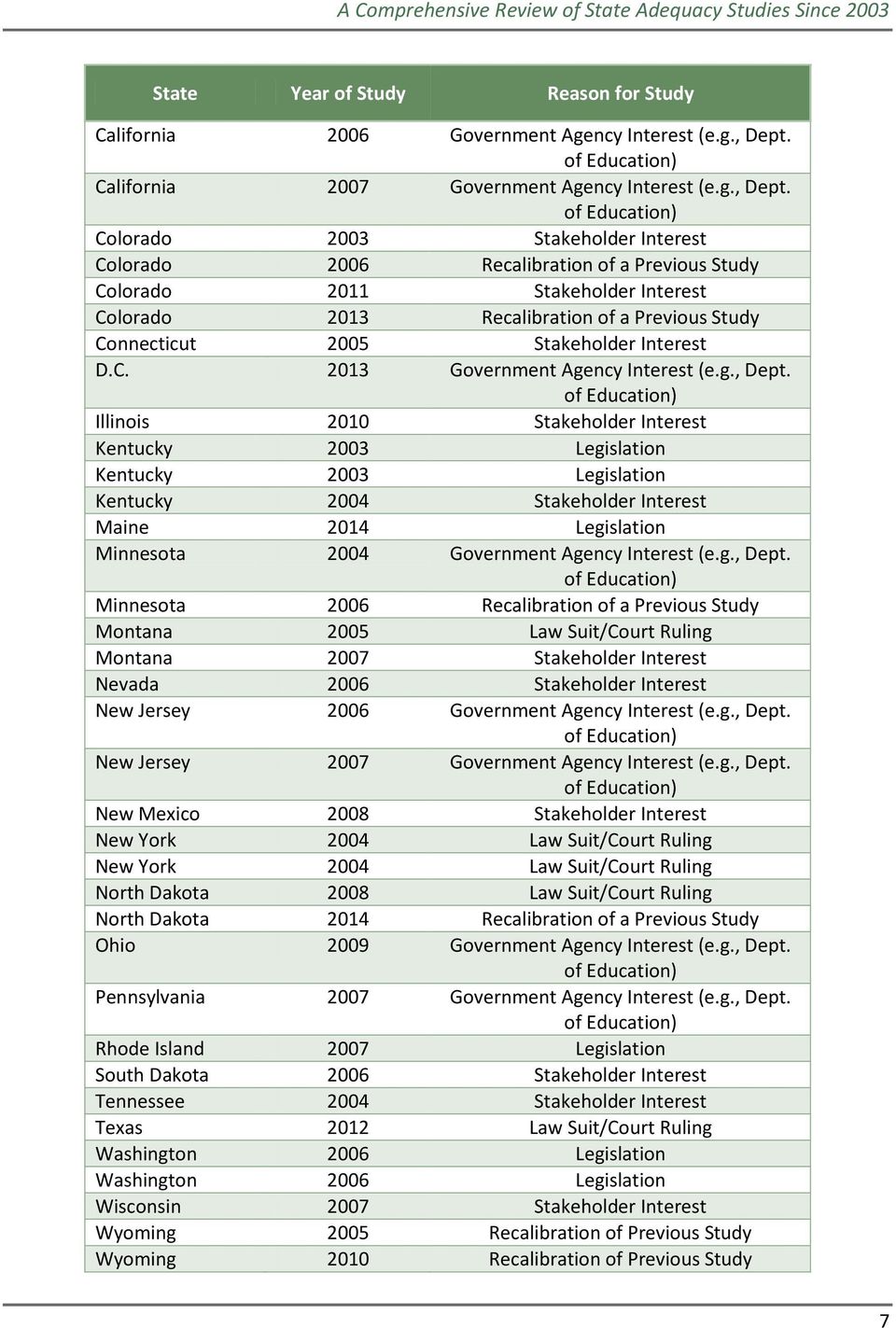
10 Chapter 1: Overview of the Adequacy Studies This chapter identifies the adequacy studies that have been conducted since 2003 and provides overview information on those studies. Specifically it identifies the organizations that conducted the studies, the reasons why each study was conducted (e.g., as a result of a lawsuit, the result of policy interest in school funding levels, etc.), and provides information on the funding levels recommended by each study. In each section of this chapter we have strived to make our analysis of the studies as comparable as possible, but in some instances direct comparisons are not feasible. Study Sample This review of state adequacy studies focuses on 39 adequacy studies that were conducted in 24 states and the District of Columbia since 2003 using three of the four approaches. This report does not include adequacy studies using the cost function approach because that methodology requires a level of data not available in Maryland. Table 1.1 summarizes the states where the adequacy studies were conducted and the number of studies in each state that were reviewed. In most states, only one study has been conducted, but in several there have been two or more. Colorado has had a total of four adequacy studies in the time frame studied, and Kentucky a total of three (with a fourth nearly complete as this report is written) 1. Table 1.2 summarizes the number of states and respective studies. Within our sample 14 states have had one study each (for this review, the District of Columbia is considered a state), nine states have had two studies, one state has had three, and one state has had four adequacy studies completed since In order to provide context to this review of adequacy studies, the first state listed in most tables is Maryland and its two 2001 adequacy studies. The first, published in June of 2001, was a professional judgment panel approach completed by Management Analysis & Planning, Inc. The second, published in September of 2001, was a professional judgment panel and successful schools approach conducted by Augenblick & Myers, Inc. Table 1.1: Summary of State Adequacy Studies, State Number of Studies Maryland 2 Arizona 1 Arkansas 2 California 2 Colorado 4 Connecticut 1 District of Columbia 1 Illinois 1 Kentucky 3 Maine 1 Minnesota 2 1 The fourth Kentucky study is not included in this analysis because the final results will not be publicly available until after the due date of this report. 3

11 State Number of Studies Montana 2 Nevada 1 New Jersey 2 New Mexico 1 New York 2 North Dakota 2 Ohio 1 Pennsylvania 1 Rhode Island 1 South Dakota 1 Tennessee 1 Texas 1 Washington 2 Wisconsin 1 Wyoming 2 Total Studies* 39 * Does not include Maryland Table 1.2: Number of States and Studies Conducted*, Number of Studies Number of States Conducted *Does not include Maryland Why Studies Were Conducted and Who Commissioned Them There are many reasons why states conduct adequacy studies. They are often the result of a court ruling holding the state school funding system unconstitutional, or legislation seeking to understand how well funding for schools stacks up to an estimate of what is needed to meet state proficiency standards. In other states, a private organization or stakeholder group commissions an adequacy study, often with the support of a charitable foundation. These often are intended to drive changes in school funding levels or formulas. Table 1.3 summarizes the types of organizations that funded adequacy studies while Table 1.4 describes the reasons such studies were undertaken. Table 1.3 shows that the largest number of studies were funded by stakeholder interest groups. Table 1.4 shows that the reason for 12 of the 39 studies was stakeholder interest, thus it is clear education support groups and child advocate groups are a powerful influence in commissioning adequacy studies in most cases with the hope the study will show more education resources are needed to fund their state s schools. 4

12 Another important sponsor of adequacy studies is state legislatures and other government agencies. These studies are often commissioned in response to a state supreme court (or possibly lower court) ruling, or conducted in anticipation of the filing of, or ruling in a school finance lawsuit. While funded through Legislative budget appropriations, some studies are managed by a Legislative office, (either through an interim committee or in some states a Legislative research office or an office established specifically to manage school funding issues), while others are managed by the state department of education, or a commission established to do the study. Of the 39 studies we reviewed, two were commissioned by the plaintiffs the 2012 Texas school funding case and the 2011 Colorado case. It is likely that other studies funded by parties to school finance litigation exist, but at present they are not part of the public literature and thus unavailable for this review. Table 1.4 also shows that seven of the studies were commissioned with the purpose of recalibrating previous studies. The Wyoming Supreme Court requires that state to recalibrate the costs of education at least every five years, and the legislation implementing Arkansas school funding plan in 2004 called for biennial updates to the model. North Dakota has no specific requirement for recalibration, but after a five-year effort to implement the 2008 study, it commissioned the 2014 study to recalibrate its per pupil funding level. Of the four studies done in Colorado, three were commissioned by a stakeholder group and one by the plaintiffs to a lawsuit. The 2006 and 2013 studies were recalibrations of the 2003 and 2011 studies respectively. Table 1.3: Organizations that Commissioned Adequacy Studies, State Year of Study Type of Organization Maryland 2001 Stakeholder Interest Group Maryland 2001 Legislature (Thornton Commission) Arizona 2004 Stakeholder Interest Group Arkansas 2003 Legislature Arkansas 2006 Legislature California 2006 Other Government Agency or Commission California 2007 Other Government Agency or Commission Colorado 2003 Stakeholder Interest Group Colorado 2006 Stakeholder Interest Group Colorado 2011 Plaintiffs in a lawsuit Colorado 2013 Stakeholder Interest Group Connecticut 2005 Stakeholder Interest Group D.C Other Government Agency or Commission Illinois 2010 Stakeholder Interest Group Kentucky 2003 State Department of Education or State Board of Education Kentucky 2003 State Department of Education or State 5

13 State Year of Study Type of Organization Board of Education Kentucky 2004 Stakeholder Interest Group Maine 2014 Legislature Minnesota 2004 Other Government Agency or Commission Minnesota 2006 Stakeholder Interest Group Montana 2005 Legislature Montana 2007 Stakeholder Interest Group Nevada 2006 Legislature New Jersey 2006 State Department of Education or State Board of Education New Jersey 2007 State Department of Education or State Board of Education New Mexico 2008 Legislature New York 2004 Stakeholder Interest Group New York 2004 Other Government Agency or Commission North Dakota 2008 Other Government Agency or Commission North Dakota 2014 Legislature Ohio 2009 Stakeholder Interest Group Pennsylvania 2007 State Department of Education or State Board of Education Rhode Island 2007 Legislature South Dakota 2006 Stakeholder Interest Group Tennessee 2004 Stakeholder Interest Group Texas 2012 Plaintiffs in a lawsuit Washington 2006 Other Government Agency or Commission Washington 2006 Other Government Agency or Commission Wisconsin 2007 Stakeholder Interest Group Wyoming 2005 Legislature Wyoming 2010 Legislature Table 1.4: Reasons Adequacy Studies Were Conducted, State Year of Study Reason for Study Maryland 2001 Stakeholder Interest Maryland 2001 Legislation Arizona 2004 Stakeholder Interest Arkansas 2003 Law Suit/Court Ruling Arkansas 2006 Recalibration of Previous Study 6

14 State Year of Study Reason for Study California 2006 Government Agency Interest (e.g., Dept. of Education) California 2007 Government Agency Interest (e.g., Dept. of Education) Colorado 2003 Stakeholder Interest Colorado 2006 Recalibration of a Previous Study Colorado 2011 Stakeholder Interest Colorado 2013 Recalibration of a Previous Study Connecticut 2005 Stakeholder Interest D.C Government Agency Interest (e.g., Dept. of Education) Illinois 2010 Stakeholder Interest Kentucky 2003 Legislation Kentucky 2003 Legislation Kentucky 2004 Stakeholder Interest Maine 2014 Legislation Minnesota 2004 Government Agency Interest (e.g., Dept. of Education) Minnesota 2006 Recalibration of a Previous Study Montana 2005 Law Suit/Court Ruling Montana 2007 Stakeholder Interest Nevada 2006 Stakeholder Interest New Jersey 2006 Government Agency Interest (e.g., Dept. of Education) New Jersey 2007 Government Agency Interest (e.g., Dept. of Education) New Mexico 2008 Stakeholder Interest New York 2004 Law Suit/Court Ruling New York 2004 Law Suit/Court Ruling North Dakota 2008 Law Suit/Court Ruling North Dakota 2014 Recalibration of a Previous Study Ohio 2009 Government Agency Interest (e.g., Dept. of Education) Pennsylvania 2007 Government Agency Interest (e.g., Dept. of Education) Rhode Island 2007 Legislation South Dakota 2006 Stakeholder Interest Tennessee 2004 Stakeholder Interest Texas 2012 Law Suit/Court Ruling Washington 2006 Legislation Washington 2006 Legislation Wisconsin 2007 Stakeholder Interest Wyoming 2005 Recalibration of Previous Study Wyoming 2010 Recalibration of Previous Study 7
15 Study Methods Over the past two decades four generally accepted approaches to estimating school finance adequacy have been developed: successful schools/districts (SSD); cost function (CF); professional judgment (PJ) and evidence-based (EB). These approaches differ in terms of underlying philosophy, the assumptions that need to be made to apply them, and the data required. Each approach is briefly summarized below. The Successful Schools/Districts Approach (SSD) The successful schools/districts approach is based on the premise that the level of resources needed to meet a set of objectives can be identified by examining the spending of schools or districts that currently meet those objectives. The approach also assumes additional funding is needed to meet the cost of serving with identified needs and districts with special circumstances. These additional amounts are determined using methods more appropriate for estimating support for with special needs. The SSD approach is most useful when the state has specified its student outcome and input objectives and districts or schools that meet them can be identified. The characteristics of the approach are the following: it is based on current practice to meet the standards; it is empirical and tangible, based on the spending of districts meeting the standard; it assumes that resources can be used in very different ways in successful districts; it focuses on the cost of providing services to with no special needs in districts with no special circumstances; and it only generates a base cost figure adjustments must be made for with identified needs and districts with special circumstances. Typically, SSD adequacy studies are conducted at the district level. There are several reasons for this, including the fact that most states report reliable expenditure data only at the district level and because district supports and strategies often contribute, at least in part, to the success of any one school in a district. Under the SSD approach, districts meeting specific performance criteria are selected and, after conducting an efficiency analysis to screen out districts with unusually high spending patterns, expenditures for general administration, general education, and operations and maintenance are analyzed and used to develop a specific amount for a per student base cost, which estimates the amount of resources required for with no special needs to successfully achieve state standards. The adequacy study that APA originally conducted in Maryland made use of a school level successful schools approach because the state has too few school districts to provide an adequate number of successful districts on which to base performance and cost comparisons. The theory behind the approach does not change based on the level of analysis district or school. Successful units are identified, their spending is examined, efficiency screens are applied where possible, and a base cost is developed based on the spending of the efficient, high-performing schools or districts. Where the approaches differ is that when working at the district level expenditure data are typically gathered from readily available state education agency fiscal reports. When schools are the unit of analysis, in nearly all states, school level expenditure data must be collected via specifically administered surveys and/or interviews with the appropriate school and district administrators and then blended with relevant district level expenditures going to support the school to ensure that all applicable resources supporting 8

16 a school are accounted for. This is the expenditure data approach used by APA in the 2001 Maryland study and the approach we propose to use again for the current study. Cost Function (CF) The cost function or statistical approach is based on understanding those factors that explain differences in spending across school districts while controlling for student performance. Because of its complexity and use of econometrics, the CF approach has proven difficult to explain in situations other than academic forums. The approach requires the availability of a significant amount of data, much of which needs to be at the school or student level in order to be most useful. No state has used the cost function approach alone to determine the parameters of a school finance formula. However, the cost function approach has been used to establish some of the adjustments states use to allocate funding sensitive to uncontrollable cost pressures, such as setting the weights for enrolled in special education programs or creating the formulas to reflect the costs associated with different enrollment levels. The SSD and CF approaches identified above are ways to estimate an adequate level of funding, but do not offer guidance about how to allocate those resources. They make no assumption that resources can or will be used differently from current practice. The next two approaches address this issue, one by relying on the expertise of education professionals and the other using the growing research evidence surrounding programs and resource use that lead to improved student learning. The Professional Judgment Approach (PJ) The professional judgment approach relies on the expertise of experienced education professionals to specify the kinds of resources, and the quantities of those resources, that would be expected to be available in order to achieve a set of objectives. This input-based approach was developed in Wyoming in the late 1990s to calculate a base cost amount in response to the state Supreme Court s requirement that the school finance system reflect the cost of the basket of goods and services needed to assure that a high school graduate could be admitted to an institution of higher education in the state. The approach uses panels of experts to specify the way education services should be delivered in order to meet state standards. Once the services have been specified (with a focus on the number and types of personnel, regular school programs, extended-day and extended-year programs, professional development, and technology), costs are attached and a per pupil cost is determined. This approach best reflects the experiences of people who are actually responsible for delivering education services, and may be combined with research results, as a rational way to specify the resources required to produce a specific level of student performance. Regardless of how the approach has been implemented, it has been designed to distribute funds through a block grant that is, without specifying exactly how money should be spent; while the professional judgment panels identify specific resources, they do so with the understanding that those resources might be employed differently in each setting to best serve the needs of a particular school or district s, but that the general level of resource identified is adequate. The advantages of the approach are that it reflects the views of actual education professionals and it is easy to understand; the disadvantages are that it tends to be based on current practice and there may 9
17 not be evidence, beyond individual experience, that the provision of money at the designated level, or even the deployment of resources as specified by the representative schools, will produce the anticipated outcomes. The approach is now often coupled with the use of evidence-based figures as a starting point in order to address some of these disadvantages. The Evidence-based Approach (EB) The evidence-based approach assumes that information gathered from research exists to define the resource needs of a hypothetical school or school district to assure that it can meet state standards. This approach was used in New Jersey in 1998 to determine the resource needs of a subset of school districts, commonly referred to as Abbott districts. The court identified these districts as requiring special attention and resources. The approach not only determined resource levels but also specified the programmatic ways such resources should be used. The strength of the approach is that it incorporates the latest research about the way services should be delivered to improve their likelihood of success. But there are disadvantages, including questions about whether research applies to all demographic situations, the lack of research information about many cost elements schools face, and the fact that the approach may not be state specific. In recent years the approach has made use of local professional judgment panels and case studies of improving schools to tailor the evidence-based model to specific state contexts. Use of the Methods in Adequacy Studies Table 1.5 identifies the methods used in each of the 39 studies we reviewed. 2 In most cases, there was a primary method or approach identified by the consultants. Some of the studies relied on a second approach to test or verify the findings. For example, many PJ studies provide panelists with a set of research findings to help guide their discussions, as noted previously. Similarly most EB studies have used panels of professionals to review and verify the EB recommendations in their particular state. In addition, recent EB studies have also included case studies of improving schools to ascertain how closely the EB strategies match the approach used by these improving schools. Some of the studies reviewed estimated adequacy findings using multiple approaches. In those cases, all of the approaches are indicated in the primary study approach column of Table 1.5. The two patterns that emerge most clearly from Table 1.5 are 1) most EB studies also have a PJ panel review the EB recommendations, and 2) most of the PJ studies have used SSD as an additional primary method to validate the base cost figures in the study. Table 1.5: Adequacy Study Methods, State Year Primary Study Secondary Approach Approach Maryland 2001 PJ Maryland 2001 PJ & SSD Arizona 2004 EB PJ 2 This review does not include adequacy studies using the cost function approach as the methodology requires a level of data not available in Maryland. 10
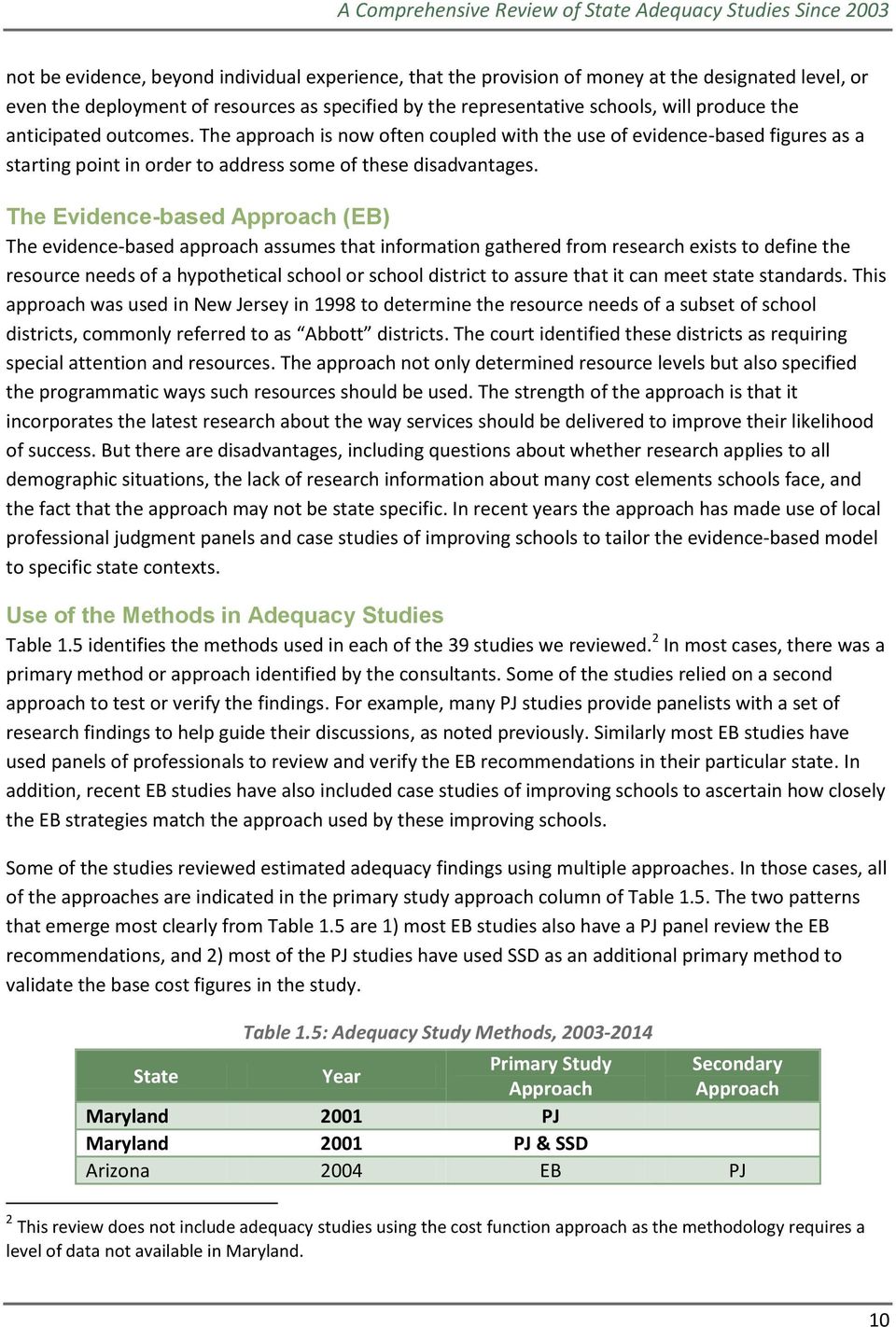
18 State Year Primary Study Secondary Approach Approach Arkansas 2003 EB PJ Arkansas 2006 EB California 2006 PJ California 2007 PJ (survey) Colorado 2003 PJ & SSD Colorado 2006 PJ & SSD Colorado 2011 PJ & SSD Colorado 2013 PJ & SSD Connecticut 2005 PJ & SSD D.C PJ & SSD Illinois 2010 EB Kentucky 2003 EB Kentucky 2003 PJ Kentucky 2004 PJ Maine 2014 EB PJ Minnesota 2004 PJ Minnesota 2006 PJ & SSD Montana 2005 PJ (survey), EB & SSD Montana 2007 PJ & SSD Nevada 2006 PJ & SSD New Jersey 2006 PJ & SSD New Jersey 2007 EB New Mexico 2008 PJ New York 2004 PJ New York 2004 SSD North Dakota 2008 EB PJ North Dakota 2014 EB PJ Ohio 2009 EB Pennsylvania 2007 PJ & SSD EB Rhode Island 2007 PJ, EB & SSD South Dakota 2006 PJ & SSD Tennessee 2004 PJ & SSD Texas 2012 EB Washington 2006 SSD Washington 2006 EB PJ Wisconsin 2007 EB PJ Wyoming 2005 EB PJ Wyoming 2010 EB Study Impact and Cost Estimates Maryland s Thornton Commission had an important impact on education funding levels in that state. Its work led to annual increases in state and local funding between 2002 and Many adequacy studies 11

19 have had similar impacts, while others have not led to much change in their state. In states with Supreme Court rulings (e.g. Wyoming and Arkansas), major changes in the distribution formula as well as substantial new funding for schools resulted from adequacy studies and the recalibration of those studies. In other states adequacy studies received considerable attention, but little action for changing funding formulas emerged directly from the study. For example, California s two studies conducted as part of a larger group of studies collectively known as Getting Down to Facts, had very little direct impact on school funding in the state although some of the initial modeling developed for one of the studies did help in the simulations used to support the successful revision of California s funding formula several years later. Ohio represents a somewhat different outcome. In 2009, Governor Ted Strickland announced during his state of the state address that Ohio would move to an evidence-based approach to fund schools, and proposed a new funding formula based on the EB model modified to meet Ohio s specific characteristics. The Ohio study reviewed for this analysis does not estimate the cost of adequacy, but rather was commissioned by a charitable foundation to compare the Governor s proposal with the generic EB model. Similarly, the 2007 New Jersey study was a review and comparison of the EB model with a previous adequacy study done in the state that used PJ and SSD methods. In Pennsylvania, the recommendations of the 2007 study conducted for the State Board of Education were largely adopted by then Governor Rendell, who in 2008 proposed the implementation of a new school funding formula that would phase in the report s recommendations over a six-year period. While implementation made progress during the Rendell administration, subsequent legislative action has reversed much of this work. Table 1.6 summarizes the increase in total and per pupil funding recommended in each of the studies for which such data can be derived. Some studies reported total funding while others provided estimates of funding per pupil. In a few studies, multiple funding recommendations were reported based on the different adequacy approaches. The studies rarely, if ever, indicated the degree to which the recommended new per pupil levels would be funded with state or local revenues. This omission is appropriate as this should be a state policy decision, generally starting with the Legislature. In several studies, recommended funding changes were presented as a range, rather than a single estimate. When that occurred, we used the average of the range or amounts reported. If multiple adequacy approach results were reported in one study, Table 1.6 contains additional lines for each reported amount. The corresponding approach is documented in the notes column of the table. Some studies reported both total funding changes and changes in funding per pupil. When only one of those amounts was reported (generally only the change in total funding) we used the state s total enrollment as reported in the NEA Rankings and Estimates Documents for the appropriate year and computed the missing information. In some instances, the estimated change in total funding was not included in the study (see for example, Ohio). 12
20 The Wyoming 2010 study, which was a recalibration of the 2005 study, is unique in that the authors found that state appropriations for K-12 education exceeded current EB estimates of adequacy and that additional resources to fund schools were not necessary. State Table 1.6: Summary of Adequacy Study Funding Recommendations, Year of the Study Total Additional Funding (in millions) Per Pupil Funding Change Needed Implementation of Study Results Notes Maryland 2001 $300 $352 Not Implemented PJ Low Estimate $1,800 $2,110 Not Implemented PJ High Estimate Maryland 2001 $2,879 $3,375 Implemented PJ $2,022 $2,371 Thornton Commission recommendation of $1.8 Billion SSD Arizona 2004 $1,325 $1,428 Not Implemented EB Arkansas 2003 $847 $1,903 Implemented EB Arkansas 2006 $220 $485 Not Implemented EB California 2006 $24,140 $32,010 $3,826 $5,073 Not Implemented Not Implemented PJ Low Estimate PJ High Estimate California 2007 $19,474 $3,099 Not Implemented PJ survey Colorado 2003 N/A N/A Not Implemented PJ Colorado 2006 $700 $2,078 Colorado 2011 $1,350 $3,580 Colorado 2013 $2,650 $4,060 Connecticut 2005 $46 $2,020 $959 $2,848 $1,633 $4,331 $3,089 $4,733 $801 $3,503 Not Implemented Not Implemented Not Implemented Not Implemented Not Implemented Not Implemented Not Implemented Not Implemented D.C $182 $2,176 Partially Implemented Illinois 2010 $3,540 $1,750 Not Implemented EB Kentucky 2003 $740 $1,176 Not Implemented EB Kentucky 2003 $1,800 $2,861 Not Implemented PJ Kentucky 2004 $1,230 $1,955 Not Implemented PJ Maine 2014 $327 $873 Too early to determine Minnesota 2004 N/A N/A N/A PJ Minnesota 2006 $1,789 $2,258 Not Implemented PJ SSD PJ SSD PJ SSD PJ SSD PJ PJ EB 13

21 State Year of the Study Total Additional Funding (in millions) Montana 2005 $96 $329 $21 Per Pupil Funding Change Needed Implementation of Study Results Notes $1,059 $1,384 Not Implemented SSD $660 $2,262 $142 Not Implemented Not Implemented Not Implemented Montana 2007 $725 $5,021 Not Implemented PJ Nevada 2006 $80 $1,321 $231 $3,579 Not Implemented Not Implemented New Jersey 2006 $200 $144 Implemented PJ New Jersey 2007 N/A N/A Implemented EB New Mexico 2008 $335 $1,034 Not Implemented PJ New York 2004 $6,210 $8,400 $2,200 $2,976 Not Implemented Not Implemented New York 2004 $4,800 $2,445 Partially Implemented SSD PJ EB SSD PJ PJ Low Estimate PJ High Estimate North Dakota 2008 $300 $976 Implemented EB North Dakota 2014 N/A N/A N/A EB Ohio 2009 N/A N/A N/A EB Pennsylvania 2007 $4,378 $2,414 Partially SSD/PJ/EB Implemented Rhode Island 2007 $93 $205 $57 South Dakota 2006 $134 $406 $570 $1,262 $349 $1,148 $3,324 Not Implemented Not Implemented Not Implemented Not Implemented Not Implemented Tennessee 2004 $1,114 $1,284 Not Implemented PJ Texas 2012 N/A N/A N/A EB Washington 2006 N/A N/A N/A EB Washington 2006 $183 $178 Partially Implemented Wisconsin 2007 $786 $888 Not Implemented EB Wyoming 2005 $327 $3,903 Implemented EB Wyoming Implemented EB SSD SSD PJ EB SSD PJ SSD Who Conducted the Studies? A review to ascertain which consultants conducted these studies shows that most of the adequacy studies completed between 2003 and 2014 were led by two firms; Augenblick, Palaich & Associates and 14
22 Picus Odden & Associates (in some instances under different firm names but with generally the same leadership staff). Table 1.7 summarizes the number of studies done by each firm, not including Maryland s two 2001 adequacy studies. There were three studies done by multiple firms during this time, including two in which Augenblick, Palaich & Associates partnered with another firm. Table 1.7: Number of Adequacy Studies Conducted, by Consulting Firm*, Firm Conducting Study Number of Studies Picus Odden & Associates 16 Augenblick, Palaich & Associates 11 American Institutes for Research 2 R. Craig Wood and Associates 2 Multiple Firms 3 Public Policy Institute of California 1 National Louis University 1 Deborah Verstegen 1 Management Analysis and Planning 1 Standard and Poor s 1 *Does not include Maryland Table 1.8 lists all 39 studies since 2003 and the two Maryland 2001 studies, and indicates the publication year for each study and the consultant conducting the work, including Maryland s two 2001 studies. The first, published in June of 2001, was a professional judgment panel approach done by Management Analysis & Planning, Inc. The second, published in September of 2001 was a professional judgment panel and successful schools approach done by Augenblick & Myers, Inc. Table 1.8: State Adequacy Studies, Study # State Year Consultant Maryland 2001 MAP Maryland 2001 APA 1 Arizona 2004 POA 2 Arkansas 2003 POA 3 Arkansas 2006 POA 4 California 2006 AIR 5 California 2007 PPIC 6 Colorado 2003 APA 7 Colorado 2006 APA 8 Colorado 2011 APA 9 Colorado 2013 APA 10 Connecticut 2005 APA 11 District of Columbia 2013 APA and the Finance Project 12 Illinois 2010 National Louis University 13 Kentucky 2003 POA 14 Kentucky 2003 POA 15 Kentucky 2004 Deborah Verstegen 15
23 Study # State Year Consultant 16 Maine 2014 POA 17 Minnesota 2004 MAP 18 Minnesota 2006 APA 19 Montana 2005 R. Craig Wood and Associates 20 Montana 2007 APA 21 Nevada 2006 APA 22 New Jersey 2006 APA/New Jersey Dept. of Education 23 New Jersey 2007 POA 24 New Mexico 2008 AIR 25 New York 2004 AIR and MAP 26 New York 2004 Standard and Poor s 27 North Dakota 2008 POA 28 North Dakota 2014 POA 29 Ohio 2009 POA 30 Pennsylvania 2007 APA 31 Rhode Island 2007 R. Craig Wood and Associates 32 South Dakota 2006 APA 33 Tennessee 2004 APA 34 Texas 2012 POA 35 Washington 2006 POA 36 Washington 2006 POA 37 Wisconsin 2007 POA 38 Wyoming 2005 POA 39 Wyoming 2010 POA POA Picus Odden & Associates (Also Lawrence O. Picus and Associates) APA Augenblick, Palaich & Associates (Also Augenblick & Myers) AIR American Institutes for Research MAP Management Analysis and Planning 16
24 Chapter 2: Assumptions and Programmatic Elements Used in the Studies The purpose of an adequacy study is to estimate an adequate level of resources needed to provide all the opportunity to meet state proficiency standards. The SSD approach identifies districts or schools that meet an agreed upon set of standards, determines the per pupil expenditures at that school and applies that estimate (with adjustments for student characteristics like poverty, ELL status and special education needs generated using other methods) to all districts in the state to get an estimate of total funding needs. Although none of the studies reviewed here used the CF approach, it relies on district level data on expenditures, student characteristics and desired student outcomes in a series of regression equations to develop coefficients that can be applied to individual school districts to predict needed spending levels. The PJ and EB approaches use prototypical schools as the basis for estimating adequacy. Each establishes one or more typical schools at the elementary (K-5), middle (6-8) and high school (9-12) levels to estimate the resources and their costs needed to meet the educational needs of the so they can perform at high levels (personnel and dollar resources), and aggregates those estimates to the district level. The model then adds estimated district central office costs to the total and sums the estimates across districts to arrive at a total estimated cost for the state. In some recent EB studies, the prototypical school resources are used to estimate average per pupil costs. These include school level costs, adjustments for struggling (poverty, ELL and special education) as well as district central office costs and adjustments for small districts. These per pupil cost estimates are then applied to the student enrollment and characteristics of either the entire state or to each individual district and summed to get a statewide estimated cost of adequacy. The main difference between PJ and EB studies is that the parameters of the EB model are more consistent across studies than are the parameters of the PJ models which tend to be more state specific. This is a result of the way each method develops the resources to cost out in prototypical schools. PJ models develop the parameters based upon the knowledge and experience of state education professionals and they tend to vary from state to state based upon each state s unique set of standards. EB estimates begin with more uniform research-based parameters for prototypical schools and then seek input as to the appropriateness of those parameters from a panel of the state s professional educators. The data below show more variation in the characteristics of the PJ studies than the EB studies. In the tables that follow, we identify the programmatic elements found in adequacy studies and show how they vary across the 39 studies. The elements we consider include: Prototypical schools Core teachers Elective teachers Instructional coaches Special Education staff Other school staff 17
25 o At-risk staff o Summer school o Extended day o Tutors o Pupil support o ELL staff Funds for purchasing materials, technology and professional development The information reported below pertains almost entirely to PJ and EB studies. There are two reasons for this. First, almost all of the studies reported here used one or both of these methods. Second, the SSD and CF approaches don t rely on the development of a prototypical school, but rather use district or school level data to derive estimates of adequacy school funding. It is important to note that the 39 studies are not consistent in what they report about methods and assumptions, so the information in the tables often appears incomplete. We have worked to develop consistent comparisons to the extent that is possible. Prototypical Schools Both the PJ and EB approaches rely on prototypical schools to establish the range of resources that should be provided. In almost all cases, the studies rely on prototypical elementary, middle and high schools, although in some cases K-8 or K-12 schools may also be estimated. PJ studies often have multiple levels of prototypical schools based on the size of the district. These schools are often referred to as hypothetical or representative schools. District size categories are developed first using actual state data to identify four or five size categories that are representative of the state s school districts. These district size categories typically consist of very small, small, medium, large and very large districts. Next, an analysis of the school sizes found within each district size category is undertaken to develop the hypothetical or representative school sizes within each category. This process results in a total of up to 15 prototypical schools that are similar in size to actual schools found in each district size category. Per pupil costs are estimated for each of the prototypical school and then used to estimate total school costs for every school that fits into the enrollment size category. The size ranges for the district categories vary across the studies and are determined based on the characteristics of the schools and districts in each state. In the analysis that follows, for the studies with more than three prototypical schools, we report the parameters of the prototypical schools in the moderate or medium size district and provide additional information about the category sizes in footnotes to Table 2.1. EB studies generally rely on only three prototypical schools (elementary, middle, and high schools) for a state and then establish algorithms for pro-rating resources up or down for schools of different sizes. In recent years EB studies have used elementary and middle schools with 450 and high schools of 600. These school sizes have evolved from reviews of research on the optimal or most effective school sizes, emphasizing research that includes both size as well as student performance. These literature reviews are included, sometimes in abbreviated form in the adequacy studies themselves, but are also available in Odden and Picus (2014). 18
26 Table 2.1 summarizes the prototypical school size used in each of the 39 studies where such was identified. Table 2.1: Prototypical School Size * Prototypical School Size Maryland ,000 Maryland ,000 Arizona Arkansas Arkansas California 2006 N/A N/A N/A California ,759 Colorado* Colorado* Colorado* Colorado* Connecticut ,400 D.C.* ,000 Illinois Kentucky Kentucky Kentucky Maine Minnesota* Minnesota* Montana Montana* Nevada* ,250 New Jersey* ,640 New Jersey ,640 New Mexico 2008 NA NA NA New York 2004 NA NA NA New York 2004 NA NA NA North Dakota North Dakota Ohio Pennsylvania* 2007 NA NA NA Rhode Island South Dakota Tennessee ,064 Texas
27 Prototypical School Size Washington Washington 2006 NA NA NA Wisconsin Wyoming Wyoming *In studies where multiple prototype sizes were used, the midsize is reported in the table and the states are indicated with an *. Core Teachers Teachers represent the largest component of school district expenditures. Most PJ and EB studies provide estimates for both core and elective teachers; though PJ studies, particularly for secondary schools, often present a total teacher figure without distinguishing between core and elective. Core teachers are regular classroom teachers. In elementary schools, they typically are responsible for a classroom all day (with time for planning). In middle and high schools with departmentalized instruction, core teachers focus on math, language arts, science, social studies and world languages. Elective teachers (discussed in the next section) provide for planning time in elementary schools and teach elective courses at middle and high schools. Table 2.2 shows how the number of core teachers is estimated for each of the studies. The most common approach is to provide a ratio of the number of to a teacher. For example, most of the EB studies use ratios of 15:1 for grades K-3 (this includes prekindergarten when it is part of the study) and 25:1 for grades This may vary due to past practice (Wyoming) or state requirements (Arkansas). The core teacher ratios vary more in the PJ studies and are sometimes reported in different formats. For example the Colorado and Connecticut studies estimate core teachers based on the number of teachers per 1,000 to make numbers comparable across all of the prototype schools, although this can be converted easily to the pupil/teacher ratios reported in most of the studies. Some of the larger ratios are also a function of combining elective teachers with core teachers rather than identify them separately. This is noted in Table 2.3. Elective Teachers Elective teachers are included in most of the adequacy studies in this sample. Generally, elective teachers at the elementary level teach art, music and physical education (PE) classes to provide time for core teachers to plan and collaborate. At the middle and high school level core teachers are used to offer non-core elective classes. Table 2.3 shows how elective teachers were allocated in the studies we reviewed. The EB studies typically estimate elective teachers at 20% of the number of core teachers at the elementary and middle school levels. Early EB studies use the same percentage at the high school level although more recent ones typically use 33% elective teachers so that high schools can use block schedules and still provide a daily planning period for all teachers. 20
28 The PJ studies show more variation (as they do with core teachers). Some of the studies identify a percentage, others provide a number of elective teachers for a prototypical school, others identify the number of elective teaches per 1,000, while others do not distinguish between core and elective teachers. Instructional Coaches Coaches, or instructional facilitators, coordinate the instructional program and ongoing instructional coaching and mentoring for teachers. There is growing evidence that coaches are an important component of improved schools (Lockwood, McCombs & Marsh, 2010; Marsh, McCombs & Martorell, 2010; and Pianta, Allen & King, 2011). Many of the adequacy studies we reviewed include coaches in their cost estimates as shown in Table 2.4. The EB studies are most consistent, generally resourcing schools with 1 coach for every 200 or 2.25 coaches for a prototypical school of 450 and 3 coaches for a prototypical school of 600. There is again more variation in the allocation of coaching resources in the PJ studies when they are included based upon different state approaches to coaching. For example, some states do not have separate instructional coaches but instead rely on mentor teachers with added release time to coach other teachers. Of the 39 studies, only 19 include instructional coaches in the cost estimates. One study in Montana includes them as elective or specialist teachers. Special Education Provision of special education is critical to estimating the costs of adequacy. Two approaches were identified in the studies. In some instances, primarily EB studies, a census-based approach was used. In those instances additional staff were included at the school site to provide special education services for children with mild and moderate disabilities while it was recommended that services for children with severe disabilities be funded entirely by the state. Over time the special education allocation has changed from one teacher and a half-time aid for every 150 to one teacher and one full-time aid for every 150. This change appears to be based on feedback from PJ panels that were part of most EB studies. The PJ approach often looks at resources for disaggregated special education categories, such as mild, moderate or severe based upon disabilities or service need levels. Twelve studies recommended a weighted student approach to funding special education. Table 2.5 summarizes the weights that were used in these 12 studies. The other studies used some combination of either a specific dollar amount, or included Special Education in another category. In Wyoming, special education was not specifically addressed since all approved special education costs are fully funded by the state. In general, special education allocations were state specific and cannot be easily summarized. For Maryland, we recommend using the recommendations that emerge from the EB and PJ studies and developing state specific cost estimates based on current approaches and the special education student counts for the state. 21
29 Other School Staff Schools rely on a range of other staff to provide services to. We found substantial variation in the types and allocation of staff positions across the studies. Position titles varied across the studies and the expected services each provided varied as well. The following tables provide a summary of these staff allocations across the 39 studies. Table 2.6 At Risk Students Table 2.7 Summer School Table 2.8 Extended Day Programs Table 2.9 Tutors Table 2.10 Pupil Support Staff Table 2.11 ELL Salary Estimates and Regional Cost Differences Employee compensation represents the largest component of any school district s expenditures and relatively the largest portion of the total cost of adequacy estimates. Therefore the choice of compensation levels used in the model is critical. The total cost of salaries and benefits will drive the total cost of any adequacy study. Our analysis found that PJ studies typically rely on statewide average teacher salary and benefit rates and apply them to the number of positions in each category as part of the total cost of adequacy. Cost of living adjustments are often made to these averages to account for variation, as discussed in further detail below. In some states (e.g., South Dakota 2008, Connecticut 2011), the PJ panels recommended that the statewide averages be adjusted to be more competitive with other states. This cost was then reflected in the final cost estimates. Benefit rates in PJ studies vary from state to state based upon available data for the state or districts, but consistently are in the range of 23% to 35%. EB studies similarly rely on state average salaries to estimate total costs. In early EB studies, average benefit costs were also typically used. However, in recent studies the authors have noted that there is substantial variation in the types of benefits paid to school district employees. This is mostly the result of variation in health care costs. Other benefits such as retirement, Social Security, and Workers Compensation are typically funded based on a percentage of salary and thus straightforward to estimate if the rates for those benefits are accurately measured. On the other hand, health benefits vary widely in terms of both the level and the type of coverage as well as the number of family members covered. Average costs are difficult to estimate. In one recent study, the 2014 North Dakota recalibration, study consultants suggested estimating health care costs using the costs of providing health care for North Dakota state employees. The average amount paid per employee (not a percentage) was used for health care costs and added to the benefits component of compensation. While this approach is logical, the higher cost of health insurance led to increased benefit rates, particularly for classified employees who typically have relatively low salaries. While this approach may produce a more realistic estimate of the cost of providing health care benefits, it suggests earlier estimates using an overall percentage of salary figure may have potentially underestimated these costs in the past. 22
30 Both EB and PJ studies develop models that have the capability of simulating various compensation levels (typically allowing salary, percentage-based benefits and health care costs per employee to vary) so that sensitivity analyses related to variation in the level of salary and benefits can be estimated. The majority of studies, regardless of methodological approach, take into account the regional cost differences in a particular state by applying, or suggesting, an index that adjusts education costs to account for these differences. In some cases, the research team developed the index. For example, in New Mexico, the research team estimated a Geographical Cost of Education Index (GCEI) to account for differences in demand and salary for personnel. Likewise, the research team in Pennsylvania used a Location Cost Metric (LCM) to reflect cost of living differences across the state. Many other studies rely on the Comparable Wage Index that was developed with the support of the National Center for Education Statistics and updated on an annual basis. The Wyoming study in 2005 developed a Hedonic Wage Index to replace a Wyoming computed price index that was in use at the time. The two indexes were centered at the state average, which meant that some districts actually received a negative adjustment if the costs in their geographic area were less than the state average. A final compromise provided each district with the higher of the two indexes, or a value of 1.0, whichever is higher. That compromise remains the approach used in Wyoming today. Table 2.2: Core Teachers Maryland Maryland (per school) 36 (per school) 69 (per school) Arizona 2004 K-3: 15, 4-5: : : 25 Arkansas 2003 K-3: 15, 4-5: : : 25 Maximum of 150 per semester Arkansas 2006 Kindergarten: 10; Grades 4-12: 25 Grades 4-12: 25 Grades 1-3: 23; Grades 4-12: 25 California 2006 NA NA NA California 2007 K: 5.2; Gr 1-5: (per school) 52.4 (per school) (per school) Colorado per 1, per 1, per 1,000 Colorado per 1, per 1, per 1,000 Colorado per 1, per 1, per 1,000 Colorado per 1, per 1, per 1,000 Connecticut per 1, per 1, per 1,000 D.C (per school) 32 (per school) 53.3 (per school) Illinois 2010 K-3rd Grade: 15, 4th- 4th-12th Grade: 25 4th-12th Grade: 25 23
31 12th Grade: 25 Kentucky 2003 K-3:15, 4-5: Kentucky 2003 K-3: 15, 4-5: Kentucky (per school) 27 (per school) 44.8 (per school) Maine 2014 Preschool: 15, K-3: , 4-5: 25 Minnesota 2004 K: 4; Gr 1-5: (per school) 34 (per school) Total: 21.5 (per school) Minnesota 2006 K: 4; Gr 1-5: (per school) 34 (per school) Total: 21.5 (per school) Montana (per school) 13 (per school) 20 (per school) Montana (per school) 5.8 (per school) 16.3 (per school) Nevada (per school) 30(per school) 65 (per school) New Jersey (per school) 43 (per school) 128 (per school) New Jersey 2007 K-3: 17.8, 4-5: 5.3, 24 (per school) 65.6 (per school) Total: 23.1 (per school) New Mexico 2008 NA NA NA New York (per school) 22.6 (per school) 24.3 (per school) New York 2004 NA NA NA North Dakota 2008 K-3: 15, 4-5: : : 25 North Dakota 2014 K-3: 15, 4-5: : : 25 Ohio 2009 K-3: 15, 4-5: Pennsylvania 2007 NA NA NA Rhode Island (per school) 31.5 (per school) 52 (per school) South Dakota (per school) 11 (per school) 18.5 (per school) Tennessee (per school) 20 (per school) 40.5 (per school) Texas 2012 K-3: 15, 4-5: : : 25 Washington 2006 K-3: 15, 4-5: : : 25 Washington 2006 NA NA NA Wisconsin 2007 K-3: 15, 4-5: : : 25 Wyoming Wyoming Note: Values in each cell represent a ratio unless otherwise noted 24
32 Table 2.3: Elective Teachers Maryland Maryland (per school) 9 (per school) Included with core Arizona % of core 20% of core 33% of core Arkansas % of core 20% of core 20% of core Arkansas % of core 20% of core 20% of core California 2006 NA NA NA California Colorado per 1, per 1, per 1,000 Colorado per 1, per 1, per 1,000 Colorado 2011 Included with core Included with core Included with core Colorado 2013 Included with core Included with core Included with core Connecticut per 1, per 1,000 Included with core D.C Included with core Included with core Illinois % over core teachers 20% over core teachers 33% over core teachers Kentucky % of core 20% of core 20% of core Kentucky % of core 20% of core 20% of core Kentucky Maine % of core 20% of core 33% of core Minnesota Minnesota Montana 2005 Included with core Included with core Included with core Montana Nevada Included with core New Jersey % of core 20% of core 30% of core New Jersey % of core 20% of core 30% of core New Mexico 2008 NA NA NA New York 2004 Included with core Included with core Included with core New York 2004 NA NA NA North Dakota % of core 20% of core 33% of core North Dakota % of core 20% of core 1/3 of core Ohio % (same) 20% (same) 25% (33%) Pennsylvania 2007 NA NA NA Rhode Island South Dakota Included with core Tennessee Texas % of core 20% of core 33% of core 25
33 Washington % of core 20% of core 33% of core Washington 2006 NA NA NA Wisconsin % of core 20% of core 33% of core Wyoming % of core 20% of core 20% of core Wyoming % of core 20% of core 33% of core Table 2.4: Instructional Coaches Maryland 2001 not included not included not included Maryland 2001 not included not included not included Arizona Arkansas Arkansas 2006 Minimum: 2.0; $270.95/pupil (schools may use up to.05 for Asst Principals Minimum: 2.0; $270.95/pupil (schools may use up to.05 for Asst Principals Minimum: 2.0; $270.95/pupil (schools may use up to.05 for Asst Principals California 2006 NA NA NA California Colorado 2003 not included not included not included Colorado 2006 not included not included not included Colorado per 1,000 2 per 1,000 2 per 1,000 Colorado per 1,000 2 per 1,000 2 per 1,000 Connecticut 2005 not included not included not included D.C Illinois per per per 200 Kentucky full time instructional facilitators with a minimum of full time instructional facilitators with a minimum of full time instructional facilitators with a minimum of 1 Kentucky Kentucky Maine instructional coach for every instructional coach for every instructional coach for every 200 Minnesota 2004 NA NA NA Minnesota 2006 NA NA NA 26
34 Montana 2005 not included not included not included Montana 2007 included in Specialist teachers included in Specialist teachers included in Specialist teachers Nevada New Jersey New Jersey New Mexico 2008 NA NA NA New York 2004 NA NA NA New York 2004 NA NA NA North Dakota North Dakota Ohio 2009 One for each organizational unit (One for every 200 ) One for each organizational unit (One for every 200 ) One for each organizational unit (One for every 200 ) Pennsylvania 2007 NA NA NA Rhode Island 2007 not included not included not included South Dakota 2006 not included not included not included Tennessee 2004 not included not included not included Texas per 200 : per 200 : per 200 : 3.0 Washington Washington 2006 NA NA NA Wisconsin Wyoming Wyoming Table 2.5: Special Education Weights State Year Special Education Weight Maryland 2001 not included in study Maryland Colorado Colorado Colorado for mild; 1.93 for moderate; 5.2 for severe Colorado for mild; 1.93 for moderate; 5.2 for severe Connecticut for mild; for moderate; for severe 27
35 State Year Special Education Weight D.C Level 1:.88; Level 2: 1.08; Level 3: 1.77; Level 4: 3.13 Kentucky Minnesota Montana for mild; 1.32 for moderate; 2.93 for severe Nevada for mild; 1.28 for moderate; 2.52 for severe Pennsylvania South for mild, 1.86 for moderate; 4.21 for severe Dakota Tennessee for mild; 1 for moderate; 3.45 for severe Table 2.6: At Risk Students Maryland 2001 $364 per pupil $203 per pupil $181 per pupil Maryland 2001 $9,165 per pupil (atrisk weight) $9,165 per pupil (atrisk weight) $9,165 per pupil (atrisk weight) Arizona 2004 EB* EB* EB* Arkansas 2003 EB* EB* EB* Arkansas 2006 EB* EB* EB* California 2006 NA NA NA California 2007 NA NA NA Colorado 2003 $3,146 per pupil (atrisk weight) Colorado 2006 $3,146 per pupil (atrisk weight) Colorado additional staff, depending on district size, for low concentration (20%) at risk; 1.88 for moderate concentration (40%) at risk; 2.25 for high concentration (60%) at risk $2,204 per pupil (atrisk weight) $2,204 per pupil (atrisk weight) 3.36 additional staff, depending on district size, for low concentration (20%) at risk; 3.8 for moderate concentration (40%) at risk; 4.59 for high concentration (60%) at risk $2,430 per pupil (atrisk weight) $2,430 per pupil (atrisk weight) 5.04 additional staff, depending on district size, for low concentration (20%) at risk; 5.47 for moderate concentration (40%) at risk; 7.05 for high concentration (60%) at risk 28
36 Colorado additional staff, depending on district size, for low concentration (20%) at risk; 1.88 for moderate concentration (40%) at risk; 2.25 for high concentration (60%) at risk Connecticut teachers, 2 aides, and 2 tutors for moderate concentration at-risk D.C teachers, 3 instructional aides, 2.5 support staff 3.36 additional staff, depending on district size, for low concentration (20%) at risk; 3.8 for moderate concentration (40%) at risk; 4.59 for high concentration (60%) at risk 6 tutors for moderate concentration at-risk 7.5 teachers, 3.6 intervention teachers, 3.6 pupil support 5.04 additional staff, depending on district size, for low concentration (20%) at risk; 5.47 for moderate concentration (40%) at risk; 7.05 for high concentration (60%) at risk 2 teachers 12.4 teachers, 6 intervention teachers, 6 pupil support, 2 security personnel Illinois 2010 EB* EB* EB* Kentucky 2003 EB* EB* EB* Kentucky 2003 EB* EB* EB* Kentucky Maine 2014 NA NA NA Minnesota 2004 NA NA NA Minnesota 2006 NA NA NA Montana 2005 $1,193 per pupil $1,789 per pupil $2,385 per pupil Montana 2007 NA NA NA Nevada teachers, 1 pupil support,.8 instructional facilitator,.2 tutor,.5 parent liaison,.3 clinical aide 2 teachers, 1 pupil support,.8 instructional facilitator, 1 parent liaison,.3 clinical aide 1 instructional aide,.8 instructional facilitator, 2 tutors, 1 parent liaison,.3 clinical aide New Jersey % 160** 40% 240** 40% 656** New Jersey % 160** 40% 240** 40% 656* New Mexico 2008 NA NA NA New York 2004 NA NA NA New York 2004 NA NA NA North Dakota 2008 EB* EB* EB* North Dakota 2014 EB* EB* EB* Ohio 2009 EB* EB* EB* Pennsylvania 2007 NA NA NA Rhode Island 2007 NA NA NA South Dakota teachers, 4 aides,.5 2 teachers, 4 aides,.4 1 teacher,.5 pupil 29
37 pupil support pupil support support Tennessee teachers,.75 aides 4 teachers, 3 aides 5 teachers, 5 aides, 1 pupil support Texas 2012 NA NA NA Washington 2006 EB* EB* EB* Washington 2006 EB* EB* EB* Wisconsin 2007 EB* EB* EB* Wyoming 2005 EB* EB* EB* Wyoming 2010 EB* EB* EB* *Evidence Based Studies provide resources for tutors, pupil support personnel, summer school, extended day, and ELL programs to serve at risk. Each of these categories is included in subsequent tables. ** Second number reported for New Jersey studies represents school size. Table 2.7: Summer School Maryland 2001 not included not included not included Maryland 2001 not included not included not included Arizona 2004 not included not included not included Arkansas 2003 existing amounts carried forward Arkansas FTE per 100 atrisk, paid at 25% of salary, which is equivalent to 1 FTE per 120 at-risk existing amounts carried forward 3.33 FTE per 100 atrisk, paid at 25% of salary, which is equivalent to 1 FTE per 120 at-risk existing amounts carried forward 3.33 FTE per 100 atrisk, paid at 25% of salary, which is equivalent to 1 FTE per 120 at-risk California 2006 NA NA NA California 2007 For 120 For 271 For 599 Colorado 2003 $177 per pupil $157 per pupil $35 per pupil Colorado 2006 $177 per pupil $157 per pupil $35 per pupil Colorado 2011 NA NA NA Colorado 2013 NA NA NA Connecticut 2005 included in At-Risk resources included in At-Risk resources included in At-Risk resources 30
38 D.C % of at-risk for 6 weeks full day, K-3 at 15:1 teacher ratio, all others 20:1 teacher ratio, 1 social worker, 2 instructional aides, 1 security personnel, plus $500 per pupil for interventions Illinois :1 for half of the who qualify for free or reducedprice lunch (FRL) 100% of at-risk for 6-8 weeks full day, 30:1 teacher ratio, 1 social worker, 1 security personnel, plus $500 per pupil for interventions 15:1 for half of the who qualify for free or reducedprice lunch (FRL) 100% of at-risk for 6-8 weeks full day, 30:1 teacher ratio, 2 security personnel, plus $100 per pupil for Summer Bridge for 9th graders; Summer Enrichment for all, 4 weeks, 3 hours, 4 days per week, 20:1 teacher ratio 15:1 for half of the who qualify for free or reducedprice lunch (FRL) Kentucky 2003 not included not included not included Kentucky 2003 not included not included not included Kentucky 2004 included in At-Risk resources included in At-Risk resources included in At-Risk resources Maine FTE per 100 atrisk, paid at 25% of salary, which is equivalent to 1 FTE per 120 at-risk 3.33 FTE per 100 atrisk, paid at 25% of salary, which is equivalent to 1 FTE per 120 at-risk 3.33 FTE per 100 atrisk, paid at 25% of salary, which is equivalent to 1 FTE per 120 at-risk Minnesota 2004 NA NA NA Minnesota 2006 NA NA NA Montana 2005 $400 per pupil not meeting proficiency $400 per pupil not meeting proficiency $400 per pupil not meeting proficiency Montana 2007 not included separately not included separately not included separately Nevada 2006 included in At-Risk resources included in At-Risk resources included in At-Risk resources New Jersey (extended school year) 1.5 (extended school year) 1.5 (extended school year) New Jersey New Mexico 2008 NA NA NA New York 2004 NA NA NA New York 2004 NA NA NA North Dakota FTE per 100 at FTE per 100 at FTE per 100 at- 31
39 risk, paid at 25% of salary, which is equivalent to 1 FTE per 120 at-risk North Dakota FTE per 100 atrisk, paid at 25% of salary, which is equivalent to 1 FTE per 120 at-risk Ohio 2009 $3,000 per summer teacher. Number of summer teachers is based on half the number of economically disadvantaged children with a class size of 30 (.25 FTE certified teachers for 1/2 of in poverty with a class size of 15) risk, paid at 25% of salary, which is equivalent to 1 FTE per 120 at-risk 3.33 FTE per 100 atrisk, paid at 25% of salary, which is equivalent to 1 FTE per 120 at-risk $3,000 per summer teacher. Number of summer teachers is based on half the number of economically disadvantaged children with a class size of 30 (.25 FTE certified teachers for 1/2 of in poverty with a class size of 15) risk, paid at 25% of salary, which is equivalent to 1 FTE per 120 at-risk 3.33 FTE per 100 atrisk, paid at 25% of salary, which is equivalent to 1 FTE per 120 at-risk $3,000 per summer teacher. Number of summer teachers is based on half the number of economically disadvantaged children with a class size of 30 (.25 FTE certified teachers for 1/2 of in poverty with a class size of 15) Pennsylvania 2007 NA NA NA Rhode Island 2007 NA NA NA South Dakota 2006 included in At-Risk included in At-Risk included in At-Risk resources resources resources Tennessee 2004 not included not included not included Texas FTE per 100 atrisk, paid at 25% of salary, which is equivalent to 1 FTE per 120 at-risk 3.33 FTE per 100 atrisk, paid at 25% of salary, which is equivalent to 1 FTE per 120 at-risk 3.33 FTE per 100 atrisk, paid at 25% of salary, which is equivalent to 1 FTE per 120 at-risk Washington Washington 2006 NA NA NA Wisconsin Wyoming teacher positions for every 15 summer Wyoming teacher positions for every 30 at-risk 0.25 teacher positions for every 15 summer 0.25 teacher positions for every 30 at-risk 0.25 teacher positions for every 15 summer 0.25 teacher positions for every 30 at-risk 32
40 Table 2.8: Extended Day Programs Maryland 2001 not included not included not included Maryland 2001 not included not included not included Arizona 2004 not included not included not included Arkansas 2003 not included not included not included Arkansas FTE per 100 atrisk, paid at 25% of salary, which is equivalent to 1 FTE per 120 at-risk 3.33 FTE per 100 atrisk, paid at 25% of salary, which is equivalent to 1 FTE per 120 at-risk 3.33 FTE per 100 atrisk, paid at 25% of salary, which is equivalent to 1 FTE per 120 at-risk California 2006 NA NA NA California teacher hours/week 133 teacher hours/week 154 teacher hours/week Colorado 2003 $237 per pupil $437 per pupil $190 per pupil Colorado 2006 $237 per pupil $437 per pupil $190 per pupil Colorado 2011 NA NA NA Colorado 2013 NA NA NA Connecticut 2005 included in At-Risk resources included in At-Risk resources included in At-Risk resources D.C % of at-risk for 2.5 hours, 25:1 teacher ratio,.5 coordination personnel, plus $165 per pupil for materials Illinois :1 for half of the who qualify for free or reducedprice lunch (FRL) 100% of at-risk for 2 hours, 30:1 teacher ratio,.5 coordination personnel 15:1 for half of the who qualify for free or reducedprice lunch (FRL) 100% of at-risk for 2 hours, 30:1 teacher ratio, 1 coordination personnel 15:1 for half of the who qualify for free or reducedprice lunch (FRL) Kentucky 2003 not included not included not included Kentucky 2003 not included not included not included Kentucky 2004 included in At-Risk resources included in At-Risk resources included in At-Risk resources Maine FTE per 100 atrisk, paid at 25% of salary, which is equivalent to 1 FTE per 120 at-risk 3.33 FTE per 100 atrisk, paid at 25% of salary, which is equivalent to 1 FTE per 120 at-risk 3.33 FTE per 100 atrisk, paid at 25% of salary, which is equivalent to 1 FTE per 120 at-risk Minnesota 2004 NA NA NA 33
41 Minnesota 2006 NA NA NA Montana 2005 $400 per pupil not meeting proficiency $400 per pupil not meeting proficiency $400 per pupil not meeting proficiency Montana 2007 not included separately not included separately not included separately Nevada 2006 included in At-Risk resources included in At-Risk resources included in At-Risk resources New Jersey New Jersey New Mexico 2008 NA NA NA New York 2004 NA NA NA New York 2004 NA NA NA North Dakota at-risk weight 1.5 at-risk weight 2.1 at-risk weight North Dakota FTE per 100 atrisk, paid at 25% of salary, which is equivalent to 1 FTE per 120 at-risk 3.33 FTE per 100 atrisk, paid at 25% of salary, which is equivalent to 1 FTE per 120 at-risk 3.33 FTE per 100 atrisk, paid at 25% of salary, which is equivalent to 1 FTE per 120 at-risk Ohio 2009 Part of responsibility of tutors for struggling (.25 FTE certified teachers for 1/2 of in poverty with a class size of 15) Part of responsibility of tutors for struggling (.25 FTE certified teachers for 1/2 of in poverty with a class size of 15) Part of responsibility of tutors for struggling (.25 FTE certified teachers for 1/2 of in poverty with a class size of 15) Pennsylvania 2007 NA NA NA Rhode Island 2007 NA NA NA South Dakota 2006 included in At-Risk resources included in At-Risk resources included in At-Risk resources Tennessee 2004 not included not included not included Texas FTE per 100 atrisk, paid at 25% of salary, which is equivalent to 1 FTE per 120 at-risk 3.33 FTE per 100 atrisk, paid at 25% of salary, which is equivalent to 1 FTE per 120 at-risk 3.33 FTE per 100 atrisk, paid at 25% of salary, which is equivalent to 1 FTE per 120 at-risk Washington Washington 2006 NA NA NA Wisconsin Wyoming teacher positions for every 15 extended-day 0.25 teacher positions for every 15 extended-day 0.25 teacher positions for every 15 extended-day 34
42 Wyoming teacher positions for every 30 at-risk 0.25 teacher positions for every 30 at-risk 0.25 teacher positions for every 30 at-risk Table 2.9: Tutors Maryland 2001 NA NA NA Maryland ,000 Arizona /each 20% poverty or one for every 100 poverty 1/each 20% poverty or one for every 100 poverty 1/each 20% poverty or one for every 100 poverty Arkansas /each 20% poverty or one for every 100 poverty 1/each 20% poverty or one for every 100 poverty 1/each 20% poverty or one for every 100 poverty Arkansas Teacher for every 100 NSL * 1 Teacher for every 100 NSL * 1 Teacher for every 100 NSL * California 2006 NA NA NA California 2007 Not included Not included Not included Colorado 2003 NA NA NA Colorado 2006 NA NA NA Colorado 2011 NA NA NA Colorado 2013 NA NA NA Connecticut 2005 NA 3 4 D.C NA NA NA Illinois 2010 Minimum of 1 per prototypical school or 1 for every 100 who qualify for FRL, whichever is greater Minimum of 1 per prototypical school or 1 for every 100 who qualify for FRL, whichever is greater Minimum of 1 per prototypical school or 1 for every 100 who qualify for FRL, whichever is greater Kentucky for each 20% from low income background with a minimum of 1 Kentucky Professional tutor types, 2 learning support for K-3, 2 support for 4-5, one speech/hearing specialist, Total of 7 1 for each 20% from low income background with a minimum of 1 7 learning support personnel, one for each of the 6 teams plus 1 floating certified staff member and a 1/2 1 for each 20% from low income background with a minimum of 1 8 includes GATE 35
43 certified personnel to handle mild and moderate disabilities and struggling. Number of tutors to vary by % poverty; minimum of one, maximum of 4. time speech/hearing specialist. If more than 75% of in poverty, one more reading specialist. Kentucky 2004 NA NA NA Maine FTE per 100 FRL 1 FTE per 100 FRL 1 FTE per 100 FRL Minnesota 2004 NA NA NA Minnesota 2006 NA NA NA Montana 2005 see At-risk see At-risk see At-risk Montana teacher and 4 paraprofessionals 1 teacher and 2 paraprofessionals 1.5 teachers and 3 paraprofessionals Nevada New Jersey New Jersey New Mexico 2008 NA NA NA New York 2004 NA NA NA New York 2004 NA NA NA North Dakota and an additional 1.0 for every 125 atrisk 1.0 and an additional 1.0 for every 125 atrisk 1.0 and an additional 1.0 for every 125 atrisk North Dakota and an additional 1.0 for every 125 atrisk Ohio certified teacher for every 100 in poverty. Also expected to provide assistance with extended-day instruction and tutoring (1 certified teacher for every 100 in poverty) 1.0 and an additional 1.0 for every 125 atrisk 1 certified teacher for every 100 in poverty. Also expected to provide assistance with extended-day instruction and tutoring (1 certified teacher for every 100 in poverty) 1.0 and an additional 1.0 for every 125 atrisk 1 certified teacher for every 100 in poverty. Also expected to provide assistance with extended-day instruction and tutoring (1 certified teacher for every 100 in poverty) Pennsylvania 2007 NA NA NA Rhode Island 2007 NA NA NA South Dakota 2006 NA NA NA Tennessee 2004 NA NA NA Texas teacher for every 100 ED 2 teacher for every 100 ED 3 teacher for every 100 ED 36
44 Washington 2006 one for every 100 poverty : 1.55 Washington 2006 Wisconsin for every 100 poverty (1.30) Wyoming FTE teacher tutor for every 100 "atrisk" Wyoming FTE teacher tutor for every 100 "atrisk" one for every 100 poverty : for every 100 poverty (1.35) 1 FTE teacher tutor for every 100 "atrisk" 1 FTE teacher tutor for every 100 "atrisk" one for every 100 poverty : for every 100 poverty (1.8) 1 FTE teacher tutor for every 100 "atrisk" 1 FTE teacher tutor for every 100 "atrisk" *Arkansas refers to its Free and Reduced Price Lunch program as the National School Lunch (NSL) program Table 2.10: Pupil Support Maryland 2001 Not specified Not specified Not specified Maryland Counselors, 1 Nurse, 1 Health Technician, 2 Psychologists Arizona /each 20% poverty or 1 for every 100 poverty Arkansas /each 20% poverty or 1 for every 100 poverty Arkansas Teacher for every 100 NSL 4 Counselors, 1 Nurse, 1 Health Technician, 1 Psychologist, 1 Juvenile Service Worker, 1 Social Worker 1 for every 100 poverty plus 1.0 guidance 1 for every 100 poverty plus 1.0 guidance 1 Teacher for every 100 NSL 5 Counselors, 2 Nurses, 1 Social Worker 1 for every 100 poverty plus 2.0 guidance 1 for every 100 poverty plus 2.0 guidance 1 Teacher for every 100 NSL California 2006 NA NA NA California Colorado 2003 Guidance counselors: 2.9; Nurse: 1.9 per Colorado 2006 Guidance counselors: 2.9; Nurse: 1.9 per Guidance counselors:2.9; Nurse: 1.9 Guidance counselors:2.9; Nurse: 1.9 Guidance counselors: 4.3; Nurse: 1.4 Guidance counselors: 4.3; Nurse:
45 Colorado 2011 Counselors: 2.38; Nurse: 1.19 ; Psychologist: 1.19; Health Aide: 1.19 Colorado 2013 Counselors: 2.38; Nurse: 1.19 ; Psychologist: 1.19; Health Aide: 1.19 Connecticut per 1,000 Counselors: 4.44 ; Nurse: 2.22 ; Psychologist:.44 ; Social Worker:.44 Counselors: 4.44 ; Nurse: 2.22 ; Psychologist:.44 ; Social Worker: per 1,000 Counselors: 4; Nurse: 2; Psychologist:.50; Social Worker:.50; Health Aide:.50 Counselors: 4; Nurse: 2; Psychologist:.50; Social Worker:.50; Health Aide: per 1,000 D.C Illinois for every 100 who qualify for free or reducedprice lunch Kentucky for each 20-25% from lowincome background with a minimum of 1 Kentucky positions to cover health, guidance and coordination for the family resource center 1 for every 100 who qualify for free or reducedprice lunch, plus 1 guidance counselor for every for each 20-25% from lowincome background with a minimum of to cover guidance services, health services, social worker/psychologist, security, and family/youth services 1 for every 100 who qualify for free or reducedprice lunch, plus 1 guidance counselor for every for each 20-25% from lowincome background with a minimum of 1 8 positions for guidance, youth services, athletics, family outreach, dropout prevention services, attendance, security, etc. Kentucky Maine FTE per 100 FRL 1 FTE per 100 FRL 1 FTE per 100 FRL Minnesota (10th percentile special needs) and 2 (90th percentile special needs) 2.7 (10th percentile special needs) and 4.5 (90th percentile special needs) 4.1 (10th percentile special needs) and 6.5 (90th percentile special needs) Minnesota (10th percentile special needs) and 2 (90th percentile special needs) 2.7 (10th percentile special needs) and 4.5 (90th percentile special needs) 4.1 (10th percentile special needs) and 6.5 (90th percentile special needs) Montana Montana plus 1 per 80 at risk.6 plus 1 per 46 at risk 1.2 plus 1.3 per 93 at risk Nevada
46 New Jersey including extended school year 19.9 including extended school year New Jersey for every 100 poverty : for every 100 poverty plus 1.0 guidance/ total 1 for every 100 poverty plus 1.0 guidance/ total New Mexico 2008 NA NA NA New York 2004 NA NA NA New York 2004 NA NA NA North Dakota Guidance counselor plus 1 pupil support staff position for every 125 at-risk ; At-risk weight=.13 North Dakota Guidance Counselor per 450 (1) & 1 Nurse per 750 plus 1 Pupil Support Staff Position for every 125 at-risk Ohio for every 75 economically disadvantaged (1 for every 100 in poverty) 1 Guidance Counselor per 250 plus 1 Pupil Support Staff Position for every 125 at-risk ; Atrisk weight=.13 1 Guidance Counselor per 250 (1.8) & 1 Nurse per 750 plus 1 Pupil Support Staff Position for every 125 at-risk 1 for every 75 economically disadvantaged (1 for every 100 in poverty) 1 Guidance Counselor per 250 plus 1 Pupil Support Staff Position for every 125 at-risk ; Atrisk weight=.13 1 Guidance Counselor per 250 (2.4) & 1 Nurse per 750 plus 1 Pupil Support Staff Position for every 125 at-risk 1 for every 75 economically disadvantaged (1 for every 100 in poverty) Pennsylvania 2007 NA NA NA Rhode Island South Dakota Tennessee Texas 2012 Counselors: 1 (per state statute); Nurse: 1/750 Washington for every 100 poverty Counselors: 1.0 /250 ; Nurse: 1/750 1 for every 100 poverty plus 1.0 guidance/250 Counselors: 1 (per state statute); Nurse: 1/750 1 for every 100 poverty plus 1.0 guidance/250 Washington 2006 NA NA NA Wisconsin for every 100 poverty 1 for every 100 poverty plus 1.0 guidance/250 1 for every 100 poverty plus 1.0 guidance/250 39
47 Wyoming FTE positions for every 100 at-risk Wyoming FTE positions for every 100 at-risk 1 for every 100 at-risk plus 1.0 guidance counselor for every for every 100 at-risk plus 1.0 guidance counselor for every for every 100 at-risk plus 1.0 guidance counselor for every for every 100 at-risk plus 1.0 guidance counselor for every 250 Table 2.11: ELL Maryland 2001 not included in study not included in study not included in study Maryland 2001 $6,612 per pupil (ELL weight of 1.0) Arizona 2004 An additional.4 teachers for every 100 ELL/LEP who are also from a poverty family Arkansas 2003 An additional 0.4 teachers for every 100 ELL/LEP who are also from a poverty family $6,612 per pupil (ELL weight of 1.0) An additional.4 teachers for every 100 ELL/LEP who are also from a poverty family An additional 0.4 teachers for every 100 ELL/LEP who are also from a poverty family $6,612 per pupil (ELL weight of 1.0) An additional.4 teachers for every 100 ELL/LEP who are also from a poverty family An additional 0.4 teachers for every 100 ELL/LEP who are also from a poverty family Arkansas Teacher for every 100 ELL 1 Teacher for every 100 ELL 1 Teacher for every 100 ELL Colorado 2003 $3,191 per pupil $2,859 per pupil $4,049 per pupil California 2006 NA NA NA California 2007 Not included Not included Not included Colorado 2006 $3,191 per pupil $2,859 per pupil $4,049 per pupil Colorado Colorado Connecticut 2005 ELL weight ELL weight ELL weight D.C teachers,.4 pupil support,.1 ELL coordinator 2.8 teachers,.5 instructional aides,.4 pupil support,.1 ELL coordinator 4.7 teachers,.6 instructional aides,.9 pupil support,.2 ELL coordinator 40
48 Illinois 2010 An additional 1.0 FTE teacher positions for every 100 ELL An additional 1.0 FTE teacher positions for every 100 ELL An additional 1.0 FTE teacher positions for every 100 ELL Kentucky 2003 included in Tutors included in Tutors included in Tutors Kentucky teacher for every 15 ELL 1 per 15 ELL 1 teacher for every 20 ELL Kentucky Maine FTE per 100 ELL 1 FTE per 100 ELL 1 FTE per 100 ELL Minnesota 2004 NA NA NA Minnesota 2006 NA NA NA Montana 2005 not included not included not included Montana teachers and 2 paraprofessionals.3 and 1 paraprofessional.3 and 1 paraprofessional Nevada teachers, 1 instructional aide,.3 instructional facilitator,.5 parent liaison 2 teachers, 3 instructional aide,.3 instructional facilitator,.5 parent liaison 4 teachers, 3 instructional aide,.3 instructional facilitator,.5 parent liaison New Jersey New Jersey New Mexico 2008 NA NA NA New York 2004 NA NA NA New York 2004 NA NA NA North Dakota 2008 Increase weight for new immigrant ELL to 1.0 North Dakota Weight for all ELL Level 1, 2 & 3 (see text pp ) Ohio teacher for every 100 LEP (1 ELL teacher for every 100 ELL ) Increase weight for new immigrant ELL to Weight for all ELL Level 1, 2 & 3 (see text pp ) 1 teacher for every 100 LEP (1 ELL teacher for every 100 ELL ) Increase weight for new immigrant ELL to Weight for all ELL Level 1, 2 & 3 (see text pp ) 1 teacher for every 100 LEP (1 ELL teacher for every 100 ELL ) Pennsylvania 2007 NA NA NA Rhode Island 2007 NA NA NA South Dakota teacher,.5 aide.5 teacher,.5 aide 1 teacher Tennessee teacher.1 teacher.1 teacher Texas teacher for every 100 LEP plus 2 teacher for every 100 LEP plus 3 teacher for every 100 LEP plus 41
49 5 percent of teacher positions for subs plus Additional 5 days a year for each LEP teacher plus $10 per LEP pupil beyond what each generates through the core model Washington 2006 An additional 1.00 teachers for every 100 ELL 5 percent of teacher positions for subs plus Additional 5 days a year for each LEP teacher plus $10 per LEP pupil beyond what each generates through the core model An additional 1.00 teachers for every 100 ELL 5 percent of teacher positions for subs plus Additional 5 days a year for each LEP teacher plus $10 per LEP pupil beyond what each generates through the core model An additional 1.00 teachers for every 100 ELL Washington 2006 NA NA NA Wisconsin 2007 An additional 1.00 teachers for every 100 ELL Wyoming 2005 An additional 1.0 FTE teacher for every 100 ELL Wyoming 2010 An additional 1.0 FTE teacher for every 100 ELL An additional 1.00 teachers for every 100 ELL An additional 1.0 FTE teacher for every 100 ELL An additional 1.0 FTE teacher for every 100 ELL An additional 1.00 teachers for every 100 ELL An additional 1.0 FTE teacher for every 100 ELL An additional 1.0 FTE teacher for every 100 ELL Funds for Purchasing Materials, Technology and Training All of the adequacy studies we reviewed also provide resources to purchase items such as technology and instructional materials as well as professional development for staff. Costs for these items are typically identified in terms of dollars rather than numbers of personnel. There is substantial variation across the studies in how each of these is handled, and the following tables identify the major components of these cost items and how they were addressed in each state study. Table 2.12 Instructional Materials Table 2.13 Assessment Table 2.14 Gifted and Talented Table 2.15 Technology Table 2.16 Professional Development Table 2.17 Campus Safety Finally, in many studies there is a carry forward component of the cost estimate that indicates that the current cost of certain programs and services is carried over as is. This is a result of the wide variety of state specific funding programs for special services, transportation, capital projects, deferred maintenance and other items (sometimes including operations and maintenance), many of which are not included in adequacy studies that typically focus on instructional programs and the resources that 42
50 directly support instruction. Table 2.18 displays how carry forward resources are handled in the studies where it is made explicit. Table 2.12: Instructional Materials Maryland 2001 $158 per pupil $158 per pupil $158 per pupil Maryland 2001 $175 per pupil $275 per pupil $550 per pupil Arizona 2004 $250/pupil $250/pupil $250/pupil Arkansas 2003 $250/pupil $250/pupil $250/pupil Arkansas 2006 $160 per pupil $160 per pupil $160 per pupil California 2006 NA NA NA California 2007 Not indicated Not indicated Not indicated Colorado 2003 $350 per pupil $425 per pupil $500 per pupil Colorado 2006 $350 per pupil $425 per pupil $500 per pupil Colorado 2011 $225 per pupil $250 per student $310 per student Colorado 2013 $225 per pupil $250 per student $310 per student Connecticut 2005 $175 per pupil $225 per pupil $275 per pupil D.C $165/student $335/student $400/student Illinois 2010 $140 Per-Pupil $140 Per-Pupil $170 Per-Pupil Kentucky 2003 not indicated not indicated not indicated Kentucky 2003 $250 per pupil $250 per pupil $250 per pupil Kentucky 2004 $320 per pupil $325 per pupil $375 per pupil Maine 2014 $170 per K-8 pupil (Instructional materials and assessments) $170 per K-8 pupil (Instructional materials and assessments) $205 per high school pupil (Instructional materials and assessments) Minnesota 2004 NA NA NA Minnesota 2006 NA NA NA Montana Montana 2007 $350 per pupil $375 per pupil $400 per pupil Nevada 2006 $250 per pupil $300 per pupil $450 per pupil New Jersey 2006 $300 per pupil plus additional for LEP and special ed $300 per pupil plus additional for LEP and special ed $320 per pupil plus additional or LEP and special ed New Jersey 2007 $140 per pupil $140 per pupil $175 per pupil New Mexico 2008 NA NA NA New York 2004 NA NA NA New York 2004 NA NA NA North Dakota 2008 $145/pupil $145/pupil $180/pupil North Dakota 2014 $140/student $140/student $175/student Ohio 2009 $165 per pupil phased in at 25% biennium ($165 per pupil) $165 per pupil phased in at 25% biennium ($165 per pupil) $165 per pupil phased in at 25% biennium ($200 per pupil) 43
51 Pennsylvania 2007 NA NA NA Rhode Island 2007 $221 per pupil $221 per pupil $221 per pupil South Dakota 2006 $250 per pupil $250 per pupil $250 per pupil Tennessee 2004 $400 per pupil $450 per pupil $600 per pupil Texas 2012 $140/pupil $140/pupil $175/pupil Washington 2006 $140/pupil $140/pupil $175/pupil Washington 2006 NA NA NA Wisconsin 2007 $140/pupil $140/pupil $175/pupil Wyoming 2005 $285.57/ADM $285.57/ADM $349.66/ADM Wyoming 2010 $140/ADM $140/ADM $175/ADM Table 2.13: Assessments Maryland 2001 $30 per pupil $30 per pupil $30 per pupil Maryland 2001 $20 per pupil $20 per pupil $20 per pupil Arizona 2004 not included not included not included Arkansas 2003 not included not included not included Arkansas 2006 $25 per pupil $25 per pupil $25 per pupil California 2006 NA NA NA California 2007 not indicated not indicated not indicated Colorado 2003 $22 per pupil $22 per pupil $22 per pupil Colorado 2006 $22 per pupil $22 per pupil $22 per pupil Colorado 2011 $25 per pupil $25 per pupil $25 per pupil Colorado 2013 $25 per pupil $25 per pupil $25 per pupil Connecticut 2005 $12 per pupil $10 per pupil $11 per pupil D.C included in Instructional Materials included in Instructional Materials included in Instructional Materials Illinois 2010 $25 Per-Pupil $25 Per-Pupil $25 Per-Pupil Kentucky 2003 not indicated not indicated not indicated Kentucky 2003 not indicated not indicated not indicated Kentucky 2004 $20 per pupil $20 per pupil $20 per pupil Maine 2014 $170 per K-8 pupil (Instructional materials and assessments) $170 per K-8 pupil (Instructional materials and assessments) $205 per high school pupil (Instructional materials and assessments) Minnesota 2004 NA NA NA Minnesota 2006 NA NA NA Montana 2005 $50 per pupil $50 per pupil $80 per pupil Montana 2007 not included separately not included separately not included separately 44
52 Nevada 2006 not included not included not included New Jersey 2006 NA NA NA New Jersey 2007 NA NA NA New Mexico 2008 NA NA NA New York 2004 NA NA NA New York 2004 NA NA NA North Dakota 2008 $25/Pupil $25/Pupil $25/Pupil North Dakota 2014 $30/student $30/student $30/student Ohio 2009 NA NA NA Pennsylvania 2007 NA NA NA Rhode Island 2007 $45 per pupil $45 per pupil $45 per pupil South Dakota 2006 $2,000 per school $2,000 per school $2,000 per school Tennessee 2004 $15 per pupil $15 per pupil $15 per pupil Texas 2012 $25/pupil $25/pupil $25/pupil Washington 2006 not included not included not included Washington 2006 NA NA NA Wisconsin 2007 $25/pupil $25/pupil $25/pupil Wyoming 2005 $28.50/ADM $28.50/ADM $28.50/ADM Wyoming 2010 $28.50/ADM $28.50/ADM $28.50/ADM Table 2.14: Gifted and Talented Maryland 2001 not included not included not included Maryland 2001 not included not included not included Arizona 2004 not included not included not included Arkansas 2003 not included not included not included Arkansas 2006 not included not included not included California 2006 NA NA NA California 2007 not included not included not included Colorado 2003 not included not included not included Colorado 2006 not included not included not included Colorado Colorado Connecticut 2005 not included not included not included D.C teacher.3 teacher.5 teacher Illinois 2010 $25 per pupil $25 per pupil $25 per pupil Kentucky 2003 not included not included not included Kentucky 2003 not included not included not included Kentucky 2004 $15 per pupil $15 per pupil $15 per pupil Maine 2014 $25 per pupil $25 per pupil $25 per pupil 45
53 Minnesota 2004 NA NA NA Minnesota 2006 NA NA NA Montana 2005 $487 per participant $487 per participant $487 per participant Montana 2007 not included separately not included separately not included separately Nevada 2006 not included not included not included New Jersey plus $50/GATE pupil New Jersey 2007 $25 per student in school $25 per student in school $25 per student in school New Mexico 2008 NA NA NA New York 2004 NA NA NA New York 2004 NA NA NA North Dakota 2008 $25 per pupil $25 per pupil $25 per pupil North Dakota 2014 $25 per pupil $25 per pupil $25 per pupil Ohio 2009 $25 per student $25 per student $25 per student Pennsylvania 2007 NA NA NA Rhode Island 2007 not included not included not included South Dakota 2006 not included not included not included Tennessee 2004 not included not included not included Texas 2012 $25 per pupil $25 per pupil $25 per pupil Washington 2006 not included not included not included Washington 2006 NA NA NA Wisconsin 2007 $25 per pupil $25 per pupil $25 per pupil Wyoming 2005 $25 per pupil $25 per pupil $25 per pupil Wyoming 2010 $25 per pupil $25 per pupil $25 per pupil Table 2.15: Technology Maryland 2001 $221 per pupil $221 per pupil $221 per pupil Maryland 2001 $160 per pupil $137 per pupil $162 per pupil Arizona 2004 $250/pupil $250/pupil $250/pupil Arkansas 2003 $250/pupil $250/pupil $250/pupil Arkansas 2006 Unit Price: $250; $250/pupil Unit Price: $250; $250/pupil Unit Price: $250; $250/pupil California 2006 NA NA NA California FTE plus computers per school 1.5 FTE plus computers per school 2.6 FTE plus computers per school Colorado 2003 $208 per pupil $272 pupil $282 per pupil Colorado 2006 $208 per pupil $272 pupil $282 per pupil Colorado 2011 $232 per pupil $319 per pupil $339 per pupil Colorado 2013 $232 per pupil $319 per pupil $339 per pupil 46
54 Connecticut 2005 $119 per pupil $156 per pupil $134 per pupil D.C FTE, $30 per pupil for licensing 1 FTE, $30 per pupil for licensing 1 technology specialist, 1 IT manager, per pupil for licensing Illinois 2010 $250/pupil $250/pupil $250/pupil Kentucky 2003 $214/student $214/student $214/student Kentucky technology person at the school site,1/2 time instructional, 1/2 time technical; $214/pupil for hardware/software replacement and repair, $50 per pupil for moving to ratio of 1 computer for every 3 Kentucky technology specialist plus $300 per pupil 1 technology person at the school site,1/2 time instructional, 1/2 time technical; $214/pupil for hardware/software replacement and repair, $50 per pupil for moving to ratio of 1 computer for every 3 1 technology specialist plus $300 per pupil 2 technology people at the school site, 1 instructional, 1 technical; $214/pupil for hardware/software replacement and repair, $50 per pupil for moving to ratio of 1 computer for every 3 1 technology specialist plus $300 per pupil Maine 2014 $250 per all pupils $250 per all pupils $250 per all pupils Minnesota 2004 NA NA NA Minnesota 2006 NA NA NA Montana FTE plus $300 per pupil 0.5 FTE plus $400 per pupil 1 FTE plus $400 per pupil Montana 2007 $235 per pupil $266 per pupil $274 per pupil Nevada plus $175 per pupil 1 plus $175 per pupil 1 plus $177 per pupil New Jersey 2006 $150 per student plus 1 tech spec. positions identified above in pupil support staff $150 per student plus 2 tech spec. positions identified above in pupil support staff $150 per student plus 2 tech spec. positions identified above in pupil support staff New Jersey 2007 $250 per pupil $250 per pupil $250 per pupil New Mexico 2008 NA NA NA New York 2004 NA NA NA New York 2004 NA NA NA North Dakota 2008 $250/student $250/student $250/student North Dakota 2014 $250/student $250/student $250/student Ohio 2009 $250 per pupil phased in at 25% per biennium ($250 per pupil) $250 per pupil phased in at 25% per biennium ($250 per pupil) $250 per pupil phased in at 25% per biennium ($250 per pupil) Pennsylvania 2007 NA NA NA Rhode Island 2007 $220 per pupil $220 per pupil $220 per pupil 47
55 South Dakota FTE plus $407 per pupil 1 FTE plus $330 per pupil 1 FTE plus $479 per pupil Tennessee technology specialist 1 technology specialist 1 technology specialist Texas 2012 $250/pupil $250/pupil $250/pupil Washington 2006 $250/pupil $250/pupil $250/pupil Washington 2006 NA NA NA Wisconsin 2007 $250/pupil $250/pupil $250/pupil Wyoming 2005 $250/ADM $250/ADM $250/ADM Wyoming 2010 $250/ADM $250/ADM $250/ADM Table 2.16: Professional Development Maryland 2001 Not specified Not specified Not specified Maryland 2001 $123 per pupil $200 per pupil $239 per pupil Arizona 2004 Included above: Instructional facilitators, Planning & prep time, 10 summer days; Additional: $50/pupil for other PD expenses - trainers, conferences, travel, etc. Included above: Instructional facilitators, Planning & prep time, 10 summer days; Additional: $50/pupil for other PD expenses - trainers, conferences, travel, etc. Included above: Instructional facilitators, Planning & prep time, 10 summer days; Additional: $50/pupil for other PD expenses - trainers, conferences, travel, etc. Arkansas 2003 Included above: Instructional facilitators, Planning & prep time, 10 summer days; Additional: $50/pupil for other PD expenses - trainers, conferences, travel, etc. Arkansas 2006 Instructional facilitators, Planning & prep time, 10 summer days; Additional: $50/pupil for other PD expenses - trainers, conferences, travel, etc. Included above: Instructional facilitators, Planning & prep time, 10 summer days; Additional: $50/pupil for other PD expenses - trainers, conferences, travel, etc. Instructional facilitators, Planning & prep time, 10 summer days; Additional: $50/pupil for other PD expenses - trainers, conferences, travel, etc. Included above: Instructional facilitators, Planning & prep time, 10 summer days; Additional: $50/pupil for other PD expenses - trainers, conferences, travel, etc. Instructional facilitators, Planning & prep time, 10 summer days; Additional: $50/pupil for other PD expenses - trainers, conferences, travel, etc. California 2006 NA NA NA 48
56 California hours/year/teacher for collaborative time hours/year/teacher for collaborative time hours/year/teacher for collaborative time Colorado 2003 $1,000 per teacher $1,000 per teacher $1,000 per teacher Colorado 2006 $1,000 per teacher $1,000 per teacher $1,000 per teacher Colorado additional teacher days, $200 per pupil 5additional teacher days, $200 per pupil 5 additional teacher days, $200 per pupil Colorado additional teacher days, $200 per pupil 5additional teacher days, $200 per pupil 6 additional teacher days, $200 per pupil Connecticut 2005 $233 per pupil $25 per pupil $217 per pupil D.C days/teacher; $ days/teacher; $ days/teacher; $100 student student student Illinois 2010 $100/pupil $100/pupil $100/pupil Kentucky 2003 $60,000 for professional development with a minimum of $30,000 Kentucky extra days for Summer Institutes included in expanded school year. Additional professional development provided by curriculum specialist included above, considerable collaborative planning during planning and preparation times. Plus $50 per student for travel, consultants, materials, etc. Kentucky days for certified staff, 4 days for classified staff Maine 2014 Instructional Coaches, Collaboration Time, 10 days of pupil free time for training, $100/pupil for training $60,000 for professional development with a minimum of $30, extra days for Summer Institutes included in expanded school year. Additional professional development provided by curriculum specialist included above, considerable collaborative planning during planning and preparation times. Plus $50 per student for travel, consultants, materials, etc. 5 days for certified staff, 4 days for classified staff Instructional Coaches, Collaboration Time, 10 days of pupil free time for training, $100/pupil for training $60,000 for professional development with a minimum of $30, extra days for Summer Institutes included in expanded school year. Additional professional development provided by curriculum specialist included above, considerable collaborative planning during planning and preparation times. Plus $50 per student for travel, consultants, materials, etc. 5 days for certified staff, 4 days for classified staff Instructional Coaches, Collaboration Time, 10 days of pupil free time for training, $100/pupil for training Minnesota 2004 NA NA NA Minnesota 2006 NA NA NA Montana 2005 not included not included not included Montana 2007 $2,000 per teacher and $2,000 per teacher and $2,000 per teacher and 49
57 $1,000 per paraprofessional $1,000 per paraprofessional $1,000 per paraprofessional Nevada 2006 $500 per teachers plus 5 extra days $500 per teachers plus 5 extra days $500 per teachers plus 5 extra days New Jersey 2006 $1,250 per personnel plus $50 per student $1,250 per personnel plus $50 per student $1,250 per personnel plus $50 per student New Jersey 2007 $100 per pupil plus costs for inst. Facilitators, planning and prep time and 10 summer days $100 per pupil plus costs for inst. Facilitators, planning and prep time and 10 summer days $100 per pupil plus costs for inst. Facilitators, planning and prep time and 10 summer days New Mexico 2008 NA NA NA New York 2004 NA NA NA New York 2004 NA NA NA North Dakota 2008 Included above: Instructional coaches, planning & prep time, 10 summer days; Additional: $100/student for other PD expenses trainers, conferences, travel, etc. North Dakota 2014 Included above: Instructional coaches, planning & prep time, 10 pupil fee days; Additional: $100/student for other PD expenses trainers, conferences, travel, etc. Ohio 2009 $1,833 per teacher at an average of 18 pupils per teacher this would be $ per pupil when specialist teachers are included ($100 per pupil) Included above: Instructional coaches, planning & prep time, 10 summer days; Additional: $100/student for other PD expenses trainers, conferences, travel, etc. Included above: Instructional coaches, planning & prep time, 10 pupil fee days; Additional: $100/student for other PD expenses trainers, conferences, travel, etc. $1,833 per teacher at a class size of 25 this is $91.65 per pupil when specialist teachers are included ($100 per pupil) Included above: Instructional coaches, planning & prep time, 10 summer days; Additional: $100/student for other PD expenses trainers, conferences, travel, etc. Included above: Instructional coaches, planning & prep time, 10 pupil fee days; Additional: $100/student for other PD expenses trainers, conferences, travel, etc. $1,833 per teacher at a class size of 25 this is $91.65 per pupil when specialist teachers are included ($100 per pupil) Pennsylvania 2007 NA NA NA Rhode Island 2007 $275 per pupil $275 per pupil $275 per pupil South Dakota 2006 $1,000 per teacher $1,000 per teacher $1,000 per teacher Tennessee % of total budget 5% of total budget 5% of total budget Texas additional teacher 5 additional teacher 5 additional teacher 50
58 days to total 10 PD days; $100/pupil days to total 10 PD days; $100/pupil days to total 10 PD days; $100/pupil Washington 2006 Included above: Instructional facilitators, Planning & prep time, 10 summer days; Additional: $100/pupil for other PD expenses - trainers, conferences, travel, etc. Included above: Instructional facilitators, Planning & prep time, 10 summer days; Additional: $100/pupil for other PD expenses - trainers, conferences, travel, etc. Included above: Instructional facilitators, Planning & prep time, 10 summer days; Additional: $100/pupil for other PD expenses - trainers, conferences, travel, etc. Washington 2006 NA NA NA Wisconsin 2007 Included above: Instructional facilitators, Planning & prep time, 10 summer days; Additional: $100/pupil for other PD expenses - trainers, conferences, travel, etc. Wyoming 2005 Included above: Instructional facilitators, Planning & prep time, 5 summer days; Additional: $100/pupil for other PD expenses - trainers, conferences, travel, etc. Wyoming 2010 Included above: Instructional facilitators, Planning & prep time, 5 summer days; Additional: $100/pupil for other PD expenses - trainers, conferences, travel, etc. Included above: Instructional facilitators, Planning & prep time, 10 summer days; Additional: $100/pupil for other PD expenses - trainers, conferences, travel, etc. Included above: Instructional facilitators, Planning & prep time, 5 summer days; Additional: $100/pupil for other PD expenses - trainers, conferences, travel, etc. Included above: Instructional facilitators, Planning & prep time, 5 summer days; Additional: $100/pupil for other PD expenses - trainers, conferences, travel, etc. Included above: Instructional facilitators, Planning & prep time, 10 summer days; Additional: $50/pupil for other PD expenses - trainers, conferences, travel, etc. Included above: Instructional facilitators, Planning & prep time, 5 summer days; Additional: $100/pupil for other PD expenses - trainers, conferences, travel, etc. Included above: Instructional facilitators, Planning & prep time, 5 summer days; Additional: $100/pupil for other PD expenses - trainers, conferences, travel, etc. 51
59 Table 2.17: Campus Safety Maryland 2001 Not specified Not specified Not specified Maryland 2001 $12 per pupil $12 per pupil $12 per pupil Arizona 2004 not included not included not included Arkansas 2003 not included not included not included Arkansas 2006 not included not included not included California 2006 NA NA NA California Colorado 2003 not included.5 School Resource Officer.5 School Resource Officer Colorado 2006 not included.5 School Resource Officer.5 School Resource Officer Colorado 2011 not included 5.55 per 1, per 1,000 Colorado 2013 not included 5.55 per 1, per 1,000 Connecticut 2005 not included not included not included D.C Illinois 2010 not included not included not included Kentucky 2003 not included not included not included Kentucky 2003 not included not included not included Kentucky Maine 2014 not included not included not included Minnesota (10th percentile special needs) and.1 (90th percentile special needs) Minnesota (10th percentile special needs) and.1 (90th percentile special needs).5 (10th percentile special needs) and.7 (90th percentile special needs).5 (10th percentile special needs) and.7 (90th percentile special needs).5 (10th percentile special needs) and 1 (90th percentile special needs).5 (10th percentile special needs) and 1 (90th percentile special needs) Montana 2005 $25 $25 $50 Montana 2007 not included not included not included Nevada 2006 not included not included not included New Jersey 2006 not included not included not included New Jersey 2007 not included not included not included New Mexico 2008 NA NA NA New York 2004 NA NA NA New York 2004 NA NA NA North Dakota 2008 not included not included not included North Dakota 2014 not included not included not included Ohio 2009 NA NA NA 52
60 Pennsylvania 2007 NA NA NA Rhode Island 2007 $16 per pupil $16 per pupil $16 per pupil South Dakota 2006 not included not included not included Tennessee 2004 not included not included not included Texas 2012 not included not included not included Washington 2006 not included not included not included Washington 2006 NA NA NA Wisconsin 2007 not included not included not included Wyoming 2005 not included not included not included Wyoming 2010 not included not included not included Table 2.18: Carry Forwards and Items Excluded from Studies State Year Carry Forward and Exclusions Maryland 2001 district-level services, special education, and transportation Maryland 2001 transportation, capital and facilities, food service Arizona 2004 facilities, transportation, food service, etc. Arkansas 2003 operations and maintenance, central office, facilities, transportation Arkansas 2006 operations and maintenance, central office, facilities, transportation California 2006 district level functions, maintenance and operations and transportation, facilities and debt service California 2007 facilities, transportation services, maintenance and operations, instructional materials, or office supplies Colorado 2003 transportation, food services, adult education, capital outlay and debt service for facilities Colorado 2006 transportation, food services, adult education, capital outlay and debt service for facilities Colorado 2011 capital, transportation, food service Colorado 2013 capital, transportation, food service Connecticut 2005 facilities, transportation, food service D.C food services, transportation, facilities Illinois 2010 NA Kentucky 2003 NA Kentucky 2003 NA Kentucky 2004 debt and facilities Maine 2014 NA Minnesota 2004 district administration, maintenance and operations and transportation Minnesota 2006 district administration, maintenance and operations and transportation 53
61 State Year Carry Forward and Exclusions Montana 2005 maintenance and operations, transportation, food costs, central office Montana 2007 transportation, food services, or facilities Nevada 2006 transportation, facilities, food services New Jersey 2006 NA New Jersey 2007 NA New Mexico 2008 transportation, facilities, debt service, food services New York 2004 central office, maintenance and operations, facilities and debt, food service New York 2004 NA North Dakota 2008 NA North Dakota 2014 NA Ohio 2009 NA Pennsylvania 2007 capital, transportation, food services, adult education Rhode Island 2007 education, and community services were excluded from PJ panel South Dakota 2006 facilities, transportation, food service Tennessee 2004 facilities, debt service, transportation, food service Texas 2012 NA Washington 2006 food services, transportation, facilities Washington 2006 NA Wisconsin 2007 facilities, debt service, transportation, food service Wyoming 2005 NA Wyoming 2010 NA 54
62 Chapter 3: The Evolution of Adequacy Studies and Best Practices for their Design The preceding chapters identified 39 adequacy studies completed between 2003 and 2014 and provided a detailed description of the ways each study reached its estimate of school finance adequacy in its respective state. The studies use a variety of methods, sometimes individually and sometimes in combination. A review of the studies shows that each of the methods has evolved over time, in some instances incorporating components of other methods in the adequacy estimates. We found that Augenblick, Palaich & Associates or Picus Odden & Associates conducted 27 of the 39 studies and partnered in two additional studies, allowing us to see and reflect on the evolution of the methodologies over time. In general the studies conducted by APA relied on the successful schools/districts (SSD) and professional judgment (PJ) methods while those completed by POA used the evidence-based (EB) approach. The remaining 12 studies relied on a variety of methods, often more than one. Twenty-one of the studies used PJ as the primary method while 16 used EB as the primary method and two the SSD approach. This chapter summarizes the evolution of the three methodological approaches we reviewed and the best practices that have emerged from this evolution. Evolution of the Successful Schools/Districts Method The successful schools/districts approach has evolved over time in two main areas. The first is in the selection and identification of the districts or schools being identified as successful. In the early SSD work the consultant typically created the approach for selecting successful districts or schools. This approach utilized state level testing results to identify the districts or schools that were performing well in an absolute sense. This approach led to the selection of districts or schools achieving high overall (or status) test scores but ignored those districts or schools that may have had lower absolute achievement but were producing significant student growth and improvement over a relatively short period of time. The method for identifying successful districts or schools began to change as data on student academic growth became more widely available, allowing for the identification and inclusion of systems achieving significant improvement in performance, thus facilitating the inclusion of multiple lenses for identifying high performance. As a result, district or school selection began to focus on identifying both absolute high performers along with those showing dramatic performance improvement but still achieving less than top tier absolute performance. Under this new method for identifying success, performance gains were measured in multiple ways, including identifying districts or schools that were growing at a rate that had them on a path to meet state standards over a set period of time or schools or districts that were outperforming what would be expected of them based on the past achievement of their. Along with the change in the types of successful school systems being selected, the focus of the selection process has also changed. As state assessment and accountability systems have become more sophisticated over time the selection method has become less consultant dependent and more aligned with the a state s own accountability system and goals. This approach, where possible, incorporates a state s own definition of what constitutes success and tends to make the selection of districts or schools more understandable to all state stakeholders. 55
63 The second area of evolution is in the identification of the base cost figure for each district or school. In earlier SSD work the identification of the base cost figure was done at the total base cost level and no examination was made of the different components of spending making up the base cost, such as instruction, administration or plant maintenance and operations. Also, no consideration was made for the efficiency of spending of the districts included in the successful schools base cost figure, which could lead to the selection of districts or schools that used their resources inefficiently. In more recent applications of the SSD methodology the base cost is disaggregated and analyzed by different cost areas and financial efficiency screens are applied to ensure that inefficient school systems do not bias the base cost estimates upward. Efficiency screens are generally applied only within the group of identified successful districts or schools and the comparative levels of staffing or per pupil spending are used as the measure of efficient use of resources for each of the different cost areas. Districts or schools are excluded from the final base cost figures if their use of resources varies significantly, according to established benchmarks, from that of other successful districts or schools included in the analysis. The SSD method also began to include studies of some of the identified schools to determine how the resources were used to produce the performance results that had them selected for the cost study. Evolution of the Professional Judgment Method The professional judgment approach has evolved dramatically since it was first implemented. Early professional judgment work was often based on the work of small groups of educators that met for a few days with little initial guidance or subsequent review of their results. Experts were often not from the state being analyzed and the focus was to build the full array of resources within just a few days, using one or perhaps a handful of panels that all addressed similar questions. As the PJ approach progressed, the number of panels and the levels of review expanded considerably. However, the work continued to focus on one specific representative district or a handful of districts typically categorized by enrollment size. Panelists focused only on their category of district and a number of different representative districts could be built independently without participants from across the panels informing each other s work. In today s application a multi-tiered approach is used that begins with school level panels. These panels are not specific to one size of district and bring together successful educators from across a state to determine what resources are required for every student in the state to be successful in meeting state standards. Separate special needs panels are assembled to specifically identify the resources needed for special education, at-risk, and English Language Learners to be successful in the school models developed by the first panels. District panels then meet to determine the types of resources needed at the district level to support the schools that were developed by the school level and special needs panels. These district level panels also bring a district-wide perspective to the school level work by reviewing the school level specifications to determine if there are specific resource changes they would make based on differences in how different sized districts might utilize resources. 56
64 Additional panels may be constituted where necessary to ensure all needed resources are identified. These may include a panel of district chief financial officers (CFO), technology specialists, or career and technical education professionals. Finally, a systems panel made up of a select group of district and school level administrators and educators who are known to hold a statewide perspective on educational performance and systems meets to review all of the panels recommendations developed up to that point. Today s professional judgment panel process has evolved to incorporate multiple levels of input and review from highly regarded in-state participants who possess a strong understanding of the state s educational expectations, student needs, and the types of resources required to allow to be successful. Evolution of the Evidence-based Method The evidence-based method has also evolved over time. The method had its origin in the comprehensive school reform models that provided detailed instructional designs that could be translated into specific resources (e.g., staff or materials) and linked to a cost. Over time, the approach incorporated research evidence on all aspects related to a school and district, where research findings are available. The early EB studies reviewed here ( ) referenced literature on the individual elements of the school model, but had limited descriptions of how the resources could be used to boost student performance. Subsequent EB studies grew more specific as to the use of resources, outlining a school design that includes significant resources in the early grades, targeted resources for with additional instructional needs, and an emphasis on teacher professional development. Underlying the approach is the goal of providing every student with an equal opportunity to achieve to state standards and an assumption that there are sets of specific instructional strategies that make that possible. To make that practical in every state, the approach has been refined to include the use of PJ panels and case studies of improving schools. Unlike the PJ panels described above, the PJ panels used in EB studies are a secondary method. Their role in the EB approach is to confirm that the elements included in the EB model are applied appropriately in their state. Participants are not asked to design a school from scratch instead, they respond to the evidence presented in light of the specific state context. The case studies found in the most recent EB studies are also used as confirmation that the EB model is applicable to the state. Leaders and teachers in schools identified as making significant improvement in student achievement, oftentimes doubling performance for all or groups of, are interviewed with the aim of understanding how they align resources to their instructional goals. The results are compared to the EB model in order to determine how well the EB model aligns to the particular state context and to make changes to the EB model when needed. They can also be a powerful local example of how a school may integrate the elements in the EB approach into an instructional school design that improves achievement. Finally, over time, the EB reports have evolved to provide more pointed recommendations on the use of additional funding. The studies suggest that if the additional resources are not used as the model is designed, substantial improvements in student performance might not emerge. These 57
65 recommendations resulted from case studies of improving schools that were included in later EB studies and from a number of follow-up studies conducted in several states where funding was increased following an adequacy study. The consultants consistently found that while there was general support from the education community for the reforms suggested in the EB study, schools provided with increased funding made few changes in how they used the resources available to them and student performance remained generally static. On the other hand, the case studies conducted in recent EB reports provide some evidence that improving schools often exhibit the characteristics and resource use patterns identified in the EB model. Our discussion of the assumptions and programmatic elements of the adequacy approaches in Chapter 2 and the evolution of the three approaches in Chapter 3 highlights how each of the approaches have been improved-upon over time as analysts have gained experience in working with the methods. A discussion of each of the key best practices we have identified through this review is presented below. Best Practices for the Design of Adequacy Studies The findings from this review, combined with the experiences of the principal consultants working together on this study, suggest seven best practices for the design of adequacy studies. They are: 1. Clear focus on improvement of student performance 2. The potential value of case studies in future work 3. Importance of state policy makers and local stakeholders in the process 4. Combining multiple methods in each state study 5. Selection of professional judgment panels 6. Number of professional judgment panels 7. Accurately representing compensation in the analysis. 1. Focus on Improvement of Student Performance An explicit goal of most adequacy studies today is the importance of improved student performance. If the intent is to determine what it costs to provide every student an equal opportunity to meet state performance standards, such as Maryland s College and Career-Ready Standards, then a focus on student outcomes and how to reach performance goals is essential. This focus reflects an evolution from early studies mostly done prior to 2003 that used the SSD and CF approaches. The early SSD studies found districts or schools that met a specific performance level while more recent SSD studies also include those schools producing large improvements in student learning. This serves to better identify schools that may face significant instructional challenges and are still able to have their achieve. Though the PJ method has always asked panels to design higher performing schools, more recent studies have sought to find members for the panels from schools that have moved the student achievement needle or have National Board certification, for example. The same is true for panelists selected to review the EB recommendations. 58
66 The EB method has always referenced research that links each programmatic element to improved student learning, but as this approach evolved over time it began to more explicitly identify a detailed theory of school improvement, i.e., how all of its recommendations could be combined in schools to dramatically improve student learning. In short, all three adequacy methods proposed for use in the Maryland study have evolved to a point where they explicitly seek to link resources to student performance. Their goal is not only to identify the level and types of resources that are needed to adequately fund the education system, but also to be more explicit about how those resources can be used to attain that performance goal. At the same time, only a few of the more recent adequacy studies have focused explicitly on attaining Common Core Standards. This latest chapter in the standards movement and its subsequent assessments can be expected to produce additional modifications to each method going forward. 2. The Value of Case Studies in Future Work We found that a number of recent adequacy studies included case studies of high-performing and/or dramatically improving schools. The case studies have been used to enhance adequacy studies for all three methods for several reasons, including: Tailoring the basic parameters of the study method to the specifics of how schools produce learning gains in the state studied. Providing examples of how the resources estimated for base funding and additional resources for with additional needs can be used to effectively boost student achievement. Confirming, at least to some degree, the school improvement model that may be embedded in the particular adequacy study approach. 3. Importance of State Policy Makers Our review of the 39 adequacy studies and our experience in conducting such studies suggests that the involvement of the State Legislature and/or other state policy making bodies is more likely to impact school finance policy and lead to changes in school finance systems. An early example of this was the work of Maryland s Thornton Commission, using findings from APA s study, which led to a five-year strategy to increase state and local education funding by over $3 billion (more than $3,000 per pupil). The Thornton Commission was created by the state s political leaders and included strong representation by members of the Legislature. The two adequacy studies conducted in Arkansas in 2003 and 2006 were done under the direction and participation of the Legislature s Interim Education Committee. Working hand in hand with the consultants, the Committee responded to the state Supreme Court s decision overturning the school finance system, finding a way to raise over $800 million in additional funding for schools. In Wyoming a joint Legislative Committee (supported by a legislative office focused specifically on school finance) has met on a regular basis since the state s high court first overturned the school finance system in Along the way, Wyoming pioneered both the PJ and EB approaches to adequacy studies, implementing a funding model that was based directly on the models developed by the consultants involved (initially Management Analysis and Planning and later Picus Odden & Associates). The two adequacy studies 59
67 conducted in North Dakota also were conducted for governmental bodies the 2008 study for the Education Improvement Commission (whose membership included the Lieutenant Governor and several legislators) and the 2014 study for an Interim committee of the Legislature. Even when Legislative bodies do not commission adequacy studies directly, the involvement of key members of the Legislature, along with other state policy makers is essential if the goal is to produce changes in the school funding system. 4. Combining Multiple Methods in Each State Study Historically, adequacy studies used one of the four approaches to each study. However, this overview analysis of the studies conducted during the past decade shows that 23 of the 39 studies used multiple methods is assessing school finance adequacy. (All four studies conducted in 2013 and 2014 have used multiple approaches.) A number of them developed cost estimates directly from two or more methods, and several others relied on one primary method, supported by reviews and analyses grounded in another of the four methods. Combining the studies led, in many cases, to multiple estimates of adequacy, which allow policy makers a set of choices about how to structure finance reform and what each option might cost. Most of the evidence-based studies conducted in the past ten years have used professional judgment panels to help validate or modify the study s initial recommendations. Although the panels were not asked to design high-performing schools from scratch as is done with the PJ approach, they were asked to review the recommendations of the EB model and to provide suggestions regarding the initial EB model parameters and to recommend modifications that better meet the specific needs of their state. Likewise, more recent PJ panels, such as the 2011 Colorado study, have used an evidence-based model as the starting point for PJ panel deliberations. Similarly, the successful schools/districts approach is usually combined with a second model (generally EB or PJ) because the estimate of a base funding level it generates does not identify weights to support, or make recommendations regarding, the cost of additional services for at risk (low income, ELL and with disabilities). 5. Selection of Professional Judgment Panels Successfully translating the resources identified through adequacy studies into programmatic strategies that can improve instruction and boost student learning has had an impact on how professional judgment panels are populated. Initially, PJ panels were created to ensure the involvement of teachers and education leaders from multiple educational perspectives elementary, middle and high schools, core and elective subjects, special education as well as all regions of a state and districts of varying size. Though continuing to meet those criteria, today s PJ panels are, to the extent possible, populated with teachers, instructional coaches, and administrators who: Are from schools that have produced large gains in student learning Work in turnaround or high-performing schools Are National Board Certified or otherwise award winning teachers. 60
68 The purpose of this change in the composition of PJ panels has been to ensure that panel members understand how to move the student achievement needle, and have experience in doing so. The hope is that recommendations from successful educators at all levels of the system will be better grounded in strategies for identifying the resources needed to adequately staff and support successful schools as well as how those resources can be used to accomplish the core goal of the education system improving student achievement. 6. Number of Professional Judgment Panels Another evolution of the PJ approach has been the addition of more panels at different levels, each reviewing the recommendations of the previous panel. Early PJ studies consisted of school panels at the elementary, middle and high school levels, a panel for central office costs, and occasionally a panel focused on special needs. More recently special needs panels have become the norm and panels consisting of district budget/finance officers and state officials are also often constituted to review and validate the school and district/central office level panels. Two studies, California in 2007 and Montana in 2005, used a different approach to PJ panels. They surveyed practitioners from across the state and, as a result, were able to gather professional opinion from many more educators than with a traditional PJ panel approach. We think that this approach, while allowing for input from more professionals, does so at the expense of the panel interaction and thoughtful deliberation that occurs when a group of educators comes together to consider how to best use resources in a school to improve student achievement. 7. Accurately Representing Compensation in the Analysis A final and just emerging best practice is a growing focus on the details of employee compensation, which constitutes as much as 80% of a school district s total budget. Generally adequacy studies have relied on the average salary of various positions, and average benefit costs, to reach an estimate of total system costs under the new resource recommendations. Today it is relatively straightforward to simulate alternative salary and benefit levels and determine the impact higher salaries and benefits will have on the total cost of the system. More specifically, it has become important to pay attention to the benefit rate used in calculating total compensation rates for all staff in adequacy studies. The most common practice in the past was to calculate an average benefit rate by dividing total expenditures for benefits (when it was available) by the total expenditures for salaries to estimate a benefit rate. When so computed, the benefit rates ranged from 25% to 35% of salaries. Recently, however, as the example of North Dakota showed, efforts are being made to identify the individual elements of and costs associated with benefits and to build a benefit rate figure from the ground up. North Dakota used the actual costs of health insurance for state employees as the estimate of health insurance costs for the K12 system, which produced much higher but more realistic benefit rates, particularly for classified employees. By identifying the individual elements of the bundle of items included in fringe benefits, and their costs, adequacy studies can provide states an opportunity to more explicitly make polices on how such cost elements will be addressed in the K12 funding system. 61
69 Another challenge adequacy studies will need to face going forward is unfunded pension liabilities in many states. While the solutions may occur at the state level, they have the potential to increase the costs of education at least for some period of time. Understanding the implications of alternative approaches to benefits is important for all future adequacy studies. Recommendations for Maryland This document summarizes 39 publically available adequacy studies conducted in 24 states and the District of Columbia between 2003 and It shows that the two consultants who partnered to do the current study in Maryland have conducted most of the studies reviewed (26 of the 39). The review also shows the evolution of adequacy studies over time and how this evolution reflects the development of methodological improvements, or best practices, over time. Both the PJ and EB methods now use components of the other method PJ studies use educational research to inform the panels as they make decisions and EB studies use panels to validate and modify recommendations for the specifics of each state. Moreover, most of the PJ studies conducted by APA also include a SSD study, and the EB model uses school case studies, to validate the findings. Given our collective history and expertise in the design of adequacy studies, we recommend that Maryland design an adequacy study that takes the best practices that have emerged from this review and is comprised of all three approaches discussed here the SSD, PJ, and EB methods. Each of the three methods provides valuable information not found in the others the programmatic expertise of practitioners found in the PJ approach, research supported programs and strategies from the EB approach, and the actual expenditure levels of currently high-performing schools from the SSD approach. Taken together, these three approaches serve to compliment and validate the findings of the individual study approaches, providing Maryland with the most accurate and actionable findings available. 62
70 List of Adequacy Studies Reviewed Augenblick, J., Brown, A., DeCesare, D., Myers, J., & Silverstein, J. (2006). Estimating the cost of an adequate education in South Dakota. Denver, CO: Augenblick, Palaich and Associates, Inc. Retrieved from: Augenblick & Myers, Inc. (2001). Calculation of the cost of an adequate education in Maryland in using two different analytic approaches. Denver, CO: Author. Retrieved from: Funding/MarylandAdequacyStudysummary.aspx Augenblick & Myers, Inc. (2003). Calculation of the cost of an adequate education in Colorado using the professional judgment and the successful school district approaches. Denver, CO: Author. Retrieved from: Augenblick, Palaich and Associates, Inc. (2006). Estimating Colorado school district costs to meet state and federal education accountability requirements. Denver, CO: Author. Retrieved from: Augenblick, Palaich, and Associates, Inc. (2007). Costing out the resources needed to meet Pennsylvania s public education goals. Denver, CO: Author. Retrieved from: Augenblick, Palaich, & Associates, Inc. (2011). Costing out the resources needed to meet Colorado education standards and requirements. Denver, CO: Author. Retrieved from: Augenblick, Palaich and Associates. (2013a). Overview of the structure of the Illinois school finance system. Denver, CO: Author. Retrieved from: Augenblick, Palaich, & Associates, Inc. (2013b). Update on the Colorado Costing Out Study. Denver, CO: Author. Retrieved from: Augenblick, J., Palaich, R., Silverstein, J., Rose, D., & DeCesare, D. (2005). Estimating the cost of an adequate education in Connecticut. Denver, CO: Augenblick, Palaich, & Associates, Inc. Retrieved from: Augenblick, J. & Silverstein, J. (2004). An estimation of the total cost in of implementing the results of the school finance adequacy study undertaken by Augenblick, Palaich and Associates, Inc. Denver, CO: Augenblick, Palaich & Associates, Inc. Retrieved from: Augenblick, J., Silverstein, J., Brown, A.R., Rose, D., DeCesare, D., & Anderson, A.B. (2006). Estimating the cost of an adequate education in Nevada. Denver, CO: Augenblick, Palaich and Associates, Inc. Retrieved from: 63
71 Chambers, J., Levin, J., & Delaney, D. (2006). Efficiency and adequacy in California school finance: A professional judgment approach. Washington, DC: American Institutes for Research. Retrieved from: Chambers, J., Levin, J., DeLancey, D., Manship, D. (2008). An independent comprehensive study of the New Mexico public school funding formula. Washington, DC: American Institutes for Research. Retrieved from: Chambers, J.G., Parrish, T.B., Levin, J.D., Smith, J.R., Guthrie, J.W., Seder, R.C., & Taylor, L. (2004). Determining the cost of providing all children in New York an adequate education. Washington, D.C.: American Institutes for Research. Retrieved from: Dupree, A., Augenblick, J., & Silverstein, J. (2006). Report on the cost of education. Trenton, NJ: New Jersey Department of Education. Retrieved from: Fermanich, M., Picus, L.O., & Odden, A. (2006). Washington learns: Successful district study final report. North Hollywood, CA: Lawrence O. Picus and Associates. Hayes, C.D., Griffin, S.S., Ravindranath, N., & Katz, I. (2013). Cost of student achievement: Report of the DC education adequacy study. Washington, DC: The Finance Project. Retrieved from: STUDY_FULL%20REPORT.pdf Management Analysis & Planning, Inc. (2001). A professional judgment approach to determining adequate education funding in Maryland. Davis, CA: Author. Retrieved from: Mangan, M.T., Purinton, T. & Aportela, A. (2010). Illinois school finance adequacy study Parts I & II: A Comparison of Statewide Simulation of Adequate Funds to Current Revenues. Chicago, IL: National Louis University. Odden, A. (2007). Final report on the reviews of the report on the cost of education in New Jersey. Madison, WI: Author. Odden, A., Picus, L.O., Archibald, S., Goetz, M., Mangan, M.T., & Aportela, A. (2007). Moving from good to great in Wisconsin: Funding schools adequately and doubling student performance. Madison, WI: The Wisconsin School Finance Adequacy Initiative. Retrieved from: Odden, A., Picus, L.O., & Fermanich, M. (2003). An evidenced-based approach to school finance adequacy in Arkansas. North Hollywood, CA: Lawrence O. Picus and Associates. Retrieved from: Odden, A., Picus, L. O., Fermanich, M., & Goetz, M. (2004). An evidenced-based approach to school finance adequacy in Arizona. North Hollywood, CA: Lawrence O. Picus and Associates. Retrieved from: 64
72 Odden. A., Picus, L.O., & Goetz, M. (2006). Recalibrating the Arkansas school funding structure. North Hollywood, CA: Lawrence O. Picus and Associates. Retrieved from: Odden, A., Picus, L.O., & Goetz, M. (2014). Recalibrating North Dakota s per student number for the school foundation program. North Hollywood, CA: Picus Odden & Associates. Retrieved from: Odden, A., Picus, L.O., Goetz, M., Aportela, A., & Archibald, S. (2008). Funding schools adequately in North Dakota: Resources to double student performance. North Hollywood, CA: Lawrence O. Picus and Associates. Retrieved from: Odden, A., Picus, L.O., Goetz, M., Fermanich, M., Seder, R.C., Glenn, W., & Nelli, R. (2005). An evidencebased approach to recalibrating Wyoming s block grant school funding formula. North Hollywood, CA: Lawrence O. Picus and Associates. Retrieved from: Odden, A., Picus, L.O., Goetz, M., Mangan, M.T., & Fermanich, M. (2006). An evidence-based approach to school finance adequacy in Washington. North Hollywood, CA: Lawrence O. Picus and Associates. Picus, L.O., & Odden, A. (2009). Review and analysis of Ohio s evidence-based model. North Hollywood, CA: Lawrence O. Picus & Associates. Retrieved from: Picus, L.O., Odden, A., & Fermanich, M. (2003a). A professional judgment panel approach to school finance adequacy in Kentucky. North Hollywood, CA: Lawrence O. Picus and Associates. Retrieved from: Picus, L.O., Odden, A., & Fermanich, M. (2003b). A state-of-the-art approach to school finance adequacy in Kentucky. North Hollywood, CA: Lawrence O. Picus and Associates. Retrieved from: Picus, L.O., Odden, A., Goetz, M., & Aportela, A. (2012). Estimating the cost of an adequate education for Texas school districts using the evidence-based approach. North Hollywood, CA: Lawrence O. Picus and Associates. Picus, L.O., Odden, A., Goetz, M., Griffith, M., Glenn, W., Hirshberg, D., & Aportela, A. (2013). An independent review of Maine s essential programs and services funding act: Parts I & II. North Hollywood, CA: Lawrence O. Picus and Associates. Retrieved from: R.C. Woods & Associates. (2007). State of Rhode Island education adequacy study. Gainesville, FL: Author. Retrieved from: Seder, R.C., Smith, J.R., & Guthrie, J.W. (2004). Preliminary study to determine adequate education funding in Minnesota. Davis, CA: Management Analysis & Planning, Inc. Retrieved from: 65
73 Silverstein, J., Rose, D., & Myers, J. (2006). Estimating the cost of an adequate education in Minnesota. Denver, CO: Augenblick, Palaich and Associates, Inc. Retrieved from: Silverstein, J., Rose, D., Palaich, R., Myers, J., & Brown, A. (2007). Estimating the cost of an adequate education in Montana. Denver, CO: Augenblick, Palaich and Associates, Inc. Retrieved from: Sontelie, J. (2007). Aligning school finance with academic standards: A weighted-student formula based on a survey of practitioners. San Francisco, CA: Public Policy Institute of California. Retrieved from: Standard & Poor s School Evaluation Services. (2004). Resource adequacy study for the New York state commission on education reform. New York, NY: Author. Retrieved from: Verstegen, D. A., (2004). Calculation of the cost of an adequate education in Kentucky: A professional judgment approach. Education Policy Analysis Archives, 12(8). Retrieved August 10, 2014 from Wood, R.C., Robson, D., Farrier, M., Smith, S., Silverthrone, J., & Griffith, M. (2005). Determining the cost of providing an adequate education in the state of Montana. Gainesville, FL: R.C. Wood & Associates. Retrieved from: Additional References Lockwood, J.R., McCombs, J.S., & Marsh, J. (2010). Linking reading coaches and student achievement: Evidence from Florida middle schools. Educational Evaluation and Policy Analysis, 32(3), Marsh, J., McCombs, J.S., & Martorell, F. (2010). How instructional coaches support data-driven decision making. Educational Policy, 24(6), MGT of America, Inc. (2008). An evaluation of the effect of increased state aid to local school systems through the bridge to excellence act. Final report. Tallahassee, FL: Maryland State Department of Education. Odden, A. & Picus, L. (2014). School Finance: A Policy Perspective, 5th Edition. New York: McGraw Hill. Pianta, R., Allen, J., & King, H. (2011). An interaction-based approach to enhancing secondary school instruction and student achievement, Science, 333 (6045),
74 Appendix A: Standards, State Assessments and the Adequacy Studies The fundamental purpose of an adequacy study is to determine the level of resources required within a state or local education agency for providing all with the opportunity to meet state learning standards and performance expectations. These learning standards and expectations are described and measured by the academic standards and assessment regime adopted by the state. The role played by state standards and assessments in guiding a study of financial adequacy varies by the study approach used. The following provides a brief description of how Maryland s state standards and assessments will be used to guide and inform the adequacy studies presented in the study team s proposal and the interaction of the study s timeline and the implementation schedule for the new PARCC assessments adopted by the state. For this work, the study team has proposed using three different adequacy methods evidence-based, professional judgment and successful schools. For the first two methods, evidence-based and professional judgment, state standards provide the benchmark for directing the discussions and fiscal decisions that take place. State assessments, on the other hand, play only an indirect role by providing an indication of how well the educational system is currently meeting state expectations. In the evidence-based approach specific research-supported programs and strategies are used to construct a comprehensive educational model that should support in meeting the state s specific academic expectations. A total adequacy cost is then calculated by costing out the various elements of the educational model. Similarly, under the professional judgment approach, participating panelists are instructed on the content and performance expectations contained in the standards and then asked to construct a comprehensive educational cost model that will enable to meet these expectations. In neither case are state assessment results necessary for linking performance expectations with the adequacy cost model. Of the three approaches, the successful schools approach makes direct use of state assessment results to determine adequacy. The estimate of an adequate per student base cost is based on how much is spent by districts currently performing well on state assessments that ideally are aligned with the state s standards. These estimates may be more or less inaccurate to the extent that the state s standards and assessments are not aligned. The successful schools adequacy work in Maryland is complicated by the fact that the state adopted its College and Career-Ready Standards in but will not administer the PARCC assessments aligned to the new standards until The assessments currently used by the state, the Maryland School Assessment (MSA) and Maryland High School Assessments (MHSA), are not aligned with the new standards. However, the selection of successful schools (and schools to be included in the case studies used to inform our adequacy recommendations) must take place in the fall of 2014, well before the first administration of the PARCC assessments. Working with MSDE staff, we have developed a plan that will keep the study on schedule while incorporating performance information from the new, aligned PARCC assessments. 67
75 The initial selection of schools for the successful schools adequacy study and the case studies will be based on six years of MSA and MHSA assessment data for the years 2006 through 2011, during which the state s prior standards were still in effect. This ensures that our school selections will reflect performance data based on aligned standards and assessments. The state s new College and Career- Ready Standards were adopted in 2012, so assessment results from 2012 through 2014 will not be directly comparable to the earlier assessment results. Although we will be well into our successful schools analysis by the time results for the first administration of the PARCC assessments become available sometime during the summer or early fall of 2015, we will rerun our school selection analysis using the PARCC-based performance data to determine if our list of high-performing schools changes significantly and whether any schools should be added to or dropped from the list of successful schools based on the new assessment data. The criteria for making changes to the list of successful schools will be developed after the data are available and there is a better understanding of magnitude and direction of changes in the performance results. If the list of schools changes, we will rerun the analysis to calculate a new per student base cost based on the new list of schools. To date, no other state that has contracted for an adequacy study that used assessment data aligned to the Common Core to identify successful schools or districts, making Maryland the first state to do so. Given the relative youth of the Common Core Standards and the time it takes to develop and implement aligned assessments, there have been only a few states (Texas 2012, Colorado 2013, and Maine 2014) that have explicitly referenced the Common Core and/or college and career standards as the goal for student achievement, but none of these used data from assessments in their adequacy studies. 68
Analysis of School Finance Equity and Local Wealth Measures in Maryland
 Analysis of School Finance Equity and Local Wealth Measures in Maryland Prepared for The Maryland State Department of Education By William J. Glenn Mike Griffith Lawrence O. Picus Allan Odden Picus Odden
Estimating the Cost of an Adequate Education in Minnesota
 Estimating the Cost of an Adequate Education in Minnesota Prepared By Justin Silverstein Doug Rose John Myers Augenblick, Palaich and Associates, Inc. Denver, Colorado November, 2006 INTRODUCTION This
$7.5 appropriation $6.5 2011 2012 2013 2014 2015 2016. Preschool Development Grants
 School Readiness: High-Quality Early Learning Head Start $10.5 $9.5 $10.1 +$1.5 +17.7% $8.5 $7.5 +$2.1 +27.0% $6.5 for fiscal year 2010 Included in the budget is $1.078 billion to ensure that every Head
Public School Teacher Experience Distribution. Public School Teacher Experience Distribution
 Public School Teacher Experience Distribution Lower Quartile Median Upper Quartile Mode Alabama Percent of Teachers FY Public School Teacher Experience Distribution Lower Quartile Median Upper Quartile
NON-RESIDENT INDEPENDENT, PUBLIC, AND COMPANY ADJUSTER LICENSING CHECKLIST
 NON-RESIDENT INDEPENDENT, PUBLIC, AND COMPANY ADJUSTER LICENSING CHECKLIST ** Utilize this list to determine whether or not a non-resident applicant may waive the Oklahoma examination or become licensed
Overview of School Choice Policies
 Overview of School Choice Policies Tonette Salazar, Director of State Relations Micah Wixom, Policy Analyst CSG West Education Committee July 29, 2015 Who we are The essential, indispensable member of
Acceptable Certificates from States other than New York
 Alabama 2 2 Professional Educator Certificate 5 Years Teacher Yes Professional Educator Certificate 5 Years Support Services Yes Alaska 2 Regular Certificate, Type A 5 Years, renewable Teacher Yes At least
Impacts of Sequestration on the States
 Impacts of Sequestration on the States Alabama Alabama will lose about $230,000 in Justice Assistance Grants that support law STOP Violence Against Women Program: Alabama could lose up to $102,000 in funds
BUSINESS DEVELOPMENT OUTCOMES
 BUSINESS DEVELOPMENT OUTCOMES Small Business Ownership Description Total number of employer firms and self-employment in the state per 100 people in the labor force, 2003. Explanation Business ownership
Report on the Cost of Education Allen Dupree New Jersey Department of Education Division of Finance Office of School Funding
 Report on the Cost of Education Allen Dupree New Jersey Department of Education Division of Finance Office of School Funding Dr. John Augenblick Justin Silverstein Augenblick, Palaich and Associates, Inc.
Workers Compensation State Guidelines & Availability
 ALABAMA Alabama State Specific Release Form Control\Release Forms_pdf\Alabama 1-2 Weeks ALASKA ARIZONA Arizona State Specific Release Form Control\Release Forms_pdf\Arizona 7-8 Weeks by mail By Mail ARKANSAS
Medicaid Topics Impact of Medicare Dual Eligibles Stephen Wilhide, Consultant
 Medicaid Topics Impact of Medicare Dual Eligibles Stephen Wilhide, Consultant Issue Summary The term dual eligible refers to the almost 7.5 milion low-income older individuals or younger persons with disabilities
Part II: Special Education Revenues and Expenditures
 State Special Education Finance Systems, 1999-2000 Part II: Special Education Revenues and Expenditures Thomas Parrish, Jenifer Harr, Jean Wolman, Jennifer Anthony, Amy Merickel, and Phil Esra March 2004
STATISTICAL BRIEF #273
 STATISTICAL BRIEF #273 December 29 Employer-Sponsored Health Insurance for Employees of State and Local Governments, by Census Division, 28 Beth Levin Crimmel, M.S. Introduction Employees of state and
State Tax Information
 State Tax Information The information contained in this document is not intended or written as specific legal or tax advice and may not be relied on for purposes of avoiding any state tax penalties. Neither
State Tax Information
 State Tax Information The information contained in this document is not intended or written as specific legal or tax advice and may not be relied on for purposes of avoiding any state tax penalties. Neither
Three-Year Moving Averages by States % Home Internet Access
 Three-Year Moving Averages by States % Home Internet Access Alabama Alaska Arizona Arkansas California Colorado Connecticut Delaware Florida Georgia Hawaii Idaho Illinois Indiana Iowa Kansas Kentucky Louisiana
State Government Subsidies for Retirement Plans Sponsored by Local Governments. National Conference of State Legislatures, January 2010
 Government Subsidies for Retirement Plans Sponsored by Local Governments National Conference of State Legislatures, January 2010 In many states, city and county governments, independent school districts,
Attachment A. Program approval is aligned to NCATE and is outcomes/performance based
 Attachment A The following table provides information on student teaching requirements across several states. There are several models for these requirements; minimum number of weeks, number of required
Net-Temps Job Distribution Network
 Net-Temps Job Distribution Network The Net-Temps Job Distribution Network is a group of 25,000 employment-related websites with a local, regional, national, industry and niche focus. Net-Temps customers'
2009-10 STATE AND LOCAL GOVERNMENT TAX AND REVENUE RANKINGS. By Jacek Cianciara
 2009-10 STATE AND LOCAL GOVERNMENT TAX AND REVENUE RANKINGS By Jacek Cianciara Wisconsin Department of Revenue Division of Research and Policy December 12, 2012 TABLE OF CONTENTS Key Findings 3 Introduction
Tax Research: Understanding Sources of Tax Law (Why my IRC beats your Rev Proc!)
 Tax Research: Understanding Sources of Tax Law (Why my IRC beats your Rev Proc!) Understanding the Federal Courts There are three levels of Federal courts that hear tax cases. At the bottom of the hierarchy,
Georgia s Ranking Among the States: Budget, Taxes, and Other Indicators
 THE CENTER FOR STATE AND LOCAL FINANCE JUNE 2015 Georgia s Ranking Among the States: Budget, Taxes, and Other Indicators IN COLLABORATION WITH ABOUT THE CENTER FOR STATE AND LOCAL FINANCE The (CSLF) mission
Chex Systems, Inc. does not currently charge a fee to place, lift or remove a freeze; however, we reserve the right to apply the following fees:
 Chex Systems, Inc. does not currently charge a fee to place, lift or remove a freeze; however, we reserve the right to apply the following fees: Security Freeze Table AA, AP and AE Military addresses*
REPORT SPECIAL. States Act to Help People Laid Off from Small Firms: More Needs to Be Done. Highlights as of April 14, 2009
 REPORT April 2009 States Act to Help People Laid Off from Small Firms: More Needs to Be Done In the past two months, several states have taken action to make sure state residents who lose their jobs in
Revenues and Expenditures for Public Elementary and Secondary Education: School Year 2012 13 (Fiscal Year 2013)
 Revenues and Expenditures for Public Elementary and Secondary Education: School Year 2012 13 (Fiscal Year 2013) First Look NCES 2015-301 U.S. DEPARTMENT OF EDUCATION Revenues and Expenditures for Public
LPSC Renewable Energy Pilot y RFPs issued by Utility Companies by Order of Commission, November 2010
 Renewable Energy LPSC Renewable Energy Pilot y RFPs issued by Utility Companies by Order of Commission, November 2010 y Searching for various forms of renewable energy and their actual cost in Louisiana
Community College Systems Across the 50 States
 Community College Systems Across the 50 States Background Information for the Nevada Legislative Committee to Conduct an Interim Study Concerning Community Colleges January 28, 2014 National Center for
Marriage Equality Relationships in the States
 Marriage Equality Relationships in the States January 7, 2015 The legal recognition of same-sex relationships has been a divisive issue across the United States, particularly during the past two decades.
Detail on mathematics graduation requirements from public high schools, by state as of June 5, 2013
 Detail on mathematics graduation requirements from public high schools, by state as of June 5, 2013 State Year in Effect Algebra II required Years of Math Alignment Comments/Explanations Alabama 2011-12
State-Specific Annuity Suitability Requirements
 Alabama Alaska Arizona Arkansas California Colorado Connecticut Delaware District of Columbia Effective 10/16/11: Producers holding a life line of authority on or before 10/16/11 who sell or wish to sell
What to Know About State CPA Reciprocity Rules. John Gillett, PhD, CPA Chair, Department of Accounting Bradley University, Peoria, IL
 What to Know About State CPA Reciprocity Rules Paul Swanson, MBA, CPA Instructor of Accounting John Gillett, PhD, CPA Chair, Department of Accounting Kevin Berry, PhD, Assistant Professor of Accounting
What Is College and Career Readiness? A Summary of State Definitions
 What Is College and Career Readiness? A Summary of State Definitions Peter A. Conforti On March 13, 2010, President Barack Obama issued a blueprint for reauthorizing the Elementary and Secondary Education
Data show key role for community colleges in 4-year
 Page 1 of 7 (https://www.insidehighered.com) Data show key role for community colleges in 4-year degree production Submitted by Doug Lederman on September 10, 2012-3:00am The notion that community colleges
State Government Tax Collections Summary Report: 2013
 State Government Tax Collections Summary Report: 2013 Governments Division Briefs By Sheila O Sullivan, Russell Pustejovsky, Edwin Pome, Angela Wongus, and Jesse Willhide Released April 8, 2014 G13-STC
In Brief. Contraception Counts: Ranking State Efforts
 In Brief 2006 Series, No. 1 Contraception Counts: ing Efforts Unintended pregnancy is a major public health and social problem in the United s. Of the six million pregnancies that occur among American
Real Progress in Food Code Adoption
 Real Progress in Food Code Adoption The Association of Food and Drug Officials (AFDO), under contract to the Food and Drug Administration, is gathering data on the progress of FDA Food Code adoptions by
SECTION 109 HOST STATE LOAN-TO-DEPOSIT RATIOS. The Board of Governors of the Federal Reserve System (Board), the Federal Deposit
 SECTION 109 HOST STATE LOAN-TO-DEPOSIT RATIOS The Board of Governors of the Federal Reserve System (Board), the Federal Deposit Insurance Corporation (FDIC), and the Office of the Comptroller of the Currency
State Laws on Suicide Prevention Training for School Personnel
 State Laws on Suicide Prevention Training for School Personnel Overview: According to the latest (2011) data from the Centers for Disease Control and Prevention (CDC), suicide is the second leading cause
Fuel Taxes: December 2012. A State-by-State Comparison
 Fuel Taxes: A -by- Comparison December 2012 The 18th Amendment to the Washington Constitution dedicates motor fuel tax collections to highway purposes. Strategic Planning and Finance Number of s Fuel
MAINE (Augusta) Maryland (Annapolis) MICHIGAN (Lansing) MINNESOTA (St. Paul) MISSISSIPPI (Jackson) MISSOURI (Jefferson City) MONTANA (Helena)
 HAWAII () IDAHO () Illinois () MAINE () Maryland () MASSACHUSETTS () NEBRASKA () NEVADA (Carson ) NEW HAMPSHIRE () OHIO () OKLAHOMA ( ) OREGON () TEXAS () UTAH ( ) VERMONT () ALABAMA () COLORADO () INDIANA
NAIC ANNUITY TRAINING Regulations By State
 Select a state below to display the current regulation and requirements, or continue to scroll down. Light grey text signifies states that have not adopted an annuity training program. Alabama Illinois
Special Education Reform: Basics for SLTs
 Special Education Reform: Basics for SLTs Introduction This overview is designed to explain the New York City Department of Education s special education reform and how it relates to your school. We will
Revenues and Expenditures for Public Elementary and Secondary Education: School Year 2011 12 (Fiscal Year 2012) First Look
 NCES 2014-301 U.S. DEPARTMENT OF EDUCATION Revenues and Expenditures for Public Elementary and Secondary Education: School Year 2011 12 (Fiscal Year 2012) First Look Revenues and Expenditures for Public
SECTION 109 HOST STATE LOAN-TO-DEPOSIT RATIOS. or branches outside of its home state primarily for the purpose of deposit production.
 SECTION 109 HOST STATE LOAN-TO-DEPOSIT RATIOS The Board of Governors of the Federal Reserve System, the Federal Deposit Insurance Corporation, and the Office of the Comptroller of the Currency (the agencies)
Medicare Advantage Cuts in the Affordable Care Act: March 2013 Update Robert A. Book l March 2013
 Medicare Advantage Cuts in the Affordable Care Act: March 2013 Update Robert A. Book l March 2013 The Centers for Medicare and Medicaid Services (CMS) recently announced proposed rules that would cut payments
Englishinusa.com Positions in MSN under different search terms.
 Englishinusa.com Positions in MSN under different search terms. Search Term Position 1 Accent Reduction Programs in USA 1 2 American English for Business Students 1 3 American English for Graduate Students
Changes in the Cost of Medicare Prescription Drug Plans, 2007-2008
 Issue Brief November 2007 Changes in the Cost of Medicare Prescription Drug Plans, 2007-2008 BY JOSHUA LANIER AND DEAN BAKER* The average premium for Medicare Part D prescription drug plans rose by 24.5
State Government Indigent Defense Expenditures, FY 2008 2012 Updated
 U.S. Department of Justice Office of Justice Programs Bureau of Justice Statistics Revised April 21, 2015 Special Report JULY 2014 NCJ 246684 State Government Indigent Defense, FY 2008 2012 Updated Erinn
The Success Family of CE Companies Affordable CE Success CE Success Live CE FirstChoice CE
 Annuity Continuing Education Requirements by State As of September 17, 2015 Care has been taken to provide accurate information in the subject matter provided within this document. This information is
Nurse Aide Training Requirements, 2011
 Nurse Aide Training Requirements, 2011 Background Federal legislation (Omnibus Budget Reconciliation Act of 1987) and associated regulations (42 CFR 483.152) require that Medicare- and Medicaid-certified
J.D. Power Reports: Strong Network Quality Performance Is Key to Higher Customer Retention for Wireless Carriers
 Kw J.D. Power Reports: Strong Network Quality Performance Is Key to Higher Customer Retention for Wireless Carriers Ranks Highest in Wireless Network Quality Performance in All Six Regions WESTLAKE VILLAGE,
STATE-SPECIFIC ANNUITY SUITABILITY REQUIREMENTS
 Alabama Alaska Arizona Arkansas California This jurisdiction has pending annuity training legislation/regulation Annuity Training Requirement Currently Effective Initial 8-Hour Annuity Training Requirement:
STATISTICAL BRIEF #435
 STATISTICAL BRIEF #435 April 2014 Premiums and Employee Contributions for Employer-Sponsored Health Insurance: Private versus Public Sector, 2012 Karen E. Davis, MA Introduction Employer-sponsored health
State Specific Annuity Suitability Requirements updated 10/10/11
 Alabama Alaska Ai Arizona Arkansas California This jurisdiction has pending annuity training legislation/regulation Initial 8 Hour Annuity Training Requirement: Prior to selling annuities in California,
Note: This Fact Sheet outlines a Proposed Rule. Any of the specifics of this fact sheet could change based on the promulgation of a Final Rule.
 Fact Sheet on Proposed Rule: Medicaid Payment for Services Furnished by Certain Physicians and Charges for Immunization Administration under the Vaccines for Children Program Note: This Fact Sheet outlines
Issue Brief. State Strategies for Awarding Credit to Support Student Learning
 Issue Brief State Strategies for Awarding Credit to Support Student Learning Executive Summary Research has called into question the ability of America s education system to produce the highly skilled
STATE DATA CENTER. District of Columbia MONTHLY BRIEF
 District of Columbia STATE DATA CENTER MONTHLY BRIEF N o v e m b e r 2 0 1 2 District Residents Health Insurance Coverage 2000-2010 By Minwuyelet Azimeraw Joy Phillips, Ph.D. This report is based on data
PUBLIC HOUSING AUTHORITY COMPENSATION
 PUBLIC HOUSING AUTHORITY COMPENSATION Background After concerns were raised about the level of compensation being paid to some public housing authority (PHA) leaders, in August 2011 HUD reached out to
High Risk Health Pools and Plans by State
 High Risk Health Pools and Plans by State State Program Contact Alabama Alabama Health 1-866-833-3375 Insurance Plan 1-334-263-8311 http://www.alseib.org/healthinsurance/ahip/ Alaska Alaska Comprehensive
LLC Member/Manager Disclosure Question by: Cathy Beaudoin. Jurisdiction. Date: 01 March 2011. LLC Member/Manager Disclosure 2011 March 01
 Topic: LLC Member/Manager Disclosure Question by: Cathy Beaudoin : Maine Date: 01 March 2011 Manitoba Corporations Canada Alabama Alaska Arizona Arkansas California Our statement of information (aka annual
United States Department of Justice Executive Office for United States Trustees. Public Report:
 United States Department of Justice Executive Office for United States Trustees Public Report: Debtor Audits by the United States Trustee Program Fiscal Year 2014 (As required by Section 603(a)(2)(D) of
Licensure Resources by State
 Licensure Resources by State Alabama Alabama State Board of Social Work Examiners http://socialwork.alabama.gov/ Alaska Alaska Board of Social Work Examiners http://commerce.state.ak.us/dnn/cbpl/professionallicensing/socialworkexaminers.as
Nurse Aide Training Requirements, October 2014
 Nurse Aide Training Requirements, October 2014 Background Federal legislation (Omnibus Budget Reconciliation Act of 1987) and associated regulations (42 CFR 483.152) require that Medicare- and Medicaid-certified
Q1 2009 Homeowner Confidence Survey. May 14, 2009
 Q1 2009 Homeowner Confidence Survey Results May 14, 2009 The Zillow Homeowner Confidence Survey is fielded quarterly to determine the confidence level of American homeowners when it comes to the value
Low-Profit Limited Liability Company (L3C) Date: July 29, 2013. [Low-Profit Limited Liability Company (L3C)] [July 29, 2013]
![Low-Profit Limited Liability Company (L3C) Date: July 29, 2013. [Low-Profit Limited Liability Company (L3C)] [July 29, 2013]](/thumbs/27/11522934.jpg "Low-Profit Limited Liability Company (L3C) Date: July 29, 2013. [Low-Profit Limited Liability Company (L3C)] [July 29, 2013]") Topic: Question by: : Low-Profit Limited Liability Company (L3C) Kevin Rayburn, Esq., MBA Tennessee Date: July 29, 2013 Manitoba Corporations Canada Alabama Alaska Arizona Arkansas California Colorado
Topic: Question by: : Low-Profit Limited Liability Company (L3C) Kevin Rayburn, Esq., MBA Tennessee Date: July 29, 2013 Manitoba Corporations Canada Alabama Alaska Arizona Arkansas California Colorado
The Obama Administration and Community Health Centers
 The Obama Administration and Community Health Centers Community health centers are a critical source of health care for millions of Americans particularly those in underserved communities. Thanks primarily
Education Program Beneficiaries
 Education Program Beneficiaries Prepared by the National Center for Veterans Analysis and Statistics January 2014 Current VA Education Programs The Post-9/11 GI Bill - Chapter 33, sections 3301-3324, of
********************
 THE SURETY & FIDELITY ASSOCIATION OF AMERICA 1101 Connecticut Avenue, N.W., Suite 800 Washington, D. C. 20036 Phone: (202) 463-0600 Fax: (202) 463-0606 Web page: www.surety.org APPLICATION Application
Impact of the House Full-Year Continuing Resolution for FY 2011 (H.R. 1)
 U.S. DEPARTMENT OF EDUCATION DISCRETIONARY PROGRAMS Impact of the House Full-Year Continuing Resolution for (H.R. 1) Students Impacted* Job Losses Elementary & Secondary Education Programs Grants to Local
American C.E. Requirements
 American C.E. Requirements Alaska Board of Nursing Two of the following: 30 contact hours 30 hours of professional nursing activities 320 hours of nursing employment Arizona State Board of Nursing Arkansas
Health Care Policy Cost Index:
 The Small Business & Entrepreneurship Council s Small Business Policy Series Analysis #33 February 2009 Health Care Policy Cost Index: Ranking the States According to Policies Affecting the Cost of Health
Michigan Education Finance Study
 Prepared for State of Michigan By Augenblick, Palaich and Associates June 2016 Executive Summary Augenblick, Palaich and Associates (APA) is a Denver-based education policy consulting firm with over 30
Data Collection Summary
 Education for Children and Youths Program Data Collection Summary From the School Year 2011 12 Federally Required State Data Collection for the McKinney Vento Education Assistance Improvements Act of 2001
State General Sales Tax Rates 2015 As of January 1, 2015
 4-Feb-15 General Sales Tax Rates 2015 As of January 1, 2015 Exemptions for General Sales Tax Rate (%) Food 1 Prescription Nonprescription Arizona 5.6 Exempt Exempt Taxable Arkansas 6.5 1.5 4 Exempt Taxable
Please contact [email protected] if you have any questions regarding this survey.
 1. Which of the following best describes your position within the company? - CEO/owner - Partner/senior executive - Professional (consultant, legal, medical, architect) - Finance/accounting/purchasing
Supreme Court Strikes Down DOMA, Clears Way for Same-Sex Marriage in California
 Brought to you by Alamo Insurance Group Supreme Court Strikes Down DOMA, Clears Way for Same-Sex On June 26, 2013, the U.S. Supreme Court announced decisions in two significant cases regarding laws affecting
State Tax Deductions for Contributions to 529 Plans Presented by Advisor Name
 State Tax Deductions for Contributions to 529 Plans Presented by Advisor Name Alabama Alaska Arizona Arkansas California Colorado Connecticut Delaware District of Columbia Florida Georgia Contributions
State Tax of Social Security Income. State Tax of Pension Income. State
 State Taxation of Retirement Income The following chart shows generally which states tax retirement income, including and pension States shaded indicate they do not tax these forms of retirement State
2015 National Utilization and Compensation Survey Report. Section 3 Billing Rates. Based on Data Collected: 4 th Quarter 2014
 2015 National Utilization and Compensation Survey Report Section 3 Billing s Based on Data Collected: 4 th Quarter Copyright 2015 Reproduction of this report or portions thereof without express written
TOTAL AWARD AMOUNT $119,067,687 1. State and Territory Base Awards for Policy and Environmental Change $44,602,383
 American Recovery and Reinvestment Act Prevention and Wellness Initiative Final s for State and Territory Component Friday February 5, 2010 TOTAL AWARD AMOUNT $119,067,687 1. State and Territory Base Awards
SCHOOL FUNDING COMPLETE RESOURCE
 [Type text] LEGISLATIVE SERVICE COMMISSION SCHOOL FUNDING COMPLETE RESOURCE Updated February 2011 [Type text] TABLE OF CONTENTS INTRODUCTION... 4 STATE OPERATING REVENUE... 8 Adequacy State Model Amount...