
Tier 1 (Entrepreneur) of the Points Based System Policy Guidance
|
|
|
- Ilene Ray
- 9 years ago
- Views:
Transcription
1 TIER 1 (ENTREPRENEUR) VERSION 07/2015 Tier 1 (Entrepreneur) of the Points Based System Policy Guidance This document gives the policy guidance for Entrepreneurs coming to the UK under Tier 1 (Entrepreneur) of the Points Based System, and should be read with paragraphs 245D to 245 DF of the Immigration Rules (these can be found on the gov.uk website at: immigration-rules). It is correct at the time of publication but may change, so you should always check that you have downloaded the right version by going to our website. For more information on how to apply, go to the visa and immigration section of the gov.uk website which can be found at: This guidance is to be used for applications made on or after 20 July 2015

2 Contents Introduction... 6 General information on making an application... 6 Overseas criminal record certificates... 6 Date of application... 7 When should you apply... 7 Verification and other checks... 8 Outcome of the decision... 8 Rights of Appeal and Administrative Review... 8 Change of circumstances... 9 Documentary evidence... 9 Additional evidence for sponsored students Tier 1 (Entrepreneur): overview of terms and conditions Length of leave Eligibility to apply in the UK Switching from Tier 1 (Post-study Work) Switching from Tier 1 (General) Switching from Tier 4/student routes Table A.1 - Options for Tier 1 (Entrepreneur) migrants switching into the route Care Arrangements for Children Private Foster Care Arrangements Conditions of stay Tier 1 (Entrepreneur) - points scoring Attributes for initial entry Genuine Entrepreneur Test Initial Applications Business Plan... 19
3 Access to funds Entrepreneurial teams Claiming points for attributes Initial Applications ,000 funding ,000 funding Leave as a Tier 1 (Graduate Entrepreneur) Migrant and 50,000 funding Leave as a Tier 1 (Post-Study Work) Migrant and access to 50, Leave as a Tier 1 (General) Migrant Available funds Initial Applications ). Previous investment - funds already invested in UK business Evidence of previous investment Evidence you have invested in a UK business Migrants relying on previous investment and fresh investment Fresh investment - money available must be in a regulated financial institution Evidence of the amount of money available to invest A letter from a financial institution Personal bank statement (only migrants with investment funds in their personal account can provide this) Letter from accountant/ authorised official (only applicable if you are applying using money awarded by a venture capital firm, seed fund or UK government department/intermediary public body) Additional evidence for third-party funding ). Declaration from third party ) Legal Declaration Existing Business Activity Initial Applications Job title and graduate level occupation Business activity and trading Self employed or director of a business Attributes for extension applications Genuine Entrepreneur Test Extension Application... 42
4 Claiming points for attributes Extension Applications Investment of funds Evidence to show how much has been invested Evidence to show you invested in a UK business Registered within six months of entering the route Evidence - Self-employed applicants Evidence - Director of a new or existing company Evidence of current registration (registered when you apply for the extension) Evidence of current registration - Self-employed applicants Evidence of current registration - Directors Job creation Evidence of job creation Extra documents needed if you took over or joined an existing business English language requirement English language assessment Claiming points National of a majority English speaking country English language test Degree taught in English Checking qualifications Documents we require Maintenance (funds) Maintenance requirement all applications Documents we require Tier 1 (Entrepreneur) - Indefinite Leave to Remain Annex A - Glossary of Terms and Further Information Annex B - Administrative Review (Overseas Applications Only) Annex C - Verification and other checks Annex D - Additional evidence for sponsored students... 75

5 Annex E - Templates... 77

6 Introduction 1. The Tier 1 (Entrepreneur) category of the Points Based System is for those investing in the United Kingdom by setting up or taking over, and being actively involved in the running of one or more businesses in the United Kingdom (UK). 2. This document provides guidance on Tier 1 (Entrepreneur) policy. It will be subject to change and should be read together with the relevant paragraphs of the Immigration Rules. 3. The section of the Immigration Rules titled General Grounds for Refusal will also apply to you. This means that your application may be refused for other reasons (such as your previous immigration history). Further information is available on our website at: government/publications/general-grounds-for-refusals-rfl In this document, we, us and our refer to the Home Office. You and your refer to the person making the application. 5. When we refer to a grant of leave, we mean permission to stay in the UK. if you apply from overseas, you are applying for entry clearance. if you apply from within the UK, you are applying for further leave to remain. General information on making an application Applying outside the UK (Entry Clearance) Application form at: Applying inside the UK (Initial or Extension application) Application form at: 6. Even if you meet all of the conditions of the Tier 1 (Entrepreneur) category, there may be other reasons why we will refuse your application under the general grounds for refusal listed in the Immigration Rules. For example, this could be because of your previous immigration history. Further information about general grounds for refusal can be found on our website at: Overseas criminal record certificates 7. From 1 st September 2015, If you are applying for entry clearance as a Tier 1 (Entrepreneur) or as an adult dependant (over 18 years old) of the main applicant in this route you must provide an overseas criminal record certificate for any country you have resided in continuously for 12 months or more, in the 10 years prior to your application. You must provide the following specified documents: The original certificate, for each country (excluding the UK) where you have resided continuously for 12 months or more in the last 10 years, since aged 18 years old, issued by the overseas authority, and If the original is not in English, then you must provide a translated copy of certificate, in line with the requirements set out at: 8. Certificates will only be considered valid if they have been issued within 6 months of the visa application. Current information on how to obtain certificates from various countries can be found at Tier 1(Entrepreneur) Policy Guidance version 07/ Page 6

7 applicants 9. If you are unable to obtain a certificate, for example because the country does not produce such documents or because of any other reasons, you must provide a letter which details your attempts to obtain a certificate and confirms why this has not been possible. You should submit this letter with your other supporting documents when you apply. UKVI will consider your explanation against the situation in those countries and decide whether to waive the requirement. If UKVI concludes that it is possible for you to obtain a certificate but you have failed to do so then you will be asked again to provide a certificate. 10. If you fail to provide any certificates or an acceptable explanation your application will be refused under paragraph 320 (2A) in the General Grounds for Refusal, Part 9 of the Immigration Rules. If you provide false or fraudulently obtained certificates your application will be refused. You may also be subject to a 10 year ban for any future entry clearance applications. Self-assessment 11. The online calculator helps you assess whether your application is likely to be successful, and whether your qualification is likely to meet the English language requirements. The online calculator is on our website at: SelfAssessment.faces. 12. The results show the possible points you could score, they do not guarantee your application will be successful. We make a decision after giving full consideration to your application and evidence. Date of application You are outside the UK The date of application is the date that you pay your application fee which is the date shown on your payment receipt. You are inside the UK The date of application is the date of posting or date delivered by courier to the Home Office. When should you apply 13. You will need to send us documentary evidence and you should check that you have everything needed before making your application. In some cases you must send us documents dating back some time. 14. If you are in the UK we encourage you to apply at least a month before your existing leave expires. If you apply much earlier than this you risk having a shortfall in leave if you choose to apply for settlement. This is because any further grant of leave is given from the date that we make the decision, not the date your leave expires. 15. Applications for leave to remain will fall for refusal if you have overstayed for more than 28 days, unless there were exceptional circumstances which prevented you from applying within the 28 day period. The 28 day period of overstaying is calculated from the latest of: the end of the last period of leave to enter or remain granted; the end of any extension of leave under sections 3C or 3D of the Immigration Act 1971; or the point at which a written notice of invalidity is deemed to have been received, in accordance with paragraph 34C or 34CA of the Immigration Rules, in relation to an intime application for further leave to remain. Tier 1(Entrepreneur) Policy Guidance version 07/ Page 7
8 16. If there are exceptional circumstances which prevented you from applying in time you must submit evidence of the exceptional circumstances with your application. The threshold for what constitutes exceptional circumstances is high and will depend on the individual circumstances of the case, but for example may include delays resulting from unexpected or unforeseeable circumstances such as the following: serious illness which meant that you or your representative were unable to submit the application in time (where supported by appropriate medical documentation); travel or postal delays which meant that you or your representative were unable to submit the application in time; inability to provide necessary documents. This would only apply to exceptional or unavoidable circumstances beyond your control, such as the Home Office being at fault in the loss of, or delay in returning, travel documents, or delay in obtaining replacement documents following loss as a result of theft, fire or flood (where supported by evidence of the date of loss and the date replacement documents were sought). 17. You should not make plans to travel outside of the Common Travel Area whilst your application is under consideration. Where you request your passport back from us in order to travel prior to a decision being reached on your application, your application will be treated as being withdrawn in accordance with Paragraph 34J of the Immigration Rules. Verification and other checks 18. We may want to check the supporting documents you send with your application. You must ensure that all the evidence comes from a source that can be clearly identified and that we can independently confirm it as being genuine. More information is given in Annex C. Outcome of the decision 19. We will notify you of the decision and return documents by Royal Mail Recorded Delivery. If you require your documents to be returned by Royal Mail Special Delivery, you must provide a pre-paid Special Delivery envelope that is large enough for your documents with your application. Rights of Appeal and Administrative Review In country applications for leave to remain made before 2 March If your application for leave to remain (permission to stay in the UK) under Tier 1 (Entrepreneur) was made before 2 March 2015 and we refuse it, depending on your appeal rights, you may be able to submit an appeal if you want to challenge the decision. Details of whether and how you can appeal against our decision will be included in the decision letter. In country applications for leave to remain made on or after 2 March If your application for leave to remain under Tier 1 (Entrepreneur) was made on or after 2 March 2015, you cannot appeal against our decision. You can apply for an administrative review of the decision if you think the Home Office has made an error in considering your application. Details of how to make an administrative review application will be included in the decision letter. Out of country applications Tier 1(Entrepreneur) Policy Guidance version 07/ Page 8
9 22. If your application for entry clearance is refused under the points-based system, you cannot appeal against our decision. You can apply for an administrative review of the decision if you think the Home Office has made an error in considering your application. Further information on administrative reviews 23. If you want more information about administrative review, this can be found on our website at: Change of circumstances To change your: contact details; or details of your criminal convictions; or representative s details; or dependants details complete a change of circumstances form which is available on our website at: uk/change-circumstances-visa-brp. We will confirm that we have noted your change of circumstances in a letter. You should keep this letter with the original documents from your application. If your current grant of leave was made by means of a Biometric Residence Permit (BRP), to change your: name date of birth nationality gender appearance you must send a new application on form NTL or TOC. Please see the related link: changes to BRP available on our website at: uk/transfer-visa. 24. You, or any member of the public, can report illegal immigrants and other immigration offences via our website Documentary evidence 25. You must provide all of the documents to support your application when you submit it. These documents must be originals (not copies) unless stated otherwise. We only accept the documents specified in the Immigration Rules and covered in this guidance. We will not consider unrelated evidence when calculating the points score. 26. If you have submitted specified documents in which: some of the documents in a sequence have been omitted (for example, if one bank statement from a series is missing); or a document is in the wrong format (for example, if a letter is not on letterhead paper as specified); or a document is a copy and not an original document; or a document does not contain all of the specified information, we may contact you or your representative in writing, and request the correct documents. We must receive the requested documents at the address specified in the request within 7 working days of the date of the request. We will not ask for further information where: Tier 1(Entrepreneur) Policy Guidance version 07/ Page 9
10 we do not anticipate that a correction of minor errors or omissions will lead to a successful application because it would be refused for other reasons; or where a specified document has been completely omitted. If you have submitted a specified document that is: in the wrong format; or a copy and not an original document; or which does not contain all of the specified information, but the missing information is verifiable from: o other documents submitted with the application; or o the website of the organisation which issued the document; or o the website of the appropriate regulatory body, we may approve your application exceptionally if we are satisfied that the specified documents are genuine and that you meet all the other requirements. We reserve the right to request the original documents in the correct format and to refuse applications if the specified documents are not provided. If your situation is unusual or particularly complex you may wish to consider including a covering letter with your application to: give an explanation of how you are claiming points, where it is not immediately clear how you score the necessary points from the specified documents you are providing with your application, and offer clarification on any complex parts to your application (if applicable); and for extension applications, give a brief history of the business or businesses you have created or joined, the investments you have made, and the jobs you have created since your initial application was granted. We will process your application without this letter, but it may speed up our consideration if your situation is unusual or particularly complex and you provide it. It is important to note that, in all circumstances, your application will be subject to the evidence principles set out in this guidance and in the Immigration Rules. For example, if you omit a specified document, which is not part of a sequence of documents provided with your application, we will not contact you to request such missing document, even if this is referred to in your covering letter. The information you provide in your letter will in no circumstances serve as a substitute for any of the specified documents and information the Immigration Rules require that you provide with your application. Additional evidence for sponsored students 27. If you have been studying in the UK and have been sponsored in your studies by a Government or international scholarship agency, you must provide us the sponsor s consent for you to stay in the UK as a Tier 1 (Entrepreneur). Please see Annex D for a further explanation. Tier 1 (Entrepreneur): overview of terms and conditions 28. The following section explains key features of the Tier 1 (Entrepreneur) category. Full details of the requirements are at paragraph 245D to 245DF of the Immigration Rules. Tier 1(Entrepreneur) Policy Guidance version 07/ Page 10
11 Length of leave Type of Leave Entry clearance: Three years, plus four months Extension where your previous leave to enter or remain was in a different category of stay and this will be your first grant of leave to remain as a Tier 1 (Entrepreneur) (see paragraph 23 below): Three years Extension where your previous leave to enter or remain as a Tier 1 (Entrepreneur), Businessperson or Innovator: Two years. 29. Information on how to apply for Indefinite Leave to Remain (settlement) is available on the Home Office website on: Eligibility to apply in the UK 30. You are allowed to make an initial application in the UK for leave to remain as a Tier 1 (Entrepreneur) migrant if you are currently in the UK with permission to stay as: a Highly Skilled migrant; a Tier 1 (Post-Study Work) migrant; a Tier 1 (Entrepreneur) migrant; a Businessperson; a Work Permit holder; a Self employed Lawyer; an Investor; a Tier 2 migrant; a Tier 1 (General) migrant; a Tier 1 (Investor) migrant; a Tier 1 (Graduate Entrepreneur) migrant; an Innovator; a Writer, Composer or Artist; a participant in the International Graduates Scheme (or its predecessor, the Science & Engineering Graduate Scheme); a participant in the Fresh Talent: Working in Scotland Scheme; a visitor who has been undertaking permitted activities as a prospective entrepreneur. 31. However, if you are in the following categories, you must meet specific criteria: Switching from Tier 1 (Post-study Work) If you wish to rely on not less than 50,000 of your own funds, or funding from a Venture Capital firm, you must have been continuously engaged in business since before 11 July 2014 and up to the date of your application. If you started your business on or after 11 July 2014 your application will be refused. You will not be entitled to a refund of your application fee. Switching from Tier 1 (General) If you wish to rely on not less than 200,000 of your own funds, or 50,000 funding from a Venture Capital firm, you must have been continuously engaged in business since before 6 April 2015 and up to the date of your application. If you started your business on or after 6 April 2015 your application will be refused. You will not be entitled to a refund of your application fee. Tier 1(Entrepreneur) Policy Guidance version 07/ Page 11
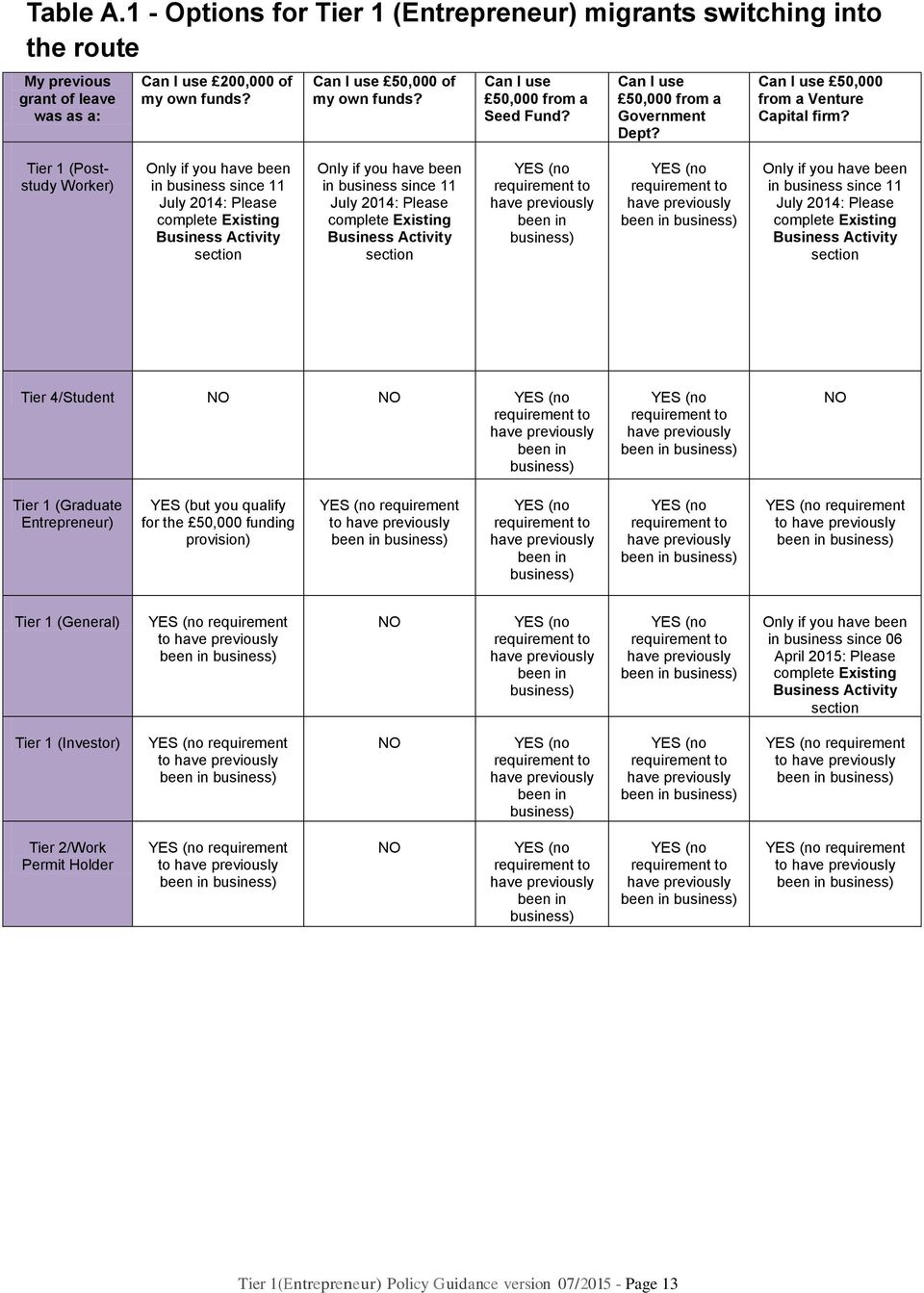
12 Switching from Tier 4/student routes 32. If you are in the UK with permission to stay as: a Tier 4 migrant; a Student; a Student re-sitting an examination; a Student nurse; a Student writing up a thesis; a Postgraduate Doctor or Dentist. You can only make an initial Tier 1 (Entrepreneur) application in the United Kingdom with access to not less than 50,000 from: one or more UK Seed Funding Competitions, listed as endorsed on the UK Trade & Investment website (UKTI), or one or more UK Government Departments, or Devolved Government Departments in Scotland, Wales or Northern Ireland, and made available by the Department(s) for the specific purpose of establishing or expanding a UK. Please see Table A.1 if for guidance on which sources of investment funds you may use if you are switching into Tier 1 (Entrepreneur). Tier 1(Entrepreneur) Policy Guidance version 07/ Page 12
13 Table A.1 - Options for Tier 1 (Entrepreneur) migrants switching into the route My previous grant of leave was as a: Can I use 200,000 of my own funds? Can I use 50,000 of my own funds? Can I use 50,000 from a Seed Fund? Can I use 50,000 from a Government Dept? Can I use 50,000 from a Venture Capital firm? Tier 1 (Poststudy Worker) Only if you have been in business since 11 July 2014: Please complete Existing Business Activity section Only if you have been in business since 11 July 2014: Please complete Existing Business Activity section YES (no requirement to have previously been in business) YES (no requirement to have previously been in business) Only if you have been in business since 11 July 2014: Please complete Existing Business Activity section Tier 4/Student NO NO YES (no requirement to have previously been in business) YES (no requirement to have previously been in business) NO Tier 1 (Graduate Entrepreneur) YES (but you qualify for the 50,000 funding provision) YES (no requirement to have previously been in business) YES (no requirement to have previously been in business) YES (no requirement to have previously been in business) YES (no requirement to have previously been in business) Tier 1 (General) YES (no requirement to have previously been in business) NO YES (no requirement to have previously been in business) YES (no requirement to have previously been in business) Only if you have been in business since 06 April 2015: Please complete Existing Business Activity section Tier 1 (Investor) YES (no requirement to have previously been in business) NO YES (no requirement to have previously been in business) YES (no requirement to have previously been in business) YES (no requirement to have previously been in business) Tier 2/Work Permit Holder YES (no requirement to have previously been in business) NO YES (no requirement to have previously been in business) YES (no requirement to have previously been in business) YES (no requirement to have previously been in business) Tier 1(Entrepreneur) Policy Guidance version 07/ Page 13
14 Care Arrangements for Children 33. You must be at least 16 years old to use this route. 34. Under Section 55 of the Borders, Citizenship and Immigration Act 2009, the Home Office must have regard to the need to safeguard children and to promote their welfare. All children working in the UK must have suitable care arrangements in place for their travel, reception on arrival in the UK and living arrangements while here. 35. Please note that 16 and 17 year olds have the legal right to live independently in the UK, and may therefore make their own arrangements for accommodation. If you are 16 or 17 years old on the date that your application is decided, you must have your parent(s) or legal guardian(s) written consent to the arrangements that have been made in regard of your application, travel, reception and care arrangements. You must submit a letter from your parent(s) or legal guardian(s) giving their consent to you making this application and to the arrangements for your care in the UK. The letter must be original (not a copy) and must confirm if your parent(s) or legal guardian(s) have legal custody or sole responsibility for you. If they have sole responsibility they must sign the letter. If they do not, the letter must confirm that each parent or legal guardian agrees to the content of the letter and must be signed by each parent or legal guardian. 36. The letter must clearly show: the relationship between the parent(s) or legal guardian(s) and you; that your parent(s) or legal guardian(s) have given their consent to this application; that your parent(s) or legal guardian(s) agree to your living arrangements in the UK; and your parent(s) or legal guardian(s) full name and address. Private Foster Care Arrangements 37. Children under 16 years old or 18 years old if disabled are privately fostered when they are cared for on a full-time basis by adults, who are not their parents or a close relative, for more than 28 days. It is the responsibility of the parent, carer, and anyone else involved in making the private fostering arrangement to notify their UK local authority of the private fostering arrangement. 38. In the UK local authorities are responsible for safeguarding and protecting children. They must make sure that private foster carers are suitable and that they get any support and guidance that they may need to help them care for a child. You must tell us if you are living under local authority care in the UK. If you are in local authority care you must provide a letter from the local authority that is caring for you confirming that you are currently in local authority care. The letter must be original (not a copy) and be on official headed paper. 39. A close relative, parent or legal guardian caring for a child is not considered to be a private foster carer and so will not need to register with a UK local authority. A close relative is a grandparent, brother, sister, step-parent, uncle (brother or half-brother of the child s parent) or aunt (sister or half-sister of the child s parent) who is aged 18 or over. Conditions of stay 40. Permission to stay under this route will be subject to the following conditions: a. no recourse to public funds (which means you will not be able to claim most benefits paid by the state); b. registration with the police, if this is required by paragraph 326 of the Immigration Rules; Tier 1(Entrepreneur) Policy Guidance version 07/ Page 14

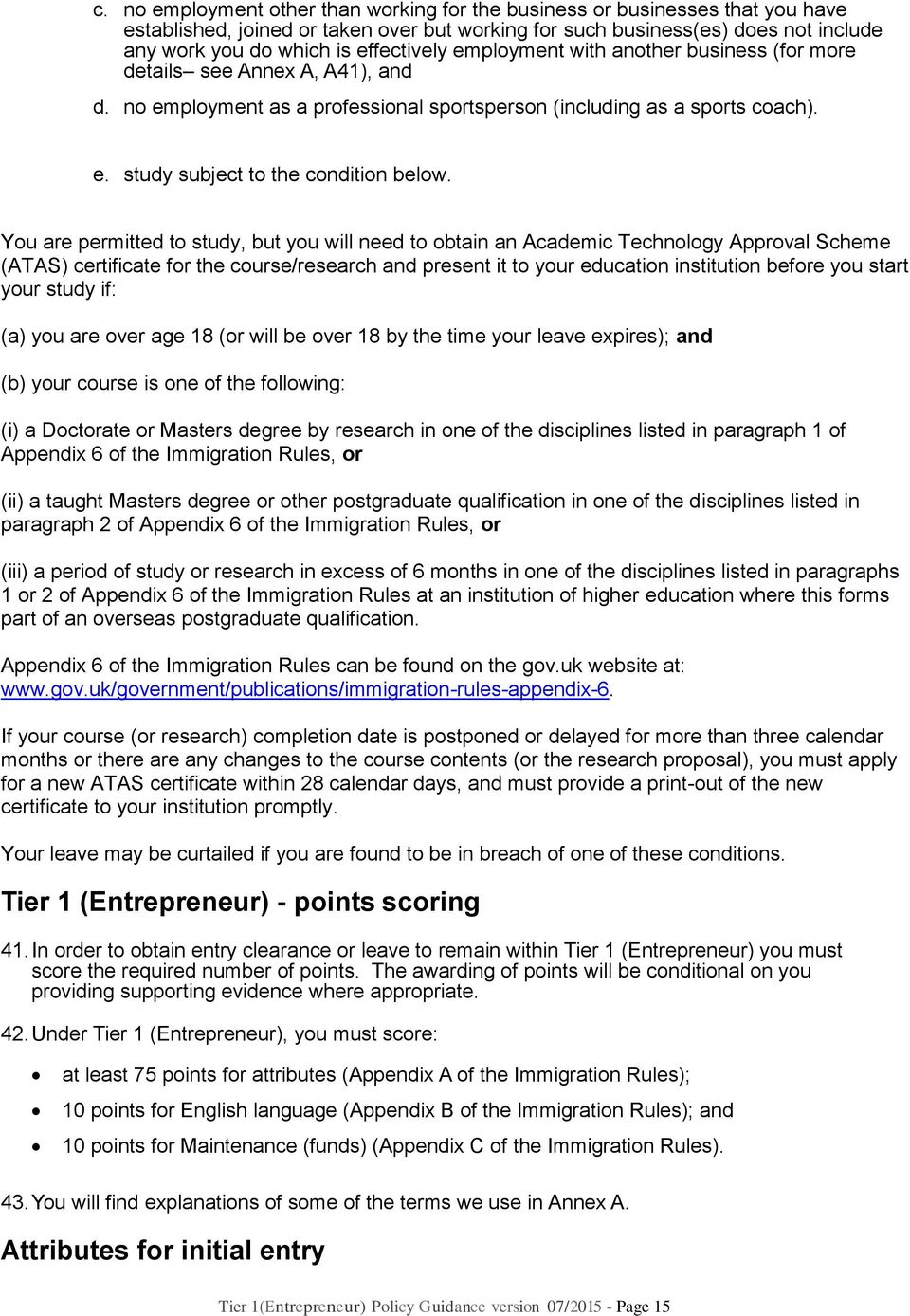
15 c. no employment other than working for the business or businesses that you have established, joined or taken over but working for such business(es) does not include any work you do which is effectively employment with another business (for more details see Annex A, A41), and d. no employment as a professional sportsperson (including as a sports coach). e. study subject to the condition below. You are permitted to study, but you will need to obtain an Academic Technology Approval Scheme (ATAS) certificate for the course/research and present it to your education institution before you start your study if: (a) you are over age 18 (or will be over 18 by the time your leave expires); and (b) your course is one of the following: (i) a Doctorate or Masters degree by research in one of the disciplines listed in paragraph 1 of Appendix 6 of the Immigration Rules, or (ii) a taught Masters degree or other postgraduate qualification in one of the disciplines listed in paragraph 2 of Appendix 6 of the Immigration Rules, or (iii) a period of study or research in excess of 6 months in one of the disciplines listed in paragraphs 1 or 2 of Appendix 6 of the Immigration Rules at an institution of higher education where this forms part of an overseas postgraduate qualification. Appendix 6 of the Immigration Rules can be found on the gov.uk website at: If your course (or research) completion date is postponed or delayed for more than three calendar months or there are any changes to the course contents (or the research proposal), you must apply for a new ATAS certificate within 28 calendar days, and must provide a print-out of the new certificate to your institution promptly. Your leave may be curtailed if you are found to be in breach of one of these conditions. Tier 1 (Entrepreneur) - points scoring 41. In order to obtain entry clearance or leave to remain within Tier 1 (Entrepreneur) you must score the required number of points. The awarding of points will be conditional on you providing supporting evidence where appropriate. 42. Under Tier 1 (Entrepreneur), you must score: at least 75 points for attributes (Appendix A of the Immigration Rules); 10 points for English language (Appendix B of the Immigration Rules); and 10 points for Maintenance (funds) (Appendix C of the Immigration Rules). 43. You will find explanations of some of the terms we use in Annex A. Attributes for initial entry Tier 1(Entrepreneur) Policy Guidance version 07/ Page 15
16 44. Points available for attributes are in the table on the next page. This table applies to you if you are seeking: entry clearance or leave to enter as a Tier 1 (Entrepreneur) migrant and did not have leave in this category within the last 12 months; and further leave to remain in the UK in this category when your previous permission to stay was given under a category other than Tier 1 (Entrepreneur) or one of the former Businessperson, or Innovator, categories, so you are switching categories. Please see table on the next page. Tier 1(Entrepreneur) Policy Guidance version 07/ Page 16

17 Attributes table for initial applications Attributes: pass mark = 75 Points a) You have access to not less than 200,000, or b) You have access to not less than 50,000 from: 1. one or more registered venture capital firms regulated by the Financial Conduct Authority (FCA) (not available to all applicants, please see the Eligibility to apply in the UK section for more information), or 2. one or more UK Entrepreneurial seed funding competitions which is listed as endorsed on the UK Trade & Investment (UKTI) website, or Points available one or more UK Government Departments or Devolved Government Departments in Scotland, Wales or Northern Ireland, and made available by the Department(s) for the specific purpose of establishing or expanding a UK business, or Tier 1 (Graduate Entrepreneur) c) You : 1. are applying for leave to remain, 2. have, or were last granted, leave as a Tier 1 (Graduate Entrepreneur) migrant, and 3. have access to not less than 50,000, or Tier 1 (Post-Study Work) d) You: 1. are applying for leave to remain, 2. have, or were last granted, leave as a Tier 1 (Post-Study Work) migrant, 3. have access to not less than 50,000, and 4. can meet the additional requirements in points 1 and 2 below. Tier 1 (General) If you are applying for leave to remain and has, or were last granted leave as a Tier 1 (General) Migrant, you will be awarded no points under (a) or (b)(i) above, unless you meet the additional requirements in 1 and 2 below. Additional Requirements for Tier 1 (Post-Study Work) and Tier 1 (General) switchers: 1). You have been continuously engaged in business activity since the specified date below and up to the date of application, and during this period you have been continuously: registered with HM Revenue and Customs (HMRC) as self-employed, or registered with Companies House as the director of a new or an existing business. Directors who are on the list of disqualified directors provided by Companies House will not be awarded points; and Tier 1(Entrepreneur) Policy Guidance version 07/ Page 17
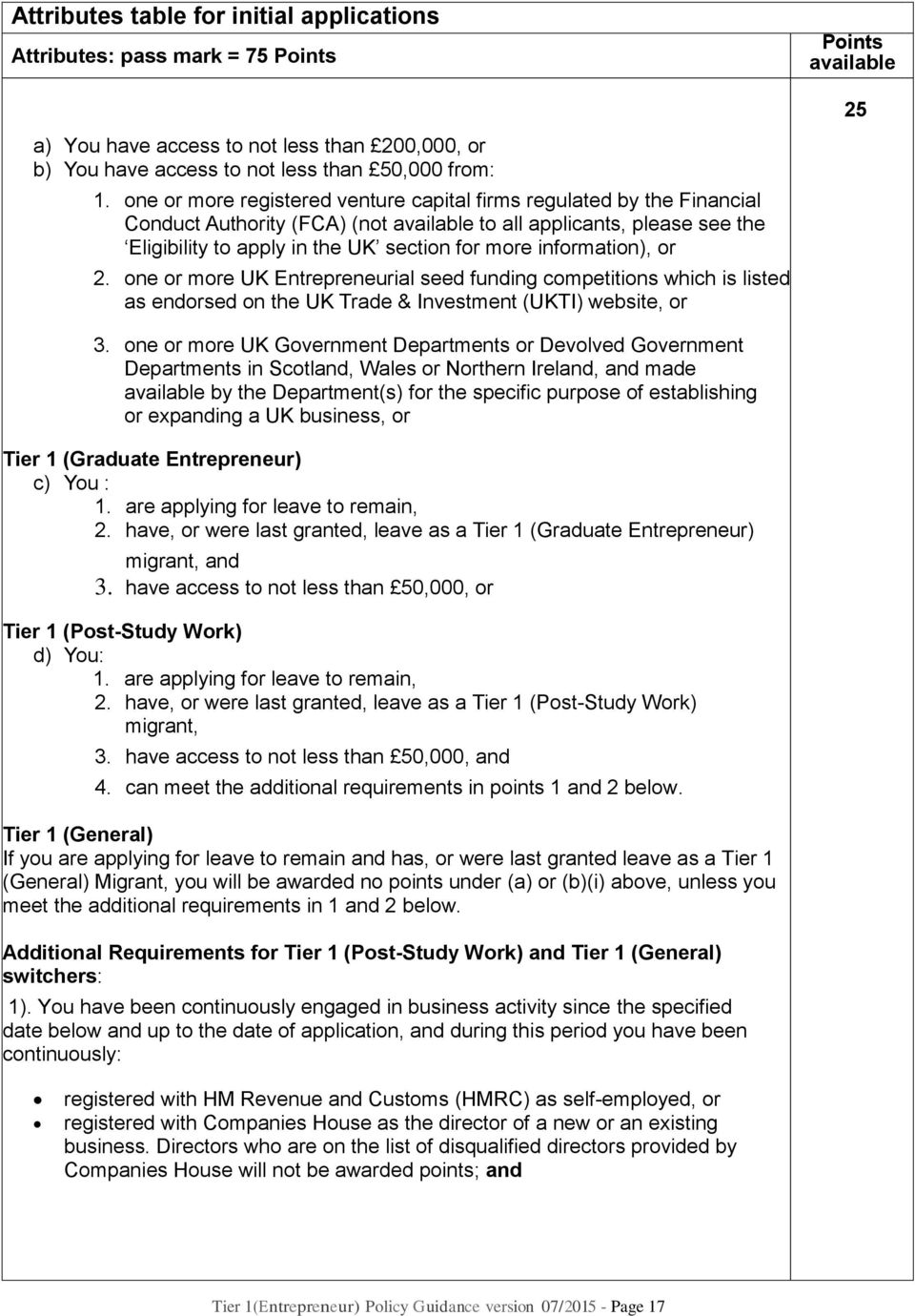
18 2). Since before the specified date below, and up to the date of application, you have been continuously working in an occupation which appears on the list of occupations skilled to National Qualifications Framework (NQF) level 4 or above, as stated in the Codes of Practice in Appendix J of the Immigration Rules and the Codes of Practice for Tier 2 Sponsors. Working in this context means that the core service your business provides to its customers or clients involves the business delivering a service in an occupation at this level. It excludes any work involved in administration, marketing or website functions for the business. The specified date referred to above is as follows: AND 11 July 2014 if you have, or were lasted granted, leave as a Tier 1 (Post-Study Work) Migrant, or 6 April 2015 if you have, or were last granted, leave as a Tier 1 (General) Migrant. The money is held in one or more regulated financial institutions. The money is disposable in the United Kingdom. If you are applying for leave to remain, the money must be held in the UK. English Language: pass mark = 10 Evidence to prove that you speak English to the required standard and meet the requirements explained in this guidance. Please see relevant section below for further details. Maintenance: pass mark = 10 A certain amount of funds to support yourself (and any dependants) in the UK. Please see relevant section below for more details Intermediary public body 45. If you are applying on the basis of access to funds from a UK or devolved government department, points may be awarded if that funding is being made available from an intermediary public body, where that body has been authorised by the a UK government department or devolved government department for the specific purpose of establishing or expanding UK businesses. An intermediary public body may include (as examples only and not an exhaustive list) The London Co-Investment Fund and Scottish Enterprise Genuine Entrepreneur Test Initial Applications 46. All Tier 1 (Entrepreneur) migrants making an initial application are subject to a genuine entrepreneur test. We must be satisfied that: you genuinely intend and are able to establish, take over or become a director of one or more businesses in the UK within the next six months; you genuinely intend to invest the money referred to in Table 4 of Appendix A in the business or businesses referred to above; the money is genuinely available to you and will remain available to you until such time as it is spent for the purposes of his business or businesses; and Tier 1(Entrepreneur) Policy Guidance version 07/ Page 18

19 you do not intend to take employment in the United Kingdom other than working in your business. We will take into account the following: the evidence that you submit; the viability and credibility of the source of the money referred to in Table 4 of Appendix A; the viability and credibility of your business plan and market research into your chosen business sector; your previous educational and business experience (or lack thereof); your immigration history and previous activity in the UK; where you have already registered in the UK as self-employed or as the director of a business, and the nature of the business requires mandatory accreditation, registration and/or insurance, whether that accreditation, registration and/or insurance has been obtained; and any other relevant information. We reserve the right to request additional information to support the assessment of the application and to refuse the application if the evidence is not provided. Any requested documents must be received by us at the specified address within 28 calendar days of the date of request. If you have already registered in the UK as self-employed or as the director of a business, we may check any compliance with requirements for your sector, and we may request additional information and evidence to support the assessment. If we are not satisfied with the genuineness of application in relation to a points-scoring requirement in Appendix A of the Immigration Rules, those points will not be awarded. We may decide not to carry out the above assessment if the application falls for refusal on other grounds, but reserve the right to carry out this assessment in any reconsideration of the decisions. You must comply with any request we made for you to attend an interview, unless a reasonable explanation is provided as to why you cannot comply. Business Plan 47. If you are making an initial application, you must provide a business plan, setting out your proposed business activities in the UK and how you expect to make your business succeed. Access to funds 48. Where you are seeking to be awarded points on the basis of access to funds, we may ask you to demonstrate that the funds you have used to apply remain available to you beyond the date of your application. The funds must continue to be available to you until they are invested in a business or businesses, or spent for the purposes of your business or businesses. Available to you means that the funds must be in one of the following: 1) in your own possession, 2) in the financial accounts of a UK incorporated business of which you are the director, or 3) available from the third party or parties named in your application (if applicable). For the purposes of the above, invested or spent by your business excludes spending on all of the following: Tier 1(Entrepreneur) Policy Guidance version 07/ Page 19
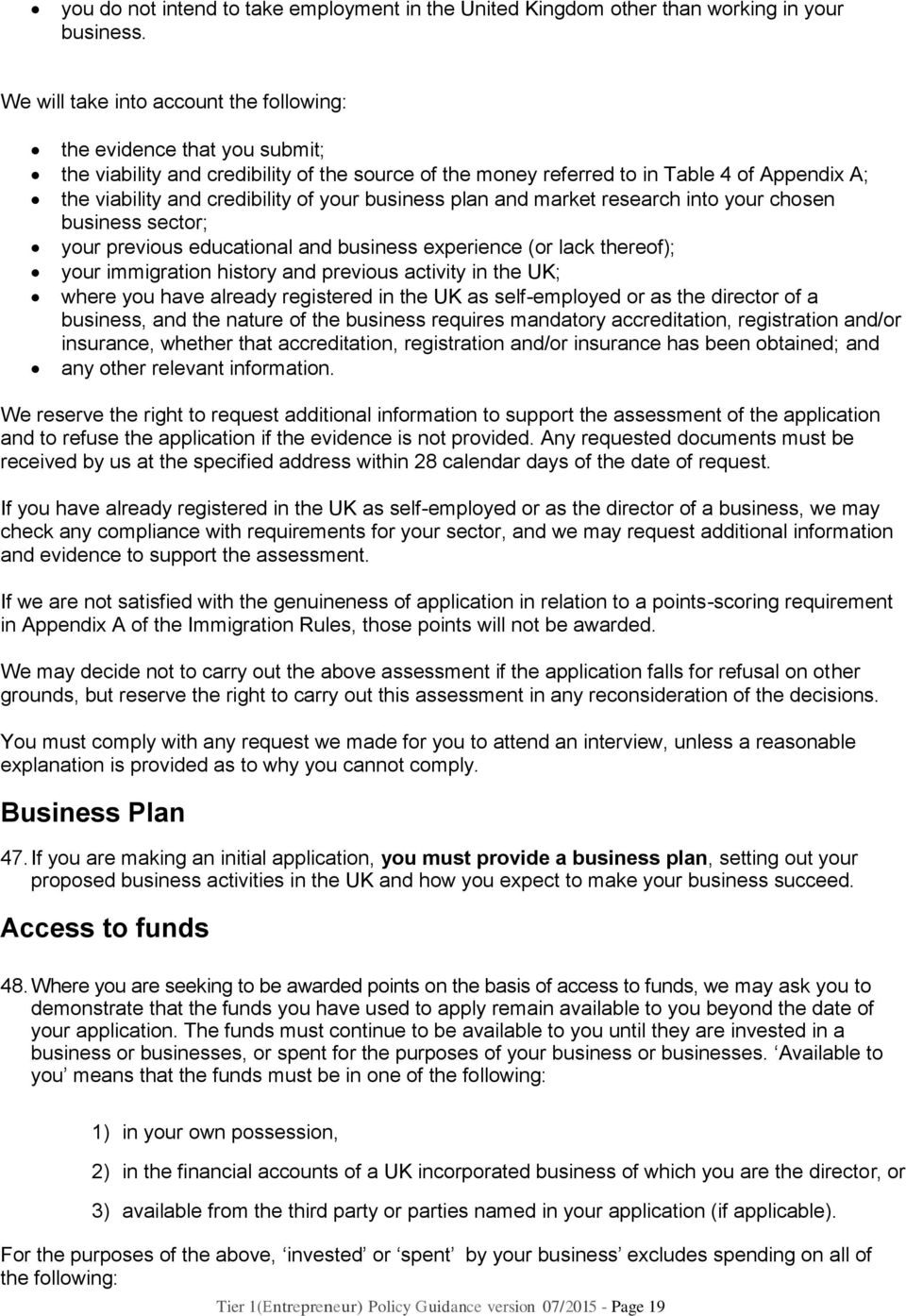
20 1) your own remuneration, 2) buying the business from a previous owner, where the money ultimately goes to that previous owner (irrespective of whether it is received or held directly or indirectly by that previous owner) rather than into the business you have bought. This applies regardless of whether the money is channelled through the business en route to the previous owner. For example, by means of you or your business purchasing goodwill or other assets which were previously part of the business you have bought, 3) investing in other businesses (other than those which you are running as self-employed or as a director), and 4) any spending which is not directly for the purpose of establishing or running your own business or businesses. 49. If the funds to which you have access are being made available to you by a third party, the declaration from that third party must confirm that the funds will remain available to you until they are transferred to you or to your business. 50. We may request further evidence or verify that the money will remain available and we will refuse your application if this evidence is not provided or if we cannot satisfactorily verify it. If your application is refused on other grounds we may not carry out the genuine entrepreneur test assessment, but if we reconsider the decision we may do the assessment then. 51. If you already have leave as a Tier 1 (Entrepreneur) migrant we may curtail your leave if the funds you have used to apply cease to be available to you (unless you have spent them in the establishment or running of your business or businesses). Invested or Spent excludes spending on your own remuneration. Entrepreneurial teams 52. Money for investment can be shared by a team of a maximum of two entrepreneurs. Each team member may apply to come to the UK as a Tier 1 (Entrepreneur) migrant using the same investment funds. Neither applicant must have used the same funds with any other applicant. Please note: you should provide all the documents needed for evidence with your own application. Your team member should also provide all the documents needed with their application. In some cases this means that your team will need to send two sets of documents. It will help in processing your application if you do not rely on information presented with anyone else s application. No points will be awarded for funds that are made available to anyone else, other than your entrepreneurial team member (if you have one). You may use your money that is held in a joint account with your spouse or partner (defined as a person who has been living together with you in a relationship akin to a marriage or civil partnership, for at least two years prior to the date of application), and your spouse or partner is not (or is not applying to be) another Tier 1 (Entrepreneur) Migrant. 53. If either you or your entrepreneurial team member is applying in the UK, then you may only rely on funds located in the UK. 54. In the case of entrepreneurial teams, where this guidance refers to funding being available, unless stated otherwise, this means available to: You; or Your entrepreneurial team member; or Tier 1(Entrepreneur) Policy Guidance version 07/ Page 20
21 Your business. Where this guidance refers to your business, your business must be a company and you must be registered as a director of that business in the UK, and provide a Companies House document showing the address of the registered office in the UK, or head office in the UK if it has no registered office, and your name, as it appears on the application form as a director. Claiming points for attributes Initial Applications 200,000 funding 55. You or the entrepreneurial team must have 200,000 of your own money available to make a fresh investment into business in the UK. You should supply documentary evidence of the money in your/ each member of the entrepreneurial team s name. 56. You or your entrepreneurial team can include money made available by other people (known as a third party or parties, and this can include money from your (or your entrepreneurial team member s) husband, wife or partner). In this case you must also provide a declaration that the money is available to you and your entrepreneurial team member (if applicable), or to the business that you or your entrepreneurial team are running. You must provide a declaration from each contributor of funds, together with confirmation that the declarations are valid. 57. If you are using money which has been transferred from a third party to you less than 90 days before the application, then you will need to supply the evidence required for third party funding, as specified in the above paragraph. 58. This money can be made up from money already invested in a UK business together with access to any balance of money needed to total 200, If you are applying from inside the UK your funds must be held in the UK 50,000 funding 60. You or the entrepreneurial team must have access to 50,000 or more from: 1. Registered venture capital firms regulated by the Financial Conduct Authority (FCA): To be considered acceptable as a source of investment funds, venture capital firms must be registered with Financial Conduct Authority (FCA) and their entry onto the register must include permission to arrange, deal in or manage investments or to manage alternative investment funds. The FCA website is at www. fca.org.uk/. 2. UK entrepreneurial seed funding competitions listed as endorsed on the UK Trade and Investment (UKTI) pages of the gov.uk website: The list of competitions that have been endorsed for this purpose and can be considered for the award of points is given on the UKTI website on government/publications/entrepreneurs-setting-up-in-theuk/entrepreneurs-setting-up-in-the-uk 3. UK Government Departments or Devolved Government Departments in Scotland, Wales and Northern Ireland, and made available by the Department(s) for the specific purpose of establishing or expanding a UK business: Where a UK Government Department or Devolved Government Department or intermediary public body has awarded some of the funds specifically for the purpose of setting up or expanding a business in the UK, the funding package can be considered for the award of points. Please see for information on UK Government Departments and Devolved Government Departments. 61. You must supply documentary evidence to demonstrate you have this funding available. This will Tier 1(Entrepreneur) Policy Guidance version 07/ Page 21
22 include a letter from each venture capital firm, seed funding competition, or UK Government Department or Devolved Government Department in Scotland, Wales or Northern Ireland. A letter from an intermediary public body is also acceptable, if that body has been authorised by a UK government department or devolved government department to award funds from that department for the specific purpose of establishing or expanding UK businesses. 62. Funds from more than one of these sources may be combined to total the required 50,000. However, funds from a venture capital firm cannot be included if you are applying to switch from Tier 4/other relevant student categories, or Tier 1 (Post-Study Work) and Tier 1 (General) if you cannot demonstrate you have been in previous business activity. 63. You may not mix your personal or other third party funds with the funding from the venture capital firms, seed funding competitions and/or UK Government Departments/Devolved Government Departments towards the 50,000. If you wish to mix the funding you will need to invest 200,000 into the UK business. 64. This money can be made up from funding obtained from the venture capital firm(s), Seed funding competitions and/or UK Government Department(s)/Devolved Government Departments already invested in business together with access to any balance of money from these sources needed to total 50, If you have formed an entrepreneurial team with another applicant, the documents must confirm that the funds are available to both team members or your business. 66. Where this guidance refers to your business, you must be registered as a director of that business in the UK, and provide a Companies House document showing the address of the registered office in the UK (or if there is no registered office, the head office in the UK). The document must show your name (as it appears on the application form) and your team member s name both listed as directors. 67. Your entrepreneurial team member must also qualify to use the same amount of investment if the total amount available to your entrepreneurial team is 50,000 or more. If the other team member does not also qualify for this level of investment, the total amount available to the team must be at 200,000 or more. Leave as a Tier 1 (Graduate Entrepreneur) Migrant and 50,000 funding 68. You must be applying from within the UK and have last been granted leave as Tier 1 (Graduate Entrepreneur) migrant. You will not be asked to provide documentary evidence of this because we will use your travel document or passport and our records. 69. You must also have 50,000 of your own money available to make a fresh investment into business in the UK. Your funds must be held in the UK. 70. You can include money made available by other people (known as a third party or parties ) but you must also provide a declaration that the money is available to you or the business that you are running, from each contributor of funds, together with confirmation that the declarations are valid. If you are relying on money held by your husband, wife or partner, they will be regarded as a third party. 71. If you are using money which has been transferred to you from a third party less than 90 days before the application, then you will need to supply the evidence required for third party funding, as specified in the above paragraph Tier 1(Entrepreneur) Policy Guidance version 07/ Page 22
23 72. This money can be made up from money already invested in business together with access to any balance of money needed to total 50, If you have formed an entrepreneurial team with another applicant, the documents must confirm that the funds are available to both team members. Your entrepreneurial team member must also qualify to use the same amount of investment if the total amount available to your entrepreneurial team is 50,000 or more. If the other team member does not also qualify for this level of investment, the total amount available to your entrepreneurial team must be at 200,000 or more. Leave as a Tier 1 (Post-Study Work) Migrant and access to 50, You must be applying from within the UK and have last been granted leave as a Tier 1 (Post- Study Work) migrant. You will not be asked to provide documentary evidence of this; we will use your travel document or passport and our records. You must: i. Be applying for leave to remain. You must be in the UK and be applying to switch to Tier 1 (Entrepreneur). You may not use row d of the attributes table for initial applications if you are applying for entry clearance or leave to enter. ii. Have been last granted leave as Tier 1 (Post-Study Work) migrant. iii. Have been continuously engaged in business activity. You have been continuously engaged in business activity (which was not, or did not amount to, activity pursuant to a contract of service see annex A, A41) with a business other than your own since before 11 July 2014 and up to the date of application, and during this period you have been continuously: registered with HM Revenue and Customs (HMRC) as self-employed, or registered with Companies House as the director of a new or an existing business. Directors who are on the list of disqualified directors provided by Companies House will not be awarded points. iv. Have been in an occupation skilled to graduate level. Other than the work necessary to administer the business, your main business activity must be working skilled to National Qualifications Framework (NQF) 4 or above. We will not take into account the tasks involved with the running of the business for this assessment. For example: If the business is software sales and your main activity is developing software, you may qualify for points; If the business is a taxi firm, the main occupation is driving a taxi and you will not score points even though you manage the business. Your main activity is providing a taxi service which is not skilled to graduate level Guidance on what is work skilled to NQF 4 or above, as stated in the Codes of Practice for Tier 2 Sponsors published by the Home Office is found on our website at: _25_Sponsor_Guidance_11-14.pdf and in Appendix J of the Immigration Rules. v. You must also have at least 50,000 to invest in UK business. Your funds must be held in the UK. 75. Please note: If you cannot demonstrate that you have been continuously engaged in business Tier 1(Entrepreneur) Policy Guidance version 07/ Page 23
24 activity since before 11 July 2014, you may only apply using 50,000 funds from a listed seed funding competition or UK government departments (not from a venture capital firm). 76. You must supply documentary evidence of the funds and the additional evidence required in the Existing Business Activity section of this guidance. 77. You can include money made available by other people or organisations (known as a third party or parties ) but you must also provide a declaration that the money is available to you or the business that you are running, from each contributor of funds, together with confirmation that the declarations are valid. If you are relying on money held by your husband, wife or partner (and not in a joint account with you), they will be regarded as a third party. 78. If you are using money which has been transferred to you less than 90 days before the application, then you will need to supply the evidence required for third party funding, as specified in the above paragraph. 79. This money can be made up from money already invested in business (providing the investment was made not more than 12 months before the date of application and you provide evidence of this investment as specified in the Immigration Rules and the Documents we require section below) together with access to any balance of money needed to total 50, If you have formed an entrepreneurial team with another applicant, the documents must confirm the funds are available to both team members or your business. Both team members must qualify in their own right. For example: If the total amount available to the entrepreneurial team is 50,000 of their own funds, and one applicant is a Tier 1 (Post-Study Work) migrant but the other is not, then only the Tier 1 (Post-Study Work) applicant can be approved. If the total amount available to the team is 200,000 of their own funds, but they have not been continuously engaged in business since before 11 July 2014, and one applicant is switching from Tier 1 (Post-Study Work) and the other is switching from Tier 2, then only the Tier 2 migrant can be approved. You and your entrepreneurial team member can qualify if you meet the following criteria: A team consisting of one Tier 1 (Post-Study Work) migrant applying in-country, and one migrant applying from overseas who have established a business together before 11 July 2014 and have 200,000 held in a joint account in the UK to invest in the business. In this example: The Tier 1 (Post-Study Work) applicant qualifies as the team has over 50,000 funding, the funds are in the UK and he has been continuously engaged in business since before 11 July 2014; and The overseas applicant qualifies as the team has access to 200,000 funding, and the funding is located in the UK. Leave as a Tier 1 (General) Migrant 81. This section applies if you are applying from within the UK and have last been granted leave as a Tier 1 (General) migrant. You will not be asked to provide documentary evidence of this; we will use your travel document or passport and our records. You can use 200,000 of your own funds, or 50,000 from a venture capital firm if you: i. are applying for leave to remain. Tier 1(Entrepreneur) Policy Guidance version 07/ Page 24
25 ii. have been last granted leave as Tier 1 (General) migrant. iii. Have been continuously engaged in business activity. You have been continuously engaged in business activity (which was not, or did not amount to, activity pursuant to a contract of service see annex A, A41) with a business other than your own since before 6 April 2015 and up to the date of application, and during this period you have been continuously: registered with HM Revenue and Customs (HMRC) as self-employed, or registered with Companies House as the director of a new or an existing business. Directors who are on the list of disqualified directors provided by Companies House will not be awarded points. iv. Have been in an occupation skilled to graduate level. Other than the work necessary to administer the business, your main business activity must be working skilled to National Qualifications Framework (NQF) 4 or above. It excludes any work involved in administration, marketing or website functions for the business. Please note: If you cannot demonstrate that you have been continuously engaged in business activity since before 6 April 2015 you may only apply using 50,000 funds from a listed seed funding competition or UK or Devolved Government Departments (not from a venture capital firm). 82. You must supply documentary evidence of the funds and the additional evidence required in the Existing Business Activity section of this guidance. 83. You can include money made available by other people or organisations (known as a third party or parties ) but you must also provide a declaration that the money is available to you or the business that you are running, from each contributor of funds, together with confirmation that the declarations are valid. If you are relying on money held by your husband, wife or partner (and not in a joint account with you), they will be regarded as a third party. 84. If you are using money which has been transferred to you less than 90 days before the application, then you will need to supply the evidence required for third party funding, as specified in the above paragraph. 85. This money can be made up from money already invested in business (providing the investment was made not more than 12 months before the date of application and you provide evidence of this investment as specified in the Immigration Rules and the Documents we require section below) together with access to any balance of money required to total the full amount. 86. If you have formed an entrepreneurial team with another applicant, the documents must confirm the funds are available to both team members or your business. Both team members must qualify in their own right. 87. For example: If the total amount available to the team is 200,000 of their own funds, but they have not been continuously engaged in business since before 6 April 2015, and one applicant is switching from Tier 1 (General) and the other is switching from Tier 2, then only the Tier 2 migrant can be approved. 88. You and your entrepreneurial team member can qualify if you meet the following criteria: A team consisting of one Tier 1 (General) migrant applying in-country, and one migrant applying from overseas who have established a business together before 6 April 2015 and have 200,000 held in a joint account in the UK to invest in the business. In this example: Tier 1(Entrepreneur) Policy Guidance version 07/ Page 25
26 The Tier 1 (General) applicant qualifies as he has been continuously engaged in business since before 6 April 2015 and the team has access to 200,000 funding, and the funds are held in the UK; and The overseas applicant qualifies as the team has access to 200,000 funding, and the funds are held in the UK. 89. In all cases you may not use the same funds to score points for your funds available for investment and for maintenance funds for yourself and any dependants. Available funds Initial Applications 90. Paragraphs 39B of the Immigration Rules states that where the Rules require that specified documents be provided, only such specified documents will be accepted as evidence of the relevant requirement. Paragraph 39B also applies to determine whether any specified documents provided are valid. The specified documents for applications for Tier 1 (Entrepreneur) are given below. 91. Where specified documents provided are not in English or Welsh you must provide the original and a full translation that can be independently verified. The translation must: confirm that it is an accurate translation of the original document; and be dated; and include the full name and original signature of the translator or an authorised official of the translation company; and include the translator or translation company s contact details; and if you are applying in the UK, be fully certified and include details of the translator or translation company s credentials. 1). Previous investment - funds already invested in UK business 92. If you have already invested the required level of funds in a legally established a business in the UK, you may use this investment to claim points for your initial application. If the full 50,000/ 200,000 investment has been made, all of the points needed for attributes can be awarded (75 points), provided all of the specified documents required are submitted to show: the amount of money invested; and you have established a business in the UK, in which the money was invested 93. If part of the investment has been made, you can also rely on this, but must have access to the remaining balance of funds. 94. The investment must have been made in the 12 calendar months before the date of application, or 24 months if you were last granted leave as a Tier 1 (Graduate Entrepreneur). Any investment made more than 12 months (or 24 months if you were last a Tier 1 (Graduate Entrepreneur) migrant) before your application will not be counted. 95. We recognise that, as an entrepreneur, you may have moved on to other activities and no longer be involved in the business in which you initially invested, but we still require this evidence to show that the money was invested. 96. The amount of money invested should not: include the value of any residential accommodation or property development, or property management; or Tier 1(Entrepreneur) Policy Guidance version 07/ Page 26
27 be in the form of a director s loan, unless it is unsecured and is subordinated in favour of the third-party creditors. 97. If you have bought property for your business which includes residential accommodation, we will not accept the value of this part of the property as investment in the business. The value of this part of the property should be deducted from the amount of your investment. You must provide an estimate of the value of this living accommodation from a surveyor who is a member of the Royal Institution of Chartered Surveyors (RICS). This valuation must be produced and dated within the three months prior to the date of application. For more information on membership of RICS please see Evidence of previous investment 98. You must provide all the appropriate specified documents needed to establish the amount you have already invested from the following list. i. Audited accounts Registered companies that are required to produce audited accounts must do so. For information on who needs to produce these accounts please refer to the Companies House website. ii. Unaudited accounts and an accountant s certificate of confirmation Businesses that are not required to produce audited accounts must provide unaudited accounts, sometimes called management accounts, together with an accounts compilation report from a suitably regulated accountant. The accounts compilation report is a service whereby practitioners compile accounts for the company directors who are responsible for the preparation of the financial statements and for being satisfied they give a true and fair view. The accounts compilation report explains how practitioners have helped the directors prepare the accounts. Audited or unaudited accounts must be prepared and signed off in accordance with statutory requirements and must clearly show the investment in money made directly by you, in your own name, or on your behalf and showing your name. You should indicate where this is shown on your evidence. If you have invested by way of share capital the business accounts must show the shareholders, the amount and value of the shares (on the date of purchase) in your name as it appears on your application. If the value of your share capital is not shown in the accounts, then share certificates should be submitted in addition to the accounts as documentary evidence. The accounts should clearly show the name of the accountant and the date the accounts were produced. The accountant must be a member of a recognised UK supervisory body (see glossary); if not, we will not accept this evidence. The accounts must show how much you have invested in the business. iii. Director s loan If you have made the investment in the form of a director s loan, it must be shown in the relevant set of accounts provided, and you must also provide a legal agreement, between you (in the name that appears on the application) and the company. This agreement should show: the terms of the loan; any interest that is payable; the period of the loan; and Tier 1(Entrepreneur) Policy Guidance version 07/ Page 27
28 that the loan is unsecured and subordinated in favour of third-party creditors. If it is not clear from the information provided that the loan is unsecured and subordinated in favour of third-party creditors, we will not accept the loan for the award of points. iv. 50,000 awarded by a seed funding competition or a UK government department or devolved government departments in Scotland, Wales or Northern Ireland/intermediary public body If you are claiming points for investing 50,000 awarded by a seed funding competition or UK government department or devolved government departments in Scotland, Wales or Northern Ireland/intermediary public body, and have not been awarded points in a previous application for having those funds available, you must provide a letter as evidence of the source of those funds. This letter must contain all of the information set out above- but it does not need to have been produced within the three months immediately before the date of the application. Evidence you have invested in a UK business 99. For each business you are providing evidence of investment in, you must supply the appropriate evidence from the lists below to prove that it is a UK business. One piece of evidence from each of rows 1, 2 and 3 in the table should be provided for each business or company. The required evidence differs depending on whether you were self-employed or a director of the company. Please see table on next page. Tier 1(Entrepreneur) Policy Guidance version 07/ Page 28
29 Type of business Self-employed applicants 1. Business Your registration with premises in the HMRC to show that the United Kingdom business is based in the UK. Directors of companies Printout of a Companies House document showing the address of the registered office in the UK, or head office if it has no registered office, and your name, as it appears on the application form, as a director. 2. Business has a United Kingdom bank account of which you are a signatory 3. Business must be subjected to United Kingdom taxation a) Personal bank statement showing transactions for your business; b) Business bank statement; or c) A letter from the UK bank, on its headed paper, confirming that you have a business and act through that bank for the purposes of that business. You must be registered as self-employed for National Insurance (NI) assessment. You must supply one of the following: a) the welcome letter from HMRC; b) an HMRC Exception certificate; c) a copy of the NI bill from HMRC; or d) your bank statement showing that NI is taken by HMRC by direct debit. a) Company bank statement showing that the company has a UK account; or b) A letter from the UKregulated bank, on its headed paper, confirming that the company has a bank account and you are a signatory of that account. Business must be registered for corporation tax and you must provide documentation from HMRC) which confirms this. For example, form CT41G from HMRC or a completed HMRC tax return document showing the tax reference number for the company. If the reporting is done online, you should provide a printout of the form and sign it as correct. Tier 1(Entrepreneur) Policy Guidance version 07/ Page 29
30 100. Note that Directors who are on the list of disqualified Directors provided by Companies House will not be awarded points, as they are not able to continue as Directors in the United Kingdom. We will check this list before awarding points. You can see the list of disqualified Directors on the Companies House website: Migrants relying on previous investment and fresh investment 101. If some of the money has been invested into a business in the UK, the balance of funds must be held in a regulated financial institution and disposable in the UK. In this case you should use the evidence required for the previous investment of money together with the evidence required for your access to the balance of sufficient funds to meet the requirement. 2. Fresh investment - money available must be in a regulated financial institution 102. If you are making a fresh investment, confirmation of the money available to you must come from a financial institution that is regulated by the home regulator. The home regulator is an official financial regulatory body, in the country where the financial institution operates and the funds are located The regulatory body must be appropriate for the type of financial transaction. Money held in the UK must be held in an institution that is regulated by the FCA and the Prudential Regulation Authority (PRA). The PRA website is at Pages/default.aspx. We will not accept evidence of your money from a financial institution with which the Home Office is unable to make satisfactory verification checks. A list of financial institutions which do not satisfactorily verify financial statements can be found in Appendix P of the Immigration Rules at: If you are making a fresh investment, and the money is not held in the UK, all of the funds required must be freely transferable to the UK and able to be converted to pounds sterling Money held in an overseas account but in a financial institution that is regulated by the FCA/ PRA will satisfy this requirement. Money held overseas in an institution that is not regulated by the FCA/PRA must have confirmation that the money can be transferred into the UK. This can be a document from your financial institution. Please note that if the institution holding the money does not have the same name as one listed by the FCA/PRA, evidence that the money can be transferred to the UK must be provided. Please also note that banks are not being asked to provide any guarantees that the money will be transferred If you are applying from inside the UK, the money must be held in the UK If the funds are overseas and you are subject to any applicable financial sanctions regime, you must provide confirmation from HM Treasury that the funds are transferable and disposable in the UK. Tier 1(Entrepreneur) Policy Guidance version 07/ Page 30
31 Evidence of the amount of money available to invest 108. You should provide the following evidence of funds available to invest for your initial application We will not accept evidence of your money from a financial institution with which the Home Office is unable to make satisfactory verification checks. A list of financial institutions which do not satisfactorily verify financial statements can be found on our website in Appendix P of the Immigration Rules. Where you provide documents which show the required level of funds (either 50,000 or 200,000), are held in more than one place, for example in two different bank accounts, the evidence must show the total amount (either 50,000 or 200,000) is available on the same date. That money must remain available to you as described earlier in this guidance You must provide one or more of the following documents: A letter from a financial institution 110. You can provide a letter from a financial institution holding the funds, to confirm the amount of money available to you, your business (or your team, if you have formed an entrepreneurial team). The total amount of available money must be either at least 200,000; or at least 50,000 as applicable. If the money is held in several financial institutions, you must supply a recent letter from each institution. If the money is not held in pounds sterling, we will use the rate of conversion on the Oanda website at to convert the money into pounds sterling, using the exchange rate that applies on the date of the application. Each letter must: be an original document and not a copy; be on the institution s official headed paper; have been issued by an authorised official of that institution; and have been produced within the 31 days immediately before the date of your application. Each letter must also confirm each of the following details: the account number; that the institution is regulated by the appropriate body; your name, and your team member s name if you have formed a entrepreneurial team; the date of the document; the minimum balance available from your own funds (if applicable) that has been held in that institution during a consecutive 90-day period of time, ending on the date of the letter; the amount of money available to your business. If the money is available to your business rather than to you by name, you must be registered as a director of that business in the UK and provide a Companies House document showing the address of the registered office in the UK or head office in the UK. The Companies House document must also show your name (and the name of your team member if appropriate) as it appears on the application form as a director; that if the money is not in an institution regulated by the FCA/PRA, the money can be transferred into the UK. Tier 1(Entrepreneur) Policy Guidance version 07/ Page 31
32 If the money is awarded by a third party other than a venture capital firm, seed funding competition or a UK government department/devolved government department, then the letter from the financial institution holding the funds must also include the following details: For money held in and being made available from the financial institution of the third party, confirmation that the third party has informed the institution of the amount of money it intends to make available, and that the institution is not aware of the third party having promised to make that money available to any other person; the name of each third party and their contact details. These must include their full address including postal code and where available a landline phone number and address. Please note: it is important to ensure that any letter from the third party s financial institution states that the third party has confirmed that they intend to make the money available to you. This is to ensure that the funds are made available to you (and your team member, if applicable) and not to anyone else. Please note: If you have 50,000 awarded by a venture capital firm, seed funding competition or a UK government department/devolved government department, then you do not need to supply this bank letter. A template is included in Annex E at the end of this guidance (document 1) for your convenience if you wish to use it. Personal bank statement (only migrants with investment funds in their personal account can provide this) 111. If the money is held in the UK and in a personal bank account, then you can provide recent personal bank or building society statements covering a consecutive 90-day period of time, with the most recent statement being dated no earlier than 31 days before the date of your application, from the UK financial institution holding the funds, which confirms the amount of money available to you or your entrepreneurial team The total amount of available money must be either at least 200,000; or at least 50,000, as applicable. If the money is held in several financial institutions, you must supply a statement from each institution. The statements must be original documents and not a copy; The bank or building society holding the money must be based in the UK and regulated by the FCA/PRA; The money must be in cash in the account. We will not accept Individual Savings Accounts (ISAs) or assets such as stocks and shares; The account must be in your own name only (or both names for an entrepreneurial team) only. You may use your money that is held in a joint account with your husband, wife, civil partner or unmarried or same-sex partner, but only if they are not applying to be a Tier 1 (Entrepreneur) migrant. Accounts in the name of a business or third party will not be accepted; Each bank or building society statement must be on the institution s official stationery and confirm each of the following details: o Your name; o The name of your team member if you have formed an entrepreneurial team o The name of your husband, wife, civil partner or unmarried or same-sex partner if you hold a joint account; Tier 1(Entrepreneur) Policy Guidance version 07/ Page 32
33 o The account number; o The date of the statement; o The financial institution s name and logo; o The bank or building society statement must have been issued by an authorised official of that institution. Electronic statements: We will not accept printouts of electronic statements without either a supporting letter from the bank, on the bank s headed paper, confirming the authenticity of the statements, or without the official stamp of the bank in question on each page of the statement. Please note: Bank statements can only be provided as evidence if the funds are held in your personal bank account. If the funds are held in a business bank account, including a business of which you are a director, you are unable to supply bank statements as evidence. If the funds are coming from your business, you must provide the evidence for third party funding. Letter from accountant/ authorised official (only applicable if you are applying using money awarded by a venture capital firm, seed fund or UK government department/intermediary public body) 113. If you have 50,000 awarded by a venture capital firm, seed funding competition or a UK government department/devolved government department/intermediary public body, then you must supply a recent letter from an accountant, who is a member of a recognised UK supervisory body, or in the case of a UK government department/intermediary public body, an authorised official, confirming the amount of money made available to you or your business.. Each letter must: be an original document and not a copy; on the institution s official headed paper; have been issued by an accountant engaged by the venture capital firm, seed funding competition or a UK government department/devolved government department/intermediary public body to provide the information. If a UK government department/devolved government department/intermediary public body is awarding the funds, the letter does not need to be issued by an accountant and can be issued by an authorised official instead; and have been produced within the three months immediately before the date of the application. Each letter must also confirm each of the following details: your name, the name of your team member if you have formed an entrepreneurial team or the name of your business; the amount of money available to your business. If the money is available to your business rather than to you by name, you must be registered as a director of that business in the UK, and provide a Companies House document showing the address of the registered office in the UK, or head office in the UK. The Companies House document must also show your name (and your team member s name if appropriate) as it appears on the application form, as a director; Tier 1(Entrepreneur) Policy Guidance version 07/ Page 33
34 the date of the document; the amount of money available to you or your business from the venture capital firm, seed funding competition or a UK government department or devolved government department in Scotland, Wales or Northern Ireland or intermediary public body; the name of the venture capital firm, Seed funding competition or a UK government department or devolved government department in Scotland, Wales or Northern Ireland or intermediary public body and the contact details of an official of that organisation. These must include their full address including postal code, and where available a landline phone number and address. The accountant must be a member of a recognised UK supervisory body. If they are not, we will not accept this item of evidence and will not award any points for this evidence. Please note: If you have 50,000 awarded by a venture capital firm, seed funding competition or a UK government department/devolved government department/intermediary public body, then you do not need to supply the bank letter referred to above. Additional evidence for third-party funding 114. You should use this for your initial application (see the attributes table for initial applicants) if you are relying on money made available from someone else. This is in addition to the evidence of the money available to you to invest, as set out in the section above If you are relying on third-party funding, and the money is not in the name of your business, your name, or joint names with you as a signatory on the account, you must also supply each of the following documents (this includes funding awarded by a venture capital firm, seed funding competition or a UK government department/devolved government department/intermediary public body) : 1). Declaration from third party A declaration from every third party that they have made the money available for you to invest in a business in the United Kingdom This declaration must be an original document and not a copy. It must contain: the names of the third party and your name, your team member s name if you have formed an entrepreneurial team or the name of your business; the date of the declaration; your signature and the signature of the third party (where you have formed an entrepreneurial team, you and your team member must both sign); the amount of money available to you or your business from the third party in pounds sterling; a confirmation that the money will remain available to you until it is transferred to you or your business; the relationship(s) of the third party to you. Additional content for money coming from venture capital firms For a venture capital firm only, confirmation of whether this body is an FCA-registered Tier 1(Entrepreneur) Policy Guidance version 07/ Page 34
35 venture capital firm, in the form of a document confirming the award and the amount of money, and including the FCA registration number and confirmation that its entry in the register includes permission to arrange, deal in or manage investments, or to manage alternative investment funds, Additional content for money coming from seed fund For a UK entrepreneurial seed funding competition only, a document confirming that you have been awarded money and that the competition is listed as endorsed on the UKTI web- site, together with the amount of the award and naming you as a winner, Additional content for money awarded by a UK government department/devolved government department/intermediary public body For a UK Government Department/Devolved Government Department/intermediary public body, a document confirming that it has awarded money to you for the specific purpose of establishing or expanding a UK business, and the amount. Additional content for money coming from a business For third party funding provided by a business in which you are self-employed or a director, confirmation of your status within that business and that you are the sole controller of that business s finances. If you are not the sole controller of that business s finances, the letter must be signed by another authorised official of the business. You or your business must be able to have access to and dispose of the money freely in the UK. Where you are part of an entrepreneurial team sharing investment funds both entrepreneurs must have equal access to, and be able to dispose of, the money in the UK. A template is included in Annex E for the convenience of applicants who wish to use it (document 2). 2.) Legal Declaration A letter from a legal representative who is independent from the third party or parties confirming the validity of signatures on each third-party declaration provided. This must confirm that the declaration from the third party contains the signatures of the people stated. It can be a single letter covering all third-party permissions, or several letters from several legal representatives. It must be an original letter and not a copy, and it must be from a legal representative permitted to practise in the country where the third party or the money is. The letter must clearly show the following: the name of the legal representative confirming the details; the registration or authority of the legal representative to practise legally in the country in which the permission or permissions was/were given; the date of the confirmation letter; your name (and your entrepreneurial team member s name if appropriate) and third party s name. The third party cannot be the legal representative themselves or their client; that the declaration from the third party is signed and valid; For individuals who are third party donors only, the number of the third party s identity document (for example a passport or national identity card), the place of issue and dates of issue and expiry. This is not needed from a venture capital firm, seed funding competition or UK Government Department or Devolved Government Department in Tier 1(Entrepreneur) Policy Guidance version 07/ Page 35
36 Scotland, Wales or Northern Ireland. Tier 1(Entrepreneur) Policy Guidance version 07/ Page 36
37 Existing Business Activity Initial Applications 116. You should use this section if you are required to show you have been engaged in continuous business activity prior to applying for leave as a Tier 1 (Entrepreneur) migrant. The categories, sources of funds and specified dates are as follows: A Tier 1 (Post-Study Work) migrant applying using 50,000 from any source, other than seed or UK government department or devolved government departments in Scotland, Wales or Northern Ireland funding. You will only qualify if you have already started a business and have been continuously engaged in business activity since before 11 July 2014 and up to the date of your application (see also Annex A, A41); A Tier 1 (General) migrant applying using 200,000 from any source or 50,000 from a venture capital firm. You will only qualify if you have already started a business and have been continuously engaged in business activity since before 6 April 2015 and up to the date of your application (see also Annex A, A41). Job title and graduate level occupation 117. You must show that since before the specified date and up to the date of your application you have been continuously working in an occupation which appears on the list of occupations skilled to National Qualifications Framework (NQF) level 4 or above, as stated in the Codes of Practice on our website. Working in this context means that the core service your business provides to its customers or clients involves the business delivering a service in an occupation at this level. It excludes any work involved in administration, marketing or website functions for the business You must provide the Standard Occupational Classification (SOC) code of the occupation that you are working in, and confirm that this appears on the list of occupations skilled to NQF level 4 or above, as stated in the Codes of Practice. More information on selecting this occupation is given on our website at government/publications/sponsorship-codes-of-practice-for-skilled-workers. To find the relevant code of practice for your occupation, you must first identify the SOC code that most closely matches your work (other than the work that you do to administer your business). You must also check that this SOC code is listed in the Codes of Practice as being skilled to at least NQF level 4. The SOC codes are published by the Office for National Statistics. Please do not ask us to match a job title or a job description to a SOC code for you, you must make this decision based on your own duties and responsibilities. Business activity and trading 119. You must confirm your business activity and that you are trading. Business activity You must provide one or more documents from the following list covering (either together or individually) a continuous period commencing before the specified date and up to no earlier than three months before the date of your application to confirm your business activity: 1). Advertising or marketing material that has been published locally or nationally, including printouts of online advertising: a) showing your name (and the name of the business if applicable) together with the business activity; or, b) where your business is trading online, confirmation of your ownership of the Tier 1(Entrepreneur) Policy Guidance version 07/ Page 37
38 domain name of the business s website. Where you are trading online and relying on marketing material from your own website as evidence, you must supply printouts of that website and confirmation that you own the domain name. We would expect that a website belonging to a business would clearly show the businesses activity, otherwise the website is not marketing the business (and is therefore not marketing material). Where you show that you own the domain name but the website is blank or under construction, the business is not trading online and again, the website cannot be considered to be marketing material. 2). Article(s) in a newspaper or other publication showing your name (and the name of the business if applicable) together with the business activity. This can include an online link to the publication; 3). Information from a trade fair(s) that you have had a stand or given a presentation to market your business. This must show your name (and the name of the business if applicable) together with the business activity; or 4). Personal registration with a UK trade body linked to your occupation. AND Trading activity You must also provide one or more of the following documents showing trading, covering (either together or individually) a continuous period commencing before the specified date and up to no earlier than three months before the date of your application: i. Contracts for service. We will accept original documents or copies, but if it is a copy you must sign each page of the contract. The contract must show each of the following: your name and the name of the business the service provided by your business the name of the other party/parties involved in the contract and their contact details. These must include their full address including postal code, and where available a land- line phone number and address the duration of the contract. ii. One or more original letters from a UK-regulated financial institution with which you have a business bank account, on the institution s headed paper, confirming the dates that the business was trading during the period commencing before 11 July 2014 up to no earlier than three months before the date of your application). Self employed or director of a business During that period, you must have been continuously registered: with HM Revenue and Customs (HMRC) as self-employed, or with Companies House as the director of a new or an existing business. Directors who are on the list of disqualified directors provided by Companies House will not be awarded points If you are claiming points for being a director of a UK company: Tier 1(Entrepreneur) Policy Guidance version 07/ Page 38
39 At the time of your application, you must provide a printout from Companies House of the company s filing history page and a printout of a Current Appointment Report, listing you as a director of a company that is actively trading and not dormant, or struck-off, or dissolved or in liquidation, and showing the date of your appointment as a director of that company. Other than the company of which you are a currently a director, at any time before the date of your application, you must provide a printout from Companies House of your personal appointments history, showing that you have held directorships continuously during the period in which you claim to have been a director, as well as a printout of the company s filing history page. You will not be awarded points if you appear on the list of disqualified Directors provided by Companies House If you are claiming points for being self-employed either at time of your application or at any other time during the period commencing before the specified date and ending on the date of your application, you must provide one of the following documents to show your compliance with National Insurance (NI) requirements: if your Class 2 NI is paid by bill you must provide the original bills covering the continuous billing period during which you claim to have been self-employed; If your Class 2 NI is paid by direct debit you must provide bank statements covering the continuous period during which you claim to have been self-employed, showing the direct debit payment of Class 2 NI to HMRC; If you have very low earnings and have applied for an HMRC exception certificate you must provide all original small earnings exception certificates issued to you by HMRC, covering the continuous tax period during which you claim to have been self-employed; or If you are switching from Tier 1 (General) and applying before 31 October 2015 and you are not yet liable for paying National Insurance or you have not yet received the above documents above, you can provide the original, dated welcome letter from HMRC, containing your unique taxpayer reference number. You may have been self-employed for part of the time and a director at another time. However, the above evidence must cover a continuous period commencing before the specified date up to no earlier than three months before the date of your application. In this context, if you are claiming points for being self-employed at the time of your application and the evidence consists of documents issued by HMRC referred to in the first, third and fourth bullet points above, you must submit the most recent document issued before the date of your application as evidence of your status at the time of your application You must also provide the following evidence to show that your business has premises in the UK and is subject to UK taxation: A printout of a Companies House document showing the address of the registered office in the UK, or head office in the UK if it has no registered office, and your name, as it appears on the application form, as a director. Documentation from HMRC which confirms your business is registered for corporation tax; If you are self employed, a personal or business bank statement showing transactions Tier 1(Entrepreneur) Policy Guidance version 07/ Page 39
40 for your business (which must be currently active), or a letter from that same bank, on its headed paper, confirming that you have a business and act through that bank for the purposes of that business; or If you are a director, a company bank statement showing that your company has a UK account and transactions for your company, or a letter from that same bank, on its headed paper, confirming that the company has a bank account and you are a signatory of that account. If you are providing evidence as a director, the evidence above must relate to a company that is actively trading and not dormant, or struck-off, or dissolved or in liquidation. Not all self-employed applicants will have a business office. If you had no business premises we will use your registration with HMRC to show that the business is based in the UK. Attributes for extension applications 123. This table applies to you if your previous leave was as a: Tier 1 (Entrepreneur) migrant, a Businessperson or Innovator in the 12 months immediately before the date of this application or if you are applying for leave to remain and have or were last granted, entry clearance, leave to enter or leave to remain as a Tier 1 (Entrepreneur) migrant, a Businessperson or an Innovator You are applying for leave to remain and have or were last granted, entry clearance, leave to enter or leave to remain as a Tier 1 (Entrepreneur) migrant, a Businessperson or an Innovator Please see the table on the next page for how to score points. Tier 1(Entrepreneur) Policy Guidance version 07/ Page 40
41 Attributes: pass mark = 75 points Points available A. You have invested, or had invested on your behalf, not less than 200,000 (or 50,000 if, in your last grant of leave, you were awarded points for funds of 50,000) directly into one or more businesses in the UK. 20 B. You have: registered with HM Revenue & Customs (HMRC) as self-employed; or registered with Companies House as a director of a new or an existing business. Directors who are on the list of disqualified directors provided by Companies House will not be awarded points. 20 Where your last grant of entry clearance, leave to enter or leave to remain was as a Tier 1 (Entrepreneur) migrant, one of the above conditions must have been met within six months of the specified date. The specified date being either: The date of your entry to the UK, where you were granted entry clearance as a Tier 1(Entrepreneur) migrant and where there is evidence to establish your date of entry to the UK; or The date of your grant of entry clearance, where you were granted entry clearance as a Tier 1 (Entrepreneur) migrant and where there is no evidence to establish your date of entry to the UK; or The date of your grant of leave to remain, in any other case. This does not apply where your last grant of leave prior to the grant of leave that you currently have was as a Tier 1 (Entrepreneur) migrant, a Businessperson or an Innovator. C. On a date no earlier than three months prior to the date of application, you were: 15 a) registered with HMRC as self-employed, or b) registered with Companies House as a director of a new or an existing business. Directors who are on the list of disqualified directors provided by Companies House will not be awarded points. Tier 1(Entrepreneur) Policy Guidance version 07/ Page 41
42 D. You have: 20 OR established a new business or businesses that has/have created the equivalent of at least two new full-time jobs for persons settled in the UK; taken over or invested in an existing business or businesses and your services or investment have resulted in a net increase in the employment provided by the business or businesses for persons settled in the UK by creating the equivalent of at least two new full time jobs for persons settled in the UK. Where your last grant of entry clearance or leave was as a Tier 1 (Entrepreneur) migrant, the jobs must have existed for at least 12 months for the period for which the previous leave was granted. English language: pass mark = 10 Evidence to prove that you speak English to the required standard and meet the requirements explained in this guidance. Please see the relevant section below. 10 Maintenance: pass mark = 10 A certain amount of funds to support yourself (and any dependants) in the UK. Please see the relevant section below You will find explanations of some of the terms we use in Annex A. Genuine Entrepreneur Test Extension Application From 6 April 2015, if you are making an extension application, you will be subject to a genuine entrepreneur test. We must be satisfied that you: have established, taken over or become a director of one or more genuine businesses in the UK, and have genuinely operated that business; have genuinely invested the money referred to in Table 5 of Appendix A into one or more genuine businesses in the UK; intend to continue operating one or more businesses in the UK; and do not intend to take employment other than under the terms of paragraph 245DE. We will take into account the following: the evidence that you submit; the viability and credibility of the source of the money referred to in Table 5 of Appendix A; the credibility of the financial accounts of the business or businesses; the credibility of your business activity in the UK; the credibility of the job creation for which you are claiming points; if the nature of the business requires mandatory accreditation, registration and/or insurance, whether that accreditation, registration and/or insurance has been obtained; and any other relevant information. Tier 1(Entrepreneur) Policy Guidance version 07/ Page 42
43 We reserve the right to request additional information to support the assessment of the application, and to refuse the application if the evidence is not provided. Any requested documents must be received by us at the specified address within 28 calendar days of the date of request. If we are not satisfied with the genuineness of application in relation to a points-scoring requirement in Appendix A of the Immigration Rules, those points will not be awarded. We may decide not to carry out the above assessment if the application falls for refusal on other grounds, but we reserve the right to carry out this assessment in any reconsideration of the decisions. You must comply with any request we made for you to attend an interview, unless a reasonable explanation is provided as to why you cannot comply. Claiming points for attributes Extension Applications Investment of funds 127. You must show that either the full amount of 200,000 or of 50,000 if appropriate, in cash has been invested in business in the UK If you provided evidence of the funds as part of your last successful application you do not need to provide that evidence again We recognise that, as an entrepreneur, you may have moved on to other activities and no longer be involved in the business in which you initially invested, but we still require this evidence to show that the money was invested If you entered the Tier 1 (Entrepreneur) category as part of an entrepreneurial team, both team members can use the same evidence for creating employment The amount of money invested should not: Include the value of any residential accommodation or property development or property management; or be in the form of a director s loan, unless it is unsecured and is subordinated in favour of the third-party creditors. Evidence to show how much has been invested 132. You must provide all the appropriate specified documents needed to establish the amount you have already invested from the following list. v. Audited accounts Registered companies that are required to produce audited accounts must do so. For information on who needs to produce these accounts please refer to the Companies House website. vi. Unaudited accounts and an accountant s certificate of confirmation Businesses that are not required to produce audited accounts must provide unaudited accounts, sometimes called management accounts, together with an accounts compilation report from a suitably regulated accountant. The accounts compilation report is a service whereby practitioners compile accounts for the company directors who are responsible for Tier 1(Entrepreneur) Policy Guidance version 07/ Page 43
44 the preparation of the financial statements and for being satisfied they give a true and fair view. The accounts compilation report explains how practitioners have helped the directors prepare the accounts. Audited or unaudited accounts must be prepared and signed off in accordance with statutory requirements and must clearly show the investment in money made directly by you, in your own name, or on your behalf and showing your name. You should indicate where this is shown on your evidence. If you have invested by way of share capital the business accounts must show the shareholders, the amount and value of the shares (on the date of purchase) in your name as it appears on your application. If the value of your share capital is not shown in the accounts, then share certificates should be submitted in addition to the accounts as documentary evidence. The accounts should clearly show the name of the accountant and the date the accounts were produced. The accountant must be a member of a recognised UK supervisory body (see glossary); if not, we will not accept this evidence. The accounts must show how much you have invested in the business. vii. Director s loan If you have made the investment in the form of a director s loan, it must be shown in the relevant set of accounts provided, and you must also provide a legal agreement, between you (in the name that appears on the application) and the company. This agreement should show: the terms of the loan; any interest that is payable; the period of the loan; and that the loan is unsecured and subordinated in favour of third-party creditors. If it is not clear from the information provided that the loan is unsecured and subordinated in favour of third-party creditors, we will not accept the loan for the award of points. viii. 50,000 awarded by a seed funding competition or a UK government department or devolved government departments in Scotland, Wales or Northern Ireland/intermediary public body If you are claiming points for investing 50,000 awarded by a seed funding competition or UK government department or devolved government departments in Scotland, Wales or Northern Ireland/intermediary public body, and have not been awarded points in a previous application for having those funds available, you must provide a letter as evidence of the source of those funds. This letter must contain all of the information set out above- but the letter does not need to have been produced within the three months immediately before the date of the application. Evidence to show you invested in a UK business 133. For each business you are providing evidence of investment in, you must supply the appropriate evidence from the lists below to prove that it is a UK business. One piece of evidence from each of rows 1, 2 and 3 in the table should be provided for each business or company. The required evidence differs depending on whether you were self-employed or a director of the company: Tier 1(Entrepreneur) Policy Guidance version 07/ Page 44
45 Type of business Self-employed applicants 1. Business Your registration with premises in the HMRC to United Kingdom show that the business is based in the UK. Directors of companies Printout of a Companies House document showing the address of the registered office in the UK, or head office if it has no registered office, and your name, as it appears on the application form, as a director. 2. Business has a United Kingdom bank account of which you are a signatory 3. Business must be subjected to United Kingdom taxation a) Personal bank statement showing transactions for your business; b) Business bank statement; or c) A letter from the UK bank, on its headed paper, confirming that you have a business and act through that bank for the purposes of that business. You must be registered as self-employed for National Insurance (NI) assessment. You must supply one of the following: a) the welcome letter from HMRC; b) an HMRC Exception certificate; c) a copy of the NI bill from HMRC; or d) your bank statement showing that NI is taken by HMRC by direct debit. a) Company bank statement showing that the company has a UK account; or b) A letter from the UKregulated bank, on its headed paper, confirming that the company has a bank account and you are a signatory of that account. Business must be registered for corporation tax and you must provide documentation from HMRC) which confirms this. For example, form CT41G from HMRC or a completed HMRC tax return document showing the tax reference number for the company. If the reporting is done online, you should provide a printout of the form and sign it as correct If you have bought property for your business which includes residential accommodation, we will not accept the value of this part of the property as investment in the business. The value of this part of the property should be deducted from the amount of your investment. You must provide an estimate of the value of this living accommodation from a surveyor who is a member of the Royal Institution of Chartered Surveyors (RICS). This valuation must be produced and dated within the three months prior to the date of application. For more information on membership of RICS please see Tier 1(Entrepreneur) Policy Guidance version 07/ Page 45
46 Registered within six months of entering the route 135. You must have been registered as self-employed with HMRC, registered a new company in which you are a director, or been registered as a Director of an existing company within the six months after entering the category (your specified date is defined in the glossary). You must meet the requirement if your previous leave was as a Tier 1 (Entrepreneur) migrant. You must provide this evidence even if you were registered as self-employed or as a director before you entered the route. Your leave may be curtailed (removed) if you are found not to have fulfilled this requirement If your last grant of leave, prior to the grant of leave that you currently have, was as a Businessperson, or Innovator, you will not need to fulfil this requirement. These points will be awarded if you tick the appropriate box in the extension application form, and if you are registered at the time of your application to extend your leave (see section C below) You must have been registered within six months of your specified date. If you wish your specified date to be the date you entered the UK you must provide evidence to establish this date. Otherwise the six months will be calculated from the date you were granted entry clearance or leave to enter the category. Evidence we will accept includes: Passport containing the Visa stamped on entry to the UK; flight tickets and boarding card, but where you can not provide either of these pieces of evidence you can supply other documents for consideration which prove the date you entered the UK We recognise that you may have moved on and no longer be engaged in the business in which you were originally working when you first entered the Entrepreneur category, but we still require evidence that you were engaged in business within six months of entering the route You must provide evidence of your registration within the 6 months after your specified date. Your specified date can be the date of entry to the UK (if you were given Entry Clearance and have the evidence of your date of entry), or the date of your grant of entry clearance, or the date of your grant of leave to remain if you applied in the UK If your last grant of leave, prior to the grant of leave that you currently have, was as a Businessperson, or Innovator, you will not need to fulfil this requirement. These points will be awarded if you tick the appropriate box in the extension application form, and if you are registered at the time of your application to extend your leave. Evidence - Self-employed applicants 141. If you were self-employed you must provide one of the following: i. Original welcome letter from HMRC: If you registered as self-employed you will have received a welcome letter from HMRC containing your unique taxpayer reference number. The original, dated document should be provided. ii. An Exception Certificate from HMRC: If you took advantage of the HMRC exception provision you will have received a certificate. The original, dated document should be provided. HMRC will issue the welcome letter or the exception certificate at any time up to six weeks from the date of first contact with a self-employed worker. We will accept a letter or certificate that is dated up to eight calendar months from your specified date. For example, if your grant of leave is dated 1 May 2011, the letter or certificate must be dated on or before 30 December If your letter or certificate is dated more than eight calendar months after your specified date we will not consider it. iii. A National Insurance (NI) bill from the HMRC dated in the 6 months after the specified date. This must be an original document and not a copy. Tier 1(Entrepreneur) Policy Guidance version 07/ Page 46
47 iv. Your bank statement dated in the 6 months after the specified date, showing the direct debit payment of NI to HMRC. Evidence - Director of a new or existing company 142. If you were a director of a new or existing company you must provide a printout from Companies House of the company s filing history page and a printout of a Current Appointment Report, listing you as a director of a company that is actively trading, and showing the date of your appointment as a director of that company If the date on the Current Appointment Report was more than 8 months after your specified datewe will not award any points for this section. Evidence of current registration (registered when you apply for the extension) 144. You must be engaged in business activity at the time of your application to extend your leave and provide the specified evidence to show that you were registered as self-employed, or as a director in the three months before you apply You may change from being self-employed to being a Director, or from Director to selfemployed, as long as you are engaging in business in the UK as one or the other The evidence must be dated within 3 months of making the application to extend your leave You may choose which evidence to supply if you have acted in both capacities, but we will only award points for one registration. Evidence of current registration - Self-employed applicants 148. If you are self-employed when you apply, you must provide evidence that you are paying Class 2 National Insurance (NI) contributions. You may also pay Class 4 NI, but we only need to see evidence of Class 2 payments NI contributions may be paid by bill or direct debit, or you may have applied for a small earnings exception certificate. If you have registered recently you will have a welcome letter You must provide one of the following documents, according to your individual circumstances. If you receive a NI bill: You must provide the bill from the billing period immediately before the application. This must be an original document and not a copy. If your NI is paid by direct debit: You must provide a copy of your most recent bank statement issued before the application, showing the direct debit payment of NI to HMRC. If you have very low earnings and have applied for an HMRC exception certificate: You should provide an original exception certificate issued by HMRC for the most recent return date. If you have recently registered and have not yet paid a contribution: You should provide the original, dated welcome letter from HMRC containing your unique Tier 1(Entrepreneur) Policy Guidance version 07/ Page 47
48 taxpayer reference number. Evidence of current registration - Directors 151. If you are a Director of a UK company when you apply you must provide a printout from Companies House of the company s filing history page and a printout of a Current Appointment Report: A current appointment report will list the Directors of a company and the dates of their appointment. You must obtain this documentation from Companies House. The date of this document should be within the three months immediately before the date of this application. Job creation 152. If you have established new businesses, those businesses must have, between them, created the equivalent of two extra full-time paid jobs for at least two people who are settled in the UK and those jobs must have existed for at least 12 months each Where you have taken over or invested in an existing business, your services and investment must have resulted in the businesses providing, between them, the equivalent of two extra full-time jobs during the period when you held leave as a Tier 1 (Entrepreneur) migrant. These jobs must have been taken by people who are settled in the UK and those jobs must have existed for at least 12 months each We consider a 30-hour working week to be full-time. Part-time work can form part of the total number of hours of employment created If your previous leave, prior to the grant of leave that you currently have, was given under one of the former Businessperson or Innovator categories, you are only required to show that you have created two extra full-time jobs. You do not need to show that the employment has been for 30 hours per week or for a continuous 12-month period If you are self-employed you must employ the workers directly. If you are a Director of a business you must show that your business has created two new posts If you entered the Tier 1 (Entrepreneur) route as part of an entrepreneurial team, both team members can use the same evidence for creating employment. The employment created: does not need to be in a single period. It can be made up of shorter periods; and must comply with the UK regulations, including the working time directive. You can find more information on the GOV. UK website: Only employees of your business will qualify. Self-employed contractors who are working for your business will not qualify for the award of points EXAMPLES: We would consider the following as acceptable employment: The working hours of two part-time workers can be combined to add up to 30 hours a week or more and form the equivalent of one full-time post. A worker who is employed for part of a year and then leaves the post can be replaced by another worker so that the employment as a whole adds up to 12 months. However, if there is a gap between one worker leaving a post and another worker starting employment, the period when the post is not filled will not be counted. Only periods during which a worker is employed in a post will be considered. Tier 1(Entrepreneur) Policy Guidance version 07/ Page 48
49 The policy guidance previously included these examples: A single worker can be employed for 24 months. The employment can also be made up of a six-month period for one worker and an 18-month period for another. If four workers are employed for 26 weeks (six months) each, their hours of employment may be added together. These examples go further than the Immigration Rules. The Immigration Rules at Appendix A Tables 5 and 6 state that you must create the equivalent of two or more full-time jobs that have existed for a total of at least 12 months during your last period of leave as an Entrepreneur in order to extend your leave or meet the settlement criteria. Appendix A, paragraphs 49 and 50 provide additional explanation. For those applying for entry clearance or switching into the route from 6 April 2014, the employment must be for at least two separate jobs, and must exist for at least a full 12 months each. Transitional arrangement people who successfully applied to enter the route before 6 April 2014 may continue to employ: a single worker for 24 months; or one worker for 6 months and one for 18 months; or four workers for six months each and still meet the requirements when they apply for extensions and for settlement. Anyone applying to enter the route on or after 6 April 2014 must create employment for at least two separate people and the jobs must exist for at least a full 12 months each. Evidence of job creation 160. Other partners or directors in your business/es If you are not the sole partner or sole director in your business or businesses, you must provide all of the following: The names of the other partners or directors Whether any of the other partners or directors are also Tier 1 (Entrepreneur) migrants; The dates that any other Tier 1 (Entrepreneur) migrant became a partner or director of the business; Whether you and the other Tier 1 (Entrepreneur) migrant are team members who will be sharing evidence of job creation; and If they have made (or are making) an application for an extension you must provide the names of the jobholders they are claiming points for You may use evidence from your business if you have been self-employed or a director, or a combination of the two towards evidence of having created two full time posts. Evidence that the employee is a settled worker 162. Only jobs that are given to people who are settled in the UK will qualify for the award of points. Tier 1(Entrepreneur) Policy Guidance version 07/ Page 49
50 163. Documents kept by an employer as evidence that an employee is a settled worker will often be the passport pages from a UK passport that contain the employee s personal details, and the page containing the UK Government stamp or endorsement, if appropriate. It may also be the worker s full birth certificate, showing the name of at least one parent Full guidance on the documents is in the section on employing legal workers, which can be found on the gov.uk website at: Number of hours worked by an employee 165. You must have the appropriate evidence to support your claims about every employment Employers must register with HMRC notify HMRC of the employment, and the earnings, of their employees. We are not able to offer advice on registering as an employer or on the records that an employer must keep. You can find advice on the HMRC website or through the sponsorship and employers helpline on You must supply the following specified evidence to prove you have created no less than two new full-time posts, and provide the following documents for each worker as evidence. (If the business employed workers before you joined it, we will also require the extra documents detailed in the Extra documents needed if you took over or joined an existing business section below): i) A HM Revenue & Customs Employee Payment Record 168. The hours claimed for the award of points must be supported by an HM Revenue & Customs (HMRC) Employee Payment Record entry The employer must keep a record of the HMRC Employee Payment Record for at least three years. This form will show details of the earnings for the employee for each week that he/she worked for the employer The HMRC Employee Payment Record is the employer s record of the earnings of each separate employee. These details will remain confidential and will be used to assess your claim for points You must also provide any changes to the worker s hourly rate and the dates of this change. This enables the hours worked to be accurately calculated by dividing the earnings by the hourly rate. ii) Original HMRC form P45 and P46 (also called a Full Payment Submission) 172. If the date of the start of the employment is not shown in the Employee Payment Record, an original HM Revenue & Customs form P45 or form P46 (also called a Full Payment Submission) for the settled worker, showing the starting date of the employment; iii) Full Payment Submissions - Real Time 173. If any of the period of employment for which points are claimed is covered by Real Time Information for PAYE, printouts of all Full Payment Submissions sent to HM Revenue & Customers, including the first one (which includes the start date of the settled worker), which are initialled by the applicant. iv) Pay slips or wage slips Tier 1(Entrepreneur) Policy Guidance version 07/ Page 50
51 174. You must provide duplicate pay statement documents, often known as pay slips or wage slips, for each worker for whom points are being claimed. These must cover the full period of the employment for which points are being claimed. v) Hourly rate 175. For the purposes of the extension application you are also required to state the hourly rate for each employee used to claim points, including any changes in the hourly rate and the dates of the changes. This will enable us to calculate how many hours of work were created for each worker. vi) Evidence that employment was created for settled workers 176. You must provide documents which show that the employment was created for settled workers, such as the passport pages from a UK passport that contain the employee s personal details, and the page containing the UK Government stamp or endorsement, if appropriate, or the workers full birth certificate, showing the name of at least one parent; vii) Directors Companies House Documentation 177. For directors of a company: a printout from Companies House of the company s filing history page and a printout of a Current Appointment Report, listing you as director of the company (which is actively trading), showing the date of your appointment as director of that company. We will check that you were a director of the company that employed the worker; and we will also check that you were a director of the specific employing company at the time that the settled worker was employed For self-employed applicants: We will cross-check the details of the business with the evidence you provide to show that it was a UK business. This will include the dates that you became self-employed, the names on the Employee Payment Record and bank account, and the address of the business For new businesses, established after you entered the UK, we will accept that the posts created are additional to jobs that existed in the UK before you arrived You can only use employment created when you were engaged in the business. If you joined an existing company as a director you may only submit employment created after you joined the company. Extra documents needed if you took over or joined an existing business 181. If you have taken over or joined a business that employed workers before you joined it, you must provide extra evidence to support a claim for points for creating jobs in the business. In addition to the evidence specified for the number of hours of work created, you must show that you have created new posts. Please provide one of the following types of payroll documentation: Duplicate HM Revenue & Customs Full Payment Submission 182. You must provide a duplicate HMRC Full Payment Submission for the year before the jobs were created, showing the net increase in employment, which you have signed and dated. and the year that the jobs were created. You only need to provide this information for any business that you are using for evidence of your creation of employment. The documents should show the net increase of two posts. This means that the total Tier 1(Entrepreneur) Policy Guidance version 07/ Page 51
52 number of employees should have increased by the number of posts that you claim to have created. If other posts have been lost, points will not be awarded unless the total number of posts has increased by the number claimed. To assess the net creation of jobs, we will compare the number of workers before you joined the business with the number of workers afterwards. If the posts were created too recently for a Full Payment Submission to have been produced, you must provide a draft copy. HM Revenue & Customs printout 183. If you are taking part in Real Time, a printout of the information sent to HM Revenue & Customs, which you have initialled. Accountant s letter verifying that the new posts have been created 184. This letter should verify that there has been a net creation of jobs, and confirm the number of posts. The accountant must be a member of one of the following professional bodies: Institute of Chartered Accountants in England and Wales, the Institute of Chartered Accountants in Scotland, the Institute of Chartered Accountants in Ireland, the Association of Chartered Certified Accountants, the Association of Authorised Public Accountants, the Chartered Institute of Public Finance and Accountancy, the Institute of Financial Accountants, the Chartered Institute of Management Accountants, or the Association of International Accountants The letter must be an original document and contain the following details: the name and contact details of the business; your status in the business; the number of posts created in the business and the hours worked; the dates of the employment created; the registration or permission of the accountant to operate in the United Kingdom; the date that the accountant created the letter on your behalf; and that the accountant will confirm the content of the letter to us at our request. If your previous permission to stay in the UK was made under one of the former Businessperson or Innovator categories you do not need to provide the above documents unless you choose to. Tier 1(Entrepreneur) Policy Guidance version 07/ Page 52
53 English language requirement English language assessment 186. English is the most widely spoken language of the UK. The ability to speak English to a competent level promotes success in the UK labour market and assists in integration into the UK You must provide the specified documents to show that you have a good knowledge of English There are three ways in which you can show you meet the English language requirement. These include: being a national of a majority English speaking country; or passing an English language test detailed in this guidance; or holding a degree that was taught in English and is equivalent to a UK bachelor s degree or above. Claiming points 189. You can also meet the English language requirement, without the need to provide evidence, if you were last given permission to stay in the UK: under Tier 1 (General), Tier 1 (Graduate Entrepreneur), Tier 1 (Post-Study Work) or Tier 1 (Entrepreneur) and are applying for an extension of leave to remain; or as a Businessperson (under Paragraphs of the Immigration Rules); or as a Highly Skilled Migrant Programme (HSMP) participant under the Immigration Rules which came into force on 5 December 2006 and you are applying for an extension of leave to remain under a Tier 1 category; or You can also meet the English language requirement without the need to provide evidence if you have ever been given leave to remain (permission to stay): as a Tier 2 (General) migrant under the Rules in place on or after 6 April 2011, provided that when you were granted that leave you obtained points for having a knowledge of English equivalent to level B1 of the Council of Europe s Common European Framework (CEFR) for Language Learning or above; or as a Tier 1 (Exceptional Talent) migrant providing you scored points for your English language ability in that application; or as a Tier 4 (General) student, and the Confirmation of Acceptance for Studies (CAS) used to support that application was assigned on or after 21 April 2011; or leave as a Minister of Religion (not as a Tier 2 (Minister of Religion) migrant) under the Rules in place on or after 19 April 2007; or as a Tier 2 (Minister of Religion) migrant, provided that when you had that leave you obtained points for English language for being a national of a majority English speaking country, a degree taught in English, or passing an English language test; provided that when you were granted that leave you obtained points for having a knowledge of English equivalent to level B1 (or above) of the Council of Europe s Common European Framework for Language Learning. Tier 1(Entrepreneur) Policy Guidance version 07/ Page 53
54 190. Applications from people who are unable to score 10 points in the section for English language requirements will be refused. Under Appendix B of the Immigration Rules, we will refuse these applications even if you have attained the pass mark of 75 for attributes and have met all the other requirements of the Immigration Rules for permission to stay as a Tier 1 migrant. National of a majority English speaking country 191. Nationals of the majority English-speaking countries listed below automatically meet the English language requirement: Antigua and Barbuda; Australia; The Bahamas; Barbados; Belize; Canada; Dominica; Grenada; Guyana; Jamaica; New Zealand; St Kitts and Nevis; St Lucia; St Vincent and the Grenadines; Trinidad and Tobago; and the United States of America. Documents we require 192. Appendix B of the Immigration Rules states that only specified documents will be accepted as evidence of this requirement. The specified documents are: i. Current valid original passport or travel document If you are unable to submit your current original passport or travel document at the time of the application you must give full reasons for this in the Passport Information section of the application form. The only valid exceptional circumstances in which alternative specified documents may be provided are where your current passport or travel document has: been lost; been stolen; expired and been returned to the relevant authorities; been sent to another part of the Home Office. If your passport or travel document is not available for one of the reasons above, you may Tier 1(Entrepreneur) Policy Guidance version 07/ Page 54
55 exceptionally provide the following alternative specified documents: ii. Current national identity document iii. Original letter from your home government or embassy. This document must be original, on the letter-headed paper of the government or embassy and must bear the official stamp of that institution. It must have been issued by an authorised official of that institution and must confirm your: Full name Date of birth Nationality English language test 193. We will only accept English language tests from providers that have been assessed as meeting our requirements. Details are available in Appendix O of the Immigration Rules on our website at: A new list of approved tests came into effect on 6 April Any English language tests sat on or after 6 April 2015 must be on this new list. Transitional arrangements will apply for tests sat before this date (see below) You must have passed an English language test that is still within its validity period, and achieved the appropriate level in all four components (reading, writing, speaking and listening) If you have a disability (for example, you have hearing difficulties) you are not exempt from the English language requirement. You should contact a test provider for details of support that can be provided to you while taking the test. Process 197. You will need to book an English language test using the provider s online booking system. You will also pay for your test using this system. This booking system will allow you to choose where you want to sit the test. A list of all the approved test centres is available on our website at: / On the day of your test, you will need to provide evidence of your identity at the test centre before you will be allowed to sit the test. The only acceptable forms of identification for UK centres are: a passport; an EU Identity Card; a Biometric Residence Permit. The above documents must be originals, include a photograph and must not have exceeded their expiry dates. Where the document contains a signature, this will also be verified on the date of the test Where you are unable to provide evidence of your identity you will not be allowed to sit the test If you are successful, the provider will provide you with a SELT unique reference number. Tier 1(Entrepreneur) Policy Guidance version 07/ Page 55
56 You must quote this reference number on your application to the Home Office. You do not need to provide any other documentation, for example the test certificate. The Home Office will use this unique reference number on the provider s online verification system to confirm that you passed the test If the test does not appear on the online verification system, the application will not meet the English language requirements. Transitional arrangements 202. Transitional arrangements apply for people who sat a test on or before 5 April You may still be able to use your test with applications made before 6 November 2015, provided that the test was named in Appendix O of the Immigration Rules on 5 April Details of the tests accepted under these transitional arrangements are available on our website at: // Tests taken on or after 6 April 2015 will not meet the English language requirements. Documents we require 204. If you sat a test on or after 6 April 2015 you do not need to provide any documentary evidence of your test with your application. Instead, you should provide your SELT unique electronic reference number, provided by the awarding body If you are applying under the transitional arrangements you must provide the documents detailed in the transitional arrangements document at: The documents should clearly show: your name; that you have achieved or exceeded the required level of the Council of Europe s Common European Framework for Language Learning in all four components (reading, writing, speaking and listening), unless you are exempted from sitting a component on the basis of disability; the date of the award; and that the test documents are still valid and have not expired The only exception to this requirement is where you have undertaken the Pearson Test of English (PTE) Academic test. In these cases you should provide a print out of your online score report For all tests sat after 6 April 2013, you should ensure that your results are available to the Home Office on the online verification systems provided by the awarding body. Where you fail to do this no points will be awarded for English language. Degree taught in English 209. You may provide evidence that you hold a degree which is equivalent to a UK bachelor s level or higher and which was taught or researched in English to a particular level as evidence of your English language ability. Tier 1(Entrepreneur) Policy Guidance version 07/ Page 56
57 210. Your degree must: be recognised by National Academic Recognition Information Centre for the United Kingdom (UK NARIC) as equivalent to at least a UK bachelor s or a master s degree or a PhD; and have been taught in English to a standard comparable to that of level C1 on the Council of Europe s Common European Framework of Reference for Languages: Learning, Teaching, Assessment. Details can be found on the Council of Europe website at linguistic/dnr_en.asp Where the degree was taken in a majority English speaking country, listed below, we will assume it to have been taught in English: Antigua and Barbuda; Australia; The Bahamas; Barbados; Belize; Dominica; Grenada; Guyana; Ireland; Jamaica; New Zealand; St Kitts and Nevis; St Lucia; St Vincent and the Grenadines; Trinidad and Tobago; the United Kingdom; the United States of America. (Please note that Canada is not on this list.) 212. Where the degree was taken in a country that is not on the list above, we will always assess it using the points based calculator on our website. The calculator contains information from UK NARIC on whether overseas qualifications are equivalent to UK bachelor s level or higher You can claim points when the points based calculator confirms that the degree: meets or exceeds the equivalent level to UK bachelor s degree; and was taught to a competent standard of English equivalent to level C1 on the Council of Europe s Common European Framework of Reference for Languages: Learning, Teaching, Assessment. Checking qualifications 214. You should check your degree by referring to the points based calculator on our website at: Where the points based calculator is unable to confirm these details, points will not be awarded for the qualification in question. Tier 1(Entrepreneur) Policy Guidance version 07/ Page 57
58 216. Where you are unable to find details of your qualification on the points based calculator, UK NARIC will not be able to verify whether a qualification satisfies the English language requirement. In these circumstances, you should either present an alternative qualification from the points based calculator if you possess one, or select an alternative means of satisfying the English language requirement. Tier 1(Entrepreneur) Policy Guidance version 07/ Page 58
59 Documents we require 217. Only the following specified documents will be accepted as evidence of this requirement: i. Original certificate of award. This document must be original and must clearly show: your name; the title of the award; the date of the award; and, the name of the awarding institution. Please note that original provisional certificates are not acceptable. This document must always be provided unless you are awaiting graduation but have successfully completed your degree or no longer have the certificate and the awarding institution is unable to issue a replacement, in which case the following should be sent ii. Original academic transcript. If you are awaiting graduation but have successfully completed the degree, we can consider an original academic transcript, or original letter in the case of a PhD qualification. The academic transcript must be on the institution s official headed paper and must show: your name the name of the academic institution the title of the award confirmation that the qualification has been or will be awarded the date that the certificate will be issued (if you have not yet graduated) or confirmation that the institution is unable to reissue the original certificate or award. This evidence must be an official document, on the official stationery of the organisation and bear the official stamp of that organisation. It must have been issued by an authorised official of that organisation. You should ensure that the contact details for the awarding body are up-to-date, because if we need to verify the details and are unable to contact the institution we will not accept this evidence and may therefore refuse the application. Maintenance (funds) Maintenance requirement all applications 218. One of the requirements of Tier 1 is that an applicant coming to the UK must be able to support them self for the entire duration of his/her stay in the UK without use of public funds (benefits provided by the state). An applicant who is unable to support them self could face financial hardship because they will not have access to most state benefits In order to qualify for entry clearance under Tier 1, you must show that you have enough money to support yourself (and any dependants). The maintenance requirement is detailed below: Tier 1(Entrepreneur) Policy Guidance version 07/ Page 59
60 If you are outside the UK seeking entry clearance you must have at least 3,310 of personal savings which you must have held for a consecutive 90 day period before the date of your application; If you are in the UK seeking further leave to remain you must have at least 945 of personal savings which must have held for a consecutive 90 day period prior to the date of your application You may not use the same funds to score points for investment funds and to score points for maintenance funds for yourself or your dependants The conversion of overseas currency will be made using the OANDA exchange rate on the date of application on You may want to check the potential costs of living in the United Kingdom. If you do not expect to get any income from your work in the UK after the first month, you may want to check that you have enough money to support yourself and any dependants Any dependants wishing to join you must also provide evidence that they have sufficient funds. Please refer to the Dependants guidance which can be found on the gov.uk website at: Where your application is made at the same time as applications by your partner or child, each applicant must have the total requisite funds specified in the relevant parts of Appendices C and E of the Immigration Rules. If each applicant does not individually meet the requirements of Appendices C and / or E, as appropriate, all the applications (the application by the Relevant Points Based System migrant and applications as the partner or child of that Relevant Points Based System migrant) will be refused We will not consider money earned during a time that an applicant was in breach of the UK immigration laws as evidence of maintenance funds. For example: Earnings made from UK employment will only be considered if you had leave to enter or remain in the UK at the time they were earned, and in a category which permitted you to take that employment. Documents we require 225. The evidence used to support personal savings for at least a consecutive 90 day period must be original, and issued by an authorised official of that organisation Evidence must be in the form of cash funds held in an account (this includes savings accounts and current accounts even when notice must be given). Other accounts or financial instruments such as shares, bonds, overdrafts, credit cards, pension funds etc, are not acceptable, regardless of notice period Where you are providing evidence of maintenance from a single account, we will always assess the funds available to you from the closing balance given on the document provided Where two or more pieces of evidence from a single account are submitted (for example two consecutive bank statements) we will assess the funds available to you from the closing balance of the most recent document Where evidence from two or more accounts are submitted, we will assess the funds available to you using: the most recent closing balance of one account, plus any additional money available to you on the date of that closing balance, for which you have provided the required evidence. Tier 1(Entrepreneur) Policy Guidance version 07/ Page 60
61 We will always use the closing balance date from the account that most favours you No points will be awarded where the specified documents show that the funds are held in a financial institution with which the Home Office is unable to make satisfactory verification checks. A list of financial institutions which do not satisfactorily verify financial statements is published on the gov.uk website in Appendix P of the Immigration Rules at: government/collections/immigration-rules#immigration-rules-appendices If you wish to rely on a joint account as evidence of available funds, you must be named on the account along with one or more other named individual 232. Only the following specified documents will be accepted as evidence of this requirement: i. Personal bank or building society statements covering a consecutive 90 day period: The most recent statement must be dated no more than 31 days before the date of application. The personal bank or building society statements should clearly show: your name; the account number; the date of the statement; the financial institution s name and logo; any transactions during the 90 day period; that there are enough funds present in the account. The balance must always be 3,310 or 945 (as appropriate), covering the 90 day period before the date of application. All statements must be on the bank s stationery, unless you are submitting electronic statements. Ad hoc bank statements printed on the bank s letterhead are admissible as evidence (this excludes mini-statements from cash points (ATMS)). If you wish to submit electronic bank statements these must contain all of the details listed above. In addition, you will need to provide either: a supporting letter from your bank, on the bank s headed paper, confirming the authenticity of the statements; or an electronic bank statement bearing the official stamp of the bank in question will be accepted. This stamp should appear on every page of the statement. We will not accept statements which show the balance in the account on a particular day as these documents do not show that you have held enough funds for the full period needed. ii. Building society pass book covering a consecutive 90 day period, ending no more than 31 days before the date of application. The building society pass book should clearly show: your name; the account number; the financial institution s name and logo; any transactions during the 90 day period; that there are enough funds present in the account. The balance must always be 3,310 or 945 (as appropriate), covering the 90 day period before the date of Tier 1(Entrepreneur) Policy Guidance version 07/ Page 61
62 application. iii. Letter from bank confirming funds and that they have been in the bank for at least 90 days: The letter from a bank or building society should show: your name; the account number; the date of the letter; the financial institution s name and logo; the funds held in your account; that the funds of 3,310 or 945 (as appropriate), have been in the bank for at least a consecutive 90 day period on and immediately before the date of the letter. The letter must be dated no more than 31 days before the date of application. All statements must be on the bank s letterhead/official stationery We will not accept letters which show the balance in the account on a particular day as these documents do not show that you have held enough funds for the full period needed. iv. Letter from a financial institution The letter(s) from a regulated financial institution that you send us must cover a consecutive 90 day period ending no more than 31 days before the date of your application. The letter(s) must be the original (not a copy) and must clearly show: your name; and the account number; and the date of the letter; and the financial institution s name and logo; and the money in the account; and that the funds of 3,310 or 945 (as appropriate), have been in the bank for at least a consecutive 90 day period on and immediately before the date of the letter. The financial institution must be regulated by either the Financial Conduct Authority (FCA), the Prudential Regulatory Authority (PRA) or, in the case of overseas accounts, by the home regulator (the official regulatory body for the country the financial institution is in and where the money is held) for the purpose of personal savings accounts. We will not accept letters which show the balance in the account on a particular day as these documents do not show that you have held sufficient funds for the full period needed. Tier 1 (Entrepreneur) - Indefinite Leave to Remain 233. If you wish to apply for Indefinite Leave to Remain (Settlement) in the UK you can find the information needed for the application on the gov.uk website at: Tier 1(Entrepreneur) Policy Guidance version 07/ Page 62
63 Annex A - Glossary of Terms and Further Information A business A1. A business means an enterprise which is a sole trader; or a partnership; or a company registered in the United Kingdom. Currency Conversion A2. The exchange rate used for overseas currency will be a rate conversion made using the exchange rate shown on the OANDA website on on the date the application was made. This is an independent website, for which we are not responsible. A new investment is required A3. The money used will only qualify for the award of points if it will be new investment in the United Kingdom. A new investment is one made within the 12 calendar months before the date of application. A4. If you have already legally established a business that complies with relevant UK legislation in the UK while here under a different immigration category, you must satisfy the full requirements for the Tier 1 (Entrepreneur) initial application before you can be considered for approval. This means that if you made the investment in the business more than 12 months before applying to enter the category, you must make a further investment of 200,000. If you were previously a Tier 1 (Graduate Entrepreneur) migrant and you invested your money more than 24 months before applying to enter the category, you must make a further investment of 50,000. If you are relying on funds previously invested in a UK business, you must provide specified evidence to demonstrate that: the amount of money has been invested directly, in your own name or on your behalf (showing your name); the relevant business is established in the UK; and you are registered as self employed or as a director in that business. Full details of the evidential requirements are available in earlier sections of this guidance. Assets or possessions will not be accepted for the award of points A5. Funds that you claim are available but that have not been converted to money will not be accepted for the award of points. For example, this includes estimates of the money that will become available when assets are sold. This is because until the sale of these assets is complete, and money transferred to the seller, there is no guarantee that the estimated value of the assets will be realised. Multiple sources of funding A6. Where your funds are held in multiple bank accounts and you are required to submit multiple pieces of specified evidence, the documents must demonstrate that the total amount required ( 50,000/ 200,000) is available on the same date. We will not accept evidence that does not show the full investment is available. For example: You must show you have access to 200,000: You have a bank statement which ends two weeks before the date of application showing Tier 1(Entrepreneur) Policy Guidance version 07/ Page 63
64 100,000; and a letter from a different bank, dated one week before the date of application which states that you have access to 100,000. This evidence does not demonstrate you have access to the full 200,000 as this could be the same 100,000 which has been moved between the two different accounts. Financial institutions A7. For the purposes of this guidance, a financial institution is one that acts as an agent that provides financial services for its clients. Common types of financial institutions include banks, building societies, credit unions, stock brokerages and asset management firms. This is not intended to be an exhaustive list. Financial institutions are responsible for transferring funds from investors to companies in need of those funds. Financial institutions fall under financial regulation from a government authority. Financial regulation A8. Financial regulations are a form of control or supervision, which subjects financial institutions to local requirements, restrictions and guidelines, aiming to maintain the integrity of the financial system. This may be handled by either a government or non-government organisation. In the UK, by law, most financial service firms must be authorised by the Financial Conduct Authority (FCA) and/or the Prudential Regulation Authority (PRA) to do business in the UK. The home regulator A9. The home regulator is an official financial regulatory body, appropriate to the type of financial transaction, in the country of operation where the transaction was made. Only money held in a regulated financial institution will be accepted for the award of points A10. The money must be held in one or more financial institutions (for example a bank or building society), each of which must be regulated by the appropriate regulator in the country where they are operating. In order for a firm to hold money on someone s behalf the financial institution must first be authorised by its home regulator and meet the minimum requirements to safeguard these funds. This activity is usually referred to as deposit taking. Money held in a financial institution that is not regulated by the home regulator will not be accepted for the award of points. Confirmation that the financial institution is regulated by the home regulator A11. We may seek to confirm that a financial institution is regulated by the home regulator. We may do this by accessing the appropriate website and/or by contacting the institution directly. A12. We will access the Financial Services Register at first, through its website at uk/firms/systems-reporting/register/search. Institutions are registered as firms under the name of the institution or as individuals if a person is the authorised body. The FCA and PRA listing process A13. The authorisation process has been split between FCA and PRA. Firms carrying out PRA regulated activities as a bank, credit union, insurer, or managing agent of a Lloyds syndicate need to apply to the PRA for authorisation, but authorisation will not be granted unless the FCA is also satisfied that it should be. Firms that will be dual regulated should apply to the PRA unless directed otherwise. Solo regulated firms e.g. e-money institutions and payments service institutions and other providers will need to apply to the FCA for authorisation. Firms that have applied to the FCA/PRA for registration may not carry on regulated activities until their registration is complete. This may take three months or longer in some cases. Tier 1(Entrepreneur) Policy Guidance version 07/ Page 64
65 Overseas institutions not regulated by the FCA/PRA A14. For overseas companies not registered with the FCA/PRA, we will use the information available from the Companies House list of overseas regulatory institutions under Worldwide registries at Alternatively for overseas institutions not registered with the FCA/PRA, we may also use the International Organization of Securities Commissions (IOSCO) general membership lists at: www. iosco.org/. Ordinary, associate and affiliate members make up a very high percentage of all overseas financial regulatory bodies on this site. Enquirers searching for a regulatory body may need to look under all three membership categories. For example, Canada s regulatory bodies are listed under affiliate bodies. Central banks may also have supervision over some financial markets. For a list of international central banks not registered with the FCA/PRA, we will use the list of central bank websites on the Bank for International Settlements website at: A15. Overseas regulatory bodies appearing on any of these websites will be accepted as an appropriate regulatory body. Only overseas regulatory bodies appearing on the websites listed may be accepted for the purpose of this guidance. If an application relies on money held in a financial institution not regulated by one of these bodies, it will not be accepted for the award of points. European Economic Area (EEA) financial institutions A16. If the EEA firm is already operating in the UK it will be on the Financial Services Register. If not, the firm must be registered for operations in the country in which it operates (see the lists of regulatory bodies on the IOSCO website under A13 above). Under what is termed passporting agreements, an EEA firm can provide financial services in the United Kingdom if it is entitled to carry on an activity in another EEA state, but in this case the firm must still be regulated by the appropriate overseas authority. Financial exchanges are not responsible for control. A17. Financial exchanges are a form of market for the financial industry, and may be in charge of some of the listing and disclosure requirements for traded financial products on stock markets. These exchanges are not likely, however, to operate any form of control or monitoring of firms. Therefore listing on a financial exchange cannot be accepted as an appropriate form of regulation of an overseas firm. For example if a bank is listed on a recognised stock exchange, this is no guarantee that the bank is properly regulated and authorised. We will need to seek evidence of registration from an authority on one of the websites listed above. Accounting periods A18. You can find more information on accounting periods at Recognised United Kingdom supervisory bodies for accountants A19. Evidence submitted from accountants must be members one of the following supervisory bodies: Institute of Chartered Accountants in England and Wales, the Institute of Chartered Accountants in Scotland, the Institute of Chartered Accountants in Ireland, the Association of Chartered Certified Accountants, the Association of Authorised Public Accountants, the Chartered Institute of Public Finance and Accountancy, the Institute of Financial Accountants, the Chartered Institute of Management Accountants, or the Association of International Accountants. Tier 1(Entrepreneur) Policy Guidance version 07/ Page 65
66 Types of investment accepted for the award of points A20. Direct cash investment In order to ensure that the money is used by the business, you should provide the accounts of that business for assessment. These accounts must show the investment in money made directly by you, in your own name. Share capital This only applies to migrants with a company structure that can raise money through shares. You must give us business accounts showing the shareholders in the business. The amount and value of the shares (on the date of purchase) owned by you (in your name as it appears on your application) must be shown. If the value of your share capital is not shown in the accounts, then share certificates should be submitted as documentary evidence. Director s loan This only applies to migrants who become directors of a company. A director s loan to the company will be considered for the award of points as long as it is unsecured and subordinated in favour of third-party creditors. (For the purposes of this guidance an unsecured loan is where you have loaned money to the business that is not secured by property or assets that become subject to seizure on default. Third-party creditors are those individuals or companies that the business owes money to, not including you.) Types of investment excluded from the award of points A21. For the purpose of the Tier 1 (Entrepreneur) rules, investment and business activity does not include investment in any residential accommodation, does not include property development or property management, and must not be in the form of a director's loan, unless it is unsecured and subordinated in favour of the business. We will use any legal agreement between you and the company to assess this. If no legal agreement is provided or if the investment appears to be in the form of a loan which does not meet these conditions, no points will be awarded for this investment. We define property development as any development of property (real estate) owned by the applicant or his business to increase the value of this property with a view to earning a return either through rent or a future sale, or both. We define property management as the management of property (regardless of who owns it - whether or not it is owned by the applicant or his business) for the purposes of renting it out or for resale. The principle is that business income must be generated from the supply of goods and/or services, and not derived from the increased value of property or any income generated from property, such as rent. The restrictions on investment in property development and property management are intended to ensure that the Entrepreneur route is used to promote United Kingdom competitiveness in business. This restriction does not, however, prevent you investing in companies that are mainly involved in construction. Money deposited in a bank account, even if it is in a United Kingdom business bank account, is not counted as investment in business. The money should be used in the business to encourage growth or expansion, to improve services or products and to ensure the business is profitable. What is a business in the UK? A22. We will consider a United Kingdom business to be one that: 1. has its business premises (unless you are self-employed and do not have a premises) or its registered office or, if it has no registered office, its head office (for a director of a company) in the UK; Tier 1(Entrepreneur) Policy Guidance version 07/ Page 66
67 2. has a UK bank account showing transactions for the business that are current (this may be either a business bank account, or a personal bank account for self employed migrants); and 3. is subject to UK taxation. Any business that benefits from your 200,000 (or 50,000) investment used for the purposes of claiming points for this application must be this type of business. What is a new business? A23 A business will be only considered to be new if it was established no earlier than 12 months before the start of a period throughout which you have had continuous leave as a Tier 1 (Entrepreneur) migrant, and which includes your last grant of leave. Continuous leave is not considered to be broken in the circumstances defined in paragraphs 245AAA(a)(i) to (iii) of the Immigration Rules. For applicants who held entry clearance or leave to remain as a Tier 1 (Graduate Entrepreneur) no more than 28 days before the application which led to the start of the continuous period, a business will be considered to be new if it was established no earlier than 24 months before the start of that period. Registration as self-employed A24. A person setting up as self-employed must register as such with HMRC within six months of starting up. For more information on the legal requirements see the section Business and Selfemployed at Current appointment report/filing history page from Companies House A25. You must obtain the report/filing history from Companies House, for a fee, and send it with your application. These documents show when you became a director of a company. This will be the same document for a new business as for those becoming directors of an existing business. For more information on registration with Companies House, please contact Companies House For information on obtaining the current appointment report please see Franchises A26. Businesses that are set up as franchises can be accepted for the award of points. You will either be self-employed or employed, depending on how you decide to structure the franchise business, and should provide the appropriate evidence. New employment created A27. The jobs created must meet United Kingdom legislation. We are not able to offer you advice on compliance with employment legislation. You should see Employing people at Other information is available from HMRC at or from its new employer helpline on , Monday to Friday or Saturday and Sunday , or textphone What is an employee? A28. Not everyone who works for someone else is an employee. You can claim points for employees who are: part-time and full-time workers; or Tier 1(Entrepreneur) Policy Guidance version 07/ Page 67
68 workers under an employment contract. However, you cannot claim points for a self-employed worker who is contracted to work for you. In this case the person will have a contract for service and will not be accepted for the award of points as an employee. It is your responsibility to consider the status of employees, and advice on this should be sought from the HMRC website ) or from the Gov. UK website.( ) The HMRC employer helpline can also offer advice, on You should not contact us for advice on employee status. What is a settled worker? A29. Only jobs that are given to people with settled status in the UK will qualify for the award of points. Paragraph 6 of the Immigration Rules defines what we mean by settled in the United Kingdom This can be viewed on: For the purposes of these guidance notes a settled worker is a person who is: A national of the UK; A national of Austria, Belgium, Bulgaria, Croatia*, Cyprus, the Czech Republic, Denmark, Estonia, Finland, France, Germany, Greece, Hungary, Iceland, Republic of Ireland, Italy, Latvia, Liechtenstein, Lithuania, Luxembourg, Malta, the Netherlands, Norway, Poland, Portugal, Romania, Slovakia, Slovenia, Spain, Sweden or Switzerland who is exercising an EC Treaty Right in the UK; *other than a Croatian national subject to worker authorisation under the Accession of Croatia (Immigration and Worker Authorisation) Regulations 2013 British overseas territories citizens except those from Sovereign Base Areas in Cyprus.Those included are Anguilla, Bermuda, British Antarctic Territory, British Virgin Islands, British Indian Ocean Islands, Cayman Islands, Falkland Islands and dependencies, Gibraltar, Montserrat, Pitcairn Islands, St. Helena and Dependencies and Turks and Caicos Islands; Commonwealth citizens who were allowed to enter or to remain in the UK on the basis that a grandparent was born here; Settled in the UK within the meaning of the Immigration Act 1971, as amended by the Immigration and Asylum Act 1999, and the Nationality, Immigration and Asylum Act Note that workers requiring approval to work in the UK, such as holders of an immigration employment document under the work permit arrangements, will not count towards the award of points even if they have permission to work for your business. Any holder of a letter of permission to work under Tier 1 of the Points Based System such as under the Tier 1 (General) category will not count for the award of points. Evidence of settled worker status A30. When you or your business employs a worker for whom points will be claimed, the employer is responsible for checking that the worker is not an illegal worker. The employer is required to copy certain documents and keep them. These documents are listed in the Summary guidance for employers on preventing illegal working, which you can download from Why is full-time work set at 30 hours a week? A31. Posts which are less than 30 hours a week are regarded as part-time by the Department for Business, Innovation and Skills (BIS) and on the National Statistics Online records. Therefore we consider 30 hours a week to be the minimum that qualifies as full-time. Tier 1(Entrepreneur) Policy Guidance version 07/ Page 68
69 HM Revenue & Customs (HMRC) registration forms A32. Every employer must register with HMRC and notify it of the employment, and the earnings, of their employees. We are not able to offer advice on registering as an employer or on the records that an employer must keep. You can find this advice on the HMRC website on www. hmrc.gov.uk or from its employer helpline on HMRC requires an employer to keep an Employee Payment Record for at least three years. This record will show details of the earnings for the employee for each week that he/she worked for the employer. If you employ more workers but do not use their employment to support their claim of points, you do not need to send information on those workers. We only need details of the employment created and used to claim points for this application. How to assess the dates of the employment from the Full Payment Submission (FPS) A33. In order to qualify for points the post must be created as a result of your contribution to the United Kingdom economy. The posts you have created or have been created by your business, must be new posts. A34. If you are joining an existing business you must create posts as a result of your contribution. When awarding points, we will only accept evidence of posts created after the date that you started work in the business. A35 The FPS shows the dates of employment of the worker. You must supply the printout of the FPS showing the dates of starting employment. Pay slips or wage slips A36. You must provide copies of pay statements, often known as pay slips or wage slips, that have been issued to the workers used to claim points. These must cover the full period for which the points are claimed. For more information on pay statements see We cannot advise on employer obligations on pay statements. You should contact the Department for Business, Innovation and Skills ( with any queries on legal requirements. Legal representative A37. This is a person who oversees the legal affairs of someone else. Examples include the executor or administrator of an estate and a court-appointed guardian of a child or incompetent person. We will accept a lawyer or a notary public as a legal representative. Lawyer A professional person authorised to practise law, conduct lawsuits or give legal advice. Notary public A public official whose main powers include administering oaths and confirming signatures. What is notarisation? A38. Notarisation is the certification by a notary public that the signature appearing on a document is genuine. Notaries assess documents and confirm that copies are exact representations of the original. A notarisation should include a notary s signature and an official stamp. What is the specified date? A39. A Tier 1 (Entrepreneur) migrant must have met the conditions of the category within six months (26 weeks) of either: The date of your entry to the UK if you were granted entry clearance as a Tier 1 (Entrepreneur) migrant and where there is evidence to establish the date of your entry to the UK; or The date of your grant of entry clearance, if you were granted entry clearance as a Tier 1(Entrepreneur) Policy Guidance version 07/ Page 69
70 Tier 1 (Entrepreneur) migrant and where there is no evidence to establish the date of your entry to the UK; or The date of your grant of leave to remain, in any other case. This does not apply where your last grant of leave prior to the grant of leave that you currently have was as a Tier 1 (Entrepreneur) migrant, a Businessperson or an Innovator. Where you have been found not to have fulfilled one or more of the following within six months of the specified date you may have their leave curtailed: Registered with the HMRC as self-employed; Registered as a new business in which you are a director; or Registered as director of an existing business. Entrepreneurial teams A40. You may claim points for the same investment and business activity with another person if you have formed an entrepreneurial team. In this case you must both have equal level of control over the investment funds and/or business(es) formed. Both members of the entrepreneurial team must be shown by name in each other s applications, and in the evidence of funds. Neither of the team members must have previously been granted leave as a Tier 1 (Entrepreneur) migrant on the basis of investment and/or business activity linked in this way with any applicant other than each other if the same funds are being relied on as in a previous application. Genuine Entrepreneur Activity (contract of service with another business) A41. If you are granted leave to enter or remain as Tier 1 (Entrepreneur) migrant, your leave will prohibit you from engaging in employment except where you are working for the business which you have established, joined or taken over. You will comply with this restriction if, for example, you are employed as the director of the business in which you have invested, or if you are working in a genuinely self-employed capacity. In this capacity you will have a contract for service. You may not, however, be considered to be working for your own business if the work you undertake amounts to no more than employment by another business (for example, where your work amounts to no more than the filling of a position or vacancy with, or the hire of your labour to, that business, including where it is undertaken through engagement with a recruitment or employment agency). In this capacity you would have a contract of service. This applies even if it is claimed that such work is undertaken on a self-employed basis. In considering whether your work amounts to genuine self-employment (and is therefore work for the business which you have established, joined or taken over) or is in fact employment by another business, we will take into consideration the factors set out at: If your work amounts to no more than employment by another business, we may consider you to be working in breach of your conditions of stay, and that you are therefore liable to curtailment of your stay and/or removal from the United Kingdom. Tier 1(Entrepreneur) Policy Guidance version 07/ Page 70
71 Annex B - Administrative Review (Overseas Applications Only) The following guidance refers to Administrative Reviews for applications made overseas only. For information about Administrative Reviews for applications made in the UK, please refer to 1. What is overseas Administrative Review? Overseas Administrative Review is the mechanism for reviewing refusal decisions on applications made outside the UK under the Points Based System, where an applicant believes an error has been made in the decision. The Administrative Review is free of charge. Administrative Review is an entitlement but the request must be made within 28 days from the date the refusal notice is received by you. Further information on the time limits relating to making a request can be found in paragraphs 6 and 7 below. Administrative Review is a non-statutory scheme; that is there is no legislation setting out what it covers or who is eligible to apply. The policy is contained in this guidance. 2. What if the Administrative Review request refers to matters outside the scope of the Administrative Review? Where this occurs the matters should be dealt with under the normal complaints procedure. In such cases you will be advised in writing. 3. Who conducts the Administrative Review? An Entry Clearance Manager will conduct the administrative review. This may mean that in some cases, an Entry Clearance Manager from another Post will conduct the Administrative Review. You may receive the result of the Administrative Review from an entry clearance post that is different to the one that considered the original entry clearance application. 4. Who can apply for overseas Administrative Review? Anyone refused entry clearance under the Points Based System, where they believe the Entry Clearance Officer has made an incorrect decision. 5. How does the applicant apply? You will receive the Administrative Review Request Notice with the entry clearance refusal notice. You must complete the Request Notice in full and send it directly to the address stated on the Request Notice. You must not send any additional documents such as passport or supporting documents with the Administrative Review request notice. If the refusal is subsequently overturned, you will be asked to send in your passport. You must not use the in country administrative review application from to apply for overseas administrative review. The in country form can only be used to apply for administrative review of eligible decisions on applications made from within the UK. 6. What is the deadline for applying for Administrative Review? You have 28 days from the date of receipt of the refusal notice, to submit a request for overseas Administrative Review. 7. What if an application is submitted late? Where an Administrative Review request is received outside the 28-day period, the administrative reviewer will consider if there are exceptional reasons to accept the application outside of the deadline. Tier 1(Entrepreneur) Policy Guidance version 07/ Page 71
72 If the Administrative Review request is outside of the 28-day period and the administrative reviewer decides not to accept the request, the request notice will be returned to you with a letter explaining why it is not being accepted. 8. How many times can you request an Administrative Review? You may only request one Administrative Review of a refusal decision. Any further review requests about the same refusal decision will not be accepted. They will be returned to you. However, where the Administrative Review upholds a refusal but with different refusal grounds, you may request an administrative review of these new refusal grounds. If you have new or further information, documents or other paperwork that you failed to submit with your original application, you will need to make a new application and pay the appropriate fee. 9. How long will the Administrative Review take? The administrative reviewer will complete their review and notify you in writing of their decision within 28 days from the date of receipt of the Administrative Review request notice. If, in exceptional circumstances, the administrative reviewer is unable to complete the Administrative Review within the 28 days, they will notify you in writing as to when to expect a decision. 10. What will the administrative reviewer look at? The administrative reviewer will examine the evidence submitted with the original application, copies of which will be kept at the refusal post. You are not allowed to provide new evidence. Any new evidence must be disregarded unless you were refused under paragraph 320 (7A) or 320 (7B) of the Immigration Rules on General Grounds for Refusal (see paragraph 12). Any new evidence you submit will be returned to you together with the outcome of the Administrative Review. 11. How are Administrative Review decisions made? The administrative reviewer should focus on the areas which you have asked to be reviewed. They will check that: points have been correctly awarded; documents have been correctly assessed; and verification checks have been properly carried out. The administrative reviewer may recommend that the reason for refusal should be overturned, if they find that the Entry Clearance Officer: failed to properly consider evidence submitted with the original application; failed to apply the Immigration Rules correctly; made a mistake in processing the application; failed to give adequate reasons for refusing entry clearance. In this case, the administrative reviewer will recommend the Entry Clearance Officer revoke the original refusal and serve a new refusal notice giving a full explanation for the refusal. Where the administrative reviewer recommends in line with the above, that the reasons for Tier 1(Entrepreneur) Policy Guidance version 07/ Page 72
73 refusal should be revoked, you may still be refused but with new grounds for refusal. The administrative reviewer will not recommend that the original decision is overturned simply because you claim there is a fault with the Home Office s underlying processes or policies. 12. Does Administrative Review cover General Grounds for Refusal? Yes. Administrative Review will also look at refusals on the basis of paragraph 320 of the Immigration Rules on General Grounds for Refusal. Reviews of refusals made under paragraphs 320(7A) and 320(7B) of the Immigration Rules You may submit further information with the Administrative Review request, if the refusal is based on paragraph 320 (7A) or 320 (7B) of the Immigration Rules on General Grounds for Refusal. If an application has been refused because a false document was used or a false representation was made, you may claim that you were unaware of the false documents or false representations. The refusal will still stand but you would have to prove that you did not know that false documents or false representations were used, if you are not to have any future applications automatically refused for 10 years. Where the documents related directly to you (for example, employment references, qualifications or financial details), such a claim would be likely to fail unless you have clear evidence that an error has been made (for example, written confirmation from an employer, financial institution or educational establishment that you have supplied us with incorrect information at the time we verified the original documentation). If the administrative reviewer does accept that you did not knowingly use false documents or false representations, the refusal will still stand, but you will not automatically have any future applications refused under the rules (paragraph 320 (7B) where false documents or false representations were used. 13. Does Administrative Review cover verification? Yes. As part of the administrative review process the administrative reviewer will ensure that the Entry Clearance Officer has followed the correct verification procedures. 14. What are the possible outcomes of Administrative Review? There are three possible outcomes of Administrative Review: Uphold decision, reasons for refusal remain the same; Uphold decision, with revised reasons for refusal; Overturn decision and issue entry clearance. 15. How are you informed of the result of the Administrative Review? Decision upheld and the reasons for refusal remain the same: the administrative reviewer will notify you by letter. You will not be entitled to a further Administrative Review as the grounds for refusal has not changed. Decision upheld but with revised reasons for refusal: A new refusal notice (GV51) will be served along with the Administrative Review letter from the administrative reviewer stating why the refusal has still been upheld. If there are fresh reasons for refusal which were not notified originally, you will be able to submit a further Administrative Review request limited to those fresh reasons. Decision overturned and entry clearance to issue: The administrative reviewer will notify you by letter and request your passport. Tier 1(Entrepreneur) Policy Guidance version 07/ Page 73
74 16. Appeals The appeals rights for Points Based System (PBS) cases have changed for all applications made on or after 6 April 2015 and migrants no longer have a limited right of appeal. Please see the following guidance for further information y_guidance_v2.0_ext.pdf Annex C - Verification and other checks 1. What may be checked? We may want to check the supporting documents you send with your application. Therefore, you must ensure that all the evidence comes from a source that can be clearly identified and that it can be independently confirmed as being genuine. These checks may delay our decision on an application so we will only make them when we have clear reasons to do so. 2. When will verification checks be made? Where we have reasonable doubts that a specified document is genuine we may want to verify the document with an independent person or government agency. What we consider to be a reasonable doubt will depend on an individual application. However, our judgments will be based on the facts we have. The purpose of these checks is to ensure that the document provided is genuine and accurately reflects statements made in the application. If the document is being used as evidence to score points, we also want to ensure that it entitles you to claim those points. 3. When will other checks be made? We will make other checks where, for example, we have doubts about an application or the documents sent with the application but these are not serious enough for us to make a verification check. This may be because previous verification checks have found that some supporting evidence is invalid and some is genuine, or where evidence provided contradicts information we already have. In these cases, we may carry out more checks. 4. What are the possible outcomes of checks? There are four possible outcomes of a check: Document confirmed as genuine. If we conclude that the document is genuine, we will consider the application as normal. Document confirmed as false. If we conclude that the document is false, we will refuse the application, whether or not the document is essential to the application. If a document is confirmed as false we will normally refuse the application for more than one reason. For example, if you send us a bank statement to show that you have enough funds available, and we have evidence that the statement is false, we will refuse the application because you do not meet the funds requirement and because you have sent a false document. Where we confirm that a document is false it will be retained by the Home Office and is likely to jeopardise any future application. Check inconclusive (verification checks). If we cannot verify that the document is Tier 1(Entrepreneur) Policy Guidance version 07/ Page 74
75 either genuine or false then we will ignore it as evidence for scoring points. If you have sent other specified documents as evidence for scoring the relevant points, we will consider these as normal. If you have not sent any other documents, we will award zero points in that area. Check inconclusive (other checks). If we cannot verify that the document is either genuine or false then we will consider the application as if the document is genuine. Check gives us cause to have reasonable doubt about the genuineness of a specified document (other checks). If we cannot determine that the document is either genuine or false but as a result of the checks we find other reasons to doubt the genuineness of a particular specified document, we may decide to make a verification check. 5. When would an application be refused without making verification checks? We may refuse an application without making verification checks where: We are concerned about a piece of evidence but would in any event refuse the application for other reasons, those reasons will form the basis of the refusal. We will not make verification checks in these circumstances. However, we will always verify passports if we doubt they are genuine. There is evidence that proves a particular document is false without verification checks. 6. What is the procedure for verification and other checks? The procedures for both verification checks and other checks will vary from case-to-case, but they may involve: checking the details or genuineness of documents with employers, the relevant embassy or high commission, other government departments (in the United Kingdom and overseas); and checking the accuracy and authenticity of documents with banks, universities and professional bodies. We record the results of our enquiries. If we cannot obtain an immediate answer to enquiries, we will normally wait for up to a maximum of four weeks for the necessary information. Our compliance team may visit your employer or educational institution (if you are a student) before we make a decision on the application. Annex D - Additional evidence for sponsored students 1. For the purposes of this section of the guidance, sponsored means wholly supported by an award that covers both fees and living costs. 2. If you have had permission to be in the United Kingdom in one of the following categories, within the last 12 months, you may have been sponsored in your studies by a Government or an international scholarship agency: Student; or Tier 4; or Student nurse; or Student re-sitting an examination; or Tier 1(Entrepreneur) Policy Guidance version 07/ Page 75
76 Student writing up a thesis; or Postgraduate Doctor or Dentist. 3. If you are currently sponsored by a Government or an international scholarship agency, or such sponsorship ended within the past 12 months of this application being made, you must provide us with the sponsor s unconditional consent in writing to us, giving you their permission to remain in or re-enter the United Kingdom. If the sponsor does not give unconditional consent or gives permission for a limited time, we will refuse the application. 4. The evidence must be original, on the official letter-headed paper or stationery of the organisation and have the official stamp of that organisation. It must have been issued by an authorised official of that organisation. 5. If you have received private sponsorship during your studies (for example from an employer or relative), we do not require the sponsor s consent. 6. For more advice on sponsored students, see the chapter on Restrictions for some Students with Official Financial Sponsorship in the Tier 4 Policy guidance, which you can find on the gov.uk website at: as-tier-4- student. Tier 1(Entrepreneur) Policy Guidance version 07/ Page 76
77 Annex E - Templates Document 1 Letter for AFI, this should be submitted as an original document, and not a copy, on the letterheaded paper of the financial institution CONFIDENTIAL For the attention of the Home Office In regards to the application of Mr/Mrs/Ms [Name] for Entrepreneur status in the United Kingdom: I have the consent of [name] to share these findings with the Agency. I will confirm the contents of this letter to the Agency at their request. [name/s] has available for investment in the United Kingdom on deposit with this financial institution. On this date [give date] The applicant has the following amount of money IN THEIR OWN NAME available for investment in a business in the United Kingdom [ ] if applicable. Or, the applicant has agreed to form an entrepreneurial team with [name] and has the following amount of money IN THEIR OWN NAMES available for investment in a business in the United Kingdom [ ] if applicable. If these funds are already in the United Kingdom, please give the date of entry to the United Kingdom [date of entry of money into the United Kingdom dd/mm/yyyy] The applicant/s has/have the following amount of money available for investment in a business in the United Kingdom, held in this institution under the names of [please enter details in the table provided if applicable]. I am not aware of [name of the funds holder] having promised to make that money available to any other person. Name of third party contributor Relationship to applicant or each applicant Contact details Amount of money from the third party available to the applicant or both applicants If these funds are already in the United Kingdom, the date of entry to the United Kingdom must be given Name and address of Authorised Financial Institution: This institution is regulated by the FCA/PRA [state form of registration] Name and contact details of the Author of this document: Signature of authorised person of the Authorised Financial Institution Document 2 Declaration of availability of third party funds used for an application for Entrepreneur status. This must be an original document and not a copy. CONFIDENTIAL For the attention of the Home Office I agree that this letter may be shown to the Home Office. I will confirm the contents of this letter at the request of the Home Office. Tier 1(Entrepreneur) Policy Guidance version 07/ Page 77
78 In regards to the application/s of Mr/Mrs/Ms [applicant s name or names] for Entrepreneur status in the United Kingdom: I [name] am the [state relationship] of [name] who has made an application for Entrepreneur status in the United Kingdom. I am willing to share this information with the Home Office. I have (please give amount in Pounds Sterling) and I will make it available to [name of applicant or applicants who have agreed to form an entrepreneurial team] or the business they run in the United Kingdom. I confirm that this money will remain available to [name of applicant or applicants who have agreed to form an entrepreneurial team] until it is transferred to them or to their business. OR I [name] represent [corporate body] which has (please give amount in pounds sterling) and will make it available to [name of applicant] or the business they run in the United Kingdom. I confirm that this money will remain available to [name of applicant or applicants who have agreed to form an entrepreneurial team] until it is transferred to them or to their business. Contact details of third party, including: Full address including postal code Landline telephone number address if available. Third party s identity document number (e.g. passport or national identity card), place of issue and dates of issue and expiry Signature of third party Signature of applicant Signature of both applicants who have agreed to form an entrepreneurial team (if applicable) Date that the declaration was made [dd/mm/yyyy] Extra information needed where the 50,000 investment provision is used For venture capital firms the name and registration number that they are listed under with the FCA as permitted to operate as a venture capital firm (its entry in the register includes a permission to arrange, deal in or manage investments, or to manage alternative investment funds) and confirmation of the funding agreement; or For Seed funding Competition confirmation that the competition is listed by the UK Trade and Industry and the name that it is listed under or For UK Government Departments or Devolved Government Departments in Scotland, Wales or Northern Ireland funding made available for the specific purpose of establishing or expanding a UK business confirmation that the Department is contributing funds directly to the applicant/s or applicant s business. Extra information needed where the third party is another business in which the applicant is self employed or a director Confirmation of the applicant s status within that business and that the applicant is the sole controller of the business s finances. If the applicant is not the sole controller of the business s finances, the signature of another authorised official of that business. Tier 1(Entrepreneur) Policy Guidance version 07/ Page 78
Tier 1 (Entrepreneur) of the Points Based System Policy Guidance
 TIER 1 (ENTREPRENEUR) VERSION 04/2016 Tier 1 (Entrepreneur) of the Points Based System Policy Guidance This document gives the policy guidance for Entrepreneurs coming to the UK under Tier 1 (Entrepreneur)
Tier 1 (Investor) of the Points Based System - Policy Guidance
 TIER 1 (INVESTOR) Version 04/2016 Tier 1 (Investor) of the Points Based System - Policy Guidance This document gives the policy guidance for investors coming to the UK under Tier 1 (Investor) of the Points
Tier 1 (GE) version 04/15. Tier 1 (Graduate Entrepreneur) of the Points Based System Policy Guidance
 Tier 1 (GE) version 04/15 Tier 1 (Graduate Entrepreneur) of the Points Based System Policy Guidance This guidance is to be used for all Tier 1 (GE) applications made on or after 06 April 2015 Contents
Tier 1 (GE) Tier 1 (Graduate Entrepreneur) of the Points Based System Policy Guidance
 Tier 1 (GE) version 04/16 Tier 1 (Graduate Entrepreneur) of the Points Based System Policy Guidance This guidance is to be used for all Tier 1 (GE) applications made on or after 6 April 2016. Contents
Tier 1 (Investor) of the Points Based System - Policy Guidance
 TIER 1 (INVESTOR) Tier 1 (Investor) of the Points Based System - Policy Guidance 110801 Contents Introduction...4 General Guidance for Applicants to the Points Based System...5 Self-assessment... 5 Documents
Tier 4 of the Points Based System Policy Guidance
 TIER 4 version 11/15 Tier 4 of the Points Based System Policy Guidance Guidance to be used for all Tier 4 applications made on or after 14 November 2015 Tier 4 Policy Guidance version 11/2015 page 1 of
Tier 4 of the Points Based System Policy Guidance
 TIER 4 version 08/15 Tier 4 of the Points Based System Policy Guidance Guidance to be used for all Tier 4 applications made on or after 10 August 2015 Tier 4 Policy Guidance version 08/2015 page 1 of 104
ADDENDUM - Tier 1 General
 ADDENDUM - Tier 1 General THIS ROUTE CLOSED ON 6 APRIL 2015 The guidance remains available for applicants who hold extant leave in the route and who wish to apply for Indefinite Leave to Remain before
Tier 4 (General) Student 22.2.10-2.3.10 All amendments came into force on 1.1.10 and 22.2.10 (HC 120)
 Tier 4 (General) Student 22.2.10-2.3.10 All amendments came into force on 1.1.10 and 22.2.10 (HC 120) 245AA. Documentary evidence (a) Where Part 6A or Appendices A to C, or E of these Rules state that
TIER 2 Version 11/15. Tier 2 of the Points Based System Policy Guidance
 TIER 2 Version 11/15 Tier 2 of the Points Based System Policy Guidance This guidance is to be used for all Tier 2 applications made on or after 19 November 2015 CONTENTS Contents PART 1: INTRODUCTION...
Tier 4 of the Points Based System Policy Guidance
 TIER 4 version 04/16 Tier 4 of the Points Based System Policy Guidance Guidance to be used for all Tier 4 applications made on or after 6 April 2016 Tier 4 Policy Guidance version 04/2016 page 1 of 92
Tier 4 (General) Student Visa Application Guide 2015/6
 UKVI Compliance Unit Tier 4 (General) Student Visa Application Guide 2015/6 A GUIDE FOR STUDENTS APPLYING TO ENTER OR REMAIN IN THE UK TO STUDY WITH THE UNIVERSITY OF WOLVERHAMPTON. INTRODUCTION Welcome
1. Arrangements for Students using the Pearson Test of English Academic (PTE Academic)
 Addendum Before making his/her application, a Tier 4 Student should consider the additional guidance at Appendix A of this document. This appendix updates some of the existing guidance elsewhere in this
Tier 2. This guidance is based on the Immigration Rules. This guidance is based on the Immigration Rules.
 Tier 2 This guidance is based on the Immigration Rules. Page 1 of 138 Tier 2 version 23.0 Published for Home Office staff on 15 December Tier 2 Tier 2: about this guidance Key facts Tier 2 Overstaying
Representatives of overseas businesses
 This guidance is based on. This guidance applies only to representatives of overseas businesses who are being posted to the UK to establish a branch or subsidiary of that company or representatives of
Once you have customised your application, you can proceed and fill this in.
 Guide to completing the online Tier 4 form To fill in an online application you need to register to create an account at: https://apply.ukba.homeoffice.gov.uk/secure/secure.portal?_nfpb=true&_pagelabel=accountreg
Applications from overstayers (non family routes) This guidance is based on the Immigration Rules.
 This guidance is based on the Immigration Rules. Page 1 of 14 Guidance Applications from overstayers (non family routes) version 6.0 Valid from 20 October 2014 About this guidance This guidance is for
TIER 5. version 04/14. Tier 5 (Youth Mobility Scheme) of the Points - Based System Policy Guidance
 TIER 5 (Youth Mobility Scheme) version 04/14 Tier 5 (Youth Mobility Scheme) of the Points - Based System Policy Guidance This guidance is to be used for applications made on or after 6 April 2014 Contents
In May and July 2014 UK Visas and Immigration (UKVI) introduced changes to the right to work checks employers are required to carry out.
 Summary of changes - August 2014 In May and July 2014 UK Visas and Immigration (UKVI) introduced changes to the right to work checks employers are required to carry out. In light of the recent changes,
Guidance for new undergraduates: Applying for a Tier 4 visa 2016/17
 International Student Team Guidance for new undergraduates: Applying for a Tier 4 visa 2016/17 Contents Introduction... 1 Confirmation of Acceptance for Studies (CAS)... 2 Applying for a Tier 4 visa outside
Parent/Guardian details to be completed only where the applicant is 16 or 17 years old. If applicant is 18 or over, skip to Part 3.
 POINTS BASED SYSTEM APPENDIX 8 (APR 2016) TIER 4 (GENERAL) STUDENT SELF-ASSESSMENT This form is for use outside the UK only This form is provided free of charge For official use only READ THIS FIRST This
Parent/Guardian details
 POINTS BASED SYSTEM APPENDIX 9 (APR 2016) TIER 4 (CHILD) STUDENT SELF-ASSESSMENT This form is for use outside the UK only This form is provided free of charge. For official use only READ THIS FIRST This
Tier 4 of the Points Based System: Guidance for Sponsors
 Tier 4 of the Points Based System: Guidance for Sponsors Document 2: Sponsorship Duties Version 11/2015 - This guidance is to be used from 12 November 2015 This guidance covers: 1. Sponsorship duties 2.
Parent/Guardian details to be completed only where the applicant is 16 or 17 years old.
 POINTS BASED SYSTEM FORM (VAF9 JAN 2010) APPENDIX 8: TIER 4 (GENERAL) STUDENT SELF-ASSESSMENT This form is for use outside the UK only This form is provided free of charge. For official use only READ THIS
Immigration Compliance Student Services Centre
 How to prepare for your Tier 4 Visa Application to Join Keele The information within this guide is designed to help you prepare for your Tier 4 visa application, from getting your CAS, applying for your
Residence Guide INZ 1002. Who is this guide for? About this guide. Immigration Levy. More information
 April 2016 INZ 1002 Residence Guide a guide to completing the Residence Application (INZ 1000) About this guide This guide is intended to help you complete your Residence Application (INZ 1000) correctly.
Part 1 About your Self-Assessment Appendix Read Guidance notes, Part 1
 POINTS BASED SYSTEM FORM (VAF9 APRIL 2014) PERSONAL DETAILS This form is for use outside the UK only. This form is provided free of charge. READ THIS FIRST This form must be completed in blue or black
Tier 4: Application Guide
 Tier 4: Application Guide Index Page l Contents 1 Introduction. When to make a visa application 2 The CAS document 3 Documents needed to make a visa application 4 Documents needed to make a visa application
EMPLOYING A CROATIAN NATIONAL IN THE UK
 EMPLOYING A CROATIAN NATIONAL IN THE UK What is this leaflet about? This leaflet explains what employers need to do in order to legally employ a Croatian national from 1 July 2013. Issues covered include
DOCTORATE EXTENSION SCHEME OVERVIEW AND FREQUENTLY ASKED QUESTIONS
 1 DOCTORATE EXTENSION SCHEME OVERVIEW AND FREQUENTLY ASKED QUESTIONS 28 March 2013 DOCTORATE EXTENSION SCHEME OVERVIEW AND FREQUENTLY ASKED QUESTIONS From 6 April 2013, students completing a PhD or other
English language. This guidance is based on the Immigration Rules
 This guidance is based on the Immigration Rules Page 1 of 39 version 11.0 Valid from 01 August 2014 test This guidance gives information for caseworkers on assessing the s for Tiers 1 and 2 of the points-based
Visa Information. Sponsor License Number (SLN)
 Visa Information All Abbey-DLD Colleges have a licence to sponsor Tier 4 students to study in the UK under both Tier 4 Child and Tier 4 General routes. The colleges all have separate licences and operate
SUMMARY GUIDE FOR EMPLOYERS ON PREVENTING ILLEGAL WORKING IN THE UK. April 2012
 SUMMARY GUIDE FOR EMPLOYERS ON PREVENTING ILLEGAL WORKING IN THE UK April 2012 CONTENTS Who should read this guide?...3 Complaints...3 1. Why is preventing illegal working so important?...4 2. What is
Immigration Directorate Instructions
 Immigration Directorate Instructions Chapter 6a 19 November 2015 Section 1 Settlement Tier 1 Contents 1. Introduction... 1 2. Forms... 2 3. General Requirements for indefinite leave to remain as a Tier
SHORT-TERM STUDY VISA GUIDE
 SHORT-TERM STUDY VISA GUIDE Last Updated 5 th April, 2016 Contents Introduction To The Short-Term Study Category...... 3 What Is The Short-Term Study Category? Who Does This Guide Apply To? Do I Need A
Application for Indefinite Leave to Remain
 Home Affairs Department Customs and Immigration Service Maritime House, La Route du Port Elizabeth St Helier, Jersey, JE1 1JD Tel: +44 (0)1534 448000 Fax: +44 (0)1534 448027 PROTECT (when complete) JCE
An employer s guide to the administration of the civil penalty scheme
 An employer s guide to the administration of the civil penalty scheme 28 July 2014 Produced by the Home Office Crown copyright 2014 Contents 1. Introduction... 3 Changes to the scheme in May 2014... 3
Asylum Support Application Form (ASF1)
 Destitution Message Asylum Support Application Form (ASF1) Under the terms of the Immigration and Asylum Act 1999, the Secretary of State may provide, or arrange for the provision of support for asylum
Studying in the UK. Applying for a visa is easier than you might think
 Student visas 1 Studying in the UK Applying for a visa is easier than you might think Applicants can apply to come to the UK to study under one of the following routes: Under Tier 4 of the points-based
International Student Guide Working in the UK after completing your studies. www.nottingham.ac.uk/internationalstudents/workingintheuk
 International Student Guide Working in the UK after completing your studies www.nottingham.ac.uk/internationalstudents/workingintheuk International Student Guide Working in the UK after completing your
Part 1 About your Self-Assessment Appendix Read Guidance notes, Part 1
 POINTS BASED SYSTEM FORM (VAF9 MAR 2009) PERSONAL DETAILS This form is for use outside the UK only. This form is provided free of charge. READ THIS FIRST This form must be completed in blue or black ink.
Applying for a Tier 4 Visa outside of the UK
 Applying for a Tier 4 Visa outside of the UK This guide is for students coming to study a full-time course at the University of Westminster. It explains how to set up a Home Office online account and gives
Appendix D: keeping documents guidance for sponsors
 This document is for Tiers 2, 4 and 5 sponsors. It is an appendix to the full policy guidance on sponsoring a worker or student. It lists the documents you must keep to meet your sponsorship requirements.
Applying for the Doctorate Extension Scheme under Tier 4 (General)
 Applying for the Doctorate Extension Scheme under Tier 4 (General) If you have any questions about this information booklet, please contact the International Student Advisers on [email protected]
Post-study Working Visas for International Students for Manchester Metropolitan University 5 th June 2013
 Post-study Working Visas for International Students for Manchester Metropolitan University 5 th June 2013 Presented by Nicky Dean, Immigration Solicitor TIER 2 (GENERAL) Route for skilled workers to do
Applying for your Tier 4 visa online November 2015
 Applying for your Tier 4 visa online November 2015 Before you complete your Tier 4 visa application form online please ensure that you meet the Tier 4 visa criteria for extending your visa in the UK: You
Graduate Entrepreneur Visa Guidance Supplement for Applicants
 Graduate Entrepreneur Visa Guidance Supplement for Applicants Please ensure you read this document in full prior to submitting an application. We recommend you thoroughly read the Home Office information,
Tier 4 of the Points Based System Policy Guidance
 TIER 4 Sponsor version 12/13 Tier 4 of the Points Based System Policy Guidance This guidance is for educational providers who want to join the Sponsor Register under Tier 4 and existing Tier 4 sponsors
Tier 1 (Graduate Entrepreneur) Victoria Everett International Student Immigration Service Lizzie Darlington LSE Careers
 Tier 1 (Graduate Entrepreneur) Victoria Everett International Student Immigration Service Lizzie Darlington LSE Careers Today What is the Tier 1 (Graduate Entrepreneur) scheme? Selection process (LSE Careers)
An employer s guide to right to work checks
 An employer s guide to right to work checks 12 July 2016 Produced by the Home Office Crown copyright 2016 1 Contents 1. Introduction... 4 Summary of changes in this issue of the guide... 4 The offence
Introduction 65. What are the financial requirements 66 associated with applying for a student visa? What conditions apply to student visas?
 Introduction 65 What are the financial requirements 66 associated with applying for a student visa? What conditions apply to student visas? 69 Do I need to have Health Insurance if I am studying 70 in
Immigration Directorate Instruction Family Migration: Part 8: Annex F. Adequate Maintenance & Accommodation
 Immigration Directorate Instruction Family Migration: Part 8: Annex F Adequate Maintenance & Accommodation Contents Contents... 2 1. Introduction... 4 2. Definition of adequate maintenance... 5 2.1. Who
Applying for Tier 4 (General) Student immigration permission
 Finance Personal Immigration UK EU International Undergraduate Postgraduate Applying for Tier 4 (General) Student immigration permission www.welfare.qmul.ac.uk About the Advice and Counselling Service
USA & Canada: Tier 4 General Student Visa Immigration Guidance 2013-2014
 USA & Canada: Tier 4 General Student Visa Immigration Guidance 2013-2014 Contents Introduction...2 Do I need a visa?...3 Making a Tier 4 application...4 Showing your funds...5 Tier 4 (General) visa...6
STATEMENT OF INTENT: CHANGES AFFECTING STUDY, POST-STUDY WORK AND MAINTENANCE REQUIREMENTS FOR STUDENTS AND WORKERS. February 2012
 STATEMENT OF INTENT: CHANGES AFFECTING STUDY, POST-STUDY WORK AND MAINTENANCE REQUIREMENTS FOR STUDENTS AND WORKERS February 2012 Contents Introduction...3 Interim limit...4 Maximum time in Tier 4 at degree
Asylum Advice Post Decisions Refusal
 Asylum Advice Post Decisions Refusal Asylum Advice - part of the Migrant Help organisation Section 4B: Post Decisions - Refusal This section explains what happens if your application is refused. If you
i You must create an account to
 The Immigration Service has created these guidance notes to assist with the Tier 4 (General) visa application process using screen-shots from the Home Office website and online form. This guidance is not
STATEMENT OF PURPOSE LOCAL AUTHORITY PRIVATE FOSTERING
 STATEMENT OF PURPOSE LOCAL AUTHORITY PRIVATE FOSTERING Children Young People & Families May 2013 Page 1 of 10 STATEMENT OF PURPOSE BIRMINGHAM CHILDREN, YOUNG PEOPLE & FAMILIES DIRECTORATE PRIVATE FOSTERING
Studying in the UK Essential information for those wanting to apply for a Tier 4 (General) or Tier 4 (Child) visa
 Studying in the UK Essential information for those wanting to apply for a Tier 4 (General) or Tier 4 (Child) visa This leaflet is for students from outside the European Economic Area who want to come to
An employers guide to using the DBS Update Service
 An employers guide to using the DBS Update Service Introduction The key aim of the DBS Update Service is to improve the ease and speed with which employers can apply for criminal record checks. It offers
This standard involves verification of identity; nationality and immigration status; employment history (past 3 years) and criminal record.
 HUMAN RESOURCES, SECURITY AND FACILITIES DIVISION BASELINE PERSONNEL SECURITY STANDARD All government departments are required to ensure that any personnel employed/engaged by them to work in their offices
CIVIL SERVICE NATIONALITY RULES GUIDANCE ON CHECKING ELIGIBILITY
 CIVIL SERVICE NATIONALITY RULES GUIDANCE ON CHECKING ELIGIBILITY Employment Practice Division Civil Service Capability Group Cabinet Office November 2007 1 CIVIL SERVICE NATIONALITY RULES GUIDANCE ON CHECKING
Guide ROA. Guide to the right of abode in the United Kingdom and applying for a certificate of entitlement. Gov.UK
 2011 Guide ROA Guide to the right of abode in the United Kingdom and applying for a certificate of entitlement Gov.UK What this guide contains: 1. Introduction. 2. The right of abode. 3. Who has the right
Applying for Tier 4 (General) Student immigration permission
 Applying for Tier 4 (General) Student immigration permission www.welfare.qmul.ac.uk About the The offers a free and confidential service to all Queen Mary students, including those from Barts and The London,
Biometric information: case working
 Biometric : case working Page 1 of 51 Biometric : case working version 4.0 Published for Home Office staff on 7 April 2015 Biometric : case working About this guidance This guidance tells you about the
APPLICATION FOR ASSESSMENT: Secondary School Teacher (ANZSCO 241411)
 Effective: 01 January 2014 APPLICATION FOR ASSESSMENT: Secondary School Teacher (ANZSCO 241411) The Australian Institute for Teaching and School Leadership (AITSL) Ltd has been gazetted by the Department
LSE Guide to Completing the Online Tier 4 Application Form in the UK (October 2015)
 International Student Immigration Service (ISIS) lse.ac.uk/isis/ LSE Guide to Completing the Online Tier 4 Application Form in the UK (October 2015) This guide is for students who are applying for their
Application to vote by emergency proxy based on disability. How do I apply to vote by proxy? Voting by proxy
 How do I apply to vote by proxy? 1 You must ask someone if they are willing and able to be your proxy and vote on your behalf. Please note that a person can only be the proxy for close relatives and up
States of Guernsey Home Department. Immigration Act 1971 as extended to the Bailiwick
 WORK PERMIT APPLICATION FORM WORK PERMIT APPLICATION FORM States of Guernsey Home Department Immigration Act 1971 as extended to the Bailiwick Work permits will be issued or refused on behalf of the Home
Working in the UK Opportunities for International Entrepreneurs
 Working in the UK Opportunities for International Entrepreneurs Sue Webb Head of International Student Support Wednesday, 27 May 2015 1 Working in the UK There are opportunities to work in the UK under
Senior care workers and immigration
 Law Centre (NI) Information Briefing This briefing was compiled for an advice and training session for UNISON members. Senior care workers and immigration Changes to Tier 2 of the Points Based system The
Worker Registration Scheme (WRS) application form guidance notes
 Worker Registration Scheme (WRS) application form guidance notes Contents Part A: Background information on applying to the WRS 1. Who has to register? 2. Who does not have to register? 3. When should
LIVING AND WORKING IN THE UK RIGHTS AND RESPONSIBILITIES OF NATIONALS FROM CROATIA FROM 1 JULY 2013
 LIVING AND WORKING IN THE UK RIGHTS AND RESPONSIBILITIES OF NATIONALS FROM CROATIA FROM 1 JULY 2013 What is this leaflet about? This leaflet explains how Croatian nationals can enter, live and work in
Individual Electoral Registration Frequently asked questions
 Individual Electoral Registration Frequently asked questions 1 Contents Contents... 2 About the change to individual electoral registration... 6 Has the registration system changed?... 6 Who is responsible
Use and Change of Names
 Use and Change of Names 16 August 2016 Issued by International and Immigration Policy Group Home Office Contents Introduction... 3 Policy Rationale... 3 What is the requirement of the policy?... 3 What
Help using this PDF claim form
 Help using this PDF claim form You can save data typed into this PDF form if you use Adobe Reader XI or a newer version. This means that you do not have to fill in the form in one session. This form will
Home Office travel documents
 s Page 1 of 52 Guidance s version 6.0 Valid from 29 October 2013 s travel (HOTD) a Office travel This guidance tells you about the types of s (HOTD) and: who qualifies for each type how applicants can
Tier 2 the noose continues to
 magrath LLP Tier 2 the noose continues to tighten As part of a continuing drive to tighten the rules around sponsorship of foreign nationals and the ability of those nationals to settle permanently in
The National Association of Estate Agents
 The National Association of Estate Agents Residential Estate Agency Code of Practice The National Association of Estate Agents Arbon House 21 Jury Street Warwick CV34 4EH Telephone: 01926 496800 Facsimile:
Sponsoring your Partner to immigrate to Canada
 Sponsoring your Partner to immigrate to Canada (Almost) Everything you need to know barbara findlay QC A B O O K L E T IN T H E OUT/LAWSERIES SPONSORINGYOUR PARTNER TO IMMIGRATE TO CANADA If you are a
Immigration Directorate Instruction Family Migration: Appendix FM Section 1.7 Appendix Armed Forces. Financial Requirement
 Immigration Directorate Instruction Family Migration: Appendix FM Section 1.7 Appendix Armed Forces Financial Requirement Contents 1. Introduction... 4 1.1. Who needs to meet the financial requirement?...4
Make and register your lasting power of attorney a guide
 LP12 Make and register your lasting power of attorney a guide Financial decisions including: running your bank and savings accounts making or selling investments paying your bills buying or selling your
The Immigration (European Economic Area) Regulations 2006
 STATUTORY INSTRUMENTS 2006 No. 1003 IMMIGRATION The Immigration (European Economic Area) Regulations 2006 Made - - - - - 30th March 2006 Laid before Parliament 4th April 2006 Coming into force - - 30th
RECRUITING INTERNATIONAL STUDENTS. A Guide for Employers. uel.ac.uk
 RECRUITING INTERNATIONAL STUDENTS A Guide for Employers uel.ac.uk ABOUT THE UNIVERSITY OF EAST LONDON The University of East London (UEL) attracts a vibrant and diverse community, with over 26,000 students
Guidance for Research Degree Examiners
 Graduate School Office Guidance for Research Degree Examiners www.le.ac.uk/gradschool 2 UNIVERSITY OF LEICESTER GRADUATE SCHOOL OFFICE Contact us: Graduate School Office University of Leicester University
TIER 4 ONLINE APPLICATION (OUTSIDE UK) GUIDANCE NOTES
 TIER 4 ONLINE APPLICATION (OUTSIDE UK) GUIDANCE NOTES To complete a Tier 4 online application form you will need to register and create an account on the following website https://www.visa4uk.fco.gov.uk/.
CREATE AN ONLINE ACCOUNT
 TIER 4 ONLINE VISA GUIDE FOR APPLICATIONS MADE IN THE UK This document will assist you in completing the Tier 4 online form for applications made in the UK. If you will be applying in the UK for a visa
Child Migration. 1128 (Design date 08/15)
 Child Migration 2 1128 (Design date 08/15) About this booklet This booklet is designed to assist in understanding the steps for applying for Child Migration to Australia, and in how to complete the application
Application For A Home Office Travel Document And A Biometric Residence Permit (also referred to as a Biometric Immigration Document)
 TD112 BRP V2 03/2016 Application For A Home Office Travel Document And A Biometric Residence Permit (also referred to as a Biometric Immigration Document) Do not apply for a Home Office travel document
Ravensbourne Tier 4 (General) student visa Application Guidance Immigration and visas. Innovation in digital media and design ravensbourne.ac.
 Ravensbourne Tier 4 (General) student visa Application Guidance Immigration and visas Innovation in digital media and design ravensbourne.ac.uk Contents Immigration and visas 2 What is an International
Recruiting international students: A guide for employers. Our students. Your future. Careers Service www.imperial.ac.uk/careers
 Recruiting international students: A guide for employers Our students. Your future. Careers Service www.imperial.ac.uk/careers Imperial College London attracts some of the best and most talented students
Guide to completing Tier 4 (General) Student Online Application Form
 Guide to completing Tier 4 (General) Student Online Application Form Last updated 28 July 2016 When you apply in your home country for a Tier 4 student visa you need to register for and complete an online
Paying for childcare Getting help from your employer
 Getting help from your employer IR115 Contents Introduction 1 Employer supported childcare and Statutory Maternity Pay/ Childcare vouchers Statutory Sick Pay 2 7 Information your childcare provider will
Home Office Immigration and Nationality Fees From October 2014
 Home Office Immigration and Nationality Fees From October Entry Clearance Visas Non PBS Applications Made Outside The UK Fees from 6 th April New fees 1 st October Visit visa short up to 6 months 83 83
Application for an Initial Grant to Leave (Switching) or an Extension of Leave under Tier 2 Main Applicant
 Isle of Man Immigration Office Application for an Initial Grant to Leave (Switching) or an Extension of Leave under Tier 2 Main Applicant Tier 2 Please complete in BLOCK CAPITALS and in black ink. In accordance