
Tier 2. This guidance is based on the Immigration Rules. This guidance is based on the Immigration Rules.
|
|
|
- Erik McCormick
- 10 years ago
- Views:
Transcription
1 Tier 2 This guidance is based on the Immigration Rules. Page 1 of 138 Tier 2 version 23.0 Published for Home Office staff on 15 December

2 Tier 2 Tier 2: about this guidance Key facts Tier 2 Overstaying Tier 2 - entry clearance and leave to remain Switching into Tier 2 Tier 2 (General) - annual limit Tier 2 attributes Tier 2 English language requirement Tier 2 maintenance Tier 2 indefinite leave to remain (settlement) Tier 2 certificate of sponsorship Tier 2 changes of Tier 2 supplementary, voluntary and secondary Tier 2 granting or refusing Tier 2 conditions of leave Tier 2 dependants This guidance tells caseworkers how to decide applications for those who wish to enter or remain in the UK as a Tier 2 migrant. This guidance is based on the Immigration Rules part 6A, paragraphs 245G 245HF. The Tier 2 category allows UK employers to recruit workers from outside the European Economic Area (EEA) to fill a particular vacancy they cannot fill with a British or EEA worker. To be eligible under Tier 2 the applicant must have a: skilled job offer certificate of sponsorship from an organisation that is a licensed sponsor in the UK Changes to this guidance This page tells you what has changed since previous versions of this guidance. Contact This page tells you who to contact for help if your senior caseworker or line manager can t answer your question. Information owner This page tells you about this version of the guidance and who owns it. Safeguard and promote child welfare This page explains your duty to safeguard and promote the welfare of children and tells you where to find out more. In this section External links Immigration Rules appendix A: attributes Immigration Rules appendix B: English language Immigration Rules appendix C: maintenance (funds) Page 2 of 138 Tier 2 version 23.0 Published for Home Office staff on 15 December

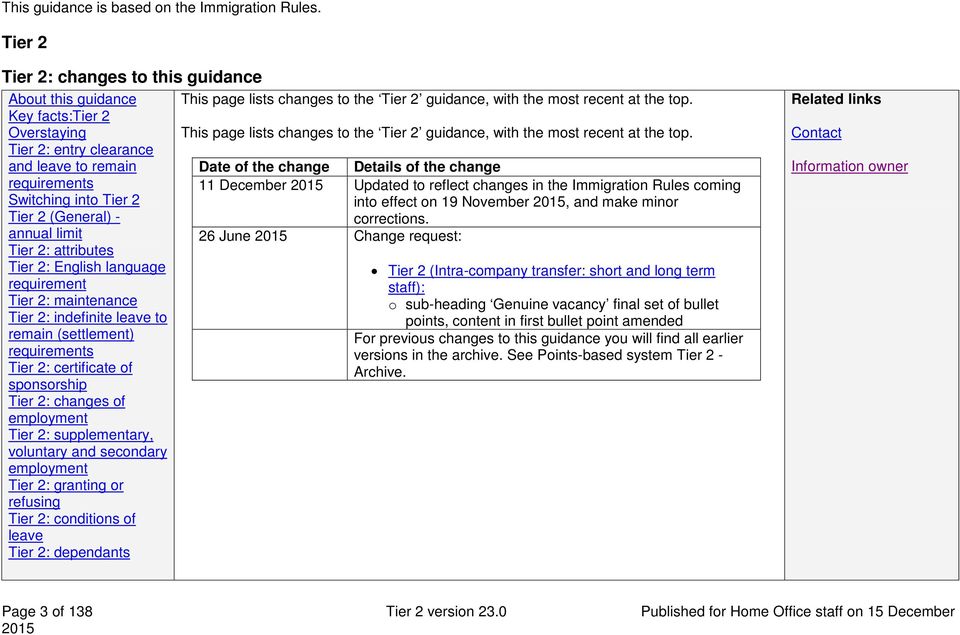
3 Tier 2 Tier 2: changes to this guidance About this guidance Key facts:tier 2 Overstaying Tier 2: entry clearance and leave to remain Switching into Tier 2 Tier 2 (General) - annual limit Tier 2: attributes Tier 2: English language requirement Tier 2: maintenance Tier 2: indefinite leave to remain (settlement) Tier 2: certificate of sponsorship Tier 2: changes of Tier 2: supplementary, voluntary and secondary Tier 2: granting or refusing Tier 2: conditions of leave Tier 2: dependants This page lists changes to the Tier 2 guidance, with the most recent at the top. This page lists changes to the Tier 2 guidance, with the most recent at the top. Date of the change Details of the change 11 December Updated to reflect changes in the Immigration Rules coming into effect on 19 November, and make minor corrections. 26 June Change request: Tier 2 (Intra-company transfer: short and long term staff): o sub-heading Genuine vacancy final set of bullet points, content in first bullet point amended For previous changes to this guidance you will find all earlier versions in the archive. See Points-based system Tier 2 - Archive. Related links Contact Information owner Page 3 of 138 Tier 2 version 23.0 Published for Home Office staff on 15 December
4 Tier 2 Tier 2: key facts About this guidance Tier 2: entry clearance and leave to remain Switching into Tier 2 Tier 2 (General) - annual limit Tier 2: attributes Tier 2: English language requirement Tier 2: maintenance Tier 2: indefinite leave to remain (settlement) Tier 2: certificate of sponsorship Tier 2: changes of Tier 2: supplementary, voluntary and secondary Tier 2: granting or refusing Tier 2: conditions of leave Tier 2: dependants This section gives caseworkers the key facts for each of the Tier 2 categories for the pointsbased system. For a summary of the key facts for each of the Tier 2 categories, see : Tier 2 (General): key facts Tier 2 (Intra-company transfer): key facts Tier 2 (Minister of religion): key facts Tier 2 (Sportsperson): key facts In this section Page 4 of 138 Tier 2 version 23.0 Published for Home Office staff on 15 December

5 Tier 2 Tier 2 (General): key facts This page shows you the key facts for Tier 2 (General). Eligibility Applicants must: not fall for refusal under general grounds for refusal not have had entry clearance or leave to remain as a Tier 2 migrant at any time during the 12 months immediately before the date of the application, unless they: o were not in the UK with leave as a Tier 2 migrant during this period and provide evidence to show this o were only in the UK as a Tier 2 migrant during the last 12 months for a short period or periods with a certificate of sponsorship (CoS) which was assigned for 3 months or less o will earn a gross salary of 155,300 or higher have a job offer and a certificate of sponsorship (CoS) from an organisation that is a licensed sponsor in the UK have a minimum of 50 points for attributes score 10 points for the English language requirement score 10 points under the maintenance requirement be over 16 years old Applicants must not be in breach of immigration laws for any period of overstaying except for the following which will be disregarded: 28 days or less if the application was submitted before 9 July 2012 For more information, see Applications from overstayers (non family routes). If the applicant is under 18 years of age the applicant s parents, legal guardian, or sole parent with legal responsibility for the child must: support the application give their consent to the applicant s: o travel arrangements to the UK o reception and care in the UK If the applicant has, or was last granted, leave as a: student postgraduate doctor or dentist Page 5 of 138 Tier 2 version 23.0 Published for Home Office staff on 15 December

6 and: student nurse student re-sitting an examination student writing-up a thesis student union sabbatical officer Tier 4 (General) student, including those on the doctorate extension scheme is currently sponsored by Her Majesty s Government, applicant s own government, or any international scholarship agency was being sponsored by Her Majesty s Government, applicant s own government, or any international scholarship agency, and that sponsorship came to an end 12 months ago or less they must provide unconditional written consent from the sponsoring government or international scholarship agency to the application and must provide the documents to show that this consent has been obtained. Application forms Cost of application: Entry clearance mandatory? Is biometric information required for applications made in the UK? Code of leave to remain granted Entry clearance endorsements Conditions of leave If the sponsor is a limited company, the applicant must not own more than 10 per cent of its shares unless their gross annual salary is 155,300 or higher. application made outside UK paper VAF9 & Appendix 5 or online by using UK4Visas extension or switching (within UK) apply online using the GOV.UK website indefinite leave to remain SET(O) For all applications see - Fees for Home Office services Yes Yes Code 4 TIER 2 (GENERAL) MIGRANT Category D The applicant: cannot take except: o working for the sponsor in the job recorded on their CoS o continuing in the lawful they were in on the date of the application, up until the start date on the CoS o supplementary Page 6 of 138 Tier 2 version 23.0 Published for Home Office staff on 15 December

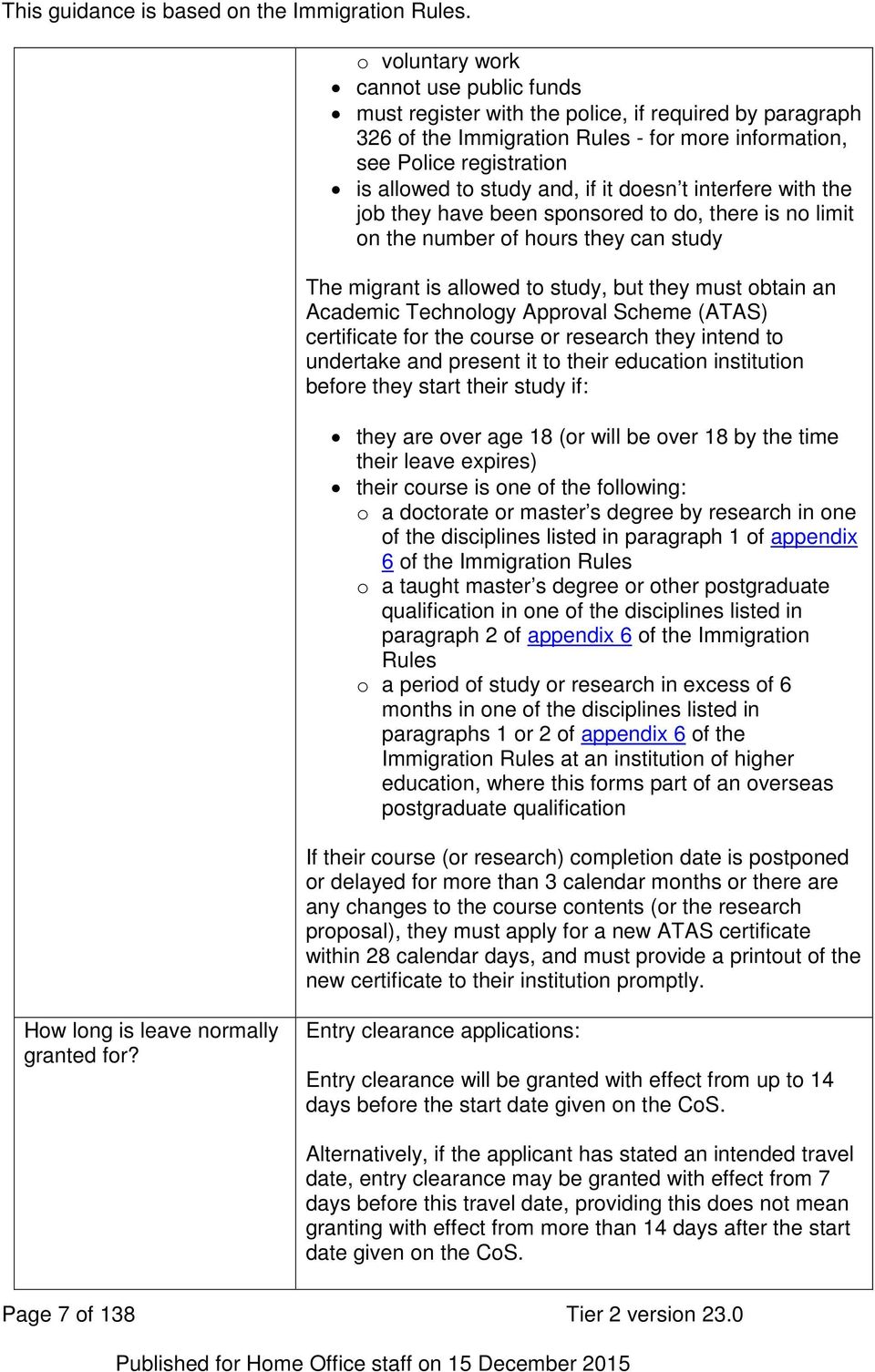
7 o voluntary work cannot use public funds must register with the police, if required by paragraph 326 of the Immigration Rules - for more information, see Police registration is allowed to study and, if it doesn t interfere with the job they have been sponsored to do, there is no limit on the number of hours they can study The migrant is allowed to study, but they must obtain an Academic Technology Approval Scheme (ATAS) certificate for the course or research they intend to undertake and present it to their education institution before they start their study if: they are over age 18 (or will be over 18 by the time their leave expires) their course is one of the following: o a doctorate or master s degree by research in one of the disciplines listed in paragraph 1 of appendix 6 of the Immigration Rules o a taught master s degree or other postgraduate qualification in one of the disciplines listed in paragraph 2 of appendix 6 of the Immigration Rules o a period of study or research in excess of 6 months in one of the disciplines listed in paragraphs 1 or 2 of appendix 6 of the Immigration Rules at an institution of higher education, where this forms part of an overseas postgraduate qualification If their course (or research) completion date is postponed or delayed for more than 3 calendar months or there are any changes to the course contents (or the research proposal), they must apply for a new ATAS certificate within 28 calendar days, and must provide a printout of the new certificate to their institution promptly. How long is leave normally granted for? Entry clearance applications: Entry clearance will be granted with effect from up to 14 days before the start date given on the CoS. Alternatively, if the applicant has stated an intended travel date, entry clearance may be granted with effect from 7 days before this travel date, providing this does not mean granting with effect from more than 14 days after the start date given on the CoS. Page 7 of 138 Tier 2 version 23.0 Published for Home Office staff on 15 December
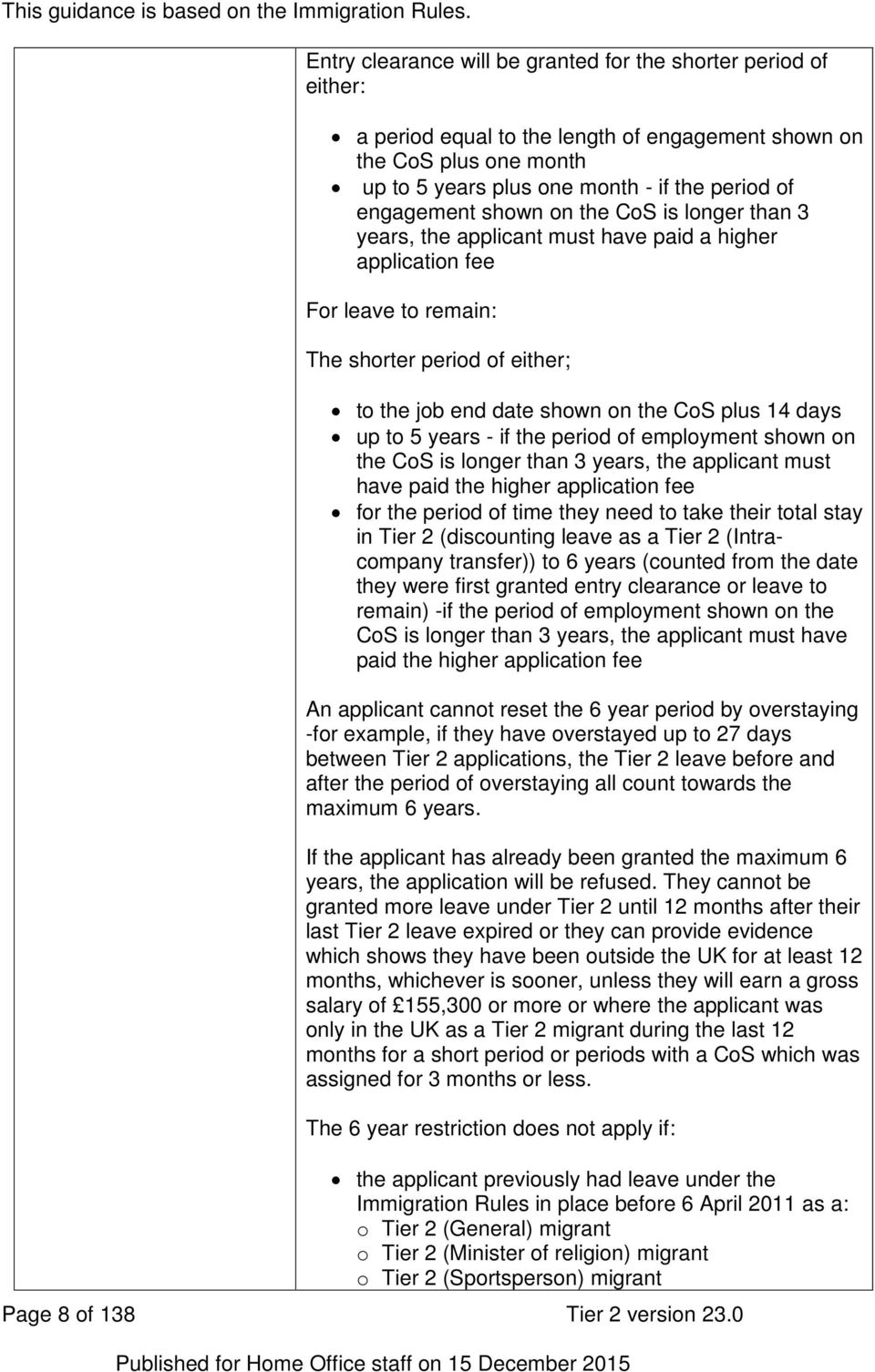
8 Entry clearance will be granted for the shorter period of either: a period equal to the length of engagement shown on the CoS plus one month up to 5 years plus one month - if the period of engagement shown on the CoS is longer than 3 years, the applicant must have paid a higher application fee For leave to remain: The shorter period of either; to the job end date shown on the CoS plus 14 days up to 5 years - if the period of shown on the CoS is longer than 3 years, the applicant must have paid the higher application fee for the period of time they need to take their total stay in Tier 2 (discounting leave as a Tier 2 (Intracompany transfer)) to 6 years (counted from the date they were first granted entry clearance or leave to remain) -if the period of shown on the CoS is longer than 3 years, the applicant must have paid the higher application fee An applicant cannot reset the 6 year period by overstaying -for example, if they have overstayed up to 27 days between Tier 2 applications, the Tier 2 leave before and after the period of overstaying all count towards the maximum 6 years. If the applicant has already been granted the maximum 6 years, the application will be refused. They cannot be granted more leave under Tier 2 until 12 months after their last Tier 2 leave expired or they can provide evidence which shows they have been outside the UK for at least 12 months, whichever is sooner, unless they will earn a gross salary of 155,300 or more or where the applicant was only in the UK as a Tier 2 migrant during the last 12 months for a short period or periods with a CoS which was assigned for 3 months or less. The 6 year restriction does not apply if: the applicant previously had leave under the Immigration Rules in place before 6 April 2011 as a: o Tier 2 (General) migrant o Tier 2 (Minister of religion) migrant o Tier 2 (Sportsperson) migrant Page 8 of 138 Tier 2 version 23.0 Published for Home Office staff on 15 December
9 o Jewish Agency employee o member of the operational ground staff of an overseas-owned airline o minister of religion, missionary o member of a religious order o qualifying work permit holder o representative of an overseas newspaper, news agency or broadcasting organisation they have not been granted entry clearance as a Tier 2 (General) migrant, Tier 2 (Minister of religion) migrant or Tier 2 (Sportsperson) migrant under the Immigration Rules in place from 6 April 2011 they have not been granted entry clearance, leave to enter or leave to remain in any other category since that grant of leave Are dependants allowed? Work and study allowed? Is switching into this category allowed? Yes Yes Applicants can switch into Tier 2 (General) if they have, or were last granted, leave in any of the following categories: any Tier 1 main applicant Tier 2 (Sportsperson) Tier 2 (Minister of religion) Tier 2 (Intra-company transfer: Established staff) if applying to change sponsor Tier 2 (Intra-company transfer) under rules in place before 6 April 2010 if applying to change sponsor one of the categories below but they must have successfully completed and passed a UK recognised bachelors or masters degree, Postgraduate Certificate in Education (PGCE), Professional Graduate Diploma of Education (PGDE) or have completed a minimum of 12 months study in the UK towards a UK PhD - this must have been during their current period of leave or in a period of continuous leave which includes their last grant of leave - the study must have been at a UK recognised institution or listed body, or an education provider which holds a Tier 4 licence: o Tier 4 (General) student, including those on the doctorate extension scheme o student o student nurse o student re-sitting an examination o student union sabbatical officer o overseas qualified nurse or midwife o person writing up a thesis o postgraduate doctor or dentist dependent partner of a Tier 4 student Page 9 of 138 Tier 2 version 23.0 Published for Home Office staff on 15 December

10 highly skilled migrant programme innovator fresh talent working in Scotland scheme international graduates scheme (or its predecessor the Science and engineering graduate scheme) business and commercial work permits (except multiple entry work permits) including Intra-company transfer work permits sports and entertainment work permits (except multiple entry work permits) Jewish agency employee member of the operational ground staff of an overseas owned airline minister of religion, missionary or member of a religious order overseas qualified nurse or midwife person writing up a thesis postgraduate doctor or dentist representative of an overseas business representative of an overseas newspaper, news agency or broadcasting organisation Does this category lead to settlement (indefinite leave to remain)? Is knowledge of language and life required? CID statistical category Immigration Rules paragraphs A person cannot switch into Tier 2 (General) from Tier 2 (Intra-company transfer: long term staff) if they are in the UK and were granted leave under the rules in place after 6 April Yes Yes TR2GEG T2 SW General Migrant LTR Grant. 245H 245HF Page 10 of 138 Tier 2 version 23.0 Published for Home Office staff on 15 December

11 Tier 2 Tier 2 (Intra-company transfer): key facts This page shows you the key facts for Tier 2 (Intra-company transfer) (ICT) Eligibility Applicants must: not fall for refusal under general grounds for refusal have a job offer and a certificate of sponsorship (CoS) from an organisation that is a licensed sponsor in the UK have a minimum of 50 points for attributes score 10 points under the maintenance requirement be over 16 years old Applicants must not be in breach of immigration laws, except for the following periods of overstaying which will be disregarded: 28 days or less if the application was submitted before 9 July 2012 For more information, see: Applications from overstayers (non family routes). If the applicant is under 18 years of age the applicant s parents, legal guardian, or sole parent with legal responsibility for the child must: support the application give their consent to the applicant s: o travel arrangements to the UK o reception and care in the UK If the applicant has, or was least granted, leave as a: and: student postgraduate doctor or dentist student nurse student re-sitting an examination student writing-up a thesis student union sabbatical officer, Tier 4 (General) student, including those on the doctorate extension scheme is currently being sponsored by Her Majesty s Government, applicant s own government, or any international scholarship agency Page 11 of 138 Tier 2 version 23.0 Published for Home Office staff on 15 December

12 was being sponsored by Her Majesty s Government, applicant s own government, or any international scholarship agency and that sponsorship came to an end 12 months ago or less Application forms Cost of application: Entry clearance mandatory? Is biometric information required for applications made in the UK? Code of leave to remain granted Entry clearance endorsements Conditions of leave they must provide the unconditional written consent to the sponsoring government or international scholarship agency to the application and must provide the specified documents to show consent has been obtained. application made outside UK paper VAF9 & Appendix 5 or online by using UK4Visas extension or switching (within UK) apply online using the GOV.UK website indefinite leave to remain SET(O) For all applications see - Fees for Home Office services Yes Yes Code 4 TIER 2 (INT COM TRAN) MIGRANT Category D The applicant: cannot take except: o working for the sponsor in the job recorded on their CoS o supplementary o voluntary work cannot use public funds must register with the police, if they are required to do so by paragraph 326 of the Immigration Rules for more information, see Police registration is allowed to study, as long as it doesn t interfere with the job they have been sponsored to do there is no limit on the number of hours they can study Study is subject to the following restriction. The migrant is allowed to study, but they must obtain an Academic Technology Approval Scheme (ATAS) certificate for the course or research they intend to undertake and present it to their education institution before they start their study if: they are over age 18 (or will be over 18 by the time their leave expires) their course is one of the following: o a doctorate or master s degree by research in one Page 12 of 138 Tier 2 version 23.0 Published for Home Office staff on 15 December

13 of the disciplines listed in paragraph 1 of appendix 6 of the Immigration Rules o a taught master s degree or other postgraduate qualification in one of the disciplines listed in paragraph 2 of appendix 6 of the Immigration Rules o a period of study or research in excess of 6 months in one of the disciplines listed in paragraphs 1 or 2 of appendix 6 of the Immigration Rules at an institution of higher education where this forms part of an overseas postgraduate qualification If their course (or research) completion date is postponed or delayed for more than 3 calendar months or there are any changes to the course contents (or the research proposal), they must apply for a new ATAS certificate within 28 calendar days, and must provide a print-out of the new certificate to their institution promptly. How long is leave normally granted for? Entry clearance applications Entry clearance will be granted with effect from up to 14 days before the start date given on the CoS. Alternatively, if the applicant has stated an intended travel date, entry clearance may be granted with effect from 7 days before this travel date, providing this does not mean granting with effect from more than 14 days after the start date given on the CoS. Short term staff and graduate trainees are granted for the shorter period of either: the period of engagement shown on the CoS plus one month 12 months based on the start date on the CoS Long term staff are granted for the shorter period of either: the period of engagement shown on the CoS plus one month up to 5 years: if the period of shown on the CoS is longer than 3 years, the applicant must have paid the higher application fee Skills transfers are granted for the shorter period of either: the period of engagement shown on the CoS plus one month a maximum of 6 months based on the job start date on the CoS Page 13 of 138 Tier 2 version 23.0 Published for Home Office staff on 15 December

14 Leave to remain applications Short term staff and graduate trainees are granted for the shorter period of either: the job end date shown on the CoS plus 14 days the period of time to take their total stay in Tier 2 ICT: short term staff or graduate trainee to 12 months (counted from the date of entry clearance or leave to remain) An applicant cannot reset the 6 year period by overstaying. For example, if they have overstayed up to 27 days between Tier 2 applications, the Tier 2 leave before and after the period of overstaying all counts towards the maximum 6 years. If the applicant has already been granted the full 12 months, the application will be refused. They cannot be granted any more leave under Tier 2 (except in the long term staff sub-category): until 12 months after the leave expired until they can provide evidence which shows they have been outside the UK for at least 12 months if they have previously been granted Tier 2 leave unless they will be paid an annual gross salary of 155,300 or more where the applicant was only in the UK as a Tier 2 migrant during the last 12 months for a short period or periods with a CoS which was assigned for 3 months or less Long term staff can be granted: to the job end date shown on the CoS plus 14 days up to 5 years - if the period of shown on the CoS is longer than 3 years, the applicant must have paid a higher application fee for the period of time they need to take their total leave granted under Tier 2 (Intra-company transfer) to 5 years, if their salary is less than 155,300 (or 153,500 if their CoS was assigned before 6 April ) per year for the period of time they need to take their total leave granted under Tier 2 (Intra-company transfer) to 9 years, if their salary is 155,300 or 153,500 if their CoS was assigned before 6 April ) or higher per year Page 14 of 138 Tier 2 version 23.0 Published for Home Office staff on 15 December

15 The total stay of 5 (or 9 years if they are earning 155,300 or more) is not broken by any gaps between their periods of leave up to 28 days. For example, if they have overstayed up to 27 days in the middle of a period of continuous leave, they cannot apply for another period of leave to take their total stay in Tier 2 beyond 5 (or 9 years if they are earning 155,300 or more). If the applicant has already been granted the maximum 5 years (or 9 years if they are earning 155,300 or more), the application will be refused. They cannot be granted any more leave under Tier 2 until 12 months after their last Tier 2 leave expired or they can provide evidence which shows they have been outside the UK for at least 12 months, whichever is the sooner, unless they will be paid an annual gross salary of 155,300 or more, or where the applicant was only in the UK as a Tier 2 migrant during the last 12 months for a short period or periods with a CoS which was assigned for 3 months or less. If the applicant was previously granted leave as an ICT under the Immigration Rules in place before 6 April 2011 or as a qualifying work permit holder and they have not been granted entry clearance in this or any other route since the grant of this leave there is no limit to the total time they can stay in this sub-category. Skills transfer are granted for the shorter period of either: to the job end date shown on the CoS plus 14 days for the period of time to take their total stay in this category to 6 months An applicant cannot reset the 6 month period by overstaying. For example, if they have overstayed up to 27 days between Tier 2 applications, the Tier 2 leave before and after the period of overstaying all count towards the maximum 6 month period (except in the long-term staff sub-category). If the applicant has already been granted the full 6 months, the application will be refused. They cannot be granted any more leave under Tier 2 (except in the long term staff sub-category): until 12 months after the leave expired until they can provide evidence which shows they have been outside the UK for at least 12 months if Page 15 of 138 Tier 2 version 23.0 Published for Home Office staff on 15 December

16 they have previously been granted Tier 2 leave unless they will be paid an annual gross salary of 155,300 or more or where the applicant was only in the UK as a Tier 2 migrant during the last 12 months for a short period or periods with a CoS which was assigned for 3 months or less Are dependants allowed? Work and study allowed? Is switching into this category allowed? Yes Yes Switching into Tier 2 (ICT: long term staff) is permitted by applicants who have or were granted leave as: Tier 2 (ICT: established staff) Tier 2 (ICT) - under the rules in place before 6 April 2010 ICT work permit holder (except multiple entry work permits) representatives of overseas businesses (this includes representatives of overseas media companies They must still be working for the same employer named on their previous application. No switching is allowed into the other Tier 2 (ICT) subcategories. Does this category lead to settlement (indefinite leave to remain)? Is knowledge of language and life required? CID statistical category Only if the period of continuous leave includes a period of leave as: Yes. a Tier 2 (ICT) migrant under the rules in place before 6 April 2010 a qualifying ICT work permit holder CID grant code: TR2GET T2 SW Inter company transfer LTR Grant CID refusal code: TR2RET T2 SW Inter company transfer LTR Refusal Immigration Rules paragraphs 245G 245GF Page 16 of 138 Tier 2 version 23.0 Published for Home Office staff on 15 December

17 Tier 2 Tier 2 (Minister of religion): key facts This page shows you the key facts for Tier 2 (Ministers of religion) Eligibility Applicants must: not fall for refusal under general grounds for refusal have a job offer and a certificate of sponsorship (CoS) from an organisation that is a licensed sponsor in the UK have a minimum of 50 points for the attributes scores a minimum of 10 points for the English language requirement scores a minimum of 10 points for the maintenance requirement be over 16 years old Applicants must not be in breach of immigration laws, except for the following periods of overstaying which will be disregarded: 28 days or less if the application was submitted before 9 July 2012 For more information, see: Application from overstayers (non family routes). If the applicant is under 18 years of age the applicant s parents, legal guardian, or sole parent with legal responsibility for the child must: support the application give their consent to the applicant s: o travel arrangements to the UK o reception and care in the UK If the applicant has, or was last granted, leave as a: and: student postgraduate doctor or dentist student nurse student re-sitting an examination student writing-up a thesis student union sabbatical officer Tier 4 (General) student, including those on the doctorate extension scheme Page 17 of 138 Tier 2 version 23.0 Published for Home Office staff on 15 December

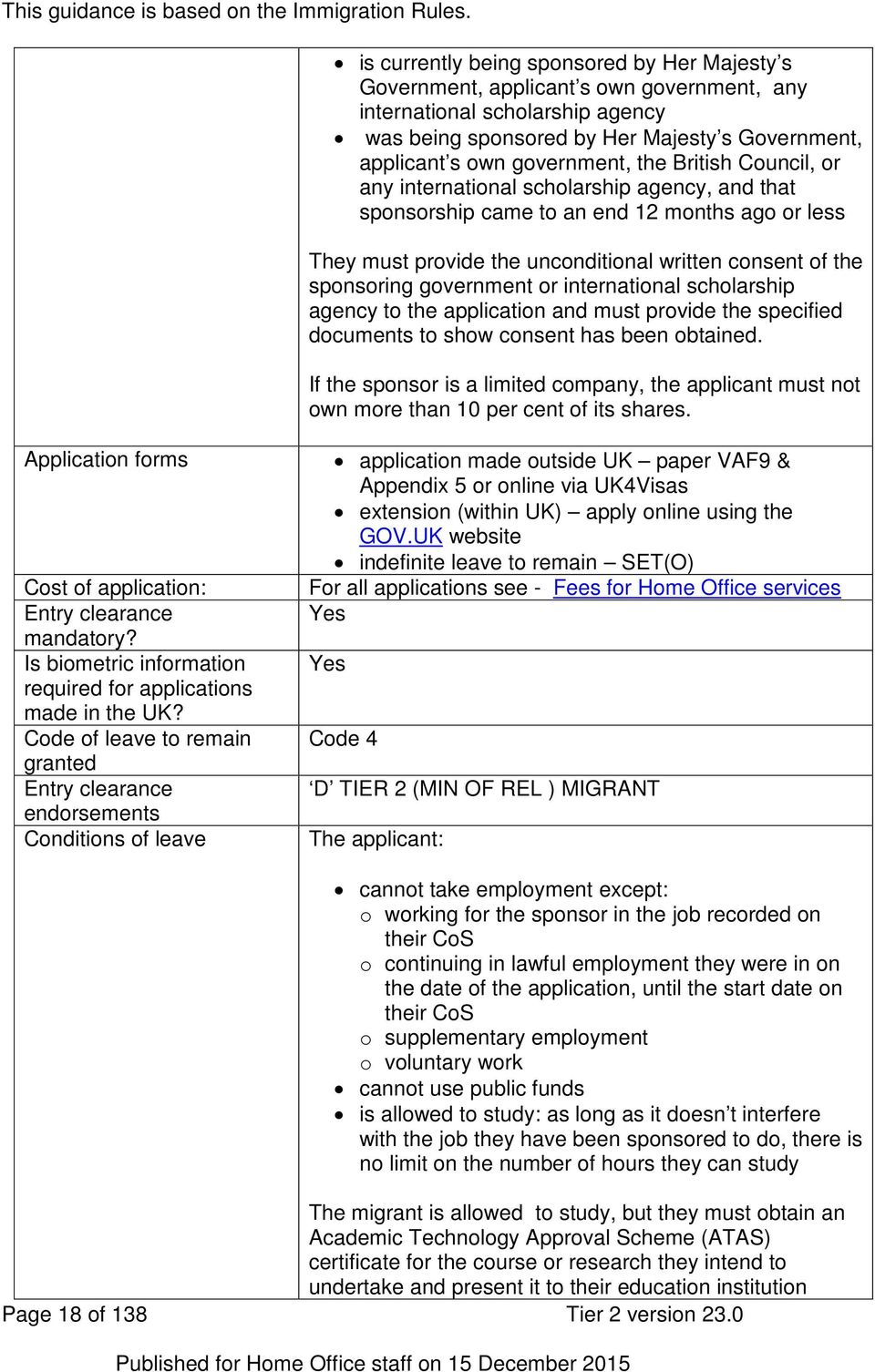
18 is currently being sponsored by Her Majesty s Government, applicant s own government, any international scholarship agency was being sponsored by Her Majesty s Government, applicant s own government, the British Council, or any international scholarship agency, and that sponsorship came to an end 12 months ago or less They must provide the unconditional written consent of the sponsoring government or international scholarship agency to the application and must provide the specified documents to show consent has been obtained. If the sponsor is a limited company, the applicant must not own more than 10 per cent of its shares. Application forms Cost of application: Entry clearance mandatory? Is biometric information required for applications made in the UK? Code of leave to remain granted Entry clearance endorsements Conditions of leave application made outside UK paper VAF9 & Appendix 5 or online via UK4Visas extension (within UK) apply online using the GOV.UK website indefinite leave to remain SET(O) For all applications see - Fees for Home Office services Yes Yes Code 4 D TIER 2 (MIN OF REL ) MIGRANT The applicant: cannot take except: o working for the sponsor in the job recorded on their CoS o continuing in lawful they were in on the date of the application, until the start date on their CoS o supplementary o voluntary work cannot use public funds is allowed to study: as long as it doesn t interfere with the job they have been sponsored to do, there is no limit on the number of hours they can study The migrant is allowed to study, but they must obtain an Academic Technology Approval Scheme (ATAS) certificate for the course or research they intend to undertake and present it to their education institution Page 18 of 138 Tier 2 version 23.0 Published for Home Office staff on 15 December
19 before they start their study if: they are over age 18 (or will be over 18 by the time their leave expires) their course is one of the following: o a doctorate or master s degree by research in one of the disciplines listed in paragraph 1 of appendix 6 of the Immigration Rules o a taught master s degree or other postgraduate qualification in one of the disciplines listed in paragraph 2 of appendix 6 of the Immigration Rules o a period of study or research in excess of 6 months in one of the disciplines listed in paragraphs 1 or 2 of appendix 6 of the Immigration Rules at an institution of higher education where this forms part of an overseas postgraduate qualification If their course (or research) completion date is postponed or delayed for more than 3 calendar months or there are any changes to the course contents (or the research proposal), they must apply for a new ATAS certificate within 28 calendar days, and must provide a print-out of the new certificate to their institution promptly. Tier 2 (Minister of Religion) migrants are not normally required to register with the police, as they are exempted under paragraph 326 of the Immigration Rules. How long is leave normally granted for? Entry clearance applications: Entry clearance will be granted with effect from up to 14 days before the start date given on the CoS. Alternatively, if the applicant has stated an intended travel date, entry clearance may be granted with effect from 7 days before this travel date, providing this does not mean granting with effect from more than 14 days after the start date given on the CoS. Entry clearance will be granted for the shorter period of either: the period of engagement shown on the CoS plus one month 3 years plus one month based on the job start date shown on the CoS For leave to remain applications: Page 19 of 138 Tier 2 version 23.0 Published for Home Office staff on 15 December

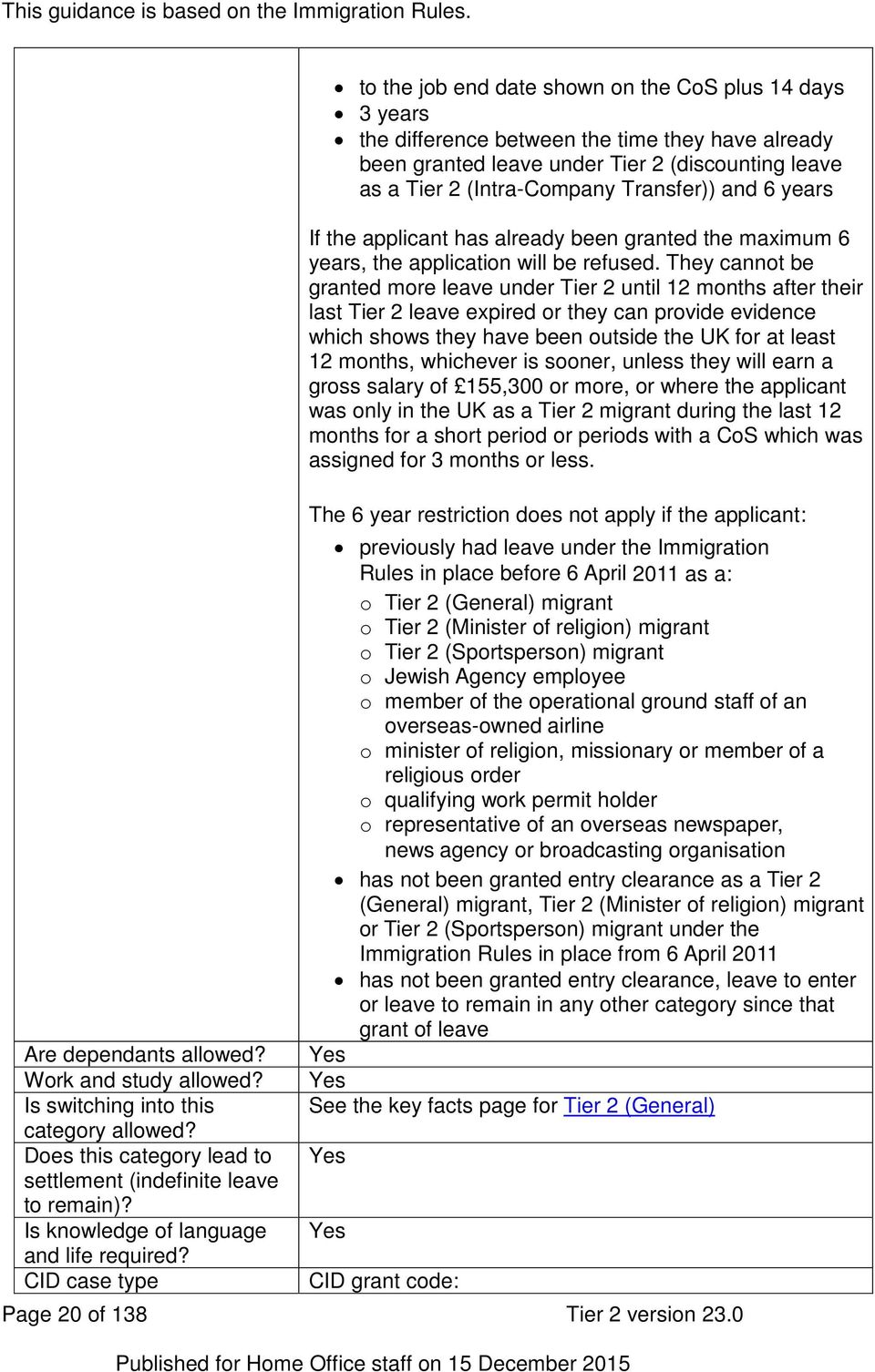
20 Are dependants allowed? Work and study allowed? Is switching into this category allowed? Does this category lead to settlement (indefinite leave to remain)? Is knowledge of language and life required? CID case type to the job end date shown on the CoS plus 14 days 3 years the difference between the time they have already been granted leave under Tier 2 (discounting leave as a Tier 2 (Intra-Company Transfer)) and 6 years If the applicant has already been granted the maximum 6 years, the application will be refused. They cannot be granted more leave under Tier 2 until 12 months after their last Tier 2 leave expired or they can provide evidence which shows they have been outside the UK for at least 12 months, whichever is sooner, unless they will earn a gross salary of 155,300 or more, or where the applicant was only in the UK as a Tier 2 migrant during the last 12 months for a short period or periods with a CoS which was assigned for 3 months or less. The 6 year restriction does not apply if the applicant: previously had leave under the Immigration Rules in place before 6 April 2011 as a: o Tier 2 (General) migrant o Tier 2 (Minister of religion) migrant o Tier 2 (Sportsperson) migrant o Jewish Agency employee o member of the operational ground staff of an overseas-owned airline o minister of religion, missionary or member of a religious order o qualifying work permit holder o representative of an overseas newspaper, news agency or broadcasting organisation has not been granted entry clearance as a Tier 2 (General) migrant, Tier 2 (Minister of religion) migrant or Tier 2 (Sportsperson) migrant under the Immigration Rules in place from 6 April 2011 has not been granted entry clearance, leave to enter or leave to remain in any other category since that grant of leave Yes Yes See the key facts page for Tier 2 (General) Yes Yes CID grant code: Page 20 of 138 Tier 2 version 23.0 Published for Home Office staff on 15 December
21 Immigration Rules paragraphs TR2 GEM T2 SW Minister of religion LTR Grant 245H 245HF Page 21 of 138 Tier 2 version 23.0 Published for Home Office staff on 15 December
22 Tier 2 Tier 2 (Sportsperson): key facts This page shows you the key facts for Tier 2 (Sportsperson). Eligibility Applicants must: not fall for refusal under general grounds for refusal have a job offer and a certificate of sponsorship (CoS) from an organisation that is a licensed sponsor in the UK have a minimum of 50 points for attributes, by having: o a certificate of sponsorship (CoS) from an organisation that is a licensed sponsor for employing sportspeople in the UK o an endorsement from the appropriate governing body score a minimum of 10 points for the English language requirement score a minimum of 10 points for the maintenance requirement be over 16 years old Applicants must not be in breach of immigration laws, except for any period of overstaying which will be disregarded: 28 days or less if the application was submitted before 9 July 2012 For more information, see: Application from overstayers (non family routes). If the applicant is under 18 years of age the applicant s parents, legal guardian, or sole parent with legal responsibility for the child must: support the application give their consent to the applicant s: o travel arrangements to the UK o reception and care in the UK If the applicant has, or was last granted, leave as a: student postgraduate doctor or dentist student nurse student re-sitting an examination student writing-up a thesis Page 22 of 138 Tier 2 version 23.0 Published for Home Office staff on 15 December
23 and: student union sabbatical officer Tier 4 (General) student, including those on the doctorate extension scheme is currently being sponsored by Her Majesty s Government, applicant s own government, or any international scholarship agency was being sponsored by Her Majesty s Government applicant s own government, or any international scholarship agency, and that sponsorship came to an end 12 months ago or less they must provide the unconditional written consent of the sponsoring government or international scholarship agency to the application and must provide the specified documents to show that this consent has been obtained. Application forms Cost of application: Entry clearance mandatory? Is biometric information required for applications made in the UK? Code of leave to remain granted Entry clearance endorsements Conditions of leave The applicant must not own more than 10 per cent of its shares if the sponsor is a limited company. application made outside UK paper VAF9 & Appendix 5 or online via UK4Visas extension or switching (within UK) apply online using the GOV.UK website indefinite leave to remain SET(O) For all applications see - Fees for Home Office services Yes Yes Code 4 TIER 2 (SPORTSPEOPLE) MIGRANT Category D The applicant: can only be employed in the job described on their certificate of sponsorship working for their sponsor, except: o if they are playing for their national side when they are in the UK, playing in British University and College Sport (BUCS) competitions, or doing temporary additional work as a sports broadcaster o continuing in lawful on the date of the application until the start date on the CoS o supplementary o voluntary work cannot use public funds Page 23 of 138 Tier 2 version 23.0 Published for Home Office staff on 15 December
24 must register with the police, if they are required to do so by paragraph 326 of the Immigration Rules -for more information, see Police registration is allowed to study - as long as it doesn t interfere with the job they have been sponsored to do there is no limit on the number of hours they can study Study is subject to the following restriction. The migrant is allowed to study, but they must obtain an Academic Technology Approval Scheme (ATAS) certificate for the course or research they intend to undertake and present it to their education institution before they start their study if: they are over age 18 (or will be over 18 by the time their leave expires) their course is either a: o doctorate or master s degree by research in one of the disciplines listed in paragraph 1 of appendix 6 of the Immigration Rules o taught master s degree or other postgraduate qualification in one of the disciplines listed in paragraph 2 of appendix 6 of the Immigration Rules o period of study or research in excess of 6 months in one of the disciplines listed in paragraphs 1 or 2 of appendix 6 of the Immigration Rules at an institution of higher education where this forms part of an overseas postgraduate qualification How long is leave normally granted for? If their course (or research) completion date is postponed or delayed for more than 3 calendar months or there are any changes to the course contents (or the research proposal), they must apply for a new ATAS certificate within 28 calendar days, and must provide a print-out of the new certificate to their institution promptly. Entry clearance applications Entry clearance will be granted with effect from up to 14 days before the start date given on the CoS. Alternatively, if the applicant has stated an intended travel date on their visa application, entry clearance may be granted with effect from 7 days before this travel date, providing this does not mean granting with effect from more than 14 days after the start date given on the CoS. Entry clearance will be granted for the shorter period of either: for the period of engagement shown on the CoS plus Page 24 of 138 Tier 2 version 23.0 Published for Home Office staff on 15 December
25 one month 3 years plus one month based on the job start date shown on the CoS For leave to remain applications: to the job end date shown on the CoS plus 14 days 3 years for the difference between the time they have already been granted leave under Tier 2 (discounting leave as a Tier 2 (Intra-company transfer)) and 6 years If the applicant has already been granted the maximum 6 years, the application will be refused. They cannot be granted more leave under Tier 2 until 12 months after their last Tier 2 leave expired or they can provide evidence which shows they have been outside the UK for at least 12 months, whichever is sooner, unless they will earn a gross salary of 155,300 or more, or where the applicant was only in the UK as a Tier 2 migrant during the last 12 months for a short period or periods with a CoS which was assigned for 3 months or less. Are dependants allowed? Work and study allowed? Is switching into this category allowed? The 6 year restriction does not apply if the applicant: previously had leave under the Immigration Rules in place before 6 April 2011 as a: o Tier 2 (General) migrant o Tier 2 (Minister of religion) migrant o Tier 2 (Sportsperson) migrant o Jewish Agency employee o member of the Operational Ground Staff of an Overseas-owned Airline o minister of religion, missionary o member of a religious order o qualifying work permit holder o a representative of an overseas newspaper, news agency or broadcasting organisation has not been granted entry clearance as a Tier 2 (General) migrant, Tier 2 (Minister of religion) migrant or Tier 2 (Sportsperson) migrant under the Immigration Rules in place from 6 April 2011 has not been granted entry clearance, leave to enter or leave to remain in any other category since that grant of leave Yes Yes See the key facts page for Tier 2 (General) but in addition to these: Page 25 of 138 Tier 2 version 23.0 Published for Home Office staff on 15 December
26 Tier 5 (Temporary worker) in the creative and sporting sub-category, for a job as a professional footballer if they meet the Tier 2 including English language Does this category lead to settlement (indefinite leave to remain)? Is knowledge of language and life required? CID case type Immigration Rules paragraphs Yes Yes Grant LTR TR2GEP Grant ILR TR2GSP Refusal LTR - TR2REP Refusal ILR - TR2RSP 245H 245HF Page 26 of 138 Tier 2 version 23.0 Published for Home Office staff on 15 December
27 Tier 2 Tier 2: overstaying About this guidance Key facts: Tier 2 Tier 2: entry clearance and leave to remain Switching into Tier 2 Tier 2 (General): annual limit Tier 2: attributes Tier 2: English language requirement Tier 2: maintenance Tier 2: indefinite leave to remain (settlement) Tier 2: certificate of sponsorship Tier 2: changes of Tier 2: supplementary, voluntary and secondary Tier 2: granting or refusing Tier 2: conditions of leave Tier 2: dependants This page tells caseworkers what they must check if an applicant has overstayed when making a decision on applications. This applies to all Tier 2 categories, including extensions, switching and changes of employer. Before considering any Tier 2 application you must check the applicant is not in breach of immigration laws, except for any period of overstaying which will be disregarded: 28 days or less if the application was submitted before 9 July 2012 For more information, see Applications from overstayers (non family routes). Page 27 of 138 Tier 2 version 23.0 Published for Home Office staff on 15 December
28 Tier 2 Tier 2: entry clearance and leave to remain About this guidance Key facts: Tier 2 Overstaying Switching into Tier 2 Tier 2 (General): annual limit Tier 2: attributes Tier 2: English language requirement Tier 2: maintenance Tier 2: indefinite leave to remain (settlement) Tier 2: certificate of sponsorship Tier 2: changes of Tier 2: supplementary, voluntary and secondary Tier 2: granting or refusing Tier 2: conditions of leave Tier 2: dependants This section tells caseworkers what they must check to see if an applicant meets the entry clearance or leave to remain for the Tier 2 categories of the points-based system. Before considering any Tier 2 application you must check the: application is valid applicant's passport or travel document is genuine applicant s immigration history (you must check internal systems and previous case notes to find this information) application has no general grounds for refusal application and biometric information are registered and verified For more information, see the following: specified application forms and procedures internal system checks leave to remain adverse immigration history general grounds for refusal biometric information points-based system - evidential flexibility You must do verification checks if you have any doubts about whether the supporting documents an applicant has submitted are genuine. For more information on changes of and supplementary, see links on left. In this section Tier 2 (General): entry clearance and leave to remain Tier 2 (Intra company transfer): entry clearance and leave to remain Tier 2 (Minister of religion): entry clearance and leave to remain Tier 2 (Sportsperson): entry clearance and leave to remain External links Immigration Rules - paragraph 245G-245HF Cooling off period Page 28 of 138 Tier 2 version 23.0 Published for Home Office staff on 15 December
29 If the application is for entry clearance or switching from another leave category within the UK, a 12 month cooling off period applies. The applicant must not have been in the UK with entry clearance or leave to remain as a Tier 2 migrant at any time during the 12 months immediately before the date of the application, unless one of the exceptions below applies. Where the applicant left the UK before their Tier 2 leave expired, the 12 month period can start earlier than the date their leave expired but only if they can provide evidence of having not been in the UK for a period of 12 months immediately before that date. Acceptable evidence may include, but is not limited to: travel tickets or boarding card stubs, but only if the applicant s sponsor submitted an SMS report at the time, confirming that their in the UK had ended exit or entry stamps in the applicant s passport which confirms that they were not in the UK a letter from the applicant s overseas employer confirming the date they started or restarted work overseas, after returning from the UK any other evidence that shows the applicant was not in the UK Where evidence is produced and accepted, the cooling off period must be calculated to start from the earliest date supported by that evidence. The cooling off period does not apply where: the applicant is applying under Tier 2 (ICT) - Long Term Staff and was previously granted under Tier 2 (ICT) - Short Term staff, Graduate Trainee or Skills Transfer, or under the Tier 2 (ICT) Rules in place before 6 April 2011 the gross annual salary stated on the applicant's current certificate of sponsorship (CoS) is 155,300 or higher the applicant was only in the UK as a Tier 2 migrant during the last 12 months for a short period or periods with a CoS which was assigned for 3 months or less, for example where the applicant: o was assigned a CoS of 3 months or less in the preceding 12 month period and had Page 29 of 138 Tier 2 version 23.0 Published for Home Office staff on 15 December
30 no other Tier 2 leave during that period, the cooling off period will not apply o has had more than one period of Tier 2 leave in the last 12 months and each CoS was assigned for less than 3 months, even where they may total over 3 months, the cooling off period will not apply o was assigned a CoS of 6 months in length, but the Home Office was notified by their sponsor that they ceased working in the UK after 2 months, the cooling off period will apply (as the CoS was assigned for more than 3 months) Tier 2 categories Tier 2 has 4 categories, for more information on the entry clearance and leave to remain for each of them, see: Tier 2 (General): entry clearance and leave to remain Tier 2 (Intra-company transfer): entry clearance and leave to remain Tier 2 (Minister of religion): entry clearance and leave to remain Tier 2 (Sportsperson): entry clearance and leave to remain Page 30 of 138 Tier 2 version 23.0 Published for Home Office staff on 15 December
31 Tier 2 Tier 2 (General): entry clearance and leave to remain About this guidance Key facts: Tier 2 Overstaying Tier 2: entry clearance and leave to remain Switching into Tier 2 Tier 2 (General): annual limit Tier 2: attributes Tier 2: English language requirement Tier 2: maintenance Tier 2: indefinite leave to remain (settlement) Tier 2: certificate of sponsorship Tier 2: changes of Tier 2: supplementary, voluntary and secondary Tier 2: granting or refusing Tier 2: conditions of leave Tier 2: dependants This page tells caseworkers what they must check to see if an applicant meets the entry clearance or leave to remain for the Tier 2 (General) category of the pointsbased system. Requirements for granting leave or entry clearance A Tier 2 (General) applicant must score 70 points against 3. The applicant must score: 50 points for attributes 10 points for English language skills - for more information on English language for Tier 2, see link on left 10 points for the maintenance requirement They must also: not fall for refusal under the general grounds for refusal be switching from one of the specified immigration categories, if applying in the UK - for a full list see link on left: Switching into Tier 2 be over 16 years old If the applicant is under 18 years of age Their parents, legal guardian, or just one parent with sole legal responsibility for the child, must: support the application give their consent to the arrangements for the applicant s travel to, and reception and care in, the UK In this section Tier 2 (Intra company transfer): entry clearance and leave to remain Tier 2 (Minister of religion): entry clearance and leave to remain Tier 2 (Sportsperson): entry clearance and leave to remain External links Immigration Rules - paragraph 245H 245HF If the applicant has been studying in the UK If the applicant has, or was last granted, leave as: Page 31 of 138 Tier 2 version 23.0 Published for Home Office staff on 15 December
32 and: a student postgraduate doctor or dentist student nurse student re-sitting an examination student writing-up a thesis a Tier 4 (General) student student union sabbatical officer is currently being sponsored by Her Majesty s Government, applicant s own government or any international scholarship agency was being sponsored by Her Majesty s Government, applicant s own government or any international scholarship agency, and that sponsorship came to an end 12 months ago or less they must provide unconditional consent from the sponsoring government or agency giving permission for them to remain in or re-enter the UK. This evidence must be original and on the organisation s official letter-headed paper. If they do not provide this you must refuse the application. If the applicant is applying to work in the UK as a nurse or midwife Unless the applicant is already registered as a nurse or midwife in the UK, or obtained a Nursing and Midwifery Council pre-registration letter before 30 April, they will need to pass their Observed Structured Clinical Examination (OSCE) after entering the UK. Their sponsor must tell the Home Office of any of the following where appropriate, within 10 working days: if the applicant fails their OSCE but arranges a re-sit and the sponsor still wants to sponsor the applicant if they pass, the sponsor must tell us the date of the applicant s re-sit if the applicant re-sits their OSCE and fails the sponsor must tell the Home Office the Page 32 of 138 Tier 2 version 23.0 Published for Home Office staff on 15 December
33 sponsor must also stop sponsoring the applicant if they do not pass the OSCE within 8 months of the start date on their CoS if the applicant passes their OSCE, the sponsor must tell us the date the applicant will start working for them as a registered nurse or midwife if the sponsor decides at any point that they no longer wish to sponsor the applicant - for example if the applicant fails their first OSCE and the sponsor does not want to wait until the applicant has done a re-sit If the applicant is already in the UK with entry clearance or leave to remain and the sponsor stops sponsoring the applicant you must reduce (curtail) the applicant s leave. For more information on the curtailment, see Curtailing the leave of points-based system migrants. If the sponsor is a limited company The applicant must not own more than 10 per cent of the company s shares, unless their gross annual salary is 155,300 or higher. Requirements for leave to remain An applicant must make an application if they need to extend their leave. The skill level and appropriate salary vary for applicants already in the UK, depending on when they initially had entry clearance, leave to enter or leave to remain under one of the categories below: If the applicant initially had entry clearance, leave to enter or leave to remain under the rules in place before 6 April 2011 as a: Tier 2 (General) migrant qualifying work permit holder representative of an overseas newspaper, news agency or broadcasting organisation member of the operational ground staff of an overseas airline Jewish agency employee Page 33 of 138 Tier 2 version 23.0 Published for Home Office staff on 15 December
34 and since this grant they have not been granted leave to remain, entry clearance or leave to enter in any other route and they are applying for the same job for either the same or a different employer, then both of the following apply: the job must be at or above national qualification framework (NQF) level 3 (or equivalent in Scotland) the salary does not need to meet the minimum threshold of 20,800, but must still be at or above the appropriate rate for the job. If the applicant initially had entry clearance, leave to enter or leave to remain under the rules in place between 6 April 2011 and 13 June 2012 and since their original grant they have not been granted leave to remain, entry clearance or leave to enter in any other route, then both of the following apply: their job must be at or above national qualification framework (NQF) level 4 or equivalent in Scotland their salary must meet the minimum threshold of 20,800 and they must be paid at or above the appropriate rate for the job If the applicant initially had entry clearance, leave to enter or leave to remain under the rules in place on or after 14 June 2012 their job must be one of the following: at or above national qualification framework (NQF) level 6 (or equivalent in Scotland) in a listed creative sector occupation on the Shortage Occupation List and their salary must meet the minimum threshold of 20,800 and they must be paid at or above the appropriate rate for the job. The applicant s job does not have to meet the skills thresholds described above in the following situations, if they have been granted leave as a Tier 2 (General) and are: Page 34 of 138 Tier 2 version 23.0 Published for Home Office staff on 15 December
35 applying to extend their leave, and: o will continue to work in the same occupation and for the same sponsor o their CoS used in their previous grant was assigned before 6 April 2013 o the job does not meet the skills threshold only because of the reclassification from SOC 200 to SOC 2010 applying to continue to work in a job which was on the Shortage Occupation List at the time of their previous grant of leave For a leave to remain application: the applicant must have a valid CoS the applicant must provide their biometric information with their extension application (for more information see Biometric information leave cannot be granted beyond the maximum time allowed (6 years) for applicants who entered the UK under the rules in place after 6 April 2011 For more information on the attributes for this category, see Tier 2 (General): attributes. For information on granting or refusing leave to remain, see Tier 2: grant or refuse leave to remain (extension). Page 35 of 138 Tier 2 version 23.0 Published for Home Office staff on 15 December
36 Tier 2 Tier 2 (Intra-company transfer): entry clearance and leave to remain About this guidance Key facts: Tier 2 Overstaying Tier 2: entry clearance and leave to remain Switching into Tier 2 Tier 2 (General): annual limit Tier 2: attributes Tier 2: English language requirement Tier 2: maintenance Tier 2: indefinite leave to remain (settlement) Tier 2: certificate of sponsorship Tier 2: changes of Tier 2: supplementary, voluntary and secondary Tier 2: granting or refusing Tier 2: conditions of leave Tier 2: dependants This page tells caseworkers what they must check to see if an applicant meets the entry clearance or leave to remain for the Tier 2 (Intra-company transfer) (ICT) category of the points-based system. Requirements for a grant of leave A Tier 2 (ICT) applicant must score 60 points, 50 for attributes and 10 for maintenance. Most of the are the same as those for Tier 2 (General), except: there is less ability to switch the specific attribute of the Tier 2 (ICT) category For more information on the for Tier 2 (General) and the ICT attributes, see: Tier 2 (General): entry clearance and extension Tier 2 (Intra-company transfer): attributes For more information on the procedures you must follow before you consider an application, see Tier 2: entry clearance and extension. Requirements for leave to remain Most of the are the same as those for Tier 2 (General), except for those below. To award 30 points for a certificate of sponsorship (CoS), the job must normally be at national qualification framework (NQF) level 6 (or equivalent in Scotland). To award the 20 points for appropriate salary it must normally be at least 24,800 (for short term staff, graduate trainee or skills transfer) or 41,500 (for long term staff). If the applicant is already in the UK and applies to extend in an ICT sub-category If initial leave was granted under the rules in place on or after 14 June 2012, the CoS must In this section Tier 2 (General): entry clearance and leave to remain Tier 2 (Minister of religion): entry clearance and leave to remain Tier 2 (Sportsperson):- entry clearance and leave to remain External links Immigration Rules - paragraph 245G-245GF Page 36 of 138 Tier 2 version 23.0 Published for Home Office staff on 15 December
37 confirm the job is NQF level 6 (or equivalent in Scotland), unless it is one of the following creative sector occupations skilled to NQF level 4 or above: 3411 artists 3412 authors, writers and translators 3413 actors, entertainers and presenters 3414 dancers and choreographers 3422 product, clothing and related designers If initial leave was granted in one of the following categories: Tier 2 (ICT: long term staff) Tier 2 (ICT: short term staff) Tier 2 (ICT: graduate trainee) Tier 2 (ICT: skills transfer) under the rules in place between 6 April 2011 and 13 June 2012 and leave to remain, entry clearance or leave to enter has not been granted in any other route, the CoS must confirm the job is NQF level 4 (or equivalent in Scotland) or above. The CoS must confirm the job is NVQ level 3 (or equivalent in Scotland) or above, if initial leave was granted as a: Tier 2 (Intra-company transfer) migrant under the rules in place before 6 April 2011, or qualifying work permit holder leave to remain, entry clearance or leave to enter has not been granted in any other route The job does not have to meet the skills thresholds described above if the: applicant is applying to extend their leave in Tier 2 (Intra-company transfer) to continue to work in the same occupation for the same sponsor the CoS used in their previous grant was assigned before 6 April 2013 Page 37 of 138 Tier 2 version 23.0 Published for Home Office staff on 15 December
38 job does not meet the skills threshold only because of the reclassification from SOC 2000 to SOC 2010 If the applicant is already in the UK and applies to extend their leave in the long term staff sub-category The job does not need to be NQF level 6 (or equivalent in Scotland) and the applicant does not need to meet the minimum annual salary of 41,500, if they were last granted leave in one of the following categories: Tier 2 (ICT) under the rules in place before 6 April 2010 Tier 2 (ICT: established staff ICT work permit holder (except multiple entry work permits) For these applicants the CoS must confirm the: job is at or above NQF level 3 (or equivalent in Scotland) person will be paid at, or above, the appropriate rate for the job For information on granting or refusing leave to remain, see Tier 2: grant or refuse leave to remain. Page 38 of 138 Tier 2 version 23.0 Published for Home Office staff on 15 December
39 Tier 2 Tier 2 (Minister of religion): entry clearance and leave to remain About this guidance Key facts: Tier 2 Overstaying Tier 2: entry clearance and leave to remain Switching into Tier 2 Tier 2 (General): annual limit Tier 2: attributes Tier 2: English language requirement Tier 2: maintenance Tier 2: indefinite leave to remain (settlement) Tier 2: certificate of sponsorship Tier 2: changes of Tier 2: supplementary, voluntary and secondary Tier 2: granting or refusing Tier 2: conditions of leave Tier 2: dependants This page tells caseworkers what they must check to see if an applicant meets the entry clearance and leave to remain for the Tier 2 (Minister of religion) category of the points-based system. Requirements for granting leave or entry clearance A Tier 2 (Minister of religion) applicant must score a minimum of 70 points against 3. Most of the are the same as those for Tier 2 (General), except for the English language and the specific attribute for the Tier 2 (Minister of religion) category. For information on the Tier 2 (General) and the specific attribute for ministers of religion, see: Tier 2 (General): entry clearance and extension Tier 2 (Ministers of religion): attributes Genuineness tests On 1 October 2013 the Immigration Rules changed to tackle abuse on this route but genuine applicants were not affected. When an applicant applies for entry clearance, leave to enter or leave to remain, you must be satisfied they: genuinely intend to undertake the role for which the certificate of sponsorship (CoS) was assigned are capable of undertaking the role for which the CoS was assigned will not undertake in the UK other than that permitted by the entry clearance, leave to enter or leave to remain In this section Tier 2 (General): entry clearance and leave to remain Tier 2 (Intra company transfer): entry clearance and leave to remain Tier 2 (Sportsperson): entry clearance and leave to remain Related links Links to staff intranet removed External links Immigration Rules - paragraph 245H-245HF Page 39 of 138 Tier 2 version 23.0 Published for Home Office staff on 15 December
40 To assess this on the balance of probabilities, you may request: additional information and evidence, and refuse the application if the information or evidence is not provided (the Home Office must receive any requested documents at the address given in the request within 28 working days of the date the request letter is posted) that an applicant attends an interview and refuse the application if they fail to comply with any such request without providing a reasonable explanation You may take into account the applicant s: knowledge of the role relevant experience relative to skills required to do the role knowledge of the sponsor in the UK explanation of how they were recruited any other relevant information You will not need to take these actions for most applicants and will only do so when: individual sponsors are assigning unusually large numbers of CoS for ministers of religion relative to their size or for the same type of role there are reasonable grounds to believe the applicant will not be working in the role described on the CoS the job descriptions on the CoS indicate the applicant will be mainly carrying out nonpastoral duties that might otherwise be done under Tier 2 (General) intelligence suggests applicants are linked to extremism, terrorism or trafficking English language requirement A minister of religion must score 10 points for English language because they have to: speak to and for the religious communities they will be representing communicate with younger English-speaking generations Page 40 of 138 Tier 2 version 23.0 Published for Home Office staff on 15 December
41 For more information on English language, see link on left. Requirements for leave to remain Leave cannot be granted for more than the maximum time allowed (6 years) for applicants entering after 6 April For more information, see Tier 2: grant or refuse leave to remain. Page 41 of 138 Tier 2 version 23.0 Published for Home Office staff on 15 December
42 Tier 2 Tier 2 (Sportsperson): entry clearance and leave to remain About this guidance Key facts: Tier 2 Overstaying Tier 2: entry clearance and leave to remain Switching into Tier 2 Tier 2 (General): annual limit Tier 2: attributes Tier 2: English language requirement Tier 2: maintenance Tier 2: indefinite leave to remain (settlement) Tier 2: certificate of sponsorship Tier 2: changes of Tier 2: supplementary, voluntary and secondary Tier 2: granting or refusing Tier 2: conditions of leave Tier 2: dependants This page tells caseworkers what they must check to see if an applicant meets the entry clearance and leave to remain of the Tier 2 (Sportsperson) category of the points-based system. Requirements for a grant of leave or entry clearance A Tier 2 (Sportsperson) applicant must score a minimum of 70 points against 3. Most of the for Tier 2 (Sportsperson) are the same as those for Tier 2 (General), except for the specific attribute for this Tier 2 category. For information on the Tier 2 (General) and the specific attributes for sportspeople, see: Tier 2 (General): entry clearance and extension Tier 2 (Sportsperson): attributes Requirements for leave to remain The applicant must provide a new governing body endorsement with a new reference number. Leave cannot be granted beyond the maximum time allowed (6 years) for applicants entering after 6 April English language requirement A sportsperson must score 10 points for English language. For more information, see link on left: Tier 2: English language requirement. For more information on the procedures you must follow before you consider an application, see link on left: Tier 2: entry clearance and leave to remain. For information on granting or refusing leave to remain, see Tier 2: grant or refuse leave to In this section Tier 2 (General): entry clearance and leave to remain Tier 2 (Intra company transfer): entry clearance and leave to remain Tier 2 (Minister of religion): entry clearance and leave to remain Related links Tier 2 (Sportsperson): attributes Tier 2: entry clearance and leave to remain External links Immigration Rules - paragraph 245H-245HF Page 42 of 138 Tier 2 version 23.0 Published for Home Office staff on 15 December
43 remain. Page 43 of 138 Tier 2 version 23.0 Published for Home Office staff on 15 December
44 Tier 2 Switching into Tier 2 About this guidance Key facts: Tier 2 Overstaying Tier 2: entry clearance and leave to remain Switching into Tier 2 Tier 2 (General): annual limit Tier 2: attributes Tier 2: English language requirement Tier 2: maintenance Tier 2: indefinite leave to remain (settlement) Tier 2: certificate of sponsorship Tier 2: changes of Tier 2: supplementary, voluntary and secondary Tier 2: granting or refusing Tier 2: conditions of leave Tier 2: dependants This section tells caseworkers when an applicant can switch into the Tier 2 category of the points-based system. Switching into Tier 2 (General), Tier 2 (Sportsperson) and Tier 2 (Minister of religion) You can switch applicants who have, or were last granted, leave in any of the following: any Tier 1 main applicant Tier 2 (General) Tier 2 (Intra-company transfer: Established staff) if applying to change sponsor Tier 2 (Intra-company transfer) under the rules in place before 6 April 2010 applying to change sponsor Tier 2 (Sportsperson) Tier 2 (Minister of religion) one of the student categories (for more information, see related link) Tier 5 (Temporary worker) in the creative and sporting sub-category, for a job as a professional footballer if they meet the Tier 2 (Sportsperson) including English language dependent partner of a Tier 4 student highly skilled migrant programme innovator fresh talent working in Scotland scheme international graduates scheme (or its predecessor the Science and engineering graduate scheme) business and commercial work permits (except multiple entry work permits) sports and entertainment work permits (except multiple entry work permits) Jewish agency employee member of the operational ground staff of an overseas owned airline minister of religion, missionary or member of a religious order overseas qualified nurse or midwife In this section Switching from a student category into Tier 2 Page 44 of 138 Tier 2 version 23.0 Published for Home Office staff on 15 December
45 representative of an overseas business representative of an overseas newspaper, news agency or broadcasting organisation Switching into Tier 2 (General) from Tier 2 (Intra-company transfer)(ict) You must not switch a person into Tier 2 (General) from Tier 2 (ICT) unless the migrant has, or was last granted leave as a: Tier 2 (ICT: Established staff) migrant and is applying to change sponsor Tier 2 (ICT) migrant under the rules in place before 6 April 2010 and is applying to change sponsor Tier 2 (ICT: Long Term Staff) granted entry clearance under the rules in place on or after 6 April 2011 cannot switch into Tier 2 (General). Switching into Tier 2 (ICT: long term staff) You can switch applicants who have, or were last granted leave as: Tier 2 (ICT: Established staff) Tier 2 (ICT), under the rules in place before 6 April 2010 ICT work permit holder (except multiple entry work permits) representative of an overseas business, including representatives of overseas media companies In all cases, the applicant must be working for the same employer named on their previous application. If the applicant is not in any of these categories, they must leave the UK and make a new application for entry under the correct immigration category. Applicants are not allowed to switch into other Tier 2 (ICT) sub-categories. Page 45 of 138 Tier 2 version 23.0 Published for Home Office staff on 15 December
46 Tier 2 Switching from a student category into Tier 2 About this guidance Key facts: Tier 2 Overstaying Tier 2: entry clearance and leave to remain Switching into Tier 2 Tier 2 (General): annual limit Tier 2: attributes Tier 2: English language requirement Tier 2: maintenance Tier 2: indefinite leave to remain (settlement) Tier 2: certificate of sponsorship Tier 2: changes of Tier 2: supplementary, voluntary and secondary Tier 2: granting or refusing Tier 2: conditions of leave Tier 2: dependants This page tells caseworkers when an applicant can switch from a student category into the Tier 2 category of the points based system. Switching into Tier 2 (General), Tier 2 (Sportsperson) and Tier 2 (Minister of religion) You can switch applicants who have, or have last been granted, leave in one of the following categories: Tier 4 (General) student, including those on the doctorate extension scheme student student nurse student re-sitting and exam student union sabbatical officer person writing up a thesis postgraduate doctor or dentist The applicant must: have successfully completed a course and passed a UK recognised: o bachelors or masters degree o Post Graduate Certificate in Education (PGCE) o Professional Graduate Diploma of Education (PGDE) o have completed a minimum of 12 months study in the UK towards a UK PhD studied the above during their current period of leave or in a period of continuous leave which includes their last grant of leave have undertaken the period of study and/or research towards their award whilst they had entry clearance, leave to enter or leave to remain in the UK and they were not subject to a restriction preventing them from undertaking a course of study and/or research have studied at a UK recognised institution or listed body, or an education provider Page 46 of 138 Tier 2 version 23.0 Published for Home Office staff on 15 December
47 which holds a Tier 4 licence meet the full for Tier 2 Documents they must provide To prove the applicant has successfully completed and passed a UK bachelor s or master s degree PGCE PGDE 12 months minimum study in the UK towards a PhD during their current period of continuous leave they must provide an: original degree certificate academic transcript academic reference on the institution s official headed paper which clearly shows: their name the course title and award the length of the course the date they completed the course unless they are studying a PhD course If the applicant has, or has last been granted, leave in one of the above categories on the date of application and satisfies the above conditions, the sponsor will not have to undertake a resident labour market test (RLMT). For more information, see Tier 2 (General): job passes resident labour market test (RLMT). Page 47 of 138 Tier 2 version 23.0 Published for Home Office staff on 15 December
48 Tier 2 Tier 2: attributes About this guidance Key facts: Tier 2 Overstaying Tier 2: entry clearance and leave to remain Switching into Tier 2 Tier 2 (General): annual limit Tier 2: attributes Tier 2: English language requirement Tier 2: maintenance Tier 2: indefinite leave to remain (settlement) Tier 2: certificate of sponsorship Tier 2: changes of Tier 2: supplementary, voluntary and secondary Tier 2: granting or refusing Tier 2: conditions of leave Tier 2: dependants This section tells caseworkers about the attributes and the points an applicant can be awarded for each of the Tier 2 categories of the points-based system. For information on the attributes for each of the Tier 2 categories, see: Tier 2 (General): attributes Tier 2 (Intra-company transfer): attributes Tier 2 (Minister of religion): attributes Tier 2 (Sportsperson): attributes In this section Page 48 of 138 Tier 2 version 23.0 Published for Home Office staff on 15 December
49 Tier 2 Tier 2 (General): attributes About this guidance Key facts: Tier 2 Overstaying Tier 2: entry clearance and leave to remain Switching into Tier 2 Tier 2 (General): annual limit Tier 2: attributes Tier 2: English language requirement Tier 2: maintenance Tier 2: indefinite leave to remain (settlement) Tier 2: certificate of sponsorship Tier 2: changes of Tier 2: supplementary, voluntary and secondary Tier 2: granting or refusing Tier 2: conditions of leave Tier 2: dependants This section tells caseworkers how to score the attribute points for the Tier 2 (General) category of the points-based system and what supporting evidence an applicant must provide. The applicant must score 50 points for their attributes. The table below is a summary of the points that the applicant can score. Attributes Valid certificate of sponsorship (CoS) from a licensed sponsor that meets one of the following : a resident labour market test has been passed by the sponsor a resident labour market test exemption applies (for example, poststudy work, shortage occupation, job offer with a salary of 155,300 or more) the application is an extension where the individual continues to work in the same job for the same employer Appropriate salary for the job 20 Certificate of sponsorship For initial applications, the CoS must confirm the: Points 30 job is national qualification framework (NQF) level 6 (or equivalent in Scotland) occupation, in a creative sector occupation skilled to NQF level 4 (or the equivalent in Scotland) as listed in appendix A of the Immigration Rules, unless transitional arrangements apply, or it is on the shortage occupation list applicant will be paid at least 20,800 or at (or above) the appropriate rate for the job, whichever is higher In this section Tier 2 (General): appropriate salary and allowances Tier 2 (General): job is in a shortage occupation Tier 2 (General): job passes resident labour market test (RLMT) Tier 2 (General): switching from a poststudy category Related links: Tier 2 (General): entry clearance and leave to remain Page 49 of 138 Tier 2 version 23.0 Published for Home Office staff on 15 December
50 For more information about transitional, see link on left: Tier 2 entry clearance and extension. For more information on appropriate salaries, see Codes of practice. For more information on the CoS, see link on left: Tier 2: certificate of sponsorship. The annual limit An annual limit of 20,700 CoS applies to Tier 2 (General). The limit runs from 6 April one year to 5 April the following year. Restricted and unrestricted CoS CoS issued under the limit are called restricted. Employers must get permission before they can issue restricted CoS by using the monthly allocation process. Restricted CoS are needed for all Tier 2 (General) entry clearance applications, unless the salary on the CoS is 155,300 or more. Restricted CoS are also needed for Tier 2 (General) leave to remain applications from those who are applying to switch from within the UK as a dependent partner of a Tier 4 (General) student. CoS for applications outside the limit are called unrestricted. Employers do not need separate permission before they issue these from their annual allocation of CoS. Unrestricted CoS can only be used for Tier 2 (General) entry clearance applications where the salary on the CoS is 155,300 or more. Unrestricted CoS can be used for all Tier 2 (General) leave to remain applications, except where the applicant is applying to switch from within the UK as a dependent partner of a Tier 4 (General) student. Entry clearance officers and caseworkers must check the type of CoS being used, and must not award points for a CoS if the application is one where a restricted CoS is required, but the applicant is applying using an unrestricted CoS. The table below shows the types of CoS which are restricted and unrestricted. Restricted CoS Unrestricted CoS Page 50 of 138 Tier 2 version 23.0 Published for Home Office staff on 15 December
51 general (Entry clearance with salary less than 155,300) general (Tier 4 dependant switching to Tier 2) general (switching immigration category) general (Extensions) general (Changes of ) general (New hires high earners) general (Tier 4 graduate switching to Tier 2) general (Entry clearance with a salary of 155,300 or more) Attributes for extension or change of applications The skill level that applies for extension or change of applications is the same as the one under which the original leave was granted. They must already be in the UK as a: Tier 2 (General) applicant qualifying work permit holder representative of an overseas newspaper, news agency or broadcasting organisation member of the operational ground staff of an overseas owned airline Jewish agency employee Tier 2 (General) or qualifying work permit holder for a job which appeared on the shortage occupation list at the time of their grant of leave and they are applying for the same job for either the same or different sponsor If the applicant was granted leave under Tier 2 (General) before 6 April 2011, the job must be at NQF level 3 (or equivalent in Scotland) unless they were last granted as a senior care worker or established entertainer, as defined in paragraph 6 of the Immigration Rules. If they were granted leave under Tier 2 (General) between 6 April 2011 and 13 June 2012, the job must be at NQF level 4 (or equivalent in Scotland). If they were granted leave under Tier 2 (General) on or after 14 June 2012, the job must be at NQF level 6 (or equivalent in Scotland). Page 51 of 138 Tier 2 version 23.0 Published for Home Office staff on 15 December
52 The job does not have to meet the skills thresholds described above if the: applicant is applying to extend their leave in Tier 2 (General) to continue to work in same occupation for the same sponsor applicant s CoS was given to the applicant before 6 April 2013 job does not meet the skills threshold only because of the reclassification from SOC 2000 to SOC 2010 For more information on the Tier 2 (General) attributes, see relate links. Page 52 of 138 Tier 2 version 23.0 Published for Home Office staff on 15 December
53 Tier 2 Tier 2 (General): appropriate salary and allowances About this guidance Key facts: Tier 2 Overstaying Tier 2: entry clearance and leave to remain Switching into Tier 2 Tier 2 (General): annual limit Tier 2: attributes Tier 2: English language requirement Tier 2: maintenance Tier 2: indefinite leave to remain (settlement) Tier 2: certificate of sponsorship Tier 2: changes of Tier 2: supplementary, voluntary and secondary Tier 2: granting or refusing Tier 2: conditions of leave Tier 2: dependants This page tells caseworkers how to score the appropriate salary attribute points for the Tier 2 (General) category of the points-based system. The table below gives the points you can award for appropriate salary and the applicant must meet one of the 20 point attributes. This is the annual salary they are going to be paid before tax (gross). Attributes Points Salary of 20,800 and above and paid the appropriate rate for the job. 20 If they have, or last had, entry clearance, leave to enter or leave to 20 remain as a: Tier 2 (General) migrant under the rules before 6 April 2011 Jewish agency employee Member of the operational ground staff of an overseas owned airline Minister or religion, missionary or member of a religious order Representative of an overseas newspaper, news agency or broadcasting organisation qualifying work permit holder and are paid the appropriate rate for the job. If the certificate of sponsorship (CoS) states the applicant is being sponsored as a nurse or midwife in a supervised practise placement approved by the Nursing and Midwifery Council, and: will be paid at least 16,271 will continue to be sponsored as a nurse or midwife by the 20 In this section Tier 2 (General): attributes Tier 2 (General): job is in a shortage occupation Tier 2 (General): job passes resident labour market test (RLMT) Tier 2 (General): switching from a poststudy category Related links Tier 2: searching the certificate of sponsorship checking system Page 53 of 138 Tier 2 version 23.0 Published for Home Office staff on 15 December
54 sponsor after getting Nursing and Midwifery Council registration the applicant s salary will not be less than 21,478 a year once they have their registration confirmed Under 20,800 and none of the above categories apply, or are not paid the appropriate for the job. 0 Check the salary is at the appropriate rate for the job The certificate of sponsorship (CoS) must confirm that the applicant will be paid at or above the appropriate rate for the job. You can check this is appropriate from the relevant code of practice for the occupation. Where a CoS is assigned which would mean the applicant s total stay in Tier 2 (plus any time as a work permit holder) would be longer than 3 years and 1 month, the salary shown on the CoS must be at least the experienced rate of pay. For example, if the sponsor assigns a 5 year CoS with the new entrant rate of pay, it will not meet the minimum of the rules and the applicant must be refused. For more information, see Codes of practice. When you assess if the salary is the appropriate rate, and award points, you must: consider basic pay (excluding overtime) plus any allowances (for example, London weighting) or bonuses which would also be paid to a settled worker in similar circumstances, provided these allowances and/or bonuses are part of the guaranteed salary package not consider other benefits, such as: o bonus or incentive pay o travel and subsistence, including travel to and from the applicant s home country You must not include the value of the shares if the person has been given shares as part of an employee shareholder contract. Page 54 of 138 Tier 2 version 23.0 Published for Home Office staff on 15 December
55 If the salary does not meet the rate stated in the code of practice, you must award 0 points for appropriate salary and refuse the application, even if the applicant meets the other for salary and allowances. You must check the appropriate salary claimed by the applicant on the application form matches the amount stated on the certificate of sponsorship (CoS). If the amount is significantly different, you must discuss it with your manager to see if it is appropriate to refer to the sponsor licensing unit (SLU) and complete the TMIH referral form. For information on checking a CoS, see Tier 2: searching the certificate of sponsorship checking system. Salaries for applicants sponsored by Research Councils Research Councils are bound by HM Treasury rules on public sector pay increases, which are currently limited to one per cent each year. In most cases Research Councils will be able to pay their sponsored workers the current minimum prescribed rate, but there may be instances where the salary on offer falls slightly short. In these cases, you must consider any reasons given by the sponsor for the shortfall. You must discuss with your manager whether to apply discretion and exceptionally grant the application outside of the rules. You may contact the economic migration policy team for advice if you need it. Salaries and allowances: what you can consider Salaries Salaries can be paid in the UK or abroad. If the funds are in a currency other than pounds sterling, the amount entered on the CoS must reflect the exchange rate for the relevant currency on the date the employer assigned the CoS. You must use the rates on the OANDA web site. If the applicant intends to work in the UK on a short term work contract, you can consider the Page 55 of 138 Tier 2 version 23.0 Published for Home Office staff on 15 December
56 12 month equivalent. If, for example, it is a 6 month contract paying 11,000, the applicant can claim yearly earnings of 22,000. If they are working part time, you must only consider the actual earnings and not the equivalent full time earnings when assessing the 20,800 threshold. You must only consider earnings up to a maximum of 48 hours each week. For example, if the applicant has an annual income 24,024 and works 52 hours each week, you would need to assess the 48 hour equivalent. The calculation is as follows: 24,024 / 52 = x 48 = 22,716 Salaries should, however, be pro-rated when assessing whether an applicant is paid the appropriate rate. For example, if the appropriate rate in the Codes of Practice is 40,000 for a 39-hour week and the applicant will be paid 30,000 for a 30-hour week, the calculation is as follows: 30,000 / 30 = 1,000 1,000 x 39 = 39,000 The applicant in this example would therefore be getting paid less than the appropriate rate. Allowances If the CoS confirms the applicant will be receiving allowances, but it is not clear what the allowances are for, you must: contact the sponsor and request this information ask the sponsor to provide this information within 3 working days: if they do not, you must: o not consider the allowances when you assess appropriate salary and allowances o refer the possible breach of compliance to SLU using the TMIH referral form Page 56 of 138 Tier 2 version 23.0 Published for Home Office staff on 15 December
57 Tier 2 Tier 2 (General): when a job is in a shortage occupation About this guidance Key facts: Tier 2 Overstaying Tier 2: entry clearance and leave to remain Switching into Tier 2 Tier 2 (General): annual limit Tier 2: attributes Tier 2: English language requirement Tier 2: maintenance Tier 2: indefinite leave to remain (settlement) Tier 2: certificate of sponsorship Tier 2: changes of Tier 2: supplementary, voluntary and secondary Tier 2: granting or refusing Tier 2: conditions of leave Tier 2: dependants This page tells caseworkers how to score the attribute points for the Tier 2 (General) category of the points-based system if a job is in a shortage occupation. You can award 30 points for sponsorship if the: other explained elsewhere in this guidance are met job on offer was on the shortage occupation list when the sponsor assigned the certificate of sponsorship (CoS) The contracted hours must be for at least 30 hours a week. The CoS must confirm the: job is in a shortage occupation standard occupational classification (SOC) code sponsor has met the for that shortage occupation set out in the shortage application list For more information see Codes of practice. Digitech shortage occupations Four digital technology jobs are included on the Shortage Occupation list where the sponsor is a qualifying company. The jobs are: IT product manager (2133 IT Specialist managers) Data scientist (2135 IT business analysts, architects and systems designers) Senior developer (2136 Programmers and software development professionals) Cyber security specialist (2139 Information and communication technology professionals not elsewhere classified) In this section Tier 2 (General): attributes Tier 2 (General): appropriate salary and allowances Tier 2 (General): job passes resident labour market test (RLMT) Tier 2 (General): switching from a poststudy category Page 57 of 138 Tier 2 version 23.0 Published for Home Office staff on 15 December
58 In order for companies to be able to assign a CoS for one of these shortage occupations they must meet certain criteria which will be assessed by sponsorship teams. These sponsors are only allowed to sponsor 10 migrants in these digitech shortage occupation roles at any one time. Please note that the above SOC codes do not solely relate to these digitech jobs and can be used to sponsor additional migrants in nonshortage roles. Caseworkers should check on Metastorm that the sponsor has been assessed as being able to sponsor migrants under these shortage occupation roles. Approved sponsors will have been given a digitech marker. If the sponsor does have the digitech marker, caseworkers should pass the case to investigations to check that the sponsor has issued no more than 10 CoS in these roles, and whether those migrants still have current leave to work for the sponsor. If there is no digitech marker on Metastorm, or granting the application would mean the sponsor would be sponsoring more than 10 Tier 2 migrants in shortage occupation digitech roles, the CoS should not be considered to be for a shortage occupation and the application should be decided accordingly. Leave to remain for shortage occupations or changes of in the same shortage occupation If the applicant was last granted leave for a job in a shortage occupation and the job is no longer on the current shortage occupation list, they can still apply for an extension, or to do the same job for another employer. This applies even if the job, as described on the previous shortage occupation list, would not otherwise meet the skills threshold. If the applicant is changing employer in these circumstances, the new sponsor will need to carry out a resident labour market test before they can sponsor the applicant. Page 58 of 138 Tier 2 version 23.0 Published for Home Office staff on 15 December
59 Tier 2 Tier 2 (General): when a job passes resident labour market test (RLMT) About this guidance Key facts: Tier 2 Overstaying Tier 2: entry clearance and leave to remain Switching into Tier 2 Tier 2 (General): annual limit Tier 2: attributes Tier 2: English language requirement Tier 2: maintenance Tier 2: indefinite leave to remain (settlement) Tier 2: certificate of sponsorship Tier 2: changes of Tier 2: supplementary, voluntary and secondary Tier 2: granting or refusing Tier 2: conditions of leave Tier 2: dependants This page tells caseworkers how to score attribute points for the Tier 2 (General) category of the points-based system if a job passes the resident labour market test (RLMT). You can award 30 points for sponsorship if: the other explained elsewhere in this guidance are met the sponsor has met the of the RLMT before assigning a certificate of sponsorship (CoS) an exemption from the RLMT applies It is the sponsor s responsibility to make sure they meet the published of the RLMT. The full of the RLMT are in the sponsor guidance, see sponsor guidance. The sponsor must confirm on the CoS either: how they have met the RMLT, including: o when and where they advertised the post o the duration of the advertising o the relevant reference number or numbers why the RLMT is not required CoS and vacancy reference number The sponsor must state on the CoS the Universal Jobmatch, Jobcentre Plus, or Job Centre Online (for jobs in Northern Ireland) vacancy reference number, plus one other advertising method permitted by the sponsor guidance. The sponsor does not have to advertise in Universal Jobmatch, Jobcentre Plus or Job Centre Online if the applicant is being sponsored to work in one of the following: In this section Tier 2 (General): attributes Tier 2 (General): appropriate salary and allowances Tier 2 (General): job is in a shortage occupation Tier 2 (General): switching from a poststudy category Codes of practice a job where recruitment took place through university milkrounds, plus a graduate Page 59 of 138 Tier 2 version 23.0 Published for Home Office staff on 15 December
60 recruitment website and at least one other suitable medium a job where there are stock exchange disclosure a creative sector job where the code of practice states that advertising is not required because the applicant will be making an additional contribution to the UK labour market a job where the salary is 72,500 per year (or 71,600 per year if the job was advertised before 6 April ) a job falls within one of the PhD standard occupation classification (SOC) codes pupillage (training) positions for barristers positions in the National Health Service (NHS) where the RLMT includes advertising on NHS Jobs between 19 November 2012 and 6 April a job which is exempt from RLMT Exemptions to RLMT The sponsor does not need to advertise the post if: an applicant s salary (as stated on the CoS) is 155,300 ( 153,500 if the recruitment took place before 6 April or more an applicant has been working lawfully in the UK as a doctor or dentist in speciality training, and: o they need to apply for further leave under Tier 2 (General) to complete their training under the same NHS training number o are returning to their training under the same NHS training number after an out of programme experience the job offer is as a doctor in speciality training and the applicant's salary and training costs are being met by the government of another country under an agreement with that country and the UK government the job offer is in a supernumerary research position where the applicant has been issued a non-transferable scientific research award or fellowship by an external organisation which is not the sponsor, which means: o the role is over and above the sponsor s normal o if the applicant was not there, the role would not be filled by anyone else o the job offer is to resume a post in a higher education institution, working for the same sponsor as in a previous grant of entry clearance or leave to remain as a Tier Page 60 of 138 Tier 2 version 23.0 Published for Home Office staff on 15 December
61 2 (General) migrant, where the break in is due solely to a period of academic leave Page 61 of 138 Tier 2 version 23.0 Published for Home Office staff on 15 December
62 Tier 2 Tier 2 (General): switching from a study or post-study category About this guidance Key facts: Tier 2 Overstaying Tier 2: entry clearance and leave to remain Switching into Tier 2 Tier 2 (General): annual limit Tier 2: attributes Tier 2: English language requirement Tier 2: maintenance Tier 2: indefinite leave to remain (settlement) Tier 2: certificate of sponsorship Tier 2: changes of Tier 2: supplementary, voluntary and secondary Tier 2: granting or refusing Tier 2: conditions of leave Tier 2: dependants This page tells caseworkers about awarding points to a Tier 2 (General) applicant who is switching from a study or post-study category. You must award 30 points for sponsorship if the applicant: has a valid certificate of sponsorship (CoS) is switching from: o Tier 1 (Graduate entrepreneur) o Tier 1 ( Post-study work) o International graduate scheme (or its predecessor, the Science and engineering graduate scheme) o Fresh talent: working in Scotland scheme o the student categories and meets the for such a switch is applying from inside the UK meets the other explained elsewhere in this guidance For more information on students switching into Tier 2, see Switching from a student category into Tier 2. If the applicant has, or has last been granted, leave in one of the above categories, the sponsor will be exempt from the resident labour market test (RLMT). For more information see Tier 2 (General): job passes resident labour market test (RLMT). In this section Tier 2 (General): attributes Tier 2 (General): appropriate salary and allowances Tier 2 (General): job is in a shortage occupation Tier 2 (General): job passes resident labour market test (RLMT) Page 62 of 138 Tier 2 version 23.0 Published for Home Office staff on 15 December
63 Tier 2 Tier 2: continuing to work in the same job for the same sponsor About this guidance Key facts: Tier 2 Overstaying Tier 2: entry clearance and leave to remain Switching into Tier 2 Tier 2 (General): annual limit Tier 2: attributes Tier 2: English language requirement Tier 2: maintenance Tier 2: indefinite leave to remain (settlement) Tier 2: certificate of sponsorship Tier 2: changes of Tier 2: supplementary, voluntary and secondary Tier 2: granting or refusing Tier 2: conditions of leave Tier 2: dependants This page tells caseworkers about awarding points to a Tier 2 (General) applicant who is continuing to work in the same job for the same sponsor. You must award 30 points for sponsorship if an applicant: has a valid certificate of sponsorship (CoS) is continuing to work in the same job for the same sponsor under the same Standard Occupation Classification (SOC) code (unless the change in SOC Code is due only to the reclassification from SOC 2000 to SOC 2010) is applying for leave to remain and has or last had entry clearance or leave to remain as a: o Tier 2 (General) migrant o qualifying work permit holder o representative of an overseas newspaper, news agency or broadcasting organisation o member of the operational ground staff of an overseas-owned airline o Jewish agency employee meets the other explained elsewhere in this guidance Genuine vacancy This section tells caseworkers about how to assess that a genuine vacancy exists when an applicant applies for entry clearance, leave to enter or leave to remain and the additional supporting evidence the applicant can provide. A genuine vacancy is one which: requires the jobholder to perform the specific duties and responsibilities for the job and meets all of the of the Tier 2 (General) category for the duration of the vacancy shown on the assigned certificate of sponsorship (CoS) In this section Tier 2 (General): attributes Tier 2 (General): appropriate salary and allowances Tier 2 (General): job is in a shortage occupation Tier 2 (General): job passes resident labour market test (RLMT) Tier 2 (General): switching from a poststudy category Page 63 of 138 Tier 2 version 23.0 Published for Home Office staff on 15 December
64 does not include dissimilar and/or lower-skilled duties and must not have been tailored to exclude suitable qualified or skilled settled workers To assess this you may request additional information and/or evidence from the migrant or their sponsor to establish this requirement, and may refuse the migrant s application if this is not provided within our deadline. The Home Office must receive any requested documents at the address given in the request within 28 calendar days of the date the request letter is posted. Examples of vacancies that are not considered to be genuine include: one which contains an exaggerated or incorrect job description to deliberately make it appear to meet the of the Tier 2 (General) category when it does not a job or role that does not exist in order to enable a migrant to come to, or stay in, the UK advertisements with that are inappropriate for the job on offer, and have been tailored to exclude resident workers from being recruited This is not an exhaustive list. You do not need to take these actions for all applicants, but must do so when there is particular cause for concern, for example when: the applicant has been working for the employer and the job vacancy was not advertised the description appears to be a standard or template response used for other businesses and the application is in a high risk sector the applicant is switching from a route that has been identified as high risk, for example, Tier 1 (Post study work) or Tier 4 student category Page 64 of 138 Tier 2 version 23.0 Published for Home Office staff on 15 December
65 Tier 2 Tier 2 (lntra-company transfer): attributes About this guidance Key facts: Tier 2 Overstaying Tier 2: entry clearance and leave to remain Switching into Tier 2 Tier 2 (General): annual limit Tier 2: attributes Tier 2: English language requirement Tier 2: maintenance Tier 2: indefinite leave to remain (settlement) Tier 2: certificate of sponsorship Tier 2: changes of Tier 2: supplementary, voluntary and secondary Tier 2: granting or refusing Tier 2: conditions of leave Tier 2: dependants This section tells caseworkers how to score the attribute points for the Tier 2 (Intra-company transfer) (ICT) category of the points-based system and the supporting evidence the applicant must provide. The applicant must score a minimum of 50 points against the following attributes: Attribute Points Valid certificate of sponsorship from a licensed 30 sponsor Appropriate salary 20 For a list of licensed sponsors, see Register of sponsors. Certificate of sponsorship (CoS) The CoS must confirm the: job is at national qualification framework (NQF) level 6 (or equivalent in Scotland) graduate level occupation, unless transitional arrangements apply, or in one of the following creative sector occupations skilled to NQF level 4: o 3411 artists o 3412 authors and writers o 3413 actors and entertainers o 3414 dancers and choreographers, or o 3422 designers, product, clothing-related, and applicant will be paid at or above the appropriate rate for the job For more information about transitional skill level see: Tier 2: entry clearance and leave to remain. In this section Tier 2 (intra-company transfer): sub categories Tier 2 (intra-company transfer): evidence of period of Tier 2 (intra-company transfer): appropriate salary and allowances Tier 2 (intra-company transfer: short or long term staff and graduate trainees) additional evidence Related links Tier 2 (General): attributes For information on appropriate salaries, see: Page 65 of 138 Tier 2 version 23.0 Published for Home Office staff on 15 December
66 Codes of practice Tier 2 (Intra-company transfer): appropriate salary and allowances For more information on the general details needed to make a CoS valid, see: Tier 2: certificate of sponsorship. For more information on each of the Tier 2 (ICT) sub-categories, see related link. Page 66 of 138 Tier 2 version 23.0 Published for Home Office staff on 15 December
67 Tier 2 Tier 2 (Intra-company transfer): sub categories About this guidance Key facts: Tier 2 Overstaying Tier 2: entry clearance and leave to remain Switching into Tier 2 Tier 2 (General): annual limit Tier 2: attributes Tier 2: English language requirement Tier 2: maintenance Tier 2: indefinite leave to remain (settlement) Tier 2: certificate of sponsorship Tier 2: changes of Tier 2: supplementary, voluntary and secondary Tier 2: granting or refusing Tier 2: conditions of leave Tier 2: dependants This section tells caseworkers about the 4 Tier 2 (lntra-company transfer) (ICT) sub categories. The Tier 2 (ICT) category is for existing employees of multi-national companies who are transferring to a UK based branch of the same organisation for training purposes or to fill a specific role that cannot be filled by a settled or European Economic Area (EEA) worker, either on a long term basis or for frequent short visits. It is not for overseas organisations with no link by common ownership or control to the UK business. There are 4 sub-categories of ICT: Tier 2 (ICT: short term staff) Tier 2 (ICT: long term staff) Tier 2 (ICT: graduate trainee) Tier 2 (ICT: skills transfer) For more information on each of these sub-categories, see related links. In this section Tier 2 (Intra-company transfer: short and long term staff) Tier 2 (Intra-company transfer: graduate trainee) Tier 2 (Intra-company transfer: skills transfer) Page 67 of 138 Tier 2 version 23.0 Published for Home Office staff on 15 December
68 Tier 2 Tier 2 (Intra-company transfer: short and long term staff) About this guidance Key facts: Tier 2 Overstaying Tier 2: entry clearance and leave to remain Switching into Tier 2 Tier 2 (General): annual limit Tier 2: attributes Tier 2: English language requirement Tier 2: maintenance Tier 2: indefinite leave to remain (settlement) Tier 2: certificate of sponsorship Tier 2: changes of Tier 2: supplementary, voluntary and secondary Tier 2: granting or refusing Tier 2: conditions of leave Tier 2: dependants This page tells caseworkers how to award the attribute points for the Tier 2 (Intra-company transfer (ICT): short and long term staff) sub-categories of the points-based system. You must award 30 points for sponsorship if an applicant: has a valid certificate of sponsorship (CoS) has been working for the sponsor for at least 12 months meets the other explained elsewhere in this guidance When calculating the amount of time spent working for the sponsor, you must include any time spent working for the sponsor: outside the UK in the UK with leave in any of the following categories: o Tier 2 (ICT: short term staff) o Tier 2 (ICT: long term staff) o Tier 2 (ICT: established staff) o under Tier 2 (ICT) rules in place before 6 April 2010 o as an ICT work permit holder o as a representative of an overseas business When you calculate the 12 months experience, you must not include time spent in the UK under: Tier 2 (ICT: graduate trainee) Tier 2 (ICT: skills transfer) any other immigration category In this section Tier 2 (Intra-company transfer) sub categories Tier 2 (Intra-company transfer: graduate trainee) Tier 2 (Intra-company transfer: skills transfer) Related links Tier 2 (lntra-company transfer): attributes Tier 2 (General): appropriate salary and allowances Tier 2 (Intra-company transfer: graduate trainee) Tier 2 (Intra-company transfer: skills transfer) But if the applicant worked for the company overseas for 6 months, for example, before coming to the UK to work for the company lawfully under: Page 68 of 138 Tier 2 version 23.0 Published for Home Office staff on 15 December
69 Tier 2 (ICT: graduate trainee) Tier 2 (ICT: skills transfer) any other immigration category and then returns to work for the company overseas for a further 6 months, you may add these 6 month overseas periods together. The 12 month period does not need to be immediately before the date of the application, providing the applicant has worked continuously and lawfully for their sponsoring organisation (in the UK and/or overseas) since the start of the period. For example, if the applicant has worked for the company overseas for 12 months, before working for the company in the UK as a Tier 2 dependant or Tier 2 (Intra-Company Transfer: Skills Transfer), they can count the 12 months experience overseas. Alternatively, if the applicant has worked for the company overseas for 6 months, followed by a period working for the company in the UK, then they returned and worked for the company overseas for a further 6 months, they can add the two 6 month periods together. The applicant does not need to provide evidence to show they have worked for their sponsor for this 12 month period with their application, however you can ask them to provide it. If the applicant does not provide the evidence requested, you may refuse the application. For more information on what supporting documents you can ask for, see: Tier 2 (Intracompany transfer: short term and long term staff and graduate trainees) additional evidence. Applicants working on a contract basis Under the Tier 2 (ICT; short term and long term staff) subcategories, where a migrant is working on a contract basis and is being supplied to one organisation by another organisation, their sponsor must be whoever has full responsibility for the duties, functions and outcomes, or outputs of the job. An example is where company A has a contract with a client - company Z - to deliver an IT solution within agreed timescales. An applicant who is sponsored by company A to work on Page 69 of 138 Tier 2 version 23.0 Published for Home Office staff on 15 December
70 that project, may be sent to work for the length of the contract at company Z s premises, but they remain employed by company A throughout the period of the contract. As company A is fully responsible for their duties, functions, outputs or outcomes, company A must be the applicant s sponsor. A sponsor can only assign a certificate of sponsorship (CoS) if they have full responsibility for deciding the duties, functions and outcomes or outputs of the job. Where the applicant is carrying out work for a third party on their sponsor s behalf, they must be contracted by their sponsor to provide a time-bound service or project on their sponsor s behalf. This means a service or project which has a specific end date, after which it will have ended or the service provided will no longer be operated by their sponsor or anyone else. An applicant must not be: an agency worker, hired to a third party to fill a position with them, whether temporary or permanent, regardless of any contract between the sponsor and any agency or business contracted to undertake an ongoing routine role or to provide an ongoing routine service for the third party, regardless of the length of any contract between the sponsor and another party Genuine vacancy On 6 November 2014, the Immigration Rules changed to tackle abuse in this route but genuine applicants were not affected. This section tells caseworkers about how to assess that a genuine vacancy exists when an applicant applies for entry clearance, leave to enter or leave to remain and the additional supporting evidence the applicant can provide. A genuine vacancy is one which: requires the jobholder to perform the specific duties and responsibilities for the job and meets all of the of the Tier 2 Intra-company transfer (ICT): short and long term staff sub-categories for the duration of the vacancy shown on the assigned Page 70 of 138 Tier 2 version 23.0 Published for Home Office staff on 15 December
71 certificate of sponsorship (CoS) does not include dissimilar and/or lower-skilled duties and must not have been tailored to exclude suitable qualified or skilled settled workers To assess this you may request additional information and/or evidence from the migrant or their sponsor to establish this requirement, and may refuse the migrant s application if this is not provided within our deadline. The Home Office must receive any requested documents at the address given in the request within 28 calendar days of the date the request letter is posted. Examples of vacancies that are not considered to be genuine include: one which contains an exaggerated or incorrect job description to deliberately make it appear to meet the of the Tier 2 (ICT): short and long term staff subcategories when it does not for a job or role that does not exist in order to enable a migrant to come to, or stay in the UK advertisements with that are inappropriate for the job on offer, and have been tailored to exclude resident workers from being recruited This is not an exhaustive list. You need not take these actions for all applicants, but should do so when there is particular cause for concern, for example: the description appears to be a standard or template response used for other businesses and the application is from a high risk sector the applicant is switching from a route that has been identified as high risk Page 71 of 138 Tier 2 version 23.0 Published for Home Office staff on 15 December
72 Tier 2 Tier 2 (Intra-company transfer: graduate trainee) About this guidance Key facts: Tier 2 Overstaying Tier 2: entry clearance and leave to remain Switching into Tier 2 Tier 2 (General): annual limit Tier 2: attributes Tier 2: English language requirement Tier 2: maintenance Tier 2: indefinite leave to remain (settlement) Tier 2: certificate of sponsorship Tier 2: changes of Tier 2: supplementary, voluntary and secondary Tier 2: granting or refusing Tier 2: conditions of leave Tier 2: dependants This page tells caseworkers how to score the attribute points for the Tier 2 (Intra-company transfer (ICT): graduate trainee) sub category of the points-based system. You must award 30 points for sponsorship if the applicant: has a valid certificate of sponsorship (CoS) is being sponsored as part of an accelerated graduate training programme has been working for the sponsor overseas for at least 3 months immediately before the date of their application meets the other explained elsewhere in this guidance You can only award these points if the sponsor has not sponsored more than 5 applicants (including the applicant in question) in the graduate trainee sub-category in the current year (beginning on 6 April and ending on 5 April). You can only include time spent working for the sponsor outside the UK. Any time they spend in the UK as a Tier 2 (ICT: graduate trainee) does not count towards the 12 months experience required for the long term staff sub-category. For more information see Tier 2 (ICT) attributes. You must check that: the certificate of sponsorship (CoS) confirms the applicant is applying as a Tier 2 (ICT: graduate trainee) the job is at national qualification framework (NQF) level 6 (or equivalent in Scotland) or above, unless transitional arrangements apply, or in one of the following creative sector occupations skilled to NQF level 4: o 3411 artists In this section Tier 2 (Intra-company transfer) sub categories Tier 2 (Intra-company transfer: short and long term staff) Tier 2 (Intra-company transfer: skills transfer) Page 72 of 138 Tier 2 version 23.0 Published for Home Office staff on 15 December
73 o 3412 authors and writers o 3413 actors and entertainers o 3414 dancers and choreographers o 3422 designers, product, clothing-related For more information about transitional skill level see link on left: Tier 2 entry clearance and leave to remain. The CoS must also confirm that the applicant will be paid at or above the appropriate rate for the job. For more information on appropriate salaries, see: Codes of practice Tier 2 (Intra-company transfer): appropriate salary and allowances For more information on the CoS, see link on left: Tier 2: certificate of sponsorship. Page 73 of 138 Tier 2 version 23.0 Published for Home Office staff on 15 December
74 Tier 2 Tier 2 (Intra-company transfer: skills transfer) About this guidance Key facts: Tier 2 Overstaying Tier 2: entry clearance and leave to remain Switching into Tier 2 Tier 2 (General): annual limit Tier 2: attributes Tier 2: English language requirement Tier 2: maintenance Tier 2: indefinite leave to remain (settlement) Tier 2: certificate of sponsorship Tier 2: changes of Tier 2: supplementary, voluntary and secondary Tier 2: granting or refusing Tier 2: conditions of leave Tier 2: dependants This page tells caseworkers how to score the attribute points for the Tier 2 (Intra-company transfer (ICT): skills transfer) sub-category of the points-based system. You can award 30 points for sponsorship if the applicant has a valid certificate of sponsorship (CoS), and the purpose of the transfer is as described below. The purpose of the transfer to the UK branch of the multi-national company must only be for the applicant to learn or to transfer skills and knowledge to the sponsor s UK environment. The job must be: additional to the sponsor s UK staffing : it is the sponsor s responsibility to make sure they can show that if the applicant was not learning or transferring skills, the role in the UK would not exist at national qualification framework (NQF) level 6 (or equivalent in Scotland) or above, unless transitional arrangements apply, or in one of the following creative sector occupations skilled to NQF level 4: o 3411 artists o 3412 authors and writers o 3413 actors and entertainers o 3414 dancers and choreographers o 3422 designers, product, clothing-related The CoS must confirm the: job is additional to normal staffing applicant will be paid at or above the appropriate rate for the job - for more information on appropriate salaries, see related links: o Codes of practice In this section Tier 2 (Intra-company transfer) sub categories Tier 2 (Intra-company transfer: short and long term staff) Tier 2 (Intra-company transfer: graduate trainee) Related links Tier 2 (lntra-company transfer): attributes Tier 2 (Intra-company transfer): appropriate salary and allowances Page 74 of 138 Tier 2 version 23.0 Published for Home Office staff on 15 December
75 o Tier 2 (Intra-company transfer): appropriate salary and allowances the applicant is applying under the Tier 2 (ICT: skills transfer) category For more information on the CoS, see: Tier 2: certificate of sponsorship. See Tier 2 (ICT) attributes for more information. Page 75 of 138 Tier 2 version 23.0 Published for Home Office staff on 15 December
76 Tier 2 Tier 2 (Intra-company transfer): evidence of period of About this guidance Key facts: Tier 2 Overstaying Tier 2: entry clearance and leave to remain Switching into Tier 2 Tier 2 (General): annual limit Tier 2: attributes Tier 2: English language requirement Tier 2: maintenance Tier 2: indefinite leave to remain (settlement) Tier 2: certificate of sponsorship Tier 2: changes of Tier 2: supplementary, voluntary and secondary Tier 2: granting or refusing Tier 2: conditions of leave Tier 2: dependants This page tells caseworkers what documents an applicant must provide for Tier 2 (lntracompany transfer: short and long term staff or graduate trainees) sub-categories. If the applicant is applying for either Tier 2 (ICT: short or long term staff) or Tier 2 (ICT: graduate trainee), you may ask them to provide evidence they have worked for the sponsor for the following specified periods before the date of application: 12 months for short or long term staff 3 months for graduate trainees They do not have to be in the same job for the specified period. If you ask them to provide evidence, they must provide it within 7 days, covering the full specified period, in the form of either: payslips: o the most recent payslip must be dated no earlier than 31 days before the date of the application o these must be original formal payslips issued by the employer showing the employer s name - if payslips are not original documents or are printouts of online payslips, they must provide a letter from the employer, confirming the information on the payslips is accurate; this letter can be posted, faxed or scanned and ed to you - the letter must be on company headed paper, and must be signed by a senior official personal bank or building society statements: o the most recent statement must be dated no earlier than 31 days before the date of the application and must clearly show the applicant s name, account number, date of statement, the financial institution s name and logo and transactions between the applicant and their sponsor covering the full specified period o you can accept ad hoc bank statements printed on the bank s letterhead as In this section Tier 2 (Intra-company transfer) attributes Tier 2 (intra-company transfer): sub categories Tier 2 (intra-company transfer): appropriate salary and allowances Tier 2 (intra-company transfer: short or long term staff and graduate trainees) additional evidence Page 76 of 138 Tier 2 version 23.0 Published for Home Office staff on 15 December
77 evidence (this does not include mini-statements from automatic teller machines (ATMs)). o you can accept electronic bank statements if they contain all of the details listed above - applicants must also provide a supporting letter from their bank, on company headed paper, confirming the authenticity of the statements and with the official stamp of the bank on every page of the electronic bank statements building society passbooks which clearly show the: o applicant s name o account number o financial institution s name and logo o transactions between the applicant and their sponsor covering the full specified period immediately before the date of the application The applicant does not need to provide this evidence if they are applying: for an extension in the same job to do a different job for the same sponsor Maternity, paternity, shared parental or adoption leave or long term sick leave If the applicant has been absent from work on maternity, paternity, shared parental or adoption leave during the last 12 months, you must accept evidence that they have been working for any 12 months within the last 24 month period. This also applies if they have been absent from work on sick leave for one month or longer during the last 12 months. For example, if they worked for 9 months, took 12 months leave and then returned to work for 3 months before applying, they can provide evidence of working for both periods, which makes 12 months in total. This exception only applies for a maximum of 12 months leave for: maternity leave paternity leave shared parental leave Page 77 of 138 Tier 2 version 23.0 Published for Home Office staff on 15 December
78 adoption leave long term sick leave It does not apply to other breaks in working, for example, a period of study or a career break. Evidence of maternity, paternity, shared parental or adoption leave If you ask the applicant to provide this, they must provide the following documents within 7 days: original full birth or adoption certificates, containing the names of the parents or adoptive parents of the child for whom the leave was taken and at least one of the following: o original letter from their sponsor, on company headed paper, confirming the start and end dates of leave o payslips or personal bank or building society statements or building society passbook covering the entire period of leave, as well as the 12 months working, showing statutory maternity, paternity, shared parental or adoption payments to the applicant If the birth or adoption certificates are not available the applicant must provide both of the other documents listed above. Evidence of long term sick leave If you ask the applicant to provide this, they must provide both of the following within 7 days: original letter from their sponsor, on company headed paper, confirming the start and end dates of the applicant s leave payslips or personal bank or building society statements or building society passbook covering the entire period of leave, as well as the 12 months working, showing the applicant s statutory sick pay and/or sick pay from their health insurance If the applicant cannot provide 2 types of documents from those listed above, they must Page 78 of 138 Tier 2 version 23.0 Published for Home Office staff on 15 December
79 provide one of the alternative documents listed below. This must be from an official source and must be independently verifiable: official adoption papers issued by the relevant authority any relevant medical documents a relevant extract from a register of birth provided it is accompanied by an original letter from the issuing authority The applicant must still provide 2 types of evidence and at least one of these must be as listed above, for maternity, paternity, shared parental, adoption leave or long term sick leave. The applicant must fully explain why they were not able to provide 2 of the listed documents. You must not accept one of the alternative documents unless you are satisfied with the reasons provided. Page 79 of 138 Tier 2 version 23.0 Published for Home Office staff on 15 December
80 Tier 2 Tier 2 (Intra-company transfer): appropriate salary and allowances About this guidance Key facts: Tier 2 Overstaying Tier 2: entry clearance and leave to remain Switching into Tier 2 Tier 2 (General): annual limit Tier 2: attributes Tier 2: English language requirement Tier 2: maintenance Tier 2: indefinite leave to remain (settlement) Tier 2: certificate of sponsorship Tier 2: changes of Tier 2: supplementary, voluntary and secondary Tier 2: granting or refusing Tier 2: conditions of leave Tier 2: dependants This page tells caseworkers how to score the attribute points for the appropriate salary for the Tier 2 (lntra-company transfer) (ICT) category of the points-based system. You can award the following points for appropriate salary. This is the annual salary they are going to be paid before tax (gross). Attributes ICT: long term staff 41,500 and above and paid the appropriate rate for the job. ICT: short term staff, graduate trainee or skills transfer, 24,800 and above and paid the appropriate rate for the job. If the applicant is extending ICT leave, granted under the rules in place before 6 April 2011, they must be paid at least the appropriate rate for the job. Under 24,800 or 41,500 (as appropriate) or paid less than the appropriate rate for the job. Points 20 Check the salary is at the appropriate rate for the job The certificate of sponsorship (CoS) must confirm that the applicant will be paid at or above the appropriate rate for the job. You can check this is appropriate from the relevant code of practice for the occupation in Appendix J of the Immigration Rules. Where a CoS is assigned which would mean the applicant s total stay in Tier 2 (plus any time as a work permit holder) would be longer than 3 years and 1 month the salary shown on the CoS must be at least the experienced rate of pay. For example, if the sponsor assigns a 5 year CoS with the new entrant rate of pay, it will not meet the minimum of the rules and the applicant should be refused Related links Tier 2 (Intra-company transfer): attributes Tier 2 (lntra-company transfer): sub categories Tier 2 (lntra-company transfer): evidence of period of Tier 2 (Intra-company transfer: short or long term staff and graduate trainees) additional evidence For more information, see Codes of practice. Page 80 of 138 Tier 2 version 23.0 Published for Home Office staff on 15 December
81 Limits on accommodation allowance If the applicant is applying in the long term staff sub-category, you can only consider accommodation allowances of up to a maximum of 30 per cent of the gross salary package. The following examples show you how to assess if the accommodation allowances are within this limit. Example 1 The sponsor offers: accommodation allowances: 10,000 salary and other (non-accommodation) allowances: 35,000 The total salary package the sponsor has offered is: 10, ,000 = 45,000. The salary and other (non-accommodation) allowances can be a minimum of 70 per cent of the total package you can take into account. This means that 35,000 is 70 per cent of the maximum package you can take into account. You calculate this maximum package by dividing 35,000 by 70 per cent (or 0.7): 35, = 50,000. In this example, the total package the sponsor has offered is less than the maximum package you can take into account. In this case you can: take into account the whole package use the total 45,000 when checking the appropriate rate award 20 points for the salary. Example 2 The sponsor offers: accommodation allowances: 20,000 salary and other (non-accommodation) allowances: 24,500 Page 81 of 138 Tier 2 version 23.0 Published for Home Office staff on 15 December
82 The total salary package the sponsor has offered is: 20, ,500 = 44,500. You calculate the maximum package you can take into account by dividing the salary and other (non-accommodation) allowances by 70 per cent (or 0.7): 24, = 35,000. In this example the total package the sponsor has offered is more than the maximum package you can take into account. In this case you can: only take into account 35,000 award no points, as it is below the 41,500 threshold for long term staff If the applicant is applying in one of the short term staff, graduate trainee or skills subcategories you can consider accommodation allowances of up to a maximum of 40 per cent of the gross salary package, instead of 30 per cent for long term staff. This is to reflect the higher cost of short term accommodation. Page 82 of 138 Tier 2 version 23.0 Published for Home Office staff on 15 December
83 Tier 2 Tier 2 (Intra-company transfer): staff and graduate trainees: evidence About this guidance Key facts: Tier 2 Overstaying Tier 2: entry clearance and leave to remain Switching into Tier 2 Tier 2 (General): annual limit Tier 2: attributes Tier 2: English language requirement Tier 2: maintenance Tier 2: indefinite leave to remain (settlement) Tier 2: certificate of sponsorship Tier 2: changes of Tier 2: supplementary, voluntary and secondary Tier 2: granting or refusing Tier 2: conditions of leave Tier 2: dependants This page tells caseworkers how to assess the additional evidence they may request for the Tier 2 (Intra-company transfer (ICT): short or long term staff and graduate trainee) sub categories of the points-based system. You may ask the applicant to provide additional evidence that they have worked for their sponsor. The supporting documents are either: payslips personal bank or building society statements building society passbook For more information on the for this evidence, see Tier 2 (Intra-company transfer): evidence of period of The evidence must show previous of either: 12 months for Tier 2 (ICT: short or long term staff) 3 months for Tier 2 (ICT: graduate trainees) The applicant does not have to be in the same job for the specified period but must be working for the same sponsor (or its linked overseas entity or entities). The applicant does not need to provide this evidence if they are making an extension or change of application to do the same or different job for the same sponsor. In this section Tier 2 (Intra-company transfer) attributes Tier 2 (intra-company transfer): sub categories Tier 2 (intra-company transfer): appropriate salary and allowances External links Codes of practice Page 83 of 138 Tier 2 version 23.0 Published for Home Office staff on 15 December
84 Tier 2 Tier 2 (Minister of religion): attributes About this guidance Key facts: Tier 2 Overstaying Tier 2: entry clearance and leave to remain Switching into Tier 2 Tier 2 (General): annual limit Tier 2: attributes Tier 2: English language requirement Tier 2: maintenance Tier 2: indefinite leave to remain (settlement) Tier 2: certificate of sponsorship Tier 2: changes of Tier 2: supplementary, voluntary and secondary Tier 2: granting or refusing Tier 2: conditions of leave Tier 2: dependants This page tells caseworkers how to score the attribute points for the Tier 2 (Minister of religion) category of the points-based system, and the supporting evidence an applicant must provide. You must award 50 points if the applicant has a valid certificate of sponsorship (CoS) which sets out the specified details of the sponsorship. For more information on the general details needed to make a CoS valid, see link on left: Tier 2: certificate of sponsorship. The CoS must contain: an outline of the duties (this may include regular or one off preaching, and/or other pastoral duties) details of earnings the following explanations: o how the role passes the resident labour market test o that the sponsor has justified the role is supernumerary, the applicant will not be filling a vacant position that could otherwise be filled by a settled worker, and the applicant intends to be based in the UK for the duration of their permission to stay o that the role involves living mainly within and being a member of a religious order, which is a lineage of communities or of people who live in some way set apart from society in line with their specific religious devotion, for example an order of nuns or monks Page 84 of 138 Tier 2 version 23.0 Published for Home Office staff on 15 December
85 Tier 2 Tier 2 (Sportsperson): attributes About this guidance Key facts: Tier 2 Overstaying Tier 2: entry clearance and leave to remain Switching into Tier 2 Tier 2 (General): annual limit Tier 2: attributes Tier 2: English language requirement Tier 2: maintenance Tier 2: indefinite leave to remain (settlement) Tier 2: certificate of sponsorship Tier 2: changes of Tier 2: supplementary, voluntary and secondary Tier 2: granting or refusing Tier 2: conditions of leave Tier 2: dependants This page tells caseworkers how to score the attribute points for the Tier 2 (Sportsperson) category of the points-based system. You must award 50 points if the applicant has a valid certificate of sponsorship (CoS) with a governing body endorsement and provides the original letter issued by the governing body containing the endorsement. For more information on the general details needed to make a CoS valid, see link on left: Tier 2: certificate of sponsorship. For the CoS to be valid for a Tier 2 (Sportsperson) it must also include a governing body endorsement reference number for the applicant. If the sponsor wishes to continue to employ the person beyond the period of leave, the sponsor must assign a new CoS and get a new governing body endorsement. For more information on the CoS, see: Tier 2: searching the certificate of sponsorship checking system Tier 2: certificate of sponsorship checking system Governing body endorsement Only a governing body approved by the Home Office can give a governing body endorsement. For a list of the approved governing bodies, see Sports governing bodies The governing body endorsement that goes with the CoS confirms the: applicant is internationally established as a player or coach at the highest level Page 85 of 138 Tier 2 version 23.0 Published for Home Office staff on 15 December
86 applicant will make a significant contribution to the development of their sport at the highest level in the UK post could not be filled by a suitable settled worker These details must be confirmed in the letter from the governing body. The governing body endorsement reference number The governing body must provide the sponsor with a reference number to confirm the endorsement. The reference number will begin with an abbreviated form of the governing body (for example RUGU for rugby union). You must check this reference number is on the CoS towards the bottom of the CoS, as well as the details in the letter. Page 86 of 138 Tier 2 version 23.0 Published for Home Office staff on 15 December
87 Tier 2 Tier 2: English language requirement About this guidance Key facts: Tier 2 Overstaying Tier 2: entry clearance and leave to remain Switching into Tier 2 Tier 2 (General): annual limit Tier 2: attributes Tier 2: English language requirement Tier 2: maintenance Tier 2: indefinite leave to remain (settlement) Tier 2: certificate of sponsorship Tier 2: changes of Tier 2: supplementary, voluntary and secondary Tier 2: granting or refusing Tier 2: conditions of leave Tier 2: dependants This page tells caseworkers about the English language for the Tier 2 categories of the points-based system. A person must meet the English language if they are applying under: Tier 2 (General) Tier 2 (Minister of religion) Tier 2 (Sportsperson) If the applicant cannot score 10 points for English language, you must refuse their application, even if they have met all the other Tier 2. Awarding points The applicant may score points on either their immigration history, or on their ability to speak English. You must award 10 points for English language if they: are a national of a majority English speaking country hold a degree that was taught in English which must be equivalent to a UK bachelors degree or above have passed a Secure English Language Test (SELT) at the appropriate level are applying for leave to remain and have previously been granted leave as a: o qualifying work permit holder o representative of an overseas newspaper, news agency or broadcasting organisation o member of the operational ground staff of an overseas owned airline o minister of religion, missionary or member of a religious order Jewish agency employee Page 87 of 138 Tier 2 version 23.0 Published for Home Office staff on 15 December
88 have previously been granted leave under: o Tier 1 (General) o Tier 1 (Entrepreneur) or Businessperson o Tier 1 (Post-study work) o the highly skilled migrant programme under the rules which were introduced on 5 December 2006 have previously been granted leave under a Tier 2 category, and already provided evidence of meeting the English language requirement: o if the applicant is applying under Tier 2 (Minister of religion), they must have last been granted leave under this category for this to apply have previously been granted leave under Tier 4 (General) student where the confirmation of acceptance for studies support the application for that grant was assigned on or after 21 April 2011: o if the applicant is applying for Tier 2 (Minister of religion), the certificate of acceptance of studies must also have been assigned for a course of at least degree level study are applying under Tier 2 (ICT) or Tier 2 (Sportsperson) and were previously granted leave as a minister of religion on or after 23 August 2004 are applying under Tier 2 (Minister of religion) or Tier 2 (General), and were granted leave as a minister of religion on or after 19 April 2007 Tier 2 (Sportsperson) English language tests The Immigration Rules require migrants to meet the correct level of English language in speaking and listening, unless the applicant was exempted from sitting a component on the basis of their disability. For more information on meeting the English language requirement, see: National of a majority English speaking country Degree taught in English English language test Page 88 of 138 Tier 2 version 23.0 Published for Home Office staff on 15 December
89 Tier 2 Tier 2: maintenance About this guidance Key facts: Tier 2 Overstaying Tier 2: entry clearance and leave to remain Switching into Tier 2 Tier 2 (General): annual limit Tier 2: attributes Tier 2: English language requirement Tier 2: maintenance Tier 2: indefinite leave to remain (settlement) Tier 2: certificate of sponsorship Tier 2: changes of Tier 2: supplementary, voluntary and secondary Tier 2: granting or refusing Tier 2: conditions of leave Tier 2: dependants This section tells caseworkers the maintenance for the Tier 2 categories of the points-based system. The applicant must score 10 points for maintenance by showing they have available funds of at least 945. If the applicant cannot score 10 points for maintenance, you must refuse their application, even if they have met all the other Tier 2. Awarding points You must award 10 points if they: have personal savings of at least 945, which must have been held for a consecutive 90 day period (finishing on the date of the closing balance), ending no more than 31 days before the date of their application: you must not include an overdraft facility as available funds currently have entry clearance, leave to enter, or leave to remain as a: o Tier 2 migrant o work permit holder o Jewish agency employee o member of the operational ground staff of an overseas-owned airline o minister of religion, missionary or member of a religious order o representative of an overseas newspaper, news agency or broadcasting organisation have an A-rated (premium), A-rated small or medium-sized enterprise (SME+) or A- rated sponsor who certifies on the certificate of sponsorship (CoS) that they will maintain and accommodate them up to the end of their first month of in the UK if required: the sponsor may limit the amount of the undertaking but any limit must be at least 945 In this section Tier 2: evidence required for maintenance Page 89 of 138 Tier 2 version 23.0 Published for Home Office staff on 15 December
90 When the funds are in a currency other than pounds sterling, you must: use the rates published on the OANDA website to convert the amount base the amount the applicant has stated on the exchange rate for the relevant currency on the date of the application If the applicant claims points for holding entry clearance, leave to enter, or leave to remain in one of the routes listed above, their leave must still be valid at their date of application. If the leave has already expired they must provide alternative evidence to demonstrate that they meet the maintenance requirement. This includes applicants who are within the 28 day period where overstaying is disregarded. If the money is in a joint account the applicant s name must be on the account along with one or more other named individual or individuals. If the main applicant is required to show maintenance funds, any dependants must also provide evidence that they have access to sufficient funds, even if they are joining the applicant at a later date. For more information on what funds they need and how to calculate there is sufficient, see Family members of points-based system migrants. For more information on the evidence needed for maintenance, see related link: Tier 2: evidence required for maintenance. Page 90 of 138 Tier 2 version 23.0 Published for Home Office staff on 15 December
91 Tier 2 Tier 2: evidence required for maintenance About this guidance Key facts: Tier 2 Overstaying Tier 2: entry clearance and leave to remain Switching into Tier 2 Tier 2 (General): annual limit Tier 2: attributes Tier 2: English language requirement Tier 2: maintenance Tier 2: indefinite leave to remain (settlement) Tier 2: certificate of sponsorship Tier 2: changes of Tier 2: supplementary, voluntary and secondary Tier 2: granting or refusing Tier 2: conditions of leave Tier 2: dependants This page tells caseworkers what evidence an applicant must provide as proof of maintenance to support an application for the Tier 2 category of the points-based system. An applicant must provide evidence of personal savings which cover a period of 90 consecutive days, and no more than one calendar month before submitting the application. You must check that the documents: are original are on the organisation s official letter-headed paper or stationery have the organisation s official stamp have been issued by an authorised official of that organisation Evidence must be in the form of cash funds. You must not: include any overdraft facilities accept other accounts or financial instruments (such as shares, bonds and pension funds), regardless of notice The applicant must provide one of the following: personal bank or building society statements covering 90 consecutive days - the most recent statement must be dated no earlier than 31 days before the date of the application building society pass book covering the previous 90 day period a letter from the bank confirming their funds and that they have been in the bank for at least 90 days a letter from a financial institution regulated by the Financial Services Authority (FSA) or, in the case of overseas account, the home regulator (official regulatory body for the Page 91 of 138 Tier 2 version 23.0 Published for Home Office staff on 15 December
92 country in which the institution operates and the funds are located), confirming funds The information must clearly show: the applicant s name the account number the date of the statement the financial institution s name and logo transactions covering the 90 day period there are enough funds in the account (the balance must always be at least 945) You can accept as evidence: other bank statements printed on the bank s letterhead electronic bank statements, if they contain all of the details listed above, and the: o applicant provides a supporting letter from the bank, on company headed paper, confirming the statements provided are authentic o electronic bank statement has the official bank stamp on every page You cannot accept the following because they do not show the applicant holding enough funds for the 90 days required: mini statements from automatic teller machines statements which simply show the balance in the account on a particular day You must not consider money earned when the applicant was in breach of the UK s immigration laws as evidence of maintenance funds. Page 92 of 138 Tier 2 version 23.0 Published for Home Office staff on 15 December
93 Tier 2 Tier 2: indefinite leave to remain (settlement) About this guidance Key facts: Tier 2 Overstaying Tier 2: entry clearance and leave to remain Switching into Tier 2 Tier 2 (General): annual limit Tier 2: attributes Tier 2: English language requirement Tier 2: maintenance Tier 2: indefinite leave to remain (settlement) Tier 2: certificate of sponsorship Tier 2: changes of Tier 2: supplementary, voluntary and secondary Tier 2: granting or refusing Tier 2: conditions of leave Tier 2: dependants This section tells caseworkers what they must check to see if an applicant meets the settlement for the Tier 2 categories of the points-based system. Before considering any Tier 2 application you must check the: application is valid applicant s passport or travel document is genuine applicant s immigration history (this information can be found on the internal systems and previous case notes) application has no general grounds of refusal biometric information is registered and verified For more information, see: Specified application forms and procedures Internal systems check leave to remain Adverse immigration history General grounds for refusal Biometric information Points-based system evidential flexibility You must do verification checks if you have any doubts about the genuineness of any supporting documents an applicant has submitted. Tier 2 has 4 categories, for more information on the settlement for each, see related links: Tier 2 (General), (Minister of Religion) and (Sportsperson): indefinite leave to remain (settlement) In this section Tier 2 (Intra-company transfer): indefinite leave to remain (settlement) Tier 2 (General), (Minister of religion) and (Sportsperson): indefinite leave to remain (settlement) Tier 2: indefinite leave to remain (settlement): specified documents Related links Links to staff intranet removed External links Immigration Rules - paragraph 245GF and 245HF Immigration Rules - Page 93 of 138 Tier 2 version 23.0 Published for Home Office staff on 15 December
94 Tier 2 (Intra-company transfer): indefinite leave to remain (settlement) paragraph Page 94 of 138 Tier 2 version 23.0 Published for Home Office staff on 15 December
95 Tier 2 Tier 2 (Intra-company transfer): indefinite leave to remain (settlement) About this guidance Key facts: Tier 2 Overstaying Tier 2: entry clearance and leave to remain Switching into Tier 2 Tier 2 (General): annual limit Tier 2: attributes Tier 2: English language requirement Tier 2: maintenance Tier 2: indefinite leave to remain (settlement) Tier 2: certificate of sponsorship Tier 2: changes of Tier 2: supplementary, voluntary and secondary Tier 2: granting or refusing Tier 2: conditions of leave Tier 2: dependants This page tells caseworkers about the indefinite leave to remain (settlement) for the Tier 2 (Intra-company transfer (ICT)) category of the points-based system. Intra-company transfer migrants A migrant can apply for settlement when they have been in the UK for 5 years if they: previously applied under a Tier 2 (ICT) category before 6 April 2010 switch into that category from being an ICT work permit holder You must refer to paragraph 254GF of the Immigration Rules when you read the following instructions. Requirements for indefinite leave to remain (ILR) You must grant ILR if: the applicant meets the of paragraph 245GF of the Immigration Rules none of the general grounds for refusal in paragraphs 320 to 324 of the Immigration Rules apply the applicant has spent a continuous period of 5 years in the UK lawfully: the most recent period of leave must have been as a Tier 2 (Intra-company transfer) migrant in any of the following categories: o Tier 2 (Intra-company transfer) o qualifying work permit holder o representative of an overseas business the continued period of leave (above) must include a period of leave as: o a Tier 2 (Intra-company transfer) migrant granted under the rules in place before 6 April 2010 o a qualifying work permit holder if the work permit was granted because the applicant was the subject of an intra-company transfer - a qualifying work permit holder is one Related links Tier 2 (General), (Minister of religion) and (Sportsperson): indefinite leave to remain Tier 2: indefinite leave to remain (settlement): specified documents Links to staff intranet removed Tier 2: grant or refuse indefinite leave to remain (settlement) in either the business and commercial category or the sports and entertainment Page 95 of 138 Tier 2 version 23.0 Published for Home Office staff on 15 December
96 category, providing that their work permit was not a multiple entry work permit - Training and Work Experience Scheme (TWES) or Sectors Based Scheme (SBS) work permit holders are not qualifying work permit holders. the sponsor who issued the certificate of sponsorship leading to the applicant s last grant of leave still holds, or has applied to renew, a Tier 2 (Intra-company transfer) sponsor license and has certified in writing that they: o require the applicant for in the job in question o are paying the applicant at, or above, the appropriate rate for the job as stated in Appendix J of the Immigration Rules (unless the applicant qualifies for a concession from this requirement because of a reduction in pay due to maternity, paternity, shared parental or adoption leave) the applicant provides the specified documents as set out in paragraphs 245GF-SD of the Immigration Rules: for more information, see Tier 2: indefinite leave to remain (settlement): specified documents the applicant satisfies the of the knowledge of the English language and life in the UK, with reference to paragraphs 33B to 33D of the Immigration Rules, unless at the time the application is made the applicant is either: o under the age of 18 o over the age of 65 the applicant is not in breach of immigration laws, except for the following which will be disregarded: o any period of overstaying for 28 days or less o if the application was submitted before 9 July 2012 For more information on the Knowledge of life requirement, see Knowledge of language and life in UK. Page 96 of 138 Tier 2 version 23.0 Published for Home Office staff on 15 December
97 Tier 2 Tier 2 (General), (Minister of religion) and (Sportsperson): indefinite leave to remain (settlement) About this guidance Key facts: Tier 2 Overstaying Tier 2: entry clearance and leave to remain Switching into Tier 2 Tier 2 (General): annual limit Tier 2: attributes Tier 2: English language requirement Tier 2: maintenance Tier 2: indefinite leave to remain (settlement) Tier 2: certificate of sponsorship Tier 2: changes of Tier 2: supplementary, voluntary and secondary Tier 2: granting or refusing Tier 2: conditions of leave Tier 2: dependants This page tells caseworkers about the indefinite leave to remain (settlement) for the Tier 2 (General), (Minister of Religion) and (Sportsperson) category of the pointsbased system. You must refer to paragraph 254HF of the Immigration Rules when you read the following instructions. Requirements for indefinite leave to remain (ILR) You must grant ILR if: the applicant meets the of paragraph 245HF of the Immigration Rules none of the general grounds for refusal in paragraphs 320 and 324 of the Immigration Rules apply the applicant has spent a continuous period of 5 years lawfully in the UK in any combination of the following categories, of which the most recent period must have been spent with leave as a Tier 2 migrant: o member of the operation ground staff of an overseas owned airline o minister of religion, missionary, or member of a religious order o qualifying work permit holder - a qualifying work permit holder is a work permit holder in either the business and commercial category or the sports and entertainment category, provided their work permit was not a multiple entry work permit. Training and Work Experience (TWES) or Sectors Based Scheme (SBS) work permit holders are not qualifying work permit holders o representative of an overseas business o representative of an overseas newspaper, news agency or broadcasting organisation o Tier 1 migrant, other than a Tier 1 (post-study work) migrant o highly skilled migrant o innovator o Tier 2 (General) migrant, a Tier 2 (Minister of religion) migrant or a Tier 2 Related links Tier 2 (Intra-company transfer): indefinite leave to remain Tier 2: indefinite leave to remain (settlement): specified documents Links to staff intranet removed. Tier 2: grant or refuse indefinite leave to remain (settlement) External links Immigration Rules - Appendix J Page 97 of 138 Tier 2 version 23.0 Published for Home Office staff on 15 December
98 (Sportsperson) migrant o Tier 2 (Intra-company transfer) (ICT) migrant, provided the continuous period of 5 years spent lawfully in the UK includes a period of leave as a Tier 2 (ICT) migrant granted under the rules in place before 6 April 2010, or a qualifying work permit holder, provided that the work permit was granted because the applicant was the subject of an ICT the sponsor who issued the certificate of sponsorship leading to the applicant s last grant of leave still holds, or has applied to renew, a Tier 2 sponsor licence in the relevant category and has certified in writing they: o still require the applicant for in the job in question, and o are paying the applicant at or above the appropriate rate for the job as stated in Appendix J of the Immigration Rules (unless the applicant qualifies for a concession from this requirement because of a reduction in pay due to maternity, paternity, shared parental or adoption leave) the applicant provides the documents specified in paragraphs 245HF-SD of the Immigration Rules - see Tier 2: indefinite leave to remain (settlement): specified documents the applicant satisfies the of the knowledge of the English language and life in the UK, with reference to paragraphs 33B to 33D of the Immigration Rules unless at the time the application is made the applicant is: o under the age of 18 o over the age of 65 the applicant is not in breach of immigration laws, except for the following which will be disregarded: o any period of overstaying for 28 days or less o if the application was submitted before 9 July 2012 Limited concession for Tier 2 (General) migrants On 6 November 2014, a limited concession outside of the Immigration Rules was introduced for Tier 2 (General) migrants sponsored as doctors who are taking unpaid leave with their sponsor s agreement to assist in the Ebola crisis in West Africa. This limited concession will enable the sponsor to continue sponsoring the migrant for up to 6 months of unpaid leave each year. The sponsor should use the SMS as usual to inform Page 98 of 138 Tier 2 version 23.0 Published for Home Office staff on 15 December
99 the Home Office of the changes so that curtailment action is not initiated. From 6 April 2014 the Immigration Rules were amended to state that absences from the UK for this purpose will not affect settlement applications. Page 99 of 138 Tier 2 version 23.0 Published for Home Office staff on 15 December
100 Tier 2 Tier 2: indefinite leave to remain (settlement): specified documents About this guidance Key facts: Tier 2 Overstaying Tier 2: entry clearance and leave to remain Switching into Tier 2 Tier 2 (General): annual limit Tier 2: attributes Tier 2: English language requirement Tier 2: maintenance Tier 2: indefinite leave to remain (settlement) Tier 2: certificate of sponsorship Tier 2: changes of Tier 2: supplementary, voluntary and secondary Tier 2: granting or refusing Tier 2: conditions of leave Tier 2: dependants This page tells caseworkers about the specified documents required for indefinite leave to remain (ILR) (settlement) applications for Tier 2 categories of the points-based system. Below is a list of the specified documents (referred to in paragraph 245GF (f) and set out in paragraphs 245GF-SD and 245HF(e) of the Immigration Rules) which are required for you to be able to grant indefinite leave to remain. Tier 2 (General), Tier (Minister of religion), Tier 2 (Sportsperson) and (Intra-company transfer) To grant indefinite leave to remain in any of these categories the employer must confirm in writing, on company headed paper, that they still need the applicant to be employed in the job in question. Appropriate rate: Tier 2 (General) and (Intra-company transfer) The applicant must provide either a payslip and a: personal bank or building society statement building society pass book Requirements for evidence The payslip must: be the most recent given and be dated no earlier than 31 days before the date of the application be the original formal payslip issued by the employer which clearly shows the employer s name If the payslip is not the original document, or is a printout of an online payslip, the applicant must provide a letter on company headed paper from the employer and signed by a senior official, confirming the information on the payslip is accurate - this letter can be posted, Related links Tier 2 (Intra-company transfer): indefinite leave to remain (settlement) Tier 2 (General), (Minister of Religion) and (Sportsperson): indefinite leave to remain (settlement) Links to staff intranet removed Tier 2: grant or refuse indefinite leave to remain (settlement) External links Immigration Rules - paragraph 245GF and 245HF Immigration Rules - paragraph Page 100 of 138 Tier 2 version 23.0 Published for Home Office staff on 15 December
101 faxed or scanned and ed to you. You must stick to the following when assessing personal bank or building society statements: the most recent statement must be dated no earlier than 31 days before the date of the application and must clearly show the: o applicant s name o applicant s account number o date of the statement o financial institution s name and logo o transactions between the applicant and their sponsor covering the full specified period you can accept ad hoc bank statements printed on the bank s letterhead as evidence you cannot accept mini-statements from automatic teller machines (ATMs) you can accept electronic bank statements if they contain all of the details listed above, however applicants must also provide a supporting letter from their bank, on company headed paper, confirming the authenticity of the statements and with the official stamp of the bank on every page of the electronic bank statements Where an applicant is paid through FOREX, the applicant must provide a statement from the account which meets the specified above and a supporting letter from the employer. FOREX, or the foreign exchange market or currency market, is the international market where one currency is traded for another. Some participants in this market simply use it to exchange a foreign currency for their own. For example, multinational corporations which must pay wages and other expenses in different nations to where they sell their products. Building society passbooks must clearly show the: applicant s name account number Page 101 of 138 Tier 2 version 23.0 Published for Home Office staff on 15 December
102 financial institution s name and logo transactions between the applicant and their sponsor covering the full specified period immediately before the date of the application The applicant may submit a photocopy of the pass book which has been certified by the issuing building society on company headed paper, confirming the authenticity of the statement provided. Maternity, paternity, shared parental or adoption leave: Tier 2 (General) and (Intracompany transfer) Where the applicant is on maternity, paternity, shared parental or adoption related leave when they make their application the employer may not be able to prove they are being paid the appropriate rate for the job. This is because the applicant, although employed and required for the job, will be on nil or reduced pay. The to be met by are set out in paragraph 245GF(e)(ii), 245GF-SD, 245HF(d)(ii) and 245HF-SD of the Immigration Rules. Type of pay Reduced Nil or reduced Action You must calculate whether the level of reduced pay meets the of paragraph 245GF(e)(ii)(2) or 245HF(d)(ii)(2) of the rules. Where they do and the applicant meets all of the other for ILR then you can grant ILR. If the applicant cannot provide: confirmation from their employer that they are being paid at or above the appropriate rate for the job the specified documents at paragraphs 245GF-SD(A) or (B) or 245HF-SD(A) or (B) Page 102 of 138 Tier 2 version 23.0 Published for Home Office staff on 15 December
103 the applicant must provide the following evidence as set out in paragraphs 245GF(f) and 245GF-SD(C) or 245HF(e) and 245HF- SD(C): the payslip from the month immediately before the commencement of leave payslips for each month of the maternity, paternity, shared parental or adoption leave bank or building society statements from the month before the period of leave bank or building society statements for each month of the maternity, paternity, shared parental or adoption leave period You can only accept pay slips and bank statements must meet the above. The sponsor must also confirm in writing: when the period of maternity, paternity, shared parental or adoption-related leave commenced that the amount the applicant was being paid at this date was at the appropriate rate for the job the sponsor must also confirm that the applicant is still needed for the job They will meet this requirement provided this evidence confirms that the applicant: Page 103 of 138 Tier 2 version 23.0 Published for Home Office staff on 15 December
104 was being paid at the appropriate rate as required in paragraph 245GF(e)(ii) or 245HF (d)(ii) of the Immigration Rules, immediately before going on maternity, paternity, shared parental or adoption-related leave the applicant meets all the other of paragraph 245GF(e)(ii) or 245HF(d)(ii) of the Immigration Rules, including the requirement for the employer to confirm that the applicant is still needed for their If the evidence does not confirm that the applicant meets these, you must refuse the application. Absences from the UK: Tier 2 (General), (Minister of religion), (Sportsperson) and (Intra-company transfer) From 12 December 2012 applicants applying under Tier 2 (General), Tier 2 (Minister of religion), Tier 2 (Sportsperson) and Tier 2 (Intra-company transfer) must provide evidence of all work-related absences. This requirement does not apply to considerations of cases which were received before this date but decided after. The type of evidence required will depend on the reason for the absence: Type of absence Work related Absence for compelling or compassionate reasons Form of evidence A letter from the applicant s current or previous employer which gives the reason for the absence and includes periods of paid annual leave. A letter which details the reasons for their absence with official documentation such as a medical, birth or death certificate. If the absence was due to a natural disaster such as a tsunami or earthquake, the Page 104 of 138 Tier 2 version 23.0 Published for Home Office staff on 15 December
105 applicant must provide official documents which detail serious delays to travel, for example a letter from their travel operator. On 6 November 2014, a limited concession outside of the Immigration Rules was introduced for Tier 2 (General) migrants sponsored as doctors who are taking unpaid leave with their sponsor s agreement to assist in the Ebola crisis in West Africa. This limited concession will enable the sponsor to continue sponsoring the migrant for up to 6 months of unpaid leave per year without this affecting their sponsorship. Absences from the UK for this purpose will not affect future settlement applications. The sponsor should use the SMS as usual to inform the Home Office of the changes so that curtailment action is not initiated. From 6 April 2014 the Immigration Rules were amended to state that absences from the UK for this purpose will not affect settlement applications. Page 105 of 138 Tier 2 version 23.0 Published for Home Office staff on 15 December
106 Tier 2 Tier 2: certificate of sponsorship About this guidance Key facts: Tier 2 Overstaying Tier 2: entry clearance and leave to remain Switching into Tier 2 Tier 2 (General): annual limit Tier 2: attributes Tier 2: English language requirement Tier 2: maintenance Tier 2: indefinite leave to remain (settlement) Tier 2: certificate of sponsorship Tier 2: changes of Tier 2: supplementary, voluntary and secondary Tier 2: granting or refusing Tier 2: conditions of leave Tier 2: dependants This section tells caseworkers how to check that a certificate of sponsorship (CoS) issued by a sponsor to a Tier 2 applicant is valid. Check the validity of the CoS A valid CoS must: have been issued by a licensed sponsor, if the sponsor has been suspended, see Tier 2: certificate of sponsorship checking system have been issued by an A-rated sponsor, unless it is an extension application to continue working for the same employer as in their last grant of leave have a reference number that links to a CoS checking service entry that names the applicant as the migrant confirm that the sponsor is sponsoring them in the Tier 2 category the migrant has applied for have the same details as in the applicant s passport have been assigned no more than three months before the date of application have a start date no more than three months after the date of application not have been used for a previous application, if that application was approved or refused (but not rejected or withdrawn) not have been withdrawn or cancelled by the sponsor or by the Home Office since it was assigned For more information on the attributes for the sub-categories, see: Tier 2 (General): attributes Tier 2 (Intra-company transfer): attributes Tier 2 (Sportsperson): attributes Tier 2 (Minister of religion): attributes In this section Tier 2: searching the certificate of sponsorship checking system Related links Tier 2: grant or refuse entry clearance Tier 2: grant or refuse leave to remain Page 106 of 138 Tier 2 version 23.0 Published for Home Office staff on 15 December
107 For more information on the steps you must take when checking the CoS, see Tier 2: certificate of sponsorship checking system. Page 107 of 138 Tier 2 version 23.0 Published for Home Office staff on 15 December
108 Tier 2 Tier 2: certificate of sponsorship checking system About this guidance Key facts: Tier 2 Overstaying Tier 2: entry clearance and leave to remain Switching into Tier 2 Tier 2 (General): annual limit Tier 2: attributes Tier 2: English language requirement Tier 2: maintenance Tier 2: indefinite leave to remain (settlement) Tier 2: certificate of sponsorship Tier 2: changes of Tier 2: supplementary, voluntary and secondary Tier 2: granting or refusing Tier 2: conditions of leave Tier 2: dependants This page tells caseworkers how to check a certificate of sponsorship (CoS) from a Tier 2 applicant using the CoS checking system and how to record it as used on the system. When you check the CoS, you must: find it on the CoS checking system check the case type given on CID matches the type of CoS issued - you can find this on the top of the CoS record it as used in all approval and refusal cases not mark it as used if you are rejecting, withdrawing or voiding the application, or the applicant is varying it to another category, because the Tier 2 decision has not been made and they could use it again Check the current status of the CoS Status of CoS on the checking system: Assigned Suspended Withdrawn What you must do: Continue to assess the application. not decide the case keep it on hold contact the sponsor licensing unit (SLU) to find out if they will be reinstating the sponsor or if it will be suspended indefinitely, and what information you can share with the applicant If they do not issue a new CoS, you must refuse the application. Refuse the application if the sponsor does not issue another CoS because it is no In this section Tier 2: searching the certificate of sponsorship checking system Page 108 of 138 Tier 2 version 23.0 Published for Home Office staff on 15 December
109 Used longer valid. Check to see if a new CoS has been issued. If not, you must refuse the application because there is no valid CoS. Length of the CoS The length of the CoS will depend on the type of application made. For more information on deciding an application, see: Tier 2: grant or refuse entry clearance Tier 2: grant or refuse entry at port Tier 2: grant or refuse leave to remain Page 109 of 138 Tier 2 version 23.0 Published for Home Office staff on 15 December
110 Tier 2 Tier 2: searching the certificate of sponsorship checking system About this guidance Key facts: Tier 2 Overstaying Tier 2: entry clearance and leave to remain Switching into Tier 2 Tier 2 (General): annual limit Tier 2: attributes Tier 2: English language requirement Tier 2: maintenance Tier 2: indefinite leave to remain (settlement) Tier 2: certificate of sponsorship Tier 2: changes of Tier 2: supplementary, voluntary and secondary Tier 2: granting or refusing Tier 2: conditions of leave Tier 2: dependants This page tells you how to search on the certificate of sponsorship (CoS) checking system for the details of the CoS that a Tier 2 applicant has provided. Access the CoS checking system using your user name and password. To access the search function click CoS check. The CoS checker times out every 30 minutes, so you may need to log in again after this time. You can search the system by the: CoS number, by entering the number into the relevant screen applicant details sponsor details Searching using applicant s details If you select this option you can search by: passport or travel document number family name given name nationality date of birth gender The more information you provide, the narrower the search will be. Searching using sponsor details If you select this option you can search by: In this section Tier 2: certificate of sponsorship checking system sponsor licence number Page 110 of 138 Tier 2 version 23.0 Published for Home Office staff on 15 December
111 sponsor name sponsor s address postcode For more information on deciding an application, see related links: Tier 2: grant or refuse entry clearance Tier 2: grant or refuse entry at port Tier 2: grant or refuse leave to remain Page 111 of 138 Tier 2 version 23.0 Published for Home Office staff on 15 December
112 Tier 2 Tier 2: changes to About this guidance Key facts: Tier 2 Overstaying Tier 2: entry clearance and leave to remain Switching into Tier 2 Tier 2 (General): annual limit Tier 2: attributes Tier 2: English language requirement Tier 2: maintenance Tier 2: indefinite leave to remain (settlement) Tier 2: certificate of sponsorship Tier 2: changes of Tier 2: supplementary, voluntary and secondary Tier 2: granting or refusing Tier 2: conditions of leave Tier 2: dependants This page tells caseworkers about changes to for Tier 2 categories of the points-based system. Changes of A person must make a change of application if they: change employer remain with the same employer and: o change their core duties which means their new job is in a different standard occupational classification (SOC) code to the one stated on their original CoS, unless the change of SOC code is due only to the reclassification from SOC 2000 to SOC 2010 o change their core duties which means they change jobs from one currently on the shortage occupation list to one that is not on the list o they are a high earner (as described in sponsor guidance) and their salary is reduced to an amount lower than the high earner threshold that applied when they made their application A person does not need to make a change of application if: they are staying with the same employer and changing their job to one in the same SOC code, and the change does not mean moving from a job on the shortage occupation list to one that is not on the list their pay increases they are moving under Transfer of Undertakings (Protection of Employment) (TUPE) arrangements due to a takeover, merger or de-merger under TUPE (or similar) protection they change jobs, the new job is in the same SOC code and the new salary continues to meet the appropriate rate for the new job as set out in the codes of practice Related links Tier 2: entry clearance and extension External links Sponsor guidance Paragraph 6 of the Immigration Rules they are undertaking a professional examination(s) for example, an Objective Page 112 of 138 Tier 2 version 23.0 Published for Home Office staff on 15 December
113 Structured Clinical Examination (OSCE) or Professional and Linguistic Assessments Board (PLAB) to assess whether their skills meet UK standards before they commence working for their sponsor, where this is a regulatory requirement of the job shown on their certificate of sponsorship (CoS) their salary is reduced due to maternity, paternity, shared parental, adoption leave, and/or a period of sick leave that lasted for one month or longer their salary is reduced, but continues to meet the appropriate rate and any Tier 2 salary thresholds which apply (for example 20,800) there are changes to core duties leading to their job changing within the same SOC code, provided the new salary rate is at or above the appropriate rate for the job as set out in the codes of practice If the applicant has been subject to a TUPE transfer, the sponsor licence unit will check the transfer was done correctly. They will update the applicants CID or CRS record with the new sponsors details. You must consider a change of application in the same way as an initial application. The applicant must: provide a new CoS from their new sponsor meet all the points For more information on the, see link on left: Tier 2: entry clearance and extension. Resident labour market test for changes of The sponsor must carry out a new resident labour market test if it is required. A resident labour market test will not be required if: they are applying as a Tier 2 (Intra-company transfer) migrant the job is a shortage occupation Page 113 of 138 Tier 2 version 23.0 Published for Home Office staff on 15 December
114 the salary (as stated on the CoS) is 155,300 (or 153,500 if the recruitment took place before 6 April ) or more their current leave in the UK allows them to work lawfully as a post-graduate doctor or dentist in speciality training and they: o need to apply for further leave under Tier 2 (General) to complete their training under the same NHS Training number o are returning to their training under the same NHS training number after an out of programme experience the job offer is as a doctor in speciality training and the applicant's salary and training costs are being met by the government of another country under an agreement with that country and the UK government the job offer is in a supernumerary research position where the applicant has been issued a non-transferable scientific research award or fellowship by an external organisation which is not the sponsor, which means that: o the role is over and above the sponsor s normal o if the applicant was not there, the role would not be filled by anyone else Page 114 of 138 Tier 2 version 23.0 Published for Home Office staff on 15 December
115 Tier 2 Tier 2: supplementary, voluntary and secondary About this guidance Key facts: Tier 2 Overstaying Tier 2: entry clearance and leave to remain Switching into Tier 2 Tier 2 (General): annual limit Tier 2: attributes Tier 2: English language requirement Tier 2: maintenance Tier 2: indefinite leave to remain (settlement) Tier 2: certificate of sponsorship Tier 2: changes of Tier 2: supplementary, voluntary and secondary Tier 2: granting or refusing Tier 2: conditions of leave Tier 2: dependants This page tells caseworkers about supplementary and secondary in the Tier 2 category of the points-based system. Supplementary In addition to the job specified on the certificate of sponsorship (CoS), the applicant can do extra work if it is: in either a job on the shortage occupation list or a job in the same sector and at the same professional level as the work for which the CoS was assigned no more than 20 hours a week outside the working hours covered by the CoS If they meet the above the applicant does not need to inform the Home Office before taking extra work. Voluntary work The applicant can do voluntary work in any sector. They must not be paid or receive other money for the voluntary work, except reasonable expenses as described in section 44 of the National Minimum Wage Act. For more information, see National Minimum Wage Act Secondary The applicant can do a second (additional) job that is not in the same profession as the job specified on the CoS and is not supplementary. For example, it requires more than 20 hours work a week. They will need a new CoS for this second job and apply for a variation of leave, in addition to the CoS and leave for their existing job. They cannot apply for further leave to remain for the second job until they have started working for their first sponsor. They will need to make a new application which must include a letter saying they want to change their existing leave to remain. The letter must include: Page 115 of 138 Tier 2 version 23.0 Published for Home Office staff on 15 December
116 the applicant s name date of birth CoS reference number, from the current leave to remain confirmation of the date when the current leave to remain expires If you approve their secondary you will be varying their initial leave and the applicant will have 2 sponsors during the period that both CoS are valid. You must arrange for a new biometric residence permit (BRP) card to be issued. Where the CoS reference number is displayed, the card should now read 2 CoS as Letter. This indicates that the applicant has secondary. You must also change the applicant s approval letter to state the primary and secondary sponsors and the leave expiry dates for each. You must tell the applicant they must keep the approval letter with their biometric card as proof of their right to work. For more information on the for new applications, see link on left: Tier 2: entry clearance and extension. Page 116 of 138 Tier 2 version 23.0 Published for Home Office staff on 15 December
117 Tier 2 Tier 2: grant or refuse About this guidance Key facts: Tier 2 Overstaying Tier 2: entry clearance and leave to remain Switching into Tier 2 Tier 2 (General): annual limit Tier 2: attributes Tier 2: English language requirement Tier 2: maintenance Tier 2: indefinite leave to remain (settlement) Tier 2: certificate of sponsorship Tier 2: changes of Tier 2: supplementary, voluntary and secondary Tier 2: granting or refusing Tier 2: conditions of leave Tier 2: dependants This section tells caseworkers how to grant or refuse an application under the Tier 2 categories of the points-based system. For more information, see: Tier 2: grant or refuse entry clearance Tier 2: grant or refuse entry at UK port Tier 2: grant or refuse leave to remain Tier 2: grant or refuse indefinite leave to remain (settlement) Page 117 of 138 Tier 2 version 23.0 Published for Home Office staff on 15 December
118 Tier 2 Tier 2: grant or refuse entry clearance About this guidance Key facts: Tier 2 Overstaying Tier 2: entry clearance and leave to remain Switching into Tier 2 Tier 2 (General): annual limit Tier 2: attributes Tier 2: English language requirement Tier 2: maintenance Tier 2: indefinite leave to remain (settlement) Tier 2: certificate of sponsorship Tier 2: changes of Tier 2: supplementary, voluntary and secondary Tier 2: granting or refusing Tier 2: conditions of leave Tier 2: dependants This page tells you how to grant or refuse entry clearance for the Tier 2 categories of the points-based system. Grant entry clearance You must grant entry clearance if: the applicant meets all the of paragraph 245GB or 245HB of the Immigration Rules none of the general grounds for refusal in paragraphs 320 to 324 apply Tier 2 (General) If the applicant meets the above you must grant entry clearance for the shorter period of either: a period equal to the length of engagement shown on the certificate of sponsorship (CoS) plus one month or up to 5 years plus one month based on the start date shown on the CoS - if the period of shown on the CoS is longer than 3 years, the applicant must have paid the higher application fee Leave must start no more than 14 days before the start date given on the CoS. Tier 2 (Minister of religion) and Tier 2 (Sportsperson) If the applicant meets the above you must grant entry clearance for the shorter period of either: a period equal to the length of engagement shown on the CoS plus one month 3 years plus one month based on the start date shown on the CoS In this section Tier 2: grant or refuse entry at UK port Tier 2 grant or refuse leave to remain Tier 2: grant or refuse indefinite leave to remain (settlement) Related links Links to staff intranet removed External links Immigration Rules - paragraph 245GA and 245HA Administrative review Forms for migrants outside the UK Leave must start no more than 14 days before the start date given on the CoS. Page 118 of 138 Tier 2 version 23.0 Published for Home Office staff on 15 December
119 Tier 2 (Intra-company transfer (ICT): short term staff and graduate trainee You must grant entry clearance for the shorter period of a: period equal to the length of engagement shown on the CoS plus one month, (beginning no more than 14 days before the start date on the CoS) maximum time of 12 months based on the job start date shown on the CoS Tier 2 (ICT): skills transfer a period equal to the length of engagement shown on the CoS plus one month, (beginning no more than 14 days before the start date on the CoS) a maximum of 6 months based on the job start date shown on the CoS Tier 2 (ICT: long term staff) You must grant entry clearance for a period the shorter period of either: a period equal to the length of engagement shown on the CoS plus one month (beginning no more than 14 days before the start date on the CoS) or up to 5 years plus one month based on the start date shown on the CoS - if the period of shown on the CoS is longer than 3 years, the applicant must have paid the higher application fee You must use the following endorsements: TIER 2 (GENERAL) MIGRANT TIER 2 (INT COM TRAN) MIGRANT TIER 2 (MIN OF REL) MIGRANT TIER 2 (SPORTSPEOPLE) MIGRANT The category is D. If the applicant has stated an intended travel date, entry clearance may be granted with effect from 7 days before this travel date, providing this does not mean granting with effect from more than 14 days after the start date given on the CoS. Page 119 of 138 Tier 2 version 23.0 Published for Home Office staff on 15 December
120 For more information on the conditions of leave that a person who is granted leave as a Tier 2 (General) migrant has, see link on left: Tier 2 - conditions of leave. Biometric information for entry clearance From 30 March, depending on the country where the migrant applied, successful applicants for entry clearance will not be given a vignette in their passport, but rather they will be given a biometric resident permit (BRP). If successful they will be given a 30 day visa to allow them to collect their BRP after they have arrived in the UK. There will be a phased introduction of this. For more information on this please see GOV.UK Biometric Residence Permits. Refuse entry clearance You must refuse the application when the applicant has not provided the required evidence that they meet all the of paragraph 245GB or 245HB, or if any of the general grounds for refusal in paragraphs 320 to 324 apply. Rights of appeal and administrative review - out of country applications If an application for entry clearance is refused under the points-based system, the applicant cannot appeal against our decision. However, if they think the Home Office has made an error in considering their application, they can apply for an administrative review. For further information on administrative reviews see Ask for a visa administrative review. Page 120 of 138 Tier 2 version 23.0 Published for Home Office staff on 15 December
121 Tier 2 Tier 2: grant or refuse entry at UK port About this guidance Key facts: Tier 2 Overstaying Tier 2: entry clearance and leave to remain Switching into Tier 2 Tier 2 (General): annual limit Tier 2: attributes Tier 2: English language requirement Tier 2: maintenance Tier 2: indefinite leave to remain (settlement) Tier 2: certificate of sponsorship Tier 2: changes of Tier 2: supplementary, voluntary and secondary Tier 2: granting or refusing Tier 2: conditions of leave Tier 2: dependants This page tells caseworkers how to grant or refuse entry at a UK port for the Tier 2 categories of the points-based system. Granting leave to enter Before you grant leave to enter, you must be satisfied that: the applicant has valid entry clearance or leave to remain in the UK for Tier 2 there are no reasons to believe the applicant gave false information to obtain the entry clearance or leave to remain in the UK or that circumstances have changed since it was issued none of the general grounds for refusal in paragraphs 320 to 324 of the Immigration Rules apply Refusing leave to enter You must refuse under paragraph 320(5) and 245GA or 245HA (as appropriate) of the Immigration Rules if someone seeks entry under Tier 2 without a valid UK entry clearance or leave to remain for this purpose. You must take into account the applicant s continuing leave if you are considering refusing them after their return from a short absence abroad. You must consider the refusal under paragraph 321A of the Immigration Rules. If the applicant is subject to a deportation order, any leave they have been granted is cancelled. You must refuse under paragraph 320(2) of the Immigration Rules. You must also refer to Border Force operational policy, BF OAS enquiries, before you make a decision. You must also refer to Border Force operational policy, BF OAS enquiries if you are considering a refusal on the grounds of: In this section Tier 2: grant or refuse entry clearance Tier 2: grant or refuse leave to remain Tier 2: grant or refuse indefinite leave to remain (settlement) Links to staff intranet removed External links Immigration Rules paragraphs 245G 245HF Page 121 of 138 Tier 2 version 23.0 Published for Home Office staff on 15 December
122 national security public policy sensitive information where the decision may affect relations with another country Official sensitive- start of section The information on this page has been removed as it is restricted for internal Home Office use. Official sensitive - end of section For information on refusing passengers who have entry clearance, see Entry at UK port refusal when the passenger has entry clearance. On entry refusal codes Lack of required non-settlement entry clearance E4 Other reasons Z1 Appeal rights and refusal forms An applicant who has valid entry clearance (EC) or a biometric residence permit (BRP), which is cancelled at the border will not have a right of appeal against that decision. Where an EC or a BRP is cancelled the applicant may have a right to administrative review of that decision. Please see the administrative review guidance for further information. Where there is a right to administrative review at the border, you must serve an IS82 No RD AR in UK port cases and at the juxtaposed controls you must serve an IS82 JUXT AR. Where the applicant has an EC or BRP and is having their leave cancelled at the border and does not qualify for administrative review, you must serve an IS82 RD no AR in UK port cases and at the juxtaposed controls you must serve the IS82 JUXT No AR. Where the applicant does not hold an EC or BRP there is no right to administrative review. Page 122 of 138 Tier 2 version 23.0 Published for Home Office staff on 15 December
123 You must serve the applicant an IS82 No AR RLE in UK port cases, and an IS82 JUXT No AR RLE at the juxtaposed controls. If the applicant is the subject of an extant deportation order, they do not have a right of appeal before removal. You must serve them with form IS 82A, which you can find on CID. Landing card codes Tier 2(General) - T2G Tier 2(Minister of religion) - T2M Tier 2(Intra-company transfer) - T2T Tier 2(Sportsperson) - T2P Tier 2 (Dependant) - T2R Page 123 of 138 Tier 2 version 23.0 Published for Home Office staff on 15 December
124 Tier 2 Tier 2: grant or refuse leave to remain About this guidance Key facts: Tier 2 Overstaying Tier 2: entry clearance and leave to remain Switching into Tier 2 Tier 2 (General): annual limit Tier 2: attributes Tier 2: English language requirement Tier 2: maintenance Tier 2: indefinite leave to remain (settlement) Tier 2: certificate of sponsorship Tier 2: changes of Tier 2: supplementary, voluntary and secondary Tier 2: granting or refusing Tier 2: conditions of leave Tier 2: dependants This page tells caseworkers how to grant or refuse leave to remain for the Tier 2 categories of the points-based system. Granting leave to remain You must grant leave to remain if: the applicant meets all the of paragraph 245GD or 245HD of the Immigration Rules none of the general grounds for refusal in paragraphs 320 to 324 apply Applicant was previously granted leave in a category that was replaced by Tier 2 or under Tier 2 (General), (Minister of religion) or (Sportsperson) before 6 April 2011 If the applicant was previously granted leave in one of the following categories: Tier 2 (General), Tier 2 (Minister of Religion) or Tier 2 (Sportsperson) under the Immigration Rules in place before 6 April 2011 business and commercial or sports and entertainment work permit holder (except multiple entry work permits) Jewish agency employee member of the operational ground staff of an overseas-owned airline minister of religion, missionary or member of a religious order representative of an overseas newspaper, news agency or broadcasting organisation has not since been granted entry clearance under any category and meets the above, you must grant to the job end date shown on the CoS plus 14 days, or up to 5 years. There is no limit on their maximum length of stay in Tier 2. Other Tier 2 (General) cases If the above section does not apply and the applicant meets the above you In this section Tier 2: grant or refuse entry clearance Tier 2: grant or refuse entry at UK port Tier 2: grant or refuse indefinite leave to remain (settlement) Related links Links to staff intranet removed External links Immigration Rules - paragraph 245GD and 245HD Page 124 of 138 Tier 2 version 23.0 Published for Home Office staff on 15 December
125 must grant for the shorter period of either: to the job end date shown on the CoS plus 14 days up to 5 years If the period of shown on the CoS is longer than 3 years, the applicant must have paid the higher application fee, or or for the period of time they need to take their total stay in Tier 2 (discounting leave as a Tier 2 (Intra-Company Transfer)) to 6 years. Other Tier 2 (Minister of religion) or Tier 2 (Sportsperson) cases If the above section does not apply and the applicant meets the above you must grant for the shorter period of either: to the job end date shown on the CoS plus 14 days 3 years for the period of time they need to take their total stay in Tier 2 (discounting leave as a Tier 2 (Intra-Company Transfer)) to 6 years Tier 2 (Intra-company transfer) (ICT) long term staff applicant who was previously granted leave as an (ICT) work permit holder, or as a Tier 2 (ICT) applicant having previously had leave as an ICT work permit holder You must grant an applicant who meets the following criteria: was previously granted leave in one of these categories is continuing to work for the same employer or sponsor has not been granted entry clearance in this or any other category since being granted entry clearance as a work permit holder meets the above You must grant for the shorter period of either: to the job end date shown on the CoS plus 14 days up to 5 years Page 125 of 138 Tier 2 version 23.0 Published for Home Office staff on 15 December
126 There is no limit to their maximum lengthy of stay in this sub category. Tier 2 (ICT) long term staff applicant who was previously granted leave under Tier 2 (ICT) rules in place before 6 April 2011 You must grant an applicant who: was previously granted leave in the above category has not been granted entry clearance in this or any other category since being granted entry clearance under Tier 2 (ICT) under the rules in place on or after 6 April 2011 meets the above You must grant for the shorter period of either: to the job end date shown on the CoS plus 14 days up to 5 years There is no limit to their maximum length of stay in Tier 2 in this sub category. Tier 2 (ICT) long term staff applicant who was initially granted leave under Tier 2 (ICT) long term staff on or after 6 April 2011 The applicant was initially granted in the Tier 2 (ICT) long term staff category under the Immigration Rules in place on or after 6 April 2011, and meets the above. In these cases you must grant for whichever of the following periods is shorter: to the job end date given on the CoS plus 14 days up to 5 years for the period of time they need to take their total stay in Tier 2 (ICT) to 5 years (counted from the date they were first granted entry clearance or leave to remain) if their salary is less than 155,300 each year for the period of time they need to take their total stay in Tier 2 (ICT) to 9 years (counted from the date they were first granted entry clearance or leave to remain) if Page 126 of 138 Tier 2 version 23.0 Published for Home Office staff on 15 December
127 their salary is 155,300 or higher each year If the period of shown on the CoS is longer than 3 years, the applicant must have paid the higher application fee. Applicant was previously granted leave under Tier 2 (ICT) short term staff or graduate trainee The applicant was previously granted leave in Tier 2 (ICT) short term staff or graduate trainee sub categories, and meets the above. In these cases you must grant for the shorter period of either: to the job end date shown on the CoS plus 14 days for the period of time they need to take their total stay in this sub category to 12 months (counted from the date they were first granted entry clearance or leave to remain) Applicant was previously granted leave under Tier 2 (ICT) skills transfer The applicant was previously granted leave in Tier 2 (ICT) skills transfer sub category, and meets the above. In these cases you must grant for whichever is the shorter period of either : to the job end date shown on the CoS plus 14 days for the period of time they need to take their total stay in this sub category to 6 months (counted from the date they were first granted entry clearance or leave to remain) CID grant codes TR2GEG T2 SW General Migrant LTR Grant TR2GET T2 SW Inter Company Trans LTR Grant TR2GEM T2 SW Minister of Religion LTR Grant TR2GEP T2 SW Sports Person LTR Grant. Page 127 of 138 Tier 2 version 23.0 Published for Home Office staff on 15 December
128 Biometric information You must check the biometric residence permit (BRP) system before you submit a BRP card production request. For further information on how to do this see Check the BRP system and submit a card production request. Refuse leave to remain You must refuse leave to remain if: the applicant does not meet all of the of paragraphs 245GD or 245HD of the Immigration Rules any of the general grounds for refusal apply the applicant is in breach of immigration laws, except: o for any period of overstaying for 28 days o for any period of overstaying if the application was submitted before 9 July 2012 which will be disregarded For more information, see Applications from overstayers (non family routes). CID refusal codes TR2REG T2 SW General Migrant LTR Refusal TR2RET T2 SW Inter Company Trans LTR Refusal TR2REM T2 SW Minister of Religion LTR Refusal TR2REP T2 SW Sports Person LTR Refusal Rights of appeal and administrative review - in country applications for leave to remain made before 2 March If the application was made before 2 March, depending on their appeal rights, applicants may be able to submit an appeal if they want to challenge a refusal decision for leave to remain (permission to stay in the UK). Details of whether and how they can Page 128 of 138 Tier 2 version 23.0 Published for Home Office staff on 15 December
129 appeal against the Home Office decision must be included in the decision letter. Rights of appeal and administrative review - In country applications for leave to remain made on or after 2 March If the application was made on or after 2 March, applicants cannot appeal against the Home Office decision. However, if they think the Home Office has made an error in considering their application, they can apply for an administrative review. Details of how to make an administrative review application must be included in the decision letter. Official sensitive - start of section The information on this page has been removed as it is restricted for internal Home Office use. Official sensitive - end of section For information on the process for retaining documents after a refusal decision, see Retention of Valuable Documents. Home Office files are created in line with local instructions. Please refer to your team leader for further advice. If the applicant raises consideration of Human Rights, section 47 and section 55 before the decision to refuse was made, see: Safeguard and promote child welfare Page 129 of 138 Tier 2 version 23.0 Published for Home Office staff on 15 December
130 Section 55 and the child s best interests Human rights considerations: Article 8 ISG Removal decisions under section 47 of the Immigration, Asylum and Nationality Act 2006 Page 130 of 138 Tier 2 version 23.0 Published for Home Office staff on 15 December
131 Tier 2 Tier 2: grant or refuse indefinite leave to remain (settlement) About this guidance Key facts: Tier 2 Overstaying Tier 2: entry clearance and leave to remain Switching into Tier 2 Tier 2 (General): annual limit Tier 2: attributes Tier 2: English language requirement Tier 2: maintenance Tier 2: indefinite leave to remain (settlement) Tier 2: certificate of sponsorship Tier 2: changes of Tier 2: supplementary, voluntary and secondary Tier 2: granting or refusing Tier 2: conditions of leave Tier 2: dependants This page tells caseworkers whether to grant or refuse indefinite leave to remain (settlement) applications for the Tier 2 (General), (Minister of religion) and (Sportsperson) category of the points-based system. Grant indefinite leave to remain You must grant indefinite leave to remain if the applicant: meets the of paragraph 245GF or 245HF of the Immigration Rules. For more information, see link on left: Immigration Rules paragraph 245GF and 245HF does not fall for refusal under the general grounds for refusal in paragraph for more information, see: o Immigration Rules paragraphs o General grounds for refusal CID grant codes If you grant the applicant you must choose the correct CID codes from the list below: TR2GSG 5 years aggregate of pre PBS and Tier 2 SW Gen Migrant settlement TR2GST 5 years aggregate of pre PBS and Tier 2 SW Int. Com. Tran. Settlement TR2GSM 5 years aggregate of pre PBS and Tier 2 SW Min. of Rel. settlement TR2GSP 5 years aggregate of pre PBS and Tier 2 SW Sports Person settlement Refuse indefinite leave to remain You must refuse indefinite leave if the applicant: does not meet all of the of paragraph 245GF or 245HF of the Immigration Rules satisfies any of the general grounds for refusal in paragraphs 320 to 324 of the Immigration Rules In this section Tier 2: grant or refuse entry clearance Tier 2: grant or refuse entry at UK port Tier 2: grant or refuse leave to remain Related links Links to staff intranet removed External links Immigration Rules - paragraph 245GF and 245HF Page 131 of 138 Tier 2 version 23.0 Published for Home Office staff on 15 December
132 CID refusal codes If you refuse the applicant you must choose the correct refusal code from the list below: TR2RSG T2 SW General ILR refusal TR2RSTC T2 SW Inter Company Trans ILR refusal TR2RSM T2 SW Minister of Religion ILR refusal TR2RSP T2 SW Sportsperson ILR refusal See Chapter 9, Section 1 of the IDI s Adverse decisions: this gives general guidance and important advice about the decision making process. You must consult this link in every case where you consider a refusal. Page 132 of 138 Tier 2 version 23.0 Published for Home Office staff on 15 December
133 Tier 2 Tier 2: conditions of leave About this guidance Key facts: Tier 2 Overstaying Tier 2: entry clearance and leave to remain Switching into Tier 2 Tier 2 (General): annual limit Tier 2: attributes Tier 2: English language requirement Tier 2: maintenance Tier 2: indefinite leave to remain (settlement) Tier 2: certificate of sponsorship Tier 2: changes of Tier 2: supplementary, voluntary and secondary Tier 2: granting or refusing Tier 2: conditions of leave Tier 2: dependants This page tells caseworkers about the conditions that an applicant must meet if they are granted leave in a Tier 2 category of the points-based system. Applicants granted entry clearance in a Tier 2 category are subject to the following conditions: they cannot take except: o working for the sponsor in the job recorded on their certificate of sponsorship (CoS) o supplementary o voluntary work o playing for their national side when they are in the UK, playing in British University and College Sport (BUCS) competitions, or doing temporary additional work as a sports broadcaster for the Tier 2 (Sportsperson) category they cannot use public funds they must register with the police, if they are required to do so by paragraph 326 of the Immigration Rules they are allowed to study providing this does not interfere with the job they are sponsored to do - there is no limit on the number of hours they can study Study is subject to the following restriction. The migrant is allowed to study, but they must obtain an Academic Technology Approval Scheme (ATAS) certificate for the course or research they intend to undertake and present it to their education institution before they start your study if: they are over age 18 (or will be over 18 by the time their leave expires) their course is one of the following: o a doctorate or master s degree by research in one of the disciplines listed in paragraph 1 of appendix 6 of the Immigration Rules o a taught master s degree or other postgraduate qualification in one of the disciplines listed in paragraph 2 of appendix 6 of the Immigration Rules Page 133 of 138 Tier 2 version 23.0 Published for Home Office staff on 15 December
134 o a period of study or research in excess of 6 months in one of the disciplines listed in paragraphs 1 or 2 of appendix 6 of the Immigration Rules at an institution of higher education where this forms part of an overseas postgraduate qualification If their course (or research) completion date is postponed or delayed for more than 3 calendar months or there are any changes to the course contents (or the research proposal), they must apply for a new ATAS certificate within 28 calendar days, and must provide a print-out of the new certificate to their institution promptly. Applicants granted leave to remain in Tier 2 (General), (Minister of Religion) or (Sportsperson) are subject to the following conditions: they cannot take except: o working for the sponsor in the job recorded on their certificate of sponsorship (CoS) unless the applicant is already in lawful on the date of the application o supplementary o voluntary work o playing for their national side when they are in the UK, playing in British University and College Sport (BUCS) competitions, or doing temporary additional work as a sports broadcaster for the Tier 2 (Sportsperson) category they cannot use public funds they must register with the police if they are required to do so by paragraph 326 of the Immigration Rules they can study if they wish - study is limited in the same way as on entry clearance application Applicants granted leave to remain in Tier 2 (ICT) are subject to the same conditions as they are when being granted leave to enter and/or entry clearance. For more information, see: Public funds Police registration Page 134 of 138 Tier 2 version 23.0 Published for Home Office staff on 15 December
135 Immigration Rules - paragraph 326 Page 135 of 138 Tier 2 version 23.0 Published for Home Office staff on 15 December
136 Tier 2 Tier 2: dependants About this guidance Key facts: Tier 2 Overstaying Tier 2: entry clearance and leave to remain Switching into Tier 2 Tier 2 (General): annual limit Tier 2: attributes Tier 2: English language requirement Tier 2: maintenance Tier 2: indefinite leave to remain (settlement) Tier 2: certificate of sponsorship Tier 2: changes of Tier 2: supplementary, voluntary and secondary Tier 2: granting or refusing Tier 2: conditions of leave Tier 2: dependants This page tells caseworkers which dependants can join a person who comes to the UK in a Tier 2 category of the points-based system. Under paragraphs 319A-319K of the Immigration Rules, the following dependants are allowed to come to the UK to join a person granted entry clearance or leave to remain as a Tier 2 migrant, provided they meet the of the rules: spouse, civil partner, unmarried or same-sex partner dependent children For more information on the that dependants must meet in order to be granted leave in line with a Tier 2 migrant, see: Points-based system (dependants) policy guidance Paragraphs 319A-319K of the Immigration Rules Page 136 of 138 Tier 2 version 23.0 Published for Home Office staff on 15 December
137 Tier 2 Tier 2: contact About this guidance Key facts: Tier 2 Overstaying Tier 2: entry clearance and leave to remain Switching into Tier 2 Tier 2 (General): annual limit Tier 2: attributes Tier 2: English language requirement Tier 2: maintenance Tier 2: indefinite leave to remain (settlement) Tier 2: certificate of sponsorship Tier 2: changes of Tier 2: supplementary, voluntary and secondary Tier 2: granting or refusing Tier 2: conditions of leave Tier 2: dependants This page explains to caseworkers who to contact if you need more help when you are considering a specific case in a Tier 2 category of the points-based system (PBS). If you have read this guidance and still need more help, you must first ask your senior caseworker or line manager. If the question cannot be answered at that level: Border Force officers can BF OAS enquiries Entry clearance officers and caseworkers can Economic Migration Policy team Changes to this guidance can only be made by the Guidance, rules and forms team (GRaFT). If you think the policy content needs amending you must contact the work team, migration policy unit (see related link), who will ask the GRaFT to update the guidance, if appropriate. The GRaFT will accept direct feedback on broken links, missing information or the format, style and navigability of this guidance. You can them at Guidance making changes. In this section Changes to this guidance Information owner Page 137 of 138 Tier 2 version 23.0 Published for Home Office staff on 15 December
138 Tier 2 Tier 2: information owner About this guidance Key facts: Tier 2 Overstaying Tier 2: entry clearance and leave to remain Switching into Tier 2 Tier 2 (General): annual limit Tier 2: attributes Tier 2: English language requirement Tier 2: maintenance Tier 2: indefinite leave to remain (settlement) Tier 2: certificate of sponsorship Tier 2: changes of Tier 2: supplementary, voluntary and secondary Tier 2: granting or refusing Tier 2: conditions of leave Tier 2: dependants This page tells you about this version of the Tier 2 guidance and who owns it. Version 23.0 Published for Home 15 December Office staff on Policy owner Official sensitive: information removed Cleared by director Official sensitive: information removed Director s role Official sensitive: information removed Clearance date 01 December This version approved for Official sensitive: information removed publication by Approver s role Official sensitive: information removed Approval date 01 December Changes to this guidance can only be made by the Guidance, rules and forms team (GRaFT). If you think the policy content needs amending, you must contact the Economic Migration Policy team, who will ask the GRaFT to update the guidance, if appropriate. The GRaFT will accept direct feedback on broken links, missing information or the format, style and navigability of this guidance. You can them at Guidance making changes. Related links Changes to this guidance Contact Page 138 of 138 Tier 2 version 23.0 Published for Home Office staff on 15 December
TIER 2 Version 11/15. Tier 2 of the Points Based System Policy Guidance
 TIER 2 Version 11/15 Tier 2 of the Points Based System Policy Guidance This guidance is to be used for all Tier 2 applications made on or after 19 November 2015 CONTENTS Contents PART 1: INTRODUCTION...
English language. This guidance is based on the Immigration Rules
 This guidance is based on the Immigration Rules Page 1 of 39 version 11.0 Valid from 01 August 2014 test This guidance gives information for caseworkers on assessing the s for Tiers 1 and 2 of the points-based
EMPLOYING A CROATIAN NATIONAL IN THE UK
 EMPLOYING A CROATIAN NATIONAL IN THE UK What is this leaflet about? This leaflet explains what employers need to do in order to legally employ a Croatian national from 1 July 2013. Issues covered include
Tier 4 (General) Student 22.2.10-2.3.10 All amendments came into force on 1.1.10 and 22.2.10 (HC 120)
 Tier 4 (General) Student 22.2.10-2.3.10 All amendments came into force on 1.1.10 and 22.2.10 (HC 120) 245AA. Documentary evidence (a) Where Part 6A or Appendices A to C, or E of these Rules state that
Tier 1 (GE) Tier 1 (Graduate Entrepreneur) of the Points Based System Policy Guidance
 Tier 1 (GE) version 04/16 Tier 1 (Graduate Entrepreneur) of the Points Based System Policy Guidance This guidance is to be used for all Tier 1 (GE) applications made on or after 6 April 2016. Contents
Points Based System Tier 2. Summary Guidance
 Points Based System Tier 2 Summary Guidance This document provides a summary of the policy guidance for Tier 2 (Skilled Workers) of the Points Based System (PBS). Tier 2 replaces the current Work Permit
Tier 1 (GE) version 04/15. Tier 1 (Graduate Entrepreneur) of the Points Based System Policy Guidance
 Tier 1 (GE) version 04/15 Tier 1 (Graduate Entrepreneur) of the Points Based System Policy Guidance This guidance is to be used for all Tier 1 (GE) applications made on or after 06 April 2015 Contents
1. Arrangements for Students using the Pearson Test of English Academic (PTE Academic)
 Addendum Before making his/her application, a Tier 4 Student should consider the additional guidance at Appendix A of this document. This appendix updates some of the existing guidance elsewhere in this
Tier 4 of the Points Based System Policy Guidance
 TIER 4 version 08/15 Tier 4 of the Points Based System Policy Guidance Guidance to be used for all Tier 4 applications made on or after 10 August 2015 Tier 4 Policy Guidance version 08/2015 page 1 of 104
Tier 4 of the Points Based System Policy Guidance
 TIER 4 version 11/15 Tier 4 of the Points Based System Policy Guidance Guidance to be used for all Tier 4 applications made on or after 14 November 2015 Tier 4 Policy Guidance version 11/2015 page 1 of
Representatives of overseas businesses
 This guidance is based on. This guidance applies only to representatives of overseas businesses who are being posted to the UK to establish a branch or subsidiary of that company or representatives of
DOCTORATE EXTENSION SCHEME OVERVIEW AND FREQUENTLY ASKED QUESTIONS
 1 DOCTORATE EXTENSION SCHEME OVERVIEW AND FREQUENTLY ASKED QUESTIONS 28 March 2013 DOCTORATE EXTENSION SCHEME OVERVIEW AND FREQUENTLY ASKED QUESTIONS From 6 April 2013, students completing a PhD or other
Tier 1 (Entrepreneur) of the Points Based System Policy Guidance
 TIER 1 (ENTREPRENEUR) VERSION 07/2015 Tier 1 (Entrepreneur) of the Points Based System Policy Guidance This document gives the policy guidance for Entrepreneurs coming to the UK under Tier 1 (Entrepreneur)
Immigration Directorate Instructions
 Immigration Directorate Instructions Chapter 6a 19 November 2015 Section 1 Settlement Tier 1 Contents 1. Introduction... 1 2. Forms... 2 3. General Requirements for indefinite leave to remain as a Tier
ADDENDUM - Tier 1 General
 ADDENDUM - Tier 1 General THIS ROUTE CLOSED ON 6 APRIL 2015 The guidance remains available for applicants who hold extant leave in the route and who wish to apply for Indefinite Leave to Remain before
Appendix D: keeping documents guidance for sponsors
 This document is for Tiers 2, 4 and 5 sponsors. It is an appendix to the full policy guidance on sponsoring a worker or student. It lists the documents you must keep to meet your sponsorship requirements.
Tier 2 the noose continues to
 magrath LLP Tier 2 the noose continues to tighten As part of a continuing drive to tighten the rules around sponsorship of foreign nationals and the ability of those nationals to settle permanently in
Parent/Guardian details to be completed only where the applicant is 16 or 17 years old.
 POINTS BASED SYSTEM FORM (VAF9 JAN 2010) APPENDIX 8: TIER 4 (GENERAL) STUDENT SELF-ASSESSMENT This form is for use outside the UK only This form is provided free of charge. For official use only READ THIS
Tier 1 (Entrepreneur) of the Points Based System Policy Guidance
 TIER 1 (ENTREPRENEUR) VERSION 04/2016 Tier 1 (Entrepreneur) of the Points Based System Policy Guidance This document gives the policy guidance for Entrepreneurs coming to the UK under Tier 1 (Entrepreneur)
Recruiting international students: A guide for employers. Our students. Your future. Careers Service www.imperial.ac.uk/careers
 Recruiting international students: A guide for employers Our students. Your future. Careers Service www.imperial.ac.uk/careers Imperial College London attracts some of the best and most talented students
Post-study Working Visas for International Students for Manchester Metropolitan University 5 th June 2013
 Post-study Working Visas for International Students for Manchester Metropolitan University 5 th June 2013 Presented by Nicky Dean, Immigration Solicitor TIER 2 (GENERAL) Route for skilled workers to do
STATEMENT OF INTENT: CHANGES AFFECTING STUDY, POST-STUDY WORK AND MAINTENANCE REQUIREMENTS FOR STUDENTS AND WORKERS. February 2012
 STATEMENT OF INTENT: CHANGES AFFECTING STUDY, POST-STUDY WORK AND MAINTENANCE REQUIREMENTS FOR STUDENTS AND WORKERS February 2012 Contents Introduction...3 Interim limit...4 Maximum time in Tier 4 at degree
April 2014. Changes To Tier 2 Policy: An Immigration Update
 April 2014 Changes To Tier 2 Policy: An Immigration Update Your Fragomen Team & Contacts Nadine Goldfoot Partner [email protected] Natasha Catterson Senior Manager (Solicitor) [email protected]
TIER 5. version 04/14. Tier 5 (Youth Mobility Scheme) of the Points - Based System Policy Guidance
 TIER 5 (Youth Mobility Scheme) version 04/14 Tier 5 (Youth Mobility Scheme) of the Points - Based System Policy Guidance This guidance is to be used for applications made on or after 6 April 2014 Contents
How To Get A Visa From The Uk
 Visa fees From Entry Clearance Visas Non PBS Applications made outside the UK New 6 th % Increase Visit visa short up to 6 months 115 80 83 4.0% Visit visa - long up to 2 years 115 278 300 8.0% Visit visa
Working in the UK after your studies. Louise Saunderson International Student Support Co-ordinator October 2015
 Working in the UK after your studies Louise Saunderson International Student Support Co-ordinator October 2015 Tier 4 (General) visa Once you have completed your studies, you should have 4 months left
Guidance on Sponsorship
 Guidance on Sponsorship (Recruiting and Employing Non-EEA Nationals under Tier 2 of the UK s Points Based System) Human Resources 1 Introduction 1.1 These guidance notes set out the requirements in place
Tier 4 (General) Student Visa Application Guide 2015/6
 UKVI Compliance Unit Tier 4 (General) Student Visa Application Guide 2015/6 A GUIDE FOR STUDENTS APPLYING TO ENTER OR REMAIN IN THE UK TO STUDY WITH THE UNIVERSITY OF WOLVERHAMPTON. INTRODUCTION Welcome
Tier 4 of the Points Based System: Guidance for Sponsors
 Tier 4 of the Points Based System: Guidance for Sponsors Document 2: Sponsorship Duties Version 11/2015 - This guidance is to be used from 12 November 2015 This guidance covers: 1. Sponsorship duties 2.
International Student Guide Working in the UK after completing your studies. www.nottingham.ac.uk/internationalstudents/workingintheuk
 International Student Guide Working in the UK after completing your studies www.nottingham.ac.uk/internationalstudents/workingintheuk International Student Guide Working in the UK after completing your
Applying for the Doctorate Extension Scheme under Tier 4 (General)
 Applying for the Doctorate Extension Scheme under Tier 4 (General) If you have any questions about this information booklet, please contact the International Student Advisers on [email protected]
Home Office Immigration and Nationality Fees From October 2014
 Home Office Immigration and Nationality Fees From October Entry Clearance Visas Non PBS Applications Made Outside The UK Fees from 6 th April New fees 1 st October Visit visa short up to 6 months 83 83
Applying for Tier 4 (General) Student immigration permission
 Finance Personal Immigration UK EU International Undergraduate Postgraduate Applying for Tier 4 (General) Student immigration permission www.welfare.qmul.ac.uk About the Advice and Counselling Service
Immigration Guidance. Working in the UK after your studies. Tier 4 (General) Students moving to Tier 2 (General)
 Immigration Guidance Working in the UK after your studies Tier 4 (General) Students moving to Tier 2 (General) For students on a Tier 4 General visa moving to Tier 2 (General) visa to work in the UK after
Tier 4 of the Points Based System Policy Guidance
 TIER 4 version 04/16 Tier 4 of the Points Based System Policy Guidance Guidance to be used for all Tier 4 applications made on or after 6 April 2016 Tier 4 Policy Guidance version 04/2016 page 1 of 92
Post-study Working Visas for International Students for Salford University June 18 th 2013. Presented by Nicky Dean, Immigration Solicitor
 Post-study Working Visas for International Students for Salford University June 18 th 2013 Presented by Nicky Dean, Immigration Solicitor Ways to Post Study Working Visas Several different ways to get
Application For A Grant Of Leave And Biometric Residence Permit Under Tier 2 - Main Applicant
 TIER 2 version 04/2015 Application For A Grant Of Leave And Biometric Residence Permit Under Tier 2 - Main Applicant In accordance with paragraph 34 of the Immigration Rules, this form is specified for
Application For A Grant Of Leave And Biometric Residence Permit Under Tier 2 - Main Applicant
 Tier 2 version 10/2013 Application For A Grant Of Leave And Biometric Residence Permit Under Tier 2 - Main Applicant In accordance with paragraph 34 of the Immigration Rules, this form is specified for
Tier 1 (Graduate Entrepreneur) Victoria Everett International Student Immigration Service Lizzie Darlington LSE Careers
 Tier 1 (Graduate Entrepreneur) Victoria Everett International Student Immigration Service Lizzie Darlington LSE Careers Today What is the Tier 1 (Graduate Entrepreneur) scheme? Selection process (LSE Careers)
RECRUITING INTERNATIONAL STUDENTS. A Guide for Employers. uel.ac.uk
 RECRUITING INTERNATIONAL STUDENTS A Guide for Employers uel.ac.uk ABOUT THE UNIVERSITY OF EAST LONDON The University of East London (UEL) attracts a vibrant and diverse community, with over 26,000 students
Senior care workers and immigration
 Law Centre (NI) Information Briefing This briefing was compiled for an advice and training session for UNISON members. Senior care workers and immigration Changes to Tier 2 of the Points Based system The
LSE Guide to Completing the Online Tier 4 Application Form in the UK (October 2015)
 International Student Immigration Service (ISIS) lse.ac.uk/isis/ LSE Guide to Completing the Online Tier 4 Application Form in the UK (October 2015) This guide is for students who are applying for their
Changes in Immigration Rules affecting Tier 2 (General)
 Changes in Immigration Rules affecting Tier 2 (General) 1. These notes accompany a presentation and discussion at a meeting of Kanlungan on Saturday, 26 th May 2012. 2. In 2011, the Government conducted
Tier 1 (Investor) of the Points Based System - Policy Guidance
 TIER 1 (INVESTOR) Tier 1 (Investor) of the Points Based System - Policy Guidance 110801 Contents Introduction...4 General Guidance for Applicants to the Points Based System...5 Self-assessment... 5 Documents
Tier 1 (Investor) of the Points Based System - Policy Guidance
 TIER 1 (INVESTOR) Version 04/2016 Tier 1 (Investor) of the Points Based System - Policy Guidance This document gives the policy guidance for investors coming to the UK under Tier 1 (Investor) of the Points
Knowledge of language and life in the UK for settlement and naturalisation Statement of Intent, changes to the requirement from October 2013
 Knowledge of language and life in the UK for settlement and naturalisation Statement of Intent, changes to the April 2013 Contents Introduction... 3 The Knowledge of Language and Life Requirement for Settlement...
Applying for Tier 4 (General) Student immigration permission
 Applying for Tier 4 (General) Student immigration permission www.welfare.qmul.ac.uk About the The offers a free and confidential service to all Queen Mary students, including those from Barts and The London,
USA & Canada: Tier 4 General Student Visa Immigration Guidance 2013-2014
 USA & Canada: Tier 4 General Student Visa Immigration Guidance 2013-2014 Contents Introduction...2 Do I need a visa?...3 Making a Tier 4 application...4 Showing your funds...5 Tier 4 (General) visa...6
Changes to Tier 4 Sponsor guidance (version 12/12)
 Changes to Tier 4 Sponsor guidance (version 12/12) PAGE 12 ADDITIONAL PARAGRAPH Maintaining your educational oversight 77. All sponsors are required to maintain their educational oversight throughout the
i You must create an account to
 The Immigration Service has created these guidance notes to assist with the Tier 4 (General) visa application process using screen-shots from the Home Office website and online form. This guidance is not
Application for an Initial Grant to Leave (Switching) or an Extension of Leave under Tier 2 Main Applicant
 Isle of Man Immigration Office Application for an Initial Grant to Leave (Switching) or an Extension of Leave under Tier 2 Main Applicant Tier 2 Please complete in BLOCK CAPITALS and in black ink. In accordance
Staff Immigration Team. Tier 5 Sponsorship. A comprehensive guide for departments and colleges. May 2016. Staff Immigration Team
 Tier 5 Sponsorship A comprehensive guide for departments and colleges May 2016 Staff Immigration Team Staff Immigration Team James Baker Staff Immigration Team Leader Tel: (2)89908 / email [email protected]
In May and July 2014 UK Visas and Immigration (UKVI) introduced changes to the right to work checks employers are required to carry out.
 Summary of changes - August 2014 In May and July 2014 UK Visas and Immigration (UKVI) introduced changes to the right to work checks employers are required to carry out. In light of the recent changes,
Tier 4 of the Points Based System Policy Guidance
 TIER 4 Sponsor version 12/13 Tier 4 of the Points Based System Policy Guidance This guidance is for educational providers who want to join the Sponsor Register under Tier 4 and existing Tier 4 sponsors
TIER 2 OF THE POINTS BASED SYSTEM STATEMENT OF INTENT, TRANSITIONAL MEASURES AND INDEFINITE LEAVE TO REMAIN
 TIER 2 OF THE POINTS BASED SYSTEM STATEMENT OF INTENT, TRANSITIONAL MEASURES AND INDEFINITE LEAVE TO REMAIN February 20 Contents Introduction...3 Tier 2 - Overview...4 Tier 2 (General) - Changes affecting
Tier 2 and 5. version 04/14. Tier 2 and 5 of the Points Based System Guidance for Sponsors
 Tier 2 and 5 version 04/14 Tier 2 and 5 of the Points Based System Guidance for Sponsors This guidance is to be used for all Tier 2 and Tier 5 applications made on or after 06 April 2014 Contents Important
Glasgow Caledonian University UKBS Points Based Sytem: Tier 4 Briefing Document for Staff
 Glasgow Caledonian University UKBS Points Based Sytem: Tier 4 Briefing Document for Staff This is a Web Document. The Policy and Regulations governing Tier 4 sponsorship are revised and updated regularly
Parent/Guardian details
 POINTS BASED SYSTEM APPENDIX 9 (APR 2016) TIER 4 (CHILD) STUDENT SELF-ASSESSMENT This form is for use outside the UK only This form is provided free of charge. For official use only READ THIS FIRST This
Applying for a Student Visitor visa
 Immigration Guidance Applying for a Student Visitor visa What is a Student Visitor visa? A Student Visitor visa will allow you to enter the UK: for up to 6 months to study a short course; or for up to
Immigration Compliance Student Services Centre
 How to prepare for your Tier 4 Visa Application to Join Keele The information within this guide is designed to help you prepare for your Tier 4 visa application, from getting your CAS, applying for your
Working in the UK Opportunities for International Entrepreneurs
 Working in the UK Opportunities for International Entrepreneurs Sue Webb Head of International Student Support Wednesday, 27 May 2015 1 Working in the UK There are opportunities to work in the UK under
UK TIER 4 STUDENT VISA GUIDE APPLICATIONS MADE OUTSIDE THE UK
 UK TIER 4 STUDENT VISA GUIDE APPLICATIONS MADE OUTSIDE THE UK February 2015 Do you need a visa? If you are a national of a country outside the European Economic Area (EEA) or Switzerland, you will need
Guide to completing Tier 4 (General) Student Online Application Form
 Guide to completing Tier 4 (General) Student Online Application Form Last updated April 2015 When you apply in your home country for a Tier 4 student visa you need to complete an online application form
Biometric information: case working
 Biometric : case working Page 1 of 51 Biometric : case working version 4.0 Published for Home Office staff on 7 April 2015 Biometric : case working About this guidance This guidance tells you about the
Once you have customised your application, you can proceed and fill this in.
 Guide to completing the online Tier 4 form To fill in an online application you need to register to create an account at: https://apply.ukba.homeoffice.gov.uk/secure/secure.portal?_nfpb=true&_pagelabel=accountreg
TIER 4 ONLINE APPLICATION (OUTSIDE UK) GUIDANCE NOTES
 TIER 4 ONLINE APPLICATION (OUTSIDE UK) GUIDANCE NOTES To complete a Tier 4 online application form you will need to register and create an account on the following website https://www.visa4uk.fco.gov.uk/.
Studying in the UK Essential information for those wanting to apply for a Tier 4 (General) or Tier 4 (Child) visa
 Studying in the UK Essential information for those wanting to apply for a Tier 4 (General) or Tier 4 (Child) visa This leaflet is for students from outside the European Economic Area who want to come to
IMMIGRATION HEALTH SURCHARGE - QUESTIONS AND ANSWERS
 IMMIGRATION HEALTH SURCHARGE - QUESTIONS AND ANSWERS Customer Q&A 1. When is the health surcharge being introduced? The surcharge will be introduced on 6 April 2015. It will apply to applications where
Studying in the UK. Applying for a visa is easier than you might think
 Student visas 1 Studying in the UK Applying for a visa is easier than you might think Applicants can apply to come to the UK to study under one of the following routes: Under Tier 4 of the points-based
Parent/Guardian details to be completed only where the applicant is 16 or 17 years old. If applicant is 18 or over, skip to Part 3.
 POINTS BASED SYSTEM APPENDIX 8 (APR 2016) TIER 4 (GENERAL) STUDENT SELF-ASSESSMENT This form is for use outside the UK only This form is provided free of charge For official use only READ THIS FIRST This
International Students A Guide for Employers. Recruiting International Graduates
 International Students A Guide for Employers Recruiting International Graduates At PricewaterhouseCoopers LLP (PwC) we are not just looking for one type of person but for those from many different backgrounds
TIER 4 ONLINE APPLICATION (OUTSIDE UK) GUIDANCE NOTES
 TIER 4 ONLINE APPLICATION (OUTSIDE UK) GUIDANCE NOTES To complete a Tier 4 online application form you will need to register and create an account on the following website https://www.visa4uk.fco.gov.uk/.
Tier 4 (General) Student Entry Clearance guide
 Tier 4 (General) Student Entry Clearance guide Passport / Travel Document Given Name(s) / Forename(s) Date of Birth Gender Do you currently hold, or have you ever held, any other nationality or nationalities?
Tiers 2 and 5: guidance for sponsors. Version 04/16
 Tiers 2 and 5: guidance for sponsors Version 04/16 This guidance is to be used for all Tier 2 and Tier 5 sponsor licence applications made on or after 6 April 2016 Contents Contents... 1 Important notes...
Graduate Entrepreneur Visa Guidance Supplement for Applicants
 Graduate Entrepreneur Visa Guidance Supplement for Applicants Please ensure you read this document in full prior to submitting an application. We recommend you thoroughly read the Home Office information,
STATEMENT OF CHANGES IN IMMIGRATION RULES
 STATEMENT OF CHANGES IN IMMIGRATION RULES Presented to Parliament pursuant to section 3(2) of the Immigration Act 1971 Ordered by the House of Commons to be printed 17 September 2015 (This document is
Immigration guide for employers
 IMMIGRATION Immigration guide for employers April 2013 Immigration Guide for Employers - April 2013 1 IMMIGRATION GUIDE FOR EMPLOYERS This guide will help you decide the right category for workers you
CREATE AN ONLINE ACCOUNT
 TIER 4 ONLINE VISA GUIDE FOR APPLICATIONS MADE IN THE UK This document will assist you in completing the Tier 4 online form for applications made in the UK. If you will be applying in the UK for a visa
Applications from overstayers (non family routes) This guidance is based on the Immigration Rules.
 This guidance is based on the Immigration Rules. Page 1 of 14 Guidance Applications from overstayers (non family routes) version 6.0 Valid from 20 October 2014 About this guidance This guidance is for
Introduction 65. What are the financial requirements 66 associated with applying for a student visa? What conditions apply to student visas?
 Introduction 65 What are the financial requirements 66 associated with applying for a student visa? What conditions apply to student visas? 69 Do I need to have Health Insurance if I am studying 70 in
APPLICATION FOR A GRANT OF LEAVE AND BIOMETRIC IMMIGRATION DOCUMENT UNDER TIER 2 - MAIN APPLICANT. Courier address:
 Tier 2 version 02/10 APPLICATION FOR A GRANT OF LEAVE AND BIOMETRIC IMMIGRATION DOCUMENT UNDER TIER 2 - MAIN APPLICANT In accordance with paragraph 34 of the immigration rules, this form is specified for
Instructions for using the Tier 4 Student online application form UK based applications only
 Instructions for using the Tier 4 Student online application form UK based applications only Step 1 Read our guidance notes on the visa application process and then go to the visa website (www.gov.uk/tier-4-general-visa/extend-your-visa)
Ravensbourne Tier 4 (General) student visa Application Guidance Immigration and visas. Innovation in digital media and design ravensbourne.ac.
 Ravensbourne Tier 4 (General) student visa Application Guidance Immigration and visas Innovation in digital media and design ravensbourne.ac.uk Contents Immigration and visas 2 What is an International
ENGLISH LANGUAGE Introduction IELTS test Bachelor degrees taught in English Exceptional consideration for English language requirement Introduction
 ENGLISH LANGUAGE Introduction Approval criteria for English language What happens if the person does not meet the requirements for English language IELTS test Evidence required Bachelor degrees taught
Tier 4 student visa application Completing the UKBA Tier 4 Student Online Application
 Tier 4 student visa application Completing the UKBA Tier 4 Student Online Application Introduction 2 1. Creating an account with UKVI 2 2. Customise the application form 3 3. Important information on completing
Points-based system Sponsor management
 Points-based system Sponsor management Page 1 of 167 Points-based system sponsor management v13.0 Published for Home Office staff on 28 April 2015 Points-based system sponsor management About this guidance
5. Visa applications can be saved and returned to later but applications are only kept for 7 days and then deleted.
 Online Tier 4 visa application from outside the UK 1. Register an account with Visa4UK 2. When registered, follow the email instructions. 3. Accept terms and conditions. 4. Fill in the Immigration Health
Applying for your Tier 4 visa online November 2015
 Applying for your Tier 4 visa online November 2015 Before you complete your Tier 4 visa application form online please ensure that you meet the Tier 4 visa criteria for extending your visa in the UK: You
SPONSOR. Guidance for Sponsor applications - Tier 2, Tier 4 and Tier 5 of the Points Based System
 SPONSOR Guidance for Sponsor applications - Tier 2, Tier 4 and Tier 5 of the Points Based System 011108 Contents Introduction...6 The principles of sponsorship... 8 How the system works... 8 Warning: Consequences