
Information Development Group
|
|
|
- Abraham Black
- 9 years ago
- Views:
Transcription
1 Good Practice Guides for Customer Information As an industry we will provide timely, relevant, accurate and consistent information easily understandable and accessible wherever, whenever and however required so that all customers can make informed choices about their travel plans or assist others to do so. Delivering the Industry s Vision for Passenger Information
2 Version
3 Document Control Version Author Date 1.0 Jason Durk 25/09/ Jason Durk 07/03/ David Whittle 24/09/ Jason Durk 30/06/ Kathryn Daniels 30/11/ Kathryn Daniels 30/09/ Kathryn Daniels 26/11/2013 Version
4 Introduction High quality information is key to driving up passenger confidence in using rail transport. Several research studies have highlighted the increasing need for up-to-date information to be available consistently at all times and across all channels of communication during normal service, when there are changes to the advertised timetable and during disruption. To make sure the industry had focus on improving information provision, the Passenger Information Strategy Group (PISG) was formed. Following creation of a licence obligation for Passenger Information by the Office of the Rail Regulator (ORR), PISG was disbanded. In 2013, the (IDG) was formed to work with the Customer Information Strategy Delivery Board to realise the benefits of the Core projects. The is a practitioner group reviewing how TOCs and 3rd Parties (e.g. PTE s) propose to leverage the Core services delivered by the Customer Information Strategy projects, under the guidance of to the Customer Information Strategy Delivery Board. The group also serves to identify customers requirements and is responsible for the maintenance and development of the industry s Good Practice Guides for Customer Information as well as for tracking their use. Aims and Objectives of the Group To gain agreement from the Customer Information Strategy Delivery Board that projects are aligned with the Customer Information Strategy in order to apply for funding (from funding bodies such as NSIP) to deliver the projects either locally by TOC or for national improvements To facilitate Customer Focus Groups on hot topics to understand customers requirements To explore initiatives in all areas of information with a view to developing front end improvements in providing information to customers in alignment with the Customer Information Strategy To keep up-to-date the Good Practice Guides for providing information to Customers and seek agreement from the Customer Information Strategy Delivery Board regarding changes and updates to the Guides. Version
5 Impact Over the past few years, various information groups have contributed to a year on year improvement in the NPS results. The graph below shows the improvement through the Autumn waves of the survey. In 2008 additional questions were introduced to the NPS survey examining, information provision during delays. What is Customer Information? Customer information encompasses all aspects of the journey from planning in advance to the arrival at the intended destination. This can be broken down into the following categories: Journey information who to contact for any pre and post journey care how to get to or from the railway station including by public transport station information timetable information the correct fare for the journey whether there are any promotions available what facilities are available on board each train changes to train times special events / engineering work etc. Real time information how trains are running in real time Information during disruption what options are available to them when there is disruption to a train or trains that they planned to catch Version
6 Good Practice Guide layout and structure This Good Practice Guide is formed of the following key sections: Principles of Information Provision Good Practice Guide o o o Information off Station Information on Station Information on Train Glossary of Terms Summary of Actions Throughout the guide, there are a number of specific items, designated as good practice, which are classed as recommended or supplementary. As good practice continually evolves, the industry will work towards compliance with these items, taking into account new technologies and future developments. Recommended items are underlined in red and are numbered with an Arabic numeral. All TOCs agree, subject to any explicit restriction in their Franchise or Concession Agreement, to implement all recommended items or develop a plan for achieving full compliance with these items. Supplementary items are underlined in blue and are numbered with a Roman numeral. All TOCs agree, subject to any explicit restriction in their Franchise or Concession Agreement, to consider implementing all supplementary items or developing a plan for achieving full compliance with these items. Keeping good practice up-to-date Key to keeping good practice up-to-date is understanding passengers priorities and their changing requirements in how they receive and perceive information. To make sure that good practice reflects this, IDG continues to facilitate focus groups with passengers to understand what these requirements are. After severe disruptive events the IDG holds Severe Incident Reviews (SIR). The objective of the reviews is to ascertain how well the Industry performed against current good practice and to identify any further opportunities for identification of good practice. Accordingly, the output of each SIR consists of a list of recommendations for IDG ratification. The outcome of which is written into the Good Practice Guides to improve information provision in the future. Review process The Good Practice Guides are reviewed at least every 12 months and updated accordingly. These Good Practice Guides were reviewed and signed off by the in September The next review is due in August Version
7 TABLE OF CONTENTS 1.0 Principles of Information Provision Journey Planning Principles Changes to Train Times Information During Disruption Disruption Policies Station Zoning Information off Station Websites and e-services Contact Centres Travel Alerts Recorded Information Telephone Lines Information on Station Pocket Timetables Posters / Signs Station Information Screens Electronic Display Screens Announcements Help Points Ticket Office / Travel Centre staff Ticket Vending Machines (TVMs) Information on Train Posters / Signs Announcements Passenger Information System (PIS) Glossary of Terms Summary of Recommended and Supplementary Items Links to the Appendices to the Good Practice Guides: The following appendices are available at: (for a password please [email protected]) Appendix A Amended Delay Phrases Appendix B Station and On Train Safety Quality Forms Appendix C New Fare Names Presentation Guide Appendix D Standard abbreviations for station names Appendix E Standard layout for CIS screens Appendix F Derivative timetables and train service card Appendix G The principles of fares simplification Appendix H Announcement Scripts Appendix I Information Services Appendix J CIS Standards Links to Reference Documents Department for Transport Accessible Train and Station Design for Disabled People: A Code of Practice July 2008 (ISBN ): Version
8 Principles of Information Version
9 Principles of Information 1.0 Principles of Information Provision All information needs to be made available to passengers across all media, which includes: Information off Station Websites and e-services Contact Centres Travel Alerts Recorded information telephone lines Information on Station Pocket Timetables Posters / Signs Station Information Screens Electronic Display Screens (EDS) Announcements Help Points Ticket Office / Travel Centre staff Ticket Vending Machines (TVMs) Information on Train Posters / Signs Announcements Passenger Information System (PIS) 1.1 Journey Planning Principles All journey planners should be compliant with all the journey planning principles in this section 1. Station information Station names and station name aliases should conform with those obtained from a Rail Settlement Plan (RSP) Approved Source. Timetable information Journey Planning queries should return train times consistent with the Integrated Train Planning System (ITPS) Publication Timetable layer. Interchange data The correct origin station departure time and date, destination station arrival time and date, and the arrival and departure times and dates at any station where interchange is required, should be shown for each journey opportunity identified for the passenger. Intra-station, inter-station and inter-toc interchange times should conform with those obtained from an RSP Approved Source. Interchange preferences (e.g. via, avoid) should be correctly reflected in the query results. Single journey Where the passenger selects a single journey, options for the return journey leg should not be available for selection. Version
10 Principles of Information Overtaken journey Journey planning systems could show overtaken journey opportunities, in addition to the fastest. Where options for the display of such journey opportunities are provided they should be clear to the passenger. Return journey For a return journey, journey opportunities for both the outward and return legs should be shown, unless the user has selected an Anytime Return option. Journey preferences A quickest or fastest journey query could be capable of reporting all journey opportunities, within a user defined departure or arrival time band, which: and are not overtaken are valid for at least one walk-up, standard class fare. If a journey planning system is unable to check fare availability and validity, this limitation should be clearly indicated to the user. A cheapest journey query could be capable of reporting all journey opportunities, within a user defined departure or arrival time band, which are valid for the cheapest walk-up (taking into account the time of the day) and, where available, the cheapest advance purchase fares. If advance purchase quota controlled fares are reported, the system should either: or confirm availability for a journey opportunity by interrogation of the reservation system indicate that the availability of such fares is limited and subject to change. The correct fare for the journey Fares information should conform with the fares data obtained an RSP Approved Source unless otherwise approved by RSP. Range of public fares Journey planners should offer the full range of public walk-up single, return and zonal fares when identifying the valid fares for a journey opportunity. Quota controlled fares Advance purchase quota controlled, as well as walk-up single and return fares, for a journey opportunity may be shown. If such fares are shown the system should confirm availability for a journey opportunity by interrogation of the National Reservation System (NRS) i. If advance purchase fares are not shown, or the range is limited to the fares valid on some, but not all of the TOC s trains, such limitations could be clearly indicated to the user ii. Season tickets Season ticket, as well as single, return and zonal, fares for a journey opportunity may be shown. Where season tickets are shown, prices for monthly and longer period season tickets should be calculated in accordance with the formula advised by an RSP Approved Source (this does not restrict the ability of the TOC to offer discounts to their TOC-only season tickets). If season ticket fares are not shown, or the range is limited to the fares valid on some, but not all of the TOC s trains, such limitations could be clearly indicated to the user. Version
11 Principles of Information Fare restrictions The following should be taken into account when determining the validity of a fare for a journey opportunity: Fare validity any TOC restrictions any restrictions limiting use of the fare to particular station zones any time of day, day of week or specific train restrictions any specific restrictions applicable to holders or beneficiaries of particular railcards or other discount schemes any need for reservations number of passengers and their status any fares routeing restrictions for a return journey, restrictions applicable to both the outward and return legs. Fares that are not valid for a particular journey opportunity should either not be shown at all or, if they are shown, clearly indicated as not valid with the reason. Fare changes Prices for travel after a planned fares change should be applied in accordance with the rules notified by RSP. Temporary fares Details of restrictions limiting the sale of Temporary Fares to particular locations or types of locations (such as internet sites or telephone sales offices) may be shown. If a journey planning system is unable to show temporary fares this limitation should be clearly indicated to the passenger. Two singles instead of return A journey planning system may optionally offer 2 singles instead of a return where this is a cheaper option. Journey planners should display the current timetable sourced from Darwin 2. Journey planners should provide real time train running information that is consistent with Darwin Changes to Train Times Informed Traveller Process All TOCs should advertise their train services - including bus substitution, diversions and amended timetables - 10 weeks in advance (subject to notification of train and engineering work plans by Network Rail being provided in line with the Informed Traveller Process) 4. The industry standard is that seat reservations can be made 9 weeks in advance. Bus substitution Sufficient numbers of staff could be made available to direct people to the right service, answer questions, control crowds and assist with luggage where passengers are interchanging between bus and train and vice versa iii. An estimate of the number of people expected to travel could be made based on historical loadings and sufficient buses ordered in accordance with that estimate iv. Version
12 Principles of Information Standards should be drawn up for the bus operator to work to these could include standards of appearance and behaviour of staff 5. The words Rail Replacement should be advertised on buses and should display window labels detailing the destination, stopping points and the name of the TOC by which it has been hired 6. Timings for rail replacement buses should be input into Darwin 7. TOCs should have documented procedures detailing how information will flow between bus operators, CIS controllers and station staff regarding the real time running of buses, e.g. last minute traffic diversions or road congestion 8. After major engineering work, a TOC representative could meet with the bus contractor to discuss what has gone well and what lessons need to be learned to improve the service v. Please also see ATOC managing the risk of passengers and staff - ref: tosggpg002 Stations with low passenger demand or poor access for buses Where a TOC has a station with poor accessibility or low passenger demand, it may be more cost effective to book alternative transport. In such circumstances, information about these arrangements, including where to wait, should be displayed prominently at the station, available on TOC websites and passed to the National Rail Communication Centre (NRCC) 9. With very low footfall stations, where the cost of having alternative transport standing by would be disproportionate, it may be appropriate to ask passengers to use the Help Point or contact customer services to alert the TOC that alternative transport is required 10. In these circumstances information about what passengers should do, including a back up telephone number in the event that a Help Point is not working, should be displayed prominently at the station, available on TOC websites and passed to the NRCC 11. Where there are stations with no road access and it is impossible to provide alternative transport, or where a TOC has formal dispensation from its franchise obligation to provide replacement transport in the event of engineering work, advice that no service will be provided from that station between dates x and y should be displayed a minimum of 5 days in advance prominently at the station, available on TOC websites and passed to the NRCC 12. Where those changes are major and prolonged, information about the changes and the reason should be displayed 4 weeks in advance at the stations affected Information During Disruption When there is disruption, information and the way in which it is presented, and how often updates are provided to passengers has to be consistent. Initial Holding Message An initial holding message should be sent within 10 minutes of the Control office receiving advice of the incident stating that the Control is in the process of determining travel advice 14. Core Message Controllers should create and disseminate a Core Message whenever the train operator declares CSL2 arrangements are being implemented 15. The Core Message should convey the problem, the impact and the advice to passengers which will allow them to make choices regarding their travel plans 16. The Problem The industry should ensure that the reason given is consistent with all operators involved 17. For example, a broken rail at location xyz should not be described as Emergency Engineering Work by TOC A and Emergency Track Repairs by TOC B. The focus should be on the route affected, not the location 18. For example, Balcombe is on the route between Haywards Heath and Brighton. If Balcombe was the location of a Version
13 Principles of Information disruption, rather than say Trains on all routes via Balcombe say Trains between Haywards Heath and Brighton are being disrupted due to an [incident] at Balcombe. Route locations which are likely to be familiar to the greatest number of passengers should be used. The message should make clear whether trains in both directions, or in one direction only are affected 19. The Impact An estimate of likely delay should always be included, even if this is a preliminary estimate 20. All estimates should be reviewed for accuracy each time the message is updated 21. When an estimate of likely delays categorically cannot be given it should be made clear that an estimate will be provided as soon as possible 22. Where multiple service groups are affected by the same disruption, the impact on each service group (if different) should be shown 23. If some service groups are unaffected by the disruption this should be included 24. If a reduced service is running, the message should state what is running 25, e.g. A reduced service is running between London Euston and Manchester, trains at 15 and 25 minutes past each hour from London to Manchester and at 11 and 55 minutes past each hour from Manchester to London will run. Where an amended timetable is in place, basic principles of the timetable should be contained within the Core Message 26. For more detailed information (such as intermediate calling points and times), recipients should be directed to where they can obtain this level of detail (for example, National Rail Enquiries, the TOC website or the staffed station information point) 27. When listing departure times in a Core Message, the use of xx in front of timings should be avoided (e.g. xx:20 could be replaced by 20 minutes past the hour ) 28. The Advice The Advice should include details of alternative routes where these are available 29. For example, if an incident affects trains between London Kings Cross and Cambridge then the London Liverpool Street to Cambridge route may be given as an alternative. Actions that passengers will need to take to complete their journeys should be clearly stated 30. For example, a requirement to change at any location for onward travel by train/rail replacement bus service. If the advice to passengers is to use a different operator s trains and / or a different station then the advice needs to be explicit as to whether or not tickets will be valid on the route; the phrase valid should be used rather than accepted or passed and the message should state whether there are any restrictions or other specific advice 31. If no alternative arrangements are possible (for example a line is blocked and there is no diversionary route and alternative transport cannot be provided) this should be clearly stated 32. The Core Message should be sent as soon as possible and reviewed at least every 20 minutes with a current situation update 33. The information within the Core Message will form the basis of all onward communications to staff and passengers and therefore promote consistency. An example of a simple core message for Cross Country may read:- Problem Impact Flooding at Oxford and Cheltenham No Cross Country services will run south of Birmingham or south of Cheltenham for the remainder of the day. Version
14 Principles of Information Advice Passengers will be accepted on South West Trains / Virgin Trains / Chiltern Railway & London Midland. Consistent information from Control To ensure that information is consistent, all TOCs should ensure that they report all of the following: Train cancellations 34 Train delays 35 Diversions to trains 36 Additional stops 37 Cancelled stops 38 Failure to report individual train amendments into Darwin, the National Real Time Database which feeds many downstream systems departure boards / websites / alerts / apps etc., will not contain accurate real time train running information. To ensure that passengers also have information regarding the reason for the disruption to their service, the TOCs should ensure that the appropriate agreed reason is used 39. See Appendix A for the agreed reasons. Relevant information from Control To make sure that messages sent by TOCs are sent to the correct recipients, TOCs should undertake a review of their address books at least annually 40. This should include deletion of out of date addresses as well as the inclusion of new addresses where required. Each TOC should have a process for inclusion of new addresses as they are required 41. Shared Locations At large stations, where two or more TOCs are present, key staff (for example: senior Network Rail and TOC Station Managers) should have the facility to share a central location from which to work and share information Disruption Policies Passengers need consistent information and this should be reinforced when the route they were expecting to travel on is experiencing disruption. To achieve a consistent approach, TOCs should adopt three policies: Ticket Acceptance Policy Cheapest Ticket Policy Do Not Travel Policy Ticket Acceptance Policy All TOCs should have a written Ticket Acceptance Policy 43 for implementation during disruption, in accordance with the Ticketing and Settlement Agreement (TSA) Section 10.2 (1)(b) If any event occurs which is capable of affecting two or more trains of an Operator and is likely to result in passengers who are using or wish to use those trains being delayed by more than an hour, every other Operator should use its reasonable endeavours to enable the passenger to complete his journey on its trains at no extra charge. Note: 10.2 (2), exception, states: The obligation in sub-clause (1)(b) above only applies if the affected Operator could not reasonably have been expected to make alternative arrangements to prevent the Version
15 Principles of Information passengers referred to in that sub-clause being delayed by more than an hour, having regard to the length of any notice it had of the event which affected its train(s). A period of amnesty should be included 44 to make sure that passengers who have been rerouted due to disruption earlier in the day are not penalised on their return journey when the disruption has ended. An example of this would be: Passenger holds a ticket from Banbury to Marylebone but is advised- as an option - to drive to Oxford and catch the train into Paddington. On returning later the same day, the passenger has to go back to Oxford to collect their car, but is charged a single ticket because the ticket they hold is not valid. This should be agreed and communicated within 20 minutes of the initial notification 45. The criteria under which Ticket Acceptance should be invoked are as follows: Tickets should be accepted by other TOCs on alternative routes 46 to enable passengers to complete their journeys when the TOC they are travelling with is experiencing disruption which triggers the Advanced Customer Service threshold (Customer Service Level 2 (CSL2)) the thresholds for CSL2 are determined by the Passenger Information during Disruption Approved Code of Practice. Passengers inconvenienced by the disruption should suffer as little additional hindrance as possible. The accepting TOC should treat rerouted passengers as if they were their own; however the impact on their own passengers should be minimised. Seat reservations of passengers already booked on the accepting TOC s train could be honoured, but the accepting TOC should make every effort to find seats for rerouted passengers 47. If Standard accommodation is severely overcrowded, consideration could be given to declassifying some or all of the First Class accommodation vi. Rerouted First Class ticket holders, irrespective of the type of ticket held, are entitled to travel First Class on the accepting TOC s train 48. Where possible, rerouted First Class ticket holders could receive the same level of onboard service as any other First Class ticket holder vii. Disrupted trains It is imperative that passengers who have tickets on a train that experiences disruption should not pay more than they would have done had their original journey not been disrupted 49. Ticket acceptance policies should ensure that a passenger making a multi leg journey can have their ticket endorsed: DISRUPTED on [train s headcode and TOC Code] 50. They should then be accepted on the next available service(s) if their intended connection(s) have been broken including the waiving of restrictions on all ticket types 51. In the event that a passenger has not had their ticket endorsed, staff should be empowered to use their discretion 52. An example of this would be: Passenger holds an Advance ticket from Portsmouth to Scarborough via London. The South West Trains service is disrupted and causes the passenger to miss their booked connection at King s Cross. In this instance, the SWT guard endorses the ticket DISRUPTED 1P52 SW. The passenger arrives at King s Cross to find that the train they were booked on has already left. The receiving TOC in this case East Coast accepts the passenger on the next train out of King s Cross at no additional charge to the passenger. Version
16 Principles of Information Alternative routes All TOCs should develop a comprehensive list of alternatives as per the ATOC Code of Practice for Customer Information 53 CACOP014v1, 10.1 Passenger Information Communications Plans for each station where they are the Station Facilities Owner (SFO) - or the Access Beneficiary - where the SFO does not run any trains. This will ensure that when disruption occurs, the accepted routes for passengers to take are already known and agreed. In such cases where disruption occurs and no advice is given to the NRCC that Ticket Acceptance has been agreed, the NRCC will seek clarification once the disruption has triggered the required parameters from the affected TOC or TOCs that Ticket Acceptance is in operation. For example: Route affected From To Via Accepting TOC Reasonable routes Sheffield Sheffield area First TransPennine Express, Northern, CrossCountry London Sheffield Doncaster East Coast London Kings Cross Doncaster Sheffield Chesterfield /Derby Tamworth Virgin Trains, CrossCountry, London Midland London Euston Birmingham New Street Chesterfield Nottingham Grantham East Coast London Kings Cross Grantham Nottingham Leicester Luton / Bedford Peterborough or Nuneaton Virgin Trains, East Coast First Capital Connect London Kings Cross Peterborough Leicester & London Euston Nuneaton Leicester London St Pancras Luton / Bedford All TOCs should share their list of alternatives with neighbouring TOCs and the NRCC 54. All TOCs should have maps showing alternative route options available for staff and passengers 55. TOCs could consider agreeing in advance a process for granting automatic ticket acceptance. If this is agreed, ticket acceptance will be granted automatically on predetermined routes as soon as a CSL2 Core Message is sent from Control or a notification of service disruption appears on National Rail Enquiries. This automatic ticket acceptance could be provided for a period of at least 90 minutes For disruption in excess of 90 minutes or where automatic ticket acceptance is not in place, the disrupted TOCs Control will arrange for the acceptance of their passengers Decision-making on the day Version
17 Principles of Information The disrupted TOC s Control Manager should arrange for the acceptance of their passengers 56 - with tickets routed via the affected route - with the intended receiving TOCs Control office(s). The only circumstance that an accepting TOC may refuse to convey these additional passengers is if they are experiencing disruption which has triggered CSL2 on their services on the route expected to be used as an alternative or where there are safety concerns. During the period that Ticket Acceptance is in place, ticket restrictions should be lifted on the routes affected - all ticket types should be included in this 57 - including Advance Purchase, complimentary and TOC-only tickets. TOCs may choose not to lift their own ticket restrictions at times when capacity is reduced. Communication on the day Unless automatic ticket acceptance is in place, a message invoking Ticket Acceptance a message invoking Ticket Acceptance should be sent via the normal recognised channels 58 - pager, SMS, etc. Updates should be issued throughout the day so that all shifts are aware 59. Passengers have to be advised of their travel options and any alternatives available to them as soon as possible using the Core Message, below: Problem Impact Flooding at Oxford and Cheltenham No CrossCountry services will operate south of Birmingham or south of Cheltenham for the remainder of the day Advice Passengers with CrossCountry tickets will be accepted on South West Trains / Virgin Trains / Chiltern Railways & London Midland. Ticket issuing during the period of disruption Tickets should not be sold when there is disruption without the passenger being informed that their journey is likely to be disrupted 60. It is therefore required that: The ticket office clerk informs the passenger at the point of sale Ticket Vending Machines carry a relevant message Reservations are not made on trains that are expected to be disrupted Website and telesales outlets warn passengers of likely disruption to their journey 61 Period of Amnesty Tickets should be accepted throughout the day in order to allow passengers to make their return journeys 62 as some passengers may have parked their car at a different station in order to avoid the disruption and disruption has ended. An example of this would be: Passenger holds a ticket from Banbury to Marylebone but is advised - as an option - to drive to Oxford and catch the train into Paddington. On returning later the same day, the passenger should not be charged when they return to Oxford. If the customer is returning on a different day to that when the disruption occurred, TOC staff should check with their Control whether tickets were being accepted and endorse the back of the passenger s ticket 63. Cheapest Ticket Policy All TOCs should agree a Cheapest Ticket Policy 64 for implementation on the first day of the disruption. This will ensure that passengers do not have to pay a higher ticket price for their ticket on the day of travel because of disruption to the service they would have caught. An example of this would be: Passenger wishes to travel from Brockenhurst to Derby, route Not London the fare for which is However, there is no Not London option due to a suspension of Cross Country services, and therefore they are sent via London at a cost of Version
18 Principles of Information When Ticket Acceptance is in operation if a passenger indicates that they intended to travel on the disrupted route where a cheaper fare applies then the cheaper fare should apply even though they re travelling on a non-disrupted route therefore it is imperative that passengers who have not already purchased tickets for the closed route should not pay more than they would have done had their original route been available 65. The cheaperrouted ticket should be sold and endorsed REROUTED via [new route] 66. An example of this would be: Passenger has enquired about a journey Brockenhurst to Derby route Not London and has been quoted However, when they wish to travel there is no Not London option due to a suspension of CrossCountry services. The via London ticket costs However, the ticket issued is the Not London routed ticket. The passenger is charged and told to travel via London. The ticket office clerk then endorses the ticket with REROUTED via London. If a passenger does incur additional cost for a journey - such as paying for cross London travel or being charged an excess fare - this additional cost should be refunded by the disrupted TOC 67. If a passenger wishes to make their return journey on the more expensive route when disruption is no longer occurring then normal excess fares policies should apply. Do Not Travel Policy All TOCs should have a Do Not Travel Policy and a process setting out when it will be implemented 68. The policy will be set depending on the TOC s business requirements, but it should provide for Do Not Travel advice to be issued when all trains between two points are suspended; no trains are expected to run for four hours or more; and there is no reasonable alternative route / replacement transport available 69. Even when Do Not Travel advice has been issued, a TOC should make reasonable endeavours to assist passengers already at stations or who have started their journey 70. Any passenger that does not travel should receive a full refund with no administration charge 71. Any passenger that commences their journey after do not travel advice has been issued may not be entitled to any compensation for the delay and this could be communicated on the day. Communicating do not travel advice To ensure a consistent approach across all train companies, all TOCs will use the Core Message to formulate the wording for the communication of the do not travel advice, as below: Problem Impact Advice Flooding at Oxford and Cheltenham No CrossCountry services will operate south of Birmingham or south of Cheltenham for the remainder of the day Passengers are advised do not travel Pre-communication of the Policies All TOCs and Network Rail should ensure that these policies are communicated to all relevant staff 72 and this communication has to include the following information: The Industry s Vision for Passenger Information 73 The three principles: o Ticket Acceptance Policy 74 o Cheapest Ticket Policy 75 o Do Not Travel Policy 76 Version
19 Principles of Information TOC policies on: o Declassification of First Class 77 o Providing service to First Class ticket holders for other TOCs 78 o Charter and Refunds 79 Staff behaviours: o Visibility to passengers 80 o On train personnel should walk through the train regularly 81 o Station staff should be available on platforms and station concourses 82 o Providing regular verbal reassurance 83 o Make frequent announcements as per the On Train and On Station Good Practice Guides 84 o Proactively checking for information updates 85 o Follow the recognised internal procedures 86 o Apologising for overcrowding and inconvenience 87 o Providing complementary refreshments 88 o Refreshments should be offered, where available, when a journey has been delayed in excess of 60 minutes 89 Additional Resources It is recognised that TOCs have a finite number of staff at stations and in Control and that at times of disruption this resource can become extremely stretched. Having a pool of volunteer staff from other functions is an ideal way to supplement the frontline teams as well as generating understanding of other functions roles within the industry. TOCs could maintain a list of staff who are willing to assist when necessary, either during work time or out of hours and a briefing process and suitable training package could be in place viii. In addition to staff resources, each TOC could carry out an annual review of the equipment and processes available for the dissemination of information and take steps to address any potential shortfall 90. Use of Mobile Technology TOCs could either supply staff with a spare battery or provide access to charged batteries at key locations around the network ix. TOCs should carry out annual reviews of the technologies available to them for use by their frontline staff 91. This is to include a review of the information availability on those platforms used by each device. TOCs could carry out an annual review of their mobile phone provider s coverage to identify blackspots that require risk mitigation measures x. 1.5 Station Zoning Station Facilities Operators should ensure that information is placed in the correct information zone 92. Welcome Zone The following information (if available) could be displayed in the welcome zone: Welcome poster / sign Station map Version
20 Principles of Information Ticket office opening hours SFO marketing posters ATOC marketing posters Other TOC marketing posters Station name sign Ticket Zone The following information (if available) could be displayed in the ticket zone: SFO engineering work poster Other TOC engineering work poster Timetables Travelcard / regional zones map Fares information Delay repay poster Accessibility map poster Community Board Ticket Office info/ payment methods poster Secure Stations sign Queue Time poster SFO marketing posters ATOC marketing posters Other TOC marketing posters Route map SFO Passenger Charter Other TOC Passenger Charter Performance update National Rail map Penalty fare notice Train Zone The following information (if available) could be displayed in the train zone: SFO engineering work poster Other TOC engineering work poster Timetables Performance update Train connections information Complaint body information SFO marketing posters ATOC marketing posters Version
21 Principles of Information Other TOC marketing posters Safety and security posters Samaritans poster Onward Travel Zone The following information (if available) could be displayed in the onward travel zone: Onward travel information poster Thank you for travelling poster Local attraction information Where to board your replacement bus PlusBus zone poster LUL / transport links engineering work Version
22
23 Information on Station 2.0 Information off Station Passengers use a variety of media to gather information about their journey when they re away from the station, either in ahead of time, or when they re about to make a journey. This good practice guide has been written to encompass all items of good practice that could be adopted for the passenger s benefit across the following media: Websites and e-services Contact Centres Travel Alerts Recorded Information Telephone Lines 2.1 Websites and e-services Advance journey information TOCs should make as much information as possible available online to enable passengers to plan their journeys. Pre and post journey care TOC websites should contain information about how to make a Passenger Assist booking and have a copy of their Disabled People s Protection Policy (DPPP) 93. Details should be given on the following: Wheelchairs and powered scooters Providing an alternative service On-train emergencies Replacement road transport Getting further information about disabled travel arrangements Train accessibility information TOC customer service department contact information Passenger Focus / London TravelWatch contact information Any Rail User Group contact information 94 Getting to and / or from the railway station including by public transport TOCs should highlight sustainable methods of travelling to and from the station 95, especially bus / tram, cycle and taxi, as a first priority and place car access and station car parking information as a second priority at stations where sustainable methods offer a good alternative to private transport. Options to integrate and interchange between train and bus services could be offered and explained including promotion of integrated ticketing systems e.g. PLUSBUS & Park and Ride 96. Version
24 Information on Station Figure 1 The availability and location of car parking, its cost, how to buy tickets / permits and realtime information on the availability of spaces could be available for main stations xi. Car sharing schemes could be promoted and available with special reserved and / or priority parking spaces for those who car-share xii. For example: Chiltern Railways run a 3 for Free promotion where if 3 rail passengers travel together to a Chiltern-operated station in the same car at any time of the day, there is no charge for parking. TOC websites should include information about the location of the nearest taxi rank or telephone numbers for local taxi / minicab firms 97. Station information TOC websites are required to clearly display information about station facilities to enable passengers to be aware of what is available. Each TOC website should display the following information as a minimum: Ticket office opening hours Accessibility information TOC Contact Centre details Customer Relations 98 Station information on websites should be consistent with NRE Knowledgebase 99. Timetable information TOCs that provide an online Journey Planner should ensure that, as a minimum, it has the following options available to passengers: CRS codes for ease of station name entry Version
25 Information on Station Configurable via option Configurable preferred minimum changes option Number of adults Number of children Class option Fare type fastest / cheapest Railcard option 100 Figure 2 Timetable information should also be made available in a line-of-route printable format, either in.pdf files or via a dynamic customer-driven Print Your Own Timetable format 101. Dynamic timetables could include STP and VSTP changes xiii. Figure 3 Version
26 Information on Station Websites should have maps showing the national railway network that passengers can use to help plan journeys 102. Maps should include the outline of the country where it is possible to show on that map 103. National maps should show as many stations as possible without compromising the legibility of the map 104. Figure 4 Websites could provide regional maps that show the routes operated by train companies within that area xiv. Regional maps should use colour coding to differentiate between TOC routes 105. Where the area covered includes regional zones (e.g. Transport for London travelcard zones) these could be shown on the map xv. Regional maps could include opportunities to interchange with other transport modes (e.g. metro / underground / buses) xvi. Regional maps should show all stations in that area 106. Regional maps should use symbols to differentiate between small and medium/interchange stations 107. Where there are a large number of stations on a map, there could be in index with grid references included to allow passengers to find the station they require xvii. Where rail routes continue off the map, an indication of the direction and main destinations should be included (i.e. to London ->) 108. TOCs that produce a map of their route should show other operators services where they overlap in the area covered by the map 109. Version
27 Information on Station Figure 5 Where changes to train times mean that a journey leg should be completed by bus this should be indicated to the passenger within journey planners 110. Passengers could not have to view a journey details in order to find that a leg of their journey is by bus 111. Journey planners should offer the ability to find out supplementary information about the changes to train times e.g. the cause of the work / detail about its affect on journeys etc The correct fare for the journey and whether there are any promotions available Types of Fares to be shown All through-ticketed fares should be shown to customers 113 for example: Internet Only fares Tickets which are only available to purchase online. Special promotion fares Some TOCs offer promotional fares that do not appear in the fares database. These are generally limited by either the duration of the offer or by the fare destination. Additionally, promotions offering 2 for 1 or similar offers should be included. Rover and Ranger tickets Fares allowing travel within defined geographical areas. Add-ons and Executive packages Add-ons such as PLUSBUS, Dining, Car Parking, Rail Links etc. which are part of a through fare. Version
28 Information on Station Group discounts Small groups e.g. GroupSave, TOC-specific discounts for large groups and other Zonal group discount fares e.g. Family Travelcard. Supplements Such as Cycle Reservations, Weekend First and Sleeper reservations which are for use in conjunction with an existing ticket. Zonal Fares For example, London Travelcard and other Zonal fares mainly offered by Passenger Transport Executives. Season Tickets Tickets which have a validity period of between 7 days and one year. Filter Questions A series of questions could be asked before any fares are presented, to filter out the display of unnecessary fares xviii. This will ensure that the response meets the customer s requirements. These questions will vary, depending on the route, type of tickets available, etc. For example, if PLUSBUS is not available from the origin and/or destination station, the related question need not be asked. For example, If they are available, would you like to add Executive Services to your ticket, for example Car Parking, an Underground ticket or a Meal Voucher? The Journey Planner could calculate any potential savings (versus the Anytime fare) and present these to the customer xix. Fares Information Matrix Fares should be presented in a table 114, known as the Fares Matrix examples of which are used throughout this guide. Grouping of Fares Fares should be grouped to show: Advance; Off-Peak and Anytime 115 to enable customers to easily decide the most appropriate ticket type for their journey. They should be shown according to class of travel. Once the appropriate fare has been selected, the full ticket name should be displayed: Advance should be used to group together tickets that should be purchased in advance of travel Off-Peak should be used to group together tickets that are named Off-Peak and Super Off-Peak Anytime should be used to group together tickets that are named Anytime Version
29 Information on Station Figure 6 The ability to filter by Anytime / Off-Peak or Advance tickets could be offered to the customer xx. Figure 7 Fares Price Range Only the cheapest available fare in each group should be shown in the fares matrix 116. The range of fares returned will be dependent upon the results of the filter questions. However, once the answers to these questions have been taken in to consideration, the cheapest suitable fare should be shown. Grouping allows the website to present fares which may be inter-available or route specific. The price shown should be the cheapest fare in that group. For example, within the Anytime group, ticket A. may be 100 with an Any Permitted Route, whilst ticket B. maybe 50 routed via station Y. The cheapest available for the displayed journey should be shown to avoid passengers buying a more expensive ticket than they need. Class of Travel Fares presented should be sub-divided into First and Standard Class 117. This will give customers who ordinarily travel in standard accommodation the opportunity to see both full fare and discounted First Class tickets that may be suitable to them. In the long term, this has the potential to convert customers future business into First Class travel, creating additional revenue for the TOC. Version
30 Information on Station Availability of First Class fares Where there is no First Class fare set for the journey being requested, the fares matrix should show only Standard Class fares 118. It should not offer the option to view non-existent First Class fares or an empty First Class fares matrix. Availability of First Class Accommodation If First Class accommodation is not available for the entire journey, the fare matrix should show a symbol to reflect this 119. This should then be explained further. Ticket Availability Only tickets that are available for purchase at the time of the enquiry should be displayed 120. The Journey Planner should query with the National Reservations System the availability of each ticket which is valid for the journeys presented. If a fare is unavailable, it should not be displayed. This will reduce the customer s perception that there are too many fares to choose from. Journey Match to Fare Customers should have the ability to find journeys on which a certain fare is valid and available 121. Below are two examples of Fares Matrices showing return journeys where the ticket selected for outward travel is valid and / or available: Figure 8 Version
31 Information on Station Figure 9 Cheapest Fare Finder Websites that offer cheapest fare finder functionality should enable the customer to select the cheapest fare for their one way and / or return journey 122. Figure 10 Version
32 Information on Station Showing Railcard Discounted fares Railcard discounted tickets should be highlighted 123. If Railcard discounts are applied to fares shown, the fares matrix should indicate this. When a Railcard discount is applied the customer should be informed of the savings made by using the Railcard. This should be on the Purchase Ticket Summary page. Example of Fares Details screen showing the breakdown of the Railcard discount. Figure 11 If no Railcard discount has been applied, it should explain this and give a reason why 124. Suggested Wording: No Railcard discount discounts not available until after 10:00 Order of Price Available fares should be displayed in ascending order 125 (lowest to highest), according to the price of the ticket. Combination of Fares In line with ATOC s Retail Standards Guide, clause B.4.3, if a customer requests a journey for which a through-fare is available, the website should display only the through fare to the customer. That is, the website should not suggest that the customer buys a combination of fares 126 (other than where 2 singles are cheaper than a return). Ticket Names Ticket Names should be displayed in the approved format as shown in Appendix C to this document 127. Presentation of Fares Not in Fares Database Suggested Wording: This ticket is only available if purchased online. To check availability or purchase this ticket, please click here to be transferred to [name of website] website. Special Promotions Where a special promotion is available for a journey requested a link should be provided to the relevant fares for the promotion 128. Group Travel Fares for groups should be calculated automatically where a fare exists in the fares database 129 e.g. GroupSave and those where Railcard holders can benefit from discounts for accompanied passengers. Version
33 Information on Station Customers requiring tickets for groups of ten or more people could always be directed to the appropriate Train Operating Company xxi. It could always be made clear that to benefit from a Group discount, the group will need to travel together at all times xxii. Supplements If supplements are available on the journey selected, these could be offered to the customer xxiii, for example Weekend First or Cycle Reservation. Add-Ons Fares which are calculated by applying an add-on should be shown as one complete fare 130. A fare which requires an add-on to the base fare should be presented as a through-fare. The calculation involving any add-ons should be performed in the background, and not be visible to the customer. In addition to travel-related add-ons, some TOCs may offer inclusive car parking tickets or meal vouchers for use on train services. If travel-related add-ons are available they could be offered when a relevant journey is chosen xxiv. Reservations When a customer purchases a ticket which does not include a mandatory reservation, the opportunity to reserve a seat (where available) could be offered 131. Seat reservations could not automatically be issued with tickets that do not require a reservation. However, customers could be able to request one if they wish. If having a seat reservation will result in an additional fee the amount should be made clear to passengers before they commit 132. To encourage customers to reserve a seat, it may be appropriate to explain that seat reservations are recommended or compulsory during busy periods such as weekends and bank holidays. Showing the Route of the Fare The route by which the ticket is valid should be shown 133. Example of Fares Details Screen showing valid routes for travel: Figure 12 Accessing Terms and Conditions It should be easy for the customer to find the terms and conditions relating to each ticket 134 displayed in the fares summary screen. This can be achieved by: Version
34 Information on Station Providing a link under the ticket name Conditions for the XXX ticket Making the ticket name a hyperlink, displaying the information on a separate page. It should be made clear at the top of the page that this is how you can access this information. The use of pop up windows is discouraged by Web Accessibility groups. Minimum Requirements The full terms and conditions as approved by ATOC Commercial Board for Anytime, Off- Peak, Super Off-Peak and Advance tickets should be shown in full and unedited 135. Other ticket information should include as a minimum, details of: How to obtain a refund How to change a ticket if their travel plans change Whether a break of journey is allowed Any booking deadlines Whether the ticket is restricted to travel on specific trains only or by time of travel 136. Is the information Partial or Impartial? Impartial Site An impartial site should be capable of providing all fares and timetable information for all relevant choices for the journey requested irrespective of the number of TOCs and or routes available 137. Partial Sites Where a web site does not provide impartial information it should be clearly described as such, indicating the limitations of the information that is provided there should also be a link to the National Rail web site ( site indicating that impartial information can always be found there 138. National Rail Accredited Logo As detailed in the proposed Regulatory Agreement on Fares and Ticketing (RAFT), all retailing websites and telephone sales offices that have been granted accreditation should display the National Rail accreditation mark 139 on the website and in telesales office publicity. The National Rail accreditation mark means that the operator accurately and impartially sells rail tickets for journeys on the National Rail network. Figure 13 Facilities on board each train TOC websites should explain what facilities are available on board their trains 140, for example: Catering availability Quiet coach First Class Wi-Fi Version
35 Information on Station Luggage Storage Seat reservations No smoking policy Bicycle carriage policy Each TOC should have a bicycle carriage policy that is clearly promoted on TOC websites 141 Figure 14 Changes to train times special events / engineering work etc. Details of any planned changes to train times should be available on websites at least 10 weeks in advance 142. This includes special events, engineering work, public holidays and any other reason for changing the times of the normal service. All TOCs could create a user-friendly website address to access details of current and future changes to train times in the format xxv. Customers can bookmark these pages to be taken straight to the information and the media can publish the website addresses. An example of this would be When providing advance notice of engineering work, the information should contain the following: Heading containing an overview of what is happening, where and when Start and end date / time The route and stations affected Which TOC(s) are affected A detailed description of the impact to passengers A map of the affected area with alternative options 143 An example of good practice for communicating changes to train times because of engineering work is illustrated below from the National Rail Enquiries website: Version
36 Information on Station Figure 15 A map could be included in an easy to read format. Further detail on the requirements for maps is included in section 3.2. Figure 16 Websites should advertise the timings of rail replacement buses with timings for each calling point 144. Changes to train times should be indicated on TOC / national service indicators on the days affected 145. Version
37 Information on Station To gain consistency TOCs could take an XML feed of the full Engineering Work section from the National Rail Enquiries website xxvi and may brand and filter the sections relevant to their services on their own websites. Real time information TOCs should make real time train running information available to their passengers which should be sourced from Darwin 146. The National Rail Live Departure Boards, and Nexus Alpha JourneyCheck solution both fulfil this criterion. Figure 17 Figure 18 Version
38 Information on Station TOC staff should have access to real time train running information sourced from Darwin. One way of achieving this is through access to CCLDB. Figure 19 Information during disruption Websites should use only the reason as reported in the Core Message - when reporting service disruptions 147. When reporting service disruption, the following details should be reported: The reason The TOC(s) affected The route and station(s) affected Impact on passengers and advice of alternative arrangements Estimates for normal service to resume 148 TOC websites should also show a map of the affected area during CSL2 disruption 149. Where alternative arrangements, timetables and / or ticket easements are introduced, these should also be included 150. When there is service disruption which affects multiple TOCs and/or multiple routes, website entries should provide an overarching summary of the problem(s) 151. Specific TOC and line of route information should be detailed separately within the same disruption message 152. Updates could be provided as and when the situation changes xxvii and the entry should be updated at least every 20 minutes regardless of any situation changes 153. Last updated times should be clearly shown, as should the first reported time and date 154. During severe disruption, all TOCs should create a user-friendly /disruption website address in the format so that customers who bookmark these pages are taken straight to the information; and so that media websites can publish the website address. An example of this would be Version
39 Information on Station One version of the truth TOCs should take an XML feed of real time disruption information from the National Rail Enquiries website 156. Third party information providers, Trafficlink, Gcap and Passenger Transport executives could be encouraged to take the service disruption XML feed. The XML feed can be used to post the information published on the National Rail Enquiries website immediately onto the TOC or third party information supplier s own website. This information can be tailored to suit individual requirements and can be shown in corporate style and branding. The XML will contain all the service alteration and engineering work incidents held in the NRE Knowledgebase. The key benefit is that the TOC and third party information suppliers websites will be updated at the same time as the National Rail Enquiries website meaning that the information will be available consistently through whichever industry website it is viewed. Website Resilience Websites should be able to handle increased levels of demand that can be expected during times of service disruption 157. Where websites are unable to handle significantly increased demand during severe disruption a mechanism should be in place to redirect users to the appropriate disruption information on the National Rail Enquiries website Contact Centres Advance journey information Contact Centre staff should have access to information that is consistent with all other off station media 159. TOC Contact Centres can divert their enquiry only calls to National Rail Enquiries to achieve this xxviii. Contact Centre staff should have access to Journey Planning systems that deliver the following information, which should be consistent with other off station media: who to contact for any pre and post journey care how to get to or from the railway station including by public transport station information timetable information the correct fare for the journey whether there are any promotions available what facilities are available on board each train changes to train times special events / engineering work etc. Real time information Contact Centre staff should have access to real time information systems that contain information consistent with Darwin 160. Information during disruption Contact Centre staff should have access to service disruption information. The information they receive should be consistent with all other industry channels Travel Alerts Information during disruption Alerts should be: free 162 Version
40 Information on Station real time 163 consistent with Darwin 164 comply with the information in the Core Message 165. As a minimum they should include: Single train delays Single train cancellations Line of route disruption 166 Passengers should be able to identify individual or multiple trains, line of route(s), a period of time (i.e. 07:00-08:15), and days of the week 167. Companies should offer the ability to set alerts for individual or multiple TOCs on the same route or between stations (i.e. alerts from Brighton towards London would cover FCC to Blackfriars & Southern to Victoria) 168. Companies should offer passengers the ability to subscribe to multi leg / multi-toc journeys 169. Passengers should be able to select station groups (i.e. London) 170. Passengers should be able to request alerts for changes to catering / formation / lack of first class or similar 171. Companies should give passengers the ability to set different category according to the day of the week 172. Passengers should have to select alert trigger times in a mandatory field so that they have specified the length of delay they wish to be notified by, this could be drop down options with minimum trigger over 5 minutes, with further options for delays over 10, 15, 20 and 30 minutes 173. All alert tools should be available, SMS, , plus other media such as Twitter, as new media becomes available, however the user should only go through one sign up process 174. Messages should be easy to understand, full text with no jargon or use of CRS codes (dependant on character limit) 175. In event of CSL2 disruption, the statement that services are being disrupted should include a link to attachment for emergency timetable, website or Live Departure Boards Recorded Information Telephone Lines Information during disruption TOCs that provide recorded information telephone lines should provide information that is consistent with the Core Message Information on Station Passengers use a variety of information media when at the station whether they are planning a journey that s a few weeks away or currently travelling. This guide is written to establish good practice for providing passenger information across the following media: Pocket Timetables Posters / Signs Station Information Screens Electronic Display Screens Version
41 Information on Station Announcements Help Points Ticket Office / Travel Centre staff Ticket Vending Machines (TVMs) 3.1 Pocket Timetables Journey information Timetable information TOCs are required to produce either a derivative timetable or a train service card for routes: over which annual journeys, as measured by Lennon, exceed 30,000 or where an opportunity to increase the total rail market is identified and on which tickets are inter-available 178. Derivative timetables or train service cards should be titled Train Times 179. An area timetable booklet should be titled Train Times 180. A description could be included at the beginning of each timetable as described in section 1 of the document Presenting Timetable Information and Station Names (see Appendix D) xxix. A lead producer has to be agreed for all comprehensive timetable publicity, by TOCs concerned. In all timetable derivatives, TOCs should include a minimum interchange time 181, shown in the National Rail Timetable format at all stations where interchange is possible. If this differs from the standard five minutes referred to in the National Rail Conditions of Carriage and all connections are not shown in light type, the standard five minutes time should be clearly explained in the timetable notes section. Summary derivative timetables and train service cards should be cross-referenced with publications that show the comprehensive service 182. To facilitate this, TOCs could adopt a unique numbering system for such publications and circulate details of such publications to other TOCs within the area xxx. All derivative timetables should include a route diagram 183. If derivative timetables or train service cards are produced by a Passenger Transport Executive or local authority, the TOC could encourage that the timetables conform to this Good Practice Guide xxxi. If agreement cannot be reached, timetable publicity could be strongly branded by the sponsoring Local Authority. In these circumstances the TOC could consider producing supplementary timetable information which complies with this guide where appropriate xxxii. Basic timetable information for each route should be available to customers without charge 184. In order to ensure that pocket timetable information is delivered in a consistent way, the following additional good practice measures could be considered: Symbols could be used to show how many carriages there are for each train xxxiii Version
42 Information on Station Figure 20 A visible indicator could be used to show when off-peak tickets may be used xxxiv A visible indicator could be used to highlight trains which are overtaken during the journey xxxv Figure 21 The timetable could highlight key stations (London, Manchester, Birmingham) xxxvi The timetable should use Standard National Rail Timetable symbols 185 The timetable should display train times without a space, dot or colon i.e TOCs should include contact details for National Rail Enquiries 187 examples of which are below: Version
43 Information on Station Figure 22 The following actions apply to booklet style timetables (as opposed to the miniature variety): The timetable could show a full list of all station facilities xxxvii The timetable could show a full list of Ticket Office opening times xxxviii Figure 23 The timetable could show connection and onward travel information xxxix Figure 24 Version
44 Information on Station The timetable could show details of public holidays occurring during the lifetime of the timetable xl Figure 25 TOCs serving London could have a London Underground map included in the timetable xli The timetable could have a Route Map on the front of showing an overview with major stations xlii Pocket timetables could also show the following if applicable: Changes to train times special events / engineering work Seat reservations Luggage space Catering Assisted travel Cycles PLUSBUS Platform lengths Minimum connection times Airport connections Ticket information Advance, Off Peak etc. Lost property Penalty Fares Passengers Charter Closing of doors Policy Info about Rail User Groups / Passenger Focus Contact details for TOCs Changes to train times special events / engineering work etc. Occasionally, TOCs may be required to make changes to the published timetable because of special events, engineering work, autumn leaf-fall or public holidays. Where there are major and prolonged changes to the published timetable due to special events / engineering work affecting trains from a station or line of route for example a major area re-signalling, TOCs should provide leaflets / booklets to provide more details of the changes and include the temporary timetable to their customers 188. These booklets should include, as a minimum, the following: Line, location or route Version
45 Information on Station Map of the route(s) affected Dates where changes are applicable Full NRE contact details (see Figure 19) Partnerships 189 Figure Posters / Signs Journey information How to get to and / or from the railway station including by public transport Clear, simple way-finding signage could direct the passenger from each platform through the station and concourse along the quickest and safest walking route to each onward travel mode, with particular emphasis on sustainable modes e.g. to buses ; to cycle parking and to trams xliii. At the main station exit which leads to the bus stops / bus interchange there could be clear signage which summarises bus destination(s) from each bus stop xliv. This could be supported by an onward information poster permanently displayed in a prominent position in the onward travel zone xlv. Onward Travel Information poster Onward travel posters should conform to the national design standard 190. Version
46 Information on Station Figure 27 TOCs should ensure that their Onward Travel Posters are kept up to date 191. Taxi ranks The availability of taxis could be clearly identified 192 and the head of the taxi rank queue should be clearly signed. The taxi rank could be located in close proximity to the main station exit (but should not conflict with the movement of buses and other vehicles). Where a taxi rank is not available, but a minicab office is, there should be clear way-finding signage to this facility 193. Rail station to Airport connections Directions to local buses and express coach services that operate between airports and rail stations should be clearly signed from the station 194 and timetable information and hours of operation could be made available at the station. Cycle Parking Where cycle parking is available at stations it could be clearly signposted xlvi and TOCs could monitor its condition, quality and level of usage to ensure that adequate provision is made. When TOCs introduce cycle parking at stations or provide additional facilities, the following could be taken into consideration: Sheffield stands can be installed at a reasonable cost and are popular with cyclists Facilities are more likely to be used if they are easy to access, safe and secure, and protected from the weather Version
47 Information on Station Enhanced security measures, such as lockable facilities, staff monitoring or CCTV surveillance, may be necessary at stations where theft or vandalism is an issue. Timetable information A-Z OR ABC Departure Sheets Where A-Z departure sheets are produced they should be displayed in the approved format 195 shown below: Figure 28 All trains between station pairs could be shown except: where a train is overtaken by a faster direct train operated by the same Operator where agreement is reached between TOCs on the route concerned, that inclusion of a particular train is undesirable or impractical xlvii. The form of timetable posters (i.e. A-Z, Line of Route) to be used at each station could be agreed by the Station Facility Owner and all TOCs running trains from the station in accordance with acceptance criteria in Station Access Conditions xlviii. Symbols shown should be the same as those used in the National Rail Timetable with the same meaning 196. Symbols should be explained on the first sheet, and referenced on other sheets 197. Where station name abbreviations are essential, only standard abbreviations could be used xlix. If it is necessary to show an abbreviated name on an electronic CIS display, but it is possible to print that name in full on the A-Z Departure Sheet, that sheet could show the abbreviated form in brackets below the full title l. Version
48 Information on Station The standard ATOC two-character operator identification code should be shown for each train 198. A-Z Departure Sheets should be headed Train Times 199. show trains of all TOCs 200. The information i symbol should be included 201. A-Z Departure sheets should TOCs could include a QR Code for each the station destination which links to a live departure board for that station. This may optionally be added to each destination on the A- Z poster automatically linking to a filtered live departure board e.g. London Kings Cross to York li. Except at stations served by trains of only one operator, A-Z Departure Sheets could not be branded by the Station Facility Owner or any Train Operator lii. A-Z Departure Sheets could be produced for stations from which: passenger flows are not mainly local journeys using direct trains, which are shown on Line of Route timetable posters long distance or limited stop trains are not shown on Line of Route timetable posters liii A-Z departure sheets should be produced for stations where more than one different sets of Line of Route posters would be required to show all train services from the station 202. Platform numbers need not be shown on A-Z Departure Sheets at stations where: trains on all routes always leave from the same platforms and these can be permanently labelled there is an electronic CIS system with summary screens and/or summary boards, which can show all long distance departures at least one hour in advance, the next local departure on all lines within that hour, and the station is continuously staffed when trains run. Where platform numbers are not shown on the A-Z Departure Sheet, the following note could be included beneath each sheet header: Destination stations are shown in alphabetical order. [Please refer to (information screens/display boards) to find your departure platform] liv The PLUSBUS symbol should be included in A to Z posters where PLUSBUS is available 203. Each station name should have its CRS code after the full station name 204. A-Z posters should include an explanation of how the passenger can use TrainTracker Text 205. Line of Route Timetable Posters Line of Route timetable posters could always show the comprehensive train service, except: on longer distance routes where another service parallels for a short distance (for example, between Accrington and Preston on a York to Blackpool Line of Route timetable). In these circumstances there should be a prominent note that additional trains operate between A and B, and reference to the Line of Route poster where they are shown between pairs of stations for which A-Z Departure Sheets are produced and where inclusion on Line of Route posters of additional trains not calling at intermediate stations would require an extra sheet. There should be a prominent note saying Please see departure time posters for other trains between A and B lv. It is the responsibility of the TOC producing Line of Route timetable posters to ensure that appropriate journeys are shown on A-Z departure sheets at both stations. Version
49 Information on Station Line of Route timetable posters should be clearly headed Train Times 206. Line of Route timetable posters should incorporate the information i symbol within the heading 207. Line of Route timetable posters could include a route diagram where the table bank includes loops or diverging lines, and where there are junctions with other routes lvi. Figure 29 Chronological Departure Sheets Chronological Departure Sheets could only be produced for point-to-point flows and normally include timings for a maximum of three stations: origin station and up to two destinations lvii. Except as described below, they will always supplement either A-Z Departure Sheets or Line of Route timetable posters. Chronological Departure Sheets should be headed Train times to A [and B ] 208. On local high frequency routes with regular train stopping patterns, a chronological departure poster, including a route map on which journey times are indicated to other stations on the route, may be displayed without complementary A-Z Departure Sheet or Line of Route timetable posters. No other chronological timetable poster format can be produced. The information i symbol should be included in the heading 209. Advertising Real Time Information All TOCs should advertise real time information sources that are consistent with Darwin 210. The full National Rail Enquiries badge should be present on all TOC timetable material to ensure maximum exposure 211 : Version
50 Information on Station Figure 30 The correct fare for the journey TOCs could show examples of when Anytime, Off-Peak and Super Off-Peak fares are available from their stations lviii. Figure 31 TOCs could show examples of fares available to popular destinations lix. Version
51 Information on Station Figure 32 Whether there are any promotions available TOCs could provide promotional posters highlighting any special offers available to passengers lx. Version
52 Information on Station Figure 33 Changes to train times special events / engineering work etc. Occasionally, TOCs may be required to make changes to the published timetable because of special events, engineering work or public holidays. To ensure that passengers are aware of changes to train times in advance, TOCs should produce posters highlighting the changes 212. These posters should include, as a minimum, the following: The title Changes to train times The i symbol Reason for the change, for example, engineering work Dates where changes are applicable Line, location or route Map of the route(s) affected 213 Where engineering work affects more than one TOC on a specific route, TOCs should work together to provide co-ordinated information for passengers 214. Posters should give passengers the option to sign up for alerts about these and future changes to train times 215. Branding Branding should not dominate the poster 216. Changes to train times posters should stand out from other TOC posters 217. Version
53 Information on Station Colours and Contrast The better the contrast between the background and the text, the more legible the text will be. Note that the contrast will be affected by the size and weight of the type. Black text on a white background provides best contrast. Type size and weight The size of the type is a fundamental factor in legibility. Type sizes between 12 and 14 points (equivalent to a minimum x-height of 2mm or more ideally 2.3mm) should be used. The larger the minimum type size, the more people will read the text. Avoid light type weights, where possible use bold. Posters should use large fonts in order to make the poster stand out and be legible 218. Wording and Terminology If journey times are extended, details should be included e.g. use of replacement transport / diversionary routes 219. An indication of the increase in length of journey times caused by the changes should be included 220. A description of where buses will stop and luggage / bicycle restrictions could also be included lxi. Other Information Sources Posters should display the TOC s website and telephone numbers as well as the National Rail Enquiries website and number so that passengers can obtain more information if necessary 221. Maps A large clear map of the area affected should be included 222. A key could be included where there are multiple areas of work 223. Where a line is closed, this should be shown in a contrasting colour passengers have expressed a preference for red 224. Maps should highlight the whole route affected by the disruption rather than just where the engineering work is taking place 225. Partnerships It is recommended that the poster includes the logo(s) of or makes reference to other companies (e.g. Network Rail) involved in the work. Version
54 Information on Station Figure 34 Display Where planned weekend engineering work will affect train services at a station or line of route, posters should be displayed a minimum of 5 days in advance at all of the stations affected 226. Where major engineering work will affect weekday train running for an extended period for example a major area re-signalling information should be made available at least 4 weeks in advance at the stations 227. Information should be provided at stations where passengers are transferring from train to bus and vice versa indicating the route to follow 228. The exact point from which buses depart should be clearly identified for the benefit of passengers 229. TOCs could install permanent signage where appropriate lxii. Information during disruption If there is major disruption (triggering CSL2), information should be displayed at the entrance to the station or on the approach to it, using information from the Core Message in order to allow passengers to make an informed decision about their travel arrangements 230. Where possible, posters could be printed specifically for the disruptive event lxiii. Version
55 Information on Station Figure 35 All TOCs could also have a suite of printed posters or pre-populated templates to cover the most frequent disruption types lxiv explaining the cause and effect of the disruption and giving options so that passengers can make informed decisions. All TOCs could produce apology posters following major disruption which could explain what happened lxv. Version
56 Information on Station Figure 36 TOCs should agree where and when information on their services can be posted at other TOCs stations Station Information Screens Appendix J contains detailed good practice for Customer Information Systems. Electronic Visual Customer Information Systems Minimum Requirements All visual displays need to comply with the EVCISMR Electronic Visual Customer Information Systems Minimum Requirements and the relevant sections of the Department for Transport Accessible Train and Station Design for Disabled People: A Code of Practice If there is a conflict between the two documents the Department for Transport Code of Practice should take precedence. Advance journey information Changes to train times special events / engineering work etc. Station information screens should show details of upcoming engineering work which complement the posters and announcements made at those stations. Where there are changes to the published timetable due to special events, engineering work or public holidays affecting trains from that station or line of route, information about the changes and the reason should be displayed 5 days in advance at all of the stations affected 232. Where there are major and prolonged changes to the published timetable due to special events / engineering work affecting trains from that station or line of route for example a Version
57 Information on Station major area re-signalling information about the changes and the reason should be displayed 4 weeks in advance at the stations affected 233. This should not overwrite train running information 234. The screens could contain the following minimum information: The line, location or route affected Date(s) work is commencing Options for the passenger TOC and National Rail Enquiries website addresses and telephone numbers for further information Real time information Information screens could display the same information that is being announced lxvi. However, the constraints of current systems may mean that this is not always possible. Where a stand-alone non-automated CIS system is in operation, the TOC could have a documented process for staff to provide timely manual updates to ensure that correct information is made available to passengers lxvii. Abbreviations could be used only when unavoidable and then only standard abbreviations can be used lxviii (see Appendix D). New installations should allow for display of a minimum of 18 characters including spacing. A standard layout could be adopted for new CIS screens for summary arrival or departure and next train displays lxix (Section 6 of Appendix E). When it is necessary to scroll a screen to show all information for a particular train, the second and subsequent pages could repeat the train destination and departure time header, and show page 2 (or page 3 etc. as appropriate) and the first page as page 1 where possible lxx. TOCs could monitor screens whilst in use to assess whether scrolling is necessary lxxi. Information messages should never be shown between successive pages of scrolled next train information (i.e. Page 1, Information Message, Page 2) 235. TOCs are encouraged to provide dedicated screens for the display of special notices. Information messages could only be shown on next train displays where this does not make train service information confusing lxxii. Summary and next train platform displays should not be used for promotional messages where the promotional message will overwrite the departure information 236. Departure summaries should show platform numbers, scheduled departure time, destination and whether the train is on time 237. On departure, a train could be cleared immediately from the next train indicator and departure summary lxxiii. Arrival summaries should show platform numbers, scheduled arrival time, train originating point, and whether the train is on time or not 238. Where systems allow, trains that have arrived could be shown as Arrived for a short time before they are cleared from the display lxxiv. Combined arrival and departure screens should show platform numbers, scheduled arrival and departure times, origin and destination and whether the train is on time 239. Platform next train departure displays should include train formation details, especially where platform zoning is in use 240 (for example four coaches/twelve coaches or location of First Class). If a train is making a lengthy journey with a significant intermediate calling point, this and the final destination could be shown on the summary display, and in the next train display heading, where space permits lxxv : for example Salisbury and Yeovil Junction. If a train consists of two or more portions which split on route, e.g. Glasgow Queen Street to Oban / Mallaig, both destinations should be shown on the summary display 241. Version
58 Information on Station Rail replacement buses should be advertised on departure screens with scheduled departure times, calling points and destinations 242. Stations without Information Screens For stations without any real time customer communication method, the following are available for consideration: Live Departure Board departure screens TrainTracker specific numbers with instruction posters Help Points Information during disruption TOCs should have a process for managing CIS during times of severe disruption or when a significant number of trains have been cancelled to ensure that the information being displayed to passengers is accurate 243. When reporting service disruption, the following details should be derived from the Core Message and reported to the passenger: The reason The TOC(s) affected The route and station(s) affected Impact on passengers and advice of alternative arrangements Estimates for normal service to resume 244 There are also specific messages that could be templated in order to ensure that the out of course announcements are supplemented by visual information. These are: Delayed train reason known Delayed train reason unknown Cancelled train Platform changes Short formations Reverse formation Emergency engineering work Catering not available Not stopping at information No first class / quiet coach / bike spaces Overcrowded train Toilets out of use 3.4 Electronic Display Screens Advance journey information Changes to train times special events / engineering work etc. The information on Electronic Display Screens should be consistent with TOCs information at that station 245. Version
59 Information on Station Where there are planned changes to train times affecting train services at a station or line of route, information about those changes should be displayed a minimum of 5 days in advance at all of the stations affected 246. Where major engineering work affects weekday train running for an extended period information about the engineering work should be displayed at least 4 weeks in advance at the stations affected 247. The screens should take an XML feed of the full engineering work section from the National Rail Enquiries website 248. Information during disruption Electronic Display Screens are designed to supplement other information at that station individual changes to train times should not be communicated 249. Information should be posted on electronic display screens at stations affected regardless of how far away the cause of disruption is 250. For example, information about an incident at Edinburgh which is causing major disruption along the length of the East Coast Main Line should be displayed at London King s Cross and other affected stations. Information should also be posted about disruption on screens at stations unaffected by disruption, but from which passengers are likely to travel into a disrupted area 251. For example, information about an incident causing major disruption along the length of the East Coast Main Line should be displayed at Cambridge, Ipswich and Norwich because passengers are likely to interchange to affected services at Peterborough. Electronic display screens should show information taken from an XML feed of service disruption information from National Rail Enquiries 252. During or following disruption pictures or video footage could be shown to ensure passengers understand the full impact of the disruptive event lxxvi. For example, when there were flash floods in the north, in June 2007, it was difficult for passengers in the south, where there was no rain, to understand what was going on. 3.5 Announcements Journey information Changes to train times special events / engineering work etc. When there are changes to train times, announcements are made at stations to complement the posters and other information available. Announcements should be made a minimum of 5 days in advance at all of the stations affected 253. Where major engineering work affects weekday train running for an extended period announcements should be made at least 4 weeks in advance at the stations affected 254 it is good practice to make these announcements at different times of the day / days of the week to ensure maximum exposure. Announcements should be made at stations affected by engineering work, before and whilst the engineering work is taking place, and should contain the following minimum information: The line, location or route affected Where passengers can get more information 255 Real time information Standard announcements should contain the following: Time of train Destination of train Version
60 Information on Station Platform of arrival / departure Calling points 256 e.g. the 08:45 service to Brighton is the next train to arrive at platform 1, calling at Farringdon, City Thameslink, London Blackfriars and Brighton. or The next train to arrive on platform 1 is the 08:45 service to Brighton calling at Farringdon, City Thameslink, London Blackfriars and Brighton. Standard announcements could also contain the following information where relevant: Which TOC operates the service Any branding e.g. Virgin Voyager Whether there is catering on board The position of First Class The position of the restaurant lxxvii Other standard announcements non train specific that could be made where relevant are: Ticket restrictions Oyster restrictions Security CCTV in operation Advance notice of planned engineering work Which part of the train to join (e.g. for trains that divide on route or which serve stations with short platforms) Use the full length of the platform Platform changes Short formations Short formation Reverse formation Emergency engineering work Catering not available Not stopping at information No first class / quiet coach / bike spaces where advertised Overcrowding subject to ticket restrictions Toilets out of use Lifts out of use lxxviii These announcements could be made at a suitable time prior to the train s arrival / departure lxxix. Various factors will determine a suitable time at particular locations, but good practice is recognised to be 3 minutes prior to departure. Information during disruption Station announcements during disruption could be formed using the information available in the Core Message 257. Version
61 Information on Station A station announcement at Oxford using the earlier example would read: This is a special announcement. Because of [flooding] there are no trains from this station to [Birmingham or the north] for the [remainder of today]. If you wish to travel [tomorrow / specific date] your ticket will be valid. If you decide not to travel you can apply for a refund. We are sorry for the inconvenience this has caused you. A station announcement at Southampton using the earlier example would read: This is a special announcement. Because of [flooding at Oxford and at Cheltenham], there are no services from this station [to] [Birmingham or the north]. Passengers with tickets routed [Not London] may travel via [London] The next train is the [12:15] to [London Waterloo] from platform [1]. It is crucial that all staff are briefed on all the alternative routes (including via other TOCs) to ensure consistency of information to passengers Help Points Signage TOCs should provide clear signage adjacent to each Help Point explaining what information is available 259. The standard i symbol should be incorporated into the sign 260. The Help Point signage should also include instructions on how to use the Help Point 261. Figure 37 Version
62 Information on Station CCTV monitoring TOCs could incorporate CCTV monitoring with Help Point answering lxxx. When the button is pressed, immediately the CCTV (pan and tilt) moves to cover the Help Point and appears on the monitor screen. It is therefore easy to see where a customer is calling from and whether they are in any danger. This enables a 2-way understanding. Where there is no CCTV, it is useful to the operator if they know where the caller is ringing from. A whisper should be played to the receiving advisor to ensure that they are aware it is a Help Point call 262. The whisper could inform the advisor which station the call is coming from lxxxi. Hours of operation Help Points should be answered at any time that trains are running from that station 263. Emergency calls If the Help Point does not have a specific emergency button, there should be a mechanism in place to transfer the caller to British Transport Police 264. Journey information Help Point staff should have access to information that is consistent with all information channels 265. One way to achieve this is for the Help Points to divert to National Rail Enquiries. Help Point staff should have access to Journey Planning systems that contain the following information, which should be consistent with other station media 266 : who to contact for any pre and post journey care how to get to or from the railway station including by public transport station information timetable information the correct fare for the journey whether there are any promotions available what facilities are available on board each train changes to train times special events / engineering work etc. Real time information Help Point staff should have access to real time information systems that contain information consistent with Darwin 267. Information during disruption Help Point staff should have access to service disruption information. The information they receive should be consistent with all other industry channels Ticket Office / Travel Centre staff Staff training Ticket office staff should be properly trained on all systems and information flows this should include training on new systems and frequent refresher sessions, to enable them to fully utilise the systems provided for them to undertake their daily duties 269. In addition to systems training, staff should have full access and the appropriate log in and password details to all of the systems that they require to carry out their duties 270. Version
63 Information on Station Advance journey information Ticket Office staff should have access to Journey Planning systems that contain the following information, which should be consistent with other media: who to contact for any pre and post journey care how to get to or from the railway station including by public transport station information timetable information the correct fare for the journey whether there are any promotions available what facilities are available on board each train changes to train times special events / engineering work etc. 271 Real time information Ticket Office staff should have access to real time information systems that contain information powered by Darwin 272. Information during disruption Ticket office staff should have access to appropriate information to provide information about disruption. As a minimum this should include: access to the TOC s own website / intranet access to the NRE Knowledgebase 273 At locations where next train departure screens are visible to passengers, identical information should be available to staff 274. Additional information systems To provide the Core Message and additional information to staff during disruption, the following can be considered: Pagers Fax PDAs Mobile Phones Live Departure Boards Staff Version Really Simple Syndication (RSS) is an effective way of pushing information to subscribers without them actively having to look for it. Where staff have internet access, TOCs can set up RSS feeds so ticket office staff are alerted to disruption information as soon as it becomes available. In conjunction with National Rail Enquiries XML feed for service disruption, the TOC could configure its ticket office desktops to look for newly published or updated disruption information and present it to the user lxxxii. Availability of equipment Regular audits should be carried out to ensure that desktop equipment is in full working order and properly configured 275. Version
64 Information on Station 3.8 Ticket Vending Machines (TVMs) Journey information The correct fare for the journey and whether there are any promotions available Station of origin Where the station of origin name is shown on the TVM screen, station aliases should not be used for example, London Waterloo not Waterloo 276. Ticket issuing procedure The following procedure for purchasing tickets through a TVM should be used 277 : customer asked if they want to buy or collect tickets (if TVM has facility to dispense pre-purchased tickets) if customer chooses Buy the customer given a list of popular destinations or a station finder is displayed customer asked their date and time of travel (if the TVM has the facility to dispense tickets in advance) customer selects number of passengers list of available tickets / fares displayed customer confirms details of their selection (including any railcard discounts) customer chooses payment method and pays. The ticket issuing procedure should involve the minimum necessary numbers of buttons to press, the minimum number of screens to view, and with no more than one screen for ticket options 278. TVMs could have the ability to plan journeys. Ticket names consistency Fares should be grouped to show: Off-Peak and Anytime 279 to enable customers to easily decide the most appropriate ticket type for their journey. They should be shown according to class of travel. Once the appropriate fare has been selected, the full ticket name should be displayed: Off-Peak should be used to group together tickets that are named Off Peak and Super Off-Peak Anytime should be used to group together tickets that are named Anytime. Ticket restrictions Ticket restrictions should be made simple, easy to understand and consistent 280. Avoid jargon Rail industry jargon names and abbreviations (such as KGX for Kings Cross) for ticket types or any other aspect of TVM operation should be avoided, both in screen information and on any machine permanent notices 281. Ticket range offered All walk up through-tickets from the station concerned should be offered to customers and all formally-established through-tickets to other transport operators services and leisure attractions should be offered, if appropriate, only after the customer has accepted a prompt to view them 282. However, this has to be balanced with the need to give customers simple choices, meaning that tickets do not have to be offered through a TVM if there is no Version
65 Information on Station foreseeable existing or potential demand for that ticket through the TVM. This will vary between stations. Tickets should not be offered to customers for journey times where they are not valid or not appropriate to sell except during a small window before a particular ticket becomes valid 283, such as Railcard discount options for season tickets, or full fare options when cheap fares are available and suffice. Availability of tickets The TVM should include advice to customers to check elsewhere (e.g. ticket office, telesales or internet) if there is a possibility that the most appropriate (and possibly cheapest) tickets are not available through the TVM to customers e.g. GroupSave and Family Travelcard 284. TVM programming for local customer requirements TOCs could carry out location specific programming to make sure that local market needs / travel patterns are met lxxxiii. Availability of maps The use of maps to assist customers in the ticket purchasing process could be considered lxxxiv. Out of service signage / displays If a TVM is temporarily out of service it should display clear signage to indicate this with directions as to what customers can do in the meantime to buy / collect tickets 285. Languages TVMs could give the option to switch to French, German, Spanish and within Wales, Welsh. Consideration could be given to adding other languages e.g. Italian and Polish lxxxv. Version
66
67 Information on Train 4.0 Information on Train Passengers who are making a journey require information about its progress whilst they are on the train. This guide lays out the good practice for providing passengers with information whilst they are making a journey by the following media: Posters / Signs Announcements Passenger Information System PIS 4.1 Posters / Signs Post journey information Who to contact for any post journey care TOCs should show information detailing who passengers could contact for any post journey care, as a minimum this should include: Customer comments Lost Property Passenger Focus London Travelwatch (where appropriate) 286 Figure 38 How to get from the railway station TOCs should provide posters / leaflets / include in their on train magazine, information detailing onward travel connections at stations along the route, and as a minimum this should include: Version
68 Information on Train Regional connections PLUSBUS / rail links 287 Figure 39 Version
69 Information on Train Figure 40 Version
70 Information on Train Figure 41 Timetable information Train destination labels Destination labels (or electronic displays) should be provided on all long distance trains in consistent format showing: train destination at top of label intermediate stops listed horizontally beneath with the destination repeated as the final calling point 288. Abbreviations should not be used on train destination labels 289. Train destination indicators Train destination indicators should only use abbreviations where this is unavoidable and then only the standard abbreviations may be used as shown in Appendix D 290. Whether there are any promotions available TOCs could provide posters detailing any special offers available to passengers lxxxvi. For example Sea Life 2 for 1: Version
71 Information on Train Figure 42 What facilities are available on the train TOCs could produce information on board highlighting what facilities are available lxxxvii, for example: catering / quiet coach etc.. Version
72 Information on Train Figure 43 TOCs should produce safety information posters / labels 291 for example: Figure 44 Changes to train times special events / engineering work etc. TOCs could produce posters highlighting changes to train times along the route. 4.2 Announcements To ensure that passengers receive a consistent level of information at each station, all TOCs should determine which of its stations are principal stations 292. A principal station is defined as a station: that is an interchange or on a converging route where passengers could practically change from, or to, another TOCs service that has a heavy footfall that provides interchange with other modes of transport (e.g. London Underground, tram systems, airports) If a train has not called at a principal station, as defined above, for over 20 minutes then the next station should be regarded as a principal station for the purposes of on train announcements 293. Version
73 Information on Train It is important to have standards so that announcements are made consistently, meet legal requirements and passengers receive the same level of information whichever TOC they travel with. Each TOC should have a defined list of announcements which makes it easy for on train personnel to understand 294. These can be summarised in a handy announcement card as per Figure 41. Figure 45 Journey information Announcements are critical for passengers to gain information about their journey. Passengers have highlighted the tendency for announcements to be made repeatedly through the journey and have expressed a preference for minimal announcements to be given as per the list below. Specific announcements containing journey information are to be made before the train leaves its starting station containing: - timetable information: time of departure, destination, all calling points - division of train / short formation (if applicable) - correct fare for the journey: long distance - ticket restrictions - facilities available on the train: long distance catering / quiet coach / first class / wifi / luggage 295 Dependent on turnaround time where possible: 10 mins before & again 2 minutes, if not possible due to short turnaround then 2 mins after leaving origin: - timetable information: time of departure, destination, next calling point, how long to next calling point 296 before arriving at principal stations: - timetable information: next calling point, change here for, connection info (train & other modes) 297 after leaving principal stations: - timetable information: time of departure, destination, all calling points, next calling point, how long to next calling point 298 before arriving at non-principal stations: - timetable information: next calling point 299 Version
74 Information on Train after leaving non-principal stations: - timetable information: long distance: next calling point, how long to next calling point 300 before arriving at destination: - timetable information: next stop; connection info 301 Announcements should be made manually, or by PIS, but not via both 302. Customers highlighted the fact that the volume of announcements currently used can devalue important announcements about the things they need to know Additional announcements already below could be made when there is a need, not as a matter course so passengers are more likely to take note of them: No smoking Quiet coach Upgrade to First Class Keep feet off seats Mind the gap Take your belongings with you If you spot anything suspicious tell staff/police Announcements should be made in Plain English and should be made in line with the guidance in Appendix H Announcements 303. Real time information Additional announcements need to be made during the journey to inform passengers about current train running and provide relevant connectional information. A scheduled stop announcement should be scripted and should be made (within 2 minutes of the train stopping) if a train is running early, or the timetable requires the train to stop at a location other than a booked station 304. At some stations it may be appropriate to give passengers change here information about connecting services onto other trains, London Underground and advertised connections, for example air links, metro systems, PLUSBUS etc. Change here for announcements should be scripted 305. A mind the gap announcement should be scripted and should be made at stations where there are large gaps or height differences between the platform and the train 306. Supplementary announcements are also required when any change occurs to the journey information previously announced, or if there is a failure of equipment during the journey. The following announcements could be made as appropriate: Air conditioning failure Broken toilets Overcrowding Poor weather conditions Station lighting faults xc Information during disruption There is a simple three-step process to follow to give information to passengers during disruption: Version
75 Information on Train Step 1 An announcement (the disruption icebreaker ) should be made within two minutes of the train making an unscheduled stop, even if the reason is not known at that point 307. The guard is then required to obtain more detailed information through whichever media available - pager, SMS, , speaking to the driver, or by telephoning the route controller in the appropriate Control Centre. Step 2 The icebreaker announcement should be followed with the detailed disruption announcement which should be made using the Core Message 308. For example an announcement on a CrossCountry service Manchester to Bournemouth using the earlier example would be: This is a special announcement. Because of [flooding at Oxford], this train will now terminate at [Birmingham New Street]. Passengers requiring stations between Birmingham and Oxford could [ ]. Passengers for stations south of Oxford are advised to travel [via London]. Tickets will be valid for this route. The next train is the [1310] to [London Euston] from platform [12] Announcements should be made regularly thereafter and the time between updates should not exceed 10 minutes, even if no further or more detailed information is available 309. Step 3 When the disruption has cleared, an after the disruption announcement should be made containing as much detail as possible about how late the train is running, including expected arrival times at key stations 310. If the train is overcrowded as a consequence of the disruption, additional announcements could be made where appropriate as per the real time information section xci. Emergency announcements It is recognised that at such times when emergency announcements are required, it may not be possible to use scripts. However, having prescribed guidance is useful and may be read in advance to give guards some structure. The following is an example of a script for the controlled evacuation of a train: Version
76 Information on Train Figure Passenger Information System (PIS) The Rail Vehicle Accessibility Regulations (RVAR) state that all trains introduced after 31 December 1998 should be equipped with a system that gives passengers information visually and audibly. In addition, the Strategic Rail Authority (SRA) Code of Practice (CoP) train and station services for disabled passengers states that refurbishment of passenger areas of vehicles should result in compliance with RVAR, although dispensations are available. Accordingly, the following section applies to trains introduced after 31 December 1998 or that have been refurbished and are therefore required to comply with RVAR and the SRA CoP. It is the TOCs responsibility to make sure that the GPRS trigger points are set correctly and therefore they are required to undertake regular reviews to ensure that the positioning remains relevant to the announcements. When system problems occur that prevent the PIS working correctly, announcements should be made in accordance with section 4.2 of this guide 311. PIS should be used for journey information not promotional material 312. Version
77 Information on Train Visual information should always display the train s next calling points. If PIS is able to show times for these calling points, then these should be the predicted arrival times consistent with Darwin 313. Real time information Automated announcements from the PIS should be scripted to comply with the manual announcements as shown in section (with the exception of train times). To provide assurance to passengers, manual announcements can be made after departing all origin stations and principal stations in accordance with section 4.2. TOCs should display visual information that is consistent with the announcements being made 315. Information during disruption When trains are disrupted, manual announcements should be made in accordance with section 4.2 of this Guide 316. Version
78
79 Glossary 5.0 Glossary of Terms Abbreviation ATOC CRS CoP CIS Full Description Association of Train Operating Companies Computer Reservation System Code of Practice Customer Information System CSL2 Customer Service Level 2 DPPP EVCISMR GPG ITPS NPS NRCC NRE OIS PISG PIS RSP RVAR SIR SFO SRA TVM TSA TOC TSDB Disabled People's Protection Policy Electronic Visual Customer Information Systems - Minimum Requirements Good Practice Guide Integrated Train Planning System National Passenger Survey National Rail Communication Centre National Rail Enquiries Operational Information System Passenger Information Strategy Group Passenger Information System Rail Settlement Plan Rail Vehicle Accessibility Regulations Severe Incident Review Station Facilities Owner Strategic Rail Authority Ticket Vending Machines Ticketing and Settlement Agreement Train Operating Company Train Service Database Version
80
81 Summary of Recommended and Supplementary Items 6.0 Summary of Recommended and Supplementary Items Items preceded by a red number are recommended items e.g. 1 All TOCs should Items preceded by a blue roman numeral are supplementary items e.g. i purchase Advance 1.0 Principles of Information Provision 1.1 Journey Planning Principles 1 All journey planners should be compliant with all the journey planning principles in this section 2 Journey planners should display the current timetable sourced from Darwin 3 Journey planners should provide real time train running information that is consistent with Darwin i Advance purchase quota controlled, as well as walk-up single and return fares, for a journey opportunity may be shown. If such fares are shown the system should confirm availability for a journey opportunity by interrogation of the National Reservation System (NRS) ii If advance purchase fares are not shown, or the range is limited to the fares valid on some, but not all of the TOC s trains, such limitations could be clearly indicated to the user 1.2 Changes to Train Times 4 All TOCs should advertise their train services - including bus substitution, diversions and amended timetables - 10 weeks in advance (subject to notification of train and engineering work plans by Network Rail being provided in line with the Informed Traveller Process) 5 Standards should be drawn up for the bus operator to work to these could include standards of appearance and behaviour of staff 6 The words Rail Replacement should be advertised on the front of buses and should display window labels detailing the destination, stopping points and the name of the TOC by which it has been hired 7 Timings for rail replacement buses should be input into Darwin 8 TOCs could have documented procedures detailing how information will flow between bus operators, CIS controllers and station staff regarding the real time running of buses, e.g. last minute traffic diversions or road congestion 9 In such circumstances information about these arrangements, including where to wait, should be displayed prominently at the station, available on TOC websites and passed to the National Rail Communication Centre (NRCC) 10 With very low footfall stations, where the cost of having alternative transport standing by would be disproportionate, it may be appropriate to ask passengers to use the Help Point or contact customer services to alert the TOC that alternative transport is required 11 In these circumstances information about what passengers should do, including a back up telephone number in the event that a Help Point is not working, should be displayed prominently at the station, available on TOC websites and passed to the NRCC 12 Advice that no service will be provided from that station between dates x and y should be displayed prominently at the station, available on TOC websites and passed to the NRCC Version
82 Summary of Recommended and Supplementary Items 13 Where those changes are major and prolonged, information about the changes and the reason should be displayed at least 4 weeks in advance at the stations affected iii Sufficient numbers of staff could be made available to direct people to the right service, answer questions, control crowds and assist with luggage where passengers are interchanging between bus and train and vice versa iv An estimate of the number of people expected to travel could be made based on historical loadings and sufficient buses ordered in accordance with that estimate v After major engineering work, a TOC representative could meet with the bus contractor to discuss what has gone well and what lessons need to be learned to improve the service 1.3 Information during disruption 14 An initial holding message should be sent within 10 minutes of the Control office receiving advice of the incident stating that the Control is in the process of determining travel advice 15 Controllers should create and disseminate a Core Message whenever the train operator declares CSL2 arrangements are being implemented 16 The Core Message should convey the problem, the impact and the advice to passengers which will allow them to make choices regarding their travel plans 17 The industry should ensure that the reason given is consistent with all operators involved 18 The focus should be on the route affected, not the location 19 The message should make clear whether trains in both directions, or in one direction only are affected 20 An estimate of likely delay should always be included, even if this is a preliminary estimate 21 All estimates should be reviewed for accuracy each time the message is updated 22 When an estimate of likely delays categorically cannot be given it should be made clear that an estimate will be provided as soon as possible 23 Where multiple service groups are affected by the same disruption, the impact on each service group (if different) should be shown 24 If some service groups are unaffected by the disruption this should be included 25 If a reduced service is running, the message could state what is running 26 Where an amended timetable is in place, basic principles of the timetable should be contained within the Core Message 27 For more detailed information (such as intermediate calling points and times), recipients should be directed to where they can obtain this level of detail (for example, National Rail Enquiries, the TOC website or the staffed station information point) 28 When listing departure times in a Core Message, the use of xx in front of timings should be avoided (e.g. xx:20 could be replaced by 20 minutes past the hour ) 29 The Advice should include details of alternative routes where these are available 30 Actions that passengers will need to take to complete their journeys should be clearly stated 31 If the advice to passengers is to use a different operator s trains and / or a different station then the advice needs to be explicit as to whether or not tickets will be valid on the route; the phrase valid should be used rather than accepted or passed and the message should state whether there are any restrictions or other specific advice Version
83 Summary of Recommended and Supplementary Items 32 If no alternative arrangements are possible (for example a line is blocked and there is no diversionary route and alternative transport cannot be provided) this should be clearly stated 33 The Core Message should be sent as soon as possible and reviewed at least every 20 minutes with a current situation update 34 All Information Controllers should ensure that they report train cancellations 35 All Information Controllers should ensure that they report train delays 36 All Information Controllers should ensure that they report diversions to trains 37 All Information Controllers should ensure that they report additional stops 38 All Information Controllers should ensure that they report cancelled stops 39 TOC information controllers should ensure that the appropriate agreed reason is used in Tyrell or the Darwin Workstation 40 TOCs should undertake a review of their address books at least annually. 41 Each TOC should have a process for inclusion of new addresses as they are required 42 At large stations, where two or more TOCs are present, key staff (for example: senior Network Rail and TOC Station Managers) should have the facility to share a central location from which to work and share information 1.4 Disruption Policies 43 All TOCs should have a written Ticket Acceptance Policy 44 A period of amnesty should be included 45 This should be agreed and communicated within 20 minutes of the initial notification 46 Tickets should be accepted by other TOCs on alternative routes 47 Seat reservations of passengers already booked on the accepting TOC s train could be honoured, but the accepting TOC should make every effort to find seats for rerouted passengers 48 Rerouted First Class ticket holders, irrespective of the type of ticket held, are entitled to travel First Class on the accepting TOC s train. 49 It is imperative that passengers who have tickets on a train that experiences disruption should not pay more than they would have done had their original journey not been disrupted 50 Tickets should be endorsed DISRUPTED on [train s headcode and TOC Code] 51 They should then be accepted on the next available service(s) if their intended connection(s) have been broken including the waiving of restrictions on all ticket types 52 In the event that a passenger has not had their ticket endorsed, staff should be empowered to use their discretion 53 All TOCs should develop a comprehensive list of alternatives as per the ATOC Code of Practice for Customer Information 54 All TOCs should share their list of alternatives with neighbouring TOCs and the NRCC 55 All TOCs should have maps showing alternative route options available for staff and passengers 56 The disrupted TOC s Control Manager will arrange for the acceptance of their passengers Version
84 Summary of Recommended and Supplementary Items 57 Ticket restrictions should be lifted on the routes affected - all ticket types should be included in this 58 A message invoking Ticket Acceptance should be sent via the normal recognised channels 59 Updates should be issued throughout the day so that all shifts are aware 60 Tickets should not be sold when there is disruption without the passenger being informed that their journey is likely to be disrupted 61 It is therefore required that: The ticket office clerk informs the passenger at the point of sale Ticket Vending Machines carry a relevant message Reservations are not made on trains that are expected to be disrupted Website and telesales outlets warn passengers of likely disruption to their journey 62 Tickets should be accepted throughout the day in order to allow passengers to make their return journeys 63 If the customer is returning on a different day to that when the disruption occurred, TOC staff should check with their Control whether tickets were being accepted and endorse the back of the passenger s ticket 64 All TOCs should agree a Cheapest Ticket Policy 65 When Ticket Acceptance is in operation if a passenger indicates that they intended to travel on the disrupted route where a cheaper fare applies then the cheaper fare should apply even though they re travelling on a non-disrupted route therefore it is imperative that passengers who have not already purchased tickets for the closed route should not pay more than they would have done had their original route been available 66 The cheaper-routed ticket should be sold and endorsed REROUTED via [new route] 67 If a passenger does incur additional cost for a journey - such as paying for cross London travel or being charged an excess fare - this additional cost should be refunded by the disrupted TOC 68 All TOCs should have a Do Not Travel Policy and a process setting out when it will be implemented 69 The policy will be set depending on the TOC s business requirements, but it should provide for Do Not Travel advice to be issued when all trains between two points are suspended; no trains are expected to run for four hours or more; and there is no reasonable alternative route / replacement transport available 70 Even when Do Not Travel advice has been issued, a TOC should make reasonable endeavours to assist passengers already at stations or who have started their journey 71 Any passenger that does not travel should receive a full refund with no administration charge 72 All TOCs and Network Rail should ensure that these policies are communicated to all relevant staff 73 The Industry s Vision for Passenger Information 74 Ticket Acceptance Policy 75 Cheapest Ticket Policy 76 Do Not Travel Policy Version
85 Summary of Recommended and Supplementary Items 77 Declassification of First Class 78 Providing service to First Class ticket holders for other TOCs 79 Charter and Refunds 80 Visibility to passengers 81 On train personnel should walk through the train regularly 82 Station staff should be available on platforms and station concourses 83 Providing regular verbal reassurance 84 Make frequent announcements as per the On Train and On Station Good Practice Guides 85 Proactively checking for information updates 86 Follow the recognised internal procedures 87 Apologising for overcrowding and inconvenience 88 Providing complementary refreshments 89 Refreshments should be offered, where available, when a journey has been delayed in excess of 60 minutes 90 In addition to staff resources, each TOC could carry out a review of the equipment and processes available for the dissemination of information and take steps to address any potential shortfall 91 All TOCs should carry out regular reviews of the technologies available to them for use by their frontline staff vi If Standard accommodation is severely overcrowded, consideration could be given to declassifying some or all of the First Class accommodation vii Where possible, rerouted First Class ticket holders could receive the same level of onboard service as any other First Class ticket holder viii TOCs could maintain a list of staff who are willing to assist when necessary, either during work time or out of hours and a briefing process and suitable training package could be in place ix TOCs could either supply staff with a spare battery or provide access to charged batteries at key locations around the network x TOCs could carry out an annual review of their mobile phone provider s coverage to identify blackspots that require risk mitigation measures 1.5 Station Zoning 92 Station Facilities Operators should ensure that information is placed in the correct information zone 2.0 Information Off Station 2.1 Websites & e-services 93 TOC websites should contain information about how to make an Assisted Passengers Reservation Service (APRS) booking and a copy of their Disabled People s Protection Policy (DPPP) 94 Details should be given on the following: Wheelchairs and powered scooters Version
86 Summary of Recommended and Supplementary Items Providing an alternative service On-train emergencies Replacement road transport Getting further information about disabled travel arrangements Train accessibility information TOC customer service department contact information Passenger Focus / London TravelWatch contact information Any Rail User Group contact information 95 TOCs should highlight sustainable methods of travelling to the station 96 Options to integrate and interchange between train and bus services could be offered and explained including promotion of integrated ticketing systems e.g. PLUSBUS & Park and Ride 97 TOC websites should include information about the location of the nearest taxi rank or telephone numbers for local taxi / minicab firms 98 Each TOC website should display the following information as a minimum: Ticket office opening hours Accessibility information TOC Contact Centre details Customer Relations 99 Station information on websites should be consistent with NRE Knowledgebase 100 TOCs that provide an online Journey Planner should ensure that, as a minimum, it has the following options available to passengers: CRS codes for ease of station name entry Configurable via option Configurable preferred minimum changes option Number of adults Number of children Class option Fare type fastest / cheapest Railcard option 101 Timetable information should also be made available in a line-of-route printable format, either in.pdf files or via a dynamic customer-driven Print Your Own Timetable format 102 Websites should have maps showing the national railway network that passengers can use to help plan journeys 103 Maps should include the outline of the country where it is possible to show on that map 104 National maps should show as many stations as possible without compromising the legibility of the map 105 Regional maps should use colour coding to differentiate between TOC routes Version
87 Summary of Recommended and Supplementary Items 106 Regional maps should show all stations in that area 107 Regional maps should use symbols to differentiate between small and medium/interchange stations 108 Where rail routes continue off the map, an indication of the direction and main destinations should be included (i.e. to London ->) 109 TOCs that produce a map of their route should show other operators services where they overlap in the area covered by the map 110 Where changes to train times mean that a journey leg should be completed by bus this should be indicated to the passenger within journey planners 111 Passengers could not have to view a journey details in order to find that a leg of their journey is by bus 112 Journey planners should offer the ability to find out supplementary information about the changes to train times e.g. the cause of the work / detail about its affect on journeys etc. 113 All through ticketed fares should be shown to customers 114 Fares should be presented in an easy to understand table 115 Fares should be grouped to show: Advance; Off-Peak and Anytime 116 Only the cheapest available fare in each group should be shown in the fares matrix 117 Fares presented should be sub-divided into First and Standard Class 118 Where there is no First Class fare set for the journey being requested, the fares matrix should show only Standard Class fares 119 If no First Class accommodation is available for the entire journey, the fare matrix should show a symbol to reflect this 120 Only tickets that are available for purchase at the time of the enquiry should be displayed 121 Customers should have the ability to find journeys on which a certain fare is valid and available 122 Websites that offer cheapest fare finder functionality should enable the customer to select the cheapest fare for their one way and / or return journey 123 Railcard discounted tickets should be highlighted 124 If no Railcard discount has been applied, it should explain this and give a reason why 125 Available fares should be displayed in ascending order 126 The website should not suggest that the customer buys a combination of fares 127 Ticket Names should be displayed in the approved format as shown in Appendix C to this document 128 Where a special promotion is available for a journey requested a link could be provided to the relevant fares for the promotion 129 Fares for groups could be calculated automatically where a fare exists in the fares database 130 Fares which are calculated by applying an add-on should be shown as one complete fare 131 When a customer purchases a ticket which does not include a mandatory reservation, the opportunity to reserve a seat (where available) could be offered Version
88 Summary of Recommended and Supplementary Items 132 If having a seat reservation will result in an additional fee the amount should be made clear to passengers before they commit 133 The route by which the ticket is valid should be shown 134 It should be easy for the customer to find the terms and conditions relating to each ticket 135 The full terms and conditions as approved by ATOC Commercial Board for Anytime, Off- Peak, Super Off-Peak and Advance tickets should be shown in full and unedited 136 Other ticket information should include as a minimum, details of: How to obtain a refund How to change a ticket if their travel plans change Whether a break of journey is allowed Any booking deadlines Whether the ticket is restricted to travel on specific trains only or by time of travel 137 An impartial site should be capable of providing all fares and timetable information for all relevant choices for the journey requested irrespective of the number of TOCs and or routes available 138 Where a web site does not provide impartial information it should be clearly described as such, indicating the limitations of the information that is provided there should also be a link to the National Rail web site ( site indicating that impartial information can always be found there 139 All retailing websites and telephone sales offices that have been granted accreditation should display the National Rail accreditation mark 140 TOC websites should explain what facilities are available on board their trains 141 Each TOC should have a bicycle carriage policy that is clearly promoted on TOC websites 142 Details of any planned changes to train times should be available on websites at least 10 weeks in advance 143 When providing advance notice of engineering work, the information should contain the following: Heading containing an overview of what is happening, where and when Start and end date / time The route and stations affected Which TOC(s) are affected A detailed description of the impact to passengers A map of the affected area with alternative options 144 Websites should advertise the timings of rail replacement buses with timings for each calling point 145 Changes to train times should be indicated on TOC / national service indicators on the days affected. 146 TOCs should make real time train running information available to their passengers which should be sourced from Darwin the National Real Time Database Version
89 Summary of Recommended and Supplementary Items 147 Websites should use only the recognised reasons as defined in the Core Message - when reporting service disruptions 148 When reporting service disruption, the following details should be reported: The reason The TOC(s) affected The route and station(s) affected Impact on passengers and advice of alternative arrangements Estimates for normal service to resume 149 TOC websites should also show a map of the affected area during CSL2 disruption 150 Where alternative arrangements, timetables and / or ticket easements are introduced, these should also be included 151 When there is service disruption which affects multiple TOCs and/or multiple routes, website entries should provide an overarching summary of the problem(s) 152 Specific TOC and line of route information should be detailed separately within the same disruption message 153 The entry should be updated at least every 20 minutes regardless of any situation changes 154 Last updated times should be clearly shown, as should the first reported time and date 155 During severe disruption, all TOCs should create a user-friendly /disruption website address in the format: TOCs should take an XML feed of real time disruption information from the National Rail Enquiries website 157 Websites should be able to handle increased levels of demand that can be expected during times of service disruption 158 Where websites are unable to handle significantly increased demand during severe disruption a mechanism should be in place to redirect users to the appropriate disruption information on the National Rail Enquiries website xi The availability and location of car parking, its cost, how to buy tickets / permits and realtime information on the availability of spaces could be available for main stations xii Car sharing schemes could be promoted and available with special reserved and / or priority parking spaces for those who car-share xiii Dynamic timetables could include STP and VSTP changes xiv Websites could provide regional maps that show the routes operated by train companies within that area xv Where the area covered includes regional zones (e.g. Transport for London travelcard zones) these could be shown on the map xvi Regional maps could include opportunities to interchange with other transport modes (e.g. metro / underground / buses) xvii Where there are a large number of stations on a map, there could be in index with grid references included to allow passengers to find the station they require xviii A series of questions could be asked before any fares are presented, to filter out the display of unnecessary fares Version
90 Summary of Recommended and Supplementary Items xix The Journey Planner could calculate any potential savings (versus the Anytime fare) and present these to the customer xx The ability to filter by Anytime / Off-Peak or Advance tickets could be offered to the customer xxi Customers requiring tickets for groups of ten or more people could always be directed to the appropriate Train Operating Company xxii It could always be made clear that to benefit from a Group discount, the group will need to travel together at all times xxiii If supplements are available on the journey selected, these could be offered to the customer xxiv If travel-related add-ons are available they could be offered when a relevant journey is chosen xxv All TOCs could create a user-friendly website address to access details of current and future changes to train times in the format xxvi To gain consistency TOCs could take an XML feed of the full Engineering Work section from the National Rail Enquiries website xxvii Updates could be provided as and when the situation changes 2.2 Contact Centres 159 Contact Centre staff should have access to information that is consistent with all other off station media 160 Contact Centre staff should have access to real time information systems that contain information consistent with Darwin 161 Contact Centre staff should have access to service disruption information. The information they receive should be consistent with all other industry channels xxviii TOC Contact Centres can divert their enquiry only calls to National Rail Enquiries to achieve this 2.3 Travel Alerts 162 Alerts should be free 163 Alerts should be real time 164 Alerts should be consistent with Darwin 165 Alerts should comply with the information in the Core Message 166 As a minimum they should include: Single train delays Single train cancellations Line of route disruption 167 Passengers should be able to identify individual or multiple trains, line of route(s), a period of time (i.e. 07:00-08:15), and days of the week 168 Companies should offer the ability to set alerts for individual or multiple TOCs on the same route or between stations (i.e. alerts from Brighton towards London would cover FCC to Blackfriars & Southern to Victoria) Version
91 Summary of Recommended and Supplementary Items 169 Companies should offer passengers the ability to subscribe to multi leg / multi-toc journeys. 170 Passengers should be able to select station groups (i.e. London) 171 Passengers should be able to request alerts for changes to catering / formation / lack of first class or similar 172 Companies should give passengers the ability to set different category according to the day of the week 173 Passengers should have to select alert trigger times in a mandatory field so that they have specified the length of delay they wish to be notified by, this could be drop down options with minimum trigger over 5 minutes, with further options for delays over 10, 15, 20 and 30 minutes 174 All alert tools should be available, SMS, , plus other media such as Twitter, as new media becomes available, however the user should only go through one sign up process 175 Messages should be easy to understand, full text with no jargon or use of CRS codes (dependant on character limit) 176 In event of CSL2 disruption, the statement that services are being disrupted should include a link to attachment for emergency timetable, website or Live Departure Boards 2.4 Recorded Information Telephone Lines 177 TOCs that provide recorded information telephone lines should provide information that consistent with the Core Message 3.0 Information on Station 3.1 Pocket Timetables 178 TOCs are required to produce either a derivative timetable or a train service card for routes: over which annual journeys, as measured by Lennon, exceed 30,000 or where an opportunity to increase the total rail market is identified and on which tickets are inter-available. 179 Derivative timetables or train service cards should be titled Train Times 180 An area timetable booklet containing summary and comprehensive timetables should be titled A Guide to Train Times 181 TOCs should include a minimum interchange time 182 Summary derivative timetables and train service cards should be cross-referenced with publications that show the comprehensive service 183 All derivative timetables should include a route diagram 184 Basic timetable information for each route should be available to customers without charge 185 The timetable should use Standard National Rail Timetable symbols 186 The timetable should display train times without a space, dot or colon i.e TOCs should include full contact details for National Rail Enquiries Version
92 Summary of Recommended and Supplementary Items 188 Where there are major and prolonged changes to the published timetable due to special events / engineering work affecting trains from a station or line of route for example a major area re-signalling, TOCs should provide leaflets / booklets to provide more details of the changes and include the temporary timetable to their customers 189 These booklets should include, as a minimum, the following: Line, location or route Map of the route(s) affected Dates where changes are applicable NRE badge Partnerships xxix A description could be included at the beginning of each timetable as described in section 1 of the document Presenting Timetable Information and Station Names (see Appendix D) xxx TOCs could adopt a unique numbering system for such publications and circulate details of such publications to other TOCs within the area xxxi If derivative timetables or train service cards are produced by a Passenger Transport Executive or local authority, the TOC could encourage that the timetables conform to this Good Practice Guide xxxii In these circumstances the TOC could consider producing supplementary timetable information which complies with this guide where appropriate xxxiii Symbols could be used to show how many carriages there are for each train xxxiv A visible indicator could be used to show when off-peak tickets may be used xxxv A visible indicator could be used to highlight trains which are overtaken during the journey xxxvi The timetable could highlight key stations (London, Manchester, Birmingham) xxxvii The timetable could show a full list of all station facilities xxxviii The timetable could show a full list of Ticket Office opening times xxxix The timetable could show connection and onward travel information xl The timetable could show details of public holidays occurring during the lifetime of the timetable xli TOCs serving London could have a London Underground map included in the timetable xlii The timetable could have a Route Map on the front of showing an overview with major stations 3.2 Posters / Signs 190 Onward travel Continuing your journey posters should conform to the national design standard 191 TOCs should ensure that their Onward Travel Posters are kept up to date 192 The availability of taxis could be clearly identified 193 Where a taxi rank is not available, but a minicab office is, there should be clear wayfinding signage to this facility 194 Directions to local buses and express coach services that operate between airports and rail stations should be clearly signed from the station Version
93 Summary of Recommended and Supplementary Items 195 Where A-Z departure sheets are produced they should be displayed in the approved format 196 Symbols shown should be the same as those used in the National Rail Timetable with the same meaning 197 Symbols should be explained on the first sheet, and referenced on other sheets 198 The standard ATOC two-character operator identification code should be shown for each train 199 A-Z Departure Sheets should be headed Train Times 200 A-Z Departure sheets should show trains of all TOCs 201 The information i symbol should be included. 202 A-Z departure sheets should be produced for stations where more than one different sets of Line of Route posters would be required to show all train services from the station 203 The PLUSBUS symbol should be included in A to Z posters where PLUSBUS is available 204 Each station name should have its CRS code after the full station name 205 A-Z posters should include an explanation of how the passenger can use TrainTracker Text 206 Line of Route timetable posters should be clearly headed Train Times 207 Line of Route timetable posters should incorporate the information i symbol within the heading 208 Chronological Departure Sheets should be headed Train times to A [and B ] 209 The information i symbol should be included in the heading 210 All TOCs should advertise TrainTracker and TrainTracker text at their stations 211 The full National Rail Enquiries badge should be present on all TOC timetable material to ensure maximum exposure 212 To ensure that passengers are aware of changes to train times in advance, TOCs should produce posters highlighting the changes 213 These posters should include, as a minimum, the following: The title Changes to train times Reason for the change, for example, engineering work Dates where changes are applicable Line, location or route Map of the route(s) affected 214 Where engineering work affects more than one TOC on a specific route, TOCs should work together to provide co-ordinated information for passengers 215 Posters should give passengers the option to sign up for alerts about these and future changes to train times 216 Branding should not dominate the poster 217 Changes to train times posters should stand out from other TOC posters 218 Posters should use large fonts in order to make the poster stand out and be legible Version
94 Summary of Recommended and Supplementary Items 219 If journey times are extended, details should be included e.g. use of replacement transport / diversionary routes 220 An indication of the increase in length of journey times caused by the changes should be included 221 Posters should display the TOC s website and telephone numbers as well as the National Rail Enquiries website and number so that passengers can obtain more information if necessary 222 A large clear map of the area affected should be included 223 A key could be included where there are multiple areas of work 224 Where a line is closed, this should be shown in a contrasting colour passengers have expressed a preference for red 225 Maps should highlight the whole route affected by the disruption rather than just where the engineering work is taking place 226 Where planned weekend engineering work will affect train services at a station or line of route, posters should be displayed a minimum of 5 days in advance at all of the stations affected 227 Where major engineering work will affect weekday train running for an extended period for example a major area re-signalling information should be made available at least 4 weeks in advance at the stations 228 Temporary signage should be provided at stations where passengers are transferring from train to bus and vice versa indicating the route to follow 229 The exact point from which buses depart should be clearly identified for the benefit of passengers and bus drivers 230 If there is major disruption (triggering CSL2), posters should be displayed at the entrance to the station or on the approach to it, using information from the Core Message in order to allow passengers to make an informed decision about their travel arrangements 231 TOCs should agree where and when information on their services can be posted at other TOCs stations xliii Clear, simple way-finding signage could direct the passenger from each platform through the station and concourse along the quickest and safest walking route to each onward travel mode, with particular emphasis on sustainable modes e.g. to buses ; to cycle parking and to trams xliv At the main station exit which leads to the bus stops / bus interchange there could be clear signage which summarises bus destination(s) from each bus stop xlv This could be supported by an onward information poster permanently displayed in a prominent position in the onward travel zone xlvi Where cycle parking is available at stations it could be clearly signposted xlvii All trains between station pairs could be shown except: where a train is overtaken by a faster direct train operated by the same Operator where agreement is reached between TOCs on the route concerned, that inclusion of a particular train is undesirable or impractical Version
95 Summary of Recommended and Supplementary Items xlviii The form of timetable posters (i.e. A-Z, Line of Route) to be used at each station could be agreed by the Station Facility Owner and all TOCs running trains from the station in accordance with acceptance criteria in Station Access Conditions xlix Where station name abbreviations are essential, only standard abbreviations could be used l If it is necessary to show an abbreviated name on an electronic CIS display, but it is possible to print that name in full on the A-Z Departure Sheet, that sheet could show the abbreviated form in brackets below the full title li TOCs could include a QR Code for each the station destination which links to a live departure board for that station. This may optionally be added to each destination on the A- Z poster automatically linking to a filtered live departure board e.g. London Kings Cross to York lii Except at stations served by trains of only one operator, A-Z Departure Sheets could not be branded by the Station Facility Owner or any Train Operator liii A-Z Departure Sheets could be produced for stations from which: passenger flows are not mainly local journeys using direct trains, which are shown on Line of Route timetable posters long distance or limited stop trains are not shown on Line of Route timetable posters liv Where platform numbers are not shown on the A-Z Departure Sheet, the following note could be included beneath each sheet header: Destination stations are shown in alphabetical order. [Please refer to (information screens/display boards) to find your departure platform] lv Line of Route timetable posters could always show the comprehensive train service, except: on longer distance routes where another service parallels for a short distance (for example, between Accrington and Preston on a York to Blackpool Line of Route timetable). In these circumstances there should be a prominent note that additional trains operate between A and B, and reference to the Line of Route poster where they are shown between pairs of stations for which A-Z Departure Sheets are produced and where inclusion on Line of Route posters of additional trains not calling at intermediate stations would require an extra sheet. There should be a prominent note saying Please see departure time posters for other trains between A and B lvi Line of Route timetable posters could include a route diagram where the table bank includes loops or diverging lines, and where there are junctions with other routes lvii Chronological Departure Sheets could only be produced for point-to-point flows and normally include timings for a maximum of three stations: origin station and up to two destinations lviii TOCs could show examples of when Anytime, Off-Peak and Super Off-Peak fares are available from their stations lix TOCs could show examples of fares available to popular destinations lx TOCs could provide promotional posters highlighting any special offers available to passengers Version
96 Summary of Recommended and Supplementary Items lxi A description of where buses will stop and luggage / bicycle restrictions could also be included lxii TOCs could install permanent signage where appropriate lxiii Where possible, posters could be printed specifically for the disruptive event lxiv All TOCs could also have a suite of printed posters or pre-populated templates to cover the most frequent disruption types lxv All TOCs could produce apology posters following major disruption which could explain what happened 3.3 Station Information Screens 232 information about the changes and the reason should be displayed a minimum of 5 days in advance at all of the stations affected 233 Where there are major and prolonged changes to the published timetable due to special events / engineering affecting trains from that station or line of route information about the changes and the reason should be displayed at least 4 weeks in advance at the stations affected 234 This should not overwrite train running information 235 Information messages should never be shown between successive pages of scrolled next train information (i.e. Page 1, Information Message, Page 2) 236 Summary and next train platform displays should not be used for promotional messages where the promotional message will overwrite the departure information 237 Departure summaries should show platform numbers, scheduled departure time, destination and whether the train is on time or not 238 Arrival summaries should show platform numbers, scheduled arrival time, train originating point, and whether the train is on time or not 239 Combined arrival and departure screens should show platform numbers, scheduled arrival and departure times, origin and destination and whether the train is on time 240 Platform next train departure displays should include train formation details, especially where platform zoning is in use 241 If a train consists of two or more portions which split on route both destinations should be shown on the summary display 242 Rail replacement buses should be advertised on departure screens with scheduled departure times, calling points and destinations 243 TOCs should have a process for managing CIS during times of severe disruption or when a significant number of trains have been cancelled to ensure that the information being displayed to passengers is accurate 244 When reporting service disruption, the following details should be derived from the Core Message and reported to the passenger: The reason The TOC(s) affected The route and station(s) affected Impact on passengers and advice of alternative arrangements Estimates for normal service to resume Version
97 Summary of Recommended and Supplementary Items lxvi Information screens could display the same information that is being announced lxvii Where a stand-alone non-automated CIS system is in operation, the TOC could have a documented process for staff to provide timely manual updates to ensure that correct information is made available to passengers lxviii Abbreviations could be used only when unavoidable and then only standard abbreviations can be used lxix A standard layout could be adopted for new CIS screens for summary arrival or departure and next train displays lxx When it is necessary to scroll a screen to show all information for a particular train, the second and subsequent pages could repeat the train destination and departure time header, and show page 2 (or page 3 etc. as appropriate) and the first page as page 1 where possible lxxi TOCs could monitor screens whilst in use to assess whether scrolling is necessary lxxii Information messages could only be shown on next train displays where this does not make train service information confusing lxxiii On departure, a train could be cleared immediately from the next train indicator and departure summary lxxiv Where systems allow, trains that have arrived could be shown as Arrived for a short time before they are cleared from the display lxxv If a train is making a lengthy journey with a significant intermediate calling point, this and the final destination could be shown on the summary display, and in the next train display heading, where space permits 3.4 Electronic Display Screens 245 The information on Electronic Display Screens should be consistent with TOCs information at that station 246 Where there are planned changes to train times affecting train services at a station or line of route, information about those changes should be displayed a minimum of 5 days in advance at all of the stations affected. 247 Where major engineering work affects weekday train running for an extended period information about the engineering work should be displayed at least 4 weeks in advance at the stations affected 248 The screens should take an XML feed of the full engineering work section from the National Rail Enquiries website 249 Individual changes to train times should not be communicated 250 Information should be posted on electronic display screens at stations affected regardless of how far away the cause of disruption is 251 Information should also be posted about disruption on screens at stations unaffected by disruption, but from which passengers are likely to travel into a disrupted area 252 Suppliers of electronic poster screens should take an XML feed of service disruption information from National Rail Enquiries lxxvi During or following disruption pictures or video footage could be shown to ensure passengers understand the full impact of the disruptive event 3.5 Announcements Version
98 Summary of Recommended and Supplementary Items 253 Announcements should be made a minimum of 5 days in advance at all of the stations affected 254 Where major engineering work affects weekday train running for an extended period announcements should be made at least 4 weeks in advance at the stations affected 255 Announcements should be made at stations affected by engineering work, before and whilst the engineering work is taking place, and should contain the following minimum information: The line, location or route affected Details of engineering work Details of any alternative services and options for the passenger 256 Standard announcements should contain the following: Time of train Destination of train Platform of arrival / departure Calling point 257 Station announcements during disruption could be formed using the information available in the Core Message 258 It is crucial that all staff are briefed on all the alternative routes (including via other TOCs) to ensure consistency of information to passengers lxxvii Standard announcements could also contain the following information where relevant: Which TOC operates the service Any branding e.g. Virgin Voyager Whether there is catering on board The position of First Class The position of the restaurant lxxviii Other standard announcements non train specific that could be made where relevant are: Ticket restrictions Oyster restrictions Security CCTV in operation Advance notice of planned engineering work Which part of the train to join (e.g. for trains that divide on route or which serve stations with short platforms) Use the full length of the platform Platform changes Short formations Short formation Reverse formation Version
99 Summary of Recommended and Supplementary Items Emergency engineering work Catering not available Not stopping at information No first class / quiet coach / bike spaces where advertised Overcrowding subject to ticket restrictions Toilets out of use Lifts out of use lxxix These announcements could be made at a suitable time prior to the train s arrival / departure 3.6 Help Points 259 TOCs should provide clear signage adjacent to each Help Point explaining what information is available 260 The standard i symbol should be incorporated into the sign 261 The Help Point signage should also include instructions on how to use the Help Point 262 A whisper should be played to the receiving advisor to ensure that they are aware it is a Help Point call 263 Help Points should be answered at any time that trains are running from that station 264 If the Help Point does not have a specific emergency button, there should be a mechanism in place to transfer the caller to British Transport Police 265 Help Point staff should have access to information that is consistent with all information channels 266 Help Point staff should have access to Journey Planning systems that contain the following information, which should be consistent with other station media 267 Help Point staff should have access to real time information systems that contain information consistent with Darwin 268 Help Point staff should have access to service disruption information. The information they receive should be consistent with all other industry channels lxxx TOCs could incorporate CCTV monitoring with Help Point answering lxxxi The whisper could inform the advisor which station the call is coming from 3.7 Ticket Office / Travel Centre staff 269 Ticket office staff should be properly trained on all systems & information flows this should include training on new systems and frequent refresher sessions, to enable them to fully utilise the systems provided for them to undertake their daily duties 270 In addition to systems training, staff should have full access and the appropriate log in and password details to all of the systems that they require to carry out their duties 271 Ticket Office staff should have access to Journey Planning systems that contain the following information, which should be consistent with other media: who to contact for any pre and post journey care how to get to or from the railway station including by public transport station information Version
100 Summary of Recommended and Supplementary Items timetable information the correct fare for the journey whether there are any promotions available what facilities are available on board each train changes to train times special events / engineering work etc. 272 Ticket Office staff should have access to real time information systems that contain information powered by Darwin 273 Ticket office staff should have the appropriate suite of information tools to provide information to customers. This should include: access to the TOC s own website / intranet access to National Rail Enquiries website access to the Knowledgebase access to National Rail Enquiries Live Departure Boards Staff Version 274 At locations where next train departure screens are visible to passengers, identical information should be available to staff 275 Regular audits should be carried out to ensure that desktop equipment is in full working order and properly configured lxxxii In conjunction with National Rail Enquiries XML feed for service disruption, the TOC could configure its ticket office desktops to look for newly published or updated disruption information and present it to the user 3.8 Ticket Vending Machines (TVMs) 276 Where the station of origin name is shown on the TVM screen, station aliases should not be used for example, London Waterloo not Waterloo 277 The following procedure for purchasing tickets through a TVM should be used 278 The ticket issuing procedure should involve the minimum necessary numbers of buttons to press, the minimum number of screens to view, and with no more than one screen for ticket options 279 Fares should be grouped to show Advance; Off-Peak and Anytime 280 Ticket restrictions should be made simple, easy to understand and consistent 281 Rail industry jargon names and abbreviations (such as KGX for Kings Cross) for ticket types or any other aspect of TVM operation should be avoided, both in screen information and on any machine permanent notices 282 All walk up through-tickets from the station concerned should be offered to customers and all formally-established through-tickets to other transport operators services and leisure attractions should be offered, if appropriate, only after the customer has accepted a prompt to view them 283 Tickets should not be offered to customers for journey times where they are not valid or not appropriate to sell 284 The TVM should include advice to customers to check elsewhere (e.g. ticket office, telesales or internet) if there is a possibility that the most appropriate (and possibly cheapest) tickets are not available through the TVM to customers e.g. GroupSave and Family Travelcard Version
101 Summary of Recommended and Supplementary Items 285 If a TVM is temporarily out of service it should display clear signage to indicate this with directions as to what customers can do in the meantime to buy tickets lxxxiii TOCs could carry out location specific programming to make sure that local market needs / travel patterns are met lxxxiv The use of maps to assist customers in the ticket purchasing process could be considered lxxxv TVMs could give the option to switch to French, German, Spanish and within Wales, Welsh. Consideration could be given to adding other languages e.g. Italian and Polish 4.0 Information on Train 4.1 Posters / Signs 286 TOCs should show information detailing who passengers could contact for any post journey care, as a minimum this should include: Customer complaints Lost Property 287 TOCs should provide posters / leaflets / include in their on train magazine, information detailing onward travel connections at stations along the route, and as a minimum this should include: London connections PLUSBUS / rail links 288 Destination labels (or electronic displays) should be provided on all long distance trains in consistent format showing: train destination at top of label intermediate stops listed horizontally beneath with the destination repeated as the final calling point 289 Abbreviations should not be used on train destination labels 290 Train destination indicators should only use abbreviations where this is unavoidable and then only the standard abbreviations may be used as shown in Appendix D 291 TOCs should produce safety information posters / labels lxxxvi TOCs could provide posters detailing any special offers available to passengers lxxxvii TOCs could produce information on board highlighting what facilities are available 4.2 Announcements 292 all TOCs should determine which of its stations are principal stations 293 If a train has not called at a principal station, as defined above, for over 20 minutes then the next station should be regarded as a principal station for the purposes of on train announcements 294 Each TOC should have a defined list of scripted announcements which makes it easy for on train personnel to understand Specific announcements should be made: 295 before the train leaves its starting station containing: - timetable information: time of departure, destination, all calling points Version
102 Summary of Recommended and Supplementary Items - division of train / short formation (if applicable) - correct fare for the journey: long distance - ticket restrictions - facilities available on the train: long distance catering / quiet coach / first class / wifi / luggage 296 after leaving origin: - timetable information: time of departure, destination, next calling point, how long to next calling point 297 before arriving at principal stations: - timetable information: next calling point, change here for, connection info (train & other modes) 298 after leaving principal stations: - timetable information: time of departure, destination, all calling points, next calling point, how long to next calling point 299 before arriving at non-principal stations: - timetable information: next calling point 300 after leaving non-principal stations: - timetable information: long distance: next calling point, how long to next calling point 301 before arriving at destination: - timetable information: next stop; connection info 302 Announcements should be made manually, or by PIS, but not via both 303 Announcements should be made in Plain English and should be made in line with the guidance in Appendix H Announcements 304 A scheduled stop announcement should be scripted and should be made (within 2 minutes of the train stopping) if a train is running early, or the timetable requires the train to stop at a location other than a booked station 305 Change here for announcements should be scripted 306 A mind the gap announcement should be scripted and should be made at stations where there are large gaps or height differences between the platform and the train 307 An announcement (the disruption icebreaker ) should be made within two minutes of the train making an unscheduled stop, even if the reason is not known at that point 308 The icebreaker announcement should be followed with the detailed disruption announcement which should be made using the Core Message 309 Announcements should be made regularly thereafter and the time between updates should not exceed 10 minutes, even if no further or more detailed information is available 310 When the disruption has cleared, an after the disruption announcement should be made containing as much detail as possible about how late the train is running, including expected arrival times at key stations Specific announcements containing journey information could be made: lxxxviii Error! Reference source not found. lxxxix Error! Reference source not found. Version
103 Summary of Recommended and Supplementary Items xc The following announcements could be made as appropriate: Air conditioning failure Broken toilets Overcrowding Poor weather conditions Station lighting faults xci If the train is overcrowded as a consequence of the disruption, additional announcements could be made where appropriate as per the real time information section 4.3 Passenger Information System PIS 311 When system problems occur that prevent the PIS working correctly, announcements should be made in accordance with section 4.2 of this guide 312 PIS should be used for journey information not promotional material 313 Visual information should always display the train s next calling points. If PIS is able to show times for these calling points, then these should be the predicted arrival times consistent with Darwin 314 Automated announcements from the PIS should be scripted to comply with the manual announcements as shown in section TOCs should display visual information that is consistent with the announcements being made 316 When trains are disrupted, manual announcements should be made in accordance with section 4.2 of this Guide Version
104 Summary of Recommended and Supplementary Items Association of Train Operating Companies 200 Aldersgate Street London EC1A 4HD Tel: +44 (0) Version
NRE Information Feeds Developer Pack
 NRE Information Feeds Developer Pack Document Ref: NRE Feeds_Developer Pack v.01-02 Version History Version Date Author Comment 01-00 03/03/2014 Lindsay Bleakley 1 st Final Draft 01-01 29/10/2014 Lindsay
National Rail Guide to Tickets
 National Rail Guide to Tickets We want you to buy the best value ticket for your journey. This guide is designed to help you make your choice with confidence. It also provides a summary of our commitments
National Rail Conditions of Carriage. From 20th May 2012
 i National Rail Conditions of Carriage From 20th May 2012 NATIONAL RAIL CONDITIONS OF CARRIAGE CONTENTS page Introduction 3 PART I CONDITIONS OF CARRIAGE FOR PASSENGERS A Tickets 5 B Validity of tickets
Be flexible travel when it s less busy
 We want you to buy the best value t This guide is designed to help you make your rail ticket choice with confidence. Finding the best value train ticket is easier than ever, with online tools and a great
RMT strike action : FAQs Correct as at 17 June 2016
 RMT strike action : FAQs Correct as at 17 June 2016 General / Overview What s your advice to customers? There are five things you can do before or on strike days: 1. Check for updates on our dedicated
2. PLANNING YOUR JOURNEY
 PASSENGER CHARTER www.grandcentralrail.com 1. INTRODUCTION This Charter sets out our commitments to you. It does not create any new legal relationship with you as a result of what we say we will do, nor
English National Concessionary Travel Scheme (Free) Bus Pass General Frequently Asked Questions
 English National Concessionary Travel Scheme (Free) Bus Pass General Frequently Asked Questions 1. Who is eligible for a pass? From April 2010, the age of eligibility for concessionary bus travel was brought
Fares Made Simple Travel Agent Retail Briefing. Fares Simplification Phase 2. Anytime, Off-Peak & Super Off-Peak
 Fares Made Simple Travel Agent Retail Briefing Fares Simplification Phase 2 Anytime, Off-Peak & Super Off-Peak New fare names from 7 September 2008 29 July 2008 Page 1 of 16 Contents Page 1 Simpler Rail
Season Ticket User Guide
 Season Ticket User Guide Your company has selected thetrainline.com business to assist you in obtaining your season ticket as part of your benefits program. The service we offer is quick and easy. Once
Service Quality Performance Report 2013
 NSB GJØVIKBANEN AS Service Quality Performance Report 2013 Passenger Rights Regulation 1371/2007 1. NSB Gjøvikbanen AS NSB Gjøvikbanen AS is a subsidiary in the NSB Group. The company is 100 % owned by
Passenger Rail Service Satisfaction. 2014-15 Quarter 2 Statistical Release. 18 December 2014. Responsible Statistician: Dr Fazilat Dar
 Passenger Rail Service Satisfaction 2014-15 Quarter 2 Statistical Release 18 December 2014 Responsible Statistician: Dr Fazilat Dar 020 7282 3705 Further information Media Enquiries: 020 7282 2094 Contents
Network Rail Consultation on Draft West Coast Main Line Route Utilisation Strategy Consultation Response by Birmingham International Airport Limited
 Network Rail Consultation on Draft West Coast Main Line Route Utilisation Strategy Consultation Response by Birmingham International Airport Limited Introduction This is the consultation response by Birmingham
Penalty Fares information
 Penalty Fares information Do you have any questions? For further information about Penalty Fares on Greater Anglia services please contact our Customer Service team: Remember: Buy a ticket before you travel
FIND THE RIGHT TICKET FOR YOU!
 FIND THE RIGHT TICKET INCLUDES 11 TOP MONEY SAVING TIPS Class Ticket Type Adult Child STD OFF-PEAK ONE NIL RTN SHEFFIELD LONDON TERMINALS FOR YOU! VALID UNTIL 5 SEPTEMBER 2015 Class 1ST NO LO Class Ticket
Passenger & Freight Rail Performance: Quality and Methodology Report
 Passenger & Freight Rail Performance: Quality and Methodology Report Release Date: November 2015 Contents Introduction 3 Methodology 4 Historical background 10 Relevance 14 Accuracy and reliability 15
1st CONFERENCE IN ETHNOMUSICOLOGY AND ANTHROPOLOGY OF MUSIC Methods, approaches and perspectives for the study of music within culture
 1st CONFERENCE IN ETHNOMUSICOLOGY AND ANTHROPOLOGY OF MUSIC Methods, approaches and perspectives for the study of music within culture Universitat Autònoma de Barcelona (UAB) 2nd-3rd, July 2015 Barcelona,
Getting around London
 Getting around London Improving health worldwide www.lshtm.ac.uk What we will cover: Different types of ticket Student discount Underground Bus London Overground Cycling and walking Taxis Transport for
Your guide to fares and tickets within Zones 1-6
 Transport for London Your guide to fares and tickets within Zones 1-6 2 January 2009 until further notice Information correct at time of going to print. November 2008. F&T (Zones 1-6)/Jan/2009 Bus, Tube,
Network Rail October 2007 Strategic Business Plan. Supporting Document. Demand Forecasting in the SBP
 Network Rail October 2007 Strategic Business Plan Supporting Document 2 Executive Summary The capacity strategy in the SBP is drawn from a range of sources. The HLOSs specify a small number of key schemes
How to use your go card on the TransLink network. TransLink go card user guide
 How to use your go card on the TransLink network TransLink go card user guide Contents The benefits of travelling using go card 2 How to travel using your go card 3 How to top up your go card 4 Touch on
National Passenger Survey Autumn 2012 Main Report
 National Passenger Survey Autumn 2012 Main Report Who are Passenger Focus? Passenger Focus is the independent consumer watchdog for Britain s rail passengers and England s bus, coach and tram passengers.
Our Station Access Guide
 Our Station Access Guide A guide to help you access our services Making rail accessible Helping older and disabled passengers July 2013 southernrailway.com If you would like a copy of this guide in large
Policy. Penalty Fares May 2002
 Policy Penalty Fares May 2002 1 Contents Page 1 Introduction 2 2 Background 3 3 The SRA s role 5 4 How we will decide whether to approve a penalty fares scheme 5 Is a penalty fares scheme appropriate?
CIVIL AVIATION REQUIREMENTS SECTION 3 AIR TRANSPORT SERIES M PART IV ISSUE I, DATED 6 TH AUGUST, 2010 EFFECTIVE: 15.8.2010 No.
 GOVERNMENT OF INDIA OFFICE OF THE DIRECTOR GENERAL OF CIVIL AVIATION TECHNICAL CENTRE, OPP SAFDURJUNG AIRPORT, NEW DELHI CIVIL AVIATION REQUIREMENTS SECTION 3 AIR TRANSPORT SERIES M PART IV ISSUE I, DATED
GTR (Govia Thameslink Railway)
 GTR (Govia Thameslink Railway) The new franchise UK s biggest ever rail franchise; 22% of all passenger train services Thameslink identity restored for services running through central core; Great Northern
Penalty Fares Rules. 55 VICTORIA STREET, LONDON SW1H 0EU TEL 020 7654 6000 www.sra.gov.uk. May 2002
 Penalty Fares Rules 55 VICTORIA STREET, LONDON SW1H 0EU TEL 020 7654 6000 www.sra.gov.uk May 2002 1 Contents Page 1 The rules 2 2 Definitions 2 3 Setting up a penalty fares scheme 4 4 Displaying warning
Train times. northernrailway.co.uk. Manchester to Stoke-on-Trent via Macclesfield. 15 May 10 December 2016. Manchester Piccadilly.
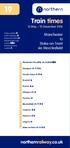 19 Parking available Staff in attendance Bicycle store facility Metrolink Interchange stations Disabled assistance available Train times 15 May 10 December 2016 Manchester to Stoke-on-Trent via Macclesfield
Seamless journeys from door to door. www.bettertransport.org.uk
 Seamless journeys from door to door www.bettertransport.org.uk Seamless journeys from door to door If public transport is to offer a real and attractive alternative to cars, it needs to offer the same
Train times 15 May 10 December 2016
 8 Train times 15 May 10 December 2016 Parking available Staff in attendance Bicycle store facility Bike & Go Disabled assistance available York to Blackpool North York Ulleskelf Church Fenton Micklefield
AIRLINE PASSENGER SERVICE COMMITMENT 28 March 2001
 AIRLINE PASSENGER SERVICE COMMITMENT 28 March 2001 PREAMBLE Airlines in Europe have developed the Airline Passenger Service Commitment following consultation with representatives of Air Travellers, European
NSB AS Service Quality Performance Report for 2012 Passenger Rights regulation 1371/2007
 NSB AS Service Quality Performance Report for 2012 Passenger Rights regulation 1371/2007 Contents 1) Information and Tickets 2) Punctuality of services, and general principles to cope with disruption to
GENERAL TERMS ANC CONDITIONS OF BROKERAGE SERVICES PROVIDED BY BZ WBK BROKERAGE S.A. (UNIFORM TEXT)
 Appendix to the Resolution No. 17/2011 of the Management Board of BZ WBK Brokerage S.A. dated 25 February 2011 concerning adoption of the amended General Terms and Conditions of Brokerage Services Provided
Northwards Housing s Communications Strategy 2014-16
 Northwards Housing s Communications Strategy 2014-16 Executive Summary 1. The purpose of this strategy is to ensure a fully integrated approach to communications; one which is aligned with Northwards business
If first class travel is to be booked, it should be signed off by the appropriate level of management first, as indicated in the table below.
 Business Expenses Policy 1. Purpose This policy sets a framework for claiming expenses incurred on behalf of Monitor. The policy ensures members of staff act reasonably when incurring expenses and achieve
UNIVERSITY TRAVEL POLICY Effective immediately.
 UNIVERSITY TRAVEL POLICY Effective immediately. Introduction: Objectives: Scope and Application: Safety: Passports: This document defines the policy for travel on University business, including overnight
Train times. northernrail.org. Manchester to Stoke-on-Trent via Macclesfield. 13 December 2015 14 May 2016. Manchester Piccadilly.
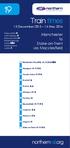 19 Train times 13 December 2015 14 May 2016 Parking available Staff in attendance Bicycle store facility Metrolink Interchange stations Disabled assistance available Manchester to Stoke-on-Trent via Macclesfield
COMMISSION REGULATION. of 5.5.2011
 EN EN EN EUROPEAN COMMISSION Brussels, 5.5.2011 C(2011) 2962 final COMMISSION REGULATION of 5.5.2011 on the technical specification for interoperability relating to the subsystem 'telematics applications
Thameslink new Class 700 trains
 Thameslink new Class 700 trains Your questions answered 1. When will the new trains enter service? The first trains are expected to enter passenger service in spring 2016 on the existing Bedford to Brighton,
Ticketing Scheme for Public Transport in Greater Manchester
 Ticketing Scheme for Public Transport in Greater Manchester Introduction The Greater Manchester Ticketing Scheme has been developed under powers given to the Authority under Sections 135 to 138 of the
BT Assure DoS Mitigation UK
 BT Assure DoS Mitigation UK Annex to the Internet Connect UK Schedule Contents A note on we and you... 2 1. Service Summary... 2 2. Service Standard Components... 2 3. Service Options... 2 4. Service Management
Taxi Licensing Scrutiny Review
 Taxi Licensing Scrutiny Review Summary of Consultation Findings Response Rates 40 surveys were issued by post/email with a closing date of 12 January 2011. 10 responses were received resulting in a 25%
Customer Service Charter
 Customer Service Charter 1 Welcome Welcome to KDR, the proud operator and maintainer of the light rail on the Gold Coast. The light rail is a brand new transport system to the Gold Coast and we will all
4. Meetings Financial Support
 4. Meetings Financial Support The MC must determine from amongst eligible participants those who are entitled to be reimbursed. The Action Chair (or Vice Chair if the Action Chair is affiliated to the
Fare Change 2014 Frequently Asked Questions & Answers
 Fare Change 2014 Frequently Asked Questions & Answers Fare change What is happening? From Monday 6 January 2014, fares across all TransLink services (bus, train and ferry) will increase by 7.5%. How much
Midlands Connect. Economic Impacts Study
 Midlands Connect Economic Impacts Study May 2015 In 2036, if journey times were cut by 20% across all of the intensive growth corridors Introduction The location of the Midlands, at the heart of the UK
Cheaper Rail Fares A cunning plan
 Cheaper Rail Fares A cunning plan [10 June 2015] The Tyne and Wear Public Transport Users Group (TWPTUG) Newcastle Group met in June 2015 and spent some time discussing the possibility of split ticketing
RAC Breakdown Cover. Key Facts PLEASE READ AND KEEP FOR YOUR RECORDS
 RAC Breakdown Cover Key Facts PLEASE READ AND KEEP FOR YOUR RECORDS Policy Summary RAC Breakdown Cover RAC Breakdown Cover is intended to offer services relating to the breakdown of vehicles. This policy
AFRAA AIRLINE PASSENGER SERVICE COMMITMENT
 AFRAA AIRLINE PASSENGER SERVICE COMMITMENT PREAMBLE African Airlines members of African Airlines Association (AFRAA) have developed the Airline Passenger Service Commitment following consultation with
NFC in Transport for London
 NFC in Transport for London Setting a context for the role of NFC technology in TfL s ticketing strategy Brian Dobson 1 Contents Context: about Transport for London The current Oyster contactless smartcard
Terms and Conditions Governing UOB PRVI Miles American Express Card ( Terms and Conditions )
 Terms and Conditions Governing UOB PRVI Miles American Express Card ( Terms and Conditions ) 1. Bonus UNI$ (i) UOB PRVI Miles American Express Cardmembers (the Cardmember ) will earn UNI$ for all their
SPECIAL SERVICES HANDBOOK
 SPECIAL SERVICES HANDBOOK 1700 North 11th Street, Reading, PA 19604 For Information, Call The Special Services Department Phone - 610-921-2361 Fax - 610-921-0209 TDD - 610-921-1018 Toll Free 1-800-383-2278
Jobcentre Plus Travel Discount Card Introduction
 Jobcentre Plus Travel Discount Card Introduction 1. On behalf of the rail network, the Association of Train Operating Companies (ATOC) entered into a new agreement with Jobcentre Plus to replace the New
THE COUNTY OF HEREFORDSHIRE DISTRICT COUNCIL DRAFT PENALTY POINTS SCHEME
 THE COUNTY OF HEREFORDSHIRE DISTRICT COUNCIL DRAFT PENALTY POINTS SCHEME 25 1 Index Page 1. Penalty Points Scheme 3 2. Recommendations 4 3. List Of Offences/Breach Of Licence Conditions/Byelaws 5 4. Driver
MEI Structured Mathematics. Practice Comprehension Task - 2. Do trains run late?
 MEI Structured Mathematics Practice Comprehension Task - 2 Do trains run late? There is a popular myth that trains always run late. Actually this is far from the case. All train companies want their trains
Trapeze Rail System Simulation and Planning
 trapeze Rail System English Software for Rail Modelling and Planning Trapeze Rail System Simulation and Planning www.trapezegroup.com Enabling future railway plans Cost reductions through integrated planning
Amadeus Training. Training
 Amadeus Training Training Amadeus The Leader in Travel Technology Training Amadeus offers a range of courses to meet your training needs. Courses are structured to provide competency in the use of Amadeus
Expenditure should only be incurred within the constraints of the appropriate budget.
 Quality Assurance Agency for Higher Education Travel and subsistence rules for staff QAA s rules for travel and subsistence arrangements have been designed with the intention of providing staff that are
The Highland Council. Travel and Subsistence Allowances. Code of Conduct. For. APT and C Staff
 The Highland Council Travel and Subsistence Allowances Code of Conduct For APT and C Staff 2005-07-13 travel and subsistence allowances - code of conduct Printed: 23 January 2012 Amended: 13 May 1997 This
Ranks Action Plan 2015
 Section 1 Text Ranks Action Plan 2015 MAYOR OF LONDON 2 Foreword The Capital s taxis are iconic, recognised by Londoners and visitors alike as being part of the city s fabric. Around 70 million taxi journeys
Route Strategies. Our high-level approach to informing future investment on roads
 Route Strategies Our high-level approach to informing future investment on roads The roads managed by Highways England provide businesses with the means to get products and services to their customers,
TfL s Contactless Ticketing: Oyster and Beyond Transport for London. Lauren Sager Weinstein Head of Oyster Development
 TfL s Contactless Ticketing: Oyster and Beyond Transport for London Lauren Sager Weinstein Head of Oyster Development September 2009 Contents Introduction to TfL Why a TfL Smartcard? Oyster Delivered:
Staying alert A guide to passenger security
 Staying alert A guide to passenger security GO Safely GO Transit is one of the safest transit systems in North America. Still, we have to be prepared for unexpected incidents. Your safety and security
Travel and subsistence policy
 Travel and subsistence policy Contents 1 Introduction... 3 2 Policy and principles... 3 3 Roles and responsibilities... 3 4 Dispensations... 4 5 Errors... 4 6 Travel costs... 4 7 Travel by road... 5 8
NPTR PROCEDURE MANUAL AND BUSINESS FLOW PROCESS FOR DEPARTMENT OF TRANSPORT
 NPTR PROCEDURE MANUAL AND BUSINESS FLOW PROCESS FOR DEPARTMENT OF TRANSPORT SECOND DRAFT i TABLE OF CONTENTS Page No. 1. INTRODUCTION... 1 2. LAYOUT OF REPORT... 1 2.1 Business process flows... 1 2.2 Procedure
GENERAL CONTRACT OF USE FOR WAGONS GCU
 GENERAL CONTRACT OF USE FOR WAGONS GCU Edition dated 1 January 2016 CONTENTS PREAMBLE 5 CHAPTER I OBJECT, SCOPE OF APPLICATION, TERMINATION, FURTHER DEVELOPMENT OF THE CONTRACT, DISCONTINUANCE OF BEING
CHAPTER 4. o Hotel Results 15 CHAPTER 5. o Car Results: Matrix & Options 19. o Ground and Limo Service 21. o Trip Purchasing & Booking 23
 User Manual - CTS Table of Contents CHAPTER 1 Log In 1 CHAPTER 4 Find a Hotel 15 Home Page 2 o Navigation Toolbar 2 o Search by Airport, Search by Address o Quick Trip Search 2 o Hotel Results 15 o Welcome
Model Customer Rights Policy
 Model Customer Rights Policy Customer protection is an integral aspect of financial inclusion. The following comprehensive Customer Rights Policy based on domestic experience and global best practices
Providing travelling expenses and reimbursing essential travel costs
 Providing travelling expenses and reimbursing essential travel costs 1. SCOPE OF THE DOCUMENT 1.1. The purpose of this document is to provide guidance for the Travel Teams when either arranging travel
Pays directly for business travel on behalf of an employee. Provides travel facilities, such as a train ticket, for an employee.
 Introduction This section explains the tax position of employees who travel for business purposes in the course of their jobs. Typically, this will involve employees using their own motor cars for business
The responsibility for this policy and adherence to the procedures rests with the Chief Operating Officer.
 STAFF TRAVEL AND EXPENSES POLICY AND PROCEDURES 1. PURPOSE This document sets out London & Partners policy and procedures on staff travel and expenses. The policy has been designed to ensure that staff
ATOC Approved Code of Practice Incident Response Duties of Primary Support Operators
 ATOC Approved Code of Practice Incident Response Duties of Primary Support Operators Submitted by --------------------------------------------------------- Gary Cooper Director, Ops., Engineering & Major
DECISION No 120/2014. on the implementing provisions for Regulations No 3/2014, No 4/2014 and No 5/2014 of the Committee of the Regions
 DECISION No 120/2014 on the implementing provisions for Regulations No 3/2014, No 4/2014 and No 5/2014 of the Committee of the Regions THE SECRETARY-GENERAL, HAVING REGARD TO HAVING REGARD TO HAVING REGARD
Powerhouse Ventures Limited (PVL) SHARE TRADING POLICY. Page i
 Powerhouse Ventures Limited (PVL) SHARE TRADING POLICY Page i 1. Definitions General terms and abbreviations used in this Policy have the meanings set out below: ASX ASX Listing Rules Audit & Risk Committee
Special conditions of MÁV-START for SCIC-NRT applicable from 13 December 2015
 Special conditions of MÁV-START for SCIC-NRT applicable from 13 December 2015 The following special conditions of carriage are valid for international railway tickets issued by foreign RUs to Hungary and
Demand for Long Distance Travel
 Demand for Long Distance Travel April 2011 Demand for long distance travel 1 Structure of this paper 1.1 This paper is structured as follows: Section 2 sets out past trends in the demand for long distance
Understanding And Testing Passenger Perceptions Of Complexity In Relation To Fares And Ticketing
 Understanding And Testing Passenger Perceptions Of Complexity In Relation To Fares And Ticketing Prepared for: ORR Ref: jn7988/sl/sk Date: October 2011 Contents Understanding And Testing Passenger Perceptions
Vision for Salisbury Quality Bus Partnership. 25 July 2012
 Vision for Salisbury Quality Bus Partnership 25 July 2012 Vision for Salisbury Quality Bus Partnership Signed on 25 July 2012 Sir Christopher Benson J.P., D.L. Chairman... Salisbury Vision Partnership
UKLPG APPROVED AUTOGAS INSTALLER CONSUMER CODE
 UKLPG APPROVED AUTOGAS INSTALLER CONSUMER CODE e-mail [email protected] Website www.drivelpg.co.uk Office 2.2, Christchurch Business Centre, Grange Road, Christchurch, Dorset, BH23 4JD. CONTENTS SECTION
Thameslink Desiro City & Signalling Press Trip April 20 to 21, 2015 Evolution in Motion. Siemens Mobility Division
 Thameslink Desiro City & Signalling Press Trip April 20 to 21, 2015 Evolution in Motion Siemens Rolling Stock Portfolio in Great Britain We have some of the most reliable trains in UK.. Over 350 trains
CONDITIONS OF CARRIAGE
 CONDITIONS OF CARRIAGE Introduction When you buy a ticket to travel on the railway network, you enter into an agreement with the Railway Operators. That agreement gives you the right to make the journey
Travel Travel and Expenses
 Travel Contents Overview...3 Audience...3 Responsibilities...3 Policy...3 Guidance...3 Claiming Travel and Other Expenses...3 Factors to Consider when Planning Travel...5 Car Hire and Car Parking...5 Taxis...6
Special conditions of MÁV-START for SCIC-NRT applicable from 13 December 2015
 Special conditions of MÁV-START for SCIC-NRT applicable from 13 December 2015 The following special conditions of carriage are valid for international railway tickets issued by foreign RUs to Hungary and
Customer Satisfaction Index 2014
 Customer Satisfaction Index 01 Contents Executive summary Customer satisfaction methodology Initiatives to improve customer satisfaction November 01 results Overall train network Overall bus regions Overall
LLITM Public Transport Supply Model
 LLITM Public Transport Supply Model Paul Smith 11 th May 2011 Leicestershire County Council Public Transport in Leicestershire Sustainable transport moving from an abstract concept to necessity PT modes