
NHS West Lancashire Clinical Commissioning Group
|
|
|
- Janel Judith Allison
- 9 years ago
- Views:
Transcription
1 NHS West Lancashire Clinical Commissioning Group EXECUTIVE SUMMARY Linked to the Lancashire JSNA James Mechan Head of Public Health Intelligence NHS central Lancashire Farhat Abbas Public Health Analyst Stephen Boydell Public Health Analyst September 2012 Contributions from Lucinda Cawley Associate Director of Public Health NHS central Lancashire Jane Cass Acting Assistant Director of Public Health NHS central Lancashire Gulab Singh Assistant Director Healthy Communities NHS central Lancashire Stephen Gough Community Pharmacy Adviser NHS central Lancashire 1 of 74 1 P a g e
2 Foreword Joint Strategic Needs Assessment (JSNA) is a partnership process to identify and understand the current and future health and wellbeing needs of the local population leading to improved outcomes and reductions in health inequalities. The Local Government and Public Involvement in Health Act placed a duty on upper-tier local authorities and PCTs to undertake a JSNA and from 1 st April 2008 this became a joint statutory duty for Directors of Adult Social Services, Directors of Public Health and Directors of Children and Young People s Services. Following the passage of the Health and Social Care Act (2012), the JSNA will be central to the commissioning system. Upper tier and unitary Local Authorities and NHS Clinical Commissioning Groups, working together through the Health and Wellbeing Board, will have a duty to produce a JSNA and to have regard to it in their commissioning plans. Health and Wellbeing Boards are to use the intelligence from the JSNA to set priorities for the population's health and wellbeing within a Joint Health and Wellbeing Strategy. JSNA is defined as a process to identify and understand the current and future health and wellbeing needs of the local population leading to improved outcomes and reductions in health inequalities. In Lancashire work is progressing to extend this into capturing assets, or opportunities, for enhancing health and wellbeing, including through commissioning. It takes into account existing services and evidence of effectiveness, and informs the strategic direction of service commissioning and delivery, making them more responsive to local communities. It is a partnership duty which involves a range of statutory and non-statutory partners, informing commissioning and the development of appropriate, sustainable and effective services that are appropriate to need; as such reducing inequities. The JSNA should not be used as a performance monitoring tool but more for an evaluation of the effectiveness of locally provided services. The resultant strategies should be designed to continually improve these services. The Lancashire JSNA In Lancashire it was agreed that there would be little merit in attempting to produce an annual Lancashire-wide paper JSNA as the requirement to consider in detail the needs of twelve differing district populations would result in too unwieldy a document. Instead the Lancashire JSNA is a process with a central output of a live web-based document, with an agreed data set that would be detailed enough to be analysed at a ward, district and county-wide level. Other strands to the Lancashire JSNA are the delivery of JSNA bespoke projects focused on conditions, behaviours or population groups (for example learning disabilities, children and young people and alcohol, drugs and tobacco) and support to promote a culture of evidence based decision making, including the offer of training and regular newsletters. The data set for the Lancashire JSNA is available through the existing Lancashire Profile website and updated on a continual basis by the intelligence teams from each contributing organisation. Hyperlinks are used to access other relevant information e.g. health needs assessments, community impact assessments, health impact assessments, health equity audits, survey results. The Lancashire Profile is managed by Lancashire County Council with data and intelligence jointly updated by a small team of analysts from the LCC JSNA team and the Lancashire Public Health Intelligence teams ensuring the availability of online, immediately available intelligence to support commissioning strategies of the county council, PCTs, CCG s and local partnerships. Lancashire's Health and Wellbeing Board includes representation from all six CCGs in the county. It has considered the intelligence from the Lancashire JSNA and used this to set a small number of priorities for the county-wide Joint Health and Wellbeing Strategy. This JSNA profile has been produced using intelligence from the Lancashire JSNA. As such there is a direct line of sight between the needs reflected in the Lancashire JSNA, through the local JSNA to inform NHS West Lancashire s Commissioning 2 of 74 2 P a g e

3 Plan. This local JSNA profile will be made available to the public and partners through the JSNA section on the Lancashire Profile website. Maggi Morris (Executive Director Public Health, NHS Central Lancashire) 3 of 74 3 P a g e

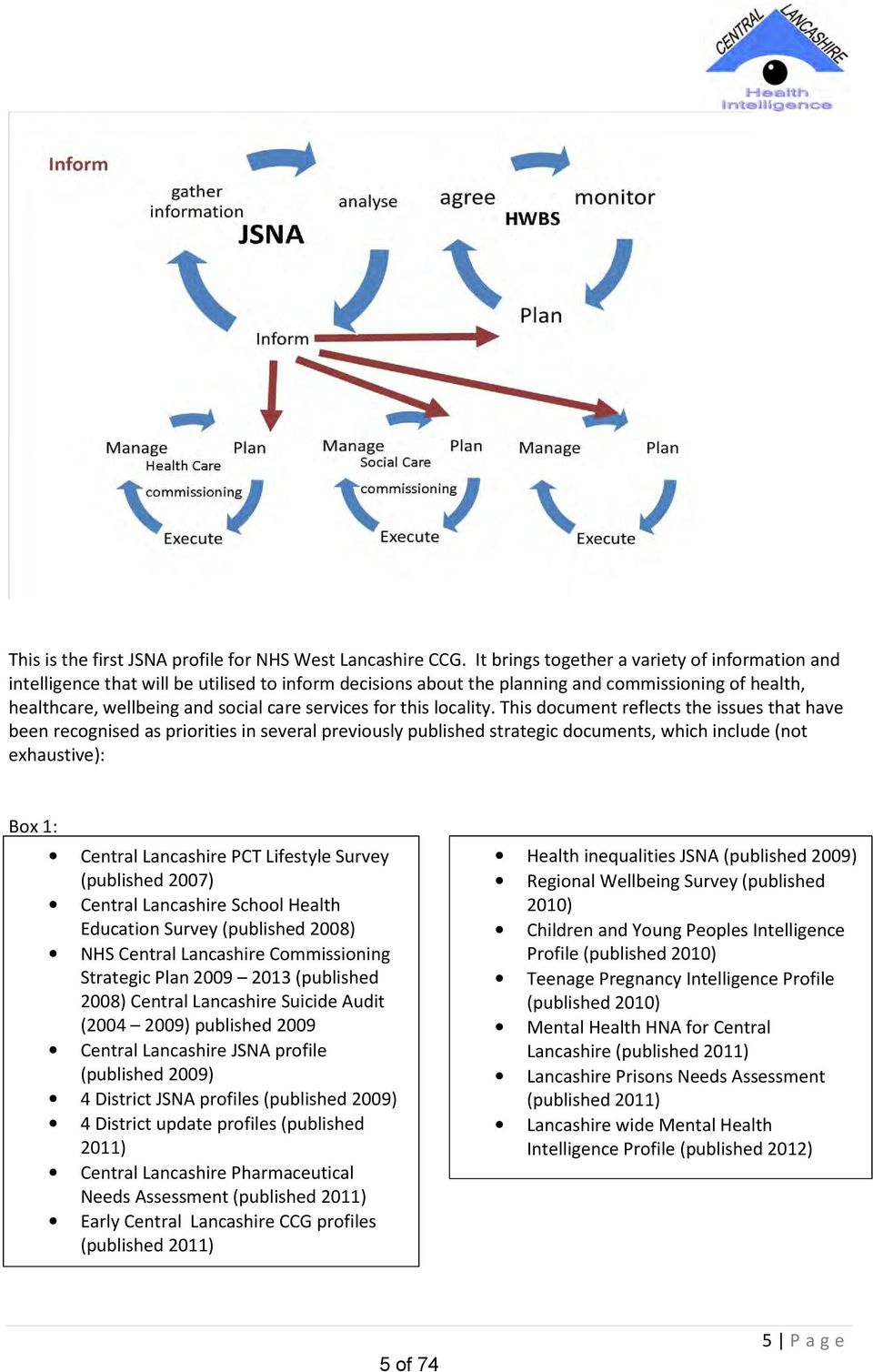
4 Background A JSNA profile for NHS West Lancashire Clinical Commissioning Group We are working to promote the use of information and intelligence to improve services In March 2011, the Department of Health published a working document on The Functions of GP Commissioning Consortia in which Clinical Commissioning Groups (CCGs) are required: To contribute to the joint strategic needs assessment (JSNA) and the joint health and well-being strategy led by the relevant Health and Well-being Board(s)..to have regard to the JSNA and the joint strategy in exercising any relevant functions and To determine the nature, volume and range of services that will need to be available locally to meet needs as part of working with Health & Wellbeing Boards (HWBs) on the JSNA and developing a joint health and wellbeing strategy. CCGs represent a totally different way of working in the NHS with all GP practices in the local area having a say in how things should be run and what should constitute a priority. CCGs have a very close relationship with service users, clinical colleagues in local hospitals and the community whom they serve. It is essential that they know what needs to change to make the health services in the area even better and be able to engage with local clinicians and communities alike to drive through improvements associated with the determinants of health and wellbeing identified through use of available data, intelligence and evidence and engaging with local people, clinical and non clinician stakeholders and health and wellbeing partnerships. It is recognised that this is a large agenda and robust engagement mechanisms, with outcomes, must be established if the CCG is to successfully commission the services their communities need at the quality standards they demand. In terms of data and intelligence to inform commissioning and decision making, CCGs will have a dual role, as key contributors and key recipients of the JSNA. Having a voice of local communities reflected in the JSNA comes about through their involvement with the commissioning cycle and other sources of intelligence, such as health needs assessment, that may be used to inform the JSNA. As the JSNA develops further over time to capture assets and opportunities, participation of local communities will come as part of the JSNA process itself. The diagram below illustrates the interrelatedness of JSNA, HWBs and the commissioning cycle. 4 of 74 4 P a g e
5 This is the first JSNA profile for NHS West Lancashire CCG. It brings together a variety of information and intelligence that will be utilised to inform decisions about the planning and commissioning of health, healthcare, wellbeing and social care services for this locality. This document reflects the issues that have been recognised as priorities in several previously published strategic documents, which include (not exhaustive): Box 1: Central Lancashire PCT Lifestyle Survey (published 2007) Central Lancashire School Health Education Survey (published 2008) NHS Central Lancashire Commissioning Strategic Plan (published 2008) Central Lancashire Suicide Audit ( ) published 2009 Central Lancashire JSNA profile (published 2009) 4 District JSNA profiles (published 2009) 4 District update profiles (published 2011) Central Lancashire Pharmaceutical Needs Assessment (published 2011) Early Central Lancashire CCG profiles (published 2011) Health inequalities JSNA (published 2009) Regional Wellbeing Survey (published 2010) Children and Young Peoples Intelligence Profile (published 2010) Teenage Pregnancy Intelligence Profile (published 2010) Mental Health HNA for Central Lancashire (published 2011) Lancashire Prisons Needs Assessment (published 2011) Lancashire wide Mental Health Intelligence Profile (published 2012) 5 of 74 5 P a g e
6 The reports in Box 1 and the online JSNA information resource are part of a collaborative working approach that brings together a number of partners across Lancashire. These partners include, Public Health and Public Health Intelligence teams in each of the three Lancashire PCTs, Lancashire County Council based teams, including the JSNA team, Social Services, Police and Fire and Rescue Service, collaborating to develop comprehensive intelligence on health and wellbeing in Lancashire. This local JSNA profile has a strong focus on published data and evidence at a district and County level on the health and wellbeing of people, both resident and registered populations. It attempts to augment this geographical data with currently available data at a GP Practice and CCG level. Increasingly, however, the data and evidence will be more tailored to the configuration of NHS West Lancashire CCG and that of the population it serves. An online page has been developed for this CCG on the Lancashire profile, to support the provision of intelligence, which will routinely be updated by the Lancashire public health intelligence team. Current projects on this online page: 1 Older peoples Pan Lancashire Intelligence Profile 2 Offender health Pan Lancashire Intelligence Profile 3 Pan Lancashire Suicide Audit 4 Learning Disabilities Pan Lancashire Intelligence Profile 5 Lancashire Long Term Conditions Needs Assessment to include a total population, total pathway approach 6 Looking Ahead for Lancashire (fuel poverty and recession monitoring) 7 Refresh and update the Health Inequalities JSNA, especially in light of the current changes to the health system, which include the creation of a Health and Wellbeing Board who will create a Health and Wellbeing Strategy, and Clinical Commissioning Groups. 8 Regional Wellbeing Survey update 9 On-going analysis of Census 2011 As a living process the JSNA will be updated to reflect key issues that are identified from these projects that are relevant to the work of NHS West Lancashire CCG and its priorities. 6 of 74 6 P a g e

7 Summary of Findings In many ways NHS West Lancashire CCG mimics the country as a whole and many indicators of health and social care are comparable with averages for England. However, there are some issues of particular concern and, even where the CCG area is comparable to the average, this masks stark inequalities between areas and communities within the CCG. For instance, the health of people in West Lancashire is generally worse than the England average. These issues are described in the five main challenges below. The supporting evidence for these issues can be found in the main local JSNA document. Challenge 1 Long Term Conditions. 1. To reduce the incidence of, and mortality from, long term conditions. 2. To upscale prevention and early intervention strategies to ensure health and social care services are able to cope with this increased demand (using self-care approaches and skills). 3. To increase early diagnosis and optimise treatment to slow the development of long term conditions. 4. To support the quality of life of carers for people with long term conditions Related health issues to be addressed: 1. Higher deaths from stroke, compared to England average 2. Deaths from respiratory diseases, compared to England 3. Higher rate of CVD mortality in men compared to women 4. Higher COPD emergency admissions, compared to England average 5. Higher diagnosed prevalence of diabetes, compared to England average 6. Higher diagnosed prevalence of CHD, compared to England average 7. Higher diagnosed prevalence of asthma and COPD, compared to England average 8. Undiagnosed cases of diabetes, hypertension and COPD as highlighted by the difference between QoF reported and modelled prevalence Challenge 2 - Mental Health and Wellbeing. 1. To promote emotional health and wellbeing in children and adults. 2. To support people (of all ages) who are affected by adverse mental health to play a full and active role in society. Mental health conditions, including depression are more prevalent in those with long term conditions such as Diabetes 3. To work in partnership to address the impact the current economic downturn may have on these trends. 4. To improve the mental health and well-being of seldom seen, seldom heard groups and the unemployed populations It is recognised that in parts of the country large numbers of people are out of work because of poor mental health. Each year between 7 and 10 people commit suicide in the area; the rate of deaths from suicide and undetermined injury is not significantly different from England s rate. Related health issues to be addressed: 1. Higher percentage of binge drinking adults, compared to England average 2. Higher rate of hospital stays for alcohol related harm, compared to England average 3. In the CCG, higher prevalence of recorded depression, compared to England average 7 of 74 7 P a g e

8 Challenge 3 Maternal and child health. The Marmot review of health inequalities shows that giving every child the best start in life by supporting expectant and new families to be healthy is one of the most effective ways of breaking the cycle of health inequality from one generation to the next. Sustaining the impact of this through ensuring evidence based, need led interventions for child and adolescent health is important with some of the related key issues being: 1. To optimise the health and wellbeing of women in pregnancy including reducing the number of women who smoke during pregnancy and increasing the number of babies who are breastfed. 2. To promote and safeguard the health and wellbeing of pre-school age children (including reducing obesity and addressing low weight issues). 3. To promote breastfeeding These factors all have consequences for the health of children, particularly those in the most disadvantaged areas. Related health issues to be addressed: 1. All risk taking behaviours In the CCG, higher rates of smoking in pregnancy, compared to England Young people s sexual health including wards that feature as statistically significant hotspot areas for under 18 conceptions. 2. In the CCG, lower breast feeding initiation and duration at 6-8 weeks, compared to England 3. Higher rate of alcohol-specific hospital stays (under 18), compared to England 4. Higher percentage of 5 and 12 year olds with decayed, missing, and filled teeth, than England average Challenge 4 Improve health and independence of older people 1. To Increase healthy life expectancy for those aged 65 and over 2. To improve support for older people and their carers in playing a full and active role in society 3. To help design services to cope with the increasing numbers of older people with chronic long term conditions such as dementia, mental illness and learning disabilities. Related health issues to be addressed: 1. Undiagnosed cases of dementia, as highlighted by the difference between QoF reported and modelled prevalence Challenge 5 - Health inequalities. 1. To reduce alcohol related hospital admissions and alcohol related harm. Alcohol related admissions to hospital are higher than the national average and increasing. 2. To work with stakeholders to ensure local environments enhance positive health and wellbeing. The place in which we live, and the community of which we are a part, has a significant impact on our health and wellbeing. Our neighbourhood, the environment and the attitudes of those around us can shape the choices that we make and affect our life chances. 3. To narrow the gap in health inequalities as measured by life expectancy. 8 of 74 8 P a g e

9 These differences in living conditions, along with health behaviours, are significant contributors to the fact that people in the most affluent areas of NHS West Lancashire CCG are living at least 6 years longer than those in the more disadvantaged areas. These unfair and avoidable differences in health between social groups are defined as the health gradient in health inequalities. 4. To work through partnerships to reduce child poverty. Child poverty is on the increase, in this area. Tackling these health inequalities in this CCG will require action to improve the following areas listed below, in addition to the targets within the public health outcomes framework: Improving integrated and holistic support for children, young people and families Narrowing of the gap in educational attainment Sustainable efforts towards improving housing conditions Sustainable efforts towards breaking the link between poor health and unemployment Improving health literacy skills across the population 5. To improve health equity. Variation in some diseases by deprivation, in general, deprived areas seem to have higher health related issues. Related health issues to be addressed: 1. In the CCG, lower uptake of cancer screening programmes, compared to England target for each programme; bowel cancer screening up take is much lower than the England target compared to the other two screening programmes. 2. Female life expectancy is lower than England average 3. Difference in life expectancy between most deprived and least deprived 4. Higher road injuries and deaths compared to England average Recommendations The published strategies identified earlier in box 1 and the evidence summarised in them indicate general conclusions for commissioners to consider as they set and refine their commissioning priorities and related actions that will address the emerging challenges. The Health and Social Care Bill proposed that GP Commissioning Groups should, by 2013, deliver a sustainable healthcare system in the face of the most challenging financial and organisational environment since the introduction of the provider/purchaser split in the NHS in The following tables set out recommendations in the following areas. Table 1 The changing population Table 2 Long term conditions and disabilities Table 3 Mental health and wellbeing Table 4 - Living conditions and health inequalities Table 5 Lifestyle and behaviours Recommendations within the tables are those taken from the main conclusions of the work identified in the strategic documents identified in box 1. The majority of these recommendations require multiagency work to effectively address and include those that the CCG has direct responsibility for and those for which the commissioning responsibility lies elsewhere. As such work may need to be undertaken to identify specific CCG actions as required. 9 of 74 9 P a g e

10 Future Public Health work As mentioned previously, it is recognised that further work may be required to gain a better insight into some specific topic areas. The following programme is to be undertaken as appropriate by the Public Health Intelligence Team: 1) Trend analysis to include data on prevalence, mortality, morbidity and wider determinants of health, including community data to be published in October ) To present a summary of the key findings from the 2011 census data and its significance to NHS West Lancashire CCG. 3) Work with NHS West Lancashire CCG to undertake further insight work into topics highlighted by the NHS West Lancashire CCG JSNA. 4) Deliver an online presence from which more detailed relevant data, intelligence and evidence of best practice can be obtained. 5) Compile a CCG diabetes report. Contact: [email protected] [email protected] [email protected] 10 of P a g e
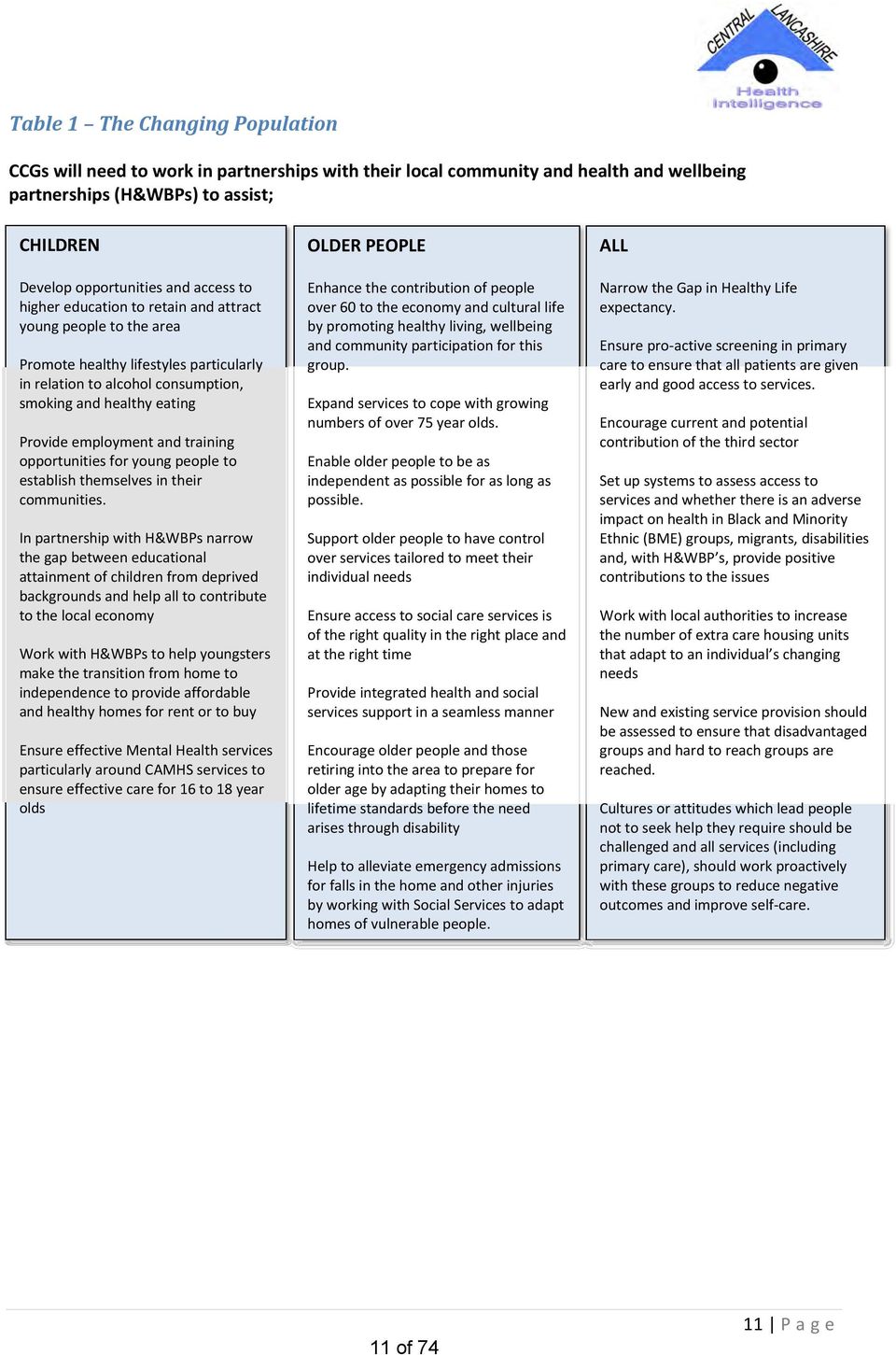
11 Table 1 The Changing Population CCGs will need to work in partnerships with their local community and health and wellbeing partnerships (H&WBPs) to assist; CHILDREN Develop opportunities and access to higher education to retain and attract young people to the area Promote healthy lifestyles particularly in relation to alcohol consumption, smoking and healthy eating Provide employment and training opportunities for young people to establish themselves in their communities. In partnership with H&WBPs narrow the gap between educational attainment of children from deprived backgrounds and help all to contribute to the local economy Work with H&WBPs to help youngsters make the transition from home to independence to provide affordable and healthy homes for rent or to buy Ensure effective Mental Health services particularly around CAMHS services to ensure effective care for 16 to 18 year olds OLDER PEOPLE Enhance the contribution of people over 60 to the economy and cultural life by promoting healthy living, wellbeing and community participation for this group. Expand services to cope with growing numbers of over 75 year olds. Enable older people to be as independent as possible for as long as possible. Support older people to have control over services tailored to meet their individual needs Ensure access to social care services is of the right quality in the right place and at the right time Provide integrated health and social services support in a seamless manner Encourage older people and those retiring into the area to prepare for older age by adapting their homes to lifetime standards before the need arises through disability Help to alleviate emergency admissions for falls in the home and other injuries by working with Social Services to adapt homes of vulnerable people. ALL Narrow the Gap in Healthy Life expectancy. Ensure pro-active screening in primary care to ensure that all patients are given early and good access to services. Encourage current and potential contribution of the third sector Set up systems to assess access to services and whether there is an adverse impact on health in Black and Minority Ethnic (BME) groups, migrants, disabilities and, with H&WBP s, provide positive contributions to the issues Work with local authorities to increase the number of extra care housing units that adapt to an individual s changing needs New and existing service provision should be assessed to ensure that disadvantaged groups and hard to reach groups are reached. Cultures or attitudes which lead people not to seek help they require should be challenged and all services (including primary care), should work proactively with these groups to reduce negative outcomes and improve self-care. 11 of P a g e
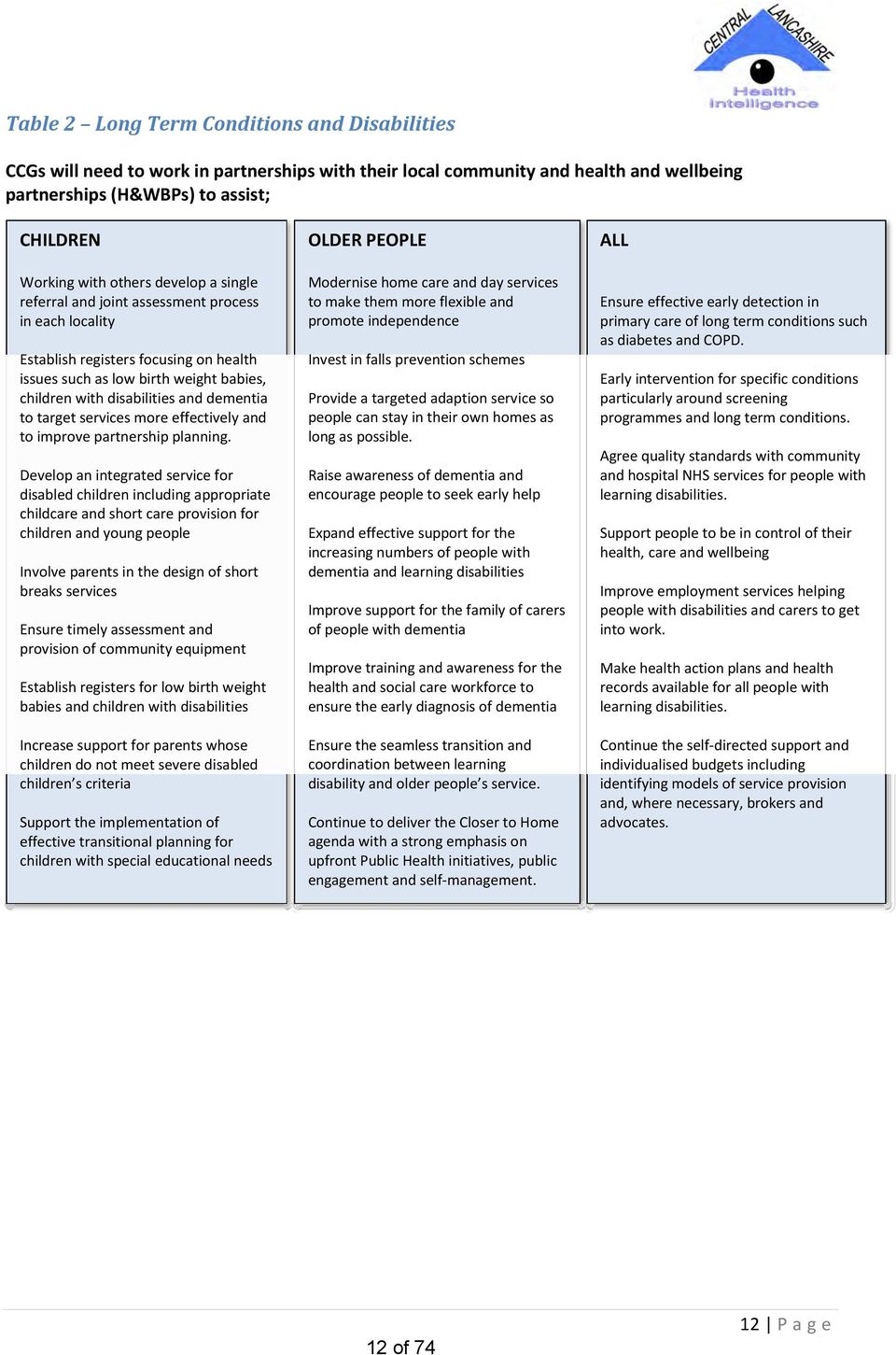
12 Table 2 Long Term Conditions and Disabilities CCGs will need to work in partnerships with their local community and health and wellbeing partnerships (H&WBPs) to assist; CHILDREN Working with others develop a single referral and joint assessment process in each locality Establish registers focusing on health issues such as low birth weight babies, children with disabilities and dementia to target services more effectively and to improve partnership planning. Develop an integrated service for disabled children including appropriate childcare and short care provision for children and young people Involve parents in the design of short breaks services Ensure timely assessment and provision of community equipment Establish registers for low birth weight babies and children with disabilities Increase support for parents whose children do not meet severe disabled children s criteria Support the implementation of effective transitional planning for children with special educational needs OLDER PEOPLE Modernise home care and day services to make them more flexible and promote independence Invest in falls prevention schemes Provide a targeted adaption service so people can stay in their own homes as long as possible. Raise awareness of dementia and encourage people to seek early help Expand effective support for the increasing numbers of people with dementia and learning disabilities Improve support for the family of carers of people with dementia Improve training and awareness for the health and social care workforce to ensure the early diagnosis of dementia Ensure the seamless transition and coordination between learning disability and older people s service. Continue to deliver the Closer to Home agenda with a strong emphasis on upfront Public Health initiatives, public engagement and self-management. ALL Ensure effective early detection in primary care of long term conditions such as diabetes and COPD. Early intervention for specific conditions particularly around screening programmes and long term conditions. Agree quality standards with community and hospital NHS services for people with learning disabilities. Support people to be in control of their health, care and wellbeing Improve employment services helping people with disabilities and carers to get into work. Make health action plans and health records available for all people with learning disabilities. Continue the self-directed support and individualised budgets including identifying models of service provision and, where necessary, brokers and advocates. 12 of P a g e
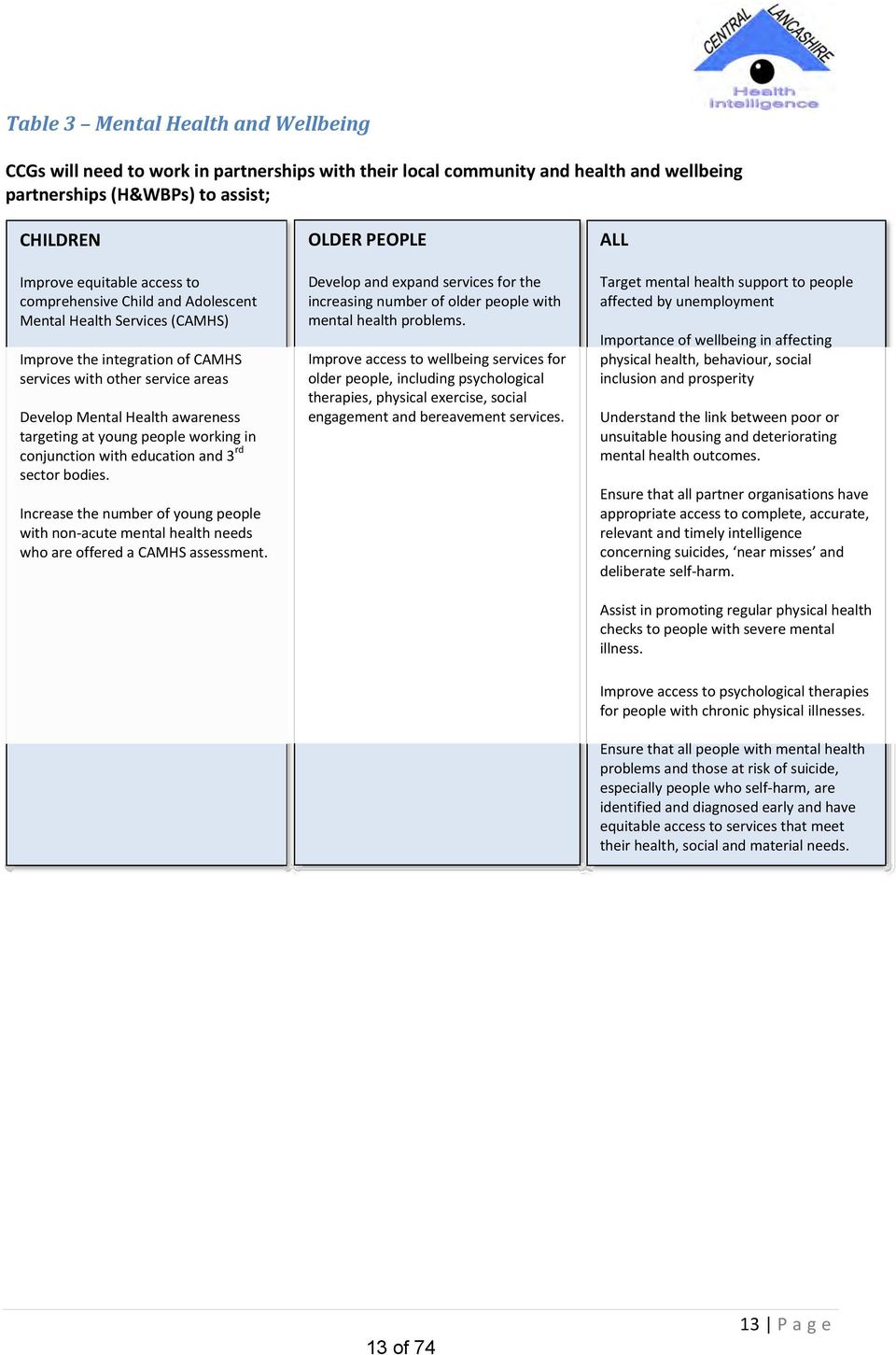
13 Table 3 Mental Health and Wellbeing CCGs will need to work in partnerships with their local community and health and wellbeing partnerships (H&WBPs) to assist; CHILDREN Improve equitable access to comprehensive Child and Adolescent Mental Health Services (CAMHS) Improve the integration of CAMHS services with other service areas Develop Mental Health awareness targeting at young people working in conjunction with education and 3 rd sector bodies. Increase the number of young people with non-acute mental health needs who are offered a CAMHS assessment. OLDER PEOPLE Develop and expand services for the increasing number of older people with mental health problems. Improve access to wellbeing services for older people, including psychological therapies, physical exercise, social engagement and bereavement services. ALL Target mental health support to people affected by unemployment Importance of wellbeing in affecting physical health, behaviour, social inclusion and prosperity Understand the link between poor or unsuitable housing and deteriorating mental health outcomes. Ensure that all partner organisations have appropriate access to complete, accurate, relevant and timely intelligence concerning suicides, near misses and deliberate self-harm. Assist in promoting regular physical health checks to people with severe mental illness. Improve access to psychological therapies for people with chronic physical illnesses. Ensure that all people with mental health problems and those at risk of suicide, especially people who self-harm, are identified and diagnosed early and have equitable access to services that meet their health, social and material needs. 13 of P a g e
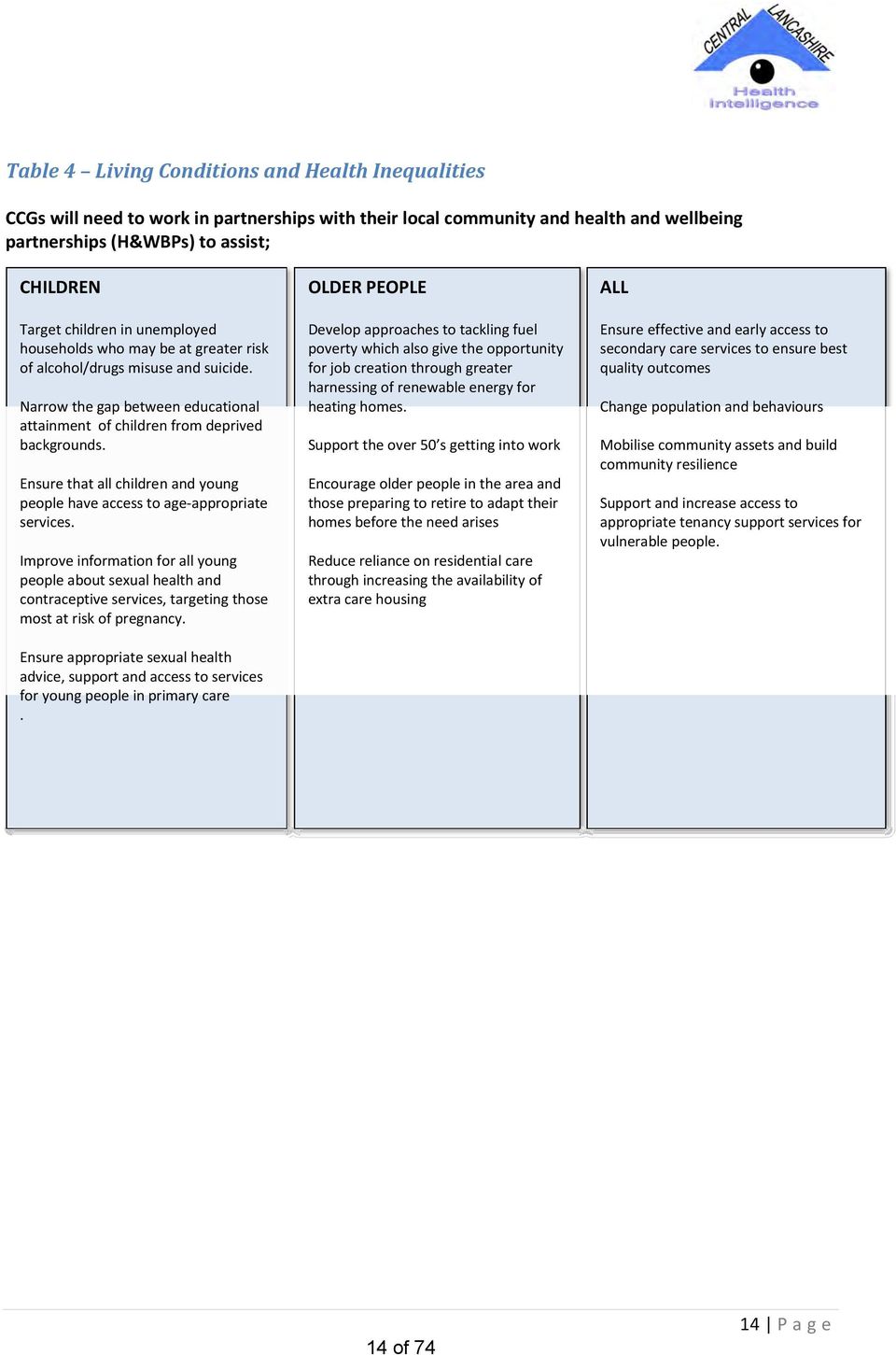
14 Table 4 Living Conditions and Health Inequalities CCGs will need to work in partnerships with their local community and health and wellbeing partnerships (H&WBPs) to assist; CHILDREN Target children in unemployed households who may be at greater risk of alcohol/drugs misuse and suicide. Narrow the gap between educational attainment of children from deprived backgrounds. Ensure that all children and young people have access to age-appropriate services. Improve information for all young people about sexual health and contraceptive services, targeting those most at risk of pregnancy. Ensure appropriate sexual health advice, support and access to services for young people in primary care. OLDER PEOPLE Develop approaches to tackling fuel poverty which also give the opportunity for job creation through greater harnessing of renewable energy for heating homes. Support the over 50 s getting into work Encourage older people in the area and those preparing to retire to adapt their homes before the need arises Reduce reliance on residential care through increasing the availability of extra care housing ALL Ensure effective and early access to secondary care services to ensure best quality outcomes Change population and behaviours Mobilise community assets and build community resilience Support and increase access to appropriate tenancy support services for vulnerable people. 14 of P a g e
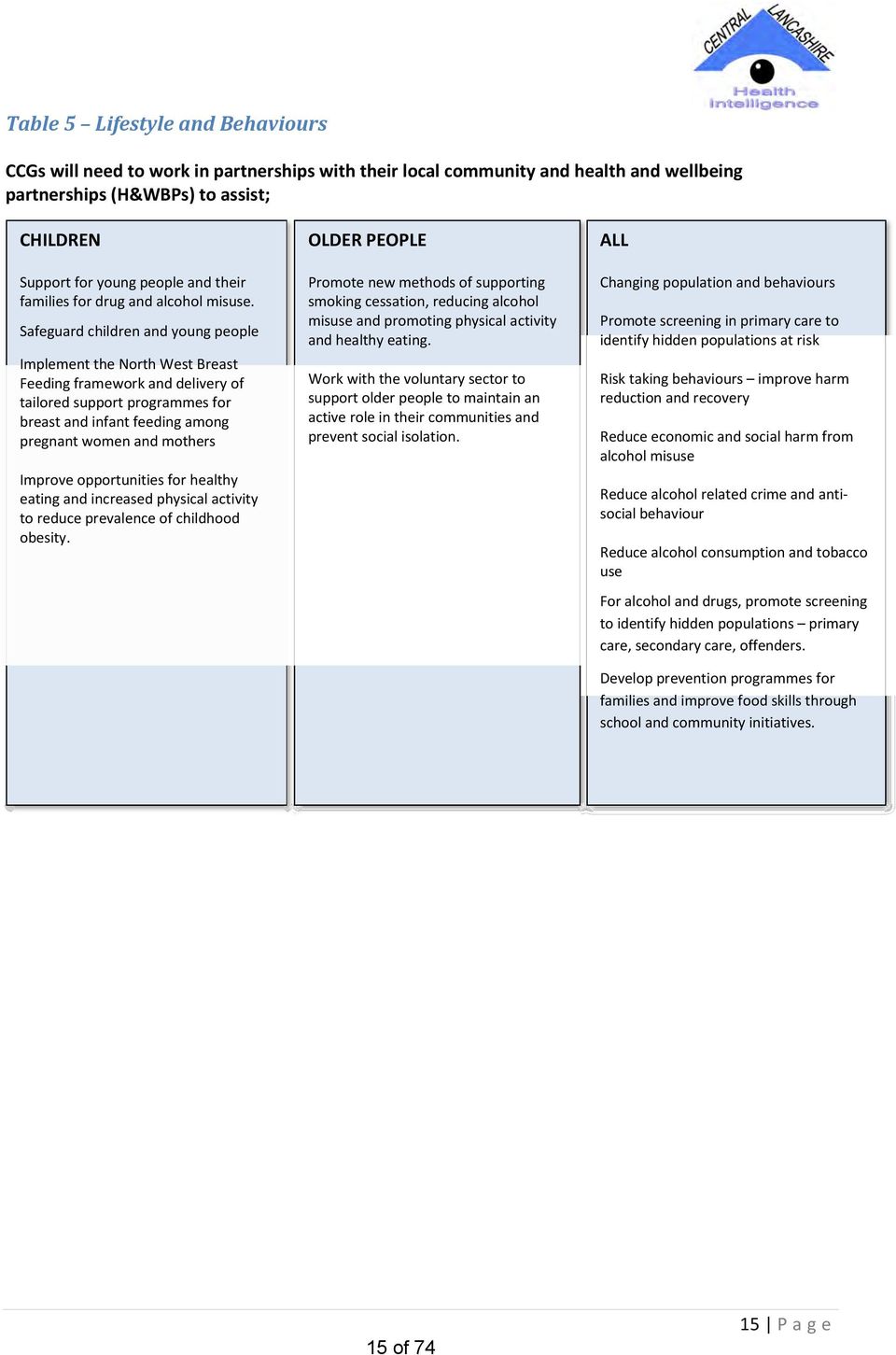
15 Table 5 Lifestyle and Behaviours CCGs will need to work in partnerships with their local community and health and wellbeing partnerships (H&WBPs) to assist; CHILDREN Support for young people and their families for drug and alcohol misuse. Safeguard children and young people Implement the North West Breast Feeding framework and delivery of tailored support programmes for breast and infant feeding among pregnant women and mothers Improve opportunities for healthy eating and increased physical activity to reduce prevalence of childhood obesity. OLDER PEOPLE Promote new methods of supporting smoking cessation, reducing alcohol misuse and promoting physical activity and healthy eating. Work with the voluntary sector to support older people to maintain an active role in their communities and prevent social isolation. ALL Changing population and behaviours Promote screening in primary care to identify hidden populations at risk Risk taking behaviours improve harm reduction and recovery Reduce economic and social harm from alcohol misuse Reduce alcohol related crime and antisocial behaviour Reduce alcohol consumption and tobacco use For alcohol and drugs, promote screening to identify hidden populations primary care, secondary care, offenders. Develop prevention programmes for families and improve food skills through school and community initiatives. 15 of P a g e
16 16 of 74

17 NHS West Lancashire Clinical Commissioning Group JSNA PROFILE Linked to the Lancashire JSNA James Mechan Head of Public Health Intelligence NHS central Lancashire Farhat Abbas Public Health Analyst Stephen Boydell Public Health Analyst September 2012 Contributions from Lucinda Cawley Associate Director of Public Health NHS central Lancashire Jane Cass Acting Assistant Director of Public Health NHS central Lancashire Gulab Singh Assistant Director Healthy Communities NHS central Lancashire Stephen Gough Community Pharmacy Adviser NHS central Lancashire 17 of 74 1 P a g e
18 The People of NHS West Lancashire CCG Demography NHS West Lancashire CCG is the overarching consortium and overseas 23 GP practices serving primarily the local authority of West Lancashire. The CCG has a registered population of approximately 111,500 people. There are pockets of registered population residing in the districts of Chorley and Wigan. Figure 1 below indicates the density and spread of the registered population in West Lancashire. Figure 1 - NHS West Lancashire CCG Population. Source: LASCA 18 of 74 2 P a g e

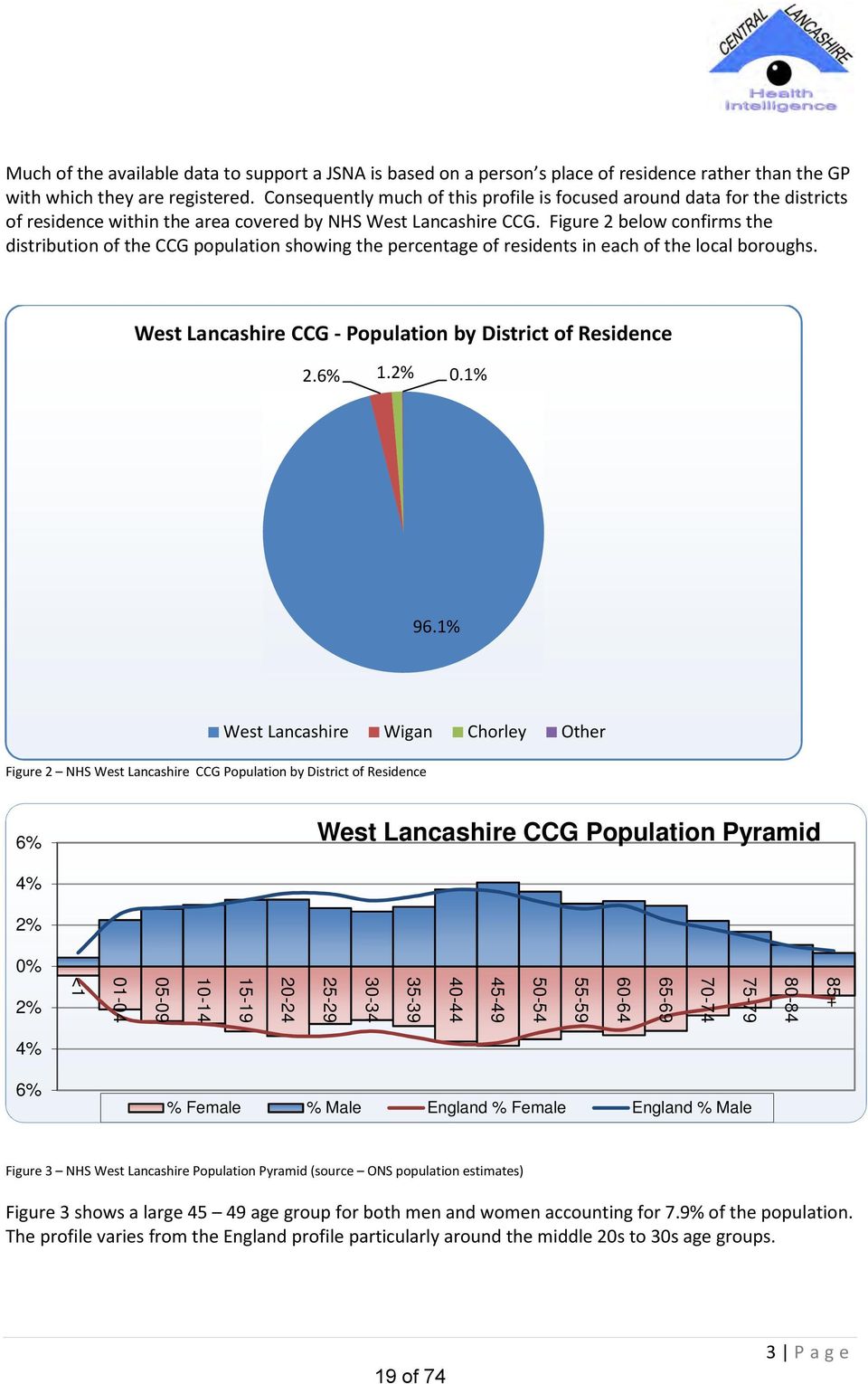
19 Much of the available data to support a JSNA is based on a person s place of residence rather than the GP with which they are registered. Consequently much of this profile is focused around data for the districts of residence within the area covered by NHS West Lancashire CCG. Figure 2 below confirms the distribution of the CCG population showing the percentage of residents in each of the local boroughs. West Lancashire CCG -Population by District of Residence 2.6% 1.2% 0.1% 96.1% West Lancashire Wigan Chorley Other Figure 2 NHS West Lancashire CCG Population by District of Residence 6% West Lancashire CCG Population Pyramid 4% 2% 0% 2% < % 6% % Female % Male England % Female England % Male Figure 3 NHS West Lancashire Population Pyramid (source ONS population estimates) Figure 3 shows a large age group for both men and women accounting for 7.9% of the population. The profile varies from the England profile particularly around the middle 20s to 30s age groups. 19 of 74 3 P a g e
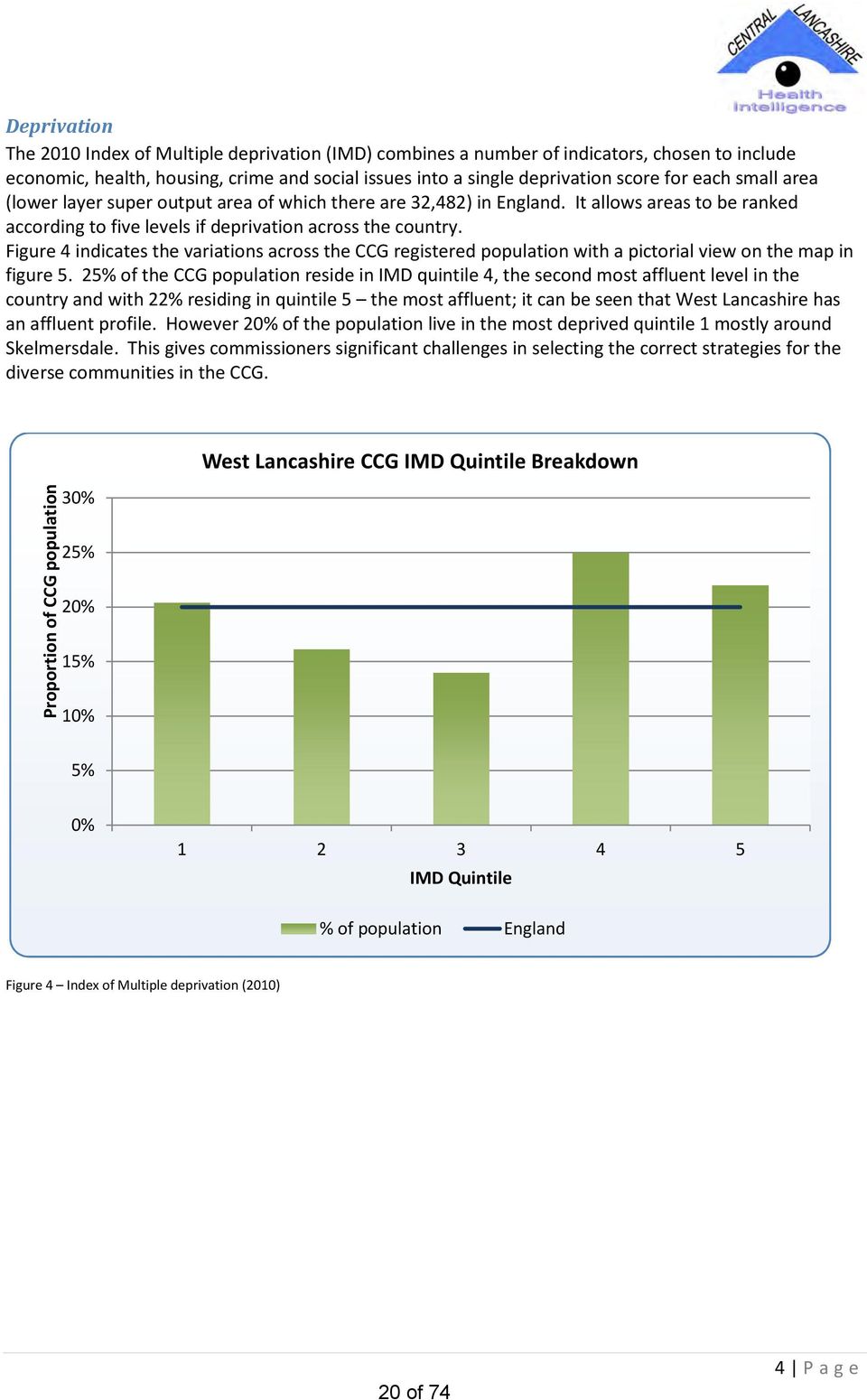
20 Deprivation The 2010 Index of Multiple deprivation (IMD) combines a number of indicators, chosen to include economic, health, housing, crime and social issues into a single deprivation score for each small area (lower layer super output area of which there are 32,482) in England. It allows areas to be ranked according to five levels if deprivation across the country. Figure 4 indicates the variations across the CCG registered population with a pictorial view on the map in figure 5. 25% of the CCG population reside in IMD quintile 4, the second most affluent level in the country and with 22% residing in quintile 5 the most affluent; it can be seen that West Lancashire has an affluent profile. However 20% of the population live in the most deprived quintile 1 mostly around Skelmersdale. This gives commissioners significant challenges in selecting the correct strategies for the diverse communities in the CCG. Proportion of CCG population 30% 25% 20% 15% 10% West Lancashire CCG IMD Quintile Breakdown 5% 0% IMD Quintile % of population England Figure 4 Index of Multiple deprivation (2010) 20 of 74 4 P a g e
21 Figure 5 shows the 2010 IMD map with location of NHS West Lancashire CCG practices. Figure 5 Location of CCG practices and IMD2010 quintiles 21 of 74 5 P a g e
22 Population Projections Population doesn t stand still and the CCGs will have to consider the change in their population over time. 6% 4% West Lancashire CCG Population Pyramid - 10 Year Comparison 2% 0% 2% < % 6% % Female 2012 % Male 2012 % Female 2022 % Male 2022 Figure 6 NHS West Lancashire CCG population Projections (source: ONS population projections) Figure 6 suggests that by the year 2022 the population of the CCG will increase by around 2,750 people to approximately 114,200. The biggest increase will occur in the year olds and in the 55 to 64 age groups for both genders which is simply a progression of the larger groups from There are substantial reductions in the teenage and early twenty s groups and substantial reductions in the year olds. Classification Clustering of Practices This report uses a nationally agreed method to create a set of classification groups of GP practices with similar characteristics. It also provides an overview of the main characteristics of the practices in each classification group. The following variables were used to group GP practices in England into classification groups of similar characteristics Percentage of population aged 0 to 4 years old (Source: ADS 2009) Percentage of population aged 5-14 years old (Source: ADS 2009) Percentage of population aged years old (Source: ADS 2009) Percentage of population aged 85 years or older (Source: ADS 2009) Percentage of population from Asian ethnic groups (Source: ERPHO estimates) Percentage of population from Black ethnic groups (Source: ERPHO estimates) Deprivation score for practice population (based on Index of Multiple Deprivation 2007) Whether the practice was in an urban area (population of 10,000 or greater), town or urban fringe area or village, hamlet or isolated dwellings (based on Office for National Statistics Classification of Rurality) Two-step cluster analysis was used to identify the best match of the classification groups. All CCG practices are classified into 10 groups. Classification groups 8 (Dark green), 10 (dark blue) and 7 (mid-green) (10) and mid-green (7) classification groups have a higher proportion of the practice population in older age groups (65 to 84 years and 85 years and older). Practices in red (1) brown (2) and Orange (3) classification groups have a greater 22 of 74 6 P a g e
23 percentage of the population under 15 years old. The largest average list sizes are found in the classification group 9 whilst classification group 1 has the smallest average list sizes. Figure 7 below shows the full range of definitions used in the analysis below. Cluster Description Group 1 Practices with a smaller than average list size, a high percentage of the population aged under 15 years old and fewer aged 65 years or older. A very high proportion of the population from Asian ethnic groups and a higher than average proportion from Black ethnic groups and very high levels of deprivation. 2 High percentage under 15 years. Very high percentage of black population and high than average Asian population High deprivation 3 Practices with a high percentage of children (under 15 years old) and very high levels of deprivation. 4 Practices with a very low percentage people under 15 years and a lower proportion of older people (65 years and older) and an above average proportion of the population from Asian and Black ethnic groups. 5 Practices with a higher percentage of older people (aged 65 years and older) with slightly higher levels of deprivation. 6 Practices with an average proportion of the population in younger and older age groups and generally low deprivation. 7 Located in towns or urban fringe settlements with low deprivation and few people from Asian and Black ethnic groups. 8 Practices with a high percentage of the population aged 65 years and older and low levels of deprivation. 9 Practices with large average list sizes, an average proportion of the population under 15 years old, a higher proportion aged 65 years and older and low levels of deprivation. 10 Located in villages, hamlets and isolated settlements with a small average list size and a higher proportion of the population aged 65 years and older. Few people from Asian and Black ethnic groups and low levels of deprivation. 11 unknown Figure 7 - Definitions of Clustering Methodology. Source: Yorkshire and Humber Public Health Observatory Figure 8 below shows the results of the clustering analysis of West Lancashire CCG practices and figure 9 shows the distribution of practices by cluster group. As it can be seen from figure 8 there are a higher number of practices in cluster group 1, 3 and of 74 7 P a g e
24 50 Cluster group of West Lancashire CCG Practices Cluster Group P81112 P81208 P81121 P81201 P81039 P81764 P81136 P81774 P81758 P81727 P81138 P81710 P81096 P81772 P81646 P81674 P81041 P81014 P81695 P81084 P81045 P81177 Y02903 Practice Group 1 Group 2 Group 3 Group 4 Group 5 Group 6 Group 7 Group 8 Group 9 Group 10 Group 11 Figure 8 cluster groups of practices across NHS West Lancashire CCG 24 of 74 8 P a g e
25 Figure 9 Distribution of NHS West Lancashire CCG practices by cluster The following tables provide some district profile data on a number of wider determinants of health. Sefton has been included as a comparator due to its closeness to the CCG area and due to the fact that there is a local hospital in Southport to which patients from both the CCG area and Sefton are referred. 25 of 74 9 P a g e
26 Economic profile of NHS West Lancashire CCG Employment and Education Community profiles 2012 Chorley Sefton West Wigan England Lancashire 1.2% 0.0% 96.1% 2.6% Domain Indicator number value number value number value number value Average Our Communities 2 Proportion of children in poverty 2, , , , Statutory homelessness GCSE achieved (5A*-C inc. Eng & Maths) , , Violent crime 1, , , , Long term unemployment , , Figure 10 Our Communities (Community health profiles 2012). Source: Office for National Statistics Community health profiles 2012 People living in poorer socio-economic circumstances or in the more deprived areas of the CCG tend to experience poorer health. They have higher levels of chronic disease and disability, more early deaths (under 75 years) and they experience the adverse effects of ageing at an earlier stage in their lives. They usually have difficulty accessing health and social care services and when contact is made it is often at a later stage in their condition. As a consequence they require more complex treatment and experience poorer health outcomes. They are less likely to engage with health promotion and disease prevention activities. Figure 10 above from the annually published Community Health Profiles (2012) indicate that within NHS West Lancashire CCG, Sefton district has the highest percentage of children in families receiving meanstested benefits & low income (21.0%). Chorley district has a lower rate of 13.9%, lower than that of Wigan on 20.6% and England on 21.9%. Encouragingly districts within the NHS West Lancashire CCG have generally lower unemployment rates and higher GCSE passes than that of England. With the exception of Wigan, statutory homeless is also lower in the CCG area as a whole compared to England. Violent crime rates in West Lancashire (11.5%) are lower than England (14.8%). The highest rates in the CCG are in Chorley and West Lancashire which isn t surprising due the larger areas of deprivation in these districts. 26 of P a g e
27 Burden of Disease QoF registers and Modelling of Disease Prevalence As shown in figure 11, in comparison to the rest of England there is significantly lower recorded prevalence for nine conditions (marked in green). This could reflect poor ascertainment of those in the local population suffering from these conditions by General Practitioners or the local population does indeed have a lower prevalence. Figure 11 Quality and Outcomes Framework (QoF) Prevalence in NHS West Lancashire CCG Conversely there is a higher than England average recorded prevalence for nine of the disease groups (marked in red), which could point to over recording of the conditions in general practice or that there is a genuine higher prevalence for these disease areas. Figure 11 above shows that hypertension is under recorded by practices with an estimated prevalence of 23.7% compared with a recorded prevalence of 12.7%. However, as can be seen from the England average, this is the case across the country as well. Estimated prevalence of COPD is significantly higher than the England average with a CCG prevalence of 3.23% compared with an England prevalence of 2.90%. Recorded prevalence of asthma and depression are both significantly higher than the recorded 27 of P a g e
28 England average. This could be due to genuinely higher prevalence locally or better than average recording of these conditions within the CCG. QoF reported vs. estimated QoF reported prevalences are shown in subsequent pages as funnel plots and give an indication of the relative position of practices actual prevalence against a modelled estimated disease prevalence and grouped by the clusters discussed earlier. The key to these funnel plots is contained at Appendix 2. For funnel plots in this paper the average line is where the expected is equal to the observed (actual) and so there is no variation between expected and observed. CHD Figure 12 below shows 10/11 QoF reported number of patients with CHD relative to estimated number of patients with CHD, by practice cluster group. Out of 23 West Lancashire CCG practices, in 11 practices the QoF reported number with CHD is significantly lower than estimated number. This may be due to under recording in these practices and indicate that hard to reach groups are not being included particularly in practices that have significant populations within the more deprived cluster group 3. Please see appendix 2 for practice name relating to practice number in chart. + 10% QoF reported number of patients with CHD (10/11) vs. estimated number of patients with CHD - NHS West Lancashire CCG practices 0% % % % % % Estimated number of patients with CHD QoF reported number relative to estimated Source: NHS IC & ERPHO Average 2SD limits 3SD limits Group 3 Group 5 Group 6 Group 7 Group 8 Group 9 Group 10 Figure 12 10/11 QoF reported number with CHD relative to estimated number with CHD 28 of P a g e
29 Stroke Figure 13 below shows 10/11 QoF reported number of patients with stroke relative to estimated number of patients with stroke, by practice cluster group. Out of 23 NHS West Lancashire CCG practices, in 9 practices the QoF reported number with stroke is significantly lower than estimated number. In 1 practice (group 3) the reported number with stroke is significantly higher than the estimated number. Please see appendix 2 for practice name relating to practice number in chart. + 40% + 30% QoF reported number of patients with stroke (10/11) vs. estimated number of patients with stroke - NHS West Lancashire CCG practices % 71 QoF reported number relative to estimated + 10% 0% 10% 20% 30% 40% Average 2SD limits 3SD limits Group 3 Group 5 Group 6 Group 7 Group 8 Group 9 Group 10 50% Estimated number of patients with stroke Source: NHS IC & ERPHO Figure 13 10/11 QoF reported number with stroke relative to estimated number with stroke Hypertension Figure 14 below shows 10/11 QoF reported number of patients with hypertension relative to estimated number of patients with hypertension, by practice cluster group. In all 23 NHS West Lancashire CCG practices, the QoF reported number with hypertension is significantly lower than estimated number, thereby indicating possible cases of undiagnosed hypertension. Please see appendix 2 for practice name relating to practice number in chart. Though the exact causes of hypertension are usually unknown, there are several factors that have been highly associated with the condition. These include Smoking, obesity or being overweight, diabetes, sedentary lifestyle, lack of physical activity, high levels of salt intake (sodium sensitivity), insufficient calcium, potassium, and magnesium consumption, vitamin D deficiency, high levels of alcohol 29 of P a g e
30 consumption, stress, medicines such as birth control pills, genetics and a family history of hypertension, chronic kidney disease + 10% QoF reported number of patients with hypertension (10/11) vs. estimated number of patients with hypertension - NHS West Lancashire CCG practices 0% QoF reported number relative to estimated 10% 20% 30% 40% 50% 60% Estimated number of patients with hypertension Source: NHS IC & ERPHO Average 2SD limits 3SD limits Group 3 Group 5 Group 6 Group 7 Group 8 Group 9 Group 10 Figure 14-10/11 QoF reported number with hypertension relative to estimated number with hypertension COPD (chronic obstructive pulmonary disease) Figure 15 shows 10/11 QoF reported number of patients with COPD relative to estimated number of patients with COPD, by practice cluster group. Out of 23 NHS West Lancashire CCG practices, in 8 practices the QoF reported number with COPD is significantly lower than estimated number, thereby indicating possible undiagnosed cases of COPD. In 1 practice (in cluster group 3), the QoF reported number with COPD is significantly higher than estimated number.. Those significantly below are mainly in more affluent cluster groups of 8 and 9. COPD is generally associated with two main lung diseases: emphysema and chronic bronchitis. Although both diseases have different pathological causes, both share an obstructive pattern in the lung airways, which most of the time is felt as dyspnea (shortness of breath). The main cause of COPD is tobacco smoking. Contributing factors may also be: allergies, air pollution, working in a polluted environment. Please see appendix 2 for practice name relating to practice number in chart. 30 of P a g e
31 + 30% QoF reported prevalence of COPD (10/11) vs. estimated number of patients with COPD - NHS West Lancashire CCG practices + 20% + 10% QoF reported number relative to estimated 0% 10% 20% 30% 40% 50% Average 2SD limits 3SD limits Group 3 Group 5 Group 6 Group 7 Group 8 Group 9 Group 10 60% Estimated number of patients with COPD Source: NHS IC & ERPHO Figure 15 10/11 QoF reported number with COPD relative to estimated number with COPD Dementia Figure 16 shows 10/11 QoF reported number of patients with Dementia relative to estimated number of patients with dementia, by practice cluster group. Please see appendix 2 for practice name relating to practice number in chart. Out of 22 NHS West Lancashire CCG practices (Y02903 not included in the funnel plot as Qof reported dementia number is zero), in 21 practices the QoF reported number with dementia is significantly lower than estimated number, thereby indicating possible undiagnosed cases of dementia.. 31 of P a g e
32 0% QoF reported number of patients with dementia(10/11) vs. estimated number of patients with dementia (early&late onset) -NHS West Lancashire CCG practices QoF reported number relative to estimated 20% 40% 60% 80% % Estimated number of patients with dementia Source: NHSCL Public Health Intelligence & QoF Average 2SD limits 3SD limits Group 3 Group 5 Group 6 Group 7 Group 8 Group 9 Group 10 Figure 16 10/11 QoF reported number with dementia relative to estimated number with dementia 32 of P a g e
33 Secondary Care In 2010/11, this CCG's practices had 37,890 inpatient admissions. Figure 17 below shows the main providers that were used, the number of admissions at each provider (and as a percentage of the CCG's total), the number of those admissions that were elective, and this CCG's admissions as a percentage of the provider's total admissions Provider Number of Admissions (%) Of which elective % of Provider total Southport & Ormskirk Hospital NHS Trust 25,733 (68%) 11, % Wrightington, Wigan & Leigh NHS FT 3,025 (8%) 1, % Aintree Univ Hospitals NHS FT 1,735 (5%) % Alder Hey Children's NHS FT 1,186 (3%) % Ramsay Healthcare UK Operations Ltd 1,052 (3%) 1, % Other 5,159 (14%) 3,315 n/a Total 37,890 (100%) 18,865 n/a Figure 17 - Main providers used by NHS West Lancashire CCG and admissions by provider. Source: Data profiles, NHS Commissioning Board Unplanned Care Accident and Emergency Attendances (2010/11) NHS Comparators have predicted the number of A&E attendances expected by practices as shown in figures 18 and 19. Figure 18 shows the rate of 2010/2011 A&E attendances per 1000 registered population. As it can be seen from figure 18, 18 of the 23 practices have a rate of A&E attendance which is significantly higher than the England rate with practice Y02903 standing out. In 5 practices rate of A&E attendance is significantly lower than the England rate. The practices with highest A&E attendance rates are predominantly in the Cluster groups of 3 and 5. It can be seen that the practices with lower rates of A&E attendances are in the cluster groups of 7 and of P a g e
34 /2011 A&E attendances per 1000 population - NHS West Lancashire CCG Practices Standardised Rate per 1000 population P81177 P81138 P81710 P81096 P81772 P81695 P81758 P81646 P81084 P81674 P81041 P81014 P81045 Practice Group 1 Group 2 Group 3 Group 4 Group 5 Group 6 Group 7 Group 8 Group 9 Group 10 Group 11 England North West P81727 P81112 P81764 P81136 P81208 P81774 P81121 P81201 P81039 Y02903 Figure 18 Rate of 2010/2011 A&E attendances per 1000 registered population Figure 19 below shows the number of actual attendances relative to expected A&E attendances, by practice and the variation across practices. Figure 19 shows that in 18 practices the actual number of A&E attendances is significantly higher than the expected number and covering a range of cluster groups. However in 5 practices the actual number of A&E attendances is significantly lower than the expected number all of which are in the more affluent Group 7 and 10. Please see appendix 2 for practice name relating to practice number in chart. 34 of P a g e
35 +400% 10/11 observed A&E attendances relative to expected -NHS West Lancashire CCG practices % Observed A&E attendances relative to expected +200% +100% 0% 100% Figure 19 Actual A&E attendances relative to expected Source: NHS Comparators Expected number of attendances at A&E 72 Average 2SD limits 3SD limits Group 3 Group 5 Group 6 Group 7 Group 8 Group 9 Group 10 Group 11 Emergency admissions (2010/11) NHS Comparators have predicted the number of emergency admissions expected by practices as shown in figures 20 and 21. Figure 20 shows the rate of 2010/2011 emergency admissions per 1000 registered population. Emergency admissions are via A&E, GP practice and various other means. As it can be seen from figure 20, in 13 (out of 23) practices the rate of emergency admissions is significantly higher than the England rate. This is confirmed in figure 21 below which shows the number of actual relative to expected emergency admissions by practice and the variation across practices. All practices in cluster group 3 have a higher than England rate of emergency admissions. 35 of P a g e
36 Standardised Rate per 1000 population P81138 Y /2011 Emergency admissions per 1000 population -NHS West Lancashire CCG Practices P81758 P81045 P81084 P81695 P81041 P81136 P81096 P81014 P81177 P81646 Group 1 Group 2 Practice Group 3 Group 4 Group 5 Group 6 Group 7 Group 8 Group 9 Group 10 Group 11 England North West P81774 P81710 P81764 P81112 P81772 P81727 P81674 P81201 P81039 P81208 P81121 Figure 20 Rate of 2010/2011 emergency admissions Please see appendix 2 for practice name relating to practice number in chart. In 13 practices the actual number emergency admissions is significantly higher than the expected number and in 1 practice the actual number of emergency admissions is significantly lower than the expected number. Figure 21 confirms that in all practices in cluster group 3 the actual number of emergency admissions is significantly higher than the expected. These practices are in the more deprived areas of West Lancashire (Skelmersdale) and this may be an indicator of this higher rate and that planned care is not effective possibly due to these patients being in harder to reach groups and therefore not being picked up at an earlier stage for appropriate management 36 of P a g e
37 + 80% + 60% 10/11 Observed emergency admissions relative to expected -NHS West Lancashire CCG practices Observed emergency admissions relative to expected + 40% + 20% 0% 20% 40% 60% Expected emergency admissions Source: NHS Comparators Average 2SD limits 3SD limits Group 3 Group 5 Group 6 Group 7 Group 8 Group 9 Group 10 Group 11 Figure 21 - Actual emergency admissions relative to expected A number of these practices are located in the more deprived Skelmersdale where other adverse environmental and economic factors will be prevalent. 37 of P a g e
38 Emergency COPD admissions (2010/11) +600% 10/11 Observed emergency COPD admissions relative to expected -NHS West Lancashire CCG practices 73 Observed emergency COPD admissions relative to expected +500% +400% +300% +200% % 0% % Expected emergency COPD admissions Source: NHS Comparators Figure 22 - Emergency COPD admissions relative to expected Average 2SD limits 3SD limits Group 3 Group 5 Group 6 Group 7 Group 8 Group 9 Group 10 Group 11 Figure 22 above shows that in 5 practices there is higher than expected emergency COPD admission rate. If taken with figure 14 above which shows lower than expected recording of COPD in general practice, this may indicate a failure to stop unnecessary emergency admissions in some practices. In three practices (cluster groups 8 and 9) there is lower than expected emergency COPD admission rate. Three practices showing higher than expected emergency admissions rates also show high QoF prevalence in figure 11 above again in the Skelmersdale area which may indicate issues around hard to reach groups. 38 of P a g e
39 Emergency Asthma admissions (2010/11) +200% 10/11 Observed emergency asthma admissions relative to expected -NHS West Lancashire CCG practices % 73 Observed emergency asthma admissions relative to expected +100% + 50% 0% 50% 100% Expected emergency asthma admissions Source: NHS Comparators Average 2SD limits 3SD limits Group 3 Group 5 Group 6 Group 7 Group 8 Group 9 Group 10 Group 11 Figure 23 - Emergency Asthma admissions relative to expected Figure 23 above shows that there is a higher than expected emergency admission rate due to asthma in 2 practices, which also have higher than expected COPD emergency admission rates. In 1 practice (group 7), the observed emergency asthma admissions are significantly lower than expected. Again these practices are in the Skelmersdale area which may indicate issues around hard to reach groups. 39 of P a g e
40 Emergency Mental Health admissions (2010/11) +500% 83 10/11 Observed emergency mental health admissions relative to expected - NHS West Lancashire CCG practices +400% Observed emergency mental health admissions relative to expected +300% +200% +100% 0% 100% Source: NHS Comparators Expected emergency mental health admissions Average 2SD limits 3SD limits Group 3 Group 5 Group 6 Group 7 Group 8 Group 9 Group 10 Group 11 Figure 24 - Emergency Asthma admissions relative to expected Figure 24 above shows that there is a higher than expected emergency admission rate due to Mental Health conditions in five practices. Although two of these are in the Skelmersdale area where we expect hard to reach groups to be found, there is one practice in Ormskirk that appears to be high, although numbers are low (18 actual to 3 expected). In 2 practices there are lower than expected emergency mental health admissions. 40 of P a g e
41 Planned Care Elective Inpatient admissions (2010/2011) NHS Comparators have predicted the number of elective inpatient admissions expected by practices as shown in figures 25 and 26 below. Figure 25 shows the 2010/2011 elective inpatient admission rate per 1000 registered population. In 2, out of 23 practices, the 10/11 elective inpatient admission rate is significantly higher than England rate. Standardised Rate per 1000 population P /2011 Elective inpatient admissions per 1000 population -NHS West Lancashire CCG Practices Y02903 P81646 P81039 P81045 P81041 P81112 P81096 P81084 P81774 P81201 P81136 Group 1 Group 2 Practice Group 3 Group 4 Group 5 Group 6 Group 7 Group 8 Group 9 Group 10 Group 11 England North West P81695 P81674 P81014 P81710 P81764 P81727 P81758 P81208 P81177 P81121 P81772 Figure /2011 Elective inpatient admission rate Figure 26 shows the number of 2010/2011 elective inpatient admissions relative to expected number of elective admissions. As it can be seen from figure 26, in 2 practices, the actual number of elective inpatient admissions is significantly higher than the expected number and in 2 practices it is significantly lower than the expected number. Please see appendix 2 for practice name relating to practice number in chart. 41 of P a g e
42 + 40% 10/11 Elective inpatient admissions - NHS West Lancashire CCG practices + 30% + 20% Observed elective admissions relative to expected + 10% 0% 10% 20% 30% 40% 50% Source: NHS Comparators Expected elective admissions Average 2SD limits 3SD limits Group 3 Group 5 Group 6 Group 7 Group 8 Group 9 Group 10 Group 11 Figure 26 10/11 Elective inpatient admissions 42 of P a g e
43 GP Patient Survey Figure 27 shows selected questions from GP Patient Survey (July 2011 to March 2012) for NHS West Lancashire CCG. As it can be seen from figure 27, in general patient satisfaction with West Lancashire GP Practices is good. 90% said that they had a good overall experience at the surgery. 88% declared that they were able to get an appointment or be able to speak to someone when they made contact, although only 77% said that getting through to the surgery was easy. This is line with the national figure which showed 88% and 78% respectively. This, however, means that 12% were not able to obtain this and in fact only 58% were able to obtain an appointment the same or the next working day. Nevertheless only 71% stated that they were able to see the GP of their choice. It is important to check the percentage in the Local Value column as well as look at the chart itself. 7% of patients felt that they were unable to manage their own health and, when considering that only 90% felt that the GP s gave them enough time, this maybe an area for consideration within the CCG for action. It is reassuring to note that there were no significantly negative comments to areas within the practice that would require major improvement. Please see appendix 4 for the details of the indicators. Figure 27 - NHS West Lancashire CCG - Selected Questions from GP Patient Survey - July 2011 to March Source: 43 of P a g e
44 District Profiles Life expectancy and causes of death This section provides a more in depth review of the main conditions that impact on life expectancy. Life expectancy is used as an indicator of the overall health status of a given population. It is the average number of years a baby born into an area could expect to live if it was to experience that area s current death rates throughout life. Years Male Life Expectancy at Birth by Local Authority Local Authority Life Expectancy at Birth; Males North West England Figure 28 - Male Life Expectancy. Source: Office for National Statistics - For males in West Lancashire there has been a steady improvement in life expectancy at birth, reaching 78.4 years in 2011 (figure 26 above) higher than that of England (78.3) and is fourth best in Lancashire (figure 28). Similarly female life expectancy has also improved to 80.8 years in 2011, below the national average of 82.3 and only 7 th best in Lancashire (figure 29 below). 44 of P a g e
45 Years Female Life Expectancy at Birth by Local Authority Local Authority Life Expectancy at Birth; Females North West England Figure 29 - Female Life Expectancy. Source: Office for National Statistics Life expectancy and causes of death Of course life expectancy not only varies at district level and there can be many years variance between communities. Figure 30 below shows the variances between communities within the West Lancashire district and it is quite clear that the LE of those people living in the most deprived 10% (decile) of the population have a much lower life expectancy than those in the highest decile. Males in decile 1 have a life expectancy of 74.2 years compared to those in decile 10 with a life expectancy of 82.9 a difference of 8.7 years. For women this variation is 77.6 and 83.9 respectively, a variance of 6.3 years. 45 of P a g e
46 90 85 Life Expectancy at Birth by Deprivation Deciles , West Lancashire district Males D1 Females D1 Males D2 Females D2 Males D3 Females D3 Males D4 Females D4 Years Males D5 Females D5 Males D6 Females D6 Males D7 Females D7 Males D8 Females D8 Males D9 Females D9 Males D10 Females D10 Decile 1 Decile 2 Decile 3 Decile 4 Decile 5 Decile 6 Decile 7 Decile 8 Decile 9 Decile 10 Data source: London Health Observatory and East Midlands Public Health Observatory Figure 30 Life expectancy by deprivation decile Many factors influence life expectancy and figure 29 below show the variations. Health outcome for babies born to teenage mothers are worse than for babies born to older mothers. The main contributing factors are that younger mothers are less likely to attend for antenatal care, more likely to smoke, less likely to breast feed and have poorer diets during pregnancy. 46 of P a g e
47 Community profiles 2012 Chorley Sefton West Wigan England Lancashire 1.2% 0.0% 96.1% 2.6% Domain Indicator number value number value number value number value Average Life expectancy and causes of death 25 Excess winter deaths Life expectancy - male n/a 77.6 n/a 77.0 n/a 78.0 n/a Life expectancy - female n/a 81.4 n/a 82.0 n/a 81.3 n/a Infant deaths Smoking related deaths Early deaths: heart disease & stroke Early deaths: cancer Road injuries and deaths Figure 31 Life expectancy and causes of death (Community health profiles 2012). Source: Office for National Statistics Community health profiles 2012 The Community health profiles published annually by the Office for National Statistics provides much data at a district level on many aspects of the wider determinants of health and figure 31 provides this data for the life expectancy and causes of deaths for the districts making up NHS West Lancashire CCG. All parts of the CCG area are higher than England (directly standardised rate of 211 deaths per 100,000 population aged 35 +, ( )) for smoking related deaths. Wigan has the highest rate at 276 but has only 2.6% of the CCG population within it. Chorley (with 1.2% of the CCG population) is also high on 224 with West Lancashire lowest on 213. Early deaths from heart disease and stroke are highest again in Wigan with 86.7 per 100,000 deaths to those under 75 compared to 67.3 for England. West Lancashire is lower than England on Wigan is again highest for early Cancer deaths, with 122 deaths per 100,000 compared to for England. West Lancashire is also high with but Chorley is lowest with Much of the CCG area has rates higher than England (44.3) for Road traffic deaths with West Lancashire substantially higher on 75.6, perhaps not surprising in a large farming community. Although percentage populations in the CCG are low for some districts that table of District data indicates areas of concerns for the CCG that still require to be tackled albeit in partnership with other CCG s, health and well-being partnerships and the Lancashire wide Health and Well-being Board All Age, All Cause Mortality Figure 32 shows mortality data analysed to NHS West Lancashire CCG level and gives an indication of the level of mortality within the CCG. It confirms that men are dying at a higher rate than women (641 against 513 per 100,000 population) and are doing better than the England rate giving them a better outcome than for England. However mortality in women is higher than England s mortality rate for women. 47 of P a g e
48 Directly Standardised Rate per 100,000 population All Age, All Cause Mortality Directly Standardised Rate to 2010 NHS West Lancashire CCG North West England NHS West Lancashire CCG North West England NHS West Lancashire CCG Male Female All Persons North West England Figure 32 All Age, All Cause Mortality(2008/10). Source: Primary Care Mortality Database and NHS IC Indicators Under 75 Cancer Mortality Cancer is more common with advancing age and, with an ageing population, demand for specialist cancer services and end of life care will continue to rise. The most effective programmes in cancer prevention include stop smoking services, human papilloma virus (HPV) vaccination, and healthy nutrition support. Screening programmes effectively detect the pre-cancerous or early stages of cervical, breast and colon cancer while targeted screening for lung cancer also shows promise of being effective Analysis in figure 33 below shows the CCG premature mortality rate for Cancer is per 100,000 for men (lower than England on 121) and 104 for women (higher than England on 99) but NHS West Lancashire CCG patients do better than others within the North West but nevertheless rates are high. More work needs to be done into mortality and survival rates for specific cancers to assess which cancers are giving the greatest causes of concern although it is likely to be that of Lung, Breast and Prostate cancer. 48 of P a g e
49 Directly Standardised Rate per 100,000 population Cancer Under 75 Directly Standardised Rate to 2010 NHS West Lancashire CCG North West England NHS West Lancashire CCG North West England NHS West Lancashire CCG North West England Male Female All Persons Figure 33 Cancer under 75 (2008/10). Source: Primary Care Mortality Database and NHS IC Indicators Under 75 Cardiovascular Disease Mortality For cardiovascular mortality the NHS West Lancashire CCG rates are not different from England rates for both men and women. Figure 34 below shows that men have higher rates than women, with a directly standardised rate of 78. In women the rate is higher than England s rate for women (41.5 to 40.9) but for men a lower rate than that of England is seen (78.7 to 95.2), per 100,000 population. Directly Standardised Rate per 100,000 population Cardiovascular Disease Under 75 Directly Standardised Rate to 2010 NHS West Lancashire CCG North West England NHS West Lancashire CCG North West England NHS West Lancashire CCG Male Female All Persons North West England Figure 34 Cardiovascular disease under 75 (2008/10). Source: Primary Care Mortality Database and NHS IC Indicators 49 of P a g e
50 Pharmaceutical Needs Assessment In 2009 the Health Act placed a requirement on all PCTs to produce and publish a Pharmaceutical Needs Assessment by February 2011, designed to supplement JSNAs. The Pharmaceutical Needs Assessment (PNA) presents a picture of pharmaceutical service provision, reviewing access, range and adequacy of service provision and choice of provider to build on the sector s capacity and capability to help address health inequalities and support self-care in areas of greatest need. The full report is published on NHS central Lancashire s website and post April 2013 the production and publication of the PNA will be local authority s responsibility. The following pages provide a summary of findings from the PNA pertinent to NHS West Lancashire CCG. The PNA is an assessment of need of a type of service rather than a service provided by a particular type of contractor. It is important to recognise that pharmaceutical services can be provided by Dispensing Doctors, Dispensing Appliance Contractors, Local Pharmaceutical Service Contractors as well as Community Pharmacies. However in NHS West Lancashire CCG locality, community pharmacies are the only providers of pharmaceutical services. A systematic approach has been taken to identify pharmaceutical need based on: Access to pharmaceutical services Adequacy of Service Provision linked to the JSNA priorities Choice of provider Access to pharmaceutical services In NHS West Lancashire there are 25 community pharmacies, including one 100 hour per week pharmacy and two internet/distance selling pharmacies. Given that NHS West Lancashire CCG has a population of 111,500 and 25 pharmacies, this represents 22.4 pharmacies per 100,000 population (or one pharmacy per 4,460 people). In 2010 the English average was 21 pharmacies per 100,000 population. With the advent of 100 hour per week pharmacies, pharmaceutical services are available in NHS West Lancashire CCG from 7.30am until 10.30pm Monday to Friday and 8am until 10pm at weekends. Taking extended hours of provision into account along with the good public transport links in areas of low car ownership access to pharmaceutical services is deemed more than adequate in NHS West Lancashire CCG. Adequacy of Service Provision The full suite of currently commissioned pharmaceutical Advanced and Enhanced services is available in NHS West Lancashire CCG however there is inequity in service provision. The following table is taken from the PNA and highlights service provision and service development opportunities by locality across West Lancashire. Please see the PNA document for a breakdown of the localities coded WL1 to WL5. The data pertaining to each pharmacy locality has been transcribed into two tables to depict Current inequality of pharmaceutical service provision across NHS West Lancashire CCG 50 of P a g e
51 Pharmaceutical service development opportunities across NHS West Lancashire (Based on Health Needs analyses for which needs are not being met by current service provision, irrespective of provider). In determining the need for a pharmaceutical service the following flow chart summarises the process undertaken. Is there a need for a pharmaceutical service within a pharmacy locality to help achieve Strategic Goals? (based on prevalence rates of illness & current service provision) No Key = No need No need, but service Yes Is the need being met by current service provision, irrespective of provider? (includes other NHS service No Partly Yes Key = Key = Key = Please note where there is a choice of provider the word Choice appears in the cell 51 of P a g e
52 Current Inequalities of Pharmaceutical Service Provision across NHS West Lancashire CCG CURRENT INEQUALITIES OF PHARMACEUTICAL SERVICE PROVISION ACROSS NHS WEST LANCASHIRE (AS AT DEC 2010) PHARMACY LOCALITY Ranked in order of deprivation (high to low) ACCESS *EHC RISK TAKING BEHAVIOURS COPD CVD *CHLAMYDIA SCREENING NEEDLE EXCHANGE *SUPERVISED METHADONE TARGETED MURs *NRT VOUCHER SERVICE WEIGHT MANAGEMENT WL5 Choice Choice Choice Choice Choice Choice WL3 Choice Choice Choice Choice Choice Choice WL4 Choice Choice Choice Choice Choice WL1 Choice Choice Choice Choice Choice Choice Choice WL2 Choice Choice Choice No need No need Choice * For those services marked with an asterisk contractors are remunerated pro rata on activity, no other costs are incurred. Therefore it is advantageous to commission these services from as many contractors as possible to increase patient access. Pharmaceutical Service Development Opportunities The Pharmaceutical Service Development Opportunities identified below are based on Health Needs analyses for which needs are not being met by current service provision, irrespective of provider. RISK TAKING BEHAVIOURS CANCER COPD CVD PHARMACY LOCALITY Ranked in order of deprivation (high to low) ALCOHOL BRIEF INTERVENTIONS TIER 1 PRESCRIBING SUBSTANCE MISUSE SCREENING FOR BBV CONTRACPTIVE SERVICE HEALTHY LIVING CENTRES PRESCRIBED STOP SMOKING DRUGS STOP SMOKING BRIEF INTERVENTIONS HEALTH CHECKS ANTICOAGUALNT MONITORING WL5 WL3 WL4 No need WL1 No need No need WL2 No need No need No need No need No need In having identified these pharmaceutical service development opportunities, it should not be assumed that these services should be automatically commissioned. Further analysis of the predicted Health Outcomes must be undertaken in comparison with other services and service providers that also have the potential to address health inequalities. A list of Pharmacists in the NHS West Lancashire area can be seen at appendix of P a g e
53 Risk Factors Children and Young People s Health Smoking in pregnancy in all parts of NHS West Lancashire CCG area is higher than that of England whilst breast feeding initiation rates in all parts are lower meaning that children may not be getting the best and healthiest start to life (figure 35). Most parts of the CCG area have children s physical activity rates higher than England. Generally children at age 12 also have higher tooth decay than in England with Wigan is highest on 1.5. Whilst West Lancashire has a high teenage pregnancy rate other teenage pregnancy rates are lower than England. Community profiles 2011 Chorley Sefton West Wigan England Lancashire 1.2% 0.0% 96.1% 2.6% Domain Indicator number value number value number value number value Average Children's and young people's Health 7 Smoking in pregnancy Breast feeding initiation , , Physically active 7, , , , children (2011 data 10 Obese children (Year 6) Children's tooth decay at age 12 (2011 data) n/a 1.1 n/a 0.9 n/a 0.9 n/a Teenage pregnancy (under 18) Figure 35 Children s and Young people s Health (Community health profiles 2011). Source: Office for National Statistics Community health profiles 2011/2012 Adult health and lifestyle Within NHS West Lancashire CCG the risk taking behaviours that have the most impact on health include unsafe sex, substance misuse (including tobacco and alcohol), violence and behaviours causing risk of injury. Tobacco and alcohol use are major lifestyle factors that contribute not only to deaths from cardiovascular diseases and cancers, but also to deaths from cirrhosis, violence, transport accidents and poisoning. Community profiles 2012 Chorley Sefton West Wigan England Lancashire 1.2% 0.0% 96.1% 2.6% Domain Indicator number value number value number value number value Average Adults' health and lifestyle 13 Adults smoking n/a 21.1 n/a 19.6 n/a 16.1 n/a Increasing and higher n/a 23.9 n/a 22.8 n/a 23.6 n/a risk drinking 15 Healthy eating adults n/a 27.8 n/a 26.5 n/a 26.7 n/a Physically active adults n/a 13.5 n/a 10.9 n/a 11.4 n/a Obese adults n/a 23.1 n/a 23.9 n/a 22.7 n/a Figure 36 Adult health and lifestyle (Community health profiles 2012). Source: Office for National Statistics Community health profiles of P a g e
54 Alcohol Alcohol misuse is a major factor that often leads on to further risk taking behaviours. When alcohol misuse is involved the ultimate consequences can range from acute alcohol poisoning and longer term cirrhosis of the liver, to sexually transmitted infections, unwanted pregnancies and sexual assault, as well as more socially defined consequences such as road accidents and violence, both within the home and in the community. Alcohol related harm affects both sexes. It also places a burden on secondary care services. The chart shows that the rate of alcohol related admissions has risen consistently over a 10 year period. Figure 36 above shows a high percentage levels of those aged 16+ in the resident population, (2008) of increasing and higher risk drinking in West Lancashire (23.6%) although Chorley has a higher rate with 23.9%. Figure 36 below show that the rate of alcohol related admissions for residents of the district of West Lancashire is above the England and below North West average. In figure 37, the green band shows the range of rates for Lancashire district. Alcohol related admissions Rate of alcohol-related admissions per 100,000 population (EASR) / / / / / / / / /11 Year Range for Lancashire 12 Districts England North West Lancashire 12 West Lancashire Figure 37 Alcohol Related Admissions by District. Source: LAPE (Local Alcohol Profiles England) 2010/11 54 of P a g e
55 Smoking Percentage of Population Current Smokers 35.0% 30.0% 25.0% 20.0% 15.0% 10.0% 5.0%.0% Smoking Prevalence by District July June 2011 District Current smoker North West England Figure 38 Smoking Prevalence by District. Source: London Health Observatory; Integrated Household Survey 2011 Figures 36 above and 38 show a large variation in smoking rates between the districts in Lancashire with West Lancashire having a lower than England rate and one of the lowest in Lancashire. Healthy eating The prevalence of overweight and obesity has been rising for many years and has now reached epidemic proportions across the UK. The impact on health is vast as obesity is a major risk factor for coronary heart disease, stroke, colon and breast cancer, type 2 diabetes, high blood pressure, degenerative joint disorders and back pain. Obese children and adults also experience more psychological and mental health disorders than the rest of the population. They are likely to have a lowered self-esteem and to lack confidence. They may experience social discrimination and bullying in school and in the workplace, and have difficulty accessing services and getting involved in social activities. Figure 36 shows that the percentage of healthy eating adults, using a modelled estimate using Health Survey for England (revised), is highest in Chorley (27.8%) and West Lancashire (26.7%) but lower than that of England (28.7%). Wigan has the lowest rate (23.3) and also has the highest number of obese adults. Drug misuse There are often higher rates of drug misuse within more deprived neighbourhoods although it is clear from figure 39 that rates in Chorley and West Lancashire are lower than England (8.9). Unplanned pregnancy, especially among teenagers, and sexually transmitted infections also have strong links to substance misuse. 55 of P a g e
56 Incidence of melanoma The data presented below indicates a generally high level of melanoma (skin cancer) within our communities particularly within the more affluent areas when compared to England. Community profiles 2011 Chorley Sefton West Lancashire Wigan England 1.2% 0.0% 96.1% 2.6% Domain Indicator number value number value number value number value Average Disease and poor health 18 Incidence of malignant melanoma 19 Hospital stays for selfharm 20 Hospital stays for alcohol related harm , ,007 2, ,877 2, ,076 2, ,555 2, , Drug misuse , , People diagnosed with 4, , , , diabetes 23 New cases of tuberculosis * * Acute sexually , , transmitted infections 25 Hip fracture in 65s and over Figure 39 Disease and poor health (Community health profiles 2011). Source: Office for National Statistics Community health profiles 2012 * Represents values are less than 5 Diabetes The increase in the number of people with type II diabetes is strongly linked to the increase in the number of overweight and obese individuals. Diabetes can have a profound impact on life expectancy. The percentage of people on GP registers with a recorded diagnosis of diabetes is highest in Wigan although the rest of the CCG area has rates higher than that of England (5.5). Hip Fractures Wigan (534) and West Lancashire (508) have the highest rate of hip fractures in NHS West Lancashire CCG probably due more to an older demographic profile than to any other factor, including housing stock. All areas within the CCG have higher rates than that of England (452) Self Harm Low income and lack of employment are common amongst people with serious mental illness. Unemployment increases deprivation and creates worry, stress, and associated risk factors for the development and exacerbation of mental health problems and poor wellbeing. It has recently been suggested by the report Mental Capital through Life: Future Challenges (2008) produced by the Foresight Project of the Government Office for Science that debt is an even stronger risk factor for mental disorder than even low income. Rates of self-harm within the CCG area are all higher than that of England (212 per 100,000) with Wigan highest on (349 per 100,000) being substantially higher than England for hospital stays. The current economic downturn could adversely affect these rates and those of suicide. 56 of P a g e
57 Appendix 1 - Recommended approaches for commissioners within the NHS West Lancashire health economy See separate document. 57 of P a g e
58 Appendix 2 West Lancashire CCG Practices Practices in the NHS West Lancashire area are identified in the funnel plots in this JSNA profile are detailed in the key below. Practice number CCG PRACTICE CODE GP PRACTICE Cluster group 66 WEST LANCASHIRE P81014 P81014-LEYLAND HOUSE SURGERY 8 67 WEST LANCASHIRE P81039 P81039-MANOR PRIMARY CARE 3 68 WEST LANCASHIRE P81041 P81041-PARKGATE SURGERY 8 69 WEST LANCASHIRE P81045 P81045-THE ELMS SURGERY 9 70 WEST LANCASHIRE P81084 P81084-HALL GREEN SURGERY 9 71 WEST LANCASHIRE P81096 P81096-PARBOLD SURGERY 7 72 WEST LANCASHIRE P81112 P81112-BEACON PRIMARY CARE 3 73 WEST LANCASHIRE P81121 P81121-DR JL JAIN 3 74 WEST LANCASHIRE P81136 P81136-DR A BISARYA 5 75 WEST LANCASHIRE P WEST LANCASHIRE P81177 P81138-BURSCOUGH FAMILY PRACTICE 7 P81177-VIRAN MEDICAL CENTRE 10 P81201-ASHURST PRIMARY 77 WEST LANCASHIRE P81201 CARE 3 78 WEST LANCASHIRE P81208 P81208-DR SK SUR 3 79 WEST LANCASHIRE P81646 P81646-LATHOM HOUSE SURGERY 7 P81674-BURSCOUGH 80 WEST LANCASHIRE P81674 HEALTH CENTRE 7 81 WEST LANCASHIRE P81695 P81695-AUGHTON SURGERY 9 82 WEST LANCASHIRE P WEST LANCASHIRE P81727 P81710-TARLETON GROUP PRACTICE 7 P81727-COUNTY ROAD SURGERY 6 P81758-MATTHEW RYDER 84 WEST LANCASHIRE P81758 CLINIC 6 85 WEST LANCASHIRE P81764 P81764-DR J MODHA 5 P81772-NORTH MEOLS 86 WEST LANCASHIRE P81772 MEDICAL CENTRE 7 87 WEST LANCASHIRE P81774 P81774-DR A LITTLER 5 88 WEST LANCASHIRE Y02903 Y02903-WEST LANCASHIRE HEALTH CENTRE of P a g e
59 Appendix 3 Location of GPs in NHS West Lancashire CCG Map no. GP Practice Map no. GP Practice 66 P81014-LEYLAND HOUSE SURGERY 81 P81695-AUGHTON SURGERY 67 P81039-MANOR PRIMARY CARE 82 P81710-TARLETON GROUP PRACTICE 68 P81041-PARKGATE SURGERY 83 P81727-COUNTY ROAD SURGERY 69 P81045-THE ELMS SURGERY 84 P81758-MATTHEW RYDER CLINIC 70 P81084-HALL GREEN SURGERY 85 P81764-DR J MODHA 71 P81096-PARBOLD SURGERY 86 P81772-NORTH MEOLS MEDICAL CENTRE 72 P81112-BEACON PRIMARY CARE 87 P81774-DR A LITTLER 73 P81121-DR JL JAIN 88 Y02903-WEST LANCASHIRE HEALTH CENTRE 74 P81136-DR A BISARYA 75 P81138-BURSCOUGH FAMILY PRACTICE 76 P81177-VIRAN MEDICAL CENTRE 77 P81201-ASHURST PRIMARY CARE 78 P81208-DR SK SUR 79 P81646-LATHOM HOUSE SURGERY 80 P81674-BURSCOUGH HEALTH CENTRE 59 of P a g e
60 Appendix 4 - GP Patient Survey (July 2011 to March 2012) Indicators details of the selected questions 1 Indicator Easy to get through to someone at GP surgery on the phone Survey Response Percentage of responders who answered "easy" 2 Helpfulness of receptionist Percentage of responders who answered "helpful" Seeing preferred GP: always, almost always or a lot of the time Able to get an appointment to see or speak to someone Time until appt: same or next working day Time until appt: a week or more later Waiting time at surgery: Over 15 mins Percentage of responders who answered "always, almost always or a lot of the time" Percentage of responders who answered "yes" Percentage of responders who answered "same or next working day" Percentage of responders who answered "a week or more later" Percentage of responders who answered "easy" 8 GP gives you enough time Percentage of responders who answered "yes" 9 GP listens to you Percentage of responders who answered "yes" 10 Nurse gives you enough time Percentage of responders who answered "yes" 11 Nurse listens to you Percentage of responders who answered "yes" 12 Satisfied with opening hours Percentage of responders who answered "satisfied" 13 Not sure when surgery is open Percentage of responders who answered "not sure" 14 Good overall experience of GP surgery Percentage of responders who answered "good experience" 15 Enough support for long term conditions Percentage of responders who answered "receive enough support" 16 Not confident in managing own health Percentage of responders who answered "not confident" 17 State of health: some mobility problems Percentage of responders who answered "some mobility problems" State of health: problems performing usual activities State of health: moderate/extreme pain discomfort State of health: moderate/extreme anxiety or depression Activities limited today due to recent illness or injury Don't know how to contact OOH service Percentage of responders who stated they have problems performing usual activities Percentage of responders who stated they experience moderate or extreme anxiety or depression Percentage of responders who stated they experience moderate or extreme pain or discomfort Percentage of responders who stated their activities were limited on day of the survey Percentage of responders who answered "don't know how to contact the OOH service" 23 Permanent sick/disabled Percentage of responders who answered "permanently sick or disabled" 24 Regular smoker Percentage of responders who answered "regular smoker" 25 Carer Percentage of responders who stated they regularly provided more than 1 hour a week looking after/providing support to someone 60 of P a g e
61 Appendix 5 West Lancashire Health Services Data updated: 12/ of P a g e
62 Appendix 6 - Location of Pharmacies in NHS West Lancashire CCG 62 of P a g e
63 Pharmacy map key Map No. Pharmacy Name Address 1 Address 2 Address 3 CCG 88 LIAM BRADLEY LTD 15 CHURCH ROAD BANKS SOUTHPORT West Lancashire 89 ROWLANDS PHARMACY HILLSIDE HEALTH CENTRE TANHOUSE ROAD SKELMERSDALE West Lancashire 90 ROWLANDS PHARMACY 115 COUNTY ROAD ORMSKIRK West Lancashire 91 ROWLANDS PHARMACY 6 MILL LANE BURSCOUGH ORMSKIRK West Lancashire 92 ROWLANDS PHARMACY 24 MARK SQUARE TARLETON PRESTON West Lancashire 93 ROWLANDS PHARMACY 22 MOSS DELPH LANE AUGHTON ORMSKIRK West Lancashire 94 J HALTON 11 THE COMMON PARBOLD WIGAN West Lancashire 95 ROWLANDS PHARMACY 37 LIVERPOOL ROAD NORTH BURSCOUGH ORMSKIRK West Lancashire 96 RUFFORD PHARMACY 124 LIVERPOOL ROAD RUFFORD ORMSKIRK West Lancashire 97 BOOTS UK LIMITED 3B MOOR STREET ORMSKIRK LANCASHIRE West Lancashire 98 FISHLOCKS CHEMIST 60 LIVERPOOL ROAD NORTH BURSCOUGH ORMSKIRK West Lancashire 99 ROWLANDS PHARMACY 21 LYNDALE ASHURST SKEMERSDALE West Lancashire 100 HALSALL PHARMACY VILLAGE HALL HALSALL ROAD HALSALL West Lancashire 101 BOOTS UK LIMITED 20 THE CONCOURSE SKELMERSDALE LANCASHIRE West Lancashire EAST 102 GREENHEY PHARMACY 35 GREENHEY PLACE GILLIBRANDS SKELMERSDALE West Lancashire 103 ROWLANDS PHARMACY 38 BURSCOUGH STREET ORMSKIRK LANCASHIRE West Lancashire HESKETH BANK 104 PHARMACY 5 STATION ROAD HESKETH BANK PRESTON West Lancashire EAST 105 CHEMIST-4-U 37 GREENHEY PLACE GILLIBRANDS SKELMERSDALE West Lancashire 106 ROWLANDS PHARMACY BEACONSFIELD CORNER MOOR STREET ORMSKIRK West Lancashire 107 ROWLANDS PHARMACY 1 DINGLE ROAD UPHOLLAND SKELMERSDALE West Lancashire 108 ORMSKIRK PHARMACY 22B WIGAN ROAD ORMSKIRK West Lancashire 109 ROWLANDS PHARMACY 55 WEST GATE SKELMERSDALE West Lancashire PARK ROAD/AUGHTON 110 MORRISONS PHARMACY STREET ORMSKIRK LANCASHIRE West Lancashire SC/BRICK B. PK, 111 GREEN CROSS PHARMACY 12 HEATON COURT SMITHY LN SCARISBRICK West Lancashire 112 ROWLANDS PHARMACY 123 BIRLEYWOOD DIGMOOR SKELMERSDALE West Lancashire 63 of P a g e
64 Appendix 7 - Location of Dentists in NHS C&SR CCG- located in district of West Lancashire 64 of P a g e
65 Dentists map key Map No. Contract Provider Providers and Performers Providing NHS Services Address 60 Mr Graham Mr G Barlow The Family Dental Practice 19 Lord Street Barlow Ms A Dorlin Burscough Mr J Evans L40 4BZ Ms R Thomas Ms L Ward 61 Mr Paul Barrand Mr P Barrand Individual Contracts - Firbeck Dental Practice Mrs E Barrand 124 Firbeck Skelmersdale 62 Mr Steve Bass Mr S Bass Individual Contracts - Firbeck Dental Practice 124 Firbeck Skelmersdale 63 Mr David Mr D Collinson The Hesketh Lane Dental Practice 133 Collinson Miss L Atkinson Hesketh Lane Tarleton Mr P Equizi Mr C Farrington 64 Ms Denise Forshaw 65 Mr Ramyras Gaiziunas Mr Abubak Ms D Forshaw Ms N Dickinson Ms M Fischer Ms S Jacklin Mr Andrew Healy Mrs L Wiggl Mr R Gaiziunas Mr M Onaitis Mr A Lastauskas 66 Ms Diane Haslehurst Ms D Haslehurst (Child only) 67 Mr John Haworth Mr J Haworth Mr C Fair Mr Andrew Booth 68 Mr Sundeep Mr S Lather Lather Ms S Bamber Ms H Barlow Mr D Tsang Mrs N Robins Chisom Adizie (VT 10/11) 69 Mr Francis Mooney Mr A Patel Mr F Mooney Mr E Stanley 70 Oak Dental Care Mr A Porteous Ms J Dickinson Ms D Parker Mr Peter George Ms Lesley Todhunter 71 Ortho 2008 Ltd Mr H Patel Mr A Hunter 72 Ms Elizabeth Prince 73 Ravat & Ray Dental Care Mr A Simha Ms E Prince Ms Alison Wood Ms R Allen Mr M Ray, Mr I Ravat Mr P Walsh Miss C Kallistratou Miss R Puthuran, Mr S Pope Sandy Lane Dental Practice Sandy Lane Health Centre Skelmersdale West Lancs Ashurst Dental Surgery 61 Lyndhurst Ashurst Skelmersdale GDS PDS or Both Orth GDS GDS GDS Gen/Orth GDS PDS Gen PDS Orth PDS Gen CCG West Lancashire West Lancashire West Lancashire West Lancashire West Lancashire West Lancashire Hall Green Dental Surgery 21A Hall Green Upholland GDS West Lancashire Mansion House 13 St Helen's Road Ormskirk PDS West Lancashire The Cottage Dental Surgery 58 Moor Street Ormskirk Mr Mooney's Practice 1 Lord Street Burscough Oak Dental Care 5A Derby Street Ormskirk Ormskirk Orthodontic Centre 55 Burscough Street Ormskirk Aughton Dental Practice 27 Bold Lane Aughton West Lancashire Health Centre Ormskirk District General Hospital Wigan Road Ormskirk 74 Mr Ananath Rao Mr Ananath Rao Individual Contracts - Firbeck Dental Practice 124 Firbeck Skelmersdale 75 Skelmersdale Mr S Bass, Miss C Hogan Individual Contracts - Firbeck Dental Practice Smiles 124 Firbeck Skelmersdale 76 Mr J Mark Smith Mr M Smith, Mr F Rashid, Ms Ruth Howie 77 St Raphael's Mr R Paul Dental Practice Mrs Puthri Raphy Limited Mr G Cullen 78 Mr Raymond Mr R Young (Child only) Young GDS PDS GDS Gen GDS Orth PDS Orth PDS PDS GDS PDS Gen West Lancashire West Lancashire West Lancashire West Lancashire West Lancashire West Lancashire West Lancashire West Lancashire Digmoor Dental Practice 156 Birkrigg Digmoor PDS West Lancashire St Raphael's Dental Practice Limited 65 GDS West Ormskirk Road UpHolland Skelmersdale Lancashire Parbold Dental & Implant Centre 8A The Common Parbold Wigan WN8 7DA GDS West Lancashire 65 of P a g e
66 Appendix 8 - Location of schools 66 of P a g e
67 67 of P a g e
68 School map key Map No. School Name School type Address 1 Address 2 Address 3 CCG Adult 270 SKELMERSDALE AND ORMSKIRK COLLEGES College Westbank Campus Yewdale Lancashire West Lancashire Adult 271 EDGE HILL COLLEGE OF HIGHER EDUCATION College St Helens Road Ormskirk Lancashire West Lancashire ORMSKIRK MOORGATE NURSERY AND 202 CHILDREN'S CENTRE Nursery Moorgate Ormskirk Lancashire West Lancashire 203 BURSCOUGH BRIDGE ST JOHN'S CHURCH OF ENGLAND PRIMARY SCHOOL Primary School Lane Burscough Ormskirk West Lancashire 204 BURSCOUGH BRIDGE METHODIST VOLUNTARY CONTROLLED PRIMARY SCHOOL Primary Orrell Lane Burscough Ormskirk West Lancashire 205 ST JOHN'S CATHOLIC PRIMARY SCHOOL. BURSCOUGH Primary Chapel Lane Lathom Ormskirk West Lancashire 206 ORMSKIRK LATHOM PARK CHURCH OF ENGLAND PRIMARY SCHOOL Primary Hall Lane Lathom Ormskirk West Lancashire 207 NEWBURGH CHURCH OF ENGLAND PRIMARY SCHOOL Primary Back Lane Newburgh Wigan West Lancashire 208 WESTHEAD LATHOM ST JAMES' CHURCH OF ENGLAND PRIMARY SCHOOL Primary School Lane Westhead Ormskirk West Lancashire 209 BURSCOUGH LORDSGATE TOWNSHIP CHURCH OF ENGLAND PRIMARY SCHOOL Primary Lordsgate Drive Burscough Ormskirk West Lancashire 210 ORMSKIRK ASMALL PRIMARY SCHOOL Primary Tennyson Drive Ormskirk Lancashire West Lancashire ORMSKIRK CHURCH OF ENGLAND PRIMARY 211 SCHOOL Primary Greetby Hill Ormskirk Lancashire West Lancashire 212 ORMSKIRK ST ANNE'S CATHOLIC PRIMARY SCHOOL Primary Aughton Street Town End Ormskirk West Lancashire 213 ORMSKIRK WEST END PRIMARY SCHOOL Primary Grimshaw Lane Ormskirk Lancashire West Lancashire 214 BURSCOUGH VILLAGE PRIMARY SCHOOL Primary Colburne Close Burscough Ormskirk West Lancashire BICKERSTAFFE VOLUNTARY CONTROLLED 215 CHURCH OF ENGLAND SCHOOL Primary Hall Lane Bickerstaffe Ormskirk West Lancashire 216 AUGHTON TOWN GREEN PRIMARY SCHOOL Primary Town Green Lane Aughton Ormskirk West Lancashire AUGHTON CHRIST CHURCH COFE VOLUNTARY 217 CONTROLLED PRIMARY SCHOOL Primary Long Lane Aughton Ormskirk West Lancashire AUGHTON ST MICHAEL'S CHURCH OF 218 ENGLAND PRIMARY SCHOOL Primary Delph Park Avenue Aughton Ormskirk West Lancashire RUFFORD CHURCH OF ENGLAND PRIMARY 219 SCHOOL Primary Flash Lane Rufford Ormskirk West Lancashire 220 HOLMESWOOD METHODIST SCHOOL Primary Chapel Lane Holmeswood Rufford West Lancashire RICHARD DURNINGS ENDOWED PRIMARY 221 SCHOOL BISPHAM Primary Chorley Road Bispham Ormskirk West Lancashire DOWNHOLLAND - HASKAYNE VOLUNTARY 222 AIDED COFE PRIMARY SCHOOL Primary Black-A-Moor Lane Haskayne Ormskirk West Lancashire HALSALL ST CUTHBERT'S CHURCH OF ENGLAND 223 PRIMARY SCHOOL Primary New Street Halsall Ormskirk West Lancashire 224 SCARISBRICK ST MARK'S CHURCH OF ENGLAND PRIMARY SCHOOL Primary Southport Road Scarisbrick Ormskirk West Lancashire 225 ST MARY'S CATHOLIC PRIMARY SCHOOL. SCARISBRICK Primary Hall Road Scarisbrick Ormskirk West Lancashire 226 PINFOLD PRIMARY SCHOOL. SCARISBRICK Primary Pinfold Lane Scarisbrick Ormskirk West Lancashire ST RICHARD'S CATHOLIC PRIMARY SCHOOL. 227 SKELMERSDALE Primary Sandy Lane Skelmersdale Lancashire West Lancashire 228 HOLLAND MOOR PRIMARY SCHOOL Primary Cornbrook Skelmersdale Lancashire West Lancashire 229 COBBS BROW SCHOOL Primary Manfield Ashurst Lancashire West Lancashire ST JAMES' CATHOLIC PRIMARY SCHOOL. 230 SKELMERSDALE Primary Ashurst Road Ashurst Lancashire West Lancashire SKELMERSDALE TRINITY CHURCH OF 231 ENGLAND/METHODIST PRIMARY SCHOOL Primary Kiln Lane Skelmersdale Lancashire West Lancashire 232 SKELMERSDALE CROW ORCHARD PRIMARY SCHOOL Primary School Lane Skelmersdale Lancashire West Lancashire Holland 233 MOORSIDE PRIMARY SCHOOL. SKELMERSDALE Primary Back Lane Moor Lancashire West Lancashire 234 LITTLE DIGMOOR PRIMARY SCHOOL Primary Abbeystead Skelmersdale Lancashire West Lancashire BISHOP MARTIN CHURCH OF ENGLAND 235 PRIMARY SCHOOL Primary Birkrig Skelmersdale Lancashire West Lancashire 236 HILLSIDE COMMUNITY PRIMARY SCHOOL Primary Egerton Tanhouse Lancashire West Lancashire 68 of P a g e
69 237 ST EDMUND'S CATHOLIC PRIMARY SCHOOL. SKELMERSDALE Primary Windrows New Church Farm Lancashire West Lancashire 238 ST JOHN'S CATHOLIC PRIMARY SCHOOL. SKELMERSDALE Primary Flamstead Birch Green Lancashire West Lancashire 239 DELPH SIDE COMMUNITY PRIMARY SCHOOL Primary Eskdale Tanhouse Lancashire West Lancashire ST TERESA'S CATHOLIC PRIMARY SCHOOL. UP 240 HOLLAND Primary College Road Up Holland Lancashire West Lancashire UP HOLLAND ROBY MILL COFE VOLUNTARY 241 AIDED PRIMARY SCHOOL Primary School Lane Roby Mill Skelmersdale West Lancashire ST THOMAS THE MARTYR CHURCH OF 242 ENGLAND PRIMARY SCHOOL Primary Mill Lane Up Holland Lancashire West Lancashire 243 CRAWFORD VILLAGE PRIMARY SCHOOL Primary Crawford Village Skelmersdale Lancashire West Lancashire 244 WRIGHTINGTON MOSSY LEA PRIMARY SCHOOL Primary Mossy Lea Road Wrightington Wigan West Lancashire APPLEY BRIDGE ALL SAINTS CHURCH OF Appley 245 ENGLAND PRIMARY SCHOOL Primary Finch Lane Bridge Wigan West Lancashire ST JOSEPH'S CATHOLIC PRIMARY SCHOOL. 246 WRIGHTINGTON Primary Mossy Lea Road Wrightington Wigan West Lancashire OUR LADY AND ALL SAINTS ROMAN CATHOLIC 247 PRIMARY SCHOOL. PARBOLD Primary Brandreth Drive Parbold Wigan West Lancashire 248 DALTON ST MICHAEL'S CHURCH OF ENGLAND PRIMARY SCHOOL Primary Higher Lane Dalton Wigan West Lancashire 249 TARLETON COMMUNITY PRIMARY SCHOOL Primary Hesketh Lane Tarleton Lancashire West Lancashire TARLETON MERE BROW CHURCH OF ENGLAND 250 PRIMARY SCHOOL Primary The Gravel Mere Brow Lancashire West Lancashire 251 TARLETON HOLY TRINITY CHURCH OF ENGLAND PRIMARY SCHOOL Primary Church Road Tarleton Lancashire West Lancashire 252 HESKETH WITH BECCONSALL ALL SAINTS COFE PRIMARY SCHOOL Primary Shore Road Hesketh Bank Lancashire West Lancashire 253 BANKS METHODIST PRIMARY SCHOOL Primary Chapel Lane Banks Southport West Lancashire BANKS ST STEPHEN'S CHURCH OF ENGLAND Greaves Hall 254 PRIMARY SCHOOL Primary Avenue Banks Southport West Lancashire 255 BROOKFIELD PARK PRIMARY SCHOOL Primary School Lane Skelmersdale Lancashire West Lancashire 256 WOODLAND COMMUNITY PRIMARY SCHOOL Primary Heathgate Birch Green Lancashire West Lancashire 257 ST FRANCIS OF ASSISI SCHOOL Primary Blakehall Skelmersdale Lancashire West Lancashire ST BEDE'S CATHOLIC HIGH SCHOOL, ORMSKIRK A SPEC ARTS COLLEGE Secondary St Anne's Road Ormskirk Lancashire West Lancashire 259 BURSCOUGH PRIORY SCIENCE COLLEGE Secondary Trevor Road Burscough Ormskirk West Lancashire UP HOLLAND HIGH SCHOOL-SPECIALIST MUSIC, 260 MATHS & COMPUTING COLL Secondary Sandbrook Road Orrell Wigan West Lancashire 261 GLENBURN SPORTS COLLEGE Secondary Yewdale Southway Lancashire West Lancashire LATHOM HIGH SCHOOL - A TECHNOLOGY 262 COLLEGE Secondary Glenburn Road Skelmersdale Lancashire West Lancashire 263 OUR LADY QUEEN OF PEACE CATHOLIC HIGH SCH_AN ENGINEERING COLL Secondary Glenburn Road Skelmersdale Lancashire West Lancashire 264 ORMSKIRK SCHOOL Secondary Wigan Road Ormskirk Lancashire West Lancashire Short Stay 265 WEST LANCASHIRE PCSS, THE ACORNS CENTRE Schools Ruff Lane Ormskirk Lancashire West Lancashire 266 HOPE HIGH SCHOOL Special Clay Brow Skelmersdale Lancashire West Lancashire Chapel 267 KINGSBURY PRIMARY SCHOOL Special School Lane House Lancashire West Lancashire Chapel 268 WEST LANCASHIRE COMMUNITY HIGH SCHOOL Special School Lane House Lancashire West Lancashire 269 ELM TREE COMMUNITY PRIMARY SCHOOL Special Elmers Wood Road Skelmersdale West Lancashire 69 of P a g e
70 70 of 74
71 NHS West Lancashire Clinical Commissioning Group Appendix 1 Recommended approaches for commissioners within the West Lancashire health economy James Mechan Head of Public Health Intelligence NHS central Lancashire [email protected] Farhat Abbas Public Health Analyst Stephen Boydell Public Health Analyst September 2012 Contributions from Lucinda Cawley Associate Director of Public Health NHS central Lancashire Jane Cass Acting Assistant Director of Public Health NHS central Lancashire Gulab Singh Assistant Director Healthy Communities NHS central Lancashire Stephen Gough Community Pharmacy Adviser NHS central Lancashire 71 of 74 1 P a g e
72 This document is linked to the CCG s JSNA profile and suggests the possible approaches that the CCG could take, for issue directly under their remit. The Changing Population 1. Reduce costly Ambulatory care sensitive conditions by maintaining health and wellness and independence in the community giving better outcomes, actions that keep people out of expensive emergency hospital admissions. i 2. Use of telephone based health coaching to encourage lifestyle change ii 3. Employ multi-component approaches to promote care co-ordination amongst providers iii 4. Improving life expectancy. iv 5. Use an asset based approach to improve health and wellbeing. v Long Term Conditions and Disabilities 1. Identify those at high risk and intervene earlier and promote effective self-management - People with LTC are the most frequent users of health care services accounting for 50% of all GP appointments and 70% of patient bed days. vi 2. Improved pick up of COPD, diabetes, CVD and hypertension in primary care. iv 3. Early diagnosis and referral of all cancer cases. vii 4. Need for endorsement of screening by GP s to improve bowel cancer screening uptake. viii to 80% of people with LTC can be supported to manage their own conditions improving patient experience, better benefits, reducing unplanned hospital admissions for COPD and asthma particularly and better adherence to treatment and medication. ix 6. Use of telephone based health coaching, use of telecare and telehealth to aid self-monitoring (better systematic controlling of hypertension, cholesterol, and diabetes). ii 7. Better patient access to their own records. x 8. Patient and carer education programmes. x 9. Understanding the key drivers of local health inequalities and identifying where and how to intervene to have the biggest impact. iv 10. Working systematically with local authorities and other partners to ensure primary care prevention forms part of a broader strategy of public health. xi 11. Working with community and voluntary sector groups to offer interventions to patients who do not engage well with mainstream health services. x 12. Establish better screening for mental health needs among people with LTCs improving their xii xiii xiv outcomes and having a positive impact on costs. 13. Reduce emergency hospital admissions from hip fractures. xv Children and Young People 1. Ensure effective Mental Health services particularly around CAMHS services to ensure effective xvi xvii care for 16 to 18 year olds. 2. Improving life expectancy at birth. iv 3. Support, though a shared commitment with partners, the effective interventions for reducing teenage conception, in particular in hot spot areas. xviii 4. Support sustained efforts to reduce smoking in pregnancy. Smoking cessation interventions in pregnancy can reduce the proportion of women who continue to smoke in late pregnancy, and reduce low birth weight and preterm birth. xix 72 of 74 2 P a g e
73 5. Support the Implementation of effective local interventions to improve oral health to promote long-term sustainable change and tackle inequalities. xx xxi xxii 6. Support sustained breast feeding initiatives. 7. Support and promote initiatives with those who work with children and young people to focus on opportunities to intervene in young people s drinking so that they are informed and able to make xxiii xxiv healthier choices about alcohol and alcohol harm reduction. 8. Support the systematic, planned community interventions in schools to reduce childhood xxv xxvi obesity. Mental Health and Wellbeing 1. Encourage more systematic coding and recording of mental health needs 2. Expanding screening for mental health needs among people with long term conditions. 3. Implementing collaborative care models for people with depression. xxvii 4. Commissioning new liaison psychiatry services in acute hospitals, care homes and elsewhere Living Conditions and Health Inequalities xii xiii xiv 1. Facilitating discharge from acute care 2. xxviii xv Joint care planning and co-ordinated assessments of care needs. 3. xxviii xxix xxx A focus on case management and support of home-based care. 4. GPs playing an active role in commissioning primary care out-of-hours services as part of a wholesystems response including community support and ambulance diversion opportunities. Lifestyle and Behaviours 1. Clinical records that are shared across the multi-professional team. xxviii 2. Improve recording in general practice of lifestyle issues such as smoking. iv 3. Support a move to multi-professional teams, including generalists working alongside specialists 4. A focus on case management and support to home-based care. xxviii 5. Joint care planning and co-ordinated assessments of care needs. xxviii 6. Personalised health care plans and programmes. xxviii 7. General practitioners acting as navigators, rather than the gatekeepers, retaining responsibility for patient care and experiences throughout the patient journey. xxviii i ERPHO (2009) Commissioning brief No. 1: Ambulatory care sensitive conditions (ACSC) in the east of England ii Birmingham Own health Programme programme using specialist care managers to support people with ACS conditions via telephone coaching. ( iii Singh D, Ham (2004). Building vision: New Roles for new leaders. Executive excellence, vol 21, no 7, p16 iv Marmot review (2010). Identifying those at risk and intervening appropriately how GP s can reduce the Widening Gaps in Life expectancy and health outcomes. v Improvement and Development Agency (2010). A glass half-full: how an asset approach can improve community health and well-being. vi Department of health (2011a). Ten things you need to know about long term conditions. vii Department of health (2011b). Improving Outcomes: A Strategy for cancer. viii Damery et al (2012). Evaluating the effectiveness of GP endorsement on increasing participation in the NHS Bowel cancer Screening Programme in England. ix Purdy S (2010). Avoiding Hospital Admissions. What does research evidence say? x Campbell et al (2004). Patient Education and Counselling, vol 55, pp 3-15 xi The Functions of GP Commissioning Consortia (March 2011). DH, developed in partnership with primary care stakeholder organisations. 73 of 74 3 P a g e
74 xii Egede LE, Zheng D, Simpson K (2002). Co-morbid depression is associated with increased health care use expenditure in individuals with diabetes. Diabetes care, vol 25, no 3, pp xiii Osborn D, Levy G, Nazareth I (2007). Relative risk of cardiovascular and cancer mortality in people with severe mental illness from the UK s General Practice Research database. Archives of general Psychiatry, vol 64, pp xiv Naylor C, Bell A (2010). Mental Health and the productivity Challenge. Improving quality and value for money. xv Lewis, C. Interventions to reduce emergency hospital admissions for falls (January 2010). Liverpool Public Health Observatory. Report Series number 81. xvi Royal College of Psychiatrists (2006). Building and sustaining specialist child and adolescent mental health services. xvii Royal College of Nursing (2007). Lost in Transition: Moving Young People between child and adult health services. xviii Teenage Pregnancy Strategy: Beyond 2010 (2010). Department of Health & Department for Children, Schools & families. xix The University of Sheffield, ScHARR (2009). Systematic review of how to stop smoking in pregnancy and following childbirth. xx Department of Health, White Paper, Choosing Better Oral Health, (2005). xxi World Health Organisation (2002). Infant and young child nutrition; global strategy for infant and young child feeding. Executive Board paper EB 109/12. xxii National Institute for Health & Clinical Excellence (July 2006). Promotion of breastfeeding initiation and duration Evidence into practice briefing. xxiii National Institute for Health and Clinical Excellence (2010). Alcohol-use Disorders: Preventing the Development of Hazardous and Harmful Drinking. xxiv Alcohol Concern (October 2010). Right time, right place: alcohol-harm reduction strategies with children and young people. xxv Cross-Government Obesity Unit, Department of Health, department for Children Schools and Families (2008) Healthy weight, healthy lives: a cross government strategy for England. xxvi Improved Interventions for childhood overweight and obesity should address lifestyle within the family and in social settings (NICE 2006). NICE clinical guideline 43. Developed by the National Collaborating Centre for Primary Care and the Centre for Public Health Excellence at NICE. Obesity: Guidance on the prevention, identification, assessment and management of overweight and obesity in adults and children. December 2006 xxvii National Institute for Health & Clinical Excellence Guidelines (2009). xxviii The King s Fund (2011). Improving the quality of care in general practice. Report of an independent inquiry. xxix Alleviating Fuel Poverty in Order to Improve Health in the North East. Final Report of the Economy, Culture and Environmental regional Advisory Group of Public Health North East. Peter Sumby et al (2009). xxx Health and fuel poverty: improving health through affordable warmth (2006).Guidance notes for PCT s, health professionals and local partnerships. South West Public Health Observatory. 74 of 74 4 P a g e
A Health and Wellbeing Strategy for Bexley Listening to you, working for you
 A Health and Wellbeing Strategy for Bexley Listening to you, working for you www.bexley.gov.uk Introduction FOREWORD Health and wellbeing is everybody s business, and our joint aim is to improve the health
How To Write The Joint Strategic Needs Assessment For Rutland
 Rutland JSNA Executive summary Aim of the JSNA This Joint Strategic Needs assessment is the means by which Leicestershire County and Rutland PCT and Rutland County Council will describe the current and
Health Summary NHS East and North Hertfordshire Clinical Commissioning Group January 2013
 Appendix A Health Summary NHS East and North Clinical Commissioning Group January 213 NHS East and North CCG Royston area has been shaded North East The five constituent districts of NHS East and North
Below you will find information relevant to CCPS members which has been taken from the Single Outcome Agreement published in June 2009.
 East Ayrshire Below you will find information relevant to CCPS members which has been taken from the Single Outcome Agreement published in June 2009. Information is ordered in the following topic groups:
What are the PH interventions the NHS should adopt?
 What are the PH interventions the NHS should adopt? South West Clinical Senate 15 th January, 2015 Debbie Stark, PHE Healthcare Public Health Consultant Kevin Elliston: PHE Consultant in Health Improvement
Black and Minority Ethnic Groups Author/Key Contact: Dr Lucy Jessop, Consultant in Public Health, Buckinghamshire County Council
 Black and Minority Ethnic Groups Author/Key Contact: Dr Lucy Jessop, Consultant in Public Health, Buckinghamshire County Council Introduction England is a country of great ethnic diversity, with approximately
JSNA Life Expectancy. Headline It s important because. The key facts are. Who is affected. What will happen if we do nothing differently
 JSNA Life Expectancy Headline It s important because Life Expectancy at birth in Suffolk county Life expectancy is an important measure of population health and provides a mechanism for identifying areas
Health in Camden. Camden s shadow health and wellbeing board: joint health and wellbeing strategy 2012 to 2013
 Health in Camden Camden s shadow health and wellbeing board: joint health and wellbeing strategy 2012 to 2013 2 Contents 1. Introduction - Reducing health inequalities - Building on strong partnerships
Nursing and midwifery actions at the three levels of public health practice
 Nursing and midwifery actions at the three levels of public health practice Improving health and wellbeing at individual, community and population levels June 2013 You may re-use the text of this document
EARLY INTERVENTION AND PREVENTION STRATEGY 2012-15 Summary
 EARLY INTERVENTION AND PREVENTION STRATEGY 2012-15 Summary Plymouth Children, Young People and Families Partnership INTRODUCTION Why do we need early intervention in Plymouth? We know that effective early
Connection with other policy areas and (How does it fit/support wider early years work and partnerships)
 Illness such as gastroenteritis and upper respiratory tract infections, along with injuries caused by accidents in the home, are the leading causes of attendances at Accident & Emergency and hospitalisation
Southwark Health and Wellbeing Strategy 2015 2020. Improving the health of our population and reducing health inequalities
 Southwark Health and Wellbeing Strategy 2015 2020 Improving the health of our population and reducing health inequalities Southwark Health and Wellbeing Board 1 P age Contents Page Foreword from the Chair
Produced by: Helen Laird, Senior Public Health Analyst, Joint Public Health Unit [email protected] 01924 304265
 Inequality Profile Wakefield District Local Deprivation These maps show the boundaries of the 209 Super Output Areas (SOAs) within the Wakefield District, each containing an average of 1,500 people. SOA
HSE Transformation Programme. to enable people live healthier and more fulfilled lives. Easy Access-public confidence- staff pride
 HSE Transformation Programme. to enable people live healthier and more fulfilled lives Easy Access-public confidence- staff pride The Health Service Executive 4.1 Chronic Illness Framework July 2008 1
Care, Fairness & Housing Policy Development Panel 21 November 2005
 Agenda Item No: 6 Developing a Corporate Health & Well-being Strategy Head of Environmental Services Summary: This report proposes the development of a health & well-being strategy for the Council, which
Diabetes: Factsheet. Tower Hamlets Joint Strategic Needs Assessment 2010-2011. Executive Summary. Recommendations
 Diabetes: Factsheet Tower Hamlets Joint Strategic Needs Assessment 2010-2011 Executive Summary Diabetes is a long term condition that affects 11,859 people in Tower Hamlets, as a result of high levels
Improving General Practice a call to action Evidence pack. NHS England Analytical Service August 2013/14
 1 Improving General Practice a call to action Evidence pack NHS England Analytical Service August 2013/14 Introduction to this pack This evidence pack has been produced to support the call to action to
A MANIFESTO FOR BETTER MENTAL HEALTH
 A MANIFESTO FOR BETTER MENTAL HEALTH The Mental Health Policy Group General Election 2015 THE ROAD TO 2020 The challenge and the opportunity for the next Government is clear. If we take steps to improve
Southern Grampians & Glenelg Shires COMMUNITY PROFILE
 Southern Grampians & Glenelg Shires COMMUNITY PROFILE Contents: 1. Health Status 2. Health Behaviours 3. Public Health Issues 4. References This information was last updated on 14 February 2007 1. Health
Fewer people with coronary heart disease are being diagnosed as compared to the expected figures.
 JSNA Coronary heart disease 1) Key points 2) Introduction 3) National picture 4) Local picture of CHD prevalence 5) Mortality from coronary heart disease in Suffolk County 6) Trends in mortality rates
Healthier Herts A Public Health Strategy for Hertfordshire
 Healthier Herts A Public Health Strategy for Hertfordshire 2013-2017 Hertfordshire County of Opportunity 0300 123 4040 www.hertsdirect.org/countyofopportunity Contents page 5 page 11 1. Why a strategy
. Alcohol Focus Scotland. Response to Tackling poverty, Inequality and deprivation in Scotland
 . Alcohol Focus Scotland. Response to Tackling poverty, Inequality and deprivation in Scotland Introduction Problem drinking and social groupings. Alcohol prob.lems affect people from all social groups.
THE FUNCTIONS OF CLINICAL COMMISSIONING GROUPS (UPDATED TO REFLECT THE FINAL HEALTH AND SOCIAL CARE ACT 2012)
 THE FUNCTIONS OF CLINICAL COMMISSIONING GROUPS (UPDATED TO REFLECT THE FINAL HEALTH AND SOCIAL CARE ACT 2012) DH INFORMATION READER BOX Policy Clinical Estates HR / Workforce Commissioner Development IM
Active, Healthy and Well. Gateshead
 Active, Healthy and Well Gateshead A Health & Wellbeing Strategy for Gateshead (2013/14 to 2015/16) April 2013 Contents Foreword................................... 2 Page Health and Wellbeing What is it
Conwy Children and Young People s Plan Priority Areas
 Conwy Children and Young People s Plan Priority Areas Priority areas as updated in the October 2009 plan review (new and changed priorities are highlighted in blue). For a full copy of the Conwy Children
Easy Read. How can we make sure everyone gets the right health care? How can we make NHS care better?
 Easy Read How can we make NHS care better? How can we make sure everyone gets the right health care? What can we do to make the NHS good now and in the future? How can we afford to keep the NHS going?
This profile provides statistics on resident life expectancy (LE) data for Lambeth.
 Lambeth Life expectancy factsheet April 2014 This profile provides statistics on resident life expectancy (LE) data for Lambeth. Key facts Average life expectancy (LE) 2010-12: Males: 78.2 years Females:
What Works in Reducing Inequalities in Child Health? Summary
 What Works in Reducing Inequalities in Child Health? Summary Author: Helen Roberts Report Published: 2000 The 'What Works?' series Some ways of dealing with problems work better than others. Every child
Depression in Adults
 Depression in Adults A chapter of Croydon s mental health Joint Strategic Needs Assessment 2012/13 Health and Wellbeing Board 5 December 2012 Bernadette Alves, Locum Consultant in Public Health Croydon
National Assembly for Wales: Health and Social Care Committee
 2 Ashtree Court, Woodsy Close Cardiff Gate Business Park Cardiff CF23 8RW Tel: 029 2073 0310 [email protected] www.rpharms.com 18 th October 2011 Submission to: Call for Evidence: Response from: National
HEALTH SYSTEM. Introduction. The. jurisdictions and we. Health Protection. Health Improvement. Health Services. Academic Public
 FUNCTIONS OF THE LOCAL PUBLIC HEALTH SYSTEM Introduction This document sets out the local PH function in England. It was originally drafted by a working group led by Maggie Rae, FPH Local Board Member
Linda Smith Public Health Specialist, KCC. Thanet Alcohol Plan Progress Update
 By: To: Linda Smith Public Health Specialist, KCC Thanet Health and Wellbeing Board Date: 12 th February 2015 Subject: Classification: Thanet Alcohol Plan Progress Update Unrestricted Purpose and summary
Big Chat 4. Strategy into action. NHS Southport and Formby CCG
 Big Chat 4 Strategy into action NHS Southport and Formby CCG Royal Clifton Hotel, Southport, 19 November 2014 Contents What is the Big Chat? 3 About Big Chat 4 4 How the event worked 4 Presentations 5
Health and Education
 Health and Education Working Together for all Children The Role of the School Health Nurse Summary Historically, the school nursing service has been perceived as one which offers advice to school age children
Scottish Parliament Health and Sport Committee s Inquiry into Teenage Pregnancy in Scotland Evidence from CHILDREN 1 ST
 Scottish Parliament Health and Sport Committee s Inquiry into Teenage Pregnancy in Scotland Evidence from CHILDREN 1 ST February 2013 For over 125 years CHILDREN 1 ST has been working to build a better
Commissioning fact sheet for clinical commissioning groups
 Commissioning fact sheet for clinical groups July 2012 This fact sheet sets out the services to be commissioned by clinical groups (CCGs) from April 2013. It also sets out the complementary services to
Social Care and Obesity
 Social Care and Obesity A discussion paper Health, adult social care and ageing Introduction The number of obese people in England has been rising steadily for the best part of 20 years. Today one in four
Impact of drugs and alcohol on individuals and the community
 Impact of drugs and alcohol on individuals and the community Introduction and overview Lynn Wilson Consultant in Public Health Overview and purpose Alcohol: The Problem Alcohol and Drug Service Review
Oklahoma county. Community Health Status Assessment
 Oklahoma county Wellness Score 2014 Community Health Status Assessment Mental and Social Health Overall Mental Health score The World Health Organization defines mental health as a state of well-being
Services for Children and Young People with Special Educational Needs and Disabilities. Lancashire s Local Offer. Lancashire s Health Services
 Services for Children and Young People with Special Educational Needs and Disabilities Lancashire s Local Offer Lancashire s Health Services 1. Name of the service and what the service provides Lancashire
Lincolnshire Alcohol and Drug Strategy
 ` Lincolnshire Alcohol and Drug Strategy 2014 2019 Foreword Alcohol and drug misuse is the cause of many health and social problems and can devastate families and communities. It is a significant driver
Directors of Public Health in Local Government. Roles, Responsibilities and Context
 Directors of Public Health in Local Government Roles, Responsibilities and Context October 2013 You may re-use the text of this document (not including logos) free of charge in any format or medium, under
Assessment of depression in adults in primary care
 Assessment of depression in adults in primary care Adapted from: Identification of Common Mental Disorders and Management of Depression in Primary care. New Zealand Guidelines Group 1 The questions and
The Current Situation
 Waltham Forest Health and Wellbeing Strategy 2013 2015 Creating the Place for a Good Life The Themes that will deliver Waltham Forest Health & Wellbeing Strategy 1. Theme One - Best Start in Life The Current
Targeted health interventions for each individual school. Develop health needs assessment for each secondary and primary school
 School profiles Aim Targeted health interventions for each individual school Develop health needs assessment for each secondary and primary school Work with school to develop a school action plan based
Inquiry into teenage pregnancy. Lanarkshire Sexual Health Strategy Group
 Inquiry into teenage pregnancy Lanarkshire Sexual Health Strategy Group A. Do you have any views on the current policy direction being taken at the national level in Scotland to reduce rates of teenage
Parkinson s Disease: Factsheet
 Parkinson s Disease: Factsheet Tower Hamlets Joint Strategic Needs Assessment 2010-2011 Executive Summary Parkinson s disease (PD) is a progressive neuro-degenerative condition that affects a person s
Milton Keynes Drug and Alcohol Strategy 2014-17
 Health and Wellbeing Board Milton Keynes Drug and Alcohol Strategy 2014-17 www.milton-keynes.gov.uk 2 Contents Foreword 4 Introduction 5 National context 6 Local context 7 Values and principles 9 Priorities
Gloucestershire Health and Wellbeing Board SIG
 Gloucestershire Health and Wellbeing Board SIG Report Title Item for decision or information? Sponsor Author Organisation Report from the Strategy Implementation Group (SIG) For information Dr Peter Brambleby
Black and Minority Ethnic Groups and Alcohol
 Summary of Findings Black and Minority Ethnic Groups and Alcohol A scoping and consultation study Betsy Thom 1, Charlie Lloyd 2, Rachel Hurcombe 1, Mariana Bayley 1, Katie Stone 1, Anthony Thickett 1 and
NHS outcomes framework and CCG outcomes indicators: Data availability table
 NHS outcomes framework and CCG outcomes indicators: Data availability table December 2012 NHS OF objectives Preventing people from dying prematurely DOMAIN 1: preventing people from dying prematurely Potential
Commissioning Strategy
 Commissioning Strategy This Commissioning Strategy sets out the mechanics of how Orkney Alcohol and Drugs Partnership (ADP) will implement its strategic aims as outlined in the ADP Strategy. Ensuring that
SHEFFIELD TEACHING HOSPITALS NHS FOUNDATION TRUST EXECUTIVE SUMMARY COUNCIL OF GOVERNORS 2 ND DECEMBER 2014
 SHEFFIELD TEACHING HOSPITALS NHS FOUNDATION TRUST C EXECUTIVE SUMMARY COUNCIL OF GOVERNORS 2 ND DECEMBER 2014 Subject: Supporting Director: Author: Status 1 NHS England Five Year Forward View A Summary
Alcohol data: JSNA support pack
 Alcohol data: JSNA support pack Technical definitions for the data to support planning for effective alcohol prevention, treatment and recovery in 2016-17 THE TECHNICAL DEFINITIONS The data in the JSNA
Simon Community Northern Ireland welcomes the opportunity to respond to the Alcohol and Drug Commissioning Framework for Northern Ireland 2013-2016
 Simon Community Northern Ireland welcomes the opportunity to respond to the Alcohol and Drug Commissioning Framework for Northern Ireland 2013-2016 About the Simon Community Simon Community Northern Ireland
2. Incidence, prevalence and duration of breastfeeding
 2. Incidence, prevalence and duration of breastfeeding Key Findings Mothers in the UK are breastfeeding their babies for longer with one in three mothers still breastfeeding at six months in 2010 compared
Sheffield City Council Draft Commissioning Strategy for services for people with a learning disability and their families September 2014
 Sheffield City Council Draft Commissioning Strategy for services for people with a learning disability and their families September 2014 1 Sheffield City Council: Draft Commissioning Strategy for services
Wandsworth Respiratory Clinical Reference Group Annual Progress Report 2014/15
 Wandsworth Respiratory Clinical Reference Group Annual Progress Report 2014/15 April 2015 Dr Kieron Earney & Kate Symons Acknowledgements Dr Sarah Deedat Public Health Lead for Long Term Conditions 1 1.
Strategic plan. Outline
 Strategic plan Outline 1 Introduction Our vision Our role Our mandate 2 About us Our governance Our structure 3 Context Our development Camden 4 Resources Funding Partners 5 Operating model How we will
Building a high quality health service for a healthier Ireland
 Building a high quality health service for a healthier Ireland Health Service Executive Corporate Plan 2015-2017 Contents Foreword from the Director General 2 Vision and Mission 3 Values 4 Our Plan 5
Variations in Place of Death in England
 Variations in Place of Death in England Inequalities or appropriate consequences of age, gender and cause of death? August 2010 www.endoflifecare-intelligence.org.uk Foreword Good and timely information
Local action on health inequalities: Good quality parenting programmes
 Local action on health inequalities: Good quality parenting programmes Health equity briefing 1a: September 2014 About PHE Public Health England exists to protect and improve the nation s health and wellbeing,
Emotional Wellbeing and Mental Health Needs Assessment 2013 Lambeth and Southwark. Everybody s business. Public Health Lambeth and Southwark
 Emotional Wellbeing and Mental Health Needs Assessment 2013 Lambeth and Southwark Everybody s business Public Health Lambeth and Southwark Introduction National policy emphasises that emotional wellbeing
Public Health Intelligence. Natalie Cantillon Principal Public Health Intelligence Analyst Public Health England
 Public Health Intelligence Natalie Cantillon Principal Public Health Intelligence Analyst Public Health England 2 Knowledge and Intelligence 1. What is public health intelligence? 2. PHE tools and products
Executive Member for Community Health and Wellbeing. Commissioned Alcohol Services and Current Performance Update
 TRAFFORD COUNCIL Report to: Health Scrutiny Committee Date: February 2014 Report of: Executive Member for Community Health and Wellbeing Report Title Commissioned Alcohol Services and Current Performance
Sure Start children s centres statutory guidance. For local authorities, commissioners of local health services and Jobcentre Plus
 Sure Start children s centres statutory guidance For local authorities, commissioners of local health services and Jobcentre Plus April 2013 Contents Summary 3 Sure Start children s centres statutory guidance
NCDs POLICY BRIEF - INDIA
 Age group Age group NCDs POLICY BRIEF - INDIA February 2011 The World Bank, South Asia Human Development, Health Nutrition, and Population NON-COMMUNICABLE DISEASES (NCDS) 1 INDIA S NEXT MAJOR HEALTH CHALLENGE
Belfast Health and Social Care Trust Trust Vision & Corporate Plan 2013/14 2015/16
 Belfast Health and Social Care Trust Trust Vision & Corporate Plan 2013/14 2015/16 2 Contents Page 1. Foreword 4 2. Introduction 5 3. Overview of the Belfast Trust 6 4. The Trust Vision 7 5. Strategic
Children s centre self-evaluation form guidance
 Children s centre self-evaluation form guidance Age group: 0 5 Published: March 2010 Reference no: 100008 The Office for Standards in Education, Children's Services and Skills (Ofsted) regulates and inspects
NHS Swindon and Swindon Borough Council. Executive Summary: Adult Alcohol Needs Assessment
 NHS Swindon and Swindon Borough Council Executive Summary: Adult Alcohol Needs Assessment Aim and scope The aim of this needs assessment is to identify, through analysis and the involvement of key stakeholders,
Healthy ageing and disease prevention: The case in South Africa and The Netherlands
 Healthy ageing and disease prevention: The case in South Africa and The Netherlands Sebastiana Kalula, 1 Ger Tielen 2 and Monica Ferreira 1 Medical advances, improved health care and prudent health behaviour
Northamptonshire Alcohol Harm Reduction Strategy 2010 2015
 Agenda Item 5 Northamptonshire Alcohol Harm Reduction Strategy 2010 2015 Version 10 (March 2010) Northamptonshire Alcohol Harm Reduction Strategy 1. Background 1.1 Introduction In Northamptonshire alcohol
How Wakefield Council is working to make sure everyone is treated fairly
 How Wakefield Council is working to make sure everyone is treated fairly As part of meeting the Public Sector Equality Duty, the Council is required to publish information on how it is working to treat
Westminster Health & Wellbeing Board
 Westminster Health & Wellbeing Board Date: 20 November 2014 Classification: Title: Report of: Wards Involved: Policy Context: Financial Summary: Report Author and Contact Details: General Release School
Alcohol and drugs prevention, treatment and recovery: why invest?
 Alcohol and drugs prevention, treatment and recovery: why invest? 1 Alcohol problems are widespread 9 million adults drink at levels that increase the risk of harm to their health 1.6 million adults show
The National Survey of Children s Health 2011-2012 The Child
 The National Survey of Children s 11-12 The Child The National Survey of Children s measures children s health status, their health care, and their activities in and outside of school. Taken together,
East Riding of Yorkshire Council and East Riding of Yorkshire Primary Care Trust
 DRAFT East Riding of Yorkshire Council and East Riding of Yorkshire Primary Care Trust Joint Strategic Needs Assessment 2009 CONTENTS Executive Summary and Introduction... 3 2. Population Characteristics...
Key Priority Area 1: Key Direction for Change
 Key Priority Areas Key Priority Area 1: Improving access and reducing inequity Key Direction for Change Primary health care is delivered through an integrated service system which provides more uniform
Overview of the Adverse Childhood Experiences (ACE) Study. Robert F. Anda, MD, MS Co-Principal Investigator. www.robertandamd.com
 Overview of the Adverse Childhood Experiences (ACE) Study Robert F. Anda, MD, MS Co-Principal Investigator www.robertandamd.com Death Early Death Disease, Disability and Social Problems Adoption of Health-risk
Working together to improve outcomes for children and families. Needs, thresholds and pathways Guidance for Camden s children s workforce
 Working together to improve outcomes for children and families Needs, thresholds and pathways Guidance for Camden s children s workforce Universal, and Specialist Services: responding to the needs of Camden
A locality approach to tackling childhood obesity: London Borough of Hackney
 A locality approach to tackling childhood obesity: London Borough of Hackney LGA/ADPH Annual Public Health Conference 3 rd February 2016 Amy Wilkinson Head of Service (Children s) Public Health Hackney: