
A MODEL FOR RISK MANAGEMENT IN AGILE SOFTWARE DEVELOPMENT
|
|
|
- Lisa Holt
- 9 years ago
- Views:
Transcription
1 A MODEL FOR RISK MANAGEMENT IN AGILE SOFTWARE DEVELOPMENT Abstract Author Ville Ylimannela Tampere University of Technology This paper researches risk management in agile software development. In traditional waterfall-model risks were usually managed by using project risk management frameworks. Nowadays agile methods have started replacing the traditional models. One of the reasons was old models inability to respond constantly changing business requirements. Agile development is based on short iteration cycles, which allow them to respond to changes in business environment. Using agile development is itself risk management at project level. Problems started arising, when people tried to merge the old school heavy project risk management models with agile models. One of the key principles in agile development is to avoid unnecessary bureaucracy and documentation. The traditional risk management is heavily centered around documentation. Two companies were interviewed during the making of this paper. The goal was to address the issues which arose during the interviews. The suggested model is based on existing models and interviews. Keywords: risk management, agile, scrum, software development 1 Introduction Risk management has traditionally been an integral part of software development. The change from traditional models, such as the waterfall model, to agile methods has created new challenges in the field of risk management. This paper will discuss the issues regarding risk management in agile software development. In modern software projects, security and risk management are not just something one might do if there are time and resources. Security has become an important part of the end product. This means risk management must be introduced at the beginning of the project, and risks must be evaluated and assessed during the whole development cycle. Agile software development methods are focused around delivering the maximum benefit to a product owner. Problems arise when the team is too focused on achieving their goals for the sprint, leaving very little time for increasing security of the product. By using the existing models and adding some new ideas, the purpose is to create a solution to problems software developers are facing when trying to manage risks in agile environment. Two companies were interviewed during making of this paper. They were asked questions about their risk management practises and how were they coping in the agile environment.
2 2 Limitations and challenges Agile development is based on short iteration cycles and providing constant flow of program code to the product owner. Traditional risk management is a slow and comprehensive process. Agile processes are not meant to create heavy documentation, which is usually what risk management produces. When creating a new model to merge agile and risk management worlds, it is important to stay loyal to agile manifesto and lean principles. Two companies were interviewed for this thesis. Both were using an agile software development process. Companies were questioned about their risk management in agile software development. The semi-structured interviews brought up shortcomings and slight problems. The biggest problems when conducting risk management in agile project environment were the following: Resources are a problem. Since the goal is to create a working increment each sprint, it might be hard to find time and people to conduct risk management each sprint. The general consensus was, that risk management takes five percent or less of the total time available each sprint. There was no clear risk owner. Acceptance of residual risks. Who has the power to accept residual risk at different abstraction levels? There was very little security training. Technical understanding of some managers might be lower than Scrum teams'. Risk communication was a problem. When is a risk high enough to be reported for a product owner for approval? If a risk is not directly related to a backlog item, it might go completely ignored. Sprint's DoD (Definition of Done) lacked security aspect. The interviews showed that risk management is considered as an important part of agile software development. Another thing that was brought up during the interview was maturity of the software. There is less time used on risk management as the software develops further. This is natural part of software development. Risks identified early in the process will not cause as much financial loss as the ones found later on. What this means is that a good model for integrating risk management to agile needs to address this issue. 3 Suggested model This chapter defines a model for managing risks in agile environment. All major risk management phases described in PMBOK (project Management Body of Knowledge), from planning risk management to monitoring and re-evaluating risks, are included in the model [4]. The model revolves around a risk board, which is used and updated constantly throughout the software development cycle. The model defined in this chapter has not been tried in any real-life software development scenario. Despite the fact that Scrum terms are used and the model is initially thought to be part of Scrum, there is no reason why it could not be applied to other agile frameworks.
![3.1 Risk board and risk notes The board used to display risks is a modified version of the board suggested in [1]. The difference is that the board is in a form of a risk matrix.](/docs-images/39/19294929/images/3-0.png "The matrix form of risk board allows the team and product owner to get a good idea about the general risk level in the project.")
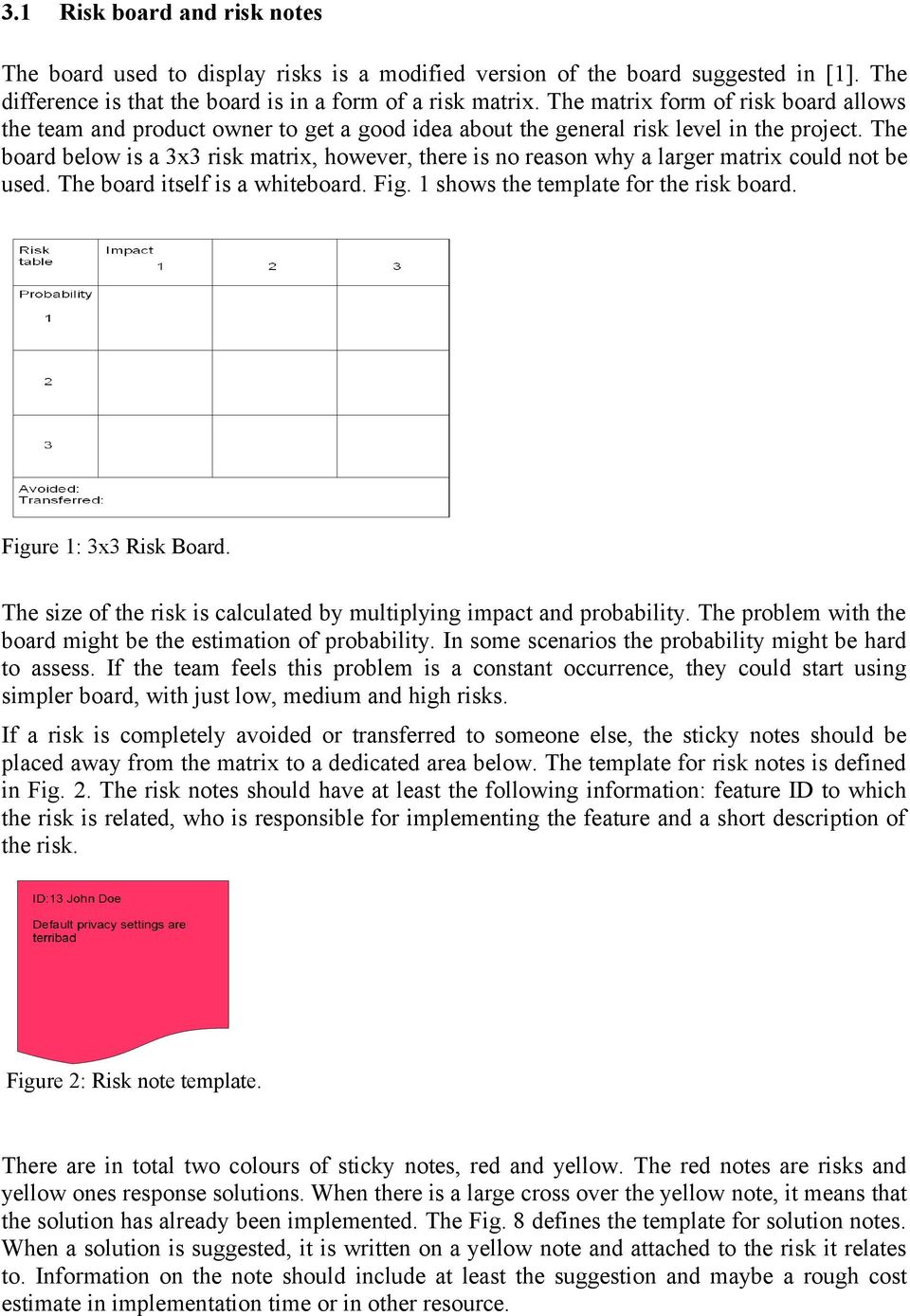
3 3.1 Risk board and risk notes The board used to display risks is a modified version of the board suggested in [1]. The difference is that the board is in a form of a risk matrix. The matrix form of risk board allows the team and product owner to get a good idea about the general risk level in the project. The board below is a 3x3 risk matrix, however, there is no reason why a larger matrix could not be used. The board itself is a whiteboard. Fig. 1 shows the template for the risk board. Figure 1: 3x3 Risk Board. The size of the risk is calculated by multiplying impact and probability. The problem with the board might be the estimation of probability. In some scenarios the probability might be hard to assess. If the team feels this problem is a constant occurrence, they could start using simpler board, with just low, medium and high risks. If a risk is completely avoided or transferred to someone else, the sticky notes should be placed away from the matrix to a dedicated area below. The template for risk notes is defined in Fig. 2. The risk notes should have at least the following information: feature ID to which the risk is related, who is responsible for implementing the feature and a short description of the risk. Figure 2: Risk note template. There are in total two colours of sticky notes, red and yellow. The red notes are risks and yellow ones response solutions. When there is a large cross over the yellow note, it means that the solution has already been implemented. The Fig. 8 defines the template for solution notes. When a solution is suggested, it is written on a yellow note and attached to the risk it relates to. Information on the note should include at least the suggestion and maybe a rough cost estimate in implementation time or in other resource.
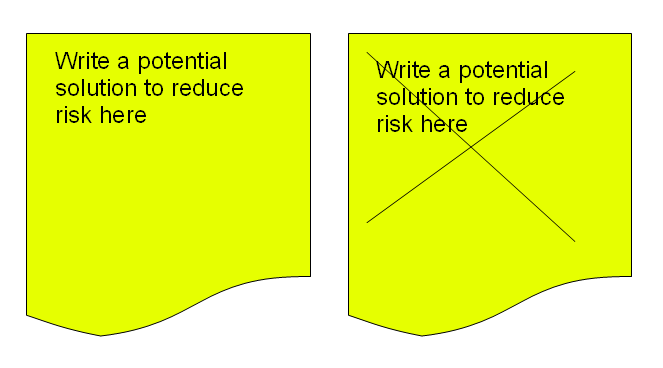
4 Figure 3: Risk response notes. The one on the left is an unattended solution and the one on the right is an implemented solution. When a solution is crossed out, the red risk note should also be moved to a new position on the board. This is done to avoid confusion regarding current risks and to prevent one risk being moved twice, which might drastically affect the accuracy of the process. The strength of the risk board is that it makes risk management highly visible and hopefully easy to understand. 3.2 Checklists To help in identification of high-risk components, checklists should be used. In this suggestion there are two checklists. One is based on the past experience and high-risk components. This list is more technical by nature. The other is based on security and abuse cases suggested in [2], and it is used as a reference card for general security requirements. One checklist should be based on past experience or already existing listing of a high risk code, such as [3]. It is not always easy to tell what feature is a high-risk one, thus all features should receive a quick risk identification. It could be in the form of a brainstorm or some other quick and light-weight method. The checklist that includes high-risk components should be updated from time time. Security and abuse cases should be another checklist, which sets the general requirements for feature security. As suggested in [2], the security and abuse cases are a great way to approach security from an outer perspective. Security cases approach the security from a users' perspective, so it is important to have a clear vision about the users' security needs. The baseline for security is set during planning phase. The idea is that the security and abuse cases are not booked as backlog items. They are used as a general reference that is compared to every feature. The person responsible for implementation of the feature should ask: What needs to be done in order to meet client's security requirements? Does the feature meet the requirements at the end of the sprint? The latter could be part of the sprint DoD. In order to use security and abuse cases effectively, the team must have understanding of the security requirements and potential attackers. This allows them to direct risk identification to correct software components. 3.3 Process The flowchart in Fig. 4 presents the idea how risks are identified, assessed and approved in the model.

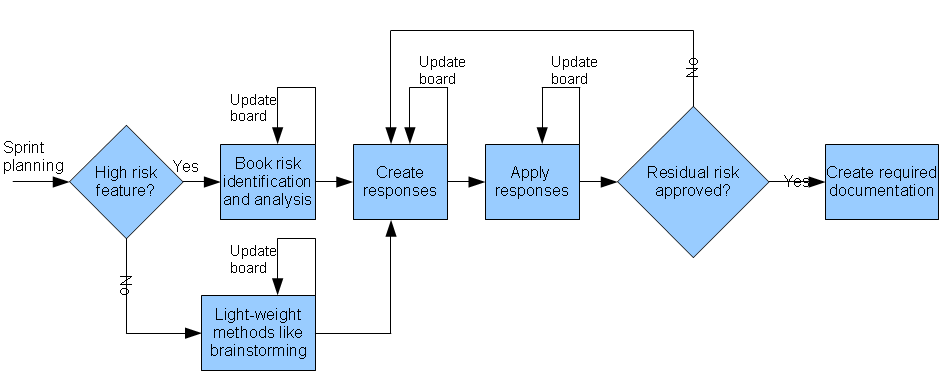
5 Figure 4: Flowchart of the process. The flowchart does not include risk management planning, which is only done once as a part of project visioning. It also doesn't include risk monitoring. The table 1 describes what additional things are done during the Scrum meetings. This does not mean that risk identification, assessment and responses would only be done during these meetings, most of the work will be done between the meetings. X means that it should be done every time, P means it is possible if needed. Table 1. Additional risk management activities in meetings. Risk management in meetings Sprint planning Identification Assessment Create response X X X Daily Scrum P P P Apply response Risk approval Sprint review P P P X Sprint retrospective Risks can be identified during all meetings apart from retrospective. As a risk is identified, one should also suggest the impact and probability it might have. Even if a feature receives a quick risk identification during sprint planning, this still means that further identification and assessment should be done by the person responsible for the feature. Identifying and assessing new risks during the sprint review is possible, but applying any responses will be a task for the next sprint Planning This is only done once during the project lifetime. While it is not possible at this point to tackle the actual security issues in the software, this is still an important part of risk management. The planning is done when establishing a vision about what the software should be like. From security and risk management perspective it is important to set requirements and goals for security. Security training is an important part of creating secure software. Security training and methods should also be discussed before starting to develop the actual software. Everyone

6 involved with the software should receive security training, including product owner and scrum master. The people responsible for accepting high-level risks should receive an adequate amount of security training in order to be able to make proper decisions. Depending on the security requirements, general security level wanted and attacker profiles the teams can adjust the time used on risk management and guide the risk identification to items that are most likely attacked. The definition of done it should be discussed here. The question is, when is a risk so high that it prevents the deliverables from being shipped? This obviously depends on the security requirements of the software and will vary from project to project Risk identification, assessment and response All features in the backlog deserve at least a quick risk identification. However, more in-depth identification and analysis should be done to those features that are considered having an elevated risk level. Just by reading the feature it is not easy to tell whether the code is high risk. The technical checklist should be used to identify high-risk components, which might require a comprehensive risk identification and assessment. Risk management should officially be part of at least sprint planning and review. New risks should be identified when choosing the features the team will commit to. This is also great timing for brainstorming, since all the members should attend. If risk management is added to the agenda of these meetings, then the meetings will be slightly longer. Risks can be identified during any Scrum meeting, however daily scrum being only maximum of 15 minutes, it might end up consuming a large portion of the time. The person responsible for implementing the feature is also responsible for making sure it receives risk identification, and if risks are found, assessment and risk response implementation. As soon as a risk is identified, it is written on a red note described in Fig. 2 and placed to the risk board. The same is done with risk solutions, however, yellow note is used and it is attached to risk it potentially can solve or mitigate. When a feature is considered a high-risk, it means a new task is booked for the risk identification and analysis. This task is added to the sprint backlog. This is done before starting to work on the actual feature itself. It should be done by the same person or people who are responsible for implementing the feature. The person responsible for a feature is also responsible for applying necessary risk responses, meaning he or she is the risk owner. The lack of clear risk ownership was considered as a problem during the interviews. Choosing which responses to apply is a crucial part of effective risk management. The following should be considered when creating and applying risk responses: Size of the risk. Risk response should be in proportion to the risk and feature. How important is the feature the risk is related to? There might be large and problematic risks related to a feature which is not high priority. Creating and applying responses would take a large amount of time to complete a feature which is not important.

7 After a response has been applied, the note will be crossed over and the risk itself is moved to a new spot on the board. In a case where there are several responses to a risk, it is up to the person responsible of the feature to decide which ones are implemented and which ones are ignored. The best response depends on the security requirements of the software and the efficiency, resources versus mitigation, of the response. 3.4 Risk approval and monitoring One of the problems that came up during the interviews was that it was not always clear who is responsible for accepting residual risks. This sub-chapter presents one solution. When accepting risks two things need to be considered, the nature and size of the risk. At this point all risks and applied responses should be visible on the risk board. The board tells how high is the residual risks after the crossed over responses have been applied. The idea is, that if risk is 2 or smaller then the person who implemented the feature and managed its risks can approve the residual risk. In case of risk being over 2, the product owner must approve the risks. If the product owner feels like he or she can't make the decision about accepting the risk, then the next approval depends on the organizational structure. It could be internal or external client, business decision maker or SoS-board (Scrum of Scrums). Problem with getting approval from them is that it is "unnecessary bureaucracy", which is something lean software development should avoid. When the risk has been accepted, there is no longer any reason for it to be on the board. The accepted risks should be stored in a digital form for potential future use and re-evaluation. The larger risks accepted should be re-evaluated from time to time. 3.5 Summary This suggestion included all traditional risk management steps. Summary of all the activities can be seen in table 2. Table 2: Summary of security activities. Activities Suggestion Done during Plan Identify Assess Identify security needs, make sure the team receives adequate training, create security cases and create attacker profiles. Create a checklist for high-risk features. Decide whether the feature is high-risk or not. If the feature is a high-risk, book risk identification to sprint backlog, otherwise use light methods like brainstorming or delphi technique. Add identified risks to the risk board. Try to assess impact and probability of the identified risks. Update the risk. Once before the project starts Before implementation of the feature After identification Respond Create responses, make sure they're in proportion to total risk and During feature
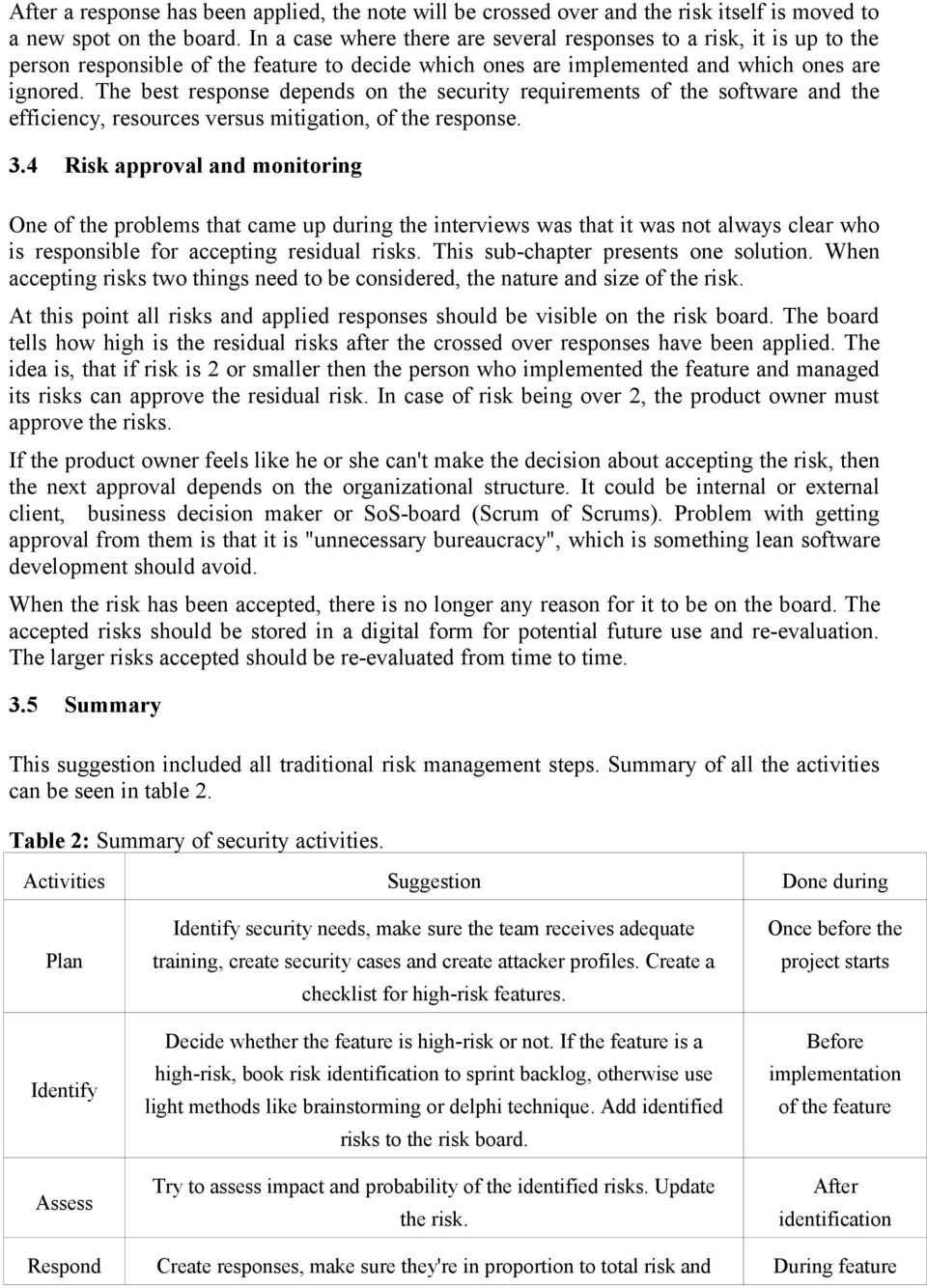
8 Accept Monitor the importance of the feature. Estimate the time required to implant the feature with the added time from response. Choose the best responses. Make sure all the risks are accepted by the risk owner, product owner or client. Digitalize the risks and remove the risk from board. Make sure to include all the information. Re-evaluate larger risks between few sprints. implementation Sprint review Between 2 to 5 sprints 4 Conclusion Using traditional risk management methodologies such as PMBOK in an agile environment requires adjustments. Also the methodologies used to identify security risks in software are very different from ideas given in PMBOK. When this paper was written very little research had been done in the field of agile risk management. The best methods for risk management are always dependant on the whole infrastructure used to develop the software, so it is impossible to create one risk management framework which would meet everyone s requirements. This paper created a model which can be used to manage risks in agile development environment. The results have yet to be verified by testing them in a real-life development scenario. Further studies could include testing the model and developing it further based on the results. References 1. Claude J.( )., Agile risk board, a way to manage risks in agile enviroment. Agile-ux. (WWW) (Cited ). Retrieved from: 2. Vähä-Sipilä A.(2010)., Product Security Risk Management in Agile Product Management. (WWW). (Cited ). Retrieved from: _Vaha-Sipila.pdf 3. Microsoft, SDL-Agile high risk code. (WWW). (Cited ). Retrieved from: 4. Project Management Institute, inc. PMBOK: A Guide to the Project Management Body of Knowledge, fourth edition.

Agile Project Management By Mark C. Layton
 Agile Project Management By Mark C. Layton Agile project management focuses on continuous improvement, scope flexibility, team input, and delivering essential quality products. Agile project management
Course Title: Planning and Managing Agile Projects
 Course Title: Planning and Managing Agile Projects Course ID: BA15 Credits: 21 PDUs Course Duration: 3 days (Live in person class only) Course Level: Basic/Intermediate Course Description: This 3-day course
Issues in Internet Design and Development
 Issues in Internet Design and Development Course of Instructions on Issues in Internet Design and Development Week-2 Agile Methods Saad Bin Saleem PhD Candidate (Software Engineering) Users.mct.open.ac.uk/sbs85
Course Title: Managing the Agile Product Development Life Cycle
 Course Title: Managing the Agile Product Development Life Cycle Course ID: BA25 Credits: 28 PDUs Course Duration: 4 days (with optional Executive session) Course Level: Intermediate/Advanced Course Description:
Is Your Organization Agile-Ready?
 Watermark Learning Article Is Your Organization Agile-Ready? Part 1: Four Formidable Questions Lately I ve been getting questions from Agile seminar participants about how to apply Scrum to real life,
When is Agile the Best Project Management Method? Lana Tylka
 When is Agile the Best Project Management Method? Lana Tylka Staged Incremental Deliveries Prototypes Plan Develop Design Deploy Test Maintain Sequential Steps Multiple Iterations Waterfall Sprints, Spirals
D25-2. Agile and Scrum Introduction
 D25-2 Agile and Scrum Introduction How to Use this Download This download is an overview of a discussion Intertech has with clients on Agile/Scrum This download has an overview of Agile, an overview of
AGILE vs. WATERFALL METHODOLOGIES
 AGILE vs. WATERFALL METHODOLOGIES Introduction Agile and waterfall are two major methodologies that software developers and project managers have the option of using. Some of the goals of developers and
A Glossary of Scrum / Agile Terms
 A Glossary of Scrum / Agile Terms Acceptance Criteria: Details that indicate the scope of a user story and help the team and product owner determine done-ness. Agile: the name coined for the wider set
Iteration Planning. also called Iteration Kickoff
 Agile Practices also called Iteration Kickoff Iteration Planning Purpose: Discuss detailed requirements of the stories to be built in the iteration. Review and refine the acceptance criteria for each story
Certified ScrumMaster (CSM) Content Outline and Learning Objectives January 2012
 Certified ScrumMaster (CSM) Content Outline and Learning Objectives January 2012 The following pages present the CSM taxonomy as validated through the 2011 Scrum Alliance Validation Study. Each percentage
A WRITER'S GUIDE TO SURVIVING AGILE SOFTWARE DEVELOPMENT
 A WRITER'S GUIDE TO SURVIVING AGILE SOFTWARE DEVELOPMENT A Writer's Guide to Surviving Agile Software Development Introductory Quote Originally, the methodology did not include documentation, but many
Agile Methods for Analysis
 Agile Methods for Analysis Lightweight Concepts for Team-Based Projects Sebastian Neubert CERN PH-LBD Sebastian Neubert Agile Analysis 1/22 Introduction: Data Analysis as a Continuous Improvement Loop
Agile Based Software Development Model : Benefits & Challenges
 Agile Based Software Development Model : Benefits & Challenges Tajinder Kumar Assistant Professor, IT Department JMIT Radaur, Haryana Vipul Gupta Assistant Professor, IT Department JMIT Radaur, Haryana
FREE ONLINE EDITION. (non-printable free online version) Brought to you courtesy of Sprint-IT &
 FREE ONLINE EDITION (non-printable free online version) If you like the book, please support the author & InfoQ by purchasing the printed version: www.sprint-it.de/scrum-checklists (only 19,90 euro) Brought
Would you like to have a process that unlocks ability to learn and produce faster?
 Would you like to have a process that unlocks ability to learn and produce faster? Agile - your unfair advantage in the competition. BUILD LEARN MEASURE DEFINED MEASURABLE REPEATABLE COLLABORATIVE IMPROVABLE
Waterfall vs. Agile Project Management
 Lisa Sieverts, PMP, PMI-ACP Phil Ailes, PMI-ACP Agenda What is a Project Overview Traditional Project Management Agile Project Management The Differences Product Life Cycle The Teams Requirements WBS/Product
1. Sprint Planning. Agile Ceremonies Demystified. A four part series written by Angela Boardman, CSM, CSP. www.atginfo.com 1-866-805-4ATG (4284)
 www.atginfo.com 1-866-805-4ATG (4284) Agile Ceremonies Demystified A four part series written by Angela Boardman, CSM, CSP 1. Sprint Planning Agile.maybe you have heard of it. Does your company want to
Agile Scrum and PMBOK Compatible or Contrary?
 Agile Scrum and PMBOK Compatible or Contrary? Paul Despres PMI Emerald Coast Panama City Branch June 26, 2014 Meeting Overview Agenda Topics: Review Agile/Scrum Methods Review PMBOK Structure Demonstrate
AGILE - QUICK GUIDE AGILE - PRIMER
 AGILE - QUICK GUIDE http://www.tutorialspoint.com/agile/agile_quick_guide.htm Copyright tutorialspoint.com AGILE - PRIMER Agile is a software development methodology to build a software incrementally using
Gothenburg 2015 Jan Marek Jan.Marek@ca. com CA Technologies Introducing Agile development methodologies to Session S601 mainframe development teams
 Jan Marek Jan.Marek@ca. com CA Technologies Session S601 Introducing Agile development methodologies to mainframe development teams Agenda Introduce Agile software development methodologies Scrum overview
Vision created by the team. Initial Business Case created. Cross functional resource meeting held. Agile alignment meeting
 Help Tips Agile SDLC Product Backlog Daily Standup Sprint 1 Show and Tell 2 Week Sprint Sprint 2 Release1 (must haves) Retrospective Sprint 1 DONE! Sprint 3 Sprint 2 DONE! Sprint Backlog Sprint 3 DONE!
Agile Software Development with Scrum. Jeff Sutherland Gabrielle Benefield
 Agile Software Development with Scrum Jeff Sutherland Gabrielle Benefield Agenda Introduction Overview of Methodologies Exercise; empirical learning Agile Manifesto Agile Values History of Scrum Exercise:
A Viable Systems Engineering Approach. Presented by: Dick Carlson ([email protected])
 A Viable Systems Engineering Approach Presented by: Dick Carlson ([email protected]) Philip Matuzic ([email protected]) i i Introduction This presentation ti addresses systems engineering
Certified ScrumMaster (CSM) Content Outline and Learning Objectives January 2012
 Certified ScrumMaster (CSM) Content Outline and Learning Objectives January 2012 The following pages present the CSM taxonomy as validated through the 2011 Scrum Alliance Validation Study. Total questions
Transitioning Your Software Process To Agile Jeffery Payne Chief Executive Officer Coveros, Inc. [email protected] www.coveros.
 Transitioning Your Software Process To Agile Jeffery Payne Chief Executive Officer Coveros, Inc. [email protected] www.coveros.com 1 About Coveros Coveros helps organizations accelerate the delivery
Automated Acceptance Testing of High Capacity Network Gateway
 Automated Acceptance Testing of High Capacity Network Gateway Ran Nyman 1, Ismo Aro 2, Roland Wagner 3, 1,2,3 Nokia Siemens Network, PO Box 1 FI-02022 Nokia Siemens Networks 1 [email protected], 2 [email protected],
Managing Agile Projects in TestTrack GUIDE
 Managing Agile Projects in TestTrack GUIDE Table of Contents Introduction...1 Automatic Traceability...2 Setting Up TestTrack for Agile...6 Plan Your Folder Structure... 10 Building Your Product Backlog...
PROJECT RISK MANAGEMENT MODEL BASED ON PRINCE2 AND SCRUM FRAMEWORKS
 PROJECT RISK MANAGEMENT MODEL BASED ON PRINCE2 AND SCRUM FRAMEWORKS Martin Tomanek and Jan Juricek Department of Systems Analysis, University of Economics, Prague, Czech Republic ABSTRACT There is a lack
How to. Create Personas For Your B2B Content Marketing Strategy
 How to Create Personas For Your B2B Content Marketing Strategy Introduction Content marketers are never short on things to do. Whether it s determining the best time to promote to your social media accounts,
Waterfall to Agile. DFI Case Study By Nick Van, PMP
 Waterfall to Agile DFI Case Study By Nick Van, PMP DFI Case Study Waterfall Agile DFI and Waterfall Choosing Agile Managing Change Lessons Learned, Sprints Summary Q and A Waterfall Waterfall Waterfall
Agile Projects 7. Agile Project Management 21
 Contents Contents 1 2 3 Agile Projects 7 Introduction 8 About the Book 9 The Problems 10 The Agile Manifesto 12 Agile Approach 14 The Benefits 16 Project Components 18 Summary 20 Agile Project Management
Agile Scrum Workshop
 Agile Scrum Workshop What is agile and scrum? Agile meaning: Able to move quickly and easily. Scrum meaning: a Rugby play Agile Scrum: It is an iterative and incremental agile software development framework
VIII. Project Management Glossary
 https://www.wrike.com/project-management-guide/glossary/ VIII. Project Management Glossary Project management, like any other industry, has its share of unique terms. Don t be overwhelmed. Here is our
5 Levels of Agile Planning: From Enterprise Product Vision to Team Stand-up
 Rally Software Development Corporation Whitepaper 5 Levels of Agile Planning: From Enterprise Product Vision to Team Stand-up Hubert Smits Agile Coach and Certified ScrumMaster Trainer [email protected]
Scrum includes a social agreement to be empirical as a Team. What do you think an empirical agreement is?
 Scrum Discussion Questions For the Facilitator These questions and subsequent discussion points are designed to help you and your Team more efficiently implement Scrum. The following are discussion points
EXIN Agile Scrum Foundation. Sample Exam
 EXIN Agile Scrum Foundation Sample Exam Edition June 2016 Copyright 2016 EXIN All rights reserved. No part of this publication may be published, reproduced, copied or stored in a data processing system
LEAN AGILE POCKET GUIDE
 SATORI CONSULTING LEAN AGILE POCKET GUIDE Software Product Development Methodology Reference Guide PURPOSE This pocket guide serves as a reference to a family of lean agile software development methodologies
The Basics of Scrum An introduction to the framework
 The Basics of Scrum An introduction to the framework Introduction Scrum, the most widely practiced Agile process, has been successfully used in software development for the last 20 years. While Scrum has
Is PRINCE 2 Still Valuable in an Agile Environment?
 Is PRINCE 2 Still Valuable in an Agile Environment? Amy Hongying Zhao Introduction Over the years, many organizations have invested heavily in creating or deploying project management frameworks. PRINCE
Creating a High Maturity Agile Implementation
 Creating a High Maturity Agile Implementation Creating a High Maturity Agile Implementation www.qaiglobal.com 1 Copyright Notice 2015. Unless otherwise noted, these materials and the presentation of them
ScrumMaster or Armchair Psychologist Scrum Fundamentals Webinar Q&A March 9, 2016
 ScrumMaster or Armchair Psychologist Scrum Fundamentals Webinar Q&A March 9, 2016 As a ScrumMaster, one of your responsibilities is "Causing change that increases the productivity of the Scrum Team." What
Adapting Agile Software Development to Regulated Industry. Paul Buckley Section 706 Section Event June 16, 2015
 Adapting Agile Software Development to Regulated Industry Paul Buckley Section 706 Section Event June 16, 2015 Agenda FDA s expectations for Software Development What is Agile development? Aligning Agile
Mastering Security in Agile/Scrum, Case Study
 Mastering Security in Agile/Scrum, Case Study Anu Puhakainen & Juha Sääskilahti Ericsson Network Security Competence Hub Session ID: ASEC-107 Session Classification: Intermediate Presentation Outline Introduction
The Agile PMO. Contents. Kevin Thompson, Ph.D., PMP, CSP Agile Practice Lead cprime, Inc. 4100 E. Third Avenue, Suite 205 Foster City, CA 94404
 The Agile PMO Kevin Thompson, Ph.D., PMP, CSP Agile Practice Lead cprime, Inc. 4100 E. Third Avenue, Suite 205 Foster City, CA 94404 [email protected] Abstract The development of Agile processes
Agile Project Management A Primer. Brian Stewart AVU ACEP Nairobi 17 th 2013
 Agile Project Management A Primer Brian Stewart AVU ACEP Nairobi 17 th 2013 http://www.coleyconsulting.co.uk/images/waterfall-model.gif Problems with waterfall model Over-planning Insufficient Communication
Challenges of Software Security in Agile Software Development
 Challenges of Software Security in Agile Software Development Dr. Panayotis Kikiras INFS133 March 2015 Agenda Lean Principles and Agile Development Usable Security Secure software development in Agile
PROJECT RISK MANAGEMENT
 PROJECT RISK MANAGEMENT DEFINITION OF A RISK OR RISK EVENT: A discrete occurrence that may affect the project for good or bad. DEFINITION OF A PROBLEM OR UNCERTAINTY: An uncommon state of nature, characterized
Software Development Methodologies in Industry. By: Ahmad Deeb
 Software Development Methodologies in Industry By: Ahmad Deeb Methodologies Software Development Methodologies in Industry Presentation outline SDM definition Project and analysis approach Research methods
Introduction to User Story Mapping. July 2015 COPYRIGHT 2015 AGILITY SOFTWARE 1
 Introduction to User Story Mapping MARK NONEMAN, PROFESSIONAL SCRUM EXPERT AGILITY SOFTWARE [email protected] @MARKNONEMAN July 2015 COPYRIGHT 2015 AGILITY SOFTWARE 1 Getting To Know You! Mark Noneman
PROJECT MANAGEMENT PLAN CHECKLIST
 PROJECT MANAGEMENT PLAN CHECKLIST The project management plan is a comprehensive document that defines each area of your project. The final document will contain all the required plans you need to manage,
Getting Agile with Scrum
 Getting Agile with Scrum Mike Cohn November 11, 2008 1 Mike Cohn - background 2 Agenda Overview of Scrum Product backlogs Sprints and sprint backlog Tracking progress Scrum meetings 3 The Agile Manifesto
Scaling Scrum Professionally using Nexus and Visual Studio Team Services
 ALM Scaling Scrum Professionally using Nexus and Visual Studio Team Services If you have been using Scrum to develop products, you have probably found that the Scrum Guide only describes the core rules
INTRODUCTION. Chapter 1. 1.1 Motivation
 Chapter 1 INTRODUCTION 1.1 Motivation The success of any computer software depends on the user s satisfaction. When software fulfills the user s requirements, it succeeds but the software fails if its
AGILE & SCRUM. Revised 9/29/2015
 AGILE & SCRUM Revised 9/29/2015 This Page Intentionally Left Blank Table of Contents Scrum Fundamentals Certified Course... 1 Scrum Developer Certified (SDC)... 2 Scrum Master Certified (SMC)... 3 Scrum
The Agile Drupalist. Methodologies & Techniques for Running Effective Drupal Projects. By Adrian AJ Jones (Canuckaholic)
 The Agile Drupalist Methodologies & Techniques for Running Effective Drupal Projects By Adrian AJ Jones (Canuckaholic) Agenda What We Will be Talking About Today! Introductions! What kind of processes
Measuring ROI of Agile Transformation
 Measuring ROI of Agile Transformation Title of the Paper: Measuring Return on Investment (ROI) of Agile Transformation Theme: Strategic & Innovative Practices Portfolio, Programs & Project (PPP) Management
Workflow and Process Analysis for CCC
 Section 3.6 Design Workflow and Process Analysis for CCC This tool introduces the importance of workflow and process improvement in a community-based care coordination (CCC) program, describes the value
Your Agile Team s Indispensible Asset
 Agile / Scrum Training Lean Software Development Agile Organizational Metrics Executive Coaching Improved Team Dynamics Improved Efficiency! Your Agile Team s Indispensible Asset The Agile Business Analyst
www.testing-solutions.com TSG Quick Reference Guide to Agile Development & Testing Enabling Successful Business Outcomes
 www. TSG Quick Reference Guide to Agile Development & Testing Enabling Successful Business Outcomes What is Agile Development? There are various opinions on what defines agile development, but most would
Water-Scrum-Fall Agile Reality for Large Organisations. By Manav Mehan Principal Agile consultant [email protected]
 Water-Scrum-Fall Agile Reality for Large Organisations By Manav Mehan Principal Agile consultant [email protected] Interests and Experience Leading Change and Transformation in Large, Complex organisations
Agile software development
 Agile software development Syed Nisar Hussain Bukhari Scientist-B DOEACC centre Srinagar [email protected] Abstract: The field of software development is open and dynamic. New approaches of software
When User Experience Met Agile: A Case Study
 When User Experience Met Agile: A Case Study Michael Budwig User Experience Manager PayPal 2211 North 1 st Street, San Jose, California 95131 USA [email protected] Soojin Jeong Manager, User Interface
Project Management in Software: Origin of Agile
 PAGE 1 ios App Development Project Management in Software: Origin of Agile PAGE 2 Learning Outcomes By the end of the unit, you should be able to: 1. Differentiate between Waterfall and Agile process 2.
Software Development Methodologies
 Software Development Methodologies Jonathan Hoyle Eastman Kodak Thursday, June 2, 2005 Overview Predictive Methodologies Waterfall Other Predictive Methodologies Agile Methodologies Extreme Programming
Making Sense of. Agile Project Management. Traditional. Project Management. 1/19/2011 2010 Breakthrough Solutions, Inc. 1
 Making Sense of Agile Project Management Agile Project Management Traditional Project Management 1/19/2011 2010 Breakthrough Solutions, Inc. 1 My View of Project Management Today Subject Matter Knowledge
Phase 2 Systems Analysis. Dr. Feng-Jen Yang
 Phase 2 Systems Analysis Dr. Feng-Jen Yang Phase Description Systems analysis is the 2nd phase in the systems development life cycle (SDLC) Use requirements modeling, data and process modeling, and object
Introduction to Agile and Scrum
 Introduction to Agile and Scrum Bob Schommer, CSP, PMP, MCTS Senior Project Manager Skyline Technologies, Inc. PMI Northeast Wisconsin Chapter May 3, 2011 About Skyline Technologies Microsoft Gold Certified
Transitioning from Waterfall: The Benefits of Becoming Agile. ASPE Web Seminar Friday, February 27 th, 2015
 Transitioning from Waterfall: The Benefits of Becoming Agile ASPE Web Seminar Friday, February 27 th, 2015 Objectives Give a high-level look at the challenges in software development Give a basic look
AGILE SOFTWARE DEVELOPMENT. BY Sysop Technology Aurangabad-431003
 AGILE SOFTWARE DEVELOPMENT BY Sysop Technology Aurangabad-431003 Abstract: Software development which can be delivered fast, quick adaptation to requirements and collecting feed back on required information.
RISK MANAGMENT ON AN AGILE PROJECT
 BIO PRESENTATION W3 6/28/ 11:30 AM RISK MANAGMENT ON AN AGILE PROJECT Michele Sliger Rally Software Development Better Software Conference June 26 29, Las Vegas, NV USA Michele Sliger Michele Sliger has
2015 Defense Health Information Technology Symposium Implementation of Agile SCRUM Software Development Methodology
 Mr. Christopher Harrington, PM Clinical Support, Solution Delivery Division Mr. James Huber, Healthcare Data Analyst, DHA Decision Support 2015 Defense Health Information Technology Symposium Implementation
EPL603 Topics in Software Engineering
 Lecture 3 Agile Software Development EPL603 Topics in Software Engineering Efi Papatheocharous Visiting Lecturer [email protected] Office FST-B107, Tel. ext. 2740 Topics covered Agile methods
QUALITY TOOLBOX. Understanding Processes with Hierarchical Process Mapping. Robert B. Pojasek. Why Process Mapping?
 QUALITY TOOLBOX Understanding Processes with Hierarchical Process Mapping In my work, I spend a lot of time talking to people about hierarchical process mapping. It strikes me as funny that whenever I
Who Doesn t Want to be Agile? By: Steve Dine President, Datasource Consulting, LLC 7/10/2008
 Who Doesn t Want to be Agile? By: Steve Dine President, Datasource Consulting, LLC 7/10/2008 Who wants to be involved in a BI project or program that is labeled slow or inflexible? While I don t believe
Frank Cervone Vice Chancellor for Information Services and Chief Information Officer Purdue University Calumet January 17, 2012 CARLI Anatomy of a
 Frank Cervone Vice Chancellor for Information Services and Chief Information Officer Purdue University Calumet January 17, 2012 CARLI Anatomy of a Digital Project webinar series An overview and background
Lean Software Development and Kanban
 1 of 7 10.04.2013 21:30 Lean Software Development and Kanban Learning Objectives After completing this topic, you should be able to recognize the seven principles of lean software development identify
Capstone Agile Model (CAM)
 Capstone Agile Model (CAM) Capstone Agile Model (CAM) Approach Everything we do within the Capstone Agile Model promotes a disciplined project leadership process that encourages frequent inspection and
Introduction to Agile Practices
 Introduction to Agile Practices Phyllis Marbach, INCOSE Agile Systems & Systems Engineering Working Group February 2, 2016 INCOSE INSIGHT July 2014 1 Current State of Intelligent Transportation Systems
Risk Management in Software projects using Scrum framework. Ana Beatriz Chiste Brandão
 Risk Management in Software projects using Scrum framework Ana Beatriz Chiste Brandão Degree of Master Thesis (1yr), Stockholm, Sweden 2012 Summary This research project aimed to study how Risk Management
Using Scrum to Guide the Execution of Software Process Improvement in Small Organizations
 Using Scrum to Guide the Execution of Software Process Improvement in Small Organizations Francisco J. Pino, Oscar Pedreira*, Félix García +, Miguel Rodríguez Luaces*, Mario Piattini + IDIS Research Group
3 Steps to an Effective Retrospective December 2012
 3 Steps to an Effective Retrospective December 2012 REVAMPING YOUR RETROSPECTIVE Scrum is a simple framework that includes some specific roles, artifacts and meetings. Scrum teams often implement the Daily
Project Management and Scrum A Side by Side Comparison by Anne Loeser, October 2006
 Project Management and Scrum A Side by Side Comparison by Anne Loeser, October 2006 For decades, software development projects have followed the classic waterfall method in which software development initiatives
Agile Team Roles Product Owner & ScrumMaster. Brian Adkins Rick Smith
 Agile Team Roles Product Owner & ScrumMaster Brian Adkins Rick Smith Agenda Scrum & Team Roles Overview Product Owner ScrumMaster Existing Roles Scrum Teams Optimally about 7 people Sponsor Stakeholders
At the end of this chapter. Project Charter. What is a Project Charter? What is a Project Charter? Why is a Project Charter used?
 At the end of this chapter Project Charter Describe what a project charter is and why it is critical to project success. Explain what a project scope statement is and why it is important. List the various
4180: Defined Processes, Evidence, and Rescuing Corporate Knowledge: Achieving Standards Compliance in Agile and Lean Environments
 4180: Defined Processes, Evidence, and Rescuing Corporate Knowledge: Achieving Standards Compliance in Agile and Lean Environments SEPG Conference March 2012 Dr. Richard Bechtold : Overview Problem Statement
Bridging the Gap: Traditional to Agile Project Management. I. S. Parente 1. Susan Parente, PMP, PMI ACP, CISSP, PMI RMP, ITIL, MSEM;
 Bridging the Gap: Traditional to Agile Project Management ABSTRACT I. S. Parente 1 1 Susan Parente, PMP, PMI ACP, CISSP, PMI RMP, ITIL, MSEM; S3 Technologies, LLC, Principal Consultant; parente@s3 tec.com
Five Core Principles of Successful Business Architecture
 Five Core Principles of Successful Business Architecture Authors: Greg Suddreth and Whynde Melaragno Strategic Technology Architects (STA Group, LLC) Sponsored by MEGA Presents a White Paper on: Five Core
Agile Software Development
 Agile Software Development Use case for Agile Software Development Methodology in an Oil and Gas Exploration environment. White Paper Introduction No matter what business you are in, there are critical
Agile and Secure Can We Be Both? Chicago OWASP. June 20 th, 2007
 Agile and Secure Can We Be Both? Chicago OWASP June 20 th, 2007 The Agile Practitioner s Dilemma Agile Forces: Be more responsive to business concerns Increase the frequency of stable releases Decrease
44-76 mix 2. Exam Code:MB5-705. Exam Name: Managing Microsoft Dynamics Implementations Exam
 44-76 mix 2 Number: MB5-705 Passing Score: 800 Time Limit: 120 min File Version: 22.5 http://www.gratisexam.com/ Exam Code:MB5-705 Exam Name: Managing Microsoft Dynamics Implementations Exam Exam A QUESTION