
National Compendium of Medical Costs in Australian Workers Compensation
|
|
|
- Diana Robinson
- 10 years ago
- Views:
Transcription
1 National Compendium of Medical Costs in Australian Workers Compensation for the Financial Years , and HWCA AUSTRALIA A Publication of the Heads of Workers Compensation Authorities June 2000

2

3 Foreword Foreword On behalf of the Heads of Workers Compensation Authorities (HWCA) I have pleasure in releasing this National Compendium of Medical Costs in Australian Workers Compensation for the financial years 1996/97, 1997/98 and 1998/99. The HWCA comprises the Chief Executive Officers of all Australian workers compensation schemes. The Chief Executive of the New Zealand Accident Compensation Corporation is also a participant. Its primary goal is to reduce the social and economic cost of workplace injury and disease across Australia. Two key objectives of the HWCA are: to promote a better understanding of the differences in the various workers compensation schemes to facilitate meaningful benchmarking of scheme performance based on consistent data. The information contained in this document has been supplied by the various State and Territory workers compensation authorities and is intended to provide insight into claims expenditure and cost management strategies that operate in the various schemes. The information in this compendium is current as at January Should you wish to make any comments or suggested improvements to the content, please forward them to: Ms Kym Coulter Chair, National Medical Services Group c/- WorkCover Corporation (South Australia) GPO Box 2668 Adelaide SA 5001 Phone: (08) Fax: (08) George O Farrell Convenor Heads of Workers Compensation Authority 1

4 Contents Contents Chapter 1 Introduction Background Methodology Structure of the compendium 4 Chapter 2 Medical costs: Influencing factors Background to the workers compensation jurisdictions Cost drivers Factors influencing cost drivers Special issues in workers compensation cost management Cost management strategies 8 Chapter 3 Medical services summaries Key Definitions for data extraction 11 Chapter 4 Medical data tables 13 Table 1.0 Claim payment summary 13 Table 2.0 Macro indicator legally qualified medical practitioners 14 Table 2.1 Professional group, anaesthetists 15 Table 2.2 Professional group, general practitioners 16 Table 2.3 Professional group, psychiatrists 17 Table 2.4 Professional group, radiologists 18 Table 2.5 Professional group, surgeons 19 Table 3.0 Macro indicator hospitals (public and private) 20 Table 3.1 Private hospitals 21 Table 3.2 Public hospitals 22 Table 4.0 Macro indicator allied health providers 23 Table 4.1 Professional group, chiropractors 24 Table 4.2 Professional group, physiotherapists 25 Table 4.3 Professional group, psychologists 26 Chapter 5 Cost management strategies across workers compensation authorities Strategies summary Comcare New South Wales Northern Territory Queensland South Australia Tasmania Victoria Western Australia 42 Chapter 6 Summary 44 Chapter 7 Glossary of terms 46 Chapter 8 Further information 48 2

5 Introduction Chapter 1 Introduction 1.1 Background The Australian workers compensation schemes are employer-financed, occupational disability programs for work related injury and disease. All Australian workers compensation schemes provide for the payment of medical and hospital costs associated with occupational injury and illness and vary between the jurisdictions. The Heads of Workers Compensation Authorities (HWCA) promotes greater consistency between the various workers compensation jurisdictions within Australia. The National Medical Services Group (NMSG) is a specialist working party convened under the HWCA, consisting of representatives from all workers compensation jurisdictions. The primary objective of the NMSG is to identify and develop best practice with respect to the provision of medical and allied health services, which may be implemented across Australia, with particular reference to cost management. This compendium includes claims expenditure data that provides jurisdictions with an indicator of scheme performance, and a summary of cost management strategies being utilised by the various jurisdictions. The use of this document will increasingly enable jurisdictions to adopt and develop more consistent national approaches to the achievement of return to work outcomes, service quality, effectiveness and cost management. The compendium also provides the reader with an understanding of the elements that drive medical costs and the strategies that exist to control them. 1.2 Methodology The task was undertaken by the National Medical Services Group, a forum consisting of representatives from all Australian workers compensation schemes. The data contained within this compendium relates to medical costs and service patterns for all open claims, which have recorded at least one type of payment, in the financial years 1996/97, 1997/98 and 1998/99. The data has been collected from all jurisdictions between July and December 1999, to allow sufficient development time and to ensure data integrity. As each state and territory have varying capabilities regarding the collection of relevant medical service and cost data, it was agreed that information would be supplied in macro and micro format to ensure that a comparison across all jurisdictions was achievable. Due to key differences in the legislative framework and the extent of data able to be provided between each jurisdiction, disclaimers have been included within the document to explain where jurisdictions were unable to present all of the required information, or where the data presented differs from the key definitions. 3
6 Chapter 1. Introduction Only speciality groups that are considered the key providers of services (either due to expenditure or number of services provided to claimants), and on which jurisdictions were able to provide information have been included in this document. To ensure consistency in the data obtained, jurisdictions were provided with a package to complete which comprised a glossary of terms and definitions and explanations of each of the cost management strategies that were likely to be utilised. 1.3 Structure of the compendium The compendium has been structured to provide a general overview of medical and allied health costs, identification of potential cost drivers and management initiatives currently undertaken by each jurisdiction within Australia. However, there are a number of cost management strategies implemented by insurers in privately underwritten schemes that are not included in this document. Statistics for each jurisdiction (where applicable) over the 1996/97, 1997/98 and 1998/99 financial years for key speciality groups are contained in Chapter 4, Medical Data Tables. 4

7 Medical costs: Influencing factors Chapter 2 Medical costs: Influencing factors 2.1 Background to the workers compensation jurisdictions Each of the workers compensation jurisdictions within Australia operates independently within a legislative framework specific to the scheme. For this reason it is not possible to make a direct comparison of expenditure and cost management strategies across the schemes. The provisions for the payment of benefits to injured workers, including the payment of medical expenses, vary according to the legislation which applies within each jurisdiction. Each workers compensation jurisdiction has varying data collection capabilities and consequently the extent of medical cost and service data collated and presented within the cost compendium varies. It is important to note the key differences and give due consideration to these factors when reviewing the cost compendium. 2.2 Cost drivers When analysing medical cost and service data, it is necessary to identify the key factors contributing to the observed cost patterns. The identification of cost drivers allows each jurisdiction to understand trends in medical costs and to review the efficacy of existing cost management strategies, and to consider the establishment of further strategies where required. Cost drivers relevant to the workers compensation environment may include but are not limited to the following: Claims Experience This may relate to incidence rates, the number and type of claims lodged and accepted, i.e. injury dates, and severity. Claims costs within jurisdictions may also be affected by the claim duration i.e. from the date of injury to cessation of benefits and the outcome achieved, e.g. whether there is a full return to work with the same employer on pre-injury duties. Service behaviour (service usage) Relates to services that are provided on the basis of their appropriateness and necessity for the medical treatment of the compensable disability or disease. Service behaviour considers the type, frequency, duration and cost of the service. Service unit cost The price of a single service. 5
8 Medical costs: Influencing factors Service Mix This relates to the mix of the most common services provided, for example, costs may increase when providers shift from a lesser charged service (short or standard consultative service) to a higher charged service (eg, long or complex consultative service). Market Penetration Relates to the number of claims that continue to receive treatment from the specified provider group as a percentage of all claims receiving at least one type of medical service. Costs often increase when market penetration increases. Service provider involvement Relates to the number and type of providers involved in a claim, and the nature of services provided. The roles and responsibilities of providers can also be categorised as a cost driver, for example, legally qualified medical practitioners are responsible for certifying incapacity which in turn directly influences the payment of income maintenance benefits to injured workers. Medico-legal environment Medical providers are responsible for certifying disability, determining return to work dates, the identification of work restrictions and assessment of permanent disability. Consequently, providers frequently become involved in litigation concerning compensability or various entitlements. In this regard, providers are obliged to assist by providing factual information reasonably required (and with the patient's consent) concerning the patient's condition or injury, to nominated parties, eg, the patient's legal adviser. Cost management strategies Implemented in isolation or combination, the strategies can directly influence scheme costs, eg, by limiting the amount paid for services, or control the utilisation of medical or ancillary health services. Conversely, the lack of cost management strategies may be reflected in overall scheme performance and observed through an increase in medical and income maintenance expenditure, or poor claim and return to work outcomes. Injury management strategies Some schemes may introduce strategies to improve injury management. For example, an early intervention strategy whereby the provision of intense treatment in the early stages of the injury may produce increased medical expenses. This in turn can result in reduced income maintenance expenditure in the longer term as a consequence of an earlier return to work outcome. 6

9 Medical costs: Influencing factors 2.3 Factors influencing cost drivers The following points are examples of external factors that may influence not only cost drivers but the jurisdiction's ability to implement cost management strategies: Legislation and political environment Schemes are enacted by complex legislation and are subject to diverse political influence. For this reason, each scheme has developed its own service fee structure, entitlement criteria, treatment protocols and approach to the introduction or removal of medical excess. In addition, legislative differences in relation to common law issues or lump sum payments may also have an impact on the scheme's overall performance. State of labour market The state of the labour market can influence the ability to successfully return claimants to suitable employment, ie, to new job, new employer. State of economy The state of the economy may directly influence employer turnover, ie, the continuation of existing positions or availability of new employment opportunities. 2.4 Special issues in workers compensation cost management The distinctive nature of medical care within the individual workers compensation environments must be acknowledged. The following issues are often pertinent to the workers compensation system and can be considered when reviewing cost management strategies. The relevance of the following points will vary between the jurisdictions depending on legislative constraints: Doctors are empowered with significant responsibility relating to injury management. The treating doctor must consider issues of capacity and must determine whether the worker can be certified fit to return to work. Different parties are involved in the management of the claim, (ie, insurer, employer, doctor and other health care professionals) with which the doctor must communicate and be accountable to. The adverse effect of the workers compensation system on patient health and recovery is well documented. Payment of compensation for work related injuries have been linked with significantly longer periods of time off work, increased psychological disturbance and less positive response to treatment. 1 1 A retrospective controlled cohort study by Greenough and Fraser (1989) found that patients with back injuries receiving workers compensation payments displayed significantly longer periods off work and increased reported levels of pain and disability, compared with non compensable back injury patients. 7

10 Medical costs Influencing factors Worker choice of treatment provider. Treating providers may be chosen on the basis of their attitude towards workers compensation issues or based on the worker's personal experience with the provider rather than for their medical expertise and skills in the area of workers compensation. Some jurisdictions are considering adopting models of preferred providers, however there are concerns regarding patient satisfaction and quality of care based on US managed care models. Many workers will visit their family GP as the first point of contact when injured at work. Generally, workers compensation patients make up a very small component of a doctor's practice and the doctor may not be fully aware of issues unique to work related injuries and the return to work process. Workers compensation jurisdictions recognise that the primary focus of treatment should be directed at achieving outcomes, (eg, return to work at a reasonable cost) and not limited to cost management. However, to achieve the best outcomes possible it may be necessary to pay for specific quality services. The provision of targeted medical services may facilitate a more effective and timely return to work and a subsequent decrease in income maintenance payments. 2.5 Cost management strategies Cost management strategies are implemented in isolation or combination to control specific cost drivers operating in the workers compensation environment. Traditionally, a number of strategies have been implemented in workers compensation schemes to control costs related to medical expenses and to effect an outcome. Current cost management strategies have incorporated a significant shift in focus towards promoting the achievement of return to work outcomes, while maintaining the underlying goal of reducing scheme liability Approved Providers Although the use of approved provider networks may be used as a cost management strategy, the injured worker's right to access services from the provider of their choice is a common feature throughout many Australian workers compensation jurisdictions. The provider must meet minimum state registration, accreditation and approval requirements. These requirements vary between jurisdictions depending on that state's legislative and policy requirements. However, the worker maintains the right to choose a provider who meets the specified minimum requirements Service and Fee Schedules Some jurisdictions have developed service and fee schedules for a variety of groups. These allow workers compensation jurisdictions to prescribe maximum fees for services and procedures performed by various medical, hospital and allied health providers. Service and fee schedules provide a consistent definition of services and list clinical services and other related services that are provided only in the workers compensation environment. Medical fee schedules are the most common strategy adopted nationally and internationally as a method of defining appropriate services and reasonable costs. 8
11 Medical costs Influencing factors Treatment Protocols/Guidelines Guidelines have been developed by some jurisdictions for the treatment of specific work related injuries in accordance with international best practice research. The aim of these guidelines is to increase overall treatment standards and improve the way in which certain injuries are medically treated and managed. The primary focus of treatment protocols/guidelines is improving patient health outcomes. The implementation of treatment protocols/guidelines also acts as a cost management strategy by allowing the identification and review of services that fall outside agreed practices specified within the treatment guidelines Provider Education & Information Due to the unique nature of injury management in the workers compensation environment, many jurisdictions develop education and information sessions specifically to address provider issues relating to servicing and cost. This in turn can influence a change in provider behaviour that may demonstrate a financial benefit to the scheme. Collaboration between workers compensation authorities and professional provider associations is critical in the development and facilitation of provider education programs. While the workers compensation authorities have a role in determining issues to be addressed through education, provider associations have an important role in the promotion of issues relating to areas of professional development and best practice. Provider education programs may be utilised as a cost management strategy throughout Australia, however the extent of the education and the involvement of the workers compensation authorities vary between jurisdictions Account Reviews In some jurisdictions account reviews are undertaken either by the workers compensation authority or the insurance agent acting in the delegated claims management function. Accounts are scrutinised to ensure that charges rendered are not in excess of prescribed rates, that the service provided is appropriate to the medical condition and that other account preparation standards are adhered to. The processes used to review accounts vary between each jurisdiction Performance Review A performance review is an assessment of a provider's total service behaviour. Providers may be targeted by the workers compensation authority on the basis of atypical service patterns, costs and outcomes achieved. Providers unable to explain or justify their service pattern may face a wide range of remedial responses including the provision of targeted education and information sessions. In some circumstances findings and reports may be forwarded to the appropriate registration board for further action. 9

12 Medical costs Influencing factors Administrative processes and forms Some jurisdictions differentiate between medical services provided by the general practitioner and/or specialist, and those services which are provided under the referral and supervision of the treating doctor eg, chiropractic or physiotherapy. Consequently, some jurisdictions require providers to complete and forward a notification of treatment or similar forms after a specified number of visits. This type of reporting can assist the claims manager in the overall management of the claim, and provide an opportunity to work with the provider to focus treatment on achieving optimum outcomes. Profession specific management plans may also be used within the performance review process to assist jurisdictions in determining the necessity and appropriateness of the services provided. 10

13 Medical services summaries Chapter 3 Medical services summaries 3.1 Key definitions for data extraction Each state and territory have varying capabilities concerning the recording and collation of medical service and cost data. Therefore, information is provided in macro and micro format to allow for the variance in data collection capabilities between the jurisdictions. The definitions below provide the framework for the collection of data. Disclaimers in the following tables indicate where there is any deviation from these definitions. It must be noted that data for each cost group has been extracted on claims that are open/active and have recorded at least one type of payment during the nominated period. Claim: Macro level data: Income maintenance: Total claims number: Total claims cost: A workers compensation claim as defined by the relevant jurisdictions legislation where at least one type of payment has been recorded during the nominated period. Claims reported are non-exempt in status, except where otherwise indicated within the tables. This is the highest level data reported on, and comprises: The sum of compensation paid to the worker or employer for lost wages as a result of time off work relating to a compensable injury or disease. The sum of open or active workers compensation claims recorded and accepted with a workers compensation authority during a nominated period. Jurisdictions have separated the costs of exempt, and non-exempt claims where possible (refer to Glossary of Terms for definition of exempt employer). The sum of all workers compensation payments made against claims that were open/active during the nominated period and recorded at least one payment of that type. Includes medical, allied health, hospital (both public and private), income maintenance, and medicolegal expenses. Total medical related cost: Relates to the costs of all medical practitioners, allied health practitioners (as per definition over page) and hospital. Costs for medico-legal services may also be included. 11

14 Medical services summaries Mid level data Medical costs: Hospital cost: Allied health cost: Micro level data This is a breakdown of the macro level data and comprises: Includes the costs of services rendered by general practitioners, psychiatrists, all specialists and surgeons, anaesthetists, radiologists, dentists, and physicians (regardless of whether the services were rendered in a hospital or clinical environment). The sum of all public, private hospital and day hospital room expenditure. Includes service costs for any provider group other than legally qualified medical practitioners or vocational rehabilitation providers (unless indicated within the tables). For example, chiropractors, occupational therapists, opticians, physiotherapists, psychologists, speech pathologists, podiatrists, remedial therapists and gymnasium and hydrotherapy providers. Again, this group may also include costs for medico-legal services provided by those in the allied health group. This data is profession specific, (ie where possible jurisdictions have reported on the individual costs relating to particular professional groups.) This consists of: General Practitioners Surgeons Anaesthetists Radiologists Psychiatrists Specialists/Consultant Physicians Physiotherapists Chiropractors Psychologists The average cost data for public and private hospitals has also been separated and included at this level. 12

15 Medical data tables Chapter 4 Medical Data tables Table 1.0 Claim payment summary General note: Data has been extracted on open/active claims (may include claims lodged from date of scheme inception), and does not include self insurers/exempt data except where indicated Where disclaimer relates to all data, indicator is shown against state reference. Where disclaimer relates to specific cell, indicator is shown in that cell. Comcare NSW bt NT b Qld SA Tas b VIC a WA ou Total claim cost ($m) $149.6m $2017m dk $31.4m $190.6m f $344.5m $126.0m l $900.3m $359.9m $141.7m $2081m dk $41.1m $169.9m f $295.0m $120.5m l $963.4m $389.5m $133.2m n/a $42.4m $166.6m f $296.9m $122.3m l $1,072m $367.2m Total claims number , ,339 5,823 65,535 54,565 18,573 89,882 n/a , ,203 6,184 65,426 50,089 17,861 90,643 n/a ,508 n/a 6,490 60,260 46,090 16,543 90,408 n/a Average total cost per claim ($) $5,374 $6,829 $5,385 $2,792 $6,313 $6,784 l $10,000 n/a $6,177 $6,981 $6,650 $2,880 $5,889 $6,747 l $10,629 n/a $6,829 n/a $6,538 $3,015 $6,442 $7,394 l $11,862 n/a Total medical related ( inc medical, hospital & allied health) cost ($m) $33.5m $275.7m dk $4.8m $34.0m $49.0m f $18.5m $126.2m $70.6m $30.8m $302.6m dk $5.3m $32.5m $50.3m f $18.2m $131.8m $74.5m $23.5m n/a $5.2m $33.2m $49.3m f $18.2m $96.7m $67.8m Total medical related (inc medical, hospital & allied health) cost as % of Total Claim Expenditure % 13.7% 15.2% 17.8% 14.2% 14.7% 14.0% 19.6% % 14.5% 12.8% 19.1% 17.0% 15.1% 13.7% 19.1% % n/a 12.2% 19.9% 16.6% 14.9% 9.0% 18.5% Total income maintenance cost ($m) $116.1m n/a $16.4m $102.4m $97.1m $41.0m l $304.8m $123.4m $110.9m n/a $18.7m $85.8m $101.5m $37.4m l $313.5m $126.6m $105.9m n/a $19.5m $77.7m $107.0m $32.6m l $318.1m $116.2m Average income maintenance cost per claim ($) $7,032 n/a $4,847 $4,072 $9,037 $4,292 l tba n/a $7,920 n/a $5,551 $4,282 $10,017 $4,788 l $8,513 n/a $8,491 n/a $5,777 $3,889 $10,711 $4,771 l $8,292 n/a Total number of income maintenance claims ,503 n/a 3,386 27,345 10,749 9,453 37,165 n/a ,998 n/a 3,370 23,815 10,133 7,809 36,826 n/a ,473 n/a 3,383 21,738 9,992 6,823 38,356 n/a Total number of claims that received a medical service , ,844 5,464 65,255 50,664 16,337 n 66,619 n/a , ,112 5,884 58,691 46,619 16,303 n 68,111 n/a ,089 n/a 6,234 54,370 43,375 14,852 n 68,054 n/a a = does not include medico-legal costs b = data includes costs for insurers and self insurers (exempts) d = medical treatment includes prescriptions, medical or surgical supplies, provision of crutches and other artificial aids or spectacles, home care, home and vehicle modifications f = public hospitals receive annual grant from WorkCover Qld k = allied health includes physiotherapy and chiropractic only l = income maintenance means compensation paid to worker including amounts paid under excess n = number of services derived by counting number of transactions with a medical service each month. This may result in an underestimation of number of services indicated o = source is actuarial assessment of returns by approved insurers and self insurers t = includes common law costs u = In 1998/99 RiskCover, the Government Insurance Funds (funded and unfunded), industrial diseases and the General Funds of the Insurance Commission of Western Australia were classified as a self insurer, and have not been included in payments. In previous years these funds have been classified with approved insurers and included in payments. n/a = data not available 13
16 Macro indicator legally qualified medical practitioners Table 2.0 Macro indicator legally qualified medical practitioners General note: Data has been extracted on open/active claims (may include claims lodged from date of scheme inception) and does not include self insurers/exempt data except where indicated. Where disclaimer relates to all data, indicator is shown against state reference. Where disclaimer relates to specific cell, indicator is shown in that cell. Comcare NSW d NT b Qld SA Tas b VIC a WA ou Annual Cost ($m) $17.3m $167.9m $3.3m $13.2m $27.0m $8.6m n/a $38.3m $15.6m $173.8m $3.6m $14.0m $28.6m $8.2m $51.1m $41.6m $10.8m n/a $3.3m $15.2m $28.5m $7.5m $50.4m $37.9m % of Total Medical Cost (%) % 60.9% 68.7% 38.9% 55.1% 32.4% n/a 54.3% % 57.4% 67.9% 43.0% 56.8% 45.0% 38.8% 55.8% % n/a 63.5% 45.8% 57.8% 41.2% 52.1% 55.9% % of Total Claims Cost % 8.3% 10.5% 6.9% 7.8% 6.8% n/a 10.6% % 8.3% 8.7% 8.2% 9.2% 6.8% 5.3% 10.7% % n/a 7.8% 9.1% 9.6% 6.1% 4.7% 10.3% Average Cost/Claim ($) $697 $796 $613 n/a $582 $576 n/a n/a $767 $772 $613 n/a $663 $565 $906 n/a $659 n/a $549 n/a $708 $554 $890 n/a No of Claims Receiving Service , ,844 5,380 n/a 46,344 14,928 n n/a n/a , ,112 5,794 n/a 43,102 14,528 n 56,474 n/a ,447 n/a 6,092 n/a 40,218 13,501 n 56,629 n/a a = does not include medico-legal costs b = data includes costs for insurers and self insurers (exempts) d = medical treatment includes prescriptions, medical or surgical supplies, provision of crutches and other artificial aids or spectacles, home care, home and vehicle modifications n = number of services derived by counting number of transactions with a medical service each month. This may result in an underestimation of number of services indicated. o = source is actuarial assessment of returns by approved insurers and self insurers u = In 1998/99 RiskCover, the Government Insurance Funds (funded and unfunded), industrial diseases and the General Funds of the Insurance Commission of Western Australia were classified as a self insurer, and have not been included in payments. In previous years these funds have been classified with approved insurers and included in payments. n/a = data not available 14

17 Medical data table anaesthetists Table 2.1 Macro indicator legally qualified medical practitioners Professional group, anaesthetists General note: Data has been extracted on open/active claims (may include claims lodged from date of scheme inception) and does not include self insurers/exempt data except where indicated. Where disclaimer relates to all data, indicator is shown against state reference. Where disclaimer relates to specific cell, indicator is shown in that cell. Comcare Qld SA VIC a Annual Cost ($m) $0.4m $3.1m $1.6m $2.5m $0.45m $3.0m $1.7m $3.1m $0.44m $3.1m $1.7m $3.0m % of Medical Cost (%) % 9.3% 3.3% 2.0% % 9.3% 3.3% 2.4% % 9.3% 3.4% 3.1% % of Total Claims Cost (%) % 1.6% 0.5% 0.3% % 1.8% 0.6% 0.3% % 1.9% 0.6% 0.3% Average Cost/Claim ($) $668 $288 $391 $ $597 $331 $413 $ $562 $340 $408 $338 No of Claims Receiving Service ,448 4,000 9, ,962 4,222 9, ,684 4,074 8,862 a = does not include medico-legal costs 15

18 Medical data table general practitioners Table 2.2 Macro indicator legally qualified medical practitioners Professional group, general practitioners General note: Data has been extracted on open/active claims (may include claims lodged from date of scheme inception) and does not include self insurers/exempt data except where indicated. Where disclaimer relates to all data, indicator is shown against state reference. Where disclaimer relates to specific cell, indicator is shown in that cell. Comcare SA VIC a Annual Cost ($m) $3.4m $6.5m $12.7m $3.1m $7.0m $13.4m $2.7m $6.9m $13.0m % of Medical Cost (%) % 13.3% 10.1% % 13.9% 10.2% % 13.9% 13.4% % of Total Claims Cost (%) % 1.9% 1.4% % 2.4% 1.4% % 2.3% 1.2% Average Cost/Claim ($) $215 $180 $ $241 $199 $ $247 $208 $293 No of Claims Receiving Service ,026 36,094 42, ,958 35,286 43, ,837 33,306 44,334 a = does not include medico-legal costs 16

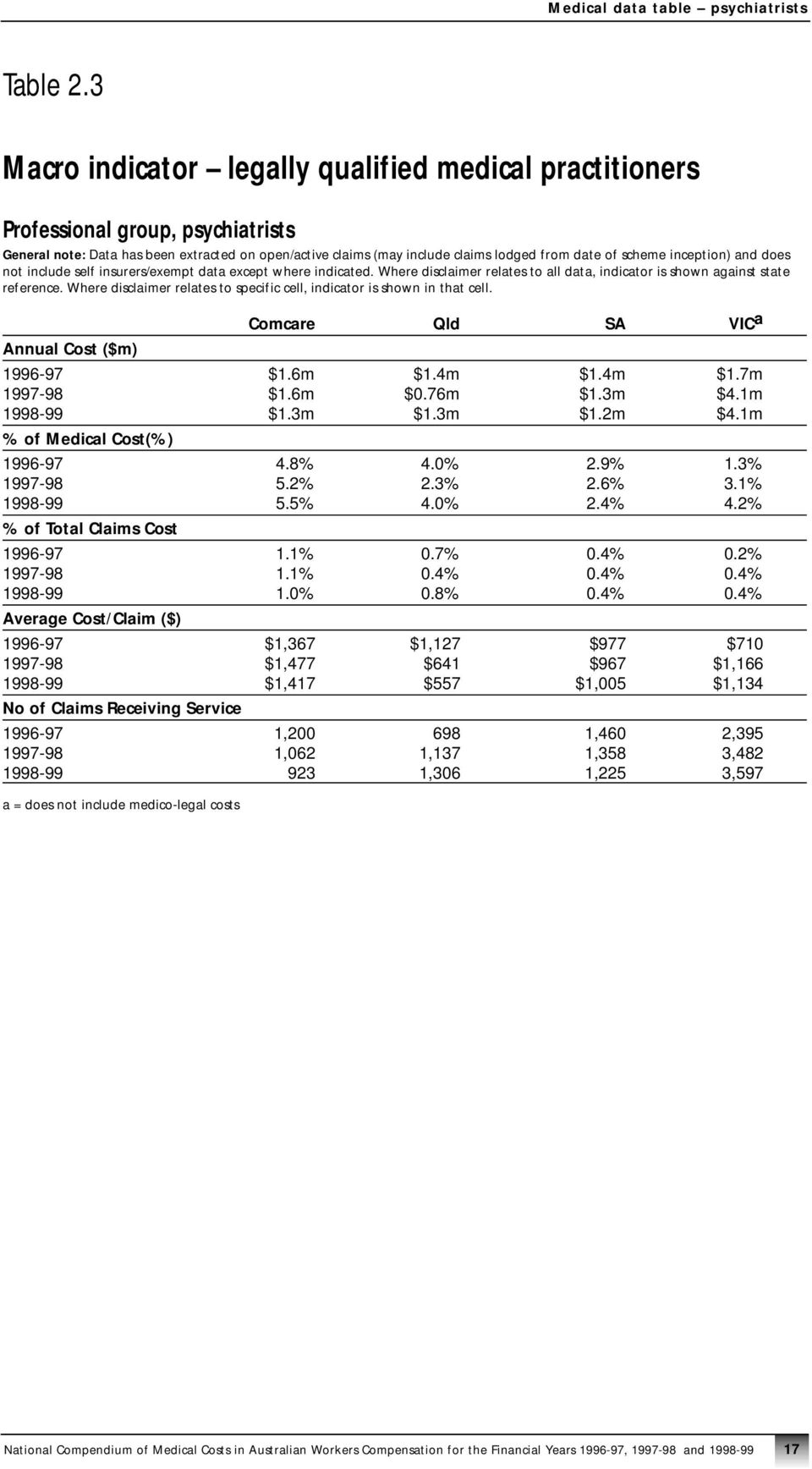
19 Medical data table psychiatrists Table 2.3 Macro indicator legally qualified medical practitioners Professional group, psychiatrists General note: Data has been extracted on open/active claims (may include claims lodged from date of scheme inception) and does not include self insurers/exempt data except where indicated. Where disclaimer relates to all data, indicator is shown against state reference. Where disclaimer relates to specific cell, indicator is shown in that cell. Comcare Qld SA VIC a Annual Cost ($m) $1.6m $1.4m $1.4m $1.7m $1.6m $0.76m $1.3m $4.1m $1.3m $1.3m $1.2m $4.1m % of Medical Cost(%) % 4.0% 2.9% 1.3% % 2.3% 2.6% 3.1% % 4.0% 2.4% 4.2% % of Total Claims Cost % 0.7% 0.4% 0.2% % 0.4% 0.4% 0.4% % 0.8% 0.4% 0.4% Average Cost/Claim ($) $1,367 $1,127 $977 $ $1,477 $641 $967 $1, $1,417 $557 $1,005 $1,134 No of Claims Receiving Service , ,460 2, ,062 1,137 1,358 3, ,306 1,225 3,597 a = does not include medico-legal costs 17
20 Medical data table radiologists Table 2.4 Macro indicator legally qualified medical practitioners Professional group, radiologists General note: Data has been extracted on open/active claims (may include claims lodged from date of scheme inception) and does not include self insurers/exempt data except where indicated. Where disclaimer relates to all data, indicator is shown against state reference. Where disclaimer relates to specific cell, indicator is shown in that cell. Comcare Qld SA VIC a Annual Cost ($m) $1.7m $4.1m $3.4m $7.6m $1.6m $3.5m $3.9m $8.1m $1.1m $3.3m $3.9m $8.0m % of Medical Cost (%) % 12.0% 6.9% 6.0% % 10.8% 7.8% 6.1% % 9.8% 7.9% 8.3% % of Total Claims Cost (%) % 2.1% 1.0% 0 8% % 2.0% 1.3% 0.8% % 1.9% 1.3% 0.7% Average Cost/Claim ($) $336 $156 $330 $ $364 $158 $360 $ $353 $153 $366 $387 No of Claims Receiving Service ,066 21,209 10,451 19, ,305 12,293 10,806 20, ,114 16,880 10,694 20,551 a = does not include medico-legal costs 18

21 Medical data table surgeons Table 2.5 Macro indicator legally qualified medical practitioners Professional group, surgeons General note: Data has been extracted on open/active claims (may include claims lodged from date of scheme inception) and does not include self insurers/exempt data except where indicated. Where disclaimer relates to all data, indicator is shown against state reference. Where disclaimer relates to specific cell, indicator is shown in that cell. Comcare SA VIC a Annual Cost ($m) $1.8m $6.5m $8.4m $1.7m $6.8m $10.5m $1.1m $6.8m $10.7m % of Medical Cost (%) % 13.3% 6.7% % 13.5% 8.0% % 13.7% 11.1% % of Total Claims Cost (%) % 1.9% 1.0% % 2.3% 1.1% % 2.3% 1.0% Average Cost/Claim ($) $623 $589 $ $624 $649 $ $774 $656 $822 No of Claims Receiving Service ,819 11,099 11, ,726 10,407 12, ,468 10,341 13,001 a = does not include medico-legal costs 19
22 Medical data table hospitals (public and private) Table 3.0 Macro indicator hospitals Hospitals (Public and Private) General note: Data has been extracted on open/active claims (may include claims lodged from date of scheme inception) and does not include self insurers/exempt data except where indicated. Where disclaimer relates to all data, indicator is shown against state reference. Where disclaimer relates to specific cell, indicator is shown in that cell. Comcare NSW b NT Qld f SA Tas b ViC a WA eo Annual Cost ($m) $5.7m $57.8m $1.5m $11.9m $10.4m $4.1m $36.0m $13.3m $5.4m $61.0m $1.9m $14.5m $10.0m $3.6m $37.1m $13.0m $3.9m n/a $1.9m $12.7m $9.3m $3.6m $34.8m $11.6m % of Total Medical Cost (%) % 21.0% 31.3% 35.0% 21.6% 15.3% 28.5% 18.9% % 20.1% 35.8% 44.0% 20.0% 19.8% 28.1% 17.5% % n/a 36.5% 38.2% 18.9% 19.8% 36.0% 17.2% % of Total Claims Cost (%) % 2.9% 4.8% 6.2% 3.0% 3.2 % 4.0% 3.7% % 2.9% 4.6% 8.5% 3.4% 3.0% 3.8% 3.3% % n/a 4.5% 7.6% 3.2% 2.9% 3.2% 3.2% Average Cost/Claim ($) $1,932 $1,361 $2,626 n/a $1,471 $2,125 n/a n/a $2,231 $1,553 $2,971 n/a $1,487 $1,855 $2,408 n/a $2,105 n/a $1,997 $1,739 $1,440 $1,963 $2,300 n/a No of Claims Receiving Service ,956 42, n/a 7,174 1,942 n n/a n/a ,425 39, n/a 6,737 1,957 n 15,397 n/a ,864 n/a 946 4,271 6,472 1,819 n 15,115 n/a a = does not include medico-legal costs b = data includes costs for insurers and self insurers/ exempts e = unable to separate expenses for hospital accommodation and treatment f = public hospitals receive annua/ grant from WorkCover Qld n = number of services derived by counting number of transactions with a medical service each month. This may result in an underestimation of number of services indicated. o = source is actuarial assessment of returns by approved insurers and self insurers u = In 1998/99 RiskCover, the Government Insurance Funds (funded and unfunded), industrial diseases and the General Funds of the Insurance Commission of Western Australia were classified as a self insurer, and have not been included in payments. In previous years these funds have been classified with approved insurers and included in payments. n/a = data not available 20
23 Medical data table private hospital Table 3.1 Macro indicator hospitals Private hospitals General note: Data has been extracted on open/active claims (may include claims lodged from date of scheme inception) and does not include self insurers/exempt data except where indicated. Comcare Qld SA VIC Annual Cost ($m) $0.7m $8.4m $6.7m $27.7m $0.6m $8.0m $6.7m $28.6m $0.49m $8.0m $6.5m $27.0m % of Medical Cost (%) % 24.7% 13.7% 22.0% % 24.6% 13.3% 22.0% % 24.1% 13.2% 27.9% % of Total Claims Cost (%) % 4.4% 1.9% 3.1% % 4.7% 2.3% 3.0% % 4.8% 2.2% 2.5% Average Cost/Claim ($) $3,303 n/a $1,798 $2, $2,914 n/a $1,775 $2, $3,327 n/a $1,721 $2,477 No of Claims Receiving Service n/a 3,734 10, n/a 3,786 11, n/a 3,755 10,912 21
24 Medical data table public hospital Table 3.2 Macro indicator hospitals Public hospitals General note: Data has been extracted on open/active claims (may include claims lodged from date of scheme inception) and does not include self insurers/exempt data except where indicated. Where disclaimer relates to all data, indicator is shown against state reference. Where disclaimer relates to specific cell, indicator is shown in that cell. Comcare Qld f SA VIC Annual Cost ($m) $5.0m $3.5m $3.8m $8.3m $4.8m $6.5m $3.3m $8.4m $3.4m $4.7m $2.9m $7.8m % of Medical Cost (%) % 10.3% 7.8% 7.0% % 20.0% 6.6% 6.4% % 14.1% 5.9% 8.1% % of Total Claims Cost (%) % 1.8% 1.1% 0.9% % 3.8% 1.1% 1.0% % 2.8% 1.0% 0.7% Average Cost/Claim ($) $2,065 n/a $1,020 $1, $2,422 n/a $1,001 $1, $2,277 n/a $944 $1,465 No of Claims Receiving Service ,445 n/a 3,766 5, ,001 n/a 3,295 5, ,511 n/a 3,026 5,282 f = public hospitals receive annual grant from WorkCover Qld 22
25 Medical data table allied health providers Table 4.0 Macro indicator allied health providers General note: Data has been extracted on open/active claims (may include claims lodged from date of scheme inception) and does not include self insurers/exempt data except where indicated. Where disclaimer relates to all data, indicator is shown against state reference. Where disclaimer relates to specific cell, indicator is shown in that cell. Comcare NSW bk NT b Qld SA Tas b Vic a WA opu Annual Cost ($m) $10.6m $49.8m $2.3m $20.8m $11.4m $5.9m n/a $18.9m $9.9m $67.8m $3.0m $18.5m $11.7m $6.2m $43.6m $19.9m $8.7m n/a $3.3m $18.0m $11.5m $7.1m $42.3m $18.2m % of Total Medical Cost (%) % 18.1% 47.9% 61.1% 23.2% 22.0% n/a 26.8% % 22.4% 56.6% 56.9% 23.2% 34.1% 33.0% 26.7% % n/a 63.5% 54.2% 23.3% 39.0% 43.7% 26.9% % of Total Claims Cost (%) % 2.5% 7.3% 10.9% 3.3% 4.6% n/a 5.3% % 3.2% 7.3% 10.8% 4.0% 5.1% 4.5% 5.1% % n/a 7.8% 10.8% 3.9% 5.8% 3.9% 5.0% Average Cost/Claim ($) $859 $678 $1,317 n/a $590 $709 n/a n/a $958 $707 $1,436 n/a $635 $744 $993 n/a $977 n/a $1,503 n/a $640 $842 $974 n/a No of Claims Receiving Service ,339 73,506 1,773 n/a 19,376 8,374 n n/a n/a ,346 95,898 2,062 n/a 18,479 8,402 n 43,878 n/a ,903 n/a 2,228 n/a 17,920 8,637 n 43,425 n/a a = does not include medico legal costs b = data includes costs for insurers and self insurers / exempts k = allied health includes physiotherapy and chiropractic only n = number of services derived by counting number of transactions with a medical service each month. This may result in an underestimation of number of services indicated. o = source is actuarial assessment of returns by approved insurers and self-insurers p = includes treatment by allied professionals, first aid, ambulance, medicine, aids and appliances u = In 1998/99 RiskCover, the Government Insurance Funds (funded and unfunded), industrial diseases and the General Funds of the Insurance Commission of Western Australia were classified as a self insurer, and have not been included in payments. In previous years these funds have been classified with approved insurers and included in payments. n/a = data not available 23
26 Medical data table chiropractors Table 4.1 Macro indicator allied health providers Professional group, chiropractors General note: Data has been extracted on open/active claims (may include claims lodged from date of scheme inception) and does not include self insurers/exempt data except where indicated. Where disclaimer relates to all data, indicator is shown against state reference. Where disclaimer relates to specific cell, indicator is shown in that cell. Comcare NSW b Qld SA VIC a Annual Cost ($m) $0.6m $3.8m $0.29m $0.9m $4.3m $0.5m $4.6m $0.23m $0.8m $4.3m $0.43m n/a $0.20m $0.8m $3.8m % of Medical Cost (%) % 1.4% 0.8% 1.8% 3.4% % 1.5% 0.7% 1.6% 3.3% % n/a 0.6% 1.5% 3.9% % of Total Claims Cost (%) % 0.2% 0.2% 0.3% 0.5% % 0.2% 0.1% 0.3% 0.4% % n/a 0.1% 0.2% 0.3% Average Cost/Claim ($) $433 $448 $196 $330 $ $455 $507 $194 $323 $ $486 n/a $189 $315 $526 No of Claims Receiving Service ,394 8,546 1,365 2,679 7, ,091 9,091 1,175 2,529 7, n/a 1,021 2,415 7,232 a = does not include medico-legal costs b = data includes costs for insurers and self insurers/ exempts n/a = data not available 24
27 Medical data table physiotherapists Table 4.2 Macro indicator allied health providers Professional group, physiotherapists General note: Data has been extracted on open/active claims (may include claims lodged from date of scheme inception) and does not include self insurers/exempt data except where indicated. Where disclaimer relates to all data, indicator is shown against state reference. Where disclaimer relates to specific cell, indicator is shown in that cell. Comcare NSW b Qld SA VIC a Annual Cost ($m) $4.8m $46.0m $6.9m $6.4m $20.0m $4.0m $63.2m $6.1m $6.6m $20.0m $3.3m n/a $5.5m $6.7m $19.2m % of Medical Cost (%) % 16.7% 20.3% 13.1% 15.8% % 20.9% 18.8% 13.1% 15.2% % n/a 16.6% 13.6% 19.8% % of Total Claims Cost (%) % 2.3% 3.6% 1.9% 1.8% % 3.0% 3.6% 2.2% 2.1% % n/a 3.3% 2.2% 1.7% Average Cost/Claim ($) $580 $678 $111 $430 $ $594 $702 $108 $454 $ $558 n/a $115 $470 $662 No of Claims Receiving Service ,204 67,923 28,531 14,880 28, ,727 89,978 26,455 14,590 29, ,848 n/a 25,968 14,226 28,937 a = does not include medico-legal costs b = data includes costs for insurers and self insurers (exempts) n/a = data not available 25
28 Medical data table psychologists Table 4.3 Macro Indicator allied health providers Professional group, psychologists General note: Data has been extracted on open/active claims (may include claims lodged from date of scheme inception) and does not include self insurers/exempt data except where indicated. Where disclaimer relates to all data, indicator is shown against state reference. Where disclaimer relates to specific cell, indicator is shown in that cell. Comcare Qld SA VIC a Annual Cost ($m) $1.9m $0.33m $2.3m $5.4m $1.9m $0.20m $2.4m $6.1m $1.7m $0.20m $2.2m $6.4m % of Medical Cost (%) % 1.0% 4.7% 4.3% % 0.6% 4.8% 4.6% % 0.6% 4.5% 6.6% % of Total Claims Cost (%) % 0.2% 0.8% 0.6% % 0.1% 0.8% 0.6% % 0.1% 0.7% 0.6% Average Cost/Claim ($) $1,434 $473 $898 $1, $1,670 $348 $1,044 $1, $1,684 $282 $1,009 $1,328 No of Claims Receiving Service , ,531 4, , ,335 4, ,277 2,177 4,803 a = does not include medico-legal costs 26
29 Cost management strategies Chapter 5 Cost management strategies across workers compensation authorities 5.1 Strategies summary Table A below provides a summary of cost management strategies that are currently being utilised in each Australian workers compensation scheme. Underlying this summary table is a wide variety of programs across and within each scheme. In privately underwritten schemes, approved insurers may undertake some of the activities identified below. More details about the nature of the work undertaken by each jurisdiction is outlined in the relevant scheme description. Table A: Cost management strategies across the jurisdictions Scheme Approved Providers Service & Fee Schedule Treatment Protocols/ Guidelines Provider Education Account Review Performance Review Comcare New South Wales Northern Territory Queensland South Australia Tasmania Victoria Western Australia 27
30 Cost management strategies Comcare 5.2 Comcare Comcare is established under the Safety, Rehabilitation and Compensation Act 1988 (SRC Act) to administer the Commonwealth Government s workers compensation scheme. The Act seeks to integrate prevention strategies, rehabilitation services and claims management processes into a comprehensive approach to health and safety at work. This integrated approach has been developed to reduce the cost of workplace injuries and to enable more productive work environments. The following cost management strategies are in place for Commonwealth premium paying agencies managed by Comcare. Other Commonwealth determining authorities (licensed under the SRC Act and the Australian Defence Forces) have their own strategies for cost management Approved Providers Injured employees are able to seek treatment for their compensable injury from a medical practitioner of their choice. It is a requirement that it must have been reasonable for the employee to obtain the treatment. Medical practitioners must be legally qualified and allied health professionals must be registered under the appropriate State or Territory law. Comcare approves rehabilitation providers under Section 34 of the SRC Act. In approving rehabilitation providers Comcare must have regard to their qualifications, effectiveness, availability and cost Service and Fee Schedule Under section 16 of the SRC Act, Comcare is liable to pay in respect of the cost of medical treatment. Comcare will pay for reasonable and necessary costs in the treatment of compensable work injuries. Comcare s practice in relation to service and fee payments is generally to follow the schedules set by the State workers compensation schemes. Where the State or Territory does not have a schedule for a particular professional treatment service or in the case of large variations between States, Comcare may adopt the relevant provider association s rates Treatment Protocols/Guidelines A system of treatment notification and quality assurance applies in relation to physiotherapy treatment. Guidelines apply to approved rehabilitation providers in the delivery of rehabilitation services. These guidelines encourage early intervention, outcome focussed case management, and consultation between key parties Provider Education Regular discussion forums are held with the AMA and the Division of General Practice (Act Division). Approved rehabilitation providers are required to undergo a Comcare training program. In addition, information seminars are conducted in Comcare service centres. Medical and rehabilitation providers are able to attend these. 28
31 Cost management strategies Comcare Account Reviews Comcare s account payment system prevents payments above the scheduled fee. In addition each claim is monitored through a treatment plan approach to managing medical and allied health costs. This means that on acceptance of initial liability, all claims are allocated a treatment plan that details the likely service types and treatment duration required to resolve the claim. Where claimed treatment extends outside this plan an automatic process holds payment and prompts the Claims Manager to review the treatment requirements for the claim Performance Reviews Service reviews can occur as part of the claims management process. Performance problems that are identified through this process are addressed on a case by case basis. Approved rehabilitation providers are subject to a performance review in order to gain re-approval status. The performance review has regard to the return to work outcomes achieved and the quality of services delivered. 29
32 Cost management strategies New South Wales 5.3 New South Wales The following cost management strategies are in place in NSW: Approved Providers There are no restrictions placed on provider choice except that providers must be registered by the appropriate body as indicated in the Workers Compensation Act Service and Fee Schedule WorkCover recommends that fees paid to general practitioners should be according to the current AMA fee schedule. Surgeons negotiate a separate fee based on schedules issued annually by their Associations. For private hospitals, WorkCover negotiates rates with the PHA, and this schedule is gazetted. For public hospitals, WorkCover approves rates set by the NSW Department of Health, and this schedule is gazetted. WorkCover recommends that fees paid to physiotherapists should be according to the 1992 schedule issued by the Australian Physiotherapy Association Treatment Protocols/Guidelines There are no protocols/guidelines that specify what treatment services should be delivered. There are guidelines for physiotherapy services, which specify the reporting arrangements between physiotherapists and insurers. Negotiation has commenced with the Chiropractors Association of Australia to develop a similar reporting system for chiropractors Provider Education A manual specific to the needs of medical practitioners has been distributed to all registered providers. Updates are distributed as the need arises for insertion into the manual. A guide for physiotherapists has also been distributed. WorkCover established a Medical Advisory Committee in November The committee has representation from the Australian Medical Association (AMA), Royal Australian College of General Practitioners (RACGP), Australian Faculty of Rehabilitation Medicine (AFRM), Australian Faculty of Occupational Medicine (AFOM), Australian Society of Orthopedic Surgeons (ASOS) and the New South Wales Health Department. The committee provides advice regarding issues relevant to the delivery of medical services. One initiative has been the development of an evidence-based training course for general practitioners on the diagnosis and management of low back pain. Information updates are regularly provided at the RACGP Division meetings throughout the state. 30
33 Cost management strategies New South Wales Account Reviews Account reviews are undertaken by WorkCover for all licensed insurers on a regular basis, and this is linked to the insurer remuneration package Performance Reviews WorkCover does not collect data relevant to service utilisation by individual providers, therefore performance reviews rest with the insurer. 31
34 Cost management strategies Northern Territory 5.4 Northern Territory The aims of the Work Health scheme are to ensure that: the compensation benefit levels under the Act are fair and that workers receive the benefits for which they are entitled injured workers are assisted in their endeavours to return to suitable employment as soon as practicable employers meet their obligations to insure and thus the cost of the scheme is spread equitably insurers manage claims and perform as required under the legislation and conditions of their approval. The Work Health Authority is essentially an advisory, educative and regulatory body. Approved insurers are responsible for the management of workers compensation claims in accordance with the legislation and conditions of their approval Approved Providers There are no restrictions on provider choice but insurers have strong input into provider selection. Vocational rehabilitation providers must be approved by the authority, whilst other providers must have a provider number allocated by the authority Service and Fee Schedule There are no provisions under the Work Health Act of the Northern Territory to set medical and related fees. Public hospital charges are determined by the Northern Territory Health Department. There is only one private hospital in the Northern Territory that sets its own schedule of fees, however, liaison with the health funds is a critical element in the process Treatment Protocols/Guidelines The Authority has assisted with the development of Rehabilitation Guidelines for insurers and providers which has industry support Provider Education Provider education forms part of the Authority's corporate plan. In particular, the current initiatives include: provider forums provider visitation program doctor visitation program medical practitioner/insurer forums. 32
35 Cost management strategies Northern Territory Account Reviews Any controls in this area are the responsibility of the approved insurers Performance Reviews The Work Health scheme is monitored by The Scheme Monitoring Committee. Its functions are to: monitor the viability and performance of the workers compensation scheme monitor premium rates offered for workers compensation services in the Northern Territory receive submissions from persons relating to premium rates charged for workers compensation insurance in the Northern Territory monitor and publish data on overall underwriting results consider and report on the effectiveness of premiums offered by insurers in encouraging employers to develop and maintain safe work practices and in penalising employers that do not. 33
36 Cost management strategies Queensland 5.5 Queensland There has been a long-standing focus within the workers compensation system in Queensland on the provision of adequate and appropriate treatment within a medical model. Specific cost management strategies have been put in place focusing medical and allied health providers on goal directed treatment with a return to work focus. Incentives have been built in to the medical fee structure to support the medical officer s role in driving return to work outcomes Approved Providers Medical treatment is restricted by the WorkCover Queensland Act 1996, to treatment provided by a practitioner registered to practice in Queensland by the Health Registration Board. WorkCover does not require any additional accreditation or approval requirements Service and Fee Schedule Medical services are defined using the Commonwealth Medicare Benefits Schedule (CMBS) descriptors. Fees are set by reference to the Health Insurance Commission market rates for Australia where they exceed 127.5% of the CMBS fee. Supplementary schedules have been negotiated with the Australian Medical Association relating to services that are specifically focused on improving claims management. Public hospitals in Queensland receive an annual grant from WorkCover. The table of costs for medical and allied health services outlines the procedures and conditions under which payment is made for services including medical reports, medical fees, magnetic resonance imaging, speech therapy, dental therapy, chiropractors/osteopaths, physiotherapy, occupational therapy, psychology, podiatry, and home nursing Treatment Protocols/Guidelines There are no guidelines or protocols developed for specific injuries. A provider management plan establishes a framework for allied health providers to develop treatment plans with a return to work focus. This assists in ensuring goals of treatment are developed and can be monitored by the insurer. Treatment limits, before insurer approval is required, apply to physiotherapy and chiropractic services Provider Education WorkCover has invested heavily to improve the standard of undergraduate and postgraduate medical teaching in musculo-skeletal injuries by supporting the Chair of Orthopaedics at the University of Queensland for several years. Information is also disseminated to medical and allied health providers through a range of media eg, seminars and newsletters. 34
37 Cost management strategies Queensland Account Reviews All accounts are checked and approvals verified where necessary, prior to payment being authorised Performance Reviews Insurers are able to monitor allied health providers performance, in terms of costs and number of services, on a case by case basis through the use of Provider Management Plans. These plans are used for all allied health providers where ongoing treatment is required. The plan concentrates on functional status of the worker and therefore provides a focus on a wellness model of rehabilitation. At a scheme level, WorkCover monitors allied health providers performance in terms of costs and services. Systems are to be developed in the future to incorporate monitoring of medical practitioners in a like manner. 35
38 Cost management strategies South Australia 5.6 South Australia The aim of the Workers Rehabilitation and Compensation Act, 1986, ( the Act') is to provide compensation for workers who have a disability or illness that arose in the course of employment and where possible to restore sick and injured workers to the workforce and the community. This is achieved through the provision of quality, timely and appropriate services delivered at a reasonable cost to the scheme to attain optimum health and return to work outcomes. The Corporation also has a statutory obligation to protect the financial viability of the scheme. Consequently, the following cost management strategies have been developed and implemented: Approved Providers Under Section 32 of the Act, injured workers are able to seek treatment from the medical expert' provider of their choice. Medical experts are defined in Section 3 of the Act as legally qualified medical practitioners, dentists, psychologists, opticians, physiotherapists, chiropractors, podiatrists, occupational therapists and speech pathologists (as registered by their respective professional boards). At present the Corporation approves remedial therapists (massage) and non-medical gymnasium and hydrotherapy providers subject to their ability to meet the Corporation's minimum standards relating to their qualifications and facility/treatment rooms. The Corporation's policy also governs the referral of services by an appropriate medical expert, the number/duration of treatment services, specific review points and reporting mechanisms. Contracted providers - In 1997, WorkCover Corporation established contracts for service with medical specialists to provide independent medical services, ie, assessments and reports. The contracts were subsequently reviewed and upgraded in Contracts were introduced to provide case managers with a comprehensive range of medical specialists who have agreed to provide accurate, relevant and objective independent medical reports. The contract also ensures that independent medical examiners and claims agents have a common understanding of the standards and requirements of independent medical reports in the workers compensation environment Service and Fee Schedule Section 32 of the Act empowers the Corporation to establish a scale of charges based on the average charge to private patients for relevant services. Where costs for medical services are not regulated, the Act requires that the service be reasonably incurred by the worker, and paid at a 'reasonable' cost. Before a regulation is made prescribing a scale of charges, the Corporation must consult with employers, employee representatives and professional associations representing the relevant provider group. 36
39 Cost management strategies South Australia As some services are not delivered in the private market it was necessary for the Corporation to determine an appropriate and consistent fee setting process. The concept of value for money' has been developed by the Corporation as the basis for negotiating any fee increase for services which fall outside of the private patient data (supplementary fee schedule services). Value for money is determined by the Corporation at the time of negotiation and is dependent on the development, implementation and review of strategies by the relevant professional provider association. These strategies are aimed at addressing key scheme risks, stakeholder issues at the time of negotiation and WorkCover Corporation core business objectives. Strategies developed by professional associations in conjunction with the Corporation will form part of a Service and Fee Package' which can then be marketed to Corporation Management, Board and Stakeholders as adding benefit to the scheme and its objectives. A WorkCover Pricing Policy document has been developed which outlines the principles for fee reviews and the requirements of any marketable service and fee package to be progressed to Cabinet for endorsement. In order to facilitate a transparent and consistent fee negotiation process, the principles of the Pricing Policy document must be applied to all fee negotiations. Regulated services and fees are currently in place for all medical practitioners, physiotherapists, speech pathologists, chiropractors, optometrists/opticians, psychologists, occupational therapists and hospitals. Public hospital charges are determined following consultation with the Department of Human Services. Private hospital charges are negotiated by the Corporation and regulated following consultation and endorsement as required Treatment Protocols/Guidelines Treatment guidelines are designed to assist the practitioner in effectively and safely restoring injured workers to their pre-injury state (wherever possible), at the lowest overall cost to the community. As a part of the value for money' concept, provider associations are expected to participate in the development of guidelines and provide endorsement of these amongst their membership. These guidelines are intended to be fluid documents that are reviewed and updated periodically. Wherever possible, these guidelines are used as a benchmark against which to assess service behaviour. The Corporation has to date established guidelines for the management of lower back injuries, psychological disorders, pain management and diagnostic imaging. 37
40 Cost management strategies South Australia Provider Education Education relating to professional development issues is the responsibility of the provider associations within South Australia. This concept is built into the valueadded packages negotiated by the Corporation with the majority of associations required to commit to a specific number of professional education sessions per year. The Corporation will continue to be involved in education programs specifically relevant to identified core business, or where a particular risk to the scheme has been identified. These education sessions may address issues such as legislation and relevant case law, policy direction, guidelines and other specific areas of concern to the scheme Account Reviews The Corporation's claims and provider database are linked. Providers are allocated a WorkCover specific provider number that, wherever possible is cross referenced against their Medicare/Medibank Private provider number. Payments are then made to this provider number. Prior to updating the provider database the provider's legality to practice, specialty, and address details are verified. Account reviews are generally undertaken by the Corporation when there is data or evidence to indicate incorrect/inappropriate billing or service patterns. It is the responsibility of the case manager to review each account for necessity and appropriateness of the service prior to processing Performance Reviews The Corporation is currently reviewing its existing Provider Evaluation Program with the aim of developing and implementing a modified process which more closely links with the measurement of return to work outcomes for the scheme. Within this program, providers are targeted for review if their service profile is atypical for cost or service numbers when compared with their peers. Service review interviews are usually conducted by a panel consisting of a WorkCover staff member, a consultant relevant to that profession, and a representative of the appropriate professional association. The Corporation expects provider associations to participate in the process in a proactive and supportive role, as value-added to both the Corporation and scheme stakeholders. Providers who are unable to explain or justify their service pattern may be subject to a wide range of remedial responses including the attending of targeted education/information sessions, being placed on a monitored program or a complaint may be forwarded to the appropriate professional registration board. 38
41 Cost management strategies Tasmania 5.7 Tasmania Approved Providers Injured workers are able to seek treatment from the provider of their choice. A medical practitioner is not permitted to issue a workers compensation medical certificate unless accredited by the Workplace Safety Board. Other providers are generally engaged by the insurer, employer or treating doctor. It is expected that the injured worker will be consulted on the appointment of a rehabilitation provider Service and Fee Schedule Under Section 75 of the Workers Rehabilitation and Compensation Act 1988, insurers and employers are required to pay the reasonable costs of medical and allied health services. There is currently no power to establish service and fee schedules. However, Section 75(2A) of the Act prohibits service providers from charging fees in excess of those they would normally charge for the same service provided to a non-compensation patient/client. Fees for medical practitioners are capped at the rates recommended by the AMA Treatment Protocols/Guidelines No treatment protocols or guidelines have been issued Provider Education Medical practitioners are required to read an information package as a precondition of accreditation. Provider education is also delivered through the development of publications aimed at providing information about the scheme Account Reviews Account reviews are not conducted by Workplace Safety Tasmania but are conducted by licensed insurers Performance Reviews Performance reviews are not conducted by Workplace Safety Tasmania. 39
42 Cost management strategies Victoria 5.8 Victoria The aim of the Accident Compensation Act is to: a) reduce the incidence of accidents and diseases in the workplace b) to make provision for the effective occupational rehabilitation of injured workers and their early return to work c) to increase the provision of suitable employment to workers who are injured to enable their early return to work d) to provide adequate and just compensation to injured workers e) to ensure workers compensation costs are contained so as to minimise the burden on Victorian business f) to establish incentives that are conducive to efficiency and discourage abuse g) to enhance flexibility in the system and allow adaptation to the particular needs of disparate work situations h) to establish and maintain a fully funded scheme i) in this context, to improve the health and safety of persons at work and reduce the social and economic costs to the Victorian community of accident compensation Approved Providers Under the Accident Compensation Act, WorkCover claimants are entitled to attend a provider of their choice to receive treatment in relation to their work related injury. Under Section 5 of the Accident Compensation Act a medical service is defined as an attendance, examination or treatment by a medical practitioner, registered dentist, registered optometrist, registered physiotherapist, registered chiropractor, registered osteopath or registered podiatrist. If there are concerns in relation to these providers, WorkCover can only prevent services being provided to claimants if the provider in question is deregistered by the relevant registration board. Under the Accident Compensation Act, other health services are defined as a medical service where requested by a medical practitioner, and the type of service and the person providing the service are approved by the Authority. Massage, acupuncture and naturopathy are examples of services that have been approved under this section Service and Fee Schedule Section 99 of the Accident Compensation Act, 1985, stipulates that the Victorian WorkCover Authority, has the responsibility to pay the reasonable costs' of medical and like services, having regard to the necessity of the service'. It is common practice for WorkCover to work in conjunction with professional medical and allied health groups to develop guidelines and negotiate fee schedules. 40
43 Cost management strategies Victoria Previously allied health and related service fees have been indexed using a combination of annual change in Average Weekly Earnings (AWE) and the Consumer Price Index (CPI). Recently the change has been minimal so the indexation has not been applied. It was recommended that professional groups make submissions for fee increases to WorkCover based on initiatives to improve outcomes for injured workers. The Victorian WorkCover Authority has a number of strategies in place to assist in cost management and ensuring that appropriate services are delivered to WorkCover claimants Treatment Protocols/Guidelines WorkCover issues guidelines to managing agents and self-insurers in relation to particular types of services to prevent over servicing and inappropriate services from occurring Provider Education WorkCover conducts education sessions for providers and submits articles for publication in professional association newsletters. WorkCover frequently meets with provider groups to raise and progress issues that are of concern Account Reviews At insurer level, the centralised computer payments system controls for: provider number recorded with the Authority payment at no more than the Authority's maximum payment rate duplicate payments non-approved services. Insurers may request the Authority to review accounts if the insurer is concerned about the adequacy, frequency or appropriateness of treatment, or if the insurer requires clarification of the reasonableness of the cost of a service Performance Reviews WorkCover has two main monitoring streams, scheme statistics and peer review statistics. Statistics are monitored on a scheme basis, in terms of costs and number of services. The Peer Review process ensures that all service providers are monitored on a regular basis. The primary data that is analysed includes the average number of services per claim in relation to the average for the scheme and the total payments to a practitioner in relation to the average for the scheme. The top forty providers in terms of the number of services provided and the total payments are the focus of further analysis. 41
44 Cost management strategies Victoria Legislative Provisions Section 249B of the Accident Compensation Act also allows the Authority to suspend and then forfeit payment for services where the Authority has concerns regarding the adequacy, appropriateness or frequency' of services provided to injured workers. Under this section of the Act, the Authority can either refer a provider for investigation by the professional regulating body if one exists, or provide notice to the provider where no regulating body exists and review that provider's conduct. Where a suspension has been applied, it remains in operation until the conduct of the provider in question has been reviewed or after six months, whichever occurs first. Forfeiture of payments only applies to the services provided during the suspension period. Under Section 99(2)(c) of the Accident Compensation Act, the Authority states that in determining the reasonable cost of a service, burial or cremation, regard must be given to the service provided, the necessity of the service and any guidelines issued by the Authority in relation to that service. 42
45 Cost management strategies Western Australia 5.9 Western Australia The aims of the Workers Compensation and Rehabilitation Act 1981 include making provision for the compensation of workers who suffer a disability and promoting the rehabilitation of those workers with a view to restoring them to the fullest capacity for gainful employment for which they are capable. To achieve this aim, WorkCover endeavours to ensure the provision of high quality medical and allied health services by: investigating and recommending options for monitoring the provision of high quality medical and allied health services making recommendations for fee structures and service schedules for the delivery of services making recommendations regarding the nature and level of key services expected of medical and allied health service providers and related competencies expected from this group. The Act also aims to promote safety measures in employment to prevent or minimise disability and make provision for the hearing and determination by the dispute resolution body between parties in a fair, just, economical, informal and quick manner Approved Providers Injured workers are able to seek treatment from a medical practitioner of their choice. A Medical Practitioner is defined in the Workers Compensation and Rehabilitation Act as: A person who is resident in a state or territory of the Commonwealth and is entitled to practice as a medical practitioner in accordance with the laws of the state or territory, or a person who is not resident in a state or territory of the Commonwealth but who is recognised as a medical practitioner for the purposes of the Act by the Commission. Allied health professionals must be a resident in the Commonwealth or a Territory of the Commonwealth and registered in accordance with the laws of the state or territory of the Commonwealth Service and Fee Schedule Service schedules for medical and allied health providers are reviewed annually by the Medical and Allied Services Committee (MASC) with a recommendation to the Workers Compensation and Rehabilitation Commission. Fees are regulated as a result of negotiation with the relevant bodies. Fee schedules for medical practitioners are based on the AMA List of Medical Services and Fees that include workers compensation specific items. Individual fee schedules for allied health providers have been developed through negotiation with service providers. Hospital charges for treatment and maintenance are provided for under the Hospitals and Health Services Act 1927 and must be gazetted by the State Minister for Health. 43
46 Cost management strategies Western Australia Treatment Protocols/Guidelines There are no specific guidelines or protocols issued by WorkCover WA. Approved insurers in consultation with allied health providers may utilise treatment protocols outlining number of services and projected outcomes Provider Education WorkCover WA continues to develop provider education in partnership with medical associations. These include: training education seminars for medical and allied health providers on the workers compensation system publication in medical journals jointly developed bulletins on injury management distributed through the Divisions of General Practice publication in partnership with the Australian Medical Association (WA Branch) of the Medical Practitioners Guide to the Western Australian Workers Compensation System annual Injury Management Week activities promoting injury management and strategies undertaken by scheme participants to achieve return to work outcomes training of medical receptionists and practice managers on workers compensation an on-line campus where medical practitioner and allied health providers can undertake modules relating to injury management and workers compensation Account Reviews Account reviews are not conducted by WorkCover WA, however may be undertaken by approved insurers Performance Reviews Performance reviews are not currently undertaken by WorkCover WA however, may be undertaken by approved insurers. WorkCover is currently undertaking a process of enhanced data collection in the medical and allied service provider area which will contribute to projected performance review within the system. 44
47 Summary Chapter 6 Summary The objective of this National Compendium of Medical Costs in Australian Workers Compensation, is to provide the reader with insight into the unique and varied issues that influence medical cost expenditure, and the range of strategies that currently exist to manage them in the workers compensation environment. This compendium does not comment upon the success or otherwise of these strategies, nor seek to endorse or promote a preferred strategy. The medical cost data has been provided by each of the Australian workers compensation agencies, and is a snapshot' of each scheme's performance for the financial years 1996/97, 1997/98 and 1998/99. Medical cost expenditure in workers compensation is heavily influenced by a number of external factors including the social, economic and political environments as well as the structure of the legislation and benefits in each individual jurisdiction. Factors such as the choice of treatment providers or the types of treatment services provided also influence scheme performance. For example, in recent times many schemes have experienced an increase in the acceptance, utilisation and expenditure of alternative therapies. Often influencing factors such as this can be managed by the jurisdictions through the introduction of policies and guidelines, the application of legislation, and provision of targeted education sessions for the relevant provider groups. Injury prevention is an essential element of workers compensation. There are many types of prevention programs ranging from industry-specific (eg, manufacturing) or injury-type specific (eg, lower back injuries). General awareness programs are aimed at raising consciousness about the importance of occupational health and safety to assist both the employers and workers to identify potential hazards and solutions for dealing with them. These programs can assist in changes to safer work practices and encourage a change to positive thinking about safety within the workplace. In the longer term these strategies will result in the reduction in the number and severity of work-related injuries which in turn leads to a reduction in overall cost to the various workers compensation schemes and to the community. Additionally, the principles of injury management recognise key parties for the claim as being the injured worker, employer and treating general practitioner. The Australian jurisdictions have differing approaches about working together and the level of involvement of each party. It is expected that these parties will coordinate treatment services and where appropriate, develop a rehabilitation and return to work program to assist in returning the employee to the workplace as soon as practicable. This approach is in accord with the objective of the workers compensation legislation. 45
48 Summary Recognition is now being given to the different phases of the claim, as they relate to the injury management process i.e: Phase 1 - in the medical phase, the focus is on regaining strength and capacity. Generally, this phase includes the provision of intense medical treatment and the beginning of occupational rehabilitation, for example, through the identification of work capacity. Phase 2 - focuses on returning the injured worker to the workplace. This may be on a graduated return to work program or by utilising other return to work management strategies. Medical treatment may also be ongoing at this point. Phase 3 - relates to the matching of skills and experience and the identification of required training needs. This phase becomes operative where the worker is unable to return to his/her pre-injury employment. It may involve employment in an alternative occupation and/or workplace and there may be a need for new skill development. Communication between the claims manager and treating professional is a vital part of effective case management and aids in the identification of barriers preventing a return to work. Once identified, the parties must then develop and implement further strategies to resolve these barriers. Of the eight Australian workers compensation jurisdictions, the most commonly utilised strategies are: service and fee schedules treatment protocols and guidelines provider education sessions. In New South Wales, Northern Territory, Tasmania and Western Australia, account reviews and Performance Review programs are undertaken by the delegated insurance agencies rather than by the Workers Compensation Authority or regulatory body. As trends continue to change within the workers compensation environment, jurisdictions will continue to evolve and implement strategies to ensure the most appropriate approach is taken toward the identification and management of scheme risks and expenditure. 46
49 Glossary of terms Chapter 7 Glossary of terms Account Review Programs examination of accounts to verify conformity with the fee schedule and account presentation standards, whether duplicate accounts or account rendered statements have been received. Allied Health this group comprises service costs for any provider group other than legally qualified medical practitioners or vocational rehabilitation providers (unless otherwise indicated). For example, chiropractors, occupational therapists, opticians, physiotherapists, psychologists, speech pathologists, podiatrists, remedial therapists and gymnasium and hydrotherapy providers. This group may also include costs for medico legal services rendered by providers in the allied health group. Annual Cost total cost per financial year (1 July - 30 June) for paid services performed by each of the specialty groups. This includes consultations, reports etc. Average Cost per Claim annual cost of the category divided by the total number of claims on which the specialty performed services in the year. Claim a workers compensation claim as defined by the relevant jurisdiction's legislation where at least one type of payment has been recorded during the nominated period. Claims reported are non-exempt in status except where otherwise indicated. Compensable disability a disability or illness which is compensable pursuant to the legislative definition of each jurisdiction. Compensation any monetary benefit which is payable pursuant to each jurisdiction's legislation. Exempt employer an employer registered as an exempt employer by the relevant jurisdiction's legislation and has the delegated authority to fund and manage their own claims. Guidelines guidelines to set standards in service provision and to regulate the number of services provided. Hospital cost the sum of all public, private hospital and day hospital room costs. Income maintenance compensation paid to the worker or employer for lost wages as a result of time off of work relating to a compensable injury or disease. Limited Initial Provider Choice the State or Territory may select the worker's treating provider rather than allow the right of choice. Limited Provider Change workers choosing to change providers may be required to receive approval following the provision of reasons to the scheme. 47
50 Glossary of terms Medical Cost relates to the costs of all medical practitioners, allied health practitioners, psychiatrists, all specialists and surgeons, anaesthetists, radiologists, dentists and physicians (regardless of whether the services were rendered in a hospital or clinical environment). Medical Fee Schedule a schedule of appropriate services and charges set by the authority for a provider specialty or group of specialties. Medical Practitioner a provider who is a legally qualified medical practitioner and who is registered to practice by the appropriate state or territory Medical Registration Board. Percentage of claims receiving medical service the number of claims which received a service by the specialty as a percentage of total claims in which at least one medical payment was made during the year. Percentage of total claims expenditure total claims expenditure which may be defined as all costs associated with individual claims but not including general administration costs to the scheme. Percentage of medical expenditure medical expenditure is defined as the sum of macro indicators, (medical practitioner, allied health, hospitals and other). Performance Review an assessment of a providers total service behaviour. Services rendered during a nominated period are assessed for necessity and appropriateness following service delivery. Treating Practitioner the practitioner who assumes primary responsibility for the assessment, treatment, co-ordination and referral of medical and ancillary health services. Total claims cost the sum of all workers compensation payments made against claims that were open/active during the nominated period and recorded at least one payment of that type. Includes medical, allied health, hospital (both public and private), income maintenance, and medicolegal expenses. Total claims number Worker the sum of open or active claims recorded with a workers compensation authority during a nominated period. Jurisdictions to separate costs of exempt/self-insured employers where possible. is a person by whom work is done under a contract of service, and includes the legal personal representative of a deceased worker. 48
51 Further information Chapter 8 Further information The table below is a list of contact people within each jurisdiction who may be contacted for clarification or further information of the details within this compendium. Jurisdiction Contact name Position Phone number Comcare Gene Reardon General Manager, (03) Rehabilitation Policy and Advice WorkCover Anna Bray Co-ordinator, Injury (02) NSW Management Branch Work Health Brian Newell Director, Rehabilitation (08) Authority NT and Compensation WorkCover Qld Jenny Duhs Manager, Workplace (07) Rehabilitation Branch WorkCover SA Kym Coulter Manager, Injury (08) Management Dept Work Place Rod Lethborg Principle (03) Standards Policy Advisor Authority Tas WorkCover Vic Marion Nagle Manager, (03) Provider Management /Health Services WorkCover WA Diane Munrowd Director, (08) Scheme Development & Operations 49
PERSONAL INJURY CLAIM FORM
 Office use only Policy Number: 0028332 Claim Number: s PERSONAL INJURY CLAIM FORM INSURANCE BROKER FOR TENPIN BOWLING AUSTRALIA V-Insurance Group Pty Ltd Authorised Representative No. 432898 an authorised
Feedback on the Inquiry into Serious Injury. Presented to the Road Safety Committee of the Parliament of Victoria. 08 May 2013
 Feedback on the Inquiry into Serious Injury Presented to the Road Safety Committee of the Parliament of Victoria 08 May 2013 About the APA The Australian Physiotherapy Association (APA) is the peak body
Australia & New Zealand. Return to Work Monitor 2011/12. Heads of Workers Compensation Authorities
 Australia & New Zealand Return to Work Monitor 2011/12 Prepared for Heads of Workers Compensation Authorities July 2012 SUITE 3, 101-103 QUEENS PDE PO BOX 441, CLIFTON HILL, VICTORIA 3068 PHONE +613 9482
REHABILITATION PROVIDERS AND WORKCOVER. WorkCover. Watching out for you. WHAT TO EXPECT FROM YOUR REHABILITATION PROVIDER. New South Wales Government
 REHABILITATION PROVIDERS AND WORKCOVER WHAT TO EXPECT FROM YOUR REHABILITATION PROVIDER WorkCover. Watching out for you. New South Wales Government REHABILITATION PROVIDERS Accredited rehabilitation providers
SPORTING ACCIDENT CLAIM FORM Please read this page first before completing the Claim Form
 SPORTING ACCIDENT CLAIM FORM Please read this page first before completing the Claim Form Dear Member, Thank you for your Claim Form request. This letter contains important information relevant to your
GUIDANCE NOTE FOR BEST PRACTICE REHABILITATION MANAGEMENT OF OCCUPATIONAL INJURIES AND DISEASE [NOHSC:3021(1995)]
![GUIDANCE NOTE FOR BEST PRACTICE REHABILITATION MANAGEMENT OF OCCUPATIONAL INJURIES AND DISEASE [NOHSC:3021(1995)]](/thumbs/24/3579764.jpg "GUIDANCE NOTE FOR BEST PRACTICE REHABILITATION MANAGEMENT OF OCCUPATIONAL INJURIES AND DISEASE [NOHSC:3021(1995)]") GUIDANCE NOTE FOR BEST PRACTICE REHABILITATION MANAGEMENT OF OCCUPATIONAL INJURIES AND DISEASE [NOHSC:3021(1995)] APRIL 1995 The National Occupational Health and Safety Commission has adopted a Guidance
GUIDANCE NOTE FOR BEST PRACTICE REHABILITATION MANAGEMENT OF OCCUPATIONAL INJURIES AND DISEASE [NOHSC:3021(1995)] APRIL 1995 The National Occupational Health and Safety Commission has adopted a Guidance
PERSONAL INJURY CLAIM FORM
 Office use only Policy Number: SUA/002202 Claim Number: Willis Australia Limited ABN 90 000 321 237 AFS 240600 PERSONAL INJURY CLAIM FORM INSURANCE BROKER FOR TRIATHLON AUSTRALIA Willis Australia Limited
The Role of the Workplace Rehabilitation Provider
 The Role of the Workplace Rehabilitation Provider The Role of the Workplace Rehabilitation Provider 1 Please note This information is for guidance only and is not to be taken as an expression of the law.
WORKERS COMPENSATION DIVISION INDUSTRY REFERENCE GROUP REPORT
 WORKERS COMPENSATION DIVISION INDUSTRY REFERENCE GROUP REPORT February/March 2009 Amendments to Workers Compensation Legislation The Workers Compensation Legislation Amendment (Benefits) Act 2008 introduced
Key Workers Compensation Information, Australia
 Key Workers Compensation Information, Australia 2010 Key Workers Compensation Information, Australia 2010 Visit www.safeworkaustralia.gov.au for more information Commonwealth of Australia 2010 ISBN 978
The Australian Government. Department of Health and Ageing. Medicare Benefits Schedule Allied Health Services
 The Australian Government Department of Health and Ageing Medicare Benefits Schedule Allied Health Services 1 November 2007 PART 3 PSYCHOLOGICAL THERAPY SERVICES FOR PATIENTS WITH AN ASSESSED MENTAL DISORDER
Managing injury and return to work policy
 Managing injury and return to work policy Description: This is a precedent workplace policy governing the management of injury and return to work. Author: Brooke Pendlebury Principal Lawyer, Pendlebury
Workplace rehabilitation providers and WorkCover
 Workplace rehabilitation providers and WorkCover What to expect from your workplace rehabilitation provider This guide aims to provide workers and employers with information regarding the role of WorkCover
Australian Postal Corporation
 Injury Management System Supplementary Audit Report Australian Postal Corporation 2-4 December 2009 Commercial-in-Confidence Disclaimer This report is supplied on the terms and understanding that Comcare
Signed:... (worker or representative) Guidelines for Claiming Compensation Benefits September 2013 Page 46 of 46
 8 October 2013 SPECIAL SUPPLEMENT 4385 Additional Reports or Documents Please list and provide copies of all further information, reports and documents in support of this application for review................
NATIONAL WORKERS COMPENSATION AND OCCUPATIONAL HEALTH AND SAFETY FRAMEWORKS
 NATIONAL WORKERS COMPENSATION AND OCCUPATIONAL HEALTH AND SAFETY FRAMEWORKS SUBMISSION TO THE PRODUCTIVITY COMMISSION FROM THE BUSINESS COUNCIL OF AUSTRALIA 1 INTRODUCTION SUBMISSION The BCA makes the
Service Provision and Service Descriptions (standards) for Approved Workplace Rehabilitation Providers
 Service Provision and (standards) for Approved Providers Service Provision and (standards) for Approved Workplace Rehabilitation Providers Service delivery requirements for Providers relating to the principles
A guide for injured workers. Introducing WorkSafe
 A guide for injured workers Introducing WorkSafe September July 2013 2011 Contents 1. About us 1 2. Weekly payments (income entitlements) 2 3. Services to help you get better 4 4. Getting back to work
CRITERIA AND OPERATIONAL STANDARDS FOR WORKPLACE REHABILITATION PROVIDERS 2015
 Safety, Rehabilitation and Compensation Act 1988 Sections 34D and 34E CRITERIA AND OPERATIONAL STANDARDS FOR WORKPLACE REHABILITATION PROVIDERS 2015 Pursuant to sections 34D and 34E of the Safety, Rehabilitation
Guidelines for Employers. Return-to-Work. April 2003. WorkCover. Watching out for you.
 Guidelines for Employers Return-to-Work Programs April 2003 WorkCover. Watching out for you. Published by WorkCover NSW First published November 1987 Revised November 1993, December 1994, May 1997, March
A GUIDE FOR PEOPLE INJURED IN A MOTOR VEHICLE ACCIDENT
 A GUIDE FOR PEOPLE INJURED IN A MOTOR VEHICLE ACCIDENT CONTENTS General information 02 Early payment of expenses 03 The Accident Notification Form (ANF) 03 Who can make a claim Other driver or owner at
Insurer audit manual
 Insurer audit manual Disclaimer This publication may contain work health and safety and workers compensation information. It may include some of your obligations under the various legislations that WorkCover
Road to Recovery Rehabilitation following a motor vehicle accident
 Road to Recovery Rehabilitation following a motor vehicle accident If you have been injured in a motor vehicle accident, rehabilitation may help you recover and move on with your life. Queensland Compulsory
A glossary for injured workers Who s who in the claims process
 A glossary for injured workers Who s who in the July 2013 Who s who in the A glossary for injured workers About us 1 Talking your language service 2 Key contacts during the 3 About the roles in the 4 Allied
Information sheet for an application for an additional location Medicare provider/registration number
 Information sheet for an application for an additional location Medicare provider/registration number Important information This application is to be used only by a Health Professional when applying for
Introduction... 4. Workers compensation authorities and organisations in Australia... 4
 2 of 96 Introduction... 4 Workers compensation authorities and organisations in Australia... 4 Operations and assistance available within the Queensland workers compensation scheme... 8 Claims process
WorkCover claims. Report 18: 2014 15
 Report 18: 2014 15 Queensland Audit Office Location Level 14, 53 Albert Street, Brisbane Qld 4000 PO Box 15396, City East Qld 4002 Telephone (07) 3149 6000 Email Online [email protected] www.qao.qld.gov.au
Consultation Report. Consultation Report: Personal Injuries (Liabilities and Damages) Act - Assessments of Permanent Impairment JUNE 2015
 DEPARTMENT OF THE ATTORNEY-GENERAL AND JUSTICE Consultation Report Consultation Report: Personal Injuries (Liabilities and Damages) Act - Assessments of Permanent Impairment JUNE 2015 Legal Policy 68 The
CEPU Representatives Guidelines Australia Post Workers Compensation
 CEPU Representatives Guidelines Australia Post Workers Compensation Introduction This Union Representatives Guide provides information on the following rights and entitlements of workers' compensation
Chiropractic Boards response 15 December 2008
 NATIONAL REGISTRATION AND ACCREDITATION SCHEME FOR THE HEALTH PROFESSIONS Chiropractic Boards response 15 December 2008 CONSULTATION PAPER Proposed arrangements for accreditation Issued by the Practitioner
PETANQUE FEDERATION AUSTRALIA LTD
 Willis Australia Limited ABN: 90 000 321 237 AFS License Number 240600 Office use only Claim Number:. PETANQUE FEDERATION AUSTRALIA LTD PERSONAL INJURY CLAIM FORM Willis Australia Limited HEAD OFFICE Level
How To Get A Netball Insurance Policy In Netball V Victoria
 Office use only Policy Number: SUA/003700 Claim Number:. PERSONAL INJURY CLAIM FORM INSURANCE BROKER FOR NETBALL VICTORIA V-Insurance Group Pty Ltd Authorised Representative No. 432898 an authorised representative
Workers guide to workers compensation Guide
 Workers guide to workers compensation Guide www.worksafe.nt.gov.au Disclaimer This publication contains information regarding workers rehabilitation and compensation. It includes some of your obligations
Key Workers Compensation Information, Australia
 Key Workers Compensation Information, Australia 2011 Disclaimer The information provided in this document can only assist you in the most general way. This document does not replace any statutory requirements
Rehabilitation Guidelines for Employers. Issued under section 41 of the Safety, Rehabilitation and Compensation Act 1988
 Rehabilitation Guidelines for Employers Issued under section 41 of the Safety, Rehabilitation and Compensation Act 1988 Publication details These guidelines are issued under section 41 of the Safety, Rehabilitation
Compendium of OHS and Workers Compensation Statistics. December 2010 PUTTING YOU FIRST
 Compendium of OHS and Workers Compensation Statistics December 2010 PUTTING YOU FIRST Disclaimer This Compendium has been developed by Comcare and all attempts have been made to incorporate accurate information
PERSONAL INJURY CLAIM FORM
 Office use only Policy Number: AN A038364 PAD Claim Number: PERSONAL INJURY CLAIM FORM INSURANCE BROKER FOR TRIATHLON AUSTRALIA V-Insurance Group Pty Ltd Level 28, Angel Place, 123 Pitt Street, SYDNEY
PERSONAL INJURY CLAIM FORM
 Willis Australia Limited ABN 90 000 321 237 AFS 240600 Office use only Policy Number: SUA/003700 Claim Number:. PERSONAL INJURY CLAIM FORM INSURANCE BROKER FOR NETBALL VICTORIA Willis Australia Limited
Information for people injured in road crashes
 Information for people injured in road crashes What is CTP insurance? All South Australian drivers pay a CTP insurance premium when they register their vehicle. The CTP premium provides drivers and/or
CHEMSKILL RETURN TO WORK AND RISK MANAGEMENT PROTOCOL (This document can be found under the Contractor s Section at www.chemskill.com.au.
 CHEMSKILL RETURN TO WORK AND RISK MANAGEMENT PROTOCOL (This document can be found under the Contractor s Section at www.chemskill.com.au.) ChemSkill is committed to providing a safe and healthy work environment
PERSONAL INJURY CLAIM FORM
 Office use only Policy Number: ATCSI00035 Claim Number: PERSONAL INJURY CLAIM FORM INSURANCE BROKER FOR TABLE TENNIS AUSTRALIA V-Insurance Group Pty Ltd Authorised Representative No. 432898 an authorised
PERSONAL INJURY CLAIM FORM
 Willis Australia Limited ABN: 90 000 321 237 AFS License Number 240600 Office use only Claim Number:. PETANQUE AUSTRALIA PERSONAL INJURY CLAIM FORM Willis Australia Limited HEAD OFFICE Level 5, 179 Elizabeth
PERSONAL INJURY CLAIM FORM
 Willis Australia Limited ABN: 90 000 321 237 AFS License Number 240600 Office use only Policy Number: SUA/002395 Claim Number:. TABLE TENNIS AUSTRALIA PERSONAL INJURY CLAIM FORM INSURANCE BROKER FOR TABLE
understanding your workers compensation accident insurance policy A guide to your policy cover and conditions
 understanding your workers compensation accident insurance policy A guide to your policy cover and conditions AIPG May 2015 contents About WorkCover Queensland 3 About your accident insurance policy 3
FREQUENTLY USED DESKTOP GUIDE TO ITEM NUMBERS for Allied Health Services
 FREQUENTLY USED DESKTOP GUIDE TO ITEM NUMBERS for Allied Health Services July 2014 FREQUENTLY USED DESKTOP GUIDE TO ITEM NUMBERS ELIGIBILITY CRITERIA FOR ALLIED HEALTH PROFESSIONALS... 3 ALLIED HEALTH
PERSONAL INJURY CLAIM FORM
 Willis Australia Limited ABN: 90 000 321 237 AFS License Number 240600 Office use only Claim Number:. ATHLETICS AUSTRALIA PERSONAL INJURY CLAIM FORM Willis Australia Limited HEAD OFFICE Level 8, 2 Market
Workcover Guidelines on Injury Management Consultants
 4210 SPECIAL SUPPLEMENT 28 September 2012 Workcover Guidelines on Injury Management Consultants Workplace Injury Management and Workers Compensation Act 1998 I, Julie Newman, the Acting Chief Executive
DECS REHABILITATION RETURN TO WORK POLICY PROCEDURES
 DECS REHABILITATION & RETURN TO WORK POLICY & PROCEDURES FOREWORD The Department of Education and Children s Services (DECS) is committed to safe work practices that support the wellbeing of all employees.
1.1 Australian Capital Territory 1.2 New South Wales 1.3 Northern Territory 1.4 Queensland
 Attachment C 1. Workers Compensation Schemes 1.1 Australian Capital Territory 1.2 New South Wales 1.3 Northern Territory 1.4 Queensland 1.5 South Australia 1.6 Tasmania 1.7 Victoria 1.8 Western Australia
Medical Education in Australia and New Zealand An Overview. Introduction
 Medical Education in Australia and New Zealand An Overview Introduction Medical education in Australia and New Zealand can be divided into four distinct stages, each of which involves the experience and
understanding your workplace personal injury insurance policy A guide to your policy cover and conditions
 understanding your workplace personal injury insurance policy A guide to your policy cover and conditions WPIIPG September 2013 contents About WorkCover Queensland 3 About your workplace personal injury
A guide for injured workers. Returning to work. April 2011
 A guide for injured workers Returning to work April 2011 Contents 1. Getting back to work 1 Ideas to help you return to work 2 Staying positive 2 Your employer s legal obligations 3 Anti-discrimination
PERSONAL INJURY CLAIM FORM
 Office use only Policy Number: ANA042769PAD Claim Number: BICYCLE QUEENSLAND PERSONAL INJURY CLAIM FORM INSURANCE BROKER FOR BICYCLE QUEENSLAND; V-Insurance Group Pty Ltd Authorised Representative No.
Compendium of OHS and Workers Compensation Statistics. December 2009 AUSTRALIA S SAFEST WORKPLACES
 Compendium of OHS and Workers Compensation Statistics December 2009 AUSTRALIA S SAFEST WORKPLACES Disclaimer This Compendium has been developed by Comcare and all attempts have been made to incorporate
Submission to the Finance and Administration Committee Queensland Parliament. Inquiry into the Operation of Queensland s Workers Compensation Scheme
 Submission to the Finance and Administration Committee Queensland Parliament Inquiry into the Operation of Queensland s Workers Compensation Scheme August 2012 Authorised by: Cherie Hearn Queensland Branch
Your People, Protected. Sports group Personal Accident Claim Form
 Your People, Protected Sports group Personal Accident Claim Form Sports group Personal Accident/Claim Form 2 Claim Form Dear Member, IMPORTANT INFORMATION, relevant to YOUR Claim, is contained on this
JUDO FEDERATION OF AUSTRALIA
 Office use only Policy Number: ANA043293PAD Claim Number: JUDO FEDERATION OF AUSTRALIA PERSONAL INJURY CLAIM FORM INSURANCE BROKER FOR : V-Insurance Group Pty Ltd Authorised Representative No. 432898 an
SCHEDULE 3 Generalist Claims 2015
 SCHEDULE 3 Generalist Claims 2015 Nominal Insurer And Schedule 3 (Claims) Page: 1 of 23 Contents Overview... 3 1. Scope of Services... 4 1.1 Claims Services... 4 1.2 Claims Process... 5 1.3 Assessment
PERSONAL INJURY CLAIM FORM
 Office use only Policy Number: Claim Number: 01PO527349 PERSONAL INJURY CLAIM FORM INSURANCE BROKER FOR V-Insurance Group Pty Ltd Authorised Representative No. 432898 an authorised representative of Willis
A guide for. Requesting care. in the NSW Motor Accidents Scheme
 A guide for Requesting care in the NSW Motor Accidents Scheme MAA 2014 2 Contents 1. Introduction 2. Principles 3. The Compulsory Third Party insurance scheme How to check claim details Accident Notification
Key Workers Compensation Information, Australia
 Key Workers Compensation Information, 2013 Disclaimer The information provided in this document can only assist you in the most general way. This document does not replace any statutory requirements under
GUIDELINES FOR WORKERS COMPENSATION & INJURY MANAGEMENT
 GUIDELINES FOR WORKERS COMPENSATION & INJURY MANAGEMENT The purpose of this document is to describe the University s procedures in relation to the management of staff injury and illness and workers compensation
MELBOURNE NETBALL PERSONAL INJURY CLAIM FORM
 Willis Australia Limited ABN: 90 000 321 237 AFS License Number 240600 Office use only Policy Number:.SUA/002646 Claim Number:. MELBOURNE NETBALL PERSONAL INJURY CLAIM FORM INSURANCE BROKER FOR MELBOURNE
Better Practice Guide Maintaining & Returning Injured Workers to Work
 Better Practice Guide Maintaining & Returning Injured Workers to Work March 2013 This Better Practice Guide examines the key drivers for achieving favourable rehabilitation and return to work outcomes
MULTI-STATE WORKERS COMPENSATION GUIDANCE MATERIAL
 Topic : State : Premium 1. How To Apply For A New Worker s Compensation Policy AUSTRALIAN CAPITAL TERRITORY When is a new Workers Compensation policy required? Under s.147 of the Workers Compensation Act
WorkCover Guidelines for Claiming Compensation Benefits
 4340 SPECIAL SUPPLEMENT 8 October 2013 WorkCover Guidelines for Claiming Compensation Benefits Workers Compensation Act 1987 Workplace Injury Management and Workers Compensation Act 1998 I, Julie Newman,
PROFESSIONAL INDEMNITY & LIABILITY INSURANCE POLICY
 HEALTH PROFESSIONALS INSURANCE PROFESSIONAL INDEMNITY & LIABILITY INSURANCE POLICY for individual practitioners Healthcare Practice & Program Management Allied Health Practitioners Paramedicine Midwifery
Aboriginal and Torres Strait Islander Health Workers / Practitioners in focus
 Aboriginal and Torres Strait Islander Health Workers / Practitioners in focus i Contents Introduction... 1 What is an Aboriginal and Torres Strait Islander Health Worker?... 2 How are Aboriginal and Torres
Workers compensation benefits guide
 Workers compensation benefits guide December 2015 Disclaimer This publication may contain information about the regulation of workers compensation in NSW. It may include some of your obligations under
SUBMISSION to PRODUCTIVITY COMMISSION NATIONAL WORKERS COMPENSATION AND OCCUPATIONAL HEALTH & SAFETY FRAMEWORKS. 24 June 2003
 SUBMISSION to PRODUCTIVITY COMMISSION NATIONAL WORKERS COMPENSATION AND OCCUPATIONAL HEALTH & SAFETY FRAMEWORKS by NATIONAL MEAT ASSOCIATION OF AUSTRALIA NSW DIVISION 24 June 2003 SOME OF THE ISSUES TO
Workers compensation benefits guide
 Workers compensation benefits guide October 2015 Disclaimer This publication may contain information about the regulation of workers compensation in NSW. It may include some of your obligations under some
COMMONWEALTH CONSTRUCTION INDUCTION TRAINING CARDS. Guidance material
 COMMONWEALTH CONSTRUCTION INDUCTION TRAINING CARDS Guidance material CONTENTS INTRODUCTION 3 WHAT IS GENERAL CONSTRUCTION INDUCTION TRAINING? 3 WHO CAN PROVIDE GENERAL CONSTRUCTION INDUCTION TRAINING?
Queensland Workplace Health & Safety Board - Key Statistical Indicators
 Workplace Health & Safety Queensland Queensland Workplace Health & Safety Board - Key Statistical Indicators Quarterly Update 1/2013-14 WHS Board Key Statistical Indicators November 2013 Page 1 of 19 CONTENTS
Performance management program
 Performance management program For Queensland workers compensation insurers First issued: 28th October 2003 Due for review: June 2012 Version 6 State Government of Queensland (Q-COMP) 2009 Contents Introduction...3
PERSONAL INJURY CLAIM FORM
 Office use only Policy Number: AN A043307 PAD Claim Number: ATHLETICS AUSTRALIA PERSONAL INJURY CLAIM FORM INSURANCE BROKER FOR ATHLETICS AUSTRALIA V-Insurance Group Pty Ltd Authorised Representative No.
A guide for people injured in a motor vehicle crash.
 A guide for people injured in a motor vehicle crash. This guide has been designed to help people who have been injured in a motor vehicle crash and who may be able to make a claim for personal injury compensation.
PERSONAL ACCIDENT CLAIM FORM - MEMBERS
 Pony Club Insurance Scheme PERSONAL ACCIDENT CLAIM FORM - MEMBERS Please read this page before completing the Claim Form Dear Member Thank you for your Claim Form request. This letter contains important
SELF-INSURANCE OF WORKERS COMPENSATION
 SELF-INSURANCE OF WORKERS COMPENSATION Information for: STAFF Page 2 SUPERVISORS & MANAGERS Page 5 TREATING DOCTORS Page 7 REPORTING PROCEDURE Page 8 Self-Insurance of Workers Compensation Revised February
Government Response: Review into the Northern Territory Workers Compensation Scheme November 2014
 Government Response: Review into the Northern Territory Workers Compensation Scheme November 2014 Government s Response to the Review Recommendations The Northern Territory Government supports a balanced
Queensland. Health Practitioner Regulation (Administrative Arrangements) National Law Act 2008
 Queensland Health Practitioner Regulation (Administrative Arrangements) National Law Act 2008 Act No. 62 of 2008 Queensland Health Practitioner Regulation (Administrative Arrangements) National Law Act
MEDICARE & CONNECTIVITY TO AUSTRALIA
 MEDICARE & CONNECTIVITY TO AUSTRALIA Medicare is the publicly funded Australian health system and is subsidised by a 1.5% Medicare levy, payable by all taxpayers, integrated in the pay-as-you-go payroll
Avant Mutual Group Limited. Submissions to the Victorian Competition and Efficiency Commission Inquiry into Aspects of the Wrongs Act 1958
 Avant Mutual Group Limited Submissions to the Victorian Competition and Efficiency Commission Inquiry into Aspects of the Wrongs Act 1958 1. Introduction Avant Mutual Group Limited ( Avant ) is Australia
Health expenditure Australia 2011 12: analysis by sector
 Health expenditure Australia 2011 12: analysis by sector HEALTH AND WELFARE EXPENDITURE SERIES No. 51 HEALTH AND WELFARE EXPENDITURE SERIES Number 51 Health expenditure Australia 2011 12: analysis by sector
in line with the worker s capacity for work meaningful provided for the purpose of increasing a worker s capacity for work.
 1 Questions and answers for employers 17 October 2012 Return to work 1. What are employers return to work obligations? Employers have an obligation to provide suitable employment (where reasonably practicable)