
HEA HIGHER EDUCATION AUTHORITY. Higher Education. Key Facts and Figures 2011/12
|
|
|
- Candice Byrd
- 9 years ago
- Views:
Transcription
1 HEA HIGHER EDUCATION AUTHORITY Higher Education Key Facts and Figures 2011/12

2 Acknowledgements Further information is available from the Statistics Section in the Higher Education Authority: This document is also available to download from the HEA website - ISBN

3 The Higher Education Authority wish to thank the following higher education institutions which provided data and information for this report: The University Sector University College Cork University College Dublin University of Limerick Dublin City University National University of Ireland Galway National University of Ireland Maynooth Trinity College Dublin Mary Immaculate College Limerick Mater Dei Institute of Education St. Patrick s College Drumcondra National College of Art and Design Royal College of Surgeons in Ireland St. Angela s College Sligo The Institute of Technology Sector Athlone Institute of Technology Institute of Technology Blanchardstown Cork Institute of Technology Institute of Technology Carlow Dublin Institute of Technology Dunlaoghaire Institute of Art, Design and Technology Dundalk Institute of Technology Galway-Mayo Institute of Technology Limerick Institute of Technology Letterkenny Institute of Technology Institute of Technology Sligo Tralee Institute of Technology Institute of Technology Tallaght Waterford Institute of Technology Department of Education and Skills and Other Department Aided Institutions Froebel College of Education Marino Institute of Education Cadet School Garda College Milltown Institute All Hallows College St. Patrick s College Maynooth National College of Ireland Privately Funded Institutions Kings Inns Law Society Griffith College, Limerick Montessori AMI Dublin Institute of Design 3

4 4 Acronyms

5 Acronyms CAO DIT DES ECF FETAC FT HEA IADT IoT ISCED NCAD NCEA NCVA NE NFQ NUI OECD PG PT RCSI SRS UG WTE Central Applications Office Dublin Institute of Technology Department of Education and Skills Employment Control Framework Further Education and Training Awards Council Full-time Higher Education Authority Dun Laoghaire Institute of Art, Design and Technology Institute of Technology International Standard Classification of Education National College of Art and Design National Council for Educational Awards National Council for Vocational Awards New Entrant National Framework of Qualifications National University of Ireland Organisation for Economic Cooperation and Development Postgraduate Part-time Royal College of Surgeons in Ireland Student Records System Undergraduate Whole-Time Equivalent 5

6 6 Foreword

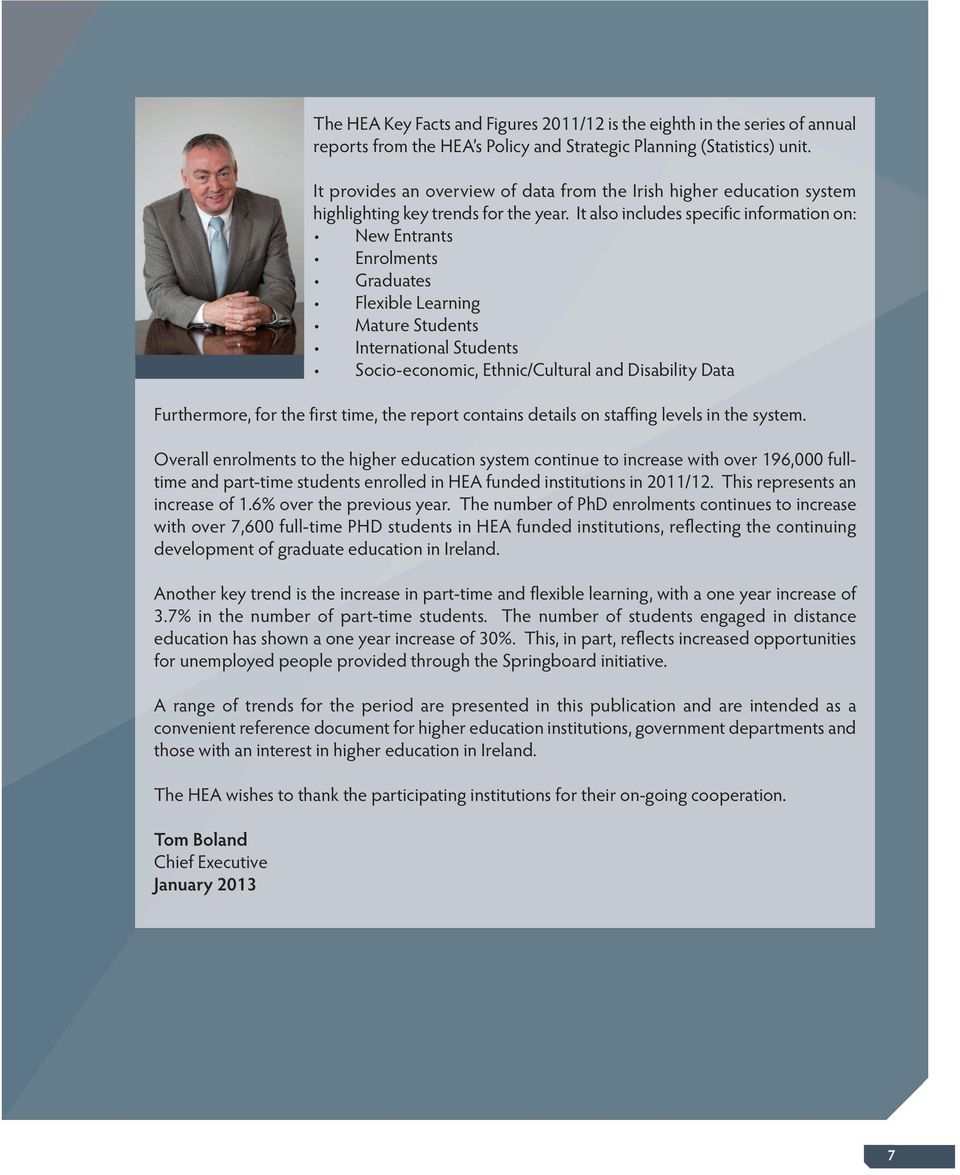
7 The HEA Key Facts and Figures 2011/12 is the eighth in the series of annual reports from the HEA s Policy and Strategic Planning (Statistics) unit. It provides an overview of data from the Irish higher education system highlighting key trends for the year. It also includes specific information on: New Entrants Enrolments Graduates Flexible Learning Mature Students International Students Socio-economic, Ethnic/Cultural and Disability Data Furthermore, for the first time, the report contains details on staffing levels in the system. Overall enrolments to the higher education system continue to increase with over 196,000 fulltime and part-time students enrolled in HEA funded institutions in 2011/12. This represents an increase of 1.6% over the previous year. The number of PhD enrolments continues to increase with over 7,600 full-time PHD students in HEA funded institutions, reflecting the continuing development of graduate education in Ireland. Another key trend is the increase in part-time and flexible learning, with a one year increase of 3.7% in the number of part-time students. The number of students engaged in distance education has shown a one year increase of 30%. This, in part, reflects increased opportunities for unemployed people provided through the Springboard initiative. A range of trends for the period are presented in this publication and are intended as a convenient reference document for higher education institutions, government departments and those with an interest in higher education in Ireland. The HEA wishes to thank the participating institutions for their on-going cooperation. Tom Boland Chief Executive January
8 Contents 8

9 Section 1: Overview 12 Enrolment Trends 14 Full-time Undergraduate New Entrant Trends 17 Graduate Trends 21 Section 2: Application/ Acceptance and New Entrant Data 24 CAO Applications and Acceptances 26 New Entrant Trends 26 By Gender and Level 26 By Field of Study 27 By Age 29 Section 3: Full-time Enrolment Data 32 Full-time Enrolment Trends 33 By Gender and Level 34 By Age 35 By Level and Field of Study 37 Full-time Undergraduate Enrolment Trends 38 Full-time Postgraduate Enrolment Trends 39 Full-time Postgraduate Research Enrolment Trends 40 Section 4: Part-time& Flexible Learning Data 42 Part-time Enrolment Trends 43 By Gender and Level 44 By Age 45 By Level and Field of Study 46 Part-time Undergraduate Enrolment Trends 47 Part-time Postgraduate Enrolment Trends 48 Part-time Postgraduate Research Enrolment Trends 49 Flexible Learning Enrolment Trends 49 By Gender and Level 50 Flexible Undergraduate Enrolment Trends 52 Flexible Postgraduate Enrolment Trends 53 9

10 Contents Section 5: Graduate Data 54 Graduate Trends By Gender, Level and Field of Study 56 Undergraduate and Postgraduate Awards By Field of Study 57 All Awards and Honours Bachelor Degree by Grade Achieved and Gender 58 All Awards and Honours Bachelor Degree by Grade Achieved and Field of Study 59 Section 6: Mature New Entrants 62 CAP Applications and Acceptances 65 New Entrants Trends 65 Discipline Trends 69 Domiciliary of Origin and Ethnicity 75 Equal Access Survey 76 Ethnic Group 76 Disability 76 Socio Economic Background 78 Section 7: Equal Access Data Collection 82 Response rates 85 Socio Economic Profile 86 New Entrants Indicating a Disability 88 Ethnic/Cultural Background of New Entrants 89 Section 8: Further Education & Trraining 90 Further Education and Training Enrolments 92 FÁS National Craft Certificate Phases 4 and 6 93 Apprenticeship Enrolments 93 10
11 Section 9: International Profile 94 Domiciliary of Origin of all Full-time Enrolments Trends 96 Non-Irish Domiciled Students Trends 96 Full-time Non-Irish Domiciled 97 New Entrants & Field of Study 97 Enrolments & Field of Study 98 Research Enrolments & Field of Study 98 Trends in OECD Countries 99 Type B Graduates 99 Type A Graduates 99 Advanced Research Qualifications 100 Section 10: Department of Education & Skills & Other Department Aided And Privately Aided Institutions 102 Full-Time and Part-time Enrolment figures 104 By Gender 105 By Age 106 Section 11: Staffing Statistics 108 Staffing Levels Trends in Staffing Gender details 118 Appendix 1: Institutional Profile 123 Enrolments by Institution, Gender, Mode of Study and Award Level 124 Enrolments by Institution, Gender, Mode of Study and Age 126 Full-time and Part-time Enrolments by Institution, Gender and Field of Study for Universities 130 Full-time and Part-time Enrolments by Institution, Gender and Field of Study for Institutes of Technology 131 New Entrant Enrolments by Institution, Gender and Field of Study 132 Research Enrolments by Institution, Gender and Field of Study

12 12 Section 1: Overview

13 KEY POINTS Combined HEA Funded Institutions There were over 196,000 full-time and part-time students enrolled in HEA funded institutions in 2011/12. Overall enrolment increased by 15.2% between 2007/08 and 2011/12. Enrolment increased by 1.6% between 2010/11 and 2011/12 compared to a 2.7% increase between 2009/10 and 2010/11. Full-time undergraduate enrolments have increased by 18.2% and full-time postgraduate enrolments have increased by 14.6% between 2007/08 and 2011/12. Part-time undergraduate enrolments have decreased by 1.9% and part-time postgraduate enrolments have increased by 16.5% between 2007/08 and 2011/12. The University Sector There were over 117,000 students enrolled in the University sector in 2011/12. Overall enrolment increased by 13.2% between 2007/08 and 2011/12 with enrolment increasing by 2.1% between 2010/11 and 2011/12. The number of new entrants decreased by 1.5% between 2010/11 and 2011/12 with a drop in male new entrants of 1.6% and in female new entrants of 1.4%. Overall graduate output increased by 10.7% since 2007, with an increase of 1.5% between 2010 and The Institute of Technology Sector There were nearly 79,000 students enrolled in the Institute of Technology sector in 2011/12. Overall enrolments increased by 18.2% between 2007/08 and 2011/12 with enrolment increasing by 0.7% between 2010/11 and 2011/12. The number of new entrants to the Institutes of Technology increased in 2011/12 by 2.4% compared to the previous year, with an increase in male new entrants of 2.3% and an increase in female new entrants of 2.4%. Graduate output increased by 5.8% between 2010/11 and 2011/12. This comprises increases in undergraduate output of 6.4% and postgraduate output of 0.9%. 13
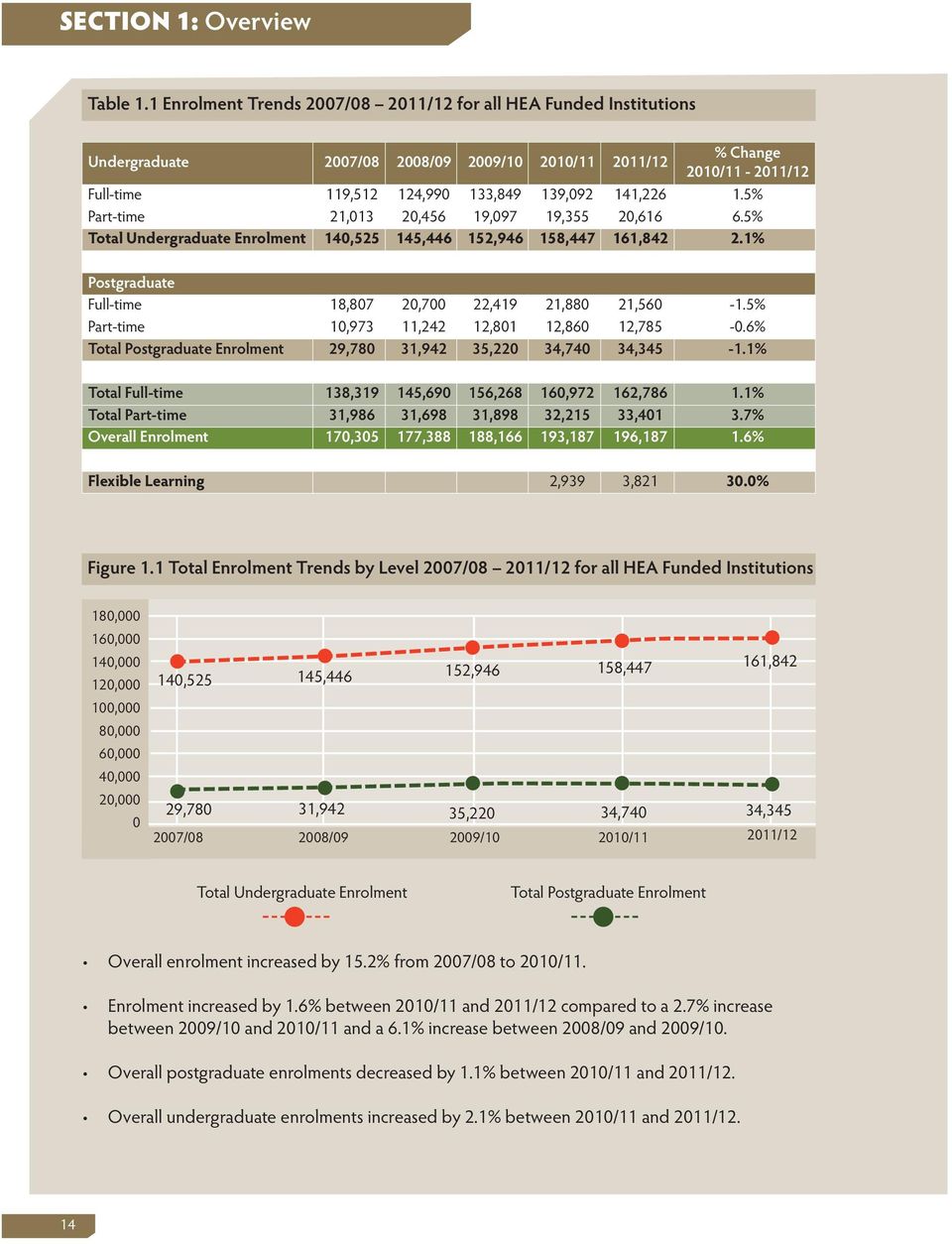
14 SECTION 1: Overview Table 1.1 Enrolment Trends 2007/ /12 for all HEA Funded Institutions Undergraduate 2007/ / / / /12 % Change 2010/ /12 Full-time 119, , , , , % Part-time 21,013 20,456 19,097 19,355 20, % Total Undergraduate Enrolment 140, , , , , % Postgraduate Full-time 18,807 20,700 22,419 21,880 21, % Part-time 10,973 11,242 12,801 12,860 12, % Total Postgraduate Enrolment 29,780 31,942 35,220 34,740 34, % Total Full-time 138, , , , , % Total Part-time 31,986 31,698 31,898 32,215 33, % Overall Enrolment 170, , , , , % Flexible Learning 2,939 3, % Figure 1.1 Total Enrolment Trends by Level 2007/ /12 for all HEA Funded Institutions 180, , , , ,000 80,000 60,000 40,000 20, , , , , ,842 29,780 31,942 35,220 34,740 34, / / / / /12 Total Undergraduate Enrolment Total Postgraduate Enrolment Overall enrolment increased by 15.2% from 2007/08 to 2010/11. Enrolment increased by 1.6% between 2010/11 and 2011/12 compared to a 2.7% increase between 2009/10 and 2010/11 and a 6.1% increase between 2008/09 and 2009/10. Overall postgraduate enrolments decreased by 1.1% between 2010/11 and 2011/12. Overall undergraduate enrolments increased by 2.1% between 2010/11 and 2011/12. 14
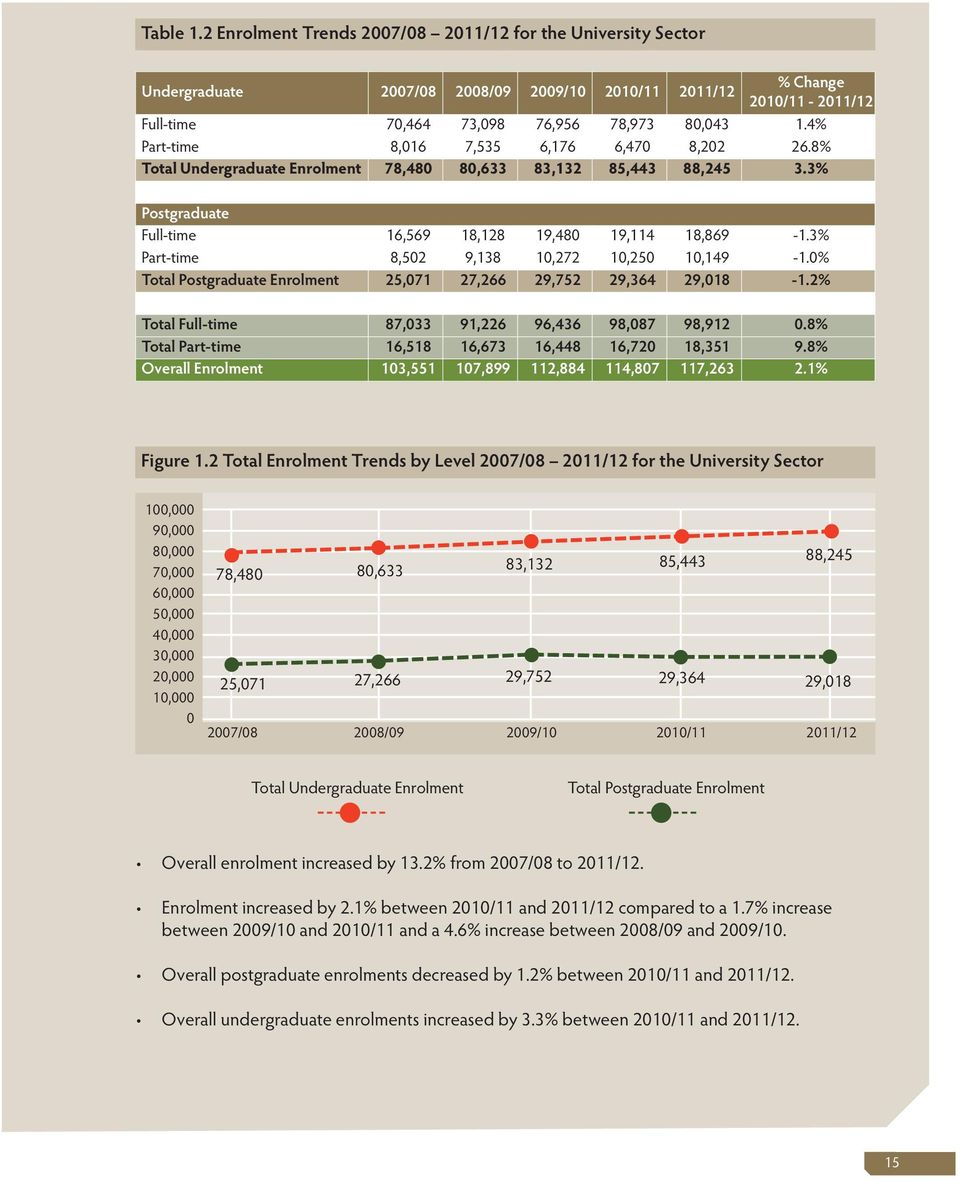
15 Table 1.2 Enrolment Trends 2007/ /12 for the University Sector Undergraduate 2007/ / / / /12 % Change 2010/ /12 Full-time 70,464 73,098 76,956 78,973 80, % Part-time 8,016 7,535 6,176 6,470 8, % Total Undergraduate Enrolment 78,480 80,633 83,132 85,443 88, % Postgraduate Full-time 16,569 18,128 19,480 19,114 18, % Part-time 8,502 9,138 10,272 10,250 10, % Total Postgraduate Enrolment 25,071 27,266 29,752 29,364 29, % Total Full-time 87,033 91,226 96,436 98,087 98, % Total Part-time 16,518 16,673 16,448 16,720 18, % Overall Enrolment 103, , , , , % Figure 1.2 Total Enrolment Trends by Level 2007/ /12 for the University Sector 100,000 90,000 80,000 70,000 60,000 50,000 40,000 30,000 20,000 10, ,480 80,633 83,132 85,443 88,245 25,071 27,266 29,752 29,364 29, / / / / /12 Total Undergraduate Enrolment Total Postgraduate Enrolment Overall enrolment increased by 13.2% from 2007/08 to 2011/12. Enrolment increased by 2.1% between 2010/11 and 2011/12 compared to a 1.7% increase between 2009/10 and 2010/11 and a 4.6% increase between 2008/09 and 2009/10. Overall postgraduate enrolments decreased by 1.2% between 2010/11 and 2011/12. Overall undergraduate enrolments increased by 3.3% between 2010/11 and 2011/12. 15
16 SECTION 1: Overview Table 1.3 Enrolment Trends 2007/08 to 2011/12 for the Institute of Technology Sector Undergraduate 2007/ / / / /12 % Change 2010/ /12 Full-time 49,048 51,892 56,893 60,119 61, % Part-time 12,997 12,921 12,921 12,885 12, % Total Undergraduate Enrolment 62,045 64,813 69,814 73,004 73, % Postgraduate Full-time 2,238 2,572 2,939 2,766 2, % Part-time 2,471 2,104 2,529 2,610 2, % Total Postgraduate Enrolment 4,709 4,676 5,468 5,376 5, % Total Full-time 51,286 54,464 59,832 62,885 63, % Total Part-time 15,468 15,025 15,450 15,495 15, % Overall Enrolment 66,754 69,489 75,282 78,380 78, % Figure 1.3 Total Enrolment Trends by Level 2007/ /12 for the Institute of Technology Sector 80,000 70,000 60,000 50,000 40,000 30,000 20,000 10, ,045 64,813 69,814 73,004 73,597 4,709 4,676 5,468 5,376 5, / / / / /12 Total Undergraduate Enrolment Total Postgraduate Enrolment Overall enrolment increased by 18.2% between 2007/08 and 2011/12. Enrolment increased by 0.7% between 2010/11 and 2011/12 compared to a 4.1% increase between 2009/10 and 2010/11 and a 8.3% increase between 2008/09 and 2009/10. Overall postgraduate enrolments decreased by 0.9% between 2010/11 and 2011/12. Overall undergraduate enrolments increased by 0.8% between 2010/11 and 2011/12. 16

17 Table 1.4 Full-time Undergraduate New Entrant Gender Trends 2007/ /12 for all HEA Funded Institutions 2007/ / / / /12 % Change 2010/ /12 Male 16,746 18,790 20,577 20,436 20, % Female 19,206 20,038 20,239 20,313 20, % Total 35,952 38,828 40,816 40,749 40, % Figure 1.4 Undergraduate New Entrant Gender Trends for all HEA Funded Institutions 2007/ /12 25,000 20,000 15,000 10,000 19,206 20,038 16,746 18,790 20,239 20,313 20,342 20,577 20,436 20,523 5, / / / / /12 Female Male The number of new entrants increased by 0.3% between 2010/11 and 2011/12 compared to a 0.2% decrease in the previous year. There are more male new entrants to higher education than female, with 50.2% male and 49.8% female. The number of male new entrants continues to grow at a faster rate than females, with an increase of 22.6% in male new entrants between 2007/08 and 2011/12 compared with a 5.9% increase in females over the same period. 17

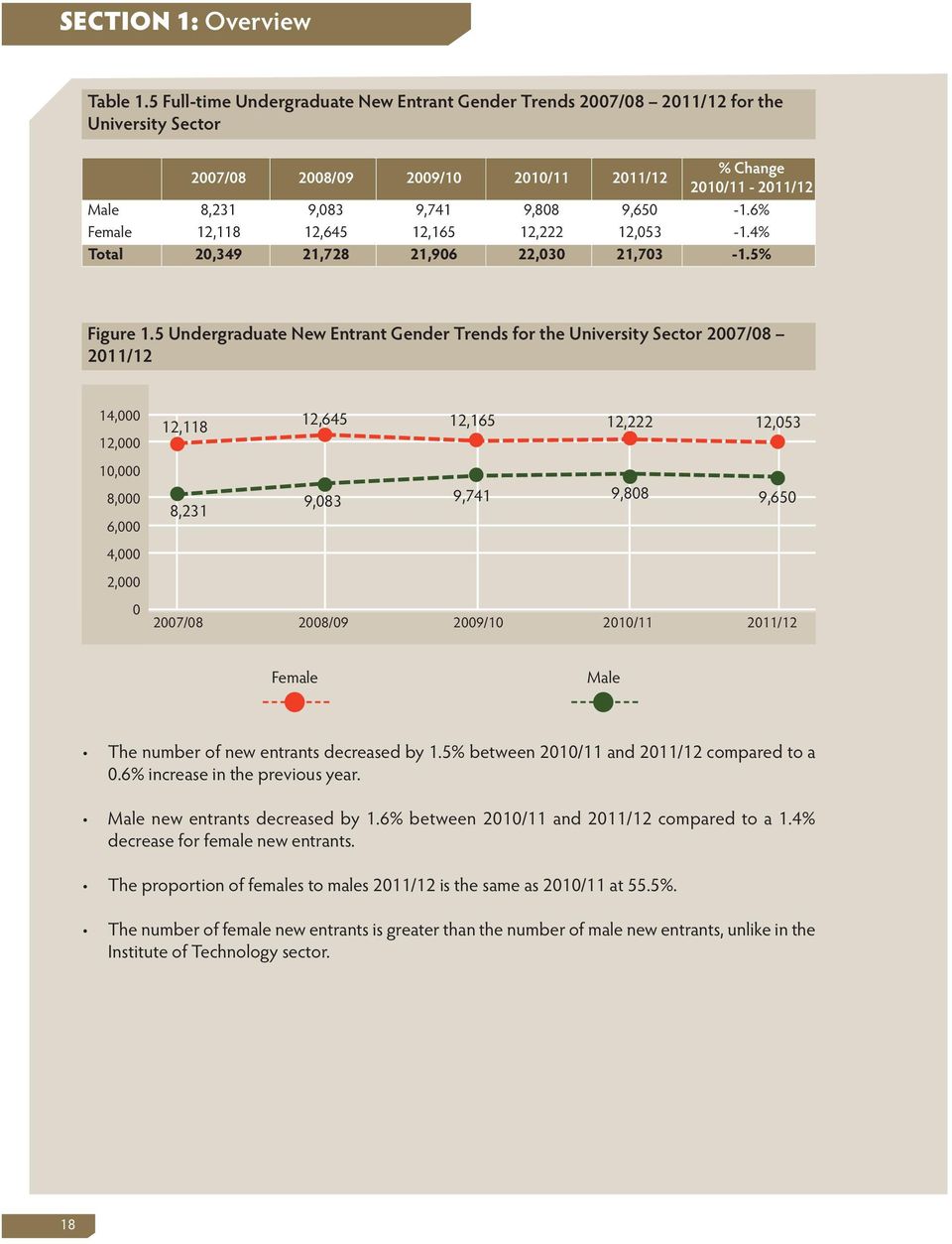
18 SECTION 1: Overview Table 1.5 Full-time Undergraduate New Entrant Gender Trends 2007/ /12 for the University Sector 2007/ / / / /12 % Change 2010/ /12 Male 8,231 9,083 9,741 9,808 9, % Female 12,118 12,645 12,165 12,222 12, % Total 20,349 21,728 21,906 22,030 21, % Figure 1.5 Undergraduate New Entrant Gender Trends for the University Sector 2007/ /12 14,000 12,000 10,000 8,000 6,000 4,000 2,000 12,118 8,231 12,645 12,165 12,222 12,053 9,083 9,741 9,808 9, / / / / /12 Female Male The number of new entrants decreased by 1.5% between 2010/11 and 2011/12 compared to a 0.6% increase in the previous year. Male new entrants decreased by 1.6% between 2010/11 and 2011/12 compared to a 1.4% decrease for female new entrants. The proportion of females to males 2011/12 is the same as 2010/11 at 55.5%. The number of female new entrants is greater than the number of male new entrants, unlike in the Institute of Technology sector. 18
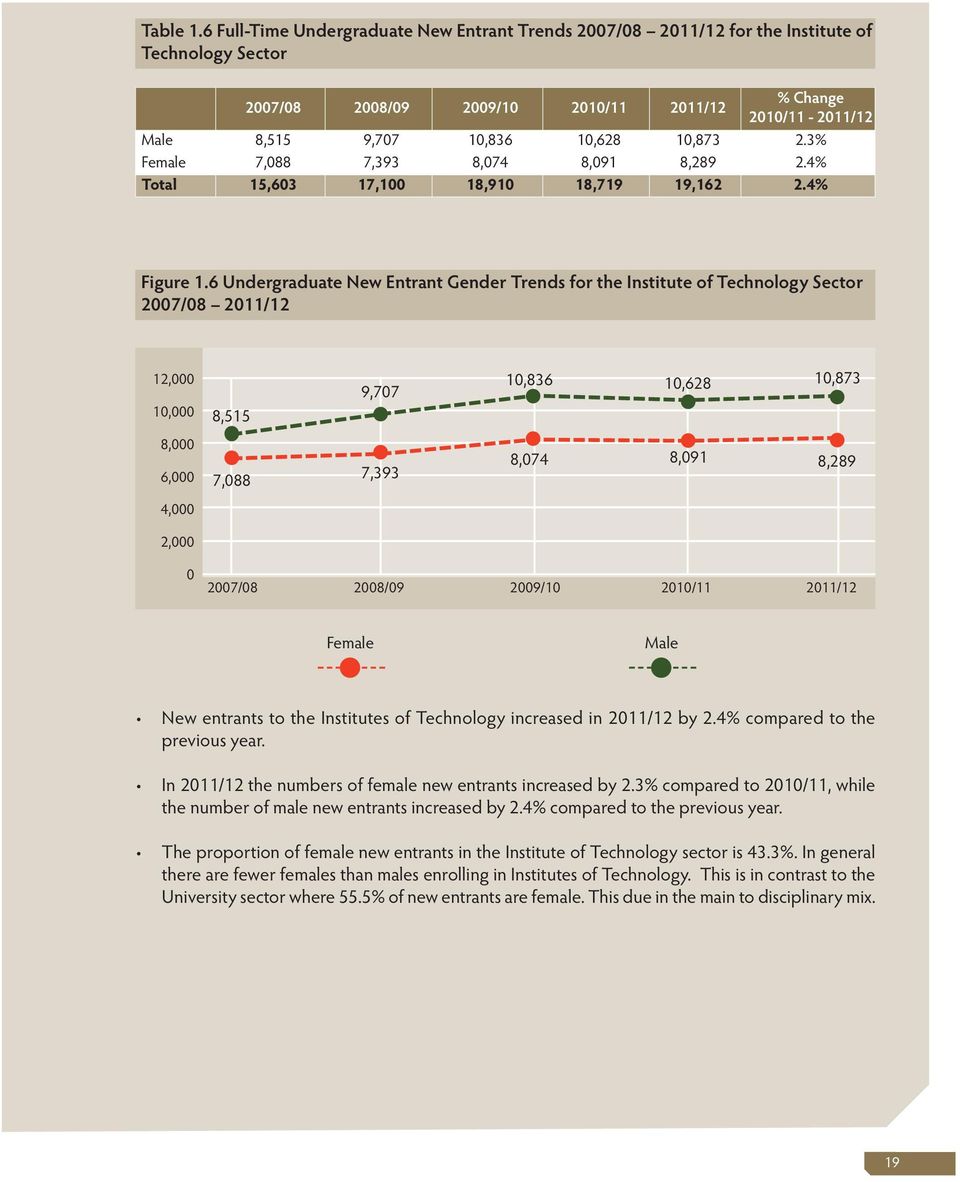
19 Table 1.6 Full-Time Undergraduate New Entrant Trends 2007/ /12 for the Institute of Technology Sector 2007/ / / / /12 % Change 2010/ /12 Male 8,515 9,707 10,836 10,628 10, % Female 7,088 7,393 8,074 8,091 8, % Total 15,603 17,100 18,910 18,719 19, % Figure 1.6 Undergraduate New Entrant Gender Trends for the Institute of Technology Sector 2007/ /12 12,000 10,000 8,515 9,707 10,836 10,628 10,873 8,000 6,000 7,088 7,393 8,074 8,091 8,289 4,000 2, / / / / /12 Female Male New entrants to the Institutes of Technology increased in 2011/12 by 2.4% compared to the previous year. In 2011/12 the numbers of female new entrants increased by 2.3% compared to 2010/11, while the number of male new entrants increased by 2.4% compared to the previous year. The proportion of female new entrants in the Institute of Technology sector is 43.3%. In general there are fewer females than males enrolling in Institutes of Technology. This is in contrast to the University sector where 55.5% of new entrants are female. This due in the main to disciplinary mix. 19
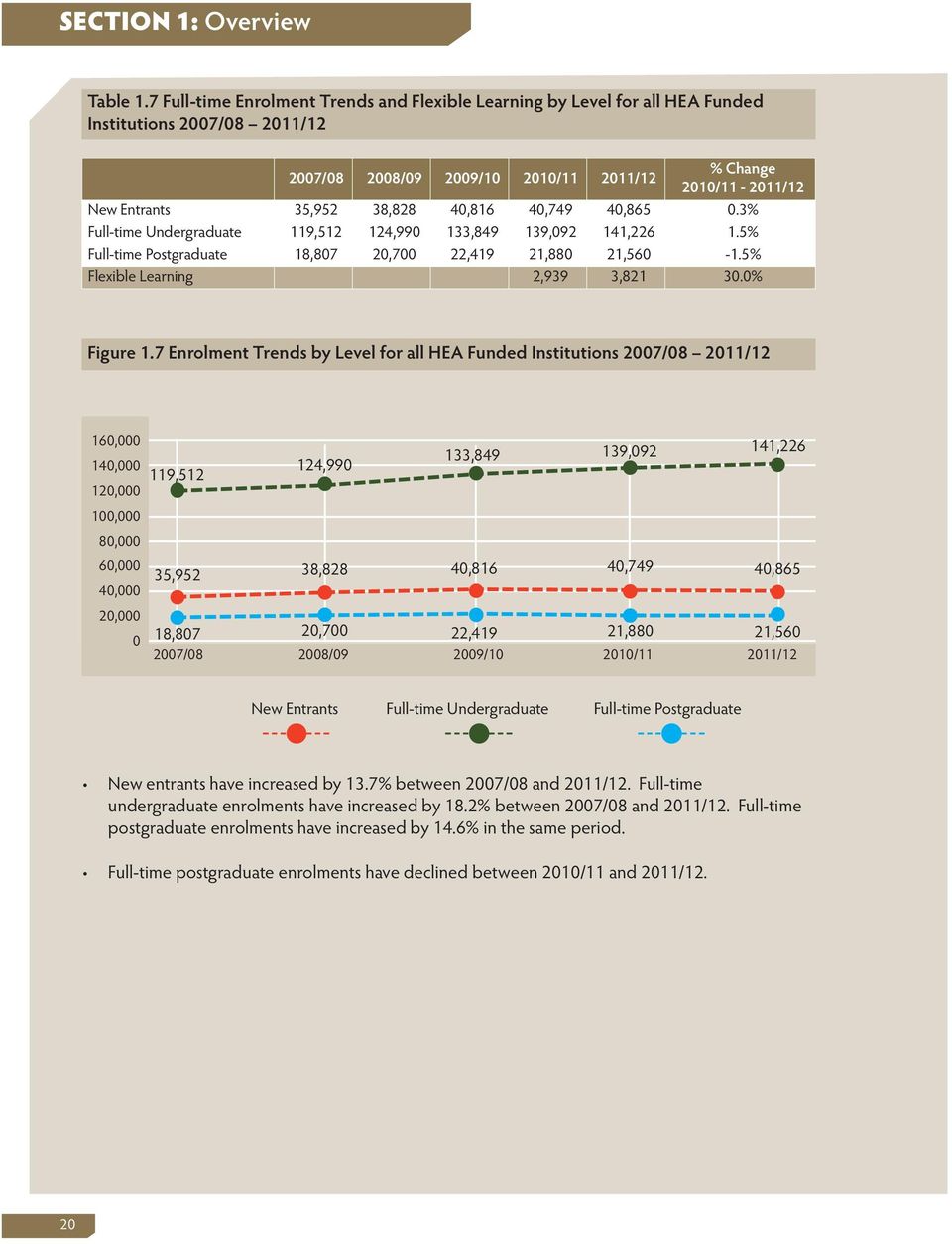
20 SECTION 1: Overview Table 1.7 Full-time Enrolment Trends and Flexible Learning by Level for all HEA Funded Institutions 2007/ / / / / / /12 % Change 2010/ /12 New Entrants 35,952 38,828 40,816 40,749 40, % Full-time Undergraduate 119, , , , , % Full-time Postgraduate 18,807 20,700 22,419 21,880 21, % Flexible Learning 2,939 3, % Figure 1.7 Enrolment Trends by Level for all HEA Funded Institutions 2007/ /12 160, , , ,000 80,000 60,000 40,000 20, , , , , ,512 35,952 38,828 40,816 40,749 40,865 18,807 20,700 22,419 21,880 21, / / / / /12 New Entrants Full-time Undergraduate Full-time Postgraduate New entrants have increased by 13.7% between 2007/08 and 2011/12. Full-time undergraduate enrolments have increased by 18.2% between 2007/08 and 2011/12. Full-time postgraduate enrolments have increased by 14.6% in the same period. Full-time postgraduate enrolments have declined between 2010/11 and 2011/12. 20
21 Table 1.8 Graduate Trends for all HEA Funded Institutions * 2009* 2010* 2011* % Change Undergraduate All Modes of Study 41,506 40,120 38,399 40,101 42, % Postgraduate All Modes of Study 14,652 15,177 15,972 18,121 17, % Overall Graduates 56,158 55,297 54,371 58,222 60, % *Distance & E-Learning included Figure 1.8 Total Graduate Trends by Level for all HEA Funded Institutions 45,000 40,000 35,000 30,000 25,000 20,000 15,000 10,000 5, ,506 40,120 38,399 40,101 4, ,652 15,177 15,972 18,121 17, Undergraduate Awards Postgraduate Awards Postgraduate output decreased by 2.6% between 2010 and 2011 compared with an increase of 13.5% in Since 2007, postgraduate output has increased by 18.4%. Undergraduate output increased by 5.7% between 2010 and There has been a 2.1% increase in undergraduate output since
22 SECTION 1: Overview Table 1.9 Graduate Trends for the University Sector * 2009* 2010* 2011* % Change Undergraduate Full-time + Part-time 20,829 21,407 20,129 21,027 22, % Postgraduate Full-time + Part-time 12,952 13,197 13,960 15,824 15, % Overall Graduates 33,781 34,494 34,089 36,851 37, % *Distance & E-Learning included Figure 1.9 Total Graduate Trends by Level for the University Sector 25,000 20,000 20,829 21,407 20,129 21,027 22,076 15,000 10,000 12,952 13,197 13,862 15,824 15,329 5, Undergraduate Awards Postgraduate Awards Overall graduate output has increased by 10.7% since Postgraduate output decreased in 2011 by 3.1% over the previous year. However, there was a 13.4% one year increase in postgraduate output the previous year. Since 2007, there has been a 18.4% increase in postgraduate output. Undergraduate output increased by 5.0% since There has been an increase of 6.0% in undergraduate output since 2007, and undergraduate output has now exceeded 2008 levels for the first time. 22
23 Table 1.10 Graduate Trends for Institute of Technology Sector * 2009* 2010* 2011* % Change Undergraduate Full-time + Part-time 20,677 18,713 18,270 19,074 20, % Postgraduate Full-time + Part-time 1,700 1,980 2,012 2,297 2, % Overall Graduates 22,377 20,693 20,282 21,371 22, % *Distance & E-Learning included Figure 1.10 Total Graduate Trends by Level for the Institute of Technology Sector 25,000 20,000 20,677 18,713 18,270 19,074 20,299 15,000 10,000 5, ,700 1,980 2,012 2,297 2, Undergraduate Awards Postgraduate Awards Overall output has increased by 5.8% between 2010 and Postgraduate output continued to increase in 2011, with a 0.9% increase since Postgraduate output has increased by over a third since Undergraduate output increased by 6.4% between 2010 and However, undergraduate output has not returned to 2007 levels. 23
24 24 Section 2: Application/Acceptance And New Entrant Data
25 KEY POINTS Combined HEA Funded Institutions The total number of Level 8 CAO acceptances in 2012 was 33,214. There were 61,846 first preference applications and first preference acceptances numbered 20,760. The proportion of first preference applicants that accepted their first preference was 63%. New entrant enrolments for all HEA funded institutes remained static in 2011/12 and total 40,865. New entrant females dominate the Humanities & Arts, Social Sciences, Business & Law, Education and the Health & Welfare categories, while males dominate the Engineering, Manufacturing & Construction and the Science categories. Nearly 72% of full-time undergraduate new entrants were aged between 17 and 19 years of age. 25
26 SECTION 2: Application/Acceptance And New Entrant Data CAO Data for all Higher Education Institutions Table 2.1 CAO Applications and Acceptances Level 8 (Honours Bachelor Degree) 2008 vs for the entire Higher Education Sector Year 1st Preference Applications* 1st Preference Acceptances** % 1st Preference Acceptors Total Acceptances*** ,846 20,760 63% 33, ,315 17,326 58% 29,697 *Each student applying to the CAO is allowed a maximum of ten Level 8 (Honours Bachelor Degree) and ten Level 7/6 (Ordinary Degree/Higher Certificate) choices. First preference applications give a clear indication of the actual number of applications for a particular course. **First preference acceptors are those applicants who have been offered their first preference courses and accepted it. ***Total Acceptances are acceptances at any preference including first preference. Not all applicants who are offered a place accept for various reasons: applicants defer their place, choose to take a Level 6/7 course, an apprenticeship, a Post Leaving Certificate Course or enter the workforce. For this reason the number of acceptors and the number of new entrants will not match. Not all students enter through the CAO system e.g. mature students. New Entrant Data to all HEA Funded Institutions Table 2.2 Full-time Undergraduate New Entrants for all HEA Funded Institutions 2011/12 by Gender and Level Undergraduate Male Female 2011/ /11 Red cell indicates a decline in new entrants from the previous year. % Change 2010/ /12 Honours Bachelor Degreees (Level 8) 13,385 15,547 28,932 28, % Ordinary Degree (Level 7) 5,119 2,765 7,884 7, % Diplomas (Level 7) % Certificate/ Higher Certificate (Level 6) 1,585 1,199 2,784 3, % Occasional ,076 1, % Total 20,523 20,342 40,865 40, % New entrant enrolments for all HEA funded institutes are up slightly by 0.3% from 2011/12 and total 40,865. There is an increase in new entrants in Honours Degrees (2.1%), Diplomas (2.7%) and Ordinary Degrees (0.4%). There is a decrease in new entrants in Certificates and Occasionals with decreases of 11.8% and 11.2% respectively. 26
27 Table 2.3 Full-time Undergraduate New Entrants 2011/12 by Field of Study for all HEA Funded Institutions Field of Study by Selected ISCED Honours Degrees Ordianry Degrees Undergraduate Diplomas Undergraduate Certificates Undergraduate Occasional Total Grand Total Male Female Male Female Male Female Male Female Male Female Male Female 2011 /12 General Programmes Education 387 1, ,047 1,434 Humanities & Arts 3,131 4, ,575 4,769 8,344 Social Sciences Business & Law 3,337 3, ,543 4,769 9,312 Social Sciences 827 1, ,279 2,166 Journalism and Information Business and Administration 2,053 1, ,178 2,880 6,058 Law Science 3,139 2, ,485 2,638 7,123 Combined Science, Mathematics and Computing ,265 Life Sciences ,021 1,135 2,156 Physical Sciences Mathematics and Statistics Computer Science & Use 1, , ,678 Engineering, Manufacturing & 1, , , ,527 Construction Combined Engineering Mechanics and Metal work Electricity and Energy , ,078 Process Engineering Architecture, Town Planning & Civil Engineering ,152 Agriculture & Veterinary Agriculture (& subdisciplines) Veterinary Health & Welfare 1,108 3, ,407 4,479 5,886 Combined Health & Welfare Medicine and Diagnostics Nursing and Caring 184 1, ,496 1,682 Dental Studies Therapy, Rehabilitation and Counselling 443 1, ,218 2,930 Pharmacy Services ,567 1,213 2,780 Combined Totals 13,385 15,547 5,119 2, ,585 1, ,523 20,342 40,865 Overall new entrant males slightly outnumber females and this difference is highlighted in the case of the Engineering, Manufacturing & Construction and Science disciplines (87.1% and 63.0% male respectively). However the opposite is true for Health & Welfare where females outnumber males (76.1% females) and Education (73.0% female). 27
28 SECTION 2: Application/Acceptance And New Entrant Data Table 2.4 Full-time Undergraduate New Entrants for all HEA Funded Institutions 2011/12 Vs 2010/11 Field of Study Field of study as % of Overall Male Female Grand Total 2011/12 Grand Total 2010/11 % Change 2010/ /12 Broad Programmes 0.4% % Education 3.5% 387 1,047 1,434 1, % Humanities & Arts 20.4% 3,575 4,769 8,344 7, % Social Science, Business & Law 22.8% 4,543 4,769 9,312 9, % Science 17.4% 4,485 2,638 7,123 6, % Engineering, Manufacturing & Construction 11.1% 3, ,527 4, % Agriculture & Veterinary 2.0% % Health & Welfare 14.4% 1,407 4,479 5,886 5, % Services 6.8% 1,567 1,213 2,780 2, % Combined 1.1% % Totals 100.0% 20,523 20,342 40,865 40, % Red cell indicates a decline in new entrants from the previous year. New entrant females dominate the Humanities & Arts, Social Sciences, Business & Law, Education and the Health & Welfare categories, while males dominate the Engineering, Manufacturing & Construction and the Science categories. Increases in new entrants were evident in four of the ten discipline categories. Those experiencing decreases were Broad Programmes, Education, Social Science, Business & Law, Engineering, Manufacturing & Construction, Agriculture & Veterinary, and Health & Welfare and Combined studies. Figure 2.1 Full-time Undergraduate New Entrants 2011/12 for the University Sector vs. the IOT Sector by Gender and Field of Study 4,000 3,500 3,000 2,500 2,000 1,500 1, General Programmes Education Science Humanities & Arts Social Science, Business & Law Science Engineering, Agriculture Manufacturing & & Veterinary Construction Health & Welfare Services Combined Male IoT Female IoT Male University Female University University sector students dominate most disciplines with the exception of Services and Engineering, Manufacturing & Construction, and Agriculture & Veterinary. Services include Leisure, Tourism, Catering and Hotel Management which are in the main offered only through the Institutes of Technology. 28
29 Table 2.5 Age Distribution of all Full-time Undergraduate New Entrants for all HEA Funded Institutions 2011/12 Vs 2010/11 M F Age as % of Total 2011/12 Total 2010/11 Total 17 and under 1,086 1, % 2,199 2, ,730 7, % 13,956 13, ,531 6, % 13,240 12, ,664 1, % 3,403 3, % 1,298 1, % % % , % 2,034 2, and over 1,574 1, % 2,771 3,013 Age Unknown 2 0.0% 2 1 Total 20,523 20, % 40,865 40,749 Figure 2.2 Age Distribution of Undergraduate Full-time New Entrants 2007/08 Vs 2011/12 for all HEA Funded Institutions 16,000 14,000 12,000 10,000 8,000 6,000 4,000 2, and under and over 2007/ /12 *Those students whose age is unknown have been removed 29
30 SECTION 2: Application/Acceptance And New Entrant Data Figure 2.3 Age Distribution of Undergraduate Full-time New Entrants: the University Sector Vs the Institute of Technology Sector in 2011/12 45% 40% 35% 30% 25% 20% 15% 10% 5% 0 17 and under and over University Sector IOT Sector *Those students whose age is unknown have been removed 30
31 31
32 32 Section 3: Full-time Enrolment Data
33 KEY POINTS Combined HEA Funded Institutions Full-time enrolment on Honours Bachelor Degree (level 8) programmes increased by 3.1% between 2010/11 and 2011/12. In the same time period full-time enrolments in other undergraduate programmes (Ordinary Degrees, Certificates, Diplomas and Occasional Programmes) decreased by 3.8%. Full-time enrolments in Humanities & Arts, Science, Agriculture & Veterinary, Health & Welfare and services increased in 2011/12. There were decreases in full-time enrolments in General Programmes, Education, Social Sciences, Business & Law, Engineering, Manufacturing & Construction and Combined Programmes in 2011/12. Overall full-time postgraduate enrolments fell with a 1.5% decrease over the 2010/11 cohort. Nearly 49% of all full-time postgraduate research enrolments are female. Full-time enrolment on PhD research programmes increased by 2.3% in 2011/12 while those on Masters research programmes have decreased by 18.3%. 33
34 SECTION 3: Full-time Enrolment Data Table 3.1 Full-time Enrolments 2011/12 by Gender and Level for all HEA Funded Institutions Full-time Undergraduate Male Female All All 2010/11 % Change 2010/ /12 Hons Bachelor Degree 51,399 58, , , % Ordinary Degree 14,687 8,318 23,005 23, % Diploma and Certificate/Higher Certificate 3,288 2,548 5,836 6, % Occasional 705 1,421 2,126 2, % Total Full-time Undergraduate 70,079 71, , , % Full-time Postgraduate PhD 3,907 3,777 7,684 7, % Research Master ,190 1, % Taught Master 4,262 4,875 9,137 9, % Postgrad Diploma and Cert 1,285 2,105 3,390 3, % Occasional % Total Full-time Postgraduate 10,181 11,379 21,560 21, % Overall Grand Total 80,260 82, , , % Red cells indicate a decline in enrolments from the previous year. Full-time enrolment on Honours Bachelor Degree (level 8) programmes increased by 3.1% between 2010/11 and 2011/12. In the same time period full-time Certificate/Diploma enrolments decreased by 11.6%. Full-time enrolment on postgraduate programmes decreased by 1.5% between 2010/11 and 2011/12. Only full-time PhD and research occasional students increased over the year. Figure 3.1 % Male/Female Undergraduate Enrolments 2011/12 for all HEA Funded Institutions Male 49.6% Female 50.4% The gender split for HEA funded institutions as a whole is slightly weighted towards females at 50.4%. 34
35 Figure 3.2 % Male/Female Postgraduate Enrolments 2011/12 for all HEA Funded Institutions Male 47.2% Female 52.8% Table 3.2 Age Distribution of Full-time Enrolments 2011/12 for all HEA Funded Institutions Age as % of Total 2011/ /11 M F Total Total Total 17 and under 1,091 1, % 2,210 2, ,732 8, % 16,050 16, ,150 14, % 27,403 27, ,094 15, % 28,116 28, ,271 12, % 23,825 22, ,514 7, % 15,139 14, ,404 4, % 8,488 8, ,100 2, % 5,737 5, ,142 8, % 17,184 16, and over 9,751 8, % 18,606 17,917 Age Unknown % Total 80,260 82, % 162, ,972 35
36 SECTION 3: Full-time Enrolment Data Figure 3.3 Age Distribution of Full-time Enrolments 2007/08 Vs 2011/12 for all HEA Funded Institutions 30,000 25,000 20,000 15,000 10,000 5, and under and over 2007/ /12 36
37 Table 3.3 Full-time Enrolments 2011/12 by Level and Field of Study for all HEA Funded Institutions Field of Study by Selected ISCED Cert/Higher Occasional Cert/Diploma Ordinary Degree Hons Bachelor Postgraduate Postgraduate Masters Degree (Level 8) Occasional Cert/ Diploma Taught Masters Research PhD Grand Total (Level 10) 2011/12 General Programmes Education , , ,249 Humanities & Arts ,549 23, , ,306 29,822 Social Sciences, Business & Law 175 1,763 4,718 27, , ,153 40,273 Combined Social Sciences, Business & Law , , ,015 Journalism & Information Business & Administration 155 1,623 4,397 16, , ,499 Law , ,204 Science ,687 17, , ,509 27,035 Combined Science, Mathematics & Computing , ,479 Life Sciences ,244 6, ,894 Physical Sciences , ,214 Mathematics & Statistics ,194 Computer Science & Use ,097 5, ,254 Engineering, Manufacturing & Construction ,942 10, ,068 19,499 Combined Engineering , ,516 Mechanics & Metal work ,213 1, ,585 Electricity & Energy ,989 1, ,133 Chemical & Process Engineering , ,630 Architecture, Town Planning & Civil Engineering ,706 4, ,635 Agriculture & Veterinary , ,306 Agriculture (& subdisciplines) , ,345 Veterinary Health & Welfare ,216 21, ,241 27,229 Combined Health & Welfare Medicine & Diagnostics , ,999 Nursing & Caring , ,480 Dental Studies Therapy, Rehabilitation & Counselling ,849 6, ,303 Pharmacy ,120 Services 3 1,165 3,867 2, ,526 Combined Totals 2,126 5,836 23, , ,390 9,137 1,190 7, ,786 37
38 SECTION 3: Full-time Enrolment Data Full-time Undergraduate Enrolments Table 3.4 Full-time Undergraduate Enrolments 2011/12 Vs 2010/11 for all HEA Funded Institutions Field of Study Field of Study as % of Total Red cell indicates a decline in enrolments from the previous year. Grand Total 2011/12 Grand Total 2010/11 Full-time enrolments increased overall by 1.5% in 2011/12 over 2010/11. The largest increases in enrolments were seen in Science and Agriculture & Veterinary. The area of largest decrease was General Programmes. % Change 2010/ /12 General Programmes 0.2% % Education 3.7% 5,186 5, % Humanities & Arts 18.6% 26,318 25, % Social Sciences, Business & Law 24.2% 34,195 34, % Science 16.0% 22,574 21, % Engineering, Manufacturing & Construction 12.4% 17,446 18, % Agriculture & Veterinary 2.2% 3, % Health & Welfare 17.2% 24,350 23, % Services 5.1% 7,269 6, % Combined 0.3% % Totals 100.0% 141, , % Figure 3.4 Full-time Undergraduate Enrolments 2011/12 by Gender and Field of Study for all HEA Funded Institutions 40,000 35,000 30,000 25,000 20,000 15,000 10,000 5,000 0 General Programmes Education Humanities & Arts Social Sciences, Business & Law Science Engineering, Manufacturing & Construction Agriculture & Veterinary Health & Welfare Services Combined Male Female Total Females outnumber males in most disciplines with the exceptions of Science, Engineering, Manufacturing & Construction and Agriculture & Veterinary. The vast majority of enrolments in Engineering courses are male at 86.6%. 38
39 Full-time Postgraduate Enrolments Table 3.5 Full-time Postgraduate Enrolments 2011/12 Vs 2010/11 for all HEA Funded Institutions Field of Study Field of Study as % of Total Red cells indicate a decline in new entrants from the previous year. Grand Total 2011/12 Grand Total 2010/11 % change 2010/ /12 General Programmes 0.1% % Education 9.6% 2,063 2, % Humanities & Arts 16.3% 3,504 3, % Social Sciences, Business & Law 28.2% 6,078 6, % Science 20.7% 4,461 4, % Engineering, Manufacturing & Construction 9.5% 2,053 2, % Agriculture & Veterinary 1.2% % Health & Welfare 13.4% 2,879 2, % Services 1.2% % Combined 0.0% 1 2 N/A Totals 100.0% 21,560 21, % Five of the ten disciplines show decreases in full-time postgraduate enrolments in 2010/11. Overall, there has been a decrease of 1.5% in full-time postgraduate enrolments in all HEA funded institutions on the previous year. Figure 3.5 Full-time Postgraduate Enrolments 2011/12 by Gender and Field of Study for all HEA Funded Institutions 7,000 6,000 5,000 4,000 3,000 2,000 1,000 0 General Programmes Education Humanities & Arts Social Sciences, Business & Law Science Engineering, Manufacturing & Construction Agriculture & Veterinary Health & Welfare Services Male Female Total 39
40 SECTION 3: Full-time Enrolment Data Table 3.6 Full-time Postgraduate Research Enrolments 2011/12 Vs 2010/11 for all HEA Funded Institutions % Change Full-time Research Postgraduate Male Female All 2011/12 All 2010/ / /12 PhD 3,907 3,777 7,684 7, % Masters Degree Research ,190 1, % Total Full-time 4,550 4,324 8,874 8, % Table 3.7 Full-time Postgraduate Research Enrolment Trends 2007/08 to 2011/12 for all HEA Funded Institutions Full-time Research Postgraduate 2007/ / / / /12 % Change 2007/ /12 PhD 5,219 6,330 7,414 7,512 7, % Masters Degree Research 2,531 2,206 1,715 1,457 1, % Total Full-time 7,750 8,536 9,129 8,969 8, % Figure 3.6 Full-time Postgraduate Research Enrolments 2011/12 by Gender and Field of Study for all HEA Funded Institutions 3,500 3,000 2,500 2,000 1,500 1, Education Humanities & Arts Social Sciences, Business & Law Science Engineering, Manufacturing & Construction Agriculture & Veterinary Health & Welfare Services Male Female Total 40
41 41
42 Section 4: Part-time & Flexible Learning Enrolment Data 42
43 KEY POINTS Combined HEA Funded Institutions There are 33,401 students enrolled on part-time programmes in the HEA-funded institutions. Part-time enrolment on Honours Bachelor Degree (level 8) programmes decreased by 3.6% between 2010/11 and 2011/12. In the same time period part-time Certificate/Diploma enrolments increased by 29.4%. Part-time undergraduate enrolments in Science, Engineering, Manufacturing & Construction, and Health & Welfare increased in 2011/12, with increases of 53.3%, 16.5% and 15.0% respectively. Overall part-time postgraduate enrolments have fallen slightly in 2011/12 with a 0.6% increase over the 2010/11 cohort. A total of 47.2% of part-time research students are male. Part-time enrolment on PhD research programmes continues to rise with an increase of 7.8% in 2011/12 from 2010/11 and by 85.1% over 2007/08 levels. Social Science, Business & Law is the most popular choice for part-time postgraduates followed by Health & Welfare and Education. 43
44 SECTION 4: Part-time & Flexible Learning Enrolment Data Table 4.1 Part-time Enrolments 2011/12 by Gender and Level for all HEA Funded Institutions Part-time Undergraduate Male Female All 2011/12 All 2010/11 % Change 2010/ /12 Hons Bachelor Degree 2,045 2,735 4,780 4, % Ordinary Degree 2,038 1,161 3,199 3, % Diploma and Certificate/Higher Certificate 3,299 3,753 7,052 5, % Occasional 3,082 2,503 5,585 5, % Total Undergraduate Part-time 10,464 10,152 20,616 19, % Part-time Postgraduate PhD ,142 1, % Research Master % Taught Master 3,187 3,675 6,862 6, % Postgrad Diploma and Cert 1,481 2,374 3,855 4, % Occasional % Total Postgraduate Part-time 5,512 7,273 12,785 12, % Overall Part-time Total 15,976 17,425 33,401 32, % Red cells indicate a decline in enrolments from the previous year. Part-time enrolment on Honours Bachelor Degree (level 8) programmes decreased by 3.6% between 2010/11 and 2011/12. In the same time period full-time Certificate/Diploma enrolments increased by 29.4%. Part-time enrolments increased overall by 3.7% from 2010/11 to 2011/12 with an increase of 6.5% in part-time undergraduate enrolments. Figure 4.1 % Male/Female Undergraduate Enrolments 2011/12 for all HEA Funded Institutions Male 50.8% Female 49.2% Gender split for HEA funded institutions as a whole is slightly weighted towards males at 50.8%. 44
45 Figure 4.2 % Male/Female Postgraduate Enrolments 2011/12 for all HEA Funded Institutions Male 43.1% Female 56.9% Table 4.2 Age Distribution of part-time Enrolments 2011/12 for all HEA Funded Institutions M F Age as % of Total 2011/12 Total 2010/11 Total 17 and under % % % % % % % % 970 1, ,430 2, % 6,288 6, and over 11,898 10, % 22,867 21,437 Age Unknown % Total 17,425 15, % 33,401 32,215 45
46 SECTION 4: Part-time & Flexible Learning Enrolment Data Table 4.3 Part-time Undergraduate Enrolments 2011/12 by Level and Field of Study for all HEA Funded Institutions Field of Study by Selected ISCED Certs/Higher Occasional Certs/Diploma Ordinary Degrees Hons Bachelor Degree Postgraduate Occasional Postgraduate Cert/ Diploma Masters Taught Masters PhD Research (Level 10) Grand Total 2011/12 General Programmes ,108 Education , ,441 Humanities & Arts 764 1, ,280 Social Sciences, Business & Law Combined Social Sciences, Business & Law 1,283 1, , ,034 2, , ,164 Journalism & Information Business & Administration 1,084 1, , , ,442 Law Science 1, , ,185 Combined Science, Mathematics & Computing Life Sciences Physical Sciences Mathematics and Statistics Computer Science & Use ,863 Engineering, Manufacturing & Construction 1, , ,088 Combined Engineering Mechanics and Metal work Electricity and Energy ,224 Chemical and Process Engineering Architecture, Town Planning & Civil Engineering Agriculture & Veterinary Agriculture (& subdisciplines) Veterinary Health & Welfare 484 1, ,170 1, ,503 Combined Health & Welfare Medicine and Diagnostics Nursing and Caring ,962 Dental Studies Therapy, Rehabilitation and Counselling 134 1, ,951 Pharmacy Services ,110 Combined Totals 5,585 7,052 3,199 4, ,855 6, ,142 33,401 46
47 Part-time Undergraduate Data Table 4.4 Part-time Undergraduate Enrolments 2011/12 Vs 2010/11 for all HEA Funded Institutions Field of Study Field of Study as % of Total Grand Total 2011/12 Grand Total 2010/11 % Change 2010/ /12 General Programmes 4.7% % Education 4.3% % Humanities & Arts 12.1% 2,503 2, % Social Sciences, Business & Law 28.9% 5,957 6, % Science 13.2% 2,713 1, % Engineering, Manufacturing & Construction 15.9% 3,287 2, % Agriculture & Veterinary 0.4% % Health & Welfare 16.0% 3,305 2, % Services 4.2% 863 1, % Combined 0.2% % Totals 100.0% 20,616 19, Red cell indicates a decline in enrolments from the previous year. Part-time undergraduate enrolments in Science, Engineering, Manufacturing & Construction, and Health & Welfare increased in 2011/12, with increases of 53.3%, 16.5% and 15.0% respectively. Figure 4.3 Part-time Undergraduate Enrolments 2011/12 by Gender and Field of Study for all HEA Funded Institutions 7,000 6,000 5,000 4,000 3,000 2,000 1,000 0 General Programmes Education Humanities & Arts Social Sciences, Business & Law Science & Veterinary Engineering, Manufacturing & Construction Agriculture Health & Welfare Services Combined Male Female Total Females outnumber males in most disciplines with the exceptions Science, Engineering, Manufacturing & Construction, Agriculture & Veterinary and Services. However, the disparity in these disciplines is greater than the disparity of female-dominated disciplines, resulting in fewer females than males overall. The vast majoring of enrolments in Engineering, Manufacturing & Construction programmes are male at 88.4%. 47
48 SECTION 4: Part-time & Flexible Learning Enrolment Data Part-time Postgraduate Data Table 4.5 Part-time Postgraduate Enrolments 2011/12 vs 2010/11 for all HEA Funded Institutions Field of Study Field of Study as % of Total Red cell indicates a decline in enrolments from the previous year. Grand Total 2011/12 Grand Total 2010/11 % change 2010/ /12 General Programmes 1.1% % Education Science 20.0% 2,551 2, % Humanities & Arts 6.1% % Social Science, Business & Law 27.5% 3,517 3, % Science 11.5% 1,472 1, % Engineering, Manufacturing & Construction 6.3% % Agriculture & Veterinary 0.7% % Health & Welfare 25.0% 3,198 3, % Services 1.9% % Totals 100.0% 12,785 12, % Four disciplines show decreases in Part-time postgraduate enrolments in 2011/12. These are Social Science, Business & Law, Engineering, Manufacturing & Construction, Health & Welfare and services. Overall, there has been a decrease of 0.6% in Part-time enrolments in all HEA funded institutions on the previous year. Figure 4.4 Part-time Postgraduate Enrolments 2011/12 by Gender and Field of Study for all HEA Funded Institutions 4,000 3,500 3,000 2,500 2,000 1,500 1, General Programmes Education Humanities & Arts Social Sciences, Business & Law Science Engineering, Manufacturing & Construction Agriculture & Veterinary Health & Welfare Services Male Female Total 48
49 Table 4.6 Part-time Postgraduate Research Enrolments 2011/12 Vs 2010/11 for all HEA Funded Institutions Part-time Research Postgraduate Male Female All 2011/12 All 2010/11 % Change 2010/ /12 PhD ,142 1, % Masters Degree Research % Total Part-time ,493 1, % Table 4.7 Part-time Postgraduate Research Enrolment Trends 2007/08 to 2011/12 for all HEA Funded Institutions Part-time Research All % Change 2007/ / / /11 Postgraduate 2011/ / /12 PhD ,059 1, % Masters Degree Research % Total Part-time 1,246 1,199 1,370 1,429 1, % Figure 4.5 Part-time Postgraduate Research Enrolments 2011/12 by Gender and Field of Study for all HEA Funded Institutions Education Humanities & Arts Social Sciences, Business & Law Science Engineering, Manufacturing & Construction Agriculture & Veterinary Health & Welfare Services Male Female Total 49
50 SECTION 4: Part-time & Flexible Learning Enrolment Data Flexible Learning Data including Distance Education, E-Learning & In-Service Education Please note that not all institutions have returned data relating to this mode of delivery to the HEA. Therefore, we are aware that this may provide an incomplete picture. See below for institutions who have returned data to the HEA in respect of Distance Education, E-Learning and In-service Education: IT Blanchardstown, Dublin City University, DIT, Galway Mayo IT, NUI Galway, NUI Maynooth, Royal College of Surgeons in Ireland, IT Sligo, IT Tallaght, Trinity College Dublin, University College Cork, University of Limerick. Table 4.8 Flexible Learning Enrolments 2011/12 by Gender and Level for all HEA Funded Institutions Flexible Learning All All % Change Male Female Undergraduate 2011/ / / /12 Hons Bachelor Degree ,162 1, % Ordinary Degree % Diploma and Certificate/Higher Certificate % Occasional % Total Undergraduate 1, ,750 1, % Flexible Learning Postgraduate PhD % Research Master Taught Master % Postgrad Diploma and Cert % Occasional % Total Postgraduate , % Overall Flexible Learning Total 2,375 1,446 3,821 2, % Red cell indicates a decline in enrolments from the previous year. 50
51 Figure 4.6 % Male/Female Undergraduate Enrolments 2011/12 for all HEA Funded Institutions Male 65.4% Female 34.6% Figure 4.7 % Male/Female Postgraduate Enrolments 2011/12 for all HEA Funded Institutions Male 53.9% Female 46.1% 51
52 SECTION 4: Part-time & Flexible Learning Enrolment Data Flexible Undergraduate Data Table 4.9 Part-time Flexible Learning Undergraduate Enrolments 2011/12 vs 2010/11 for all HEA Funded Institutions Field of Study Field of Study as % of Total Grand Total 2011/12 Grand Total 2010/11 % Change 2010/ /12 General Programmes 1.2% % Education 0.0% 0 0 N/A Humanities & Arts 20.6% % Social Sciences, Business & Law 9.0% % Science 22.8% % Engineering, Manufacturing & Construction 22.3% % Agriculture & Veterinary 1.9% % Health & Welfare 9.9% % Services 12.3% % Combined 0.0% 1 0 N/A Totals 100.0% 2,750 2, % Red cell indicates a decline in enrolments from the previous year. Figure 4.8 Part-time Flexible Learning Undergraduate Enrolments 2011/12 by Gender and Field of Study for all HEA Funded Institutions General Programmes Humanities & Arts Social Sciences, Business & Law Science Engineering, Manufacturing & Construction Agriculture & Veterinary Health & Welfare Services Male Female Total 52
53 Flexible Postgraduate Data Table 4.10 Part-time Flexible Learning Postgraduate Enrolments 2011/12 vs 2010/11 for all HEA Funded Institutions Field of Study Field of Study as % of Total Grand Total 2011/12 Grand Total 2010/11 % change 2010/ /12 General Programmes 0.0% 0 0 N/A Education Science 16.8% % Humanities & Arts 2.2% % Social Science, Business & Law 29.4% % Science 18.5% % Engineering, Manufacturing & Construction 2.6% % Agriculture & Veterinary 0.0% 0 0 N/A Health & Welfare 30.3% % Services 0.2% % Totals 100.0% 1,071 1, % Red cell indicates a decline in enrolments from the previous year. Figure 4.9 Part-time Flexible Learning Postgraduate Enrolments 2011/12 by Gender and Field of Study for all HEA Funded Institutions Education Humanities & Arts Social Sciences, Business & Law Science Engineering, Manufacturing & Construction Health & Welfare Services Male Female Total 53
54 54 Section 5: Graduate Data
55 KEY POINTS Combined HEA Funded Institutions A total of 59,983 students graduated from HEA funded institutions in Of this figure, 42,342 graduated from undergraduate programmes and 17,641 graduated from postgraduate programmes. Between them Humanities & Arts and Social Sciences, Business & Law graduates constituted 48.4% of all Honours Bachelor Degree graduates in They comprised 33.3% of all Ordinary Degrees in Science graduates constituted 13.0% of all Honours Bachelor Degree graduates and Engineering, Manufacturing & Construction graduates constituted 11.3% of all Honours Bachelor Degree graduates in Female graduates represent 53.5% of all undergraduate graduates and 57.0% of postgraduate graduates. 55
56 SECTION 5: Graduate Data Table 5.1 Graduates 2011 by Gender, Level and Field of Study for all HEA Funded Institutions Field of Study (ISCED) Certificate Undergraduate Postgraduate Overall Diplomas Ordinary Degrees Hons Degree Certificate Diplomas Taught Masters (Level 9) Research Masters (Level 9) M F M F M F M F M F M F M F M F M F M F Total General Programmes Education , , ,152 3,718 4,870 Humanities & Arts ,029 3, , ,367 5,436 8,803 Social Science Business & Law ,235 3,457 4, ,205 2, ,022 9,856 17,878 Combined Social Science, Business , ,437 2,519 3,956 & Law Journalism and Information Business and Administration ,155 2,351 2, ,548 1, ,816 6,303 12,119 Law ,625 Science ,002 1, ,251 2,891 7,142 Combined Science, Mathematics and Computing Life Science ,224 2,043 Physical Science Maths and Statistics Computer Science & Use , ,009 Engineering, Manufacturing & , , ,932 1,187 7,119 Construction Combined Engineering Mechanics and Metal work Electricity and Energy , ,649 Process Engineering Architecture, Town Planning & Civil , , ,879 Engineering Agriculture & Veterinary Agriculture (& subdisciplines) Veterinary Health & Welfare , ,063 7,716 9,779 Combined Health & Welfare Medicine & Diagnostic ,646 Nursing and caring , ,983 3,217 Dental Studies Therapy & Rehabilitation & , ,014 3,744 Counselling Pharmacy Services ,797 1,362 3,159 Combined Totals 2,820 2, ,168 4,554 3,088 11,672 15, ,820 3,237 4,659 5, ,269 32,714 59,983 PhD Data includes graduates from all levels Between them Humanities & Arts and Social Sciences, Business & Law graduates constituted 48.4% of all Honours Bachelor Degree graduates in They comprised 33.3% of all Ordinary Degrees in Science graduates constituted 13.1% of all Honours Bachelor Degree graduates while Engineering, Manufacturing & Construction graduates constituted 11.3% of all Honours Bachelor Degree graduates in Social Sciences, Business & Law graduates also constituted the largest undergraduate graduate bloc with 28.8%. Female graduates represent 53.5% of all undergraduate graduates and 57.0% of postgraduate graduates. 56
57 Table 5.2 All Undergraduate Awards for all HEA Funded Institutions Field of Study (ISCED) Field as % of Total % Change 2011 v 2010 General Programmes 0.9% % Education 4.4% 1,866 1, % Humanities & Arts 15.5% 6,551 6, % Social Science Business & Law 28.2% 11,937 11, % Science 11.8% 4,982 4, % Engineering, Manufacturing & Construction 14.2% 5,999 5, % Agriculture & Veterinary 1.8% % Health & Welfare 16.6% 7,044 6, % Services 6.7% 2,826 2, % Totals 100.0% 42,342 40, % All disciplines reported increases in graduate numbers in 2011 compared with Table 5.3 All Postgraduate Awards for all HEA Funded Institutions Field of Study (ISCED) Field as % of Total % Change 2011 v 2010 General Programmes 0.2% % Education 17.0% 3,004 3, % Humanities & Arts 12.8% 2,252 2, % Social Science Business & Law 33.7% 5,941 6, % Science 12.2% 2,160 2, % Engineering, Manufacturing & Construction 6.3% 1,120 1, % Agriculture & Veterinary 0.3% % Health & Welfare 15.5% 2,735 2, % Services 1.9% % Combined 0.0% % Totals 100.0% 17,641 18, % Red cell indicates a decline in graduates from the previous year. Overall, the number of postgraduate graduates decreased in 2011 compared with
58 SECTION 5: Graduate Data Table 5.4 % Breakdown of All Awards (Level 6-10) by Gender for all HEA Funded Institutions Grade M F T 1st Class Honours 42.6% 57.4% 100.0% 2nd Class Honours (Grade 1) 39.6% 60.4% 100.0% 2nd Class Honours (Grade 2) 45.0% 55.0% 100.0% Other Honours & Unclassified 50.9% 49.1% 100.0% Pass 53.2% 46.8% 100.0% Totals 45.6% 54.4% 100.0% Overall 86.2% of female and 89.8% of male graduates received an honour in Table 5.5 % Breakdown of Honours Bachelor Degree (Level 8) Awards and Gender for all HEA Funded Institutions Grade M F T 1st Class Honours 43.9% 56.1% 100.0% 2nd Class Honours (Grade 1) 39.1% 60.9% 100.0% 2nd Class Honours (Grade 2) 44.9% 55.1% 100.0% Other Honours & Unclassified 39.8% 60.2% 100.0% Pass 55.0% 45.0% 100.0% Totals 42.6% 57.3% 100.0% Overall 91.6% of female and 94.8% of male graduates received an honour in
59 Table 5.6 % Breakdown of all Awards (Level 6-10) by Level of Award and Discipline for all HEA Funded Institutions Field of Study 1H1 2H1 2H2 Other Honours and Unclassified Pass Total Broad Programmes 17.4% 21.6% 6.2% 22.0% 32.8% 100.0% Education 17.4% 47.2% 14.4% 16.2% 4.8% 100.0% Humanities & Arts 14.6% 38.2% 24.0% 16.5% 6.7% 100.0% Social Science Business & Law 12.4% 32.7% 17.7% 26.3% 11.0% 100.0% Combined Social Science, Business & Law 17.0% 39.5% 20.1% 17.3% 6.2% 100.0% Journalism and Information 12.4% 43.8% 19.1% 16.3% 8.4% 100.0% Business and Administration 10.9% 28.7% 17.0% 30.1% 13.3% 100.0% Law 11.7% 45.4% 16.5% 21.1% 5.3% 100.0% Science 16.7% 25.8% 14.0% 29.3% 14.2% 100.0% Combined Science, Mathematics and Computing 14.5% 34.1% 22.0% 17.8% 11.6% 100.0% Life Science 15.1% 31.3% 15.7% 27.4% 10.5% 100.0% Physical Science 16.9% 23.8% 15.4% 32.8% 11.1% 100.0% Maths and Statistics 24.0% 18.6% 11.8% 24.6% 20.8% 100.0% Computer Science & Use 17.1% 22.0% 10.8% 32.9% 17.1% 100.0% Engineering, Manufacturing & Construction 10.2% 19.5% 15.3% 38.9% 16.0% 100.0% Combined Engineering 10.7% 18.3% 15.3% 43.6% 12.2% 100.0% Mechanics and metal work 7.3% 17.1% 13.1% 44.5% 18.0% 100.0% Electricity and energy 10.5% 14.8% 10.6% 48.2% 15.9% 100.0% Process Engineering 12.8% 22.4% 17.8% 36.5% 10.5% 100.0% Architecture, Town Planning & Civil Engineering 10.0% 22.4% 18.0% 31.3% 18.4% 100.0% Agriculture & Veterinary 5.1% 17.3% 19.4% 47.4% 10.8% 100.0% Agriculture 5.1% 16.0% 20.4% 46.7% 11.8% 100.0% Veterinary 5.2% 22.9% 15.0% 50.3% 6.5% 100.0% Health & Welfare 11.3% 27.8% 16.0% 29.9% 15.0% 100.0% Health & Welfare 19.4% 38.8% 22.3% 11.0% 8.4% 100.0% Medicine & Diagnostics 7.7% 16.2% 10.6% 40.5% 25.1% 100.0% Nursing and caring 10.0% 32.6% 22.8% 20.3% 14.3% 100.0% Dental Studies 1.8% 0.5% 0.9% 49.8% 47.0% 100.0% Therapy & Counselling 9.6% 31.9% 14.6% 32.4% 11.4% 100.0% Pharmacy 35.3% 15.4% 7.1% 36.8% 5.4% 100.0% Services 10.8% 19.7% 15.6% 40.9% 13.0% 100.0% Combined 0.0% 0.0% 0.0% 100.0% 0.0% 100.0% Totals 13.1% 30.5% 17.1% 27.5% 11.8% 100.0% 59
60 SECTION 5: Graduate Data Table 5.7 % Breakdown of Honours Bachelor Degree (Level 8) Awards by Level of Award and Discipline for all HEA Funded Institutions Field of Study 1H1 2H1 2H2 Other Honours and Unclassified Broad Programmes Education 11.1% 58.3% 27.0% 3.4% 0.2% 100.0% Humanities & Arts 11.8% 47.8% 34.2% 2.9% 3.2% 100.0% Social Science Business & Law 14.1% 44.8% 31.6% 3.2% 6.2% 100.0% Combined Social Science, Business & Law 12.1% 50.1% 31.6% 3.5% 2.8% 100.0% Journalism and Information 11.9% 55.9% 25.4% 6.8% 0.0% 100.0% Business and Administration 14.7% 40.6% 33.3% 3.2% 8.1% 100.0% Law 15.1% 56.8% 22.7% 2.4% 2.9% 100.0% Science 21.5% 42.7% 24.2% 4.4% 7.1% 100.0% Combined Science, Mathematics and Computing 17.6% 43.6% 29.3% 3.4% 6.1% 100.0% Life Science 19.3% 47.8% 25.8% 2.1% 5.0% 100.0% Physical Science 25.8% 37.3% 25.6% 5.4% 6.0% 100.0% Maths and Statistics 37.7% 26.9% 16.0% 14.2% 5.2% 100.0% Computer Science & Use 20.7% 42.3% 21.5% 5.0% 10.5% 100.0% Engineering, Manufacturing & Construction 18.6% 38.2% 33.0% 2.6% 7.7% 100.0% Combined Engineering 19.2% 37.8% 32.2% 4.6% 6.2% 100.0% Mechanics and metal work 17.3% 40.3% 31.0% 1.6% 9.9% 100.0% Electricity and energy 22.6% 34.7% 29.9% 1.8% 11.0% 100.0% Process Engineering 16.8% 32.8% 34.8% 11.4% 4.1% 100.0% Architecture, Town Planning & Civil Engineering 17.8% 40.4% 34.2% 0.1% 7.5% 100.0% Agriculture & Veterinary 9.3% 37.2% 44.5% 0.3% 8.6% 100.0% Agriculture 8.7% 33.3% 48.1% 0.4% 9.5% 100.0% Veterinary 11.4% 50.0% 32.9% 0.0% 5.7% 100.0% Health & Welfare 11.6% 39.8% 24.4% 12.8% 11.3% 100.0% Health & Welfare 10.2% 46.9% 26.5% 16.3% 0.0% 100.0% Medicine & Diagnostics 8.9% 20.3% 12.6% 30.8% 27.3% 100.0% Nursing and caring 12.8% 42.8% 27.7% 9.9% 6.8% 100.0% Dental Studies 1.4% 0.0% 0.0% 43.1% 55.6% 100.0% Therapy & Counselling 10.7% 49.3% 28.9% 4.9% 6.2% 100.0% Pharmacy 25.9% 48.3% 23.6% 0.0% 2.3% 100.0% Services 13.8% 37.3% 37.6% 0.0% 11.2% 100.0% Totals 14.5% 44.1% 30.1% 4.8% 6.5% 100.0% Pass Total 60
61 61
62 Section 6: Mature New Entrants 62
63 KEY POINTS 14% (5,500) of full-time new entrants are mature students. 88% (1,412) of part-time new entrants are mature students. 17% (6,912) of combined full-time and part-time new entrants are mature students. 10% (2,029) of full-time new entrants to the Universities are mature students compared to 18% (3,471) in the Institutes of Technology. 96% (899) of part-time new entrants in the Universities are mature compared to 77% (513) in the Institutes of Technology. The most popular discipline for full-time mature new entrants in the Universities is Humanities & Arts while Health & Welfare is the most popular discipline in the Institutes of Technology. The most popular discipline for part-time mature new entrants in the universities is Social Science, Business & Law while Engineering, Manufacturing & Technology is the most popular in the Institutes of Technology. Males make up the greater proportion of mature new entrants in all HEA funded institutions for both full-time (57%) and part-time (53%) learners together. The majority of full-time mature new entrants are in the year age group. The highest proportion of full-time mature new entrants not domiciled in Ireland come from the EU at 44.7%. For part-time new entrants, the EU also represents the highest proportion at 56.7% of the share. 7.7% of full-time mature new entrant respondents to the Equal Access survey indicated that they had a disability. Full-time mature respondents to the Equal Access survey demonstrate a higher rate of disability for every category of disability than non-mature respondents except for those with a specific learning difficulty. The largest proportion of full-time mature new entrant respondents come from a Manual Skilled background, this contrasts with the non-mature respondents whose largest socio-economic group is Employers and Managers. 63
64 SECTION 6: Mature New Entrants Introduction This section outlines the trends in mature student participation in Irish higher education over recent years. It presents a demographic profile of mature new entrants (NE) in higher education and is intended to improve our understanding of mature student engagement. For this section we have included enrolments for year one of Undergraduate Certificate, Undergraduate Diploma, Ordinary Bachelor Degree and Honours Bachelor Degree courses for our analysis. This is to keep our reporting of mature students and those who responded to the Equal Access survey consistent with any reporting from the National Access Office. Definitions A mature new entrant (NE) is defined as a student who was 23 or over on the 1st of January of the year of entry to the higher education institution, i.e. 1st of Jan 2011 for new entrants to the academic year 2011/12. This is consistent with the definition of the criteria for student maintenance grants. For the purposes of this study undergraduate students include those undertaking Honours and Ordinary Degrees and undergraduate Diplomas and Certificates. Occasional students 1 are not included in the analysis, however they are included in other sections of this report. The data is obtained through the Student Record System (SRS) 2. This chapter presents summaries of key trends over recent years and detail for mature new entrants to undergraduate courses in year 1 for the academic year 2011/ Occasional students are students taking intra-mural courses of lectures or laboratory instruction which do not lead directly to a third level award. Such students include individuals taking modules for their own interests, students attending access courses teaching study skills, and students taking qualifying courses for admission to postgraduate study. 2 The SRS is an electronic Student Record System devised by the institutions and the HEA to allow detailed reporting of higher education students. It introduced the ISCED reporting scheme, and replaced the previous paper-based mode of data collection. To complete the SRS submission, the Registrar (or equivalent) of each institution certifies the dataset as being a true and accurate reflection of that academic year s student cohort. 3 The data excludes RCSI and National College of Ireland. 64
65 Selected trends for mature new entrants Figure 6.1: CAO Full-time Mature Entrant Applications and Acceptances as a % of all Applications and Acceptances % 18% 16% 14% 12% 10% 8% 6% 4% 2% 0% 13.6% % 18.8% 16.9% 18.2% 17.6% 15.6% 13.6% 14.5% 14.0% mature applicants as a % of all applicants mature acceptances as a % of all acceptances Figure 1 shows that between 2008 and 2010 there was a steady rise in the proportion of mature student applications, 13.6% (9,349) in 2008 to 18.8% (14,696) in However, the proportion of both mature applicants and acceptors declined in 2011 and again in Mature applicants declined from 18.8% (14,696) of all applicants in 2010 to 17.6% (13,516) in Mature acceptors from 15.6% (7,131) of all acceptors in 2010 to 14.0% (6,467) in Figure 6.2: Proportions of Mature and Non-Mature New Entrants for all HEA Institutions Fulltime and Part-time 2011/12 Full-time Part-time 14% 12% 86% 88% Non Mature New Entrants Full-time Mature New Entrants Full-time Mature New Entrants Part-time Non Mature New Entrants Part-time Figure 6.2 shows that 14% (5,500) of all full-time new entrants and 88% (1,412) of all part-time new entrants were mature in 2011/12. 65
66 SECTION 6: Mature New Entrants Figure 6.3: Full and Part-time Mature New Entrants as a % of all New Entrants for all HEA institutions 2007/ /12 100% 80% 83% 87% 90% 92% 88% 60% 40% 20% 11% 11% 14% 15% 14% 0% 2007/ / / / /12 Full-time Mature New Entrant as % of all Full-time New Entrants Part-time Mature New Entrants as % of all Part-time New Entrants Figure 6.3 shows that mature new entrant enrolments increased gradually over a number of years and are now decreasing very slightly. Figure 6.4: Full and Part-time Mature New Entrants as a % of all New Entrants by Sector 2011/12 100% 96% 80% 77% 60% 40% 20% 0% 10% Universities 18% Institutes of Technology Full-time Part-time Figure 6.4 shows that full-time mature new entrants represent 10% (2,029) of all full-time new entrants in the Universities compared to 18% (3,471) in the Institutes of Technology. Mature new entrants represent 96% (899) of all part-time new entrants in Universities compared to 77% (513) in the Institutes of Technology. 66
67 Figure 6.5: Trends in Full and Part-time Mature New Entrants as a % of all New Entrants 2007/ /12 Full-time (6.5a) 25% 20% 17% 20% 18% 15% 10% 10% 12% 9% 13% 10% 11% 10% 5% 0% 2007/ / / / /12 Universities Institutes of Technology Part-time (6.5b) 100% 90% 80% 70% 60% 50% 40% 30% 20% 10% 0% 90% 77% 2007/08 Universities 93% 94% 94% 96% 89% 83% 80% 77% 2008/ / / /12 Institutes of Technology Figure 6.5a shows the participation of full-time mature new entrants in the two sectors over a five year period. Mature new entrant enrolments have been consistent over this period in the Universities. The Institute of Technology sector however has experienced steady growth of the proportion of full-time mature new entrants up until 2010/11. Between 2010/11 and 2011/12, the proportion dropped from 20% to 18% in this sector. Figure 6.5b shows part-time mature new entrants in both sectors. It is here that the Universities demonstrate the greater proportion of mature new entrants. The proportion of mature new entrant enrolments has grown steadily over the 5 year period, from 90% in 2007/08 to 96% in 2011/12. Part-time new entrant enrolments in the Institute of Technology sector have fluctuated during this time period with both increases and decreases. The latest decrease appeared between 2010/11 and 2011/12 when the proportion of mature new entrants in the Institute of Technology sector dropped from 89% to 77%. 67
68 SECTION 6: Mature New Entrants Figure 6.6: Proportions of Full and Part-time Mature New Entrants Studying at Levels 6, 7 & 8 in the Universities 2011/12 100% 90% 80% 70% 60% 50% 40% 30% 20% 10% 0% 93% level 6 81% 9% level 7 level 8 Figure 6.6 illustrates full and part-time mature new entrant proportions for levels 6, 7 and 8. The chart shows that 9% of all level 8 (Honours Bachelor Degree) new entrants are mature students while 93% of level 6 (Undergraduate Certificate) new entrants are mature students. Figure 6.7 Proportions of Full and Part-time Mature New Entrants Studying at Levels 6, 7 and 8 in the Institutes of Technology 2011/12 100% 90% 80% 70% 60% 50% 40% 30% 20% 10% 0% 28% level 6 20% 18% level 7 level 8 Figure 6.7 demonstrates full and part-time mature new entrant proportions for levels 6, 7 and 8 in the Institute of Technology sector. This sector has a greater percentage of mature new entrants in level 8 programmes (18%) compared to the 9% in the Universities. However level 7 programmes are much less populated by mature students in this sector (20%) than in the University sector (81%). 68
69 Discipline Trends This section examines the discipline choices of both Full and Part-time mature new entrants. Figure 6.8: Discipline of Full-time Mature New Entrants 2011/12 Universities (6.8a) 35% 30% 31.3% 28.9% 27.5% 25% 20% 15% 10% 5% 0% Humanities & Arts 12.8% Health & Welfare 17.7% 23.4% Social Sciences, Business & Law 10.9% Science, Mathematics and Computing Full-time Mature 18.6% 6.9% 6.7% Education 3.6% 7.5% Engineering, Manufacturing & Construction Full-time Non Mature 1.6% 2.1% 0.3% Agriculture & Veterinary General Programmes 0.0% 0.0% 0.1% Services Institutes of Technology (6.8b) 35% 30% 25% 24.9% 20% 15% 10% 20.5% 13.2% 17.9% 17.8% 17.1% 16.3% 16.0% 13.4% 11.1% 15.2% 12.1% 5% 0% 1.9% 2.2% 0.1% 0.3% 0.0% 0.0% Health & Welfare Social Sciences, Business & Law Science, Mathematics and Computing Engineering, Manufacturing & Construction Humanities & Arts Services Agriculture & Veterinary Education General Programmes Full-time Mature Full-time Non Mature Figure 6.8a illustrates the discipline for full-time mature new entrants in the University sector. Humanities & Arts is the most popular discipline for mature and non-mature new entrants in the Universities. Health & Welfare and Social Sciences, Business & Law are the next most popular disciplines for full-time mature new entrants in the Universities. The most popular discipline in the Institutes of Technology is Health & Welfare for full-time mature new entrants, followed by Social Sciences, Business & Law and Science, Mathematics & Computing. The poularity of the different disciplines in the Universities and the Institutes of Technology demonstrates the type of discipline provision supplied to mature students in the two sectors. 69
70 SECTION 6: Mature New Entrants Figure 6.9: Discipline Choice of Mature Part-time New Entrants 2011/12 Universities (6.9a) 40% 35% 30% 27.5% 25% 20% 15% 10% 5% 0% 22.2%22.5% Social Sciences, Business & Law 19.9% Humanities & Arts 17.5% 15.7% 12.5% 10.5% General Programmes Health & Welfare 10.5% 2.5% Services 10.3% 12.5% Science, Mathematics & Computing 5.5% 0% Engineering, Manufacturing & Construction 5.3% 5.0% Education 0.1% 0% Agriculture & Veterinary Part-time Mature Part-time Non Mature Institutes of Technology (6.9b) 60% 57.1% 50% 40% 34.5% 30% 20% 10% 0% 7.7% Engineering, Manufacturing & Construction 22.6% 12.2% Health & Welfare 20.3% Science, Mathematics and Computing 14.8% 6.4% Agriculture & Veterinary 7.8% 13.5% Services 0% 3.2% Humanities & Arts 0% 0% Social Sciences, Business & Law 0% 0% Education 0% 0% General Programmes Part-time Mature Part-time Non Mature Social Sciences, Business & Law, and Humanities & Arts are the most popular disciplines for part-time matures students in the Universities while Engineering, Manufacturing & Construction are the most popular discipline choices in the Institutes of Technology. 70
71 Figure 6.10: Male & Female Mature New Entrants Full and Part-time all HEA Institutions 2011/12 57% 53% 43% 47% Full-time Part-time Male Female Males make up the greater proportion of mature new entrants in all HEA funded institutions for both fulltime and part-time learners. However when the two sectors are separated as shown in the figure below, different patterns emerge in the Universities and Institutes of Technology. Figure 6.11: Male & Female Mature New Entrants Full and Part-time Universities and Institutes of Technology 2011/12 50% 50% 38% 62% 52% 48% 37% 63% Full-time Mature Universities Full-time Mature Institutes of Technology Part-time Mature Universities Part-time Mature Institutes of Technology Male Female Figure 6.11 shows that the proportion of male and female mature learners is relatively balanced in the Universities while males far outnumber females in the Institute of Technology sector for both modes of study. 71
72 SECTION 6: Mature New Entrants Figure 6.12: Male and Female Mature New Entrants Full-time Universities 2007/ /12 60% 40% 55% 50% 50% 50% 50% 50% 50% 45% 2007/ / / / /12 Male Female Figure 6.12 shows a trend of the male female breakdown of full-time mature new entrants in the Universities over a five year period. The proportion breakdown has equaled out over the last three years. Figure 6.13: Male and Female Mature New Entrants Full-time Institutes of Technology 2007/ /12 55% 58% 61% 62% 51% 49% 45% 42% 39% 38% 2007/ / / / /12 Male Female In the Institute of Technology sector, the male to female proportion of mature learners has in fact reversed to some degree over the five year trend. In 2011/12, 62% were male compared to 49% in 2007/08. 72
73 Figure 6.14: Full and Part-time Mature Students by age as a % of the Total Mature New Entrants 2011/12 all HEA Institutions 16% 14% 12% 10% 8% 6% 4% 2% 0% Full-time Mature New Entrants Part-time Mature New Entrants Figure 6.14 shows that the majority of full-time mature students are in the year age group, this is followed by a gradual decline in numbers of participation for older age groups. However for part-time learners, those aged 23 to 41 years are somewhat equally distributed. 73
74 SECTION 6: Mature New Entrants Figure 6.15a: Age Profile of Full-time Mature New Entrants 2011/12 100% 90% 80% 70% 60% 50% 40% 30% 20% 10% 0% University sector Institute of Technology sector Figure 6.15b: Age Profile of Part-time Mature New Entrants 2011/12 100% 90% 80% 70% 60% 50% 40% 30% 20% 10% 0% University sector Institute of Technology sector Figures 6.15a and 6.15b illustrate the age profile of mature news entrants in the University and the Institute of Technology sectors for both full-time and part-time respectively. For full-time mature new entrants, the Institute of Technology sector enrols the greater proportion of students across the two sectors. However, the universities enrol higher proportions of older age groups. For part-time mature new entrants, the universities have a much greater share of mature new entrants from age groups years and upwards. 74
75 Domiciliary of Origin and Ethnicity of Full and Part-time Mature New Entrants Figure 6.16: Domiciliary of Origin of Full and Part-time Mature New Entrants all HEA Institutions 2011/12 100% 90% 80% 70% 60% 50% 40% 30% 20% 10% 0% 56.7% 44.7% Europe - EU (excl. Ireland and Northern Ireland) 21.3% North America 11.8% 3.3% 3.3% 5.3% Asia Full-time 33.3% Africa 2.6% 3.3% Europe - Non EU Part-time 13.2% 0% 0.7% 2.0% Other Oceania The highest proportion of full-time mature new entrants not domiciled in Ireland come from Europe EU at 44.7% followed by 21.3% from North America. For part-time new entrants, the EU represents the highest proportion at 56.7% of the share, followed by 33.3% from Africa. Figure 6.17: Domiciliary of Origin of Full and Part-time Mature New Entrants in the Universities and Institutes of Technology 2011/12 100% 90% 80% 70% 60% 50% 40% 30% 20% 10% 0% 48.9% 47.5% Europe - EU (excl. Ireland and Northern Ireland) 27.1% 2.1% North America 23.4% 8.5% 10.6% 5.1% 1.7% 4.3% 8.5% 10.6% 1.7% 0% Asia Africa Europe - Oceania Other Non EU % Universities % Institutes of Technology Figure 6.17 shows the sector breakdown for domiciliary of origin of all mature new entrants excluding those with a domiciliary of origin in Ireland. In both the University sector and the Institute of Technology sector, the majority of mature new entrants come from the EU, 47.5% and 48.9% respectively. The next largest group represented in the Universities come from North America (27.1%) while in the Institutes of Technology, the next largest proportion of mature new entrants come from Africa (23.4%). 75
76 SECTION 6: Mature New Entrants Equal Access survey data of mature new entrants The Equal Access survey is administered to all new entrants in Higher Education Authority institutions at registration every year. The information in the following tables and figures is taken from the respondents answers to questions in this survey. All data in this section refer to new entrants full-time year 1 Undergraduate Certificate, Diploma, Ordinary Bachelor Degree and Honours Bachelor Degree*. Table 6.1: Respondents Ethnic Group Full-time Mature and Non Mature 2011/12 Ethnic group Mature Respondents Non Mature Respondents Irish 83.4% 92.1% Irish Traveller 0.1% 0.1% Any Other White Background 9.5% 4.2% African 3.6% 1.1% Any Other Black Background 0.2% 0.1% Chinese 0.2% 0.6% Any Other Asian Background 1.1% 1.1% Other 1.8% 0.9% Total 100.0% 100.0% Table 6.1 shows the breakdown of ethnic group for all full-time new entrants who responded to the ethnic group question in the Equal Access survey. The proportion of Irish mature new entrants is less than that of nonmature new entrants at 83.4% and 92.1% respectively. Mature respondents are also more populated in the Any Other White background group (9.5%) and African group (3.6%) background compared to non-mature respondents. Table 6.2 Type of Disability Full-time Mature and Non-Mature 2011/12 Type of disability** Mature respondents Non mature respondents 425 1,741 As % of total mature respondents with a disability As % of total non mature respondents with a disability Blindness, deafness, severe hearing or vision impairment** 11.5% 8.4% Physical condition** 20.0% 8.3% Specific learning difficulty** 19.3% 51.9% Psychological/Emotional condition** 28.9% 14.8% Other including chronic illness** 38.8% 24.2% % of people with a disability indicating support required 27.8% 37.2% *The equal access data in this section excludes the responses from the National College of Ireland (NCI) and RCSI. This is to keep the report consistent with any previously published data. However NCI is included in section 7 Equal Access Data Collection 2011/12. ** % refer to proportion of disabilities as some respondents indicated more than one disability. 76
77 Table 6.2 shows the number of people who responded to the survey and indicated that they have a disability (425 mature respondents, 1,741 non-mature respondents). It also shows the percentage of disabilities as a proportion of those who responded. The percentages measure the number of disabilities reported and not the number of people with a disability, this means that some respondents reported more than one disability. Mature respondents demonstrate a higher rate of disability that non mature respondents with exception to the percentage of specific learning difficulties. 19.3% of mature respondents reported this type of disability compared to 51.9% of the non-mature respondent population, who indicated a disability. Table 6.3: Type of Disability Full-time Mature & Non Mature Respondents as a Proportion of all New Entrants 2011/12 Type of Disability* No. of disabilities for Mature Respondents as % all Mature New Entrants No. of disabilities for Non Mature Respondents as % all Non Mature New Entrants Blindness, deafness, severe vision or hearing impairment* 0.9% 0.4% Physical Condition* 1.5% 0.4% Specific Learning Difficulty* 1.5% 2.6% Psychological/Emotional Condition* 2.2% 0.8% Other, including Chronic Illness* 3.0% 1.2% Mature Non Mature Respondents with a disability as % of all new entrants 7.7% 5.1% Respondents with a disability as % of all respondents to survey 8.6% 5.6% Those indicating support required as % of all new entrants 2.1% 1.9% Table 6.3 shows the proportion of disabilities as a percentage of all new entrants, categorised into mature and non-mature. The individual proportions of the various disabilities are all 3% or under of the total new entrant population. Mature new entrant respondents with a disability represent an estimate of 7.7% of the total mature new entrant population while the non-mature new entrant respondents with a disability represent an estimate of 5.1% of the non-mature new entrant population. * % refer to proportion of disabilities as some respondents indicated more than one disability. 77
78 SECTION 6: Mature New Entrants Socio Economic Background of Mature New Entrants* Socio-economic data is gathered by the Equal Access Survey at registration annually. The information below outlines the response rates by mature new entrants to the survey and the results by socio-economic group. To replicate the report last year, the socio-economic group All those Gainfully Employed and Unknown has been excluded from all socio-economic analyses in this section. Table 6.4: Response Rates Full-time Mature New Entrants and Non-Mature New Entrants 2011/12 All New entrants 2011/12 Universities Institutes of Technology Total Mature 2,029 3,471 5,500 Non Mature 18,663 15,464 34,127 % of new entrants responding to Equal Access survey 2011/12 Mature 81% 95% 90% Non Mature 88% 96% 91% % of respondents for whom a socio-economic classification was assigned Mature 44% 25% 31% Non Mature 70% 51% 61% Response rates to the equal access survey for mature new entrants are higher in the Institutes of Technology sector than in the University sector. Mature new entrants demonstrate a slightly lower response rate than non-mature respondents for both sectors. However for responses to the socio-economic questions within the survey, the Universities demonstrate higher response rates than the Institutes of Technology. *Section 7 Equal Access Data Collection 2011/12 includes the National College of Ireland in its analysis, however this chapter has excluded the National College of Ireland to replicate last year s report. 78
79 Table 6.5: Socio Economic group of Full-time Mature & Non Mature Respondents for Whom a Classification was assigned all HEA Institutions 2011/12 Socio-economic group Mature Non Mature Employers and Managers 15.6% 22.8% Higher Professional 8.1% 13.3% Lower Professional 9.0% 11.1% Non-manual 11.9% 10.9% Manual skilled 22.1% 13.3% Semi-skilled 8.5% 6.2% Unskilled 5.2% 2.6% Own account workers 10.9% 9.8% Farmers 7.4% 9.1% Agricultural workers 1.3% 1.0% The largest proportion of mature new entrant respondents come from a Manual Skilled background, this contrasts with the non-mature respondents whose largest socio-economic group is Employers and Managers. The smallest proportion of mature and non-mature new entrants come from the Agricultural Worker group. Table 6.6: Socio-Economic Group of Full-time Mature and Non Mature Respondents for Whom a Classification was assigned by Sector 2011/12 Socio-economic group Mature Non Mature Mature Institutes of Non Mature Institutes Universities Universities Technology of Technology Employers and Managers 16.8% 24.2% 14.6% 20.6% Higher Professional 10.8% 17.4% 5.6% 7.0% Lower Professional 9.7% 13.0% 8.3% 8.2% Non-manual 12.6% 10.2% 11.2% 11.8% Manual skilled 18.8% 10.2% 25.2% 18.1% Semi-skilled 7.1% 4.9% 9.8% 8.3% Unskilled 3.3% 1.7% 6.9% 3.9% Own account workers 12.1% 8.5% 9.9% 11.8% Farmers 7.7% 9.1% 7.2% 9.0% Agricultural workers 1.1% 0.7% 1.5% 1.3% Table 6.6 shows that the largest socio-economic group for mature respondents in both the Universities and the Institutes of Technology is the Manual Skilled group. For non-mature new entrants, the largest group in both sectors is the Employers and Managers group. 79
80 SECTION 6: Mature New Entrants Table 6.7 Response rates to Equal Access Survey by Institution for Full-time Mature New Entrants 2011/2012 Institution Response rate % 2011/12 Mater Dei Institute, Dublin 100% National College of Art and Design 100% St. Angela's College, Sligo 100% St. Patrick's College, Drumcondra 100% University of Limerick 100% Mary Immaculate College, Limerick 93% NUI Maynooth 91% University College Cork 90% Dublin City University 86% Trinity College Dublin 85% University College Dublin 72% NUI Galway 36% Athlone IT 100% DIT 100% Galway-Mayo IT 100% IT Sligo 100% IT Tralee 100% Waterford IT 99% Dun Laoghaire IADT 98% IT Tallaght 96% Letterkenny IT 94% Limerick IT 93% Dundalk IT 91% IT Blanchardstown 88% IT Carlow 80% Cork IT 77% Total institution response rate 90% 80
81 81
82 Section 7: Equal Access Data Collection 2011/12 82
83 KEY POINTS 23 out of the 28 institutes that responded to the survey had a response rate of %. The Institutes of Technology along with the National College of Ireland had the highest response rate to the survey at 96% overall. For both the University sector and the Institute of Technology sector, the largest socio-economic group is the Employers and Managers group. 6.1% of all respondents to the survey indicated that they had a disability compared to last year s figure of 7.4%. 35.7% of those respondents with a disability reported that they require additional support for their disability. After those with an Irish background, the majority of respondents to the Ethnic group question came from the Any Other White background group at 4.8%. 83
84 SECTION 7: Equal Access Data Collection 2011/12 Important note on the survey data in this section The figures in this section represent full-time new entrants to year 1 of an Undergraduate Certificate & Diploma, Ordinary Bachelor Degree, and Honours Bachelor Degree. The new entrant figures in other selected sections of this report also contain occasional figures which are excluded here.* We have also included data from the National College of Ireland (NCI) in this chapter. NCI is the only non HEA funded institution which takes the time to administer this survey therefore we decided to include their data in our Equal Access survey data analysis. The Equal Access Survey In 2007, twenty-six higher-education institutions gathered information from the first Equal Access Survey. The voluntary survey collects information on the social, economic and ethnic background of new students who enter higher education for the first time. The data is crucial in the ongoing process of developing policies that increase access of underrepresented groups in higher education. The collection is managed jointly by the National Access Office and the Statistics unit of the HEA and is carried out on an annual basis. Since 2011, the Equal Access data has been used to fully implement the access element of the annual HEA recurrant grant allocation model for the universities as well as the first phase of access funding for the Institutes of Technology. This funding supports the provision of access and lifelong learning initiatives by higher education institutions. These include outreach programmes and post-support services for mature students. Since 2010 the Equal Access data has also been used to advise the allocation of the Student Assistance Fund every year to each higher education institution for the support of students in financial need. This section presents a summary of the key trends emerging from the Equal Access data for the academic year 2011/12. *RCSI do not participate in the Equal Access Survey, they are therefore omitted from this section. 84
85 Table 7.1 Response rates to the Equal Access Data Survey by Institution 2011/12 and 2010/11 Institution Response Rate as % of all New Entrants 2011/12 Response Rate as % of all New Entrants 2010/11 National College Art & Design 100% 100% St. Angela's College, Sligo 100% 100% St. Patrick's College, Drumcondra 100% 63% University of Limerick 100% 100% Dublin City University 98% 38% NUI Maynooth 98% 97% University College Dublin 94% 97% University College Cork 94% 93% Mater Dei Institute, Dublin 92% 95% Trinity College Dublin 90% 94% Mary Immaculate College, Limerick 77% 95% NUI Galway 42% 33% Athlone IT 100% 90% DIT 100% 100% Galway-Mayo IT 100% 84% IT Sligo 100% 99% IT Tralee 100% 97% Waterford IT 99% 95% Cork IT 97% 93% IT Tallaght 96% 100% Dun Laoghaire IADT 93% 100% Dundalk IT 93% 88% Letterkenny IT 91% 94% Limerick IT 91% 66% IT Blanchardstown 82% 99% IT Carlow 75% 100% National College of Ireland 100% 100% Table 7.1 shows the response rate by higher education institutions to the Equal Access Survey 2011/12 with a comparison of the 2010/11 response rates. The response rates reflect an overall response rate to the survey from each institution, individual questions within the survey are then answered on a voluntary basis and have their own response rates by each institution. 23 out of the 28 institutions that responded to the survey had a response rate of %. 9 institutions experienced a drop in response rates between the 2010/11 and the 2011/12 survey. 85
86 SECTION 7: Equal Access Data Collection 2011/12 Table 7.2 Response rates by Sector & selected Equal Access Survey Question 2011/12 New Entrants 2011/12 Response to Access survey 2011/12 % of New Entrants who responded to socio-economic group questions % of New Entrants who responded to Ethnic Group questions Universities 20,692 87% 66% 73% Institutes of Technology & National College of Ireland 19,415 96% 54% 49% Total 40,107 91% 60% 61% Table 7.2 shows response rates by institution sector. The Institutes of Technology with the National College of Ireland (NCI) had the highest response rate to the survey at 96% compared to an overall rate of 87% in the Universities. Table 7.3 Socio Economic Group of Respondents 2011/12 & 2010/11 Socio-economic group % of new entrant respondents socio-economic group 2011/12 % of new entrant respondents socio-economic group 2010/11 Employers and Managers 18.9% 17.9% Higher Professional 11.0% 10.7% Lower Professional 9.3% 8.8% Non-manual 9.3% 9.7% Manual skilled 11.9% 12.1% Semi-skilled 5.5% 5.3% Unskilled 2.4% 2.4% Own account workers 8.4% 7.6% Farmers 7.6% 7.9% Agricultural workers 0.8% 0.8% All others gainfully occupied & unknown 15.0% 16.8% 86
87 Figure 7.1 Socio Economic Group of Respondents 2011/12 & 2010/11 25% 20% 15% 10% 5% 0% Employers Higher Lower and Professional Professional Managers Manual skilled Nonmanual Semiskilled Unskilled Own account workers Farmers Agricultural workers % socio-economic group 2011/12 % socio-economic group 2010/11 Table 7.3 and Figure 7.1 show the socio-economic group of full-time new entrant respondents. All others gainfully occupied & unknown The Employer and Manager group has increased slightly since 2010/11 as has the Higher Professional group and the Own Account Workers group. The participation of new entrants in the Manual Skilled, Semi-skilled and Unskilled groups has remained more or less the same. Table 7.4 Socio-Economic Group by Sector 2011/ /11 Universities Institutes of Technology & National College of Ireland 2011/ / / /11 Employers and Managers 21.1% 20.0% 16.0% 15.3% Higher Professional 15.1% 14.9% 5.5% 5.7% Lower Professional 11.4% 10.7% 6.6% 6.5% Non-manual 9.2% 9.6% 9.4% 9.8% Manual skilled 9.5% 9.4% 15.1% 15.3% Semi-skilled 4.5% 4.6% 6.8% 6.1% Unskilled 1.6% 1.7% 3.3% 3.3% Own account workers 7.7% 7.2% 9.2% 8.1% Farmers 8.0% 8.2% 7.0% 7.4% Agricultural workers 0.7% 0.7% 1.0% 0.9% All others gainfully occupied & unknown 11.1% 12.9% 20.1% 21.5% The largest socio-economic group in the University sector is the Employer and Manager group followed by the Higher Professional group. The participation of new entrant respondents within these groups has increased slightly between 2010/11 and 2011/12. In the Institute of Technology Sector, excluding all others gainfully occupied and unknown, the largest socio-economic group is also the Employers and Managers group, followed by the Manual Skilled group. 87
88 SECTION 7: Equal Access Data Collection 2011/12 Table 7.5 Respondents with a Disability 2011/12 Type of disability % of respondents* % of new entrants Blindness, deafness, severe vision or hearing impairment 9.1% 0.5% Physical Condition 10.6% 0.6% Specific Learning Difficulty 46.0% 2.5% Psychological/Emotional Condition 17.2% 0.9% Other, including Chronic Illness 26.9% 1.5% Table 7.6 Proportions of respondents with a disability % % of New Entrants with a disability 5.5% % of total respondents with a disability 6.1% % of New Entrants requiring support 2.0% % of respondents with a disability requiring support 35.7% Table 7.5 shows that the largest number of respondents who indicated a disability, reported a Learning Difficulty at 46% followed by those with a Psychological/Emotional condition (17.2%). Table 7.6 shows the proportions of both new entrants with a disability based on the number of respondents along with proportions of respondents to the overall survey who indicated a disability. It is estimated that 5.5% of the new entrant cohort had one or more disabilities. 6.1% of respondents to the survey indicated that they had one or more disabilities. 35.7% of those respondents with a disability reported that they require additional support for their disability. *Some respondents indicated more than one type of disability. 88
89 Table 7.7 Ethnic group of respondents 2011/12 Ethnic Group Universities Institutes of Technology & National College of Ireland All institutions Irish 92.9% 87.9% 90.9% Irish Traveller 0.1% 0.1% 0.1% Any Other White Background 3.4% 7.1% 4.8% African 0.8% 2.3% 1.4% Any Other Black Background 0.1% 0.1% 0.1% Chinese 0.6% 0.4% 0.5% Any Other Asian Background 1.0% 1.3% 1.1% Other 1.1% 0.8% 1.0% Total 100.0% 100.0% 100.0% Just over 90% of respondents in all HEA institutions were Irish. After those with an Irish background, the majority of respondents came from the Any Other White background ethnic group at 4.8%. The lowest proportion of respondents came from the Irish Traveller group and the Any Other Black Background group. Figure 7.2 Ethnic group of respondents 2011/12, 2010/11 & Census 2011* 5% 4% 3% 2% 1% 0% Irish Traveller Any Other White Background African Any Other Black Background Chinese Any Other Asian Background Other 2011/ /11 Census 2011 Figure 7.2 (Those with an Irish background are excluded from figure 7.2) shows that the participation of respondents from the Any Other White background increased by almost 1 percentage point between 2010/11 and 2011/12. Respondents from other ethnic groups also enjoyed marginal increases in participation. *Census 2011 data taken from year age group by ethnic group. 89
90 Section 8: Further Education and Training 90
91 KEY POINTS There were a total number of 7,416 further education and training enrolments in 2011/12. Overall, males greatly outnumber female FETAC enrolments, with males comprising 97.4% of all enrolments. Construction-related apprenticeships comprise 87.6% of all recruitment to FETAC apprenticeships. Electrical and electrical related apprenticeships form the largest single bloc of the construction-related apprenticeships with 29.4% of all apprenticeship enrolments. The following section provides an overview of enrolments from further education and training in the Institutes of Technology. As the Institutes provide the education element of a number of Fáilte Ireland and FÁS apprenticeships they have returned this data to the HEA. This is also fulfilling their reporting obligations under existing legislation. Previously this information was supplied to the HEA via the Institutes from FÁS. The data detailed in this section includes all apprenticeship enrolments in the calendar year. There are three bodies associated with Institute of Technology provision of apprenticeships, in addition to the HEA s funding & reporting role: The Further Education and Training Awards Council is the national awarding body for further education and training in Ireland. FÁS has statutory responsibility for the regulation of craft apprenticeships. Completing a FÁS Apprenticeship is the recognised means by which people are trained to become craftspeople in Ireland. Fáilte Ireland is the state s tourism development authority and among other roles provides training and training support for those wishing to be employed in the tourism industry. Since 2003 FETAC assumed has responsibility for the many Certificates formerly awarded by a range of bodies including FÁS, Fáilte Ireland, NCVA, NCEA and Teagasc. 91
92 SECTION 8: Further Education and Training Table 8.1 All Further Education and Training Enrolments carried out in the Institute of Technology Sector 2011/12 Male Female Total FETAC Certificate FETAC Advanced Certificate 6, ,055 Overall Total 7, ,416 Overall, male enrolment outnumbers female FETAC enrolment. Females comprise just 2.6% of FETAC enrolments both at Certificate and Advanced Certificate levels. FETAC National Craft Certificates (Advanced Certificates) Collaboration between FÁS and the Institutes of Technology allow apprentices to enter the Institutes of Technology for both phases 4 and 6 of their apprenticeship. Programmes combine workplace, classroom and laboratory learning and are educational and training programmes for employed people. The Institutes of Technology (plus two colleges of further education) are providers for the Off-the-Job Phases 4 and 6 of the programme. Apprentices are released by employers to attend Institutes of Technology for Phases 4 and 6 of their apprenticeship. These releases normally take place in the apprentice s second and third year of apprenticeship. On successful completion of an apprenticeship, a FETAC Level 6 advanced certificate is awarded; this is recognised nationally as the requirement for craftsperson status and has international status. According to FÁS craft apprentices are recruited into the following broad trade families; Electrical Family Engineering Family Construction Family Motor Family Print Media Family 92
93 Table 8.2 FÁS National Craft Certificate 2011/12 Phases 4 and 6 Male Female Total FETAC Certificates & Advanced Certificate (Apprentices Phase 4 and 6) 6, ,551 Apprenticeships are still seen as very much a male preserve and once again this is strongly reflected in the gender imbalance. Females make up 0.5% of enrolments. Figure 8.1 Apprenticeship Enrolments by Trade Family Plumbing 20.4% Other Apprenticeship 14.2% Plastering 2.9% Motor Mechanic12.4% Electrical 29.4% Carpentry & Joinery 19.1% Bricklaying 1.5% Electrical and electrical related apprenticeships from the largest single bloc (29.4%) in both the construction family of trades and overall recruitment. 93
94 Section 9: International Profile of HEA Funded Institutions 94
95 KEY POINTS There are 152,215 full-time enrolments in the HEA funded institutions who are from Ireland. This makes up over 93% of full-time enrolments. A total of 10,571 full-time enrolments come from outside Ireland. Of these 30% come from the EU, 32.4% come from Asia and 28.7% come from North America. There has been a decline of 896 in the number of non-irish domiciled full-time enrolments since 2010/11, when there were 11,466 such students. The most popular fields of study for non-irish domiciled new entrants in 2011/12 were Humanities & Arts and Social Sciences, Business & Law. 95
96 SECTION 9: International Profile of HEA Funded Institutions Table 9.1 Domiciliary of Origin of all Full-time Enrolments 2011/12 for All HEA Funded Institutions Country of Origin As % of Total M F Total 2011/12 Total 2010/11 Ireland (Including Northern Ireland) 93.5% 75,420 76, , ,506 Africa 0.2% North America 1.9% 1,006 2,026 3,032 3,309 South America 0.0% Asia 2.1% 1,871 1,556 3,427 3,006 Europe (EU) 1.9% 1,459 1,710 3,169 3,949 Europe (Non-EU) 0.1% Oceania 0.0% Other & Unknown 0.2% Total 100.0% 80,260 82, , ,972 All categories with exception of Ireland, Asia and South America have recorded declines in full-time enrolments from these regions in 2011/12 compared with 2010/11. There has been a decline of 896 in the number of non-irish domiciled full-time enrolments since 2010/11, when there were 11,466 such students. There has been a significant decline of 19.8% in full-time enrolments from the EU states. Figure 9.1 Non-Irish Domiciled Students by Region of Domicile 2011/12 for All HEA Funded Institutions Europe (EU) 30.0% Europe (Non-EU) 1.7% Oceania 0.6% Africa 3.5% North America 28.7% Asia 32.4% South America 0.5% Asia now accounts for the single largest bloc represented (when Irish domiciled students are excluded), accounting for 32.4% of enrolments. The EU states and North America are the next largest accounting for 30.0% and 28.7% respectively. The remaining regions account for 8.9% of overall full-time enrolments. 96
97 Table 9.2 Non-Irish Domiciled Full-time Enrolments & Country of Origin countries with the highest numbers of such enrolments in HEA funded institutions. United States 2,255 China 1,412 Great Britain (excluding Northern Ireland) 1,162 Malaysia 791 Canada 714 France 451 Germany 448 India 285 Saudi Arabia 267 Italy 229 Students from the US are the largest non-irish domiciliary in HEA funded institutions followed by China and Great Britain. EU States account for four of the top ten non-irish domiciled. Figure 9.2 All Full-time Non-Irish Domiciled New Entrants & Field of Study Broad Programmes Education Humanities & Arts Social Science, Science Engineering, Manufacturing Agriculture & Business & & Construction Veterinary Law Health & Welfare Services Combined 2007/ / / / /12 Humanities & Arts and Social Science, Business & Law, and Health & Welfare are the three most consistently popular disciplines of study for non-irish domiciled new entrants. 97
98 SECTION 9: International Profile of HEA Funded Institutions Figure 9.3 All Full-time Non-Irish Domiciled Enrolments & Field of Study 3,500 3,000 2,500 2,000 1,500 1, Broad Programmes Education Humanities & Arts Social Science, Science Engineering, Manufacturing Agriculture & Business & & Construction Veterinary Law Health & Welfare Services Combined 2007/ / / / /12 When all Full-time enrolments are taken into account Health & Welfare is the largest single discipline. Figure 9.4 All Full-time Non-Irish Domiciled Research Enrolments & Field of Study 1,200 1, Education Humanities & Arts Social Science, Business & Law Science Engineering, Manufacturing & Construction Agriculture & Veterinary Health & Welfare Services Combined 2007/ / / / /12 At research level Science is by far the strongest discipline. 98
99 Figure 9.5 % of Tertiary Type B Graduates to the Population at Typical Age of Graduation 2008 for selected OECD Countries Canada New Zealand Slovenia Japan Ireland Turkey Spain Switzerland Australia Germany United Kingdom Austria United States Denmark Sweden Hungary Czech Republic Iceland Mexico Source: Education at a Glance 2012, OECD Tertiary Type B graduates correspond to Higher Certificate, University Certificate, Ordinary Degree and University Diploma graduates. The average for selected OECD countries is 10.63%. Canada produces the highest number of tertiary type B graduates, and Ireland performs well above average at 22.0%. However, it is important to note that Tertiary Type B programmes may differ in length in different countries and in turn impact on the participation and graduation rates. Figure 9.6 % of Tertiary Type A Graduates to the Population at Typical Age of Graduation 2008 for selected OECD Countries Iceland Poland United Kingdom Denmark Australia Slovak Republic Finland New Zealand Ireland Netherlands Norway Japan Portugal United States Czech Republic Israel Sweden Canada Italy Switzerland Hungary Germany Austria Spain Tertiary Type A graduates correspond to Honours Bachelor Degree and Masters Graduates Source: Education at a Glance 2012, OECD Iceland continues to produce the highest output of graduates for tertiary type A education at 59.8% of the population at typical age of graduation. At 46.9% the graduation rates of the population at the typical age of graduation in Ireland for tertiary type A education are above the average rate (39.4%) for the selected OECD countries. 99
100 SECTION 9: International Profile of HEA Funded Institutions Figure 9.7 Trends in Net Graduation Rates in Advanced Research Qualifications in Selected OECD Countries, 2000, 2008 and Austria Belgium Czech Republic Denmark Finland France Germany Greece Hungary Ireland Japan Norway Poland Slovak Republic Spain Sweden Switzerland United Kingdom OECD average Source: Education at a Glance 2012, OECD Advanced Research Qualifications refer to Tertiary programmes that lead directly to the award of an advanced research qualification (PhD) Table 9.3 % Increase in Graduates across Selected European Countries Selected Countries where data is available Tertiary-type A (first-time graduation) Austria Czech Republic Denmark Finland Germany Greece m m m Hungary m m m m Ireland Italy m Japan Netherlands New Zealand Norway Poland Portugal Slovak Republic m m Slovenia m m m m m Spain Sweden United Kingdom United States OECD average All the countries above have displayed an increase in net graduation rates between 2000 and At 68.3%, the percentage increase for Ireland during this period is above the OECD average of 38.1%. 100
101 101
102 Section 10: Department of Education and Skills (DES) & Other Department Aided Institutions and Privately Funded Institutions 102
103 KEY POINTS Department of Education and Skills (DES) & Other Department Aided Institutions There are 4,643 students enrolled in DES and Other Department Aided Institutions. 54.4% of enrolments to DES and Other Department Aided Institutions are undertaking an Honours Degree. There is slightly higher participation among females than males in the DES and other Department Aided Institutions, with 50.6% female participation. Enrolment at postgraduate level accounts for 17.6% in DES and Other Department Aided Institutions. Privately Funded Institutions There are 943 students enrolled in Privately Funded Institutions who reported to the HEA. 25.8% of enrolments to Privately Funded Institutions are undertaking an undergraduate programme for those institutions who reported to the HEA. There is slightly higher participation among females than males in the Privately Funded Institutions, with 52.6% female participation. Enrolments in privately funded institutions have an older age profile than DES and other Department Aided Institutions. 103
104 SECTION 10: DES & Other Department Aided Institutions and Privately Funded Institutions Table 10.1 Full-time and Part-time Enrolment 2011/12 for the Department Other Aided Sector Total Full-time and Part-time Department of Education & Skills and Other Department Aided Institutions Privately Funded Institutions M F T M F T UNDERGRADUATE Hons Bachelor Degree Ordinary Bachelor Degree Diploma & Certificate Occasional Total UG 1,879 1,949 3, POSTGRADUATE PHD Masters Postgraduate Diploma & Cert Occasional Total PG TOTAL 2,293 2,350 4, There are 4,643 students enrolled in DES and Other Department Aided Institutions. 54.4% of enrolments to DES and Other Department Aided Institutions are undertaking an Honours Degree. There are 943 students enrolled in Privately Funded Institutions who reported to the HEA. 25.8% of enrolments to Privately Funded Institutions are undertaking an undergraduate programme for those institutions who reported to the HEA. It is important to note that no direct comparison can be made with previous years for the Privately Funded Institutions as they are under no obligation to report to the HEA and we are unable to guarantee that the same institutions will report every year. 104
105 Figure 10.1 Full-time and Part-time Enrolments in Other Department Aided Colleges at Undergraduate and Postgraduate Level 4,500 4,000 3,500 3,000 2,500 2,000 1,500 1, Full-time Undergraduate Part-time Undergraduate Total Undergraduate Full-time Postgraduate Part-time Postgraduate Total Postgraduate Department of Education & Skills and Other Department Aided Institutions Privately Funded Institutions Figure 10.2 Gender Breakdown of Total Enrolments in Other Aided Colleges 2011/12 DES and Other Department Aided Institutions Privately Funded Institutions Female 50.6% Male 49.4% Female 52.6% Male 47.4% Mirroring the University sector, the overall gender breakdown is slightly biased towards females. 105
106 SECTION 10: DES & Other Department Aided Institutions and Privately Funded Institutions Figure 10.3 Age of Full-time Undergraduate & Postgraduate Students 2011/ <= >=30 DES and Other Department Aided Institutions Privately Funded Institutions The age distribution of students enrolled in DES and Other Department Aided Institutions shows a younger age profile than those who enrolled in private institutions. Those whose age group is unknown have been removed from chart. Several institutions did not return any New Entrant data and therefore a comparison between the two sectors was not possible. 106
107 107
108 108 Section 11: Staffing Statistics
109 KEY POINTS There are 17,701 core whole-time equivalent (WTE) staff employed in HEA Funded Institutions in Staffing numbers have decreased since the introduction of the Employment Control Framework (ECF) in The ECF has imposed reductions in the number of staff employed in the institutions. Universities and Colleges There are 10,300 WTE core staff employed in Universities and Colleges, of which 4,701 are academic and 5,599 are non-academic. There are 4,172 research/specialist staff employed. Of these, 2,345 are funded through the Irish Exchequer. Core staff numbers have decreased by 12% since 2008 and the introduction of the ECF. Over 57% of academic staff employed are male. At professorial level, 81% of staff are male. Nearly 65% of non-academic staff employed in the Universities are female. Institutes of Technology There are 7,401 WTE core staff employed in Institutes of Technology, of which 4,518 are academic and 2,883 are non-academic. There are 708 research staff employed. Of these 310 are funded through the Irish Exchequer. Core staff numbers have decreased by 11.7% since 2008 and the introduction of the ECF. 57.5% of academic staff employed are male. At senior lecturer level, 70.9% of staff are male. Nearly 59% of non-academic staff employed in the Institutes of Technology are female. Staff statistics are collected from the HEA funded institutions on a quarterly basis (March, June, September and December). Details of academic, non-academic, research and other specialist staff are collected as part of these returns. 109
110 SECTION 11: Staffing Statistics Table 11.1 Staffing Levels for the University Sector at December 2011 (WTEs) Academic Staff Non- Academic Staff Total Core Staff Exchequer Funded Research Staff Non-Exchequer Funded Research / Other Specialist Staff Total University College Dublin 944 1,140 2, ,978 University College Cork 701 1,013 1, ,507 NUI Galway , ,003 NUI Maynooth Trinity College Dublin 680 1,072 1, ,819 University of Limerick , ,436 Dublin City University ,209 Mary Immaculate College St. Patrick's College NCAD Mater Dei St. Angela's College Total 4,701 5,599 10,300 2,345 1,827 14,472 There are 10,300 WTE core staff employed in Universities and Colleges, of which 4,701 (45.6%) are academic and 5,599 (54.4%) are non-academic. There are 4,172 research/specialist staff employed. Of these, 2,345 are funded through the Irish Exchequer. 110
111 Table 11.2 Staffing Levels for Institute of Technology Sector at December 2011 (WTEs) Academic Staff Non- Academic Staff Total Core Staff Exchequer Funded Research Staff Non-Exchequer Funded Research / Other Specialist Staff Total Athlone IT IT Blanchardstown IT Carlow Cork IT Dundalk IT IADT Galway-Mayo IT Letterkenny IT Limerick IT IT Sligo IT Tallaght IT Tralee Waterford IT Dublin IT 1, , ,888 Total 4,518 2,883 7, ,109 There are 7,401 WTE core staff* employed in Institutes of Technology, of which 4,518 (61%) are academic and 2,883 (39%) are non-academic. There are 708 research/other specialist staff employed. Of these 310 are funded through the Irish Exchequer. * Note: A number of posts funded from the Student Services Charge (c. 100 posts) are included in Core Staff 111
112 SECTION 11: Staffing Statistics Figure 11.1 Core Academic and Non-Academic Staff in the HEA funded Institutions at December 2011 (WTEs) 1,200 1, Athlone IT IT Blanchardstown IT Carlow Cork IT Dundalk IT IADT Galway-Mayo IT Letterkenny IT Limerick IT IT Sligo Academic Staff IT Tallaght IT Tralee Waterford IT Dublin IT University College Dublin Non-Academic Staff University College Cork NUI Galway NUI Maynooth Trinity College Dublin University of Limerick Dublin City University Mary Immaculate College St. Patrick's College NCAD Mater Dei St. Angela s College 112
113 Table 11.3 Staffing Trends Universities (WTEs) Change Change Academic 1,160 1,190 1,084 1, % -18.7% University Non academic 1,519 1,562 1,483 1,188 1, % -25.0% College Research - Academic % 0.4% Dublin Research - Non Academic % % Total 3,245 3,379 3,283 3,095 2, % -8.2% Academic % -6.2% Non academic 1,135 1,131 1,081 1,032 1, % -10.8% Univeristy Research - Academic % 8.6% College Cork Research - Non Academic % 33.4% Total 2,567 2,674 2,669 2,550 2, % -2.3% Academic % 12.9% Non academic % 1.9% NUI Galway Research - Academic % 22.5% Research - Non Academic % -44.5% Total 1,859 2,116 2,057 2,015 2, % 7.7% Academic % 4.4% Non academic % -1.4% NUI Research - Academic % -46.2% Maynooth Research - Non Academic % % Total % -8.7% Academic % -8.2% Trinity Non academic 1,099 1,134 1,093 1,080 1, % -2.5% College Research - Academic % 13.7% Dublin Research - Non Academic % 673.5% Total 2,488 2,644 2,579 2,941 2, % 13.3% Academic % -2.3% Non academic % -8.4% University of Research - Academic % 78.8% Limerick Research - Non Academic % 156.3% Total 1,291 1,323 1,308 1,428 1, % 11.2% Academic % 24.8% Non academic % -8.4% Dublin City Research - Academic % 24.9% University Research - Non Academic % - Total 1,030 1,226 1,267 1,243 1, % 17.4% Academic 4,434 4,796 4,544 4,382 4, % -3.3% Non academic 5,858 6,054 5,788 5,363 5, % -10.3% Total Research - Academic 2,626 2,875 3,077 3,020 2, % 9.7% Research - Non Academic ,288 1, % 234.2% Total 13,301 14,180 13,918 14,053 13, % 3.0% 113
114 SECTION 11: Staffing Statistics Table 11.4 Staffing Trends Colleges (WTEs) St. Patrick's College Mater Dei Mary Immaculate College NCAD St Angela's College Total Change Change Academic % -23.2% Non academic % -19.8% Research - Academic % -81.6% Research - Non Academic % -25.0% Total % -24.7% Academic % -5.2% Non academic % -14.6% Research - Academic Research - Non Academic Total % -9.0% Academic % -0.4% Non academic % 7.0% Research - Academic % % Research - Non Academic % 503.6% Total % -0.8% Academic % -7.3% Non academic % 3.5% Research - Academic Research - Non Academic Total % -1.3% Academic % -7.5% Non academic % 5.8% Research - Academic Research - Non Academic Total % -1.3% Academic % -11.3% Non academic % -2.1% Research - Academic % -92.2% Research - Non Academic % 225.0% Total % -9.4% Since December 2008, reductions of 12% in core staffing numbers have been required in the HEA funded institutions as a result of the introduction of the Employment Control Framework. Growth in research and other non-exchequer funded posts has not been restricted as part of the ECF. 114
115 Figure 11.2: Staffing in the University Sector (WTEs) 3,000 2,500 2,000 1,500 1, University College Dublin Univeristy College Cork NUI Galway NUI Maynooth Trinity College Dublin University of Limerick Dublin City University St. Patrick's College Mater Dei Mary Immaculate College NCAD St Angela's College
116 SECTION 11: Staffing Statistics Table 11.5: Staffing Trends Institutes of Technology (WTEs) Athlone IT IT Blanchardstown IT Carlow Cork IT DIT Dundalk IT IADT Galway-Mayo IT Change Change Academic % 9.5% Non academic % -12.0% Research - Academic % Research - Non Academic % % Total % 13.2% Academic % 3.0% Non academic % -15.9% Research - Academic % Research - Non Academic % - Total % 3.8% Academic % -12.1% Non academic % -13.9% Research - Academic % Research - Non Academic % % Total % -2.2% Academic % -11.4% Non academic % -6.5% Research - Academic % Research - Non Academic % 166.8% Total 1,009 1, % -4.7% Academic ,111 1,044 1, % 5.5% Non academic 944 1, % -21.7% Research - Academic % Research - Non Academic % 20.7% Total 2,018 2,126 2,051 1,959 1, % -6.5% Academic % -10.6% Non academic % -22.6% Research - Academic % Research - Non Academic % 209.3% Total % -5.7% Academic % -9.0% Non academic % -17.7% Research - Academic % Research - Non Academic % 960.0% Total % -8.1% Academic % -11.3% Non academic % -8.9% Research - Academic % % Research - Non Academic % Total % -8.7% 116
117 Table 11.5 (Ctd): Staffing Trends Institutes of Technology (WTEs) Letterkenny IT Limerick IT IT Sligo IT Tallaght IT Tralee Waterford IT Total Change Change Academic % -10.5% Non academic % -13.8% Research - Academic % Research - Non Academic % 82.9% Total % -9.7% Academic % -0.1% Non academic % -9.6% Research - Academic % Research - Non Academic % % Total % 4.0% Academic % -10.3% Non academic % -15.3% Research - Academic % Research - Non Academic % 412.5% Total % -5.2% Academic % -4.9% Non academic % -18.4% Research - Academic % Research - Non Academic % 356.6% Total % -3.1% Academic % -12.9% Non academic % -17.8% Research - Academic % Research - Non Academic % 173.4% Total % -12.1% Academic % -13.7% Non academic % -15.5% Research - Academic % Research - Non Academic % -21.2% Total 1,053 1, % -15.5% Academic 4,800 4,869 4,843 4,644 4, % -5.9% Non academic 3,422 3,509 3,212 2,888 2, % -15.8% Research - Academic % Research - Non Academic % 89.5% Total 8,596 8,891 8,479 8,313 8, % -5.7% Since December 2008, reductions of 12% in core staffing numbers have been required in the the Institutes of Technology as a result of the introduction of the Employment Control Framework. 117
118 SECTION 11: Staffing Statistics Figure 11.3: Staffing in the Institutes of Technology Sector (WTEs) 2,500 2,000 1,500 1, Athlone IT IT IT Blanchardstown Carlow Cork IT DIT Dundalk IT IADT Galway- Letterkenny Limerick Mayo IT IT IT IT Sligo IT Tallaght IT Tralee Waterford IT Gender Details The HEA has recently commenced collection of gender details of academic staff in the HEA institutions. The first such return is given below. Table 11.6: Gender Details of Academic Staff in the Universities at September 2012 University College Dublin University NUI NUI Galway College Cork Maynooth Trinity College Dublin University of Limerick Dublin City University Male Female Male Female Male Female Male Female Male Female Male Female Male Female Male Female Professor 78.6% 21.4% 82.7% 17.3% 88.2% 11.8% 76.7% 23.3% 87.3% 12.7% 66.0% 34.0% 84.1% 15.9% 81.0% 19.0% Associate 75.6% 24.4% 71.0% 29.0% 98.7% 1.3% 86.1% 13.9% 65.9% 34.1% 83.3% 16.7% 28.6% 71.4% 74.0% 26.0% Professor Total Senior Lecturer 62.0% 38.0% 71.1% 28.9% 76.5% 23.5% 74.8% 25.2% 64.4% 35.6% 61.1% 38.9% 68.1% 31.9% 67.2% 32.8% Lecturer 49.8% 50.2% 51.5% 48.5% 48.8% 51.2% 52.8% 47.2% 52.6% 47.4% 53.7% 46.3% 46.6% 53.4% 50.7% 49.3% Other 52.4% 47.6% 54.1% 45.9% 48.7% 51.3% 61.5% 38.5% 35.4% 64.6% 50.6% 49.4% 46.2% 53.8% 50.7% 49.3% Total 56.3% 43.7% 59.3% 40.7% 58.9% 41.1% 64.0% 36.0% 59.2% 40.8% 55.4% 44.6% 52.5% 47.5% 57.4% 42.6% 118
119 Table 11.7: Gender Details of Academic Staff in the Colleges at September 2012* Mater Dei NCAD St. Angela's College Mary Immaculate College Male Female Male Female Male Female Male Female Male Female Senior Lecturer 100.0% 0.0% 66.7% 33.3% 33.3% 66.7% 53.3% 46.7% 57.7% 42.3% Lecturer 77.9% 22.1% 49.0% 51.0% 16.8% 83.2% 32.2% 67.8% 33.9% 66.1% Assistant Lecturer 32.1% 67.9% 40.0% 60.0% 19.1% 80.9% 27.3% 72.7% Part-time Academic 45.8% 54.2% 45.8% 54.2% Total 60.2% 39.8% 51.2% 48.8% 17.7% 82.3% 36.1% 63.9% 38.6% 61.4% * Note: St. Patrick s College has not returned information. Over 57% of academic staff in Universities, and nearly 39% of academic staff in the colleges are male. At professorial level, 81% of academic staff in the Universities, and 57.7% in the colleges are male. Total Figure 11.4 Gender Details of Total Academic Staff and Professorial Staff in the Universities Gender Breakdown of all Academic Staff in Universities Gender Breakdown of Professorial Staff in Universities Female 42.6% Male 57.4% Female 19.0% Male 81.0% 119
120 SECTION 11: Staffing Statistics Table 11.8: Gender Details of Academic Staff in the Institutes of Technology at September 2012 Senior Lecturer Athlone IT IT Blanchardstown IT Carlow Cork IT Dundalk IT IADT Galway-Mayo IT Male Female Male Female Male Female Male Female Male Female Male Female Male Female 88.2% 11.8% 50.0% 50.0% 86.7% 13.3% 74.9% 25.1% 82.1% 17.9% 45.5% 54.5% 60.9% 39.1% Lecturer 56.2% 43.8% 74.9% 25.1% 55.2% 44.8% 62.7% 37.3% 57.0% 43.0% 60.9% 39.1% 45.2% 54.8% Assistant Lecturer 47.4% 52.6% 47.9% 52.1% 54.5% 45.5% 41.5% 58.5% 54.9% 45.1% 44.8% 55.2% 47.9% 52.1% Other 72.2% 27.8% 57.5% 42.5% 57.7% 42.3% 59.5% 40.5% Total 56.7% 43.3% 64.9% 35.1% 57.5% 42.5% 58.5% 41.5% 59.1% 40.9% 55.0% 45.0% 47.2% 52.8% Letterkenny IT Limerick IT IT Sligo IT Tallaght IT Tralee Waterford IT DIT Total Male Female Male Female Male Female Male Female Male Female Male Female Male Female Male Female Senior Lecturer 60.0% 40.0% 61.5% 38.5% 73.9% 26.1% 67.9% 32.1% 53.8% 46.2% 67.9% 32.1% 73.4% 26.6% 70.9% 29.1% Lecturer 51.6% 48.4% 65.8% 34.2% 55.8% 44.2% 60.3% 39.7% 47.4% 52.6% 51.9% 48.1% 64.6% 35.4% 57.6% 42.4% Assistant Lecturer 46.0% 54.0% 56.3% 43.7% 48.8% 51.2% 67.6% 32.4% 39.9% 60.1% 52.8% 47.2% 57.9% 42.1% 51.0% 49.0% Other 14.9% 85.1% 39.2% 60.8% 66.7% 33.3% 84.5% 15.5% 100.0% 0.0% 100.0% 0.0% 65.4% 34.6% 59.4% 40.6% Total 50.2% 49.8% 61.7% 38.3% 55.4% 44.6% 62.3% 37.7% 46.4% 53.6% 52.9% 47.1% 64.2% 35.8% 57.5% 42.5% In the Institutes of Technology, 57.5% of staff employed are male. At senior lecturer level, 70.9% of staff are male. Figure 11.5: Gender Details of Academic Staff and Senior Lecturer Staff in the Institutes of Technology Gender Details of Total Academic Staff in the Institutes of Technology Gender Details of Senior Lecturer Staff in the Institutes of Technology Female 42.5% Male 57.5% Female 29.1% Male 70.9% 120
121 Table 11.9: Gender Details of Non-Academic Staff in the Universities at 30 September 2012 University College Dublin University College Cork NUI Galway NUI Maynooth Trinity College Dublin University of Limerick Dublin City University Male Female Male Female Male Female Male Female Male Female Male Female Male Female Male Female Pay scale with maximum point above 70, % 49.3% 49.4% 50.6% 51.9% 48.1% 58.2% 41.8% 47.2% 52.8% 30.7% 69.3% 41.3% 58.7% 45.5% 54.5% Pay scale with maximum point below 70, % 66.3% 32.0% 68.0% 29.8% 70.2% 16.9% 83.1% 41.0% 59.0% 34.2% 65.8% 32.6% 67.4% 33.2% 66.8% Total 36.0% 64.0% 34.5% 65.5% 32.6% 67.4% 23.4% 76.6% 42.3% 57.7% 33.1% 66.9% 34.2% 65.8% 35.3% 64.7% Total Table 11.10: Gender Details of Non-Academic Staff in the Colleges at 30 September 2012 Mater Dei Mary Immaculate NCAD St Angela's Total College Male Female Male Female Male Female Male Female Male Female Pay scale with maximum point above 70, % 25.0% 69.2% 30.8% 100.0% 0.0% 66.7% 33.3% 75.0% 25.0% Pay scale with maximum point below 70, % 75.7% 17.9% 82.1% 45.6% 54.4% 28.0% 72.0% 27.7% 72.3% Total 36.7% 63.3% 23.1% 76.9% 48.8% 51.2% 30.3% 69.7% 32.0% 68.0% Nearly 65% of non-academic staff in Universities, and 68% of non-academic staff in colleges are female. At higher pay grades, nearly 55% of non-academic staff in Universities, and 25% in colleges are female. 121
122 SECTION 11: Staffing Statistics Table 11.11: Gender Details of Non-Academic Staff in the Institutes of Technology at 30 September 2012 Athlone IT IT Blanchardstown IT Carlow Cork IT Dundalk IT IADT Galway-Mayo IT Pay scale with maximum point above 70,000 Pay scale with maximum point below 70,000 Male Female Male Female Male Female Male Female Male Female Male Female Male Female 53.6% 46.4% 40.4% 59.6% 57.1% 42.9% 83.3% 16.7% 55.6% 44.4% 46.2% 53.8% 63.6% 36.4% 29.5% 70.5% 37.0% 63.0% 28.7% 71.3% 41.5% 58.5% 39.8% 60.2% 42.1% 57.9% 30.3% 69.7% Total 31.6% 68.4% 37.9% 62.1% 31.9% 68.1% 43.4% 56.6% 41.2% 58.8% 42.8% 57.2% 31.6% 68.4% Letterkenny IT Limerick IT IT Sligo IT Tallaght IT Tralee Waterford IT DIT Total Male Female Male Female Male Female Male Female Male Female Male Female Male Female Male Female Pay scale with maximum point 75.3% 24.7% 63.6% 36.4% 76.9% 23.1% 75.0% 25.0% 72.7% 27.3% 50.2% 49.8% 49.9% 50.1% 59.1% 40.9% above 70,000 Pay scale with maximum point 32.9% 67.1% 40.2% 59.8% 38.1% 61.9% 50.9% 49.1% 30.9% 69.1% 41.8% 58.2% 46.6% 53.4% 39.5% 60.5% below 70,000 Total 40.1% 59.9% 42.0% 58.0% 41.4% 58.6% 53.5% 46.5% 35.4% 64.6% 42.4% 57.6% 46.9% 53.1% 41.2% 58.8% In the Institutes of Technology, nearly 59% of non-academic staff are female. At higher pay grades, this figure is just under 41%. 122
123 Appendix1: Institutional Profile 123
124 Overall enrolments Overall enrolments in Universities in the academic year 2011/12 Dublin City University NUI Galway NUI Maynooth Trinity College Dublin University College Cork University College Dublin University of Limerick Totals Grand M F T M F T M F T M F T M F T M F T M F T M F Total Undergraduate Honours Bachelor Degrees 3,248 3,633 6,881 5,251 6,299 11,550 2,704 3,418 6,122 4,536 6,498 11,034 5,511 6,941 12,452 7,238 7,812 15,050 4,938 3,708 8,646 33,426 38,309 71,735 Ordinary Degrees Diplomas ,010 1,456 2,466 Certificates , ,354 2,256 Occasional ,137 2,979 Professional Training Undergraduate Total 3,573 4,117 7,690 5,734 7,358 13,092 3,185 4,498 7,683 4,731 6,868 11,599 6,036 8,181 14,217 7,900 8,400 16,300 5,022 3,853 8,874 36,181 43,275 79,455 Postgraduate Ph. D ,051 1,076 2, , , ,953 3,939 7,892 Masters (Research) Masters (Taught) , , ,153 1, ,501 1,711 1,677 3, ,402 6,257 11,659 Diplomas , ,871 2,832 4,703 Certificates Occasional Professional Training Postgraduate Total 1,389 1,232 2,634 1,427 2,013 3, ,123 2,074 2,108 2,670 4,778 1,744 2,127 3,871 3,417 3,782 7,199 1,048 1,208 2,256 12,084 14,155 26,252 Total 4,962 5,349 10,324 7,161 9,371 16,532 4,136 5,621 9,757 6,839 9,538 16,377 7,780 10,308 18,088 11,317 12,182 23,499 6,070 5,061 11,130 48,265 57, ,707 Overall enrolments Overall enrolments in Colleges in the academic year 2011/12 Mary Immaculate College Mater Dei Institute NCAD RCSI St Angela's St. Patrick's Drumcondra Totals Grand M F T M F T M F T M F T M F T M F T M F Total Undergraduate Honours Bachelor Degrees 617 1,896 2, ,046 1,175 2, ,381 1,827 2,563 5,703 8,266 Ordinary Degrees Diplomas Certificates Occasional Professional Training Undergraduate Total 617 1,896 2, ,089 1,309 2, ,381 1,827 2,683 6,106 8,789 Postgraduate Ph. D Masters (Research) Masters (Taught) ,106 Diplomas Certificates Occasional Professional Training Postgraduate Total , ,083 2,779 Total 746 2,214 2, ,162 1,357 2,086 3, ,923 2,535 3,379 8,189 11,
125 Overall enrolments Overall enrolments in Institutes of Technology in the academic year 2011/12 Athlone IT Cork IT DIT IADT Dundalk IT Galway-Mayo IT IT Blanchardstown M F T M F T M F T M F T M F T M F T M F T FETAC Apprenticeships FETAC Certificate FETAC Adv. Certificate , ,623 1, , FETAC Total , ,669 1, , Undergraduate Honours Bachelor Degrees ,489 2,096 1,407 3,503 5,053 3,844 8, , ,117 1, , ,022 Ordinary Degrees ,251 2,470 1,309 3,779 2, , , ,027 2,557 1,497 4, ,241 Diplomas Certificates , Occasional Professional Training Undergraduate Total 1,971 2,278 4,249 5,645 3,308 8,953 8,436 5,262 13,698 1,097 1,078 2,175 2,263 2,070 4,333 3,749 2,514 6,263 1,684 1,141 2,825 Postgraduate Ph. D Masters (Research) Masters (Taught) , Diplomas Certificates Occasional Professional Training Postgraduate Total , , Total 2,555 2,505 5,060 7,572 3,588 11,160 11,867 6,322 18,189 1,131 1,132 2,263 2,991 2,160 5,151 4,093 2,580 6,673 2,056 1,150 3,206 Overall enrolments Overall enrolments in Institutes of Technology in the academic year 2011/12 IT Carlow IT Sligo IT Tallaght, Dublin IT Tralee Letterkenny IT Limerick IT Waterford IT Totals Grand M F T M F T M F T M F T M F T M F T M F T M F Total FETAC Apprenticeships FETAC Certificate FETAC Adv. Certificate , ,055 FETAC Total , ,416 Undergraduate Honours Bachelor Degrees 1,201 1,510 2, , , , ,388 1,567 2,955 1,849 2,263 4,112 17,455 17,583 35,038 Ordinary Degrees ,295 1, ,243 1, , , ,631 1, ,342 1, ,847 16,725 9,479 26,204 Diplomas Certificates ,445 3,009 7,454 Occasional , ,610 Professional Training , ,080 Undergraduate Total 2,601 2,300 4,901 2,247 1,999 4,246 2,405 1,551 3,956 1,465 1,326 2,791 1,323 1,322 2,645 3,171 2,257 5,428 3,621 3,512 7,133 41,678 31,918 73,596 Postgraduate Ph. D Masters (Research) Masters (Taught) ,779 1,455 3,234 Diplomas Certificates Occasional Professional Training Postgraduate Total ,913 2,414 5,327 Total 2,929 2,370 5,299 2,884 2,045 4,929 2,620 1,568 4,188 1,677 1,385 3,062 1,421 1,395 2,816 3,809 2,364 6,173 4,212 3,958 8,170 51,817 34,522 86,
126 Full-time Enrolments by Age Age of All Full-time Enrolments Undergraduate and Postgraduate at 1 January 2012 in Universities Dublin City University NUI Galway NUI Maynooth Trinity College Dublin University College Cork University College Dublin University of Limerick Totals M F T M F T M F T M F T M F T M F T M F T M F 17 and under , , , , , ,015 3,870 4,721 8, ,499 1,191 1,410 2, , ,285 2,221 1,173 1,526 2,699 1,507 1,608 3,115 1, ,759 7,159 8,156 15, ,505 1,205 1,540 2, ,249 1,015 1,460 2,475 1,198 1,847 3,045 1,582 1,778 3, ,758 7,179 8,958 16, , ,141 1, ,380 2,281 1,082 1,483 2,565 1,398 1,464 2, ,585 6,157 7,382 13, , , ,581 1,002 1,038 2, ,009 4,472 8, , ,278 2,418 4, ,562 1,616 3, , ,003 1, ,690 1,115 1,164 2, ,158 4,654 5,041 9, and over , , , , , ,061 4,443 4,818 9,261 Grand Total Age Unknown Grand Total 4,051 4,301 8,352 6,220 7,653 13,873 3,354 4,058 7,412 6,046 8,436 14,482 6,989 9,017 16,006 9,434 10,102 19,536 5,658 4,609 10,267 41,752 48,176 89,928 Age of All Part-time Enrolments Undergraduate and Postgraduate at 1 January 2012 in Universities Part-time Enrolments by Age Dublin City University NUI Galway NUI Maynooth Trinity College Dublin University College Cork University College Dublin University of Limerick Totals M F T M F T M F T M F T M F T M F T M F T M F 17 and under , , ,008 1,668 2, and over , ,315 2, , , ,887 6,616 11,503 Grand Total Age Unknown Grand Total 911 1,048 1, ,718 2, ,563 2, ,102 1, ,291 2,082 1,883 2,080 3, ,513 9,254 15,
127 Full-time Enrolments by Age Age of All Full-time Enrolments Undergraduate and Postgraduate at 1 January 2012 in Colleges Mary Immaculate College Mater Dei Institute NCAD RCSI St Angela's St. Patrick's Drumcondra Totals Grand M F T M F T M F T M F T M F T M F T M F Total 17 and under ,224 1, ,219 1, , and over Age Unknown Grand Total 719 2,131 2, ,174 1,147 2, ,486 1,969 2,856 6,128 8,984 Part-time Enrolments by Age Age of All Part-time Enrolments Undergraduate and Postgraduate at 1 January 2012 in Colleges Mary Immaculate College Mater Dei Institute NCAD RCSI St Angela's St. Patrick's Drumcondra Totals Grand M F T M F T M F T M F T M F T M F T M F Total 17 and under and over ,506 1,916 Age Unknown Grand Total , ,061 2,
128 Age of All Full-time Enrolments Undergraduate and Postgraduate at 1 January 2012 in Institutes of Technology Full-time Enrolments by Age Athlone IT Cork IT DIT IADT Dundalk IT Galway-Mayo IT IT Blanchardstown IT Carlow M F T M F T M F T M F T M F T M F T M F T M F T 17 and under , ,244 1, , ,327 1, , , , , , and over , Age Unknown 1 1 Grand Total 1,706 1,905 3,611 4,579 2,806 7,385 7,263 5,066 12,329 1,036 1,068 2,104 2,179 2,031 4,210 3,396 2,072 5,468 1, ,184 1,923 1,602 3,525 Full-time Enrolments by Age IT Sligo IT Tallaght, Dublin IT Tralee Letterkenny IT Limerick IT Waterford IT Totals Grand M F T M F T M F T M F T M F T M F T M F Total 17 and under , ,628 2,882 6, ,138 5,532 4,873 10, ,072 5,448 4,845 10, ,740 4,290 9, ,947 1,408 3, , , ,104 2,462 6, and over ,951 3,525 8,476 Age Unknown Grand Total 1,956 1,827 3,783 1,735 1,184 2,919 1,301 1,233 2,534 1,231 1,247 2,478 2,668 2,056 4,724 3,432 3,188 6,620 35,652 28,222 63,
129 Age of All Part-time Enrolments Undergraduate and Postgraduate at 1 January 2012 in Institutes of Technology Part-time Enrolments by Age Athlone IT Cork IT DIT IADT Dundalk IT Galway-Mayo IT IT Blanchardstown IT Carlow M F T M F T M F T M F T M F T M F T M F T M F T 17 and under , and over , , ,012 Age Unknown Grand Total ,450 2, ,773 4,604 1,256 5, , ,022 1, ,774 Part-time Enrolments by Age 17 and under IT Sligo IT Tallaght, Dublin IT Tralee Letterkenny IT Limerick IT Waterford IT Totals Grand M F T M F T M F T M F T M F T M F T M F Total , , , , , , ,162 1,390 4, and over ,018 6,192 3,834 10,026 Age Unknown Grand Total , , , , ,337 15,949 6,257 22,
130 Full-time Enrolments by Institution and Field of Study for the University Sector Dublin City University NUI Galway NUI Maynooth Trinity College Dublin University College Cork University College Dublin University of Limerick Mary Immaculate College, Limerick Mater Dei Institute, Dublin NCAD Royal College of Surgeons St. Angela's College, Sligo St. Patrick's College, Drumcondra (0) General Programmes 0.0% 0.0% 0.0% 1.0% 0.0% 0.0% 0.0% 0.0% 0.0% 0.0% 0.0% 0.0% 0.0% 0.2% (1) Education 4.2% 2.5% 5.3% 4.4% 3.0% 1.6% 7.3% 59.3% 76.9% 8.3% 0.0% 48.5% 70.3% 7.1% (2) Humanities & Arts 14.1% 33.3% 37.2% 22.0% 20.1% 18.2% 16.2% 36.4% 23.1% 90.6% 0.0% 0.0% 29.7% 23.0% (3) Social Sciences, Business & Law 32.4% 22.9% 29.9% 21.6% 25.1% 28.1% 27.1% 0.0% 0.0% 0.0% 0.0% 0.0% 0.0% 23.8% (4) Science, Mathematics and Computing 25.1% 16.8% 21.8% 18.3% 21.9% 14.6% 16.1% 4.4% 0.0% 0.0% 0.0% 0.0% 0.0% 17.0% (5) Engineering, Manufacturing & Construction 7.2% 8.9% 3.1% 6.3% 6.7% 8.8% 17.3% 0.0% 0.0% 0.0% 0.0% 2.9% 0.0% 7.6% (6) Agriculture & Veterinary 0.1% 0.0% 0.0% 0.0% 0.0% 9.6% 1.2% 0.0% 0.0% 0.0% 0.0% 0.0% 0.0% 2.0% (7) Health & Welfare 16.4% 14.7% 2.7% 26.2% 20.4% 19.0% 13.9% 0.0% 0.0% 1.1% 100.0% 48.5% 0.0% 18.6% (8) Services 0.0% 0.7% 0.0% 0.2% 0.0% 0.1% 0.9% 0.0% 0.0% 0.0% 0.0% 0.0% 0.0% 0.2% (9) Combined 0.4% 0.0% 0.0% 0.0% 2.9% 0.0% 0.0% 0.0% 0.0% 0.0% 0.0% 0.0% 0.0% 0.5% Grand Total 100.0% 100.0% 100.0% 100.0% 100.0% 100.0% 100.0% 100.0% 100.0% 100.0% 100.0% 100.0% 100.0% 100.0% Grand Total Part-time Enrolments by Institution and Field of Study for the University Sector Dublin City University NUI Galway NUI Maynooth Trinity College Dublin University College Cork University College Dublin University of Limerick Mary Immaculate College, Limerick Mater Dei Institute, Dublin NCAD Royal College of Surgeons St. Angela's College, Sligo St. Patrick's College, Drumcondra (0) General Programmes 0.2% 2.4% 7.8% 14.1% 0.0% 6.7% 0.0% 0.0% 0.0% 0.0% 0.0% 5.9% 0.0% 4.4% (1) Education 21.2% 21.7% 15.8% 13.6% 7.5% 3.0% 7.1% 80.0% 24.5% 4.5% 0.0% 62.6% 89.9% 15.5% (2) Humanities & Arts 5.0% 24.0% 23.2% 7.1% 9.0% 7.0% 14.7% 20.0% 75.5% 95.5% 0.0% 18.5% 10.1% 13.7% (3) Social Sciences, Business & Law 34.9% 22.3% 33.9% 12.6% 28.1% 34.1% 28.4% 0.0% 0.0% 0.0% 1.5% 0.0% 0.0% 24.6% (4) Science, Mathematics and Computing 6.3% 10.2% 2.3% 15.4% 6.8% 10.1% 12.3% 0.0% 0.0% 0.0% 0.0% 0.5% 0.0% 7.6% (5) Engineering, Manufacturing & Construction 6.0% 5.1% 0.8% 7.0% 5.4% 5.2% 11.1% 0.0% 0.0% 0.0% 0.0% 6.2% 0.0% 4.6% (6) Agriculture & Veterinary 0.0% 0.0% 0.0% 0.0% 0.0% 2.2% 4.6% 0.0% 0.0% 0.0% 0.0% 0.0% 0.0% 0.7% (7) Health & Welfare 22.7% 14.3% 12.9% 29.9% 39.8% 28.3% 19.7% 0.0% 0.0% 0.0% 98.5% 6.2% 0.0% 26.9% (8) Services 1.1% 0.0% 3.3% 0.5% 3.5% 3.3% 22% 0.0% 0.0% 0.0% 0.0% 0.0% 0.0% 1.8% 2.6% 0.0% 0.0% 0.0% 0.0% 0.0% 0.0% 0.0% 0.0% 0.0% 0.0% 0.0% 0.0% 0.3% Grand Total 100.0% 100.0% 100.0% 100.0% 100.0% 100.0% 100.0% 100.0% 100.0% 100.0% 100.0% 100.0% 100.0% 100.0% Grand Total 130
131 Full-time Enrolments by Institution and Field of Study for the Institute of Technology Sector Athlone IT Cork IT DIT Dun Laoghaire IADT Dundalk IT Galway- Mayo IT IT Blanchardstown IT Carlow IT Sligo IT Tallaght IT Tralee Letterkenny IT Limerick IT Waterford IT (0) General Programmes 0.0% 0.0% 1.5% 0.0% 0.0% 0.0% 0.2% 0.0% 0.0% 0.0% 0.0% 0.0% 0.0% 0.2% 0.3% (1) Education 0.0% 0.5% 1.2% 0.0% 0.0% 0.0% 0.0% 0.0% 0.0% 0.0% 0.1% 0.0% 0.6% 0.5% 0.4% (2) Humanities & Arts 4.0% 10.9% 11.7% 46.4% 11.4% 9.2% 0.1% 7.7% 8.2% 8.6% 10.3% 7.8% 18.0% 8.6% 11.1% (3) Social Sciences, Business & Law 25.0% 19.2% 27.1% 47.3% 28.7% 26.4% 24.7% 28.2% 22.8% 40.8% 14.3% 28.1% 22.2% 26.8% 26.3% (4) Science, Mathematics and Computing 16.8% 20.1% 12.5% 6.3% 15.4% 15.0% 19.7% 17.4% 14.1% 21.0% 17.9% 22.6% 19.7% 12.3% 15.9% (5) Engineering, Manufacturing & Construction 8.7% 25.8% 25.7% 0.0% 13.2% 23.8% 13.8% 15.6% 17.6% 18.1% 9.9% 14.0% 22.9% 14.8% 18.7% (6) Agriculture & Veterinary 3.3% 2.2% 0.0% 0.0% 5.3% 3.2% 3.8% 0.0% 0.5% 0.0% 2.9% 1.9% 0.0% 6.2% 2.0% (7) Health & Welfare 26.1% 9.2% 6.2% 0.0% 18.9% 4.9% 29.5% 21.2% 18.9% 6.0% 26.1% 16.9% 9.9% 24.0% 13.9% (8) Services 16.1% 12.1% 14.2% 0.0% 7.1% 17.5% 8.2% 9.9% 18.0% 5.5% 18.5% 8.8% 6.6% 6.6% 11.4% Grand Total 100.0% 100.0% 100.0% 100.0% 100.0% 100.0% 100.0% 100.0% 100.0% 100.0% 100.0% 100.0% 100.0% 100.0% 100.0% Grand Total Part-time Enrolments by Institution and Field of Study for the Institute of Technology Sector Athlone IT Cork IT DIT Dun Laoghaire IADT Dundalk IT Galway- Mayo IT IT Blanchardstown IT Carlow IT Sligo IT Tallaght IT Tralee Letterkenny IT Limerick IT Waterford IT Grand Total (0) General Programmes 7.2% 0.0% 0.9% 0.0% 5.1% 0.0% 0.0% 2.8% 0.0% 0.0% 0.0% 0.0% 7.6% 5.3% 2.0% (1) Education 0.0% 0.3% 2.4% 0.0% 13.2% 0.0% 0.0% 0.0% 0.0% 0.0% 6.4% 0.0% 1.3% 32.1% 4.0% (2) Humanities & Arts 0.3% 5.2% 3.4% 23.9% 1.0% 22.0% 0.0% 2.7% 5.8% 2.9% 11.9% 3.6% 11.7% 1.6% 5.1% (3) Social Sciences, Business & Law 49.7% 32.3% 31.1% 76.1% 25.1% 30.9% 30.1% 40.1% 19.2% 42.9% 13.9% 45.3% 28.9% 20.6% 33.0% (4) Science, Mathematics and Computing 5.7% 21.0% 29.8% 0.0% 20.3% 14.4% 29.4% 3.3% 8.7% 23.1% 13.6% 22.3% 8.3% 16.4% 18.6% (5) Engineering, Manufacturing & Construction 3.7% 29.9% 24.8% 0.0% 19.3% 18.4% 24.4% 21.4% 5.1% 27.0% 10.1% 18.8% 38.5% 11.9% 21.6% (6) Agriculture & Veterinary 0.1% 0.0% 0.1% 0.0% 2.4% 0.2% 2.7% 0.0% 0.0% 0.0% 0.6% 0.0% 0.0% 0.0% 0.2% (7) Health & Welfare 22.8% 6.8% 1.7% 0.0% 6.4% 2.1% 10.3% 28.2% 59.1% 2.2% 11.9% 5.8% 3.0% 10.5% 10.4% (8) Services 10.5% 4.4% 5.8% 0.0% 7.1% 12.0% 3.1% 1.4% 2.1% 1.9% 31.6% 4.2% 0.8% 1.6% 5.2% Grand Total 100.0% 100.0% 100.0% 100.0% 100.0% 100.0% 100.0% 100.0% 100.0% 100.0% 100.0% 100.0% 100.0% 100.0%
132 New Entrant Enrolments by Institution and Field of Study for the University Sector Dublin City University NUI Galway NUI Maynooth Trinity College Dublin University College Cork University College Dublin University of Limerick Mary Immaculate College, Limerick Mater Dei Institute, Dublin NCAD Royal College of Surgeons St. Angela's College, Sligo St. Patrick's College, Drumcondra (0) General Programmes 0.0% 0.0% 0.0% 8.6% 0.0% 3.8% 0.0% 0.0% 0.0% 0.0% 0.0% 1.3% 0.0% 1.9% (1) Education 5.2% 0.9% 3.6% 0.5% 1.0% 0.0% 6.1% 63.1% 77.3% 0.0% 0.0% 39.3% 66.4% 6.2% (2) Humanities & Arts 17.0% 37.2% 37.9% 22.1% 26.5% 28.8% 18.5% 32.4% 22.7% 100.0% 0.0% 17.9% 33.6% 27.6% (3) Social Sciences, Business & Law 34.0% 23.3% 32.4% 19.5% 19.8% 22.7% 24.3% 0.0% 0.0% 0.0% 0.0% 0.0% 0.0% 21.5% (4) Science, Mathematics and Computing 21.4% 19.8% 21.5% 18.8% 18.3% 12.4% 21.5% 4.5% 0.0% 0.0% 0.0% 0.0% 0.0% 16.5% (5) Engineering, Manufacturing & Construction 4.6% 8.2% 3.1% 5.2% 5.1% 8.2% 18.2% 0.0% 0.0% 0.0% 0.0% 14.5% 0.0% 6.7% (6) Agriculture & Veterinary 0.3% 0.0% 0.0% 0.0% 0.0% 8.0% 2.2% 0.0% 0.0% 0.0% 0.0% 0.0% 0.0% 1.8% (7) Health & Welfare 15.4% 10.1% 1.5% 25.5% 17.5% 14.2% 9.3% 0.0% 0.0% 0.0% 100.0% 26.9% 0.0% 15.1% (8) Services 0.0% 0.5% 0.0% 0.0% 0.0% 2.1% 0.0% 0.0% 0.0% 0.0% 0.0% 0.0% 0.0% 0.5% (9) Combined 2.0% 0.0% 0.0% 0.0% 11.8% 0.0% 0.0% 0.0% 0.0% 0.0% 0.0% 0.0% 0.0% 2.2% Grand Total 100.0% 100.0% 100.0% 100.0% 100.0% 100.0% 100.0% 100.0% 100.0% 100.0% 100.0% 100.0% 100.0% 100.0% Grand Total New Entrant Enrolments by Institution and Field of Study for the Institute of Technology Sector Athlone IT Cork IT DIT Dun Laoghaire IADT Dundalk IT Galway- Mayo IT IT Blanchardstown IT Carlow IT Sligo IT Tallaght IT Tralee Letterkenny IT Limerick IT Waterford IT (0) General Programmes 0.0% 0.0% 1.2% 0.0% 0.7% 0.0% 0.4% 1.3% 0.0% 0.0% 0.0% 0.0% 0.0% 0.1% 0.4% (1) Education 0.0% 0.0% 1.3% 0.0% 0.1% 0.0% 0.0% 0.0% 0.0% 0.0% 0.0% 0.0% 0.0% 0.0% 0.2% (2) Humanities & Arts 3.5% 9.2% 15.5% 45.9% 12.7% 8.2% 0.0% 6.0% 8.5% 8.3% 9.6% 9.4% 17.8% 9.3% 10.9% (3) Social Sciences, Business & Law 23.7% 18.2% 23.2% 47.5% 24.1% 26.8% 23.3% 24.9% 21.5% 37.1% 8.4% 23.1% 20.4% 26.4% 24.1% (4) Science, Mathematics and Computing 16.3% 19.2% 14.0% 6.7% 16.4% 15.5% 23.5% 17.5% 15.4% 24.6% 24.9% 28.7% 22.6% 13.8% 17.8% (5) Engineering, Manufacturing & Construction 9.5% 26.2% 20.6% 0.0% 15.0% 22.4% 16.1% 14.7% 16.3% 19.5% 10.3% 12.2% 19.5% 11.6% 17.1% (6) Agriculture & Veterinary 3.9% 2.3% 0.0% 0.0% 5.5% 3.0% 3.4% 0.0% 0.0% 0.0% 3.0% 2.0% 0.0% 5.9% 2.0% (7) Health & Welfare 24.0% 9.9% 6.3% 0.0% 15.8% 4.0% 26.1% 27.2% 16.7% 3.3% 19.3% 12.8% 10.1% 25.3% 13.7% (8) Services 19.1% 14.9% 17.9% 0.0% 9.8% 20.1% 7.3% 8.2% 21.7% 7.2% 24.5% 11.8% 9.6% 7.7% 13.8% Grand Total 100.0% 100.0% 100.0% 100.0% 100.0% 100.0% 100.0% 100.0% 100.0% 100.0% 100.0% 100.0% 100.0% 100.0% 100.0% Grand Total 132
133 Research Enrolments by Institution and Field of Study for the University Sector Dublin City University NUI Galway NUI Maynooth Trinity College Dublin University College Cork University College Dublin University of Limerick Mary Immaculate College, Limerick Mater Dei Institute, Dublin NCAD Royal College of Surgeons St. Patrick's College, Drumcondra (1) Education 6.6% 0.0% 8.5% 3.9% 4.7% 2.5% 13.2% 15.7% 45.5% 4.2% 0.0% 98.8% 5.5% (2) Humanities & Arts 9.9% 14.9% 24.3% 18.3% 18.2% 12.9% 16.6% 84.3% 55.0% 95.8% 0.0% 1.2% 17.2% (3) Social Sciences, Business & Law 16.3% 16.9% 19.2% 16.7% 16.9% 14.9% 17.0% 0.0% 0.0% 0.0% 0.0% 0.0% 15.6% (4) Science, Mathematics and Computing 40.1% 21.5% 42.1% 30.3% 39.0% 29.7% 18.0% 0.0% 0.0% 0.0% 0.0% 0.0% 29.0% (5) Engineering, Manufacturing & Construction 17.7% 17.8% 5.6% 9.7% 10.6% 13.3% 22.9% 0.0% 0.0% 0.0% 0.0% 0.0% 12.6% (6) Agriculture & Veterinary 0.0% 0.0% 0.0% 0.0% 0.0% 9.8% 0.0% 0.0% 0.0% 0.0% 0.0% 0.0% 2.1% (7) Health & Welfare 9.3% 28.9% 0.2% 21.1% 10.6% 16.9% 3.1% 0.0% 0.0% 0.0% 100.0% 0.0% 17.1% (8) Services 0.0% 0.0% 0.0% 0.0% 0.0% 0.0% 9.2% 0.0% 0.0% 0.0% 0.0% 0.0% 0.8% (9) Combined 0.0% 0.0% 0.2% 0.0% 0.0% 0.0% 0.0% 0.0% 0.0% 0.0% 0.0% 0.0% 0.0% Grand Total 100.0% 100.0% 100.0% 100.0% 100.0% 100.0% 100.0% 100.0% 100.0% 100.0% 100.0% 100.0% 100.0% Grand Total Research Enrolments by Institution and Field of Study for the Institute of Technology Sector Athlone IT Cork IT DIT Dun Laoghaire IADT Dundalk IT Galway- Mayo IT IT Blanchardstown IT Carlow IT Sligo IT Tallaght IT Tralee Letterkenny IT Limerick IT Waterford IT (1) Education 0.0% 0.0% 0.9% 0.0% 0.0% 0.0% 0.0% 0.0% 0.0% 0.0% 25.0% 0.0% 0.0% 1.9% 0.9% Grand Total (2) Humanities & Arts 0.0% 4.9% 15.3% 42.9% 7.5% 23.5% 21.4% 0.0% 0.0% 5.3% 16.7% 0.0% 36.2% 21.1% 13.9% (3) Social Sciences, Business & Law 0.0% 6.5% 19.2% 57.1% 0.0% 5.9% 7.1% 21.4% 35.7% 0.0% 16.7% 71.4% 0.0% 20.5% 16.1% (4) Science, Mathematics and Computing 100.0% 40.7% 31.4% 0.0% 90.0% 32.4% 28.6% 71.4% 37.1% 73.7% 41.7% 28.6% 46.6% 18.6% 38.9% (5) Engineering, Manufacturing & Construction 0.0% 41.5% 30.6% 0.0% 0.0% 38.2% 42.9% 7.1% 18.6% 21.1% 0.0% 0.0% 17.2% 26.1% 25.9% (6) Agriculture & Veterinary 0.0% 0.0% 0.4% 0.0% 0.0% 0.0% 0.0% 0.0% 0.0% 0.0% 0.0% 0.0% 0.0% 0.0% 0.2% (7) Health & Welfare 0.0% 4.9% 0.2% 0.0% 2.5% 0.0% 0.0% 0.0% 8.6% 0.0% 0.0% 0.0% 0.0% 2.5% 1.7% (8) Services 0.0% 1.6% 2.0% 0.0% 0.0% 0.0% 0.0% 0.0% 0.0% 0.0% 0.0% 0.0% 0.0% 9.3% 2.4% Grand Total 100.0% 100.0% 100.0% 100.0% 100.0% 100.0% 100.0% 100.0% 100.0% 100.0% 100.0% 100.0% 100.0% 100.0% 100.0% 133
134 The Higher Education Authority Brooklawn House Shelbourne Road Dublin 4 Tel: Fax: LoCall: [email protected] Web: An túdarás um Ard-Oideachas Teach Plasóg an tsrutháin Bóthar Síol mbrain Baile Átha Cliath 4 Guthán: Facs: Íosghlao: Ríomhphost: [email protected] Gréasán: HEA HIGHER EDUCATION AUTHORITY
The Third Level Bursary Scheme 2015 (for students from DEIS schools)
 The Third Level Bursary Scheme 2015 (for students from DEIS schools) 1 Contents 1. Introduction 2. Eligibility Requirements 3. The Order of Merit 4. Bursary Offers 5. Conditions attached to bursary Offers
INSTITUTES/PROFESSIONAL BODIES
 ACCREDITED QUALIFICATIONS The listing below displays all of the qualifications that have previously been accredited by the Chartered Insurance Institute (CII) on behalf of our students. If your qualification
EUROSTUDENT SURVEY IV
 EUROSTUDENT SURVEY IV Report on the Social and Living Conditions of Higher Education Students in Ireland 2009/2010 EUROSTUDENT SURVEY IV Report on the Social and Living Conditions of Higher Education Students
MATURE APPLICANT GUIDE
 MATURE APPLICANT GUIDE A Mature Applicant is normally 23 years old on or before 1 st of January of the year of admission to a HEI. 1 Request a Handbook To request a copy of the CAO Handbook simply log
FULL-TIME UNDERGRADUATE COURSES
 FULL-TIME UNDERGRADUATE COURSES Courses Eligible for Tax Relief Under Section 473A, Taxes Consolidation Act, 1997 In the 2008/2009 Academic Year Academy of Medical Laboratory Science Higher Diploma in
Teaching Council Registration Curricular Subject Requirements (Post-Primary)
 Teaching Council Registration Curricular Subject Requirements (Post-Primary) List of Recognised Degree/Teacher Education Programmes For persons applying for registration prior to and including 31 December
REVISED PART-TIME UNDERGRADUATE COURSES
 REVISED PART-TIME UNDERGRADUATE COURSES Courses Eligible for Tax Relief Under Section 473A, Taxes Consolidation Act, 1997 In the 2009/2010 Academic Year INDEX OF APPROVED COLLEGES 1. Universities and University-Affiliated
PART-TIME UNDERGRADUATE COURSES
 PART-TIME UNDERGRADUATE COURSES Courses Eligible for Tax Relief in the 2012/2013 Academic Year Under section 473A Taxes Consolidation Act 1997 2012/2013 Part-time Undergraduate List INDEX OF APPROVED COLLEGES
Exemptions. What if a qualification is not listed?
 EXEMPTION APPLICATION DEADLINE* Summer examinations: 27 November 2015 Autumn examinations: 6 May 2016 *Applications received after this date will subject to a late fee of 50. Exemptions The Irish Tax Institute
PART-TIME UNDERGRADUATE COURSES
 PART-TIME UNDERGRADUATE COURSES Courses Eligible for Tax Relief In the 2013/2014 Academic Year Under section 473A Taxes Consolidation Act 1997 2013/2014 Part-time Undergraduate List INDEX OF APPROVED COLLEGES
PART-TIME UNDERGRADUATE COURSES
 PART-TIME UNDERGRADUATE COURSES Courses Eligible for Tax Relief In the 2014/2015 Academic Year Under section 473A Taxes Consolidation Act 1997 2014/2015 Part-time Undergraduate List INDEX OF APPROVED COLLEGES
PART-TIME UNDERGRADUATE COURSES
 PART-TIME UNDERGRADUATE COURSES Courses Eligible for Tax Relief In the 2015/2016 Academic Year Under section 473A Taxes Consolidation Act 1997 2015/2016 Part-time Undergraduate List INDEX OF APPROVED COLLEGES
Accredited Engineering Programmes in Irish Universities and Institutes of Technology
 Accredited Engineering Programmes in Irish Universities and Institutes of Technology The names of the sections in this part of the book reflect the structure of the National Framework of Qualifications
Teacher Education Access Course for Mature Learners 2014/15 Pilot Programme. What is the Teacher Education Access Course for Mature Learners?
 Teacher Education Access Course for Mature Learners 2014/15 Pilot Programme What is the Teacher Education Access Course for Mature Learners? The Teacher Education Access Course for Mature Learners is a
List of Degree/Teacher Education Programmes Recognised for Post-Primary Registration Purposes. Important Notice
 List of Degree/Teacher Education Programmes Recognised for Post-Primary Registration Purposes Important Notice Degrees contained on this list will only meet the registration requirements for named curricular
Post-Primary Registration. List of Recognised Degree/Teacher Education Programmes. Important Notice
 Post-Primary Registration Post-Primary Curricular Subject Criteria List of Recognised Degree/Teacher Education Programmes Important Notice contained in this list will only meet the registration requirements
Post-Primary Registration. List of Recognised Degree/Teacher Education Programmes. Important Notice
 Post-Primary Registration Post-Primary Curricular Subject Criteria List of Recognised Degree/Teacher Education Programmes Important Notice contained in this list will only meet the registration requirements
* Please be aware these programmes will no longer be offered from September 2014 and will be replaced by the Professional Master of Education (PME)
 HEI Title of Programme Accreditation Status Accreditation date CAO/ PAC Reference Primary Concurrent Church of Ireland College of Education Bachelor of Education 27-May-13 CE 001 Colaiste Mhuire, Marino
List of Degree/Teacher Education Programmes Recognised for Post-Primary Registration Purposes. Important Notice
 List of Degree/Teacher Education Programmes Recognised for Post-Primary Registration Purposes Important Notice Degrees contained on this list will only meet the registration requirements for named curricular
TU4Dublin FAQ (SUMMARY)
 Technological University for Dublin Frequently Answered Questions There has been significant engagement with colleagues across all three institutions in relation to the development of the new TU4Dublin.
Where should I study architecture?
 1. Where should I study music or drama? 2. Where should I study architecture? 3. Where should I study law? 4. Where should I study health sciences? 5. Where should I study business and accounting? 6. Where
Angela Rickard, ITE, Dublin:
 Angela Rickard, ITE, Dublin: Ireland Educational system - summary The state provides free education at all three levels. All children attend primary school and follow a national curriculum from age 4 to
Accredited Training List
 Level Accredited Training List Type of Course Contact Organisation/Training Centre Telephone No. Location FETAC Childcare (NCVA Level ) Classroom based Youthreach Letterfrack 09 4193 Letterfrack, Co Galway
Monitoring Ireland's Skills Supply. Trends in Education and Training Outputs
 Monitoring Ireland's Skills Supply Trends in Education and Training Outputs July 2012 Monitoring Ireland s Skills Supply Trends in Education and Training Outputs 2012 Authors Joan McNaboe Nora Condon Monitoring
Graduate Employment. First Destinations Report. UL Graduates 2012. Careers Service. Cooperative Education & Careers Division. www.ul.
 Graduate Employment First Destinations Report UL Graduates 2012 Careers Service Cooperative Education & Careers Division www.ul.ie/careers 1 TABLE OF CONTENTS 1 EXECUTIVE SUMMARY... 6 2 GRADUATE EMPLOYMENT
EQF. FQReferencing of the Irish National Framework of Qualifications (NFQ) to the European Qualifications Framework for Lifelong Learning (EQF)
 FQReferencing of the Irish National Framework of Qualifications (NFQ) to the European Qualifications Framework for Lifelong Learning (EQF) EQF NATIONAL REPORT This report establishes the referencing of
ADMISSION DATA 2015 Final Level 7/6
 ADMISSION DATA 2015 Final Level 7/6 The details given are for general information only and do not form part of any contract. They are not intended for use in determining whether any individual applicant
REVISED FULL-TIME UNDERGRADUATE COURSES
 REVISED FULL-TIME UNDERGRADUATE COURSES Courses Eligible for Tax Relief In the 2010/2011 Academic Year Under Section 473A, Taxes Consolidation Act 1997 ATHLONE INSTITUTE OF TECHNOLOGY Higher Certificate
First Pan-European Nurse Educators Conference Udine, November 2007. The Career Pathways of Nurse Educators in Europe: A Collaborative Project
 First Pan-European Nurse Educators Conference Udine, November 2007 The Career Pathways of Nurse Educators in Europe: A Collaborative Project BASELINE INFORMATION GATHERING SHEET One of the important early
PDF Created with deskpdf PDF Writer - Trial :: http://www.docudesk.com
 Guidelines regarding Qualification Requirements for participation in Early Childhood Care and Education Free Preschool Scheme In addition to meeting the requirements regarding staff ratios, as provided
Leaving Certificate Subject Choice
 Leaving Certificate Subject Choice Points to Remember Most students will study 7 subjects 3 Subjects are compulsory Many will pick a language and a science subject For College purposes -only your top 6
DkIT B.Sc. in Veterinary Nursing
 Frequently Asked Questions How many places are on the course? DkIT B.Sc. in Veterinary Nursing 35 in total: 25 Leaving Certificate students, 5 mature students and 5 from FETAC Level 5 and 6 courses are
Hello Future Summary of Programmes
 GMITsummary2015_Layout 1 08/09/2015 12:29 Page 6 Hello Future Summary of Programmes 2016/2017 GMIT Prospectus Available online: www.gmit.ie www.gmit.ie Galway l Mayo l Letterfrack l Mountbellew GMITsummary2015_Layout
Developments in Geomatics Education. Spatial Information Sciences
 Developments in Geomatics Education Spatial Information Sciences FSCSI FRICS Education in Spatial Information Sciences in Ireland 1. Third-Level Education in Ireland 2. Third-Level Education in the UK
PROGRAMMES AND AWARDS EXECUTIVE COMMITTEE (PAEC)
 PROGRAMMES AND AWARDS EXECUTIVE COMMITTEE (PAEC) Wednesday 10 June 2015 at 9am Boardroom, QQI Offices, 26-27 Denzille Lane, Dublin 2 Note of the eleventh meeting of the QQI Programmes and Awards Executive
LIT SAMPLE DIPLOMA SUPPLEMENT LIMERICK INSTITUTE OF TECHNOLOGY INSTITIÚID TEICNEOLAÍOCHTA LUIMNIGH
 LIMERICK INSTITUTE OF TECHNOLOGY INSTITIÚID TEICNEOLAÍOCHTA LUIMNIGH DIPLOMA SUPPLEMENT This Diploma Supplement follows the model developed by the European Commission, Council of Europe and UNESCO/CEPES.
Comparative Starting Salaries and Career Progression of Graduates in Science, Engineering and Technology (SET)
 Comparative Starting Salaries and Career Progression of Graduates in Science, Engineering and Technology (SET) June 2006 Table of Contents Acknowledgements... 4 Executive Summary... 5 Chapter 1 - College
Horticulture 10. Early Childhood Care & Education - Level 5 12 Early Childhood Care & Education - Level 6 14 Community Health Services 16
 CONTENTS College Information Mission Statement 1 Principal s Welcome 2 PLC Coordinators Welcome 3 Information for Learners 4 FETAC 5 Student Maintenance Grants 8 Calendar of Events 9 AGRICULTURE Horticulture
Summary of Programmes 2015/2016. www.gmit.ie. GMIT Prospectus Available online: www.gmit.ie
 Reach your potential Summary of Programmes 2015/2016 GMIT Prospectus Available online: www.gmit.ie www.gmit.ie Galway Mayo Letterfrack Mountbellew AGRICULTURE Agri-business Agri-science GA172 BB Rural
FULL-TIME UNDERGRADUATE COURSES
 FULL-TIME UNDERGRADUATE COURSES Courses Eligible for Tax Relief In the 2014/2015 Academic Year Under Section 473A, Taxes Consolidation Act, 1997 CARLOW COLLEGE Higher Certificate in Arts in Applied Social
ADMISSION DATA 2014 Final Level 8
 ADMISSION DATA 2014 Final Level 8 The details given are for general information only and do not form part of any contract. They are not intended for use in determining whether any individual applicant
Higher Degrees: Postgraduate Study in the UK 2000/01 to 2005/06. Jane Artess, Charlie Ball and Pearl Mok Higher Education Careers Service Unit (HECSU)
 Higher Degrees: Postgraduate Study in the UK 2000/01 to 2005/06 Jane Artess, Charlie Ball and Pearl Mok Higher Education Careers Service Unit (HECSU) DIUS Research Report 08 16 Higher Degrees: Postgraduate
A Review of the Structure of Initial Teacher Education Provision in Ireland. Background Paper for the International Review Team May 2012.
 A Review of the Structure of Initial Teacher Education Provision in Ireland. Background Paper for the International Review Team May 2012. Paper prepared by Áine Hyland, Emeritus Professor of Education,
Total Enrollment Fall 2007 to Fall 2011
 STATISTICAL PORTRAIT FALL 211 Total Enrollment 1 College or School 1 8 7 8 9 21 211 Medicine Masters of Public Health Graduate Studies Health Related Professions Nursing School Medicine 776 762 772 791
Courses marked * are recognised by the Irish Association for Counselling and Psychotherapy (IACP) as professional counselling training courses.
 KERRY ADULT GUIDANCE SERVICE Tel: 066 7121300; e-mail: [email protected] INFORMATION SHEET: COUNSELLING COURSES Last updated 31 st July 2007 The courses listed here are those of which the Kerry Adult
Overview of the various types of Bologna second cycle programmes (NFQ Level 9 in Ireland)
 Overview of the various types of Bologna second cycle programmes (NFQ Level 9 in Ireland) Professor G. Honor Fagan Dean of Graduate Studies NUI Maynooth IUA Deans of Graduate Studies Group [email protected]
Response. Economic Migration Policy Unit Department of Enterprise, Trade & Employment
 Response to Economic Migration Policy Unit Department of Enterprise, Trade & Employment On Proposed Draft Scheme on the introduction of Employment Permits for non-eea students Irish Council for International
Policy on Host Institutions for HRB Research Awards
 Definition Policy on Host Institutions for HRB Research Awards Host Institution is the organisation to which a research grant is paid and which fulfils the responsibilities of Institution per the grant
Introduction to Irish higher education & DIT at a glance. www.dit.ie. Dr Anne Murphy
 Introduction to Irish higher education & DIT at a glance www.dit.ie Dr Anne Murphy Higher education in the NQF EQF Levels EHEA Framework (Bologna) Irish NFQ Levels Irish NFQ Major Award-types 1 1 Level
Patterns of higher education institutions in the UK:
 Patterns of higher education institutions in the UK: Seventh report This publication has been supported by Embargo til 00:00 hrs Thursday 13 September 2007 Patterns of higher education institutions in
Academic Principles and Regulations. Section A3: Definition of University Awards. August 2015
 Academic Principles and Regulations Section A3: Definition of University Awards August 2015 Approved June 2002; Amended June 2003, July 2004, July 2005, May 200, July 2007, May 2008, July 2009, November
Subject Choices for Leaving Certificate 2012-2014
 Subject Choices for Leaving Certificate 2012-2014 Introduction Overview of Subject Choices Essential Subjects Ideal Subjects Other Entry Requirements UK colleges Choosing Subjects Guidelines Irish, English,
UCD Registry Student Desk & Records. Tierney Building University College Dublin Belfield, Dublin 4, Ireland
 DIPLOMA SUPPLEMENT This Diploma Supplement model was developed by the European Commission, Council of Europe and UNESCO/CEPES. The purpose of the supplement is to provide sufficient independent data to
Training and Employment Opportunities in the Biopharma Industry
 014 Training and Employment Opportunities in the Biopharma Industry In association with Employment Opportunities What are the Job Opportunities in the Biopharma Industry? The strong flow of investment
What is a Chartered Accountant?
 2009-2010 What is a Chartered Accountant? Chartered Accountancy The Premier Accountancy Qualification Chartered Accountants are members of Chartered Accountants Ireland, a body originally formed by Royal
ADMISSION DATA 2015 Final Level 8
 ADMISSION DATA 2015 Final Level 8 The details given are for general information only and do not form part of any contract. They are not intended for use in determining whether any individual applicant
Shape the Future. www.snmci.ie. Prospectus 2013-2014. Programmes at SNMCI. Dublin Cork Limerick. BA in Montessori Education Level 7
 Dublin Cork Limerick Prospectus 2013-2014 Shape the Future Programmes at BA in Montessori Education Level 7 BA (Hons) in Montessori Education Level 8 Higher Diploma in Arts in Early Childhood Montessori
WHAT IS A CHARTERED ACCOUNTANT? CHARTERED ACCOUNTANCY IS... PASS RATES
 2 WHAT IS A CHARTERED ACCOUNTANT? Chartered Accountants are Ireland s leading business professionals, recognised the world over as experts in finance, accounting, audit and tax. They are trusted advisors.
Case Study on DIT Masters Degree Programmes. Dr Frank McMahon March 2009
 Case Study on DIT Masters Degree Programmes Dr Frank McMahon March 2009 The National Framework of Qualifications award-types and awarding bodies 2 NQAI Learning Outcomes for Master Degree programmes Learning
APPLICATION INFORMATION DARE APPLICATION ADVICE CLINICS. Nationwide Saturday January 10th 2015 FOR ENTRY AUTUMN 2015. for locations and times
 Disability Access Route To to Education DARE APPLICATION ADVICE CLINICS Nationwide Saturday January 10th 2015 See www.accesscollege.ie for locations and times APPLICATION INFMATION F ENTRY AUTUMN 2015
Scotland s Class of 99: the early career paths of graduates who studied in Scottish higher education institutions. Summary report
 Scotland s Class of 99: the early career paths of graduates who studied in Scottish higher education institutions Summary report Scotland s Class of 99: the early career paths of graduates who studied
Hibernia College Online Application Guide: PME Primary
 The purpose of this guide is to aid you through the online application process. You can save the application and come back to it at a later stage, should you need to. Once you have submitted a fully completed
Mature Student Guidelines. www.tcd.ie
 Mature Student Guidelines 2015 www.tcd.ie WELCOME FROM THE MATURE STUDENT OFFICER This is an exciting time as you consider your options and research and identify the many opportunities that Trinity College
prospectus 2015 2016 1
 prospectus 2015 2016 1 www.dunboynecfe.ie FETAC further education courses prospectus 2015-2016 Welcome from Dunboyne College of Further Education... 4 College Information... 6 health care and community
Annual Fee. Annual Fee. UNIVERSITY of LIMERICK
 Undergraduate programmes Interdisciplinary programmes The fees listed cover the following where applicable, tuition fee and student contribution LM020 B.A. Law and Accounting 5,558 11,423 LM036 B.A. Economics
PATTERNS AND TRENDS IN UK HIGHER EDUCATION 2012 HIGHER EDUCATION: ANALYSING A DECADE OF CHANGE
 IN FOCUS Universites UK PATTERNS AND TRENDS IN UK HIGHER EDUCATION 2012 HIGHER EDUCATION: ANALYSING A DECADE OF CHANGE Contents Foreword 2 Introduction 4 An overview of higher education provision 5 Students
Institiúid Teicneolaíochta na Gaillimhe-Mhaigh Eo Galway Mayo Institute of Technology GMIT FEES SCHEDULE 2015/2016
 Institiúid Teicneolaíochta na GaillimheMhaigh Eo FEES SCHEDULE 15/16 Approved by Governing Body 17/09/15 FEES FOR UNDERGRADUATE PROGRAMMES TUITION FEES: Level 8 (Honours Degree Full Time Programmes) Applicants
Not for use before: 00.01, Thursday 18 th December 2014
 SUTTON TRUST NEWS RELEASE Not for use before: 00.01, Thursday 18 th December 2014 STUDYING AT OXBRIDGE EARNS YOU 7,600 MORE THAN STUDYING AT A NEW UNIVERSITY - SUTTON TRUST RESEARCH Students who study