
ANS: 1 x 200,000 = x 2000 ref. p
|
|
|
- Janice Hunter
- 9 years ago
- Views:
Transcription
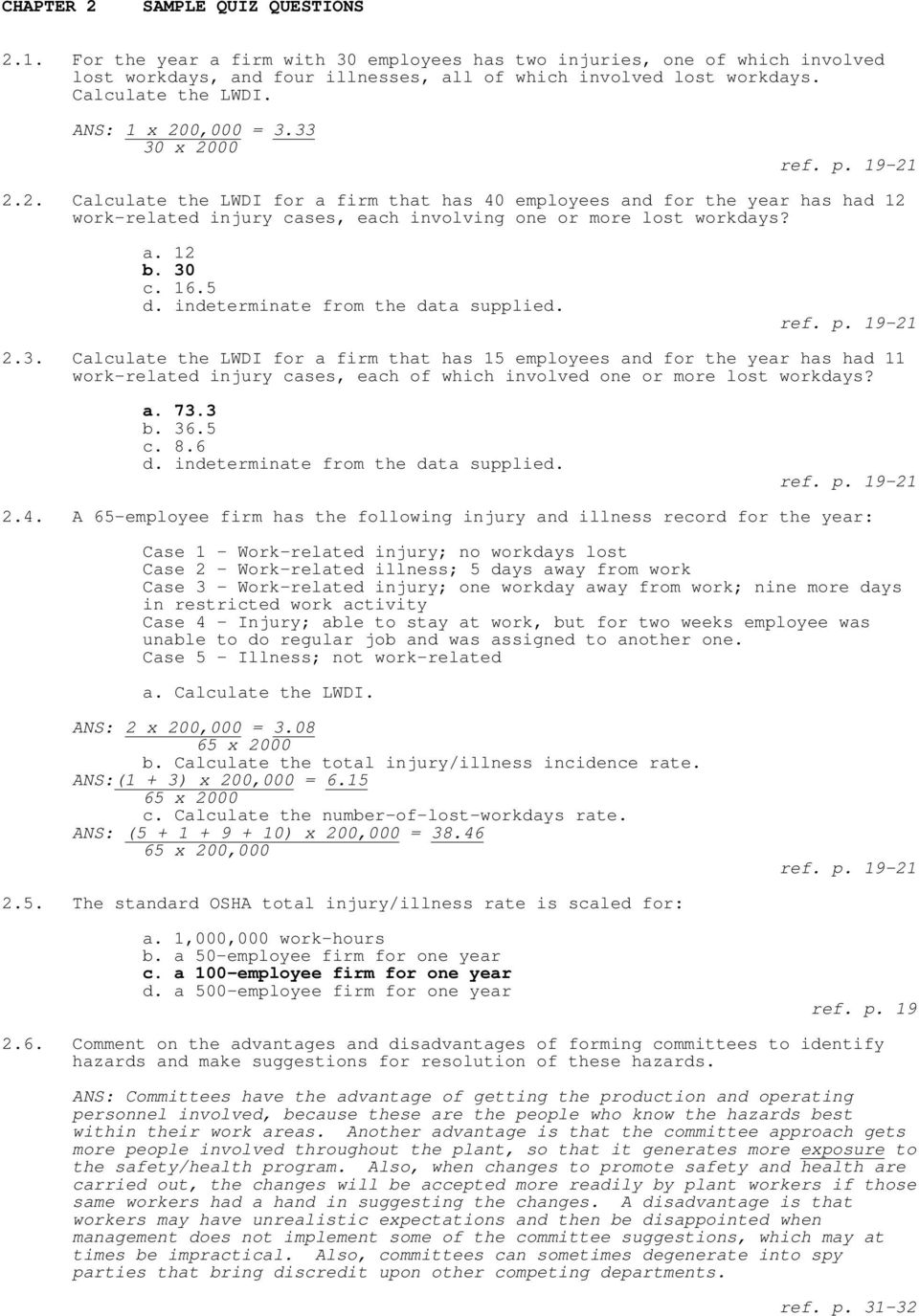
1 CHAPTER 2 SAMPLE QUIZ QUESTIONS 2.1. For the year a firm with 30 employees has two injuries, one of which involved lost workdays, and four illnesses, all of which involved lost workdays. Calculate the LWDI. ANS: 1 x 200,000 = x Calculate the LWDI for a firm that has 40 employees and for the year has had 12 work-related injury cases, each involving one or more lost workdays? a. 12 b. 30 c d. indeterminate from the data supplied Calculate the LWDI for a firm that has 15 employees and for the year has had 11 work-related injury cases, each of which involved one or more lost workdays? a b c. 8.6 d. indeterminate from the data supplied A 65-employee firm has the following injury and illness record for the year: Case 1 - Work-related injury; no workdays lost Case 2 - Work-related illness; 5 days away from work Case 3 - Work-related injury; one workday away from work; nine more days in restricted work activity Case 4 - Injury; able to stay at work, but for two weeks employee was unable to do regular job and was assigned to another one. Case 5 - Illness; not work-related a. Calculate the LWDI. ANS: 2 x 200,000 = x 2000 b. Calculate the total injury/illness incidence rate. ANS:(1 + 3) x 200,000 = x 2000 c. Calculate the number-of-lost-workdays rate. ANS: ( ) x 200,000 = x 200, The standard OSHA total injury/illness rate is scaled for: a. 1,000,000 work-hours b. a 50-employee firm for one year c. a 100-employee firm for one year d. a 500-employee firm for one year ref. p Comment on the advantages and disadvantages of forming committees to identify hazards and make suggestions for resolution of these hazards. ANS: Committees have the advantage of getting the production and operating personnel involved, because these are the people who know the hazards best within their work areas. Another advantage is that the committee approach gets more people involved throughout the plant, so that it generates more exposure to the safety/health program. Also, when changes to promote safety and health are carried out, the changes will be accepted more readily by plant workers if those same workers had a hand in suggesting the changes. A disadvantage is that workers may have unrealistic expectations and then be disappointed when management does not implement some of the committee suggestions, which may at times be impractical. Also, committees can sometimes degenerate into spy parties that bring discredit upon other competing departments. ref. p
2 2.7. On February 1, a firm posts its annual OSHA 300A Summary for the previous year as shown below. For purposes of this exercise, assume that both of the illnesses (listed in M(5)) were in the category of lost workdays (Category H cases with days away from work). Calculate: (a) LWDI: ANS: To arrive at the number of cases to count in the LWDI subtract the illness cases out of the total in Category H, i.e., 6-2 = 4. 4 x 200,000 LWDI = ,000 = 4 x 2 = 8 (b) Illness incidence rate: ANS. 2 x 200,000 Illness-incidence = ,000 = 2 x 2 = 4 (c) Fatality-incidence rate: ANS. 1 x 200,000 Fatality-incidence = ,000 = 1 x 2 = 2 (d) Number-of-lost-workdays rate: ANS. ( ) x 200,000 Number-of-lost-workdays rate = ,000

3 = 33 x 2 = The text describes a type of analysis that is said to be the "single most effective method of training workers to avoid injury and illness." Name this analysis and describe its advantages and its primary disadvantage. ANS: "Accident cause analysis" is advantageous in that it shows workers what has already happened to their co-workers. It is advantageous even for those accidents that do not result in injuries, because even no-injury accidents are unwanted events that next time might cause injuries. The analysis can lead to design changes to product, process, or work procedures. The primary disadvantage is that the analysis is too late to prevent the accident being studied. ref. p Place an entry in the attached OSHA 300 Log for the following Case File. If the case file is not recordable write "Not recordable" on the line. Case File 11--Tenosynovitis victim undergoes carpal tunnel surgery. The employee is away from work all day Tuesday, May 6, and returns to work Friday morning, May 9, at the regular time for her shift. However, due to the surgery she is given an alternate job beginning on the Friday that she returns to work, and she stays on that alternate job until Monday morning, June 2, when she returns to her regular job. ANS: The Case File 11 entry should read: Note that Column H was checked because being away from work is considered a more serious result than Column I, job transfer or restriction. Since the worker was away from work all day Tuesday, Wednesday, and Thursday, Column L shows 3 days away from work. From Friday, May 9, she remains in her alternate job assignment until Monday, June 2. Counting all the days INCLUDING weekends in this alternate job, she was in job transfer or restriction a total of 24 calendar days, so the entry in Column K is 24. Since tenosynovitus can not be classified as an injury or skin disorder or respiratory condition or poisoning, it is classified as All other illnesses, Column M(5). ref. p

4 2.10. Examine the OSHA 300 Log and construct the OSHA 300a Summary of Work-Related Injuries and Illnesses on the form provided. Assume that this firm has 200 employees and all employees worked for the entire year. Calculate the LWDI. ANS:
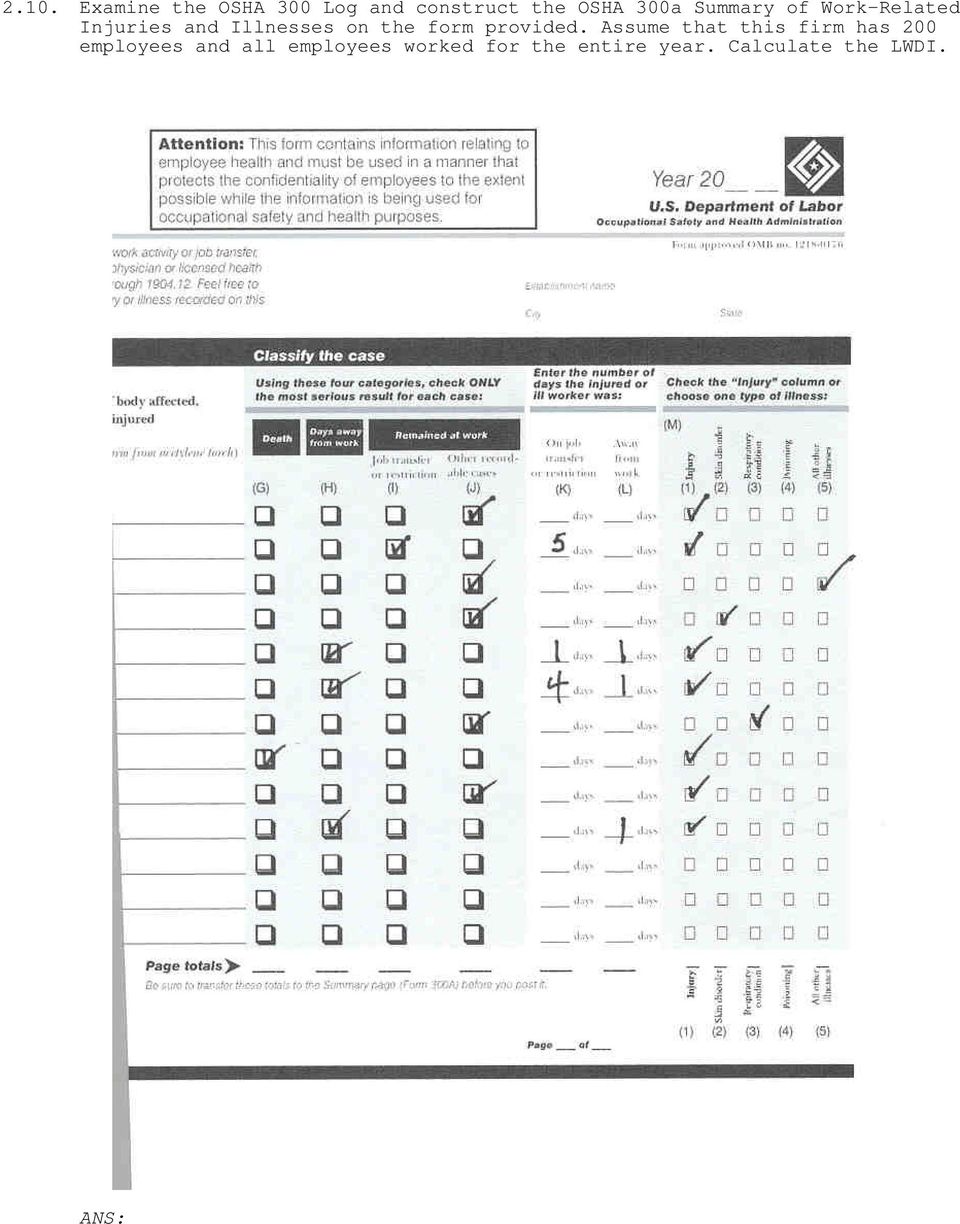
5 LWDI = 4 x 200,000 = x 2000 ref. p

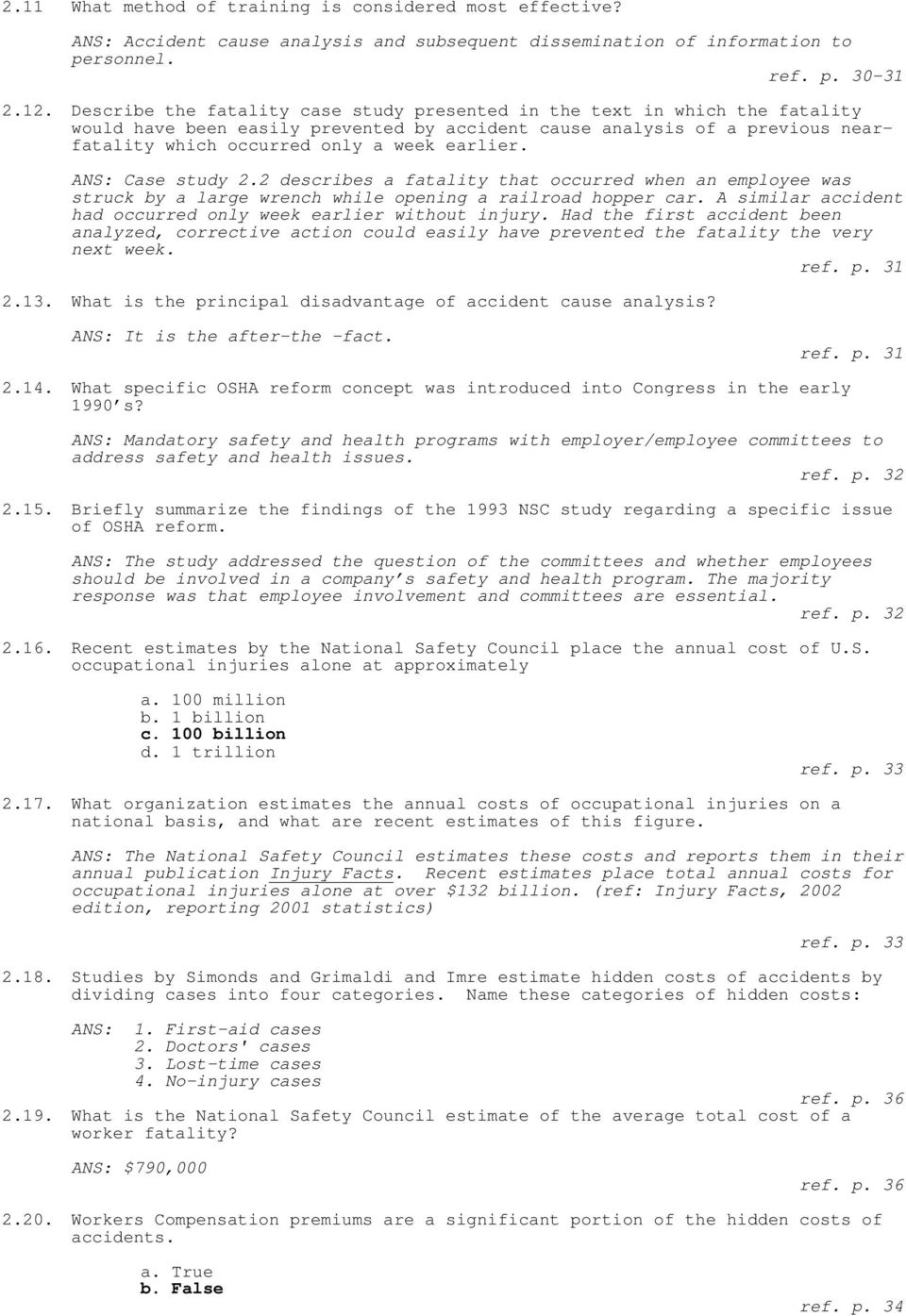
6 2.11 What method of training is considered most effective? ANS: Accident cause analysis and subsequent dissemination of information to personnel. ref. p Describe the fatality case study presented in the text in which the fatality would have been easily prevented by accident cause analysis of a previous nearfatality which occurred only a week earlier. ANS: Case study 2.2 describes a fatality that occurred when an employee was struck by a large wrench while opening a railroad hopper car. A similar accident had occurred only week earlier without injury. Had the first accident been analyzed, corrective action could easily have prevented the fatality the very next week. ref. p What is the principal disadvantage of accident cause analysis? ANS: It is the after-the fact. ref. p What specific OSHA reform concept was introduced into Congress in the early 1990 s? ANS: Mandatory safety and health programs with employer/employee committees to address safety and health issues. ref. p Briefly summarize the findings of the 1993 NSC study regarding a specific issue of OSHA reform. ANS: The study addressed the question of the committees and whether employees should be involved in a company s safety and health program. The majority response was that employee involvement and committees are essential. ref. p Recent estimates by the National Safety Council place the annual cost of U.S. occupational injuries alone at approximately a. 100 million b. 1 billion c. 100 billion d. 1 trillion ref. p What organization estimates the annual costs of occupational injuries on a national basis, and what are recent estimates of this figure. ANS: The National Safety Council estimates these costs and reports them in their annual publication Injury Facts. Recent estimates place total annual costs for occupational injuries alone at over $132 billion. (ref: Injury Facts, 2002 edition, reporting 2001 statistics) ref. p Studies by Simonds and Grimaldi and Imre estimate hidden costs of accidents by dividing cases into four categories. Name these categories of hidden costs: ANS: 1. First-aid cases 2. Doctors' cases 3. Lost-time cases 4. No-injury cases ref. p What is the National Safety Council estimate of the average total cost of a worker fatality? ANS: $790,000 ref. p Workers Compensation premiums are a significant portion of the hidden costs of accidents.
7 2.21. Workers Compensation premiums have grown in recent years to become a more significant percentage of total payroll. ref. p Despite significantly higher premium rates for Workers Compensation insurance in recent years, these costs are still considered as the tip of the iceberg when considering the total costs of accidents The hidden costs of accidents are considered the tip of the iceberg when compared to the rising levels of Workers Compensation costs Due to recent significant increases, Workers Compensation costs have been found to exceed the hidden costs of accidents Which of the following cost categories is referred to in the text as the "tip of the iceberg?" a. Workers Compensation costs b. Hidden costs of accidents c. OSHA fines d. Cost of compliance with OSHA standards Which of the following costs are covered by Workers Compensation insurance? a. Cost of wages paid supervisors for time required for activities necessitated by the accident. b. Overtime wages for the time needed to make up lost production. c. Wage cost caused by decreased output of injured worker after return to work. d. All of the above e. None of the above ref. p What two facets of a drug or alcohol abuse program are suggested by the text? ANS: 1. Screening tests 2. Employee assistance programs ref. p What 1990 law protects disabled persons from job discrimination? ANS: The Americans with Disabilities Act (ADA) ref. p Name the two infectious viruses that are the target of OSHA's Bloodborne Pathogens standard. ANS: 1. Human Immunodeficiency Virus (HIV) (also called "AIDS" virus) 2. Hepatitis B virus (HBV) The primary at-risk occupations for bloodborne pathogens are the health care professions. a. true b. false

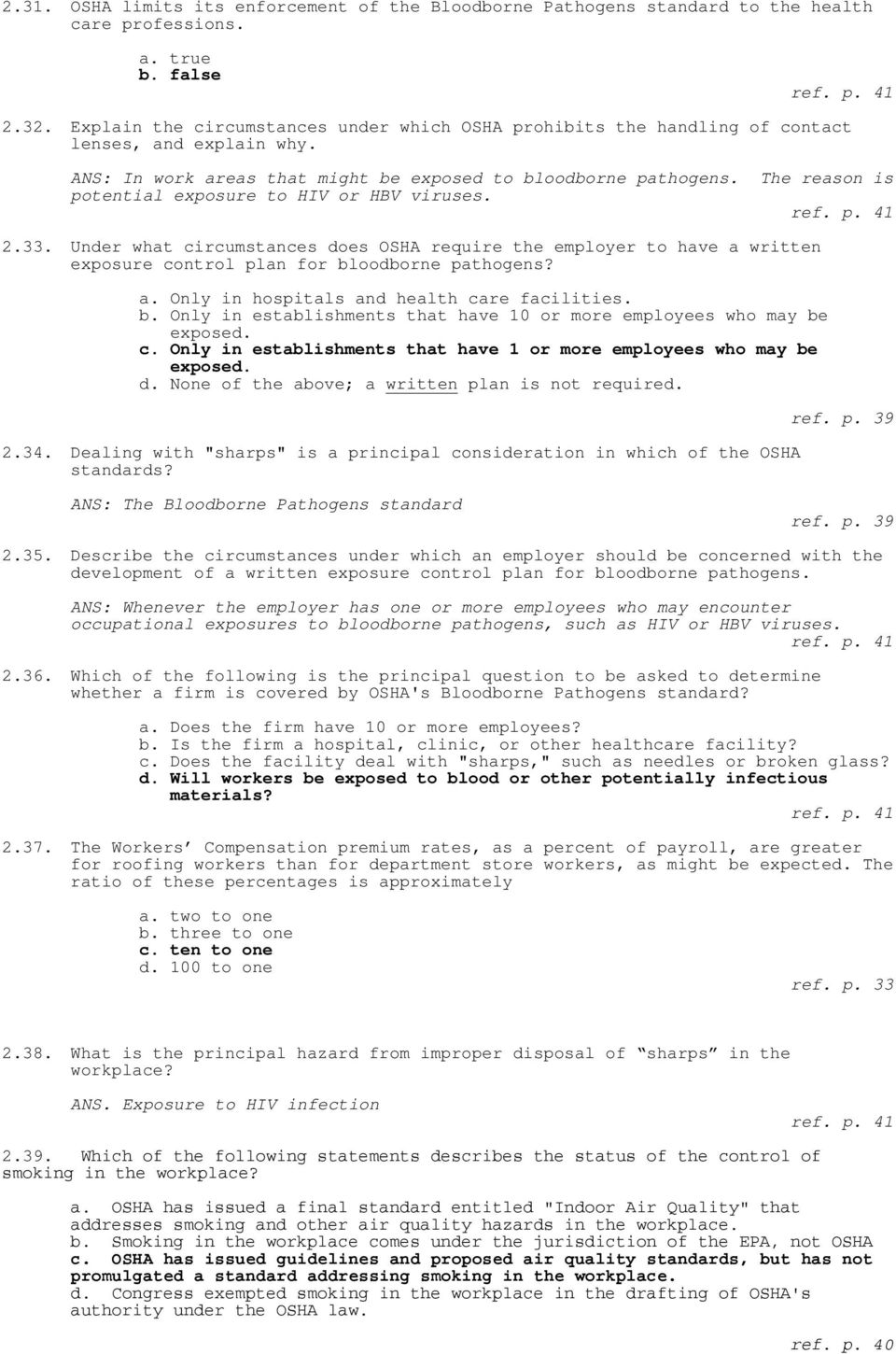
8 2.31. OSHA limits its enforcement of the Bloodborne Pathogens standard to the health care professions. a. true b. false Explain the circumstances under which OSHA prohibits the handling of contact lenses, and explain why. ANS: In work areas that might be exposed to bloodborne pathogens. The reason is potential exposure to HIV or HBV viruses Under what circumstances does OSHA require the employer to have a written exposure control plan for bloodborne pathogens? a. Only in hospitals and health care facilities. b. Only in establishments that have 10 or more employees who may be exposed. c. Only in establishments that have 1 or more employees who may be exposed. d. None of the above; a written plan is not required Dealing with "sharps" is a principal consideration in which of the OSHA standards? ref. p. 39 ANS: The Bloodborne Pathogens standard ref. p Describe the circumstances under which an employer should be concerned with the development of a written exposure control plan for bloodborne pathogens. ANS: Whenever the employer has one or more employees who may encounter occupational exposures to bloodborne pathogens, such as HIV or HBV viruses Which of the following is the principal question to be asked to determine whether a firm is covered by OSHA's Bloodborne Pathogens standard? a. Does the firm have 10 or more employees? b. Is the firm a hospital, clinic, or other healthcare facility? c. Does the facility deal with "sharps," such as needles or broken glass? d. Will workers be exposed to blood or other potentially infectious materials? The Workers Compensation premium rates, as a percent of payroll, are greater for roofing workers than for department store workers, as might be expected. The ratio of these percentages is approximately a. two to one b. three to on c. ten to one e d. 100 to one ref. p What is the principal hazard from improper disposal of sharps in the workplace? ANS. Exposure to HIV infection Which of the following statements describes the status of the control of smoking in the workplace? a. OSHA has issued a final standard entitled "Indoor Air Quality" that addresses smoking and other air quality hazards in the workplace. b. Smoking in the workplace comes under the jurisdiction of the EPA, not OSHA c. OSHA has issued guidelines and proposed air quality standards, but has not promulgated a standard addressing smoking in the workplace. d. Congress exempted smoking in the workplace in the drafting of OSHA's authority under the OSHA law. ref. p. 40
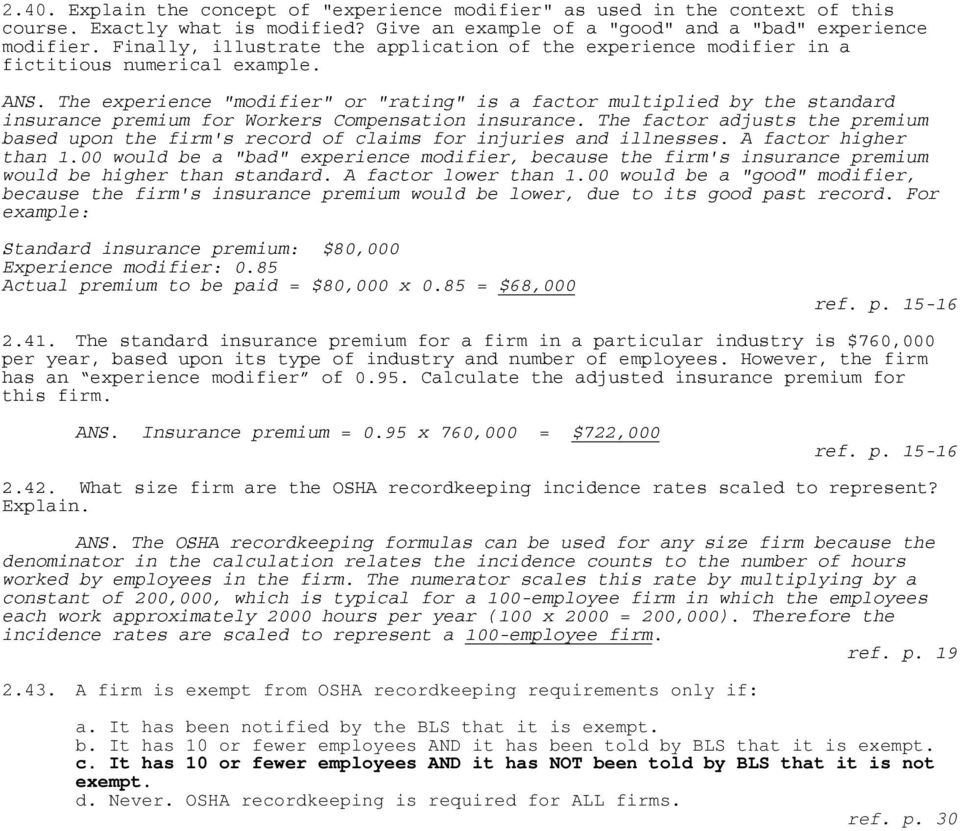
9 2.40. Explain the concept of "experience modifier" as used in the context of this course. Exactly what is modified? Give an example of a "good" and a "bad" experience modifier. Finally, illustrate the application of the experience modifier in a fictitious numerical example. ANS. The experience "modifier" or "rating" is a factor multiplied by the standard insurance premium for Workers Compensation insurance. The factor adjusts the premium based upon the firm's record of claims for injuries and illnesses. A factor higher than 1.00 would be a "bad" experience modifier, because the firm's insurance premium would be higher than standard. A factor lower than 1.00 would be a "good" modifier, because the firm's insurance premium would be lower, due to its good past record. For example: Standard insurance premium: $80,000 Experience modifier: 0.85 Actual premium to be paid = $80,000 x 0.85 = $68,000 ref. p The standard insurance premium for a firm in a particular industry is $760,000 per year, based upon its type of industry and number of employees. However, the firm has an experience modifier of Calculate the adjusted insurance premium for this firm. ANS. Insurance premium = 0.95 x 760,000 = $722,000 ref. p What size firm are the OSHA recordkeeping incidence rates scaled to represent? Explain. ANS. The OSHA recordkeeping formulas can be used for any size firm because the denominator in the calculation relates the incidence counts to the number of hours worked by employees in the firm. The numerator scales this rate by multiplying by a constant of 200,000, which is typical for a 100-employee firm in which the employees each work approximately 2000 hours per year (100 x 2000 = 200,000). Therefore the incidence rates are scaled to represent a 100-employee firm. ref. p A firm is exempt from OSHA recordkeeping requirements only if: a. It has been notified by the BLS that it is exempt. b. It has 10 or fewer employees AND it has been told by BLS that it is exempt. c. It has 10 or fewer employees AND it has NOT been told by BLS that it is not exempt. d. Never. OSHA recordkeeping is required for ALL firms. ref. p. 30
KEY CAL/OSHA STANDARDS THAT APPLY TO MOST EMPLOYERS
 KEY CAL/OSHA STANDARDS THAT APPLY TO MOST EMPLOYERS FACTSHEET 1 Below are some key Cal/OSHA standards that apply to most employers: A. INJURY AND ILLNESS PREVENTION PROGRAM STANDARD (Title 8 California
OSHA Training Guidelines (An Unofficial Summary)
 OSHA Training Guidelines (An Unofficial Summary) Many standards promulgated by the Occupational Safety and Health Administration (OSHA) explicitly require the employer to train employees in the safety
Safety Issue: OSHA requires most employers to maintain. Recording and Reporting Occupational Injuries and Illnesses
 Overview Safety Issue: Is your organization currently in compliance with OSHA s occupational injury and illness recording and reporting requirements? OSHA requires most employers to maintain occupational
29 CFR Part 1904 Recording and Reporting Occupational Injuries and Illnesses
 29 CFR Part 1904 Recording and Reporting Occupational Injuries and Illnesses Revised 3/06 1 Organization of the Rule Subpart A - Purpose Subpart B - Scope Subpart C - Forms and recording criteria Subpart
OSHA Compliance Checklist ASC
 OSHA Compliance Checklist ASC Date Inspectors Facility OSHA is the agency responsible for establishing and enforcing standards that will make the workplace safe and healthful for the employees. The way
OSHA Recordkeeping Policy #: OGP 600
 OSHA Recordkeeping Policy #: OGP 600 APPROVED BY: Anthony Dallas, MD, CMO SUPERCEDES POLICY: 03/2006 ADOPTED: 03/2006 REVISED: 09/09/2015 REVIEWED: OBJECTIVE: To recognize, report, and record work-related
Roger Williams University. Bloodborne Pathogens Exposure Control Plan
 Roger Williams University Bloodborne Pathogens Exposure Control Plan Revised 12/2010 ROGER WILLIAMS UNIVERSITY BLOODBORNE PATHOGENS EXPOSURE CONTROL PLAN I. STATEMENT OF POLICY It is the policy of Roger
ALL INJURIES MUST BE REPORTED WITHIN 24 HOURS OF THE INCIDENT TO BOTH THE SITE ADMINISTRATION AND THE CALL CENTER.
 REGULATION TITLE: Reporting Industrial Injuries or Illness Tucson, Arizona POLICY REGULATION CODE: GBGC-R1 ALL INJURIES MUST BE REPORTED WITHIN 24 HOURS OF THE INCIDENT TO BOTH THE SITE ADMINISTRATION
Part 801 Recording and Reporting Public Employees' Occupational Injuries and Illnesses (Statutory authority: Labor Law 27-a)
 Part 801 Recording and Reporting Public Employees' Occupational Injuries and Illnesses (Statutory authority: Labor Law 27-a) Sec. 801.0 Purpose 801.1 Reserved 801.2 Reserved 801.3 Reserved 801.4 Recording
Reporting Work-Related Injuries and Illnesses
 Page #: 1 of 14 Last Reviewed/Update Date: 12/10/14 Reporting Work-Related Injuries and Illnesses 1. Purpose / Background This SOP describes procedures for reporting work-related injuries and illnesses
Employee Injury/Illness Reporting and Managed Return to Work. April 15, 2011 HR 23. Human Resources Responsible Key Business
 Managed Return to Work Date Effective April 15, 2011 City Manager Revision Date Effective Code Number HR 23 Human Resources Responsible Key Business Objective: The City of Charlotte seeks to ensure the
Leader s Guide E4017. Bloodborne Pathogens: Always Protect Yourself
 E4017 Bloodborne Pathogens: Always Protect Yourself 1 Table of Contents Introduction 3 Video Overview.3 Video Outline.4 Preparing for and Conducting a Presentation. 7 Discussion Ideas..8 Quiz..9 Quiz Answers...11
OSHA INJURY AND ILLNESS RECORDKEEPING 5 STEP PROCESS
 29 CFR Part 1904 Recording and Reporting Occupational Injuries and Illnesses 1 Organization of the Rule Subpart A - Purpose Subpart B - Scope Subpart C - Forms and recording criteria Subpart D - Other
YOUTH CONSULTATION SERVICE (YCS) WORKERS COMPENSATION POLICY AND PROCEDURES
 YOUTH CONSULTATION SERVICE (YCS) WORKERS COMPENSATION POLICY AND PROCEDURES - 1 -Revised 02/05 PHILOSOPHY STATEMENT It shall be the philosophy of Youth Consultation Service to value its employees as important
Bloodborne Pathogens Exposure Incident Reporting Kit
 THE UNIVERSITY OF SOUTHERN INDIANA Bloodborne Pathogens Exposure Incident Reporting Kit Administrative Services Annex North 8600 University Blvd., Evansville, IN 47712 Any Questions? TELEPHONE: (812) 461-5393
Management Plan For Control of Blood-borne Pathogens, Infectious Wastes and Other Potentially Hazardous Biological Agents
 Management Plan For Control of Blood-borne Pathogens, Infectious Wastes and Other Potentially Hazardous Biological Agents 1.0 Executive Summary 1.1 The Bloodborne Pathogen standard, initiated by OSHA,
29 CFR Part 1904. Revised 1/1/04
 29 CFR Part 1904 Recording and Reporting Occupational Injuries and Illnesses Revised 1/1/04 1 Organization of the Rule Subpart A -Purpose Subpart B -Scope Subpart C -Forms and recording criteria Subpart
29 CFR Part 1904. Recording and reporting occupational injuries and illnesses
 29 CFR Part 1904 Recording and reporting occupational injuries and illnesses OSHA Form 300 Log of Work-related Injuries and Illnesses OSHA Form 300A Summary of Work-related Injuries and Illnesses OSHA
Indicator 1 (Alternate Method): Non-Fatal Work-Related Injuries and Illnesses
 Indicator 1 (Alternate Method): Non-Fatal Work-Related Injuries and Illnesses Significance i Work-related injuries are typically one-time events and include burns, falls, strains, sprains or fractures,
1) Giving patient access and control over their health information
 he HIPAA Challenge: How to protect patient privacy while providing necessary information to individuals and entities involved in the patient s care that need patient information to perform necessary services.
DO YOU WORK AROUND BLOOD OR BODY FLUIDS? Cal/OSHA s New Rules
 DO YOU WORK AROUND BLOOD OR BODY FLUIDS? Cal/OSHA s New Rules Labor Occupational Health Program University of California, Berkeley 1994 ACKNOWLEDGMENTS This booklet is a publication of the Labor Occupational
Workers Compensation Injury/Illness Reporting
 Workers Compensation Injury/Illness Reporting s I. Introductions/Objectives This document outlines the procedures and responsibilities for reporting injuries, illnesses, accidents and medical emergencies
The New OSHA Regulations on. Sharps Safety Requirements
 The New OSHA Regulations on Sharps Safety Requirements 2001 ASOA Congress on Ophthalmic Practice Management April 29, 2001 San Diego, California By Page 1 of 12 BACKGROUND Numerous workers who are occupationally
For Employees: Employees: What What to to do do when when an an accident occurs 08/19/14/dmv
 For Employees: What to do when an accident occurs 08/19/14/dmv When there is a work-related accident or illness, procedures must be taken to ensure the employees needs are met with respect to treatment
STANDARD OPERATING PROCEDURE SOP Sec. 5.4 Workers Compensation Incident Reporting
 This SOP implements Section 5.4 of the Policy Manual. A. If an incident occurs in which an employee is injured during the course of and arising out of his/her employment with the County, the employee shall:
Bloodborne Pathogens (HIV, HBV, and HCV) Exposure Management
 Bloodborne Pathogens Exposure Policy and Procedures Employees of the State of South Dakota Department of Health Bloodborne Pathogens (HIV, HBV, and HCV) Exposure Management PEP Hotline 1-888-448-4911 DOH
OSHA s Bloodborne Pathogens Standard 1910.1030
 OSHA s Bloodborne Pathogens Standard 1910.1030 Jens Nissen & Kennan Arp Iowa OSHA Enforcement 515-281-3122 [email protected] or [email protected] Bloodborne Pathogens Standard Federal Law 29 CFR 1910.1030
NCI-Frederick Safety and Environmental Compliance Manual 03/2013
 C-6. Medical Surveillance I. Purpose The purpose of the medical surveillance of employees at the NCI-Frederick is to preserve health and prevent work related disease. The medical surveillance program will
Livingston County Michigan Human Resources Policy Manual
 Livingston County Michigan Human Resources Policy Manual Section: Subject: A. POLICY 1. PURPOSE: To establish uniform procedures for claims and payments. 2. POLICY STATEMENT: Livingston County will provide
Safety Incentive and Injury Discipline Policies: The Bad, The Even Worse and the Downright Ugly
 United Steelworkers Health, Safety & Environment Department Safety Incentive and Injury Discipline Policies: The Bad, The Even Worse and the Downright Ugly Safety Incentive Programs In a Washington state
SUBJECT: Audit Report Compliance with Occupational Safety and Health Administration Recordkeeping Requirements (Report Number HR-AR-11-004)
 May 27, 2011 DEBORAH M. GIANNONI-JACKSON VICE PRESIDENT, EMPLOYEE RESOURCE MANAGEMENT SUBJECT: Audit Report Compliance with Occupational Safety and Health (Report Number ) This report presents the results
Reportable vs. Recordable. Recording and Reporting Occupational Injuries and Illnesses. Why Track Injuries? 1904.2 - Industry Exemption
 Recording and Reporting Occupational Injuries and Illnesses 29 CFR Part 1904 Reportable vs. Recordable o Reportable BWC report claims ASAP there are only two reasons to report injuries to OSHA o Recordable
FLORENCE TOWNSHIP BOARD OF EDUCATION FILE CODE: 4112.4/4212.4 Florence, New Jersey
 FLORENCE TOWNSHIP BOARD OF EDUCATION FILE CODE: 4112.4/4212.4 Florence, New Jersey Regulation Exposure Control Administration BLOODBORNE PATHOGENS A. The district safety and health program officer, district
What to Do When an Accident Occurs - Work Comp Procedures
 What to Do When an Accident Occurs - Work Comp Procedures Immediate Response Non-emergency Respond with onsite first aid/cpr responders. Employee must select a physician from the Panel of Physicians form
Shop Safety. Action Tattoo 3525 Del Mar Heights Rd., Suite 7 San Diego, CA 92130
 Shop Safety Action Tattoo 3525 Del Mar Heights Rd., Suite 7 San Diego, CA 92130 Action Tattoo Exposure Control and Infection Prevention Plan (ECIPP) Established on: / / Section 1: Policy, Scope, and Responsibility...
Occupational Medicine
 2408 Wanda Daley Drive Ames, Iowa 50011-3602 (515) 294-5359 www.ehs.iastate.edu Copyright Reviewed 2015 Environmental Health and Safety 2809 Daley Drive Ames, IA 50011-3660 Ph: (515) 294-5359 www.ehs.iastate.edu
Employer Record Retention Requirements
 Brought to you by Kistler Tiffany Benefits Employer Record Retention Requirements The following table summarizes numerous employer recordkeeping and retention requirements, indicating the longest retention
ITH STAFFING EMPLOYEE HANDBOOK
 ITH STAFFING EMPLOYEE HANDBOOK Revised November 2013 ITH/FIELD EMPLOYEES This employee handbook is not meant to be a contract of employment. Its only purpose is to inform employees about company policies,
Office of Advocacy. Occupational Safety and Health Administration's (OSHA) Draft Proposed Safety and Health Program Rule 29 CFR 1900.
 Office of Advocacy Occupational Safety and Health Administration's (OSHA) Draft Proposed Safety and Health Program Rule CONTENTS (a) Scope (b) Basic obligation (c) Management leadership and employee participation
The methods of implementation of these elements of the standard are discussed in the subsequent pages of this ECP.
 Exposure Control Plan (ECP) for Bloodborne Pathogens Updated 9/15/2009 Purpose Our Company is committed to providing a safe and healthful work environment for our entire staff. In pursuit of this endeavor,
OCCUPATIONAL SAFETY AND HEALTH ADMINISTRATION (OSHA)
 OCCUPATIONAL SAFETY AND HEALTH ADMINISTRATION (OSHA) The OSHA/VOSH 1910.1030 Blood borne Pathogens Standard was issued to reduce the occupational transmission of infections caused by microorganisms sometimes
Workers Compensation Procedures Booklet
 Workers Compensation Procedures Booklet Supervisor s Guide (Revised January 2015) TABLE OF CONTENTS WHO IS COVERED?... 2 INJURIES COVERED... 2 INJURIES NOT COVERED... 3 WHAT SHOULD I DO WHEN AN EMPLOYEE
Cal/OSHA Recordkeeping Requirements. Presented by: Meg McCormick Loss Prevention Specialist ALPHA Fund
 Cal/OSHA Recordkeeping Requirements Presented by: Meg McCormick Loss Prevention Specialist ALPHA Fund Objectives O Explain what constitutes a recordable injury and/or illness O Discuss how to fill out
OSHA INJURY AND ILLNESS RECORDKEEPING. Dave Stolp National Safety Council, Nebraska
 OSHA INJURY AND ILLNESS RECORDKEEPING Dave Stolp National Safety Council, Nebraska Let s talk OSHA recordkeeping... WARNING: DO NOT MIX OSHA RECORDABILITY AND WORKERS COMPENSATION Workers Compensation
George Mason University Accident and Incident Plan
 George Mason University Prepared by: Environmental Health and Safety Office May 2015 Foreword The is intended for use by all parties working at, attending, or visiting George Mason University. This Plan
Recording and Reporting Occupational Injuries and Illnesses. Mike Minicky, CSP OSHA-St. Louis Area Office [email protected]
 Recording and Reporting Occupational Injuries and Illnesses Mike Minicky, CSP OSHA-St. Louis Area Office [email protected] At the end of this session, participants will be able to Identify the OSHA
This program is listed as a mandatory inspection item on the MnOSHA Investigation Checklist, Item 7D.
 Standard: Summary: Coverage: Workplace Accident and Injury Reduction Program RESOLUTION NO# 0809-88 Minnesota Statutes 182.653, A Workplace Accident and Injury Reduction Program Minnesota Rules 5205.1500,
INJURY & ILLNESS RECORDKEEPING POLICY
 INJURY & ILLNESS RECORDKEEPING POLICY 1 Contents 1 PURPOSE... 3 2 SCOPE... 3 3 RESPONSIBILITIES... 3 4 INJURY AND ILLNESS RECORDING PROCEDURE... 3 5 POSTING REQUIREMENTS... 4 6 RECORD RETENTION REQUIREMENTS...
OSHA s Revised Bloodborne Pathogens Standard. Outreach and Education Effort 2001
 OSHA s Revised Bloodborne Pathogens Standard Outreach and Education Effort 2001 Bloodborne Pathogens Standard 29 CFR 1910.1030, Occupational Exposure to Bloodborne Pathogens Published December 1991 Effective
BLOODBORNE PATHOGENS EXPOSURE CONTROL PROGRAM
 BLOODBORNE PATHOGENS EXPOSURE CONTROL PROGRAM Purpose: The purpose of this program is to eliminate or minimize employee and student exposure to blood and other potentially infectious materials. This exposure
A P P E N D I X SAMPLE FORMS
 A P P E N D I X A SAMPLE FORMS Authorization for Disclosure Consent for HBV/HCV Antigens, HIV Antibody Documentation of Staff Education Employees Eligible for Hepatitis-B Vaccination Hepatitis-A Consent
OSHA 29 CFR Part 1904 Recording and Reporting Occupational Injuries and Illnesses
 OSHA 29 CFR Part 1904 Recording and Reporting Occupational Injuries and Illnesses The following are explanations and instructions on what you need to do to be in compliance with the above OSHA Standard.
Bloodborne Pathogens
 Bloodborne Pathogens Learning Objectives By the end of this section, the participant should be able to: Name 3 bloodborne pathogens Identify potentially contaminated bodily fluids Describe 3 safe work
Workers Compensation Program Review and Approval Authority
 July 2003 Workers Compensation Program Review and Approval Authority Prepared and Edited by: Assistant Director Date UM Workers Compensation Manager Date Reviewed and Approved by: Chair - UM E, H & S Operations
INCIDENT RATES DEFINITIONS:
 INCIDENT RATES Incident rates are an indication of how many incidents have occurred, or how severe they were. They are measurements only of past performance or lagging indicators. Incident rates are also
Category Records to be Retained Period of Record Retention
 Personnel Records Retention In order for the City to reduce it s requirements to provide space for and maintain inactive employee personnel files the following is adopted: 1. All records on inactive employees
MIOSHA Recordkeeping Summary Report Injury and Illness Reporting & Recordkeeping Standards and Process
 January 29, 2005 MIOSHA Recordkeeping Summary Report Injury and Illness Reporting & Recordkeeping Standards and Process Public posting of the MIOSHA Summary of Work-Related Injuries and Illnesses (Form
Workers Compensation. Are Costs Controllable?
 Workers Compensation Are Costs Controllable? Your WC Risk Costs Has your WC premium gone down in recent years? Has your WC premium stayed the same? Has your WC premium gone up in recent years? Are you
Bloodborne Pathogens Program Revised July, 5 2012
 Bloodborne Pathogens Program Revised July, 5 2012 Page 1 of 16 Table of Contents 1.0 INTRODUCTION...3 1.1 Purpose...3 1.2 Policy.3 2.0 EXPOSURE CONTROL METHODS 4 2.1 Universal Precautions.4 2.2 Engineering
SAFETY DOESN T HAVE TO BE EXPENSIVE! SAMPLE PAGES. OSHA Recordkeeping Policy
 SAFETY DOESN T HAVE TO BE EXPENSIVE! OSHA Recordkeeping Policy Valued Customer, Thank you for selecting Affordable Safety Training safety solutions for your business. This OSHA Compliant Program will provide
Health Care Worker Health and Safety: Preventing Needlestick Injury and Occupational Exposure to Bloodborne Pathogens
 Health Care Worker Health and Safety: Preventing Needlestick Injury and Occupational Exposure to Bloodborne Pathogens World Health Organization International Council of Nurses WHO-ICN Project Preventing
RECORDING AND REPORTING OCCUPATIONAL INJURIES ILLNESSES PART 1904
 RECORDING AND REPORTING OCCUPATIONAL INJURIES ILLNESSES PART 1904 The Occupational Safety and Health Act of 1970 requires most private sector employers to prepare and maintain records of work related injuries
Mercyhurst University Athletic Training Program Bloodborne Pathogens Exposure Control Plan
 Mercyhurst University Athletic Training Program Bloodborne Pathogens Exposure Control Plan In accordance with the Occupational Safety Health Administration (OSHA) Bloodborne Pathogens Standard, 29 CFR
WORKERS COMPENSATION QUICK FACTS
 The Workers' Compensation Handbook // 1 WORKERS COMPENSATION QUICK FACTS Workers Compensation Quick Facts contains general information about the workers compensation system in New Mexico, to provide employers
WORKER S COMPENSATION, ACCIDENT REPORTING AND OSHA RECORDKEEPING
 Authority: WORKER S COMPENSATION, ACCIDENT REPORTING AND OSHA RECORDKEEPING Chancellor History: Revised January 22, 2007; supersedes former Policy No. HR 5.10 effective July 24, 1995 Source of Authority:
BLOODBORNE PATHOGENS EXPOSURE CONTROL PLAN
 BLOODBORNE PATHOGENS EXPOSURE CONTROL PLAN Updated October 30, 2015 Table of Contents Table of Contents Policy... 1 Scope and Application... 1 2.1 Exposure Determination by Job Title and Task... 1 Definitions...
Bloodborne Pathogens (BBPs) Louisiana Delta Community College
 Bloodborne Pathogens (BBPs) Louisiana Delta Community College 1 Bloodborne Pathogens Rules & Regulations Office of Risk Management (ORM) requires development of a bloodborne pathogens plan low risk employees
INTRODUCTION TO OSHA PRESENTATION
 Introduction to OSHA 2-hour Lesson Directorate of Training and Education OSHA Training Institute Lesson Overview Purpose: To provide workers with introductory information about OSHA Topics: 1. Why is OSHA
WORKPLACE INJURY AND ILLNESS INCIDENT REPORT & GUIDE
 WORKPLACE INJURY AND ILLNESS INCIDENT REPORT & GUIDE Included: Overview Dos and Don ts Checklist Sample Workplace Injury and Illness Incident Report 1. Overview Employees are some of the most valuable
Federal Agency OSHA Injury and Illness Recordkeeping Requirements
 Federal Agency OSHA Injury and Illness Recordkeeping Requirements September 27, 2013 Mikki Holmes Office of Federal Agency Programs [email protected] 202.693.2491 2013 updates to 29 CFR 1960 Establishes
OSHA & Workers Compensation Requirements Recording Workplace Injuries & Illness
 Human Resources 30-71 7/15/91 3/25/02 1 of 7 OSHA & Workers Compensation Requirements Recording Workplace Injuries & Illness VPSI, Inc. is subject to the record-keeping requirements of the Occupational
These procedures are applicable to all employees of NCI-Frederick.
 B-2. Accident Reporting I. Scope These procedures are applicable to all employees of NCI-Frederick. II. Purpose A. To provide for the systematic reporting and investigation of occupational injury and illness
OCCUPATIONAL HEALTH AND SAFETY IN HOSPITALITY
 OCCUPATIONAL HEALTH AND SAFETY IN HOSPITALITY Employee Induction Checklist March 2003 CONTENTS HOSPITALITY INDUSTRY OHS EMPLOYEE INDUCTION CHECKLIST... 2 INTRODUCTION... 2 WHAT IS THE OHS INDUCTION CHECKLIST?...
Lancet Device Incident Investigation Report - 2012
 Lancet Device Incident Investigation Report - 2012 Summary On May 16, 2012 the Winnipeg Regional Health Authority (WRHA) received notification from the University of Manitoba (U of M) of an incident at
OCCUPATIONAL HEALTH, DISABILITY AND LEAVE SECTOR MEASURES TO MINIMIZE EXPOSURE TO BLOODBORNE PATHOGENS AND POST-EXPOSURE PROPHYLAXIS POLICY
 UNIVERSITY OF OTTAWA OCCUPATIONAL HEALTH, DISABILITY AND LEAVE SECTOR MEASURES TO MINIMIZE EXPOSURE TO BLOODBORNE PATHOGENS AND POST-EXPOSURE PROPHYLAXIS POLICY Prepared by the Occupational Health, Disability
MODEL POLICY TO COMPLY WITH NEW OSHA INJURY REPORTING REQUIREMENTS
 MODEL POLICY TO COMPLY WITH NEW OSHA INJURY REPORTING REQUIREMENTS XYZ COMPANY INCIDENT & INJURY REPORTING POLICY 1.0 Purpose It is the policy of XYZ Company (Company) that all incidents that result in
EXPOSURE CONTROL PLAN (sample) 1 Child Care Directors and Employers
 EXPOSURE CONTROL PLAN (sample) 1 Child Care Directors and Employers The Model Exposure Control Plan is intended to serve as an employer guide to the OSHA Bloodborne Pathogens standard. A central component
Best Practices for Machine Shops. Best Practices for. Machine Shops
 Best Practices for Machine Shops Contents Introduction...3 Management commitment...3 Pre-employment screening... 5 Accident analysis...6 Claims management...6 Employee training...6 Employee invovement...7
elearning Course Catalog Human Resources
 ADA- What Supervisors Need to Know This online employment course will help supervisors identify the purpose of the ADA, define "disability" correctly, make reasonable accommodations, handle job interviews
Blood-borne viruses in the workplace Guidance for employers and employees
 Blood-borne viruses in the workplace Guidance for employers and employees Is this guidance useful to me? If you are an employer or employee, self-employed or a safety representative, and involved in work
FILING WORKERS COMPENSATION CLAIMS IN IDAHO
 Claims contact information First Report of Injury forms [email protected] General e-mail [email protected] FILING WORKERS COMPENSATION CLAIMS IN IDAHO Provider inquiries 208-332-2169 or 800-334-2370
SUB-CONTRACTOR/VENDOR PRE-QUALIFICATION QUESTIONNAIRE
 Page 1 of 7 SUB-CONTRACTOR/VENDOR PRE-QUALIFICATION QUESTIONNAIRE GENERAL INFORMATION 1. Company Name/Contractors License No.: Telephone: SIC(s): Street Address: Mailing Address: 2. Officers: Years With
ACCIDENT/INCIDENT INVESTIGATION RIDDOR
 1.0 INTRODUCTION ACCIDENT/INCIDENT INVESTIGATION RIDDOR In the event of an employee, contractor, visitor or member of the public suffering an injury from a work related incident, certain procedures must