
Minimum variance portfolio mathematics
|
|
|
- Pierce Barnett
- 9 years ago
- Views:
Transcription
1 Spring 6 Minimum variance portfolio mathematics Consider a portfolio of mutual funds: long term debt securities (D) and sotck fund in equity (E). Debt Equity E(r) 8% 3% % % Cov(r D ; r E ) 7 D;E.3 weights w D w E = w D We can compute the expected return on the portfolio P E(r P ) = w D E(r D ) + w E E(r E ); in our example we have given that w D = w E ; E(r P ) = :8w D + :3w E E(r P ) = :8( w E ) + :3w E = :8 + :5w E ; if we plot it we get E[r_P] The variance of the portfolio w_e P = wd D + we E + w D w E Cov(r D; r E ); in our example we have P = wd + we + w D w E 7 P = ( w E ) + we + ( w E )w E 7 P = 4wE 44w E + 44: This variance as a function of w E is

2 Spring 6 var(r_p) w_e Variance of a portfolio of two risky assets Assume a portfolio composed of two risky assets The expected return is then, the variance of this portfolio will be r P = w D r D + w E r E E(r P ) = w D E(r D ) + w E E(r E ); P = E [r P E[r P ]] = E rp ] [E[r P ] h = E (w D r D + w E r E ) i [w D E(r D ) + w E E(r E )] = = E n(w D r D ) + (w E r E ) + w D r D w E r E h io (w D E(r D )) + (w E E(r E )) + w D w E E(r D )E(r E ) = = w DE(r D) + w EE(r E) + w D w E E(r D r E ) w DE(r D ) w EE(r E ) w D w E E(r D )E(r E ) = rearranging we have = wde(r D) wde(r D ) + wee(r E) wee(r E ) + w D w E E(r D r E ) w D w E E(r D )E(r E ) = = wd E(r D ) E(r D ) + w E E(r {z } E ) E(r E ) + w D w E [E(r D r E ) E(r D )E(r E )] = {z } {z } D Cov(r D ;r E ) E Recall that the correlation coe cient is = w D D + w E E + w D w E Cov(r D ; r E ): D;E = Cov(r D; r E ) D E : then, we can express the portfolio variance as follows: P = w D D + w E E + w D w E Cov(r D ; r E ) = w D D + w E E + w D w E DE D E :
![) = w D E(r D ) + w E E(r E ); P = E [r P E[r P ]] = E rp ] [E[r P ] h = E (w D r D + w E r E ) i [w D E(r D ) + w E E(r E )] = = E n(w D r D ) + (w E r E ) + w D r D w E r E h io (w D E(r D )) + (w](/docs-images/48/19198059/images/page_2.jpg "E E(r E )) + w D w E E(r D )E(r E ) = = w DE(r D) + w EE(r E) + w D w E E(r D r E ) w DE(r D ) w EE(r E ) w D w E E(r D )E(r E ) = rearranging we have = wde(r D) wde(r D ) + wee(r E) wee(r E ) + w D")
3 Spring 6 Relationship between correlation coe cients and portfolio variance Let s analyze the variance of the portfolio depending on the correlation coe cient of the assets. If D;E =! Cov(r D ; r E ) = D E ; then the portfolio variance becomes and P = w D D + w E E : P = w D D + w E E + w D w E Cov(r D; r E ) = = w D D + w E E + w D w E D E = = (w D D + w E E ) If D;E =! Cov(r D ; r E ) = ; then the portfolio variance becomes that is, P = wd D + w E E P = w D D + w E E + w D w E Cov(r D; r E ) = = w D D + w E E + = = w D D + w E E If D;E =! Cov(r D ; r E ) = D E ; then the portfolio variance becomes and P = abs(w D D by setting that is, we are left with and P = w D D + w E E + w D w E Cov(r D; r E ) = = w D D + w E E w D w E D E = = (w D D w E E ) w E E ): In this case, a perfectly hedging portfolio can be obtained P = abs(w D D w E E ); P = w D D w E E ; P = w E E w D D : In general, the variance of the portfolio expressed as P = w D D + w E E + w D w E Cov(r D; r E ); if we replace w D = w E ; can be rewritten as follows: P = D + w E D w E D + w E E + w E Cov(r D; r E ) w ECov(r D; r E ): If we plot the relationship between standard deviation of the portfolio ( P ) and the proportion of wealth allocated to equity for alternative correlation coe cients, D;E, we obtain 3

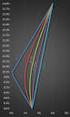
4 Spring 6 sigma_p Solid line: DE = Dots line: DE = Circle line: DE = w_e Notice that if all income is allocated to Debt (w E = ) the volatility of the portfolio is that of Debt, whereas if all income is allocated to Equity (w E = ); then the volatility of the portfolio is that of Equity. Then, depending on the correlation coe cient between these two assets we get di erent combinations between w E and P : When DE = (solid line), there is no room for reducing risk by diversi cation. When DE = (dotted line) some risk reduction is possible and this is shown in the shape of the curve. The highest risk reduction is achieved when DE = (circle line) in fact, portfolio volatility can be completely reduced. In our example, this would happen when w E is roughly around :4; and therefore w D is approximately :6: We will compute this optimal allocation later. Computing the minimum variance portfolio Taking the formula of the variance of the portfolio P = D + w E D w E D + w E E + w E Cov(r D; r E ) w ECov(r D; r E ): Which proportion of assets should we choose in order to minimize this variance? Derive P with respect to w E d P dw E = w E D D + w E E + Cov(r D; r E ) 4w E Cov(r D; r E ) = ; that is, w E = D Cov(r D; r E ) D + E Cov(r D; r E ) : 4

5 Spring 6 Notice that when D;E =! Cov(r D ; r E ) = D E ; this equation collapses to In general, w E = D + D E D + E + D E = D( D + E ) ( D + E ) = w E = D D;E D E D + E Cov(r D; r E ) : D D + E : If we apply this to the numbers in our example we obtain P = D + we D + E Cov(r D; r E ) D Cov(r D; r E ) w E ; the minimum variance is attained at that is, d P dw E = w E D + E D;E D E D D;E D E = ; we D D;E D E = D + = 44 4 D;E = 9 5 D;E ; E D;E D E D;E 34 3 D;E then depending on D;E we obtain di erent optimal allocations The risk-return tradeo D;E =! w E = :5! w E = D;E =! w E = 6:47% D;E =! w E = 37:5% D;E = :9! w E = 64:8! w E = D;E = :3! w E = 8%; then w D = 8% Now, we can put together all the relationships between risk and return, since and given the standard deviation in general E(r P ) = :8 + :5w E ; P = D + w E D + E Cov(r D; r E ) D Cov(r D; r E ) w E ; we could solve for the relationship between expected return and risk, the result is 5

6 Spring 6 E[r_P] sigma_p In the gure, the gross solid line refers to the case D;E = ; the circle line is for D;E = ; the dotted line is for the case D;E = ; and nally, the thin solid line refers to the numerical example D;E = :3: 6

Lesson 5. Risky assets
 Lesson 5. Risky assets Prof. Beatriz de Blas May 2006 5. Risky assets 2 Introduction How stock markets serve to allocate risk. Plan of the lesson: 8 >< >: 1. Risk and risk aversion 2. Portfolio risk 3.
1 Capital Allocation Between a Risky Portfolio and a Risk-Free Asset
 Department of Economics Financial Economics University of California, Berkeley Economics 136 November 9, 2003 Fall 2006 Economics 136: Financial Economics Section Notes for Week 11 1 Capital Allocation
CAPM, Arbitrage, and Linear Factor Models
 CAPM, Arbitrage, and Linear Factor Models CAPM, Arbitrage, Linear Factor Models 1/ 41 Introduction We now assume all investors actually choose mean-variance e cient portfolios. By equating these investors
Capital Allocation Between The Risky And The Risk- Free Asset. Chapter 7
 Capital Allocation Between The Risky And The Risk- Free Asset Chapter 7 Investment Decisions capital allocation decision = choice of proportion to be invested in risk-free versus risky assets asset allocation
CHAPTER 7: OPTIMAL RISKY PORTFOLIOS
 CHAPTER 7: OPTIMAL RIKY PORTFOLIO PROLEM ET 1. (a) and (e).. (a) and (c). After real estate is added to the portfolio, there are four asset classes in the portfolio: stocks, bonds, cash and real estate.
Answers to Concepts in Review
 Answers to Concepts in Review 1. A portfolio is simply a collection of investments assembled to meet a common investment goal. An efficient portfolio is a portfolio offering the highest expected return
Portfolio Performance Measures
 Portfolio Performance Measures Objective: Evaluation of active portfolio management. A performance measure is useful, for example, in ranking the performance of mutual funds. Active portfolio managers
CHAPTER 6 RISK AND RISK AVERSION
 CHAPTER 6 RISK AND RISK AVERSION RISK AND RISK AVERSION Risk with Simple Prospects Risk, Speculation, and Gambling Risk Aversion and Utility Values Risk with Simple Prospects The presence of risk means
Four Derivations of the Black Scholes PDE by Fabrice Douglas Rouah www.frouah.com www.volopta.com
 Four Derivations of the Black Scholes PDE by Fabrice Douglas Rouah www.frouah.com www.volopta.com In this Note we derive the Black Scholes PDE for an option V, given by @t + 1 + rs @S2 @S We derive the
Lecture 1: Asset Allocation
 Lecture 1: Asset Allocation Investments FIN460-Papanikolaou Asset Allocation I 1/ 62 Overview 1. Introduction 2. Investor s Risk Tolerance 3. Allocating Capital Between a Risky and riskless asset 4. Allocating
Final Exam MØA 155 Financial Economics Fall 2009 Permitted Material: Calculator
 University of Stavanger (UiS) Stavanger Masters Program Final Exam MØA 155 Financial Economics Fall 2009 Permitted Material: Calculator The number in brackets is the weight for each problem. The weights
1. a. (iv) b. (ii) [6.75/(1.34) = 10.2] c. (i) Writing a call entails unlimited potential losses as the stock price rises.
![1. a. (iv) b. (ii) [6.75/(1.34) = 10.2] c. (i) Writing a call entails unlimited potential losses as the stock price rises.](/thumbs/39/20115486.jpg "1. a. (iv) b. (ii) [6.75/(1.34) = 10.2] c. (i) Writing a call entails unlimited potential losses as the stock price rises.") 1. Solutions to PS 1: 1. a. (iv) b. (ii) [6.75/(1.34) = 10.2] c. (i) Writing a call entails unlimited potential losses as the stock price rises. 7. The bill has a maturity of one-half year, and an annualized
1. Solutions to PS 1: 1. a. (iv) b. (ii) [6.75/(1.34) = 10.2] c. (i) Writing a call entails unlimited potential losses as the stock price rises. 7. The bill has a maturity of one-half year, and an annualized
Solution: The optimal position for an investor with a coefficient of risk aversion A = 5 in the risky asset is y*:
 Problem 1. Consider a risky asset. Suppose the expected rate of return on the risky asset is 15%, the standard deviation of the asset return is 22%, and the risk-free rate is 6%. What is your optimal position
CHAPTER 6: RISK AVERSION AND CAPITAL ALLOCATION TO RISKY ASSETS
 CHAPTER 6: RISK AVERSION AND CAPITAL ALLOCATION TO RISKY ASSETS PROBLEM SETS 1. (e). (b) A higher borrowing is a consequence of the risk of the borrowers default. In perfect markets with no additional
Investment Analysis (FIN 670) Fall 2009. Homework 5
 Investment Analysis (FIN 670) Fall 009 Homework 5 Instructions: please read careully You should show your work how to get the answer or each calculation question to get ull credit The due date is Tuesday,
Econ 422 Summer 2006 Final Exam Solutions
 Econ 422 Summer 2006 Final Exam Solutions This is a closed book exam. However, you are allowed one page of notes (double-sided). Answer all questions. For the numerical problems, if you make a computational
CHAPTER 10 RISK AND RETURN: THE CAPITAL ASSET PRICING MODEL (CAPM)
 CHAPTER 10 RISK AND RETURN: THE CAPITAL ASSET PRICING MODEL (CAPM) Answers to Concepts Review and Critical Thinking Questions 1. Some of the risk in holding any asset is unique to the asset in question.
Distinction Between Interest Rates and Returns
 Distinction Between Interest Rates and Returns Rate of Return RET = C + P t+1 P t =i c + g P t C where: i c = = current yield P t g = P t+1 P t P t = capital gain Key Facts about Relationship Between Interest
1 Portfolio mean and variance
 Copyright c 2005 by Karl Sigman Portfolio mean and variance Here we study the performance of a one-period investment X 0 > 0 (dollars) shared among several different assets. Our criterion for measuring
Long-Term Debt Pricing and Monetary Policy Transmission under Imperfect Knowledge
 Long-Term Debt Pricing and Monetary Policy Transmission under Imperfect Knowledge Stefano Eusepi, Marc Giannoni and Bruce Preston The views expressed are those of the authors and are not necessarily re
AFM 472. Midterm Examination. Monday Oct. 24, 2011. A. Huang
 AFM 472 Midterm Examination Monday Oct. 24, 2011 A. Huang Name: Answer Key Student Number: Section (circle one): 10:00am 1:00pm 2:30pm Instructions: 1. Answer all questions in the space provided. If space
t = 1 2 3 1. Calculate the implied interest rates and graph the term structure of interest rates. t = 1 2 3 X t = 100 100 100 t = 1 2 3
 MØA 155 PROBLEM SET: Summarizing Exercise 1. Present Value [3] You are given the following prices P t today for receiving risk free payments t periods from now. t = 1 2 3 P t = 0.95 0.9 0.85 1. Calculate
Enhancing the Teaching of Statistics: Portfolio Theory, an Application of Statistics in Finance
 Page 1 of 11 Enhancing the Teaching of Statistics: Portfolio Theory, an Application of Statistics in Finance Nicolas Christou University of California, Los Angeles Journal of Statistics Education Volume
CFA Examination PORTFOLIO MANAGEMENT Page 1 of 6
 PORTFOLIO MANAGEMENT A. INTRODUCTION RETURN AS A RANDOM VARIABLE E(R) = the return around which the probability distribution is centered: the expected value or mean of the probability distribution of possible
Midterm Exam:Answer Sheet
 Econ 497 Barry W. Ickes Spring 2007 Midterm Exam:Answer Sheet 1. (25%) Consider a portfolio, c, comprised of a risk-free and risky asset, with returns given by r f and E(r p ), respectively. Let y be the
Wel Dlp Portfolio And Risk Management
 1. In case of perfect diversification, the systematic risk is nil. Wel Dlp Portfolio And Risk Management 2. The objectives of investors while putting money in various avenues are:- (a) Safety (b) Capital
 C C D E C C D E C C D E C C D E C C C Figure 1: Distribution of of s Density 0 1 2 2 4 3 6 4 5 8 4 2 0 0 2 4.5 Fraction of Applications Approved 0.2.4.6.8 1 Figure 2: The Credit-Score Regression
GESTÃO FINANCEIRA II PROBLEM SET 3 - SOLUTIONS (FROM BERK AND DEMARZO S CORPORATE FINANCE ) LICENCIATURA UNDERGRADUATE COURSE
 GESTÃO FINANCEIRA II PROBLEM SET 3 - SOLUTIONS (FROM BERK AND DEMARZO S CORPORATE FINANCE ) LICENCIATURA UNDERGRADUATE COURSE 1 ST SEMESTER 010-011 Chapter 10 Capital Markets and the Pricing of Risk 10-1.
1 Pricing options using the Black Scholes formula
 Lecture 9 Pricing options using the Black Scholes formula Exercise. Consider month options with exercise prices of K = 45. The variance of the underlying security is σ 2 = 0.20. The risk free interest
Mid-Term Spring 2003
 Mid-Term Spring 2003 1. (1 point) You want to purchase XYZ stock at $60 from your broker using as little of your own money as possible. If initial margin is 50% and you have $3000 to invest, how many shares
RISKS IN MUTUAL FUND INVESTMENTS
 RISKS IN MUTUAL FUND INVESTMENTS Classification of Investors Investors can be classified based on their Risk Tolerance Levels : Low Risk Tolerance Moderate Risk Tolerance High Risk Tolerance Fund Classification
BS2551 Money Banking and Finance. Institutional Investors
 BS2551 Money Banking and Finance Institutional Investors Institutional investors pension funds, mutual funds and life insurance companies are the main players in securities markets in both the USA and
Chapter 2 Portfolio Management and the Capital Asset Pricing Model
 Chapter 2 Portfolio Management and the Capital Asset Pricing Model In this chapter, we explore the issue of risk management in a portfolio of assets. The main issue is how to balance a portfolio, that
1 Capital Asset Pricing Model (CAPM)
 Copyright c 2005 by Karl Sigman 1 Capital Asset Pricing Model (CAPM) We now assume an idealized framework for an open market place, where all the risky assets refer to (say) all the tradeable stocks available
Holding Period Return. Return, Risk, and Risk Aversion. Percentage Return or Dollar Return? An Example. Percentage Return or Dollar Return? 10% or 10?
 Return, Risk, and Risk Aversion Holding Period Return Ending Price - Beginning Price + Intermediate Income Return = Beginning Price R P t+ t+ = Pt + Dt P t An Example You bought IBM stock at $40 last month.
Chapter 9 Interest Rates
 Chapter 9 Interest Rates Concept Questions 1. Short-term rates have ranged between zero and 14 percent. Long-term rates have fluctuated between about two and 13 percent. Long-term rates, which are less
Optimal Risky Portfolios Chapter 7 Investments Bodie, Kane and Marcus
 Optimal Risky ortfolios Section escription 7.0 Introduction 7.1 iversification and ortfolio Risk 7. ortfolios of Two Risky Assets 7.3 Asset Allocation with Stocks, Bonds and Bills 7.4 The Markowitz ortfolio
Review for Exam 2. Instructions: Please read carefully
 Review for Exam 2 Instructions: Please read carefully The exam will have 25 multiple choice questions and 5 work problems You are not responsible for any topics that are not covered in the lecture note
Financial-Institutions Management
 Solutions 3 Chapter 11: Credit Risk Loan Pricing and Terms 9. County Bank offers one-year loans with a stated rate of 9 percent but requires a compensating balance of 10 percent. What is the true cost
Use the table for the questions 18 and 19 below.
 Use the table for the questions 18 and 19 below. The following table summarizes prices of various default-free zero-coupon bonds (expressed as a percentage of face value): Maturity (years) 1 3 4 5 Price
M.I.T. Spring 1999 Sloan School of Management 15.415. First Half Summary
 M.I.T. Spring 1999 Sloan School of Management 15.415 First Half Summary Present Values Basic Idea: We should discount future cash flows. The appropriate discount rate is the opportunity cost of capital.
The CAPM (Capital Asset Pricing Model) NPV Dependent on Discount Rate Schedule
 The CAPM (Capital Asset Pricing Model) Massachusetts Institute of Technology CAPM Slide 1 of NPV Dependent on Discount Rate Schedule Discussed NPV and time value of money Choice of discount rate influences
Chapter 7 Risk, Return, and the Capital Asset Pricing Model
 Chapter 7 Risk, Return, and the Capital Asset Pricing Model MULTIPLE CHOICE 1. Suppose Sarah can borrow and lend at the risk free-rate of 3%. Which of the following four risky portfolios should she hold
Valuing Stock Options: The Black-Scholes-Merton Model. Chapter 13
 Valuing Stock Options: The Black-Scholes-Merton Model Chapter 13 Fundamentals of Futures and Options Markets, 8th Ed, Ch 13, Copyright John C. Hull 2013 1 The Black-Scholes-Merton Random Walk Assumption
CHAPTER 11: ARBITRAGE PRICING THEORY
 CHAPTER 11: ARBITRAGE PRICING THEORY 1. The revised estimate of the expected rate of return on the stock would be the old estimate plus the sum of the products of the unexpected change in each factor times
Life Cycle Asset Allocation A Suitable Approach for Defined Contribution Pension Plans
 Life Cycle Asset Allocation A Suitable Approach for Defined Contribution Pension Plans Challenges for defined contribution plans While Eastern Europe is a prominent example of the importance of defined
The Behavior of Bonds and Interest Rates. An Impossible Bond Pricing Model. 780 w Interest Rate Models
 780 w Interest Rate Models The Behavior of Bonds and Interest Rates Before discussing how a bond market-maker would delta-hedge, we first need to specify how bonds behave. Suppose we try to model a zero-coupon
The Cost of Equity in Latin America
 Working Paper Nº 12 The Cost of Equity in Latin America Martin Grandes, Demian Panigo and Ricardo Pasquini December 2005 The Cost of Equity in Latin America Martin Grandes The American University of Paris
This paper is not to be removed from the Examination Halls
 ~~FN3023 ZB d0 This paper is not to be removed from the Examination Halls UNIVERSITY OF LONDON FN3023 ZB BSc degrees and Diplomas for Graduates in Economics, Management, Finance and the Social Sciences,
Characteristics of Binomial Distributions
 Lesson2 Characteristics of Binomial Distributions In the last lesson, you constructed several binomial distributions, observed their shapes, and estimated their means and standard deviations. In Investigation
Practice Set #4 and Solutions.
 FIN-469 Investments Analysis Professor Michel A. Robe Practice Set #4 and Solutions. What to do with this practice set? To help students prepare for the assignment and the exams, practice sets with solutions
Makeup Exam MØA 155 Financial Economics February 2010 Permitted Material: Calculator, Norwegian/English Dictionary
 University of Stavanger (UiS) Stavanger Masters Program Makeup Exam MØA 155 Financial Economics February 2010 Permitted Material: Calculator, Norwegian/English Dictionary The number in brackets is the
Executive Summary of Finance 430 Professor Vissing-Jørgensen Finance 430-62/63/64, Winter 2011
 Executive Summary of Finance 430 Professor Vissing-Jørgensen Finance 430-62/63/64, Winter 2011 Weekly Topics: 1. Present and Future Values, Annuities and Perpetuities 2. More on NPV 3. Capital Budgeting
VIX, the CBOE Volatility Index
 VIX, the CBOE Volatility Index Ser-Huang Poon September 5, 008 The volatility index compiled by the CBOE (Chicago Board of Option Exchange) has been shown to capture nancial turmoil and produce good volatility
INTERNATIONAL COMPARISON OF INTEREST RATE GUARANTEES IN LIFE INSURANCE
 INTERNATIONAL COMPARISON OF INTEREST RATE GUARANTEES IN LIFE INSURANCE J. DAVID CUMMINS, KRISTIAN R. MILTERSEN, AND SVEIN-ARNE PERSSON Abstract. Interest rate guarantees seem to be included in life insurance
A. GDP, Economic Growth, and Business Cycles
 ECON 3023 Hany Fahmy FAll, 2009 Lecture Note: Introduction and Basic Concepts A. GDP, Economic Growth, and Business Cycles A.1. Gross Domestic Product (GDP) de nition and measurement The Gross Domestic
How to Win the Stock Market Game
 How to Win the Stock Market Game 1 Developing Short-Term Stock Trading Strategies by Vladimir Daragan PART 1 Table of Contents 1. Introduction 2. Comparison of trading strategies 3. Return per trade 4.
7.4A/7.4B STUDENT ACTIVITY #1
 7.4A/7.4B STUDENT ACTIVITY #1 Write a formula that could be used to find the radius of a circle, r, given the circumference of the circle, C. The formula in the Grade 7 Mathematics Chart that relates the
How Many Days Equal A Year? Non-trivial on the Mean-Variance Model
 How Many Days Equal A Year? Non-trivial on the Mean-Variance Model George L. Ye, Dr. Sobey School of Business Saint Mary s University Halifax, Nova Scotia, Canada Christine Panasian, Dr. Sobey School of
TPPE17 Corporate Finance 1(5) SOLUTIONS RE-EXAMS 2014 II + III
 TPPE17 Corporate Finance 1(5) SOLUTIONS RE-EXAMS 2014 II III Instructions 1. Only one problem should be treated on each sheet of paper and only one side of the sheet should be used. 2. The solutions folder
z-scores AND THE NORMAL CURVE MODEL
 z-scores AND THE NORMAL CURVE MODEL 1 Understanding z-scores 2 z-scores A z-score is a location on the distribution. A z- score also automatically communicates the raw score s distance from the mean A
ATHENS UNIVERSITY OF ECONOMICS AND BUSINESS
 ATHENS UNIVERSITY OF ECONOMICS AND BUSINESS Masters in Business Administration (MBA) Offered by the Departments of: Business Administration & Marketing and Communication PORTFOLIO ANALYSIS AND MANAGEMENT
Finance 400 A. Penati - G. Pennacchi Market Micro-Structure: Notes on the Kyle Model
 Finance 400 A. Penati - G. Pennacchi Market Micro-Structure: Notes on the Kyle Model These notes consider the single-period model in Kyle (1985) Continuous Auctions and Insider Trading, Econometrica 15,
The Tangent or Efficient Portfolio
 The Tangent or Efficient Portfolio 1 2 Identifying the Tangent Portfolio Sharpe Ratio: Measures the ratio of reward-to-volatility provided by a portfolio Sharpe Ratio Portfolio Excess Return E[ RP ] r
University of Saskatchewan Department of Economics Economics 414.3 Homework #1
 Homework #1 1. In 1900 GDP per capita in Japan (measured in 2000 dollars) was $1,433. In 2000 it was $26,375. (a) Calculate the growth rate of income per capita in Japan over this century. (b) Now suppose
Multi Asset Portfolio: Back-testing Report
 Multi Asset Portfolio: Back-testing Report Report Prepared for the Hamilton Investment Fund This analysis has been undertaken by Dr Paul Docherty to verify the performance and risk of the Multi Asset Portfolio
Sample Problems. Practice Problems
 Lecture Notes Partial Fractions page Sample Problems Compute each of the following integrals.. x dx. x + x (x + ) (x ) (x ) dx 8. x x dx... x (x + ) (x + ) dx x + x x dx x + x x + 6x x dx + x 6. 7. x (x
1. Portfolio Returns and Portfolio Risk
 Chapter 8 Risk and Return: Capital Market Theory Chapter 8 Contents Learning Objectives 1. Portfolio Returns and Portfolio Risk 1. Calculate the expected rate of return and volatility for a portfolio of
Partial Fractions Decomposition
 Partial Fractions Decomposition Dr. Philippe B. Laval Kennesaw State University August 6, 008 Abstract This handout describes partial fractions decomposition and how it can be used when integrating rational
Models of Risk and Return
 Models of Risk and Return Aswath Damodaran Aswath Damodaran 1 First Principles Invest in projects that yield a return greater than the minimum acceptable hurdle rate. The hurdle rate should be higher for
Chapter 13 Composition of the Market Portfolio 1. Capital markets in Flatland exhibit trade in four securities, the stocks X, Y and Z,
 Chapter 13 Composition of the arket Portfolio 1. Capital markets in Flatland exhibit trade in four securities, the stocks X, Y and Z, and a riskless government security. Evaluated at current prices in
Number of bond futures. Number of bond futures =
 1 Number of bond futures x Change in the value of 1 futures contract = - Change in the value of the bond portfolio Number of bond futures = - Change in the value of the bond portfolio.. Change in the value
Concepts in Investments Risks and Returns (Relevant to PBE Paper II Management Accounting and Finance)
 Concepts in Investments Risks and Returns (Relevant to PBE Paper II Management Accounting and Finance) Mr. Eric Y.W. Leung, CUHK Business School, The Chinese University of Hong Kong In PBE Paper II, students
FTS Real Time System Project: Portfolio Diversification Note: this project requires use of Excel s Solver
 FTS Real Time System Project: Portfolio Diversification Note: this project requires use of Excel s Solver Question: How do you create a diversified stock portfolio? Advice given by most financial advisors
15.433 Investments. Assignment 1: Securities, Markets & Capital Market Theory. Each question is worth 0.2 points, the max points is 3 points
 Assignment 1: Securities, Markets & Capital Market Theory Each question is worth 0.2 points, the max points is 3 points 1. The interest rate charged by banks with excess reserves at a Federal Reserve Bank
a) The Dividend Growth Model Approach: Recall the constant dividend growth model for the price of a rm s stock:
 Cost of Capital Chapter 14 A) The Cost of Capital: Some Preliminaries: The Security market line (SML) and capital asset pricing model (CAPM) describe the relationship between systematic risk and expected
How To Factor By Grouping
 Lecture Notes Factoring by the AC-method page 1 Sample Problems 1. Completely factor each of the following. a) 4a 2 mn 15abm 2 6abmn + 10a 2 m 2 c) 162a + 162b 2ax 4 2bx 4 e) 3a 2 5a 2 b) a 2 x 3 b 2 x
The Time Value of Money
 The Time Value of Money This handout is an overview of the basic tools and concepts needed for this corporate nance course. Proofs and explanations are given in order to facilitate your understanding and
Instructor s Manual Chapter 12 Page 144
 Chapter 12 1. Suppose that your 58-year-old father works for the Ruffy Stuffed Toy Company and has contributed regularly to his company-matched savings plan for the past 15 years. Ruffy contributes $0.50
What s Wrong with Multiplying by the Square Root of Twelve
 What s Wrong with Multiplying by the Square Root of Twelve Paul D. Kaplan, Ph.D., CFA Director of Research Morningstar Canada January 2013 2013 Morningstar, Inc. All rights reserved. The information in
A New Perspective on The New Rule of the Current Account
 A New Perspective on The New Rule of the Current Account Cedric Tille Graduate Institute of International and Development Studies, Geneva CEPR 1 Eric van Wincoop University of Virginia NBER 2 1 Corresponding
CML is the tangent line drawn from the risk free point to the feasible region for risky assets. This line shows the relation between r P and
 5. Capital Asset Pricing Model and Factor Models Capital market line (CML) CML is the tangent line drawn from the risk free point to the feasible region for risky assets. This line shows the relation between
Recommending Alternative Investments
 Recommending Alternative Investments Content Introduction 3 The Power of Alternative Investments 4 Types of Alternative Investments 5 Alternative Investments Benefits 7 The Risk Spectrum & Determining
CHAPTER 15 INTERNATIONAL PORTFOLIO INVESTMENT SUGGESTED ANSWERS AND SOLUTIONS TO END-OF-CHAPTER QUESTIONS AND PROBLEMS
 CHAPTER 15 INTERNATIONAL PORTFOLIO INVESTMENT SUGGESTED ANSWERS AND SOLUTIONS TO END-OF-CHAPTER QUESTIONS AND PROBLEMS QUESTIONS 1. What factors are responsible for the recent surge in international portfolio
The Impact of Stochastic Volatility on Pricing, Hedging, and Hedge Efficiency of Variable Annuity Guarantees
 The Impact of Stochastic Volatility on Pricing, Hedging, and Hedge Efficiency of Variable Annuity Guarantees Alexander Kling, Frederik Ruez, and Jochen Russ Frederik Ruez, Ulm University Research Purpose
A defensive investment strategy for portfolio alpha return and market risk reduction
 Università LUISS Guido Carli Dottorato di Ricerca in Metodi Matematici per l Economia, l Azienda, la Finanza e le Assicurazioni XXII Ciclo Anno IV Tesi di Dottorato A defensive investment strategy for
Fundamentals of Futures and Options (a summary)
 Fundamentals of Futures and Options (a summary) Roger G. Clarke, Harindra de Silva, CFA, and Steven Thorley, CFA Published 2013 by the Research Foundation of CFA Institute Summary prepared by Roger G.