
Insuring, Hedging and Trading Credit Risks in Financial Macroeconomics
|
|
|
- Jocelin Pearson
- 9 years ago
- Views:
Transcription
1 Insuring, Hedging and Trading Credit Risks in Financial Macroeconomics Roxana Angela Calistru 1 + and Alexandru Trifu 1 1 Petre Andrei University of Iasi, Romania Abstract. The purpose of this paper is to explore how the tools we have available for facing credit risks respond to the necessity of the entities affected. We will review the classical way to face credit risks, preferred by the companies affected by the commercial credit risks the credit insurance. As well, we will make an analysis of the newest way to encounter the credit risks, that fits better the financial entities needs credit derivatives. Developments of the CDS market have played an important role in the credit risk markets before and during the current financial crisis, so we assign a generous space in the paper for analyzing the strengths of CDS derivatives, as hedging or trading instruments. The method used is that of analyzing in parallel the major macro-financial domains involving risks. Regarding the insurances, these ones are linked to international trade and evolution on the global markets and depending on the changeable conditions in different levels of real economy. More volatiles are the derivatives and represent one of the main features of the financial market. The results of our study show the fact that both instruments have to be taken into account by economic agents, in order to ensure theirs development and sustainability and, on the other hand, by a prudential financial and monetary policies, the economic welfare and global functioning of economies can be reached. Keywords: credit risks, insurance, derivatives, credit default swaps 1. Introduction Commercial activity, as well as financial, is subject to credit risks. Within an economy a broad variety of entities have a natural need to assume, reduce or manage credit exposures. These include corporate, banks, insurance companies, hedge funds, fund managers and government agencies. Each type of player will have different economic or regulatory motives for wishing to take positive or negative credit positions at particular times. Every year, many companies worldwide fail, leaving the partners with many debts; often, the reason is represented by the insolvency of their buyers or borrowers, which makes impossible to recover these amounts and therefore it continues the series of problems overflows and upon others competitors or entities. In the current period, more then once, the financial crisis effects require the valences analysis of the tools we have available for facing the credit risks. 2. The Insurance of Credit Risks We think that financial insurances represent a new and powerful type of insurance, appeared as a consequence of shrinking the distinction between financial and insurance institutions. Financial losses due to the risks are transferred to a specialized institution, an insurer. The financial insurances are different from the bank guarantees and other financial tools. These ones include the taking of risks under certain conditions, while unconditional bank guarantees involve taking into account of all obligations. Credit insurances, an important category of financial insurances, protect traders and manufacturers facing the risk of default by their customers who buy or rent goods or similar credit facilities. It appeared as a necessity emerged from the fact that the majority trade agreements are concluded in circumstances in which payment is made partially or completely after delivery of goods or services subject to contract, thus in the form of delayed payment, respectively, credit sale. Thus, credit insurance comes to eliminating the seller s fear regarding the buyer payment of the amounts due to him, offering protection for the risk of default. Therefore, credit insurance is a direct seller + Corresponding author. Tel.: ; fax: address: [email protected]. 69

2 protection against the risk of failures to receive and at the same time, as a guarantee to the bank, is also the possibility of access to finance. Credit insurance goal is to protect against financial losses resulting from default, failure or insolvency of the buyers who have purchased goods on credit or insolvency of credit beneficiaries. Through credit insurance policies there are substantially protected commercial revenues from commercial businesses, in the terms of the transfer failures risks to the insurer. Commercial risks related to the buyer's financial situation concern the following aspects: the failure due to insolvency of the buyer; the temporary or permanent inability of the buyer to pay the goods or services; the buyer's refusal to accept goods contracted for reasons beyond the seller s will. Credit insurance is an indemnity insurance, because it requires the compensation to be paid to the insured for a loss suffered because of insolvency or default of the insured client and not for a physically event, as the other insurance. Therefore, it is a pecuniary insurance, for financial loss and not material. The differences between ordinary insurance and credit insurance come from the nature of risk and from the interests of stakeholders: credit insurance involves three parties, each being aware of others; the insurer has no interest in the contract, unless as the guarantor for the purchaser; the responsibility for repayment is of the debtor, while the insurer responsibility is on the second level, being liable only if the first one fails to fulfill its obligation to pay for the reasons included in the policy. Credit insurance is considered a luxury one, being characteristic and optimal operating in markets with a stable and well developed credit system. Globally speaking, most credit insurances are practiced in the developed countries. Although insurance against these risks are available on domestic and international insurance markets, only a relatively small number of traders turn to them. Along with the necessary protection for risks that may affect companies on the medium and long term, credit insurance policy facilitates the access to financing procedure, representing a guarantee for the financing bank and removing a substantial part of risks involved. Credit insurances eliminate, in a substantially measure, the risk of financial loss, especially when it s about high-value transactions or number of partners is relatively small in business activities or market. However, credit insurance is not always profitable, especially if the individual loans are low and risks are dispersed over a large turnover. 3. Credit Derivatives Credit derivatives are a class of privately negotiated contracts designed with the express purpose of transferring credit risk from one party to another. They are financial instruments whose payoffs are linked in some way to a change in credit quality of an issuer or issuers The Credit Default Swaps (CDSs) The credit default swaps (CDSs) are the most common category of credit derivatives in the last ten years. CDSs are defined as private contracts in which parties bet on a debt issuer s default. As an insurance policy, the credit default swaps contracts must clearly specify the insured events or the credit events hedged which may vary from bankruptcy, relevant only for corporate entities, to obligation default or technical default, such as breaking of a bond pledge, failure to pay, even debs restructuring in order to improve or restore liquidity of the borrower. Therefore, the stake for the contracting partners is the underlying entity defaults, entity which may be a corporate borrower, a bond issuer or even a sovereign entity. CDS acts as a protection against losses incurred by the holder of the debt in case of the default of the reference entity. The two sides opposed into the contract are the protection buyer, usually a creditor, interested in covering the credit risk, and the protection seller, the party which assumes the financial loss in case the underlying entity defaults or becomes insolvent. The CDS buyer let oneself in for the benefits he gets in the period extends from contracting until the credit event occurs or until the contract maturity. He pays for the right to collect from the other counterparty a stipulated notional amount, in case of default of the 70

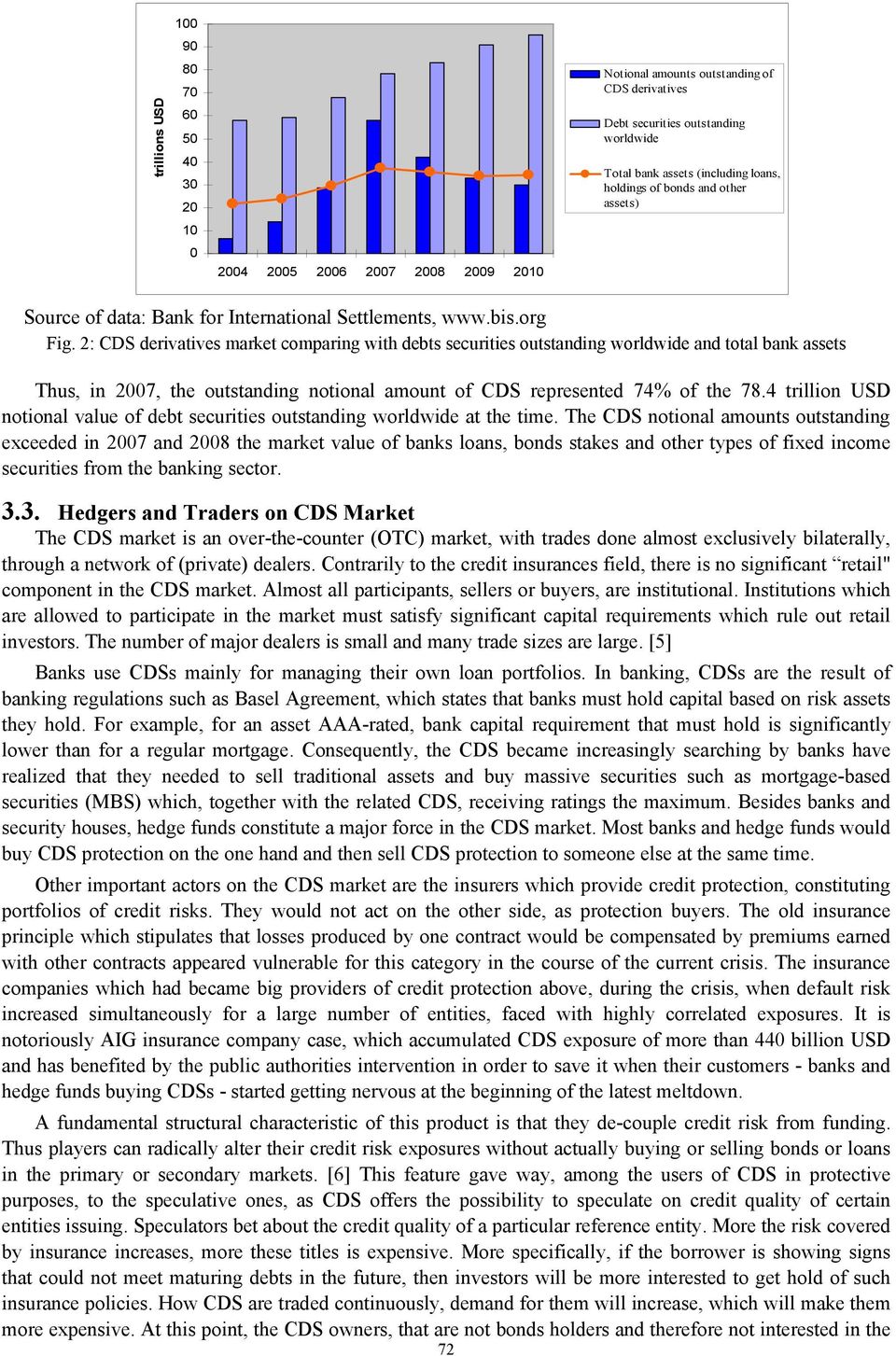
3 reference entity. This payment compensates the seller for bearing the risk of a default. It is like a premium, making CDS contract similar to an insurance policy, where one side assumes the risk and the other pays an (insurance) premium. The CDS premium is calculated to cover the expected loss of the reference entity as follows [1]: CDS premium = PD * (1-RR) There are two main parameters that determine the expected loss and hence the CDS premium: PD - the probability of default and RR - the recovery rate. The probability of default is closely related by the quality of the debts hedged with these financial instruments. (Fig. 1) 19,26% 17,55% 9,63% 53,55% Investment grade AAA-AA Investment grade A-BBB Below investment grade (BB and below) Non-rated Source of data: Bank for International Settlements, Fig. 1: Structure of CDS market by the debts quality in June 2011 As we can observe in the Bank for International Settlements survey for June 2011, the high rated (AAA to AA) underlying debts represented only 9.63% from the CDS market, while an almost double share (17.55%) is owned by the non-rated debs, the riskiest ones, which may attract important troubles for the market participants. The quality of the underlying debs and the excessive volumes traded before the crisis by some dealers caused some notoriously defaults among participants in CDS markets recently Volumes of CDSs Market CDS was launched by JP Morgan in 1997 and become the most widely used type of credit derivative, being considered by Alan Greenspan, the Federal Reserve chairman at the time, the most important instruments he has seen in decades [2]. There is only three years distance from the speech of George Soros, when he named CDS as truly toxic securities [3]. In 1997, the notional open interest in CDS was on the order of 200 billion USD. In the next decade, the notional amounts outstanding in the credit default swap (CDS) market increased moderately, so in June of 2001, the first time the International Swaps and Derivatives Association (ISDA) conducted surveys of credit derivatives, the outstanding notional amount of credit derivatives was just over 631 billion USD [4]. In the next 6 years, the rhythm of growth was very high, almost doubled in value every year. The peak of 58 trillion USD notional amounts outstanding of CDS was register at the end of After the financial crisis started, CDS market record a continuous downward trend till the 30 trillions USD at the end of Even so, the value did not drop below the 2006 level. If the figures alone do not say much, comparing with the notional value of debt securities outstanding worldwide could make the complete picture. (Fig. 2) 71
![The CDS premium is calculated to cover the expected loss of the reference entity as follows [1]: CDS premium = PD * (1-RR) There are two main parameters that determine the expected loss and hence the](/docs-images/48/19164512/images/page_3.jpg "CDS premium: PD - the probability of default and RR - the recovery rate. The probability of default is closely related by the quality of the debts hedged with these financial instruments. (Fig.")
4 trillions USD Notional amounts outstanding of CDS derivatives Debt securities outstanding worldwide Total bank assets (including loans, holdings of bonds and other assets) Source of data: Bank for International Settlements, Fig. 2: CDS derivatives market comparing with debts securities outstanding worldwide and total bank assets Thus, in 2007, the outstanding notional amount of CDS represented 74% of the 78.4 trillion USD notional value of debt securities outstanding worldwide at the time. The CDS notional amounts outstanding exceeded in 2007 and 2008 the market value of banks loans, bonds stakes and other types of fixed income securities from the banking sector Hedgers and Traders on CDS Market The CDS market is an over-the-counter (OTC) market, with trades done almost exclusively bilaterally, through a network of (private) dealers. Contrarily to the credit insurances field, there is no significant retail" component in the CDS market. Almost all participants, sellers or buyers, are institutional. Institutions which are allowed to participate in the market must satisfy significant capital requirements which rule out retail investors. The number of major dealers is small and many trade sizes are large. [5] Banks use CDSs mainly for managing their own loan portfolios. In banking, CDSs are the result of banking regulations such as Basel Agreement, which states that banks must hold capital based on risk assets they hold. For example, for an asset AAA-rated, bank capital requirement that must hold is significantly lower than for a regular mortgage. Consequently, the CDS became increasingly searching by banks have realized that they needed to sell traditional assets and buy massive securities such as mortgage-based securities (MBS) which, together with the related CDS, receiving ratings the maximum. Besides banks and security houses, hedge funds constitute a major force in the CDS market. Most banks and hedge funds would buy CDS protection on the one hand and then sell CDS protection to someone else at the same time. Other important actors on the CDS market are the insurers which provide credit protection, constituting portfolios of credit risks. They would not act on the other side, as protection buyers. The old insurance principle which stipulates that losses produced by one contract would be compensated by premiums earned with other contracts appeared vulnerable for this category in the course of the current crisis. The insurance companies which had became big providers of credit protection above, during the crisis, when default risk increased simultaneously for a large number of entities, faced with highly correlated exposures. It is notoriously AIG insurance company case, which accumulated CDS exposure of more than 440 billion USD and has benefited by the public authorities intervention in order to save it when their customers - banks and hedge funds buying CDSs - started getting nervous at the beginning of the latest meltdown. A fundamental structural characteristic of this product is that they de-couple credit risk from funding. Thus players can radically alter their credit risk exposures without actually buying or selling bonds or loans in the primary or secondary markets. [6] This feature gave way, among the users of CDS in protective purposes, to the speculative ones, as CDS offers the possibility to speculate on credit quality of certain entities issuing. Speculators bet about the credit quality of a particular reference entity. More the risk covered by insurance increases, more these titles is expensive. More specifically, if the borrower is showing signs that could not meet maturing debts in the future, then investors will be more interested to get hold of such insurance policies. How CDS are traded continuously, demand for them will increase, which will make them more expensive. At this point, the CDS owners, that are not bonds holders and therefore not interested in the 72
5 fact itself that issuer go bankrupt, but have anticipated this event and bought CDS, can sell those and obtain gain. With certain limits, speculators add liquidity to the market. The course of events beginning from 2007, give legitimate reasons to be concerned about potential problems that can be created because of exposures to credit derivatives and because of the trading of derivatives. [7] That is why the regulatory authorities have imposed a paradigm shift policy in order to achieve an increased transparency in CDS markets and to place market participants in the position to assess risks properly. 4. Conclusions For the moment, we consider that the risk of the global economic depression is not overwhelmed. The resumption of economic growth depends on risks and uncertainty on different markets, or domains of the economic and social activities. Therefore, for the moment, the revenues in insurance are not of a high level and investments on the financial markets are still going, but based on prudential principle in the benefit of all parties involved. The credit derivatives played a major role in increasing economic welfare prior to the crisis and could do the same during recovery, with the condition of a better regulation of the market, which should bring an improved balance of derivatives exposures. They did facilitate risk-sharing among investors and allow financial institutions to better manage their exposures. CDSs help complete markets, providing an effective means to hedge and trade credit risks. CDSs are important tools for managing the credit risk profile of a loan portfolio, consists of corporate bonds or asset-backed securities for example, by acquiring protection on them. Thereby, CDSs hedging provides capital relief and insures the acquirer of protection against credit losses. The problems highlighted by the financial crisis should not distract from the potential benefits of these instruments. 5. Acknowledgements This work was supported by the project "Post-Doctoral Studies in Economics: training program for elite researchers - SPODE" co-funded from the European Social Fund through the Development of Human Resources Operational Programme , contract no. POSDRU/89/1.5/S/ References [1] C. Weistroffer. Credit Default Swaps - Heading towards a more stable system, Deutche Bank Research, Frankfurt am Main, Germany, Current Issue, 21st December 2009 [2] A. Greenspan, speech at a Bond Market Association conference in New York. In C. Salas, Derivatives, Not Bonds. Show What Pimco, TIAA CREF Really Think, Bloomberg.com, Retrieved from: [3] G. Soros, speech on the Membership Meeting of Institute of International Finance (IIF), in Beijing, China, June 12, He said: "Some derivatives ought not to be allowed to be traded at all. I have in mind credit default swaps. The more I've heard about them, the more I've realised they're truly toxic." [4] S. J. Lubben, Credit Derivatives and the Future of Chapter 11, American Bankruptcy Law Journal, vol.81, 2007, Issue 4, [5] M. Avellaneda and R. Cont. Transparency in Credit Default Swap Markets, Finance Concept, July Retrieved from [6] E. Angelini, Credit Default Swaps (CDS) and their Role in the Credit Risk Market, International Journal of Academic Research in Business and Social Sciences, January 2012, Vol. 2, No. 1 [7] R. M. Stulz, Credit Default Swaps and the Credit Crisis, National Bureau of Economic Research Working Paper Series, Working Paper 15384, Cambridge, September
A Short Introduction to Credit Default Swaps
 A Short Introduction to Credit Default Swaps by Dr. Michail Anthropelos Spring 2010 1. Introduction The credit default swap (CDS) is the most common and widely used member of a large family of securities
A primer on Credit Default Swap (CDS)& RBI guidelines on CDS
 A primer on Credit Default Swap (CDS)& RBI guidelines on CDS Prof. Utkarsh Jain Assistant Professor,, Pune E-mail : [email protected] Prof. Kaustubh Medhekar Associate Professor,, Pune E-mail : [email protected]
Credit Default Swaps (CDSs) and Systemic Risks
 Journal of Modern Accounting and Auditing, ISSN 1548-6583 June 2012, Vol. 8, No. 6, 880-890 D DAVID PUBLISHING Credit Default Swaps (CDSs) and Systemic Risks Eliana Angelini G. D Annunzio University of
THE CDS AND THE GOVERNMENT BONDS MARKETS AFTER THE LAST FINANCIAL CRISIS. The CDS and the Government Bonds Markets after the Last Financial Crisis
 THE CDS AND THE GOVERNMENT BONDS MARKETS AFTER THE LAST FINANCIAL CRISIS The CDS and the Government Bonds Markets after the Last Financial Crisis Abstract In the 1990s, the financial market had developed
Wealth Management Education Series. Cultivate an Understanding of Bonds
 Wealth Management Education Series Cultivate an Understanding of Bonds Wealth Management Education Series Cultivate an Understanding of Bonds Managing your wealth well is like tending a beautiful formal
Credit Default Swaps (CDS)
 Introduction to Credit Default Swaps (CDS) CDS Market CDS provide investors with the ability to easily and efficiently short credit Shorting allows positions to be taken in forward credit risk ik CDS allow
New Features of Credit Default Swaps
 March 25, 2013 Table of contents 1 2 Evidence on 3 Origins The earliest credit default swaps involved banks attempting to manage their credit exposure and regulatory capital requirements by purchasing
CREDIT RISK MANAGEMENT
 GLOBAL ASSOCIATION OF RISK PROFESSIONALS The GARP Risk Series CREDIT RISK MANAGEMENT Chapter 1 Credit Risk Assessment Chapter Focus Distinguishing credit risk from market risk Credit policy and credit
DERIVATIVES IN INDIAN STOCK MARKET
 DERIVATIVES IN INDIAN STOCK MARKET Dr. Rashmi Rathi Assistant Professor Onkarmal Somani College of Commerce, Jodhpur ABSTRACT The past decade has witnessed multiple growths in the volume of international
Monetary and Economic Department OTC derivatives market activity in the second half of 2007
 Monetary and Economic Department OTC derivatives market activity in the second half of 27 May 28 Queries concerning this release should be addressed to the authors listed below: Section I: Naohiko Baba
Introduction to Fixed Income & Credit. Asset Management
 Introduction to Fixed Income & Credit Asset Management Fixed Income explanation The Basis of Fixed Income is the need to purchase today with not enough cash available: ie. Mortgage or consumer loan You
Shares Mutual funds Structured bonds Bonds Cash money, deposits
 FINANCIAL INSTRUMENTS AND RELATED RISKS This description of investment risks is intended for you. The professionals of AB bank Finasta have strived to understandably introduce you the main financial instruments
Using Derivatives in the Fixed Income Markets
 Using Derivatives in the Fixed Income Markets A White Paper by Manning & Napier www.manning-napier.com Unless otherwise noted, all figures are based in USD. 1 Introduction While derivatives may have a
Saving and Investing. Chapter 11 Section Main Menu
 Saving and Investing How does investing contribute to the free enterprise system? How does the financial system bring together savers and borrowers? How do financial intermediaries link savers and borrowers?
Note 10: Derivative Instruments
 Note 10: Derivative Instruments Derivative instruments are financial contracts that derive their value from underlying changes in interest rates, foreign exchange rates or other financial or commodity
The Consumer and Business Lending Initiative
 March 3, 2009 The Consumer and Business Lending Initiative A Note on Efforts to Address Securitization Markets and Increase Lending Overview The Obama administration along with the Federal Reserve, the
Risk Explanation for Exchange-Traded Derivatives
 Risk Explanation for Exchange-Traded Derivatives The below risk explanation is provided pursuant to Hong Kong regulatory requirements relating to trading in exchange-traded derivatives by those of our
ADVISORSHARES TRUST. AdvisorShares Pacific Asset Enhanced Floating Rate ETF NYSE Arca Ticker: FLRT
 ADVISORSHARES TRUST AdvisorShares Pacific Asset Enhanced Floating Rate ETF NYSE Arca Ticker: FLRT Supplement dated February 26, 2016 to the Summary Prospectus, Prospectus, and Statement of Additional Information
Credit Risk Management: Trends and Opportunities
 Risk & Compliance the way we see it Credit Risk Management: Trends and Opportunities The Current State of Credit Risk Management 1 Overview The crisis exposed the shortcomings of existing risk management
LOCKING IN TREASURY RATES WITH TREASURY LOCKS
 LOCKING IN TREASURY RATES WITH TREASURY LOCKS Interest-rate sensitive financial decisions often involve a waiting period before they can be implemen-ted. This delay exposes institutions to the risk that
CREDIT DEFAULT SWAPS AND CREDIT RISK PRICING MELİH SAZAK
 CREDIT DEFAULT SWAPS AND CREDIT RISK PRICING MELİH SAZAK MSc Finance Cass Business School City University London 2012 1. Introduction Credit default swap (CDS), a type of over-the-counter derivative, is
CDS IndexCo. LCDX Primer
 LCDX Primer This document aims to outline the key characteristics of LCDX, and give investors the information they need to trade the index with confidence. What is LCDX? LCDX is a tradeable index with
Chapter 14 Foreign Exchange Markets and Exchange Rates
 Chapter 14 Foreign Exchange Markets and Exchange Rates International transactions have one common element that distinguishes them from domestic transactions: one of the participants must deal in a foreign
Chapter 1 THE MONEY MARKET
 Page 1 The information in this chapter was last updated in 1993. Since the money market evolves very rapidly, recent developments may have superseded some of the content of this chapter. Chapter 1 THE
Re: Notice and Request for Comments - Determinations of Foreign Exchange Swaps and Forwards (75 Fed. Reg. 66829)
 ISDA International Swaps and Derivatives Association, Inc. 360 Madison Avenue, 16th Floor New York, NY 10017 United States of America Telephone: 1 (212) 901-6000 Facsimile: 1 (212) 901-6001 email: [email protected]
Legg Mason Western Asset Asian Opportunities Fund
 PRODUCT KEY FACTS Legg Mason Global Funds Plc Legg Mason Western Asset Asian Opportunities Fund Issuer: Legg Mason Asset Management Hong Kong Limited January 2015 This statement provides you with key information
How To Understand The Concept Of Securitization
 Asset Securitization 1 No securitization Mortgage borrowers Bank Investors 2 No securitization Consider a borrower that needs a bank loan to buy a house The bank lends the money in exchange of monthly
Credit Default Swaps. Pamela Heijmans Matthew Hays Adoito Haroon
 Credit Default Swaps Pamela Heijmans Matthew Hays Adoito Haroon Credit Default Swaps Definition A credit default swap (CDS) is a kind of insurance against credit risk Privately negotiated bilateral contract
Mortgage and Asset Backed Securities Investment Strategy
 Mortgage and Asset Backed Securities Investment Strategy Traditional fixed income has enjoyed an environment of falling interest rates over the past 30 years. Average of 10 & 30 Year Treasury Yields (1981
Credit Event Binary Options October 2007
 1 Agenda Credit Event Binary Options October 2007 The over-the-counter (OTC) credit derivatives environment Credit Default Swaps (CDS) Definition Cash Flows CDS Example CBOE s offerings within the credit
Lord Abbett Short Duration High Yield Municipal Bond Fund
 SUMMARY PROSPECTUS Lord Abbett Short Duration High Yield Municipal Bond Fund FEBRUARY 1, 2016 CLASS/TICKER CLASS A... SDHAX CLASS F... SDHFX CLASS C... SDHCX CLASS I... SDHIX Before you invest, you may
Funds in Court Information Guide INVESTMENT RISKS
 Funds in Court Information Guide INVESTMENT RISKS NOTE: The information in this document is for information purposes only. The information is not intended to be and does not constitute financial advice
General Risk Disclosure
 General Risk Disclosure Colmex Pro Ltd (hereinafter called the Company ) is an Investment Firm regulated by the Cyprus Securities and Exchange Commission (license number 123/10). This notice is provided
BERYL Credit Pulse on High Yield Corporates
 BERYL Credit Pulse on High Yield Corporates This paper will summarize Beryl Consulting 2010 outlook and hedge fund portfolio construction for the high yield corporate sector in light of the events of the
The CDO Product. Overview
 The CDO Product Overview Collateralized debt obligations, or CDOs, are structured vehicles that are similar to leveraged closed-end funds. As discussed below, the majority are cash flow structures, a fair
Lord Abbett High Yield Municipal Bond Fund
 SUMMARY PROSPECTUS Lord Abbett High Yield Municipal Bond Fund FEBRUARY 1, 2016 CLASS/TICKER CLASS A... HYMAX CLASS C... HYMCX CLASS I... HYMIX CLASS B... HYMBX CLASS F... HYMFX CLASS P... HYMPX Before
Response to European Commission Consultation Document on Undertakings for Collective Investment in Transferable Securities ( UCITS )
 Association for Financial Markets in Europe Response to European Commission Consultation Document on Undertakings for Collective Investment in Transferable Securities ( UCITS ) 24 October 2012 The Association
Understanding Fixed Income
 Understanding Fixed Income 2014 AMP Capital Investors Limited ABN 59 001 777 591 AFSL 232497 Understanding Fixed Income About fixed income at AMP Capital Our global presence helps us deliver outstanding
SUMMARY PROSPECTUS SUPPLEMENT
 DIVERSIFIED ASSETS PORTFOLIO SUMMARY PROSPECTUS SUPPLEMENT NORTHERN INSTITUTIONAL FUNDS DIVERSIFIED ASSETS PORTFOLIO SHARES SUPPLEMENT DATED MAY 27, 2016 TO SUMMARY PROSPECTUS DATED APRIL 1, 2016 The Summary
Product Key Facts. PineBridge Global Funds PineBridge Global Emerging Markets Bond Fund. 22 December 2014
 Issuer: PineBridge Investments Ireland Limited Product Key Facts PineBridge Global Funds PineBridge Global Emerging Markets Bond Fund 22 December 2014 This statement provides you with key information about
An empirical analysis of the dynamic relationship between investment grade bonds and credit default swaps
 An empirical analysis of the dynamic relationship between investment grade bonds and credit default swaps Roberto Blanco, Simon Brennan and Ian W. Marsh Credit derivatives Financial instruments that can
DERIVATIVES (Wikipedia)
 DERIVATIVES (Wikipedia) In finance, derivatives is the collective name used for a broad class of financial instruments that derive their value from other financial instruments (known as the underlying),
Article 2014. Collateralized Loan Obligations. by Rob McDonough Chief Risk Officer, Angel Oak Capital Advisors, LLC
 Article 2014 Collateralized Loan Obligations by Rob McDonough Chief Risk Officer, Angel Oak Capital Advisors, LLC Collateralized Loan Obligations Collateralized loan obligations ( CLOs ) are structured
An Alternative Way to Diversify an Income Strategy
 Senior Secured Loans An Alternative Way to Diversify an Income Strategy Alternative Thinking Series There is no shortage of uncertainty and risk facing today s investor. From high unemployment and depressed
KEY FEATURES DOCUMENT
 KEY FEATURES DOCUMENT HSBC GIF Global High Income Bond This Key Features Document (KFD) is designed to highlight what HSBC consider are the key points you should know before you invest. It is not exhaustive
IMF Country Report No. 11/365
 The mortgage finance system in Canada is quite strong, as evidenced by its performance during the recent financial crisis. Home buyers who cannot make a 20 percent down-payment are required to insure their
Introduction To Fixed Income Derivatives
 Introduction To Fixed Income Derivatives Derivative instruments offer numerous benefits to investment managers and the clients they serve. The goal of this paper is to give a high level overview of derivatives
GNMA Fund PRGMX. T. Rowe Price SUMMARY PROSPECTUS
 SUMMARY PROSPECTUS PRGMX October 1, 2015 T. Rowe Price GNMA Fund A bond fund seeking income and high overall credit quality through investments in mortgage-backed securities issued by the Government National
A guide to investing in hybrid securities
 A guide to investing in hybrid securities Before you make an investment decision, it is important to review your financial situation, investment objectives, risk tolerance, time horizon, diversification
Single Name Credit Derivatives:
 Single ame Credit Derivatives: Products & Valuation Stephen M Schaefer London Business School Credit Risk Elective Summer 2012 Objectives To understand What single-name credit derivatives are How single
The 2003 ISDA Credit Derivatives Definitions
 The 2003 ISDA Credit Derivatives Definitions Edmund Parker, Mayer Brown www.practicallaw.com/0-380-8160 This note provides an overview of the 2003 ISDA Credit Derivatives Definitions (the 2003 Definitions).
Assessing Credit Risk for a Ghanaian Bank Using the Black- Scholes Model
 Assessing Credit Risk for a Ghanaian Bank Using the Black- Scholes Model VK Dedu 1, FT Oduro 2 1,2 Department of Mathematics, Kwame Nkrumah University of Science and Technology, Kumasi, Ghana. Abstract
Brown Advisory Strategic Bond Fund Class/Ticker: Institutional Shares / (Not Available for Sale)
 Summary Prospectus October 30, 2015 Brown Advisory Strategic Bond Fund Class/Ticker: Institutional Shares / (Not Available for Sale) Before you invest, you may want to review the Fund s Prospectus, which
Industrial and Commercial Bank of China Limited Dealing frequency: Daily on each business day *
 APRIL 2016 This statement provides you with key information about Income Partners RMB Bond Fund (the Sub-Fund ). This statement is a part of the offering document and must be read in conjunction with the
Financial Derivatives Lessons From the Subprime Crisis
 Financial Derivatives Lessons From the Subprime Crisis By René M. Stulz 58 The Milken Institute Review TThe subprime mess has triggered the most destructive financial crisis since the stock market crash
Rigensis Bank AS Information on the Characteristics of Financial Instruments and the Risks Connected with Financial Instruments
 Rigensis Bank AS Information on the Characteristics of Financial Instruments and the Risks Connected with Financial Instruments Contents 1. Risks connected with the type of financial instrument... 2 Credit
Emerging Markets Bond Fund Emerging Markets Corporate Bond Fund Emerging Markets Local Currency Bond Fund International Bond Fund
 PROSPECTUS PREMX TRECX PRELX RPIBX T. Rowe Price Emerging Markets Bond Fund Emerging Markets Corporate Bond Fund Emerging Markets Local Currency Bond Fund International Bond Fund May 1, 2016 A choice of
RISK DISCLOSURE STATEMENT
 RISK DISCLOSURE STATEMENT You should note that there are significant risks inherent in investing in certain financial instruments and in certain markets. Investment in derivatives, futures, options and
Hedging in the electricity market
 C Hedging in the electricity market C.1 The role of hedging Electricity prices in the spot market are highly variable. The price, which usually sits between $0 and $100 per megawatt hour, can suddenly
Specifics of national debt management and its consequences for the Ukrainian economy
 Anatoliy Yepifanov (Ukraine), Vyacheslav Plastun (Ukraine) Specifics of national debt management and its consequences for the Ukrainian economy Abstract This article is about the specifics of the national
THE FINANCIAL CRISIS AN OPERATIONAL RISK VIEW
 THE FINANCIAL CRISIS AN OPERATIONAL RISK VIEW Roxana HERGHILIGIU Alexandru Ioan Cuza University of Iasi Iasi, Romania [email protected] Abstract The 2008 financial crisis is branded as Made
Seix Total Return Bond Fund
 Summary Prospectus Seix Total Return Bond Fund AUGUST 1, 2015 (AS REVISED FEBRUARY 1, 2016) Class / Ticker Symbol A / CBPSX R / SCBLX I / SAMFX IS / SAMZX Before you invest, you may want to review the
STRUCTURED FINANCE RATING CRITERIA 2015
 STRUCTURED FINANCE RATING CRITERIA 2015 1. Introduction 3 1.1 Credit quality of the collateral 3 1.2 The structure designed 3 1.3 Qualitative risks on the Securitization Fund 4 1.4 Sensitivity 4 1.5 Definition
Options Markets: Introduction
 Options Markets: Introduction Chapter 20 Option Contracts call option = contract that gives the holder the right to purchase an asset at a specified price, on or before a certain date put option = contract
Web. Chapter FINANCIAL INSTITUTIONS AND MARKETS
 FINANCIAL INSTITUTIONS AND MARKETS T Chapter Summary Chapter Web he Web Chapter provides an overview of the various financial institutions and markets that serve managers of firms and investors who invest
Meteor Asset Management
 Meteor Asset Management Counterparty Credit Default Swap Rates 27 th January 2012 This information is for professional investors only and should not be presented to, or relied upon by, private investors.
SUMMARY PROSPECTUS SIPT VP Conservative Strategy Fund (SVPTX) Class II
 April 30, 2016 SUMMARY PROSPECTUS SIPT VP Conservative Strategy Fund (SVPTX) Class II Before you invest, you may want to review the Fund s Prospectus, which contains information about the Fund and its
Basel Committee on Banking Supervision. Basel III counterparty credit risk - Frequently asked questions
 Basel Committee on Banking Supervision Basel III counterparty credit risk - Frequently asked questions November 2011 Copies of publications are available from: Bank for International Settlements Communications
INVESTING IN NZ BONDS
 INVESTING IN NZ BONDS August 2008 Summary Historically active NZ bond managers have achieved returns about 0.6% p.a., before tax and fees, above that of the NZ government stock index. While on the surface
Bonds, in the most generic sense, are issued with three essential components.
 Page 1 of 5 Bond Basics Often considered to be one of the most conservative of all investments, bonds actually provide benefits to both conservative and more aggressive investors alike. The variety of
CHAPTER 4 Securities Markets
 REVIEW QUESTIONS CHAPTER 4 Securities Markets 4-1. The third market involves OTC transactions in securities listed on the organized exchanges. The fourth market involves direct transactions among large
Statement of Financial Condition
 Financial Report for the 14th Business Year 5-1, Marunouchi 1-Chome, Chiyoda-ku, Tokyo Citigroup Global Markets Japan Inc. Rodrigo Zorrilla, Representative Director, President and CEO Statement of Financial
1. HOW DOES FOREIGN EXCHANGE TRADING WORK?
 XV. Important additional information on forex transactions / risks associated with foreign exchange transactions (also in the context of forward exchange transactions) The following information is given
Chapter 16: Financial Risk Management
 Chapter 16: Financial Risk Management Introduction Overview of Financial Risk Management in Treasury Interest Rate Risk Foreign Exchange (FX) Risk Commodity Price Risk Managing Financial Risk The Benefits
Loan Capital Formation Strategy of Companies I.D. Anikina*
 Abstract Loan Capital Formation Strategy of Companies I.D. Anikina* Defines of principles, goals, objectives, stages and factors of loan capital companies. Analyzed the main methods of forming loan capital
Centrale Bank van Curaçao en Sint Maarten. Manual Coordinated Portfolio Investment Survey CPIS. Prepared by: Project group CPIS
 Centrale Bank van Curaçao en Sint Maarten Manual Coordinated Portfolio Investment Survey CPIS Prepared by: Project group CPIS Augustus 1, 2015 Contents Introduction 3 General reporting and instruction
Credit Derivatives Possible Implications for Financial Stability
 39 Credit Derivatives Possible Implications for Financial Stability Suzanne Hyldahl, Financial Markets INTRODUCTION Taking risks is an integral element of banking operations. The banks typically take several
The Eurosystem's Collateral Framework General Principles and Recent Developments
 The Eurosystem's Collateral Framework General Principles and Recent Developments Evangelos Tabakis Eloi Espargilière DG-Market Operations Financial Market and Collateral Money Market Contact Group meeting
Min. Investment Class A Units Initial: USD 1,000 Additional: USD 250
 Issuer: PineBridge Investments Ireland Limited Product Key Facts PineBridge Global Funds PineBridge Global Emerging Markets Bond Fund 22 February 2013 This statement provides you with key information about
Best Practices for Credit Risk Management. Rules Notice Guidance Notice Dealer Member Rules
 Rules Notice Guidance Notice Dealer Member Rules Please distribute internally to: Credit Institutional Internal Audit Legal and Compliance Operations Regulatory Accounting Retail Senior Management Trading
Don t Fear the Repo. Ying Jiang William Hessert Sang Hun Kang. Dec 8 2008 FIN567
 Don t Fear the Repo Ying Jiang William Hessert Sang Hun Kang Dec 8 2008 FIN567 Overview Repurchase agreement: structure & history Tri-party repo General collateral repo Fall of Bear Stearns Primary dealer
Examination II. Fixed income valuation and analysis. Economics
 Examination II Fixed income valuation and analysis Economics Questions Foundation examination March 2008 FIRST PART: Multiple Choice Questions (48 points) Hereafter you must answer all 12 multiple choice