
NOTTINGHAM UNIVERSITY HOSPITALS NHS TRUST Medicines Policy: Code of Practice Prescribing
|
|
|
- Jonah Bridges
- 9 years ago
- Views:
Transcription
1 NOTTINGHAM UNIVERSITY HOSPITALS NHS TRUST Medicines Policy: Code of Practice Prescribing Reference CL/MM/006 Approving Body Directors Group Date Approved 27 April 2015 Implementation Date 27 April 2015 Version 9 Summary of Changes from Changes to process of amendment of Previous Version prescriptions Prescriber must add dose form where appropriate Where LMWH prophylaxis not required, the pre-printed section of the drug chart must be crossed out Cross reference to cytotoxic policy for restrictions on prescribing Prescribers should use appropriate resources if they need clarity on a medicine name, dose etc Use of the word stat is not an approved abbreviation at NUH Revised wording on prescribing of IV loading doses Diagrams revised as per new NUH drug chart Addition of approved electronic prescribing systems to prescribe 6.4 Amendments to prescribing of antimicrobials section Supersedes CL/MM/006 version 8 rev (26 th Feb 2013, revised 16 th Jan 2014) Consultation Undertaken NUH Medicines Safety Group NUH Medicines Education group NUH Drug and Therapeutics Committee Non-Medical Prescribing And Supply Group Representatives for MAST students Review of NUH accuracy of prescribing audit undertaken CLMM006 Prescribing NUH Medicines policy: Code of practice version 9 (April 2015) 1

2 Date of Completion of Equality Impact Assessment Date of Completion of We Are Here for You Assessment Practice development matrons, nursing development Antimicrobial pharmacists team Review of accuracy of prescribing audit th January th January 2015 Date of Environmental Impact Assessment (if applicable) Legal and/or Accreditation Implications Target Audience 5 th January 2015 Review Date April 2018 Lead Executive Medicines Act and subsequent updates MHRA Human Medicines Regulations 2012 Relevant NHS England Patient Safety Alerts Relevant legacy NPSA alerts (see section 10 for full details) All NUH staff who are involved in the prescribing of medicines. Medical Director Author/Lead Manager Mo Rahman Head of Pharmacy and Clinical Director for Medicines Management Ext Further Guidance/Information Sonia Gilmore Secretary to Medicines Management Committee Ext CLMM006 Prescribing NUH Medicines policy: Code of practice version 9 (April 2015) 2

3 CONTENTS Paragraph Title Page 1. Introduction 4 2. Executive Summary 4 3. Policy Statement 4 4. Definitions (including Glossary as needed) 4 5. Roles and Responsibilities Policy Hospital formulary Authority to prescribe Timeliness of prescribing Prescription charts Prescribing Recording of allergies or Adverse Drug Reactions (ADRs) 6.7 Prescribing for Outpatients Verbal orders Prescribing for relatives and visitors of inpatients at NUH 6.10 Prescribing by NUH prescribers for themselves, their family and other NUH staff 6.11 Transcribing and rewriting inpatient prescription charts 6.12 Prescribing of High Risk Medicines Training, Implementation and Resources Impact Assessments Monitoring Matrix Relevant Legislation, National Guidance and 39 Associated NUH Documents Appendix 1 Antimicrobial Stewardship 40 Appendix 2 Equality Impact Assessment Appendix 3 Environmental Impact Assessment Appendix 4 Here For You Assessment Appendix 5 Certification Of Employee Awareness 48 CLMM006 Prescribing NUH Medicines policy: Code of practice version 9 (April 2015) 3

4 1.0 Introduction 1.1 This policy outlines who is authorised to prescribe at NUH, and the process they are required to follow. 2.0 Executive Summary 2.1 This policy applies to all prescribers working at NUH or working in affiliated hospitals or in the community on behalf of NUH who are involved in prescribing medicines. When prescribers employed by other Trusts come into NUH to practice they must comply with all NUH policies, procedures and guidelines for medicines. 3.0 Policy Statement 3.1 Prescribers should act within their sphere of competence at all times. Prescribers are accountable for their practice in accordance with the standards of their professional body and with the requirements of the NUH medicines policy. 4.0 Definitions 4.1 Glossary See sections of this policy for approved abbreviations: Acceptable abbreviations for medicine dose Acceptable abbreviations for Route of administration Acceptable abbreviations for dosage regimens 5.0 Roles and Responsibilities 5.1 Committees DTC- to approve medicines for use on the Formulary at NUH CLMM006 Prescribing NUH Medicines policy: Code of practice version 9 (April 2015) 4

5 5.1.2 MMC- to ensure this policy is in place and to provide evidence of compliance where appropriate 5.2 Individual Officers All health professionals using this policy must ensure they have undertaken the necessary training and Continuing Professional Development in accordance with their professional body 6.0 Policy and/or Procedural Requirements 6.1 HOSPITAL FORMULARY Only medicines contained in the Nottingham University Hospitals Trust (NUH) formulary may be newly prescribed to any patient receiving treatment as an NHS patient at NUH, whether as an inpatient or outpatient. The Drugs and Therapeutics Committee (DTC) approve medicines for inclusion on the formulary. Limited exception to the use of non-formulary medicines (those not formally approved by the NUH DTC), is given to: patients own medicines brought into the hospital and approved suitable for use (see section CLMM018 of this Medicines Code of Practice); medicines undergoing a clinical trial; specialist therapy approved by DTC for individual patients (see local one-off procedure). If a medicine is needed that is not on the formulary, the NUH procedure to request such a medicine must be followed (see local procedure). Free samples must not be accepted under any circumstances directly onto any ward, clinic or theatre (e.g. from company representatives). A consultant must obtain written agreement from the DTC pharmacist approving the use of free samples. No supplies of any medicine will be ordered until the medicine has been approved by the DTC. CLMM006 Prescribing NUH Medicines policy: Code of practice version 9 (April 2015) 5

6 6.2 AUTHORITY TO PRESCRIBE Only legally authorised prescribers can prescribe medicines for hospital inpatients and patients attending hospital clinics. For nonmedical prescribers see Medicines Policy CL/MM/026 The prescriber has a responsibility to ensure that the drug and dose is appropriate for that patient at that time, e.g. following a verbal order from a Consultant on a ward round, or when writing up a discharge prescription. Nurses who are not authorised prescribers must not write prescriptions. This includes transcribing of information from old to new inpatient prescription charts, or preparing outpatient or discharge prescriptions before signature by a prescriber Dietitian initiated dietary therapy Dietitians are authorised to initiate the use of dietetic products such as sip feeds or enteral feeds, although they are not authorised prescribers. These should be written directly onto the drug chart. Student dietitians who are in the final stages of their clinical placement can initiate dietetic products. Overall responsibility for this is with the Dietetics Manager who will hold a list of students approved for this purpose. Other practitioners should always discuss dietetic options with a dietitian Medical students and clinical observers Medical students undertaking their MAST programme and clinical observers are not permitted to prescribe independently. They are permitted to complete a prescription under the direct supervision of a prescriber (their supervising doctor) who will then check and sign the prescription. The prescriber takes full responsibility for the accuracy and appropriateness of each prescription they sign. Medical students and clinical observers must never write out a prescription for any cytotoxic medicines, even under the supervision of a prescriber who is authorised to prescribe such medicines. See section CL/MM/013 of this Medicines Code of Practice. Medical students and clinical observers are not permitted to complete ETTO as they do not have the necessary electronic permissions. CLMM006 Prescribing NUH Medicines policy: Code of practice version 9 (April 2015) 6

7 6.2.3 Cytotoxic medicines Refer to CL/MM/013 Cytotoxic policy for restrictions for prescribing of cytotoxics. 6.3 TIMELINESS OF PRESCRIBING Every patient admitted to a ward must have a prescription and administration chart prepared as part of the admission process. Care should to be taken to ensure that a full medicines reconciliation has taken place, as partially completed charts may be received by wards from areas such as ED. Non-administration of medicines has been identified as a risk nationally and one of the contributing factors is the delay in medicines being prescribed. All medicines need to be prescribed in a timely manner. If a medicine is required immediately, the dose should be prescribed on the once-only section of the drug chart with the time required. See Any change or addition to a patient s prescribed medicines must be communicated by the prescriber to the nurse caring for the patient, particularly if on the once-only section. 6.4 PRESCRIPTION CHARTS Medicines may only be prescribed on: Drug Prescription and Administration Records (inpatient prescription charts), etto or green TTO discharge prescriptions, Out-patient prescription forms, FP10HP forms, Other specialised prescription charts that are ratified by the Medicines Management Committee (MMC) Approved electronic prescribing systems in place (e.g. Chemocare) In this procedure the term prescription applies to any of the above. All medications for inpatients must be prescribed on approved inpatient prescription charts. If a patient is re-admitted a new inpatient prescription chart must be written. CLMM006 Prescribing NUH Medicines policy: Code of practice version 9 (April 2015) 7

8 When a patient is transferred from the Emergency Department, another Trust or another hospital the medicines must be written onto an NUH inpatient prescription chart before any dose is administered. Inpatient prescription charts started on one campus within NUH should remain in use if the patient transfers to another NUH campus. Use of multiple medicine charts increases the risk of nonadministration and duplication of therapy. If multiple charts are in use they must be either securely attached to each other or stored together. This may include other officially agreed specialised charts (e.g. cytotoxics, insulin, anticoagulant). Each inpatient prescription chart must state clearly that it is 1 of 2, 2 of 2 etc. in the space provided on the front of the inpatient prescription chart, and the prescriber must complete the Other Cards in Use section on the front page of the main inpatient prescription chart. A patient must only have one set of inpatient prescription charts in use at any one time. Continuation sheets for the prescribing of fluids are permitted, to prevent another main inpatient prescription chart being used; these must be securely attached to the inpatient prescription chart by the self-adhesive strip. 6.5 PRESCRIBING General requirements Prescriptions must be written legibly in indelible black ink only, by approved stickers or pre-printed sections or be computer generated. Staff must request that a prescription is re-written by a prescriber if the prescription is ambiguous or unclear at any time. Only one medicine must be prescribed per line on the inpatient prescription chart. When the prescribing section is full, an additional inpatient prescription chart must be used. All patients must have their medicines reviewed regularly. CLMM006 Prescribing NUH Medicines policy: Code of practice version 9 (April 2015) 8

9 The name and dose times of any medicine prescribed on a specialised chart must also be written on the inpatient prescription chart and the specialised chart referred to, e.g. Insulin- as per chart. Administration must only be recorded on the specialised chart Patient details Prescribers must include the following details on every prescription: patient s name; date of birth; patient's hospital number; consultant, ward or clinical specialty; dated weight in kg for all patients Prescribers must ensure they record an accurate weight on the prescription in kg to prescribe against. The date of the weight must be no more than 7 days old. Where patients are prescribed a course of therapy where the dose depends on weight, the patient must be weighed at the start of treatment to ensure accurate dosage and the new weight documented and dated on the prescription In exceptional circumstances a patient s condition may not allow them to be weighed. The prescriber should use accepted best practice to obtain an estimated weight and record it as estimated weight on the prescription chart. allergy status; height in metres where doses are dependent on surface area Additional details that must be included on inpatient prescription charts and day case discharge prescriptions are: ward name, number or department; date of admission; other charts in use (if any). It is good practice to ensure a patient s identity label is always attached to relevant sections of the prescription and that the various sections defined on the relevant prescription are completed. If a patient s name is not known, the Emergency Department system of assigning details to a patient should be used: Name UNKNOWN, Forename UNKNOWN, Date of Birth= date of admission to CLMM006 Prescribing NUH Medicines policy: Code of practice version 9 (April 2015) 9

10 make the patient 110 years old. A new hospital number is generated from PAS. Any other additional identifying information should be included on the prescription to avoid confusion e.g year old male with scar on right cheek Allergy status The allergy status of each patient must be ascertained and clearly documented in the dedicated allergy section before any medicines are prescribed for, or administered to, a patient. See section Signature of prescriber Each prescription item must be validated by the usual signature of the prescriber. The printed name of the prescriber must be written next to the signature together with the bleep/contact number at least once on each prescription in order that the prescriber can be clearly identified. Where approved electronic prescribing systems are in place, validated electronic signatures are permitted. Initials or abbreviated signatures may not be an adequate means of identification or authorisation, are easier to forge and should be avoided for prescribing. Prescriptions may be returned before dispensing and/or administration if the name of the prescriber is not clear or the prescriber cannot be identified Medicine name and form Recommended International Non-proprietary Names (rinns) must be used for prescribing medicines. These rinn names are as given in the British National Formulary (BNF). A medicine may have numerous brand names but only one rinn. There are three exceptions to prescribing using rinns, namely: 1. If the medicine is one where bioavailability is so important that the patient should always receive the same brand, the brand name and the rinn must be prescribed, e.g. theophylline, Nuelin. If there is any doubt about the bioavailability differences for a particular medicine the advice of a pharmacist must be sought. CLMM006 Prescribing NUH Medicines policy: Code of practice version 9 (April 2015) 10

11 2. Where the brand name is important to differentiate between multiple similar preparations of a drug available e.g. insulins (see also section ) 3. If the medicine is a compound i.e. contains more than one constituent (with no approved name) then the brand name will be accepted e.g. Navispare. Non-approved medicine names, abbreviations and chemical formulae must not be used. Prescribers will be asked to re-write these before administration as they are not valid names and can lead to errors. The only approved medicine name abbreviations are: KCl Potassium Chloride - fluids only NaCl Sodium Chloride - fluids only If the medicine is not a tablet, capsule or injection the form must be stated e.g. liquid, cream. The prescriber must add the appropriate dose form where more than one exists for a specific drug e.g. Modified Release (MR), Immediate release (IR), liposomal etc Medicine dose The dose must be clearly prescribed in the relevant section, using only approved abbreviations and forms for dosing units. The abbreviations that are approved for use on inpatient prescription charts are: g mg ml mmol dose per kg mm min hr h Gram Milligrams Millilitres Millimoles dose per Kilogram Millimetres minute hour hour The dose must be expressed in metric units Decimal points that are unnecessary must not be used e.g. 3mg not CLMM006 Prescribing NUH Medicines policy: Code of practice version 9 (April 2015) 11

12 3.0mg, 125 micrograms rather than 0.125mg Where use of a decimal point is unavoidable, a zero must be written in front of the decimal point where there is no other figure e.g. 0.5ml not.5ml ml is the only permitted abbreviation for millilitre. cc or cm3 must not be used. All volumes of liquids must be expressed in terms of millilitres, i.e. litres must be expressed in terms of millilitres e.g. 1000ml The word "micrograms" must be written in full and not abbreviated to mcg or µg, to avoid confusion with milligrams (mg) The word nanograms must be written in full and not abbreviated to ng, to avoid confusion with milligrams (mg) Medicines in a liquid form must be prescribed by weight (e.g. amoxicillin syrup 500mg) or international units or millimoles (e.g. ergocalciferol 30,000 units, potassium chloride 3 mmol), not by volume alone. Only standard liquid preparations that cannot be expressed by concentration may be prescribed by volume alone (e.g. lactulose) The word "unit" must be written in full rather than abbreviated to "U" or IU Mega units must be expressed using the term mega units, this must not be abbreviated The blood unit symbol must not be used as an abbreviation for prescribing since it can frequently be confused with a "0" (zero) and may lead to 10 times the dose being administered in error Roman numerals or other symbols, for example ii, are also the cause of medication errors and must not be used. If there is no obvious or practical tablet/capsule strength e.g. senna tablets, the number of tablets to be administered must be expressed in numbers e.g. 2 not ii A fixed dose, rather than a dose range, must be written on the regular prescription section of the inpatient prescription chart e.g. furosemide 40mg and not 40 80mg. Medicine ranges are permitted only on the as required drugs section. See section for this. The only exceptions to these are laxatives, tramadol, codeine and dihydrocodeine where a dose range is permitted. The practitioner who administers the dose must write the dose given on the inpatient prescription chart each time a dose is administered (see section CL/MM/008 of this Medicines Code of Practice) The abbreviations for dose form e.g. ung, occ, liq are not permitted. The dose form must be written in full CLMM006 Prescribing NUH Medicines policy: Code of practice version 9 (April 2015) 12

13 6.5.7 Route of administration The route of administration must be clearly stated. If the route is to be abbreviated, only approved abbreviations for the more common routes may be used. The abbreviations that are approved for use for routes on inpatient prescription charts are: Routes IM Intramuscular IP Intraperitoneal (when prescribed by renal prescribers only) IV Intravenous Inh Inhalation Neb Nebulisation NG Naso-gastric Tube NJ Naso-jejunal Tube PEG Percutaneous Endoscopic Gastrostomy PEJ Percutaneous Endoscopic Jejunostomy PO By Mouth PR Per Rectum PV Per Vagina SC Subcutaneous SL Sublingual Top Topical All other routes of administration must be written out in full e.g. epidural not ep. No other terms or abbreviations for routes, other than those listed are acceptable. Preparations used for Eye and Ear, Nose and Throat indications must state in full the intended site of application e.g. Right Eye or Left Eye or Both Ears and not be abbreviated to, for example, RE, BE. Topical preparations that are to be applied to a specific site must have that site specified e.g. clotrimazole 1% cream to be applied to the groin. More than one route of administration may be prescribed for the same medicine (e.g. cyclizine PO/IV), but care must be taken to CLMM006 Prescribing NUH Medicines policy: Code of practice version 9 (April 2015) 13

14 ensure the bioavailability of the routes is equivalent. Advice should be sought from pharmacy if there is doubt. Haloperidol by the oral and intramuscular route is an example where two routes do not have equivalent bioavailability Intrathecal and epidural medication Authorisation to prescribe Medicines that are to be given by the intrathecal and epidural routes must only be prescribed by the specialist groups of clinicians listed below. 1. Anaesthesia anaesthetists, medically qualified pain specialists, and specialist pain nurses with the non-medical prescribing qualification 2.Haematology / oncology 3.Intensive Care (adult) 4.Intensive Care (paediatric) 5.Neurosurgery 6.Palliative cancer care unit (Hayward House) 7.Radiology Each specialist group must have its own set of policies and/or procedures for the prescribing and administration of intrathecal and epidural drugs for their patient group. If a specialist group administers both epidural and intrathecal medicines there must be a separate policy and procedure for each route. These policies and procedures must be registered with the Trust, via the MMC. The policy and procedures must include: Which staff are permitted to prescribe intrathecal or epidural medicines What training is provided for prescribing Who authorises that this person is competent for prescribing intrathecal or epidural medicines Which staff are permitted to administer intrathecal or epidural medicines What training is provided for administration Who authorises that this person is competent to administer CLMM006 Prescribing NUH Medicines policy: Code of practice version 9 (April 2015) 14

15 intrathecal or epidural medicines Arrangements with pharmacy for the supply of the medicines A current list of medicines approved for intrathecal or epidural administration in that speciality Style of Prescription Medication which is to be given by the intrathecal or epidural routes must have the route written out in full and not abbreviated. Intrathecal cytotoxic chemotherapy must be prescribed on a designated intrathecal chemotherapy chart, see Procedure CL/MM/013 of this Medicines Code of Practice. All other intrathecal or epidural medicines must be prescribed on a designated chart if this is stipulated by that speciality group s policy and procedures. If there is no specialist prescription chart the medicines must be prescribed on the inpatient prescription chart Intravenous medication For full details see separate current NUH IV policy. For IV loading doses only: Direct injections should be prescribed on the once-only section of the drug chart. Infusions (which must be administered via a rate controlling device), including antibiotic loading doses requiring infusion, should be prescribed in full on the infusion therapy prescription section. Make a reference to it on the once-only section. For IV maintenance doses direct injections or infusions: Prescribe maintenance doses of medicines administered by direct injection or infusion on either the regular, antimicrobial or as required sections of the drug chart as appropriate. Prescribe continuous infusions on infusion therapy section e.g. medicine infusion lasting over 24 hours (aminophylline), or on other specialist chart where available. In the absence of specific medicine administration details, nurses will administer the IV medicine in line with the most up to date IV reference source in use in that area. CLMM006 Prescribing NUH Medicines policy: Code of practice version 9 (April 2015) 15

16 When prescribing IV drugs, it is best practice to state central line, or state which peripheral line to use Enteral medication Medication for administration via an enteral route e.g. NG, PEG, PEJ should be prescribed where possible at a different time of day from parenteral medication. They should also be prescribed, where possible, to all be given at the same time of day, e.g. in the morning. The administration of medicines via the enteral route is unlicensed Start date of medication The start date of the medication and the time prescribed must be documented on the prescription chart for all new prescriptions. It is acceptable to use the abbreviation H in the start date box, meaning home, providing that medicine is being continued exactly as prescribed at home. If the dose or frequency is amended, the date of amendment must be entered into the start date box Administration times The times for administration must be clearly indicated by circling the pre-printed times on the inpatient prescription chart, or by writing the desired times on the chart and circling them As required (prn) prescriptions The prescriber must review this section of the inpatient prescription chart at regular intervals. Medicines that are administered frequently from an as required prescription may need to be prescribed regularly. The sections for minimum interval and maximum dose must be clearly completed for medicines which need them. The indication(s) for administration should be completed if there is more than one use for a medicine or there is a trigger for administering it. Approved abbreviations for dosage regimens must be used. The abbreviations that are approved for use to indicate dosage regimen or dose times on a prescription are: CLMM006 Prescribing NUH Medicines policy: Code of practice version 9 (April 2015) 16

17 BD Mane MDU Nocte OD OM ON PRN Protocol QDS TDS Twice daily Morning As directed (outpatient prescriptions only) At bedtime/ night Once a day Each morning Each night As required As per protocol (protocol for use must be stated) Four times daily Three times daily When prescribing as required medicines prescribers should check that the same or similar medicines have not also been prescribed on the regular medicines sections. This avoids the risk of overdose. A notable example of this risk is with medicines containing paracetamol Once only and variable dose prescriptions The sections for these types of prescriptions must be completed fully. It is particularly important to indicate the time of administration and communicate with nursing staff that the medicines have been prescribed on this section and require administration. The use of the word stat to mean at once is NOT an approved abbreviation at NUH Antibiotics Refer to Prudent Antimicrobial Prescribing at NUH and see appendix 1 of this policy. Document on drug chart and in medical notes: clinical indication, duration or review date, route and dose. Obtain Cultures First. Review the clinical diagnosis and the continuing need for antibiotics within hours and make a clear plan of action on the drug chart - the Day 3 review CLMM006 Prescribing NUH Medicines policy: Code of practice version 9 (April 2015) 17

18 All prescribers must indicate an appropriate stop/review date and document an indication on the prescription chart for all orders of antimicrobial agents, at the point of prescribing. When antibiotics are prescribed on the inpatient prescription chart, they must be prescribed in the dedicated antibiotic section on the drug chart. All antibiotic courses, whatever their actual start date, must always be prescribed starting at Day 1 on the antibiotic section, see example below: Administration will stop after day 6 unless the antimicrobial agent is re-prescribed. For planned courses of antimicrobial agents exceeding 5 days, e.g. for diabetic foot infections or endocarditis, the Antimicrobial - Defined longer courses boxes (last 2 prescriptions boxes on antimicrobial section of the drug chart) may be used. See example below. Note a day 3 review should still be documented in the medical notes. CLMM006 Prescribing NUH Medicines policy: Code of practice version 9 (April 2015) 18

19 Long term prophylactic courses of antimicrobials may be prescribed on the regular prescription section. However, stop / review dates and indications should still be documented. If the chart runs out of antibiotic spaces but there is still space on the regular prescription section of the drug chart, then antibiotic courses should be prescribed here in preference to starting a new drug chart. When blood level monitoring of an antibiotic (or any other medicine) is required, the time and date when levels are to be taken must be annotated on the administration section of the chart. It must also be made clear to the nursing staff whether the next dose is to be given or withheld until levels are available. For further advice about antibiotic blood level monitoring refer to the antibiotic website on the NUH intranet Cancellation of treatment Any cancellation of treatment must be legible and the intention of the prescriber clearly understood. Both the prescription details and the remaining spaces available for recording administration must be crossed through with a bold diagonal line. The cancellation must be timed, dated and signed by the practitioner who cancels that prescription item in full. A reason for stopping the medicine should also be entered on the inpatient prescription chart or in the medical notes, especially where it has caused adverse effects, or if the reason for the change is not clear. See example below: CLMM006 Prescribing NUH Medicines policy: Code of practice version 9 (April 2015) 19
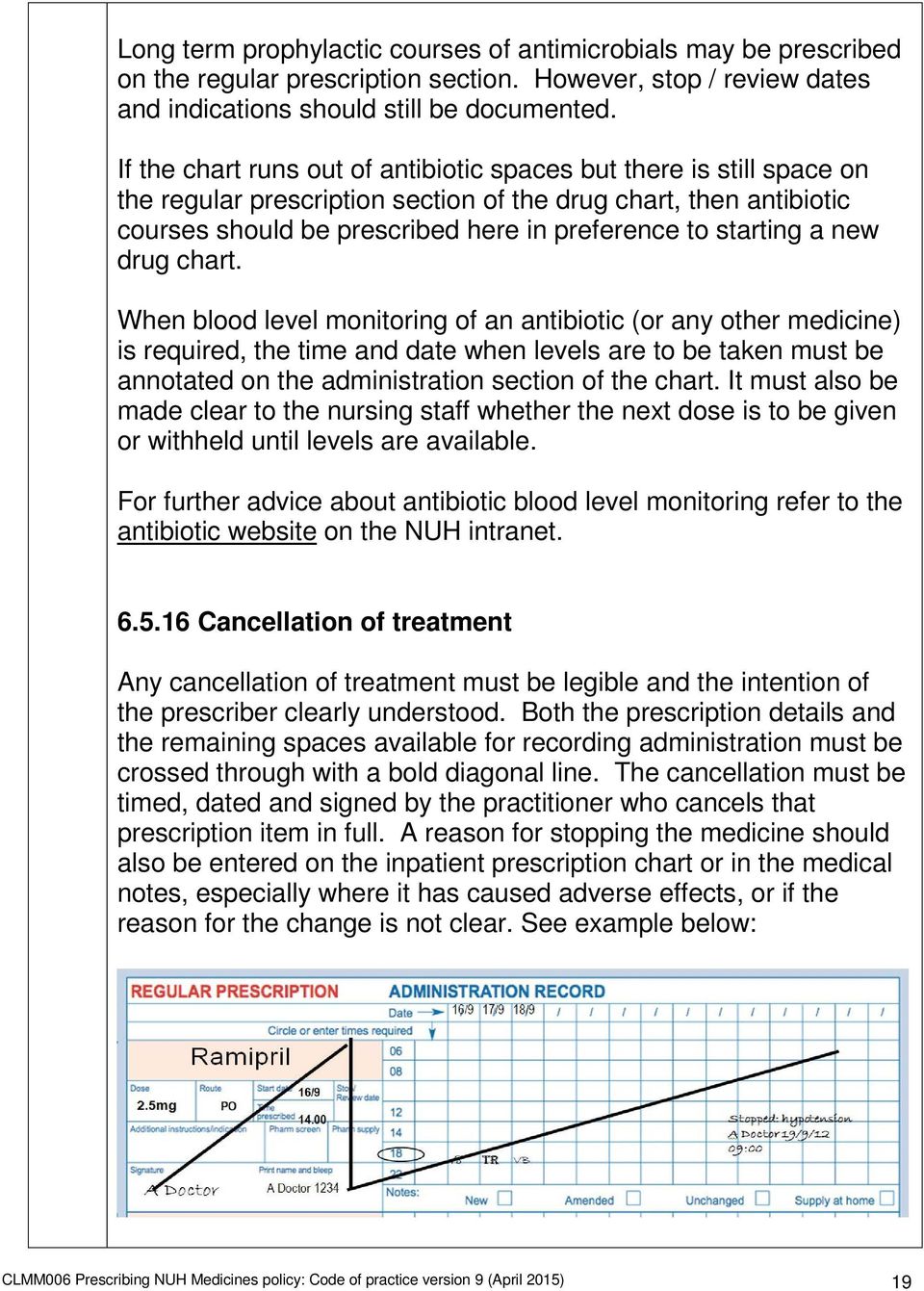
20 When a stop date or for x days direction is used in anticipation of the treatment course, unless otherwise stated, this indicates that, at (midnight) on the date specified, the prescription must be discontinued and no further doses are to be administered. The prescriber or pharmacist must cross through the remaining spaces for administration with a bold diagonal line to indicate when the treatment must stop. The whole prescription item must be clearly crossed out after the treatment course has ended. If treatment is planned to stop part way through the day, the subsequent administration boxes must be blocked off with a single line. If treatment is withheld temporarily, the prescriber must indicate which individual doses are to be omitted, by putting a cross in the administration square and initialling it Alteration of prescriptions If any change to dose amount, medicine name or route is required, only a prescriber can make the necessary changes. A new prescription must be written and the previous prescription clearly cancelled, see section For minor amendments such as changes to dose frequency, the prescriber must still cross out the prescription and rewrite it Use of pre-printed sections on NUH drug charts Some NUH charts (e.g. the adult general chat and others approved by MMC) have pre-printed sections e.g. for oxygen, enoxaparin. These must be signed by the prescriber to authorise a nurse to administer from them. In the case of pre-printed enoxaparin only, CROSS THROUGH the pre-printed section if this is NOT required by the patient (Refer to NUH VTE prophylaxis policy) Rewriting of prescriptions A new inpatient prescription chart must be written and all treatment that is to continue transferred to it when: no further space is available for the required prescription the administration record is full the clarity of the prescription chart is impaired. CLMM006 Prescribing NUH Medicines policy: Code of practice version 9 (April 2015) 20

21 It is important to transfer the starting date of treatment onto the new inpatient prescription chart. This may be H meaning the medicine was started at home. See section Prescribers must not alter the established sequence of dates on the administration record to prolong the life of a chart; only one date per administration column must ever be used Discharge prescriptions See CL/MM/024 of this Medicines Code of Practice Prescribing Resources Prescribers should ensure they use appropriate up to date resources/reference sources if they are unsure of a medicine name, dose, administration information etc. Such resources may include BNF, Palliative Care Formulary. The most up to date version should be used, and this may mean using an online or electronic version. 6.6 RECORDING OF ALLERGIES OR ADVERSE DRUG REACTIONS (ADRs) The drug allergy section on the drug chart must be completed by a prescriber or pharmacist. All entries must be signed and dated. Where appropriate, clinical alerts must be added to the patient s NOTIS record- refer to NUH PAS clinical alert policy and procedure On admission An allergy and adverse drug reaction (ADR) history must be taken from all patients every time they are admitted to hospital, or are to receive treatment as an outpatient or day case patient, regardless of the information that has been recorded on NOTIS or in the medical notes in the past. All details within the allergy and ADR history must be verbally confirmed with the patient or carer each time, and documented in both: the current section of the medical notes or Emergency department records in the designated allergy box on the drug chart for this admission. This information must be written onto all charts the patient is using and transferred to all subsequent charts. CLMM006 Prescribing NUH Medicines policy: Code of practice version 9 (April 2015) 21
22 On admission to hospital, the clerking practitioner is responsible for confirming the allergy history with the patient or carer. If the practitioner has not got their information from the patient it is good practice to document the source of information in the medical notes or on the designated allergy box on the drug chart. Sources of information may be: the patient or carer, the medical notes, GP admissions information, NOTIS alerts, previous drug charts, medicalert bracelets worn by the patient. For patients admitted for day case procedures where the notes are not routinely available, the doctor in charge of administering a drug or reagent during the course of the procedure must check with the patient prior to administration that they have not had a previous allergic reaction to that agent, e.g. contrast media. Details of the drug or drug class, or compound and the type of reaction must be documented. All information on serious or life-threatening ADRs and relevant nondrug allergies such as latex or egg allergies must be recorded, but it is good practice to also record details of minor allergies and adverse effects the patient has experienced. Where there are no known allergies this must be documented on the drug chart for this admission. The abbreviations NKA or NKDA are not permitted. The chart must be signed and dated A PGD may be used before the medicine allergy section is completed, provided the patient fits the PGD inclusion and exclusion criteria and is able to confirm they have no known allergy to the medicine that is to be administered under the PGD. In an emergency situation, such as an unconscious patient of unknown identity requiring IV antibiotics, it is acceptable not to take an allergy history prior to prescribing a drug if the patient or carer is unable to give details, but this should be done as soon as possible once information is available Adverse Drug Reactions during the admission If a patient suffers from a serious or life-threatening reaction whilst they are an in-patient, the medical team looking after the patient at CLMM006 Prescribing NUH Medicines policy: Code of practice version 9 (April 2015) 22
23 the time of the reaction is responsible for documenting details of the reaction in the medical notes and on the drug chart. If a reaction occurs whilst the patient is an out-patient or day case patient, details of the reaction must be documented. If the notes are not present they must be retrieved retrospectively and an entry must be made into the notes by the doctor responsible for that patient at the time of the reaction. If the arrest team is called to resuscitate a patient experiencing an allergic reaction or ADR they must document their attendance in the medical notes. The medical team looking after the patient at the time of the reaction is responsible for letting the patient/carer know at the earliest opportunity what has happened and what drugs or reagents the patient must avoid in the future. If a patient is prescribed a drug or reagent, or administered a drug or reagent and it has been clearly documented that they are allergic to that drug, an incident form must be completed by the healthcare professional discovering the error. See chapter CL/MM/020 of this Code of practice. Any patient who suffers a serious or life-threatening unpredictable or idiosyncratic allergic reaction to a drug or reagent as an in-patient, or whilst receiving care as an out-patient or day case procedure should be considered for referral to allergy for further testing and counselling On discharge The team looking after the patient at discharge is responsible for communicating details of any serious allergic reaction or ADR that has occurred whilst the patient has been an in-patient, outpatient or day case patient to the GP or other relevant healthcare provider. This should be done using the Trust discharge TTO form or via the Emergency Department documentation, and also in their written or electronic discharge information. Details of any minor allergies or drug adverse effects the patient has suffered from in hospital must also be communicated to primary care Antibiotic allergies For additional information on antibiotic allergies please refer to the CLMM006 Prescribing NUH Medicines policy: Code of practice version 9 (April 2015) 23
24 antibiotic website 6.7 PRESCRIBING FOR OUTPATIENTS Medicines may be prescribed from the hospital for outpatients if they: Need to be started immediately, Are available in hospital only, including clinical trials and named patient medicines, Are classified as red in the Nottingham area traffic lights prescribing arrangements, Are prescribed for patients who are managed solely in secondary care, Are covered by an approved shared care agreement before care has been transferred to the patients GP, The patients may be issued with a hospital out-patient prescription. FP10HP prescriptions may only be used for drugs/indications with prior approval by pharmacy. These are used by NUH prescribers for dispensing in the community. They may also be used by community practitioners e.g. paediatricians to initiate urgent treatment in the community. Prescriptions must be completed in accordance with the criteria previously specified in this Medicines Code of Practice. Foundation doctors with provisional registration (F1) are not allowed to prescribe on FP10HP or external prescriptions. Medicines prescribed on hospital out-patient prescriptions can only be dispensed at NUH pharmacies. A maximum of 28 days will be supplied, unless the medicine is designated as hospital only or is part of a longer course for clinical reasons. Medicines prescribed on a FP10HP forms can be dispensed at either NUH pharmacies or a community pharmacy. Patients presenting with FP10NC forms (written by their GP, i.e. not FP10HP forms) may get them dispensed at QMC pharmacy or in the community. All other non-urgent medicines should be started by the patient s GP and that request communicated in writing by the hospital medical CLMM006 Prescribing NUH Medicines policy: Code of practice version 9 (April 2015) 24
25 practitioner Prescribing on Out-patient prescriptions Outpatient prescriptions must be written in indelible black ink. The following must be included: all patient demographic details as stated in above, using a patient addressograph label where available details of consultant code or clinic attended Relevant information e.g. concurrent interacting medicines, dose changes etc. to be written in the medicines communication box on the OP prescription Patient allergies must be documented in the allergy box weight (actual or estimated) for all patients prescribed weightbased drugs, paediatric prescriptions etc. printed name and signature, and bleep or contact number (or state available via switchboard ) The form, route and site of application must be stated for all non-oral medicines 6.8 VERBAL ORDERS Verbal orders to nurses and midwives Verbal orders must only be used in exceptional circumstances when a doctor cannot immediately attend a patient in person to prescribe and where a delay may cause harm or prolong suffering to a patient. The nurse and doctor must be able to justify the decision to use a verbal order. Doctors must refuse to give a verbal order, and nurses must refuse to receive a verbal order if there are any doubts about the appropriateness of doing so. The refusal of a verbal order must be documented. Verbal orders given by a doctor may be given to a nurse to amend, delete or add a prescription item. The doctor giving the order must sign it as soon as they can attend the patient and not later than 24 hours. A verbal order must be received and confirmed by two nurses. CLMM006 Prescribing NUH Medicines policy: Code of practice version 9 (April 2015) 25
26 The prescriber must: confirm the identity of the patient; state the name of the medicine to be administered; state the dose to be administered; state the route and time to be administered. This information must be given to the first nurse and then repeated by the prescriber to the second nurse. The nurses must enter the verbal order on the inpatient prescription chart under the Once only prescription section including the prescriber s name. Controlled drugs must never be prescribed as a verbal order. Verbal orders must be for a single dose to be administered and the same verbal order must not be repeated. A written prescription, patient specific written direction or PGD is required in order to authorise all other new medicine administration. See Chapter CLMM007 of this Medicines Code of Practice Verbal orders to pharmacists Verbal orders given by a prescriber to a pharmacist to amend, delete or add a prescription item, are permitted. The pharmacist must only do this under the authorisation of a prescriber. Prescribers must refuse to give a verbal order, and pharmacists must refuse to receive a verbal order if there are any doubts about the appropriateness of doing so. A pharmacist in possession of the inpatient prescription chart, TTO discharge prescription or out-patient prescription form may receive a verbal order from a prescriber to delete, alter or add a prescription item. Any medicine may be authorised in this way with the exception of controlled drugs on TTO discharge prescriptions and outpatient prescriptions. The pharmacist must ascertain: The name of the patient and identifiable information such as their hospital number, ward and inpatient bed number, CLMM006 Prescribing NUH Medicines policy: Code of practice version 9 (April 2015) 26
27 date of birth or address The medicine, form and dose The name of the prescriber. They must also have access to sufficient information to assure themselves of the appropriateness of the medicine and dose. The pharmacist must read the alteration or addition back to the prescriber who must then confirm it. If the alteration is to formulation, frequency or timings of dose, then that part of the prescription may be crossed out and altered in pharmacy purple ink as long as the prescription is left unambiguous. See section If the alteration involves any other changes e.g. new medicine, change in dose, then the whole prescription for that item must be written out as a new entry on the inpatient prescription chart or TTO discharge prescription by the pharmacist even if no doses have been administered. The alteration or new prescription item must state Verbal Order, the name of the prescriber, bleep number, the date and the signature of the pharmacist accepting the order. If necessary a new inpatient prescription chart or TTO discharge prescription must be started by the pharmacist. The pharmacist must transcribe the patients details and ward onto the new chart or TTO discharge prescription as appropriate. The pharmacist must ensure that all changes made on a TTO discharge prescription copy through to all the underneath sheets of the prescription, paying particular attention to changes made to frequency of administration. The pharmacist or the prescriber must also ensure that these verbal orders for additions or changes to the TTO discharge prescription are also prescribed onto the inpatient prescription chart, where CLMM006 Prescribing NUH Medicines policy: Code of practice version 9 (April 2015) 27
28 appropriate, in case the discharge is delayed Verbal advice from one prescriber to another Any verbal communication between prescribers about any medication which leads to a prescription being written (for example telephone advice about antibiotic doses) must be repeated back to confirm: the name of the medicine is correct (and in the case of uncommon drugs, the spelling of the drug name) the dose has been heard correctly. The prescriber receiving the advice must document the advice given in the medical notes. This includes the dose of any drug recommended, the name of the prescriber that the advice was given by and any other pertinent instructions such as blood level monitoring. 6.9 PRESCRIBING FOR RELATIVES AND VISITORS OF INPATIENTS AT NUH Relatives and visitors of patients at NUH are responsible for supplying their own medication. However, there will be circumstances where relatives and visitors may not have brought their own medication to the hospital and their own health may suffer as a consequence. In such a situation where it would be detrimental to the relative s or visitor s health if they did not receive their medication, the following two courses of action may be taken: 1) At QMC Campus there is a pharmacy shop, which may make an emergency supply of medicines to relatives and visitors. The relative or visitor themselves must go to the pharmacy shop, ask for the pharmacist and request an emergency supply of the medicine. 2) A doctor may write an emergency prescription for the relative or visitor at any time at the City Campus, and at QMC Campus when the pharmacy shop is closed. These prescriptions must be written on an outpatient prescription form; state emergency supply for relative/visitor of and state CLMM006 Prescribing NUH Medicines policy: Code of practice version 9 (April 2015) 28
29 the NUH inpatients name and ward; be for medicines on the NUH formulary; be dispensed from the hospital pharmacy; be for a maximum of 5 days supply or in an original pack if the medication is a preparation of insulin, an ointment, a cream, an inhaler for the relief of asthma, an oral contraceptive or an antibiotic liquid preparation. The relative or visitor must pay the NHS prescription charge for each item prescribed unless they have an exemption. The pharmacy department on either campus must dispense the prescription PRESCRIBING BY NUH PRESCRIBERS FOR THEMSELVES, THEIR FAMILY AND OTHER NUH STAFF Employees of NUH who are registered prescribers are not permitted to obtain medicines for themselves or their family through the NUH prescribing and dispensing service. They may only prescribe for other NUH staff as part of an episode of planned NHS care. This policy applies to both NHS and private prescriptions. This policy is in accordance with the written guidance in "Good Medical Practice (2006)" (GMP) published by the General Medical Council. Doctors should not prescribe for themselves - this is the remit of their GP. (Paragraph 77 of GMP: "You should be registered with a general practitioner outside your family to ensure that you have access to independent and objective medical care. You should not treat yourself.") Doctors should not prescribe for their family members - this should be the remit of the named GP for that family member. (Paragraph 5 of GMP Avoid treating those close to you "Wherever possible, you should avoid providing medical care to anyone with whom you have a close personal relationship") Doctors should not prescribe for colleagues UNLESS it is in the context of a professional medical relationship, and information about CLMM006 Prescribing NUH Medicines policy: Code of practice version 9 (April 2015) 29
30 ongoing treatment and prescribing is sent to that patient's GP. (Paragraph 53 of GMP: "If a patient has not been referred to you by a general practitioner, you should ask for the patient s consent to inform their general practitioner before starting treatment, except in emergencies or when it is impractical to do so. If you do not inform the patient s general practitioner, you will be responsible for providing or arranging all necessary after-care.") 6.11 TRANSCRIBING AND REWRITING INPATIENT PRESCRIPTION CHARTS It is a core responsibility of a prescriber to transcribe drug charts that need rewriting. Prescription information may be transcribed or rewritten by a pharmacist to maintain continuity of treatment, aid clarity and reduce potential risks. A pharmacist may transcribe a prescription to enable the patient to continue to receive medicines as intended, provided they are satisfied that the hospital prescriber has previously authorised treatment with the medicine and that it is to continue Transcribing information from a drug history onto an inpatient prescription chart The pharmacist may write the prescription information onto an inpatient prescription chart if the information concerning the patient s treatment is obtained from a GP, previous hospital case notes or a patient s own medicine container and has not been previously prescribed by a hospital prescriber on the current admission. The prescription will require the signature of a prescriber before medicines are administered. The pharmacist must also add this information to the medication history in the patient s medical notes Rewriting information on inpatient prescription charts for clarity or continuation It is expected that the original prescriber will rewrite a prescription if it is unclear, the writing is illegible or there is no space for recording any more dose administrations. A pharmacist may also rewrite such CLMM006 Prescribing NUH Medicines policy: Code of practice version 9 (April 2015) 30
31 a prescription. The pharmacist must state re-written by pharmacist on the front of the inpatient medicine chart. All transcriptions must be in black indelible ink. The pharmacist must sign and date all transcribed and rewritten prescriptions and state their name and bleep number once on each inpatient prescription chart. Prescriptions which are rewritten by a pharmacist do not require a further signature from a prescriber. Suitably validated pharmacy technicians may rewrite prescriptions under the supervision of a pharmacist. A pharmacist must sign these before any doses are administered PRESCRIBING OF HIGH RISK MEDICINES The following drugs have been identified by national agencies or agreed at a local level within the Trust as requiring specific instructions and/or special caution to be taken when prescribing Insulin All insulin doses, including regular, one-off, and as required doses must be prescribed on the designated insulin chart. Insulin doses must also be referred to on the main section of the drug chart by prescribing as Insulin-as per chart, see section 6.4 The insulin prescription must state: o The brand name of the insulin, e.g. Novorapid, Humalog o The strength of the insulin where applicable, e.g. Novomix 30, Humalog Mix 25 o The device that the patient usually uses, e.g. 3ml cartridges, disposable pen, Kwikpen device etc. As the word units is preprinted on the insulin chart, the prescriber should only prescribe the number of units to be administered, e.g. 20. Information about the patient s usual insulin may be obtained from the Insulin Passport. The IP is a patient held record for diabetic patients in which the patient can document their insulin type and device. CLMM006 Prescribing NUH Medicines policy: Code of practice version 9 (April 2015) 31
32 Insulin Passport (IP) All adult patients who are newly started on insulin should be offered an Insulin Passport (IP) and an insulin patient information booklet, in line with guidance from the NPSA. These will usually be offered by the Diabetes Specialist Team (DST). If the patient declines to accept an IP, or they are not able to competently understand or use it correctly, the prescriber or DST must document this in the patient s notes. Following a change to a patient s type or device of insulin, the prescriber must inform the patient of the changes in order that they may update their IP. All adult patients who are newly started on insulin should be offered an Insulin Passport (IP) and an insulin patient information booklet, in line with guidance from the NPSA. The prescriber who initiates the insulin should offer this to the patient. During working hours the patients will usually be referred to the Diabetes Specialist Team (DST) who will offer these to the patient. If the patient declines to accept an IP, or they are not able to competently understand or use it correctly, the prescriber or DST must document this in the patient s notes. Following a change to a patient s type or device of insulin, the prescriber must inform the patient of the changes in order that they may update their IP Lithium Treatment with lithium is usually initiated by a patient s psychiatric team. However, there may be occasions when a continuation of therapy is required in secondary care Lithium has a narrow therapeutic range. Before prescribing Lithium it is the Prescriber s responsibility to check that the patient has had recent monitoring in accordance with NICE guidance. The minimum monitoring requirements for maintaining patients CLMM006 Prescribing NUH Medicines policy: Code of practice version 9 (April 2015) 32
33 within the appropriate therapeutic margin are: Lithium blood level every 3 months Thyroid function tests every 6 months Renal function tests every 6 months At the start and throughout treatment with lithium patients receive appropriate ongoing verbal and written information which is documented in an NPSA lithium booklet. Where available, this booklet can be checked for details of any recent levels. Where it is not possible to assess monitoring, therapy should not be withheld and arrangements for blood tests should be made as soon as possible. It is the prescriber s responsibility to ensure the results of these tests are communicated to both the patient and the patient s GP and documented in the patient s lithium booklet and in the medical notes. To ensure a that copy of the results goes automatically to the GP, it is essential that on any blood request form a clear direction is stated to copy the results to the both the patient s named GP (and Practice) as well as the secondary care specialist. Lithium must always be prescribed by brand name as there are bioavailability differences between brands and formulations. The prescriber must consider the impact of interacting medicines when prescribing lithium and make patients aware of key aspects of their treatment including side effects and toxicity. A list of Lithium interactions is available on the MMC website. References 1. NPSA Patient Safety Alert: Safer Lithium Therapy (NPSA 2009/PSA005) issued 1 December Available at: 2. National Institute for Clinical Excellence (NICE). Bipolar disorder; The management of bipolar disorder in adults, children and adolescents, in primary and secondary care. Clinical Guideline 38, Available at Opioids Prior to prescribing opioid medicines in anything other than an acute emergency, the prescriber must: CLMM006 Prescribing NUH Medicines policy: Code of practice version 9 (April 2015) 33
34 o Confirm any recent opioid dose, formulation, frequency of administration and any other analgesic medicines prescribed for the patient. This may be done through discussion with the patient or their representative (although not in the case of treatment for addiction), the prescriber, or through medication records. o Ensure where a dose increase is intended, that the calculated dose is safe for the patient (e.g. for oral morphine or oxycodone in adult patients, not normally more than 50% higher than the previous dose) o Ensure they are familiar with the following characteristics of that medicine and formulation: usual starting dose, frequency of administration, standard dosing increments, symptoms of overdose, common side-effects Heparin flushes All heparin flushes must be prescribed on the in-patient drug chart. Heparin flushes should not normally be used to flush peripheral intravenous catheters Methotrexate If the prescriber is initiating methotrexate, the patient s understanding and consent to treatment should be sought, appropriate baseline tests conducted, monitoring schedule explained, and patient-held monitoring booklet issued. See separate procedure Procedure for use of oral methotrexate for non-cancer conditions at NUH (adults and paediatrics) approved Oct 14 (available in appendix to NUH cytotoxic policy CL/MM/013) Low Molecular Weight Heparin (therapeutic dose) Patients should be weighed on admission and the weight documented on the drug chart and in the medical notes. If it is not possible to weigh the patient then a recent weight should be obtained from relevant sources, e.g. GP, patient s relative, Nursing Home etc. An estimate of patient weight should only be made if CLMM006 Prescribing NUH Medicines policy: Code of practice version 9 (April 2015) 34
35 there is no information, and it is not practical to weigh the patient. If this has to be done this should be documented on the drug chart as estimated weight. Treatment doses of enoxaparin should be prescribed according to weight and renal function. The dose for Venous Thromboembolism (VTE) is 1.5mg/kg/od, and for Acute Coronary Syndrome (ACS) 1mg/kg/bd Before the LMWH is prescribed, the egfr must be checked to ensure it is over 30ml/min. If it is less than 30ml/min a reduced dose of enoxaparin of 1mg/kg/od should be prescribed for treatment of ACS and VTE. (Creatinine clearance must be calculated and used if at extremes of body weight) The indication for the enoxaparin must be endorsed on the drug chart under additional instructions If the patient is being discharged on enoxaparin then the indication, weight, egfr, and duration of therapy must be recorded on the TTO discharge form. If the patient is transferred to another hospital on enoxaparin then the indication, weight, and egfr should be recorded on the transfer information to ensure safe continuity of treatment Oxygen Refer to separate policy CL/MM/032 of this Code of Practice Potassium Refer to separate policy CL/MM/025 of this Code of Practice Controlled drugs Refer to separate policy CL/MM/012 of this Code of Practice Midazolam Refer to conscious sedation policy on Trust intranet Refer to CL/MM/012 controlled drugs for details on ordering, CLMM006 Prescribing NUH Medicines policy: Code of practice version 9 (April 2015) 35
36 prescribing, supply and administration of low strength IV midazolam, high strength IV midazolam, and buccal midazolam Gentamicin and Vancomycin Refer to antibiotics website Bowel Preps When prescribing bowel preparations for surgery or investigative procedures, the clinician authorising the procedure is responsible for assessing the patient to ensure there are no contraindications, and is also responsible for ensuring an explanation on the safe use of the medicine is provided to the patient or carer. For further information refer to the following guidelines on the Trust intranet: Clinical guideline for adult gastro-intestinal endoscopy- Bowel preparations Clinical guideline for the use of bowel cleansing agents when having a barium enema Clinical guideline for adult colorectal surgery- Bowel preparations 7.0 Training and Implementation 7.1 Training Please refer to the trust s Training Needs Analysis for details of training to support delivery of this document. 7.2 Implementation This is an existing document and will continue to be implemented via the existing routes. 7.3 Resources CLMM006 Prescribing NUH Medicines policy: Code of practice version 9 (April 2015) 36
37 No additional resources are required. 8.0 Trust Impact Assessments 8.1 Equality Impact Assessment An equality impact assessment has been undertaken on this draft and has not indicated that any additional considerations are necessary. 8.2 Environmental Impact Assessment An environmental impact assessment has been undertaken on this draft and has not indicated that any additional considerations are necessary. 8.3 Here For You Assessment A Here For You assessment has been undertaken on this document and has not indicated that any additional considerations are necessary. CLMM006 Prescribing NUH Medicines policy: Code of practice version 9 (April 2015) 37
38 9.0 Policy / Procedure Monitoring Matrix Minimum requirement to be monitored Review of prescribing error incidents Review of accuracy of prescribing Review of Pharmacist contributions relating to prescribing errors Responsible individual/ group/ committee Directorates and local areas Directorates and local areas Pharmacy Process for monitoring e.g. audit Monitoring of DATIX Audit (using standard template approved by Medicines Management Committee) Ongoing standard data collection form Frequency of monitoring Ongoing Rolling audit, results reviewed annually 2-3 times per year Responsible individual/ group/ committee for review of results Directorate governance forum or speciality governance meeting Directorate governance forum or speciality governance meeting Pharmacy senior leadership team Responsible individual/ group/ committee for development of action plan Directorate governance forum or speciality governance meeting Directorate governance forum or speciality governance meeting Pharmacy senior leadership team Responsible individual/ group/ committee for monitoring of action plan Directorate governance forum or speciality governance meeting Directorate governance forum or speciality governance meeting. Medicines Management Committee also receive results Pharmacy senior leadership team in conjunction with directorates CLMM006 Prescribing NUH Medicines policy: Code of practice version 9 (April 2015) 38
39 10.0 Relevant Legislation, National Guidance and Associated NUH Documents 10.1 List all of the following which are relevant: 1. Legislation 2. National Guidance Legacy NPSA alerts: Promoting safer use of injectable medicines Risks with Intravenous Heparin flush solutions Reducing dosing errors with opioid medicines Safer Lithium therapy Reducing harm from omitted and delayed medicines in hospital Safer administration of insulin Improving compliance with oral methotrexate guidelines Prudent Antimicrobial Prescribing at NUH PAS clinical alert policy and procedure Common Lithium drug interactions (produced by Pharmacy August 2010) National resources referred to through the document: British National Formulary (current edition) Palliative Care Formulary (current edition) 3 Associated NUH Documents(with NUH referencing) MAST students guidance- information available locally from MMC CL/MM/018 Patient s Own medicines policy CL/MM/026 Non-medical prescribing policy CL/MM/020 CL/CGP/070 Venous Thromboembolism (VTE) prophylaxis policy CLMM006 Prescribing NUH Medicines policy: Code of practice version 9 (April 2015) 39
40 APPENDIX 1 Antimicrobial stewardship CLMM006 Prescribing NUH Medicines policy: Code of practice version 9 (April 2015) 40
41 APPENDIX 2 Insert templates of relevant impact assessments (page break after each) Equality Impact Assessment (EQIA) Form (Please complete all sections) Q1. Date of Assessment: 5 th Jan 2015 Q2. For the policy and its implementation answer the questions a c below against each characteristic (if relevant consider breaking the policy or implementation down into areas) Protected Characteristic a) Using data and supporting information, what issues, needs or barriers could the protected characteristic groups experience? i.e. are there any known health inequality or access issues to consider? The area of policy or its implementation being assessed: b) What is already in place in the policy or its implementation to address any inequalities or barriers to access including under representation at clinics, screening Race and n/a n/a n/a Ethnicity Gender n/a n/a n/a Age n/a n/a n/a Religion n/a n/a n/a Disability n/a n/a n/a c) Please state any barriers that still need to be addressed and any proposed actions to eliminate inequality CLMM006 Prescribing NUH Medicines policy: Code of practice version 9 (April 2015) 41
42 Sexuality n/a n/a n/a Pregnancy and n/a n/a n/a Maternity Gender n/a n/a n/a Reassignment Marriage and n/a n/a n/a Civil Partnership Socio-Economic n/a n/a n/a Factors (i.e. living in a poorer neighbourhood / social deprivation) Area of service/strategy/function Q3. What consultation with protected characteristic groups inc. patient groups have you carried out? None Q4. What data or information did you use in support of this EQIA? n/a Q.5 As far as you are aware are there any Human Rights issues be taken into account such as arising from surveys, questionnaires, comments, concerns, complaints or compliments? none Q.6 What future actions needed to be undertaken to meet the needs and overcome barriers of the groups identified or to create confidence that the policy and its implementation is not discriminating against any groups CLMM006 Prescribing NUH Medicines policy: Code of practice version 9 (April 2015) 42
43 What By Whom By When Resources required Q7. Review date 5 th Jan 2018 CLMM006 Prescribing NUH Medicines policy: Code of practice version 9 (April 2015) 43
44 APPENDIX 3 Environmental Impact Assessment The purpose of an environmental impact assessment is to identify the environmental impact of policies, assess the significance of the consequences and, if required, reduce and mitigate the effect by either, a) amend the policy b) implement mitigating actions. Area of impact Environmental Risk/Impacts to consider Action Taken (where necessary) Waste and materials Soil/Land Water Is the policy encouraging using more materials/supplies? Is the policy likely to increase the waste produced? Does the policy fail to utilise opportunities for introduction/replacement of materials that can be recycled? Is the policy likely to promote the use of substances dangerous to the land if released (e.g. lubricants, liquid chemicals) Does the policy fail to consider the need to provide adequate containment for these substances? (e.g. bunded containers, etc.) Is the policy likely to result in an increase of water usage? (estimate quantities) Is the policy likely to result in water being polluted? (e.g. dangerous chemicals being introduced in the water) Does the policy fail to include a mitigating procedure? (e.g. modify procedure to prevent water from being polluted; polluted water containment for adequate disposal) Air Is the policy likely to result in the introduction of procedures No CLMM006 Prescribing NUH Medicines policy: Code of practice version 9 (April 2015) 44 No n/a No No n/a No No No
45 Energy Nuisances and equipment with resulting emissions to air? (e.g. use of a furnaces; combustion of fuels, emission or particles to the atmosphere, etc.) Does the policy fail to include a procedure to mitigate the effects? Does the policy fail to require compliance with the limits of emission imposed by the relevant regulations? Does the policy result in an increase in energy consumption levels in the Trust? (estimate quantities) Would the policy result in the creation of nuisances such as noise or odour (for staff, patients, visitors, neighbours and other relevant stakeholders)? n/a n/a No no CLMM006 Prescribing NUH Medicines policy: Code of practice version 9 (April 2015) 45
46 APPENDIX 4 We Are Here For You Policy and Trust-wide Procedure Compliance Toolkit The We Are Here For You service standards have been developed together with more than 1,000 staff and patients. They can help us to be more consistent in what we do and say to help people to feel cared for, safe and confident in their treatment. The standards apply to how we behave not only with patients and visitors, but with all of our colleagues too. They apply to all of us, every day, in everything that we do. Therefore, their inclusion in Policies and Trust-wide Procedures is essential to embed them in our organization. Please rate each value from 1 3 (1 being not at all, 2 being affected and 3 being very affected) Value Score (1-3) 1. Polite and Respectful 1 Whatever our role we are polite, welcoming and positive in the face of adversity, and are always respectful of people s individuality, privacy and dignity. 2. Communicate and Listen 1 We take the time to listen, asking open questions, to hear what people say; and keep people informed of what s happening; providing smooth handovers. 3. Helpful and Kind 1 All of us keep our eyes open for (and don t avoid ) people who need help; we take ownership of delivering the help and can be relied on. 4. Vigilant (patients are safe) 1 Every one of us is vigilant across all aspects of safety, practices hand hygiene & demonstrates attention to detail for a clean and tidy environment everywhere. CLMM006 Prescribing NUH Medicines policy: Code of practice version 9 (April 2015) 46
47 5. On Stage (patients feel safe) 1 We imagine anywhere that patients could see or hear us as a stage. Whenever we are on stage we look and behave professionally, acting as an ambassador for the Trust, so patients, families and carers feel safe, and are never unduly worried. 6. Speak Up (patients stay safe) 1 We are confident to speak up if colleagues don t meet these standards, we are appreciative when they do, and are open to positive challenge by colleagues 7. Informative 1 We involve people as partners in their own care, helping them to be clear about their condition, choices, care plan and how they might feel. We answer their questions without jargon. We do the same when delivering services to colleagues. 8. Timely 1 We appreciate that other people s time is valuable, and offer a responsive service, to keep waiting to a minimum, with convenient appointments, helping patients get better quicker and spend only appropriate time in hospital. 9. Compassionate 1 We understand the important role that patients and family s feelings play in helping them feel better. We are considerate of patients pain, and compassionate, gentle and reassuring with patients and colleagues. 10. Accountable Take responsibility for our own actions and results 11. Best Use of Time and Resources 1 Simplify processes and eliminate waste, while improving quality 12. Improve 1 Our best gets better. Working in teams to innovate and to solve patient frustrations TOTAL 12 CLMM006 Prescribing NUH Medicines policy: Code of practice version 9 (April 2015) 47
48 APPENDIX 5 CERTIFICATION OF EMPLOYEE AWARENESS Document Title Prescribing Policy Medicines Code of practice: Medicines Policy Version (number) 9 Version (date) 27 April 2015 I hereby certify that I have: Identified (by reference to the document control sheet of the above policy/ procedure) the staff groups within my area of responsibility to whom this policy / procedure applies. Made arrangements to ensure that such members of staff have the opportunity to be aware of the existence of this document and have the means to access, read and understand it. Signature Print name Date Directorate/ Department The manager completing this certification should retain it for audit and/or other purposes for a period of six years (even if subsequent versions of the document are implemented). The suggested level of certification is; Clinical directorates - general manager Non clinical directorates - deputy director or equivalent. The manager may, at their discretion, also require that subordinate levels of their directorate / department utilize this form in a similar way, but this would always be an additional (not replacement) action. CLMM006 Prescribing NUH Medicines policy: Code of practice version 9 (April 2015) 48
All Wales Prescription Writing Standards
 All Wales Prescription Writing Standards These standards should be read in conjunction with completing the All Wales Medication Chart e- learning package, available on the Learning@NHSWales internet site
The Medicines Policy. Chapter 2: Standards of Practice PRESCRIBING
 Chapter 2: Standards of Practice PRESCRIBING V2.1 Date: January 2015 CHAPTER 2 Table of Contents 6. Standards and Practice... 3 6.1. Prescribing... 3 6.1.1 Patient-Centred Prescribing... 3 6.1.2 Prescription
Medicines reconciliation on admission and discharge from hospital policy April 2013. WHSCT medicines reconciliation policy 1
 Medicines reconciliation on admission and discharge from hospital policy April 2013 WHSCT medicines reconciliation policy 1 Policy Title Policy Reference Number Medicines reconciliation on admission and
East & South East England Specialist Pharmacy Services Medicines Use and Safety Division Community Health Services Transcribing
 East & outh East England pecialist Pharmacy ervices East of England, London, outh Central & outh East Coast Medicines Use and afety Division Community Health ervices Transcribing Guidance to support the
Humulin R (U500) insulin: Prescribing Guidance
 Leeds Humulin R (U500) insulin: Prescribing Guidance Amber Drug Level 2 We have started your patient on Humulin R (U500) insulin for the treatment of diabetic patients with marked insulin resistance requiring
NHS Professionals. Guidelines for the Administration of Medicines
 NHS Professionals Guidelines for the Administration of Medicines Introduction The control of medicines in the United Kingdom is primarily through the Medicines Act (1968) and associated British and European
Medicines Policy. Drugs and Therapeutics Committee Date Ratified: 19 th September 2011
 Authorising Officer: Signature Of Authorising Officer: Dr. Geraldine O'Sullivan, Executive Director Quality & Medical Leadership Version: V6 Ratified By: Drugs and Therapeutics Committee Date Ratified:
MEDICINES MANAGEMENT STANDARD OPERATING PROCEDURE (MMSOP018) Preparation of Medication Administration Record (MAR) Charts
 MEDICINES MANAGEMENT STANDARD OPERATING PROCEDURE (MMSOP018) Preparation of Medication Administration Record (MAR) Charts Any deviation in practice from this procedure must be discussed with the Community
DRUG CALCULATIONS. Mathematical accuracy is a matter of life and death. [Keighley 1984]
![DRUG CALCULATIONS. Mathematical accuracy is a matter of life and death. [Keighley 1984]](/thumbs/39/19297070.jpg "DRUG CALCULATIONS. Mathematical accuracy is a matter of life and death. [Keighley 1984]") DRUG CALCULATIONS Mathematical accuracy is a matter of life and death. [Keighley 1984] At the end of this practice sheet, you will be able to: Perform simple arithmetical tasks. Accurately calculate drug
DRUG CALCULATIONS Mathematical accuracy is a matter of life and death. [Keighley 1984] At the end of this practice sheet, you will be able to: Perform simple arithmetical tasks. Accurately calculate drug
Clinical Audit Procedure for NHS-LA and CNST Casenote Audit
 Clinical Audit Procedure for NHS-LA and CNST Casenote Audit NHS Litigation Authority (NHS-LA) Risk Management Standards for Acute Trusts Pilot Clinical Negligence Scheme for Trusts (CNST) Maternity Clinical
Standards of Practice for Pharmacists and Pharmacy Technicians
 Standards of Practice for Pharmacists and Pharmacy Technicians Introduction These standards are made under the authority of Section 133 of the Health Professions Act. They are one component of the law
Health Professions Act BYLAWS SCHEDULE F. PART 2 Hospital Pharmacy Standards of Practice. Table of Contents
 Health Professions Act BYLAWS SCHEDULE F PART 2 Hospital Pharmacy Standards of Practice Table of Contents 1. Application 2. Definitions 3. Drug Distribution 4. Drug Label 5. Returned Drugs 6. Drug Transfer
National Chlamydia Screening Programme September 2012 PATIENT GROUP DIRECTION FOR THE ADMINISTRATION OF AZITHROMYCIN FOR CHLAMYDIA TRACHOMATIS
 PATIENT GROUP DIRECTION FOR THE ADMINISTRATION OF AZITHROMYCIN FOR CHLAMYDIA TRACHOMATIS Below is a template that can be used to produce a local patient group direction (PGD) for the administration of
Health Professions Act BYLAWS SCHEDULE F. PART 3 Residential Care Facilities and Homes Standards of Practice. Table of Contents
 Health Professions Act BYLAWS SCHEDULE F PART 3 Residential Care Facilities and Homes Standards of Practice Table of Contents 1. Application 2. Definitions 3. Supervision of Pharmacy Services in a Facility
GUIDELINES FOR THE CONTROL AND ADMINISTRATION OF MEDICINES DOMICILIARY CARE AGENCIES
 GUIDELINES FOR THE CONTROL AND ADMINISTRATION OF MEDICINES DOMICILIARY CARE AGENCIES January 2009 Contents Page Number 1.0 Introduction 3 2.0 Background 4 3.0 Criteria 5 3.1 Referral 5 3.2 Levels of assistance/consent
Adverse reactions identification and documentation
 Adverse reactions identification and documentation Contents Purpose... 1 Policy... 2 Scope... 2 Associated documents... 2 Responsibilities on Presentation to the CDHB for capture and documentation... 3
DRUG DOSAGE CALCULATIONS
 DRUG DOSAGE CALCULATIONS THE UNIVERSITY OF NOTTINGHAM SCHOOL OF NURSING updated Feb 2001 Mathematics and Drug Administration Why is it important? During your career you will often be called upon to administer
ONCE ONLY GLUCAGON and Fast Acting Glucose gel (PGD) For nurse administration under Patient Group Direction (Trust wide PGD in place)
 ADULT INSULIN PRERIPTION AND BLOOD GLUCOSE MONITORING CHART Ward CONSULTANT DATE OF ADMISSION Please affix Patient s label here Ward Ward.../...year PATIENT NAME....... DATE OF BIRTH... NHS NUMBER.......
Administrative Policies and Procedures for MOH hospitals /PHC Centers. TITLE: Organization & Management Of Medication Use APPLIES TO: Hospital-wide
 Administrative Policies and Procedures for MOH hospitals /PHC Centers TITLE: Organization & Management Of Medication Use APPLIES TO: Hospital-wide NO. OF PAGES: ORIGINAL DATE: REVISION DATE : السیاسات
Medication Management Guidelines for Nurses and Midwives
 Medication Management Guidelines for Nurses and Midwives 1. Introduction As the statutory body responsible for the regulation of nursing and midwifery practice in Western Australia (WA), the Nurses & Midwives
NSW Adult Subcutaneous Insulin Prescribing Chart User Guide
 NSW Adult Subcutaneous Insulin Prescribing Chart User Guide Adult Subcutaneous Insulin Prescribing Chart User Guide - 13 August 2013 Contents Target audience:... 1 Exceptions:... 1 1. Introduction... 2
PRESCRIBING GUIDELINES FOR THE MANAGEMENT OF PATIENTS ANTICOAGULANT THERAPY
 PRESCRIBING GUIDELINES FOR THE MANAGEMENT OF PATIENTS ON ANTICOAGULANT THERAPY Prepared by: NPSA Anticoagulation Steering Group Approved by: Wirral Drug & Therapeutics Committee 14 th May 2008 Review:
LDU Maths, Stats and Numeracy Support. Metric Conversions
 Metric Conversions Here are some metric weights arranged in size order, starting with the biggest:- Kg (kilogram) g (gram) mg (milligram) mcg (microgram) Each one is a thousand (1000) times smaller than
GUIDELINES ON PREVENTING MEDICATION ERRORS IN PHARMACIES AND LONG-TERM CARE FACILITIES THROUGH REPORTING AND EVALUATION
 GUIDELINES GUIDELINES ON PREVENTING MEDICATION ERRORS IN PHARMACIES AND LONG-TERM CARE FACILITIES THROUGH REPORTING AND EVALUATION Preamble The purpose of this document is to provide guidance for the pharmacist
Good Practice Guidance: The administration of medicines in domiciliary care
 Good Practice Guidance: The administration of medicines in domiciliary care Medicines Management Social Care Support Team Reviewed February 2014 This guidance is based on documents that were on CQC s website
PPP 1. Continuation of a medication to ensure continuity of care
 PRESCRIBING POLICIES: 4.7 PHARMACIST AUTHORITY The College of Pharmacists of BC Professional Practice Policy (PPP) 58 Medication Management (Adapting a Prescription) became effective April 1, 2009. The
Good practice for drug calculations
 Good practice for drug calculations A step-by-step guide for nurses, doctors and all other healthcare professionals Pharmacyservices 7048 Drug Cal Guide A6 Update_AW.indd 1 22/07/2014 09:55 2 Contents
St Bernard s Catholic School. Administration of Medicine Policy
 St Bernard s Catholic School Page 1 of 10 The St Bernard s administration of medicine policy has been developed to ensure that children with medical needs have the same access to education as their peers
SafetyFirst Alert. Errors in Transcribing and Administering Medications
 SafetyFirst Alert Massachusetts Coalition for the Prevention of Medical Errors January 2001 This issue of Safety First Alert is a publication of the Massachusetts Coalition for the Prevention of Medical
Roles and Responsibilities Policy
 Roles and Responsibilities Policy Contents Policy... 2 Scope/Audience... 2 Associated Documents... 2 Definitions... 2 Accountability... 2 Scope of Practice Statement:... 2 Anaesthetic Technicians... 3
File No.: 20100701. Guidelines for the Administration of certain substances by aged-care workers in residential aged care services
 File No.: 20100701 Guidelines for the Administration of certain substances by aged-care workers in residential aged care services 1 September 2010 Contents 1. Introduction...4 2. Regulation 95EA...5 3.
William MacGregor Primary School. Medical Administration Policy
 William MacGregor Primary School Medical Administration Policy School Vision In accordance with our aim to be a Rights Respecting School, this policy supports the following articles of the United Nation
DRUG CALCULATIONS FOR REGISTERED NURSES ADULT SERVICES
 Serving the people of north east Essex DRUG CALCULATIONS FOR REGISTERED NURSES ADULT SERVICES A Programmed Approach - It is essential you read this pack & practice the questions prior to your drug calculation
Keeping patients safe when they transfer between care providers getting the medicines right
 PART 1 Keeping patients safe when they transfer between care providers getting the medicines right Good practice guidance for healthcare professions July 2011 Endorsed by: Foreword Taking a medicine is
Medicines Administration and Management Policy for Reg Nurses, Midwives and SCPHNs
 This is an official Northern Trust policy and should not be edited in any way Medicines Administration and Management Policy for Reg Nurses, Midwives and SCPHNs Reference Number: NHSCT/10/294 Target audience:
NON-MEDICAL PRESCRIBING POLICY
 NON-MEDICAL PRESCRIBING POLICY Responsible Director: Mrs Hazel Borland, Executive Nurse Director Author: Mrs Alice Wilson, Associate Nurse Director Date: April 2014 Review Date: April 2016 Version: 2.0
IQ Level 2 Certificate in Understanding the Safe Handling of Medicines (QCF) Specification
 IQ Level 2 Certificate in Understanding the Safe Handling of Medicines (QCF) Specification Regulation No: 601/2010/1 Page 1 of 25 IQB/0.2/211 Version 1.0 13/01/2014 Author AW Contents Page Industry Qualifications...
HealthStream Regulatory Script
 HealthStream Regulatory Script Medication Terminology: Use of Abbreviations & Symbols Release Date: December 2011 HLC non-pa Version: 603 HLC PA Version: 603 Lesson 1: Introduction Lesson 2: Risky Terms
Advice, Guidance & Over 400 Online Questions for Extra Revision & Practice
 Advice, Guidance & Over 00 Online Questions for Extra Revision & Practice 00_Starkings_Prelims.indd 2/2/20 ::9 PM Chapter Diagnostic assessment NMC Standards for Pre-registration Nursing Education At the
GLOUCESTERSHIRE HOSPITALS NHS FOUNDATION TRUST
 GLOUCESTERSHIRE HOSPITALS NHS FOUNDATION TRUST MEDICINES MANAGEMENT STRATEGY 2006/07 ANNUAL REPORT 1. Aim An annual report on the Trust s Medicines Management Strategy is part of the requirements for Standards
Developed / Reviewed by the Collaborative Provider PGD (Patient Group Direction) Group (CPPGDG) and approved by the following members of the CPPGDG:
 Patient Group Direction 7.02 version 4.0 Administration of Intravenous Adrenaline (Epinephrine) 1 in 10,000 (100micrograms per ml) Injection in Cardiopulmonary by Registered Practitioners in Torbay and
MULTI AGENCY POLICY FOR THE ADMINISTRATION OF MEDICATION AND HEALTH CARE PROCEDURES:
 MULTI AGENCY POLICY FOR THE ADMINISTRATION OF MEDICATION AND HEALTH CARE PROCEDURES: Early years provision, Educational Establishments and Voluntary Services Document reference number: C O R P O L O 0
PHYSICIAN ORDER POLICY
 PURPOSE: To clarify requirements and assure all physician orders are complete and valid for safe patient care SUPPORTIVE DATA: Medication: Prescribing and Ordering Procedure #790.25 RCW 18.164.011 and
POLICY FOR MANAGING THE BOUNDARIES OF NHS AND PRIVATE FUNDED HEALTHCARE DOCUMENT CONTROL
 POLICY FOR MANAGING THE BOUNDARIES OF NHS AND PRIVATE FUNDED HEALTHCARE DOCUMENT CONTROL TITLE Managing the boundaries of NHS and private funded healthcare AUTHOR Head of Medicines Management VERSION NUMBER
Care Pathway for the Administration of Intravenous Iron Sucrose (Venofer )
 Departments of Haematology, Nephrology and Pharmacy Care Pathway for the Administration of Intravenous Iron Sucrose (Venofer ) [Care Pathway Review Date] Guidance for use This Care Pathway is intended
Electronic Medication Administration Record (emar) (For Cerner Sites Only)
 POLICY NO. 1009 Approved: 12/05 Effective: 12/05 Reviewed: 9/10; 5/12 1. Purpose: Electronic Medication Administration Record (emar) (For Cerner Sites Only) To provide direction for the transcription and
Medication Reconciliation Technician Standard Workflow
 Process Description: Medication Reconciliation is the process of making a good faith attempt to obtain a patients prior to admission medication history, which is eventually reconciled against a patients
Alert. Patient safety alert. Actions that can make anticoagulant therapy safer. 28 March 2007. Action for the NHS and the independent sector
 Patient safety alert 18 Alert 28 March 2007 Immediate action Action Update Information request Ref: NPSA/2007/18 4 Actions that can make anticoagulant therapy safer Anticoagulants are one of the classes
HOSPITAL PHARMACY PRACTICE IN THE UK AND THE RESPONSIBLE PHARMACIST REQUIREMENTS
 HOSPITAL PHARMACY PRACTICE IN THE UK AND THE RESPONSIBLE PHARMACIST REQUIREMENTS ROYAL PHARMACEUTICAL SOCIETY OF GREAT BRITAIN AND THE PHARMACEUTICAL SOCIETY OF NORTHERN IRELAND STATUS OF THIS DOCUMENT
Protocol for the safe administration of iodinated contrast media in diagnostic radiology
 Protocol for the safe administration of iodinated contrast media in diagnostic radiology Protocol statement: This protocol applies to all staff within Radiology Departments at Heart of England NHS Foundation
Local Enhanced Service Specification for the Supply of Pharmaceutical Services to Care Homes through Community Pharmacy
 Local Enhanced Service Specification for the Supply of Pharmaceutical Services to Care Homes through Community Pharmacy Contents: 1. Introduction and purpose 2. Period of Service 3. Aim of the Service
Practice Guidance for Dietetic Supplementary Prescribers
 Practice Guidance for Dietetic Supplementary Prescribers CONTENTS Introduction 5 Types of dietetic prescribing 5 Standards for prescribing 5 The scope of dietitian prescribing 6 Scope of practice and competency
UW School of Dentistry Comprehensive Medication Policy
 UNIVERSITY OF WASHINGTON SCHOOL OF DENTISTRY Subject: UW School of Dentistry Comprehensive Medication Policy Policy Number: Effective Date: December 2014 Revision Dates: June 2015 PURPOSE This policy provides
WHEREAS updates are required to the Compensation Plan for Pharmacy Services;
 M.O. 23/2014 WHEREAS the Minister of Health is authorized pursuant to section 16 of the Regional Health Authorities Act to provide or arrange for the provision of health services in any area of Alberta
Briefing for Doctors. Introduction. Electronic Prescribing. Electronic Prescribing:
 Electronic Prescribing: Briefing for Doctors Electronic Prescribing Introduction Electronic prescribing (eprescribing) systems can help improve the safety and efficiency of healthcare by aiding the choice,
CROSS HEALTH CARE BOUNDARIES MATERNITY CLINICAL GUIDELINE
 CROSS HEALTH CARE BOUNDARIES MATERNITY CLINICAL GUIDELINE Title of Guideline (must include the word Guideline (not protocol, policy, procedure etc) Obstetric Early Warning Score Guideline Implementation
Standards for medicines management Guidance for nurses and midwives
 Record keeping Standards for medicines management Guidance for nurses and midwives 1 15105_Record Keeping_A5_proof 3.indd 1 09/03/2010 09:47 We are the nursing and midwifery regulator for England, Wales,
SPECIALIST PALLIATIVE CARE DIETITIAN
 SPECIALIST PALLIATIVE CARE DIETITIAN JOB PROFILE Post:- Responsible to: - Accountable to:- Specialist Palliative Care Dietitian Clinical Operational Manager Director of Clinical Services Job Summary Work
Medication Policy and Procedures
 Medication Policy and Procedures Policy Number: 2009/10 Approved by: Heritage Management Committee 10 November 2009 Last reviewed: October 2009 Next review due: November 2011 Policy Statement Studies of
Compensation Plan for Pharmacy Services
 Compensation Plan for Pharmacy Services Attachment A Section 1 - Definitions ABC Pharmacy Agreement means an agreement between ABC and a Community Pharmacy as described in Schedule 2.1 of the Alberta Blue
105 CMR: DEPARTMENT OF PUBLIC HEALTH 105 CMR 210.000: THE ADMINISTRATION OF PRESCRIPTION MEDICATIONS IN PUBLIC AND PRIVATE SCHOOLS
 105 CMR 210.000: THE ADMINISTRATION OF PRESCRIPTION MEDICATIONS IN PUBLIC AND PRIVATE SCHOOLS Section 210.001: Purpose 210.002: Definitions 210.003: Policies Governing the Administration of Prescription
Corporate Medical Policy
 Corporate Medical Policy File Name: Origination: Last CAP Review: Next CAP Review: Last Review: infusion_therapy_in_the_home 3/1998 2/2016 2/2017 2/2016 Description of Procedure or Service Home infusion
NHS Lanarkshire Care Homes Protocol Group. Care Home Prescriptions - Good Practice Guide
 NHS Lanarkshire Care Homes Protocol Group Care Home Prescriptions - Good Practice Guide Date of Publication Review Date August 2015 Responsible Author Francesca Aaen Care Homes Pharmacist on behalf of
A competency framework for all prescribers updated draft for consultation
 A competency framework for all prescribers updated draft for consultation Consultation closes 15 April 2016 Contents 1 Introduction... 3 2 Uses of the framework... 4 3 Scope of the competency framework...
The Pharmacological Management of Cancer Pain in Adults. Clinical Audit Tool
 The Pharmacological Management of Cancer Pain in Adults Clinical Audit Tool 2015 This clinical audit tool accompanies the Pharmacological Management of Cancer Pain in Adults NCEC National Clinical Guideline
Medication Administration Procedure
 Medication Administration Procedure Procedure Name Medication Administration Approved by Category Work Practice Approval date April 2014 Version 1 Review date April 2016 Why do we need this procedure?
Patient Group Directions. Guidance and information for nurses
 Patient Group Directions Guidance and information for nurses Patient Group Directions Guidance and information for nurses Contents Introduction 4 What is a patient group direction (PGD)? 4 When can PGDs
Evidence on the quality of medical note keeping: Guidance for use at appraisal and revalidation
 Health Informatics Unit Evidence on the quality of medical note keeping: Guidance for use at appraisal and revalidation April 2011 Funded by: Acknowledgements This project was funded by the Academy of
Part(s) of the register: Registered Nurse Sub part 1 Adult Nursing Level 1
 Conduct and Competence Committee Substantive Hearing 19 October 2015 Nursing and Midwifery Council, 2 Stratford Place, Montfichet Road, London, E20 1EJ Name of Registrant Nurse: NMC PIN: Tracey Michelle
Policy Document Control Page
 Policy Document Control Page Title Title: Covert Administration of Medicines Version: Version 6 Reference Number: CL37 Supersedes Supersedes: Version 5 Description of amendment(s): Originator 3.5 Clarification
SAMPLE ANTIMICROBIAL STEWARDSHIP POLICY
 SAMPLE ANTIMICROBIAL STEWARDSHIP POLICY FOR A LOCAL HEALTH DISTRICT OR NETWORK Purpose of this document The development of an official policy for Antimicrobial Stewardship (AMS) is a fundamental step towards
Prompting, assisting and administration of medication in a care setting: guidance for professionals
 Prompting, assisting and administration of medication in a care setting: guidance for professionals Publication date: March 2015 Publication code HCR-0315-092 Page 1 of 6 Background Any care service provision
PHARMACISTS AMENDMENTS TO PRESCRIPTIONS
 PHARMACISTS AMENDMENTS TO PRESCRIPTIONS May 2016 Version 2.3 Table of Contents 1. Introduction... 3 2. Purpose of this Policy... 3 3. Scope... 3 4. Definitions/Glossary... 3 5. Ownership and Responsibilities...
LOUISIANA STATE UNIVERSITY HEALTH SCIENCES CENTER - SHREVEPORT MEDICAL RECORDS CONTENT/DOCUMENTATION
 LOUISIANA STATE UNIVERSITY HEALTH SCIENCES CENTER - SHREVEPORT MEDICAL RECORDS CONTENT/DOCUMENTATION Hospital Policy Manual Purpose: To define the components of the paper and electronic medical record
The Use of Electronic signatures for Prescribing Chemotherapy and data entries on the Aria MedOncology system V3.0
 The Use of Electronic signatures for Prescribing Chemotherapy and data entries on the Aria MedOncology system V3.0 January 2013 Table of Contents 1. Introduction... 3 2. Purpose of this Policy... 3 3.
2. Characteristics of staff Qualifications required. Additional requirements. Continued education & training requirements
 Patient Group Direction The supply of Azithromycin 1g as a single dose by accredited Community Pharmacists to patients in receipt of a positive test result to Chlamydia trachomatis, and treatment of their
Office of Clinical Standards and Quality / Survey & Certification Group
 DEPARTMENT OF HEALTH & HUMAN SERVICES Centers for Medicare & Medicaid Services 7500 Security Boulevard, Mail Stop C2-21-16 Baltimore, Maryland 21244-1850 Office of Clinical Standards and Quality / Survey
Electronic Medical Record (EMR) Safety Results of CAH Testing. Tom Johns, PharmD Shands at the University of Florida
 Electronic Medical Record (EMR) Safety Results of CAH Testing Tom Johns, PharmD Shands at the University of Florida Vendors Evaluated CPSI Healthland Cerner Test Patients Test Patient A Age: 76 y/o Sex:
Inpatient Anticoagulation Safety. To provide safe and effective anticoagulation therapy through a collaborative approach.
 Inpatient Anticoagulation Safety Purpose: Policy: To provide safe and effective anticoagulation therapy through a collaborative approach. Upon the written order of a physician, Heparin, Low Molecular Weight
Cytotoxic and Biotherapies Credentialing Programme Module 5
 Cytotoxic and Biotherapies Credentialing Programme Module 5 1. Drug Dose Determination 2. Drug Calculations 3. Role of the Second Checker 4. The Checking Process At the completion of this module the RN
Healthcare Math: Calculating Dosage
 Healthcare Math: Calculating Dosage Industry: Healthcare Content Area: Mathematics Core Topics: Applying medical abbreviations to math problems, using formulas, solving algebraic equations Objective: Students
Policy for the Administration of Medication In Partnership with
 Policy for the Administration of Medication The Governors and staff of Southwold and Orchard Primary Schools wish to ensure that pupils with medication needs receive appropriate care and support at school.
Formulary notes for the List of Approved Medicines
 Formulary notes for the List of Approved Medicines Last updated May 2016 Contents Introduction... 2 Formulary notes... 2 Generic listing of medicines... 2 PBS items... 2 Restrictions... 3 Applications
MELATONIN FOR SLEEP DISORDERS IN CHILDREN AND ADOLESCENTS WITH NEURODEVELOPMENTAL DISORDERS SHARED CARE GUIDELINES
 MELATONIN FOR SLEEP DISORDERS IN CHILDREN AND ADOLESCENTS WITH NEURODEVELOPMENTAL DISORDERS SHARED CARE GUIDELINES Version control: Version Date Main changes/comments V1 4 June 2013 First draft circulated
Seven steps to patient safety The full reference guide. Second print August 2004
 Seven steps to patient safety The full reference guide Second print August 2004 National Patient Safety Agency Seven steps to patient safety 113 Appendix Four F Examples of events according to severity
Medication Guidelines
 Medication Guidelines January 2014 Approved by the College and Association of Registered Nurses of Alberta Provincial Council, January 2014. Second printing with editorial change (p16), November 2014.
Intake / Admissions Processes
 Intake / Admissions Processes Now that the elements of providing quality customer service have been reviewed, the intake and admission processes will be covered. Some homecare companies make a distinction
ALABAMA BOARD OF NURSING ADMINISTRATIVE CODE CHAPTER 610-X-5 ADVANCED PRACTICE NURSING COLLABORATIVE PRACTICE TABLE OF CONTENTS
 ALABAMA BOARD OF NURSING ADMINISTRATIVE CODE CHAPTER 610-X-5 ADVANCED PRACTICE NURSING COLLABORATIVE PRACTICE TABLE OF CONTENTS 610-X-5-.01 610-X-5-.02 610-X-5-.03 610-X-5-.04 610-X-5-.05 610-X-5-.06 610-X-5-.07
Shared care protocol for the management of patients with Rheumatoid Arthritis treated with disease modifying antirheumatic drugs (DMARDs)
 Tameside Hospital NHS Foundation Trust and NHS Tameside and Glossop Shared care protocol for the management of patients with Rheumatoid Arthritis treated with disease modifying antirheumatic drugs (DMARDs)
DELEGATION OF MEDICATION ADMINISTRATION TO UAP Position Statement for RN and LPN Practice
 P.O. BOX 2129 Raleigh, NC 27602 (919) 782-3211 FAX (919) 781-9461 Nurse Aide II Registry (919) 782-7499 www.ncbon.com DELEGATION OF MEDICATION ADMINISTRATION TO UAP Position Statement for RN and LPN Practice
June 2010 Pharmacy Professional
 f e at u r e s p e c i a l s Dealing with specials Responding to members requests the Society presents practical guidance for pharmacists on professional responsibilities when dealing with the supply of
Section II When you are finished with this section, you will be able to: Define medication (p 2) Describe how medications work (p 3)
 Section II When you are finished with this section, you will be able to: Define medication (p 2) Describe how medications work (p 3) List the different medication effects (p5) List the ways that medications
Revised: X Date: 04/07/14. 1. All medication orders shall be reviewed, signed, or co-signed by a Registered Nurse (RN).
 Vermont Psychiatric Care Hospital Procedure Revised: X Date: 04/07/14 I. Medication Orders 1. All medication orders shall be reviewed, signed, or co-signed by a Registered Nurse (RN). 2. Medication orders
Introduction. Background to this event. Raising awareness 09/11/2015
 Introduction Primary Care Medicines Governance HSCB Background to this event New class of medicines Availability of training Increasing volume of prescriptions Reports of medication incidents Raising awareness
Introduction 2. 1. The Role of Pharmacy Within a NHS Trust 3. 2. Pharmacy Staff 4. 3. Pharmacy Facilities 5. 4. Pharmacy and Resources 6
 Index Index Section Page Introduction 2 1. The Role of Pharmacy Within a NHS Trust 3 2. Pharmacy Staff 4 3. Pharmacy Facilities 5 4. Pharmacy and Resources 6 5. Prescription Charges 7 6. Communication
Consultation: Two proposals for registered nurse prescribing
 Consultation: Two proposals for registered nurse prescribing Submission Form Please read and refer to the consultation document Two proposals for registered nurse prescribing available on the Nursing Council