
PICC- Peripherally Inserted Central Catheter PROCEDURAL CONSENT FORM. A. Interpreter / cultural needs. B. Procedure. C. Risks of the procedure
|
|
|
- Ophelia McCormick
- 9 years ago
- Views:
Transcription
1 DO NOT WRITE IN THIS BINDING MARGIN v /2011 SW9266 Facility: PICC- Peripherally Inserted Central Catheter A. Interpreter / cultural needs An Interpreter Service is required? Yes No If Yes, is a qualified Interpreter present? Yes No A Cultural Support Person is required? Yes No If Yes, is a Cultural Support Person present? Yes No B. Procedure The following will be performed (Doctor/doctor delegate to document include site and/or side where relevant to the procedure) Peripherally Inserted Central Catheter (PICC) is a long, narrow tube (catheter) about the same size as a strand of long spaghetti. It is used to give you medication directly into your blood stream without having to repeatedly insert a needle into your vein. Using ultrasound as a guide the needle will be inserted into your vein. Once the catheter has entered into your vein, it is passed along the vein using X-ray guidance. The tip of the PICC will be positioned in one of the major blood vessel next to the heart. When the catheter is in the correct place a chest x-ray will be taken to confirm its placement. This procedure will require the injection of a local anaesthetic. A sedative injection is rarely given. C. Risks of the procedure In recommending the PICC, the doctor believes the benefits to you from having this procedure exceed the risks involved. The risks and complications with this procedure and with having a PICC can include but are not limited to the following. Common risks and complications include: Minor pain, bruising and/or infection at the insertion site. This may require treatment with antibiotics. Bleeding or bruising may occur. This is usually stopped by applying pressure and/or ice to the puncture site. This is more common if you take Aspirin, Warfarin, Clopidogrel (Plavix and Iscover) or Dipyridamole (Persantin and Asasantin). The PICC may become kinked or blocked. The PICC may need to be re-positioned and/ or medication given to unblock the catheter URN: Family name: Given name(s): Address: (Affix identification label here) Date of birth: Sex: M F I The PICC may be accidentally removed if pulled or tugged on. The PICC may need to be reinserted. Failure of local anaesthetic which may require a further injection of anaesthetic or a different method of anaesthesia may be used. Nerve damage, is usually temporary, and should get better over a period of time. Permanent nerve damage is rare. Less common risks and complications include: Infection at the skin puncture site, requiring antibiotics and/or further Infection in the catheter, requiring the removal of the PICC. Damage to surrounding structures such as blood vessels, organs and muscles, requiring further Irritation and pain in the vein from the PICC, the medications injected or from infection. The PICC may need to be removed. Blood clot blocking the vein may require medication to treat. An allergy to injected drugs, requiring further Difficulty or inability to advance/insert the PICC may be due to small vessels, vasospasm, stenosis or difficult anatomy. The procedure may not be possible due to medical and/or technical reasons. Rare risks and complications include: Injected medications may leak outside of the vein, under the skin and into the fat tissues, this may require A fast or irregular heart beat. Usually resolves on it s own but sometimes may need further The tip of the PICC may move from the original placement, this will require repositioning or removal. An air bubble enters the blood stream. This can travel to the heart causing a heart attack or to the brain causing a stroke. An increased lifetime cancer risk due to the exposure to x-rays. Seizures and/or cardiac arrest due to local anaesthetic toxicity. Death as a result of this procedure is very rare. PROCEDURAL CONSENT FORM Page 1 of 2 Continues over page

2 (Affix identification label here) URN: PICC- Peripherally Inserted Central Catheter Family name: Given name(s): Address: Facility: D. Patient consent I acknowledge that the doctor/doctor delegate has explained the proposed procedure. I understand; the risks and complications, including the risks that are specific to me. the anaesthetic required for this procedure. I understand the risks, including the risks that are specific to me. that no guarantee has been made that the procedure will improve my condition even though it has been carried out with due professional care. if immediate life-threatening events happen during the procedure, they will be treated based on my discussions with the doctor/doctor delegate or my Acute Resuscitation Plan. a doctor/doctor delegate undergoing further training may conduct this procedure. I have been given the following Patient Information Sheet/s: PICC- Peripherally Inserted Central Catheter Ultrasound I was able to ask questions and raise concerns with the doctor/doctor delegate about the proposed procedure and its risks. My questions and concerns have been discussed and answered to my satisfaction. I understand I have the right to change my mind at any time including after I have signed this form but, preferably following a discussion with my doctor/doctor delegate. I understand that image/s or video footage may be recorded as part of and during my procedure and that these image/s or video/s will assist the doctor to provide appropriate I understand that Queensland Health may release my relevant de-identified information obtained from this and related procedures for education and training of health professionals. On the basis of the above statements, Date of birth: Sex: M F I I request to have the procedure Name of Patient:... Signature:... Date:... Patients who lack capacity to provide consent Consent must be obtained from a substitute decision maker/s in the order below. Does the patient have an Advance Health Directive (AHD)? Yes No Location of the original or certified copy of the AHD:... Name of Substitute Decision Maker/s:... Signature:... Relationship to patient:... Date:... PH No:... Source of decision making authority (tick one): Tribunal-appointed Guardian Attorney/s for health matters under Enduring Power of Attorney or AHD Statutory Health Attorney If none of these, the Adult Guardian has provided consent. Ph 1300 QLD OAG ( ) E. Doctor/delegate Statement I have explained to the patient all the above points under the Patient Consent section (D) and I am of the opinion that the patient/substitute decisionmaker has understood the information. Name of Doctor/delegate:... Designation:... Signature:.. Date.. F. Interpreter s statement I have given a sight translation in... (state the patient s language here) of the consent form and assisted in the provision of any verbal and written information given to the patient/parent or guardian/substitute decision-maker by the doctor. Name of Interpreter:... DO NOT WRITE IN THIS BINDING MARGIN Signature:.. Date.. Page 2 of 2

3 1. What is a PICC? Peripherally Inserted Central Catheter (PICC) is a long, narrow tube (catheter) about the same size as a strand of long spaghetti. It is used to give you medication directly into your blood stream without having to repeatedly insert a needle into your vein. Blood samples can also be taken through the PICC for testing. A PICC can be left in place for weeks or months depending on your This procedure is performed in medical imaging with guidance from imaging machines such as ultrasound and x-ray. For more information on these imaging methods and the risks involved in their use, please read the Ultrasound Patient Information Sheet (if you do not have this information sheet please ask for one). Consent Information - Patient Copy PICC- Peripherally Inserted Central Catheter 4. During the procedure Ultrasound will be used to look at your veins and a suitable vein for the catheter will be selected. Local anaesthetic will be injected into the skin around the selected vein. Using ultrasound as a guide the needle will be inserted into your vein. You must remain as still as possible. Once the catheter has entered into your vein, it is passed along the vein using X-ray guidance. At this time, you may be asked to turn your head to face the arm where the PICC is being inserted. This helps guide the catheter into the right place. The tip of the PICC will be positioned in one of the major blood vessel next to the heart. The catheter does not go into your heart. You will not feel the catheter inside your body. When the catheter is in the correct place a chest x-ray will be taken to confirm its placement. PICC PICC line enters the body here Heart 5. After the procedure At the end of the procedure, a dressing will be applied to your arm where the catheter exits your vein. There are usually no stitches holding the catheter in place. You must be careful not to pull or tug the PICC. Once placement of the PICC has been confirmed by a Radiologist (x-ray doctor), it can be used straight away. Following your PICC insertion it is normal to experience some redness and tenderness in the area of the insertion for about 24 to 48 hours. You will be educated about your PICC, how to take care of it and the recommended level of activity advised while it is in place. Taken from CancerHelp UK, the patient information website of Cancer research UK: 2. Will there be any discomfort, is any anaesthetic needed? This procedure will require an injection of a local anaesthetic. It is used to prevent or relieve pain, but will not put you to sleep. You should feel no more than mild discomfort. 3. Preparation for the procedure The medical imaging department will give you instructions on how to prepare for your procedure. Please tell the staff if you are or suspect you might be pregnant or are breastfeeding. If you take Aspirin, Warfarin, Clopidogrel (Plavix and Iscover) or Dipyridamole (Persantin and Asasantin) or any other drug that is used to thin your blood ask your doctor/health practitioner if you should stop taking it before the procedure as it may affect your blood clotting. Page 1 of 2 6. What are the risks of this specific procedure? The risks and complications with this procedure and with having a PICC can include but are not limited to the following. Common risks and complications include: Minor pain, bruising and/or infection at the insertion site. This may require treatment with antibiotics. Bleeding or bruising may occur. This is usually stopped by applying pressure and/or ice to the puncture site. This is more common if you take Aspirin, Warfarin, Clopidogrel (Plavix and Iscover) or Dipyridamole (Persantin and Asasantin). The PICC may become kinked or blocked. The PICC may be accidentally removed if pulled or tugged on. Failure of local anaesthetic which may require a further injection of anaesthetic or a different method of anaesthesia may be used. Continues over page

4 Consent Information - Patient Copy PICC- Peripherally Inserted Central Catheter Nerve damage, is usually temporary, and should get better over a period of time. Permanent nerve damage is rare. Less common risks and complications include: Infection at the skin puncture site, requiring antibiotics and/or further Infection in the catheter, requiring the removal of the PICC. Damage to surrounding structures such as blood vessels, organs and muscles, requiring further Irritation and pain in the vein from the PICC, the medications injected or from infection. The PICC may need to be removed. Blood clot blocking the vein may require medication to treat. An allergy to injected drugs, requiring further Difficulty or inability to advance/insert the PICC may be due to small vessels, vasospasm, stenosis or difficult anatomy. The procedure may not be possible due to medical and/or technical reasons. Rare risks and complications include: Injected medications may leak outside of the vein, under the skin and into the fat tissues, this may require A fast or irregular heart beat. Usually resolves on it s own but sometimes may need further The tip of the PICC may move from the original placement, this will require repositioning or removal. An air bubble enters the blood stream. This can travel to the heart causing a heart attack or to the brain causing a stroke. An increased lifetime cancer risk due to the exposure to x-rays. Seizures and/or cardiac arrest due to local anaesthetic toxicity. Death as a result of this procedure is very rare. 7. What are the safety issues when you leave the hospital? Take care not to pull or tug the PICC. Notify your nurse or clinic immediately if your PICC has been tugged or has fallen out. a fever swelling in the arm the PICC is inserted in other warning signs you may have been asked to be aware of. Notes to talk to my doctor/ health practitioner about: Go to your nearest Emergency Department or GP if you become unwell or have; pain, unrelieved by simple pain killers continuous bleeding or swelling at the skin around the catheter redness or inflammation on the skin around the catheter Page 2 of

5 1. What is an Ultrasound? Ultrasound scans assess internal organs and help to diagnose a variety of conditions. They are also performed to assess disease in the arteries or veins. An Ultrasound machine is made up of a console containing a computer, a display screen and a probe (transducer). The probe is a small hand-held device that resembles a microphone. Ultrasound pictures are produced by passing ultrasonic (high frequency) soundwaves into the area being scanned. Ultrasound does not use x-rays. 2. Will there be any discomfort, is any anaesthetic needed? An Ultrasound is a painless procedure. No anaesthetic is required. If scanning is performed over an area of tenderness, you may feel pressure or minor discomfort from the probe. 3. Preparation for the procedure There are different preparations required depending on the area of the body being scanned. The medical imaging department will give you instructions on how to prepare for your scan. Consent Information - Patient Copy Ultrasound If you are having an intimate examination the staff will describe the procedure to you, and your verbal consent for this will be obtained. A second staff member may also be in the room during these procedures. 5. What are the risks of this specific procedure? There are no known risks from an ultrasound. It is considered to be a very safe procedure. Notes to talk to my doctor/ health practitioner about: 03/ v During the procedure The lights in the room will be dimmed so that the pictures on the screen can be seen more clearly. A gel will be applied to your skin over the area to be scanned. The gel allows the probe to slide easily over the skin and helps produce clearer pictures. The probe will be moved back and forth slowly over the area of interest until the area is completely examined. You could be asked to hold you breath or roll into different positions during the scan. Once the scan is complete, the gel will be wiped off your skin. The Ultrasound will take between 15 and 60 minutes. This time frame is dependent on what body part is being scanned and the type of investigation is required. In some ultrasound studies, the probe is inserted into a natural opening in the body. These procedures include: - Transrectal Ultrasound where the probe is inserted into a man s rectum to view the prostate. - Transvaginal Ultrasound where the probe is inserted into a woman s vagina to view the uterus and ovaries. These procedures may cause minimal discomfort. Page 1 of 1

Nephrostomy &/or Ureteric Stent Insertion PROCEDURAL CONSENT FORM. A. Interpreter / cultural needs. B. Procedure. C. Risks of the procedure
 DO NOT WRITE IN THIS BINDING MARGIN v2.00-03/2011 SW9231 Facility: Nephrostomy &/or Ureteric Stent Insertion A. Interpreter / cultural needs An Interpreter Service is required? Yes No If Yes, is a qualified
Myelogram PROCEDURAL CONSENT FORM. A. Interpreter / cultural needs. B. Procedure. C. Risks of the procedure
 DO NOT WRITE IN THIS BINDING MARGIN v5.00-03/2011 SW9263 Facility: A. Interpreter / cultural needs An Interpreter Service is required? Yes No If Yes, is a qualified Interpreter present? Yes No A Cultural
IVC Filter Insertion PROCEDURAL CONSENT FORM. A. Interpreter / cultural needs. B. Procedure. C. Risks of the procedure
 DO NOT WRITE IN THIS BINDING MARGIN V4.00-03/2011 SW9264 Facility: A. Interpreter / cultural needs An Interpreter Service is required? Yes No If Yes, is a qualified Interpreter present? Yes No A Cultural
Hernia- Open Inguinal Hernia Repair PROCEDURAL CONSENT FORM. A. Interpreter / cultural needs. B. Condition and treatment
 DO NOT WRITE IN THIS BINDING MARGIN v5.00-04/2011 SW9317 Hernia- Open Inguinal Hernia Repair Facility: A. Interpreter / cultural needs An Interpreter Service is required? Yes No If Yes, is a qualified
Eye Surgery PROCEDURAL CONSENT FORM
 The State of Queensland (Queensland Health), 2011 Permission to reproduce should be sought from [email protected] DO NOT WRITE IN THIS BINDING MARGIN v5.00-06/2011 SW9441 Facility: A. Interpreter
Vaginal Repair- with Mesh A. Interpreter / cultural needs B. Condition and treatment C. Risks of a vaginal repair- with mesh
 The State of Queensland (Queensland Health), 2011 Permission to reproduce should be sought from [email protected] DO NOT WRITE IN THIS BINDING MARGIN v2.00-03/2011 SW9226 Facility: A. Interpreter
Total Knee Arthroplasty (Knee Replacement) PROCEDURAL CONSENT FORM. A. Interpreter / cultural needs. B. Condition and treatment
 The State of Queensland (Queensland Health), 2011 Permission to reproduce should be sought from [email protected] DO NOT WRITE IN THIS BINDING MARGIN v4.00-04/2011 SW9337 Total Knee Arthroplasty
Total Hip Arthroplasty (Hip Replacement) PROCEDURAL CONSENT FORM. A. Interpreter / cultural needs. B. Condition and treatment
 The State of Queensland (Queensland Health), 2011 Permission to reproduce should be sought from [email protected] DO NOT WRITE IN THIS BINDING MARGIN v4.00-04/2011 SW9336 Facility: Total Hip
Peripherally Inserted Central Catheter (PICC) for Outpatient
 Peripherally Inserted Central Catheter (PICC) for Outpatient Introduction A Peripherally Inserted Central Catheter, or PICC line, is a thin, long, soft plastic tube inserted into a vein of the arm. It
Inferior Vena Cava filter and removal
 Inferior Vena Cava filter and removal What is Inferior Vena Cava Filter Placement and Removal? An inferior vena cava filter placement procedure involves an interventional radiologist (a specialist doctor)
Transrectal Ultrasound (Trus) Guided Prostate Biopsies Urology Patient Information Leaflet
 Transrectal Ultrasound (Trus) Guided Prostate Biopsies Urology Patient Information Leaflet Page 1 What is the purpose of my appointment? Your doctor has informed us that you have an elevated Prostate Specific
X-Plain Subclavian Inserted Central Catheter (SICC Line) Reference Summary
 X-Plain Subclavian Inserted Central Catheter (SICC Line) Reference Summary Introduction A Subclavian Inserted Central Catheter, or subclavian line, is a long thin hollow tube inserted in a vein under the
Understanding your Peripherally Inserted Central Catheter (PICC) Patient Information
 Understanding your Peripherally Inserted Central Catheter (PICC) Patient Information The Purpose of this Information Sheet This information sheet has been written by patients, members of the public and
Epidural Continuous Infusion. Patient information Leaflet
 Epidural Continuous Infusion Patient information Leaflet April 2015 Introduction You may already know that epidural s are often used to treat pain during childbirth. This same technique can also used as
Guy s, King s and St Thomas Cancer Centre The Cancer Outpatient Clinic Central venous catheter: Peripherally inserted central catheter
 Guy s, King s and St Thomas Cancer Centre The Cancer Outpatient Clinic Central venous catheter: Peripherally inserted central catheter This information leaflet aims to help answer some of the questions
Renal Vascular Access Having a Fistula For Haemodialysis
 Renal Vascular Access Having a Fistula For Haemodialysis Delivering the best in care UHB is a no smoking Trust To see all of our current patient information leaflets please visit www.uhb.nhs.uk/patient-information-leaflets.htm
Peripherally Inserted Central Venous Catheter (PICC) Invasive Devices Clinical Nurse Specialist Chief Nurse
 Peripherally Inserted Central Venous Catheter (PICC) Invasive Devices Clinical Nurse Specialist Chief Nurse This leaflet has been designed to give you important information about your condition / procedure,
Having denervation of the renal arteries for treatment of high blood pressure
 Having denervation of the renal arteries for treatment of high blood pressure The aim of this information sheet is to help answer some of the questions you may have about having denervation of the renal
Peripherally Inserted Central Catheter
 Peripherally Inserted Central Catheter (PICC) by Patricia Griffin Kellicker, BSN En Español (Spanish Version) Definition A peripherally inserted central catheter is a long, thin tube that is inserted through
Insertion of a Central Catheter (Hickman/Groshong Catheter)
 Insertion of a Central Catheter (Hickman/Groshong Catheter) Patient Information Introduction This booklet has been written to provide information to patients about to have a central catheter inserted in
Tunnelled haemodialysis catheter
 Liver, Renal & Surgery Tunnelled haemodialysis catheter Information for patients and carers This leaflet explains what a tunnelled haemodialysis catheter is and how it is put in. It also covers the risks
Having a kidney biopsy
 Having a kidney biopsy Delivering the best in care UHB is a no smoking Trust To see all of our current patient information leaflets please visit www.uhb.nhs.uk/patient-information-leaflets.htm Introduction
Insertion of a Peripherally Inserted Central Catheter (PICC Line)
 Insertion of a Peripherally Inserted Central Catheter (PICC Line) Patient Information Introduction This booklet has been written to provide information to patients about to have a peripherally inserted
SUPRAPUBIC CATHETER INSERTION INFORMATION FOR PATIENTS
 The British Association of Urological Surgeons 35-43 Lincoln s Inn Fields London WC2A 3PE Phone: Fax: Website: E-mail: +44 (0)20 7869 6950 +44 (0)20 7404 5048 www.baus.org.uk [email protected] INFORMATION
PICC & Midline Catheters Patient Information Guide
 PICC & Midline Catheters Patient Information Guide medcompnet.com 1 table of contents Introduction 4 What is a PICC or Midline Catheter? 4 How is the PICC or Midline Catheter Inserted? 6 Catheter Care
Care of your peripherally inserted central catheter
 Care of your peripherally inserted central catheter A guide for patients and their carers We care, we discover, we teach Contents What is a PICC?.... 1 How is it put in?.... 1 What are the benefits of
Percutaneous Abscess Drainage
 Scan for mobile link. Percutaneous Abscess Drainage An abscess is an infected fluid collection within the body. Percutaneous abscess drainage uses imaging guidance to place a thin needle through the skin
Varicose Vein Treatment (Endovenous Ablation of Varicose Veins)
 Scan for mobile link. Varicose Vein Treatment (Endovenous Ablation of Varicose Veins) Varicose vein treatment, also known as endovenous ablation, uses radiofrequency or laser energy to cauterize and close
Headache after an epidural or spinal injection What you need to know. Patient information Leaflet
 Headache after an epidural or spinal injection What you need to know Patient information Leaflet April 2015 We have produced this leaflet to give you general information about the headache that may develop
Patient & Family Guide. Fistuloplasty. www.nshealth.ca
 Patient & Family Guide Fistuloplasty 2016 www.nshealth.ca Fistuloplasty What is a fistuloplasty? A fistuloplasty is a non-surgical procedure used to open blocked or narrowed blood vessels in your fistula.
Information for you Treatment of venous thrombosis in pregnancy and after birth. What are the symptoms of a DVT during pregnancy?
 Information for you Treatment of venous thrombosis in pregnancy and after birth Published in September 2011 What is venous thrombosis? Thrombosis is a blood clot in a blood vessel (a vein or an artery).
Page 1 of 10 MC1482 Peripherally-Inserted Central Catheter. Peripherally-Inserted Central Catheter (PICC)
 Page 1 of 10 MC1482 Peripherally-Inserted Central Catheter Peripherally-Inserted Central Catheter (PICC) Page 2 of 10 MC1482 Peripherally-Inserted Central Catheter Introduction A peripherally-inserted
Peripherally Inserted Central Catheter (PICC)
 Patient information leaflet Royal Surrey County Hospital NHS Foundation Trust Peripherally Inserted Central Catheter (PICC) Intravenous Therapy What is a PICC? A PICC is a very fine flexible tube measuring
Tunnelled indwelling pleural catheter (TIPC)
 Tunnelled indwelling pleural catheter (TIPC) A patient s guide 1 What is a tunnelled indwelling pleural catheter? A tunnelled indwelling pleural catheter is a specially designed small tube to drain fluid
Presence and extent of fatty liver or other metabolic liver diseases
 UC San Diego Health System Patient Information Sheet: Liver Biopsy What is a Liver Biopsy? A liver biopsy is a procedure where a qualified doctor (typically a hepatologist, radiologist or gastroenterologist)
Patient Information Sheet Electrophysiological study
 Patient Information Sheet Electrophysiological study Your doctor has recommended performing an electrophysiological study (also called EPS). EPS is a diagnostic procedure designed to test and evaluate
Inferior Vena Cava Filter Placement and Removal
 Scan for mobile link. Inferior Vena Cava Filter Placement and Removal What is Inferior Vena Cava Filter Placement and Removal? In an inferior vena cava filter placement procedure, interventional radiologists
All About Your Peripherally Inserted Central Catheter (PICC)
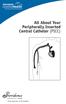 All About Your Peripherally Inserted Central Catheter (PICC) General Information Intravenous (IV) therapy is the delivery of fluid directly into a vein. An intravenous catheter is a hollow tube that is
Peripherally Inserted Central Catheter (PICC)
 Peripherally Inserted Central Catheter (PICC) Disclaimer This is general information developed by The Ottawa Hospital. It is not intended to replace the advice of a qualified healthcare provider. Please
PROCEDURE- SPECIFIC INFORMATION FOR PATIENTS
 The British Association of Urological Surgeons 35-43 Lincoln s Inn Fields London WC2A 3PE Phone: Fax: Website: E- mail: +44 (0)20 7869 6950 +44 (0)20 7404 5048 www.baus.org.uk [email protected] PROCEDURE-
The degree of liver inflammation or damage (grade) Presence and extent of fatty liver or other metabolic liver diseases
 ilearning about your health Liver Biopsy www.cpmc.org/learning What is a Liver Biopsy? A liver biopsy is a procedure where a specially trained doctor (typically a hepatologist, radiologist, or gastroenterologist)
Epidurals for pain relief after surgery
 Epidurals for pain relief after surgery This information leaflet is for anyone who may benefit from an epidural for pain relief after surgery. We hope it will help you to ask questions and direct you to
Femoral artery bypass graft (Including femoral crossover graft)
 Femoral artery bypass graft (Including femoral crossover graft) Why do I need the operation? You have a blockage or narrowing of the arteries supplying blood to your leg. This reduces the blood flow to
Ureteral Stenting and Nephrostomy
 Scan for mobile link. Ureteral Stenting and Nephrostomy Ureteral stenting and nephrostomy help restore urine flow through blocked ureters and return the kidney to normal function. Ureters are long, narrow
Catheter insertion of a new aortic valve to treat aortic stenosis
 Issue date March 2012 Understanding NICE guidance Information for people who use NHS services NICE interventional procedures guidance advises the NHS on when and how new procedures can be used in clinical
Having a RIG tube inserted
 Having a RIG tube inserted Information for patients and carers Delivering the best in care UHB is a no smoking Trust To see all of our current patient information leaflets please visit www.uhb.nhs.uk/patient-information-leaflets.htm
Oxford Centre for Respiratory Medicine Bronchial-Artery Embolisation Information for patients
 Oxford Centre for Respiratory Medicine Bronchial-Artery Embolisation Information for patients This leaflet tells you about the bronchial-artery embolisation procedure. It explains what is involved and
What should I expect before the procedure?
 The British Association of Urological Surgeons 35-43 Lincoln s Inn Fields London WC2A 3PE Phone: Fax: Website: E- mail: +44 (0)20 7869 6950 +44 (0)20 7404 5048 www.baus.org.uk [email protected] PROCEDURE-
PICCs and Midline Catheters
 Patient Education PICCs and Midline Catheters Patient s guide to PICC (peripherally inserted central catheter) and midline catheters What are PICCs and midline catheters used for? Any medicine given over
Cardiac Catheter Lab Information for patients having a Coronary Angiogram
 Cardiac Catheter Lab Information for patients having a Coronary Angiogram Page 1 of 5 What is a Coronary Angiogram? This is a test that uses dye and special x-rays to show the inside of your coronary arteries.
PROCEDURE- SPECIFIC INFORMATION FOR PATIENTS
 The British Association of Urological Surgeons 35-43 Lincoln s Inn Fields London WC2A 3PE Phone: Fax: Website: E- mail: +44 (0)20 7869 6950 +44 (0)20 7404 5048 www.baus.org.uk [email protected] PROCEDURE-
X-Plain Hip Replacement Surgery - Preventing Post Op Complications Reference Summary
 X-Plain Hip Replacement Surgery - Preventing Post Op Complications Reference Summary Introduction Severe arthritis in the hip can lead to severe pain and inability to walk. To relieve the pain and improve
Level 1, 131-135 Summer Street ORANGE NSW 2800 Ph: 02 63631688 Fax: 02 63631865
 Write questions or notes here: Level 1, 131-135 Summer Street ORANGE NSW 2800 Ph: 02 63631688 Fax: 02 63631865 Document Title: Revision Total Hip Replacement Further Information and Feedback: Tell us how
PATIENT GUIDE. Understand and care for your peripherally inserted central venous catheter (PICC). MEDICAL
 PATIENT GUIDE Understand and care for your peripherally inserted central venous catheter (PICC). MEDICAL Introduction The following information is presented as a guideline for your reference. The best
The temporary haemodialysis catheter
 The temporary haemodialysis catheter Department of Renal Medicine Patient Information Leaflet Introduction The information in this booklet is for: People have renal failure and who require urgent haemodialysis.
Electrophysiology study (EPS)
 Patient information factsheet Electrophysiology study (EPS) The normal electrical system of the heart The heart has its own electrical conduction system. The conduction system sends signals throughout
Heart Attack: What You Need to Know
 A WorkLife4You Guide Heart Attack: What You Need to Know What is a Heart Attack? The heart works 24 hours a day, pumping oxygen and nutrient-rich blood to the body. Blood is supplied to the heart through
Atrioventricular (AV) node ablation
 Patient information factsheet Atrioventricular (AV) node ablation The normal electrical system of the heart The heart has its own electrical conduction system. The conduction system sends signals throughout
Peripherally Inserted Central Catheter (PICC Line)
 Feedback We appreciate and encourage feedback. If you need advice or are concerned about any aspect of care or treatment please speak to a member of staff or contact the Patient Advice and Liaison Service
APPENDIX I-A: INFORMED CONSENT BB IND 11184 Protocol CDC IRB #4167
 APPENDIX I-A: INFORMED CONSENT BB IND 11184 Protocol CDC IRB #4167 INFORMED CONSENT FOR USE OF DIPHTHERIA ANTITOXIN (DAT) FOR SUSPECTED DIPHTHERIA CASES Investigational New Drug (IND) BB 11184 Protocol
How To Use An Ultrasound For Medical Research
 Scan for mobile link. General Ultrasound What is General Ultrasound Imaging? Ultrasound is safe and painless, and produces pictures of the inside of the body using sound waves. Ultrasound imaging, also
CONTENTS: WHAT S IN THIS BOOKLET
 Q Questions & A & Answers About Your Prostate Having a biopsy test to find out if you may have prostate cancer can bring up a lot of questions. This booklet will help answer those questions. CONTENTS:
AMPUTATION OF THE PENIS (PARTIAL OR COMPLETE) FOR CANCER INFORMATION FOR PATIENTS
 The British Association of Urological Surgeons 35-43 Lincoln s Inn Fields London WC2A 3PE Phone: Fax: Website: E-mail: +44 (0)20 7869 6950 +44 (0)20 7404 5048 www.baus.org.uk [email protected] AMPUTATION
Local Steroid Injections to Joints and Soft Tissues. Rheumatology Patient Information Leaflet
 Local Steroid Injections to Joints and Soft Tissues Rheumatology Patient Information Leaflet Welcome to The Dudley Group Rheumatology department. This leaflet will provide you with information about what
ARTHROSCOPIC HIP SURGERY
 ARTHROSCOPIC HIP SURGERY Hip Arthroscopy is a relatively simple procedure whereby common disorders of the hip can be diagnosed and treated using keyhole surgery. Some conditions, which previously were
Nerve Blocks. What is a Nerve Block? What are some common uses of the procedure?
 Scan for mobile link. Nerve Blocks A nerve block is an injection to decrease inflammation or "turn off" a pain signal along a specific distribution of nerve. Imaging guidance may be used to place the needle
Care of your central venous catheter A guide for patients and their carers. We care, we discover, we teach
 Care of your central venous catheter A guide for patients and their carers We care, we discover, we teach This booklet contains information about central venous catheters (CVC). These are sometimes called
CORONARY ANGIOGRAPHY WHAT IS CORONARY ANGIOGRAPHY:
 CORONARY ANGIOGRAPHY WHAT IS CORONARY ANGIOGRAPHY: This is an x-ray exploration of the main arteries connected to the heart. The objective of the examination is to determine if the inner walls of the arteries
Further information You can get more information and share your experience at www.aboutmyhealth.org
 OS01 Total Hip Replacement Further information You can get more information and share your experience at www.aboutmyhealth.org Local information You can get information locally from: Taunton and Somerset
A PATIENT S GUIDE TO CARDIAC CATHETERIZATION
 A PATIENT S GUIDE TO CARDIAC CATHETERIZATION The science of medicine. The compassion to heal. This teaching booklet is designed to introduce you to cardiac catheterization. In the following pages, we will
Having a Trans-Arterial Embolisation
 Having a Trans-Arterial Embolisation Delivering the best in care UHB is a no smoking Trust To see all of our current patient information leaflets please visit www.uhb.nhs.uk/patient-information-leaflets.htm
Arthroscopic subacromial decompression and rotator cuff repair
 Further sources of information http://www.patient.co.uk/showdoc/553/ http://www.shoulderdoc.co.uk/article.asp?section=11 http://www.medic8.com/healthguide/articles/painfulshoulder.html http://www.cks.nhs.uk/patientinformationleaflet/shoulderpainarc/st
An abdominal ultrasound produces a picture of the organs and other structures in the upper abdomen.
 Scan for mobile link. Ultrasound - Abdomen Ultrasound imaging of the abdomen uses sound waves to produce pictures of the structures within the upper abdomen. It is used to help diagnose pain or distention
Blepharoplasty - Eyelid Surgery
 Blepharoplasty - Eyelid Surgery Introduction Eyelid surgery repairs sagging or drooping eyelids. The surgery is also known as blepharoplasty, or an eyelid lift. Sagging or drooping eyelids happen naturally
Mesenteric Angiography
 Information for patients Mesenteric Angiography Sheffield Vascular Institute Northern General Hospital You have been given this leaflet because you need a procedure known as a Mesenteric Angiogram. This
Ultrasound - Vascular
 Scan for mobile link. Ultrasound - Vascular Vascular ultrasound uses sound waves to evaluate the body s circulatory system and help identify blockages and detect blood clots. A Doppler ultrasound study
Level 1, 131-135 Summer Street ORANGE NSW 2800 Ph: 02 63631688 Fax: 02 63631865
 Write questions or notes here: Level 1, 131-135 Summer Street ORANGE NSW 2800 Ph: 02 63631688 Fax: 02 63631865 Document Title: Total Knee Replacement Further Information and Feedback: Tell us how useful
Percutaneous Transluminal Angioplasty (PTA) and Stenting For PVS Patients
 Percutaneous Transluminal Angioplasty (PTA) and Stenting For PVS Patients There are two types of blood vessels in the body arteries and veins. Arteries carry blood rich in oxygen from the heart to all
Image-guided abdominal drain insertion Information for patients
 Oxford University Hospitals NHS Trust Image-guided abdominal drain insertion Information for patients What is an image-guided abdominal drain insertion? A drain is a thin plastic tube which is inserted
Client Information for Informed Consent TESTOSTERONE FOR TRANSGENDER PATIENTS
 Client Information for Informed Consent TESTOSTERONE FOR TRANSGENDER PATIENTS You want to take testosterone to masculinize your body. Before taking it, there are several things you need to know about.
Arterio-Venous Fistula or Arterio-Venous Graft for Haemodialysis
 Department of Nephrology Care of your Fistula Nephrology Department Lower Lane Liverpool L9 7AL Tel:0151-525-5980 Arterio-Venous Fistula or Arterio-Venous Graft for Haemodialysis Haemodialysis access In
What Are Arrhythmias?
 What Are Arrhythmias? Many people have questions about what the word arrhythmia means, and arrhythmias can be a difficult subject to understand. The text below should give you a better understanding of
A Patient s Guide to Antithrombotic Therapy in Atrial Fibrillation
 Patient s Guide to Antithrombotic Therapy in Atrial Fibrillation A Patient s Guide to Antithrombotic Therapy in Atrial Fibrillation PATIENT EDUCATION GUIDE What is atrial fibrillation? Atrial fibrillation
CERVICAL MEDIASTINOSCOPY WITH BIOPSY
 INFORMED CONSENT INFORMATION ADDRESSOGRAPH DATA CERVICAL MEDIASTINOSCOPY WITH BIOPSY You have decided to have an important procedure and we appreciate your selection of UCLA Healthcare to meet your needs.
Tunneled Central Venous Catheter (CVC) Placement
 PATIENT EDUCATION patienteducation.osumc.edu Tunneled Central Venous Catheter (CVC) Placement A tunneled Central Venous Catheter (CVC) is a special type of intravenous (IV) line that is placed into a large
Central Venous Lines (CVP)
 2011 Central Venous Lines (CVP) Central Venous Line This pamphlet is about a central venous pressure (CVP) line and why it may be needed. We would like to encourage you to read this pamphlet. The nurses
CATHETER for Hemodialysis
 CATHETER for Hemodialysis What You Need to Know to Stay Healthy with a Catheter One treatment choice for kidney failure is hemodialysis (HD). HD removes wastes and excess fluid from your blood. Your lifeline
Suspected pulmonary embolism (PE) in pregnant women
 Suspected pulmonary embolism (PE) in pregnant women What is a pulmonary embolus? A deep vein thrombosis (DVT) is a blood clot that forms in one of the deep veins of the leg. If the clot moves to the lung,
PICC/Midclavicular/Midline Catheter
 47 PICC/Midclavicular/Midline Catheter Introduction- PICC/ MCV/ Midline You have a PICC/Midclavicular/Midline (peripherally inserted) catheter. This catheter should make receiving I.V. medicines or solutions
Sterilisation for women and men: what you need to know
 Sterilisation for women and men: what you need to know Published January 2004 by the RCOG Contents Page number Key points 1 About this information 2 What are tubal occlusion and vasectomy? 2 What do I
Facts about diabetic macular oedema
 Patient information medical retina services Facts about diabetic macular oedema What is diabetic macular oedema? Diabetic eye disease is a leading cause of blindness registration among working age adults
Your anaesthetist may suggest that you have a spinal or epidural injection. These
 Risks associated with your anaesthetic Section 11: Nerve damage associated with a spinal or epidural injection Your anaesthetist may suggest that you have a spinal or epidural injection. These injections
Hemodialysis Access: What You Need to Know
 Hemodialysis Access: What You Need to Know Hemodialysis Access: What You Need To Know Whether you already get hemodialysis treatment, or you will need to start dialysis soon, this booklet will help you
PICC Catheter for IV Therapy
 PICC Catheter for IV Therapy A Patient Guide for: PATIENT PICC A PICC is defined as a Peripherally Inserted Central Catheter. A PICC is a special IV Catheter. It is put in an arm vein and ends in a large
Procedure Information Guide
 Procedure Information Guide Total hip replacement Brought to you in association with EIDO and endorsed by the The Royal College of Surgeons of England Discovery has made every effort to ensure that the
Arthroscopic shoulder stabilisation. Patient Information to be retained by patient
 PLEASE PRINT WHOLE FORM DOUBLE SIDED ON YELLOW PAPER Patient Information to be retained by patient affix patient label Shoulder instability The shoulder is the most common joint in the body to dislocate.
PATIENT INFORMATION BOOKLET
 PATIENT INFORMATION BOOKLET Wingspan Stent System with Gateway PTA Balloon Catheter TABLE OF CONTENTS Definitions... 2 What is the Purpose of This Booklet?... 3 What is an Intracranial Lesion?... 3 Who
Chemotherapy. What is chemotherapy? How does it work? What is cancer? How will I be given chemotherapy? Cannula
 INFORMATION SHEET This information sheet has been written to help you understand more about chemotherapy. The sheet discusses the support and information your doctors, nurses and the Cancer Society can