
Public Water System. Consumer Confidence Report Template
|
|
|
- Andra Patrick
- 9 years ago
- Views:
Transcription
1 Public Water System Consumer Confidence Report Template Ohio Environmental Protection Agency Division of Drinking and Ground Waters Updated March 2015

2 Section 1: Title {Water System Name} Drinking Water Consumer Confidence Report For {year} Section 2: Introduction The following paragraph is not required. Other preferred wording may be used. It is recommended that information concerning improvements to treatment or distribution that have been made in the past year, information of future improvements or public service information be added. The {Water System Name} has prepared the following report to provide information to you, the consumer, on the quality of our drinking water. Included within this report is general health information, water quality test results, how to participate in decisions concerning your drinking water and water system contacts. Section 3: Source Water Information The {Water System Name} receives its drinking water from {name and location of source water}. Include the following if an auxiliary or emergency public water system interconnection is available; see instructions for limitations on the use of this paragraph: The {Water System Name} also has an {Auxiliary / Emergency / Back-up} connection with the {Supplier Water System Name}. During {year} we used gallons from this connection over days. On average, this connection is used for approximately days each year. This report does not contain information on the water quality received from the {Supplier Water System Name}, but a copy of their consumer confidence report can be obtained by contacting {Supplier s contact name and number}. Note: A Vulnerability Assessment Report was prepared for your water system by Ohio EPA. The Susceptibility Paragraph on the last page of that report is to be included in your CCR every year. Section 4: What are sources of contamination to drinking water? {Mandatory Language} The sources of drinking water (both tap water and bottled water) include rivers, lakes, streams, ponds, reservoirs, springs, and wells. As water travels over the surface of the land or through the ground, it dissolves naturally-occurring minerals and, in some cases, radioactive material, and can pick up substances resulting from the presence of animals or from human activity. Contaminants that may be present in source water include: (A) Microbial contaminants, such as viruses and bacteria, which may come from sewage treatment plants, septic systems, agricultural livestock operations and wildlife; (B) Inorganic contaminants, such as salts and metals, which can be naturallyoccurring or result from urban storm water runoff, industrial or domestic wastewater discharges, oil and

3 gas production, mining, or farming; (C) Pesticides and herbicides, which may come from a variety of sources such as agriculture, urban storm water runoff, and residential uses; (D) Organic chemical contaminants, including synthetic and volatile organic chemicals, which are by-products of industrial processes and petroleum production, and can also come from gas stations, urban Strom water runoff, and septic systems; (E) Radioactive contaminants, which can be naturally-occurring or be the result of oil and gas production and mining activities. In order to ensure that tap water is safe to drink, USEPA prescribes regulations which limit the amount of certain contaminants in water provided by public water systems. FDA regulations establish limits for contaminants in bottled water which must provide the same protection for public health. Drinking water, including bottled water, may reasonably be expected to contain at least small amounts of some contaminants. The presence of contaminants does not necessarily indicate that water poses a health risk. More information about contaminants and potential health effects can be obtained by calling the Federal Environmental Protection Agency s Safe Drinking Water Hotline ( ). Section 5: Who needs to take special precautions? {Mandatory Language} Some people may be more vulnerable to contaminants in drinking water than the general population. Immuno-compromised persons, such as persons with cancer undergoing chemotherapy, persons who have undergone organ transplants, people with HIV/AIDS or other immune system disorders, some elderly, and infants can be particularly at risk from infection. These people should seek advice about drinking water from their health care providers. EPA/CDC guidelines on appropriate means to lessen the risk of infection by Cryptosporidium and other microbial contaminants are available from the Safe Drinking Water Hotline ( ). Section 6: About your drinking water. The EPA requires regular sampling to ensure drinking water safety. The {Water System Name} conducted sampling for {bacteria; inorganic; radiological; synthetic organic; volatile organic} during {year}. Samples were collected for a total of {number of different contaminants for which samples were collected} different contaminants most of which were not detected in the {Water System Name} water supply. The Ohio EPA requires us to monitor for some contaminants less than once per year because the concentrations of these contaminants do not change frequently. Some of our data, though accurate, are more than one year old. Section 7: Monitoring & Reporting Violations & Enforcement Actions Include the following paragraph if there were monitoring or reporting violations, or violations of terms of an administrative order, bilateral compliance agreement, or a judicial order. During the month of {month}, {year}, {Water System Name} failed to {monitor or report} {Describe monitoring or reporting violations and indicate steps to prevent future violations}.
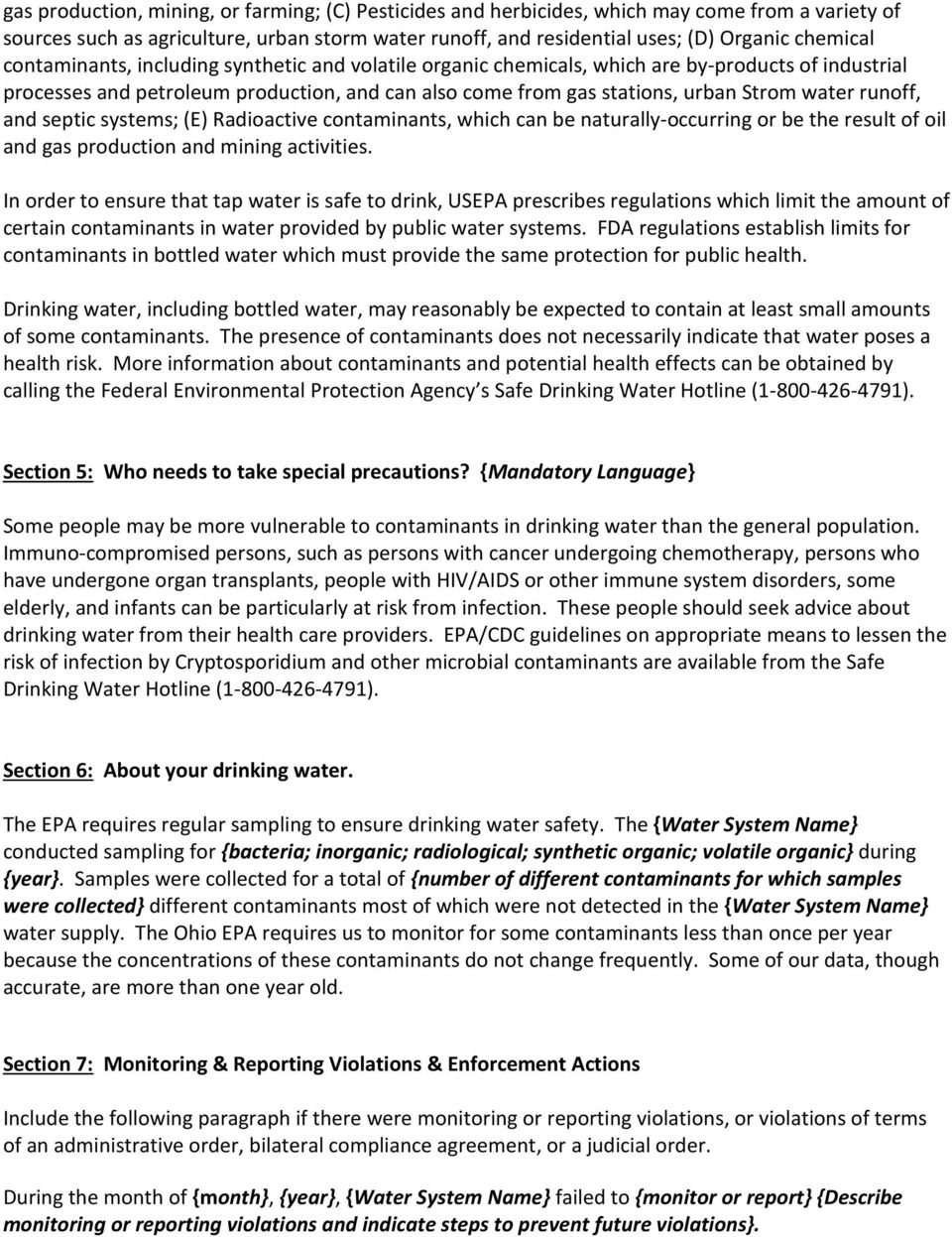
4 If there was an enforcement action taken in the reporting year, include the deadline for meeting the terms of the agreement, action, or findings and orders. Also include whether or not the deadline was met. Section 8: Table of Detected Contaminants {A Table of Detected Contaminants is Mandatory} Listed below is information on those contaminants that were found in the {Water System Name} drinking water. TABLE OF DETECTED CONTAMINANTS Contaminants Level MCLG MCL (Units) Found Bacteriological Range of Detections Violation Sample Year Typical Source of Contaminants Radioactive Contaminants Inorganic Contaminants Synthetic Organic Contaminants including Pesticides and Herbicides Volatile Organic Contaminants Residual Disinfectants Include the following if Beta was detected: EPA considers 50 pci/l to be the level of concern for beta particles.
5 Section 9: Turbidity Include the following if required to monitor for turbidity. Turbidity is a measure of the cloudiness of water and is an indication of the effectiveness of our filtration system. The turbidity limit set by the EPA is {0.3 NTU) in 95% of the daily samples and shall not exceed 5 NTU at any time. As reported above, the {Water System Name s} highest recorded turbidity result for {year} was {highest recorded turbidity} NTU and lowest monthly percentage of samples meeting the turbidity limits was {lowest monthly % samples meeting turbidity limit}. Section 10: Violations Include the following if a MCL, TT, filtration or disinfection (CT) violation or action level exceedance occurred. The {Water System Name} had a {MCL, treatment technique, filtration or disinfection (CT) violation or action level exceedance} during the month(s) of {month(s)}, {year}. {Obtain mandatory health effects language from the CCR Template Instruction Guide Appendix B and add it here}. {Water System Name} took/is taking the following steps to correct this violation (or action level exceedance) and prevent future violations from occurring: {Describe steps to return to compliance and to prevent future violations.} Section 11: Nitrate Educational Information Include the following paragraph if the nitrate level is greater than 5.0 ppm but less than 10 ppm. Nitrate in drinking water at levels above 10 ppm is a health risk for infants less than six months of age. High nitrate levels in drinking water can cause blue baby syndrome. Nitrate levels may rise quickly for short periods of time because of rainfall or agricultural activity. If you are caring for an infant you should ask advice from your health care provider. Section 12: Arsenic Educational Information Include the following paragraph if the arsenic level is > 5 ppb and up to, and including, 10 ppb. If the level detected is greater than 10 ppb, include the health effects language for arsenic contained in Appendix B of the Instruction Guide in place of the below paragraph. While your drinking water meets EPA s standard for arsenic, it does contain low levels of arsenic. EPA s standard balances the current understanding of arsenic s possible health effects against the cost of removing arsenic from drinking water. EPA continues to research the health effects of low levels of arsenic, which is a mineral known to cause cancer in humans at high concentrations and is linked to other health effects such as skin damage and circulatory problems.

6 Section 13: Lead Educational Information {Mandatory Language} All CCRs must include the following paragraph: If present, elevated levels of lead can cause serious health problems, especially for pregnant women and young children. Lead in drinking water is primarily from materials and components associated with service lines and home plumbing. {Name of Water System} is responsible for providing high quality drinking water, but cannot control the variety of materials used in plumbing components. When your water has been sitting for several hours, you can minimize the potential for lead exposure by flushing your tap for 30 seconds to 2 minutes before using water for drinking or cooking. If you are concerned about lead in your water, you may wish to have your water tested. Information on lead in drinking water, testing methods, and steps you can take to minimize exposure is available from the Safe Drinking Water Hotline at or at Also, if the lead action level was exceeded, include the following paragraph: Infants and young children are typically more vulnerable to lead in drinking water than the general population. It is possible that lead levels at your home may be higher than at other homes in the community as a result of materials used in your home's plumbing. If you are concerned about elevated lead levels in your home's water, you may wish to have your water tested and flush your tap for 30 seconds to 2 minutes before using tap water. Additional information is available from the Safe Drinking Water Hotline ( ). Section 14: Cryptosporidium Information. Include the following if Cryptosporidium was detected either in the RAW or finished water. {Water System Name} monitored for Cryptosporidium in the {source water and/or treated water} during {year}. Cryptosporidium was detected in {# of raw water samples found to contain Cryptosporidium} of {Total # of raw water samples collected for Cryptosporidium} collected from the source water and in {# of finished water samples found to contain Cryptosporidium} of {Total # of finished water samples collected for Cryptosporidium} collected from the treated water. Cryptosporidium is a microbial pathogen found in surface water throughout the U.S. Although filtration removes cryptosporidium, the most commonly used filtration methods cannot guarantee 100 percent removal. Our monitoring of source water and/or finished water indicate the presence of these organisms. Current test methods do not enable us to determine if the organisms are dead or if they are capable of causing disease. Symptoms of infection include nausea, diarrhea, and abdominal cramps. Most healthy individuals can overcome the disease within a few weeks. However, immunocompromised people are at greater risk of developing a life threatening illness. We encourage immunocompromised individuals to consult their doctor regarding appropriate precautions to avoid infection. Cryptosporidium must be ingested to cause disease, and it may be spread through means other than drinking water.
7 Include the following if adequate filtration equipment is not installed or is not operational or if Cryptosporidium was detected in the finished water: The {Water System Name} intends to take the following actions to ensure adequate treatment for Cryptosporidium: {Describe actions to be taken.} Section 15: Radon Include the following if radon was detected in the finished water. {Water System Name} monitored for radon in the finished water during {year}. A total of {# collected} samples were collected and the average radon level was {Average of all finished water radon sample results} pci/l with a detection range of {detected range of radon samples}. {OR} One sample was collected and the radon level was {Radon sample result pci/l}. Radon is a radioactive gas that occurs naturally in some ground water. It may pose a health risk when the gas is released from water into air, as occurs during showering, bathing, or washing dishes and clothes. Radon gas released from drinking water is a relatively small part of the total radon in air. Major sources of radon gas are soil and cigarettes. Inhalation of radon gas has been linked to lung cancer; however, the effects of radon ingested in drinking water are not yet clear. If you are concerned about radon in your home, tests are available to determine the total exposure level. For additional information on how to have your home tested, call SOS RADON. Note: It is recommended that the water system include any additional monitoring information that has not been reported above. Information on levels detected and any possible health risk are recommended.

8 Section 16: Ground Water Rule Include the following if there were any significant deficiencies identified regarding your ground water wells. Significant deficiency information must be included in the CCR every year until it has been corrected. We were informed by the Ohio EPA that a significant deficiency {list the deficiency} had been identified on {letter date}. We were directed to correct the deficiency by {deadline} but we failed to do so. We {are implementing/have completed} the corrective action plan which is {describe specific action plan} by {deadline} as prescribed by the Ohio EPA. If there were any Fecal indicator-positive ground water source samples, include the following information in the Table of Detected Contaminants Contaminant (Units) MCLG MCL Value Range of Detections Violation Year Sampled Typical Source of Contaminants Fecal indicator (E. coli) NA TT Positive (E. coli) NA No 2009 Human and animal fecal waste Also, include the language below in the body of the report. Mandatory language is in bold. On {date}, we were informed that one of our routine bacteria samples, collected on {sample date}, was total coliform positive. As required by the Ground Water Rule, we collected {# samples} from {source} for fecal contamination analysis. The {source} sample was positive for fecal contamination {E. coli}. Inadequately treated or inadequately protected water may contain disease-causing organisms. These organisms can cause symptoms such as diarrhea, nausea, cramps and associated headaches. Fecal indicators are microbes whose presence indicates that the water may be contaminated with human or animal wastes. Microbes in these pose a special health risk for infants, young children, some of the elderly, and people with severely compromised immune system. In response, we sent notices to all of our customers within 24 hrs of learning of this positive sample. {Explain how the situation was or will be resolved and list the date of completion or proposed date of completion.} Note: A Special notice for fecal contamination must be included in your CCR every year until Ohio EPA determines the situation has been satisfactorily corrected. Section 17: License to Operate (LTO) Status Information One of four possible situations describes the status of a LTO. It must be included in the report. If you were issued a green LTO, include a statement similar to the following: In {year} we had an unconditioned license to operate our water system.
9 If you were issued a yellow LTO, there are ongoing conditions or violations that continue to need to be met. Include statements similar to the following: In {year} we had a conditioned license to operate our public water system. The conditions require us to address ongoing violations. For more information on these violations, contact {name and phone number}. If you were issued a red LTO, the license was revoked or suspended. Include statements similar to the following: Our license to operate this public water system was suspended/revoked in {year} based on ongoing violations. Until we address our violations and obtain a license to operate from the Ohio EPA, we are prohibited to operate this public water system. For more information on all of our violations, contact {name and phone number}. If you failed to pay the LTO, statements similar to the following must be included: We did not have a current license to operate in {year} as required by the Ohio EPA. We plan to pay the fee as soon as possible. To prevent this from happening in the future, we plan to pay the fee immediately upon request from the Ohio EPA. Section18: Public Notice If you choose to include a monitoring violation public notice in your CCR in lieu of mailing/posting the public notice of violation, the following information must be included. Note that all required public notice components for monitoring violations are provided in the OEPA violation letter. a) Standard language for monitoring and testing procedure violations, including the language necessary to fill in the blanks: We are required to monitor your drinking water for specific contaminants on a regular basis. Results of regular monitoring are an indicator of whether or not your drinking water meets health standards. During {compliance period}, we (did not monitor or test {or} did not complete all monitoring or testing) for {contaminant(s)} and therefore cannot be sure of the quality of your drinking water during that time. b) For fluoride secondary MCLs, and if applicable, include potential adverse health effects from the violation, including standard health effects language, (See Instruction Guide - Appendix B); c) The population at risk, including subpopulations particularly vulnerable if exposed to the contaminant in the drinking water; d) Whether alternative water supplies should be used; what actions consumers should take, including when they should seek medical help, if known; what the system is doing to correct the violation or situation; e) When the water system expects to return to compliance or resolve the situation;

10 f) The name, business address, and phone number of the water system owner, operator, or designee of the public water system as a source of additional information concerning the notice, and; g) A statement to encourage the notice recipient to distribute the public notice to other persons served, using the following standard language: "Please share this information with all the other people who drink this water, especially those who may not have received this notice directly (for example, people in apartments, nursing homes, schools, and businesses). You can do this by posting this notice in a public place or distributing copies by hand or mail." Section 19: Public Participation Information How do I participate in decisions concerning my drinking water? Public participation and comment are encouraged at regular meetings of {Governing body} which meets {Meeting schedule for the next year.} For more information on your drinking water contact {Water system contact person} at {Phone #} Section 20: Definitions of some terms contained within this report. {Mandatory Definitions} Maximum Contaminant Level Goal (MCLG): The level of a contaminant in drinking water below which there is no known or expected risk to health. MCLGs allow for a margin of safety. Maximum Contaminant level (MCL): The highest level of contaminant that is allowed in drinking water. MCLs are set as close to the MCLGs as feasible using the best available treatment technology. Parts per Million (ppm) or Milligrams per Liter (mg/l) are units of measure for concentration of a contaminant. A part per million corresponds to one second in a little over 11.5 days. Parts per Billion (ppb) or Micrograms per Liter (μg/l) are units of measure for concentration of a contaminant. A part per billion corresponds to one second in 31.7 years. Maximum Residual Disinfectant Level Goal (MRDLG): The level of drinking water disinfectant below which there is no known or expected risk to health. MRDLGs do not reflect the benefits of the use of disinfectants to control microbial contaminants. Maximum Residual Disinfectant Level (MRDL): The highest level of a disinfectant allowed in drinking water. There is convincing evidence that addition of a disinfectant is necessary for control of microbial contaminants.

11 Action Level (AL): The concentration of a contaminant which, if exceeded, triggers treatment or other requirements which a water system must follow. The following definitions are only required if used in the report. Include definitions for any term used in the report that is not considered every-day language. Treatment Technique (TT): A required process intended to reduce the level of a contaminant in drinking water. The < symbol: A symbol which means less than. A result of <5 means that the lowest level that could be detected was 5 and the contaminant in that sample was not detected. Picocuries per liter (pci/l): A common measure of radioactivity.

Parts per million (ppm) or Milligrams per liter (mg/l): one part by weight of analyte to 1 million parts by weight of the water sample.
 2015 Annual Drinking Water Quality Report St. Johns County Utility CR 214 Mainland We're pleased to present to you this year's Annual Water Quality Report. This report is designed to inform you about the
2010 Annual Drinking Water Quality Report Collier County Water Department
 Annual Drinking Water Quality Report Collier County Water Department The Collier County Water Department is pleased to present this annual water quality report. We trust that you will read this report
water quality 2007 annual report Huntington District Our Customer Charter Dear West Virginia American Water Customer,
 Dear West Virginia American Water Customer, 2007 annual water quality report You are our top priority. And delivering reliable, high-quality water to you all day, every day is our mission. We deliver at
Water. Quality. Report. Water Resources Department
 2013 Water Quality Report Providing Quality Water For Over A Century For more than 100 years, the City of Mesa has been committed to providing its customers with water that meets more than 100 state and
Saving water means saving money; Fix those leaks right away. Community Water Company of Green Valley. Our Water Source
 Published June 20155 Community Water Company of Green Valley Water Quality Report 1501 S. La Canada Dr., Green Valley, AZ 85622 Phone: 520-625-8409 www.communitywater.com Community Water Company is pleased
2015 Annual Drinking Water Quality Report of the Englewood Water District
 2015 Annual Drinking Water Quality Report of the Englewood Water District Is my water safe? We are pleased to present this year's Annual Water Quality Report (Consumer Confidence Report) as required by
Annual. Water testing performed in 2010. Presented By PWS ID#: FL6520336
 Annual Water QualityReport Water testing performed in 2010 Presented By PWS ID#: FL6520336 Meeting the Challenge O nce again we are proud to present our annual Water Quality Report. This report covers
Drinking Water Quality Report
 Anne Arundel County Drinking Water Quality Report 2012 2012 Drinking Water Quality Anne Arundel County Department of Public Works Bureau of Utility Operations is proud to present the 2012 Drinking Water
2010 Annual Water Quality Report
 2010 Annual Water Quality Report Tennessee PWS ID: TN0000107 A Message from John Watson, President Dear Tennessee American Water Customer: Tennessee American Water is proud to be your local water company.
Annual. Quality. Report. for Courthouse Bay Water Treatment System. USMC Camp Lejeune - Courthouse Bay PWS ID#: NC0467047
 2007 Water Annual Quality Report for Courthouse Bay Water Treatment System USMC Camp Lejeune - Courthouse Bay PWS ID#: NC0467047 Meeting the Challenge M A arine Corps Base (MCB) Camp s Lejeune is committed
2015 Annual Drinking Water Quality Report. Celebrating 200 Years of That good York water Thanks to our Dedicated Employees.
 2015 Annual Drinking Water Quality Report Public Water System I.D. 7670100 Celebrating 200 Years of That good York water Thanks to our Dedicated Employees. W ANNUAL DRINKING WATER QUALITY REPORT e re pleased
2015 Annual Drinking Water Quality Report Water System Number: 04-07-010
 2015 Annual Drinking Quality Report System Number: 04-07-010 We are pleased to present to you this year's Annual Drinking Quality Report. This report is a snapshot of last year s water quality. Included
Where does my water come from? Harrisonburg 2013 Hardness Levels
 Definitions AL (Action Level): The concentration of a contaminant which, if exceeded, triggers treatment or other requirements which a water system must follow. MCL (Maximum Contaminant Level): The highest
EDINBORO WATER AUTHORITY
 Annual Drinking Water Quality Report EDINBORO WATER AUTHORITY PWSID 6250022 No Monitoring Violations in 2014 We're pleased to present to you this year's Annual Drinking Water Quality Report. This report
2011 Drinking Water Quality Report for Nellis Air Force Base
 2011 Drinking Water Quality Report for Nellis Air Force Base This report is a snapshot of calendar year 2011 drinking water quality at Nellis AFB. It is required by the Environmental Protection Agency
2008 Consumer Confidence Report
 2008 Consumer Confidence Report A Message from Robert G. MacLean, President As a trusted leader in the industry, California American Water places a strong emphasis on sharing water quality information
YOUr 2013 Water Quality REport
 YOUr 2013 Water Quality REport Chaparral City Water Company epcor.com PWS ID 0407017 CHAPARRAL CITY WATER COMPANY Safety. Quality. Community. You ll hear these words spoken often around EPCOR. For EPCOR,
2012 Drinking. Water Report. Indianapolis, Morgan Co. & Plainfield. CitizensEnergyGroup.com - 1 -
 2012 Drinking Water Report Indianapolis, Morgan Co. & Plainfield CitizensEnergyGroup.com - 1 - What is a drinking water report and why did I get one? As a regional water supplier serving multiple counties
2015 Annual Drinking Water Quality Report For the City of Pittsfield, Massachusetts
 2015 Annual Drinking Water Quality Report For the City of Pittsfield, Massachusetts MassDEP Public Water Supply ID #1236000 This report provides drinking water quality information, including details about
2009 Drinking Water Quality Report The University of Kansas - Lawrence Campus - July 2010
 2009 Drinking Water Quality Report The University of Kansas - Lawrence Campus - July 2010 Prepared by the Department of Environment, Health & Safety The purpose of this report is to inform people who work
Water Quality Report January 1 - December 31, 2013
 Water Quality Report January 1 - December 31, 2013 Keeping Our Community Educated On the Quality of Our Drinking Water The purpose of this report is to keep our Residents informed on the quality of their
Report to Customers on. Water Quality. Introduction: Where Does Water Come From? Water Quality. For Supply Year. Important Phone Numbers
 2014 ANNUAL REPORT Endicott Water Department Public Water Supply ID# 0301665 Report to Customers on Water Quality Endicott Municipal Water Department Water Quality For Supply Year 2014 Introduction: To
Hampton Shaler Water Authority
 Hampton Shaler Water Authority PWSID # 5020019 P.O. Box 66, 3101 McCully Road Allison Park, PA 15101 Phone: (412) 486-4867 Fax: (412) 486-4345 Annual Quality Report For Este informe contiene informacion
Hampton Shaler Water Authority
 Hampton Shaler Water Authority PWSID # 5020019 P.O. Box 66, 3101 McCully Road Allison Park, PA 15101 Phone: (412) 486-4867 Fax: (412) 486-4345 Annual Quality Report For Este informe contiene informacion
Water Analysis Report Report Date: March 31, 2012 Testing Period: 1st - 4th Quarter 2011
 Volatile Organic Compounds Benzene 0.0005 0.005 ND Carbon tetrachloride 0.0005 0.005 ND Chlorobenzene (Monochlorobenzene) 0.0005 0.100 ND 1,2-Dichlorobenzene (o-dcb) 0.0005 0.600 ND 1,4-Dichlorobenzene
El Paso Water Utilities Drinking Water Report. www.epwu.org
 2 El Paso Water Utilities Drinking Water Report www.epwu.org Definitions Action Level - The concentration of a contaminant which, if exceeded, triggers treatment or other requirements which a water system
How To Read The 2015 Water Quality Report
 2015 Annual Water Quality Report US Army South Fort Hood PWS ID: TX0140107 This report contains important information about your drinking water. If you do not understand it, please have someone explain
Division of Epidemiology, Environmental and Occupational Health Consumer and Environmental Health Services
 Division of Epidemiology, Environmental and Occupational Health Consumer and Environmental Health Services FACTS Cryptosporidium in Drinking Water What Is Cryptosporidium? 3 Why Is Cryptosporidium a Concern
A Report on Your Water Quality
 2013 Consumer Confidence REPORT FROM THE MAHWAH WATER DEPARTMENT A Report on Your Water Quality MAHWAH WATER DEPARTMENT Normal Working Hours Monday thru Friday 7:00am to 3:30pm 201-529-4413 / 201-512-1161
FACTS. Nitrate and Nitrite in Drinking Water. What Are Nitrate and Nitrite? 3. How Can These Chemicals Get into Your Drinking Water?
 FACTS Nitrate and Nitrite in Drinking Water What Are Nitrate and Nitrite? 3 How Can These Chemicals Get into Your Drinking Water? 3 How Can You Find Out If These Chemicals Are in Your Drinking Water? 4
Water Quality Report. 2015 Annual. Atlantic County System PWS ID: NJ0119002. A Message from the New Jersey American Water President
 2015 Annual Water Quality Report Atlantic County System PWS ID: NJ0119002 A Message from the New Jersey American Water President To Our Valued Customer: New Jersey American Water is proud to be your local
ANNUAL WATER QUALITY REPORT
 2014 ANNUAL WATER QUALITY REPORT Presidio of San Francisco Lobos Creek The Presidio Water Treatment Plant vigilantly safeguards its water supplies. Last year, Presidio tap water met all U.S. Environmental
FACTS Private Well Testing
 FACTS Private Well Testing Introduction 3 Why Should You Test Your Well Water? 4 What Are the Most Common Sources of Well Water Contamination? 6 What Health Effects Are Associated with Well Water Contaminants?
NITRATE. is found in the Honolulu Board of Water Supply REGION 3 (Ewa-Waianae-Waipahu System). Here are the EPA s Health Effects for this contaminant,
 NITRATE is found in the Honolulu Board of Water Supply REGION 3 (Ewa-Waianae-Waipahu System). Here are the EPA s Health Effects for this contaminant, as reported in the EPA Reports, & Honolulu Board of
Water Quality Report. For You, Only Our Best Will Do! An Ongoing Commitment to the Communities We Serve. West Orange Water System
 Water Quality Report 2008 For You, Only Our Best Will Do! An Ongoing Commitment to the Communities We Serve. West Orange Water System West Orange Water System Water Quality, Customer Service and Healthy
How do you treat water based on water quality from different water sources?
 How do you treat water based on water quality from different water sources? Why? Authors: Wendy Lane and Kim Sciarrone Seattle Public Schools; Seattle, WA Water from different sources will contain different
BOTTLED WATER QUALITY REPORT INTRODUCTION VOSS SOURCE SPECIFIC MINERAL ANALYSIS. VOSS Still. VOSS Sparkling. General Mineral Analysis
 BOTTLED WATER QUALITY REPORT Voss ion AS, N-4730 Vatnestrøm, Norway 1-877-525-VOSS INTRODUCTION At VOSS, we are proud of the quality of our products. VOSS Artesian Water from Norway meets all bottled water
Chapter 14 Quiz. Multiple Choice Identify the choice that best completes the statement or answers the question.
 Chapter 14 Quiz Multiple Choice Identify the choice that best completes the statement or answers the question. 1. Which of the following is NOT true regarding the Chesapeake Bay? a. it is one of many small
FREQUENTLY ASKED QUESTIONS: National Response to I-131 from Japan Nuclear Power Plant March 27, 2011. Environmental Protection Agency (EPA)
 FREQUENTLY ASKED QUESTIONS: National Response to I-131 from Japan Nuclear Power Plant March 27, 2011 Environmental Protection Agency (EPA) Are the levels we re seeing in precipitation likely to lead to
Total Suspended Solids Total Dissolved Solids Hardness
 Total Suspended Solids (TSS) are solids in water that can be trapped by a filter. TSS can include a wide variety of material, such as silt, decaying plant and animal matter, industrial wastes, and sewage.
Drinking Water Quality Report
 Annual July 2015 Issue The Charter Township of Redford (year 2014 test results ) Drinking Water Quality Report Water & Sewer Department 12200 Beech Daly, Redford Ml 48239 (313) 387-2670 Dear Water Customer,
Drinking Water Quality Report
 Annual July 2012 Issue (year test results) Drinking Water Quality Report The Charter Township of Redford Water & Sewer Department 12200 Beech Daly, Redford MI 48239 313-387-2670 Dear Water Customer, Redford
How To Test For Lead
 Water Quality Report Rancho Dominguez District Hermosa-Redondo Este informe contiene información muy importante sobre su agua potable. Tradúzcalo o hable con alguien que lo entienda bien. Table of Contents
DENVER, CO. WHAT S ON TAP? Grading Drinking Water in U.S. Cities June 2003 KEY CONTAMINANTS IN DENVER S WATER DENVER
 WHAT S ON TAP? Grading Drinking Water in U.S. Cities June 23 DENVER, CO Earned a Water Quality and Compliance Grade in 2 and 21 The city had moderate levels of some contaminants, but they generally measured
Purity of water is defined in part by the mineral level found in specific bottled waters and is referred to as
 BOTTLED WATER QUALITY REPORT Voss ion AS, N-4730 Vatnestrøm, Norway 1-877-525-VOSS INTRODUCTION At VOSS, we are proud of the quality of our products. VOSS Artesian Water from Norway meets all bottled water
New Jersey Private Well Water Test Reporting Form
 The New Jersey Private Well Water Test Reporting Form is a standardized form to be used exclusively by laboratories reporting well test results. In accordance with the Private Well Testing Act Regulations
Your 2014 Water Quality Report
 Your 2014 Water Quality Report Since 1990, California public water utilities have been providing an annual Water Quality Report to their customers. This year s report covers calendar year 2013 drinking
STATUS REPORT: Bacteria and Other Contaminants in Domestic Water Wells in the Jackson Purchase Region
 ENRI-221 STATUS REPORT: Bacteria and Other Contaminants in Domestic Water Wells in the Jackson Purchase Region E. Glynn Beck, James Dinger, and Megan McMeans, Kentucky Geological Survey; William Thom,
CHICAGO, IL. WHAT S ON TAP? Grading Drinking Water in U.S. Cities June 2003 KEY CONTAMINANTS IN CHICAGO S WATER CHICAGO
 WHAT S ON TAP? Grading Drinking Water in U.S. Cities June 2003 CHICAGO, IL Chicago Earned a Water Quality and Compliance Grade of Excellent in 2000 and 2001 Contaminants present were found at levels averaging
The Las Vegas Valley Water District is a not-for-profit agency.
 The Las Vegas Valley Water District is a not-for-profit agency. Water. You depend on it every day. That s why it s important to know the facts. The Water District s 2015 Water Quality Report explains where
CONTAMINANT SOURCES. JUNE 1998 Printed on recycled paper
 Rural Wellhead Protection Protection Fact Sheet Fact Sheet CONTAMINANT SOURCES JUNE 1998 Printed on recycled paper INTRODUCTION More than 75 percent of Wyoming s population relies on groundwater for part
BOIL WATER NOTICE FREQUENTLY ASKED QUESTIONS
 Nick Fish, Commissioner David G. Shaff, Administrator 1120 SW 5 th Avenue, Room 600 Portland, Oregon 97204-1926 Information: 503-823-7404 www.portlandoregon.gov/water About the Event: BOIL WATER NOTICE
DRINKING WATER SUPPLY CONTINGENCY PLAN WATER SUPPLY CONTINGENCY PLAN FOR: PWS ID NUMBER: COUNTY: POPULATION SERVED: DATE:
 DRINKING WATER SUPPLY CONTINGENCY PLAN WATER SUPPLY CONTINGENCY PLAN FOR: PWS ID NUMBER: COUNTY: POPULATION SERVED: DATE: REVISIONS: (All copies of this plan must be revised as the names, addresses, and
Glenview School District 34 - Lead in Drinking Water FAQ
 Glenview School District 34 - Lead in Drinking Water FAQ Why did the district conduct testing? Following recent national news, Glenview District 34 engaged an environmental engineering firm to conduct
Does my drinking water contain Fluoride?
 Does my drinking water contain Fluoride? Yes, all New York City tap water contains fluoride. In accordance with Article 141.08 of the New York City Health Code, DEP, as the New York City water supplier,
Water Quality Knowledge to Go Purdue Extension
 WQ-4 Water Quality Knowledge to Go Purdue Extension Why & How to Test Home Water Supplies Jane Frankenberger, Department of Agricultural and Biological Engineering Cheri Janssen, Department of Agronomy
Homeowner s GUIDE. to living with a well and septic system. Northeast Colorado. Health. Department. Replacement System. Leach Field. Septic Tank.
 Homeowner s GUIDE to living with a well and septic system Northeast Colorado Health Department Replacement System Leach Field Septic Tank Well Congratulations on the purchase of your new home. Living in
EAST BAY MUNICIPAL UTILITY DISTRICT
 EST BY MUNICIPL UTILITY DISTRICT NNUL WTER QULITY REPORT DROUGHT LERT Our water supply is critically low for 5. The drought continues. Tougher measures and more emergency supplies are needed. Please visit
Tests for Drinking Water from Private Wells
 Wisconsin Department of Natural Resources, Bureau of Drinking Water and Groundwater PUBL-DG-023 2011 Tests for Drinking Water from Private Wells Why should I test my well? As one of Wisconsin s 900,000
National Primary Drinking Water Regulations
 National Primary Drinking Water Regulations Contaminant MCL or Potential health effects from Common sources of contaminant Public Health TT 1 (mg/l) 2 long-term 3 exposure above the MCL in drinking water
AP ENVIRONMENTAL SCIENCE 2007 SCORING GUIDELINES
 AP ENVIRONMENTAL SCIENCE 2007 SCORING GUIDELINES Question 1 Read the Fremont Examiner article below and answer the questions that follow. (a) Identify ONE component of the sewage that is targeted for removal
WATER. Environmental Issue. Water pollution. Outline Water pollution enforcement (before test) Sources. Effects
 WATER Outline Water pollution enforcement (before test) Sources Categories of pollution (before test) Effects Result of pollution in water (after test) Environmental Issue Problems that affect some part