
How Professionally Skeptical are Certified Fraud Examiners? Joel Pike Gerald Smith
|
|
|
- Stella Carter
- 9 years ago
- Views:
Transcription
1 How Professionally Skeptical are Certified Fraud Examiners? Joel Pike Gerald Smith Sixth Annual Fraud & Forensic Accounting Education Conference May 17, 2012

2 What is Professional Skepticism? Proposed ACFE Standard Measuring Aspects of Professional Skepticism Results Plans for Future research 2
3 What is Professional Skepticism? General Definitions PCAOB (2007) Center for Audit Quality (2010) Grenier (2011) Nelson (2009) Hurtt (2010) Skeptical Thoughts or Actions? 3

4 Oxford English Dictionary Skeptical attitude in relation to some particular branch of science; doubt or incredulity as to the truth of some assertion or supposed fact. Also, disposition to doubt or incredulity in general; mistrustfulness; skeptical temper. Wikipedia Skepticism has many definitions, but generally refers to any questioning attitude towards knowledge, facts, or opinions/beliefs stated as facts, or doubt regarding claims that are taken for granted elsewhere See also: Critical Thinking Critical thinking is thinking that questions assumptions. It is a way of deciding whether a claim is always true, sometimes true, partly true, or false. Critical thinking is an important component of most professions. 4

5 PCAOB Professional skepticism is defined as an attitude that includes a questioning mind and a critical assessment of audit evidence. (AU ) As a result of the inspection process, the Board has expressed concern that auditors, when considering the risk of fraud, do not, as required, adequately set aside any prior beliefs the audit team members may have that management is honest and has integrity (Observations on Auditors Implementation of PCAOB Standards Relating to Auditors Responsibilities with Respect to Fraud Release No January 22, 2007) Concern expressed that auditors are not sufficiently skeptical with regards to indicators of fraud. Standards on Auditors Responsibility to Detect Fraud amended 2010 The auditor should conduct the engagement with a mindset that recognizes the possibility that a material misstatement due to fraud could be present, regardless of any past experience with the entity and regardless of the auditor s belief about management s honesty and integrity. Furthermore, professional skepticism requires an ongoing questioning of whether the information and evidence obtained suggests that a material misstatement due to fraud has occurred (AU ) 5
6 Center for Audit Quality Professional skepticism is defined as a questioning mindset and an attitude that withholds judgment until evidence is adequate promotes risk awareness and is inherently an enemy of fraud. Skepticism involves the validation of information through probing questions, critical assessment of evidence, and attention to red flags or inconsistencies. Skepticism does not mean a lack of trust. Rather, it means, I trust you, but my responsibilities require me to confirm what you and others tell me. Some refer to this as the trust but verify approach. (Deterring and Detecting Financial Reporting Fraud: A Platform for Action) 6
7 Jon Grenier (Encouraging Professional Skepticism in the Industry Specialization Era, Working Paper March 2011) Professional skepticism is defined as an attitude that includes a questioning mind and a critical assessment of audit evidence. (AU ) He introduces the idea that a questioning mind should include questioning one s own judgments and decision making processes. In an experiment using industry specialist auditors, he finds that (a)s auditors amass industry experience, they make more automatic, intuitive judgments. Priming industry specialists to be skeptical of audit evidence, therefore, has little influence on their judgments. However, priming specialists to be skeptical of their otherwise automated judgment and decision making does substantially alter their decision processing. They begin to consider the potential fallibility of their professional judgments and potential management fraud. Of perhaps more concern, he finds that (u)nprimed specialists are less concerned with unknown misstatements and fraud than are unprimed non-specialists. In fact, none of the 19 unprimed specialists generate a fraud explanation. 7
8 Mark Nelson (A Model and Literature Review of Professional Skepticism in Auditing, Auditing: A Journal of Practice & Theory November 2009) Begins by reviewing the professional standards referenced above He classifies the standards as referring to two types of skepticism: A neutral view (t)he auditor neither assumes that management is dishonest nor assumes unquestioned honesty (AU ) Some academic literature adopts this view. A presumptive doubt view because of the characteristics of fraud, the auditor s exercise of professional skepticism is important when considering the risk of material misstatement due to fraud... The auditor should conduct the engagement with a mindset that recognizes the possibility that a material misstatement due to fraud could be present, regardless of any past experience with the entity and regardless of the auditor s belief about management s honesty and integrity. Furthermore, professional skepticism requires an ongoing questioning of whether the information and evidence obtained suggests that a material misstatement due to fraud has occurred (AU ) Most academic literature adopts this view (f)or example, Shaub (1996) equates skepticism with suspicion (and as the opposite of trust). Hogarth and Einhorn (1992, 40) define a skeptic as being someone who is highly sensitive to negative evidence but ignores positive evidence, and McMillan and White (1993) view an auditor as skeptical if the auditor is more sensitive to evidence that reduces the risk of failing to detect errors in the client s financial statements. For the remainder of his paper, he uses the presumptive doubt view. 8

9 Kathy Hurtt (Development of a Scale to Measure Professional Skepticism, Auditing: A Journal of Practice & Theory, May 2010) Proposes that professional skepticism is a multi-dimensional individual characteristic. As an individual characteristic, professional skepticism can be both a trait (a relatively stable, enduring aspect of an individual) and also a state (a temporary condition aroused by situational variables). Her instrument is designed to measure six dimensions of skepticism as a trait. Three dimensions relate to the neutral view: Questioning Mind Suspension of Judgment Search for Knowledge One dimension relates to the presumptive doubt Interpersonal Understanding She also proposes two characteristics that make skeptical actions based on skeptical thoughts more or less likely: Autonomy Self-Esteem 9
10 So far, the discussion has been mostly based on auditors, although their responsibility to detect fraud has been part of the discussion How does this apply to CFE s? Textbooks suggest (f)orensic accountants and fraud examiners generally maintain a high degree of professional skepticism a level that probably exceeds that of the traditional auditor because the nature of their work is different. Forensic professionals understand that skilled fraudsters often manipulate the data provided by altering documents or limiting the amount and timing of data made available to the opposing side. (Kranacher, Riley, Jr., & Wells, 2011). 10
11 They use a definition of professional skepticism that is derived from the standards for auditors, but encompasses additional elements as well. Professional skepticism can be broken in to three attributes: Recognition that fraud may be present. In the forensic accounting arena, it is recognition that plaintiff and/or the defendant may be masking the true underlying story that requires a thorough analysis of the evidence. An attitude that includes a questioning mind and a critical assessment of the evidence. A commitment to persuasive evidence. This commitment requires the fraud examiner or forensic accountant to go the extra mile to tie up all loose ends. These three attributes listed above directly relate to the presumptive doubt view, the neutral view, and finally the need to act on skeptical thoughts. 11

12 The ACFE Board of Regents approved in January, 2012 a new set of Proposed Professional Standards for Certified Fraud Examiners The CFE Code of Professional Standards shall apply to all members and all Associate members of the Association of Certified Fraud Examiners. The use of the word member or members in this Code shall refer to Associate members as well as regular members of the Association of Certified Fraud Examiners. 1.7 Due Professional Care CFEs shall exercise due professional care in the performance of their services. Due professional care requires diligence, critical analysis, and professional skepticism in discharging professional responsibilities. 12
13 Measuring Aspects of Professional Skepticism 13
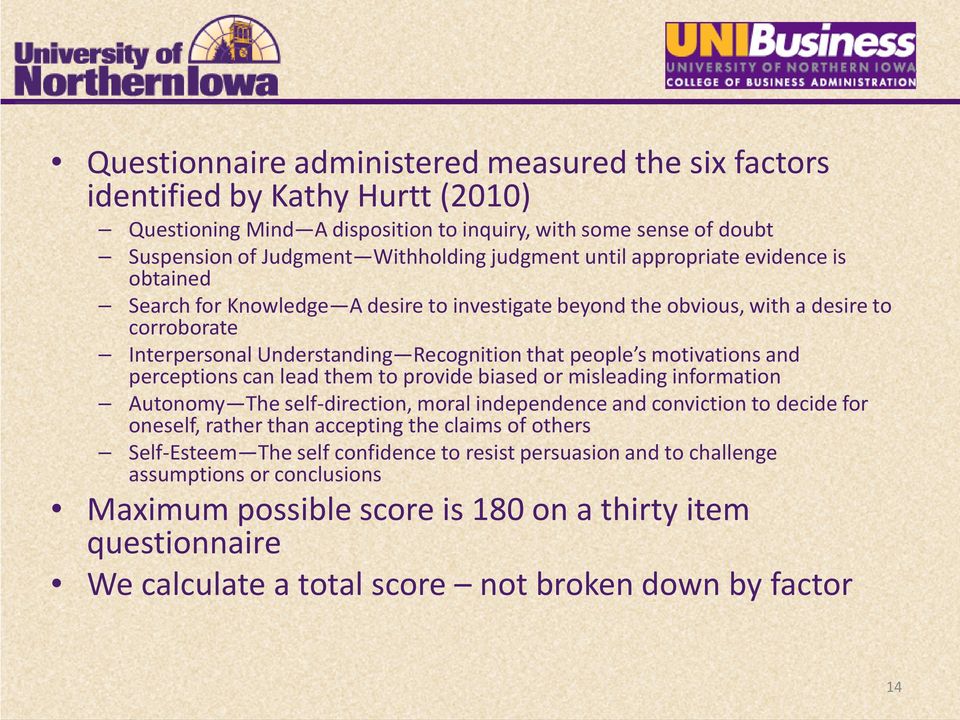
14 Questionnaire administered measured the six factors identified by Kathy Hurtt (2010) Questioning Mind A disposition to inquiry, with some sense of doubt Suspension of Judgment Withholding judgment until appropriate evidence is obtained Search for Knowledge A desire to investigate beyond the obvious, with a desire to corroborate Interpersonal Understanding Recognition that people s motivations and perceptions can lead them to provide biased or misleading information Autonomy The self-direction, moral independence and conviction to decide for oneself, rather than accepting the claims of others Self-Esteem The self confidence to resist persuasion and to challenge assumptions or conclusions Maximum possible score is 180 on a thirty item questionnaire We calculate a total score not broken down by factor 14
15 Kathy Hurtt (2010) 147 upper division accounting students Mean score 132.7, standard deviation 15.9, range 77 to 175 Pike has administered this questionnaire to over 1,000 students in 36 sections of his auditing class over the last 9 years. Scores are remarkably consistent with this only one section was significantly different (and that was lower). 200 professional auditors Mean score 138.6, standard deviation 12.6, range 111 to 173 Professional auditors score, on average, significantly higher (p<.001), than students 102 attendees at two local ACFE Chapter Meeting (78 with CFE Certification) Mean Score (141.0) standard deviation 11.9 (11.8), range (111 to 167) Scored, on average, significantly higher than professional auditors (p<.03) P<.04 for CFEs only (one tail T-tests) 15

16 Plans for Future Research 16

17 Increase Sample Size Sixth Annual Fraud and Forensic Accounting Education Conference Savannah, Georgia (May 15 to 17, 2012) Other ACFE Chapter Meetings? Analyze Demographic Factors Experience? Certifications? Type of Employment? Analyze each of the six individual factors to see if there are patterns which drive the differences from students to professional auditors and professional auditors to CFEs 17
18 Questions? 18

Consideration of Fraud in a Financial Statement Audit
 Consideration of Fraud in a Financial Statement Audit 1719 AU Section 316 Consideration of Fraud in a Financial Statement Audit (Supersedes SAS No. 82.) Source: SAS No. 99; SAS No. 113. Effective for audits
Professional Scepticism in an Audit of a Financial Report
 AUASB Bulletin AUASB Bulletin Professional Scepticism in an Audit of a Financial Report August 2012 Message from the AUASB Chairman Australia continues to experience a prolonged period of economic uncertainty
INTERNATIONAL STANDARD ON AUDITING 240 THE AUDITOR S RESPONSIBILITIES RELATING TO FRAUD IN AN AUDIT OF FINANCIAL STATEMENTS CONTENTS
 INTERNATIONAL STANDARD ON 240 THE AUDITOR S RESPONSIBILITIES RELATING TO (Effective for audits of financial statements for periods beginning on or after December 15, 2009) CONTENTS Paragraph Introduction
INTERNATIONAL STANDARD ON AUDITING (UK AND IRELAND) 240 THE AUDITOR S RESPONSIBILITIES RELATING TO FRAUD IN AN AUDIT OF FINANCIAL STATEMENTS
 INTERNATIONAL STANDARD ON AUDITING (UK AND IRELAND) 240 Introduction THE AUDITOR S RESPONSIBILITIES RELATING TO FRAUD IN AN AUDIT OF FINANCIAL STATEMENTS (Effective for audits of financial statements for
) ) ) ) ) ) ) ) ) ) ) ) OBSERVATIONS ON AUDITORS' IMPLEMENTATION OF PCAOB STANDARDS RELATING TO AUDITORS' RESPONSIBILITIES WITH RESPECT TO FRAUD
 1666 K Street, NW Washington, D.C. 20006 Telephone: (202 207-9100 Facsimile: (202862-8430 www.pcaobus.org OBSERVATIONS ON AUDITORS' IMPLEMENTATION OF PCAOB STANDARDS RELATING TO AUDITORS' RESPONSIBILITIES
The Auditor s Responsibilities Relating to Fraud in an Audit of Financial Statements
 ISA 240 February 2008 International Standard on Auditing The Auditor s Responsibilities Relating to Fraud in an Audit of Financial Statements INTERNATIONAL STANDARD ON AUDITING 240 The Auditor s Responsibilities
Consideration of Fraud in a Financial Statement Audit
 Consideration of Fraud in a Financial Statement Audit 151 AU-C Section 240 Consideration of Fraud in a Financial Statement Audit Source: SAS No. 122; SAS No. 128. Effective for audits of financial statements
Enhancing Auditor Professional Skepticism
 Enhancing Auditor Professional Skepticism BY Professors Steven M. Glover and Douglas F. Prawitt, Brigham Young University Contents ii Executive Summary 1 Definition and Application of Professional Skepticism
INTERNATIONAL STANDARD ON AUDITING (UK AND IRELAND) 240 THE AUDITOR S RESPONSIBILITY TO CONSIDER FRAUD IN AN AUDIT OF FINANCIAL STATEMENTS CONTENTS
 INTERNATIONAL STANDARD ON AUDITING (UK AND IRELAND) 240 THE AUDITOR S RESPONSIBILITY TO CONSIDER FRAUD IN AN AUDIT OF FINANCIAL STATEMENTS CONTENTS Paragraphs Introduction... 1-3 Characteristics of Fraud...
Auditor's Objective in an Audit of Internal Control Over Financial Reporting
 November 21, 2003 Office of the Secretary Public Company Accounting Oversight Board 1666 K Street, N.W. Washington, D.C. 20006-2803 Re: PCAOB Rulemaking Docket No. 008 Proposed Auditing Standard An Audit
Fraud Prevention and Deterrence
 Fraud Prevention and Deterrence Fraud Prevention Programs 2016 Association of Certified Fraud Examiners, Inc. Fraud Prevention Policy The best way to sell the establishment of a fraud policy is by stressing
STAFF AUDIT PRACTICE ALERT NO. 10 MAINTAINING AND APPLYING PROFESSIONAL SKEPTICISM IN AUDITS. December 4, 2012
 1666 K Street, NW Washington, D.C. 20006 Telephone: (202) 207-9100 Facsimile: (202)862-8430 www.pcaobus.org STAFF AUDIT PRACTICE ALERT NO. 10 MAINTAINING AND APPLYING PROFESSIONAL SKEPTICISM IN AUDITS
Comparison of ISA 330 with AS-402 Objectives and Requirements Only
 Comparison of ISA 330 with AS-402 Objectives and Requirements Only International Standard on Auditing 330 (Redrafted): The Auditor s INTRODUCTION Scope of this ISA 1. This International Standard on Auditing
STAFF AUDIT PRACTICE ALERT NO. 5 AUDITOR CONSIDERATIONS REGARDING SIGNIFICANT UNUSUAL TRANSACTIONS. April 7, 2010
 1666 K Street, NW Washington, D.C. 20006 Telephone: (202) 207-9100 Facsimile: (202)862-8430 www.pcaobus.org STAFF AUDIT PRACTICE ALERT NO. 5 AUDITOR CONSIDERATIONS REGARDING SIGNIFICANT UNUSUAL TRANSACTIONS
Professional Judgment Resource
 Professional Judgment Resource 1155 F Street NW Suite 450 Washington, DC 20004 202-609-8120 www.thecaq.org Contents Preface...1 Overview...2 The Use of This Resource...2 Elements of an Effective Judgment
Audit Evidence. AU Section 326. Introduction. Concept of Audit Evidence AU 326.03
 Audit Evidence 1859 AU Section 326 Audit Evidence (Supersedes SAS No. 31.) Source: SAS No. 106. See section 9326 for interpretations of this section. Effective for audits of financial statements for periods
INTERNATIONAL STANDARD ON AUDITING 540 AUDITING ACCOUNTING ESTIMATES, INCLUDING FAIR VALUE ACCOUNTING ESTIMATES, AND RELATED DISCLOSURES CONTENTS
 INTERNATIONAL STANDARD ON AUDITING 540 AUDITING ACCOUNTING ESTIMATES, INCLUDING FAIR VALUE ACCOUNTING ESTIMATES, AND RELATED DISCLOSURES (Effective for audits of financial statements for periods beginning
Performing Audit Procedures in Response to Assessed Risks and Evaluating the Audit Evidence Obtained
 Performing Audit Procedures in Response to Assessed Risks 1781 AU Section 318 Performing Audit Procedures in Response to Assessed Risks and Evaluating the Audit Evidence Obtained (Supersedes SAS No. 55.)
OBSERVATIONS FROM 2010 INSPECTIONS OF DOMESTIC ANNUALLY INSPECTED FIRMS REGARDING DEFICIENCIES IN AUDITS OF INTERNAL CONTROL OVER FINANCIAL REPORTING
 1666 K Street, N.W. Washington, DC 20006 Telephone: (202) 207-9100 Facsimile: (202) 862-8430 www.pcaobus.org OBSERVATIONS FROM 2010 INSPECTIONS OF DOMESTIC ANNUALLY INSPECTED FIRMS REGARDING DEFICIENCIES
Accounting Ethics: The Moral of the Story
 Accounting Ethics: The Moral of the Story Dinah Payne 1 Role of Financial Reporting To provide information that is useful in making business and economic decisions To serve the public interest To communicate
INTERNATIONAL STANDARD ON AUDITING 200 OBJECTIVE AND GENERAL PRINCIPLES GOVERNING AN AUDIT OF FINANCIAL STATEMENTS CONTENTS
 INTERNATIONAL STANDARD ON AUDITING 200 OBJECTIVE AND GENERAL PRINCIPLES GOVERNING (Effective for audits of financial statements for periods beginning on or after December 15, 2005. The Appendix contains
Management s Discussion and Analysis
 Management s Discussion and Analysis 1473 AT Section 701 Management s Discussion and Analysis Source: SSAE No. 10. Effective when management s discussion and analysis is for a period ending on or after
How To Write A Financial Audit
 Overall Objectives of the Independent Auditor 77 AU-C Section 200 Overall Objectives of the Independent Auditor and the Conduct of an Audit in Accordance With Generally Accepted Auditing Standards Source:
Implementation Tool for Auditors
 Implementation Tool for Auditors CANADIAN AUDITING STANDARDS (CAS) APRIL 2015 STANDARD DISCUSSED CAS 240, The auditor s responsibilities relating to fraud in an audit of financial statements Testing Journal
INTERNATIONAL STANDARD ON ASSURANCE ENGAGEMENTS 3000 ASSURANCE ENGAGEMENTS OTHER THAN AUDITS OR REVIEWS OF HISTORICAL FINANCIAL INFORMATION CONTENTS
 INTERNATIONAL STANDARD ON ASSURANCE ENGAGEMENTS 3000 ASSURANCE ENGAGEMENTS OTHER THAN AUDITS OR REVIEWS OF HISTORICAL FINANCIAL INFORMATION (Effective for assurance reports dated on or after January 1,
INTERNATIONAL FRAMEWORK FOR ASSURANCE ENGAGEMENTS CONTENTS
 INTERNATIONAL FOR ASSURANCE ENGAGEMENTS (Effective for assurance reports issued on or after January 1, 2005) CONTENTS Paragraph Introduction... 1 6 Definition and Objective of an Assurance Engagement...
Audit Sampling. AU Section 350 AU 350.05
 Audit Sampling 2067 AU Section 350 Audit Sampling (Supersedes SAS No. 1, sections 320A and 320B.) Source: SAS No. 39; SAS No. 43; SAS No. 45; SAS No. 111. See section 9350 for interpretations of this section.
CRITICAL THINKING REASONS FOR BELIEF AND DOUBT (VAUGHN CH. 4)
 CRITICAL THINKING REASONS FOR BELIEF AND DOUBT (VAUGHN CH. 4) LECTURE PROFESSOR JULIE YOO Claims Without Arguments When Claims Conflict Conflicting Claims Conflict With Your Background Information Experts
Inspection Observations Related to PCAOB "Risk Assessment" Auditing Standards (No. 8 through No.15)
 1666 K Street, N.W. Washington, DC 20006 Telephone: (202) 207-9100 Facsimile: (202) 862-8430 www.pcaobus.org Inspection Observations Related to PCAOB "Risk Assessment" Auditing Standards (No. 8 through
Leonard W. Vona, CPA, CFE
 Leonard W. Vona, CPA, CFE Certified Public Accountant Certified Fraud Examiner 3331 Route 9 Valatie, NY 12184 Tel: (518) 784-2250 Fax: (518) 784-2251 e-mail: [email protected] Part of an auditor s job is
Audit Documentation 2029. See section 9339 for interpretations of this section.
 Audit Documentation 2029 AU Section 339 Audit Documentation (Supersedes SAS No. 96.) Source: SAS No. 103. See section 9339 for interpretations of this section. Effective for audits of financial statements
STANDING ADVISORY GROUP MEETING
 1666 K Street, NW Washington, D.C. 20006 Telephone: (202) 207-9100 Facsimile: (202)862-8430 www.pcaobus.org STANDING ADVISORY GROUP MEETING AUDIT CONFIRMATIONS APRIL 2, 2009 Introduction Confirmations
INTERNATIONAL STANDARD ON AUDITING 330 THE AUDITOR S RESPONSES TO ASSESSED RISKS CONTENTS
 INTERNATIONAL STANDARD ON AUDITING 330 THE AUDITOR S RESPONSES TO ASSESSED RISKS (Effective for audits of financial statements for periods beginning on or after December 15, 2009) CONTENTS Paragraph Introduction
Auditing Standard ASA 240 The Auditor's Responsibilities Relating to Fraud in an Audit of a Financial Report
 Compiled Auditing Standard ASA 240 (November 2013) Auditing Standard ASA 240 The Auditor's Responsibilities Relating to Fraud in an Audit of a Financial Report This compilation was prepared on 11 November
STANDING ADVISORY GROUP MEETING
 1666 K Street, NW Washington, D.C. 20006 Telephone: (202) 207-9100 Facsimile: (202)862-8430 www.pcaobus.org REASONABLE ASSURANCE OCTOBER 5-6, 2005 Introduction The Board's interim auditing standards 1/
AN AUDIT OF INTERNAL CONTROL OVER FINANCIAL REPORTING THAT IS INTEGRATED WITH AN AUDIT OF FINANCIAL STATEMENTS:
 1666 K Street, NW Washington, D.C. 20006 Telephone: (202) 207-9100 Facsimile: (202) 862-8430 www.pcaobus.org STAFF VIEWS AN AUDIT OF INTERNAL CONTROL OVER FINANCIAL REPORTING THAT IS INTEGRATED WITH AN
(Effective for audits of financial statements for periods beginning on or after December 15, 2009) CONTENTS
 INTERNATIONAL STANDARD ON 200 OVERALL OBJECTIVES OF THE INDEPENDENT AUDITOR AND THE CONDUCT OF AN AUDIT IN ACCORDANCE WITH INTERNATIONAL STANDARDS ON (Effective for audits of financial statements for periods
[300] Accounting and internal control systems and audit risk assessments
![[300] Accounting and internal control systems and audit risk assessments](/thumbs/25/6464424.jpg "[300] Accounting and internal control systems and audit risk assessments") [300] Accounting and internal control systems and audit risk assessments (Issued March 1995) Contents Paragraphs Introduction 1 12 Inherent risk 13 15 Accounting system and control environment 16 23 Internal
[300] Accounting and internal control systems and audit risk assessments (Issued March 1995) Contents Paragraphs Introduction 1 12 Inherent risk 13 15 Accounting system and control environment 16 23 Internal
INTERNATIONAL STANDARD ON REVIEW ENGAGEMENTS 2410 REVIEW OF INTERIM FINANCIAL INFORMATION PERFORMED BY THE INDEPENDENT AUDITOR OF THE ENTITY CONTENTS
 INTERNATIONAL STANDARD ON ENGAGEMENTS 2410 OF INTERIM FINANCIAL INFORMATION PERFORMED BY THE INDEPENDENT AUDITOR OF THE ENTITY (Effective for reviews of interim financial information for periods beginning
Audit Quality Thematic Review
 Thematic Review Professional discipline Financial Reporting Council January 2014 Audit Quality Thematic Review Fraud risks and laws and regulations The FRC is responsible for promoting high quality corporate
INTERNATIONAL STANDARD ON AUDITING 230 AUDIT DOCUMENTATION CONTENTS
 INTERNATIONAL STANDARD ON AUDITING 230 AUDIT DOCUMENTATION (Effective for audits of financial statements for periods beginning on or after December 15, 2009) CONTENTS Paragraph Introduction Scope of this
The auditors responsibility to consider fraud in an audit of financial statements
 The auditors responsibility to consider fraud in an audit of financial statements Audit in a nutshell Reality Picture (= financial statements) Balance sheet Assets Liabilities Equity Process Detection
THE AUDITOR S RESPONSES TO ASSESSED RISKS
 SINGAPORE STANDARD ON AUDITING SSA 330 THE AUDITOR S RESPONSES TO ASSESSED RISKS This revised Singapore Standard on Auditing (SSA) 330 supersedes SSA 330 The Auditor s Procedures in Response to Assessed
Risk Management Advisory Services, LLC Capital markets audit and control
 Risk Management Advisory Services, LLC Capital markets audit and control November 14, 2003 Office of the Secretary Public Company Accounting Oversight Board 1666 K Street, N.W. Washington, D.C., 20006-2803
HKSA 500 Issued July 2009; revised July 2010, May 2013, February 2015
 HKSA 500 Issued July 2009; revised July 2010, May 2013, February 2015 Effective for audits of financial statements for periods beginning on or after 15 December 2009 Hong Kong Standard on Auditing 500
COMMUNICATIONS WITH AUDIT COMMITTEES OVERVIEW OF PCAOB AUDITING STANDARD NO. 16
 FEBRUARY 2013 www.bdo.com AN OFFERING FROM BDO S CORPORATE GOVERNANCE PRACTICE BDO USA CORPORATE GOVERNANCE PRACTICE BDO USA s Corporate Governance Practice was developed to provide guidance to corporate
INTERNATIONAL STANDARD ON AUDITING 530 AUDIT SAMPLING AND OTHER MEANS OF TESTING CONTENTS
 INTERNATIONAL STANDARD ON AUDITING 530 AUDIT SAMPLING AND OTHER MEANS OF TESTING (Effective for audits of financial statements for periods beginning on or after December 15, 2004) CONTENTS Paragraph Introduction...
In-Depth Guide to Public Company Auditing: The Financial Statement Audit
 In-Depth Guide to Public Company Auditing: The Financial Statement Audit Why an In-Depth Guide to Public Company Auditing? The foundation for confidence in U.S. capital markets is strengthened through
Honesty, Integrity and Ethics in Public Relations. In the quote above, Mitchell Friedman (n.d.), identifies a core principle of public
 Honesty, Integrity and Ethics in Public Relations Success in public relations demands strict intellectual honesty and integrity in all aspects of one s professional demeanor. Introduction In the quote
A Publication of the Center for Audit Quality
 Practice Aid for Testing Journal Entries and Other Adjustments Pursuant to AU Section 316 A Publication of the Center for Audit Quality December 8, 2008 1 Practice Aid for Testing Journal Entries and Other
How To Audit A Company
 1666 K Street, NW Washington, D.C. 20006 Telephone: (202) 207-9100 Facsimile: (202)862-8430 www.pcaobus.org STAFF AUDIT PRACTICE ALERT NO. 11 CONSIDERATIONS FOR AUDITS OF INTERNAL CONTROL OVER FINANCIAL
How To Audit A Financial Statement
 INTERNATIONAL STANDARD ON 400 RISK ASSESSMENTS AND INTERNAL CONTROL (This Standard is effective, but will be withdrawn when ISA 315 and 330 become effective) * CONTENTS Paragraph Introduction... 1-10 Inherent
Annual Assessment of the External Auditor
 Annual Assessment of the External Auditor TOOL FOR AUDIT COMMITTEES January 2014 ENHANCING AUDIT QUALITY AUDIT COMMITTEES iii Table of Contents Introduction 1 1. Determine the scope, timing and process
Understanding the Entity and Its Environment and Assessing the Risks of Material Misstatement
 Understanding the Entity and Its Environment 1667 AU Section 314 Understanding the Entity and Its Environment and Assessing the Risks of Material Misstatement (Supersedes SAS No. 55.) Source: SAS No. 109.
STANDING ADVISORY GROUP MEETING
 1666 K Street, NW Washington, D.C. 20006 Telephone: (202) 207-9100 Facsimile: (202) 862-8430 www.pcaobus.org STANDING ADVISORY GROUP MEETING PANEL DISCUSSION FORENSIC AUDIT PROCEDURES FEBRUARY 22, 2007
HKSAE 3000 (Revised), Assurance Engagements Other than Audits or Reviews of Historical Financial Information
 HKSAE 3000 Issued March 2014; revised February 2015 Hong Kong Standard on Assurance Engagements HKSAE 3000 (Revised), Assurance Engagements Other than Audits or Reviews of Historical Financial Information
YOUR GUIDE TO UNDERSTANDING FINANCIAL STATEMENTS
 YOUR GUIDE TO UNDERSTANDING FINANCIAL STATEMENTS WE SEE MORE THAN NUMBERS In an audit engagement, the Certified General Accountant provides an Independent Auditor s Report. The report provides reasonable
INTERNATIONAL STANDARD ON AUDITING (UK AND IRELAND) 200
 INTERNATIONAL STANDARD ON AUDITING (UK AND IRELAND) 200 OVERALL OBJECTIVES OF THE INDEPENDENT AUDITOR AND THE CONDUCT OF AN AUDIT IN ACCORDANCE WITH INTERNATIONAL STANDARDS ON AUDITING (UK AND IRELAND)
INTERNATIONAL STANDARD ON AUDITING (UK AND IRELAND) 540
 INTERNATIONAL STANDARD ON AUDITING (UK AND IRELAND) 540 AUDITING ACCOUNTING ESTIMATES, INCLUDING FAIR VALUE ACCOUNTING ESTIMATES, AND RELATED DISCLOSURES (Effective for audits of financial statements for
) ) ) ) ) ) ) ) ) ) ) )
 1666 K Street, NW Washington, D.C. 20006 Telephone: (202) 207-9100 Facsimile: (202)862-8430 PROPOSED AUDITING STANDARD RELATED TO CONFIRMATION AND RELATED AMENDMENTS TO PCAOB STANDARDS ) ) ) ) ) ) ) )
Fundamental Principles of Financial Auditing
 ISSAI 200 ISSAI The 200 International Fundamental Standards Principles of Supreme of Financial Audit Institutions, Auditing or ISSAIs, are issued by INTOSAI, the International Organisation of Supreme Audit
Performing Audit Procedures in Response to Assessed Risks and Evaluating the Audit Evidence Obtained
 Performing Audit Procedures in Response to Assessed Risks 327 AU-C Section 330 Performing Audit Procedures in Response to Assessed Risks and Evaluating the Audit Evidence Obtained Source: SAS No. 122.
2. Auditing. 2.1. Objective and Structure. 2.2. What Is Auditing?
 - 4-2. Auditing 2.1. Objective and Structure The objective of this chapter is to introduce the background information on auditing. In section 2.2, definitions of essential terms as well as main objectives
Control Environment Questionnaire
 Control Environment Questionnaire Internal Control Questionnaire Question Yes No N/A Remarks INTEGRITY AND ETHICAL VALUES Management must convey the message that integrity and ethical values cannot be
Communicating Internal Control Related Matters Identified in an Audit
 Communicating Internal Control 1843 AU Section 325 Communicating Internal Control Related Matters Identified in an Audit (Supersedes SAS No. 112.) Source: SAS No. 115. Effective for audits of financial
Auditing Module 7 June 2009. Suggested Solutions
 Auditing Module 7 June 2009 Suggested Solutions 1 Question 1 1. Tests of control are tests carried out to obtain assurance about the operating and effectiveness of controls. An example of such a test would
The Implications of Inherent Risks Assessment in Audit Risk Limitation
 Economy Transdisciplinarity Cognition www.ugb.ro/etc Vol. 15, Issue 1/2012 45-49 The Implications of Inherent Risks Assessment in Audit Risk Limitation Radu FLOREA, Ramona FLOREA George Bacovia University
Audit Documentation 133
 Audit Documentation 133 AU-C Section 230 Audit Documentation Source: SAS No. 122; SAS No. 123; SAS No. 128. See section 9230 for interpretations of this section. Effective for audits of financial statements
SSARS 19. Objectives and Limitations of Compilation and Review Engagements. Hierarchy of Compilation and Review Standards and Guidance
 SSARS 19 The Accounting & Review Services committee has issued Statement on Standards for Accounting & Review Services No. 19. Generally the standard is effective for compilations and reviews of financial
Fraud Prevention and Deterrence
 Fraud Prevention and Deterrence Fraud Risk Assessment 2016 Association of Certified Fraud Examiners, Inc. What Is Fraud Risk? The vulnerability that an organization faces from individuals capable of combining
INTERNATIONAL STANDARD ON AUDITING (UK AND IRELAND) 530 AUDIT SAMPLING AND OTHER MEANS OF TESTING CONTENTS
 INTERNATIONAL STANDARD ON AUDITING (UK AND IRELAND) 530 AUDIT SAMPLING AND OTHER MEANS OF TESTING CONTENTS Paragraph Introduction... 1-2 Definitions... 3-12 Audit Evidence... 13-17 Risk Considerations
Checkpoint Learning Forensic Accounting Certificate Program
 Checkpoint Learning Forensic Accounting Certificate Program Powered by CPEasy, part of the Checkpoint Learning portfolio Firm Admin & User s Guide Develop Technical Forensic Accounting Knowledge Tax &
Due Diligence Primer Registered Investment Advisers and Broker-Dealers
 Due Diligence Primer Registered Investment Advisers and Broker-Dealers James T. Conversano, CFE, CFA 1 2 Disclaimer. The opinions expressed in this presentation are those of the individual author and do
STAFF GUIDANCE FOR AUDITORS OF SEC-REGISTERED BROKERS AND DEALERS JUNE 26, 2014
 1666 K Street, N.W. Washington, DC 20006 Telephone: (202) 207-9100 Facsimile: (202) 862-8430 www.pcaobus.org STAFF GUIDANCE FOR AUDITORS OF SEC-REGISTERED BROKERS AND DEALERS JUNE 26, 2014 This publication
Understanding Accounting Ethics Cheffers & Pakaluk (2005): Allen David Press. Basics of Accounting Ethics
 Understanding Accounting Ethics Cheffers & Pakaluk (2005): Allen David Press Basics of Accounting Ethics Basics of Accounting Ethics Main Topics Professionalism Public Interest The Virtues of an Accountant
Guidance on Professional Judgment for CPAs
 2015I17-066 Guidance on Professional Judgment for CPAs (Released by The Chinese Institute of Certified Public Accountants on March 26, 2015) CONTENTS 1 General Provisions...1 2 Necessity of professional
Management Representations
 Management Representations 1941 AU Section 333 Management Representations (Supersedes SAS No. 19.) Source: SAS No. 85; SAS No. 89; SAS No. 99; SAS No. 113. See section 9333 for interpretations of this
CIMA CODE OF ETHICS. For professional accountants
 CIMA CODE OF ETHICS For professional accountants October 2007 CIMA PREFACE As chartered management accountants, CIMA members (and registered students) throughout the world have a duty to observe the highest
Accountability for Others being responsible for the consequences of the actions of those whom you manage.
 List of Soft Skill Competencies with Descriptions Each title is available as a separate training and development module and is based on the competencies measured by the TriMetrix Job and Personal Talent
Benford s Law and Digital Frequency Analysis
 Get M.A.D. with the Numbers! Moving Benford s Law from Art to Science BY DAVID G. BANKS, CFE, CIA September/October 2000 Until recently, using Benford s Law was as much of an art as a science. Fraud examiners
INTERNATIONAL STANDARD ON RELATED SERVICES 4410 ENGAGEMENTS TO COMPILE FINANCIAL STATEMENTS CONTENTS
 INTERNATIONAL STANDARD ON RELATED SERVICES 4410 (Previously ISA 930) ENGAGEMENTS TO COMPILE FINANCIAL STATEMENTS (This Standard is effective) CONTENTS Paragraph Introduction... 1 2 Objective of a Compilation
Auditing Accounting Estimates
 Auditing Accounting Estimates 2057 AU Section 342 Auditing Accounting Estimates Source: SAS No. 57; SAS No. 113. See section 9342 for interpretations of this section. Effective for audits of financial
FERRELLGAS CODE OF ETHICS FOR PRINCIPAL EXECUTIVE AND FINANCIAL OFFICERS
 FERRELLGAS CODE OF ETHICS FOR PRINCIPAL EXECUTIVE AND FINANCIAL OFFICERS I. PURPOSE OF THE CODE The Ferrellgas Code of Ethics (this Code ) is intended to serve as the code of ethics described in Section
WIKI EDUCATION FOUNDATION
 WIKI EDUCATION FOUNDATION JUNE 30, 2015 INDEPENDENT AUDITORS REPORT AND FINANCIAL STATEMENTS Independent Auditors Report and Financial Statements Independent Auditors Report 1-2 Financial Statements Statement
CERTIFIED FINANCIAL PLANNER BOARD OF STANDARDS, INC. FINANCIAL PLANNING PRACTICE STANDARDS
 CERTIFIED FINANCIAL PLANNER BOARD OF STANDARDS, INC. FINANCIAL PLANNING PRACTICE STANDARDS 1 2 T E R M I N O L O G Y Terminology in this Booklet C l i e n t denotes a person, persons, or entity who engages
Justice and Ethics. Jimmy Rising. October 18, 2002
 Justice and Ethics Jimmy Rising October 18, 2002 1 Introduction Utilitarianism is an ethical system. John Stuart Mill s use of Utilitarianism to determine what is just and what is injustice may seem natural,
Guide to Public Company Auditing
 Guide to Public Company Auditing The Center for Audit Quality (CAQ) prepared this Guide to Public Company Auditing to provide an introduction to and overview of the key processes, participants and issues
Review of an SMSF audit engagement questionnaire
 Review of an SMSF audit engagement questionnaire Introduction Instructions for the Reviewer This questionnaire has been designed to help you assess whether the audit of Self Managed Superannuation Funds
Financial Transactions and Fraud Schemes
 Financial Transactions and Fraud Schemes Accounting Concepts 2013 Association of Certified Fraud Examiners, Inc. Accounting Basics Assets = Liabilities + Owners Equity Accounting Basics By definition,
Internal Controls and Fraud Detection & Prevention. Harold Monk and Jennifer Christensen
 Internal Controls and Fraud Detection & Prevention Harold Monk and Jennifer Christensen 1 Common Fraud Statements Everyone in government has an honest and charitable heart. It may happen other places,
The Confirmation Process
 The Confirmation Process 1897 AU Section 330 The Confirmation Process (Supersedes section 331.03.08.) Source: SAS No. 67. Effective for audits of fiscal periods ending after June 15, 1992, unless otherwise
Special Purpose Reports on the Effectiveness of Control Procedures
 Auditing Standard AUS 810 (July 2002) Special Purpose Reports on the Effectiveness of Control Procedures Prepared by the Auditing & Assurance Standards Board of the Australian Accounting Research Foundation