
Spinal Instability as Defined by the Three-column Spine Concept in Acute Spinal Trauma
|
|
|
- Alexander Strickland
- 9 years ago
- Views:
Transcription
1 Spinal Instability as Defined by the Three-column Spine Concept in Acute Spinal Trauma FRANCIS DENIS, M.D., F.R.C.S.(C.), F.A.C.S.* This article is a presentation of the concept of the three-column spine. The concept evolved from a retrospective review of 41 2 thoracolumbar spine injuries and observations on spinal instability. The posterior column consists of what Holdsworth described as the posterior ligamentous complex. The middle column includes the posterior longitudinal ligament, posterior annulus fibrosus, and posterior wall of the vertebral body. The anterior column consists of the anterior vertebral body, anterior annulus fibrosus, and anterior longitudinal ligament. Major spinal injuries are classified into four different categories, all definable in terms of the degree of involvement of each of the three columns. Each type is defined also in terms of its pathomechanics, roentgenograms, and computerized axial tomograms, as well as in terms of its particular stability. The compression fracture is basically stress failure of the anterior column with an intact middle column. The burst fracture indicates failure under compression of both the anterior and middle columns. The seat-belt-type spinal fracture is the result of failure of the posterior and middle columns under tension with an intact anterior hinge. In fracturedislocations, the structure of all three columns fails from forces acting to various degrees from one or another direction. Spinal instability was defined by Holdsworth6 as rupture of the posterior ligamentous Assistant Professor of Orthopaedic Surgery, University of Minnesota, Orthopedic Surgeon in Charge of the Spine Service, St. Paul-Ramsey Medical Center, and Staff, Spine Service, Gillette Children s Hospital. Reprint requests to Francis Denis, M.D., 640 Jackson Street, St. Paul, MN Received: November 21, complex. This was confirmed by Roafs15 study of the mechanics of spinal injuries in which rupture of normal spinal ligaments could not be produced by hyperextension or hyperflexion. The implication was that rupture of the posterior ligamentous complex was not compatible with a stable compression fracture but was pathognomonic of instability initiated by either rotation or translation. Heuritsch and Bohler2 had an excellent intuitive understanding of the pathomechanics of spinal fractures. They created drawings demonstrating several cases of compression fractures seen in conjunction with disruption of the interspinous ligament. According to Bohler, in 1932 Heuritsch made an accurate sketch of what was to be called, 16 years later, a Chance fra~ture.~ In spite of accumulating clinical it has taken some recent biomechanic studies to demonstrate that subluxation, dislocation, and simple instability appear only when the posterior longitudinal ligament and part of the disc are tom in conjunction with the posterior or the anterior ligamentous complex. The past decade has shown the term instability to be a key word in therapeutic indications because it equates, in many cases, with a need for internal stabilization. The purpose of this paper is to introduce a classification based on the new concept of the threecolumn spine.s 65

2 Clinrlll Orthopeedics 66 Denis and Aaated Research THE THREE-COLUMN SPINE FIG. 1. Illustrations of the anterior, middle, and posterior columns. This and all succeeding figures are published with permission from Francis Denis: The three-column spine and its significance in the classification of acute thoracolumbar spinal injuries. Spine 8:817, Recent biomechanic evidence',' '.I3.l4 shows that complete rupture of the posterior ligamentous complex alone is not sufficient to establish instability (Fig. 1). Further biomechanic data demonstrate that additional rupture of the posterior longitudinal ligament and posterior annulus fibrosus permits instability in flexion. Complete dislocation requires further disruption of the disc and stripping or disruption of the anterior longitudinal ligament. It appears logical, therefore, to separate the posterior longitudinal ligament, the posterior annulus fibrosus, and the posterior vertebral body into a third column independent of the two others, which plays its own role in the sequence of spinal injury.4 The posterior column remains essentially the same as described by Holdsworth.6 It is formed by the posterior bony complex (posterior arch) alternating with the posterior ligamentous complex: supraspinous ligament, interspinous ligament, capsule, and ligamentum flavum. The middle column is formed by the posterior longitudinal ligament, posterior annulus fibrosus, and the posterior wall of the vertebral body. The anterior column is formed by the anterior longitudinal ligament, the anterior annulus fibrosus, and the anterior part of the vertebral body. CLASSIFICATION OF SPINAL FRACTURES The minor injuries represented by fractures of transverse processes, articular processes, pars interarticularis, and spinous processes involve only a part of the posterior column and do not lead to acute instability. The more significant spinal injuries are classified into four different categories. COMPRESSION FRACTURES FIG. 2. Anterior compression fracture with disruption of the inferior end-plate (Type C compression fracture). Note the normal height of the posterior part of the vertebral body. Definition. The compression fracture is a failure under compression of the anterior column (Fig. 2). The middle column is intact and acts as a hinge. The more severe the

3 Number 189 October, 1984 SDinal lnstabilitv 67 compression fracture, the more likely it will be to present, in addition to the anterior wedging, a partial failure of the posterior column, indicating the tension forces at that level. The fact that the middle column is intact is of major importance because it prevents the fracture from subluxation or compression of the neural elements by fragmentation and retropulsion of the fragment of the posterior wall into the canal. Both of these instances are neurologic threats encountered in fracturedislocations for the former and in burst fractures for the latter. Roentgenographic characteristics. The lateral film shows a normal posterior body cortex and a normal height of the posterior vertebral body (intact middle column). There is no subluxation of the body above or the body below. The interspinous distance of the compressed segment is increased in proportions that are geometrically expected from the angulation at that level. The anteroposterior film shows the lateral wedging in lateral compression fractures (Fig. 3). CA T scan characteristics. Computerized axial tomography is rarely indicated in compression fractures, but when done it will demonstrate an intact vertebral ring (intact middle column). There is no retropulsion of bone into the canal (Fig. 4). FIG. 3. Lateral compression fracture. BURST FRACTURES Definition. The burst fracture results from failure under axial load of both the anterior and the middle columns originating at the level of one or both end-plates of the same vertebra. Roentgenographic characteristics. The lateral roentgenogram demonstrates a fracture of the posterior wall cortex, loss of height of the posterior vertebral body, and tilting and retropulsion of the fragment of bone into the canal of either or both end-plates (compression failure of the middle column) (Fig. 5). The anteroposterior roentgenogram demonstrates the pathognomonic increase Of the intewdiculate distance, the vertical laminar fracture, and the splaying of the posterior joints (Fig. FIG. 4. Computerized axial tomogram of a compression fracture. Note anterior end-plate fracture and totally intact posterior wall of the vertebral body.

4 Clinical OnhOpaedlcs 68 Denis and Related Research FIG. 5. Lateral tomogram of a burst fracture (Type B) showing severe disruption of superior endplate, loss of height of posterior vertebral body. and fracture of posterior wall of body. The arrow shows the large fragment retropulsed into the canal. L4, and LS). The majority of burst fractures involve only one plate (the superior one in most cases). For this reason, five different types of burst fractures are described (Fig. 8). Type A: Fracture of both end-plates due to pure axial load. The bone is retropulsed into the canal at the level of both discs adjacent to the comminuted vertebra. Type B: Fracture of the superior end-plate. This is the most common burst fracture. It is encountered mainly at the thoracolumbar junction and its mechanism is a combination of axial load with flexion. Decompression should be performed at the upper level only when indicated. Type C: Fracture of the inferior end-plate. This fracture pattern is rare. The mechanism of injury also appears to be axial load and flexion. Type D: Burst rotation. This fracture could be misdiagnosed as a fracture-dislocation because of the rotational component of injury. It presents, however, all the pathognomonic signs of burst 6). The latter two signs are another expression of the increase of the interpediculate distance leading to the splay of the entire posterior arch. The vertical fracture of the lamina may not be seen at the time of surgery because in most cases it is a greenstick fracture of the anterior cortex of the lamina with an intact posterior cortex. The operator should decorticate the posterior arch very carefully. CAT scan characteristics. The vertebral ring is fractured both anteriorly and posteriorly. This fragment of bone retropulsed from the vertebral body is sequestrated in the spinal canal and locked in position by the posterior arch (Fig. 7). Classification of burst fractures. The burst fracture described by Holdsworth with comminution of the entire vertebra and without kyphosis involves both end-plates and 1s mainly localized in the low lumbar region (L3, FIG. 6. tornogram of a burst fracture. Note the increased interpediculate distance (34 mm) and the vertical laminar fracture.

5 Number 189 October, 1984 Spinal Instability 69 FIG. 7. Computerized axial tomogram of a burst fracture. Note the large fragment of bone retropulsed from the posterior wall. fractures, with increase of the interpediculate distance, comminution of the vertebral body, vertical fracture of the lamina, retropulsion of bone into the canal, and loss of posterior height. Computerized axial tomography as well as myelography may identify the large fragment of bone occluding the canal. The mechanism of this injury is a combination of axial load and rotation. Type E: Burst lateral flexion. This type of fracture differs from the lateral compression fracture in that it presents an increase of the interpediculate distance on FIG. 8. Classification of burst fractures: Types A, B, and C are mainly diagnosed on lateral roentgenograms; their anteroposterior roentgenograms reveal the basic pathognomonic features seen in Figs Types D and E are diagnosed on anteroposterior roentgenograms. The lateral film of a Type D looks like a Type A, whereas the lateral film of a Type E may look like Type A, B, or C. A B C D E

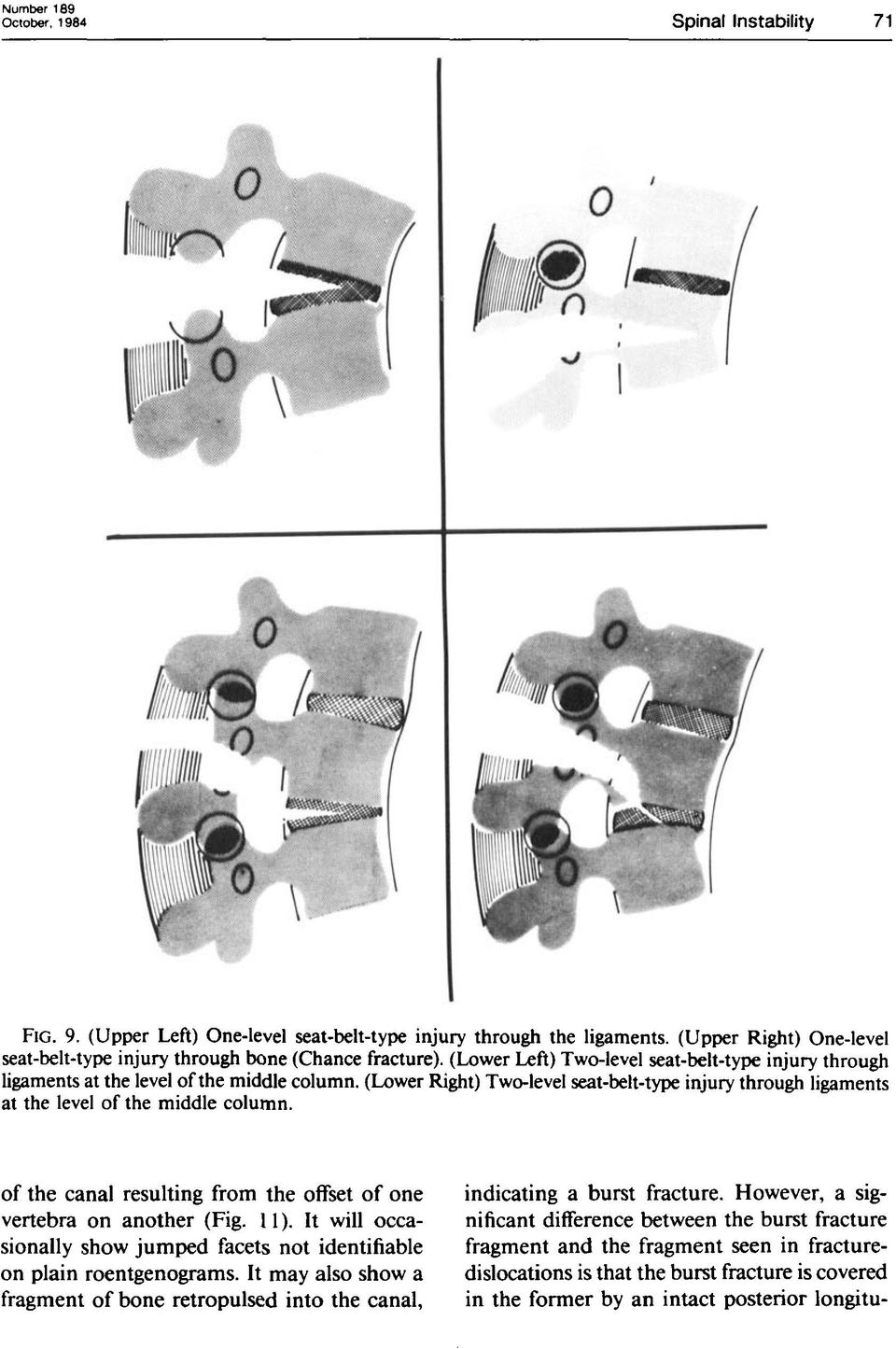
6 70 Denis anteroposterior roentgenogram. The lateral film will disclose the retropulsion of bone from the posterior wall into the canal. Computerized axial tomography again identifies the extruded fragment and shows it to be somewhat more lateralized as compared with the other types of burst fractures. SEAT-BELT-TYPE INJURIES Dejnition. These injuries represent a failure of both the posterior and middle columns under tension forces generated by flexion with its axis placed in the anterior column. The anterior part of the anterior column may partially fail under compression but will not lose its role as a hinge. This type of injury will be unstable in flexion and will not present with association of subluxation, which indicates that the anterior hinge is also disrupted and that fracture dislocation is present. Roentgenographiccharacteristics. A pathognomonic sign of this type of injury is the horizontal split of the transverse processes as well as of the pedicles. There may be a horizontal fracture of the spinous process or of the pars intra-articularis, or also, in some cases, an increase of the interspinous distance with a minimal spinous process avulsion. The height of the posterior vertebral body is increased or there may be an increase of the disc space posteriorly at the level of the injury. CAT scan characteristics. CAT scan does not provide additional information for this type of injury because the horizontal cuts are often parallel to the plane of injury. Coneddown views or lateral tomograms are more useful in terms of identifying the precise level of the fracture. Subtypes of seat-belt-type injuries. These injuries are divided into one- and two-level lesions (Fig. 9). One-level lesions may present as a simple Chance fracture going through bone or as a ligamentous disruption starting at the level of the supraspinous ligament and proceeding to the anterior part of the disc. Two-level lesions are comparable to the con- Clinlcal Onhopaedocs and Related Research dition presented in hangman s fracture in which the middle column may rupture either through the bone or through the disc. FR ACTURE-DISLOCATIONS Dejnition. This is the most unstable of injuries and presents with failure of all three columns under compression. tension, rotation, or shear. Roentgenographic Characteristics. Its pathognomonic sign is the subluxation or dislocation seen on anteroposterior or lateral roentgenograms. Some indirect signs may suggest this type of injury in the presence of multiple rib fractures, multiple transverse process fractures, fracture of a unilateral articular process, slight increased height of a disc, or minimal vertebral body offset. Siihtjpes c?efructure-dislocations. There are three major mechanisms in fracture-dislocations: flexion rotation, shear, and flexion distraction. Flexion-rotation fracture-dislocation (Fig. 10). This injury has been described by Holdsworth6 and also by Roaf. There is usually a complete rupture of the posterior and middle columns under tension and rotation. The anterior column may fail in rotation or sometimes in varying combinations of compression and rotation. The failure at the level of the middle and anterior columns may occur through the vertebral body or purely through the disc. Roentgenographic characteristics, the pathognomonic sign of the fracture-dislocation, will be the subluxation or dislocation of a vertebral segment on another one. There is frequently an increase of the interspinous distance and a displaced fracture of a superior articular process on one side, indicating rotational failure of the posterior column. Multiple transverse process fractures and multiple rib fractures are frequent. A slight amount of rotation between the segment above and the segment below may be observed. computerized axial tomography in flexion rotation. This may demonstrate the occlusion

7 Number 189 October Spinal Instability 71 FIG. 9. (Upper Left) One-level seat-belt-type injury through the ligaments. (Upper Right) One-level seat-belt-type injury through bone (Chance fracture). (Lower Left) Two-level seat-belt-type injury through ligaments at the level of the middle column. (Lower Right) Two-level seat-belt-type injury through ligaments at the level of the middle column. of the canal resulting from the offset of one vertebra on another (Fig. 11). It will occasionally show jumped facets not identifiable on plain roentgenograms. It may also show a fragment of bone retropulsed into the canal, indicating a burst fracture. However, a significant difference between the burst fracture fragment and the fragment seen in fracturedislocations is that the burst fracture is covered in the former by an intact posterior longitu-
8 72 Denis Clinical Onhopaedi and Reiated Research A FIG. 10. (Upper Left) Lateral diagram of a fracturedislocation of the flexion-rotation type through the disc. Note the superior articular process fracture on one side only. (Upper Right) Anteroposterior diagram of a fracturedislocation of the flexion-rotation type through the disc. Note the fracture of the left superior articular surface. (Lower Left) Lateral diagram of a fracturedislocation of the flexion-rotation type through bone (slice fracture). (Lower Right) Anteroposterior diagram of a fracture-dislocation of the flexionrotation type through bone (slice fracture). Note the difference in rotation between both spinal segments. dinal ligament, whereas this same structure is tom in the latter. The implication of this is twofold: first, in terms of stability of the injury, and second, in terms of reduction of the retropulsed fragment by ligamentotaxis. Shear type of fracture-dislocation. This in-

9 Number 189 October, 1984 Spinal Instability 73 FIG. 1 I. Computerized axial tomogram of an L2- L3 lumbar fracture-dislocation of the flexion-rotation type. Note the fracture of the right superior articular process of L3 and the 80% neural canal obstruction resulting from the malalignment. jury results from an extension type of mechanism in which the anterior longitudinal ligament is disrupted. The disc is first tom anteriorly to posteriorly until the continued shearing force translates the upper segment on top of the inferior segment, or vice versa. (1) In the posteroanterior shear subtype (Fig. 12), the segment above is sheared off forward on top of the segment below. The posterior arch of the last one or two vertebrae of the upper segment is usually fractured in the translation, leaving a floating posterior arch behind. The frequency of dural tear and complete paraplegia is very high in this type of fracture. (2) In the anteroposterior shear, the segment above shears off on the segment below in a posterior direction. Its posterior arch has nothing to clear during its posterior displacement; therefore, no free-floating laminae exist (Figs. 13 and 14). Fracturedislocation of the flexiondistraction type. This injury resembles the seat-belt type of injury with disruption of both the postenor and middle columns under tension. However, in addition, it presents tear of the anterior annulus fibrosus, allowing stripping of the anterior longitudinal ligament during subluxation or dislocation (Fig. 15). Roentgenographic characteristics. This is a symmetrical type of injury with frequent horizontal split of the transverse process pedicle and spinous process. This injury may be sub- FIG. 12. Lateral diagram of a posteroanterior shear injury. Note the intact anterior vertebral bodies. The spinous process or entire posterior arch may be fractured by the same mechanism, leaving a floating lamina behind.

10 74 Denis FIG. 13. Lateral diagram of an anteroposterior shear injury. The posterior arches and anterior vertebral bodies may be entirely intact, but the three ligamentous columns are disrupted. divided into the seat-belt-type injuries in oneand two-level types. Definition of instability. As Whitesides" Clinical onhopaedlcs and Related Research pointed out, a stable spine is one that can withstand stress without progressive deformity or further neurologic damage. An unstable spine is thus one that may lead to an increased deformity or an increased neurologic deficit. In order to incorporate that notion into the present classification, the author has subdivided instability into the three potential combinations of these complications. ( 1) Instability of the first degree is a mechanical instability with risk of chronic kyphosis. It applies to the severe compression fracture with posterior column disruption as well as to some of the seat-belt-type injuries. (2) Instability of the second degree is a neurologic instability. The so-called stable burst fracture falls into this category as further vertical collapse of the fractured vertebra may lead to more retropulsion of bone into the canal in the early post-traumatic phase and to higher risks of post-traumatic spinal stenosis after healing of the fracture. Both of these situations may precipitate neurologic complications in a previously intact patient. (3) Instability of the third degree is both a mechanical and a neurologic instability. Fracture-dislocations and unstable burst fractures with or without existing neurologic damage are in this category. FIG. 14. Computerized axial tomogram of a fracture-dislocation of the anteroposterior shear type. Note the anterior aspect of the superior vertebral body locked on the superior facets of the inferior vertebral body.

11 Number 189 October Spinal Instability 75 DISCUSSION Nicoll reported a classification of dorsal and lumbar spinal injuries based on four main types: anterior wedge fracture, lateral wedge fracture, fracture-dislocation, and isolated fracture of the neural arch. This classification may be confusing because under the heading Neural Arch Fractures the author includes Chance fractures with chronic spondylolisthesis as well as traumatic spondylolisthesis. Nicoll believed that rotation was responsible for these neural arch fractures and that the lateral wedge fracture was due to flexion rotation; both of these mechanisms were formerly attributed to fracture-dislocations by most authors. Olof Perey subjected one-level spinal motion segments consisting of two vertebrae and the intervening disc to a strong force of axial load with a fast rate of loading. The amount of stress used was established at a right angle to the cross-sectional dimension. Disc spaces were visualized by diskography. Four experimental series were made in which the maximum forces were calculated to be 1050, 1250, and 1350 kiloponds during approximately 0.06 seconds. A total of 76 experiments were performed, which demonstrated how vertebral end-plate fractures occurred experimentally. Only two cases of double end-plate disruption were observed (two out of 24 experiments done with two-level spinal motion segments as opposed to frequent rupture of both endplates encountered in the clinical series). It should be noted also that the changes at the level of the posterior arch were not mentioned. Roaf demonstrated that discs, joints, and ligaments were rather resistant to distraction, flexion, and extension but were very vulnerable to rotation and horizontal shearing forces. His experimental work suggested that rupture of the anterior longitudinal ligament in hyperextension was impossible and that neural arches fractured first. When the spine was rotated in extension, the anterior longitudinal ligament easily ruptured; therefore, the socalled hyperextension injury was actually a FIG. IS. Lateral diagram of a fracturedislocation of the flexion-distraction type. The posterior, middle, and anterior ligamentous columns are disrupted, but the anterior longitudinal ligament is intact and strips off the vertebral body below. rotation-extension injury. Similarly, Roaf was unable to experimentally reproduce rupture of the posterior ligamentous complex as observed clinically in severe compression fractures. It appears that his results were greatly influenced by the limited degree of freedom of his biomechanic testing apparatus, which lacked, in particular, the essential versatility of being able to combine predetermined vectors of forces. Smith and Kaufer16 reported 24 lumbar spine injuries sustained by persons wearing a lap seat belt who were involved in motorcycle accidents. Twenty of these patients presented a specific pattern of lumbar spine injury: a transverse type of lumbar fracture believed to be extremely rare in unbelted individuals. The authors emphasized the risk of abdominal contusions associated with the spinal injury and characterized the disruption as osseous, ligamentous, or both. There was little or no decrease in anterior vertical height of the involved vertebral body. Most disrup tion occurred between the first and third lumbar vertebrae. It was assumed that the axis of flexion of the spine during injury was at the level of the lap belt pressing over a thick layer

12 76 Denis of tissue separating it from the spine. The implications of such an access are that the spine is submitted to pure distraction forces. This assumption may be challenged for two reasons. Firstly, the lap belt acts as a fulcrum that becomes the access of flexion only if and when the bending strength of the "spinal beam" under consideration is nil at the point of application of the fulcrum. Secondly, indirect evidence of this was demonstrated by Gordon Armstrong, who pointed out that in the 15 Chance fractures in the present series there was a slight vertical shortening of the anterior vertebral body, demonstrating post fucto that the instantaneous axis of flexion was somewhere in the anterior column at the time of injury (unpublished data). It should be added also that an instantaneous axis of flexion is dynamic, not static, and moves during the sequence of rupture from somewhere in the middle column to somewhere in the anterior column as the ligaments or bony parts rupture posteriorly to anteriorly. Panjabi ef uf.," in an individual study conducted to establish the thresholds of thoracic spine stability, demonstrated that under flexion loads the thoracic functional spinal unit is on the verge of instability when all ligaments posterior to and including the posterior half of the discs are cut. Nagel el ul9 tested five fresh human cadavers to determine range-of-motion measurements between the first and second lumbar vertebrae after progressive disruption of the motion segment. Their study showed that an anterior flexion of 20" or a lateral flexion of 10" seen on a routine roentgenogram indicated that all posterior ligaments and at least part of the annulus fibrosus must be disrupted. Chnlcal Orthopedics and Related Research REFERENCES 1. Bedbrook. G. M.: Stability of spinal fractures and fracture dislocations. Paraplegia 9: I. 2. Bohler. L.: The Treatment of Fracture. ed. 5. New York, Grune & Stratton pp Chance, C. Q.: Note on a type of flexion fracture of the spine. Br. J. Radiol. 21: Denis. F.: The three column spine and its significance in the classification of acute thoracolurnbar spinal injuries. Spine Denis. F., and Armstrong. G. W. D.: Compression fractures versus burst fractures in the lumbar and thoracic spine. J. Bone Joint Surg. 63B(3):462, Holdsworth. F. W.: Fractures, dislocations and fracture-dislocations of the spine. J. Bone Joint Surg. 52A(R): Howorth. M. B.: Fracture of the spine..am. J. Surg. 92: Kaufer. H.. and Hayes. J. T.: Lumbar fracture dislocation. J. Bone Joint Surg. 48A: Nagel, D. A,. Koogle. T. A,. Piziali, R. L., and Perkash, 1.: Stability of the upper lumbar spine following progressive disruptions and the application of the individual internal and external fixation devices. J. Bone Joint Surg. 63A( I ):62. I98 I. 10 Nicoll. E. A.: Fractures of the dorsolumbar spine. J. Bone Joint Surg. 31B: II Panjabi. M. M.. Hausfeld, J. N.. and White, A. A,: A biomechanical study of the ligamentous stability of the thoracic spine in man. Acta Orthop. Scand I2 Perey. 0.: Fracture ofthe vertebral end plate in lumbar spine. Acta Orthop. Scand. (Supp1.)25: I, Purcell. G. A,, Markolf. K. L.. and Dawson, E. G.: Twelfth thoracic-first lumbar vertical mechanical stability of fractures after Hanington rod instrumentation. J. Bone Joint Surg. 63A(l):71, Reuber. M.. Schultz, A,. Denis. F., and Spencer, D.: Bulging of lumbar intervertebral discs. J. Biomech. Eng. 104: Roaf. R.: A study of the mechanics of spinal injuries. J. Bone Joint Surg. 42B(4):810, Smith, W. S.. and Kaufer, H.: Patterns and mechanisms of lumbar injuries associated with lap seat belts. J. Bone Joint Surg. 51A: Stauffer. E. S.. and Neil. J. L.: Biomechanical analysis of structural stability of internal fixation in fractures of the thoracolumbar spine. Clin. Orthop. I 12: 159, Whitesides. T. E.: Traumatic kyphosis of the thoracolumbar spine. Clin. Orthop. I28:78, 1977.

Thoracolumbar Spine Fractures. Outline. Outline. Holmes Criteria. Disclosure:
 Thoracolumbar Spine Fractures C. Craig Blackmore, MD, MPH Department of Radiology Virginia Mason Medical Center Affiliate Professor, University of Washington Disclosure: Book Royalties, Springer-Verlag
Evaluation and Treatment of Spine Fractures. Lara C. Portmann, MSN, ACNP-BC
 Evaluation and Treatment of Spine Fractures Lara C. Portmann, MSN, ACNP-BC Nurse Practitioner, Neurosurgery, Trauma Services, Intermountain Medical Center; Salt Lake City, Utah Objectives: Identify the
Thoracolumbar Fratures R1: 胡 家 瑞 指 导 老 师 : 吴 轲 主 任
 Thoracolumbar Fratures R1: 胡 家 瑞 指 导 老 师 : 吴 轲 主 任 Patient Data Name: 苏 XX Gender: Female Age:47 years old Admission date: 2010.06.09 Chief complaint Fell down from 4-54 5 meter tree and lead to lumbosacral
Vivian Gonzalez Gillian Lieberman, MD. January 2002. Lumbar Spine Trauma. Vivian Gonzalez, Harvard Medical School Year III Gillian Lieberman, MD
 January 2002 Lumbar Spine Trauma Vivian Gonzalez, Harvard Medical School Year III Agenda Anatomy and Biomechanics of Lumbar Spine Three-Column Concept Classification of Fractures Our Patient Imaging Modalities
Instability concept. Symposium- Cervical Spine. Barcelona, February 2014
 Instability concept Guillem Saló Bru, MD, Phd AOSpine Principles Symposium- Cervical Spine Orthopaedic Depatment. Spine Unit. Hospital del Mar. Barcelona. Associated Professor UAB Barcelona, February 2014
.org. Fractures of the Thoracic and Lumbar Spine. Cause. Description
 Fractures of the Thoracic and Lumbar Spine Page ( 1 ) Spinal fractures can vary widely in severity. While some fractures are very serious injuries that require emergency treatment, other fractures can
Assessment & Treatment of Fractures and Dislocations of the Thoracic and Lumbar Spine. Brian Drew, MD
 Assessment & Treatment of Fractures and Dislocations of the Thoracic and Lumbar Spine Brian Drew, MD Introduction Mechanism of injuries to the thoracolumbar spine Assessment of spinal stability Treatment
Compression Fractures
 September 2006 Compression Fractures Eleanor Adams Harvard Medical School Year IV Overview Spine Anatomy Thoracolumbar Fractures Cases Compression Fractures, Ddx Radiologic Tests of Choice Treatment Options
Cervical Spondylotic Myelopathy Associated with Kyphosis or Sagittal Sigmoid Alignment: Outcome after Anterior or Posterior Decompression
 Cervical Spondylotic Myelopathy Associated with Kyphosis or Sagittal Sigmoid Alignment: Outcome after Anterior or Posterior Decompression 1 Journal of Neurosurgery: Spine November 2009, Volume 11, pp.
Biomechanics of the Lumbar Spine
 Biomechanics of the Lumbar Spine Biomechanics of the Spine 6 degrees of freedom Extension & Flexion Translation Rotation Compression & Distraction The disc/annulus/all/pll complex is the major restraint
Cervical Spine Surgery. Orthopaedic Nursing Seminar. Dr Michelle Atkinson. Friday October 21 st 2011. Cervical Disc Herniation
 Cervical Spine Surgery Dr Michelle Atkinson The Sydney and Dalcross Adventist Hospitals Orthopaedic Nursing Seminar Friday October 21 st 2011 Cervical disc herniation The most frequently treated surgical
Cervical Spine: Postmortem Assessment of Accident Injuries Comparison of Radiographic, MR Imaging, Anatomic, and Pathologic Findings
 Cervical Spine: Postmortem Assessment of Accident Injuries Comparison of Radiographic, MR Imaging, Anatomic, and Pathologic Findings 1 Radiology, November, 2001;221:340-346. Axel Stäbler, MD, Jurik Eck,
III./8.4.2: Spinal trauma. III./8.4.2.1 Injury of the spinal cord
 III./8.4.2: Spinal trauma Introduction Causes: motor vehicle accidents, falls, sport injuries, industrial accidents The prevalence of spinal column trauma is 64/100,000, associated with neurological dysfunction
Thoracolumbar and Lumbar Burst Fractures. Sussan Salas, MD Thomas Jefferson University Hospital Department of Neurological Surgery
 Thoracolumbar and Lumbar Burst Fractures Sussan Salas, MD Thomas Jefferson University Hospital Department of Neurological Surgery Thoracolumbar/Lumbar Burst Fractures: Overview Epidemiology Anatomy Initial
Spine Trauma: When to Transfer. Alexander Ching, MD Director, Orthopaedic Spine Trauma OHSU
 Spine Trauma: When to Transfer Alexander Ching, MD Director, Orthopaedic Spine Trauma OHSU Disclosures Depuy Spine Consultant (teaching and courses) Department education and research funds Atlas Spine
Minimally Invasive Lumbar Fusion
 Minimally Invasive Lumbar Fusion Biomechanical Evaluation (1) coflex-f screw Biomechanical Evaluation (1) coflex-f intact Primary Stability intact Primary Stability Extension Neutral Position Flexion Coflex
Surgical Technique. coflex Surgical Technique
 Surgical Technique coflex Surgical Technique Interspinous Implant Overview I. Preparation II. Microsurgical Decompression III. Implant Site Preparation IV. Implant Insertion Preparation Patient Positioning
Acute Injuries of the Upper Thoracic Spine Associated With Paraplegia
 89 Acute Injuries of the Upper Thoracic Spine Associated With Paraplegia Lee F. Rogers 1 Craig Thayer Peter E. Weinberg Kwang S. Kim A review of 35 cases of acute injury of the upper thoracic spine associated
Spinal Fractures Classification System
 Spinal Fractures Classification System an AOSpine Knowledge Forum initiative Cervical Spine Fractures Thoracolumbar Spine Fractures Sacral Spine Fractures AOSpine the leading global academic community
Cervical Spine Trauma: Pearls and Pitfalls
 Cervical Spine Trauma: Pearls and Pitfalls Mark P. Bernstein 1, Alexander B. Baxter Accurate diagnosis of acute cervical spine injury requires cooperation between clinician and radiologist, a reliable
Objectives. Spinal Fractures: Classification Diagnosis and Treatment. Level of Fracture. Neuro exam Muscle Grading
 Objectives Spinal Fractures: Classification Diagnosis and Treatment Johannes Bernbeck,, MD Review and apply the understanding of incidence and etiology of VCF. Examine conservative and operative management
ANTERIOR CERVICAL DISCECTOMY AND FUSION. Basic Anatomical Landmarks: Anterior Cervical Spine
 Anterior In the human anatomy, referring to the front surface of the body or position of one structure relative to another Cervical Relating to the neck, in the spine relating to the first seven vertebrae
MATERIALS AND METHODS
 REDISTRIBUTION OF LOAD OF INJURED LOWER CERVICAL SPINE UNDER AXIAL COMPRESSION USING FEM E. C. Teo 1 and H. W. Ng 1 1 School of Mechanical and Production Engineering, Nanyang Technological University,
Anatomy and Terminology of the Spine. Bones of the Spine (Vertebrae)
 Anatomy and Terminology of the Spine The spine, also called the spinal column, vertebral column or backbone, consists of bones, intervertebral discs, ligaments, and joints. In addition, the spine serves
On Cervical Zygapophysial Joint Pain After Whiplash. Spine December 1, 2011; Volume 36, Number 25S, pp S194 S199
 On Cervical Zygapophysial Joint Pain After Whiplash 1 Spine December 1, 2011; Volume 36, Number 25S, pp S194 S199 Nikolai Bogduk, MD, PhD FROM ABSTRACT Objective To summarize the evidence that implicates
Spine Trauma. Seamus Looby, MD*, Adam Flanders, MD. radiologic.theclinics.com KEYWORDS OVERVIEW OF SPINE TRAUMA. Spine Trauma Cervical Thoracic Lumbar
 Spine Trauma Seamus Looby, MD*, Adam Flanders, MD KEYWORDS Spine Trauma Cervical Thoracic Lumbar Spine trauma is a devastating event with a high morbidity and mortality and many additional medical, psychological,
ENTITLEMENT ELIGIBILITY GUIDELINES SPONDYLOLISTHESIS AND SPONDYLOLYSIS
 ENTITLEMENT ELIGIBILITY GUIDELINES SPONDYLOLISTHESIS AND SPONDYLOLYSIS MPC 01414 ICD-9 756.12; 738.41; 756.11 DEFINITION Spondylolisthesis is generally defined as an anterior or posterior slipping or displacement
Human Anatomy & Physiology
 PowerPoint Lecture Slides prepared by Barbara Heard, Atlantic Cape Community College Ninth Edition Human Anatomy & Physiology C H A P T E R 7 The Skeleton: Part B Annie Leibovitz/Contact Press Images Vertebral
Study on Structural Behaviour of Human Vertebral Column Using Staad.Pro
 Study on Structural Behaviour of Human Vertebral Column Using Staad.Pro Healtheephan alexis. S Post graduate student, Government College of Technology, Coimbatore 641 013 [email protected] ABSTRACT
Cervical-Spine Injuries: Catastrophic Injury to Neck Sprain. Seth Cheatham, MD
 Cervical-Spine Injuries: Catastrophic Injury to Neck Sprain Seth Cheatham, MD 236 Seth A. Cheatham, MD VCU Sports Medicine I have no financial disclosures Contact sports, specifically football, places
Thoracolumbar Spinal Injuries
 31 Thoracolumbar Spinal Injuries Michael Heinzelmann, Guido A. Wanner Fractures Section 883 Core Messages Spinal fractures are frequently located at the thoracolumbar junction for biomechanical reasons
C-Spine Injuries. Trauma Rounds
 C-Spine Injuries Trauma Rounds OUTLINE Introduction: Incidence, Importance Normal C-spine Anatomy Clinical Criteria for C-Spine X-rays Imaging Evaluation & Interpretation Fractures: Mechanism, Types, Management
1 REVISOR 5223.0070. (4) Pain associated with rigidity (loss of motion or postural abnormality) or
 1 REVISOR 5223.0070 5223.0070 MUSCULOSKELETAL SCHEDULE; BACK. Subpart 1. Lumbar spine. The spine rating is inclusive of leg symptoms except for gross motor weakness, bladder or bowel dysfunction, or sexual
Thoracic and Lumbar Spine Trauma
 Thoracic and Lumbar Spine Trauma Linda Gray, Robert Vandemark, and Matthew Hays Complete thoracolumbar trauma evaluation incorporates radiographs, computed tomography, and magnetic resonance imaging. Primarily
TRAUMA OF THE SPINE AND SPINAL CORD
 TRAUMA OF THE SPINE AND SPINAL CORD Mauricio Castillo, M.D., F.A.C.R. Professor of Radiology and Chief of Neuroradiology University of North Carolina School of Medicine, Chapel Hill, NC Editor-in-Chief,
INJURIES OF THE HAND AND WRIST By Derya Dincer, M.D.
 05/05/2007 INJURIES OF THE HAND AND WRIST By Derya Dincer, M.D. Hand injuries, especially the fractures of metacarpals and phalanges, are the most common fractures in the skeletal system. Hand injuries
If you or a loved one have suffered because of a negligent error during spinal surgery, you will be going through a difficult time.
 If you or a loved one have suffered because of a negligent error during spinal surgery, you will be going through a difficult time. You may be worried about your future, both in respect of finances and
Lumbar Spine Anatomy. eorthopod.com 228 West Main St., Suite D Missoula, MT 59802-4345 Phone: 406-721-3072 Fax: 406-721-2619 info@eorthopod.
 A Patient s Guide to Lumbar Spine Anatomy 228 West Main St., Suite D Missoula, MT 59802-4345 Phone: 406-721-3072 Fax: 406-721-2619 [email protected] DISCLAIMER: The information in this booklet is compiled
Spinal Anatomy. * MedX research contends that the lumbar region really starts at T-11, based upon the attributes of the vertebra.
 Spinal Anatomy Overview Neck and back pain, especially pain in the lower back, is one of the most common health problems in adults. Fortunately, most back and neck pain is temporary, resulting from short-term
Hyperextension Injuries Thoracic Spine Joseph Junewick, MD FACR
 Hyperextension Injuries Thoracic Spine Joseph Junewick, MD FACR 10/29/2010 History 3 year old restrained passenger involved in motor vehicle accident. Diagnosis Hyperextension Injuries Thoracic Spine Additional
Thoracic Spine Anatomy
 A Patient s Guide to Thoracic Spine Anatomy 228 West Main, Suite C Missoula, MT 59802 Phone: [email protected] DISCLAIMER: The information in this booklet is compiled from a variety of sources.
Side Impact Causes Multiplanar Cervical Spine Injuries
 Side Impact Causes Multiplanar Cervical Spine Injuries 1 The Journal of Trauma, Injury, infection and Critical Care Volume 63(6), December 2007, pp 1296-1307 Maak, Travis G. MD; Ivancic, Paul C. PhD; Tominaga,
Upper Cervical Spine - Occult Injury and Trigger for CT Exam
 Upper Cervical Spine - Occult Injury and Trigger for CT Exam Bakman M, Chan K, Bang C, Basu A, Seo G, Monu JUV Department of Imaging Sciences University of Rochester Medical Center, Rochester, NY Introduction
Disc Replacement or Fusion: which is best for me?
 Disc Replacement or Fusion: which is best for me? After anterior discectomy in either the cervical or lumbar region there is a need to replace the removed disc with something and the choice lies between
SPINE ANATOMY AND PROCEDURES. Tulsa Spine & Specialty Hospital 6901 S. Olympia Avenue Tulsa, Oklahoma 74132
 SPINE ANATOMY AND PROCEDURES Tulsa Spine & Specialty Hospital 6901 S. Olympia Avenue Tulsa, Oklahoma 74132 SPINE ANATOMY The spine consists of 33 bones called vertebrae. The top 7 are cervical, or neck
TABLE OF CONTENTS. Indications and Contraindications 3. Features and Benefits 4. Ease of connection 4 Stable fixation concept 5
 Surgical Technique TABLE OF CONTENTS Indications and Contraindications 3 Features and Benefits 4 Ease of connection 4 Stable fixation concept 5 Surgical Technique Steps 6 Identification and preparation
The Petrylaw Lawsuits Settlements and Injury Settlement Report
 The Petrylaw Lawsuits Settlements and Injury Settlement Report BACK INJURIES How Minnesota Juries Decide the Value of Pain and Suffering in Back Injury Cases The Petrylaw Lawsuits Settlements and Injury
R/F. Applications and Present Issues of Tomosynthesis in Spine Surgery. 87th Annual Meeting of the Japanese Orthopaedic Association Evening Seminar 4
 R/F Applications and Present Issues of Tomosynthesis in Spine Surgery 87th Annual Meeting of the Japanese Orthopaedic Association Evening Seminar 4 Professor and Chairman Department of Orthopaedic Surgery
Burst fracture of the fifth lumbar vertebra: results of posterior internal fixation and transpedicular bone grafting
 Eur Spine J (2002) 11 :435 440 DOI 10.1007/s00586-002-0390-1 ORIGINAL ARTICLE A. Kaminski E. J. Müller G. Muhr Burst fracture of the fifth lumbar vertebra: results of posterior internal fixation and transpedicular
PELVIS. 2007 Lippincott Williams & Wilkins S59 BONE: PELVIS (6) Location: Pelvic ring (61)
 PELVIS BONE: PELVIS (6) Location: Pelvic ring (61) Types: A. Lesion sparing (or with no displacement of) posterior arch (61-A) B. Incomplete disruption of posterior arch, partially stable (61-B) C. Complete
THE MECHANISM OF INJURY TO THE SPINAL CORD IN THE NECK WITHOUT DAMAGE TO THE VERTEBRAL COLUMN
 THE MECHANISM OF INJURY TO THE SPINAL CORD IN THE NECK WITHOUT DAMAGE TO THE VERTEBRAL COLUMN A. R. TAYLOR, EDINBURGH, SCOTLAND Fro;n the Department of Surgical Neurology, Edinburgh The discrepancy between
Cervical Spinal Injuries
 Cervical Spinal Injuries Common mechanism is extension or axial compression with buckling into extension. Structures most often injured are discs & facets. Disc & facet injuries are equally frequent. Major
Image-guided Spine Procedures for Relief of Severe Lower Back Pain:
 Image-guided Spine Procedures for Relief of Severe Lower Back Pain: A Guide to Epidural Steroid Injection, Facet Joint Injection, and Selective Nerve Root Block. PETER H TAKEYAMA MD HENRY WANG MD PhD SVEN
Vertebral anatomy study guide. Human Structure Summer 2015. Prepared by Daniel Schmitt, Angel Zeininger, and Karyne Rabey.
 Vertebral anatomy study guide. Human Structure Summer 2015 Prepared by Daniel Schmitt, Angel Zeininger, and Karyne Rabey. 1. Plan of Action: In this guide you will learn to identify these structures: Cervical
visualized. The correct level is then identified again. With the use of a microscope and
 SURGERY FOR SPINAL STENOSIS Laminectomy A one inch (or longer for extensive stenosis) incision is made in the middle of the back over the effected region of the spine. The muscles over the bone are moved
Spine and Spinal Cord Injuries. William Schecter, MD
 Spine and Spinal Cord Injuries William Schecter, MD Anatomy of the Spine http://education.yahoo.com/reference/gray/fig/387.html Anatomy of the spine 7 cervical vertebrae 12 thoracic vertebrae 5 lumbar
Nomenclature and Standard Reporting Terminology of Intervertebral Disk Herniation
 167 Nomenclature and Standard Reporting Terminology of Intervertebral Disk Herniation Richard F. Costello, DO a, *, Douglas P. Beall, MD a,b MAGNETIC RESONANCE IMAGING CLINICS Magn Reson Imaging Clin N
Degenerative Spine Solutions
 Degenerative Spine Solutions The Backbone for Your Surgical Needs Aesculap Spine Backbone for Your Degenerative Spine Needs Comprehensive operative solutions, unique product technology and world-class
Head Position and Impact Direction in Whiplash Injuries: Associations with MRI-Verified Lesions of Ligaments and Membranes in the Upper Cervical Spine
 Head Position and Impact Direction in Whiplash Injuries: Associations with MRI-Verified Lesions of Ligaments and Membranes in the Upper Cervical Spine 1 Journal of Neurotrauma Volume 22, Number 11, November
Complications in Adult Deformity Surgery
 Complications in Adult Deformity Surgery Proximal Junctional Kyphosis: Thoracolumbar and Cervicothoracic Sigurd Berven, MD Professor in Residence UC San Francisco Disclosures Research/Institutional Support:
SCAPULAR FRACTURES. Jai Relwani, Shoulder Fellow, Reading Shoulder Unit, Reading.
 SCAPULAR FRACTURES Jai Relwani, Shoulder Fellow, Reading Shoulder Unit, Reading. Aims Anatomy Incidence/Importance Mechanism Classification Principles of treatment Specific variations Conclusion Anatomy
Does the pain radiating down your legs, buttocks or lower back prevent you from walking long distances?
 Does the pain radiating down your legs, buttocks or lower back prevent you from walking long distances? Do you experience weakness, tingling, numbness, stiffness, or cramping in your legs, buttocks or
BODY BODY PEDICLE PEDICLE TRANSVERSE TRANSVERSE PROCESS PROCESS
 Learning Objective Radiology Anatomy of the Spine and Upper Extremity Identify anatomic structures of the spine and upper extremities on standard radiographic and cross-sectional images Timothy J. Mosher,
Non-Surgical Multi-Purpose Therapeutic Device. ExtenTrac Elite. M3D [Multi-Directional Disc Decompression]
![Non-Surgical Multi-Purpose Therapeutic Device. ExtenTrac Elite. M3D [Multi-Directional Disc Decompression]](/thumbs/27/11142437.jpg "Non-Surgical Multi-Purpose Therapeutic Device. ExtenTrac Elite. M3D [Multi-Directional Disc Decompression]") Non-Surgical Multi-Purpose Therapeutic Device ExtenTrac Elite M3D [Multi-Directional Disc Decompression] The World s Most Versatile Multi-Functional 3D Therapeutic Device Extentrac Elite is a patented,
Non-Surgical Multi-Purpose Therapeutic Device ExtenTrac Elite M3D [Multi-Directional Disc Decompression] The World s Most Versatile Multi-Functional 3D Therapeutic Device Extentrac Elite is a patented,
Lumbar Back Pain in Young Athletes
 Lumbar Back Pain in Young Athletes MS CAQ in Sports Medicine Blair Orthopedics Altoona, PA OMED 2012 San Diego CA AOASM Tuesday October 9 th 1:00pm Lumbar Back Pain in Learning ObjecKves Epidemiology Anatomy
An Anatomical Comparison of the Human and Bovine Thoracolumbar Spine
 Journal of Orthopaedic Research 4:298-303, Raven Press, New York 0 1986 Orthopaedic Research Society An Anatomical Comparison of the Human and Bovine Thoracolumbar Spine Paul C. Cotterill, J. P. Kostuik,
SHOULDER INSTABILITY IN PATIENTS WITH EDS
 EDNF 2012 CONFERENCE LIVING WITH EDS SHOULDER INSTABILITY IN PATIENTS WITH EDS Keith Kenter, MD Associate Professor Sports Medicine & Shoulder Reconstruction Director, Orthopaedic Residency Program Department
Experimental determination of cervical spine mechanical properties
 Acta of Bioengineering and Biomechanics Vol. 10, No. 4, 2008 Experimental determination of cervical spine mechanical properties MAREK GZIK*, WOJCIECH WOLAŃSKI, DAGMARA TEJSZERSKA Division of General Mechanics
Biomechanical Analysis of the Deadlift (aka Spinal Mechanics for Lifters) Tony Leyland
 Biomechanical Analysis of the Deadlift (aka Spinal Mechanics for Lifters) Tony Leyland Mechanical terminology The three directions in which forces are applied to human tissues are compression, tension,
Anatomy of the Spine. Figure 1. (left) The spine has three natural curves that form an S-shape; strong muscles keep our spine in alignment.
 1 2 Anatomy of the Spine Overview The spine is made of 33 individual bony vertebrae stacked one on top of the other. This spinal column provides the main support for your body, allowing you to stand upright,
Spine University s Guide to Kinetic MRIs Detect Disc Herniations
 Spine University s Guide to Kinetic MRIs Detect Disc Herniations 2 Introduction Traditionally, doctors use a procedure called magnetic resonance imaging (MRI) to diagnose disc injuries. Kinetic magnetic
WHIPLASH INJURIES By Prof RP Grabe, Department of Orthopaedics, University of Pretoria
 1 WHIPLASH INJURIES By Prof RP Grabe, Department of Orthopaedics, University of Pretoria In a recent publication in Spine the Quebec task force mentions that very little is available in the literature
Imaging of Lisfranc Injury
 November 2011 Imaging of Lisfranc Injury Greg Cvetanovich, Harvard Medical School Year IV Agenda Case Presentation Introduction Anatomy Lisfranc Injury Classification Imaging Treatment 2 Case Presentation
Spine Anatomy and Spine General The purpose of the spine is to help us stand and sit straight, move, and provide protection to the spinal cord.
 Spine Anatomy and Spine General The purpose of the spine is to help us stand and sit straight, move, and provide protection to the spinal cord. Normal List Kyphosis The human spine has 7 Cervical vertebra
LONG-TERM CONSEQUENCES OF STABLE FRACTURES OF THE THORACIC AND LUMBAR VERTEBRAL BODIES
 LONG-TERM CONSEQUENCES OF STABLE FRACTURES OF THE THORACIC AND LUMBAR VERTEBRAL BODIES M. H. YOUNG, CARDIFF, WALES Senior Lecturer iii Ortliopaedic Surgery, Welsh National School of Medicine I-Jo,zorarv
Lectures of Human Anatomy
 Lectures of Human Anatomy Vertebral Column-I By DR. ABDEL-MONEM AWAD HEGAZY M.B. with honor 1983, Dipl."Gynecology and Obstetrics "1989, Master "Anatomy and Embryology" 1994, M.D. "Anatomy and Embryology"
Cervical Spine Imaging
 March 20, 2006 Cervical Spine Imaging Johannes Kratz, Harvard Medical School Year IV 1 Overview Background Clinical Cases Diagnostic Tests and a Decision-Tree Algorithm Examples of Cervical Spine Evaluations
How To Understand The Anatomy Of A Lumbar Spine
 Sciatica: Low back and Leg Pain Diagnosis and Treatment Options Presented by Devesh Ramnath, MD Orthopaedic Associates Of Dallas Baylor Spine Center Sciatica Compression of the spinal nerves in the back
Minimally Invasive Spine Surgery For Your Patients
 Minimally Invasive Spine Surgery For Your Patients Lukas P. Zebala, M.D. Assistant Professor Orthopaedic and Neurological Spine Surgery Department of Orthopaedic Surgery Washington University School of
SURGICAL TREATMENT OF THORACIC AND LUMBAR SPINE FRACTURES USING MODERN TECHNOLOGIES*
 S.T. Vetrile, A.A. Kuleshov, 2013 SURGICAL TREATMENT OF THORACIC AND LUMBAR SPINE FRACTURES USING MODERN TECHNOLOGIES* S.T. Vetrile, A.A. Kuleshov Central Institute of Traumatology and Orthopaedics n.a.
INVESTIGATION OF LOWER SPINE COMPRESSION FRACTURES IN FRONTAL CRASHES
 INVESTIGATION OF LOWER SPINE COMPRESSION FRACTURES IN FRONTAL CRASHES Rodney W. Rudd, National Highway Traffic Safety Administration Company Logo Here Overview Lower spine includes: 10 th through 12 th
Spine DJD Nomenclature. Sonia K Ghei, MD
 Spine DJD Nomenclature Sonia K Ghei, MD Recommendations of the Combined Task Forces of the North American Spine Society, American Society of Spine Radiology, and American Society of Neuroradiology http://www.asnr.org/spine_nomenclature/
ICD 10 CM IMPLEMENTATION DATE OCT 1, 2015
 Presented by: Teri Romano, RN, MBA, CPC, CMDP ICD 10 CM IMPLEMENTATION DATE OCT 1, 2015 Source: http://journal.ahima.org/2015/02/04/us house committee to hold hearing on icd 10 implementation/ 2 2015 Web_Non
Research Article Partial Facetectomy for Lumbar Foraminal Stenosis
 Advances in Orthopedics, Article ID 534658, 4 pages http://dx.doi.org/10.1155/2014/534658 Research Article Partial Facetectomy for Lumbar Foraminal Stenosis Kevin Kang, 1 Juan Carlos Rodriguez-Olaverri,
Airway Management in Adults after Cervical Spine Trauma Edward T. Crosby, M.D., F.R.C.P.C.*
 REVIEW ARTICLE David C. Warltier, M.D., Ph.D., Editor Anesthesiology 2006; 104:1293 318 2006 American Society of Anesthesiologists, Inc. Lippincott Williams & Wilkins, Inc. Airway Management in Adults
InternatIonal JOURNAL OF ANATOMY PHYSIOLOGY and BIOCHEMISTRY
 ORIGINAL RESEARCH ARTICLE http://www.eternalpublication.com InternatIonal JOURNAL OF ANATOMY PHYSIOLOGY and BIOCHEMISTRY IJAPB: Volume: 1; Issue: 1; October 2014 ISSN(Online):2394-3440 A Morphometric Study
Low Back Injury in the Industrial Athlete: An Anatomic Approach
 Low Back Injury in the Industrial Athlete: An Anatomic Approach Earl J. Craig, M.D. Assistant Professor Indiana University School of Medicine Department of Physical Medicine and Rehabilitation Epidemiology
The goals of modern spinal surgery are to maximize
 SPRING 2013 Robot-Guided Spine Surgery Christopher R. Good, M.D., F.A.C.S. and Blair K. Snyder, P.A.-C. The goals of modern spinal surgery are to maximize patient function and accelerate a return to a
LUMBAR LAMINECTOMY AND DISCECTOMY. Basic Anatomical Landmarks: Posterior View Lumbar Spine
 Lumbar Relating to the loins or the section of the back and sides between the ribs and the pelvis. In the spinal column, the last five vertebrae (from superior to inferior, L1-L5) Laminectomy Surgical
SPINAL FUSION. North American Spine Society Public Education Series
 SPINAL FUSION North American Spine Society Public Education Series WHAT IS SPINAL FUSION? The spine is made up of a series of bones called vertebrae ; between each vertebra are strong connective tissues