
Achieving Pay Equity What needs to happen?
|
|
|
- Alexandrina Howard
- 9 years ago
- Views:
Transcription
1 Achieving Pay Equity What needs to happen? Report of CLEW seminar from Sue Ryall, Centre Manager, CLEW The current court case on equal pay (Terranova vs Bartlett) has reinvigorated the discussion and debate around gender pay difference and why women's pay still lags behind their male counterparts. The May 19 seminar Achieving Pay Equity What needs to happen? organised by CLEW in partnership with the PSA brought together a range of people from different perspectives to look at this issue. Erin Polaczuk, National Secretary of the NZ Public Service Association outlined the historical campaigns for pay equity. The PSA has a long history of campaigning for pay equity with the issue first raised at the inaugural PSA conference in 1914 when it was agreed That female employees of equal competence with male employees shall receive equal treatment as to pay and privileges. In 1956 the PSA women a landmark equal pay test case and in 1961 the Government Service Equal Pay Act, introduced by the Labour Government and supported by the opposition National Party, came into force. However, women in the private sector had to wait until 1972 for the Equal Pay Act to win the right to pay equity with their male counterparts. Erin Polaczuk commented, Some might have thought the battle had been won and indeed some big shifts occurred immediately following its passage, but 44 years on the Act seems both arcane and not fit for purpose for ensuring equal pay for work of equal value. Despite this perception, Lisa Heap later commented the arguments in the Terranova case for establishing pay equity for care workers may have proven more difficult if changes had been made to the Act. The 1980 s saw another rash of initiatives to address pay equity New Zealand ratified the International Labour Organization Remuneration Convention 100 (1983); we followed that up by signing up to the UN Convention on the Elimination of Discrimination Against Women (1986), the establishment of the EEO Unit in the State Services Commission; the report Towards Employment Equity became the basis for the short lived Employment Equity Act 1990 that addressed equal employment opportunity and pay equity. However, the Act was repealed within a few months after a change in government.
2 Erin observed that despite the past campaigns and legislative change the gap still exists and it remains to be seen what impact the Terranova case has on equal pay for work of equal value but the PSA will continue their work with other union members through the Worth 100% campaign with the goal of eliminating the gap by Prue Hyman, an economist and former associate professor at Victoria University, took a labour economic lens to the issue and drew on her February 2015 article on Policy Quarterly 1. Prue began by pointing out that there is no one economic view and no consensus across economists. She would look at the social and political factors as well as economic. The extent of the gender pay gap is difficult to determine. There is both horizontal and vertical occupational segregation between men and women and women are frequently in areas of insecure work. Women also work part time more than men and there are big differences in pay rates between part time and full time employees. Also, more women are in trainee positions with lower pay rates but are absent in the higher levels of most organizations where remuneration is higher. It is also important to note that there are also big disparities among women and men on the basis of other factors particularly ethnicity. It is also important to note that there are also big disparities among women and men on the basis of other factors particularly ethnicity. Maori and Pacific women are over-represented in the low wage sectors and Maori and Pacific men and women on average earn much less than their pakeha counterparts Maori and Pacific women are over represented in the low wage sectors and Maori and Pacific men and women on average earn much less than their pakeha counterparts. Another issue for measuring the gender pay gap is the payment level that is being measured. The gap is often expressed as a single measure for the sake of simplicity, but the reality is whether you look at hourly, weekly or annual earnings, for example, or only those working in full time employment [part time employees make significantly less], can really change how the numbers look. To make it more challenging to assess, there are different sources of data. Prue posed the question 'How much is due to discrimination?' She considers that there are multiple factors involved. She commented, It is partly judgment but predominantly that women's occupations are undervalued by the market, and less than productivity would justify. Biases cannot all be detected in individual employment agreements. Individual productivity is unknown and variable. So how can the gender pay gap be narrowed? In Prue's view gender wage gaps will narrow as women's economic capital builds up. Low wage workers are an increasing proportion and women are over represented in this group. 1 Hyman, P (2015) Is Active Intervention Still Needed to Improve the Position of Women in the New Zealand Labour Market? If so, what can be done? Policy Quarterly, Volume 11, Issue 1, February 2015: Institute of Governance and Policy Studies, School of Government, Victoria University of Wellington

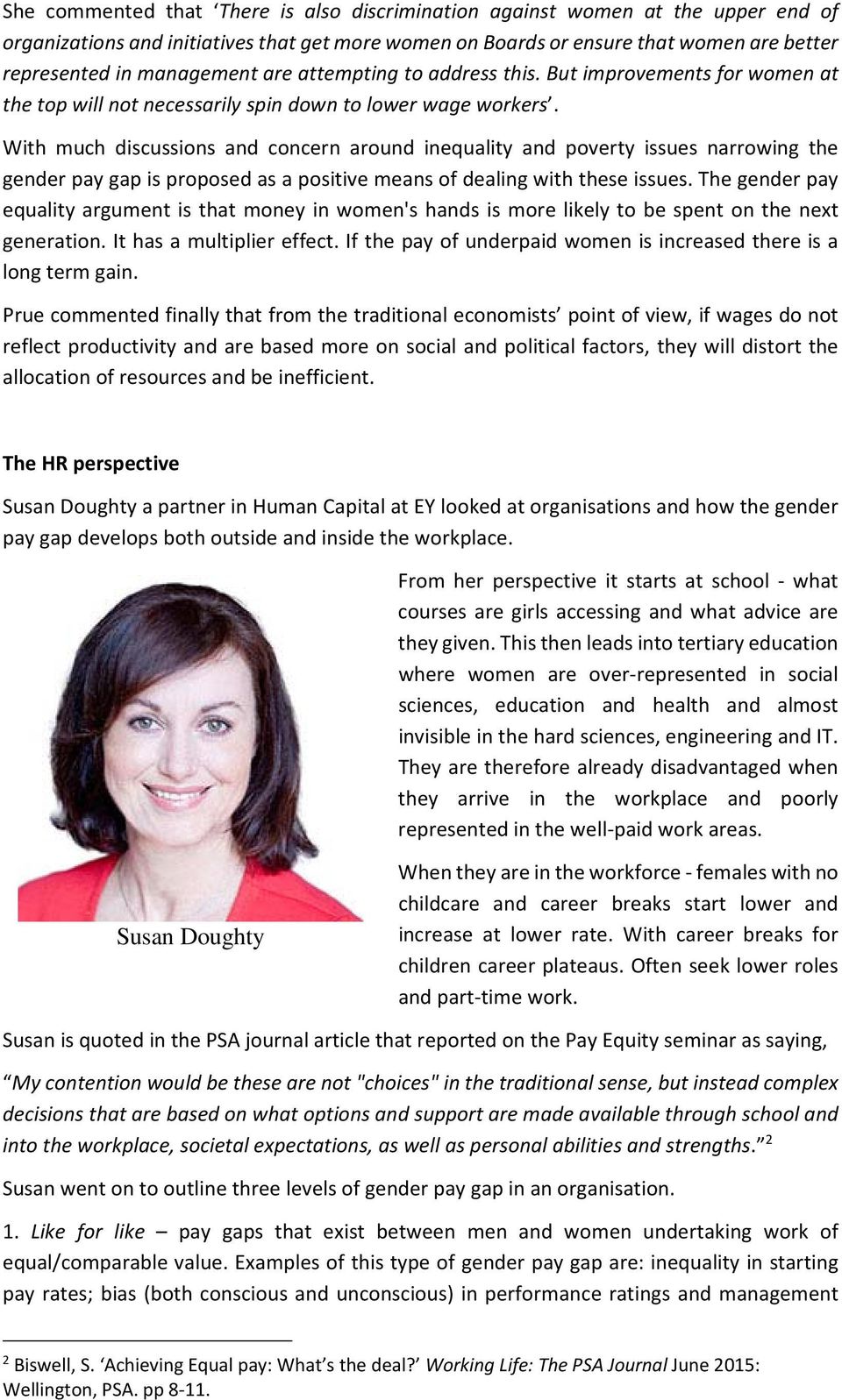
3 She commented that There is also discrimination against women at the upper end of organizations and initiatives that get more women on Boards or ensure that women are better represented in management are attempting to address this. But improvements for women at the top will not necessarily spin down to lower wage workers. With much discussions and concern around inequality and poverty issues narrowing the gender pay gap is proposed as a positive means of dealing with these issues. The gender pay equality argument is that money in women's hands is more likely to be spent on the next generation. It has a multiplier effect. If the pay of underpaid women is increased there is a long term gain. Prue commented finally that from the traditional economists point of view, if wages do not reflect productivity and are based more on social and political factors, they will distort the allocation of resources and be inefficient. The HR perspective Susan Doughty a partner in Human Capital at EY looked at organisations and how the gender pay gap develops both outside and inside the workplace. From her perspective it starts at school what courses are girls accessing and what advice are they given. This then leads into tertiary education where women are over represented in social sciences, education and health and almost invisible in the hard sciences, engineering and IT. They are therefore already disadvantaged when they arrive in the workplace and poorly represented in the well paid work areas. Susan Doughty When they are in the workforce females with no childcare and career breaks start lower and increase at lower rate. With career breaks for children career plateaus. Often seek lower roles and part time work. Susan is quoted in the PSA journal article that reported on the Pay Equity seminar as saying, My contention would be these are not "choices" in the traditional sense, but instead complex decisions that are based on what options and support are made available through school and into the workplace, societal expectations, as well as personal abilities and strengths. 2 Susan went on to outline three levels of gender pay gap in an organisation. 1. Like for like pay gaps that exist between men and women undertaking work of equal/comparable value. Examples of this type of gender pay gap are: inequality in starting pay rates; bias (both conscious and unconscious) in performance ratings and management 2 Biswell, S. Achieving Equal pay: What s the deal? Working Life: The PSA Journal June 2015: Wellington, PSA. pp 8 11.
4 systems; inequality in access to discretionary pay such as bonuses and incentives. Other factors that influence like for like gender pay gap are the cumulative effects of pay inequality, the impact of long term leave, and periods of part time employment. 2. By level where there are pay gaps between women and men at the same organisational level. The cumulative effect of like for like gender pay gaps contribute to by level gender pay gaps such as women predominantly in support roles and men in organizational roles. 3. Organization wide differences between men and women in average remuneration across an organization. This can be identified as more men at higher levels and more women at lower levels; conscious and unconscious bias in the way 'mothers' and pregnant women are treated such as pregnant women not included in long term projects or either of these groups of women not being offered development opportunities that would contribute to career advancement. Susan Doughty pointed out that even top female executives are not immune to the gender pay gap. Research from the Federal Reserve Bank of New York (March 2015) 3 shows that: Female executives receive less incentive pay or stock overall than men. Men benefit more when company stock increases than women do. Women s earnings are more exposed to decline in a company s market value than men and conversely growth in a company s market value is inequitably shared between male and female executives at the same level. In addressing the gender pay gap in an organisation, Susan stressed the importance of good information that looks across all three levels. Use data to drive strategy. With that information, develop a proactive strategy and Use data to drive strategy. With that information, develop a proactive strategy and ensure the leadership is actively and consistently engaged in meeting targets to narrow the gap. Key to all of this is educating and training. ensure the leadership is actively and consistently engaged in meeting targets to narrow the gap. Key to all of this is educating and training. 4 Lisa Heap, adjunct professor at the Australian Catholic University, who is currently advising the PSA on equal pay was the final speaker. She focused on the legal campaign, particularly in relation to low pay care workers. Lisa was involved with landmark equal pay case for Australia s social and community workers. Lisa identifies care work as a prime example of systematic undervaluation of women s work. In both Australia and New Zealand this sector is dependent on government funding and as public expenditure has tightened over the last thirty years this funding has been set on an assumption low labour costs, effectively placing a ceiling on wages for care workers. 3 Gender and Dynamic Agency: Theory and Evidence on the Compensation of Top Executives (Federal Reserve Bank of New York - March 2015) 4 Biswell (2015:11)
5 But a major difference between the two countries in relation to the current legal case is that the Australian award system provides a vehicle for changes in wages for workers collectively that is not readily available in New Zealand (unless class action cases become the norm). 5 Lisa commented that in New Zealand the absence of an award system means that the only protection for wage rates, with the collapse of collective bargaining, is the legislated minimum rate. But the collapse in the minimum wage has meant that the gap between male and female wages has converged, not because of advancement in pay equity, but because of the reduction in remuneration of male workers. There is also a difference in the legislation between the two countries. There has been little change since the 1972 Act in New Zealand and it is still framed in the equal pay for work of equal value concept whereas in Australia the legislation has moved toward equal pay for work of equal or In Australia the legislation has moved toward equal pay for work of equal or comparable value. It does not rely on discrimination as the foundation for proving inequity, but rather has adopted the framework of undervaluation. comparable value. It does not rely on discrimination as the foundation for proving inequity, but rather has adopted the framework of undervaluation. 6 However as Lisa pointed out, this difference may not be as big as it seems as the New Zealand Court recognises the need to look at historical undervaluation. The Court of Appeal, in sending the Terranova case back to the Employment Court to develop a statement of principles that would provide a workable framework for the resolution of Ms Bartlett s case indicated that the Court may for example in its statement of principles identify appropriate comparators and guide the parties on how to produce evidence of other comparator groups or issues relating to systematic undervaluation. 7 The seminar concluded with a discussion that concluded that this case may be a game changer but the achievement of pay equity will only happen through work at multiple levels and there is no certainly that its time has come. Presentations from the seminar are available on our web site. 5 Heap, L. Point of View. Working Life: The PSA Journal June 2015: Wellington, PSA. p20 6 Ibid, p20. 7 Terranova Homes and Care ltd and Service and Food Workers Union Nga Ringa Tota Inc [2014] NZCA 516 at [239]
Manager briefing. Gender pay equity guide for managers GENDER P Y EQUITY
 Manager briefing Gender pay equity guide for managers GENDER P Y EQUITY Manager briefing Gender pay equity guide for managers Managers play a vital role in addressing pay equity as they are responsible
E U R O P E A N E C O N O M I C A R E A
 E U R O P E A N E C O N O M I C A R E A S T A N D I N G C O M M I T T E E O F T H E E F T A S T A T E S 22 February 2016 SUBCOMMITTEE IV ON FLANKING AND HORIZONTAL POLICIES EEA EFTA Comment on possible
Your Excellency, Distinguished Guests, Ladies and Gentlemen,
 Your Excellency, Distinguished Guests, Ladies and Gentlemen, Thank you, Rachel and Aparna for your gracious introduction and for organising this important forum on International Women s Day -- Breaking
27 30 October 2011 KAV - Belgium. Wanted: Gender proof systems of Social Security and Protection!
 EBCA seminar London Marietje Van Wolputte 27 30 October 2011 KAV - Belgium Wanted: Gender proof systems of Social Security and Protection! 1 Introduction: The face of poverty is female. This is the case
Best Practice Guide Gender pay equity
 Best Practice Guide Gender pay equity 01 Work & family 02 Consultation & cooperation in the workplace 03 Use of individual flexibility arrangements 04 A guide for young workers 05 An employer s guide to
SUBMISSION of WEST COAST Legal Education & Action Fund to the TASK FORCE ON PAY EQUITY Nitya Iyer, Chair November 30th, 2001
 SUBMISSION of WEST COAST Legal Education & Action Fund to the TASK FORCE ON PAY EQUITY Nitya Iyer, Chair November 30th, 2001 The principle that men and women should receive equal remuneration for work
HAVING REGARD to Article 5 b) of the Convention on the Organisation for Economic Cooperation and Development of 14 December 1960;
 THE COUNCIL, HAVING REGARD to Article 5 b) of the Convention on the Organisation for Economic Cooperation and Development of 14 December 1960; HAVING REGARD to the 1976 Recommendation of the Council on
Access to meaningful, rewarding and safe employment is available to all.
 Home Previous Reports Links Downloads Contacts The Social Report 2002 te purongo oranga tangata 2002 Introduction Health Knowledge and Skills Safety and Security Paid Work Human Rights Culture and Identity
Equal Pay for Work of Equal Value: How do We Get There? ILO UN Global Compact webinar March 2011
 Equal Pay for Work of Equal Value: How do We Get There? ILO UN Global Compact webinar March 2011 The Presentation «Equal Pay» and UN Global Compact Principles The concept of Equal Pay Advantages of Equal
Percentage of women in U.S. labor force. Percentage of women in U.S. labor force. Population of adult women in the United States
 Factsheet: Women and Gender Inequality in the U.S. Labor Force Since the 1970s the role of women in the U.S. work has changed tremendously - more women have entered the work, they are increasingly holding
RECOMMENDATIONS. COMMISSION RECOMMENDATION of 7 March 2014 on strengthening the principle of equal pay between men and women through transparency
 L 69/112 Official Journal of the European Union 8.3.2014 RECOMMENDATIONS COMMISSION RECOMMENDATION of 7 March 2014 on strengthening the principle of equal pay between men and women through transparency
COMMISSION RECOMMENDATION. of 7.3.2014. on strengthening the principle of equal pay between men and women through transparency
 EUROPEAN COMMISSION Brussels, 7.3.2014 C(2014) 1405 final COMMISSION RECOMMENDATION of 7.3.2014 on strengthening the principle of equal pay between men and women through transparency (Text with EEA relevance)
Romanian Economic and Business Review Vol. 3, No. 2 EQUAL PAY THE TIME-BOMB UNDER PAY STRUCTURES IN ROMANIA
 Romanian Economic and Business Review Vol. 3, No. 2 EQUAL PAY THE TIME-BOMB UNDER PAY STRUCTURES IN ROMANIA W. David Rees and Christine Porter Abstract One of the major consequences of Romania joining
Executive Summary and Recommendations
 Executive Summary and Recommendations To download a free copy of the complete report, go to www.aauw.org/learn/research/whysofew.cfm. Executive Summary Women have made tremendous progress in education
Pay Equity Christopher Rootham, Nelligan O Brien Payne LLP
 Pay Equity Christopher Rootham, Nelligan O Brien Payne LLP Introduction This paper is designed to provide a brief introduction and overview of the Ontario Pay Equity Act. It is important for both employers
INSTITUTIONAL AND ORGANISATIONAL CHANGE j) Mainstreaming a gender equality perspective in the Consolidated Inter-Agency Appeals BACKGROUND
 INSTITUTIONAL AND ORGANISATIONAL CHANGE j) Mainstreaming a gender equality perspective in the Consolidated Inter-Agency Appeals BACKGROUND A gender perspective in humanitarian assistance: what does it
Global Gender Pay Gap Survey. United States, Canada, United Kingdom, France, Germany, The Netherlands, Switzerland
 Global Gender Pay Gap Survey United States,, United Kingdom,,, The, Overview There has been much discussion of late related to the pay gap between men and women. The World Economic Forum finds that, while
Beyond Prime Age: Moving from Preconceptions to Objective Assessments. By Clayton Jan
 Beyond Prime Age: Moving from Preconceptions to Objective Assessments By Clayton Jan Youth culture has permeated many parts of our world; and the workplace is certainly one area where it is the younger
Public and Private Sector Earnings - March 2014
 Public and Private Sector Earnings - March 2014 Coverage: UK Date: 10 March 2014 Geographical Area: Region Theme: Labour Market Theme: Government Key Points Average pay levels vary between the public and
Women, Wages and Work A report prepared by the UNC Charlotte Urban Institute for the Women s Summit April 11, 2011
 A report prepared by the UNC Charlotte Urban Institute for the Women s Summit April 11, 2011 A report prepared for the Women s Summit by the UNC Charlotte Urban Institute 1 Table of Contents Table of Contents...
PAY AND REWARD. Think Business, Think Equality
 PAY AND REWARD Think Business, Think Equality CONTENTS INTRODUCTION WHAT TO CONSIDER WHEN DECIDING HOW MUCH TO PAY STAFF DEVELOPING PAY SYSTEMS INTRODUCING A NON-DISCRIMINATORY PAY RATE SYSTEM INTRODUCING
What Women Want Addressing the gender imbalance on MBA programmes
 What Women Want Addressing the gender imbalance on MBA programmes 1 Introduction JWT Education undertook an international market research project addressing female participation in MBA programmes. The
Case study. Research showcasing leading practice at the Commonwealth Bank GENDER P Y EQUITY
 Case study Research showcasing leading practice at the Commonwealth Bank GENDER P Y EQUITY Contents Foreword 2 Executive Summary In brief Context and history Step 1: Awareness Step 2: The business case
Estimating differences in public and private sector pay
 Estimating differences in public and private sector pay Andrew Damant and Jamie Jenkins, July 2011 Summary It is difficult to make comparisons of the two sectors because of differences in the types of
Preparation of a new EU Disability Strategy 2010-2020 Summary of the main outcomes of the public consultation
 Preparation of a new EU Disability Strategy 2010-2020 Summary of the main outcomes of the public consultation European Commission 2 Table of Contents 1. Background of the public consultation...5 2. Questionnaire...5
GENDER DIVERSITY STRATEGY
 GENDER DIVERSITY STRATEGY Purpose TMB s Gender Diversity Strategy acknowledges the value of a gender diverse workforce and details our commitment to ensuring that all workplace policies support and enable
Health services management education in South Australia
 Health services management education in South Australia CHRIS SELBY SMITH Chris Selby Smith is Professor, Department of Business Management, Faculty of Business and Economics at Monash University. ABSTRACT
Graduating to a Pay Gap
 Graduating to a Pay Gap The Earnings of Women and Men One Year after College Graduation Executive Summary and Recommendations Executive Summary Fifty years after the passage of the Equal Pay Act of 1963,
20% and No More: Barriers to Women s Advancement in Higher Education Administration
 20% and No More: Barriers to Women s Advancement in Higher Education Administration Dr. Terrie Smith Director of Faculty Affairs, University of South Carolina President Elect, South Carolina Women in Higher
Human Resources Report 2014
 Item 7 Item # Council CounciRemunerationl 3 February Date19 2015 March 2013 Human Resources Report 2014 Purpose of paper Action Public/Private Corporate Strategy 2013-15 Decision Trail Recommendations
European Reconciliation Package
 European Reconciliation Package On the occasion of the public consultation of the European Commission on possible action addressing the challenges of work-life balance faced by working parents and caregivers,
Sweden s recent experience of international migration - issues and studies
 Session 2: Social coàhesion, diversity and inequality Björn Gustafsson October 2001 Sweden s recent experience of international migration - issues and studies Abstract When Sweden entered the new millennium
FIGURE 7: WOMEN IN LEADERSHIP POSITIONS IN HIGHER EDUCATION % OF WOMEN
 Higher Education ALL EDUCATIONAL ORGANISATIONS ALL REPORTING ORGANISATIONS HIGHER EDUCATION NO. OF EOWA REPORTING ORGANISATIONS 41 350 2712 % OF EOWA EDUCATIONAL ORGANISATIONS 12% 100% N/A AVERAGE NO.
Room at the Top: Advancement and Equity for Women in the Business World
 Room at the Top: Advancement and Equity for Women in the Business World Donna Evans According to The Double-Bind Dilemma for Women in Leadership: Damned if You Do, Doomed if You Don't, a study released
Australia s gender equality scorecard
 Australia s gender equality scorecard Key findings from the Workplace Gender Equality Agency s 2014-15 reporting data November 2015 WGEA dataset 4 million employees 4,670 reports 12,000+ employers Introduction
Gender Diversity in Corporate Pakistan
 Gender Diversity in Corporate Pakistan The participation of women in professional organisations in Pakistan and the Middle East is challenges for organisations that recognise the value companies in Pakistan
Overqualified and Undervalued: What is the evidence?
 Overqualified and Undervalued: What is the evidence? Assoc Prof Santina Bertone PhD Victoria University 21 August 2009 1 The Importance of Immigration Australia is a land of immigrants Population 21 million
MARK SCHEME for the May/June 2007 question paper 9699 SOCIOLOGY. 9699/02 Paper 2 (Data Response), maximum raw mark 50
 www.xtremepapers.com UNIVERSITY OF CAMBRIDGE INTERNATIONAL EXAMINATIONS GCE Advanced Subsidiary Level and GCE Advanced Level MARK SCHEME for the May/June 2007 question paper 9699 SOCIOLOGY 9699/02 Paper
Engineering PhDs: how many has Australia produced?
 Volume 12, Number 1, 2010 WIETE 2010 Global Journal of Engineering Education Engineering PhDs: how many has Australia produced? Ian R. Dobson University of Helsinki Helsinki, Finland ABSTRACT: Doctoral
Women s Occupational Health and Safety in New Zealand. Mark Wagstaffe Centre for Public Health Research Massey University
 Women s Occupational Health and Safety in New Zealand Mark Wagstaffe Centre for Public Health Research Massey University NOHSAC Committee Professor Neil Pearce Professor Philippa Gander Professor John
A GENDER EDIT of A STRONGER SCOTLAND: THE GOVERNMENT S PROGRAMME FOR SCOTLAND 2015-16
 A GENDER EDIT of A STRONGER SCOTLAND: THE GOVERNMENT S PROGRAMME FOR SCOTLAND 2015-16 This document is a gender edit guide to the Scottish Government s Programme for Government 2015-16. It includes all
a workplace for all Bargaining Equality Wage Discrimination / Pay Equity
 a workplace for all Bargaining Equality J Wage Discrimination / Pay Equity Employers don t give fair value to women s work and jobs done by other designated groups. Unions can change that at the bargaining
New Zealand Journal of Teachers Work, Volume 6, Issue 1, 28-34, 2009
 Briefing Paper: Men in Early Childhood Education New Zealand Journal of Teachers Work, Volume 6, Issue 1, 28-34, 2009 JULIE JONES Third Year Student, The Open Polytechnic of New Zealand ABSTRACT Male participation
RCN INTERNATIONAL DEPARTMENT
 RCN INTERNATIONAL DEPARTMENT Royal College of Nursing (UK) consultation response to the European Commission s Green Paper on the European Workforce for Health. With a membership of just under 400,000 registered
STATISTICAL ANALYSIS OF UBC FACULTY SALARIES: INVESTIGATION OF
 STATISTICAL ANALYSIS OF UBC FACULTY SALARIES: INVESTIGATION OF DIFFERENCES DUE TO SEX OR VISIBLE MINORITY STATUS. Oxana Marmer and Walter Sudmant, UBC Planning and Institutional Research SUMMARY This paper
Equal Pay Statement and Information 2015
 Equal Pay Statement and Information 2015 Contents 1. Introduction... 2 2. Commitment... 4 3. Purpose... 8 4. Approach... 10 5. Equal Pay Information... 12 6. Occupational Segregation... 14 7. Equal Pay
Supporting Women in Leadership
 June 2011 Supporting Women in Leadership Gender diversity at work Why be concerned with gender diversity in your workplace? Organizations that attract, retain, and advance women are: accessing talent from
Guide to gender pay equity
 Guide to gender pay equity Practical steps to improve pay equity between women and men in your organisation GENDER P Y EQUITY Contents Contents 1 Overview 2 Addressing pay equity: a strategic issue 2 Purpose
CONCEPT NOTE. High-Level Thematic Debate
 CONCEPT NOTE High-Level Thematic Debate Advancing Gender Equality and Empowerment of Women and Girls for a Transformative Post-2015 Development Agenda 6 March 2015 Introduction The UN and the international
21 August 2015 ACSA CONTACTS
 ACSA response to Exposure Draft Legislation Tax and Superannuation Laws Amendment (2015 Measures No. #) Bill 2015: Limiting fringe benefit tax concessions on salary packaged entertainment benefits 21 August
G20 EMPLOYMENT WORKING GROUP COUNTRY SELF-REPORTING TEMPLATE ON IMPLEMENTATION OF G20 EMPLOYMENT PLANS
 G20 EMPLOYMENT WORKING GROUP COUNTRY SELF-REPORTING TEMPLATE ON IMPLEMENTATION OF G20 EMPLOYMENT PLANS Contents 1. Key economic and labour market indicators 2. Key policy indicators 3. Checklist of commitments
The Role of TVET Providers in Training for Employees: New Zealand paper
 APEC Forum on Human Resources Development, Chiba November 2008 The Role of TVET Providers in Training for Employees: New Zealand paper Executive Summary New Zealand needs to raise labour productivity if
(4 August 2005 - to date) EMPLOYMENT EQUITY ACT 55 OF 1998
 (4 August 2005 - to date) EMPLOYMENT EQUITY ACT 55 OF 1998 (Gazette No. 19370, Notice No. 1323 dated 19 October 1998. See Act for various commencement dates) CODE OF GOOD PRACTICE ON THE INTEGRATION OF
Welfare Reform Submission SCOA submission:
 Welfare Reform Submission SCOA submission: The Settlement Council of Australia (SCOA) appreciates the opportunity to make a submission on the Interim Report of the Reference Group on Welfare Reform. SCOA
The self-employed and pensions
 BRIEFING The self-employed and pensions Conor D Arcy May 2015 resolutionfoundation.org [email protected] +44 (0)203 372 2960 The self-employed and pensions 2 The UK s self-employed populace
An analysis of funding allocations for staff and research degree completions in the Performance-Based Research Fund
 An analysis of funding allocations for staff and research degree completions in the Performance-Based Report An analysis of funding allocations for staff and research degree completions in the Performance-Based.
Gender Equality in Human Resources for Health: What Does This Mean and What Can We Do?
 Gender Equality in Human Resources for Health: What Does This Mean and What Can We Do? Gender equality in human resources for health (HRH) means that women and men have an equal chance of choosing a health
The Training Needs of Older Workers
 The Training Needs of Older Workers Katrina Ball, Josie Misko and Andrew Smith National Centre for Vocational Education Research ABSTRACT The nature of work has been the subject of significant change in
Full report - Women in the labour market
 Full report - Women in the labour market Coverage: UK Date: 25 September 2013 Geographical Area: UK Theme: Labour Market Key points The key points are: Rising employment for women and falling employment
Gender-based discrimination in the labour market
 A UNIFEM Briefing Paper 19 3. Labour Market Discrimination Against Women at Home and Abroad Perceived to be especially fit for domestic chores, women migrants are tracked into this sector even when they
Ending Sex and Race Discrimination in the Workplace:
 Ending Sex and Race Discrimination in the Workplace: Legal Interventions That Push the Envelope Ariane Hegewisch, Cynthia Deitch and Evelyn Murphy Executive Summary ENDING SEX AND RACE DISCRIMINATION IN
ACC PO Box 242 WELLINGTON
 Submission To: ACC PO Box 242 WELLINGTON SUBMISSION ON THE EMPLOYERS ACCOUNT CONSULTATION RESIDUAL CLAIMS ACCOUNT CONSULTATION Submission From: NZ Manufacturers Federation Inc. PO Box 11 543 WELLINGTON
Diploma in Human Resource Management (Level 4) Course Structure & Contents
 Brentwood Open Learning College Diploma in Human Resource Management (Level 4) Course Structure & Contents Diploma in Human Resource Course Structure & Contents Page 1 Unit 1 Overview of Human Resource
Trends in part-time and temporary work
 Trends in part-time and temporary work This analysis has been carried out using the latest available quarterly data from the Labour Force Survey. This was used to examine trends in temporary and part-time
CLOSE THE GAP WORKING PAPER GENDER PAY GAP STATISTICS. April 2015 INTRODUCTION WHAT IS THE GENDER PAY GAP? ANNUAL SURVEY OF HOURS AND EARNINGS
 CLOSE THE GAP 14 WORKING PAPER GENDER PAY GAP STATISTICS April 2015 This paper is an updated version of Working Paper 11 Statistics published in 2014.It provides the latest gender pay gap statistics for
ANNEX E. Czech Republic
 Czech Republic Population: 10.24 m. Fertility rate: 1.18. GDP per capita: USD 15 100. Children under 6years: 540 000. Female labour force participation: Female labour force participation rate for women
Responsible Investment Policy
 (ABN 30 006 169 286) (AFSL 246664) October 2011 Version 4.0 (September 2011) Contents 1. Fund Objectives... 1 2. Implications of the Fund s Objectives on its Investments... 2 3. Policy on Responsible Investment...
Workplace Relations Framework Productivity Commission
 Submission to: Workplace Relations Framework Productivity Commission Submitted: 16 th March 2015 By email to: [email protected] To the Commission: Workplace Relations Framework: Issues Paper
Economic and Social Council
 United Nations E/2010/92 Economic and Social Council Distr.: General 4 June 2010 Original: English Substantive session of 2010 New York, 28 June-23 July 2010 Item 2 (b) and (c) of the provisional agenda*
OPINION ON GENDER DIMENSION IN THE NEXT PROGRAMMING PERIOD OF THE STRUCTURAL FUNDS 2007-2013
 OPINION ON GENDER DIMENSION IN THE NEXT PROGRAMMING PERIOD OF THE STRUCTURAL FUNDS 2007-2013 Advisory Committee on Equal Opportunities Between Women and Men July 2006 1 Opinion 1 on GENDER DIMENSION IN
Research Report May 2016. Which Countries in Europe Have the Best Gender Equality in the Workplace?
 Research Report May 2016 Which Countries in Europe Have the Best Gender Equality in the Workplace? Foreword Despite improvements in gender equality in recent decades, much remains to be done. Around the
SECTOR ASSESSMENT (SUMMARY): EDUCATION 1
 Country Partnership Strategy: Bangladesh, 2011 2015 SECTOR ASSESSMENT (SUMMARY): EDUCATION 1 Sector Road Map 1. Sector Performance, Problems, and Opportunities 1. Bangladesh has made considerable progress
Alternative report from UNICEF Sweden re. the UPR process re. Sweden
 To The Human rights council Geneva Stockholm 13 June 2014 Alternative report from UNICEF Sweden re. the UPR process re. Sweden Introduction This is a comment to the coming Universal Periodic Review (UPR)
Thank you Madam Chair, members of the Committee,
 Oral Statement of the Dutch CEDAW Network To the Committee for the Elimination of All Forms of Discrimination against Women on the Fifth Periodic Report from the Government of the Netherlands by Leontine
A New Way To Assess Damages For Loss Of Future Earnings
 A New Way To Assess Damages For Loss Of Future Earnings Richard Lewis, Robert McNabb and Victoria Wass describe research which reveals claimants to have been under-compensated by tort This article summarises
POLICY: DIVERSITY/ EQUAL EMPLOYMENT OPPORTUNITY (EEO) September 2008 Version: V3-09-2008. Contents. Introduction. Scope. Purpose.
 POLICY: DIVERSITY/ EQUAL EMPLOYMENT OPPORTUNITY (EEO) September 2008 Version: V3-09-2008 Contents Introduction Scope Purpose Policy Equal Employment Opportunity Where does EEO apply? Recruitment and Selection
What is gender mainstreaming?
 What is gender mainstreaming? Gender Mainstreaming is the strategy of the European Union for the promotion of equal opportunities for women and men in institutions, organisations and politics. Gender mainstreaming
Equality between women and men
 Equality between women and men Gender equality means an equal visibility, empowerment, responsibility and participation of women and men in all spheres of public and private life. It also means an equal