
Oracle Enterprise Manager Installation and Configuration Guide for IBM Tivoli Enterprise Console Connector Release
|
|
|
- Tabitha Nash
- 9 years ago
- Views:
Transcription
1 Oracle Enterprise Manager Installation and Configuration Guide for IBM Tivoli Enterprise Console Connector Release E November 2010

2 Oracle Enterprise Manager Installation and Configuration Guide for IBM Tivoli Enterprise Console Connector, Release E Copyright 2010, Oracle and/or its affiliates. All rights reserved. Primary Author: Michael Zampiceni This software and related documentation are provided under a license agreement containing restrictions on use and disclosure and are protected by intellectual property laws. Except as expressly permitted in your license agreement or allowed by law, you may not use, copy, reproduce, translate, broadcast, modify, license, transmit, distribute, exhibit, perform, publish, or display any part, in any form, or by any means. Reverse engineering, disassembly, or decompilation of this software, unless required by law for interoperability, is prohibited. The information contained herein is subject to change without notice and is not warranted to be error-free. If you find any errors, please report them to us in writing. If this software or related documentation is delivered to the U.S. Government or anyone licensing it on behalf of the U.S. Government, the following notice is applicable: U.S. GOVERNMENT RIGHTS Programs, software, databases, and related documentation and technical data delivered to U.S. Government customers are "commercial computer software" or "commercial technical data" pursuant to the applicable Federal Acquisition Regulation and agency-specific supplemental regulations. As such, the use, duplication, disclosure, modification, and adaptation shall be subject to the restrictions and license terms set forth in the applicable Government contract, and, to the extent applicable by the terms of the Government contract, the additional rights set forth in FAR , Commercial Computer Software License (December 2007). Oracle USA, Inc., 500 Oracle Parkway, Redwood City, CA This software is developed for general use in a variety of information management applications. It is not developed or intended for use in any inherently dangerous applications, including applications which may create a risk of personal injury. If you use this software in dangerous applications, then you shall be responsible to take all appropriate fail-safe, backup, redundancy, and other measures to ensure the safe use of this software. Oracle Corporation and its affiliates disclaim any liability for any damages caused by use of this software in dangerous applications. Oracle is a registered trademark of Oracle Corporation and/or its affiliates. Other names may be trademarks of their respective owners. This software and documentation may provide access to or information on content, products, and services from third parties. Oracle Corporation and its affiliates are not responsible for and expressly disclaim all warranties of any kind with respect to third-party content, products, and services. Oracle Corporation and its affiliates will not be responsible for any loss, costs, or damages incurred due to your access to or use of third-party content, products, or services.

3 Contents Preface... v Audience... Documentation Accessibility... Related Documents... Conventions... v v vi vi 1 Introduction to the Connector Connector Features Oracle Enterprise Manager Alerts Transmitted to TEC Events Versions Supported Prerequisites Installing the Connector Installation Platforms Installing the IBM TEC Web Service Installing and Running the IBM TEC Web Service on Unix Installing the Web Service on Unix Running the Web Service on Unix Testing the Web Service on Unix Installing and Running the IBM TEC Web Service on Windows Installing the Web Service on Windows Running the Web Service on Windows Testing the Web Service on Windows Adding Signed Certificates to Enterprise Manager Adding Signed Certificates to Wallet Manager Adding Signed Certificates to cacerts Oracle Enterprise Manager Event Polling to TEC Installing and Running the IBM TEC Agent Installing the Agent Running and Stopping the Agent Updates to TEC Rules Handling Data Flowing from Enterprise Manager to TEC Handling Data Flowing from TEC to Enterprise Manager Installing the IBM TEC Connector in Oracle Enterprise Manager iii
4 3 Configuring the Connector Configuring the General Page Configuring the Targets Page Testing the IBM TEC Connector Sending Oracle Enterprise Manager Alerts to IBM TEC Creating Notification Rules Updating Notification Rules Viewing Oracle Enterprise Manager Alerts Sending Oracle Enterprise Manager Alerts to IBM TEC Changing Default Configurations Customizing Mappings XML Format of IBM TEC Events Mappings Between XML Format and Event Field Names Extended Fields XML Format of Oracle Enterprise Manager Alerts Changing a Mapping Changing Default Port Numbers Troubleshooting the Connector Preparing for Troubleshooting Using the Correct URL for TEC Web Service Operations Diagnosing Problems with Event Generation and Updates Alerts from Oracle Enterprise Manager to TEC Events from TEC to Oracle Enterprise Manager Resolving Alerts from Oracle Enterprise Manager Resolving Events from TEC A Default Mappings Index Data Translation Files... A-1 createevent Operation... A-2 updateevent Operation... A-3 getnewalerts and getupdatedalerts Operations... A-5 iv
5 Preface This Installation and Configuration Guide for IBM Tivoli Enterprise Console (TEC) Connector provides the information that you require to install and configure the IBM Service Manager Connector that integrates Oracle Enterprise Manager with IBM Service Manager management tools and help desk systems. Audience This guide is written for Oracle Enterprise Manager system administrators who want to install and configure the IBM TEC Connector to enable integration between Oracle Enterprise Manager and IBM TEC. You should already be familiar with Oracle Enterprise Manager. Documentation Accessibility Our goal is to make Oracle products, services, and supporting documentation accessible to all users, including users that are disabled. To that end, our documentation includes features that make information available to users of assistive technology. This documentation is available in HTML format, and contains markup to facilitate access by the disabled community. Accessibility standards will continue to evolve over time, and Oracle is actively engaged with other market-leading technology vendors to address technical obstacles so that our documentation can be accessible to all of our customers. For more information, visit the Oracle Accessibility Program Web site at Accessibility of Code Examples in Documentation Screen readers may not always correctly read the code examples in this document. The conventions for writing code require that closing braces should appear on an otherwise empty line; however, some screen readers may not always read a line of text that consists solely of a bracket or brace. Accessibility of Links to External Web Sites in Documentation This documentation may contain links to Web sites of other companies or organizations that Oracle does not own or control. Oracle neither evaluates nor makes any representations regarding the accessibility of these Web sites. TTY Access to Oracle Support Services To reach Oracle Support Services, use a telecommunications relay service (TRS) to call Oracle Support at v

6 Related Documents Conventions For more information, see the following books in the Oracle Enterprise Manager documentation set: Oracle Enterprise Manager Connectors Integration Guide Oracle Database 2 Day DBA Oracle Enterprise Manager Concepts Oracle Enterprise Manager Quick Installation Guide Oracle Enterprise Manager Grid Control Installation and Basic Configuration Oracle Enterprise Manager Advanced Configuration Oracle Enterprise Manager Metric Reference Manual Oracle Enterprise Manager Command Line Interface Extending Oracle Enterprise Manager The latest versions of this and other Oracle Enterprise Manager documentation can be found at: Oracle Enterprise Manager also provides extensive online help. Click Help on any Oracle Enterprise Manager page to display the online Help system. Printed documentation is available for sale in the Oracle Store at To download free release notes, installation documentation, white papers, or other collateral, please visit the Oracle Technology Network (OTN). You must register online before using OTN; registration is free and can be done at If you already have a user name and password for OTN, then you can go directly to the documentation section of the OTN Web site at The following text conventions are used in this document: Convention boldface italic monospace Meaning Boldface type indicates graphical user interface elements associated with an action, or terms defined in text or the glossary. Italic type indicates book titles, emphasis, or placeholder variables for which you supply particular values. Monospace type indicates commands within a paragraph, URLs, code in examples, text that appears on the screen, or text that you enter. vi

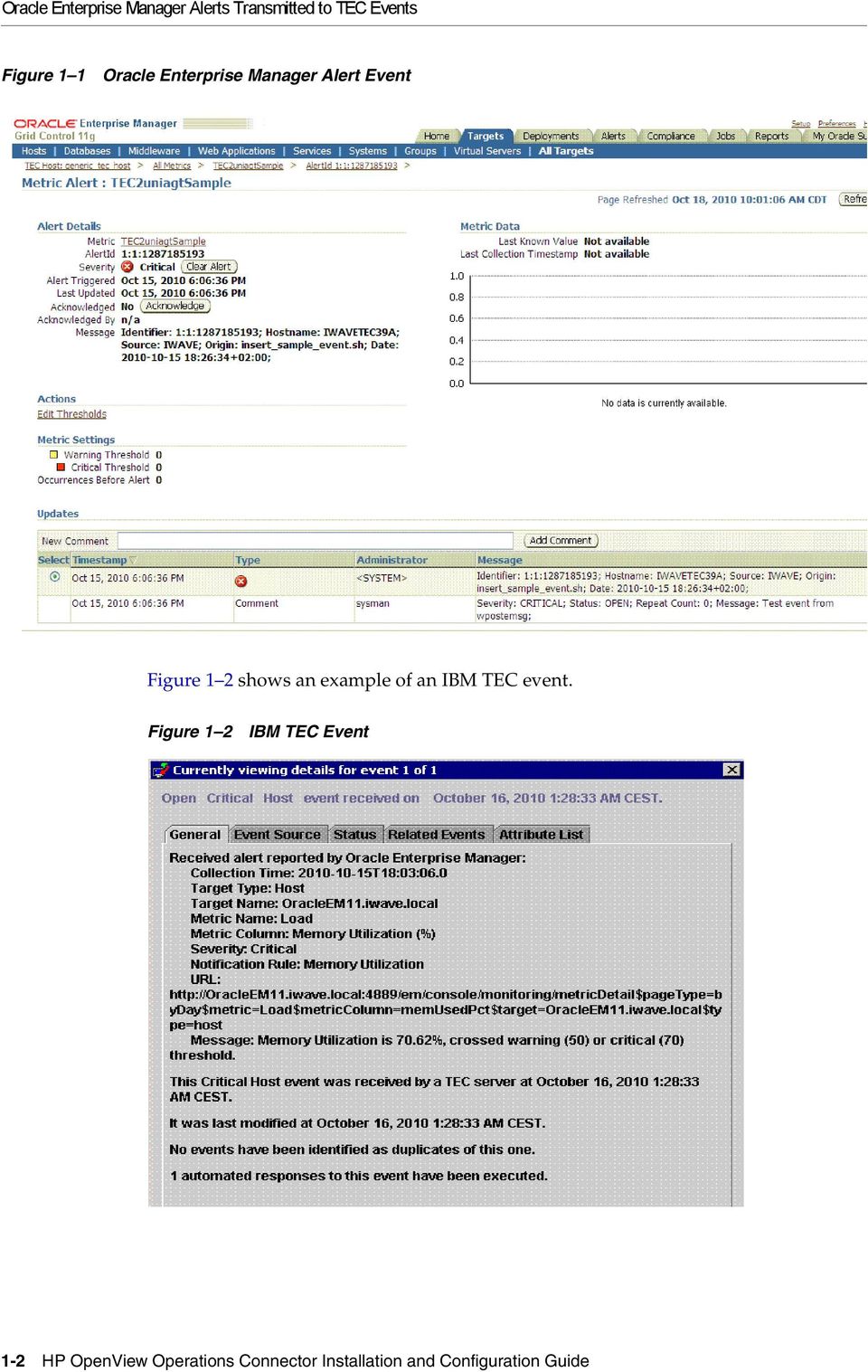
7 1 Introduction to the Connector The IBM Tivoli Enterprise Console (TEC) Connector (version ) integrates Oracle Enterprise Manager with IBM TEC through web services, enabling you to exchange event information between the two systems. 1.1 Connector Features The Oracle Management Connector for IBM TEC monitors all of the events forwarded from TEC and automatically updates alert information in the Oracle Enterprise Manager console whenever changes occur in TEC. A similar synchronization of alerts sent from Oracle Enterprise Manager occurs in TEC. This ensures that the two systems are always synchronized, providing administrators with current information about their entire data center. The connector supports the following features: Synchronization of the alert life cycle on both ends Customization of alert mappings during the alert information exchange Bi-directional flow of alert information The state change of the event/alert in the originating system is reflected in the other system but not vice versa. For example, if an alert is forwarded from Oracle Enterprise Manager to TEC, all the state changes in Enterprise Manager are reflected in TEC. However, if you change the state of the alert in TEC, the change is not reflected in Enterprise Manager because the alert originated in Enterprise Manager. This is also the case for the other direction. The following sections explain how the connector handles TEC events and polls the TEC web service. 1.2 Oracle Enterprise Manager Alerts Transmitted to TEC Events Conceptually, alerts in Oracle Enterprise Manager are equivalent to events in TEC. Whenever an alert is triggered in Oracle Enterprise Manager, the TEC Connector can automatically create or update an event in TEC. You can use Notification Rules to specify the set of alerts for which events must be created, and the alert severity for which this should happen. After the connector creates an event in TEC, any subsequent change of the alert severity is propagated to IBM TEC. When the severity of the alert changes to Clear in Oracle Enterprise Manager, the corresponding event is closed in TEC. Figure 1 1 shows an example of an Oracle Enterprise Manager alert event. Introduction to the Connector 1-1

8 Oracle Enterprise Manager Alerts Transmitted to TEC Events Figure 1 1 Oracle Enterprise Manager Alert Event Figure 1 2 shows an example of an IBM TEC event. Figure 1 2 IBM TEC Event 1-2 HP OpenView Operations Connector Installation and Configuration Guide
9 Prerequisites 1.3 Versions Supported 1.4 Prerequisites This connector supports the following versions of Oracle Enterprise Manager and IBM TEC: Oracle Enterprise Manager Grid Control 10g Release 4 with one-off patch or later IBM Tivoli Enterprise Console versions 3.8 and 3.9 You can install the TEC Agent on the following platforms: Microsoft Windows (2000, 2003, XP) Sun Solaris (SPARC OS version 5-10) IBM AIX (RS/6000 OS version 5.2+) The base Enterprise Manager version number for the HP Tivoli Enterprise Console Connector Release is Enterprise Manager 10g Release 4. Before using the IBM TEC connector, ensure that you meet the following prerequisites: Oracle Patches are installed. To install patches, do the following: 1. Download patch # from: 2. Follow the instructions included with the download in the README.txt file. A utility for unzipping.zip files is available on the system hosting IBM TEC. Java JRE 6.0 or higher is installed on the system where the TEC Web Service will be installed. If you want Oracle Enterprise Manager to forward alerts to IBM TEC, you need to create an event class named OracleEnterpriseManager at the IBM TEC server. Sample BAROC and rules files are provided with the installation that you can install manually or with the installation script. Introduction to the Connector 1-3

10 Prerequisites 1-4 HP OpenView Operations Connector Installation and Configuration Guide

11 2 Installing the Connector The Oracle Enterprise Manager Connector Framework requires a web service interface for exchanging event information with IBM TEC. Since TEC does not provide a web services interface, you must install a third-party TEC web service front-end, which is included in the Oracle Enterprise Manager installation package. You can install the web service on any Unix or Windows system that has connectivity with the TEC server. In addition to the TEC web service front-end, you must also install a back-end TEC Agent on the same physical system as the TEC server. The TEC Agent is preconfigured and is also included in the Oracle Enterprise Manager installation package. Figure 2 1 shows the communication between the various components of the TEC Connector. Figure 2 1 Connector Communication Between Components The following sections in this chapter discuss these topics: Installation Platforms Installing the IBM TEC Web Service Installing and Running the IBM TEC Agent Updates to TEC Rules Installing the IBM TEC Connector in Oracle Enterprise Manager 2.1 Installation Platforms You can install the TEC web service on the following platforms that support Java JRE 1.6: Microsoft Windows Sun Solaris Installing the Connector 2-1

12 Installing the IBM TEC Web Service IBM AIX HP-UX Linux You can install the TEC Agent on the following platforms: Microsoft Windows (2000, 2003, XP) Sun Solaris (SPARC OS version 5-10) IBM AIX (RS/6000 OS version 5.2+) 2.2 Installing the IBM TEC Web Service The TEC web service acts as a front-end for all data flowing into and out of TEC. Oracle Enterprise Manager posts calls to the web service whenever it needs to create or update an event, or get new or updated events from TEC. You can install the TEC web service on any Unix or Windows system that has connectivity to the TEC server and the Oracle Enterprise Manager server Installing and Running the IBM TEC Web Service on Unix The following sections explain how to install and then subsequently run the Web Service Installing the Web Service on Unix To install the web service on a Unix platform, perform the following steps: 1. Create a directory where you want to install the web service. 2. Open a terminal and change the working directory to the installation directory. 3. Download tec_connector_bundle.jar from the Oracle Technology Network to the installation directory, then extract the component.jar files. 4. Make sure the JAVA_HOME environment variable is set to the directory where Java 1.6 is installed. 5. Enter the following command to unzip and extract the.tar file: $JAVA_HOME/bin/jar xvf TEC_webservices_adapter.jar This creates the adapters directory that contains the installation files. Note: If the system where the TEC web service is being installed does not have the JDK installed, you cannot extract the jar file contents. You need to copy the jar file to a system that has the JDK installed and transfer the files after they have been extracted. 6. Enter the following command to change the working directory: cd adapters/endpoints/tec 7. Enter the following command to run the installation script: sh./install.sh 8. When the script prompts whether you want to use HTTPS: If you specify Y, the web service is set up to use HTTPS port number HP OpenView Operations Connector Installation and Configuration Guide

13 Installing the IBM TEC Web Service If you specify N, the web service is set up to use HTTP port number When the script prompts for the user name of the web service, enter the user name that must be provided to access the web service, or accept the default of "tec." 10. When the script prompts for the password of the web service, enter the password that must be provided to access the web service, or accept the default of "webservice." 11. When the script prompts for the host name of the IBM TEC server, enter the host name or IP address where the server is installed. 12. When the script prompts for the port number of the IBM TEC server, enter the port number of the TEC reception port if a port mapper is not defined for the server. If a port mapper is defined for the server, specify a port number of 0. Note: The TEC reception port is defined by the tec_recv_agent_port parameter in the.tec_config file in the $BINDIR/TME/TEC directory. 13. Copy the API jar files from the TEC installation disk to the adapters/lib/adapters directory. The files you need to copy are log.jar and evd.jar, which are located in the EIFSDK/jars directory of the TEC installation disk. 14. If the web service was configured to run using the HTTPS protocol, you must install a SSL certificate. You can install a self-signed certificate, or you can acquire a certificate from a Certificate Authority (CA). To generate and install a self-signed SSL certificate, enter the following commands, and replace <hostname> with the system host name or IP address that the TEC web service will use: "%JAVA_HOME%\bin\keytool" delete -alias iwave -keypass iwavepw -storepass iwavepw -keystore keystore.jks "%JAVA_HOME%\bin\keytool" -genkey -alias iwave -keyalg RSA -keysize dname "CN=<hostname>, OU=Development, O=iWave Software, L=Frisco, ST=TX, C=US" -keypass iwavepw -storepass iwavepw -keystore keystore.jks To install a certificate that the Certificate Authority issues: Request a certificate from a Certificate Authority, such as VeriSign. In the certificate request, make sure to specify the host name or IP address that the TEC web service will use. The host name in the certificate must match the host name configured for the web service. If they do not match, the web service cannot function. After you obtain the certificate from the Certificate Authority, enter the following command to install the certificate, where <certificatefile> is the full path name of the file provided by the Certificate Authority: "%JAVA_HOME%\bin\keytool" -export -alias iwave -file <certificatefile> -keypass iwavepw -storepass iwavepw -keystore keystore.jks The web service framework is now installed and ready to start. Installing the Connector 2-3

14 Installing the IBM TEC Web Service Running the Web Service on Unix To run the IBM TEC Web Service framework commands listed with the following tasks, first change the working directory to... adapters/bin... in the installation directory. Start./service.sh start Shut Down./service.sh stop Restart./service.sh restart Check Status./service.sh status Testing the Web Service on Unix Perform the following steps to verify that the IBM TEC Web Service is functional. 1. Open a terminal and change the working directory to the adapters/bin directory in the installation directory. 2. Enter the following command to run the test script:./testadapter.sh 3. If the test completes successfully, the last line the utility displays is "Test completed successfully." Note: If the HTTPS protocol is being used, the test fails if the installed JRE version is 1.6_10. An issue with this version causes the test to fail. To test the web service, you need to verify that you can load the WSDL in a web browser. See Section 3.3, "Testing the IBM TEC Connector" Installing and Running the IBM TEC Web Service on Windows The following sections explain how to install and then subsequently run the Web Service Installing the Web Service on Windows To install the web service on a Windows platform, perform the following steps: 1. Create a directory where you want to install the web service. 2. Open a terminal and change the working directory to the installation directory. 3. Download tec_connector_bundle.jar from the Oracle Technology Network to the installation directory, then extract the component.jar files. 4. Make sure the JAVA_HOME environment variable is set to the directory where Java 1.6 is installed. 5. Enter the following command to unzip and extract the.jar file: %JAVA_HOME%\bin\jar xvf TEC_webservices_adapter.jar This creates the adapters directory that contains the installation files. 2-4 HP OpenView Operations Connector Installation and Configuration Guide

15 Installing the IBM TEC Web Service Note: If the system where the TEC web service is being installed does not have the JDK installed, you cannot extract the jar file contents. You need to copy the jar file to a system that has the JDK installed and transfer the files after they have been extracted. 6. Enter the following command to change the working directory: cd adapters\endpoints\tec 7. Enter the following command to run the installation script:.\install.bat 8. When the script prompts whether you want to use HTTPS: If you specify Y, the web service is set up to use HTTPS port number If you specify N, the web service is set up to use HTTP port number When the script prompts for the user name of the web service, enter the user name that must be provided to access the web service, or accept the default of "tec." 10. When the script prompts for the password of the web service, enter the password that must be provided to access the web service, or accept the default of "webservice." 11. When the script prompts for the host name of the IBM TEC server, enter the host name or IP address where the server is installed. 12. When the script prompts for the port number of the IBM TEC server, enter the port number of the TEC reception port. The default value for this port is Note: The TEC reception port is defined by the tec_recv_agent_port parameter in the.tec_config file in the $BINDIR/TME/TEC directory. 13. Copy the API jar files from the TEC installation disk to the adapters\lib\adapters directory. The files you need to copy are log.jar and evd.jar, which are located in the EIFSDK\jars directory of the TEC installation disk. 14. If the web service was configured to run using the HTTPS protocol, you must install a SSL certificate. You can install a self-signed certificate, or you can acquire a certificate from a Certificate Authority (CA). To generate and install a self-signed SSL certificate, enter the following commands, and replace <hostname> with the system host name or IP address that the TEC web service will use: "%JAVA_HOME%\bin\keytool" delete -alias iwave -keypass iwavepw -storepass iwavepw -keystore keystore.jks "%JAVA_HOME%\bin\keytool" -genkey -alias iwave -keyalg RSA -keysize dname "CN=<hostname>, OU=Development, O=iWave Software, L=Frisco, ST=TX, C=US" -keypass iwavepw -storepass iwavepw -keystore keystore.jks To install a certificate that the Certificate Authority issues: Request a certificate from a Certificate Authority, such as VeriSign. Installing the Connector 2-5

16 Installing the IBM TEC Web Service In the certificate request, make sure to specify the host name or IP address that the TEC web service will use. The host name in the certificate must match the host name configured for the web service. If they do not match, the web service cannot function. After you obtain the certificate from the Certificate Authority, enter the following command to install the certificate, where <certificatefile> is the full path name of the file provided by the Certificate Authority: "%JAVA_HOME%\bin\keytool" -export -alias iwave -file <certificatefile> -keypass iwavepw -storepass iwavepw -keystore keystore.jks The following steps are optional. If you want the web service to run as a Windows service, perform the following steps. 1. Enter the following command to change the working directory to the bin directory: cd..\..\bin 2. Enter the following command to install the web service as a Windows service: service.bat install The web service framework is now installed and ready to start. If the Microsoft SCOM Web Service was configured to use the HTTPS protocol, the certificate must be imported into Enterprise Manager. See Section 2.2.3, "Adding Signed Certificates to Enterprise Manager" for instructions Running the Web Service on Windows Standalone Service To start the TEC web service framework when set up as a standalone application (not set up to run as a Windows service): 1. Change the working directory to the adapters\bin directory in the installation directory. 2. Run the following command: startadapters.bat To shut down the TEC web service framework, close the window where you started the adapter. Windows Service To start the TEC web service framework when set up to run as a Windows service: net start iwaveadapters To shut down the TEC web service framework: net stop iwaveadapters Testing the Web Service on Windows Perform the following steps to verify that the IBM TEC Web Service is functional. 1. Open a terminal and change the working directory to the adapters/bin directory in the installation directory. 2. Enter the following command to run the test script: 2-6 HP OpenView Operations Connector Installation and Configuration Guide
17 Installing the IBM TEC Web Service./testAdapter.bat 3. If the test completes successfully, the last line the utility displays is "Test completed successfully." Note: If the HTTPS protocol is being used, the test fails if the installed JRE version is 1.6_10. An issue with this version causes the test to fail. To test the web service, you need to verify that you can load the WSDL in a web browser. See Section 3.3, "Testing the IBM TEC Connector" Adding Signed Certificates to Enterprise Manager The Service Manager SSL certificate must be imported into Enterprise Manager. For versions and , perform the steps in Section , "Adding Signed Certificates to Wallet Manager". For versions , perform the steps in the Adding Signed Certificates to cacerts section Adding Signed Certificates to Wallet Manager Note: Oracle Wallet Manager is available at $ORACLE_HOME/bin on OMS for versions and See the Oracle Application Server Administrator's Guide for details. Perform the following steps in Oracle Enterprise Manager to add signed certificates: 1. Do the following to obtain a copy of the certificate that the TEC web service is using: a. Open a command prompt window and change the working directory to... <TECWS_INSTALL>/adapters/conf... where <TECWS_INSTALL> is the directory where the TEC web service is installed. b. Issue the following command to extract the certificate: Unix platforms: $JAVA_HOME/bin/keytool -exportcert -alias iwave -file TECws.cer -keystore keystore.jks -storepass iwavepw Windows platforms: "%JAVA_HOME%\bin\keytool" -exportcert -alias iwave -file TECws.cer -keystore keystore.jks -storepass iwavepw c. Transfer the certificate file TECws.cer to the system where Enterprise Manager is installed. 2. Open a new terminal and set the ORACLE_HOME environment variable to the directory where OMS is installed. 3. As Super Administrator, create a wallet using the following orapki utility command at the OMS host: $OMS_HOME/bin/orapki wallet create -wallet client -auto_login 4. Add the trusted certificate to the wallet by entering the following command: Installing the Connector 2-7

18 Installing the IBM TEC Web Service $OMS_HOME/bin/orapki wallet add -wallet client -trusted_cert -cert <certfile> 5. To view the content of the wallet, enter the following command: $OMS_HOME/bin/orapki wallet display -wallet client Verify that the certificate that was added is listed in the Trusted Certificates. 6. Start Oracle Wallet Manager and open the client wallet. Note: Oracle Wallet Manager is available at $OMS_HOME/bin. See the Oracle Application Server Administrator's Guide for details. 7. Click on Trusted Certificates and select Operations on the main menu. 8. Select Export All Trusted Certificates. 9. Save the file as certdb.txt. 10. Place the file certdb.txt in the connector home root directory ($OMS_HOME/sysman/connector). If the certdb.txt file already exists in the root directory, open the file and add the contents of your certdb.txt file to the existing content. Java SSL can now use this file for communication between Oracle Enterprise Manager and the TEC web service in HTTPS mode. See Also: For additional information on creating a wallet, see "Creating and Viewing Oracle Wallets with orapki" in the Oracle Database Advanced Security Administrator's Guide, 10g Release 2 (10.2) Adding Signed Certificates to cacerts Do the following in Enterprise Manager to add signed certificates to the Java cacerts keystore: 1. Copy the certificate to the Enterprise Manager server system. 2. Determine the location of the JRE in the Oracle Home directory. 3. Open a command window and navigate to the JRE bin directory. 4. Enter the following command to add the certificate to the cacerts keystore: keytool -importcert -keystore..\lib\security\cacerts -storepass changeit -trustcacerts -file <certfile> -alias scomws_cert 5. Restart OMS by opening a command window, changing the working directory to <ORACLE_HOME>/oms10g/bin, and issuing the following commands: emctl stop oms emctl start oms Oracle Enterprise Manager Event Polling to TEC After installation and configuration, the event connector automatically polls the TEC web service for events to exchange alerts and events with Oracle Enterprise Manager. The poll cycle is configurable, where the duration is specified in minutes with a minimum possible duration of 5 minutes. 2-8 HP OpenView Operations Connector Installation and Configuration Guide

19 Installing and Running the IBM TEC Agent Every poll cycle, the event connector polls for up to (40 * polling interval) new or updated events in TEC. The Oracle Enterprise Manager connector framework processes and acknowledges all of the events provided in the poll response. 2.3 Installing and Running the IBM TEC Agent Installing the Agent The following sections provide procedures for installing and running the TEC Agent. The back-end TEC Agent pushes data from TEC into the TEC Web Service. The Agent is comprised of a script (invoked by TEC rules and a command line utility invoked by the script) to send a transaction to the TEC Web Service. The TEC Agent must be installed on the same physical system as the TEC server. The TEC Agent is preconfigured to interface with the TEC Web Service and requires minimal configuration. To install the TEC Agent, perform the following steps: 1. Download tec_connector_bundle.jar from Oracle Technology Network, extract the components, and put the appropriate installation file into the directory where you intend to install the TEC Agent. Note: You need to do this on the IBM TEC system host. Table 2 1 identifies the installation file name for each supported platform. Table 2 1 Platform Installation Files Platform Installation File IBM AIX TECAgentAIX.tar.gz Sun Solaris TECAgentSolaris.tar.gz Microsoft Windows TECAgentWindows.zip 2. Open a terminal and change the working directory to the installation directory. 3. Unzip the installation file. This creates the TEC-agent directory that contains the installation files. For Windows platforms, use a zip utility to unzip the TECAgentWindows.zip file. For AIX platforms, issue the following commands to unzip and untar the files: gunzip TECAgentAIX.tar.gz tar xvf TECAgentAIX.tar For Solaris platforms, issue the following commands to unzip and untar the files: gunzip TECAgentSolaris.tar.gz tar xvf TECAgentSolaris.tar 4. Set up the TEC environment: For Windows systems, enter the following commands to start the bash shell: Installing the Connector 2-9
20 Updates to TEC Rules %SystemRoot%\system32\drivers\etc\Tivoli\setup_env.cmd bash For Unix systems, enter the following command to start the bash shell: /etc/tivoli/setup_env.sh 5. Change the working directory to the TEC-agent directory. 6. Enter the following command to run the setup script to configure the TEC Agent:./install.sh The following prompts appear in this sequence: Enter the hostname or IP address where the TEC adapter is installed [localhost]: Enter the host name or IP address of the system where the TEC Web Service adapter is installed. Do you want to install the default Oracle Enterprise Manager classes and rules [Y]? Enter Y to install and activate the class definitions and rules for the OracleEnterpriseManager class. This class must be installed before alerts from Enterprise Manager can be inserted into TEC. Enter N to skip the installation of the OracleEnterpriseManager class. The classes must be manually installed if you choose not to install the class definitions. The following prompts appear in this sequence if you choose to install the OracleEnterpriseManager class. Enter the name of the rule base to use: Enter the name of the rule base where the class should be installed. This can be an existing rule base or one that does not exist. Rule base could not be found. Do you want to create it [N]? This prompt only appears if the rule base specified in the previous response did not already exist. Specify Y to create a new rule base, or specify N to exit the script without installing the OracleEnterpriseManager class. Enter the rule base directory: This prompt only appears if the script cannot determine the directory where the rule base files are located. Enter the directory where the rule base files are located. The script terminates if the directory does not exist. 7. Delete the installation file from the installation directory Running and Stopping the Agent You do not need to start or stop the Agent. A TEC rule invokes it whenever a transaction needs to be sent to the TEC Web Service adapter. The Agent terminates after the transaction has been successfully delivered to the TEC Web Service adapter. 2.4 Updates to TEC Rules TEC rules must initiate event information sent from TEC to the TEC Web Service. This requires changes to the TEC rule sets to invoke the tec2uniagt script, which sends 2-10 HP OpenView Operations Connector Installation and Configuration Guide
![sh The following prompts appear in this sequence: Enter the hostname or IP address where the TEC adapter is installed [localhost]: Enter the host name or IP address of the system where the TEC Web](/docs-images/43/18791113/images/page_20.jpg "Service adapter is installed. Do you want to install the default Oracle Enterprise Manager classes and rules [Y]?")
21 Updates to TEC Rules event information to the TEC Web Service. The following sections describe the required changes to the TEC rule sets for data flowing in both directions Handling Data Flowing from Enterprise Manager to TEC For the TEC connector to work out of the box, the Oracle Enterprise Manager default classes must be installed and loaded into the TEC Server. When installing the TEC Agent, you have the option to install the classes and rules. If you choose to install the default classes, the install script compiles the classes and rules, and loads them into the TEC Server. It also shuts down and restarts the server to pick up the new classes. If you choose not to install the classes, you must manually install the classes and rules. The default class files are located in the TEC-agent/Samples directory. The OracleEnterpriseManager.baroc file defines the 5 classes that are required to insert events into TEC. The OracleEnterpriseManager.rls file contains the rules required to send the event data back to the TEC Web Service after an event has been created, updated, or closed. To manually install the classes with the install script, perform the following steps. 1. Open a command terminal at the system where the TEC server is installed. 2. Change the working directory to the TEC-agent/Samples directory in the TEC Agent install directory. 3. Set up the TEC environment: For Windows systems, enter the following commands to start the bash shell: %SystemRoot%\system32\drivers\etc\Tivoli\setup_env.cmd bash For Unix systems, enter the following command to start the bash shell: /etc/tivoli/setup_env.sh 4. Enter the following command to install the default classes:./rule_load.sh Handling Data Flowing from TEC to Enterprise Manager To send new/updated events from TEC to Enterprise Manager, you need to define one or more rules in TEC to call the tec2uniagt script. The script is named tec2uniagt.sh on Unix systems and it is named tec2uniagt.cmd on Windows systems. This script sends an event to the TEC Web Service and makes the event available for Enterprise Manager to consume. You need to identify the classes that you want Enterprise Manager to consume. You also need to identify the conditions that should trigger sending an event to the TEC Web Service. An example of conditions would be changing the status or severity of an event. After you identify this information, you need to coordinate with the TEC Administrator to define and install the necessary rules to invoke the tec2uniagt script. Sample files are provided in the TEC-agent/Samples directory of the TEC Agent install directory. The files are named tec2uniagt_sample.baroc and tec2uniagt_sample.rls. These files provide an example of how to invoke the tec2uniagt script and should not be installed on your TEC Server. Installing the Connector 2-11
22 Installing the IBM TEC Connector in Oracle Enterprise Manager 2.5 Installing the IBM TEC Connector in Oracle Enterprise Manager The following procedure explains how to add the new TEC Connector. Note: Table 2 2 provides descriptions for the parameters shown for the emctl command in this procedure. Note: The commands in this section reference the OMS_HOME environment variable. OMS_HOME must be set to the OMS sub-directory in the Enterprise Manager installation directory. For versions and , this is the oms10g directory. For version , this is the oms11g directory. Example settings of the OMS_ HOME variable are /gc/oraclehomes/oms10g on a Unix platform running version , and C:\Oracle\Middleware2\oms11g on a Windows platform running version Enter the following command to extract the connector.jar file for versions and : $OMS_HOME/bin/emctl extract_jar connector -jar <jarfile> -cname <connector_ type_name> For version , enter the following command: $OMS_HOME/bin/emctl extract_jar connector <jarfile> <connector_type_name> <OracleHomes> Note: You should perform this extraction on all OMS instances, because all OMS instances need to access the files locally. Command Example $OMS_HOME/bin/emctl extract_jar connector -jar $OMS_HOME/sysman/ connector/ibm_tec.jar" cname "TEC Connector" When run, this creates a new connector subdirectory called TEC_Connector in the <OracleHomes> sysman/connector directory. 2. Register the connector by entering the following command based on the Enterprise Manager version, noting the required double-quotes. You only need to perform the registration once $OMS_HOME/bin/emctl register_connector connector -dd "<deployment_file>" -repos_pwd <password> $OMS_HOME/bin/emctl register_connector connector -dd "<deployment_file>" -cs //<server>:<port>/<database_sid> -repos_user <username> -repos_pwd <password> $OMS_HOME/bin/emctl register_connector connector <deployment_file> <server> <port> <database_sid> <username> <password> <omshome> 2-12 HP OpenView Operations Connector Installation and Configuration Guide
23 Installing the IBM TEC Connector in Oracle Enterprise Manager Command Example $OMS_HOME/bin/emctl register_connector connector dd $OMS_HOME/sysman/connector/TEC_Connector/TECConnector.xml -repos_pwd password The new TEC connector should now appear in the Management Connectors page after the emctl register_connector command has loaded the connector, as shown in Figure 2 2. Figure 2 2 Installed TEC Connector Table 2 2 provides descriptions for the parameters shown in the procedure above. Table 2 2 Parameter emctl Parameters Description connector_name Connector name. Specify "TEC Connector". The double quotes ( "" ) are mandatory. connector_type_name database sid/ Service Name for RAC DB deployment_file description internal_name jarfile omshome oraclehome password port server Connector type name. Specify "TEC Connector". The double quotes ( "" ) are mandatory. Repository database instance ID or service name if you are using a RAC database as the repository. Fully-qualified name of the connector deployment file. This TECConnector.xml file resides in the TEC connector directory $OMS_HOME/sysman/connector/TEC_Connector/. Short description for the ticket template. This description is also displayed in Enterprise Manager. Internal name Depending on the template, the values can be acknowledgealerts, createevent, getnewalerts, getupdatedalerts, or updateevent. Fully-qualified name of the connector jar file. The jar file name is ibm_tec.jar. "<oraclehome>\oms10g" with double quotes recommended. Top directory of the OMS installation. Password for SYSMAN. Listener port of the repository. Host name of the Enterprise Manager repository. Installing the Connector 2-13
24 Installing the IBM TEC Connector in Oracle Enterprise Manager Table 2 2 (Cont.) emctl Parameters Parameter template_name template_type template.xml username Description Template name Depending on the template, the values can be Acknowledge Alerts, Create Event, Get New Alerts, Get Updated Alerts, or Update Event. Template type Specify 1 for inbound transformation, 2 for outbound transformation, and 3 for xml. Fully-qualified name of the connector template file Specify SYSMAN HP OpenView Operations Connector Installation and Configuration Guide
25 3 Configuring the Connector This chapter provides procedures to configure the two sub-pages of the main Configure Management Connector page, then explains how to perform other tasks to complete the configuration process. This chapter discusses the following topics: Configuring the General Page Configuring the Targets Page Testing the IBM TEC Connector Sending Oracle Enterprise Manager Alerts to IBM TEC 3.1 Configuring the General Page To configure the General page: 1. From the Management Connectors page, select the TEC Connector and click the Configure icon. By default, the General sub-page of the Configure Management Connector page appears, as shown in Figure 3 1. Configuring the Connector 3-1
26 Configuring the General Page Figure 3 1 TEC Connector General Settings 2. Update the URLs for each of the Web Service End Point operations as described below. Operation Descriptions The TEC connector uses the following operations (web methods) to exchange data with the TEC Web Service. getnewalerts Creates alerts in Oracle Enterprise Manager based on events that originate in IBM TEC. Oracle Enterprise Manager uses this operation when polling for events in IBM TEC. getupdatedalerts Updates alerts in Oracle Enterprise Manager based on events that originate from IBM TEC. Oracle Enterprise Manager uses this operation when polling for events from IBM TEC. acknowledgealerts Acknowledges the alerts after Oracle Enterprise Manager has processed them. Oracle Enterprise Manager uses this operation when polling for events in IBM TEC. createevent Generates events in IBM TEC based on alerts that originate in Oracle Enterprise Manager. Oracle Enterprise Manager invokes this operation when it forwards a new alert to TEC. updateevent Updates events in IBM TEC based on alerts that originate in Oracle Enterprise Manager. Oracle Enterprise Manager invokes this operation when it forwards a new alert to TEC. URL Types 3-2 HP OpenView Operations Connector Installation and Configuration Guide
27 Configuring the Targets Page The connector uses two different URLs for operations. One URL polls data out of IBM TEC (getnewalerts, getupdatedalerts and acknowledgealerts), and defaults to the following value: The other URL pushes data into IBM TEC (createevent and updateevent), and defaults to the following value: You need to make the following changes to each of the default URLs: Replace [Hostname] in the URL with the hostname or IP address of the system where the TEC Web Service is installed. If necessary, change the port to the port on which the web services are running. For example, the default port for HTTP is 8080 and the default port for HTTPS is If the TEC Web Service was configured to use the HTTPS protocol, change http to https at the beginning of each web service URL. If you are using HTTPS as the protocol, you must also include the TEC web service certificate in Oracle Wallet Manager as described in Adding Signed Certificates to Enterprise Manager on on page Enter the user name and password you specified when you installed the TEC web service, which is discussed in steps 9 and 10 of Section and section steps 9 and 10 of Section The TEC web service installer prompts for the user name and password that should be supplied when accessing the TEC web service. It provides default values if you do not provide a response. 4. Enter the user name and password of the Oracle Enterprise Manager account. 5. Optionally enter a polling interval to specify how often Oracle Enterprise Manager should poll the IBM TEC web service for new or updated events to process. The poll interval defaults to 5 minutes if not specified. 6. Click OK to save your configuration changes. 3.2 Configuring the Targets Page Whenever an IBM TEC event is translated into an Oracle Enterprise Manager alert, the IBM TEC event host name determines the target-type instance associated with the alert in Oracle Enterprise Manager. If a target instance that matches the event host name is not found, the default target instance of generic_tec_host is used for the alert. To add proxy targets in Oracle Enterprise Manager: 1. From the Configure Management Connector page, click the Targets link to display the Targets page, as shown in Figure 3 2. Configuring the Connector 3-3
28 Testing the IBM TEC Connector Figure 3 2 TEC Connector Target Settings 2. Provide a target name. The Target Name field is set to the host name specified in the TEC event and must exactly match the name. 3. Provide the TEC host name in the TEC HOST NAME field. This field must be set to the same value as the Target Name field. 4. Repeat this process for as many target instances as desired. 5. Click OK to save your configuration changes. 3.3 Testing the IBM TEC Connector Perform the following steps to test the connector: 1. Log in to the Oracle Enterprise Manager console by entering a user name with a Super Administrator role, entering the appropriate password, then clicking Login. 2. Click the Setup link at the top right part of the window. The Overview of Setup page appears. 3. Click the Management Connectors link on the left side of the window. The Management Connectors page appears, which shows the installed connectors. 4. Click on the Configure icon associated with the TEC Connector. 5. Click on the General tab. 3-4 HP OpenView Operations Connector Installation and Configuration Guide
29 Sending Oracle Enterprise Manager Alerts to IBM TEC 6. Select and copy the URL specified for the createevent or updateevent operation. 7. Open an internet browser on the system where the Oracle Enterprise Manager server is installed. 8. In the address window, enter the URL that was copied in step 6 above. Add?wsdl to the end of the URL. The URL should appear similar to the following example: [Hostname] is the actual host name or IP address where the TEC web service is installed. If the WSDL is loaded, this confirms that the connector is configured correctly for sending event information to TEC. 9. At the Oracle Enterprise Manager console, select and copy the URL specified for the getnewalerts, getupdatedalerts, or the acknowledgealerts operation. They should all be set to the same URL. 10. Open an internet browser on the system where the Oracle Enterprise Manager server is installed. 11. In the address window, enter the URL that you copied in step 9 above. Add?wsdl to the end of the URL. The URL should be similar to the following example: [Hostname] is the actual host name or IP address where the TEC web service is installed. If the WSDL is loaded, this confirms that the connector is configured correctly for polling event information from TEC. 3.4 Sending Oracle Enterprise Manager Alerts to IBM TEC Alerts generated or updated in Oracle Enterprise Manager are not transferred to TEC unless you create notification rules to invoke the IBM TEC notification method. A notification rule identifies the conditions that must be met before the notification method is invoked. The following sections provide procedures that explain how to create and update notification rules Creating Notification Rules The following procedure explains how to create a new notification rule to invoke the TEC notification method. 1. Click the Preferences link in the upper right corner of the Oracle Enterprise Manager console. The General page appears. 2. Click the Notification Rules link on the left side of the window. The Notification Rules page appears and displays a list of all defined notification rules. 3. Click Create to create a new notification rule. 4. From the General sub-page, enter a name for the notification rule and an optional description. Configuring the Connector 3-5
30 Sending Oracle Enterprise Manager Alerts to IBM TEC Select the target type and whether you want it to apply to all targets of that type or a specific instance. If you indicate that you want a specific instance, you need to click Add and select the desired target instance. 5. Click the Availability link, then select the availability states for which you would like to receive notifications. Each state you select invokes the notification method whenever it is reached. 6. Click the Metrics link. If you want to trigger the notification method based on metric violations, click Add and select the metrics and states for which you want to invoke the notification method, then click Continue. 7. Click the Methods link. In the Advanced Notification Methods section, click the check box next to the TEC Connector to assign the TEC notification method to the notification rule. 8. Click OK to complete the setup Updating Notification Rules The following procedure explains how to update an existing notification rule to invoke the TEC notification method. 1. Click the Preferences link in the upper right corner of the Oracle Enterprise Manager console. The General page appears. 2. Click the Notification Rules link on the left side of the window. The Notification Rules page appears and displays a list of all defined notification rules. 3. Click on the radio button next to the notification rule you want to update, and click Edit to update the notification rule. 4. Click the Methods link. In the Advanced Notification Methods section, click on the check box next to the TEC Connector to assign the TEC notification method to the notification rule. 5. Click OK to complete the update Viewing Oracle Enterprise Manager Alerts Whenever an event is created in IBM TEC from an alert that originates in Oracle Enterprise Manager, a link is provided in the event text. To view the Oracle Enterprise Manager alert that triggered the event, copy the URL to a web browser. You will be asked to log in to Oracle Enterprise Manager. After logging in, the Oracle Enterprise Manager alert information is displayed. 3.5 Sending Oracle Enterprise Manager Alerts to IBM TEC No special setup is required in Oracle Enterprise Manager to retrieve event information from TEC. Oracle Enterprise Manager automatically starts polling the TEC web service after the connector has been configured. TEC does not automatically send new and updated events to the TEC web service. You must create and install TEC rules to forward events to the TEC Web Service. See "Handling Data Flowing from TEC to Enterprise Manager" on page 2-11 for information about the TEC rules changes. 3-6 HP OpenView Operations Connector Installation and Configuration Guide
31 4 Changing Default Configurations This chapter explains how to change default mappings and default port numbers. This chapter discusses the following topics: Customizing Mappings Changing Default Port Numbers 4.1 Customizing Mappings Although the default mappings are sufficient for most implementations, you can change them as needed. The following sections discuss: XML Format of IBM TEC Events XML Format of Oracle Enterprise Manager Alerts Changing a Mapping It is assumed that you already have a good understanding of XSL. For reference information on the default mappings, see Appendix A, "Default Mappings" XML Format of IBM TEC Events Example 4 1 represents the format that the IBM TEC web service expects for creating new events in IBM TEC. The format for update requests is the same, except the root node would be "update" instead of "create." Example 4 1 Sample Format for IBM TEC Web Service <iwaveaf:create xmlns:iwaveaf=" adapter-framework"> <event> <description></description> <status></status> <severity></severity> <repeatcount></repeatcount> <createdate></createdate> <eventclass> <name>oracleenterprisemanager</name> </eventclass> <group> <name>primaryserver</name> </group> <object> <computername></computername> Changing Default Configurations 4-1
32 Customizing Mappings <displayname></displayname> </object> <source> <computername></computername> <name>oracleenterprisemanager</name> </source> <extended-fields> <string-field name="ext_id"></string-field> <string-field name="sub_source">oracleenterprisemanager</string-field> </extended-fields> </event> </iwaveaf:create> Mappings Between XML Format and Event Field Names Table 4 1 identifies the mappings between the IBM TEC base event slot names and the XML format that the IBM TEC web services uses. The XML document presented to the IBM TEC web service must have the corresponding fields set. This must be handled in the appropriate translation file identified in Table A 1. Table 4 1 IBM TEC Slot Names Class Name msg status severity repeat_count date fqhostname hostname source origin All other slot names Event Attributes and XML Path Mappings XML Path /create/event/eventclass/name /create/event/description /create/event/status /create/event/severity /create/event/repeatcount /create/event/createdate /create/event/object/displayname /create/event/object/computername /create/event/source/name /create/event/source/computername See "Extended Fields" below Extended Fields Extended fields pass information for slots that are not mapped. An extended field is defined as a <string-field/> element that is a child of the extended-fields node. The name of the slot is specified in the name attribute, and the value of the slot is specified in the value attribute XML Format of Oracle Enterprise Manager Alerts Example 4 2 shows the format that the Oracle Enterprise Manager Connector Framework provides when an alert is created or updated in Oracle Enterprise Manager. Example 4 2 XML Format of Alerts <EMEvent> <EventGuid/> <ExternalEventId/> <ViolationId/> 4-2 HP OpenView Operations Connector Installation and Configuration Guide
33 Customizing Mappings <TargetType/> <TargetName/> <MetricName/> <MetricColumn/> <KeyValues/> <Message/> <Severity/> <SeverityCode/> <CollectionTime/> <EventPageURL/> <EMUser/> <NotificationRuleName/> <TargetHost/> <TargetTimezone/> <Property> <Name/> <Value/> </Property> </EMEvent> Table 4 2 provides a description of the fields shown in Example 4 2. Table 4 2 Field EventGuid ExternalEventId CollectionTime TargetType TargetName MetricName MetricColumn KeyValues Severity SeverityCode EMUser NotificationRuleName EventPageURL Message TargetHost TargetTimezone Field Descriptions for XML Format Description Unique identifier of the alert in Oracle Enterprise Manager. Unique identifier of the event in IBM TEC. This will only be set for updates. Time the alert was generated. Target type for which the alert was generated. Target name that is a unique instance of the target type. Name of the metric that was violated. Column under the metric that was violated. Key values associated with the metric column that was violated. Severity text assigned to the alert. Severity numeric code assigned to the alert. User that owns the rule that generated the alert. Name of the notification rule that caused the alert to be forwarded to IBM TEC. Link to the web page for the alert. Description of the alert. Host name of the system where the target resides. Time zone of the system where the target resides. Changing Default Configurations 4-3
34 Customizing Mappings Table 4 2 (Cont.) Field Descriptions for XML Format Field Property Description Additional properties that do not have a specific field in the alert model Changing a Mapping This section explains how to customize the mapping between Enterprise Manager and the IBM TEC web service. The procedure provides the steps required for changing a mapping. Following this procedure, an example is provided that shows how to change the mapping of the target type and target name fields. 1. Study the default mapping and determine the changes you want to make. See Appendix A for details about the default mappings and the files that define the mapping for the different Enterprise Manager operations. 2. Create a back-up copy of the XSL file you want to change. 3. Open the XSL file in a text editor or in an XSLT editor. 4. Change the file to map the fields as determined in step 1. You might need to study the information in Section and Section These sections describe the data formats of the IBM TEC events and Oracle Enterprise Manager alerts. 5. Save your changes. The files are now ready for integration. You do not need to stop and start OMS. The changes will automatically be picked up. Example of Changing a Mapping By default, the origin slot in the IBM TEC event is set to the Oracle Enterprise Manager target type, and the sub_origin slot is set to the target name. The following example shows how to change the value where the target type and name information is placed in TEC. In this example, the target_type and target_name slots were added to the class definition to contain this information. The changes made to the default mapping are as follows: The origin slot is modified to use a hard-coded value of Oracle Enterprise Manager. The sub_origin slot is not set to any value. The new target_type slot is set to the Oracle Enterprise Manager target type. The new target_name slot is set to the Oracle Enterprise Manager target name. 1. Make a back-up copy of the createevent_request.xsl file and name it default_createevent_request.xsl. 2. Make a backup copy of the updateevent_request.xsl file and name it default_updateevent_request.xsl. 3. Open the createevent_request.xsl file in your text editor. 4. Change the appropriate sections to reflect the new mapping. Before Changes The code below shows the impacted sections in the file before the changes. 4-4 HP OpenView Operations Connector Installation and Configuration Guide
35 Customizing Mappings <source> <!-- TEC slot = source --> <name>oracleenterprisemanager</name> <!-- TEC slot = origin --> <computername> <xsl:value-of select="a:targettype"/> </computername> </source> <extended-fields> <!-- TEC fields that are not mapped to the common object model --> <string-field name="action_flag">create</string-field> <string-field name="ext_id"> <xsl:value-of select="a:eventguid"/> </string-field> <string-field name="sub_source">oracleenterprisemanager</string-field> <string-field name="sub_origin"> <xsl:value-of select="a:targetname"/> </string-field> </extended-fields> After Changes The code below shows the Extended Fields section in the file after the changes. The changes are shown in bold. <source> <!-- TEC slot = source --> <name>oracleenterprisemanager</name> <!-- TEC slot = origin --> <computername>oracle Enterprise Manager</computerName> </source> <extended-fields> <!-- TEC fields that are not mapped to the common object model --> <string-field name="action_flag">create</string-field> <string-field name="ext_id"> <xsl:value-of select="a:eventguid"/> </string-field> <string-field name="sub_source">oracleenterprisemanager</string-field> <string-field name="target_type"> <xsl:value-of select="a:targettype"/> </string-field> <string-field name="target_name"> <xsl:value-of select="a:targetname"/> </string-field> </extended-fields> 5. Save your changes after making the updates. 6. Open the updateevent_request.xsl file and make the same changes. In this case, you cannot just cut and paste the Extended Fields section, because there are some differences between the create and update translations. You will need to edit them separately. 7. Save your changes after making the updates. Changing Default Configurations 4-5
36 Changing Default Port Numbers 4.2 Changing Default Port Numbers In most cases, you can use the default port numbers that the IBM TEC web service uses. However, if there are any conflicts with existing applications, you need to change the port numbers is the default port number for HTTP communication, and 8443 is the default port for HTTPS communication. To change the port number, perform the following steps on the system where the IBM TEC web services are installed. Replace <TECWS_INSTALL> with the directory where the IBM TEC web services are installed. 1. Open a command prompt window and change the working directory to: <TECWS_INSTALL>/adapters/conf 2. Enter the following command to configure the web service to connect to the IBM TEC Agent...../bin/propertiesEditor.bat -p services.url=<prot>://localhost:<newport>/ services framework.properties... where <prot> is the protocol (HTTPS or HTTPS) and <newport> is the new port number. The propertieseditor.bat script is specifically for the Windows platform. The equivalent script for Unix platforms is propertieseditor.sh. 3. Make a backup copy of the framework.properties file. 4. Open the framework.properties file with a text editor and replace all references to the old port number with the new port number, then save the file. Note: If the old port number is 8443, you will not find any references to the old port number. 5. Change the working directory to../bin. 6. Enter the following command to restart the IBM TEC web service. If the web service is installed on a Unix system:./service.sh restart If the web service is installed on a Windows system as a standalone application, close the window where the adapter was running, then run: startadapters.bat If the web service is installed on a Windows system as a Windows service, enter the following commands: net stop iwaveadapters net start iwaveadapters Perform the following steps to change the URL the TEC connector is using: 1. Log in to the Oracle Enterprise Manager console by entering a user name with a Super Administrator role, entering the appropriate password, then clicking Login. 2. Click the Setup link at the top right part of the window. The Overview of Setup page appears. 4-6 HP OpenView Operations Connector Installation and Configuration Guide
37 Changing Default Port Numbers 3. Click the Management Connectors link on the left side of the window. The Management Connectors page appears, which shows the installed connectors. 4. Click on the Configure icon associated with the TEC Connector. This invokes edit mode, enabling you to configure the connector. 5. Change the URLs listed in the Web Service End Points section to use the new port number. 6. Click OK to save your changes. Changing Default Configurations 4-7
38 Changing Default Port Numbers 4-8 HP OpenView Operations Connector Installation and Configuration Guide
39 5 Troubleshooting the Connector This chapter provides information to assist in troubleshooting integration issues with IBM TEC. The chapter focuses on troubleshooting issues in the web service front-end and the back-end Agent. This chapter discusses the following topics: Preparing for Troubleshooting Using the Correct URL for TEC Web Service Operations Diagnosing Problems with Event Generation and Updates Resolving Alerts from Oracle Enterprise Manager Resolving Events from TEC 5.1 Preparing for Troubleshooting In order to troubleshoot integration issues, you must adjust the Oracle Enterprise Manager logging options to capture additional information. To enable debug logging information: 1. Edit the emomslogging.properties file using a text editor. The location of the file depends on the Enterprise Manager version. Version <ORACLE_HOME>/oms11g/sysman/config Versions and <ORACLE_HOME>/oms10g/sysman/config... where <ORACLE_HOME> is the Oracle installation directory. 2. Set the parameters as follows: log4j.appender.emlogappender.threshold = DEBUG log4j.rootcategory=debug, emlogappender, emtrcappender 3. After setting the debug logging parameters, restart OMS by opening a command window, changing the working directory to <ORACLE_HOME>/oms10g/bin, and issuing the following commands: emctl stop oms emctl start oms Troubleshooting the Connector 5-1
40 Using the Correct URL for TEC Web Service Operations 5.2 Using the Correct URL for TEC Web Service Operations Perform the following steps to identify and configure the connector to use the correct URL for TEC Web Service operations. 1. Open a command terminal on the system where the TEC web service is installed. 2. Change the working directory to the adapters/log directory in the TEC web service installation directory. 3. Open the framework.log file in a text editor. 4. Go to the bottom of the file and search backwards for the string Setting the server's publish address to be. Continue searching backwards until the URL that contains AcquisitionService is found. The URL listed there is the URL that should be specified for the getnewalerts, getupdatedalerts, and acknowledgealerts operations. 5. Go to the bottom of the file and search backwards for the string Setting the server's publish address to be." Continue searching backwards until the URL that contains EventService is found. The URL listed here is the URL that should be specified for the createevent and updateevent operations. 6. Log in to the Oracle Enterprise Manager console by entering a user name with a Super Administrator role, entering the appropriate password, then clicking Login. 7. Click the Setup link at the top right part of the window. The Overview of Setup page appears. 8. Click the Management Connectors link on the left side of the window. The Management Connectors page appears, which shows the installed connectors. 9. Click on the Configure icon associated with the TEC Connector. This invokes edit mode, enabling you to configure the connector. 10. Verify that the URL identified in step 4 is specified for the getnewalerts, getupdatedalerts, and acknowledgealerts operations. The URL from the log file will specify a host name of localhost. The URL specified for the different operations must specify the IP address or host name of the system where the web service is installed as the host name instead of localhost. 11. Verify that the URL identified in step 5 is specified for the createevent and updateevent operations. 12. If any of the operations are incorrect, change to the correct URL and click OK. 5.3 Diagnosing Problems with Event Generation and Updates You might encounter issues involved in generating or updating events in TEC from alerts that have originated in Oracle Enterprise Manager or vice versa. The following sections provide diagnostic information to resolve these problems Alerts from Oracle Enterprise Manager to TEC TEC can generate or update events from alerts that have originated in Oracle Enterprise Manager. Perform the following diagnostic steps if TEC events are not being generated or updated as expected. 1. Verify that a notification rule is set up for the condition that triggered the alert. Perform the following steps to verify that it is set up correctly: 5-2 Connector Installation and Configuration Guide
41 Diagnosing Problems with Event Generation and Updates a. Open an Oracle Enterprise Manager console window and log in. b. Click on the Setup link in the upper right corner of the Oracle Enterprise Manager console. c. Click on the Notification Methods link on the left side of the window. d. Locate the TEC Connector in the table near the bottom of the window and click on it to list and note the notification rules that use this method. e. Click on the Preferences link in the upper right corner. f. Click on the Notification Rules link on the left side of the window. This displays a list of all defined notification methods. g. Examine the details for the rules listed in step d above and verify that at least one rule matches the conditions that triggered the alert. h. If you did not find at least one rule, you need to modify an existing notification rule or add a new one to invoke the TEC notification method. 2. Determine the error that Oracle Enterprise Manager has reported. a. Navigate to the page that displays the alert information that should have triggered the new event in TEC. For example, if the Memory Utilization % metric was set up to invoke the TEC Connector method, you would perform the following steps to access the page that displays alert information. This example assumes that the generated alert was critical. 1.) Click on the Alerts tab. 2.) Click on the Critical sub-tab. 3.) Click on the Memory Utilization % alert. b. Click on the details and look for any error events. After the alert is generated, it initially indicates that the method will be invoked, but no error events appear. The Enterprise Manager Connector Framework makes several attempts to transfer the alert information to the TEC web service. After all attempts have failed, an error event is usually added to the details for the alert. If there are no errors after several minutes, it is likely that no error events will be added to the log. c. If there is no error information in the alert details, you need to examine the log file for errors. Perform the following steps to locate errors in the log file: 1.) Open the emoms.trc file in a text editor. The location of the file depends on the Enterprise Manager version. Version <EM_INSTANCE_BASE>/em/<OMS_NAME>/sysman/log/... where <EM_INSTANCE_BASE> is the OMS Instance Base directory. By default, the OMS Instance Base directory is gc_inst, which is present under the parent directory of the Oracle Middleware Home. Versions and $OMS_HOME/sysman/log 2.) Go to the bottom of the file and search backwards for this string: ERROR core.emeventconnectorserviceimpl createevent Troubleshooting the Connector 5-3
42 Resolving Alerts from Oracle Enterprise Manager The error event is contained in the Exception information. 3. Diagnose the problem based on the error event. See Section 5.4, "Resolving Alerts from Oracle Enterprise Manager" for information on troubleshooting common error events Events from TEC to Oracle Enterprise Manager Oracle Enterprise Manager can generate or update alerts resulting from events that have originated in TEC. Perform the following diagnostic steps if Oracle Enterprise Manager alerts are not being generated or updated as expected. 1. Open the $OMS_HOME/sysman/log/emoms.trc file in a text editor. The location of the file depends on the Enterprise Manager version. Version <EM_INSTANCE_BASE>/em/<OMS_NAME>/sysman/log/... where <EM_INSTANCE_BASE> is the OMS Instance Base directory. By default, the OMS Instance Base directory is gc_inst, which is present under the parent directory of the Oracle Middleware Home Versions and $OMS_HOME/sysman/log 2. Go to the bottom of the file and search backwards for getnewalerts(). Any instances you find are immediately followed by exception information that identifies the cause of the failure. See Section 5.5, "Resolving Events from TEC" for the error event you found in the log file. Each event entry explains the cause of the problem and the steps required to correct the problem. 5.4 Resolving Alerts from Oracle Enterprise Manager This section provides cause and solution information on troubleshooting common alert messages. Find the error message in Table 5 1 that matches your alert message, then refer to the corresponding section(s) indicated under Possible Cause for instructions to diagnose and correct the problem. Table 5 1 Enterprise Manager Alert Messages Alert Message Possible Cause Applicable Versions targetexception=oracle.xml.parser.v2.xmlparseexception: Start of root element expected javax.net.ssl.sslexception: SSL handshake failed: X509CertChainInvalidErr The wallet "/gc/oraclehomes/oms10g/sysman/connector// certdb.txt" does not exist Error opening socket: java.net.connectexception: Connection refused Error opening socket: java.net.unknownhostexception: <hostname> Invalid Web Service Credentials SSL Not Configured in Enterprise Manager , , Missing certdb.txt File , TEC Web Service Is Down , Unknown Host , Connector Installation and Configuration Guide
43 Resolving Alerts from Oracle Enterprise Manager Table 5 1 (Cont.) Enterprise Manager Alert Messages Alert Message Possible Cause Applicable Versions Error opening socket: java.net.noroutetohostexception: No route to host SOAPException: faultcode=soap-env:protocol; msg=unsupported response content type "text/html; Error occurred while calling Web Service: soap:serverattempt to insert the event into TEC failed Error occurred while calling Web Service: soap:servertimeout occurred waiting for synchronous response from TEC after inserting an event The server sent HTTP status code 403: Forbidden javax.net.ssl.sslkeyexception: [Security:090477]Certificate chain received from IWAVETEC39A was not trusted causing SSL handshake failure. HTTP transport error: java.net.socketexception: Socket Closed HTTP transport error: java.net.unknownhostexception: <hostname> Invalid IP Address or Port Number , Invalid URL Path , TEC Server Not Operational , TEC Server Timeout , Invalid Web Service Credentials SSL Not Configured in Oracle Enterprise Manager TEC Web Service is Down, Invalid IP Address or Port Number Unknown Host The server sent HTTP status code 404: Not Found Invalid URL Path javax.xml.ws.soap.soapfaultexception: Attempt to insert the event into TEC failed javax.xml.ws.soap.soapfaultexception: Timeout occurred waiting for synchronous response from TEC after inserting an event TEC Server Not Operational TEC Server Timeout Invalid Web Service Credentials Cause The user name or password for accessing the TEC web service is incorrect. Solution 1. Log in to the Oracle Enterprise Manager console by entering a user name with a 'Super Administrator' role, entering the appropriate password, then clicking Login. 2. Click the Setup link at the top right corner of the window. The Overview of Setup page appears. 3. Click the Management Connectors link on the left side of the window. The Management Connectors page appears, which shows the installed connectors. 4. Click on the Configure icon associated with the TEC Connector. 5. Click the General tab. 6. Correct the TEC Web Service Username and TEC Web Service Password fields, then click OK. Troubleshooting the Connector 5-5
44 Resolving Alerts from Oracle Enterprise Manager SSL Not Configured in Enterprise Manager Cause The SSL handshake between the Oracle Enterprise Manager Connector Framework and the TEC web service failed. This failure occurs because Oracle Enterprise Manager is not configured correctly with the SSL certificate for the TEC web service. The SSL certificate the TEC web service uses must be imported into the certificate store. The certificate is either missing from the certificate store or does not match the SSL certificate provided by the TEC web service. Solution Import the SSL certificate from the TEC web service into the certificate store. See Section 2.2.3, "Adding Signed Certificates to Enterprise Manager" on page 2-7 for details on setting up Oracle Enterprise Manager with the TEC SSL certificate. Missing certdb.txt File Cause The TEC web service is configured to use SSL, but the certdb.txt file that contains the SSL information is missing. Solution Import the SSL certificate from the TEC web service into the wallet manager. See Section 2.2.3, "Adding Signed Certificates to Enterprise Manager" on page 2-7 for details on setting up Oracle Enterprise Manager with the TEC SSL certificate. TEC Web Service Is Down Cause The TEC web service is down. Solution Perform the following steps to check the status of the web service and start it if necessary. If the TEC web service is installed on a Unix system: 1. Open a command terminal on the system where the TEC web service is installed. 2. Change the working directory to the adapters/bin directory in the TEC web service installation directory. 3. Enter the following command:./service.sh status 4. If the command indicates that the service is not running, enter the following command:./service.sh start If the TEC web service is installed on a Windows system: 1. Open a command terminal on the system where the TEC web service is installed. 2. Change the working directory to the adapters/log directory in the TEC web service installation directory. 5-6 Connector Installation and Configuration Guide
45 Resolving Alerts from Oracle Enterprise Manager 3. Open the framework.log file in a text editor. 4. Go to the bottom of the file and search backwards for the string iwave Adapter Framework. If the last occurrence found is iwave Adapter Framework Started, this indicates that the web service is started. 5. If the web service is not started, start the web service based on how the web service is installed. If it is installed as a standalone application, change the working directory to the adapters/bin directory and run the startadapters.bat command file. If it is installed as a Windows service, enter the net start iwaveadapters command. Unknown Host Cause The system does not recognize the host name specified in the URL. Solution You can use the following options to address this issue: Coordinate with the system administrator to change the system configuration to recognize the host name. Specify the IP address in the URL instead of the host name. To do this, perform the following steps: 1. Determine the IP address of the system where the TEC web service is installed. 2. Log in to the Oracle Enterprise Manager console by entering a user name with a Super Administrator role, entering the appropriate password, then clicking Login. 3. Click the Setup link at the top right part of the window. The Overview of Setup page appears. 4. Click the Management Connectors link on the left side of the window. The Management Connectors page appears, which shows the installed connectors. 5. Click on the Configure icon associated with the IBM TEC Connector. This invokes edit mode, enabling you to configure the connector. 6. Change the host name to the IP address in the URL specified for the createevent and updateevent operations. 7. Click OK. Invalid IP Address or Port Number Cause The IP address or port number specified in the URL is invalid, or the network is down. Solution Verify that the hostname/ip address configured for the connector is correct: Troubleshooting the Connector 5-7
46 Resolving Alerts from Oracle Enterprise Manager 1. Log in to the Oracle Enterprise Manager console by entering a user name with a Super Administrator role, entering the appropriate password, then clicking Login. 2. Click the Setup link at the top right part of the window. The Overview of Setup page appears. 3. Click the Management Connectors link on the left side of the window. The Management Connectors page appears, which shows the installed connectors. 4. Click on the Configure icon associated with the TEC Connector. This invokes edit mode, enabling you to configure the connector. 5. Verify that the hostname/ip address and port number specified in the URL for the createevent and updateevent operations are correct. 6. If the hostname/ip address and port number are incorrect, provide the correct values and click OK. If the URLs specify a host name, make sure that the host name resolves to the correct IP address. To determine the IP address of the host name, issue the ping <hostname> command, where <hostname> is the actual host name. This lists the IP address that was resolved for the host name. If this is incorrect, the system administrator needs to investigate why it is incorrect. If the hostname/ip address appears to be correct, try to ping the system where the TEC web service is installed using the hostname/ip address. If the ping fails, the system administrator needs to investigate why there is no connectivity. Invalid URL Path Cause The web service received the request and rejected it because there was a problem. This likely indicates that an invalid path was specified in the URL. Solution To determine the reason for the failure, examine the HTML document listed with the Exception information in the emoms.trc log file. The location of this file depends on the Enterprise Manager version. For , the file is located at <EM_INSTANCE_BASE>/em/<OMS_NAME>/sysman/log/, where <EM_INSTANCE_BASE> is the OMS Instance Base directory. By default, the OMS Instance Base directory is gc_inst, which is present under the parent directory of the Oracle Middleware Home. For , the file is located at $OMS_HOME/sysman/log. The HTML document provides error information that indicates the reason why it was rejected. The error information may be difficult to spot because the HTML tag delimiters are encoded. If the error information specifies HTTP Error: 404, this indicates that the path in the URL is incorrect. Perform the following steps to test the URL the connector is using. 1. Log in to the Oracle Enterprise Manager console by entering a user name with a Super Administrator role, entering the appropriate password, then clicking Login. 2. Click the Setup link at the top right part of the window. The Overview of Setup page appears. 5-8 Connector Installation and Configuration Guide
47 Resolving Alerts from Oracle Enterprise Manager 3. Click the Management Connectors link on the left side of the window. The Management Connectors page appears, which shows the installed connectors. 4. Click on the Configure icon associated with the TEC Connector. 5. Click the General tab. 6. Select and copy the URL specified for the createevent operation. 7. Open an internet browser on the system where the Oracle Enterprise Manager server is installed. 8. In the address window, enter the URL that was copied in step 6 above. Add?wsdl to the end of the URL. The URL should appear similar to the following example: [Hostname] is the actual host name or IP address where the TEC web service is installed. If the WSDL is loaded, this confirms that the URL is correct. If it fails to load, there is a problem with the URL. Perform the steps specified in Section 5.2, "Using the Correct URL for TEC Web Service Operations" to configure the connector to use the correct URL. TEC Server Not Operational Cause The web service could not insert the event into TEC because it could not connect to the TEC server. This problem could be caused for one of the following reasons: The TEC server is down. The TEC server hostname/ip address or port number is not configured correctly for the TEC web service. A network outage is preventing the TEC web service from connecting to the TEC server. Solution Perform the following steps to determine and correct the root cause of the problem: 1. Open a command terminal on the system where the TEC web service is installed. 2. Change the working directory to the adapters/conf directory in the TEC web service installation directory. 3. Edit the framework.properties file with a text editor. 4. Search for the tec.server1.config.t_serverlocation parameter. This parameter specifies the hostname/ip address to use when connecting to the TEC API server. 5. Verify that the host name or IP address is correct. If the hostname/ip address appears to be correct, try to ping the system where the TEC web service is installed using the hostname/ip address. If the ping fails, the system administrator needs to investigate why there is no connectivity. 6. Search for the tec.server1.config.t_port parameter. This parameter specifies the port number to use when connecting to the TEC API server. 7. Verify that the port number is correct. If the TEC server is running on a Unix machine with a port mapper, the port number should be set to 0. If the TEC server Troubleshooting the Connector 5-9
48 Resolving Alerts from Oracle Enterprise Manager is running on a Windows system or Unix system without a port mapper, the port number must be set to the TEC reception port. Note: The TEC reception port is defined by the tec_recv_agent_port parameter in the.tec_config file in the $BINDIR/TME/TEC directory. If the hostname/ip address is valid and reachable, and the port number is correct, the TEC server must be down. 8. To check the status of the TEC server, open a command terminal on the system where the TEC server is installed. 9. Set up the TEC environment. For Windows systems, enter the following commands to start the bash shell: %SystemRoot%\system32\drivers\etc\Tivoli\setup_env.cmd bash For Unix systems, enter the following command to set the TEC environment variables: /etc/tivoli/setup_env/sh 10. Enter the following command to display the status of the TEC server: wstatesvr 11. If the TEC server is down, contact your TEC system administrator to start the server. TEC Server Timeout Cause The web service successfully sent the event to the TEC server, but did not receive a response in the time-out period. This problem could be caused for one of the following reasons: The TEC server ignored the request because it contained invalid data. The TEC rule for the class is incorrectly configured. Solution Perform the following steps to determine and correct the root cause of the problem. 1. Open a command terminal on the system where the TEC server is installed. 2. Set up the TEC environment. For Windows systems, enter the following commands to start the bash shell: %SystemRoot%\system32\drivers\etc\Tivoli\setup_env.cmd bash For Unix systems, enter the following command to set the TEC environment variables: /etc/tivoli/setup_env.sh 5-10 Connector Installation and Configuration Guide
49 Resolving Events from TEC 3. Enter the following command to display the most recent entries in the TEC server log: wtdumprl o DESC more 4. Locate the entry for the event that timed out, and verify that the log indicates that it was processed. If an error appears, it explains what is incorrect with the data. You will need to modify the mapping to fix the problem. See Section 4.1.3, "Changing a Mapping" for additional information. 5. If the log indicates that TEC successfully processed the data, you need to verify that the TEC rule base invoked the tec2uniagt script located in the TEC Agent installation directory. Consult with your TEC administrator for information on setting up and viewing the rule logs. 5.5 Resolving Events from TEC This section provides cause and solution information on troubleshooting common alert messages. Find the error message in Table 5 2 that matches your error message, then refer to the corresponding section(s) indicated under Possible Cause for instructions to diagnos and correct the problem. Table 5 2 TEC Error Messages Error Message Possible Cause Applicable Versions targetexception=oracle.xml.parser.v2.xmlparseexception: Start of root element expected. SOAPException: faultcode=soap-env:ioexception; msg=javax.net.ssl.sslexception: SSL handshake failed: X509CertChainInvalidErr SOAPException: faultcode=soap-env:ioexception; msg=the wallet "/gc/oraclehomes/oms10g/sysman/connector// certdb.txt" does not exist java.lang.exception: Error occurred while calling Web Service SOAPException: faultcode=soap-env:client; msg=error opening socket: java.net.connectexception: Connection refused; SOAPException: faultcode=soap-env:client; msg=error opening socket: java.net.unknownhostexception: <hostname>; SOAPException: faultcode=soap-env:client; msg=error opening socket: java.net.noroutetohostexception: No route to host; SOAPException: faultcode=soap-env:protocol; msg=unsupported response content type The server sent HTTP status code 403: Forbidden Certificate chain received from <hostname> - <IPAddress> was not trusted causing SSL handshake failure. Tried all: 1 addresses, but could not connect over HTTPS to server: <IPAddress> port: <port> Invalid Web Service Credentials SSL Not Configured in Enterprise Manager , , Missing certdb.txt File , Invalid XML Format , TEC Web Service IsDown, Invalid Port Number , Unknown Host , Invalid IP Address , Invalid URL Path , Invalid Web Service Credentials SSL Not Configured in Oracle Wallet Manager TEC Web Service Is Down Troubleshooting the Connector 5-11
50 Resolving Events from TEC Table 5 2 (Cont.) TEC Error Messages Error Message Possible Cause Applicable Versions HTTP transport error: java.net.socketexception: Socket Closed HTTP transport error: java.net.unknownhostexception: <hostname> Invalid Port Number, Invalid IP Address Unknown Host The server sent HTTP status code 404: Not Found Invalid URL Path Invalid Web Service Credentials Cause The user name or password for accessing the TEC web service is incorrect. Solution 1. Log in to the Oracle Enterprise Manager console by entering a user name with a 'Super Administrator' role, entering the appropriate password, then clicking Login. 2. Click the Setup link at the top right part of the window. The Overview of Setup page appears. 3. Click the Management Connectors link on the left side of the window. The Management Connectors page appears, which shows the installed connectors. 4. Click on the Configure icon associated with the TEC Connector. 5. Click the General tab. 6. Correct the TEC Web Service Username and TEC Web Service Password fields and click OK. SSL Not Configured in Oracle Enterprise Manager Cause The SSL handshake between the Oracle Enterprise Manager Connector Framework and the TEC web service failed. This failure occurs when the SSL certificate in the certificate store does not match the SSL certificate that the TEC web service provides. Solution You need to import the SSL certificate from the TEC web service into the certificate store. See Section 2.2.3, "Adding Signed Certificates to Enterprise Manager" on page 2-7 for details on setting up Oracle Enterprise Manager with the TEC SSL certificate. Missing certdb.txt File Cause The TEC web service is configured to use SSL, but the certdb.txt file that contains the SSL information is missing. Solution You need to import the SSL certificate from the TEC web service into the wallet manager. See Section 2.2.3, "Adding Signed Certificates to Enterprise Manager" on 5-12 Connector Installation and Configuration Guide
51 Resolving Events from TEC page 2-7 for details on setting up Oracle Enterprise Manager with the TEC SSL certificate. TEC Web Service is Down Cause The TEC web service is down. Solution Perform the following steps to check the status of the web service and start it if necessary. If the TEC web service is installed on a Unix system: 1. Open a command terminal on the system where the TEC web service is installed. 2. Change the working directory to the adapters/bin directory in the TEC web service installation directory. 3. Enter the following command:./service.sh status 4. If the command indicates that the service is not running, enter the following command:./service.sh start If the TEC web service is installed on a Windows system: 1. Open a command terminal on the system where the TEC web service is installed. 2. Change the working directory to the adapters/log directory in the TEC web service installation directory. 3. Open the framework.log file in a text editor. 4. Go to the bottom of the file and search backwards for the string iwave Adapter Framework. If the last occurrence found is iwave Adapter Framework Started, this indicates that the web service is started. 5. If the web service is not started, start the web service based on how the web service is installed: If it is installed as a standalone application, change the working directory to the adapters/bin directory and run the startadapters.bat command file. If it is installed as a Windows service, enter the net start iwaveadapters command. If the web service is not down, there must be a problem with the port number. Perform the steps specified in Section 5.2, "Using the Correct URL for TEC Web Service Operations" to identify the correct URL, including the port number. Troubleshooting the Connector 5-13
52 Resolving Events from TEC Invalid Port Number Cause The port number in the URL is incorrect. Solution Perform the steps specified in Section 5.2, "Using the Correct URL for TEC Web Service Operations" to identify the correct URL, including the port number. Invalid XML Format Cause The request sent to the TEC web service was rejected because the XML was formatted incorrectly. This problem should not occur unless the connector configuration XML files are manually updated. Solution Look at the error event in the fault string node of the SOAP fault response and determine what is incorrect in the request document. Examine any changes made to the XML configuration files for mistakes that could have caused the problem. You can determine the correct XML format by accessing the WSDL using a web browser. Perform the following steps to access the WSDL: 1. Log in to the Oracle Enterprise Manager console by entering a user name with a Super Administrator role, entering the appropriate password, then clicking Login. 2. Click the Setup link at the top right part of the window. The Overview of Setup page appears. 3. Click the Management Connectors link on the left side of the window. The Management Connectors page appears, which shows the installed connectors. 4. Click on the Configure icon associated with the TEC Connector. 5. Click the General tab. 6. Select and copy the URL specified for the getnewalerts operation. 7. Open an internet browser on the system where the Oracle Enterprise Manager server is installed. 8. In the address window, enter the URL that was copied in step 6 above. Add?wsdl to the end of the URL. The URL should appear similar to the following example: [Hostname] is the actual host name or IP address where the TEC web service is installed. If you cannot determine why the format is incorrect, contact Oracle for support. Unknown Host Cause The system does not recognize the host name specified in the URL. Solution 5-14 Connector Installation and Configuration Guide
53 Resolving Events from TEC Select one of the following options to address this issue. Coordinate with the system administrator to change the system configuration to recognize the host name. Specify the IP address in the URL instead of the host name. To do this, perform the following steps: 1. Determine the IP address of the system where the TEC web service is installed. 2. Log in to the Oracle Enterprise Manager console by entering a user name with a Super Administrator role, entering the appropriate password, then clicking Login. 3. Click the Setup link at the top right part of the window. The Overview of Setup page appears. 4. Click the Management Connectors link on the left side of the window. The Management Connectors page appears, which shows the installed connectors. 5. Click on the Configure icon associated with the TEC Connector. This invokes edit mode, enabling you to configure the connector. 6. Change the host name to the IP address in the URL specified for the getnewalerts, getupdatedalerts, and acknowledgealerts operations. 7. Click OK. Invalid IP Address Cause The IP address specified in the URL is invalid, or the network is down. Solution Verify that the hostname/ip address configured for the connector is correct: 1. Log in to the Oracle Enterprise Manager console by entering a user name with a Super Administrator role, entering the appropriate password, then clicking Login. 2. Click the Setup link at the top right part of the window. The Overview of Setup page appears. 3. Click the Management Connectors link on the left side of the window. The Management Connectors page appears, which shows the installed connectors. 4. Click on the Configure icon associated with the TEC Connector. This invokes edit mode, enabling you to configure the connector. 5. Verify that the hostname/ip address specified in the URL for the getnewalerts, getupdatedalerts, and acknowledgealerts operations are correct. 6. If the hostname/ip address are incorrect, provide the correct values and click OK. If the URLs specify a host name, make sure that the host name resolves to the correct IP address. To determine the IP address of the host name, issue the ping <hostname> command, where <hostname> is the actual host name. This lists the IP address that was resolved for the host name. If this is incorrect, the system administrator needs to investigate why it is incorrect. Troubleshooting the Connector 5-15
54 Resolving Events from TEC If the hostname/ip address appears to be correct, try to ping the system where the TEC web service is installed using the hostname/ip address. If the ping fails, the system administrator needs to investigate why there is no connectivity. Invalid URL Path Cause The URL hostname/ip address and port numbers are correct, but there is an invalid path. Solution Perform the steps specified in Section 5.2, "Using the Correct URL for TEC Web Service Operations" to identify the correct URL, including the port number Connector Installation and Configuration Guide
55 A ADefault Mappings This appendix describes the default mappings between the Enterprise Manager alert data fields and the IBM TEC event slots. The data is formatted in XML, and the XSLT files transform the data from one format to another. For information on customizing the field mappings, see Section 4.1, "Customizing Mappings". This appendix discusses the following topics: Data Translation Files createevent Operation updateevent Operation getnewalerts and getupdatedalerts Operations Data Translation Files XML Style Sheet (XSL) files contain the mappings between the two systems. These files are located in the following directory: $ORACLE_HOME/sysman/connector/TEC_Connector Table A 1 lists the XSL files that perform the mappings and provides a summary of each. Table A 1 File XSL Files that Perform Mappings createevent_request.xsl updateevent_request.xsl getnewalerts_response.xsl getupdatedalerts_ response.xsl Description Transforms the Oracle Enterprise Manager alert data to the IBM TEC event format for the createevent operation. Transforms the Oracle Enterprise Manager alert data to the IBM TEC event format for the updateevent operation. Transforms data in the IBM TEC event format to the Oracle Enterprise Manager alert format. This file is invoked to transform the response for the getnewalerts poll operation. Transforms data in the IBM TEC event format to the Oracle Enterprise Manager alert format. This file is invoked to transform the response for the getupdatedalerts poll operation. The following sections provide details about the default mappings in each of the files. Default Mappings A-1
56 createevent Operation createevent Operation TEC Slot The Oracle Enterprise Manager Connector Framework invokes the createevent operation whenever an alert is generated in Oracle Enterprise Manager and there is a notification rule configured to invoke the TEC connector. createevent_ request.xsl is invoked during the process to transform the data from Oracle Enterprise Manager format to TEC event format. Table A 2 lists the default field mappings between the IBM TEC event and the Oracle Enterprise Manager alert. Table A 2 TEC Attribute Type Req d? createevent Operation Mappings Oracle Enterprise Manager Alert Attributes Class Name String Yes Conditional based on the TargetType msg String Yes Values from the alert context are listed in angle brackets in the Value column. Value status String Yes Value defaulted OPEN severity String Yes Conditional based on the Oracle Enterprise Manager severity. repeat_count String No Value defaulted. 0 date String No Set to the Collection Time Set to Database if Oracle Enterprise Manager target type is database instance or cluster database. Set to Listener if Oracle Enterprise Manager target type is database listener. Set to Host if Oracle Enterprise Manager target type is host. Set to ApplicationServer if Oracle Enterprise Manager target type is Oracle application server. Set to OracleEnterpriseManager for all other target types. Received alert reported by Oracle Enterprise Manager: Collection Time <Collection Time> Target Type <TargetType> Target Name <TargetName> Metric Name <MetricName> Metric Column <MetricColumn> * Key Values <KeyValues> Severity <Severity> * Notification Rule <NotificationRuleName> * URL <EventPageURL> Message <Message> Fields preceded with an asterisk ( * ) are only present if the corresponding Enterprise Manager alert field has data. Set to UNKNOWN if Oracle Enterprise Manager Severity is Unknown. Set to HARMLESS if Oracle Enterprise Manager Severity is Information. Set to CRITICAL if Oracle Enterprise Manager Severity is Critical. Set to WARNING for all other Oracle Enterprise Manager severity values. <CollectionTime> fqhostname String No Set to the Target Host <TargetHost> hostname String No Set to the Target Host <TargetHost> A-2 HP OpenView Operations Connector Installation and Configuration Guide
57 updateevent Operation TEC Slot Table A 2 (Cont.) createevent Operation Mappings TEC Attribute Type Req d? Oracle Enterprise Manager Alert Attributes source String Yes Value defaulted OracleEnterpriseManager origin String No Set to the Target Type <TargetType> action_flag String No Value defaulted CREATE ext_id String Yes Set to the unique identifier for the Oracle Enterprise Manager Alert Value <EventGuid> sub_source String Yes Value defaulted OracleEnterpriseManager sub_origin String No Set to the Target Name <TargetName> updateevent Operation The Oracle Enterprise Manager Connector Framework invokes the updateevent operation whenever an alert is generated in Oracle Enterprise Manager and there is a notification rule configured to invoke the TEC connector. updateevent_request.xsl is invoked during the process to transform the data from Oracle Enterprise Manager format to TEC event format. Table A 3 lists the default field mappings between the IBM TEC event and the Oracle Enterprise Manager alert. Default Mappings A-3
58 updateevent Operation TEC Slot Table A 3 TEC Attribute Type Req d? updateevent Operation Mappings Oracle Enterprise Manager Alert Attributes Class Name String Yes Conditional based on the TargetType msg String Yes Values from the alert context are listed in angle brackets in the Value column. Value status String Yes Value defaulted OPEN severity String Yes Conditional based on the Oracle Enterprise Manager severity. repeat_count String No Value defaulted. 0 date String No Set to the Collection Time Set to Database if Oracle Enterprise Manager target type is database instance or cluster database. Set to Listener if Oracle Enterprise Manager target type is database listener. Set to Host if Oracle Enterprise Manager target type is host. Set to ApplicationServer if Oracle Enterprise Manager target type is Oracle application server. Set to OracleEnterpriseManager for all other target types. Received alert reported by Oracle Enterprise Manager: Collection Time <Collection Time> Target Type <TargetType> Target Name <TargetName> Metric Name <MetricName> Metric Column <MetricColumn> * Key Values <KeyValues> Severity <Severity> * Notification Rule <NotificationRuleName> * URL <EventPageURL> Message <Message> Fields preceded with an asterisk ( * ) are only present if the corresponding Enterprise Manager alert field has data. Set to UNKNOWN if Oracle Enterprise Manager Severity is Unknown. Set to HARMLESS if Oracle Enterprise Manager Severity is Information. Set to CRITICAL if Oracle Enterprise Manager Severity is Critical. Set to WARNING for all other Oracle Enterprise Manager severity values. <CollectionTime> fqhostname String No Set to the Target Host <TargetHost> hostname String No Set to the Target Host <TargetHost> source String Yes Value defaulted OracleEnterpriseManager origin String No Set to the Target Type <TargetType> action_flag String No Conditional based on the Oracle Enterprise Manager severity. Set to CLOSE if Oracle Enterprise Manager severity is Clear, Unreachable End, Blackout End, or Metric Error End. Set to UPDATE for all other Oracle Enterprise Manager severity values. A-4 HP OpenView Operations Connector Installation and Configuration Guide
59 getnewalerts and getupdatedalerts Operations TEC Slot Table A 3 (Cont.) updateevent Operation Mappings TEC Attribute Type Req d? Oracle Enterprise Manager Alert Attributes ext_id String Yes Set to the unique identifier for the Oracle Enterprise Manager Alert Value <EventGuid> sub_source String Yes Value defaulted OracleEnterpriseManager sub_origin String No Set to the Target Name <TargetName> getnewalerts and getupdatedalerts Operations Table A 4 Oracle Enterprise Manager Event Attribute The Oracle Enterprise Manager Connector Framework invokes the getnewalerts operation on the poll cycle interval configured for the TEC connector. One step in the operation is to send a request to the IBM TEC web service for new alerts in IBM TEC. When the response comes back, the getnewalerts_response.xsl file is invoked to transform the IBM TEC event data to the format required to create new alerts in Oracle Enterprise Manager. After the getnewalerts operation is complete, the Enterprise Manager Connector Framework performs the getupdatedalerts operation. Like the getnewalerts operation, it sends a request to the IBM TEC web service for updated alerts. When the response comes back, the getupdatedalerts_response.xsl file is invoked to transform the IBM TEC event data to the format required to update the alerts in Oracle Enterprise Manager. Table A 4 lists the default field mappings between the IBM TEC event and the Oracle Enterprise Manager alert. These mappings are applicable to new and updated alerts, and must always be the same. getnewalerts and getupdatedalerts Operation Mappings Attribute Type Req d? Oracle Enterprise Manager Alert Attributes key1 String Yes Set to the IBM TEC event identifier. message String Yes Values from the event slot are listed in angle brackets in the Value column. Value <Identifier> Identifier <Identifier> Hostname <hostname> Source <source> Object <Object> * Origin <origin> Date <date> Fields precede with an asterisk ( * ) are only present if the corresponding TEC event slot has data. comment String Yes Set to message text. Severity Identifier <severity> Status <status> Repeat Count <repeat_count> Message <msg> producerid String No Value defaulted. TEC Default Mappings A-5
60 getnewalerts and getupdatedalerts Operations Table A 4 (Cont.) getnewalerts and getupdatedalerts Operation Mappings Oracle Enterprise Manager Event Attribute Attribute Type Req d? Oracle Enterprise Manager Alert Attributes targetname String Yes Set to the host that reported the problem. <hostname> TargetType String No Value defaulted. tec_host username String No Value defaulted to no value. password String No Value default to no value. metricname String Yes Set to the event class name. category String Yes Set to the event class name. value String Yes Set to the transaction identifier. This is not part of the event data. It is provided by the web service for tracking transactions. severity String Yes Conditional based on the IBM TEC status and severity. Value <Class Name> <Class Name> <transactionid> Set to Clear if the TEC status is set to CLOSED. Set to Informational if the TEC status is not set to CLOSED and the TEC severity is HARMLESS. Set to Critical if the TEC status is not set to CLOSED and the IBM TEC severity is CRITICAL or FATAL. Set to Warning if the TEC status is not set to CLOSED and any other TEC severity value is specified. A-6 HP OpenView Operations Connector Installation and Configuration Guide
61 Index A adding new Unix connector, 2-12 Agent, configuring, 2-10 alert event, example of, 1-1 alert message, example of, 1-1 alerts to TEC events, Enterprise Manager and, 1-1 viewing, 3-6 B back-end TEC Agent, 2-9 C configuring connector General page, 3-1 connector Targets page, 3-3 TEC Agent, 2-10 connector features, 1-1 general settings, picture of, 3-2 target settings, picture of, 3-4 D default port numbers, changing, 4-6 E emctl parameters Microsoft SCOM Connector, 2-13 Enterprise Manager alerts to TEC events, 1-1 alerts, XML format of, 4-2 Connector Framework (EMCF), A-2 event polling, TEC, 2-8 installing the connector in, 2-12 versions supported by connector, 1-3 viewing alerts, 3-6 event polling to TEC, Enterprise Manager and, 2-8 extended fields XML path mappings, 4-2 F features of the connector, 1-1 G General page settings operation descriptions, 3-2 URL types, 3-2 H HTTP or HTTPS, choosing, 2-2, 2-5 I IBM TEC Connector configuring Targets page, 3-3 testing, 3-4 IBM TEC event, example of, 1-2 IBM TEC, XML format of, 4-1 installed TEC connector, picture of, 2-13 installing web service, 2-2 M mappings between XML format and message field names, 4-2 changing, 4-4 changing, example of, 4-4 createevent operation, A-2 getnewalerts operation, A-5 getupdatedalerts operation, A-5 updateevent operation, A-3 Microsoft SCOM Connector emctl parameters, 2-13 N notification rules, 1-1 O orapki utility, 2-7 Index-1
62 P poll cycle interval configured for connector, A-5 port numbers, changing defaults, 4-6 prerequisites, TEC Connector, 1-3 R running installation script, web service on Unix, 2-2 setup script, 2-10 S sample format for IBM TEC web service, 4-1 setup script, running, 2-10 Windows installing web service on, 2-4 running web service on, 2-6 testing web service on, 2-6 X XML format Enterprise Manager alerts, 4-2 IBM TEC events, 4-1 message field names, mappings between, 4-2 XML Style Sheet (XSL) files, A-1 XSL files that perform mappings, A-1 T target settings, picture of, 3-4 TEC Connector adding new Unix connector, 2-12 configuring General page, 3-1 features, 1-1 general settings, picture of, 3-2 installing the connector, 2-12 installing web service, 2-2 prerequisites, 1-3 target settings, picture of, 3-4 Wallet Manager, 2-7 TEC event, example of, 1-2 troubleshooting preparation, 5-1 trusted certificate, adding to Wallet Manager, 2-7 U Unix installing web service on, 2-2 running web service on, 2-4, 2-6 testing web service on, 2-4 V viewing alerts, 3-6 W Wallet Manager adding trusted certificate, 2-7 orapki utility, 2-7 TEC Connector, 2-7 viewing content of wallet, 2-8 web service installing web service on Unix, 2-2 installing web service on Windows, 2-4 running installation script, 2-2 running web service on, 2-4, 2-6 running web service on Unix, 2-4 running web service on Windows, 2-6 testing web service on Unix, 2-4 testing web service on Windows, 2-6 Index-2
Oracle Enterprise Manager. Description. Versions Supported
 Oracle Enterprise Manager System Monitoring Plug-in Installation Guide for Microsoft Active Directory 10g Release 2 (10.2.0.2) B28044-02 June 2006 This document provides a brief description about the Oracle
Oracle Enterprise Manager. Description. Versions Supported. Prerequisites
 Oracle Enterprise Manager System Monitoring Plug-in Installation Guide for Microsoft SQL Server 10g Release 2 (10.2) B28049-01 January 2006 This document provides a brief description about the Oracle System
Oracle Enterprise Manager. Description. Versions Supported
 Oracle Enterprise Manager System Monitoring Plug-in Installation Guide for Microsoft SQL Server Release 10 (4.0.3.1.0) E14811-03 June 2009 This document provides a brief description about the Oracle System
IBM WebSphere Portal Reference Guide Release 9.2
 [1]JD Edwards EnterpriseOne IBM WebSphere Portal Reference Guide Release 9.2 E53620-03 March 2016 Describes how to use this guide to supplement the use of the IBM WebSphere Portal with Oracle JD Edwards
Oracle Enterprise Manager
 Oracle Enterprise Manager System Monitoring Plug-in Installation Guide for Microsoft Active Directory Release 12.1.0.1.0 E28548-04 February 2014 Microsoft Active Directory, which is included with Microsoft
Oracle Enterprise Manager. Description. Versions Supported
 Oracle Enterprise Manager System Monitoring Plug-in Installation Guide for Microsoft SQL Server Release 12 (4.1.3.2.0) E18740-01 November 2010 This document provides a brief description about the Oracle
Oracle Virtual Desktop Client for ipad. User Guide for Version 1.0
 Oracle Virtual Desktop Client for ipad User Guide for Version 1.0 Oracle Virtual Desktop Client for ipad: User Guide for Version 1.0 Published June 2011 Abstract Part Number: E23350-01 This manual describes
Oracle Virtual Desktop Client. Release Notes for Version 3.0
 Oracle Virtual Desktop Client Release s for Version 3.0 Oracle Virtual Desktop Client: Release s for Version 3.0 Published August 2011 Abstract Part Number: E23537-01 This manual provides information about
Oracle WebCenter Sites. Backup and Recovery Guide 11g Release 1 (11.1.1)
 Oracle WebCenter Sites Backup and Recovery Guide 11g Release 1 (11.1.1) April 2012 Oracle WebCenter Sites Backup and Recovery Guide, 11g Release 1 (11.1.1) Copyright 2012 Oracle and/or its affiliates.
Oracle Enterprise Manager. Description. Platforms Supported. Versions Supported
 Oracle Enterprise Manager System Monitoring Plug-in Installation Guide for Check Point Firewall 10g Release 2 (10.2) B28038-02 May 2007 This document provides a brief description about the Oracle System
Oracle Enterprise Manager
 Oracle Enterprise Manager System Monitoring Plug-in Installation Guide for EMC Symmetrix DMX System Release 12.1.0.2.0 E27543-03 February 2014 This document provides installation and configuration instructions
Oracle Enterprise Manager
 Oracle Enterprise Manager System Monitoring Plug-in Installation Guide for Microsoft Internet Information Services Release 12.1.0.2.0 E28547-05 February 2014 This document provides a brief description
Oracle WebCenter Content Service for Microsoft Exchange
 Oracle WebCenter Content Service for Microsoft Exchange Installation and Upgrade Guide 10g Release 3 (10.3) November 2008 Oracle WebCenter Content Service for Microsoft Exchange Installation and Upgrade
Downloading Oracle Configuration Manager
 Oracle Configuration Manager Quick Start Guide Release 10.3.2.1 E12481-07 April 2010 This document provides instructions on installing and configuring Oracle Configuration Manager (OCM), and uploading
Oracle Agile Product Lifecycle Management for Process
 Oracle Agile Product Lifecycle Management for Process Document Reference Library User Guide Release 6.1.0.1 E27854-01 March 2012 Oracle Agile Product Lifecycle Management for Process Document Reference
Oracle Cloud. Creating a Business Intelligence Cloud Extract 11.1.1.10.1 E59934 01
 Oracle Cloud Creating a Business Intelligence Cloud Extract 11.1.1.10.1 E59934 01 June 2015 Oracle Cloud Creating a Business Intelligence Cloud Extract, 11.1.1.10.1 E59934 01 Copyright 2014, 2015, Oracle
Oracle Enterprise Manager
 Oracle Enterprise Manager System Monitoring Plug-in for Oracle TimesTen In-Memory Database Installation Guide Release 11.2.1 E13081-02 June 2009 This document was first written and published in November
JD Edwards EnterpriseOne Tools. 1 Understanding JD Edwards EnterpriseOne Business Intelligence Integration. 1.1 Oracle Business Intelligence
 JD Edwards EnterpriseOne Tools Embedded Business Intelligence for JD Edwards EnterpriseOne Release 8.98 Update 4 E21426-02 March 2011 This document provides instructions for using Form Design Aid to create
SSL Configuration on Weblogic Oracle FLEXCUBE Universal Banking Release 12.0.87.01.0 [August] [2014]
![SSL Configuration on Weblogic Oracle FLEXCUBE Universal Banking Release 12.0.87.01.0 [August] [2014]](/thumbs/34/16904074.jpg "SSL Configuration on Weblogic Oracle FLEXCUBE Universal Banking Release 12.0.87.01.0 [August] [2014]") SSL Configuration on Weblogic Oracle FLEXCUBE Universal Banking Release 12.0.87.01.0 [August] [2014] Table of Contents 1. CONFIGURING SSL ON ORACLE WEBLOGIC... 1-1 1.1 INTRODUCTION... 1-1 1.2 SETTING UP
SSL Configuration on Weblogic Oracle FLEXCUBE Universal Banking Release 12.0.87.01.0 [August] [2014] Table of Contents 1. CONFIGURING SSL ON ORACLE WEBLOGIC... 1-1 1.1 INTRODUCTION... 1-1 1.2 SETTING UP
Oracle Cloud E66791-05
 Oracle Cloud Using Oracle Managed File Transfer Cloud Service 16.2.5 E66791-05 June 2016 Oracle Managed File Transfer (MFT) is a standards-based, endto-end managed file gateway. Security is maintained
Oracle Application Server
 Oracle Application Server Quick Installation Guide 10g Release 3 (10.1.3) for Microsoft Windows (64-Bit) on Intel Itanium B28114-01 February 2006 Oracle Application Server Quick Installation Guide 10g
Oracle Enterprise Manager. 1 Introduction to SAP Monitoring with Oracle Enterprise Manager Grid Control. 1.1 Overview
 Oracle Enterprise Manager SAP Monitoring Guide 10g Release 4 (10.2.0.4.0) E11037-02 February 2008 This document provides a brief introduction to SAP Monitoring using Oracle Enterprise Manager Grid Control.
Application Interface Services Server for Mobile Enterprise Applications Configuration Guide Tools Release 9.2
 [1]JD Edwards EnterpriseOne Application Interface Services Server for Mobile Enterprise Applications Configuration Guide Tools Release 9.2 E61545-01 October 2015 Describes the configuration of the Application
Oracle Virtual Desktop Client. Release Notes for Release 3.2
 Oracle Virtual Desktop Client Release s for Release 3.2 E36350-03 January 2013 Oracle Virtual Desktop Client: Release s for Release 3.2 Copyright 2013, Oracle and/or its affiliates. All rights reserved.
Oracle Enterprise Manager. Description. Versions Supported. Prerequisites
 Oracle Enterprise Manager System Monitoring Plug-in Installation Guide for Check Point Firewall 10g Release 2 (10.2) B28038-01 January 2006 This document provides a brief description about the Oracle System
Oracle Utilities Meter Data Management Business Intelligence
 Oracle Utilities Meter Data Management Business Intelligence Metric Reference Guide Release 2.3.2 E22567-01 May 2011 Oracle Utilities Meter Data Management Business Intelligence Metric Reference Guide
Oracle Database. How To Get Started. April 2006. 10g Release 2 (10.2) for or IBM z/os (OS/390) B28533-01
 Oracle Database How To Get Started 10g Release 2 (10.2) for or IBM z/os (OS/390) B28533-01 April 2006 Oracle Database How To Get Started, 10g Release 2 (10.2) for or IBM z/os (OS/390) B28533-01 Copyright
Oracle WebLogic Server
 Oracle WebLogic Server Creating Templates and Domains Using the pack and unpack Commands 10g Release 3 (10.3) November 2008 Oracle WebLogic Server Oracle Workshop for WebLogic Oracle WebLogic Portal Oracle
Universal Content Management Version 10gR3. Security Providers Component Administration Guide
 Universal Content Management Version 10gR3 Security Providers Component Administration Guide Copyright 2008 Oracle. All rights reserved. The Programs (which include both the software and documentation)
Oracle Enterprise Manager. Introduction to the Oracle Virtual Networking Plug-in. Requirements. Supported Versions
 Oracle Enterprise Manager System Monitoring Plug-in Installation Guide for Oracle Virtual Networking Release 12.1.0.2.0 E40873-02 October 2013 This document describes how to install and use the System
Oracle Order to Activate Integration Pack for Siebel CRM and Oracle Communications Order and Service Management
 Oracle Order to Activate Integration Pack for Siebel CRM and Oracle Communications Order and Service Management 2.5: Installation Guide Addendum Release 2.5 E18738-03 January 2012 Oracle Order to Activate
Oracle Enterprise Manager. Description. Versions Supported
 Oracle Enterprise Manager System Monitoring Plug-in Installation Guide for Microsoft.NET Framework 10g Release 2 (10.2) E10749-01 January 2006 This document provides a brief description about the Oracle
Oracle Enterprise Manager
 Oracle Enterprise Manager System Monitoring Plug-in Installation Guide for Apache Tomcat Release 12.1.0.1.0 E28545-04 February 2014 This document provides installation instructions and configuration information
Oracle Cloud E37404-05
 Oracle Cloud Known Issues for Oracle Business Intelligence Cloud Service E37404-05 November 2015 Describes information about known software issues and their workarounds for this release of Oracle Business
Pre-Installation Instructions
 Agile Product Lifecycle Management PLM Mobile Release Notes Release 2.0 E49504-02 October 2014 These Release Notes provide technical information about Oracle Product Lifecycle Management (PLM) Mobile 2.0.
About Contract Management
 Contract Management System Architecture Data Sheet June 2015 About Contract Management Oracle Primavera Contract Management is a multi-user, multi-project Web-based application that manages all aspects
Oracle FLEXCUBE Direct Banking Android Tab Client Installation Guide Release 12.0.3.0.0
 Oracle FLEXCUBE Direct Banking Android Tab Client Installation Guide Release 12.0.3.0.0 Part No. E52543-01 April 2014 Oracle Financial Services Software Limited Oracle Park Off Western Express Highway
Installing a Plug-in
 Oracle Enterprise Manager Release Notes for System Monitoring Plug-ins 10g Release 2 (10.2.0.2) B28199-03 July 2006 These release notes list the System Monitoring Plug-ins that are documented, describe
Oracle Enterprise Manager
 Oracle Enterprise Manager Release Notes for System Monitoring Plug-Ins Release 11 (11.0) B28199-15 December 2009 Oracle Enterprise Manager System Monitoring Plug-Ins (System Monitoring Plug-Ins) enhance
Deploying Oracle Business Intelligence Publisher in J2EE Application Servers Release 10.1.3.2.0
 Oracle Business Intelligence Publisher Deploying Oracle Business Intelligence Publisher in J2EE Application Servers Release 10.1.3.2.0 Part No. B32481-01 December 2006 Introduction Oracle BI Publisher
Reviewing Employee History
 COPYRIGHT & TRADEMARKS Copyright 1998, 2009, Oracle and/or its affiliates. All rights reserved. Oracle is a registered trademark of Oracle Corporation and/or its affiliates. Other names may be trademarks
Oracle Workflow Builder and Oracle XML Gateway Message Designer Hardware and Software Requirements
 Oracle Workflow Client Installation Guide Release 12.1 Part No. E12779-03 November 2009 Overview This document explains how to install or upgrade the Oracle Workflow and Oracle XML Gateway components that
New Features in Primavera Contract Management 14.1
 New Features in Primavera Contract Management 14.1 July 2014 COPYRIGHT & TRADEMARKS Copyright 2014 Oracle and/or its affiliates. All rights reserved. Oracle is a registered trademark of Oracle Corporation
C O N F I G U R I N G O P E N L D A P F O R S S L / T L S C O M M U N I C A T I O N
 H Y P E R I O N S H A R E D S E R V I C E S R E L E A S E 9. 3. 1. 1 C O N F I G U R I N G O P E N L D A P F O R S S L / T L S C O M M U N I C A T I O N CONTENTS IN BRIEF About this Document... 2 About
Oracle Audit Vault Administrator s Guide Oracle Audit Vault Auditor s Guide Oracle Enterprise Manager Cloud Control Administrator s Guide
 Oracle Enterprise Manager System Monitoring Plug-in Installation Guide for Oracle Audit Vault Release 12.1 (12.1.0.2.0) E26595-02 September 2012 Oracle Audit Vault is used to transparently collect and
Oracle Cloud E66330-01
 Oracle Cloud Known Issues for Oracle Data Visualization Cloud Service E66330-01 November 2015 Describes information about known software issues and their workarounds for this release of Oracle Data Visualization
Oracle Virtual Desktop Infrastructure. VDI Demo (Microsoft Remote Desktop Services) for Version 3.2
 Oracle Virtual Desktop Infrastructure VDI Demo (Microsoft Remote Desktop Services) for Version 2 April 2011 Copyright 2011, Oracle and/or its affiliates. All rights reserved. This software and related
P R O V I S I O N I N G O R A C L E H Y P E R I O N F I N A N C I A L M A N A G E M E N T
 O R A C L E H Y P E R I O N F I N A N C I A L M A N A G E M E N T, F U S I O N E D I T I O N R E L E A S E 1 1. 1. 1.x P R O V I S I O N I N G O R A C L E H Y P E R I O N F I N A N C I A L M A N A G E
Oracle Fusion Middleware
 Oracle Fusion Middleware Getting Started with Oracle Stream Explorer 12c Release (12.1.3) E58912-05 October 2015 Describes the prerequisites and how to install Oracle Stream Explorer on top of the existing
Oracle Database. Products Available on the Oracle Database Examples Media. Oracle Database Examples. Examples Installation Guide 11g Release 2 (11.
 Oracle Database Examples Installation Guide 11g Release 2 (11.2) E10846-01 August 2009 This document describes how to install and configure the products available on the Oracle Database Examples media.
Review Employee Leave Balances
 COPYRIGHT & TRADEMARKS Copyright 1998, 2009, Oracle and/or its affiliates. All rights reserved. Oracle is a registered trademark of Oracle Corporation and/or its affiliates. Other names may be trademarks
Copyright http://support.oracle.com/
 Primavera Portfolio Management 9.0 Security Guide July 2012 Copyright Oracle Primavera Primavera Portfolio Management 9.0 Security Guide Copyright 1997, 2012, Oracle and/or its affiliates. All rights reserved.
Oracle WebLogic Server
 Oracle WebLogic Server Creating WebLogic Domains Using the Configuration Wizard 10g Release 3 (10.3) November 2008 Oracle WebLogic Server Oracle Workshop for WebLogic Oracle WebLogic Portal Oracle WebLogic
http://support.oracle.com/
 Contract Management System Architecture Data Sheet October 2012 Legal Notices Copyright 1997, 2012, Oracle and/or its affiliates. All rights reserved. Oracle and Java are registered trademarks of Oracle
COPYRIGHT & TRADEMARKS
 COPYRIGHT & TRADEMARKS Copyright 1998, 2009, Oracle and/or its affiliates. All rights reserved. Oracle is a registered trademark of Oracle Corporation and/or its affiliates. Other names may be trademarks
Oracle Identity Manager
 Oracle Identity Manager Password Synchronization Module for Microsoft Active Directory Installation and Configuration Guide Release 9.0.4 E10179-01 May 2007 Oracle Identity Manager Password Synchronization
SSL Configuration on WebSphere Oracle FLEXCUBE Universal Banking Release 12.0.2.0.0 [September] [2013] Part No. E49740-01
![SSL Configuration on WebSphere Oracle FLEXCUBE Universal Banking Release 12.0.2.0.0 [September] [2013] Part No. E49740-01](/thumbs/27/10153664.jpg "SSL Configuration on WebSphere Oracle FLEXCUBE Universal Banking Release 12.0.2.0.0 [September] [2013] Part No. E49740-01") SSL Configuration on WebSphere Oracle FLEXCUBE Universal Banking Release 12.0.2.0.0 [September] [2013] Part No. E49740-01 Table of Contents 1. CONFIGURING SSL ON WEBSPHERE... 1-1 1.1 INTRODUCTION... 1-1
SSL Configuration on WebSphere Oracle FLEXCUBE Universal Banking Release 12.0.2.0.0 [September] [2013] Part No. E49740-01 Table of Contents 1. CONFIGURING SSL ON WEBSPHERE... 1-1 1.1 INTRODUCTION... 1-1
NetFlow Collection and Processing Cartridge Pack User Guide Release 6.0
 [1]Oracle Communications Offline Mediation Controller NetFlow Collection and Processing Cartridge Pack User Guide Release 6.0 E39478-01 June 2015 Oracle Communications Offline Mediation Controller NetFlow
Oracle Enterprise Manager
 Oracle Enterprise Manager Installation and Configuration Guide for BMC Remedy Service Desk 7 Connector Release 1.1.5.0.0 E14753-03 August 2009 Oracle Enterprise Manager Installation and Configuration Guide
Revenue/Expenses Balance by Fund
 COPYRIGHT & TRADEMARKS Copyright 1998, 2009, Oracle and/or its affiliates. All rights reserved. Oracle is a registered trademark of Oracle Corporation and/or its affiliates. Other names may be trademarks
Siebel Installation Guide for UNIX. Siebel Innovation Pack 2013 Version 8.1/8.2, Rev. A April 2014
 Siebel Installation Guide for UNIX Siebel Innovation Pack 2013 Version 8.1/8.2, Rev. A April 2014 Copyright 2005, 2014 Oracle and/or its affiliates. All rights reserved. This software and related documentation
[1]Oracle Communications Billing and Revenue Management Web Services Manager Release 7.5 E16724-11
![[1]Oracle Communications Billing and Revenue Management Web Services Manager Release 7.5 E16724-11](/thumbs/35/17199989.jpg "[1]Oracle Communications Billing and Revenue Management Web Services Manager Release 7.5 E16724-11") [1]Oracle Communications Billing and Revenue Management Web Services Manager Release 7.5 E16724-11 December 2015 Oracle Communications Billing and Revenue Management Web Services Manager, Release 7.5 E16724-11
[1]Oracle Communications Billing and Revenue Management Web Services Manager Release 7.5 E16724-11 December 2015 Oracle Communications Billing and Revenue Management Web Services Manager, Release 7.5 E16724-11
Oracle Fusion Middleware
 Oracle Fusion Middleware Getting Started with Oracle Data Integrator 12c Virtual Machine Installation Guide December 2014 Oracle Fusion Middleware Getting Started with Oracle Data Integrator, 12c Copyright
Integrating Oracle Sales Cloud, Release 9 with JD Edwards EnterpriseOne release 9.1 Implementation Guide
 December 2014 Integrating Oracle Sales Cloud, Release 9 with JD Edwards EnterpriseOne release 9.1 Implementation Guide Doc version 1.0 Copyright 2005, 2014 Oracle and/or its affiliates. All rights reserved.
Vendor Performance Summary Report
 COPYRIGHT & TRADEMARKS Copyright 1998, 2009, Oracle and/or its affiliates. All rights reserved. Oracle is a registered trademark of Oracle Corporation and/or its affiliates. Other names may be trademarks
Oracle Business Intelligence Publisher. 1 Oracle Business Intelligence Publisher Certification. Certification Information 10g Release 3 (10.1.3.4.
 Oracle Business Intelligence Publisher Certification Information 10g Release 3 (10.1.3.4.2) E12692-08 September 2011 This document outlines the certified hardware and software configurations for Oracle
Introduction. Document Conventions. Administration. In This Section
 MS Project Integration Guide March 2014 Contents Introduction... 5 Document Conventions... 5 Administration... 5 MS Project Template... 6 MS Project Template Usage... 6 Project Metadata... 6 Project WBS/Assignments...
Siebel Installation Guide for Microsoft Windows. Siebel Innovation Pack 2013 Version 8.1/8.2, Rev. A April 2014
 Siebel Installation Guide for Microsoft Windows Siebel Innovation Pack 2013 Version 8.1/8.2, Rev. A April 2014 Copyright 2005, 2014 Oracle and/or its affiliates. All rights reserved. This software and
Oracle Virtual Desktop Client for Android. Release Notes for Release 1.2
 Oracle Virtual Desktop Client for Android Release Notes for Release 1.2 E35974-01 February 2013 Oracle Virtual Desktop Client for Android: Release Notes for Release 1.2 Copyright 2013, Oracle and/or its
Contents Legal Notices... 2 Preface... 5 Introduction... 7 Installation Instructions... 8
 Unifier File Transfer Utility Instructions Release 9.13.0.0 August 2013 Legal Notices Oracle Primavera Unifier File Transfer Utility Instructions Copyright 1998, 2013, Oracle and/or its affiliates. All
PeopleSoft Enterprise FSCM 9.1 Mobile Inventory Management Hardware and Software Requirements
 PeopleSoft Enterprise FSCM 9.1 Mobile Inventory Management Hardware and Software Requirements FEBRUARY 2011 PeopleSoft Enterprise FSCM 9.1 Mobile Inventory Hardware and Software Requirements SKU ifscm91hwsw_021011
Oracle Fusion Middleware. 1 Oracle Team Productivity Center Server System Requirements. 2 Installing the Oracle Team Productivity Center Server
 Oracle Fusion Middleware Installation Guide for Oracle Team Productivity Center Server 11g Release 2 (11.1.2.1.0) E17075-02 September 2011 This document provides information on: Section 1, "Oracle Team
Third Party System Management Integration Solution
 Third Party System Management Integration Solution Oracle Hardware Management Connector Update Catalog 1.1 for Microsoft System Center Configuration Manager 2007 A complete list of currently supported
Agile Product Lifecycle Management for Process
 Document Reference Library User Guide Release 6.0.0.3.0 Part No. E18528-01 September 2010 Copyrights and Trademarks Agile Product Lifecycle Management for Process, Release 6.0.0.3.0 E18528-01 Copyright
ORACLE USER PRODUCTIVITY KIT USAGE TRACKING ADMINISTRATION & REPORTING RELEASE 3.6 PART NO. E17087-01
 ORACLE USER PRODUCTIVITY KIT USAGE TRACKING ADMINISTRATION & REPORTING RELEASE 3.6 PART NO. E17087-01 FEBRUARY 2010 COPYRIGHT Copyright 1998, 2009, Oracle and/or its affiliates. All rights reserved. Part
Oracle Beehive. Using iphone or ipad with Oracle Beehive Release 2 (2.0.1.6)
 Oracle Beehive Using iphone or ipad with Oracle Beehive Release 2 (2.0.1.6) November 2011 Document updated November 4, 2011 This page contains instructions on how to access Oracle Beehive from your iphone
Oracle Fusion Middleware
 Oracle Fusion Middleware Installation Guide for Oracle Business Intelligence 11g Release 1 (11.1.1) E10539-04 April 2012 Explains how to install and deinstall Oracle Business Intelligence products (including
Introduction to Virtual Datacenter
 Oracle Enterprise Manager Ops Center Configuring a Virtual Datacenter 12c Release 1 (12.1.1.0.0) E27347-01 June 2012 This guide provides an end-to-end example for how to use Oracle Enterprise Manager Ops
Oracle Enterprise Content Management
 Oracle Enterprise Content Licensing Information 10g Release 3 (10.1.3.3.0) E10302-15 March 2010 Oracle Enterprise Content Licensing Information, 10g Release 3 (10.1.3.3.0) E10302-15 Copyright 2009, 2010,
Oracle Applications Release Notes Release 12 for Apple Macintosh OS X version 10.4 (Doc ID 402138.1)
 Oracle Applications Release Notes Release 12 for Apple Macintosh OS X version 10.4 (Doc ID 402138.1) Skip to content Modified: 04-Feb-2013 Type: BULLETIN Status: PUBLISHED Priority: 3 Oracle Applications
Changes for Release 3.0 from Release 2.1.1
 Oracle SQL Developer Oracle TimesTen In-Memory Database Support Release Notes Release 3.0 E18439-03 February 2011 This document provides late-breaking information as well as information that is not yet
Oracle Cloud. What s New for Oracle Compute Cloud Service (IaaS) Topics. July 2016. What's New for Oracle Compute Cloud Service (IaaS) Release 16.
 Oracle Cloud What's New for Oracle Compute Cloud Service (IaaS) Release 16.3 E71882-05 July 2016 What s New for Oracle Compute Cloud Service (IaaS) Learn about the new and changed features of Oracle Compute
PeopleSoft Customer Relationship Management 9.1 Hardware and Software Requirements Guide
 PeopleSoft Customer Relationship Management 9.1 Hardware and Software Requirements Guide June 2012 PeopleSoft Customer Relationship Management 9.1 Hardware and Software Requirements Guide SKU crm91hwsw
Oracle Enterprise Manager
 Oracle Enterprise Manager Connectors Integration Guide Release 12.1.0.4 E25163-05 February 2015 Oracle Enterprise Manager Connectors Integration Guide, Release 12.1.0.4 E25163-05 Copyright 2015, Oracle
Approve or Reject Purchase Requistions, Contracts, and Purchase Orders
 Contracts, and Purchase Orders COPYRIGHT & TRADEMARKS Copyright 1998, 2009, Oracle and/or its affiliates. All rights reserved. Oracle is a registered trademark of Oracle Corporation and/or its affiliates.
Oracle Retail Item Planning Configured for COE Installation Guide Release 13.0.2. December 2008
 Oracle Retail Item Planning Configured for COE Installation Guide Release 13.0.2 December 2008 Oracle Retail Item Planning Configured for COE Installation Guide, Release 13.0.2 Copyright 2003, 2008, Oracle.
Customer Order Portal Created on 9/24/2009 12:45 PM
 Created on 9/24/2009 12:45 PM COPYRIGHT & TRADEMARKS Copyright 1998, 2009, Oracle and/or its affiliates. All rights reserved. Oracle is a registered trademark of Oracle Corporation and/or its affiliates.
Oracle Fusion Middleware. 1 Oracle Identity Management Templates
 Oracle Fusion Middleware Domain Reference for Oracle Identity and Access Management 11g Release 2 (11.1.2) E35961-01 July 2012 This chapter describes the WebLogic domain and extension templates that are
Oracle Utilities Mobile Workforce Management Business Intelligence
 Oracle Utilities Mobile Workforce Management Business Intelligence Metric Reference Guide Release 2.4.0 E26818-01 December 2011 Oracle Utilities Mobile Workforce Management Business Intelligence Metric
1 What Are Web Services?
 Oracle Fusion Middleware Introducing Web Services 11g Release 1 (11.1.1) E14294-04 January 2011 This document provides an overview of Web services in Oracle Fusion Middleware 11g. Sections include: What
Oracle Java Micro Edition Software Development Kit
 Oracle Java Micro Edition Software Development Kit Release Notes Release 3.0.5 for Windows E25309-04 April 2012 Contents Release Highlights Prerequisites Installation Installation and Runtime Security
Required Ports and Protocols. Communication Direction Protocol and Port Purpose Enterprise Controller Port 443, then Port 11165 Port 8005
 Oracle Enterprise Manager Ops Center Ports and Protocols Guide 12c Release 2 (12.2.2.0.0) E51942-04 December 2014 This document contains the latest information on the ports and protocols that Oracle Enterprise
New Features in Primavera P6 Professional 15.1
 New Features in Primavera P6 Professional 15.1 COPYRIGHT & TRADEMARKS Copyright 2015, Oracle and/or its affiliates. All rights reserved. Oracle is a registered trademark of Oracle Corporation and/or its
Oracle Retail MICROS Stores2 Functional Document Sales - Reasons Release 1.34. September 2015
 Oracle Retail MICROS Stores2 Functional Document Sales - Reasons Release 1.34 September 2015 Oracle Retail MICROS Stores2 Functional Document, Sales - Reasons, Release 1.34 Copyright 2015, Oracle and/or
Oracle Database. New Feature in Oracle Database 11g Release 2 (11.2.0.2) Products Available on the Oracle Database Examples Media
 Oracle Database Examples Installation Guide 11g Release 2 (11.2) E17861-03 September 2010 This document describes how to install and configure the products available on the Oracle Database Examples media.
StorageTek Library Attach for Window Servers
 StorageTek Library Attach for Window Servers Release Notes Version 1.4.3 Part Number: 316138001 May 2010, Revision AA Submit comments about this document by clicking the Feedback [+] link at: http://docs.sun.com
Oracle Banking Digital Experience
 Oracle Banking Digital Experience Merchant Payments User Manual Release 16.1.0.0.0 Part No. E71761-01 March 2016 Merchant Payments User Manual March 2016 Oracle Financial Services Software Limited Oracle
Viewing Paycheck Information Online - LSUSH Off Campus
 Viewing Paycheck Information Online - LSUSH Off Version Date: March 2013 COPYRIGHT & TRADEMARKS Copyright 1998, 2011, Oracle and/or its affiliates. All rights reserved. Oracle is a registered trademark