
FTTH ARCHITECTURE WHITE PAPER SERIES
|
|
|
- Gervase Jason Cobb
- 9 years ago
- Views:
Transcription
1
2 Not all FTTH networks are built the same. Since construction and outside plant account for the majority of total network costs, getting the architecture right has a major impact on the business case. The network architecture can also impact time-to-market, labor/training requirements, future upgradeability, network performance, and ultimately customer satisfaction. This paper provides an overview of two fundamental FTTH architecture categories centralized and cascaded that determines where in the network the fiber is split. Splitter placement and split ratios strongly impact the location and amount of fiber required, and hence the cost of deployment. This is followed by a discussion of several designs. The choice of fiber all the way to the home, or of using copper in the final drop to the customer premises (FTTdp) is also examined. This work draws upon over a decade of experience that TE Connectivity has in helping providers around the world design, build, and maintain FTTH networks, including variations such as FTTN, FTTC, and FTTB networks. This overview paper is the first in TE Connectivity s FTTH Architecture Series. Papers in this series discuss different architectures, along with their benefits, trade-offs and disadvantages, providing an objective look at each architecture to help providers make informed decisions. Centralized or Cascaded? Or, how many stages? The Passive Optical Network (PON) is the optical fiber infrastructure of an FTTH network. The first crucial architectural decision for the PON network is that of optical placement. The centralized approach uses single-stage s located in a central hub in a star topology. The cascaded approach uses multi-stage s in a tree-and-branch topology. A centralized approach typically uses a 1x32 located in a fiber distribution hub (FDH). The hub may be located anywhere in the network. The is directly connected via a single fiber to a GPON optical line terminal (OLT) in the central office. On the other side of the, 32 fibers are routed through distribution panels, splice ports and/or access point connectors to 32 customers homes, where it is connected to an optical network terminal (ONT). Thus, the PON network connects one OLT port to 32 ONTs. A cascaded approach may use a residing in an outside plant enclosure. This is directly connected to an OLT port in the central office. Each of the four fibers leaving this stage 1 is routed to an access terminal that houses a 1x8 stage 2. In this scenario, there would be a total of 32 fibers (4x8) Figure 1: Comparison of Centralized and Cascaded Architectures

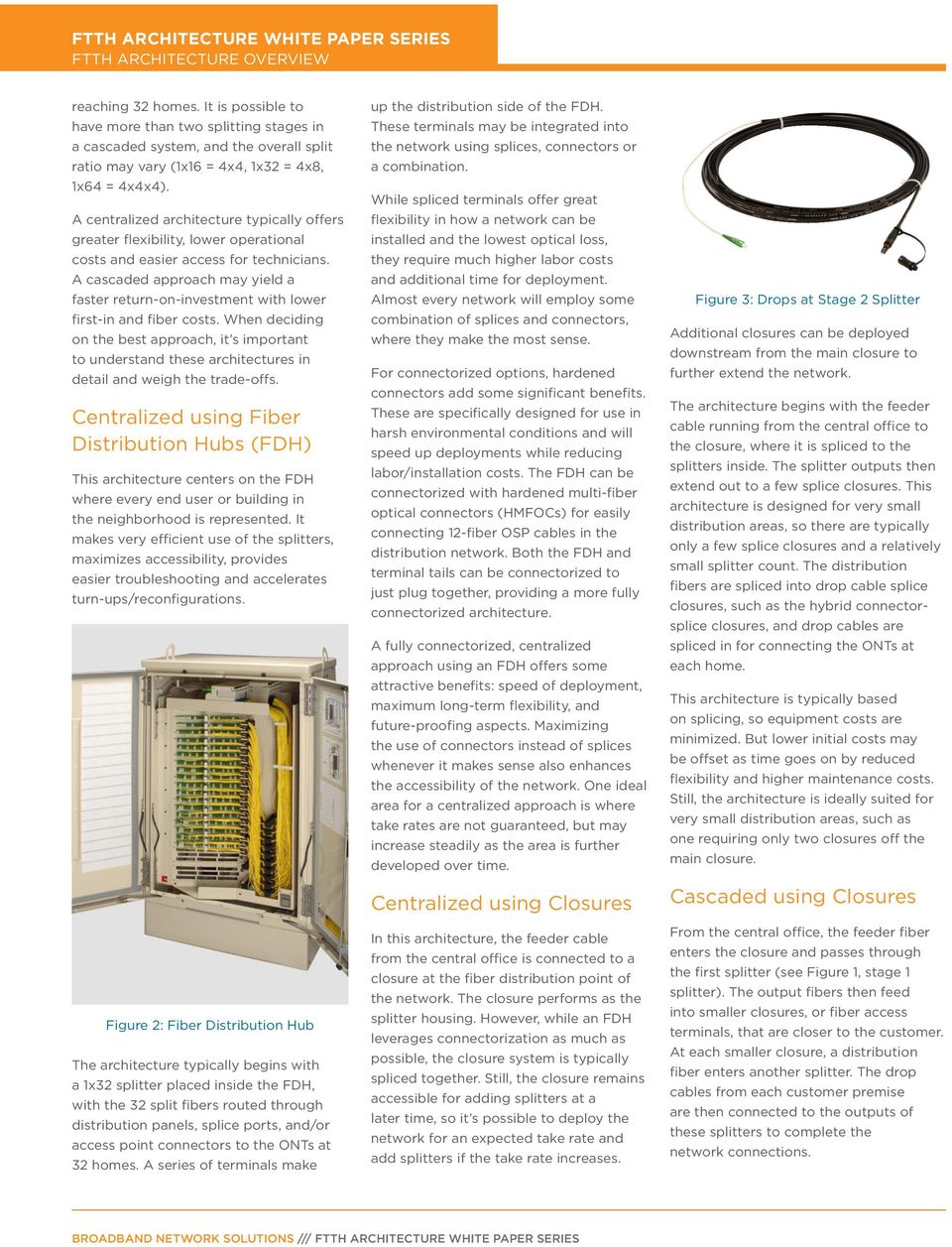
3 reaching 32 homes. It is possible to have more than two splitting stages in a cascaded system, and the overall split ratio may vary (1x16 = 4x4, 1x32 = 4x8, 1x64 = 4x4x4). A centralized architecture typically offers greater flexibility, lower operational costs and easier access for technicians. A cascaded approach may yield a faster return-on-investment with lower first-in and fiber costs. When deciding on the best approach, it s important to understand these architectures in detail and weigh the trade-offs. Centralized using Fiber Distribution Hubs (FDH) This architecture centers on the FDH where every end user or building in the neighborhood is represented. It makes very efficient use of the s, maximizes accessibility, provides easier troubleshooting and accelerates turn-ups/reconfigurations. Figure 2: Fiber Distribution Hub The architecture typically begins with a 1x32 placed inside the FDH, with the 32 split fibers routed through distribution panels, splice ports, and/or access point connectors to the ONTs at 32 homes. A series of terminals make up the distribution side of the FDH. These terminals may be integrated into the network using splices, connectors or a combination. While spliced terminals offer great flexibility in how a network can be installed and the lowest optical loss, they require much higher labor costs and additional time for deployment. Almost every network will employ some combination of splices and connectors, where they make the most sense. For connectorized options, hardened connectors add some significant benefits. These are specifically designed for use in harsh environmental conditions and will speed up deployments while reducing labor/installation costs. The FDH can be connectorized with hardened multi-fiber optical connectors (HMFOCs) for easily connecting -fiber OSP cables in the distribution network. Both the FDH and terminal tails can be connectorized to just plug together, providing a more fully connectorized architecture. A fully connectorized, centralized approach using an FDH offers some attractive benefits: speed of deployment, maximum long-term flexibility, and future-proofing aspects. Maximizing the use of connectors instead of splices whenever it makes sense also enhances the accessibility of the network. One ideal area for a centralized approach is where take rates are not guaranteed, but may increase steadily as the area is further developed over time. Centralized using Closures In this architecture, the feeder cable from the central office is connected to a closure at the fiber distribution point of the network. The closure performs as the housing. However, while an FDH leverages connectorization as much as possible, the closure system is typically spliced together. Still, the closure remains accessible for adding s at a later time, so it s possible to deploy the network for an expected take rate and add s if the take rate increases. Figure 3: Drops at Stage 2 Splitter Additional closures can be deployed downstream from the main closure to further extend the network. The architecture begins with the feeder cable running from the central office to the closure, where it is spliced to the s inside. The outputs then extend out to a few splice closures. This architecture is designed for very small distribution areas, so there are typically only a few splice closures and a relatively small count. The distribution fibers are spliced into drop cable splice closures, such as the hybrid connectorsplice closures, and drop cables are spliced in for connecting the ONTs at each home. This architecture is typically based on splicing, so equipment costs are minimized. But lower initial costs may be offset as time goes on by reduced flexibility and higher maintenance costs. Still, the architecture is ideally suited for very small distribution areas, such as one requiring only two closures off the main closure. Cascaded using Closures From the central office, the feeder fiber enters the closure and passes through the first (see Figure 1, stage 1 ). The output fibers then feed into smaller closures, or fiber access terminals, that are closer to the customer. At each smaller closure, a distribution fiber enters another. The drop cables from each customer premise are then connected to the outputs of these s to complete the network connections.
4 The cascaded with closures architecture is typically spliced from the hub closure to the inputs at the fiber access terminals. The feeder fibers are spliced to the inputs and the distribution fibers are spliced to the outputs. In the fiber access terminals, the distribution fibers are spliced into the inputs. There are pre-connected adapters on the outputs to allow fast connections with pre-connectorized drop cables. This half-spliced, half-connectorized installation accounts for the majority of today s cascaded networks. Connectorization at the customer side enables faster changes and more flexibility. In areas where high take rates are projected, or in rural areas where fiber costs become more significant, this approach can be a great fit. Cascaded with Fiber Reuse This architecture is extremely fiber-efficient. To illustrate this architecture, let s take a 1x32 split ratio and a single -fiber cable placed throughout the area. This single cable is used as both the feeder fibers and the distribution fibers. Fibers 1 to 8 are the feeder fibers, and each will connect from the central office to a stage 1 within the area. Fibers to are the distribution fibers that connect a stage 1 to a stage 2. These distribution fibers are divided into segments along the length of the cable, with each segment serving only the local area. Since the distribution fibers to do not directly connect back to the central office, they are reused throughout in each local area. Figure 4 illustrates the fiber reuse architecture. Fibers to in the cable are reused eight times, because there are eight segments one segment for each feeder fiber 1 through 8. Each feeder cable will have a split in the first stage and 1x8 split in the second stage. This then connects directly to the home via drop cables, resulting in 32 homes served. Thus, a single -fiber cable can up to 256 homes by combining feeder and distribution functions. The fiber reuse model is particularly effective in a large rural or MDU setting because all the components, including the fiber itself, are relatively small. The terminals or closures are also quite small, having minimal aesthetic impact to the neighborhood or building. It should be noted that the fiber reuse architecture can be significantly more difficult to design, engineer, document and. However, it is extremely efficient in terms of fiber usage, and equipment costs are lower. This architecture should seriously be considered in large rural areas or for MDU applications where smaller equipment size, easeof-installation and overall aesthetics are important requirements. fiber # 1 2 -fiber cable Central Office stage 1 stage 1 stage1 stage1 Figure 4: Fiber Reuse Architecture for -Fiber Cable

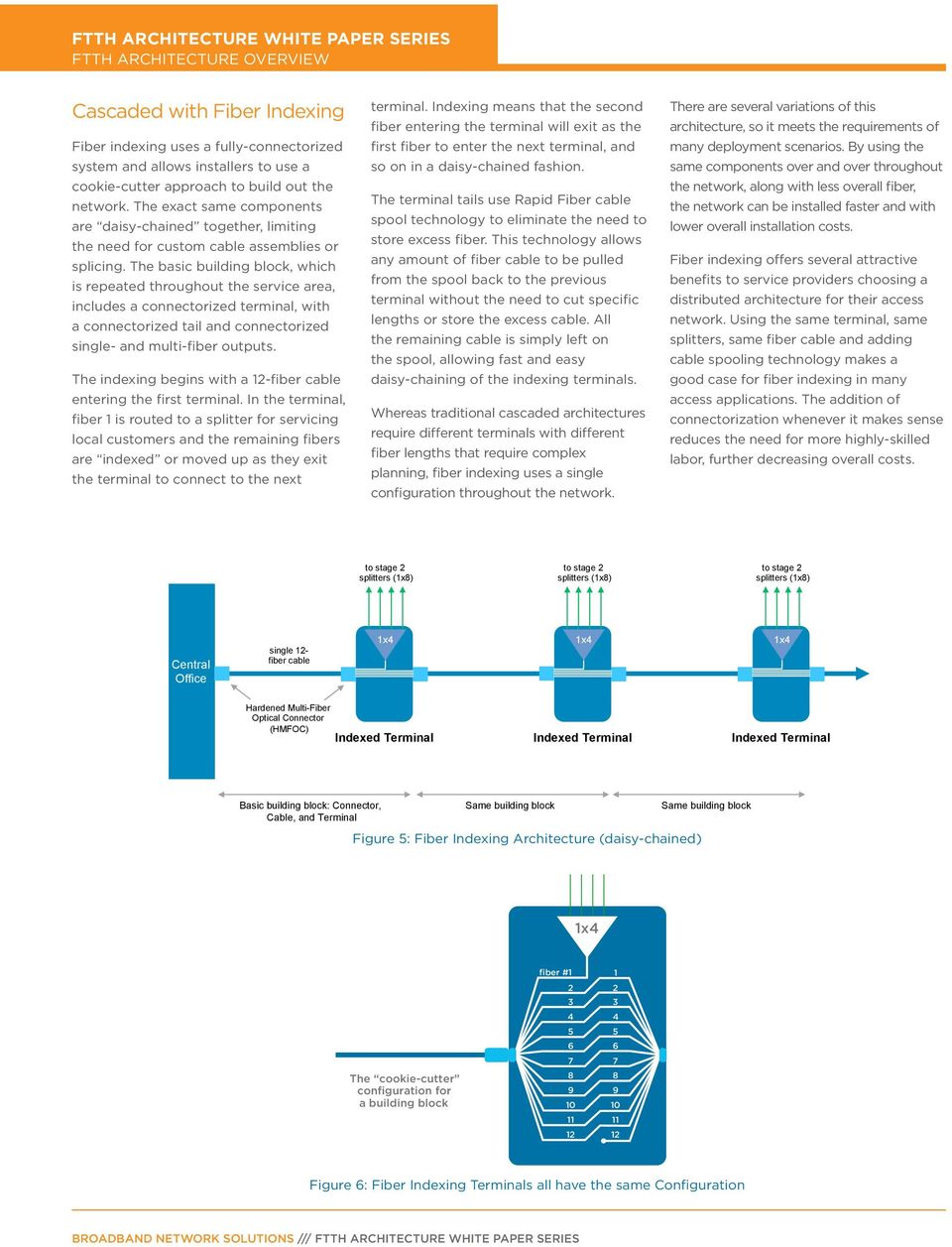
5 Cascaded with Fiber Indexing Fiber indexing uses a fully-connectorized system and allows installers to use a cookie-cutter approach to build out the network. The exact same components are daisy-chained together, limiting the need for custom cable assemblies or splicing. The basic building block, which is repeated throughout the area, includes a connectorized terminal, with a connectorized tail and connectorized single- and multi-fiber outputs. The indexing begins with a -fiber cable entering the first terminal. In the terminal, fiber 1 is routed to a for servicing local customers and the remaining fibers are indexed or moved up as they exit the terminal to connect to the next terminal. Indexing means that the second fiber entering the terminal will exit as the first fiber to enter the next terminal, and so on in a daisy-chained fashion. The terminal tails use Rapid Fiber cable spool technology to eliminate the need to store excess fiber. This technology allows any amount of fiber cable to be pulled from the spool back to the previous terminal without the need to cut specific lengths or store the excess cable. All the remaining cable is simply left on the spool, allowing fast and easy daisy-chaining of the indexing terminals. Whereas traditional cascaded architectures require different terminals with different fiber lengths that require complex planning, fiber indexing uses a single configuration throughout the network. There are several variations of this architecture, so it meets the requirements of many deployment scenarios. By using the same components over and over throughout the network, along with less overall fiber, the network can be installed faster and with lower overall installation costs. Fiber indexing offers several attractive benefits to providers choosing a distributed architecture for their access network. Using the same terminal, same s, same fiber cable and adding cable spooling technology makes a good case for fiber indexing in many access applications. The addition of connectorization whenever it makes sense reduces the need for more highly-skilled labor, further decreasing overall costs. to stage 2 s (1x8) to stage 2 s (1x8) to stage 2 s (1x8) Central Office single - fiber cable Hardened Multi-Fiber Optical Connector (HMFOC) Indexed Terminal Indexed Terminal Indexed Terminal Basic building block: Connector, Cable, and Terminal Same building block Same building block Figure 5: Fiber Indexing Architecture (daisy-chained) The cookie-cutter configuration for a building block fiber # Figure 6: Fiber Indexing Terminals all have the same Configuration
6 The Promise of FTTdp: Gigabit Speeds over the Existing Copper Plant The approximately 200 meters (600 ) from the drop to the customers premises is typically the most cost and labor intensive part of any deployment. Fiber To The Distribution Point (FTTdp) is an architecture that takes fiber to the distribution point, then uses the existing copper local loop to bridge the final distance to the home. It avoids or defers the relatively expensive civil works of laying fiber all the way to the home. Several copper technologies can be deployed with FTTdp: G.fast, VDSL2, or G.hn. G.fast promises peak data rates approaching 1 Gbps at short distances. VDSL2, which can be further augmented by bonding and vectoring, can achieve a theoretical 200 Mbps over a longer distance. G.hn is an evolving technology designed to work over copper local loop, power lines, and coaxial cable with data rates in the sub-gigabit range. For incumbent providers, FTTdp can be considered the next and possibly final step in getting fiber closer to the subscriber, short of going all the way as with FTTH. The initial step was FTTN (where the Node is a remote DSLAM), then followed by FTTC/FTTB (Curb or Building). Extending fiber deeper into the access network is driven by to next distribution point the exponential growth in demand for bandwidth which shows no signs of abating in the near-, mid-, or long-term. In the FTTdp architecture, a PON ONT is located at the distribution point where the copper subscriber loops are patched or spliced instead of in the subscriber s home. From the network side the fiber drop terminates at the ONT; from the subscriber side the copper wiring from multiple homes also terminate at the ONT. The CPE equipment in the home is a VDSL2/ G.fast modem. Besides transmitting data, the modem may also supply power to the ONT in a reverse powering arrangement, since the ONT will often be located outdoors with very limited access to power. The distribution point is an ideal intercept point for copper to handoff to the fiber network (see Figure 7). Its precise location would be determined by existing and planned cable conduits and pathways which could mean aerial, in a building basement, mounted on a pole, in an outdoor cabinet or pedestal, or buried underground in a small hand-hole. The wide range of locations necessitates a compact design with a small form factor, and hardened for operation in harsh environments. Heat dissipation of the VDSL2/G.fast/ PON ONT (which increases with the number of subscribers served) may be an issue, particularly in space-constrained locations such as underground hand-holes. customer premises The implication for network architecture is that less fiber is required for FTTdp compared to FTTH, since the PON ONT (which requires a single fiber) now aggregates multiple (typically 4-8) subscribers. FTTdp can work equally well with centralized or cascaded splitting architectures. However with multiple subscribers sharing a fiber drop, fiber split ratios in the distribution network could be lower. A key provision for FTTdp will be maintaining flexibility for future upgrades. Factors such as deterioration of the copper local loop, subscriber take-up rates, and the competitive threat of other providers installing fiber will likely necessitate a combination of FTTdp for the broader market and FTTH for select customers likely at the level of the distribution point. Upgrading a subscriber from FTTdp to FTTH must be a fast, simple, and reliable process. Hence considerations for spare fiber capacity and fiber split ratios that can be adjusted according to demand should be taken into account. Throughout 2015, FTTdp is expected to rapidly mature from the proof-of-concept stage into a robust and industrialized technology. TE Connectivity s engineering and product development programs are contributing to this progress to help make FTTdp a viable solution for providers. distribution point basic telephony POTS copper drop copper local loop VDSL2 modem 0 Mbps fiber drop VDSL2/ G.fast PON ONT fiber drop cable G.fast modem PON ONT 500 Mbps 1 Gbps -fiber cable 20/50 copper pair cable towards central office Figure 7: FTTdp Architecture at the Distribution Point

7 Conclusion This paper has reviewed a number of centralized and cascaded FTTH architectures, As the expectation and business plan for every deployment is unique, there is no one-size-fits-all architecture solution. Knowing the advantages and disadvantages of each will help in the selection process. TE Connectivity has comprehensive and in-depth experience in designing, implementing, and maintaining fiber and FTTH networks around the world. The FTTH Architecture Series is a complete set of white papers that explore the key issues and decision criteria for building best-in-class FTTH networks. For more information, please visit te.com Rapid Fiber, TE Connectivity, TE Connectivity (logo) and Every Connection Counts are trademarks. All other logos, products and/or company names referred to herein might be trademarks of their respective owners. The information given herein, including drawings, illustrations and schematics which are intended for illustration purposes only, is believed to be reliable. However, TE Connectivity makes no warranties as to its accuracy or completeness and disclaims any liability in connection with its use. TE Connectivity s obligations shall only be as set forth in TE Connectivity s Standard Terms and Conditions of Sale for this product and in no case will TE Connectivity be liable for any incidental, indirect or consequential damages arising out of the sale, resale, use or misuse of the product. Users of TE Connectivity products should make their own evaluation to determine the suitability of each such product for the specific application TE Connectivity Ltd. family of companies All Rights Reserved AE 06/15 Revision WHITE PAPER Contact us P.O. Box Minneapolis, Minnesota USA Tel: x Fax:

FTTH ARCHITECTURE WHITE PAPER SERIES
 FTTH ARCHITECTURE WHITE PAPER SERIES BROADBAND ACCESS TECHNOLOGIES OVERVIEW BROADBAND ACCESS TECHNOLOGIES OVERVIEW Video, Cloud, and the Internet of Things these trends are having a profound effect on
Current access technologies overview
 White Paper Current access technologies overview In this paper, we explore six basic technology choices for deploying broadband services to the end customer xdsl, DOCSIS, G.fast, satellite, wireless and
BroadbandSoHo. Verizon MDU FTTP Overview. Document Description:
 BroadbandSoHo Verizon MDU FTTP Overview Document Description: The enclosed document was created to give a basic overview of Verizon s FTTP PON, and technology terms behind there Fios product in regards
Faster Method for Connecting Customers in the Colocation Data Center
 Faster Method for Connecting Customers in the Colocation Data Center The increased demand for datacenter space is creating both opportunities and challenges for providers of colocation space. Among these
FTTP OSP Design to Maximize Coverage and Upgradeability
 FTTP OSP Design to Maximize Coverage and Upgradeability Introduction Now that FTTP technology is being deployed after years of discussion and several false starts, one has to ask, What took so long? Was
FTTX Solutions FDH 3000 Cross-Connect
 TE Connectivity's (TE) FTTX infrastructure solutions are designed from the ground up to meet the unique requirements of FTTX networks. Designed for operational efficiency and scalability, TE s FTTX solutions
Get to Fast, Faster accelerate the existing
 Get to Fast, Faster accelerate the existing Copper Plant with VECTORING and BONDING Strategic White Paper As service providers face rapidly increasing bandwidth demand from consumers, businesses and governments,
FTTH Explained: Delivering efficient customer bandwidth and enhanced services Michael Kunigonis Product Line Manager Access Corning Cable Systems
 FTTH Explained: Delivering efficient customer bandwidth and enhanced services Michael Kunigonis Product Line Manager Access Corning Cable Systems Overview: Telecommunication carriers worldwide have come
Multiple Solutions for Connecting Multiple Dwelling Units (MDUs) WHITE PAPER
 Multiple Solutions for Connecting Multiple Dwelling Units (MDUs) WHITE PAPER Multiple Solutions for Connecting Multiple Dwelling Units (MDUs) Abstract Fiber-to-the-Premises (FTTP) networks increasingly
Multi-Dwelling Unit Fiber Deployment
 Multi-Dwelling Unit Deployment Billions of dollars are spent annually delivering high speed fiber networks to Multi-Dwelling Units (MDUs) apartments, condos, and student-housing across North America. Service
The Economics of Broadband Access Platform Evolution
 The Economics of Broadband Access Platform Evolution The EU's ACTS (Advanced Communications Technologies and Services) research programme has tested a number of approaches to delivering broadband services
Making Communities Better with Broadband
 * Making Communities Better with Broadband So Many Choices!!!!!! Where Do I Even Start? *Where to Begin *Start With Your Community *Demographics *Current Needs *Vision for the Future *Strengths and Challenges
A flexible upgrade path for the Australian National Broadband Network
 Australian Journal of Telecommunications and the Digital Economy A flexible upgrade path for the Australian National Broadband Network Mark A. Gregory RMIT University Summary. This paper provides a flexible
How Enhanced DSL Technologies Optimize the Last Copper Mile By John Williams
 White Paper How Enhanced DSL Technologies Optimize the Last Copper Mile By John Williams As broadband speeds increase to support the connected home, a debate continues over which type of network architecture
Prospects and Problems GPON Technology over Ethernet Technology
 Prospects and Problems GPON Technology over Ethernet Technology Md. Hayder Ali [email protected] SANOG 23 Conference Thimpu, Bhutam Bangladesh : Name: People's Republic of Bangladesh Population: 164.4
COMPLETE YOUR GO-TO-MARKET PLAN BUSINESS SOLUTIONS BARRY DERRICK PRODUCT MARKETING MANAGER
 COMPLETE YOUR GO-TO-MARKET PLAN BUSINESS SOLUTIONS BARRY DERRICK PRODUCT MARKETING MANAGER AGENDA ADTRAN OVERVIEW GO-TO-MARKET WITH WINNING SOLUTIONS! Market Leading Cloud Connectivity Solutions that Outperform
Planning for Universal Broadband Solving for x
 Planning for Universal Broadband Solving for x Kermit L. Ross President, NDDI Broadband Is the New Universal For most of the last century, telephone companies built networks designed for voice services,
What fiber network expansion solutions will you choose to deliver the lowest cost of ownership and operation?
 What fiber network expansion solutions will you choose to deliver the lowest cost of ownership and operation? A White Paper from the Experts in Business-Critical Continuity Executive Summary I. There s
Fiber to the Home: Enabling Innovation & Growth. Stuart Elby, PhD Vice President -- Technology
 Fiber to the Home: Enabling Innovation & Growth Stuart Elby, PhD Vice President -- Technology Communications Trends Access Bandwidth Consumption 4G 3G 2/2.5G 2 Infonetics, Alcatel-Lucent Applications and
PON Technology A Shift in Building Network Infrastructure. Bob Matthews Technical Manager CommScope Canada
 PON Technology A Shift in Building Network Infrastructure Bob Matthews Technical Manager CommScope Canada The Evolution to PON In 1980s -1990s, we had: Dial up modems The best data rate we could get from
V-DSL technology in the NBN
 CommsDay Melbourne Congress 2013 V-DSL technology in the NBN Wednesday 9 th October 2013 Cliff Gibson Outline VDSL2 technologies which extend the capability of existing copper are expected to be included
Broadband Technology Clinic. Burlington Telecom Advisory Board
 Broadband Technology Clinic Burlington Telecom Advisory Board 1 What are the Defining Characteristics of a Broadband Service? Speed - Throughput capability both down and upstream Performance - Latency
Healthcare. Passive Optical LAN Solutions
 Healthcare Passive Optical LAN Solutions 2 The Evolution of Structured Cabling Media Improving structured cabling starts with understanding its roots Copper has been used as a cabling solution since the
EDA 1200 and Mini-Link Solution. Early deployments of profitable fixed broadband
 EDA 1200 and Mini-Link Solution Early deployments of profitable fixed broadband Taking broadband further Opportunities are increasing to take broadband to areas not units. The MINI-LINK only requires a
The Infrastructure of Tomorrow, Available Today. Luca Rozzoni RCDD Business Line Manager TE Connectivity
 Optical LAN Solutions The Infrastructure of Tomorrow, Available Today Luca Rozzoni RCDD Business Line Manager TE Connectivity Key Terms PON - Passive Optical Network - (Carrier) Between Central Office
Broadband 101: Installation and Testing
 Broadband 101: Installation and Testing Fanny Mlinarsky Introduction Today the Internet is an information superhighway with bottlenecks at every exit. These congested exits call for the deployment of broadband
Breathing New Life into Copper: The Long Awaited Arrival of VDSL2
 Breathing New Life into Copper: The Long Awaited Arrival of VDSL2 Agenda Introduction Access Network Evolution VDSL2 Technology History of DSL ADSL2+ and VDSL2 comparison VDSL2 Nuts and Bolts PTM and Profiles
TROUBLESHOOTING AT THE SPEED OF LIGHT EMBEDDED OTDR FOR OPERATIONAL EXCELLENCE IN PASSIVE OPTICAL NETWORKS
 TROUBLESHOOTING AT THE SPEED OF LIGHT EMBEDDED OTDR FOR OPERATIONAL EXCELLENCE IN PASSIVE OPTICAL NETWORKS Application Note Abstract With our increasing dependence on broadband, service disruptions are
The Evolution of the U.S. Telecommunications Infrastructure Over the Next Decade
 The Evolution of the U.S. Telecommunications Infrastructure Over the Next Decade BROAD BANDWIDTH THROUGH DSL TTG4: McAdams, Cioffi, Bloom, Hargadon Digital Subscriber Line (DSL) telecommunication service
Solutions Focus: IPTV
 Zhone delivers the world s most complete IPTV solutions MALC offers more provisioning options for multicast, more capability for mixed multicast and unicast video, and more fiber and copper subscriber
Ethernet Passive Optical Networks EPON
 Ethernet Passive Optical Networks EPON IEEE 802.3 Ethernet in the First Mile Study Group January 8-9, 2001, Irvine, CA Gerry Pesavento Alloptic, Inc. Tel 925-245-7647 Email [email protected]
White Paper: Broadband Access Technologies A White Paper by the Deployment & Operations Committee
 White Paper: Broadband Access Technologies A White Paper by the Deployment & Operations Committee Contributors: Rong Zhao (Detecon International) Wolfgang Fischer (Cisco) Edgar Aker (Prysmian Group) Pauline
WIRELESS /// INTERREACH FUSION FOR BUSINESS INTERREACH FUSION FOR BUSINESS (F4B) WIRELESS SERVICE SIMPLIFIED
 WIRELESS /// INTERREACH FUSION FOR BUSINESS INTERREACH FUSION FOR BUSINESS (F4B) WIRELESS SERVICE SIMPLIFIED MOBILE USERS EXPECT WIRELESS SERVICE INSIDE OFFICE BUILDINGS, RETAIL CENTERS, MANUFACTURING
The battle for the residential customer
 Fiber, Coax or DSL? Meeting Customer Demand for Bandwidth Only fiber will deliver the kinds of content customers will crave in a few years By David R. Kozischek Corning Cable Systems The battle for the
Fiber-to-the-Home/FTTH
 Hands-On Design, Installation, Maintenance & Troubleshooting Active and Passive Optical Networks Course Description This Hands-On 2-day course is designed to provide technicians with Hands-On practical
The Convergence of GPON and the Connected Home
 The Convergence of GPON and the Connected Home Zhone offers a complete GPON solution that addresses the typical roadblocks to FTTH and video multi-play services. GPON and Triple Play Go Hand-in-Hand For
Deep-fiber broadband access networks
 Deep-fiber broadband access networks Joe Baker, Torbjörn Cagenius, Colin Goodwin, Mats Hansson and Martin Hatas Millions of subscribers around the world are today connected via deepfiber broadband (FTTx)
Increasing cable bandwidth to retain high-value customers
 STEM example model Increasing cable bandwidth to retain high-value customers Frank HAUPT July 2013 Cambridge, UK MDL01\0006 STEM example model MDL01\0006 WORK IN PROGRESS Wednesday 31 July 2013 Implied
4 Small Cables Sealing Kit: Wrap Style
 4 Small Cables Sealing Kit: Wrap Style I N S T A L L A T I O N I N S T R U C T I O N Gel Wrap Kit For Sealing up to 4 Small Cables in FOSC 450 & FOSC 600 Closures Max. Combined Diameter Closure Port of
Fibre Networks Deliver Customer Value
 Turning networks into a competitive edge Fibre Networks Deliver Customer Value NCS GROUP OFFICES Australia Bahrain China Hong Kong SAR India Korea Malaysia Philippines Singapore Sri Lanka Your Partner
Multiple Solutions for Connecting Multiple Dwelling Units (MDUs)
 Multiple Solutions for Connecting Multiple Dwelling Units (MDUs) 1 MDU Construction - Objectives and Approach The MDU Construction Techniques aims at investigating the key elements of the MDU Technology
How To Get The Most Out Of A Pon From Commscope
 Passive Optical Network (PON): Solutions for Federal Government Deployments Operational Efficiency Solutions Passive Optical Network (PON) solutions for federal government networks Discover opportunities
Profitably Get High Speed, Reliable CE 2.0 Services Out to Small and Medium Business Using EFM over Copper
 Profitably Get High Speed, Reliable CE 2.0 Services Out to Small and Medium Business Using EFM over Copper The Small and Medium Business (SMB) Ethernet services market is creating huge access, value added
ElectroniCast Consultants
 ElectroniCast Consultants Fiber Optic Installation Apparatus Global Market Forecast and Analysis (2015) This proposal describes the scheduled market forecast and analysis study report by ElectroniCast.
Top of Rack: An Analysis of a Cabling Architecture in the Data Center
 SYSTIMAX Solutions Top of Rack: An Analysis of a Cabling Architecture in the Data Center White paper Matthew Baldassano, Data Center Business Unit CommScope, Inc, June 2010 www.commscope.com Contents I.
FiberHome s XGPON Solution
 FiberHome s X Solution 1 X Application Scenarios The application of digital FTTH family Due to the service development, bandwidth requirements are raised. will be replaced by X technology which provides
Wireless SDSL for the Business Sector
 Wireless SDSL for the Business Sector Broadband Services over BreezeACCESS VL June 2005 Alvarion Ltd. All rights reserved. The material contained herein is proprietary. No part of this publication may
DSL Rings White Paper
 INTRODUCTION DSL Rings (DSLR) is a patent pending access technology that re uses existing copper telephone cabling to provide bandwidth of up to 400 Mb/s with Quality of Service (QoS) and Efficient Multicast.
Optimizing Infrastructure Support For Storage Area Networks
 Optimizing Infrastructure Support For Storage Area Networks December 2008 Optimizing infrastructure support for Storage Area Networks Mission critical IT systems increasingly rely on the ability to handle
ClearGain Tower Mounted Amplifiers A Deployment Guide for Wireless Carriers
 A Deployment Guide for Wireless Carriers As mobile usage continues to increase, service providers are faced with the challenge of optimizing and expanding their wireless networks to provide new and existing
Chapter 9A. Network Definition. The Uses of a Network. Network Basics
 Chapter 9A Network Basics 1 Network Definition Set of technologies that connects computers Allows communication and collaboration between users 2 The Uses of a Network Simultaneous access to data Data
Deutsche Telekom Super Vectoring @ FTTC. The Hague, June 2015
 Deutsche Telekom Super Vectoring @ FTTC The Hague, June 2015 Fixed access network strategy long term goal: FTTH. Access Network Evolution ADSL2+ ( 16 Mbps) FTTC: Vectoring (100 Mbps) FTTdp* (> 500 Mbps)
Technology Solution Guide. Deploying Omnitron PoE Media Converters with Aruba Access Points and AirMesh Routers
 Technology Solution Guide Deploying Omnitron PoE Media Converters with Aruba Access Points and AirMesh Routers WARRANTY DISCLAIMER THE FOLLOWING DOCUMENT, AND THE INFORMATION CONTAINED HEREIN IS PROVIDED
Local-Area Network -LAN
 Computer Networks A group of two or more computer systems linked together. There are many [types] of computer networks: Peer To Peer (workgroups) The computers are connected by a network, however, there
Transformation of the Enterprise Network Using Passive Optical LAN
 WHITE PAPER Transformation of the Enterprise Network Using Passive Optical LAN Passive Optical LAN Study Completed by Network Strategy Partners, LLC Contents Executive Summary... 3 Introduction... 4 Modeling
How To Define Hfc Technology
 Cable network topologies and implications for evolutionary approaches 33 rd International conference and Exhibition PIKE 2008, Zakopane, 14 October 2008 Bart Brusse, ReDeSign Project Manager Pressure on
Fiber to the Home. Definition. Overview. Topics
 Fiber to the Home Definition Fiber to the home (FTTH) is the ideal fiber-optics architecture. In this architecture, fiber deployment is carried all the way to the customer s home (premises). Overview Today
Keeping up the momentum: The importance of innovation to keep networks fit for the future Dr Tim Whitley MD Research & Innovation, BT Distinguished
 Keeping up the momentum: The importance of innovation to keep networks fit for the future Dr Tim Whitley MD Research & Innovation, BT Distinguished Engineer Context Trends Increasing consumer and business
CADDSTAR V7.0 FEATURES AND FUNCTIONALITY
 CADDSTAR V7.0 FEATURES AND FUNCTIONALITY CADDStar is a powerful GIS-based facilities management and network documentation software. By combining the drawing / mapping features of AutoCAD Map with a relational
Gigabit Passive Optical Networks
 White Paper Gigabit Passive Optical Networks Passive Optical LAN Solutions (POLS) Theory, Design, and Installation Considerations Sean McCloud, RCDD Senior Applications Engineer, Leviton Network Solutions
3M xdsl Line Conditioners 3620
 3M xdsl Line Conditioners 3620 Instructions 1.0 General 1.1 Document Purpose This document provides general and installation information necessary to install the 3M xdsl Line Conditioner. 1.2 Description
Overview of Copper DSL and FTTN Solutions. Ryan McCowan Product Manager November 16-17, 2010
 Overview of Copper DSL and FTTN Solutions Ryan McCowan Product Manager November 16-17, 2010 2 Agenda Drivers for Access Architecture Decisions FTTx Overview and Enabling Technologies CO/RT FTTN Hybrid
T1 Backhaul Connectivity Solution All Products :: Application Note
 Telect 1 RU Customer Interface Panel (CIP) Enables Demarcation, Remote Circuit Maintenance and Trouble Isolation at the Backhaul Node The Application: T1 Demarcation and Testing in Backhaul Environments
Managing High-Density Fiber in the Data Center: Three Real-World Case Studies
 Managing High-Density Fiber in the Data Center: Three Real-World Case Studies CHALLENGE In today s data center, fiber optic links have become more vital than ever for transmitting data to and from a large
Economic issues of (broadband) access networks. C. Courcoubetis
 Economic issues of (broadband) access networks Topics Broadband access networks* Economics of deployment* Municipal access networks * WIK Consult: The economics of NGA Economics of access - 2 The importance
FTTP Networks: Topology and Competition
 FTTP Networks: Topology and Competition Marvin A. Sirbu Department of Engineering and Public Policy Carnegie University [email protected] http://www.andrew.cmu.edu/user/sirbu/ 2008 Marvin A. Sirbu 1 Conclusions
ZHONE VDSL2 TECHNOLOGY. Access Technology for the Future. November 2009 CONTENTS
 ZHONE VDSL2 TECHNOLOGY Access Technology for the Future November 2009 CONTENTS Introduction 2 VDSL2 technology 2 VDSL2 Deployments: Zhone findings 4 Zhone s VDSL2 solutions 6 Conclusion 8 Access for a
FIBRE TO THE BTS IMPROVING NETWORK FLEXIBILITY & ENERGY EFFICIENCY
 FIBRE TO THE BTS IMPROVING NETWORK FLEXIBILITY & ENERGY EFFICIENCY (Study Paper by FLA Division) Ram Krishna Dy. Director General (FLA) TEC New Delhi, DoT, Govt. of India. E-mail: [email protected] Mrs.
Maximizing the Impact of Optical Technology OFC/NFOEC 2007
 Maximizing the Impact of Optical Technology OFC/NFOEC 2007 Mark Wegleitner Senior VP Technology, CTO Verizon March 27, 2007 Traffic Growth 2000 Video downloads 1500 1000 700 600 500 400 300 200 100 0 0
Tutor: Orawan Tipmongkolsilp
 IPTV Services and Technologies Jan Laskowski s Tutor: Orawan Tipmongkolsilp Contents 1. Overview 2. Headend / Data Center 3. IPTV Technologies IPTV Backbone or core network The Last Mile 4. Consumer devices
Reverse Powering Its Benefits and Constraints Daniel Feldman VP Business Development, Microsemi. Power Matters
 Reverse Powering Its Benefits and Constraints Daniel Feldman VP Business Development, Microsemi Agenda Why Fiber to the Distribution Point? MDU ONT Reverse Power Fed Benefits of Reverse Power Feeding (RPF)
National Broadband Infrastructure Plan for Next Generation Access
 Decree 435/ 26.06. 2014 National Broadband Infrastructure Plan for Next Generation Access Sofia, 2014 TABLE OF CONTENTS I. INTRODUCTION... 5 II. TECHNOLOGICAL SOLUTIONS FOR BUILDING NGA INFRASTRUCTURE...
An Integrated Approach to FTTx Network Lifecycle Management. An Oracle Communications & Synchronoss Joint Solution White Paper March 2013
 An Integrated Approach to FTTx Network Lifecycle Management An Oracle Communications & Synchronoss Joint Solution White Paper March 2013 Disclaimer The following white paper was developed to outline general
OSP DSLAMs. Standing at the Ready
 OSP DSLAMs Standing at the Ready Emerging Network Network Evolution The world of communications is ever growing. One only has to look at Apple s AppStore reports for Sept. 28, 2009, to get the picture:
Aurora Networks, Inc.
 WHITE PAPER Shridhar Kulkarni, Product Manger, Access Network Solutions Luis Yu, Senior Product Manager, Access Network Solutions Aurora Networks, Inc. October 2009 (First presented at the 2009 FTTH Conference
Power over Ethernet technology for industrial Ethernet networks
 Power over Ethernet technology for industrial Ethernet networks Introduction Ethernet networking has grown beyond office and home usage to become a very successful protocol suite used in many industrial
Municipalities Ask and Answer the Question
 ? To Overbu or Unde By Merrion Edwards Municipalities Ask and Answer the Question There are now more than 180 million broadband subscribers worldwide and the number continues to rise rapidly. In analyzing
Managing Interference in a Vectored VDSL2 environment Communications Alliance WC58
 Managing Interference in a Vectored VDSL2 environment Communications Alliance WC58 18 November 2014 Stefan Keller-Tuberg, Acting Editor Communications Alliance Working Committee 58 1 CA Working Committee
Passive Optical Networks: Recent Developments and Issues
 Passive Optical Networks: Recent Developments and Issues CTO and Co-Founder Nayna Networks, Inc. 180 Rose Orchard Way San Jose, CA 95134 USA www.nayna.com Raj Jain Adjunct Professor Ohio State University
What s at the Antenna Counts The Value of Distributed Amplifiers in DAS Solutions
 What s at the Antenna Counts The Value of Distributed Amplifiers in DAS Solutions Facing increasing demands for higher data rates from their subscribers, mobile operators are becoming more interested in
Network Neutrality Statement
 Network Neutrality Statement CTC continues to comply with all applicable FCC requirements while providing the best possible customer experience for its Internet users. As such, CTC commits to the open
Analyzing Full-Duplex Networks
 Analyzing Full-Duplex Networks There are a number ways to access full-duplex traffic on a network for analysis: SPAN or mirror ports, aggregation TAPs (Test Access Ports), or full-duplex TAPs are the three
Power over Ethernet and Power over HDBaseT for Carrier Applications. White Paper Daniel Feldman, VP Business Development and Channel Marketing
 Power over Ethernet and Power over HDBaseT for Carrier Applications White Paper Daniel Feldman, VP Business Development and Channel Marketing December 2014 Introduction Since the invention of Power over
Lantiq s DSLTE technology enables carriers to offer combined DSL and LTE for highest data rates
 Backgrounder Lantiq s DSLTE technology enables carriers to offer combined DSL and LTE for highest data rates A growing number of network operators face the competitive challenge to offer broadband access
VDSL (VERY HIGH DATA BIT RATE DIGITAL SUBSCRIBER LINE)
 1 VDSL (VERY HIGH DATA BIT RATE DIGITAL SUBSCRIBER LINE) INTRODUCTION 1. Recent events in the telecommunications environment are giving rise to a new class of service providers, setting the stage for how
How To Use A Network Instrument Ntap
 ntap Product Family Provides monitoring and security devices with complete visibility into full-duplex networks Network Instruments ntaps let you monitor and analyze full-duplex links. ntaps are critical
How DSL Works. by Curt Franklin
 by Curt Franklin How DSL Works When you connect to the Internet, you might connect through a regular modem, through a localarea network connection in your office, through a cable modem or through a digital