
Phillips Beth Israel School of Nursing
|
|
|
- Jared Casey
- 9 years ago
- Views:
Transcription
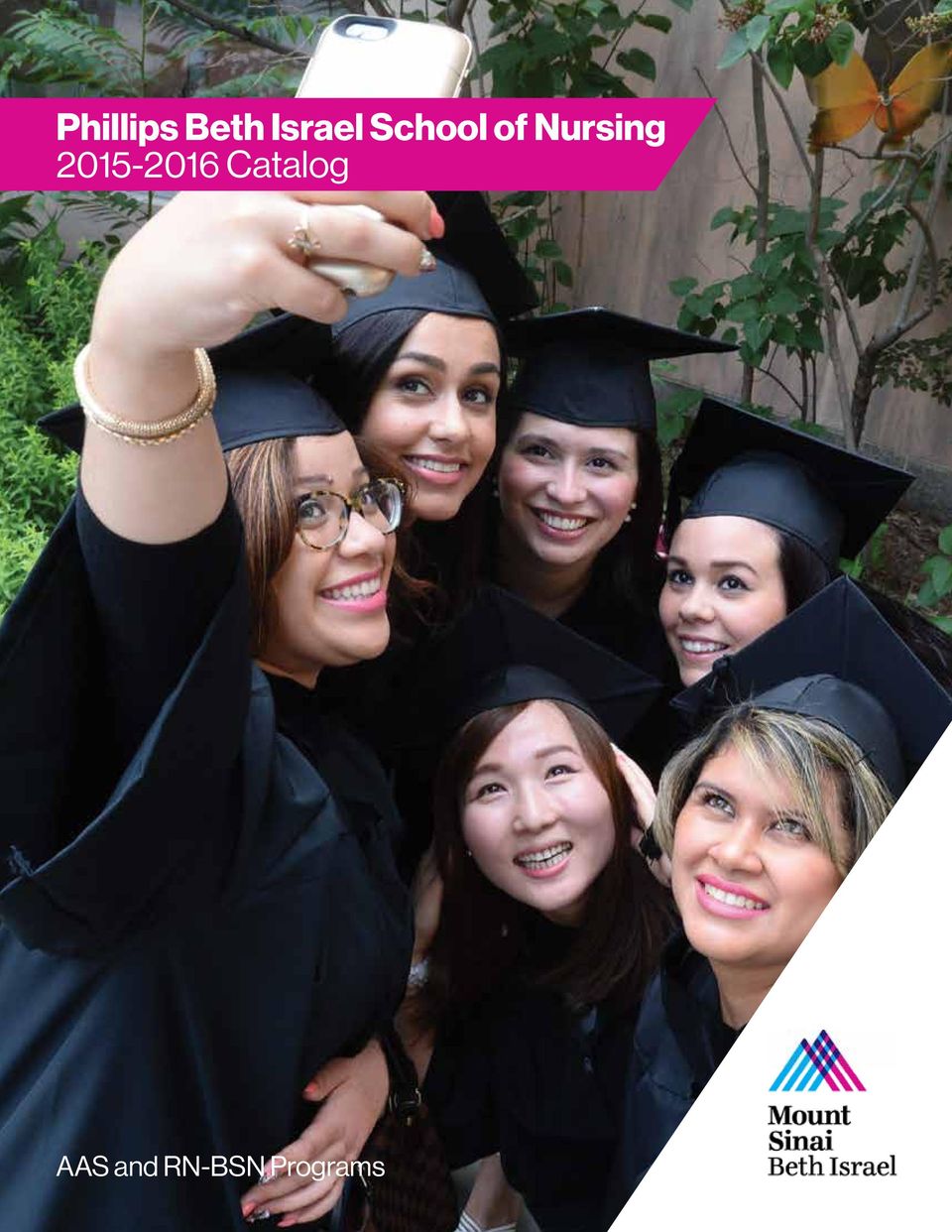
1 Phillips Beth Israel School of Nursing Catalog AAS and RN-BSN Programs
2 Vision Statement The vision of Phillips Beth Israel School of Nursing is: To actively respond to society s need for caring, knowledgeable, and skilled nursing professionals. To use and develop evidence-based research as the foundation for contemporary education and clinical practice. To be a leader in associate and baccalaureate nursing education.
3 Contents 3 The School and its Resources 12 AAS Program Mission Statement The mission of Phillips Beth Israel School of Nursing, as a single-purpose institution, is to provide optimal The mission of the School has been established in cognizance of society s ongoing need for nurses who are able academic and clinical experiences at to provide care to diverse populations, 24 RN-BS Program the associate and baccalaureate levels and to meet the challenges of a in nursing. complex health care system. To achieve 36 Tuition & Fees 38 Financial Aid 1 Academic Policies 7 Student Activities and Services 9 School Policies 61 Administration and Faculty 63 Accreditation and Affiliation The Associate in Applied Science Degree leads to eligibility for licensure as a Registered Professional Nurse. The baccalaureate degree program prepares nurses to assume advanced roles in the profession. The school is committed to serving a diverse student body with both students new to the college experience and adult learners returning to college for a degree in nursing. The education program prepares graduates to utilize the knowledge and skills necessary our mission, the faculty and the leadership of the School provide an educational program that is responsive to societal changes and prepares graduates to practice in a changing world. The curriculum provides a foundation upon which graduates can build leadership, educational and clinical expertise. The strong emphasis on critical thinking abilities and community service prepares graduates to become knowledgeable and involved global citizens to problem-solve, think critically and collaborate with health care providers to manage the care of patients. The education program is also designed to prepare graduates for entry into baccalaureate and masters programs in nursing. Graduates will demonstrate a commitment to lifelong learning through their own personal and professional growth. The aim is to graduate nurses who will provide high quality, culturally sensitive and compassionate care in a variety of health care settings. The program prepares graduates to be flexible, accountable and maintain the highest moral and ethical standards of the profession. 1

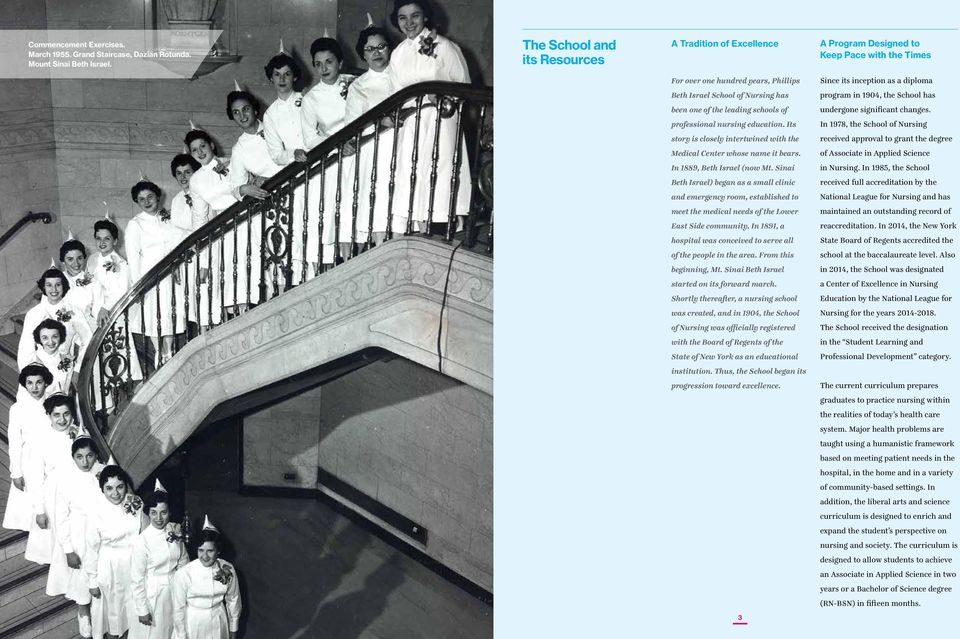
4 Commencement Exercises. March 19. Grand Staircase, Dazian Rotunda. Mount Sinai Beth Israel. The School and its Resources A Tradition of Excellence A Program Designed to Keep Pace with the Times For over one hundred years, Phillips Since its inception as a diploma Beth Israel School of Nursing has program in 1904, the School has been one of the leading schools of undergone significant changes. professional nursing education. Its In 1978, the School of Nursing story is closely intertwined with the received approval to grant the degree Medical Center whose name it bears. of Associate in Applied Science In 1889, Beth Israel (now Mt. Sinai in Nursing. In 198, the School Beth Israel) began as a small clinic received full accreditation by the and emergency room, established to National League for Nursing and has meet the medical needs of the Lower maintained an outstanding record of East Side community. In 1891, a reaccreditation. In 2014, the New York hospital was conceived to serve all State Board of Regents accredited the of the people in the area. From this school at the baccalaureate level. Also beginning, Mt. Sinai Beth Israel in 2014, the School was designated started on its forward march. a Center of Excellence in Nursing Shortly thereafter, a nursing school Education by the National League for was created, and in 1904, the School Nursing for the years of Nursing was officially registered The School received the designation with the Board of Regents of the in the Student Learning and State of New York as an educational Professional Development category. institution. Thus, the School began its progression toward excellence. The current curriculum prepares graduates to practice nursing within the realities of today s health care system. Major health problems are taught using a humanistic framework based on meeting patient needs in the hospital, in the home and in a variety of community-based settings. In addition, the liberal arts and science curriculum is designed to enrich and expand the student s perspective on nursing and society. The curriculum is designed to allow students to achieve an Associate in Applied Science in two years or a Bachelor of Science degree (RN-BSN) in fifteen months. 3
5 Students can: Roosevelt, Mount Sinai St. Luke s, and clinical experiences. In addition, body as well as the staff of the Medical Association, a non-profit organization If you have a disability, you Obtain an education either on a the New York Eye and Ear Infirmary of students may also be assigned to other Center. The library collection contains dedicated to fostering the professional are entitled to assistance and full-time or part-time basis. Mt. Sinai. The Mt. Sinai Health System facilities such as: approximately 12,000 books, over 90 development of nursing students. accommodation(s) through Receive transfer credit for provides the highest quality medical Mt. Sinai St. Luke s and Mt. Sinai journals and a significant number the School. This assistance comparable courses. and nursing services throughout Roosevelt Hospitals and other of audiovisual materials. Online Since Mt. Sinai Beth Israel is a includes evaluating your Receive financial aid including Manhattan, as well as the other medical facilities that are part of databases are available for extensive teaching center for many health care medical documentation, scholarships, if eligible. boroughs, and in Westchester and Mount Sinai Health System research on health care topics. The disciplines such as medicine, physical conducting the appropriate tests, Rockland counties. In Manhattan, Mt. Hudson Guild Senior Center faculty consists of experienced full- therapy and radiologic technology, making recommendations for Students will: Sinai Beth Israel s Milton and Carroll Callen-Lorde Community and part-time instructors who offer a students have many opportunities to accommodation(s) and contacting Receive extensive clinical learning Petrie Division, at 16th Street and Health Center high level of classroom teaching and interact with professionals who share your professors to request experiences provided within Mt. First Avenue, is an acute care teaching Housing Works clinical experience in general and similar interests. accommodation(s). However, you Sinai Beth Israel and the Mt. Sinai hospital. Mount Sinai Brooklyn is United Cerebral Palsy of NYC specialized areas of practice. must contact the 04/ADA and Title Health System, as well as in various community organizations. At the Associate in Applied Science Degree level, prepare to take the NCLEX- RN Registered Professional Nurse Licensing Examination. Prepare for a wide variety of career opportunities in nursing. Study at a Major Medical Facility Mt. Sinai Beth Israel has been serving the New York community for over a century and provides a full range of primary, secondary and tertiary level services. Mt. Sinai Beth Israel is one of the largest providers of inpatient care in New York State and is part of the Mt. Sinai Health System. The Mt. Sinai Health System serves the people of the New York metropolitan area through the following hospital campuses: Mount Sinai Beth Israel, Mount Sinai Brooklyn, The Mount Sinai Hospital, Mount Sinai Queens, Mount Sinai located in the Midwood community. Mount Sinai Beth Israel also includes: primary and specialty care practices, the Japanese Medical Practice, the Karpas Health Information Center, and the Phillips Family Practice. The Medical Center also encompasses the Max Meltzer Health Center (a primary care practice for the elderly on the Lower East Side), the Phillips Ambulatory Care Center in Union Square (which includes an ambulatory surgery center), and a comprehensive cancer center (with an East and West side campus). The Medical Center consistently adds new state-of-theart technology and implements sophisticated treatment modalities which provide excellent clinical opportunities to prepare students for nursing now and in the future. Students are assigned to the various sites of the Mt. Sinai Beth Israel for Extensive Academic Resources Phillips Beth Israel School of Nursing maintains the high fidelity Hillman Nursing Skills Center where nursing faculty is available to assist students in the development of nursing competencies. Students use the Suzanne Toor Karpas Science Laboratory which features a wide variety of anatomical models. The spacious Karpas Study Center is available for individual study. The Study Center provides computers for students use, as well as Wi-Fi access. The School s academic resources include the School s Learning Resource Center where a dedicated Research Services Librarian is available. In addition, students have access to the Seymour J. Phillips Health Sciences Library, which serves the information needs of the student A low faculty to student ratio assures individualized attention. A Diverse Student Body Women and men, from the greater metropolitan area, are enrolled in the School. Their ages range from 18 to over 60, and they reflect the multiplicity of race, religion, sexual orientation, ethnic origin, cultural and economic backgrounds that one finds in a large metropolis. Professional Development Every student is a member of the Student Organization which coordinates school activities. Students are encouraged to serve on selected faculty committees which offer many opportunities for personal and professional growth. Students hold active membership in the National Student Nurses Services for Individuals with Disabilities Phillips Beth Israel School of Nursing is committed to the elimination of architectural and other barriers that prevent any qualified person from attending. The School will provide reasonable accommodations in the form of auxiliary aids and services for students with disabilities. The School will determine on a case-by-case and course-by-course basis whether a need exists, based on documentation, and what accommodation(s) is appropriate. Any individual with an inquiry or complaint related to Section 04 of the Rehabilitation Act of 1973 or the ADA should contact Bernice Pass-Stern, Assistant Dean and 04/ADA and Title IX Compliance Coordinator in the Office of Student Services, 776 Sixth Avenue, Suite 4A, New York, New York or call (212) Information shared is held in the strictest confidence. IX Compliance Coordinator, Mrs. Pass-Stern, (contact information listed above) at the beginning of the academic year to ensure that you receive these services. If you fail to do so, accommodation(s) may not be provided to you. Comprehensive Financial Assistance Depending on financial needs, students may be eligible for Federal and State financial assistance programs as well as the scholarship awards and grants of the School. More than 90 percent of students receive some type of financial aid. A Tobacco Free Campus The school maintains a 100% tobaccofree campus. No tobacco use of any kind is allowed anywhere on school property or the block outside of the school. 4
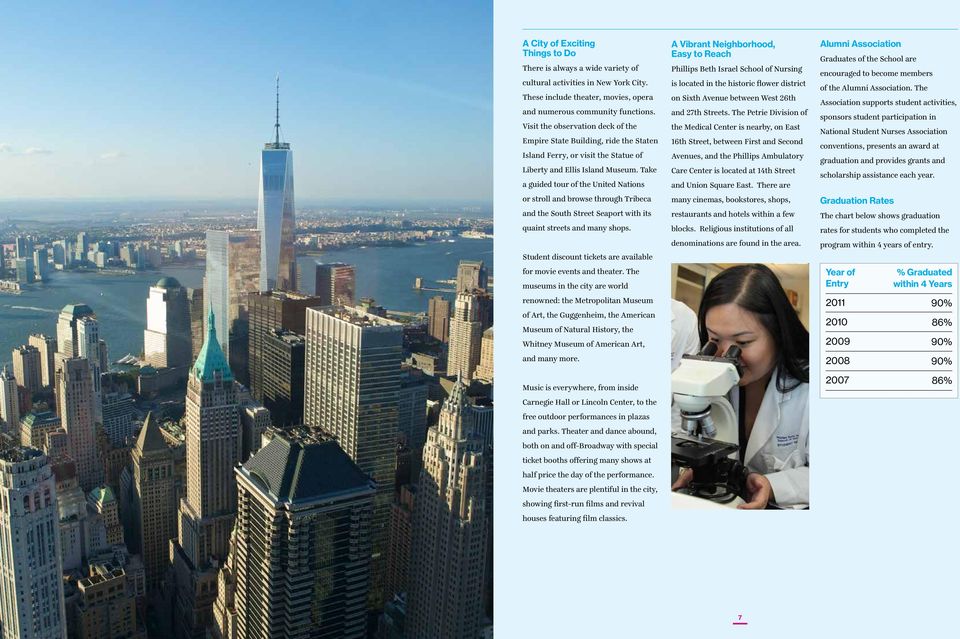
6 A City of Exciting Things to Do There is always a wide variety of cultural activities in New York City. These include theater, movies, opera and numerous community functions. Visit the observation deck of the Empire State Building, ride the Staten Island Ferry, or visit the Statue of Liberty and Ellis Island Museum. Take a guided tour of the United Nations or stroll and browse through Tribeca and the South Street Seaport with its quaint streets and many shops. Student discount tickets are available for movie events and theater. The museums in the city are world renowned: the Metropolitan Museum of Art, the Guggenheim, the American Museum of Natural History, the Whitney Museum of American Art, and many more. A Vibrant Neighborhood, Easy to Reach Phillips Beth Israel School of Nursing is located in the historic flower district on Sixth Avenue between West 26th and 27th Streets. The Petrie Division of the Medical Center is nearby, on East 16th Street, between First and Second Avenues, and the Phillips Ambulatory Care Center is located at 14th Street and Union Square East. There are many cinemas, bookstores, shops, restaurants and hotels within a few blocks. Religious institutions of all denominations are found in the area. Alumni Association Graduates of the School are encouraged to become members of the Alumni Association. The Association supports student activities, sponsors student participation in National Student Nurses Association conventions, presents an award at graduation and provides grants and scholarship assistance each year. Graduation Rates The chart below shows graduation rates for students who completed the program within 4 years of entry. Year of Entry % Graduated within 4 Years 90% 86% 90% 90% Music is everywhere, from inside Carnegie Hall or Lincoln Center, to the free outdoor performances in plazas and parks. Theater and dance abound, both on and off-broadway with special ticket booths offering many shows at half price the day of the performance. Movie theaters are plentiful in the city, showing first-run films and revival houses featuring film classics % 7
7 NCLEX-RN Passing Scores During the past 100 years, the school has graduated over 4,000 licensed registered nurses who have significantly served the community and the nursing profession. Our graduates have consistently demonstrated superior first time passing rates on the National Council Licensure Exam-RN (NCLEX-RN), as indicated at right: NCLEX Results Class of First Time Pass Rate 77% 88% 92% 99% 97% Pass rates are higher than the state and national averages for both associate degrees and baccalaureate nursing programs. Campus Security Statistics As required under subsection 6433 of Article 129-A of the education law, the School s Campus Crime Report is available for review through the Office of Student Services. The information contained in the report lists on-campus crime rates for robbery, assault, burglary, sex offenses, arrests for violations of liquor and drug laws and illegal weapons possession, as well as other crimes. The School will provide a paper copy of this report upon written request to the Office of Student Services. Program Completion Rates The chart at right represents the completion or graduation rate for the cohort of degree-seeking full-time, first-time students for which 10% of the normal time for completion elapsed for students entering the program between 2008 and 2011: The chart at right represents completion rates for the cohort group of 118 students entering in Overall Completion Rate: 90%. Years 4 Year Completion Rates by Scheduling Option Scheduling Option: Traditional # Students Began: 81 # in Cohort Group % % % Note: Since almost all students entering the school have previous college experience, the number of first time students is small. Graduated 2 Years 6 Graduated 3 Years 16 Graduated 4 Years 2 % Graduates Totals 74 ATOP Evenings Total

8 Hours of Operation community groups. The School of who internalizes and applies new For Further Information Administrative offices are open Nursing, as part of the community, principles, concepts and skills as The remainder of this publication Monday, Wednesday, Thursday and prepares graduates to make vital evidenced by modification of attitude, is divided into two sections and Friday from 8:00 am to :00 pm, and contributions to society. This is ideas and behavior. Inherent in this provides detailed information on the on Tuesdays from 8:00 am to 6:00 pm. achieved through provision of care to process is the development of the curriculum, faculty, and admission The school is open weekdays from individuals and groups of individuals learner s self-awareness, independent procedures of the School of Nursing 8:00 am to 10:30 pm and on some in varied health care settings and decision-making and accountability. for the Associate in Applied Science Saturdays from 8:00 to 1:00 pm when by participation in health-related Optimal learning occurs in an and Bachelor of Science degrees. For classes are in session. community activities. interactive environment where questions about nursing or about Philosophy of Phillips Beth Israel School of Nursing The philosophy of Phillips Beth Israel School of Nursing reflects the beliefs of the faculty regarding individuals, society, nursing, education and the role of the nurse within the health illness continuum. The faculty s belief is embodied in the recognition that human beings possess physical, social, psychological, spiritual and cultural qualities. Inherent in this belief is that human beings are endowed with self-worth and dignity and have a right to have their basic needs met. The human experience is dynamic throughout the life cycle and an individual s behavior reflects continuous interaction with the total environment. Health is a dynamic state with levels of wellness existing along a continuum. Optimal health is a state of physical, mental and social well-being and not merely the absence of illness. Illness is manifested by compromised functioning and diminished capacity to meet one s needs. Nursing is a dynamic, interactive process between the nurse, patient, family and significant others whereby goals are mutually established in order to meet compromised patient needs. Nursing practice is caring and humanistic, aimed at assisting patients to achieve their highest level of functioning. Adult education is an interdependent process between teacher and learner. mutual respect and freedom of inquiry are fostered. Nursing education provides the graduate with the competencies necessary to implement nursing care based upon current knowledge and concepts of the biological, social and behavioral sciences, nursing concepts, current technology and health care trends. The ultimate goal is to graduate nurses who deliver competent and compassionate health care, both locally and globally, and who participate in professional activities and demonstrate a commitment to lifelong learning. Graduates are prepared to function in a collaborative role with other health care practitioners when providing and managing preventative, restorative and supportive care to individuals. They the School, please do not hesitate to attend one of the School s Open House programs which are held during the winter and spring months. The programs are designed to answer your individual questions. For information, or the Open House schedule, please call the Office of Admissions at (212) or visit our website at We look forward to hearing from you. Society is comprised of individuals, diverse in their cultures, customs and behaviors, whose interactions occur through membership in family and The educator functions as a facilitator, resource person and role model who encourages students to develop the knowledge and critical thinking skills necessary to deal with challenges. practice in a variety of health care settings utilizing established protocols within an ethical and legal framework. The learner is a motivated individual 10 11

9 Associate in Applied Science, Nursing Student Learning Outcomes Program Goals/Outcomes Program Options Upon completion of the program, the graduate will be able to: 1. Utilize a body of theoretical knowledge derived from nursing, the biological, behavioral and social sciences and other disciplines in meeting the needs of patients of varying cultures, ages and stages of development throughout the life span. 2. Utilize the nursing process, integrating critical thinking and information literacy, with an evidence-based approach to provide individualized care. 3. Manage the varied activities and technologies that are required to provide nursing care to groups of patients in a variety of settings. 4. Communicate effectively with patients, families, significant others and health care members to provide optimal health care.. Utilize teaching activities to restore and maintain health and to promote optimal functioning. 6. Maintain accountability for the practice of nursing within the profession s established ethical and legal standards. 7. Assume responsibility for professional development essential to meet the demands of a rapidly changing society. 1. At least seventy-five percent (7%) of students entering the program will successfully complete the program in four years. 2. Graduates licensure exam pass rates (for first-time test takers) will be at or above the state and national means. 3. At least eighty-five percent (8%) of the graduates will obtain employment within twelve months following RN licensure. 4. At least ninety percent (90%) of graduates will be satisfied with the education they received as evidenced by responses on follow-up surveys. The last incoming class for the Associate Degree program was accepted to begin their studies in the Fall of 201. The School is in the process of transitioning to an Accelerated Bachelors of Science in Nursing (ABSN) for those candidates with prior baccalaureate degrees in other disciplines. A Teach Out Agreement (see Teach Out Policy on page 9) will be implemented as necessary. The Associate Degree can be completed by selecting from one of these two schedules: 1. The Traditional Program provides for liberal arts, science and nursing courses to be taken concurrently. Classes are generally offered from Monday through Friday between 8:00 am and 4:30 pm. This is a 21-month program. 2. Alternative Two-Day Option Program (ATOP) open only to students who have completed all of the curriculum s science and liberal arts co-requisites, with the exception of Nutrition & Diet Therapy and Pharmacology. Courses are offered on Thursdays from 3:00 pm to 8:00 pm, and Fridays and Saturdays from 8:00 am to 8:00 pm. This is a 21- month program. Students may be enrolled in only one program option during a semester. Any request to change a program option must be submitted in writing to the Office of Student Services prior to the start of the next semester
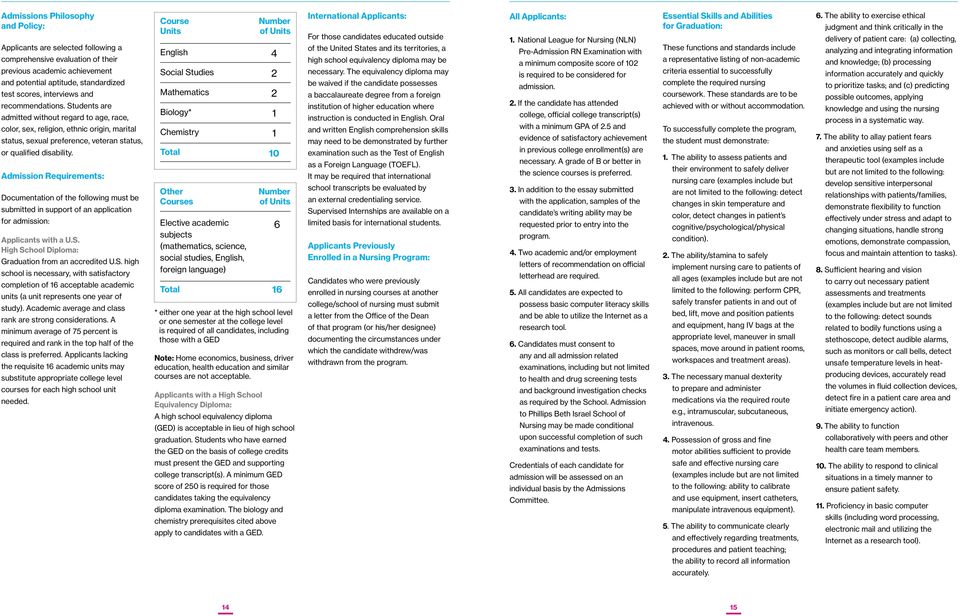
10 Admissions Philosophy and Policy: Applicants are selected following a comprehensive evaluation of their previous academic achievement and potential aptitude, standardized test scores, interviews and recommendations. Students are admitted without regard to age, race, color, sex, religion, ethnic origin, marital status, sexual preference, veteran status, or qualified disability. Admission Requirements: Documentation of the following must be submitted in support of an application for admission: Applicants with a U.S. High School Diploma: Graduation from an accredited U.S. high school is necessary, with satisfactory completion of 16 acceptable academic units (a unit represents one year of study). Academic average and class rank are strong considerations. A minimum average of 7 percent is required and rank in the top half of the class is preferred. Applicants lacking the requisite 16 academic units may substitute appropriate college level courses for each high school unit needed. Course Units English Social Studies Mathematics Biology* Chemistry Total Other Courses Elective academic subjects (mathematics, science, social studies, English, foreign language) Total Number of Units Number of Units 6 16 * either one year at the high school level or one semester at the college level is required of all candidates, including those with a GED Note: Home economics, business, driver education, health education and similar courses are not acceptable. Applicants with a High School Equivalency Diploma: A high school equivalency diploma (GED) is acceptable in lieu of high school graduation. Students who have earned the GED on the basis of college credits must present the GED and supporting college transcript(s). A minimum GED score of 20 is required for those candidates taking the equivalency diploma examination. The biology and chemistry prerequisites cited above apply to candidates with a GED International Applicants: For those candidates educated outside of the United States and its territories, a high school equivalency diploma may be necessary. The equivalency diploma may be waived if the candidate possesses a baccalaureate degree from a foreign institution of higher education where instruction is conducted in English. Oral and written English comprehension skills may need to be demonstrated by further examination such as the Test of English as a Foreign Language (TOEFL). It may be required that international school transcripts be evaluated by an external credentialing service. Supervised Internships are available on a limited basis for international students. Applicants Previously Enrolled in a Nursing Program: Candidates who were previously enrolled in nursing courses at another college/school of nursing must submit a letter from the Office of the Dean of that program (or his/her designee) documenting the circumstances under which the candidate withdrew/was withdrawn from the program. All Applicants: 1. National League for Nursing (NLN) Pre-Admission RN Examination with a minimum composite score of 102 is required to be considered for admission. 2. If the candidate has attended college, official college transcript(s) with a minimum GPA of 2. and evidence of satisfactory achievement in previous college enrollment(s) are necessary. A grade of B or better in the science courses is preferred. 3. In addition to the essay submitted with the application, samples of the candidate s writing ability may be requested prior to entry into the program. 4. Two academic and/or employment letters of recommendation on official letterhead are required.. All candidates are expected to possess basic computer literacy skills and be able to utilize the Internet as a research tool. 6. Candidates must consent to any and all admission related examinations, including but not limited to health and drug screening tests and background investigation checks as required by the School. Admission to Phillips Beth Israel School of Nursing may be made conditional upon successful completion of such examinations and tests. Credentials of each candidate for admission will be assessed on an individual basis by the Admissions Committee. Essential Skills and Abilities for Graduation: These functions and standards include a representative listing of non-academic criteria essential to successfully complete the required nursing coursework. These standards are to be achieved with or without accommodation. To successfully complete the program, the student must demonstrate: 1. The ability to assess patients and their environment to safely deliver nursing care (examples include but are not limited to the following: detect changes in skin temperature and color, detect changes in patient s cognitive/psychological/physical condition). 2. The ability/stamina to safely implement nursing care to patients of all ages (examples include but are not limited to the following: perform CPR, safely transfer patients in and out of bed, lift, move and position patients and equipment, hang IV bags at the appropriate level, maneuver in small spaces, move around in patient rooms, workspaces and treatment areas). 3. The necessary manual dexterity to prepare and administer medications via the required route e.g., intramuscular, subcutaneous, intravenous. 4. Possession of gross and fine motor abilities sufficient to provide safe and effective nursing care (examples include but are not limited to the following: ability to calibrate and use equipment, insert catheters, manipulate intravenous equipment).. The ability to communicate clearly and effectively regarding treatments, procedures and patient teaching; the ability to record all information accurately. 6. The ability to exercise ethical judgment and think critically in the delivery of patient care: (a) collecting, analyzing and integrating information and knowledge; (b) processing information accurately and quickly to prioritize tasks; and (c) predicting possible outcomes, applying knowledge and using the nursing process in a systematic way. 7. The ability to allay patient fears and anxieties using self as a therapeutic tool (examples include but are not limited to the following: develop sensitive interpersonal relationships with patients/families, demonstrate flexibility to function effectively under stress and adapt to changing situations, handle strong emotions, demonstrate compassion, focus and maintain attention to tasks). 8. Sufficient hearing and vision to carry out necessary patient assessments and treatments (examples include but are not limited to the following: detect sounds related to bodily functions using a stethoscope, detect audible alarms, such as monitors or call bells, detect unsafe temperature levels in heatproducing devices, accurately read the volumes in fluid collection devices, detect fire in a patient care area and initiate emergency action). 9. The ability to function collaboratively with peers and other health care team members. 10. The ability to respond to clinical situations in a timely manner to ensure patient safety. 11. Proficiency in basic computer skills (including word processing, electronic mail and utilizing the Internet as a research tool). 14 1
11 Transfer Students and Transfer Credits Students may obtain transfer credit for liberal arts and science courses required by Phillips Beth Israel School of Nursing by either of these two methods: (1) Successful completion of a comparable course from an accredited post-secondary institution of higher education with a grade of C or better. Science courses (Anatomy and Physiology I and II, Microbiology, and Nutrition and Diet Therapy) must be completed within the last five years. Liberal arts courses will be evaluated by the Admissions Committee on a caseby-case basis. A course description and/or syllabus may be requested for courses for which the student is requesting transfer credit. OR (2) Success on a challenge examination offered through one of these three modalities: (i) Challenge Examinations offered through the College Board in: General Biology (Admission Pre-requisite) General Chemistry (Admission Pre-requisite) Introductory Psychology Introductory Sociology College Composition Modular Arrangements must be made for the essay/composition component of the exam to be mailed to: Assistant Dean Phillips Beth Israel School of Nursing 776 Sixth Avenue, Suite 4A New York, NY More information can be obtained by calling (609) or logging on to (ii) Challenge Exams offered through Excelsior College in: Anatomy and Physiology (I and II) 6* credits Microbiology 3* credits * 1 credit for each science course will be granted by the School of Nursing for laboratory work completed in the prior course. The school will allow students to take the Excelsior College challenge exam in anatomy and physiology and microbiology only if the student has successfully completed a comparable course (both lecture and lab components) more than five years ago. More information can be obtained by calling (888) , (18) or logging on to NOTE: Students who fail a science course at the School of Nursing may not take the Excelsior College challenge exam for subsequent course credit. They are required to pass a comparable course at another college or to repeat the course at the School of Nursing. Further information relative to the College Composition Modular and Excelsior College exams may be received from the Admissions office. (iii) Challenge Exams are offered by Phillips Beth Israel School of Nursing in: Nursing Math for Medications* Biology Nutrition and Diet Therapy* * A challenge exam is offered if a comparable course was successfully completed more than five years ago. Official transcripts from all schools attended must be submitted for Admissions Committee review. A Transfer Credit Assessment Form will be generated for each student accepted into the program. Prior to enrollment, students must review the Transfer Credit Assessment Form, indicate any courses in progress, and sign off on the form, acknowledging that the form lists all of the transfer credits awarded the student by the School of Nursing. (Once updated transcripts are received by the School for courses recently completed, the Transfer Credit Assessment Form will be revised accordingly.) Once a student is enrolled, it is expected that Introduction to Bioethics (PHI201), as well as all science and nursing courses, will be completed at the School. Students who are already enrolled in the program may request in writing to concurrently take required non-nursing and non-science courses (except PHI201) for transfer credit from an accredited post-secondary institution. Students should be aware of the financial aid implications of enrolling in a required course at another institution, or of taking a challenge exam for course exemption. Students must receive written approval from the Office of Student Services before registering for required liberal arts courses outside the program. In addition: An Add/Drop form (Enrollment Change Request Form) must be completed and submitted to the Office of Student Services six (6) weeks prior to the beginning of the semester in which the course is required at the School of Nursing. The results from CLEP, Excelsior College and School-offered challenge examinations must be received by the Office of Student Services three (3) weeks prior to the beginning of the semester in which the course is required at the School of Nursing. If a student s CLEP exam result(s) are received later than three weeks before the first day of the course, the student will be registered for that course (by the Office of Student Services) and will be held liable for the cost of tuition. Evidence of successful course completion must be received by the Office of Student Services prior to the beginning of the semester in which the course is required at the School of Nursing unless the outside course is being taken concurrently. The Office of Student Services must receive an official transcript for any outside course(s) taken concurrently within four (4) weeks of the date of course completion. Residency Requirements Transfer students who have already successfully completed all liberal arts and science co-requisites are required to complete all nursing courses (with the exception of NSG 100: Math for Medications) to be eligible for an AAS degree. International Students This school is authorized under Federal law to enroll non-immigrant international students into the AAS program only. After acceptance, students requiring the F-1 student visa should immediately contact the Office of Student Services so appropriate documents can be filed online with the Office of Immigration and Customs Enforcement (ICE) of the United States Department of Homeland Security

12 The AAS Curriculum The curriculum is continuously updated to reflect changes in nursing education, practice and research. It is the student s responsibility to complete all courses necessary for the Associate Degree. In addition, the School may offer elective and/or enrichment courses on a semesterby-semester basis. Students will be notified of the availability of such courses prior to registration deadlines. Academic Calendar The academic calendar is distributed under separate cover. Note: 1 hrs. Theory = 1 credit 4 hrs. Lab/Clinical = 1 credit For Scheduling Options see the following pages Two-Year Traditional (21 Months): Monday Through Friday* Year I Courses Credits Fall Semester NSG100 Math for Medications 1 NSG101 Introduction to Nursing 6 BIO12 Anatomy & Physiology I 4 EDU130 Developmental Psychology 3 ENG110 English I 3 17 Spring Semester NSG102 Nsg Care of Patients w/common Health Problems 7 BIO13 Anatomy & Physiology II 4 BIO110 Nutrition & Diet Therapy 3 PSY111 General Psychology 3 17 Summer Session NSG103 Principles of Psychiatric/Mental Health Nursing 3 BIO264 Microbiology 4 7 Minimum Credits for Graduation: 68 Credits *An accelerated 18 month honors track is offered to highly qualified students entering Level II of the nursing program with a 3.70 GPA or better. Year II Courses Credits Fall Semester NSG201 Nsg Care of Childbearing/Childrearing Families 8 or NSG202 Nsg Care of Patients w/complex Common Health Problems 8 BIO200 Pharmacology 3 SOC102 Introduction to Sociology 3 14 Spring Semester NSG202 Nsg Care of Patients w/complex Common Health Problems 8 or NSG201 Nsg Care of Childbearing/Childrearing Families 8 PHI201 Introduction to Bioethics 3 NSG203 Pathways to Practice (3 weeks)

13 Two-Year Alternative, Two Day Schedule/ATOP (21 Months): Half Day Thursday, Full Day Friday and Saturday* Year I Courses Credits Fall Semester NSG100 Math for Medications 1 NSG101 Introduction to Nursing 6 7 Spring Semester NSG102 Nsg Care of Patients w/common Health Problems 7 BIO110 Nutrition & Diet Therapy 3 10 Summer Session NSG103 Principles of Psychiatric/Mental Health Nursing 3 Year II Courses 7 Credits Fall Semester NSG201 Nsg Care of Childbearing/Childrearing Families 8 or NSG202 Nsg Care of Patients w/complex Common Health Problems 8 BIO200 Pharmacology 3 14 Spring Semester NSG202 Nsg Care of Patients w/complex Common Health Problems 8 or NSG201 Nsg Care of Childbearing/Childrearing Families 8 NSG203 Pathways to Practice (3 weeks) 2 13 Minimum Credits for Graduation: 68 Credits *An accelerated 18 month honors track is offered to highly qualified students entering Level II of the nursing program with a 3.70 GPA or better. Course Descriptions Nursing Courses NSG Math for Medications 1 Cr.-1 hrs Class hrs.=1 [hybrid course] This course provides the student with the skills required to accurately calculate dosages for safe administration of medication. The student will be required to validate these skills prior to each nursing course. Co-requisite: NSG 101 NSG Introduction To Nursing 6 Cr.-10 hrs. Class hrs.= 4 Lab/Clinical hrs.=6 This course introduces students to the profession of nursing and its place within the health care delivery system. Students are assisted with the identification and application of basic facts, principles and concepts derived from the biological and behavioral sciences and nursing, in order to develop a sound foundation of nursing knowledge, skills, abilities and professional values. Clinical core nursing concepts include basic needs for health and commonly occurring variations throughout the life span with emphasis on adulthood including gerontology. The concepts of nursing practice are taught in laboratory/classroom settings. The student begins to apply these concepts in clinical settings. Students are encouraged to think critically. The Nursing Process is introduced as a framework for problem-solving and is used in meeting patients needs. Clinical experiences are offered in acute care settings. Co-requisites: NSG 100, BIO 12, EDU 130 NSG Nursing Care of Patients with Common Health Problems 7 Cr.-19 hrs. Class hrs.= 4 Lab/Clinical hrs.=9 This course builds upon knowledge and skills from previous and concurrent courses. Principles of relevant therapeutic treatment modalities such as pharmacological, nutritional and surgical interventions are used by students in caring for patients with compromised basic needs arising from actual and/ or potential common health problems across the life span. Selected nursing diagnosis categories are introduced and the student is assisted in applying concepts when caring for patients in both acute and community settings. The student continues to use the Nursing Process in caring for patients who are experiencing unmet needs related to various physiological alterations in health status. Pre-requisites: NSG 100, NSG 101, BIO 12, EDU 130 Co-requisites: BIO 13, BIO 110 NSG Principles of Psychiatric/ Mental Health Nursing 3 Cr.-7 hrs. Class hrs.= Clinical hrs.=7. This course provides the student with knowledge related to alterations in psychological well-being and the subsequent behavioral responses of patients along the health-illness continuum throughout the life span. Students establish a therapeutic nurse patient relationship in both acute and community mental health settings. As a member of the health team, the student participates in assessing the needs of patients with common mental health problems. Pre-requisites: NSG 101, NSG 102, BIO 12, PSY 111, EDU

14 Liberal Arts and Science Courses NSG Nursing Care of Childbearing and Childrearing Families 8 Cr.-240 hrs. Class hrs.= 4 Clinical hrs.=12 This course introduces the concepts essential to meeting the health care needs of childbearing women, their infants, children and families. Selected women s health problems and common health problems of children are also presented. Health promotion activities are emphasized. A variety of health care agencies are utilized. Students are guided by nurse mentors in selected community settings. Pre-requisites: All Level I courses NSG Nursing Care of Patients with Complex Common Health Problems 8 Cr.-240 hrs. Class hrs. = 4 Clinical hrs. =12 In this course, the student integrates all previous knowledge and skills with emphasis on managing care to meet the complex needs of individuals with chronic illness. Students provide care to patients and their families in a continuum of settings from critical care and acute care units to home and community service agencies. The community experience includes health promotion activities with individuals and small groups of patients. Students are guided by nurse mentors in selected community settings. Pre-requisites: All Level I courses NSG Pathways to Practice (3 Weeks) 2 Cr.-90 hrs. Clinical hrs.=90 This course facilitates the transition of the student to the role of staff nurse. Current parameters of nursing practice are discussed and students are encouraged through seminars to explore current issues that impact on the practice of nursing. The student selects a clinical experience in an acute or community-care setting, and functions in the role of a beginning practitioner of nursing. The student s clinical practice is coordinated by faculty and guided by a registered nurse mentor. Pre-requisites: All other courses in the curriculum Note: All pre-requisite nursing courses must be successfully completed with a passing grade of C+ or better. ENG English I 3 Cr.-4 hrs. Class hrs.=3 This is a writing course that instructs students in the composition of both expository and argumentative essays. Students learn the organizational and rhetorical skills essential to successful academic writing. In addition, the course introduces students to the research paper, including methods of documentation and the use of library resources. Scheduled individual conferences are an integral part of the course. PSY General Psychology 3 Cr.-4 hrs. Class hrs.=3 An introduction to the science and profession of psychology, including coverage of human development, personality theory and research, social psychology, motivation, perception and related topics. EDU Developmental Psychology 3 Cr.-4 hrs. Class hrs.=3 This course represents a systematic study of behavior during childhood, adolescence and adulthood. Scientific methods of case study, constitutional and social factors contributing toward personality growth and problems of adjustment stemming from changes in human capacities, abilities and needs are studied. Emphasis will be on life span development from birth through old age. PHI 201 Introduction to Bioethics 3 Cr.-4 hrs. Class hrs.=3 A philosophical examination of such issues as abortions, homosexuality, prostitution, criminal punishment, euthanasia, medical ethics, civil disobedience, and just and unjust wars. Discussion of these issues will begin with reflection on the nature and meaning of good as discussed in appropriate readings from major thinkers in the history of philosophy. This course may be offered as a blended online course. BIO 12 - Anatomy and Physiology I 4 Cr.-90 hrs. Class hrs.=3 Lab hrs.=3 This course begins with a general introduction to body organization and terms of reference, followed by a histological description of major tissue types and their distribution. The remainder of the course focuses on the basic structure and functioning of the following organ systems: skin, skeletal, muscular, nervous and endocrine. BIO 13 - Anatomy and Physiology II 4 Cr.-90 hrs. Class hrs.=3 Lab hrs.=3 This course is a continuation of the Anatomy and Physiology sequence. Basic structure and functional concepts and principles of the following organ systems are discussed: circulatory, immune system, respiratory, digestive, urinary and reproductive. Pre-requisite: BIO 12 BIO Microbiology 4 Cr.-90 hrs. Class hrs.=3 Lab hrs.=3 An in-depth study of microorganisms, including classification, ecology, biochemistry, and genetics. Pathogenicity, epidemiology, and immunological responses are also considered. BIO Nutrition and Diet Therapy 3 Cr.-4 hrs. Class hrs.=3 This course introduces current concepts, trends, issues and the role of normal nutrition throughout the life span. Also included are the dietary modifications needed when health is compromised. The goal of this course is to enable the student to apply theoretical knowledge to clinical nursing practice. This course may be offered as a blended online course. BIO Pharmacology 3 Cr.-4 hrs. Class hrs.=3 General principles of pharmacology, mechanisms of drug actions, biotransformation, drug characteristics and interactions are discussed. Major classifications of drugs are presented in relation to therapeutic use. This course may be offered as a blended online course. Pre-requisites: NSG 100, NSG 101, NSG 102, NSG 103, BIO 12, BIO 13 SOC Introduction to Sociology 3 Cr.-4 hrs. Class hrs.=3 An introduction to the basic concepts, methods and application of the sociological perspective. These concepts will be viewed in relation to contemporary institutions and trends

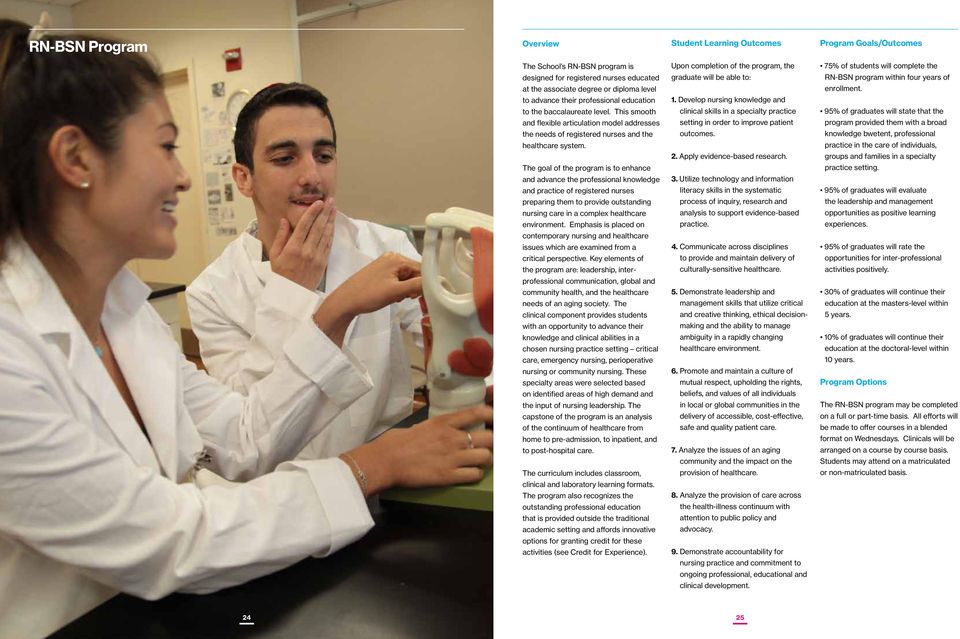
15 RN-BSN Program Overview Student Learning Outcomes Program Goals/Outcomes The School s RN-BSN program is designed for registered nurses educated at the associate degree or diploma level to advance their professional education to the baccalaureate level. This smooth and flexible articulation model addresses the needs of registered nurses and the healthcare system. The goal of the program is to enhance and advance the professional knowledge and practice of registered nurses preparing them to provide outstanding nursing care in a complex healthcare environment. Emphasis is placed on contemporary nursing and healthcare issues which are examined from a critical perspective. Key elements of the program are: leadership, interprofessional communication, global and community health, and the healthcare needs of an aging society. The clinical component provides students with an opportunity to advance their knowledge and clinical abilities in a chosen nursing practice setting critical care, emergency nursing, perioperative nursing or community nursing. These specialty areas were selected based on identified areas of high demand and the input of nursing leadership. The capstone of the program is an analysis of the continuum of healthcare from home to pre-admission, to inpatient, and to post-hospital care. The curriculum includes classroom, clinical and laboratory learning formats. The program also recognizes the outstanding professional education that is provided outside the traditional academic setting and affords innovative options for granting credit for these activities (see Credit for Experience). Upon completion of the program, the graduate will be able to: 1. Develop nursing knowledge and clinical skills in a specialty practice setting in order to improve patient outcomes. 2. Apply evidence-based research. 3. Utilize technology and information literacy skills in the systematic process of inquiry, research and analysis to support evidence-based practice. 4. Communicate across disciplines to provide and maintain delivery of culturally-sensitive healthcare.. Demonstrate leadership and management skills that utilize critical and creative thinking, ethical decisionmaking and the ability to manage ambiguity in a rapidly changing healthcare environment. 6. Promote and maintain a culture of mutual respect, upholding the rights, beliefs, and values of all individuals in local or global communities in the delivery of accessible, cost-effective, safe and quality patient care. 7. Analyze the issues of an aging community and the impact on the provision of healthcare. 8. Analyze the provision of care across the health-illness continuum with attention to public policy and advocacy. 9. Demonstrate accountability for nursing practice and commitment to ongoing professional, educational and clinical development. 7% of students will complete the RN-BSN program within four years of enrollment. 9% of graduates will state that the program provided them with a broad knowledge bwetent, professional practice in the care of individuals, groups and families in a specialty practice setting. 9% of graduates will evaluate the leadership and management opportunities as positive learning experiences. 9% of graduates will rate the opportunities for inter-professional activities positively. 30% of graduates will continue their education at the masters-level within years. 10% of graduates will continue their education at the doctoral-level within 10 years. Program Options The RN-BSN program may be completed on a full or part-time basis. All efforts will be made to offer courses in a blended format on Wednesdays. Clinicals will be arranged on a course by course basis. Students may attend on a matriculated or non-matriculated basis. 24 2
16 Admissions RN-BSN Program Admissions Philosophy and Policy Applicants are selected following a comprehensive evaluation of their previous academic achievement and potential aptitude and recommendations. Students are admitted without regard to age, race, color, sex, religion, ethnic origin, marital status, sexual preference, veteran status or qualified disability. Admission Requirements Admission to the RN-BSN Program is competitive and applying does not guarantee admission to the program. Documentation of the following must be submitted in support of an application for admission: A U.S. High School Diploma from an accredited U.S. high school or a high school equivalency diploma (GED) with a minimum score of 20. For those candidates educated outside of the U.S. and its territories, the equivalency diploma may be waived if the candidate possesses a baccalaureate degree from a foreign institution of higher education where instruction is conducted in English. Associate in Science degree, or Associate in Applied Science degree, or diploma in nursing from a state registered nursing program. Unrestricted and unencumbered current license and current registration to practice as a registered nurse in New York State. (Applicants educated outside the United States and its territories must validate credentials with the Commission of Graduates of Foreign Nursing Schools before applying for RN licensure.) Minimum overall grade point average of 2. on a 4.0 scale. Grade of C or higher in all science and mathematics courses. Grade of C+ or higher in all nursing courses. Satisfactory completion of prerequisite general education courses. Pre-requisites: English Composition (3 credits, Class hrs. = 4) Anatomy and Physiology I (4 credits, Class hrs. = 4, Lab hours = 4) Anatomy and Physiology II (4 credits, Class hrs. = 4, Lab hours = 4) Microbiology (4 credits, Class hrs. = 4, Lab hours = 4) Introduction to Sociology (3 credits, Class hrs. = 4) General Psychology (3 credits, Class hrs. = 4) Developmental Psychology (3 credits, Class hrs. = 4) Nutrition (3 credits, Class hrs. = 4) Ethics (3 credits, Class hrs. = 4) The pre-requisite courses can be taken at PBISN or another accredited postsecondary institution. Generally, except as noted, academic credits from other accredited institutions are accepted if a grade of C or higher is earned. There is no time limit for acceptance. Advanced placement credit by exam, and the College Level Examination Program (CLEP) are other ways to meet these criteria. Transfer Credits: 30 semester hours of nursing credit granted for prior learning validated by the successful completion of the NCLEX-RN Maximum number of credits transferable 90 credits National Certification in a Specialty Area may be accepted in lieu of N401 - Nursing in a Clinical Specialty ( credits) (See Credit for Experience) Minimum residency requirement 27 to 32 nursing credits Comparable liberal arts and science courses accepted for transfer credit on a case-by-case basis Once enrolled, all liberal arts and science courses must be completed at the school. Application Requirement Checklist: Applicants must complete the following requirements for consideration to the RN-BSN program: Submit official transcripts documenting High School diploma or GED, an Associate in Science degree, or Associate in Applied Science degree, or diploma in nursing from an approved institution. Request that an official transcript be sent directly to the Admissions Office or submit with the application in a sealed envelope. Applicants educated outside the United States and its territories must have their transcripts from a college or university outside of the US evaluated by a commercial evaluation service approved by the School. The School will use this evaluation to determine eligibility to apply for the BSN Program. The evaluation of transcripts must be received by the School prior to the application deadline date. The transcript evaluation must consist of a courseby-course evaluation and upper course identification. The commercial evaluation companies approved by the School are: World Education Services and Globe Language Services, Inc. New or transfer students must complete the school s RN-BSN application; PBISN graduates may complete the brief Supplemental Application for the RN-BSN Program. An essay expressing the candidate s interest in the RN-BSN program at PBISN; their individual characteristics, abilities and educational plan that will enhance his/her success in the program. The application may include any other additional information important for admission to the program. Current resume. Two professional letters of recommendation (academic or employment on official letterhead). In addition, admitted candidates must submit the following prior to admission: Successfully completed required health clearance Successfully completed background investigation and drug screening (fee required) Current CPR certification (copy of card) Provide documentation of current professional liability (malpractice) insurance How to Apply Application forms may be downloaded from our website at Completed application portfolios should be sent to: Chairperson Admissions Committee Phillips Beth Israel School of Nursing 776 Sixth Avenue, Suite 4A New York, NY Admissions Process 1. Students are enrolled on a rolling basis. 2. Submit a completed application portfolio with a non-refundable $0.00 (money order) fee. (Refer to Application Requirement Checklist) 3. It is the candidate s responsibility to ensure that his/her portfolio is complete by contacting the Admissions Office at (212) to verify the status of the application and the receipt of documents. 4. When all documents have been received, the candidate s portfolio will be evaluated by the Admissions Committee to determine eligibility.. Admission decisions are made by the Admissions Committee. Note: All materials in student portfolios are the property of the School and will not be returned. Portfolios are retained for a period of two years. Acceptance 1. Applicants are selected following a comprehensive assessment of their previous academic achievement, personal and professional experiences. 2. All candidates will receive a decision from the Admissions Committee in writing. 3. All accepted candidates must submit a $ non-refundable tuition deposit by the deadline stated in the decision letter; otherwise, acceptance will be canceled
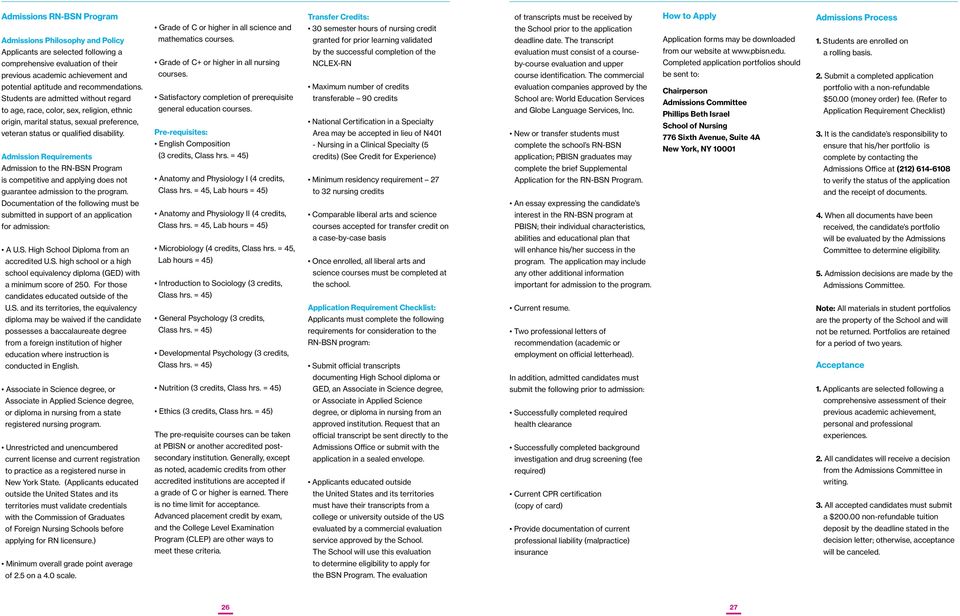
17 4. Once accepted to the RN-BSN program, candidates may select either full- or part-time enrollment.. All students must enroll for a minimum of six credits per semester. 6. Once enrolled, all courses required for the degree must be completed at the School. Admission Deferment Students unable to register for classes in the academic year for which they are accepted may opt to postpone their admission into the program. Admission deferment requests should be submitted in writing to the Chairperson of the Admissions Committee. Candidates who have been accepted for admission and deferred their entry into the program must reactivate their portfolios and submit a re-entry request in writing by March 1st of the academic year in which they seek admission. Readmission Former RN-BSN students seeking readmission are required to submit a written request to the Chairperson of the Admissions Committee requesting consideration for reacceptance into the program. A candidate applying for readmission must document that the reason(s) for withdrawal have been addressed. Each applicant seeking readmission will be evaluated on an individual basis, and the Admissions Committee will determine eligibility to re-enter the program. Readmission will be denied to any student who has exhibited unprofessional behaviors, verbally or physically aggressive behaviors towards students, faculty or administration, and/ or has had any violations of the PBISN Code of Conduct. A student dismissed for academic reasons will be allowed to reapply only once. If re-accepted: The student must successfully pass all subsequent courses. The student is expected to follow the admissions process and meet admission requirements as delineated in the current catalog. The student must adhere to all current school policies. Transfer Credits Official transcripts from all schools attended must be submitted for Admissions Committee review. A Transfer Credit Assessment Form will be generated for each student accepted into the program. Prior to enrollment, students must review the Transfer Credit Assessment Form and return it to the Office of Student Services if any additional courses are in progress. Students should be aware of the financial aid implications of taking a challenge exam for course exemption. Evidence of successful national certification must be received by the Office of Student Services prior to the beginning of the semester in which the course is required at the School of Nursing. International Students The school does not enroll nonimmigrant international students in its RN-BSN program. The RN-BSN Curriculum The curriculum is designed to be completed in 1 months of full-time studies. The curriculum is continuously updated to reflect changes in nursing education, practice and research. It is the student s responsibility to complete all courses necessary for the Bachelor of Science Degree. In addition, the School may offer elective and/or enrichment courses on a semester-bysemester basis. Students will be notified of the availability of such courses prior to registration deadlines. Academic Calendar The academic calendar is distributed under separate cover. A listing of all required courses is broken down by year and semester at right. Minimum Credits for Graduation: 122 Credits Courses may be completed on a full-or part-time basis. Note: 1 hrs. Theory = 1 credit 4 hrs. Lab/Clinical = 1 credit Students are required to take a minimum of six credits per semester. Residency Requirement credits in nursing. Level I Courses Credits Fall Semester NSG301 Nursing Research & Evidence-Based Practice 3 NSG302 Interprofessional Communication & Practice 3 NSG303 Health Assessment 3 MAT 301 Statistics 3 SCI301 Pharmacology 3 INL302 Information Literary & Technology 3 18 Spring Semester NSG304 Nursing Issues in Caring for an Aging Population And At-Risk Communities NSG30 Nursing Leadership and Management 4 NSG40 (Elective) International Nursing* 3 OR NSG406 (Elective) Genetic Issues in Patient Care* 3 SPE201 Public Speaking 3 ENG301 Professional Writing 3 *One elective course to be taken in the Spring Semester 18 Summer Semester NSG401 Nursing in a Clinical Specialty NSG403 (Elective) Applied Ethics in Nursing* 3 OR NSG404 (Elective) Using the Arts to Enhance Clinical Care* 3 SPA100 Spanish for Healthcare Professionals 3 SCI401 Pathophysiology 3 *One elective course to be taken in the Summer Semester Level II Courses 14 Credits Fall Semester NSG402 Nursing Capstone 3 HIS200 Geopolitics of Healthcare 3 PSY200 Group Dynamics 3 PSY300 Abnormal Psychology
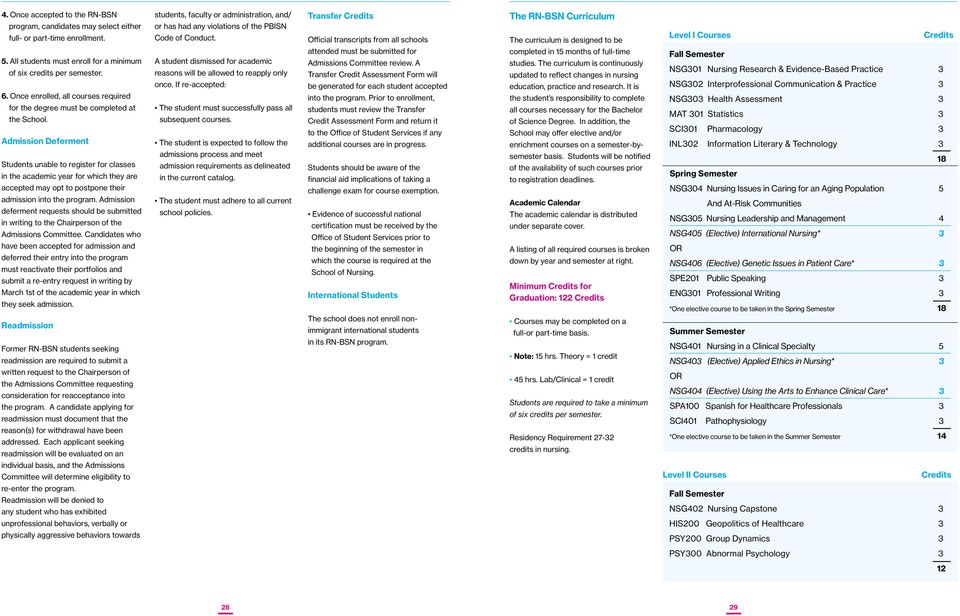
18 Credit for Experience The School will award baccalaureate nursing degree credits for the following national certifications, up to a maximum of five credits. Credits earned by certification are accepted as the N401/401a - Nursing in a Clinical Specialty curriculum requirement. Phillips Beth Israel School of Nursing Evaluating Professional Nursing Experience for Credit Phillips Beth Israel School of Nursing Evaluating Professional Nursing Experience for Credit Group American Board of Perianesthesia Nursing Certification, Inc. ABPANC Comprehensive standardized exam and a minimum of 1,800 hours of direct perianesthesia clinical experience during the two (2) years prior to application. Certification Received Certified Post Anesthesia Nurse (CPAN) Certified Ambulatory Perianesthesia Nurse (CAPA) Credits Awarded Group Academy of Medical-Surgical Nurses Comprehensive standardized exam and a minimum of two calendar years as a registered nurse (RN) in a medical-surgical setting and have accrued a minimum of 2,000 hours within the past three years of practice in a medical-surgical setting. Certification Received Certified Diabetes Educator Credits Awarded American Nurses Credentialing Center Comprehensive standardized exam and a minimum of 2,000 hours of clinical practice in the specialty area of nursing within the last 3 years and two of 2 years full-time as a registered nurse and have completed 30 hours of continuing education in the nursing specialty within the last 3 years. Association of Rehabilitation Nurses Certified Gerontological (ADN) Nurse Psychiatric and Mental Health Nurse Generalist and other certifications that meet similar ANCC requirements AACN Certification Corporation Comprehensive 3 hour exam and requires 1,70 hours in direct bedside care of acutely and/or critically ill patients during the previous two years, with 87 of those hours accrued in the most recent year preceding application. American Association of Diabetes Educators Certification for Adult Critical Care Nurses (CCRN Adult) Certification for Neonatal Critical Care Nurse (CCRN Neonatal) Certification for Pediatric Critical Care Nurses (CCRN Pediatric) Certification for Progressive Care Nurses (PCCN) Comprehensive standardized exam and at least one of the following at the time of application: within the five years preceding the examination, completion of two years of practice as a registered professional nurse in rehabilitation nursing; OR within the five years preceding the examination, completion of one year of practice as a registered professional nurse in rehabilitation nursing and one year of advanced study (beyond baccalaureate) in nursing. National Board for Certification of Hospice and Palliative Nurses Comprehensive standardized exam and at least 2 years of experience (recommended) in hospice and palliative nursing practice Certified Rehabilitation Registered Nurse (CRRN) Certified Hospice and Palliative Nurse (CHPN) Comprehensive standardized examination and minimum of 1 clock hours of continuing education activities applicable to diabetes within the two (2) years prior to applying for certification and a minimum of 1000 hours of DSME experience with a minimum of 40% of those hours (400 hours) accrued in the most recent year preceding application. Certified Diabetes Educator Board of Certification for Emergency Nursing, Emergency Nurses Association Comprehensive standardized exam and two years of experience in emergency nursing Certified Emergency Nurse (CEN) Association of Perioperative Nursing Comprehensive standardized exam and working full-time or part-time in perioperative nursing in the area of nursing education, administration, research or clinical practice and completion of a minimum of 2 years and 2,400 hours of experience in perioperative nursing, with a minimum of 0% (1,200 hours) in the intraoperative setting. Certified Perioperative Registered Nurse National Certification Corporation Comprehensive standardized exam and two years (24 months) of experience comprised of at least 2000 hours of practice time in one of the specialties offered Inpatient Obstetrics Nursing (RNC-OB) Maternal Newborn Nursing (RNC-MNN) Low Risk Neonatal Nursing (RNC-LRN) American Board of Neuroscience Nursing Comprehensive standardized exam and 2 years of full-time (or 4,160 hours) experience in either direct or indirect neuroscience nursing practice during the past years. Certified Neuroscience Registered Nurse Certification (CCRN) Oncology Nursing Certification Corporation Neonatal Intensive Care Nursing (RNC-NIC) American Board for Occupational Health Nurses, Inc. Comprehensive standardized exam and 3,000 hours in occupational health in the past five years; OR a completion of a certificate program in occupational health nursing for academic credit. Occupational Health Nursing Case Management Specialty Extension of the COHN Certification Comprehensive standardized exam and a minimum of one year (12 months) of experience as an RN within the three years (36 months) prior to application, and a minimum of 1,000 hours of adult oncology nursing practice within the two-and-one-half years (30 months) prior to application, and completed a minimum of 10 contact hours of continuing nursing education or an academic elective in oncology nursing within the three years (36 months) prior to application. Oncology Certified Nurse (OCN) Certified Oncology Nurse (CPON) Pediatric Nursing Certification Board Comprehensive standardized exam and 1800 hours of pediatric clinical practice within the past 24 month period in a pediatric nursing specialty Certification in Pediatric Nursing (CPN) 30 31
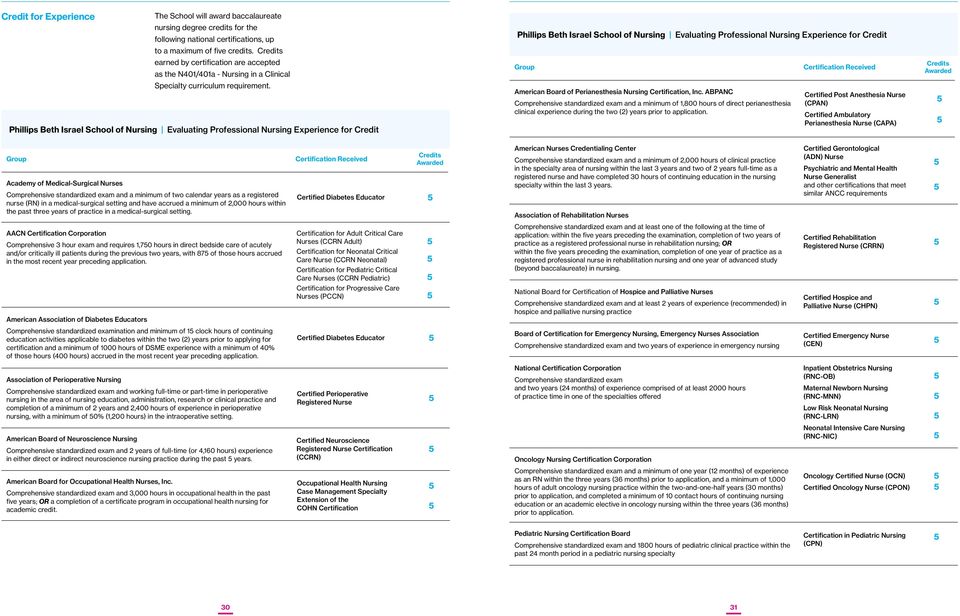
19 Course Descriptions Nursing Courses N301 Nursing Research and Evidenced - based Practice 3 credits (Class - 4 hrs) The steps of the research process are presented to provide students with the basis for evaluating research, designing research projects and the application of research in clinical practice. Legal, ethical and political issues will be discussed as well as an overview of the role of institutional review boards and their role in protecting human participants. Special emphasis will be placed on quality initiatives, patient satisfaction and issues of diversity. Co-requisites: INL302, MAT301 N302 Inter-professional Communication and Practice 3 credits (Class - 4 hrs) The course builds on inter-professional teamwork providing an overview of the history of inter-professional communication and practice from the establishment of the nursing profession to current times. The principles of collaboration, communication, and care coordination are explored in depth. N303 Health Assessment 3 credits (Class - 4 hrs) Students will build on their basic physical assessment skills of adults to learn to conduct a thorough history and physical exam, including recognizing normal variations, common abnormalities and potential problems. Class will be conducted in the nursing skills lab and include lectures, skills demonstration by faculty, and peer skills practice. Readings and audiovisual materials will be assigned to supplement class time. N304 Nursing Issues in Caring for Aging and At-Risk Communities 3 credits (Class - 4 hrs) N304a Nursing Community Practicum 2 credits (Clinical 60 hrs) The course will provide an overview of the aged and other vulnerable residents in the community setting. Emphasis will be placed on identifying challenges within selected at-risk communities to seek methods to overcome such challenges as enhancing health promotion, disease prevention, illness care, restoration, rehabilitation, health counseling, education, spiritual care and client advocacy. The student will assess a community and select an area identified as lacking in resources. Pre-requisites: NSG301, NSG302, NSG303 N30 Nursing Leadership and Management 3 credits (Class - 4 hrs) N30a Nursing Leadership Practicum 1 credit (Clinical 30 hrs) Students will explore theories, models and principles of nursing leadership and management in a variety of settings. The course utilizes Benner s framework of knowledge in comparing and contrasting the functions, responsibilities and expectations of the roles of leader and manager. Emphasis will be placed on professional practice issues, the current healthcare environment, the use of research and evaluation, and legal/ regulatory issues. The clinical practicum experience will provide students with an opportunity to observe, reflect upon, assess and identify specific management/leadership styles and issues. Pre-requisites: NSG301, NSG302, NSG303 N401 Nursing in a Clinical Specialty 3 credits (Class - 4 hrs) N401a Nursing in a Clinical Specialty Practicum 2 credits (Clinical 60 hrs) The course provides an opportunity for students to advance their knowledge and clinical skills in a focused area of specialty- Critical care Nursing, Emergency Nursing and Nursing in Perioperative settings. Students provide direct patient care under the supervision of nurse preceptors who guide their development. Pre-requisites: NSG301, NSG302, NSG303 N402 Nursing Capstone 2 credits Class - 30 hrs N402a Nursing Capstone - Practicum 1 credit (Clinical 30 hrs) The Capstone course requires the student to demonstrate the competencies consistent with the program outcomes. The student will have the opportunity to display his/her knowledge and expertise in selected areas of nursing, including but not limited to specialty clinical nursing practice, nursing leadership, nursing education, and community health nursing. Course requirements will include an evidencebased project that is selected by the student. The completed project will be displayed as a poster presentation followed by a paper describing how the outcomes were attained Pre-requisites: All other nursing courses in the curriculum N403 Applied Ethics in Nursing 3 credits (Class 4 hrs.) Elective Students will expand their knowledge of theories, models and principles of ethical decision making in nursing situations across the lifespan, in a variety of settings. The course utilizes an epistemological framework based on the work of Bayliss Webber that incorporates nursing knowledge, meaning, values, skills, and experience (KMVSE). Selected ethical issues and dilemmas encountered in health care delivery systems and nursing practice will be explored. Pre-requisites: NSG301, NSG302, NSG303 N404 Using the Arts to Enhance Clinical Care 3 credits (Class 4 hrs.) - Elective This course integrates concepts of nursing clinical care with interdisciplinary learning activities in the humanities, developed from the disciplines of history, literature, religion, philosophy, and the fine arts including music, painting, sculpture, drama and film. The course utilizes teaching/ learning strategies and evaluation methods to hone reflective/ observational abilities of the student. It also allows student translation of their reflective and critical thinking abilities into sensitivity to patient concerns and enhanced clinical skills. Pre-requisites: NSG301, NSG302, NSG303 N40 International Nursing 3 credits (Class 4 hrs.) - Elective The course provides advanced theories and principles related to the delivery of nursing care in selected global settings and/or with selected patient populations. The student will gain an overview of global health in preparation to practice in a variety of settings. An overview of strategies that promote the health of nations will be examined including infectious diseases, chronic diseases, and the complex factors that affect the health of countries such as healthcare delivery systems, war, religion, politics, culture, and the environment. Pre-requisites: NSG301, NSG302, NSG303 N406 Genetic Issues in Patient Care 3 credits (Class 4 hrs.) - Elective This course introduces the student to advances in the field of genetics and genomics and the application and impact of these advances to patient care. Since many options for patient care now include genetics (the study of individual genes) and genomics (the study of all the genes in the human genome) information, the course will focus on the application of these for disease prevention, screening, diagnosis, selection of treatment, and monitoring of treatment effectiveness. The student will research anticipated future findings and its expected impact on patient care. Pre-requisites: NSG301, NSG302, NSG
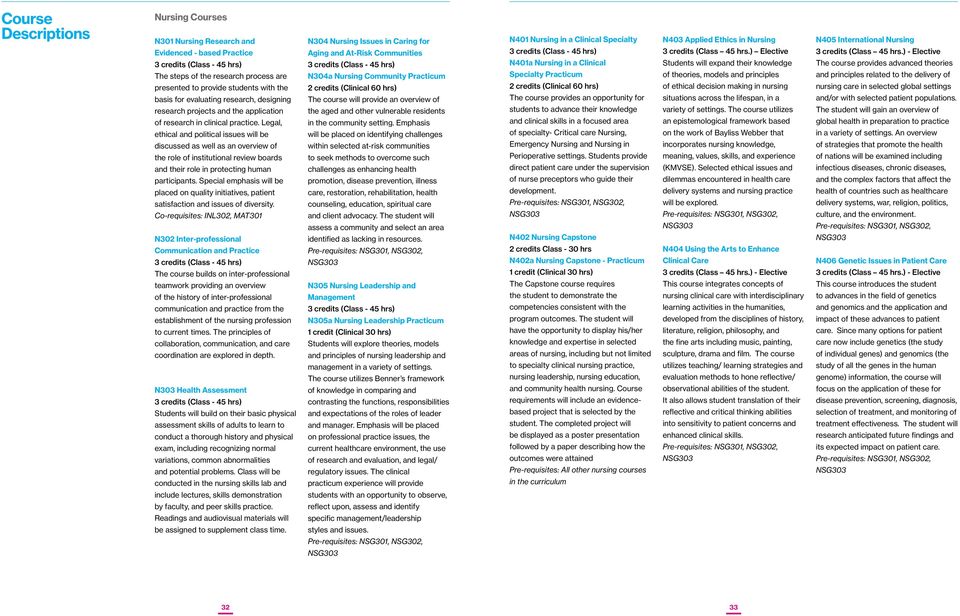
20 Liberal Arts & Science Courses ENG301 Professional Writing 3 credits (Class - 4 hrs) This foundation course will fine-tune the nurses basic writing skills and prepare them for the types of writing necessary for registered nurses. Writing as both a conceptual activity and a mechanical act will be jointly addressed. HIS200 Geopolitics of Healthcare 3 credits (Class - 4 hrs) This course examines the social, political, historical and economic events that have shaped healthcare from the late 1800 s to the present in this country and internationally. It addresses the connections between a society s wellness (its physical, emotional, mental, spiritual, interpersonal and environmental state of being) and its ability to function and coexist amicably with other global citizens. INL302 Information Literacy and Technology 3 credits (Class - 4 hrs) This course provides an overview of information literacy and explores the principles of fundamental research, evidence-based nursing practice and proper usage of appropriate citation style, as skills to be utilized by nurses. Information literacy skills will be integrated with strategic searching, evaluative research and communication endeavors. Co-requisite: NSG301 MAT301 Statistics 3 credits (Class - 4 hrs) This foundation course aims to equip students with the basic knowledge of the principles of statistical analysis. The concepts of data analysis including probability, hypothesis testing and regression intervals will be explored. Students will utilize these concepts to master statistical problems related to healthcare policy, genetics, bioinformatics and other related topics. Co-requisite: NSG301 PSY200 Group Dynamics 3 credits (Class - 4 hrs) This course provides an overview of the group dynamics inherent in small group interactions. Didactic and experiential techniques are used to explore the stages of group development, decisionmaking techniques, group problems and problem-solving, resolution skills, group norms, structures, leadership authority, cultural sensitivity and the intra- and interpersonal dynamics that occur within small groups. PSY300 Abnormal Psychology 3 credits (Class - 4 hrs) This course provides an overview of various forms of psychopathology, including addictive, anxiety, childhood, dissociative, impulse control, mood, organic, personality, psychophysiological, schizophrenic and sexual disorders. Based on a review of contemporary research findings, discussion will focus on relevant theories and approaches for understanding, diagnosing and treating psychological disorders. SCI301 Pharmacology 3 credits (Class - 4 hrs) General principles of pharmacology, mechanisms of drug actions, biotransformation, drug characteristics and interactions are discussed. Major classifications of drugs are presented in relation to therapeutic use. SCI401 Pathophysiology 3 credits (Class - 4 hrs) This course focuses on the physiologic changes that participate in disease production. These alterations are examined at the cellular, organic and systemic levels. Emphasis is placed on the body s attempt to compensate for these changes. SPE201 Public Speaking 3 credits (Class - 4 hrs) This course focuses on the development of public speaking skills in general with an emphasis on conducting presentations in the healthcare setting. Students will strengthen their abilities in speaking in front of a group and learn how to tailor their oral message for different audiences. Issues related to the delivery of speech, such as pitch, articulation, pauses, and volume will be highlighted. Non-verbal communication, clarity, repetition, and simplicity of expression will also be incorporated. SPA100 Spanish for Healthcare Professionals 3 credits (Class - 4 hrs) This course empowers nursing students with Spanish literacy skills so that they may communicate with Spanishspeaking patients, their families, and other healthcare providers. Organized by medical systems addressing patients chief complaints, the course content will integrate Spanish grammar and vocabulary knowledge into communicatively-focused activities. The stress, intonation, rhythm, and articulation patters of Spanish will also be highlighted. Tuitions, Fees and Financial Aid 34 3
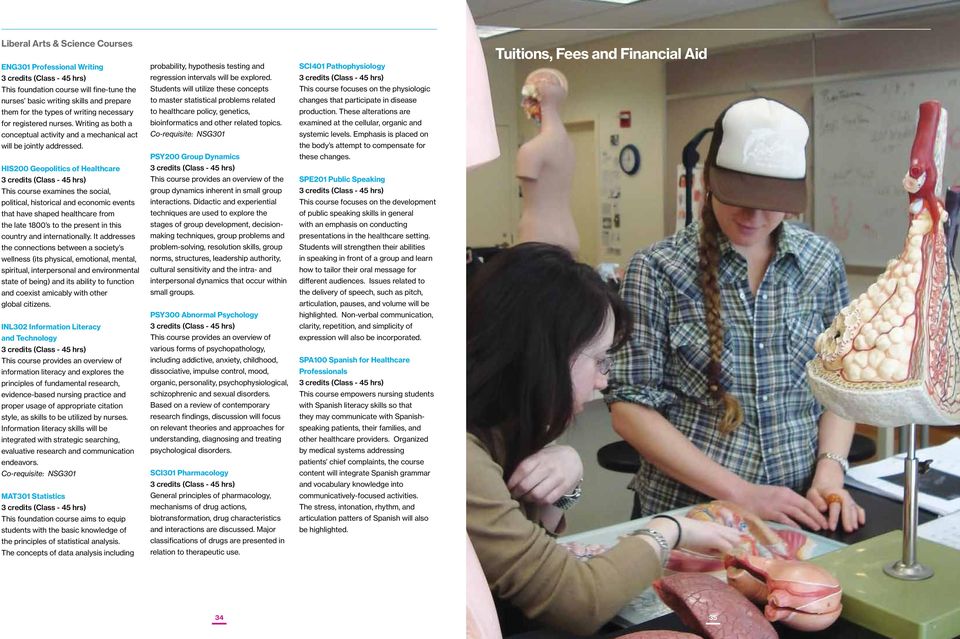
21 Tuition and Fees AAS Program RN-BSN Program Tuiton and Fees Academic Year Tuiton and Fees Academic Year Year 1 1st Semester 2nd Semester 3rd Semester Year 1 1st Semester 2nd Semester Additional Fees Tuition ($00/Credit) 17 $00/Credit = $8,00 17 $00/Credit = $8,00 7 $00/Credit = $3,00 Tuition 18 $0/Credit = $9, $0/Credit = $9,900 Tuition/Late Fee $0/month Science Lab Fee $00 $00 $00 Nursing Lab Fee $0 (N303) Transcript $ Nursing Lab Fee $00 $00 Student Activities Fees* $00 $00 Makeup/Retake Written Exam* $7 Online Learning Systems $100 $100 $100 Health Service Fee $420 Makeup/Lab Practical* $7 Student Activities Fees* $200 $200 Health Service Fee $420 $10,200 $9,800 $4,100 Year 1 Total $10,970 $10,000 Clinical Makeup $10 $20,970 Year 1 Total $24,120 Year 2 1st Semester 2nd Semester Additional Fees Year 2 1st Semester 2nd Semester Additional Fees Tuition ($00/Credit) 14 $0/Credit = $7, $0/Credit = $6,600 Challenge Exam $7 Tuition ($00/Credit) 14 $00/Credit = $7,000 Nursing Lab Fee $00 $00 Online Learning Systems $10 $10 Student Activities Fees* $200 $200 Health Service Fee $37 NCLEX Review Course Included in online learning system fee Senior Fees $20 $20 Year 2 Total $8,47 $7,600 $16,07 Grand Total (2 Years) $40,19 13 $00/Credit = $6,00 Tuition Late Fee $0/month Course Add/Drop (after 1st wk.) - $2 Makeup/Retake Written Exam - $7 (Mandatory) Makeup/Lab Practical Exam - $7 (Mandatory) Clinical Makeup- $10 Transcript $ Challenge Exam- $7 Course Audit - 0% of Lecture Credit *Includes $30 membership fee to the National Student Nurses Association (NSNA) A 10% discount for tuition and fees is offered to Mt. Sinai Health System employees and their children (must be employed at the time of admissiondocumentation of relationship required). Nursing Lab Fee $0 (N401) Student Activities Fees* $100 $100 Health Service Fee $37 Senior Fees $20 $20 Year 2 Total $8,97 $6,90 Year 2 Total Grand Total $1,92 Course Audit: 0% of Lecture Credit Course Add/Drop (after 1st week): $2 $36,89 Note: 10% discount if PBISN alum or Mt. Sinai Health System employee * Students who have missed an exam, and are permitted to take a makeup exam at the discretion of faculty, will pay a $7 fee (mandatory)
22 Financial Aid Federal School Code: State School Code: 004 Average Costs for an Independent, First-year, Full-time AAS Student: Tuition and Fees: $24,120 Books & Supplies: 2,60 Room & Board: 22,00 Transportation & Other Expenses: 12,30 $9,780 Average Costs for an Independent, First-year, Full-time RN-BSN Student: Tuition and Fees: $20,970 Books & Supplies: 2,60 Room & Board: 22,00 Transportation & Other Expenses: 12,30 $4,620 Phillips Beth Israel School of Nursing offers a comprehensive financial aid program for eligible students. Financial aid is available in the form of scholarships, grants and loans. The basic premise in student financial aid is that the primary responsibility for meeting educational costs rests with the student and the student s family. The School ensures that all regulations and requirements pertaining to Title IV Federal Family Education Loan and Federal and State Grant programs are rigorously followed. The School regularly refers to reference materials from the U.S. Department of Education, the Higher Education Services Corporation and their web sites in order to ascertain that the procedures implemented satisfy program requirements. Financial Aid Eligibility To determine eligibility for financial aid, the Financial Aid Officer evaluates student data from the Free Application for Federal Student Aid (FAFSA). Federal regulations are followed to award students any aid. All appropriate verification rules and data match issues must be resolved before awarding any aid. All records are reviewed for any conflicting data and the appropriate corrections are made to the student s record to ensure an accurate Estimated Family Contribution (EFC). Needs analysis and determination of eligibility for funds are performed so that the packaging of student aid will be consistent with Federal and State regulations. Financial assistance is awarded to students at Phillips Beth Israel School of Nursing based on demonstrated financial need and/or academic ability. Students who apply by the application filing date, and who demonstrate the highest financial need, are awarded aid before those with less need. Need is determined through the use of Federal methodology calculations, which are based on data submitted by the student on his/her Free Application for Federal Student Aid. Since funds are limited, financial aid may not be available to students whose applications are received after the filing deadline. How to Apply or Renew Your Financial Aid To be awarded financial aid at PBISN, you must complete your financial aid application by the required due dates below. Your application will be processed ONLY if all required documents are received by the deadline dates. If your application is not completed by the required deadline dates, your request for aid will be rejected. If your request for aid is rejected, you will be responsible for payment of tuition and fees in full on or before the first day of class. Please note that a Deferred Payment Plan may be arranged with the Bursar s Office. After the required arrangements for payment have been made, you may appeal your request for financial aid. Upon review of the appeal, you may be eligible for adjustments and/or refunds. Detailed information on all financial aid programs is available from the Office of Financial Aid on the 4th Floor. The School is not responsible for any changes in financial aid programs, eligibility or application processes made as a result of changes in legislation. In order for the Office of Financial Aid to process an application for aid, the following steps must be completed: 1. Students, parents, and borrowers are required to use an FSA ID, made up of a username and password, to ascertain U.S. Department of Education websites. Your FSA ID is used to confirm your identity when accessing your financial aid information and electronically signing your federal student aid documents. Login to StudentAid.gov to create an FSA ID. 2. Complete the Free Application for Federal Student Aid (FAFSA) at The FAFSA is required for the Federal and State grant application, including PELL, SEOG, FWS, TAP, APTS, Direct Loan Program, Direct Plus Loan Program, Nursing Loan Program and Phillips Beth Israel School of Nursing Scholarships Programs. If you are a New York State resident, you will be linked from the online FAFSA to the New York TAP application or you can access the application online at 3. Check for your Student Aid Report (SAR). If you provided an address on your FAFSA, your SAR will be sent electronically within five days. Without an address, a paper SAR will be mailed to you. Review the results for accuracy and make any corrections to 4. Check periodically for materials sent to you by the Financial Aid Office. Complete all forms and provide all information requested by the Financial Aid Office. If requested information is not received, then your financial aid application will not be processed; therefore not eligible for any type of aid. Award Notifications/Loan Processes. The Financial Aid Office will process a student award package only when a student s file is complete and accurate. Students are awarded federal and state grants, and school scholarships based on eligibility and the availability of funds. Students will be notified of awards by mail. If a student is awarded money that he/she wishes to refuse, the Financial Aid Office should be contacted immediately.. Complete the Direct Loans process (You may skip this step if you do not plan to apply for loans). If you plan to borrow a Federal Direct Loan or a PLUS loan, go to Students must complete the entrance counseling and a multi-year MPN for Direct subsidized/unsubsidized loans. Parents must complete an e-mpn for PLUS loan. Students who anticipate difficulties paying their tuition or financing other educational needs are encouraged to meet with the Assistant Dean and/or Director of Financial Aid prior to the beginning of the semester. Financial aid in the form of institutional scholarships, Federal Pell Grants and Federal Nursing Loans, will be applied directly to the student s tuition account. The Direct Loan and Plus Loan are disbursed to the School in the form of electronic fund transfer and is applied directly to the student s tuition account. If financial aid is in excess of tuition due, a tuition credit payment will be made within 14 days to the student on a semester-by-semester basis. When this occurs, students are required to complete a Credit Balance Authorization Form with the Bursar s Office. Please refer to the Table for Financial Aid Application & Tuition Payment Deadlines for Academic Year
23 Financial Aid Deadlines Deadline Dates After January 1, but before May 1 June 1 June 11 July 1 August 20 September 1 September 24 October 1 October 22 November 1 November 19 December 17 January 21 February 18 March 18 April 22 May 20 Notification Complete the FAFSA (Free Application for Federal Student Aid). Complete the FAFSA online at: The Priority Processing Deadline for Returning Students to complete the FAFSA and submit all required documents for the Summer II and Fall semester. Tuition for Summer II Term Due in Full. State Deadline for Returning students applying for State Aid (TAP/ APTS) for Fall and Spring terms. Tuition for Fall Term Due in Full. If Financial Aid Applications are not completed by August 1 (for new and returning students), tuition must be paid in full by this date before classes start. Payment arrangements are available; see bursar s office. Deadline for New Students to complete the FAFSA and submit all required documents for Fall and Spring semester. Priority Award Processing for New Students for Fall and Spring who completed the FAFSA and submitted all required documents by this date. Priority is given to registered students. Second Deferred Payment for Fall Term Due Due Date for New Students applying for state aid for Fall and Spring semesters. Deadline for Spring Enrollment. Students to apply for Financial Aid for Spring and Summer semesters. Complete the FAFSA online at Third Deferred Payment for Fall Term Due Deadline for Spring Enrollment. Students to complete the FAFSA and submit all required documents for Spring and Summer semesters. Final Deferred Payment for Fall Term. All tuition due must be paid in full by this date. Last Day to apply for Student Loans for Fall Term. Tuition for Spring Term Due in Full. If Financial Aid Applications are not completed by November 1 (for all returning students and Spring enrollment students), tuition must be paid in full by this date before classes start. Payment arrangements are available; see bursar s office. Second Deferred Payment for Spring Term Due Third Deferred Payment for Spring Term Due. Deadline for Spring Enrollment. Students to Apply for State Aid (TAP/ APTS) for the Spring Semester. Final Deferred Payment for Spring Term. All tuition due must be paid in full by this date. Last Day to apply for Student Loans for Spring and Summer Semesters. Summer I Term Tuition Due Payment arrangements are available; see bursar s office. Summer I Term Deferred Tuition Due in Full. General Eligibility Requirements for Financial Aid In general, to be considered for financial aid at Phillips Beth Israel School of Nursing, a student must be: 1. Enrolled for at least 6 credits (for spring and fall semesters); 2. in good academic standing and making satisfactory progress toward degree requirements; and 3. a U.S. Citizen or permanent resident with appropriate documentation for federal and state aid. Eligibility for federal and state student aid is based on financial need. Need is defined as the difference between the cost of attendance and the student s (and/or parents ) expected family contribution (EFC). The cost of attendance will include tuition, fees, rent, board, books, travel, personal expenses, and an allowance for dependent care, if applicable. The student s (and/ or parents ) contribution includes an expectation from the student s (and/ or parents ) income and assets that a student (and/or parent) may have as determined by the FAFSA, as well as a consideration of the number of household members and the number attending college at least half-time. The school has the final determination of need and determines actual awards from federal, state, private, and school resources. Types of Aid The Office of Financial Aid is available to help students who require financial assistance to complete their nursing education. The office will provide personal and confidential counseling and assist students in completing applications for financial aid programs. Financial aid data is available upon request; more specific information and applications are sent after acceptance into the program. Financial Aid available to students is listed in the following pages. June 30 End of the Academic Year
24 1. Federal Government Education Assistance Programs A. Federal Pell Grant 1. Apply by filing the FAFSA online at and the Institutional Aid Application. 2. Eligibility is based on student s financial need and is determined by using a Federal formula that evaluates the information reported on the FAFSA. The formula produces an Expected Family Contribution (EFC) which determines the amount of the award. 3. Available only to undergraduates: Students who hold a Bachelor s degree or higher (or its equivalent from another country) are ineligible. 4. $,77.00 is the expected maximum award for the academic year. B. FSEOG 1. Must complete a FAFSA. 2. FSEOG (Federal Supplemental Educational Opportunity Grant) eligibility is based on student s financial need and is available to Federal Pell Grant recipients only. 3. The average award ranges between $12.00 and $20.00 for the academic year. C. Federal Nursing Loan (NSL) (AAS Students only) 1. Must complete a FAFSA. 2. Eligibility is based on financial need. 3. Loans generally range from $1, to no more than $2, per academic year depending upon program funding. Present interest rate is %. 4. Repayment begins 9 months after graduation or when the student ceases to be enrolled at least half-time. The maximum repayment period is ten years. A student who receives a Federal Nursing Loan is required to complete a Nursing Loan Master Promissory Note and an Entrance Interview before the loan is disbursed; as well as an Exit Interview before the student graduates or leaves school. The Entrance and Exit Counseling can be accessed online at: Download the NSL Request Form and NSL Master Promissory Note and return to Financial Aid Office for processing request. D. Direct Loans and PLUS (Parent) Loan 1. Completion of a FAFSA and the Institutional Loan Request Form is required by the Financial Aid Office; a Master Promissory Note and Direct Loan Entrance Counseling session is required to be filed on-line at NOTE: Parents must complete a PLUS Master Promissory Note (MPN) for each PLUS loan borrowed. 2. The Direct Subsidized Loan is awarded based on financial need. No interest is charged during the in-school period and grace period because the federal government subsidizes the interest during these periods. 3. The Direct Unsubsidized Loan is not based on need and is available to all students regardless of income. Interest will be charged from the time the loan is disbursed until it is paid in full. Payment may be deferred, but interest will accumulate during in-school attendance or during other periods of non-payment. Payment will be capitalized, meaning that interest will be added to the principle amount and then additional interest will be based on that higher principle amount. 4. The annual loan limits for undergraduates are based on grade level and dependency status. A borrower who has reached his/her aggregate loan limit is not allowed to receive additional loan monies. (See attached Loan Limit Chart).. Direct Subsidized Loans: You won t be charged interest while you re enrolled in school at least half time. Interest will begin to accumulate at the beginning of the grace period or when you cease to be enrolled at PBISN at least half time or enter repayment. 6. Direct Unsubsidized loans: You ll be charged interest from the day the loan is disbursed and until it is paid in full, including during in-school, grace, and deferment periods. You can pay interest during these periods or it can be capitalized. 7. The PLUS (Parent) Loan is available for parents to help pay for their dependent children s education. These loans are not based on need, and eligibility is the student s Cost of Attendance minus other aid. 8. A parent with an adverse credit history is not qualified to get a PLUS loan. In this case, the dependent student is allowed to borrow additional monies from the Direct Unsubsidized Loan program for up to $6, There will an origination fee on Direct Loans and PLUS Loans deducted by the federal government when the loan amount is disbursed to the school. 10. Repayment of the Direct Loan generally begins six months from the time the student has graduated, left school or dropped below six credits.the PLUS Loan must generally be repaid within sixty days after disbursement. 11. Download Direct Loan or PLUS Loan Request Form(s) and return to Financial Aid Office for processing request. The following charts illustrate government loan borrowing limits for students and their parents. Stafford Loan Limits (Dependent Undergraduate Students) School Year Annual Loan Limits Aggregate Loan Limits AAS Freshman AAS Sophomore BSN Junior $,00 ($3,00 between base subsidized and unsubsidized, plus an additional $2,000 unsubsidized) $6,00 ($4,00 between base subsidized and unsubsidized, plus an additional $2,000 unsubsidized) $7,00 ($,00 between base subsidized and unsubsidized, plus an additional $2,000 unsubsidized) Stafford Loan Limits (Independent Undergraduate and Graduate Students) $31,000 (up to $23,000 may be subsidized) $31,000 (up to $23,000 may be subsidized) $31,000 (up to $23,000 may be subsidized) School Year Annual Loan Limits Aggregate Loan Limits AAS Freshman AAS Sophomore BSN Junior BSN Senior Parent PLUS Loan Limits $9,00 ($3,00 between base subsidized and unsubsidized, plus an additional $6,000 unsubsidized) $10,00 ($4,00 between base subsidized and unsubsidized, plus an additional $6,000 unsubsidized) $11,00 ($,00 between base subsidized and unsubsidized, plus an additional $6,000 unsubsidized) $12,00 ($,00 between base subsidized and unsubsidized, plus an additional $7,000 unsubsidized) $7,00 (including $23,000 base subsidized and unsubsidized) $7,00 (including $23,000 base subsidized and unsubsidized) $7,00 (including $23,000 base subsidized and unsubsidized) $7,00 (including $23,000 base subsidized and unsubsidized) School Year Annual Loan Limits Aggregate Loan Limits Undergraduate Cost of attendance minus other financial aid, per dependent student None 42 43
25 2. New York State Financial Aid Assistance Programs 3. Phillips Beth Israel School of Nursing (PBISN) Scholarships 4. Important Points to Remember. Tuition Payment Procedures A. Tuition Assistance Program (TAP) 1. Eligibility is based on student s (and/ or spouse/parents ) 2014 New York State Net Taxable Income from the New York State Income Tax Return. 2. The TAP application process begins with the Free Application for Federal Student Aid (FAFSA). HESC will use the FAFSA as part of your online TAP application; or complete your online TAP application at 3. The student must be a New York State resident who is enrolled for a minimum of 12 credits per semester (full-time status). 4. The maximum TAP award is $,16 for the academic year. B. Aid for Part Time Study- (APTS) 1. Eligibility is based on student s (and/or spouse/parents ) 2014 New York State Net Taxable Income from the New York State Income Tax Return. 2. Must Complete FAFSA and TAP application; and a separate APTS application must be completed for APTS eligibility. Download the APTS Application Forms and return to Financial Aid Office for processing request. 3. The student must be a New York State resident who is enrolled for 6-11 credits per semester. 4. The award ranges between $20 to $1,000 per semester. Maximum award per year is $2,000. There are a number of institutional scholarships available at PBISN. These include, but are not limited to: a General Scholarship based on academic achievement and/or financial need to help meet the costs of tuition and fees; The PVH Foundation Scholarship, which features full reimbursement for nursing courses; and the Sidney and Loretta Teich Foundation Scholarship offered to minority students with substantial financial need. A packet of Institutional Scholarship Applications is sent to new and returning students during the summer. For those students who are employees of the New York City Police or the Fire Department, scholarships of $2,000 per academic year are available. Eligibility criteria must be documented and met before these scholarships are awarded. Employees of the Mt. Sinai Health System and their immediate family (spouse or children) are entitled to a 10% tuition discount upon submission of appropriate documentation (e.g., work ID or a letter from department/human resources). Local Programs such as Local 1199 Training and Upgrading Fund Institutional Emergency Grant Fund Funds may be provided for the purpose of offsetting educational related emergency needs. However, those funds may not be used for payment of tuition or school fees. 1. Fill out each form in its entirety, according to the instructions provided. 2. Always keep copies of all forms/ documents for your record. 3. After filing, any change or special conditions that significantly affect your financial situation should be communicated to the Financial Aid Office in writing as soon as possible. 4. Each semester, you will receive a tuition bill reflecting the amount owed to the school after all financial aid awards have been deducted. Failure to pay tuition may result in REMOVAL FROM CLASSES. Tuition bills are mailed to students approximately one month prior to the beginning of each semester. Appropriate tuition and fees are expected to be paid in full prior to the beginning of each semester, unless other arrangements have been made. Tuition and all other fees are to be paid to the Office of Financial Aid on the 4th Floor. Tuition may be processed by personal check, money order, bank cashier s check, or credit card (Master Card, Visa, American Express or Discover). A late fee of $3.00 is charged for bills not paid on or before the due date on the bill. 1. Full payment this is the regular and preferred payment option. 2. Deferred Payment Plan Deferred payment arrangements must be made with the bursar s office one week prior to the start of classes. A one-time fee of $2 is charged to set-up a deferred payment plan. A $0 late fee is charged for EACH installment paid after the due date. 3. A minimum payment of at least one third of tuition & fees is required on or before the start of classes. The tuition balance will be deferred and payable in installments determined by the school. All financial aid paperwork, including loan applications, must be approved before the start of each semester. If financial aid does not cover the tuition charges in full, the student may combine above options to complete the payment obligation. Veteran Benefits The School is approved for training in accordance with the provision of Section 177, Title 38, U.S. Code. Contact the Veterans Administration directly for specifics on individual qualifications. 44 4
26 Cancellation of Classes for Non-Payment In accordance with State law, payment for tuition and fees is due prior to the start of the term. Students registering in the billing period must pay tuition and fees or defer their bill by signing a Deferred Payment Agreement with the Bursar s Office. Accounts not paid or deferred by the due date may result in cancellation of registration. Past due prior term balances cannot be deferred or paid with financial aid for future terms. Students whose schedules are canceled may find it difficult or impossible to reregister for the same courses because their seats may have been taken by students on wait lists. Students who register after the billing period and students who have been cancelled who were originally registered during the early registration process must pay estimated tuition and fees or provide proof that they are financial aid recipients prior to being able to access registration. Credit Balances Financial Aid Refunds: Refunds of credit balances caused by financial aid exceeding student account charges will be refunded to the student by check. When the refund check is ready at the Bursar s Office, an notification will be sent to the student to pick up any refunds at the Bursar s Office. Refund checks cannot be disbursed until the first day of classes for the semester. Once the semester has begun, refund checks are usually available ten business days after the aid is placed on the student account. Credit balances resulting from surplus financial aid funds may be transferred to a future or prior semester balance with the completion of a Credit Balance Authorization Form. Parent Plus Loans: Refunds of credit balances caused by parent plus loans exceeding student account charges will be refunded to the parent by check mailed to the address provided by the parent. If the student wishes to pickup the Plus Loan refund check, the borrower must notify the Bursar s Office in writing. Non-Financial Aid Refunds: If a student account has a credit balance for reasons other than financial aid, the refund will not be generated until after the Add/ Drop period for the semester. This includes overpayments where personal payments combined with financial aid exceed the balance, credit balances due to dropped classes, and other overpayments. In most cases, credit balances are refunded directly to the student. However some exceptions apply, for example when the credit is due to a potential over-award of financial aid, the credit may be held until the Office of Scholarships and Student Aid has reviewed the account. If financial aid is determined to exceed the federal definition of need, the over-award will be refunded to the appropriate financial aid fund. In the case of posting errors, the Financial Aid Office will reverse the error. Otherwise, students may request that credit balances on their accounts be refunded to them or transferred to another semester with completion of a Credit Balance Authorization Form. Holds/Stops/Financial Clear Holds The Office of Student Accounts places holds on student accounts when they become past due. Holds are also placed on accounts of students scheduled to graduate to alert them to resolve any debts before graduation. These holds prevent registration and receipt of transcripts and diplomas. The past due amount (or amount due for those scheduled to graduate) must be paid in full for the hold to be lifted. Financial Clear Holds preventing registration are placed on the term record of students who will be registering for classes in the billing period of that term. Financial Clear Holds are manually lifted when the student prepays. Returned Check Fee Any payments returned by the payer s bank because of insufficient funds are subject to a $3.00 returned payment fee. In addition, a hold restricting registration and the receipt of diplomas and transcripts will be placed on the account. This hold will not be released until the returned payment is repaid. PBISN reserves the right to observe a 30 day waiting period to ensure that any replacement payment clears. For immediate release of the hold, payment must be made by money order, certified check, or credit card. No cash will be accepted for payments. Delinquent Payment of Tuition Unpaid balances at the end of each semester may become interest bearing at the rate of 10% per annum. Interest on the outstanding balance may be computed and added monthly to the amount due. However, if the balance is outstanding for more than 180 days, the interest rate may escalate to 1% per annum. If it becomes necessary for the PBISN to seek collection help and/ or initiate legal proceedings to collect unpaid accounts, the student may be responsible for all legal fees incurred. Other Expenses Students are responsible for all expenses related to travel to and from assigned clinical sites. Students must also budget money for housing, meals, textbooks and supplies, uniforms, and personal expenses. Satisfactory Academic Progress Federal Regulations require that students must meet certain academic criteria to continue receiving financial aid. Students are reviewed at the end of the spring semester. For certain cases students not meeting the standard may be given a one term financial aid probation semester and receive aid. If the standard is not met at the end of that term no further aid will be awarded. Students should contact the Financial Aid Office for full details of the standard. Clear Holds are manually lifted when the student prepays. The charts below delineate the school s standards of satisfactory academic progress for the AAS Program and the RN-BSN Program for the purpose of determining eligibility for financial aid: AAS Program AAS Full Time Students To be eligible for financial aid At the completion of the semester, a full-time student taking all courses must have accrued at least this many credits With at least this cumulative grade point average First Year/Semester 1st 2nd 3rd 1st 2nd Second Year/Semester Part-time, including three-year option students, must adhere to the following satisfactory academic progress guidelines: AAS Part Time Students To be eligible for financial aid At the completion of the semester, a part-time student should accrue at least this many credits: With at least this cumulative grade point average RN-BSN Program RS-BSN Full Time Students To be eligible for financial aid At the completion of the semester, a full-time student taking all courses must have accrued at least this many credits With at least this cumulative grade point average First Year/ Semester Second Year/ Semester Third Year/ Semester 1st 2nd 3rd 1st 2nd 3rd 1st 2nd First Year/Semester 1st 2nd 1st 2nd Second Year/Semester Part-time students must enroll for a minimum of six credits and must adhere to the following satisfactory academic progress guidelines. Students are expected to maintain a minimum of 2.00 GPA at the completion of each semester of attendance
27 Withdrawals and/or Grades of Incomplete Students who withdraw from courses may impact their financial aid awards. Any student who totally withdraws and receives aid is subject to a different refund calculation. Students withdrawing from the School are required to file notice in writing with the Office of Student Services. The amount of tuition to be refunded will be determined based on the date notification of withdrawal is received. If a student withdraws from a course or receives a grade of Incomplete, that student will still be expected to adhere to the quantitative and qualitative standards of the satisfactory academic progress policy stated above. Maximum Time Frame to Complete the Program The student must complete the program within a time frame that does not exceed 10 percent of the published length of the program for full-time students. For example, a two-year option student with no transfer credits would normally complete the program by taking 68 credits. If unusual circumstances arise that force the student to transfer to the three-year option or to take an approved leave of absence, that student s aggregate credit total may not exceed 102 credits in order for that student to maintain satisfactory academic progress and receive financial aid. This standard includes all periods of enrollment, even those for which the student does not receive aid from the Title IV program. Waivers for Special Circumstances If a student does not meet the School s standard for satisfactory academic progress, he/she may not receive further financial aid. In cases of extenuating circumstances, the School may waive the satisfactory progress requirement, consistent with federal and state regulations. Appeal Process A student may appeal a financial aid decision by submitting a letter to the Director of Financial Aid. Decisions will be made on a case-by-case basis, and the student will receive the decision in writing, within ten working days following submission of the letter of appeal. Reinstatement of Aid If a student initially fails to make satisfactory progress but later meets the standards, his or her eligibility for aid will be reinstated for the semester in which he or she regains satisfactory progress. If a student is dismissed from the program for failure to maintain satisfactory progress, the sole means to reestablish eligibility for financial aid is to be readmitted to the School. Necessity for Repaying Loans Students are obligated to repay the full amount of their loan(s) even if they: (a) do not complete the program, (b) are unable to find subsequent employment or, (c) are otherwise dissatisfied with the education acquired from the School. The School will process any Direct Loan program chosen by students. When students borrow money from the Direct Loan Program, they are required to repay that amount plus interest. Repayment will begin six months after graduation or immediately if the student fails to maintain a minimum half-time course load. Entrance and exit counseling services are required for students to receive their loans and to facilitate debt management. A hold will be placed on a student s academic transcript, if that student fails to complete the Exit Interview Process or has a balance due in his or her tuition and fees account. Tuition Refund Policy Any student who withdraws during the semester is liable for all tuition charges and fees. Students who withdraw from courses may be entitled to a refund. The official date of withdrawal determines the refund based upon a pro rata refund policy consistent with federal regulations. Actual days of attendance are utilized in calculating the pro rata refund. If the student receives less Title IV aid than the amount earned, the School will make a disbursement to the student of the earned aid that was not received (post withdrawal disbursement). If. however, the student receives more Title IV aid than the amount earned, the School, the student, or both must return the unearned funds in the following order: 1. Unsubsidized Federal Stafford Loan Program 2. Subsidized Federal Stafford Loan Program 3. Federal PLUS Loan Program 4. Federal Pell Grant Program (for which a return of funds is required). Any other Title IV Program Students are expected to withdraw officially, in writing. Students who fail to notify the school and thus unofficially withdraw, and whose withdrawal date cannot be ascertained, will be considered withdrawn effective on the midpoint day of the semester in question. This policy is consistent with federal regulations, effective October 7, Further information relative to the School s official withdrawal policy can be found in the Academic Policies section of this catalog. Tuition Liability Schedule for Fall and Spring Sessions: Time of Withdrawal % of Refund Prior to First scheduled class 100% Prior to Second week of class 80% Prior to Third week of class 70% Prior to Fourth week of class 2% Prior to Fifth week of class 20% During or after th week of class 0% Tuition Liability Schedule for Summer Session: Time of Withdrawal % of Refund Prior to First scheduled class 100% Prior to Third day of class 90% Prior to Eighth day of class 0% Prior to Ninth day of class 2% During or after Tenth day of class 0% 48 49
28 Health Requirements A physical examination will be performed at Mt. Sinai Beth Israel prior to enrollment and each year the student is in attendance at the School. Accepted students will receive a Comprehensive Packet of Information regarding health requirements. In addition, applicants must present evidence of all required immunizations or receive the needed vaccines. The annual health service fee includes the cost of any required immunizations through the Department of Occupational Medicine and enrollment in the Student Health Services Network. The correction or stabilization of any existing physical condition requiring professional attention is the responsibility of the applicant and must be effected prior to enrollment. Please Note: Students will not be allowed to attend clinical experiences or classes unless all health requirements are met. Also, students absent due to illness more than three consecutive days must be cleared by Employee Health Services prior to returning to class/clinical. Health Insurance Students are responsible for securing and maintaining their own health insurance to cover them for medical, emergency and hospital care. Reduced rate coverage is available through the National Student Nurses Association (NSNA) to its members. New York University s College of Dentistry Kriser Dental Center also offers a limited dental plan to students (contact [212] for details). The Student Health Services Network provides: Vaccinations and screenings for immunity Acute injury/illness care for candidates, such as cold, cough, flu, and sprains/strains Wellness and health education Preventative medicine Referrals, alcohol and substance abuse counseling A discount prescription program at Duane Reade pharmacies Confidentiality The Student Health Services Network is located at Mt. Sinai Beth Israel, 317 East 17th Street, 2nd Floor (between 1st and 2nd Avenues). You may call them toll free at (877) or (212) Hours of operation are: Monday to Friday 8:00 am to 11:30 am and 1:00 pm to 4:00 pm. Immunization Against Influenza All students must be vaccinated against influenza unless a student submits medical documentation of allergy to components of the vaccine or other medical contraindication to the vaccine. Students may be vaccinated in Mt. Sinai Beth Israel Employee Health Services or by their private physician (documentation is required). A sticker will be placed on the student s photo ID indicating such vaccination. Those students with medical contraindication to the vaccine are required to wear a mask in the clinical areas. Those students who have not received an influenza vaccine by October 31st of each academic year, or who do not have documentation of medical contraindication, will be suspended from the program. Basic Life Support Program All students are required to complete a basic life support (BLS) course for health care providers offered by the American Heart Association and the American Red Cross. Students must present valid evidence of successful completion of the appropriate CPR course prior to enrollment in the nursing option. The required BLS course is offered by Mt. Sinai Beth Israel for a nominal fee to all incoming students. Academic Policies 0 1
29 The academic policies of the School are designed to ensure that all students meet the school s academic standards for successful program completion and eventual licensure. Students are advised to be thoroughly familiar with these to be thoroughly familiar with these policies since they will be accountable for strict adherence to all academic policies and for maintenance of the ethical and legal standards of the School. Example: Student A received the following grades for courses taken in the Fall Semester: Course Grade Quality Point Equivalent X # Credits/ Course Quality Course Point Grading Criteria Grades are based on a percentage system, as enumerated below. Students receive letter grades as final course grades. Letter Grade Numerical Percentage Equivalent Quality Points A A+ B+ B B- C+ C C- D+ D F How to Calculate the Grade Point Average At the end of each term, GPAs (Grade Point Averages) are computed for each student. GPAs can be calculated as follows: (A) Multiply the credit value of each course by the quality points corresponding to the letter grade Below achieved to obtain the course quality points. (B) Follow the same procedure as in (A) for all courses taken and add these figures to obtain a total course quality point value. (C) Divide this sum by the total number of credits taken to obtain the GPA. P (Pass) I (Incomplete) W (Withdrawal) WP (Withdrawal-passing) WF (Withdrawal-failing) T (Transfer Credit) not included in calculation of grade point average B is the minimum passing grade for Nursing 100 C+ is the minimum passing grade for all other nursing courses C is the minimum passing grade for all liberal arts and science courses Bio 12: Eng 110: Edu 130: Nsg 101: Nsg 100: B+ A C B- A- = = = = = course quality points 17 credits = 3.00 term GPA. The cumulative GPA is called the cumulative index (CI) and represents all courses completed in the program. Recording and Reporting of Grades In recording the grade for a nursing course, the theoretical grade achieved is the grade recorded for the course, provided the student has passed the clinical component. A failure in the clinical component will result in a failure for the entire course and a grade of F will be recorded on the student s transcript. Grades for elective courses are reported and calculated on the student s transcript. Upon successful completion of a repeated course, the grade achieved will be recorded in addition to the failing grade. The cumulative index (CI) will reflect the quality points for all completed courses, passed or failed. X X X X X = = = = = Students contesting a recorded grade must do so within six months following the completion of the course in question. Grade Reports can be downloaded by students at the completion of each semester from the school s Web Portal. Grade reports incorporate liberal arts and sciences as well as nursing grades. Transfer grades and challenge exam grades are not calculated in the GPA or CI. 2 3
30 Repeating Courses A student may repeat no more than one course during the period of enrollment. A student may not enroll in any course for which the failed course is a pre-requisite until the failed course is repeated and passed. A student who fails a nursing course will be re-registered in the course as soon as feasible. A student who has failed either the theoretical or clinical component of a nursing course must repeat the entire course. Only one nursing course may be repeated throughout the program. Grades of Incomplete A grade of I (Incomplete), may be granted for extenuating circumstances by the instructor of the course. An incomplete grade indicates that the student has not met all course requirements. The incomplete grade must be removed within six weeks, unless the course is a pre-requisite for another course, in which case the student must complete the requirements within two weeks from the start of the next semester in order to remain in the current course. If the coursework is not completed within the designated time frame, the incomplete grade will be converted to a grade of F on the transcript. Final Course Grades Once a final course grade has been reported to the Office of Student Services it may not be changed unless an actual error was made in computation or recording of that grade. Except for grades of Incomplete, submitted grades are final and may only be changed by the instructor to correct human error or fraud (plagiarism or cheating). Grades will not be changed for students submitting additional work or materials past the last day of the course (unless the student has a grade of Incomplete in the course). Exam Make-Up Policy Students are expected to take all course exams when scheduled. The final course grade will be reduced three points for every missed exam (unless documentation of illness or family emergency is submitted) even if a makeup exam is completed. Once scheduled, make-up exams will not be rescheduled. Course Withdrawal Policy Permission to withdraw from a course must be requested in writing by the student to the Assistant Dean using the Enrollment Change Request Form. A student may not withdraw from a course until authorization is granted. Unauthorized withdrawal will be recorded as a WF on the student s transcript. If a student withdraws from a course before the second Friday after the first day of class, the student will not be academically penalized for that withdrawal, and the course will not appear on the transcript. Students withdrawing before the official withdrawal without academic penalty date (see academic calendar) will receive the grade of W. Students who are passing a course and withdraw after the official withdrawal without academic penalty date will receive the grade of WP. Students who are failing a course and withdraw after the official withdrawal without academic penalty date will receive the grade of WF which will be included in computation of the GPA. ( WF is equivalent to -0- quality points) Students who do not officially withdraw from a course and who are absent from class and/or clinical for 4 consecutive weeks will be automatically withdrawn from the course. The course withdrawal policy, as specified above, will apply. Students may not withdraw from a course more than once. 4 School Withdrawal Policy Students seeking to withdraw from the School of Nursing must inform the Dean in writing. Students who do not officially withdraw from the program, but are absent from classes for a period of one month, will automatically be withdrawn from the School and will receive a grade of WF for all courses in progress. Time Requirements for Program Completion All courses in both programs must be completed within a 4-year period of enrollment. This policy remains valid as long as the graduation requirements do not change. The programs may be pursued on a part-time basis as long as the 4-year completion policy is followed. All leaves of absence are included in the 4-year time frame for program completion. Leaves of Absence Students requesting a leave of absence must complete an Enrollment Change Request Form, which must be submitted to and approved by the Assistant Dean. A leave of absence may be granted for health or personal reasons for no more than one hundred eighty (180) days. Generally only one leave of absence may be granted in a 12-month period. However, more than one leave of absence may be granted for limited, well-documented cases due to extreme, unforeseen circumstances. The student is expected to return from Leave of Absence the semester immediately following leave completion. Failure to follow these guidelines will result in dismissal from the program. Upon return to the program, students must comply with all revised policies, curriculum, and health requirements. AAS returning students must also demonstrate the level of competency required for enrollment in a course (see Audit Policy below). If the reason for the leave of absence was medical, clearance from the student s personal physician must be obtained in writing prior to return. The student must then be deemed Fit for Duty by the Medical Center s Department of Occupational Medicine. Attendance Policy Students are expected to attend all clinical, laboratory and classroom sessions. However, the faculty recognizes that an emergency situation may arise which requires a student to be absent. Students should be aware that frequent, periodic absence or extended absence may result in withdrawal from course(s) and/or dismissal from the School. Students are responsible for knowing the policies in effect for each course. Audit Policy Students are expected to enroll in nursing courses in sequential order each semester. If a student withdraws from or fails a nursing course, or takes a Leave of Absence for at least one semester, there will be a hiatus in the sequencing of the nursing courses. AAS students must then audit the nursing labs prior to resuming their nursing coursework. They will be advised of this schedule before the beginning of the semester. Progression Progression from one semester to the next is based on the following: Achievement of a minimum grade point average (GPA) of 1.70 at the completion of the first semester of attendance, achievement of a minimum GPA of 1.8 at the end of the second semester and achievement of a cumulative index (CI) of 2.0 at the end of the first year or completion of three semesters, and for all semesters thereafter. To progress, students must meet all pre-requisite requirements. To progress from one nursing course to the next, students must complete all standardized testing requirements. Students may not be concurrently enrolled in two nursing courses if they meet at the same time with respect to lecture, laboratories, and/or clinical sections. Students must adhere to the current requirements and policies of their graduating class. Promotion Promotion from Year I to Year II is based upon: (1) Successful completion of all Year I courses (2) GPA of 2.0 or higher (3) Meeting all financial obligations of the previous semesters. Warning Status At any point during the semester, a written warning is issued to a student who is at risk of failure for unsatisfactory performance or excessive absence. If substantial improvement does not occur, the student will fail the course(s) and may be withdrawn from the nursing program. Academic Probation When a student s GPA falls below the school s standards for academic progression, and that student has not accrued a sufficient number of credits to ascertain academic potential for success (less than three courses) that student may be placed on academic probation for up to two subsequent semesters. If, after that timeframe, the student s GPA is still below the minimum academic progression standard, that student will be dismissed. Rather than being placed on academic probation, if other negative factors are in place, at the discretion of the Academic Standards Committee that student may be dismissed from the program is his/her GPA falls below the School s standard for progression. Dismissal A student will be dismissed from the program for unsatisfactory academic performance which may result from any of the following situations: A student with two failures during a period of enrollment. A student with two failures during a period of enrollment, along with a GPA of 3.0 or above, may not be automatically dismissed. Dismissal will be addressed by the Academic Standards Committee on a case-bycase basis. Failure to achieve the minimum required GPA of 1.70 at the completion of the first semester of attendance, 1.8 at the completion of the second semester of attendance, and 2.0 at the end of the first year or completion of three semesters or any semester thereafter that the GPA falls below 2.0. Failure to return to repeat a course as scheduled. Unauthorized absence from the program. Failure to respond to official school notifications. The faculty reserves the right to suspend or recommend the dismissal of a student at any time in the program for failure to maintain the safety of the patient. School Standards and Code of Conduct The School has adopted standards for student conduct that include the ANA Code of Conduct for Nurses and a Student Code of Conduct, Standards of Accountability, and a Code of Academic Integrity. Students are expected to uphold the professional, legal and ethical standards of the School in any venue where they are identified as students of the School of Nursing. Behaviors such as falsification of records, cheating,
31 plagiarism, theft, abusive language, substance abuse, sexual harassment and/or abuse, physical abuse, theft or intentional damage to school or individual property, inappropriate use of computer technology for other than school-related activities, violations of patient confidentiality, lack of respect for faculty and staff and failure to regard the rights of others is expressly prohibited and will lead to disciplinary action by the School s administration. Disciplinary action may include: Warning A written notice to the offender that continuation or repetition of a violation may be cause for further disciplinary action. Suspension Exclusion from the program for a specific period of time. Dismissal Termination of student status. Legal action Report to authorities. The Dean and faculty may dismiss, impose a mandatory leave of absence or require the resignation of any student for reasons pertaining to dishonest or immoral behavior; failure to develop the personal and professional qualifications for nursing; or unsafe conduct affecting either the student, patient or others. Grievance and Appeal Process A procedure with specific guidelines has been established by which students may appeal academic or disciplinary actions. The School s Grievance Procedure and Appeals process is clearly delineated in the Student Handbook, which each student receives annually. First Level Honors for AAS Program A student who achieves a cumulative grade point average of 3.3 or better at the end of Level I will receive First Level Honors. Dean s List Students will be placed on the Dean s List if they meet the following criteria: Enrolled in a minimum of 12 credits for the fall and spring semesters and 7 credits in the summer terms. Grade point average of 3.3 or better in the semester. No D or F grade in the semester. No repeat of a failed course in the semester. Dean s List designation will be placed on the student s academic transcript. Honor Society In 2012, the school established an Honor Society for those students who achieve a GPA of 3.70 or better at the end of their final semester in the program. Graduation Requirements Upon recommendation of the faculty, the degrees of Associate in Applied Science or Bachelor of Science with a major in Nursing is conferred upon all successful candidates at the graduation ceremony. The candidates must meet the following criteria: 1. Successfully complete the requisite number of credits. 2. Maintain a GPA of 2.0 or better. 3. Meet all course and program objectives and maintain the School s standards. 4. Fulfill all financial obligations to the School.. Receive clearance from the medical library. 6. Satisfy the residency requirements. Students in the AAS in Nursing program who meet the aforementioned requirements will be certified to sit for the NCLEX-RN (Registered Nurse licensing examination). Graduation Honors All students with a GPA of 3.30 or better will receive graduation honors. The following honors will be noted on the student s transcript: Honor GPA Cum laude Magna cum laude Summa cum laude Registered Nurse Licensure Requirements In order to practice as a Registered Professional Nurse in New York State, a candidate must be: at least 18 years old graduate from a nursing program approved by the State of New York meet the requirements of the New York State Board of Nursing not be in default of a Title IV loan not owe a repayment to the School and pass the National Council Licensure Examination (NCLEX-RN). international students should check eligibility with the New York State Office of Higher Education and the Professions. Any candidate for licensure who has been convicted of a felony will be referred to the New York State Education Department s Office of Professional Discipline for assessment of eligibility prior to the issuance of a license. Student Activities and Services 6 7
32 Student Government Activities The principal governing body for students of the School is the Student Organization. All students are members; officers are elected from each program and faculty members serve as Student Organization advisors. Students have input into policies of the School through their student representatives. They may also serve on designated Faculty Organization committees. The Student Organization plans social activities and organizes subcommittees for special projects. These include the graduation party, class yearbook, fund-raising endeavors and community service. All AAS students are encouraged to become members of the National Student Nurses Organization (NSNA). Students are also encouraged to become actively involved in NSNA activities on the State level and attend conventions. Students have often held high offices in the state organization. Peer Advisement The School offers a peer advisement program to assist new students. Incoming students are introduced to a panel of peer advisors who are senior students and resource persons, available to answer questions and make appropriate referrals within the School. The student advisors have experienced the nursing program firsthand and, therefore, are able to provide the support and insight necessary to assist the first level student in successfully adjusting to the nursing curriculum. Academic Advisement and Plus Program Upon admission, each student is assigned a faculty member who will serve as their academic advisor. Students who may require additional academic support to enhance their success in the program will be placed in the Plus Program. The assigned academic advisor will meet with these students on a regular basis for the duration of the program. Advisors will make referrals and recommend activities to improve learning outcomes. Counseling and Wellness Services One-on-one counseling services are available to assist students with adjustment to college life, as well personal issues and/or family problems. Outside referrals are also available. Contact Linda Fabrizio, Director of Student Services for a confidential referral. A Student Wellness Program was established in 2012 to promote activities to enhance individual health and well-being. New Graduate Advantage Program Preparation of a professional résumé and job interview techniques; certifications and continuing education courses are offered to students through the New Graduate Advantage Program. Other services include having representatives from various colleges visit onsite to present about baccalaureate (online) and master s degree programs. Graduates are contacted regarding job opportunities as the school becomes aware of them. Follow-up employment data are gathered periodically on each graduating class, one year and three years after graduation. Availability of Student Services The Office of Student Services will assist with matters related to course enrollment, immigration status, determination of transfer credit, progress reports and school-sponsored scholarships and emergency grants. A student should see his or her advisor for other academic issues. Tutoring Tutoring is offered by faculty and peer tutors in specific nursing and science subjects. Faculty members offer tutoring sessions as necessary. Services for both programs are coordinated by the Director, Liberal Arts and Sciences, RN- BSN program. Karpas Summer Institute The former trustee chairpersons of the School of Nursing fund a threeweek enrichment program, offered in the summer, covering fundamentals of chemistry, mathematics, study/testtaking skills, and medical terminology. Food Services Students are responsible for their own meals. The School provides a lounge with a microwave oven and vending machines offering light snacks. Light meals and snacks may be purchased in the Linsky Lobby Cafe, where dietary laws are observed. Hours of operation are posted at the Medical Center. School Policies Nondiscrimination Policy Phillips Beth Israel School of Nursing, in compliance with Title VI of the Civil Rights Act of 1964, Title IX of the Education Amendments of 1972, Section 04 of the Federal Rehabilitation Act of 1973, the Age Discrimination in Employment Act of 1967, and the Americans with Disabilities Act of 1990, does not discriminate on the basis of race, color, national origin, age, gender, veteran status, religion, creed, marital status, sexual orientation, genetic predisposition or carrier status or qualified handicap in any of its policies, procedures or practices. This nondiscrimination policy covers admission and access to school programs and activities, including but not limited to academic admissions, financial aid, educational services and student employment. Inquiries regarding this policy should be addressed to Bernice Pass-Stern, Assistant Dean and 04/ADA and Title IV Compliance Coordinator in the Office of Student Services, 776 Sixth Avenue, Suite 4A, New York, New York or call (212) Information shared is held in the strictest confidence Teach Out Policy Should it become necessary to close the School or a complete program, closure will be accomplished in such a way that the last class(es) enrolled at that time will be able to continue to program completion. Closure plans provide for a phase out period during which faculty, staff, student services, and financial aid are available until all students have graduated. Drug, Alcohol and Smoke Free School Environment The School of Nursing maintains a drug, alcohol and smoke free environment. The use of alcohol, tobacco, and/or any controlled substance is strictly prohibited within the school area. Smoking is not permitted anywhere within the School facility or in close proximity to the School entrance. All who violate this rule will be subject to disciplinary action, which may lead to dismissal. Campus Security Act In accordance with federal regulations, the School is required to collect data on all forcible or non-forcible sex offenses and other crimes reported by students that occur on the campus. The campus is inclusive of 26th and 27th Streets between Sixth Avenue and Broadway. The Advisory Committee on Campus Safety will provide, upon request, all campus crime statistics as reported to the United States Department of Education. Sexual Harassment Uninvited comments or actions of a sexual nature directed to another person are considered sexual harassment. This is unacceptable behavior that the School of Nursing will not tolerate. Prompt investigation of allegations will be made on a confidential basis to ascertain the veracity of complaints. Appropriate corrective action will be taken. Refer to the Handbook on Safety, Alcohol and Drug Related Issues for the specific procedure to report violations and have alleged incidents investigated. Minors on Campus Students are responsible for arranging appropriate child care. Young children may not accompany their parents to School nor sit in classes or public areas while classes are in session. Uniforms AAS Program students are required to wear the School uniform and white nursing shoes at all times when in the clinical environment. Students are responsible for purchasing their own uniforms prior to the beginning of the school year. Information for ordering uniforms is provided by the School upon admission. Students are accountable for maintaining a professional appearance when in uniform. Excessive jewelry may not be worn in the clinical area. Students may wear regular street clothes in the classroom setting; however, a uniform or white lab coat is required for skills lab practice sessions. Specific policies relating to uniforms and dress code for both AAS Program students and RN- BSN Program students are delineated in the Student Handbook and must be followed at all times. Transcripts of Academic Record Transcript requests must be made in writing to the Office of Student Services. There is a $.00 charge for each transcript. Transcripts may be ordered online through the school s website at A hold will be placed against issuance of a transcript for outstanding financial obligations to the School or for failure to respond to official School notices. Access to Student Records Students have the right to inspect and review their academic records by submitting a written request to the Office of Student Services. In addition, they have the right to request an amendment to their records and to request a hearing (if the request for amendment is denied) to challenge the contents of the educational records on the grounds that the records are inaccurate, misleading or violate their rights. 8 9
33 The School of Nursing conforms to the regulations of the Family Educational Rights and Privacy Act of 1974, (Public Law ) [as amended]. The law (also known as the Buckley Amendment) provides for students access to their academic records, permits students to address information which has been recorded and protects the confidentiality of student records by prohibiting release of information without students written consent. An exception to this occurs with judicial orders and subpoenas, and compliance with audit and evaluation criteria of federally supported education programs. Other record keeping exceptions are permitted by the Act when an agency providing financial aid requests a report on student academic progress. Furthermore, in compliance with the Gramm-Leach-Bliley Act of 2000 and the Federal Trade Commission Information Protection Rule of 2003, the School has developed administrative, technical and physical safeguards to ensure the confidentiality of protected student information. Student Identification Cards All new students are issued a photo identification card from the Medical Center s Security Department. This card should be visible at all times at the Medical Center and shown to security upon entrance to the School. A replacement fee of $.00 will be charged for lost cards. Student Awareness of Policies Students are expected to be familiar with all policies, requirements and regulations of the School as stated in this catalog and the Student Handbook. No responsibility is assumed for editorial, clerical or printing errors. Administration and Faculty Administration Todd F. Ambrosia, DNP, MSN, FNP-BC, FNAP Dean MSN, Vanderbilt University DNP, University of Miami Lynn Rubenstein, MA, RN Associate Dean Diploma, Beth Israel School of Nursing BS, C.W. Post College, Long Island University MA, Teachers College, Columbia University Bernice Pass-Stern, MS, MEd, BA Assistant Dean BA, MEd, Brooklyn College MS, New York Institute of Technology David Rabinowitsch, DNP, RN, AHN-BC, CHTP/I CNE Director, Nursing, RN-BSN Program Diploma, St. Vincent s Hospital School of Nursing MSN, Russell Sage College DNP, Case Western University Angela Parrino, PhD, MA, BA Director, Liberal Arts & Sciences, RN-BSN Program BA, Stony Brook University MA, New York University PhD, New York University Natalie Cline, BA Director, Business Operations BA, College of New Rochelle Maria Gallo, BBA Assistant Manager of Admissions BBA, Aquinas University, Philippines Sheila Sinclair Secretary III Julieta Enriquez Clerk Typist Full-time Faculty Rosemarie Emmerich, PhD, MS, BS Professor in Science BS, Fordham University MS, Fordham University PhD, MS, St. John s University Carmen Feliciano, MSN, RN Instructor in Nursing BSN, Lehman College MSN, Lehman College Lynn Fisher, MSN, CNM, RN Associate Professor in Nursing BS, Brigham Young University MSN, New York University Carleen Graham, MSN, RN, SAFE Associate Professor in Nursing BSN, Chamberlain College of Nursing MSN, Chamberlain College of Nursing Lorraine McGrath, MA, RN-BC Associate Professor in Nursing BS, Wagner College MA, New York University Maintenance of Records Academic records are maintained either on microfiche, as a scanned document or hard copy for students and school graduates since the School s inception in Financial aid records are maintained for at least three years after the student ceases enrollment, in keeping with federal regulations. Linda Fabrizio, BBA Director, Student Services BBA, Baruch College CUNY Thomas A. Zarkos, BA Director, Financial Aid BA, Pace University Administrative Staff Sharon Fischer, MLS, BS Librarian & Faculty, RN-BSN Program BS, University of Maine at Augusta MLS, Texas Woman s University Kurt Villcheck Desktop Support Specialist I IT Sim Lab Technician/Education Assistant Vanessa Milne, MS, FNP-BC, CLS, RN-BC Associate Professor in Nursing BA, Boston College MS, Columbia University Zelda Suzan, MA, RN-CNE Associate Professor in Nursing BS, Hunter College MA, New York University EdD, Walden University (Candidate) Joana Velasquez, MS. RN, CNOR Associate Professor in Nursing BSN, San Juan de Dios Educational Foundation (Philippines) MS, Mercy College Letizia Gaeta, BA Bursar/Financial Aid Officer BA, SUNY at Oneonta 60 61
34 Phillips Beth Israel School of Nursing Board of Trustees Co-Chairs: Janet Green Ruth Nerken Members: Howard N. Blitman Cynthia Chesner, EdD, RN Chryssanthos P. Chryssanthou, MD Suzanne Cutler, MBA, PhD Jane Dolan, MS, RN Carmel Dato, PhD, RN, NPP, CNE Carol P. Green Morgan Miller Sherman Raskin Mary Walsh, RN, MSN Travel Directions Phillips Beth Israel School of Nursing is located at 776 Sixth Avenue, between West 26th and 27th Streets, and may be reached by the following modes of transportation: Car Any major artery to 23rd Street; proceed up Sixth Avenue to West 26th Street. Parking is available at nearby garages and at parking meters. Bus Sixth Avenue bus to 26th Street, or any bus to 23rd Street, then take the 23rd Street Crosstown Bus to Sixth Avenue. Contact Information Phillips Beth Israel School of Nursing 776 Sixth Avenue, Suite 4A New York, NY General Information (212) Admissions (212) Financial Aid (212) Accreditation and Affiliation Phillips Beth Israel School of Nursing Registered by: The New York State Education Department Office of Higher Education and the Professions State Education Building, 2nd Floor 89 Washington Avenue Albany, New York (18) Approved by: The New York State Education Department for the Training of Veterans Institutional Accreditation by: The New York State Board of Regents and the Commissioner of Education New York State Education Department 89 Washington Avenue Board of Regents, Room 110EB Albany, NY (18) or 382 Articulation Agreement for BSN Degree with: Chamberlain University educational-healthcare-partners Drexel University Excelsior College phillipsbethson New York University School of Nursing bachelors/rn.html Member of: Commission of Independent Colleges and Universities The National League for Nursing Ex Officio: Steven Hochberg Susan Somerville, RN, MA Train F train to 23rd Street (6th Avenue) station N and R trains to 28th Street (Broadway) station B or D trains to 34th Street (6th Avenue) station #1 Train to 28th Street (7th Avenue) station Specialized Accreditation (Nursing) by: For the Associate in Applied Science, Nursing: Accreditation Commission for Education in Nursing 3343 Peachtree Road NE, Suite 80 Atlanta, GA (404) and The New York State Board of Regents and the Commissioner of Education New York State Education Department 89 Washington Avenue North Mezzanine Albany, New York ( ) For the Bachelor of Science, Nursing: The New York State Board of Regents and the Commissioner of Education New York State Education Department 89 Washington Avenue North Mezzanine Albany, New York ( ) New York State Council of Hospital-based Schools of Nursing New York State Associate Degree Nursing Council National Organization for Associate Degree Nursing Hegis Codes: (AAS Degree) (RN-BSN Degree) Mount Sinai Beth Israel Accredited by:: The Joint Commission on Accreditation of Health care Organizations Accreditation Council for Graduate Medical Education Medical Society of New York, in cooperation with the Accreditation Council for Continuing Medical Education Accreditation and licensing information is available for review through the Office of Student Services during normal business hours. All information contained in this catalog is current only as of the date of publication. The School reserves the right to change, without prior notice, any statements concerning tuition, fees, charges, academic regulations and requirements, course cancellations, curricula or credits. Such modifications may apply to enrolled and prospective students alike. Updated information is available through the Office of Student Services. August
35 Notes
36 Notes
37 Phillips Beth Israel School of Nursing 776 Sixth Avenue, Suite 4A New York, NY Admissions
AAS and RN-BSN Programs
 Phillips Beth Israel School of Nursing 2014-2015 Catalog AAS and RN-BSN Programs Mission Statement The mission of Phillips Beth Israel School of Nursing, as a single-purpose institution, is to provide
Douglas E. Lentivech SUMMARY
 THE STATE EDUCATION DEPARTMENT / THE UNIVERSITY OF THE STATE OF NEW YORK / ALBANY, NY 12234 TO: FROM: The Honorable the Members of the Board of Regents Douglas E. Lentivech SUBJECT: Phillips Beth Israel
Program Outcomes At the completion of the baccalaureate program, the graduate will be able to:
 Bachelor of Science in Nursing Improving the nation s health in the twenty-first century requires increasing the variety of care delivery settings available to the general population. Professional nurses
LEHMAN COLLEGE The City University of New York DEPARTMENT OF NURSING
 LEHMAN COLLEGE The City University of New York DEPARTMENT OF NURSING The upper division nursing program, which leads to a B.S. degree, is designed to prepare students for a career as a professional nurse
OAKLAND UNIVERSITY SCHOOL OF NURSING RN/BSN DEGREE COMPLETION SEQUENCE
 OAKLAND UNIVERSITY SCHOOL OF NURSING RN/BSN DEGREE COMPLETION SEQUENCE Please visit the School of Nursing website at: www2.oakland.edu/nursing/ ON-LINE PROGRAM AT IN-STATE TUITION RATES Oakland University
LEHMAN COLLEGE The City University of New York DEPARTMENT OF NURSING
 LEHMAN COLLEGE The City University of New York DEPARTMENT OF NURSING The upper division nursing program, which leads to a B.S. degree, is designed to prepare students for a career as a professional nurse
University of Pikeville Division of Nursing RN-to-BSN Program. Accreditation Statement
 University of Pikeville Division of Nursing RN-to-BSN Program Accreditation Statement The University of Pikeville RN-BSN completion program is a candidate for accreditation by the National League for Nursing
University of Pikeville Division of Nursing RN-to-BSN Program. Admission and Curriculum Information
 Admission Criteria for the RN-to-BSN Program University of Pikeville Division of Nursing RN-to-BSN Program Admission and Curriculum Information 1. Must submit an application for admission to the University
RN- BSN Program Admission and Curriculum. Accreditation Statement. Admission Criteria RN- BSN Program
 RN- BSN Program Admission and Curriculum Accreditation Statement The University of Pikeville RN- BSN program is accredited by the Accreditation Commission for Education in Nursing (ACEN), 4 Peachtree Road
How To Get A Nursing Degree
 MASTER OF SCIENCE IN NURSING Program Director Judith L. Papenhausen, Ph.D., RN Graduate Coordinator and Chairperson Denise M. Boren, Ph.D., RN The mission of the graduate program in nursing at California
How To Get A Nursing Degree At Northern Michigan University
 NORTHERN MICHIGAN UNIVERSITY DEPARTMENT OF NURSING Information Packet for the Baccalaureate Nursing Program BSN Fast Track www.nmu.edu/nursing/ Revised S09 University & Nursing Program Information For
La Roche College ASSOCIATE OF SCIENCE IN NURSING / BACHELOR OF SCIENCE IN NURSING PROGRAM GUIDE
 La Roche College ASSOCIATE OF SCIENCE IN NURSING / BACHELOR OF SCIENCE IN NURSING PROGRAM GUIDE Student Name First-Year Student Transfer I.D. Number Change of Major Readmit This is the (check one) official
I. Required Nursing Courses ON-LINE PROGRAM AT IN-STATE TUITION RATES
 OAKLAND UNIVERSITY SCHOOL OF NURSING RN/BSN DEGREE COMPLETION SEQUENCE 3027 Human Health Building 2200 N. Squirrel Road, Rochester MI 8309-01 (28) 370-253 www.oakland.edu/nursing [email protected] Healthcare
NUNAVUT. HEALTH & WELLNESS CAREERS Nursing PROGRAM REPORT. 198 Bachelor of Science in Arctic Nursing
 NUNAVUT HEALTH & WELLNESS CAREERS Nursing PROGRAM REPORT 198 Bachelor of Science in Arctic Nursing Start Term: No Specified Start Date End Term: No Specified End Date Program Status: Approved Action Type:
I. Required Nursing Courses ON-LINE PROGRAM AT IN-STATE TUITION RATES
 SCHOOL OF NURSING BSN DEGREE COMPLETION SEQUENCE F REGISTERED NURSES 3027 Human Health Building 2200 N. Squirrel Road, Rochester MI 8309-01 (28) 370-253 www.oakland.edu/nursing [email protected] ON-LINE
DEPARTMENT OF NURSING C.W.POST CAMPUS LONG ISLAND UNIVERSITY UNDERGRADUATE STUDENT HANDBOOK
 DEPARTMENT OF NURSING C.W.POST CAMPUS LONG ISLAND UNIVERSITY UNDERGRADUATE STUDENT HANDBOOK C.W. POST CAMPUS DEPARTMENT OF NURSING UNDERGRADUATE STUDENT HANDBOOK TABLE OF CONTENTS MISSION STATEMENT FOR
MARYMOUNT UNIVERSITY. UNDERGRADUATE NURSING PROGRAMS Traditional Transfer B.S.N. Accelerated Second-Degree B.S.N. Hybrid Online R.N.-to-B.S.N.
 MARYMOUNT UNIVERSITY Arlington, Virginia great education capital location UNDERGRADUATE NURSING PROGRAMS Traditional Transfer B.S.N. Accelerated Second-Degree B.S.N. Hybrid Online R.N.-to-B.S.N. NURSING
The Oakland University nursing programs are fully accredited by the Commission on Collegiate Nursing Education.
 OAKLAND UNIVERSITY SCHOOL OF NURSING RN/BSN DEGREE COMPLETION SEQUENCE 3027 Human Health Building 2200 N. Squirrel Road, Rochester MI 8309-01 (28) 370-253 / www.oakland.edu/nursing / [email protected]
Advanced Practice Nursing
 Wegmans School of Nursing Master of Science in: Advanced Practice Nursing Program Overview The mission of the program at St. John Fisher College is to provide a stimulating milieu of academic and clinical
The Lakeland Advantage. For more information. Career Opportunities
 Nursing Registered nurses play a critical role in providing quality healthcare services to patients. RNs administer treatments and medications, review the results of diagnostic tests, and assist clients
Auerbach School of Occupational Therapy
 Auerbach School of Occupational Therapy School Overview The Auerbach School of Occupational Therapy is named in honor of Dr. S. P. Auerbach and his family in recognition of their outstanding support of
University of Pikeville Division of Nursing RN- to- BSN Program. Accreditation Statement. Admission Criteria* RN to BSN Program
 University of Pikeville Division of Nursing RN- to- BSN Program Accreditation Statement The University of Pikeville RN- BSN program is a candidate for accreditation by the National League for Nursing Accrediting
Nursing, Generic Track
 2012-13 PROGRAM GUIDE See your Career Program Advisor to help you get into the right classes. Nursing, Generic Track Articulated A.S. to B.S. Degree Set Yourself Up for a Great Career There is no career
WASHBURN UNIVERSITY SCHOOL OF NURSING. Program Comparisons: Prelicensure BSN and RN-BSN Undergraduate Degrees
 WASHBURN UNIVERSITY SCHOOL OF NURSING Program Comparisons: Prelicensure BSN and RN-BSN Undergraduate Degrees Introduction The Washburn University School of Nursing offers two tracks for the Bachelor of
Clinical Practicum From the second semester of the sophomore year, students will engage in clinical practice in various clinical settings.
 School of Nursing Elizabeth Simon, RN, PhD, CCRN, CEN, ANP, Director Nursing Major - B.S. Primary Faculty, Rockland: Inseon Hwang, DNSc, NP-C, RN, Assistant Professor Maureen Kroning, EdD, RN, Associate
CHAPTER SIX STANDARDS FOR NURSING EDUCATION PROGRAMS
 Agency #067.00 CHAPTER SIX STANDARDS FOR NURSING EDUCATION PROGRAMS SECTION I APPROVAL OF PROGRAMS This chapter presents the Standards established by the Arkansas State Board of Nursing for nursing education
UNIVERSITY OF NORTH DAKOTA COLLEGE OF NURSING INFORMATION AND APPLICATION TO THE COLLEGE OF NURSING DISTANCE DELIVERY RN TO BSN PROGRAM
 UNIVERSITY OF NORTH DAKOTA COLLEGE OF NURSING INFORMATION AND APPLICATION TO THE COLLEGE OF NURSING DISTANCE DELIVERY RN TO BSN PROGRAM INTRODUCTION The RN/BSN Option is an upper division completion program
Nursing, Generic Track
 2011-12 See your Career Program Advisor to help you get in the right classes. Nursing, Generic Track Articulated A.S. to B.S. Degree Set Yourself Up for a Great Career There is no career path hotter right
Center for Medicine, Nursing and Health Sciences North Haven Campus
 School of Nursing School and Program Information..................................................168 Mission Statement.............................................................. 169 Values.........................................................................
Associate of Applied Science in Nursing Degree (ADN) Nursing Applicant Advising Sheet www.ncmich.edu
 Associate of Applied Science in Nursing Degree (ADN) Nursing Applicant Advising Sheet www.ncmich.edu The ADN program has a competitive admission process. Each fall semester 46 students can be admitted
Nursing Admission Information
 Nursing Admission Information www.worwic.edu Table of Contents Introduction 3 Accreditation 3 Costs 3 CPN Program 4 Description 4 Admission Requirements 4-5 Drug Testing and Background Checks 5 GPA Admission
COLLEGE OF HEALTH & HUMAN SERVICES
 COLLEGE OF HEALTH AND HUMAN SERVICES 159 COLLEGE OF HEALTH & HUMAN SERVICES Degree Program Dothan Campus Montgomery Campus The College of Health and Human Services provides quality education for professional
COLLEGE OF NURSING UNIVERSITY OF SOUTH FLORIDA - 2009/2010 UNDERGRADUATE CATALOG
 COLLEGE OF NURSING Undergraduate Nursing Program General Information The program is accredited by the National League for Nursing Accrediting Commission, 61 Broadway, New York, NY 10006, (212) 363-555
academic programs Accreditation Program Description Associate of Science Nursing (ASN) Program ASN Program Admission Requirements Career Pathways
 academic programs Nursing DEPARTMENT Associate of Science in Nursing Degree (ASN) (122 Credits) Bachelor of Science in Nursing Degree (RN/BSN) (184 Credits) Program Description The associate and baccalaureate
Nursing. Faculty. Programs Offered. Bachelor of Science in Nursing. (707) 664-2465 www.sonoma.edu/nursing
 Nursing (707) 664-2465 www.sonoma.edu/nursing Department Chair Liz Close Administrative Staff Ana Munoz Eileen O Brien Faculty Anita Catlin Liz Close Carole Heath Deborah Kindy Jeanette Koshar Deborah
How To Get A Nursing Degree At California State University San Mario
 Cal State San Marcos at Temecula Nursing Degree Programs Cal State San Marcos at Temecula Nursing Degree Programs In 2008, California State University San Marcos (CSUSM) forged a unique partnership with
ASSOCIATE DEGREE IN NURSING (ADN)
 ASSOCIATE DEGREE IN NURSING (ADN) Judson s nursing program curriculum is in accordance with the Alabama Board of Nursing regulations for nursing education programs. The program is designed to provide a
Respiratory Care Associate in Science Degree
 2011-12 See your Career Program Advisor to help you get in the right classes. Respiratory Care Associate in Science Degree Set Yourself Up for a Great Career Respiratory therapists are an integral member
Progression to the second year of the nursing program is based upon an average passing grade in nursing courses.
 General Information Treasure Valley Community College offers a nursing curriculum which is accredited by the Oregon State Board of Nursing and the nursing education program is a candidate for accreditation
Department of Nursing
 Department of Nursing The Department of Nursing offers two undergraduate programs of study leading to the associate degree and the baccalaureate degree. Upon completion of the first two years, the student
COLLEGE OF HEALTH & HUMAN SERVICES
 COLLEGE OF HEALTH AND HUMAN SERVICES 195 COLLEGE OF HEALTH & HUMAN SERVICES The College of Health and Human Services provides quality education for professional practice in a variety of areas associated
Schuylkill Technology Center North Campus Practical Nursing Program Program of Learning
 Schuylkill Technology Center North Campus Practical Nursing Program Program of Learning 101 Technology Drive Frackville, PA 17931 (570) 874-1034, Extension 4881 FAX: (570) 874-4028 www.stcenters.org SCHUYLKILL
Undergraduate Nursing Curriculum B.S. Program in Nursing: 121 Credits
 Undergraduate Nursing Curriculum B.S. Program in Nursing: 2 Required Foundation s: Required for BIO 22* Other Required STA 220 (M) OR NUR 20 BIO 2* Credit s for PSY 200 CHM 0* (N) Program NFS 207* (N)
NORTHERN MICHIGAN UNIVERSITY SCHOOL OF NURSING
 NORTHERN MICHIGAN UNIVERSITY SCHOOL OF NURSING Information Packet for the Baccalaureate Nursing Program RN to BSN Track www.nmu.edu/nursing/ Revised may 2014 km/tv University & Nursing Program Information
COLLEGE OF NURSING UNIVERSITY OF SOUTH FLORIDA - 2010/2011 UNDERGRADUATE CATALOG. Undergraduate Nursing Program
 COLLEGE OF NURSING Undergraduate Nursing Program General Information The program is accredited by the Commission on Collegiate Nursing Education, One DuPont Circle, NW Suite 530, Washington, DC, 20036,
WICHITA STATE UNIVERSITY College of Health Professions School of Nursing RN to BSN Program PROCEDURE FOR ADMISSION
 College of Health Professions School of Nursing RN to BSN Program PROCEDURE FOR ADMISSION To be considered for admission, ALL Step 1 Application materials MUST be completed and submitted to the School
Hagerstown Community College Nursing Programs
 Hagerstown Community College Nursing Programs Certified Medicine Aide (CMA)... 2 Certified Nursing Assistant/ Geriatric Nursing Assistant (CNA/GNA)... 4 Nursing....6 Nursing: LPN to RN Transition... 9
MASTER OF SCIENCE IN NURSING Director: Jennifer Twaddell
 Nursing MASTER OF SCIENCE IN NURSING Director: Jennifer Twaddell Department of Nursing Mission and Purposes The Department of Nursing is dedicated to carrying out the mission of the College of Arts and
School of Nursing and Allied Health Dean Dr. Kimberly Sharp
 300 School of and Allied Health Dean Dr. Kimberly Sharp Division of Division Chair Dr. Elizabeth Battalora Professors D. Sharp, K. Sharp Associate Professors Migues, Sonneland Instructor R. Shamblin The
BACHELOR OF SCIENCE IN NURSING (BSN)
 BACHELOR OF SCIENCE IN NURSING (BSN) (Please see the Undergraduate Program Offerings by Campus chart in the catalog or on the Herzing Website at www.herzing.edu/career-programs/downloads for a list of
Nursing Program Admission Information
 Nursing Program Admission Information Associate in Applied Science (A.A.S) - Nursing 1333 South Prospect Street Nanticoke, PA 18634-3899 Phone: 1-800-377-5222 Fax: (570)740-0238 www.luzerne.edu Rev. 2/2015
NORTHERN MICHIGAN UNIVERSITY DEPARTMENT OF NURSING
 NORTHERN MICHIGAN UNIVERSITY DEPARTMENT OF NURSING Information Packet for the Baccalaureate Nursing Program Traditional Track www.nmu.edu/nursing/ Revised F06 Getting Information about the University or
Table of Contents. School of Nursing... 2 Nursing - MSN... 5 Curriculum in Nursing - Traditional... 7 Index... 10
 Table of Contents School of Nursing... 2 Nursing - MSN... 5 Curriculum in Nursing - Traditional... 7 Index... 10 2 School of Nursing School of Nursing GREGG E. NEWSCHWANDER, Dean JENNIFER SCHUESSLER, Associate
NORTHERN MICHIGAN UNIVERSITY SCHOOL OF NURSING
 NORTHERN MICHIGAN UNIVERSITY SCHOOL OF NURSING Information Packet for the Baccalaureate Nursing Program RN to BSN Track www.nmu.edu/nursing/ Revised may 2015 MC/AS University & Nursing Program Information
OCCUPATIONAL THERAPY ASSISTANT PROGRAM ADMISSION INFORMATION. EFFECTIVE 2016 2018 Cohort
 OCCUPATIONAL THERAPY ASSISTANT PROGRAM ADMISSION INFORMATION EFFECTIVE 2016 2018 Cohort TABLE OF CONTENTS Abbreviations... 2 Introduction... 3 Contact Information... 3 Occupational Therapy Assistant Program...
Nursing. OCtech. Orangeburg-Calhoun Technical College. Nursing
 OCtech Orangeburg-Calhoun Technical College Nursing ASSOCIATE IN APPLIED SCIENCE MAJOR IN NURSING 68 SEMESTER HOURS Registered Nurses provide for the physical, mental, and emotional needs of their patients.
Nursing Education Program Requirements in Arkansas
 CHAPTER SIX STANDARDS FOR NURSING EDUCATION PROGRAMS SECTION I APPROVAL OF PROGRAMS This chapter presents the Standards established by the Arkansas State Board of Nursing for nursing education programs
College of NURSING. Mary H. Mundt, DEAN UNDERGRADUATE PROGRAM
 College of NURSING Mary H. Mundt, DEAN The nursing profession is committed to the promotion of health through the provision of high quality nursing care within the health care system. Nursing encompasses
646 HEALTH CARE POLICY IN THE U.S.: DEVELOPMENT, IMPACTS AND IMPLICATIONS FOR NURSES
 Graduate Courses: Master s Courses (NURS) AY 2012-13 (Effective August 2012) Professional Core 646 HEALTH CARE POLICY IN THE U.S.: DEVELOPMENT, IMPACTS AND IMPLICATIONS FOR NURSES (3). This course examines
ESSENTIAL DUTIES AND RESPONSIBILITIES. Program Duties and Responsibilities:
 An Invitation to Apply: Simmons College School of Nursing and Health Sciences: Department of Nursing Director of the Doctor of Nursing Practice (DNP) Program THE SEARCH Simmons College School of Nursing
NORTHERN MICHIGAN UNIVERSITY SCHOOL OF NURSING
 NORTHERN MICHIGAN UNIVERSITY SCHOOL OF NURSING Information Packet for the Baccalaureate Nursing Program Traditional Track www.nmu.edu/nursing/ Updated May 2014 Getting Information about the University
Glossary of College Terms
 Glossary of College Terms Academic Advisor: Member of student services who helps and advises students on what classes to take, what major to pursue, etc. He or she also assists students during the registration
MASTER OF SOCIAL WORK
 MASTER OF SCHOOL OF Program Delivery The MSW Program accepts students as full-time or part-time students to begin in fall or spring semesters. Students entering with a degree other than the BSW must complete
Guide for Pre-Nursing Students. Dutchess Community College
 Guide for Pre-Nursing Students Dutchess Community College 2014 Revised 2014 2 PLEASE NOTE: Currently there is a very high interest in the nursing curriculum. Since registration into the General Studies
PHYSICAL THERAPIST ASSISTANT PROGRAM ADMISSION INFORMATION
 PHYSICAL THERAPIST ASSISTANT PROGRAM ADMISSION INFORMATION 2016 2018 Cohort NOTES Updated August 2015 PTA Program Admission Information Booklet Page 2 TABLE OF CONTENTS Abbreviations... 3 Introduction...
The discipline of nursing is concerned with how nurses
 Nursing Faculty: Melody M. Cash (chair) Wendy Carr Kate Clark Marcy Dean Ann G. Hershberger Judith Hiett Kristen Kirwan Marcia Pusey Catherine E. Rittenhouse Ann Schaeffer Deborah Snarr Donald L. Tyson
East Central University Department of Nursing. RN to BSN Fast Track Option Guide for the Registered Nurse Student
 East Central University Department of Nursing RN to BSN Fast Track Option Guide for the Registered Nurse Student Revised: Spring 2012 This institution, in compliance with Title VI of the Civil Rights Act
MASTER OF SCIENCE IN NURSING Director: Jennifer Twaddell
 Graduate Studies and Research 476 The University of North Carolina at Pembroke 2014-2015 Academic Catalog MASTER OF SCIENCE IN NURSING Director: Jennifer Twaddell Department of Nursing Mission and Purposes
ADMISSION REQUIREMENTS
 Degree: Associate in Applied Science Major: NURSING (ADN5) - Limited Access Program Credit Requirements: 68 semester credit hours Criminal Background Check Required: YES Urine Drug Screening Required:
Associate Degree in Nursing Application
 Associate Degree in Nursing Application Admission Information for Fall 2016 and Spring 2017 Associate in Applied Science: Major in Nursing The Associate Degree in Health Science Major in Nursing (ADN)
CREDIT NURSING PROGRAMS
 COLLEGE of SOUTHERN MARYLAND CREDIT NURSING PROGRAMS ADMISSIONS BOOKLET TABLE OF CONTENTS General Information 3 Accreditation 4 Required Courses 5 Admission Requirements for 8 PN and ADN Clinical Programs
INFORMATION SHEET ACCELERATED OPTION FOR LICENSED PRACTICAL NURSES A. A. S. DEGREE IN NURSING
 INFORMATION SHEET ACCELERATED OPTION FOR LICENSED PRACTICAL NURSES A. A. S. DEGREE IN NURSING Objective: Assist Licensed Practical Nurses to obtain A.A.S. degree in Nursing. Prerequisites: (Must be attained
Campus Alberta Central, in partnership with Olds and Red Deer Colleges, is working with your community to offer this program locally.
 Practical Nurse Campus Alberta Central, in partnership with Olds and Red Deer Colleges, is working with your community to offer this program locally. Institution Description Red Deer College This full-time
THE SCHOOL OF NURSING
 NURSING BACHELOR OF SCIENCE IN NURSING The RN to BSN Program is a baccalaureate program for Registered Nurses who hold an active, unencumbered license as a Registered Nurse from any state in the United
2015-2016 Articulation Manual
 2015-2016 Articulation Manual Ringling College of Art and Design For more information please visit: www.ringling.edu Mission Ringling College of Art and Design recognizes that artists and designers play
Occupational Therapy. School of Health. Bachelor of Science
 306 OCCUPATIONAL THERAPY Occupational Therapy School of Health Division of Health Sciences Bachelor of Science Faculty Marilyn Masunaka-Noriega, Program Coordinator Pat Nagaishi (vacant), Fieldwork Coordinator
Newman Division of Nursing www.emporia.edu/nursing
 Newman Division of Nursing www.emporia.edu/nursing RN-to-BSN ADMISSION POLICIES An individual who has completed a nursing program and is licensed in Kansas as a registered nurse (RN) may apply for admission
COLLEGE OF HEALTH & HUMAN SERVICES
 COLLEGE OF HEALTH AND HUMAN SERVICES 187 COLLEGE OF HEALTH & HUMAN SERVICES The College of Health and Human Services provides quality education for professional practice in a variety of areas associated
SCHOOL OF NURSING. Baccalaureate in Nursing Degree (BSN) Nursing. Pat O Connor, Interim Dean Greta Kostac, Ph.D, Interim Dean
 102 SCHOOL OF NURSING Degree programs for Registered Nurses (RNs) Pat O Connor, Interim Dean Greta Kostac, Ph.D, Interim Dean Regina Hall, Room 118 (920) 923-8094 Excellence in education is at the forefront
GREAT FALLS COLLEGE MSU RESPIRATORY THERAPIST PROGRAM
 GREAT FALLS COLLEGE MSU RESPIRATORY THERAPIST PROGRAM Student Information and Application Packet (Applications are subject to change from year to year) Fall 2015 Updated February 13, 2015 for Fall 2015
NURSING. Faculty. Bachelor of Science in Nursing. Programs Offered
 NURSING DEPARTMENT OFFICE Nichols Hall 256, (707) 664-2465 Fax: (707) 664-2653 www.sonoma.edu/nursing DEPARTMENT CHAIR Deborah A. Roberts ADMINISTRATIVE STAFF Ana Munoz Kristi Nellman Faculty *Liz Close
BARBARA R. ALLEN, Dean
 1 THE COLLEGE OF GENERAL STUDIES BARBARA R. ALLEN, Dean THE COLLEGE of GENERAL STUDIES offers a baccalaureate and associate degree in General Studies for students who desire a plan of study not found in
Practical Nursing. Location: Trenholm Campus - Bldg. B. Program Information
 Practical Nursing 235 Practical Nursing Location: Trenholm Campus - Bldg. B Program Information The Practical Nursing program is designed to provide students with the knowledge and proficiencies to provide
Associate Degree Nursing Program 2014 Admission Brochure
 Associate Degree Nursing Program 2014 Admission Brochure Brunswick Community College PO Box 30 Supply, NC 28462 Lee Brinkley (910) 755-7460 [email protected] 1-800-754-1050 ext. 7460 www.brunswickcc.edu
ACCESS EVENING / WEEKEND BSN Program Admission & Progression Policy
 ACCESS has combined the strengths of the DeSales nursing education with an accelerated format that enables busy adult learners to earn a BSN degree while continuing to work, care for a family, and handle
LICENSED PRACTICAL NURSE TO REGISTERED NURSE PROGRAM OPTION CLASS SELECTION CRITERIA
 LICENSED PRACTICAL NURSE TO REGISTERED NURSE PROGRAM OPTION CLASS SELECTION CRITERIA *Criteria effective for the March 2016 application deadline* The Licensed Practical Nurse to Registered Nurse (LPN to
Bachelor of Science Degree In Nursing
 Bachelor of Science Degree In Nursing Option for Registered Nurses 2013/2014 Student Handbook On Blackboard at UT Martin Campus and UT Martin Ripley Center Campus Accredited by the Accreditation Commission
SURGICAL TECHNOLOGY - CODE A45740
 SURGICAL TECHNOLOGY - CODE A45740 The Surgical Technology curriculum prepares individuals to assist in the care of the surgical patient in the operating room and to function as a member of the surgical
College of Nursing Catalog 2015-2016
 College of Nursing Catalog 2015-2016 Graduate The College of Nursing at the University of Toledo offers several graduate-level degree and certificate programs. Doctor of Nursing Practice (DNP) and Master
Physician Assistant Studies
 Physician Assistant Studies Physician Assistant Phone: (540) 568-8171 Website: http://www.jmu.edu/heathsci/paweb Interim Academic Unit Head Dr. Paula Maxwell Graduate Program Director Mr. James Hammond,
f the top after the booklet is made. f this side and a half inch of The InTernaTIonal Trim 1-1/2 inches of STudenT experience
 The International Student Experience Chatham University welcomes International Students! Students from all over the world find their home at Chatham University. Cultural diversity is welcomed and celebrated
PRACTICAL NURSING 2015 ADMISSION BROCHURE
 PRACTICAL NURSING 2015 ADMISSION BROCHURE Brunswick Community College PO Box 30 Supply, NC 28462 1-800-754-1050 www.brunswickcc.edu For admission information, contact Lee Brinkley [email protected]
University of Miami Bulletin, 2003-2004 Graduate, School of Nursing
 SCHOOL OF NURSING - GRADUATE NURSING - Dept. Code: NUR The School of Nursing offers two degrees: the Master of Science in Nursing and the Doctor of Philosophy with a major in Nursing. Admission to graduate