
Maintaining Customer Loyalty Case: Industrial Securities Ltd (CHINA)
|
|
|
- Oliver Heath
- 9 years ago
- Views:
Transcription
1 Maintaining Customer Loyalty Case: Industrial Securities Ltd (CHINA) Zhang, Wenqing 2010 Leppävaara

2 Laurea University of Applied Sciences Laurea Leppävaara Maintaining Customer Loyalty CASE: Industrial Securities Ltd (CHINA) Wenqing Zhang Degree Programme in Business Management Thesis April, 2010
3 Laurea University of Applied Sciences Laurea Leppävaara Degree Programme in Business Management International Business-to-Business Marketing Abstract Wenqing Zhang Maintaining Customer Loyalty; Case: Industrial Securities Ltd (China) Year 2010 Pages 45 The purpose of this thesis is to investigate how customer relationship management can be applied in maintaining customer loyalty. The study will assist the case company to find the way to develop a long-term relationship with existing customers. The better relationship with customers, the higher customer loyalty will be obtained. The theoretical background of the thesis begins with general view of customer relationship management, which embodies the concept of managing customer relationship, customers perceived value, customer satisfaction, customer relationship levels as well as customer equity. Customer relationship marketing is discussed, which includes the difference between customer relationship marketing and transactional marketing. In addition, detailed stages of customer relationship building are ascertained. Finally, the theory provides various solutions on building the appropriate relationship with right customers. The empirical research was accomplished by a quantitative approach which involves sending questionnaires to target customers. The purpose of this research is to give objective suggestions how Industrial Securities satisfies customers and to retain existing customers loyalty in the intense securities industry in China. The findings indicated that although the majority of customers is satisfied with the overall service supplied by Industrial Securities, only a small number of customers would recommend the case company to others, this is because that the company lacks distinct competitive advantages. The result of the study implies that there is growing demand for the development of customer relationship management. Suggestions for improvement are recommended on the basis of the theoretical studies and the findings. It is very important to develop a long-term relationship with existing customers and to maintain their loyalty. Keywords: Customer relationship management, customer relationship marketing, customer loyalty, customer satisfaction
4 TABLE OF CONTENTS 1 INTRODUCTION Case company and research context The purpose of the study and research problem The theoretical framework The structure of the thesis THEORETICAL BACKGROUND Customer relationship management (CRM) The concept of CRM Relationship building obstacles: customer perceived value and customer satisfaction Measuring customer satisfaction Customer relationship levels and customer equity Benefits of CRM Customer relationship marketing The concept The objective Comprehensiveness Profitability The difference between customer relationship marketing and transactional marketing Marketing mix in customer relationship marketing Extended marketing mix Customer service The element of people Stages of the customer relationship Segmentation The concept of segmentation Bases for segmenting consumer markets Segmentation procedure Benefits and dangers of segmentation Developing the customer relationship Building appropriate CRM with right customers Choosing a position strategy Identifying possible competitive advantages Choosing the right competitive advantages Selecting an overall positioning strategy METHODOLOGY OF THE STUDY... 22

5 4 3.1 Research methods Target group Questionnair design Validity and reliability CASE COMPANY: INDUSTRIAL SECURITIES Case company introduction Customers Company organizational structure RESULT OF EMPIRICAL STUDY Background information Business relationship Cooperation time with Industrial Securities Service classification Investment period Features of Industrial Securities Customer satisfaction Degrees of satisfaction for the overall service Cost of the service Future relationship Competitive position of Industrial Securities Recommendation Communication Different interest degrees of different channel Additional services from Industrial Securities CONCLUSIONS AND SUGGESTIONS SUMMARY LIST OF REFERENCES LIST OF FIGURES LIST OF TABLES APPENDICES... 43
6 5 1 INTRODUCTION Nowadays, the prime marketing strategy of doing business is to satisfy customers needs and to maintain the relationship. After finishing the first transaction with customers, it is significant to develop a long-term relationship with them. According to some authentic scientific statistics, most companies obtain 65% of business from their existing customers. An outstanding company will not only enlarge market share or increase sales volume, but concentrate on maintaining a long-term relationship with existing customers for their repeat purchases. Attracting new customers spends more time and costs compared with maintaining the relationship with existing customers. The satisfied existing customers will be regarded as mobile advertisers to recommend the company s products or services to prospective customers. This word-of-mouth recommendation is one of the most persuasive and costeffective promotion channels. (Advertising and Integrated brand promotion 2009) 1.1 Case company and research context The case company for this thesis is Industrial Securities Ltd (China). Industrial Securities, which is classified as Class A by the Chinese Securities Regulatory Commission, is one of the national innovation securities companies. The business scope of this company includes security underwriting, brokerage, proprietary trading, investment consulting services, entrusted asset management, online securities commission business and establishment of investment funds. (Industrial Securities 2010) The author practised half a year in the customer assets management department of Industrial Securities. This department helps customers to invest in profitable projects and it also assists customers to manage and add value on their assets. The target customers of this department are people whose cash asset should be at least 5 million RMB (which is equal to 0.5 million euro). When the company collects all the customers money together, the department of customer assets management helps them to invest in potential investment projects such as stocks, bonds and funds to increase the value of customers original assets. If any investments increase value, customers can share dividends according to their amount of shares. The company benefits from the investment consulting fee and commission. Until now in the customer assets management department, there are about 200 existing customers. In this case, it is more important to retain current customers than to attract new customers, due to limited numbers of target customers and they have variety securities to choose from. The quantitative research method, which includes the questionnaire, is used in this thesis. The questionnaire will be targeted to about 200 existing customers of the department.

7 6 1.2 The purpose of the study and research problem Only a small number of people in China own 5 billion RMB in cash assets without considering intangible assets such as real-estate properties. There exist 108 securities companies in China, so Industrial Securities confronts a large number of competitors. The research problem therefore is to investigate how to keep customer loyalty from customer relationship management concept as there is intense competition in the securities industry in China. The challenges of Industrial Securities are how to compete with these rivals and how to retain the existing customers loyalty. The study will investigate the customer satisfaction, business relationship and customer loyalty with Industrial Securities by means of questionnaire. The purpose of this thesis is to give objective suggestions how Industrial Securities improves service quality and customer satisfaction to maintain existing customers loyalty. 1.3 The theoretical framework The scope of the study encompasses customer relationship management, which comprises the concept of customer relationship management, customer relationship marketing, stages of customer relationship and how to build appropriate relationship with the right customers. In this thesis, the basic elements are also discussed, such as customer perceived value, customer satisfaction, customer loyalty, customer equity, difference between customer relationship marketing and transactional marketing, and marketing mix. The theoretical background not only helps to comprehend the CRM topic better but solve the practical problem better as well. 1.4 The structure of the thesis Figure 1 The structure of the Thesis

8 7 Figure 1 shows that the thesis can be divided into five sections. The first section is the introduction, which includes the thesis topic and simple introduction of the case company. The second section mainly introduces the general theories of customer relationship management and all related issues connected to developing a good customer relationship. The methodology of the study explains the choice of the research method, questionnaire design, target group and reliability and the validity of the research. The fourth section is the empirical study which involves the detailed introduction of the case company and the analysis of the research results. The thesis ends with conclusions and suggestions, which help to improve the customer satisfaction and loyalty in Industrial Securities. 2 THEORETICAL BACKGROUND 2.1 Customer relationship management (CRM) The concept of CRM CRM can be considered as either a narrow or broad way. According to the narrow view, CRM can be defined as a customer database management activity, which is to obtain every single customer s detailed information and manage the information to build the customer loyalty. Recently, CRM has developed into a broader concept, which can be defined as the whole process of establishing and retaining profitable customer relationship through delivering superior customer value and satisfaction. Companies utilize CRM to build and maintain a longterm profitable relationship with customers. Companies used to focus on sales volume and market share, losing customers wasn t their concern due to few competitors and market situation in which demanding volume was higher than supplying volume. At present, with the development of the market, intense competition and overcapacity have emerged more than ever; it is more difficult for companies to attract new customers. Another phenomenon also interests companies: the costs of attracting new customers are rising. Companies also realize that losing a customer means losing the entire opportunity of purchases that the customer would commit all the life time. (Kotler & Armstrong, 2004, 15-16) Relationship building obstacles: customer perceived value and customer satisfaction Customers do not know what their best choice is when they are bombarded by a great amount of information about an array of products and services from different companies. There are two important elements that can indicate whether the CRM building is relatively successful or not: customer perceived value and customer satisfaction. Customer perceived value means the customer s evaluation of the difference between the benefits and the costs of a marketing offering relative to those of competing offers. Customers often judge product s value and cost subjectively, so making customers sense the good value of the product is

9 8 significant, by which helps company distinguish away from the competitors. (Kotler & Armstrong, 2004, 17) According to Arnould, Price and Zinkhan (2004, 755), customer satisfaction can be defined as a judgement of a pleasurable level of consumption-related fulfilment, including levels of under fulfilment or over fulfilment. First, customers can judge their satisfaction referring to a combination of product or service aspects. Each aspect is potentially different from the marketing offering. But not all customers consider overall aspect as a standard level to measure their satisfaction. Customer satisfaction is a process of the product or service experience. Even when complaints from these unsatisfied customers appear, prompt remedies will increase customer satisfaction more than if customers do not experience bad services. However, effective service recovery can not retrieve repeated service failures. A second criterion to observe customer satisfaction is fulfilment. If the performance of a product matches customer s expectation, the customer is satisfied; if the performance of a product lowers customer s expectation, the customer is disappointed. At present, the company not only pursues satisfying customers, but also delights customers by promising what company can do and delivery more than the company promises. The company can make the customers happy either by improving the quality of products or increasing extra services to exceed customers expectations. (Kotler & Keller, 2009, 164) Measuring customer satisfaction Measuring customer satisfaction is a new concept for a number of companies and they used to concentrate on income statements and balance sheets. Companies currently realize that the global economy, which brings competitive marketers with little product or service differentiation and decreasing sale volumes, implies a big change. Under that circumstance, companies have recognized the importance of measuring customer satisfaction. Measuring customer satisfaction is a new tactics to remake marketing strategy through tracking customer satisfaction to retain existing customers and foster their loyalty. Without a clear and accurate sense of what needs to be measured and how to collect and analyze and use the data as a strategy to operate the business, a majority of companies will not be able to compete in this new business climate. Plans constructed using customer satisfaction research results can be designed to target customers and processed that are most able to extend profits. (Measuring and Managing Customer Satisfaction 1995) Customer surveys with standardized survey questions ensure the company will collect valuable information from customers to improve products or services in the near future. Here are a few of the possible dimensions, such as quality of service, speed of service, pricing, complaints or problems, trust in employees, the closeness of the relationship with contacts in

10 9 the firm, types of other services need and company positioning in clients minds. (Why and How to Measure Customer Satisfaction 2009) Customer relationship levels and customer equity Kotler and Armstrong contend that companies establish customer relationships at many levels on the basis of the extent of profit. At a low-profit level, companies will build a basic relationship with customers; whereas at the high-profit level, companies will develop a full partnership with core customers. Most circumstances are between a high and low margin. One of the objectives of customer relationship management is to produce customer equity. The notion of customer equity can be defined as total combined customer lifetime values of all the company s customers. The more loyal the customers, the higher customer equity will be. Customer equity is more meaningful than sales volume and market share because it reflects future sales volume and market share. (Kotler and Armstrong, 2004, 21) Benefits of CRM Chaturvedi argues that developing customer relationship management will benefit enterprises in the following aspects: improving response time to customer requests for information, product meets customer requirement, improving customer satisfaction, improving revenue and reducing cost. In addition, managing CRM will increase customer loyalty due to the interactions between companies and clients; CRM will help companies to attract and grow new customers; and CRM will strengthen companies competitive advantages. (Chaturvedi, 2005, 31-32) 2.2 Customer relationship marketing The concept Customer relationship marketing is a section of relationship marketing, which intends to benefit customers and companies and develop a long-term relationship with both existing and potential customers. (Isoviita and Lahtinen, 1994, 22) The objective Figure 2 illustrates that comprehensiveness, customer loyalty and profitability form the objective of customer relationship marketing. The prime objective is to satisfy customers needs by providing suitable products or services and develop a long-term relationship with customers. Subsequently, acquiring the customer loyalty can be implemented by repeating

11 10 business transactions. Eventually, making profit is from customer orientated-marketing. (Isoviita and Lahtinen, 1994, 22) Figure 2The objective of customer relationship marketing (Isoviita and Lahtinen, 1994, 22) Comprehensiveness According to Isoviita and Lahtinen (1994, 23), in the traditional marketing, customer service, quality and other marketing activities operate independently. But customer relationship marketing integrates these three independent elements together, so that the consumers obtain excellent services or products and they are willing to develop a long-tem relationship. Figure 3 shows that the model of customer relationship marketing cooperates with customer service personnel, quality products or services and marketing personnel. These personnel act as a crucial role in the marketing because they are responsible for fulfilling all the commitments. (Isoviita and Lahtinen, 1994, 23) Figure 3 Integrated customer relationship marketing(the yellow shadow) (Isoviita and Lahtinen, 1994, 23) Customer loyalty Griffin (1995, 4-5) contends customers behaviour reflects the customer loyalty more than customers attitude does. When a customer becomes loyal, his repeated purchases do not belong to random buying behaviour and they can stand the test of time. There are two important factors connected with customer loyalty: customer retention and total share of

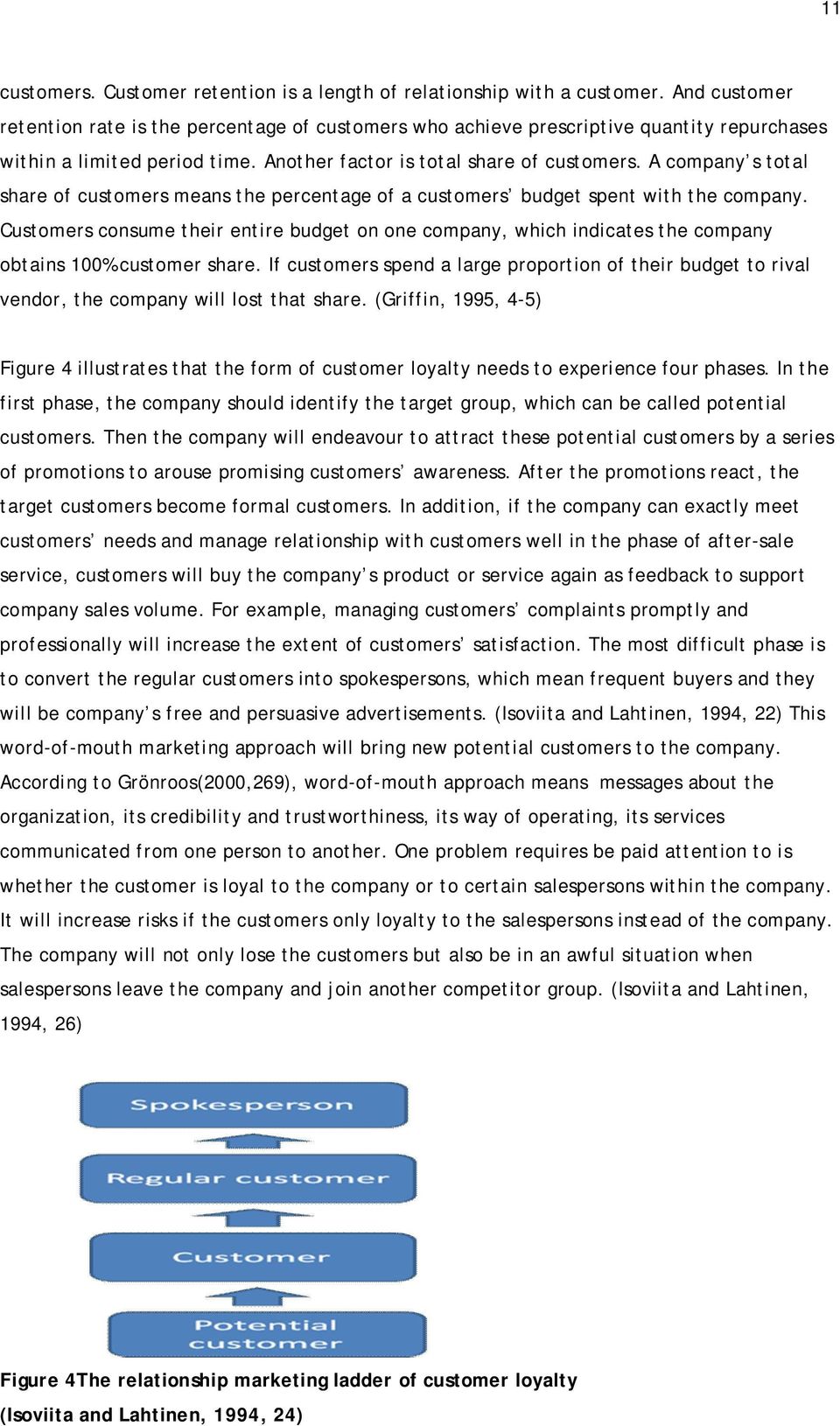
12 11 customers. Customer retention is a length of relationship with a customer. And customer retention rate is the percentage of customers who achieve prescriptive quantity repurchases within a limited period time. Another factor is total share of customers. A company s total share of customers means the percentage of a customers budget spent with the company. Customers consume their entire budget on one company, which indicates the company obtains 100% customer share. If customers spend a large proportion of their budget to rival vendor, the company will lost that share. (Griffin, 1995, 4-5) Figure 4 illustrates that the form of customer loyalty needs to experience four phases. In the first phase, the company should identify the target group, which can be called potential customers. Then the company will endeavour to attract these potential customers by a series of promotions to arouse promising customers awareness. After the promotions react, the target customers become formal customers. In addition, if the company can exactly meet customers needs and manage relationship with customers well in the phase of after-sale service, customers will buy the company s product or service again as feedback to support company sales volume. For example, managing customers complaints promptly and professionally will increase the extent of customers satisfaction. The most difficult phase is to convert the regular customers into spokespersons, which mean frequent buyers and they will be company s free and persuasive advertisements. (Isoviita and Lahtinen, 1994, 22) This word-of-mouth marketing approach will bring new potential customers to the company. According to Grönroos(2000,269), word-of-mouth approach means messages about the organization, its credibility and trustworthiness, its way of operating, its services communicated from one person to another. One problem requires be paid attention to is whether the customer is loyal to the company or to certain salespersons within the company. It will increase risks if the customers only loyalty to the salespersons instead of the company. The company will not only lose the customers but also be in an awful situation when salespersons leave the company and join another competitor group. (Isoviita and Lahtinen, 1994, 26) Figure 4The relationship marketing ladder of customer loyalty (Isoviita and Lahtinen, 1994, 24)
13 12 Table 1 demonstrates that the customer relationship can be separated into three different levels. These three different levels match different links in customer loyalty, deciding different marketing strategies and they are related to different degrees of customization. At the first level, low prices are the key marketing strategy which indicates a small degree of customization. This level obtains no any obvious competitive advantage but low prices, which can attract customers immediately without a loyal long-term relationship. The second level is more advanced than the first level, which requires financial and social links with customer loyalty. Personal communicative interaction is the main marketing strategy which indicates an average degree of customization. On this level, by personal communication with customers identifies buyers needs and satisfies them. The second level is more stable and longer in fostering customer relationship than the first level. The third level provides a tailor-made service for specific group to deepen the customer relationship. Each level targets different groups and the first level can be considered as first-time customers, the second level group will develop to regular customers and the third level group will be the company s spokespersons. (Isoviita and Lahtinen, 1994, 27) Level Links in Customer Loyalty Degree of Customization The Most Important Marketing Strategy One Financial links Small Low prices Two Financial and Social links Average Personal communicative interaction Three Financial, social and structural links Moderate, large Tailor-made service Table 1 The three levels of the customer relationship and customer loyalty (Isoviita and Lahtinen, 1994, 27) Profitability Lahtinen and Isoviita contend that a long-term and mature customer relationship can mutually benefit both customers and companies. A short-term customer relationship only brings one-time consumption. The first purchase only enables companies to refund costs instead of earning profits, but the long-term customer relationship will accumulate sales volume to make profits. A long-term relationship is profitable due to the several main reasons, such as accumulated sales from regular buyer and long-term customers make bulk orders. Furthermore, customers would like to pay higher if the company meets their need; long-term customer relationship is also a competitive advantage and word-of-mouth approach will bring new customers. (Isoviita and Lahtinen, 1994, 29)

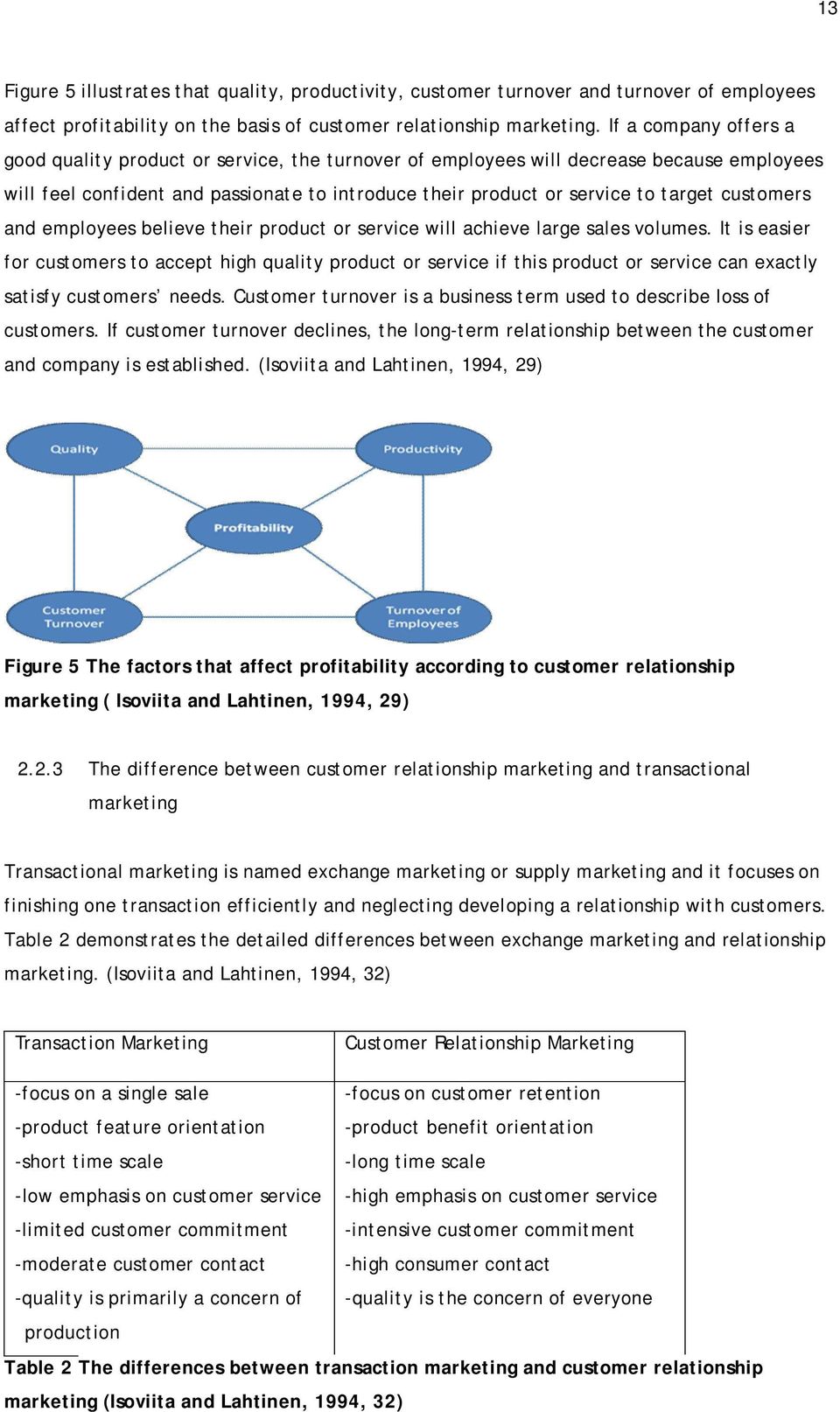
14 13 Figure 5 illustrates that quality, productivity, customer turnover and turnover of employees affect profitability on the basis of customer relationship marketing. If a company offers a good quality product or service, the turnover of employees will decrease because employees will feel confident and passionate to introduce their product or service to target customers and employees believe their product or service will achieve large sales volumes. It is easier for customers to accept high quality product or service if this product or service can exactly satisfy customers needs. Customer turnover is a business term used to describe loss of customers. If customer turnover declines, the long-term relationship between the customer and company is established. (Isoviita and Lahtinen, 1994, 29) Figure 5 The factors that affect profitability according to customer relationship marketing ( Isoviita and Lahtinen, 1994, 29) The difference between customer relationship marketing and transactional marketing Transactional marketing is named exchange marketing or supply marketing and it focuses on finishing one transaction efficiently and neglecting developing a relationship with customers. Table 2 demonstrates the detailed differences between exchange marketing and relationship marketing. (Isoviita and Lahtinen, 1994, 32) Transaction Marketing Customer Relationship Marketing -focus on a single sale -focus on customer retention -product feature orientation -product benefit orientation -short time scale -long time scale -low emphasis on customer service -high emphasis on customer service -limited customer commitment -intensive customer commitment -moderate customer contact -high consumer contact -quality is primarily a concern of -quality is the concern of everyone production Table 2 The differences between transaction marketing and customer relationship marketing (Isoviita and Lahtinen, 1994, 32)
15 14 Grönroos (2000, 26) contends that the process of creating value to customers from the relationship perspective and exchange perspective is totally distinct. As figure 6 shows, from the exchange perspective, value can be distributed by companies through embedding the value inside the final product. From the relationship perspective, value is created through communication between customers and companies. In conclusion, relationship marketing focuses on vale creation and the value-creating process rather than value distribution and the value-distribution outcome. (Grönroos, 2000, 26) Figure 6 The exchange versus the relationship perspective in the marketing process (Grönroos, 2000, 27) Figure 7 shows that customers and companies are independent elements, a majority of companies ignore needs from their customers in transactional marketing and they are only responsible for producing their products. So conflicts arise between customers and companies, companies try to persuade consumers to buy the products which maybe customers do not want. However, in relationship marketing, customers and companies are interdependent mutually. Companies can identify the needs of customers and produce products to satisfy customers needs, there is no conflict but cooperation between two parties. Hence, it is easier not only in developing a long-term mutually beneficial relationship, but also will increase customer loyalty in relationship marketing. (Grönroos, 2000, 28) Figure 7 Inherent values in relationship and transaction marketing (Grönroos, 2000, 28)

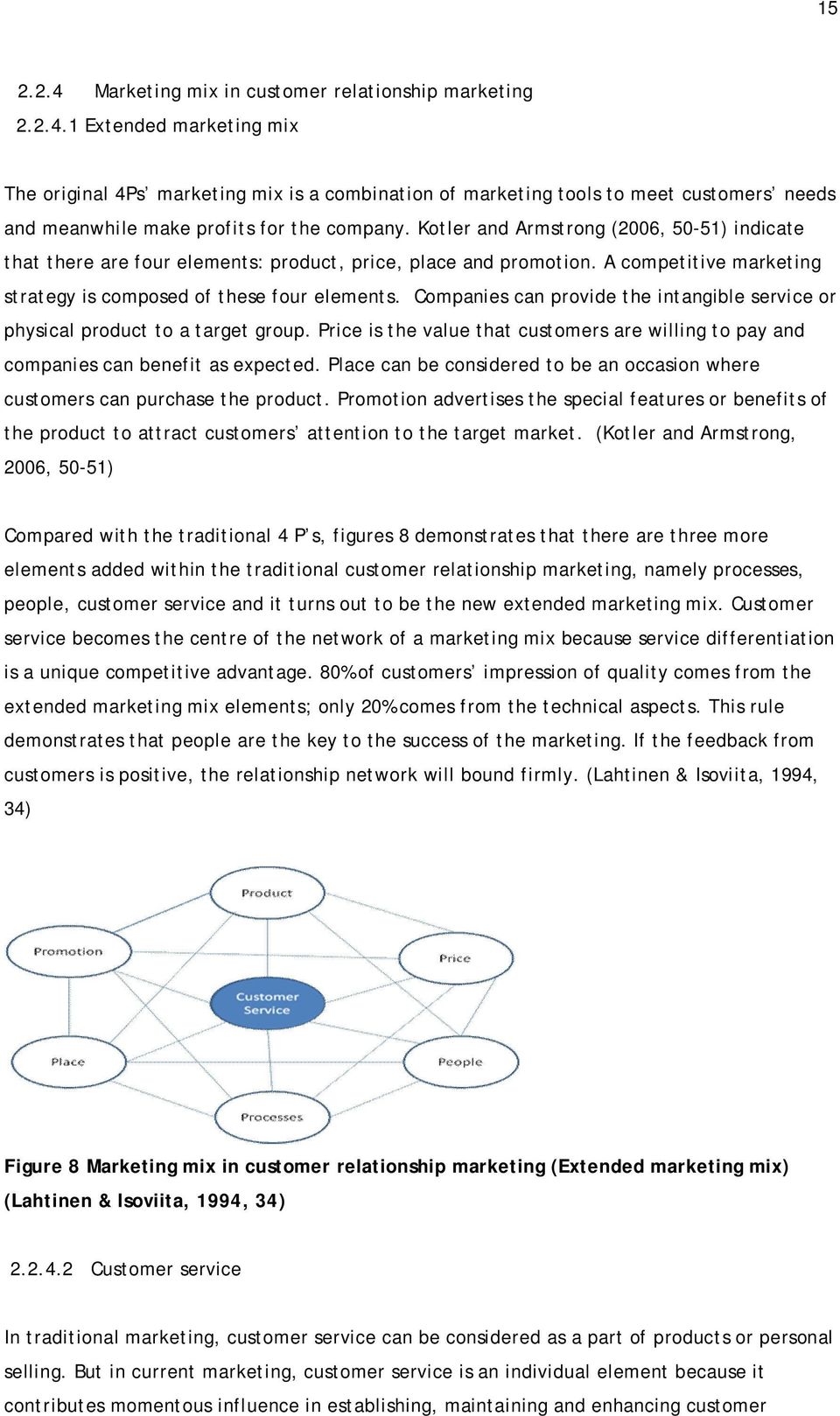
16 Marketing mix in customer relationship marketing Extended marketing mix The original 4Ps marketing mix is a combination of marketing tools to meet customers needs and meanwhile make profits for the company. Kotler and Armstrong (2006, 50-51) indicate that there are four elements: product, price, place and promotion. A competitive marketing strategy is composed of these four elements. Companies can provide the intangible service or physical product to a target group. Price is the value that customers are willing to pay and companies can benefit as expected. Place can be considered to be an occasion where customers can purchase the product. Promotion advertises the special features or benefits of the product to attract customers attention to the target market. (Kotler and Armstrong, 2006, 50-51) Compared with the traditional 4 P s, figures 8 demonstrates that there are three more elements added within the traditional customer relationship marketing, namely processes, people, customer service and it turns out to be the new extended marketing mix. Customer service becomes the centre of the network of a marketing mix because service differentiation is a unique competitive advantage. 80% of customers impression of quality comes from the extended marketing mix elements; only 20% comes from the technical aspects. This rule demonstrates that people are the key to the success of the marketing. If the feedback from customers is positive, the relationship network will bound firmly. (Lahtinen & Isoviita, 1994, 34) Figure 8 Marketing mix in customer relationship marketing (Extended marketing mix) (Lahtinen & Isoviita, 1994, 34) Customer service In traditional marketing, customer service can be considered as a part of products or personal selling. But in current marketing, customer service is an individual element because it contributes momentous influence in establishing, maintaining and enhancing customer
17 16 loyalty. If a company applies the customer relationship approach, the organization of the company will be reversed as the following figure 9. It shows that the department of customer contact personnel is highly valued in word-of-mouth marketing. In addition, departments of internal service personnel and management are responsible for supporting customers in contacting personnel to satisfy customers needs. (Lahtinen & Isoviita, 1994, 36) Figure 9 The organization chart of companies and non-profit organizations which have adopted a customer relationship marketing approach (Lahtinen & Isoviita, 1994, 36) The element of people People is basic but vital element in relationship marketing as all marketing operations will be executed by people, whether in the product industry or service industry and especially in the service industry. Service is intangible so customers sense personnel behaviour in the service industry. If the company can provide professional and appropriate solutions to assist different customers to solve their problems, it can be considered successful service. Not only in service marketing but in the product industry as well, it is necessary to focus on the quality of the products, but companies need to pay more attention to services section too. Concerning services section, the personnel must learn three communication skills: questioning the customer, maintaining eye contact and listening to the customer. Through these skills, salespersons can identify customers needs clearly and satisfy them. (Lahtinen & Isoviita, 1994, 3) 2.3 Stages of the customer relationship Segmentation The concept of segmentation

18 17 Marketing segmentation is a marketing tool to assist companies to identify the target market and it categorizes the market into several distinct groups based on the similar need for the products or services. It is impossible for a company to design products for every single consumer but it is more efficient and profitable to provide different versions of the same product to different target groups by concentrating on segments. If the company separates the segments well, it will bring much profit and a high return of marketing expenses. (Marketing segmentation 2010) There are three approaches towards marketing: undifferentiated marketing, segmented marketing and single-segment concentration. In the undifferentiated marketing, companies have not defined the target group and companies regard the whole market as their potential consumers. This marketing strategy concentrates on common needs from customers instead of varied needs. It depends on a number of advertisements and mass distribution to give a deep impression in customer s mind. It is the most inefficient and unprogressive marketing. Compared with more-focused competitors, there is no obvious competitive advantage. In the segmented marketing, companies decide to target several market segments and design for each. Although differentiated marketing will bring high sales and a strong position in the same industry, the costs of doing business increase. Developing segmented marketing needs additional fees on marketing research and promotion planning. Thus, companies must consider more seriously when they decide segmented marketing as the marketing strategy. Single-segment concentration is also named niche marketing, and it offers small companies big opportunities to serve the narrow marketing, which big companies always ignore. (Kotler & Armstrong, 2000, ) Bases for segmenting consumer markets Researchers can segment consumer markets into two approaches: some researchers believe forming segmentation through detecting consumer characteristics, for instance, from geographic, demographic and psychographic segmentation. After collecting the customer information, it is convenient to group them and to satisfy their diverse needs. Other researchers advocate seeking consumer responses to segment, such as occasions and usage rate. Above mentioned approaches are feasible depending on the services or products the company offers. The major segmentation variables are geographic, demographic, psychographic and behavioural segmentation. Demographic segmentation will be explicated since this segmentation is related with case company s questionnaire. In demographic segmentation, the market is separated into groups on a basis of variables such as age, gender, income, occupation and education. Demographic variables are common based on dividing customer groups because the customer needs, preferences and usage rates are often combined with demographic variables. (Kotler, 2000, 263)

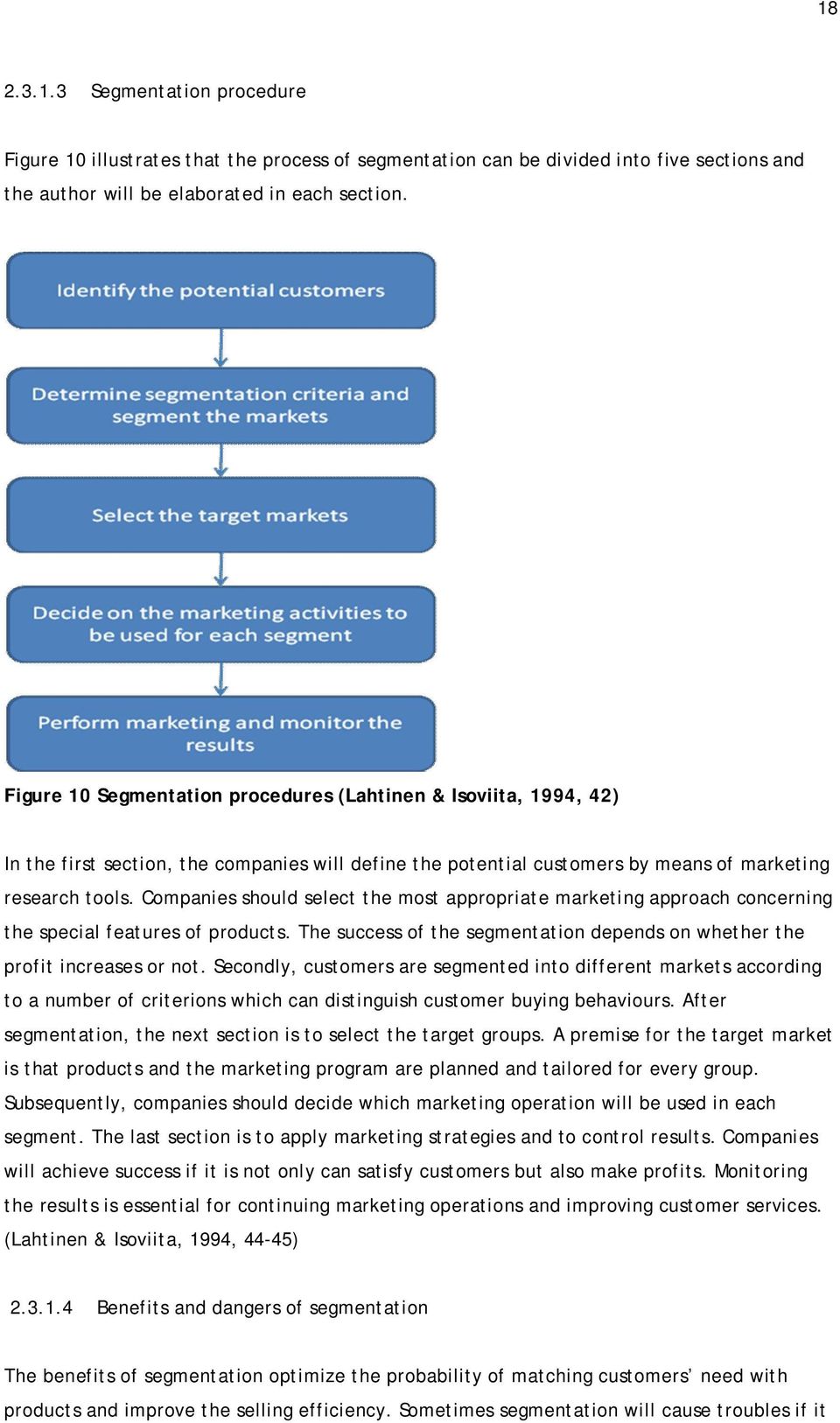
19 Segmentation procedure Figure 10 illustrates that the process of segmentation can be divided into five sections and the author will be elaborated in each section. Figure 10 Segmentation procedures (Lahtinen & Isoviita, 1994, 42) In the first section, the companies will define the potential customers by means of marketing research tools. Companies should select the most appropriate marketing approach concerning the special features of products. The success of the segmentation depends on whether the profit increases or not. Secondly, customers are segmented into different markets according to a number of criterions which can distinguish customer buying behaviours. After segmentation, the next section is to select the target groups. A premise for the target market is that products and the marketing program are planned and tailored for every group. Subsequently, companies should decide which marketing operation will be used in each segment. The last section is to apply marketing strategies and to control results. Companies will achieve success if it is not only can satisfy customers but also make profits. Monitoring the results is essential for continuing marketing operations and improving customer services. (Lahtinen & Isoviita, 1994, 44-45) Benefits and dangers of segmentation The benefits of segmentation optimize the probability of matching customers need with products and improve the selling efficiency. Sometimes segmentation will cause troubles if it
20 19 has not been implemented properly, for example, segments too small to be profitable or unsuitable selection of segments. (Lahtinen & Isoviita, 1994, 45) Developing the customer relationship A mass marketing strategy usually applies at the beginning of marketing activities because the initial objective of this strategy is to attract as many customers as possible. Traditional mass marketing will spread products information to reach potential customers by newspaper, television advertising and other mass of marketing techniques. Either mass marketing or interactive marketing belongs to external marketing when establishing customer relationships. The customer relationship will be built when customers contact the company or the company representative contacts customers directly or indirectly and this is obvious movement from mass marketing to interactive marketing. The objectives of interactive marketing are stimulating sales, encouraging impulse buying and developing customer relationships. The first impression from the companies personnel to contract customers is very important as it represents companies in the interactive marketing. An interactive marketing strategy minimizes the target group from mass marketing. Possible customers will become customers at this stage. (Lahtinen & Isoviita, 1994, 50) Interactive marketing is needed in developing a customer relationship but it is a relatively passive way to manage the relationship. After-sales service is instrumental in developing a customer relationship stage. It is quite often that companies sell the same product but customers will select the one which offers better after service. After service will be a relatively competitive advantage to help customers differentiate the same products from different companies. It is easy to make a first purchase through mass marketing or interactive marketing, whereas the repeat purchase is not easily achievable. When the customer expresses the interest in products and decides to buy twice, this sign can be considered that the solid customer relationship has been built. The activities related to after-sales service are named after-sales marketing. The theory based on aftersales marketing is that it is easier and less time to keep existing customers than to attract new customers. The objectives of after-sales marketing are increasing sales volume, strengthening the customer relationship and developing customers into regular customers. Meanwhile, the after-sales marketing operations are after-sales contacts, direct advertising, direct selling, and accessibility of services such as maintenance, training and delivery on time. (Lahtinen & Isoviita, 1994, 50-52) 2.4 Building appropriate CRM with right customers Figure 11 demonstrates that there are three levels to establish appropriate CRM with right customers. Two of the elements, market segmentation and target marketing, are discussed in chapter 2.3. Now market position will be elaborated. (Kotler & Armstrong, 2000, 259)

21 20 Figure 11 Steps in marketing segmentation, targeting and positioning. (Kotler & Armstrong, 2000, 259) Choosing a position strategy Companies must confirm position strategy in the target marketing after segmenting the marketing. Companies must distinguish their products from others to create their own competitive advantage. The positioning task comprises three sections: identifying possible competitive advantage, choosing the appropriate competitive advantage and selecting an overall positioning strategy. (Kotler & Armstrong, 2000, 259) Identifying possible competitive advantages The concept of competitive advantage is an advantage over competitors gained by providing consumers greater value, either by lower prices or by providing more benefits in accord with higher prices. Companies competitive advantage is based on that understanding customers needs better and delivering more added value than competitors do. Differentiation is the sign of companies competitive advantages. Differentiation can be separated into several aspects: product differentiation, services differentiation, channel differentiation, people differentiation and image differentiation. Companies need to identify their product or service s differentiations and utilize them to raise sales volume and enlarge market share. Production differentiation is the most basic differentiation, which can be divided into two categories. One is products with little variation, such as food and commodities; another is products with high differentiation, for instance, cars, mobile phones and clothing. These highly diversified products can be distinct in the aspects of design, features, performance and styles. When companies produce the same products, they still can be outstanding in the service differentiation. Some companies offer better delivery service, some provide customer training service or consulting services to satisfy consumers needs. The above service differentiation will assist companies to attract customers and improve customers loyalty. Channel differentiation is the way companies design the channel s distribution, expertise and performance compared with the traditional ways to gain competitive advantage. People differentiation is the company hiring and training people, who are different from competitors. Especially for salespersons, if the company hires salespersons that not only have professional knowledge but understand different customers various needs as well. It is
22 21 intangible competitive advantage for the companies to distinguish from competitors. Even if companies offer the same products and the same services but the consumers embed company or brand image beforehand. Developing an impressive image differentiation requires timeconsuming and promotion costs, such as increasing advertising costs. (Kotler & Armstrong, 2000, ) Choosing the right competitive advantages Kolter and Armstrong (2000, 261) argue that if a company is lucky to gain several competitive advantages, the problem generates to select how many and which ones to establish position strategy. Some marketing personnel believe that companies should select one most conspicuous feature of the product and insist on promoting it. However, other marketing personnel suggest that advertise all differentiations together to arouse customers awareness. Marketing personnel should contemplate on selecting which method is more effective depending on the realistic situation. (Kotler & Armstrong, 2000, 261) Companies usually makes three common mistakes in building position strategy: underpositioning, overpositioning and confused positioning. The result of companys underpositioning is only an indefinite product or service image in consumers mind. Overpositioning leads to disappointment and complaints when customers detect the product or service does not meet their original expectations. Confused positioning leaves buyers a confused image of the company. These three common errors should be avoided in making the position strategies. (Kotler & Armstrong, 2000, ) Selecting an overall positioning strategy Consumers will usually select one product or service which can deliver the greatest value for them. Markets will position their brands in accord with their mixed and outstanding attributes to compete with competitors. The full positioning of a brand is named the brand s value proposition, which indicates the full mix of benefits upon which the brand is positioned. Figure 12 illustrates possible value propositions which companies will take to position their products or services. In the figure 12, the five blue areas are successfully positioned to make profit but the orange squares express failed position strategy with no competitive advantages. The yellow section can be considered as breakeven area providing the same price and the same quality product. Thus, the company obtains five prosperous position strategies: more for more, more for the same, more for less, the same for less and less for much less. The strategy of more for more includes offering a highest quality product and charging a higher price. This positioning is always used in luxury goods because it not only provides high quality but also prestige as well. Companies can gain competitive advantage by supplying better
23 22 quality products compared with opponents at the same price. The strategy of more for less indicates a better quality product at a lower price for customers. The strategies of same for less and less for less respectively indicate the same quality product at a lower price and lower quality with a much lower price. (Kotler & Armstrong, 2000, ) Figure 12 Possible value propositions (Kotler & Armstrong, 2000, 263) 3 METHODOLOGY OF THE STUDY 3.1 Research methods Quantitative methods focus on numbers and frequencies while qualitative methods concentrate on meaning and experience. Quantitative methods (e.g. experiments, questionnaires and psychometric tests) translate the collected data into word information. This method is related to the scientific and experimental approach but lacks deep description. Qualitative methods provide explicit and deep description but with low reliability, for instance, an interview. In modern research, most analysts will combine qualitative and quantitative methods together to optimize the reliability and validity. (Quantitative and Qualitative data 2010) In addition, according to Saunders, Lewis and Thornhill(2007, 145), the quantitative research method is mainly applied as a synonym for any data collection technique (such as a questionnaire) or data analysis procedure (such as graphs or statistics) that generates numerical data. Ghauri and Grønhaug (2005, 109) argue that quantitative research employs measurement. In addition, the quantitative method is appropriate for a large target sample to analyze statistics reliably and validly. (Whether to Use Qualitative or Quantitative Research to Answer a Marketing Question 2000) In this study case, quantitative research is suitable for this study on the basis of the sample group, which is quite large, approximately 200 target customers. In addition, the questionnaire is used to measure customer satisfaction and customer relationship with the
24 23 case company. Finally, the findings are reached by analyzing the collected data of the questionnaires. 3.2 Target group The target group of this research is the entire existing customers about 200 in the department of customer assets management in Industrial Securities. The questionnaires were dispatched to these customers. The author finished her half-year internship in customer assets management, Industrial Securities in When the author decided to use her practice company as her thesis case company, she contacted the manager of customer assets management, Keyi Yan who is responsible for both marketing department and customer assets management department in Industrial Securities. Ultimately, the author was permitted to use Industrial Securities as her thesis case company, in addition, the manager also provided the customers address to author. 3.3 Questionnair design The questionnaire consists of four sections, including customer background information, customer relationship, customer satisfaction and communication. There were 17 questions, 16 of them were closed questions and the last one was an open-ended question to obtain subjective suggestions from each customer. The objective of the designed questionnaire is to improve the service quality supplied by customer assets management of Industrial Securities in the near future by analyzing customer satisfaction and loyalty and the business relationship between the case company and customers. The questionnaires were sent on 18 th March by s with a covering letter to explain who and why sent questionnaires to them. In addition, a reminding letter was sent one week afterward. The author spent two weeks to collect the feedback and analyze it by Microsoft Office. The author processed all the information from questionnaires to data, translated them into graphs by Excel 2007, and described the final analysis results. 3.4 Validity and reliability McDaniel and Gates (2001, 295) contend that it is necessary to provide consistent results over time for a measurement scale to have reliability. It is impossible for researchers to, for instance, obtain conclusion or formulate theories from their research if they conclude results that can not be consistent with other independent observers. (Reliability 1993) The concept of validity is the degrees which the researchers intend to measure the accuracy of the study. (McDaniel & Gates, 2001, 296) Factors which can affect the validity are design of the questionnaire and the alternatives chosen for the questions, for instance, the scales in the
25 24 questionnaire. (Validity 1993) The obvious difference between reliability and validity is that the former one measures precision, whereas validity measures the accuracy. (Reliability Statistics, 2006) In the reliability area of this study, data was gathered from reliable sources because the author had internship experience in the case company and it was very accessible for her to obtain customers information from the manager of customer assets management. In addition, 200 questionnaires were sent and 58 were received but 52 were the valid questionnaires. The rate of valid questionnaire was 26% which could be considered that meets the case study sample demands, and the results can sustain repeated tests. To ensure the reliability of this research, the author confirmed the research results several times by collecting, processing and analysing them. In the validity area, to guarantee the validity of the research, the questionnaire was designed for a long period to ensure all the questions were as logical as possible and the scales were used to ensure the accuracy of the research. 4 CASE COMPANY: INDUSTRIAL SECURITIES 4.1 Case company introduction After phone interview with the manager of the department of customer assets management, Keyi Yan, the author acquires the following basic information of Industrial Securities: Industrial Securities, which is approved as Class A by the China Securities Regulatory Commission, is one of the national innovation securities companies. The business scope of this company covers security underwriting, brokerage, proprietary trading, and investment consulting services, entrusted asset management, online securities commission business and establishment of investment funds. After 19 years long efforts, Industrial Securities has been developed into large-scale securities which include 4.6 billion RMB net assets, 17.4 billion RMB total assets, 2300 billion RMB in client assets, 18 headquarters departments, 29 stock exchange departments, 11 securities services departments, 2 holding subsidiaries and more than 2000 professional employees. Particularly in recent years, the main business of the company ranks the leading position in the industry due to seizing the market opportunities. With the improvement of general competitive strength, anti-risk capability and market Influence, Industrial Securities plays an important role in building economic zones in the western of China. The customer assets management department belongs to the entrusted assets management business operation, which helps customers increase value of the assets through investing profitable projects such as stocks or bonds. (Industrial Securities 2010) 4.2 Customers The customers of the customer assets management department are people who have cash at
26 25 least 5 million RMB (which is equal to 0.5 million euro) without considering the intangible assets such as real-estate properties or cars. Until now in the customer assets management department, there are about 200 existing customers. 4.3 Company organizational structure Figure 13 Organizational structure
27 26 5 RESULT OF EMPIRICAL STUDY 5.1 Background information Figure 14 Customer gander Figure 15 Customer age Figure 16 Customer education background Four questions at the beginning of the questionnaire are related to the target customers background information, such as gender, age, education background and occupation. By acquiring their basic personal information, the company can realize the need from different customers and serve them better in the near feature. Figure 14 shows that 39 are male, which accounts for 75%, three times bigger compared with the female number. Males are the main force in the customer assets management department. It can be seen from figure 15 that the age between 40 and 49 accounts for more than half of all respondents. The group of age is the second largest group shares one quarter. The smallest group is the youngest group. Groups of age and contribute the most for the company, which account for 80% together. The requirement of minium cash assets for customers of Industrial Securities is 5 million RMB. Age group between 30 and 49 people is the middle class in chinese society because they have many years working experiences, saving and they are willing to invest to increase their fortune. As figure 16 demenstrates most people have finished their degree studies, the second biggest group accounts for 27%, graduated from vocational school,
28 27 master graduates only share 10%. Concerning the occupation, most customers are engaged in education, finance, medical care and entrepreneur business fileds. The final findings about the customer personal information are that the main group of customer assets management department is the age group of males with bachelor degrees, who are mainly centralized in the field of education, finance, medical care and entrepreneurship. 5.2 Business relationship Cooperation time with Industrial Securities Figure 17 Cooperation time with Industrial Securities According to figure 17, One-third of repondents have been customers of Industrial Securities for less than one year; these new customers can be considered as the first cooperation with Industrial Securites. If the company can satisfy them well, they will continue the business relationship with the company. Less than half of customers have relationship with the case company for one-three years, the company should provide superior services to satisfy customers to improve their realationship with the company. Customers who have four-six years relationship with the company can be grouped as mature customers and they will be loyal customers soon. No customers has the relationship with the Industrial Securites for ten or more than ten years although the department has been set up for more than ten years, which indicates that the company still needs to foster the relationship with the customers Service classification Figure 18 illurstrates that 42% of customers purchase the stock investment service, which indicates that most customers like to make profits quickly but risky. The feature of the stock, which can be profitable in a short-term period but highly risky. Fund service is featured by a general profit with a general risk whthin a medium term, which accounts for 33%. Most customers purchase the stock and fund services, only 19% of customers buy the bond service,
29 28 which is with a lowest risk and a lowest profit, but as figure 19 shows most customers prefer to sign the medium-term contract to make fortune slowly but stably. Customers prefer to make profits quickly but like to sign medium-term contract looks contradictory with figure 18, but taking the deep consideration, it is caused by consumer psychology. Although most people prefer to acquire the return from investment quickly, they will be very cautious when investing with their own assets. Figure 18 Services classification Investment period Figure 19 Investment period Features of Industrial Securities These four charts show the most distinguished service features of Industrial Securites. Figure 20 shows one-third of customers think Industrial Securities has normal reputation, only 15% of customers believe that Industrial Securities owns good repution. This information is instrumental for brand-building of Industrial Securites. As figure 21 shows, more than half of customers are satisfaied with the professional service Industrial Securities provides. Figure 22 demonstrate that 34% of respondents are pleased with their return rate on investment, at the
30 29 same time 31% of customers are unsatisfied with their profitability. The number of unsatisfied customers is almost as many as the number of satisfied customers. In the securities industry, earning ability is the most significant element to attract new customers and retain existing customers. Figure 23 shows that alsmost all customers are satisfied with valuable advice and 42% of customers are completely satisfied. Combining these four charts, valuable advice and professional service are Industrial Securities competitive advantages, but the company needs to improve return rate on investment and brand building. Figure 20 Good reputation Figure 21 Professional service Figure 22 Good return rate on investment
31 30 Figure 23 Valuable advices 5.3 Customer satisfaction Degrees of satisfaction for the overall service Figure 24 Degree of satisfaction Figure 24 shows that 58% of customers are satisfied with the overall services while 19% of customers are not. It is a good sign that satisfied customers are three times more than unsatisfied customers on the overall services. 35% of customers are completely satisfied, they can be considered loyal customers and they maybe will tell their friends or relativers. 23% of customers are neither unsatisified nor satisfied with the overall service, the company needs to pay more attention to this group. If the company can manage them well, this 23% of customers will be fairly satisfied customers, even the satisfied, otherwise they will turn to the reverse direction Cost of the service Figure 25 demonstrates that half of customers take neutral position on the cost of the services, their opinions are that the service charge from Industrial Securities can be adopted.
32 31 30% of customers consider that the expense is high. However, 19% of customers think the service charge from Industrial Securites is low. To sum up, industrial securities can adjust their service charge concerning its own situation, but at present, it is unnecessary to increase or decrease the fee. There is a small subtle connection between fiugre 24 and 25. Generally, the satisfied customers are willing to pay more, but it does not happen in this case. Most satisfied customers prefer that the fee remains the same. Figure 25 The cost of the service Future relationship Figure 26 Future relationship Figure 26 illustrates that 42% of customers tend to increase the cooperation with Industrial Securities. The more people satisfied, the longer cooperation will continue. 22% of customers hesitate to increase cooperation because figure 24 reflects that a number of customers are neither satisfied nor unsatisfied with the services. To increase the further cooperation in the future relationship, the most efficient way is to meet customers need as they wish and always keep promises.
33 Competitive position of Industrial Securities Figure 27 Competitive position As figure 27 shows, 46% of customers consider Industrial Securities has a very strong competitive position in current marketing. 35% of customers think the company does not have any obvious competitive advantages compared with other securities. Analysing the information, the competitive position of industrial securities is above average, which can be considered middle plus Recommendation Figure 28 Recommendation The recommendation can be utilized to measure customers satisfaction accurately. Figure 28 illurstrates that over half of customers will recommend Industrial Securities services to other people, including 17% of customers will strongly recommend. Nearly one-third of consumers would neither recommend nor recomme to keep the status quo. The company needs to strive for these approximately 30% customers by meeting their changeable needs.
34 Communication Different interest degrees of different channel Figure 29 Newspaper Figure 30 Internet Figure 31 Friends or relatives
35 34 Figure 32 Financial fairs The objective of figure assists the case company to analyze customers different degrees of interest on different channel, which will affect the company s promotion and advertising activities in the future. There are four channel options for customers to scale their degrees of interest, such as newspaper, internet, friends or relatives and financial fairs. 48% of customers consider that information from friends or relatives is the most persuasive and trustful. From source of newspaper is the second important channel from customers view. Half of customers are not willing to acquire information of Industrial Securities in the financial fairs. If ranking the channel from high to low, it is friends or relatives, newspaper, internet, financial fairs Additional services from Industrial Securities Figure test the interest of customers for other services supplied by industrial securities. From the above four charts, brokerage service is the most popular one, which will be chosen by 73% of customers compared with other services. The second choice from customers is investment consulting services or online securities commission, which accounts for 65% and 60% of customers respectively. Fewer customers are interested in establishment of investment funds service. Figure 33 Brokerage
36 35 Figure 34 Investment consulting services Figure 35 Online securities commission business Figure 36 Establishment of investment funds The questionnaire ends with one open question, which is to collect other suggestions from existing customers. Most customers were failed to fill it, only a few customers offered their suggestions for Industrial Securities. Some customers commented that they were very willing to fulfil questionnaire and felt happy that Industrial Securities has the sincerity to develop
37 36 the relationship with them. Other comments indicated that they hope Industrial Securities can increase the return rate on the profit. 6 CONCLUSIONS AND SUGGESTIONS The narrow concept of CRM can be regarded as collecting customers detailed information and build a long-term relationship with them to keep their loyalty. In addition, targeting potential clients is basic pace to transfer possible customers into formal customers. After analyzing the background information of customers in the questionnaire, the author finds that people who qualify the following criterions: male; age group from 30 to 49; graduated with the university degree; occupations in the field of education, finance, medical care and entrepreneurship are the most potentical target customers. These valuable information will help company improve the service quality to meet these group customers demands and direct the way to attract new customers too. The business relationship between Industrial Securities and customers is not as loyal as imaged because the author found most customers had relationship with the company for 1/2-3 years. Only one-fourth of customers had 4-9 years. However, the customer assets management of Industrial Securities has already been set up for more than 10 years. Considerable customers sign the stock and fund investment contract, by analyzing the background information, the author discovered that elder clients prefer a long term investment with stable profits and lowest risks, such as bond investment; The middle-age group prefers a medium-term investment with higher profits and higher risks. As the younger group, who prefer to invest with largest profits and highest risks in a short-term period, such as stock and other profitable projects. Professional service and valuable advice are the most distinct features of Industrial Securities, but they need endeavour to brand-building and earnings profitability. In author s opinion, the customers can have more options if Industrial Securities can combine services, for instance, customers can sign stock and bond services in accordance with different percentages, such as 60% of stocks service with 40% of bonds service. The more choices offer, the more customers will be attracted. This small change will bring a great effect whether on maintaining existing customers or bringing new customers. In addition, the company should not only make competitive advantage more distinguished but improve other features as well. Measuring customer satisfaction can improve the case company s services to remake the marketing strategy to retain existing customers and foster their loyalty. The more satisfaction for customers, the higher customer loyalty the company will obtain. In addition, customer satisfaction will stimulate clients to continue relationship with the case company. In the questionnaire, a majority of customers are satisfied with the overall service from the
38 37 customer assets management department. Concerning the overall satisfactory service offering, customers consider that their payments are worthy. But less than half of customers said they would continue or increase their relationship with Industrial Securities in the future. The marketing position of Industrial Securities is middle plus in customers minds. Over half of customers would like to recommend the company to others. In author s opinion, most customers are not as satisfied as imaged, the company still needs to work hard on how to satisfy customers. The questionnaire is a good and effective tool to measure customer satisfaction because it is anonymous and reliable. Through the analysis of the communication section in the questionnaire, the author finds that customers like to acquire the information on the following channels with ranking from high to low: friends or relatives, newspaper, internet, financial fairs. Most of existing customers are interested in attempting brokerage and investment consulting services. By analyzing the customers interest degrees of different channel, which is helpful in marketing strategy and promotion, for instance, advertising. People mentioned in the questionnaire who would attempt other services from Industrial Securities; the marketing department should act promptly to contract these promising customers. 7 SUMMARY The practical research of the thesis is based on the theoretical background studies which are expended by the core discussion of customer relationship management. CRM is the whole process of building and maintaining profitable relationship with consumers through transferring customer value and satisfaction. In this case, CRM benefits the case company in the following aspects: developing CRM will increase customer loyalty; CRM will strengthen the case company s competitive advantages; and improving clients satisfaction. Customer satisfaction can be measured whether the services meet their expectation or not. The questionnaire is a good tool to collect customer information and measure their degrees of satisfaction. Customer satisfaction will lead customers to loyal customers. Loyal customers will not only continue their relationship with company and can stand the test of time, but also will be alive advertisement and free spokesman to promote the company. Customer relationship marketing concentrates on customer retention, long time scale, emphasis on customers services, intensive commitment and high quality service. Generally, the objective of the study is to give constructive advice to the customer assets management of Industrial Securities on how to retain the business relationship with existing customers and compete in the intense securities industry in China from the point view of customer relationship management. In this case, maintaining the relationship with existing customers is more important than attracting new clients due to the limitation of the target
39 38 group. Retaining one customer is less time-consuming and costs less compared with attracting a new one. In addition, the solid relationship with old customers will help to bring new customers by mouth-to-mouth approach unconsciously. The questionnaire approach is applied in assisting this study, which aims at learning customer satisfaction, business relationship, and the extent of customer loyalty in the case company. All the feedback is collected and translated them into graphs, and then described them. The final findings can be generalized: weak business relationship, high customer satisfaction, low customer loyalty and marketing position with a middle plus. The weak business relationship with customers, lower customer loyalty and common competitive advantages can be regarded as the future challenges. The author gives the recommendations on the basis of the above theory studies, for instance, combining the services to enrich customers options; keeping promises to the customers, sometimes even surprising customers to impress them deeply; and adjusting marketing strategy promptly.
40 39 LIST OF REFERENCES Books Arnould, E., Price, L., Zinkhan,G Consumers. Boston : McGraw-Hill/Irwin Chaturvedi, M., Chaturvedi, A Customer Relationship Management. New Delhi : Excel Books Ghauri P., Grønhaug K Research methods in business studies. Harlow : Pearson Education Griffin, J Customer Loyalty. San Francisco: Jossey-Bass Grönroos, C Service Management and Marketing. Chichester: John Wiley & Sons Kotler, P., Armstrong,G Principles of Marketing. Upper Saddle River: NJ. Pearson Education International, cop Kotler, P., Keller, K. L Marketing Management. Upper Saddle River: N.J. Pearson Prentice Hall. Kotler, P Marketing Management. New Jersey: Prentice Hall International Lahtinen, J., Isoviita, A Customer Relationship Marketing. Tempere: Avaintulos McDaniel C., Gates R Marketing Research: the impact of the Internet. New York: Wiley Saunders M., Lewis P., Thornhill A Research methods for business students. Harlow : Prentice Hall Internet Advertising and Integrated Brand Promotion CN#v=onepage&q&f=false (Accessed 4 Feb 2010) Industrial Securities 2010 < (Accessed 10 March 2010) Marketing segmentation 2010 < (Accessed 21 Feb 2010) Measuring and Managing Customer Satisfaction (Accessed 8 Feb 2010) Quantitative and Qualitative data 2010 < (Accessed 4 March 2010) Reliability 1993 < (Accessed 6 March 2010) Reliability Statistics, 2006 < (Accessed 6 March 2010) Validity 1993 < (Accessed 6 March 2010)
41 40 Whether to Use Qualitative or Quantitative Research to Answer a Marketing Question 2000 < (Accessed 5 March 2010) Why and How to Measure Customer Satisfaction (Accessed 8 Feb 2010) Thesis Berkia, A Enhancing customer relationships as a strategic management tool Case: Perfect InfoTech solutions ltd, Laurea University of Applied Sciences, Thesis. Dosunmu, A Enhancing customer relationship as a key strategy for growth and service Case: Abbeykas Nigeria enterprises, Laurea University of Applied Sciences, Thesis. Interview Keyi, Y Interview with manager of customer assets management. 28 March Industrial Securities LTD. Shanghai, China.
42 41 LIST OF FIGURES Figure 1 The structure of the Thesis...6 Figure 2The objective of customer relationship marketing Figure 3 Integrated customer relationship marketing Figure 4The relationship marketing ladder of customer loyalty Figure 5 The factors that affect profitability according to customer relationship Figure 6 The exchange versus the relationship perspective in the marketing process Figure 7 Inherent values in relationship and transaction marketing Figure 8 Marketing mix in customer relationship marketing (Extended marketing mix) Figure 9 The organization chart of companies and non-profit organizations which have adopted a customer relationship marketing approach) Figure 10 Segmentation procedures Figure 11 Steps in marketing segmentation, targeting and positioning Figure 12 Possible value propositions Figure 13 Organizational structure Figure 14 Customer gander Figure 15 Customer age Figure 16 Customer education background Figure 17 Cooperation time with Industrial Securities Figure 18 Services classification Figure 19 Investment period Figure 20 Good reputation Figure 21 Professional service Figure 22 Good return rate on investment Figure 23 Valuable advices Figure 24 Degree of satisfaction Figure 25 The cost of the service Figure 26 Future relationship Figure 27 Competitive position Figure 28 Recommendation Figure 29 Newspaper Figure 30 Internet Figure 31 Friends or relatives Figure 32 Financial fairs Figure 33 Brokerage Figure 34 Investment consulting services Figure 35 Online securities commission business Figure 36 Establishment of investment funds... 35
43 42 LIST OF TABLES Table 1 The three levels of the customer relationship and customer loyalty Table 2 The differences between transaction marketing and customer relationship marketing... 13
44 43 APPENDICES Appendix 1: Customers questionnaire cover letter Dear customer of Industrial Securities, It will be extremely honourable for me if you can spare some time to read this letter. My name is Wenqing Zhang and I m studying Business Management at Laurea University of Applied Sciences in Finland. I have recently finished my half year internship at Industrial Securities Customer Assets Management Department in China. For my thesis Industrial Securities has kindly permitted me to use them as my case company, the focus being in customer asset management services. The purpose of the thesis is to study customer loyalty from customer relationship management point of view. For the study I have developed a questionnaire with questions covering key aspects in customer satisfaction and customer relationships. The collected data of the questionnaire will be analyzed and then used for providing even better customer service in the future. I would be extremely grateful if you can spend a few minutes to answer the questions of the enclosed questionnaire. Your answers and comments will be treated with highest confidentiality. Thank you for your time! My contact information: [email protected] Mobile:
45 44 Appendix 2: Customers questionnaire Questionnaire A. Customer Background Information 1. Gender (Please circle the right choice) A. Male B. Female 2. Age (Please circle the right choice) A B C D E Education Background (Please circle the right choice) A. Elementary School B. Vocational education C. University Bachelor Degree D. University Master Degree E. Other 4. Occupation B. Business relationship 1. How long have you been a customer of Industrial Securities? (Please circle the right choice) A. Less than one year B. One-Three years C. Four- Six years D. Seven-Nine years E. Ten and more years 2. What Asset Management services are you supplied by Customer Assets Management of Industrial Securities? (Please circle the right choice) A. Bond investment contract B. Fund investment contract C. Stock investment contract D. Other profitable projects 3. What kind of investment period do you prefer? A. Long-term B. Medium-term C. Short-term 4. Which expectations and to what degree have influenced your decision to become a customer of Industrial Securities Asset Management? (Please circle the right choice on a scale 1-5: 1= not at all, 2= little, 3= not little nor somewhat 4= somewhat 5= very much A. Good reputation B. Professional service C. Good return rate on investment D. Valuable advices E) Others, what C. Customer Satisfaction 1. Overall, how satisfied are you with service provided by Industrial Securities asset management services? (Please circle the right choice on a scale 1-5: 1= totally unsatisfied, 2= fairly unsatisfied, 3= not unsatisfied nor satisfied, 4= fairly satisfied, 5=totally satisfied How do you find the costs level of the services offered by Industrial Securities in asset management? (Please circle the right choice on a scale 1-5: 1= low, 2= fairly low, 3= not low, not high, 4= fairly high, 5=high)
46 45 3. How would you evaluate your future relationship and cooperation in with Customer Assets Management services of Industrial Securities? ((Please circle the right choice on a scale 1-5: 1=will clearly decrease 2=will somewhat decrease 3 = will not decrease nor increase 4= will somewhat increase 5= will clearly increase) How would you describe the competitive position of Industrial Services in Asset Management Services? (Please circle the right choice on a scale 1-5: 1= weak 2= fairly weak 3= not weak nor strong 4= fairly strong 5= strong) Would you recommend the Asset Management Services of Industrial Securities to others? (Please circle the right choice on a scale 1-5: would definitely not recommend 2= would probably not recommend 3= would not recommend nor recommend 4= would possibly recommend 5= would definitely recommend D. Communication 1.From which channels do you find information of asset management services (Please circle the right choice on a scale 1-5: 1 = unimportant 2= fairly unimportant 3= not unimportant nor important 4= somewhat important 5= very important) A. Newspapers B. Internet C. Friends or relatives D. Financial fairs E. Other channels 2. Which of the following additional services of Industrial Securities would you consider to try in the future? (Please circle one choice on a scale 1-5:1= would not consider, 2=would possibly not consider, 3=would not consider nor consider, 4=would possibly consider, 5=would definitely consider) A. Brokerage B. Investment consulting services C. Online securities commission business D. Establishment of investment funds Finally, Industrial securities would very much appreciate any comments or suggestions regarding asset management or other services that we provide Thank you for your time!
UNLEASH POTENTIAL THROUGH EFFECTIVE SERVICE QUALITY DETERMINANTS
 UNLEASH POTENTIAL THROUGH EFFECTIVE SERVICE QUALITY DETERMINANTS Viruli de Silva ABSTRACT This article is based on a recent research conducted in the Sri Lankan banking sector and it discusses how the
What this topic is about. The purpose of marketing Different approaches to marketing Segmentation Niche &mass markets B2C & B2B marketing
 Effective Marketing What this topic is about The purpose of marketing Different approaches to marketing Segmentation Niche &mass markets B2C & B2B marketing What is Marketing? The process of identifying,
Barco Marketing Case Analysis
 Barco Marketing Case Analysis I. Position Statement: Over the past few months, many events have led Barco Projection Systems to be confronted with an important decision: Barco needs to continue its development
1 Compiled by: Deep Banerjee, Marketingpundit.com (Market Segmentation)
 MARKET SEGMENTATION (Compiled by Deep Banerjee, Marketingpundit.com) Definition : The division of a market into different homogenous groups of consumers is known as Market Segmentation. Market segmentation
CHAPTER V PROMOTING AND MARKETING TRADE INSURANCE - THE MALAYSIAN APPROACH
 CHAPTER V SYNOPSIS PROMOTING AND MARKETING TRADE INSURANCE - THE MALAYSIAN APPROACH Difference Between Selling and Marketing Concept Selling Concept Emphasis is on the product Company first makes the product
CHAPTER 1. Overview of CRM. E-Customer Relationship Management
 CHAPTER 1 Overview of CRM E-Customer Relationship Management Objectives Defines CRM as a process and as a hub of learning for the organization Outlines costs and benefits of the CRM system for organizations
Contents. Part- I: Introduction to Services Marketing. Chapter 1 Understanding Services 3-22. Chapter 2 The Nature of Services Marketing 23-38
 Contents Part- I: Introduction to Services Marketing Chapter 1 Understanding Services 3-22 Chapter 2 The Nature of Services Marketing 23-38 Part- II: The Customer Experience Chapter 3 Consumer Behavior
Marketing Plan Template
 1. Executive Summary (Done Last) Marketing Plan Template Keep in mind that not everyone will read every page of your marketing plan. Your executive summary should highlight the most important parts. It
Chapter Seven Customer-Driven Marketing Strategy: Creating Value for Target Customers
 Chapter Seven Customer-Driven Marketing Strategy: Creating Value for Target Customers Customer-Driven Marketing Strategy: Creating Value for Target Customers Market Segmentation Market Targeting Topic
Analysis of the Precision Marketing Technological System on CRM
 Analysis of the Precision Marketing Technological System on CRM LI Zhihong 1, LIANG Dong 2 1, 2. Business School, Jianghan University, Wuhan, Hubei, China 1, 2. Key Research Institute of Strategies and
Market Segmentation, Targeting, and Positioning. Leonard Walletzký
 Market Segmentation, Targeting, and Positioning Leonard Walletzký 5C STP Marketing Mix Marketing framework Customer Company Context Collaborators Competitors Segmentation Targeting Positioning 4P 7P 4C
Marketing Management
 Marketing Management Theocharis Katranis Fall Semester 2014 1 Today s Lecture 1. We will discuss the competitive forces in a market 2. We will identify and analyse competitors 3. We will elaborate different
Key Terms. DECA Ryerson 2015-16 Case Guides Business to Business Marketing
 Key Terms Acquisition Costs: The incremental costs involved in obtaining a new customer. Agent: A business entity that negotiates, purchases, and/or sells, but does not take title to the goods. Benchmark:
Marketing Plan Development 101: The Importance of Developing a Marketing Plan for Public Transit Agencies & Commuter Assistance Programs
 Marketing Plan Development 101: The Importance of Developing a Marketing Plan for Public Transit Agencies & Commuter Assistance Programs Mark Glein, PhD, Marketing Florida State University Marketing Plan
Developing a Marketing Plan. Develop a strategic marketing plan to successfully grow your business and increase profits
 Developing a Marketing Plan Develop a strategic marketing plan to successfully grow your business and increase profits Learning Objectives At the end of this module, you will be able to: Understand the
Managing Customer Retention
 Customer Relationship Management - Managing Customer Retention CRM Seminar SS 04 Professor: Assistent: Handed in by: Dr. Andreas Meier Andreea Iona Eric Fehlmann Av. Général-Guisan 46 1700 Fribourg [email protected]
Customer relationship management MB-104. By Mayank Kumar Pandey Assistant Professor at Noida Institute of Engineering and Technology
 Customer relationship management MB-104 By Mayank Kumar Pandey Assistant Professor at Noida Institute of Engineering and Technology University Syllabus UNIT-1 Customer Relationship Management- Introduction
An introduction to marketing for the small business
 An introduction to marketing for the small business Membership Services Moor Hall, Cookham Maidenhead Berkshire, SL6 9QH, UK Telephone: 01628 427500 www.cim.co.uk/marketingresources The Chartered Institute
Brand Loyalty in Insurance Companies
 Journal of Economic Development, Management, IT, Finance and Marketing, 4(1), 12-26, March 2012 12 Brand Loyalty in Insurance Companies Sancharan Roy, (B.E., MBA) Assistant Professor, St. Joseph's College
MARKETING SUMMARY Chapter 7 Target Marketing Strategies and CRM
 MARKETING SUMMARY Chapter 7 Target Marketing Strategies and CRM TARGET MARKETING STRATEGY: SELECT AND ENTER A MARKET Market fragmentation: The creation of many consumer groups due to a diversity of distinct
Key Accounts How to Maximize Opportunities and Minimize Disappointments
 Key s How to Maximize Opportunities and Minimize Disappointments Key Key accounts represent a larger and larger share of the market and are becoming more demanding Many companies create some form of a
THE PLANNING OF A CUSTOMER RELATIONSHIP MANAGEMENT PROJECT: REQUIREMENTS AND OPPORTUNITIES
 THE PLANNING OF A CUSTOMER RELATIONSHIP MANAGEMENT PROJECT: REQUIREMENTS AND OPPORTUNITIES Professor PhD Adriana OLARU Lecturer Alexandru CAPATINA Dunărea de Jos University of Galati, Romania Abstract:
How to Write a Business Plan
 How to Write a Business Plan Small Business Development Center (SBDC) A well-written comprehensive business plan forms the basis for the success of any business venture. The business plan is a written
Functional Title Classification FLSA Status Reports To Team Purpose
 Functional Title Classification FLSA Status Reports To Team Purpose Vice President of Marketing and Engagement Director, Marketing & Communications UWW 400 N Exempt President & CEO Marketing & Engagement
Executive Summary. Overview
 Jack Felton Golden Ruler Award Research Based Business Transformation: Benchmark and Tracking the Customer Experience Padilla Speer Beardsley and GfK for Rockwell Automation Executive Summary Listen. Think.
The Age of the Customer: Focus on Retention
 The Age of the Customer: Focus on Retention A 5% increase in customer retention can boost profitability 75%. Does your customer loyalty make the grade? CONTENTS Customer Lifecycle 101: Roadmap to Customer
Existing Analytical Market Assessment Tools - Definitions
 Existing Analytical Market Assessment Tools - Definitions November, 2003 This list of market assessment tools was prepared by Development Alternatives Inc. (DAI) as an internal working document to support
CHAPTER VII SUMMARY OF MAJOR FINDINGS AND RECOMMENDATIONS
 CHAPTER VII SUMMARY OF MAJOR FINDINGS AND RECOMMENDATIONS 395 7.1 Findings Related to Secondary Data In the initial phase the analysis of secondary indicates that CRM is emerging as a strategic factor
CHAPTER OUTLINE. Spotlight: Mayan Pigments (http://mayanpigments.com)
 CHAPTER OUTLINE Spotlight: Mayan Pigments (http://mayanpigments.com) 1 What Is Small Business Marketing Describe small business marketing. Definitions Small business Marketing - business activities that
Marketing and the 7Ps
 Marketing and the 7Ps www.cim.co.uk/marketingresources The Chartered Institute of Marketing 2005 www.cim.co.uk/knowledgehub 1 ONE What is marketing? Marketing is the management process responsible for
SWOT analysis and PEST analysis
 SWOT analysis and PEST analysis (Notes to accompany templates) The SWOT analysis is an extremely useful tool for understanding and reviewing the company s position prior to making decisions about future
Diploma in Marketing
 Brentwood Open Learning College Diploma in Marketing (Level 4) Course Structure & Contents Diploma in Marketing Course Structure Contents Page 1 Unit 1 to Marketing The unit 1 covers the following topics:
in nigerian companies.
 Information Management 167 in nigerian companies. Idris, Adekunle. A. Abstract: Keywords: Relationship Marketing, Customer loyalty, Customer Service, Relationship Marketing Strategy and Nigeria. Introduction
Segmentation, Targeting, and Positioning
 Segmentation, Targeting, and Positioning What We Learn? Learn the three steps of target marketing, market segmentation, target marketing, and market positioning Understand the major bases for segmenting
CUSTOMER RELATIONSHIP MANAGEMENT OF SELECT LIFE INSURANCE COMPANIES
 I n t e r n a t i o n a l J o u r n a l o f M a n a g e m e n t F o c u s 1 CUSTOMER RELATIONSHIP MANAGEMENT OF SELECT LIFE INSURANCE COMPANIES G. RAJU Asst. Professor of Business Administration, St. Thomas
Bingo glossary marketing mix
 Bingo glossary marketing mix The management process which identifies customer wants, anticipates their future wants and then goes about satisfying them profitably. Where the market has been divided up
Building Customer Relationships
 CHAPTER OUTLINE Spotlight: United Supermarkets LLC (http://www.unitedtexas.com) 1 What Is Customer Relationship Management? Define customer relationship management CRM broader marketing effort Focuses
A Management Report. Prepared by:
 A Management Report 7 STEPS to INCREASE the RETURN on YOUR BUSINESS DEVELOPMENT INVESTMENT & INCREASE REVENUES THROUGH IMPROVED ANALYSIS and SALES MANAGEMENT Prepared by: 2014 Integrated Management Services
Customer Relationship Management based on Increasing Customer Satisfaction
 International Journal of Business and Social Science Vol. 5, No. 5; April 2014 Customer Relationship Management based on Increasing Customer Satisfaction Fangfang Tao Management School Shanghai University
CUSTOMER EXPERIENCE MANAGEMENT THE MOST IMPORTANT DIMENSION OF THE SERVICE FIRM STRATEGY
 CUSTOMER EXPERIENCE MANAGEMENT THE MOST IMPORTANT DIMENSION OF THE SERVICE FIRM STRATEGY Ra iu Monica Paula Romanian-American University, Faculty of Internal and International Tourism Economy, 1B, Expozi
Introduction. 1.1 Customer Relationship Management (CRM) In the business environment CRM is a known concept and every
 1 Introduction 1.1 Customer Relationship Management (CRM) In the business environment CRM is a known concept and every entrepreneur and executive of any organization cannot afford to ignore this aspect
Entrepreneurship & Business Management N4
 Oxbridge Academy effortless excellence in education Entrepreneurship & Business Management N4 Study Guide Preview CONTENTS TOPIC 1: THE CHALLENGES OF ENTREPRENEURSHIP 1.1 Defining the concept entrepreneur
Customer Lifecycle Management How Infogix Helps Enterprises Manage Opportunity and Risk throughout the Customer Lifecycle
 Customer Lifecycle Management How Infogix Helps Enterprises Manage Opportunity and Risk throughout the Customer Lifecycle Analytics can be a sustained competitive differentiator for any industry. Embedding
CUSTOMER SERVICE THE IMPORTANT GOAL OF LOGISTICS
 CUSTOMER SERVICE THE IMPORTANT GOAL OF LOGISTICS Associate Professor Adriana SCRIOŞTEANU, PhD University of Craiova Faculty of Economics Craiova, Romania Professor Daniela POPESCU, PhD University of Craiova
SOCIAL CUSTOMER RELATIONSHIP MANAGEMENT (SCRM) IN INDIAN RETAIL INDUSTRY
 SOCIAL CUSTOMER RELATIONSHIP MANAGEMENT (SCRM) IN INDIAN RETAIL Dr. A.R. Annadurai* INDUSTRY Abstract: Social CRM is an advanced form of customer relationship management that uses social media services,
Chapter 11: Campaign Management
 Chapter 11: Campaign Management Overview Topics discussed: Campaign Management Process Campaign Planning and Development Campaign Execution Analysis & Control Campaign Feedback 2 Campaign A series of interconnected
Best Practices: Customer Relationship Management By Ian Gordon
 I M P R O V I N G T H E P R A C T I C E O F M A N A G E M E NT Best Practices: Customer Relationship Management By Ian Gordon Reprint # 9B02TF08 IVEY MANAGEMENT SERVICES NOVEMBER/DECEMBER 2002 COPYRIGHT
Financial ratio analysis
 Financial ratio analysis A reading prepared by Pamela Peterson Drake O U T L I N E 1. Introduction 2. Liquidity ratios 3. Profitability ratios and activity ratios 4. Financial leverage ratios 5. Shareholder
RESEARCH NOTE NETSUITE S IMPACT ON MANUFACTURING COMPANY PERFORMANCE
 Document K59 RESEARCH NOTE NETSUITE S IMPACT ON MANUFACTURING COMPANY PERFORMANCE THE BOTTOM LINE When Nucleus analysts investigated the use of NetSuite by manufacturers, they found these companies were
Trier 5. Segmentation and positioning
 Trier 5 Segmentation and positioning Previewing concepts (1) Define the steps in designing a customerdriven marketing strategy: market segmentation, market targeting, differentiation, and positioning (STP)
Bb 2. Targeting Segmenting and Profiling How to generate leads and get new customers I N S I G H T. Profiling. What is Segmentation?
 Bb 2 ISSUE 2 Targeting Segmenting and Profiling How to generate leads and get new customers Profiling Why, what does it entail and how do you do it? What is Segmentation? The method and the benefits Targeting
Strategies and Methods for Supplier Selections - Strategic Sourcing of Software at Ericsson Mobile Platforms
 Strategies and Methods for Supplier Selections - Strategic Sourcing of Software at Ericsson Mobile Platforms Caroline Raning & Johanna Vallhagen February 2007 Department of Industrial Management and Logistics,
Get Better Business Results
 Get Better Business Results From the Four Stages of Your Customer Lifecycle Stage 1 Acquisition A white paper from Identify Unique Needs and Opportunities at Each Lifecycle Stage It s a given that having
Customer Relationship Management: A Case Study of Religare Securities Maraimalai Nagar
 65 Customer Relationship Management: A Case Study of Religare Securities Maraimalai Nagar Josephine Lalrindiki, Research Scholar, Department of Management, Mizoram University, Aizawl Dr Amit Kumar Singh,
The impact of relationship marketing on customer loyalty enhancement (Case study: Kerman Iran insurance company)
 Marketing and Branding Research 3(2016) 41-49 MARKETING AND BRANDING RESEARCH WWW.AIMIJOURNAL.COM INDUSTRIAL MANAGEMENT INSTITUTE The impact of relationship marketing on customer loyalty enhancement (Case
Marketing and Marketing Management: A First Basic Understanding
 Marketing and Marketing Management: A First Basic Understanding 2 2.1 Definitions, Tasks and Scope of Marketing Peter Drucker, an Austrian-born American management consultant, educator, and author, whose
Direct Marketing of Insurance. Integration of Marketing, Pricing and Underwriting
 Direct Marketing of Insurance Integration of Marketing, Pricing and Underwriting As insurers move to direct distribution and database marketing, new approaches to the business, integrating the marketing,
release 240 Exact Synergy Enterprise CRM Implementation Manual
 release 240 Exact Synergy Enterprise CRM Implementation Manual EXACT SYNERGY ENTERPRISE CRM IMPLEMENTATION MANUAL The information provided in this manual is intended for internal use by or within the organization
POWER YOUR ECOMMERCE BUSINESS
 ebook POWER YOUR ECOMMERCE BUSINESS With Referral Marketing Did you know that customers are 4 times more likely to buy when referred by a friend? Learn how to launch a successful ecommerce referral marketing
Six steps to building effective marketing communications.
 Six steps to building effective marketing communications. How You Can Avoid Pitfalls and Improve Marketing ROI. By Dan Patton A BRIEF PERSPECTIVE The marketing communications development process is often
International Journal of Business, Economics and Management
 International Journal of Business, Economics and Management journal homepage: http://pakinsight.com/?ic=aimandscope&journal=62 EFFECTS OF ADVERTISING ON CONSUMER BEHAVIOR IN LOW DENSITY HOUSES: THE CASE
Antecedents and Consequences of Consumer s Dissatisfaction of Agro-food Products and Their Complaining through Electronic Means
 Antecedents and Consequences of Consumer s Dissatisfaction of Agro-food Products and Their Complaining through Electronic Means Costas Assimakopoulos 1 1 Department of Business Administration, Alexander
Full Time Master of Science in Management program. Core concepts and disciplinary foundations of the courses. Marketing Management Specialization
 Full Time Master of Science in program Core concepts and disciplinary foundations of the courses Specialization Courses during the adaptation phase (Pre-Master) Deep Dive Business Strategy Managerial Economics
SURVEY ON HOW COMMERCIAL BANKS DETERMINE LENDING INTEREST RATES IN ZAMBIA
 BANK Of ZAMBIA SURVEY ON HOW COMMERCIAL BANKS DETERMINE LENDING INTEREST RATES IN ZAMBIA September 10 1 1.0 Introduction 1.1 As Government has indicated its intention to shift monetary policy away from
The 10 Week Business Success Challenge
 The 10 Week Business Success Challenge Week Two: Branding Just who are You? Branding is so much more than your logo or colours. This week you will discover how to identify and weave your unique and authentic
Cluster 3 in 2004: Multi-Channel Banking
 Cluster 3 in 2004: Multi-Channel Banking (Prof. Dr. Bernd Skiera) 1 Motivation The aim of the Multi-Channel Banking Cluster is to provide research in the area of multi-channel,anagement which should aid
Revenue Administration: Performance Measurement in Tax Administration
 T e c h n i c a l N o t e s a n d M a n u a l s Revenue Administration: Performance Measurement in Tax Administration William Crandall Fiscal Affairs Department I n t e r n a t i o n a l M o n e t a r
Effectiveness of Customer Relationship Management Programs
 Evgeni Stanimirov * Summary: Customer relationship management (CRM) has been among the most widely debated topics in the field of marketing during the last decade. Regardless of the significant interest
Chapter 17 Promotional Concepts and Strategies. Section 17.1 Promotion and Promotional Mix Section 17.2 Types of Promotion
 Unit 6 Promotion Chapter 17 Promotional Concepts and Strategies Chapter 18 Visual Merchandising and Display Chapter 19 Advertising Chapter 20 Print Advertisements Chapter 17 Promotional Concepts and Strategies
B2B Market Segmentation
 Circle Research White Paper B2B Market Segmentation B2B Market Segmentation IN SUMMARY This paper on B2B market segmentation: Outlines the different approaches to segmentation in B2B environments Provides
Raising the Bar of Customer Loyalty Programs
 Raising the Bar of Customer Loyalty Programs Identifying Your Best Customers and Driving Their Most Profitable Behavior by Carlos Dunlap, Vice President, Strategic Services, Maritz Loyalty Marketing A
MAGNT Research Report (ISSN. 1444-8939) Vol.2 (Special Issue) PP: 213-220
 Studying the Factors Influencing the Relational Behaviors of Sales Department Staff (Case Study: The Companies Distributing Medicine, Food and Hygienic and Cosmetic Products in Arak City) Aram Haghdin
Strong Brands, Profitable Brands: How Greater Alignment with Ideals Leads to Best Results
 Insights&Trends I42/2014 Metrics Strong Brands, Profitable Brands: Estimation of a brand s value and its contribution to business has always been considered the main challenge in measuring intangible assets.
MARKET SEGMENTATION TARGETING POSITIONING
 MARKET SEGMENTATION TARGETING POSITIONING Ch. 8 KOTLER, BOWEN, AND MAKENS. MARKETING FOR HOSPITALITY AND TOURISM. 6E. PEARSON HIGHER EDUCATION. 2014 MARKET SEGMENTATION Dividing a market into distinct
Chapter 2 Theoretical Framework JOB SATISFACTION OF EMPLOYEES
 Chapter 2 Theoretical Framework JOB SATISFACTION OF EMPLOYEES What is employee satisfaction? Employee satisfaction is the individual employee s general attitude towards the job. It is also an employee
Appendix A. The Business Plan
 Appendix A The Business Plan A key element of business success is a business plan, a written statement of the rationale for the enterprise and a step-by-step explanation of how it will achieve its goals.
Marketing (Marketing Principles)
 Marketing (Marketing Principles) Main Aim(s) of the Unit: To provide students with a foundation for the analysis of marketing within organizations including decision making processes, segmentation, the
INTEGRATED SALES MANAGEMENT: THE SINE QUA NON OF CRM SALES AUTOMATION
 BPTrends December 2005 Integrated Sales Executive Summary INTEGRATED SALES MANAGEMENT: THE SINE QUA NON OF CRM SALES AUTOMATION Michael W. Lodato Conducting business in the new millennium is significantly
CUSTOMER RELATIONSHIP MANAGEMENT (CRM) CII Institute of Logistics
 CUSTOMER RELATIONSHIP MANAGEMENT (CRM) CII Institute of Logistics Session map Session1 Session 2 Introduction The new focus on customer loyalty CRM and Business Intelligence CRM Marketing initiatives Session
Segmentasi, Target, dan Positioning
 Don t buy market share. Figure out how to earn it. Segmentasi, Target, dan Positioning Mata Kuliah: Pemasaran (TKI 4212) Target Marketing Target marketing requires marketers to take three major steps:
THE PROCESS OF PREPARATION AND IMPLEMENTATION OF CRM IN THE COMPANY
 Journal of Information, Control and Management Systems, Vol. 6, (2008), No.1 95 THE PROCESS OF PREPARATION AND IMPLEMENTATION OF CRM IN THE COMPANY Viliam LENDEL, Milan KUBINA University of Žilina, Faculty
The Role of Market Analysis in Developing Efficient Marketing Audit
 Abstract The Role of Market Analysis in Developing Efficient Marketing Audit Violeta Radulescu Lecture, PhD, Academy of Economic Studies, Bucharest E-mail: [email protected] Marketing Audit is an
How to Develop Qualification Criteria
 How to Develop Qualification Criteria that Help You Find and Win Customers Sales Process Improvement Series Volume 2, Version 2.1 by Michael J. Webb President Sales Performance Consultants, Inc. 2004 by
Market Segmentation. - A framework for determining the right target customers. BA-thesis May 2010
 Market Segmentation - A framework for determining the right target customers BA-thesis May 2010 By Nynne Larsen Supervisor: Mariette Ulbæk Aarhus School of Business Table of contents 1. Summary... 1 2.
Chapter 8 Customer Relationship Management Benefits of CRM Helps in improving customer retention and loyalty Helps in generating high customer
 Chapter 8 Customer Relationship Management Benefits of CRM Helps in improving customer retention and loyalty Helps in generating high customer profitability through a steady flow of customer purchases
One Size Doesn t Fit All: How a Segmentation Approach Can Help Guide CE Product Strategy
 One Size Doesn t Fit All: How a Segmentation Approach Can Help Guide CE Product Strategy Presenters Joe Bates Director of Research Gina Woodall Vice President More than 2,100 members Top 20 Trade Association
Market Research. What is market research? 2. Why conduct market research?
 What is market research? Market Research Successful businesses have extensive knowledge of their customers and their competitors. Market research is the process of gathering information which will make
Twelve Initiatives of World-Class Sales Organizations
 Twelve Initiatives of World-Class Sales Organizations If the economy were a season, we are looking at an early spring after a long, hard winter. There is still uncertainty that it is here to stay, but
Investigation the Effect of Customer value on performance of Customer Relationship Management (Case Study: Parsian E-Commerce Company)
 Investigation the Effect of Customer value on performance of Customer Relationship Management (Case Study: Parsian E-Commerce Company) Seyyed Mohammad Nopasand Asil 1, Mostafa Ebrahimpour 2, Zahra Saberdel
How credit analysts view and use the financial statements
 How credit analysts view and use the financial statements Introduction Traditionally it is viewed that equity investment is high risk and bond investment low risk. Bondholders look at companies for creditworthiness,
High Performance Eng 9 Overview of Marketing
 High Performance Eng 9 Overview of Marketing Definition: Marketing is the performance of business activities that direct the flow of goods and services from producer to consumer or user in order to satisfy