
Las Positas College ANNUAL PROGRAM REVIEW TEMPLATE Review of AY
|
|
|
- Ann Walker
- 9 years ago
- Views:
Transcription
1 Las Positas College ANNUAL PROGRAM REVIEW TEMPLATE Review of AY Name of Program Division Author(s) Psychology-Counseling Student Services Christina Lee INSTRUCTIONS: 1. This Annual Program Review covers the time frame academic year The planning should be for the academic year Use the Save As feature in Word to save this template with your program name, so that you do not overwrite the original template (e.g., Bio, math, EOPS) 4. In each section, click in the box under the instructions and fill in your information. The box will expand as you type. If a section is not pertinent to your program enter N/A in the box; do not leave it blank. 5. To see how other programs completed sections in the Annual Program Review, visit the Examples Template on the PR website. The examples are from a variety of programs and may give you ideas of how to respond for your own program. 6. When you have completed the form, run the spell-checker (click inside the text in the first box, then click on the Review tab and find Spell-Check in the far left corner of the ribbon). 7. Please address your questions to your Program Review Committee representatives or the PR cochairs Jill Carbone and Teri Henson. Concerns, feedback and suggestions are welcome at anytime to PRC representatives or co-chairs. 8. Instructions for submitting your Annual Program Review will be available at the start of the fall semester. STATEMENT OF PURPOSE: Review and reflect on the student experience, with the goals of assessing and improving o student learning and achievement o services for students o program effectiveness. Provide a forum for each program s findings to be communicated to Administration Create written records of what is working well, what can be improved, and specific plans for implementing chosen improvements. Collect information that will contribute to institutional assessment and improvement. I. MISSION State the current program mission (A mission statement should address the unique role and scope of the program. Consider the operating mission of your program. Identify specific purposes within your program (e.g., certificates, degrees, general education, matriculation, assessment). Avoid vague, overbroad language.) The Psychology-Counseling (PSCN) program mission is to provide excellent academic as well as personal development instruction in the applied field of psychology. Counseling faculty, knowledgeable about different learning styles of students, comprehend the vast number of
2 different goals of students taking courses at LPC, and work effectively with the diverse needs of the community college student population. The Psychology-Counseling program s mission is twofold: 1) to help train students for entrylevel positions in the field of Health and Human Services and 2) to promote student success (retention and progress towards each student s individual and unique goals) of all LPC students. To meet the first objective, Psychology-Counseling for the Health and Human Services field, provide students with a means to learn theoretical knowledge about counseling theories, group counseling, case management, multiculturalism, along with an internship component to apply their college coursework education in the field. To meet the second objective, Psychology-Counseling courses help to empower students by increasing their self-knowledge and self-awareness regarding their own abilities, strengths, interests, personality traits, and learning styles. The primary objective of these courses would be college success of students. In the College Study Skills courses, students gain an understanding about effective note taking, time management and test taking strategies. Psychology-Counseling courses also educate students about the certificate/degree programs and resources available at LPC, and how to successfully navigate the transfer process to 4-year universities (CSUs/UCs/private/out of state) based on their selected majors and career choices. PSCN courses are required for the Certificate of Achievement in Health & Human Services. PSCN 3, 8 and 13 courses fulfill LPC s American Cultures requirement for an AA/AS as well as for the Social & Behavioral Science general education requirement. All PSCN courses (except for 100) are CSU transferable. PSCN 3 and 13 satisfy CSUs general education breadth requirements for Area D: Social Science. PSCN 7, 10, and 11 satisfy CSUs general education breadth requirements for Area E: Lifelong Learning & Self Development. PSCN 13 meet UC s general education breadth requirement for Social Sciences. PSCN 18 is UC transferable. PSCN courses may fulfill lower division major requirements for Health & Human Services majors at CSUs. The mission of Las Positas College is: Las Positas College is an inclusive, student-centered institution providing learning opportunities and support for completion of transfer, degree, basic skills, careertechnical, and retraining goals. (NOTE: this is the draft mission statement, currently under review.) Discuss how the program supports the college mission. The Psychology-Counseling program supports Las Positas College s Mission of an inclusive, Las Positas College Annual Program Review, AY Page 2
3 learning-centered institution providing educational opportunities that meet the academic, intellectual, career-technical, creative, and personal development goals of its diverse students. Counseling faculty recognize the diverse goals of all students who attend Las Positas College and to meet the personal development of all students, PSCN courses help orient students about all the programs and resources at LPC and encourages increased self-knowledge of students to pursue their unique goals based on the students backgrounds, interests, strengths, and situations. II. PROGRAM ANALYSIS A. Courses (For Instructional Programs Only) 1. Will any course outlines be revised or updated in the academic year ? (Highlight the appropriate box to type in an X.) YES X* NO If yes, in the table below, please list which courses will be revised or updated and the reason for the revision. (Click in the box under Courses to start entering information. Tab to move to the next box. Tab in the last box to create a new row.) Course(s) *PSCN 3 *PSCN 5 *PSCN 6 *PSCN 8 Reason for Revision Please see item 2 below. If the AS-T/AA-T in Social Work is implemented and CID descriptors of courses are determined, then we will look into revising our PSCN courses. Please see item 2 below. If the AS-T/AA-T in Social Work is implemented and CID descriptors of courses are determined, then we will look into revising our PSCN courses. Please see item 2 below. If the AS-T/AA-T in Social Work is implemented and CID descriptors of courses are determined, then we will look into revising our PSCN courses. Please see item 2 below. If the AS-T/AA-T in Social Work is implemented and CID descriptors of courses are determined, then we will look into revising our PSCN courses. 2. Will new curriculum (e.g., course outlines, degrees) be submitted to the Curriculum Committee for the academic year ? YES X NO If yes, please describe briefly what new curriculum is planned. If there is an approved AS-T or AA-T degree in Social Work from the State Chancellor s office then we may discuss developing new curriculum in to offer the AS-T or AA-T degree. Las Positas College Annual Program Review, AY Page 3

4 B. New Initiatives (AY ) Are any new initiatives planned for the academic year ? (Examples of new initiatives include, but are not limited to: new degrees or certificates, new pathways, new outreach efforts.) YES X NO If yes, please describe briefly what new initiatives are planned. If there is an approved AS-T or AA-T degree in Social Work from the State Chancellor s office then we may discuss developing new curriculum in to offer the AS-T or AA-T degree. C. SLOs/SAOs 1. Status of course SLOs/SAOs and assessments for AY (Since the Program Review process is beginning in 2013 and the assessments for AY will not be complete, analyze the assessments for the AY ). Click in the box under Number of Courses Offered. Press Tab to move to the next box. Press Tab at the end of the row to create a new row. Number of Courses Offered (AY ) 25 total sections offered (of 15 PSCN courses) Number of Courses with SLOs (AY ) 15 courses 15 courses Number of Courses Assessed within the last TWO years (AY , AY ) 2. How frequently have course SLOs/SAOs been assessed? (e.g: every semester, every other semester, once a year.) (This is a summary; it is not a list of courses and their assessment frequency.) Click in the box and begin typing. The box will expand as you type. Typically, we strive to assess the SLOs in at least one section of PSCN courses every semester if not at least once a year. However, due to the external factors in (with the loss of three PSCN faculty and a delay in rehiring their replacements, some PSCN faculty (both FT and adjunct) did not complete assessments of their SLOs. 3. Status of program-level SLOs/SAOs and assessments for AY Number of degrees/certificates offered 1: Certificate of Achievement in Health & Human Services Number of degrees/certificates with SLOs Analysis of SLO/SAO data for AY (Attach a summary of the program s AY SLO/SAO data as an appendix.) Number of program level SLOs/SAOs a. Please describe the program-wide dialogue on assessment results, including assessment of distance education courses. Where would one find evidence of this dialogue? Las Positas College Annual Program Review, AY Page 4

5 (This section concerns the type and variety of dialog regarding assessment results, not the assessment results themselves. For examples of evidence, consider: meeting notes, program coordinator s records of dialogue, or .) For each of these questions, click in the following box and begin typing. The box will expand as you type. 9/2/2011: re: PSCN program review. 2/15/2012: discussion regarding IPR update. 3/22/2012: PSCN program review to all counseling faculty. 3/29/12: Faculty Flex Day re: PR. 4/4/2012: 2 nd hour after Town Hall meeting 9/3/2013: Dean & Counselors Meeting 9/24/2013: Counselors only Meeting b. Please summarize what was learned from the assessments, including distance education courses. How will these results be used for improvement/s? (Please provide at least two paragraphs. One paragraph should address face-to-face assessments, the other paragraph should address distance education assessments. If the course is taught in both faceto-face and distance education modes include a paragraph comparing the assessment results.) For AY , it appears that the SLOs currently in place and assessed are useful in course improvement and adjustments. One counseling faculty mentioned how she was able to use her assessment of the SLO in her face to face class to ensure that students are reaching the course objectives. The assessments utilized are projects, exams and/or papers. For AY , one of the SLOs for the DE mode of PSCN 13 had to be assessed differently because it was too difficult for students to complete a group project successfully together as a group due to the asynchronous style of DE classes. Instead that SLO was assessed in the way they interacted and engaged with each other in the blogs. Each student had to comment on at least three other classmates blog per module. The results were used to improve DE sections of PSCN 13 to make the course more interactive and have more student-to-instructor engagement. For example, one PSCN 13 instructor started using anonymous checkin surveys to poll the class to see 1) what was learned in that module, 2) what they learned about themselves, and 3) what questions they still had. c. To what extent will, and how, do assessment results support resource requests for AY ? N/A d. What are the general plans for assessments in the upcoming academic year AY (i.e. additional assessments or reassessment)? Las Positas College Annual Program Review, AY Page 5

6 Evaluate SLO assessments at the program level. Discuss assessment results at counselor meetings in to determine revising the assessments or create additional assessments. D. Student Data 1. Analyze the student data provided by the Office of Institutional Research ( and other data as appropriate (for example: SARS-TRAK data, library student surveys). a. Please describe the program s dialogue about the student data. Where would one find evidence of this dialogue? (This dialog should be occurring as you write your Program Review of Examples of evidence may include: agenda or minutes from workshops or meetings, internal reports. Smaller programs may want to consider discussing their data with related programs, their Dean, the Institutional Researcher or, for academic programs, adjunct faculty in the program.) For each of these questions, click in the following box and begin typing. The box will expand as you type. The PSCN faculty analyzed the student data at the Dean & Counselors meeting on Sept. 3, The Institutional Researcher also attended to explain the PSCN Program Data Packet/student data from to the PSCN faculty. Please refer to the Dean/Counselors meeting minutes. b. Please summarize what the program learned from the student data. How will these results be used for improvement/s and planning? (Briefly discuss trends or significant findings regarding student retention, success rates, different cohorts of students, etc. Student data may suggest the need for changes in course offerings, scheduling, teaching methodology, outreach, processes, etc., or may lead to the creation of a new SLO/SAO.) It was discussed how there was a peak number of FTES students in and then the numbers dramatically decreased in Fall 2011 (due to PSCN 24 no longer being offered). It was mentioned that the total student head count and demographic data were atypical due to PSCN 24 Expo that incoming freshmen took (400+ students) from Fall 2007 to Fall 2010 (when PSCN 24 was offered in the fall semesters). However, starting in Fall 2011, PSCN 24 was no longer offered so the student headcount went from 885 in Fall 2010 to 431 in Fall A request was made to the Institutional Researcher asking if we could get a program data packet excluding PSCN 24. PSCN 24 was primarily made up of incoming freshmen (400+) and had a 100% success/completion rate. We wondered if PSCN 24 was skewing the data with the other PSCN courses affecting overall course success, completion, demographic data, productivity, etc. Las Positas College Annual Program Review, AY Page 6
7 For Fall 2011, the fill rate was 88% (as compared to 100% in Fall 2010 with PSCN 24). The productivity (WSCH/FTEF) went down from in Fall 2010 to in Fall The course success rate went down from 83% in Fall 2010 to 71% in Fall The course completion rate went from 93% to 88% respectively. Again, it would be interesting to compare the information with the exclusion of PSCN 24 (in Fall 2010). But PSCN course success and completion rates are comparable to all LPC courses campus wide. College wide, the success rate is 71% for both Fall 2010 and Fall 2011 while the course completion rate is at 85% for Fall 2010 and 86% for Fall c. To what extent, and how, do the student data results support resource requests? (If relevant, briefly explain how your student data may be improved by acquiring new or additional resources (eg: faculty, classified personnel, instructional equipment, facilities) that you plan to request. You will be asked to provide more detailed information on the resource request forms; this is just a brief summary.) The student data may be improved by acquiring new PSCN faculty because in Fall 2011, only 0.4 FTEF came from FT faculty to teach PSCN courses (that is only 17% of FTEF from FT faculty were teaching for load). This is compared to 33% FTEF from FT faculty teaching for load in Fall 2007, to 39% FTEF in Fall 2009 and then decreased to only 12% FTEF from FT faculty teaching for load in Fall In , the PSCN faculty were teaching courses for overload (outside of their normal commitments) and so the PSCN curriculum has been neglected in curriculum development, revisions, and new initiatives/program development. 2. Enrollment Management (Instructional programs only) a. What total FTEF was approved for the program in ? This data is found in your Discipline Plans FTEF (2.23 for Fall 2012 and 1.63 for Spring 2013) b. If this amount differs from , describe what changes have occurred. (To find Total FTEF for AY consult the Enrollment Management data on the IR website. ( If your allocation was less than the previous year, comment on the types of courses that were cut. If the allocation was more, indicate which classes were added and why.) A total FTEF for Due to the budget cuts, we were asked to cut down our FTEF from 2.43 to For Fall 2012, removed PSCN 40 (0.07 FTEF) again from schedule (same as Fall 2011) based on CEMC cuts. Also canceled 1 section of PSCN 15 (0.133 FTEF) from F12 but was able to add that back after Prop. 30 ballot passed. As of Aug. 2012, canceled one section of PSCN 28 (0.07 FTEF) from F12 due to low enrollment. B. In Fall 2009, the FTEF for Fall was 3.2; in Fall 2010, the FTEF for Fall was 3.1. From our Las Positas College Annual Program Review, AY Page 7

8 high period, we lost 0.87 FTEF in the fall semester to offer more PSCN curriculum (whether it might have been for student success, orientation or for the Health and Human Services program). C. With the advent of the Puente Project that required institution support, we had to allocate PSCN courses for the Puente Project (2 units in the Fall and 1 unit in the Spring) in c. Describe and explain any changes you anticipate in course offerings for the academic year A. Puente Project will require a 3 unit course specifically dedicated to this group (3 units per semester). B. Student Success Act and its impact on course offerings. E. Human Resources (in AY ) 1. Please complete the following table. (Enrollment Management data is posted on the IR website: ( Total FTEF* FTEF from Full-Time Faculty* Full-time load Full-time overload % FTEF from Full-Time Faculty ** 20% full-time for load 19% full-time for overload 60.3% part-time * If your program consists of multiple rubrics (eg: Anatomy, Ecology, Microbiology) sum values from all rubrics ** If your program consists of multiple rubrics, use the following equation to calculate the % FTEF from Full-Time Faculty: Divide the FTEF from Full-Time Faculty by the Total FTEF and multiply by 100. Type of Personnel full-time classified staff* Number Shared? With whom? If shared, state % of time assigned to the program No. of hrs/wk No. of mo/yr 1 N/A Las Positas College Annual Program Review, AY Page 8
9 regular hourly classified staff** student assistants 1 N/A Cal Works * full-time: 20 hrs/wk (50%) to 40 hrs/wk (100%) ** regular hourly: 18 or fewer hrs/wk (45% or less) 2. Will human resources be adequate for the academic year ? YES NO X If No, briefly describe. Provide any data which support these needs. As evidenced by the PSCN program data packet, there is less FTEF PSCN faculty who teach courses for load. Instead, PSCN faculty have been encouraged to teach courses as part of overload. According to the Matriculation Site Visit report, we are still short two PSCN faculty. In addition, we are mandated by the Student Success and Support Program to provide extra counseling services for all students which will impact the ability of our fulltime faculty to teach all of the PSCN courses. 3. Are there Staff Development needs for the academic year ? YES X NO If yes, elaborate. Provide any data which support these needs. 1. We need more training on SLOs and assessments as more PSCN faculty are teaching courses (instead of only 2-3 members) 2. We need to support part time PSCN faculty to complete their SLOs and assessments. In the past, one PSCN faculty would set up individual meetings with PSCN faculty to ensure that SLO assessments were completed. Due to limited resources and other conflicting time commitments, this was not possible in We need training on CID descriptors if we are to update our PSCN curriculum to offer AA-T/AS-T in Social Work. F. Technological Resources Are there any new technological needs for the academic year ? (Do not discuss your existing technology, including replacements and repairs of existing technology. DO discuss new needs.) YES NO X If yes, briefly describe. Provide any data which support these needs. (Examples of relevant data might include: enrollment information related to the growth of your program, workforce demands/trends, obsolete or outdated equipment and/or software.) Las Positas College Annual Program Review, AY Page 9

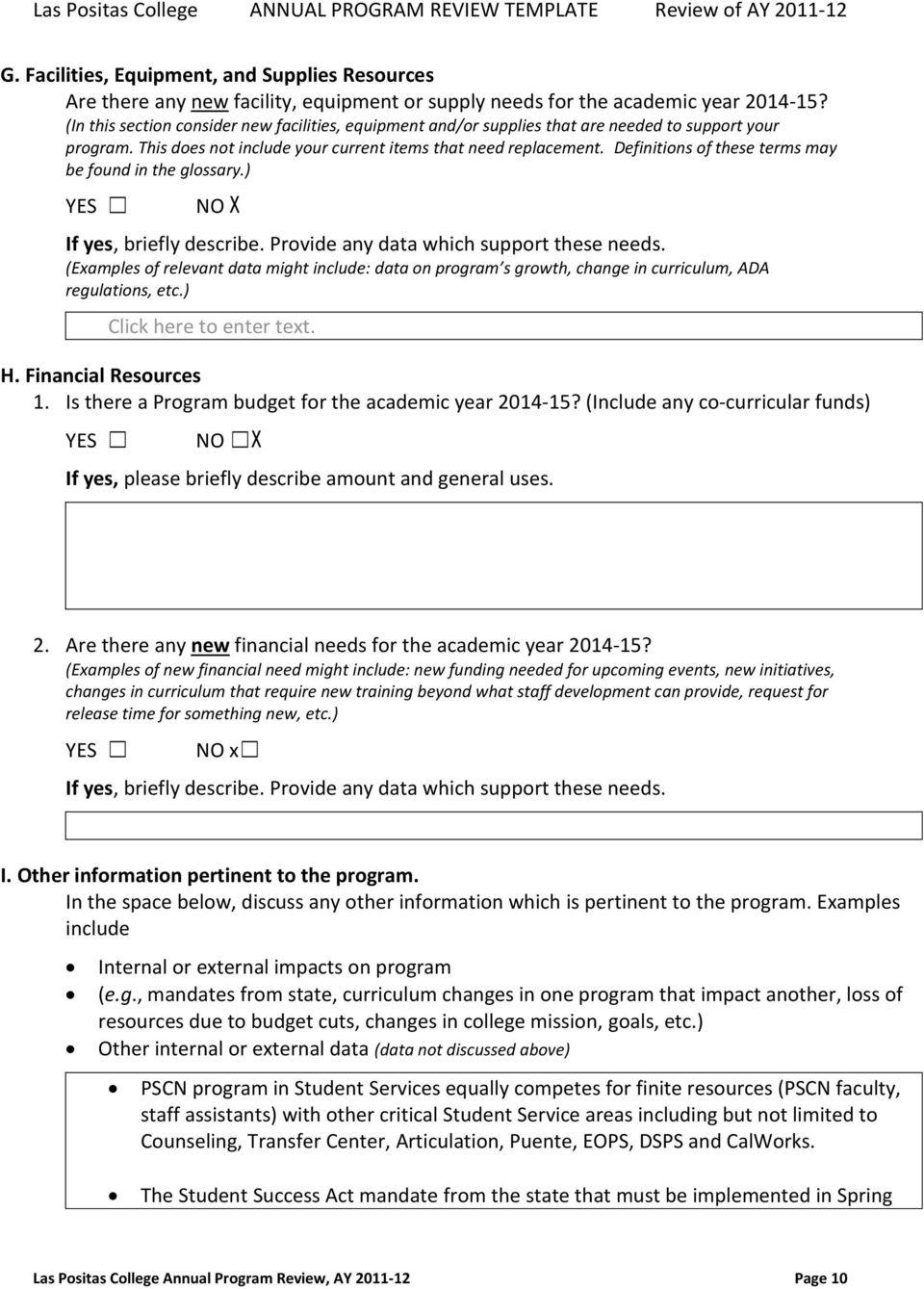
10 G. Facilities, Equipment, and Supplies Resources Are there any new facility, equipment or supply needs for the academic year ? (In this section consider new facilities, equipment and/or supplies that are needed to support your program. This does not include your current items that need replacement. Definitions of these terms may be found in the glossary.) YES NO X If yes, briefly describe. Provide any data which support these needs. (Examples of relevant data might include: data on program s growth, change in curriculum, ADA regulations, etc.) H. Financial Resources 1. Is there a Program budget for the academic year ? (Include any co-curricular funds) YES NO X If yes, please briefly describe amount and general uses. 2. Are there any new financial needs for the academic year ? (Examples of new financial need might include: new funding needed for upcoming events, new initiatives, changes in curriculum that require new training beyond what staff development can provide, request for release time for something new, etc.) YES NO x If yes, briefly describe. Provide any data which support these needs. I. Other information pertinent to the program. In the space below, discuss any other information which is pertinent to the program. Examples include Internal or external impacts on program (e.g., mandates from state, curriculum changes in one program that impact another, loss of resources due to budget cuts, changes in college mission, goals, etc.) Other internal or external data (data not discussed above) PSCN program in Student Services equally competes for finite resources (PSCN faculty, staff assistants) with other critical Student Service areas including but not limited to Counseling, Transfer Center, Articulation, Puente, EOPS, DSPS and CalWorks. The Student Success Act mandate from the state that must be implemented in Spring Las Positas College Annual Program Review, AY Page 10
11 2014 will greatly impact Counseling faculty workload that directly impacts the staffing needs of PSCN courses. Lack of consistent leadership and institutional knowledge--interim Dean of Student Services for , No Dean for , and again new Interim Dean for (new permanent Dean will be hired for ). Loss of a total of 5 PSCN faculty prior to AY due to retirement and job changes. Conducted interviews and hire 3 new counseling faculty to start mid-oct 2011 that involved training for AY With a majority of PSCN faculty teaching courses primarily for overload and not for load, there is a lack of leadership/time allocated to development or enhance the PSCN curriculum and program. The Business Department eliminated offering Internship seminar (INTN 95) and Internship Experience (INTN 96) for Fall 2012 that affects the Health and Human Services Certificate because it is one of the requirements of the certificate. There are institutional directives that allocated PSCN FTEF into other areas (e.g., General Studies courses for the College Foundation Semester). III. SUMMARY A. Summarize objectives accomplished since the Program Review Update (2012) (The 2012 Academic Program Review Updates can be found on the Grapevine (Click on your discipline name.) Your brief discussion may include objectives accomplished since the 2010 program review, even if not discussed in the Update.) The two program objectives from 2012 were 1): reinstate the Health and Human services Advisory Board and 2): re-submit the AA Degree in Health and Human Services. Due to budget and staffing shortages, we have not been able to accomplish these objectives. For PSCN, we have increased enrollments and scheduled our classes in larger rooms to accommodate more students. We have also added more Psychology Counseling streaming videos in the library to support our courses. Although funding for professional development has been limited, we have supported Counseling faculty to attend conferences and provided training in mental health crisis counseling. Las Positas College Annual Program Review, AY Page 11

12 B Summarize objectives not accomplished since the program review update (2012) and why not. (Your brief discussion may include objectives not accomplished since the 2010 program review, even if not discussed in the Update.) 1. Lack of consistent leadership and institutional knowledge--interim Dean of Student Services for , No Dean for compounded by having an Interim VP of Student Services for and a new VP of Student Services who started in Spring At the end of summer 2011, we lost a total of 5 PSCN faculty. Due to the limited number of PSCN faculty, we were stretched thinly to cover PSCN courses and to also offer counseling services. 3. Due to the lack of leadership (no Dean of Student Services in ), the primary goal for the PSCN Counseling faculty was to maintain counseling services in the Student Services Division while maintaining the PSCN curriculum offerings. C. What are the objectives for the academic year ? (Summarize briefly the objectives you plan to accomplish or begin in You will describe your plan to implement/achieve these objectives in the Program Effectiveness Plan in Part IV.) Objectives to being in : 1. Hire 2 PSCN faculty; 2. Begin work on PSCN courses to match CIDs for possible AS-T: Social Work; 3. Start working on an extensive orientation class (6 hours) for specific populations such as athletes, veterans, financial aid, probation students, etc. D. For all needs identified in Part II, summarize how these needs will affect student learning/achievement and impact the program. (This brief summary should capture the effects on students and the program if the needs are met or unmet.) If the needs identified in Part II are unmet then the effects on the students and the program would be: a. Loss of a possible AA-T/AS-T transfer degree in Social Work that will expedite students transferring to CSUs for Social Work major; b. Loss of FTEF to PSCN due to the implementation of a 3 unit Puente class in fall and 1 unit Puente class in spring; c. Limited number of course offerings that promote student success (with career exploration and study skill success); and d. Reduced number of course offerings that fulfill degree and general education requirements. Continue to the next page to complete the form. Las Positas College Annual Program Review, AY Page 12

13 Name of Program Division Author(s) Psychology-Counseling Student Services Christina Lee IV. PROGRAM EFFECTIVENESS PLAN Instructions: In the table below, indicate how you plan to measure the effectiveness of each objective summarized in Part III and the resources needed. Suggested: 0-5 Objectives (focus on a few) Rank Priority 1=essential 2=important 3=nice to have Objective 1 1 Restoration of 2 PSCN faculty positions 2 2 Begin work on PSCN courses to match CIDs for possible AS-T: Social Work 3 3 Begin work on an extensive SLO s/sao s linked to objective Training in Student Success & Support Program Mandates, SARS training and continued Degree Works training. Tied to updating Health and Human Services Program level SLO s. Mandates from 3SP College goal(s) linked to objective How will effectiveness be measured? When additional faculty are hired and training has occurred When the State approves our AA-T/AS-T in Social Work Number of students Category* Human and financial Resources Human Resources Reassigned time; Resources needed Funding Human Resources, PSCN faculty PSCN faculty & Committee Faculty Hiring Committee Curriculum Committee Curriculum Committee Las Positas College Annual Program Review, AY Page 13
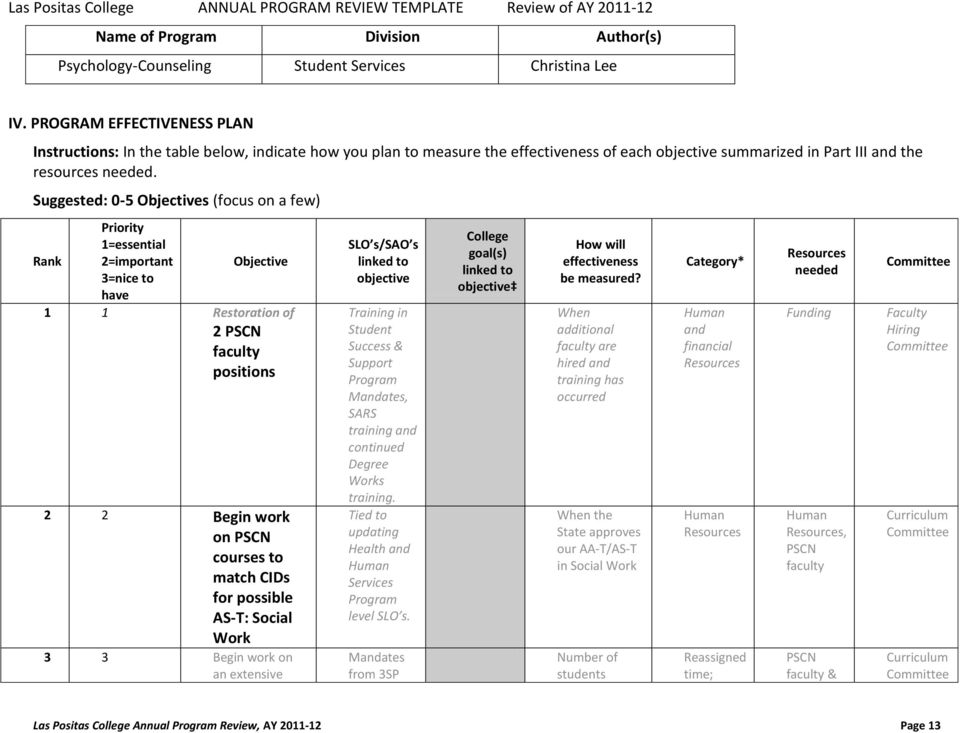
14 Name of Program Division Author(s) Psychology-Counseling Student Services Christina Lee orientation class (6 hours) for specific populations such as athletes, veterans, financial aid, probation students, etc). served through the class as well as an evaluation of the course. Approximately 2100 new students each yr. Human Resources reassigned time 4 5 *human, technological, facilities/supplies, financial, other When College Goals become available, this column will be activated. Las Positas College Annual Program Review, AY Page 14

Las Positas College ANNUAL PROGRAM REVIEW TEMPLATE Review of AY 2011-12. Name of Program Division Author(s) Geography ALSS Thomas Orf
 Las Positas College ANNUAL PROGRAM REVIEW TEMPLATE Review of AY 2011-12 Name of Program Division Author(s) Geography ALSS Thomas Orf INSTRUCTIONS: 1. This Annual Program Review covers the time frame academic
The Instructional (Academic Affairs) Program Review Narrative Report
 The Instructional (Academic Affairs) Program Review Narrative Report 1. College: Laney College Discipline, Department or Program: Counseling Discipline Date: 11/13/12 (Due by November 13, 2012) Members
PROGRAM REVIEW UPDATE 2015-2016
 Program: Nutrition and Health Division: BSBA Date: October 2 nd, 2015 Writer(s): Marsha Vernoga SLO/SAO Point-Person: Marsha Vernoga PROGRAM REVIEW UPDATE 2015-2016 Audience: Deans, Vice Presidents of
Program Planning and Assessment (PPA) for Services, Offices & Non-Instructional Programs. Comprehensive Review, Annual Review & Action Plan
 Program Planning and Assessment (PPA) for Services, Offices & Non-Instructional Programs Comprehensive Review, Annual Review & Action Plan Spring 2015 The purpose of Program Planning and Assessment at
Bakersfield College Program Review Annual Update
 Bakersfield College Program Review Annual Update I. Program Information: Program Name: Counseling and Advising Department Program Type: Instructional Non Instructional Program Mission Statement: Academic
PROGRAM REVIEW UPDATE 2015-2016
 Program: Humanities Division: ALSS Date: 15 September 2015 Writer(s): Candy Klaschus, Jeremiah Bodnar SLO/SAO Point-Person: Candy Klaschus PROGRAM REVIEW UPDATE 2015-2016 Audience: Deans, Vice Presidents
Summary of Counseling Program SLO Assessment Fall 2012 Review & Spring 2013 Plans (Compiled from data submitted by February 13, 2013)
 Summary of Counseling Program SLO Assessment Fall 2012 Review & Spring 2013 Plans (Compiled from data submitted by February 13, 2013) Summary prepared by Kathleen Mitchell Table of Contents Introduction
PROPOSAL FOR FULL-TIME CWA COUNSELOR
 PROPOSAL FOR FULL-TIME CWA COUNSELOR A. Department/Discipline/Program Criteria 1. Identify current Comprehensive Program Review (in cycle) and current Annual Program Plan documents with position need and
Peralta Community College District STUDENT SERVICES ANNUAL PROGRAM UPDATE Academic Year 2013-2014
 Peralta Community College District STUDENT SERVICES ANNUAL PROGRAM UPDATE Academic Year 2013-2014 This presents the common elements to be addressed by each student services unit/area in its annual program
Psychology Program Review 2006-2007
 Psychology Program Review 2006-2007 Spring 2007 Prepared By: Dr. Rick Brown Dr. Michael A. Hurtado Dr. Andrew Kim Carolyn Perry PSYCHOLOGY PROGRAM REVIEW COMMITTEE MEMBERS 2006-2007 FACULTY: Dr. Rick Brown
Chaffey College Program Review Three Year Review 2011
 PROGRAM OVERVIEW Program Title: Chaffey College Program Review Three Year Review 2011 Hotel and Food Service Program Code: 1306 - HOTEL AND FOOD SERVICE MANAGEMENT Review Type: Instructional Does this
Chaffey College Program Review Three Year Review 2011
 PROGRAM OVERVIEW Program Title: Geology Chaffey College Program Review Three Year Review 2011 Program Code: 1914 - GEOLOGY AND EARTH SCIENCE Review Type: Instructional Does this review contain any career
Dean: Erin Vines, Faculty Member: Mary Gumlia 12/14/2009
 SOLANO COMMUNITY COLLEGE PROGRAM REVIEW COUNSELING COURSES Dean: Erin Vines, Faculty Member: Mary Gumlia 12/14/2009 Introduction The mission of the Solano College Counseling Division is to provide services,
Lakeland Community College Campus Completion Plan
 Lakeland Community College Campus Plan Narrative Overview Lakeland Community College opened its doors in 1967 as the first college in Ohio established by a vote of local citizens committed to providing
Peralta Community College District
 Peralta Community College District Berkeley City College College of Alameda Laney College Merritt College Counseling Program Review Handbook Fall 2015 Version 3. i ii Table of Contents Purpose and Goals
Program Review List Logout How it works
 Program Review Submission Program Review List Logout How it works 2014-2015 Student Services Program Review Program Name: Counseling Services Program Contact: Ramezane, Marsha Academic Year: 2014-2015
Santa Rosa Junior College
 Santa Rosa Junior College Program Resource Planning Process Digital Media 2015 1.1a Mission PRPP for Digital Media, prior to June 2015, was included in the Computer Studies PRPP. Digital Media will start
Student Learning Outcomes Report. Student Services Area Admissions and Records
 West Los Angeles College Program Review 2013 2014 Student Learning Outcomes Report Student Services Area Admissions and Records The dialogue regarding the move toward fully online applications and an application
Criminal Justice Department Portfolio Assessment/Program Review 2014/15
 1 Criminal Justice Department Portfolio Assessment/Program Review 2014/15 Criminal Justice Department Mission The mission of the Criminal Justice Department is to enhance community safety by providing
El Camino College Industry and Technology Division Engineering Technology Department Program Review Spring 2009 Conducted by: Eric Carlson
 El Camino College Industry and Technology Division Engineering Technology Department Program Review Spring 2009 Conducted by: Eric Carlson I. Overview A. Description of Program B. Status of Previous Recommendations
MIRACOSTA COLLEGE TRANSFER CENTER: MASTER PLAN
 MIRACOSTA COLLEGE TRANSFER CENTER: MASTER PLAN Fall 2015 TRANSFER CENTERS: THE HUB OF TRANSFER ACTIVITY This section presents a description of the strategies that support the transfer function at MiraCosta
2009-10 ANNUAL DISTANCE EDUCATION REPORT TO THE CLPCCD BOARD OF TRUSTEES
 2009-10 ANNUAL DISTANCE EDUCATION REPORT TO THE CLPCCD BOARD OF TRUSTEES Las Positas College Scott Vigallon, Instructional Technology/Open Learning Coord. August, 2010 Table of Contents INTRODUCTION...
Bob Haick, Lorraine Barrales-Ramirez, Karen Olesen
 Kathy Sammut and Sandra Mendez Bob Haick, Lorraine Barrales-Ramirez, Karen Olesen Include the purpose of the program, the ideals the program strives to attain, and whom the program serves. The program
COUNSELING DEPARTMENT PROGRAM REVIEW. 1. College: Laney College Date: November 1, 2012
 COUNSELING DEPARTMENT PROGRAM REVIEW 1. College: Laney College Date: November 1, 2012 Program: Counseling Department Review Team Members: Dean Tina Vasconcellos, Kathy Ma, Ann McMurdo 2. Background Information
Strategic Planning: A Small College s Approach and Implementation
 Strategic Planning: A Small College s Approach and Implementation Prepared and Presented by: Dr. Cheryl Marshall, Vice President of Instruction Keith Wurtz, Director of Research and Planning Session Objectives
Chaffey College Program Review Report
 Program Review Title: Program Code: Review Type: Type: Chaffey College Program Review Report Nursing Assistant and Home Health Care 1202 - NURSING: CNA Instructional SLO's Overview of Chaffey College Program:
Mt. San Antonio College Counseling
 epie Report - 4 Column Mt. San Antonio College Counseling Mt. SAC Mission Statement: The mission of Mt. San Antonio College is to welcome all students and to support them in achieving their personal, educational,
Integrated Planning in a Multi College District
 Integrated Planning in a Multi College District Critical functions coordinated under the district umbrella. Planning levels build upon one another District Strategic Planning College Strategic Planning
Chaffey College Program Review Three Year Review 2011
 PROGRAM OVERVIEW Program Title: Counseling Chaffey College Program Review Three Year Review 2011 Program Code: 6303 - COUNSELING Review Type: Instructional Administrative Student Support Does this review
Business A.S. Degree: Accounting
 Business A.S. Degree: Accounting COURSE ID Legend: PLOs: X = Relevant but not assessed. % Upon satisfactory completion of the course requirements for the Accounting Associate of = assessed. Science Degree
Program Area: Tutoring
 Program Area: Tutoring Program Philosophy The Las Positas College Tutorial Program is dedicated to students educational success. We provide quality learning support for the diverse student population that
EL CAMINO COLLEGE Compton Center Athletics 2013-14 Program Review
 EL CAMINO COLLEGE Compton Center Athletics 2013-14 Program Review Program Description 1. Describe the program emphasizing the program s objectives and how the program supports the college s mission and
OVERVIEW OF THE PARALEGAL PROGRAM
 OVERVIEW OF THE PARALEGAL PROGRAM Our mission in union with the American Bar Association and the State Bar of California is to extend access to legal services in our local community. With this in mind,
UNIT PLAN PART A Program/Pathway Update
 UNIT PLAN PART A Program/Pathway Update Program/Pathway: Date: November 1, 2013 Our Mission: Los Angeles Harbor College fosters learning through comprehensive programs that meet the educational needs of
CRIMINAL JUSTICE PROGRAM REVIEW 08-09 ONE COLLEGE WAY BLYTHE, CA 92225
 CRIMINAL JUSTICE PROGRAM REVIEW 08-09 ONE COLLEGE WAY BLYTHE, CA 92225 EXECUTIVE SUMMARY CRIMINAL JUSTICE The Criminal Justice program services a critical community and student need in providing basic
ENROLLMENT MANAGEMENT PLAN
 ENROLLMENT MANAGEMENT PLAN September, 2009 Vision A premier learning community recognized for supporting student success and enriching society. Mission Cypress College enriches students lives by providing
The Instructional Program Review Narrative Report
 The Instructional Program Review Narrative Report 1. College: MERRITT COLLEGE Discipline, Department or Program: ADMINISTRATION OF JUSTICE Date: 10/9/12 Members of the Instructional Program Review Team:
San Diego Continuing Education. Student Equity Plan 2014-2017
 Student Equity Plan 2014-2017 November 6, 2014 2 EXECUTIVE SUMMARY (SDCE) provides adult education for the San Diego Community College District. SDCE is the largest, separately accredited continuing education
students to complete their degree online. During the preliminary stage of included Art, Business, Computer Science, English, Government, History, and
 Texas Woman s University College of Arts and Sciences Bachelor of General Studies Program Undergraduate Program Review May 2012 I. PROGRAM REVIEW AND MISSION A. History Texas Woman s University has a proud
Student Affairs and Higher Education
 About the Practicum The practicum enables students to acquire experience and competencies in various domains of higher education administration. The practicum plays a major role in bridging theory and