
Solution for Staging Area in Near Real-Time DWH Efficient in Refresh and Easy to Operate. Technical White Paper
|
|
|
- Anastasia Hodges
- 9 years ago
- Views:
Transcription
1 Solution for Staging Area in Near Real-Time DWH Efficient in Refresh and Easy to Operate Technical White Paper Mathias Zarick, Karol Hajdu Senior Consultants March-2011
2 While looking for a solution for near real-time data warehouse (DWH), the efficiency and operational stability (reliability) is probably one of your primary technical concerns. This applies both to the data transformation tasks and to the extraction & loading of staging area as well. This article covers the challenges around the staging area. It presents a technical solution which aims to solve both important concerns: the refresh process of staging area is efficient and easy to operate. This solution is based on Oracle Data Guard and transportable tablespaces. Contents 1. The role of a Staging Area in Data Warehouse The Challenge called short latency Different solutions having different advantages Solution with Data Guard the management perspective Benefits for Data Warehouses Which types of Data Warehouses will benefit most? Solution with Oracle Data Guard the technical insight How it works? The Key Advantages Technical Prerequisites Take a Tour on Real-Life Example Real-life example Setup and Configuration Operation Solution extension: If data availability for operational reporting matters [email protected]. Info-Tel Page 2 / 19

3 1. The role of a Staging Area in Data Warehouse In data warehouse architectures, there are some common good practices concerning the staging area: 1. Create a staging area. After being extracted from source systems, the data is loaded into the staging area. The staging area serves as the input for transformation processes. 2. During the extraction and load into the staging area, only minimal data transformations are done: the tables in the staging area have the same structure as the corresponding tables in the source system. This makes the ETL architecture much more transparent. Based on the staging area s content, the transformation and integration processes will produce: - snapshots of data, serving as input for DWH s versioning - sets of change events (transactions) to be loaded into the DWH 1.1 The Challenge called short latency In many enterprises, the Data Warehouse is the place where operative data originating from different systems are coming together and are integrated with analytical or dispositive data. Step-by-step, many business users discovered the value of integrated data. They use the data stored in the Data Warehouse to create reporting or analytical applications. As the markets in many lines of business get more and more volatile, the business users are not willing to wait several days or hours for the latest figures. They require a shortened latency of the Data Warehouse: the need for near real-time data warehouse was born. Integration tasks involve both hardware resources and time. Hence, the Data Warehouse architects faced a new challenge: to find a trade-off between get more speed (data latency) and provide integrated and cleansed data. Some of them decided to introduce additional redundancy (by creating an Operational Data Store, having short latency, but less integration). Some of them decided to provide short latency only for very narrow and well specified content: they speak about real-time data warehouse content, rather than a real-time data warehouse. Regardless on which approach the Data Warehouse architect has chosen, he or she needs to have a Staging Area with short latency. This is the subject covered by this white paper. 1.2 Different solutions having different advantages There are several technical approaches how data extraction and the loading of a staging area can be implemented. The technical implementations differ basically in the following characteristics: - transferred data volumes required to refresh the staging area [email protected]. Info-Tel Page 3 / 19
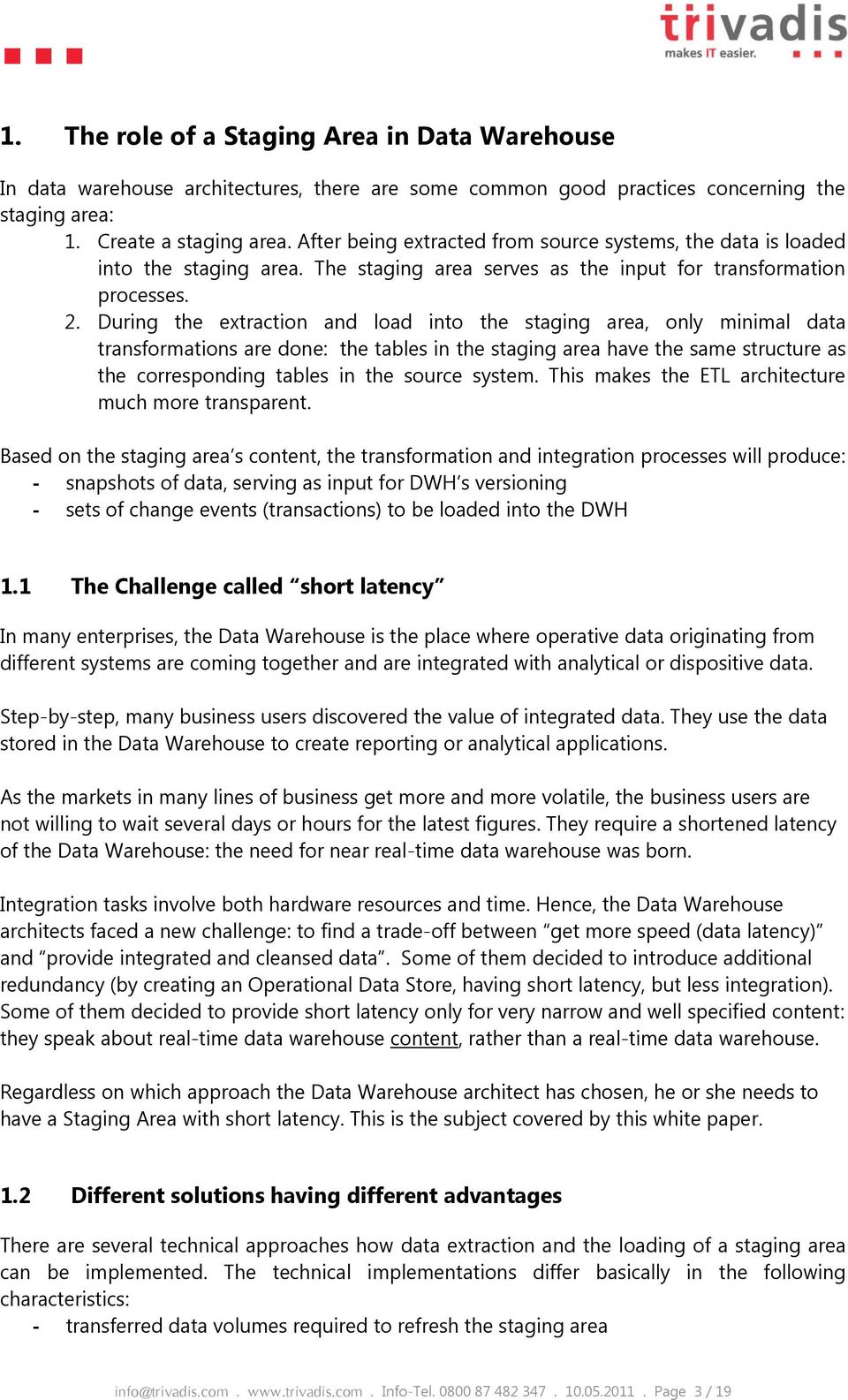
4 - degree of completeness for changes to be captured - performance impact on the source system (additional resource consumption) - impact on data and service availability of source system - total costs of ownership: o licensing costs and development efforts o operational complexity (efforts, reliability) Concept / Implementation Data Volumes to Transfer Degree of Completeness Performance Impact on Source Availability Impact on Source Operational Complexity Full-Extraction Marker-Based Extraction Journal-Based Extraction Oracle Streams / / Oracle Golden Gate / / Table 1: Simple overview of refresh solutions for DWH s staging area Depending on database technology of the source system, some concepts can be excluded right from the start, because they have very specific prerequisites about supported technologies. For more details about the refresh solutions for Staging Area, please refer to the book Data Warehousing mit Oracle Business Intelligence in der Praxis [3], Chapter 3.4. If the source system is Oracle, there is yet another technical solution to extract the data from source systems and load it into staging area. This approach uses Oracle Data Guard, flashback and transportable tablespaces. This solution has the same advantages common for any other replication techniques like Oracle Streams or Oracle GoldenGate: - small data volumes to be transferred - low impact on source system s performance & availability 1 - all types of changes on both data & structures are captured and transferred However, there is one important difference: This new solution has significantly lower operational complexity than Oracle Streams or Oracle GoldenGate! Concept / Implementation Data Volumes to Transfer Degree of Completeness Performance Impact on Source Availability Impact on Source New Solution using Data Guard and transportable tablespaces Table 2: New solution has significantly lower operational complexity than Streams or GoldenGate Operational Complexity This white paper explains the concepts and provides the most important implementation details presented in form of a real-life example. 1 This solution has even less impact on source database than Oracle Streams or Oracle GoldenGate. Reason: the supplemental logging is not required here. [email protected]. Info-Tel Page 4 / 19
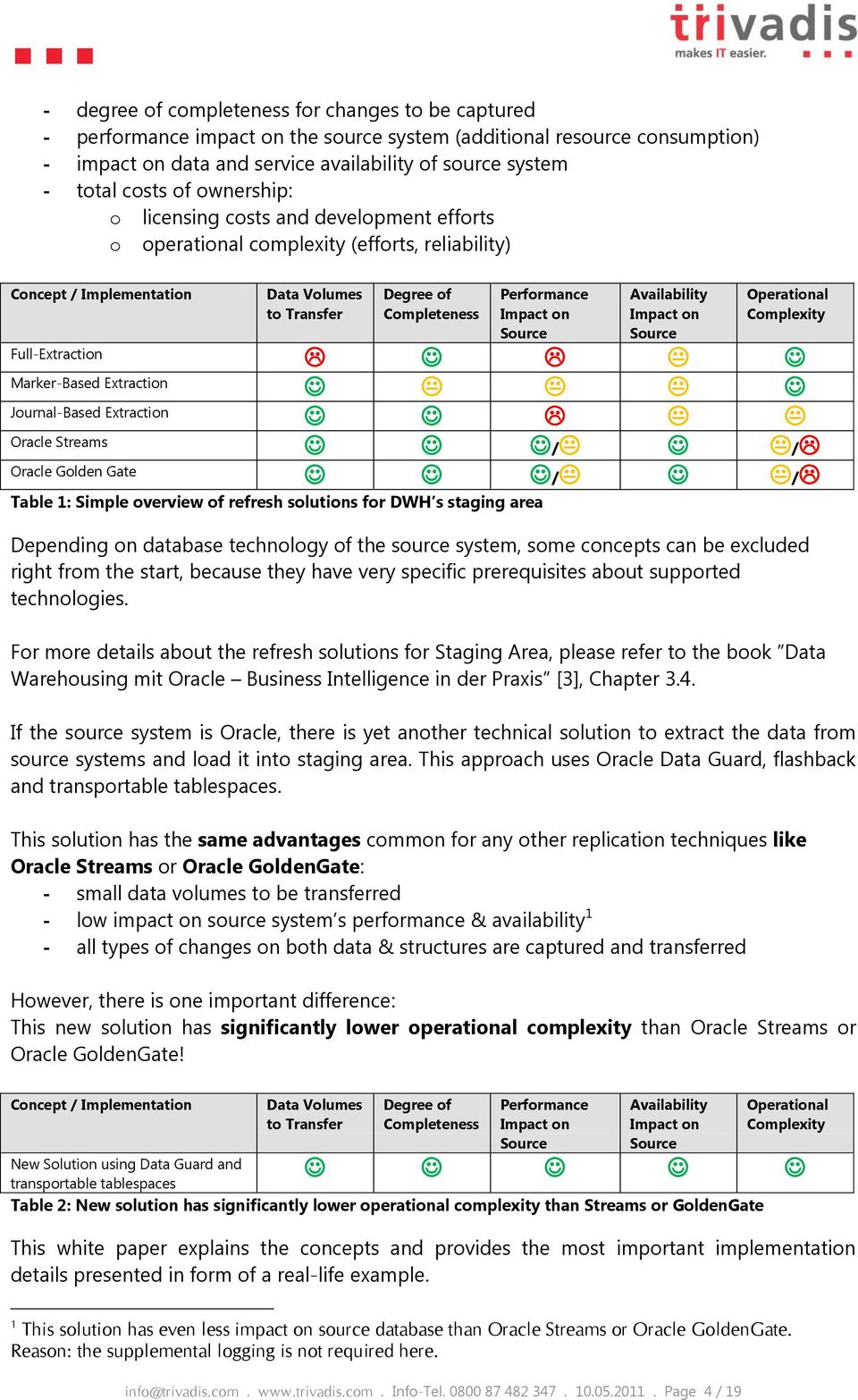
5 2. Solution with Data Guard the management perspective 2.1 Benefits for Data Warehouses Our experience shows that the solution described in this paper brings the following benefits for Data Warehousing: Benefit Short latency of data stored in DWH or ODS (to near real-time) Shorter time-to-market for new ETL functionality Easy and stable operation How is this achieved? The refresh process of Staging Area and/or Operational Data Store (ODS) is very efficient. It consumes small amount of HW resources. It terminates in short elapsed time. Solution enables that Staging Area contains full set of data (not only the changed records). This makes the ETL application more transparent. Introducing changes in ETL applications is then less complex. While refreshing the tables in Staging Area, the operational complexity is delegated to standard and reliable Oracle products and features. These features are easy to operate. 2.2 Which types of Data Warehouses will benefit most? Extraction and sourcing from dedicated online transaction applications which are used to manage complex relationships between customers, suppliers, accounts or delivery components (applications like CRM or SCM 2 ) can be very hard. The underlying database schema of these applications is related with complex data models 3. Companies using dedicated CRM or SCM applications often have to manage the life cycle of several millions of individual subjects (like customers, suppliers, contracts, product components, stock keeping units, policies etc). A Staging Area or even an Operational Data Store (ODS) if using the solution described in this paper, takes most benefits if: - The source system has huge data volume with complex relationships, having relatively small rate of data changes. - There are reports with short latency requirements. The Staging Area needs to capture the changes made in online applications with a very short latency. 2 Supply Chain Management 3 a lot of relationships between the tables [email protected]. Info-Tel Page 5 / 19

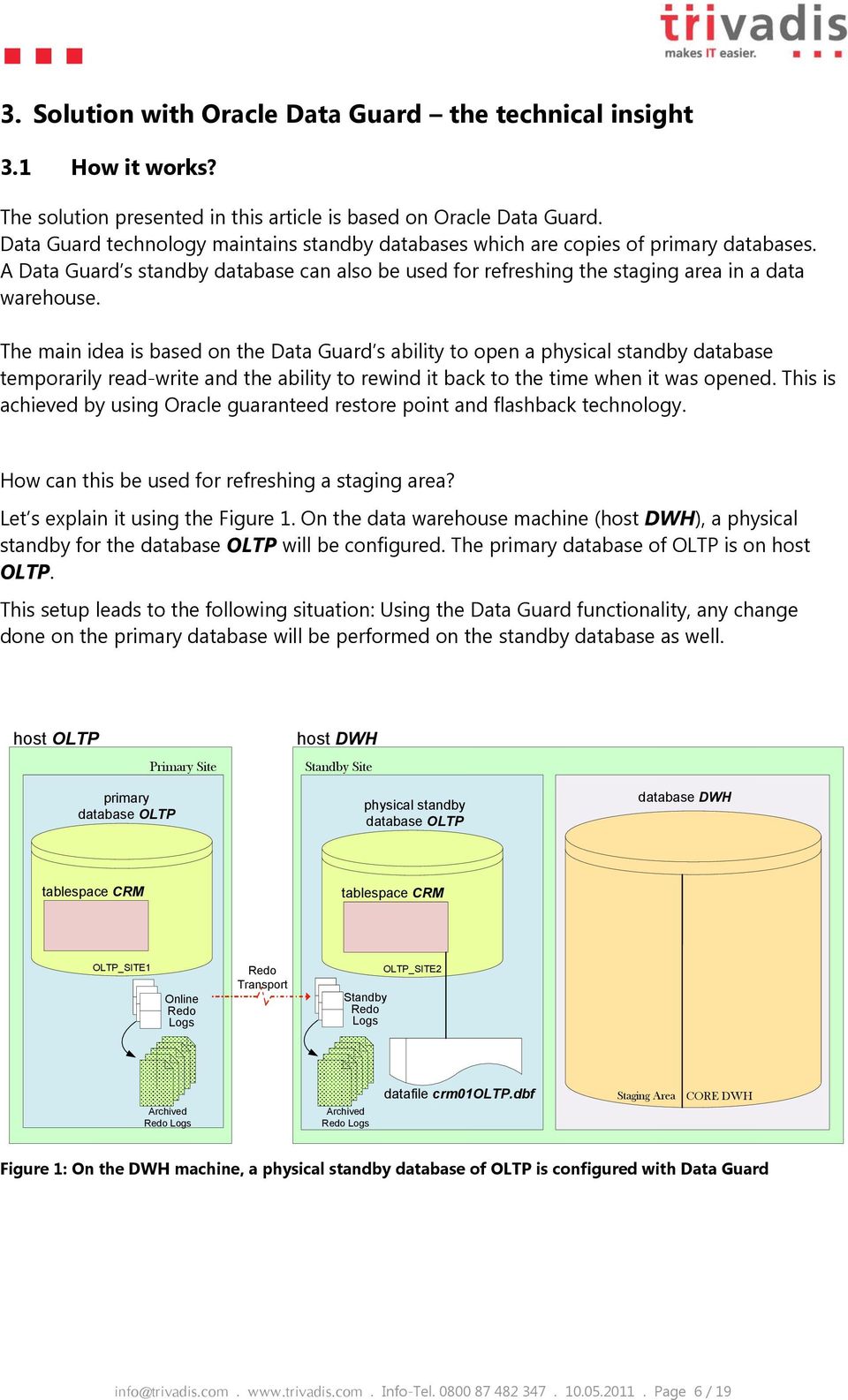
6 3. Solution with Oracle Data Guard the technical insight 3.1 How it works? The solution presented in this article is based on Oracle Data Guard. Data Guard technology maintains standby databases which are copies of primary databases. A Data Guard s standby database can also be used for refreshing the staging area in a data warehouse. The main idea is based on the Data Guard s ability to open a physical standby database temporarily read-write and the ability to rewind it back to the time when it was opened. This is achieved by using Oracle guaranteed restore point and flashback technology. How can this be used for refreshing a staging area? Let s explain it using the Figure 1. On the data warehouse machine (host DWH), a physical standby for the database OLTP will be configured. The primary database of OLTP is on host OLTP. This setup leads to the following situation: Using the Data Guard functionality, any change done on the primary database will be performed on the standby database as well. host OLTP Primary Site host DWH Standby Site primary database OLTP physical standby database OLTP database DWH tablespace CRM tablespace CRM OLTP_SITE1 Online Redo Logs Redo Transport Standby Redo Logs OLTP_SITE2 Archived Redo Logs Archived Redo Logs datafile crm01oltp.dbf Staging Area CORE DWH Figure 1: On the DWH machine, a physical standby database of OLTP is configured with Data Guard [email protected]. Info-Tel Page 6 / 19
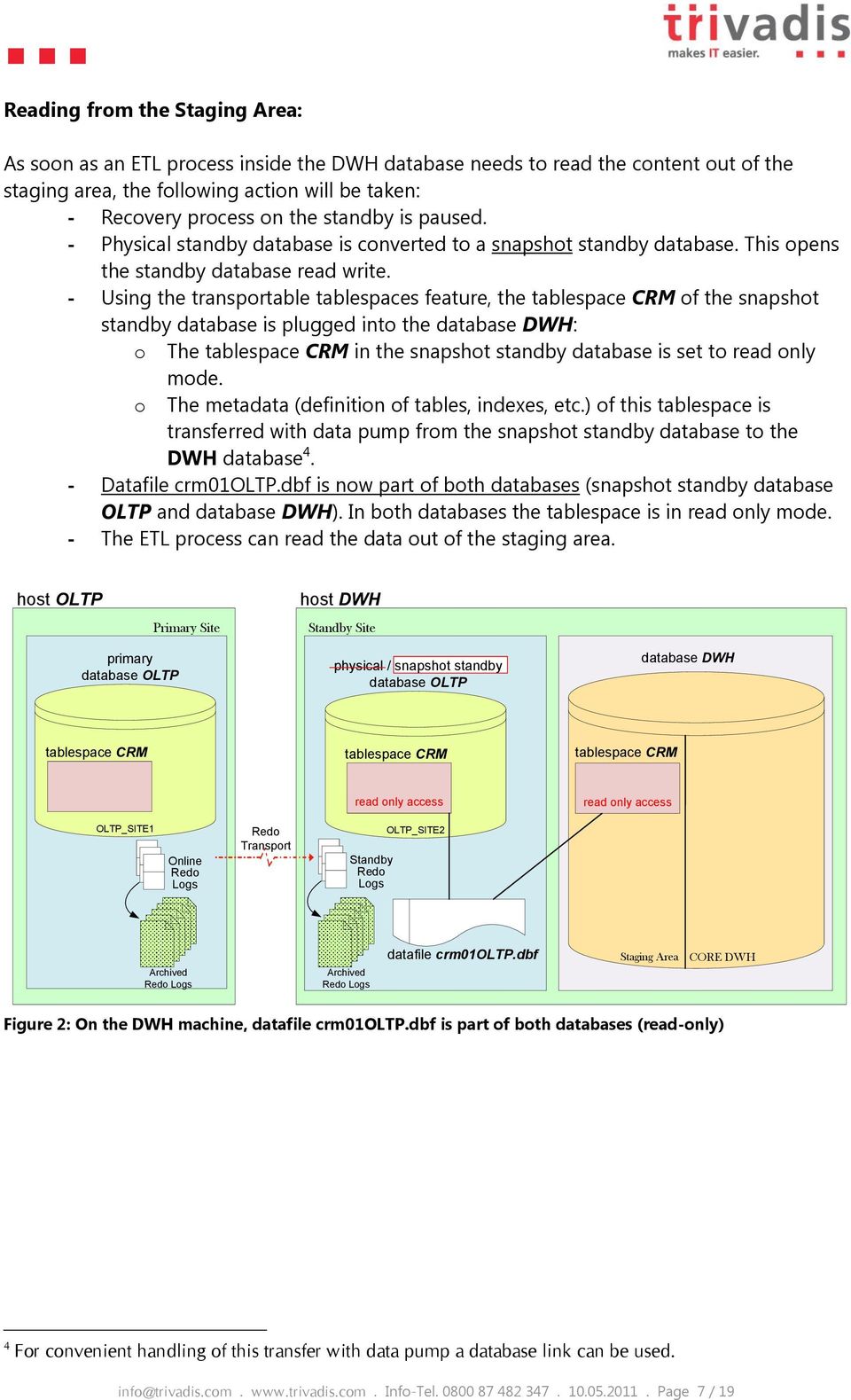
7 Reading from the Staging Area: As soon as an ETL process inside the DWH database needs to read the content out of the staging area, the following action will be taken: - Recovery process on the standby is paused. - Physical standby database is converted to a snapshot standby database. This opens the standby database read write. - Using the transportable tablespaces feature, the tablespace CRM of the snapshot standby database is plugged into the database DWH: o The tablespace CRM in the snapshot standby database is set to read only mode. o The metadata (definition of tables, indexes, etc.) of this tablespace is transferred with data pump from the snapshot standby database to the DWH database 4. - Datafile crm01oltp.dbf is now part of both databases (snapshot standby database OLTP and database DWH). In both databases the tablespace is in read only mode. - The ETL process can read the data out of the staging area. host OLTP Primary Site host DWH Standby Site primary database OLTP physical / snapshot standby database OLTP database DWH tablespace CRM tablespace CRM tablespace CRM read only access read only access OLTP_SITE1 Online Redo Logs Redo Transport Standby Redo Logs OLTP_SITE2 Archived Redo Logs Archived Redo Logs datafile crm01oltp.dbf Staging Area CORE DWH Figure 2: On the DWH machine, datafile crm01oltp.dbf is part of both databases (read-only) 4 For convenient handling of this transfer with data pump a database link can be used. [email protected]. Info-Tel Page 7 / 19
8 Refreshing the Content in the Staging Area: As far as there is a need to read a more current content, that means there is a need to refresh the CRM part of the staging area, the following action will be taken: - The plugged-in tablespace CRM is dropped from the DWH database. - The snapshot standby database is converted back to a physical standby database. - This resumes the recovery process of all its datafiles, including those of the tablespace CRM. host OLTP Primary Site host DWH Standby Site primary database OLTP physical / snapshot standby database OLTP database DWH tablespace CRM tablespace CRM tablespace CRM recovery dropped OLTP_SITE1 Online Redo Logs Redo Transport Standby Redo Logs OLTP_SITE2 Archived Redo Logs Archived Redo Logs datafile crm01oltp.dbf Staging Area CORE DWH Figure 3: Tablespace CRM is dropped from DWH database; standby database is converted back to physical standby [email protected]. Info-Tel Page 8 / 19

9 3.2 The Key Advantages This solution has the following Key Advantages: - Staging area contains the full set of data. - No additional workload on the host OLTP. - Datafiles with full set of data are neither transferred nor copied. o Volume of data transferred between the OLTP and DWH is determined merely by the volume of data changes (size of archived redo logs). - Elapsed time of refresh process of the staging area this represents the refresh of the standby database - does not include the elapsed time to copy the archived redo logs from host OLTP to DWH: o The standby site is able to receive logs from the primary database, in both the physical standby mode and in the snapshot standby mode. In the snapshot standby mode, the logs are queued and not applied. o Since the log transport to the standby site is running all the time, as the recovery process resumes, the outstanding archived redo log files are already registered and available for the recovery 5 of the physical standby database. - Elapsed time for refresh process of staging area does not depend on tablespace size but only on the volume of data changes since the last refresh. - Once configured, both the operation of physical standby databases and the operation of transportable tablespaces are easy to handle and maintain. - Neither remote queries nor distributed joins are used. - On the DWH database the access methods to the data residing in the transported tablespace(s) can be adjusted as follows: o estimation of additional statistics like histograms o manipulation of statistics o creation of additional data structures like indexes or materialized views Considering the overhead produced on the source system and the workload produced on the DWH machine, the solution presented in this article is the most efficient one. - Only the redo logs, and no additional structures, are used - it works on the level of changes on data blocks and not on the level of SQL statements 5 Transported redo logs are applied in physical standby mode only. [email protected]. Info-Tel Page 9 / 19
10 In case the refresh of the staging area is the only purpose of the standby database on the DWH machine, the elapsed time for the refresh process can be minimized by narrowing the scope of the recovery process on the standby database to only those tablespaces of OLTP database, which need to be read by the ETL application. Usually, the ETL processes in DWH require other index types than an OLTP application. If indexes of an OLTP schema reside in a separate tablespace, excluding them can boost the recovery process. Exclusion of irrelevant tablespaces can be easily achieved by offlining and deleting their datafiles on the standby database 6. The standby database on the DWH machine can be configured to serve two purposes at the same time: both for refresh of staging area and for disaster protection of OLTP database. While considering this approach, be aware of the following impacts: - A standby database with offline datafiles cannot be used for disaster protection. - If MaxAvailability or MaxProtection is considered then the availability or the workload on the DWH machine can impact the availability or the performance of the OLTP database. 3.3 Technical Prerequisites There are some technical prerequisites which have to be fulfilled, in order to be able to use the solution described. These prerequisites can be grouped in the following categories: - Identical database character set - Self-contained tablespace sets - Required Oracle database releases - Required Oracle licenses Identical Database Character Set In order to use transportable tablespaces the database OLTP and the database DWH must have identical database character set and identical national character set Self-contained Tablespace Sets In order to be able to transport a set of tablespaces it needs to be self contained. This means that you cannot transport a set of tablespaces which contain objects with other dependent objects such as materialized views, table partitions, etc. as long as you transfer all those objects together in one set 7. 6 Tablespaces that are needed for opening the database like system, sysaux and undo cannot be excluded. 7 Segmentless objects like sequences, views, pl/sql packages are not transferred with transportable tablespaces. Normally you don t need to transfer them into Staging Area anyway. [email protected]. Info-Tel Page 10 / 19

11 3.3.3 Required Oracle Database Release The OLTP database needs to be operated with Oracle Database release 10g or higher. Oracle 11g is recommended as the snapshot standby database feature is available as of this release. If using Oracle 10g it would be necessary to emulate this functionality manually by creating a guaranteed restore point on the standby database before opening it read write. The following limitations have also to be considered when running with Oracle 10g: - There is no out-of-the-box handling with Data Guard for this functionality. You will need to develop a piece of code but this is quite straight forward. - The redo transport between primary and standby is stopped during the period when the standby is open read write 8. In order to use transportable tablespaces in this context, the DWH database needs to be at same or higher release as the OLTP database Required Oracle Licenses This solution requires Oracle Enterprise Edition licence both for the OLTP host and for the DWH host. All required features like Data Guard, transportable tablespaces and snapshot standby database are included in the Enterprise Edition license. No additional option is required for this solution - neither the Active Data Guard 9 option nor the Partitioning option. 8 As mentioned before with a snapshot standby database as of 11g the log transport stays active all the time. 9 Active Data Guard is a new extra licensable option with 11g which includes real-time query and fast incremental backup. None of these features is required by the described solution. [email protected]. Info-Tel Page 11 / 19
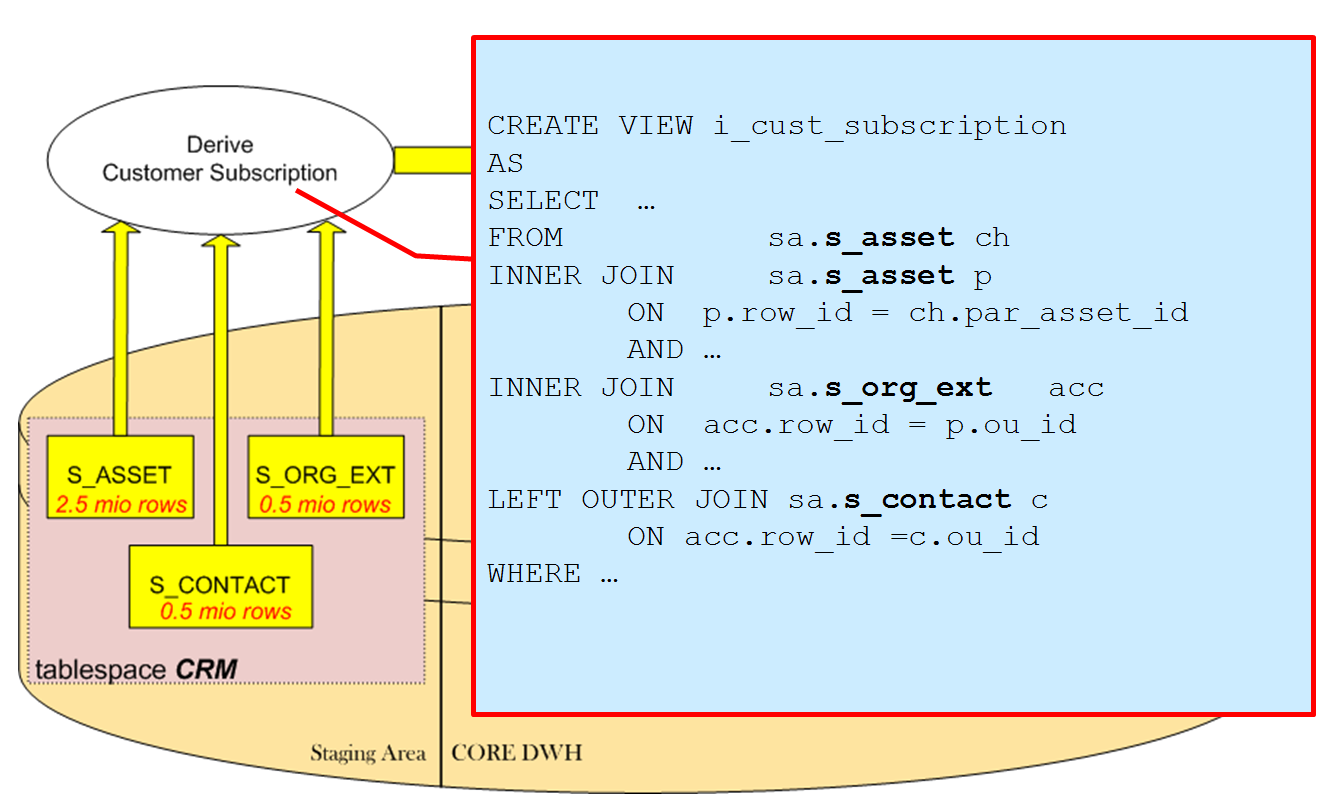
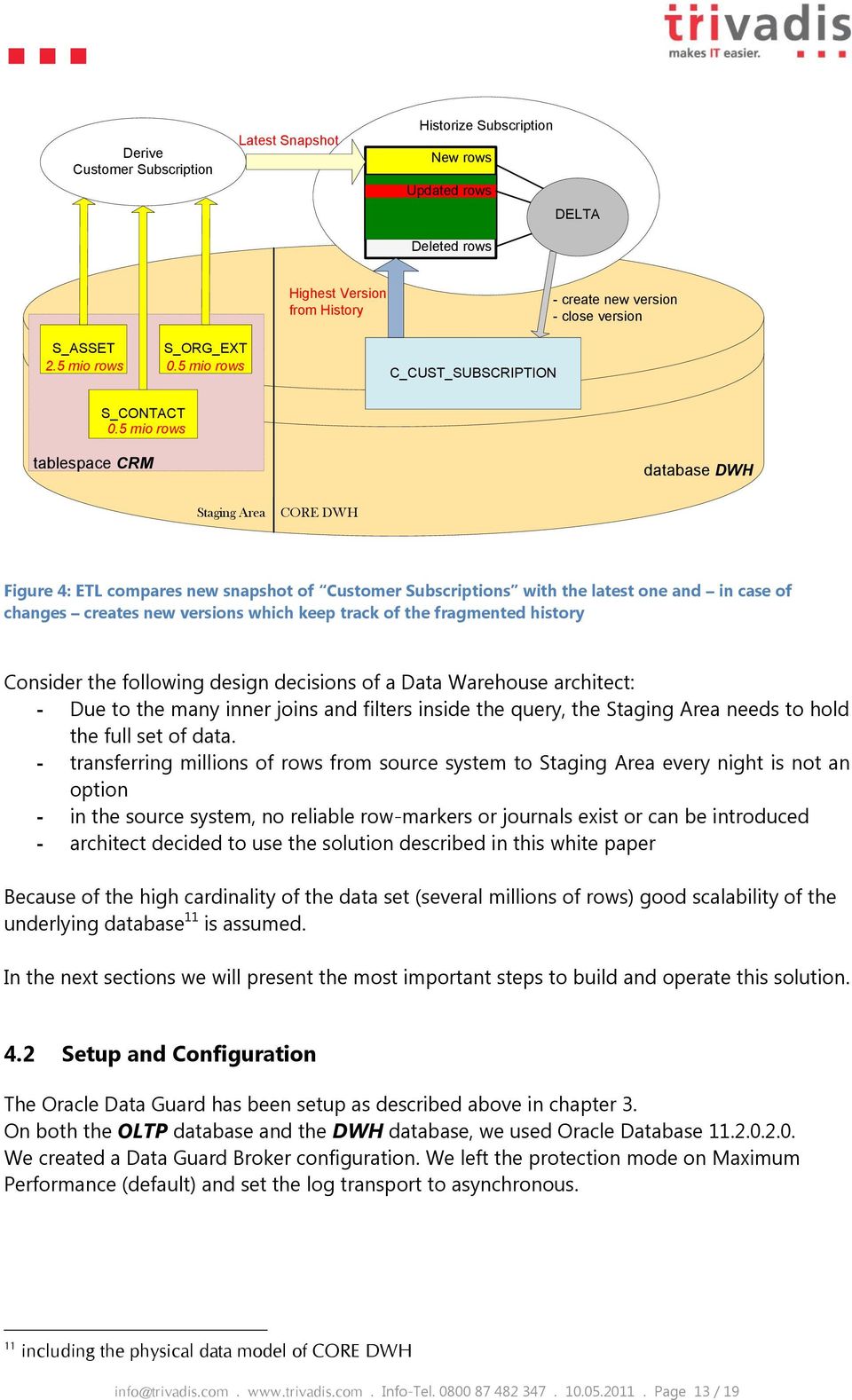
12 4. Take a Tour on Real-Life Example To demonstrate our approach on a representative sample we will use an excerpt from the database schema of CRM application called Siebel. We took Siebel to improve the readability of this example. Siebel is a widely used CRM application owned by Oracle and hence there is a higher chance that ETL developers are familiar with the data model behind it. It is important to understand that the described solution works with any other system or application, even a non-standard in-house developed SW application, too 10. We took the Siebel tables S_CONTACT, S_ORG_EXT and S_ASSET as the representatives for a set of approximately 15 Siebel tables having complex relationships and high cardinality. 4.1 Real-life example Consider the following common Data Warehouse situation: Transformation processes have to read the content out from Siebel tables and transform it into a new entity, let s call it Customer Subscription (refer to Figure 3). Figure 3: Transformation process reads Siebel tables and transform the data into new entity Customer Subscription The Data Warehouse has to store not only the latest status of the Customer Subscriptions, but also all the historical values. The ETL has to compare the new snapshot of Customer Subscriptions with the latest one and in case of changes create new versions which will keep track of the fragmented history. This concept is known as versioning -refer to Figure as long as the data is stored in Oracle RDBMS [email protected]. Info-Tel Page 12 / 19

13 Derive Customer Subscription Latest Snapshot Historize Subscription New rows Updated rows DELTA Deleted rows Highest Version from History - create new version - close version S_ASSET 2.5 mio rows S_ORG_EXT 0.5 mio rows C_CUST_SUBSCRIPTION S_CONTACT 0.5 mio rows tablespace CRM database DWH Staging Area CORE DWH Figure 4: ETL compares new snapshot of Customer Subscriptions with the latest one and in case of changes creates new versions which keep track of the fragmented history Consider the following design decisions of a Data Warehouse architect: - Due to the many inner joins and filters inside the query, the Staging Area needs to hold the full set of data. - transferring millions of rows from source system to Staging Area every night is not an option - in the source system, no reliable row-markers or journals exist or can be introduced - architect decided to use the solution described in this white paper Because of the high cardinality of the data set (several millions of rows) good scalability of the underlying database 11 is assumed. In the next sections we will present the most important steps to build and operate this solution. 4.2 Setup and Configuration The Oracle Data Guard has been setup as described above in chapter 3. On both the OLTP database and the DWH database, we used Oracle Database We created a Data Guard Broker configuration. We left the protection mode on Maximum Performance (default) and set the log transport to asynchronous. 11 including the physical data model of CORE DWH [email protected]. Info-Tel Page 13 / 19
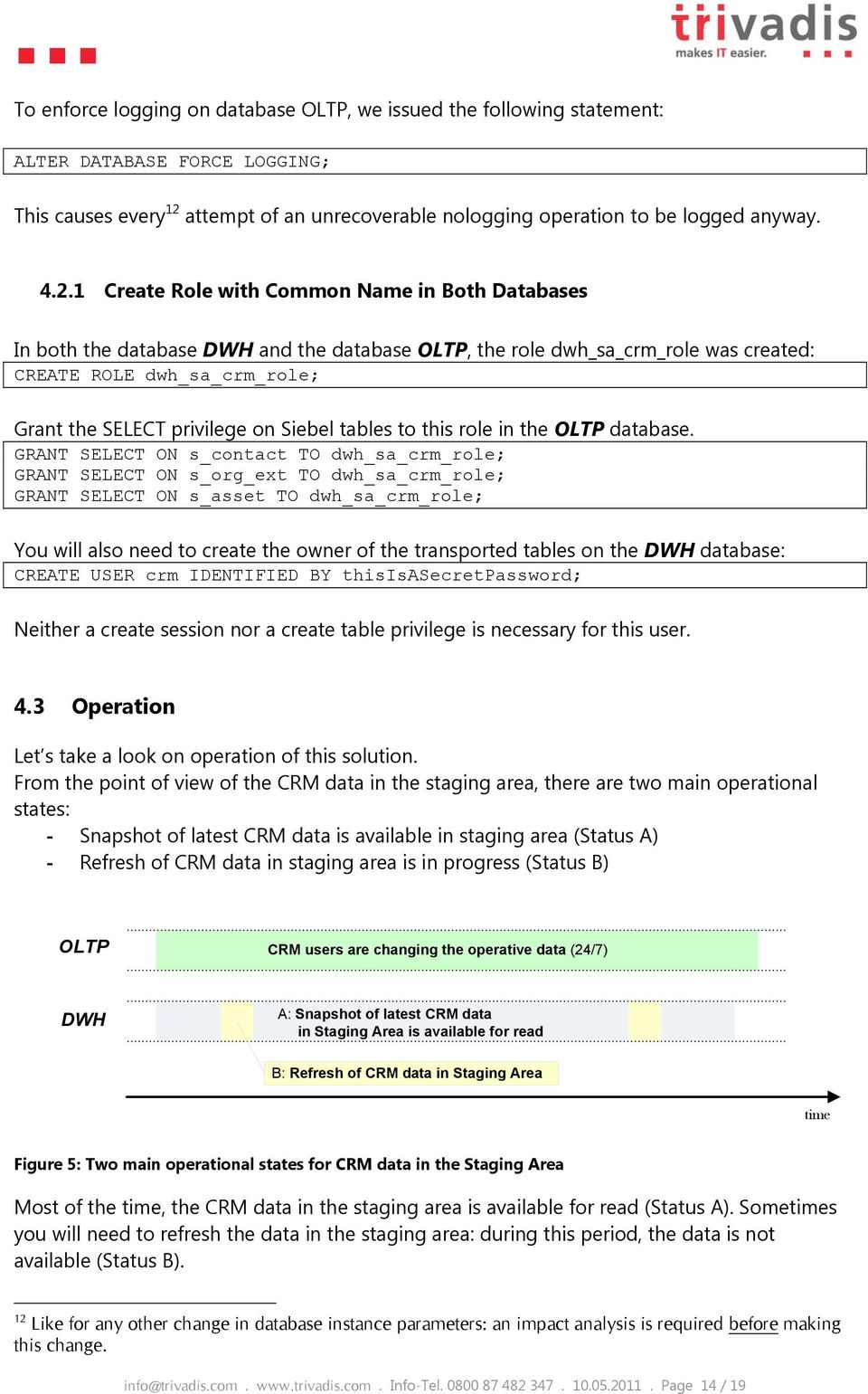
14 To enforce logging on database OLTP, we issued the following statement: ALTER DATABASE FORCE LOGGING; This causes every 12 attempt of an unrecoverable nologging operation to be logged anyway Create Role with Common Name in Both Databases In both the database DWH and the database OLTP, the role dwh_sa_crm_role was created: CREATE ROLE dwh_sa_crm_role; Grant the SELECT privilege on Siebel tables to this role in the OLTP database. GRANT SELECT ON s_contact TO dwh_sa_crm_role; GRANT SELECT ON s_org_ext TO dwh_sa_crm_role; GRANT SELECT ON s_asset TO dwh_sa_crm_role; You will also need to create the owner of the transported tables on the DWH database: CREATE USER crm IDENTIFIED BY thisisasecretpassword; Neither a create session nor a create table privilege is necessary for this user. 4.3 Operation Let s take a look on operation of this solution. From the point of view of the CRM data in the staging area, there are two main operational states: - Snapshot of latest CRM data is available in staging area (Status A) - Refresh of CRM data in staging area is in progress (Status B) OLTP CRM users are changing the operative data (24/7) DWH A: Snapshot of latest CRM data in Staging Area is available for read B: Refresh of CRM data in Staging Area time Figure 5: Two main operational states for CRM data in the Staging Area Most of the time, the CRM data in the staging area is available for read (Status A). Sometimes you will need to refresh the data in the staging area: during this period, the data is not available (Status B). 12 Like for any other change in database instance parameters: an impact analysis is required before making this change. [email protected]. Info-Tel Page 14 / 19
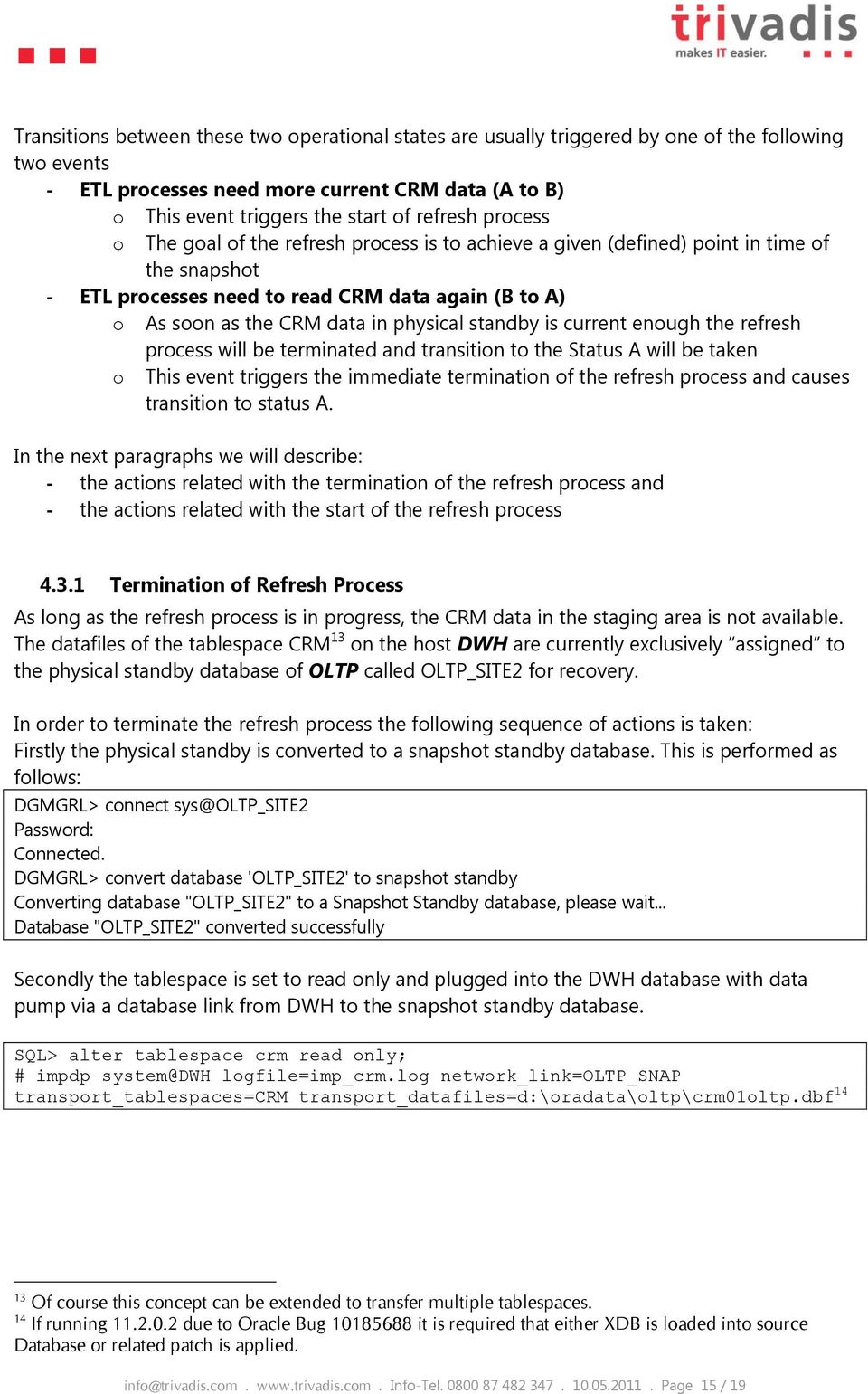
15 Transitions between these two operational states are usually triggered by one of the following two events - ETL processes need more current CRM data (A to B) o This event triggers the start of refresh process o The goal of the refresh process is to achieve a given (defined) point in time of the snapshot - ETL processes need to read CRM data again (B to A) o As soon as the CRM data in physical standby is current enough the refresh process will be terminated and transition to the Status A will be taken o This event triggers the immediate termination of the refresh process and causes transition to status A. In the next paragraphs we will describe: - the actions related with the termination of the refresh process and - the actions related with the start of the refresh process Termination of Refresh Process As long as the refresh process is in progress, the CRM data in the staging area is not available. The datafiles of the tablespace CRM 13 on the host DWH are currently exclusively assigned to the physical standby database of OLTP called OLTP_SITE2 for recovery. In order to terminate the refresh process the following sequence of actions is taken: Firstly the physical standby is converted to a snapshot standby database. This is performed as follows: DGMGRL> connect sys@oltp_site2 Password: Connected. DGMGRL> convert database 'OLTP_SITE2' to snapshot standby Converting database "OLTP_SITE2" to a Snapshot Standby database, please wait... Database "OLTP_SITE2" converted successfully Secondly the tablespace is set to read only and plugged into the DWH database with data pump via a database link from DWH to the snapshot standby database. SQL> alter tablespace crm read only; # impdp system@dwh logfile=imp_crm.log network_link=oltp_snap transport_tablespaces=crm transport_datafiles=d:\oradata\oltp\crm01oltp.dbf Of course this concept can be extended to transfer multiple tablespaces. 14 If running due to Oracle Bug it is required that either XDB is loaded into source Database or related patch is applied. [email protected]. Info-Tel Page 15 / 19
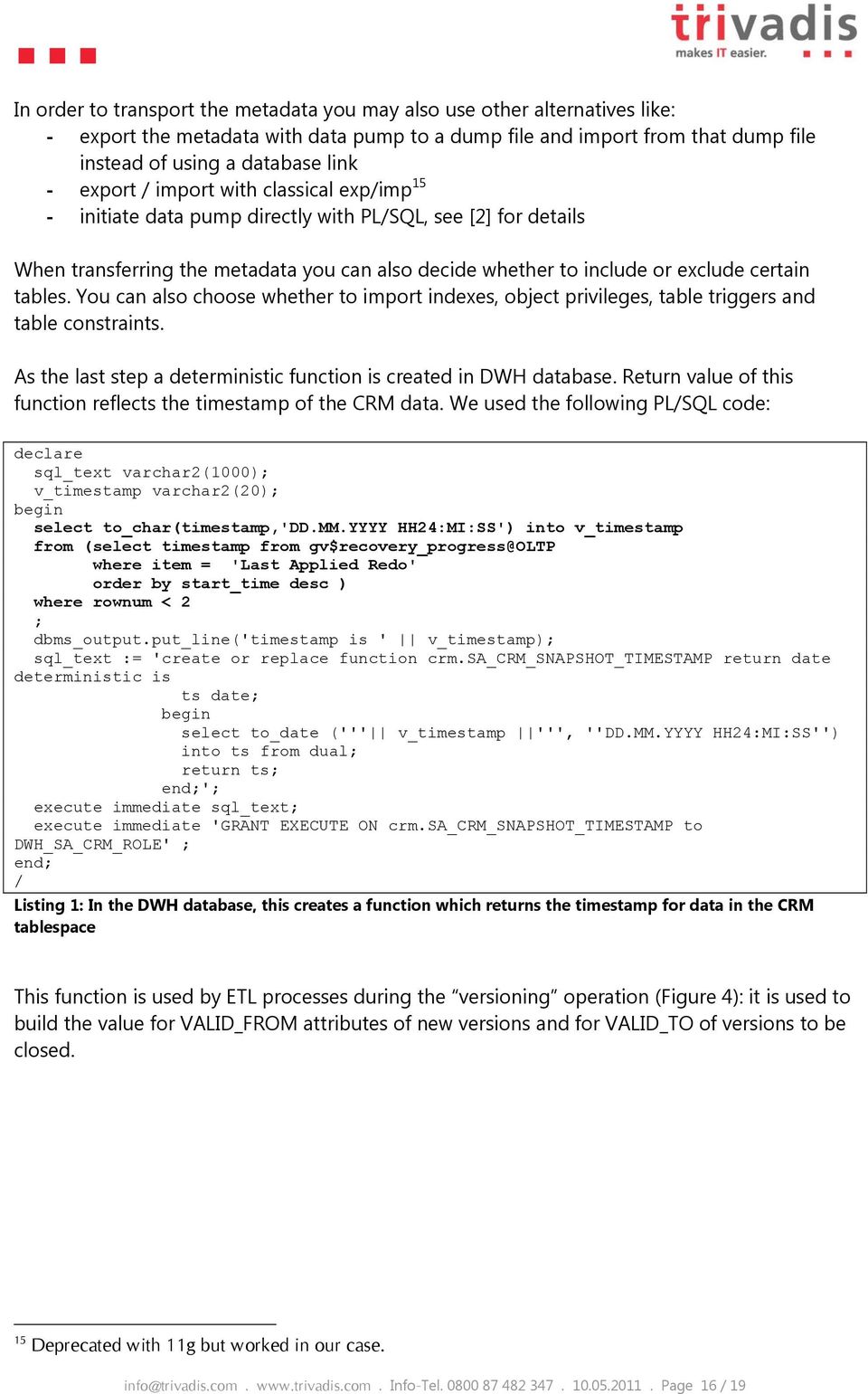
16 In order to transport the metadata you may also use other alternatives like: - export the metadata with data pump to a dump file and import from that dump file instead of using a database link - export / import with classical exp/imp 15 - initiate data pump directly with PL/SQL, see [2] for details When transferring the metadata you can also decide whether to include or exclude certain tables. You can also choose whether to import indexes, object privileges, table triggers and table constraints. As the last step a deterministic function is created in DWH database. Return value of this function reflects the timestamp of the CRM data. We used the following PL/SQL code: declare sql_text varchar2(1000); v_timestamp varchar2(20); begin select to_char(timestamp,'dd.mm.yyyy HH24:MI:SS') into v_timestamp from (select timestamp from gv$recovery_progress@oltp where item = 'Last Applied Redo' order by start_time desc ) where rownum < 2 ; dbms_output.put_line('timestamp is ' v_timestamp); sql_text := 'create or replace function crm.sa_crm_snapshot_timestamp return date deterministic is ts date; begin select to_date (''' v_timestamp ''', ''DD.MM.YYYY HH24:MI:SS'') into ts from dual; return ts; end;'; execute immediate sql_text; execute immediate 'GRANT EXECUTE ON crm.sa_crm_snapshot_timestamp to DWH_SA_CRM_ROLE' ; end; / Listing 1: In the DWH database, this creates a function which returns the timestamp for data in the CRM tablespace This function is used by ETL processes during the versioning operation (Figure 4): it is used to build the value for VALID_FROM attributes of new versions and for VALID_TO of versions to be closed. 15 Deprecated with 11g but worked in our case. [email protected]. Info-Tel Page 16 / 19
17 4.3.2 Start of Refresh Process In order to start the refresh process the following sequence of actions has to be taken: Firstly, the tablespace CRM has to be dropped from the DWH database. After this any queries on the data will fail as it is not available. Dependent views, synonyms, stored PL/SQL procedures etc. get invalid. 16 SQL> drop tablespace crm including contents; DGMGRL> convert database 'OLTP_SITE2' to physical standby If you need to check whether your physical database with CRM tablespace in OLTP_SITE2 is again current enough in order to be used for the next integration load cycle you can easily query the Data Guard Broker: DGMGRL> show database 'OLTP_SITE2'; Database - OLTP_SITE2 Role: PHYSICAL STANDBY Intended State: APPLY-ON Transport Lag: 0 seconds Apply Lag: 11 minutes 23 seconds Real Time Query: OFF Instance(s): oltp Database Status: SUCCESS As the refresh is a parallel media recovery the process is very efficient. Media recovery works block change oriented and is much faster and less resource consuming than the mechanisms of GoldenGate and Streams where SQL is extracted and processed row by row. The presented real-life example demonstrates clearly the high efficiency and the easy and stable operation of this solution. 5. Solution extension: If data availability for operational reporting matters There is yet another challenge for today s DWH architects: Where to place the Operational Reporting? - The OLTP database is becoming a less and less suitable place due to the heavy workload related with complex query logic inside the Operational Reports - Many Operational Reports query not only the data residing in OLTP system, but also additional analytical attributes which are typically stored in a Core DWH. With the solution presented in this white paper, the DWH architect can consider to use the data residing in the Staging Area for Operational Reporting 17 as well. As this data resides in the 16 They get valid automatically again when they are used after the tablespace reappears in next cycle. [email protected]. Info-Tel Page 17 / 19

18 data warehouse database, it can be joined with analytical attributes in Core DWH without performance impacts (no distributed queries). However, one point has to be taken into consideration: During the refresh, the data in Staging Area is not available (refer to Figure 5). This unavailability needs to be eliminated. The snapshot functionality of operating system and/or storage facility can be used to overcome this. The concept: After the standby database is turned into snapshot standby and the tablespaces are set to read only, snapshots of data files will be created. These snapshots are then plugged into the DWH database, instead of the standby databases data files. This will result in two advantages: - the data in the Staging Area is available almost all 18 the time - the recovery of the tablespaces can go on as the standby database can be converted from snapshot standby back to a physical standby right after taking the snapshot of the data files. This will achieve an even shorter latency for the refresh cycles. Note: the snapshots do not copy the data. The data is presented a second time. Later changes are tracked for both sets of data: origin and snapshot. This is known as copy on write mechanism (COW). Examples for OS side snapshotting: With ZFS on Solaris you have a feature of taking copy on write snapshots. It is also possible with Veritas file system, LVM snapshots in Linux and Microsoft Volume Shadow Copy on Windows. SAN and NAS Systems also offer snapshotting features that work with COW mechanism. By using the knowhow of Trivadis, we believe it is possible to reduce operating costs and the complexity of your data warehouse: proper design is what matters! Kontakt Karol Hajdu Mathias Zarick [email protected] [email protected] Trivadis Delphi GmbH Millennium Tower Handelskai A-1200 Vienna Tel.: Please contact us if you need more information or help with your setup. 17 at least for that part of reporting where the integrity level of data in Staging Area is sufficient. 18 short downtime will still occur during tablespace drop and re-plugin [email protected]. Info-Tel Page 18 / 19
19 Literature and Links [1] Oracle Data Guard Concepts and Administration, [2] Oracle Database PL/SQL Packages and Types Reference Chapter 46, [3] Data Warehousing mit Oracle Business Intelligence in der Praxis. Chapter 3.4. Jordan et al. Hanser Info-Tel Page 19 / 19
![htm [2] Oracle Database PL/SQL Packages and Types Reference Chapter 46, http://download.oracle.](/docs-images/48/18320223/images/page_19.jpg "com/docs/cd/e11882_01/appdev.112/e16760/d_datpmp.htm [3] Data Warehousing mit Oracle Business Intelligence in der Praxis.")
Oracle Architecture, Concepts & Facilities
 COURSE CODE: COURSE TITLE: CURRENCY: AUDIENCE: ORAACF Oracle Architecture, Concepts & Facilities 10g & 11g Database administrators, system administrators and developers PREREQUISITES: At least 1 year of
Real-time Data Replication
 Real-time Data Replication from Oracle to other databases using DataCurrents WHITEPAPER Contents Data Replication Concepts... 2 Real time Data Replication... 3 Heterogeneous Data Replication... 4 Different
1 Introduction. 2 Technical overview/insights into FDAs. 1.1 What is what
 Flashback Data Archives re-checked or reject? Beat Ramseier Consultant, IMS-ZH 22.8.2012 The promising feature Flashback Data Archives was introduced with Oracle 11g Release 1. Various limitations prevented
Oracle Total Recall with Oracle Database 11g Release 2
 An Oracle White Paper September 2009 Oracle Total Recall with Oracle Database 11g Release 2 Introduction: Total Recall = Total History... 1 Managing Historical Data: Current Approaches... 2 Application
ORACLE DATABASE ADMINISTRATOR RESUME
 1 of 5 1/17/2015 1:28 PM ORACLE DATABASE ADMINISTRATOR RESUME ORACLE DBA Resumes Please note that this is a not a Job Board - We are an I.T Staffing Company and we provide candidates on a Contract basis.
UNIVERSITY AUTHORISED EDUCATION PARTNER (WDP)
 Audience Data Warehouse Administrator Database Administrators Database Designers Support Engineer Technical Administrator Related Training Required Prerequisites Working knowledge of SQL and use of PL/SQL
OLTP Meets Bigdata, Challenges, Options, and Future Saibabu Devabhaktuni
 OLTP Meets Bigdata, Challenges, Options, and Future Saibabu Devabhaktuni Agenda Database trends for the past 10 years Era of Big Data and Cloud Challenges and Options Upcoming database trends Q&A Scope
Maximum Availability Architecture. Oracle Best Practices For High Availability
 Preventing, Detecting, and Repairing Block Corruption: Oracle Database 11g Oracle Maximum Availability Architecture White Paper May 2012 Maximum Availability Architecture Oracle Best Practices For High
D12C-AIU Oracle Database 12c: Admin, Install and Upgrade Accelerated NEW
 D12C-AIU Oracle Database 12c: Admin, Install and Upgrade Accelerated NEW Duration: 5 Days What you will learn This Oracle Database 12c: Admin, Install and Upgrade Accelerated course will provide you with
Oracle 11g Database Administration
 Oracle 11g Database Administration Part 1: Oracle 11g Administration Workshop I A. Exploring the Oracle Database Architecture 1. Oracle Database Architecture Overview 2. Interacting with an Oracle Database
FIFTH EDITION. Oracle Essentials. Rick Greenwald, Robert Stackowiak, and. Jonathan Stern O'REILLY" Tokyo. Koln Sebastopol. Cambridge Farnham.
 FIFTH EDITION Oracle Essentials Rick Greenwald, Robert Stackowiak, and Jonathan Stern O'REILLY" Beijing Cambridge Farnham Koln Sebastopol Tokyo _ Table of Contents Preface xiii 1. Introducing Oracle 1
RMAN BACKUP & RECOVERY. Recovery Manager. Veeratteshwaran Sridhar
 RMAN Recovery Manager BACKUP & RECOVERY Veeratteshwaran Sridhar Why Backup & Recovery? The purpose of a backup and recovery strategy is to protect the database against data loss and reconstruct the database
Restore and Recovery Tasks. Copyright 2009, Oracle. All rights reserved.
 Restore and Recovery Tasks Objectives After completing this lesson, you should be able to: Describe the causes of file loss and determine the appropriate action Describe major recovery operations Back
Oracle Database 12c: Admin, Install and Upgrade Accelerated
 Oracle University Contact Us: + 38516306373 Oracle Database 12c: Admin, Install and Upgrade Accelerated Duration: 5 Days What you will learn This Oracle Database 12c: Admin, Install and Upgrade Accelerated
Oracle Database 12c: Administration Workshop NEW
 Oracle University Contact Us: 1.800.529.0165 Oracle Database 12c: Administration Workshop NEW Duration: 5 Days What you will learn The Oracle Database 12c: Administration Workshop will teach you about
Oracle Maximum Availability Architecture with Exadata Database Machine. Morana Kobal Butković Principal Sales Consultant Oracle Hrvatska
 Oracle Maximum Availability Architecture with Exadata Database Machine Morana Kobal Butković Principal Sales Consultant Oracle Hrvatska MAA is Oracle s Availability Blueprint Oracle s MAA is a best practices
Oracle Backup & Recovery
 ORACLG«Oracle Press Oracle Backup & Recovery Rama Velpuri Osborne McGraw-Hill Berkeley New York St. Louis San Francisco Auckland Bogota Hamburg London Madrid Mexico City Milan Montreal New Delhi Panama
Maximum Availability Architecture
 Oracle Data Guard: Disaster Recovery for Sun Oracle Database Machine Oracle Maximum Availability Architecture White Paper April 2010 Maximum Availability Architecture Oracle Best Practices For High Availability
Data Integration Overview
 Data Integration Overview Phill Rizzo Regional Manager, Data Integration Solutions [email protected] Oracle Products for Data Movement Comparing How They Work Oracle Data
ORACLE CORE DBA ONLINE TRAINING
 ORACLE CORE DBA ONLINE TRAINING ORACLE CORE DBA THIS ORACLE DBA TRAINING COURSE IS DESIGNED TO PROVIDE ORACLE PROFESSIONALS WITH AN IN-DEPTH UNDERSTANDING OF THE DBA FEATURES OF ORACLE, SPECIFIC ORACLE
Oracle Database 10g: Administration Workshop II Release 2
 ORACLE UNIVERSITY CONTACT US: 00 9714 390 9000 Oracle Database 10g: Administration Workshop II Release 2 Duration: 5 Days What you will learn This course advances your success as an Oracle professional
Cross Platform Transportable Tablespaces Migration in Oracle 11g
 Cross Platform Transportable Tablespaces Migration in Oracle 11g Prepared by ViSolve Migration Team June 2012 Contact ViSolve, Inc. 4010, Moorpark Avenue, #205 San Jose, California 95117 (602) 842 2738
Oracle Database 12c: New Features for Administrators
 Oracle University Contact Us: 67 52 67 24 Oracle Database 12c: New Features for Administrators Duration: 5 Days What you will learn In the Oracle Database 12c: New Features for Administrators course, you
Optimizing the Performance of the Oracle BI Applications using Oracle Datawarehousing Features and Oracle DAC 10.1.3.4.1
 Optimizing the Performance of the Oracle BI Applications using Oracle Datawarehousing Features and Oracle DAC 10.1.3.4.1 Mark Rittman, Director, Rittman Mead Consulting for Collaborate 09, Florida, USA,
ORACLE DATABASE 12C: NEW FEATURES FOR ADMINISTRATORS GRADE CURRICULAR. Enterprise Manager Express home page versus Enterprise Manager Database Control
 FACULDADE DE EDUCAÇÃO SUPERIOR DO PARANÁ CURSO DE EXTENSÃO UNIVERSITÁRIA ORACLE DATABASE 12C: NEW FEATURES FOR ADMINISTRATORS GRADE CURRICULAR Enterprise Manager and Other Tools Enterprise Manager (EM)
Trivadis White Paper. Comparison of Data Modeling Methods for a Core Data Warehouse. Dani Schnider Adriano Martino Maren Eschermann
 Trivadis White Paper Comparison of Data Modeling Methods for a Core Data Warehouse Dani Schnider Adriano Martino Maren Eschermann June 2014 Table of Contents 1. Introduction... 3 2. Aspects of Data Warehouse
Disaster Recovery for Oracle Database
 Disaster Recovery for Oracle Database Zero Data Loss Recovery Appliance, Active Data Guard and Oracle GoldenGate ORACLE WHITE PAPER APRIL 2015 Overview Oracle Database provides three different approaches
Oracle Database 12c Recovery Manager New Features
 Oracle Database 12c Recovery Manager New Features Presented by: Andy Colvin February 13, 2013 *DISCLAIMER* Oracle 12c has not been released yet Some features may not be available I believe Oracle has mentioned
Oracle Database: SQL and PL/SQL Fundamentals NEW
 Oracle University Contact Us: 001-855-844-3881 & 001-800-514-06-97 Oracle Database: SQL and PL/SQL Fundamentals NEW Duration: 5 Days What you will learn This Oracle Database: SQL and PL/SQL Fundamentals
How to Enhance Traditional BI Architecture to Leverage Big Data
 B I G D ATA How to Enhance Traditional BI Architecture to Leverage Big Data Contents Executive Summary... 1 Traditional BI - DataStack 2.0 Architecture... 2 Benefits of Traditional BI - DataStack 2.0...
An Oracle White Paper January 2014. Oracle Database 12c: Full Transportable Export/Import
 An Oracle White Paper January 2014 Oracle Database 12c: Full Transportable Export/Import Introduction... 3 Benefits of Using Full Transportable Export/Import... 4 Full Transportable Export/Import Support
Oracle Database Backups and Disaster Recovery @ Autodesk
 Oracle Database Backups and Disaster Recovery @ Autodesk Alan Williams Database Design Engineer Who We Are Autodesk software, suites, and cloud technology help customers design, visualize, and simulate
Oracle Database Auditing Performance Guidelines
 Oracle Database Auditing Performance Guidelines Anjo Miguel Consultant July 2011 Enabling Oracle Database Audit could potentially have an impact on database performance, but how much? Is it measurable?
Oracle Database 12c: Administration Workshop NEW. Duration: 5 Days. What you will learn
 Oracle Database 12c: Administration Workshop NEW Duration: 5 Days What you will learn The Oracle Database 12c: Administration Workshop will teach you about the Oracle Database architecture. You will discover
Oracle Database - Engineered for Innovation. Sedat Zencirci Teknoloji Satış Danışmanlığı Direktörü Türkiye ve Orta Asya
 Oracle Database - Engineered for Innovation Sedat Zencirci Teknoloji Satış Danışmanlığı Direktörü Türkiye ve Orta Asya Oracle Database 11g Release 2 Shipping since September 2009 11.2.0.3 Patch Set now
Backup Types. Backup and Recovery. Categories of Failures. Issues. Logical. Cold. Hot. Physical With. Statement failure
 Backup Types Logical Backup and Recovery Cold Hot Physical With Without Issues Categories of Failures Protectthe database from numerous types of failures Increase Mean-Time-Between-Failures (MTBF) Decrease
Contents. SnapComms Data Protection Recommendations
 Contents Abstract... 2 SnapComms Solution Environment... 2 Concepts... 3 What to Protect... 3 Database Failure Scenarios... 3 Physical Infrastructure Failures... 3 Logical Data Failures... 3 Service Recovery
MS-40074: Microsoft SQL Server 2014 for Oracle DBAs
 MS-40074: Microsoft SQL Server 2014 for Oracle DBAs Description This four-day instructor-led course provides students with the knowledge and skills to capitalize on their skills and experience as an Oracle
Oracle Database Cross Platform Migration Lucy Feng, DBAK
 Delivering Oracle Success Oracle Database Cross Platform Migration Lucy Feng, DBAK RMOUG QEW November 19, 2010 Business Requirements Migrate all Oracle databases to IBM zseries based Linux The database
SQL Databases Course. by Applied Technology Research Center. This course provides training for MySQL, Oracle, SQL Server and PostgreSQL databases.
 SQL Databases Course by Applied Technology Research Center. 23 September 2015 This course provides training for MySQL, Oracle, SQL Server and PostgreSQL databases. Oracle Topics This Oracle Database: SQL
A McKnight Associates, Inc. White Paper: Effective Data Warehouse Organizational Roles and Responsibilities
 A McKnight Associates, Inc. White Paper: Effective Data Warehouse Organizational Roles and Responsibilities Numerous roles and responsibilities will need to be acceded to in order to make data warehouse
Extraction Transformation Loading ETL Get data out of sources and load into the DW
 Lection 5 ETL Definition Extraction Transformation Loading ETL Get data out of sources and load into the DW Data is extracted from OLTP database, transformed to match the DW schema and loaded into the
One Solution for Real-Time Data protection, Disaster Recovery & Migration
 One Solution for Real-Time Data protection, Disaster Recovery & Migration Built-in standby virtualisation server Backs up every 15 minutes up to 12 servers On and Off-site Backup User initialed file, folder
Why Not Oracle Standard Edition? A Dbvisit White Paper By Anton Els
 Why Not Oracle Standard Edition? A Dbvisit White Paper By Anton Els Copyright 2011-2013 Dbvisit Software Limited. All Rights Reserved Nov 2013 Executive Summary... 3 Target Audience... 3 Introduction...
news from Tom Bacon about Monday's lecture
 ECRIC news from Tom Bacon about Monday's lecture I won't be at the lecture on Monday due to the work swamp. The plan is still to try and get into the data centre in two weeks time and do the next migration,
The Future of PostgreSQL High Availability Robert Hodges - Continuent, Inc. Simon Riggs - 2ndQuadrant
 The Future of PostgreSQL High Availability Robert Hodges - Continuent, Inc. Simon Riggs - 2ndQuadrant Agenda / Introductions / Framing the High Availability (HA) Problem / Hot Standby + Log Streaming /
Comparing MySQL and Postgres 9.0 Replication
 Comparing MySQL and Postgres 9.0 Replication An EnterpriseDB White Paper For DBAs, Application Developers, and Enterprise Architects March 2010 Table of Contents Introduction... 3 A Look at the Replication
Oracle Recovery Manager 10g. An Oracle White Paper November 2003
 Oracle Recovery Manager 10g An Oracle White Paper November 2003 Oracle Recovery Manager 10g EXECUTIVE OVERVIEW A backup of the database may be the only means you have to protect the Oracle database from
An Oracle White Paper March 2014. Best Practices for Real-Time Data Warehousing
 An Oracle White Paper March 2014 Best Practices for Real-Time Data Warehousing Executive Overview Today s integration project teams face the daunting challenge that, while data volumes are exponentially
Oracle Database Backup & Recovery, Flashback* Whatever, & Data Guard
 18 th Annual International zseries Oracle SIG Conference Present: Oracle Database Backup & Recovery, Flashback* Whatever, & Data Guard Tammy Bednar [email protected] Manager, HA Solutions & Backup
The safer, easier way to help you pass any IT exams. Exam : 1Z0-067. Upgrade Oracle9i/10g/11g OCA to Oracle Database 12c OCP.
 http://www.51- pass.com Exam : 1Z0-067 Title : Upgrade Oracle9i/10g/11g OCA to Oracle Database 12c OCP Version : DEMO 1 / 7 1.Which two statements are true about scheduling operations in a pluggable database
SharePlex for SQL Server
 SharePlex for SQL Server Improving analytics and reporting with near real-time data replication Written by Susan Wong, principal solutions architect, Dell Software Abstract Many organizations today rely
Module 14: Scalability and High Availability
 Module 14: Scalability and High Availability Overview Key high availability features available in Oracle and SQL Server Key scalability features available in Oracle and SQL Server High Availability High
Microsoft SQL Server for Oracle DBAs Course 40045; 4 Days, Instructor-led
 Microsoft SQL Server for Oracle DBAs Course 40045; 4 Days, Instructor-led Course Description This four-day instructor-led course provides students with the knowledge and skills to capitalize on their skills
Postgres Plus xdb Replication Server with Multi-Master User s Guide
 Postgres Plus xdb Replication Server with Multi-Master User s Guide Postgres Plus xdb Replication Server with Multi-Master build 57 August 22, 2012 , Version 5.0 by EnterpriseDB Corporation Copyright 2012
Oracle Database 11g Comparison Chart
 Key Feature Summary Express 10g Standard One Standard Enterprise Maximum 1 CPU 2 Sockets 4 Sockets No Limit RAM 1GB OS Max OS Max OS Max Database Size 4GB No Limit No Limit No Limit Windows Linux Unix
Database as a Service (DaaS) Version 1.02
 Database as a Service (DaaS) Version 1.02 Table of Contents Database as a Service (DaaS) Overview... 4 Database as a Service (DaaS) Benefit... 4 Feature Description... 4 Database Types / Supported Versions...
Connectivity. Alliance Access 7.0. Database Recovery. Information Paper
 Connectivity Alliance Access 7.0 Database Recovery Information Paper Table of Contents Preface... 3 1 Overview... 4 2 Resiliency Concepts... 6 2.1 Database Loss Business Impact... 6 2.2 Database Recovery
Oracle. Brief Course Content This course can be done in modular form as per the detail below. ORA-1 Oracle Database 10g: SQL 4 Weeks 4000/-
 Oracle Objective: Oracle has many advantages and features that makes it popular and thereby makes it as the world's largest enterprise software company. Oracle is used for almost all large application
How to Implement Multi-way Active/Active Replication SIMPLY
 How to Implement Multi-way Active/Active Replication SIMPLY The easiest way to ensure data is always up to date in a 24x7 environment is to use a single global database. This approach works well if your
COURCE TITLE DURATION. Oracle Database 11g: Administration Workshop I
 COURCE TITLE DURATION DBA 11g Oracle Database 11g: Administration Workshop I 40 H. What you will learn: This course is designed to give students a firm foundation in basic administration of Oracle Database
Oracle Database 10g: New Features for Administrators
 Oracle Database 10g: New Features for Administrators Course ON10G 5 Day(s) 30:00 Hours Introduction This course introduces students to the new features in Oracle Database 10g Release 2 - the database for
Maximize Availability With Oracle Database 12c
 Maximize Availability With Oracle Database 12c Darl Kuhn DBA [email protected] 1 Copyright 2013, Oracle and/or its affiliates. All rights reserved. HA? 2 Copyright 2013, Oracle and/or its affiliates.
<Insert Picture Here> Oracle Cloud Storage. Morana Kobal Butković Principal Sales Consultant Oracle Hrvatska
 Oracle Cloud Storage Morana Kobal Butković Principal Sales Consultant Oracle Hrvatska Oracle Cloud Storage Automatic Storage Management (ASM) Oracle Cloud File System ASM Dynamic
Increase productivity and safety data of warehouse systems using Shareplex for Oracle
 VIII Konferencja PLOUG Koœcielisko PaŸdziernik 2002 Increase productivity and safety data of warehouse systems using Shareplex for Oracle referat sponsorski Quest Software Increase productivity and safety
CON5604 Upgrade from Siebel CRM 7.7 to 8.1 in Germany s Largest Loyalty Program Moscone West 2007 10/01/14, 11:30-12:15
 CON5604 Upgrade from Siebel CRM 7.7 to 8.1 in Germany s Largest Loyalty Program Moscone West 2007 10/01/14, 11:30-12:15 Us Alexander Doubek Moritz Schlaucher System Architect Unit Lead Oracle Technology
www.rackwareinc.com RackWare Solutions Disaster Recovery
 RackWare Solutions Disaster Recovery RackWare Solutions Disaster Recovery Overview Business Continuance via Disaster Recovery is an essential element of IT and takes on many forms. The high end consists
ORACLE DATABASE 11G: COMPLETE
 ORACLE DATABASE 11G: COMPLETE 1. ORACLE DATABASE 11G: SQL FUNDAMENTALS I - SELF-STUDY COURSE a) Using SQL to Query Your Database Using SQL in Oracle Database 11g Retrieving, Restricting and Sorting Data
Emerging Technologies Shaping the Future of Data Warehouses & Business Intelligence
 Emerging Technologies Shaping the Future of Data Warehouses & Business Intelligence Appliances and DW Architectures John O Brien President and Executive Architect Zukeran Technologies 1 TDWI 1 Agenda What
SQL DATABASE PROGRAMMING (PL/SQL AND T-SQL)
 Technology & Information Management Instructor: Michael Kremer, Ph.D. Database Programming SQL DATABASE PROGRAMMING (PL/SQL AND T-SQL) WHO AM I? Michael Kremer Currently: Federal Reserve Bank San Francisco
QAD Business Intelligence Release Notes
 QAD Business Intelligence Release Notes September 2008 These release notes include information about the latest QAD Business Intelligence (QAD BI) fixes and changes. These changes may affect the way you
SQL Server Training Course Content
 SQL Server Training Course Content SQL Server Training Objectives Installing Microsoft SQL Server Upgrading to SQL Server Management Studio Monitoring the Database Server Database and Index Maintenance
SQL-BackTrack the Smart DBA s Power Tool for Backup and Recovery
 SQL-BackTrack the Smart DBA s Power Tool for Backup and Recovery by Diane Beeler, Consulting Product Marketing Manager, BMC Software and Mati Pitkanen, SQL-BackTrack for Oracle Product Manager, BMC Software
Library Recovery Center
 Library Recovery Center Ever since libraries began storing bibliographic information on magnetic disks back in the 70 s, the challenge of creating useful back-ups and preparing for a disaster recovery
Connectivity. Alliance Access 7.0. Database Recovery. Information Paper
 Connectivity Alliance 7.0 Recovery Information Paper Table of Contents Preface... 3 1 Overview... 4 2 Resiliency Concepts... 6 2.1 Loss Business Impact... 6 2.2 Recovery Tools... 8 3 Manual Recovery Method...
DBMS Questions. 3.) For which two constraints are indexes created when the constraint is added?
 DBMS Questions 1.) Which type of file is part of the Oracle database? A.) B.) C.) D.) Control file Password file Parameter files Archived log files 2.) Which statements are use to UNLOCK the user? A.)
Feature. Database Backup and Recovery Best Practices
 Feature Ali Navid Akhtar, OCP, has more than two decades of experience with databases. He works as a lead database administrator at Solo Cup Co. Jeff Buchholtz has more than 18 years of design, implementation
Comparing Microsoft SQL Server 2005 Replication and DataXtend Remote Edition for Mobile and Distributed Applications
 Comparing Microsoft SQL Server 2005 Replication and DataXtend Remote Edition for Mobile and Distributed Applications White Paper Table of Contents Overview...3 Replication Types Supported...3 Set-up &
AV-005: Administering and Implementing a Data Warehouse with SQL Server 2014
 AV-005: Administering and Implementing a Data Warehouse with SQL Server 2014 Career Details Duration 105 hours Prerequisites This career requires that you meet the following prerequisites: Working knowledge
<Insert Picture Here> Oracle Database Directions Fred Louis Principal Sales Consultant Ohio Valley Region
 Oracle Database Directions Fred Louis Principal Sales Consultant Ohio Valley Region 1977 Oracle Database 30 Years of Sustained Innovation Database Vault Transparent Data Encryption
Oracle 11g DBA Training Course Content
 Oracle 11g DBA Training Course Content ORACLE 10g/11g DATABASE ADMINISTRATION CHAPTER1 Important Linux commands Installing of Redhat Linux as per oracle database requirement Installing of oracle database
Data Integration and ETL with Oracle Warehouse Builder: Part 1
 Oracle University Contact Us: + 38516306373 Data Integration and ETL with Oracle Warehouse Builder: Part 1 Duration: 3 Days What you will learn This Data Integration and ETL with Oracle Warehouse Builder:
Oracle DBA Course Contents
 Oracle DBA Course Contents Overview of Oracle DBA tasks: Oracle as a flexible, complex & robust RDBMS The evolution of hardware and the relation to Oracle Different DBA job roles(vp of DBA, developer DBA,production
Microsoft SQL Database Administrator Certification
 Microsoft SQL Database Administrator Certification Training for Exam 70-432 Course Modules and Objectives www.sqlsteps.com 2009 ViSteps Pty Ltd, SQLSteps Division 2 Table of Contents Module #1 Prerequisites
Application-Tier In-Memory Analytics Best Practices and Use Cases
 Application-Tier In-Memory Analytics Best Practices and Use Cases Susan Cheung Vice President Product Management Oracle, Server Technologies Oct 01, 2014 Guest Speaker: Kiran Tailor Senior Oracle DBA and
Implementing an Enterprise Class Database Backup and Recovery Plan
 Implementing an Enterprise Class Database Backup and Recovery Plan Tammy Bednar Oracle Corporation 400 Oracle Parkway, Redwood Shores, CA 94065 Work: (650) 506-4780 Fax: (650) 506-7203 [email protected]
Oracle 11g DBA Online Course - Smart Mind Online Training, Hyderabad. Oracle 11g DBA Online Training Course Content
 Oracle 11g DBA Online Training Course Content Faculty: Real time and certified INTRODUCTION TO ORACLE DBA What is DBA? Why a Company needs a DBA? Roles & Responsibilities of DBA Oracle Architecture Physical
Oracle Database 11g: New Features for Administrators DBA Release 2
 Oracle Database 11g: New Features for Administrators DBA Release 2 Duration: 5 Days What you will learn This Oracle Database 11g: New Features for Administrators DBA Release 2 training explores new change
HP LeftHand SAN Solutions
 HP LeftHand SAN Solutions Support Document Application Notes Oracle Backup Recovery Setup on LeftHand Networks IP SAN Legal Notices Warranty The only warranties for HP products and services are set forth
How To Use A Recoverypoint Server Appliance For A Disaster Recovery
 One Solution for Real-Time Data protection, Disaster Recovery & Migration Built-in standby virtualisation server Backs up every 15 minutes up to 12 servers On and Off-site Backup Exchange Mailbox & Message
Tushar Joshi Turtle Networks Ltd
 MySQL Database for High Availability Web Applications Tushar Joshi Turtle Networks Ltd www.turtle.net Overview What is High Availability? Web/Network Architecture Applications MySQL Replication MySQL Clustering
Eloquence Training What s new in Eloquence B.08.00
 Eloquence Training What s new in Eloquence B.08.00 2010 Marxmeier Software AG Rev:100727 Overview Released December 2008 Supported until November 2013 Supports 32-bit and 64-bit platforms HP-UX Itanium
Near-Instant Oracle Cloning with Syncsort AdvancedClient Technologies White Paper
 Near-Instant Oracle Cloning with Syncsort AdvancedClient Technologies White Paper bex30102507wpor Near-Instant Oracle Cloning with Syncsort AdvancedClient Technologies Introduction Are you a database administrator
D78850GC10. Oracle Database 12c Backup and Recovery Workshop. Summary. Introduction. Prerequisites
 D78850GC10 Oracle 12c and Recovery Workshop Summary Duration Vendor Audience 5 Days Oracle Data Warehouse Administrators, Administrators, Support Engineers, Technical Administrators, Technical Consultants
RMAN What is Rman Why use Rman Understanding The Rman Architecture Taking Backup in Non archive Backup Mode Taking Backup in archive Mode
 RMAN - What is Rman - Why use Rman - Understanding The Rman Architecture - Taking Backup in Non archive Backup Mode - Taking Backup in archive Mode - Enhancement in 10g For Rman - 9i Enhancement For Rman
SQL Server 2012/2014 AlwaysOn Availability Group
 SQL Server 2012/2014 AlwaysOn Availability Group Part 1 - Introduction v1.0-2014 - G.MONVILLE Summary SQL Server 2012 AlwaysOn - Introduction... 2 AlwaysOn Features... 2 AlwaysOn FCI (Failover Cluster
Oracle Database 10g: Backup and Recovery 1-2
 Oracle Database 10g: Backup and Recovery 1-2 Oracle Database 10g: Backup and Recovery 1-3 What Is Backup and Recovery? The phrase backup and recovery refers to the strategies and techniques that are employed