
Released: March 1, 2011
|
|
|
- Ada Morris
- 9 years ago
- Views:
Transcription
1 Request for Application New one-year P.A.T.H. Mini-Grant Expanding P.A.T.H. Services within Ohio (P.A.T.H. - Projects for Assistance in Transition from Homelessness) Federal Fiscal Year 2011 (State Fiscal Year 2012) Released: March 1, 2011 I. Introduction of the Initiative Demonstration of the Need P.A.T.H. is a formula grant program administered by the Center for Mental Health Services, a component of Substance Abuse and Mental Health Services Administration (SAMHSA). P.A.T.H. was designed to support service delivery to individuals with severe mental illnesses (SMI) who may also have co-occurring substance use disorders, who are homeless or at risk of becoming homeless, and are not yet linked with traditional community mental health services. The ultimate goal is connecting individuals to mainstream mental health services as a way of working towards the elimination of homelessness for this population. P.A.T.H. services include community-based outreach, mental health, substance abuse, case management and other support services, as well as a limited set of housing services. On August 12-13, 2010, SAMHSA completed a federal site review of Ohio s P.A.T.H. Program. Two recommendations received from SAMHSA were: 1) to explore methods to serve more individuals with existing funds and 2) to consider a more competitive allocation process. Purpose of the Initiative This $50,000 one-time mini-p.a.t.h. grant has been created for State Fiscal Year 2012 (SFY 2012) in order to expand services to an additional geographic area within Ohio. This initiative is intended to increase and target outreach, engagement, and service efforts that are trauma-informed and culturally-appropriate to people with severe mental illness, including those with co-occurring substance use disorders, who are experiencing homelessness and are not yet linked with traditional community mental health services in their natural environments (e.g., living in camps, on the streets, and in shelters). Ohio s currently Funded P.A.T.H. Projects: County Butler Cuyahoga Franklin Hamilton Lake Lorain Lucas Mahoning/Trumbull Montgomery Stark Summit P.A.T.H. Provider Transitional Living Mental Health Services, Inc. Southeast, Inc. Greater Cincinnati Behavioral Health Services Extended Housing Gathering Hope House, Inc. Neighborhood Properties, Inc. Help Hotline Miami Valley Housing Opportunities ICAN Community Support Services Page 1 of 16

2 II. Target Population Services Targeted for: a. Adults (18+ years old) b. SMI/SPMI c. SMI/SPMI with co-occurring substance abuse disorders [note - Substance abuse disorders without mental health diagnosis are excluded] d. Currently Homeless * * While PATH funds can be used for those persons who are at risk of homelessness, this minigrant is designed to address services only directed toward individuals who are currently homeless. (SAMHSA is moving the P.A.T.H. program back to its core mission of serving individuals with severe mental illnesses, including those with co-occurring substance use disorders, who are currently homeless as the priority population.) SAMHSA PATH Program Definitions: Homeless: An individual who lacks housing (without regard to whether the individual is a member of a family), including an individual whose primary residence during the night is a supervised public or private facility (such as an emergency shelter) that provides temporary living accommodations and an individual who is a resident in transitional housing. Imminent Risk of Homelessness: An individual who, without direct intervention, will likely become homeless (as defined above) within the next 30 days. The individual s current living situation may include one or more of the following criteria: doubled-up living arrangement where the individual's name is not on the lease; living in a condemned building without a place to move; in arrears on rent or with high rent/utility payments placing individual at risk of eviction within the next 30 days; judgment for eviction without a place to move; living in temporary or transitional housing that carries time limits; being discharged from a health care or criminal justice institution without a place to live. Severe Mental Illness: Severe mental illness in persons ages 18 or over with a diagnosable mental disorder of such severity and duration as to result in functional impairment that substantially interferes with or limits major life activities. Note: the SAMHSA (P.A.T.H.) Website does not define which diagnoses are considered to be a severe mental illness. However, ODMH provides further guidance on the definition of severe mental illness to include any mental health diagnosis that has impacted an individual s functioning to the point of being unable to maintain housing, employment, etc. When determining whether or not a diagnosis is severe, outside of major thought and mood disorders, ODMH advises P.A.T.H. outreach workers to consider the entire picture of the person s life circumstances and history such as: Current level of symptom distress Current functionality in all life areas, including but not limited to duration of homelessness Possibility of improvement without intervention, including but not limited to medication Functionality in all life areas during the past 7 months Involvement with other systems of care or benefit/assistance programs Page 2 of 16

3 III. Availability of Funds The funding for the mini-grant is available for the last 3 quarters of SFY All funds for this mini-grant and Ohio s PATH Program are dependent upon the allocation of P.A.T.H. funds to Ohio from SAMHSA. (SAMHSA P.A.T.H. funds are released on a federal fiscal year cycle.) Funds for the mini-grant are expected to be available from October 1, 2011 June 30, 2012, in accordance with SFY Funds for the mini-grant are expected to be available on or about October 1, Commitment of matching Funds (Cost Sharing) is required as specified in Section 523 (a) of the Public Health Service (PHS) Act. The state must match, directly or through donations from public or private entities, non-federal contributions in an amount that is not less than $1 for each $3 of federal P.A.T.H. funds. Non-Federal contributions required in Section 523 may be in cash or in kind, fairly evaluated, including plant, equipment, or services. Amounts provided by the Federal Government, or services assisted or subsidized by any significant extent by the Federal Government, shall not be included in determining the amount of such non-federal contribution. Example: If your program is awarded $160,000.00, you must contribute at least $53, in matching funds. IV. Proposal Requirements Applicant Eligibility Applicants must be county/regional mental health or alcohol, drug addiction and mental health services boards (Boards), or providers partnering with a Board, in Board areas that do not have one of the 11 existing P.A.T.H. Grants. Boards must contract with a non-profit agency to deliver P.A.T.H. services. Boards receiving P.A.T.H. allocations and their contract P.A.T.H. provider organizations must participate in their local community s Continuum of Care process. Note: No program will be funded that has a policy of excluding individuals from mental health services due to the existence or suspicion of substance abuse, or a policy of excluding individuals from substance abuse services due to the existence or suspicion of mental illness. Applicant Qualifications (past experience, training, etc.) and Readiness Proposal narrative questions and requests for information, set forth below, should demonstrate an overarching integration of the applicant s experience and readiness with regard to: a. Demonstrated need, vision, and how your proposed project will enhance Ohio s expansion of targeted outreach, engagement, and service efforts to people with severe mental illness, including those with co-occurring substance use disorders, experiencing homelessness and are not yet linked with traditional community mental health services in their natural environments, e.g. living in camps, on the streets, and in shelters. b. Utilization of Evidence-Based and Promising Best Practices in service delivery, including but not limited to trauma-informed care, culturally informed, and the integration of physical and behavioral healthcare c. Cultural Competency Cultural competence is not a stand-alone function. It is an essential or intrinsic element that needs to be infused within every process and structure of communities systems of care and within all service programs and every aspect of service delivery. Throughout the proposal narrative, the Applicant must ensure that cultural competence is integrated into every planning and implementation function d. Current success serving persons who are homeless e. Existing and Proposed Collaborations Page 3 of 16

4 f. Employment of Peers and Involvement of Consumers and Family Members g. Client Satisfaction Measures h. Data Collection, Outcomes Management, and Evaluation i. Dissemination of Information: Sharing lessons learned and participating with State P.A.T.H. Providers in knowledge development to improve service delivery practices j. Sustainability & Replicability Proposal Narrative Proposal narrative should address each of the following questions or requests for information: 1. What are the quantitative needs, goals, objectives, and desired outcomes associated with the P.A.T.H. program proposed for your local area? 2. Provide a brief description of the Board contracted provider, including name, type of organization, services provided by the organization and region served. List the types of Services currently being provided by provider organization: Outreach Screening/Diagnostic Habitation/Rehabilitation Food/ Food Referral Clothing/Clothing Referral Shelter/Shelter Referral Referral to other agencies Mental Health Services Mental Health Services Referral, not treatment Substance Abuse Services Substance Abuse Services Referral, not treatment Physical Health Services Physical Health Services Referral, not treatment Medication Management Case Management Housing Benefits Bank Site or Assistance with Obtaining Benefits Employment/Employment Referral Other (Specify) 3. Describe the provider organization s current collaborations with local homeless shelters, Healthcare for the Homeless, community physical healthcare centers, social security administration, County Department of Job and Family Services, The Ohio Benefit Bank, and other local social service providers serving persons experiencing homelessness. 4. Describe the provider organization s current collaborations with Ohio prisons, jails, and the local criminal justice system. 5. Estimate the number of individuals in your board area who are experiencing homelessness and have a severe mental illness (ODMH Guidance Document revised September 2010, page 3 of 13). 6. Estimate the number of individuals in #3 who are Veterans. 7. Estimate the number of individuals in #2 and #3 to be served with P.A.T.H. dollars. 8. Describe: (a) the demographics of your county s homeless population; (b) the demographics of the staff serving the clients; (c) how staff providing services to the target population will be sensitive to age; gender and racial/ethnic differences of clients; and (d) the extent to which staff receive periodic training in cultural competence and trauma informed care. Page 4 of 16

5 9. Proposed staffing for the P.A.T.H. mini-grant. a. Position(s) b. Duties assigned with each position c. Qualifications for each position d. FTE% for each position listed e. Supervision of staff 10. Describe the organization's plan to provide coordinated and comprehensive services: a. Which of the following services will be provided with P.A.T.H. funding? Outreach Screening and diagnostic treatment Community mental health treatment Alcohol and drug treatment Staff training Case management Supportive and supervisory services in residential settings Referrals for other services; e.g. primary health, job training, educational relevant housing b. Which of the following P.A.T.H. Eligible Housing Services will be provided with P.A.T.H. funding? Minor renovation, expansion, and repair of housing Planning of housing Technical assistance in applying for housing Improving the coordination of housing services Security deposits Costs associated with matching eligible homeless individuals with appropriate housing situations One-time rental payments to prevent eviction c. Which community organizations will provide key services (e.g., primary health, behavioral health, substance abuse, housing, employment) to P.A.T.H. eligible clients? Include a description of the current and/or proposed enhanced coordination with those organizations. d. Where are the current gaps in your local system of care and how will P.A.T.H. funds will be utilized to help to reduce those gaps? e. What strategies will be implemented to make suitable housing available to P.A.T.H. clients (indicate the type of housing usually provided and the name of the agency(s) that provides such housing)? 11. Describe how your county s P.A.T.H. provider plans to participate in the HUD Continuum of Care and any other local planning, coordinating or assessment activities. 12. Describe how persons who are homeless and have severe mental illnesses and any family members will be involved at the organizational level in the planning, implementation, and evaluation of P.A.T.H.-funded services. 13. Please discuss how you will utilize your P.A.T.H. Quarterly Data in your program s daily operation practices to make real-time quality improvement changes. 14. Describe your local plan for continuation/sustainability funding once mini-grant funds end. Page 5 of 16
6 15. Describe your local plan to share replicate the lessons learned within the local system of care, including but not limited to best practices and effective outreach and engagement strategies to persons experiencing homelessness. Attachment Section shall include Budget and Budget Narratives (Exhibits A1, A2, B1, B2) If applicant is a provider, letter of support from the local ADAMH Board Reference Letter from 3 community partners for the P.A.T.H. mini-grant Job Descriptions for each position funded by the mini grant Budget and Financing Plan In this section the Applicant should provide project budget and financial components, including the following: Budget Forms and Budget Narrative Exhibit A1 & A2: Mandatory Forms (corresponding pages 10 & 11) Exhibit B1 & B2: Mandatory Forms (corresponding pages 12 & 13) Identification of any other resources (local match) committed to this Mini Grant (Exhibit B1 & B2) Statement of assurance that the applicant will pursue appropriate first and third party payers Statement of assurance that these grant funds will not supplant current local, state, and federal funds for current service activities Further budget development is provided on pages 9 12 of the Ohio P.A.T.H. Guidance Document. Neither federal P.A.T.H. funds allocated to local boards nor local match funds may be used for costs associated with the administration of the grant. However, up to twenty-five percent (25%) of the federal P.A.T.H. budget and up to 25% of the local match budget may be used for non-direct services such as travel, equipment, supplies, leasing of vehicles, and operating costs. The Travel, Equipment, Supplies, and Other categories are separated into A, B and C for this purpose. Categories A and C are direct cost; category B is non-direct. All expenditures funded through P.A.T.H. funds must be excluded from the rates of other federal funding sources (e.g., Community Medicaid, Title XX). All federal P.A.T.H. funds must be directly attributable to a derived benefit to the targeted P.A.T.H. population. The match requirement is that for every three dollars of federal P.A.T.H. funds, the local system contributes at least one dollar. Totals on Budgets Worksheets and Budget Narratives must exactly match the P.A.T.H. Project Allocation. Budget Worksheets and Narratives that do not match will be returned and may put the Proposal at risk of not being considered for funding. Page 6 of 16
7 Evaluation Plan In response to SAMHSA s recommendations, in SFY 2012 ODMH will require and monitor the following information for each currently funded P.A.T.H. Project: The number of enrolled P.A.T.H. consumers for each county the timely and accurate submissions of applications, draw downs, and quarterly data reports to ODMH the ability to demonstrate the use of real-time data & outcomes in quality improvement processes documented evidence of consumer involvement in the delivery of and planning for P.A.T.H. services at the local level Page 7 of 16
8 V. Proposal Submission Process Application Due Date Instructions for Submission of Proposal The submission deadline for Proposals is 5:00 p.m. on April 15, Where to Send Proposal All proposals are to be submitted by 5:00 p.m., April 15, 2011 to: Deborah Givens, State P.A.T.H. Contact and Project Lead Office of Community Supports and Clients Rights 30 E. Broad St., 8 th Floor Columbus, OH [email protected] Phone: Method for Submission All proposals need to be submitted electronically via to Deb Givens at [email protected], in MS Word format only by the deadline noted above, 5:00 p.m. on April 15, Incomplete or late submissions will not be considered. The risk of delay or failure of delivery rests with the applicant. Conditions of Submission All proposals must be submitted in MS Word 12 point type and may not exceed six (6) narrative pages plus the cover sheet (outlined below) and specified attachments (see page 5 of this announcement). Proposals must meet all requirements set forth in this RFA. A cover sheet that includes the following must accompany the proposal: Applicant s name(s) Board name (if applicant is a provider) Applicant s address Applicant s phone number Applicant s address Name, phone number, and address of Applicant s mini-grant contact person Name, phone number, and address of Board s mini-grant contact person, if applicable Questions/Inquiries Deborah Givens, State P.A.T.H. Contact and Project Lead Office of Community Supports and Clients Rights 30 E. Broad St., 8 th Floor, Columbus, OH [email protected] Phone: Award Date The award will be made within SFY 2012, concurrent with the start of Federal Fiscal Year 2011 (October 1, 2011,) contingent upon receiving the P.A.T.H. grant allocation from SAMHSA. Page 8 of 16

9 Announcement of the Selection ODMH anticipates making a funding decision (selection) by May 6, When work is expected to begin The awarded project is to begin all work no later than October 1, Work may begin as early as July 1, All work will end on June 30, VI. Factors and Criteria for Evaluation of Proposals Criteria weighted as indicated: a. Demonstrated need, vision, and explanation of how your proposed project will enhance Ohio s expansion of targeted outreach, engagement, and service efforts to people with severe mental illness, including those with co-occurring substance use disorders, experiencing homelessness (20%) b. Cultural Competency (10%) c. Current success serving persons experiencing Homelessness (5%) d. Existing and Proposed Collaborations: (10%) e. Training and Employment of Peers (5%) f. Client Satisfaction Measures (5%) g. Data Collection, Outcomes Management, and Evaluation (10%) h. Plan for Dissemination of Information: Sharing lessons learned and participating with State P.A.T.H. Providers in knowledge development to improve service delivery practices (15%) i. Plan for Sustainability & Replicability (20%) Scoring Tool Included at the end of this document (see Pages 14-16). VII. Conditions: (Standard Language) The Department reserves the right to reject, in whole or in part, any and all proposals where the Department, taking into consideration factors including, but not limited to, cost and the results of the evaluation process, has determined that the award would not be in the best interest of the Department. Applicant will be solely responsible for reporting, withholding, and paying all employment related taxes, payments, and withholdings for his/her self and any personnel, including but not limited to: Federal, State, and local income taxes, social security, unemployment or disability deductions, withholdings, and payments. Page 9 of 16
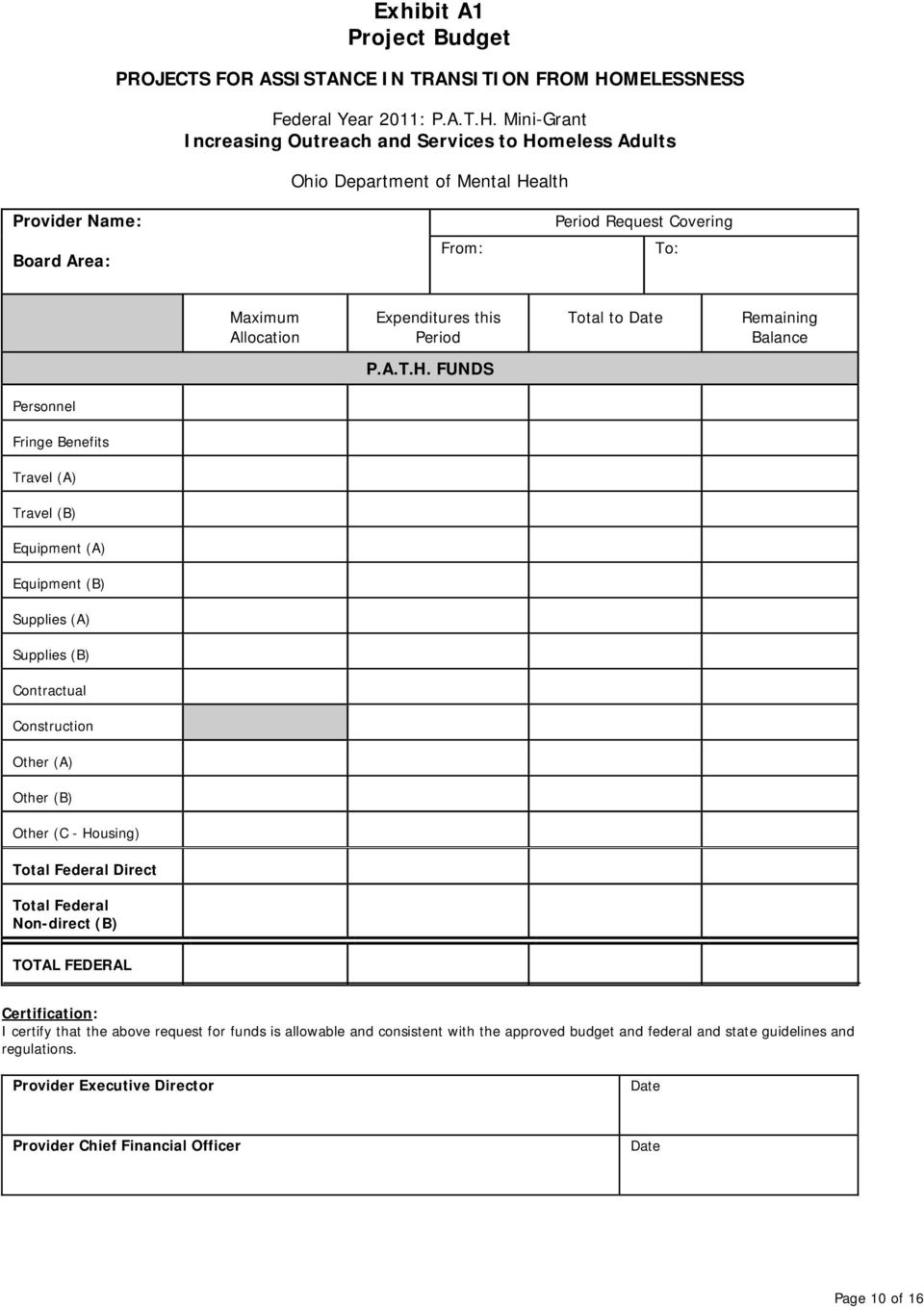
10 Exhibit A1 Project Budget PROJECTS FOR ASSISTANCE IN TRANSITION FROM HOMELESSNESS Federal Year 2011: P.A.T.H. Mini-Grant Increasing Outreach and Services to Homeless Adults Ohio Department of Mental Health Provider Name: Board Area: From: Period Request Covering To: Maximum Allocation Expenditures this Period Total to Date Remaining Balance P.A.T.H. FUNDS Personnel Fringe Benefits Travel (A) Travel (B) Equipment (A) Equipment (B) Supplies (A) Supplies (B) Contractual Construction Other (A) Other (B) Other (C - Housing) Total Federal Direct Total Federal Non-direct (B) TOTAL FEDERAL Certification: I certify that the above request for funds is allowable and consistent with the approved budget and federal and state guidelines and regulations. Provider Executive Director Date Provider Chief Financial Officer Date Page 10 of 16
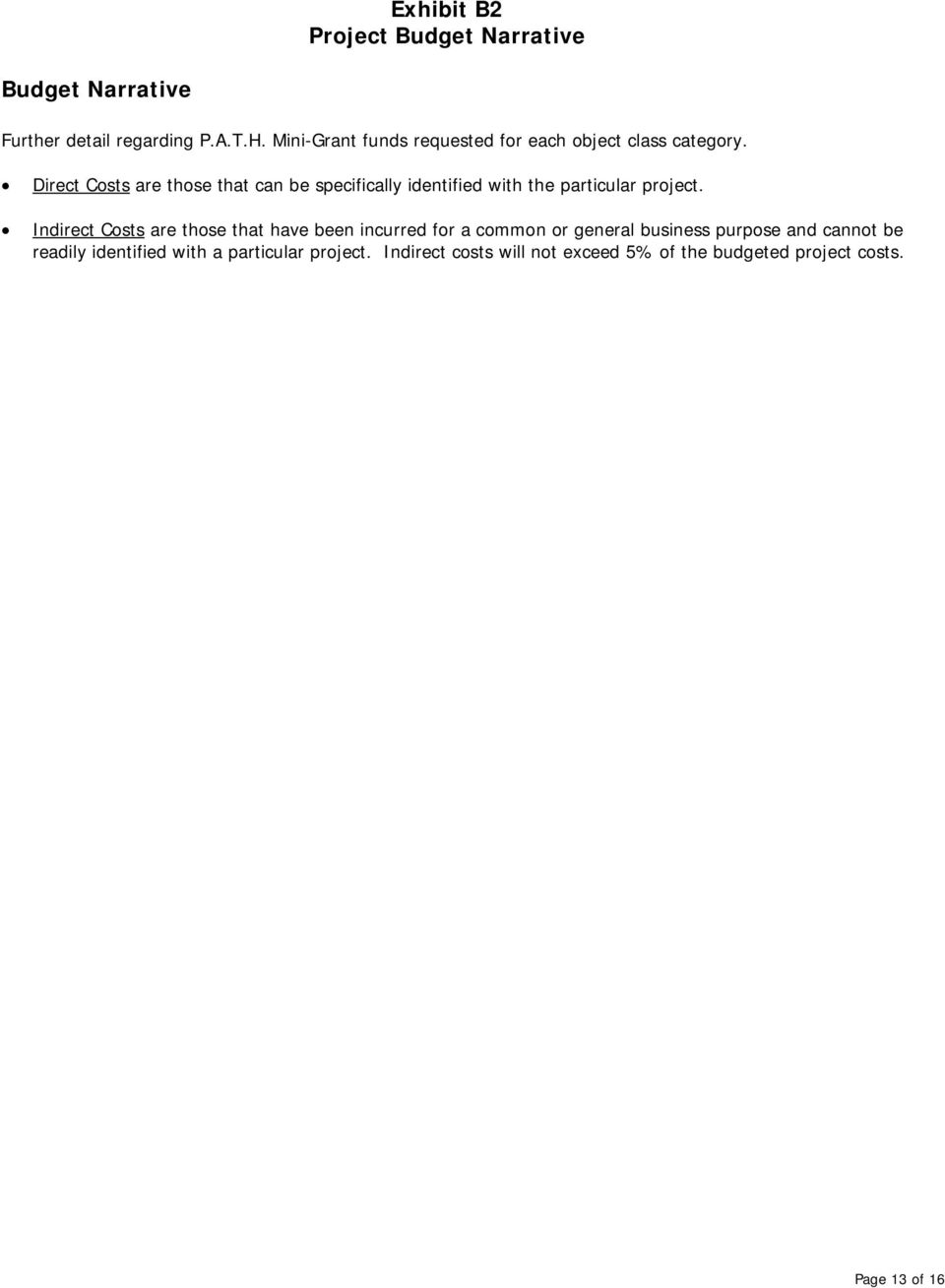
11 Exhibit A2 Project Budget Narrative Budget Narrative Further detail regarding P.A.T.H. Mini-Grant funds requested for each object class category. Direct Costs are those that can be specifically identified with the particular project. Indirect Costs are those that have been incurred for a common or general business purpose and cannot be readily identified with a particular project. Indirect costs will not exceed 5% of the budgeted project costs. Page 11 of 16

12 Exhibit B1 Project Budget PROJECTS FOR ASSISTANCE IN TRANSITION FROM HOMELESSNESS Federal Year 2011: P.A.T.H. Mini-Grant Increasing Outreach and Services to Homeless Adults Ohio Department of Mental Health Provider Name: Board Area: From: Period Request Covering To: Maximum Allocation Expenditures this Period Total to Date Remaining Balance LOCAL MATCHING FUNDS Personnel Fringe Benefits Travel (A) Travel (B) Equipment (A) Equipment (B) Supplies (A) Supplies (B) Contractual Construction Other (A) Other (B) Other (C - Housing) Total Federal Direct Total Federal Non-direct (B) TOTAL FEDERAL Certification: I certify that the above request for funds is allowable and consistent with the approved budget and federal and state guidelines and regulations. Provider Executive Director: Date: Provider Chief Financial Officer: Date: Page 12 of 16

13 Exhibit B2 Project Budget Narrative Budget Narrative Further detail regarding P.A.T.H. Mini-Grant funds requested for each object class category. Direct Costs are those that can be specifically identified with the particular project. Indirect Costs are those that have been incurred for a common or general business purpose and cannot be readily identified with a particular project. Indirect costs will not exceed 5% of the budgeted project costs. Page 13 of 16
14 PATH Mini-Grant SFY12 Mini-Grant: Expanding P.A.T.H. Services within Ohio Scoring Tool RFP Reference Number: Board/Applicant Name: Reviewer: Step 1) Scoring Criteria Criteria were fully/completely/comprehensively met = 3 points Criteria were partially met = 1 or 2 points (gradation based on your assessment of completeness/congruency relating to that criteria) Criteria were poorly met or not met at all = 0 points Project Vision (20%) Does the project demonstrate current need, current gaps, and vision for the project, including the demographics of the county s homeless population? Will the project enhance Ohio s expansion of targeted outreach, engagement, and service efforts to people with severe mental illness, including those with co-occurring substance use disorders, experiencing homelessness? Is the planned work well matched and does it appear to be practical and realistic to the relevant characteristics of the target population, including homelessness, persons with severe mental illness, and veteran population? Training and Utilization, Expansion, and Enhancement of Culturally- Informed and Trauma-Informed Practices/Readiness (10%) Does the PATH Project and planned work use evidence-based or promising practices consistent with professional and/or national standards of practice within the target population? Does the PATH Project and planned work demonstrate culturally-informed practices including, but not limited to, the proposed demographics of the staff serving the clients; how staff providing services to the target population will be sensitive to age, gender and racial/ethnic differences of clients; and the extent to which staff receive periodic training? Does the PATH Project and planned work demonstrate trauma-informed practices? Does the PATH Project and planned work demonstrate the integration of physical and behavioral healthcare? Does the planned work demonstrate cultural competence is integrated into every planning and implementation function? Points Earned (place a score in the box) No Partial Yes (0) (1 or 2) (3) (0) (1 or 2) (3) TOTAL Total x 20 = Total x 10 = Page 14 of 16

15 Current Success serving persons who are experiencing homelessness (5%) Does this PATH Project demonstrate a current local increase in serving people who are experiencing homelessness? (0) (1 or 2) (3) TOTAL Total x 5 = Existing and Proposed Collaborations/Readiness (10%) Does the PATH Project already have established collaborations or address methods to enhance/expand collaborations with other local providers servicing people experiencing homelessness? Does the PATH Project already have in place cross-system collaborations or address methods to enhance/expand cross-system collaborations with Ohio prisons, jails, and the local criminal justice system? Does the PATH Project already have in place cross-system collaborations or address methods to enhance/expand cross-system collaborations with the Veterans Administration or other providers servicing Veterans? Does the PATH Project already have the ability to or address methods to enhance/expand the leverage of local housing dollars within local community for persons experiencing homelessness? Does the PATH Project already have or address methods to enhance/expand collaborations with physical healthcare providers? Does the PATH Project describe how the county s P.A.T.H. provider plans to participate in the HUD Continuum of Care and any other local planning, coordinating or assessment activities? Total x 10 = Education, Training, and Employment of Peers/Readiness (5%) Does the provider organization currently employ peers? Does the provider organization collaborate with a local Consumer Operated Service site and the Ohio Empowerment Coalition? Does the provider organization offer training around stigma to employees on an annual basis and to new employees? Total x 5 = Client Satisfaction Measures (5%) Does the provider organization already collect client satisfaction data? Does the provider organization demonstrate a utilization of client satisfaction data to inform quality improvement efforts presently? Does the planned work discuss new ways or expanded ways to collect client satisfaction data? Does the planned work discuss how the provider organization will utilize client satisfaction data to inform quality improvement efforts targeting services to persons experiencing homelessness? Total x 5 = Page 15 of 16

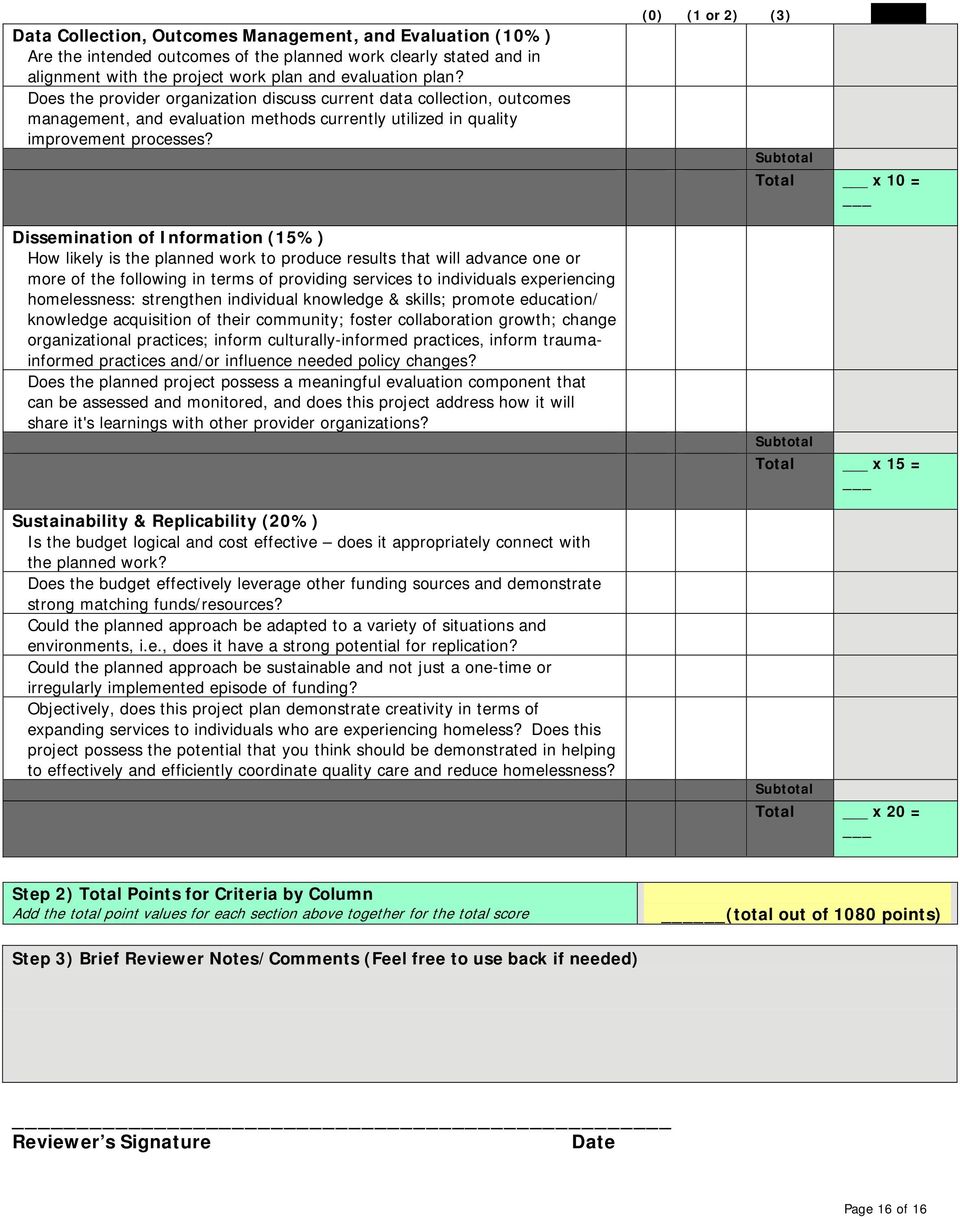
16 Data Collection, Outcomes Management, and Evaluation (10%) Are the intended outcomes of the planned work clearly stated and in alignment with the project work plan and evaluation plan? Does the provider organization discuss current data collection, outcomes management, and evaluation methods currently utilized in quality improvement processes? Dissemination of Information (15%) How likely is the planned work to produce results that will advance one or more of the following in terms of providing services to individuals experiencing homelessness: strengthen individual knowledge & skills; promote education/ knowledge acquisition of their community; foster collaboration growth; change organizational practices; inform culturally-informed practices, inform traumainformed practices and/or influence needed policy changes? Does the planned project possess a meaningful evaluation component that can be assessed and monitored, and does this project address how it will share it's learnings with other provider organizations? Sustainability & Replicability (20%) Is the budget logical and cost effective does it appropriately connect with the planned work? Does the budget effectively leverage other funding sources and demonstrate strong matching funds/resources? Could the planned approach be adapted to a variety of situations and environments, i.e., does it have a strong potential for replication? Could the planned approach be sustainable and not just a one-time or irregularly implemented episode of funding? Objectively, does this project plan demonstrate creativity in terms of expanding services to individuals who are experiencing homeless? Does this project possess the potential that you think should be demonstrated in helping to effectively and efficiently coordinate quality care and reduce homelessness? (0) (1 or 2) (3) TOTAL Total x 10 = Total x 15 = Total x 20 = Step 2) Total Points for Criteria by Column Add the total point values for each section above together for the total score (total out of 1080 points) Step 3) Brief Reviewer Notes/Comments (Feel free to use back if needed) Reviewer s Signature Date Page 16 of 16
2015 Residential Substance Abuse Treatment (RSAT) for State Prisoners Program Request for Proposals (RFP) CFDA Number: 16.593
 Idaho State Police Planning, Grants, & Research U.S. Department of Justice Bureau of Justice Assistance 2015 Residential Substance Abuse Treatment (RSAT) for State Prisoners Program Request for Proposals
ADAMHSCC Request For Proposals. Recovery Housing Initiative
 Summary and Background ADAMHSCC Request For Proposals Recovery Housing Initiative The mission of the Alcohol, Drug Addiction and Mental Health Services of Cuyahoga County (ADAMHSCC) is to promote and enhance
Mental Health 101 for Criminal Justice Professionals David A. D Amora, M.S.
 Mental Health 101 for Criminal Justice Professionals David A. D Amora, M.S. Director, National Initiatives, Council of State Governments Justice Center Today s Presentation The Behavioral Health System
Program Plan for the Delivery of Treatment Services
 Standardized Model for Delivery of Substance Use Services Attachment 5: Nebraska Registered Service Provider s Program Plan for the Delivery of Treatment Services Nebraska Registered Service Provider s
Department of Alcohol and Drug Addiction Services
 Department of Alcohol and Drug Addiction Services Deauna Hale, Budget Analyst The Recovery Assistance and Recovery Healthcare Assistance programs are eliminated State GRF dollars allows local boards more
Transitioning to The Health Home Model in PSH. Presented by Eric Morse, LISW-S, Chief Operating Officer
 Transitioning to The Health Home Model in PSH Presented by Eric Morse, LISW-S, Chief Operating Officer Our Mission Reaching out to adults and children in Northeast Ohio to end homelessness, prevent suicide,
Residential Substance Abuse Treatment (RSAT 2014/2015)
 State of Wisconsin Department of Justice 17 W. Main St. P.O. Box 7857 Madison, WI 53707-7857 Brad D. Schimel Attorney General Criminal Justice Residential Substance Abuse Treatment (RSAT 2014/2015) Grant
RECOVERY HOUSING POLICY BRIEF
 I. Introduction and Intent As communities implement strategies to end homelessness, they need to be able to provide effective housing and services options for people experiencing homelessness who have
FY 2015 Program Guide Residential Substance Abuse Treatment (RSAT) for Prisoners
 Commonwealth of Virginia Department of Criminal Justice Services FY 2015 Program Guide Residential Substance Abuse Treatment (RSAT) for Prisoners Applications must be received by July 18, 2014 Virginia
Santa Barbara County Department of Alcohol, Drug and Mental Health Services Division of Alcohol and Drug Programs
 Santa Barbara County Department of Alcohol, Drug and Mental Health Services Division of Alcohol and Drug Programs Request for Proposal (RFP) Drug Diversion - PC 1000 Treatment Services Through Fiscal Year
Request for Applications
 Palm Beach County Department of Public Safety Justice Services Division Palm Beach County Drug Court Programs Substance Abuse Treatment Request for Applications Release Date: June 30, 2015 Due Date: July
Outcomes for People on Allegheny County Community Treatment Teams
 Allegheny HealthChoices, Inc. Winter 2010 Outcomes for People on Allegheny County Community Treatment Teams Community Treatment Teams (CTTs) in Allegheny County work with people who have some of the most
STATE OF GEORGIA HOMELESS ACTION PLAN
 STATE OF GEORGIA HOMELESS ACTION PLAN Homeless persons have increased their independence and been restored to the mainstream of society because State and local resources have ensured optimal opportunities
Department of Mental Health
 332401 Forensic Services $4,319,519 $4,328,547 $4,371,610 $4,323,287 $3,089,969 $3,244,251 0.2% 1.0% -1.1% -28.5% 5.0% Section 335.10.10 of Am. Sub. H.B. 1 of the 128th G.A. (originally established by
VALUE BEHAVIORAL HEALTH OF PENNSYLVANIA (VBH-PA) IN PARTNERSHIP WITH WESTMORELAND DRUG AND ALCOHOL COMMISSION REQUEST FOR PROPOSAL (RFP)
 VALUE BEHAVIORAL HEALTH OF PENNSYLVANIA (VBH-PA) IN PARTNERSHIP WITH WESTMORELAND DRUG AND ALCOHOL COMMISSION REQUEST FOR PROPOSAL (RFP) FOR FUNDS SUPPORTING DEVELOPMENT OF A SUBSTANCE ABUSE TREATMENT
Supportive Housing Program (SHP) Self-Monitoring Tools
 Supportive Housing Program (SHP) Self-Monitoring Tools U.S. Department of Housing and Urban Development Office of Community Planning and Development Table of Contents INTRODUCTION...1 TOOL 1 MEASURING
Program of Assertive Community Services (PACT)
 Program of Assertive Community Services (PACT) Service/Program Definition Program of Assertive Community Services (PACT) entails the provision of an array of services delivered by a community-based, mobile,
VALUE BEHAVIORAL HEALTH OF PENNSYLVANIA (VBH-PA) IN PARTNERSHIP WITH FAYETTE COUNTY BEHAVIORAL HEALTH ADMINISTRATION HAVE ISSUED A
 VALUE BEHAVIORAL HEALTH OF PENNSYLVANIA (VBH-PA) IN PARTNERSHIP WITH FAYETTE COUNTY BEHAVIORAL HEALTH ADMINISTRATION HAVE ISSUED A REQUEST FOR PROPOSALS (RFP) FOR SUBSTANCE ABUSE OUTPATIENT SERVICES SERVING
Eugenia Cash LSW, MSSA, CDCA William M. Denihan Board Chair Chief Executive Officer SERVICES DIRECTORY Published July 2015
 Eugenia Cash LSW, MSSA, CDCA Board Chair William M. Denihan Chief Executive Officer SERVICES DIRECTORY Published July 2015 EMERGENCY RESOURCES FOR ADULTS AND CHILDREN 24-HOUR ALCOHOL AND/OR OTHER DRUG
L O S T. The High Price of Not Expanding Medicaid in Virginia *****
 L O S T Dollars Jobs Opportunities People The High Price of Not Expanding Medicaid in Virginia ***** Joel E. Miller Executive Director and Chief Executive Officer American Mental Health Counselors Association
COMMUNITY CHEMICAL DEPENDENCE AND ABUSE FACILITIES
 Office of Alcoholism and COMMUNITY CHEMICAL DEPENDENCE AND ABUSE FACILITIES Objective: Provides funds to public and private chemical dependence and abuse agencies for capital projects including construction,
Fairfax-Falls Church Community Services Board
 106-06-Mental Health Adult Residential Services Fund/Agency: 106 Fairfax-Falls Church Community Services Board Personnel Services $5,855,252 Operating Expenses $5,664,614 Recovered Costs $0 Capital Equipment
Baltimore Substance Abuse Systems, Inc. A subsidiary of BHS Baltimore
 Baltimore Substance Abuse Systems, Inc. A subsidiary of BHS Baltimore B U D G E T A P P L I C A T I O N P A C K E T I N S T R U C T I O N M A N U A L FY 2015 (Do not proceed before reading all instructions)
City of Los Angeles, 2003-2008 Consolidated Plan
 , 2003-2008 Consolidated Plan D. Other Special Needs Supportive and Housing Services The Mayor has identified residents with special needs as a top priority for the Consolidated Plan and Annual Action
Fairfax-Falls Church Community Services Board
 LOB #267: ADULT RESIDENTIAL TREATMENT SERVICES Purpose Adult Residential Treatment Services provides residential treatment programs for adults with severe substance use disorders and/or co occurring mental
UTAH DIVISION OF SUBSTANCE ABUSE AND MENTAL HEALTH SUBSTANCE USE DISORDER SERVICES MONITORING CHECKLIST (FY 2014) GENERAL PROGRAM REQUIREMENTS
 UTAH DIVISION OF SUBSTANCE ABUSE AND MENTAL HEALTH SUBSTANCE USE DISORDER SERVICES MONITORING CHECKLIST (FY 2014) Program Name Reviewer Name Date(s) of Review GENERAL PROGRAM REQUIREMENTS 2014 Division
PHILADELPHIA DEPARTMENT OF BEHAVIORAL HEALTH AND INTELLECTUAL disability SERVICES
 PHILADELPHIA DEPARTMENT OF BEHAVIORAL HEALTH AND INTELLECTUAL disability SERVICES Program Description Guidelines I. Introduction A. Name of the Program Please give the name of the program you plan to operate.
ASSERTIVE COMMUNITY TREATMENT (ACT) TEAM REQUEST FOR PROPOSALS. October 3, 2014
 ASSERTIVE COMMUNITY TREATMENT (ACT) TEAM REQUEST FOR PROPOSALS INTRODUCTION October 3, 2014 New York State Office of Mental Health communicated the availability of reinvestment funding associated with
Paul Jaquith, Director f Broward Addiction Recovery Center (BARC)
 NARD COUNTY HUMAN SERVICES DEPARTMENT BROWARD ADDICTION RECOVERY CENTER (BARC) DIVISION - ADMINISTRATION 115 S. Andrews Avenue, Room 318 Fort Lauderdale, Florida 33301 954-357-5444 FAX 954-357-5468 To:
Children, youth and families with co-occurring mental health and substance abuse issues are welcomed in every contact, and in every setting.
 Practice Guidelines for the Identification and Treatment of Co-occurring Mental Health and Substance Abuse Issues In Children, Youth and Families June, 2008 This document is adapted from The Vermont Practice
EMERGENCY SOLUTIONS GRANTS PROGRAM (ESG) ELIGIBLE EXPENSE GUIDE
 EMERGENCY SOLUTIONS GRANTS PROGRAM (ESG) ELIGIBLE EXPENSE GUIDE DECEMBER 2012 STATE OF CALIFORNIA EMERGENCY SOLUTIONS GRANT ELIGIBLE EXPENSES DEPARTMENT OF HOUSING AND COMMUNITY DEVELOPMENT DIVISION OF
Provider Application Packet
 Provider Application Packet Criminal Justice Treatment Programs Administered by the Tennessee Department of Mental Health and Substance Abuse Services (TDMHSAS) Division of Substance Abuse Services (DSAS)
SENATE BILL No. 614 AMENDED IN ASSEMBLY JULY 16, 2015 AMENDED IN ASSEMBLY JULY 6, 2015 AMENDED IN SENATE APRIL 6, 2015
 AMENDED IN ASSEMBLY JULY 16, 2015 AMENDED IN ASSEMBLY JULY 6, 2015 AMENDED IN SENATE APRIL 6, 2015 SENATE BILL No. 614 Introduced by Senator Leno (Coauthor: Senator Anderson) February 27, 2015 An act to
Peer Support Services Code Detail Code Mod Mod
 HIPAA Transaction Code Peer Support Services Peer Support Services Code Detail Code Mod Mod 1 2 Mod 3 Mod 4 Rate Practitioner Level 4, In-Clinic H0038 HQ U4 U6 $4.43 Practitioner Level 5, In-Clinic H0038
The President s 2016 Budget: Fact Sheet on Homelessness Assistance
 President Obama s 2016 Budget demonstrates his deep commitment to ending homelessness. The Budget makes investments needed to end chronic homelessness in 2017, make significant progress toward ending homelessness
Emergency Solutions Grants Program. Eligible Expense Guide
 Emergency Solutions Grants Program Eligible Expense Guide State of West Virginia Office of Economic Opportunity 2015 Table of Contents 1. Street Outreach 1.1 Engagement.2 1.2 Case Management.2 1.3 Emergency
EMERGENCY SOLUTIONS GRANT PROGRAM
 TABLE OF CONTENTS AND CHECKLIST Lead Applicant name: Provider or Sub-recipient named in this application: This is application is # of a total # of applications being submitted by this lead applicant. Lead
Oxford House. A Successful Government Private Partnership in North Carolina since 1991
 Oxford House A Successful Government Private Partnership in North Carolina since 1991 Overview Oxford House, Inc. (OHI) is the umbrella organization for the more than 1750 individual Oxford Houses. Oxford
Community Mediation Mini-grant Program
 1 Program Overview The JAMS Foundation and the National Association for Community Mediation (NAFCM) are pleased to announce the Community Mediation Mini-Grant Program ( Program ). The purpose of the Program
DENVER HOUSING FIRST COLLABORATIVE COST BENEFIT ANALYSIS AND PROGRAM OUTCOMES REPORT. Jennifer Perlman, PsyD, and John Parvensky
 DENVER HOUSING FIRST COLLABORATIVE COST BENEFIT ANALYSIS AND PROGRAM OUTCOMES REPORT By: Jennifer Perlman, PsyD, and John Parvensky Colorado Coalition for the Homeless December 11, 2006 DENVER HOUSING
Audit Report. Division of Mental Health and Developmental Services Substance Abuse Prevention and Treatment Agency
 LA12-15 STATE OF NEVADA Audit Report Division of Mental Health and Developmental Services Substance Abuse Prevention and Treatment Agency 2012 Legislative Auditor Carson City, Nevada Audit Highlights Highlights
REQUEST FOR PROPOSALS (RFP) APPLICATION GUIDEBOOK HOMELESSNESS PREVENTION AND RAPID RE-HOUSING PROGRAM (HPRP)
 REQUEST FOR PROPOSALS (RFP) APPLICATION GUIDEBOOK FOR: HOMELESSNESS PREVENTION AND RAPID RE-HOUSING PROGRAM (HPRP) HARRIS COUNTY COMMUNITY SERVICES DEPARTMENT OFFICE OF HOUSING AND COMMUNITY DEVELOPMENT
Department of Alcohol and Drug Addiction Services
 Department of Alcohol and Drug Addiction Services Holly Wilson, Budget Analyst GRF funding provides for increases in Prevention and Treatment Services Department receives $2.1 million in FY 2006 and $2.8
OUR MISSION. WestCare s mission. is to empower everyone whom. we come into contact with. to engage in a process of healing, growth and change,
 OUR MISSION WestCare s mission is to empower everyone whom we come into contact with to engage in a process of healing, growth and change, benefiting themselves, their families, coworkers and communities.
Department of Mental Health and Addiction Services 17a-453a-1 2
 17a-453a-1 2 DEPARTMENT OF MENTAL HEALTH AND ADDICTION SERVICES General Assistance Behavioral Health Program The Regulations of Connecticut State Agencies are amended by adding sections 17a-453a-1 to 17a-453a-19,
LOCAL NEEDS LOCAL DECISI NS LOCAL BOARDS
 ALCOHOL, DRUG ADDICTION, AND MENTAL HEALTH BOARDS OF OHIO The Value of Ohio s Alcohol, Drug Addiction, and Mental Health Boards Providing hope and helping local communities thrive ++--------- LOCAL NEEDS
DISTRICT OF COLUMBIA OFFICIAL CODE TITLE 7. HUMAN HEALTH CARE AND SAFETY SUBTITLE L. SUBSTANCE ABUSE CHAPTER 30. CHOICE IN DRUG TREATMENT
 DISTRICT OF COLUMBIA OFFICIAL CODE TITLE 7. HUMAN HEALTH CARE AND SAFETY SUBTITLE L. SUBSTANCE ABUSE CHAPTER 30. CHOICE IN DRUG TREATMENT Current as of November 19, 2008 7-3001. Legislative findings (a)
Professional Treatment Services in Facility-Based Crisis Program Children and Adolescents
 Professional Treatment Services in Facility-Based Crisis Program Children and Adolescents Medicaid and North Carolina Health Choice (NCHC) Billable Service WORKING DRAFT Revision Date: September 11, 2014
New York City Department of Homeless Services Audit Services Directive Number 1 Audit Protocols For Human Services Contracts
 I. UNIVERSAL TESTS (all programs) CONTRACT REVIEW PROCEDURES TESTS TO BE PERFORMED 1. Salaries 2. Fringe Benefits 3. OTPS 4. Compliance with Contractual Requirements 5. Purchasing 6. Funding 7. Additional
NATIONAL VOLUNTEER WEEK 2015 REQUEST FOR PROPOSALS
 NATIONAL VOLUNTEER WEEK 2015 REQUEST FOR PROPOSALS Proposals due: Tuesday, January 6, 2015 ISSUED BY THE MASSACHUSETTS SERVICE ALLIANCE WITH SUPPORT FROM THE CORPORATION FOR NATIONAL AND COMMUNITY SERVICE
ADRC READINESS CHECKLIST
 ADRC READINESS CHECKLIST This checklist is intended to help in planning for the development of and evaluating readiness to begin operations as an Aging and Disability Resource Center (ADRC). The readiness
[Provider or Facility Name]
![[Provider or Facility Name]](/thumbs/24/2833314.jpg "[Provider or Facility Name]") [Provider or Facility Name] SECTION: [Facility Name] Residential Treatment Facility (RTF) SUBJECT: Psychiatric Security Review Board (PSRB) In compliance with OAR 309-032-0450 Purpose and Statutory Authority
[Provider or Facility Name] SECTION: [Facility Name] Residential Treatment Facility (RTF) SUBJECT: Psychiatric Security Review Board (PSRB) In compliance with OAR 309-032-0450 Purpose and Statutory Authority
Request for Proposal (RFP) Chemical Dependency Outpatient Treatment Services
 Request for Proposal (RFP) Chemical Dependency Outpatient Treatment Services 1. Introduction Island County Board of County Commissioners is requesting proposals to provide Outpatient Chemical Dependency
CHAPTER 5. Rules and Regulations for Substance Abuse Standards. Special Populations for Substance Abuse Services
 CHAPTER 5 Rules and Regulations for Substance Abuse Standards Special Populations for Substance Abuse Services Section 1. Authority. These rules are promulgated by the Wyoming Department of Health pursuant
NORTH COUNTRY COMMUNITY MENTAL HEALTH NORTHERN AFFILIATION UTILIZATION MANAGEMENT PLAN November 1, 2001. Revised January 2013
 NORTH COUNTRY COMMUNITY MENTAL HEALTH NORTHERN AFFILIATION UTILIZATION MANAGEMENT PLAN November 1, 2001 Revised January 2013 I. Mission II. III. IV. Scope Philosophy Authority V. Utilization Management
Jail Diversion & Behavioral Health
 Jail Diversion & Behavioral Health Correctional Health Reentry Meeting Mandy Gilman, Director of Public Policy & Research Association for Behavioral Healthcare Association for Behavioral Healthcare Statewide
Performance Standards
 Performance Standards Co-Occurring Disorder Competency Performance Standards are intended to provide a foundation and serve as a tool to promote continuous quality improvement and progression toward best
Requirements For Provider Type 11 Mental Health/Substance Abuse Services
 Requirements For Provider Type 11 Mental Health/Substance Abuse Services Specialty Code Please choose from the following for specialty and code: 113 - Partial Psychiatric Hospitalization (Children) 114
MONROE COUNTY OFFICE OF MENTAL HEALTH, DEPARTMENT OF HUMAN SERVICES RECOVERY CONNECTION PROJECT PROGRAM EVALUATION DECEMBER 2010
 MONROE COUNTY OFFICE OF MENTAL HEALTH, DEPARTMENT OF HUMAN SERVICES RECOVERY CONNECTION PROJECT PROGRAM EVALUATION DECEMBER 2010 Prepared For: Kathleen Plum, RN, PhD Director, Monroe County Office of Mental
Consolidation of ODMH and ODADAS into the Department of Mental Health and Addiction Services
 MHACD36 Consolidation of ODMH and ODADAS into the 3793., 5119. Merges the Department of Mental Health and the Department of Alcohol and Drug Addiction Services to form the. Relocates numerous Revised Code
Senate Bill (SB) 855: Housing Support Program Orange County Application
 Submitted by: Orange County Contact: Sumit Sapra, 714-541-7782, [email protected] Topic: Senate Bill (SB) 855: Housing Support Program 1. Describe the problem of homelessness and housing instability
Services Provided for Polk County Residents
 Providing Successful, Evidence-Based Substance Abuse and Mental Health Treatment to Men, Women and Adolescents in Polk, Highlands and Hardee Counties for over 39 years. 1 Services Provided for Polk County
BUSINESS PLAN TEMPLATE MANUFACTURING
 BUSINESS PLAN TEMPLATE MANUFACTURING COVER SHEET (This highlights how you can be contacted. numbers and email addresses listed are operational.) Ensure that telephone 1. Identify the Business 2. Identify
CASE STUDY: CHICAGO HEALTH OUTREACH Chicago, Illinois
 CASE STUDY: CHICAGO HEALTH OUTREACH Chicago, Illinois This project was funded by a grant from the Health Resources and Services Administration, U.S. Department of Health and Human Services, grant #4H97HA001580201.
Easter Seals Bay Area. Request for Proposals Occupational Therapy, Speech and Language Pathology and Applied Behavior Analysis Services RFP #2.
 Easter Seals Bay Area Request for Proposals Occupational Therapy, Speech and Language Pathology and Applied Behavior Analysis Services RFP #2.2012 Event Time (PST) Date RFP Issued 3.2.2012 Questions accepted
Office of Health Care Quality
 Office of Health Care Quality Bland Bryant Building Spring Grove Hospital Center 55 Wade Avenue Catonsville, Maryland 21228 (410) 402-8100 Fax: (410) 402-8270 To: From: Re: Existing & New Program Applicants
Peer Support Staff: Hiring, Supervising, and Managing Peers in Your Organization
 Peer Support Staff: Hiring, Supervising, and Managing Peers in Your Organization Jack Cameron, MPA Executive Director, Ohio Empowerment Coalition Donna Conley, MBA, LSW, OCPS II Executive Director, Ohio
Request for Proposal (RFP) For a Mental Health Transitional Residential Treatment Center for Individuals with Complex Service Needs
 Request for Proposal (RFP) For a Mental Health Transitional Residential Treatment Center for Individuals with Complex Service Needs AUTHORITY San Diego Regional Center Community Placement Plan For Fiscal
What is CCS? Eligibility
 What is CCS? Department of Health Services Division of Mental Health and Substance Abuse Services Bureau of Prevention, Treatment and Recovery Services Comprehensive Community Services (CCS) Comprehensive
Los Angeles County Department of Health Services Alcohol and Drug Program Administration
 Los Angeles County Department of Health Services Annual Review of Participants in Alcohol and Drug Programs Contracted by the 2003-04 Fiscal Year Prepared by Research and Evaluation Planning Division Los
Medicaid Application for Intensive Outpatient Programs Application Checklist for Providers
 Provider information Agency Name: Physical Address: If applying for multiple sites or applying to serve adolescents and/or adults please note and list specific physical locations: Mailing Address (if different
OUR MISSION. WestCare s mission. is to empower everyone whom. we come into contact with. to engage in a process of healing, growth and change,
 OUR MISSION WestCare s mission is to empower everyone whom we come into contact with to engage in a process of healing, growth and change, benefiting themselves, their families, coworkers and communities.
Quality Management. Substance Abuse Outpatient Care Services Service Delivery Model. Broward County/Fort Lauderdale Eligible Metropolitan Area (EMA)
 Quality Management Substance Abuse Outpatient Care Services Broward County/Fort Lauderdale Eligible Metropolitan Area (EMA) The creation of this public document is fully funded by a federal Ryan White
OREGON HEALTH AUTHORITY ADDICTIONS AND MENTAL HEALTH DIVISION CHAPTER 415: ADDICTION SERVICES
 OREGON HEALTH AUTHORITY ADDICTIONS AND MENTAL HEALTH DIVISION CHAPTER 415: ADDICTION SERVICES DIVISION 56 SUBSTANCE ABUSE AND PROBLEM GAMBLING PREVENTION PROGRAMS 415-056-0030 Purpose and Scope (1) These
A Homeless Prevention System for London Ontario
 A Homeless Prevention System for London Ontario A Three Year Implementation Plan A coordinated and integrated individual and family centred housing stability approach that is outcome focussed and designed
H.R 2646 Summary and S. 1945 Comparison
 H.R 2646 Summary and S. 1945 Comparison TITLE I ASSISTANT SECRETARY FOR MENTAL HEALTH AND SUBSTANCE USE DISORDERS It establishes an Office of the Assistant Secretary for Mental Health and Substance Use
Edward Byrne Memorial Justice Assistance Grant (JAG) Program 2016 Existing Local Project Application Packet
 The Criminal Justice Coordinating Council (the Council) is pleased to announce that it is seeking applications for competitive funding under the Edward Byrne Memorial Justice Assistance Grant (JAG) Program.
State Plan for the State Vocational Rehabilitation Services Program and State Plan Supplement for the State Supported Employment Services Program
 Page 1 of 64 Screen 1 of 17 State Plan for the State Vocational Rehabilitation Services Program and State Plan Supplement for the State Supported Employment Services Program Indiana State Plan for Fiscal
New York State Office of Alcoholism and Substance Abuse Services
 O FFICE OF THE NEW YORK STATE COMPTROLLER DIVISION OF STATE GOVERNMENT ACCOUNTABILITY New York State Office of Alcoholism and Substance Abuse Services Chemical Dependency Program Payments to Selected Contractors
REQUEST FOR SUBSTANCE ABUSE DRUG-FREE OUTPATIENT AND INTENSIVE OUTPATIENT SERVICES SERVING WASHINGTON COUNTY CHILDREN/ADOLESCENTS
 VALUE BEHAVIORAL HEALTH OF PENNSYLVANIA (VBH-PA) IN PARTNERSHIP WITH THE WASHINGTON DRUG AND ALCOHOL COMMISSION, INC. HAVE ISSUED A REQUEST FOR PROPOSAL (RFP) REQUEST FOR SUBSTANCE ABUSE DRUG-FREE OUTPATIENT
Mental Health & Addiction Forensics Treatment
 Mental Health & Addiction Forensics Treatment Sheriffs: Help needed to cope with September 15, 2014 mentally ill INDIANAPOLIS - A sheriff says county jails have become the "insane asylums" for Indiana
FAMILY DRUG COURT PROGRAM
 SUPREME COURT OF MISSISSIPPI Administrative Office of Courts FAMILY DRUG COURT PROGRAM REQUEST FOR PROPOSAL PURPOSE OF THE REQUEST FOR PROPOSAL Through the American Recovery and Reinvestment Act of 2009
GOVERNMENT OF THE DISTRICT OF COLUMBIA Department of Health Health Professional Licensing Administration (HPLA)
 GOVERNMENT OF THE DISTRICT OF COLUMBIA Department of Health Health Professional Licensing Administration (HPLA) Board of Professional Counseling APPLICATION INSTRUCTIONS AND FORMS TO PRACTICE ADDICTION