
BMC Remedy Service Desk: Incident Management User s Guide
|
|
|
- Dwayne Sherman
- 9 years ago
- Views:
Transcription
1 BMC Remedy Service Desk: Incident Management User s Guide October 2010 BMC Remedy Service Desk: Incident Management
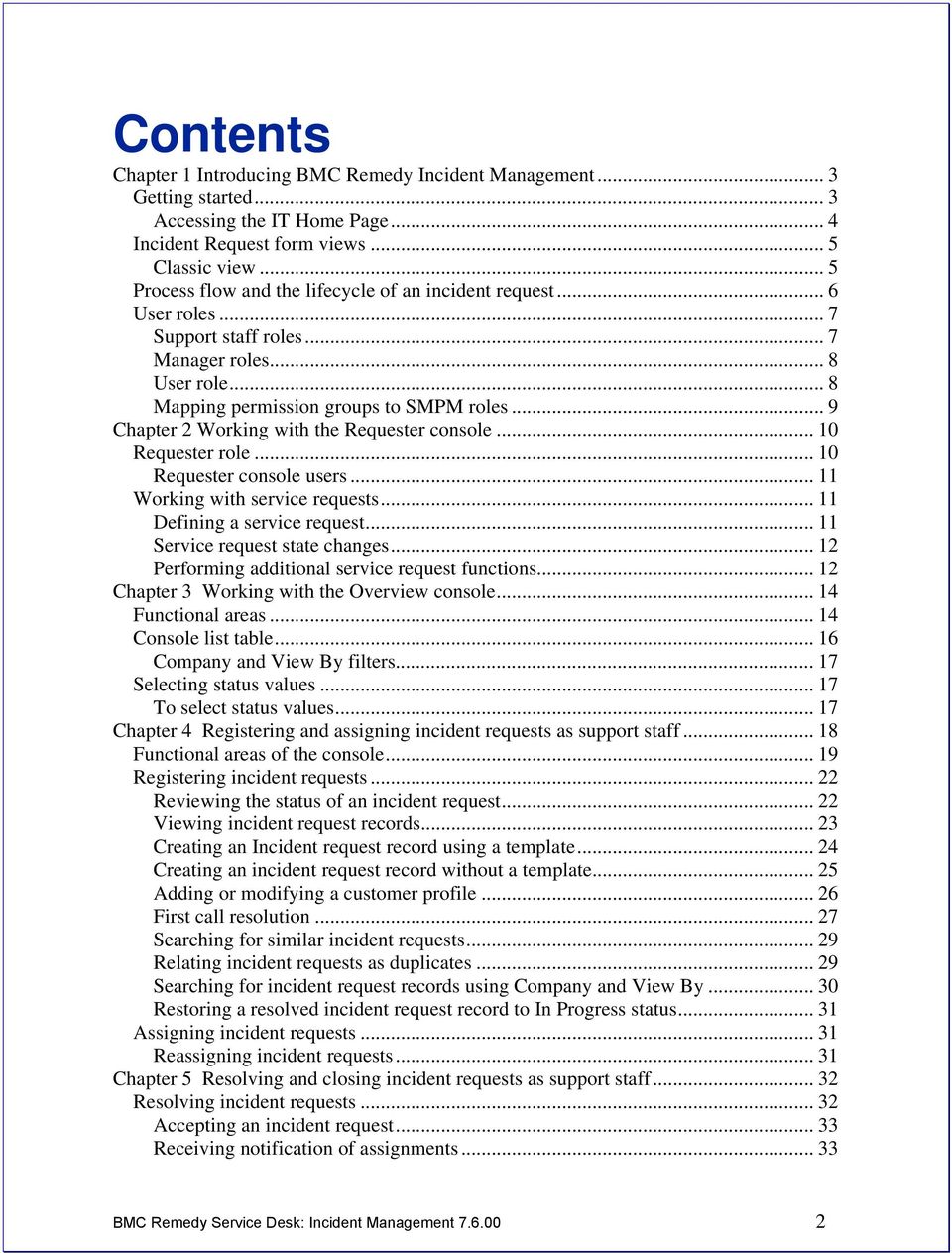
2 Contents Chapter 1 Introducing BMC Remedy Incident Management... 3 Getting started... 3 Accessing the IT Home Page... 4 Incident Request form views... 5 Classic view... 5 Process flow and the lifecycle of an incident request... 6 User roles... 7 Support staff roles... 7 Manager roles... 8 User role... 8 Mapping permission groups to SMPM roles... 9 Chapter 2 Working with the Requester console Requester role Requester console users Working with service requests Defining a service request Service request state changes Performing additional service request functions Chapter 3 Working with the Overview console Functional areas Console list table Company and View By filters Selecting status values To select status values Chapter 4 Registering and assigning incident requests as support staff Functional areas of the console Registering incident requests Reviewing the status of an incident request Viewing incident request records Creating an Incident request record using a template Creating an incident request record without a template Adding or modifying a customer profile First call resolution Searching for similar incident requests Relating incident requests as duplicates Searching for incident request records using Company and View By Restoring a resolved incident request record to In Progress status Assigning incident requests Reassigning incident requests Chapter 5 Resolving and closing incident requests as support staff Resolving incident requests Accepting an incident request Receiving notification of assignments BMC Remedy Service Desk: Incident Management
3 Working with assignments Working with tasks Searching for a solution Recording time worked on an incident request Creating work information entries Modifying work information entries Updating an incident request Creating a change request Creating a solution database entry from an incident Creating a knowledge base article from an incident Closing incident requests Completing an incident request Moving a resolved incident request back to In Progress Chapter 6 Working with incident requests as a manager Assigning incident requests as a group coordinator Rejecting an incident Tracking incident requests Overview of BMC SLM calculations Working with the Watch List Approving solutions To approve or reject a solution Chapter 7 Creating and monitoring tasks Tasks overview Opening the Task form When using the Classic view: Adding tasks using task templates To add a task using task templates Creating ad hoc tasks To create an ad hoc task Accepting task assignments To accept an assigned task Opening and viewing individual task records To view task records Reassigning task sequence numbers To reassign a sequence to task groups and tasks Reassigning sequence numbers to task group children Assigning and reassigning tasks Updating task record details Planning task times To plan the time for tasks Tracking the time spent working on tasks To use the start and the stop buttons to track the time spent working on a task To manually track the time spent working on a task To use the Task Effort log to track the time spent working on a task Adding work information to a task To add work information to a task BMC Remedy Service Desk: Incident Management

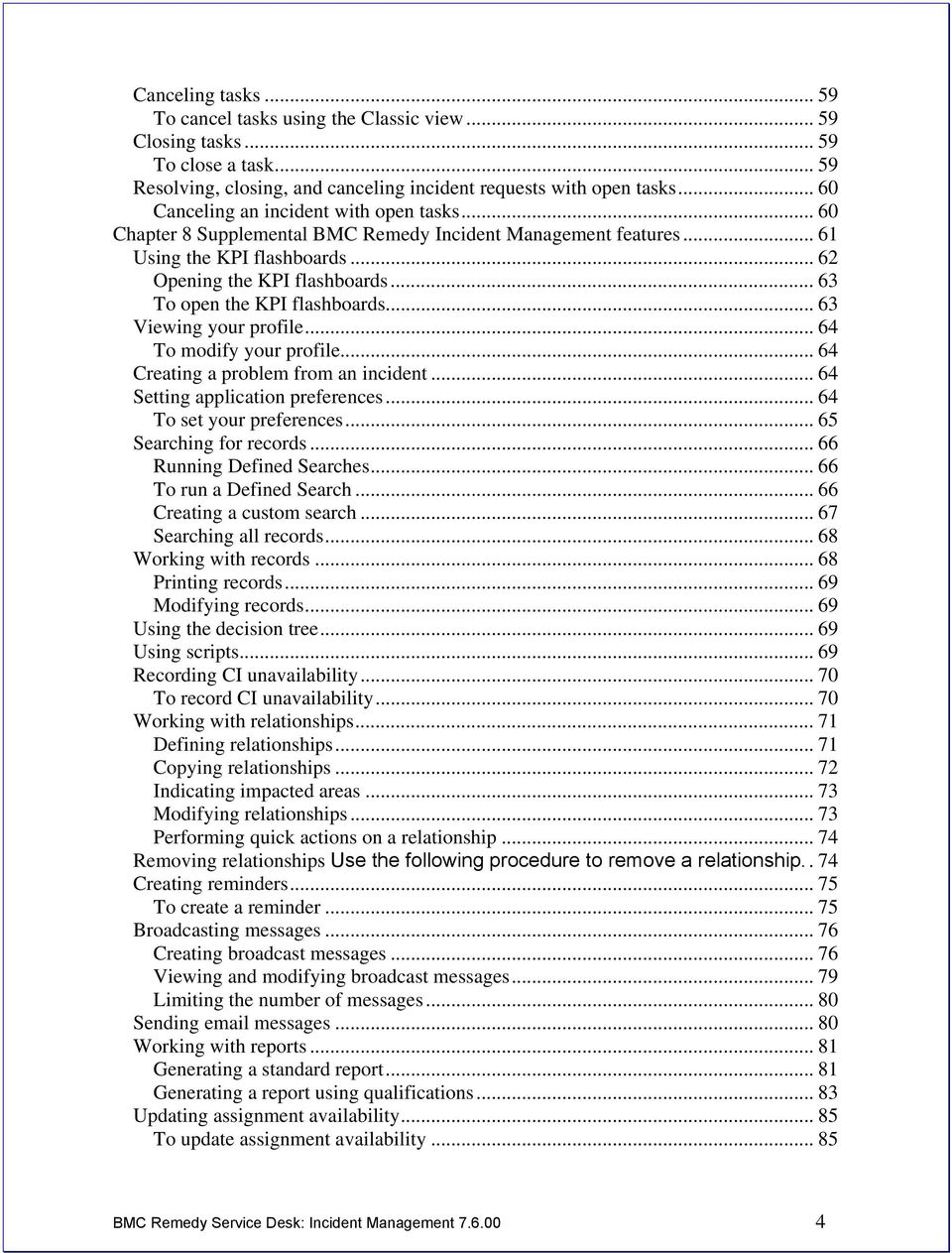
4 Canceling tasks To cancel tasks using the Classic view Closing tasks To close a task Resolving, closing, and canceling incident requests with open tasks Canceling an incident with open tasks Chapter 8 Supplemental BMC Remedy Incident Management features Using the KPI flashboards Opening the KPI flashboards To open the KPI flashboards Viewing your profile To modify your profile Creating a problem from an incident Setting application preferences To set your preferences Searching for records Running Defined Searches To run a Defined Search Creating a custom search Searching all records Working with records Printing records Modifying records Using the decision tree Using scripts Recording CI unavailability To record CI unavailability Working with relationships Defining relationships Copying relationships Indicating impacted areas Modifying relationships Performing quick actions on a relationship Removing relationships Use the following procedure to remove a relationship.. 74 Creating reminders To create a reminder Broadcasting messages Creating broadcast messages Viewing and modifying broadcast messages Limiting the number of messages Sending messages Working with reports Generating a standard report Generating a report using qualifications Updating assignment availability To update assignment availability BMC Remedy Service Desk: Incident Management
5 BMC Remedy Service Desk: Incident Management

6 Chapter 1 Introducing BMC Remedy Incident Management According to IT Infrastructure Library (ITIL ) standards, the primary goal of the incident management process is to restore normal service operation as quickly as possible with minimum disruption to the business, thus ensuring that the best achievable levels of availability and service are maintained. The BMC Remedy Incident Management application helps you to restore normal service operation quickly by managing all aspects of an incident, from creation to their resolution and closure. The processes described in this guide are developed from the BMC Service Management Process Model (SMPM), which is a companion product to BMC Remedy Incident Management. The SMPM describes a set of predefined processes for the delivery and support of information technology (IT) services. The processes described by the SMPM are aligned with ITIL good practices. The following topics are provided: 1. Starting BMC Remedy IT Service Management 2. Incident Request form views 3. Process flow and the lifecycle of an incident request 4. User roles BMC Remedy Service Desk: Incident Management
7 NOTE How you start the BMC Remedy AR System server depends on whether you are using the BMC Remedy User client or a browser. Both of these methods are described in Table below. The method to use depends on your organization s policies and procedures. Table: Starting the Incident Management console Using a browser Type the following URL in to your browser s address bar: Enter your user name and password, and then click Log in. Note: The user name and password are case sensitive. If the Overview or another console opens, click the Incident Management link in the Navigation pane. Using the BMC Remedy user client If you are using Microsoft Windows XP, choose Start > All Programs > BMC Software > AR System >BMC Remedy User. Enter your user name and password, and then click OK. If the Overview or another console opens, click the Incident Management link in the Navigation pane. Accessing the IT Home Page If you must access the IT Home Page, for example - to access the Asset Management console, click the IT Home Page link in the Consoles section of the Navigation pane of the console you are currently working from. Consoles overview The following consoles provide access to all or a part of BMC Remedy Incident Management: 1. Requester console 2. Overview console 3. Incident Management console Requester Console From the Requester console, IT users can submit incident requests directly to BMC Remedy Incident Management. Overview console Using the Overview console, service desk workers who fulfill many different roles can view incident requests that are assigned to them through BMC Remedy Incident Management, and additional work assignments that come to them through other BMC Remedy ITSM applications with which BMC Remedy Incident Management integrates: 1. BMC Remedy Problem Management 2. BMC Remedy Asset Management 3. BMC Remedy Change Management BMC Remedy Service Desk: Incident Management

8 Incident Management console The Incident Management console is the main console for the application. It provides service desk workers with a single point from which they can generate incident requests, monitor the progress of incident requests as they move through their lifecycle, and record work that was performed while solving the incident request. Working with forms and dialog boxes As you work with the forms and dialog boxes associated with the consoles, you might see a plus sign (+) included in a field label. You can type part of the information next to these fields and press ENTER. If an exact match is located, the program automatically completes the field. If a selection list appears, double-click the item you want to put in the field. Using auto-fill fields and lists is faster, more consistent, and more accurate than typing the information. Incident Request form views BMC Remedy Incident Management release provides different ways to view the Incident Request form: 1. Best Practice view (the default view) 2. Classic view NOTE Your view is configured for you by your system administrator. The Commonwealth s Enterprise Remedy System will use the Classic view for Incident and Problem Management. Classic view The Classic view is the Incident Request form as it appeared in previous releases of BMC Remedy Incident Management. This view is provided for customers who are upgrading from earlier versions of BMC Remedy Incident Management and who are not yet ready to adopt the Best Practice view. The following fields have been added to the Classification tab: Service field - The Service field relates business service configuration items (CIs) to the incident request at the time it is created. Service entitlement for business service CIs are related either to the customer directly or to the customer s company, organization, or department. Only the CIs that you are entitled to see appear in the selection list for this field. CI field -The CI field provides a place for you to indicate to which piece of infrastructure the incident request pertains. This field is a required field when you resolve the incident; however, you can indicate the CI at any time in the incident request lifecycle. BMC Remedy Service Desk: Incident Management

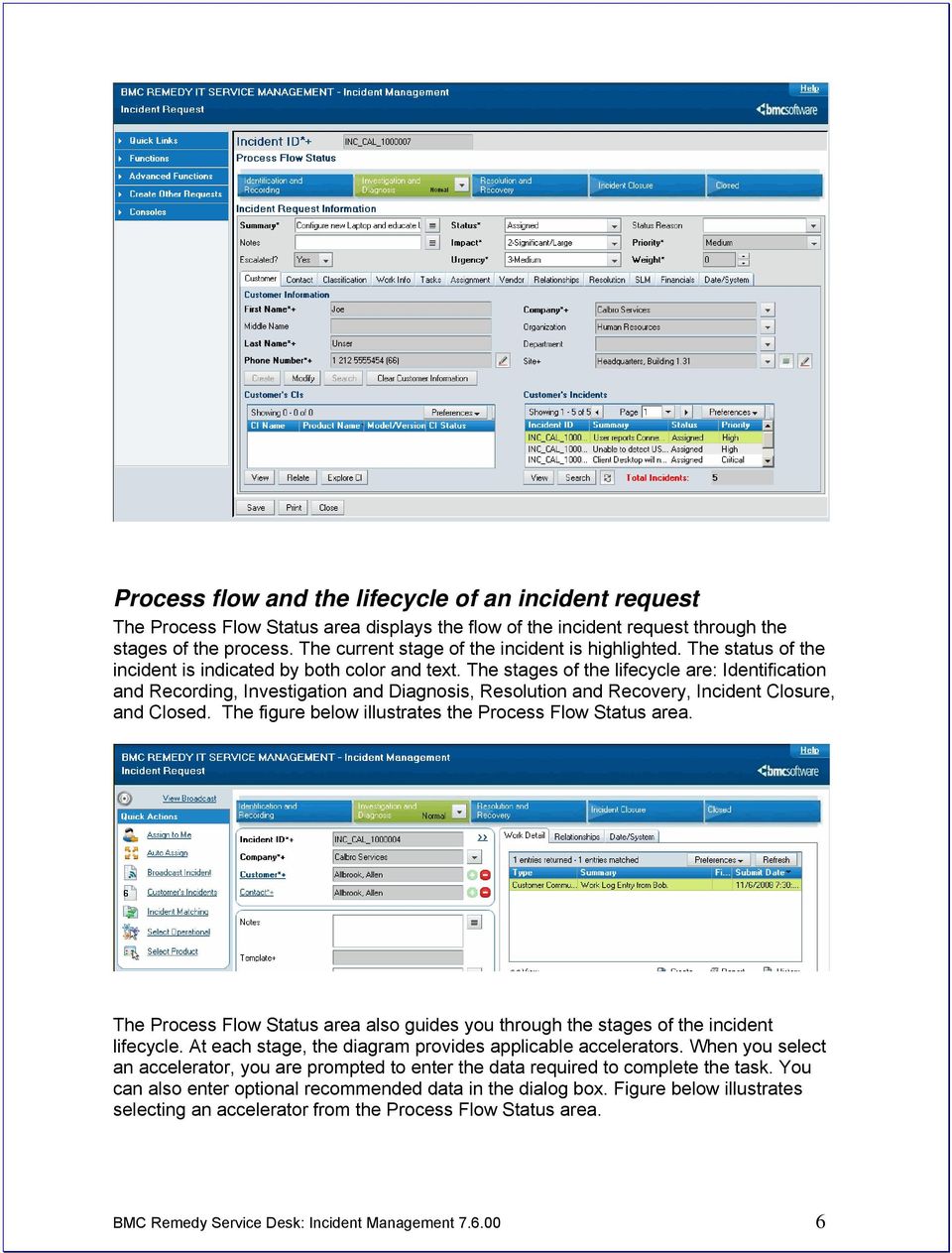
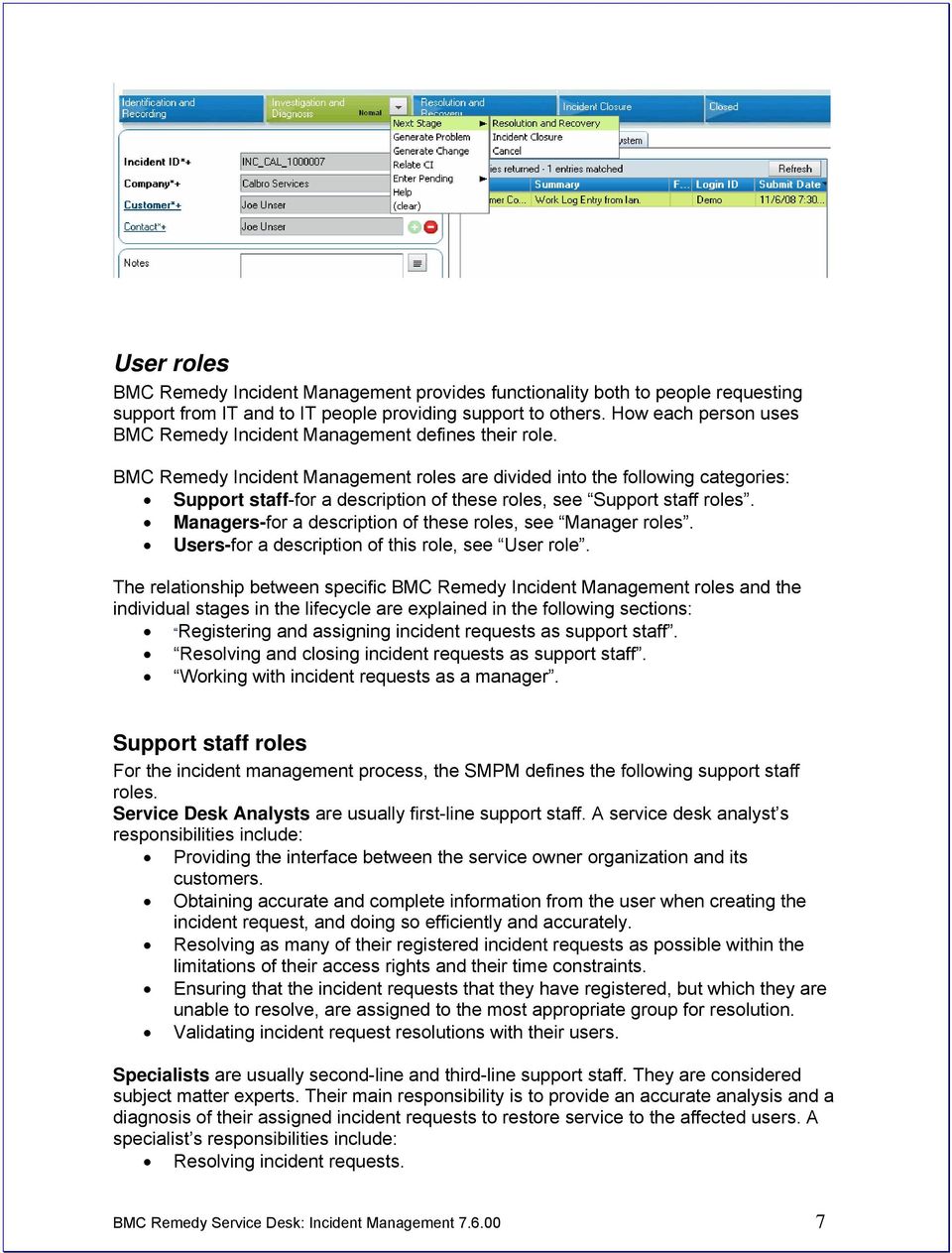
9 Process flow and the lifecycle of an incident request The Process Flow Status area displays the flow of the incident request through the stages of the process. The current stage of the incident is highlighted. The status of the incident is indicated by both color and text. The stages of the lifecycle are: Identification and Recording, Investigation and Diagnosis, Resolution and Recovery, Incident Closure, and Closed. The figure below illustrates the Process Flow Status area. The Process Flow Status area also guides you through the stages of the incident lifecycle. At each stage, the diagram provides applicable accelerators. When you select an accelerator, you are prompted to enter the data required to complete the task. You can also enter optional recommended data in the dialog box. Figure below illustrates selecting an accelerator from the Process Flow Status area. BMC Remedy Service Desk: Incident Management
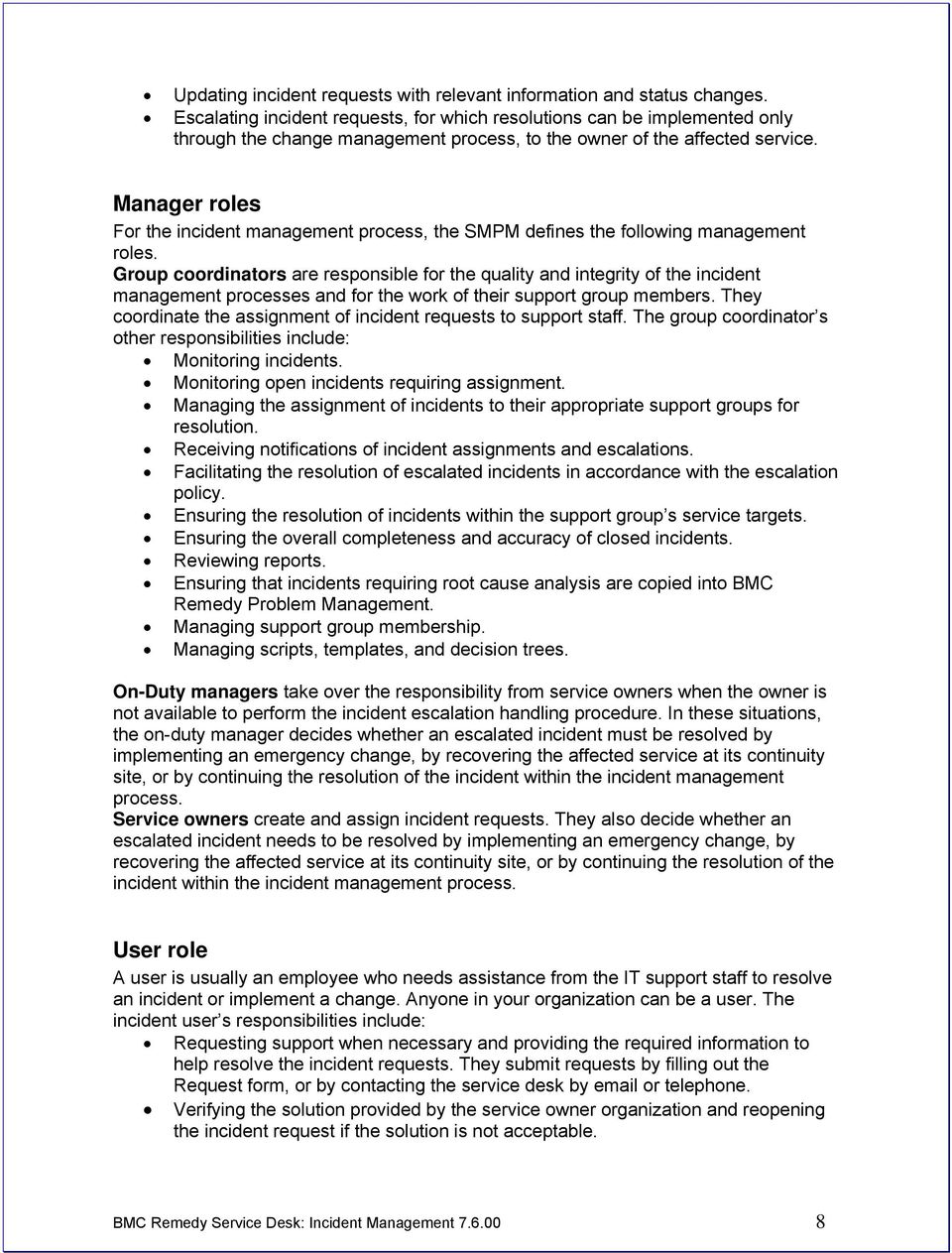
10 User roles BMC Remedy Incident Management provides functionality both to people requesting support from IT and to IT people providing support to others. How each person uses BMC Remedy Incident Management defines their role. BMC Remedy Incident Management roles are divided into the following categories: Support staff-for a description of these roles, see Support staff roles. Managers-for a description of these roles, see Manager roles. Users-for a description of this role, see User role. The relationship between specific BMC Remedy Incident Management roles and the individual stages in the lifecycle are explained in the following sections: Registering and assigning incident requests as support staff. Resolving and closing incident requests as support staff. Working with incident requests as a manager. Support staff roles For the incident management process, the SMPM defines the following support staff roles. Service Desk Analysts are usually first-line support staff. A service desk analyst s responsibilities include: Providing the interface between the service owner organization and its customers. Obtaining accurate and complete information from the user when creating the incident request, and doing so efficiently and accurately. Resolving as many of their registered incident requests as possible within the limitations of their access rights and their time constraints. Ensuring that the incident requests that they have registered, but which they are unable to resolve, are assigned to the most appropriate group for resolution. Validating incident request resolutions with their users. Specialists are usually second-line and third-line support staff. They are considered subject matter experts. Their main responsibility is to provide an accurate analysis and a diagnosis of their assigned incident requests to restore service to the affected users. A specialist s responsibilities include: Resolving incident requests. BMC Remedy Service Desk: Incident Management
11 Updating incident requests with relevant information and status changes. Escalating incident requests, for which resolutions can be implemented only through the change management process, to the owner of the affected service. Manager roles For the incident management process, the SMPM defines the following management roles. Group coordinators are responsible for the quality and integrity of the incident management processes and for the work of their support group members. They coordinate the assignment of incident requests to support staff. The group coordinator s other responsibilities include: Monitoring incidents. Monitoring open incidents requiring assignment. Managing the assignment of incidents to their appropriate support groups for resolution. Receiving notifications of incident assignments and escalations. Facilitating the resolution of escalated incidents in accordance with the escalation policy. Ensuring the resolution of incidents within the support group s service targets. Ensuring the overall completeness and accuracy of closed incidents. Reviewing reports. Ensuring that incidents requiring root cause analysis are copied into BMC Remedy Problem Management. Managing support group membership. Managing scripts, templates, and decision trees. On-Duty managers take over the responsibility from service owners when the owner is not available to perform the incident escalation handling procedure. In these situations, the on-duty manager decides whether an escalated incident must be resolved by implementing an emergency change, by recovering the affected service at its continuity site, or by continuing the resolution of the incident within the incident management process. Service owners create and assign incident requests. They also decide whether an escalated incident needs to be resolved by implementing an emergency change, by recovering the affected service at its continuity site, or by continuing the resolution of the incident within the incident management process. User role A user is usually an employee who needs assistance from the IT support staff to resolve an incident or implement a change. Anyone in your organization can be a user. The incident user s responsibilities include: Requesting support when necessary and providing the required information to help resolve the incident requests. They submit requests by filling out the Request form, or by contacting the service desk by or telephone. Verifying the solution provided by the service owner organization and reopening the incident request if the solution is not acceptable. BMC Remedy Service Desk: Incident Management
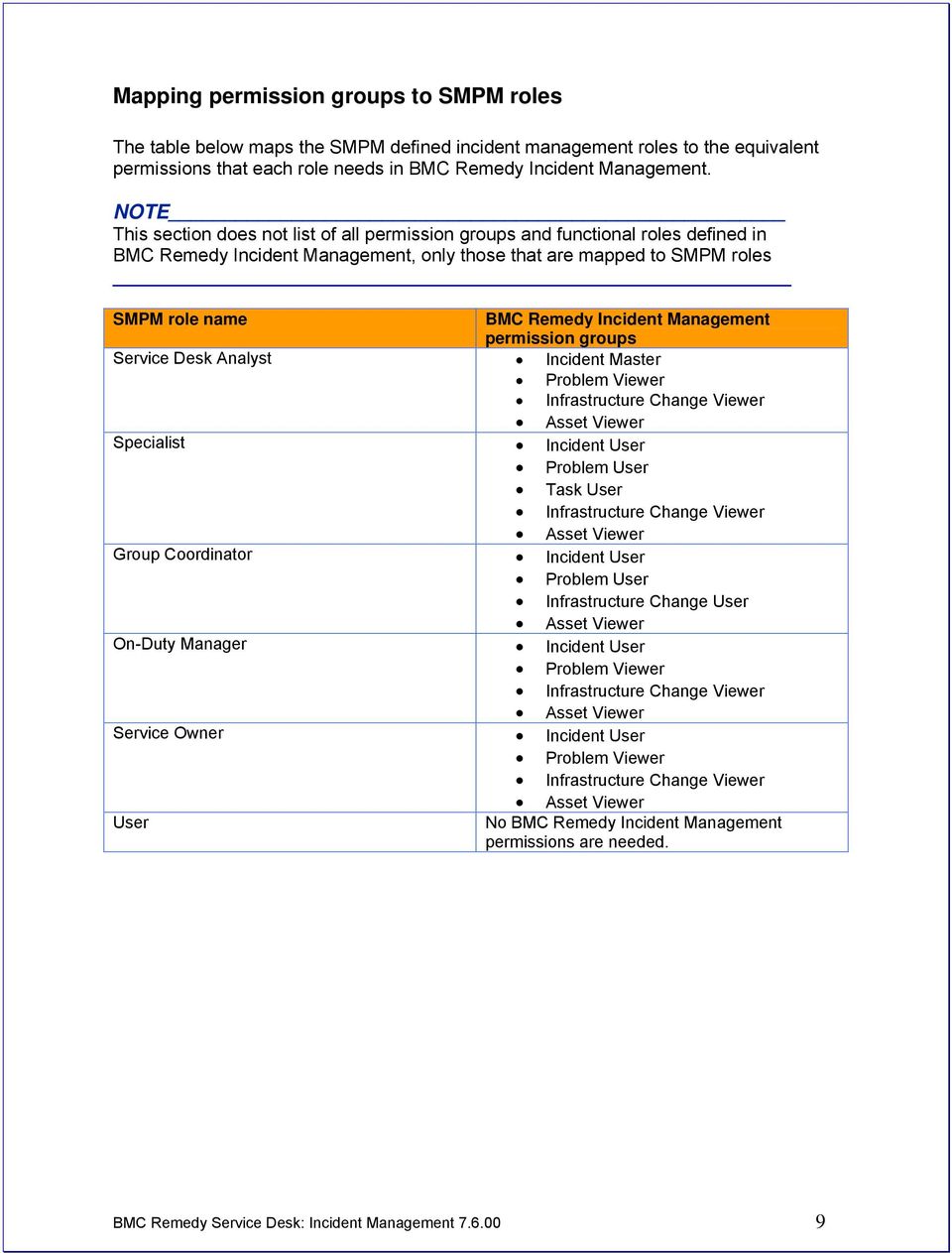
12 Mapping permission groups to SMPM roles The table below maps the SMPM defined incident management roles to the equivalent permissions that each role needs in BMC Remedy Incident Management. NOTE This section does not list of all permission groups and functional roles defined in BMC Remedy Incident Management, only those that are mapped to SMPM roles SMPM role name BMC Remedy Incident Management permission groups Service Desk Analyst Incident Master Problem Viewer Infrastructure Change Viewer Asset Viewer Specialist Incident User Problem User Task User Infrastructure Change Viewer Asset Viewer Group Coordinator Incident User Problem User Infrastructure Change User Asset Viewer On-Duty Manager Incident User Problem Viewer Infrastructure Change Viewer Asset Viewer Service Owner Incident User Problem Viewer Infrastructure Change Viewer Asset Viewer User No BMC Remedy Incident Management permissions are needed. BMC Remedy Service Desk: Incident Management
13 Chapter 2 Working with the Requester console The Requester console enables users to quickly submit changes and incidents to BMC Remedy Change Management and BMC Remedy Incident Management. Requester role Users of the Requester console are usually employees who need assistance from the IT support staff. The user is typically an employee in the organization who must have a change implemented or an incident resolved. Any member of your organization can be a user. However, the user might not be an employee. Non-employees can also be users because non-registered users can also submit service requests. Traditionally, after a user made a telephone call to a central help desk, a support staff member logged the request. BMC Remedy Incident Management and BMC Remedy Change Management provide user self-provisioning. Using the Requester console, users can submit, track, and (in some cases) resolve their own requests. BMC Remedy Change Management and BMC Remedy Incident Management are preconfigured to work with the Requester console. However, an organization can decide to make the Requester console unavailable. The Requester console is the primary interface for users to define and view their requests. From the Requester console, you can define a request that is submitted to BMC Remedy Change Management or BMC Remedy Incident Management. You can also view requests and respond to a survey after the request has been resolved. The figure below illustrates the key areas on the Requester console. BMC Remedy Service Desk: Incident Management
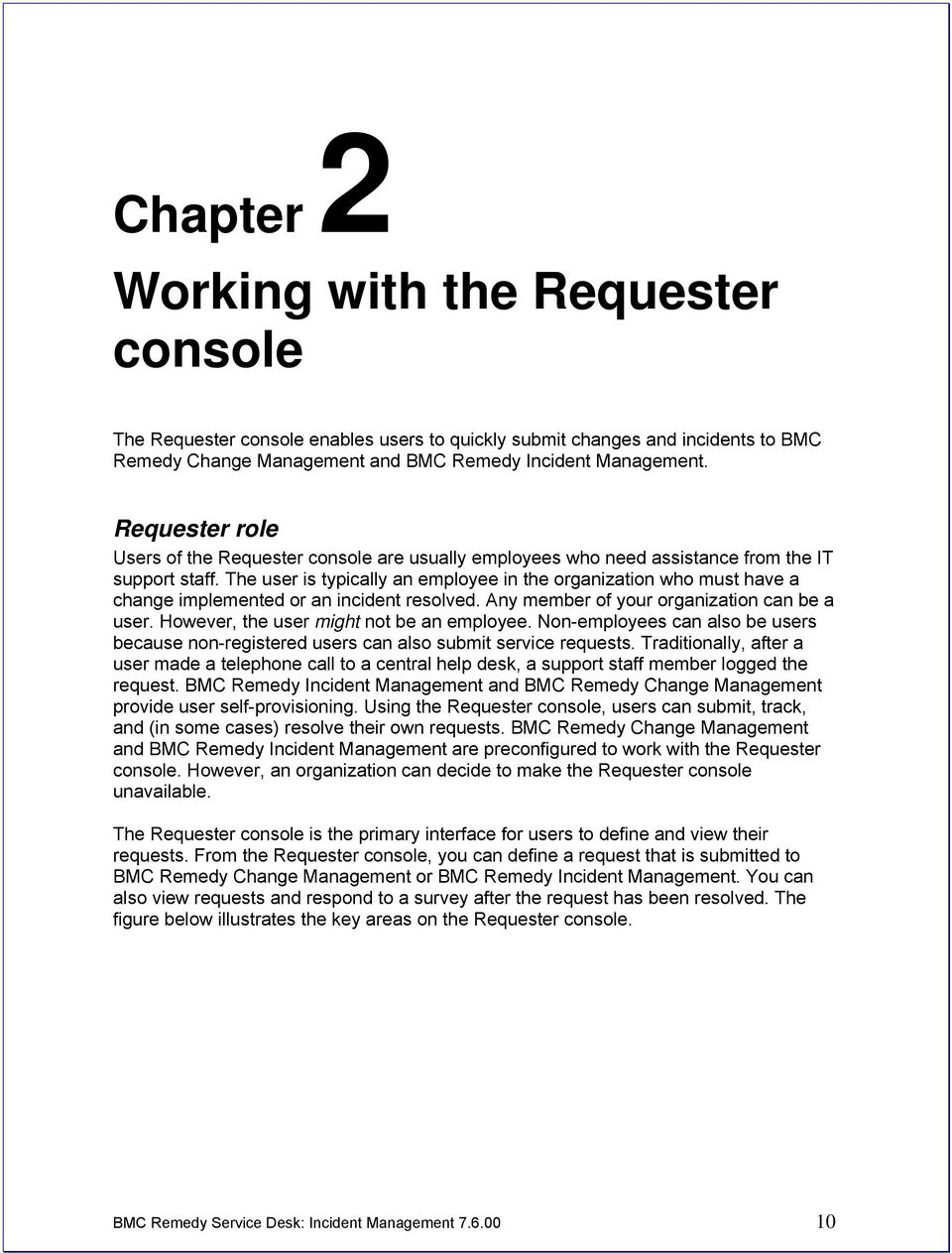
14 Requester console Requester console users The following permissions can be used for accessing the Requester console to submit service requests: Request Master-This user is responsible for troubleshooting service requests. The request master can view requests submitted by other users and view the details of a record in the Service Request form. This user is more of an administrator than a support user. Registered User-This user has a record in the People form, and the user s AR login information is in the Login/Access Details tab of the People form or in the BMC Remedy AR System User form. Working with service requests This section describes working with service requests. Defining a service request BMC recommends the New Request wizard as a simplified method of submitting service requests. You can also define service requests from the Change and Incident Request forms. To define a service request 1. From the Requester console, click Create a New Request. BMC Remedy Service Desk: Incident Management
15 Pay careful attention to the following items for the Requester section: 2. If you are a registered user, the fields in the Requester section are filled from your People record. You can edit only the Phone and fields. 3. Complete the required fields, as shown in bold with an asterisk. 4. Select a definition from the Summary list that best describes your issue. If the list does not contain the specific request to log, type a summary of the request in the Summary field. NOTE If BMC Remedy Incident Management is installed, entering a summary or.ad hoc request generates an incident request. If you select a summary definition that is an incident request, then related solution database entries appear in the Possible Solutions table. If, however, BMC Remedy Problem Management is not installed, possible solutions do not appear for manually entered summaries or selected summary definitions. If there is a solution database entry that might be valid, click the entry, and then click View. Review the solution entry. If the solution resolves your request, click Use Solution. If you choose a matching solution, the solution entry is related your request and the request is resolved automatically. 5. Select an Urgency level for your request. 6. If you do not have a record in the People form, enter your company, first name and last name. 7. (Optional) Click Add Attachment to enter request work information. You can include a note or an attachment. 8. Complete the optional fields: Date Required-Enter the date when you need the request to be completed. Phone-Enter or edit your phone number. -Enter or edit your address. 9. Click Save The request appears in the Requests table. Service request state changes For changes and incidents, the Requests table provides the status of its underlying service request. Users are notified by when a service request undergoes a status change, for example, when a service request is moved from In Progress to Completed or a change request reaches the Completed state. Performing additional service request functions In addition to defining a service request, you can perform the functions listed in the following table: BMC Remedy Service Desk: Incident Management

16 Additional service request functions Function Filter your service requests View a service request Add work information Search for a request by request ID Print a service request Cancel a service request Reopen a request Complete a survey View broadcast messages Action Click the appropriate link from the View Requests section, located in the Navigation pane, and then select Open or All. Note: Open is the default view. To change the default view, select another sort option, and then click Save As Default View. From the Requests table, select the service request, and then click View. Only the requests that the logged in user has submitted appear in the Requests table. Change requests are prefixed with CRQ and Incident requests are prefixed by INC. From the Requests table, select the service request, and then click View. Click the Add Work Info link in the console s Functions section of the Navigation pane. You can add: A summary of the work log in the Summary field. Additional information in the Notes field. An attachment. You can add only one attachment for each work information entry. To add multiple attachments, add multiple work information entries. In the Functions area of the Navigation pane, click Search by Request ID, and then enter the complete Request ID or the numeric part of the ID. From the Requests table, select the service request, and then click Print. Review the report, and then click the Print icon on the toolbar. Note: If you are having problems printing from BMC Remedy User, choose Tools > Options in BMC Remedy User. On the Advanced tab of the Options dialog box, make sure the ODBC Use Underscores option is selected. From the Requests table, select the service request, and then click Cancel. The Status changes to Canceled. You can only cancel a service request that is open. From the Requests table, select the service request, and then click Reopen. The Status changes to New, Staged, or In Progress. You can only reopen service requests that are completed or rejected. From the Functions are of the Navigation pane, click View Survey, select a survey, and then click Respond. Type your responses to the questions, and then click Save. View the broadcasts by clicking the Broadcast link in the Navigation pane. Note: If there are new broadcasts, the label on the link changes to New Broadcast, and the color of the link changes from gray to red. To view more details, select a broadcast entry, and then click View. Broadcasts are filtered by the logged-in user s company. If the logged-in and user s company cannot be determined, only Global broadcasts appear. Only Public messages are shown to the users. BMC Remedy Service Desk: Incident Management
17 Chapter 3 Working with the Overview console The information in this section is for people who fulfill one or more of the support staff roles. Use the Overview console if you must respond to, manage, or track individual or group work assignments from a variety of sources. For example, if your company runs the full BMC Remedy ITSM Suite, either you or the group you manage might receive work assignments from BMC Remedy Incident Management, BMC Remedy Problem Management, and BMC Remedy Change Management. From the Overview console, you can quickly get information about all your work assignments and perform the procedures that you use most often. The following topics are provided: Functional areas Console list table Selecting status values Functional areas The following figure illustrates the functional areas of the Overview console. The table Overview console functional areas that follows describes what you can do in each of the functional areas. BMC Remedy Service Desk: Incident Management
18 Overview console and its functional areas Table: Overview console functional areas Functional area Overview console header Company and View By Refresh Navigation pane View Broadcast, or New Broadcast Functions Purpose This area contains the following fields: Company and View By. These fields combine to provide a way that you can indicate the company name and the assigned-to categories used to filter the records in the Console list table. Refreshes the data in the tables. Opens the broadcast dialog box, from where you can view, create, modify, and delete broadcasts. When there are unread broadcast messages, this area displays a message: New Broadcasts, followed by the number of new messages. When there are new broadcast messages, the area also turns red. Note: If you open the Overview console with no new broadcast messages, but the View Broadcast link is red, open the Application Preferences dialog box and make sure that a Console View preference has been selected. Use the links in this area to do the following actions: Select Status Values - See only those records in a certain state, which BMC Remedy Service Desk: Incident Management

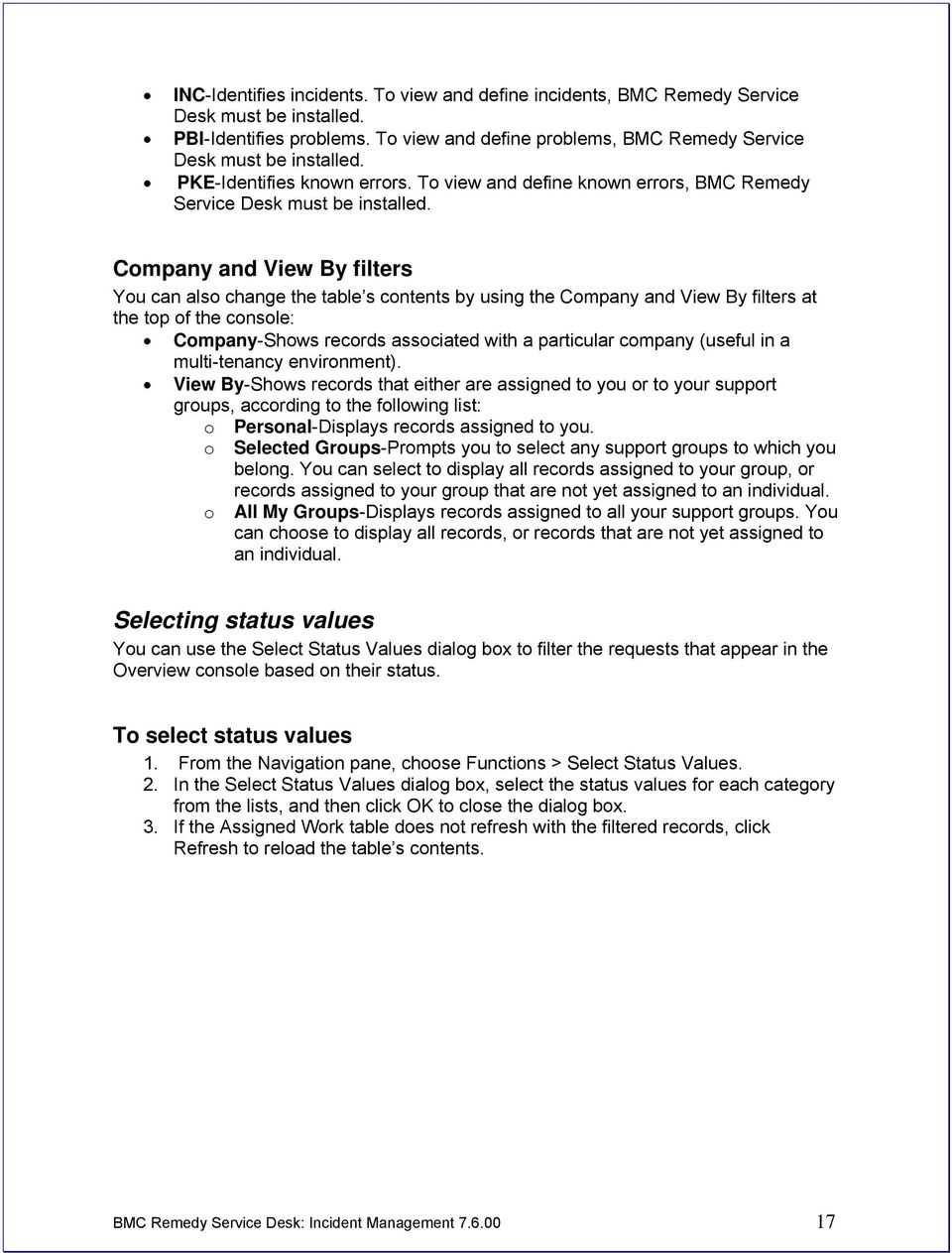
19 Consoles Console list panel Print View Create Search for Ticket Console list table you specify from the Select Status Values dialog box. My Profile - Set your profile. Application Preferences - Set your program preferences and options. This function is also available from the BMC Remedy Incident Management console Depending on your permissions and what other applications are installed, use these links to open: IT Home Page Incident Management Problem Management Change Management Release Management Asset Management Contract Management Software Asset Management Approval console Prints the selected record. Displays a form containing detailed information about the selected record in the Console list table. Create Creates a new record. Opens a dialog box from which you can select the type of ticket you are searching for. After you select the type of record from the menu, click the Select button to open a search form specific to the type of ticket you are searching for. Note: To see activity records and CI unavailability records, you must search for those tickets, because these records are not displayed in the Console List table. Lists the different types of requests. Console list table The Console list table lists different types of requests. The types of requests that you can choose from depend on the applications that are installed. A specific prefix identifies each type of request: CRQ-Identifies change requests. To view and define change requests, BMC Remedy Change Management must be installed. RLM-Identifies release requests. To view and define release requests, BMC Remedy Change Management must be installed. TAS-Identifies tasks. SDB-Identifies solution database entries. To view and define solution entries, BMC Remedy Service Desk must be installed. BMC Remedy Service Desk: Incident Management
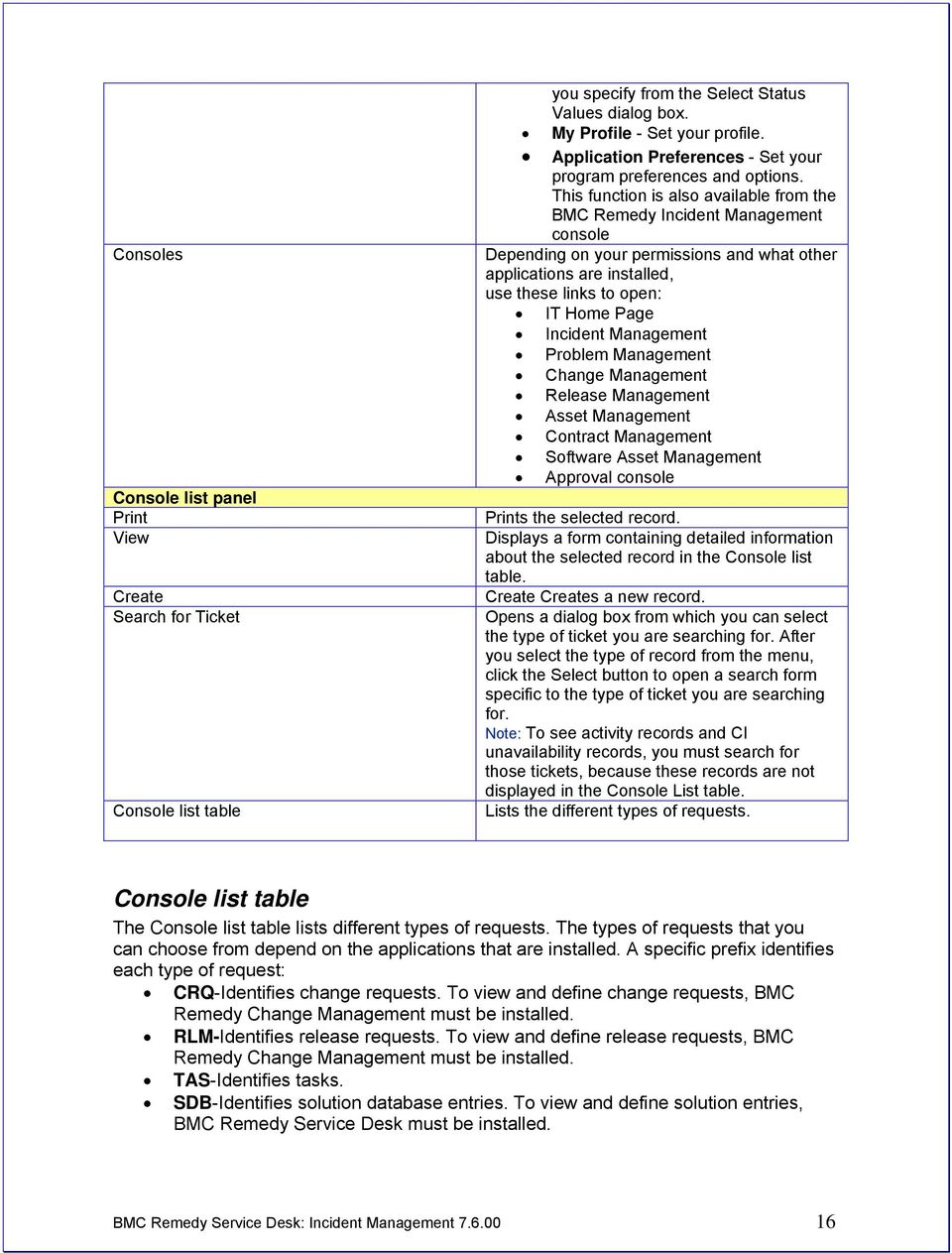
20 INC-Identifies incidents. To view and define incidents, BMC Remedy Service Desk must be installed. PBI-Identifies problems. To view and define problems, BMC Remedy Service Desk must be installed. PKE-Identifies known errors. To view and define known errors, BMC Remedy Service Desk must be installed. Company and View By filters You can also change the table s contents by using the Company and View By filters at the top of the console: Company-Shows records associated with a particular company (useful in a multi-tenancy environment). View By-Shows records that either are assigned to you or to your support groups, according to the following list: o Personal-Displays records assigned to you. o Selected Groups-Prompts you to select any support groups to which you belong. You can select to display all records assigned to your group, or records assigned to your group that are not yet assigned to an individual. o All My Groups-Displays records assigned to all your support groups. You can choose to display all records, or records that are not yet assigned to an individual. Selecting status values You can use the Select Status Values dialog box to filter the requests that appear in the Overview console based on their status. To select status values 1. From the Navigation pane, choose Functions > Select Status Values. 2. In the Select Status Values dialog box, select the status values for each category from the lists, and then click OK to close the dialog box. 3. If the Assigned Work table does not refresh with the filtered records, click Refresh to reload the table s contents. BMC Remedy Service Desk: Incident Management
21 Chapter 4 Registering and assigning incident requests as support staff The information in this section is for people who fulfill the support role of service desk analyst. Group coordinators and on-duty managers should also be familiar with the information in this section to better understand the support staff tasks and so they can fulfill the role of support staff if necessary. Using the Incident Management console, support staff can create, track, and resolve incident requests. The tasks described by this section are organized according to the stages of the incident management lifecycle as described by the BMC Service Management Process Model (SMPM). The following topics are provided: Functional areas of the console Registering incident requests Assigning incident requests BMC Remedy Service Desk: Incident Management
22 Functional areas of the console This section describes the areas of the Incident Management console and the features and functions that you can access from them. Figure below illustrates the functional areas of the Incident console. The Incident Management console and its functional areas Navigation pane Console and KPIs tabs Incidents table Incident Management View Selected (Highlighted) Incident Detail and Tasks BMC Remedy Service Desk: Incident Management
23 Table: Incident Management console functional areas Functional area Purpose Console tab If the KPIs tab is open, click the Console tab to return to the console. KPIs tab Click the KPIs tab to select and to view the incident management flashboards. The flashboards that appear present, in graphical format: Process KPIs-See Using the KPI flashboards for information about how to use these flashboards. Total Open Incidents-Click either All Open or By Status and Priority. Incident Management console header Company and View By This area contains the following fields: Company and View By - These fields combine to provide a way that you can indicate the company name and the assigned-to categories used to filter the incident request records in the Incidents table. Refresh Navigation pane View Broadcast, or New Broadcast Updates the console with the latest information. Opens the broadcast dialog box, from where you can view, create, modify, and delete broadcasts. When there are unread broadcast messages, this area displays a message: New Broadcast, along with the number of new messages. When there are new broadcast messages, the area also turns red. Incident Counts Defined Searches Note: If you open the console with no new broadcast messages, but the View Broadcast link is red, open the Application Preferences dialog box and make sure that a Console View preference has been selected. This area shows the number of open, unassigned, unacknowledged, and breached incidents for the combination of Company and View By fields. This area provides a place from which you can run a series of predefined searches. For more information about running Defined Searches, see Running Defined Searches. You also have the ability to define custom searches using Manage My Searches. Manage My Searches-Defines, edits, saves, and deletes custom searches. Saved custom searches appear in the My Searches node of the Defined Searches list. See Creating a custom search. Note: If no custom searches are defined, the My Searches node does not appear. Watch List-Opens the Watch List. See Watch List later in this table BMC Remedy Service Desk: Incident Management
24 Functional area Functions Consoles Incidents table Quick Actions Print View Purpose Use the links in this area to do the following actions: New Incident-Create a new incident request record. See Creating an Incident request record using a template. Search Incident-Search the database for current incident request records. See searching all records. My Profile-Set your profile. See viewing your profile. Application Preferences-Set your application preferences and application options. See Setting application preferences. Reminders-View and create reminders. See- Creating reminders. Reports-Create and run custom reports. See: Working with reports. Manage CIs-Search for information about specific CI types and gives you access to the CI records. See Creating a CI. Manage Inventory-Access the Manage Inventory form of BMC Remedy Asset Management. See Inventory management Surveys-Review and respond to customer surveys. Depending on your permissions and what other applications are installed, use these links to open: IT Home Page Overview Problem Management Change Management Release Management Asset Management Software Asset Management Select the action from the menu. You can perform the following quick actions: Assign to group member-reassigns the incident request to another member of your group. Assign to me-reassigns the incident request to yourself. Incident Closure-Moves incident requests with a status of Resolved to the Closed status. Prints the selected record in the Watch List and the Incidents table. Shows the incident request record that is selected in the Incidents table. BMC Remedy Service Desk: Incident Management
25 Functional area Create Add to Watch List Table Purpose Creates a new incident request record. Adds the selected record to the Watch List. See Working with the Watch List. A list of the incident request records according to the company selected in the Company field and the group selected in the View By field. Incident Detail and Tasks Incident Details - When selected, contains detailed information about the record selected in the Incidents table. To see Incident Details when the Tasks table is showing, click Show Incident Details. The Create, View, and Report icons relate to work information notes. For information about working with work information notes, see Creating work information entries. Tasks - When selected, enables you to see tasks associated with the incident request record selected in the Incidents table. To see Tasks when Incident Details is showing, click Show Tasks. Watch List - To see the Watch List, click Watch List in the Defined Searches area of the Navigation pane. For information about the Watch List, see Working with the Watch List. Quick Actions, View, Create, Print Remove From Watch List Incidents table Perform the same actions described for the Incident table. Removes the selected incident request record from the Watch List. A list of the incident request records currently in the Watch List. Registering incident requests When a user contacts the service desk with an incident request, you first determine the nature of the request. If the request is about a previously registered request, you query the request and update the user with the current status. If the request concerns an incident that was resolved, but for which the resolution was not effective, reopen the incident request record and assign the incident to a specialist. If this is a new incident request, you create a new incident request record by capturing key information about the user and the incident. If possible, you resolve the incident immediately and then complete the incident request; otherwise you make sure the incident request is assigned to the appropriate group. Reviewing the status of an incident request If a customer calls to enquire about the status of a registered incident request, you can quickly review all of the customer s active records (that is, records that do not have a status of Closed) from the incident request form, using the following procedure. To review the status of an incident request 1. From the Incident Management console, click Create. 2. In the Customer or Contact field on the new Incident Request form, type the customer s or the contact s information as described in Using the Customer and Contact fields. 3. When the application updates the new incident request record with the customer s information, In the Quick Actions area click Customer s Incidents. BMC Remedy Service Desk: Incident Management
26 4. In the Customer's Incidents window, select the incident request you are reviewing the status for and click View. 5. When you finish reviewing the status in the Incident Request Information window, choose one of the following actions: Close-returns you to the Customer s Incidents window. Choose this to review more incident records for the customer. Close All-returns you to the Search form. Choose this when you are finished. Viewing incident request records Use the following procedure when you want to view the incident record in detail. To view an incident request In the Incidents table, double-click the incident request you want to view. Fields on the form display the incident status and other information that has been collected about the incident. Figure below shows the Incident Request form in the Classic view. Incident Request form Classic view BMC Remedy Service Desk: Incident Management
27 Creating an Incident request record using a template The purpose of the Identification and Recording stage is to accurately record and recognize disruptions to services provided by IT to its customers. When creating a new incident request record, you classify the incident and record user information, CI information, and a description of the incident. The key to this activity is the accuracy and completeness of the information recorded. To help ensure accuracy and completeness, BMC recommends that you use a template to help create the record. A template ensures consistency in the way information about the incident request is captured. A template can also set a relationship to a CI. Your administrator can define templates for commonly occurring incidents. To use a template 1. On the Incident Management console, click Create. 2. In the Customer or Contact field on the new Incident Request form, type the customer s or the contact s information as described in, Using the Customer and Contact fields. 3. Check the rest of the customer information for accuracy. 4. Type the incident request details in the Notes field. 5. Open the Incident Template Selection form as described in the following table. 6. From the Quick Links section of the Navigation pane, click Select Template. A list of templates available to your default support group appears in the Viewing Templates for Support Group area of the Incident Template Selection form. NOTE If you belong to multiple support groups, you can select a template from another of your support groups by selecting a different group from the Viewing Templates for Support Group menu at the top of the form. 7. From the hierarchical list, select the appropriate template and then click Select. 8. Type a brief description in the Summary field. 9. Select the business service CI from the Service list. You must select the business service CI from the menu. The business services that appear in this menu have a relationship type of Used By either for the customer directly or the organization the customer belongs to. 10. If the incident request was caused by a CI, you can record the CI in the CI field. This creates a relationship between the incident request record and the CI record. The CIs that appear in the menu are all the other CIs related to the customer that are not business service CIs. If there are no CIs related to the customer, click the button beside the CI field to open a CI search form, from which you can search for all CIs. 11. Complete the rest of the incident request form as appropriate. BMC Remedy Service Desk: Incident Management
28 NOTE Use the Contact field to record the name of someone who reports an incident on behalf of someone else. Use this field, for example, if an administrative assistant is reporting an incident on behalf of an executive. By using the Contact field, you can type the name of the person who is experiencing the incident in the Customer field. This is especially important if the person experiencing the incident is registered as a VIP or as a sensitive customer. It also ensures that the BMC Remedy Incident Management application displays the correct set of business CIs in the Service field selection list, and so on. TIP If your template does not supply categorizations (Operational Categorization and Product Categorization), you can open a dialog box where you record this information by selecting the Classification tab when using the Classic view. 12. Click Save. Creating an incident request record without a template To create an incident request record using the Classic view 1. In the Navigation pane, select Functions > New Incident. 2. In the Process Flow Status area, click the arrow in the Identification and Recording box. 3. Choose Next Stage > Investigation and Diagnosis. You can move directly to the Resolution and Recovery stage or the Incident Closure stage by selecting the appropriate stage. The Incident Request form appears. The tabs on this form prompt you to enter required and optional information. NOTE This is a dynamic form. The fields on the Required and Optional tabs depend on the information to move from the current stage or state to the selected stage or state. 4. On the Incident Request form, type the customer s last name in the Last Name field and press ENTER. If there are multiple customers with the same last name, you are prompted to select the appropriate customer. The Company, First Name, and Phone Number fields are completed from the customer record. The company drives the selection on other menus, such as Operational, Product, and Resolution. 5. Type a brief description in the Summary field. 6. Type additional details in the Notes field. 7. Select the business service CI from the Service list (Optional Not Required). 8. If the incident request was caused by a CI, you can record the CI in the CI field. This creates a relationship between the incident request record and the CI BMC Remedy Service Desk: Incident Management
29 9. Select values from the Impact and Urgency lists. 10. If appropriate, select a different service company. 11. When you select the customer, the service company is set to the customer s company. 12. Select the appropriate service type: User Service Restoration-Use this service type for typical service restoration requests (for example, a request to restore printing services). User Service Request-Use this service type if the incident request is a simple question or a request for information (for example, a request for how to information) Infrastructure Restoration-Use this service type if the incident request is more focused on the restoration of infrastructure service. Typically, these types of incident requests are reported by system management tools (for example, if an incident is detected on a piece of network infrastructure by system monitoring software). Infrastructure Event-Use this service type when a system management tool registers an event that does not require infrastructure restoration. 13. Click Save. If you did not assign the incident, the incident is automatically assigned based on predefined assignment routing. If there is no appropriate predefined assignment routing, you are prompted to assign the incident. 14. If prompted, assign the incident; then click Save. Adding or modifying a customer profile Before you can record an incident, the customer must be listed in the People database. Customers are usually added to the People database by your administrator. However, if you have Contact People User or Contact People Admin permissions, and a customer is not listed in the database, you can add a customer s profile from the Incident Request form. (If you are unsure about your permissions, ask you system administrator.) You can also modify the customer and the contact phone number and site directly on the Incident Request form. A modification directly on the Incident Request form, however, applies only to the current incident; it does not update the People record permanently. To update the People database permanently, you can open the People form from the Incident Request record, as described in the following procedure. To add a new, or modify a current, customer profile 1. Do one of the following actions. To add a new customer profile From the Incident Management console click Create to create a new incident request record. To modify a customer profile From the Incident Management console, open a current incident request record belonging to the customer whose profile BMC Remedy Service Desk: Incident Management
30 you are modifying. 2. Do one of the following actions. To add a new customer profile When using the Classic view Click Create on the Customer tab. To modify a customer profile Click Modify on the Customer tab. 3. On the People form, complete or modify the required fields. If adding a customer record, you do not need to add all the information for this individual s profile, only what is necessary to submit the record. NOTE You cannot define a Support Person record here. See the Remedy Administrator for further details. 4. Click Save. If adding a new customer, the status of the person you added has a default value of Proposed. Your People/Contact administrator must verify those in proposed status, update them to Enabled, and add any other information that is necessary. First call resolution Before you assign an incident request, determine if you can resolve the incident yourself. To do this, use the BMC Remedy Incident Management s Incident Matching feature, or the BMC Remedy Knowledge Management application, if you have access to it, to look for matching, or similar, incident requests, problem investigations, known errors, and solution entries. NOTE BMC Remedy Knowledge Management is a separate application that must be integrated with BMC Remedy Incident Management before you can use it. For information about accessing BMC Remedy Knowledge Management, see To access BMC Remedy Knowledge Management. If you cannot resolve the incident request, assign the incident request to a specialist. For information about how to do this, see Assigning incident requests. NOTE You can also use the Advanced Search feature to look for similar incident records. For information about how to do this, see.searching for similar incident requests. BMC Remedy Service Desk: Incident Management
31 To search for matching records 1. Open or create an incident request. 2. Use one of the following methods to search for a solution: Incident Matching feature - To use this method, continue with step 3. BMC Remedy Knowledge Management application - For information about how to open this application; see To access BMC Remedy Knowledge Management. 3. Open the Incident Matching dialog box. In the Navigation pane, choose Functions > Incident Matching. 4. Select the appropriate check boxes to search for incidents, problem investigations, known errors, or solution database entries. 5. Run the search by using either the incident request s operational categorization or product categorization. Operational Categorization-In the Search by Operational Categorization area, click Current Operation. Product Categorization-in the Search by Product Categorization area, click Current Product. NOTE To further filter the search results, you can specify the other fields in the search criteria pages. 6. Click Search. Matching incidents, problem investigations, known errors, and solutions appear in the tabs at the bottom half of the dialog box. 7. To view details of a matching record, perform the following steps: a) On the bottom half of the form, click the appropriate tab, such as the Known Errors tab. This tab lists matching records, such as matching known errors. b) Select the appropriate record. c) On the top half of the form, click the appropriate Search and Solution tab, such as the Known Error Search and Solution tab, then within that tab click the solution tab, such as the View Known Error Solution tab. This tab displays details of the selected record. 8. If the matching record resolves the current incident, from the Relationship Type list, select Resolved by. 9. To relate the record and copy the solution to the resolution of the incident, click Relate with Solution. 10. Alternatively, to relate the record without the solution, click Relate without Solution. To access BMC Remedy Knowledge Management If you have access to BMC Remedy Knowledge Management, you can use that application to look for a solution. When using the Classic view - With the incident request record open, from the Quick Links area of the Navigation pane, click Search Knowledge Base BMC Remedy Service Desk: Incident Management
32 Searching for similar incident requests A tool you can use for finding similar incident requests is the Advanced Search feature that is available when an incident request record is open. To search for similar incident requests 1. With the incident request record open, from the Navigation pane, chose Advanced Functions > Advanced Search. 2. In the Advanced Search Selection dialog box, select the type of search you want to perform and then click Select. Search incident request by Work Info-Searches for incident request using fields from the Work Details tab (Work Info when using the Classic view) tab. Search incident request by Relationships-Searches for incident requests using fields from the Relationship form. Search Incidents by Assignment Logs-Searches for Incidents using fields from the Assignment Log form. 3. On the search form, provide as much information as possible, and then click Search. 4. View the incident requests that match the search criteria in the table that appears. TIP You can use the advanced search bar to define a more complex set of criteria than you can specify by using only fields in a form. For example, you can search for all incident requests with two different values in the same field. Thus, you can search for all incident requests that have a status of Resolved or Closed. Relating incident requests as duplicates You can relate an incident request to another as a duplicate. The original incident request resolves all its duplicates. When someone resolves, closes, or cancels the original incident request, its Operational and Product Categorizations, Resolution, and CI fields are copied to the related duplicates, marking them with a status of Resolved. Also, if the original incident request record has a value in the Service field that is also a valid service for the customer who submitted the duplicate record, and the duplicate record s Service field is empty, the program copies the service from the original incident request record to the duplicate. To relate an incident request as a duplicate 1. Open the incident under investigation. 2. Click the Relationships tab. 3. From the Request Type list, select Incident, and then click Search. The Incident Relationship Search dialog box appears. BMC Remedy Service Desk: Incident Management
33 4. Enter the search criteria to find the original incident, and then click Search. Incidents matching the search criteria appear on the form s bottom half. 5. Select the duplicate incident according to the following choices: If the current incident is a duplicate of the original incident, from the Relationship Type list, select Duplicate of. If the current incident is the original incident, from the Relationship Type list, select Original of. 6. Clicks Relate. The Incident Relationship Search dialog box closes. The incidents are related as duplicate and original. The status of the duplicate incident is Pending, with a status reason of Pending Original Incident. NOTE To see the details of the related record, select the record in the table on the Relationships tab, and click View. 7. Click Save. Searching for incident request records using Company and View By This section describes how to search for incident request records that are related to the company and the group selected in the Company and View By area of the Incident Management console. For information about how to search for records that are not associated with your ID or group information or to search all records, see Searching all records. To search for incident request records 1. In the Company and View By area on the Incident Management console, make sure the company and the support groups for which you want to view records are selected in the Company and View By fields. 2. In the Defined Searches list, expand the node that corresponds to the type of search criteria you want to conduct. For example, to see all open incident request records matching the Company and View by fields, expand the All Open node. NOTE If the Defined Searches list does not contain a search that meets your needs, you can define a custom search. For information about custom searches, see Creating a custom search. 3. Select the specific type of search that you want to view. For example, to see all open records with critical priority, select Critical Priority. This starts the search, which places the results in the Incidents table. BMC Remedy Service Desk: Incident Management
34 Restoring a resolved incident request record to In Progress status If the recorded resolution did not resolve the incident, you can restore the incident request record to the In Progress status. This also moves the incident back to the Resolution and Recovery stage in the incident request lifecycle. For information about how to do this, see.moving a resolved incident request back to In Progress. Assigning incident requests Service desk users play a role in assigning incident requests. The information in this section applies to service desk users. When you register a new incident request, one of the following actions happen: The routing rules used by BMC Remedy Incident Management automatically assign the incident request to the most appropriate group when the incident request record is saved. If the incident request is created from a template that has an assignment group predefined, the incident request is assigned to the predefined assignment group. If you reopen a current incident request, you manually reassign the incident request to the most appropriate group. For information about how to do this, see.reassigning incident requests. The group to which the incident request is assigned then reviews the request. Reassigning incident requests You can reassign an incident to either an individual or a support group. Use the shortcut in the Quick Actions section (Quick Links in Classic view) of the Incident Request form to reassign an incident to you (Assign to Me) or to reassign an incident based on automatic routing (Auto Assign). This assigns the incident based on predefined mapping. Automated assignment can be based on the customer organization, location, operational categorization, or product categorization. To reassign an incident 1. Open the incident request record. 2. Reassign the investigation. When using the Classic view: 1) Click the Assignment tab. 2) Select the Assigned Group from the list. 3) After selecting an Assigned Group, select the Assignee from the list. 3. Click Save. BMC Remedy Service Desk: Incident Management
35 Chapter 5 Resolving and closing incident requests as support staff The information in this section is for people who fulfill the role of support users. The tasks described by this section are organized according to the stages of the incident management lifecycle as described by the BMC Service Management Process Model (SMPM). The following topics are provided: Resolving incident requests Closing incident requests Resolving incident requests If the incident request does not require the change management process, you resolve the incident. After resolving the incident request, you update the incident request, to make sure the user is notified of the resolution. If the resolution information entered in the incident request might help users, service desk analysts, or other specialists resolve future, similar cases, you can create a solution database entry to document the solution. If the incident request was resolved using a workaround, but the incident can recur, you should notify the problem coordinator, so that a problem investigation record can be created. BMC Remedy Service Desk: Incident Management
36 Accepting an incident request There are several on-going tasks that you must perform when you accept and begin working on an incident request, as described by the procedures that follow. These ongoing tasks help to keep the incident request record up-to-date with the latest information about the work being performed to resolve the incident. These on-going tasks include: Receiving notification of assignments Working with assignments Working with tasks Recording time worked on an incident request Creating work information entries Modifying work information entries Receiving notification of assignments When an incident is assigned to you, you can receive notification through . All incidents assigned to you or your support groups appear in the Incident Management and Overview consoles. The purpose of the notification policy is to inform key IT support staff and customers about incidents that have caused a service disruption. Notifications from BMC Remedy BMC Remedy Service Desk: Incident Management
37 Automated notifications are sent to individuals or groups, such as when an incident is created, assigned, or resolved. The administrator can configure the notification method, as to whether business hours and holidays are included or excluded, and whether to send individual or group notifications. The following scenarios are examples of notifications sent from BMC Remedy Incident Management: Customers are notified by when the incident is resolved. The message includes the resolution. The incident owner is notified when an incident is resolved, if the assignee group is different from the owner group. The Problem assignment group or assignee is notified when a solution entry is created from an incident. Working with assignments When you work on open incidents, you are working on incidents assigned to you or to your support group. You can also assist with an incident assigned to another support group when a task is assigned to you. To accept an assignment 1. Open the incident request record. 2. Assign the incident request record to yourself. When using the Classic view- From the Quick Links section of the Navigation pane, click Assign to Me. 3. Change the Status to In Progress. 4. Click Save. Working with tasks You can assign tasks to one or more people without changing the assignment of the incident. For information about working with tasks, see Creating and monitoring tasks. Searching for a solution You can search for information that might help resolve the current incident request in other incident requests, problem investigations, known errors, and solution database entries. To do this, use the methods for finding similar incident requests described in First call resolution. If BMC Remedy Knowledge Management is installed, you can also use this application to search for possible solutions. For information about accessing BMC Remedy Knowledge Management; see First call resolution. BMC Remedy Service Desk: Incident Management
38 Recording time worked on an incident request You must keep track of the time that you spend working on an incident request. If the incident request record is open on your desktop while you are working on it, you can use a timer to keep track of the time. Or, you can enter the time manually. If you receive assistance from someone else, you can also keep track of their time through the Incident Assignment Log. The Incident Assignment Log contains a record of who created the current incident request as well as individual records for each group and person who was subsequently assigned to the request. Each record contains the total effort duration for each assignee (that is, the amount of time each group or person worked on the incident request), as well as other information. NOTE Because the Incident Assignment Log is historical, it does not contain a record for the current assignee, only for previous assignees. The system updates the Incident Assignment Log with a record for the most recent assignee each time the incident request is reassigned. When the incident request is moved to the Closed state, the system writes the final assignee record to the Incident Assignment Log. You can also update the amount of time you spent working on an incident request after it has been assigned to another assignee. Recording your time Use the following procedure to record time against an incident request that currently is assigned to you. To record your time 1. Open the incident request record. 2. Click the Assignment tab. 3. Enter the time you spent on the incident request in the Effort Time Spent (Minutes) field. TIP Use the automatic timer to keep track of your time anytime you work on the incident request while the incident request record is open on your desktop. To start the timer, click the Stopped button (the text on the button changes to Started-the button s text reports the timer s current status). When you finish working on the incident request, make sure you click the Started button (the text on the button changes to Stopped). 4. Click Save. NOTE The Effort Time Spent Minutes field is a data entry field only. When you click Save, the time value that you provided in Effort Time Spent Minutes is written to a database field BMC Remedy Service Desk: Incident Management
39 called Total Time Spent, which totals the time spent on the incident request for the current assignee. After the BMC Remedy Incident Management writes the time value to Total Time Spent, it resets Effort Time Spent Minutes to zero. If you reassign the incident request or resolve it, the cumulative time is written from Total Time Spent to the Assignment Log and Total Time Spent is reset to zero. Recording time for an assistant Use the following procedure to record time against an incident request for someone who assisted you but who was not formally assigned to the incident request. To record an assistant s time 1. Open the incident request record. 2. Click the Assignment tab. 3. Click Update Assignment Log to open the Incident Assignment Log dialog box. 4. Add the assistant to the Assignment Log by selecting values for the following fields: Support Company - the name of the assistant s support company Support Organization - the name of the assistant s support organization Assigned Group - the name of the assistant s assigned group Assignee - the name of the assistant s name of the individual. 5. In the Effort Time Spent (Minutes) field, enter the time the assistant spent on the incident request. 6. Click Add. An entry containing this information appears in the table at the bottom of the Incident Assignment Log dialog box. Updating your time after the incident request is reassigned Use the following procedure to update the time that you spend on an incident request after it has been reassigned. For example, if the person or group to which the incident request is reassigned asks for your help with some aspect of the incident request resolution, you can update your record in the Incident Assignment Log with the additional time. NOTE You can update the time only for your own Incident Assignment Log records. You cannot update the records of other support groups or individuals. To update your time after the incident request is reassigned 1. Open the incident request record. 2. Open the Incident Assignment Log dialog box. 3. Click the Assignment tab. BMC Remedy Service Desk: Incident Management
40 4. Click Update Assignment Log. 5. In the table at the bottom of the Incident Assignment dialog box, select your record. 6. In the Effort Time Spent (Minutes) field of the Update Assignee Effort Duration area, type the number of minutes that you are adding or subtracting from your recorded time. 7. Click the plus button (+) to add the time to the record s total amount of time, or click the minus button (-) to subtract the time. 8. Click Close. NOTE You cannot delete a completed assignment log. Creating work information entries When you begin working on an incident request, you must make sure that you keep careful work information entries in the Work Details area of the incident request record (or in the Work Info tab when using the Classic view), explaining what you have done. For example, you might want to add a note that a particular CI was deployed, and include the date. You can add work information entries to an incident request record directly from the Incidents table, or you can add them to open incident request records. To add work information entries from the Incidents table 1. From the Incident Management console, select the incident request record. 2. At the bottom of the Incident Management console, if the Tasks table is visible, open the Incident Detail area by clicking Show Incident Detail. 3. Click Create. 4. Enter the work information details in the Incident Work Info dialog box. 5. To add an attachment to the record, right-click in the attachment table and select Add from the menu that appears. 6. Choose whether to lock the work log. NOTE If you select Yes, you cannot modify the work log after you save it. 7. Choose the type of view access: Internal-choose this if you do not want the customer to see the work information entry. Public-Choose this if you want the customer to see the work information entry. 8. Click Save. NOTE To see a report of selected work information entries, select one or more entries, and click Report. BMC Remedy Service Desk: Incident Management
41 To add work information entries to an open incident request record When using the Classic view 1. With the incident request record open, click the Work Info tab. 2. Complete the fields on the tab as described in Creating work information entries. Modifying work information entries If the work information entry is not locked, you can modify any field on it. The following procedure describes how to modify the notes, add attachments, lock the entry so it cannot be modified later, and change the viewing access level. To modify a work information entry from the Incidents table 1. From the Incident Management console, select the incident request record. 2. At the bottom of the Incident Management console, if the Tasks table is visible, open the Incident Detail area by clicking Show Incident Detail. 3. From the list of work information entries, select the work information record that you want to update. 4. Click View. 5. Make the required modification as described in Table below. Modification To update the note To add an attachment To lock the entry To change the view access level Action Click inside the Notes field and type the changes. Right-click in the attachment table and select Add from the menus that appears, and then follow the onscreen instructions. Note: Attachments to work information entries created in BMC Service Request Management are not transferred with information sent to a backend application, such as an incident, a change request, or a work order. You can access the attachments only from the service request. From the Locked list, select Yes or No. Note: If you select Yes, the work information entry cannot be modified after you save it. From the View Access list, select Internal or Public from the View Access list. Internal-Select this if you do not want the customer to see the work information entry. Public-Select this if you want the customer to see the work information entry. 6. Click Save. BMC Remedy Service Desk: Incident Management
42 To modify a work information entry from an open incident request record When using the Classic view: 1. With the incident request record open, click the Work Info tab. 2. Select the work information entry that you want to update. 3. Complete the fields on the tab as described in.to modify a work information entry from the Incidents table. See the table above. Updating an incident request To update an incident request, open the incident request and then update the details as required. Click save when you finish. Creating a change request This feature is only available to those agencies that purchased BMC Remedy Change Management Application licenses. If infrastructure change is required to permanently resolve the incident request, assign the incident request to a Change Coordinator. For information about how to do this; see reassigning incident requests. If you have the correct change management permissions, you can create a change request from the Incident Request form. If you are not sure about your change management permissions, ask your system administrator. To create change from an incident 1. Open the incident request record. 2. From the Navigation pane, select Create Other Requests > Create Change. A Change Request form appears. The Product and Operational Categorization are copied from the incident to the infrastructure change. A relationship is created between the change and the incident. 3. Complete the Change Request form. 4. For information about recording change requests, see the BMC Remedy Change Management User s Guide. 5. Click Save. Creating a solution database entry from an incident If you have access to BMC Remedy Problem Management, you can publish the resolution from an incident into the solution database. To create a solution entry from an incident 1. From the Incident Management Incidents table, open the incident. 2. Click the Relationships tab. 3. From the Request Type list, select Solution Database. 4. Click Create. 5. Edit the form as required. BMC Remedy Service Desk: Incident Management
43 6. Click Save. Creating a knowledge base article from an incident If you have access to BMC Remedy Knowledge Management, you can also create knowledge base articles that described the resolution. These can be helpful in the future, when trying to resolve similar incident requests. To create a knowledge base article 1. Open the resolved incident request record. 2. Create the knowledge base article. 3. From the Quick Links area of the Navigation pane, click Create Knowledge. Closing incident requests When you resolve the incident request, move the incident request status to Resolved. If you are in communication with the customer when you resolve the incident request, and can verify the resolution, move the request status to Closed immediately. For information about how to do this, see Closing an incident request. If you cannot verify the resolution at the time you make it, complete the incident request with the Resolved status, and set the Status Reason field to Customer Follow-up Required. For information about how to do this, see Completing an incident request. NOTE The customer must verify the resolution within a specified period of time, or BMC Remedy Incident Management automatically moves the incident request status to Closed. The length of this period is configurable. Check with your system administrator to determine how much time your organization specifies. The default setting is 5 days. If the resolution information entered in the incident request can help users, service desk analysts, or other specialists resolve future, similar cases, you can create a solution database entry to document the solution. For information about how to do this, see Creating a solution database entry from an incident. If the incident request was resolved using a workaround, but the incident can recur, notify the problem coordinator so that person can investigate the issue in a timely manner and then decide whether to create a problem investigation. If the user does not accept the resolution, the user contacts the service desk and asks for the incident request to be reopened. Depending on the incident request s status see either.moving a resolved incident request back to In Progress or Reopening a resolved or closed incident request. The figure below provides an overview of the incident request closure process as described by the SMPM. BMC Remedy Service Desk: Incident Management
44 Figure: Incident request closure Completing an incident request Use this procedure when you have resolved the incident request, but are unable to have the user verify the resolution. To complete an incident request 1. Open the incident request record. 2. Change the Status field to Resolved. 3. Select the appropriate status reason. The status reason can indicate action required before the incident is closed, such as Customer Follow-up Required. 4. Click Save. The status of the incident is set to Resolved. BMC Remedy Service Desk: Incident Management
45 If CI unavailability was created from this incident and your support group is responsible for the CI unavailability, you are prompted to update the CI unavailability. To update the CI unavailability, for example, if the CI is now available, click Update. For details about CI unavailability, see Recording CI unavailability. To continue resolving the incident without updating the CI, click Close and Continue Save. Caution: To return to the Incident Request form without saving, click Close and Cancel Save. NOTE When you resolve an incident request that has related duplicate requests, BMC Remedy Incident Management also updates those duplicate requests as resolved. It can take up to several minutes to update duplicate requests, because BMC Remedy Incident Management processes these updates in the background. For information about duplicate incident requests, see, Relating incident requests as duplicates Closing an incident request This activity makes sure that the incident has successfully restored the service to the user and that the user is satisfied with the outcome. When the user agrees that the incident can be closed, review the incident request record for completion and, if appropriate, create a solution database entry. If you leave an incident as resolved, after a period of time BMC Remedy Incident Management closes the incident. The time for your installation to close the incident is configurable, so check with your administrator to find out the interval for your organization. The default setting is 5 days. To close an incident request 1. Open the incident request record. 2. Review the Incident Request form to make sure that it is complete and accurate. 3. In the status field, choose Closed. 4. Click Save. The status is now set to Closed. If the incident was broadcast, the broadcast is removed. Moving a resolved incident request back to In Progress Use the following procedure to move an incident request record with a status of Resolved back to the In Progress status. You do this if the reported resolution did not resolve the incident request, and further work is needed. To move a resolved incident request to In Progress 1. Open a resolved incident. 2. In the Status field, select In Progress. BMC Remedy Service Desk: Incident Management
46 3. Click Save The incident moves back to the Resolution and Recovery stage, and the status changes from Resolved to In Progress. Reopening a resolved or closed incident request Use the following procedure when you want to reopen a resolved or a closed incident request. NOTE If the status of the incident request record is Resolved, anyone can reopen it. If the status of the incident request record is Closed, then only someone with Incident Master permissions, or support staff who have either Support Group Manager or Support Group Lead functional roles can reopen it. To reopen a closed incident 1. Open a closed incident. 2. From the Navigation pane, select Functions > Re-open incident. New Incident Request form appears with a new incident number. The basic details from the closed incident are copied to it and a relationship is created between the new and closed incident request. NOTE The Re-open option is only enabled under Functions when the status of the selected record is Closed. 3. On the new Incident Request form, click Save. BMC Remedy Service Desk: Incident Management
47 Chapter 6 Working with incident requests as a manager The information in this section is for people who fulfill the management role of group coordinator. On-duty managers should also be familiar with the information in this section. Other people in your organization, who occasionally fulfill the role of group coordinators and on-duty managers, should also be familiar with the information in this section. Using the Incident Management console, managers can assign and track incident requests, make escalations when necessary, and approve solutions. The tasks described by this section are organized according to the stages of the incident management lifecycle as described by the BMC Service Management Process Model (SMPM). The following topics are provided: Assigning incident requests as a group coordinator Tracking incident requests Approving solutions Assigning incident requests as a group coordinator This information in this section applies to group coordinators. When an incident request is assigned to a group by the service desk analyst, you must review it before assigning it to a specialist. If important information is missing from the incident request or if it is assigned to the wrong group, you send it back to the service desk for correction by reassigning it back to the service desk. For information about how to do this, see.reassigning incident requests. If the incident request is accepted, you check whether the request requires the change management process. If it does, you escalate (or assign) the incident request to the service owner. For information about how to do this, see Assigning incident requests. The resolution of an incident request is performed using the change management process when the resolution requires a change that will: BMC Remedy Service Desk: Incident Management
48 have a negative affect on the service during the service hours (defined by the SLA) change the functionality of a service require an update to the BMC Atrium Configuration Management Database (BMC Atrium CMDB) If the incident request does not require the change management process, you assign the incident to a specialist within your group. If a change is required, you assign the incident request to the change coordinator of the affected service. For information about how to do this, see Assigning incident requests. Rejecting an incident If the incident request does not contain enough information for the specialist to work with, or if it is assigned to the wrong group, you can reject the incident request by assigning it back to the service desk. For information about how to do this, see Reassigning incident requests. NOTE Make sure you include a note in the Work Info section of the incident request record explaining why the incident request was rejected. Include the name of the correct group to which the incident request needs to be assigned, if known. Tracking incident requests If BMC Service Level Management (BMC SLM) is installed, you receive a notification when the incident request is in danger of breaching the service terms. For example, this happens when: The target response time has elapsed and the incident is still assigned. The target resolution time has elapsed and the incident is still open (not resolved, closed, or canceled). You can configure BMC SLM to send notifications to incident assignees, assignee group coordinators, incident owners, or owner group coordinators, by using templates included with BMC Remedy Incident Management when you integrate it with BMC SLM. For details about configuring service targets and notifications contact your system administrator. When you receive an escalation, you determine the cause of the notification and act accordingly. For example, if the notification occurred because an SLA was breached, you escalate the incident request to the service owner of the affected service. If, however, the escalation notification occurred because an SLA threshold is approaching a breach, you determine whether the incident request needs to be reassigned to another specialist with different skills, greater experience, or with different access rights. BMC Remedy Service Desk: Incident Management
49 If you decide not to reassign the incident request, then you must notify the assigned specialist that the incident request must be resolved quickly to avoid any service level objective (SLO) violations. Beginning with BMC Remedy Service Desk: Incident Management version , you can place incident requests that require special monitoring on the Watch List (see.working with the Watch List.) Figure below provides an overview of the tracking incident requests process, as described by the SMPM. Overview of BMC SLM calculations From the Incident Request form, you can view incident service targets defined in BMC SLM. Service targets can be defined in BMC SLM for response time and resolution time. Service targets for an incident can be determined by related CIs, product and service categorization, and many additional criteria. The service target response time applies when an incident request s reported source is: , Fax, Voic , Web, Self Service, BMC Impact Manager Event, or Other. In these cases, the Responded Date is blank until someone indicates that the incident has been responded to by updating the Response field on the Incident Request form to Yes (for information about updating the Response field, see.to set the responded date. When support staff responds to an incident request from one of the previously noted sources, the Responded Date is set to the date that the incident was responded to. BMC Remedy Service Desk: Incident Management
50 The service target resolution time is configurable; a typical scenario would be from when the incident is recorded until it is resolved. The following scenarios can affect the calculated resolution time: When an incident is in a pending state, it might not be included in BMC SLM calculations, depending on the status reason. When a resolved incident is reopened, the BMC SLM calculations account for time spent in the resolved state. Working with the Watch List The Watch List provides a separate area where you can place records that you particularly want to monitor. NOTE You can use the Watch List to track an incident request record throughout its lifecycle, even if it is reassigned to a group that you do not belong to. After you add an incident request record to the Watch List, it stays there until you remove it. Table below describes how to add and remove records from the Watch List. Table : Working with the Watch List Action Viewing the Watch List Returning to the Incidents table Adding records Removing records Note From the Defined Searches list in the Navigation pane, click Watchlist. From the Defined Searches list in the Navigation pane, run one of the searches. From the Incidents table, select the record to add. Click Add to Watch List Note: When you add a record to the Watch List, it is still enabled in the Incidents table. From the Watch List table, select the record to remove. Click Remove From Watch List Note: This does not delete the record from the database; it only removes it from the Watch List. NOTE When you are viewing the Watch List, the Company and View By fields at the top of the Incident Management console are disabled. Approving solutions When the specialist proposes a solution, you must review the proposed solution to make sure the information is complete and accurate. You might need to contact the specialist BMC Remedy Service Desk: Incident Management
51 When you agree that the proposed solution is accurate and complete, and appropriate for the incident request, you approve the solution by changing the Status field on the Solution form from Inactive to Active. If you do not agree that the proposed solution is appropriate for the incident request, you perform the following steps on the Solution form: record the reason for disagreement in Work Info set the Expiry Date field to today s date leave the Status field reading Inactive To approve or reject a solution 1. Open the incident request record. 2. Click the Relationship tab. 3. From the Relationships table, select the solution database entry you are working on, and then click View. 4. Perform the following steps, as required. Approving a solution Change the Status field from Inactive to Active. Rejecting a solution Leave the Status field at Inactive. On the Date/System tab, change the Expiry Date to today s date. Add a work information note to record the reason for disagreement. 5. Click Save. The figure below provides an overview of the solution approval process as described by SMPM. Figure: Approving solutions BMC Remedy Service Desk: Incident Management
52 BMC Remedy Service Desk: Incident Management
53 Chapter 7 Creating and monitoring tasks The information in this section is for people who fulfill one or more of the following support roles: service desk analysts group coordinators specialists The following topics are provided: Tasks overview Adding tasks using task templates Creating ad hoc tasks Accepting task assignments Opening and viewing individual task records Reassigning task sequence numbers Assigning and reassigning tasks Updating task record details Planning task times Tracking the time spent working on tasks Adding work information to a task Canceling tasks Closing tasks Resolving, closing, and canceling incident requests with open tasks Tasks overview A task is a unit of work that needs to be completed as a step in resolving an incident request. If the solution to an incident request involves more than one action, procedure, or process, consider dividing the solution into separate tasks. Dividing the solution into separate tasks can help you to better manage and to monitor the incident request as it moves toward resolution. You can assign the tasks to the same person, to several people, or to a support group. The person or support group to whom the task is assigned is the task implementer. BMC Remedy Service Desk: Incident Management
54 When the group coordinator sets the task status to In Progress, the task implementers are notified of the tasks assigned to them by , BMC Remedy Alert, pager, or some additional means. After a task is assigned to the task implementers, they can log their progress as they complete each task. You can use a task template to add a task to an incident request, or you can create an ad hoc task. Task templates are predefined tasks that you can quickly add to an incident request. For information about how to do this, see Adding tasks using task templates. An ad hoc task is any task that is not included in the list of task templates and, therefore, you must create it manually. For information about how to do this, see, Creating ad hoc tasks When using task templates, you can also add tasks that are divided into sub-tasks. A task that has sub-tasks is called a task group. The sub-tasks of the task group are called children of the task group. Although tasks and task groups are related to specific incident request records, information about the tasks and task groups is stored on a separate Task form. You can relate an unlimited number of tasks or task groups to an incident request. After a task or task group is assigned to a task implementer, the task implementer receives notifications to perform each of the assigned tasks. Opening the Task form When using the Classic view: 1. Open the incident request record 2. Click the Tasks tab. Adding tasks using task templates To save time, you can use a task template to add a task to an incident request record. Task templates are created by your system administrator. A task template is a predefined task; usually for the most commonly performed tasks that your service desk handles. Because the Task form is predefined (that is, the fields are already completed), you do not need to spend time manually completing the Task form fields as described in Creating ad hoc tasks The following are the types of tasks that you can add to an incident request record when using templates:.task Template. and.task Group Template.. Task templates associate a single task to the incident request record. Task Template tasks can be either.manual. or.automatic.. Manual tasks must be performed by a person. Automatic tasks are preformed by a computer or automated system, but you must still assign automatic tasks to a person, so there is someone to monitor the task. The Task Group template generates a task that has two or more sub-tasks. Task BMC Remedy Service Desk: Incident Management
55 Group tasks can be defined either as standard or sequencing. Standard task group tasks can be performed in any order. In a sequencing task group, however, the tasks must be performed in the sequence indicated on the Task form. To add a task using task templates 1. Open the Tasks form, as described in Opening the Task form. 2. From the Request Type list, select either Task Template or Task Group Template, and then click Relate. TIP To manage a large number of task templates, you can filter the list by selecting from the Type and Category lists at the top of the dialog box. 3. From the list of tasks in the Select Template dialog box, select the template for the task you are adding, and then click Relate. When you click Relate, the Task form closes. 4. Repeat steps 2 and 3 for all tasks you want to add to the incident. The templates you selected are displayed in the Tasks and Task Groups list. If there are no templates listed, click inside the list to refresh the table. 5. If necessary, redefine the numeric sequence of the children tasks created by any group template, as described in Reassigning sequence numbers to task group children The task management subsystem enforces the dependencies between tasks. These relate to the sequence order specified in the Incident Request form. 6. Click Close. 7. When you finish adding templates, save the incident. Creating ad hoc tasks Add hoc tasks are tasks that are not predefined by a task template and, therefore, must be created manually. To create an ad hoc task 1. Open the Tasks form, as described in Opening the Task form. 2. From the Request Type list, choose Ad hoc. 3. Click Relate. The Create Task form appears. Certain fields in the form are already filled in with the data for the incident. BMC Remedy Service Desk: Incident Management
56 4. In the upper region of the form, fill in the following required fields: Name-Enter a descriptive name of the task. Summary-Enter a brief description of the task. The Type field is set to Manual by default when you create an ad hoc task. 5. On the General tab, fill in information about the company. The Company field defaults to the contents of the Incident Location field in the Incident Request form. Your task can be assigned to an different department or a different company. 6. On the Requester tab, fill in information about the person creating the task (Requester) and the intended target of the task (Requested For). Some information is set by default from the Requested By information of the incident. 7. On the Classification tab, fill in information about the product and operational categorizations. 8. In the Assignment/Dates tab, assign the task by completing the following fields: Assignee Group-Optionally, select a task implementer group from the list. Assignee-Optionally, select a task implementer from the list. The BMC Remedy Assignment Engine automatically assigns the task when the task is created according to how the administrator has configured BMC Remedy Incident Management, but you can override this if necessary. For more information about assignment configuration, contact the Remedy System administrator. Scheduled Start Date-Optionally, enter an estimated start date. Scheduled End Date-Optionally, enter an estimated end date. You can set the Start Date and End Date to be different from the dates of the parent incident. 9. On the Relationships tab, search for and then relate configuration items that are needed with this task. You can perform quick actions that are with the task, for example, get related relationships. 10. When you finish creating the task, click Save. The task information form closes and returns you to the Incident Request form. The task management subsystem enforces the dependencies between tasks. These relate to any Sequence order you might have specified in the Incident Request form. 11. Click Save on the Incident Request form. BMC Remedy Service Desk: Incident Management
57 Accepting task assignments You receive notification of assigned tasks by way . You can also use the Overview console or the Incident Management console to view all tasks assigned to you. Tasks are identified by the TAS prefix. To access the Incident Management console, the task implementer must have Incident Master, Incident User, Incident Submitter, or (at minimum) Incident Viewer permissions. NOTE When you follow the recommended lifecycle of an incident, the status of a task must be Scheduled before you accept the task. Also, when the incident is in Assigned status, all the tasks have a status of Staged. To accept an assigned task 1. Open the Tasks form, as described in Opening the Task form 2. Select the task that you want to accept. 3. Click View. NOTE To view the related incident request record, click Open next to the Request ID field on the Task form 4. If the Status Field of the incident is set to In Progress, manually set the Status field to Work in Progress. This is an important step, because the task then moves into Work in Progress status. In addition, different escalations occur based on the task s status. If the task is still in the Scheduled state while you are working on it, an inaccurate escalation can occur. 5. Click Save. Opening and viewing individual task records You can open and view the contents of individual task records. This enables you to see detailed information about the individual records and to update them. To view task records 1. Open the Tasks form, as described in Opening the Task form 2. Click inside the Tasks and Task Groups table. A list of the tasks and task group appears in the table. 3. In the Tasks and Task Group table, select the task record you want to view, and then click View. BMC Remedy Service Desk: Incident Management
58 Reassigning task sequence numbers When you relate tasks or task groups to an incident, they are automatically sequenced in the order in which you related them to the incident. This sequence is strictly enforced inside the incident. You can, however, reassign the sequence in which tasks and task groups are performed. You can also assign the same sequence number to more than one task or children tasks of a task group. If two tasks or children tasks of a task group have the same sequence number, they are considered peers. You can work on peer tasks in any order. To reassign a sequence to task groups and tasks 1. Open the Tasks form, as described in Opening the Task form. 2. In the Tasks and Task Groups table, select the task that you want to resequence. 3. Click either the up arrow or the down arrow located to the right of the table. This moves the selected task either higher or lower in the sequence. 4. Click Close. Reassigning sequence numbers to task group children You can change the order in which the children of a group template task are sequenced. To reassign sequence numbers to task group children 1. Open the Tasks form, as described in Opening the Task form. 2. In the Tasks and Tasks Groups table, select the task group. The tasks assigned to the task group appear in the Children of Selected Task Group table. NOTE You might need to click inside the Children of Selected Task Group table to refresh its contents. 3. In the Children of Selected Task Group table, select the task you want to reassign Click either the up arrow or the down arrow located to the right of the table. This moves the selected task either higher or lower in the sequence. BMC Remedy Service Desk: Incident Management
59 Assigning and reassigning tasks After creating a task or adding a task template to an incident request record, you assign it. You can assign tasks to individuals or to a support group. If you cannot resolve one of your assigned tasks, you can reassign the task, or you can ask your group coordinator to reassign the task. For example, you might ask the group coordinator to reassign the task in situations where you want to reassign the task to someone outside your group. 1. Open the task record as described in Opening and viewing individual task records. 2. Click the Assignment tab. 3. In the Assignee or Assignee Group fields, choose the group or person to you want to reassign the task to. 4. Make sure the Notify Assignee field is set to Yes. 5. Click Save. The new task implementer is notified of the request assignment. Until the new implementer accepts the task assignment, you are still assigned to the task and have responsibility for it. Updating task record details After a task record is created, you can change the details that appear on the record. To do this, open the task record as described in Opening and viewing individual task Records and then update the details as needed. Save the changes and close the form. Planning task times You can plan the time for individual tasks. The Dates tab in the Task form includes fields where you can enter scheduling information. You can create the time segments that are required to complete individual tasks. To plan the time for tasks 1. Open the task record as described in Opening and viewing individual task records. 2. Click the Dates tab. 3. In the Dates/Time region of the form, provide dates for the Scheduled Start Date and Scheduled End Date fields. 4. In the Time Segment Action field, select the following options: Analyze Time Segments Create Business Event Time Segment Modify Business Event Time Segment Create Categorizational Time Segment Modify Categorizational Time Segment Create/Modify CI Time Segment BMC Remedy Service Desk: Incident Management
60 5. Save and close the form. Tracking the time spent working on tasks You can track the time spent working on a task at any time after it is created. Use this feature between the time the task status is in Implementation In Progress and Closed. You can track the time spent working on a task in different ways: Use the start and stop clock buttons - The time is automatically calculated based on when you click the start and stop clock buttons. Manually enter in the time - You can enter a time into the Time Spent field directly. Enter work into the effort log - You can create an effort log entry. To use the start and the stop buttons to track the time spent working on a task 1. Open the task record as described in Opening and viewing individual task records. 2. Click the Assignment tab. 3. Click the Start Clock button. The current date and current time are displayed in the read-only Start Time field. 4. Click Save. 5. When you finish working on the task and want to stop tracking the time, click Stop Clock. You must repeat steps 1 and 2 first if you closed the task after saving it in step 4. A message reports the number of minutes spent working on the task. The time spent is also added to the value in the read-only Total Time Spent field. 6. Save and close the form. You can use the start and stop clock buttons as many times as is required. Each successive time, the new time is added to the value already in the Total Time Spent field. To manually track the time spent working on a task 1. Open the task record as described in Opening and viewing individual task records. 2. Click the Assignment tab. 3. Enter a number of hours or minutes manually in the editable Time Spent fields. 4. Click Save. The time you entered is automatically added to the value already in the Total Time Hours and Minutes fields. BMC Remedy Service Desk: Incident Management
61 To use the Task Effort log to track the time spent working on a task 1. Open the task record as described in Opening and viewing individual task records. 2. Click the Assignment tab. 3. Click Effort Log. The Task Effort Log window appears. 4. Enter information into the effort log. For example, you can enter time spent in hours and minutes and additional details. 5. Click Add to Effort Log. An entry is added to the effort log. You can view the entry or delete it as needed. 6. Close the task effort log to return to the task. 7. Click Save. Adding work information to a task Work information is a note about any work you performed while completing or trying to complete the task. You can add work information to each task included in the incident. The work information for each task appears in the Work Info of Selected Task table on the Task form. To add work information to a task 1. Open the task record as described in Opening and viewing individual task records. 2. Click the Work Info tab. 3. If needed, modify the work information type. 4. From the Source list, select the source of this information. Information sources can include, for example, messages, system assignment, or the web. 5. Enter the details of your work information record in the Date, Summary, and Notes fields. 6. To add attachments to the record, right-click in the attachment table and select Add from the menu that appears. 7. From the Locked list, select Yes or No to lock the log. 8. Select the view access: Internal-Only users within your organization can see the entry. External-Everyone with access to the system can see the entry. BMC Remedy Service Desk: Incident Management
62 9. When you finish updating, save your changes. The Save operation adds your entry to the task s work history. You filter out specific work entries in the Show field, based on the type of activity that appears in the table. 10. To see a report of the activities you performed against this task, click Report. 11. To display all current entries for work information history, click View. 12. Close the Task form when you finish with it. 13. When you return to the Incident Request form, refresh the work information entry of the Assigned Task table to display all the entries. Canceling tasks You can cancel tasks by accessing them through the Incident Request form. This action does not delete the task; it sets the status of the task to Closed and the closure code to Canceled. NOTE If you cancel an incident with open tasks, all the tasks associated with the canceled incident are also canceled. For information about canceling an incident with open tasks, see.resolving, closing, and canceling incident requests with open tasks. To cancel tasks using the Classic view 1. Open the incident request record. 2. Click the Tasks tab. 3. In the Tasks and Task Groups table, select the task you want to cancel. 4. Click Cancel. 5. The status of the task is automatically set to Closed. 6. Save the incident request record. Closing tasks When you have completed a task, you are ready to close it. IMPORTANT Depending on how your system is configured, you might not be able to resolve the incident until you close the task. To close a task 1. Open the task record as described in Opening and viewing individual task records. 2. Click the Assignment tab. 3. Update the time you spent on the task. You can create an entry in the effort log as needed. 4. Click the Work Info tab. BMC Remedy Service Desk: Incident Management
63 5. Make an entry in the Work Info History field. 6. At the top of the Task form, set the Status field to Closed. When a task is set to a status of Closed and certain conditions apply, you have the option of updating related CIs that might be affected by this modification. 7. Select a status reason to describe how the task was closed. The closure codes are: Success Failed Canceled 8. Click Save. Resolving, closing, and canceling incident requests with open tasks You resolve and close incident requests with open tasks the same way that you close other types of incident requests. However, depending how your environment is configured, if you resolve or close an incident request with open tasks, you might receive either an error message or a warning message. Depending on your configuration, it is also possible to receive no message. The following section describes what to do if you receive an error message. It also describes what happens when you receive a warning message or when you receive no message. For information about what happens if you cancel an incident request, see Canceling an incident with open tasks which follows. Error message - If you receive an error message when closing an incident that has open tasks, you must close all the open tasks before you can close the incident. When the Incident Resolution with Open Tasks rule is configured to generate an error message, the error condition stops all workflow processing and prevents the incident from being closed. This is the default configuration. Warning message - If you receive a warning message when closing an incident that has an open task, you can still close the incident successfully. The task remains open, however. No message - It is possible to close an incident that has an open task and receive no message, depending on how your installation is configured. If you receive no message when closing an incident with an open task, the task remains open. Canceling an incident with open tasks If you cancel an incident that has an open task associated with it, the open task is also canceled. BMC Remedy Service Desk: Incident Management
64 Chapter 8 Supplemental BMC Remedy Incident Management features This section contains descriptions of supplemental features that you might also use if you work with the Overview console or the Incident Management console. The following topics are provided: Using the KPI flashboards Viewing your profile Creating a problem from an incident Setting application preferences Searching for records Working with records Using the decision tree Using scripts Recording CI unavailability Working with relationships Creating reminders Broadcasting messages Sending messages Working with reports Updating assignment availability BMC Remedy Service Desk: Incident Management
65 Using the KPI flashboards The KPI flashboards graph incident management business processes against the incident management key performance indicators (KPIs), which are described in.bmc Remedy Incident Management KPIs. on page 115. If you have BMC Service Management Process Model (SMPM) installed, you can also view the incident management KPI definitions there. TIP The SMPM defines a key performance indicator as,.a vital and measurable result to track the efficiency, effectiveness, and predictability of a process. The KPI flashboard component collects the data according to the selected customer company. Each KPI flashboard contains graphs that present the following types of information: Relevant historical data-use this graph for trending purposes. The most recent historical data displayed in the graph is collected from the previous month. Historical data goes back to a maximum of one year. NOTE Historical data only appears in a graph when that historical data exists in the database. Typically, new or recent installations, or upgrades, of BMC Remedy Incident Management might not have historical data available.! Current, or real time data-use this graph to see what is happening with the business process now. In most cases, the displayed real time data is collected from the first day of the current month to today s date. You can also view the individual incident request records that are reported by the real time flashboard graph. For example, you can view all of the incident request records that are reported by the Incident Backlog KPI flashboard. For information about how to do this, see Viewing and displaying data. NOTE KPI flashboards are available only for version (and later) of the BMC Remedy ITSM applications. If you are running a mixed environment, that is, if you are running some BMC Remedy ITSM applications at version level (or earlier), you see flashboards with only the version (or later) applications. BMC Remedy Service Desk: Incident Management
66 Table below lists and describes the incident management key performance indicators. KPI name Description of graph content Incidents Resolved This graph displays: The number of closed incident requests with the Service Type field set to Service Restoration and that were resolved without escalations!he total number of closed incidents Rejected Solutions This graph displays: The number of times that an incident request was reopened because its solution was not accepted The total number of resolved incident requests Incident Backlog This graph displays the number of incident requests that do not yet have their Status field set to Resolved, Closed, or Canceled. Service Desk This graph displays: Resolutions The number of incident requests that were both registered and resolved at the service desk without assistance from another group The total number of incident requests registered by service desk analysts Opening the KPI flashboards Use this procedure to open the KPI flashboards. To open the KPI flashboards 1. At the top left corner of the BMC Remedy Incident Management console, click the KPIs tab. 2. From the Company list at the top, select the customer company for which you want to view KPI flashboards. NOTE Your access level determines the companies that you see in the Company list. 3. From the Navigation pane, choose Process KPIs > KPIflashboardLink. KPIflashboardLink is the link to the specific KPI flashboard that you want to see. TIP Click the triangle beside the Process KPI text to open and close this area of the Navigation pane. BMC Remedy Service Desk: Incident Management
67 Viewing your profile You can view and modify your personal profile. When you click My Profile, the People (Search) form appears. In this form, you can: Update company information such as organization, business, and home address, and so on. View permissions. To modify your profile 1. From the Incident Management console Navigation pane, choose Functions > My Profile. 2. On the People form, update the information at the top of the form, or click the tab corresponding to the area in which you want to change the profile information. 3. Make your changes by selecting from the various lists that are available. 4. When you finish making the changes, click Save. Creating a problem from an incident If you fulfill the Problem Coordinator role, you can create a problem investigation from an incident request NOTE This only applies if your company utilizes the BMC Change Management Application. To create a problem investigation from an incident request 1. Open the incident request record. 2. From the Navigation pane, select Create Other Requests > Create Problem. The Problem form appears. The details are copied from the incident request to the Problem form and a relationship is created between the problem investigation and the incident request. 3. Complete the Problem form, as described in the BMC Remedy Service Desk: Problem Management User s Guide. 4. Click Save. Setting application preferences You can set preferences to: Automatically use decision trees, if available, whenever you record a new incident. Set defaults for the consoles. Determine the action that occurs after you save an Incident Request form. BMC Remedy Service Desk: Incident Management
68 Determine which console appears by default when you open BMC Remedy Incident Management To set your preferences 1. From the Navigation pane of the Incident Management console, choose Functions > Application Preferences. 2. Update the form as appropriate. The table below describes the settings available on the form. Table: Application preference settings Setting Preferences for Default Home Page Company Data Set Name Description This is a read-only field that identifies the user. Select the console that you want to appear as your home page when you log into the BMC Remedy Action Request System (BMC Remedy AR System) server. For example, if you want the Incident Management console to appear, select Incident Management Console The default console view, with the search criteria, controls which problem investigations appear in the Assigned Work area. You can temporarily change this setting from the Navigation pane of the console. The following list shows you the available selections: Personal-Displays work assigned to you. Selected Groups-Prompts you to select any support groups to which you belong. All My Groups-Displays work assigned to all your support groups. You can choose to display all work, or work that is not yet assigned to an individual. When multiple data sets exist, such as production and training data sets, select the appropriate data set. Note: This field will not be accessible to users. Form After New Save-This setting controls the action after you click Save on the Incident Request form. The following list shows the available selections: No Action-Leaves the Incident Request form open and it is ready for you to record a new incident. Reopen in New-Opens the current incident in modify mode in a new window. The original window is ready for you to record a new incident. Reopen in Current-Opens the current incident in modify mode in the current window. BMC Remedy Service Desk: Incident Management
69 Setting Tab Views Overview console Description Enable Auto-Decision-Tree-If you select Yes from this list and a decision tree is set up; you are prompted by the decision tree when you record a new incident. For more information about decision trees, see.using the decision tree. Note: These preferences apply only when you are using the Classic view. You can choose whether to show the Vendor, Financials, or Date System panels. You can choose whether to show incidents or incident tasks on the Overview console. 3. Click Save. Searching for records You can search for incident request records from the Incident Management console. To do this, you can run a series of predefined searches, search all of the records using the Search Incident form, or create and save your own custom searches using advanced qualifications. Running Defined Searches The Defined Searches area of the Navigation pane contains a series of predefined searches that you can use to look for incident request records. For example, you can use a predefined search to locate all open incident requests with a priority of Critical. The predefined search looks only through records that are in some way associated with you through your login ID or group ID (for example, records assigned to you or to your support group and so on). You run this type of search from the Defined Searches area of the Navigation pane. You can view the support groups you belong to by clicking the My Profile link in the Navigation pane, then opening the Support Groups tab. For more information about this link, see.viewing your profile. To run a Defined Search 1. Ensure the Company and View By fields in the Incident Console area are pointing to the appropriate company and support group. 2. From the Defined Searches area of the Navigation pane, click the plus sign to open the Defined Searches node. 3. Open the search category that corresponds to the search you want to run and then select a specific search. 4. For example, to see all open, unassigned incident requests, select All Open Unassigned > All Priorities. BMC Remedy Service Desk: Incident Management
70 5. Click the search name to run the search. In the preceding example, you click All Priorities. TIP If the contents of the Incident table does not update after you run the search, click the Refresh button. Creating a custom search You can define and save a custom search. After you save the custom search, it appears in the My Searches node of the Defined Searches list. NOTE The My Searches node only appears after a custom search is defined. To create a custom search 1. In the Defined Searches section of the Navigation pane, click Manage My Searches. 2. In the Search Name field, type a name for the search. 3. Click Build Search Qualification to open the Advanced Qualification Builder dialog box, and then define the search qualification. 4. From the Keywords or Fields selection boxes, select the keywords or record fields on which you want to search. To insert operators (+, =, >, <, and so on), click the appropriate operator button. Do not forget to place literal values between double quotation marks. For example, if Allen Allbrook is performing an incident request review and he needs to search for incident requests that meet the following criteria: Impact => 2-Significant/Large or 1-Extensive/Widespread Service = Payroll Service! the Last Resolved Date >= 07/19/2008 then his query would look like this: ( Impact = 2-Significant/Large OR Impact = 1-Extensive/Widespread ) AND Service = Payroll Service AND Last Resolved Date >= 07/19/2008 NOTE Date formats can vary, depending on how your system is configured. The date shown in this sample query is only an example. 5. Click Select to close the Advanced Qualification Builder, and then click Save. 6. Close the Manage My Searches dialog box. The search appears in the Defined Searches list, under the My Searches node. NOTE The My Searches node appears only when a custom search is defined. BMC Remedy Service Desk: Incident Management
71 To edit or delete the custom search 1. Open the Manage My Searches dialog box as described in the preceding procedure. 2. From the list of searches, select the search you are modifying or deleting. 3. Perform one of the actions described in the following table. To modify the search To delete the search 1. Edit the search as required. 1. Click Delete. 2. Click Save. 3. Click Close. 2. Click Close. Searching all records The following procedure describes how to search all incidents. Use this type of search when you are looking for an incident that is not associated with your ID or your group s ID, or any time you search all incidents. To search all records 1. From the Incident Management console Navigation pane, choose Functions > Search Incident. A form appears that you can use to perform the search. The form is laid out in a similar way to the Incident Request form. 2. Use the tabs and fields to build your search condition. To reduce the number of records found by the search, enter as much information into the form as you can. NOTE If the Customer field is configured to search on an attribute other than First Name or Last Name, you can still search using the customer s name by opening the Additional Search tab and using the First Name or Last Name fields. 3. When you finish entering your search criteria, click Search. When the search finishes, the search results table lists all the records that match the search criteria. 4. Scroll through the table to find the specific record you want. 5. When you find the record, select it to display it in Modify mode. Working with records This section discusses some of the common functions related to record handling. BMC Remedy Service Desk: Incident Management
72 Printing records You can print a copy of a record to keep for filing purposes or to share with someone who does not have access to BMC Remedy Incident Management. To print a record 1. Open the incident request record. 2. Click Print at the bottom of the form to open the Business Objects Report Preview dialog box, then go to step 3. The Business Objects Report Preview dialog box appears, enabling you to view the record before you print it. 3. Click the Print icon on the menu bar at the top of the dialog box. 4. When the print confirmation dialog box appears, click the Print icon to send the record to your local printer. 5. Close the Business Objects dialog box. Modifying records After you generate a record, you can modify or update the information it contains. Use the following procedure to modify a record. To modify a record 1. Open the incident request record. 2. Click the field, tab, or link in the Navigation pane that contains or takes you to the information you want to update. 3. Make the appropriate changes. 4. Click Save. Using the decision tree A decision tree takes you step-by-step through a questionnaire. Based on your answers, the decision tree completes part of the form for a new incident request record. Each element in the decision tree displays a list of items. Your final selection completes part of the incident. Decision trees are built by a manager or administrator at your company. You can set up your preferences to use available decision trees whenever you start a new incident. For information about setting up your application preferences, see.setting application preferences. Using scripts Scripts are detailed instructions that have been set up at your company to help you record important information about an incident request. You have access only to scripts BMC Remedy Service Desk: Incident Management
73 that have been set up for your support group. Scripts might include a list of questions to ask the user. These questions can assist you in resolving or assigning the incident. The following list describes the types of scripts: Initiator scripts-select an initiator script when you record an incident after you indicate the user. Assignment scripts-select an assignment script when you assign or reassign an incident after you indicate the assignee. The assignment scripts correspond to the group to which you are assigning the incident. For example, a networking group might have specific questions for you to ask the user when you assign the incident. This table describes how to open a script. Using an Initiator script Using an Assignment script 1. On the Incident Management console, 1. On the Incident Management console, click create. open an incident request record or click 2. Record the user s information in the create. Customer field. 2. Ensure the user s name is recorded in 3. From the Navigation pane, select the Customer field. Advanced Functions > Initiator Script. 3. From the Navigation pane, select Advanced Functions > Assignment Script. Recording CI unavailability CI unavailability is the actual down-time of a CI. You can record CI unavailability due to an unexpected circumstance from the incident. To record CI unavailability 1. Open the incident request record. 2. Click the Relationships tab. 3. From the Request Type list, select Configuration Item, and then click Search. 4. Click inside the CIs table to refresh the contents and then select the CI record against which you want to record the unavailability. 5. In the Relationship Type field of the CI Relationships Search dialog box, select the relationship type. 6. Click Relate with Unavailability. NOTE Relate with Unavailability is available only when you are searching for CIs to relate to an incident. 7. In the Unavailability Type list, select whether the unavailability is scheduled or unscheduled, and whether it is full or partial unavailability. 8. Select the actual start date of the unavailability. 9. Complete additional fields of the form, as appropriate. 10. Click Save. 11. Close the CI Relationship Search dialog box. BMC Remedy Service Desk: Incident Management
74 Working with relationships By defining and maintaining relationships among records, you can create a sophisticated overview of the connections and interdependencies among the current record and additional service issues being tracked by BMC Remedy Incident Management. An incident can be related to any of the following record types: Configuration item Another incident Solution database entry Known error Problem investigation If you have BMC Remedy Asset Management and BMC Remedy Change Management, an incident can also be related to the following record types: CI unavailability Release Infrastructure change Defining relationships Use the following procedure to define a relationship. To define a relationship 1. Open the incident request record. 2. Click the Relationships tab. 3. From the Request Type list, select the type of record to you want to relate the current record to. 4. Click Search. 5. In the dialog box that appears, complete the search criteria tabs with the relevant information, and then click Search. NOTE The content of the dialog box depends on the type of record you chose in the Request Type list. TIP Try to supply as much information as possible in the search dialog box to reduce the overall number of records returned by the search. 6. From the search results table that appears, select the request type with which you want to create the relationship. 7. From the Relationship Type list at the bottom of the search dialog box, select the type of relationship you want to create. 8. Create the relationship by clicking the appropriate relate button at the bottom of the dialog box. BMC Remedy Service Desk: Incident Management
75 NOTE The specific text on the relate button depends on the type of relationship you are creating. For example, if you are creating a relationship with another incident request record, the button reads Relate. If you are creating a relationship with a known error, there are two relate buttons: Relate With Solution and Relate Without Solution, and so on. 9. Click OK to dismiss the dialog box. Copying relationships When you define a relationship between the current incident request record and another record, the other record might already have one or more records related to it. To more thoroughly document all the record relationships, you can chose to relate the other record s related records to the current incident request record. For example: you are creating a relationship between Incident Request Record A and CI B. Unknown to you, CI B already has a relationship with Incident Request Record C. However, by using the procedure described in this section, you discover the relationship between CI B and Incident Request Record C and subsequently decide to make a relationship between Incident Request Record A and Incident Request Record C. To view the other record s other relationships and relate them to the current incident request record, use the procedure that follows. NOTE You cannot use this procedure to copy related CIs. To copy relationships 1. Open the incident request record. 2. Click the Relationships tab. 3. From the Relationships table, select the record with the other relationships that you want to copy. 4. From the Quick Actions list, select Get Related Relationships, and then click Execute. The Copy Related Relationships dialog box appears. This dialog box contains a table of all other records related to the record you selected in step From the table of related records, select the other record that you want to relate to the current record. NOTE BMC Remedy Service Desk: Incident Management
76 To see the details of the other record, select it, and then click View. A form appears with detailed information about the selected record. Use this feature to help you determine whether you want to relate the other record to the current record. 6. Click inside the Relationship Type field. NOTE The contents of the Relationship Type list depends on the type of record you are trying to create the relationship with. 7. Select the type of relationship you want to create, and then click Select. 8. Click OK to dismiss the note that confirms the relationship creation. 9. Close the Copy Related Relationships form. The newly created relationship appears in the Relationships table. Indicating impacted areas The Impacted Areas dialog box gives you a place to show the region, site, location, and so on, that are affected by the content of the record. Use the following procedure to indicate the impacted areas. To indicate an impacted area 1. Open the incident request record. 2. In the Navigation pane, choose Advanced Functions > Impacted Areas. 3. From the Impacted Areas dialog box, select items from the various lists that help describe the impacted area appropriate for the incident you are working on, for example, Company, Region, and so on. Note Required fields are marked with an asterisk. 4. Click Add. Note You can add as many impacted areas as necessary. You can also delete areas that you have previously chosen in this dialog box. 5. When you finish indicating the impacted areas, click Close Modifying relationships After you define a relationship, you change the relationship type and then update the relationship description. Use the following procedure to modify the relationship. BMC Remedy Service Desk: Incident Management
77 To modify a relationship 1. Open the incident request record. 2. Click the Relationships tab. 3. From the Relationships table, select the relationship you want to modify. 4. From the Quick Actions list, select Modify Relationship Type, and then click Execute. 5. Enter the new relationship details according to the onscreen instructions. 6. Click Save to save your changes. Performing quick actions on a relationship You can perform many other actions on a relationship. For a list of these actions, see the tables below. To perform a quick action 1. Open the incident request record. 2. Click the Relationships tab. 3. From the Relationships table, select the relationship entry for which you want to perform the action. 4. From the Quick Actions list, select the action you want to perform Effects of general relationship actions Relationship action Get Related Relationships Modify Relationship Type Effect Copies the relationships of the selected record to the current incident s relationships. Prompts you to modify the relationship type, as described in.modifying relationships. More quick actions are available when you select a related configuration item, as indicated in the Table below. Effects of relationship actions for related CIs Relationship action Create New CI Unavailability Get CI Impact/Urgency Get CI Product Categorization Effect If Asset Management is installed, you can create CI unavailability for the selected CI. Copies the impact and urgency of the selected CI. Copies the product categorization from the selected CI to the classification of the current incident. 5. Click Execute. Removing relationships Use the following procedure to remove a relationship. BMC Remedy Service Desk: Incident Management
78 To remove a relationship 1. Open the incident request record. 2. Click the Relationships tab. 3. In the Relationships table, select the relationship you want to remove. 4. Click Remove. 5. Click Yes when BMC Remedy Incident Management prompts you to confirm the removal BMC Remedy Incident Management refreshes the Relationships list. Creating reminders Use reminders to create notes for yourself and others. You can send the reminders by , and can specify when they are sent. You can create generic reminders, or you can create reminders that are associated with a specific request. For example, you can send yourself a note about a specific incident to remind yourself to check on it. You can create and view reminders from either the Incident Management console or from within a specific incident request record. Where you create or view a reminder determines which reminders you see, as described in the following list: Incident Management console-you can view all reminders that you created. Incident Request form-you can view all reminders associated with that incident. This includes the reminders that were created by other users of BMC Remedy Incident Management. To create a reminder 1. From the Navigation pane either on the Incident Management console or with the incident request record open, choose Functions > Reminders. NOTE If you create a reminder from the Incident Management console, the reminder is general in nature. If you open a record and create a reminder, the reminder is specific to the open record. 2. Click the Create Reminder tab. NOTE If you are creating the reminder from the main console, skip the next step. 3. To remove the link between the reminder you are creating and the open record, select, and then delete the contents of the Link to Request-ID field. The Request-ID and Form fields are filled in automatically by BMC Remedy Incident Management. The Request-ID field links the reminder to the open record. 4. From the Notify list, select either Individual or Group, depending on whether you are sending the reminder to a single person, or a support group. BMC Remedy Service Desk: Incident Management
79 5. In the Recipient field, type the name of the person or group to whom you want to send the reminder. If you type a person s name and press ENTER, BMC Remedy Incident Management automatically fills in the BMC Remedy AR System Login field. If BMC Remedy Incident Management discovers multiple matches with the name that you entered, another dialog box appears, from which you can specify which of the matching names you want to receive the reminder. 6. In the Time field, enter the date and time that you want BMC Remedy Incident Management to send the reminder. You can type the information directly into the field, or you can click the button next to the field and select the date and time from the calendar that appears. By default, the Time field contains the current date and the current time, plus one hour (that is, if it is 3:00 p.m., the Time field reads 4:00 p.m.). 7. In the Subject field, enter information about the reminder. If you need more space to type the entry, click the Browse button next to the field. A larger text entry box appears. The information in this field appears in the subject line if the reminder is sent by In the Message field, type the reminder message text. If you need more space to type the entry, click the ellipsis button next to the field. A larger text entry box appears. 9. Click Save. 10. Click Close to close the Reminders dialog box. The reminder is sent at the time you specified. Broadcasting messages With this feature you can send messages to your entire organization, selected groups within the organization, and to external customers. You can send messages about work in progress, system status, planned work, and so on. You can also view messages that were broadcast to you from other groups in your organization. Creating broadcast messages To create a broadcast, you must have the functional role of Broadcast Submitter. For information about having this functional role added to your system ID, contact your system administrator. BMC Remedy Service Desk: Incident Management
80 To create a broadcast message 1. Open the New/Modify Broadcasts form. How you do this depends on where you are when creating the broadcast message. NOTE When you create a broadcast message from the Incident Request form, it is related to the incident request record currently open. When you create a broadcast message from the Incident Management console, it is not related to any specific incident request record. Incident Management console-click the View Broadcast link (or New Broadcast link, if there are unviewed broadcast messages) and then click Create. Incident Request form-perform one of the following actions. 2. From the Navigation pane, select Functions> Broadcast Incident. 3. Enter information in the required fields. Required fields Field Company Subject Broadcast Message Broadcast Type Broadcast Start Date and Broadcast End Date Broadcast Originated From Explanation Select the company to which this broadcast pertains. Only users with access to this company can see the broadcast. If you select Global from the Company list, the broadcast is sent to everyone. Note: Of the various Location fields, only company is mandatory. The other Location fields: Region, Site Group, Site, Organization, and Department, are informational fields that allow you to specify the physical location, and so on, to which the broadcast applies. These fields otherwise do not restrict who can see the broadcast. All people assigned to the specified company will see the broadcast. A short description of what the broadcast is about. The text of your message. Select a broadcast type from the list. To start the broadcast now, click inside the Broadcast Start Date field, and press ENTER. To select a date from the calendar, click the Browse button next to the field, and then use the calendar that appears to select the date on which the broadcast is to start and the date on which you want it to end. You can also specify times of the day using the Time feature at the bottom of the calendar. This field is completed by the system. The contents depend on where you are creating the broadcast. If you broadcast from an incident, BMC Remedy Service Desk: Incident Management
81 Field Broadcast Originated From ID View Access Notify Explanation this is set to Incident. This field is filled in by the system, but only when you create a broadcast from within a record. If you create a broadcast from the main console, the field appears dimmed. Select Internal if you want the broadcast enabled only for members of your organization. If you also want the broadcast enabled from the Requester console, select Public. If you want a broadcast notification automatically sent to an individual or group, select Yes. If you select Yes, the Manual l button and the Notify Support area appear. Use the Manual button to manually send an about the broadcast to a person or group. When the System form appears, enter the recipient s address in the Internet field, and then click Send Now. Priority Use the Notify Support area to indicate the group you want to notify of the broadcast. You must complete all of the fields: Support Company, Support Organization, and Support Group. The notification is sent at the time and on the date specified in the Broadcast Start Date field. Select a priority level for the broadcast. The choices are Low, Medium, and High. 4. To add an attachment to the broadcast message, right-click inside the table and choose Add from the menu that appears. The Add Attachment dialog box appears. Use this to indicate the file you want to attach. Click Open to attach the indicated file. You are limited to one attachment for each broadcast. 5. To allow members of another group to modify the message, perform the following steps: a) Click the Authoring Groups tab. b) Click Manage Authoring Groups. The Authoring Group dialog box appears. c) Indicate the group that you want to have authoring rights by selecting from the menus. Click Add when you finish. NOTE The support group that you belong to appears in the table by default. You can indicate another group, or click Close to dismiss the dialog box. BMC Remedy Service Desk: Incident Management
82 6. Click Save to save the broadcast message and close the dialog box. TIP When viewing a broadcast message, you can also create new broadcast messages. For information about how to do this, see.viewing and modifying broadcast messages. Viewing and modifying broadcast messages While viewing broadcasts, you can modify the message (if you belong to an authorized authoring group), create a new broadcast message, and under some circumstances (when viewing the message from the current record) relate the broadcast message to the current record. When viewing a broadcast from either the Incident Management console or the Incident Request form, you can create a new incident request from the broadcast. If you do this, and the broadcast was created originally from either: a problem investigation, a CI (configuration item), a CI unavailability, or another incident request, BMC Remedy Incident Management asks whether you want to relate the new incident request to the originating record. To view or modify a broadcast message 1. Open the View Broadcasts form. How you do this depends on where you are when viewing the broadcast message. Incident Management console-click the View Broadcast link (or New Broadcast link, if there are unviewed broadcast messages) and then click View. Incident Request form-perform one of the following actions. 2. From the Navigation pane, select Quick Links > View Broadcast. TIP When viewing broadcast messages from the Incident Request form, you see all the broadcasts, not just ones related to the current record. If the View Broadcast table contains many messages, you can sort the contents of the table using the table column headers. To do this, right-click inside the table and then select Sort > Column Header Name > Ascending/Descending. For example, in the Best Practice view, to sort the broadcasts alphabetically by broadcast title from A to Z, right-click inside the Broadcast View table and then select Sort > Broadcast > Ascending. In the Classic view, right-click inside the Broadcast View table, then select Sort > Broadcast_Type > Ascending. 3. Inside the View Broadcasts table, double-click the message you want to view. 4. To modify the broadcast message, click Modify. TIP BMC Remedy Service Desk: Incident Management
83 When viewing broadcast messages, you can create a new broadcast message by clicking Create and then following the steps described in Creating broadcast messages. 5. Change the fields as necessary. 6. Click Save. Limiting the number of messages If a large number of messages appear in the Broadcast table of the current record, you can reduce the number of messages that appear by opening the Broadcast Search Criteria tab and defining a set of criteria that filters out messages that do not match. To limit the number of messages 1. From the Navigation pane of an open incident request record, Select Quick Actions (Quick Links in Classic view) > View Broadcast. 2. On the View Broadcast window, click the Broadcast Search Criteria tab. 3. Complete the fields on the search form according to your search parameters, and then click Search. The search results appear in the View Broadcasts table at the top of the search form. Sending messages BMC Remedy Incident Management allows the sending of messages to either individuals or organizations: This section describes how to set up to send these messages. NOTE BMC Remedy Incident Management can send notification messages to individuals, based on incident assignments and other events, as s. To send information about configuring notification contact the Remedy System administrator To send an message 1. Open the incident request record. 2. In the Navigation pane, choose Functions > System. 3. Indicate the recipient by selecting one of the following options: Current Contact-If BMC Remedy Incident Management assigned a current contact to the record when you open the System form, the contact s name with contact information appears in the table and is the default recipient. Current Assignee-To select the current assignee, click Select Current Assignee. The current assignee s name with contact information appears in the table. 4. To select another recipient, perform the following steps: BMC Remedy Service Desk: Incident Management
84 a) Complete the fields in the People Search Criteria area. b) Click Search. c) When the search finishes, select the recipient s name in the search results table. If you need help determining the correct name in the list, you can see more information about an individual by selecting their name from the list, and then clicking View. This opens the People form, which contains detailed information about the recipient. 5. Complete the information fields. See the list that follows for a description of the fields. Internet -This displays the recipient s address. When you select the recipient, as described in steps 3 and 4, the Internet address updates from the people record. Subject Line-By default, the subject line contains the incident ID number, to which you can append text or overtype. Message Body-You type the message text here. By using the series of buttons to the right of the Message Body field, you can also automatically insert text from the record into the message text; you can insert the following values: Status Summary Details Resolution NOTE If one or more of these buttons are dimmed, it means the corresponding field in the record contains no information. Attachment-You can attach a file to the message (BMC Remedy Incident Management limits you to one attachment). To do this, right-click inside the Attachment table, and then click Add. The Add Attachment dialog box appears. Browse to and select the file that you want to attach. Click Open. Details of the attached file appear in the table. 6. Click Send Now. Working with reports BMC Remedy Incident Management provides a variety of predefined reports to give you quick access to information. You use the Report console to generate these reports. If the predefined reports return more information than you need, you can manage the scope of the report using qualifications. For information about using qualifications, see Generating a report using qualifications. Generating a standard report BMC Remedy Service Desk: Incident Management
85 To generate a report 1. From the Navigation pane in the Incident Management console, choose Functions> Reports. 2. On the Report console, select Incident from the Report Name list. 3. The Incident selection on the Report Name list is organized by categories. Some of these categories also contain sub-categories. 4. Select the report you want to run from the Incident report categories or subcategories. The table below contains a list of the available reports. The table also provides a brief description of each report and shows you where to find it. Table: Report names and descriptions Report name Description Asset > Configuration Items with Open Incidents Configuration Items with Open Incidents Incident Information > Aging Incidents By Activity Time Incident Information > All Incidents High Volume Incident by Company Chart High Volume Incident by Departments Chart High Volume Incident Requester Chart Incident Details Incident Details by Date Range Incident Volume By Product Categorization Chart Monthly Incident Volumes Weekly Incident Volume Chart Incident Information > Assignee Charts Incident Activity by Assignee Open Incident Volume by Assignee Resolved and Closed Incident Volume by Assignee Incident Information > Assignment Log Data Group Assignment to Incidents Incident Information > Open Incidents Incident Volume By Priority and Status Charts My Open Incidents Lists configuration items that have open incidents on them. Lists all open incidents and the amount of time since the reported date. Displays a pie chart of all incidents based on the company. This report is intended for use with multitenancy. Displays a pie chart of all incidents based on the department. Displays a pie chart of all incidents based on the user. Lists details of all incidents. Details include Summary and work information. Lists details of all incidents based on a specified date range. Details include Summary and work information. Displays a bar graph illustrating all incidents based on Tier 1 product categorization. Provides a count of all incidents by month. Weekly Incident Volume Chart Provides a count of all incidents by week. Displays a vertical bar graph illustrating all cases based on status, and the breakdown by assignee. Displays a bar chart illustrating the number of open incidents for each assignee. Displays a bar chart of the number of resolved and closed incidents for each assignee. Displays a history of the groups assigned to each incident request. Displays a bar graph illustrating all open incidents based on Tier 1 product categorization. Reports all open incidents that are assigned to BMC Remedy Service Desk: Incident Management
86 Report name Description the ID from which the report is run. Open Incident Counts by Product Provides a count of all incidents based on Categorization product categorization. Open Incidents - Current / by Date Range Provides a list of all open, current incidents or a list of incidents based on a particular date range. Incident Information > Related Configuration Items Incidents with Related Configuration Items Returns a list of incident requests that have a related CI. Included is the type of CI, a summary of the incident request and the reported date. Incident Information > Resolved Incidents My Resolved Incidents Resolved Incident Counts by Product Categorization Resolved Incident Volume by Company Charts Resolved Incident Volume by Company Charts Resolved Incident Volume By Department Charts Resolved Incident Volume By Priority and Status Charts Resolved Incident Volume By Product Categorization Chart Resolved Incident Volume By Product Categorization Graph Relationship Information > Change Change Induced Incidents Displays all resolved incidents that are assigned to the ID under which the report is run. Provides a count of all resolved incidents based on product categorization. Provides a count of all resolved incidents based on product categorization. Displays a pie chart illustrating all resolved cases based on company. This report is for multi-tenancy clients. Displays a pie chart illustrating all resolved cases based on a department. Displays pie charts illustrating all resolved and closed cases; one based on status, and the other based on priority of all resolved cases. Displays a bar graph illustrating all resolved incidents based on Tier 1 product categorization. Displays a pie chart illustrating all resolved incidents based on Tier 1 product categorization. Lists incidents that were caused by changes. Note: This report is available only if BMC Remedy Change Management is installed. If you select a report that requires a date range, the date range field appears. 5. Select a start date and end date for the report. 6. From the Destination list, select one of the following output destinations: Screen-Your report appears in a separate dialog box. Printer-The report is sent to the printer you specified in the Print Setup dialog box. File-The report is saved to the path and file you specify. 7. Click Run Report. Generating a report using qualifications You can manage the scope of a report by adding qualifications to the criteria that are used by the report engine to generate the report content. You can tell the report to search only certain specified fields for particular values, or build advanced qualifications BMC Remedy Service Desk: Incident Management
87 using field names, keywords, and operators. By saving the qualifications, you can rerun the qualified report without having to respecify the qualifications. The following procedure describes how to create basic report qualifications from the Define Report Qualification area of the Report console. To create a report using advanced qualifications, see To generate a report using advanced qualifications. To generate a report using qualifications 1. From the Navigation pane in the Incident Management console, choose Functions>Reports. 2. From the Report Name list, select the name of the report you want to generate. 3. In the Define Report Qualification area, create your qualifications from the lists. For example, to create the qualification: Cost Center = 001 select Cost Center from the list in the left column, select = from the operand list (middle column), then type 001 in the right column. You can use all of the rows in the area to define qualifications. 4. To save the qualification, click Save Qualification. You are prompted to name the qualification. NOTE By saving the qualification, you can rerun this report without defining the qualification again. See To generate a report using a saved qualification. 5. In the Qualification Name field, enter a name for your qualification, and click OK. 6. Click OK. 7. From the Destination list of the Report Console, select one of the following output destinations: Screen.Your report appears in a separate dialog box. Printer.The report is sent to the printer you specified in the Print Setup dialog box. File.Saves the report to the path and file you specify. 8. Click Run Report. To generate a report using advanced qualifications 1. From the Navigation pane in the Incident Management console, choose Functions> Reports. 2. From the Report Name list of the Report console, select the name of the report you want to generate. 3. Click Advanced Qualification. The Advanced Qualification Search Builder dialog box appears. BMC Remedy Service Desk: Incident Management
88 4. By using the buttons in the qualification builder, you can construct your qualification. 5. Click Save. NOTE By saving the qualification, you can rerun this report without defining the qualification again. See To generate a report using a saved qualification 6. From the Destination list of the Report console, select one of the following output destinations: Screen-Your report appears in a separate dialog box. Printer-Sends the report to the printer that you specified in the Print Setup dialog box. File-Saves the report to the path and file you specify. 7. Click Run Report. To generate a report using a saved qualification 1. From the Navigation pane in the Incident Management console, choose Functions > Reports. 2. Select a report name from the Report Name field of the Report console. 3. Click Select Saved Qualification. 4. Select the qualification from the Saved Qualifications dialog box table, and click Return Selected. 5. From the Destination list of the Report console, select one of the following output destinations: Screen-Your report appears in a separate dialog box. Printer-Sends the report to the printer you specified in the Print Setup dialog box. File-Saves the report to the path and file you specify. 6. Click Run Report. Updating assignment availability Your assignment availability status indicates whether you are available to accept work assignments. If your status is Yes, you are available. If your status is No, you are not available. You can quickly update your status using the My Profile function. NOTE If you have management level permissions, you can also update the status of the people in the support group that you manage. To update assignment availability 1. From the Navigation pane, choose Functions > My Profile. BMC Remedy Service Desk: Incident Management
89 2. From the Assignment Availability menu, choose the status you want. 3. Click Save. BMC Remedy Service Desk: Incident Management
BMC Remedy Service Desk: Incident Management User. Guide. Supporting. Version 7.6.04 of BMC Remedy Incident Management. January 2011. www.bmc.
 BMC Remedy Service Desk: Incident Management User Guide Supporting Version 7.6.04 of BMC Remedy Incident Management January 2011 www.bmc.com Contacting BMC Software You can access the BMC Software website
REMEDY 7.5 INCIDENT MANAGEMENT AND CHANGE MANAGEMENT USER MANUAL
 INCIDENT MANAGEMENT AND CHANGE MANAGEMENT USER MANUAL 08/17/2009 Contents OVERVIEW... 3 CREATING INCIDENT TICKETS... 13 WORKING AND RESOLVING INCIDENTS AS SUPPORT STAFF... 28 CHANGE MANAGEMENT... 33 SEARCHING
Introduction... 4. Purpose... 4 Scope... 4 Manitoba ehealth Change Management... 4 Icons... 4. RFC Procedures... 5
 Remedy Change Management Version 3.0 Modified: 10/27/2015 Table of Contents Introduction... 4 Purpose... 4 Scope... 4 Manitoba ehealth Change Management... 4 Icons... 4 RFC Procedures... 5 Process Flow
Polar Help Desk 4.1. User s Guide
 Polar Help Desk 4.1 User s Guide Copyright (legal information) Copyright Polar 1995-2005. All rights reserved. The information contained in this document is proprietary to Polar and may not be used or
Introduction... 4. Purpose... 4 Scope... 4 Manitoba ehealth Incident Management... 4 Icons... 4
 Remedy Incident Management Version 3.0 Modified: 08/20/2015 TABLE OF CONTENTS Introduction... 4 Purpose... 4 Scope... 4 Manitoba ehealth Incident Management... 4 Icons... 4 Incident Stages Overview...
BMC Remedy Service Desk: Problem Management User. Guide. Supporting. Version 7.6.04 of BMC Remedy Problem Management. January 2011. www.bmc.
 BMC Remedy Service Desk: Problem Management User Guide Supporting Version 7.6.04 of BMC Remedy Problem Management January 2011 www.bmc.com Contacting BMC Software You can access the BMC Software website
Introduction... 2. Purpose... 2 Scope... 2 Icons... 2. Tasks and ehealth Processes... 3. Incident Management... 3 Change Management...
 Version 1.5 Modified: 01/21/2013 Table of Contents Remedy Tasks Introduction... 2 Purpose... 2 Scope... 2 Icons... 2 Tasks and ehealth Processes... 3 Incident Management... 3 Change Management... 3 Overview
Enterprise Support Solution. Remedy Help Desk. User s Guide
 Enterprise Support Solution Remedy Help Desk User s Guide November 2004 This material is considered internal to the United States Department of Veterans Affairs and is not intended for commercial or other
How To Use Remedy On A Pc Or Macbook 2.5 (For Mac)
 Remedy Quick Start Guide Remedy 7 is a workflow tool for managing requests and their resolution. It is available to subscribed departments at NYU. This guide will introduce you to the basic layout and
User Guide BMC Remedy Support System
 United Arab Emirates Federal Authority For Government Human Resources User Guide BMC Remedy Support System User Guide BMC Remedy Support System Releases: Bayanati Self-Service User Guide Version 1.0 Bayanati
HDAccess Administrators User Manual. Help Desk Authority 9.0
 HDAccess Administrators User Manual Help Desk Authority 9.0 2011ScriptLogic Corporation ALL RIGHTS RESERVED. ScriptLogic, the ScriptLogic logo and Point,Click,Done! are trademarks and registered trademarks
HP Service Manager. Software Version: 9.34 For the supported Windows and UNIX operating systems. Service Desk help topics for printing
 HP Service Manager Software Version: 9.34 For the supported Windows and UNIX operating systems Service Desk help topics for printing Document Release Date: July 2014 Software Release Date: July 2014 Legal
BMC Service Request Management 7.6.04 User s Guide
 BMC Service Request Management 7.6.04 User s Guide January 2011 www.bmc.com Contacting BMC Software You can access the BMC Software website at http://www.bmc.com. From this website, you can obtain information
Remedy ITSM Service Request Management Quick Start Guide
 Remedy ITSM Service Request Management Quick Start Guide Table of Contents 1.0 Getting Started With Remedy s Service Request Management. 3 2.0 Submitting a Service Request.7 3.0 Updating a Service Request
HP Service Manager. Software Version: 9.34 For the supported Windows and UNIX operating systems. Incident Management help topics for printing
 HP Service Manager Software Version: 9.34 For the supported Windows and UNIX operating systems Incident Management help topics for printing Document Release Date: July 2014 Software Release Date: July
Incident Management. ITSM ServiceNow User Guide. Version 0.6 May 8, 2013 Draft- Third Sky. May 2013
 1 Incident Management ITSM ServiceNow User Guide May 2013 Contact: [email protected] Version 0.6 May 8, 2013 Draft- Third Sky Document Change Control VERSION DATE AUTHOR(S) BRIEF DESCRIPTION 0.1 4/3/13
HP Service Manager. Service Desk help topics for printing. For the supported Windows and UNIX operating systems. Software Version: 9.
 HP Service Manager For the supported Windows and UNIX operating systems Software Version: 9.32 Service Desk help topics for printing Document Release Date: August 2013 Software Release Date: August 2013
Table of Contents INTRODUCTION... 2 HOME PAGE... 3. Announcements... 7 Personalize & Change Password... 8 Reminders... 9 SERVICE CATALOG...
 Table of Contents INTRODUCTION... 2 HOME PAGE... 3 Announcements... 7 Personalize & Change Password... 8 Reminders... 9 SERVICE CATALOG... 11 Raising a Service Request... 12 Edit the Service Request...
User Manual for Web. Help Desk Authority 9.0
 User Manual for Web Help Desk Authority 9.0 2011ScriptLogic Corporation ALL RIGHTS RESERVED. ScriptLogic, the ScriptLogic logo and Point,Click,Done! are trademarks and registered trademarks of ScriptLogic
BMC Remedy Incident Management Quick Start User Guide Training Manual. Version 3.0
 BMC Remedy Incident Management Quick Start User Guide Training Manual Version 3.0 2 Table Contents - Quick Start User Guide How to display Incident Console window... 3 How to set up your Profile... 3 How
Unicenter Service Desk v11 (USD) Training Materials for Analysts
 Unicenter Service Desk v11 (USD) Training Materials for Analysts 1 Table of Contents Introduction... 3 Logging In as an Analyst... 4 Reading the Scoreboard... 5 My Requests...5 Viewing My Group Unassigned
Help Desk Web User Guide
 Help Desk Web User Guide 1 P age Contents Create an Incident... 3 Classifying Category... 3 Describe Incident Request... 3 Add Attachments to the Request... 4 Requests... 4 Request List View... 5 Modes
HEAT Call Logging User Guide
 HEAT Call Logging User Guide Office of Information Technology Created: January 28, 2003 Updated: April 25, 2010 TABLE OF CONTENTS TABLE OF CONTENTS... 2 OVERVIEW... 3 ISSUE RESOLUTION FLOWCHART... 5 LOGGING
HEAT Quick Reference Guide
 HEAT Quick Reference Guide How to Log In 1. In a browser, enter the URL for the HEAT system (https://heat.nd.gov/heat). HEAT opens to the login page. 2. Enter your user name and password (this will be
Remedy ITSM Incident Management User Guide
 Remedy ITSM Incident Management User Guide For use by IT professional support staff with Remedy ITSM at Missouri S&T Version 1.4 December 11, 2013 Revision History Version Date Modified Author Modification
Guide. BMC Analytics for Business Service Management User. Supporting. BMC Analytics version 7.6.05 for Business Service Management. www.bmc.
 BMC Analytics for Business Service Management User Guide Supporting BMC Analytics version 7.6.05 for Business Service Management January 2012 www.bmc.com Supplier Performance Percentage RMA The Percentage
LANDESK Service Desk Manual Support Analyst Role
 LANDESK Service Desk Manual Support Analyst Role Version 1.5 Last Updated 3/23/2015 Table of Contents Overview (p. 1) Getting Started (p. 2) How to access Service Desk Recommended browsers Service Desk
HP Service Manager. Software Version: 9.40 For the supported Windows and Linux operating systems. Service Desk help topics for printing
 HP Service Manager Software Version: 9.40 For the supported Windows and Linux operating systems Service Desk help topics for printing Document Release Date: December 2014 Software Release Date: December
13 Managing Devices. Your computer is an assembly of many components from different manufacturers. LESSON OBJECTIVES
 LESSON 13 Managing Devices OBJECTIVES After completing this lesson, you will be able to: 1. Open System Properties. 2. Use Device Manager. 3. Understand hardware profiles. 4. Set performance options. Estimated
CA Service Desk Manager (SDM) r12.6 SDM Basic Navigation and Functionality
 CA Service Desk Manager (SDM) r12.6 SDM Basic Navigation and Functionality Analyst Training Last Updated: February 4, 2013 Created by: Administrative Information Technology Services (AITS) University of
Richmond SupportDesk Web Reports Module For Richmond SupportDesk v6.72. User Guide
 Richmond SupportDesk Web Reports Module For Richmond SupportDesk v6.72 User Guide Contents 1 Introduction... 4 2 Requirements... 5 3 Important Note for Customers Upgrading... 5 4 Installing the Web Reports
Cherwell Training: Help Desk Consultant
 Cherwell Training: Help Desk Consultant About Cherwell This course will introduce you to the Cherwell Service Management (CSM) desktop client. Topics covered in this class will include accessing Cherwell,
Table of Contents INTRODUCTION...2 HOME PAGE...3. Announcements... 6 Personalize... 7 Reminders... 9 Recent Items... 11 SERVICE CATALOG...
 Table of Contents INTRODUCTION...2 HOME PAGE...3 Announcements... 6 Personalize... 7 Reminders... 9 Recent Items... 11 SERVICE CATALOG...12 REQUEST...14 Request List View... 15 Creating a New Incident...
Overview. Table of Contents. isupport Incident Management
 Overview The isupport software is a powerful and flexible help desk/desktop support solution used by San José State to manage information technology tickets, or incidents. While isupport has many tools
HP Service Manager. Software Version: 9.40 For the supported Windows and Linux operating systems. Processes and Best Practices Guide (Codeless Mode)
 HP Service Manager Software Version: 9.40 For the supported Windows and Linux operating systems Processes and Best Practices Guide (Codeless Mode) Document Release Date: December, 2014 Software Release
e11 Help Desk User Manual
 e11 Help Desk User Manual Representative Section (Version 4.4) Page 1 of 30 Preface The e11 Helpdesk Representative Manual Version 4.4 is intended for the customer support representatives who are responsible
Partner Portal DOCUMENT. Ticketing User Guide. NTT Communications
 DOCUMENT Partner Portal Ticketing User Guide PREPARED BY NTT Communications Copyright of this document is owned by NTT Communications Corporation. Copying a part of or whole of this document without our
OWA - Outlook Web App
 OWA - Outlook Web App Olathe Public Schools 0 Page MS Outlook Web App OPS Technology Department Last Revised: May 1, 2011 Table of Contents MS Outlook Web App... 1 How to Access the MS Outlook Web App...
BillQuick Agent 2010 Getting Started Guide
 Time Billing and Project Management Software Built With Your Industry Knowledge BillQuick Agent 2010 Getting Started Guide BQE Software, Inc. 2601 Airport Drive Suite 380 Torrance CA 90505 Support: (310)
Colligo Email Manager 6.0. Connected Mode - User Guide
 6.0 Connected Mode - User Guide Contents Colligo Email Manager 1 Benefits 1 Key Features 1 Platforms Supported 1 Installing and Activating Colligo Email Manager 2 Checking for Updates 3 Updating Your License
Table of Contents INTRODUCTION... 2 HOME PAGE... 3. Announcements... 7. Personalize & Change Password... 8. Reminders... 10 SERVICE CATALOG...
 Table of Contents INTRODUCTION... 2 HOME PAGE... 3 Announcements... 7 Personalize & Change Password... 8 Reminders... 10 SERVICE CATALOG... 12 Raising a Service Request... 12 Edit the Service Request...
How to integrate Verax NMS & APM with Verax Service Desk
 How to integrate Verax NMS & APM with Verax Service Desk Table of contents Abstract... 3 1. Configuring Service Desk notification profile in Verax Administrator Console... 4 2. Configuring incident categories
IT Service Desk Manual Ver. 2.0. Document Prepared By: IT Department. Page 1 of 12
 Document Prepared By: Page 1 of 12 INDEX 1. Introduction. 3 2. Home Page..... 4 2.1 My Request Summary..... 4 2.2 Announcement....... 5 2.3 Submit your Request...... 5 2.4 Report a Problem...... 6 2.5
Colligo Email Manager 6.0. Offline Mode - User Guide
 6.0 Offline Mode - User Guide Contents Colligo Email Manager 1 Key Features 1 Benefits 1 Installing and Activating Colligo Email Manager 2 Checking for Updates 3 Updating Your License Key 3 Managing SharePoint
Installation and Troubleshooting Guide for SSL-VPN CONNECTIONS Access
 Installation and Troubleshooting Guide for SSL-VPN CONNECTIONS Access Version 1 Revised 11/29/2007 Table of Contents Java Installation:...4 Browser Configuration:...4 Citrix Client Installation:...8 Attempting
Community Edition 3.3. Getting Started with Alfresco Explorer Document Management
 Community Edition 3.3 Getting Started with Alfresco Explorer Document Management Contents Copyright... 3 Introduction... 4 Important notes...4 Starting with Explorer... 5 Toolbar... 5 Sidebar...6 Working
Microsoft Office 365 Outlook Web App (OWA)
 CALIFORNIA STATE UNIVERSITY, LOS ANGELES INFORMATION TECHNOLOGY SERVICES Microsoft Office 365 Outlook Web App (OWA) Spring 2013, Version 1.0 Table of Contents Introduction...3 Signing In...3 Navigation
How To Log On To The Help Desk On Manageengine Service Desk Plus On Pc Or Mac Or Macbook Or Ipad (For Pc Or Ipa) On Pc/ Mac Or Ipo (For Mac) On A Pc Or Pc Or Mp
 Service Desk Plus: User Guide Introduction ManageEngine ServiceDesk Plus is comprehensive help desk and asset management software that provides help desk agents and IT managers, an integrated console to
Module One: Getting Started... 6. Opening Outlook... 6. Setting Up Outlook for the First Time... 7. Understanding the Interface...
 2 CONTENTS Module One: Getting Started... 6 Opening Outlook... 6 Setting Up Outlook for the First Time... 7 Understanding the Interface...12 Using Backstage View...14 Viewing Your Inbox...15 Closing Outlook...17
Table of Contents INTRODUCTION... 2 HOME... 3. Dashboard... 5 Reminders... 8 Announcements... 12 Preferences... 13 Recent Items... 15 REQUESTS...
 Table of Contents INTRODUCTION... 2 HOME... 3 Dashboard... 5 Reminders... 8 Announcements... 12 Preferences... 13 Recent Items... 15 REQUESTS... 16 Request List View... 17 Requests based on Filters...
CUSTOMER PORTAL USER GUIDE FEBRUARY 2007
 CUSTOMER PORTAL USER GUIDE FEBRUARY 2007 CONTENTS INTRODUCTION 1. Access to the system 2. Case Management 2.1 Create a case 2.2 Review & Access existing cases 2.3 Update a Case 2.4 Resolve and Close a
ITSM Process Description
 ITSM Process Description Office of Information Technology Incident Management 1 Table of Contents Table of Contents 1. Introduction 2. Incident Management Goals, Objectives, CSFs and KPIs 3. Incident Management
AdventNet ManageEngine SupportCenter Plus :: User Guide. Table Of Contents INTRODUCTION... 3 REQUEST... 4. Creating a New Request...
 Table Of Contents INTRODUCTION... 3 REQUEST... 4 Creating a New Request... 5 Quick Create...5 Contact Details...5 Classifying Request Category...5 Prioritizing Request...6 Describe Request...6 Add Attachments
EMC Documentum Webtop
 EMC Documentum Webtop Version 6.5 User Guide P/N 300 007 239 A01 EMC Corporation Corporate Headquarters: Hopkinton, MA 01748 9103 1 508 435 1000 www.emc.com Copyright 1994 2008 EMC Corporation. All rights
BCSD WebMail Documentation
 BCSD WebMail Documentation Outlook Web Access is available to all BCSD account holders! Outlook Web Access provides Webbased access to your e-mail, your calendar, your contacts, and the global address
Sage Intelligence Financial Reporting for Sage ERP X3 Version 6.5 Installation Guide
 Sage Intelligence Financial Reporting for Sage ERP X3 Version 6.5 Installation Guide Table of Contents TABLE OF CONTENTS... 3 1.0 INTRODUCTION... 1 1.1 HOW TO USE THIS GUIDE... 1 1.2 TOPIC SUMMARY...
The Welcome screen displays each time you log on to PaymentNet; it serves as your starting point or home screen.
 PaymentNet Cardholder Quick Reference Card Corporate Card ffwelcome to PaymentNet The Welcome screen displays each time you log on to PaymentNet; it serves as your starting point or home screen. PaymentNet
1.1 What is FootPrints?... 1 1.2 FootPrints Application Support... 1 1. INTRODUCTION... 1
 Table of Contents 1. INTRODUCTION... 1 1.1 What is FootPrints?... 1 1.2 FootPrints Application Support... 1 2. GETTING STARTED WITH THE OIT FOOTPRINTS APPLICATION... 1 2.1 Logging In and Accessing FootPrints...
White Paper August 2006. BMC Best Practice Process Flows for ITIL Change Management
 White Paper August 2006 BMC Best Practice Process Flows for ITIL Change Management Copyright 1991 2006 BMC Software, Inc. All rights reserved. BMC, the BMC logo, all other BMC product or service names,
BIG LOTS VENDOR COMPLIANCE WEB PORTAL USER GUIDE - VENDOR 300 PHILLIPI RD. COLUMBUS, OH 43228
 BIG LOTS VENDOR COMPLIANCE WEB PORTAL USER GUIDE - VENDOR 300 PHILLIPI RD. COLUMBUS, OH 43228 Contents Getting Started...4 Tips for Using Actionable Intelligence... 4 Logging into Actionable Intelligence...
Using Outlook WebAccess
 Using Outlook WebAccess Outlook Toolbars - Terminology Update all folders New Move/Copy Reply Forward Check for New Messages Help Show/Hide Folders Delete Reply to All Show/Hide Reading Pain Search Address
End User Guide. Version 2.8.0
 End User Guide Version 8.0 Table of Contents About this Guide... 5 Using this Manual... 5 Audience... 5 RedCarpet Overview... 6 What is RedCarpet?... 6 Who Uses RedCarpet?... 6 How Do I Get Started?...
Analyst Guide for Request Support -- Incident/Service Request
 Analyst Guide for Request Support -- Incident/Service Request Login... 3 Information Questions/Report Issues... 3 LANDesk Web Desk Toolbar... 3 Dashboard Information... 4 Ticket Statuses... 4 Search Functionality...
ECAT SWE Exchange Customer Administration Tool Web Interface User Guide Version 6.7
 ECAT SWE Exchange Customer Administration Tool SWE - Exchange Customer Administration Tool (ECAT) Table of Contents About this Guide... 3 Audience and Purpose... 3 What is in this Guide?... 3 CA.mail Website...
NETWORK PRINT MONITOR User Guide
 NETWORK PRINT MONITOR User Guide Legal Notes Unauthorized reproduction of all or part of this guide is prohibited. The information in this guide is subject to change without notice. We cannot be held liable
Richmond Systems. Self Service Portal
 Richmond Systems Self Service Portal Contents Introduction... 4 Product Overview... 4 What s New... 4 Configuring the Self Service Portal... 6 Web Admin... 6 Launching the Web Admin Application... 6 Setup
September 2008. Remedy 7 User Guide. techtraining.stanford.edu 650.723.4391. http://www.stanford.edu/services/helpsu/internal
 September 2008 Remedy 7 User Guide techtraining.stanford.edu 650.723.4391 http://www.stanford.edu/services/helpsu/internal 2008 Stanford University All rights reserved September 2008 Page 2 of 48 Table
SOS SO S O n O lin n e lin e Bac Ba kup cku ck p u USER MANUAL
 SOS Online Backup USER MANUAL HOW TO INSTALL THE SOFTWARE 1. Download the software from the website: http://www.sosonlinebackup.com/download_the_software.htm 2. Click Run to install when promoted, or alternatively,
Outlook Web App McKinney ISD 5/27/2011
 Outlook Web App McKinney ISD 5/27/2011 Outlook Web App Tutorial Outlook Web Access allows you to gain access to your messages, calendars, contacts, tasks and public folders from any computer with internet
Table of Contents. Manual for Core Staff - Equipment/Scheduling Core Facilities
 Table of Contents 1. Overview 2. How do I manage my account? 3. Equipment Scheduling Workflow Overview 4. Equipment Scheduling Walk Through a. How do I access the list of calendars available for scheduling?
Cox Business Premium Online Backup USER'S GUIDE. Cox Business VERSION 1.0
 Cox Business Premium Online Backup USER'S GUIDE Cox Business VERSION 1.0 Table of Contents ABOUT THIS GUIDE... 4 DOWNLOADING COX BUSINESS PREMIUM ONLINE BACKUP... 5 INSTALLING COX BUSINESS PREMIUM ONLINE
Outlook 2010 Essentials
 Outlook 2010 Essentials Training Manual SD35 Langley Page 1 TABLE OF CONTENTS Module One: Opening and Logging in to Outlook...1 Opening Outlook... 1 Understanding the Interface... 2 Using Backstage View...
CITY OF BURLINGTON PUBLIC SCHOOLS MICROSOFT EXCHANGE 2010 OUTLOOK WEB APP USERS GUIDE
 CITY OF BURLINGTON PUBLIC SCHOOLS MICROSOFT EXCHANGE 2010 OUTLOOK WEB APP USERS GUIDE INTRODUCTION You can access your email account from any workstation at your school using Outlook Web Access (OWA),
Table of Contents. 1. Content Approval...1 EVALUATION COPY
 Table of Contents Table of Contents 1. Content Approval...1 Enabling Content Approval...1 Content Approval Workflows...4 Exercise 1: Enabling and Using SharePoint Content Approval...9 Exercise 2: Enabling
IBM Business Monitor V8.0 Global monitoring context lab
 Copyright IBM Corporation 2012 All rights reserved IBM BUSINESS MONITOR 8.0 LAB EXERCISE IBM Business Monitor V8.0 lab What this exercise is about... 2 Lab requirements... 2 What you should be able to
Outlook Email. User Guide IS TRAINING CENTER. 833 Chestnut St, Suite 600. Philadelphia, PA 19107 215-503-7500
 Outlook Email User Guide IS TRAINING CENTER 833 Chestnut St, Suite 600 Philadelphia, PA 19107 215-503-7500 This page intentionally left blank. TABLE OF CONTENTS Getting Started... 3 Opening Outlook...
ProSystem fx Engagement
 ProSystem fx Engagement Admin Guide October 2009 Copyright 2009 CCH INCORPORATED. A Wolters Kluwer business. All Rights Reserved. Material in this publication may not be reproduced or transmitted, in any
Microsoft Dynamics GP. Electronic Signatures
 Microsoft Dynamics GP Electronic Signatures Copyright Copyright 2011 Microsoft. All rights reserved. Limitation of liability This document is provided as-is. Information and views expressed in this document,
Evaluator s Guide. PC-Duo Enterprise HelpDesk v5.0. Copyright 2006 Vector Networks Ltd and MetaQuest Software Inc. All rights reserved.
 Evaluator s Guide PC-Duo Enterprise HelpDesk v5.0 Copyright 2006 Vector Networks Ltd and MetaQuest Software Inc. All rights reserved. All third-party trademarks are the property of their respective owners.
Dell KACE K1000 System Management Appliance Version 5.4. Service Desk Administrator Guide
 Dell KACE K1000 System Management Appliance Version 5.4 Service Desk Administrator Guide October 2012 2004-2012 Dell Inc. All rights reserved. Reproduction of these materials in any manner whatsoever without
NYS OCFS CMS Manual CHAPTER 1...1-1 CHAPTER 2...2-1 CHAPTER 3...3-1 CHAPTER 4...4-1. Contract Management System
 NYS OCFS CMS Manual C O N T E N T S CHAPTER 1...1-1 Chapter 1: Introduction to the Contract Management System...1-2 Using the Contract Management System... 1-2 Accessing the Contract Management System...
Intellect Platform - The Workflow Engine Basic HelpDesk Troubleticket System - A102
 Intellect Platform - The Workflow Engine Basic HelpDesk Troubleticket System - A102 Interneer, Inc. Updated on 2/22/2012 Created by Erika Keresztyen Fahey 2 Workflow - A102 - Basic HelpDesk Ticketing System
HP Service Manager. Software Version: 9.40 For the supported Windows and Linux operating systems. Request Management help topics for printing
 HP Service Manager Software Version: 9.40 For the supported Windows and Linux operating systems Request Management help topics for printing Document Release Date: December 2014 Software Release Date: December
MCCG PowerChart. Message Center Complete Manual. Hold the Ctrl key down & then left click on a link below to navigate to it:
 Hold the Ctrl key down & then left click on a link below to navigate to it: Table of Contents Overview of the Message Center Message Center Basics Working with the Message Journal Working with Documents
Fermilab Service Desk
 Fermilab Service Desk Incident Management Recording new Incident work instructions Software tools: Remedy 7.1x OVERVIEW Incident recording: As the starting point for the Incident Management process; accurately
Corporate Telephony Toolbar User Guide
 Corporate Telephony Toolbar User Guide 1 Table of Contents 1 Introduction...6 1.1 About Corporate Telephony Toolbar... 6 1.2 About This Guide... 6 1.3 Accessing The Toolbar... 6 1.4 First Time Login...
Telephony Toolbar Corporate. User Guide
 Telephony Toolbar Corporate User Guide Release 7.1 March 2011 Table of Contents 1 About This Guide...7 1.1 Open Telephony Toolbar - Corporate... 7 1.2 First Time Login... 8 1.3 Subsequent Use... 11 2 Using
Welcome to MaxMobile. Introduction. System Requirements
 MaxMobile 10.5 for Windows Mobile Smartphone Welcome to MaxMobile Introduction MaxMobile 10.5 for Windows Mobile Smartphone provides you with a way to take your customer information on the road. You can
Load testing with. WAPT Cloud. Quick Start Guide
 Load testing with WAPT Cloud Quick Start Guide This document describes step by step how to create a simple typical test for a web application, execute it and interpret the results. 2007-2015 SoftLogica
econtrol 3.5 for Active Directory & Exchange Administrator Guide
 econtrol 3.5 for Active Directory & Exchange Administrator Guide This Guide Welcome to the econtrol 3.5 for Active Directory and Exchange Administrator Guide. This guide is for system administrators and
Outlook Live Basics. for Students
 Outlook Live Basics for Students 2 Outlook Live for Support Staff Outlook Live for Support Staff 3 Getting Started... 6 Signing into your Outlook Account... 6 Migrating your Account... 8 Address Book...
System Administration and Log Management
 CHAPTER 6 System Overview System Administration and Log Management Users must have sufficient access rights, or permission levels, to perform any operations on network elements (the devices, such as routers,
SAP BusinessObjects Business Intelligence Platform Document Version: 4.1 Support Package 5-2014-11-06. Business Intelligence Launch Pad User Guide
 SAP BusinessObjects Business Intelligence Platform Document Version: 4.1 Support Package 5-2014-11-06 Business Intelligence Launch Pad User Guide Table of Contents 1 Document history....7 2 Getting started
Change Management for Rational DOORS User s Guide
 Change Management for Rational DOORS User s Guide Before using this information, read the general information under Appendix: Notices on page 58. This edition applies to Change Management for Rational
Managing Identities and Admin Access
 CHAPTER 4 This chapter describes how Cisco Identity Services Engine (ISE) manages its network identities and access to its resources using role-based access control policies, permissions, and settings.
Quality Assurance Guide. IRMS-5.8.4.0c-Quality Assurance Guide.doc 01.0 November 2, 2009
 Quality Assurance Guide IRMS-5.8.4.0c-Quality Assurance Guide.doc 01.0 November 2, 2009 IRMS Quality Assurance Guide 1011 State Street, Suite 210 Lemont, IL 60439 Phone: 630-243-9810 Fax: 630-243-9811
Legal Notes. Regarding Trademarks. 2012 KYOCERA Document Solutions Inc.
 Legal Notes Unauthorized reproduction of all or part of this guide is prohibited. The information in this guide is subject to change without notice. We cannot be held liable for any problems arising from
Microsoft Outlook 2013 -And- Outlook Web App (OWA) Using Office 365
 1 C H A P T E R Microsoft Outlook 2013 -And- Outlook Web App (OWA) Using Office 365 1 MICROSOFT OUTLOOK 2013 AND OUTLOOK WEB ACCESS (OWA) Table of Contents Chapter 1: Signing Into the Microsoft Email System...
ThirtySix Software WRITE ONCE. APPROVE ONCE. USE EVERYWHERE. www.thirtysix.net SMARTDOCS 2014.1 SHAREPOINT CONFIGURATION GUIDE THIRTYSIX SOFTWARE
 ThirtySix Software WRITE ONCE. APPROVE ONCE. USE EVERYWHERE. www.thirtysix.net SMARTDOCS 2014.1 SHAREPOINT CONFIGURATION GUIDE THIRTYSIX SOFTWARE UPDATED MAY 2014 Table of Contents Table of Contents...
Colligo Email Manager 6.2. Offline Mode - User Guide
 6.2 Offline Mode - User Guide Contents Colligo Email Manager 1 Benefits 1 Key Features 1 Platforms Supported 1 Installing and Activating Colligo Email Manager 3 Checking for Updates 4 Updating Your License