
Nutritional recommendations for POTATO
|
|
|
- Randell Berry
- 10 years ago
- Views:
Transcription

1 1

2 Nutritional recommendations for POTATO Botanical name: Solanum tuberosum L. Synonyms: Spuds; Pomme de terre; Patata; Kartoffel Contents: 1. General growing conditions The plant Soil type and ph Special sensitivities of the potato plant Chloride Boron deficiency Storage conditions Irrigation Crop uses Crop growth stages Nutritional requirements Nutrient uptake curves Main functions of plant nutrients Nutritional disorders in potatoes Leaf analysis standards Plant nutrient requirements Fertilization recommendations General recommendations Haifa NutriNet web software for Nutigation programs...24 a) Base dressing...24 b) Nutrigation Side dressing with Multi-K Poly-Feed water-soluble NPK fertilizers Multicote Agri controlled release fertilizer Foliar nutrition Examples of potato fertilization with Multi-K in various countries South Africa Australia Poland Israel...33 Appendix I: Haifa specialty fertilizers Appendix II: Conversion tables... 37

3 1. General growing conditions 1.1 The plant The potato (Solanum tuberosum) is an herbaceous annual that grows up to 100 cm (40 inches) tall and produces tubers, which are botanically thickened stems that are so rich in starch that they rank as the world's fourth most important food crop, after maize, wheat and rice. The potato belongs to the Solanaceae, and shares the genus Solanum with at least 1,000 other species, including tomato and eggplant. S. tuberosum is divided into two, only slightly different, subspecies: andigena, which is adapted to short day conditions and is mainly grown in the Andes, and tuberosum, the potato now cultivated around the world, which is believed to descend from a small introduction to Europe of andigena potatoes that later adapted to longer day conditions. Figure 1: A scheme of the potato plant 1.2 Soil type and ph Potatoes will grow on most soils, organic as well as mineral ones. But, light and medium texture soils are recommended where mechanical harvesting is practiced, to avoid difficulties in harvesting when weather conditions are adverse at harvest time. Lowest possible soil ph is 5.5. Soil ph below 4.8 generally results in impaired growth. Too alkaline conditions can adversely affect skin quality and can induce micronutrients deficiencies. 3

4 1.3 Special sensitivities of the potato plant Chloride Potatoes are sensitive to the chloride anion. Chloride damage is manifested by scorching of the leaf tips and margins, and leaves yellowing and distortion. Fertilization with chloride-free fertilizers will, therefore, contribute to increased yields and to the improvement of their quality Boron deficiency Hollow Heart, by comparison, is characterized by formation of a cavity near the tuber centre, without any external indication of this syndrome. It is the result of soil boron deficiency. Rapid growth of the tuber, sometimes due to too low plant density, may cause this syndrome, too Storage conditions Black heart symptom of potatoes is caused by a limited supply of oxygen to the tubers during their storage, and cannot be alleviated by improved growth conditions. 1.4 Irrigation During the early growth phase, until tuber formation, it is essential to keep the soil constantly and uniformly wet to a depth of at least 10-15cm. The frequency of irrigation cycles during this period should be determined according to the specific soil type and climate conditions. During the second growth phase, during tuber development, irrigation will be less frequent and applied once every 3-5 days. This allows efficient root respiration and intensifying growth rate. Potatoes can be irrigated almost until harvest. Irrigation at tuber initiation can affect the skin quality of daughter tubers by influencing phytopathogens, either favorably or adversely, according to conditions, and moisture rate present. A monitored drip system equipped with a Nutrigation (fertigation) device is the preferable method of irrigation (Fig. 2) Figure 2: Drip-irrigated potato field in southern Israel 4

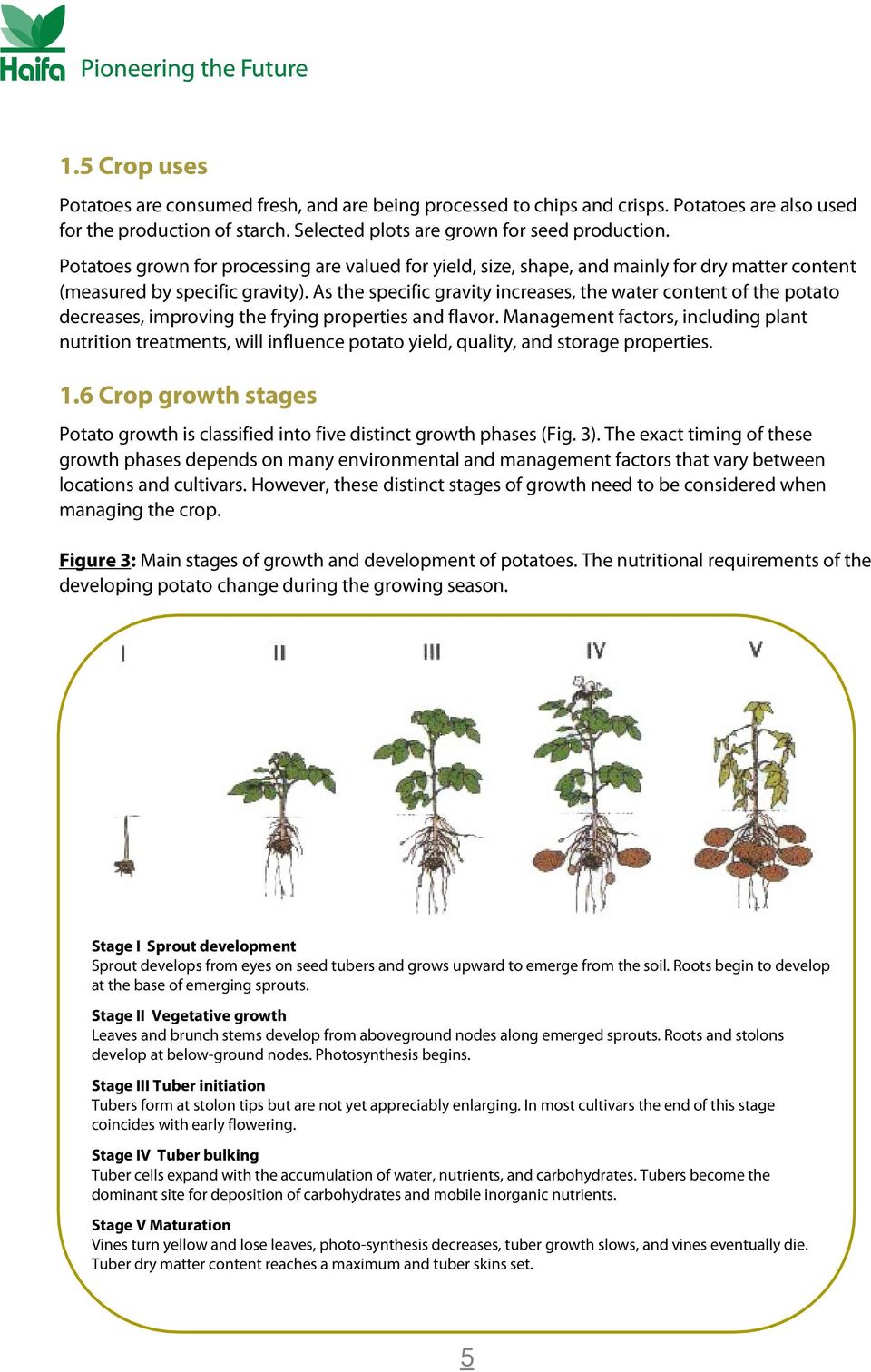
5 1.5 Crop uses Potatoes are consumed fresh, and are being processed to chips and crisps. Potatoes are also used for the production of starch. Selected plots are grown for seed production. Potatoes grown for processing are valued for yield, size, shape, and mainly for dry matter content (measured by specific gravity). As the specific gravity increases, the water content of the potato decreases, improving the frying properties and flavor. Management factors, including plant nutrition treatments, will influence potato yield, quality, and storage properties. 1.6 Crop growth stages Potato growth is classified into five distinct growth phases (Fig. 3). The exact timing of these growth phases depends on many environmental and management factors that vary between locations and cultivars. However, these distinct stages of growth need to be considered when managing the crop. Figure 3: Main stages of growth and development of potatoes. The nutritional requirements of the developing potato change during the growing season. Stage I Sprout development Sprout develops from eyes on seed tubers and grows upward to emerge from the soil. Roots begin to develop at the base of emerging sprouts. Stage II Vegetative growth Leaves and brunch stems develop from aboveground nodes along emerged sprouts. Roots and stolons develop at below-ground nodes. Photosynthesis begins. Stage III Tuber initiation Tubers form at stolon tips but are not yet appreciably enlarging. In most cultivars the end of this stage coincides with early flowering. Stage IV Tuber bulking Tuber cells expand with the accumulation of water, nutrients, and carbohydrates. Tubers become the dominant site for deposition of carbohydrates and mobile inorganic nutrients. Stage V Maturation Vines turn yellow and lose leaves, photo-synthesis decreases, tuber growth slows, and vines eventually die. Tuber dry matter content reaches a maximum and tuber skins set. 5

6 2. Nutritional requirements 2.1 Nutrient uptake curves Nutrients uptake is at its greatest during tuber bulking up (intensive volume increase process). The amount of nutrients removed by a potato crop is closely related to yield. Usually, twice the yield will result twice the removal of nutrients. Nutrients need to be applied as accurately as possible to the zone of uptake, slightly before, or at the time that the crop needs them. Failure to ensure that each plant gets the right balance of nutrients can spoil crop quality and reduce yield. The highest requirement for potassium, as shown on Figure 4, is during the bulking up stage of the tubers. The flowering of potato plants is an indication when this morphological stage starts. Consequently, the ideal side-dressing period with Multi-K would be during the tuber bulking stage. Figure 4: Uptake of macronutrient uptake by a whole potato plant Source: Harris (1978) Total uptake (kg/ha) K Bulking up KNO3 N P 0 The daily requirements of potato tubers during the critical bulking stage are 4.5 kg/ha N, 0.3 kg/ha P and 6.0 kg/ha K. Potassium requirements of potato tubers during the bulking stage are very high as they are considered to be luxury consumers of potassium. Daily yield increase during the critical tuber bulking stage can reach kg/ha/day. Therefore, it is important to supply the required plant nutrients during the tuber bulking stage in right N-P-K ratio and in ample quantities. 6

7 Figure 5: Uptake of macro and secondary nutrients by vines and tubers of potato plants yielding 55 ton/ha. Source: Reiz, 1991 Removal (kg/ha) Tubers Vines N P K Ca Mg Figure 6: Uptake of micro-nutrients by vines and tubers of potato plants yielding 55 ton/ha. Source: Reiz, 1991 Removal (kg/ha) Tubers Vines Cu Zn B Mn Fe 7

8 2.2 Main functions of plant nutrients Table 1: Summary of main functions of plant nutrients Nutrient Functions Nitrogen (N) Synthesis of proteins (growth and yield). Phosphorus (P) Cellular division and formation of energetic structures. Potassium (K) Transport of sugars, stomata control, cofactor of many enzymes, reduces susceptibility to plant diseases. Calcium (Ca) A major building block in cell walls, and reduces susceptibility to diseases. Sulfur (S) Synthesis of essential amino acids cystine and methionine. Magnesium (Mg) Central part of chlorophyll molecule. Iron (Fe) Chlorophyll synthesis. Manganese (Mn) Necessary in the photosynthesis process. Boron (B) Formation of cell wall. Germination and elongation of pollen tube. Participates in the metabolism and transport of sugars. Zinc (Zn) Auxins synthesis. Copper (Cu) Influences in the metabolism of nitrogen and carbohydrates. Molybdenum (Mo) Component of nitrate-reductase and nitrogenase enzymes. Table 2: Effects of the nutrients and the potassium source on the yield quality. Parameter Increase in dosage of Application of KCl in Nitrogen Phosphorus Potassium comparison to chloride-free K (-Cl) Tuber size No effect Chloride-free K helps increasing size Sensitivity to No information mechanical damage Tuber blackening 1 KCl is more effective No effect No effect than (-Cl) % dry matter 2 Slight effect Chloride-free K yields better results % starch 3 Chloride-free K yields better results % protein Conflicting results Chloride-free K helps increasing content % reducing sugars Inconsistent No difference Taste No effect Chloride-free K is better Blackening after cooking No effect 1 Blackening is caused by oxidation of phenol compounds when skin is exposed. 2 A high percentage of dry matter is required in potatoes for industry. 3 High concentrations are desirable. The characteristic is correlated to the specific gravity. 8

9 Nitrogen (N) Adequate N management is one of the most important factors required to obtain high yields (Fig. 7) of excellent quality potatoes. An adequate early season N supply is important to support vegetative growth. Figure 7: The effect of nitrogen (N) on potato yields Yield (ton/ha) kg N /Ha Excessive soil N, applied late in the season delays maturity of the tubers and result in poor skin set, which harms the tuber quality and storage properties. Potatoes are a shallow-rooted crop, generally growing on sandy, well-drained soils. These soil conditions frequently make water and N management difficult since nitrate is susceptible to leaching losses. On these sandy soils, it is recommended that potatoes receive split applications of N during the growing season. This involves applying some of the total N requirement prior to planting and applying the remainder during the season with side-dress applications or through the irrigation system by Nutrigation (fertigation). The period of highest N demand varies by potato variety and is related to cultivar characteristics, such as root density and time to maturity. Petiole analysis during the growing season is a useful tool, allowing growers to determine the N status of the crop and respond in a timely manner with appropriate nutrients. A balanced ammonium / nitrate ratio is very important at planting time. Too much ammoniumnitrogen is a disadvantage as it reduces root-zone ph and thereby promotes Rhizoctonia disease. Nitrate-nitrogen enhances the uptake of cations such as calcium, potassium and magnesium, required for elevated specific gravity values. 9

10 Figure 8: Relative response of potato growth to the nitrate-ammonium concentrations in the nutrient solution Relative dry weight Nitrate Ammonium N concentration (mm) At 12 mm of N, plants exhibited interveinal ammonium toxicity with NH 4 + nutrition, but healthy growth with NO 3 - nutrition. Thus, a careful control of NH 4 + concentrations is necessary to minimize ammonium toxicity to potato plants. Figure 9: Effect of Nitrate/Ammonium ratio and N rate on total yield of U.T.D. tubers Source: Vegetables & Fruits, Feb./March, South Africa Relative Yield % Amm./ 20%Nitr. 50% Amm./ 50%Nitr. 20% Amm./80%Nitr Total N (kg/ha) 10

11 Nitrogen Assessment Soil testing to a depth of 60 cm. in the spring is critical to planning an effective and efficient N management program. Post-harvest soil samples may help growers to select succeeding crops, which will make maximum use of the residual N after the potato crop. The nitrogen demand by the crop during tuber bulking may be 2.2 to 3.0 kg/ha/day. Petiole nitrate sampling allows for in-season monitoring of the crop s nutrient status. Collecting the 4 th petiole from randomly selected plants throughout the field (Fig. 10) is recommended. Tissue samples are often collected weekly to track changes in nitrate levels, and to plan supplemental fertilizer applications, should levels drop below optimum. Critical petiole nitrate-levels decline as the potato crop develops and matures. Generally, petiole nitrate-n levels at tuber bulking are <10,000 ppm = low, 10,000-15,000 ppm = medium, >15,000 ppm = sufficient. (Fig. 11) Figure 10: The structure of the 4 th leaf on a potato plant 11

12 Figure 11: Interpretation of N-NO 3 levels in potato petioles at different stages of growth Petiole nitrate (ppm N-NO 3 ) Adequate Warning Deficient leaves ½-1 tubers 1½-2 tubers Late season Growth stage Phosphorus (P) Phosphorus is important for early root and shoot development, providing energy for plant processes such as ion uptake and transport. Roots absorb phosphate ions only when they are dissolved in the soil water. Phosphorus deficiencies can occur even in soils with abundant available P, if drought, low temperatures, or disease interfere with P diffusion to the root, through the soil solution. These deficiencies will result in stunt root development and inadequate function. At the tuber initiation stage, an adequate supply of phosphorus ensures that optimum number of tubers is formed. Following the tuber initiation, phosphorus is an essential component for starch synthesis, transport and storage. Recent research suggests that modifications to P fertilizer, such as polymer additives, humic substances, and coatings may be beneficial in improving P uptake and potato production. 12

13 Potassium (K) Potato plants take up large quantities of potassium throughout the growing season. Potassium has an important role in the control of the plant water status and internal ionic concentration of the plant tissues, with a special focus on the stomatal functioning. Potassium plays a major positive role in the process of nitrate reduction within the plant. Where large amounts (e.g. >400 kg/ha K 2O) are to be applied, in temperate conditions it is advisable to split the dressings 6-8 weeks apart. Potatoes require large amounts of soil K, since this nutrient is crucial to metabolic functions such as the movement of sugars from the leaves to the tubers and the transformation of sugar into potato starch. Potassium deficiencies reduce the yield, size, and quality of the potato crop. A lack of adequate soil K is also associated with low specific gravity in potatoes. Potassium deficiencies impair the crop s resistance to diseases and its ability to tolerate stresses such as drought and frost. Applying K fertilizer with a broadcast application prior to planting is most commonly recommended. If the K is band-applied, the rates should be kept below 45 kg K 2O/ha to avoid any salt injury to the developing sprouts. Selection of the best K fertilizer The source of potassium plays an important role on the quality and the yield of potato tubers. By comparing different sources of K, Multi-K potassium nitrate was found to increase the dry matter ontent and the yield significantly higher than other sources of K (Fig. 12 & 13). This study was done on different cultivars and all of them responded with higher tuber yield to Multi-K treatment (Fig 14). Figure 12: The effect of different potassic fertilizers on the potato tuber yield Source: Reiz, 1991 Yield (ton/ha) KCl SOP Multi-K 13


14 Figure 13: The effect of different potassic fertilizers on the dry matter content in potato tubers Source: Reiz, 1991 % dry matter KCl SOP Multi-K Figure 14: The effect of different potassic fertilizers on potato yield of various cultivars Source: Bester, 1986 Tuber yield (g/plant) Multi-K KCl SOP VDP UTD BP-1 PPN Cultivar 14

15 The potato's specific gravity and the chips color are important parameters for the processing potatoes industry. Both of these parameters are responding favourably to Multi-K potassium nitrate treatments as compared to other sources of K fertilizers (Fig. 15, 16). Figure 15: The effect of different potassic fertilizers on chips color rating Source: Reiz, 1991 Color rating KCl SOP Multi-K Figure 16: The effect of different potassic fertilizers on specific gravity of potato tubers Source: Reiz, 1991 S.G KCl SOP Multi-K 15

16 Beside the favourable effect of Multi-K on the quality and yield of potato tubers, it also improves the shelf life of the tubers in storage (Fig. 17). Figure 17: The effect of different K fertilizers loss of mass over time (@ 20 o C, RH 66%) Source: Bester (1986) 6 Mass loss (%) KCl SOP Multi-K Time (weeks) Calcium (Ca) Calcium is a key component of cell walls, helping to build a strong structure and ensuring cell stability. Calcium-enriched cell walls are more resistant to bacterial or fungal attack. Calcium also helps the plant adapt to stress by influencing the signal chain reaction when stress occurs. It also has a key role in regulating the active transport of potassium for stomatal opening. Magnesium (Mg) Magnesium has a central role in photosynthesis, as its atom is present in the centre of each chlorophyll molecule. It is also involved in various key steps of sugar and protein production as well as the transport of sugars in the form of sucrose from the leaves to the tubers. Yield increases of up to 10% were obtained in trials in which regular application of magnesium fertilizers has been practiced. Sulphur (S) Sulphur reduces the level of common and powdery scab. This effect is related to a reduction in the soil ph where sulphur is applied in its elemental form. 16

17 2.3 Nutritional disorders in potatoes Nitrogen Nitrogen deficiency is manifested by reduced growth pale leaves, and results in reduced tuber yield (size and number). The deficiency is made worse by extrenme soil ph (low or high), low organic matter, drought conditions or heavy irrigation (Fig. 18). Nitrogen excess causes delayed maturity, excessive top growth, hollow heart & growth cracks, increased susceptibility to biotic diseases, reduced tuber specific gravity and difficulty in vine burning before harvest. Figure 18: Characteristic nitrogen (N) deficiency symptoms Phosphorus Typical symptoms and syndroms related with phosphorus deficiency are: fewer tubers, smaller tubers, stunted plants, yellowing of older leaves, small dark green younger leaves (Fig. 19). P deficiency leads to reduced early vigor, delayed maturity and reduced yields. Excessive phosphorus, when present, ties up other elements such as calcium and zinc, inducing thereby their deficiencies 17

18 Figure 19: Characteristic phosphorus (P) deficiency symptoms Potassium Potassium deficiency retards nitrogen uptake, slows down plant growth and leads to reduced yields, inferior quality, and poor disease resistance. Typical symptoms of K deficiency are necrosis of leaf margins, premature leaf senescence (Fig. 20) Excessive potassium causes reduced tuber specific gravity and reduced calcium and/or magnesium uptake. It also degrades soil structure. Figure 20: Characteristic potassium (K) deficiency symptoms Calcium Calcium deficiency interferes with root growth, causes deformation of foliage growth tips, and may result in reduced yields and poor quality. Calcium-deficient potato tubers have reduced storage capability. Low calcium levels in the soil result in poorer soil structure. Typical symptoms of calcium deficiency are yellow curled leaves on upper leaves, tip burns, and small chlorotic new leaves. (Fig. 21) Excessive calcium results in reduced magnesium uptake, with the symptoms related to magnesium deficiency. 18

19 Figure 21: Characteristic calcium (Ca) deficiency symptoms Magnesium As magnesium is a key element in photosynthesis, its rate slows down under conditions of magnesium deficiency, resulting in Reduced tuber formation and lower yields. Severe magnesium deficiency can reduce yields by up to 15%. Magnesium-deficient tubers are more easily damaged during lifting and storage. Typical deficiency symptoms: Leaves get yellow and brown; The leaves wilt and die; Stunted plants, early crop maturation; Poor skin finish of the tubers. (Fig. 22) Excessive magnesium results in reduced calcium uptake, with the symptoms related to calcium deficiency. Figure 22: Characteristic magnesium (Mg) deficiency symptoms 19

20 Sulfur Sulfur (S) deficiency causes reduced growth, and leaves become pale green or yellow. Number of leaves is reduced. (Fig. 23) Figure 23: Characteristic sulfur (S) deficiency symptoms Iron Under Iron (Fe) deficiency, the interveinal areas get chlorotic while the veins remain green. In cases of severe deficiency, the entire leaf is chlorotic. (Fig. 24). Iron deficiency symptoms firstly appear on the youngest leaves. Figure 24: Characteristic Iron (Fe) deficiency symptoms Boron Boron (B) regulates transport of sugars through membranes, and also plays a key role in cell division, cell development and auxin metabolism. Under condition of boron deficiency growing buds die, and plants appear bushy, having shorter internodes. Leaves thicken and roll upward; leaf tissue darkens and collapses. Brown necrotic patches appear on tubers, and internal rust spot are formed. (Fig. 25) 20

21 Figure 25: Characteristic Boron (B) deficiency symptoms Copper Under copper (Cu) deficiency young leaves become flaccid and wilted, terminal buds drop at flower bud development, and leaf tips become necrotic (Fig. 26). Figure 26: Characteristic Boron (B) deficiency symptoms Zinc Zinc deficiency symptoms: Young leaves become chlorotic (light green or yellow), narrow, upwardly-cupped and develop tip-burn. Other leaf symptoms are green veins, spotting with dead tissue, blotching, and erect appearance. (Fig. 27) 21
22 Figure 27: Characteristic Zinc (Zn) deficiency symptoms Manganese Manganese (Mn) deficiency symptoms: black or brown spots on younger leaves; leaves yellowing; poor skin finish of the tubers (Fig. 28). Tubers are more easily damaged during lifting and storage. Figure 28: Characteristic manganese (Mn) deficiency symptoms 22
23 2.4 Leaf analysis standards Table 8: Reference levels for each nutrient at foliar level: Nutrient (%) Deficient Low Normal High Excessive Nitrogen (N) < >6.5 Phosphorus (P) < >0.6 Potassium (K) < >7.0 Calcium (Ca) < >2.0 Magnesium (Mg) < >0.5 Sulfur (S) Nutrient (ppm) Deficient Low Normal High Excessive Copper (Cu) < Zinc (Zn) < Manganese (Mn) < >800 Iron (Fe) Boron (B) < Sodium (Na) >0.4 Chloride (Cl) > Plant nutrient requirements Table 9: Nutritional requirements of potatoes: Expected yield Removal by yield (kg/ha) Uptake by whole plant (kg/ha) (ton/ha) N P 2O 5 K 2O CaO MgO N P 2O 5 K 2O CaO MgO

24 3. Fertilization recommendations The recommendations appearing in this document should be regarded as a general guide only. The exact fertilization program should be determined according to the specific crop needs, soil and water conditions, and the grower s experience. For detailed recommendations, consult a local Haifa representative. Disclaimer: Any use of the information given here is made at the reader s sole risk. Haifa Chemicals Ltd. provides no warranty whatsoever for "Error Free" data, nor does it warrants the results that may be obtained from use of the provided data, or as to the accuracy, reliability or content of any information provided here. In no event will Haifa Chemicals Ltd. or its employees be liable for any damage or punitive damages arising out of the use of or inability to use the data included. 3.1 General recommendations Haifa NutriNet web software for Nutigation programs Haifa fertilization recommendations are available in the online Knowledge Center on our website, Use the NutriNet web software, accessible through our website or directly at to assist you in working out the recommended fertilizer rates at different growth stages according to the expected yield under your growing conditions. The following is an example of recommendations, found on the NutriNet, in accordance with the above-mentioned guideline to split the scheduled fertilization into: a) Base-dressing (pre-plant) fertilizers, followed by: b) Nutrigation (fertigation) at different growth stages, on sandy-loam soil, when the expected yield is 80 ton/ha: a) Base dressing 24

25 b) Nutrigation Total amount of fertilizers applied by Nutrigation Table 10: The total contribution of plant nutrients from each fertilizer as calculated by NutriNet : kg N P 2O 5 K 2O CaO MgO Ammonium nitrate (34%) Haifa MAP ( ) Multi-K ( ) Haifa Cal (26% CaO) Magnesium sulphate (16% MgO) 58 9 Total Table 11: Recommended nutrient rates per ha per day and per growth stage as calculated by NutriNet : Phase Days from sowing / planting kg/ha/day kg/ha/phase N P 2O 5 K 2O CaO MgO N P 2O 5 K 2O CaO MgO Planting Vegetative growth Tuber initiation & bulking Maturation Total
26 Table 12: Recommended fertilizers rates per growth stage Phase Days from sowing / planting Ammonium nitrate Haifa MAP* kg/ha/phase Multi-K * Haifa Cal* (26% CaO) Magnesium sulfate (16% MgO) Planting Vegetative growth Tuber initiation & bulking Maturation * Multi-K = Potassium nitrate Haifa MAP = Mono-ammonium phosphate Haifa Cal = Calcium nitrate Total


27 3.1.2 Side dressing with Multi-K It is recommended to apply Multi-K by side dressing in prilled form. It can be done by any surface fertilizer applicator. However, when the soil is too wet, especially in early spring, aerial application is recommended. Table 12: Soil applied fertilization Type of potatoes When to apply Rate kg/ha Ware potatoes 5-8 weeks after planting kg Multi-K /ha Early potatoes After removing plastic cover kg Multi-K /ha Comments Split into 2-4 applications. First application days after emergence Fewer applications in heavier soils, more in light texture soils days interval Poly-Feed water-soluble NPK fertilizers Table 13: fertilization recommendations for potatoes. Expected yield: 60 ton/ha Growth stage Days Poly-Feed formula kg/ha/day Total kg/ha Planting & Establishment Tuber initiation MgO Tuber growth MgO

28 3.1.4 Multicote Agri controlled release fertilizer An N:P 2O:K 2O ratio of 2:1:3* is recommended, as pre-plant application. This application will take care of the nutritional requirement of the plot for the entire growth season. Multicote Agri granules should be incorporated into the soil, 10cm deep and 10cm away from the planting row. Consult a local Haifa representative for detailed explanations and instructions. Table 14: Multicote Agri application recommendations for potatoes* Application rate % of local practice* % coated nutrients N P2O5 K2O N P2O5 K2O Light soil Up to 50 Heavy soil Up to 50 * These recommendations refer to areas where nitrogen application rates are not restricted by regulations. If nitrogen application is restricted, calculation of Multicote Agri application rates should be based on the full optimum rates that would have been given with no restrictions Foliar nutrition Foliar feeding is a fast and highly effective method of supplementing and enriching plant nutrients when needed. Foliar application of Haifa water soluble fertilizers provides needed plant nutrients for normal development of crops when absorption of nutrients from the soil is disturbed, precisiontimed foliar sprays are also a fast-acting and effective method for treating nutrient deficiencies. Foliar application of the correct nutrients in relatively low concentrations at critical stages in crop development contributes significantly to higher yields and improved quality. Determine safe foliar applied rate: To verify the safe rate under local conditions, it is advisable to spray recommended rate on a few plants. After 3-4 days check the tested plants for scorching symptoms. Preparation of tank-mix: Dissolve Haifa water-soluble fertilizes in about half of the tank volume, and add to the spray tank. When applying together with crop-protection agents, addition of wetting agents is not necessary. To ensure compatibility of tank-mix components, a small-scale test should be performed prior to actual application. 28


29 Table 15: Haifa water-soluble fertilizers for foliar application Fertilizer Curing Treatment Recommended concentration Haifa Bonus Potassium deficiency 1% - 3% Haifa MAP Phosphorus deficiency 1% - 3% Haifa MKP Phosphorus and potassium 1% - 3% deficiency Magnisal Magnesium deficiency 1% - 2% Poly-Feed N-P-K and micronutrients deficiency See table below Haifa Micro Micronutrients deficiencies Consult Haifa agronomist Table 16: Recommended foliar feeding with Poly-Feed products for boosting crop performances Stage Poly-Feed Foliar analysis Concentration Spray volume Vegetative growth Vegetative Booster 2% - 5% L/ha Tuber growth Poly-Potato Two applications at 2% - 4% L/ha 29
30 3.2 Examples of potato fertilization with Multi-K in various countries South Africa A. Cape region Application Product (N- kg/ha N P P 2O 5 K K 2O Schedule P 2O 5-K 2O) Before plant Gypsum 2000 Bended at Granular planting Fertigation (Via Central Pivot) Weeks Applications per week Rate per application 1 to * 2 75 kg/ha Calcium Nitrate 1 50 kg/ha to 7 Multi-K 2 60 kg/ha Calcium Nitrate 1 50 kg/ha to 10 Multi-K 3 60 kg/ha Sub-total Nutrigation Total * Water-soluble fertilizer made of Multi-K MKP and AS B. Free state Fertilizers Magnisal Haifa Cal UAN (18) Multi-K KCl S. G Week kg/ha 0 (Jan-10) Total
31 Australia Soil type: Light (with low phosphorus and potassium) Note: Nutrients supplied by a base dressing with strategic applications through the center pivot irrigators. Recommended rates of nutrients N P P 2O 5 K K 2O kg/ha kg/ha kg/ha kg/ha kg/ha a) Base-dressing On silt soils (medium soils) up to 50% of the N and K should be applied as pre-plant and up to 100 % of P applied as pre-plant dry fertilizer *. N P P 2O 5 K K 2O kg/ha kg/ha kg/ha kg/ha 60-70kg/ha * On light (sandy) soils, up to 30% of the N and K should be applied as pre-plant and up to 100 % of the P applied as pre-plant dry fertilizer. b) Nutrigation 50%** of N and K are applied through the irrigation system (center pivot) Time of application (weeks after emergence) kg/ha/application N P K K 2O Multi-K Ammonium Nitrate ** When 70% of N and K are applied, increase Multi-K rate to kg/application an ammonium nitrate to 90 kg/application. Nutrient applied kg/ha N P P 2O 5 K K 2O (Approx) Note: Nutrigation begins 6 weeks after emergence. If practical, applications can be split and applied on a weekly basis. 31
32 Poland Soil type: Light /sandy Plant density : 40,000-75,000 / ha Expected yield: T/ha, depending on variety Average recommended rates of nutrients (kg/ha): N P 2O 5 K 2O CaO MgO a) Base-dressing Nutrient Requirements Recommended Fertilizers N P 2O 5 K 2O MgO AN TSP Haifa SOP MgSO AN - Ammonium nitrate (34%) TSP - Triple Super phosphate (46% P 2O 5) Haifa SOP - Potassium sulfate (50% K 2O) b). Nutrigation Based on a weekly irrigation. Growth stage Weeks after Nutrition requirement (kg/ha/week) Recommended fertilizer (kg/ha/week) emergence N P 2O 5 K 2O CaO MgO Multi-K Mg Haifa MAP AN CN Vegetative growth Tuber initiation Tuber bulking * Maturation Total If fertilizers are applied by side-dressing, the entire weekly rate should be applied at once. Fertilizers should be placed besides the row. Multi-K Mg = Potassium nitrate enriched with magnesium ( MgO) Haifa MAP= Mono-Ammonium Phosphate ( ) AN = Ammonium nitrate CN = Calcium nitrate 32
33 Israel Soil application: Growth stage N rate Multi-K * P 2O 5 rate From planting till tuber initiation kg/ha --- According to soil test or kg /ha At tuber initiation kg/ha days later kg/ha * Optional Multi-K Mg Foliar feeding: Treatment Fertilizer Spray timing Conc. Spray volume No. of applications Improving Poly-Feed One week after 2% - 3% Full coverage 2-3 growth emergence Correcting K Haifa Bonus Two weeks after 5% - 8% deficiency emergence Higher yield Haifa Bonus From full canopy 5% - 8% Aerial application: When there is a need for top-dressing and the soil is either too wet or the field is too large for timely ground application, an aerial application of prilled Multi-K is a practical solution. This is especially effective when the soil temperature is still cold, (usually in early spring), so a nitrate application will enable the plant to take up nitrogen at this stage for quick response. 33
34 Appendix I: Haifa specialty fertilizers Pioneering Solutions Haifa develops and produces Potassium Nitrate products, Soluble Fertilizers for Nutrigation and foliar sprays, and Controlled-Release Fertilizers. Haifa s Agriculture Solutions maximize yields from given inputs of land, water and plant nutrients for diverse farming practices. With innovative plant nutrition schemes and highly efficient application methods, Haifa s solutions provide balanced plant nutrition at precise dosing, composition and placing. This ultimately delivers maximum efficiency, optimal plant development and minimized losses to the environment. Potassium Nitrate Haifa's Potassium Nitrate products represent a unique source of potassium due to their nutritional value and contribution to plant's health and yields. Potassium Nitrate has distinctive chemical and physical properties that are beneficial to the environment. Haifa offers a wide range of potassium nitrate products for Nutrigation, foliar sprays, side-dressing and controlled-release fertilization. Haifa's potassium nitrate products are marketed under the Multi-K brand. Multi-K Products Pure Multi-K Multi-K Classic Crystalline potassium nitrate ( ) Multi-K Prills Potassium nitrate prills ( ) Special Grades Multi-K GG Greenhouse-grade potassium nitrate ( ) Multi-K phast Low-pH potassium nitrate ( ) Multi-K Top Hydroponics-grade potassium nitrate ( ) Enriched Products Multi-npK Enriched with phosphate; crystalline or prills Multi-K Mg Enriched with magnesium; crystalline or prills Multi-K Zn Enriched with zinc; crystalline Multi-K S Enriched with sulfate; crystalline Multi-K B Enriched with boron; crystalline or prills Multi-K ME Enriched with magnesium and micronutrients; crystalline 34
35 Nutrigation Nutrigation (fertigation) delivers pure plant nutrients through the irrigation system, supplying essential nutrients precisely to the area of most intensive root activity. Haifa s well-balanced Nutrigation program provides the plant with their exact needs accordingly with seasonal changes. Decades of experience in production and application of specialty fertilizers for Nutrigation have made Haifa a leading company in this field. Haifa keeps constantly up to date with contemporary scientific and agricultural research, in order to continuously broaden its product line to better meet the requirements of crops and cropping environments. Haifa offers a wide range of water-soluble fertilizers for Nutrigation. All products contain only pure plant nutrients and are free of sodium and chloride Multi-K Poly-Feed Haifa MAP Haifa MKP Haifa Cal Magnisal Haifa Micro Haifa VitaPhos-K Haifa ProteK Comprehensive range of plain and enriched potassium nitrate products Soluble NPK fertilizers enriched with secondary and micro-nutrients Mono-ammonium phosphate Mono-potassium phosphate Calcium nitrate Our original magnesium nitrate fertilizer Chelated micronutrients Precipitation-proof poly-phosphate for soilless Nutrigation Systemic PK fertilizer Foliar Feeding Foliar Feeding provides fast, on-the-spot supplementary nutrition to ensure high, top quality yields and is an ideal feeding method under certain growth conditions in which absorption of nutrients from the soil is inefficient, or for use on short term crops. Precision-timed foliar sprays are also a fast-acting and effective method for treating nutrient deficiencies. Foliar application of the correct nutrients in relatively low concentrations at critical stages in crop development contributes significantly to higher yields and improved quality. Haifa offers a selection of premium fertilizers for foliar application. Haifa offers a selection of fertilizers for foliar application: Haifa Bonus High-K foliar formulas enriched with special adjuvants for better absorption and prolonged action Poly-Feed Foliar NPK formulas enriched with micronutrients specially designed to enhance the crop performance during specific growth stages Magnisal, Haifa MAP, Haifa MKP, Haifa Cal and Haifa Micro are also suitable for foliar application. 35
36 Controlled Release Nutrition Multicote, Haifa's range of Controlled Release Fertilizers includes products for agriculture, horticulture, ornamentals and turf. Multicote products provide plants with balanced nutrition according to their growth needs throughout the growth cycle. Multicote products enhance plant growth, improve nutrients use efficiency, save on labor and minimize environmental impact. Single, pre-plant application controlled-release fertilizer can take care of the crop s nutritional requirements throughout the growth season. Controlled release fertilizers are designed to feed plants continuously, with maximal efficiency of nutrients uptake. Controlled release fertilizers save labor and application costs. Their application is independent of the irrigation system, and does not require sophisticated equipment. Taking advantage of MulticoTech polymer coating technology, Haifa produces Multicote line of controlled release fertilizers. Multicote Products Multicote for nurseries and ornamentals; NPK formulae with release longevities of 4, 6, 8, 12 and 16 months Multicote Agri / Multigro for agriculture and horticulture CoteN controlled-release urea for arable crops Multicote Turf / Multigreen for golf courses, sports fields, municipals and domestic lawns 36
37 Appendix II: Conversion tables From To Multiply by From To Multiply by P P 2O P 2O 5 P 0.44 P PO PO 4 P 0.32 H 3PO 4 H 2PO H 2PO 4 H 3PO K K 2O 1.20 K 2O K 0.83 Ca CaO 1.40 CaO Ca 0.71 Mg MgO 1.66 MgO Mg 0.60 S SO SO 3 S 0.40 S SO SO 4 S 0.33 N NH NH 4 N 0.82 N NO NO 3 N 0.22 From To Multiply by From To Multiply by Acre Hectare Hectare Acre Kilogram Lbs Lbs Kilogram Gram Ounces Ounces Gram Short Ton MT MT Short Ton 1.1 Gallon (US) Liters Liters Gallon (US) 0.26 Kg/Ha Lbs/acre Lbs/acre Kg/Ha 1.12 MT/Ha Lbs/acre 892 Lbs/acre MT/Ha meq Correspondent 1 mmol Correspondent Weight of ion element (mg) element (mg) + NH 4 14 mg N + NH 4 14 mg N + 18 mg NH 4 - NO 3 14 mg N - NO 3 14 mg N - 62 mg NO 3 H 2PO mg P H 2PO mg P 71 mg P 2O 5 2- HPO 4 31 mg P 2- HPO 4 31 mg P 35,5 mg P 2O 5 2- HPO mg P K + 39 mg K 47 mg K 2O K + 39 mg K Ca mg Ca 28 mg CaO Ca mg Ca Mg mg Mg 20 mg MgO Mg mg Mg 2- SO 4 32 mg S 48 mg SO 4 2- SO 4 16 mg S Na + 23 mg Na - Na + 23 mg Na Cl mg Cl - 37
Understanding the. Soil Test Report. Client and Sample Identification
 Understanding the Soil Test Report Page 1 of 7 Crops absorb the nutrients required from soil in order to grow, so ensuring that your soil is meeting the crops needs is critical. Having the proper level
LAB 5 - PLANT NUTRITION. Chemical Ionic forms Approximate dry Element symbol Atomic weight Absorbed by plants tissue concentration
 LAB 5 PLANT NUTRITION I. General Introduction All living organisms require certain elements for their survival. Plants are known to require carbon (C), hydrogen (H), oxygen (O), nitrogen (N), phosphorus
WHAT IS IN FERTILIZER OTHER THAN NUTRIENTS?
 WHAT IS IN FERTILIZER OTHER THAN NUTRIENTS? Raymond C. Ward Ward Laboratories Inc. Kearney, NE Commercial fertilizer is a source of plant nutrients that can be applied to soil to nourish crops when the
Understanding ph management and plant nutrition Part 5: Choosing the best fertilizer
 Understanding ph management and plant nutrition Part 5: Choosing the best fertilizer Bill Argo, Ph.D. Blackmore Company, Tel: 800-874-8660, Int l 734-483-8661, E-mail: [email protected] Originally
Nutrient Deficiencies
 Integrated Pest Management Nutrient Deficiencies and Application Injuries in Field Crops John Sawyer Department of Agronomy Nitrogen deficiency in corn IPM 42 Revised July 2004 Nutrient deficiencies in
POTASSIUM. Functions of Potassium in Plants. Potassium Deficiency Symptoms
 POTASSIUM Potassium is the last of what might be called the big three soil nutrients nitrogen, phosphorus, and potassium. These three primary nutrients are, by far, the nutrients most commonly limiting
Deficiency Symptoms in Vegetable Plants (Corrective Treatments Per 30ʼ-long Row)
 Deficiency Symptoms in Vegetable Plants (Corrective Treatments Per 30ʼ-long Row) BORON (1-2 ounces Borax) General Symptoms Rosette Crown terminal buds; Death of terminal buds; leaves are an off-green color;
Fertility Guidelines for Hops in the Northeast Dr. Heather Darby, University of Vermont Extension Agronomist
 Fertility Guidelines for Hops in the Northeast Dr. Heather Darby, University of Vermont Extension Agronomist The increasing acreage of hops in the Northeast has prompted the need for fertility guidelines
Effect Of Amino Acids On Plants
 Effect Of Amino Acids On Plants Agriculture production is a very intensive business and is related to better quality and better yield leading to better profitability Every farmer s dreams to achieve this
N-P-K FERTILIZERS. by M.L. Vitosh Extension Specialist, Crop and Soil Sciences
 Michigan State University Extension! Extension Bulletin E-896! Reprint July 1996 N-P-K FERTILIZERS by M.L. Vitosh Extension Specialist, Crop and Soil Sciences T here are many grades and analyses of nitrogen
What Is Humic Acid? Where Does It Come From?
 What Is Humic Acid? Humic and Fulvic acids are the final break-down constituents of the natural decay of plant and animal materials. These organic acids are found in pre-historic deposits. Humic matter
Agronomic and Economic Considerations on Michigan Farms
 Agronomic and Economic Considerations on Michigan Farms MSU Phosphorus and Potassium Fertilizer Recommendations for Field Crops The key ingredients: Soil Test Information Yield Goal Buildup, Maintenance
Forest Nursery Notes Summer 2009
 Fertigation - Injecting Soluble Fertilizers into the Irrigation System by Thomas D. Landis, Jeremy R. Pinto, and Anthony S. Davis Introduction Fertigation (fertilization + irrigation) is the newest way
Part 1: Knowing how to identify the problem. Author: Damon Polta, Friendly Aquaponics Farm Manager. For free distribution.
 Diseases, Deficiencies, and Toxicities in Plants Part 1: Knowing how to identify the problem. Author: Damon Polta, Friendly Aquaponics Farm Manager. For free distribution. Diseases Beet Western Yellow
FARMING FOR THE FUTURE How mineral fertilizers can feed the world and maintain its resources in an Integrated Farming System
 How mineral fertilizers can feed the world and maintain its resources in an Integrated Farming System european fertilizer manufacturers association Global trends in population growth (Population 1000 million),
Three Reasons to Broaden Your Fertigation Knowledge
 Three Reasons to Broaden Your Fertigation Knowledge While the benefits of fertigation are being recognized by more irrigation managers today than ever before, the staff of Irrigation Business & Technology
The Basics of Fertilizer Calculations for Greenhouse Crops Joyce G. Latimer, Extension Specialist, Greenhouse Crops; Virginia Tech
 The Basics of Fertilizer Calculations for Greenhouse Crops Joyce G. Latimer, Extension Specialist, Greenhouse Crops; Virginia Tech Publication 430-100 Meeting the Plant s Needs Fertilizers are designed
You d be mad not to bet on this horse.
 You d be mad not to bet on this horse. With a proven 300% return on investment*, FertiCoat is the clear winner for crops. *For wheat and maize The ultimate fertiliser coating FertiCoat applied to fertilisers:
A SOIL TESTING SERVICE FOR FARMERS IN THAILAND, USING MOBILE LABORATORIES
 A SOIL TESTING SERVICE FOR FARMERS IN THAILAND, USING MOBILE LABORATORIES Narong Chinabut Office of Science for Land Development Land Development Department, Ministry of Agriculture and Cooperatives, Bangkok
Soil Sampling for Nutrient Management
 Soil Sampling for Nutrient Management Nutrient Management Factsheet No. 2 in Series Revised September 2010 Order Reference No. 631-500-1 For nutrient management, soil sampling is done to collect a soil
Chapter D9. Irrigation scheduling
 Chapter D9. Irrigation scheduling PURPOSE OF THIS CHAPTER To explain how to plan and schedule your irrigation program CHAPTER CONTENTS factors affecting irrigation intervals influence of soil water using
SULFUR AND MICRONUTRIENT RESPONSES ON CORN AND SOYBEANS George Rehm Department of Soil, Water, and Climate, University of Minnesota, St.
 SULFUR AND MICRONUTRIENT RESPONSES ON CORN AND SOYBEANS George Rehm Department of Soil, Water, and Climate, University of Minnesota, St. Paul, MN Introduction The importance of sulfur and micronutrients
COTTON WATER RELATIONS
 COTTON WATER RELATIONS Dan R. Krieg 1 INTRODUCTION Water is the most abundant substance on the Earth s surface and yet is the most limiting to maximum productivity of nearly all crop plants. Land plants,
Sugarcane Plant Nutrient Diagnosis 1
 SS-AGR-128 Sugarcane Plant Nutrient Diagnosis 1 J. Mabry McCray, Ike V. Ezenwa, Ronald W. Rice and Timothy A. Lang 2 Introduction A consistent soil testing program is a valuable best management practice
CALCIUM AND MAGNESIUM: THE SECONDARY COUSINS George Rehm, University of Minnesota
 CALCIUM AND MAGNESIUM: THE SECONDARY COUSINS George Rehm, University of Minnesota 1. Introduction In the discipline of soil fertility, sulfur (S), calcium (Ca), and magnesium (Mg) are put into the category
These calculations are on a hectare basis or for a given size of an experimental plot.
 Fertilizer Calibration Objective: The objective of this lesson is to help you to learn to convert a fertilizer recommendation to the required amounts per unit area. These calculations are on a hectare
Chapter 5 Foliar Testing and Sampling in Berry Crops, Visual Symptoms of Deficiencies - Dr. Marvin Pritts, Cornell University
 Chapter 5 Foliar Testing and Sampling in Berry Crops, Visual Symptoms of Deficiencies - Dr. Marvin Pritts, Cornell University Let s review Soil testing is most useful prior to planting to adjust ph and
Agro-One Soil Analysis
 Lab Sample ID: 70947940 Field/Location: MONDAY GROUP 1 Date Sampled: 10/03/2011 Phosphorus (P) 160 Potassium (K) 599 Calcium (Ca) 5,232 Magnesium (Mg) 573 Element Element Element Soil ph 6.8 Manganese
Testing Water for Gardening and Lawn Irrigation
 wellcare information for you about Testing Water for Gardening and Lawn Irrigation Within a household, water may serve many functions beyond everyday household uses such as drinking, cooking, laundry,
ATOMS. Multiple Choice Questions
 Chapter 3 ATOMS AND MOLECULES Multiple Choice Questions 1. Which of the following correctly represents 360 g of water? (i) 2 moles of H 2 0 (ii) 20 moles of water (iii) 6.022 10 23 molecules of water (iv)
EFFECTS OF VARYING IRRIGATION AND MEPIQUAT CHLORIDE APPLICATION ON COTTON HEIGHT, UNIFORMITY, YIELD, AND QUALITY. Abstract
 EFFECTS OF VARYING IRRIGATION AND MEPIQUAT CHLORIDE APPLICATION ON COTTON HEIGHT, UNIFORMITY, YIELD, AND QUALITY Glen Ritchie 1, Lola Sexton 1, Trey Davis 1, Don Shurley 2, and Amanda Ziehl 2 1 University
Carbon-organic Compounds
 Elements in Cells The living substance of cells is made up of cytoplasm and the structures within it. About 96% of cytoplasm and its included structures are composed of the elements carbon, hydrogen, oxygen,
Sulfur deficiency in corn Jim Camberato, Stephen Maloney, and Shaun Casteel 1 Agronomy Department, Purdue University, West Lafayette, IN
 Purdue University Department of Agronomy Soil Fertility Update May 2012 URL: http://www.kingcorn.org/news/timeless/sulfurdeficiency.pdf Sulfur deficiency in corn Jim Camberato, Stephen Maloney, and Shaun
Advantages and disadvantages of controlled-release fertilizers. Matt Ruark Dept. of Soil Science WI FFVC, 1/17/2012
 Advantages and disadvantages of controlled-release fertilizers Matt Ruark Dept. of Soil Science WI FFVC, 1/17/2012 Outline Why consider slow-release N fertilizers? Defining slow-release Types of slow-release
Evaluation of Biofertilizer and Manure Effects on Quantitative Yield of Nigella Sativa L.
 Evaluation of Biofertilizer and Manure Effects on Quantitative Yield of Nigella Sativa L. Mohammad Reza Haj Seyed Hadi Fereshteh Ghanepasand Mohammad Taghi Darzi Dept. of Agronomy, Roudehen Branch, Islamic
Substrate ph: Getting it Right for Your Greenhouse Crops
 Substrate ph: Getting it Right for Your Greenhouse Crops Neil Mattson Assistant professor and Floriculture Extension Specialist, Department of Horticulture Cornell University, 134A Plant Sciences Bldg,
Virginia Gardener http://www.hort.vt.edu/envirohort
 The Virginia Gardener http://www.hort.vt.edu/envirohort Name Help Sheets: Things Plants Need There are certain things that every living thing needs in order to live and grow. Just like you, plants need
NUTRIENT DISORDERS IN TREE FRUITS
 PNW 121E NUTRIENT DISORDERS IN TREE FRUITS A Pacific Northwest Extension Publication Washington Idaho Oregon NUTRIENT DISORDERS IN TREE FRUITS By Nels R. Benson, Soil Scientist and Horticulturist (retired),
Irrigation Water Quality for Greenhouse Production
 Agricultural Extension Service The University of Tennessee PB 1617 Irrigation Water Quality for Greenhouse Production 1 Table of Contents Factors Affecting Water Quality 3 ph 3 Alkalinity/Carbonates and
Managing of Annual Winter Forages in Southwest Texas
 r r r rr EDUCATION RESEARCH EXTENSION The Texas A&M University System Soil & Crop Sciences Managing of Annual Winter Forages in Southwest Texas Mr Charles Stichler Assocaite Professor and Extension Agronomist
MICRONUTRIENTS AS STARTER AND FOLIAR APPLICATION FOR CORN AND SOYBEAN
 MICRONUTRIENTS AS STARTER AND FOLIAR APPLICATION FOR CORN AND SOYBEAN Nathan D. Mueller and Dorivar A. Ruiz Diaz Dep. of Agronomy, Kansas State University Abstract Corn and soybean production under high
Irrigation Water for Greenhouses and Nurseries
 Agriculture and Natural Resources Irrigation Water for Greenhouses and Nurseries FSA6061 James Robbins Professor - Ornamentals Arkansas Is Our Campus Visit our web site at: http://www.uaex.edu Both the
Jeremiah K.S. Dung Hermiston Agricultural Research and Extension Center Oregon State University
 Jeremiah K.S. Dung Hermiston Agricultural Research and Extension Center Oregon State University Species of Pectobacterium and Dickeya Formerly known as soft rot Erwinias P. carotovorum subspecies P. atrosepticum
Water Quality Management for Greenhouse Production
 ANR-1158 A dependable irrigation water supply is a vital component of any greenhouse growing operation. In the past, the quality of the water source was not a cultural issue considered by growers. They
Potash. products. All from a Single Source
 All from a Single Source ALCHEMICAL SYMBOL OF POTASSIUM Contents What is Potassium? DSW POTASH PRODUCTS Granular Grade 1-3 mm... 4 Granular Grade 2-4 mm... 5 Standard Grade... 6 Fine Grade... 7 IBERPOTASH
NUTRITION OF THE BODY
 5 Training Objectives:! Knowledge of the most important function of nutrients! Description of both, mechanism and function of gluconeogenesis! Knowledge of the difference between essential and conditionally
NUTRIENT DEFICIENCY SYMPTOMS Barbara J. Bromley, Mercer County Horticulturist 10
 NUTRIENT DEFICIENCY SYMPTOMS Barbara J. Bromley, Mercer County Horticulturist 10 Of all of the symptoms and signs of trouble in plants, possibly the most overlooked are nutrient deficiencies. The interrelationship
NITROGEN IN SOIL AND FERTILIZERS James J. Camberato
 1 NITROGEN IN SOIL AND FERTILIZERS James J. Camberato Nitrogen influences turf health and quality more than any other nutrient. Nitrogen is present in grass plants in greater quantities than any other
Managing the Root Zone in Soilless Culture
 Managing the Root Zone in Soilless Culture Author: Eyal Ronen Haifa Chemicals Chief Agronomist In solid growing media, there are five important parameters that should be monitored around the root zone
Introduction. Introduction Nutritional Requirements. Six Major Classes of Nutrients. Water 12/1/2011. Regional Hay School -- Bolivar, MO 1
 Cattle and Horse Nutrition Dona Goede Livestock Specialist Introduction Many health, reproductive and production problems can be prevented with good nutrition. Poor nutrition results in: Poor conception
How To Know If A Pink Lady Apple Browning
 The Flesh Browning Disorder of Pink Lady Apples Hannah James 1 and Jenny Jobling 2 1 Department of Horticulture, Cornell University, Ithaca, NY 2 Applied Horticultural Research, Sydney, NSW, Australia
GENERAL WATERING & CARE GUIDE
 GENERAL WATERING & CARE GUIDE Between 30-60 percent of water applied to lawns and gardens is never absorbed by the plants. Water is often wasted because it is applied too quickly and runs off, evaporates
Determining nutrient needs
 A3340 Corn fertilization L.G. Bundy Profitable corn production requires an adequate soil fertility program. Insufficient nutrients will lower yields; excess nutrients will lower profit margins and may
MICRO IRRIGATION A technology to save water
 MICRO IRRIGATION A technology to save water 1. Introduction Efficient utilization of available water resources is crucial for a country like, India, which shares 17% of the global population with only
The Potash Development Association Potash for Cereals
 leaflet 11 The Potash Development Association Potash for Cereals Introduction There is tremendous pressure on cereal farmers to reduce costs. Expenditure on fertilisers ranges between 60-100 per hectare
Agricultural Extension Service The University of Tennessee PB1637
 Agricultural Extension Service The University of Tennessee PB1637 1 Table of Contents Introduction Essential Plant Nutrients Functions of the Essential Nutrients in Plants Visual Diagnoses of Plant Nutrient
Is Lower Priced Urea a Bargain?
 Is Lower Priced Urea a Bargain? James J Camberato Agronomy Department Purdue Univ., West Lafayette, IN Email: [email protected] Purdue University Department of Agronomy Corny News Network Published at
Salinity Management and Soil Amendments for Southwestern Pecan Orchards
 Salinity Management and Soil Amendments for Southwestern Pecan Orchards Thomas L. Thompson, Professor and Soils Specialist James L. Walworth, Associate Professor and Soils Specialist Department of Soil,
CORN IS GROWN ON MORE ACRES OF IOWA LAND THAN ANY OTHER CROP.
 CORN IS GROWN ON MORE ACRES OF IOWA LAND THAN ANY OTHER CROP. Planted acreage reached a high in 1981 with 14.4 million acres planted for all purposes and has hovered near 12.5 million acres since the early
PHOSPHORUS, POTASSIUM, AND MINOR ELEMENT FERTILIZATION
 PHOSPHORUS, POTASSIUM, AND MINOR ELEMENT FERTILIZATION 31 Carolyn DeMoranville Cranberry Experiment Station University of Massachusetts The order of topics in the title reflects the relative amounts of
IV. PLANT NUTRIENT ELEMENTS
 IV. PLANT NUTRIENT ELEMENTS 1. Introduction There are sixteen (16) elements that have been established as essential for the optimal growth of chlorophyll-containing plants. These elements have been divided
Update on Nitrogen Management Field Studies with Strawberries and Leafy Vegetables
 Update on Nitrogen Management Field Studies with Strawberries and Leafy Vegetables Mark Gaskell, Farm Advisor UCCE Santa Maria CAPCA Central Coast Meeting Nipomo, CA December 2, 2009 University of California
Drip Fertigation in Horticultural crops
 Drip Fertigation in Horticultural crops G. Sri Krishna, Research Associate, Agricultural Research Station, Utukur, Kadapa - 516003 Mail: [email protected] Application of Fertilizers to plantation,
Land Application of Drilling Fluids: Landowner Considerations
 SCS-2009-08 Land Application of Drilling Fluids: Landowner Considerations Mark L. McFarland, Professor and Extension State Water Quality Specialist Sam E. Feagley, Professor and Extension State Environmental
SCH 4C1 Unit 2 Problem Set Questions taken from Frank Mustoe et all, "Chemistry 11", McGraw-Hill Ryerson, 2001
 SCH 4C1 Unit 2 Problem Set Questions taken from Frank Mustoe et all, "Chemistry 11", McGraw-Hill Ryerson, 2001 1. A small pin contains 0.0178 mol of iron. How many atoms of iron are in the pin? 2. A sample
Strawberry Production Basics: Matted Row
 Strawberry Production Basics: Matted Row David T. Handley, Vegetable and Small Fruits Specialist University of Maine Cooperative Extension Highmoor Farm, P.O. Box 179, Monmouth, Maine 04259 (207) 933-2100
BEC Feed Solutions. Steve Blake BEC Feed Solutions
 BEC Feed Solutions Presenter: Steve Blake BEC Feed Solutions Nutritional Role of Phosphorus Phosphorus (P) is present in all cells in the body Essential for many digestive and metabolic processes, including
Design of Control System for Measurement of Ph and EC of Fertilizer Solution
 Design of Control System for Measurement of Ph and EC of Fertilizer Solution Prof Ajay V. Raipure 1, Dr. Ashwinikumar P. Dhande 2 Professor, Dept. of ECE, PCP College, Pune, Maharashtra, India 1 Professor,
Correcting Iron Deficiencies in Soybean with Foliar Iron Fertilizer
 Correcting Iron Deficiencies in Soybean with Foliar Iron Fertilizer Kevin Bronson, Calvin Trostle, Wayne Keeling, and J.D. Booker Texas A&M University Texas Agricultural Experiment Station, Lubbock, TX,
Nematode Management in Okra 1
 ENY-043 Nematode Management in Okra 1 J.W. Noling 2 Okra is infamous for its susceptibility to root-knot nematodes; it is also extremely sensitive to sting nematodes. Because of this, okra should not be
SULFUR COATED UREA 32-0-0-0-0-24 CANADIAN INDUSTRIES LTD. PROCESS R. A. Brown National Sales Manager The Andersons, Maumee, Ohio Many people think
 SULFUR COATED UREA 32-0-0-0-0-24 CANADIAN INDUSTRIES LTD. PROCESS R. A. Brown National Sales Manager The Andersons, Maumee, Ohio Many people think that sulfur coated urea is a new concept and still in
Fertilizer, Weed Control, Grubs, and General Application Questions
 Lawn Care FAQ s Fertilizer, Weed Control, Grubs, and General Application Questions Why do we have so many weeds? Dandelions in particular, weeds in general, do not seem concerned about how long lawn has
The Basic Humic Acid Products
 The Basic Humic Acid Products Over at least twelve years of actual field experience with an ample variety of humic acid formulations (some of them developed many years before) have given us a singular
Soils should be warm and moist for at least a week before SME sampling. Chilean may not be allowed at all after 2012
 ORGANIC GREENHOUSE TOMATO NUTRITION by Vern Grubinger Vegetable and Berry specialist University of Vermont Extension [email protected] www.uvm.edu/vtvegandberry Most organic greenhouse tomatoes
Overall Planning for Developing a New Vineyard: Site Selection and Assessment. Ed Hellman Viticulture Extension Specialist
 Overall Planning for Developing a New Vineyard: Site Selection and Assessment Ed Hellman Viticulture Extension Specialist Critical Site Selection Criteria Climate (plant adapted varieties) Diseases and
Apple and pear nutrition
 OCTOBER 2005 PRIMEFACT 85 Apple and pear nutrition Jeremy Bright District Horticulturist Intensive Industries Development, Orange Agricultural Institute Most pome fruit orchards need some fertiliser, lime,
Speaker Summary Note
 2020 CONFERENCE MAY 2014 Session: Speaker: Speaker Summary Note Building Resilience by Innovating and Investing in Agricultural Systems Mark Rosegrant Director, Environment and Production Technology Division
SOIL FERTILITY MANAGEMENT BASICS. Organic Soil Amendments and Fertilizers
 SOIL FERTILITY MANAGEMENT BASICS Organic Soil Amendments and Fertilizers What are Your Objectives for Soil and Crops? Increase soil organic matter Improve soil tilth Enhance nitrogen availability Increase
FERTILIZER CALCULATIONS AND PRACTICE QUESTIONS
 FERTILIZER CALCULATIONS AND PRACTICE QUESTIONS Neil Mattson, Ph.D. Floriculture Extension Specialist phone: (607) 255-0621 email: [email protected] Department of Horticulture 134A Plant Science Building
GROUNDWATER QUALITY MANAGEMENT CONTROLS
 GROUNDWATER QUALITY MANAGEMENT CONTROLS The following controls shall be utilized in the appropriate phase areas in order to manage those activities having an effect on groundwater quality. 1. PHASE I AREAS:
Soil and Leaf Tissue Testing for Commercial Citrus Production 1
 SL253.04 Soil and Leaf Tissue Testing for Commercial Citrus Production 1 Thomas A. Obreza, Mongi Zekri, Edward A. Hanlon, Kelly Morgan, Arnold Schumann, and Robert Rouse 2 Introduction Nutrient deficiency
NUTRIENT MANAGEMENT. W. David Smith Extension Crop Science Specialist Tobacco
 NUTRIENT MANAGEMENT W. David Smith Extension Crop Science Specialist Tobacco The goal of every tobacco farmer should be to develop a fertilization program that meets the needs of the crop while minimizing
Fertilizing hops improves yield and quality by
 Hops FG 79 Reprinted January 2000 C. Gingrich, J. Hart, and N. Christensen Fertilizing hops improves yield and quality by supplying the crop with ample nutrition in advance of demand. Producers must combine
MOLES AND MOLE CALCULATIONS
 35 MOLES ND MOLE CLCULTIONS INTRODUCTION The purpose of this section is to present some methods for calculating both how much of each reactant is used in a chemical reaction, and how much of each product
Worksheet for Calculating Biosolids Application Rates in Agriculture
 PNW0511e Worksheet for Calculating Biosolids Application Rates in Agriculture Overview This bulletin will walk you through the calculations that yield the biosolids agronomic rate. This rate is based on
Perspectives of water efficient and saline agriculture. November 25th, Greet Blom-Zandstra
 Perspectives of water efficient and saline agriculture November 25th, Greet Blom-Zandstra Outline Current and future problems Effects of drought or salinity on plants Plant responses Anticipation in agricultural
Construction Damage to Trees
 Construction Damage to Trees When a building site is cleared, several large, well-established trees are often left to enhance the aesthetic value of the property. However, within about 2-8 years after
ph is an expression of the concentration of hydrogen ions in solution
 What is Acidity? An acid is a substance that gives off hydrogen ions ( H + ). A base is a substance that gives off hydroxyl ions. ( OH - ). ph is an expression of the concentration of hydrogen ions in
NO-TILL AND NITROGEN FIXING INOCULANTS
 NO-TILL AND NITROGEN FIXING INOCULANTS Tom Wacek R & D Director for Urbana Laboratories St. Joseph, Missouri Nitrogen fixation is the utilization of the free gaseous nitrogen in the air by soil bacteria
1. The diagram below represents a biological process
 1. The diagram below represents a biological process 5. The chart below indicates the elements contained in four different molecules and the number of atoms of each element in those molecules. Which set
Microbial Nutrition And bacterial Classification Microbiology Unit-I. Muhammad Iqbal Lecturer KMU
 Microbial Nutrition And bacterial Classification Microbiology Unit-I Muhammad Iqbal Lecturer KMU Objectives At the end of this lecture the students will be able to: Define key terms. Identify the basic
Managing Crops for Excess Water Stress
 Managing Crops for Excess Water Stress Curtis Cavers* and John Heard Canada-Manitoba Crop Diversification Centre (CMCDC) Potato Agronomist ([email protected]) A review of literature on the effect
Calcium (Ca) and magnesium (Mg) are secondary nutrients, but they are
 Chapter 4 Magnesium 32 4 Magnesium Charles S. Wortmann UNL Professor of Agronomy Revised from: Kenneth D. Frank UNL Associate Professor Emeritus, Agronomy Calcium (Ca) and magnesium (Mg) are secondary
FERTILIZING APPLES. Spectrum Analytic Inc.
 Spectrum Analytic Inc. FERTILIZING APPLES Soil Analysis 1087 Jamison Road 1-800-321-1562 Plant Analysis PO Box 639 (740) 335-1562 Fertilizer Analysis Washington C.H., Ohio 43160 Fax: (740) 335-1104 Manure
Landscape Fertilizers: Selection, Handling, Application and Storage...
 Landscape Fertilizers: Selection, Handling, Application and Storage... Lawn and garden experts have longknown that plants, especially turfgrass, benefit from the regular application of supplemental fertilizers.
Investigating cells. Cells are the basic units of living things (this means that all living things are made up of one or more cells).
 SG Biology Summary notes Investigating cells Sub-topic a: Investigating living cells Cells are the basic units of living things (this means that all living things are made up of one or more cells). Cells
1. THE GROWER 2. GREENHOUSE STRUCTURE FEATURED 3. CROPS GROWN. Hung Nguyen: 0408 696 949, [email protected]
 1. THE GROWER Hung Nguyen: 0408 696 949, [email protected] Hung is a new grower in his third year of independent farm management. He completed a Diploma in Horticulture while working on his parent
Care of Mature Backyard Apple Trees
 Education Center and Info Line practical solutions to everyday questions Toll free Info Line 1-877-398-4769 M-F 9 AM - 2 PM Care of Mature Backyard Apple Trees Introduction Backyard apple trees can be