
Taxation of Deferred Compensation: Overview of 409A and 457
|
|
|
- Vivian Primrose Hill
- 9 years ago
- Views:
Transcription
1 BENEFITS/Taxation Taxation of Deferred Compensation: Overview of 409A and 457 Compensation & Benefits Review 42(4) SAGE Publications Reprints and permission: sagepub.com/journalspermissions.nav DOI: / Marcia S. Wagner, Managing Director, The Wagner Law Group 1 Abstract The complex rules governing the taxation of deferred compensation are complicated. This article provides an overview of the treatment of nonqualified deferred compensation under Sections 409A and 457 of the Internal Revenue Code of 1986, as amended (the Code). It provides background information about nonqualified deferred compensation plans generally and the enactment of Code Section 409A. The related interpretive guidance issued by the Internal Revenue Service is also described. The general requirements under Section 409A for nonqualified deferred compensation plans are discussed, and the various types of arrangements that are excluded from coverage by these rules are described. The article also provides an overview of Code Section 457, and its application to 457(f) plans and 457(b) plans maintained by governmental employers and tax-exempt organizations. Keywords deferred compensation, 409A plans, 457 plans Internal Revenue Service (IRS) Code Section 409A plan includes any arrangement that enables an employee to defer receiving compensation to be earned until a subsequent year and thus delay taxation on the deferred compensation. Although Section 409A covers a broad array of arrangements, it does not apply to tax-qualified retirement plans (e.g., 401(k) plans, 403(b) plans, 457(b) plans, or similar tax-favored plans, even though these plans also delay taxation on the compensation deferred thereunder). For key differences between tax-favored plans and typical 409A plans, see Table 1. Before Section 409A was enacted, tax practitioners had developed several techniques to soften the harder edges of the deferred compensation taxation rules. After their initial compensation deferral elections, employees could subsequently delay taxation again by making a subsequent payment deferral election before their deferred compensation was otherwise payable. Employees could easily accelerate receiving their deferred compensation without concerns about constructive receipt, if the nonqualified deferred compensation plan imposed a haircut (i.e., the employee forfeited a small portion of the deferred compensation on accessing it). Employees with unfunded deferred compensation could reduce the risk of losing their deferred compensation on their employer s bankruptcy if the plan included financial triggers that caused the deferred compensation to be paid as the employer approached bankruptcy. The American Jobs Protection Act of 2004 added Section 409A to the Code to regulate compensation deferral and payment elections. The new Section 409A rules essentially bar employees from accelerating the payment of deferred compensation. The rules also restrict the timing of initial compensation deferral elections and subsequent payment deferral elections. The penalties for not complying with these rules are severe. Noncompliance will cause an employee s deferred compensation (and related investment earnings) to become taxable and subject to a 20% additional tax penalty with a possible assessment of interest. IRS Guidance Under Code Section 409A The IRS issued two notices regarding 409A plans. On September 10, 2007, the IRS issued Notice to extend until the end of 2008 the deadline to make certain amendments to nonqualified deferred compensation plans in order to bring them into compliance with Code Section 409A. However, the extension was subject to two major limitations. 1 Boston, MA, USA Corresponding Author: Marcia S. Wagner, The Wagner Law Group, A Professional Corporation, 99 Summer Street, 13th Floor, Boston, MA 02110, USA [email protected]
2 240 Compensation & Benefits Review 42(4) Table 1. Discrimination Minimum standards Funding Taxation Tax-Favored Plans Qualification rules prohibit discrimination in favor of the highly compensated and impose contribution and benefit limits ERISA minimum standards apply to eligibility, participation, vesting, funding, etc. Plans must be funded (except nongovernmental 457(b) plans) Employee s deferred compensation is not taxed until payment 409A Plans Nondiscrimination rules and most other limits do not apply ERISA minimum standards do not apply Plan must be unfunded Employee s deferred compensation is not taxed until payment or constructive receipt. First, 409A plans must have been amended before the end of 2007 if they did not include at least one time and form of payment provision that complies with Section 409A. Second, in a departure from its previous practice when extending the documentary deadline, IRS did not extend the current good faith reliance period or transition rules. The IRS issued Notice on October 22, 2007, which substantially revoked the transition period guidance provided in Notice In the second Notice the IRS removed the requirement that plans be amended before December 31, 2007 if they did not include at least one time and form of payment provision that complies with Section 409A and generally extended through December 31, 2008 the good faith compliance rules in effect before the IRS issued Notice Beginning January 1, 2009, plans must operate in accordance with the final regulations. They must operate in good faith compliance with Section 409A and interim guidance from January 1, 2005 through December 31, During this period a 409A plan may rely on applicable IRS guidance, but reliance on the proposed 409A regulations is not permitted after December 31, Plan documents must be amended to comply with Section 409A on or before December 31, Written plan documents, at a minimum, must include conditions for initial compensation deferral elections, amounts being deferred (or the formula for determining amounts deferred), the time and form of payment (including a 6-month delay for payments to key employees of public companies on employment termination), and conditions for subsequent payment deferral elections. The minimum content need not be included in one document. For example, compensation deferral election and payment deferral election forms may be separate from the plan design document. A 409A plan may allow employees to revise elections as to the time or form of payment of previously deferred compensation, if the revised elections are made no later than December 31, 2008, and do not accelerate deferred compensation payments into 2008 or defer payments otherwise due in 2008 until later years. Similar rules apply for time and form of payment elections made in Employees who fail to change their time and form of payment elections in 2008 will generally be able to do so in 2009 or later only if they comply with the re-deferral rules in the final regulations. An employer need not amend its plan retroactively to reflect actions taken during the transition period (i.e., January 1, 2005 to December 31, 2008), or amend or adopt a written plan document with regard to deferred compensation already paid. Compensation earned and vested under a nonqualified deferred compensation plan in effect on October 3, 2004 need not comply with Section 409A. However, if these grandfathered plans are materially modified after October 3, 2004, they become subject to Section 409A. In Notice , the IRS announced its intention to establish a voluntary compliance program that will enable employers to correct unintentional failures to comply with Section 409A in operation. To avoid adverse tax consequences under Section 409A, the voluntary compliance program would permit such failures to be corrected, but only in the year in which they occur. Later correction would result in limited amounts becoming includible in income and subject to additional taxes under Section 409A. In Notice , the IRS affirmed its intention to issue guidance on the voluntary compliance program as soon as possible. On October 23, 2007, the IRS issued Notice which suspends the income tax reporting requirements of Section 409A for amounts deferred in 2007 under nonqualified deferred compensation plans operated in accordance with Section 409A. The Notice is similar to the
3 Wagner 241 suspension of the income tax reporting requirements previously granted by the IRS for 2005 and The Notice also provides interim guidance on reporting and withholding of amounts includible in income under arrangements that have violated Section 409A. Requirements Under Code Section 409A An employee generally must make a compensation deferral election prior to the year in which the compensation is earned. For example, deferral elections for compensation to be earned in 2008 must be made by December 31, However, there are many exceptions to the general rule, including the key exceptions described below: Newly eligible participants Employees newly eligible to participate in a 409A plan can make their initial compensation deferral elections within 30 days of becoming eligible. However, the deferral election will apply only to compensation earned after the election. Performance-based compensation Deferral elections for performance-based compensation can be made as late as 6 months before the end of the performance period. However, the performance period must be at least 12 months. The amount or payment of the compensation must be contingent on the satisfaction of the performancebased objectives (e.g., bonus tied to achieving sales targets for a year) established at the beginning of the performance period. Also, whether the objectives would be achieved must be substantially uncertain when they are established. Ad hoc bonuses An employee may elect to defer an ad hoc bonus if the employee will forfeit the bonus if he or she terminates employment within 12 months after the bonus is awarded, and the deferral election is made within 30 days after the bonus is awarded and at least 12 months in advance of the earliest date at which the forfeiture condition could lapse. Excess plans Excess plans typically provide benefits based on a formula in a qualified plan that produces benefits that exceed the plan qualification limits designed to restrict benefits for the highly compensated employees. Accruing benefits under excess plans is usually automatic. The design of an excess plan may or may not allow an employee to choose the time and form of payment. The final regulations allow an excess plan to permit employees accruing a benefit to elect the time and form of payment within the first 30 days of the plan year following the year during which they first accrue a benefit. The election applies to benefits that were accrued in the prior plan year as well as those that accrue after the payment election. For purposes of this rule, however, all excess benefit plans are aggregated. Thus, if an employee participates in an excess 401(k) plan, the employee cannot rely on the 30-day special election rule if the employee later accrues a benefit under another excess pension plan. When an employee first accrues a benefit under any excess plan, the employee should make payment elections for all excess plans under which the employee may accrue a benefit. When employees make compensation deferral elections under a 409A plan, they must also elect the time and form of payment. Alternatively, the plan must specify the time and form of payment. A 409A plan may allow for payment no earlier than one of the following events: separation from service, 1 disability, 2 death, change of control, unforeseeable emergency and at a fixed date or according to a fixed schedule specified by the plan or an employee s irrevocable election. In certain circumstances, different forms of payment can be elected for different types of payment events. For example, a participant can elect to receive a lump sum payment at disability and installment payments at separation from service. Once an employee or the 409A plan has specified when the deferred compensation will be paid, the payment of the deferred compensation payment cannot be accelerated. 3 For example, the Section 409A regulations would treat the payment of a bonus simultaneously with the employee s relinquishment of an equivalent amount of deferred compensation under the 409A plan as a prohibited acceleration. Similarly, granting a loan to an employee that is secured by an offset under the 409A plan would also violate the anti-acceleration rule. The time and form of payment election for death or survivor benefits payable to a beneficiary must generally be made at the same time as the employee s payment election (e.g., whether the employee s beneficiary will receive a lump sum or an annuity). However, the Section 409A regulations allow an employee to subsequently change beneficiaries so long as the change does not affect the time or form of payment. Changes in payment options must be made at least 12 months prior to the first payment and postpone the first payment a minimum of 5 years. For example, suppose an employee initially elects to receive deferred compensation in a lump sum at age 65 but now wants to change to installment payments. The employee must make the payment deferral election by age 64 and cannot receive the first installment payment until age 70.
4 242 Compensation & Benefits Review 42(4) A change in the form of a payment from one type of life annuity to another life annuity with the same date for the first annuity payment is not considered a change in the time and form of payment if the annuities are actuarially equivalent. Generally, certain features (e.g., cash refund) are disregarded in determining whether the annuity is a life annuity but not in determining actuarial equivalence. However, the value of a joint and survivor annuity subsidy may be disregarded in determining actuarial equivalence if the amount of annuity, both before and after the first death, does not exceed the amount that would be paid under a single life annuity. Oftentimes, 409A plans are linked to qualified plans. The final regulations continue to allow some coordination but restrict current practices, particularly in the area of the time and form of payment under the 409A plan. Until December 31, 2008, a 409A plan can continue to piggyback on the time and form of payment elections that an employee has made under a qualified plan. As of January 1, 2009, however, direct linkage of the time and form of payments between a qualified plan and a 409A plan is no longer permitted. An employee can increase or decrease elective deferrals (and other employee pretax contributions) under qualified plans up to the 401(k) salary reduction limit ($15,500 for 2007 and 2008, plus where applicable the catch-up limit) without regard to the Section 409A rules. However, elective deferrals (or other pretax contributions) made under a qualified plan that cause decreases or increases in the amount of deferred compensation under a 409A plan in excess of the salary reduction limit must conform to the Section 409A compensation deferral and anti-acceleration rules. An employer maintaining a 409A plan cannot fund the 409A plan for the top five officers (or certain other key employees) while any qualified defined benefit plan is in at-risk status because it is poorly funded or while the employer is in bankruptcy. The funding restriction also applies 6 months before or after an underfunded qualified defined benefit plan is terminated. The 409A plan funding restriction applies even to amounts set aside in a socalled rabbi trust whose assets remain subject to the employer s creditors in bankruptcy. Employers can terminate a 409A plan without adverse tax consequences under Section 409A if the plan termination is not proximate to a downturn in the employer s financial health; the employer terminates all other similar 409A plans; payments under the plan are made no earlier than 12 months, and no later than 24 months, after the employer takes the necessary steps to terminate the plan; and the employer does not adopt another similar 409A plan for 3 years. An equity split-dollar arrangement is subject to Section 409A if the employee earns a right to cash value that is payable in a later year. However, the Section 409A compensation deferral election rules are usually not relevant because employers typically make nonelective premium payments to the insurer. On the other hand, the Section 409A anti-acceleration rule and the restrictions on changing the time and form of payment could come into play. For example, the anti-acceleration rule could be problematic if an employee could borrow the cash value from the insurance policy before employment termination. Code Section 409A Exceptions As suggested by the split-dollar illustration, the Section 409A definition of nonqualified deferred compensation is broad and captures many arrangements that, until recently, were not considered to constitute nonqualified deferred compensation. To provide relief, Section 409A regulations create exceptions for many arrangements, although the exceptions are frequently packaged with their own restrictions. Several of the more noteworthy exceptions are described below: Short-term deferral exception The Section 409A regulations carve out an exception for deferred compensation that is paid within 2½ months after the employee s or employer s tax year in which the deferred compensation is earned or, if later, becomes vested. This is known as the short-term deferral exception. Employment agreements may be modified through December 31, 2008 to comply with the exception for short term deferrals or the exceptions under the final regulations for distributions payable solely on an involuntary termination. Severance pay Section 409A does not apply to severance pay (called separation pay in the Section 409A regulations) if certain conditions are satisfied: the pay is available only if the employee s separation from service is (a) involuntary or (b) voluntary for a good reason; 4 the pay is limited to two times the employee s annualized compensation rate for the year prior to separation or, if less, two times the compensation limit for qualified retirement plans (e.g., $225,000 in 2007 and $230,000 in 2008) for the year in which the separation occurs; and the payments are completed no later than the end of the second year beginning after the employee separates from service.
5 Wagner 243 Restricted stock An employee, who receives restricted property (e.g., employer stock) in connection with the performance of services, is not subject to Section 409A, even if taxation is deferred under Section 83. Generally, the value of restricted stock is not included in an employee s gross income under Section 83 so long as the restrictions make the stock subject to a substantial risk of forfeiture. Stock options Section 409A does not apply to options granted under an employee stock purchase plan or incentive stock options (i.e., statutory stock options). Nonstatutory stock options and stock appreciation rights also are not subject to Section 409A if they are granted or are awarded at fair market value and if there is no additional tax deferral feature after employees exercise them. However, extending the exercise period for terminated employees will not be treated as an additional deferral feature if the extension does not exceed the original exercise period or, if less, 10 years from the date of grant. For publicly traded companies, fair market value must generally be based on market prices in actual transactions. For non publicly traded companies, a valuation expert must determine the fair market value taking into account all available relevant information, including the present value of anticipated future cash flows, recent arm s length transactions in the stock, control premiums and discounts for lack of marketability. Through December 31, 2008, discounted stock option and stock appreciation rights that are subject to Section 409A may be exchanged for nondiscounted stock rights if the cancellation and reissuance does not involve an exchange of cash or vested property in the year of cancellation. Such an exchange is not available for discounted rights granted to executive officers by public companies that have reported or expect to report a financial expense due to the issuance of the stock right that was not timely reported under GAAP. Overview of Code Section 457 Code Section 457 governs the federal tax treatment of the deferred compensation paid by any eligible employer, which is defined to include state and local governmental employers as well as tax-exempt organizations. As a matter of public policy, these special rules were deemed necessary, in part, because eligible employers are not subject to taxation and are not concerned with the tax benefits or timing of deductions. The tax treatment under Code Section 457 of an eligible employer s deferred compensation arrangement depends on whether it qualifies as a 457(b) plan or a 457(f) plan. A 457(b) plan is an eligible deferred compensation plan under Code Section 457, which is narrowly defined to include plans established and maintained by eligible employers that meet all the specific requirements of Section 457(b) of the Code. Because of the nature of these requirements, 457(b) plans are designed to be defined contribution arrangements. Conversely, a 457(f) plan is broadly defined to encompass every type of agreement or arrangement of an eligible employer providing for the deferral of compensation, other than an eligible deferred compensation plan. For this reason, 457(f) plans are also referred to as ineligible deferred compensation plans. Even though a governmental employer or tax-exempt organization may not have intended to establish a formal plan which defers the compensation of one or more employees, any such informal arrangement will be viewed as a 457(f) plan for federal tax purposes if it does not satisfy the requirements of Code Section 457(b). Because they are often used to supplement the contributions made under 457(b) plans, 457(f) plans are often designed as defined contribution arrangements. However, 457(f) plans can also be designed as defined benefit plans, such as a supplemental executive retirement plan (a 457(f) SERP ). Even though these arrangement involve the deferral of compensation, the rules under Code Section 457 do not apply to tax-favored plans which are qualified under Code Sections 401(a) or 403, the portion of plans that consist of a transfer of property described in Section 83, the portion of plans that consist of a 402(b) trust, qualified governmental excess benefit arrangements and applicable employment retention plans. For purposes of Code Section 457, certain types of arrangements are treated as not providing for the deferral of compensation, including but not limited to bona fide vacation leave, sick leave, severance, disability and death benefit plans. The restrictions and limitations under Code Section 409A apply to 457(f) plans to the extent any such plan provides for the deferral of compensation within the meaning of Code Section 409A. As clarified by the IRS in Notice , a 457(f) plan that allows participants to defer the payment of benefits beyond their vesting date is generally subject to Code Section 409A (as further discussed in the section Overview of 457(b) Plans). Conversely, if a 457(f) plan does not provide for the deferral of compensation for purposes of Code Section 409A, the 409A-related limitations on deferrals and

6 244 Compensation & Benefits Review 42(4) distributions would not apply. For example, a 457(f) plan that provided for the full and immediate payment of benefits on vesting would not be deemed to provide for the deferral of compensation within the meaning Code Section 409A. Code Section 409A does not apply to 457(b) plans (as discussed above in section IRS Guidance Under Code Section 409A ). Overview of 457(f) Plans A tax-exempt organization must limit participation in its 457(f) plan to a top hat group, or a select group of management or highly compensated employees. The plan must restrict eligibility in this manner in order to avoid being subject to the participation, vesting and funding requirements under the Employee Retirement Income Security Act of 1974, as amended (ERISA). It is particularly important for a 457(f) plan to avoid being subject to ERISA s funding requirement. If such plan were funded, interests in the plan would become taxable to participants in accordance with Sections 83 and 402(b) of the Code, and the favorable tax treatment of earnings would no longer be available to participants. On the other hand, governmental plans are automatically exempt from ERISA. Thus, a governmental employer has the flexibility to include any employee or group of employees in its 457(f) plan. Code Section 457(f) provides that benefits are taxable to the participant in the first calendar year in which there is no substantial risk of forfeiture. However, even though 457(f) plan benefits are taxed on vesting, any earnings on such benefits after the vesting date will accumulate on a tax-deferred basis if the applicable conditions are met. Treas. Reg. Section (a)(3) provides that earnings credited on such vested benefits will be subject to taxation only when paid or made available to the participant, provided that the interest of the participant in any assets of the employer (including amounts deferred under the plan) is not senior to the employer s general creditors. Section 457(f) plans may be designed to allow participants to make pretax payroll contributions, which may be supplemented with nonelective employer contributions. Alternatively, 457(f) plans can be designed to permit nonelective employer contributions only or provide for defined benefits. No contribution or benefit limits are imposed under the Code with respect to 457(f) plans. If a 457(f) plan provides for the deferral of compensation within the meaning of Code Section 409A, any pretax deferral elections made by the participants must be made in accordance with the requirements of Code Section 409A. Thus, the participants of such plan generally must make a compensation deferral election prior to the year in which the compensation is earned, and employees newly eligible to participate in a 457(f) plan can make their initial compensation deferral elections within 30 days after becoming eligible. On the other hand, such deferral rules would not apply to a 457(f) plan that was not subject to Code Section 409A. In Notice , the IRS clarified that a 457(f) plan which allows participants to defer the payment of benefits beyond their vesting date, generally would be subject to Code Section 409A pursuant to the following analysis: Under Treas. Reg. Section 1.409A-1(b), a 457(f) plan provides for the deferral of compensation if the employee has a legally binding right during a calendar year to compensation that, pursuant to the terms of the 457(f) plan, is or may be payable more than 2½ months after the end of such year (or the employer s taxable year, if later). In determining whether a deferral occurs for 409A purposes, a 457(f) plan participant is deemed to receive payment when amounts are taxed. Because the participant is taxed and deemed to receive payment on vesting, a deferral does not occur even if actual payment is delayed beyond the vesting date. However, because earnings accumulate under a 457(f) plan on a tax-deferred basis after the vesting date, Code Section 409A generally would apply to such plan if it allowed participants to defer payment of such earnings beyond the year in which benefits vested (and the applicable 2½-month period). Historically, many 457(f) plans were designed to allow an employee to make pretax deferrals and to defer the taxation of these amounts pursuant to a rolling risk of forfeiture. Under this type of 457(f) plan, the benefit would remain subject to a substantial risk of forfeiture until the end of a stated employment period, but participants would have the ability to delay the vesting date (and taxation of benefits) indefinitely by making elections to extend the vesting period at regular intervals. Treas. Reg. Section 1.409A-1(d)(1) provides that any extension of a period during which compensation is subject to a risk of forfeiture is generally disregarded for purposes of determining whether such compensation is subject to a substantial risk of forfeiture under Section 409A. Thus, a 457(f) plan with a rolling risk of forfeiture generally would be viewed as providing for the deferral of compensation for Section 409A purposes, even if by its terms it provided for the full and immediate payment of benefits immediately after the extended vesting date. As a result, such 457(f) plan would be subject to the applicable
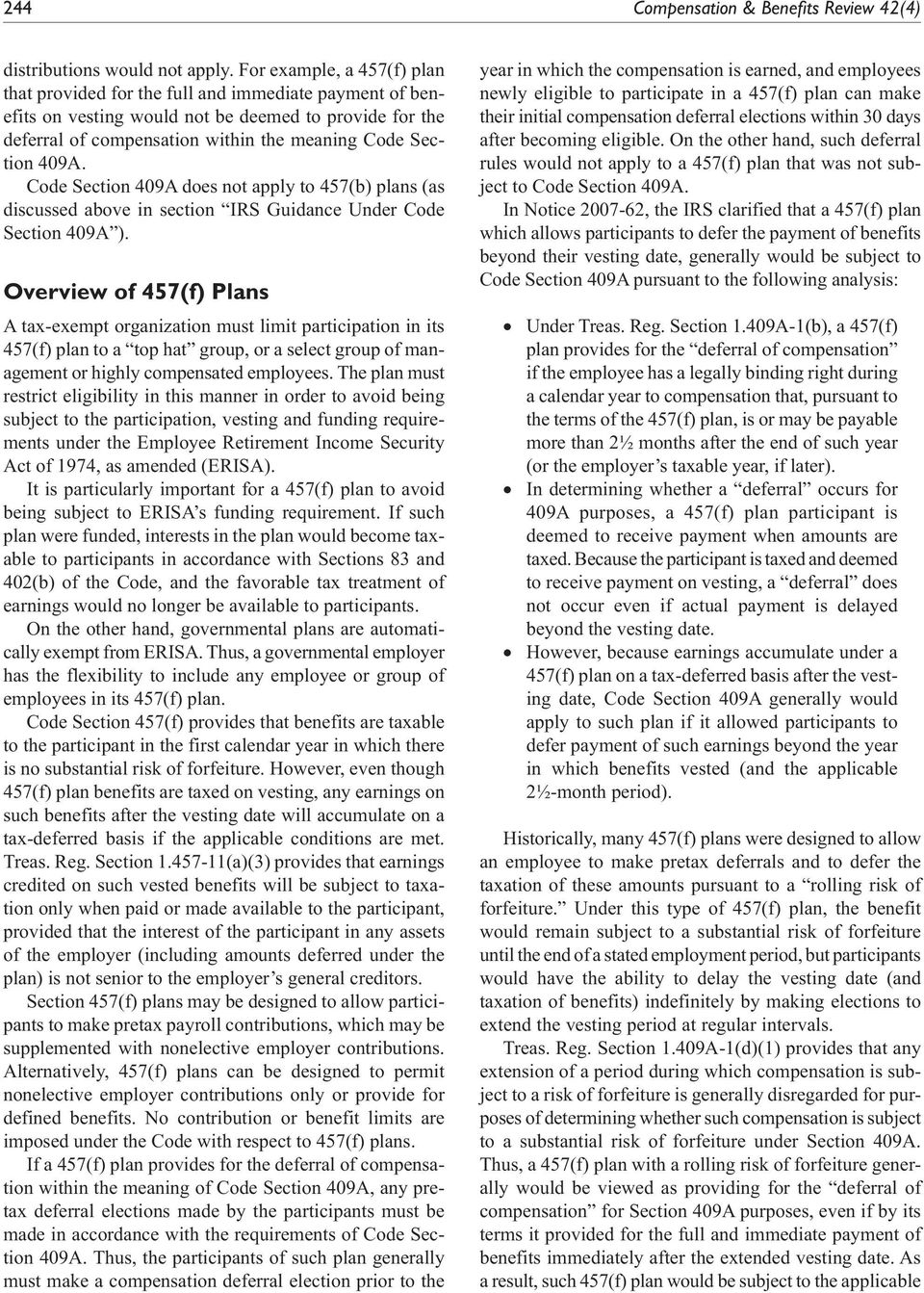
7 Wagner 245 limitations on deferral elections and distributions as mandated by Code Section 409A. In Notice , the IRS announced that it would be issuing guidance under Code Section 457(f) regarding the definition of a substantial risk of forfeiture under rules similar to those set forth under Treas. Reg. Section 1.409A-1(d). On issuance of such guidance, which is to take effect on a prospective basis only, benefits under a 457(f) plan with a rolling risk of forfeiture would become taxable on the lapse of the original vesting period, without regard to any extensions elected by the participant. Section 457(f) plans are legally unfunded, although they may be de facto funded through a rabbi trust arrangement. This means the contributions and investment earnings remain the property of the employer and, therefore, are subject to the claims of the employer s creditors until paid to a participant. As a matter of plan design, 457(f) plans may provide for distribution of benefits in full as of the vesting date. Alternatively, they may provide for distribution at a later date, and/or may provide for the payment of benefits in installments or other payment forms. If the 457(f) plan provides for the payment of benefits after the applicable vesting date, such plan could by design provide for a limited partial distribution that is sufficient to satisfy the required income tax withholding due on such vesting date. If a 457(f) plan provides for the deferral of compensation within the meaning of Code Section 409A, any distributions from the plan must be made in accordance with the requirements of Code Section 409A. Overview of 457(b) Plans A governmental 457(b) plan may include any employee or group of employees without limitation. In contrast, a tax-exempt organization must limit participation in its 457(b) plan to a top hat group, or a select group of management or highly compensated employees, to avoid being subject to the funding requirements under ERISA. It is critical for a 457(b) plan to avoid such funding requirements, because Code Section 457 expressly prohibits the funding of 457(b) plans maintained by tax-exempt organizations. A 457(b) plan gives participants the ability to make pretax payroll deferrals. A 457(b) plan by design may also provide for nonelective contributions from the employer. Generally, the combination of pretax payroll deferrals and nonelective employer contributions for a calendar year cannot exceed the IRS annual limit ($16,500 in 2009). Because the annual limit takes into account both elective and nonelective contributions, many 457(b) plans by design only permit elective contributions. In accordance with Code Section 457(b)(4), compensation will be deferred for any calendar month only if a deferral agreement has been entered into before the beginning of such month. During the last three calendar years ending before a participant s normal retirement age under the 457(b) plan, the limit (the catch-up limit ) can be increased by any unused annual limit from prior years while the plan was in effect up to an amount equal to double the IRS annual limit ($33,000 in 2009). With respect to governmental 457(b) plans only, a participant who is age 50 or older may make catch-up contributions in accordance with Code Section 414(v). If a participant in a governmental 457(b) plan is eligible for both the catch-up limit and for catch-up contributions under Section 414(v), the participant may take advantage of the higher of the two limits (which may not be combined). Section 457(b) plans customarily provide for full and immediate vesting for all elective deferrals and any nonelective contributions. Any vesting requirement with respect to nonelective employer contributions is likely to result in a violation of the IRS annual limit, since any contributions and earnings thereon vesting in the same year must be combined and counted against the IRS annual limit under the applicable Code Section 457 rules. Code Section 457 requires governmental 457(b) plans to be funded and held in trust for the exclusive benefit of participants. However, 457(b) plans maintained by taxexempt organizations must be legally unfunded, meaning that the contributions and investment earnings must remain the property of the employer and, therefore, remain subject to the claims of the employer s creditors until paid to a participant. However, a nongovernmental 457(b) plan may be informally funded through a rabbi trust arrangement. To satisfy the requirements under Code Section 457, a 457(b) plan may not make benefits available to participants earlier than the calendar year in which the participant attains age 70½, severance from employment and a financial hardship that constitutes an unforeseeable emergency. Minimum required distributions must commence under a 457(b) plan in accordance with the requirements of Code Section 401(a)(9). Governmental 457(b) plans are also subject to the substantive requirements under Code Section 401(a)(31) for eligible rollover distributions. Benefits under a 457(b) plan maintained by a tax-exempt organization are taxed when distributed or made available, whichever comes first. However, benefits under a governmental 457(b) plan are taxed when distributed. With the maze of IRS Code Sections, coupled with the complex notices and guidelines governing deferred compensation for 409A and 457 plans, employers should seek legal counsel prior to making a decision that could affect tax liabilities.

8 246 Compensation & Benefits Review 42(4) Declaration of Conflicting Interests The author(s) declared no conflicts of interest with respect to the authorship and/or publication of this article. Funding The author(s) received no financial support for the research and/or authorship of this article. Notes 1. Payment on separation from service must be delayed at least 6 months for specified employees. These are key employees as defined in the so-called top-heavy rules for qualified plans if their employer s stock is publicly traded. 2. The definition of disability is strict. The employee must be unable to engage in any substantial gainful activity by reason of an impairment that can be expected to last for a continuous period of not less than 12 months or to result in death. Alternatively, the employee must be receiving disability benefits replacing lost wages for a period of not less than 3 months under the employer s accident and health plan. 3. Payments made on separation from service, disability, death, change of control and so on would not violate the anti-acceleration rule if the 409A plan provided for payments on the occurrence of these events. 4. A good reason includes a material diminution in the employee s (or his or her supervisor s) base compensation, duties, or budget, according to the safe harbor definition in the Section 409A regulations. It also includes a material change in the employee s geographic location or material breach of the employment agreement. In addition, the employee must provide the employer with notice of the good reason condition within 90 days of its initial existence, and the employer must have at least 30 days to remedy the good reason condition. The severance pay must be paid within 2 years following the initial existence of the good reason condition. The amount, time and form of payment for a voluntary good reason separation must be identical to the amount, time and form of payment for an involuntary separation. Finally, these good reason requirements must be incorporated into the severance plan. Bio Marcia S. Wagner is the Managing Director of The Wagner Law Group, one of the largest law firms focused solely on ERISA, employee benefits and executive compensation law. She was recently named as the one of the top 40 most influential people in the 401(k) industry. She is a frequent speaker at national conferences and corporate training programs. Since 2007, she has served on the Internal Revenue Service Advisory Committee on Tax Exempt and Government Entities and is the 2010 Chair of the Employee Plans Section of the Advisory Council, which provides advice and consultation to the IRS on pension matters.
TAXATION OF DEFERRED COMPENSATION: OVERVIEW OF 409A AND 457. MCLE s Executive Compensation Law
 TAXATION OF DEFERRED COMPENSATION: OVERVIEW OF 409A AND 457 MCLE s Executive Compensation Law by: Marcia S. Wagner, Esq. The Wagner Law Group A Professional Corporation 99 Summer Street, 13 th Floor Boston,
TAXATION OF DEFERRED COMPENSATION: OVERVIEW OF 409A AND 457. MCLE s Executive Compensation Law
 TAXATION OF DEFERRED COMPENSATION: OVERVIEW OF 409A AND 457 MCLE s Executive Compensation Law by: Marcia S. Wagner, Esq. The Wagner Law Group A Professional Corporation 99 Summer Street, 13 th Floor Boston,
Final Nonqualified Deferred Compensation (409A) Regulations -- Focus on SERPs
 April 18, 2007 By John Lowell, Vice President, Aon Consulting On April 10, 2007, Treasury released final regulations under Internal Revenue Code (IRC) Section 409A, relating to the taxation of nonqualified
The Split Personalities of 457(b) Nonqualified Plans
 VOLUME 39, NUMBER 3 JOURNAL of PENSION PLANNING & COMPLIANCE Editor-in-Chief: Bruce J. McNeil, Esq. FALL 2013 JPPC The Split Personalities of 457(b) Nonqualified Plans DANIEL SCHWALLIE Daniel Schwallie,
2. Section 457(b) Eligible Deferred Compensation Plans
 I. SECTION 457 DEFERRED COMPENSATION PLANS OF STATE AND LOCAL GOVERNMENT AND TAX-EXEMPT EMPLOYERS AFTER THE SMALL BUSINESS JOB PROTECTION ACT OF 1996 AND THE TAXPAYER RELIEF ACT OF 1997 by Cheryl Press
Non-Qualifi ed Fringe Benefi t Planning
 Employee benefi t packages are increasingly viewed as an important form of compensation. The right mix of salary and other benefits can attract, and keep, top-quality employees. Non-Qualifi ed Fringe Benefi
DEFERRED COMPENSATION PLANS. 2 OVERVIEW OF 409A. 3 BASIC TYPES OF DEFERRAL ARRANGEMENTS. 5 ADMINISTRATION OF PLAN.
 Table of Contents DEFERRED COMPENSATION PLANS... 2 OVERVIEW OF 409A... 3 BASIC TYPES OF DEFERRAL ARRANGEMENTS... 5 ADMINISTRATION OF PLAN... 7 ANNUAL CHECKLIST FOR 409A PLAN SPONSORS... 20 This information
Nonqualified Plans of Non-Profit Employers and New Code Section 409A
 Nonqualified Plans of Non-Profit Employers and New Code Section 409A by Danny Miller Erica Summers Conner & Winters, P.C. 1627 I Street, N.W. Suite 900 Washington, D.C. 202-887-5711 (800) 579-0811 Nonqualified
401(k) Summary Plan Description
 401(k) Summary Plan Description WELLSPAN 401(K) RETIREMENT SAVINGS PLAN SUMMARY PLAN DESCRIPTION I I PRIOR TO II III I TABLE OF TO YOUR PLAN What kind of Plan is this? 5 What information does this Summary
PRO-SPHERE 401(K) PLAN SUMMARY PLAN DESCRIPTION
 PRO-SPHERE 401(K) PLAN SUMMARY PLAN DESCRIPTION TABLE OF CONTENTS INTRODUCTION TO YOUR PLAN What kind of Plan is this?... 1 What information does this Summary provide?... 1 ARTICLE I PARTICIPATION IN THE
The Anticipated 457(f) Regulations and How They Affect Deferred Compensation for Tax Exempts
 Representing & Managing Tax-Exempt Organizations April 28-29, 2011 Washington, DC The Anticipated 457(f) Regulations and How They Affect Deferred Compensation for Tax Exempts Submitted by: Gregory L. Needles
G Employee Benefits Alert
 G Employee Benefits Alert August 2001 The Economic Growth and Tax Relief Reconciliation Act of 2001 The Economic Growth and Tax Relief Reconciliation Act of 2001 (the Act ) ushers in the most significant
M. SECTION 457 DEFERRED COMPENSATION PLANS OF STATE AND LOCAL GOVERNMENT AND TAX-EXEMPT EMPLOYERS by Cheryl Press and Robert Patchell
 M. SECTION 457 DEFERRED COMPENSATION PLANS OF STATE AND LOCAL GOVERNMENT AND TAX-EXEMPT EMPLOYERS by Cheryl Press and Robert Patchell 1. Introduction Section 457 plans are nonqualified, unfunded deferred
Section 457(b) Plan. What is a Section 457(b) plan? What types of employers can use a Section 457(b) plan? Section 457(b) plans and ERISA
 Section 457(b) Plan What is a Section 457(b) plan? A Section 457(b) plan is a type of nonqualified deferred compensation plan that certain governmental and tax-exempt organizations can establish for their
Internal Revenue Code Section 409A Special Considerations: Unique Challenges Facing Tax-Exempt Organizations under the New Deferred Compensation Rules
 Internal Revenue Code Section 409A Special Considerations: Unique Challenges Facing Tax-Exempt Organizations under the New Deferred Compensation Rules Part II, Bulletin 3 Introduction Starting in 2005,
A GUIDE TO EXECUTIVE DEFERRED. An Employer s Quandry: How do we get more Deferred Compensation to Executives? Qualified Plans
 An Employer s Quandry: How do we get more Deferred Compensation to Executives? A GUIDE TO EXECUTIVE DEFERRED COMPENSATION In business, it is often difficult enough to determine what salaries and short
Schwab Individual 401(k) Plan Summary Plan Description
 Schwab Individual 401(k) Plan Summary Plan Description Employer Instructions 1. Complete the Summary Plan Description (SPD) in accordance with the elections you made on the Adoption Agreement. 2. Provide
INDEPENDENCE PLUS CONTRACT SERIES STATEMENT OF ADDITIONAL INFORMATION. FORM N-4 PART B May 2, 2016 TABLE OF CONTENTS
 THE VARIABLE ANNUITY LIFE INSURANCE COMPANY SEPARATE ACCOUNT A UNITS OF INTEREST UNDER GROUP AND INDIVIDUAL FIXED AND VARIABLE DEFERRED ANNUITY CONTRACTS INDEPENDENCE PLUS CONTRACT SERIES STATEMENT OF
DESIGNING DEFERRED COMPENSATION PLANS FOR TAX-EXEMPT ORGANIZATIONS
 DESIGNING DEFERRED COMPENSATION PLANS FOR TAX-EXEMPT ORGANIZATIONS A Discussion Draft Section 457(b) Eligible Plans Section 457 (f) Ineligible Plans Alternative Plan Approaches Note: these materials do
SUMMARY REVIEW COLORADO COUNTY OFFICIALS AND EMPLOYEES RETIREMENT ASSOCIATION 457 DEFERRED COMPENSATION PLAN FOR THE
 SUMMARY REVIEW FOR THE COLORADO COUNTY OFFICIALS AND EMPLOYEES RETIREMENT ASSOCIATION 457 DEFERRED COMPENSATION PLAN TABLE OF CONTENTS INTRODUCTION... i HIGHLIGHTS... 2 PARTICIPATION... 2 Eligibility to
Summary Plan Description
 Summary Plan Description Prepared for Norwich University Defined Contribution Retirement Plan INTRODUCTION Norwich University has restated the Norwich University Defined Contribution Retirement Plan (the
SUMMARY PLAN DESCRIPTION FOR THE BECKER TRUCKING, INC. 401(k) PROFIT SHARING PLAN AND TRUST. (January 1, 2009) Revised
 SUMMARY PLAN DESCRIPTION FOR THE BECKER TRUCKING, INC. 401(k) PROFIT SHARING PLAN AND TRUST (January 1, 2009) Revised TABLE OF CONTENTS Page (1) General... 1 (2) Identification of Plan... 1 (3) Type of
POWER SOLUTIONS INTERNATIONAL, INC. 70,000 SHARES OF COMMON STOCK TO BE ISSUED UNDER THE POWER GREAT LAKES, INC. EMPLOYEES 401(K) PROFIT SHARING PLAN
 PROSPECTUS POWER SOLUTIONS INTERNATIONAL, INC. 70,000 SHARES OF COMMON STOCK TO BE ISSUED UNDER THE POWER GREAT LAKES, INC. EMPLOYEES 401(K) PROFIT SHARING PLAN This document relates to retirement benefits
Alert. Client PROSKAUER ROSE SM. Employee Benefits Provisions Under the Economic Growth And Tax Relief Reconciliation Act of 2001
 PROSKAUER ROSE SM Client Alert Employee Benefits Provisions Under the Economic Growth And Tax Relief Reconciliation Act of 2001 On June 7, 2001, President Bush signed into law The Economic Growth and Tax
Executive Retirement Arrangements
 COMPENSATION COMMITTEE HANDBOOK &A Executive Retirement Arrangements Qualified Retirement Plans A qualified retirement plan is a funded plan for which organizational assets irrevocably have been set aside,
Cash or Deferred 401(k) Plan
 The Basics Any profit sharing or stock bonus plan that meets certain participation requirements of IRC Sec. 40(k) can be a cash or deferred plan. An employee can agree to a salary reduction or to defer
Offers flexible deferrals up to 100% of annual performance bonus and/or stock options gains
 PLAN SUMMARY Please note that the red text indicates optional plan features which vary from company to company based on overall compensation philosophy or personal preferences. Introduction The Standard
Union College 457(b) Deferred Compensation Plan
 457(b) Deferred Compensation Plan Plan Description is pleased to offer the 457(b) Deferred Compensation Plan (the "457(b) Plan") which was amended and restated as of January 1, 2016. The 457(b) Plan is
Primatics Financial 401(k) Profit Sharing Plan & Trust SUMMARY PLAN DESCRIPTION
 Primatics Financial 401(k) Profit Sharing Plan & Trust SUMMARY PLAN DESCRIPTION Primatics Financial 401(k) Profit Sharing Plan & Trust SUMMARY PLAN DESCRIPTION TABLE OF CONTENTS INTRODUCTION TO YOUR PLAN...1
Participant Name (First) (Middle Initial) (Last) Social Security Number I.D. Number. Participant Address (Street) City State ZIP Code + 4
 Mailing Address: Des Moines, IA 50392-0001 Principal Life Insurance Company Early Withdrawal of Benefits Without Guaranteed Accounts No Spousal Consent Needed CTD00603 Complete this form to withdraw part
Nonqualified Deferred C ompensation P lans. Prepared by Sentinel Benefits & Financial Group October 13, 2014
 Nonqualified Deferred C ompensation P lans Prepared by Sentinel Benefits & Financial Group October 13, 2014 2 Nonqualified Deferred Compensation Plans WHAT IS IT? A nonqualified deferred compensation (NQDC)
Applying Section 409A to Severance Benefits
 Applying Section 409A to Severance Benefits This Note explains the application of Internal Revenue Code section 409A relating to nonqualified deferred compensation plans to various types of severance benefits.
Non-Qualified Deferred Compensation Plans: What and Why? Presented by: Justin W. Stemple
 Non-Qualified Deferred Compensation Plans: What and Why? Presented by: Justin W. Stemple Qualified Plans 401(k), 403(b), profit-sharing, and defined benefit plans Broad based participation Limits on contributions
A QUESTION-AND-ANSWER GUIDE TO CODE SECTION 409A
 A QUESTION-AND-ANSWER GUIDE TO CODE SECTION 409A Section 409A created new requirements for nonqualified deferred compensation and imposes penalties on arrangements that do not comply with these requirements.
Summary Plan Description. PetSmart, Inc. SaveSmart 401(k) Plan
 Summary Plan Description PetSmart, Inc. SaveSmart 401(k) Plan As Revised Effective January 1, 2010 TABLE OF CONTENTS INTRODUCTION... - 1 - Type of Plan... - 1 - Plan Sponsor... - 1 - Purpose of This Summary...
PRESENT LAW AND BACKGROUND RELATING TO THE TAX TREATMENT OF RETIREMENT SAVINGS
 PRESENT LAW AND BACKGROUND RELATING TO THE TAX TREATMENT OF RETIREMENT SAVINGS Scheduled for a Public Hearing Before the HOUSE COMMITTEE ON WAYS AND MEANS on April 17, 2012 Prepared by the Staff of the
The Ideal Solution - A 457(f) Plan
 Cammack LaRhette s 403(b) Curriculum series provides timely articles to plan sponsors offering qualified 403(b), 401(a) and 457 plans. Qualified plans, such as 403(b) plans, may impose income restrictions
THE STATE of ARIZONA PUBLIC EMPLOYEES DEFERRED COMPENSATION PLAN FOR PUBLIC EMPLOYEES 457 GOVERNMENTAL PLAN AND TRUST EFFECTIVE DECEMBER 1, 2011
 THE STATE of ARIZONA PUBLIC EMPLOYEES DEFERRED COMPENSATION PLAN FOR PUBLIC EMPLOYEES 457 GOVERNMENTAL PLAN AND TRUST EFFECTIVE DECEMBER 1, 2011 Document provided as a courtesy of: 457 GOVERNMENTAL PLAN
Title IV Treatment of Rollovers from Defined Contribution Plans to Defined Benefit Plans
 [Billing Code 7709-02-P] PENSION BENEFIT GUARANTY CORPORATION 29 CFR Parts 4001, 4022, and 4044 RIN 1212-AB23 Title IV Treatment of Rollovers from Defined Contribution Plans to Defined Benefit Plans AGENCY:
GOLD CROSS SERVICES, INC. 401(K) RETIREMENT SAVINGS PLAN SUMMARY PLAN DESCRIPTION
 GOLD CROSS SERVICES, INC. 401(K) RETIREMENT SAVINGS PLAN SUMMARY PLAN DESCRIPTION TABLE OF CONTENTS INTRODUCTION TO YOUR PLAN What kind of Plan is this?... 1 What information does this Summary provide?...
Incentive Stock Options (ISOs) vs. Nonstatutory Stock Options (NSOs) Quick Comparison: Tax treatment of ISOs vs. NSOs
 Incentive Stock Options (ISOs) vs. Nonstatutory Stock Options (NSOs) Quick Comparison: Tax treatment of ISOs vs. NSOs ISOs NSOs Employees don t have to report any income when they exercise the option,
Summary Plan Description
 Summary Plan Description Prepared for Worcester Polytechnic Institute Defined Contribution Plan INTRODUCTION Worcester Polytechnic Institute has restated the Worcester Polytechnic Institute Defined Contribution
NORTHEASTERN UNIVERSITY BASIC RETIREMENT PLAN Summary Plan Description
 NORTHEASTERN UNIVERSITY BASIC RETIREMENT PLAN Summary Plan Description PURPOSE The purpose of the Northeastern University Basic Retirement Plan is to provide a centerpiece for participants in saving for
PENSION PLANS: EVERYTHING YOU NEED TO KNOW, BUT WERE AFRAID TO ASK. October, 2010
 PENSION PLANS: EVERYTHING YOU NEED TO KNOW, BUT WERE AFRAID TO ASK October, 2010 by: Marcia S. Wagner, Esq. The Wagner Law Group A Professional Corporation 99 Summer Street, 13 th Floor Boston, MA 02110
Hardship distributions. A hardship distribution is not eligible for rollover.
 SPECIAL TAX NOTICE REGARDING PLAN PAYMENTS 1 (Alternative to IRS Safe Harbor Notice - For Participant) This notice explains how you can continue to defer federal income tax on your retirement plan savings
457 PLANS 457(b) and 457(f) Plans NONQUALIFIED DEFERRED COMPENSATION PLANS
 457 PLANS 457(b) and 457(f) Plans NONQUALIFIED DEFERRED COMPENSATION PLANS What is a 457 Plan? Nonqualified Deferred Compensation Eligible Deferred Compensation Arrangement Restrictions on 457(b) Plans
SAVE MART 401(K) COMPANY MATCH PLAN SUMMARY PLAN DESCRIPTION
 SAVE MART 401(K) COMPANY MATCH PLAN SUMMARY PLAN DESCRIPTION DATED: April 2013 #12568514 TABLE OF CONTENTS Page INTRODUCTION... 1 1. Who is Eligible?... 3 2. What Affiliated Employers Participate in the
SPECIAL TAX NOTICE REGARDING PLAN PAYMENTS
 SPECIAL TAX NOTICE REGARDING PLAN PAYMENTS This notice explains how you can continue to defer federal income tax on your retirement plan savings in the Plan and contains important information you will
Qualified Retirement Plan
 Qualified Retirement Plan BASIC PLAN DOCUMENT 158198 12/10 QUALIFIED RETIREMENT PLAN AND TRUST BASIC PLAN DOCUMENT (EGTRRA) Table Of Contents DEFINITIONS...1 ACP Test Safe Harbor Matching Contributions...1
HCS RETIREMENT SERVICES
 Distribution Form HCS RETIREMENT SERVICES 1095 South 800 East Orem, UT 84097 Phone 801-224-1900 Fax 801-224-1930 www.hcsretirement.com EMPLOYER: PERSONAL INFORMATION Last Name: S.S. #: First Name: Date
Client Alert. An informational newsletter from Goodwin Procter LLP. Final Section 409A Regulations and Equity Compensation Arrangements
 May 3, 2007 Client Alert An informational newsletter from Goodwin Procter LLP Final Section 409A Regulations and Equity Compensation Arrangements Highlights of Final Regulations The IRS recently published
SUFFOLK UNIVERSITY STANDARD RETIREMENT PLAN AND VOLUNTARY TAX DEFERRED ANNUITY PLAN PLAN DOCUMENT
 SUFFOLK UNIVERSITY STANDARD RETIREMENT PLAN AND VOLUNTARY TAX DEFERRED ANNUITY PLAN PLAN DOCUMENT Restated as of January 1, 2009 1 TABLE OF CONTENTS ARTICLE I ESTABLISHMENT OF PLAN 1.1 Establishment of
OVERVIEW OF DEFERRED COMPENSATION ARRANGEMENTS UNDER SECTION 409A
 OVERVIEW OF DEFERRED COMPENSATION ARRANGEMENTS UNDER SECTION 409A I. What Is Nonqualified Deferred Compensation? 1 A. Types of Arrangements B. Not Tax-Qualified C. General Exemption From ERISA II. Background
SOUTHERN OHIO EDUCATIONAL SERVICE CENTER. 403(b) RETIREMENT PLAN
 SOUTHERN OHIO EDUCATIONAL SERVICE CENTER 403(b) RETIREMENT PLAN TABLE OF CONTENTS Parties to Agreement................................................... 3 Recitals.............................................................
PRESENT LAW AND BACKGROUND RELATING TO EMPLOYER-SPONSORED DEFINED BENEFIT PENSION PLANS AND THE PENSION BENEFIT GUARANTY CORPORATION ( PBGC )
 PRESENT LAW AND BACKGROUND RELATING TO EMPLOYER-SPONSORED DEFINED BENEFIT PENSION PLANS AND THE PENSION BENEFIT GUARANTY CORPORATION ( PBGC ) Scheduled for a Public Hearing Before the SENATE COMMITTEE
Salary Reduction Simplified Employee Pension (SAR-SEP) Plan Employer Adoption Agreement For Use with the Traditional IRA Application
 december 2011 Salary Reduction Simplified Employee Pension (SAR-SEP) Plan Employer Adoption Agreement For Use with the Traditional IRA Application Employer s Guide to the SAR-SEP Plan Salary Reduction
TRADITIONAL IRA DISCLOSURE STATEMENT
 TRADITIONAL IRA DISCLOSURE STATEMENT TABLE OF CONTENTS REVOCATION OF ACCOUNT... 1 STATUTORY REQUIREMENTS... 1 (1) Qualification Requirements... 1 (2) Required Distribution Rules... 1 (3) Approved Form....
[PLACE YOUR COMPANY NAME HERE] BASIC PLAN DOCUMENT #CE-ESOP [INTENDED FOR CYCLE A2]
![[PLACE YOUR COMPANY NAME HERE] BASIC PLAN DOCUMENT #CE-ESOP [INTENDED FOR CYCLE A2]](/thumbs/36/17625620.jpg "[PLACE YOUR COMPANY NAME HERE] BASIC PLAN DOCUMENT #CE-ESOP [INTENDED FOR CYCLE A2]") [PLACE YOUR COMPANY NAME HERE] BASIC PLAN DOCUMENT #CE-ESOP [INTENDED FOR CYCLE A2] Copyright, 2002-2011 [PLACE YOUR COMPANY NAME HERE] All Rights Reserved. [PLACE YOUR COMPANY NAME HERE] BASIC PLAN DOCUMENT
[PLACE YOUR COMPANY NAME HERE] BASIC PLAN DOCUMENT #CE-ESOP [INTENDED FOR CYCLE A2] Copyright, 2002-2011 [PLACE YOUR COMPANY NAME HERE] All Rights Reserved. [PLACE YOUR COMPANY NAME HERE] BASIC PLAN DOCUMENT
UNIVERSITY OF MISSOURI. Tax-Deferred Investment Plans Tax Deferred Annuity Plan (403b) Deferred Compensation Plan (457b)
 UNIVERSITY OF MISSOURI Tax-Deferred Investment Plans Tax Deferred Annuity Plan (403b) Deferred Compensation Plan (457b) Plan design effective January 1, 2010 This booklet is designed to provide an overview
Guide to Nondiscrimination Testing for Code Section 403(b) Plans. For Employers
 Guide to Nondiscrimination Testing for Code Section 403(b) Plans For Employers Table of contents PREFACE... III Question and Answers about Nondiscrimination Testing for Section 403(b) Tax-Sheltered Annuity
Retirement Savings Plans for Radiologists: Part 1 The Options
 Retirement Savings Plans for Radiologists: Part 1 The Options Jeffrey J. Brown, MD, MBA a, Jason R. Kerr, MD a, Brian S. Johnston, MD b Employer-sponsored retirement plans are the primary savings vehicles
NOVA SOUTHEASTERN UNIVERSITY 401(K) PLAN SUMMARY PLAN DESCRIPTION
 NOVA SOUTHEASTERN UNIVERSITY 401(K) PLAN SUMMARY PLAN DESCRIPTION 11/21/11 TABLE OF CONTENTS INTRODUCTION TO YOUR PLAN What kind of Plan is this?...1 What information does this Summary provide?...1 ARTICLE
Defined Contribution and Tax-deferred Annuity Retirement Plan. Summary Plan Description
 Defined Contribution and Tax-deferred Annuity Retirement Plan Summary Plan Description Updated September 2015 This document provides each Participant with a description of the Institution's Defined Contribution
A. TYPES OF PLAN DISTRIBUTIONS
 SPECIAL TAX NOTICE REGARDING PLAN PAYMENTS 1 (Alternative to IRS Safe Harbor Notice - For Participant) This notice explains how you can continue to defer federal income tax on your retirement plan savings
Application of ERISA
 Special Issues for Non-Profits - Employee Benefits Ginny Schubert Employee Benefits & Executive Compensation Practice Group Gray, Plant, Mooty [email protected] Application of ERISA Does ERISA
CASH DISTRIBUTION FORM For VALIC Annuity Accounts Only All Plan Types
 1. CLIENT INFORMATION Name: Daytime Phone: ( ) Date of Birth: SSN or Tax ID: 2. DISTRIBUTION REQUEST Please select either OPTION A or OPTION B below. Selecting both options will delay processing your distribution
YALE UNIVERSITY RETIREMENT ACCOUNT PLAN SUMMARY PLAN DESCRIPTION
 YALE UNIVERSITY RETIREMENT ACCOUNT PLAN SUMMARY PLAN DESCRIPTION Effective January 1, 2015 Table of Contents Introduction...1 Definitions...2 Eligible Employee...5 Eligible Employees... 5 Excluded Employees...
DELUXE CORPORATION 401(k) AND PROFIT SHARING PLAN SUMMARY PLAN DESCRIPTION
 DELUXE CORPORATION 401(k) AND PROFIT SHARING PLAN SUMMARY PLAN DESCRIPTION October 1, 2015 151027:0918 INFORMATION IN THIS SUMMARY INTRODUCTION... 1 WHY CONTRIBUTE TO THE PLAN?... 2 ELIGIBILITY... 2 Eligibility
SPECIAL TAX NOTICE FOR PARTICIPARTS RECEIVING PLAN BENEFIT PAYMENTS
 SPECIAL TAX NOTICE FOR PARTICIPARTS RECEIVING PLAN BENEFIT PAYMENTS SPECIAL TAX NOTICE REGARDING PLAN PAYMENTS This notice explains how you can continue to defer federal income tax on your retirement plan
Distribution Election Form
 IMPORTANT INFORMATION Distribution Election Form Please complete the form in its entirety. Missing pages and/or incomplete forms will delay processing. After completion, please return form to Pension Inc.
AUBURN UNIVERSITY. 457(b) DEFERRED COMPENSATION PLAN SUMMARY EXPLANATION OF THE PLAN
 AUBURN UNIVERSITY 457(b) DEFERRED COMPENSATION PLAN SUMMARY EXPLANATION OF THE PLAN Effective September 6, 2012 AUBURN UNIVERSITY 457(b) DEFERRED COMPENSATION PLAN SUMMARY EXPLANATION OF THE PLAN TABLE
Retirement System. IRS Compliance Policy I\5165269.7
 Retirement System IRS Compliance Policy August 2015 Table of Contents I. SECTION 1. PUBLIC EMPLOYEES RETIREMENT SYSTEM TIERS 1, 2, AND 3 DEFINED BENEFIT PLAN...2 A. Rollover Distributions Compliance with
Most venture-backed companies do not have
 Structuring Stock Options and Severance Payments after Section 409A: Practical Advice for Venture-backed Companies BY A. WILLIAM CAPORIZZO AND KIMBERLY B. WETHLY WITH SPECIAL THANKS TO EDWARD YOUNG Most
YOUR GUIDE TO YOUR UNITED AMERICAN IRA
 3700 S. STONEBRIDGE DRIVE POST OFFICE BOX 8080 MCKINNEY, TEXAS 75070-8080 YOUR GUIDE TO YOUR UNITED AMERICAN IRA PLAN CODE: E91 UASA DF PC E91 UAI1422 1209 Your Guide to Your United American IRA This Guide
Recent Developments Affect Puerto Rico Retirement Plans
 Recent Developments Affect Puerto Rico Retirement Plans Volume 35 Issue 04 January 25, 2012 Employers with employees in Puerto Rico should be aware of three recent developments affecting Puerto Rico retirement
SPECIAL TAX NOTICE REGARDING PLAN PAYMENTS
 SPECIAL TAX NOTICE REGARDING PLAN PAYMENTS This notice explains how you can continue to defer federal income tax on your retirement plan savings in the Plan and contains important information you will
Qualified Retirement Plan and Trust Defined Contribution Basic Plan Document 03
 Qualified Retirement Plan and Trust Defined Contribution Basic Plan Document 03 PO Box 2760 Omaha, NE 68103-2760 Fax: 866-468-6268 TABLE OF CONTENTS DEFINITIONS.... 5 2009 RMD.... 5 ACP Test Safe Harbor
Internal Revenue Service Department of the Treasury CC:TEGE:QP2 - PLR-167048-01. Entity E =
 Internal Revenue Service Department of the Treasury Number: 200301032 Release Date: 01/03/2003 Index No. 106.00-00 457.01-00 403.04-00 457.10-00 Legend Entity E = CC:TEGE:QP2 - September 30, 2002 Dear
Nonqualified Deferred Compensation Plans Why Administration Matters
 Nonqualified Deferred Compensation Plans Why Administration Matters By: Howard D. Stern, FSA Vice President & Actuary The Pangburn Company HOWARD D. STERN, FSA is Vice President and Actuary with the Pangburn
Frequently asked questions
 Page 1 of 6 Frequently asked questions Distributions and rollovers from retirement accounts Choosing what to do with your retirement savings is an important decision. Tax implications are just one of several
Legal Alert: Pension Protection Act of 2006 IRAs, 403(b) Plans, and 457 Plans
 Legal Alert: Pension Protection Act of 2006 IRAs, 403(b) Plans, and 457 Plans August 21, 2006 The Pension Protection Act of 2006, despite its focus on pension funding rules, touches in various ways on
RETIREMENT NEWS. March/April 2014 P.O. Box 1789 302 East Main Street Albertville, AL 35950 (800) 545-6741
 March/April 2014 P.O. Box 1789 302 East Main Street Albertville, AL 35950 (800) 545-6741 RETIREMENT NEWS In plan Roth Rollovers The in-plan Roth rollover (IRR) was created by the Small Business Jobs and
Compensating Owners and Key Employees of Partnerships and LLC's
 College of William & Mary Law School William & Mary Law School Scholarship Repository William & Mary Annual Tax Conference Conferences, Events, and Lectures 2013 Compensating Owners and Key Employees of
COLGATE UNIVERSITY DEFINED CONTRIBUTION RETIREMENT PLAN SUMMARY PLAN DESCRIPTION JANUARY 2013
 COLGATE UNIVERSITY DEFINED CONTRIBUTION RETIREMENT PLAN SUMMARY PLAN DESCRIPTION JANUARY 2013 TABLE OF CONTENTS ARTICLE I PARTICIPATION IN THE PLAN Page Am I eligible to participate in the Plan?... 2 When