
Capacity Assessment for Information Systems on Food and Nutrition Security in Puntland. Final Report
|
|
|
- Gordon Williams
- 9 years ago
- Views:
Transcription
1 Capacity Assessment for Information Systems on Food and Nutrition Security in Puntland Final Report Garowe and Nairobi, August 2015 Report prepared by Food Security and Nutrition Analysis Unit (FSNAU) In collaboration with The Puntland Minstry of Planning and International Cooperation
2 ACRONYMS ADESO CARE CD FAO FSNAU HADMA IYCF MOAI MOEWT MOC MOF MOH MOI MOLAH MOLYS MOPIC MOWDAFA NGOs PSAWEN PSU SRCS SWALIM UN UNICEF Africa Development Solutions Cooperative American Relief Everywhere Capacity Development Food and Agriculture Organization of the United Nations Food Security and Nutrition Analysis Unit Humanitarian Affairs and Disaster Management Agency Infant and Young Child Feeding Ministry of Agriculture and Irrigation Ministry of Environment, Wildlife and Tourism Ministry of Commerce Ministry of Fisheries Ministry of Health Ministry of Interior Ministry of Livestock and Animal Husbandry Ministry of Labour, Youth and Sports Ministry of Planning and International Cooperation Ministry of Women Development and Family Affairs Non-Governmental Organizations Puntland State Agency for Water, Energy and Natural Resources Puntland State University Somali Red Crescent Society Somalia Water and Land Information Management United Nations United Nations Children s Fund WFP WHO World Food Programme World Health Organization WASH WVI Water, Sanitation and Hygiene World Vision International

3 Table of Content Page Executive Summary Background and Introduction Capacity Assessment Approach Capacity Assessment Main Findings Findings on Production Sector Working Group Findings on Health and Nutrition Sector Working Group Findings on Cross-cutting Issues and Coordination Sector Working Group Priority Follow-up Actions to Address Major Identified Gaps Annex 1 Capacity Assessment Report for Production Sector Working Group Annex 2 Capacity Assessment Report for Health and Nutrition Sector Working Group.. 24 Annex 3 Capacity Assessment Report for Cross Cutting Sector Working Group Annex 4 - Draft Priority Plan of Action Annex 5 List of Participants of Capacity Needs Assessment Workshop in Garowe Annex 6 - Principles of FAO s Capacity Development Strategy

4 Capacity Assessment for Information Systems on Food and Nutrition Security in Puntland August 2015 Executive Summary The Government of Puntland attaches significant importance to the development of the capacities of its institutions in terms of their ability to effectively monitor, assess, analyze and report on the food security and nutrition situation across Puntland State. Puntland s Second Five-Year Development Plan ( ) emphasizes that good governance is the fundamental pillar for any development plan because no development plan will succeed if government institutions, entrusted to implement this plan, are not functioning properly. Therefore, it s necessary for Puntland government to have a strong institutional building in terms of having the combination of the right institutions, policies and civil servants, who are capable of confidently carrying out the effective and efficient public services badly needed by the people of Puntland in general and the most marginalized groups in particular. This requires civil servants to possess the right skills, experience and equipment. It further indicates that there is a need for improving the institutional and human resources capacity of all government agencies. Consistent with the above, one of the partners providing capacity development support to Puntland Government institutions is the Food Security and Nutrition Analysis Unit (FSNAU) of the Food and Agriculture Organization (FAO) of the United Nations. Under previous phases, FSNAU capacity development support to Puntland institutions has been limited to the provision of training and ICT equipment. Under the current phase of the FSNAU project (2013/ /17), FSNAU has developed a more comprehensive capacity development strategy. Consistent with this strategy and in collaboration with the Puntland Ministry of Planning and International Cooperation (MOPIC), a capacity needs assessment organized a participatory capacity needs assessment workshop in Garowe from 22 to 24 November 2014 with the participation of 60 senior technical staff drawn from key counterpart government institutions, local and international NGOs, academic institutions, UN agencies partners and other relevant stakeholders (See Annex 6 for list of institutions which participated in the workshop). The objective of the workshop was to facilitate a coordinated and harmonized identification of capacity development needs and priorities of Puntland government institutions and inform future food security and nutrition related capacity development initiatives by the Government of Puntland, FSNAU as well as other partners. In the past, the international community claims that development assistance focused mainly on transfer of knowledge, resulting in transfer of blue print solutions from one region to another. This has sometimes contributed to the successful application of ready-made solutions, but not necessarily to strengthen the abilities of the national system to analyze their situation, lead programs and develop suitable solutions. Below is presented a summary of the key principles of the Capacity Development (CD) strategy adopted by FAO1 and the international development community: i. Three-dimensional approach: the new CD approach involves more than just learning, training and knowledge; a comprehensive three-dimensional approach is needed to strengthen also organizational capacities and the enabling environment. ii. Country leadership: in the new CD approach, country actors take a lead role in the process of enhancing their systems, structures and institutions. 1 Approved by FAO s Council in

5 Capacity Assessment for Information Systems on Food and Nutrition Security in Puntland iii. iv. v. vi. August 2015 Context specificity: it is important to remember that there is no easy one-size-fits-all solution for CD; CD interventions need to be tailored to the context in question. Beyond technical capacities: new CD approach addresses not only technical capacities for example in food and nutrition security but also functional capacities which are those needed to sustain change2. Institutionalization of functions and processes: CD approach encourages sustainable organizational changes by supporting institutions to internalize functions and operational procedures in their structures and mandates. Action-Reflection Cycle: to ensure effectiveness, CD projects need to be based on a sound understanding of key factors influencing changes in the country system. See Annex 6 for further details on principles of FAO s capacity development strategy. FAO carries out capacity assessments together with key national stakeholders on major capacity issues, perceptions and suggestions across the three dimensions (enabling environment, organizations and individuals) to create country ownership and to identify the capacity strengths and gaps in the specific context. Prior to the capacity workshop held from 22 to 24 November 2014, FSNAU developed and communicated capacity assessment questionnaires to food security and nutrition related institutions of the Government of Puntland. The institutions were advised to complete the questionnaires and discuss them internally in preparation for the November 2014 workshop. The information collected through the questionnaires was validated during the participatory workshop, using a combination of FAO corporate capacity assessment tools, focus group (thematic) and plenary discussions where workshop participants reviewed existing mechanisms for collecting, analyzing and reporting food security and nutrition information, including coordination structures; assess their strengths and weaknesses; formulate desired changes based on identified gaps and recommend next steps. The three thematic working groups were: 1. Production Sector Working Group (Agriculture, Livestock, Fisheries, Labor, Water and Environment) 2. Health and nutrition 3. Cross-cutting (Planning, Labor, Gender, Market and Coordination) The three working groups reviewed and discussed several focus questions aimed at assessing capacities of existing institutions in Puntland. The focus questions were organized and elaborated under the following themes: 1. Food security and nutrition information needs related to the policy formulation and decision-making processes 2. Analysis and production of food security and nutrition information 3. Information systems on food security and nutrition (data collection); and 4. Institutional set up for cross-sectoral coordination The focus groups concluded that food security and nutrition information is primarily needed for: 2 Functional capacities are: (1) implement policies and programmes, (2) establish and maintain partnerships, (3) retrieve and share knowledge, and (4) formulate policy. 2

6 Food security and nutrition policy development and programme formulation Program planning and resource mobilization and advocacy for investment in food security and nutrition Seasonal food security monitoring and early warning Nutrition surveillance-changes in situation over time Emergency needs assessment and response planning The groups also identified substantial gap in terms of existing staff for food security and nutrition related survey planning and coordination, data collection, data management, data analysis, report writing and dissemination. Capacity strengths identified were: Stable political situation and working environment Existence of government institutions with clear mandates and There are functional organizational structures within government institutions Some skilled manpower and technical expertise is already available locally in various capacities Capacity weaknesses identified were: Lack of staff motivation due to low salary payments owing to government financial/budgetary constraints resulting in high turnover of civil servants and poor retention Limited knowledge and low level of skills among (technical) government staff Low budget allocation by government and high dependence on external funding Overlapping responsibilities and conflicting mandates among government institutions and low coordination between government institutions and other stakeholders Weak implementation of policies and strategies due to government structures not being fully functional at district/community level and inadequate functional government capacity for policy implementation and enforcement Based on the foregoing assessment of capacity strengths and gaps (weaknesses), the following were identified as priority follow up actions by government line ministries, FSNAU/FAO and other partners who provide capacity development support to government institutions in the area of food security and nutrition assessment, analysis, reporting and coordination. The follow up actions are presented in four thematic areas as follows: 1) Data Collection: Development of production sector information system (including livestock and crop production, marketing, water and land) 2) Production and analysis of information Awareness creation and sensitization of stakeholders on food security and nutrition, including at community level Establishment of regional and district level food security and nutrition information dissemination mechanisms Establishment of linkages with regional food security and nutrition bodies Establish forums for validation and consensus building among stakeholders on situation analysis and assessment findings Media involvement in food security and nutrition information dissemination 3) Institutional Setup: 3

7 Clarification of mandates and responsibilities among food security and nutrition stakeholders Establishment of a cross-sectoral Puntland level Food Security and Nutrition Unit within an appropriate government ministry/institution Institutional capacity development support to improve government technical and implementation capacity Coordination structures exist at sectoral levels; however, it is necessary to establish inter-sectoral food security and nutrition coordination structures and mechanisms at technical and policy levels Establishment of collaboration with local Universities 4) Policy formulation: Many policies exist of relevance to food security; however, it is necessary to formulate a dedicated national food security policy and strategy Improve government ownership, leadership and political commitment The participatory capacity assessment process 1. There was a strong participation by technical as well as policy level staff of all relevant Puntland government institutions in the assessment and action planning workshop; participation by national and international NGOs and academic institutions was also commendable. However, some important UN and NGO partners were not able to participate in the workshop due to other engagements. 2. Reviewing and completing the focus questions in advance of the workshop and subsequently validating these through discussions in working groups made the capacity assessment more rigorous. Although less complete, the completed focus questions for individual institutions are also considered useful for further discussions and planning within these institutions. 3. Drawing lessons from a previous experience, reducing the duration of the workshop to three days together with adequate advance preparation in terms of completing focus questions for individual institutions was an improvement. 4
8 Capacity Assessment for Information Systems on Food and Nutrition Security in Puntland August Background and Introduction The main livelihood systems in Puntland are pastoral, agropastoral and urban. Frankincense and fishing are also important sources household income in the extreme northeast along the coastal parts of the region. The Government of Puntland attaches significant importance to the development of the capacities of its institutions in terms of their ability to effectively monitor, assess, analyze and report on the food security and nutrition situation across Puntland State. Puntland s Second Five-Year Development Plan ( ) emphasizes that good governance is the fundamental pillar for any development plan because no development plan will succeed if government institutions, entrusted to implement this plan, are not functioning properly. Therefore, it s necessary for Puntland government to have a strong institutional building in terms of having the combination of the right institutions, policies and civil servants, who are capable of confidently carrying out the effective and efficient public services badly needed by the people of Puntland in general and the most marginalized groups in particular. This requires civil servants to possess the right skills, experience and equipment. It further indicates that there is a need for improving the institutional and human resources capacity of all government agencies. Consistent with the above, one of the partners providing capacity development support to Puntland Government institutions is the Food Security and Nutrition Analysis Unit (FSNAU) of the Food and Agriculture Organization (FAO) of the United Nations. Under previous phases, FSNAU capacity development support to Puntland institutions has been limited to the provision of training and ICT equipment. Under the current phase of the FSNAU project (2013/ /17), FSNAU has developed a more comprehensive capacity development strategy. Consistent with this strategy and in collaboration with the Puntland Ministry of Planning and International Cooperation (MOPIC), a capacity needs assessment organized a participatory capacity needs assessment workshop in Garowe from 22 to 24 November 2014 with the participation of senior technical staff drawn from key counterpart government institutions, local and international NGOs, academic institutions, UN agencies partners and other relevant stakeholders (See Annex 6 for list of institutions which participated in the workshop). The objective of the workshop was to facilitate a coordinated and harmonized identification of capacity development needs and priorities of Puntland government institutions and inform future food security and nutrition related capacity development initiatives by the Government of Puntland, FSNAU as well as other partners. 2. Capacity Assessment Approach The FAO approach to capacity development defines capacity assessments as structured discussions with key national stakeholders on major capacity issues, perceptions and suggestions at different levels. They allow a comparison of existing capacities with desired levels of capacities3. They are guided by three main questions: Where are we now? Where do we want to go? What is the best way to get there? 3 FAO (2012), FAO Approaches To Capacity Development In Programming: Processes And Tools (Module 2) 5

9 Capacity Assessment for Information Systems on Food and Nutrition Security in Puntland August 2015 The institutional capacity assessment seeks to provide an overview of the current status of the government of Puntland s capacities, development opportunities and capacity constraints in the areas of food and nutrition analysis, response planning and decision making with a particular focus on the capacities in gathering data, analyzing and reviewing food security information, and the development of food security policies and strategies. The capacity assessment approach started with identification of the main stakeholders working on food security issues and the main policies and strategies that contribute to food and nutrition security in Puntland. The standard FAO capacity assessment involves the following main steps: 1) Preparatory phase: Through discussion with key national counterparts, define the purpose of the capacity assessment and obtains a shared vision of the capacity constraints and opportunities. Analyze stakeholders which can influence the capacity development process. Analyze the context 2) Implementation phase: Dialogue with decision-makers (high-level and senior government officials) to seek high level support Dialogue with relevant international stakeholders at the country level Establish the capacity-assessment team Assess capacity assets and needs Document and validate results with national stakeholders and prioritize follow up actions The preparatory phase for the capacity assessment in Puntland started in late February 2014 during bilateral meetings with the Ministry of Planning and International Cooperation (MOPIC) and on the FSNAU capacity development strategy. Due to budget and time constraints and drawing lessons learned from a similar workshop conducted in Somaliland, the implementation phase was condensed and squeezed in to a three-day participatory workshop for the capacity needs assessment conducted in Puntland, The assessment used the FAO corporate Capacity Development Approach to develop the questionnaires for capacity needs assessment by tailoring the tools to the context in Puntland. A three-day workshop was organized in Garowe based on lessons learned from a similar workshop conducted in Somaliland in May A total of 60 senior technical staff drawn from Puntland government institutions, national/local academic institutions, local and international NGOs, FAO Somalia and other UN agencies participated in the participatory capacity needs assessment workshop. Workshop participants were divided into three thematic Working groups: 1. Production Sector Working Group (Agriculture, Livestock, Fisheries, Labor, Water and Environment) 2. Health and nutrition 3. Cross-cutting (Planning, Labor, Gender, Market and Coordination) The three Working groups reviewed and discussed several focus questions aimed at assessing capacities of existing institutions in Puntland. 6

10 The focus questions were organized and elaborated under the following themes: 1. Food security and nutrition information needs related to the policy formulation and decision-making processes 2. Analysis and production of food security and nutrition information 3. Information systems on food security and nutrition (data collection); and 4. Institutional set up for cross-sectoral coordination Capacity assessment findings based on the outcome of the deliberations within the three working groups and subsequent discussions in plenary sessions are highlighted below. 3. Capacity Assessment Main Findings The assessment findings are presented below each of the three thematic working groups separately. 3.1 Findings on Production Sector Working Group (Agriculture, Livestock, Fisheries, Labour, Water and Environment) The group identified the following key uses of and the demand for food security and nutrition information: food security/nutrition policy development and programme formulation, seasonal monitoring and early warning, and emergency needs assessment and response planning. In terms of who should receive and use food security and nutrition information, the group identified government, donors and humanitarian/development agencies, and research and educational institutions as the main users and intended users. The group also indentified key food security related policies and strategies that currently exist: environmental policy, water policy, and livestock marketing policy. However, the group also recommended additional policies ones (food security and nutrition policy, land use policy, and fishery policy). The group concluded that the type and frequency of existing food security and nutrition data collection are insufficient; most of the data collection is being done by partners (UN agencies, NGOs, etc); and most of the data collection is being done at national and regional levels. In terms of analysis and production of food security and nutrition information, the group highlighted that the type and frequency of existing food security and nutrition reports are insufficient; most of these reports are produced by partners (UN agencies, NGOs, etc); and awareness of most of these reports among stakeholders is low. Food security and nutrition related skills of individuals in government institutions in the production sector: Skills # of Existing Staff Additional Staff Required Planning and coordination 9 45 Data collection Data management 6 30 Data analysis Report writing 6 25 Dissemination Based on capacity assessment questionnaires completed prior to the workshop, the group identified substantial gap in terms of skills of individuals in government institutions in all 7

11 relevant skill areas (survey planning and coordination, data collection, data management, data analysis, report writing, and dissemination). In terms of existing food security and nutrition related coordination mechanisms, the group identified the following: Food Security and Livelihood Cluster, Emergency Coordination and Production Sector Coordination meetings. The group also proposed the establishment of a Food Security and Nutrition Steering Committee and a Food Security and Nutrition Technical Unit as additional coordination mechanisms. In terms of strengths and weaknesses of existing institutions, the group identified the following strengths: a stable security situation and working environment; existence of government institutions with mandates; and available human resource. Weaknesses identified by the group are lack of motivation due to low payments/financial constraints; low coordination between government institutions and with other stakeholders; and weak knowledge and limited expertise. The group identified the following desired changes and associated priority capacity development interventions: 1. Establishment of Puntland level Food Security and Nutrition Unit within an appropriate government ministry/institution through: Food security and nutrition policy design, implementation and sustainability Capacity building for the established Food Security and Nutrition Unit Budget allocation for the unit 2. Regional and district level food security and nutrition information dissemination mechanisms through: Improved community knowledge of food security and nutrition information Food security and nutrition dialogues, forums, workshops Media involvement in food security and nutrition information dissemination 3. Production sector information management through: Environmental and climate change information sharing and awareness The development of water and land information system The assessment and monitoring of agricultural production (livestock & crop) and marketing Further details on the consolidated capacity assessment of the Production Sectors can be found in Annex Findings on Health and Nutrition Sector Working Group Nutrition surveillance which is a systematic and periodic collection of information on nutrition is vital to the capacity of governments to track their progress towards reducing acute malnutrition; to promote accountability of their actions and to improving their ability to respond promptly to rapid changes in nutrition status brought about by shocks (e.g. disease outbreak, food price volatility, etc). Acute malnutrition amongst children under five is widespread in Puntland, with sustained high levels of acute malnutrition. This underscores the need to ensure that nutrition information and analysis is duly considered and incorporated in early warning, in planning, programming, as well as monitoring and evaluation of humanitarian and development programs. The Health and Nutrition working group identified the following key uses of food security and nutrition information: for assessing the type, magnitude and severity of malnutrition; for 8

12 monitoring changes in the nutrition situation over time (nutrition surveillance); and for program planning and resource mobilization (i.e. using information for advocacy for increased investment in food security and nutrition). The three key uses identified by participants are consistent with the following objectives of establishing a national food security and nutrition information system: (1) policy or strategy development; (2) program formulation, (3) emergency response planning and (4) resource mobilization and advocacy. The group identified as users or intended users of food security and nutrition information: government, relevant partners (UN, INGOs, LNGOs and academic and research institutions), and donors. The group identified the existence of the following food security and nutrition policies and strategies in Puntland: nutrition strategy, micro-nutrient strategy, and health and nutrition policy. Nutrition is integrated within health in terms of the institutional and policy framework. The group also identified the need for the following additional policies/strategies: behavioral change/communication policy on nutrition, food safety strategy, food fortification policy. There was consensus by participants that meetings on policy dialogue on nutrition and health should be led and organized by the Ministry of Health while ensuring the participation of all other relevant ministries (Agriculture, Livestock, Education, Fisheries, Planning, HADMA and others). The group noted that the type and frequency of existing food security and nutrition data collection are insufficient; most of the data collection is being done by partners (UN agencies, NGOs, etc); and most of the nutrition related data collection is being done at livelihood level (not at district level). In terms of analysis and production of food security and nutrition information, the group concluded that the type and frequency of existing food security and nutrition reports are insufficient; most of these reports are produced by partners (UN agencies, NGOs, etc); and awareness of most of these reports is medium among stakeholders. Food security and nutrition related skills of individuals in government institutions in the health and nutrition sector: Skills # of Existing Staff Additional Staff Required Planning and coordination 1 5 Data collection Data management and analysis 1 5 Report writing 1 5 Dissemination 0 2 Based on capacity assessment questionnaires completed prior to the workshop, the group concluded that existing nutrition related skills in government institutions are extremely limited and most of it concentrated in data collection. The group identified substantial gap in terms of skills of individuals in government institutions in all relevant skill areas (survey 9

13 Capacity Assessment for Information Systems on Food and Nutrition Security in Puntland August 2015 planning and coordination, data collection, data management, data analysis, report writing, and dissemination). The Working Group recommended the establishment of a good Nutrition Information system (NIS) which will consist of the following features: The ability to continuously detect and prevent malnutrition epidemics particularly during times of insecurity The ability to collect and process information easily so that information can be available promptly to various levels of government administration and the local community for making policy decisions and developing intervention programmes As far as possible, use data and information already available from the routine service returns at the local level It is designed so that the information can be collected and processed by frontline health workers in the community It serves as a monitoring mechanism for higher level government administrators (regional and federal levels) so that information can be communicated to them timely way without creating additional reporting arrangements. The group identified the following existing nutrition related coordination mechanisms: Nutrition Cluster and Health Cluster. The group recommended the establishment of Multisectoral Coordination as additional coordination mechanism. In terms of strengths and weaknesses of existing institutions, the group identified the following strengths: human resource is available; functional organizational structures, government institutions and policies are in place. Weaknesses identified by the group are limited capacity, knowledge & skills level of government staff; high external dependence (i.e. donor driven projects due to low budget allocation by the government); and weak implementation of policies and strategies due to limited government functional capacity at district and community levels. The group identified the following desired changes and associated priority capacity development interventions: 1. Improve government ownership, leadership, accountability and high level political commitment through: Government leadership in ensuring inter-sectoral collaboration Fostering networking and partnership among stakeholders Active Government participation and leadership in advocacy and resource mobilization 2. Improve government technical and implementation capacity through: Participation of government staff in survey and programme planning, coordination and research, implementation, monitoring, and accountability Allocation of adequate resources (financial, human resources, logistics and supply) 3. Establish a multi-sectoral coordination mechanism for nutrition through: The establishment of a High Level National Steering Committee on Nutrition with responsibility for deliberating on major nutrition policy decisions and overseeing the implementation of the nutrition policy across government sectors-nutrition Appointment of focal points in each of the line ministries 4. Institutional capacity development support to the nutrition sector through: Enabling MOH to formulate sector and sub-sector policies and programmes Enabling MOH to effectively coordinate and optimize assistance from various international partners according to Government policies and priorities 10

14 Further details on the consolidated capacity assessment of the Health and Nutrition Sectors can be found in Annex Findings on Cross-cutting Issues and Coordination Sector Working Group (labor, gender, markets and coordination) The group identified food security and nutrition policy development and emergency needs assessment and response planning as key uses and intended uses of food security and nutrition information. The group identified government institutions and line ministries (HADMA, Ministry of Agriculture, Ministry of Planning, Ministry of Livestock, Ministry of Fisheries, Ministry of Interior, Ministry of Environment and Ministry of Commerce) as the intended recipients of food security and nutrition information. The group identified the following existing food Security and nutrition related policies and strategies: Internally Displaced Persons (IDP) policy and disaster risk prevention and management policy. The group also recommended additional policies/strategies: food security/nutrition policy and strategies, national food security action plan, and food reserve and food safety/quality control policy. The group noted that the type and frequency of existing food security and nutrition data collection are insufficient; most of the data collection is being done by partners (UN agencies, NGOs, etc); most of the data collection is being done at regional (sub-national) level. The group also noted that the type and frequency of existing food security and nutrition reports are insufficient; most of these reports are produced by partners (UN agencies, NGOs, etc); awareness of most of these reports among stakeholder is low. Food security and nutrition related skills of individuals in government institutions in the health and nutrition sector: Skills # of Existing Staff Additional Staff Required Planning and coordination: MOPIC HADMA 8 6 MOI 1 10 MOWDAFA 2 7 MOLYS 2 3 Data collection: MOPIC HADMA 8 14 MOI 7 42 MOWDAFA 2 20 MOLYS 6 6 Data management: MOPIC 2 12 HADMA 1 4 MOI 0 5 MOWDAFA 2 5 MOLYS 3 5 Data management analysis: 11

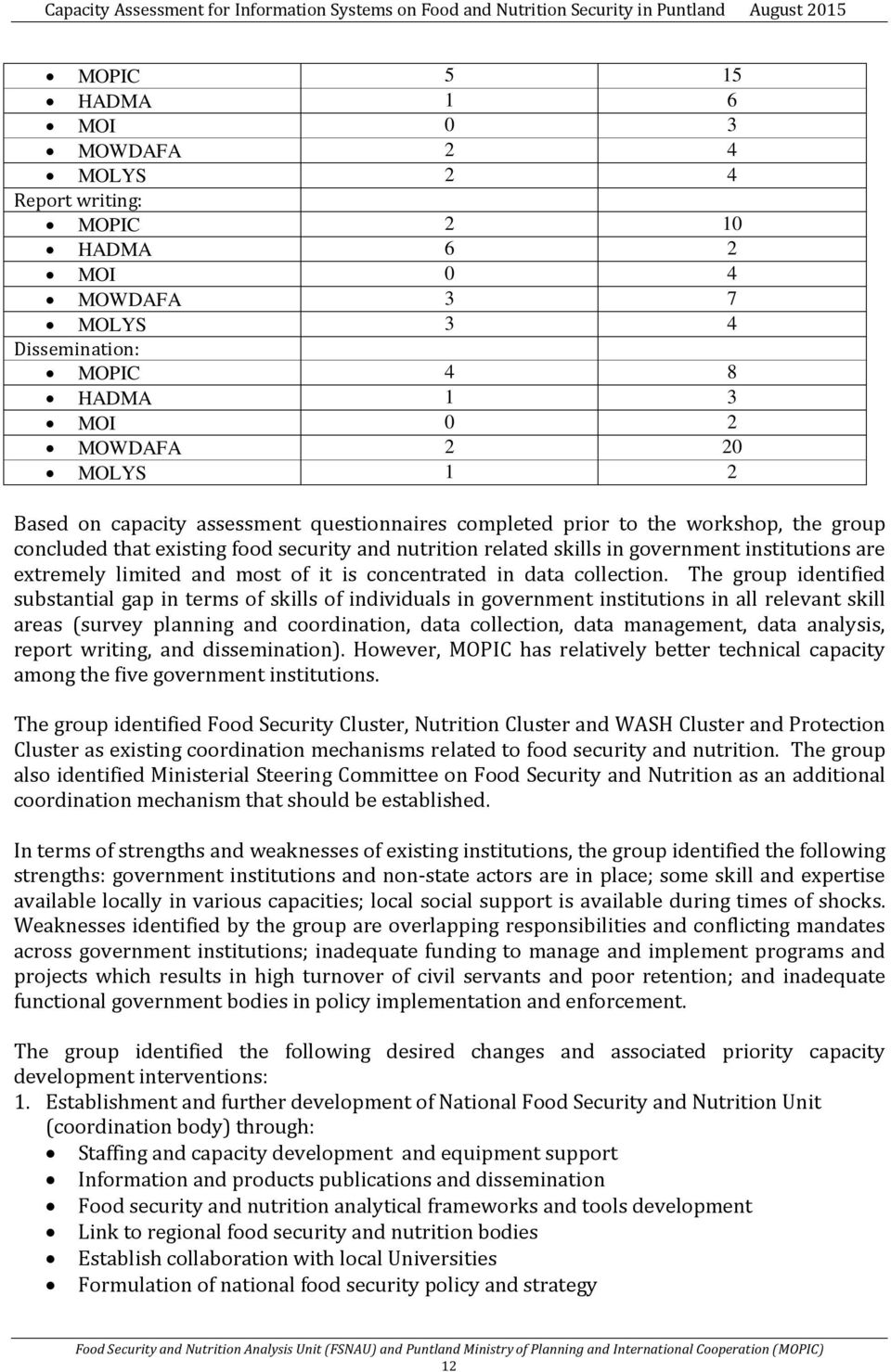
15 MOPIC 5 15 HADMA 1 6 MOI 0 3 MOWDAFA 2 4 MOLYS 2 4 Report writing: MOPIC 2 10 HADMA 6 2 MOI 0 4 MOWDAFA 3 7 MOLYS 3 4 Dissemination: MOPIC 4 8 HADMA 1 3 MOI 0 2 MOWDAFA 2 20 MOLYS 1 2 Based on capacity assessment questionnaires completed prior to the workshop, the group concluded that existing food security and nutrition related skills in government institutions are extremely limited and most of it is concentrated in data collection. The group identified substantial gap in terms of skills of individuals in government institutions in all relevant skill areas (survey planning and coordination, data collection, data management, data analysis, report writing, and dissemination). However, MOPIC has relatively better technical capacity among the five government institutions. The group identified Food Security Cluster, Nutrition Cluster and WASH Cluster and Protection Cluster as existing coordination mechanisms related to food security and nutrition. The group also identified Ministerial Steering Committee on Food Security and Nutrition as an additional coordination mechanism that should be established. In terms of strengths and weaknesses of existing institutions, the group identified the following strengths: government institutions and non-state actors are in place; some skill and expertise available locally in various capacities; local social support is available during times of shocks. Weaknesses identified by the group are overlapping responsibilities and conflicting mandates across government institutions; inadequate funding to manage and implement programs and projects which results in high turnover of civil servants and poor retention; and inadequate functional government bodies in policy implementation and enforcement. The group identified the following desired changes and associated priority capacity development interventions: 1. Establishment and further development of National Food Security and Nutrition Unit (coordination body) through: Staffing and capacity development and equipment support Information and products publications and dissemination Food security and nutrition analytical frameworks and tools development Link to regional food security and nutrition bodies Establish collaboration with local Universities Formulation of national food security policy and strategy 12
16 2. Clarify mandates and responsibilities among food security and nutrition stakeholders through: Functional reviews of government institutions engaged in food security and nutrition Awareness creation and sensitization of stakeholders on food security and nutrition Forum for validation and consensus building among stakeholders on situation analysis and assessment findings Further details on the consolidated capacity assessment of Cross Cutting Sectors and Issues can be found in Annex Priority Follow-up Actions to Address Major Identified Gaps Based on the foregoing assessment of capacity strengths and gaps (weaknesses), the following were identified as priority follow up actions by government line ministries, FSNAU/FAO and other partners who provide capacity development support to government institutions in food security and nutrition assessment, analysis, reporting, coordination and policy: Development of production sector information system (including livestock and crop production, marketing, water and land) Clarification of mandates and responsibilities among food security and nutrition stakeholders Establishment of Puntland level Food Security and Nutrition Unit within an appropriate government ministry/institution Institutional capacity development support to improve government technical and implementation capacity Establishment of food security and nutrition coordination structures and mechanisms at technical and policy levels Establishment of linkages with regional food security and nutrition bodies Establishment of collaboration with local Universities Establishment of forums for validation and consensus building among stakeholders on situation analysis and assessment findings Media involvement in food security and nutrition information dissemination Awareness creation and sensitization of stakeholders on food security and nutrition, including at community level Establishment of regional and district level food security and nutrition information dissemination mechanisms Formulation of national food security policy and strategy Improve government ownership, leadership, accountability and political commitment Further detail on the above can be found in Annex 4. 13

17 Annex 1 Capacity Assessment Report for Production Sector Working Group (Agriculture, Livestock, Fisheries, Labour, Water and Environment), Puntland Section 1: Policy Formulation and Decision-making processes 1. What are the key uses or intended uses of food security and nutrition information in Puntland? List the four most important uses (current or planned). Use of Food Security Information Rank 1, 2, 3 or 4 or leave blank Food security/nutrition policy development and 1 programme formulation Seasonal monitoring and early warning 2 Nutrition surveillance and assessment Emergency needs assessment and response planning 3 Vulnerability analysis Monitoring of household food security (access to food) 4 Trade and Market monitoring Resource mobilization and Advocacy for investment in food security and nutrition Other (specify): Summary: Food security policy development and programme formulation, seasonal monitoring and early warning, emergency needs assessment and response planning and monitoring of household food security (access to food) are the main uses and intended uses of food security information in Puntland. 2. What are the existing food security and/or nutrition policies (and/or strategies) including those that are being developed? (include policies for short and long-term decision making) Current food security policies Environmental policy Natural Resource Policy Environmental customary law Water policy Agricultural policy (to be revised) Labour policy (to be revised) Livestock marketing policy Veterinary law Meat hygiene and quality control policy Diary act Fishery policy Land policy Water policy Summary: The Group listed thirteen existing policies in Agriculture, Livestock and Fishery-related sectors. 3. What food security and/or nutrition policies/strategies are needed? Future food security policies (to be formulated) Food security and nutrition policy separate from the environmental policy Land management policy 14

18 Food safety and quality control policy Seed and pesticide policy Water law act Summary: The Group identified five different policies to be formulated. 4. What are the key topics being discussed by decision makers and in policy dialogue meetings that concern the food security and nutrition situation in Puntland? Topics being discussed - Water harvesting, dams, soil & water conservation - Livelihood polices and interventions - Food for work and cash for work - Rangeland management (gully control charcoal) - Land use management - Irrigation development - Illegal fishing - Cyclones and disasters - Locusts - Capacity development for ministries and stakeholders - Livestock disease surveillance and control - Piracy Summary: The Group proposed twelve different key topics, most of which reflect long-standing/ recurrent concerns of Puntland. 5. Based on the current and intended uses of food security and nutrition information (Question 1) and based on the current and intended food security and nutrition policies and decisions (Question 2-4), what type of data and information needs to be collected and managed? Data and information needed (e.g. sector-specific data/information) - Environmental monitoring reports - Vulnerability assessment reports - Partner plans and availability of resources - Market information (prices, quantities,fluctuation, availability and accessibility of food) - Food production (fish, crops, livestock) - Water availability and prices monitoring - Agricultural research - Baseline information for food security and nutrition for all livelihoods - Baseline for frankincense - Hydro geological data - Livestock status (herd size, body condition, conception and calving) - Import and export - Rainfall data and weather forecasting - Population figures, including population displacement Summary: The Group proposed multiple types of data and information that needs to be collected, which is a mix of production sector related information as well as general food security-related information 6. Based on Questions 1-4, who should receive and use the food security and/or nutrition information? Information needed Who should receive information? 15
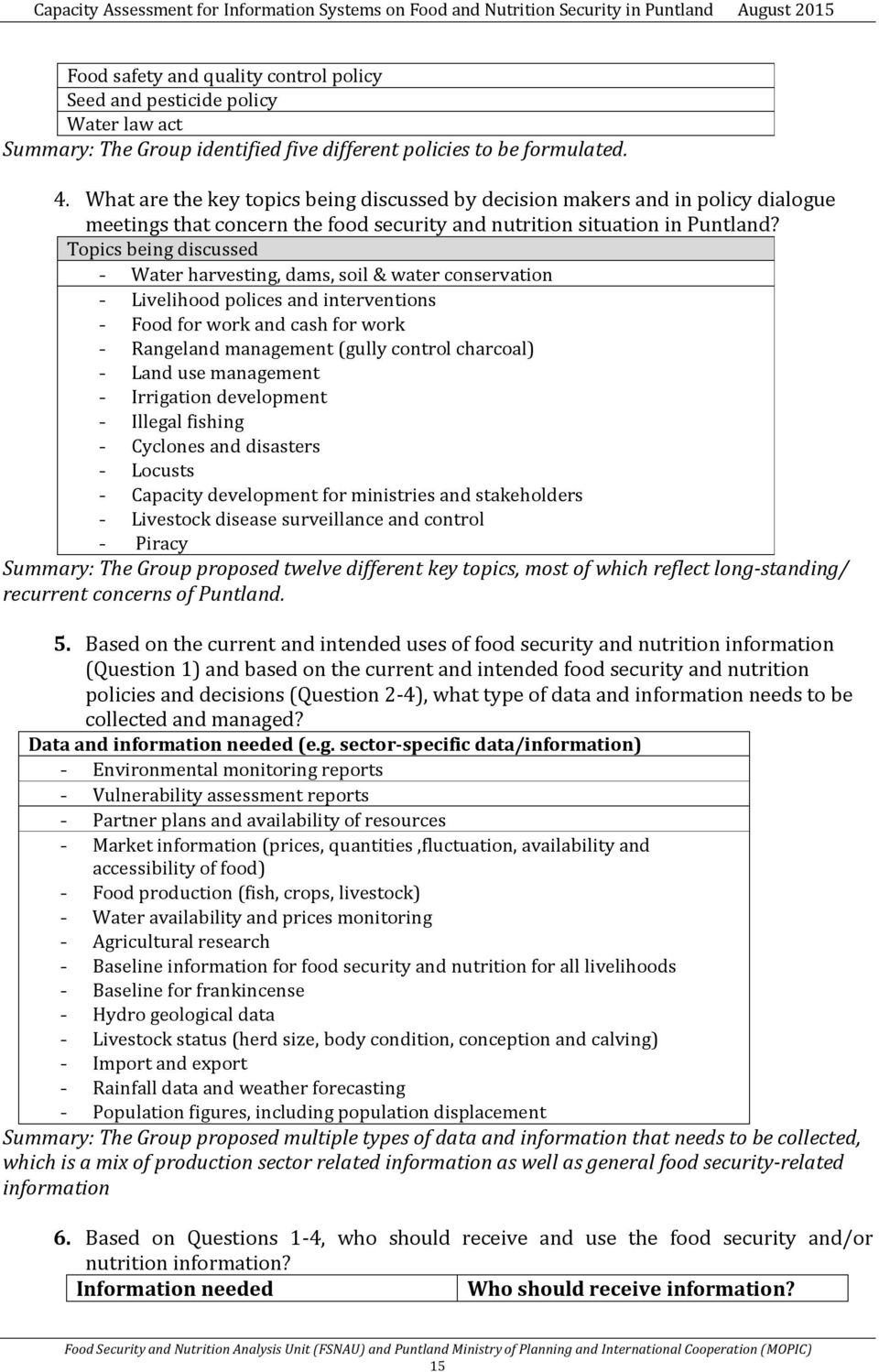
19 - Environmental reports Government, agencies, donors and civil society - Vulnerability reports Government, agencies, donors and civil society - Partner plans Government, agencies, donors and civil society - Market information (prices, quantities, fluctuation, availability and accessibility of food) - Food production (fish, crops, livestock) - Water availability and prices monitoring - Agricultural research - Baseline information for food security and nutrition for all livelihoods - Import and export - Baseline for frankincense - Population figures - Hydro geological data - Livestock status (herd size, body condition, conception and calving) - Rainfall data and weather forecasting Government, agencies, donors and civil society, research organisations, educational institutions Summary: The Group suggested that government, agencies and donors should be receiving all types of food-security related information/ products. In addition, research organisations and educational institutions should be recipients of production sector related information Policy dialogue processes 7. This question pertains to whether policy dialogue meetings are inclusive of all stakeholders. Please indicate (yes/no) the stakeholders which participate and those which should participate Stakeholders presence Currently participating Should participate Gender in numbers No No Curre Future Central Government Local Government NSA (non-state actors) No Local NGOs International Agencies Research & Academic Institutions Business/ Private Sector No Women Organizations Consumer Organizations (N/A) (N/A ) (N/A ) Producer Organizations No Other (Religious groups/leaders) No Other (elders) No nt 16

20 Summary: According to the Group, currently only six different (out of 12 listed) stakeholders, including Central Government, take part in policy dialogues. The group proposed that all stakeholders should be taking part in policy dialogues. Gender-related information was not available. 8. Who should be organizing food security and nutrition policy dialogue meetings? Who should be leading? Organizers of policy dialogue meetings Leaders of policy dialogue meetings MOEWT, MOAI, MOLAH, PSAWEN, MOF Ministers, Director Generals and other livelihood sector group Summary: The Group proposed several ministries and organisations to be organisers of policy dialogues with Ministers and DGs being the leaders of these meetings 9. What are the main weaknesses and challenges of existing food security and nutrition policy dialogue meetings? Weaknesses - Lack of resources (financial) and contingency plan - Fragmentation of responsibilities - Discussion of issues and dialogues take only during crises - Poor coordination in FSN - Low capacity in FSN analysis - No food security and nutrition policy Summary: The Group identified six different types of weaknesses, related to resources, capacity, coordination and policy 10. How is the awareness and knowledge of Non-State Actors (local NGOs) regarding food security and nutrition policy? Score from 1 to 3 (weak to good awareness/capacities) Skill level of NSAs in information systems for FSN Score Awareness of existing food security and nutrition 1 policies and programmes Capacities in reviewing policies 2 Knowledge of food security and nutrition policies, 2 programmes and interventions Summary: The Group suggested weak to average knowledge/awareness of food security and nutrition policies by non-state actors. Section 2: Analysis and production of food security information Types of information produced/disseminated 11. What are the main food security and nutrition reports currently produced by FAO- FSNAU and by the Government? How would you rate their quality? Scale from 1 to 3 (low to high) What institution produces the report or bulletin? Food security and nutrition report (or bulletins) Quality Source (institutions e.g. Ministry of Agriculture, Health, Environment, FAO/FSNAU, other UN agencies, NGOs, others?) - Market data 3 FSNAU/FEWSNET/Govt - Consumer price index 2 FSNAU/FEWSNET/Govt 17

21 - Post Gu and Post deyr 3 FSNAU/FEWSNET/Govt - Rainfall data 3 SWALIM/Gov - IDP and urban assessment 3 FSNAU/FEWSNET/Govt Summary: The Group suggested that most of the food security-related products are produced by FAO/ FEWSNET with participation from the Government. 12. Keeping in mind the key uses and intended uses of food security and nutrition information (see questions 1) and the current and intended policies (Questions 2-4), what types of information and reports should be produced in the future? And by whom? Future food security and nutrition report By whom should the report be produced? - Monthly FSN forecasts FSNAU and Govt - Annual FSN report FSNAU and Govt - Flood monitoring and forecast Govt and SWALIM Summary: The Group identified three types of products that should be produced by FAO projects (FSNAU/ SWALIM) and the Government 13. What are the skills of individuals in food security and nutrition information systems? Skills Institution (i.e. Min of Ag, Save the Children, etc.) Number of staff existing Estimated number of staff needed Survey planning & coordination Data collection 3 6 Data management 3 3 Data analysis 3 6 Report writing 3 6 Dissemination 3 3 Summary: The Group proposed that number of staff in data collection/analysis/report writing needs to double within the government. Section 3: Information systems on food security and nutrition: Data collection Please fill in the following tables (Questions 14-18) for the data relevant to your working group. 14. What are the main types of data being collected (and by who)? Please tick for each data item being collected; indicate the institution collecting each data item and score the quality (score from 1 to 3: from low to high) Data collected No Institution collecting Quality Market prices (including different FSNAU commodities, inputs, outputs, wage rates, etc. Trade statistics Port Authorities Crop Production Crop pest & disease Livestock holdings and fish farming FSNAU Fruits and Vegetables Livestock conditions FSNAU 18
22 Nutrition & health MOH, FSNAU, UNICEF Rainfall SWALIM/FEWS NET Pasture condition/ availability FSNAU Water availability and prices FSNAU Environment MOEWT 3 Climate Change MOEWT 3 Land Summary: The Group identified that there is limited food security related data collection by government institutions. 15. Keeping in mind the key uses and intended uses of food security and nutrition information (see questions 1-4) and the reports needed (Questions 12), what types of data should be collected in the future(and by who)? Please tick for each data item being collected; indicate the institution which should collect each data item and answer the last two columns Data collected No Institutions which should collect data whether local NGO, International agencies, or State actors Market prices (including different commodities, inputs, outputs, wage rates, etc. MOC/MOPIC Trade statistics MOC/MOPIC Crop Production MOAI Indicate whether new processes, procedures and systems are needed (/No) Describe new processes, procedures and systems needed -Training for staff and institutional capacity development, -Law enforcement and environmental protection Crop pest & disease MOAI Livestock holdings MOLAH and fish farming Fruits and Vegetables MOAI Livestock conditions MOLAH Nutrition & health MOH -Environment and climate change information management system -Environment and climate change information education and awareness Rainfall MOEWT Pasture condition/ MOLAH availability Water availability MOEWT and prices Environment MOEWT, 19
23 Capacity Assessment for Information Systems on Food and Nutrition Security in Puntland Climate Change Land SWALIM, NGOs MOEWT, SWALIM, MOAI August 2015 Summary: There is a need for greater government/line ministry involvement and leadership in data collection. 16. At what level is the data being collected and analysed? Please tick national or district level. Data collected Market prices (including different commodities, inputs, outputs, wage rates, etc. Trade statistics Crop Production Crop pest & disease Livestock holdings and fish farming Fruits and Vegetables Livestock conditions Nutrition & health Rainfall Pasture condition/ availability Water availability and prices Environment Climate Change Land National District Data analysed Market prices (including different commodities, inputs, outputs, wage rates, etc. Trade statistics Crop Production Crop pest & disease Livestock holdings and fish farming Fruits and Vegetables Livestock conditions Nutrition & health Rainfall Pasture condition/ availability Water availability and prices Environment Climate Change Land National District 17. In terms of coverage, realistically in how many districts should data be collected? Data collected Market prices (including different commodities, inputs, outputs, wage rates, etc. Trade statistics District Major towns and cities Crop Production Major producing districts Crop pest & disease Crop producing centres Livestock holdings and fish farming Major centres Fruits and Vegetables Major market towns Livestock conditions All districts Nutrition & health All districts Port and border towns 20
24 Rainfall Pasture condition/ availability Water availability and prices Environment Climate Change All districts All districts Major towns All districts All the regions Land 18. What methodology is currently used to collect data and what should be used in the future? Data Market prices (including different commodities, inputs, outputs, wage rates, etc. Trade statistics Crop Production Crop pest & disease Livestock holdings and fish farming Fruits and Vegetables Livestock conditions Nutrition & health Rainfall Pasture condition/ availability Water availability and prices Environment Climate Change Land What methodology currently used to collect data? Observation, workshops Observation, from workshops What methodology should be used to collect data? Workshops satellites What tools, procedures and standards need to be modified? Satellites, images, GPS Section 4: Institutional set up for Cross-sectoral coordination Coordination mechanisms are bodies (committees or fora) that bring together several institutions and partners with an objective to advance food security and improve nutrition. 19. What are the existing coordination mechanisms for food security and nutrition in Puntland? What is the purpose of coordination? Members? Leaders Existing coordination mechanisms Purpose Members Leaders Summary: At present, there are no coordination mechanisms for food security in Puntland. 20. What coordination mechanisms for food security and nutrition should there be in Puntland? What is the purpose of coordination? Members? Leaders Needed coordination mechanisms Purpose Members Leaders Food Security and Nutrition Advocacy President, President and 21
25 Steering Committee Minister, MPs Minister Food Security and Nutrition Advocacy and Minister, MPs Ministerial Committee policies Summary: The Group suggested two types of coordination mechanisms under the leadership of the President and Ministers for advocacy purposes. 21. If there is a need for a cross-sectoral coordination unit to ensure the adequate information systems, what reports should this coordination unit produce? Reports Monthly food security and nutrition updates Quarterly food security and nutrition reports Seasonal food security and nutrition report Vulnerability reports Summary: The Group suggested two types of products to be produced by a cross-sectoral coordination unit (vulnerability and food security and nutrition report). Food security and nutrition reports should be produced periodically (monthly, quarterly, and seasonally) a) What should be the responsibility of the coordination mechanism? Please indicate yes/no (you can choose more than one) Responsibility /No Data management Analysis yes Report writing yes Dissemination yes Planning and Coordination yes Summary: According to the Group, the coordination mechanism should be responsible for all activities, from planning and coordination up to report writing/ dissemination Existing Coordination mechanisms b) In the existing and desired coordination mechanisms, please rate the presence and participation of women. (1 to 3: low to high). In the first column, take the coordination mechanisms from questions 1 and 2. Presence of women (Score: 1-3) Participation of women (Score: 1-3) Desired Coordination mechanisms Presence of women (Score: 1-3) Participation of women (Score: 1-3) Strengths and weaknesses of existing institutions The three most important strengths and weaknesses on Policy Formulation and Decision Making processes are: Strengths (institutions are good at): 1. Stability of working environment 2. Existence of government institutions with mandates 3. Existing human resource (graduates, workforce, etc) Weaknesses (institutions should improve on): 1. Lack of motivation due to low payments/financial constraints 2. Low coordination between government institutions and with other stakeholders 3. Weak knowledge and limited expertise 22
26 Desired Change and Priority Capacity Development Interventions Desired changes and related priority capacity development interventions are outlined below. Desired changes and Way forward Desired change 1: Establishment of Puntland level Food Security and Nutrition Unit Activity 1: Food security and nutrition policy design, implementation and sustainability Activity 2: Capacity building for the established Food Security and Nutrition Unit Activity 3: Budget allocation for the unit Desired change 2: Regional and district level food security and nutrition information dissemination mechanisms Activity 1: Improved community knowledge of food security and nutrition information Activity 2: Food security and nutrition dialogues, forums, workshops Activity 3: Media involvement in food security and nutrition information dissemination Desired change 3: Production sector information management Activity 1: Environmental and climate change information sharing and awareness Activity 2: Water and land information system Activity 3: Agricultural (livestock & crop) production and marketing 23
27 Annex 2 Capacity Assessment Report for Health and Nutrition Sector Working Group (Ministry of Health), Puntland Section 1: Policy Formulation and Decision-making processes 22. What are the key uses or intended uses of food security and nutrition information in Puntland? List the four most important uses (current or planned). Use of Food Security and Nutrition Information Food security policy development and programme formulation Nutrition policy development and programme formulation 4 Seasonal monitoring and early warning 1 Nutrition surveillance and assessment 2 Emergency needs assessment and response planning Vulnerability analysis 5 Monitoring of household food security (access to food) Trade and Market monitoring Resource mobilization and Advocacy for investment in food security and nutrition Rank 1, 2, 3 or 4 or leave blank Summary: The most important of nutrition information in Puntland identified by participants are seasonal monitoring and early warning, Nutrition surveillance and assessment, resource mobilization and advocacy for investment in food security and nutrition, nutrition policy development and program formulation, and vulnerability analysis. 23. What are the existing food security and/or nutrition policies (and/or strategies) including those that are being developed? (include policies for short and long-term decision making) Current food security and/or nutrition policies Nutrition Strategy Micro-nutrient strategy Costing nutrition policy plan for action IYCF strategy Health and nutrition policy Summary: There are existing Health and Nutrition Policy, Micro-nutrient Strategy, Costing nutrition plan for action, IYCF strategy, and Nutrition Strategy. 24. What food security and/or nutrition policies/strategies are needed? Future food security and/or nutrition policies (to be formulated) Behavioural change /communication policy on nutrition Food fortification policy Puntland dietary guideline Food safety strategy Community health and nutrition strategy Summary: The Nutrition policies/ strategies needed are Behavioural change or communication policy on nutrition, Food fortification Policy, Dietary guideline, Food Safety Strategy and Community Health and Nutrition Strategy. 25. What are the key topics being discussed by decision makers and in policy dialogue meetings that concern the food security and nutrition situation in Puntland? Topics being discussed Establishment of food security nutrition strategy Breast milk substitute marketing code 3 24
28 Capacity Assessment for Information Systems on Food and Nutrition Security in Puntland - August 2015 Advocacy for Infant and Young Child Feeding Reduce maternal and child mortality Referral system of severely malnourished children in rural areas Mainstreaming nutrition in to other sectors Summary: The participants discussed to establish food security and nutrition strategy, breast milk substitutes marketing code; advocacy for infant and young child feeding and reducing maternal and child mortality, to make referral system of severely malnourished and mainstreaming nutrition in to other sectors. 26. Based on the current and intended uses of food security and nutrition information (Question 1) and based on the current and intended food security and nutrition policies and decisions (Question 2-4), what type of data and information needs to be collected and managed? Data and information needed (e.g. sector-specific data/information) Nutrition Surveillance data Morbidity and mortality Mother and child diet diversity Food security dimensions Summary: Data and information needed to be collect are nutrition surveillance data, morbidity and mortality, mother and child dietary diversity and food security dimensions. 27. Based on Questions 1-4, who should receive and use the food security and/or nutrition information? Information needed Who should receive information? MOH and partners Nutrition and food security surveillance MOH and partners HIS data MOH and partners Morbidity and mortality surveillance Summary: The participants agreed that the MOH and Partners (including FSNAU) to receive the information such as nutrition surveillance, health facilities data (health information system), and morbidity and mortality data. Policy dialogue processes 28. This question pertains to whether policy dialogue meetings are inclusive of all stakeholders. Please indicate (yes/no) the stakeholders which participate and those which should participate Stakeholders presence Currently Should Gender in participating participate numbers No No Curre Future nt Central Government 10% 30% Local Government 40% NSA (non-state actors) and Local 30% 50% NGOs International Agencies 40% 50% Research & Academic Institutions 30% Business/ Private Sector 60% Women Organizations 40% Consumer Organizations Producer Organizations Other (specify) 25
29 Summary: Most of policy dialogue meetings are inclusive of all stakeholders 29. Who should be organizing food security and nutrition policy dialogue meetings? Who should be leading? Organizers of policy dialogue meetings Leaders of policy dialogue meetings MOH/UNICEF MOH Summary: The Nutrition policy dialogue meetings should be organized by MOH with support from UNICEF and led by MOH. 30. What are the main weaknesses and challenges of existing food security and nutrition policy dialogue meetings? Weaknesses Less funding availability Technical constraints at national level Donor-driven strategy Limited international support for policy development Summary: The main weaknesses that the team discussed were less funding availability, technical constraints at national level; donor-driven strategies; and limited international support for policy development. 31. How is the awareness and knowledge of Non-State Actors regarding food security and nutrition policy? Score from 1 to 3 (weak to good awareness/capacities) Skill level of NSAs in information systems for FSN Score Awareness of existing food security and nutrition policies and 1 programmes Capacities in reviewing policies 1 Knowledge of food security and nutrition policies, programmes and 2 interventions Summary: the awareness and knowledge of Non-State Actors regarding to nutrition policy were poor or inadequate. Section 2: Analysis and production of food security information Types of information produced/disseminated 32. What are the main food security and nutrition reports currently produced by FAO-FSNAU and by the Government? How would you rate their quality? Scale from 1 to 3 (low to high) What institution produces the report or bulletin? Food security and nutrition report (or bulletins) Quality Source (institutions e.g Ministry of Agriculture, Health, Environment, FAO/FSNAU, other UN agencies, NGOs, others?) Technical series report -Nutrition 3 FSNAU Bimonthly nutrition update 3 FSNAU Quarterly food security and Nutrition 3 FSNAU brief Bimonthly Health Bulletin 3 WHO Monthly Feeding centres report 3 UNICEF IYCF Report 2 UNICEF and MoH 26
30 Weekly surveillance report 3 MOH Health and Nutrition Annual report 2 MOH HIS monthly report 3 MOH Summary: The main nutrition reports that currently produced by FAO/FSNAU are technical series report on nutrition, bimonthly nutrition update, quarterly food security and nutrition brief, while MOH and partners also produce monthly feeding reports, IYCF report, weekly surveillance and HIS reports, and Health and nutrition annual report. 33. Keeping in mind the key uses and intended uses of food security and nutrition information (see questions 1) and the current and intended policies (Questions 2-4), what types of information and reports should be produced in the future? And by whom? Future food security and nutrition report By whom should the report be produced? Quarterly health and nutrition Bulletin MOH EPI Coverage report MOH and partners Prevalence of Micro-nutrient Deficiency MOH /Partners Summary: Participants proposed that MOH and partners should produce quarterly health and nutrition bulletin, EPI coverage and prevalence of micro- nutrients updates. 34. What are the skills of individuals in food security and nutrition information systems? Skills Institution (ie. Min of Health, Save the Children, etc.) Number of staff existing Estimated number of staff needed Data Collection and Survey MOH planning & coordination Data collection MOH Data management MOH 1 5 Data analysis MOH Report writing MOH Dissemination MOH 0 4 Summary: Currently MOH has limited existing staff capacity to adequately perform data collection and survey planning & coordination, data collection, data management, data analysis, report writing, and dissemination. Section 3: Information systems on food security and nutrition: Data collection Please fill in the following tables (Questions 14-18) for the data relevant to your working group. 35. What are the main types of data being collected (and by who)? Please tick for each data item being collected; indicate the institution collecting each data item and score the quality (score from 1 to 3: from low to high) Data collected No Institution Quality Market prices (including different commodities, inputs, outputs, wage rates, etc. Trade statistics Crop Production Crop pest & disease Livestock holdings and fish farming Fruits and Vegetables Livestock conditions collecting 27
31 Nutrition & health FSNAU and MoH 3 Rainfall Pasture condition/ availability Water availability and prices Environment Climate Change Land 36. Keeping in mind the key uses and intended uses of food security and nutrition information (see questions 1-4) and the reports needed (Questions 12), what types of data should be collected in the future(and by who)? Please tick for each data item being collected; indicate the institution which should collect each data item and answer the last two columns Data collected No Institutions which should collect data whether local NGO, International agencies, or State actors Indicate whether new processes, procedures and systems are needed (/No) Describe new processes, procedures and systems needed Market prices (including different commodities, inputs, outputs, wage rates, etc. Trade statistics Crop Production Crop pest & disease Livestock holdings and fish farming Fruits and Vegetables Livestock conditions Nutrition & health MOH YES Mobile data collection Rainfall Pasture condition/ availability Water availability and prices Environment Climate Change Land 37. At what level is the data being collected and analysed? Please tick national or district level. Data collected National District Data analysed National District Market prices (including different commodities, inputs, outputs, wage rates, etc. Market prices (including different commodities, inputs, outputs, wage rates, etc. Trade statistics Trade statistics Crop Production Crop Production Crop pest & disease Crop pest & disease 28
32 Livestock holdings and fish farming Livestock holdings and fish farming Fruits and Vegetables Fruits and Vegetables Livestock conditions Livestock conditions Nutrition & health Nutrition & health Rainfall Rainfall Pasture condition/ availability Pasture condition/ availability Water availability and prices Water availability and prices Environment Environment Climate Change Climate Change Land Land 38. In terms of coverage, realistically in how many districts should data be collected? Data collected District Market prices (including different commodities, inputs, outputs, wage rates, etc. Trade statistics Crop Production Crop pest & disease Livestock holdings and fish farming Fruits and Vegetables Livestock conditions Nutrition & health 20 Rainfall Pasture condition/ availability Water availability and prices Environment Climate Change Land Summary: Information collected from 20 districts which are the old districts (before 1991), but the newly established districts have not that capacity yet. 39. What methodology is currently used to collect data and what should be used in the future? Data What methodology currently used to collect data? What methodology should be used to collect data? What tools, procedures and standards need to be modified? Market prices (including different commodities, inputs, outputs, wage rates, etc. Trade statistics Crop Production Crop pest & disease Livestock holdings and fish farming Fruits and Vegetables Livestock conditions Nutrition & health Facility based and sampling Mobile technology for HIS Questionnaires, digital pen, Anthropometric 29
33 Capacity Assessment for Information Systems on Food and Nutrition Security in Puntland August 2015 tool, Diagnostic tool Rainfall Pasture condition/ availability Water availability and prices Environment Climate Change Land Summary: Currently information is collected through facility based surveillance and nutrition assessment but the participants proposed the use of Mobile technology for nutrition surveillance compared to traditional, time consuming and paper-based data collection and it s a less expensive as well as may help to lower the costs of data collection and improve data quality as part of a surveillance system. Data can be received and analysed more quickly. Section 4: Institutional set up for Cross-sectoral coordination Coordination mechanisms are bodies (committees or forums) that bring together several institutions and partners with an objective to advance food security and improve nutrition. 40. What are the existing coordination mechanisms for food security and nutrition in Puntland? What is the purpose of coordination? Members? Leaders Existing coordination Purpose Members Leaders mechanisms Nutrition Cluster UNICEF, WHO, MOH and Information sharing, coordination Save the UNICEF Policy and strategy review, Children, WV, Analysing gabs, CARE, Relief Emerging issues International, WFP, SRCS, FSNAU, Health and nutrition MOH and MOH and SCI Information sharing, coordination partners Policy and strategy review, Analysing gabs, Emerging issues Summary: The coordination mechanisms existing in Puntland are Nutrition and Health Clusters and their purposes usually are information sharing, policy & strategy review, sharing analysis gaps and emerging issues. The coordination is led by MOH, UNICEF and partners. 41. What coordination mechanisms for food security and nutrition should there be in Puntland? What is the purpose of coordination? Members? Leaders Needed coordination Purpose Members Leaders mechanisms Multi-sectoral MOH Nature of Health, coordination UNICEF nutrition multi Nutrition, causal needs Agriculture-food multi sectoral security and solution livelihoods Sectoral Social welfarecontribution to protection improving Women/Gender Nutrition Industry: fortified Avoid wheat,iodized salt, overlapping and Law/Justice 30
34 Capacity Assessment for Information Systems on Food and Nutrition Security in Puntland resource duplication August 2015 Ministry Summary: Coordination mechanisms required is multi-sectoral coordination with the purpose of nature of nutrition on multi-causal needs solution, sectoral contribution to improving nutrition and avoid overlapping and resource duplication. Members are line ministries and partners led by MOH and UNICEF. 42. If there is a need for a cross-sectoral coordination unit to ensure the adequate information systems, what reports should this coordination unit produce? Reports on indicators and coverage related to Nutrition Water and sanitation Food security Health Situation analyses Summary: Reports needed to produce are health and nutrition, water and sanitation and situation analysis report. c) What should be the responsibility of the coordination mechanism? Please indicate yes/no (you can choose more than one) Responsibility /No Data management Analysis Report writing Dissemination Planning and Coordination d) In the existing and desired coordination mechanisms, please rate the presence and participation of women. (1 to 3: low to high). In the first column, take the coordination mechanisms from questions 1 and 2. Existing Presence Participatio Desired Presence Participation Coordination of women n of women Coordination of women of women mechanisms (Score: 1- (Score: 1-3) mechanisms (Score: 1(Score: 1-3) 3) 3) Nutrition cluster 3 2 Nutrition cluster 3 3 Health and nutrition 3 2 Health and 3 3 cluster nutrition cluster Strengths and weaknesses of existing institutions The three most important strengths and weaknesses on Policy Formulation and Decision Making processes are: Strengths (institutions are good at): Weaknesses (institutions should improve on): 1. Human resources are available 1. Limited capacity, knowledge & skills level 2. There is functional organizational 2. High external dependence donor driven structure and low budget allocation 3. Government institutions and policy 3. Weak implementation of Policy/strategy are in place -not fully functional at district/ community level 31
35 Desired change and priority capacity development interventions: Desired changes and Way forward Desired change 1: Leadership and political commitment Activity 1: Advocacy and resource mobilization Activity 2: Inter-sectoral collaboration Activity 3: Networking and partnership Partners and Projects: Puntland presidency, MOH and other Government Institution Desired change 2: Improved Technical capacity Activity 1: Planning, coordination and research Activity 2: Implementation Activity 3: Monitoring and accountability Partners and Projects: MOH, FSNAU, UNICEF, WHO, and other concerning partners Desired change 3: Adequate resources Activity 1: Financial resources Activity 2: Human resources (skilled personnel) Activity 3: Logistic and supply Partners and Projects: MOH, UNICEF, WHO and line Ministries 32
36 Annex 3 Capacity Assessment Report for Cross Cutting Sector Working Group (Planning, Labor, Gender, Market), Puntland Section 1: Policy Formulation and Decision-making processes 43. What are the key uses or intended uses of food security and nutrition information in Puntland? List the four most important uses (current or planned). Use of Food Security and Nutrition Information Rank 1, 2, 3 or 4 or leave blank Food security policy development and programme 1 formulation Nutrition policy development and programme formulation 2 Seasonal monitoring and early warning 4 Nutrition surveillance and assessment Emergency needs assessment and response planning 3 Vulnerability analysis Monitoring of household food security (access to food) Trade and Market monitoring Resource mobilization and Advocacy for investment in food security and nutrition Summary: The most important uses listed by the group are: food security and nutrition policy development and programme formulation, seasonal monitoring and early warning, emergency needs assessment and response planning 44. What are the existing food security and/or nutrition policies (and/or strategies) including those that are being developed? (include policies for short and long-term decision making) Current food security and/or nutrition policies No policies/strategies on food security MOI has IDP Policy in place, HADMA has Disaster Risk Reduction Policy to be ratified Summary: Not many food security and nutrition policies exit in Puntland with the exception of IDP Policy and Disaster Risk Reduction Policy 45. What food security and/or nutrition policies/strategies are needed? Future food security and/or nutrition policies (to be formulated) Food security/nutrition policy and strategies Resilience Strategy, Summary: The group suggested additional food security and nutrition related policies that need to be developed. 46. What are the key topics being discussed by decision makers and in policy dialogue meetings that concern the food security and nutrition situation in Puntland? Topics being discussed - Improvement of livelihoods to reduce food insecurity - Poverty reduction - Increasing local food production - Marketing of local productions - Improvement of infrastructure of the remote areas (coastal areas) for market access (i.e fish to be marketed to major towns/cities ) - Food reserve - Quality Control, Access to water in remote areas, improve water reserve 33
37 - Nutritional status in IDPs and rural communities - -Improve infrastructure Summary: In the policy dialogue meetings, Puntland decision makers discuss the following topics: Improvement of livelihoods, poverty reduction, increasing of local productions, marketing of local production, improvement if infrastructure in the remote areas, food reserves, nutritional status of IDPs. 47. Based on the current and intended uses of food security and nutrition information (Question 1) and based on the current and intended food security and nutrition policies and decisions (Question 2-4), what type of data and information needs to be collected and managed? Data and information needed (e.g. sector-specific data/information) - Data on climate (rain) and early warning - Market data - Monitoring of environmental changes - Data collection on families in need, numerically and demographically - Vulnerability mapping - Local production (Livestock and crops, Frankincense, Dates, and marine resources) Summary: Group suggested that the following data need to be collected: Data on climate including early warning, market data, monitoring of environmental changes, vulnerability mapping and data on local food production 48. Based on Questions 1-4, who should receive and use the food security and/or nutrition information? Information needed Who should receive information? - Data on climate (rain) and early warning Ministry of Agriculture, Ministry of Planning, Ministry of Livestock, Ministry of fisheries - Market data Ministry of commerce - Monitoring of environmental changes Ministry of environment, Ministry of Agriculture Summary: Coordination group proposed that the data on climate and early warning should be received and used by government institutions such as the Ministry of Agriculture and Industry, Ministry of livestock and Animal Husbandry, Ministry of Fisheries and Ministry of Planning and International Cooperation. Market data should be used by Ministry of Commerce; Monitoring of environmental changes should be used by Ministry of Environment Policy dialogue processes 49. This question pertains to whether policy dialogue meetings are inclusive of all stakeholders. Please indicate (yes/no) the stakeholders which participate and those which should participate Stakeholders presence Currently Should Gender in numbers participating Participate No No Current Future Central Government 2% 32% Local Government NO YES 2% 32% NSA (non-state actors) and Local NGOs 10% 50% International Agencies 7% 20% Research & Academic Institutions NO YES 0 15% Business/ Private Sector No 10% 25% Women Organizations No 15% 20% 34
38 Consumer Organizations No 0 20% Producer Organizations No 0 20% Other (specify) Summary: Group revealed that local governments, research/academic institutions, women organizations, consumer organizations and producers organizations do not participate in the policy dialogue meetings and recommended that they should participate in the future 50. Who should be organizing food security and nutrition policy dialogue meetings? Who should be leading? Subject in discussion. Organizers of policy dialogue meetings Leaders of policy dialogue meetings Ministry of Planning (in collaboration with Line Ministries (concerned Ministries) international agencies and local NGOs Summary: The group suggested that Ministry of Planning and International Cooperation should organize food security policy dialogue meetings, while concerned line ministries are expected to lead the policy dialogue meetings 51. What are the main weaknesses and challenges of existing food security and nutrition policy dialogue meetings? Weaknesses - Lack of effective coordination and communication - Lack of information sharing, capacity and commitment - Lack of guidelines on how to prepare policies - Lack of expertise, lack of resources - Poor infrastructure - Low stakeholder participation. - Lack of awareness of the usefulness of policies - Resources constraints Summary: The group came up with a number of weaknesses and challenges in existing policy dialogue meetings. The main weaknesses identified are: lack of effective coordination, lack of capacity and commitment and lack of resources 52. How is the awareness and knowledge of Non-State Actors regarding food security and nutrition policy? Score from 1 to 3 (weak to good awareness/capacities) Skill level of NSAs in information systems for FSN Score Awareness of existing food security and nutrition policies and programmes 1 Capacities in reviewing policies 1 Knowledge of food security and nutrition policies, programmes and 2 interventions Capacity to participate in policy dialogue meeting 1 Summary: Awareness of non -state actors on food security and nutrition policy is considered low. Section 2: Analysis and production of food security information Types of information produced/disseminated 53. What are the main food security and nutrition reports currently produced by FAO- FSNAU and by the Government? How would you rate their quality? Scale from 1 to 3 (low to high) What institution produces the report or bulletin? Food security and nutrition report (or bulletins) Quality Source (institutions e.g Ministry of Agriculture, 35
39 -Quarterly bulletin in food security, child protection and women and development programs, and gbv projects Health, Environment, FAO/FSNAU, other UN agencies, NGOs, others?) 3 MOWDAFA -Puntland fact and figures (Annually) 1 MOPIC -Consumer price index (CPI) (Quarterly) 3 -Assessment report (Rapid) 3 HADMA - Monitoring reports (quarterly) -Emergency reports (periodical) 3 3 -Seasonal reports especially during hot and dry 2 MOI seasons -Monthly market update 3 FSNAU/FEWSNET -Monthly climate update -Quarterly food security and nutrition brief report -Seasonal technical series (both nutritional and food security) Summary: There are a number of reports or bulletins produced by the Puntland Government institutions (MOWDFA, MOPIC, HADMA). FSNAU and FEWSNET on the other hand produce on regular basis a substantial number of good quality food security/nutrition reports. 54. Keeping in mind the key uses and intended uses of food security and nutrition information (see questions 1) and the current and intended policies (Questions 2-4), what types of information and reports should be produced in the future? And by whom? Future food security and nutrition report By whom should the report be produced? - GDP (annually) MOPIC - Unemployment rates MOLYS - Population figures MOPIC - Regular reports on local productions LIVESTOCK, FISHERIES, AGRICULTURE MINISTRIES - Report on markets and market changes MOPIC -Continue quarterly report emphasizing food security MOWDAFA information and nutritional needs -Humanitarian information bulletin HADMA -Food security and early warning bulletin -Quarterly reports on Puntland livelihoods MOI -Seasonal reports on the general situation of food security Summary: Other food security and nutrition reports recommended to be produced in the future include: GDP statistics and employments rates, population estimates, market reports, humanitarian information bulletin, quarterly livelihood monitoring reports 55. What are the skills of individuals in food security and nutrition information systems? Skills Institution (ie. Min of Ag, Save the Children, etc.) Number of staff existing Estimated number of staff needed including (including existing -Data Collection and Survey planning & MOPIC HADMA 25 8 number of staff)
40 coordination MOI MOWDAFA MOLYS Data collection Data management Data analysis Report writing Dissemination Monitoring and evaluation Total MOPICHADMA MOI 8 14 MOWDAFA 7 42 MOLYS Total MOPICHADMA MOI 1 4 MOWDAFA 0 5 MOLYS Total MOPICHADMA 5 30 MOI 1 4 MOWDAFA 0 3 MOLYS Total MOPICHADMA 7 14 MOI 6 2 MOWDAFA 0 4 MOLYS Total MOPICHADMA MOI MOWDAFA MOLYS Total MOPICHADMA MOI MOWDAFA MOLYS Summary: The five key government institutions working in the food security coordination sector (MOPIC, HADMA, MOI, MOWDFA, MOLYS) have 152 skilled people, but they indicated that they need additional 384 skilled staff. Ministry of Interior and Ministry of Labour in particular have less skilled people when compared to the other three Ministries. Section 3: Information systems on food security and nutrition: Data collection Please fill in the following tables (Questions 14-18) for the data relevant to your working group. 56. What are the main types of data being collected (and by who)? Please tick for each data item being collected; indicate the institution collecting each data item and score the quality (score from 1 to 3: from low to high) Data collected No Institution collecting Quality
41 Market prices (including MOPIC, FSNAU different commodities, inputs, outputs, wage rates, etc. Trade statistics MOPIC, MOC Crop Production MOA, FSNAU, HADMA Crop pest & disease MoA, FSNAU, HADMA Livestock holdings and fish MOLAH, FSNAU, HADMA farming Fruits and Vegetables MOA Livestock conditions MOLAH, FSNAU Nutrition & health MOH, FSNAU, UNICEF, WV, Rainfall FAO (SWALIM), Pasture condition/ MOLAH, FSNAU availability Water availability and prices FAO/SWALIM/PSAWEN Environment MOEWT Climate Change MOEWT, HADMA (if related w/disaster and crisis issues) Land MOA, SWALIM, MOPW Summary: Group confirmed that most of the food security/nutrition information data is collected by FSNAU, FEWSNET, UNICEF and SWALIM. However some government institutions (HADMA, MOEWT) do collect some data. 57. Keeping in mind the key uses and intended uses of food security and nutrition information (see questions 1-4) and the reports needed (Questions 12), what types of data should be collected in the future (and by who)? Please tick for each data item being collected; indicate the institution which should collect each data item and answer the last two columns Data collected No Institutions which should collect data whether local NGO, International agencies, or State actors Market prices (including different commodities, inputs, outputs, wage rates, etc. Indicate whether new processes, procedur es and systems are needed (/No) Describe new processes, procedures and systems needed MOPIC, FSNAU -Update and revise processes/systems to simplify -Training for staff -Provision of equipment and software Trade statistics MOPIC, MOC -Training for staff -Provision of equipment and software Crop Production MOA -Training for staff -Provision of equipment and software 38
42 Capacity Assessment for Information Systems on Food and Nutrition Security in Puntland Crop pest & disease MOA Livestock holdings and fish farming MOLAH, FSNAU, MOF Fruits and Vegetables Livestock conditions Nutrition & health MOA and other stakeholders that can support MOLAH, FSNAU, Somali Animal Health (SASPA), SWELPA and other external agencies MOA, FSNAU, MOH, UNICEF, WV Rainfall FAO (SWALIM), FSNAU, MOA, and its partners, FEWS NET Pasture condition/ availability Water availability and prices Environment Climate Change FSNAU, MOLAH, FEWSNET, FAO/SWALIM, PSAWEN, MOPIC MOEWT, Adeso, Care and other agencies MOEWT, MOA, HADMA Land August Training for staff -Provision of equipment and software -Training for staff -Provision of equipment and software -Training for staff -Provision of equipment and software -Training for technical needs -Provision of equipment and software Update and revise processes/systems to simplify -Training for staff -Provision of equipment and software Equipment Stations Software Research experts Meteorology experts Expert staff Equipment Expert staff Water tanks Technical staff Software Software Research experts Meteorology MOA, MOI, MOPW Summary: Most of the food security/nutrition data is collected by international agencies such as FSNAU, SWALIM, FEWSNET, UNICEF, ADESO, and CARE. The group suggested that more government staff should be trained in data collection and supported with the necessary equipment/software. 58. At what level is the data being collected and analysed? Please tick national or district level. Data collected Market prices (including different commodities, inputs, outputs, wage rates, etc. Trade statistics National District Crop Production Crop pest & disease Livestock holdings and National Data analysed Market prices (including different commodities, inputs, outputs, wage rates, etc. Trade statistics Crop Production Crop pest & disease Livestock holdings and District 39
43 Capacity Assessment for Information Systems on Food and Nutrition Security in Puntland fish farming Fruits and Vegetables Livestock conditions Nutrition & health Rainfall Pasture condition/ availability Water availability and prices Environment Climate Change Land fish farming Fruits and Vegetables Livestock conditions Nutrition & health Rainfall Pasture condition/ availability Water availability and prices Environment Climate Change Land August 2015 Summary: It is recommended that data for food security be collected primarily at national level and at certain times at district level. The group agreed that the data be analysed exclusively at national level. 59. In terms of coverage, realistically in how many districts should data be collected? Data collected Market prices (including different commodities, inputs, outputs, wage rates, etc. Trade statistics Crop Production Crop pest & disease Livestock holdings and fish farming Fruits and Vegetables Livestock conditions Nutrition & health Rainfall Pasture condition/ availability Water availability and prices Environment Climate Change Land District Major towns, port and border towns And appropriate sites Port and border towns Bosaso, Alula, Galgala, Garowe, Eyl, Iskushuban, Hallin, Taleh, Boame, Cuun, Timir, Jibaah, laacadheere and appropriate sites Main producing districts and appropriate sites Main fish landing sites and appropriate sites Major producing districts and appropriate sites Major districts and appropriate sites All districts and appropriate sites Major towns/villages and appropriate sites All districts At National level Summary: It is recommended that information should be collected from major towns and other appropriate locations. 60. What methodology is currently used to collect data and what should be used in the future? Data What methodology currently used to collect data? What methodology should be used to collect data? Market prices (including different commodities, inputs, outputs, wage rates, etc. By filling forms designed for market price collection or sometimes thru telephones and site visits Mobile data collection Data collection system What tools, procedures and standards need to be modified? -Simplify some the complicated reports and data collection methods. 40
44 Trade statistics Crop Production Crop pest & disease Livestock holdings and fish farming Fruits and Vegetables By filling forms designed for the purpose Through extension workers reports Thru extension workers reports Surveys Extension workers reports Mobile data collection Data collection system Mobile data collection Data collection system Mobile data collection Data collection system Mobile data collection Data collection system Mobile data collection Data collection system Livestock conditions Survey assessments Mobile data collection Data collection system Nutrition & health Survey assessments Mobile data collection Data collection system Rainfall Rain gauges Mobile data collection Data collection system Pasture condition/ availability Water availability and prices Environment Climate Change Survey assessments Assessments and thru interviews with local people Informal methods and thru observations Thru observations over longer period Mobile data collection Data collection system Mobile data collection Data collection system Mobile data collection Data collection system Mobile data collection Data collection system This applies to all -Necessary training and equipment provided -Computerize data collection -Skill of map making -Technical staff -Equipment and software Land Summary: Various methods are used for collecting information including: Conducting assessment or surveys, observations, or by using tools such as rain gauges. It is recommended that mobile data collection system (technology) be used. In order to enhance the methodology of information 41
45 Capacity Assessment for Information Systems on Food and Nutrition Security in Puntland August 2015 collection, it was recommended to computerize the data and provide the necessity training and skills to staff working on it. Section 4: Institutional set up for Cross-sectoral coordination Coordination mechanisms are bodies (committees or fora) that bring together several institutions and partners with an objective to advance food security and improve nutrition. 61. What are the existing coordination mechanisms for food security and nutrition in Puntland? What is the purpose of coordination? Members? Leaders Existing coordination mechanisms Food, Nutrition and WASH cluster meetings led by WFP/FAO Seasonal outcome presentations (FSNAU lead) Cluster meetings to be held in Garowe, not in Nairobi and should be led by the government -Protection cluster meetings -FGM Group meetings -GBV cluster meetings -Child protection groups - Human Trafficking Prevention and Intervention Committee -Reporting and organizing meeting and events -Minority rights committee -JPLG -Refugee cluster meetings Purpose Members Leaders Info sharing coordination and dissemination Info sharing Gov, UN, Inter. and Local NGOs Government (line ministries) FSNAU Coordination of humanitarian activities needs to take place in the field. Information sharing, activities to be implemented, obstacles to be discussed about, national action plans, child protection policies to be developed, human trafficking activities to be monitored, evaluation on existing system and policies and procedures on protection: FGM, GBV, Child Protection Information sharing/research on minority rights and their needs/policies to be developed Information sharing, activities to be implemented, action plans, resource dissemination, reports, and completed activities Information sharing, activities to be implemented, obstacles to be aware Cluster members both international and national and government Gov, UN, International and local NGOs WFP, UNICEF, FAO Gov, to be presented/shared with the international, UN, and local NGO s Gov (VP office and line ministers: MOWDAFA, MOPIC, MOPW, MOE, MOI, MOH, MOS, MOLAH and UN agencies MOI, MOPIC, MOWDAFA, MOS, MOJRAR, AND UN MOWDAFA & Presidency FSNAU, Gov MOWDAFA MOI MOI 42
46 Capacity Assessment for Information Systems on Food and Nutrition Security in Puntland -Aid Coordination/Response Monitoring cluster -Regional Coordination Meeting of, and resolutions Information sharing, and how to collaborate further Information sharing, identification of problems on district level, and how to improve August 2015 HADMA/MOPIC HADMA/MO PIC ALL REGIONAL DIRECTORS AND MOI MOI Summary: Group listed a large number of coordination mechanisms existing in Puntland: They include, Food cluster, WASH cluster, Protection cluster, child protection meeting, human trafficking, regional coordination meeting, aid coordination meeting, etc 62. What coordination mechanisms for food security and nutrition should there be in Puntland? What is the purpose of coordination? Members? Leaders Needed coordination mechanisms -Monthly cluster meetings -Quarterly meetings on food security/nutrition -Effective coordination meetings Maternal and infant mortality cluster Mother and children s rights cluster Vulnerable children and adults cluster Gender cluster meetings -Monitoring and evaluation cluster Purpose Members Leaders - Discuss major food security issues or concerns, stakeholder update each other Gov, UN and Local and Inter. NGOs Line ministers To establish ways to identify and prevent maternal mortality and infant mortality Protect mothers and children after divorce, separation or abandonment by the head of household To identify problems faced by vulnerable adults and children and advocate for their wellbeing Women development programs, information sharing on constraints on resources, research based on women s needs in Puntland level, and how to resolve them Information sharing, input and outcome of aid coordination and monitoring processes Gov/UN/local and International NGOs MOWDAFA Gov/UN and local and international NGOs MOWDAFA Gov/UN and local and international NGOs MOWDAFA Gov/UN and local and international NGOs MOWDAFA GOVERNMENT MOPIC Summary: About 11 additional coordination meetings were suggested for the purpose of information sharing among the food security stakeholders. 43
47 63. If there is a need for a cross-sectoral coordination unit to ensure the adequate information systems, what reports should this coordination unit produce? Reports Information bulletin on food security issues, market information -Documentation and meeting minute processes -Achievements, and constraints as well as the way forward Summary: The group suggested that the cross sectoral coordination unit should produce a bulletin on food security and document the minutes of such meetings. e) What should be the responsibility of the coordination mechanism? Please indicate yes/no (you can choose more than one) Responsibility /No Data management Analysis Report writing Dissemination Planning and Coordination Summary: Group suggested that the coordination mechanisms should be responsible in the planning and coordination, data management, analysis, report writing and the dissemination of information Existing Coordination mechanisms Food, Nutrition and WASH cluster meetings Seasonal outcome presentations (FSNAU lead) FGM Group meetings GBV cluster meetings Child protection groups Human Trafficking Prevention f) In the existing and desired coordination mechanisms, please rate the presence and participation of women. (1 to 3: low to high). In the first column, take the coordination mechanisms from questions 1 and 2. Presence of women (Score: 1-3) Participation of women (Score: 1-3) Desired Coordination mechanisms 1 1 Government Institutions and Independent research Centre. 1 1 Interministerial coordination meetings. Inter-sectoral coordination meetings FGM Group meetings -GBV cluster meetings -Child protection groups - Human Trafficking Prevention and Intervention Presence of women (Score: 1-3) Participation of women (Score: 1-3) 44
48 Capacity Assessment for Information Systems on Food and Nutrition Security in Puntland and Intervention Committee Reporting and organizing meeting and events Mother and children s rights cluster August 2015 Committee -Reporting and organizing meeting and events Mother and children s rights cluster Gender cluster meetings Summary: Women participation in WASH, and seasonal outcome presentations is very low and it is recommended to increase the number of women participation. Strengths and Weaknesses Strengths and weaknesses of existing institutions The three most important strengths and weaknesses on Policy Formulation and Decision Making processes are: Strengths (institutions are good at): Weaknesses (institutions should improve on): 1. The existence of a strong political 1. Overlapping responsibilities and and technical skills conflicting mandates across government 2. Government institutions and Noninstitutions State Actors are in place 2. Funding deficit to manage and implement 3. Some policies and plans are in programs/projects resulting in high existence in some institutions turnover of civil servants and poor 4. On-going functional reviews retention mechanisms 3. Inadequate functional government bodies in policy enforcement and their implementation. Desired change and priority capacity development interventions: Desired changes and Way forward Desired change 1: Establishment of National Food Security and Nutrition Unit (coordination body) Activity 1: Formulation of national food security policy and strategy Activity 2: Staffing and capacity development and equipment Activity 3: information and products publications and dissemination Partners and Projects: Government partners (MOPIC, HADMA, MOWDFA, MOL), FSNAU, UNICEF, WFP, WV Desired change 2: Clear mandates and responsibilities among food security and nutrition stakeholders Activity 1: Functional reviews of government institutions engaging in food security and nutrition Activity 2: Sensitization of the food security and nutrition policy among stakeholders Activity 3: Forum for the validation and consensus building among the stakeholders on findings Partners and Projects: Presidency, MOPIC, Civil Service Commission, NGOs in food security and nutrition sector Desired change 3: Food Security and Nutrition Unit development and standardization Activity 1: Food security and nutrition operational documents and tools development Activity 2: Link to regional food security and nutrition bodies Activity 3: Establish collaboration between Food Security and Nutrition Unit and local Universities Partners and Projects: Government partners (HADMA, MOPIC, MOWDFA), PSU 45
49 Capacity Assessment for Information Systems on Food and Nutrition Security in Puntland August 2015 Annex 4 - Draft Priority Plan of Action Capacity gaps, and priority actions to address these gaps are presented under the following thematic areas: Information needs development and policy support Analysis and production of food security and nutrition information Data collection for information systems Coordination mechanisms 1. Information Needs Development and Policy Support To address the following capacity gaps in the individual dimension: Weak implementation of policies and strategies due to government structures not being fully functional at district/community level and inadequate functional government capacity for policy implementation and enforcement Overlapping responsibilities and conflicting mandates among government institutions and low coordination between government institutions and other stakeholders Activity Sub-Activity 1.1 Provide technical support to Ministries for the development and/or review of key policies, strategies and actions plans Support the development of a food security strategy and policy Budget Narrative Consultancy costs and consultation workshop costs Responsible Unit/Person Ministry of Planning and International Cooperation (MOPIC) Indicators Strategy and action plan documents finalized Budget Source (MOPIC) to mobilize resources from partners and donors Readiness 2. Analysis and Production of Food Security and Nutrition Information To address the following capacity gaps in the individual dimension: Lack of staff motivation due to low salary payments owing to government financial/budgetary constraints resulting in high turnover of civil servants and poor retention Limited knowledge and low level of skills among (technical) government staff Low budget allocation by government and high dependence on external funding Activity Sub-Activity 2.1 Provide technical support to Ministries to initiate preparation of food security and nutrition reports by the ministries in order to help improve technical capacity of Ministry staff to learn how to analyze data and produce technical and analytical reports on their respective sectors Budget Narrative On the job training and coaching of relevant ministry staff Responsible Unit/Person FSNAU and other partners Indicator s Sectoral reports produced by respectiv e ministries Budget Source Line ministries to mobilize resources from partners and donors Readiness 46
50 government institutions Planning, analysis and coordination staff to learn how to analyze and data and produce consolidated technical and analytical food security and nutrition reports Information and products publications and disseminati on On the job training and coaching of staff of planning, analysis and coordination unit FSNAU and other partners Consolida ted technical and analytical food security and nutrition reports produced by planning, analysis and coordinat ion unit Line ministries to mobilize resources from partners and donors 2.2 Strengthen Puntland training and academic institutions to train individuals in Food security and nutrition concepts, Data collection, management, analysis, report writing and dissemination 2.4 Support for the establishment of a unit/units within appropriate government Food security and nutrition analytical frameworks and tools developmen t Design courses and develop curricula in the skill areas (Data collection, management, analysis, report writing and disseminatio n) After agreement on the key focal government institutions for food Identify the Puntland institutions to run the trainings of individuals and agree on the curricula development Government, local universities, FSNAU and other partners Government, FSNAU and other partners Courses delivered regularly by Puntland institutio ns to train individual s Planning and coordinat ion of data collection and Local academic institution s to mobilize resources from partners and donors Line ministries to mobilize resources from partners 47
51 ministry/ministr ies for a consolidated food security and nutrition planning, analysis and coordination security and nutrition assessment and monitoring planning, analysis, reporting and coordination, FSNAU to coach staff of the coordination unit survey carried out by relevant line Ministries and donors Staffing and capacity developmen t and equipment support Establish linkages with regional food security and nutrition bodies 2.5 Raise awareness about existing food security and nutrition related reports Establish collaboratio n with local Universities Establish food security and nutrition dialogues, forums, workshops Involve media in food security and nutrition information disseminatio n Ensure translation of reports or at least key highlights of reports into Somali; explore additional options for increased awareness Government FSNAU and other partners Increased dissemina tion and awarenes s of existing food security and nutrition related reports Line ministries to mobilize resources from partners and donors Establish 48
52 regional and district level food security and nutrition information disseminatio n mechanisms Awareness creation and sensitizatio n of stakeholder s on food security and nutrition, including at community level 3. Data Collection for Information Systems To address the following capacity gaps in the individual dimension: Limited knowledge and low level of skills among (technical) government staff Low budget allocation by government and high dependence on external funding Activity Sub-Activity Budget Narrative 3.1 Improved Sharing of use of existing existing and and updated updated data food security collected by and nutrition FSNAU and related data by other government partners with institutions concerned government institutions Training of government staff (focal points) in the management and use of the data Existing and regularly updated data to be shared with government institutions Government focal points to receive basic training on management and use of the data Responsible Unit/Person Government line ministries, FSNAU and other partners Indicators Ministries are able to use data collected by FSNAU and other partners Budget Source Readiness 3.2 Increased participation of government staff in Training of ministry staff in FSNAU data FSANU to provide opportunities for Government, FSNAU and other partners Ministry staff are able to collect Line ministries to mobilize 49
53 FAO/FSNAU data collection activities collection procedures Establish production sector information management through assessment and monitoring of agricultural production (livestock & crop) and marketing participation during seasonal and ad hoc assessments and regular monitoring activities data resources from partners and donors 3.3 Increased use of technology adopted for data collection The development of water and land information system Use of mobile data technology piloted and adopted for data collection Develop capacities of ministry staff to use mobile technology for data collection Purchase of equipment, piloting and roll out Provide training and opportunity to ministry staff in collecting data using mobile technology Mobile technology is used for data collection Min staff are able to collect data using mobile technology Line ministries to mobilize resources from partners and donors 4. Coordination mechanisms To address the following capacity gaps in the individual dimension: Low budget allocation by government and high dependence on external funding Overlapping responsibilities and conflicting mandates among government institutions and low coordination between government institutions and other stakeholders Weak implementation of policies and strategies due to government structures not being fully functional at district/community level and inadequate functional government capacity for policy implementation and enforcement Activity Sub-Activity Budget Narrative 4.1 Clarify Functional Support mandates of reviews of Review of Responsible Unit/Person Government, FSNAU and Indicators Mandates are clarified and Budget Source Readiness 50
54 ministries and partners 4.2 Strengthen existing coordination mechanisms or establish new ones in order to ensure government leadership and political commitment government institutions engaged in food security and nutrition Clarify mandates and responsibilities among food security and nutrition stakeholders Establishment of food security and nutrition analysis and coordination structures at technical and policy level (strengthen if they already exist) Enabling line ministries to effectively coordinate and optimize assistance from various international partners to support Government policies and priorities existing institutional roles and mandates for food security and nutrition information data collection, analysis and reporting Support for the establishment of food security and nutrition and nutrition analysis and coordination structures at technical and policy level (support for strengthening the structures if they already exist) other partners Government, FSNAU and other partners streamlined Food security and nutrition analysis and coordination structures are established (or strengthened) Appointment of food security and nutrition focal points in each of the line ministries Forum for validation and consensus 51
55 building among stakeholders on situation analysis and assessment findings Establish linkages with regional food security and nutrition bodies Fostering networking and partnership among stakeholders Government should demonstrate leadership and political commitment Government leadership in ensuring inter-sectoral collaboration Active Government participation and leadership in advocacy and resource mobilization 52
56 Annex 5 List of Participants of Capacity Needs Assessment Workshop in Garowe S/n Name Organization 1 Abdirahman M. Yusuf FSNAU/FAO 2 Abdi Hussein Roble FSNAU/FAO 3 Abdikarim Hukiin Duale FSNAU/FAO 4 Ahmed Tawakal FSNAU/FAO 5 Nina Dodd FSNAU/FAO 6 Saadiq Enow WOH 7 Tamara Nanitashivili FSNAU/FAO 8 Maka Abdi Mohamud WOH 9 Ahmed Abdullahi Elmi ADESO 10 Kafi Nidamudin Adan MOEWT 11 Ahmed M. Mohamud FSNAU/FAO 12 Said Ahmed Hassan MoWDFA 13 Mohamud Hamid PSU 14 Mohamud Abdullahi WFP 15 Essa Musse WFP 16 Abdirahman Y. muse UNICEF 17 Abdullahi A. Ahmed HADMA 18 Abdulkadir Ali Mohamed HADMA 19 Said Abdi Mohamed SRCS 20 Mustafe Dahir Aden MOLAH 21 Hafsa Hashi Ali MOLAH 22 Zakaria Ahmed Mohamud MOH 23 Mustafe Abdikadir Khalil WUI 24 Hersi Hassan Yusuf PSAWEN 25 Faadumo Aden Hamse MOPIC 26 Mohamud Abdi Ali FAO 27 Mohamed Dahir MOPIC 28 Ahmed Shire KAALO 29 Mohamed Salad Mohamud 30 Jama Mohamed Gelle MOH 31 Hamdi Abdillahi Ali CARE 32 Safiya Jama Qeyre MOWDAFA 33 Abdihakin Warsame 34 Abdisalan Darood Yusuf MOF 35 Mohamud Shire Saeed MOPIC 36 Mukhtar Mohamud M= MOPIC 37 Ibrahim Abdullahi MOPIC 38 Saleban Mohamed Ismail MOLYS 39 Ahmed Hassan Bile MLYS 40 Abdirizak Shire Ismail MOLYS. vice 41 Mohamud Abdulahi Mohamed MOLAH 42 Said Abdi Mohad SOCIETY SECS 43 Ahmed Shire KAALO 44 Said Farah Mohamoud MOPIC 45 Ahmed Elmi Osman MOI 53
57 46 Fadumo Aden Husseinn MOPIC 47 Hafsa Hashi Ali MOLAH 48 Mako Abdi Mohamed MOH 49 Hamdi Abdikadir Ali CARE 50 Mohamoud Abdulkadir MOLAH 51 Anisa Abdikadir Xaaji Mumin MOWDAFA 52 Mohamed Abdiwaaxid MOWDAFA 53 Farah Ali Abdi MOEWT 54 Saado Hussein Ali MOAI 55 Ayan Abdulkadir Esse MOPIC 56 Suad Salah Nour MOPIC 57 Adun Aden Adow MOPIC 58 Abdulaziz Diire Hussein HADMA 59 Ali Mohamud Ahmed MOAI 60 Anab Ali Shire MOPIC 54
58 Capacity Assessment for Information Systems on Food and Nutrition Security in Puntland August 2015 Annex 6 - Principles of FAO s Capacity Development Strategy Three-dimensional approach: the new CD approach involves more than just learning, training and knowledge; a comprehensive three-dimensional approach addressing also organizational capacities and enabling environment dimension is required. o The CD approach comprehensively involves the individual, organizational and enabling environment dimensions, aiming to make real and sustainable change possible. o It is not enough to train individuals as even organizational capacities are needed to manage and sustain knowledge and change. The main organizations of concern in the ministries and local governments. o In addition, issues related to the enabling environment are addressed such as the institutional and political setup for food security and nutrition information and the institutionalization of procedures and processes for improved functional capacities. Country leadership: in the new CD approach, country actors, both National and State, take a lead role in the process of enhancing their systems, structures and institutions. o In the past, development assistance has often missed a critical condition for enhancing and empowering national systems, structures and institutions that is, putting countries in the lead, giving them more space to choose their own development path and ensuring that the choice of CD activities fits country circumstances. This increases the likelihood that at the end of the programme, Puntland will be in a position to sustain the intended changes Context specificity: It is important to remember that there is no easy one-size-fits-all solution for CD; CD interventions need to be tailored to the context of each state in question. o Context is at the heart of any capacity action and captured in the assessment process. The specific approach used in Puntland addresses the local circumstances taking into account the institutional set up, power relations and drivers of change. Beyond technical capacities: new CD approach addresses not only technical capacities for example in food security but also functional capacities which are those needed to sustain change. o Of particular note, functional capacities include the capacities to share knowledge and to create partnerships. o The capacity assessment and the validation workshops showed an emergence of the importance of functional capacities in areas such as advocacy (to have inclusive processes), communication (to share information on food security and nutrition), facilitation (to ensure that all actors participate in meetings and fora, and have the required skills to lead discussion), and resource mobilization (to address the sustainability of food security and nutrition information systems). Institutionalization of functions and processes: CD approach encourages sustainable organizational changes by supporting insititutions to internalize functions and oprational procedures in their structures and mandates. o Efforts are made to design activities as core activities and services of the state institutions; also full participation of national actors was ensured since the early stages of the project (e.g. participatory project design). Action-Reflection Cycle: to ensure effectiveness, CD projects need to be based on a sound understanding of key factors influencing changes in the country system. o The project approach takes into consideration power relations as well as the institutional and structural factors affecting the political will for desired change. o The action-reflection cycle principle of CD ensures that state actors and the project team will continuously reflect and take into account what works, what is not successful, and what the situation is to redirect and refocus the project. o The project recognizes the need to engage in a consultative multi-stakeholder process to reflect on how the project is going and enable the action-reflection cycle. 55
59 o Critical elements that can be affecting the implementation of activities are taken into consideration in the CD approach are: Inaccessibility of critical areas due to conflict and insecurity and a focus on more stable areas; Changes in institutional set up such as merging or splitting of Ministries/Departments targeted by the project. 56
Terms of Reference. Food Security. Sector Coordination-Lebanon
 Terms of Reference Food Security Sector Coordination-Lebanon Background Lebanon hosts the largest Syrian refugee population in the region. Since the outset of the influx in 2011, the Government of Lebanon
Web Annex 6: Output indicators and targets 2016-17
 CL 153/3 Web Annex 6 1 Web Annex 6: Output indicators and targets 2016-17 SO1: Contribute to the eradication of hunger, food insecurity and malnutrition 1.1 Member countries and their 1.1.1 Improving capacities
7. ASSESSING EXISTING INFORMATION SYSTEMS AND INFORMATION NEEDS: INFORMATION GAP ANALYSIS
 7. ASSESSING EXISTING INFORMATION 6. COMMUNITY SYSTEMS AND LEVEL INFORMATION MONITORING NEEDS: OF THE INFORMATION RIGHT TO ADEQUATE GAP ANALYSIS FOOD 7. ASSESSING EXISTING INFORMATION SYSTEMS AND INFORMATION
TOR - Consultancy Announcement Final Evaluation of the Cash assistance and recovery support project (CARSP)
 TOR - Consultancy Announcement Final Evaluation of the Cash assistance and recovery support project (CARSP) Organization Project Position type Adeso African Development Solutions and ACTED - Agency for
IASC Inter-Agency Standing Committee
 IASC Inter-Agency Standing Committee Global Health Cluster Guidance Note Promotion and Advocacy for Stronger National and Local Capacities in Health Emergency Preparedness and Risk Reduction 1. Background
Terms of Reference for Assessment of the Environment & Natural Resources Sector in Kenya
 Terms of Reference for Assessment of the Environment & Natural Resources Sector in Kenya REF.NO: ACT/ESS/08/2015 1. Background Act Change Transform (Act!) is a leading Kenyan Non-Governmental Organization
Islamic Republic of Afghanistan, Post Disaster Need Assessment (PDNA) Training Manual
 Islamic Republic of Afghanistan, Ministry of Rural Rehabilitation and Development (MRRD) Ministry of Rural Rehabilitation & Development Post Disaster Need Assessment (PDNA) Training Manual Social Protection
Capacity Assessment of South Sudan Food Security and Nutrition Information Systems NOVEMBER 2013
 Food Security and Nutrition Information Systems NOVEMBER 2013 This document supports the overall objectives of the Food Security Information Network (FSIN) to strengthen information systems for food and
AN OVERVIEW OF VULNERABILITY ANALYSIS AND MAPPING (VAM)
 AN OVERVIEW OF VULNERABILITY ANALYSIS AND MAPPING (VAM) Contents: What is Vulnerability? Ability to Cope What does VAM do? How to Undertake VAM Assistance to Country Offices The Goals of VAM The broad
INTER-AGENCY CONTINGENCY PLANNING GUIDELINES FOR HUMANITARIAN ASSISTANCE. November 2007 IASC. Inter-Agency Standing Committee
 INTER-AGENCY CONTINGENCY PLANNING GUIDELINES FOR HUMANITARIAN ASSISTANCE November 2007 IASC Inter-Agency Standing Committee INTER-AGENCY CONTINGENCY PLANNING GUIDELINES FOR HUMANITARIAN ASSISTANCE Endorsed
GLOBAL ALLIANCE FOR CLIMATE-SMART AGRICULTURE (GACSA)
 GLOBAL ALLIANCE FOR CLIMATE-SMART AGRICULTURE (GACSA) FRAMEWORK DOCUMENT Version 01 :: 1 September 2014 I Vision 1. In today s world there is enough food produced for all to be well-fed, but one person
Approach: Household and Livelihoods Security (HLS) - CARE
 Approach: Household and Livelihoods Security (HLS) - CARE To provide a multi-dimensional view of and peoples goals to identify programming priorities. All Mostly development and stable situations. Primary
Monitoring, Evaluation, Accountability and Learning (MEAL) Advisor, CARING Project. Bauchi, Supervising Gombe and Taraba states
 TITLE: REPORTS TO: LOCATION: Monitoring, Evaluation, Accountability and Learning (MEAL) Advisor, CARING Project Project Manager CARING Bauchi, Supervising Gombe and Taraba states DURATION: July 1 st 2016
Joint UN Statement 1 st Preparatory Committee Meeting (PREPCOM) for the Third UN World Conference on Disaster Risk Reduction, 14-15 July 2014, Geneva
 FINAL VERSION Joint UN Statement 1 st Preparatory Committee Meeting (PREPCOM) for the Third UN World Conference on Disaster Risk Reduction, 14-15 July 2014, Geneva PLEASE CHECK AGAINST DELIVERY Excellencies,
HUMANITARIAN. Food 11. Health 4 Shelter 4 Other 7 OECD/DAC
 #094 DENMARK Group 1 PRINCIPLED PARTNERS OFFICIAL DEVELOPMENT ASSISTANCE HRI 2011 Ranking 2nd 0.90% AID of GNI of ODA P4 6.2% US $32 6.95 P5 7.62 7.12 7.49 P3 7.90 P1 5.35 P2 Per person AID DISTRIBUTION
Terms of Reference for the Education Sector Working Group - Lebanon
 Terms of Reference for the Education Sector Working Group - Lebanon Background Since April 2011, due to the conflict in Syria, people started fleeing to neighboring countries including Lebanon. Recent
FINAL PROJECT REPORT. "Emergency Preparedness and Response Disaster Risk Management" Content. 1. General Project Information
 FINAL PROJECT REPORT "Emergency Preparedness and Response Disaster Risk Management" 1. General Project Information Country, project title, project number, and period Budget originally requested and actually
Costa Rica Annual Report 2012
 Costa Rica Report 2012 MAACR001 27 July 2013 This report covers the period 01 January 2012 to 31 December 2012. Psicosocial l support during the Nicoya earthquake/crc2012 Overview During the year 2012
Overview of food security projects funded by EKN Addis Ababa in 2016
 Overview of food security projects funded by EKN Addis Ababa in 2016 Each project is described under one of the three pillars in the Multi-Annuals Strategic Plan 2014-2017 to which it contributes most.
global Food Security Cluster INFORMATION MANAGEMENT FRAMEWORK
 global Food Security Cluster INFORMATION MANAGEMENT FRAMEWORK Updated April 2016 1 Contents 1.BACKGROUND... 3 2. OBJECTIVES AND BENEFITS... 4 3. PRINCIPLES... 6 4. CORE IM PRODUCTS... 7 2 1. BACKGROUND
Draft Programme Document
 Draft Programme Document CHANGE MANAGEMENT, PUBLIC SECTOR DEVELOPMENT AND PROGRAMME SUPPORT A Programme under the National Agriculture Development Framework APRIL 2009 1 Table of Contents I. Executive
Building Drought Resilience through Land and Water Management
 Building Drought Resilience through Land and Water Management Request for Proposal for Development of strategic water infrastructure in selected sub-catchments of Lower Tana Basin, Kenya 1. Background
E Distribution: GENERAL EVALUATION REPORTS. Agenda item 6
 Executive Board Second Regular Session Rome, 10 13 November 2014 EVALUATION REPORTS Agenda item 6 For consideration MANAGEMENT RESPONSE TO THE RECOMMENDATIONS OF THE FAO/WFP JOINT EVALUATION OF FOOD SECURITY
SCOPING STUDY ON FOOD SECURITY AND NUTRITION INFORMATION IN MYANMAR
 Support to the EC Programme on Linking Information and Decision Making to Improve Food Security for Selected Greater Mekong Sub Regional Countries SCOPING STUDY ON FOOD SECURITY AND NUTRITION INFORMATION
Capabilities Statement by UN Participating Organizations: Capabilities statement by UN Participating Organizations_10.doc
 1 of 9 06/11/2008 06:16 p.m. ID: MDGF-2039 Thematic Window: Children, Food Security and Nutrition Request for Proposals Round: Round 1 (26/04/2007-31/12/2009) Date Submitted: Thu, 2008/11/06-7:57pm Last
MARKET INFORMATION SYSTEMS AND PARTNERSHIPS IN MOZAMBIQUE. Lara Carrilho WFP Mozambique António Paulo SIMA/MINAG. Background
 MARKET INFORMATION SYSTEMS AND PARTNERSHIPS IN MOZAMBIQUE Lara Carrilho WFP Mozambique António Paulo SIMA/MINAG Presentation at the Workshop on Partnerships in Market Analysis for Food Security 11 13 December
Whenever there is a disaster or a humanitarian catastrophe, the UN is on the ground providing relief, support and assistance.
 UNITED NATIONS HUMANITARIAN AND DISASTER RELIEF ASSISTANCE (UNHDR) NEWSLETTER Whenever there is a disaster or a humanitarian catastrophe, the UN is on the ground providing relief, support and assistance.
DEPARTMENT OF FORESTRY DRAFT REVISED NATIONAL FOREST POLICY OF MALAWI
 DEPARTMENT OF FORESTRY DRAFT REVISED NATIONAL FOREST POLICY OF MALAWI July, 2013 1. Foreword 2. Preface 3. Introduction 4. Policy linkages 5. Broad Policy Direction 6. Policy Priority Areas Provides the
Eliminating child labour in agriculture
 Eliminating child labour in agriculture Gender, Equity and Rural Employment Division Economic and Social Development Department Food and Agriculture Organization of the United Nations May 2010 The following
Centre International de Droit Comparé de l Environnement CIDCE. Comments on the Zero draft of the Post 2015 framework for disaster risk reduction
 Centre International de Droit Comparé de l Environnement CIDCE Comments on the Zero draft of the Post 2015 framework for disaster risk reduction Paragraph n (1,2,3,...), page Comments A. Preambule 5. page
Building Disaster Risk Management capacity: key principles
 briefing note Building Disaster Risk Management capacity: key principles How can programmes aiming to build disaster risk management (DRM) capacity improve their effectiveness? What works and why? What
The Road Map for establishment of an effective EPR system for Health Sector in Afghanistan 8/18/2010
 The Road Map for establishment of an effective EPR system for Health Sector in Afghanistan 8/18/20100 The document has been developed based on the recommendations from the National Workshop on Planning
International environmental governance. Bali Strategic Plan for Technology Support and Capacity-building
 UNITED NATIONS UNEP/GC.23/6/Add.1 EP Governing Council of the United Nations Environment Programme Distr.: General 23 December 2004 Original: English Twenty-third session of the Governing Council/ Global
MINISTERIAL MEETING OF THE BLUE WEEK 2015
 5 JUNE 2015 MINISTERIAL MEETING OF THE BLUE WEEK 2015 We, Ministers responsible for Ocean/ Fisheries/ Maritime Affairs, having met in Lisbon on June the 5 th, 2015, at the invitation of the Minister of
FINAL NARRATIVE REPORT
 FINAL NARRATIVE REPORT Albania Thematic window Children, Food Security & Nutrition Programme Title: Reducing Child Malnutrition in Albania Augusts 2013 Prologue The MDG Achievement Fund was established
OUTLINE TERMS OF REFERENCE FOR CONSULTING SERVICES
 A. Introduction OUTLINE TERMS OF REFERENCE FOR CONSULTING SERVICES 1. Interdisciplinary international and national consultants with extensive experience in climate change planning, project planning and
The total 2010-2011 budget is CHF 5.3m (USD 5.2m or EUR 3.5m) (Click here to go directly to the summary budget of the plan).
 Disaster services Executive summary The increasing frequency of disasters, coupled with emerging threats and trends which leave more people vulnerable to the effects of disasters, underlie the need for
COMMITTEE ON FISHERIES
 May 2016 COFI/2016/Inf.15 E COMMITTEE ON FISHERIES Thirty-second Session Rome, 11-15 July 2016 ADVANCING KNOWLEDGE ON RIGHTS-BASED APPROACHES FOR FISHERIES: A GLOBAL WORK PROGRAMME FOR ENHANCING FOOD SECURITY
How to Design and Update School Feeding Programs
 CHAPTER 7 How to Design and Update School Feeding Programs Previous chapters highlight the need to improve the design of new school feeding programs and to revisit existing programs with a view toward
ASEAN INTEGRATED FOOD SECURITY (AIFS) FRAMEWORK AND STRATEGIC PLAN OF ACTION ON FOOD SECURITY IN THE ASEAN REGION (SPA-FS) 2009-2013
 ASEAN INTEGRATED FOOD SECURITY (AIFS) FRAMEWORK AND STRATEGIC PLAN OF ACTION ON FOOD SECURITY IN THE ASEAN REGION (SPA-FS) 2009-2013 BACKGROUND The sharp increase in international food prices in 2007/2008
A FRESH ANALYSIS OF THE HUMANITARIAN SYSTEM IN SOMALIland, puntland and south central somalia
 OXFAM RESEARCH REPORT APRIL 2015 A FRESH ANALYSIS OF THE HUMANITARIAN SYSTEM IN SOMALIland, puntland and south central somalia Somali State Agencies and Local Organisations Capacities to Manage Humanitarian
Training Materials for Scaling-up Climate Change Adaptation and Modified Procedures
 Coastal Adaptation and Resilience Planning Component Training Materials for Scaling-up Climate Change Adaptation and Modified Procedures December 2013 ii Training Materials for Scaling-up Climate Change
Scaling Up Nutrition (SUN) Movement Strategy [2012-2015]
![Scaling Up Nutrition (SUN) Movement Strategy [2012-2015]](/thumbs/27/12344538.jpg "Scaling Up Nutrition (SUN) Movement Strategy [2012-2015]") Scaling Up Nutrition (SUN) Movement Strategy [2012-2015] September 2012 Table of Contents Synopsis... 3 A: SUN Movement Vision and Goals... 4 B: Strategic Approaches and Objectives... 4 C: Principles of
Scaling Up Nutrition (SUN) Movement Strategy [2012-2015] September 2012 Table of Contents Synopsis... 3 A: SUN Movement Vision and Goals... 4 B: Strategic Approaches and Objectives... 4 C: Principles of
Central American Strategy for Rural Area-based Development ECADERT. Executive Summary
 Central American Strategy for Rural Area-based Development ECADERT Executive Summary The 2010-2030 Central American Strategy for Rural Area-based Development (ECADERT) addresses the need by Central American
Discussion Paper on Follow-up and Review of the Post-2015 Development Agenda - 12 May 2015
 Discussion Paper on Follow-up and Review of the Post-2015 Development Agenda - 12 May 2015 Introduction This discussion paper outlines some key elements on follow-up and review which have emerged from
ZAMBIA EMERGENCY HUMANITARIAN FOOD ASSISTANCE TO FLOOD VICTIMS
 AFRICAN DE DEVELOPMENT BANK Prepared by: OSAN Original: English ZAMBIA EMERGENCY HUMANITARIAN FOOD ASSISTANCE TO FLOOD VICTIMS DEPARTMENT OF AGRICULTURE AND AGRO-INDUSTRY, OSAN April 2008 The Government
Terms of Reference Baseline Assessment for the employment intensive project for youth in Lower Juba (Dhobley and Afmadow), Somalia
 Terms of Reference Baseline Assessment for the employment intensive project for youth in Lower Juba (Dhobley and Afmadow), Somalia Organization African Development Solutions www.adesoafrica.org Project
TERMS of REFERENCE (ToR)
 TERMS of REFERENCE (ToR) Project Name: Building Disaster Resilient Communities in Cambodia ActionAid (Cambodia) - DRR Program OVERALL PURPOSE OF THE CONSULTANCY Undertake an independent research study
Climate-Smart Agriculture - Science for Action 24-26 October 2011 - Ede / Wageningen - The Netherlands
 The Wageningen Statement: Climate-Smart Agriculture - Science for Action 24-26 October 2011 - Ede / Wageningen - The Netherlands The Wageningen Statement: Climate-Smart Agriculture Science for Action The
District Disaster Risk Management Planning
 District Disaster Risk Management Planning GUIDELINES JULY 2007 National Disaster Management Authority 1. Introduction Notifications for establishment of the District Disaster Management Authorities (DDMAs)
social protection floor initiative
 social protection floor initiative TER SECURITY PROTECTION HILDREN FAMILY PARTICIPATE SFERS SECURITY COUNTRY OWNERSHIP The human right to social security Sufficient income for adequate food, housing, water
CLIMATE CHANGE VULNERABILITY ASSESSMENT OF CAPE VERDE
 CLIMATE CHANGE VULNERABILITY ASSESSMENT OF CAPE VERDE SUMMARY FOR POLICY MAKERS panoramio.com 1 Ministry of Environment, Housing and Territory Planning B.P. 115 Praia Cape Verde http://www.governo.cv United
Guidelines for Civil Society participation in FAO Regional Conferences
 Viale delle Terme di Caracalla, 00153 Rome, Italy Fax: +39 0657053152 Tel: +39 0657051 www.fao.org Guidelines for Civil Society participation in FAO Regional Conferences 1. Intro: Civil Society participation
Chapter 3: Strategic planning
 Chapter 3: Strategic planning Chapter 3: Strategic planning 3.1 OUTLINE OF CHAPTER A strategic plan is an important tool to guide the work of any organisation. It will help maintain a focused, long term
2.0 Information Management and the Humanitarian Context
 2.0 Information Management and the Humanitarian Context 2.1 What is Information Management? The term information management covers the various stages of information processing from production to storage
Emergency appeal operations update Cameroon: Population Movements
 Emergency appeal operations update Cameroon: Population Movements Emergency appeal n MDRCM021 Operations update n 1 GLIDE n OT-2014-000172-CMR Timeframe covered by this update: 9 to 28 February 2015 Timeframe:
2014-2017. UNICEF/NYHQ2012-1868/Noorani
 UNICEF STRATEGIC PLAN 2014-2017 UNICEF/NYHQ2012-1868/Noorani UNICEF s Strategic Plan 2014-2017 is a road map for the realization of the rights of every child. The equity strategy, emphasizing the most
Terms of Reference: External Evaluation for Integrated Project focused on Gender Based Violence, Child Protection and Nutrition.
 Terms of Reference: External Evaluation for Integrated Project focused on Gender Based Violence, Child Protection and Nutrition. Project title: Funded by: Safe Women s and Children s Centre: Prevention
Terms of Reference for Rangeland Management Plan Preparation
 Terms of Reference for Rangeland Management Plan Preparation Organization Project Position Type Study/assessment Topic Position Location Duration Reporting to Working with Starting date Application deadline
Recognizing that women smallholder farmers constitute the majority of food producers, but remain vulnerable and require targeted support;
 DECLARATION OF THE HIGH-LEVEL MEETING Toward African Renaissance: Renewed Partnership for a Unified Approach to End Hunger in Africa by 2025 under the Framework the Comprehensive Africa Agriculture Development
GOVERNMENT OF MALAWI NATIONAL DISASTER RISK MANAGEMENT POLICY
 GOVERNMENT OF MALAWI NATIONAL DISASTER RISK MANAGEMENT POLICY 2015 For further information, contact: The Secretary and Commissioner for Disaster Management Affairs Private Bag 336 Lilongwe 3 Malawi Physical
Country Programme Framework (CPF) Roles and Responsibilities of the CPF Development Team
 Country Programme Framework (CPF) Roles and Responsibilities of the CPF Development Team August 2006 International Atomic Energy Agency Department of Technical Cooperation Roles and Responsibilities of
VOLUNTARY GUIDELINES ON THE GOVERNANCE OF TENURE. At a glance
 VOLUNTARY GUIDELINES ON THE GOVERNANCE OF TENURE At a glance VOLUNTARY GUIDELINES ON THE GOVERNANCE OF TENURE At a glance FOOD AND AGRICULTURE ORGANIZATION OF THE UNITED NATIONS Rome, 2012 The designations
ZIMBABWE PROGRAMME PLAN 2013
 BABWE PROGRAMME PLAN 2013 BABWE PROGRAMME PLAN 2013 1. Introduction Zimbabwe has continued to stabilise with the economy showing growth of 8% in 2011 although indications are that growth is slowing in
Drought related food insecurity: A focus on the Horn of Africa
 Drought related food insecurity: A focus on the Horn of Africa Drought has caused famine in parts of Somalia and killed tens of thousands of people in recent months. The situation could get even worse
Guidance Note on Developing Terms of Reference (ToR) for Evaluations
 Evaluation Guidance Note Series UNIFEM Evaluation Unit October 2009 Guidance Note on Developing Terms of Reference (ToR) for Evaluations Terms of Reference (ToR) What? Why? And How? These guidelines aim
Save the Children. Protecting Children in Zambia from Violence, Abuse, Neglect and Exploitation
 Protecting Children in Zambia from Violence, Abuse, Neglect and Exploitation Baseline 2010: National Child Protection System in Zambia What is a National Child Protection System and why do we need it?
2 INFORMATION/DATA MANAGEMENT STRATEGY
 2 INFORMATION/DATA MANAGEMENT STRATEGY 2.1 OVERVIEW AND FUNCTION The information management strategy should be drafted and maintained by the Information Management Officer (IMO), preferably, or the Information
Technical guidance note for Global Fund HIV proposals in Round 11
 Technical guidance note for Global Fund HIV proposals in Round 11 UNAIDS I World Health Organization I August 2011 Rationale for including the development of a system in the proposal With the global momentum
FAO-Adapt. Framework Programme on Climate Change Adaptation
 FAO-Adapt Framework Programme on Climate Change Adaptation Food security and climate change FAO s vision for the future is a world free of hunger and malnutrition where food and agriculture contribute
COUNTRY OPERATIONS PLAN
 COUNTRY OPERATIONS PLAN Executive Committee Summary Country: Libya Planning Year: 2005 Part I: Executive Committee Summary (a) Context and Beneficiary Population 2005 Country Operation Plan: Libya Political
ROAD MAP FOR IMPLEMENTING AND MONITORING POLICY AND ADVOCACY INTERVENTIONS
 ROAD MAP FOR IMPLEMENTING AND MONITORING POLICY AND ADVOCACY INTERVENTIONS This suite of tools was designed to strengthen the capacity of key stakeholders to engage in and monitor health policy development
G20 FOOD SECURITY AND NUTRITION FRAMEWORK
 G20 FOOD SECURITY AND NUTRITION FRAMEWORK G20 Food Security a nd Nutrition Framework 2 G20 Food Security and Nutrition Framework INTRODUCTION Food security and nutrition requires an inclusive economic
SUSTAINABLE LIVELIHOODS AND FOOD SECURITY UNDER CHANGING CLIMATE IN DRY AREAS
 Expert Group Meeting on Promoting Best Practices On sustainable Rural Livelihoods in the ESCWA Region Beirut, 24-25 November 2010 SUSTAINABLE LIVELIHOODS AND FOOD SECURITY UNDER CHANGING CLIMATE IN DRY
Compilation of Principles and Recommendations on Preparedness from a series of Workshops and Meetings
 Compilation of Principles and Recommendations on Preparedness from a series of Workshops and Meetings Disaster prone countries Advocacy and Awareness Make disaster risk reduction for resilience, including
The IASC Principals Commitments on Accountability to Affected Populations (CAAP) Tools to assist in meeting the commitments 1
 The IASC Principals Commitments on Accountability to Affected Populations (CAAP) Tools to assist in meeting the commitments 1 The CAAP In December 2011, the IASC Principals endorsed the following 5 commitments:
Presented by Prosper P. D. Asima Assistant Director of Immigra7on/PPMEU
 Data, Migration Profiles and How to Evaluate Migration s Impact on Development the case of Ghana 7 th -8 th May 2012, Millennium UN Plaza Hotel, New York Presented by Prosper P. D. Asima Assistant Director
SUMMARY OF NATIONAL VOLUNTARY REVIEW PROCESS INDEPENDENT STATE OF SAMOA
 SUMMARY OF NATIONAL VOLUNTARY REVIEW PROCESS INDEPENDENT STATE OF SAMOA The Government of the Independent State of Samoa strongly supports the launch of the United Nations Sustainable Development Goals
Distance learning program for agricultural education in Southern Africa. Mungule Chikoye, Krishna Alluri, Richard Siaciwena, and Rainer Zachmann *
 Distance learning program for agricultural education in Southern Africa Mungule Chikoye, Krishna Alluri, Richard Siaciwena, and Rainer Zachmann * Abstract The Commonwealth of Learning (COL) in collaboration
INFORMATION MANAGEMENT STRATEGY MEETING 7 April 2002 0900-1300 UNAMA Conference Room Chaired by Nigel Fisher (UNAMA) and Ashraf Ghani (AACA)
 0900-1300 UNAMA Conference Room Chaired by Nigel Fisher (UNAMA) and Ashraf Ghani (AACA) Agenda 0845 Refreshments 0900 Introduction (Ashraf Ghani) 0915 Presentation on overall information strategy, including
GLOBAL CONSULTATION GENEVA, 14-16 OCTOBER 2015 CO-CHAIRS SUMMARY
 OCHA/Iason Athanasiadis GLOBAL CONSULTATION OF THE WORLD HUMANITARIAN SUMMIT GLOBAL CONSULTATION CO-CHAIRS SUMMARY Given the growing scale of humanitarian needs around the world and an ever more complex
CSCAP MEMORANDUM No. 15 The Security Implications of Climate Change
 CSCAP MEMORANDUM No. 15 The Security Implications of Climate Change A Memorandum from the Council for Security Cooperation in the Asia Pacific (CSCAP) June 2010 CSCAP Memorandum No. 15 The Security Implications
CSO CAPACITY ANALYSIS: A tool for assessing capacities for quality OVC response
 CSO CAPACITY ANALYSIS: A tool for assessing capacities for quality OVC response 1. Capacity areas for strengthening among OVC CSOs These capacity areas were generated from OVC grantee profiles and feedback
A concept to equitably share water resources within and amongst rural communities
 !!!HELVETAS PROJECT EXPERIENCE!!! Photo: Silvia Voser WATER USE MASTER PLAN (WUMP)III A concept to equitably share water resources within and amongst rural communities SUMMARY!!! WUMP is a planning tool
Five-Year Strategic Plan (2011-2015) HEALTH INFORMATION SYSTEM MYANMAR
 MINISTRY OF HEALTH Five-Year Strategic Plan (2011-2015) HEALTH INFORMATION SYSTEM MYANMAR Department of Health Planning CONTENTS Acknowledgement Executive Summary i ii Introduction 1 Myanmar Health Care
PARTICIPATORY SELF-EVALUATION REPORTS: GUIDELINES FOR PROJECT MANAGERS
 PARTICIPATORY SELF-EVALUATION REPORTS: GUIDELINES FOR PROJECT MANAGERS 1 Table of Contents Background A. Criteria B. Definition C. Rationale D. Initiator E. Timing F. Planning G. Involvement of the Independent
Developing Post Disaster Recovery Frameworks
 Developing Post Disaster Recovery Frameworks Raja Rehan Arshad Team Leader Sustainable Recovery, GFDRR Disaster and Crisis Recovery Operations for Increased Resilience JVI, September 10-14, 2012 Why The
Rationale for UNESCO involvement
 Complementary Additional Programme 2014-2015 / Concept note Title: Development of the UNESCO Inclusive Policy Lab a global space for inclusive policy analysis and policy innovation Geographical country(ies):
Country implementation of the Strategic Plan: the case of Uganda
 21351 Country implementation of the Strategic Plan: the case of Uganda Stanlake Samkange, Paul Howe and Marco Cavalcante 1. Introduction In June 2008, WFP s Executive Board approved a new Strategic Plan,
CONSULTANT - CALL FOR APPLICATIONS: EXPERTS AND TRAINERS ROSTER (UN WOMEN GLOBAL)
 CONSULTANT - CALL FOR APPLICATIONS: EXPERTS AND TRAINERS ROSTER (UN WOMEN GLOBAL) Location : Application Deadline : Type of Contract : Post Level : Languages Required : Duration of Initial Contract : To
Perspective. The Hanoi Communiqué
 The Hanoi Communiqué The Ministers, representatives of countries, practitioners, scientists, civil society, private sector, and all other participants present at the 2 nd Global Conference on Agriculture,
Problem Tree Analysis
 Problem Tree Analysis What is it? The Problem Tree method is a planning method based on needs, however it is not a mechanical translation of problems into objectives. While going through the process, taking
Statement for the High Level Meeting on Disability and Development
 Statement for the High Level Meeting on Disability and Development 1. What are the major obstacles encountered and challenges faced in relation to implementing policies and programs for the realization
Republic of South Sudan
 1 Page Republic of South Sudan Intended Nationally Determined Contribution (Draft) Introduction 1. The Republic of South Sudan gained its independence from Sudan on 9 July 2011 after more than 50 years
GUIDELINES ON COMPLIANCE WITH AND ENFORCEMENT OF MULTILATERAL ENVIRONMENTAL AGREEMENTS
 GUIDELINES ON COMPLIANCE WITH AND ENFORCEMENT OF MULTILATERAL ENVIRONMENTAL AGREEMENTS 1. In its decision 21/27, dated 9 February 2001, the Governing Council of the United Nations Environment Programme