
2.0 Information Management and the Humanitarian Context
|
|
|
- Harold Hoover
- 10 years ago
- Views:
Transcription
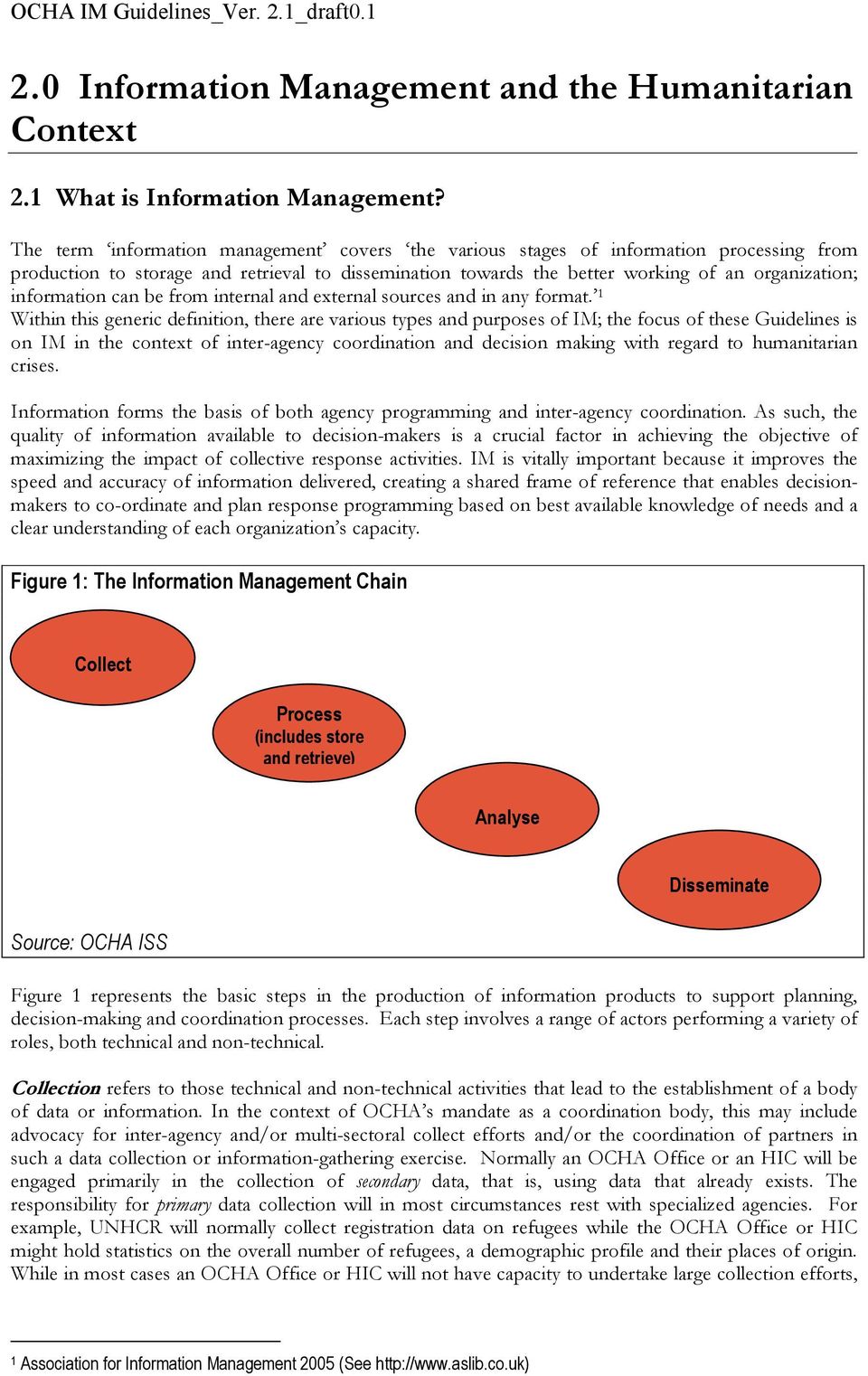
1 2.0 Information Management and the Humanitarian Context 2.1 What is Information Management? The term information management covers the various stages of information processing from production to storage and retrieval to dissemination towards the better working of an organization; information can be from internal and external sources and in any format. 1 Within this generic definition, there are various types and purposes of IM; the focus of these Guidelines is on IM in the context of inter-agency coordination and decision making with regard to humanitarian crises. Information forms the basis of both agency programming and inter-agency coordination. As such, the quality of information available to decision-makers is a crucial factor in achieving the objective of maximizing the impact of collective response activities. IM is vitally important because it improves the speed and accuracy of information delivered, creating a shared frame of reference that enables decisionmakers to co-ordinate and plan response programming based on best available knowledge of needs and a clear understanding of each organization s capacity. Figure 1: The Information Management Chain Collect Process (includes store and retrieve) Analyse Source: OCHA ISS Disseminate Figure 1 represents the basic steps in the production of information products to support planning, decision-making and coordination processes. Each step involves a range of actors performing a variety of roles, both technical and non-technical. Collection refers to those technical and non-technical activities that lead to the establishment of a body of data or information. In the context of OCHA s mandate as a coordination body, this may include advocacy for inter-agency and/or multi-sectoral collect efforts and/or the coordination of partners in such a data collection or information-gathering exercise. Normally an OCHA Office or an HIC will be engaged primarily in the collection of secondary data, that is, using data that already exists. The responsibility for primary data collection will in most circumstances rest with specialized agencies. For example, UNHCR will normally collect registration data on refugees while the OCHA Office or HIC might hold statistics on the overall number of refugees, a demographic profile and their places of origin. While in most cases an OCHA Office or HIC will not have capacity to undertake large collection efforts, 1 Association for Information Management 2005 (See
2 staff will engage with other agencies undertaking such efforts to ensure compatibility through data standards (see Section 5.2.6). Processing consists of primarily technical processes that transform raw data (i.e. numbers) into a format that can be easily manipulated or combined with other data in preparation for further analysis. This includes activities such as cleaning, compiling from various sources, and using established storage and archiving structures. These functions are primarily, but not exclusively, carried out by information management staff within an OCHA Office (IMU), or a HIC. Analysis is the process by which data or information is aggregated and summarized for presentation. Analysis is carried out at two levels. The first level involves basic statistical or spatial analysis using graphs, charts or maps to display the basic information. Adding background, context or technical (subject) expertise is the second level of analysis. An IMU or HIC will normally be involved in the first level of analysis while contextual or technical analysis might be carried out by OCHA Humanitarian Affairs Officers, experts from implementing agencies or policy specialists. Dissemination, the last step of the chain, puts information products into the hands of policy-makers and planners at various levels. Dissemination may be to a general audience or a targeted group of key decision-makers, in a variety of formats and through a range of mechanisms. As with collection, dissemination is generally the task of all OCHA program staff. 2.2 Principles of Humanitarian Information Management and Exchange Recognizing a need to establish global standards to guide information management and exchange in humanitarian action similar to those that govern humanitarian action as a whole, participants at the 2002 OCHA-sponsored Symposium on Best Practices in Humanitarian Information Management and Exchange identified ten guiding principles for anyone engaged in any aspect of humanitarian information management. This list was expanded at the 2007 Global Symposium+5 to further reflect the importance accorded the role of information in humanitarian action. Accessibility Humanitarian information and data should be made accessible to all humanitarian actors by applying easy-to-use formats and by translating information into common or local languages. Information and data for humanitarian purposes should be made widely available through a variety of online and offline distribution channels, including the media. Inclusiveness Information management and exchange should be based on collaboration, partnership and sharing with a high degree of participation and ownership by multiple stakeholders, including national and local governments and, especially, affected communities whose information needs should equally be taken into account. Interoperability All sharable data and information should be made available in formats that can be easily retrieved, shared and used by humanitarian organizations. Accountability Information providers should be responsible to their partners and stakeholders for the content they publish and disseminate. Verifiability Information should be accurate, consistent and based on sound methodologies, validated by external sources and analyzed within the proper contextual framework.
3 Relevance Information should be practical, flexible, responsive and driven by operational needs in support of decision-making throughout all phases of a crisis. Data that is not relevant should not be collected. Impartiality Information managers should consult a variety of sources when collecting and analyzing information so as to provide varied and balanced perspectives for addressing problems and recommending solutions. Humanity Information should never be used to distort, to mislead or to cause harm to affected or at-risk populations and should respect the dignity of victims. Timeliness Humanitarian information should be collected, analyzed and disseminated efficiently and must be kept current. Sustainability Humanitarian information and data should be preserved, cataloged and archived, so that it can be retrieved for future use, such as for preparedness, analysis, lessons learned and evaluation. The use of Open Source Software should be promoted to further enhance access to information by all stakeholders in a sustainable way. When possible, post-emergency data should be transitioned to relevant recovery actors and host governments and training provided on its use. Reliability Users must be able to evaluate the reliability and credibility of data and information by knowing its source and method of collection. Collection methods should adhere to global standards where they exist to support and reinforce credibility. Reliability is a prerequisite for ensuring validity and verifiability. Reciprocity Information exchange should be a beneficial two-way process between the affected communities and the humanitarian community, including affected governments. Confidentiality The processing of any personal data shall not be done without the prior explicit description of its purpose and will only be done for that purpose, and after prior informed consent of the individual concerned. Sufficient safeguards must be put in place to protect personal data against loss, unauthorized processing and other misuse. If sensitive information is publicly disclosed, the sources of such information will not be released when there is a reasonable risk that doing so will affect the security or integrity of these sources. 2.3 The Importance of Reciprocity and Added-Value in Humanitarian Information Management Both the OCHA Office and HICs support all steps in the IM chain: they both receive data from collecting/producing individuals and agencies, processes it to produce information in a manner which facilitates humanitarian decision making and coordination and disseminates this product to users. (Depending on the nature of the data and/or final product needed, an IMU or HIC may also undertake analysis.)
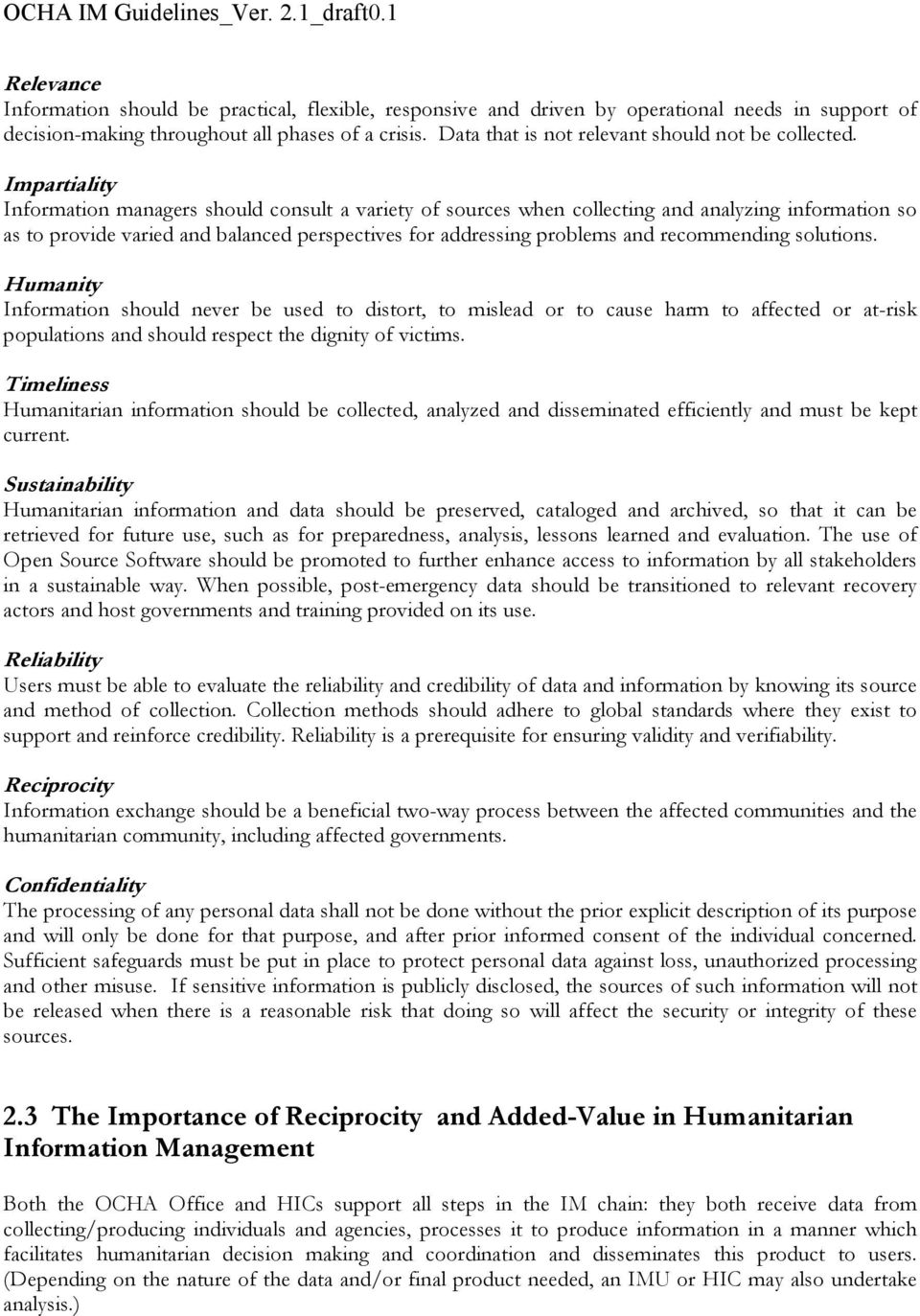
4 Figure 2: The Virtuous Circle of Information Exchange Convince partner to share Partner sees net benefit Add value to information Disseminate quickly Source: OCHA ISS In most cases, the sources for data used by an OCHA Office or HIC will also be the ultimate users of the products. Because of the reliance on other actors for primary data, developing and maintaining strong relations with client organizations in the humanitarian community is perhaps the most critical element in determining the performance and impact of an OCHA office or HIC. Figure 2 above represents the principle of reciprocity on which information exchange largely rests: potential partners will be encouraged to share data if they ultimately see (or tangibly receive) a benefit for having done so. When an IMU or HIC is able to add value to data/information by, for example, displaying it in the form of a map and returning it in a timely fashion to the agency/ies that provided the initial data, then the agency/ies are more likely to continue to participating in an exchange relationship. If the circle is broken at any stage, the process as a whole will ultimately break down. Initially convincing partners to share data or information without being able to show an immediate benefit is a challenge which often requires creativity and strong persuasion skills. Once a demonstrable benefit is achieved however, the process can quickly become self-sustaining due to a normally high demand for quality information products and services. An important message emerges from the case studies: an effective disaster information management system requires a good technological platform, but also much more. The real difficulty lies in anchoring these technological approaches in an appropriate institutional context where they are supported by relevant and effective operating procedures, agreed terminology and data labeling, and a shared awareness of the benefits of proper handling of disaster information. Clearly, a disaster information management system must be supported by accepted rules, procedures, and relationships that encourage, facilitate, and guide the production, sharing, and analysis and use of data in response to disaster. In these case studies, the institutional dimension the hidden wiring determined the effectiveness of the systems. Data Against Disasters, World Bank

5 Box #: Best Practices for Developing and Maintaining Relationships No one organization can collect all of the data and information needed during a relief operation so cooperation among international organizations, local and national actors, and the media is critical to both the short term success and long term sustainability of both global and field based information systems. Partnerships encourage trust and commitment among stakeholders and allow information systems to remain objective, accountable and focused on common rather than narrow interests. Maximize resources by establishing partnerships. Recognize that data and information are collected and managed by a variety of actors including national governments, UN agencies, NGOs, the private sector and research institutions and that the contributions of these providers are crucial. Pre-establish inter-agency agreements and relationships at the national and local levels. Relationships should be established with appropriate agencies at the national level in high-risk countries prior to an emergency situation. Maintain an ongoing process of personal interaction to create partnerships for IM and exchange. Promote trust and transparency through linkages. Use distributed networks and neutral portal repositories to assist with information sharing, and promote linkages to avoid duplication of effort (e.g. provide websites, or areas on existing websites, where interest groups or members can post information and collaborate). Engage local and national actors in information projects. Develop networks of local communities and national NGOs, civil society groups and the private sector and address the issue of local participation as part of overall emergency planning, monitoring and evaluation. Build and strengthen the national/local capacity in IM and exchange and promote the transfer and use of local knowledge. Partnering with the media can be an effective way of communicating information to the affected population. Use local and international media outlets to inform the local population about humanitarian relief operations. Source: Symposium on Best Practices in Humanitarian Information Exchange Final Report, OCHA (2002) 2.4 Information Management in the Humanitarian Context Humanitarian Crisis Most often, up-to-date and reliable information is scarce at the onset of a humanitarian crisis. The crisis environment is characterized by high risk factors and the consequences of mistakes or delays can be disastrous (considering that the lives and well-being of people are at stake). Humanitarian staff may be under particularly strong pressure to act quickly in what are likely to be difficult security and living conditions. In many instances the conflict or natural hazard generating the crisis will simultaneously hinder humanitarian response (e.g. communications and power utilities may be cut or damaged, physical and/or security constraints impede access to beneficiaries). The crisis environment generally includes a large and diverse range of actors (including UN Agencies, international organizations, local and international NGOs, Government, donors, military, media actors) with differing mandates and capacities. The onset of a crisis is usually characterized by a large and sudden influx of agencies, many of which arrive with little or no prior in-country experience or capacity. For example, following the NATO intervention in Kosovo, the inter-agency contact list contained over three hundred local and international NGOs working in the province.
6 A protracted crisis environment is one in which there may not be immediate large-scale humanitarian needs, but where the population includes highly vulnerable groups and the political, social and/or security situation is extremely fragile. This kind of situation necessitates close monitoring, and IM remains critical in the ongoing assessment of political, economic and social changes and the dissemination of this information to partners and donors.with the aim of ensuring timely and appropriate planning, funding and assistance delivery Information in the Crisis Environment The objective of humanitarian organizations in crisis response is to alleviate human suffering and meet basic needs. Plans and operations to meet this objective will be based on information such as affected population numbers, locations, profile and needs, as well as contextual information regarding logistics, security, capacities and plans of other agencies etc. The effectiveness of any response is dependent on the quality of information available. However, in a complex and rapidly changing crisis environment, reliable, accurate and up-to-date information is often scarce and difficult to locate. Humanitarian missions, carried out in chaotic and fast-changing environments by multiple actors, often lack even the most basic shared information systems. This means surveys are frequently repeated and the results not shared or effectively used. Although individual organizations bear responsibility for dealing with this issue, there are certain common information needs which can benefit the humanitarian community as a whole. In this context, a focal point for information sharing and processing, such as an OCHA Office or HIC, raises the efficiency of the humanitarian community, saving individual agencies time and energy on information sharing and processing, and providing a common platform of available information which facilitates collaboration Coordination of Humanitarian Response Coordination relates to the process of planning and decision-making among organizations. Bringing agencies together to share and analyse information, and jointly develop response goals and strategies, coordination can also assist internal decision-making by providing the framework within which each organization can plan and execute its response activities. Therefore, by Information management systems are a critical element of effective response capacity. Responding to a major disaster involves numerous challenges in information management: tracking displaced and vulnerable populations; logging the damage to housing, infrastructure, and services; dealing with the sudden influx of humanitarian supplies; and coordinating the work of dozens and even hundreds of responding agencies. Essential information is controlled by many autonomous actors, and these actors may be working together for the first time. Developing systems that enable the information to be shared and analyzed to target resources is fundamental to building better response capacity. Data Against Disasters, World Bank strengthening the coordination process (through providing best possible information as shown in the previous section) the benefits of good IM practices at the inter-agency level flow through to the programming process of individual agencies. As illustrated earlier, IM is a sequence of linked activities, essentially taking raw data, compiling/collating and associating it with other relevant data, and presenting this in a format designed to assist analysis, decision-making and action regarding aspects of a humanitarian crisis. As with coordination, IM does not in itself produce best-possible decisions or action; rather it supports this goal by providing decisionmakers with high quality information products relevant to the situation under consideration. 2 Association for Information Management 2005 (See
7 Box #: Minimum Essential Data In the early stages of a humanitarian crisis there is frequently a lack of timely and accurate data. The acquisition of appropriate data and information and its early incorporation into the planning needs of the humanitarian response has been identified as a priority in a number of recent studies on humanitarian coordination. Among the most critical priority information needs are: Estimated number of individuals affected Geographical area affected Numbers and location(s) of displaced populations Critical immediate needs (i.e. medical assistance, shelter, food) Core datasets to include administrative divisions, demographic information, population movements, health and education facilities, etc. These generic datasets can be applied across a wide range of functions and sectors. The Survey of Surveys (see Section 5.2.4) and Information Needs Assessment (see Section 5.2.7) tools can be helpful in identifying what data or information exists. Where gaps are identified, the first and most important step is to secure the active participation of the major agencies in the necessary data collection activities and agreement that the entire humanitarian community will have access to relevant information outputs. The humanitarian community encompasses a large number of entities, each with particular interests and abilities. They range from formal, highly structured governmental institutions, through specialist international agencies to independent non-governmental organizations and concerned individuals. In an acute crisis, as these different types of relief stakeholders flood to the area, all under intense pressure to engage as quickly as possible, the characteristics of the humanitarian community often mirror the fragmented and rapidly changing nature of the crisis itself. Acknowledging this, UN General Assembly Resolution 46/182 (1992) recognized the need to make more effective the collective efforts of the international community, and confirmed that the UN has a central and unique role to play in providing leadership and co-ordinating the efforts of the international community to ensure the prompt and smooth delivery of relief assistance. The purpose of coordination is to enable humanitarian organizations to maximise the impact of their collective effort. In simple terms coordination output might produce a set of programmes that are: compatible (avoiding gaps or overlaps); targeted to the most in need; and delivered in the most efficient and effective manner possible. Six facets of coordination have been identified 3 : 1) Avoiding duplication 2) Taking coherent approaches 3) Efficient use of resources 4) Leadership 5) Direction 6) Strata (local, sub-national, national, international) 3 OCHA Paper#1: Meeting of the high-level working group on OCHA, May 2003.

8 The Humanitarian Coordinator, with support from OCHA and the UN Country Team, has primary responsibility for the structure and functioning of coordination mechanisms 4. The impact on humanitarian response (measured in terms of the six facets above) will depend on their performance and the level of participation by humanitarian actors in the process. In practice, coordination is a complex process (joint analysis, planning and decision making; building consensus on goals and priorities) but the first step is to ensure that the relevant actors are at least working with the same information and that this is as accurate and timely as possible. Information is in this sense the foundation stone on which decision-making and coordination are based. IM increases the quality of available information, and this can benefit all the actors and fora, and therefore the above mentioned facets of coordination, above. However good information will not generate positive coordination per se; rather it is a tool for the use of coordination focal points and fora. It is in this sense that IM supports coordination actors and mechanisms. Box #: Humanitarian Needs Assessment Humanitarian needs define the crisis response. Needs information is collected through assessments, and the collection and analysis of data is the responsibility of operational agencies. However, an IM specialist may support the process in a number of ways by providing: guidance on survey design (to ensure the quality, type and format of data collected meets the user s output needs) technical advice on data processing and management technical support to production of outputs for general distribution The OCHA Office or HIC may have other data which could assist in analysis of the information on needs. For example, linking the W3 database of humanitarian activity with information on humanitarian needs could produce very useful outputs (e.g. maps) showing gaps or overlaps by sector, area, agency etc Sensitive Information and the Security of Humanitarian Staff While the primary responsibility for the safety and security of humanitarian aid workers rests with host governments, the UN Department for Safety and Security (UNDSS) contributes to creating a safe environment by providing specialised security advice to the humanitarian community. In general, OCHA staff does not disseminate security-related information to the humanitarian community unless explicitly advised by UNDSS. As such, any information on security-related issues including maps of security phases, should be cleared by UNDSS before publication. Procedures for disseminating tools such as contact lists which could potentially impact the safety of staff should also be agreed upon with the humanitarian community in consultation with UN Department of Safety and Security (UNDSS) staff. 4 Donors, NGOs and Government also have responsibilities, both regarding internal coordination and participation in UN fora.
9 Box #: Handling Sensitive Information The overall policy of OCHA is to make as much information as possible openly available. However, some humanitarian information may be sensitive to particular parties or place people at risk, and should therefore be treated accordingly. This kind of situation often arises in complex emergencies which involve conflict. For example, displacement routes and locations may threaten IDPs if made available to military parties to a conflict. Because each crisis is different (and changing), the type of information which will be considered sensitive is a matter of judgement. Security staff, beneficiaries and civilian populations will be the primary criterion and the political environment is also often an important factor. In deciding on which information is sensitive and how it should be dealt with, staff should take the advice of the information source, potential users and consult with and follow the instructions of the Humanitarian Coordinator Preparedness and Contingency Planning Although the value of information in coordinating humanitarian response is by now well-known, less attention is often given to the integration of information management activities into preparedness and contingency planning efforts. In this context information management can be viewed in two ways: as a support function for planning and preparation and as a key component of a potential response scenario. A more detailed discussion of the role of data preparedness as part of overall preparedness efforts can be found in Chapter 7. Want to know more? Swiss Re (a) Information Support to Contingency Planning Contingency planning often includes the development of potential crisis and response scenarios, both of which rely on accurate data to make them realistic and comprehensive. Population data, for example, may be used to anticipate the number and demographic profile of those who may be affected by a natural disaster occurring in a specific geographic area. Who Does What Where (3W) information may be a useful starting point for anticipating capacities for response by sector or geographic area. (b) Planning Information Management Capacity Too often, information management has been an afterthought when it comes to humanitarian response. Increasingly however, the importance of establishing disaster information systems before a crisis occurs is becoming clear to relief and development professionals. 5 While establishing a comprehensive information management system is a goal for many countries, this often takes years of development and training. In the short term, much more basic efforts to identify and assign information management roles and tasks in potential response scenario may result in significant benefits to all actors once a response is triggered. Many of these institutional arrangements have been or are being developed at the global level 5 See Data Against Disasters etc.
10 but their reiteration and clarification in local contingency planning exercises is often necessary to ensure a common understanding among all partners.

2 INFORMATION/DATA MANAGEMENT STRATEGY
 2 INFORMATION/DATA MANAGEMENT STRATEGY 2.1 OVERVIEW AND FUNCTION The information management strategy should be drafted and maintained by the Information Management Officer (IMO), preferably, or the Information
global Food Security Cluster INFORMATION MANAGEMENT FRAMEWORK
 global Food Security Cluster INFORMATION MANAGEMENT FRAMEWORK Updated April 2016 1 Contents 1.BACKGROUND... 3 2. OBJECTIVES AND BENEFITS... 4 3. PRINCIPLES... 6 4. CORE IM PRODUCTS... 7 2 1. BACKGROUND
Vacancy No. IRC3004. Call for Expression of Interest Emergency Response Roster. Field Security Officer. Deadline for Applications: 30 September 2015
 Vacancy No. IRC3004 Call for Expression of Interest Emergency Response Roster Field Security Officer Deadline for Applications: 30 September 2015 Job Title Duty Station Profile Number Field Security Officer
INTER-AGENCY CONTINGENCY PLANNING GUIDELINES FOR HUMANITARIAN ASSISTANCE. November 2007 IASC. Inter-Agency Standing Committee
 INTER-AGENCY CONTINGENCY PLANNING GUIDELINES FOR HUMANITARIAN ASSISTANCE November 2007 IASC Inter-Agency Standing Committee INTER-AGENCY CONTINGENCY PLANNING GUIDELINES FOR HUMANITARIAN ASSISTANCE Endorsed
Terms of Reference. Food Security. Sector Coordination-Lebanon
 Terms of Reference Food Security Sector Coordination-Lebanon Background Lebanon hosts the largest Syrian refugee population in the region. Since the outset of the influx in 2011, the Government of Lebanon
HUMANITARIAN. Food 11. Health 4 Shelter 4 Other 7 OECD/DAC
 #094 DENMARK Group 1 PRINCIPLED PARTNERS OFFICIAL DEVELOPMENT ASSISTANCE HRI 2011 Ranking 2nd 0.90% AID of GNI of ODA P4 6.2% US $32 6.95 P5 7.62 7.12 7.49 P3 7.90 P1 5.35 P2 Per person AID DISTRIBUTION
Terms of Reference for the Education Sector Working Group - Lebanon
 Terms of Reference for the Education Sector Working Group - Lebanon Background Since April 2011, due to the conflict in Syria, people started fleeing to neighboring countries including Lebanon. Recent
Human mobility and displacement tracking
 Human mobility and displacement tracking The importance of collective efforts to efficiently and ethically collect, analyse and disseminate information on the dynamics of human mobility in crises Mobility
IASC Inter-Agency Standing Committee
 IASC Inter-Agency Standing Committee Global Health Cluster Guidance Note Promotion and Advocacy for Stronger National and Local Capacities in Health Emergency Preparedness and Risk Reduction 1. Background
reflected and translated into policy orientations and priorities as well strategy documents and a management plan.
 ECHO s main mission is to fund the co-ordinated delivery of Community humanitarian assistance and protection through partner humanitarian organisations in order to save and preserve life, reduce or prevent
TERMS OF REFERENCE. Junior Professional Officer (JPO) Programme
 TERMS OF REFERENCE Junior Professional Officer (JPO) Programme Emergency Response Officer, Goma, Democratic Republic of the Congo Programme Office, Goma Area Office, DRC Country Office Special Notice:
Compilation of Principles and Recommendations on Preparedness from a series of Workshops and Meetings
 Compilation of Principles and Recommendations on Preparedness from a series of Workshops and Meetings Disaster prone countries Advocacy and Awareness Make disaster risk reduction for resilience, including
VACANCY ANNOUNCEMENT Geographic Information Systems Associate Based at East Jerusalem, OCHA opt
 U N I T E D N A T I O N S N A T I O N S U N I E S United Nations Office for the Coordination of Humanitarian Affairs (OCHA) VACANCY ANNOUNCEMENT Geographic Information Systems Associate Based at East Jerusalem,
EN 31IC/11/R7 Original: English Adopted
 EN 31IC/11/R7 Original: English Adopted 31st INTERNATIONAL CONFERENCE OF THE RED CROSS AND RED CRESCENT Geneva, Switzerland 28 November 1 December 2011 Strengthening normative frameworks and addressing
WFP ENTERPRISE RISK MANAGEMENT POLICY
 WFP ENTERPRISE RISK MANAGEMENT POLICY Informal Consultation 3 March 2015 World Food Programme Rome, Italy EXECUTIVE SUMMARY For many organizations, risk management is about minimizing the risk to achievement
Islamic Republic of Afghanistan, Post Disaster Need Assessment (PDNA) Training Manual
 Islamic Republic of Afghanistan, Ministry of Rural Rehabilitation and Development (MRRD) Ministry of Rural Rehabilitation & Development Post Disaster Need Assessment (PDNA) Training Manual Social Protection
When an earthquake erupts A crisis is called a disaster A number of small and large donors have adopted
 When an earthquake erupts or when a tsunami causes death and destruction, when thousands are displaced by war, or when yet another drought leads to acute famine in a developing country Denmark is ready
Building Disaster Risk Management capacity: key principles
 briefing note Building Disaster Risk Management capacity: key principles How can programmes aiming to build disaster risk management (DRM) capacity improve their effectiveness? What works and why? What
The Challenges and Recommendations of Accessing to Affected Population for Humanitarian Assistance: A Narrative Review
 Global Journal of Health Science; Vol. 7, No. 3; 2015 ISSN 1916-9736 E-ISSN 1916-9744 Published by Canadian Center of Science and Education The Challenges and Recommendations of Accessing to Affected Population
Guidelines for humanitarian aid
 DGCS-NGO Working Guidelines for aid Good Humanitarian Donorship Initiative Humanitarian Donorship Principles and Good Practice (2012-2015) 1 Contents Introduction... Section I Strategic Guidelines for
TRANSITION FROM RELIEF TO DEVELOPMENT: Key Issues Related to Humanitarian and Recovery/Transition Programmes
 Internal Working Document Draft: May 8 2006 UNITED NATIONS NATIONS UNIES Secretary-General s High-level Panel on UN System-wide Coherence in the Areas of Development, Humanitarian Assistance, and the Environment
Core Humanitarian STANDARD. Core Humanitarian Standard on Quality and Accountability
 Core Humanitarian STANDARD Core Humanitarian Standard on Quality and Accountability Published by: CHS Alliance, Groupe URD and the Sphere Project. First edition: 2014 ISBN: 78-2-83-1564- All rights reserved.
Ohio Supercomputer Center
 Ohio Supercomputer Center IT Business Continuity Planning No: Effective: OSC-13 06/02/2009 Issued By: Kevin Wohlever Director of Supercomputer Operations Published By: Ohio Supercomputer Center Original
Resolution adopted by the General Assembly. [without reference to a Main Committee (A/64/L.43 and Add.1)]
![Resolution adopted by the General Assembly. [without reference to a Main Committee (A/64/L.43 and Add.1)]](/thumbs/26/9256534.jpg "Resolution adopted by the General Assembly. [without reference to a Main Committee (A/64/L.43 and Add.1)]") United Nations A/RES/64/251 General Assembly Distr.: General 30 April 2010 Sixty-fourth session Agenda item 70 (a) Resolution adopted by the General Assembly [without reference to a Main Committee (A/64/L.43
United Nations A/RES/64/251 General Assembly Distr.: General 30 April 2010 Sixty-fourth session Agenda item 70 (a) Resolution adopted by the General Assembly [without reference to a Main Committee (A/64/L.43
Developing Post Disaster Recovery Frameworks
 Developing Post Disaster Recovery Frameworks Raja Rehan Arshad Team Leader Sustainable Recovery, GFDRR Disaster and Crisis Recovery Operations for Increased Resilience JVI, September 10-14, 2012 Why The
Centre International de Droit Comparé de l Environnement CIDCE. Comments on the Zero draft of the Post 2015 framework for disaster risk reduction
 Centre International de Droit Comparé de l Environnement CIDCE Comments on the Zero draft of the Post 2015 framework for disaster risk reduction Paragraph n (1,2,3,...), page Comments A. Preambule 5. page
The Core Humanitarian Standard and the Sphere Core Standards. Analysis and Comparison. SphereProject.org/CHS. Interim Guidance, March 2015 (version 2)
 The Core Humanitarian Standard and the Sphere Core Standards Analysis and Comparison Interim Guidance, March 2015 (version 2) SphereProject.org/CHS Contents Introduction... 3 The CHS and the Sphere Core
INFORMATION MANAGEMENT STRATEGY MEETING 7 April 2002 0900-1300 UNAMA Conference Room Chaired by Nigel Fisher (UNAMA) and Ashraf Ghani (AACA)
 0900-1300 UNAMA Conference Room Chaired by Nigel Fisher (UNAMA) and Ashraf Ghani (AACA) Agenda 0845 Refreshments 0900 Introduction (Ashraf Ghani) 0915 Presentation on overall information strategy, including
VACANCY ANNOUNCEMENT Website and Database Associate Based at East Jerusalem, OCHA opt
 U N I T E D N A T I O N S N A T I O N S U N I E S United Nations Office for the Coordination of Humanitarian Affairs (OCHA) VACANCY ANNOUNCEMENT Website and Database Associate Based at East Jerusalem,
A FRAMEWORK FOR NATIONAL HEALTH POLICIES, STRATEGIES AND PLANS
 A FRAMEWORK FOR NATIONAL HEALTH POLICIES, STRATEGIES AND PLANS June 2010 A FRAMEWORK FOR NATIONAL HEALTH POLICIES, STRATEGIES AND PLANS June 2010 This paper reviews current practice in and the potential
IMAS 05.10. First Edition 01 September 2012 Amendment 1, May 2013
 Amendment 1, May 2013 IMAS 05.10 01 September 2012 Amendment 1, May 2013 Information Management for Mine Action Director, United Nations Mine Action Service (UNMAS) 1 United Nations Plaza, 6th Floor New
Information Governance and Management Standards for the Health Identifiers Operator in Ireland
 Information Governance and Management Standards for the Health Identifiers Operator in Ireland 30 July 2015 About the The (the Authority or HIQA) is the independent Authority established to drive high
pm4dev, 2007 management for development series Introduction to Project Management PROJECT MANAGEMENT FOR DEVELOPMENT ORGANIZATIONS
 pm4dev, 2007 management for development series Introduction to Project Management PROJECT MANAGEMENT FOR DEVELOPMENT ORGANIZATIONS PROJECT MANAGEMENT FOR DEVELOPMENT ORGANIZATIONS A methodology to manage
We are currently looking for a REACH Assessment Officer to support our REACH team in Chad.
 REACH was born in 2010 as a joint initiative of two International NGOs (IMPACT Initiatives and ACTED) and the United Nations Institute for Training and Research (UNITAR) Operational Satellite Applications
Overview of Child Protection Information Management tools for Field Based Coordinators and Information Management Officers
 Overview of IM tools Overview of Child Protection Information Management tools for Field Based Coordinators and Information Management Officers Overview of IM tools Data Collection tools Contact List Desk
UNISDR Science and Technology Roadmap
 UNISDR Science and Technology Roadmap For the UNISDR Science and Technology Partnership supporting the implementation of Sendai Framework for Disaster Risk Reduction 2015-2030 Background The Sendai Framework
E Distribution: GENERAL EVALUATION REPORTS. Agenda item 6
 Executive Board Second Regular Session Rome, 10 13 November 2014 EVALUATION REPORTS Agenda item 6 For consideration MANAGEMENT RESPONSE TO THE RECOMMENDATIONS OF THE FAO/WFP JOINT EVALUATION OF FOOD SECURITY
Joint Declaration on Post-Crisis Assessments and Recovery Planning
 Joint Declaration on Post-Crisis Assessments and Recovery Planning The European Commission, the United Nations Development Group and the World Bank seek to mobilize our institutions and resources to harmonise
WHAT IS CCCM? CAMP COORDINATION AND CAMP MANAGEMENT
 WHAT IS CCCM? CAMP COORDINATION AND CAMP MANAGEMENT The mission of CCCM is to ensure equitable access to services and protection for displaced persons living in communal settings, to improve their quality
Disaster Preparedness and Response World Health Organization Regional Office for Europe. Introduction to the VRAM
 Disaster Preparedness and Response World Health Organization Regional Office for Europe 1 WHO principles all-hazard approach the multidisciplinary (intrasectoral) approach multisectoral approach comprehensive
Scaling Up Nutrition (SUN) Movement Strategy [2012-2015]
![Scaling Up Nutrition (SUN) Movement Strategy [2012-2015]](/thumbs/27/12344538.jpg "Scaling Up Nutrition (SUN) Movement Strategy [2012-2015]") Scaling Up Nutrition (SUN) Movement Strategy [2012-2015] September 2012 Table of Contents Synopsis... 3 A: SUN Movement Vision and Goals... 4 B: Strategic Approaches and Objectives... 4 C: Principles of
Scaling Up Nutrition (SUN) Movement Strategy [2012-2015] September 2012 Table of Contents Synopsis... 3 A: SUN Movement Vision and Goals... 4 B: Strategic Approaches and Objectives... 4 C: Principles of
SOS Children s Villages
 SOS Children s Villages Emergency Policy May, 2012 Protecting children in Emergencies Core Policy 2 SOS Children s Villages Emergency Policy This policy expresses the organisation s stand on Emergency
VACANCY ANNOUNCEMENT # 2015-006 Database Analyst (National Position) Level (ICS-8) Jerusalem/OCHA opt
 U N I T E D N A T I O N S N A T I O N S U N I E S United Nations Office for the Coordination of Humanitarian Affairs (OCHA) VACANCY ANNOUNCEMENT # 2015-006 Database Analyst (National Position) Level (ICS-8)
7. ASSESSING EXISTING INFORMATION SYSTEMS AND INFORMATION NEEDS: INFORMATION GAP ANALYSIS
 7. ASSESSING EXISTING INFORMATION 6. COMMUNITY SYSTEMS AND LEVEL INFORMATION MONITORING NEEDS: OF THE INFORMATION RIGHT TO ADEQUATE GAP ANALYSIS FOOD 7. ASSESSING EXISTING INFORMATION SYSTEMS AND INFORMATION
RECRUITMENT PROFILE. Profile: Community Services
 Profile: Community Services RECRUITMENT PROFILE Major Duties and Responsibilities 1. Provide information and social analysis of the cultural, political and economic context of population of persons of
Technical guidance note for Global Fund HIV proposals in Round 11
 Technical guidance note for Global Fund HIV proposals in Round 11 UNAIDS I World Health Organization I August 2011 Rationale for including the development of a system in the proposal With the global momentum
The European. Civil Protection. Training Programme. Humanitarian Aid and Civil Protection
 The European Civil Protection Training Programme Humanitarian Aid and Civil Protection Europe Direct is a service to help you find answers to your questions about the European Union. Freephone number (*):
Disaster Preparedness & Response
 3 4 5 6 7 8 9 10 11 12 13 14 15 16 17 18 19 20 21 22 23 24 25 26 27 28 29 30 31 32 A B C E INTRODUCTION AND PURPOSE REVIEW ELEMENTS ABBREVIATIONS NCUA REFERENCES EXTERNAL REFERENCES Planning - Ensuring
Lessons Learned from MDG Monitoring From A Statistical Perspective
 Lessons Learned from MDG Monitoring From A Statistical Perspective Report of the Task Team on Lessons Learned from MDG Monitoring of the IAEG-MDG United Nations March 2013 The views expressed in this paper
Instruction note for ECHO staff on Remote Management
 Ref. Ares(2013)168580-08/02/2013 EUROPEAN COMMISSION DIRECTORATE-GENERAL HUMANITARIAN AID AND CIVIL PROTECTION ECHO Instruction note for ECHO staff on Remote Management Commission européenne/europese Commissie,
GLOBAL CONSULTATION GENEVA, 14-16 OCTOBER 2015 CO-CHAIRS SUMMARY
 OCHA/Iason Athanasiadis GLOBAL CONSULTATION OF THE WORLD HUMANITARIAN SUMMIT GLOBAL CONSULTATION CO-CHAIRS SUMMARY Given the growing scale of humanitarian needs around the world and an ever more complex
Disaster risk reduction & emergency response for WASH
 February 2009 WSSCC Reference Note Disaster risk reduction & emergency response for WASH The Water Supply and Sanitation Collaborative Council (WSSCC) is a global multi-stakeholder partnership organisation
RISK APPETITE IN THE WORLD FOOD PROGRAMME
 RISK APPETITE IN THE WORLD FOOD PROGRAMME Informal Consultation 7 December 2015 World Food Programme Rome, Italy INTRODUCTION 1. WFP s risk appetite reflects its overall approach to risk management. Since
Integrated data and information management in social protection
 BRIEFING Integrated data and information management in social protection Key messages > Integrating data and information management of social protection programs through a Single Registry and associated
WORLD HEALTH ORGANIZATION
 WORLD HEALTH ORGANIZATION Follow up to the World Health Assembly decision on the Ebola virus disease outbreak and the Special Session of the Executive Board on Ebola: Roadmap for Action September 2015
2 The Code of Conduct for the International Red Cross and Red Crescent Movement and Non- Governmental Organisations (NGOs) in Disaster Relief
 2 The Code of Conduct for the International Red Cross and Red Crescent Movement and Non- Governmental Organisations (NGOs) in Disaster Relief Prepared jointly by the International Federation of Red Cross
Subject: National Preparedness
 For Immediate Release Office of the Press Secretary The White House December 17, 2003 Homeland Security Presidential Directive / HSPD-8 Subject: National Preparedness Purpose (1) This directive establishes
EVALUATION REPORT. EVALUATION OF UNICEF S EMERGENCY PREPAREDNESS SYSTEMS Executive Summary
 EVALUATION REPORT EVALUATION OF UNICEF S EMERGENCY PREPAREDNESS SYSTEMS Executive Summary EVALUATION OFFICE DECEMBER 2013 EVALUATION REPORT EVALUATION OF UNICEF S EMERGENCY PREPAREDNESS SYSTEMS Executive
International Disaster Response Tools
 International Disaster Response Tools Executive summary National Red Cross and Red Crescent Societies throughout the world have domestic responsibilities, as auxiliary to the public authorities, to provide
IFRC Framework for Evaluation
 IFRC Framework for Evaluation Planning and Evaluation Department (PED) IFRC Secretariat February 2011 1 IFRC Framework for Evaluation 1. INTRODUCTION The purpose of this IFRC Framework for Evaluation (hereafter
Active Engagement, Modern Defence - Strategic Concept for the Defence and Security of the Members of the North Atlantic Treaty Organization, 1010
 1 Modern security environment contains a broad and evolving set of challenges to the security of NATO s territory and populations. In order to assure their security, the Alliance must and will continue
INSTITUTIONAL AND ORGANISATIONAL CHANGE j) Mainstreaming a gender equality perspective in the Consolidated Inter-Agency Appeals BACKGROUND
 INSTITUTIONAL AND ORGANISATIONAL CHANGE j) Mainstreaming a gender equality perspective in the Consolidated Inter-Agency Appeals BACKGROUND A gender perspective in humanitarian assistance: what does it
JOINT COMMUNICATION TO THE EUROPEAN PARLIAMENT AND THE COUNCIL. The EU's comprehensive approach to external conflict and crises
 EUROPEAN COMMISSION HIGH REPRESENTATIVE OF THE EUROPEAN UNION FOR FOREIGN AFFAIRS AND SECURITY POLICY Brussels, 11.12.2013 JOIN(2013) 30 final JOINT COMMUNICATION TO THE EUROPEAN PARLIAMENT AND THE COUNCIL
Component 1: Mapping humanitarian access and coverage trends
 Improving the evidence base on delivering aid in highly insecure environments Component 1: Mapping humanitarian access and coverage trends SUMMARY OF RESEARCH OBJECTIVES AND APPROACH PROBLEM STATEMENT
AN OVERVIEW OF VULNERABILITY ANALYSIS AND MAPPING (VAM)
 AN OVERVIEW OF VULNERABILITY ANALYSIS AND MAPPING (VAM) Contents: What is Vulnerability? Ability to Cope What does VAM do? How to Undertake VAM Assistance to Country Offices The Goals of VAM The broad
Security Risk Assessment Tool
 Security Risk Assessment Tool Version: (Draft) 24 April 2014 This tool was developed by the ACT Safety & Security Community of Practice (SSCP) for use by ACT Alliance members and partners. 1. Purpose of
The total 2010-2011 budget is CHF 5.3m (USD 5.2m or EUR 3.5m) (Click here to go directly to the summary budget of the plan).
 Disaster services Executive summary The increasing frequency of disasters, coupled with emerging threats and trends which leave more people vulnerable to the effects of disasters, underlie the need for
Disaster Recovery Plan. NGO Emergency Operations
 Disaster Recovery Plan NGO Emergency Operations When a disaster happens there is a natural tendency to optimize the capacity to respond quickly in order to find the best solutions to reduce the effect
Global Nutrition Cluster Information and Knowledge Management Strategy in support of country Cluster IM/KM work 2014-2016
 Global Nutrition Cluster Information and Knowledge Management Strategy in support of country Cluster IM/KM work 2014-2016 Table of Contents Table of Contents... 1 Executive summary... 2 1 Background...
Guidelines for Designing Disaster Risk Assessment Projects. GLOBAL RISK IDENTIFICATION PROGRAMME Better Risk Information for Sound Decision Making
 GLOBAL RISK IDENTIFICATION PROGRAMME Better Risk Information for Sound Decision Making Guidelines for Designing Disaster Risk Assessment Projects Methodology and Tools Empowered lives. Resilient nations.
Web Annex 6: Output indicators and targets 2016-17
 CL 153/3 Web Annex 6 1 Web Annex 6: Output indicators and targets 2016-17 SO1: Contribute to the eradication of hunger, food insecurity and malnutrition 1.1 Member countries and their 1.1.1 Improving capacities
VACANCY ANNOUNCEMENT Database Associate Based at East Jerusalem, OCHA opt
 U N I T E D N A T I O N S N A T I O N S U N I E S United Nations Office for the Coordination of Humanitarian Affairs (OCHA) VACANCY ANNOUNCEMENT Database Associate Based at East Jerusalem, OCHA opt Salary:
TERMS of REFERENCE (ToR)
 TERMS of REFERENCE (ToR) Project Name: Building Disaster Resilient Communities in Cambodia ActionAid (Cambodia) - DRR Program OVERALL PURPOSE OF THE CONSULTANCY Undertake an independent research study
National Principles for Disaster Recovery
 National Principles for Disaster Recovery Introduction Recovery is a significant component within Australia s comprehensive approach to emergency management (Prevention, Preparedness, Response, and Recovery).
Emergency Plan Of Action update
 Emergency Plan Of Action update Tajikistan: Floods DREF n MDRTJ019 Update n 1 Date of issue: 30 June 2014 Operation n MDRTJ019 Glide n FL-2014-000063-TJK Timeframe covered by this update: 11 May 2014 23
OUTCOME OF PROCEEDINGS
 Council of the European Union Brussels, 18 November 2014 15585/14 COPS 303 POLMIL 103 CYBER 61 RELEX 934 JAI 880 TELECOM 210 CSC 249 CIS 13 COSI 114 OUTCOME OF PROCEEDINGS From: Council On: 17 18 November
NATO UNCLASSIFIED. 27 February 2012 DOCUMENT C-M(2012)0014 Silence Procedure ends: 16 Mar 2012 16:00
 27 February 2012 DOCUMENT Silence Procedure ends: 16 Mar 2012 16:00 Directive on the Management of Records Generated on Operational Deployment Note by the Secretary General 1. In June 2011 the NATO Records
UNHCR Georgia 2010 Operation
 UNHCR Georgia 2010 Operation UNHCR Tbilisi, November 2009 New Budget Structure in UNHCR Four Pillars UNHCR recently adopted a revised budget structure, in line with UNHCR s results framework, which uses
Human Resource (HR) Management Strategy
 Human Resource (HR) Management Strategy Appeal No. MAA00034 8 June 2011 This report covers the period 01 January to 31 December 2010. HR Seminar 2010 In brief Programme outcome: The overall outcome is
Human Resource (HR) Management Strategy
 Human Resource (HR) Management Strategy Appeal No. MAA00034 10 August 2010 This report covers the period 1 January to 30 June 2010. Delegates in a Danish Red Cross base camp canteen in Haiti. IFRC In brief
Attachment A. Terms of Reference. 1. Background and Justification
 Attachment A Terms of Reference 1. Background and Justification In 2011, UNESCO s 195 Member States approved a resolution during their 36th General Conference requesting the Organization to monitor, in
Education 2030: Towards inclusive and equitable quality education and lifelong learning for all. ED/WEF2015/MD/3 Original: English
 Education 2030: Towards inclusive and equitable quality education and lifelong learning for all ED/WEF2015/MD/3 Original: English 1. We, Ministers, heads and members of delegations, heads of agencies and
LIST OF RELIEF ORGANIZATIONS
 LIST OF RELIEF ORGANIZATIONS Action Against Hunger (AAH) http://www.aah-usa.org/ Develops and runs emergency programs in nutrition, health, water and food security for countries in need. Also provides
EMERGENCY MANAGEMENT BRITISH COLUMBIA A STRATEGY TO ADVANCE SUPPORT FOR LOCAL AUTHORITY EMERGENCY MANAGEMENT PROGRAMS OCTOBER 14, 2015
 EMERGENCY MANAGEMENT BRITISH COLUMBIA A STRATEGY TO ADVANCE SUPPORT FOR LOCAL AUTHORITY EMERGENCY MANAGEMENT PROGRAMS OCTOBER 14, 2015 1 MESSAGE FROM THE ASSISTANT DEPUTY MINISTER I am pleased to introduce
Security Council. United Nations S/2008/434
 United Nations S/2008/434 Security Council Distr.: General 3 July 2008 Original: English Special report of the Secretary-General pursuant to Security Council resolution 1806 (2008) on the United Nations
VACANCY ANNOUNCEMENT # 2014-007 Website Assistant (National Position)
 United Nations Office for the Coordination of Humanitarian Affairs (OCHA) VACANCY ANNOUNCEMENT # 2014-007 Website Assistant (National Position) Contract: SC Contract, SB3/Peg3 Duty Station: Jerusalem Duration:
GLOBAL RISK IDENTIFICATION PROGRAMME. Better Risk Information for Sound Decision Making DISASTER RISK ASSESSMENT TRAINING PACKAGE INTRODUCTORY COURSES
 GLOBAL RISK IDENTIFICATION PROGRAMME Better Risk Information for Sound Decision Making DISASTER RISK ASSESSMENT TRAINING PACKAGE INTRODUCTORY COURSES GRIP Global Risk Identification Programme 2012 GRIP
Revised Performance Appraisal Tool for Resident Coordinators and UN Country Teams: Assessment of Results and Competencies (ARC)
 ANNEX I Conceptual Design Revised Performance Appraisal Tool for Resident Coordinators and UN Country Teams: Assessment of Results and Competencies (ARC) I. From One80 to the ARC: Background and Key Changes
USAID PROGRAM CYCLE OVERVIEW
 USAID PROGRAM CYCLE OVERVIEW USAID AUGUST 2012 CONTENTS Background... 3 Overview Summary... 3 Program Cycle Components:... 3 Agency Policies and Strategies:... 4 Country Development Cooperation Strategies:...
NSW Government Open Data Policy. September 2013 V1.0. Contact
 NSW Government Open Data Policy September 2013 V1.0 Contact [email protected] Department of Finance & Services Level 15, McKell Building 2-24 Rawson Place SYDNEY NSW 2000 DOCUMENT CONTROL Document
Call for applications and checklist for selection and appointment of the Special Rapporteur on the right to privacy
 Call for applications and checklist for selection and appointment of the Special Rapporteur on the right to privacy 9 April 2015 At the 29 th session of the UN Human Rights Council (the Council or the
HEALTH INFORMATION MANAGEMENT
 Module 5 HEALTH INFORMATION MANAGEMENT INTER-REGIONAL TRAINING COURSE ON PUBLIC HEALTH AND EMERGENCY MANAGEMENT IN ASIA AND THE PACIFIC PHEMAP 08 Learning Objectives By the end of this session, the participant
CONSULTANT - CALL FOR APPLICATIONS: EXPERTS AND TRAINERS ROSTER (UN WOMEN GLOBAL)
 CONSULTANT - CALL FOR APPLICATIONS: EXPERTS AND TRAINERS ROSTER (UN WOMEN GLOBAL) Location : Application Deadline : Type of Contract : Post Level : Languages Required : Duration of Initial Contract : To