
California Independent System Operator Certification Practice Statement for Basic Assurance Certification Authority. Version 3.
|
|
|
- Kristina Jones
- 9 years ago
- Views:
Transcription
1 California Independent System Operator Certification Practice Statement for Basic Assurance Certification Authority Version 3.4 April 2015

2 Table of Contents 1.0 INTRODUCTION OVERVIEW DOCUMENT NAME AND IDENTIFICATION PKI PARTICIPANTS CERTIFICATION AUTHORITIES (CAs) Registration authorities Subscribers Relying parties Other participants CERTIFICATE USAGE Appropriate certificate uses POLICY ADMINISTRATION Organization administering the document Contact person Person determining CPS suitability for the policy CPS approval procedures DEFINITIONS AND ACRONYMS General definitions Acronyms PUBLICATION AND REPOSITORY RESPONSIBILITIES REPOSITORIES PUBLICATION OF CERTIFICATION INFORMATION TIME AND FREQUENCY OF PUBLICATION ACCESS CONTROLS ON REPOSITORIES IDENTIFICATION AND AUTHENTICATION NAMING Types of names Need for names to be meaningful Anonymity or pseudonymity of subscribers Rules for interpreting various name forms Uniqueness of names Recognition, authentication, and role of trademarks INITIAL IDENTITY VALIDATION Method to prove possession of private key Authentication of organization identity Authentication of individual identity Non-verified subscriber information Validation of authority Criteria for interoperation IDENTIFICATION AND AUTHENTICATION FOR RE-KEY REQUESTS Identification and authentication for routine re-key Identification and authentication for re-key after revocation IDENTIFICATION AND AUTHENTICATION FOR REVOCATION REQUEST CERTIFICATE LIFE-CYCLE OPERATIONAL REQUIREMENTS CERTIFICATE APPLICATION Who can submit a certificate application Enrollment process and responsibilities CERTIFICATE APPLICATION PROCESSING Performing identification and authentication functions Approval or rejection of certificate applications
3 Time to process certificate applications CERTIFICATE ISSUANCE CA actions during certificate issuance Notification to subscriber by the CA of issuance of certificate CERTIFICATE ACCEPTANCE Conduct constituting certificate acceptance Publication of the certificate by the CA Notification of certificate issuance by the CA to other entities KEY PAIR AND CERTIFICATE USAGE Subscriber private key and certificate usage Relying party public key and certificate usage CERTIFICATE RENEWAL Circumstance for certificate renewal Who may request renewal Processing certificate renewal requests Notification of new certificate issuance to subscriber Conduct constituting acceptance of a renewal certificate Publication of the renewal certificate by the CA Notification of certificate issuance by the CA to other entities CERTIFICATE RE-KEY Circumstance for certificate re-key Who may request certification of a new public key Processing certificate re-keying requests Notification of new certificate issuance to subscriber Conduct constituting acceptance of a re-keyed certificate Publication of the re-keyed certificate by the CA Notification of certificate issuance by the CA to other entities CERTIFICATE MODIFICATION Circumstance for certificate modification Who may request certificate modification Processing certificate modification requests Notification of new certificate issuance to subscriber Conduct constituting acceptance of modified certificate Publication of the modified certificate by the CA Notification of certificate issuance by the CA to other entities CERTIFICATE REVOCATION AND SUSPENSION Circumstances for revocation Who can request revocation Procedure for revocation request Revocation request grace period Time within which CA must process the revocation request Revocation checking requirement for relying parties CRL issuance frequency Maximum latency for CRLs On-line revocation/status checking availability On-line revocation checking requirements Other forms of revocation advertisements available Special requirements in reference to key compromise Circumstances for suspension Who can request suspension Procedure for suspension request Limits on suspension period CERTIFICATE STATUS SERVICES Operational characteristics Service availability

4 Optional features END OF SUBSCRIPTION KEY ESCROW AND RECOVERY Key escrow and recovery policy and practices Session key encapsulation and recovery policy and practices FACILITY, MANAGEMENT, AND OPERATIONAL CONTROLS PHYSICAL CONTROLS Site location and construction Physical access Power and air conditioning Water exposures Fire prevention and protection Media storage Waste disposal Off-site backup PROCEDURAL CONTROLS Trusted roles Number of persons required per task Identification and authentication for each role Roles requiring separation of duties PERSONNEL CONTROLS Qualifications, experience, and clearance requirements Background check procedures Training requirements Retraining frequency and requirements Job rotation frequency and sequence Sanctions for unauthorized actions Independent contractor requirements Documentation supplied to personnel AUDIT LOGGING PROCEDURES Types of events recorded Frequency of audit log processing Retention period for audit log Protection of audit log Audit log backup procedures Audit collection system (internal vs. external) Notification to event-causing subject Vulnerability assessments RECORDS ARCHIVAL Types of records archived Retention period for archive Protection of archive Archive backup procedures Requirements for time-stamping of records Archive collection system (internal or external) Procedures to obtain and verify archive information KEY CHANGEOVER COMPROMISE AND DISASTER RECOVERY Incident and compromise handling procedures Computing resources, software, and/or data are corrupted Entity private key compromise procedures Business continuity capabilities after a disaster CA OR RA TERMINATION

5 6.0 TECHNICAL SECURITY CONTROLS KEY PAIR GENERATION AND INSTALLATION Key pair generation Private key delivery to subscriber Public key delivery to certificate issuer CA public key delivery to relying parties Key sizes Public key parameters generation and quality checking Key usage purposes (as per X.509 v3 key usage field) PRIVATE KEY PROTECTION AND CRYPTOGRAPHIC MODULE ENGINEERING CONTROLS Cryptographic module standards and controls Private key (n out of m) multi-person control Private key escrow Private key backup Private key archival Private key transfer into or from a cryptographic module Private key storage on cryptographic module Method of activating private key Method of deactivating private key Method of destroying private key Cryptographic Module Rating OTHER ASPECTS OF KEY PAIR MANAGEMENT Public key archival Certificate operational periods and key pair usage periods ACTIVATION DATA Activation data generation and installation Activation data protection Other aspects of activation data COMPUTER SECURITY CONTROLS Specific computer security technical requirements Computer security rating LIFE CYCLE TECHNICAL CONTROLS System development controls Security management controls Life cycle security controls NETWORK SECURITY CONTROLS TIME-STAMPING CERTIFICATE, CRL, AND OCSP PROFILES CERTIFICATE PROFILE Version number(s) Certificate extensions Algorithm object identifiers Name forms Name constraints Certificate policy object identifier Usage of Policy Constraints extension Policy qualifiers syntax and semantics Processing semantics for the critical Certificate Policies extension CRL PROFILE OCSP PROFILE Version number(s) OCSP extensions COMPLIANCE AUDIT AND OTHER ASSESSMENTS

6 8.1 FREQUENCY OR CIRCUMSTANCES OF ASSESSMENT IDENTITY/QUALIFICATIONS OF ASSESSOR ASSESSOR'S RELATIONSHIP TO ASSESSED ENTITY TOPICS COVERED BY ASSESSMENT ACTIONS TAKEN AS A RESULT OF DEFICIENCY COMMUNICATION OF RESULTS OTHER BUSINESS AND LEGAL MATTERS FEES Certificate issuance or renewal fees Certificate access fees Revocation or status information access fees Fees for other services Refund policy FINANCIAL RESPONSIBILITY Insurance coverage Other assets Insurance or warranty coverage for end-entities CONFIDENTIALITY OF BUSINESS INFORMATION Scope of confidential information Information not within the scope of confidential information Responsibility to protect confidential information PRIVACY OF PERSONAL INFORMATION Privacy plan Information treated as private Information not deemed private Responsibility to protect private information Notice and consent to use private information Disclosure pursuant to judicial or administrative process Other information disclosure circumstances INTELLECTUAL PROPERTY RIGHTS REPRESENTATIONS AND WARRANTIES CA representations and warranties RA representations and warranties Subscriber representations and warranties Relying party representations and warranties Representations and warranties of other participants DISCLAIMERS OF WARRANTIES LIMITATIONS OF LIABILITY INDEMNITIES TERM AND TERMINATION Term Termination Effect of termination and survival INDIVIDUAL NOTICES AND COMMUNICATIONS WITH PARTICIPANTS AMENDMENTS Procedure for amendment Notification mechanism and period Circumstances under which OID must be changed DISPUTE RESOLUTION PROVISIONS GOVERNING LAW COMPLIANCE WITH APPLICABLE LAW MISCELLANEOUS PROVISIONS Entire agreement Assignment
7 Severability Enforcement (attorneys' fees and waiver of rights) Force Majeure OTHER PROVISIONS

8 1.0 INTRODUCTION 1.1 Overview This document is the Certification Practice Statement (CPS) for the California Independent System Operator (ISO) Basic Assurance Certification Authority. The Certificate Policies for the California Independent System Operator Public Key Infrastructure (hereafter called the CP Document) defines four policies for use in the ISO PKI. Each policy represents a different assurance level. The assurance levels are named Rudimentary (a.k.a. Test), Basic, Medium, and High. These policies are used for issuing certificates for the purposes of Identity Authentication, Message Origin Authentication and Key Agreement. The Basic Assurance CA operates according to the Basic Assurance Policy that is defined in the CP document. The California ISO, through a Managed PKI Service, operates a two-level certification authority hierarchy as depicted in Figure 1. The Root CA is a self-signed certification authority named CAISO_Root_CA. The Root CA issues certificates to operational Certification Authorities (CAs) according to one or more of the policies described in this document. The Operational Certification Authorities then issue certificates to all ISO PKI Subscribers. Root Certificate Authority (CAISO_Root_CA) Operational Certificate Authority Figure 1 California ISO Certification Authority Hierarchy Under normal operating conditions the Root CA is an off-line system. Circumstances that may warrant brining the Root CA on-line include (but are not limited to): 1. Revoke the digital certificate of one of the operational CAs, 8

9 2. Create a new operational CA, or 3. Create a cross-certificate for another CA. The ISO maintains many servers and applications in support of its public Web site. These servers exchange information with external entities that have business dealings with the California ISO and its employees and contractors. Additionally, the ISO employs Webmasters and other staff who administer these server systems and their server applications. This Certification Practice Statement covers the practices employed in issuing Basic Assurance digital certificates for use by these external entities, California ISO employees, California ISO contractors, and California ISO systems and applications. This CPS is issued according to the Basic Assurance policy, as defined by the California ISO Certificate Policy (CP) document. The Basic Assurance CA will operate in accordance with this CPS, the ISO CP, the laws of the state of California, and other applicable federal regulations. The CA will ensure that all RAs operating on its behalf will comply with the relevant provisions of the ISO CP concerning the operation of RAs. The CA will take all reasonable measures to ensure that Subscribers and Relying Parties are aware of their respective rights and obligations with respect to the operation and management of any keys, certificates or End-Entity hardware and software used in connection with the PKI. Issuance of a certificate governed by this CPS does not imply that the Subscriber has any authority to conduct business transactions on behalf of the California ISO. The laws of the state of California and other applicable federal laws concerning the enforceability, construction, interpretation and validity will govern this CPS. The California ISO reserves the right to accept or decline offers to enter into a cross certification agreement with an external Certification Authority. The operation of a Certification Authority requires the assignment of certain roles with corresponding responsibilities. This CPS states who has been assigned specific roles and lists their respective responsibilities. The table below shows the roles and responsibilities of the entities in the ISO Basic Assurance CA. Titles & Roles Manager, Information Security, Policy Management Authority (PMA) Managed PKI Service Provider (CyberTrust) Responsibilities Sets, implements and administers policy for the PKI Operator of the PKI service Initial creation of accounts for PKI officers 9
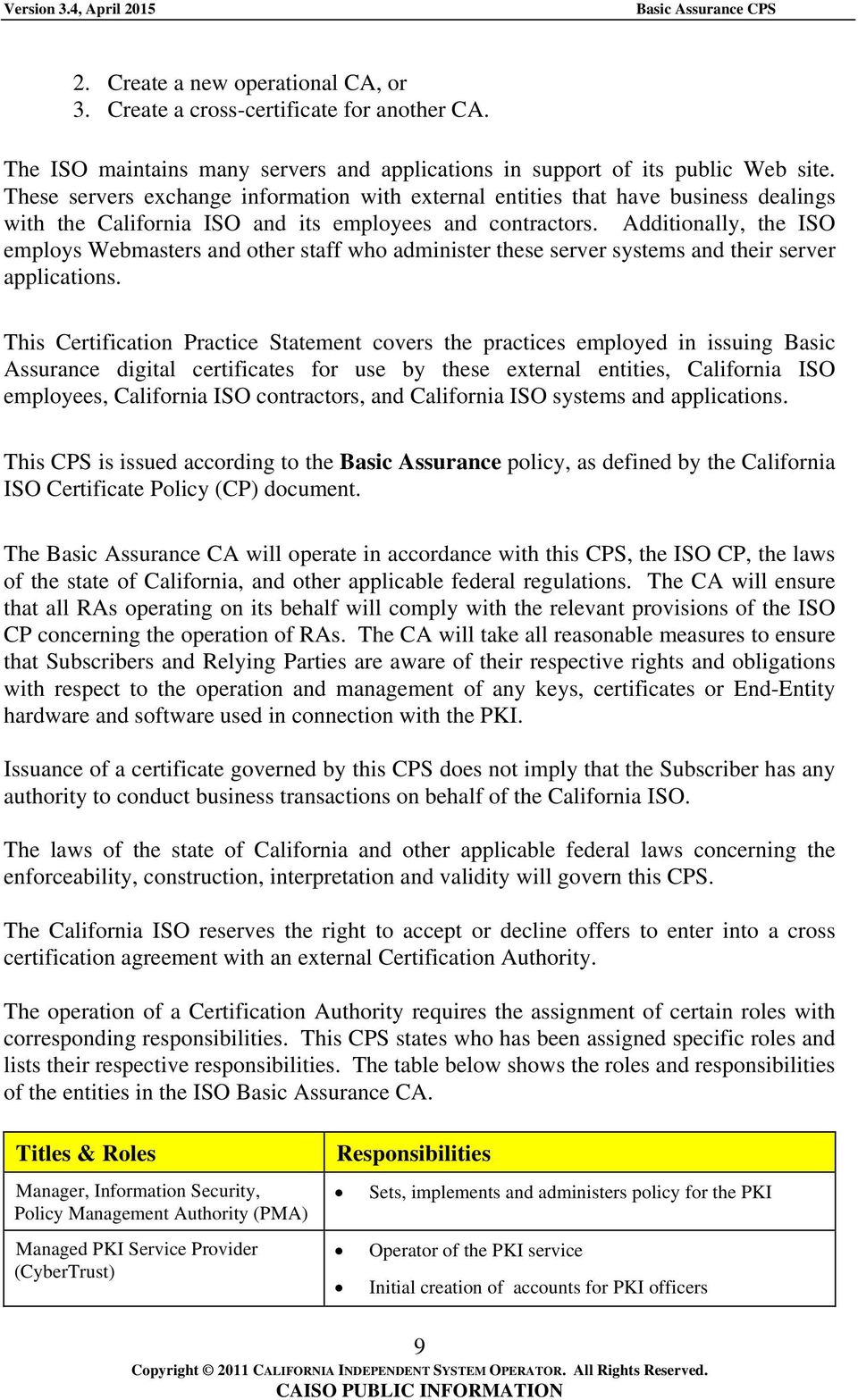
10 Titles & Roles Information Security Analyst, Operational Authority Responsibilities Directs Managed PKI Service provider and has overall management responsibility for the operation of the ISO PKI (CA, RA, CP, CPS). Contact Person for CP or CPS. Information Security Analyst, PKI Officer Information Security Engineer, PKI Officer Managing PKI Administrators, Local Registration Authority Administrators (account creation, modification and removal) Verification of Certificate Policy and CPS compliance Audit of operational logs Information Security Analyst, PKI Administrator Information Security Technician, LRA Information Security Technician, LRA Administrator Super Registration Officer Requests certificates for registration officers PKI Subscriber administration remote from the CA PKI Subscriber administration remote from the CA through the use of an LRA application that assigns key material in an on-line interaction with the CA CAISO Information Security, Sponsor Notifying/verifying CA/LRA of a Subscriber s right to a digital certificate and any relevant credentials of the Subscriber Members of CAISO Information Security, Directory Administrator Notifying the CA/LRA when a Subscriber s digital certificate is to be updated or revoked Managing the repository used by the CA, in particular for creating and updating entries for each Subscriber 1.2 Document name and identification This document is identified by name as Certification Practice Statement For Basic Assurance Certification Authority. A Basic Assurance CA follows the Policy Identifier and records this identifier in all if its certificates. 1.3 PKI participants This section describes the identity or types of entities that fill the roles of participants of the Basic Assurance CA CERTIFICATION AUTHORITIES (CAs) The California ISO, through its Managed PKI Service Provider, is the Certification Authority for the Basic Assurance CA. A Basic Assurance CA operating under this practice statement is responsible for: 10
11 Creating and signing of certificates binding Subscribers with their public encryption keys. Publishing certificates and revocation lists to a repository. Ensuring adherence to the CP document Registration authorities Authorized ISO employees as well as security officers from companies that have business dealings with the California ISO can act as the Registration Authorities for the Basic Assurance CA Subscribers The Subscribers include all internal and external organizations, users, applications and devices that interact with the California ISO and that require certificates for the purpose of authenticating identity, authenticating message origin or establishing secure sessions with appropriate ISO applications and/or the ISO networks. Subscribers may be issued certificates for assignment to devices, groups, organizational roles or applications provided that responsibility and accountability is attributable to an individual or an organization. The Subscriber, identified within the certificate, is liable for all transactions occurring with their respective certificate(s). Basic Assurance certificates will only be issued after request or authorization for issuance from one or more Sponsors. Eligibility for a certificate is at the sole discretion of the ISO. The California ISO may administer any number of Subscribers Relying parties A Relying Party may be either a Subscriber of the ISO PKI or an entity that interacts with a Subscriber, which presents an ISO Certificate but does not require a reciprocal certificate to be presented to it Other participants The Basic Assurance CA requires at least one certificate and CRL repository. This repository is in the form of one or more directories that comply with the LDAP Version 3 standard. 1.4 Certificate usage Appropriate certificate uses This CPS and the digital certificates created under it pertain only to approved external entities that have business dealings with the California ISO and its employees, contractors, systems and applications. Any application of the certificates described in this CPS other than described above is prohibited. 11

12 1.5 Policy administration This section includes the name and mailing addresses of the organization and individuals responsible for creating and maintaining this Certification Practice Statement document Organization administering the document The California ISO is responsible for administering this document. The mailing address for the California ISO is: California ISO 250 Outcropping Way Folsom, CA Contact person The points of contact for this Certificate Policy document are: Manager, Information Security California ISO 250 Outcropping Way Folsom, CA CIO and VP of Information Services California ISO 250 Outcropping Way Folsom, CA Person determining CPS suitability for the policy The person determining CPS suitability for the Basic Assurance policy as defined in the CP document is: Manager, Information Security California ISO 250 Outcropping Way Folsom, CA CPS approval procedures A CA s accreditation into the ISO PKI is in accordance with procedures specified by the PMA. 1.6 Definitions and acronyms This section provides general definitions of terms and acronyms that are used throughout this document General definitions Certificate The public key of an entity together with related information, digitally signed with the private key of the Certification Authority that issued it. The certificate format is in 12
13 accordance with ITU-T Recommendation X.509v3. An entity can be a human user, a device, or an application that is executed on a device. Certificate Revocation List (CRL) A list maintained by a Certification Authority of the certificates it issued and revoked before their natural expiry time. Certification Authority An authority trusted by one or more users to issue and manage X.509v3 public key certificates and CRLs. Each CA within the ISO PKI may issue certificates under one or more policies based on the assurance level the CA has been accredited to and the requirements and role of the Subscriber. Certification Authority Software The cryptographic software required for managing the lifecycle of keys and certificates of end entities. Data Integrity Assurance that data remains free of unauthorized change from creation to reception. Digital Signature The result of a transformation of a message by means of a cryptographic system using keys such that a person who has the initial message can determine: (a) Whether the transformation was created using the key that corresponds to the signer s key; and (b) Whether the message has been altered since the transformation was made. End-Entity An Entity that uses the keys and certificates created within the PKI for purposes other than the management of the aforementioned keys and certificates. An end-entity may be a Subscriber or a Relying Party. Entity Any autonomous element within the Public Key Infrastructure. This may be a CA, an RA or an End-Entity. Issuing CA In the context of a particular certificate, the issuing CA is the CA that signed and issued the certificate. 13
14 Root CA The highest level CA, or in the ISO s PKI, the CA that is named CAISO_Root_CA. Registration Authority (RA) A person or organization that is responsible for the identification and authentication of certificate Subscribers before certificate issuance, but does not actually sign or issue the certificates. An RA is delegated certain tasks on behalf of a CA. Also referred to as a Local Registration Authority (LRA). MD5 One of the message digest algorithms developed by RSA Data Security Inc. Object Identifier (OID) The unique alphanumeric/numeric identifier registered under the ISO registration standard to reference a specific object or object class. In the ISO PKI they are used to uniquely identify each of the four policies and cryptographic algorithms supported. Operational Authority Personnel who are responsible for the overall operations for the ISO PKI CAs. Operations Zone An area where access is limited to authorized personnel needing to work there and to properly escorted visitors. Operations Zones should be monitored at least periodically, based on a Threat Risk Assessment (TRA), and should preferably be accessible from a Reception Zone. Organization A department, agency, corporation, partnership, trust, joint venture or other association or governmental body. Policy Management Authority (PMA) The body, the California ISO in this case, responsible for setting, implementing, and administering policy decisions regarding CPs and CPSs throughout the ISO PKI. Public Key Infrastructure (PKI) A set of policies, processes, server platforms, software and workstations used for the purpose of administering certificates and keys. Reception Zone 14

15 The entry to a facility where the initial contact between the public and the department occurs, where services are provided, information is exchanged and access to restricted (Operations, Security and High-security) zones is controlled. To varying degrees, activity in a Reception Zone is monitored by personnel who work there, by other personnel or by security staff. Access by the public may be limited to specific times of the day or for specific reasons. Entry beyond the Reception Zone is indicated by a recognizable perimeter such as a doorway or an arrangement of furniture and dividers in an open office environment. Relying Party An End Entity who uses a certificate signed by an ISO PKI CA to authenticate an identity or for key agreement to establish a secure session; May also be a Subscriber of the ISO PKI CA. Repository A location where CRLs and certificates are stored for access by End Entities with a needto-know. Secure Hash Algorithm (SHA) One of the message digest algorithms developed by the US government under Federal Information Processing Standards (FIPS) publication. Security Zone An area to which access is limited to authorized personnel and to authorized and properly escorted visitors. Security Zones should preferably be accessible from an Operations Zone, and through a specific entry point. A Security Zone need not be separated from an Operations Zone by a secure perimeter. A Security Zone should be monitored 24 hours a day and 7 days a week by security staff, other personnel or electronic means. Sponsor A Sponsor in the ISO PKI is the department or employee that has nominated that a specific individual or organization be issued a certificate (e.g., for an employee this may be the employee s manager). The Sponsor might suggest an appropriate DN for the certificate and will be responsible for either supplying or confirming the certificate attribute details to the RA. The Sponsor is also responsible for informing the CA or RA if the department s relationship with the Subscriber is terminated or has changed such that the certificate should be revoked or updated. Subscriber An individual, device or organization whose public key is certified in a public key certificate. In the ISO PKI this could be an employee, a market participant, a device, a system or an application. 15
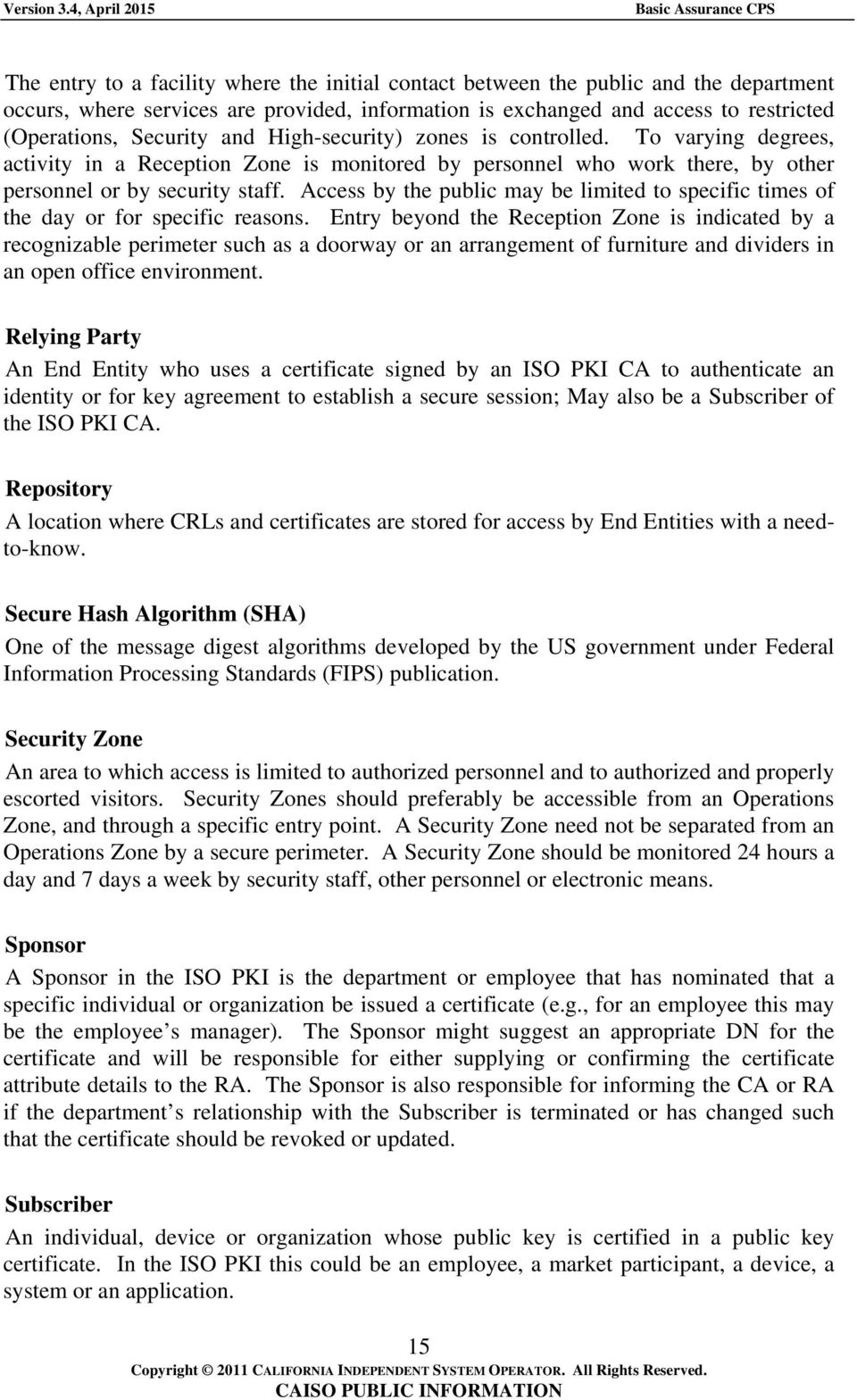
16 Acronyms Acronym Term CA Certification Authority ISO The California Independent System Operator CRL Certificate Revocation List LDAP Lightweight Directory Access Protocol LRA Local Registration Authority OID Object Identifier PKI Public Key Infrastructure RA Registration Authority 2.0 PUBLICATION AND REPOSITORY RESPONSIBILITIES 2.1 Repositories The California ISO operates all the repositories to which certificates and Certificate Revocation Lists (CRLs) are published. The repository is part of ISO IT infrastructure and is available for a significant proportion of every 24-hour period. 2.2 Publication of certification information A Basic Assurance CA: Includes within any certificate it issues the URL of a web site maintained by, or on behalf of, the CA; Publishes its CPS, on a web site maintained by, or on behalf, of the CA. An electronic copy of this document, digitally signed by an authorized representative of the CA, is available: at the CAISO World Wide Web site at the URL via an request to the point of contact listed in Section Ensures that operating system and repository access controls will be configured so that only authorized CA personnel can write or modify the online version of the CPS; and Provides a full text version of the CPS when necessary for the purposes of any audit, inspection, or accreditation. Use a central repository for publishing digital certificates and CRLs. A Basic Assurance CA will use a central repository for publishing digital certificates and CRLs. 2.3 Time and frequency of publication A Basic Assurance CA promptly publishes certificates upon issuance. A Basic Assurance CA also issues an up-to-date CRL at least every twenty-four hours. When a certificate is revoked the updated CRL is issued within 60 minutes after certificate revocation. 16
17 2.4 Access controls on repositories Access controls may be instituted at the discretion of the Basic Assurance CA with respect to certificates. 3.0 IDENTIFICATION AND AUTHENTICATION This section describes the procedures used to authenticate the identity and/or other attributes of an end-user certificate applicant to the Basic Assurance CA or RA prior to certificate issuance. 3.1 Naming Types of names Each Entity will have a clearly distinguishable and unique X.500 Distinguished Name (DN) in the certificate subject name field and in accordance with PKIX Part 1. The DN must be in the form of a X.500 printablestring and must not be blank Need for names to be meaningful The Basic Assurance digital certificates will use the CAISO naming conventions for naming its subjects. The root of the naming tree is: C=US, O=CAISO. The Issuer Common Name is CAISO_ISSUING_CA. The content of Subject names will be associated with the authenticated identity of the Subscriber Anonymity or pseudonymity of subscribers No stipulation Rules for interpreting various name forms No stipulation Uniqueness of names The Basic Assurance digital certificates will use the ISO naming conventions for naming its subjects. The root of the naming tree is: C=US, O=CAISO. The Issuer Common Name is CAISO_ISSUING_CA. The content of Subject names will be associated with the authenticated identity of the Subscriber. In cases where multiple certificates are issued to the same Subscriber, the Subscriber s certificates will be differentiated using the certificates serial numbers Recognition, authentication, and role of trademarks The CA reserves the right to make all decisions regarding Entity names in all assigned certificates. A party requesting a certificate must demonstrate its right to use a particular name. The use of trademarks will be reserved to registered trademark holders. 17

18 3.2 Initial identity validation Method to prove possession of private key A signed certificate request will constitute possession of private key Authentication of organization identity Depending on the Subscriber, an approved internal or external point of contact or ISO Information Security will validate an organization s identity Authentication of individual identity The external entity s organization or the requesting department within the ISO will establish the identity of the individual who is asking for a certificate. The RA keeps a record of identification details Non-verified subscriber information The address of the subscriber in the digital certificate is not verified. The address may be empty, may have an incorrect user name and/or an incorrect domain name Validation of authority The approved internal or external point of contact, or ISO Information Security, will validate the identity according to the procedures in Sections and Criteria for interoperation Not Applicable. 3.3 Identification and authentication for re-key requests Identification and authentication for routine re-key Not applicable Identification and authentication for re-key after revocation In the event of the revocation of a digital certificate the Subscriber must ask for a new digital certificate in the same manner as asking for the original certificate. 3.4 Identification and authentication for revocation request A Registration Authority (RA) acting on behalf of a Basic Assurance CA authenticates a request for revocation of a certificate. Requests for revocation of certificates are logged. 4.0 CERTIFICATE LIFE-CYCLE OPERATIONAL REQUIREMENTS The Basic Assurance CA will operate in accordance with the CAISO CP when managing the keys provided to RAs and Subscribers. 18

19 4.1 Certificate Application Who can submit a certificate application Any organization with appropriate business dealings with the California ISO or its employees or contractors can request a certificate Enrollment process and responsibilities An employee of an external entity who has business dealings with the California ISO or its employee or contractor must generate all applications for certificates. Requests for a certificate may be submitted for the individual who is submitting the application or for a device, system, or software application under the control of that individual. 4.2 Certificate application processing The Subscriber will prepare a request and start a process which will eventually deliver the request to the RA. For example, the Subscriber may forward the request to the Help Desk for the Basic Assurance CA. The RA will verify the authenticity of the request and ask the CA to prepare the certificate. The California ISO publishes its CP and this CPS on a web site that is accessible to all Subscribers Performing identification and authentication functions See Section Approval or rejection of certificate applications An application for a certificate does not oblige a Basic Assurance CA to issue a certificate. The issuance and publication of the digital certificate by the Basic Assurance CA indicates a complete and final approval of the digital certificate application by the CA Time to process certificate applications The Basic Assurance RA shall process a digital certificate request within ten (10) working days of receipt of the request. 4.3 Certificate issuance CA actions during certificate issuance The issuance and publication of a certificate by a Basic Assurance CA indicates a complete and final approval of the certificate application by the CA Notification to subscriber by the CA of issuance of certificate Notification of digital certificate issuance to subscribers is via receipt of the digital certificate by the Subscriber. 19

20 4.4 Certificate acceptance Conduct constituting certificate acceptance Any of the following methods constitutes acceptance of certificate: 1. The Subscriber uses its certificate. 2. If the digital certificate is electronically mailed to the subscriber then the system must support notification to the sender after the is read. In these cases the notification will constitute acceptance on the part of the Subscriber. 3. If the digital certificate is delivered by a means other than electronically (e.g., on a floppy disk), then the Subscriber must sign a letter acknowledging the receipt of the digital certificate. Upon first usage of the certificate by the subscriber, the Subscriber thereby accepts the certificate Publication of the certificate by the CA A Basic Assurance CA publishes its certificates to its LDAP repository Notification of certificate issuance by the CA to other entities Notification of digital certificate issuance is by publication in the CA s hosted LDAP directory. 4.5 Key pair and certificate usage Subscriber private key and certificate usage All Subscribers to the Basic Assurance CA must read and understand a Subscriber s agreement. By utilizing the delivered certificate, the Subscriber is agreeing that they have read, understood, and will abide by the terms and conditions as defined in the either this CPS or the Subscriber Agreement. The digital certificate may be only be used for: Authentication: establish the identity of a communicating party, Key Encipherment: establish symmetric encryption key for integrity and confidentiality protection. Message origin authentication: establish the origin of a message from a communicating party Relying party public key and certificate usage After the digital certificate is issued, the Subscriber and the Relying Party determine its usage. Relying parties are obligated to use certificates for the purpose for which they are issued and must use the certificates only in accordance with the certification path validation procedure specified in X.509v3 standards. The digital certificate may be only be used for: Authentication: establish the identity of a communicating party, Key Encipherment: establish symmetric encryption key for integrity and confidentiality protection. 20
21 Message Origin Authentication: establish the origin of a message from a communicating party. 4.6 Certificate renewal Expiration of a basic assurance digital certificate is an expected event. Existing certificates are not renewed. Requests for a new digital certificate follow the procedures outlined in Section Circumstance for certificate renewal Expiration of a Basic Assurance digital certificate is an expected event. Subscribers may request a new certificate before or after expiration of their existing certificates. The request follows the same procedure as requesting a new certificate Who may request renewal Processing certificate renewal requests Notification of new certificate issuance to subscriber Conduct constituting acceptance of a renewal certificate Publication of the renewal certificate by the CA Notification of certificate issuance by the CA to other entities 4.7 Certificate re-key A Basic Assurance CA does not re-key certificates Circumstance for certificate re-key Who may request certification of a new public key Processing certificate re-keying requests Notification of new certificate issuance to subscriber 21
22 Conduct constituting acceptance of a re-keyed certificate Publication of the re-keyed certificate by the CA Notification of certificate issuance by the CA to other entities 4.8 Certificate modification A Basic Assurance CA does not modify certificates Circumstance for certificate modification Who may request certificate modification Processing certificate modification requests Notification of new certificate issuance to subscriber Conduct constituting acceptance of modified certificate Publication of the modified certificate by the CA Notification of certificate issuance by the CA to other entities 4.9 Certificate revocation and suspension ISO PKI only revokes certificates. It does not suspend certificates Circumstances for revocation A digital certificate must be revoked: When any of the information in the digital certificate changes; When the Subscriber is an individual and leaves the organization or is otherwise terminated; When the Subscriber is assigned to other functions that no longer require the use of the digital certificate issued to them; Upon suspected or known compromise of the private key; 22
23 Upon suspected or known compromise of the media holding the private key; Upon suspected or known loss of the private key. The Basic Assurance CA in its discretion may revoke a digital certificate when a Subscriber fails to comply with obligations set out in the ISO Certificate Policy, this CPS, any applicable agreement or any applicable law Who can request revocation The revocation of a digital certificate may only be requested by: The Subscriber in whose name the digital certificate was issued; An authorized individual within the organization who sponsored the Subscriber; The individual or organization which made the application for the certificate on behalf of a system, device or software application; The Sponsor; Policy Management Authority; The Operational Authority; The RAs of the Basic Assurance CA Procedure for revocation request The request to revoke a digital certificate is manually or electronically communicated to an RA of the Basic Assurance CA. The RA will authenticate the origin and the validity of the request. The RA will maintain a log of all revocation requests and the resulting action. Any action taken as a result of a revocation request will be initiated within twenty-four (24) hours of receipt. The processing of the request may or may not result in the revocation of the digital certificate Revocation request grace period In the event of the compromise, or suspected compromise, of any Entity s private key, an Entity must notify the Issuing CA immediately. When a digital certificate is revoked the revocation will be published immediately in an appropriate CRL. The CRL, or equivalent means, will be the means to provide notice of key compromise or suspected key compromise Time within which CA must process the revocation request Any action taken as a result of a revocation request will be initiated within twenty-four (24) hours of receipt Revocation checking requirement for relying parties Prior to using a certificate, a Relying Party must check the status of all certificates in the certificate validation chain against the appropriate and current CRL. If a CRL is not being used, then a certificate must be validated against an authoritative, trusted directory, OCSP, or some equivalent measure, to ensure a certificate has not been revoked prior to establishing a connection. 23
24 CRL issuance frequency A new CRL is issued minimally every twenty-four hours and is valid for at least thirty hours. A new CRL is also issued within 60 minutes after a certificate is revoked Maximum latency for CRLs When a digital certificate is revoked the revocation will be published immediately in an appropriate CRL repository On-line revocation/status checking availability On-line revocation checking requirements Other forms of revocation advertisements available Special requirements in reference to key compromise Circumstances for suspension Not applicable Who can request suspension Not applicable Procedure for suspension request Not applicable Limits on suspension period Not applicable 4.10 Certificate status services The California ISO and its Managed PKI Service Provider do not provide a certificate status service Operational characteristics Service availability Optional features 24
25 4.11 End of subscription A Subscriber or the entity who sponsors the Subscriber may inform the CA, through one of its RAs, that the subscriber wishes to end its subscription. In this case, the CA takes the same actions that it would for revoking the Subscriber s certificate Key escrow and recovery Key escrow and recovery policy and practices Session key encapsulation and recovery policy and practices 5.0 FACILITY, MANAGEMENT, AND OPERATIONAL CONTROLS 5.1 Physical controls Site location and construction The site location of the Basic Assurance CA has been designed and implemented to meet the requirements for a Security Zone as specified in the CP Document and is both manually and electronically monitored for unauthorized intrusion. Cryptographic and operational functions are housed in a facility which is classified as a Tier-IV data center, the highest standard established for data centers. CA equipment is protected from unauthorized access while the cryptographic module is installed and activated. Physical access controls have been established to reduce the risk of equipment tampering when the cryptographic module is not installed and activated. Cryptographic tokens are protected against theft, loss, and unauthorized use at all times. The Managed PKI Service Provider s security policies and procedures are detailed in the Provider s System Security Plan. The PIN and passwords for operating the Basic Assurance CA are recorded and stored in a locked safe accessible only to the designated personnel of the Managed PKI Service Provider Physical access The Managed PKI Service Provider has implemented policies and procedures (as described in detail in the Provider s Security Procedures and Standard Operating Procedures) to ensure that the physical environment in which the Basic Assurance CA systems are installed maintain a high level of security: (i) the system is installed in a secure facility that is isolated from outside networks, with all access controlled; (ii) the entrances and exits from the secure areas are under constant video surveillance and all systems that provide authentication, as well as those that record entry, exit and network activity, are in secured areas; and (iii) the 25
26 software components are built in an environment designed to minimize security risks. The security techniques employed are designed to resist a large number and combination of different forms of attack. The specific mechanisms the Managed PKI Service Provider uses include: Proximity card readers Perimeter alarms Closed circuit television Biometric identification systems Mantraps (individual and multi-person) Human Guards Physical access to the Managed PKI Service Provider s systems is controlled; (i) only operative personnel and essential personnel with a valid business reason (e.g., resources to conduct statutory independent audits) are provided such access; (ii) the access control system is always functional and requires unique login credentials;(iii) those admitted physical access are only granted access to business and proprietary information based on their "need to know" and; (iv) facility access is logged and such logs are reviewed by the Managed PKI Service Provider s Chief Security Officer or designee. To prevent tampering, cryptographic hardware is stored in a secure site, with access limited to authorized personnel, having the following characteristics: inventory control processes and procedures to manage the origination, arrival, condition, departure and destination of each device; access control processes and procedures to limit physical access to authorized personnel; all successful or failed physical access attempts are recorded in an event journal; incident processes and procedures to handle abnormal events, security breaches, and investigation and reports; audit processes and procedures to verify the effectiveness of the controls; prior to installation, the handling of cryptographic hardware is performed in the presence of no less than two individuals in Trusted Roles; and cryptographic hardware is stored in tamper resistant and tamper evident packages. 26
27 The installation of cryptographic hardware is performed in the presence of no less than two individuals in Trusted Roles. The removal of cryptographic hardware from production and the process of disassembling such hardware is performed in the presence of no less than two individuals in Trusted Roles. When storing the cryptographic module containing the CA s private key, the cryptographic module is deactivated upon removal from the CA hardware. If the device is being permanently removed from service, then any key contained within the device that has been used for any cryptographic purpose is erased from the device by initializing the device. The Managed PKI Service Provider s Security Procedures and Standard Operating Procedures provide for physical access controls to ensure that: All removable media and paper containing sensitive plain-text information is stored in secure containers. An access log is maintained and inspected periodically. Activation data is either memorized or recorded and stored in a manner commensurate with the security afforded the cryptographic module, and is not stored with the cryptographic module. The Managed PKI Service Provider uses human guards to continually monitor the perimeter of the facility housing the CA equipment on a 24 hour, 365 day basis. In addition there are guards who monitor the building. The Managed PKI Service Provider also uses CCTV and IDS to monitor the Provider s suite within the Data Center Power and air conditioning The Managed PKI Service Provider uses 2 backup generators and sufficient UPS capability to lock out input, finish any pending actions, and record the state of the equipment automatically before lack of power or air conditioning causes a shutdown. The directories are provided with uninterrupted power sufficient for a minimum of 6 minutes operation in the absence of commercial power. Additionally, the generator will be on line and available at 100% capacity within 50 seconds, to maintain availability of services Water exposures The Managed PKI Service Provider has taken reasonable precautions to minimize the impact of water exposure. CA equipment is installed in computer racks which are not in danger of exposure to water (e.g. on tables or elevated floors). Potential water damage from fire prevention and protection measures (e.g sprinkler systems) are excluded from this requirement Fire prevention and protection The Managed PKI Service Provider follows best industry standard practices for fire prevention and protection. The facility is protected by HALON 1301 fire suppression systems. 27
28 Media storage Media storage under the control of the Managed PKI Service Provider is subject to multiple-layer security storage requirements as described in the Provider s Security Procedures and Standard Operating Procedures. These procedures include full back-up of data, offsite storage in two physically separate locations with security similar to that of the facility in which the CA activities are performed. Media is stored so as to protect them from accidental damage (e.g., water, fire, or electromagnetic). Media that contain audit, archive, or backup information is duplicated and stored in locations separate from the CAs Waste disposal The Managed PKI Service Provider s Security Procedures provide that sensitive media and documentation, no longer needed for operations, is destroyed in the appropriate disposal process. For example, sensitive paper documentation is shredded, burned, or otherwise rendered unrecoverable Off-site backup The Managed PKI Service Provider makes full system backups once a week with daily incremental back-ups that are sufficient to enable recovery from a system failure. At a minimum, backups are performed and stored offsite daily. A full backup copy is stored at an offsite location which is separate from the CA equipment. The backup is stored at a site with physical and procedural controls commensurate to that of the operational CA. Procedures for CA private key backup are specified in Section of this CPS. 5.2 Procedural controls Trusted roles CA trusted roles All employees, contractors and consultants of CAISO who have access to or control over cryptographic operations that may materially affect the Issuing Authority s issuance, use, or revocation of certificates, including access to restricted operations, shall, for the purposes of this CPS, be considered as serving in a trusted position. Such personnel include, but are not limited to, customer service personnel, system administration personnel, designated engineering personnel and executives who are designated to oversee the Issuing Authority s trustworthy system infrastructure. All activities concerning the CAISO_Root_CA will be under strict dual custody procedures. Basic Assurance CA The functions of a Basic Assurance CA are not required to be under dual custody. However, the following table summarizes how a Basic Assurance CA ensures separation of duties. Titles & Roles Responsibilities 28
29 Titles & Roles Manager of Information Security, Policy Management Authority (PMA) Managed PKI Service Provider (Verizon Business) Responsibilities Sets, implements and administers policy for the PKI Operator of the PKI service Initial creation of accounts for PKI officers Information Security Analyst, Operational Authority Information Security Analyst, PKI Officer Information Security Engineer, PKI Officer Directs Managed PKI Service provider and has overall management responsibility for the operation of the ISO PKI (CA, RA, CP, CPS). Contact Person for CP or CPS. Managing PKI Administrators, Local Registration Authority Administrators (account creation, modification and removal) Verification of Certificate Policy and CPS compliance Audit of operational logs Information Security Analyst, PKI Administrator Information Security Technician, LRA Information Security Technician, LRA Administrator Super Registration Officer Requests certificates for registration officers PKI Subscriber administration remote from the CA PKI Subscriber administration remote from the CA through the use of an LRA application that assigns key material in an on-line interaction with the CA ISO Information Security, Sponsor Notifying/verifying CA/LRA of a Subscriber s right to a digital certificate and any relevant credentials of the Subscriber Members of ISO Information Security, Directory Administrator Notifying the CA/LRA when a Subscriber s digital certificate is to be updated or revoked Managing the repository used by the CA, in particular for creating and updating entries for each Subscriber RA trusted roles A Basic Assurance CA ensures that RA personnel understand their responsibility for the identification and authentication of prospective Subscribers and perform the following functions: Acceptance of subscription, certificates change and certificate revocation requests; Verification of an applicant s identity and authorizations or acceptance of verification made by other CAISO departments; Transmission of applicant information to the CA; Provision of authorization codes for on-line key exchange and certificate creation. 29
30 A Basic Assurance CA may permit all duties for RA functions to be performed by one individual Number of persons required per task A Basic Assurance CA requires multi-user control for CA key generation. All other duties associated with CA roles may be performed by an individual operating alone Identification and authentication for each role The Basic Assurance CA personnel are employees or contractors of ISO or its Managed PKI Service Provider that have their identity and authorization verified before they are: Included in the access list for physical access to the CA system; Given a certificate for the performance of their CA role; Given an account on the PKI system. Each of these certificates and accounts (with the exception of CA signing certificates) is: Directly attributable to an individual; Not shared; Restricted to actions authorized for that role through the use of CA software, operating system and procedural controls Roles requiring separation of duties See Section Personnel controls The PMA ensures that all personnel performing duties with respect to the operation of a Basic Assurance CA or RA: Are appointed in writing; Are bound by contract or statute to the terms and conditions of the position they are to fill; Have received comprehensive training with respect to the duties they are to perform; Are bound by statute or contract not to disclose sensitive CA security-relevant information or Subscriber information; and Are not assigned duties that may cause a conflict of interest with their duties Qualifications, experience, and clearance requirements Background, qualifications, experience and clearance requirements are: College degree in related fields or five years experience in security. Experience in one or more of the following: Data Entry System Administration Windows NT UNIX 30
31 Networking Certification Authority Digital Certificates PKI Information or physical security Internet security Be able to work autonomously, under short time frames, and be able to multi-task. Certification desired but not mandatory Security clearance requirements are not applicable Background check procedures The CA performs background checks in accordance with the procedures followed by the Managed PKI Service Provider, which CAISO has reviewed and accepted Training requirements All personnel performing duties with respect to the operation of a CA or RA must receive comprehensive training in: The CA/LRA security principles and mechanisms; All PKI software versions in use on the CA system; All PKI duties they are expected to perform; and Disaster recovery and business continuity procedures. This training is only required for personnel performing duties with respect to the operation of the CA Retraining frequency and requirements Personnel performing CA duties will review all relevant documents, including the CP, CPS, and relevant documentation as required Job rotation frequency and sequence No Stipulation Sanctions for unauthorized actions For any deliberate violation of trust for persons in a trusted position as defined in this CPS, the person must be removed from that position of trust. Further actions of organizations for a violation of trust lies outside of this CPS Independent contractor requirements Contracting personnel must follow the same employment requirements as ISO employees Documentation supplied to personnel Documentation is stored in a designated secure area and is available to authorized personnel. 31
32 5.4 Audit logging procedures The Basic Assurance CA will follow the security audit procedures outlined in the ISO Certificate Policy Types of events recorded A Basic Assurance CA records in audit log files all events relating to the security of the CA system. These include such events as: System start-up and shutdown; CA application start-up and shutdown; Changes to CA details and/or keys; Login and logoff attempts; Generation of own and subordinate Entity keys; Creation and revocation of certificates; Attempts to initialize remove, enable, and disable Subscribers, and update and recover their keys; Failed read-and-write operations on the certificate and CRL directory. Information captured that is not CA-system generated includes: Physical access logs; System configuration changes and maintenance; Personnel changes; Discrepancy and compromise reports; Records of the destruction of media containing key material, activation data, or personal Subscriber information Frequency of audit log processing CA personnel review audit logs when issues arise and all significant events are explained. Actions taken following these reviews are documented. In case there are no issues that warrant review of the audit log, the CA personnel must review the audit log at least once a month with at least a random sample of no less than 5% of the logged information Retention period for audit log A Basic Assurance CA retains its audit logs onsite for at least one year and subsequently retains them in the manner described in Section 5.5 of this CPS Protection of audit log The electronic audit log system includes mechanisms to protect the log files from unauthorized viewing, modification, and deletion Audit log backup procedures Audit logs and audit summaries are backed up or copied if in manual form. 32
33 Audit collection system (internal vs. external) System logs are collected for OS related activity, and application text logs are captured for application events. Application logs are maintained on the CA system with least privilege access granted to approved users only Notification to event-causing subject Where an event is logged by the audit collection system no notice needs be given to the individual, organization, device or application which caused the event Vulnerability assessments No stipulation 5.5 Records archival Types of records archived The following records will be archived: Digital Signature certificates stored by the CA, CRLs generated by the CA, Audit information as detailed in Section 5.4 of this policy, Any identification and authentication information Retention period for archive Digital Signature certificates stored by the CA, and CRLs generated by the CA, must be retained for at least one year after the expiration of the key material. This requirement does not include the back up of private signature keys. Audit information as detailed in Section 5.4 of this policy, and any identification and authentication information should be retained for at least four years Protection of archive Archive records are protected against accidental and malicious tampering Archive backup procedures A second copy of all material retained or backed up must be stored in a location other than the CA site and must be protected either by physical security alone, or a combination of physical and cryptographic protection. Any such secondary site must provide adequate protection from environmental threats such as temperature, humidity and magnetism Requirements for time-stamping of records No stipulation Archive collection system (internal or external) No stipulation 33
34 Procedures to obtain and verify archive information A Basic Assurance CA verifies the integrity of the back-ups once every six months. Material stored off-site will be periodically verified for data integrity. 5.6 Key changeover The CAISO PKI does not support key changeover. Upon or prior to expiration of an existing certificate the subscriber must apply for a new certificate in the same manner as the initial certificate. 5.7 Compromise and disaster recovery Incident and compromise handling procedures Incidents are handled according to the Managed PKI Service Provider s incident handling procedures which have been reviewed by the California ISO Computing resources, software, and/or data are corrupted Business continuity plans are documented regarding the PKI environment Entity private key compromise procedures In the event of the compromise of a CA s Digital Signature key, prior to re-certification within the ISO PKI, a CA must: Revoke all certificates issued using that key; Immediately notify: The PMA; All of its RAs; All Subscribers; All individuals or organizations who are responsible for a certificate used by a device or application. After addressing the factors that led to key compromise, the CA may: Generate a new CA signing key pair; Re-issue certificates to all Entities and ensures all CRLs are signed using the new key. In the event of the compromise, or suspected compromise, of any other Entity s Digital Signature key, the Entity must notify the Issuing CA immediately Business continuity capabilities after a disaster Business continuity plans are documented regarding the PKI environment. 5.8 CA or RA termination The Basic Assurance CA will publish a notification of termination 30 days prior to terminating its service. 34
35 6.0 TECHNICAL SECURITY CONTROLS 6.1 Key pair generation and installation Key pair generation The Subscriber or an authorized RA will generate the key for the Subscriber Private key delivery to subscriber Subscriber is responsible for generating its key pair. In cases where an authorized RA generates keys for a Subscriber, the key will be delivered in a secure manner Public key delivery to certificate issuer The Subscriber will deliver the public key in a Certificate Signing Request (standard PKCS10 file) to the RA. The RA delivers the public key to the CA for certification CA public key delivery to relying parties A Basic Assurance CA s public key will be delivered in a certificate signed by the Root. The Root s public key will be delivered in a self-signed certificate. This self-signed certificate, and the Basic Assurance CA s certificate will be published in the ISO Web site. Additionally, the Root s self-signed certificate and the Basic Assurance CA s certificate may be delivered to Subscribers along with the Subscriber s certificate Key sizes The length of the RA and Subscriber RSA key must be a minimum of 1024 bits. The length of the CA s RSA key is a minimum of 2048 bits Public key parameters generation and quality checking Not Applicable. Operational public keys in the Basic Assurance CA use the RSA algorithm Key usage purposes (as per X.509 v3 key usage field) Subscriber keys may only be used for Digital Signature (for purposes other than nonrepudiation), Key Encipherment and Key Agreement. Extended Key Usage may include Client Authentication, Server Authentication, Encrypted File System and Protection. 6.2 Private Key Protection and Cryptographic Module Engineering Controls The Subscriber must protect its private key from disclosure at all times. All transactions performed with the Subscriber s private key are the responsibility of the Subscriber Cryptographic module standards and controls All CA Digital Signature key generation, CA Digital Signature key storage and certificate signing operations are performed in a hardware cryptographic module rated to at least FIPS Level 2 or otherwise verified to an equivalent level of functionality and assurance. 35
36 The RA Administrator Digital Signature key generation and signing operations are performed in a hardware cryptographic module rated to at least FIPS Level 2 or otherwise verified to an equivalent level of conformance. End Entities are not required to use a hardware cryptographic module Private key (n out of m) multi-person control Two or more employees of the ISO or its Managed PKI Service Provider are required for a Basic Assurance CA key generation and certification Private key escrow Not applicable Private key backup An Entity may optionally back-up its own private key. If so, the keys must be copied and stored in encrypted form and protected at a level no lower than stipulated for the primary version of the key Private key archival The ISO PKI does not archive private keys Private key transfer into or from a cryptographic module No stipulation Private key storage on cryptographic module No stipulation Method of activating private key The Entity must be authenticated to the hardware or software cryptographic module before the activation of the private key. This authentication may be in the form of a password. When deactivated, private keys must be kept in encrypted form only Method of deactivating private key No Stipulation Method of destroying private key Upon termination of use of a private key, all copies of the private key in computer memory and shared disk space must be securely destroyed by over-writing Cryptographic Module Rating See Section
37 6.3 Other aspects of key pair management Public key archival The public keys will be archived by the Basic Assurance CA in the course of normal archival procedures Certificate operational periods and key pair usage periods Certificates issued by a Basic Assurance CA have a maximum life of fifteen (15) months. Private Key Usage period is not set within the certificates. Its validity period is the same as the certificate s. 6.4 Activation data Activation data generation and installation Activation data may be in the form of a password, which follows the ISO s standard policies and procedures for passwords. An Entity will have the capability to change its password at any time Activation data protection Data used for Entity initialization must be protected from unauthorized access. This protection mechanism must follows CAISO s standard policies and procedures for protecting passwords Other aspects of activation data No stipulation 6.5 Computer security controls Specific computer security technical requirements The Basic Assurance CA follows computer security control procedures outlined in the CAISO PKI Certificate Policy for Basic Assurance Computer security rating No Stipulation 6.6 Life cycle technical controls System development controls The CA uses software that has been designed and developed by a formal methodology and supported by Configuration Management tools. 37
38 Security management controls The configuration of the CA system as well as any modifications and upgrades is documented and controlled. There is a method of detecting unauthorized modification to the CA software or configuration. When there are significant changes, the CA provides notice to the PMA by Life cycle security controls No Stipulation 6.7 Network security controls The CA server is protected from attack through any open or general-purpose network with which it is connected. This Basic Assurance CA is not accessible by external entities. A firewall separates the network of the CA system from other internal and external networks. Communication with the repository uses the push model, with the CA being the initiator of the connection. Additionally, this Basic Assurance CA publishes to a directory a list of usable certificates. 6.8 Time-stamping No Stipulation 7.0 CERTIFICATE, CRL, AND OCSP PROFILES 7.1 Certificate profile All CAISO certificates will follow the X.509 Version 3 standard Version number(s) The CA must issue X.509 Version 3 certificates, in accordance with the PKIX Certificate The PKI End-Entity software must support all the basic (non-extension) X.509 fields including: Version: version of X.509 certificate, version 3 Serial Number: unique serial number for certificate SignatureAlgorithm: algorithm ID for signing the certificate Issuer: name of the issuing CA Validity: start and expiration dates for certificate Subject: subscriber s distinguished name Subject Public Key: subscriber s public key Signature: CA signature to authenticate certificate as well as the certificate extensions defined in Section of this document. 38
39 Certificate extensions All certificates may contain one or more of the following extensions: SubjectKeyIdentifier: a unique identifier for the subject s public key AuthorityKeyIdentifier: a unique identifier for the issuer s public key CertificatePolcies: the policy identifier according to which the CA issues the certificate along with a policy qualifier, which may include a URL to the CA s CPS. SubjectAlternativeName: subscriber s alternative name KeyUsage: allowed usages of private key ExtendedKeyUsage: additional application-specific usages for the private key BasicConstraints: an indication of whether the certificate owner is a CA or and End Entity CRLDP: CRL Distribution Points AIA (Authority Information Access): location of the issuing CA s certificate Algorithm object identifiers End entities must support the RSA algorithm with key sizes of 1024 bits, or greater. The digest algorithm must be either SHA-1 or MD5. The Basic Assurance CA uses, and end entities must support for signing and verification, the following algorithms: RSA with 2048 bit keys The digest algorithm may be SHA-1 or MD Name forms Every DN is in the form of an X.500 printablestring Name constraints Subject and issuer DNs comply with the x.500 standard Certificate policy object identifier A Basic Assurance CA includes the Policy OID within the certificates it issues under the extension CERTIFICATEPOLCIES Usage of Policy Constraints extension No Stipulation Policy qualifiers syntax and semantics No Stipulation 39
40 Processing semantics for the critical Certificate Policies extension No Stipulation 7.2 CRL profile Version number(s) A Basic Assurance CA issues CRLs according to the X.509 Version 2 standard CRL and CRL entry extensions The CRL of a Basic Assurance CA contains the following fields: Version: version of X.509 CRL, which is 2 SignatureAlgorithm: algorithm ID for signing the certificate Issuer: name of the issuing CA Effective date: the date starting which the CRL is valid Next update date: the date before which the CA expects to issue another CRL Revocation list: the serial number and revocation date for each revoked certificate Signature: CA signature to authenticate the CRL 7.3 OCSP profile A Basic Assurance CA does not support OCSP Version number(s) A Basic Assurance CA does not support OCSP OCSP extensions A Basic Assurance CA does not support OCSP. 8.0 COMPLIANCE AUDIT AND OTHER ASSESSMENTS This CPS and the CA are subject to both internal and third party reviews. 8.1 Frequency or circumstances of assessment A Basic Assurance CA must establish that the environment in which it is operating complies with the requirements of the CP and this CPS. This must occur: prior to initial issuance of operational certificates; and at a minimum, every two years thereafter. The CA must certify annually to the PMA that its operating environment at all times during the period in question complied with the requirements of this policy. The CA must also provide to the PMA reasons for which the CA has not complied with the CP or this CP and state any periods of non-compliance. 40
41 8.2 Identity/qualifications of assessor Any person or entity, external to CAISO, seeking to perform a compliance inspection must possess significant experience with PKI and cryptographic technologies as well as the operation of relevant PKI software. An independent auditor selected by the PMA will conduct the third party review. 8.3 Assessor's relationship to assessed entity Where an inspector is within the California ISO, the inspector must be independent of the CA. Where an inspector is external to the California ISO, the inspector must be independent of the CA and must comply with the provisions of the Non-Disclosure Agreement and Confidentiality requirements of the ISO or its Managed PKI Service Provider. No person may be appointed an inspector or perform as an inspector who is, whose partner is, or a member of whose firm is: (i) A member of the relevant Officer, Director or CA personnel s family; (ii) (iii) A member of the family of another Officer or Director of the California ISO; or Employed by, or a member of the immediate family of, a person referred to above where such family members are employed in a senior position of authority in an inspecting organization. 8.4 Topics covered by assessment The compliance inspection must follow the inspection guidelines instituted by PMA. This will include whether: the CPS outlines, in sufficient detail, the technical, procedural and personnel policies and practices of the CA, which meet the requirements of all the certificate policies supported by the CA; the CA operates in an environment that implements and complies with those technical, procedural and personnel practices and policies; an RA implements and complies with those technical, procedural and personnel practices and policies set out by the CA. and; an LRA, if used, implements and complies with those technical, procedural and personnel practices and policies set out by the CA. 8.5 Actions taken as a result of deficiency The inspection results must be submitted to the accreditation authority and the Policy Management Authority (PMA). If irregularities are found, the CA must submit a report to the PMA as to any action the CA will take in response to the inspection report. Where a CA fails to take appropriate action in response to the inspection report, the PMA may: Indicate the irregularities, but allow the CA to continue operations until the next programmed inspection; or Allow the CA to continue operations for a maximum of thirty days pending correction of any problems prior to revocation; or Revoke the CA's certificate. 41
42 Any decision regarding which of these actions to take will be based on the severity of the irregularities. Necessary corrective action on identified deficiencies will be taken immediately. 8.6 Communication of results These results will not be made public unless required by law. In cases of revocation of the CA certificate, notification and communication will follow policies stated in the ISO CP. 9.0 OTHER BUSINESS AND LEGAL MATTERS 9.1 Fees The Basic Assurance CA will not charge for services at this time Certificate issuance or renewal fees The Basic Assurance CA will not charge for services at this time Certificate access fees The Basic Assurance CA will not charge for services at this time Revocation or status information access fees The Basic Assurance CA will not charge for services at this time Fees for other services The Basic Assurance CA will not charge for services at this time Refund policy Not Applicable 9.2 Financial responsibility Not applicable Insurance coverage Not applicable Other assets Not applicable Insurance or warranty coverage for end-entities Not applicable 42
43 9.3 Confidentiality of business information Scope of confidential information Certificates and CRLs, and personal or corporate information appearing on them and in public directories are not considered confidential or private. All other personal or corporate information held by the Basic Assurance CA or one of its RAs is considered confidential and will not be disclosed without the prior consent of the Subscriber, unless required by applicable law or regulation. The Subscriber must keep the Subscriber s copy of their private key confidential. Disclosure by the Subscriber is at the Subscriber s own risk. The Subscriber is responsible for all transactions that occur with their keys. Information pertaining to the CA s management of a Subscriber s certificate may only be disclosed to the Subscriber, the Sponsor or where required by law. Any request for the disclosure of information must be signed by the requester and delivered to the CA Operational Authority Information not within the scope of confidential information Certificates and CRLs, and personal or corporate information appearing on them and in public directories, are not considered sensitive Responsibility to protect confidential information Any requests for the disclosure of information must be signed and delivered to the CA. Any disclosure of information is subject to the requirements of the Federal and State of California legislation and any applicable ISO policy. 9.4 Privacy of personal information See section Privacy plan No Stipulation Information treated as private See section Information not deemed private See section Responsibility to protect private information See section
44 Notice and consent to use private information No Stipulation Disclosure pursuant to judicial or administrative process No Stipulation Other information disclosure circumstances No Stipulation 9.5 Intellectual property rights No Stipulation 9.6 Representations and warranties CA representations and warranties A Basic Assurance CA will take reasonable efforts to ensure that all RAs and Subscribers will follow the requirements of this CPS when dealing with any certificates containing the Basic Assurance policy OID. Depending on the Subscriber, an approved internal or external point of contact, or ISO Information Security, will verify all Subscribers representation in its certification application prior to issuance of a certificate. In cases where the Basic Assurance CA generates the key pair for a Subscriber, the Basic Assurance CA will use industry standards and accepted practices to generate the key pair. The Basic Assurance CA uses industry standards and accepted methods to transmit a key pair to the Subscriber. In all cases the private key is protected using a PIN or a password. The Basic Assurance CA will use a central repository for publishing certificates. The delivery of a certificate to a Subscriber constitutes notice of issuance to the Subscriber. The CA will use one of the following means to inform the Subscriber and/or Sponsor of his or her certificate revocation: 1. Secure , or 2. In writing. The CA will publish the certificate in the directory after the Subscriber has accepted the certificate. The Basic Assurance CA will promptly revoke certificates on a valid request from the subscriber or other authorized entities. The Basic Assurance CA will publish the CRL to a directory, minimally once every 24 hours. 44
45 RA representations and warranties RAs must ensure that their authentication and validation procedures are implemented as set forth in Section 3.0. The Basic Assurance CA uses a Registration Authority (RA) who submits Subscriber information to the CA. The RA certifies that it has authenticated the identity of the Subscriber in accordance with the provisions of this CPS Subscriber representations and warranties A Subscriber must enter into an agreement with the CA or abide by its rules. By utilizing the delivered certificate, the Subscriber is agreeing that they have read, understood, and will abide by the terms and conditions as defined in the CPS. Any information required to be submitted to a CA or RA in connection with a certificate must be complete and accurate. When a Subscriber generates his or her own key pair the Subscriber must use acceptable industry practices and standards for key generation. The keys certified by the Basic Assurance CA shall only be used for identity authentication, message origin authentication and for establishing a session for protecting possibly confidential information. Subscribers agree to adhere to all limitations that have been placed upon the use of their private keys and their certificates. All transactions occurring with the Subscriber s keys are the responsibility of the Subscriber; therefore keys must not be divulged or shared at any time. Subscribers are obligated to protect their private keys at all times. Subscribers shall abide by policies as set forth in the ISO CP, this document, as well as local procedures, which are obligated to correspond with the guidelines described in the ISO CP and this document. Notification upon key compromise Subscribers are obligated to promptly notify the CA in the event that the subscriber believes that there is a potential that the subscriber s private key has been compromised. Where any other entity suspects private key compromise, they should immediately notify the Issuing CA Relying party representations and warranties The rights and obligations of a Relying Party who is a member of the CAISO PKI are covered in this CPS. See sections and
46 Representations and warranties of other participants No Stipulation 9.7 Disclaimers of warranties The Subscriber identified within the certificate is liable for all transactions occurring with their respective certificate(s). ISO assumes no liability whatsoever in relation to the use of ISO PKI certificates or associated public/private key pairs for any use other than in accordance with the CP and this CPS. ISO, its governors, officers, directors, employees or agents makes no representations, warranties or conditions, express or implied other than as expressly stated in the CP and this CPS or in any other document. No joint venture, partnership, trust, agency or fiduciary relationship is established or deemed to be established between ISO, its partners, market participants or others using the ISO PKI. 9.8 Limitations of liability ISO disclaims any liability of any kind whatsoever for any award, damages or other claim or obligation of any kind arising from tort, contract or any other reason with respect to any service associated with the issuance, use of, or reliance upon, a ISO PKI certificate or its associated public/private key pair. The disclaimers and limitations of liability in this section and Section 9.7 are subject to any signed contract agreement that may be entered into by the ISO that provides otherwise. Any such disclaimers or limitations of liability must be consistent with this Certificate Policy. 9.9 Indemnities Subscribers will indemnify ISO and hold ISO harmless from any liability with respect to any service associated with the issuance, use of, or reliance upon, a ISO PKI certificate or its associated public/private key pair Term and termination Term This CP shall remain in effect unless otherwise terminated by ISO Termination ISO shall have the exclusive right to terminate this CPS Effect of termination and survival All provisions of this CPS essential to the resolution of any claim arising under this CPS shall survive termination of this CPS for as long as necessary to resolve such dispute. 46
47 9.11 Individual notices and communications with participants All items in this CPS are subject to the notification requirement. The CA ensures that any agreements will be governed by the laws of California and the California ISO Tariff and state and federal law concerning the enforceability, construction, interpretation and validity of this Certificate Policy Amendments Procedure for amendment Modifications such as additions, deletions, changes, upgrades and updates must be reviewed by the Policy Management Authority, the Operational Authority, the ISO Corporate Counsel, or outside legal firm specializing in CPS and PKI technologies. The Policy Management Authority and the Operational Authority must jointly approve any changes to this CPS. Prior to making significant changes to this CPS, the Policy Management Authority (PMA) will notify the subscribers Notification mechanism and period The PMA will notify all Subscribers of any major proposed changes to this CPS. The notification must contain a statement of major proposed changes, the final date for receipt of comments, and the proposed effective date of change. The PMA will also post a notice of the proposal on the ISO World Wide Web site. The comment period will be 30 days unless otherwise specified. The comment period will be defined in the notification. Written and signed comments on major proposed changes must be directed to the PMA. Decisions with respect to the proposed changes are at the sole discretion of the PMA The PMA will determine the period for final change notice Circumstances under which OID must be changed If a policy change is determined by the PMA to warrant the issuance of a new policy, the PMA may assign a new Object Identifier (OID) for the modified policy Dispute resolution provisions Any dispute related to key and certificate management between the ISO and an organization or individual outside of ISO will be resolved using the appropriate dispute settlement mechanism established by the California ISO Tariff. 47
48 A dispute related to key and certificate management between departments should be resolved by negotiation if possible. A dispute not settled by negotiation should be resolved by the Policy Management Authority (PMA) or, where appropriate, through a mediator or arbitrator(s) appointed by the PMA. A dispute related to key and certificate management within a department is to be resolved by the appropriate departmental authority in conjunction with the Basic Assurance CA Governing law The PMA ensures that any agreements by the Basic Assurance CA will be governed by the laws of California and the California ISO Tariff and state and federal law concerning the enforceability, construction, interpretation and validity of this Certificate Policy. This will be accomplished by conducting a legal review of the CP and CPS documents as needed, but minimally once every two years Compliance with applicable law See Section Miscellaneous provisions Entire agreement This CPS and any other provision incorporated into this CPS by reference shall constitute the entire understanding with regard to the matters addressed herein Assignment The ISO Tariff provisions regarding assignment shall apply to this CPS Severability The PMA ensures that any agreements by a Basic Assurance CA will be governed by the laws of California and the California ISO Tariff and state and federal law concerning the enforceability, construction, interpretation and validity of this Certificate Policy Enforcement (attorneys' fees and waiver of rights) The ISO Tariff provisions regarding dispute resolution shall apply to any dispute arising under this CPS, including the question of whether attorneys fees are available Force Majeure The ISO Tariff provisions regarding force majeure shall apply to this CPS Other provisions The ISO Tariff as it may be amended from time to time is hereby incorporated by reference to the extent referenced in this CPS and shall govern with regard to interpretation of this CPS. 48
49 49
CMS Illinois Department of Central Management Services
 CMS Illinois Department of Central Management Services State of Illinois Public Key Infrastructure Certification Practices Statement For Digital Signature And Encryption Applications Version 3.3 (IETF
THE WALT DISNEY COMPANY PUBLIC KEY INFRASTRUCTURE CERTIFICATE POLICY. July 2011 Version 2.0. Copyright 2006-2011, The Walt Disney Company
 THE WALT DISNEY COMPANY PUBLIC KEY INFRASTRUCTURE CERTIFICATE POLICY July 2011 Version 2.0 Copyright 2006-2011, The Walt Disney Company Version Control Version Revision Date Revision Description Revised
THE RSA ROOT SIGNING SERVICE Certification Practice Statement For RSA Certificate Authorities (CAs) Published By: RSA Security Inc.
 THE RSA ROOT SIGNING SERVICE Certification Practice Statement For RSA Certificate Authorities (CAs) Last Revision Date: June 28, 2007 Version: 3.0 Published By: RSA Security Inc. Copyright 2002-2007 by
TR-GRID CERTIFICATION AUTHORITY
 TR-GRID CERTIFICATION AUTHORITY CERTIFICATE POLICY AND CERTIFICATION PRACTICE STATEMENT Version 2.1 January, 2009 Table of Contents: TABLE OF CONTENTS:...2 1. INTRODUCTION...7 1.1 OVERVIEW...7 1.2 DOCUMENT
SAUDI NATIONAL ROOT-CA CERTIFICATE POLICY
 SAUDI NATIONAL ROOT-CA CERTIFICATE POLICY Document Classification: Public Version Number: 2.5 Issue Date: June 25, 2015 National Center for Digital Certification Policies and Regulations Department Digitally
TR-GRID CERTIFICATION AUTHORITY
 TR-GRID CERTIFICATION AUTHORITY CERTIFICATE POLICY AND CERTIFICATION PRACTICE STATEMENT Version 2.3 May 15, 2014 Table of Contents TABLE OF CONTENTS:... 2 1. INTRODUCTION... 7 1.1 OVERVIEW... 7 1.2 DOCUMENT
VeriSign Trust Network Certificate Policies
 VeriSign Trust Network Certificate Policies Version 2.8.1 Effective Date: February 1, 2009 VeriSign, Inc. 487 E. Middlefield Road Mountain View, CA 94043 USA +1 650.961.7500 http//:www.verisign.com - 1-
Fraunhofer Corporate PKI. Certification Practice Statement
 Fraunhofer Corporate PKI Certification Practice Statement Version 1.1 Published in June 2012 Object Identifier of this Document: 1.3.6.1.4.1.778.80.3.2.1 Contact: Fraunhofer Competence Center PKI Fraunhofer
Malaysian Identity Federation and Access Management Certification Authority Certificate Policy and Certification Practice Statement
 Malaysian Identity Federation and Access Management Certification Authority Certificate Policy and Certification Practice Statement Version 2.2 Document OID: 1.3.6.1.4.1.36355.2.1.2.2 February 2012 Contents
Apple Corporate Email Certificates Certificate Policy and Certification Practice Statement. Apple Inc.
 Apple Inc. Certificate Policy and Certification Practice Statement Version 2.0 Effective Date: April 10, 2015 Table of Contents 1. Introduction... 4 1.1. Trademarks... 4 1.2. Table of acronyms... 4 1.3.
KIBS Certification Practice Statement for non-qualified Certificates
 KIBS Certification Practice Statement for non-qualified Certificates Version 1.0 Effective Date: September, 2012 KIBS AD Skopje Kuzman Josifovski Pitu 1 1000, Skopje, Republic of Macedonia Phone number:
apple WWDR Certification Practice Statement Version 1.8 June 11, 2012 Apple Inc.
 Apple Inc. Certification Authority Certification Practice Statement Worldwide Developer Relations Version 1.8 Effective Date: June 11, 2012 Table of Contents 1. Introduction... 4 1.1. Trademarks... 4 1.2.
Registration Practices Statement. Grid Registration Authority Approved December, 2011 Version 1.00
 Registration Practices Statement Grid Registration Authority Approved December, 2011 Version 1.00 i TABLE OF CONTENTS 1. Introduction... 1 1.1. Overview... 1 1.2. Document name and Identification... 1
epki Root Certification Authority Certification Practice Statement Version 1.2
 epki Root Certification Authority Certification Practice Statement Version 1.2 Chunghwa Telecom Co., Ltd. August 21, 2015 Contents 1. INTRODUCTION... 1 1.1 OVERVIEW... 1 1.1.1 Certification Practice Statement...
Symantec Trust Network (STN) Certificate Policy
 Symantec Trust Network (STN) Certificate Policy Version 2.8.5 Effective Date: September 8, 2011 Symantec Corporation 350 Ellis Street Mountain View, CA 94043 USA +1 650.527.8000 http//:www.symantec.com
Certificate Policy and Certification Practice Statement CNRS/CNRS-Projets/Datagrid-fr
 Certificate Policy and Certification Practice Statement CNRS/CNRS-Projets/Datagrid-fr Version 0.3 August 2002 Online : http://www.urec.cnrs.fr/igc/doc/datagrid-fr.policy.pdf Old versions Version 0.2 :
X.509 Certificate Policy for India PKI
 X.509 Certificate Policy for India PKI Version 1.4 May 2015 Controller of Certifying Authorities Department of Information Technology Ministry of Communications and Information Technology Document Control
Certification Practice Statement
 FernUniversität in Hagen: Certification Authority (CA) Certification Practice Statement VERSION 1.1 Ralph Knoche 18.12.2009 Contents 1. Introduction... 4 1.1. Overview... 4 1.2. Scope of the Certification
Globe Hosting Certification Authority Globe Hosting, Inc. 501 Silverside Road, Suite 105, Wilmington, DE 19809, County of New Castle, United States
 Globe Hosting Certification Authority Globe Hosting, Inc. 501 Silverside Road, Suite 105, Wilmington, DE 19809, County of New Castle, United States www.globessl.com TABLE OF CONTENTS 1. INTRODUCTION...
Gandi CA Certification Practice Statement
 Gandi CA Certification Practice Statement Gandi SAS 15 Place de la Nation Paris 75011 France Version 1.0 TABLE OF CONTENTS 1.INTRODUCTION...10 1.1.Overview...10 1.2.Document Name and Identification...10
SwissSign Certificate Policy and Certification Practice Statement for Gold Certificates
 SwissSign Certificate Policy and Certification Practice Statement for Gold Certificates Version March 2004 Version 2004-03 SwissSign Gold CP/CPS Page 1 of 66 Table of Contents 1. INTRODUCTION...9 1.1 Overview...
Apple Inc. Certification Authority Certification Practice Statement Worldwide Developer Relations Version 1.14 Effective Date: September 9, 2015
 Apple Inc. Certification Authority Certification Practice Statement Worldwide Developer Relations Version 1.14 Effective Date: September 9, 2015 Table of Contents 1. Introduction... 5 1.1. Trademarks...
EuropeanSSL Secure Certification Practice Statement
 EuropeanSSL Secure Certification Practice Statement Eunetic GmbH Version 1.0 14 July 2008 Wagnerstrasse 25 76448 Durmersheim Tel: +49 (0) 180 / 386 384 2 Fax: +49 (0) 180 / 329 329 329 www.eunetic.eu TABLE
Bangladesh Bank Certification Authority (BBCA) Certification Practice Statement (CPS)
 [Draft] Bangladesh Bank Certification Authority (BBCA) Certification Practice Statement (CPS) Version: 1.00 August, 2015 Bangladesh Bank Page 2 of 42 Document Reference Title Document Type Bangladesh Bank
The Boeing Company. Boeing Commercial Airline PKI. Basic Assurance CERTIFICATE POLICY
 The Boeing Company Boeing Commercial Airline PKI Basic Assurance CERTIFICATE POLICY Version 1.4 PA Board Approved: 7-19-2013 via e-mal PKI-233 BCA PKI Basic Assurance Certificate Policy Page 1 of 69 Signature
Trusted Certificate Service
 TCS Server and Code Signing Personal CA CPS Version 2.0 (rev 15) Page 1/40 Trusted Certificate Service TCS Server CAs, escience Server CA, and Code Signing CA Certificate Practice Statement Version 2.0
Equens Certificate Policy
 Equens Certificate Policy WebServices and Connectivity Final H.C. van der Wijck 11 March 2015 Classification: Open Version 3.0 Version history Version no. Version date Status Edited by Most important edit(s)
TeliaSonera Server Certificate Policy and Certification Practice Statement
 TeliaSonera Server Certificate Policy and Certification Practice Statement v.1.4 TeliaSonera Server Certificate Policy and Certification Practice Statement CA name Validation OID TeliaSonera Server CA
SSL.com Certification Practice Statement
 SSL.com Certification Practice Statement SSL.com Version 1.0 February 15, 2012 2260 W Holcombe Blvd Ste 700 Houston, Texas, 77019 US Tel: +1 SSL-CERTIFICATE (+1-775-237-8434) Fax: +1 832-201-7706 www.ssl.com
Certificate Policy for the United States Patent and Trademark Office November 26, 2013 Version 2.5
 Certificate Policy for the United States Patent and Trademark Office November 26, 2013 Prepared by: United States Patent and Trademark Office Public Key Infrastructure Policy Authority This page is intentionally
TREND MICRO SSL CERTIFICATION PRACTICE STATEMENT. Version 2.0
 TREND MICRO SSL CERTIFICATION PRACTICE STATEMENT Version 2.0 Effective Date: 14 April 2015 TABLE OF CONTENTS 1. INTRODUCTION 1.1 Overview 1.2 Document name and identification 1.3 PKI participants 1.3.1
Advantage Security Certification Practice Statement
 Advantage Security Certification Practice Statement Version 3.8.5 Effective Date: 01/01/2012 Advantage Security S. de R.L. de C.V. Prol. Paseo de la Reforma # 625 Int 402, Col Paseo de las Lomas. Del Alvaro
National Identity Exchange Federation (NIEF) Trustmark Signing Certificate Policy. Version 1.1. February 2, 2016
 National Identity Exchange Federation (NIEF) Trustmark Signing Certificate Policy Version 1.1 February 2, 2016 Copyright 2016, Georgia Tech Research Institute Table of Contents TABLE OF CONTENTS I 1 INTRODUCTION
X.509 Certificate Policy for the Australian Department of Defence Root Certificate Authority and Subordinate Certificate Authorities
 X.509 Certificate Policy for the Australian Department of Defence Root Certificate Authority and Subordinate Certificate Authorities Version 5.1 May 2014 Notice to all parties seeking to rely Reliance
phicert Direct Certificate Policy and Certification Practices Statement
 phicert Direct Certificate Policy and Certification Practices Statement Version 1. 1 Effective Date: March 31, 2014 Copyright 2013-2014 EMR Direct. All rights reserved. [Trademark Notices] phicert is a
CERTIFICATE POLICY (CP) (For SSL, EV SSL, OSC and similar electronic certificates)
 (CP) (For SSL, EV SSL, OSC and similar electronic certificates) VERSION : 09 DATE : 01.12.2014 1. INTRODUCTION... 10 1.1. Overview... 10 1.2. Document Name and Identification... 11 1.3. Participants...
Internet Security Research Group (ISRG)
 Internet Security Research Group (ISRG) Certificate Policy Version 1.0 Updated May 5, 2015 Approved by ISRG Policy Management Authority ISRG Web Site: https://letsencrypt.org Page 1 of 83 Copyright Notice
ESnet SSL CA service Certificate Policy And Certification Practice Statement Version 1.0
 ESnet SSL CA service Certificate Policy And Certification Practice Statement Version 1.0 June 30, 2004 Table of Contents Table of Contents...2 1 Introduction...3 1.1 Overview...3 1.1.1 General Definitions...4
Neutralus Certification Practices Statement
 Neutralus Certification Practices Statement Version 2.8 April, 2013 INDEX INDEX...1 1.0 INTRODUCTION...3 1.1 Overview...3 1.2 Policy Identification...3 1.3 Community & Applicability...3 1.4 Contact Details...3
- X.509 PKI EMAIL SECURITY GATEWAY. Certificate Policy (CP) & Certification Practice Statement (CPS) Edition 1.1
 - X.509 PKI EMAIL SECURITY GATEWAY Certificate Policy (CP) & Certification Practice Statement (CPS) Edition 1.1 Commerzbank AG - Page 1 Document control: Title: Description : RFC Schema: Authors: Commerzbank
Getronics Certification Certificate of Authentic Trustworthy
 Getronics Version 3.0 Effective Date: 15 october, 2008 Getronics Nederland B.V. Fauststraat 1 P.O. Box 9105 7300 HN Apeldoorn The Netherlands Phone: +31 (0)20 570 4511 http://www.pki.getronicspinkroccade.nl
CERTIFICATE POLICY KEYNECTIS SSL CA
 CERTIFICATE POLICY KEYNECTIS SSL CA Date: 05/02/2009 KEYNECTIS SSL CA CERTIFICATE POLICY Subject: KEYNECTIS SSL CA Certificate Policy Version number: 1.1 Number of pages: 49 Status of the Project Final
Trusted Certificate Service (TCS)
 TCS Personal and escience Personal CA CPS Version 2.0 (rev 15) Page 1/40 Trusted Certificate Service (TCS) TCS Personal CA, escience Personal CA, and Document Signing CA Certificate Practice Statement
Ford Motor Company CA Certification Practice Statement
 Certification Practice Statement Date: February 21, 2008 Version: 1.0.1 Table of Contents Document History... 1 Acknowledgments... 1 1. Introduction... 2 1.1 Overview... 3 1.2 Ford Motor Company Certificate
Vodafone Group CA Web Server Certificate Policy
 Vodafone Group CA Web Server Certificate Policy Publication Date: 06/09/10 Copyright 2010 Vodafone Group Table of Contents Acknowledgments... 1 1. INTRODUCTION... 2 1.1 Overview... 3 1.2 Document Name
Certificate Policy KEYNECTIS SSL CA CP. Emmanuel Montacutelli 12/11/2014 DMS_CP_KEYNECTIS SSL CA CP_1.2
 Certificate Policy KEYNECTIS SSL CA CP Emmanuel Montacutelli 12/11/2014 DMS_CP_KEYNECTIS SSL CA CP_1.2 KEYNECTIS SSL CA CP Version 1.2 Pages 51 Status Draft Final Author Emmanuel Montacutelli OpenTrust
Government CA Government AA. Certification Practice Statement
 PKI Belgium Government CA Government AA Certification Practice Statement 2.16.56.1.1.1.3 2.16.56.1.1.1.3.2 2.16.56.1.1.1.3.3 2.16.56.1.1.1.3.4 2.16.56.1.1.1.6 2.16.56.1.1.1.6.2 2.16.56.9.1.1.3 2.16.56.9.1.1.3.2
TeliaSonera Public Root CA. Certification Practice Statement. Revision Date: 2006-11-17. Version: Rev A. Published by: TeliaSonera Sverige AB
 Document no 1/011 01-AZDA 102 213 TeliaSonera Sverige AB Certification Practice Statement Rev A TeliaSonera Public Root CA Certification Practice Statement Revision Date: 2006-11-17 Version: Rev A Published
X.509 Certificate Policy For The Federal Bridge Certification Authority (FBCA) Version 2.24
 X.509 Certificate Policy For The Federal Bridge Certification Authority (FBCA) Version 2.24 February 25, 2011 Signature Page Chair, Federal Public Key Infrastructure Policy Authority DATE Revision History
Certification Practice Statement. Internet Security Research Group (ISRG)
 Certification Practice Statement Internet Security Research Group (ISRG) Version 1.0 Updated May 5, 2015 Approved by ISRG Policy Management Authority Web Site: https://letsencrypt.org Page 1 of 11 Copyright
Visa Public Key Infrastructure Certificate Policy (CP)
 Visa Public Key Infrastructure Certificate Policy (CP) Version 1.7 Effective: 24 January 2013 2010-2013 Visa. All Rights Reserved. Visa Public Important Note on Confidentiality and Copyright The Visa Confidential
Ericsson Group Certificate Value Statement - 2013
 COMPANY INFO 1 (23) Ericsson Group Certificate Value Statement - 2013 COMPANY INFO 2 (23) Contents 1 Ericsson Certificate Value Statement... 3 2 Introduction... 3 2.1 Overview... 3 3 Contact information...
American International Group, Inc. DNS Practice Statement for the AIG Zone. Version 0.2
 American International Group, Inc. DNS Practice Statement for the AIG Zone Version 0.2 1 Table of contents 1 INTRODUCTION... 6 1.1 Overview...6 1.2 Document Name and Identification...6 1.3 Community and
Danske Bank Group Certificate Policy
 Document history Version Date Remarks 1.0 19-05-2011 finalized 1.01 15-11-2012 URL updated after web page restructuring. 2 Table of Contents 1. Introduction... 4 2. Policy administration... 4 2.1 Overview...
Operational Research Consultants, Inc. Non Federal Issuer. Certificate Policy. Version 1.0.1
 Operational Research Consultants, Inc. Non Federal Issuer Certificate Policy Version 1.0.1 Operational Research Consultants, Inc. 11250 Waples Mill Road South Tower, Suite 210 Fairfax, Virginia 22030 June
X.509 Certification Practice Statement for the Australian Department of Defence
 X.509 Certification Practice Statement for the Australian Department of Defence Version 5.1 December 2014 Document Management This document is controlled by: Changes are authorised by: Defence Public Key
TELSTRA RSS CA Subscriber Agreement (SA)
 TELSTRA RSS CA Subscriber Agreement (SA) Last Revision Date: December 16, 2009 Version: Published By: Telstra Corporation Ltd Copyright 2009 by Telstra Corporation All rights reserved. No part of this
TC TrustCenter GmbH. Certification Practice Statement
 TC TrustCenter GmbH Certification Practice Statement NOTE: The information contained in this document is the property of TC TrustCenter GmbH. This Certification Practice Statement is published in conformance
Version 2.4 of April 25, 2008
 TC TrustCenter GmbH Certificate Policy for SAFE NOTE: The information contained in this document is the property of TC TrustCenter GmbH. This Certificate Policy is published in conformance with international
Trustwave Holdings, Inc
 Trustwave Holdings, Inc Certificate Policy and Certification Practices Statement Version 2.9 Effective Date: July 13, 2010 This document contains Certification Practices and Certificate Policies applicable
thawte Certification Practice Statement
 thawte Certification Practice Statement Version 3.7.5 Effective Date: 4 June, 2012 (All CA/Browser Forum-specific requirements are effective on July 1, 2012) thawte Certification Practice Statement 2012
Trustis FPS PKI Glossary of Terms
 Trustis FPS PKI Glossary of Terms The following terminology shall have the definitions as given below: Activation Data Asymmetric Cryptosystem Authentication Certificate Certificate Authority (CA) Certificate
Certificate Policy and Certification Practice Statement
 DigiCert Certificate Policy and Certification Practice Statement DigiCert, Inc. Version 3.03 March 15, 2007 333 South 520 West Lindon, UT 84042 USA Tel: 1-801-805-1620 Fax: 1-801-705-0481 www.digicert.com
Public Certification Authority Certification Practice Statement of Chunghwa Telecom (PublicCA CPS) Version 1.5
 Public Certification Authority Certification Practice Statement of Chunghwa Telecom (PublicCA CPS) Version 1.5 Chunghwa Telecom Co., Ltd. August 21, 2015 Contents 1. INTRODUCTION... 1 1.1 OVERVIEW... 1
Certificate Policy. SWIFT Qualified Certificates SWIFT
 SWIFT SWIFT Qualified Certificates Certificate Policy This Certificate Policy applies to Qualified Certificates issued by SWIFT. It indicates the requirements and procedures to be followed, and the responsibilities
SSL CERTIFICATE POLICY AND CERTIFICATION PRACTICE STATEMENT
 SSL CERTIFICATE POLICY AND CERTIFICATION PRACTICE STATEMENT Kamu Sertifikasyon Merkezi TÜBİTAK Yerleşkesi, P.K. 74 Gebze 41470 Kocaeli, TURKEY Tel: +90 (0) 262 648 18 18 Fax: +90 (0) 262 648 18 00 www.kamusm.gov.tr
Metropolitan Police Service Enterprise PKI. Root Certificate Authority, Certificate Policy. Version 6.1 10 th February 2012 NOT PROTECTIVELY MARKED
 Metropolitan Police Service Enterprise PKI Root Certificate Authority, Certificate Policy Version 6.1 10 th February 2012 Version Control Issue Release Date Comments A 02/11/07 First draft release of CP
ING Public Key Infrastructure Certificate Practice Statement. Version 5.3 - June 2015
 ING Public Key Infrastructure Certificate Practice Statement Version 5.3 - June 2015 Colophon Commissioned by Additional copies ING Corporate PKI Policy Approval Authority Additional copies of this document
Entrust Managed Services Non-Federal Public Key Infrastructure X.509 Certificate Policy
 Entrust Managed Services Non-Federal Public Key Infrastructure X.509 Certificate Policy Version 1.4 September 30, 2010 Signature Page EMS PKI Policy Authority DATE i Revision History Document Version Document
Page de signatures électroniques / Electronic Signatures Page
 Page de signatures électroniques / Electronic Signatures Page Information Documentaire / Document Information Titre / Title : Auteur / Author : Reference : This document has been digitally signed and timestamped.
CERTIFICATION POLICY QUEBEC CERTIFICATION CENTRE. 2015 Notarius Inc.
 CERTIFICATION POLICY QUEBEC CERTIFICATION CENTRE 2015 Notarius Inc. Document Version: 4.5 OID: 2.16.124.113550 Effective Date: July 17, 2015 TABLE OF CONTENTS 1. GENERAL PROVISIONS...8 1.1 PURPOSE...8
RAPIDPIV-I Credential Service Certification Practice Statement Redacted
 James D. Campbell Digitally signed by James D. Campbell DN: c=us, cn=james D. Campbell Date: 2014.06.18 10:45:03-07'00' RAPIDPIV-I Credential Service Certification Practice Statement Redacted Key Information:
InCommon Certification Practices Statement. Client Certificates
 InCommon Certification Practices Statement for Client Certificates 14 February 2011 Version 1.0 Latest version: 14 February 2011 This version: 14 February 2011 Table of Contents 1 INTRODUCTION... 4 1.1
PKI NBP Certification Policy for ESCB Signature Certificates. OID: 1.3.6.1.4.1.31995.1.2.2.1 version 1.5
 PKI NBP Certification Policy for ESCB Signature Certificates OID: 1.3.6.1.4.1.31995.1.2.2.1 version 1.5 Security Department NBP Warsaw, 2015 Table of Contents 1. Introduction 1 1.1 Overview 1 1.2 Document
InCommon Certification Practices Statement. Server Certificates
 InCommon Certification Practices Statement for Server Certificates 16 August 2010 Version 1.0 Latest version: https://www.incommon.org/cert/repository/cps_ssl.pdf This version: https://www.incommon.org/cert/repository/cps_ssl_20100816.pdf
Gatekeeper PKI Framework. February 2009. Registration Authority Operations Manual Review Criteria
 Gatekeeper PKI Framework ISBN 1 921182 24 5 Department of Finance and Deregulation Australian Government Information Management Office Commonwealth of Australia 2009 This work is copyright. Apart from
CA Certificate Policy. SCHEDULE 1 to the SERVICE PROVIDER AGREEMENT
 CA Certificate Policy SCHEDULE 1 to the SERVICE PROVIDER AGREEMENT This page is intentionally left blank. 2 ODETTE CA Certificate Policy Version Number Issue Date Changed By 1.0 1 st April 2009 Original
PKI NBP Certification Policy for ESCB Encryption Certificates. OID: 1.3.6.1.4.1.31995.1.2.3.1 version 1.2
 PKI NBP Certification Policy for ESCB Encryption Certificates OID: 1.3.6.1.4.1.31995.1.2.3.1 version 1.2 Security Department NBP Warsaw, 2015 Table of Contents 1. Introduction 1 1.1 Overview 1 1.2 Document
PEXA Public Key Infrastructure (PKI) Certification Authority Certificate Policy
 PEXA Public Key Infrastructure (PKI) Certification Authority Certificate Policy Version: 1.0 Issued: August 2014 Status: Final PEXA Certification Authority Certificate Profile 1. Introduction Property
SWITCHaai Metadata CA. Certificate Policy and Certification Practice Statement
 SWITCHaai Metadata CA Certificate Policy and Certification Practice Statement Version 1.0, OID 2.16.756.1.2.6.7.1.0 July 15, 2008 Table of Contents 1. INTRODUCTION...6 1.1 Overview...6 1.2 Document name
GARR Certification Authority Certificate Policy and Certification Practice Statement. Version 1.0
 GARR Certification Authority Certificate Policy and Certification Practice Statement Version 1.0 November 2006 The PDF version of this document has been signed with following PGP key: pub 1024R/5BA9D271
Starfield Technologies, LLC. Certificate Policy and Certification Practice Statement (CP/CPS)
 Starfield Technologies, LLC Certificate Policy and Certification Practice Statement (CP/CPS) Version 3.8 April 15, 2016 i Starfield CP-CPS V3.8 Table of Contents 1 Introduction... 1 1.1 Overview... 1 1.2
thawte Certification Practice Statement Version 2.3
 thawte Certification Practice Statement Version 2.3 Effective Date: July, 2006 thawte Certification Practice Statement 2006 thawte, Inc. All rights reserved. Printed in the United States of America. Revision
CERTIFICATION PRACTICE STATEMENT. EV SSL CA Certification Practice Statement
 CERTIFICATION PRACTICE STATEMENT EV SSL CA Certification Practice Statement Emmanuel Montacutelli September 1, 2015 OpenTrust_DMS_EV Statement SSL CA Certification Practice Manage d Services Signature
TACC ROOT CA CERTIFICATE POLICY
 TACC ROOT CA CERTIFICATE POLICY AND CERTIFICATE PRACTICES STATEMENT (In RFC 3647 format) January 20, 2009 OID: 1.3.6.1.4.1.17940.5.1.1.1 Version 1.2 1 INTRODUCTION... 3 1.1 Overview...3 1.2 Document Name
Certification Practice Statement
 Certification Practice Statement Revision R1 2013-01-09 1 Copyright Printed: January 9, 2013 This work is the intellectual property of Salzburger Banken Software. Reproduction and distribution require
Comodo Certification Practice Statement
 Comodo Certification Practice Statement Notice: This CPS should be read in conjunction with the following documents:- * LiteSSL addendum to the Certificate Practice Statement * Proposed Amendments to the
DigiCert Certification Practice Statement
 DigiCert Certification Practice Statement DigiCert, Inc. Version 2.22 June 01, 2005 333 South 520 West Orem, UT 84042 USA Tel: 1-801-805-1620 Fax: 1-801-705-0481 www.digicert.com 1 General...7 1.1 DigiCert,
REGISTRATION AUTHORITY (RA) POLICY. Registration Authority (RA) Fulfillment Characteristics SECURITY DATA SEGURIDAD EN DATOS Y FIRMA DIGITAL, S.A.
 REGISTRATION AUTHORITY (RA) POLICY Registration Authority (RA) Fulfillment Characteristics SECURITY DATA SEGURIDAD EN DATOS Y FIRMA DIGITAL, S.A. INDEX Contenido 1. LEGAL FRAMEWORK... 4 1.1. Legal Base...
Swiss Government Root CA II. Document OID: 2.16.756.1.17.3.21.1
 Swiss Government Root CA II CP/CPS End-user Certificates Swiss Government PKI - Root CA II Certificate Policy and Certification Practice Statement (CP/CPS) Document OID: 2.16.756.1.17.3.21.1 Project Name:
GENERAL PROVISIONS...6
 Preface This Key Recovery Policy (KRP) is provided as a requirements document to the External Certification Authorities (ECA). An ECA must implement key recovery policies, procedures, and mechanisms that
Post.Trust Certificate Authority
 Post.Trust Certificate Authority Certification Practice Statement CA Policy and Procedures Document Issue date: 03 April 2014 Version: 2.7.2.1 Release Contents DEFINITIONS... 6 LIST OF ABBREVIATIONS...
e-tuğra CERTIFICATE POLICY E-Tuğra EBG Bilişim Teknolojileri ve Hizmetleri A.Ş. Version: 3.1 Validity Date: September, 2013 Update Date: 30/08/2013
 e-tuğra CERTIFICATE POLICY E-Tuğra EBG Bilişim Teknolojileri ve Hizmetleri A.Ş. Version: 3.1 Validity Date: September, 2013 Update Date: 30/08/2013 Ceyhun Atıf Kansu Cad. 130/58 Balgat / ANKARA TURKEY
EBIZID CPS Certification Practice Statement
 EBIZID EBIZID CPS Certification Practice Statement Version 1.02 Contents 1 General 7 1.1 EBIZID 7 1.2 Digital Certificates 7 1.3 User Interaction for Selecting a Certification Service 7 1.4 EBIZID Registration
HKUST CA. Certification Practice Statement
 HKUST CA Certification Practice Statement IN SUPPORT OF HKUST CA CERTIFICATION SERVICES Version : 2.1 Date : 12 November 2003 Prepared by : Information Technology Services Center Hong Kong University of
OFFICE OF THE CONTROLLER OF CERTIFICATION AUTHORITIES TECHNICAL REQUIREMENTS FOR AUDIT OF CERTIFICATION AUTHORITIES
 OFFICE OF THE CONTROLLER OF CERTIFICATION AUTHORITIES TECHNICAL REQUIREMENTS FOR AUDIT OF CERTIFICATION AUTHORITIES Table of contents 1.0 SOFTWARE 1 2.0 HARDWARE 2 3.0 TECHNICAL COMPONENTS 2 3.1 KEY MANAGEMENT
GlobalSign CA Certificate Policy
 GlobalSign CA Certificate Policy Date: December 17 th 2007 Version: v.3.0 Table of Contents Document History...1 Acknowledgments...2 1. Introduction...3 1.1 Overview...4 1.1.1 GlobalSign Rootsign...5 1.1.2
Certification Practice Statement (ANZ PKI)
 Certification Practice Statement March 2009 1. Overview 1.1 What is a Certification Practice Statement? A certification practice statement is a statement of the practices that a Certification Authority
The DoD Public Key Infrastructure And Public Key-Enabling Frequently Asked Questions
 The DoD Public Key Infrastructure And Public Key-Enabling Frequently Asked Questions May 3, 2004 TABLE OF CONTENTS GENERAL PKI QUESTIONS... 1 1. What is PKI?...1 2. What functionality is provided by a