
SSL CERTIFICATE POLICY AND CERTIFICATION PRACTICE STATEMENT
|
|
|
- Francis Barnett
- 9 years ago
- Views:
Transcription
1 SSL CERTIFICATE POLICY AND CERTIFICATION PRACTICE STATEMENT Kamu Sertifikasyon Merkezi TÜBİTAK Yerleşkesi, P.K. 74 Gebze Kocaeli, TURKEY Tel: +90 (0) Fax: +90 (0) Issue Date: March 30, 2016 Version: 1
2 Copyright Notice Copyright Kamu SM All rights reserved. No part of this publication may be reproduced, stored in or introduced into a retrieval system, or transmitted, in any form or by any means (electronic, mechanical, photocopying, recording or otherwise) without prior written permission of Kamu SM. Requests for any other permission to reproduce this Kamu SM document (as well as requests for copies from Kamu SM) must be addressed to: Kamu Sertifikasyon Merkezi TÜBİTAK Yerleşkesi, P.K. 74 Gebze Kocaeli, TURKEY 2

3 TABLE OF CONTENTS 1. INTRODUCTION Overview Document Name and Identification PKI Participants Certification Authorities Registration Authorities Subscribers Relying Parties Other Participants Certificate Usage Appropriate Certificate Usage Prohibited Certificate Usage Policy Administration Organization Administering the Document Contact Person Person Determining CP Suitability for the Policy CPS Approval Procedure Definitions and Acronyms Definitions Abbreviations PUBLICATION AND REPOSITORY RESPONSIBILITIES Repositories Publication of Certification Information Time and Frequency of Publication Access Controls on Repositories IDENTIFICATION AND AUTHENTICATION Naming Type of Names Need for Names to be Meaningful Anonymity or Pseudonymity of Subscribers Rules for Interpreting Various Name Forms Uniqueness of Names Recognition, Authentication, and Role of Trademarks Initial Identity Validation Method to Prove Possession of Private Key Authentication of Organization Identity Authentication of Individual Identity Non-Verified Subscriber Information Validation of Authority

4 Criteria for Interoperation Identification and Authentication for Re-Key Requests Identification and Authentication for Routine Re-Key Identification and Authentication for Re-Key After Revocation Identification and Authentication for Revocation Request CERTIFICATE LIFE-CYCLE OPERATIONAL REQUIREMENTS Certificate Application Who Can Submit a Certificate Application Enrolment Process and Responsibilities Certificate Application Processing Performing Identification and Authentication Functions Approval or Rejection of Certificate Applications Time to Process Certificate Applications Certificate Issuance CA Actions During Certificate Issuance Notification to Subscriber by the CA of Issuance of Certificate Certificate Acceptance Conduct Constituting Certificate Acceptance Publication of the Certificate by the CA Notification of Certificate Issuance by the CA to Other Entities Key Pair and Certificate Usage Subscriber Private Key and Certificate Usage Relying Party Public Key and Certificate Usage Certificate Renewal Certificate Re-Key Certificate Modification Circumstances for Certificate Modification Who May Request Certificate Modification Processing Certificate Modification Requests Notification of New Certificate Issuance to Subscriber Conduct Constituting Acceptance of Modified Certificate Publication of the Modified Certificate by the CA Notification of New Certificate Issuance by the CA to Other Entities Certificate Revocation and Suspension Circumstances for Revocation Who Can Request Revocation Procedure for Revocation Request Revocation Request Grace Period Time within which CA Must Process the Revocation Request Revocation Checking Requirement for Relying Parties CRL Issuance Frequency Maximum Latency for CRLs On-Line Revocation/Status Checking Availability
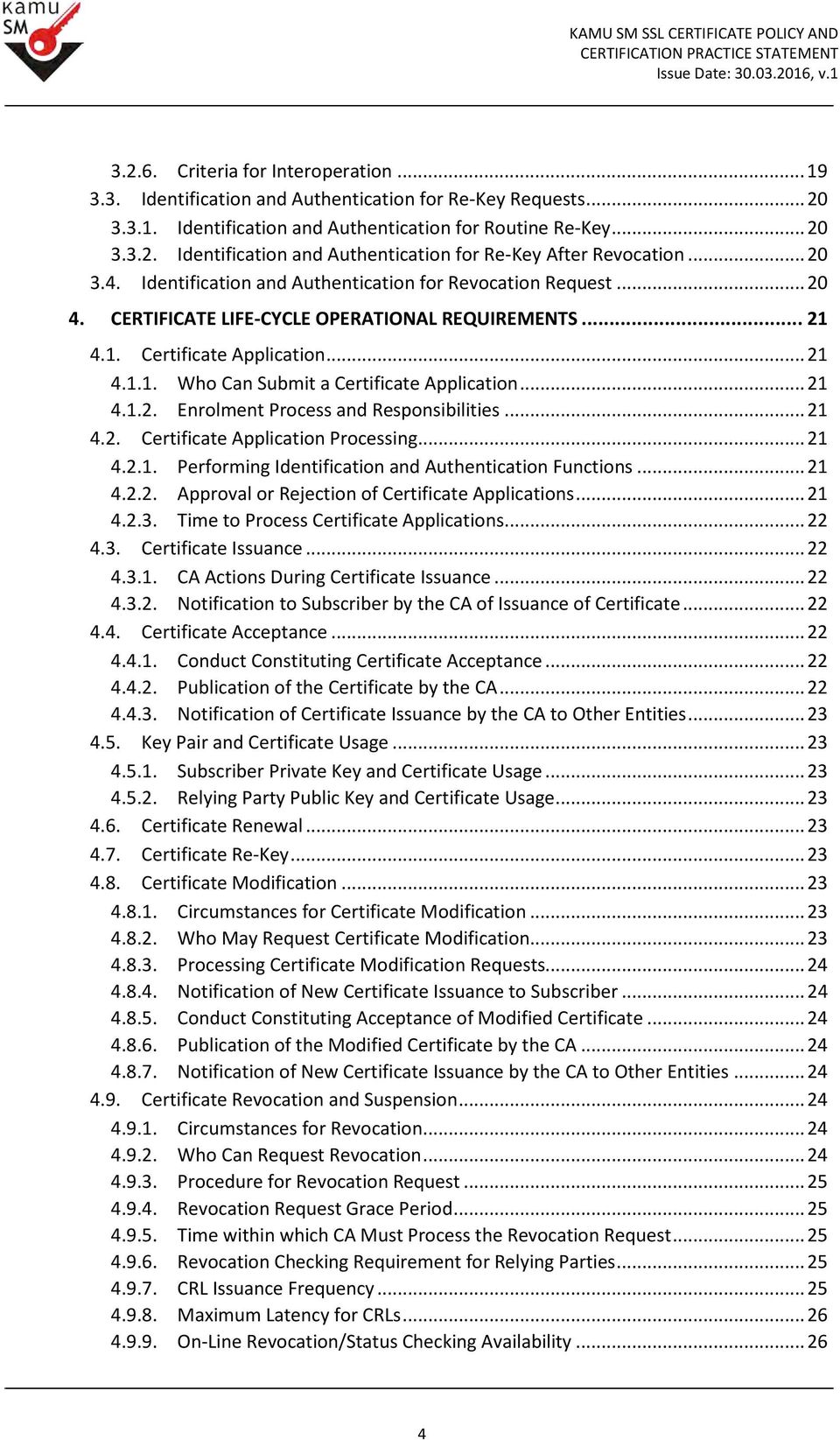
5 Online Revocation Checking Requirements Other Forms of Revocation Advertisements Available Special Requirements Regarding Key Compromise Circumstances for Suspension Who Can Request Suspension Procedure for Suspension Request Limits on Suspension Period Certificate Status Services Operational Characteristics Service Availability Optional Features End of Subscription Key Escrow and Recovery Key Escrow and Recovery Policy and Practices Session Key Encapsulation and Recovery Policy and Practices FACILITY, MANAGEMENT AND OPERATIONAL CONTROLS Physical Controls Site Location and Construction Physical Access Power and Air Conditioning Water exposures Fire Prevention and Protection Media Storage Waste Disposal Off-Site Backup Procedural Controls Trusted Roles Number of Persons Required per Task Identification and Authentication for Each Role Roles Requiring Separation of Duties Personnel Controls Qualifications, Experience, and Clearance Requirements Background Check Procedures Training Requirements Retraining Frequency and Requirements Job Rotation Frequency and Sequence Sanctions for Unauthorized Actions Independent Contractor Requirements Documentation Supplied to Personnel Audit Logging Procedures Types of Events Recorded Frequency of Processing Log Retention Period for Audit Log

6 Protection of Audit Log Audit Log Backup Procedures Audit Collection System (Internal vs. External) Notification to Event-Causing Subject Vulnerability Assessments Records Archival Types of Records Archived Retention Period for Archive Protection of Archive Archive Backup Procedures Requirements for Time-Stamping of Records Archive Collection System (Internal or External) Procedures to Obtain and Verify Archive Information Key Changeover Compromise and Disaster Recovery Incident and Compromise Handling Procedures Computing Resources, Software, and/or Data are Corrupted Entity Private Key Compromise Procedures Business Continuity Capabilities after a Disaster CA or RA Termination TECHNICAL SECURITY CONTROLS Key Pair Generation and Installation Key Pair Generation Private Key Delivery to Subscriber Public Key Delivery to Certificate Issuer CA Public Key Delivery to Relying Parties Key Sizes Public Key Parameters Generation and Quality Checking Key Usage Purposes (as per X.509 v3 Key Usage Field) Private Key Protection and Cryptographic Module Engineering Controls Cryptographic Module Standards and Controls Private Key Multi-Person Control Private Key Escrow Private Key Backup Private Key Archival Private Key Transfer Into or From a Cryptographic Module Private Key Storage on Cryptographic Module Method of Activating Private Key Method of Deactivating Private Key Method of Destroying Private Key Cryptographic Module Rating Other Aspects of Key Pair Management Public Key Archival
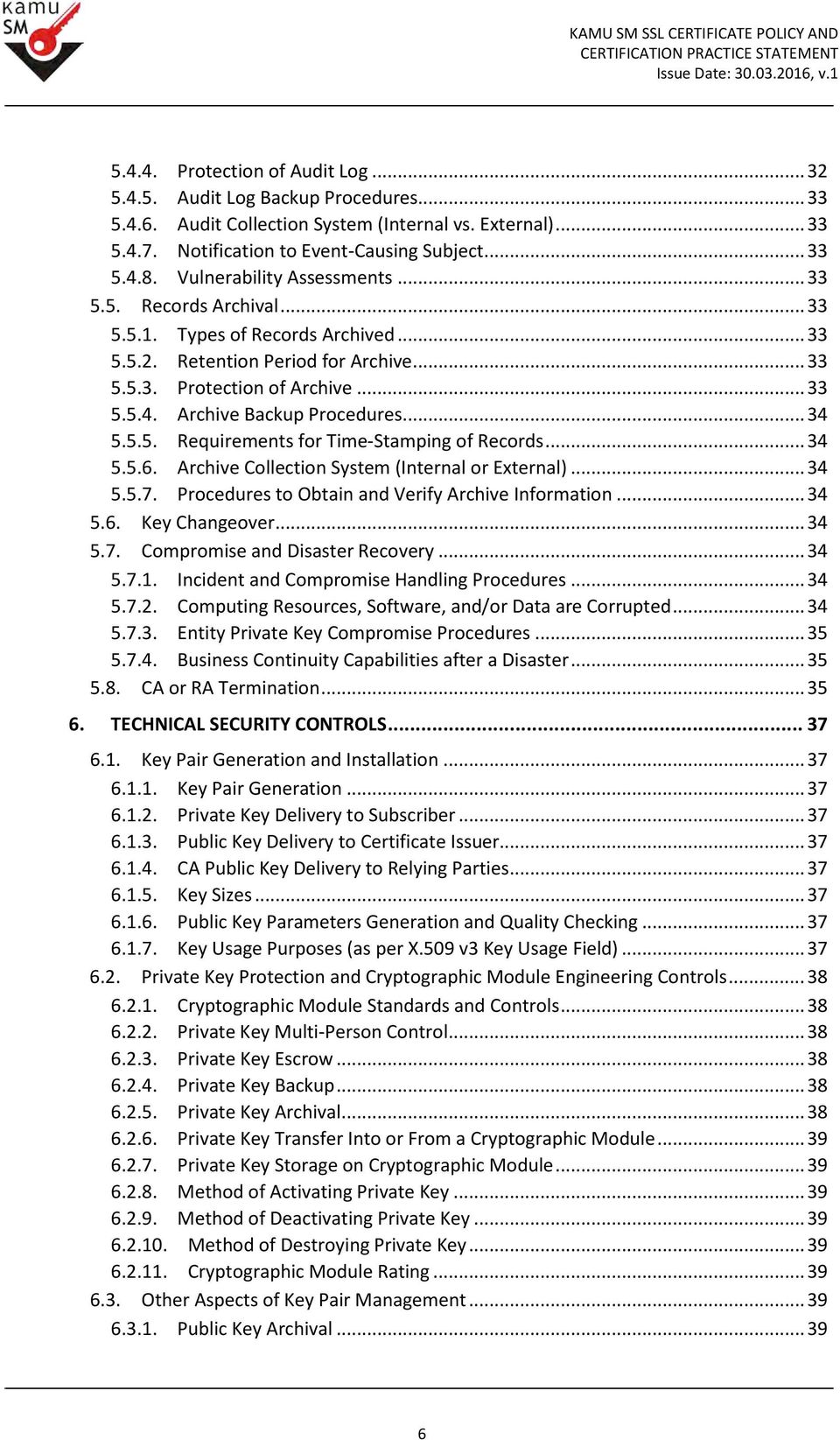
7 Certificate Operational Periods and Key Pair Usage Periods Activation Data Activation Data Generation and Installation Activation Data Protection Other Aspects of Activation Data Computer Security Controls Specific Computer Security Technical Requirements Computer Security Rating Life Cycle Technical Controls System Development Controls Security Management Controls Life Cycle Security Controls Network Security Controls Time-Stamping CERTIFICATE, CRL AND OCSP PROFILES Certificate Profiles Version Number(s) Certificate Extensions Algorithm Object Identifiers Name Forms Name Constraints Certificate Policy Object Identifier Usage of Policy Constraints Extension Policy Qualifiers Syntax and Semantics Processing Semantics for the Critical Certificate Policies Extension CRL Profile Version Number(s) CRL and CRL Entry Extensions OCSP Profile Version Number(s) OCSP Extensions COMPLIANCE AUDIT AND OTHER ASSESSMENTS Frequency and Circumstances of Assessment Identity/Qualifications of Assessor Assessor's Relationship to Assessed Entity Topics Covered by Assessment Actions Taken as a Result of Deficiency Communication of Results OTHER BUSINESS AND LEGAL MATTERS Fees Certificate Issuance or Renewal Fees

8 Certificate Access Fees Revocation or Status Information Access Fees Fees for Other Services Refund Policy Financial Responsibility Insurance Coverage Other Assets Insurance or Warranty Coverage for End-Entities Confidentiality of Business Information Scope of Confidential Information Information Not Within the Scope of Confidential Information Responsibility to Protect Confidential Information Privacy of Personal Information Privacy Plan Information Treated as Private Information Not Deemed Private Responsibility to Protect Confidential Information Notice and Consent to Use Private Information Disclosure Pursuant to Judicial or Administrative Process Other Information Disclosure Circumstances Intellectual Property Rights Representations and Warranties CA Representations and Warranties RA Representations and Warranties Subscriber Representations and Warranties Relying Parties Representations and Warranties Representations and Warranties of Other Parties Disclaimers of Warranties Limitations of Liability Indemnities Term and Termination Term Termination Effect of Termination and Survival Individual Notices and Communications with Participants Amendment Procedure for Amendment Notification Mechanism and Period Circumstances under Which OID Must Be Changed Dispute Resolution Provisions Governing Law Compliance with Applicable Law Miscellaneous Provisions
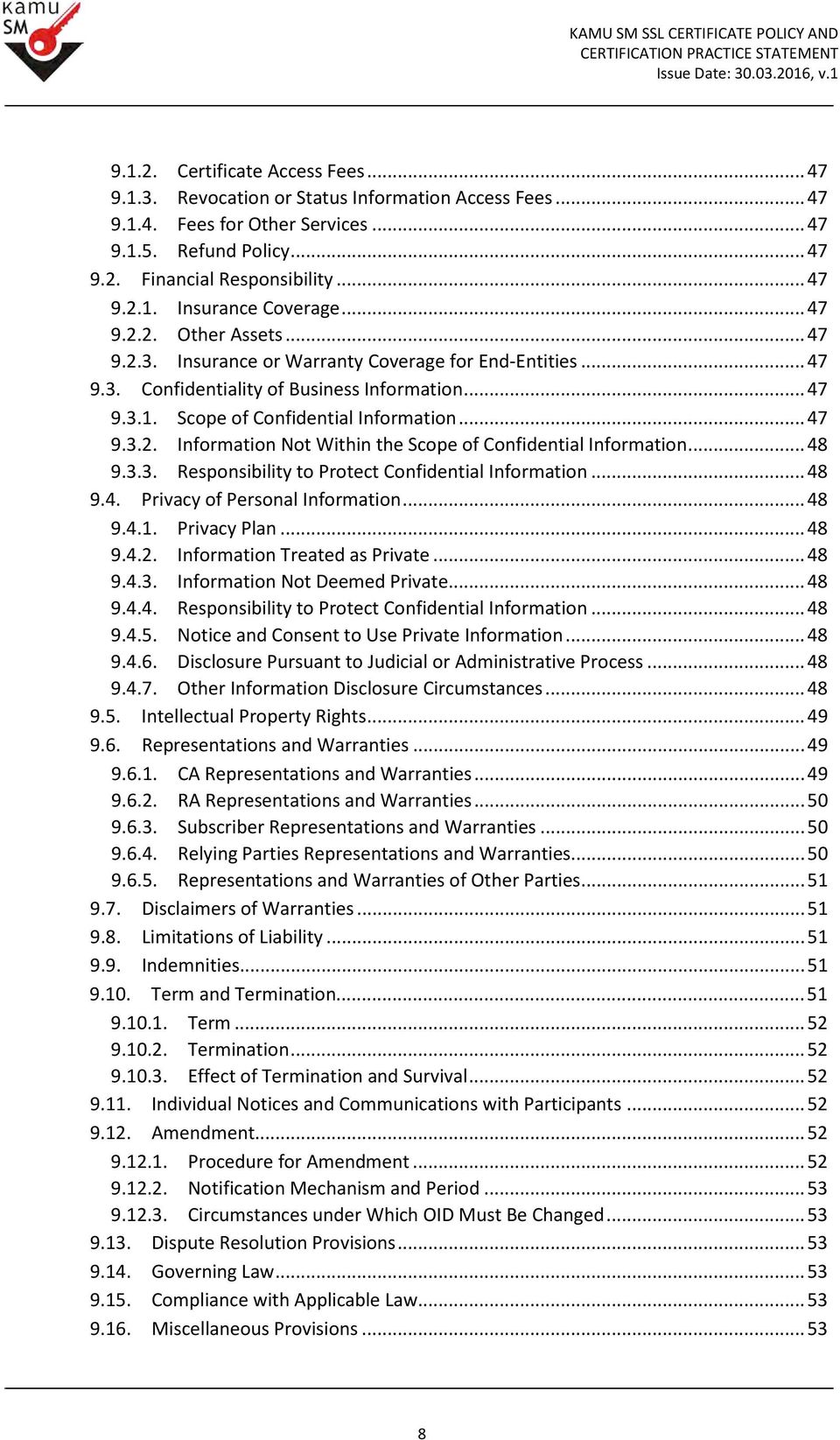
9 10. APPENDIX-A Certificate Profiles Root CA Certificate of Kamu SM Subordinate CA Certificate of Kamu SM End Entity SSL Certificate Template

10 1. INTRODUCTION Kamu SM (Government Certification Authority) was founded in accordance with Electronic Signature Law no dated January 15th, 2004 by The Scientific and Technological Research Council of Turkey (TÜBİTAK). Kamu SM is a government-owned Certificate Authority (CA) operated in compliance with the international standards. Referred as Certificate Policy and Certification Practice Statement (CP/CPS), this document has been prepared in compliance with the guide book of IETF RFC 3647 Internet X.509 Public Key Infrastructure Certificate Policy and Certification Practices Framework for the purpose of describing how Kamu SM executes its operations during providing OV SSL (Organization Validated SSL) certificate to government agencies of Republic of Turkey. Kamu SM conforms to updated versions of the standard of ETSI TS Electronic Signatures Infrastructure (ESI); Policy Requirements for Certification Authorities Issuing Public Key Certificates and CA/Browser Forum Baseline Requirements (BR) for the Issuance and Management of Publicly-Trusted Certificates referenced in ETSI TS standard and published on while providing certification services. In the event of any inconsistency between CP/CPS document and these documents, the requirements set out in respective documents take precedence over this document. This CP/CPS document describes execution of the services in regard to accepting certificate applications, certificate issuance and management, certificate revocation procedures in compliance with administrative, technical and legal requirements. This document determines practice responsibilities of Kamu SM, subscribers and relying parties. The certificates issued within this context shall not be considered within the scope of qualified electronic certificate mentioned in Electronic Signature Law no Overview CP/CPS document defines the roles, responsibilities and relationships of system entities and also describes realization method of registration and certification management procedures. Registration procedures consist of the processes such as receiving applications, identification information, and relevant official documents of government agencies to be certified, verifying and approving such information, receiving and evaluating certificate production and revocation requests, and initiating required procedures in line with approved certificate application and revocation requests. Certificate management consists of the processes such as generating key pair and certificate for subscribers, publishing and revoking certificates, publishing revocation status records, informing relevant parties involved with certification procedures regarding application and certification status and keeping required records. CP/CPS document has been prepared by taking IETF - Internet X.509 Public Key Infrastructure Certificate Policy and Certification Practices Framework (RFC 3647) as a reference. The expression of No Stipulation under some subheadings refers to the fact that no explanation is needed. 10

11 1.2. Document Name and Identification Document Name: SSL Certificate Policy and Certification Practice Statement Document Version Number: 03 Published on: OID: This CP/CPS document defines the procedures applied by Kamu SM while providing OV SSL certification services and covers OV SSL certificates issued to the servers. OV SSL certificates are issued and managed in accordance with Normalized Certificate Policy defined in ETSI TS standard. CP/CPS document is publicly accessible at PKI Participants PKI Participants defined within the scope of this document are the parties bearing relevant rights and obligations within certification services of Kamu SM. These parties are defined as CA, registration authority, subscribers and relying parties Certification Authorities Kamu SM provides OV SSL certification service as a CA. For this end, there is a hierarchy consisting of a root CA at the top and sub CAs under it. SSL certificates are issued by sub CAs. The sub CAs fulfil the following services: Generating and signing certificates and delivering them to relevant government agencies Revoking certificates Publication of certificate status information in the form of Certificate Revocation List (CRL) or other methods Registration Authorities All registration procedures are directly executed by Kamu SM personnel. Registration units execute services such as certificate application and revocation intended for end users. This unit creates the first customer record and executes required identification and authentication processes and directs relevant certificate requests to certificate generation unit Subscribers Government agencies whose certificates are issued by Kamu SM and which are responsible for using their certificates in compliance with this CP/CPS Relying Parties The parties accepting the certificates by validating them and performing procedures accordingly Other Participants No stipulation. 11

12 1.4. Certificate Usage Appropriate Certificate Usage SSL certificate is used for the purpose of performing authentication between the server and clients, and providing encrypted communication. SSL certificate is deployed only on the server offering service to domain name contained in the certificate. Usage rights of certificates rest with only subscribers Prohibited Certificate Usage SSL certificate issued by Kamu SM may not be used other than the purposes laid down in Section Policy Administration Organization Administering the Document This CP/CPS document has been written by Kamu SM. Kamu SM may make amendments in the document when it deems necessary Contact Person Questions relating to implementation of this CP/CPS document and relevant management policy can be directed to the following contact information of Kamu SM: Address : Kamu Sertifikasyon Merkezi, TÜBİTAK Yerleşkesi P.K. 74, Gebze-Kocaeli Tel : Fax : (262) E-Posta : [email protected] URL : Kamu SM publishes CP/CPS document publicly accessible at Person Determining CP Suitability for the Policy Suitability of this CP/CPS document shall be determined by Kamu SM administration and the persons authorized by administration CPS Approval Procedure Approval of this CP/CPS document for publication shall be granted as a result of examinations conducted by Kamu SM administration and the persons authorized by administration Definitions and Acronyms Definitions Certificate Revocation List (CRL): An electronic file that has been generated, signed and published by the CA to disclose the revoked certificates to the public. DV SSL: SSL certificate issued and maintained in accordance with Domain Validation Certificate Policy defined in ETSI TS standard. End users: Subscribers and relying parties using the certificates. 12

13 EV SSL: SSL certificate issued and maintained in accordance with Extended Validity Certificate Policy defined in ETSI TS standard. Kamu Sertifikasyon Merkezi (Kamu SM): A TÜBİTAK unit providing certification service for the government agencies. Key pair: Private key and corresponding public key used for creating and verifying electronic signature or encrypting and decrypting data. Object identification number (OID): Number obtained from an organization identifying an international standard uniquely defining an object. Online Certificate Status Protocol (OCSP): Standard protocol that has been created to disclose the validity status of certificates to the public, and allows receipt of certificate status information by on-line methods instantly and without interruption. OV SSL: SSL certificate issued and maintained pursuant to Organization Validation Certificate Policy defined in ETSI TS standard. Relying parties: Natural and legal persons performing transaction by relying on certificates. Repository: Data storage medium such as web servers where certificates, revocation status records and certificate procedures and other relevant information are published. Revocation status record: Record wherein revocation information of unexpired certificates is included and relying parties can swiftly and securely access exact certificate revocation time if revoked. Root CA Certificate: Certificate of the root CA. Root Certificate Authority: Certificate authority formed within Kamu SM, to whom the most authorized signature degree has been given and having signed its own certificate. Sub CA Certificate: Certificate of the subordinate CA. Subordinate Certificate Authority: Certificate authority formed within Kamu SM, to whom the most authorized signature degree has been given and having signed its own certificate. Subscriber: Government agency obtaining certificate from Kamu SM. Time stamping: Record verified by electronic signature of CA for the purpose of detecting the time when an electronic data is issued, modified, sent, received and/or saved Abbreviations BR: CA/Browser Forum Baseline Requirements for the Issuance and Management of Publicly-Trusted Certificates CA/Browser Forum Basic Requirements Document BS: British Standards CA: Certificate Authority CEN: European Committee for Standardization CP: Certificate Policy CPS: Certificate Practise Statement CRL: Certificate Revocation List CWA: CEN Worksop Agreement 13

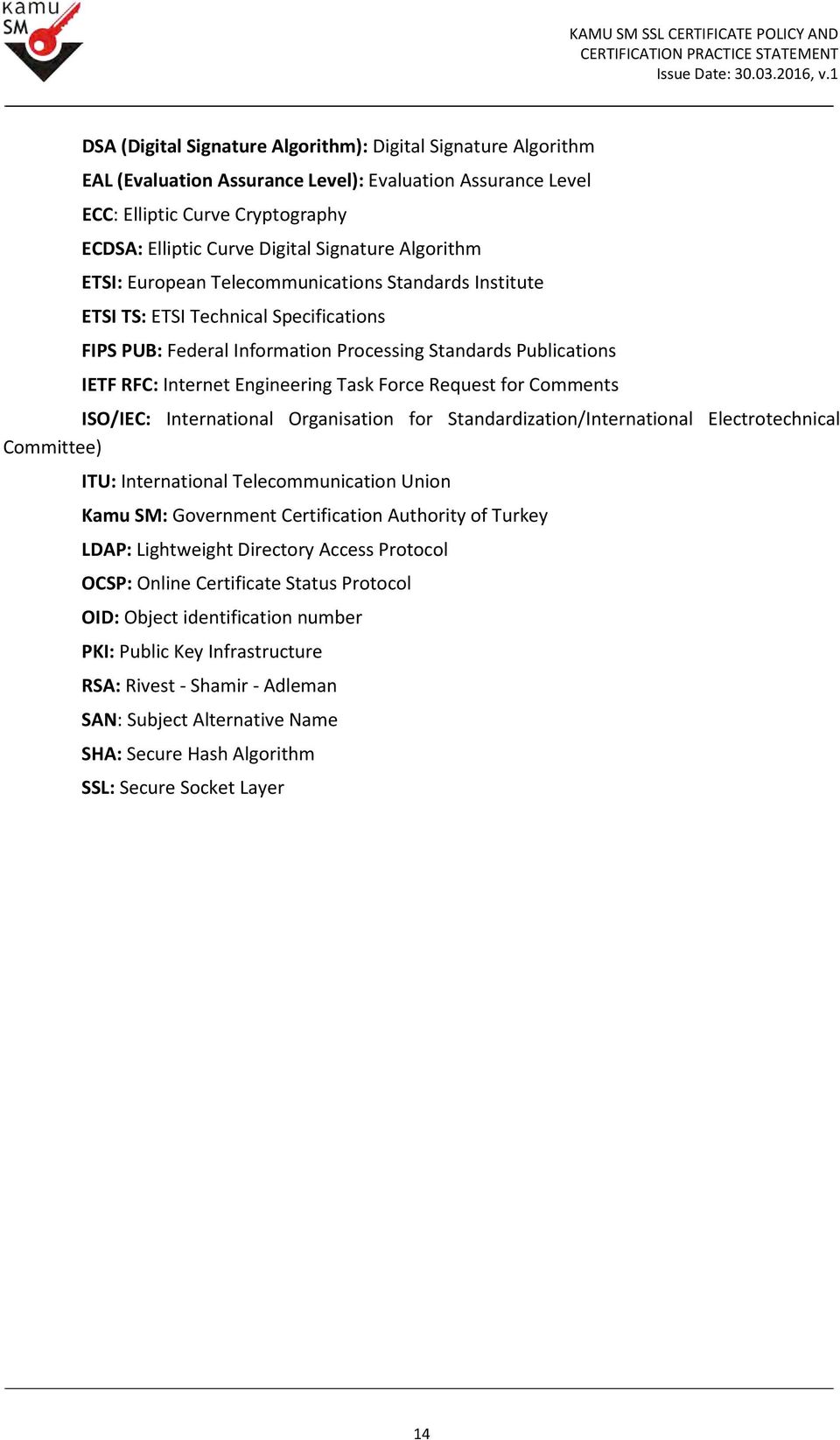
14 DSA (Digital Signature Algorithm): Digital Signature Algorithm EAL (Evaluation Assurance Level): Evaluation Assurance Level ECC: Elliptic Curve Cryptography ECDSA: Elliptic Curve Digital Signature Algorithm ETSI: European Telecommunications Standards Institute ETSI TS: ETSI Technical Specifications FIPS PUB: Federal Information Processing Standards Publications IETF RFC: Internet Engineering Task Force Request for Comments ISO/IEC: International Organisation for Standardization/International Electrotechnical Committee) ITU: International Telecommunication Union Kamu SM: Government Certification Authority of Turkey LDAP: Lightweight Directory Access Protocol OCSP: Online Certificate Status Protocol OID: Object identification number PKI: Public Key Infrastructure RSA: Rivest - Shamir - Adleman SAN: Subject Alternative Name SHA: Secure Hash Algorithm SSL: Secure Socket Layer 14
15 2. PUBLICATION AND REPOSITORY RESPONSIBILITIES Repository is the environment wherein the documents such as root and sub CA certificates of Kamu SM, revocation status records, CP/CPS are uninterruptedly, securely and freely published. Some critical files published in repository are updated when necessary. These updates are specified with version numbers and updating date kept on the updated files Repositories Kamu SM repository is accessed over the Internet. Kamu SM does not employ a trusted third party to operate the repository Publication of Certification Information The following information except for those related with internal operations is available in the repository to be accessed publicly: values, Root and sub CA certificates of Kamu SM, Hash values of certificates of Kamu SM and hash algorithms used in calculation of hash OID list used by Kamu SM, Kamu SM CP/CPS documents, Agreements, forms, certificate contracts, certification management procedures, Updated revocation status records Kamu SM repository is accessible over and Time and Frequency of Publication Agreements, forms, certificate contracts, certification management procedures and CP/CPS documents are updated when their content is modified. Updated documents are promptly published after update. Certificates of Kamu SM are promptly published after update. Publication frequency of CRLs and frequency of updating OCSP records are specified in Sections and Access Controls on Repositories Kamu SM repository is publicly accessible for acquiring information. Updating repository is carried out by authorized Kamu SM personnel. Kamu SM fulfils the following representations and warranties in regard to repository: Maintaining integrity of the information kept in repository against unauthorized deletion and modification, Providing accuracy and up-to-dateness of the information kept in repository, Keeping repository accessible at all times, Adopting required measures for providing uninterruptible accessibility of repository, 15
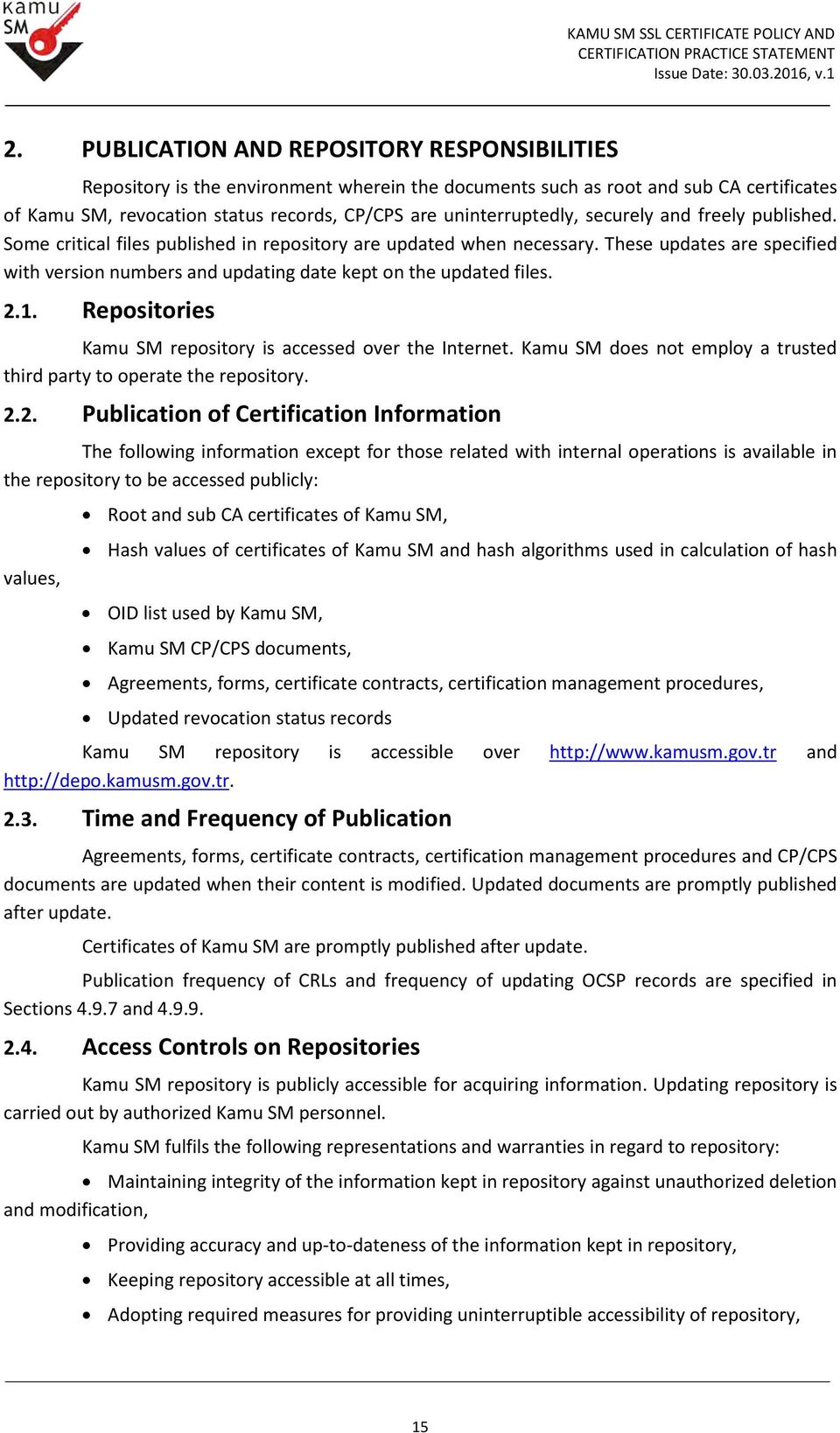
16 Providing free access to repository. 16

17 3. IDENTIFICATION AND AUTHENTICATION Kamu SM authenticates organization identity of government agencies having applied for certificate and domain ownership of the agencies. Kamu SM conducts authentication procedures based on all documents and official resources deemed necessary in line with legal and technical requirements Naming Type of Names DN (Distinguished Name) field wherein identification information of subscriber is revealed in the certificates issued by Kamu SM may not be left blank and name types where ITU X.500 format is supported are used Need for Names to be Meaningful Name values in the certificates that Kamu SM issues shall be clear and meaningful. These name values are verified by Kamu SM Anonymity or Pseudonymity of Subscribers Anonymity or pseudonymity of the subscriber is not allowed Rules for Interpreting Various Name Forms Name forms other than ITU X.500 are not used in certificate content Uniqueness of Names Credentials in content of certificates issued by Kamu SM are distinctive for each government agency. It is permitted that credentials are same in the content of certificates of the same government agency. However, credentials in the content of certificates of different agencies are prevented to be identical. Availability of only domain names, virtual server names or internal server names and IP addresses without agency information are not permitted within the certificate. Kamu SM issues OV SSL certificates to only government agencies of Turkey. The following is included in OV SLL certificates: CN field: Name of server registered on behalf of the subscriber government agency in DNS is written in CN field. *.<domain name> is written in this field in OV SSL wildcard certificates. This field does not contain non-distinctive names such as *.com or *.com.tr". IP address or internal server name is not written in this field. O field contains open title or understandably abbreviated form of subscriber government agency as laid down in organizational law or other legislation. In cases where OU field contains organizational unit or brand name, brand name registered in Turkish Standards Institute shall be written. SERIALNUMBER field is unique tax number of subscriber government agency. L field contains province information where subscriber government agency is located. 17

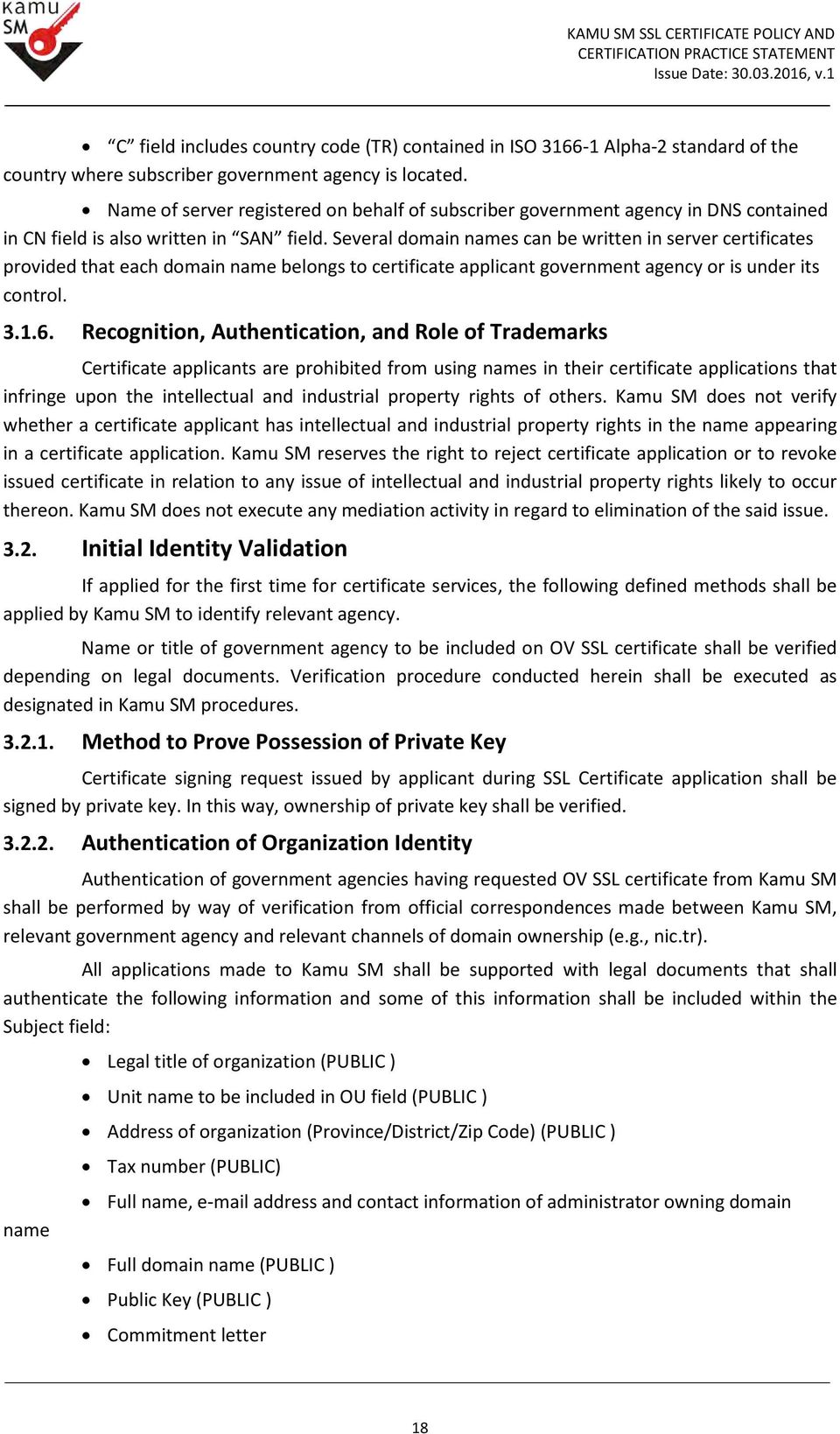
18 C field includes country code (TR) contained in ISO Alpha-2 standard of the country where subscriber government agency is located. Name of server registered on behalf of subscriber government agency in DNS contained in CN field is also written in SAN field. Several domain names can be written in server certificates provided that each domain name belongs to certificate applicant government agency or is under its control Recognition, Authentication, and Role of Trademarks Certificate applicants are prohibited from using names in their certificate applications that infringe upon the intellectual and industrial property rights of others. Kamu SM does not verify whether a certificate applicant has intellectual and industrial property rights in the name appearing in a certificate application. Kamu SM reserves the right to reject certificate application or to revoke issued certificate in relation to any issue of intellectual and industrial property rights likely to occur thereon. Kamu SM does not execute any mediation activity in regard to elimination of the said issue Initial Identity Validation If applied for the first time for certificate services, the following defined methods shall be applied by Kamu SM to identify relevant agency. Name or title of government agency to be included on OV SSL certificate shall be verified depending on legal documents. Verification procedure conducted herein shall be executed as designated in Kamu SM procedures Method to Prove Possession of Private Key Certificate signing request issued by applicant during SSL Certificate application shall be signed by private key. In this way, ownership of private key shall be verified Authentication of Organization Identity Authentication of government agencies having requested OV SSL certificate from Kamu SM shall be performed by way of verification from official correspondences made between Kamu SM, relevant government agency and relevant channels of domain ownership (e.g., nic.tr). All applications made to Kamu SM shall be supported with legal documents that shall authenticate the following information and some of this information shall be included within the Subject field: name Legal title of organization (PUBLIC ) Unit name to be included in OU field (PUBLIC ) Address of organization (Province/District/Zip Code) (PUBLIC ) Tax number (PUBLIC) Full name, address and contact information of administrator owning domain Full domain name (PUBLIC ) Public Key (PUBLIC ) Commitment letter 18
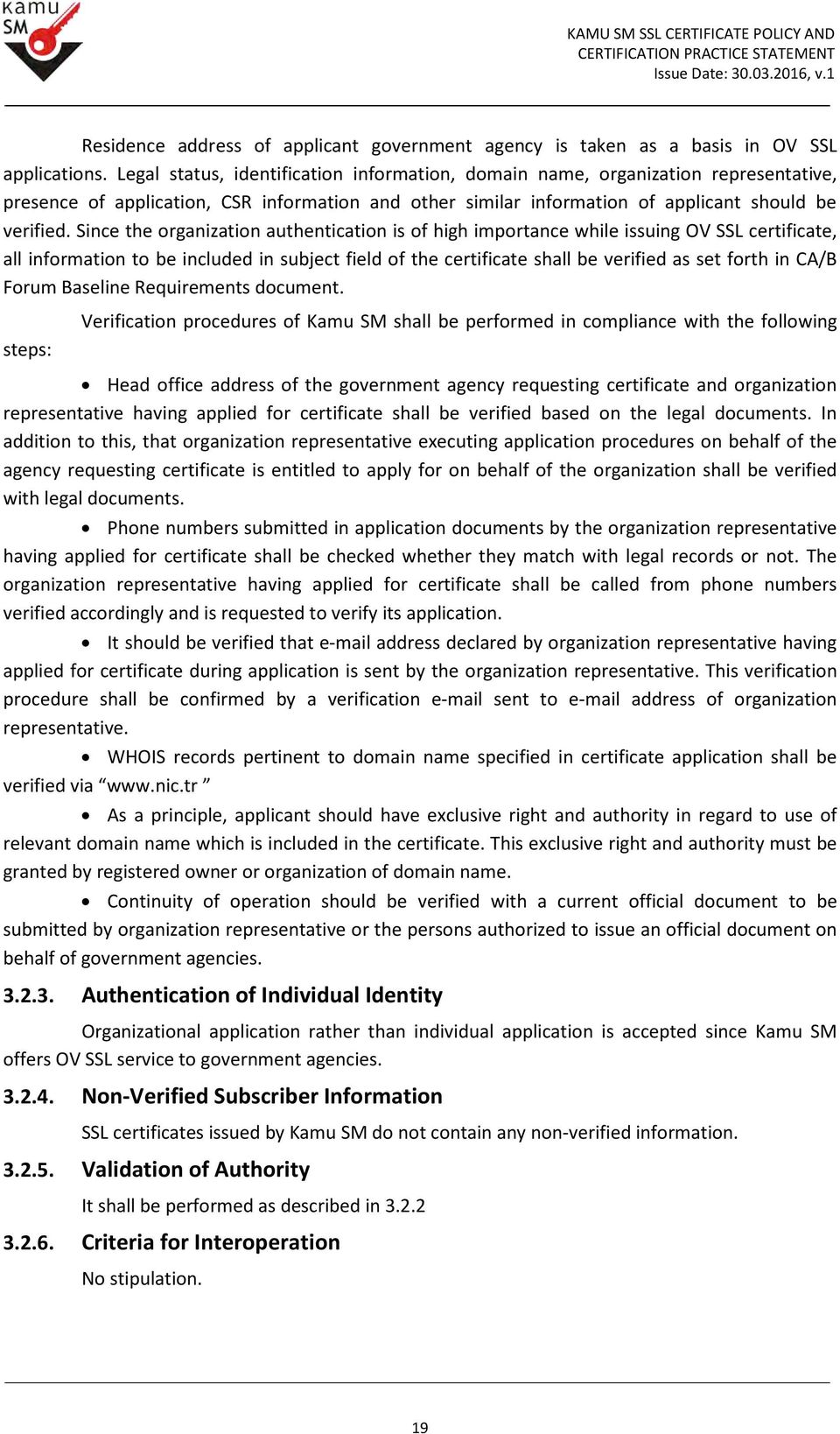
19 Residence address of applicant government agency is taken as a basis in OV SSL applications. Legal status, identification information, domain name, organization representative, presence of application, CSR information and other similar information of applicant should be verified. Since the organization authentication is of high importance while issuing OV SSL certificate, all information to be included in subject field of the certificate shall be verified as set forth in CA/B Forum Baseline Requirements document. steps: Verification procedures of Kamu SM shall be performed in compliance with the following Head office address of the government agency requesting certificate and organization representative having applied for certificate shall be verified based on the legal documents. In addition to this, that organization representative executing application procedures on behalf of the agency requesting certificate is entitled to apply for on behalf of the organization shall be verified with legal documents. Phone numbers submitted in application documents by the organization representative having applied for certificate shall be checked whether they match with legal records or not. The organization representative having applied for certificate shall be called from phone numbers verified accordingly and is requested to verify its application. It should be verified that address declared by organization representative having applied for certificate during application is sent by the organization representative. This verification procedure shall be confirmed by a verification sent to address of organization representative. WHOIS records pertinent to domain name specified in certificate application shall be verified via As a principle, applicant should have exclusive right and authority in regard to use of relevant domain name which is included in the certificate. This exclusive right and authority must be granted by registered owner or organization of domain name. Continuity of operation should be verified with a current official document to be submitted by organization representative or the persons authorized to issue an official document on behalf of government agencies Authentication of Individual Identity Organizational application rather than individual application is accepted since Kamu SM offers OV SSL service to government agencies Non-Verified Subscriber Information SSL certificates issued by Kamu SM do not contain any non-verified information Validation of Authority It shall be performed as described in Criteria for Interoperation No stipulation. 19
20 3.3. Identification and Authentication for Re-Key Requests Identification and Authentication for Routine Re-Key Certificate re-key is not performed for SSL certificates. If the agency wants, certificate applications are applied like a first time application. In this case, identification and authentication procedures are applied as described in Section Identification and Authentication for Re-Key After Revocation Certificate re-key is not performed for SSL certificates. If the agency wants, certificate applications are applied like a first time application. In this case, identification and authentication procedures are applied as described in Section Identification and Authentication for Revocation Request In case of a revocation request, Kamu SM calls the agency from the numbers registered in its system, identifies and authenticates the requester and confirms the revocation request. 20
21 4. CERTIFICATE LIFE-CYCLE OPERATIONAL REQUIREMENTS This part describes the procedures performed in certification management processes. Details relating to the processes are revealed on web site of Kamu SM Certificate Application Who Can Submit a Certificate Application Government agencies can apply to Kamu SM for SSL certificate. These applications shall be made corporately by an organization employee duly authorized. The agency shall complete SSL Agreement setting forth requirements of certificate services to be obtained from Kamu SM and Secure Server Certificate Request Form and shall send them to Kamu SM with wet signature and seal. Organization employee may not individually make an application without the request of the government agency Enrolment Process and Responsibilities Responsibilities of government agency having applied for SSL certificate is as follows: It shall send Secure Server Certificate Request Form as incorporating all information with requirements set out in this CP/CPS document and SSL Agreement to Kamu SM with wet signature and seal. The agency shall be liable for following up the information sent to Kamu SM and notifying Kamu SM in case of modification in this information. The agency shall generate key pair by itself and shall create Certificate Signing Request (CSR) as to prove that private key belongs to itself and sends this to Kamu SM from corporate address. The agency shall take all required measures for protecting confidentiality and integrity of its private key Certificate Application Processing Performing Identification and Authentication Functions SSL applications shall be executed in pursuance of the principles set out in Section 3.2 and 4.1 and the procedures of Kamu SM in parallel with this Approval or Rejection of Certificate Applications In case of required forms and documents are fully completed in accordance with application procedures of Kamu SM and the principles described in Section 3.2, certificate application shall be accepted. Those whose application has been accepted are defined in the system of Kamu SM and certificate issuance process shall be initiated. Kamu SM shall reject certificate application in case any of the circumstances occurs: Required forms and documents are not duly completed in accordance with application procedures of Kamu SM and the principles described in Section 3.2, Applicant fails to satisfactorily respond the queries relating to verification of the information and documents on timely manner, The organization has no official record, 21
22 Emergence of strong conviction presuming that issuance of SSL certificate may damage reputation of Kamu SM, Presence of falsification, error, missing approval, missing information or inaccurate information in the documents declared during certificate application, CSR file sent to Kamu SM not meeting technical criteria. Information relating to those whose application has not been accepted shall be notified via or by calling. and phone information of the applicant is the information declared during application. After required adjustments are made and missing parts are completed, applicant may reapply. During server certificate applications Certification Authority Authorization (CAA) records identified in CA/Browser Forum s BR document, are not controlled by Kamu SM and no kind of action is performed in accordance with these records Time to Process Certificate Applications Insofar as the application is accurate and complete in accordance with the principles contained in Section 3.2 and the procedures of Kamu SM, the application shall be taken into consideration within at the latest 3 (three) working days following delivery of relevant documents to Kamu SM. After considered certificate application is accepted pursuant to the principles contained in Section 4.2.2, its issuance shall be performed within at the latest 2 (two) working days Certificate Issuance CA Actions During Certificate Issuance Certificate applications accepted in pursuance of the principles contained in Section shall be processed by Kamu SM and certificate shall be issued following verification of CSR file. All the steps during this procedure are logged Notification to Subscriber by the CA of Issuance of Certificate Kamu SM shall send the certificate to organization representative s verified address Certificate Acceptance Conduct Constituting Certificate Acceptance Subscriber shall check whether or not the information contained in certificate is identical to the information it has declared during application and in case of any inconsistency, it shall immediately notify Kamu SM and shall not use the certificate. In this case, the certificate shall be revoked by Kamu SM. SSL certificate shall be deemed to have been accepted in case of no return within 10 (ten) working days following sending it to the applicant Publication of the Certificate by the CA Kamu SM shall not publish SSL certificates it has issued. 22
23 Notification of Certificate Issuance by the CA to Other Entities No stipulation Key Pair and Certificate Usage Subscriber Private Key and Certificate Usage Subscriber shall use its certificate and private key within the framework of the terms and conditions contained in agreement of relevant subscriber and in CP/CPS document with other regulations and standards being subjected to. Subscriber shall be liable for protecting its private key against unauthorized access. Private key corresponding to SSL certificate may only be used within the purposes specified in the Key Usage field of the certificate Relying Party Public Key and Certificate Usage Public key contained within the certificate of the subscriber may be used for verification purposes by relying parties. Relying parties shall be liable for checking validity of CA certificate issuing the certificate and the certificate itself, for verifying that the certificate is used in line with the purposes specified in the Key Usage field and for conforming to use terms specified in this CP/CPS. If the certificate validation is unsuccessful, procedure should not be performed based on the certificate. Kamu SM shall not be responsible for failure of relying parties to fulfil the said requirements thereon in use of public key and certificate Certificate Renewal Certificate renewal refers to renewal of the certificate by using the same key pair. Kamu SM does not perform certificate renewal for SSL certificates. In the event the subscriber wants to make a renewal application, it is considered as a new certificate application stated in Section Certificate Re-Key Certificate re-key refers to issuing a new certificate to replace the current certificate without making any modification except the key pair before the expiry date. Kamu SM does not perform certificate re-key for SSL certificates. In the event the subscriber wants to make a re-key application, it is considered as a new certificate application stated in Section Certificate Modification In case of modification within the information in the content of a certificate issued by Kamu SM, the certificate shall be revoked and an application shall be made for a new certificate together with new information. In the event the subscriber wants to make a certificate modification application, it is considered as a new certificate application stated in Section Circumstances for Certificate Modification No stipulation Who May Request Certificate Modification No stipulation. 23
24 Processing Certificate Modification Requests No stipulation Notification of New Certificate Issuance to Subscriber No stipulation Conduct Constituting Acceptance of Modified Certificate No stipulation Publication of the Modified Certificate by the CA No stipulation Notification of New Certificate Issuance by the CA to Other Entities No stipulation Certificate Revocation and Suspension Circumstances for Revocation cases: The subscriber shall apply to Kamu SM for revocation of its certificate in the following Suspecting confidentiality of its private key, Modification in the information contained in the certificate, Termination of domain name ownership. Kamu SM shall revoke the subscriber certificate in the following cases: Emergence of forgery or inaccuracy of the information of the subscriber in the certificate, Determining use of the certificate in contradiction with the requirements set forth in SSL Agreement and CP/CPS document, Issuing a notification to Kamu SM indicating that a court or an authority has revoked domain name ownership or use authority of the subscriber, or this case is identified by Kamu SM, Compromise of the private key used by Kamu SM for signing the certificate, Key size or cryptographic algorithms used in issuance of SSL certificate becoming deprecated, Termination of operation of Kamu SM and failure of continuation of management of issued certificates by other CAs Who Can Request Revocation The organization representative is entitled to request the revocation of the certificate issued by Kamu SM. In cases of the circumstances provided in Section 4.9.1, Kamu SM is also entitled to revoke the certificate. However, in case Kamu SM revokes the certificate, Kamu SM informs the agency and provides the reason(s) for revocation. 24
25 Procedure for Revocation Request SSL certificate revocation application shall be made by the organization representative with an approved official letter. In case of an urgent revocation, the organization representative may send the scanned approved official letter to Kamu SM from his corporate address and call Kamu SM for revocation. In this case, after the required authentication procedures, Kamu SM shall revoke the certificate. Kamu SM notifies the agency about revocation of its certificate via and the revocation is reflected to CRL and OCSP as described in Section In case of revocation of root or sub CA certificates of Kamu SM, revocation status shall be announced to relevant parties as soon as possible. All certificates bearing signature of root or sub CA shall be revoked and their owners shall be duly notified via or SMS Revocation Request Grace Period Revocation request grace period refers to maximum time that the subscriber may delay the certificate revocation request. The subscriber should communicate its revocation request to Kamu SM within the shortest time possible. Kamu SM shall not be held responsible for the issues of the subscriber arising from delay of revocation request Time within which CA Must Process the Revocation Request Kamu SM shall promptly take into consideration the valid revocation applications it has received and shall revoke the certificate after required verification. This information is instantly reflected to OCSP service and reflected to CRL file within 24 hours Revocation Checking Requirement for Relying Parties Revocation status records shall not require authentication and are freely and publicly accessible for everyone. Kamu SM shall maintain continuity of access for revocation status records. Relying parties shall be liable for checking validity of certificates using one of CRL or OCSP methods prior to performing any procedure based on the certificates. Relying parties shall check that CRL file that relying parties has performed certificate validity check or revocation status record obtained from OCSP service have been signed with the Kamu SM private key. Validity checks required to be performed by relying parties are described in Section CRL Issuance Frequency CRL wherein the certificate revocation information of end users is available shall be published minimum once a day. Validity period of this CRL is maximum 36 (thirty six) hours. CRL file survives until its expiry time although newer one is published. CRL files containing sub CAs revocation information shall be published minimum once a year. If a sub CA certificate is revoked, a new CRL shall be published immediately. CRL files published by Kamu SM shall be archived. 25
26 Maximum Latency for CRLs CRL shall be published within at the latest 10 (ten) minutes as of the moment of its issuance On-Line Revocation/Status Checking Availability Kamu SM shall uninterruptedly publish revocation status records of SSL certificates over OCSP. Applications with OCSP support shall receive revocation status of SSL certificates over and revocation status of Kamu SM sub CA certificates over Online Revocation Checking Requirements Relying parties shall be obligated to check the revocation status of a certificate in line with the principles set out in Section prior to relying on this certificate. If technical facilities are eligible, performing certificate revocation check over OCSP is the method recommended by Kamu SM Other Forms of Revocation Advertisements Available OCSP. Kamu SM shall not provide revocation status advertisement methods rather than CRL and Special Requirements Regarding Key Compromise If confidentiality or security of any CA private key of Kamu SM is under suspicion, the certificate related to this private key and all the certificates under this CA certificate shall be revoked, and certificate owners shall be duly notified via . In cases where Kamu SM discovers or has reasons to believe compromise of subscriber s key, it shall revoke the certificate and notify the subscriber. New certificate issuance procedures shall be initiated within the shortest time possible in all certificate revocation procedures originating from Kamu SM Circumstances for Suspension Suspension procedure shall not be applied for SSL certificates Who Can Request Suspension No stipulation Procedure for Suspension Request No stipulation Limits on Suspension Period No stipulation Certificate Status Services Relying parties shall access revocation status records through CRL and OCSP. 26
27 Operational Characteristics Relying parties may access revocation status records from CRL files that Kamu SM publishes. Access information to CRL files is provided in Section 2. Whenever relying parties want to check revocation status of certificates, they shall copy CRL file from Kamu SM repository and shall fetch the status information. Relying parties with OCSP client support may access revocation status records from OCSP service. Access address of OCSP service is provided in Section 2. Whenever relying parties want to check validity status of certificates, they shall query the certificates status over OCSP service Service Availability Kamu SM shall take all required measures for providing CRL and OCSP services uninterruptedly on 7/24 basis Optional Features No stipulation End of Subscription Certificate ownership shall terminate when the certificate expires, is revoked or Kamu SM terminates certification services. In cases where Kamu SM terminates certification services or the certificate is revoked, Kamu SM shall notify the subscriber or the persons specified in the agreement, if any. In case of expiration, Kamu SM shall not have to notify the subscriber; the subscriber shall be liable for following the expiration time of its certificate by its own Key Escrow and Recovery Since Kamu SM does not generate the end user keys, Kamu SM may not reissue or backup the keys of the subscribers Key Escrow and Recovery Policy and Practices No stipulation Session Key Encapsulation and Recovery Policy and Practices No stipulation. 27
28 5. FACILITY, MANAGEMENT AND OPERATIONAL CONTROLS This section outlines non-technical security controls that are required to be performed while offering certificate service by Kamu SM Physical Controls Kamu SM operates its systems in physically secured locations that are equipped with security precautions such as access control systems against unauthorized access. They are protected from external as well as internal malicious activities. A record of all access to secure areas is maintained Site Location and Construction Kamu SM operations are conducted within facilities in Gebze and Ankara. Gebze facility is located away from city where the disasters such as fire, flood, earthquake, lightning and air pollution have minimal impact. Ankara facility is metropolitan area with levels of physical access controls. Access to areas and the buildings is protected by multiple tiers of physical security, video monitoring and authentication including hi-sec interlocking doors that only allows single person entry or exit. The building is suitable for the high-security operations designed to deter, prevent and detect covert/overt penetration. Power supplies, communication units, ventilations and fire suppression systems ensure reliable operation. Proper safety precautions are taken against earthquakes, flood and other disasters. Software and hardware modules, and the archives are restricted in accordance with segregation of duties requirements to prevent unauthorized modification, substitution or destruction. Unauthorized personnel and unescorted visitors are not allowed into such sensitive areas Physical Access See Power and Air Conditioning The following power units are utilized to support the operations of Kamu SM and provide its continuity: Transformation units Distribution panels Transformer UPS devices Dry accumulator Emergency power generator The building is equipped with uninterrupted heating/air ventilation systems that are used to prevent overheating and to maintain a suitable humidity level. 28
29 Water exposures The necessary precautions are taken to minimize the damages arising from the floods and water exposures at Kamu SM facilities Fire Prevention and Protection Kamu SM facilities are equipped with smoke detection systems. Necessary precautions are taken to ensure secure facilities are protected from exposure to flame and smoke Media Storage All media containing production software, production data, system audit, and archive are protected physically and electronically against corruption, aging and accidental damage. Media are backed up on-site and off-site Waste Disposal Sensitive documents and materials are shredded before disposal. Media used to collect or transmit sensitive information are destroyed irreversibly. Cryptographic devices, smart cards, and other devices containing private keys or keying materials are physically destroyed and zeroized according to industry best practice. Other waste is disposed in accordance with normal waste disposal requirements Off-Site Backup Kamu SM performs routine backups of critical system data, audit log data, and other sensitive information. Gebze and Ankara facilities are 400 km distant and secure off-site backups to each other. The locations, where the backups are located, comply with all the security and functional requirements of the main system. Access to backup servers/media is restricted to authorized personnel only Procedural Controls Trusted Roles Roles of personnel employed in Kamu SM have been identified in accordance with CWA and ETSI standards and have been classified as follows: Kamu SM Administrator: Kamu SM Administrator is responsible for managing all administrative and technical activities for fulfilling strategic objectives of Kamu SM. Security Personnel: Security Personnel is responsible for implementing security policies. System Administrators: System Administrators are responsible for managing information technology infrastructure for sustainability of certificate service. System Operators: System Operators are responsible for operation, backup and recovery activities for all system components. System Auditor: System Auditor is responsible for reviewing and inspecting archive and audit logs relating to certificate service. Certificate Enrolment Personnel: Certificate Enrolment Personnel is responsible for processing enrolments relating to certificate issuance and revocation. 29
30 Certificate Issuance Personnel: Certificate Issuance Personnel is responsible for issuance of certificate Number of Persons Required per Task Kamu SM requires at least presence of two personnel at the same time for issuing certificates of CA and end users, revocation of CA certificate, and backing up CA private keys within another cryptographic module Identification and Authentication for Each Role Verification of identity and authentication of the personnel are performed in each step of Kamu SM procedures. In this way, only access of authorized personnel is established for each system unit. Access to some of the units in the system is permitted by different levels of authorizations. In order for accessing these units, the authentication is made and the operations can be performed in accordance with the authorization levels. Verification of identity within Kamu SM system is performed with up to date cryptographic methods by using secure hardware tools, passwords, secret questions, and biometric data Roles Requiring Separation of Duties Separation of duties among trusted roles meets CWA standard at least. Separation of duties exist among; Certificate Issuance Personnel and Certificate Enrolment Supervisor, System Auditor and other roles, System Administrator and Security Personnel and System Auditor Personnel Controls Qualifications, Experience, and Clearance Requirements Personnel are selected from those with requisite background, qualifications, and experience that shall meet operational and security requirements of the system. Personnel to be employed by Kamu SM are comprised of qualified persons with knowledge and experience in relevant fields such as system security, database management, electronic signature technologies and applications, and certificate management Background Check Procedures All trusted personnel have to undergo background checks before access is granted to systems. Prior to commencement of employment, it is investigated whether or not the personnel have been convicted for any reason Training Requirements Personnel are required training prior to active commencement of their employment in Kamu SM. Security policies, technical and administrative system operations, processes related to employment, duties and responsibilities are described in the training for newly recruited personnel. 30
31 Retraining Frequency and Requirements Kamu SM provides refresher training and informational updates to ensure that personnel maintain the required level of proficiency to perform their job responsibilities competently and satisfactorily. Basic initial training is provided for newly recruited personnel Job Rotation Frequency and Sequence No stipulation Sanctions for Unauthorized Actions Appropriate disciplinary actions are taken for unauthorized actions or other violations of Kamu SM policies and procedures. Any personnel who knowingly or negligently, violate policies, exceed their authority, use their authority outside the scope of their employment, or allow personnel under their supervision to do so may be subject to penal sanction in pursuance of relevant legislation Independent Contractor Requirements In the event Kamu SM uses independent contractors or consultants, it conducts same functional and security criteria that apply to a Kamu SM employees in a comparable position Documentation Supplied to Personnel Personnel are provided with required guidelines and supporting documents in relation to their job responsibilities. These include technical and operational documents required for CPS and Kamu SM to execute CA operations Audit Logging Procedures Logs of the events related to key and certificate management and system security performed during operation of Kamu SM are duly stored. Kamu SM maintains electronic or manual logs of the following events for core functions. These logs are examined by the officials when deemed necessary during audits Types of Events Recorded Logs of the events performed electronically or manually related to the events performed below are stored: Kamu SM key life cycle management events Key generation Key backup Key destruction Cryptographic device life cycle management events Certificate issuance and revocation applications Kind of identification documents presented by the Certificate Applicant Record of unique identification documents taken during application Forms or documents taken electronically or manually during application Storage location of copies of applications and identification documents 31
32 All application information received validly and invalidly Certificate life cycle management events Certificate issuance Certificate revocation Issuing CRL Other events related to security All successful and unsuccessful access attempts to system Security system actions performed by personnel Security sensitive files or records read, written or deleted Security profile changes System crashes, hardware failures and other anomalies Security device/software events (Firewalls, IPS, HIDS, Router etc. ) Kamu SM facility visitor entry/exit Log time and name of personnel causing creation of log are found in logs Frequency of Processing Log System operation logs are reviewed periodically. Reviews are conducted on weekly basis for possible security issues. Logs are examined periodically for security and operational events. In addition to this, logs stored in the system are reviewed in case of alarms or monitoring irregularities. Actions taken based on reviews are also documented. Electronic or manual logs of the information received from subscribers during certificate application may be examined by virtue of legal actions or once deemed necessary within certificate life cycle period Retention Period for Audit Log Audit logs are stored within the system at least for 2 (two) months after reviews and thereafter archived Protection of Audit Log The following precautions have been taken for keeping audit logs of Kamu SM under security either electronically or manually: Unauthorized persons may not access the systems where electronic audit logs are stored. Manual audit logs are stored in locked rooms and can be accessed only by the authorized personnel. Modification of audit logs is not allowed; required security precautions have been taken against this incident. Audit logs posing criticality in terms of system operation are signed digitally and stored. In this way, all kinds of modifications likely to occur in critical records will be noticed by the system. Critical information is stored encrypted with keys of Kamu SM, when necessary. 32
33 Audit Log Backup Procedures Considering criticality of the system, online backups of necessary logs is taken regularly on daily basis when the system is not intensively used. Tape library for meeting backup requirement and backup management software for automated backups are available. Critical audit logs are backed up in secure disaster recovery facilities located in geographically remote cities Audit Collection System (Internal vs. External) Audit logs are automatically collected on the levels of application, network and operating system. Automatic audit log collection operates from start-up to shut-down of the system Notification to Event-Causing Subject Kamu SM system user, prompting the event and causing audit log creation, is notified by the system regarding audit log creation Vulnerability Assessments Technical security controls mentioned in Section 6.5, 6.6 and 6.7 are implemented for the systems where audit logs are stored. Kamu SM periodically conducts weakness assessment and records these assessments. Weaknesses recorded are processed based on risk assessment events Records Archival Types of Records Archived In addition to the logs specified in Section 5.4.1, the following electronic or manual documents in relation to certificate application and certificate life cycle are archived: All information and documents provided during application by subscriber Forms received electronically or manually during certificate issuance and revocation applications Important correspondence made regarding certificate events All issued certificates All expired Kamu SM root and sub CA certificates All published certificate revocation status logs Certificate policy document Certificate practice statement document Certificate management procedures Subscriber agreements Retention Period for Archive Archived data and documents are retained for a period of minimum 7 (seven) years Protection of Archive Archived data and documents are electronically and physically protected safely to prevent unauthorized monitoring, modification and deletion. Only authorized personnel have access to 33
34 archives. Media where archives are retained is selected in a way that will prevent damaging of archives during time frame set out in Archive Backup Procedures Electronic archives containing critical information are backed up in pursuance of Kamu SM business continuity policy Requirements for Time-Stamping of Records Kamu SM adds time stamping to records where it deems necessary Archive Collection System (Internal or External) Archives are collected according to relevant procedures either electrically or manually Procedures to Obtain and Verify Archive Information Archive information is obtained from authorized personnel. In case of more than one archive pertaining to the same information, archives are compared and their accuracy is checked Key Changeover Keys and certificates of Kamu SM may be renewed as they expire or because of security concerns. Prior to expiration of certificate of Kamu SM, key changeover procedures are done. Key changeover process requires the following: Actions are initiated at the latest 3 (three) years before expiration of certificate lifetime. Issuing certificate with old key is ceased. Old Kamu SM certificate continues to be published in order for certificates to be verified which are signed with old Kamu SM private key. If CRL file and certificates are signed with the same private key, Kamu SM continues to sign CRLs with the same private key until the last expiration date of the certificates issued using this private key. CRL file created for newly issued certificates is signed with new Kamu SM private key. Kamu SM announces the information of renewal of its keys on web address and notifies the government agencies to which it provides certificate service Compromise and Disaster Recovery Incident and Compromise Handling Procedures In case of a compromise, (incident or security vulnerability etc.) designated processes are operated so as to securely restore certificate management system within the shortest time possible, to notify affected parties of the incident and to mitigate the damages Computing Resources, Software, and/or Data are Corrupted If Kamu SM determines that its computing resources, software, or data operations have been compromised, Kamu SM will investigate the extent of the compromise and the risk presented to affected parties. Compromise of computing resources, software, or data operation is reported and required process is initiated for remedying failure/error. The process of remedying the failure contains 34
35 investigation of cause of failure, remedying the error and migrating Kamu SM services to trusted redundant media, when deemed necessary Entity Private Key Compromise Procedures Upon the suspected or known compromise of private key of Kamu SM used in signing the certificate, relevant certificate is revoked within the shortest time possible and the following procedures are performed: Certificate s revoked status of Kamu SM is published together with the grounds for revocation within the shortest time possible over web site and notifies all affected parties in writing. Kamu SM makes a statement indicating to what extent the subscribers will be affected and issues a notice to affected parties not to rely on the certificates signed with old private keys. Kamu SM states revoked status of its certificate in CRL file. Some or all of the certificates issued by Kamu SM are revoked. Subscribers are notified of certificate s revoked status within the shortest time possible. Kamu SM ceases to respond to certificate requests. Affected parties are notified in ongoing basis in relation to status of Kamu SM. Kamu SM processes destruction of private key. Kamu SM delivers new certificate to the parties by generating a new key pair and issuing a certificate. Upon renewal of key pair of Kamu SM, the process of issuing new certificates instead of revoked ones is initiated in line with the requests received from the users Business Continuity Capabilities after a Disaster Kamu SM defines required procedures and processes for restoring the system at the earliest and secure resumption of the system following a compromise or disaster in Kamu SM Business Continuity Plan. Kamu SM maintains a disaster recovery facility located at a separate city. For maintaining business continuity, backups of data stored in Kamu SM head office are also retained in disaster recovery facility. Kamu SM periodically revises and tests Kamu SM Business Continuity Plan enabling restoration and recovery after a compromise CA or RA Termination In the event that it is necessary for Kamu SM to cease operations for any reason whatsoever, it will perform the following operations: In case of termination of CA operations for any reason, Kamu SM notices all government agencies to whom it provides certificate services at least 3 (three) months before termination. Kamu SM makes a public announcement that it will cease to act as CA according to the legislation. 35
36 Kamu SM does not accept any certificate application from its announcement to cease to act as CA and does not issue a new certificate. Kamu SM revokes the certificates it has issued and announces their revocation status information to relying parties via CRL and OCSP. Subscribers are notified of revocation of certificates. Kamu SM continues to publish the last CRL file until expiration of all revoked certificates. Kamu SM continues to publish its certificate corresponding to private key used for signing CRL throughout validity period of CRL file. Kamu SM destroys private key used for signing certificates. years. Kamu SM maintains all relevant logs and archives minimum for a period of 7 (seven) 36
37 6. TECHNICAL SECURITY CONTROLS The systems that Kamu SM generates its own key pairs with the access data and that performs all certificates management procedures are all conform to CWA , ETSI TS and CAB Forum Baseline Requirements Key Pair Generation and Installation Key Pair Generation Key pairs of root and sub CAs shall be generated by using secure software and/or hardware meeting FIPS-140 or EAL4+ standards, passed from the testing required for secure key generation, in closed network environment under the supervision of several trained personnel in a secure room where unauthorized personnel cannot access. Generated private keys shall be stored within secure cryptographic module. Module cannot be moved out of the secure room. All procedures conducted shall be recorded and shall be approved by the personnel having performed the procedure. The requirements of the documents of ETSI TS and Baseline Requirements shall be met during generation of key pairs. Key pair generation for SSL certificates shall be performed by the requesting party. Kamu SM shall not issue PKCS#12 file for the end users. Cryptographic module where private key is stored conforms to the standards laid down in Section Private Key Delivery to Subscriber Since key pair generation for SSL certificates is performed by the party requesting the certificate, delivering private key to its owner is out of the question Public Key Delivery to Certificate Issuer Following acceptance of the application, SSL certificate applicant shall deliver its public key in PKCS#10 format to Kamu SM via by using its corporate CA Public Key Delivery to Relying Parties Root and sub CA certificates shall be made available for access of the relying parties through the Kamu SM repository. Additionally, these certificates are embedded in browsers Key Sizes RSA key sizes of root and sub CA are 2048 bits. RSA key size of OCSP is 2048 bits. RSA key sizes of SSL certificates issued by Kamu SM are 2048 bits Public Key Parameters Generation and Quality Checking Security of algorithms used by Kamu SM in key generation has been proven and has been accepted worldwide. The methods used for implementing algorithms meet the required security criteria. Hardware and software generating keys comply with required security tests Key Usage Purposes (as per X.509 v3 Key Usage Field) For what purposes the keys issued by Kamu SM shall be used shall be specified in the Key Usage and Extended Key Usage extensions in the certificates. 37
38 Root and sub CA keys shall be used for signing certificates and CRLs. OCSP certificates shall be used for signing OCSP responses. SSL keys shall be used for authentication and encryption Private Key Protection and Cryptographic Module Engineering Controls Cryptographic Module Standards and Controls Kamu SM private keys shall be generated by using secure hardware and/or software and shall be stored in secure cryptographic module and shall not move outside of this module. Cryptographic module has the following security functions specified: It provides confidentiality and integrity throughout validity period of private key. It meets identification and authentication functions in accessing the module. It can be defined in a manner that access authority shall be under the control of several authorized personnel. It restricts access to the services offered in line with the roles defined for the user. All kinds of physical measures likely to lead to tampering with use and unauthorized access to the module have been properly taken. In case of attempting unauthorized access, the module shall delete the data inside it. It enables secure backup of private key. Cryptographic module shall meet minimum one of the following security standards: FIPS 140-1, or level 3 or higher Private Key Multi-Person Control Access to the room where Kamu SM private keys exist shall be established by being complied with the principle of separation of duties and under the presence of minimum 2 (two) different personnel. Access attempts made by persons other than authorized personnel shall be blocked via required controls Private Key Escrow No stipulation Private Key Backup Backup procedure of Kamu SM private keys shall be performed by several authorized personnel together. Backup procedure shall be performed under equivalent security measures as security established for operative private keys. Backed up private key shall be kept within a physically and electronically secure cryptographic hardware, as blocked for access of unauthorized persons. This secure hardware device shall be kept in an environment having the same security requirements with the environment where the operative private keys exist. Private keys of the subscribers shall not be kept in Kamu SM since Kamu SM does not generate the subscribers key pairs Private Key Archival Kamu SM private keys shall not be archived. 38
39 Private Key Transfer Into or From a Cryptographic Module Transfer procedure is performed in encrypted form with reliable methods and under the supervision of several authorized personnel Private Key Storage on Cryptographic Module Kamu SM private keys are kept in encrypted form with secure algorithm and methods within secure cryptographic hardware device having FIPS 140 Level 3 certificate, as blocked to access of unauthorized persons. Transfer of private keys outside of the device has been blocked except for backup purpose Method of Activating Private Key Activation of Kamu SM private key is performed under mutual supervision of several authorized personnel. Defined personnel should be available at the same time and identification and authentication should be electronically verified for the access to the room where private key is available. In cases authorized personnel is not available in sufficient number and identifications are not verified, access may not be established for the room where private key is available. While private key is in encrypted state within cryptographic module, it is not in active state. Required data should be provided to the module for activation Method of Deactivating Private Key Access to Kamu SM private key is automatically de-activated upon logging off the system and shall be logged off until following use. The method specified in Section is operated for reactivation of private key Method of Destroying Private Key Kamu SM private key and all its backups are irreversibly destroyed with appropriate means upon their expiration, and these procedures are recorded. Authorized personnel in sufficient number as specified in Section should be available at the same time for the procedure of destroying private keys and backups Cryptographic Module Rating Kamu SM shall use cryptographic module in compliance with the standards specified in Section Other Aspects of Key Pair Management Public Key Archival Public keys of Kamu SM and the subscribers are kept within the certificates and the certificates are archived according to procedures outlined in Section 5.5. Archives of the certificates are kept in an environment where required measures are taken against tampering and deleting by unauthorized persons Certificate Operational Periods and Key Pair Usage Periods Usage period of private keys is as usage period of the certificate. Usage of private keys expires upon expiration of the certificate or revocation of the certificate. Usage period of key pairs of Kamu SM and the subscribers is determined according to key size and crypto algorithms used. End 39
40 user certificates may be for 1 (one), 2 (two) or 3 (three) years. Usage period of key pairs of Kamu SM may not exceed 30 (thirty) years Activation Data Activation Data Generation and Installation Activation data used within Kamu SM systems are generated in physically and electronically safe environments, blocked for access of unauthorized persons, and having required complexity requirements. Activation data are generated in compliance with the characteristics of cryptographic module. Cryptographic modules used by Kamu SM minimum conform to FIPS Activation Data Protection Access data used within Kamu SM are only used by authorized personnel. Required measures are taken in line with data protection policies of Kamu SM in protection of these data Other Aspects of Activation Data No stipulation Computer Security Controls Specific Computer Security Technical Requirements Required measures are taken against malicious software in Kamu SM. Intrusion detection system incorporating some network and server based sensors is available in the system. Virus detection and cleaning agents that can be managed centrally have been installed on all servers. Computers where critical operations are performed are excluded from network. Required security measures are taken for ensuring protection against tampering, deletion and leakage of information and maintaining operation. Copy of each installed software is backed up and all improvement actions for system security are implemented without delay. Authorizations not falling within the scope of the principle of separation of duties are not assigned in system infrastructure of Kamu SM. In this respect, periodic access review activities are performed. Required logging for all directly or indirectly certificate lifecycle related systems are performed Computer Security Rating No stipulation Life Cycle Technical Controls System Development Controls Controls are provided below while performing system development: Quality and security measures in sufficient level are taken. Personnel eligible for designated security criteria is employed. Copy of each installed software is backed up. All entities keeping system information are backed up for ensuring continuity of certification procedures. 40
41 Required security measures are taken for connection of the system to the public network. Outsourced software is subject to virus scan before use and access of unofficial software to the system is blocked. All security requirements in this regard are fulfilled and all remedial actions are implemented without delay. System status is monitored closely at early stages for keeping up with possible abnormal system conditions. Access to the system being developed is performed by identifying information such as identity, password. Controls conducted during development of the system meet the requirements of latest version of the standard of ISO Information Security Management Systems. Development, testing and live systems are segregated during development activities. Go live procedure is performed following approval mechanisms. Periodic risk assessments in respect of system entities are conducted and submitted to management. Modifications performed in the systems are recorded and monitored. Access of third parties to the systems is not allowed including remote connections. Selection of third party supplier in case of any consultancy or product requirement is performed based on previous references and work completion capabilities of supplier Security Management Controls Periodic security controls are performed for demonstrating that software and hardware products installed within the system and network environment functioning securely, as planned. Actions and authorizations not complying with security practices of Kamu SM are disclosed as a result of audit and corrective actions are taken. Basis for security controls is the updated version of ISO Information Security Management Systems Life Cycle Security Controls No stipulation Network Security Controls Required network security controls are applied by considering the latest technological advancements. New generation firewalls equipped with intrusion prevention systems are used between internal and external networks. Network and system management infrastructures are available for the purpose of monitoring status and performances of servers and active devices in the system, issuing past performance reports and identifying future performance trends. Network and system management and security agents are deployed on the servers. Management software retrieves the information such as disk, memory, processor usage, file integrity, security log entries, external storage unit tracks etc. and monitor this information in real time. Threshold values are identified for sources that are of importance for operation of servers and in case these threshold values are exceeded, system administrator is automatically alerted. Network 41
42 and system management and security infrastructure stores such retrieved information in a central database. In this way, it enables to query data at any time and to issue past reports. Different network segments have been issued for the high security systems (such as root and sub CA servers). The systems where critical operations are performed are not connected to the network. Authorizations to privileged access accounts in the systems are provided by security team in controlled way and are monitored over log records. All procedures regarding network and system security are monitored by Cyber Incident Response Team (CIRT) and action is taken in line with incident response procedures, when necessary. Vulnerability scans are performed periodically on the systems and penetration testing is performed at least annually Time-Stamping Electronic records maintained for confidentiality, integrity and availability of Kamu SM systems and services are kept as time stamped. 42
43 7. CERTIFICATE, CRL AND OCSP PROFILES This section describes the profiles of certificates and CRLs issued, and structure of OCSP service provided by Kamu SM Certificate Profiles This section describes the contents of the root CA, sub CA and SSL certificates. Kamu SM creates certificates in compliance with updated versions of the documents ISO/IEC / ITU-T Recommendation X.509 v.3: Information Technology - Open Systems Interconnection - The Directory: Public-key and attribute certificate frameworks, IETF RFC 5280: Internet X.509 Public Key Infrastructure Certificate and Certificate Revocation List (CRL) Profile and CA/Browser Forum Baseline Requirements (BR) for the Issuance and Management of Publicly- Trusted Certificates. The contents of the root CA, sub CA and SSL certificates issued by Kamu SM are provided in APPENDIX-A Version Number(s) Kamu SM supports the certificate standard of X.509 v3 in accordance with IETF RFC Certificate Extensions The certificates issued by Kamu SM contain mandatory fields and X.509 v3 certificate extensions in accordance with IETF RFC Certificate extensions in content of the certificate are determined depending on requirements of the application to be used by the certificate. The contents of the root CA, sub CA and SSL certificates issued by Kamu SM are provided in APPENDIX-A. Some of the extensions are defined as critical. In the event the extensions stated as critical fail to be defined by the application using the certificate, the certificate should not be used Algorithm Object Identifiers SHA-256 with RSA algorithm (OID = { }) is used in signing all certificates issued by Kamu SM Name Forms Name forms in the certificates issued by Kamu SM are specified in Section Root CA, sub CA and SSL certificate name forms issued by Kamu SM are provided in APPENDIX-A Name Constraints No stipulation Certificate Policy Object Identifier Content of each certificate issued by Kamu SM contains an OID of relevant certificate policy for the purpose of specifying according what certificate policy that certificate will be used. OID specified in Section 1.2 is used in SSL certificates issued by Kamu SM. Certificate Policy OID of the certificates issued by Kamu SM is provided under relevant certificate as set forth in APPENDIX-A. 43
44 Usage of Policy Constraints Extension No stipulation Policy Qualifiers Syntax and Semantics In the content of Certificate Policy extension in SSL certificates issued by Kamu SM, policy OID is as set forth in Section 1.2 and policy qualifier value is Certificate Policy Qualifiers of the certificates issued by Kamu SM are provided under relevant certificates as set forth in APPENDIX-A Processing Semantics for the Critical Certificate Policies Extension No stipulation CRL Profile Kamu SM creates CRL in compliance with the document of IETF RFC 5280: Internet X.509 Public Key Infrastructure Certificate and Certificate Revocation List (CRL) Profile. CRLs published by Kamu SM contain as a basis the issuer information, CRL number, issue date of CRL, date on which next CRL will be published, and serial numbers and revocation dates of revoked certificates. CRL files are signed by Kamu SM Version Number(s) CRLs issued by Kamu SM conform to X.509 v2 format in accordance with IETF RFC CRL and CRL Entry Extensions The extensions defined in IETF RFC 5280 are used in CRLs issued by Kamu SM. Extension CRL Number Authority Key Identifier Reason Code Value Monotonically increasing integer Subject Key Identifier in the certificate of CA signing CRL Reason for revocation (optional) 7.3. OCSP Profile Kamu SM provides its OCSP in compliance with the document of IETF RFC 6960 Internet X.509 Public Key Infrastructure Online Certificate Status Protocol - OCSP Version Number(s) OCSP service provided by Kamu SM supports v1 based on IETF RFC OCSP Extensions SM. The extensions as set forth in IETF RFC 6960 can be used in OCSP service provided by Kamu 44
45 8. COMPLIANCE AUDIT AND OTHER ASSESSMENTS This section provides information about the audit of Kamu SM compliance with its CP/CPS document Frequency and Circumstances of Assessment Whether or not Kamu SM meets the requirements in this CP/CPS document shall be audited at least annually. These audits consists of external audits within the scope of ETSI TS and CAB Forum Baseline Requirements made by Information And Communication Technologies Authority having official audit authority authorized by the law of Republic of Turkey, Information Security Management System audits conducted within the scope of ISO and internal audits conducted by reliable personnel. Scope of these audits is limited to OV SLL Identity/Qualifications of Assessor External audit within the scope of ETSI TS and CAB Forum Baseline Requirements made by Information and Communication Technologies Authority is conducted each year with official charter. Assessors are competent persons in the issue of audit of public key infrastructure technology, information security and technology and information systems. Assessors conduct their audits independently. ISO lead-auditor certificate is needed for audits Assessor's Relationship to Assessed Entity Assessors are the persons independent from Kamu SM for not causing any conflict of interest and not damaging its independent entity Topics Covered by Assessment During audits, certificate management procedures describing certificate management processes, security and functional controls of Kamu SM and their compliance with CP/CPS document is audited. Within this scope; Key and certificate life cycle processes, CA system and environmental security controls, Processes compliance with the documents, Personnel competencies, Compliance with the principle of separation of duties, Compliance with CP/CPS, ISO 27001, ETSI TS and CAB Forum Baseline Requirements are audited. 45
46 8.5. Actions Taken as a Result of Deficiency In cases where it is identified during the audit that Kamu SM fails to fulfil the requirements of the document of CP/CPS, the assessor notifies to the persons concerned in a report it has issued in which processes the phases are not appropriate. Actions to be performed are identified and initiated for remedying identified deficiencies under the leadership of Kamu SM management. In cases where it is identified that the requirements of CP/CPS are not duly fulfilled during installation, operation or maintenance phases of the system during audit, the following actions shall be performed: Auditor notes down in which processes the phases are inappropriate and notifies relevant parties. Kamu SM remedies the deficiencies identified as a result of audit in compliance with practice statement specified in CP/CPS document. In case of identifying deficiency in critical procedures with respect to certificate management, Kamu SM suspends relevant processes until adjustments are duly made. In cases where Kamu SM personnel creates fully or partially malicious electronic certificate, forges or falsifies electronic certificates issued validly, creates unauthorized electronic certificate or uses such electronic certificates on purpose and in case of other unauthorized actions, Kamu SM performs proceedings in pursuance of relevant legislation Communication of Results Audit results are communicated to Kamu SM management in report format. Kamu SM management ensures that the non-compliance set forth in the report must be corrected as soon as possible. 46
47 9. OTHER BUSINESS AND LEGAL MATTERS 9.1. Fees Certificate Issuance or Renewal Fees The subscribers are charged for the certificate issued by Kamu SM. Amount of fee and payment terms are announced in offer letter sent by Kamu SM or its corporate web page. Under circumstances where the subscriber is not negligent such as theft, loss of private key of Kamu SM, breaching confidentiality or reliability of private key, modification of certificate policy or faulty generation of certificate, certificates are revoked and renewed free of charge Certificate Access Fees Kamu SM publishes its own certificate free of charge Revocation or Status Information Access Fees Kamu SM will not charge the subscribers or relying parties for the service of announcement of revocation status record via CRL or OCSP Fees for Other Services No fee will be charged for the procedures automatically performed over call center and electronic environment within certificate management procedures. Kamu SM will not charge the subscribers or relying parties for access to the information and documents published in repository Refund Policy If the subscriber identifies that it fails to use its certificate as a result of audit conducted upon first delivery and it is understood that this issue arises from an error resulting from Kamu SM, fee paid for the certificate by the subscriber is refunded upon request Financial Responsibility Insurance Coverage No insurance is currently applied for relying parties and the subscribers in respect of OV SSL certificates Other Assets No stipulation Insurance or Warranty Coverage for End-Entities No stipulation Confidentiality of Business Information Scope of Confidential Information Business plans, sales information, trade secrets and the information provided in nondisclosure agreements disclosed by Kamu SM and the parties receiving service are considered as 47
48 business information. In addition, all documents and certificates not specifically reported as nonconfidential are considered as confidential Information Not Within the Scope of Confidential Information The information contained in all kinds of documents and certificates published in web site by Kamu SM is not considered as confidential Responsibility to Protect Confidential Information Kamu SM and relevant parties will not disclose their mutual commercial information. They take required measures for this purpose Privacy of Personal Information Privacy Plan Kamu SM maintains privacy of personal/organizational information of the certificate applicants, the subscribers or other participants within the scope of the services provided thereon Information Treated as Private Information such as demographic information, address information and phone numbers declared to Kamu SM for use within identification, authentication and certificate management procedures during application is treated as private Information Not Deemed Private The information contained in the content of the certificate issued by Kamu SM is not confidential unless otherwise noted in agreements/contracts between the parties Responsibility to Protect Confidential Information Kamu SM does not request information except required information for issuing certificate from the certificate requesting agency. Kamu SM does not use personal/organizational information so obtained for the purposes other than offering certificate service and does not disclose the same to relying parties and does not keep available the certificate in environments accessible by relying parties without consent of the subscriber. Required security measures are taken by Kamu SM for blocking unauthorized use and access to information required within certificate life cycle during and after application of the subscribers. Only authorized personnel have access to the information of the subscribers Notice and Consent to Use Private Information Kamu SM may disclose the information with relying parties with written consent of the subscriber Disclosure Pursuant to Judicial or Administrative Process Kamu SM may disclose the confidential information owned by the subscriber pursuant to judicial or administrative process Other Information Disclosure Circumstances No stipulation. 48
49 9.5. Intellectual Property Rights Kamu SM retains intellectual property rights of all certificates and documents issued by Kamu SM and all information developed based on this CP/CPS document Representations and Warranties Kamu SM, subscribers and the relying parties fulfill the representations and warranties mentioned in the certificate contracts and agreements CA Representations and Warranties As an OV SSL provider, the representations and warranties of Kamu SM are as follows: Employing qualified personnel for required by the service, Executing certification procedures in compliance with policy and practice statements designated thereof, Publishing CP/CPS documents from public access repository, Generating key pairs for root and sub CAs and issuing certificates for these key pairs, Publishing root and sub CA certificates in environments accessible by end users, Identifying organization identity to issue certificate based on official documents reliably, Performing authentication processes by way of duly accepting the certificate applications received from the government agency and by subjecting application forms with the documents of applicants to required controls, as set forth in Section 3.2.2, Ensuring accuracy of the information in the content of the certificates based on the declared documents, Not issuing certificate for applicant failed to meet required application requirements, Reviewing certificate applications and informing relevant governmental agency regarding the result of application, Issuing certificate for the governmental agency whose certificate application has been accepted, Accepting certificate renewal applications as set forth in CP/CPS and performing required renewal procedures by way of reviewing process, Accepting certificate revocation applications as set forth in CP/CPS and performing required revocation procedures by way of reviewing process on timely manner, In case it is identified that there is certificate usage not complying with CP/CPS document published and SSL Agreement, revoking relevant certificate, Publishing revoked certificates information in CRL and announcing the same via OCSP service, Taking all kinds of measures for ensuring integrity and accessibility of the certificates and revocation status records, Taking required measures for protecting confidentiality of the information of the subscribers kept electronically or in hard copy format, not disclosing such information to relying parties without court order, 49
50 Recording all procedures performed in relation to certificate generation, management and revocation, Storing all hard copy and electronic records used during this process securely throughout the periods set forth in this CP/CPS, Publishing root certificate according to legislation RA Representations and Warranties Registration authority representations and warranties are as follows: Obtaining certificate applications, Identifying identification information of the certificate application specified in this document according to type of certificate based on required documents, Obtaining required documents and information from the subscriber, Accepting renewal, suspension and revocation of the certificate and communicating the same to relevant units of Kamu SM Subscriber Representations and Warranties Subscriber representations and warranties are as follows: Fulfilling the certificate application, revocation and other procedures in compliance with the principle described in Kamu SM certificate management procedures as set forth in this CP/CPS, Declaring accurate and complete information during certificate application, renewal and revocation procedures, Checking accuracy of the information contained in issued certificate, Providing security of private key, in case of suspicion of losing confidentiality of private key, applying for Kamu SM as soon as possible for revoking the certificate, In cases where content of the certificate issued by Kamu SM is modified, applying Kamu SM with immediate effect for revoking the certificate, Communicating to Kamu SM when the modifications occurred in declared information during the certificate application and validity period of certificate, Performing no actions with revoked or expired certificates, Not using its private key for the purpose of signing a sub CA certificate, Using the certificate issued to itself as set forth in CP/CPS document and within the conditions stipulated in SSL Agreement. In cases where relying parties suffer a loss by virtue of breach of the representations and warranties revealed hereinabove, TÜBİTAK reserves the right to recourse the compensations it has to pay to the subscriber Relying Parties Representations and Warranties Relying parties are liable for performing validity checks of the certificate provided below before performing any action relating to the certificate: Verifying that the certificate is used in compliance with its intended purpose of issuance, 50
51 Checking expiration period of the certificate, Checking validity of the certificate via CRL or OCSP service, Verifying integrity of revocation status record obtained from CRL or OCSP service by using public key existing within relevant certificates of Kamu SM, Verifying authenticity of the certificate using public key existing within sub CA certificate of Kamu SM, Verifying authenticity of sub CA certificate of Kamu SM by using public key existing within root certificate, Verifying authenticity of root certificate of Kamu SM by checking certificate hash value, Verifying that the subscriber possesses private key corresponding to public key within the certificate Representations and Warranties of Other Parties Other participants consisting of all persons and organizations that Kamu SM procures service while offering OV SSL Certificate service warrant that they shall offer the said service in the most diligent manner and they shall not disclose confidential or private information relating to its customers and the procedures of Kamu SM. Service contracts wherein warranties are explicitly stated between the persons or organizations that Kamu SM has procured service will be duly executed Disclaimers of Warranties Warranty between Kamu SM and the subscriber government agency expire as set forth in SSL Agreement Limitations of Liability Limitations relating to liabilities of Kamu SM and the parties receiving certificate services are designated in SSL Agreement Indemnities The damages arising of failure of fulfilling the liabilities between Kamu SM and the parties of subscriber are liquidated by way of protecting rights and receivables accrued by the parties until that moment on actual basis Term and Termination The subscriber works in collaboration with Kamu SM in compliance with SSL Agreement. The Subscribers agree that they will fulfill the requirements specified in certificate management procedures with CP/CPS document throughout the period where they receive certificate services. Kamu SM fulfils the requirements set forth in CP/CPS document, certificate management procedures and SSL Agreement communicated to the subscriber throughout the period it has offered certificate service. 51
52 Term Term of SSL Agreement executed by the subscriber is as validity period of the certificate. However, if the certificate is revoked, term of the agreement also expires Termination SSL Subscriber Agreement may be terminated in following circumstances: Revocation of the certificate by the subscriber, Expiration of the certificate, In cases where the subscriber acts in contradiction with Subscriber Agreement, revocation of the certificate of the subscriber by Kamu SM, Revocation of the certificate of the subscriber by Kamu SM due to emergence of security breach specified in Section 5.7.3, If Kamu SM terminates certificate services as set forth in Section 5.8, revocation of the certificate of the subscriber by Kamu SM Effect of Termination and Survival Upon expiration of SSL Subscriber Agreement, liabilities of the government agency receiving service relating to ensuring the following requirements in CP/CPS will come to an end. Kamu SM will not be held responsible for the damages it suffers due to failure of acting in accordance with the agreement of the subscriber. Even if agreements expire, Kamu SM continues to fulfil its liabilities in relation to the certificates it has issued thereto. Kamu SM maintains its services relating to ensuring access to issued certificates and revocation status records by the parties, storage of the records and archives set out in Section 5.4 and Individual Notices and Communications with Participants Kamu SM notifies the subscriber regarding result of certificate application in certification administration procedures and result of revocation and renewal requests. Notices will be made via phone, fax or . Notifications made to of the agency specified in certificate application form, if modified, to newly notified address will be considered as official notification. Notifications relating to the procedures deemed critical as regards certificate management will be made in writing. In what circumstances and how the communication will be made with subscribers during certificate management procedures will be in detailed specified in certificate management procedures of Kamu SM Amendment Procedure for Amendment CP/CPS document has been written by Kamu SM. Amendments likely to be made on this CP/CPS document may be either by way of addition or modification or Kamu SM may decide on whole renewal of the document. Even if it is revealed that any part of this CP/CPS document is 52
53 inaccurate or invalid, other parts of CP/CPS document of Kamu SM will survive until CP/CPS document is updated Notification Mechanism and Period Amendments made on this CP/CPS document will be announced by way of publicly accessing over repository of Kamu SM. Renewed document is published in repository after 1 (one) week at most and becomes effective on the date of publication Circumstances under Which OID Must Be Changed No stipulation Dispute Resolution Provisions All disputes arising out of the parties will be settled amicably. It shall be referred to the contracts mutually concluded thereon, agreements, the document of Kamu SM Certificate Policy and Kamu SM Certification Practice Statement in settlement of disputes. If disputes fail to be settled amicably, competent courts will be Gebze Courts, Republic of Turkey in settlement of disputes Governing Law Competent courts will be Gebze Courts, Republic of Turkey in settlement of disputes Compliance with Applicable Law In the event the provisions contained in CP/CPS document are found to be in contradiction with the relevant legislation to be effective thereafter, required adjustments shall be made and duly adapted Miscellaneous Provisions No stipulation. 53
54 10. APPENDIX-A Certificate Profiles Root CA Certificate of Kamu SM Area Version Value V3 Serial Number 01 Signature Algorithm RSA with sha-256 { } Issuer CN = TUBITAK Kamu SM SSL Kok Sertifikasi - Surum 1 OU = Kamu Sertifikasyon Merkezi - Kamu SM O = Turkiye Bilimsel ve Teknolojik Arastirma Kurumu - TUBITAK L = Gebze - Kocaeli C = TR Valid From 25 November 2013 Monday 11:25:55 Valid To 25 October 2043 Sunday 11:25:55 Subject CN = TUBITAK Kamu SM SSL Kok Sertifikasi - Surum 1 OU = Kamu Sertifikasyon Merkezi - Kamu SM O = Turkiye Bilimsel ve Teknolojik Arastirma Kurumu - TUBITAK L = Gebze - Kocaeli C = TR Subject Public Key 2048 bit RSA { } Area Subject Key Identifier Key Usage Basic Constraints Value Critical=No; 65 3f c7 8a 86 c6 3c dd 3c 54 5c 35 f8 3a ed 52 0c c8 Critical=Yes; Certificate Signing, Offline CRL Signing, CRL Signing Critical=Yes; Subject Type=CA; Path Length Constraint=None 54
55 10.2. Subordinate CA Certificate of Kamu SM Area Version Value V3 Serial Number 29 Signature Algorithm RSA with sha-256 { } Issuer CN = TUBITAK Kamu SM SSL Kok Sertifikasi - Surum 1 OU = Kamu Sertifikasyon Merkezi - Kamu SM O = Turkiye Bilimsel ve Teknolojik Arastirma Kurumu - TUBITAK L = Gebze - Kocaeli C = TR Valid From 14 May 2015 Thursday 16:32:27 Valid To 11 May 2025 Sunday 16:32:27 Subject CN = TUBITAK Kamu SM SSL Sertifika Hizmet Saglayicisi - Surum 1 OU = Kamu Sertifikasyon Merkezi - Kamu SM O = Turkiye Bilimsel ve Teknolojik Arastirma Kurumu - TUBITAK L = Gebze - Kocaeli C = TR Subject Public Key 2048 bit RSA { } Area Authority Key Identifier Value Critical=No; 65 3f c7 8a 86 c6 3c dd 3c 54 5c 35 f8 3a ed 52 0c c8 Subject Key Identifier Critical=No; f ae 2e fb b7 7d f a eb 67 7a 40 ab Key Usage Basic Constraints Certificate Policy Critical=Yes; Certificate Signing, Offline CRL Signing, CRL Signing Critical=Yes; Subject Type=CA; Path Length Constraint=0 [1] Certificate Policy: Policy Identifier= All issuance policies [1.1] Policy Qualifier Info: Policy Qualifier ID=CPS Qualifier= [1,2] Policy Qualifier Info: Policy Qualifier ID=User Notice Qualifier= 55
56 Notice Text=Bu sertifika ile ilgili Sertifika Ilkelerini okumak için belirtilen web sitesini ziyaret ediniz. CRL Distribution Points Authority Information Access [1]CRL Distribution Point Distribution Point Name: Full Name: URL= [1] Authority Information Access Access Method=Certificate Authority Issuer ( ) Other Name: URL= [2] Authority Information Access Access Method= Online Certificate Status Protocol ( ) Other Name: URL= 56
57 10.3. End Entity SSL Certificate Template Area Version Serial Number Value V3 A unique number Signature Algorithm RSA with sha-256 { } Issuer CN = TUBITAK Kamu SM SSL Sertifika Hizmet Saglayicisi - Surum 1 OU = Kamu Sertifikasyon Merkezi - Kamu SM O = Turkiye Bilimsel ve Teknolojik Arastirma Kurumu - TUBITAK L = Gebze - Kocaeli C = TR Valid From Certificate generation time Valid To End of certificate validity Subject CN = <CommonName> O = <Organization> ST = <StateOrProvince> C = <Country > Subject Public Key 2048 bit RSA { } Extensions Value Authority Key Identifier Critical=No; f ae 2e fb b7 7d f a eb 67 7a 40 ab Subject Key Identifier Key Usage Basic Constraints Certificate Policy Critical=No; Includes the SHA-1 hash output of the BIT STRING value of subjectpublickey field of the certificate. Critical=Yes; Digital signature, Key Encipherment Critical=No; Subject Type=End Entity; Path Length Constraint=None [1] Certificate Policy: Policy Identifier= [1.1] Policy Qualifier Info: Policy Qualifier ID=CPS Qualifier= [1,2] Policy Qualifier Info: Policy Qualifier ID=User Notice Qualifier= Notice Text = Bu sertifika ile ilgili sertifika ilkelerini 57
58 okumak için belirtilen web sitesini ziyaret ediniz. Extended Key Usage Server Authentication ( ) Client Authentication ( ) CRL Distribution Points Authority Information Access Subject Alternative Name [1]CRL Distribution Point Distribution Point Name: Full Name: URL= [1] Authority Information Access Access Method=Certificate Authority Issuer ( ) Other Name: URL= [2] Authority Information Access Access Method=Online Certificate Status Protocol ( ) Other Name: URL= DNS Name=<Domain Name 1> DNS Name=< Domain Name 2>... DNS Name=< Domain Name n> 58
TR-GRID CERTIFICATION AUTHORITY
 TR-GRID CERTIFICATION AUTHORITY CERTIFICATE POLICY AND CERTIFICATION PRACTICE STATEMENT Version 2.1 January, 2009 Table of Contents: TABLE OF CONTENTS:...2 1. INTRODUCTION...7 1.1 OVERVIEW...7 1.2 DOCUMENT
CERTIFICATE POLICY (CP) (For SSL, EV SSL, OSC and similar electronic certificates)
 (CP) (For SSL, EV SSL, OSC and similar electronic certificates) VERSION : 09 DATE : 01.12.2014 1. INTRODUCTION... 10 1.1. Overview... 10 1.2. Document Name and Identification... 11 1.3. Participants...
TR-GRID CERTIFICATION AUTHORITY
 TR-GRID CERTIFICATION AUTHORITY CERTIFICATE POLICY AND CERTIFICATION PRACTICE STATEMENT Version 2.3 May 15, 2014 Table of Contents TABLE OF CONTENTS:... 2 1. INTRODUCTION... 7 1.1 OVERVIEW... 7 1.2 DOCUMENT
THE RSA ROOT SIGNING SERVICE Certification Practice Statement For RSA Certificate Authorities (CAs) Published By: RSA Security Inc.
 THE RSA ROOT SIGNING SERVICE Certification Practice Statement For RSA Certificate Authorities (CAs) Last Revision Date: June 28, 2007 Version: 3.0 Published By: RSA Security Inc. Copyright 2002-2007 by
CMS Illinois Department of Central Management Services
 CMS Illinois Department of Central Management Services State of Illinois Public Key Infrastructure Certification Practices Statement For Digital Signature And Encryption Applications Version 3.3 (IETF
Fraunhofer Corporate PKI. Certification Practice Statement
 Fraunhofer Corporate PKI Certification Practice Statement Version 1.1 Published in June 2012 Object Identifier of this Document: 1.3.6.1.4.1.778.80.3.2.1 Contact: Fraunhofer Competence Center PKI Fraunhofer
Gandi CA Certification Practice Statement
 Gandi CA Certification Practice Statement Gandi SAS 15 Place de la Nation Paris 75011 France Version 1.0 TABLE OF CONTENTS 1.INTRODUCTION...10 1.1.Overview...10 1.2.Document Name and Identification...10
TeliaSonera Server Certificate Policy and Certification Practice Statement
 TeliaSonera Server Certificate Policy and Certification Practice Statement v.1.4 TeliaSonera Server Certificate Policy and Certification Practice Statement CA name Validation OID TeliaSonera Server CA
THE WALT DISNEY COMPANY PUBLIC KEY INFRASTRUCTURE CERTIFICATE POLICY. July 2011 Version 2.0. Copyright 2006-2011, The Walt Disney Company
 THE WALT DISNEY COMPANY PUBLIC KEY INFRASTRUCTURE CERTIFICATE POLICY July 2011 Version 2.0 Copyright 2006-2011, The Walt Disney Company Version Control Version Revision Date Revision Description Revised
Globe Hosting Certification Authority Globe Hosting, Inc. 501 Silverside Road, Suite 105, Wilmington, DE 19809, County of New Castle, United States
 Globe Hosting Certification Authority Globe Hosting, Inc. 501 Silverside Road, Suite 105, Wilmington, DE 19809, County of New Castle, United States www.globessl.com TABLE OF CONTENTS 1. INTRODUCTION...
EuropeanSSL Secure Certification Practice Statement
 EuropeanSSL Secure Certification Practice Statement Eunetic GmbH Version 1.0 14 July 2008 Wagnerstrasse 25 76448 Durmersheim Tel: +49 (0) 180 / 386 384 2 Fax: +49 (0) 180 / 329 329 329 www.eunetic.eu TABLE
VeriSign Trust Network Certificate Policies
 VeriSign Trust Network Certificate Policies Version 2.8.1 Effective Date: February 1, 2009 VeriSign, Inc. 487 E. Middlefield Road Mountain View, CA 94043 USA +1 650.961.7500 http//:www.verisign.com - 1-
TREND MICRO SSL CERTIFICATION PRACTICE STATEMENT. Version 2.0
 TREND MICRO SSL CERTIFICATION PRACTICE STATEMENT Version 2.0 Effective Date: 14 April 2015 TABLE OF CONTENTS 1. INTRODUCTION 1.1 Overview 1.2 Document name and identification 1.3 PKI participants 1.3.1
SAUDI NATIONAL ROOT-CA CERTIFICATE POLICY
 SAUDI NATIONAL ROOT-CA CERTIFICATE POLICY Document Classification: Public Version Number: 2.5 Issue Date: June 25, 2015 National Center for Digital Certification Policies and Regulations Department Digitally
epki Root Certification Authority Certification Practice Statement Version 1.2
 epki Root Certification Authority Certification Practice Statement Version 1.2 Chunghwa Telecom Co., Ltd. August 21, 2015 Contents 1. INTRODUCTION... 1 1.1 OVERVIEW... 1 1.1.1 Certification Practice Statement...
Trusted Certificate Service
 TCS Server and Code Signing Personal CA CPS Version 2.0 (rev 15) Page 1/40 Trusted Certificate Service TCS Server CAs, escience Server CA, and Code Signing CA Certificate Practice Statement Version 2.0
Symantec Trust Network (STN) Certificate Policy
 Symantec Trust Network (STN) Certificate Policy Version 2.8.5 Effective Date: September 8, 2011 Symantec Corporation 350 Ellis Street Mountain View, CA 94043 USA +1 650.527.8000 http//:www.symantec.com
KIBS Certification Practice Statement for non-qualified Certificates
 KIBS Certification Practice Statement for non-qualified Certificates Version 1.0 Effective Date: September, 2012 KIBS AD Skopje Kuzman Josifovski Pitu 1 1000, Skopje, Republic of Macedonia Phone number:
SSL.com Certification Practice Statement
 SSL.com Certification Practice Statement SSL.com Version 1.0 February 15, 2012 2260 W Holcombe Blvd Ste 700 Houston, Texas, 77019 US Tel: +1 SSL-CERTIFICATE (+1-775-237-8434) Fax: +1 832-201-7706 www.ssl.com
e-tuğra CERTIFICATE POLICY E-Tuğra EBG Bilişim Teknolojileri ve Hizmetleri A.Ş. Version: 3.1 Validity Date: September, 2013 Update Date: 30/08/2013
 e-tuğra CERTIFICATE POLICY E-Tuğra EBG Bilişim Teknolojileri ve Hizmetleri A.Ş. Version: 3.1 Validity Date: September, 2013 Update Date: 30/08/2013 Ceyhun Atıf Kansu Cad. 130/58 Balgat / ANKARA TURKEY
Apple Corporate Email Certificates Certificate Policy and Certification Practice Statement. Apple Inc.
 Apple Inc. Certificate Policy and Certification Practice Statement Version 2.0 Effective Date: April 10, 2015 Table of Contents 1. Introduction... 4 1.1. Trademarks... 4 1.2. Table of acronyms... 4 1.3.
California Independent System Operator Certification Practice Statement for Basic Assurance Certification Authority. Version 3.
 California Independent System Operator Certification Practice Statement for Basic Assurance Certification Authority Version 3.4 April 2015 Table of Contents 1.0 INTRODUCTION... 8 1.1 OVERVIEW... 8 1.2
Malaysian Identity Federation and Access Management Certification Authority Certificate Policy and Certification Practice Statement
 Malaysian Identity Federation and Access Management Certification Authority Certificate Policy and Certification Practice Statement Version 2.2 Document OID: 1.3.6.1.4.1.36355.2.1.2.2 February 2012 Contents
SwissSign Certificate Policy and Certification Practice Statement for Gold Certificates
 SwissSign Certificate Policy and Certification Practice Statement for Gold Certificates Version March 2004 Version 2004-03 SwissSign Gold CP/CPS Page 1 of 66 Table of Contents 1. INTRODUCTION...9 1.1 Overview...
Registration Practices Statement. Grid Registration Authority Approved December, 2011 Version 1.00
 Registration Practices Statement Grid Registration Authority Approved December, 2011 Version 1.00 i TABLE OF CONTENTS 1. Introduction... 1 1.1. Overview... 1 1.2. Document name and Identification... 1
Equens Certificate Policy
 Equens Certificate Policy WebServices and Connectivity Final H.C. van der Wijck 11 March 2015 Classification: Open Version 3.0 Version history Version no. Version date Status Edited by Most important edit(s)
Getronics Certification Certificate of Authentic Trustworthy
 Getronics Version 3.0 Effective Date: 15 october, 2008 Getronics Nederland B.V. Fauststraat 1 P.O. Box 9105 7300 HN Apeldoorn The Netherlands Phone: +31 (0)20 570 4511 http://www.pki.getronicspinkroccade.nl
apple WWDR Certification Practice Statement Version 1.8 June 11, 2012 Apple Inc.
 Apple Inc. Certification Authority Certification Practice Statement Worldwide Developer Relations Version 1.8 Effective Date: June 11, 2012 Table of Contents 1. Introduction... 4 1.1. Trademarks... 4 1.2.
Advantage Security Certification Practice Statement
 Advantage Security Certification Practice Statement Version 3.8.5 Effective Date: 01/01/2012 Advantage Security S. de R.L. de C.V. Prol. Paseo de la Reforma # 625 Int 402, Col Paseo de las Lomas. Del Alvaro
CERTIFICATE POLICY KEYNECTIS SSL CA
 CERTIFICATE POLICY KEYNECTIS SSL CA Date: 05/02/2009 KEYNECTIS SSL CA CERTIFICATE POLICY Subject: KEYNECTIS SSL CA Certificate Policy Version number: 1.1 Number of pages: 49 Status of the Project Final
Certificate Policy and Certification Practice Statement CNRS/CNRS-Projets/Datagrid-fr
 Certificate Policy and Certification Practice Statement CNRS/CNRS-Projets/Datagrid-fr Version 0.3 August 2002 Online : http://www.urec.cnrs.fr/igc/doc/datagrid-fr.policy.pdf Old versions Version 0.2 :
Certificate Policy KEYNECTIS SSL CA CP. Emmanuel Montacutelli 12/11/2014 DMS_CP_KEYNECTIS SSL CA CP_1.2
 Certificate Policy KEYNECTIS SSL CA CP Emmanuel Montacutelli 12/11/2014 DMS_CP_KEYNECTIS SSL CA CP_1.2 KEYNECTIS SSL CA CP Version 1.2 Pages 51 Status Draft Final Author Emmanuel Montacutelli OpenTrust
Apple Inc. Certification Authority Certification Practice Statement Worldwide Developer Relations Version 1.14 Effective Date: September 9, 2015
 Apple Inc. Certification Authority Certification Practice Statement Worldwide Developer Relations Version 1.14 Effective Date: September 9, 2015 Table of Contents 1. Introduction... 5 1.1. Trademarks...
Certificate Policy and Certification Practice Statement
 DigiCert Certificate Policy and Certification Practice Statement DigiCert, Inc. Version 3.03 March 15, 2007 333 South 520 West Lindon, UT 84042 USA Tel: 1-801-805-1620 Fax: 1-801-705-0481 www.digicert.com
phicert Direct Certificate Policy and Certification Practices Statement
 phicert Direct Certificate Policy and Certification Practices Statement Version 1. 1 Effective Date: March 31, 2014 Copyright 2013-2014 EMR Direct. All rights reserved. [Trademark Notices] phicert is a
The Boeing Company. Boeing Commercial Airline PKI. Basic Assurance CERTIFICATE POLICY
 The Boeing Company Boeing Commercial Airline PKI Basic Assurance CERTIFICATE POLICY Version 1.4 PA Board Approved: 7-19-2013 via e-mal PKI-233 BCA PKI Basic Assurance Certificate Policy Page 1 of 69 Signature
Bangladesh Bank Certification Authority (BBCA) Certification Practice Statement (CPS)
 [Draft] Bangladesh Bank Certification Authority (BBCA) Certification Practice Statement (CPS) Version: 1.00 August, 2015 Bangladesh Bank Page 2 of 42 Document Reference Title Document Type Bangladesh Bank
Danske Bank Group Certificate Policy
 Document history Version Date Remarks 1.0 19-05-2011 finalized 1.01 15-11-2012 URL updated after web page restructuring. 2 Table of Contents 1. Introduction... 4 2. Policy administration... 4 2.1 Overview...
- X.509 PKI EMAIL SECURITY GATEWAY. Certificate Policy (CP) & Certification Practice Statement (CPS) Edition 1.1
 - X.509 PKI EMAIL SECURITY GATEWAY Certificate Policy (CP) & Certification Practice Statement (CPS) Edition 1.1 Commerzbank AG - Page 1 Document control: Title: Description : RFC Schema: Authors: Commerzbank
Public Certification Authority Certification Practice Statement of Chunghwa Telecom (PublicCA CPS) Version 1.5
 Public Certification Authority Certification Practice Statement of Chunghwa Telecom (PublicCA CPS) Version 1.5 Chunghwa Telecom Co., Ltd. August 21, 2015 Contents 1. INTRODUCTION... 1 1.1 OVERVIEW... 1
CERTIFICATION PRACTICE STATEMENT. EV SSL CA Certification Practice Statement
 CERTIFICATION PRACTICE STATEMENT EV SSL CA Certification Practice Statement Emmanuel Montacutelli September 1, 2015 OpenTrust_DMS_EV Statement SSL CA Certification Practice Manage d Services Signature
Ford Motor Company CA Certification Practice Statement
 Certification Practice Statement Date: February 21, 2008 Version: 1.0.1 Table of Contents Document History... 1 Acknowledgments... 1 1. Introduction... 2 1.1 Overview... 3 1.2 Ford Motor Company Certificate
Starfield Technologies, LLC. Certificate Policy and Certification Practice Statement (CP/CPS)
 Starfield Technologies, LLC Certificate Policy and Certification Practice Statement (CP/CPS) Version 3.8 April 15, 2016 i Starfield CP-CPS V3.8 Table of Contents 1 Introduction... 1 1.1 Overview... 1 1.2
Trusted Certificate Service (TCS)
 TCS Personal and escience Personal CA CPS Version 2.0 (rev 15) Page 1/40 Trusted Certificate Service (TCS) TCS Personal CA, escience Personal CA, and Document Signing CA Certificate Practice Statement
Comodo Certification Practice Statement
 Comodo Certification Practice Statement Notice: This CPS should be read in conjunction with the following documents:- * LiteSSL addendum to the Certificate Practice Statement * Proposed Amendments to the
TC TrustCenter GmbH. Certification Practice Statement
 TC TrustCenter GmbH Certification Practice Statement NOTE: The information contained in this document is the property of TC TrustCenter GmbH. This Certification Practice Statement is published in conformance
thawte Certification Practice Statement
 thawte Certification Practice Statement Version 3.7.5 Effective Date: 4 June, 2012 (All CA/Browser Forum-specific requirements are effective on July 1, 2012) thawte Certification Practice Statement 2012
CERTIFICATION PRACTICE STATEMENT UPDATE
 CERTIFICATION PRACTICE STATEMENT UPDATE Reference: IZENPE-CPS UPDATE Version no: v 5.03 Date: 10th March 2015 IZENPE 2015 This document is the property of Izenpe. It may only be reproduced in its entirety.
Internet Security Research Group (ISRG)
 Internet Security Research Group (ISRG) Certificate Policy Version 1.0 Updated May 5, 2015 Approved by ISRG Policy Management Authority ISRG Web Site: https://letsencrypt.org Page 1 of 83 Copyright Notice
E-TUGRA INFORMATIC TECHNOLOGIES AND SERVICES CORP (E-TUGRA)
 E-TUGRA INFORMATIC TECHNOLOGIES AND SERVICES CORP (E-TUGRA) QUALIFIED CERTIFICATE POLICY AND PRACTICE STATEMENT (CP-CPS) VERSION 1.0 DATE OF ENTRY INTO FORCE : JUNE, 2008 OID 2.16.792.3.0.4.1.1.2 E-TUGRA
DigiCert Certification Practice Statement
 DigiCert Certification Practice Statement DigiCert, Inc. Version 2.22 June 01, 2005 333 South 520 West Orem, UT 84042 USA Tel: 1-801-805-1620 Fax: 1-801-705-0481 www.digicert.com 1 General...7 1.1 DigiCert,
Certification Practice Statement
 FernUniversität in Hagen: Certification Authority (CA) Certification Practice Statement VERSION 1.1 Ralph Knoche 18.12.2009 Contents 1. Introduction... 4 1.1. Overview... 4 1.2. Scope of the Certification
ING Public Key Infrastructure Certificate Practice Statement. Version 5.3 - June 2015
 ING Public Key Infrastructure Certificate Practice Statement Version 5.3 - June 2015 Colophon Commissioned by Additional copies ING Corporate PKI Policy Approval Authority Additional copies of this document
Certification Practice Statement. Internet Security Research Group (ISRG)
 Certification Practice Statement Internet Security Research Group (ISRG) Version 1.0 Updated May 5, 2015 Approved by ISRG Policy Management Authority Web Site: https://letsencrypt.org Page 1 of 11 Copyright
Visa Public Key Infrastructure Certificate Policy (CP)
 Visa Public Key Infrastructure Certificate Policy (CP) Version 1.7 Effective: 24 January 2013 2010-2013 Visa. All Rights Reserved. Visa Public Important Note on Confidentiality and Copyright The Visa Confidential
Trustwave Holdings, Inc
 Trustwave Holdings, Inc Certificate Policy and Certification Practices Statement Version 2.9 Effective Date: July 13, 2010 This document contains Certification Practices and Certificate Policies applicable
TeliaSonera Public Root CA. Certification Practice Statement. Revision Date: 2006-11-17. Version: Rev A. Published by: TeliaSonera Sverige AB
 Document no 1/011 01-AZDA 102 213 TeliaSonera Sverige AB Certification Practice Statement Rev A TeliaSonera Public Root CA Certification Practice Statement Revision Date: 2006-11-17 Version: Rev A Published
InCommon Certification Practices Statement. Server Certificates
 InCommon Certification Practices Statement for Server Certificates 16 August 2010 Version 1.0 Latest version: https://www.incommon.org/cert/repository/cps_ssl.pdf This version: https://www.incommon.org/cert/repository/cps_ssl_20100816.pdf
Swiss Government Root CA II. Document OID: 2.16.756.1.17.3.21.1
 Swiss Government Root CA II CP/CPS End-user Certificates Swiss Government PKI - Root CA II Certificate Policy and Certification Practice Statement (CP/CPS) Document OID: 2.16.756.1.17.3.21.1 Project Name:
Certificate Policy. SWIFT Qualified Certificates SWIFT
 SWIFT SWIFT Qualified Certificates Certificate Policy This Certificate Policy applies to Qualified Certificates issued by SWIFT. It indicates the requirements and procedures to be followed, and the responsibilities
ETSI TR 103 123 V1.1.1 (2012-11)
 TR 103 123 V1.1.1 (2012-11) Technical Report Electronic Signatures and Infrastructures (ESI); Guidance for Auditors and CSPs on TS 102 042 for Issuing Publicly-Trusted TLS/SSL Certificates 2 TR 103 123
X.509 Certificate Policy for the Australian Department of Defence Root Certificate Authority and Subordinate Certificate Authorities
 X.509 Certificate Policy for the Australian Department of Defence Root Certificate Authority and Subordinate Certificate Authorities Version 5.1 May 2014 Notice to all parties seeking to rely Reliance
X.509 Certificate Policy for India PKI
 X.509 Certificate Policy for India PKI Version 1.4 May 2015 Controller of Certifying Authorities Department of Information Technology Ministry of Communications and Information Technology Document Control
Vodafone Group CA Web Server Certificate Policy
 Vodafone Group CA Web Server Certificate Policy Publication Date: 06/09/10 Copyright 2010 Vodafone Group Table of Contents Acknowledgments... 1 1. INTRODUCTION... 2 1.1 Overview... 3 1.2 Document Name
InCommon Certification Practices Statement. Client Certificates
 InCommon Certification Practices Statement for Client Certificates 14 February 2011 Version 1.0 Latest version: 14 February 2011 This version: 14 February 2011 Table of Contents 1 INTRODUCTION... 4 1.1
INDEPENDENT AUDIT REPORT BASED ON THE REQUIREMENTS OF ETSI TS 101 456. Aristotle University of Thessaloniki PKI (www.pki.auth.gr) WHOM IT MAY CONCERN
 Title INDEPENDENT AUDIT REPORT BASED ON THE REQUIREMENTS OF ETSI TS 101 456 Customer Aristotle University of Thessaloniki PKI (www.pki.auth.gr) To WHOM IT MAY CONCERN Date 18 March 2011 Independent Audit
ESnet SSL CA service Certificate Policy And Certification Practice Statement Version 1.0
 ESnet SSL CA service Certificate Policy And Certification Practice Statement Version 1.0 June 30, 2004 Table of Contents Table of Contents...2 1 Introduction...3 1.1 Overview...3 1.1.1 General Definitions...4
Operational Research Consultants, Inc. Non Federal Issuer. Certificate Policy. Version 1.0.1
 Operational Research Consultants, Inc. Non Federal Issuer Certificate Policy Version 1.0.1 Operational Research Consultants, Inc. 11250 Waples Mill Road South Tower, Suite 210 Fairfax, Virginia 22030 June
Version 2.4 of April 25, 2008
 TC TrustCenter GmbH Certificate Policy for SAFE NOTE: The information contained in this document is the property of TC TrustCenter GmbH. This Certificate Policy is published in conformance with international
TELSTRA RSS CA Subscriber Agreement (SA)
 TELSTRA RSS CA Subscriber Agreement (SA) Last Revision Date: December 16, 2009 Version: Published By: Telstra Corporation Ltd Copyright 2009 by Telstra Corporation All rights reserved. No part of this
Certificate Policy for the United States Patent and Trademark Office November 26, 2013 Version 2.5
 Certificate Policy for the United States Patent and Trademark Office November 26, 2013 Prepared by: United States Patent and Trademark Office Public Key Infrastructure Policy Authority This page is intentionally
X.509 Certification Practice Statement for the Australian Department of Defence
 X.509 Certification Practice Statement for the Australian Department of Defence Version 5.1 December 2014 Document Management This document is controlled by: Changes are authorised by: Defence Public Key
Ericsson Group Certificate Value Statement - 2013
 COMPANY INFO 1 (23) Ericsson Group Certificate Value Statement - 2013 COMPANY INFO 2 (23) Contents 1 Ericsson Certificate Value Statement... 3 2 Introduction... 3 2.1 Overview... 3 3 Contact information...
CERTIFICATION POLICY QUEBEC CERTIFICATION CENTRE. 2015 Notarius Inc.
 CERTIFICATION POLICY QUEBEC CERTIFICATION CENTRE 2015 Notarius Inc. Document Version: 4.5 OID: 2.16.124.113550 Effective Date: July 17, 2015 TABLE OF CONTENTS 1. GENERAL PROVISIONS...8 1.1 PURPOSE...8
PKI NBP Certification Policy for ESCB Encryption Certificates. OID: 1.3.6.1.4.1.31995.1.2.3.1 version 1.2
 PKI NBP Certification Policy for ESCB Encryption Certificates OID: 1.3.6.1.4.1.31995.1.2.3.1 version 1.2 Security Department NBP Warsaw, 2015 Table of Contents 1. Introduction 1 1.1 Overview 1 1.2 Document
X.509 Certificate Policy For The Federal Bridge Certification Authority (FBCA) Version 2.24
 X.509 Certificate Policy For The Federal Bridge Certification Authority (FBCA) Version 2.24 February 25, 2011 Signature Page Chair, Federal Public Key Infrastructure Policy Authority DATE Revision History
BUYPASS CLASS 3 SSL CERTIFICATES Effective date: 11.06.2013
 CERTIFICATE POLICY BUYPASS CLASS 3 SSL CERTIFICATES Effective date: 11.06.2013 PUBLIC Version: 2.0 Document date: 11.05.2013 Buypass AS Nydalsveien 30A, PO Box 4364 Nydalen Tel.: +47 23 14 59 00 E-mail:
SWITCHaai Metadata CA. Certificate Policy and Certification Practice Statement
 SWITCHaai Metadata CA Certificate Policy and Certification Practice Statement Version 1.0, OID 2.16.756.1.2.6.7.1.0 July 15, 2008 Table of Contents 1. INTRODUCTION...6 1.1 Overview...6 1.2 Document name
PKI NBP Certification Policy for ESCB Signature Certificates. OID: 1.3.6.1.4.1.31995.1.2.2.1 version 1.5
 PKI NBP Certification Policy for ESCB Signature Certificates OID: 1.3.6.1.4.1.31995.1.2.2.1 version 1.5 Security Department NBP Warsaw, 2015 Table of Contents 1. Introduction 1 1.1 Overview 1 1.2 Document
thawte Certification Practice Statement Version 2.3
 thawte Certification Practice Statement Version 2.3 Effective Date: July, 2006 thawte Certification Practice Statement 2006 thawte, Inc. All rights reserved. Printed in the United States of America. Revision
Government CA Government AA. Certification Practice Statement
 PKI Belgium Government CA Government AA Certification Practice Statement 2.16.56.1.1.1.3 2.16.56.1.1.1.3.2 2.16.56.1.1.1.3.3 2.16.56.1.1.1.3.4 2.16.56.1.1.1.6 2.16.56.1.1.1.6.2 2.16.56.9.1.1.3 2.16.56.9.1.1.3.2
Certification Practice Statement
 Certification Practice Statement Version 2.0 Effective Date: October 1, 2006 Continovation Services Inc. (CSI) Certification Practice Statement 2006 Continovation Services Inc. All rights reserved. Trademark
Land Registry. Version 4.0 10/09/2009. Certificate Policy
 Land Registry Version 4.0 10/09/2009 Certificate Policy Contents 1 Background 5 2 Scope 6 3 References 6 4 Definitions 7 5 General approach policy and contract responsibilities 9 5.1 Background 9 5.2
National Identity Exchange Federation (NIEF) Trustmark Signing Certificate Policy. Version 1.1. February 2, 2016
 National Identity Exchange Federation (NIEF) Trustmark Signing Certificate Policy Version 1.1 February 2, 2016 Copyright 2016, Georgia Tech Research Institute Table of Contents TABLE OF CONTENTS I 1 INTRODUCTION
Qatar Ministry of Interior - Public Key Infrastructure Certificate Policy
 Qatar Ministry of Interior - Public Key Infrastructure Certificate Policy Issue : 1.2 Issue date : 19 October 2014 Status : Approved page 1 of 58 Amendment history Date Issue Status Changes Author 27/08/2014
ETSI TS 101 456 V1.4.3 (2007-05)
 TS 101 456 V1.4.3 (2007-05) Technical Specification Electronic Signatures and Infrastructures (ESI); Policy requirements for certification authorities issuing qualified certificates 2 TS 101 456 V1.4.3
American International Group, Inc. DNS Practice Statement for the AIG Zone. Version 0.2
 American International Group, Inc. DNS Practice Statement for the AIG Zone Version 0.2 1 Table of contents 1 INTRODUCTION... 6 1.1 Overview...6 1.2 Document Name and Identification...6 1.3 Community and
Metropolitan Police Service Enterprise PKI. Root Certificate Authority, Certificate Policy. Version 6.1 10 th February 2012 NOT PROTECTIVELY MARKED
 Metropolitan Police Service Enterprise PKI Root Certificate Authority, Certificate Policy Version 6.1 10 th February 2012 Version Control Issue Release Date Comments A 02/11/07 First draft release of CP
CA Certificate Policy. SCHEDULE 1 to the SERVICE PROVIDER AGREEMENT
 CA Certificate Policy SCHEDULE 1 to the SERVICE PROVIDER AGREEMENT This page is intentionally left blank. 2 ODETTE CA Certificate Policy Version Number Issue Date Changed By 1.0 1 st April 2009 Original
Symantec Trust Network (STN) Certificate Policy
 Symantec Trust Network (STN) Certificate Policy Version 2.8.20 May 20, 2016 Symantec Corporation 350 Ellis Street Mountain View, CA 94043 USA +1 650.527.8000 www.symantec.com - i - Symantec Trust Network
Page de signatures électroniques / Electronic Signatures Page
 Page de signatures électroniques / Electronic Signatures Page Information Documentaire / Document Information Titre / Title : Auteur / Author : Reference : This document has been digitally signed and timestamped.
Microsoft Trusted Root Certificate: Program Requirements
 Microsoft Trusted Root Certificate: Program Requirements 1. Introduction The Microsoft Root Certificate Program supports the distribution of root certificates, enabling customers to trust Windows products.
SECOM Trust.net Root1 CA
 CERTIFICATE POLICY/ CERTIFICATION PRACTICE STATEMENT May 22, 2006 Version 2.00 SECOM Trust Systems Co.,Ltd. Revision History Version Date Description V1.00 2003.08.01 Initial Draft (Translated from Japanese
DigiCert. Certificate Policy. DigiCert, Inc. Version 4.03 May 3, 2011
 DigiCert Certificate Policy DigiCert, Inc. Version 4.03 May 3, 2011 Suite 200 Canopy Building II 355 South 520 West Lindon, UT 84042 USA Tel: 1 801 877 2100 Fax: 1 801 705 0481 www.digicert.com TABLE OF
Certipost Trust Services. Certificate Policy. for Lightweight Certificates for EUROCONTROL. Version 1.2. Effective date 03 May 2012
 Certipost Trust Services Version 1.2 Effective date 03 May 2012 Certipost NV ALL RIGHTS RESERVED. 2 13 Definitions : Activation Data Certificate Certificate Holder Certificate Public Registry Certificate
Qatar Ministry of Interior - Public Key Infrastructure Infrastructure CA Certification Practice Statement
 Qatar Ministry of Interior - Public Key Infrastructure Infrastructure CA Certification Practice Statement Issue : 1.2 Issue date : 19 October 2014 Status : Approved page 1 of 51 Amendment history Date
Neutralus Certification Practices Statement
 Neutralus Certification Practices Statement Version 2.8 April, 2013 INDEX INDEX...1 1.0 INTRODUCTION...3 1.1 Overview...3 1.2 Policy Identification...3 1.3 Community & Applicability...3 1.4 Contact Details...3
TC TrustCenter GmbH Certification Practice Statement and Certificate Policy for Qualified Certificates
 GmbH Certification Practice Statement and Certificate Policy Version 1.0 of June 11 th, 2007 NOTE: The information contained in this document is the property of TC TrustCenter GmbH. This Certification