
THE RELATIVE ADVANTAGE OF ELECTRONIC CHANNELS: A MULTIDIMENSIONAL VIEW 1
|
|
|
- Randolph Garrett
- 9 years ago
- Views:
Transcription
1 RESEARCH NOTE THE RELATIVE ADVANTAGE OF ELECTRONIC CHANNELS: A MULTIDIMENSIONAL VIEW 1 By: Vivek Choudhury Information Systems Department College of Business University of Cincinnati Cincinnati, OH U.S.A. [email protected] Elena Karahanna MIS Department Terry College of Business University of Georgia Athens, GA U.S.A. [email protected] Abstract The Internet has the potential to fundamentally change the structure of marketing channels, but only if consumers choose to adopt electronic channels. Thus, this paper aims to develop a more nuanced understanding of consumer channel choices. Specifically, it contends that it is important to examine consumers intent to adopt electronic channels, not as a monolithic decision, but as a choice they make at each of four stages in the purchase process: requirements determination, vendor selection, purchase, and after-sales service. 1 Ritu Agarwal was the accepting senior editor for this paper. Ron Thompson was the associate editor. George Marakas and Paul Hendriks served as reviewers. An additional reviewers chose to remain anonymous. Innovation diffusion theory suggests that consumers make adoption decisions based on their perceptions of the relative advantage of the innovation. The relative advantage of electronic channels is conceptualized as a multidimensional construct involving a cumulative assessment of the perceived relative merits of channels on three dimensions: convenience, trust, and efficacy of information acquisition. Combining the multidimensional nature of relative advantage with the multistage purchase process, the central assertion, and intended contribution, of this paper is to show that the relative advantage of electronic channels, and the influence of each dimension of relative advantage on the adoption of electronic channels, will vary across the different stages of the purchase process. Survey data were collected from faculty and staff at a large university about their intention to use the web for auto insurance transactions. The results provide support for the multidimensional nature of relative advantage, although the emergent factors do not align neatly with the hypothesized dimensions (convenience, trust, and efficacy of information acquisition) or stages. Results of the study support three conclusions. First, the dimensions along which consumers assess relative advantage blend hypothesized dimensions such as trust and convenience with stages of the purchase process. Second, consumers consider the relative advantage of channels at two distinct stages of the purchase process: gathering information and executing the transaction. Third, different dimensions of relative advantage are critical in predicting consumer channel choice at each stage. Keywords: Electronic channels, relative advantage, stages in purchasing process, B2C e-commerce, trust, efficacy of information acquisition MIS Quarterly Vol. 32 No. 1, pp /March

2 Introduction It has been suggested that the Internet will lead to fundamental changes in the structure of marketing channels (e.g., Choudhury et al. 1998, Clark and Kauffman 2000, Grover et al. 1999, Janssen and Sol 2000, Jin and Robey 1999). Predictions include simple substitution of electronic channels for traditional ones (e.g., using Amazon.com instead of a physical bookstore), disintermediation (e.g., buying tickets on an airline s web site instead of through a travel agent), and cybermediation, either to replace traditional intermediaries (e.g., online travel agencies replacing traditional travel agents) or to provide new services (e.g., aggregation of personal financial information) (Madnick et al. 2000). These predictions all assume that customers will choose electronic channels over traditional channels. But the choice of channels is not a monolithic decision. Rather, the purchase process consists of several distinct stages and consumers can disaggregate their choice to move from one channel to another at different stages of a single transaction (Steinfeld et al. 2002, p ). Pavlou and Fygenson (2006) capture the distinction between using the web for information gathering and for purchasing. Anecdotal evidence indicates that a larger proportion of consumers use the web to search for invoice pricing on new cars than actually purchase the car on the web. Over 75 percent of online consumers abandon their shopping carts before purchase (BizRate 2000). Therefore, rather than assuming that consumers will use the same channel (electronic or traditional) for all stages of the purchase process, it is important to gain a more nuanced understanding of consumer channel choices. Thus the objective of this paper is to investigate consumers decisions to adopt electronic channels at each of four stages in the purchase process: requirements determination, vendor selection, purchase, and after-sales service. 2 Drawing on innovation diffusion theory, we posit that consumers will adopt electronic channels for a specific stage only if they perceive a relative advantage (RA) over traditional channels for that stage. In innovation diffusion theory, relative advantage is conceptualized as a multidimensional construct that captures the benefits of an innovation on such dimensions as lower costs, savings in time and effort, and decrease in discomfort (Rogers 1995). Consistently, we posit 2 It is worthwhile noting that, unlike most research on user acceptance of e- commerce, the current paper does not focus on the adoption of a specific website or e-vendor but rather on the adoption of electronic channels in general. that relative advantage of electronic channels is multidimensional and involves a cumulative assessment of the perceived relative merits of channels on three dimensions: convenience, trust, and efficacy of information acquisition. Having conceptualized relative advantage as a multidimensional construct and purchasing as a multistage process, the question arises: Do consumers assess relative advantage of channels across stages (e.g., electronic channels have an advantage over traditional channels for requirements determination), across dimensions (e.g., electronic channels are more convenient overall), or across a combination of the two (e.g., electronic channels are more convenient than traditional channels for transactions but not for requirements determination)? The central assertion, and intended contribution, of this paper is to show that the relative advantage of electronic channels, and the influence of each dimension of relative advantage on the adoption of electronic channels, will vary across the different stages of the purchasing process. That is, some dimensions will be more important determinants of the relative advantage of electronic channels for some stages of the purchasing process than for others. This study addresses three gaps in prior literature. First, while two of the posited dimensions of RA trust and efficiency have been widely discussed, the third efficacy of information acquisition has not. This is an important consideration, given that a large part of the use of the web is for information search and acquisition and as the use of the web moves toward more complex transactions and products, as we discuss later. Second, prior studies have largely viewed the purchase process as monolithic and adoption of electronic channels as a unitary decision. We disaggregate the purchase process into stages and suggest that consumers make an adoption choice for each stage. Finally, by blending the multidimensional nature of RA with a multistage purchase process, we examine if the influence of each dimension of RA varies with the stage of the purchasing process. Research Model Empirical evidence suggests that relative advantage, defined as the degree to which using an innovation is perceived as being better than using the practice it supersedes (Rogers 1995), is consistently the best predictor of adoption/usage (measured through behavioral intent to use in the current study) (Agarwal and Prasad 1997; Karahanna et al. 1999; Moore and Benbasat 1991; Plouffe et al. 2001; Rogers 1995). Thus, we posit 180 MIS Quarterly Vol. 32 No. 1/March 2008

3 Convenience Trust Efficacy of Information Acquisition Relative Advantage + Behavioral Intent: Web Control Variables Perceived Value of Existing Traditional Channel Perceived Value of New Electronic Channel Web Use Web Experience Perceived Web Obstacles Requirements Determination Vendor Selection Purchase After-Sales Service Figure 1. Research Model H1: Overall perceptions of relative advantage of the web visà-vis a traditional channel will be positively related to behavioral intent to use the web. The relationship between relative advantage and adoption is well established (for a meta-analysis, see Tornatzky and Klein 1982). Thus, hypothesis 1 is offered as a baseline, not as a central contribution. Our core contribution is a more granular conceptualization of both acceptance and relative advantage. Specifically, we (1) examine user acceptance at four stages of the purchase process, (2) propose that the relative advantage of electronic channels has three dimensions, and (3) argue that the dimensions of relative advantage that are most influential in adoption decisions vary by stage of the purchase process. The research model is depicted in Figure 1. The dependent variable in most studies of adoption is the subject s behavioral intent to adopt the innovation (e.g., Agarwal and Prasad 1998; Karahanna et al. 1999; Koufaris 2002; Plouffe et al. 2001; Wixom and Todd 2005). As Table 1 shows, with few exceptions (e.g., McKnight et al. 2002), this is true in the context of e-commerce as well. Behavioral intent has been well established as a strong predictor of actual behavior (e.g., Chau 1996; Sheppard et al. 1988; Venkatesh and Davis 2000; Venkatesh et al. 2003). Thus, in this paper, our dependent variable is behavioral intent to adopt electronic channels at each of multiple stages in the purchase process. Stages in the Purchase Process Extant literature offers multiple conceptualizations of stages in the purchase process (e.g., Ives and Learmonth 1984; Li and Zhang 2002; Pavlou and Chai 2002) and ways that a seller can offer value through the web at each stage (e.g., Choudhury and Galletta 1998; Gonsalves et al. 1999; O Keefe and McEachern 1998). Although the multiple frameworks identified in the literature vary in granularity, they all include some combination of activities at each of three stages: (1) the prepurchase stage, where buyers acquire information about products and vendors (e.g., prepurchase/information [Steinfeld et al. 2002]; acquire information [Pavlou and Chai 2002]; requirements [Ives and Learmonth 1984]; need recognition, information search, evaluation [O Keefe and McEachern 1998]); (2) the purchase stage, where the buyer completes the actual transaction (e.g., purchase [Steinfeld et al. 2002]; make purchases [Pavlou and Chai 2002]; online purchasing [Li and Zhang 2002]; acquisition [Ives and Learmonth 1984]); and (3) the post-purchase stage, during which buyers receive any needed after-sales service (e.g., post-purchase phase [Steinfeld et al. 2002]; stewardship and retirement [Ives and Learmonth 1984]; and after-purchase evaluation [O Keefe and McEachern 1998]). We use this basic sequence with one modification. We split the prepurchase stage into two steps: requirements determination and vendor selection. Thus, we divide the consumer purchase process into four stages the first two (requirements determination and vendor selection) focus on information gathering, and the latter two (purchase and after-sales service) on transaction execution. MIS Quarterly Vol. 32 No. 1/March

4 Table 1. Summary of Selected Prior Studies Agarwal and Venkatesh (2002) Barnes and Vidgen (2002) Efficacy of Information Acquisition Convenience Trust T (content) T (information quality [accurate, timely, believable; security of site and personal information]) Bhatnagar et al. (2000) T T (perceived risk) D Ambra and Rice (2001) Devaraj et al. (2002) Gefen et al. (2003a, 2003b) T (ability to find otherwise hard to find information; ability to find needed information) T assurance [had answers to all of my questions about product] T (reduced shopping cost [convenience [no need to travel; absence of sales pressure]) T (transaction cost [= time & effort to find product; lower costs, shipping & handling costs & PU]) T (information that is current) T (assurance [safe in transactions] and reliability [= trust]) Other Possible RA Dimensions Empathy Service quality (empathy reliability [ns] responsiveness [ns] assurance Focus Website quality Performance EC channel satisfaction (purchase) T (PU) T (trust in vendor) BI purchase Gefen and Straub (2000) T (PU) BI inquire BI purchase Jarvenpaa and Tractinsky (1999) T (vendor trustworthiness) BI purchase Koufaris (2002) T (PU) BI return Lederer et al. (2000) T (ability to provide needed information) T (PU) Liao and Cheung (2001) Liu and Arnett (2000) McKinney et al. (2002) T (learning capability) T (usefulness dimension of information quality [informative, valuable]) Yes (transaction security) T (information quality) T (reliability aspect of IQ [trustworthy, credible, accurate]) Price Website quality Web customer satisfaction (information gathering phase) McKnight et al. (2002) T (trust in vendor) Moon and Kim (2001) T (PU) BI use Palmer (2002) T (content richness, responsiveness, interactivity) Satisfaction BI return Frequency of use Pavlou (2003) T (PU) T (trust in vendor) Pavlou and Chai (2002) T (trust in vendor) BI purchase Strader and Hendrickson (1999) T (prices, transaction costs, convenience) T (trust in vendor, site security) Transaction 182 MIS Quarterly Vol. 32 No. 1/March 2008
![believable; security of site and personal information]) Bhatnagar et al. (2000) T T (perceived risk) D Ambra and Rice (2001) Devaraj et al. (2002) Gefen et al.](/docs-images/44/17991200/images/page_4.jpg "(2003a, 2003b) T (ability to find otherwise hard to find information; ability to find needed information) T assurance [had answers to all of my questions about product] T (reduced shopping cost")
5 Table 1. Summary of Selected Prior Studies (continued) Tan and Teo (2000) Wang et al. (2001) Wang and Benbasat (2005); Xiao and Benbasat (2004) Efficacy of Information Acquisition Convenience Trust T (relative advantage) T (security of web site, accuracy and trustworthiness of information provided) T (trust in recommendation agent) Other Possible RA Dimensions Relevance of information Focus BI adopt Internet banking Customer information satisfaction 1. Requirements determination: At this stage, the consumer determines exactly what he needs/wants to purchase. This stage can be particularly involved for complex products that involve multiple attributes on which the consumer must make choices. For instance, an auto insurance consumer must configure a policy by deciding on the specific types and amounts of coverage. Consumers can either educate themselves about the various types of risk exposures and coverages to configure their own policies, or they may prefer not to acquire such detailed knowledge, but rather accept advice and recommendations either from an agent or a web site that offers such recommendations. 2. Vendor selection: This stage involves gathering information to choose among vendors (e.g., price) or vendors reputation for product reliability and post-purchase service. In this study, we focus on comparing prices. 3. Purchase: The next stage is for the buyer to complete the purchase transaction, including communicating the product specifications, payment information, and other demographic information such as name and address. 4. After-sales service: This stage incorporates all services needed by the buyer to maintain and upgrade the product (e.g., downloading software updates). In the case of auto insurance policies, after sales services may include such tasks as changing address, modifying coverages, and claims processing. Dimensions of Relative Advantage Although prior research has identified a number of antecedents of consumer acceptance of business-to-consumer e- commerce (see Table 1 for a review), two factors have been consistently influential in acceptance of electronic channels: efficiency or convenience, and trust. 3 Although not explicitly labeled as such, one can argue that these are dimensions of RA because they represent ways in which electronic channels can offer advantages over traditional channels. To this, we add a third to posit that buyers evaluate the relative advantage of electronic channels on three dimensions: convenience, trust, and efficacy of information acquisition. We do not claim that this is an exhaustive set; rather that these dimensions are core to the choice of electronic versus traditional channels. Convenience Initial arguments for the move to electronic channels were based largely on expected reductions in the transaction costs (Williamson ) of interaction between trading partners (e.g., Bakos ; Birkhofer et al. 2000; Smith et al. 1999) For instance, Malone et al. (1987) predicted that information technology, by reducing the transaction costs of market-based coordination, would lead to increased use of market-based governance structures. However, transaction costs, as conceptualized in transaction cost economics, incorporate dimensions beyond just the efficiency of interaction, such as the costs of building contractual safeguards against opportunism. These additional dimensions are not as applicable in the context of B2C commerce. 3 Perceived usefulness, or the degree to which a person believes that using a particular system will enhance his or her job performance (Davis 1989, p. 320), has shown a consistently strong direct positive effect on technology acceptance (for a review, see Venkatesh et al. 2003), including e-commerce (e.g., Gefen and Straub 2000; Gefen et al. 2003b). Our conceptualization of convenience is not inconsistent with PU. MIS Quarterly Vol. 32 No. 1/March

6 In the context of B2C e-commerce, therefore, it is more useful to think in terms of perceived convenience: individuals are unlikely to measure such monetary transaction costs but rather consider how convenient a channel is. Devaraj et al. (2002) use time savings, ease of completing the transaction, and price savings to measure transaction costs. Li et al. (1999) concluded that consumers who shop on the Internet are convenience oriented. Thus, to avoid the connotation of the broader aspects of transactions costs (such as opportunistic behavior), we use the term convenience to refer to a customer s perception of the efficiency of interaction with a seller. Convenience, which we define as the time and effort required to interact through a channel, is likely to be an important consideration for consumers across both the informational and transactional stages. Trust Consumers worry about the trustworthiness of individual web-based vendors, many of whom are unfamiliar to them, as well as about the reliability of the web in general, in light of the much publicized potential for theft of private, sensitive data transmitted over the Internet. A number of studies have examined the factors that affect trust in the web and webbased vendors (e.g., Gefen et al. 2003a; Jarvenpaa and Tractinsky 1999; McKnight et al. 2002; Pavlou 2003) and concluded that trust positively influences consumers intent to engage in e-commerce. Trust is a multidimensional construct. McKnight et al. (2002) distinguish between dispositional, institutional, and interpersonal trust. A majority of studies on trust in B2C e-commerce (e.g., Gefen et al. 2003a, 2003b; Jarvenpaa et al. 2000; Pavlou 2003) have focused on interpersonal trust, that is, a user s belief that a specific web vendor has worthy attributes such as competence, honesty, or benevolence (McKnight et al. 2002). This makes the user willing to depend on a vendor (Rempel et al. 1985), for instance, by making purchases from the vendor. In this study, our focus is not on willingness to deal with a specific web-based vendor but on the adoption of web-based electronic channels in general, so the relevant aspect of trust is institutional trust, that is, a user s beliefs about the institution of the web. For institutional trust, we can further distinguish between two aspects. The first may be termed informational trust, that is, a user s beliefs about the reliability, credibility, and accuracy of information gathered through the web. For instance, studies of online recommendation agents (Wang and Benbasat 2005; Xiao and Benbasat 2004) view trust as beliefs about the recommendations provided by these tools. Further, as Table 1 shows, information quality is an important factor in B2C e-commerce (e.g., Barnes and Vidgen 2002; Liu and Arnett 2000; Wang et al. 2001). Although labeled in multiple ways (e.g., as reliability of information [McKinney et al. 2002]), an important aspect of information quality is whether the information is credible, accurate, and believable. The second dimension of institutional trust is structural assurance (McKnight et al. 2002). This refers to confidence in the social structure (Shapiro 1987; Zucker 1986) and the technological underpinnings of the web, that is, whether the user believes the technology is secure from hackers and unauthorized theft of personal information (Liao and Cheung 2001; Strader and Hendrickson 1999; Swaminathan et al. 1999; Wang et al. 2001). In the requirements determination and vendor selection stages, a consumer uses the web to acquire information. Hence, the relevant consideration is informational trust. In the transactional stages (purchase and after-sales service), users communicate personal information. Thus, the focus is on structural assurance. Efficacy of Information Acquisition Media richness (Daft and Lengel 1984) and social presence (Short et al. 1976) theories suggest that, for effective communication, the richness of the chosen medium must match the equivocality of the information being communicated (Daft et al. 1987). For the communication of equivocal information, rich media such as face-to-face interactions are more appropriate whereas media perceived as low in richness (e.g., e- mail) are better for the exchange of low equivocality information (Rice 1993; Steinfield 1986). Most e-vendor web sites are perceived as lacking provisions for socially rich exchanges (Gefen and Straub 2000). In the requirements determination and vendor selection stages, consumers use the channel to gather information. Thus, the efficacy of the channel (web-based versus traditional channel, such as speaking to a salesperson) as a medium for information acquisition is a relevant consideration. Yet, this factor has been largely ignored in B2C e- commerce studies likely due to the focus of most prior studies primarily on the transaction stages of the purchasing process (exceptions include Gefen and Straub [2000] and McKinney et al. [2002]). We define efficacy of information acquisition as user perceptions of a channel s ability to provide information and clear 184 MIS Quarterly Vol. 32 No. 1/March 2008

7 Table 2. Relative Advantage: Dimensions and Stages of Purchase Process Stages of Purchase Process Informational Stages: (1) Requirements Determination (2) Vendor Selection Transactional Stages: (3) Purchase (4) After Sales Service Dimension Efficacy of Information Acquisition Trust Convenience T T T T T T T T T understandable explanations to educate the user on the product. This factor may be particularly important as web use moves toward more complex transactions, such as the acquisition of financial advice, or the purchase of products with complex descriptions and multiple, configurable attributes. For such complex products, we posit that consumers will vary in their knowledge of the product and, hence, in their perceptions of the equivocality of the information needed to determine exact requirements. Therefore, consumers will differ in perceptions of efficacy of electronic and traditional channels for acquiring such information. Hence, efficacy of the channel as a medium for information acquisition must be considered a salient factor. As noted above, though, this factor is relevant only during the requirements determination stage, particularly for a complex product; the exchange of information such as prices is typically sufficiently low in equivocality that this should not be a factor. Table 2 summarizes the preceding discussion and presents the dimensions of relative advantage relevant to each stage of the purchase process. Because the activities and objectives at each stage of the purchase process differ, we posit that different dimensions of relative advantage are more or less salient at different stages. For instance, while efficacy of information acquisition may be predominant in the requirements determination stage, which focuses on information gathering, learning, and assessment, convenience may dominate the consumers assessment of relative advantage at the purchase stage, which involves transaction execution. Indirect empirical support for this is provided by Pavlou and Fygenson (2006) who found different antecedents for attitude and perceived behavioral control leading to intentions to gather information than for attitude and perceived behavioral control leading to intentions to purchase. This does not imply that the assessments are entirely independent of each other, or that only one dimension of relative advantage is significant during any stage of the purchase process, but rather that the relative significance of each dimension of relative advantage will vary by stage of the purchase process. H 2 : Dimensions of relative advantage will vary in importance across different stages of the purchase process. Further, consumer perceptions will likely not be uniform across all three dimensions. That is, a consumer may perceive a high relative advantage for electronic channels on efficacy of information acquisition but perceive a low relative advantage for electronic channels on the trust dimension. This, combined with the posited differing importance of the dimensions across stages, suggests that a consumer s cumulative perception of relative advantage and, therefore, intended usage of the web will vary across stages of the purchase process. H 3 : Consumers will vary in their intended usage of the web across different stages of the purchase process. Control Variables We also include a number of control variables in the study as antecedents to both relative advantage and behavioral intention to use the web. First, for products such as auto insurance (our empirical context), consumers typically have a history of experience with traditional channels (e.g., agents). The more a consumer values the services provided by the existing channel, the less likely he is to perceive advantage from switching to an electronic channel. Thus, a decision of whether or not to use electronic channels must be understood, at least partially, within the context of the customer s history with the traditional channel. Consumers may also have experience with the web in contexts other than the purchase of insurance. Consumers who generally perceive the web as a useful tool for shopping and research are also likely to perceive relative advantage in using this electronic channel for purchasing insurance. Furthermore, level of experience with the web, frequency of web usage, and concerns with privacy and security on the web (George 2002; van Slyke et al. 2006; Wang et al. 1998) may also influence both percep- MIS Quarterly Vol. 32 No. 1/March

8 tions of relative advantage and intentions to use the web, and are included as control variables. Method A field study using surveys for data collection was used to empirically test the research model. Purchase of auto insurance was chosen as the focus of the study for two reasons. First, auto insurance is not a commodity but a complex product consisting of a bundle of options, types and levels of coverage, and deductibles. The specific configuration of auto insurance policies varies across individuals. This was important in order to have a meaningfully complex requirements determination stage to test the importance of efficacy of information acquisition as a dimension of relative advantage. Second, selection and purchase of auto insurance is commonplace and most adults have experience and well-formed beliefs about the process. This makes it more realistic for respondents to project future behavioral intent. We collected data from faculty and staff at a large state university. We asked respondents to fill out the questionnaire only if they were responsible for making the auto insurance purchase decisions in their household. The sample was particularly appropriate because it included individuals who were typically already knowledgeable in using computers and the Internet and thus had relatively well-formed perceptions about the capabilities of the web. A pilot survey of 500 respondents from a cross section of academic and administrative departments at the university yielded 82 returned questionnaires. These were examined for completeness of responses, reliability, and construct validity, and appropriate changes were made. For the main study, 2,187 questionnaires were mailed (excluding some that were returned for incorrect addresses) to respondents other than the 500 included in the pilot study yielding 499 responses (23 percent response rate). Since the purpose of the study was to examine choice between traditional agent-led channels versus web-based channels, we excluded from the analysis respondents not purchasing auto insurance through agents (that is, those purchasing directly from the insurance company). This yielded 338 usable observations. Demographic information is shown in Table 3. All research constructs were measured using multi-item scales (see Appendix A for items and their sources). We adapted existing validated scales where available. However, since few scales existed to measure the constructs in the specific context of auto insurance, some new scales were developed. Behavioral intent (BI) is the extent to which a consumer plans to use the web to interact with an insurance provider. To measure BI, we asked respondents how likely they were to use the web for activities in each of the four stages of the purchase process. For economy of presentation, in Appendix A, we group the items, not along the four originally hypothesized stages, but into the two stages that actually emerged from our factor analysis (see discussion of measurement model below): information gathering and transaction. We note in italics next to each item the originally hypothesized stage of the purchase process that it was intended to measure. Relative advantage was measured using the vignettes presented in Appendix A. Current research on technology acceptance is often based on respondents stated perceptions of the attributes of the new technology alone (e.g., Davis 1989; Gefen et al. 2003; Karahanna et al. 1999; Moore and Benbasat 1991; Venkatesh et al. 2003); any comparison with the current technology is at best implicit. This paper uses vignettes to directly measure customer perceptions of the relative advantage of electronic channels. The use of vignettes, where we described specific capabilities that insurance companies could provide, was also important for another reason: many respondents were not familiar with web sites offering these capabilities, as the use of the technology by auto insurance companies for interacting with consumers was still in its infancy. Thus, it was important to provide respondents with descriptions of the capabilities that they were being asked to rate. The vignettes were organized around the stages of the purchase process (the rows in Table 2). Items under each vignette tapped the three dimensions of relative advantage (the columns in Table 2). The number of items used to measure each dimension of RA included at least one item for each of the four stages (with the exception of efficacy of information acquisition, which is only relevant in the requirements stage). Where the construct could be measured in multiple nonredundant ways, we included more than one item per dimension per stage (Appendix A). Based on prior literature and discussions with industry experts, value of an agent was conceptualized as a twodimensional construct consisting of (1) the perceived value of services provided by an agent (e.g., Arnold et al. 1999; Ibrahim and Mobley 1991), and (2) trust in the agent (e.g., Bachrach 1994; Barthelman 1998; Cooper and Frank 1991). For the former, we asked respondents to indicate the extent to which their agent provides specific services and how important each service is to them. The two scores were multiplied and summed to arrive at a measure for the perceived value of the agent s services. We measured trust in the agent as beliefs about competence, benevolence, and honesty (McKnight et al. 2002) of the agent (interpersonal trust). Measures of perceptions of value of the web, web use, web experience in 186 MIS Quarterly Vol. 32 No. 1/March 2008

9 Table 3. Demographic Information Gender Number Male 139 Female 192 Missing 7 Web Experience Information Purchase Any Item 233 Obtain Information on Auto Insurance 125 Obtain Auto Quote 62 Purchase Auto Insurance 6 Years of Experience with Insurance Mean Number of Years Owned Car 26.1 Number of Year Licensed 29.5 Number of Years With Current Auto Insurer 12.4 purchasing, and web obstacles are self-explanatory and can be found in Appendix A. Results Measurement Model As discussed, relative advantage is conceptualized along three dimensions (efficacy of information acquisition, trust, and convenience) and evaluated across four stages (requirements determination, vendor selection, purchase, and after-sales service) in the purchase process. Thus, our first task was to conduct a confirmatory factor analysis (CFA) in LISREL to determine whether respondents assess relative advantage along stages (in which case we would get four factors corresponding to the four rows in Table 2) or along dimensions (which would lead to three factors corresponding to the last three columns in Table 2). Results of the two CFA runs (Table 4) show that the model fit is not acceptable for either one. Changes suggested by the modification indices did not make theoretical sense. Hence, an exploratory factor analysis was conducted to determine the combination of dimensions and stages that, in fact, empirically define relative advantage. Results confirmed the multidimensional, multistage nature of relative advantage. However, as expected given the CFA results, the emergent factor structure did not align with either the hypothesized dimensions or stages, but combined them in interesting patterns. Specifically, four distinct factors emerged (Appendix B) which were subsequently tested in a LISREL CFA and show good fit (see Table 4, emergent column). Discriminant validity, assessed by pairwise comparisons of the four constructs where the unconstrained model was compared to a model that constrained the correlation between two constructs to one, suggests that all factors are distinct. Table 5 shows how the emergent factor structure compares to the hypothesized pattern. The first factor, labeled RA Learning, includes all statements on learning about auto insurance terms and definitions, incorporating all three dimensions: convenience, trust, and efficacy of information acquisition. The second factor, labeled RA Informational Trust, includes statements that refer to the extent to which a respondent had confidence in information obtained through the web versus that obtained from an agent with respect to both the lowest price available for a policy as well as recommendations on suggested coverage levels. The third factor, labeled RA Informational Convenience, includes statements with respect to the convenience of obtaining information on the lowest price for a policy or obtaining recommendations on suggested levels of coverage. The final factor, RA Transaction, combines the purchase and after-sales service stages of the purchasing process, incorporating all statements related to these two stages, including those related to the perceived convenience of transacting through each channel, and confidence in transacting through the channels. The emergent factor structure provides interesting insights into how consumers assess the relative advantage of channels. The emergence of RA Transaction as a distinct factor suggests that consumers clearly distinguish between the relative advantage of a channel for transactional stages versus its rela- MIS Quarterly Vol. 32 No. 1/March

10 Table 4. LISREL CFA Fit Statistics for Structure of Relative Advantage Fit Statistic Acceptable Level Stages Dimensions Emergent X 2 /df < CFI > NFI > RMSEA < GFI > AGFI > Table 5. Proposed Versus Resulting Dimensions of Relative Advantage Phase and Task Efficacy Information Acquisition Trust Convenience Requirements Determination Education on product features (definition) X X X RA Learning Configuration of product (coverage recommendations) RA Informational Trust X X RA Informational Convenience Vendor Selection Find lowest price (quotes) X X Purchase (purchase) RA Transaction X X After-Sales Service (claims) X X Terms in parentheses correspond to the vignettes used in this study. tive advantage for informational stages. However, within the transactional stages, they do not distinguish among the dimensions of trust and convenience. Even within the informational stages, there are differences in how consumers view relative advantage. Thus, the composition of the first factor (RA Learning) suggests that (1) buyers evaluate the relative advantage of channels for this part of the requirements determination stage separately from their evaluation of the relative advantage for other informational (as well as transactional) stages, but (2) within their assessment of the relative advantage at this stage, they do not distinguish among the three dimensions of convenience, trust, or efficacy information acquisition. The RA Informational Trust and RA Informational Convenience factors indicate that for obtaining coverage recommendations and comparing prices across vendors, consumers (1) make a distinction between the convenience afforded by the channel and the confidence the channel engenders (mean values of 3.87 and 4.55 for trust and convenience respectively; difference significant at.000), but (2) their assessment of the level of trust or convenience is similar across these two activities. One reason trust may be a separate factor for these two stages is that buyers may perceive a higher level of risk in accepting coverage recommendations or shopping for prices so they are more concerned with the credibility of the source of the information/recommendations. 188 MIS Quarterly Vol. 32 No. 1/March 2008

11 Next, PLS was used to assess the psychometric properties of all scales used in the study and the structural model. PLS was chosen because, as we discuss later, some of our constructs are formative, and LISREL is not well-suited to modeling such constructs. A CFA was conducted in PLS to assess item loadings, discriminant validity, and internal consistency of all scales (not just the relative advantage dimensions). Item loadings and internal consistencies greater than 0.70 are considered acceptable (Fornell and Larcker 1981). In the initial CFA, one item from the web obstacle control factor (webost3) did not load well on its corresponding factor and was dropped. Loadings for behavioral intent web indicate two factors rather than the hypothesized four factors corresponding to the four stages in the purchase process. The first, labeled BI Information, measures a consumer s intent to use the web for information gathering (information about auto policy coverage options, auto insurance companies, prices, and recommended coverage levels). The second, BI Transaction, measures intended use of the web to purchase auto insurance and file claims. That is, consumers make a clear distinction between using the web to become better informed about insurance coverage and prices, and using the web to actually conclude their purchase, but do not make finer grained distinctions. A t-test of mean values of BI Information and BI Transaction (means of 4.35 and 2.98 respectively) shows significant difference at.000, providing support for hypothesis H3. The final CFA results in Table 6 and composite reliability scores (Werts et al. 1974) in Table 7 indicate that the scales largely meet the guidelines. All items exhibit high loadings (>.70) on their respective constructs except for two items in services provided (loadings.69 and.63), one item in RA Informational Trust (loading.63), and one item in the value of the web (loading.66). Further, constructs exhibit good internal consistency evidenced by their composite reliability scores (.82 to.94). The two lower composite reliability scores of.66 for web experience and.70 for web use on Table 7 are for formative constructs (see explanation below), which are not expected to be internally consistent. To assess discriminant validity (Chin 1998), (1) indicators should load more strongly on their corresponding construct than on other constructs in the model, and (2) the square root of the average variance extracted (AVE) should be larger than the inter-construct correlations. Results of the CFA (Table 6) show that, without exception, all indicators load more highly on their own construct than on other constructs. Furthermore, as shown in Table 7, all constructs share more variance with their indicators than with other constructs. Thus, these results point to the discriminant validity of our scales. Descriptive statistics for the constructs in the study are reported in Table 7. The Structural Model To test the theoretical model we used PLS, a latent structural equations modeling technique (Chin 1998; Fornell and Bookstein 1982; Lohmoller 1989). With the exception of relative advantage, value of the agent, BI Web, web experience, and web use, all other constructs in the model are modeled as reflective. The formative constructs are modeled as such since their underlying dimensions do not necessarily covary (Jarvis et al. 2003). Since PLS does not directly support second order factors, for the formative constructs, factor scores were calculated for each dimension and used in the structural model. The two remaining formative constructs (web experience and web use) and all the reflective constructs are fist order factors, and therefore they are modeled using their specific scale items. Figure 2 presents the results of our analysis. As expected (H 1 ), there is a positive significant path between relative advantage and intended web usage. The weights of the RA dimensions are all significant, indicating that all four dimensions play a significant role in determining intended behavior. This lends credence to our belief that consumers evaluation of the relative advantage of electronic channels is based on multiple criteria. Further, both BI Information and BI Transaction are significant formative dimensions of Behavioral Intent Web. The path coefficients for the basic model strongly support our model, explaining 38 percent of the variance in BI. We also tested whether perceptions of relative advantage vary across different stages of the purchase process (H 2 ). Since two BI factors emerged (BI Information and BI Transaction) corresponding to the information and transactional stages of the purchase process, two separate models were run to determine whether the weights of the dimensions of relative advantage differ across the two intended behaviors. One model had BI Information as the dependent variable while the second model had BI Transaction as the dependent variable. All four aspects of relative advantage are significant dimensions for BI Information (weights: RA Learning =.20; RA Informational Convenience =.58; RA Informational Trust =.20; RA Transaction =.18; path coefficient between RA and BI Information =.38, with 35.1 percent of explained variance in BI Information). However, for BI Transaction, only RA Transaction, RA Learning, and RA Informational Convenience are significant (weights: RA Learning =.23; RA Informational Convenience =.31; RA Informational MIS Quarterly Vol. 32 No. 1/March

12 Table 6. Confirmatory Factor Analysis Results RA RA Trust Service BI Web Info. BI Web Trans. RA Learning Info. Trust Info. Convenience RA Transactions in Agent by Agent Value Web Web Obstacles Biwebi Biwebi Biwebi Biwebi Biwebt Biwebt RATC RAKN1A RAKN1B RATR RATR3A RATR3B RATR RATC2A RATC RATC2B RATC RATC RATR RATR Trusta Trusta Trusta Servimp Servimp Servimp Servimp Servimp Valweb Valweb Valweb Valweb Valweb Webobst Webobst MIS Quarterly Vol. 32 No. 1/March 2008

13 Table 7. Inter-Construct Correlations Composite Reliability a Mean (SD) b Value Web Web Obstacles Web Experience Web Use Trust in Agent Service by Agent RA Transaction RA Info. Trust RA Learning RA Info. Convenience BI Web Information BI Web Transaction Value Web Web obstacles Web Exper. Web Use Trust in agent Service agent RA Trans. RA Info. Trust RA Learning RA Conv. BI Web info BI Web Trans 0.87 (5) 0.82 (2) 0.66 (4) 0.70 (2) 0.92 (3) 0.89 (5) 0.88 (4) 0.87 (4) 0.92 (4) 0.90 (2) 0.94 (4) 0.92 (2) 4.5 (1.10) 3.7(1. 42) N/A c N/A c (1.17) 27.2(1 0.26) 3.4 (1.19) 3.9 (1.08) 3.9 (1.26) 4.6 (1.39) 4.4 (1.47) 3.0 (1.38) a Composite Reliability = D c = (E8 i ) 2 / [(E8 i ) 2 +E i var(e i ) ] where 8 I is the component loading to an indicator and var(e i ) = i. Items in parenthesis represent the number of items for the scale. The shaded numbers on the leading diagonal are the square root of the variance shared between the constructs and their measures. Off diagonal elements are the correlations among constructs. For discriminant validity, diagonal elements should be larger than off-diagonal elements. b All scales, except services provided by agent, are measured on a likert scale ranging from 1 (strongly disagree) to 7 (strongly agree). Services provided by agent is a multiplicative scale ranging from 1 to 49 (where 49 represents that the agent provides all services and these services are very important to the individual). c Formative construct. Mean values for items that make up the construct can be found in Table 3. MIS Quarterly Vol. 32 No. 1/March

14 Services.9*** Perceived Value of Agent -.13** Trust *** RA Learning.22*** RA Transaction.30***.48*** Relative Advantage RA Informational Convenience 37%.17** RA Informational Trust.12***.46*** BI BI Information Transaction.74***.39*** Behavioral Intent.40*** Web 38%.14**.17*** Web Use Web Obstacles Perceived Value of Web in Shopping Web Experience -----Dashed Lines indicate control variables For ease of exposition, only significant paths from control variables to RA and BI are shown *** Significant at.01 ** Significant at.05 * Significant at.1 Figure 2. PLS Results, Research Model Trust =.13 (nonsignificant); RA Transaction =.51; path coefficient between RA and BI Transaction =.37, with 27.1 percent of explained variance in BI Transaction). Further, whereas RA Learning seems to have a consistent influence across both stages, RA Informational Convenience dominates for BI Information, while, not surprisingly, RA Transaction dominates for BI Transaction. 4 4 An additional model included both BI Information and BI Transaction to examine the relationship between the two. BI Information has a significant effect on BI Transaction (path coefficient =.38; t-statistic = 5.81). Further, whereas BI Information is determined by perceptions of RA, value of the web, and web experience, BI Transaction is determined by perceptions of RA, BI Information, perceptions of the value added by the agent, and perceptions of web obstacles as they pertain to privacy and security of information. That is, general experience with the web, along with perceptions of RA, are enough to motivate consumers to use the web to gather information. However, they will use the web to transact only if they also perceive low value added by the agent and are not concerned about the potential lack of security and privacy in communicating information over the web. Discussion The premise of the paper was that consumers can disaggregate their choice of channels for a purchase and may use electronic channels for some stages of the purchase process and traditional channels for others. Drawing on innovation diffusion theory, we posited that consumers will adopt electronic channels for a specific stage only if they perceive a relative advantage over traditional channels for that stage. Further, consistent with innovation diffusion theory, we posited that relative advantage of electronic channels is multidimensional and involves a cumulative assessment of the perceived relative merits of channels on three dimensions: convenience, trust, and efficacy of information acquisition. Based on these underlying principles, the central assertion tested in the paper was that the relative advantage of electronic channels, as well as the influence of each dimension of relative advantage on the adoption of electronic channels, would vary across the different stages of the purchase process. Our results indicate that, as hypothesized, consumers do not view the purchase process as monolithic. However, they do 192 MIS Quarterly Vol. 32 No. 1/March 2008

15 not make as fine grained a distinction as initially conceptualized. Rather than view the purchasing process as consisting of four distinct stages, for the purpose of making channel choices, consumers seem to divide the purchase process into two broad stages: gathering information and executing transactions. This is consistent with Pavlou and Fygenson s (2006) conceptualization of two distinct dependent variables in B2C adoption: information gathering and purchasing. However, while these authors a priori conceptualized these two stages, in our study, the two stages emerged empirically from an initially finer-grained conceptualization of the purchase process. A central issue in our study was whether consumers perceive relative advantage along the three hypothesized dimensions (e.g., the web is more convenient than traditional channels), along the stages of the purchase process (e.g., the web is better than traditional channels for information gathering), or a combination of the two (e.g., the web is more convenient than traditional channels for information gathering but perhaps not for purchasing). The empirically emergent factors constituting relative advantage did not align neatly with the hypothesized stages or dimensions, but rather combined the two. In the RA Learning and RA Transaction emergent factors, contrary to our expectations, respondents do not discriminate between dimensions of convenience, trust, and efficacy of information acquisition (relevant only in RA Learning). In the former, they view educating themselves about the product holistically and evaluate it similarly on all three dimensions. It is possible that auto insurance terms are familiar and not complex enough for respondents to perceive a high degree of equivocality in information acquisition. Similarly, respondents may perceive explanations of auto insurance terms as sufficiently objective that trust in the channel is not a significant concern and blends with convenience. For RA Transaction, the lack of discriminance between trust and convenience may reflect that users perceive relative convenience in a channel for transaction execution only to the extent that they trust the channel. However, we find a different result for the two tasks of receiving recommendations on optimum levels of coverage (part of the requirements determination stage) and vendor selection. For these information gathering tasks, respondents make a distinction between the convenience of obtaining such information via the web or through an agent, and their relative trust in these two channels. This suggests that the nature of the information being gathered is an important factor in consumers evaluation of channels and influences the salience of trust concerns. This has implications for research on trust in the web. First, it is important to measure trust not just in terms of a user s willingness to share information with a webbased vendor, but also in terms of a user s trust in information gathered over the web. Second, this additional aspect of trust may not be a crucial determinant of adoption of web-based channels when the information is perceived as being largely objective and nonjudgmental. But when the information involves relying on the judgment and integrity of the source, the respondents trust in the channel is a significant dimension. Thus, users may have questions about whether an agent or a web-based search engine is, in fact, searching for the best possible price. Similarly, respondents may have concerns about whether an agent/web-based service is recommending coverage levels with their best interests in mind. Or they may have questions about the competence of the agent or the sophistication of the algorithm used by the web-based service. Finally, the weights and significance of the four dimensions of RA differ when predicting BI Information versus BI Transaction. That is, individuals weigh criteria differently in choosing between an agent and the web for information gathering and for transacting. When predicting BI Information only, the most important dimension is RA Informational Convenience, that is, the relative advantage in perceived convenience of gathering information over the web rather than through an agent. However, the other dimensions of RA also show meaningful weights, including RA Transaction, suggesting that some part of an individual s decision to use the web for information gathering is influenced by whether they may ultimately want to use the web for transaction execution as well. That is, while the two dimensions of BI Web are distinct, they are not unrelated. The high correlation (0.52) between the two constructs BI Information and BI Transaction further supports this notion. When predicting BI Transaction, the dominant dimension of RA, not surprisingly, is RA Transaction. What is less intuitive is the fact that RA-Learning has significant effects across both the information gathering and transaction execution stages. A possible explanation may be that individuals inclination to execute a transaction over a channel is partly a function of the perceived efficacy of that channel in educating them about the product. Limitations Prior to discussing implications of our work, limitations of the study must be acknowledged. With respect to external validity, the respondents were faculty and staff at a large state university. This population was purposefully chosen since it includes individuals who are already knowledgeable in using MIS Quarterly Vol. 32 No. 1/March

16 the Internet and have well-formed beliefs about Internet use. Thus, there were no impediments (such as lack of Internet skills and computer access) that would make agent use a de facto choice. Further, data were collected in 2000, when discussion of the web as an alternate channel for purchasing was not as prevalent as it is today. Such secondary information can change individual s attitudes toward the web, especially in the absence of first-hand experience, and can be an important antecedent of perceptions of relative advantage. The focus of the study on the dimensionality of relative advantage and its relationship with intended behavior (and not on antecedents of relative advantage), and the fact that 67 percent of respondents had prior experience purchasing on the web, suggest that this may not pose a serious concern to the validity of our findings. Nonetheless, both the timeframe of the study as well as the nature of the sample should be considered as one interprets the results. Further, conclusions drawn in this study are based on a single complex product and may not generalize across a wide set of products, particularly commodity products such as books. All constructs were measured at one point in time and, as such, the potential for common method variance exists. Finally, due to the cross-sectional nature of the study, causality cannot be inferred from the results but rather from the theoretical underpinnings of the study. Implications and Conclusions This study argues for the need to extend extant conceptualizations of B2C adoption in several ways. First, relative advantage in this study was originally conceptualized as a confluence of convenience, trust, and efficacy of information acquisition. We find the multidimensional view of relative advantage compelling and in line with conceptualizations in innovation diffusion theory. Results indicate that the dimensionality of relative advantage is an intriguing interplay between the three proposed dimensions and the stages of the purchasing process. Consumers seem to distinguish both among sources of value added by channels and by stage in the purchasing process. Additional research is needed to further examine the underlying structure and dimensions of relative advantage across a range of products that vary in complexity. Further, future research can examine the role across the various stages of the purchasing process of other consumer perceptions, such as ease of use and compatibility, which have been shown to play a role in technology acceptance. Second, as consumers become more accustomed to e-business and consider it for purchases of more complex products, research is needed to examine relative advantage dimensions that become salient as product complexity increases. While many prior studies have focused on the adoption of commodity products, e.g., books, the current study focuses on the adoption of a more complex product. In this vein, results of the current study imply that the perceived efficacy of the web for information acquisition plays an important role and is worthy of closer attention. Practitioners trying to persuade consumers to use the web site for transactional interaction, particularly for complex products, may first need to convince consumers that the web site is an adequate medium for the more equivocal information exchange and acquisition tasks such products often entail. For this, they may need to enhance the social presence of the web site through such tools as Online Live Help and multimedia presentations. Some empirical evidence suggests that enhancing the web site with multimedia capabilities is an effective way of increasing web site efficacy in handling less analyzable tasks (Lim and Benbasat 2000). The use of artificial intelligence (e.g., expert systems) may help consumers configure products, and provide the rationale underlying the recommendations to increase confidence in the recommendation (Wang and Benbasat 2005; Xiao and Benbasat 2004). Finally, use of the web for e-business is not monolithic. Consumers engage in a range of activities prior to final purchase. Future research should therefore take a more nuanced view of the purchase process and identify both unique and common predictors of adoption at each stage. It may also focus on the relationship between behaviors at different stages of the purchase process. For instance, understanding the factors that would convert information seekers to purchasers would provide useful insights and guidelines to online vendors. Finally, although there is some convergence in the literature about the stages of the purchase process, it is not clear that online consumers make these same distinctions. Identifying which stages are distinct in the eyes of online consumers is a fruitful direction for future research. Acknowledgments We would like to thank the senior editor, Ritu Agarwal, the associate editor, and the reviewers for their insights. We would also like to thank Randy Dumm for his help in conducting the research. References Agarwal, R., and Prasad, J The Role of Innovation Characteristics and Perceived Voluntariness in the Acceptance of Information Technologies, Decision Sciences (28:3), pp MIS Quarterly Vol. 32 No. 1/March 2008

17 Agarwal, R., and Venkatesh, V Assessing a Firm s Web Presence: A Heuristic Evaluation Procedure for the Measurement of Usability, Information Systems Research (13:2), June, pp Arnold, P., Wheeler, B., Abernathy, C., Bates, R., Chastain, P., Flannigan, G., Glover, T., and Otto, P Shopping for Value: Insurance Distribution in the Information Age, CPCU Journal (52), pp Bachrach, B Total Client Loyalty: Three Keys to Building Client Relationships for Life, Life & Health Insurance Sales (137), pp Bakos, Y Reducing Buyer Search Costs: Implications for Electronic Marketplaces, Management Science (43:12), December, pp Bakos, Y The Emerging Role of Electronic Marketplaces for the Internet, Communications of the ACM (41:8), August, pp Barnes, S. J., and Vidgen, R. T An Integrative Approach to the Assessment of E-Commerce Quality, Journal of Electronic Commerce Research (3:3), pp Barthelman, A. F Use Needs-Based Selling in the Worksite Market, National Underwriter (102), pp Bhatnagar, A., Misra, S., and Rao H. R On Risk, Convenience, and Internet Shopping Behavior, Communications of the ACM (43:11), November, pp Birkhofer, B., Schoegel, M., and Tomczak, T Transactionand Trust-Based Strategies in E-Commerce A Conceptual Approach, Electronic Markets (10:3), pp BizRate Percent of Online Buyers Abandon Shopping Carts According to BizRate.com Survey, Press Release, October 23. Burnkrant, R. E., and Cousineau, A Informational and Normative Social Influence in Buyer Behavior, Journal of Consumer Research (2), pp Chau, P. Y An Empirical Assessment of a Modified Technology Acceptance Model, Journal of Management Information Systems (13:2), pp Chin, W The Partial Least Squares Approach to Structural Equation Modeling, in Modern Methods for Business Research, G. A. Marcoulides (ed.), Mahwah, NJ: Lawrence Erlbaum Associates. Choudhury, V., and Galletta, D Exploiting the Internet: Strategies and Frameworks for a Small Business, Journal of Small Business Strategy (9:2), pp Choudhury, V., Hartzel, K., and Konsynski, B Uses and Consequences of Electronic Markets: An Empirical Investigation in the Aircraft Parts Industry, MIS Quarterly (22:4), December, pp Clark, T. H. K., and Kauffman, R. J Introduction to the Special Section: Electronic Intermediaries and Networks in Business-to-Business Electronic Commerce, International Journal of Electronic Commerce (4:4), Summer, pp Cooper, R. W., and Frank, G Ethics in the Life Insurance Industry: The Issues, Helps, and Hindrances, Journal of the American Society of CLU and ChFC (45), pp Daft, R. L., and Lengel, R. H Information Richness: A New Approach to Managerial Behavior and Organizational Design, in Research in Organizational Behavior, L. L. Cummings and B. M. Staw (eds.), Greenwich, CT: JAI Press, pp Daft, R. L, Lengel, R. H., and Trevino, L. K The Relationship Among Message Equivocality, Media Selection, and Manager Performance, MIS Quarterly (11:3), September, pp D Ambra, J., and Rice R. E Emerging Factors in User Evaluation of the World Wide Web, Information & Management (38), pp Davis, F. D Perceived Usefulness, Perceived Ease of Use, and User Acceptance of Information Technology, MIS Quarterly (13:3), September, pp Devaraj S., Fan, M., and Kohli, R Antecedents of B2C Channel Satisfaction and Preference: Validating e-commerce Metrics, Information Systems Research (13:3), pp Fishbein, M., and Ajzen, I Belief, Attitude, Intention and Behavior: An Introduction to Theory and Research, Reading, MA: Addison-Wesley. Fornell, C., and Bookstein, F Two Structural Equation Models: LISREL and PLS Applied to Consumer Exit-Voice Theory, Journal of Marketing Research (19), November, pp Fornell, C., and Larcker, D. F Evaluating Structural Equation Models with Unobservable Variables and Measurement Error, Journal of Marketing Research (18:1), pp Gefen, D., Karahanna, E., and Straub, D. W. 2003a. Potential and Repeat e-consumers: The Role of Perceived e-vendor Trustworthiness vis-à-vis TAM, IEEE Transactions on Engineering Management (50:3), pp Gefen, D., Karahanna, E., and Straub, D. W. 2003b. Trust and TAM in Online Shopping: An Integrated Model, MIS Quarterly (27:1), March, pp Gefen, D., and Straub, D. W The Relative Importance of Perceived Ease-of-Use in IS Adoption: A Study of e-commerce Adoption, Journal of the AIS (1:8), pp George, J. F Influences on the Intent to Make Internet Purchases, Internet Research (12:2), pp Gonsalves, G. C., Lederer, A., Mahaney, R. C., and Newkirk, H. E A Customer Resource Life Cycle Interpretation of the Impact of the World Wide Web on Competitiveness: Expectations and Achievements, International Journal of Electronic Commerce (4:1), Fall, pp Grover, V., Ramanlal, P, and Segars, A. H Information Exchange in Electronic Markets: Implications for Market Structures, International Journal of Electronic Commerce (3:4), Summer, pp Ibrahim, N. A., and Mobley, M Analysis of Client Retention in the Homeowners Insurance Business, Journal of Professional Services Marketing (7), pp Ives, B., and Learmonth, G. P The Information System as a Competitive Weapon, Communications of the ACM (27:12), pp MIS Quarterly Vol. 32 No. 1/March

18 Janssen, M., and Sol, H. G Evaluating the Role of Intermediaries in the Electronic Value Chain, Internet Research (10:5), pp Jarvenpaa, S. L., and Tractinsky, N Consumer Trust in an Internet Store: A Cross-Cultural Validation, Journal of Computer Mediated Communication (5:2), pp Jarvenpaa, S. L., Tractinsky, N., and Vitale, M Consumer Trust in an Internet Store, Information Technology and Management (1), pp Jarvis, C. B., Mackenzie, S. B., and Podsakoff, P. M A Critical Review of Construct Indicators and Measurement Model Misspecification in Marketing and Consumer Research, Journal of Consumer Research (30:2), pp Jin, L., and Robey, D Explaining Cybermediation: An Organizational Analysis of Electronic Retailing, International Journal of Electronic Commerce (3:4), Summer, pp Karahanna, E., Straub, D. W., and Chervany, N. L Information Technology Adoption Across Time: A Cross-Sectional Comparison of Pre-Adoption and Post-Adoption Beliefs, MIS Quarterly (23:2), June, pp Koufaris, M Applying the Technology Acceptance Model and Flow Theory to Online Consumer Behavior, Information Systems Research (13:2), June, pp Lederer, A. L., Maupin, D. J., Sena, M. P., and Zhuang, Y The Technology Acceptance Model and the World Wide Web, Decision Support Systems (29), pp Li, H., Kuo, C., and Russell, M.G The Impact of Perceived Channel Utilities, Shopping Orientations, and Demographics on the Consumer s Online Buying Behavior, Journal of Computer Mediated Communications (5:2); available online at Li, N., and Zhang, P., Consumer Online Attitudes and Behavior: An Assessment of Research, in Proceedings of the 8 th Americas Conference on Information Systems, R. Ramsower and J. Windsor (eds.), Dallas, Texas, August 9-11, pp Lim, K. H., and Benbasat, I The Effects of Multimedia on Perceived Equivocality and Perceived Usefulness of Information Systems, MIS Quarterly (24:3), September, pp Liao, Z., and Cheung, M. T Internet-Based E-Shopping and Consumer Attitudes: An Empirical Study, Information and Management (38), pp Liu, C., and Arnett, K. P Exploring the Factors Associated with Web Site Success in the Context of Electronic Commerce, Information and Management (38), pp Lohmoller, J Latent Variable Path Modelling with Partial Least Squares, Heidelberg: Physica-Verlag. Madnick, S., Siegel, M., Frontini, M. A., Khemka, S., Chan, S., and Pan, H Surviving and Thriving in the New World of Web Aggregators, unpublished paper presented at the Society for Information Management Workshop, Brisbane, Australia, December. Malone, T. W., Yates, J., and Benjamin, R. I Electronic Markets and Electronic Hierarchies, Communications of the ACM (30:6), pp Mayer, R. C., Davis, J. H., and Schoorman, F. D An Integration Model of Organizational Trust, Academy of Management Review (20:3), pp McKinney, V., Yoon, K., and Zahedi, F. M The Measurement of Web Customer Satisfaction: An Expectation and Disconfirmation Approach, Information Systems Research (13:3), September, pp McKnight, D. H, Choudhury, V., and Kacmar, C Developing and Validating Trust Measures for e-commerce: An Integrative Typology, Information Systems Research (13:3), September, pp McKnight, D. H., Cummings, L. L., and Chervany, N. L Initial Trust Fformation in New Organizational Relationships, Academy of Management Review (23:3), pp Moon, J., and Kim Y Extending the TAM for a World- Wide Web Context, Information & Management (38), pp Moore, G. C., and Benbasat, I Development of an Instrument to Measure the Perceptions of Adopting an Information Technology Innovation, Information Systems Research (2), pp O Keefe, R., and McEachern, T Web-Based Customer Decision Support Systems, Communications of the ACM (41:3), pp Palmer, J. W Web Site Usability, Design, and Performance Metrics, Information Systems Research (13:2), pp Pavlou, P. A. Consumer Acceptance of Electronic Commerce Integrating Trust and Risk with the Technology Acceptance Model, International Journal of Electronic Commerce (7:3), 2003, pp Pavlou, P. A., and Chai, L What Drives Electronic Commerce Across Cultures? A Cross-Cultural Empirical Investigation of the Theory of Planned Behavior, Journal of Electronic Commerce Research (3:4), pp Pavlou P. A., and Fygenson M Understanding and Predicting Electronic Commerce Adoption: An Extension of the Theory of Planned Behavior. MIS Quarterly (30:1), March, pp Plouffe, C. R., Hulland, J. S., and Vandenbosch, M. Research Report: Richness Versus Parsimony in Modeling Technology Adoption Decisions Understanding Merchant Adoption of a Smart Card-Based Payment System, Information Systems Research (12), pp Rempel, J. K., Holmes, J. G., and Zanna, M. P Trust in Close Relationships, Journal of Personality and Social Psychology (49), pp Rice, R. E Media Appropriateness: Using Social Presence Theory to Compare Traditional and New Organizational Media, Human Communication Research (19:4), pp Rogers, E. M Diffusion of Innovations (4 th ed.), New York: The Free Press. Shapiro, S. P The Social Control of Impersonal Trust, American Journal of Sociology (93), pp Sheppard, B. H., Hartwick, J., and Warshaw, P. R The Theory of Reasoned Action: A Meta-Analysis of Past Research with Recommendations for Modifications and Future Research, Journal of Consumer Research (15), pp Short, J., Williams, E., and Christie, B The Social Psychology of Telecommunications, London: Wiley. 196 MIS Quarterly Vol. 32 No. 1/March 2008

19 Smith, M. D., Bailey, J., and Brynjolfsson, E Understanding Digital Markets: Review and Assessment, in Understanding the Digital Economy, E. Brynjolfsson and B. Kahnin (eds.), Boston: MIT Press. Steinfield, C. W Computer-Mediated Communications in an Organizational Setting: Explaining Task-Related and Socio- Emotional Uses, in Communication Yearbook 9, M. McLaughlin (ed.), Newbury Park, CA: Sage Publications, pp Steinfield, C., Bouwman, H., and Adelaar, T The Dynamics of Click-and-Mortar Electronic Commerce: Opportunities and Management Strategies, International Journal of Electronic Commerce (7:1), pp Strader, T. J., and Hendrickson, A. R Consumer Opportunity, Ability and Motivation as a Framework for Electronic Market Research, Electronic Markets (9:1). Swaminathan, V., Lepkowska-White, E., and Rao, B. P Browser or Buyers in Cyberspace? An Investigation of Factors Influencing Electronic Exchange, Journal of Computer Mediated Communication (5:2), December, available online at Tan, M., and Teo, T. S. H Factors Affecting the Adoption of Internet Banking, Journal of the Association for Information Systems (1:5). Tornatzky, L. G., and Klein, K. J Innovation Characteristics and Innovation Adoption Implementation: A Meta- Analysis of Findings, IEEE Transactions on Engineering Management (29:1), pp Van Slyke, C., Shim, J. T., Johnson, R., and Jiang J. J Concern for Information Privacy and Online Consumer Purchasing, Journal of the Association for Information Systems (7:6), pp Venkatesh, V., and Davis, F. D A Theoretical Extension of the Technology Acceptance Model: Four Longitudinal Field Studies, Management Science (46:2), pp Venkatesh, V., Morris, M. G., Davis, G. B., and Davis, F. D User Acceptance of Information Technology: Toward a Unified View, MIS Quarterly (27:3), September, pp Wang, H., Lee, M. K. O., and Wang, C Consumer Privacy Concerns about Internet Marketing, Communications of the ACM (41:3), pp Wang, W., and Benbasat, I Trust in and Adoption of Online Recommendation Agents, Journal of the AIS (6:3), pp Wang, Y., Tang, T., Tang, J. E An Instrument for Measuring Customer Satisfaction Toward Web Sites that Market Digital Products and Services, Journal of Electronic Commerce Research (2:3), pp Werts, C. E., Linn, R. L. and Jöreskog, K. G Intraclass Reliability Estimates: Testing Structural Assumptions, Educational and Psychological Measurement (34), pp Williamson, O Markets and Hierarchies: Analysis and Antitrust Implications, New York: Free Press. Williamson, O The Economic Institutions of Capitalism, New York: Free Press. Wixom, B. H., and Todd, P. A A Theoretical Integration of User Satisfaction and Technology Acceptance, Information Systems Research (16:1), pp Xiao, S., and Benbasat, I Understanding Customer Trust in Agent-Mediated Electronic Commerce, Web-Mediated Electronic Commerce, and Traditional Commerce, Information Technology & Management (5:1-2), January-April, pp Zucker, L. G Production of Trust: Institutional Sources of Economic Structure, in Research in Organizational Behavior, Volume 8, B. M. Staw and L. L. Cummings (eds.), Greenwich, CT: JAI Press, pp About the Authors Vivek Choudhury is an associate professor of Information Systems at the College of Business, University of Cincinnati. Prior to this, he taught at Florida State University and the University of Pittsburgh. He earned his doctorate from the University of California, Los Angeles. His research interests include electronic commerce, outsourcing of IT, and knowledge management. His publications have appeared in such outlets as Information Systems Research, MIS Quarterly, Journal of Strategic Information Systems, Journal of Small Business Research, and Competitive Intelligence Review. He is currently a senior editor at MIS Quarterly and an associate editor at Information Systems Research and IEEE Transactions on Engineering Management. Elena Karahanna is a professor of MIS and director of International Business Programs at the Terry College of Business, University of Georgia. She holds a Ph.D. in Management Information Systems from the University of Minnesota. Her current research interests include the acceptance of information technologies in organizations and in B2C e-commerce; IS leadership; and crosscultural issues. Her work has been published in top ranked journals such as Management Science, MIS Quarterly, Organization Science, and IEEE Transactions on Engineering Management. She currently serves or has served as senior editor at MIS Quarterly and Journal of the AIS and on the editorial boards of Information Systems Research, Management Science, IEEE Transactions on Engineering Management, European Journal of Information Systems, International Journal of Information Systems and Management, and Computer Personnel. MIS Quarterly Vol. 32 No. 1/March

20 Appendix A Survey Items Vignettes Used to Measure Relative Advantage The vignettes used to measure relative advantage are presented below. The vignettes are organized by stage in the purchase process. We indicate in italics next to each item the dimension of relative advantage it is designed to measure Many insurance companies are making available a variety of tools on web sites related to the process of purchasing insurance. Please read the following descriptions of some of the tools available and then indicate your level of agreement with each statement by circling the appropriate number on the scale provided. Definitions: Insurance companies provide definitions and descriptions of auto insurance terms on web sites to help customers learn about different coverage such as uninsured motorist, liability, medical payments, or rental reimbursement options. RATC1: RAKN1a: RATR1: RAKN1b: I would find it more convenient to educate myself about auto insurance policy coverages by reading from the web site than by asking questions of an agent. (Convenience) I would learn more by reading from the web site than by talking to an agent. (Efficacy of Information Acquisition) I would have greater confidence in the explanations provided on such web sites than those offered by an agent. (Trust) I would understand the explanations offered by insurance web sites better than those provided by an agent. (Efficacy of Information Acquisition) Quotes: You are asked to enter information on the web site about the auto insurance coverages you would like. You then receive price quotes, either from a company of your own choosing, or from multiple auto insurance companies. RATC2a: RATC2b: RATR2: I would find a lower price for my policy using the web than through an agent. (Convenience) It would be more convenient for me to use the web to compare auto insurance prices than an agent. (Convenience) I would trust the validity of quotes provided by the web more than those provided by an agent. (Trust) Coverage Recommendations: You are asked to enter some information (without providing your name) on the web site, such as income level, automobiles owned, etc. The tool then computes and provides recommended levels of coverage for you. RATC3: RATR3a: RATR3b: I would find it more convenient to use this web tool rather than an agent. (Convenience) I believe such a web tool would provide more objective recommendations than an agent. (Trust) I would trust the recommendation of such web sites more than the recommendation of an agent with regard to the appropriate level of coverage for my needs. (Trust) Purchase: Enter your coverage and personal information on the web to purchase the policy online. RATC4: I would find it more convenient to purchase the policy on the web than through an agent. (Convenience) RATR4: I would feel more confident purchasing the policy through the web than through an agent. (Trust) You can file claims directly on the company s web site. RATR5: I would be more confident filing a claim through the web than through an agent. (Trust) RATC5: I would find it more convenient to file a claim on the web than through an agent. (Convenience) 198 MIS Quarterly Vol. 32 No. 1/March 2008
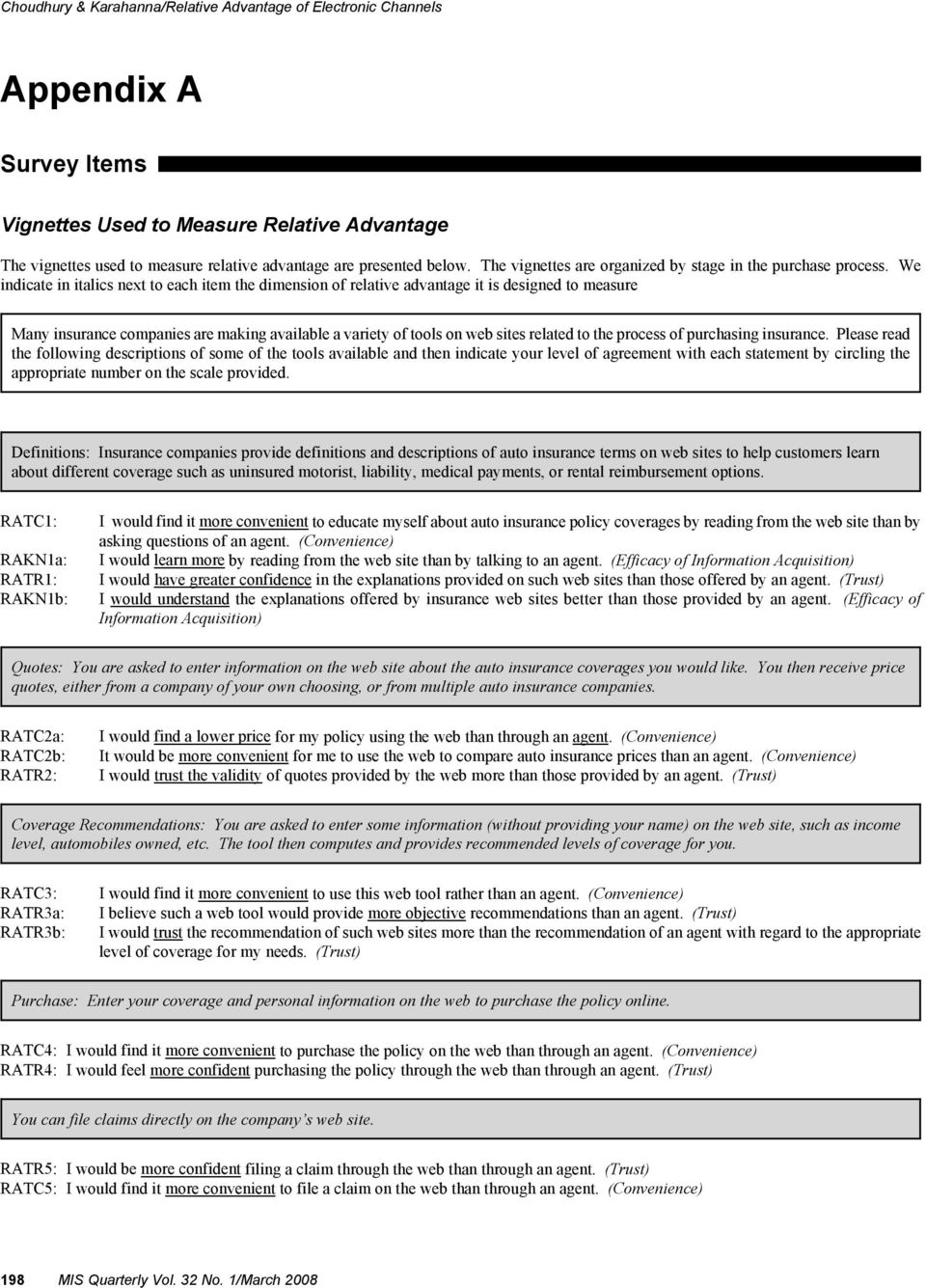
21 Services Provided (Source: new): Indicate the extent to which your agent provides each of the following services, and how important each service is to you Servimp1: Servimp2: Servimp3: Servimp4: Servimp5: Educating you about auto insurance policies Analyzing your needs to recommend the right coverage Finding the best price for your auto insurance policy Finding the right auto insurance company Helping you with the auto insurance claims process Trust in the Agent (Source: McKnight et al. 1998; Mayer et al. 1995): Trusta1: My current auto insurance agent acts in my best interests Trusta2: My current auto insurance agent is honest in his/her dealings with me. Trusta3: My current auto insurance agent is very knowledgeable about auto insurance policies Value of the Web (Source: D Ambra and Rice 2001; Devaraj et al. 2002; Strader and Hendrikson 1999): Vaweb1: One of the advantages of shopping on the web is the absence of sales pressure Vaweb2: Shopping on the web saves time. Vaweb3: Shopping on the web saves money. Vaweb5: Shopping on the web is very convenient. Vaweb6: Shopping on the web allows me to compare prices easily. Web Obstacles (Source: new): Webobst1: Shopping on the web is generally safe and secure. Webobst2: I would not enter personal information on the web site because I would be concerned about the security of my personal and financial information. (Reverse coded) Webobst3: I am concerned about the privacy of personal information entered on the web (dropped). Web Use (Source: Davis 1989; Karahanna et al. 1999; Venkatesh et al. 2003): Webusehr: How many hours per week do you use the web? Yrweb: How long have you been using the web? Web Experience (Source: new): Have you ever used the web to: Webpur: Purchase a product other than insurance Webquote: Request quotes from one or more insurance companies Webauto: Purchase an auto insurance policy Webinfo: Gather information about insurance companies and/or products Behavioral Intent Web: Information: (Source: New [based on Fishbein and Ajzen 1975]): BIwebi1: To gather information about auto insurance policy coverage options (Stage: Requirements Determination) BIwebi2: To gather information about auto insurance companies (Stage: Vendor Selection) BIwebi3: To obtain auto insurance price quotes (Stage: Vendor Selection) BIwebi4: To get a recommendation on the right coverage for me (Stage: Requirements Determination) Behavioral Intent Web: Transaction (Source: New [based on Fishbein and Ajzen 1975]): BIwebt1: To purchase auto insurance (Stage: Purchase) BIwebt2: To file an auto insurance claim (Stage: After-Sales Service) MIS Quarterly Vol. 32 No. 1/March
22 Appendix B Relative Advantage Emergent Structure Relative Advantage Learning: RATC1: RAKN1a: RATR1: RAKN1b: I would find it more convenient to educate myself about auto insurance policy coverages by reading from the web site than by asking questions of an agent. I would learn more by reading from the web site than by talking to an agent. I would have greater confidence in the explanations provided on such web sites than those offered by an agent. I would understand the explanations offered by insurance web sites better than those provided by an agent. Relative Advantage Informational Convenience: RATC3: RATC2b: I would find it more convenient to use this web tool rather than an agent. It would be more convenient for me to use the web to compare auto insurance prices than an agent. Relative Advantage Informational Trust: RATR3a: RATR3b: RATC2a: RATR2: I believe such a web tool would provide more objective recommendations than an agent. I would trust the recommendation of such web sites more than the recommendation of an agent with regard to the appropriate level of coverage for my needs. I would find a lower price for my policy using the web than through an agent. I would trust the validity of quotes provided by the web more than those provided by an agent. Relative Advantage Transaction: RATC4: RATR4: RATR5: RATC5: I would find it more convenient to purchase the policy on the web than through an agent. I would feel more confident purchasing the policy through the web than through an agent. I would be more confident filing a claim through the web than through an agent. I would find it more convenient to file a claim on the web than through an agent. 200 MIS Quarterly Vol. 32 No. 1/March 2008
Does Trust Matter to Develop Customer Loyalty in Online Business?
 Does Trust Matter to Develop Customer Loyalty in Online Business? Pattarawan Prasarnphanich, Ph.D. Department of Information Systems, City University of Hong Kong Email: [email protected] Abstract
An Empirical Study on the Effects of Software Characteristics on Corporate Performance
 , pp.61-66 http://dx.doi.org/10.14257/astl.2014.48.12 An Empirical Study on the Effects of Software Characteristics on Corporate Moon-Jong Choi 1, Won-Seok Kang 1 and Geun-A Kim 2 1 DGIST, 333 Techno Jungang
Exploring the Antecedents of Electronic Service Acceptance: Evidence from Internet Securities Trading
 Exploring the Antecedents of Electronic Service Acceptance: Evidence from Internet Securities Trading Siriluck Rotchanakitumnuai Department of Management Information Systems Faculty of Commerce and Accountancy
Exploring the Drivers of E-Commerce through the Application of Structural Equation Modeling
 Exploring the Drivers of E-Commerce through the Application of Structural Equation Modeling Andre F.G. Castro, Raquel F.Ch. Meneses and Maria R.A. Moreira Faculty of Economics, Universidade do Porto R.Dr.
E-learning: Students perceptions of online learning in hospitality programs. Robert Bosselman Hospitality Management Iowa State University ABSTRACT
 1 E-learning: Students perceptions of online learning in hospitality programs Sungmi Song Hospitality Management Iowa State University Robert Bosselman Hospitality Management Iowa State University ABSTRACT
CHAPTER 5: CONSUMERS ATTITUDE TOWARDS ONLINE MARKETING OF INDIAN RAILWAYS
 CHAPTER 5: CONSUMERS ATTITUDE TOWARDS ONLINE MARKETING OF INDIAN RAILWAYS 5.1 Introduction This chapter presents the findings of research objectives dealing, with consumers attitude towards online marketing
A COMPARISON ANALYSIS ON THE INTENTION TO CONTINUED USE OF A LIFELONG LEARNING WEBSITE
 International Journal of Electronic Business Management, Vol. 10, No. 3, pp. 213-223 (2012) 213 A COMPARISON ANALYSIS ON THE INTENTION TO CONTINUED USE OF A LIFELONG LEARNING WEBSITE Hsiu-Li Liao * and
Inexperience and Experience With Online Stores: The Importance of TAM and Trust
 IEEE TRANSACTIONS ON ENGINEERING MANAGEMENT, VOL. 50, NO. 3, AUGUST 2003 307 Inexperience and Experience With Online Stores: The Importance of TAM and Trust David Gefen, Elena Karahanna, and Detmar W.
Issues in Information Systems Volume 16, Issue I, pp. 163-169, 2015
 A Task Technology Fit Model on e-learning Linwu Gu, Indiana University of Pennsylvania, [email protected] Jianfeng Wang, Indiana University of Pennsylvania, [email protected] ABSTRACT In this research, we propose
E-Commerce Web Sites Trust Factors: An Empirical Approach
 Contemporary Engineering Sciences, Vol. 6, 2013, no. 1, 1 7 HIKARI Ltd, www.m-hikari.com E-Commerce Web Sites Trust Factors: An Empirical Approach Radwan M. Al-Dwairi Department of Computer Information
EXAMINING HEALTHCARE PROFESSIONALS ACCEPTANCE OF ELECTRONIC MEDICAL RECORDS USING UTAUT
 EXAMINING HEALTHCARE PROFESSIONALS ACCEPTANCE OF ELECTRONIC MEDICAL RECORDS USING UTAUT Matthew J. Wills, Dakota State University Omar F. El-Gayar, Dakota State University Dorine Bennett, Dakota State
An Examination of the Determinants of Customer Loyalty in Online Group-buying Context in China
 Association for Information Systems AIS Electronic Library (AISeL) WHICEB 2014 Proceedings Wuhan International Conference on e-business Summer 6-1-2014 An Examination of the Determinants of Customer Loyalty
Evaluating User Acceptance of Online Banking Information Systems: An Empirical Case of Pakistan Paper 18
 Evaluating User Acceptance of Online Banking Information Systems: An Empirical Case of Pakistan Paper 18 Fida Hussain Chandio [email protected] ABSTRACT Pakistan banking sector has gone through
EXAMINING STUDENTS ACCEPTANCE OF TABLET PC USING TAM
 EXAMINING STUDENTS ACCEPTANCE OF TABLET PC USING TAM Omar El-Gayar, Dakota State University, [email protected] Mark Moran, Dakota State University, [email protected] ABSTRACT With the proliferation
Mobile Stock Trading (MST) and its Social Impact: A Case Study in Hong Kong
 Mobile Stock Trading (MST) and its Social Impact: A Case Study in Hong Kong K. M. Sam 1, C. R. Chatwin 2, I. C. Ma 3 1 Department of Accounting and Information Management, University of Macau, Macau, China
The Technology Acceptance Model with Online Learning for the Principals in Elementary Schools and Junior High Schools
 The Technology Acceptance Model with Online Learning for the Principals in Elementary Schools and Junior High Schools RONG-JYUE FANG 1, HUA- LIN TSAI 2, CHI -JEN LEE 3, CHUN-WEI LU 4 1,2 Department of
Conceptualising and Modelling Virtual Experience for the Online Retailer: The 3D Technology
 Conceptualising and Modelling Virtual Experience for the Online Retailer: The 3D Technology INTRODUCTION Previous studies (e.g., Jiang & Benbasat, 2005; Algharabat & Dennis, 2010 a, b, c) regarding online
A Study on consumers continuing to use online group-buying platforms: The impact of price performance expectations
 December 2010, Volume 9, No.12 (Serial No.90) Chinese Business Review, ISSN 1537-1506, USA A Study on consumers continuing to use online group-buying platforms: The impact of price performance expectations
MAGNT Research Report (ISSN. 1444-8939) Vol.2 (Special Issue) PP: 213-220
 Studying the Factors Influencing the Relational Behaviors of Sales Department Staff (Case Study: The Companies Distributing Medicine, Food and Hygienic and Cosmetic Products in Arak City) Aram Haghdin
Asian Research Journal of Business Management
 Asian Research Journal of Business Management FACTORS INFLUENCING ONLINE TRADING ADOPTION: A STUDY ON INVESTORS ATTITUDE IN GREATER VISAKHAPATNAM CITY Dr. Krishna Mohan Vaddadi 1 & Merugu Pratima 2 * 1
INITIAL PERCEPTIONS OF COMPANY TRUSTWORTHINESS ONLINE: A COMPREHENSIVE MODEL AND EMPIRICAL TEST. Marios Koufaris William Hampton-Sosa #CIS-2002-11
 INITIAL PERCEPTIONS OF COMPANY TRUSTWORTHINESS ONLINE: A COMPREHENSIVE MODEL AND EMPIRICAL TEST Marios Koufaris William Hampton-Sosa # October 2002 Marios Koufaris Assistant Professor Computer Information
Attitude, Behavioral Intention and Usage: An Empirical Study of Taiwan Railway s Internet Ticketing System
 Attitude, Behavioral Intention and Usage: An Empirical Study of Taiwan Railway s Internet Ticketing System Wen-Hung Wang Department of Shipping and Transportation Management National Taiwan Ocean University,
The Online Banking Usage in Indonesia: An Empirical Study
 DOI: 10.7763/IPEDR. 2012. V54. 19 The Online Banking Usage in Indonesia: An Empirical Study Sulistyo Budi Utomo 1 + 1 Indonesia School of Economics (STIESIA) Surabaya Abstract. Many Indonesian banks have
CUSTOMER TRUST ONLINE: EXAMINING THE ROLE OF THE EXPERIENCE WITH THE WEB SITE. Marios Koufaris William Hampton-Sosa #CIS-2002-05.
 CUSTOMER TRUST ONLINE: EXAMINING THE ROLE OF THE EXPERIENCE WITH THE WEB SITE Marios Koufaris William Hampton-Sosa #CIS-2002-05 May 2002 Marios Koufaris Assistant Professor [email protected]
THE ONLINE CONSUMER TRUST CONSTRUCT: A WEB MERCHANT PRACTITIONER PERSPECTIVE
 THE ONLINE CONSUMER TRUST CONSTRUCT: A WEB MERCHANT PRACTITIONER PERSPECTIVE Allen C. Johnston Mississippi State University [email protected] Merrill Warkentin Mississippi State University [email protected]
Understanding the Continued Usage of Business e-learning Courses in HK Corporations
 Understanding the Continued Usage of Business e-learning Courses in HK Corporations Paul Yeung Ernest Jordan Macquarie Graduate School of Management, Macquarie University, Australia e-mail : [email protected]
B2C e-commerce Success: a Test and Validation of a Revised Conceptual Model
 B2C e-commerce Success: a Test and Validation of a Revised Conceptual Model Irwin Brown and Ruwanga Jayakody University of Cape Town, South Africa [email protected] Abstract: Since the advent of the
Technology Complexity, Personal Innovativeness And Intention To Use Wireless Internet Using Mobile Devices In Malaysia
 International Review of Business Research Papers Vol.4 No.5. October-November 2008. PP.1-10 Technology Complexity, Personal Innovativeness And Intention To Use Wireless Internet Using Mobile Devices In
TRUST AND USER ACCEPTANCE OF MOBILE ADVERTISING
 TRUST AND USER ACCEPTANCE OF MOBILE ADVERTISING Samer Barakat, Management Information Systems Department, Faculty of Economics & Administrative Science, Applied Science Private University, Jordan [email protected]
Determinants of Internet Entrepreneurship Intentions among Business School Students
 Determinants of Internet Entrepreneurship Intentions among Business School Students Yu-Min Wang and Yi-Shuan Lin Abstract This study presents the findings of an empirical study to analyze factors affecting
Examining acceptance of information technology: A longitudinal. Study of Iranian high school teachers
 2011 3rd International Conference on Information and Financial Engineering IPEDR vol.12 (2011) (2011) IACSIT Press, Singapore Examining acceptance of information technology: A longitudinal Study of Iranian
Understanding Retailers Acceptance of Virtual Stores
 Knowledge Management & E-Learning: An International Journal, Vol.2, No.3. 328 Understanding Retailers Acceptance of Virtual Stores Irene Y.L. Chen* Department of Accounting, National Changhua University
Customers Acceptance of Online Shopping In Saudi Arabia
 Customers Acceptance of Online Shopping In Saudi Arabia Sulaiman A. Al-Hudhaif, Ph.D. Saleh Saad Alqahtani, Ph.D. College of Business Administration King Saud University Introduction: Good news for e-
Investigating the Effect of Consumer Traits on the Relative Importance of TAM Constructs in an E-Commerce Context
 Investigating the Effect of Consumer Traits on the Relative Importance of TAM Constructs in an E-Commerce Context Thijs L.J. Broekhuizen 1 ; Eelko K.R.E. Huizingh 2 1 Assistant Professor, University of
Chapter VIII Customers Perception Regarding Health Insurance
 Chapter VIII Customers Perception Regarding Health Insurance This chapter deals with the analysis of customers perception regarding health insurance and involves its examination at series of stages i.e.
TRUST IN E-COMMERCE VENDORS: A TWO-STAGE MODEL
 TRUST IN E-COMMERCE VENDORS: A TWO-STAGE MODEL D. Harrison McKnight College of Business Florida State University Vivek Choudhury College of Business Administration University of Cincinnati Charles Kacmar
Importance of Online Product Reviews from a Consumer s Perspective
 Advances in Economics and Business 1(1): 1-5, 2013 DOI: 10.13189/aeb.2013.010101 http://www.hrpub.org Importance of Online Product Reviews from a Consumer s Perspective Georg Lackermair 1,2, Daniel Kailer
A Comparison of Online Trust Building Factors between Potential Customers and Repeat Customers
 RESEARCH ARTICLE A Comparison of Online Trust Building Factors between Potential Customers and Repeat Customers Hee-Woong Kim Department of Information Systems National University of Singapore [email protected]
A trust-based consumer decision-making model in electronic commerce: The role of trust, perceived risk, and their antecedents
 Available online at www.sciencedirect.com Decision Support Systems 44 (2008) 544 564 www.elsevier.com/locate/dss A trust-based consumer decision-making model in electronic commerce: The role of trust,
SEYED MEHDI MOUSAVI DAVOUDI*; HAMED CHERATI**
 THE LINK BETWEEN INFORMATION TECHNOLOGY ALIGNMENT AND FIRMS FINANCIAL AND MARKETING PERFORMANCE: A QUESTIONNAIRE SURVEY IN IRAN S MANUFACTURING COMPANIES ABSTRACT SEYED MEHDI MOUSAVI DAVOUDI*; HAMED CHERATI**
Technological Acceptance and Consumer's Behavior on Buying Online Insurance
 International Conference on ebusiness, ecommerce, emanagement, elearning and egovernance [IC5E] 112 International Conference on ebusiness, ecommerce, emanagement, elearning and egovernance 2015 [IC5E 2015]
THE RELATIONSHIPS BETWEEN CLIENT AND CONSULTANT OBJECTIVES IN IT PROJECTS
 THE RELATIONSHIPS BETWEEN CLIENT AND CONSULTANT OBJECTIVES IN IT PROJECTS Matthew J. Liberatore, Villanova University, 610-519-4390, [email protected] Wenhong Luo, Villanova University,
Determinants of online purchasing behavior: An empirical investigation using an extension of the Theory of Planned Behavior
 BUSINESS AND SOCIAL SCIENCES Department of Business Administration Master Thesis Master of Science in Marketing Determinants of online purchasing behavior: An empirical investigation using an extension
Information Technology Adoption Behavior Life Cycle: Toward a Technology Continuance Theory (TCT).
 Information Technology Adoption Behavior Life Cycle: Toward a Technology Continuance Theory (TCT). By: Chechen Liao, Prashant Palvia and Jain-Liang Chen Liao, C, Palvia, P., and Chen, J-L. Information
Senior Citizens and E-commerce Websites: The Role of Perceived Usefulness, Perceived Ease of Use, and Web Site Usability
 Informing Science: the International Journal of an Emerging Transdiscipline Volume 11, 2008 Senior Citizens and E-commerce Websites: The Role of Perceived Usefulness, Perceived Ease of Use, and Web Site
INTERACTIVE SHOPPING AIDS USAGE BY CONSUMERS AS A WAY TO REDUCE SHOPPING RISK
 Radosław Mącik Monika Nalewajek Maria Curie-Skłodowska University, Lublin, Poland INTERACTIVE SHOPPING AIDS USAGE BY CONSUMERS AS A WAY TO REDUCE SHOPPING RISK Introduction In the consumer behavior literature
Modeling Customer Behavior in Multichannel Service Distribution: A Rational Approach D. Heinhuis
 Modeling Customer Behavior in Multichannel Service Distribution: A Rational Approach D. Heinhuis Appendix 4 Summary Research question Most organizations have innovated their distribution strategy and adopted
CHARACTERISTICS AFFECTING THE ABANDONMENT OF E-COMMERCE SHOPPING CARTS A PILOT STUDY
 CHARACTERISTICS AFFECTING THE ABANDONMENT OF E-COMMERCE SHOPPING CARTS A PILOT STUDY Jason Coppola, Bryant University, (203) 496-3234, [email protected] Kenneth J. Sousa, Bryant University,
What Keeps Online Customers Repurchasing through the Internet?
 What Keeps Online Customers Repurchasing through the Internet? KANOKWAN ATCHARIYACHANVANICH, HITOSHI OKADA and NOBORU SONEHARA Factors affecting the intention of purchasing online have been investigated
Examining Consumers Willingness to Buy in Chinese Online Market
 JOURNAL OF COMPUTERS, VOL. 5, NO. 5, MAY 2010 815 Examining Consumers Willingness to Buy in Chinese Online Market Shouming Chen School of Economics and Management, Tongji University, Shanghai, China Email:
A Casual Structure Analysis of Smart phone Addiction: Use Motives of Smart phone Users and Psychological Characteristics
 A Casual Structure Analysis of Smart phone Addiction: Use Motives of Smart phone Users and Psychological Characteristics Dept. of Social Welfare, BaekSeok Culture University, [email protected] Abstract
DETERMINANTS OF INSTRUCTORS TO APPLY IT IN TEACHING
 Proceedings of the International Conference for Education, 2005 World Scientific Publishing Company DETERMINANTS OF INSTRUCTORS TO APPLY IT IN TEACHING SHOW-HUI HUANG International Business & Trade, Shu-Te
Adding Innovation Diffusion Theory to the Technology Acceptance Model: Supporting Employees Intentions to use E-Learning Systems
 Lee, Y.-H., Hsieh, Y.-C., & Hsu, C.-N. (2011). Adding Innovation Diffusion Theory to the Technology Acceptance Model: Supporting Employees' Intentions to use E-Learning Systems. Educational Technology
UNDERSTANDING EXPLORATORY USE
 UNDERSTANDING EXPLORATORY USE OF ERP SYSTEMS 1 Rui D. Sousa Terry College of Business University of Georgia [email protected] Dale L. Goodhue Terry College of Business University of Georgia [email protected]
Copyright subsists in all papers and content posted on this site.
 Student First Name: Talhat Student Second Name: Alhaiou Copyright subsists in all papers and content posted on this site. Further copying or distribution by any means without prior permission is prohibited,
The influence of system characteristics on e-learning use q
 Computers & Education 47 (2006) 222 244 www.elsevier.com/locate/compedu The influence of system characteristics on e-learning use q Keenan A. Pituch a, *, Yao-kuei Lee b a Department of Educational Psychology,
Evaluating the Factors Affecting on Intension to Use of E-Recruitment
 American Journal of Information Science and Computer Engineering Vol., No. 5, 205, pp. 324-33 http://www.aiscience.org/journal/ajisce Evaluating the Factors Affecting on Intension to Use of E-Recruitment
Predicting consumer intentions to shop online: An empirical test of competing theories
 Available online at www.sciencedirect.com Electronic Commerce Research and Applications 6 (007) 433 44 www.elsevier.com/locate/ecra Predicting consumer intentions to shop online: An empirical test of competing
The Performance of Customer Relationship Management System:
 The Performance of Customer Relationship Management System: antecedents and consequences 1 Hyun Gi Hong, 2 Je Ran Chun 1, First Author Dept. Of Business Administration, Cheongju University, [email protected]
ANALYSIS OF USER ACCEPTANCE OF A NETWORK MONITORING SYSTEM WITH A FOCUS ON ICT TEACHERS
 ANALYSIS OF USER ACCEPTANCE OF A NETWORK MONITORING SYSTEM WITH A FOCUS ON ICT TEACHERS Siti Rahayu Abdul Aziz 1, Mohamad Ibrahim 2, and Suhaimi Sauti 3 1 Universiti Teknologi MARA, Malaysia, [email protected]
An Empirical Analysis on the Performance Factors of Software Firm
 , pp.121-132 http://dx.doi.org/10.14257/ijseia.2014.8.7,10 An Empirical Analysis on the Performance Factors of Software Firm Moon-Jong Choi, Jae-Won Song, Rock-Hyun Choi and Jae-Sung Choi #3-707, DGIST,
Department of Business Management, Islamic Azad University, Iran
 Factors Influencing Online Purchase Books By Students and Lecturer of Qazvin University of Medical Sciences Maryam Jabbari Department of Business Management, Islamic Azad University, Iran Abstract The
Abstract. Keywords: Mobile commerce, short messaging services, mobile marketing. Mobile Marketing
 Consumer Perspectives On Mobile Advertising And Marketing Craig Standing, Steve Benson, Edith Cowan University Heikki Karjaluoto, University of Oulu, Finland Abstract Mobile marketing is set to make a
Nursing students behavioral intention to use online courses: A questionnaire survey
 International Journal of Nursing Studies 45 (2008) 1299 1309 www.elsevier.com/ijns Nursing students behavioral intention to use online courses: A questionnaire survey Feng-Cheng Tung a,b,, Su-Chao Chang
Complementing Classroom Teaching with an Internet Course Website: Does Gender and Race Matter
 Complementing Classroom Teaching with an Internet Course Website: Does Gender and Race Matter T. Ramayah School of Management, Universiti Sains Malaysia, 11800 Penang, MALAYSIA Abstract This research looks
Brand Loyalty in Insurance Companies
 Journal of Economic Development, Management, IT, Finance and Marketing, 4(1), 12-26, March 2012 12 Brand Loyalty in Insurance Companies Sancharan Roy, (B.E., MBA) Assistant Professor, St. Joseph's College
A revalidation of the SET37 questionnaire for student evaluations of teaching
 Educational Studies Vol. 35, No. 5, December 2009, 547 552 A revalidation of the SET37 questionnaire for student evaluations of teaching Dimitri Mortelmans and Pieter Spooren* Faculty of Political and
Columbia, MO 65211 Columbia, MO 65211
 Impacts of customers' perceptions on internet banking use with a smart phone Hyun Shik Yoon Luis Occeña University of Missouri University of Missouri Columbia, MO 65211 Columbia, MO 65211 ABSTRACT In recent
WHAT DRIVES ELECTRONIC COMMERCE ACROSS CULTURES? A CROSS-CULTURAL EMPIRICAL INVESTIGATION OF THE THEORY OF PLANNED BEHAVIOR
 Journal of Electronic Commerce Research, VOL. 3, NO. 4, 2002 WHAT DRIVES ELECTRONIC COMMERCE ACROSS CULTURES? A CROSS-CULTURAL EMPIRICAL INVESTIGATION OF THE THEORY OF PLANNED BEHAVIOR Paul A. Pavlou Marshall
Service Quality Value Alignment through Internal Customer Orientation in Financial Services An Exploratory Study in Indian Banks
 Service Quality Value Alignment through Internal Customer Orientation in Financial Services An Exploratory Study in Indian Banks Prof. Tapan K.Panda* Introduction A high level of external customer satisfaction
Influencing Factors on Price Tolerance of Internet Customers
 Influencing Factors on Price Tolerance of Internet Customers Shu Fen Chen, Ph.D. candidate of Graduate Institute of Resource Engineering, National Cheng-Kung University, Taiwan, R.O.C. Chia-Yon Chen, Professor
PHYSICIANS ACCEPTANCE OF WEB-BASED MEDICAL ASSESSMENT SYSTEMS: FINDINGS FROM A NATIONAL SURVEY
 PHYSICIANS ACCEPTANCE OF WEB-BASED MEDICAL ASSESSMENT SYSTEMS: FINDINGS FROM A NATIONAL SURVEY Bengisu Tulu School of Information Science Claremont Graduate University [email protected] Brian Hilton
Understanding Online Consumer Stickiness in E-commerce Environment: A Relationship Formation Model
 , pp.151-162 http://dx.doi.org/10.14257/ijunesst.2014.7.3.13 Understanding Online Consumer Stickiness in E-commerce Environment: A Relationship Formation Model Haiping Wang 1, Guona Gu 2, Shihu An 3 and
Understanding online shopping behaviour using a transaction cost economics approach. Pien Wang and Chang Hong Leong
 62 Int. J. Internet Marketing and Advertising, Vol. 1, No. 1, 2004 Understanding online shopping behaviour using a transaction cost economics approach Thompson S.H. Teo* Department of Decision Sciences,
UTILIZING THE TECHNOLOGY ACCEPTANCE MODEL TO ASSESS THE EMPLOYEE ADOPTION OF INFORMATION SYSTEMS SECURITY MEASURES
 UTILIZING THE TECHNOLOGY ACCEPTANCE MODEL TO ASSESS THE EMPLOYEE ADOPTION OF INFORMATION SYSTEMS SECURITY MEASURES Cynthia M. Jones, Nova Southeastern University, [email protected] Richard V. McCarthy,
MASTER'S THESIS. Factors Influencing Adoption of Online Ticketing
 MASTER'S THESIS 2006:45 Factors Influencing Adoption of Online Ticketing Mitra Karami Luleå University of Technology Master Thesis, Continuation Courses Marketing and e-commerce Department of Business
INITIAL TRUST, PERCEIVED RISK, AND THE ADOPTION OF INTERNET BANKING
 INITIAL TRUST, PERCEIVED RISK, AND THE ADOPTION OF INTERNET BANKING Kyu Kim University of Cincinnati U.S.A. Inha University Korea Bipin Prabhakar University of Cincinnati U.S.A. Abstract Studies on the
Relationship Quality as Predictor of B2B Customer Loyalty. Shaimaa S. B. Ahmed Doma
 Relationship Quality as Predictor of B2B Customer Loyalty Shaimaa S. B. Ahmed Doma Faculty of Commerce, Business Administration Department, Alexandria University Email: [email protected] Abstract
INVESTIGATING BUSINESS SCHOOLS INTENTIONS TO OFFER E-COMMERCE DEGREE-PROGRAMS
 INVESTIGATING BUSINESS SCHOOLS INTENTIONS TO OFFER E-COMMERCE DEGREE-PROGRAMS Jean Baptiste K. Dodor College of Business Jackson State University [email protected] 601-354-1964 Darham S. Rana College
Issues in Information Systems Volume 13, Issue 1, pp. 258-263, 2012
 FACULTY PERCEPTIONS OF PEDAGOGICAL BENEFITS OF WEB 2.0 TECHNOLOGIES AND VARIABLES RELATED TO ADOPTION Pamela A. Dupin-Bryant, Utah State University, [email protected] 258 ABSTRACT In recent years,
User Resistance Factors in Post ERP Implementation
 User Resistance Factors in Post ERP Implementation Sayeed Haider Salih 1 e-mail: [email protected] Ab Razak Che Hussin 2 e-mail: [email protected] Halina Mohamed Dahlan 3 e-mail: [email protected] Author(s)
UNDERSTANDING THE ACCEPTANCE OF MOBILE HEALTH SERVICES: A COMPARISON AND INTEGRATION OF ALTERNATIVE MODELS
 Journal of Electronic Commerce Research, VOL 14, NO 2, 2013 UNDERSTANDING THE ACCEPTANCE OF MOBILE HEALTH SERVICES: A COMPARISON AND INTEGRATION OF ALTERNATIVE MODELS Yongqiang Sun School of Information
Viability of the Technology Acceptance Model in Multimedia Learning Environments: A Comparative Study
 Interdisciplinary Journal of Knowledge and Learning Objects Volume 3, 2007 Viability of the Technology Acceptance Model in Multimedia Learning Environments: A Comparative Study Raafat George Saadé, Fassil
Examining the Savings Habits of Individuals with Present-Fatalistic Time Perspectives using the Theory of Planned Behavior
 Examining the Savings Habits of Individuals with Present-Fatalistic Time Perspectives using the Theory of Planned Behavior Robert H. Rodermund April 3, 2012 Lindenwood University 209 S. Kingshighway, Harmon
WHAT CONSUMERS THINK, FEEL, AND DO TOWARD DIGITAL ADS: A MULTI-PHASE STUDY
 WHAT CONSUMERS THINK, FEEL, AND DO TOWARD DIGITAL ADS: A MULTI-PHASE STUDY Abstract Ping Zhang, Syracuse University, Syracuse, NY 13244, USA, [email protected] With the wide deployment of digital technologies,