
TRUST AND USER ACCEPTANCE OF MOBILE ADVERTISING
|
|
|
- Elizabeth Pearson
- 10 years ago
- Views:
Transcription
1 TRUST AND USER ACCEPTANCE OF MOBILE ADVERTISING Samer Barakat, Management Information Systems Department, Faculty of Economics & Administrative Science, Applied Science Private University, Jordan Asim El Sheikh, Computer Information Systems Department, Faculty of Information Systems & Technology, Arab Academy for Banking & Financial Sciences, Jordan Abstract The technology acceptance model (TAM) has been widely used to examine the factors that influence a person s acceptance of new technology. In mobile advertising, trust has been proposed as an important factor affecting the adoption of this new advertising channel. The objective of this study is to test the impact of trust on mobile advertising adoption based on the technology acceptance model. A cross-sectional survey is conducted among 174 respondents from two shopping centres samples. Bivariate correlations and multiple regressions were used to test the hypotheses. The results shows that trust significantly influence the attitude towards accepting mobile advertising. Keywords: Technology Acceptance Model, Trust, Mobile Advertising 1 INTRODUCTION Davis presented in 1989 the Technology Acceptance Model (TAM) to explain the determinants of user acceptance of a wide range of end-user computing technologies [1]. The model is based on the Theory of Reasoned Action by Ajzen and Fishbein [2]. TAM points out that perceived ease of use and perceived usefulness affect the intention to use. Davis [1] defines perceived ease of use as "the degree to which a person believes that using a particular system would be free from effort" and perceived usefulness as "the degree to which a person believes that using a particular system would enhance his or her job performance". Perceived ease of use also affects the perceived usefulness (Figure 1). The intention to use affects the real usage behavior. TAM has been tested and extended by many researchers, including Davis himself. TAM has been designed to study information systems at work to predict if the users will actually take a certain system into use in their jobs. The model provides a tool to study the impact of external variables on internal beliefs, attitudes and intentions. TAM has been applied mostly in studying office software usage and in that application area the model can explain about 40% of system use [3]. Figure 1. Technology Acceptance Model [1]. 1

2 Trust is the people s acceptance is vulnerable to the actions of other people [4]. This is based on the notion that the other people are acting in a responsible manner [5], and they do not benefit from other people s dependence on them [6]. Trust also has a direct influence on a consumer's behavioral intention to use the service [7]. Trust is one of the determinants of perceived usefulness especially in a mobile environment. Mayer [8] also found that trust has a positive effect on perceived usefulness in an m-commerce setting. The study we report here, therefore, begins to explore this new territory both from a user s perspective, and with an eye to what this means for the design of new ubiquitous computing technologies. 2 PREVIOUS STUDIES Table 1 briefly explains some of the related studies made by various researchers. Davis [1] Technology Acceptance Model (TAM) measure perceived usefulness, perceived ease of use and user acceptance of information technology. Davis et al [9] compared Theory of Reasoned (TRA) and TAM in terms of user acceptance of computer technology. Both of the studies were conducted in an organizational context. Nevertheless, Yan et al. [10] used TAM to measure user acceptance of short message service (SMS) in Hong Kong and China and recommended that in order to formulate a successful business strategy for a specific service in a specific market, a mobile operator has to conduct a comprehensive study and identify the key external factors that will affect the perceived usefulness, perceived ease of use, and subjective norms towards acceptance of that particular service in a specific market. Baron et al. [11] indicated the need of further research into the importance of text messaging as a social and cultural practice in everyday lives, with emphases on addictive behaviors, learning and the development of repertoires of communication skills by increasingly sophisticated consumers, and feelings of exclusion by non-participants through qualitative research approach that reflect upon consumer text message (short message service SMS) behavior. Authors Relevant Findings [1] Usefulness was significantly more stronger linked than was ease of use [12] Both TRA and TAM postulated that Behavioral Intention (BI) is the major determinants of usage behavior [13] LOOP, which is a marketing campaign approach marketers use to build an effective process of interactivity with consumers [14] Perceived expressiveness and perceived enjoyment emphasize the importance of taking into consideration relatively untraditional antecedent of technology usage. [10] Research delineating the various stimuli to consider for successful technology acceptance in a global setting, which can account for differential impacts across regions [11] The existence of counter-intuitive behaviors, technology paradoxes and intense social and emotional elements in actual text message usage all point to the need for a review of the definition of the key TAM constructs. Table 1: Theories and models that inform the primary research Recently, the topic of mobile e-commerce and users perceptions of trust in this context has begun to emerge in the literature. Unfortunately, such studies seek to carry over to the mobile context lessons about trust by appealing to research on the use of the internet e.g. [25, 26]. There is little or no investigation of how mobile ecommerce transactions may be different, including the physical configurations of mobile devices, the fact that wireless connections are made, or the fact that there may be no history or experience of use built up in such circumstances. 2
![Trust also has a direct influence on a consumer's behavioral intention to use the service [7]. Trust is one of the determinants of perceived usefulness especially in a mobile environment.](/docs-images/50/15560173/images/page_2.jpg "Mayer [8] also found that trust has a positive effect on perceived usefulness in an m-commerce setting.")
3 Researchers found that perceived risk is influenced by trust toward the transaction partner [27][4]. They [27] also showed that trust works as a mechanism for reducing consumer s perceived risk in Internet shopping. A recent study of Internet banking showed that trust reduces perceived risk and invigorates the usage of online banking service [28]. In contrast, [29] found that higher perceived risk decreases the level of trust toward the partner. In addition, Mayer [4] insisted that it was unclear whether trust comes before perceived risk or otherwise. Although previous studies showed that perceived risk is an important determinant of online behavior, there was mixed reviews about the relationship between perceived risk and trust in the research literature. While consumers initially trust their e-vendors and have an idea that adopting online service is beneficial to job performance or life style, they will eventually believe that on-line services are useful [30]. In particular, a model of trust [30] and TAM in an on-line shopping setting explicitly indicated that trust is an antecedent of perceived usefulness. Trust also has a direct influence on a consumer's behavioral intention to use the service [7]. Trust is one of the determinants of perceived usefulness especially in an on-line environment. Mayer [4] also found that trust has a positive effect on perceived usefulness in an m-commerce setting. The study we report here, therefore, begins to explore this new territory both from a user s perspective, and with an eye to what this means for the design of new ubiquitous computing technologies. Relevant studies on trust and their findings are shown in Table 2 below. These studies support the importance of trust as a direct or indirect influencing factor in an individual s intention to engage in electronic business activities. Authors Relevant Findings [6] Purchase intention was influenced by trust, which in turn, was affected by integrity and benevolence. [15] Consumers willingness to transact online was influenced by trust, which in turn was affected by familiarity. Familiarity was significant on consumers willingness to transact. [5] Trust was a significant predictor of purchase intention for both potential and repeat customers. Familiarity and disposition to trust were significant on trust for both customers. [16] Privacy and Internet trustworthiness were significant determinants of attitude toward Internet purchasing. In turn, attitude had a significant effect on intent to purchase. [17] Willingness to buy in an Internet store was affected by attitude and perception of risk. Attitude and perception of risk were affected by trust, which in turn was affected by consumer s perception of size and reputation of the store. [18] Trust in one s bank had a significant influence on him or her to use Internet banking. Other factors were Internet accessibility, attitude towards change, computer and Internet access costs, security concerns, ease of use, and convenience. [6] Trust was a significant predictor of intention to transact in both samples. Trust had a significant effect on perceived risk, perceived usefulness, and perceived ease of use. Table 2: Studies on Trust 3
![A recent study of Internet banking showed that trust reduces perceived risk and invigorates the usage of online banking service [28].](/docs-images/50/15560173/images/page_3.jpg "In contrast, [29] found that higher perceived risk decreases the level of trust toward the partner.")
4 3 RESEARCH MODEL In this section we develop our hypotheses and a conceptual model based on the previous discussion on consumer acceptance of mobile advertising and additional relevant issues related to the specific nature of the mobile phone as a medium. Based on the above discussion and the lack of research on Trust of Mobile Advertising channel, this research seeks to develop an extended TAM by including the Trust construct to the model. The study shall test empirically the influence of trust, together with the attributes of the technology acceptance model (TAM) on mobile advertising acceptance. We used mobile advertising as the targeted technology and hypothesized that trust, utility and ease of use positively affect an individual s acceptance of mobile advertising. In addition, the model focuses on current usage instead of intention to use. The research model for this study is shown in Figure 2. Utility EOU Trust H2 H3 H1 Acceptance Figure 2. Research model EOU = Ease of Use There are three hypotheses in this study. H1: Utility of mobile advertising is positively related to the acceptance of mobile advertising. H2: Ease of use of mobile advertising is positively related to the acceptance of mobile advertising. H3: Trust of mobile advertising is positively related to the acceptance of mobile advertising. 4 METHODOLOGY Subjects for this study were Jordanian consumers age 15 and above surveyed at shopping centres in Amman - Jordan. All items intended to measure the variables in this study were adopted from previously validated instruments. Regression analysis was used to analyze the data. A confirmatory factor analysis was performed to assess the reliability and validity of the measurement model before the regression analysis was performed. 4

5 5 ANALYSIS The selection of the shopping centre sample of this study followed the sampling procedures suggested by Sudman [19]. According to Sudman, sampling from only one entrance of a shopping centre can create a socioeconomic or geographical bias. Therefore, various locations such as door entrances and different stores were rotated to avoid potential biases [19]. Intercepted visitors were informed of the purpose of the study. They were then asked to spare about 10 minutes to answer the questionnaire. A total of 342 visitors were asked to take part, and 186 people agreed. The response rate was a little higher for the group under age 25 and lower for the group over age 45. Among the questionnaires answered, twelve responses were unusable, because more than 15% of the total items were missing [20]. The total number of usable questionnaires was 174. Table 3 provides the respondents demographic characteristics. The size of the 15 to 44 age group was 88% which is larger than the Jordanian population statistics of 82%. Similarly, a sample size of participants who are age 35 and older was 24% and that is smaller than that of the Jordanian population statistic of 31%. The result is reasonable, since younger groups constitute important market segments for mobile advertising. Female and male respondents accounted for 48.3% and 50.6%, respectively. Thus, the difference between female and male sample is not significant. Age Frequency Percent and older 6 3 Missing 2 1 Total Gender Female Male Missing Total Table 3: Demographic Characteristics (n = 174) 5
![Therefore, various locations such as door entrances and different stores were rotated to avoid potential biases [19]. Intercepted visitors were informed of the purpose of the study.](/docs-images/50/15560173/images/page_5.jpg "They were then asked to spare about 10 minutes to answer the questionnaire. A total of 342 visitors were asked to take part, and 186 people agreed.")
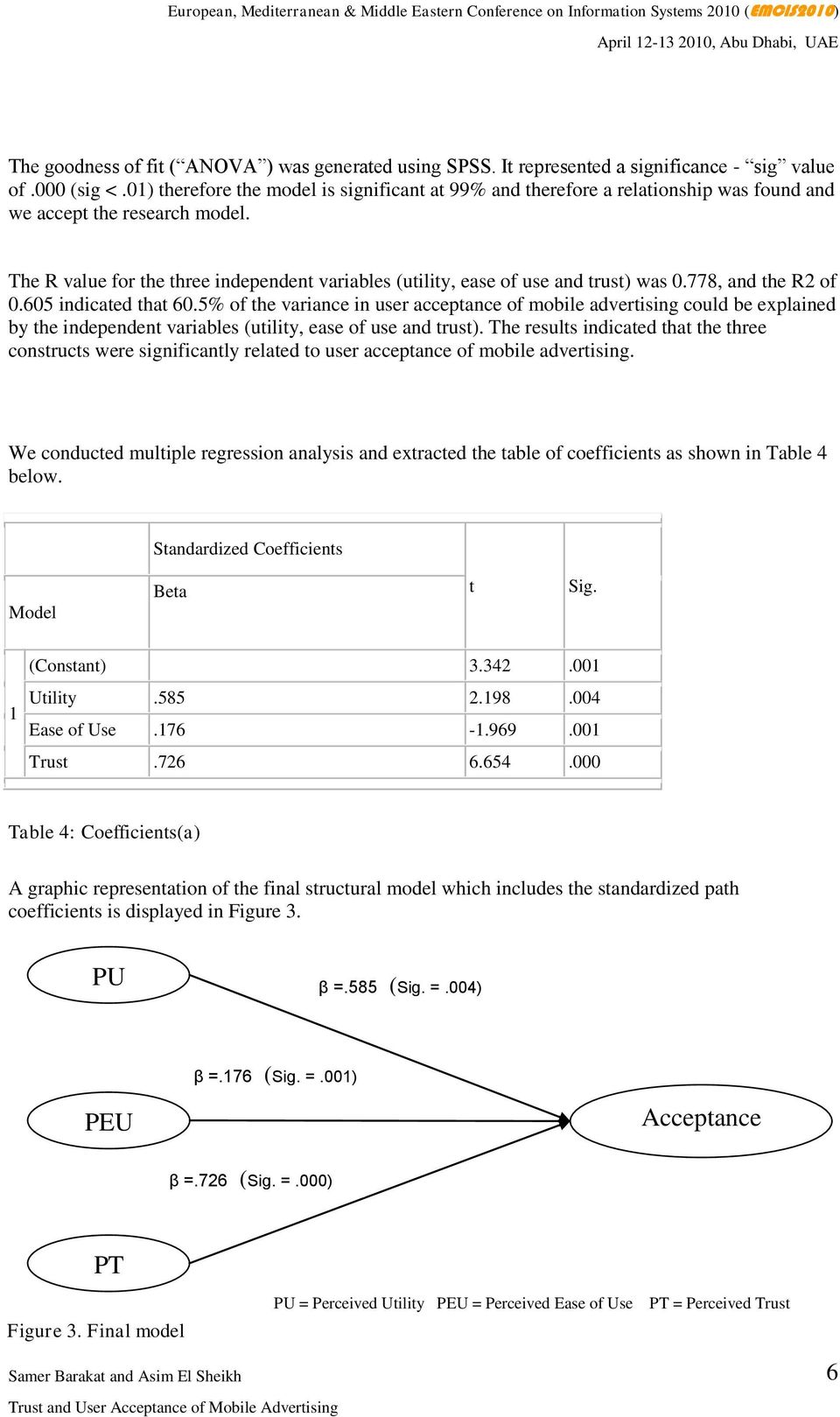
6 The goodness of fit ( ANOVA ) was generated using SPSS. It represented a significance - sig value of.000 (sig <.01) therefore the model is significant at 99% and therefore a relationship was found and we accept the research model. The R value for the three independent variables (utility, ease of use and trust) was 0.778, and the R2 of indicated that 60.5% of the variance in user acceptance of mobile advertising could be explained by the independent variables (utility, ease of use and trust). The results indicated that the three constructs were significantly related to user acceptance of mobile advertising. We conducted multiple regression analysis and extracted the table of coefficients as shown in Table 4 below. Standardized Coefficients Model Beta t Sig. 1 (Constant) Utility Ease of Use Trust Table 4: Coefficients(a) A graphic representation of the final structural model which includes the standardized path coefficients is displayed in Figure 3. PU β =.585 (Sig. =.004) β =.176 (Sig. =.001) PEU Acceptance β =.726 (Sig. =.000) PT Figure 3. Final model PU = Perceived Utility PEU = Perceived Ease of Use PT = Perceived Trust 6
7 6 FINDINGS AND PRACTICAL IMPLICATIONS The coefficients for the final model are reported above and the model is represented by: (H1): The regression coefficient for perceived utility is (p = 0.004, p < = 0.05). The regression results in Table 4 indicated that the H1 hypothesis stands. Perceived utility of mobile advertising is positively related to the user s acceptance of mobile advertising. This result is similar to that of Davis et al. [9], Straub et al. [21], Szajna [22], Igbaria (1997) [23], and Thompson et al [24] that perceived utility is positively related to acceptance. (H2): For the second hypothesis, the regression coefficient is 0.176, and the significance level is (p < 0.05). Therefore, Ease of Use is positively related to user acceptance of mobile advertising. (H3): The regression coefficient is.726, and the significance level is (p < 0.05). Therefore, Perceived Trust is positively related to user acceptance of mobile advertising. Trust and Utility have a much stronger positive influence on Acceptance than East of Use. In particular, based on the Beta value and the significance levels, one may suggest that Trust component, followed by Utility are the strongest predictors of Acceptance. Ease of Use play relatively a marginal role in the prediction and the explanation of Acceptance. 7 CONCLUSION The theoretical background for the study was adopted from technology acceptance model. In addition to the utility and ease of use constructs found in the technology acceptance model, trust was added as a third construct to the model. These constructs were found to be significant in determining user acceptance of mobile advertising. Acceptance is one of the crucial keys to successful applications choice and use. Clearly, many factors influence technology acceptance according to Davis and others. The regression results indicated that Trust and Utility has a strong positive influence on acceptance. Therefore, the findings of this study partially supported the hypothesis designed in the research model: utility, ease of use and trust are the key attributes that affect user acceptance of mobile adverting. References [1] Fred Davis (1989), Perceived usefulness, perceived ease of use, and user acceptance of information technology, MIS Quartely, 13/1989, pp [2] Icek Ajzen, Martin Fishbein (1980), Understanding attitudes and predicting social behavior, EngleCliffs-Wood: NJ: Prentice Hall. [3] Paul Legris, John Ingham, Pierre Collerette (2003), Why do people use information technology?, A critical review of the Technology Acceptance Model. Information & Management, 40, pp
![Perceived utility of mobile advertising is positively related to the user s acceptance of mobile advertising. This result is similar to that of Davis et al. [9], Straub et al.](/docs-images/50/15560173/images/page_7.jpg "[21], Szajna [22], Igbaria (1997) [23], and Thompson et al [24] that perceived utility is positively related to acceptance. (H2): For the second hypothesis, the regression coefficient is 0.")
8 [4] Mayer, R.C., Davis, J.H., & Schoorman, F.D. (1995). An integrative model of organizational trust. Academy of Management Review, 20(3), [5] Pavlou, P.A. (2003). Consumer acceptance of electronic commerce: Integrating trust and risk with the technology acceptance model. International Journal of Electronic Commerce, 7(3), [6] Gefen, D., Karahanna, E., & Straub, D.W. (2003). Inexperience and experience with online stores: The importance of TAM and trust. IEEE Transactions on Engineering Management, 50(3), [7] Cunningham, S.(1967). The major dimensions of perceived risk. IN:Cox, D(Ed.), Risk taking and information handling in consumer behavior. Harvard university press, Cambridge, MA. [8] Mayer, R. C., David, F. D. and Schoorman, F. D.(1995). An integrative model of organizational trust. Academy of Management Review, 20(3): [9] Fred Davis, Viswanath Venkatesh (2004), Toward preprototype user acceptance testing of new information systems: implications for software project management, IEEE Transactions on Engineering Management, Vol. 51, No 1. [10] Yan, X., Gong, M., & Thong, J.Y.L. (2006): Two tales of one service: user acceptance of short message service (SMS) in Hong Kong and China. Emerald Group Publishing Limited, Vol.8 NO , pp [11] Baron, S., Patterson, A., & Harris, K. (2006): Beyond technology acceptance: understanding consumer practice. International Journal of Service Industry Management. Emerald Group Publishing Limited, Vol. 17 No.2, pp [12] Davis, F.D., Bagozzi, R.P., and Warshaw, P.R. (1989): User Acceptance of Computer Technology: A Comparison of Two Theoretical Models. Management of Science; Aug 1989; 35, 8; ABI/INFORM Global pg.984 [13] Davis, R. & Yung, D. (2005): Understanding the Interactivity between Television and Mobile Commerce. Communications of ACM, July 2005/Vol.48, No. 7 [14] Nysveen, H., Pedersen, P.E., & Thorbjornsen, H. (2005): Intentions to Use Mobile Services: Antecendents and Cross-Service Comparisons. Academy of Marketing Science, Journal; Summer 2005; 33, 3;ABI/INFORM Global. [15] Bhattacherjee, A. (2002). Individual trust in online firms: Scale development and initial test. Journal of Management Information Systems, 19(1), [16] George, F.F. (2002). Influences on the intent to make Internet purchases. Internet Research: Electronic Networking Applications and Policy, 12(2), [17] Jarvenpaa, S.L., Tractinsky, N., & Vitale, M. (2000). Consumer trust in an Internet store. Information Technology and Management, 1, [18] Sohail, S., & Shanmugham, B. (2003). E-banking and customer preferences in Malaysia: An empirical investigation. Information Sciences, 150,
![, & Straub, D.W. (2003). Inexperience and experience with online stores: The importance of TAM and trust. IEEE Transactions on Engineering Management, 50(3), 307-321. [7] Cunningham, S.(1967).](/docs-images/50/15560173/images/page_8.jpg "The major dimensions of perceived risk. IN:Cox, D(Ed.), Risk taking and information handling in consumer behavior. Harvard university press, Cambridge, MA. [8] Mayer, R. C., David, F. D. and Schoorman, F.")
9 [19] Seymour Sudman, (1980), "Improving the quality of shopping center sampling," Journal of Marketing Research, 18 (November 1980), [20] George Darren, Paul Mallery (2005), SPSS for windows step by step: a simple guide and reference 12.0 update, Boston: Allyna and Bacon. [21] Detmar Straub, Mark Keil, Walter Brenner (1997). Testing the technology acceptance model across cultures: A three country study, Information & Management, 33, [22] Bernadette Szajna (1996), Empirical evaluation of the revised technology acceptance model, Management Science, 42, [23] Magid Igbaria, Nancy Zinatelli, Paul Cragg (1997), Personal computing acceptance factors in SMEs: A structural equation Model, MIS Quarterly, 21, [24] Ronald Thompson, Christopher Higgins, Jane Howell (1991), Personal computing: Toward a conceptual model of utilization, MIS Quarterly, 15, [25] Siau, K. and Shen, Z. Building customer trust in mobile commerce. Communications of the ACM, Vol. 46(4), 2003, pp [26] Ventakesh, V. Ramesh, V., and Massey, A. P. Understanding usability in mobile commerce. Communications of the ACM, Vol. 46(12), 2003, pp [27] Javenpaa S. L. and Todd, P. A.(1998). An empirical examination of the determinants of attitudes and intention toward shopping on the Internet. Working paper,university of Texas. [28] Gefen, D.(2000). E-commerce: the role of familiarity and trust. Omega, 28(6): [29] Lee, H. G.(1998). Do electronic marketplaces lower the price of goods?. Communications of the ACM, 41(1): [30] Gefen, D., Karahanna, E. and Straub, D.(2003), Trust and TAM in online shopping: an integrated model. MIS Quarterly, 27(1):

Short Messaging Services (SMS) and Banking
 Short Messaging Services (SMS) and Banking Submitted to: Otago Business PhD Colloquium, October 18 19, 2006 Geoffrey Harvey Tanakinjal (Early Stage) (Department of Marketing) Introduction As a direct marketing
Mobile Stock Trading (MST) and its Social Impact: A Case Study in Hong Kong
 Mobile Stock Trading (MST) and its Social Impact: A Case Study in Hong Kong K. M. Sam 1, C. R. Chatwin 2, I. C. Ma 3 1 Department of Accounting and Information Management, University of Macau, Macau, China
Evaluating User Acceptance of Online Banking Information Systems: An Empirical Case of Pakistan Paper 18
 Evaluating User Acceptance of Online Banking Information Systems: An Empirical Case of Pakistan Paper 18 Fida Hussain Chandio [email protected] ABSTRACT Pakistan banking sector has gone through
Technology Complexity, Personal Innovativeness And Intention To Use Wireless Internet Using Mobile Devices In Malaysia
 International Review of Business Research Papers Vol.4 No.5. October-November 2008. PP.1-10 Technology Complexity, Personal Innovativeness And Intention To Use Wireless Internet Using Mobile Devices In
Exploring the Antecedents of Electronic Service Acceptance: Evidence from Internet Securities Trading
 Exploring the Antecedents of Electronic Service Acceptance: Evidence from Internet Securities Trading Siriluck Rotchanakitumnuai Department of Management Information Systems Faculty of Commerce and Accountancy
Complementing Classroom Teaching with an Internet Course Website: Does Gender and Race Matter
 Complementing Classroom Teaching with an Internet Course Website: Does Gender and Race Matter T. Ramayah School of Management, Universiti Sains Malaysia, 11800 Penang, MALAYSIA Abstract This research looks
E-Commerce Web Sites Trust Factors: An Empirical Approach
 Contemporary Engineering Sciences, Vol. 6, 2013, no. 1, 1 7 HIKARI Ltd, www.m-hikari.com E-Commerce Web Sites Trust Factors: An Empirical Approach Radwan M. Al-Dwairi Department of Computer Information
EXAMINING HEALTHCARE PROFESSIONALS ACCEPTANCE OF ELECTRONIC MEDICAL RECORDS USING UTAUT
 EXAMINING HEALTHCARE PROFESSIONALS ACCEPTANCE OF ELECTRONIC MEDICAL RECORDS USING UTAUT Matthew J. Wills, Dakota State University Omar F. El-Gayar, Dakota State University Dorine Bennett, Dakota State
Students Acceptance on Document Sharing through Online Storage System
 Students Acceptance on Document Sharing through Online Storage System Wan Hussain Wan Ishak, Fadhilah Mat Yamin, Amlus Ibrahim Universiti Utara Malaysia, Sintok, Kedah, Malaysia Email: [email protected]
DEVELOPING AN EXTENDED TECHNOLOGY ACCEPTANCE MODEL: DOCTORS ACCEPTANCE OF ELECTRONIC MEDICAL RECORDS IN JORDAN
 DEVELOPING AN EXTENDED TECHNOLOGY ACCEPTANCE MODEL: DOCTORS ACCEPTANCE OF ELECTRONIC MEDICAL RECORDS IN JORDAN INTRODUCTION Fauziah Baharom 1, Ola T. Khorma 2, Haslina Mohd 3, and Mahmood G. Bashayreh
THE ONLINE CONSUMER TRUST CONSTRUCT: A WEB MERCHANT PRACTITIONER PERSPECTIVE
 THE ONLINE CONSUMER TRUST CONSTRUCT: A WEB MERCHANT PRACTITIONER PERSPECTIVE Allen C. Johnston Mississippi State University [email protected] Merrill Warkentin Mississippi State University [email protected]
DETERMINANTS OF INSTRUCTORS TO APPLY IT IN TEACHING
 Proceedings of the International Conference for Education, 2005 World Scientific Publishing Company DETERMINANTS OF INSTRUCTORS TO APPLY IT IN TEACHING SHOW-HUI HUANG International Business & Trade, Shu-Te
Examining acceptance of information technology: A longitudinal. Study of Iranian high school teachers
 2011 3rd International Conference on Information and Financial Engineering IPEDR vol.12 (2011) (2011) IACSIT Press, Singapore Examining acceptance of information technology: A longitudinal Study of Iranian
Perceived Usefulness and Perceived Ease-of-Use of Ambient Intelligence Applications in Office Environments
 Röcker, C. (2009). Perceived Usefulness and Perceived Ease-of-Use of Ambient Intelligence Applications in Office Environments. In: M. Kuroso (Ed.): Human- Centered Design, HCII 2009, LNCS 5619. Springer
Why do people use information technology? A critical review of the technology acceptance model
 Information & Management 40 (2003) 191 204 Why do people use information technology? A critical review of the technology acceptance model Paul Legris a,*, John Ingham b, Pierre Collerette c a Université
A Study on Customer Satisfaction in Mobile Telecommunication Market by Using SEM and System Dynamic Method
 A Study on in Mobile Telecommunication Market by Using SEM and System Dynamic Method Yuanquan Li, Jiayin Qi and Huaying Shu School of Economics & Management, Beijing University of Posts & Telecommunications,
ICT acceptation : The case of CRM project
 Business School W O R K I N G P A P E R S E R I E S Working Paper 2014-356 ICT acceptation : The case of CRM project Mouna JEGHAM Jean-Michel SAHUT http://www.ipag.fr/fr/accueil/la-recherche/publications-wp.html
EXAMINING STUDENTS ACCEPTANCE OF TABLET PC USING TAM
 EXAMINING STUDENTS ACCEPTANCE OF TABLET PC USING TAM Omar El-Gayar, Dakota State University, [email protected] Mark Moran, Dakota State University, [email protected] ABSTRACT With the proliferation
An Investigation of the Factors Influencing the Adoption of E-Health Services:
 An Investigation of the Factors Influencing the Adoption of E-Health Services: The Case for Selected Hospitals in Lagos State, Nigeria 1 Senanu Okuboyejo & 2 Valerie Ochiotu Department of Computer and
User Behavior Research of Information Security Technology Based on TAM
 , pp.203-210 http://dx.doi.org/10.14257/ijsia.2014.8.2.21 User Behavior Research of Information Security Technology Based on TAM Wang Cheng 1 and Wang Shi-bo 1 1 School of Economics and Management of Qiqihar
CHAPTER 5: CONSUMERS ATTITUDE TOWARDS ONLINE MARKETING OF INDIAN RAILWAYS
 CHAPTER 5: CONSUMERS ATTITUDE TOWARDS ONLINE MARKETING OF INDIAN RAILWAYS 5.1 Introduction This chapter presents the findings of research objectives dealing, with consumers attitude towards online marketing
Task-Technology Fit and Adoption Behaviors of Mobile Business Systems
 International DSI / Asia and Pacific DSI 2007 Full Paper (July, 2007) Task-Technology Fit and Adoption Behaviors of Mobile Business Systems Ching-Chang Lee *, Kuo-Wei Su, Cheng-Ta Lu, Xin-Xin Yu National
Technological Acceptance and Consumer's Behavior on Buying Online Insurance
 International Conference on ebusiness, ecommerce, emanagement, elearning and egovernance [IC5E] 112 International Conference on ebusiness, ecommerce, emanagement, elearning and egovernance 2015 [IC5E 2015]
A COMPARISON ANALYSIS ON THE INTENTION TO CONTINUED USE OF A LIFELONG LEARNING WEBSITE
 International Journal of Electronic Business Management, Vol. 10, No. 3, pp. 213-223 (2012) 213 A COMPARISON ANALYSIS ON THE INTENTION TO CONTINUED USE OF A LIFELONG LEARNING WEBSITE Hsiu-Li Liao * and
Customers Acceptance of Online Shopping In Saudi Arabia
 Customers Acceptance of Online Shopping In Saudi Arabia Sulaiman A. Al-Hudhaif, Ph.D. Saleh Saad Alqahtani, Ph.D. College of Business Administration King Saud University Introduction: Good news for e-
Factors that Affect Mobile Telephone Users to Use Mobile Payment Solution
 Int. Journal of Economics and Management 3(1): 37 49 (2009) ISSN 1823-836X Factors that Affect Mobile Telephone Users to Use Mobile Payment Solution AW WAI YAN a, KHALIL MD-NOR b*, EMAD ABU-SHANAB c AND
A STUDY ON ERP SYSTEM ACCEPTANCE BASED ON TECHNOLOGY ACCEPTANCE MODEL
 A STUDY ON SYSTEM ACCEPTANCE BASED ON TECHNOLOGY ACCEPTANCE MODEL Rajesri Govindaraju and Nenny Indriany Faculty of Industrial Technology, Bandung Institute of Technology Jalan Ganesha No. 10, Bandung
ANALYSIS OF USER ACCEPTANCE OF A NETWORK MONITORING SYSTEM WITH A FOCUS ON ICT TEACHERS
 ANALYSIS OF USER ACCEPTANCE OF A NETWORK MONITORING SYSTEM WITH A FOCUS ON ICT TEACHERS Siti Rahayu Abdul Aziz 1, Mohamad Ibrahim 2, and Suhaimi Sauti 3 1 Universiti Teknologi MARA, Malaysia, [email protected]
A Study on Trust Building and Its Derived Value in C2C E-Commerce
 A Study on Trust Building and Its Derived Value in C2C E-Commerce Eugenia Huang, National Chengchi University, Taiwan Ching-Chi Liu, J.P. Morgan Asset Management, Taiwan ABSTRACT Trust is one of the crucial
Jurnal Teknologi CONTINUOUS USE OF ONLINE STORAGE SYSTEM FOR DOCUMENT SHARING. Full Paper. Fadhilah Mat Yamin a*, Wan Hussain Wan Ishak b
 Jurnal Teknologi CONTINUOUS USE OF ONLINE STORAGE SYSTEM FOR DOCUMENT SHARING Fadhilah Mat Yamin a*, Wan Hussain Wan Ishak b a School of Technology Management & Logistics, College of Business, Universiti
Attitude, Behavioral Intention and Usage: An Empirical Study of Taiwan Railway s Internet Ticketing System
 Attitude, Behavioral Intention and Usage: An Empirical Study of Taiwan Railway s Internet Ticketing System Wen-Hung Wang Department of Shipping and Transportation Management National Taiwan Ocean University,
Revista de Administração da Universidade Federal de Santa Maria E-ISSN: 1983-4659 [email protected] Universidade Federal de Santa Maria Brasil
 Revista de Administração da Universidade Federal de Santa Maria E-ISSN: 1983-4659 [email protected] Universidade Federal de Santa Maria Brasil Ozen, Cagla; Basoglu, Nuri; Daim, Tugrul Impact of man-machine
Predicting Undergraduate Nursing Students Intention to Use the Electronic Health Records Software Application
 Predicting Undergraduate Nursing Students Intention to Use the Electronic Health Records Software Application Yanika Kowitlawakul a and Sally Chan a Alice Lee Centre for Nursing Studies/Yong Loo Lin School
Examining Consumers Willingness to Buy in Chinese Online Market
 JOURNAL OF COMPUTERS, VOL. 5, NO. 5, MAY 2010 815 Examining Consumers Willingness to Buy in Chinese Online Market Shouming Chen School of Economics and Management, Tongji University, Shanghai, China Email:
INVESTIGATING BUSINESS SCHOOLS INTENTIONS TO OFFER E-COMMERCE DEGREE-PROGRAMS
 INVESTIGATING BUSINESS SCHOOLS INTENTIONS TO OFFER E-COMMERCE DEGREE-PROGRAMS Jean Baptiste K. Dodor College of Business Jackson State University [email protected] 601-354-1964 Darham S. Rana College
Abstract. Keywords: Mobile commerce, short messaging services, mobile marketing. Mobile Marketing
 Consumer Perspectives On Mobile Advertising And Marketing Craig Standing, Steve Benson, Edith Cowan University Heikki Karjaluoto, University of Oulu, Finland Abstract Mobile marketing is set to make a
Cloud Computing: A Comparison Between Educational Technology Experts' and Information Professionals' Perspectives
 Noa Aharony 1 Cloud Computing: A Comparison Between Educational Technology Experts' and Information Professionals' Perspectives Noa Aharony Department of Information Science, Bar-Ilan University [email protected]
Determinants of Intention to Use an Online Bill Payment System among MBA Students
 Determinants of Intention to Use an Online Bill Payment System among MBA Students T. Ramayah Chin Yee Ling School of Management, Universiti Sains Malaysia E-mail: [email protected] Norazah Mohd Suki College
An Explorative Model for B2B Cloud Service Adoption in Korea - Focusing on IaaS Adoption
 , pp.155-164 http://dx.doi.org/10.14257/ijsh.2013.7.5.16 An Explorative Model for B2B Cloud Service Adoption in Korea - Focusing on IaaS Adoption Kwang-Kyu Seo Department of Management Engineering, Sangmyung
A Study of the Factors that Influence the Acceptance of e-commerce in Developing Countries:
 A Study of the Factors that Influence the Acceptance of e-commerce in Developing Countries: A Comparative Survey between Iran and United Arab Emirates Lotfollah Forouzandeh Dehkordi Assistant Professor
Columbia, MO 65211 Columbia, MO 65211
 Impacts of customers' perceptions on internet banking use with a smart phone Hyun Shik Yoon Luis Occeña University of Missouri University of Missouri Columbia, MO 65211 Columbia, MO 65211 ABSTRACT In recent
http://jist.irandoc.ac.ir *[email protected] 1. [email protected] 2. Theory Planned Behavior (TPB) TPB
 * 1 1389/06/ 29 : 1389/05/05 : 2 251-8 223 ( ) 2 251-8 231 ( ) ISC SCOPUS L ISA http://jist.irandoc.ac.ir 343-325 2 27 1390 : *[email protected] 1. [email protected] 2. Theory Planned Behavior
Understanding the Continued Usage of Business e-learning Courses in HK Corporations
 Understanding the Continued Usage of Business e-learning Courses in HK Corporations Paul Yeung Ernest Jordan Macquarie Graduate School of Management, Macquarie University, Australia e-mail : [email protected]
Dual. Utilitarian. Productivity. Fun
 An Interdisciplinary Journal on Humans in ICT Environments ISSN: 1795-6889 www.humantechnology.jyu.fi Volume 2 (2), October 2006, 225 235 AN ACCEPTANCE MODEL FOR USEFUL AND FUN INFORMATION SYSTEMS Thomas
PHYSICIANS ACCEPTANCE OF WEB-BASED MEDICAL ASSESSMENT SYSTEMS: FINDINGS FROM A NATIONAL SURVEY
 PHYSICIANS ACCEPTANCE OF WEB-BASED MEDICAL ASSESSMENT SYSTEMS: FINDINGS FROM A NATIONAL SURVEY Bengisu Tulu School of Information Science Claremont Graduate University [email protected] Brian Hilton
Information & Management
 Information & Management 45 (2008) 474 481 Contents lists available at ScienceDirect Information & Management journal homepage: www.elsevier.com/locate/im The role of readiness for change in ERP implementation:
ijcrb.webs.com INTERDISCIPLINARY JOURNAL OF CONTEMPORARY RESEARCH IN BUSINESS OCTOBER 2013 VOL 5, NO 6 Abstract 1. Introduction:
 Impact of Management Information Systems to Improve Performance in Municipalities in North of Jordan Fawzi Hasan Altaany Management Information Systems Department, Faculty of Administrative Sciences, Irbid
Investigating the Effect of Consumer Traits on the Relative Importance of TAM Constructs in an E-Commerce Context
 Investigating the Effect of Consumer Traits on the Relative Importance of TAM Constructs in an E-Commerce Context Thijs L.J. Broekhuizen 1 ; Eelko K.R.E. Huizingh 2 1 Assistant Professor, University of
UNDERSTANDING EXPLORATORY USE
 UNDERSTANDING EXPLORATORY USE OF ERP SYSTEMS 1 Rui D. Sousa Terry College of Business University of Georgia [email protected] Dale L. Goodhue Terry College of Business University of Georgia [email protected]
INVESTIGATION OF EFFECTIVE FACTORS IN USING MOBILE ADVERTISING IN ANDIMESHK. Abstract
 INVESTIGATION OF EFFECTIVE FACTORS IN USING MOBILE ADVERTISING IN ANDIMESHK Mohammad Ali Enayati Shiraz 1, Elham Ramezani 2 1-2 Department of Industrial Management, Islamic Azad University, Andimeshk Branch,
DRIVERS OF E-COMMERCE/E-BUSINESS SUCCESS: CONSTRUCTS, ANTECEDENTS & MODERATORS IN ADOPTION OF TECHNOLOGY ENABLED PRODUCTS & SERVICES
 DRIVERS OF E-COMMERCE/E-BUSINESS SUCCESS: CONSTRUCTS, ANTECEDENTS & MODERATORS IN ADOPTION OF TECHNOLOGY ENABLED PRODUCTS & SERVICES John P Wentzel, Jeannette M Wentzel, Diatha K Sundar, VS SarmaYadavalli
TAM Analysis of College Students Online Banking Brand Selection Factors
 ISSN(Print): 2377-0082 ISSN(Online): 2377-0163 EQUILIBRIUM, CHAOS, AND CONERGENCE IN DYNAMICAL NETWORK In Press TAM Analysis of College Students Online Banking Brand Selection Factors Jing Xu*, Xue Liu,
The Diffusion of E-Learning Innovations in an Australian Secondary College: Strategies and Tactics for Educational Leaders
 The Diffusion of E-Learning Innovations in an Australian Secondary College: Strategies and Tactics for Educational Leaders Sam Jebeile Division of Economic and Financial Studies Macquarie University Australia
APPLYING THE TECHNOLOGY ACCEPTANCE MODEL AND FLOW THEORY TO ONLINE E-LEARNING USERS ACCEPTANCE BEHAVIOR
 APPLYING THE TECHNOLOGY ACCEPTANCE MODEL AND FLOW THEORY TO ONLINE E-LEARNING USERS ACCEPTANCE BEHAVIOR Su-Houn Liu, Chung Yuan Christian University, [email protected] Hsiu-Li Liao, Chung Yuan Christian
End User Satisfaction With a Food Manufacturing ERP
 Applied Mathematical Sciences, Vol. 8, 2014, no. 24, 1187-1192 HIKARI Ltd, www.m-hikari.com http://dx.doi.org/10.12988/ams.2014.4284 End-User Satisfaction in ERP System: Application of Logit Modeling Hashem
MASTER'S THESIS. Factors Influencing Adoption of Online Ticketing
 MASTER'S THESIS 2006:45 Factors Influencing Adoption of Online Ticketing Mitra Karami Luleå University of Technology Master Thesis, Continuation Courses Marketing and e-commerce Department of Business
Exploring the Drivers of E-Commerce through the Application of Structural Equation Modeling
 Exploring the Drivers of E-Commerce through the Application of Structural Equation Modeling Andre F.G. Castro, Raquel F.Ch. Meneses and Maria R.A. Moreira Faculty of Economics, Universidade do Porto R.Dr.
CONCEPTUALISING THE EVALUATION OF HRIS IN PUBLIC SECTOR
 CONCEPTUALISING THE EVALUATION OF HRIS IN PUBLIC SECTOR Prof. Dr. Junaidah Hashim Faizal Haji Zainuddin Prof. Dr. Saodah Wok Dept of Business Administration Dept of Business Administration Dept of Communication
Evaluating the Factors Affecting on Intension to Use of E-Recruitment
 American Journal of Information Science and Computer Engineering Vol., No. 5, 205, pp. 324-33 http://www.aiscience.org/journal/ajisce Evaluating the Factors Affecting on Intension to Use of E-Recruitment
EFFECT OF ENVIRONMENTAL CONCERN & SOCIAL NORMS ON ENVIRONMENTAL FRIENDLY BEHAVIORAL INTENTIONS
 169 EFFECT OF ENVIRONMENTAL CONCERN & SOCIAL NORMS ON ENVIRONMENTAL FRIENDLY BEHAVIORAL INTENTIONS Joshi Pradeep Assistant Professor, Quantum School of Business, Roorkee, Uttarakhand, India [email protected]
Exploring Academicians Acceptance of E-Learning Using an Extended TAM: The Case of Yarmouk University
 Exploring Academicians Acceptance of E-Learning Using an Extended TAM: The Case of Yarmouk University Emad Abu-Shanab MIS Department, IT College, Yarmouk University, Irbid, Jordan [email protected] Laila
2. Theoretical background
 System Quality, User Satisfaction, and Perceived Net Benefits of Mobile Broadband Services Eunice Hsiao-Hui Wang Department of Information Communication, Yuan Ze University, [email protected] Chao-Yu
Attitude of Pakistani Consumers towards SMS Advertising
 International Journal of Sciences: Basic and Applied Research (IJSBAR) ISSN 2307-4531 (Print & Online) http://gssrr.org/index.php?journal=journalofbasicandapplied ---------------------------------------------------------------------------------------------------------------------------
Does Trust Matter to Develop Customer Loyalty in Online Business?
 Does Trust Matter to Develop Customer Loyalty in Online Business? Pattarawan Prasarnphanich, Ph.D. Department of Information Systems, City University of Hong Kong Email: [email protected] Abstract
The Impact of Management Information Systems on the Performance of Governmental Organizations- Study at Jordanian Ministry of Planning
 The Impact of Management Information Systems on the Performance of Governmental Organizations- Study at Jordanian Ministry of Planning Dr. Shehadeh M.A.AL-Gharaibeh Assistant prof. Business Administration
THE THEORY OF PLANNED BEHAVIOR AND ITS ROLE IN TECHNOLOGY ACCEPTANCE OF ELECTRONIC MEDICAL RECORDS IMPLEMENTATION
 THE THEORY OF PLANNED BEHAVIOR AND ITS ROLE IN TECHNOLOGY ACCEPTANCE OF ELECTRONIC MEDICAL RECORDS IMPLEMENTATION Elaine Seeman, Department of Management Information Systems College of Business, East Carolina
IMPACT OF JOB CHARACTERISTICS ON JOB SATISFACTION AMONG ERP SYSTEM USERS
 IMPACT OF JOB CHARACTERISTICS ON JOB SATISFACTION AMONG ERP SYSTEM USERS S.Lakshmi 1 * and M.R.Vanithmani 2# 1. School of Management, Sri Krishna College Of Engineering And Technology, Coimbatore, Tamil
Advertising value of mobile marketing through acceptance among youth in Karachi
 MPRA Munich Personal RePEc Archive Advertising value of mobile marketing through acceptance among youth in Karachi Suleman Syed Akbar and Rehan Azam and Danish Muhammad IQRA UNIVERSITY 1. September 2012
STUDENT ATTITUDES TOWARD WEB-BASED COURSE MANAGEMENT SYSTEM FEATURES
 STUDENT ATTITUDES TOWARD WEB-BASED COURSE MANAGEMENT SYSTEM FEATURES Dr. Manying Qiu, Virginia State University, [email protected] Dr. Steve Davis, Clemson University, [email protected] Dr. Sadie Gregory, Virginia
The Influence of Trust and Commitment on Customer Relationship Management Performance in Mobile Phone Services
 2011 3rd International Conference on Information and Financial Engineering IPEDR vol.12 (2011) (2011) IACSIT Press, Singapore The Influence of Trust and Commitment on Customer Relationship Management Performance
User Resistance Factors in Post ERP Implementation
 User Resistance Factors in Post ERP Implementation Sayeed Haider Salih 1 e-mail: [email protected] Ab Razak Che Hussin 2 e-mail: [email protected] Halina Mohamed Dahlan 3 e-mail: [email protected] Author(s)
Master Thesis. Improving the Word-of-Mouth Effect on Social Media sites by increasing actual sharing
 Master Thesis Improving the Word-of-Mouth Effect on Social Media sites by increasing actual sharing Luc van Hagen ANR: 548700 Tilburg University Faculty of Economics & Business Administration Master Information
Decision Support Systems
 Decision Support Systems 47 (2009) 133 142 Contents lists available at ScienceDirect Decision Support Systems journal homepage: www.elsevier.com/locate/dss Predicting and explaining the adoption of online
Chia-Chun Wu 2* Assistant Professor Dept. of Information Management I-Shou University Kaohsiung, Taiwan [email protected]
 IRACST- International Journal of Research in Management & Technology (IJRMT), ISSN: 2249-9563 Utilizing the Technology Acceptance Model to Explore the Effects on Purchase Lisa Y. Chen 1 Associate Professor
The Technology Acceptance Model with Online Learning for the Principals in Elementary Schools and Junior High Schools
 The Technology Acceptance Model with Online Learning for the Principals in Elementary Schools and Junior High Schools RONG-JYUE FANG 1, HUA- LIN TSAI 2, CHI -JEN LEE 3, CHUN-WEI LU 4 1,2 Department of
An Empirical Study for Factors that Affect Undergraduate Students Trust in Online Shopping in Taiwan
 An Empirical Study for Factors that Affect Undergraduate Students Trust in Online Shopping in Taiwan Mei-Jane Chan, DBA candidate, Northwestern Polytechnic University, USA ABSTRACT Trust has been positively
Inexperience and Experience With Online Stores: The Importance of TAM and Trust
 IEEE TRANSACTIONS ON ENGINEERING MANAGEMENT, VOL. 50, NO. 3, AUGUST 2003 307 Inexperience and Experience With Online Stores: The Importance of TAM and Trust David Gefen, Elena Karahanna, and Detmar W.
Older-Users Acceptance of Smartcard Payment Systems: An Investigation of an Old-street Venders
 Older-Users Acceptance of Smartcard Payment Systems: An Investigation of an Old-street Venders 1 Sheng-Chin Yu, 2 Fong-Ling Fu, 3 Chia-jen Ting, 4 Hsing-Chuan Lu 1, Assoc Prof. of TungNan University, [email protected]
MAGNT Research Report (ISSN. 1444-8939) Vol.2 (Special Issue) PP: 213-220
 Studying the Factors Influencing the Relational Behaviors of Sales Department Staff (Case Study: The Companies Distributing Medicine, Food and Hygienic and Cosmetic Products in Arak City) Aram Haghdin
Factors affecting the Satisfaction of China s Mobile Services Industry Customer. Su-Chao Chang a, Chi-Min Chou a, *
 Factors affecting the Satisfaction of China s Mobile Services Industry Customer Su-Chao Chang a, Chi-Min Chou a, * a Dept. of Business Administration, National Cheng Kung University, 1 University Rd.,
Analysis of the Relationship Between Perceived Security and Customer Trust and Loyalty in Online Shopping
 Chinese Business Review, ISSN 1537-1506 November 2011, Vol. 10, No. 11, 990-997 Analysis of the Relationship Between Perceived Security and Customer Trust and Loyalty in Online Shopping Nihan Özgüven Dokuz
TECHNOLOGY ACCEPTANCE IN A MANDATORY TECHNOLOGY-BASED LEARNING ENVIRONMENT
 TECHNOLOGY ACCEPTANCE IN A MANDATORY TECHNOLOGY-BASED LEARNING ENVIRONMENT by Kyle Ray Hurst Ed.S., The University of West Florida, 2008 M.P.A, Troy State University, 2003 B.S., Troy State University,
An Application of the UTAUT Model for Understanding Student Perceptions Using Course Management Software
 An Application of the UTAUT Model for Understanding Student Perceptions Using Course Management Software Jack T. Marchewka Chang Liu Operations Management and Information Systems Department Northern Illinois
Employees technology acceptance of ERP systems in a Bulgarian car dealer company
 Employees technology acceptance of ERP systems in a Bulgarian car dealer company Vladislav Damaskinov 1, Panayiotis H. Ketikidis 2, Adrian Solomon 3 1 The University of Sheffield International Faculty,
Social Influence for Perceived Usefulness and Ease-of-Use of Course Delivery Systems
 www.ncolr.org/jiol Volume 5, Number 3, Winter 2006 ISSN: 1541-4914 Social Influence for Perceived Usefulness and Ease-of-Use of Course Delivery Systems Demei Shen, James Laffey, Yimei Lin, and Xinxin Huang