
Stock Market -Trading and market participants
|
|
|
- Marilyn Thornton
- 9 years ago
- Views:
Transcription
1 Stock Market -Trading and market participants Ruichang LU ( 卢 瑞 昌 ) Department of Finance Guanghua School of Management Peking University
2 Overview Trading Stock Understand trading order Trading cost Margin trading Short-selling Market participants Mutual funds, hedge funds Sources: SC Chap. 8 Stock Markets; Chap.17 Mutual Funds and Hedge Funds

3 Trading Stock

4 Types of stock markets Conventional stock exchanges Specialist system in NYSE Broker system in most other exchanges Nasdaq and OTC markets In Nasdaq, dealers are market markers who stand ready to buy and sell particular securities OTC bulletin boards and pink sheets: These trade very small stocks. (e.g. delisted Lehman Brothers stock). ECNs (Electronic Communications Network) Computerized systems that match buyers and sellers without going through an exchange.
5

6 Trading Stocks Liquid stock markets Stock markets are extremely liquid. Stock holders trade shares with one another on stock exchanges. Liquidity is the ability to buy or sell shares without much cost, time, difficulty, or price concession. Most investors hold a stock for less than one year. Short-term investing Hedge fund trading and program trading accounts for about one third of NYSE volume. Why do investors trade? Liquidity reasons (they need funds for consumption) Differences of opinion about fundamentals Investment Speculation

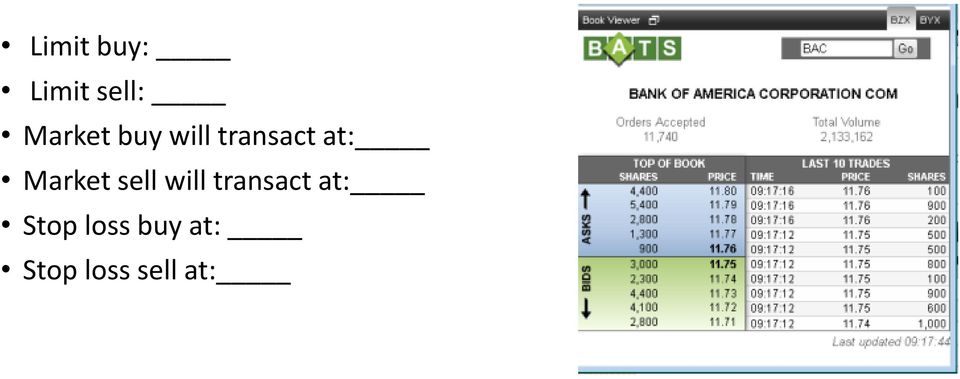
7 Trading Orders Limit orders Transact at the limit price or better. Non urgent execution. Queuing for a better price. E.g. Buy at a price lower than the market price. Market order Immediate execution. Executing a trade at the prevailing market price or whatever price available. Stop loss order To protect against losses from existing positions. When the market price reaches the stop loss price, the stop order becomes a market order. See BATS (an ECN) example.

8 Limit buy: Limit sell: Market buy will transact at: Market sell will transact at: Stop loss buy at: Stop loss sell at:
9

10
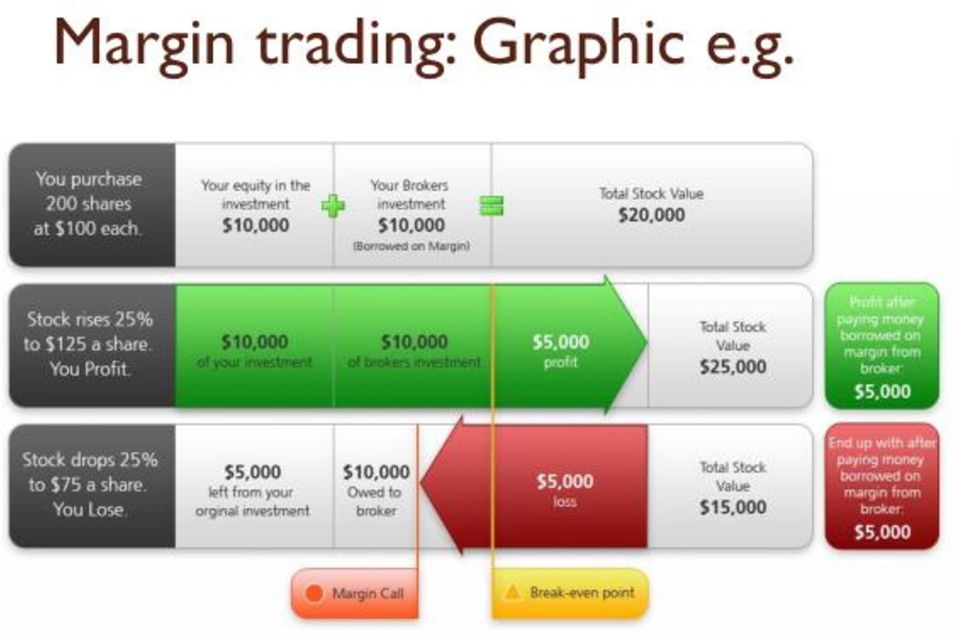
11 Price drop to $60

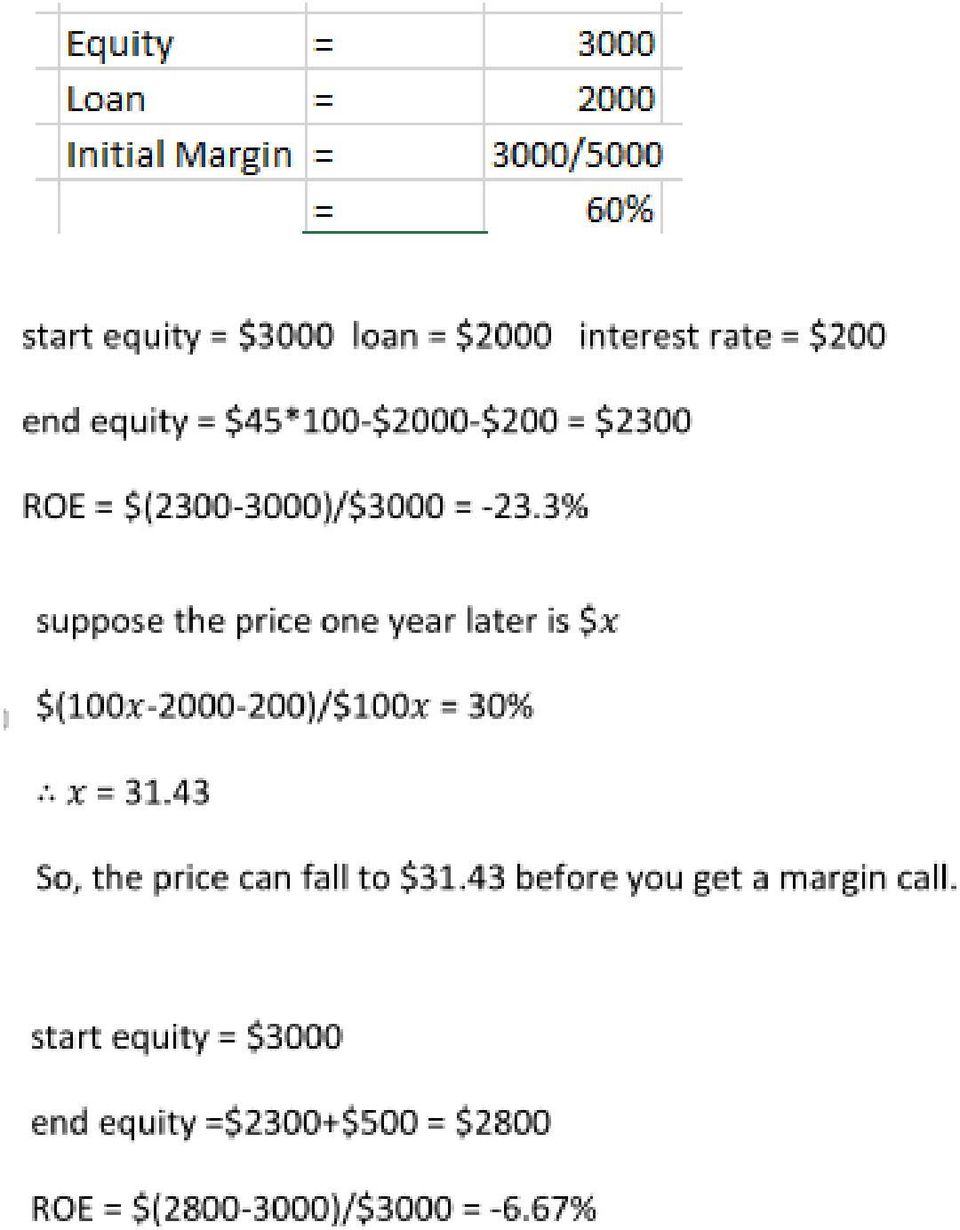
12 Exercise Suppose that Froogle Inc. is selling at $50 per share. You buy 100 shares using $3,000 of your own money, borrowing the remainder of the purchase price from your broker. The interest rate on the margin loan is 10%. What s the initial margin? What is the percentage increase in the net worth of your brokerage account if the price of Froogle is selling at $45 after one year? The maintenance margin is 30%. Suppose a year has passed. How low can Froogle s price fall before you get a margin call? What is your answer for part (a) if Froogle pays a dividend of 5$ per share during the year and the ex-dividend price is still $45 after one year? Ignore the dividend reinvestment income.

13

14 Short Selling

15 Short Selling Adds to market efficiency, so that investors can profit from price declines. Assets that cannot be shorted are usually inefficiently priced, larger bid-ask spreads. Eg. no short selling in real estate, most Chinese stocks. Short-selling is sometimes banned during financial crises to prevent further price declines. But it s not clear that short selling exacerbates price declines. In fact, short sales can lead to price increases due to short covering.

16 Market participants Mutual funds ETFs Hedge funds

17 Mutual Funds, ETFs, Hedge Funds Mutual funds Economic Motivation for funds Structure of MF industry ETFs Hedge funds Evaluating funds Performance measures Costs measures

18 Mutual Funds MFs are financial institutions that pool the financial resources of individuals and companies and invest those resources in portfolios of assets. They can have short-term or long term investment horizons. Fund is mutually owned by the asset management firm and the investors. An appointed trustee represents the investors to safeguard their interests. ( Board of Trustees or Trustee Company) The barriers to entry in the mutual fund industry are low. The largest MF sponsors have not increased their market share recently the largest 25 MF companies managed 76% (71%) of industry assets in 1990 (2007). 7 of the largest 25 firms in 2007 were not among the top 25 in 1990

19 Economic Motivation of Funds Low-cost diversification (across companies, sectors, countries). You don t need to do it yourself. Better liquidity You buy/sell one fund instead of hundreds of individual securities. Professional management You don t have to do research on which securities to buy. Variety, Choice Choosing asset classes instead of choosing individual securities.

20
21 Diversification Diversification reduces risk Expected portfolio return is the weighted average of the two expected returns Portfolio standard deviation is smaller than the weighted average of the two standard deviations Question: When will portfolio standard deviation equal the weighted average of the two standard deviations? As long as asset returns do not always move in the same direction (< 1), we have room for lowering risk by diversification Not all risks are systematic risks Firms respond to systematic risk in different ways
22
23 To Diversify Or Not To Diversify? While diversification reduces risk (in theory), some professional asset managers have different views: Warren Buffet: From , the top 5 holdings of Berkshire on average accounted for 73% of the portfolio The average annual return of Berkshire s stock portfolio outperformed the S&P500 by 11% Wide diversification is only required when investors do not understand what they are doing Mutual fund managers that concentrate their portfolios in a few industries perform better than those who widely diversify across industries (Kacperczyk, Sialm, and Zheng, 2005 JF) How do you reconcile the two views?
24 Passive versus Active funds Approximately 25% of long-term funds are passive funds Passive funds are index funds which managers buy securities in proportions similar to those included in a specified major index. Index funds involve little research or management, which results in lower management fees and higher net returns than actively-managed funds. Active funds are funds whose objective is to beat the market, i.e. perform better than a passive benchmark. Active funds have much higher fees than comparable passive funds. Paradox: But they rarely beat the market! (see articles) 86% of investment managers failed to beat the market in
25
26 Open versus Closed end fund Open-end Redeem or issue shares at NAV Investors sell shares back to the fund to cash out Shares outstanding change when new shares are sold or old shares are redeemed Closed-end Shares are traded in secondary markets (like common stocks) No change in shares outstanding: If investors want to sell, they must sell to other investors Share prices can differ from NAV Premium/discount = (Price NAV)/NAV
27 Mutual Fund Expenses Front-end Load: a commission or sales charge paid when purchasing the shares Typically less than 6%; Reduce the amount of money invested Back-end Load: a redemption, or exit, fee incurred when selling the shares Typically starts at 5~6%; Becomes smaller with longer investment periods Operating Expenses: costs incurred in operating the portfolio Including administrative expenses and advisory fees paid to the investment manager Expressed as a percentage of total assets under management Deducted from the assets of the fund periodically 12b-1 Charges: annual fees charged by a mutual fund to pay for marketing and distribution cost Deducted from the assets of the fund periodically Limited to 1% of average net assets per year
28 Returns from MF investing Investor returns from MF ownership reflect three components income and dividends on portfolio assets. Dividends are usually reinvested in the fund s assets. capital gains on assets bought and sold at higher prices capital appreciation on assets held in the fund MF assets are usually marked to market daily prices are adjusted daily to reflect changes in the current market prices of the portfolio s assets Then net asset value (NAV) of a MF share is equal to the market value of the assets in the MF portfolio divided by the number of shares outstanding
29 Fees and Mutual Fund Returns Note that this measure ignores any commissions such as front-end loads and expenses Example: You purchased 1,000 shares of the PKU Fund at a price of $20 per share at the beginning of the year The front-end fee is 4% and the expense ratio is 1.2% The securities in which the fund invests increase in value by 12% during the year What is your rate of return on the fund if you sell your shares at the end of the year?
30
31 Exchange Traded Funds (ETFs) Mutual funds that are traded on an exchange. Closed -end funds, but float can be increased/decreased. Usually passively-managed, tracking an index. But some ETFs are derivative based and very risky. (e.g. short 2x financials) Lower fees (only pay brokerage commissions for transaction, and yearly expense ratios typically <0.5%) Able to be traded intra-day, unlike open-ended mutual funds Explosive growth in the US in recent years (QQQs, SPDRs, DIAMONDs, ishares). E.g., SPDRs is the most liquid stock in the US.
32 Hedge funds Hedge funds (HFs) are investment pools that solicit funds from wealthy individuals and other investors (e.g., commercial banks) and invest these funds on their behalf Similar to MFs, but not required to register with the SEC Subject to virtually no regulatory oversight and thus generally can (and do) take significant risk Do not have to disclose their activities to third parties and thus offer a high degree of privacy HFs use more aggressive trading strategies than MFs such as short selling, leverage, program trading, arbitrage, and the use of derivatives Diversification, providing alternate beta Allow investors to have an alternative source of returns that is not highly correlated with regular risky assets. There are no specific rules on valuation or pricing for hedge funds and new investors typically must pledge to keep their money in a hedge fund for at least 1 year (lock-up period)
33 What Do Hedge Funds Do? A long-short equity hedge fund takes both long and short positions in stocks Event-driven hedge fund strategies attempt to take advantage of opportunities created by significant transactional events, such as mergers and acquisitions, reorganizations, bankruptcies, and other extraordinary corporate transactions Macro hedge fund strategies attempt to identify mispriced valuations in stock markets, interest rates, foreign exchange rates, and physical commodities and make leveraged bets on the anticipated price movements in these markets Fixed-income arbitrage hedge funds attempt to find arbitrage opportunities in the fixed-income markets
34 Hedge fund fees Management fees on HFs are computed as a percent of assets under management, usually 2% p.a. Performance fees give fund managers a share of any positive returns earned. the average is 20%, but performance fees vary substantially depending on the HF a hurdle rate is a benchmark that must be realized before a performance fee can be assessed. a high-water mark is when a manager does not receive a performance fee unless the value of the fund exceeds the highest NAV it has previously achieved (for that particular investor).
35 High-Water Mark Some managers offer a high-water mark in calculating their performance fees Performance fees is triggered only when the investor has profits exceeding the level of profits that existed the last time a performance fee was charged Example: Suppose PKU fund uses a high-water mark. The fund is up 25% gross in year 1, down 20% gross in year 2, up 30% gross in year 3 What is the performance fee in each year?
36 Evaluating Funds Historical performance Arithmetic mean, Geometric mean Risk-adjusted return Sharpe ratio Treynor ratio Jenson s alpha Information ratio Against appropriate benchmark Evaluating fees, Refer to handout on fund fees Sales charges (front-end, back-end) Management fee, trustee fee, good performance fee, switching fee
37
38
39
40
41
42 Luck or Skill? Suppose we regress monthly excess returns of a fund manager s portfolio on the excess return of the market index and find: alpha = 0.2% and std(e) = 2% How many months must we observe this manager before we can be 95% sure that his alpha is truly different than zero ( alpha> 0)?
43 Luck or Skill?
44
45
46 Empirical Evidence of Mutual Fund Performance Most academic research shows that mutual funds on average underperform the market after correcting for costs Before costs, some studies show that mutual fund managers have some stock picking skills, but this is not enough to offset the expenses charged by the funds Mutual fund managers are on average not able to time the market Turnover, fund flows, expenses, and management fees have a negative impact on the performance of mutual funds There is some evidence that the funds with high turnover earn higher net returns than funds with low turnover There is little persistence in performance of funds from year to year Nevertheless, some short-term persistence is found among the bestperforming funds and the worst-performing funds
Mutual Funds and Other Investment Companies Hedge Funds
 Mutual Funds and Other Investment Companies Hedge Funds Chapter 4 & 26 McGraw-Hill/Irwin Copyright 2005 by The McGraw-Hill Companies, Inc. All rights reserved. Lecture outline Introduction of investment
BARUCH COLLEGE DEPARTMENT OF ECONOMICS & FINANCE Professor Chris Droussiotis LECTURE 2. Chapter 3 SECURITIES MARKETS
 LECTURE 2 Chapter 3 SECURITIES MARKETS IPO Required Docs: Amendment to the certificate of incorporation Corporate Governance (Private are far less formal responsibility) Recruit Independent Board Members
How To Invest In Stocks And Bonds
 Review for Exam 1 Instructions: Please read carefully The exam will have 21 multiple choice questions and 5 work problems. Questions in the multiple choice section will be either concept or calculation
Investment Analysis (FIN 670) Fall 2009. Homework 2
 Investment Analysis (FIN 670) Fall 2009 Homework 2 Instructions: please read carefully You should show your work how to get the answer for each calculation question to get full credit The due date is Tue,
Mutual Funds and Other Investment Companies. Chapter 4
 Mutual Funds and Other Investment Companies Chapter 4 Investment Companies financial intermediaries that collect funds from individual investors and invest in a portfolio of assets shares = claims to portfolio
Solutions for End-of-Chapter Questions and Problems: Chapter Five
 Solutions for End-of-Chapter Questions and Problems: Chapter Five 2. What are money market mutual funds? In what assets do these funds typically invest? What factors have caused the strong growth in this
BASKET A collection of securities. The underlying securities within an ETF are often collectively referred to as a basket
 Glossary: The ETF Portfolio Challenge Glossary is designed to help familiarize our participants with concepts and terminology closely associated with Exchange- Traded Products. For more educational offerings,
THE STOCK MARKET GAME GLOSSARY
 THE STOCK MARKET GAME GLOSSARY Accounting: A method of recording a company s financial activity and arranging the information in reports that make the information understandable. Accounts payable: The
9 Questions Every ETF Investor Should Ask Before Investing
 9 Questions Every ETF Investor Should Ask Before Investing 1. What is an ETF? 2. What kinds of ETFs are available? 3. How do ETFs differ from other investment products like mutual funds, closed-end funds,
INVESTMENT DICTIONARY
 INVESTMENT DICTIONARY Annual Report An annual report is a document that offers information about the company s activities and operations and contains financial details, cash flow statement, profit and
Learn about exchange-traded funds. Investor education
 Learn about exchange-traded funds Investor education Become a more knowledgeable exchange-traded funds investor In this education guide, you ll get answers to common questions about exchange-traded funds,
Nine Questions Every ETF Investor Should Ask Before Investing
 Nine Questions Every ETF Investor Should Ask Before Investing UnderstandETFs.org Copyright 2012 by the Investment Company Institute. All rights reserved. ICI permits use of this publication in any way,
Client Education. Learn About Exchange-Traded Funds
 Client Education Learn About Exchange-Traded Funds 2 What is an ETF? 6 How do ETFs work? 12 How do ETFs compare with other investments? 2 Exchange-traded funds, or ETFs, are attracting more and more attention
Chapter 2 Characteristics of Investment Companies
 Chapter 2 Characteristics of Investment Companies Abstract Chapter 2 provides a brief overview of five types of investment companies: open-end funds, closed-end funds, unit investment trusts, exchange-traded
Mutual Funds and Other Investment Companies
 Mutual Funds and Other Investment Companies Investment Companies Pool funds of individual investors and invest in a wide range of securities or other assets. pooling of assets Provide several functions
Financial Markets and Institutions Abridged 10 th Edition
 Financial Markets and Institutions Abridged 10 th Edition by Jeff Madura 1 12 Market Microstructure and Strategies Chapter Objectives describe the common types of stock transactions explain how stock transactions
Exchange-Traded Funds
 Exchange-Traded Funds Exchange Traded Funds (ETF s) are becoming popular investment vehicles for many investors. Most ETF s are cost effective, broad market funds. We have put together a layman s explanation
Financial Markets and Institutions Abridged 10 th Edition
 Financial Markets and Institutions Abridged 10 th Edition by Jeff Madura 1 23 Mutual Fund Operations Chapter Objectives provide a background on mutual funds describe the various types of stock and bond
Investment Companies
 Mutual Funds Mutual Funds Investment companies Financial intermediaries that collect funds form individual investors and invest those funds in a potentially wide rande of securities or other asstes Polling
Welcome to Firm Element Session 2 March 16, 2011 - A Primer on Exchange Traded Funds -
 Welcome to Firm Element Session 2 March 16, 2011 - A Primer on Exchange Traded Funds - The Webinar will start shortly and all phones will be muted by the presenter. Please email any questions you have
Glossary of Investment Terms
 online report consulting group Glossary of Investment Terms glossary of terms actively managed investment Relies on the expertise of a portfolio manager to choose the investment s holdings in an attempt
FREQUENTLY ASKED QUESTIONS March 2015
 FREQUENTLY ASKED QUESTIONS March 2015 Table of Contents I. Offering a Hedge Fund Strategy in a Mutual Fund Structure... 3 II. Fundamental Research... 4 III. Portfolio Construction... 6 IV. Fund Expenses
9 Questions Every ETF Investor Should Ask Before Investing
 9 Questions Every ETF Investor Should Ask Before Investing 1. What is an ETF? 2. What kinds of ETFs are available? 3. How do ETFs differ from other investment products like mutual funds, closed-end funds,
A GUIDE TO MUTUAL FUND INVESTING
 Many investors turn to mutual funds to meet their long-term financial goals. They offer the benefits of diversification and professional management and are seen as an easy and efficient way to invest.
Exchange-Traded Funds
 Exchange-Traded Funds By Ken Hawkins Investopedia Introduction Exchange-traded funds (ETFs) can be a valuable component for any investor's portfolio, from the most sophisticated institutional money managers
How To Understand The Value Of A Mutual Fund
 FCS5510 Sample Homework Problems and Answer Key Unit03 CHAPTER 6. INVESTMENT COMPANIES: MUTUAL FUNDS PROBLEMS 1. What is the net asset value of an investment company with $10,000,000 in assets, $500,000
UNDERSTANDING CLOSED-END FUNDS
 Lessons in Investing for Income UNDERSTANDING CLOSED-END FUNDS Income is one of investors most common goals but one not easily achieved, especially in today s low-yielding environment. That s why investors
Understanding mutual fund share classes, fees and certain risk considerations
 Disclosure Understanding mutual fund share classes, fees and certain risk considerations Highlights Mutual funds may offer different share classes most commonly in retail brokerage accounts, Class A, B
Portfolio Management. Bertrand Groslambert. [email protected]. Skema Business School
 Portfolio Management Bertrand Groslambert [email protected] Skema Business School International Portfolio Management Asset Management Industry 1 Course Outline Introduction (lecture 1) Presentation
ETFs as Investment Options in 401(k) Plans
 T. ROWE PRICE ETFs as Investment Options in 401(k) Plans Considerations for Plan Sponsors By Toby Thompson, CFA, CAIA, T. Rowe Price Defined Contribution Investment Specialist Retirement Insights EXECUTIVE
Equities 2: The Stock Market
 Equities 2: The Stock Market Jan 2016 Week 3, FNCE102 R. Loh Raising Stock Stock 1 Equities 2 overview Raising Stock Initial public offering Understanding IPO tombstone ads IPO underpricing offering Pricing
Exchange Traded Funds A Brief Introduction
 Exchange Traded Funds A Brief Introduction 1 What You Need to Know about ETFs 2 ETF Basics Benefits of ETFs ETFs vs. Mutual Funds The Role of ETFs in Your Portfolio Our Next Steps Appendix: FAQs 3 ETF
Wealth Management Education Series. Explore the Field of Mutual Funds
 Wealth Management Education Series Explore the Field of Mutual Funds Wealth Management Education Series Explore the Field of Mutual Funds Managing your wealth well is like tending a beautiful formal garden
ADVISORSHARES YIELDPRO ETF (NASDAQ Ticker: YPRO) SUMMARY PROSPECTUS November 1, 2015
 ADVISORSHARES YIELDPRO ETF (NASDAQ Ticker: YPRO) SUMMARY PROSPECTUS November 1, 2015 Before you invest in the AdvisorShares Fund, you may want to review the Fund s prospectus and statement of additional
STRATEGIES FOR USING ETFS. Tax Loss Harvesting Investors can sell individual stock positions currently
 STRATEGIES FOR USING ETFS Tax Loss Harvesting Investors can sell individual stock positions currently trading below purchase price, realize the loss and maintain similar exposure by purchasing the appropriate
Prospectus Socially Responsible Funds
 Prospectus Socially Responsible Funds Calvert Social Investment Fund (CSIF) Balanced Portfolio Equity Portfolio Enhanced Equity Portfolio Bond Portfolio Money Market Portfolio Calvert Social Index Fund
Answers to Concepts in Review
 Answers to Concepts in Review 1. (a) In the money market, short-term securities such as CDs, T-bills, and banker s acceptances are traded. Long-term securities such as stocks and bonds are traded in the
Exchange Traded Funds A Brief Introduction
 Exchange Traded Funds A Brief Introduction spdrs.com What You Need to Know about ETFs ETF Basics Potential Benefits of ETFs ETFs versus Mutual Funds The Role of ETFs in Your Portfolio Our Next Steps Frequently
Review for Exam 1. Instructions: Please read carefully
 Review for Exam 1 Instructions: Please read carefully The exam will have 25 multiple choice questions and 5 work problems covering chapter 1, 2, 3, 4, 14, 16. Questions in the multiple choice section will
Investments, Chapter 4
 Investments, Chapter 4 Answers to Selected Problems 2. An open-end fund has a net asset value of $10.70 per share. It is sold with a front-end load of 6 percent. What is the offering price? Answer: When
Important Information about Closed-End Funds and Unit Investment Trusts
 Robert W. Baird & Co. Incorporated Important Information about Closed-End Funds and Unit Investment Trusts Baird has prepared this document to help you understand the characteristics and risks associated
ETFs 101 An Introduction to Exchange-Traded Funds
 An Introduction to Exchange-Traded Funds Leading the Intelligent ETF Revolution Please refer to Slides 2 and 3 for Important Information. Shares are not individually redeemable for redemption to the Fund
Understanding Managed Funds
 ... Understanding Managed Funds Contact us If you would like to know more about how AMP Capital can help you, please visit ampcapital.com.au, or contact one of the following: Financial Planners Personal
Explore the Field of Mutual Funds
 Wealth Management Education Series How can we help you further? Do you have a question on what you have just read? Would you like to have a further discussion on this subject? Contact your Relationship
The Young Investor s Guide To Understanding The Terms Used In Investing.
 The Young Investor s Guide To Understanding The Terms Used In Investing. The Young Investor Dictionary compliments of Integrity Mutual Funds. YOUNG INVESTOR DICTIONARY Asset Something of value. The property
Put ETFs to work for your clients
 Put ETFs to work for your clients Contents 2 What are ETFs? 4 Potential benefits of ETFs 5 Comparing ETFs and mutual funds 6 How ETFs work 11 ETFs and indexing Exchange-traded funds (ETFs) are attracting
Wealth Management Education Series. Explore the Field of Investment Funds
 Wealth Management Education Series Explore the Field of Investment Funds Wealth Management Education Series Explore the Field of Investment Funds Managing your wealth well is like tending a beautiful formal
About Hedge Funds. What is a Hedge Fund?
 About Hedge Funds What is a Hedge Fund? A hedge fund is a fund that can take both long and short positions, use arbitrage, buy and sell undervalued securities, trade options or bonds, and invest in almost
www.optionseducation.org OIC Options on ETFs
 www.optionseducation.org Options on ETFs 1 The Options Industry Council For the sake of simplicity, the examples that follow do not take into consideration commissions and other transaction fees, tax considerations,
Investing in Mutual Funds
 Investing in Mutual Funds C H A P T E R 17 Barb Branson thought she knew a good thing when she saw it. After researching some mutual funds, she picked one that had a great five-year track record. With
INVESTMENT TERM GLOSSARY
 A Accrued Interest - Interest that has been earned but not yet credited to a bond or other fixed-income investment, such as a certificate of deposit. Active Management The use of professional investment
Investment Finance 421-002 Prototype Midterm I
 Investment Finance 421-002 Prototype Midterm I The correct answer is highlighted by a *. Also, a concise reasoning is provided in Italics. 1. are an indirect way U. S. investor can invest in foreign companies.
Exchange Traded Funds
 LPL FINANCIAL RESEARCH Exchange Traded Funds February 16, 2012 What They Are, What Sets Them Apart, and What to Consider When Choosing Them Overview 1. What is an ETF? 2. What Sets Them Apart? 3. How Are
15.433 Investments. Assignment 1: Securities, Markets & Capital Market Theory. Each question is worth 0.2 points, the max points is 3 points
 Assignment 1: Securities, Markets & Capital Market Theory Each question is worth 0.2 points, the max points is 3 points 1. The interest rate charged by banks with excess reserves at a Federal Reserve Bank
Exchange Traded Funds (ETFs)
 Exchange Traded Funds (ETFs) Advisers guide to ETFs and their potential role in client portfolios This document is directed at professional investors and should not be distributed to, or relied upon by
ETF Total Cost Analysis in Action
 Morningstar ETF Research ETF Total Cost Analysis in Action Authors: Paul Justice, CFA, Director of ETF Research, North America Michael Rawson, CFA, ETF Analyst 2 ETF Total Cost Analysis in Action Exchange
Board Oversight of Exchange-Traded Funds
 Board Oversight of Exchange-Traded Funds October 2012 Nothing contained in this paper is intended to serve as legal advice. Each investment company board should seek the advice of counsel for issues relating
9 Questions Every Australian Investor Should Ask Before Investing in an Exchange Traded Fund (ETF)
 SPDR ETFs 9 Questions Every Australian Investor Should Ask Before Investing in an Exchange Traded Fund (ETF) 1. What is an ETF? 2. What kinds of ETFs are available? 3. How do ETFs differ from other investment
FIN 432 Investment Analysis and Management Review Notes for Midterm Exam
 FIN 432 Investment Analysis and Management Review Notes for Midterm Exam Chapter 1 1. Investment vs. investments 2. Real assets vs. financial assets 3. Investment process Investment policy, asset allocation,
 1 2 3 4 5 6 Say that you need to generate $4,000 per month in retirement and $1,000 will come from social security and you have no other pension. This leaves $3,000 per month, or $36,000 per year, that
Virtual Stock Market Game Glossary
 Virtual Stock Market Game Glossary American Stock Exchange-AMEX An open auction market similar to the NYSE where buyers and sellers compete in a centralized marketplace. The AMEX typically lists small
Best ETF Trading Practices
 Presented by QQQ TM Also inside: 2 Why best trading practices matter 3 The value of a pretrade analysis 4 Evaluating ETFs for trading efficiency 5 Mechanics of ETF trades 5 Relationships between ETF trading
Investment Education Series
 Investment Education Series Types of Investment Funds Introduction Investment fund basically refers to a pool of funds, but our focus in this edition of GTBAM education series is to highlight the features,
What is the history and global performance of ETFS? What are ETFs? Assets Under Management (AUM) of ETFs: 2001 Q12013
 What is the history and global performance of ETFS? Exchange Traded Funds debuted in 1993 when State Street launched the SPDR S&P 500, an equity index fund tracking the S&P 500. Shortly after, ETFs gained
decidedly different Catalyst Mutual Funds Brochure
 decidedly different Catalyst Mutual Funds Brochure Our Mission We strive to provide innovative strategies to support financial advisors and their clients in meeting the investment challenges of an ever
2016 Summary Prospectus
 March 1, 2016 Global X Permanent ETF NYSE Arca, Inc: PERM 2016 Summary Prospectus Before you invest, you may want to review the Fund's prospectus, which contains more information about the Fund and its
General Investment-Related Terms
 General Investment-Related Terms 12b-1 Fee: A fee assessed on certain mutual funds or share classes permitted under an SEC rule to help cover the costs associated with marketing and selling the fund. 12b-1
Is it time to hire a professional to manage your bonds?
 Is it time to hire a professional to manage your bonds? Today s bond markets are more complex Finding the right bonds can be difficult. The bond markets are large and complex, and it takes a lot of homework
Investing in Stocks 14-1. Copyright 2012 by The McGraw-Hill Companies, Inc. All rights reserved. McGraw-Hill/Irwin
 Investing in Stocks McGraw-Hill/Irwin Copyright 2012 by The McGraw-Hill Companies, Inc. All rights reserved. 14-1 Invest in stocks Learning Objectives Identify the most important features of common and
Series of Shares B, B-6, E, F, F-6, O B, E, F, O O A, B
 No securities regulatory authority has expressed an opinion about these securities and it is an offence to claim otherwise. The Funds and their securities offered under this Annual Information Form are
An Overview of the US Closed-End Fund Market. By Paul Mazzilli
 An Overview of the US Closed-End Fund Market By Paul Mazzilli Introduction Closed-end funds (CEFs) are professionally managed investment companies that offer investors various unique benefits. They offer
Vanguard REIT ETF Prospectus
 Vanguard REIT ETF Prospectus May 28, 2015 Exchange-traded fund shares that are not individually redeemable and are listed on NYSE Arca Vanguard REIT Index Fund ETF Shares (VNQ) This prospectus contains
SPDR S&P 400 Mid Cap Value ETF
 SPDR S&P 400 Mid Cap Value ETF Summary Prospectus-October 31, 2015 Before you invest in the SPDR S&P 400 Mid Cap Value ETF (the Fund ), you may want to review the Fund's prospectus and statement of additional
 1 Regional Bank Regional banks specialize in consumer and commercial products within one region of a country, such as a state or within a group of states. A regional bank is smaller than a bank that operates
Risks of Investments explained
 Risks of Investments explained Member of the London Stock Exchange .Introduction Killik & Co is committed to developing a clear and shared understanding of risk with its clients. The categories of risk
Exchange-traded Funds
 Mitch Kosev and Thomas Williams* The exchange-traded fund (ETF) industry has grown strongly in a relatively short period of time, with the industry attracting greater attention as it grows in size. The
Unit Investment Trusts
 a guide to Unit Investment Trusts A unit investment trust (UIT) is a registered investment company that buys and holds a generally fixed portfolio of stocks, bonds, or other securities. Table of Contents
Understanding Exchange Traded Funds (ETFs)
 Level 7,34 Charles St Parramatta NSW 2150 PO Box 103 Parramatta NSW 2124 Phone: 02 9687 1966 Fax: 02 9635 3564 Web: www.carnegie.com.au Guide Build Protect Manage Wealth Understanding Exchange Traded Funds
Contents. 1 Asset allocation 2 Sub-asset allocation 3 Active/passive combinations 4 Asset location
 ETF Strategies Contents Why ETFs? Strategic uses for ETFs 1 Asset allocation 2 Sub-asset allocation 3 Active/passive combinations 4 Asset location Tactical uses for ETFs 1 Portfolio completion 2 Cash
Lecture Two Essentials of Trading. Andy Bower www.alchemetrics.org
 Lecture Two Essentials of Trading Andy Bower www.alchemetrics.org Essentials of Trading Why People Trade Money What People Trade Market Where People Trade Exchanges How People Trade Brokers Orders Margin
Xetra. The market. Xetra: Europe s largest trading platform for ETFs. ETF. One transaction is all you need.
 Xetra. The market. Xetra: Europe s largest trading platform for ETFs ETF. One transaction is all you need. Deutsche Börse Group is the leading global service provider to the securities industry. Its cutting-edge
Mutual Fund Investing Exam Study Guide
 Mutual Fund Investing Exam Study Guide This document contains the questions that will be included in the final exam, in the order that they will be asked. When you have studied the course materials, reviewed
Market Linked Certificates of Deposit
 Market Linked Certificates of Deposit This material was prepared by Wells Fargo Securities, LLC, a registered brokerdealer and separate non-bank affiliate of Wells Fargo & Company. This material is not
decidedly different Catalyst Mutual Funds Investor Overview
 decidedly different Catalyst Mutual Funds Investor Overview Our Mission We strive to provide innovative strategies to support financial advisors and their clients in meeting the investment challenges of
Final Exam Spring 2003
 15.433 Investments Final Exam Spring 2003 Name: Result: Total: 40 points: 40 Instructions: This test has 35 questions. You can use a calculator and a cheat sheet. Each question may have multiple parts
Interest Rates and Inflation: How They Might Affect Managed Futures
 Faced with the prospect of potential declines in both bonds and equities, an allocation to managed futures may serve as an appealing diversifier to traditional strategies. HIGHLIGHTS Managed Futures have
ANDERSON UNIVERSITY INVESTMENT POLICY
 ANDERSON UNIVERSITY INVESTMENT POLICY I. General Investment Objectives A. The primary objective for investment of all funds of the university is to provide an adequate flow of resources sufficient to meet
2016 Summary Prospectus
 April 18, 2016 Global X S&P 500 Catholic Values ETF NASDAQ: CATH 2016 Summary Prospectus Before you invest, you may want to review the Fund's prospectus, which contains more information about the Fund
decidedly different Catalyst Mutual Funds Investor Overview
 decidedly different Catalyst Mutual s Investor Overview Our Mission We strive to provide innovative strategies to support financial advisors and their clients in meeting the investment challenges of an