
Part 512 Conservation Program Contracting
|
|
|
- Oswin Gilmore
- 9 years ago
- Views:
Transcription
1 512.0 General A. Overview Part 512 Conservation Program Contracting Subpart A General Information This part sets forth NRCS policy for installing conservation treatment under conservation program contracts (CPCs) administered through the Program Contracts System (ProTracts). B. Purpose of a CPC The purpose of a CPC is to help a participant install, operate, and maintain a conservation system (steps eight and nine of the conservation planning process). The CPC specifies the following: (i) What conservation practices or activities will be implemented and maintained (ii) Where conservation practices or activities will be implemented (iii) When conservation practices or activities will be implemented (iv) Program payment amounts and methods of payment for establishing or maintaining conservation practices or activities (v) Opportunities and requirements for modifications (vi) Opportunities and requirements for payments (vii) Consequences if the participant fails to meet contract requirements C. Managing Contracts Through ProTracts (1) This part establishes requirements for all program contracts managed through ProTracts. For specific conservation program guidance regarding application processes, program eligibility, ranking, and related program matters, see the appropriate program part in Title 440, Conservation Programs Manual (CPM). (2) Field users will route all business tools questions through their respective State-level support staff, who will then direct questions to national support desks through the Contact Us features. D. Acceptable Contracting Software (1) ProTracts is the only acceptable software for processing applications and developing and implementing a CPC for the following programs: (i) Agricultural Management Assistance (AMA) (ii) Conservation Security Program authorized under the 2002 Farm Bill (CSP 2002) (iii) Conservation Stewardship Program authorized under the 2008 Farm Bill (CSP 2008) (iv) Environmental Quality Incentives Program (EQIP), including all initiatives (v) Wildlife Habitat Incentive Program (vi) Chesapeake Bay Watershed Initiative (vii) Cooperative Conservation Partnership Initiative (2) Form NRCS-CPA-1155, Conservation Plan or Schedule of Operations, and Form NRCS-CPA-1156, Revision of Plan/Schedule of Operations or Modification of a Contract, created in the Customer Service Toolkit, will not be utilized for these programs. Only the versions of these forms completed in ProTracts are acceptable. 512-A.1

2 E. Implementation Authority of NRCS Title 440 Conservation Programs Manual The authority for the use of CPCs to implement conservation systems originates from the Commodity Credit Corporation (CCC) Charter Act (15 U.S.C. Section 714) and the Soil Conservation and Domestic Allotment Act of 1935 (16 U.S.C. Sections 590a f). The CCC Charter Act was amended in 1996 to incorporate conservation programs and associated activities as a purpose of CCC. The Chief of NRCS may use any and all authorities, facilities, or personnel that are determined necessary or appropriate to carry out such conservation programs with funds available from the CCC. The USDA Uniform Federal Assistance Regulations are published at 7 CFR Part The Federal Acquisition Regulation (FAR) does not apply to CPCs. F. Legal Contracting Responsibilities (1) CPCs are legally binding agreements that define the terms and conditions of program participation, including the responsibilities of the participants, NRCS, and technical service providers (TSPs), as well as the consequences of violating these terms and conditions. (Note: A TSP is not a party to a CPC. TSP responsibilities are derived from the TSP regulations at 7 CFR Part 652, the agreement for use of and payment for assistance from a TSP, and the arrangement between the TSP and the program participant.) A CPC requires the participant to carry out conservation activities with his or her own resources or through a contractor. However, conservation program rules may require that specific assistance be provided by NRCS to ensure that the participant is able to comply with the CPC s terms and conditions. (2) For example, the EQIP rule provides that all conservation practices must be carried out in accordance with the Field Office Technical Guide (7 CFR Section (a)). In order for a participant to be able to comply with this requirement, NRCS must make all designs, standards, and specifications for implementing the required conservation practices available in a reasonable period of time. (3) NRCS employees must provide participants a copy of all signed and dated documents following CPC approval. This includes the following: (i) Form NRCS-CPA-1200, Conservation Program Application (ii) Form NRCS-CPA-1202, Conservation Program Contract (iii) CPC appendix (iv) Form NRCS-CPA-1155, Conservation Plan or Schedule of Operations generated from ProTracts (4) Other recommended references to help participants understand their obligations include (i) Job sheets, the standards and specifications for conservation practices included within a contract, or both. (ii) The applicable program regulation (available in the program manual or on the Web). (iii) State or locally developed fact sheets that explain program requirements. G. Technical Assistance for Contracts NRCS, based upon available funding, must provide technical assistance within a reasonable period of time when requested to develop plans and to provide designs, standards, and specifications needed to install scheduled conservation practices and activities. Failure to provide the assistance requested in a reasonable period of time can result in a breach of the terms and conditions of the contract by NRCS. Participants should use assistance available from other Federal and State agencies and private sources, including TSPs that are properly registered through TechReg. It remains the 512-A.2

3 responsibility of the participant to request technical assistance in a timely manner to allow for scheduling of the assistance and application of the practice within CPC parameters. H. Payments Conservation payments are made to participants upon satisfactory implementation of the scheduled conservation practices or activities. A conservation practice or activity generally may not receive financial assistance through more than one USDA program on the same land (see section E). I. Internal Revenue Service (IRS) Reporting Payments made to participants under CPCs are reported to the IRS on Form 1099-MISC by the National Finance Center. Section 126 of the Internal Revenue Code of 1954, as amended (26 U.S.C. Section 126), provides that certain payments made to persons under conservation programs may be excluded from the recipient s gross income for Federal income tax purposes. Information on the eligible conservation programs is in IRS Publication 225, Farmer s Tax Guide, under Soil and Water Conservation Expenses. NRCS employees are not authorized to advise CPC participants on the tax implications of conservation payments. Section 175 of the Internal Revenue Code of 1954, as amended (26 U.S.C. Section 175) addresses the topic of soil or water conservation expenditures made by a taxpayer engaged in the business of farming. NRCS policy related to 26 U.S.C. Section 175 is contained within Title 180, General Manual (GM), Part 403, Federal Tax Treatment of Soil and Water Conservation Expenditures. J. State Supplements to This Part A copy of all State supplements to this part must be submitted to the Deputy Chief for Programs for review. State supplements must not conflict with or be less restrictive than national policy and statutory or regulatory program provisions. The final version of all State supplements must be submitted to the Deputy Chief for Management for posting in the edirectives System in accordance with Title 120, Directives Management Handbook, Part 620. K. Waivers to National Policy For unusual situations and special conditions, a written request for a waiver to the policy in this part must be sent to the Deputy Chief for Programs. The request must provide adequate rationale for the policy waiver. All requested actions must be consistent with applicable statutes and regulations. All policy waivers will expire at the end of the fiscal year in which they are approved. Further, policy waivers granted by the Deputy Chief will not be approved for broad requests. Policy waivers will only be granted to address individual requests. Approved waivers must not be extended to contracts that were not specifically identified in the request and approval. A copy of the approved policy waiver or reference to its location will be maintained in the CPC case file to which it applies Required State Actions Each State Conservationist (STC) is required to (1) Develop a process for evaluating applications in accordance with each program regulation using those procedures included in each specific part of the CPM. 512-A.3
4 (2) Establish program subaccounts and allocations within ProTracts for each program, consistent with the programmatic allocation policy in the respective 440-CPM. (See Subpart I, Fund Management. ) (3) Monitor and manage program allocations and accounts consistent with annual allocation letter and all subsequent directives. (See Subpart I, Fund Management. ) (4) Develop payment schedules. (See Subpart D, Program Payment Schedules. ) (5) Maintain cost data for the development of payment schedule. (6) Establish payment rates. (7) Review and update the list of eligible conservation practices or activities and cost data. This material must be posted on the State s Web site and in the electronic Field Office Technical Guide. Payment schedules must be uploaded in the customer service toolkit and ProTracts. (8) Delegate in writing the responsibilities for developing, approving, and administering contracts; making payments; and assigning appropriate roles in ProTracts. (See Section 512.3, NRCS Responsibilities. ) The STC may delegate conservation program contracting responsibilities only as allowed by the specific program rule. (9) Provide State guidance on assembling CPC case files. (See Section , Components and Assemble of Contract File. ) Definitions Refer to 440-CPM, Part 502, Terms and Abbreviations Common to All Programs, for the definition of terms related to CPCs NRCS Responsibilities A. Contracting Roles (1) The STC will use Form AD-1143, Corporate Systems Access Request Form, to delegate contracting responsibilities and authorize appropriate individuals to assign the appropriate roles in ProTracts and fund manager. Form AD-1143 will be used to document the request and approval of each action to add, delete, or modify user roles. There must be complete separation of duties between the user requesting access, the supervisor who approves the access, and the role grantor who enrolls the user. The fund manager State vendor coordinator and fund manager obligation approver roles may only be enrolled by the designated national financial role grantor. All AD-1143 forms must be maintained by the approving supervisor and role grantor following the filing and disposition policy contained in the NRCS records guide, located in 120- GM, Part 408, Subpart D, Records Guide, under file code (2) All employees must have access to ProTracts and fund manager removed by the State role grantor immediately upon their separation from NRCS. The STC must review and certify the validity of all user roles between January 1 and March 1 annually. (3) The nationally standardized permissions applicable to each role are as follows: Figure 512-A1: Roles and Permissions Role Permissions State Office Roles State This role is assigned to staff members who assist with program management and delivery. Permissions include the ability to 512-A.4
5 Role Programs Approving Official Contract Support Permissions create subaccounts and allocate funds, create and manage ranking tools, upload payment schedules, manage all aspects of applications, sign contracts, manage contracts without approving any payments, approve modifications, and cancel and terminate contracts. This role is typically assigned to State Conservationists and State or area staff members who sign contracts and approve modifications, as these are the two key permissions associated with this role. Other permissions allow viewing and limited editing access of all application and contract data and the ability to cancel or terminate contracts. This role is typically assigned to State- or area-level program, administrative, or financial management personnel. This role can be established for staff assigned the fund manager second-level obligation review role and includes the State vendor coordinator. Permissions grant access to view funds, manage applications, view payment schedules, and manage contracts. The permissions do not allow for the approval of applications, contracts, and payments. Field Office Roles Planner Technical Designated Conservationist Farm Bill Specialist This role is to be assigned to the on-the-ground conservation delivery assistance technical staff. The role has limited access to administrative tasks. Permissions include the ability to accept and rank applications, upload planning data, modify contracts, certify practice installation, and complete contract reviews. A designated conservationist is an NRCS employee whom the State Conservationist has designated as responsible for program administration in a specific area. The role can reallocate funds and take action to manage applications, including selection for funding. The permissions allow most manage contracts functions, including all steps to approve payments and sign contract reviews. This role cannot sign contracts, approve modifications, or terminate or cancel contracts. This role is to be assigned administrative support staff to minimize the nontechnical duties on field staff. This role can take all steps to manage applications and contracts with all data entry functions. This role does not have approval authority for funding or obligations and cannot approve modifications, but can approve payments. 512-A.5
6 (4) The State delegations of contracting authority must be within the parameters of individual program regulations and national policy. Roles may be delegated differently by program. In order to reduce errors, ProTracts users who generate the requests for adding vendor records must not use their edit vendor information role to modify existing vendor records. If any items on an existing vendor record need to be corrected, only the State fund manager vendor coordinators are authorized to edit existing vendor records. ProTracts users must not create a duplicate vendor in an attempt to correct incorrect data entry. (5) Only appropriately delegated NRCS officials may sign contracts. Affiliates cannot be assigned any role that signs contracts. ProTracts and exclusion rules will prevent granting those roles. Affiliates are non-nrcs employees who perform services for NRCS, act on the behalf of NRCS, or whose duties involve interaction with NRCS. Often, an affiliate is a business or organization, with the affiliation established through a contract or agreement. Employees or members of that organization then perform the services as an extension of the organization. The following list is representative of the various types of affiliates recognized by NRCS: (i) Contractors (ii) Conservation district employees (iii) Resource conservation and development employees (iv) State and local government employees (v) Volunteers (vi) Other Federal agency employees (vii) Agriculture Conservation Experienced Service (ACES) employees (6) All NRCS employees are responsible for ensuring that funds delivered through CPCs are properly managed and disbursed for the intended purpose. The General Accountability Office s appropriation law requires that each obligation and payment be reviewed for compliance with purpose, time, and amount. (i) Purpose. NRCS s contracting and program person requesting the obligation and payment is responsible for reviewing the agreement (obligation) and payment request to ensure that the terms are consistent with the purpose or purposes for which the funds were allocated. (ii) Time. The second-level reviewers are responsible for ensuring that the obligation and payment are using the funds during their period of availability. (iii) Amount. The second-level reviewers are responsible for ensuring that there are sufficient allocated funds to record the obligation and sufficient funds on the existing obligation to issue the payment. Note: The ProTracts automated controls help ensure that there are sufficient funds for the obligation and payment, but Financial Management Modernization Initiative (FMMI) remains the definitive funds control instrument. (7) For modifications to existing contracts, the contracting and program person requesting obligation is responsible for making the determination that the change is within the scope of the original contract. This information is used by the secondlevel reviewers to ensure that the correct funding year is utilized. B. Separation of Duties for Certification and Approval (1) In assigning roles, the State Conservationist must ensure a separation of duties for obligating funds in ProTracts (ProTracts approving official) and the second-level review of obligations in Fund Manager and payments in FMMI. (i) Employees who are authorized to obligate funds and approve payment applications in ProTracts must not perform the second-level obligation review 512-A.6

7 roles in Fund Manager on contracts in which they have made these approvals. In addition, an employee who provides second-level obligation review cannot be a State vendor coordinator or fund manager FMMI user; these roles are exclusionary. (ii) The ProTracts approving official (for both obligations and payments) must not have access to FMMI where direct entry obligations and all payments are certified and approved. (2) The fund manager second-level obligation reviewer is required for all CPCs. Second-level obligation review is also required for all CPC modifications that increase obligations by more than $500. (3) The second-level obligation reviewer must complete both of the following requirements: (i) Complete the 4-day appropriation law training course or the certifying officers training course. (ii) Submit Form AD-1143 to the chief financial officer in National Headquarters for approval. (4) The fund manager second-level obligation approver will review and validate the following: (i) That the participant s signature and the date are on Forms NRCS-CPA-1202, Conservation Program Contract, or NRCS-CPA-1156, Revision of Plan/Schedule of Operations or Modification of a Contract (ii) The signature authority of the participant (see Section , Signature Authority for Businesses ) (iii) The period of performance (that is, that the agreement is effective on the date electronically signed by the NRCS approving official and extends through the indicated expiration date) (iv) That the dollar amount displayed in fund manager is the same as the dollar amount indicated on Form NRCS-CPA-1202, Conservation Program Contract, or Form NRCS-CPA-1156, Revision of Plan/Schedule of Operations or Modification of a Contract (v) The accounting information on the obligating document (that is, that the program and subaccount names appear on Forms NRCS-CPA-1202, Conservation Program Contract, or NRCS-CPA-1156, Revision of Plan/Schedule of Operations or Modification of a Contract ) C. Training and Quality Assurance The STC is responsible for training and quality assurance for all aspects of CPC administration. Appropriate staff must be assigned the responsibility for monitoring and oversight of all active CPCs to ensure proper contract administration. Tools available in ProTracts for tracking and follow-up of CPC administration include, but are not limited to, the following: (i) Contract Reviews Contracts on schedule Contracts not on schedule (ii) Contract Maintenance Active contracts that expire in current calendar year Active contracts that are past the expiration date (iii) Pending Actions Obligations Modifications 512-A.7
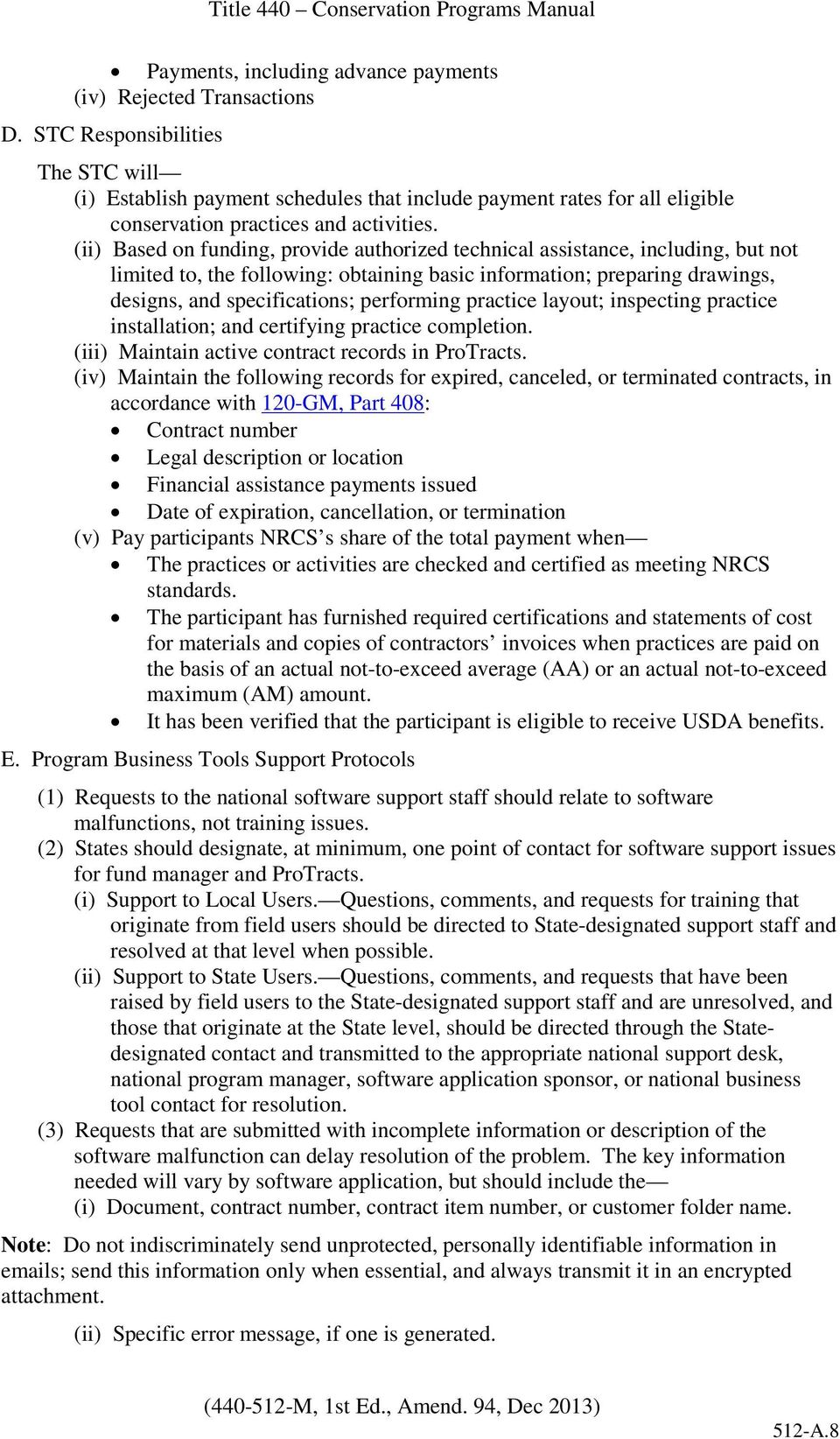
8 Payments, including advance payments (iv) Rejected Transactions D. STC Responsibilities The STC will (i) Establish payment schedules that include payment rates for all eligible conservation practices and activities. (ii) Based on funding, provide authorized technical assistance, including, but not limited to, the following: obtaining basic information; preparing drawings, designs, and specifications; performing practice layout; inspecting practice installation; and certifying practice completion. (iii) Maintain active contract records in ProTracts. (iv) Maintain the following records for expired, canceled, or terminated contracts, in accordance with 120-GM, Part 408: Contract number Legal description or location Financial assistance payments issued Date of expiration, cancellation, or termination (v) Pay participants NRCS s share of the total payment when The practices or activities are checked and certified as meeting NRCS standards. The participant has furnished required certifications and statements of cost for materials and copies of contractors invoices when practices are paid on the basis of an actual not-to-exceed average (AA) or an actual not-to-exceed maximum (AM) amount. It has been verified that the participant is eligible to receive USDA benefits. E. Program Business Tools Support Protocols (1) Requests to the national software support staff should relate to software malfunctions, not training issues. (2) States should designate, at minimum, one point of contact for software support issues for fund manager and ProTracts. (i) Support to Local Users. Questions, comments, and requests for training that originate from field users should be directed to State-designated support staff and resolved at that level when possible. (ii) Support to State Users. Questions, comments, and requests that have been raised by field users to the State-designated support staff and are unresolved, and those that originate at the State level, should be directed through the Statedesignated contact and transmitted to the appropriate national support desk, national program manager, software application sponsor, or national business tool contact for resolution. (3) Requests that are submitted with incomplete information or description of the software malfunction can delay resolution of the problem. The key information needed will vary by software application, but should include the (i) Document, contract number, contract item number, or customer folder name. Note: Do not indiscriminately send unprotected, personally identifiable information in s; send this information only when essential, and always transmit it in an encrypted attachment. (ii) Specific error message, if one is generated. 512-A.8
9 (iii) Specific activity in which the problem is encountered. (iv) Concise details on steps taken to resolve the problem prior to submitting the support request. (4) Requests for business tools software assistance should be sent to only one support desk. Due to the increased integration of automated business tools, the boundaries between applications have become blurred, but sending duplicate requests (for example, to Fund Manager and ProTracts support) is unnecessary and may delay response times. All national support desks have a tracking mechanism for requests and coordinate internally when cross-project questions arise so as to provide a comprehensive and timely response to the question. Other required protocols are as follows: (i) For requests to national support desks, only use the address To line for one recipient so it is clear who is designated to take action on the request. (ii) Use the cc line to keep other personnel informed of the correspondence. Note: Under no circumstances should the public or participants be carbon copied or blind carbon copied with messages to the national support desks. (iii) Do not leave the subject line blank. Instead, include the application, contract number, and a brief description of the concern. (5) Questions on participant program eligibility should first be routed to the appropriate State-level program managers. If unresolved at the State level, the State-designated contact person should transmit the question to the eligibility mailbox at NRCS- [email protected] with the completed checklist for NRCS customer eligibility, which is located in section of this manual. Only national program managers may elevate these requests to national support staff for resolution. (6) Requests for training that encompasses how to use the application and why specific business rules or internal controls are implemented should be routed to the appropriate State-level contact. If additional assistance is needed, the Statedesignated contact will route the request to the appropriate national program manager or the programs business tools team Farm Service Agency (FSA) Responsibilities A. Maintaining Customer Records (1) FSA will maintain USDA customer records relating to the following certifications: (i) Form AD-1026, Highly Erodible Land Conservation and Wetland Conservation (ii) Form CCC-526C, Payment Eligibility Average Adjusted Gross Income Certification for Certain Conservation Program, or Form CCC-931, Average Adjusted Gross Income Certification and Consent to Disclosure of Tax Information, or equivalent successor forms as applicable for reporting years (2) ProTracts will access these records by a Web service link to the FSA subsidiary files. Hardcopies are not necessary in the CPC case file. This information may be viewed at by using the Customer Service Center Information Management System identification number. Additional information about the certification records maintained by FSA is contained in FSA Handbook 3-PL. B. Member Information Participants in most FSA programs will have member information for legal entities and joint operations filed on Form CCC-902, Farm Operating Plan. NRCS may obtain a 512-A.9

10 copy of this information from FSA. For CPC applicants who are not FSA customers, NRCS will collect member information using Form CCC-901, Member s Information. Additional information about the use of this form is contained in FSA Handbook 4-PL. C. Use of FSA Forms (1) Other forms issued by FSA and authorized through this part for prior-year contracts, as identified below, include the following: (i) Form CCC-36, Assignment of Payment 2010 and Earlier (see FSA Handbook 1-CM) (ii) Form FSA-211, Power of Attorney 2005 and Earlier (see FSA Handbook 1- CM) (2) Form FSA-211, Power of Attorney (revision 12/17/2008), which specifies applicability to NRCS programs, is authorized for use through this part for current and future-year contracts. This form must indicate that the appointed attorney-in-fact may act on behalf of the grantor or grantors for NRCS programs, and it must be notarized or witnessed by an authorized FSA employee. NRCS employees are not authorized to sign as a witness. See FSA Handbook 1-CM for details. (3) FSA is not responsible for providing guidance to NRCS employees on the use of these forms. D. Handling Appeals A participant may appeal an NRCS program decision to the FSA county committee, as described in 440-CPM, Part 510, and in accordance with the NRCS appeals regulation, 7 CFR Part 614. Participants may, however, appeal directly to the National Appeals Division Historically Underserved Individuals and Groups A. Historically underserved individuals and groups include those who have not participated in, or have received limited benefits from, USDA or NRCS programs. The 2008 Farm Bill recognizes landowners and operators who are socially disadvantaged, have limited resources, or are beginning farmers or beginning ranchers as eligible for special incentives for program participation. These incentives may include an increased payment rate, advanced payments, and evaluation under special funding pools, as specified in the individual program regulations and policies. Note: In the case of a contract made with multiple participants, the historically underserved payment rates are applied to the contract only when 100 percent of the participants receiving a payment share are historically underserved, unless at least 50 percent of the participant payment shares are designated to socially disadvantaged participants, in which case the historically underserved payment rates will apply. B. Socially Disadvantaged (1) A socially disadvantaged group is a group whose members have been subject to racial or ethnic prejudice because of their identity as members of a group without regard to their individual qualities. These groups consist of the following: (2) American Indians and Alaskan Natives (3) Asians (4) Black or African Americans (5) Native Hawaiians and other Pacific Islanders (6) Hispanics 512-A.10
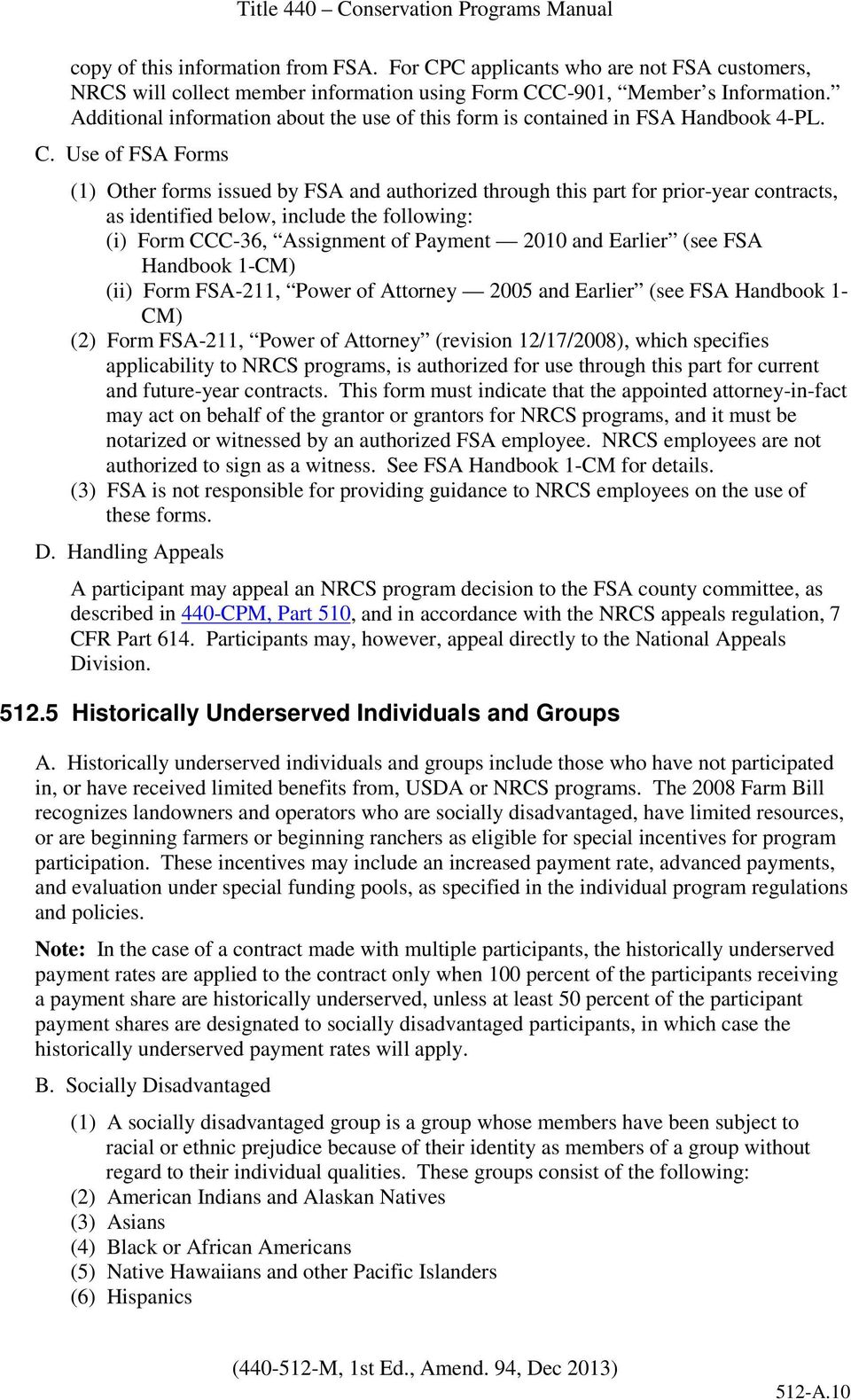
11 Note: Gender alone is not a covered group for the purposes of NRCS conservation programs. C. A socially disadvantaged applicant is an individual or entity who is a member of a socially disadvantaged group. For an entity, at least 50-percent ownership in the farm business must be held by socially disadvantaged individuals. As used in this definition, entities reflect a broad interpretation to include partnerships, couples, legal entities, etc. There is no validation process for participants who self-certify as belonging to a socially disadvantaged group. D. Limited Resource (1) To be considered a limited-resource farmer or rancher, an applicant must meet both of the following criteria: (i) Direct or indirect gross farm sales of not more than the current indexed value in each of the previous 2 years (ii) Total household income at or below the national poverty level for a family of four, or less than 50 percent of county median household income in each of the previous 2 years (2) A legal entity or joint operation can be a limited-resource farmer or rancher only if all of its individual members independently qualify. (3) A self-determination tool is available to the public and may be completed online at or printed and completed in hardcopy. (4) Applicants who self-certify eligibility as a limited resource farmer or rancher may be requested to provide records to justify their claim. It is the responsibility of the applicant to provide accurate data. False certifications are subject to criminal and civil fraud statutes. E. Beginning Farmer or Rancher (1) A beginning farmer or rancher is an applicant who meets both of the following criteria: (i) Has not operated a farm or ranch, or has operated a farm or ranch for not more than 10 consecutive years Note: This requirement applies to all members of a legal entity. (ii) Will materially and substantially participate in the operation of the farm or ranch In the case of a contract with an individual, individually or with the immediate family, material and substantial participation requires that the individual provide substantial day-to-day labor and management of the farm or ranch, consistent with the practices in the county or State where the farm is located. In the case of a contract made with a legal entity, all members must materially and substantially participate in the operation of the farm or ranch. Material and substantial participation requires that the members provide some amount of the management, labor, or both necessary for day-to-day activities, such that if the members did not provide these inputs, operation of the farm or ranch would be seriously impaired. (2) Applicants who self-certify eligibility as a beginner farmer or rancher may be requested to provide records to justify their claim. It is the responsibility of the applicant to provide accurate data. False certifications are subject to prosecution and litigation under criminal and civil fraud statutes. F. Indian Tribes 512-A.11

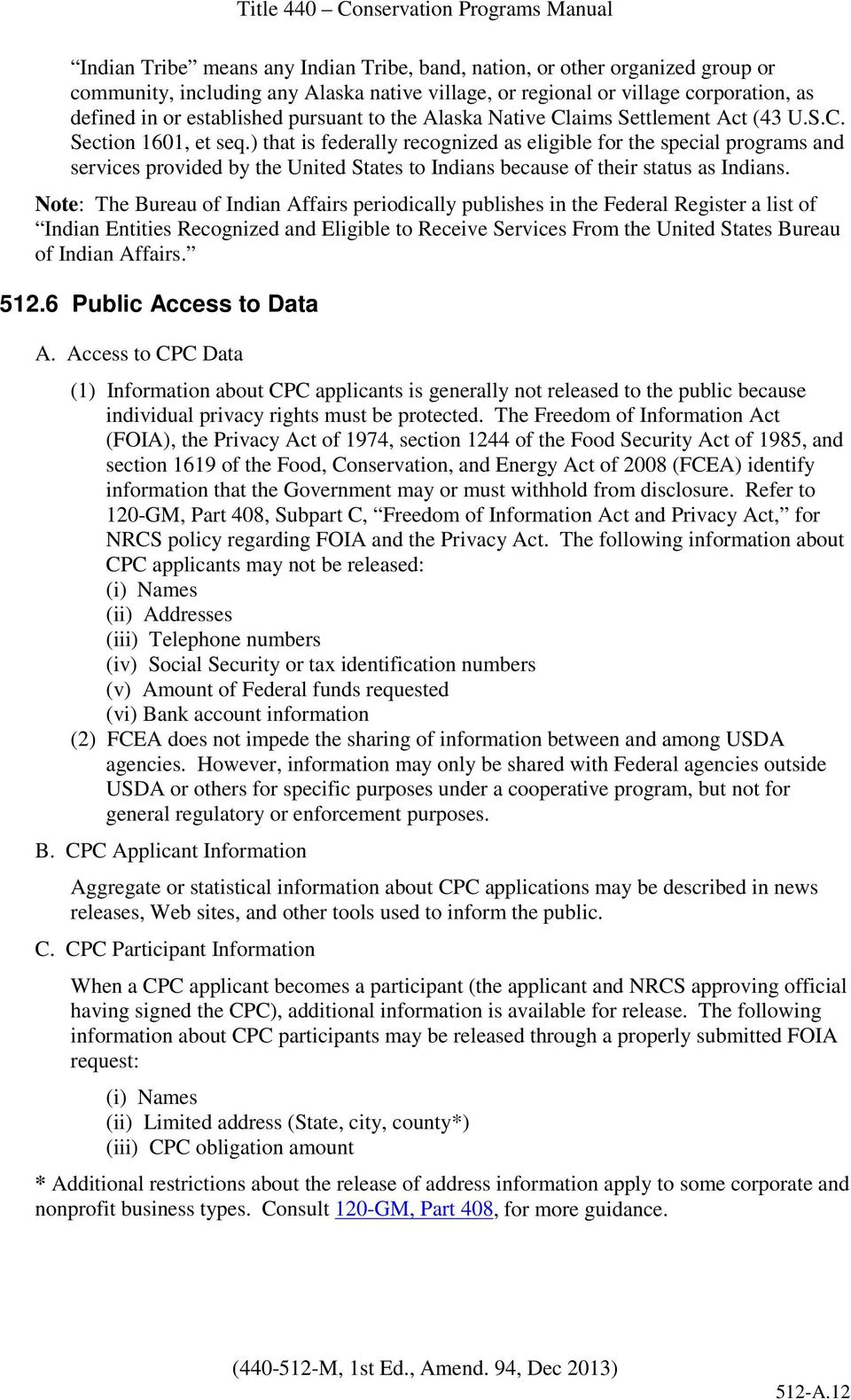
12 Indian Tribe means any Indian Tribe, band, nation, or other organized group or community, including any Alaska native village, or regional or village corporation, as defined in or established pursuant to the Alaska Native Claims Settlement Act (43 U.S.C. Section 1601, et seq.) that is federally recognized as eligible for the special programs and services provided by the United States to Indians because of their status as Indians. Note: The Bureau of Indian Affairs periodically publishes in the Federal Register a list of Indian Entities Recognized and Eligible to Receive Services From the United States Bureau of Indian Affairs Public Access to Data A. Access to CPC Data (1) Information about CPC applicants is generally not released to the public because individual privacy rights must be protected. The Freedom of Information Act (FOIA), the Privacy Act of 1974, section 1244 of the Food Security Act of 1985, and section 1619 of the Food, Conservation, and Energy Act of 2008 (FCEA) identify information that the Government may or must withhold from disclosure. Refer to 120-GM, Part 408, Subpart C, Freedom of Information Act and Privacy Act, for NRCS policy regarding FOIA and the Privacy Act. The following information about CPC applicants may not be released: (i) Names (ii) Addresses (iii) Telephone numbers (iv) Social Security or tax identification numbers (v) Amount of Federal funds requested (vi) Bank account information (2) FCEA does not impede the sharing of information between and among USDA agencies. However, information may only be shared with Federal agencies outside USDA or others for specific purposes under a cooperative program, but not for general regulatory or enforcement purposes. B. CPC Applicant Information Aggregate or statistical information about CPC applications may be described in news releases, Web sites, and other tools used to inform the public. C. CPC Participant Information When a CPC applicant becomes a participant (the applicant and NRCS approving official having signed the CPC), additional information is available for release. The following information about CPC participants may be released through a properly submitted FOIA request: (i) Names (ii) Limited address (State, city, county*) (iii) CPC obligation amount * Additional restrictions about the release of address information apply to some corporate and nonprofit business types. Consult 120-GM, Part 408, for more guidance. 512-A.12
13 General A. Basis for CPC Part 512 Conservation Program Contracting Subpart B Conservation Plan Schedule of Operation (1) The basis for CPC is an up-to-date conservation plan documented in the Customer Service Toolkit (CST). The conservation plan describes the conservation practices or activities to be implemented, timing of implementation, location, estimates of payments, conservation and environmental purposes to be achieved, and operation and maintenance required for the life of the practice or activity. (2) All CPCs will be initiated in ProTracts with an upload from CST unless an individual program manual instructs otherwise. (3) Form NRCS-CPA-1155, Conservation Plan or Schedule of Operations, and Form NRCS-CPA-1156, Revision of Plan/Schedule of Operations or Modification of a Contract, populated in CST, will not be utilized for conservation program contracts administered through ProTracts. Only the versions of these forms completed in ProTracts are acceptable. B. Conservation Planning References (1) Title 180, National Planning Procedures Handbook (NPPH), Part 600 (2) Title 180, General Manual (3) Title 190, General Manual, Part 410 (4) Electronic Field Office Technical Guide (efotg) (5) Title 180, National Food Security Act Manual (NFSAM), Parts 510 to 520 (6) Title 440, Conservation Programs Manual (CPM), Part 500, Locally Led Conservation (7) Title 190, National Cultural Resources Procedures Handbook (NCRPH), Part 601 (8) Title 190, National Environmental Compliance Handbook (NECH), Part 610 (9) Title 180, Technical Service Provider Handbook (TSPH), Part 610 C. Communication of Participant Responsibilities The State Conservationist will identify and clearly communicate to participants their responsibilities for complying with all applicable program or regulatory requirements. NRCS s development or acceptance of a conservation plan will not constitute compliance with program or regulatory requirements administered or enforced by another agency. D. Permitting The participant is responsible for obtaining all necessary Federal, State, and local permits to perform the planned work and for furnishing necessary land rights and water rights. NRCS may provide technical assistance to the participant in accordance with specific NRCS conservation program policy. The participant will certify that he or she accepts the responsibility for acquiring all permits, land rights, and water rights by signing the CPC appendix. E. Compliance with the CPC Appendix The participant must comply with all provisions of the CPC appendix. F. Program Requirements (440-V-CPM, Amend. 90, March 2012) 512-B.1

14 The contract must meet all requirements for the specific NRCS conservation program before it can be accepted and approved. The participant must comply with all Federal laws and regulations regardless of any nonconforming State law Applicable Conservation Treatment A. Compatibility with a Planned Resource Management System The conservation treatment included in a conservation plan must be compatible with the planned resource management systems and address the identified resource concerns. B. Technical Requirements for Conservation Treatment Conservation treatment includes any practice or activity that meets program criteria. Practices must be listed in the National Handbook of Conservation Practices with an approved standard in the applicable efotg. All eligible practices are listed on the applicable cost lists for program years through fiscal year (FY) 2007 and payment schedules for program years beginning with FY 2008, as described in Subpart D, Program Payment Schedules, of this part. C. Planning Conservation Practices Conservation practices must be planned, applied, and maintained in accordance with the approved practice specifications on file in the efotg or, in the case of an approved waiver, meets the requirements approved by the authorized NRCS official. D. Practice Lifespan Conservation practice lifespans are established and maintained in the Conservation Practice Standards Web application. All conservation practices established through a CPC should be maintained for the established lifespan. Operation and maintenance (O&M) must be included for each practice with O&M requirements. This can be incorporated as part of the practice narrative or through a separate O&M plan, as necessary. The lifespan of a practice may extend beyond the length of the program contract. The practice lifespan is defined as the time period in which the conservation practices are to be used and maintained for their intended purposes, as defined by NRCS technical references Conservation Treatment Already on the Land Compatible conservation practices or components thereof established before entering into a contract will be used to the extent practical in combination with planned conservation treatment. O&M of the existing practices necessary to meet the objectives of the program will be included as part of the conservation plan. (440-V-CPM, Amend. 90, March 2012) 512-B.2

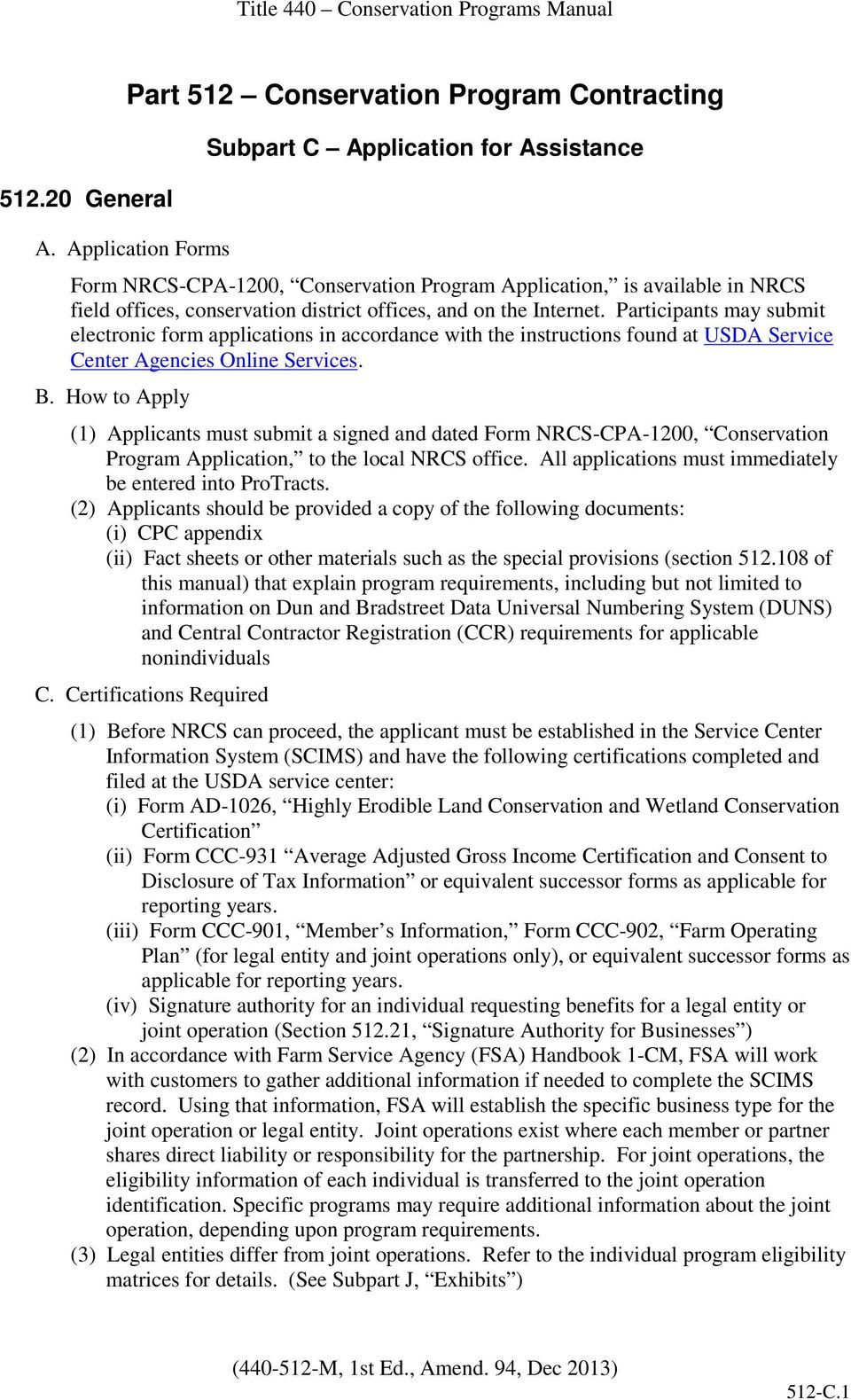
15 General Part 512 Conservation Program Contracting A. Application Forms Subpart C Application for Assistance Form NRCS-CPA-1200, Conservation Program Application, is available in NRCS field offices, conservation district offices, and on the Internet. Participants may submit electronic form applications in accordance with the instructions found at USDA Service Center Agencies Online Services. B. How to Apply (1) Applicants must submit a signed and dated Form NRCS-CPA-1200, Conservation Program Application, to the local NRCS office. All applications must immediately be entered into ProTracts. (2) Applicants should be provided a copy of the following documents: (i) CPC appendix (ii) Fact sheets or other materials such as the special provisions (section of this manual) that explain program requirements, including but not limited to information on Dun and Bradstreet Data Universal Numbering System (DUNS) and Central Contractor Registration (CCR) requirements for applicable nonindividuals C. Certifications Required (1) Before NRCS can proceed, the applicant must be established in the Service Center Information System (SCIMS) and have the following certifications completed and filed at the USDA service center: (i) Form AD-1026, Highly Erodible Land Conservation and Wetland Conservation Certification (ii) Form CCC-931 Average Adjusted Gross Income Certification and Consent to Disclosure of Tax Information or equivalent successor forms as applicable for reporting years. (iii) Form CCC-901, Member s Information, Form CCC-902, Farm Operating Plan (for legal entity and joint operations only), or equivalent successor forms as applicable for reporting years. (iv) Signature authority for an individual requesting benefits for a legal entity or joint operation (Section , Signature Authority for Businesses ) (2) In accordance with Farm Service Agency (FSA) Handbook 1-CM, FSA will work with customers to gather additional information if needed to complete the SCIMS record. Using that information, FSA will establish the specific business type for the joint operation or legal entity. Joint operations exist where each member or partner shares direct liability or responsibility for the partnership. For joint operations, the eligibility information of each individual is transferred to the joint operation identification. Specific programs may require additional information about the joint operation, depending upon program requirements. (3) Legal entities differ from joint operations. Refer to the individual program eligibility matrices for details. (See Subpart J, Exhibits ) 512-C.1
16 Note: The participant must complete and file all documents necessary for FSA to process and determine farm and tract eligibility. If customers have previously provided business information on Form CCC-902, Farm Operating Plan, to establish eligibility for participation in other USDA programs administered by FSA, it is not necessary to collect duplicate information with Form CCC-901, Members Information. If these certifications are not available, NRCS will advise the applicant of additional filing requirements using the program eligibility certification letter found in section The application should remain in pending status until these certifications are completed and processed by FSA. Application evaluation and ranking should not occur until applicant eligibility is determined. D. Review of Applications The designated conservationist must review applications for completeness and consistency with individual or business information maintained in the SCIMS before recording applicant data in ProTracts. Applications will be serviced on the basis of the signup and evaluation cutoff dates, the Application Evaluation and Ranking Tool (AERT) criteria determined for each program, the availability of program funds, and other requirements, as specified for the program Signature Authority for Businesses A. Authorization for Joint Operations and Entities Each joint operation or legal entity must authorize someone to act on its behalf to sign the application, contract, payment request, or other administrative documents. FSA has agreed to give NRCS a copy (upon request) of all documents supporting existing legal entity or joint operations currently on file at the service center. Form CCC-501, Member s Information, and Form CCC-502, Farm Operating Plan for Payment Eligibility Review, provide a list of entity members but do not establish signature authority for the business in and of themselves. B. Signatory Verification (1) NRCS will accept any of the following to verify an authorized signatory for a joint operation, legal entity, or unit of government: (i) A copy of the corporate charter, bylaws, court orders of appointment, trust agreement, last will and testament, articles of partnership, or other legal documents clearly designating who has signature authority for the joint operation or legal entity. Where specific signatory authority is not provided in the documents, all members must sign the contract documents or a power of attorney (POA) designating an individual to act as the attorney-in-fact or agent for the joint operation or legal entity. (ii) Appropriate delegation from a State or local government official having legal authority to obligate a unit of government. This may be in letter form on official letterhead. If the authority is being delegated to a subordinate, the delegation letter must also include the original signature of the designee accepting the delegation. (iii) Self-certification for members of businesses and legal entities operating with an employer identification number (EIN), as indicated on Form CCC-902, Farm Operating Plan, for an Entity 2009 and Subsequent Program Years, or Form CCC-901, Member s Information 2009 and Subsequent Years, or equivalent successor forms as applicable for reporting years. Only members selected on these forms will be considered authorized to sign for the business or legal entity. 512-C.2
17 If they request that an individual other than an authorized member be granted authority to act as an attorney-in-fact on their behalf, they may grant this authority by executing a Form FSA-211, Power of Attorney. (iv) A business enterprise that is representing itself as a joint operation but does not have an EIN may be a CPC applicant but may not receive payments. These business enterprises are sometimes referred to as informal joint ventures. Members are paid directly under their individual identification numbers, and these types of business enterprises may or may not qualify for higher payments or contract limits that are available to joint operations with an EIN. Therefore, all members of this type of business enterprise must be signatories to the contract for their individual interest. An agent for the business enterprise may be designated on Form FSA-211, Power of Attorney, if signed by all members. However, this delegation of authority to sign on behalf of the business enterprise is only for enterprise s interest and does not extend POA authority for the individual members. If they request that an individual be granted authority to act as an attorney-in-fact on their behalf, they may grant this authority by executing a separate Form FSA-211, Power of Attorney. Note: Form CCC-901 or CCC-902, or equivalent successor forms as applicable for reporting years, only document signature authority for legal entities. All self-certifications of signature authority for legal entities are subject to verification by supporting documents. By definition, joint operations and informal joint ventures are not legal entities and no such records exist. (2) NRCS will accept the following POA documents executed for programs and years: (i) For EQIP contracts obligated before October 1, 2005, a POA filed with FSA using Form FSA-211, Power of Attorney, that provides signature authority for all administrative actions. (ii) For all NRCS program contracts obligated in 2009 and earlier, a notarized POA on Form NRCS-CPA-009, Power of Attorney, that provides signature authority for an individual to represent another individual, a legal entity, or joint operation for all administrative actions associated with a program application or contract (see Section , Summary of Forms Used ). (iii) For all NRCS program contracts obligated in 2009 and later, a Form FSA-211, Power of Attorney, witnessed by an FSA employee or notary public, which specifically provides signature authority for NRCS programs. Note: Under 7 CFR Part 718, spouses may sign on behalf of one another without a POA for the purposes of specific FSA programs. This authority is specific to FSA programs and does not extend to NRCS programs. C. Local FSA Office Requirements The local FSA office may require additional identification or signature authorities from an NRCS program applicant before processing applicable forms required to determine eligibility Eligibility A. Who May be Eligible (1) A contract may be entered into with one or more participants having control of a land unit for the contract period. The word control means possession of the land by ownership, written lease, or other legal agreement. The participant will self-certify control of the land unit and relationship (owner, operator, or both) on Form NRCS- 512-C.3
18 CPA-1200, Conservation Program Application, at the time of application. If the applicant is a tenant, the applicant must obtain written evidence or assurance of control from the landowner prior to contract obligation. Self-certifications will be reviewed and verified in the year of fund obligation, as directed in section of this part. In addition to self-certification of control, tenants must obtain and provide to NRCS prior to obligation written concurrence of the landowners to apply a structural or vegetative practice. The landowners may be signatory to the contract to indicate their concurrence. (2) A minor is eligible only if legally responsible and independently participating in the operation of the farm or ranch as an eligible individual. A parent or legal guardian must also be signatory to the CPC. (See 7 CFR Part 1400.) (3) A foreign person who is providing land, capital, and a substantial amount of personal labor in the production of crops may be eligible if he or she meets all other program eligibility requirements. (See 7 U.S.C. Section ) (4) NRCS employees may become CPC participants and receive payments. However, they must follow the ethics guidance contained in Title 110, General Manual (GM), Part 405, Subpart G, Employee Participation in NRCS Programs. (5) Conservation district employees are subject to the ethics requirements specified in the approved cooperative working agreement between NRCS and the conservation district. B. Applicant s Status The applicant will self-certify whether he or she is a limited-resource producer, beginning farmer or rancher, or socially disadvantaged farmer or rancher, as appropriate for the program. All members of a legal entity or joint operation must meet the requirements for the application to qualify for limited-resource or beginning farmer or rancher status. Definitions are available on the NRCS Web site at Applicants who self-certify as a limited-resource farmer or rancher may also utilize this Web site to access the self-determination tool. Due to the personal information required, NRCS employees will not complete the determination tool for applicants. C. Other Eligibility Land and applicant eligibility verified manually is identified on the ProTracts participant information screen as other eligibility. Each conservation program has specific requirements that are contained in the respective program regulation or program part of Title 440, Conservation Program Manual (CPM). Web links for program eligibility requirements are in Section , Summary of General Program Eligibility. D. Basic Eligibility Requirements Basic eligibility requirements include the following: (i) A person who is determined ineligible for USDA program benefits under the highly erodible land conservation (HELC) and wetland conservation (WC) provisions of the Food Security Act of 1985 may not participate in applicable programs or receive any payments for the crop year that the person is found ineligible and, for HELC, all subsequent years that the person remains ineligible. For violations of the WC provisions, a person will not be eligible to participate or receive benefits for the crop year of the conversion and all subsequent crop years. ProTracts will verify this determination before contract obligation, changes by a modification, and before each payment. 512-C.4

19 (ii) A person or legal entity is not eligible to receive program payments if his, her, or its average adjusted gross income (AGI) exceeds certain amounts specified in the authorizing statute or regulation. The Chief may, on a case-by-case basis, waive the AGI limitation when necessary for the protection of environmentally sensitive land of special significance. See required documentation in section of this manual. Any payment issued to a legal entity, general partnership, or joint operation that has members who do not meet the AGI requirement will be reduced by an amount that is commensurate with their direct or indirect ownership interest. Previously ineligible applicants may reapply in subsequent years if their income status changes. An eligibility determination is required before the application is promoted to eligible status and verified at contract obligation. The AGI determination is based on the year for which the conservation program contract is approved and the determination will apply for the entire term of the subject contract unless there is a change in contract participants or legal entity membership. For successors to an approved contract, the determination is based on the date of succession, not on the original approval date of the contract. (iii) Eligibility requirements must be verified in ProTracts prior to an application s being promoted from pending status to eligible. ProTracts will use the SCIMS business type to test the eligibility records for HELC, WC, and AGI compliance using the FSA subsidiary Web service, and payment limitations and other eligibility though the NRCS fund manager processes. Refer to Section , Program Eligibility Matrices for Individuals, Entities, and Joint Operations, for program-specific eligibility matrices. (iv) Applicants must comply with the provisions for protecting the interests of tenants and sharecroppers, including the provisions for sharing payments on a fair and equitable basis. Consent must be obtained, in writing, from each identified tenant or sharecropper before excluding them from a contract to ensure that all parties having a share in the agricultural operation receive equitable treatment. This determination is applicable before contract obligation and to all owner or operator changes during the term of the contract. E. Eligibility Relationships among USDA Conservation Programs Figure 512-C1 Program Environmental Quality Incentives Program (EQIP) (440-CPM, Part 515, Subpart F, Section ) Agricultural Management Assistance (AMA) (440-CPM, Part 521, Subpart E, Sections and ) Relationship Land currently enrolled in other USDA programs is ineligible to receive financial assistance payments or other benefits under EQIP for the same practice on the same land. Land under other conservation programs that provide payments is eligible if AMA is being used to Treat a different resource concern. Provide a higher or improved level of treatment for a similar resource concern than obtained with the other conservation program. 512-C.5
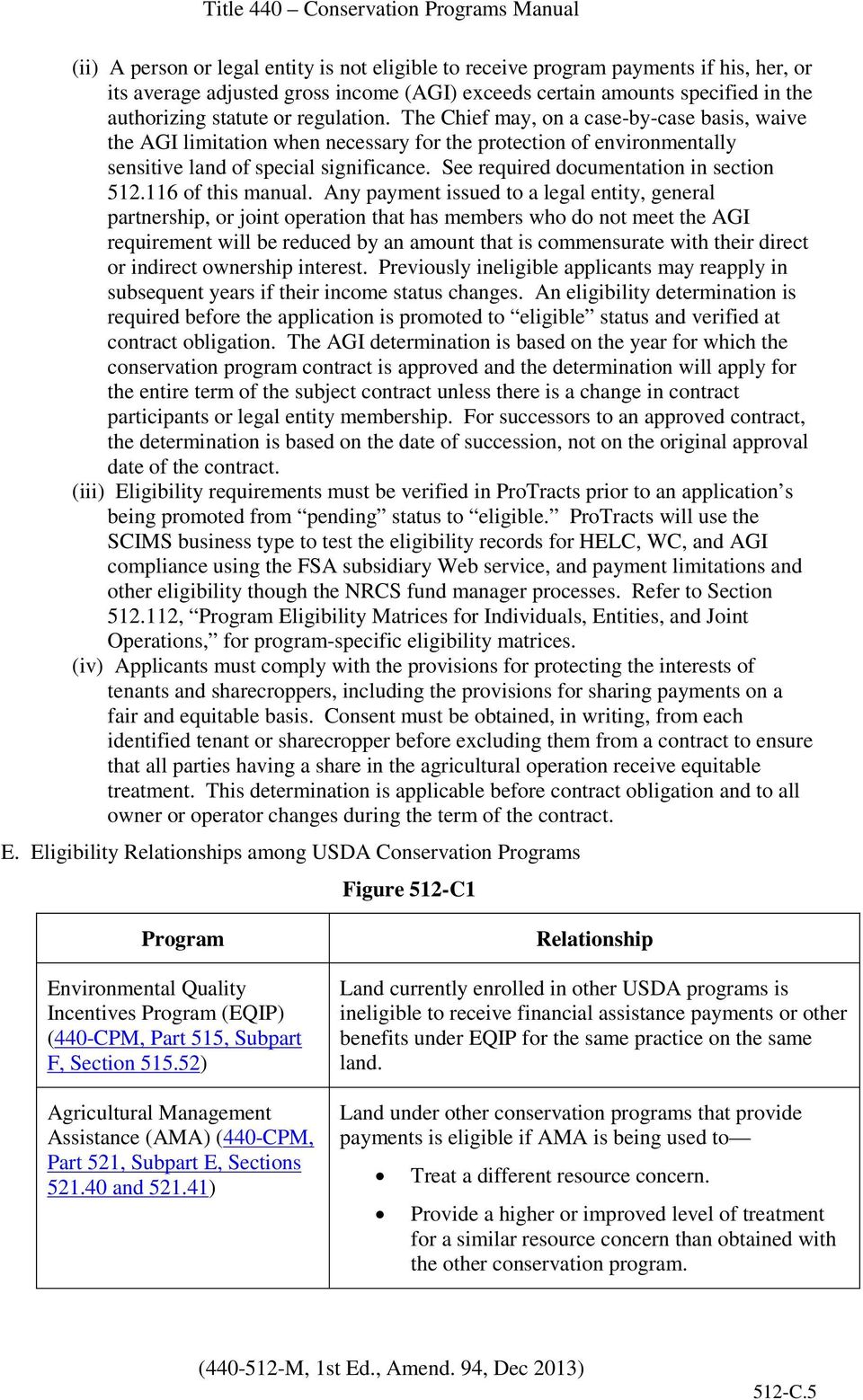
20 Wildlife Habitat Incentive Program (WHIP) (440-CPM, Part 517, Subpart C, Section ) Conservation Security Program (CSP 2002) (440- CPM, Part 518, Subpart E, Section , and Subpart I, Section ) Land currently enrolled in the following programs is ineligible: Water Bank Program Emergency Watershed Program, on land that is subject to a floodplain easement Conservation Reserve Program (CRP) Wetlands Reserve Program (WRP) Grassland Reserve Program (GRP) Health Forests Reserve Program (HFRP) Exception: The State Conservationist may fund a WHIP contract along with a GRP contract if both of the following requirements are met: Wildlife habitat is the primary resource concern. The GRP contract is for an easement. Land currently enrolled in any of the following programs is ineligible: CRP WRP GRP Land enrolled in any other USDA program is not eligible to receive payments under the CSP for the same practices or activities on the same land at the same time. F. Treatment of Indian Tribes, Alaskan Native Corporations, and Trusts Involving the Bureau of Indian Affairs (BIA) A unique situation occurs in contracting with Indian Tribes and related corporations and trusts. The following provides eligibility requirements and ProTracts processes. (i) ProTracts does not maintain a payment limitation record for program participants categorized as Indians Represented by the Bureau of Indian Affairs, as Indian Tribes are exempt. State Conservationists (STCs) must maintain a process to document compliance with the payment limitations. The fund manager report, Foundation Financial Information System Financials Payment Limitation Summary by Contract Participant, may be accessed by approved financial management staff for tracking the applicable payment records. Payments exceeding the payment limitation may be made to the Tribal participant if a BIA official certifies in writing that no one individual will receive more than the payment limitation. The BIA must provide, annually, a listing of individuals and of payments made, by tax identification number or other unique identification number, during the previous year for calculation of overall payment limitations. The BIA must also produce, at the request of NRCS, proof of payments made to 512-C.6
21 the person or legal entity that incurred costs or sacrificed income related to conservation practice implementation. (ii) Enforcement of HELC, WC, and other eligibility requirements for Indian Tribes represented by BIA and Alaska Native corporations began for new contracts in fiscal year Indian Tribes and Alaska Native corporations are exempt from Adjusted Gross Income eligibility determinations. ProTracts warnings will continue when eligibility cannot be determined on prior-year contracts. See Section , Program Eligibility Matrices for Individuals, Entities, and Joint Operations, for additional guidance Submitting Applications A. Submitting Applications (1) All applications must be submitted to NRCS using Form NRCS-CPA-1200, Conservation Program Application. The form must be signed and dated by the applicant. The minimum size for an application is a field. If a program request is received by any means other than on Form NRCS-CPA-1200 such as by telephone, , or letter, an NRCS representative will manually prepare Form NRCS-CPA- 1200, Conservation Program Application, by entering or noting, as applicable, all of the following: (i) Name of applicant (ii) Date request was received (iii) How request was received (attach a copy of the original submission by the applicant if applicable) (2) When applications are received by means other than hardcopy, the program applicant remains responsible for verifying that NRCS has received, accepted, and properly recorded his or her application for consideration. Applicants may request and will be provided a photocopy of their completed application with NRCS s date stamp or other means of identifying receipt. B. Request for Signatures For unsigned applications and applications received by telephone, , or letter, NRCS will ask the applicant to visit the office or otherwise make arrangements to sign and date the NRCS prepared application Form NRCS-CPA Refer to Section B, Signing and Approving Contract Documents, for faxed or scanned signature acceptance requirements. C. Starting Practices Included in the CPC (1) Practices started or completed before CPC approval are not eligible for payments, in accordance with the applicable program regulation and the CPC appendix. Starting a practice or engaging the services of a technical service provider before the contract is approved by NRCS renders an applicant ineligible for payment. A waiver for starting financially assisted practices may be granted by the STC. Requests for a waiver to this provision must be made in writing. Waivers may be considered in special cases and for meritorious reasons for applications that meet all eligibility requirements described in Section , Processing Applications, provided all of the following additional conditions are met: (i) The practice was not started when the waiver application is made. (ii) They have an up-to-date conservation plan and completed environmental evaluation worksheet (Form NRCS-CPA-52). 512-C.7
22 (iii) Meritorious reasons are documented, which include any of the following: Alleviation of imminent and significant environmental problems Prevention of endangerment to life or property Unusual or extreme weather constraints (2) For an applicant to remain eligible, the waiver must be granted after application for the program has been made but before starting the practice; otherwise, the applicant is ineligible to receive financial assistance for the conservation practice once the CPC is signed. This waiver will expire on a date determined by the STC, but no later than September 30 of the current fiscal year. NRCS will inform applicants who have been granted a waiver that this waiver does not guarantee contract approval and that they may be ineligible to receive payments if either the applicant or practice does not meet all NRCS requirements. See section for a waiver to begin a conservation practice letter template Processing Applications A. All applications must be entered into ProTracts. Upon receipt of an application for program assistance, the designated conservationist (DC) must check the application for completeness and accuracy. If any information is missing or items in the application need further clarification, the application must be returned to the applicant with instructions for completing any missing or incomplete items. Once the application is complete, the DC will immediately (1) Enter all required application data into ProTracts prior to the end of the ranking period cutoff date (application status is pending in ProTracts). (2) Confirm that other eligibility requirements (for example, applicant has an interest in the agricultural operation) have been met by the applicant and document in the Participant Information screen of ProTracts. (3) Confirm applicant information (for example, correct name and spelling, tax identification and type, and complete address). B. Several additional steps also will occur. (1) ProTracts will use the SCIMS and tax identification numbers to confirm HELC, WC, and AGI compliance through a Web service link to FSA eligibility files. ProTracts flags for the applicant will be automatically set to match FSA records. (2) Applicants without current eligibility determinations processed by FSA will be asked to file the appropriate forms. Section provides a letter template for advising applicants to file certification requests for the current year at the USDA service center. (3) The Web service link to FSA records will provide member information (for legal entities and joint operations) used to attribute payments and apply potential commensurate payment reductions for AGI-ineligible members and a payment limitation record for program applicants. (4) Applications will remain in pending status until all participant and land eligibility requirements have been met and the applicant has indicated the subaccount in which they wish to compete. NRCS is under no obligation to evaluate or rank an application until these requirements are met. Refer to section for applicant notification of program eligibility certification requirements. (5) If ineligibility of the land or applicant is confirmed, applicant will be notified of this determination and must be provided appeal rights according to 440-CPM, Part C.8
23 See section for a letter template on ineligibility determination for CPC. The application status in ProTracts will be changed to ineligible Evaluating Applications A. Use of Application Evaluation and Ranking Tool (AERT) (1) All eligible AMA, EQIP, and WHIP applications received within the designated ranking period (see Section , Processing Applications ) that meet applicable screening tool requirements and applications deferred from a previous fiscal year or ranking period (Section , Servicing Unfunded Applications ) will be evaluated in the applicant selected subaccount using AERT with current fiscal year criteria developed for each program and subaccount, as described in the applicable part of the CPM. The AERT is the only authorized method for documenting application ranking. Side records or questions documented outside AERT are not acceptable. The AERT is accessed through ProTracts and directly integrated with conservation practice physical effects and practice average cost in SmarTech. The conservation practice standard application is also coupled with these applications. (2) National, State, and local questions are required in all ranking tools, and messages in AERT will indicate at release if not in place. States are required to distribute 25 percent of the total ranking points to national questions. The remaining 75 percent will be divided, with 10 percent to the efficiency score, at least 25 percent to local questions, and the balance to State questions. B. Responsibilities The STC, with advice from the State Technical Committee and local working groups, will develop a ranking process to prioritize the applications for funding that addresses priority natural resource concerns and any other criteria required by the applicable program regulation. C. Evaluating Applications The evaluation process may include (i) Using a screening process that may include sorting applications into high, medium, or low priority. (ii) Defining an acceptable suite of practices for a conservation system that meets quality criteria for various resource concerns. (iii) Defining a threshold for high-priority applications. Thresholds will be based on target levels or benchmark conditions defined for a particular natural resource concern. (iv) Considering readiness of applicant to complete all contract items within 2 years after contract obligation. (v) Considering applicant s prior adoption of management practices on other active or completed contracts. D. Application Funding The State Conservationist or designated conservationist, as delegated, will periodically select the highest-ranked applications (based on applicant eligibility and the NRCS ranking process) for funding. Applications within a subaccount must not be skipped to allow funding of a lower-ranked application. E. Managing Applications 512-C.9
24 All applications received and determined eligible at the close of the announced program evaluation period must be included in the AERT and on the ranking lists. If a screening tool is used, those applications receiving high enough priority to be ranked will be included in the AERT. At the end of each ranking period, the program-specific ranking list from AERT for each subaccount will be archived in hardcopy and retained in the appropriate file, in accordance with 120-GM, Part 408, Records Status of Applications ProTracts users will manage applications according to the delegations outlined in Section 512.3, NRCS Responsibilities. The application status categories available in ProTracts are described in Figure 512-C2. Figure 512-C2 Status Draft Pending Eligible Preapproved Definition, Impacts, and Related Information An application status automatically is set when a user opens the add new application module. An application status automatically is set after the location of the land being offered has been specified and the applicant information has been entered and saved in ProTracts. This status will result in the generation of the letter shown in section if eligibility determinations are not complete according to sections C through E. Upload from the CST is not permitted for this status. Application status is manually set by user and refers to program eligibility ( other eligibility as referenced in the ProTracts participant information screen; for example, control of land, etc.). This does not exclusively refer to participant eligibility, which is transmitted from the FSA s Web-based subsidiary file. An application may be manually set to eligible when it has an applicant, county, and application number; is pending in ProTracts; meets all program eligibility criteria; and HELC, WC, and AGI requirements have been met. NRCS is under no obligation to evaluate and rank applications until they have achieved this status. All eligible applications received by the close of the evaluation period will be ranked for funding. Upload from CST is permitted for this status. An application has been tentatively selected for funding based on an estimated contract cost, but the applicant has not confirmed his or her contract interest. This required status is set manually and triggers the letters shown in sections and Upload from CST is permitted for this status. Banking information will be established for generating the vendor record after promoting to this level. 512-C.10
25 Approved Ineligible Disapproved Cancelled Deferred A status chosen after an application has been selected for funding and applicants interest has been confirmed. This status is set by ProTracts users with permission to select an application for funding. This action causes the contract cost to be reserved in the ProTracts ledger (fund commitment) but the commitment is not transacted to the Financial Management Modernization Initiative (FMMI). This action will record a commitment on the ProTracts ledger and reduce the balance available for application approval. Upload from CST is not permitted for this status. Ranking score is required to set this status for programs that require ranking with the AERT. An application is not eligible for the program based on one or more of the eligibility criteria shown in the ProTracts participant information screen. This flag is set manually by the user and triggers the letter shown in section Upload from CST is not permitted for this status. An application was not selected for funding. This status is set manually by the user. This category is unique to CSP 2002 applications that were offered under the 2002 Farm Bill and were determined eligible but not funded due to insufficient program funding. For all other programs, the status will be either deferred or cancelled. This reflects an applicant s request to cancel an application. It is set manually by users with permission to cancel applications. An eligible application was not chosen for funding but remains as an active application for the next funding period. Deferred applications can be promoted to the next fiscal year. This action permanently resets the contract year, contract number, fund code, payment schedule, and AERT data. Contract items are removed from the application. This status is set by users with permission to defer applications and triggers the letter shown in section Servicing Unfunded Applications At the end of each program funding period, generally the end of the fiscal year, all eligible but unfunded applications will be deferred to the next funding period and will be changed to deferred status in ProTracts. A deferral letter (see section ) will notify the applicant of the options to continue as is, modify the application, or cancel the application. Cancelled applications should be so designated in ProTracts. All deferred applications will be promoted by the designated conservationist to be ranked in the next fiscal year. Note: An application for any deceased person will be canceled by the designated conservationist. Successors wishing to continue the application must sign a new application. 512-C.11
26 Part 512 Conservation Program Contracting Subpart D Program Payment Schedules Methods of Making Conservation Program Payments A. Payment Methods (1) Payments for conservation program contracts (CPCs) obligated through ProTracts after September 30, 2007, will be based on the following: (i) Payment rate (PR) documented in approved payment schedules will be used for all payments using financial assistance (FA) funds. PR is based upon estimated incurred costs and income foregone associated with practice implementation. (ii) Actual cost, not to exceed a specified maximum (AM), will be used for technical service provider (TSP) payments (Code 900 series practices for services of conservation planning, design, construction layout, and construction checkout for a program-funded practice) using technical assistance (TA) funds. (iii) A non-cost-shared (NC) method may be utilized only for Wildlife Habitat Incentive Program (WHIP) contracts. (iv) Payment schedules are used to document payment rates administered through ProTracts for the following programs: Environmental Quality Incentives Program (EQIP) Agricultural Management Assistance (AMA) Program Wildlife Habitat Incentive Program (WHIP) (v) Program payment schedules are not used to document or support payments made through the Conservation Security Program or Conservation Stewardship Program. Note: Program payments that use a calculation based upon a percentage multiplied by the actual cost of practice installation or cost share, are no longer used for establishing contract payments after October 1, ProTracts no longer uses actual costs or percent cost share to calculate program payments, therefore, concerns regarding over or under payment is no longer relevant. The currently used program payment percentages (i.e. 50 percent, 75 percent, 90 percent) are statuteestablished maximum payment limitations, not to be confused with cost-share percentages based upon actual incurred cost. See section B(8) for explanation. (2) During fiscal year (FY) 2007, average cost (AC), actual not to exceed a maximum (AM, and flat rate (FR) methods were authorized for financial assistance obligations. Contracts obligated in FY 2006 and earlier used methodology associated with AM, FR and similar payment methods. B. Definitions and Guidance Definitions, methods of payment, and detailed guidance for development of payment schedules are found in the following directives: (i) Title 440, Conservation Programs Manual (CPM), Part 502, Common Terms (ii) Title 300, Payment Schedule Handbook (PSH), Part 600, Payment Schedules Payment Schedules A. Scope of Payment Schedule Use Effective October 1, 2007, payment schedules are used to document all authorized costs and payment rates used to support EQIP, WHIP, and AMA program contracts administered through ProTracts. All contracts prior to this date are supported by cost lists using other payment methodology. Payment schedules must reflect estimated incurred costs appropriate to encourage voluntary implementation of ( M, 1st Ed., Amend. 95, Dec 2013) 512-D.1
27 conservation practices meeting NRCS technical standards, cost effectiveness to achieve the desired environmental benefit, and adhere to program requirements. Payment schedules are required to provide a description (scenario) and cost data within the context of a program s authority to justify a payment rate for each conservation practice supported by a program. The documentation of typical practice costs in payment schedules and the process to develop program payment rates are an inherently governmental activity. The methodology the agency uses to develop payment rates and the documentation of estimated in published payment schedules may be shared with State Technical Committees, the public, and other partners. B. Requirements for Developing Payment Schedules (1) National Process. The agency has established a national process for development, review, and approval of all payment schedules used to support payment rates in program contracts administered through ProTracts. (2) Program Neutral. Only one payment schedule, using program-neutral costs, may be developed for each approved conservation practice or activity each fiscal year. To manage final cost list payment rates, State Conservationists must establish program payment percentages in each payment schedule as allowed per 440-CPM, Part 512, Subpart D, Section , and subject to the following: (i) Unless specified through national guidance, State Conservationists (STC) must establish appropriate program payment percentages for each cost category based upon input from State Technical Committees, partners, or other stakeholders. Additional guidance is provided in 300- PSH, Part 600, Payment Schedules. (ii) Program payment percentages may not exceed the maximum payment percentage per 440- CPM, Part 512, Subpart D, Section (3) Technical Standards. All conservation practices implemented with financial and technical assistance must meet the minimum technical design criteria of the conservation practice standard, activity, or planning criteria published in the Field Office Technical Guide (FOTG). Costs documented in a payment schedule must be appropriate to meet the definition and purpose of the FOTG criteria, and achieve a positive environmental effect as documented in the Conservation Practice Physical Effects (CPPE) database. (4) One Payment Schedule Per Practice. Payment schedules may only address the costs associated with a single stand-alone practice and as defined in the practice standard or planning requirements. Payments for other stand-alone practices may not be bundled or included in another stand-alone practice payment schedule (e.g., Pump Practice (533) may not be included in the payment for Irrigation Pipeline (430)). (5) Cost Categories. Cost categories appropriate for each program are described in 440-CPM, Part 512, Subpart D, Section Not all cost categories are appropriate for all practices. Refer to the Payment Schedule Handbook and other annually issued technical references for additional guidance for appropriate use of cost categories. Only those costs and cost categories that are authorized for program payment will be documented in payment schedules. (6) Component Payments Are Not Allowed. Program payments for incomplete practices, partial extents, components, or activities that do not meet the purpose, definition, and minimum requirements of the practice standard are not allowed. (7) Scenario Requirements. The payment schedule scenario is required to provide a general description of practice application for a typical resource setting and the following: (i) The scenario is used to Establish a basis for determination of the commonly used components and activities associated with a practice. Describe application of a practice on a national or regional scale in typical resource situations. Help document estimated incurred costs, foregone income, and support an appropriate payment rate. ( M, 1st Ed., Amend. 95, Dec 2013) 512-D.2
28 Assist the field planner select the most appropriate scenario for the resource setting. (ii) The scenario is not used to Dictate the technical requirements or design of a practice. Represent application of a practice for a geographic area less than that of a State. Develop a description of every situation that may exist where the practice is applied. (iii) Practice scenarios are initially established by national technical leads for each practice or activity to address common application of a practice for typical resource settings. (iv) The national process provides opportunity for States and regional teams to modify or add additional scenarios needed to address typical practice application that may not be addressed in nationally established scenarios. (v) The maximum number of scenarios that may be developed for a specific practice payment schedule are established by each national technical lead. (vi) Additional guidance and minimum requirements for documentation of payment schedule scenarios is found in 300-PSH, Part 600, Payment Schedules. (8) Estimated Incurred Cost and Income Foregone. Program payment rates are based on the estimated incurred costs and income foregone associated with practice implementation. This negates the need for collection of receipts or invoices for payment purposes and streamlines the delivery of program benefits. (i) Estimated incurred costs are based upon the typical costs of components and activities associated with practice implementation as documented in payment schedule cost categories. Only those components and costs needed that meet the minimum requirements of the practice standard to address the identified natural resource concern may be documented in a payment schedule. (ii) Estimated costs associated with income foregone may be allowed when conservation practice implementation results in significant net income loss due to a change in land use or land taken out of production. Income is an actual calculated cost representing income foregone that is not to be confused with previous authority associated with incentive payments, which are not allowed. The amount of income foregone allowed in payment schedules is limited to the estimated annual net loss during the year of practice implementation, not the estimated loss over the life of practice. The calculation for inclusion of foregone income in payment rates is subject to approval by the Deputy Chief for Programs and uses same rigorous process for other estimated incurred costs. Additional guidance and details when this cost is appropriate can be found in the 300- PSH, Part 600. (9) Considerations to Address Least-Cost. Cost effectiveness is defined in regulation and 440-CPM, Part 502, as the least-costly option for achieving a given set of conservation objectives. Consideration to achieve least-cost must be used during the following activities and methodology used to support development of appropriate payment rates that meet requirements of cost effectiveness: (i) Payment Schedule Components. The selection of components will be based on what is typically needed to meet the minimum requirements of the practice standard, address the resource concern, and also represent the least-costly alternative. (ii) Payment Schedule Payment Percentages. The selection of an appropriate payment percentage should also consider the minimum or least-costly percentage needed to encourage participation in the program. Program payment percentages are recorded in payment schedules to establish the percentage of typical expenses for each cost category that may be included in the final payment rate. (10) Practice Lifespan. The payment schedule should include components that allow the practice to be operated for the specified lifespan and to meet the intended conservation purpose of the standard, activity, or planning criteria. This does not require that each funded component by itself meet the lifespan, but rather that the combined total of all required components together serve to allow the ( M, 1st Ed., Amend. 95, Dec 2013) 512-D.3
29 practice to meet the intended lifespan if operated and maintained according to the required operation and maintenance (O&M) plan. Specific components originally included in the payment schedule that alone cannot meet the lifespan requirement may need to be replaced or repaired according to the O&M plan. The program participant is responsible for expenses associated with O&M. (11) Business Tools. To provide timely final approval to program payment rates for program opportunities in any fiscal year, all conservation practices and activities, payment schedules, and the following business tools must also be updated and ready to use prior to program announcement: (i) Conservation Practice Standards (CPS) database (ii) Conservation Practice Physical Effects (CPPE) database (iii) Practice Average Annual Costs (PAAC) database (12) Quality Review. All payment schedules will be reviewed for quality assurance purposes before released for use. Additional guidance and requirements for quality assurance review of payment schedules is found in the 300-PSH, Part 600. C. Cost Data Requirements (1) The cost data documented in payment schedules is critical for developing appropriate payment rates to support NRCS programs and is managed by the national Cost Team. Cost data documented in payment schedules must meet the guidance provided in the 300-PSH, Part 600, and the following criteria: (i) Necessary to ensure the purpose, definition, and technical requirements of the conservation practice standards to be met (ii) Support the implementation of a conservation practice based on the typical scenarios which address resource concerns in common resource settings (iii) Consolidated data which reflects national, regional, or State geographic areas (iv) Based on credible sources that offer estimates of incurred costs (v) Are appropriately based on program authority and purposes of the supported program (vi) Represent the least-cost material or equipment needed to meet the minimum requirements of the practice standard (2) Payment schedule costs will be developed and reviewed annually by the national Cost Team and if needed, updated when there is a significant increase or decrease in estimated costs. Costs may also change based upon revisions to practice standards that may impact the appropriate components or activities required by the practice each fiscal year. (3) Costs documented in payment schedules must not be based upon a predetermined payment rate, goal, or target amount, including historical perceptions of the amount of payment needed to provide incentive to participate in programs. (4) Geographic Area Requirements (i) Payment schedules must be based upon typical resource settings representing a national, regional, or State geographic area. (ii) To the extent possible, cost data will be consolidated to represent expense associated with practice implemented in common resource settings, economic considerations, and similar technology needs as defined in the scenario. (5) Accepted Data Sources (i) Sources of component data must be credible, reliable, consistent, defensible, and replicable. (ii) Data sources should provide historical accuracy and demonstrate statistical accuracy and, if needed, be able to be duplicated or verified. (iii) Data source must represent typical national or regional costs, but if needed, may be indexed to costs represented at a scale of a State geographic area. (iv) After approval of payment schedules and rates, sources of data should to the extent possible, be freely available without restriction for reasons of proprietary ownership, trademark, or patent laws. Some data may need to be protected to conform to protection of sensitive personal identifiable information (PII) or other confidential information. ( M, 1st Ed., Amend. 95, Dec 2013) 512-D.4
30 Payment Schedule Transparency and Posting A. Payment Schedule Library (SharePoint Web Site) (1) In accordance with this subpart, payment schedule workbooks are uploaded to the NRCS payment schedule library. The SharePoint Web site facilitates the sharing of cost data and payment scenarios among States for assisting with consistency and allows for national oversight. (2) The SharePoint Web site is an internal agency directory accessible by authorized users. Payment schedules may contain references to private and proprietary financial and economic information; the data must remain confidential and protected from public access within the SharePoint Web site. B. Final payment schedule lists must be approved by the STC, posted to the State Web site, efotg, and uploaded into ProTracts before proceeding with CPC development. Once payment schedules have been publicly announced for each program (posted to efotg and the State programs Web sites and uploaded into ProTracts), the list of eligible practices and associated payment rates offered may not be modified. Additional payment schedules may be uploaded into ProTracts when additional or new programs and initiatives are announced and offered. (1) Prior to uploading the payment schedule workbooks, remove all private, personal, or confidential identifying information. Posting the workbook meets the requirement for transparency by making available to the public the process and data justification used by the agency to develop approved payment rates for program benefits. (2) States must use the ProTracts rule checker to verify that all payment schedule formatting and payment methods are accurate based on any unique program requirements (such as permitting noncost-share methods for WHIP). (3) Payment schedule cost lists must be publicly announced and posted on the State Web page no less than 30 days prior to the beginning of any scheduled program ranking period. C. Prior to the publication or uploading into ProTracts, payment schedule lists for EQIP that include practice payment rates greater than 50 percent must be submitted to the Regional Conservationist for review and concurrence. Practice payment rates for initiatives may be announced by the Chief and may include additional review and concurrence requirements. D. The payment schedule used to support the Customer Service Toolkit (CST) and ProTracts is a listing of all eligible conservation practices and activities for defined geographical areas and must be identical for each program and practices supported for program payment. Payment rates that are not documented in an approved payment schedule may not be uploaded to ProTracts. The final approved list uploaded into CST and ProTracts consists of payment rates derived from payment schedules defined in agency policy and the Payment Schedule Handbook. E. For payment schedules developed to address program assistance through formal agreement per section B(2), additional consideration must be provided for coordination with partners for publication and announcement of payment rates. Such coordination is necessary when partners are providing financial assistance in addition to NRCS program payments to assure practice payment rates are appropriate an amount such that the combined total financial assistance to the participant from NRCS and the partner must not exceed the amount needed to encourage voluntary adoption of the practice Maximum Program Payment Percentages A. Maximum Payment Percentages and Authorized Cost Categories The maximum payment percentages, as defined in 440-CPM, Part 502, applicable to each of the cost categories in the payment schedule is established by authority of each program regulation. Figure 512- D1 provides the maximum payment percentages allowed for each program and cost category. Figure 512-D1 ( M, 1st Ed., Amend. 95, Dec 2013) 512-D.5
31 Cost Category and Program Matrix for Payment Schedules: Maximum Payment Percentages by Program and Cost Category Programs => EQIP 2/ and AMA WHIP Cost Category 1/ Regular Percentage Historically Underserved Regular Percentage Historically Underserved Materials 75% 90% 75% 4/ 90% Equipment for Installation 75% 90% 75% 4/ 90% Labor 75% 90% 75% 4/ 90% Mobilization 75% 90% 75% 4/ 90% Acquisition of Technical Knowledge 3/ 75% 90% 75% 4/ 90% Foregone Income 100% 100% 100% 100% The historically underserved category includes limited-resource, beginning, socially disadvantaged, and Tribal producers. Program payment percentages for historically underserved participants must be at least 25 percent above the otherwise applicable program payment percentage, not to exceed a 90 percentage rate. 1/ Cost categories currently approved to document costs in Payment Schedules. (Previously used cost categories of Operation and Maintenance, Risk, and Administrative/Permit Costs are no longer documented or used in payment schedules.) 2/ EQIP payment schedules also support financial assistance for the following programs: Chesapeake Bay Watershed (CBWI), Agriculture Water Enhancement Program (AWEP), Cooperative Conservation Partnership Initiative (CCPI), Great Lakes Restoration Initiative (GLRI), and other agency-established program opportunities. Note: Conservation activities, as defined in EQIP policy, are also subject to maximum payment percentages. 3/ Costs associated with acquisition of technical knowledge or training the participant needs to implement a practice may be used when technical service providers (TSPs) other than NRCS provide technical support. This category supports incurred costs specifically identified in the practice standard needed to successfully implement the conservation practice or activity, but not for travel related expenses. 4/ A maximum payment percentage of 90 percent is available for WHIP contracts where the contract agreement provides for treatment on essential habitat and a contract term of at least 15 years. B. Determining Program Payment Percentages (1) Within the statutory requirements shown in figure 512-C3, program regulations allow the Chief or State Conservationists (STCs) to establish appropriate payment percentages for each practice and payment schedule cost category. For certain nationally established program opportunities that need to be offered consistently throughout the nation, payment percentages may be established through ( M, 1st Ed., Amend. 95, Dec 2013) 512-D.6
32 guidance for specific practices. For all other situations, the STC, with input from State Technical Committees, will set the payment percentage for each program within each State and payment schedule according to policy at section B(2). (2) When the agency enters into a formal agreement with partners who provide financial support to help implement program initiatives, the Chief or State Conservationists must adjust NRCS program payment percentages to provide practice payment rates to an amount such that the total financial assistance to the participant from NRCS and the partner does not exceed the amount needed to encourage voluntary adoption of the practice Management Practices, Foregone Income, Conservation Activities, and Conservation Activity Plans A. Payments for Management Practices (1) Management practices have a maximum practice lifespan of 1 year and are applied annually. Payments for management practices are limited to a maximum of three separate payments during the term of a single contract. Payment schedule scenarios may be constructed to allow for varying payment amounts that may be supported with multiple payments within a single program contract, depending upon the variation in costs incurred and foregone income for each year of payment for the same management practice. (2) The Agricultural Water Enhancement Program (AWEP) includes specific regulatory authority to offer payments for management practices for a period of to 5 years to encourage and assist participants to convert from irrigated farming to dryland farming. B. Conservation Activities (1) The agency has defined a conservation activity as the actions, necessary, using acceptable tools and protocols, to identify, inventory, assess, evaluate, or otherwise measure the presence and extent of a natural resource concern and how to address the natural resource concern through one or more conservation practices. Information gathered as a result of these actions must be essential to the development of a plan that furthers the purposes of the program including a plan that addresses the adoption or adaptation of conservation practices in order to achieve a conservation benefit. (2) Only EQIP is authorized to provide financial support for conservation activities. Additional guidance related to conservation activities is located at 440-CPM, Part 515, Subpart I, Section Conservation activities are not the same as a conservation activity plan, defined in the following section. Conservation activities are not assigned a lifespan. C. Conservation Activity Plans (1) The Food Conservation and Energy Act of 2008 (FCEA) provides authority to use EQIP financial assistance for payment of practices and conservation activities involving the development of plans appropriate for the eligible land of a program participant. The act specifically authorizes EQIP to be used for comprehensive nutrient management plans and other plans that further the purposes of the program. For approved conservation practices, the statute allows EQIP payments for up to 75 percent of the estimated incurred cost of practice implementation, which, for this authority, will be the development of a plan meeting agency standards and requirements. The conservation practice associated with plan development under this authority is known as a conservation activity plan (CAP), defined as the conservation practice associated with the development of an approved conservation plan by an NRCS-certified TSP for which payments are made directly to EQIP participants. (2) Any agency effort funded through EQIP will provide support for authorized conservation activity plans through development of payment schedules. EQIP payments are made directly to program participants for development of approved conservation plans by TSPs. In addition, consistent with program authority, no CAP may be approved for funding through EQIP unless first supported by a ( M, 1st Ed., Amend. 95, Dec 2013) 512-D.7
33 completed Form NRCS-CPA-52, Environmental Evaluation, and an NRCS-approved conservation plan. (3) For conservation activity plans approved by the Chief for EQIP under this authority, the agency will develop payment schedules based upon the estimated incurred cost associated with activity plan development. The data used to estimate the cost of activity plan development will be based on the labor and acquisition of technical knowledge costs associated with the services provided by a certified TSP. Other cost categories, such as foregone income, may not be used to document estimated costs for this practice. Practices approved for development of conservation activity plans are assigned a practice code number in the Conservation Practice Standards (CPS) database to allow use in CST and payment schedules. Costs associated with travel (hotel, mileage, etc.) expenses are not an allowable cost to be included in a CAP payment schedule. (4) Authorized Cost Categories and Maximum Payment Rates to Support Conservation Activity Plans Figure 512-D2 Cost Category and Program Matrix for Payment Schedules Supporting EQIP Conservation Activity Plans: Maximum Payment Rates by Program and Cost Category Authorized Program EQIP 2/ Cost Category 1/ Regular Historically Underserved Labor 75% 90% Acquisition of Technical Knowledge 3/ 75% 90% The historically underserved category includes limited-resource, beginning, socially disadvantaged and Tribal farmers and ranchers. 1/ Definitions of cost categories and instructions for use are found in the Payment Schedule Handbook. The cost categories for materials, equipment and installation, mobilization, and foregone income are not authorized for CAPs. Travel expenses are not authorized for payment. 2/ EQIP payment schedules also support contracts associated with the following programs: CBWI, AWEP, and CCPI. Support for CAPs through other programs is not authorized. 3/ Acquisition of technical knowledge may be used when technical support is only provided by TSPs. ( M, 1st Ed., Amend. 95, Dec 2013) 512-D.8
34 Part 512 Conservation Program Contracting Participant Responsibilities Subpart E Contracting NRCS requires a conservation program participant to (1) Carry out land use changes and conservation treatment according to the specifications in a conservation program contract (CPC). (2) Submit to NRCS an application for payment on Form NRCS-CPA-1245, Practice Approval and Payment Application. (3) In States where actual costs will be collected for use by NRCS in developing cost data, submit to NRCS an itemized statement of cost of materials and copies of contractor s invoices whenever financially assisted practices are part of a selected CPC. Actual cost information will be collected to be used by NRCS in developing practice payment schedules. (4) Permit free access for NRCS and its agents to provide technical assistance and to inspect the work at any reasonable time during the contract period of performance. (5) Upon violation of a program requirement, forfeit all rights to further payments under the contract, refund to NRCS all contract payments received, and pay liquidated damages upon termination of the contract according to the applicable CPC appendix. (6) Upon transfer of his or her rights and interest in the land unit during the contract period, forfeit all rights to further payments under CPC. (7) Upon cancellation of the contract, refund to NRCS all payments made under the contract, unless the cancellation is due to situations cited in Section A, Cancelling and Terminating Contracts. (8) Maintain the conservation treatment installed on the land unit, as provided in the contract, for the lifespan of each conservation practice, as identified on Form NRCS- CPA-1155, Conservation Plan or Schedule of Operations or Form NRCS-CPA- 1156, Revision of Plan/Schedule of Operations or Modification of a Contract. (9) Apply or commence a financially assisted practice within 12 months of the date the CPC is signed and obligated by NRCS, unless the participant requests a waiver in writing and it is approved in accordance with section C. (10) Complete contract items as scheduled. Financial assistance contract items may be accomplished at any time prior to the year scheduled. (An exception is that Conservation Security Program and Conservation Stewardship Program out-year contract items do not have funds obligated to them and, therefore, cannot be paid ahead of schedule.) When contract items cannot be completed in the year scheduled, but will be completed no later than 1 year after the originally planned year, a contract modification in ProTracts is not required to reflect the delay of implementation of the practice. However, when this provision is used, it will be noted on a formal contract review using Form NRCS-CPA-13 because the practice application is not on schedule. Refer to Section , Contract Reviews, for the requirements. Contract items may not be repeatedly delayed or rescheduled to avoid a potential contract violation determination. All required treatment must be installed at least 12 months before the end of the contract period (excluding CSP annual payments). (11) Share responsibility for ensuring that Form NRCS-CPA-1155, Conservation Plan or Schedule of Operations, is accurate and complete. NRCS has no authority to 512-E.1
35 compensate participants for practices or activities that are not in the contract at the time of obligation. (12) Comply with all requirements, as identified in the CPC appendix Joint Agreements Joint agreements are formalized group contracts in which (1) Two or more eligible applicants on two or more operations, intending to substantially pool resources, efforts, finances, or other contributions to mutually address the same resource concerns, may organize as a group. Joint participation is permitted when it will result in greater environmental benefit than individual participation or in a cost savings. (2) Individual applications filed under a joint agreement are ranked as one application or in which a single application for the joint agreement is submitted and signed by all parties. (i) Example 1. Ten dairy farms want to construct an anaerobic digester. It might be considered equitable to calculate a flat rate (dollar amount per ton per year) and assess the cost against each participant based on the volume of manure to be supplied to the digester by each farm. (ii) Example 2. A water-runoff control measure involves 1,000 units of a practice on farm one and 200 units on farm two. On farm one, 20 acres are benefited, and on farm two, 80 acres are benefited. It might be equitable to base the division of cost on each participant s benefited acreage. (3) Participants may enroll in joint agreements according to guidelines established for each program and described in the applicable part of Title 440, Conservation Programs Manual (CPM). All joint agreements must also (i) Identify responsibilities of each party or member of the agreement. Parties may provide formal documentation of the joint agreement outside the CPC s parameters. However, NRCS will enforce the joint agreement and administrative actions based on the participants signing the CPC and the shares established to each participant. A signatory indicator check box on Form NRCS-CPA-1202, Conservation Program Contract, must be marked, designating who may sign for modifications and contractual changes in payment shares. Any CPC participant may sign the application for payment as long as the payment shares remain as contracted. (ii) Include specific provisions for installing, operating, maintaining, and replacing conservation improvements that benefit multiple participants. (iii) Be legally sufficient to bind all agreement participants to comply with its requirements Establishing CPCs in ProTracts A. For an application that ranks high enough to be selected for a contract, the designated conservationist or others with the delegated authority and appropriate ProTracts permissions will (1) Promote the application in ProTracts to preapproved status. (2) Notify the applicants of preapproval. This notice specifies a response date for the applicants to provide additional information NRCS may need to complete a contract. Each individual or business expecting to receive a payment should also be given Standard Form (SF)-1199A, Direct Deposit Sign-Up Form, for establishing an 512-E.2
36 electronic banking record. (See sections and for letter templates on preapproval for a CPC.) (3) Finalize Form NRCS-CPA-1155, Conservation Plan or Schedule of Operations. Technical adequacy certification is required by the designated conservationist. The NRCS approving official s signature is electronically affixed to the schedule of operations and is incorporated as a part of the contract that is approved at obligation. (4) Establish the following records for each contract participant and assignee receiving a payment: (i) Vendor code information Note: The vendor code information is required in ProTracts when an application is being changed to approved status. (ii) Electronic banking information on SF-1199A, Direct Deposit Sign-Up Form (5) Complete technical review and approve the application to affix the application approval electronic signature. (6) Print Form NRCS-CPA-1155, Conservation Plan or Schedule of Operations, Form NRCS-CPA-1202, Conservation Program Contract, and the CPC appendix, then obtain signatures from each participant receiving a payment share for the contract. A participant may sign with a zero share and acknowledge acceptable signature for payments (for example, a spouse s signature). (7) Enter the date the participants signed these documents in the Participant Information. (8) Obligate funds in the Financial Management Modernization Initiative (FMMI) by electronic signature of the NRCS approving official with the sign contract function in ProTracts. B. In addition (1) For legal entities, signature authorities were established at the time Form CCC-901, Members Information, or Form CCC-902, Farm Operating Plan, was filed (as specified in Section , Signature Authority for Businesses ). (2) Where two or more participants are listed on a contract (for example, a joint operation), they must agree on the distribution of contract shares and identify one individual to serve as the contract decisionmaker on the Form NRCS-CPA-1202, Conservation Program Contract, signature page. The decisionmaker becomes the point of contact for correspondence relating to the contract. (3) Participants must acknowledge the signature requirements for modifications on the Form NRCS-CPA-1202, Conservation Program Contract, signature page. Where the signature block is checked yes, subsequent Forms NRCS-CPA-1156, Revision of Plan/Schedule of Operations or Modification of a Contract, will be generated with the signature block for the indicated participant or participants. Signatures are required on Form NRCS-CPA-1156, Revision of Plan/Schedule of Operations or Modification of a Contract, for all participants checking yes on Form NRCS- CPA-1202, Conservation Program Contract. (4) Participants must acknowledge the acceptable signature requirements for payments on the Form NRCS-CPA-1202, Conservation Program Contract, signature page. Where the signature block is checked yes, any of the participants may sign Form NRCS-CPA-1245, Practice Approval and Payment Application, representing all other participants. Form NRCS-CPA-1245, Practice Approval and Payment Application, requires a signature from one participant represented on Form NRCS- CPA-1202, Conservation Program Contract. 512-E.3
37 (5) State-designated second-level obligation reviewer validates the items shown in Section 512.3B(4), NRCS Responsibilities. (6) Second-level obligation reviewer approves or rejects the obligation using the Fund manager processing report, Accept/Reject Obligations. If the obligation is rejected, field staff must return the application to pending status by means of undo status, correct the problems that led to the rejection, and repeat the applicable steps described above prior to reinstating an approved application. (7) Obligate funds in Financial Management Modernization Initiative (FMMI) by electronic signature of the NRCS approving official with the Sign Contract function in ProTracts Components and Assembly of Contract File A. Filing Contract Documents (1) Program contract filing and disposition policy is contained in the NRCS records guide in Title 120, General Manual (GM), Part 408, Subpart D, Records Guide. Refer to the records guide for detailed disposition information concerning the period of time in which CPC records are to be maintained for the following: (i) Completed, expired, cancelled, or terminated program contracts after final payment (ii) Original, signed copies of all cancelled, deferred, disapproved, or ineligible applications (iii) Records relating to policy, procedure, and implementation of the conservation program, such as ranking criteria, cost lists, payment schedules, and general operating instructions for a given year (2) Active contract documents must be filed in the field office with the participant s case file. State Conservationists will supplement this section to clarify filing requirements within each State (for example, type and location of the official file). A record of the following materials is required (if not included as hardcopy in the case file, a crossreference notation must be included): (i) Original, signed application for program participation, Form NRCS-CPA-1200, Conservation Program Application, including any attachments, such as verifications of a participant s interest in an agricultural operation, and determination of land eligibility (ii) Joint agreement, if any (iii) Form NRCS-CPA-1202, Conservation Program Contract, with NRCS contract application approver s electronic and participants original signatures and dates (iv) Form NRCS-CPA-1202, Conservation Program Contract, with electronic signature of the NRCS approving official, indicating date of contract obligation (participants do not sign this duplicate copy of the form); this form must be printed and maintained in the CPC case file for audit purposes Note: For prior-year contracts in which the obligation date and electronic signature of the NRCS approving official were not printed at the time of obligation, the designated conservationist will verify using the ProTracts obligation history function and manually annotate this information in the CPC case file. (v) Form NRCS-CPA-1155, Conservation Plan or Schedule of Operations, with participant signatures and date (vi) Plan map and legend that clearly identifies the land to which the contract applies and location of planned practices 512-E.4
38 (vii) Location map (viii) Soil map and legend (ix) CPC appendix with original participant signatures and dates corresponding with the signature dates on Form NRCS-CPA-1202, Conservation Program Contract (x) All contract modifications (Form NRCS-CPA-1156, Revision of Plan/Schedule of Operation or Modification of a Contract ) (xi) Documents establishing signature authority of the business representative (such as corporate charters, articles of organization, or trust agreements for signatures obtained prior to execution of Form CCC-901, Member s Information or Form CCC-902, Farm Operating Plan, indicating authorized signatory) (xii) Form FSA-211, Power of Attorney, indicating authority for use with all NRCS programs or a notarized Form NRCS-CPA-09, Power of Attorney, for signatures obtained prior to issuance of Form FSA-211, Power of Attorney, (revision ) and related documents supporting signature authority (xiii) Job sheets referenced from the conservation plan (xiv) Worksheets referenced from the conservation plan (xv) Documentation of annual reviews or contract reviews (Form NRCS-CPA-13, Contract Review, ) when required (xvi) Application for payment Form NRCS-CPA-1245, Practice Approval and Payment Application, with original participant signatures and date (xvii) Conservation assistance notes, which should be concise, factual statements that document information relating to significant activities and situations, such as Planning and application materials delivered (participant s copy of contract, job sheets, and engineering data) Documentation of site visits Annual contract reviews Potential noncompliance with contract provisions and actions taken Scheduling arrangements Correspondence and agreements reached with the participant that are not documented in other parts of the contract and may be useful in followup (xviii) Environmental evaluations and assessments (including cultural resource and at-risk species considerations) (xix) Conservation practice designs, drawings, and specifications (xx) Checkout notes and other support data (xxi) Documentation supplied by technical service providers (xxii) Agreements concerning noncompliance (Form NRCS-CPA-153, Agreement Covering Non-Compliance with Provisions of Contract ) (xxiii) Operation and maintenance agreements (xxiv) Appeals and mediation records (xxv) General correspondence, in order of date created or receipt stamped (most recent on top) (xxvi) Cross-references to other programs that may be contributing to the implementation of the CPC (xxvii) Any other documents incorporated into the CPC by reference in the CPC appendix (3) Privacy protection actions must be enforced for all personally identifiable information (PII). The following forms must be on file when applicable, but they contain sensitive information and may only be maintained in the CPC case file if tax identification and bank account and routing numbers are removed. Documents 512-E.5
39 containing PII must not be left unattended in open spaces and must be kept under reasonable custodial control. When not included in the CPC case file, a crossreference notation must be included as to their location. (i) SF-1199A, Direct Deposit Sign-Up Form, or Form NRCS-FNM-060, Electronic Funds Transfer Hardship Waiver Request, with original signatures of participants receiving a payment (ii) Form CCC-901, Members Information, or Form CCC-902, Farm Operating Plan, for businesses, along with any required documents supporting signature authority of the business representative (iii) Payment assignments (Form NRCS-CPA-1236, Assignment of Payment, or Form CCC-36, Assignment of Payment, with original signatures B. Assembling the Contract Folder The method of assembling the contract folder is determined by the State Conservationist. Guidance for assembling and using a six-part folder is in Section , Checklist for Six-Part Folder Special Provisions for Conservation Program Contracts A. The CPC appendix provides additional terms and conditions to the contract, including a summary of the following special provisions: (1) Certification regarding lobbying if the CPC obligation exceeds $100,000 (7 CFR Part 3018) (2) Certification regarding maintenance of a drug-free workplace (7 CFR Part 3021) (3) Certification regarding debarment, suspension, and other responsibility matters (7 CFR Part 3017) (4) Certification and assurances regarding compliance with provisions applicable to financial assistance (7 CFR Parts 3015, 3016, and 3019) (5) Certification and assurances regarding compliance with provisions applicable to requirements for Federal Funding Accountability and Transparency Act implementation (2 CFR Parts 25 and 170) B. Section , Conservation Program Contract Other Special Provisions, provides a detailed explanation of the certifications relating to lobbying; drug-free workplace; debarment, suspension, and other responsibility matters; as well as other required certifications and assurances. Note: This document will be provided to CPC participants seeking additional details about these certifications. C. Section , Conservation Program Contract Special Provisions for Equal Opportunity, which provides an explanation of certifications relating to nonsegregated facilities. Note: This document will also be provided to CPC participants requesting more detail Contract Period and Limitations A. Summary by Program. The contract expiration date will be established in ProTracts and displayed on applicable Form NRCS-CPA-1202, Conservation Program Contract or Form NRCS-CPA-1155, Conservation Plan or Schedule of Operations and Form NRCS-CPA- 512-E.6
40 1156, Revision of Plan/Schedule of Operations or Modification of a Contract. The following summarizes contract periods and limitations by program: (1) Contract Periods (i) Agricultural Management Assistance (AMA) The contract must be for a minimum duration of 1 year after completion of the last practice, but not more than 10 years. Total contract length must be at least 3 years but not more than 10 years. No practices will be scheduled in the 10th year of the contract. All practices must be applied within 9 years of contract obligation. (ii) Conservation Security Program (CSP 2002) Tier I. Five years Tier II. Five to ten years Tier III. Five to ten years (iii) Environmental Quality Incentives Program (EQIP) The contract must be for a minimum duration of 1 year after completion of the last practice, but not more than 10 years. No practices will be scheduled in the 10th year of the contract. All practices must be applied within 9 years of contract obligation. (iv) Wildlife Habitat Incentive Program (WHIP) The contract must be for a minimum duration of 1 year after completion of the last practice, but not more than 10 years. Total contract length must be at least 5 years but not more than 10 years. No practices will be scheduled in the 10th year of the contract. All practices must be applied within 9 years of contract obligation. Exception: Essential plant and animal habitat agreements receiving higher cost-share rate must remain in place a minimum of 15 years. (v) AMA, EQIP, and WHIP Contract must be for a minimum duration of 1 year after completion of the last practice, but not more than 10 years. (Exception: WHIP contracts addressing essential habitat restoration and receiving corresponding higher payment rates must be for a term of at least 15 years.) (2) Payment Limitations (i) AMA Payments are limited to $50,000 per person or legal entity each fiscal year. (ii) AMA 2008 Total payments made either directly or indirectly to a person or legal entity from NRCS, the Risk Management Agency, and the Agricultural Marketing Service under the program may not exceed $50,000 in any fiscal year. Annual payment limitations may not be waived. Split payments are not allowed. When payment requests for completed practices exceed the annual limitation for a person or legal entity, the portion that exceeds the limitation will not be deferred to the next fiscal year. The balance must be deobligated. Incremental payments are not allowed. Participants may work ahead of schedule, but certification of satisfactorily completed practices may not be delayed or postponed to circumvent the annual payment limitations. When scheduled practices exceed the annual payment limitation, Form NRCS-CPA-1155, Conservation Plan or Schedule of Operations, or Form NRCS-CPA-1156, Revision of Plan/Schedule of Operations or Modification of a Contract, must show the capped practice cost. Participants who are party to multiple contracts and have reached the annual payment limitation will have reductions made at the time of payment. 512-E.7
41 (iii) CSP 2002 Tier I. Limited to $20,000 per contract per year Tier II. Limited to $35,000 per contract per year Tier III. Limited to $45,000 per contract per year (iv) EQIP 2002 Total cost-share and incentive payments are limited to $450,000 per individual or legal entity during any 6-year period over the period of the 2002 Farm Bill. The final rolling 6-year period is 2003 to Federally recognized Tribes and Alaska Native corporations may exceed $450,000 as long as no individual member or contract exceeds this limit. (v) EQIP Total direct or indirect financial assistance payments to a person or a legal entity are limited to $300,000 during the 6-year period between 2009 and 2014, including payments made during this period on prior-year contracts. Exceptions: A waiver may be granted by the Chief to extend this limit up to $450,000 for projects having special environmental significance. Federally recognized Tribes and Alaska Native corporations may exceed $300,000 as long as no individual member or contract exceeds this limit (see 440-CPM, Part 515, for details). (vi) EQIP 2008 Organic Payments made either directly or indirectly to a person or legal entity for financial assistance practices related to organic production are limited to $20,000 per fiscal year and $80,000 during the 6-year period between 2009 and Federally recognized Tribes and Alaska Native corporations may exceed $80,000 as long as no individual member or contract exceeds this limit. Annual payment limitations may not be waived. Split payments are not allowed. When payment requests for completed practices exceed the annual limitation for a person or legal entity, the portion that exceeds the limitation will not be deferred to the next fiscal year. The balance must be deobligated. Incremental payments are not allowed. Participants may work ahead of schedule, but certification of satisfactorily completed practices may not be delayed or postponed to circumvent the annual payment limitations. When scheduled practices exceed the annual payment limitations, Form NRCS-CPA-1155, Conservation Plan or Schedule of Operations, or Form NRCS-CPA-1156, Revision of Plan/Schedule of Operations or Modification of a Contract, must show the capped practice cost. Participants who are a party to multiple contracts and have reached the annual payment limitation will have reductions made at the time of payment. (vi) WHIP No national limit exists. The State Conservationist (STC), with advice from the State Technical Committee, may have established a State-level payment limitation. (vii) WHIP 2008 Total payments made either directly or indirectly to a person or legal entity under the program may not exceed $50,000 in any fiscal year. Annual payment limitations may not be waived. Split payments are not allowed. When payment requests for completed practices exceed the annual limitation for a person or legal entity, the portion that exceeds the limitation will not be deferred to the next fiscal year. The balance must be deobligated. 512-E.8
42 Incremental payments are not allowed. Participants may work ahead of schedule, but certification of satisfactorily completed practices may not be delayed or postponed to circumvent the annual payment limitations. When scheduled practices exceed the annual payment limitation, Form NRCS-CPA-1155, Conservation Plan or Schedule of Operations, or Form NRCS-CPA-1156, Revision of Plan/Schedule of Operations or Modification of a Contract, will show the capped practice cost. Participants who are party to multiple contracts and have reached the annual payment limitation will have reductions made at the time of payment. B. Program-Specific Contracts Use separate contracts if more than one NRCS program is providing financial assistance. C. Program Practice Requirements (1) Failure to start an AMA, EQIP, or WHIP practice within the first 12 months of the contract will constitute noncompliance with the provisions of the contract. The STC may waive this requirement if requested in writing by the participant. The participant must agree to the revised practice application schedule on Form NRCS-CPA-153, Agreement Covering Non-Compliance with Provisions of Contract, which must include notification of consequences of failure to implement as rescheduled. This waiver will expire on a date determined by the STC, but no later than 1 year after the date of waiver approval. If a practice has not been started prior to the waiver expiration, the contract will be terminated in accordance with 440-CPM, Part 512, Subpart F, Section , Cancelling and Terminating Contracts. (2) Contract items may be accomplished at any time prior to the year scheduled or no later than 1 year after the planned year. When this provision is used, it must be noted on the next contract review because the practice application is not on schedule. All required treatment must be installed at least 12 months before the end of the contract period. D. Contract Completion and Expiration (1) Contracts are set to completed when all practices and conservation activities have been installed and certified in ProTracts only if they have fulfilled the required minimum period of performance of one year after the completion of the last practice. (2) Contracts expire at midnight on the expiration date stated in the contract. An expired contract may or may not have had all practices completed. With proper contract administration, contracts will not expire with open obligations. Exception: Conservation Stewardship Program contracts may expire prior to the final annual payment. (i) The agreement is severed upon contract expiration, and further payments are not authorized. All remaining undisbursed obligations must be deobligated. Deobligation is accomplished by changing the contract status to Complete by using the Expired Contract minor modification function within ProTracts. (ii) Participants with incomplete items must be notified of the contract s expiration and advised not to start any remaining contract items with the expectation of financial assistance. However, if practice application was performed and certified in ProTracts prior to CPC expiration, payment may be made outside ProTracts using the original fund source identified at contract obligation. (See 440-CPM, Part 512, Subpart G, Section , Special Payments, for payment outside the ProTracts procedure.) 512-E.9
43 (iii) Contracts can be modified to extend the expiration date within the statutory contract length provisions only if approved by the NRCS approving official prior to the contract s expiration. Utilize the contract maintenance function within ProTracts to identify active contracts that have expired or that will expire in selected years. Written notice to the participant of contract expiration is not required for contracts that were completed as scheduled. See 440-CPM, Part 512, Subpart F, Section , Contract Reviews, for contracts expiring with open contract items. (iv) When necessary to accommodate the regulatory requirement for the contract period to have a minimum duration of 1 year after completion of the last practice, ProTracts will prompt the user to process a schedule completed modification to set the contract status to completed. The new expiration date will then print on the applicable Form NRCS-CPA-1156, Revision of Plan/Schedule of Operations or Modification of a Contract, for the participant s notification and the signatory s concurrence to the new period of performance. This action can be completed during the final practice payment, but not in the final year of a 10-year contract Signing and Approving Contract Documents A. Participants Receiving Payments All individual participants receiving a share of the contract payment must sign the contract (Form NRCS-CPA-1202, Conservation Program Contract, and Form NRCS- CPA-1155, Conservation Plan or Schedule of Operations ). For business participants (entities or joint operations), only the signature of the authorized business representative is required on these documents. B. Faxed and Scanned Signature Acceptance (1) Signatures sent by fax or other electronic transmissions from participants are acceptable for processing Form NRCS-CPA-1200, Conservation Program Application, and Form NRCS-CPA-1245, Practice Approval and Payment Application. (2) Faxed or scanned signatures are not acceptable on obligating documents (for example, contracts and contract modifications), agreements covering noncompliance, and agreements transferring land or payments in a CPC. (3) Applicants and participants are responsible for successful transmission and confirmation of receipt of information provided to NRCS through electronic transmission. The date printed by the transmittal method on the program form or document will be used to determine whether program deadlines and filing dates have been met. C. NRCS Required Signatures The designated conservationist will sign Form NRCS-CPA-1155, Conservation Plan or Schedule of Operations, or Form NRCS-CPA-1156, Revision of Plan/Schedule of Operation or Modification of a Contract, certifying the technical adequacy of the conservation treatment in accordance with NRCS conservation planning policy. (See 440-CPM, Part 512, Subpart B, Conservation Plan Schedule of Action. ) D. NRCS Approving Official 512-E.10
44 (1) The NRCS approving official will approve and affix an electronic signature to Form NRCS-CPA-1202, Conservation Program Contract, in ProTracts committing funds for the contract only after the participants have manually signed and dated the form. A copy of Form NRCS-CPA-1202 with the electronic signature of the approving official must be printed and filed in the case file for audit purposes. The participant s manual signature will not be on the duplicate copy. (2) Contracts having obligations of $150,000 to $300,000 and contracts with other special circumstances must be approved by the appropriate Regional Conservationist or designee. See required documentation in sections to of this part. (3) The Chief may approve contracts up to $450,000 for projects or land with unique environmental circumstances. (4) Due to the unique nature of annual obligations for CSP 2008, there is no requirement for review and approval by the Regional Conservationist for CSP 2008 contracts greater than $150, Numbering and Distributing Contracts A. Contract Number Assignment ProTracts electronically assigns a unique contract number when the contract application is recorded. B. Contract Distribution Contract documents must be distributed as follows: (i) Originals maintained in the field office where funds were obligated and the contract is administered (ii) Copies to the participant designated as decisionmaker for the contract (iii) Copies to other participants who are signatory to the contract, as needed (iv) Copy (signature page only) to the office responsible for second-level review of obligation and payment applications (v) Copies to any other offices that service the contract C. Supplementing this paragraph State Conservationists may supplement this paragraph to identify additional contract distribution requirements by program Servicing Multistate Contracts A. Multistate Contracts CPCs are normally developed and administered within the State where the land is located. Exceptions to this policy must be approved by each State Conservationist having responsibility for the geographic field office (GFO) and servicing field office (SFO). Such exceptions may be approved based on geographic barriers that have an impact on groups of producers or based on an individual participant s request. See Section , Examples of Servicing Multistate Applications and Contracts. B. Responsibilities When servicing of multistate contracts has been approved, the following responsibilities apply to the respective field offices: (i) The SFO will 512-E.11
45 Receive program applications. Confirm or establish the applicant records in the Service Center Information Management System. Establish applications in ProTracts. Determine applicant and land eligibility. Collect data to rank or prioritize applications. Provide technical assistance for contract development and implementation. (ii) The GFO will Establish eligible practices, payment schedules, and technical requirements Rank and make funding selections among applicants. Manage allocations and contract obligations for participants. Submit payment applications for second-level certification. C. Changing ProTracts Permissions The State role grantor in each State will grant permissions based on completed Forms AD-1143, Corporate Systems Access Request, so that employees in the SFO and the GFO have access to program applications and contracts at both locations. D. Approving Contract Obligations and Payments All authorizations to approve applications, contracts, and payment requests in ProTracts and perform second-level review and approval of payment applications in FMMI will be based on delegations established by the State Conservationist where the land is located. 512-E.12
46 Modifications Part 512 Conservation Program Contracting A. Contract Changes Subpart F Contract Administration If situations arise during the contract period that require changes to the conservation plan or contract requirements, print and file a copy of all modifications in the contract folder. The following categories describe allowable and prohibited changes in the conservation program contract (CPC). (i) Contract modifications are specific changes to a contract that require the signatures of the NRCS approving official and the participant. Contract modifications are documented on either Form NRCS-CPA-1156, Revision of Plan/Schedule of Operations or Modification of a Contract, or Form NRCS- CPA-152, Conservation Program Contract Transfer Agreement. These forms must be manually signed by the participants prior to approval by the NRCS approving official, who will sign electronically. (ii) Minor contract changes are defined as changes made to an Agricultural Management Assistance (AMA), Environmental Quality Incentives Program (EQIP), or Wildlife Habitat Incentive Program (WHIP) contract that do not increase the current obligation by $500 or more, do not require approval by an NRCS official and do not require the participant s signature. Minor contract changes are captured in ProTracts. These include all edits or updates made to a contract that do not require numbering, approval, or participant-signed hardcopy documentation. Changes of this nature will be recorded in the history module in ProTracts, noted in the conservation assistance notes, and reflected on the printed Form NRCS-CPA-1245, Practice Approval and Payment Application, for changes at payment. (iii) Prohibited Changes are changes that are not allowed in conservation program contracts unless a specific exemption is granted. B. Modification Process (1) Due to the unique nature of the Conservation Security Program (CSP 2002) contract administration, Title 440, Conservation Programs Manual (CPM), Part 518, Subpart K, Contract Administration, will contain the primary guidance on CSP 2002 contract modifications. (2) Modifications will be submitted for approval by an NRCS official. Approved modifications must be documented on Form NRCS-CPA-1156, Revision of Plan/Schedule of Operations or Modification of a Contract, or Form NRCS-CPA- 152, Conservation Program Contract Transfer Agreement, depending on the type of changes made. When participants signatures are required, contract participants must sign and date the appropriate form prior to NRCS s electronic approval and obligation. Modify contracts through ProTracts as follows: (i) Use Form NRCS-CPA-1156, Revision of Plan/Schedule of Operations or Modification of a Contract, generated through ProTracts, or Form NRCS-CPA- 152, Conservation Program Contract Transfer Agreement, as applicable, for documenting a modification. 512-F.1
47 (ii) The basis for modifying the contract must be stated clearly when submitting a modification for approval in ProTracts. This information will be printed on Form NRCS-CPA-1156, Revision of Plan/Schedule of Operations or Modification of a Contract, or Form NRCS-CPA-152, Conservation Program Contract Transfer Agreement, as appropriate, and is archived in contract history. (iii) Select the primary modification reason from the ProTracts-enabled list of approved modification reasons. (iv) Contract items will not be rescheduled to avoid loss of payments due to violation of highly erodible land conservation (HELC) and wetland conservation (WC) compliance provisions. The contract must be completed, as scheduled, without payment. (v) Modifications that result in an obligation increase must be within the scope of the original contract and are generally categorized as a cost overrun. Contract modifications are generally within the scope if they are used to carry out the original intent of the contract on the original land, and the modifications will treat the original resource concern according to the ranking criteria on which contract approval was based. (vi) Modifications that increase obligations by $500 or more require a second-level review in Fund Manager. The State-designated second-level reviewer verifies and approves or rejects the obligation using the Fund Manager processing report, Accept/Reject Obligations. (vii) Modifications of CPCs for programs utilizing annual funds with a cost overrun will be processed using the original fund code and fund year for the contract. After national cost overrun funds have been depleted, modification increases must use current fiscal year funds. (viii) Modifications involving a change in scope are prohibited for all programs. Contract modifications are generally out of scope if they add new or additional practices or if they change or add resource concerns. (ix) The participant and NRCS may modify the contract by mutual agreement at the request of the participant, if the modification is consistent with the purposes of the program. C. Contract Changes in Which Signatures Are Not Required Minor contract changes may be made in ProTracts that do not require planners to obtain a participant s signature. These changes will be numbered, dated, and labeled with the planner s name in ProTracts and documented in the case file. Contract changes, edits, or updates that do not require participant signatures include (i) Scheduling changes within the original length of the contract. When contract items cannot be completed in the year scheduled, but will be completed no later than 1 year after the originally planned year, a signed contract modification in ProTracts will not be required to delay the practice. However, when this provision is used, it will be noted on a formal contract review using Form NRCS- CPA-13, Contract Reviews, because the contract is not on schedule. Refer to Section , Contract Reviews, for contract review requirements. Contract items may not be repeatedly delayed or rescheduled to avoid a potential contract violation determination. (ii) Increasing, at the time of payment, the planned amount for conservation practices or components as long as the increase is less than $500 per contract item. Select the primary reason for the increased payment from the standard list provided in ProTracts and provide additional contract-specific justification. 512-F.2
48 This justification is printed on Form NRCS-CPA-1245, Practice Approval and Payment Application, and archived in the contract history. (iii) Adding or deleting a component from a planned practice. (iv) Editing crop types or acres. (v) Editing livestock type. (vi) Adding a vendor code to an existing participant. D. Modifications That Require Signatures Modifications recorded in ProTracts that require the signatures of participants on Form NRCS-CPA-1156, Revision of Plan/Schedule of Operations or Modification of a Contract, or Form NRCS-CPA-152, Conservation Program Contract Transfer Agreement, prior to the final NRCS approving official s electronic signature include the following: (i) Adding land to an existing contract is generally considered a change-in-scope action and is generally not permitted. This action will only be allowed when the addition of the land is necessary to accomplish the objectives of the original contract. (If, for example, a waterway was planned in the original contract, but final engineering design requires the waterway to be extended across a field that was not included in the original contract. The practice could not be installed to meet the original planned purpose without the additional land; therefore, adding land is permissible and within the contract scope). Document this on Form NRCS-CPA-1156, Revision of Plan/Schedule of Operations or Modification of a Contract. (ii) Losing control of some of the land under contract will require a modification to delete contract acreage. This may lead to another participant s assuming the contract responsibilities for this land or to the original participant s being expected to repay NRCS for financial assistance received and also pay liquidated damages. See Section , Transfer Land, for additional information. (iii) The contract period can be extended or reduced if it is mutually beneficial to the participant and NRCS. Active contracts may be modified within the program requirements shown in Section , Contract Period and Limitations. The contract may not be modified after expiration. (iv) Adding or deleting a contract item. To delete any contract item, there must be a valid reason not adverse to the Government s interest and conservation objectives. The designated conservationist must certify on Form NRCS-CPA- 1156, Revision of Plan/Schedule of Operations or Modification of a Contract, that the application ranking score was not adversely impacted by a deletion. Contract items may not be deleted simply to avoid a potential contract violation. Contract items may be deleted if The original conservation practice is not technically feasible to be installed. If so, a substitute practice may be approved to address the original resource concern. When a practice of higher cost is requested as a substitute practice by the participant and the original practice is still feasible, NRCS will only provide cost-share assistance up to the amount of the least-cost option to treat the resource concerns. The original conservation practice may be deleted if no substitute practice is feasible. A practice is no longer necessary to address the resource concern originally identified. 512-F.3
49 (v) Increasing contract cost resulting from quantity variations or other cost overruns when the increased payment amount is $500 or more per conservation practice or activity. (vi) Destroying a practice established under the contract or any existing practice for which maintenance is specified in the contract. The participant is responsible for obtaining approval from the administering agency to destroy a practice when financial assistance was provided to implement the practice under another conservation program if the practice has not fulfilled its lifespan or maintenance requirements. (See Section , Destruction of Practices. ) (vii) Changing or supplementing the contract or CPC appendix. Such changes will be authorized only through national directive. (viii) Changing contract information, such as adding a participant or adjusting participant contract shares. Document this on Form NRCS-CPA-152, Conservation Program Contract Transfer Agreement. (ix) Reapplying a conservation treatment that failed due to no fault of the participant. (See Section , Reapplication of Failed Conservation Treatment. ) (x) Adding an item to the contract that authorizes the participant to utilize a technical service provider (TSP) to perform one or more technical services. Technical assistance items scheduled for zero dollars are neither valid obligations nor a commitment by the agency to fund the assistance. The use of zero dollars is simply a placeholder to reflect a participant s interest in TSP assistance in the future. (xi) Changing the method of cost sharing or adding a payment cap for a practice. (xii) Delaying or rescheduling a practice to the last year of the contract. A modification to extend the expiration date will be required, but is only allowed if such contract extension is within the program limitations. (xii) Changing the payment schedule scenario associated with a contract item. Each payment schedule has a range of potential practice payment scenarios that represent the typical costs associated with implementation of a conservation practice under various site and related conditions. The payment rates incorporated into a contract are based upon a practice payment scenario within the payment schedule that was determined to best approximate the site conditions for the contract. The contract may be modified to substitute a different practice payment scenario upon which to base the payment rates used in the contract provided that all of the following are met: Substantive design changes are required prior to practice installation. NRCS determines that the proposed substitute scenario is within the existing payment schedule associated with the contract and better approximates the site conditions as identified by the design changes. There is sufficient difference in implementation requirements between the original payment scenario and the substitute payment scenario to increase or decrease the estimated practice payment by more than 10 percent. Practice specifications are clearly documented in the practice narrative or substitute payment scenario description. E. Contract Changes Requiring Other Supporting Documentation Certain changes to the original CPC must be supported by a participant s signature on documents and correspondence generated outside ProTracts. The following CPC modifications require supporting documentation with appropriate signatures of participants prior to execution by the NRCS approving official: 512-F.4
50 (i) Canceling all or portions of the land enrolled in a contract Note: The participant-requested action and justification will be documented by written request from the participants or using Form NRCS-CPA-153, Agreement Covering Non- Compliance with Provisions of Contract. (See Section , Cancelling and Terminating Contracts. ) (ii) Reactivating a cancelled, terminated, or completed contract Note: There must be written documentation and justification from the participant, requesting reinstatement of the contract. Form NRCS-CPA-153, Agreement Covering Non- Compliance with Provisions of Contract, is executed and signed by the participant, establishing the practices and time schedule for implementation as a part of the reinstatement. Participants must be eligible prior to approval of the reinstatement of contract obligations. Contracts reactivated by modification in ProTracts require a subsequent modification to add new obligations. (iii) Change in participant direct deposit, which requires a signed Standard Form (SF)-1199A, Direct Deposit Signup (iv) Change in participant payment shares, which should be documented on Form NRCS-CPA-152, Conservation Program Contract Transfer Agreement F. Prohibited Changes in a CPC ProTracts will prevent users from changing the following contract data, except where noted: (i) Changing the Application Evaluation and Ranking worksheet after contract approval (ii) Changing or modifying a cancelled, terminated, or expired contract (iii) Changing contract conservation program (iv) Changing contract number (v) Changing the contract State and county (prohibited because changing the State or county invalidates the fund code and cost list linked to the contract) (vi) Changing contract s fiscal year (vii) Changing the current contract year, which is calculated automatically in ProTracts (viii) Changing resource concerns (ix) Changing CSP 2002 land use acres, category, and subcategory information that preserves the original category under which contract was funded (x) Changing the fund code of a financial assistance (FA) contract item Note: For CSP 2002 contracts, fund codes are changed when items are obligated with current fiscal year FA funds. (xi) Changing the cost list or payment schedule linked to a contract to the current fiscal year s cost list or payment schedule. Exception: Participant incorrectly self-certified as being a beginning farmer or rancher or a limited-resource farmer or rancher, and has been determined to be ineligible for the associated higher payment rate. This circumstance must be addressed with support from the national program manager. (xii) Changing contract item and contract item component number (xiii) Changing contract items to avoid loss of payments due to violation of HELC/WC provisions, in which case the contract must be completed as scheduled, without payment 512-F.5
51 (xiv) Changing or modifying a contract item or a component that is certified and approved for payment, which is permitted only after payment is deleted in Financial Management Modernization Initiative (FMMI) and rolled back to fund manager and ProTracts (xv) Changing a deleted contract item or component (xvi) Changing a contract item component that was paid by the Farm Service Agency (FSA) (xvii) Deleting an item after processing a partial or advance payment. Exception: Having an item marked paid by FSA to correct an EQIP reconciliation error G. Documentation of Contract Modifications (1) Modifications are documented in the ProTracts database and on the appropriate NRCS-CPA form. ProTracts-generated contract forms include the electronic signature of the NRCS approving officials and the manual signature of the participant. Signed forms are maintained in the contract folder. It is critical that signatures (both electronic and manual) are obtained in the correct sequence (that is, NRCS certification, participant concurrence, and then NRCS approval). Form NRCS-CPA-1156, Revision of Plan/Schedule of Operations or Modification of a Contract, with the electronic signature of the NRCS approving official indicating the date of obligation, will be printed and maintained in the CPC case file for audit purposes. Participants will not sign this duplicate copy of the form. (2) Minor contract changes, edits, and updates are documented in the ProTracts database. These changes do not require a participant s signatures on a contract form. H. A summary of typical modifications is presented in figure 512-F1. Figure 512-F1 Modification Action Cancel a contract Terminate a contract Form Use Form NRCS-CPA-1156, Revision of Plan/Schedule of Operations or Modification of a Contract. The designated conservationist (DC) is required to write cancelled and the effective date on all contract documents in the folder and to initiate the contract status change by means of a contract modification. The State Conservationist (STC) or authorized designee will approve the modification to change the contract status to cancelled in ProTracts. This requires documentation supporting the participant s request or approval on Form NRCS-CPA-153, Agreement Covering Non- Compliance with Provisions of Contract, or formal correspondence. Use Form NRCS-CPA-1156, Revision of Plan/Schedule of Operations or Modification of a Contract. Termination is completed in ProTracts by means of an approved contract modification. The DC is required to write 512-F.6
52 terminated and the effective date on all contract documents in the folder and initiate the contract status change with a contract modification. The STC or authorized designee will approve the modification to change the contract status to terminated in ProTracts. This is an adverse action, which requires formal documentation, with appeal rights provided to the participant. Add a participant Delete a participant Change participant payment shares Change contract expiration date Change contract land units or legal description Change acres under contract Change CSP 2002 eligible acres Change CSP 2002 contract years Add a practice or contract item Change contract item technical assistance fund code Delete a practice or contract item Use Form NRCS-CPA-152, Conservation Program Contract Transfer Agreement. Use Form NRCS-CPA-152, Conservation Program Contract Transfer Agreement. Use Form NRCS-CPA-152, Conservation Program Contract Transfer Agreement. Use Form NRCS-CPA-1156, Revision of Plan/Schedule of Operations or Modification of a Contract. Use Form NRCS-CPA-1156, Revision of Plan/Schedule of Operations or Modification of a Contract. Use Form NRCS-CPA-1156, Revision of Plan/Schedule of Operations or Modification of a Contract. Use Form NRCS-CPA-1156, Revision of Plan/Schedule of Operations or Modification of a Contract. Use Form NRCS-CPA-1156, Revision of Plan/Schedule of Operations or Modification of a Contract. Use Form NRCS-CPA-1156, Revision of Plan/Schedule of Operations or Modification of a Contract. Use Form NRCS-CPA-1156, Revision of Plan/Schedule of Operations or Modification of a Contract. Use Form NRCS-CPA-1156, Revision of Plan/Schedule of Operations or Modification of a Contract. 512-F.7
53 Add land units to a practice Remove land units from a practice Decrease payment rate Increase payment rate Increase component unit cost in contracts obligated prior to September 30, 2007 Use Form NRCS-CPA-1156, Revision of Plan/Schedule of Operations or Modification of a Contract. Use Form NRCS-CPA-1156, Revision of Plan/Schedule of Operations or Modification of a Contract. Use Form NRCS-CPA-1156, Revision of Plan/Schedule of Operations or Modification of a Contract (only when transferred to a participant who is not eligible for the applicable higher historically underserved rate). This action requires assistance from the national program manager. Use Form NRCS-CPA-1156, Revision of Plan/Schedule of Operations or Modification of a Contract (applies to historically underserved participants). This action requires assistance from the national program manager. Use Form NRCS-CPA-1156, Revision of Plan/Schedule of Operations or Modification of a Contract. This can only be completed with a helpdesk ticket if approved by National Headquarters (NHQ). Change cost share method or type Use Form NRCS-CPA-1156, Revision of Plan/Schedule of Operations or Modification of a Contract, (allowed only for contracts from fiscal year (FY) 2004 to FY 2006). This can only be completed with a help desk ticket if approved by NHQ Modification Procedures A. Completing CPC Modifications and Minor Contract Changes (1) All contract modifications and minor contract changes will be completed through the ProTracts modification module. After contract changes have been entered, Form NRCS-CPA-1156, Revision of Plan/Schedule of Operations or Modification of a Contract, will be printed for signatures when required. (See Section D, Modifications.) Participants must manually sign Form NRCS-CPA-1156, Revision of Plan/Schedule of Operations or Modification of a Contract, prior to the approval by the NRCS approving official. The CPC changes will be identified on the modification form along with an explanation of the basis for the modification or revision. The basis for modification or revision will be selected from the choice list, 512-F.8
54 with additional contract-specific narrative information added by the planner on the modification approval screen in ProTracts. (2) ProTracts will assign a number to the contract modification or minor contract change and update the status of the contract items. B. Approval of Contract Modifications (1) The participant and NRCS approving official must sign all contract modifications (excluding minor contract changes, in accordance with Section C, Modifications ). Participant signatures on Form NRCS-CPA-1156, Revision of Plan/Schedule of Operations or Modification of a Contract, or Form NRCS-CPA- 152, Conservation Program Contract Transfer Agreement, must match those designated on Form NRCS-CPA-1202, Conservation Program Contract. In the signatory process (i) The designated conservationist completes a technical adequacy review and manually signs Form NRCS-CPA-1156, Revision of Plan/Schedule of Operations or Modification of a Contract. (ii) Participants then manually sign Form NRCS-CPA-1156, Revision of Plan/Schedule of Operations or Modification of a Contract, when required in accordance with Section D, Modifications. The participant s signature date must be recorded in ProTracts when submitting the modification for approval. (iii) Modifications that increase obligations by $500 or more must have a secondlevel obligation review. In fund manager, the State-designated second-level reviewer approves or rejects the obligation using the fund manager processing report, Accept/Reject Obligations. (iv) The NRCS approving official finalizes modification by electronic signature on Form NRCS-CPA-1156, Revision of Plan/Schedule of Operations or Modification of a Contract, by selecting approve modification. (2) The effective date of a contract modification is the date it is electronically signed by the NRCS approving official. This form must be printed and maintained in the CPC case file for audit purposes. Participants will not sign this duplicate copy of the form. (3) Significant increases in contract obligations must be monitored to ensure compliance with Federal appropriations law and Section A, Modifications. Contract modifications that exceed the lesser of 20 percent of the current remaining contract obligation balance or $10,000 require the approval of the STC or State program manager, as determined by the STC. The NRCS approving official will notify the STC or designee of the need for action on these contracts. The contract basis for modification will include a narrative justification for the increased cost. This is not currently enforced in ProTracts and must be monitored by appropriate State-level approval authorities. C. Beginning Work on New Practices No CPC practice payments may be made for new conservation practices and activities, or for services provided by a technical service provider that are included by a contract modification if the project is started before the modification is signed by the NRCS approving official to indicate that funds are obligated. D. Deleting Practices or Funds Funds scheduled for financially assisted practices may be deleted from a contract by modification if a participant elects to carry out the practice under another conservation program or at his or her own expense before installation is started. If any part of a 512-F.9
55 practice is begun before the contract is modified, all of that practice must be carried out under that conservation program. Conservation practices may not be deleted from the contract to avoid noncompliance with NRCS requirements or the terms and conditions of the contract. E. Contract Item Numbers New contract items added by modifications will automatically be consecutively numbered in ProTracts. Contract item numbers will be maintained for the life of the contract. The originally assigned item number will be used for any item that is modified Destruction of Practices A. NRCS Approval CPC participants may destroy and replace an established practice with an equivalent conservation treatment. The participant must file a written request and receive the STC s approval before altering a practice implemented or maintained with NRCS s financial assistance. B. Required Project Information Participants requesting practice destruction must supply NRCS with project information that clearly substantiates that proposed actions will (i) Achieve CPC s conservation objectives. (ii) Provide for the most practical operation of the land unit. (iii) Complete treatment actions without NRCS s financial assistance Reapplication of Failed Conservation Treatment A. Documentation Required (1) Reapplication of financially assisted practices may be approved as allowed by individual program regulation and subject to the availability of funds. (2) Reapplication of practices may only be scheduled if the original practice installation has failed because of circumstances beyond the participant s control. Failure of a practice because of circumstances within the control of a participant constitutes a violation of the terms and conditions of the contract. B. Program Payment Fund Sources The funding source utilized for practice reapplication is determined by the implementation status of the practice being reapplied. (i) Prior-Year Funds. The program payment for reapplication of conservation practices that were not fully established will use the same fund source (when available) and payment rate as provided in the original contract. (ii) Current Fiscal Year Funds. Reapplication of failed practices that were fully established prior to their failure must be funded using current fiscal year funds. C. Modification Approval (1) Active or completed contracts may be modified to provide for reapplication of a financially assisted practice that failed, provided all of the following conditions are met: (i) Failure was caused by circumstances beyond the participant s control. 512-F.10
56 (ii) The contract has not expired. (iii) The payments do not exceed the applicable program payment limitations. (iv) The participant meets all required eligibility requirements. (2) Reapplication of conservation practices not fully established will have the reapplied practices added to the CPC through a modification in ProTracts. The new contract item will utilize the original fund source. The original contract item number will be referenced in the Basis for Modification section of Form NRCS-CPA-1156, Revision of Plan/Schedule of Operations or Modification of a Contract. (3) Reapplication of conservation practices that were fully established prior to a failure are generally caused by a local, State, or nationally recognized disaster and must be identified as such in the Basis for Modification section of Form NRCS-CPA-1156, Revision of Plan/Schedule of Operations or Modification of a Contract. (i) The modification reason, established reapplication, must be selected in ProTracts to trigger use of current-fiscal-year funds. (ii) These modifications must be approved by the State Conservationist or State program manager. D. New Contract Required (1) When the destroyed practice is part of an expired contract, process an application and rank according to normal procedures. If selected for funding, the new contract will utilize current-year funds. (2) Equitable relief is necessary when the reapplication of the failed practice is authorized to be paid at a 100-percent payment rate (that is when authorized for employee-caused failure). In this case, the reapplication must be funded with a new contract utilizing current-fiscal-year funds. (i) State Conservationist authority under 7 CFR Part 635 for approving equitable relief does not extend to the waiver of payment limitations. State Conservationist-approved contracts must neither exceed statutory cost-share limits nor exceed maximum payment rates. (ii) The Chief may consider approval of requests for replacement that exceeds payment limitations or maximum payment rates when practice failure was due to NRCS misaction or misinformation Transfer of Land A. Transfer Terminology Land is considered transferred if the participant loses control of the acreage for any reason, including land transfers resulting from a change in participant business type. The term transferor means the participant who loses control, and the term transferee means the person who acquires control of the land. B. Assumption of Obligations (1) The transferor is responsible for contacting the transferee about assuming the contract obligations. (2) If all or part of a land unit under contract is transferred, the contract terminates with respect to the transferred acreage. However, an eligible transferee may assume the obligations of the contract with respect to the transferred acreage. All terms and conditions of the CPC appendix signed at the time of original obligation continue to apply for successors in interest to all contracts. 512-F.11
57 (i) The date of succession to the contract determines the 3-year period for the average AGI certification. Form CCC-526C, Adjusted Gross Income, applicable to the year that program benefits are requested by the successor will be used for a participant succeeding to a 2002 Farm Bill contract. Form CCC-931, Average Adjusted Gross Income (AGI) Certification and Consent to Disclosure of Tax Information, will be used for a participant succeeding to a 2008 Farm Bill contract. (3) Refer to the applicable part of 440-CPM for program-specific guidance on contract transfer approval. CSP 2002 in particular has fewer options for transferring land under contract. Under CSP 2002, all contract acres must be transferred for the transferee to have the option to continue the contract. (4) Refer to Section , Sample Letters, for an example program eligibility certification letter for when the transferee is not an eligible participant. The transferee has 30 days to become an eligible program participant or the contract will be terminated. (5) When a transfer is approved, the transferee must be provided with a copy of all documents in accordance with section of this part. Contract documents will be distributed in accordance with section of this part. (6) When the transferor is deceased, the contract is considered cancelled unless the participant had identified an executor or other estate representative to act on his or her behalf and that representative transfers the contract to an eligible successor. Note: The power of attorney forms used for program implementation, identified in section , are automatically revoked upon the grantor s death and are not an acceptable form of signature authority for the deceased. C. Assumption Not Accepted If the transferee will not assume the obligations of the contract with respect to the transferred acreage, the transferor is in violation and subject to forfeiture and must refund payments received on the transferred acreage. On the date of the final program determination notification to the transferor, the contract status in ProTracts will be changed to terminated by an approved modification. See 440-CPM, Part 512, Subpart H, Violations, for more guidance as well as the appropriate program regulation. D. Entire Contract Assumption If all of the land under contract is transferred and the transferee agrees to assume the obligations of the contract (i) Add the transferee as a participant to the new contract and verify eligibility to participate in the program. If the person is not in the Service Center Information Management System or lacks participant eligibility records for the current fiscal year, refer to Section C, General. (ii) Prepare a modification to add the new owner as a participant on the contract and confirm eligibility. (iii) Execute Form NRCS-CPA-152, Conservation Program Contract Transfer Agreement, in ProTracts. (iv) Adjust contract shares to reflect the correct distribution of remaining payments. This requires the participant transferring the contract to have a zero payment share. The participant cannot be deleted from the contract due to the financial system s linkage of obligation vendors. (v) The existing number will remain with the contract. 512-F.12
58 (vi) The period of the original contract applies. (vii) The original budget fiscal year and fund code will be retained on this modified contract. E. Removal of Contract Acreage If only part of the land under contract is transferred, the transferred acreage and all applicable practices must be removed from the transferor s contract. (See sections B and C.) F. Partial Contract Assumption If only part of the land under contract is transferred and the transferee agrees to assume the obligations for the acreage removed from the transferor s contract (i) The description of the acreage transferred and all practices to be carried out by the transferee must be included in a new application and contract. Also, include with the transfer agreement all practices previously installed on the transferred land that must be maintained by the transferee. (ii) The transferee assumes all contract rights and obligations for this land by signing the ProTracts-generated Form NRCS-CPA-152, Conservation Program Contract Transfer Agreement, which serves as their contract document, and signing and dating the original copy of the CPC appendix. (iii) A new contract number will be assigned to the transferee. (iv) The contract period of the original contract applies to the extent that it is used to determine the maximum period of the partially assumed contract. The new participant may change the scheduled dates for the assumed practices. (v) The original contract budget fiscal year and fund code will be used to fund the new contract. Note: See Section , Guidance for Transferring Contracted Land in ProTracts, for guidance on transferring land in ProTracts. G. Transferee with Existing Contract If the transferee already has an active contract, it may not be modified to add the transferred acreage. In order to maintain the contract fund s integrity, the land and practices remaining in the transferred contract must be maintained separately Contract Reviews A. Evaluating Contract Implementation Contract evaluation (followup) is part of the conservation planning process (see section ). B. Annual Reviews Required The designated conservationist must review contract implementation with the CPC participant annually and record findings in the ProTracts Contract Review module and in the CPC case file. The first review must be completed within 12 months of obligation in order to document meeting requirements in section C. (1) If all practices are applied as scheduled and other contract provisions are being followed, this finding will be documented in the ProTracts Contract Review module and in the conservation assistance notes. In order for a contract to be considered as on schedule, the contract must have no prior-year incomplete items, 512-F.13
59 although it is permissible to have items planned in the current calendar year. Form NRCS-CPA-13, Contract Review, does not need to be completed for these contracts. (2) Contracts must be considered as not on schedule if they have any prior-year incomplete items. However, contracts may also be considered as not on schedule with incomplete items remaining as planned in the current calendar year. If the practice application is not on schedule, the NRCS representative will document the specific items and needed corrective actions on Form NRCS-CPA-13, Contract Review, within the ProTracts Contract Review module. It will be signed electronically by the NRCS representative completing the review. (i) When the NRCS representative is a person other than the DC, both the reviewing representative and the DC will electronically sign Form NRCS-CPA-13, Contract Review. A copy will be provided to the participant to communicate the need to implement the delayed contract items no later than 1 year after the originally planned year. (Exception: Items may not be delayed to the last year of the contract without a modification to reschedule the item and extend the contract expiration date.) (ii) A hardcopy of the completed NRCS-CPA-13, Contract Review, will be placed in the CPC case file. ProTracts does not archive contract reviews; only the most recent form is stored in the database. (iii) A followup review will be required on Form NRCS-CPA-13, Contract Review, the following year. If the followup review indicates that delayed practices continue to be behind schedule, these items must be rescheduled on Form NRCS-CPA-1156, Revision of Plan/Schedule of Operations or Modification of a Contract, within the specific program contract period and limitations. (Exception: Refer to 440-CPM, Part 512, Subpart E, Contracting, Section C, when a participant fails to start a practice within the first 12 months of the contract.) (3) If the participant fails to implement the rescheduled items or if any other contract provisions are not being met, the NRCS representative will initiate Form NRCS- CPA-153, Agreement Covering Non-Compliance with Provisions of Contract, within the ProTracts Contract Review module, citing the specific basis for the potential contract violation. (i) The DC will work with the participant to resolve all issues and document all actions that need to be taken to complete the contract, including establishing a reasonable timeframe, not to exceed 1 year, for the participant to comply with the contract provisions and notifying the participant of the consequences of failure to remedy the potential contract violation. This document will be signed by the NRCS approving official, STC or designee, and the participant. (ii) Adverse actions that may be taken by NRCS for a continuance of the potential violation, and of which the participant must be notified, include, but are not limited to, the following: Contract termination Forfeiture of all rights to any payments under the contract Recovery of all previously paid financial assistance Assessment of liquidated damages (as allowed by applicable program regulation) Assessment of late payment interest on delinquent debts (4) If the participant cannot or will not complete the contract obligations as previously agreed to on Form NRCS-CPA-153, Agreement Covering Non-Compliance with 512-F.14
60 Provisions of Contract, or in formal correspondence, follow the procedure in Section , Cancelling and Terminating Contracts. Since contract termination is an adverse action, program participants must be offered appeal rights, as described in 440-CPM, Part 510. (5) Form NRCS-CPA-153, Agreement Covering Non-Compliance with Provisions of Contract may be initiated at any time during the contract period if the situation warrants termination. C. Elements to be Reviewed Elements that will be annually reviewed with CPC participants include the following: (i) Success of practices and systems completed (ii) Operation and maintenance of practices and systems (iii) Location and condition of all portable equipment purchased with CPC assistance (iv) Confirmation that at least the benchmark level of treatment is maintained (CSP 2002 only) (v) Status of practices not completed, including partial and advance payments (vi) Reasons for lack of progress (vii) Need for revision of the conservation plan schedule of operations (viii) Description of any potential violations of the CPC (ix) Agreement on practices to be implemented next fiscal year (x) Confirmation that participant still controls all land under contract (xi) Review of financial activity, including verification that All satisfactorily completed practices and activities have been certified and paid All remaining open obligations are valid D. Annual Administrative Review of Certifications (1) For the purposes of verification, the NRCS State office will select at least 5 percent of all contract participants in the year of obligation (preferably before payment is made) who have self-certified as any of the following: (i) Limited-resource farmer or rancher (ii) Beginning farmer or rancher (iii) Having control of the land for the life of the contract (2) In addition, NRCS will conduct verification of all other participants when it receives a complaint or otherwise has information that a participant s certification is incorrect. These verifications must be completed early enough in the year to reobligate any funds from contracts that must be terminated due to incorrect participant certification. (3) Sample letters for use in notifying participants of this review are included in sections , , and In order to verify participant self-certifications, NRCS requires the participant to provide documents that were in effect at the time of application, as detailed in figure 512-F2. Note: There is no validation process for participants who self-certify as belonging to a socially disadvantaged group. Figure 512-F2: Annual Administrative Reviews Certification to be Verified Limited-Resource Producer Requirement Determine gross farm sales and total household income by referring to the self-determination tool on 512-F.15
61 Certification to be Verified Beginning Farmer or Rancher Requirement the NRCS Web site. Click here to link to the tool: Limited Resource Self-Determination Tool. Verification requires that the participant provide Internal Revenue Service (IRS) Form 1040, which was filed with the IRS. Exceptions: A letter from a certified public accountant or attorney certifying that the participant meets the eligibility requirements may be used in lieu of IRS Form If the individual was exempt from filing IRS Form 1040, a written, notarized certification by the participant, declaring the exemption and stating his or her income for the prior reporting year, is sufficient. If the participant can provide one IRS Form 1040 from the last 10 years that shows that the participant did not file schedule F, the participant is eligible as a beginning farmer or rancher. Exception: For nonindustrial private forestland, the participant must provide evidence satisfactory to the STC to verify that the participant has not had definitive decisionmaking authority over the land for 10 consecutive years. Control of Land The word control means possession of the land by ownership, written lease, or other legal agreement. When available, FSA records may be used to verify ownership. When a land unit in the contract has multiple owners, only one is required to sign. However, when a contract contains multiple land units, each with a different owner, all must sign. If the applicant is a tenant, the applicant must provide NRCS with written evidence or assurance of control from the landowners to substantiate their selfcertification. Where the specific program regulation allows, STCs may waive this requirement for Tribal land and other unique cases in which a written lease is not customarily used. (4) Failure to provide the information necessary to verify eligibility will result in potential contract violation. If the information provided fails to support eligibility, the STC or designee will take appropriate action. The STC must terminate all approved contracts with a participant who has falsely certified his or her control of land, or limited-resource producer or beginning farmer or rancher status. E. Other Administrative Spot Checks (1) Special circumstances, such as waivers, that have been granted for adjusted gross income or payment limitations require followup to ensure that the basis or justification for the waiver has been adequately addressed in the implementation of the contract. 512-F.16
62 (2) NRCS will perform all other administrative spot checks according to the State s quality assurance plan. Note: Follow up requirements for recurring payments will be conducted according to the applicable program part in 440-CPM. F. Misrepresentation, Scheme, or Device (1) In accordance with the provisions of the applicable CPC appendix and program regulation, a participant must refund all payments received under the CPC plus any applicable liquidated damages if they are determined to have engaged in any of the following: (i) Adopted any scheme or device that tends to defeat the purpose of the program (ii) Made any fraudulent representation (iii) Misrepresented any fact affecting a program determination (iv) Adopted any scheme or device for the purpose of depriving any tenant or sharecropper of the payments to which such person would otherwise be entitled under the program (2) NRCS may request an investigation by the Office of the Inspector General (OIG) in cases where a participant is suspected of misrepresentation, scheme, or device. (3) If misrepresentation, scheme, or device is determined, NRCS will take actions authorized in the CPC appendix and the applicable program regulation, which may include the following: (i) Denying any further CPC payments (ii) Terminating CPC (iii) Requesting cost recovery and any applicable liquidated damages, as authorized in the CPC appendix Note: NRCS will not disclose information concerning the existence of an ongoing OIG investigation unless OIG has notified NRCS in writing that such confirmation may be made or information provided. Any publicity about the allegations being investigated, or even about the existence of a planned investigation, may interfere with the inquiry or with necessary legal, administrative, contractual, or personnel actions. G. Determination of Misrepresentation, Scheme, or Device (1) Identify the criteria (example: program eligibility) or other requirement the participant is suspected of misrepresenting or trying to evade. (2) Gather evidence. (i) How does the applicant or participant represent themselves to NRCS? (ii) How does the applicant or participant represent themselves to others? FSA records IRS records Businesses and individuals (bills, invoices) Employees (iii) What are the differences between how the applicant or participant represents themselves to NRCS versus others? Is there an explanation for the differences? (iv) Did the applicant or participant change their records? If so, when were changes made? (v) Did the applicant or participant change their records to defeat the intent or purpose of the program? (3) The STC will make a determination and provide a brief that includes findings of facts and supporting evidence. OIG, the Office of General Counsel, or both may be 512-F.17
63 consulted in making the determination. The brief will be submitted to the Regional Conservationist and the appropriate Deputy Chief for concurrence. (4) The Chief approves or denies the final determination. (5) If there is a final determination of misrepresentation, scheme, or device, terminate the CPC (see Section , Canceling and Terminating Contracts ) and initiate cost recovery (see Section , Recovery of Costs and Liquidated Damages ) Practice Documentation, Certification, and Quality Assurance Conservation treatment installed under contracts will be assessed as specified in Title 450, General Manual (GM), Part 407; 340-GM, Part 404; and State supplements to these parts of the GM Canceling and Terminating Contracts A. Cancellation Versus Termination A CPC may be either cancelled by both parties, or terminated for cause by NRCS. In either event, the obligations contained in the CPC are ended through action that annuls the responsibilities of both parties to the contract. There is a slight but significant difference in the terminology used when CPC obligations are ended, as follows: (i) Cancellation. A cancellation is an equitable remedy that allows both parties to the contract to end the contractual relationship (see Section B, Cancelling and Terminating Contracts. ). A recovery of financial assistance payments may or may not be appropriate, depending upon the circumstances. Liquidated damages will not be assessed for contract cancellations. (ii) Termination. A contract is subject to termination as a result of a material breach of the terms and conditions included in the CPC (see Section C, Cancelling and Terminating Contracts ). As such, a contract termination is an adverse action (that is, termination meets the definition for an adverse decision in accordance with 7 CFR Section 11.1, National Appeals Division Rules of Procedure ) and must be fully documented on Form NRCS-CPA-153, Agreement Covering Non-Compliance with Provisions of Contract, or formal correspondence as to cause for the termination and the procedure NRCS used to ensure that the participant has been provided an opportunity to remedy the violation, as required by the specific program regulation. (See Section , Contract Reviews. ) Terminations for cause will usually result in an assessment of liquidated damages for recovery of costs associated with the administration of the breached contract as well as recovery of financial assistance payments (see Section , Recovery of Costs and Liquidated Damages. ). Figure 512-F3: Determination of Cancellation or Termination Contract Cancellation The STC may cancel a contract if justified by the reasons provided by the participant and when there is no successor-in-interest. Justification for cancellation includes, but is not limited to Contract Termination The STC may terminate a contract with respect to a participant s interest at any time if it is determined any of the following apply: Participant or land becoming ineligible 512-F.18
64 Natural disasters, preventing completion of contract provisions. Documented hardships, including Death. Major illness. Bankruptcy. Destruction of farm or ranch property through fire or theft. In the public interest and beyond the participant s control (eminent domain). Military service. Environmental or archeological concerns. Other economic or personal hardship. Note: The justifications listed above do not constitute an all-inclusive list. There may be other reasons for a mutual contract cancellation. However, explanation must be provided to substantiate the conditions that have materialized since the contract was obligated. Preexisting conditions will not satisfy this requirement. Participant transferring ownership or losing control of land under contract Participant s violating the terms of the contract and failing to correct and comply within a reasonable time Participant s failing to install, operate, or maintain one or more practices or activities required to meet the contract objectives Participant s actions posing a threat to the health and safety of NRCS employees (360-GM, Part 420) Participant s being determined to have committed any of the following acts: Knowingly misrepresented any fact affecting a program determination Adopted any scheme or device that tends to defeat the program s purpose Made any fraudulent representation B. Cancelling a Contract (1) Contract participants may request that a contract be cancelled. Participants must request cancellation in writing, provide reasons for the cancellation, and, if applicable, provide information on availability of any transferees. (2) If a contract is cancelled, the participant forfeits all rights to any payments under the contract and may be required to refund payments, as described in the CPC appendix. When a contract is cancelled, the STC or designee will (i) Enter cancelled and the effective date of cancellation on the contract documents. The reasons for the contract cancellation must be fully documented. (ii) Update the contract status to cancelled by State-level approval of a contract modification in ProTracts. (3) The STC will, in writing, inform the participant of the approval of the cancellation request, including the forfeiture of all future payments under the contract and applicable repayment requirements to complete the process. C. Termination for Cause (1) The STC will, in writing, inform the participant of the contract s termination, including the forfeiture of all future payments under the contract and repayment requirements to complete the process (see section for a letter template). Termination is effective as of the date of the notification letter. (2) When a contract is terminated, the STC or designee will immediately 512-F.19
65 (i) Enter terminated and the effective date of termination on the contract documents. The reasons for the contract termination must be fully documented. (See Section , Contract Reviews. ) (ii) Update the contract status to terminated by State-level approval of a contract modification in ProTracts. D. Forfeiture of Further Rights If the contract is either cancelled or terminated, the participant forfeits all rights to any payments under the subject contract and may be required to refund all payments Recovery of Costs and Liquidated Damages A. Applicability of Cost Recovery of Financial Assistance Obligations (1) Financial assistance will be refunded in accordance with the provisions of the CPC appendix and the applicable program regulation. NRCS may seek a recovery of all or part of the financial assistance that has been paid to a participant when a CPC is either terminated or cancelled. NRCS must, in all cases, consider the following when determining the applicability of cost recovery: (i) Whether the previously installed conservation practices can function independently (ii) Whether the previously installed conservation practices will be affected by the violation or the absence of other conservation practices that would have been installed under the contract (iii) Whether the participant agrees to operate and maintain the installed conservation practices for their lifespan (2) Consideration of these issues must be addressed in the notification provided by NRCS to the participant when making an assessment for a recovery of costs. B. Liquidated Damages (1) The term liquidated damages means a sum of money stipulated in the CPC that the participant agrees to pay NRCS if the participant fails to adequately complete the terms of the contract and the CPC is terminated. (2) As allowed by specific program rules and the CPC appendix, NRCS will make liquidated-damage assessments on all terminated contracts at a rate of 10 percent of the total financial assistance funds originally obligated on the CPC. (TSP technical assistance obligations are excluded). This includes both disbursed and undisbursed financial assistance obligations. (3) The STC may waive liquidated-damage assessments in accordance with the applicable program regulation. Even though the participant is allowed to request a waiver of the liquidated-damage assessment, the STC must consider whether a waiver is merited. This consideration will be documented by providing an explanation of all considerations in the adverse-decision notification letter. Waiver decisions must be applied consistently. The STCs will waive the assessment of liquidated damages only when any of the following extenuating circumstances are documented: (i) A contract violation resulting from the failure of NRCS to provide the requested services for the participant to fulfill the contract obligations (ii) A contract violation resulting from an NRCS administrative or technical error 512-F.20
66 (iii) The participant s demonstrating a good-faith effort to comply with the contract and circumstances beyond the participant s control have prevented rectification of the contract violation (4) WHIP, as authorized under the 2002 Farm Bill (WHIP 2002), does not include any regulatory provisions, nor are any terms or conditions included in the CPC appendix for WHIP 2002 that allow an assessment of liquidated damages. Therefore, NRCS will not assess liquidated damages for the termination of a WHIP 2002 contract. C. Interest Charges NRCS will assess late payment interest on the full amount of delinquent debts in accordance with the Debt Collection Improvement Act of For CPC purposes, the term full amount of the delinquent debt means the sum of the principal and any other charges that are otherwise due on the delinquent debt. D. Participant Notification, Followup, and Other Considerations (1) NRCS must provide a program participant with appropriate notification, followup, or other considerations when an adverse action is necessary (see 7 CFR Section 614.6). (i) When the STC requires a recovery of financial assistance or the assessment of liquidated damages, NRCS must notify the CPC participant. Refer to the template letters in sections and for communicating cost recovery actions. The STC will ensure that cost recovery actions are applied consistently and equitably among contract participants. The STC is encouraged to waive cost recovery and liquidated damage assessments that total $1,000 or less as being in the public interest. Immediately provide the State office s financial management staff with a copy of the initial notification letter to the participant to establish the debt in FMMI. Note: Cost recovery waiver provisions are not applicable to improper payments (see Section , Claims, Collections, and Offsets ). (ii) Following consultation with the State technical committee, the STC may supplement this paragraph to identify additional considerations for evaluating CPC participant requests for full or partial waiver of the cost recovery amount. When recovery of previous financial assistance payments or liquidated damages is being considered, the STC may determine if equitable relief would be justified. Equitable relief can be considered if an NRCS representative has provided erroneous information or acted erroneously or if a participant has failed to comply fully with CPC requirements due to a hardship that prevented contract compliance. A good-faith effort is required in both cases. Refer to 440-CPM, Part 509, Equitable Relief from Ineligibility for Conservation Programs, when such situations occur. (iii) The following are considered to be adverse for the purpose of providing appeal and mediation rights: The amount of the cost recovery or a liquidated-damage assessment Denial of a waiver or partial waiver of the recovery of costs or liquidated damage assessment (2) Therefore, all notifications in which either a cost recovery or a liquidated-damage assessment is being made must be fully supported by the facts in the specific CPC case file as well as documented in the participant notification letter. See 440-CPM, Part 510 for more guidance. Based on the initial participant notification letter and bill entered into FMMI, interest will accrue on the amount not paid after the first 30 days. Interest will continue to accrue until the payment is received in full. 512-F.21
67 E. Disposition of Recoveries Title 440 Conservation Programs Manual The refund of financial assistance payments is applied to the applicable budget fiscal year and fund of the original payment. The refund is posted in FMMI and is shown as available funding in the applicable year s cost-overrun account. Correspondence regarding cost recovery must show each recovery separately within the body of the letter. 512-F.22
68 Part 512 Conservation Program Contracting Subpart G Conservation Program Payments Applying for Conservation Program Payments A. Direct Deposit Required The Omnibus Consolidated Rescissions and Appropriations Act of 1996 mandated the use of electronic fund transfer (EFT). It requires all Government payments, other than tax refunds, to be made electronically. NRCS requires that all program payments be made by direct deposit unless the participant requests a waiver as described in 31 CFR Section 208.4(a). NRCS payments issued by EFT are reported to the Office of Management and Budget (OMB) as part of the President s Management Agenda (PMA) Governmentwide metrics. Note: The National Finance Center (NFC) will establish vendor records based on a hardship waiver or for a one-time payment waiver. After payment with the one-time payment waiver, the vendor file will be deactivated. Participants attempting to avoid the direct deposit requirements by requesting waivers can expect delays in receipt of conservation program contract (CPC) payments over and above the time required for mailing due to the creation of new vendor records. B. Immediate Pay Required The Prompt Payment Act, 31 U.S.C. Sections 3901 to 3907, is not applicable to CPC contracts. This act only applies to payments made by the Federal Government under contracts for the acquisition of goods and services. CPC payments are financial assistance, not procurement contracts. All payments through CPCs are processed as immediate pay. Payments will generally be made within 5 business days after the payment application has been approved in Financial Management Modernization Initiative (FMMI). C. Form NRCS-CPA-1245, Practice Approval and Payment Application Practices or activities are to be certified as per Title 450, General Manual (GM), Part 407, as soon as practicable after satisfactory completion. Participants must then apply for NRCS conservation payments on Form NRCS-CPA-1245, Practice Approval and Payment Application, including payments for participant-acquired technical service provider (TSP) services included in the CPC. D. Receipts Not Required When payment rate, average cost, and flat rate methods are used, no receipts or bills are required to be submitted to support the payment application. (NRCS may request receipts to assess the need for adjustments to the current cost data. Receipts collected for this purpose are not filed in the CPC case file.) E. Itemized Receipts Required The participant must submit acceptable itemized receipts, invoices, or bills to support payment applications based on actual cost not to exceed the average cost (AA) and actual cost not to exceed a specified maximum cost (AM) methods. These materials are placed in the CPC case file with the applicable Form NRCS-CPA-1245, Practice 512-G.1
69 Approval and Payment Application. Actual cost methods are not applicable to financial assistance obligations made after September 30, F. Cost Caps (1) Cost caps are a means of limiting the payment amount for a practice. Cost caps are available and applied only at the practice level in ProTracts for achieving one of the following: (i) Limiting practice cost to a maximum amount regardless of the participant s cost or extent performed. State Conservationists must announce cost caps as per section C(2). Cost caps for announced practices must be applied consistently to all similarly situated CPCs. (ii) Imposing a regulatory payment limitation. (2) Cost caps may be established during CPC development or by a modification. G. Use of Other Funds (1) The participant s share of the cost of installing practices for Environmental Quality Incentives Program (EQIP) may come from other non-usda public and private sources without a reduction in NRCS funding. If other funds are used on an Agricultural Management Assistance (AMA), Conservation Security Program (CSP 2002), or Wildlife Habitat Incentive Program (WHIP) contract, the NRCS share will normally be reduced so that total Federal funding does not exceed the applicable program cost-share rate for contracts prior to September 30, 2007, or the payment rate for contracts after September 30, 2007, as noted in Subpart D, Program Payment Schedules. AMA also requires that total funding from other sources not exceed 100 percent. Refer to the applicable part of Title 440, Conservation Programs Manual (CPM), for specific program guidance. (2) The participant will certify on Form NRCS-CPA-1245, Practice Approval and Payment Application, his or her receipt of other Federal funds for the completion of the practice and the amount contributed by the Federal agency. Contributions of materials by Federal agencies will be assessed at the average cost rate or the payment rate for the particular practice or component at the time of installation. (3) A participant is not eligible for payments for conservation practices on eligible land if the participant receives payments or other benefits for the same practice on the same land under any other conservation program administered by USDA. NRCS field personnel must monitor ProTracts and Fund Manager payment activity across all programs to ensure that there are no duplicate payments across NRCS programs. H. Processing Payment Applications in ProTracts All payment applications are initiated in ProTracts. Immediately upon notification of a completed practice or activity, the designated conservationist or designee will (i) Identify the contract associated with the payments. (ii) Complete practice checkout and documentation, as required in 450-GM, Part 407. (iii) Complete the practice certifications to show the actual extent performed for each practice and component on Form NRCS-CPA-1245, Practice Approval and Payment Application, for participant signature. Upward adjustments in certified quantities resulting in payment increases of less than $500 per contract item do not require a modification. ProTracts 512-G.2
70 will automatically access the appropriate account and transmit the CPC obligation increase request with the payment to FMMI. In accordance with language in the applicable contract appendix in fiscal year 2007 contracts and later, payments for a practice implemented according to or ahead of the original schedule will be updated to reflect an indexed payment rate effect for the year the practice is completed, subject to the availability of funds. (iv) Complete payment instructions to prepare the payment document for printing and manual signature by the participant. Vendor coordinators are prohibited from completing this step. Verify the participant s name (typically, the decisionmaker is selected for printing on the form), address, payment shares, and direct deposit information. If an assignment of payment is to occur, it must be documented in ProTracts (see Section , Payment Assignments ). Form NRCS-CPA-1245, Practice Approval and Payment Application, must reflect all participants receiving a share of the payment and incorporate current active payment assignments, program payment limitations, or AGIcommensurate reductions for ineligible entity members. Ensure that the payment application is manually signed and dated by the contract participant after completing the required certifications. This will be internally controlled in ProTracts by requiring the entry of the signature date prior to payment approval. Signatory authority is established at signing of the contract (Section B, Signature Authority for Businesses ) or by modification (Section B, Modifications ). (v) All payments must be reviewed using the payment checklist in section or an equivalent State checklist. The validations to occur and the documents to be reviewed include, but are not limited to A copy of the signature page (the page displaying block 4, Contract Participants ) of Form NRCS-CPA-1202, Conservation Program Contract, showing participant signatures on a contract (required only when Form NRCS-CPA-1202, Conservation Program Contract, has not already been provided as described in section ). A copy of Form NRCS-CPA-1245, Practice Approval and Payment Application, manually signed and dated by the participant. A copy of Form NRCS-CPA-1236, Assignment of Payment, if the participant is assigning all or a portion of the payment to one or more parties. A power of attorney or other documents substantiating signature authority if the payment request is signed by a person who has not signed Form NRCS- CPA-1202, Conservation Program Application, as a CPC participant. A copy of Standard Form (SF)-1199A, Direct Deposit Sign-Up or Form NRCS-FNM-060, Electronic Funds Transfer Hardship Waiver Request, for each payee. The payment is directed to the correct bank account, and the payment address is correct for mailing of checks and Internal Revenue Service (IRS) Form A copy of invoices (or other documentation) to support payment calculations, if payment is for AA or AM cost-share-type payments. Determine that the requested payment amount for each payee is correctly calculated and that all participants and assignees, where applicable, are receiving their designated share of the payment. 512-G.3
71 Note: When personally identifiable information is transmitted, it must be protected from unauthorized access. (vi) A rigorous payment review must be complete and accurate prior to approving payments. Only payments that have been accepted by the payment reviewer, whose name and date will be electronically stored, may proceed to payment approval. All payment applications that have not met the payment review accuracy criteria must have corrective actions completed before being Accepted. (vii) Approve the payment in ProTracts, which affixes an electronic signature to Form NRCS-CPA-1245, Practice Approval and Payment Application. This form must be printed and maintained in the CPC case file for audit purposes. Participants will not sign this duplicate copy of the form. ProTracts transmits the payment application directly to FMMI daily for payment through the Treasury. Internal software controls prohibit the user who completed the payment review from approving the payment he or she reviewed Applying for Recurring Payments A. Recurring Payments Recurring payments are for items that a participant is currently implementing and agrees to continue as scheduled in the contract. B. Participant Notification Payment for recurring items will be based upon CPC participant self-certification on Form NRCS-CPA-1245, Practice Approval and Payment Application, and verification of supporting data by the designated conservationist. To accomplish this, an annual practice reminder letter (see section for sample letter template) will be sent to the participant at the beginning of the calendar year. It will include (i) The CPC participant s name. (ii) The contract number. (iii) A list of practices and activities scheduled for the current calendar year. (iv) A request for the participant to contact the servicing office regarding changes in agriculture operation or personal information, such as loss of control, payment shares, or banking information. C. Self-Certification Receipt Upon receipt of the participant s self-certification and the information listed in 450-GM, Part 407, the NRCS approving official will verify that the practice or activity meets standards and specifications prior to approving the payment application in ProTracts. D. Requirements for Contract Reviews For contracts with recurring payments that cannot be certified, the contract may be in violation. See Section , Contract Reviews, for requirements Payment Assignments A. Assignment Process 512-G.4
72 Any participant (assignor) receiving CPC benefits may assign his or her payments to another individual or business (assignee) by filing Form NRCS-CPA-1236, Assignment of Payment, with NRCS (see subpart J, section , for assignments to the Farm Service Agency (FSA)). The CPC participant is responsible for providing the directdeposit information for an assignee. Payments made to an assignee are reported to the IRS as though they were received by the assignor. The assignor will also receive the deduction from the available payment limitation. B. Amount and Timing of Assignments Assignments are authorized in a fixed dollar amount and will remain in effect until either that dollar threshold has been disbursed to the assignee or the CPC participant and the assignee jointly agreed to revoke the assignment for the contract. Assignments may be established any time after CPC fund obligation, including when a payment application is filed by a participant. See Section , Summary of Forms Used, for additional instructions on completing Form NRCS-CPA-1236, Assignment of Payment. Note: Assignments are dollar specific, not practice specific. Recording assignments prior to the specific practices being certified may result in payments for other practices being processed to the assignee. If the participant desires an assignment to be made associated with the installation of a specific practice (for example, irrigation system, sprinkler ) in a contract containing multiple conservation practices, add a payment assignment in ProTracts prior to processing the practice payment application. If the assignment authority has ended after a specific practice installation, is must revoked prior to another practice payment C. Handling in ProTracts ProTracts requires that a separate payment assignment be established on each contract for which an assignment is requested. The only limit on the number of assignments that may be authorized for a participant or a contract is the dollar value of the contract. However, assignments generate an administrative workload, and the State Conservationist may issue guidance to limit the number of assignments that will be processed per participant or contract TSP Payments A. Availability to CPC Participants A program participant may elect to use a TSP in lieu of NRCS technical assistance. If funds are available, NRCS may provide funding for this assistance through a CPC. B. Modification Requirements (1) Before beginning any technical services through a TSP, the participant must locate a certified TSP through who is willing to perform the services needed. If the technical assistance (TA) funds were not obligated when the contract was signed, the participant then requests a modification of his or her CPC, to include funding for the desired services that will be started and substantially completed within the current fiscal year. This modification must be manually signed and dated by the participant and electronically signed and dated by the NRCS approving official, and funds obligated, before the participant is authorized to use TSP services. TA items scheduled as zero dollars are neither valid obligations nor a funding commitment by the agency. A subsequent modification must be approved to obligate funds prior to starting the TA item. 512-G.5
73 (2) TSP TA funds are annual funds and may only be scheduled if they will be started and substantially completed within the fiscal year of obligation. TSP technical assistance funds may not be scheduled for future years. TSP technical assistance funds that are deobligated may only be used for valid cost overruns on existing TA items in the same fiscal year of the original obligation. When a TSP TA cost overrun occurs, funds should be added from the obligating budget fiscal year s cost-overrun account. If available funds are not adequate to cover a legitimate cost overrun, modification must be made from current fiscal year TA funds. ProTracts does not allow multiple fund codes on TA items; when cost overrun funds are lacking, the item must be deleted and the entire amount funded from current fiscal year TA. If TSP technical assistance must be rescheduled, current-fiscal-year funds must be used. C. Payment Application When a TSP has completed the work, the participant supplies NRCS the required supporting documentation and initiates a payment application using Form NRCS-CPA- 1245, Practice Approval and Payment Application. D. Substantial Completion of Work All work to be performed by a TSP must be substantially completed during the same fiscal year that funds are obligated in a CPC for TSP assistance. A formal contract review is required when the schedule of operations is not being followed (see Section , Contract Reviews ). E. Payment Processing The designated conservationist processes a TSP-related payment application in a manner similar to any other practice or component included in the CPC, with payment being authorized by a second-level reviewing official Disapproval of Payments Applications A. Payment applications that are incomplete or contain incorrect calculations will be rejected by thepayment reviewer. If this occurs (1) The payment reviewer will notify the designated conservationist or farm bill specialist of the deficiencies. Note: An adequate payment review (in ProTracts) will minimize incomplete or inaccurate payment applications reaching FMMI. Payments cannot be rolled back once they are in FMMI. (2) The designated conservationist will (i) Submit additional documentation requested by the second-level reviewer. (ii) Remove the approved status from the payment application in ProTracts if changes are needed. (iii) Correct deficiencies in the payment application in ProTracts. (iv) Reapprove the payment application in ProTracts. B. The designated conservationist will promptly notify the participant if additional documentation is needed to process a payment application. 512-G.6
74 Payments Not Authorized Title 440 Conservation Programs Manual Payment is not authorized for practices or activities in which no contractual obligation is present in the CPC document. Participants will be notified in writing and payments will not be authorized for any of the following: (1) Any component that is less than a complete practice (2) A practice that depends on the performance of another practice that has not yet been installed (for example, a water and sediment control basin that requires an underground outlet and critical area seeding) or that failed to meet NRCS specifications and for which a financial assistance payment was denied Note: In the latter case, the participant must be informed in writing of the actions required to correct the deficiencies (see Section , Contract Reviews ). Form NRCS-CPA-153, Agreement Covering Non-Compliance with Provisions of Contract, may be used for this purpose. (3) Any work requiring a contract modification that is performed by a participant before being obligated by the NRCS approving official, including services of a TSP (4) Practices started before the contract was approved, unless a waiver was issued in accordance with Section , Submitting Applications (5) Use of used materials, except as set forth in Title 210, National Engineering Manual, Part 512 (6) Any payment application that would result in duplicate payments (7) A financial assistance payment that would result in total payments exceeding the program limitation (8) Practices on contracts where the contract period and limitations (see section ) has been exceeded. (9) A practice that does not meet Field Office Technical Guide standards and specifications or does not meet the practice intent. Exception: Under limited circumstances, a State Conservationist may request, through the Regional Conservationist, a waiver from both the Deputy Chief for Programs and the Deputy Chief for Science and Technology. The jointly approved waiver will authorize the State Conservationist to approve conservation program contracts that include up to three applications of either the Brush Management practice (314) or the Herbaceous Weed Control practice (315) when such treatment is required to achieve the full intent of the practice standard to address natural resource concerns created by invasive woody and herbaceous species in grassland systems. In particular, given the tenacity of some invasive species, a system of treatments is needed over several years in order to achieve natural resource objectives. All of the following criteria must be met in order for the waiver to be granted and multiple payments for the same practice authorized: (i) A waiver must be approved by both the Deputy Chief for Programs and the Deputy Chief for Science and Technology. The waiver approval is only applicable for a single program year and the waiver request must be submitted and approved annually. (ii) The scope of the waiver is to authorize certification of payment for practice implementation that meets NRCS specifications but does not fully meet practice intent upon initial application, but is expected to upon repeated implementation of the same practice pursuant to a system of treatment scheduled in the conservation program contract. (iii) The waiver request includes: 512-G.7
75 An areawide assessment which identifies the particular natural resource concern faced by producers and key treatment strategies, including the species targeted and how the proposed system of treatment is the most costeffective strategy to address that natural resource concern and to achieve ultimately the full intent of the practice standard. Documentation from the State resource conservationist describing how repeated implementation of conservation practice standard (CPS) 314 or 315, either alone or in combination with other conservation practices, is essential to accomplish the required level of control of invasive, noxious, or prohibited plants necessary to achieve resource management objectives. A draft job sheet for each scenario for which a waiver is sought that includes the NRCS specifications that a producer must meet for complete treatment of the natural resource concern. Draft payment schedule scenarios that allow for varying payment rates, depending upon the variation in costs incurred, including foregone income, for the initial and subsequent implementation of the practice. (iv) If the Deputy Chiefs authorize a waiver for particular treatment scenarios, the State Conservationist may only implement the waiver when the individual case file documents how the project site s conditions and treatment are consistent with the criteria related to the approved treatment scenario. If a project waiver is approved, NRCS may schedule repeated application of either CPS-314 or CPS- 315 and certify payment for each implementation of such practice if the participant meets the required specifications. The participant must, prior to initiating the first implementation of the conservation practice, sign a NRCS- CPA-153, Agreement Covering Non-Compliance with Provisions of Contract identifying that the participant agrees to implement the full system treatment in accordance with all specifications or all payments received for any part of the treatment must be refunded Designating Payment Shares A. Establishing Shares in the CPC Payment shares among participants are established when the CPC is approved, and apply to all practices and components for a contract. B. Changing Payment Share Distributions A contract modification is necessary if the participant requests a different share distribution. Following approval of CPC modification on Form NRCS-CPA-152, Conservation Program Contract Transfer Agreement, the new payment shares will apply to all subsequent payment applications. C. Entity Payments When a legal entity is approved as a CPC participant, all payments will be made to the entity. For payment limitation purposes, NRCS will attribute payments to eligible entity members according to the ownership share filed with FSA on Form CCC-901, Member s Information. The entity is responsible for distributing payments to its members. 512-G.8
76 Partial and Advance Payments A. Partial Payment Applicability Under limited circumstances, practices within a single contract item may be modified into more or more contract items to enable partial payment. (i) For example, a practice with a 100-acre extent may be modified to reflect two 50- acre contract items that can be paid separately when half of the field is too wet to seed. (ii) For contracts obligated prior to September 30, 2007, payment applications for a practice with multiple components can only be processed for one or more completed components. ProTracts does not support partial payment on a practice component. (iii) Contracts should be modified to clearly indicate the schedule and quantity to be implemented. Note: CSP 2002 enhancements are payments for established, recurring activities and may not be modified to allow for a partial payment. B. Use of Partial Payments (1) Partial payments are discouraged for CPCs. Under no circumstances are partial payments to be used to circumvent annual payment limitations or to reimburse a participant funds on an incomplete conservation practice. The use of partial payments is restricted to situations in which (i) An application for payment is made on Form NRCS-CPA-1245, Practice Approval and Payment Application. (ii) The designated conservationist determines that the completed practice extent reflects a significant portion of the originally planned practice and is fully functional and able to meet the conservation objectives if the remaining extent is not performed. (iii) The completed extent is clearly identified on Form NRCS-CPA-1245, Practice Approval and Payment Application. Note: All of the conditions in paragraphs (i) through (iii) must be satisfied. By signing a contract modification (adding another component to account for the remaining practice units), the participant agrees to finish the remaining extent of the practice by a mutually agreeable date. This agreement is to be documented on form NRCS-CPA-153, Agreement Covering Non-Compliance with Provisions of Contract. Failure to complete the practice by that date will be considered noncompliance with the CPC. (2) Exceptions to this policy requested on the basis that extreme hardship is preventing participants from successfully implementing the conservation practice or activity must be approved by the Chief of NRCS. Exceptions to policy will not be granted for hardships that were preexisting when the participant entered into the CPC. (3) Contracts that are to be cancelled or terminated must have any outstanding partial payment reconciled. This occurs where the contract items were not modified into separate items or and advance payment item was not completed. Internal controls in ProTracts will prevent cancellation or termination of a CPC that has an outstanding advance payment. Follow procedure in section Documentation that a receivable has been established in FMMI must be provided to ProTracts Support. C. Advance Payments 512-G.9
77 The State Conservationist will make advance payments for historically underserved EQIP 2008 contract participants available through ProTracts. (i) EQIP, Agricultural Water Enhancement Program (AWEP) and Chesapeake Bay Watershed Initiative (CBWI) contracts in which all the participants with greater than zero payment shares have self-certified as belonging to a historically underserved group are eligible to receive payment advances to assist in completing financial assistance conservation practices included in an approved CPC. Advance payments may only be provided for anticipated out-of-pocket costs associated with purchasing materials, supplies, equipment, and services required for practice installation. Management practices and conservation activity plans do not meet the requirements set forth for advance payments. Advance payment requests are only to cover the immediate needs of the CPC participant. The timing of advance payments is to be such that the participant will complete the practices within 30 days of advance payment approval. The State Conservationist may extend this amount of time on a case-by-case basis to accommodate special circumstances, such as inclement weather, mechanical breakdowns, or to for special orders of planting stock, seed, or other specialty materials that are not readily available from local suppliers. Advance payment requests may not exceed 30 percent of the estimated payment a participant is scheduled to receive for a contract item. To determine the extent of the payment advance item, the scheduled practice for which the advance is needed must have an approved design prior to approval of the advance payment. A contract modification may be necessary to adjust the planned practice extent after the practice is designed and prior to approving the advance. Subsequent partial payments are not permitted in ProTracts. (ii) Queries are available to monitor the status of advance payments. State financial management will provide accounting system reports on request, but not less than quarterly, showing the status of advance payments. Reports will be provided to staff for following up with the participant. Participants who fail to complete their conservation practice within the specified time, as determined by the STC, will be found in contract violation and required to refund the advance payment, as described in section of this manual. Advance payments may not be retained by a participant for practices that are not completed. Internal controls in ProTracts will prevent cancellation or termination of a CPC that has an outstanding advance payment. Follow procedure in section Documentation that a receivable has been established in FMMI must be provided to ProTracts Support Claims, Collections, and Offsets A. Collection of Debts Collection of amounts due under NRCS-administered contracts will follow procedures of the Debt Collection Improvement Act of 1996 (DCIA). Debt settlement policies and procedures are authorized by 7 CFR Part Participants will be notified in writing of the amount owed. NRCS will send the initial notification letter to participants, identifying the contract number, amount owed, and reason for collecting these funds (see section for a debt collection letter template). The STCs or Chief may waive the 512-G.10
78 collection of overpayments in certain limited circumstances (see paragraph G below). Federal Claims Collections Standards require aggressive agency collection activity. Collection of NRCS overpayments due to data entry error on program contracts is not an appealable decision. See 7 CFR Section 614.4(a)(7). B. Receivables When the program notification letter is sent to the participant, immediately provide a copy to the State financial management staff (FNM) to enter the receivable into the FMMI accounting system. The full amount of the bill is to be recorded when the initial program notification letter is sent to the participant. C. Debt Collection Using NFC When the receivable is entered into the FMMI system, NFC mails a bill to the participant, requesting payment for these amounts. The participant must make the check payable to U.S. Department of Agriculture NRCS, and follow the instructions on the bill. If payment is not received within 30 days of the date of the NFC bill, then interest will start to accrue on the total amount requested in the letter. A hold may be placed on the bill during an appeal. If an appeal is filed, notify FNM to request a hold on the debt from NHQ Financial Management Division. Once the appeal is complete, notify FNM to either cancel the bill or remove the hold. After 30 days, NFC will send up to three demand letters, which provide payment options as per 7 CFR Part If there is no response after the three demand letters, NFC will then transfer the debt to the U.S. Department of the Treasury to offset the payment against any other payments to the participant. Collection of amounts due will follow DCIA procedures and will accrue interest at the current value of funds rate published in the Federal Register by the U.S. Department of the Treasury. The outstanding debt is referred to the Treasury Offset Program (TOP). D. Commodity Credit Corporation (CCC) Debt Register If a participant receiving a CPC payment is on the CCC debt register but the indebtedness has not yet been submitted to TOP, the only option to offset the payment is by using Form NRCS-CPA-1236, Assignment of Payment, signed by the participant assigning his or her payment to the USDA agency. The CCC debt register allows payments to be offset for other USDA agency debt (starting when the initial notification letter is sent). The NFC disbursing center only honors debts referred to TOP. E. Offsets to Payments Made by the Treasury Department If a participant receiving a CPC payment is indebted to another Federal agency (for example, IRS) or USDA, and the DCIA collection procedures resulted in a debt being referred to TOP, the compensation due that participant will be reduced by the amount owed the U.S. Government. This action will be accomplished by the Treasury Department. Offsets to payments made pursuant to this section do not deprive the participant of any rights to contest the indebtedness. When offsets are made by the Treasury Department against a CPC payment, FMMI payment records reflect full payment to the participant. The FNM staff is not notified of the offset, but can inquire to the NFC payments branch to determine if an offset was applied to a payment. The CPC participant will not be notified by NFC or the Treasury Department when payment of an offset occurs. F. ProTracts and Collections or Claims Neither collections nor claims are recorded in ProTracts. 512-G.11
79 G. Handling of Small Debts Title 440 Conservation Programs Manual (1) Debts Less than $25 (i) Debts less than $25 may be compromised, unless otherwise specified by legislation or program procedures, under any of the following situations: The producer is deceased, incompetent, or cannot be located. The cost of further collection efforts, including the costs incurred to obtain the facts establishing liability or the costs to establish or locate the liable party, will exceed the amount recovered. There is no possibility of imminent collection. (ii) A memorandum of justification is not needed, and this rule applies if the debt is the initial amount or the balance of a reduced debt. (2) Exceptions Do not disregard debts of less than $25 under any of the following situations: There is evidence that civil fraud or criminal statutes have been violated. A person or firm appears to habitually or deliberately submit underpayments or documents causing over disbursements. Program policy mandates that small balances not be written off. Program operations would be adversely affected. Several small amounts involving the same facts or basis of liability can be included in a single billing or demand, if collection is imminent. It would not be in the best interests of USDA to disregard the debt. (3) Accept Voluntary Payments Regardless of whether a debt has been compromised in accordance with this paragraph because of the small amount, accept any amounts the producer voluntarily pays toward satisfying the debt. (4) Procedures Write off the receivable in FMMI in accordance with financial management procedures after a debt has been compromised as allowed by this part Special Payments A. Definition of Special Payments Special payments occur whenever a payment is made that does not conform to the NRCS administrative policies (see Section , Indicators of Erroneous Payments, for a list of erroneous payment indicators). Due diligence must be exercised to prevent the need for special payments. B. Types of Special Payments NRCS has identified the four most common types of special payments encountered in program contracts. These include the following: (i) Erroneous Underpayment. This covers situations in which payment has already been issued, but an error is subsequently discovered on the payment. This error may have resulted from action by an NRCS employee, a TSP, or a participant. A finding of facts approved by the State Conservationist must document the causes of each erroneous underpayment and support the corrective action. Erroneous 512-G.12
80 underpayment does not cover situations in which there is no contractual obligation for payment or is out of the scope of the CPC. (ii) Judicial or National Appeals Division (NAD) Directive. A final judicial decision (in Federal court) or NAD decision in which NRCS or USDA error has been determined may direct the agency to issue a payment in an amount or for a purpose that is not authorized in a participant s CPC. A copy of the final order or NAD decision directing NRCS payment must precede any payment action. (iii) Equitable Relief. This is applicable to program applications or contracts in which equitable relief has been approved in accordance with 7 CFR Part 635 and 440-CPM, Part 509. All equitable relief payments must be processed with current fiscal year funds. Only payments that cannot be processed within ProTracts are included in this situation. A copy of Form FSA-321, Finality Rule and Equitable Relief, or a written brief that sets forth the rationale behind the need and authority for NRCS payment (including review and concurrence by the Office of the General Counsel (OGC)) must accompany any payment request. If an error was committed by an NRCS employee, a management action plan must be included, in accordance with 440-CPM, Part 509. (iv) Other Circumstances Approved by the Deputy Chief for Programs. All other circumstances involving a special payment must be submitted through the respective national program manager for review and approval. All requests must include a narrative description of the situation with a justification for NRCS payment. An approval letter signed by the Deputy Chief must precede any payment action. Other circumstance may include split-payment situations where a portion of a payment was rejected at the Treasury, generally due to incorrect banking information. C. Processing Payments To process payment requests for the four situations listed in section B, above (i) The STC will submit a request to the Deputy Chief for Programs that includes A memo describing the justification, as cited in section B, for the specific situation and that includes an explanation of why the payment cannot be processed through normal ProTracts procedures. Information that would appear on a payment application indicating the practice and practice location, extent, and amount to be paid, which will certify that authorized improvements are complete; meet all NRCS requirements; are supported by bills, invoices, and receipts, as appropriate; and a copy of a screen print from the ProTracts participant information screen, showing that the participant is currently eligible to receive payment through the applicable program contract. Documentation from the STC certifying that the payment amount requested is within the applicable program payment limitations. A copy of the signature page of the contract with participants signature. A copy of the power of attorney or other documents substantiating signature authority if the payment request is signed by a person who did not sign the program contract. A copy of SF-1199A, Direct Deposit Sign-Up, for all participants who are to receive payment. Any other documentation (for example, an assignment of payment) needed to support the payment request. OGC concurrence for equitable relief approved by the STC. 512-G.13
81 Plan of corrective action, explaining how errors will be prevented in the future and any personnel actions that have been or will be taken as a result of employee misconduct. (ii) The applicable national program manager will Review and verify that the payment request cannot be processed through ProTracts. Any requests that can be processed in ProTracts will be returned to the State with instructions. Verify the adequacy of documentation supporting the payment request, as outlined in Section H, Applying for Conservation Program Payments. Create a new obligation through ProTracts into FMMI and notify the State that the payment can be completed using conventional payment processes. (iii) When necessary, the State financial management staff will be notified to process manual entries into FMMI for the obligation and payment according to instructions in Title 250, Financial Management Handbook, Part 600, Subpart A, Section 600.5, FMMI Direct Entry. 512-G.14
82 Part 512 Conservation Program Contracting Handling Contract Violations Subpart H Violations A. All contract violations will be handled using the guidance contained in the applicable program regulation and Title 440, Conservation Programs Manual, Part 510. B. Each program regulation contains the following language, which requires specific actions to be taken by NRCS: If NRCS determines that a participant is in violation of the terms of a contract or documents incorporated by reference into the contract, NRCS will give the participant a reasonable period of time, as determined by the STC [State Conservationist], to correct the violation and comply with the terms of the contract and attachments thereto. If a participant continues in violation, the STC may terminate the [program] contract. The following table provides the regulatory citation for each of the applicable program regulations. Program Figure 512-H Regulatory Citation Agricultural Management Assistance (AMA) Environmental Quality Incentives Program (EQIP) Conservation Security Program (CSP 2002) Wildlife Habitat Incentive Program (WHIP)** 7 CFR Section (a)(1) 7 CFR Section (a)(1) 7 CFR Section (a)(1) 7 CFR Section (a)(1) ** In the case of WHIP, the regulatory language regarding violations is somewhat different from that cited above; however, the difference is insignificant as to the legal intent and meaning regarding NRCS s contractual responsibilities Documenting Contract Violations When a contract review indicates a violation that the participant has failed to remedy within the specified time period, as described in Section , Contract Reviews, the NRCS representative providing assistance to the USDA program participant must give that person sufficient notification of the following: (1) Cause of violation (2) Regulatory and contractual basis for the violation (3) Notification that the participant has failed to correct the violation and comply with the terms of the contract within the previously specified time period (4) Notification of adverse actions that are being taken by NRCS, including but not limited to (i) Contract termination with forfeiture of all program contract payments (440-V-CPM, Amend. 90, March 2012) 512-H.1
83 (ii) Recovery of previously paid financial assistance payments (iii) Assessment of liquidated damages (iv) Notification that interest will accrue if payment is not received within 30 days of the National Finance Center billing date (v) Notification that a response required of the participant (vi) Appeal rights Note: Refer to example letter in section Filing of False Payment Applications Applications for financial assistance payments on practices or components not carried out or that do not meet required specifications constitute false applications. In accordance with 18 U.S.C. Section 1001 and 31 U.S.C. Section 3729(a)(1) (the False Claims Act), participants filing false or fraudulent applications are subject to a fine of not more than $10,000 or imprisonment for not more than 5 years, or both Referral for Placement on the Nonprocurement Suspension and Debarment List Conservation program contract violations so serious as to affect the integrity of the agency may serve as the basis for a suspension and debarment actions by NRCS. The State Conservationist will provide documentation to the Chief for a suspension and debarment determination when warranted. Procedures are located in Title 120, Federal Grants and Cooperative Agreements Handbook, Part 600. (440-V-CPM, Amend. 90, March 2012) 512-H.2
84 General Part 512 Conservation Program Contracting A. Financial and Contracting Systems Subpart I Fund Management All NRCS employees are responsible for ensuring that funds delivered through CPCs are properly managed and disbursed for the intended purpose. NRCS operates three distinct systems to provide the necessary mechanisms and processes for insuring integrity in the CPC application, contracting, and fiscal accounting processes. (i) The USDA Office of the Chief Financial Officer s Foundation Financial Information System (FFIS) is the sole accounting system for all NRCS obligations and disbursements. (ii) ProTracts is the application management and contract administration tool for CPC programs. This system allows field-level users and State-level managers to create CPC products (applications, contracts, modifications, payments, and other program documents) for working with NRCS customers to create financial transaction requests, record the administrative history for each CPC, and provide managers the necessary tools and reports for tracking performance of CPCs. (iii) Fund Manager provides the interface between ProTracts and FFIS for recording and communicating financial transaction requests and action. Fund Manager also provides the necessary processing records for interfacing with the Farm Service Agency s eligibility files, adjusted gross income (AGI) records, payment limitations, and the National Finance Center s (NFC s) vendor records system. The second-level obligation review is performed in Fund Manager. (iv) Fund Manager transfers data from ProTracts to FFIS and returns data from FFIS to ProTracts. The interface processes requests and updates periodically during the FFIS processing cycle. Fund Manager is one cycle behind FFIS in the processing of data. The interface process is as follows: From Fund Manager to FFIS: New obligations and adjustments to previously recorded obligations as FFIS MG transactions. New payment requests as FFIS PG transactions New vendor records and modifications to existing vendor records to NFC. From FFIS to Fund Manager: Vendor records updated FFIS PG documents with Treasury disbursement confirmed date FFIS s deleted PG documents rejected by Financial Management staff FFIS new or adjusted allocations posted MG and PG data for reconciliation between Fund Manager and FFIS B. Fund Authorities (1) NRCS receives funds authorized by Congress and apportioned by the Office of Management and Budget (OMB) each fiscal year. These funds are posted in FFIS for allocation and execution at the fund code (program) level; however, they are reported by a Treasury Account Symbol (TAS). Any funds transferred from NRCS to another (440-V-CPM, Amend. 90, March 2012) 512-I.1
85 agency to carry out authorized activities will maintain, at minimum, the same authorities for the funding as originally apportioned. For example, NRCS funds transferred to another Federal agency under treasure symbol must be obligated in fiscal year (FY) 2008 or the funds expire. (2) The following types of funds are authorized: (i) Annual, Single-Year Treasury Symbol. Funds are available for new obligations within the year apportioned. On the first day of the next fiscal year, the funds are considered expired. Once expired, any unobligated funds are available for valid cost overruns and in scope modifications on existing contracts. Unobligated, expired annual funds remain available until expended, but only for the purpose of making payments to liquidate obligations made within the fiscal year for which the funds were apportioned. NRCS has been granted extended disbursing authority for specific Farm Bill programs through special legislation that allows the obligated balance for the annual TAS to remain available for adjusting and liquidating obligations properly chargeable to that fiscal year, but no new obligations. The unobligated balance is not canceled at the end of the fifth expired year, and remains in the expired phase until the TAS is closed. (ii) Multiple (Multi). Funds must be obligated within the authorized period defined by Congress. Multiyear TASes carry the years authorized designating the year of funds availability. For example, in FY 2005, conservation operations were authorized from October 1, 2005, to June 30, 2006, under TAS 125/ In FY 2010, conservation operations were authorized from October 1, 2010, to September 30, 2011, under TAS 120/ (iii) No-Year Funds remain available until expended for their original purpose. Each fiscal year, OMB must reauthorize the unobligated balance. Therefore, funds are available for new obligations until all funds are disbursed. No-year TASes carry an X designation, indicating the no-year authorization. (3) To comply with the purpose of the annual Farm Bill funding received, NRCS administers the technical assistance (TA) and financial assistance (FA) funding differently. (i) For FA, funds are obligated during the year in which the funds are received for the entire landowner contract amount. This ensures sufficient funding to fulfill the obligation of the contract. An exception is the Conservation Security Program and the Conservation Stewardship Program where the contract is signed and includes activities for multiple years, but NRCS receives funding for only current fiscal year activities. (ii) For TA, funds are obligated during the fiscal year in which the funds are received for needs of that year ( bona fide need rule). If a landowner chooses to have a TSP perform TA, only the current fiscal year need is obligated in the contract. Each year thereafter, if funds are available, the original contract may be amended to add current fiscal year TA funding. Work funded by this TA must be started and substantially performed within the fiscal year of funding FFIS Fund Structure A. Program Fund Codes For programs administered in ProTracts, NRCS establishes alphanumeric fund codes within FFIS for each program. The numeric portion correlates to the specific conservation program, as described in figure 512.I1. (440-V-CPM, Amend. 90, March 2012) 512-I.2
86 Figure 512-I1 Fund Fund Name Treasury Account Symbol Funding Type 87 FY , FY FY FY Agriculture Management Assistance Wildlife Habitat Incentives Program (WHIP) 12 Y 1004 Annual 12 X 3322 No-Year Annual 12 Y 1004 Annual 76 Environmental Quality Incentive Program (EQIP) General 78 EQIP Ground and Surface Water Conservation: No new funding beginning in EQIP Klamath Basin: No new funding beginning in Y 1004 Annual 12 Y 1004 Annual 12 Y 1004 Annual 85 CSP Y 1004 Annual 95 CSP Y 1004 Annual 96 Environmental Quality Incentive Program (1996 Farm Bill Funding) 97 Chesapeake Bay Watershed Initiative 98 EQIP Agricultural Water Enhancement Program Annual 12 X1004 No-Year 12 Y 1004 Annual Note: Not all WHIP contracts were required to be administered in ProTracts. B. Fund Categories The alpha character appended to the numeric code describes the specific category of the funding. (440-V-CPM, Amend. 90, March 2012) 512-I.3
87 Figure 512-I2 Code T F P R Description Technical Assistance (TA) Financial Assistance (FA) Prior-Year FA (ProTracts only) Reimbursable (for FA or TA) C. Annual funds carrying a year-specific identifier can be obligated only for contracts of the same-year funding, as described in Section A, Modifications. For example, 07 76T equates to 2007 FY EQIP TA funds, with the 07 being the year-specific identifier Fund Management Timeline NRCS fund allocation and management for CPC-related programs requires the assessment, monitoring, and management of current-fiscal-year programs and all prior-fiscal-year program funds with open obligations. The following table provides the allocation strategy to guide the process of program allocation and management across the systems essential to CPC programs. Figure 512-I3 Timeline Planned Action Fund Status in ProTracts Fund Status in FFIS Impact Late September Prepare for year-end close by suspending ProTracts interface activity for new obligations. Vendor file interface and PG document transfer will continue. Allocations and obligations are audited and adjustments made to match FFIS. Allocations and obligations match ProTracts. FNM posts all payments for certification. Research and clear all other transactions. FFIS SUSF PG and MG transactions accepted in FFIS. Final fiscal year reconciliation of ProTracts to align with FFIS October (for NHQ) Open FFIS with nationallevel FFIS allocation established for current fiscal year programs when ProTracts is automatically aligned with FFIS allocations for the current fiscal year. FFIS allocations are available to States for new obligations for the current fiscal year. Prior-year funds are available for modifications and States have the funds available for processing obligations and payments in FFIS and ProTracts. (440-V-CPM, Amend. 90, March 2012) 512-I.4
88 apportionment is available. payments. October (for States) States reallocate current fiscal year funds. State offices establish current fiscal year subaccounts and reallocate funds to these subaccounts in accordance with the established program fund allocation policy. No impact on FFIS Program funds are available in ProTracts for obligation in CPCs. November (for NHQ) Complete review of the preliminary year-end closing data. No changes expected No changes expected Quarterly (for States) Complete a State-level review and certification of valid obligations. State Financial Management produces FFIS Section 1311, Valid Unpaid Obligations Report from FFIS. Program manager reviews and provides certification and adjustments if needed for valid unpaid obligations. End of Second Quarter (for States) Complete a mid-year assessment of fund status. Obligations and commitments are evaluated. Review and implement any adjustments needed to ensure effective utilization of current fiscal year funds and cost overrun accounts. ProTracts reconciles with FFIS. Program funds are adjusted and remain available. End of Third Quarter (for NHQ) Sweep accounts and reallocate funds. Excess available funds are swept. Excess available funds are swept and redistributed to States (through the allocation process) that have indicated a need and ability Program funds are adjusted in preparation for final-quarter activity and yearend close. (440-V-CPM, Amend. 90, March 2012) 512-I.5
89 to utilize by mid- September Fund Allocations A. The Chief will issue State program allocations consistent with national program priorities and allocation formulas. Allocations are provided to the Deputy Chief for Management for entry into the FFIS. Notification of allocations with supplemental instruction, if needed, will be provided to the State Conservationist (STC) by letter. B. Local subaccounts will be utilized for all programs, including Agricultural Water Enhancement Program and Chesapeake Bay Watershed Initiative, unless an exception is requested by the STC through the applicable Regional Conservationist (RC) and a waiver is granted by the Deputy Chief for Programs. The subaccount types are provided in a choice list for selection in ProTracts. Not all subaccount types are applicable to all states or local geographic areas. (1) States will select the applicable subaccount type and add the appropriate land use or operation type in the subaccount name. Land use designations will generally include crop, forest, range, hay, and pasture. Other local land use designations, or habitat types for WHIP, may be utilized when appropriate. (i) This will provide for consistent analysis of NRCS subaccounts and provide the ability to track and summarize program delivery on a national level and meet the farm bill s mandated grouping of applications by similar crop or livestock type and by beginning farmers or ranchers and socially disadvantaged farmers or ranchers. This means that rangeland applications will be ranked against rangeland applications, cropland against cropland, etc. (ii) States will be allowed to retain a portion of their funds at the State level for special initiatives and circumstances that may not be practical to manage at the local level; examples include Animal Feeding Operation/Confined Animal Feeding Operation, irrigation, beginning Farmer and rancher and the socially disadvantaged subaccounts. (iii) For EQIP, AWEP and CBWI, each State must establish separate subaccounts and set aside funding for beginning farmer and rancher and socially disadvantaged applications. These two subaccounts may not be combined into one Historically Underserved subaccount. However, these targeted subaccounts are not required to be further broken down by land uses. (2) States are required to develop a formal fund allocation methodology and to distribute funds to all local subaccounts. The fund allocation process must be designed to have a transparent fact-based foundation that is consistent with the applicable program purpose. STCs will base allocations on the State and local conservation priorities with input from the State technical committee and applicable local work groups. C. In allocating current fiscal year funds in ProTracts for obligation in CPCs, STCs will (1) Determine the amount for the current fiscal year s nationally created State reserve subaccount. Only this subaccount will be used for making adjustments to current fiscal year contracts for payments in excess of planned quantities, for funding the indexed payment rate to applicable prior year contracts, or for modifications to contracts for correcting errors in the initial conservation planning and contracting. These may include omissions of required practices or design changes. STCs will establish protocols for requesting and allocating from the reserve. (440-V-CPM, Amend. 90, March 2012) 512-I.6
90 (2) Allocate EQIP-General FA funds into the Conservation Innovation Grants State component subaccount. The State CIG subaccount is a placeholder to ensure that these funds are not used for other EQIP obligations. (3) Monitor State CIG obligations in FFIS. (4) Reallocate funds from State CIG subaccounts back up to the State EQIP general account immediately prior to when State CIG contracts are obligated in FFIS. (5) Establish allocations and protocols for distributing technical assistance funds for participant-acquired TSP contract items. (6) Establish appropriate crop and livestock subaccounts. (7) Establish State-level procedure for managing allocations at the area level, field level, or both. (8) Allocate funds to all subaccounts. D. STCs must not approve applications for funding in excess of the State allocation. Internal controls automated in ProTracts provide protection from overobligation of fund accounts only when processed through ProTracts. It is necessary to track and account for all payment outside of ProTracts activity in order to not overobligate current fiscal year program funds. No software process is in place to backfeed payments processed outside of ProTracts to reduce the available current fiscal year program allocation showing in ProTracts. Therefore, until notified otherwise, States must keep a documented list, by program, of all payments processed outside ProTracts and deduct this total amount from the current fiscal year program allocation balance showing in ProTracts in order to align with the available balance in FFIS Fund Allocation Changes A. STCs will monitor program obligations and expenditures. Current operating systems have the necessary controls to prevent overobligation of program accounts at the program, State, and contract levels. STCs will monitor and manage State- and contract-level funds in all program accounts to provide the funding necessary to accomplish the program s objectives. B. When State program allocations in ProTracts cost overrun accounts are depleted, STCs will request additional funds through the Deputy Chief for Programs, using Form NHQ- FNM-3, Allowance/Performance Adjustment Sheet. The request will include the following information: (1) Program fund code (alphanumeric: 76F, 76T, 75F, etc.) (2) Program s fiscal year (2007, 2008, etc.) (3) Requested amount by fund code (4) Basis and justification for the request (5) Written concurrence from State administrative officer and responsible State technical staff that the modifications for which the additional funds are being requested are within scope (see Section (B), Modifications ) (6) STC s signature C. The Deputy Chief for Programs will evaluate and process the request. Approvals will be routed to ProTracts Support through the applicable national program manager for entry into ProTracts. The ProTracts redistribution of available funds will not initiate a change in FFIS. No prior-year allowance changes will be processed in FFIS. If prior-year funds are depleted nationally, no more than 1 percent of the FA apportioned in the current fiscal year may be used to fund obligation increases. The STC will receive, in writing, a disapproval notification and basis for determination for any request of funds that is denied. (440-V-CPM, Amend. 90, March 2012) 512-I.7
91 D. STCs may return the program s current-fiscal-year funds that cannot be obligated using the method described in a national bulletin or memo issued by the Chief each year that defines the process for return and reallocation of funds. The procedure for processing current-fiscal-year allowance-change requests is located in Title 130, General Manual, Part Contract-Level Fund Management All NRCS organizational levels are responsible for managing funds and fund integrity in FFIS at the contract level. Areas of responsibility and processes are described as follows: (1) NHQ Financial Management (i) NHQ will align State allocations in FFIS and ProTracts through an automated synchronization process. (ii) FFIS and ProTracts contract obligations are aligned through automated processes that remove residual FA and TA funds created through contract payments, modifications, or contract completion. If the payment for a ProTracts contract line item is less than the obligation for an item, the contract obligation is reduced to the payment amount at the time the payment is processed. If the ProTracts contract line item is paid at an amount greater than the obligation, but less than $500, the total obligation will be increased by that amount when the payment request is approved in FFIS. (iii) NHQ will manually process allocation requests from States in FFIS. FFIS synchronizes the change with ProTracts during the FFIS processing. (iv) NHQ will monitor fund obligations and use of cost-overrun accounts for conformance with principles of appropriations law and fund authorizations. (v) NHQ will review State-level cost-overrun balances and adjust as necessary for effective program management. (vi) NHQ will enter accruals for payments that have been certified in ProTracts but not paid by the end of the reporting period and for payments that are held in suspense in the accounting system. (2) State Office (i) FNM monitors FFIS SUSF for rejected obligating documents (initial and modification) that were entered into FFIS through the interface. (ii) FNM performs voucher examination procedures using information supplied by the field office and performs second-level review to certify the CPC payments in FFIS. (iii) Program manager and FNM coordinate the monitoring of current fiscal year funds accumulating from modifications and payments on current fiscal year contracts. Program managers sweep current fiscal year ProTracts subaccounts for reallocation, as needed. (iv) State office will monitor Fund Manager transactions needing immediate attention and initiate corrective action through field office, program manager, Fund Manager support staff, or NHQ FNM, as appropriate. (v) Program manager monitors and requests adjustments to ProTracts cost overrun accounts through the Deputy Chief for Programs. (vi) Field offices staff will provide information for payment applications with participants signature and NRCS technical approval, but not yet entered into ProTracts, and will coordinate with NHQ FM for quarterly cutoff dates. (vii) State FNM provides obligation status and open-obligation reports to the program manager at least quarterly for the open-obligation review. (440-V-CPM, Amend. 90, March 2012) 512-I.8
92 (3) Field Office (i) ProTracts ledger tracks approved applications and obligations of allocated funds for contracts. Application approvals and obligations are presented on the view funds screen in ProTracts. (ii) ProTracts, using the Fund Manager interface, communicates all obligation requests to FFIS. (iii) Payment applications are certified and approved in ProTracts. The ProTracts ledger is updated to reflect the payments on a contract. The payments completed by fund year and by contract are presented on the view funds screen in ProTracts. (iv) ProTracts uses the Fund Manager interface to communicate the disbursement request to FFIS. (v) Fund Manager transaction reports enable users to verify a financial transaction as complete in ProTracts and in FFIS. (vi) ProTracts modifications (deleting practices or components) and payments (for quantities less than planned amounts) will generate a balance in the county-level account for the contract-year fund code. Unobligated balances will be shown in the view funds ledger for the county. For prior-year contracts (three times each week), ProTracts will sweep these unobligated balances into the fiscal year-costoverrun account for the State. The funds will remain available for other costoverrun or in-scope modification actions on contracts within the State. Current fiscal year funds remain in the county-level account. (vii) ProTracts modifications (adding practices or components) and payments for quantities greater than planned amounts will access funding from either the contract year and fund-cost-overrun account or the current fiscal year Statereserve-fund subaccount. Field offices do not request reallocation of funds for legitimate cost overruns on prior-year contracts. ProTracts automatically accesses the appropriate State-level cost overrun fund. For current fiscal-year funded contracts, ProTracts will access the State reserve fund subaccount. Increases in current fiscal year contracts may require a reallocation of funds to the appropriate subaccount before the modification can be approved. (viii) ProTracts and FFIS will communicate and reconcile all transactions automatically. (ix) On a quarterly basis, the field office will provide State office FNM staff with information (dollar amount by budget fiscal year and fund and supporting documentation) for valid obligations and complete payment applications, but not yet recorded in ProTracts. This includes contracts and payment applications that have been signed by the participant and approved by NRCS, but are not yet accepted in ProTracts. The supporting documentation includes copies of the signed contracts and the reason not recorded in FFIS. Coordinate with your FNM staff for quarterly cutoff dates. (440-V-CPM, Amend. 90, March 2012) 512-I.9
Administrative Policy Reminders. Changing Bank Accounts. Civil Rights/Discrimination Complaint Process. Nondiscrimination Statement
 Farm Service Agency Annual Policy Reminders Farm Service Agency works hard to get information to you in a timely manner regarding our programs and policies. This document provides a list of important FSA
502 Home Loan Pre Qualification Worksheet
 502 Home Loan Pre Qualification Worksheet Please complete the following information and have each person over the age of 18 sign a separate Form 3550 1 Authorization to Release Information and in house
Supplier Representations and Certifications
 Instructions: Please fill out the form in its entirety and return to W.W. Williams. A copy of your certificate of insurance should be sent to [email protected]. Supplier Representations and Certifications
` Instructions for Completing the Service Provider and Billed Entity Identification Number and Contact Information Form
 ` Instructions for Completing the Service Provider and Billed Entity Identification Number and Contact Information Form The FCC Form 498 is used to collect contact, remittance, and payment information
USDA Rural Development Direct Program Prequalification Form
 USDA Rural Development Direct Program Prequalification Form Please complete and return this worksheet with Form RD 3550-1, Authorization to Release Information, signed by each adult household member. What
36 CFR PART 800 -- PROTECTION OF HISTORIC PROPERTIES (incorporating amendments effective August 5, 2004)
 1 36 CFR PART 800 -- PROTECTION OF HISTORIC PROPERTIES (incorporating amendments effective August 5, 2004) Subpart A -- Purposes and Participants Sec. 800.1 Purposes. 800.2 Participants in the Section
http://agnis/sites/amsissuances/shared%20documents/201.1.htm
 Page 1 of 11 Directive 201.1 11/4/91 ASSISTANCE DOCUMENTS AND MEMORANDUMS OF UNDERSTANDING TABLE OF CONTENTS Page I. PURPOSE... 2 II. REPLACEMENT HIGHLIGHTS... 2 III. POLICY... 2 IV. DEFINITIONS... 2 V.
PITTSBURG UNIFIED SCHOOL DISTRICT
 PITTSBURG UNIFIED SCHOOL DISTRICT New Construction and Modernization Projects PRE-QUALIFICATION PROGRAM QUESTIONNAIRE FOR PROJECTS $20 MILLION AND OVER TABLE OF CONTENTS PAGE NO. GENERAL INFORMATION.......i
MINNESOTA DEPARTMENT OF HEALTH MASTER GRANT CONTRACT FOR COMMUNITY HEALTH BOARDS
 MINNESOTA DEPARTMENT OF HEALTH MASTER GRANT CONTRACT FOR COMMUNITY HEALTH BOARDS DRAFT for Discussion Only 8.22.14 THIS MASTER GRANT CONTRACT, and amendments and supplements thereto, is between the State
USDA Farm Program Agencies
 USDA Farm Program Agencies NRCS-Natural Resource Conservation Service Administers engineering and conservation plans Administers conservation programs FSA- Farm Service Agency Administers Commodity Programs
- POLICY - Disaster Recovery Assistance Program
 August 29, 2013 - POLICY - Disaster Recovery Assistance Program Overview Disasters and emergency legislative funding occur frequently and usually unpredictably. These characteristics require a standard
UNITED STATES DEPARTMENT OF THE INTERIOR BUREAU OF LAND MANAGEMENT MANUAL TRANSMITTAL SHEET MS 1221 DIRECTIVES MANUAL
 Form 1221-2 (June 1969) Subject UNITED STATES DEPARTMENT OF THE INTERIOR BUREAU OF LAND MANAGEMENT MANUAL TRANSMITTAL SHEET MS 1221 DIRECTIVES MANUAL Release 1-1759 Date 7/25/2014 1. Explanation of Materials
Professional Solutions Insurance Company. Business Associate Agreement re HIPAA Rules
 Professional Solutions Insurance Company Business Associate Agreement re HIPAA Rules I. Purpose of Agreement This Agreement reflects Professional Solutions Insurance Company s agreement to comply with
FirstCarolinaCare Insurance Company Business Associate Agreement
 FirstCarolinaCare Insurance Company Business Associate Agreement THIS BUSINESS ASSOCIATE AGREEMENT ("Agreement"), is made and entered into as of, 20 (the "Effective Date") between FirstCarolinaCare Insurance
AFFORDABLE HOUSING HOMEOWNERSHIP APPLICATION CHECKLIST
 AFFORDABLE HOUSING HOMEOWNERSHIP APPLICATION CHECKLIST Return checklist indicating ALL applicable information included with application 1. HOMEBUYER INFORMATION WORKSHEET 2. BORROWER SIGNATURE AUTHORIZATION
Wire Transfer Agreement
 Account Number Wire Transfer Agreement These are the terms and conditions whenever you request a wire transfer of funds to or from your account(s) with us based upon your oral or written request. We will
BUSINESS ASSOCIATE AGREEMENT
 BUSINESS ASSOCIATE AGREEMENT THIS BUSINESS ASSOCIATE AGREEMENT ( Agreement ) is entered into by and between (the Covered Entity ), and Iowa State Association of Counties (the Business Associate ). RECITALS
STATE OF FLORIDA OFFICE OF FINANCIAL REGULATION
 STATE OF FLORIDA OFFICE OF FINANCIAL REGULATION Registration of Crowdfunding Intermediary Application (Form FL-INT) Pursuant to Section 517.12, Florida Statutes GENERAL INSTRUCTIONS An intermediary of
SD MEDICAID PROVIDER AGREEMENT
 SD MEDICAID PROVIDER AGREEMENT The SD Medicaid Provider Agreement, hereinafter called Agreement, is executed by an eligible provider who desires to be a participating provider in the South Dakota Medicaid
SHORT FORM For Use by presently certified firms.
 Economic Development Department Minority and Women-Owned Business Enterprise Certification Application SHORT FORM For Use by presently certified firms. M/WBE Certification Application, Short Form Rev.
INFORMATION EXCHANGE AGREEMENT BETWEEN THE SOCIAL SECURITY ADMINISTRATION AND THE STATE OF [NAME OF STATE], [NAME OF STATE AGENCY]
![INFORMATION EXCHANGE AGREEMENT BETWEEN THE SOCIAL SECURITY ADMINISTRATION AND THE STATE OF [NAME OF STATE], [NAME OF STATE AGENCY]](/thumbs/29/13526774.jpg "INFORMATION EXCHANGE AGREEMENT BETWEEN THE SOCIAL SECURITY ADMINISTRATION AND THE STATE OF [NAME OF STATE], [NAME OF STATE AGENCY]") 2012 MODEL STC AGREEMENT INFORMATION EXCHANGE AGREEMENT BETWEEN THE SOCIAL SECURITY ADMINISTRATION AND THE STATE OF [NAME OF STATE], [NAME OF STATE AGENCY] AS THE STATE TRANSMISSION/TRANSFER COMPONENT
2012 MODEL STC AGREEMENT INFORMATION EXCHANGE AGREEMENT BETWEEN THE SOCIAL SECURITY ADMINISTRATION AND THE STATE OF [NAME OF STATE], [NAME OF STATE AGENCY] AS THE STATE TRANSMISSION/TRANSFER COMPONENT
Chapter 200 1999 EDITION. Disadvantaged, Minority, Women and Emerging Small Business Enterprises
 Chapter 200 1999 EDITION Disadvantaged, Minority, Women and Emerging Small Business Enterprises GENERAL PROVISIONS 200.005 Definitions for ORS 200.005 to 200.075 200.015 Legislative findings 200.025 Advocate
Small Business Enterprise Certification Application 49 CFR Part 26
 Small Business Enterprise Certification Application 49 CFR Part 26 All firms wishing to be certified as a Small Business Enterprise (SBE) must complete this application and submit it to the Washington
AGREEMENT between OKLAHOMA HEALTH CARE AUTHORITY AND HEALTH PROVIDER FOR MENTAL HEALTH CASE MANAGEMENT SERVICES FOR PERSONS OVER AGE 21 WITNESSETH:
 AGREEMENT between OKLAHOMA HEALTH CARE AUTHORITY AND HEALTH PROVIDER FOR MENTAL HEALTH CASE MANAGEMENT SERVICES FOR PERSONS OVER AGE 21 WITNESSETH: Based upon the following recitals, the Oklahoma Health
New York City School Construction Authority APPLICATION FOR. Minority/Woman Business Enterprise (M/WBE) CERTIFICATION
 New York City School Construction Authority APPLICATION FOR Minority/Woman Business Enterprise (M/WBE) CERTIFICATION APPENDI E(4) DOCUMENT CHECKLIST AND INSTRUCTIONS Supplier Only M/WBE Certification is
Carmel Unified School District. Prequalification Application For Bleacher and Pressbox Replacement Project at Carmel High School
 Carmel Unified School District Prequalification Application For Bleacher and Pressbox Replacement Project at Carmel High School January 4, 2016 1 NOTICE REGARDING PREQUALIFICATION FOR BLEACHER AND PRESSBOX
Arkansas Department of Career Education Arkansas Rehabilitation Services Division
 Agency # 172.00 Arkansas Department of Career Education Arkansas Rehabilitation Services Division Fiscal Year 2015 State Plan For the Vocational Rehabilitation Services and Supported Employment Services
TEXAS ASSOCIATION OF REALTORS INDEPENDENT CONTRACTOR AGREEMENT FOR SALES ASSOCIATE. Robyn Jones Homes, LLC
 1 TEXAS ASSOCIATION OF REALTORS INDEPENDENT CONTRACTOR AGREEMENT FOR SALES ASSOCIATE USE OF THIS FORM BY PERSONS WHO ARE NOT MEMBERS OF THE TEXAS ASSOCIATION OF REALTORS IS NOT AUTHORIZED Texas Association
Commodity Futures Trading Commission Commodity Whistleblower Incentives and Protection
 Commodity Futures Trading Commission Commodity Whistleblower Incentives and Protection (7 U.S.C. 26) i 26. Commodity whistleblower incentives and protection (a) Definitions. In this section: (1) Covered
UNPAID CHECK FUND INSTRUCTIONS
 UNPAID CHECK FUND INSTRUCTIONS How to file a claim: If you are an individual filing a claim: Complete the claimant portion of the claim form to the best of your knowledge. The claim form must include each
Sunrise Loan Fund Application Form
 Sunrise Loan Fund Application Form Instructions For Application Form Sections I, II, III. Please provide the information requested. "You" refers to the proprietor, general partner, or corporate officer
HIPAA BUSINESS ASSOCIATE AGREEMENT
 HIPAA BUSINESS ASSOCIATE AGREEMENT This HIPAA Business Associate Agreement ("BA AGREEMENT") supplements and is made a part of any and all agreements entered into by and between The Regents of the University
U. S. Small Business Administration (SBA) Certification Programs & Contracting Opportunities
 U. S. Small Business Administration (SBA) Certification Programs & Contracting Opportunities 8(a) Program Objectives To promote business development among small business concerns owned and controlled by
This form may not be modified without prior approval from the Department of Justice.
 This form may not be modified without prior approval from the Department of Justice. Delete this header in execution (signature) version of agreement. HIPAA BUSINESS ASSOCIATE AGREEMENT This Business Associate
Settlement Agreement. This Settlement Agreement ( Agreement ) is entered into between and among (i) the
 Settlement Agreement This Settlement Agreement ( Agreement ) is entered into between and among (i) the District of Columbia ( District ), (ii) Compass/Chartwells (defined below), and (iii) Relator Jeffrey
PART I ARTICLE. apply to all insurers domiciled in this State unless exempt. (b) The purposes of this article shall be to:
 THE SENATE TWENTY-EIGHTH LEGISLATURE, 0 STATE OF HAWAII A BILL FOR AN ACT RELATING TO INSURANCE BE IT ENACTED BY THE LEGISLATURE OF THE STATE OF HAWAII: PART I SECTION. Chapter, Hawaii Revised Statutes,
MIT LINCOLN LABORATORY REPRESENTATIONS AND CERTIFICATIONS-COMMERCIAL (JUNE 2014)
 The MIT Lincoln Laboratory preferred method of verifying annual representations and certifications is through an on-line U.S. government website, which is available at https://ww.sam.gov We request that
BUSINESS ASSOCIATE AGREEMENT
 BUSINESS ASSOCIATE AGREEMENT This Business Associate Agreement ( Agreement ) is effective as of, 2013, and is by and between SOUTHWEST DEVELOPMENTAL SERVICES, INC. ( Covered Entity ) and ( Business Associate
MEMORANDUM OF AGREEMENT BETWEEN THE UNITED STATES OF AMERICA AND THE COLORADO JUDICIAL DEPARTMENT DEPARTMENT OF JUSTICE NUMBER 171-13-63
 MEMORANDUM OF AGREEMENT BETWEEN THE UNITED STATES OF AMERICA AND THE COLORADO JUDICIAL DEPARTMENT DEPARTMENT OF JUSTICE NUMBER 171-13-63 A. SCOPE OF THE INVESTIGATION 1. The United States Department of
Contents. Deposit Account Contract Part 2
 Deposit Account Contract Part 2 1-800-750-0959 www.fivecounty.com Contents CONTRACT TERMS AND DISCLOSURES 1 1. This is a Contract between You and Your Credit Union 1 2. Organization of Your & Our Contract
SPECIAL ISSUES IN ESTATE PLANNING FOR PERSONS WHO OWN AGRICULTURAL LAND OR CONDUCT FARMING OPERATIONS. By Robert Serio
 SPECIAL ISSUES IN ESTATE PLANNING FOR PERSONS WHO OWN AGRICULTURAL LAND OR CONDUCT FARMING OPERATIONS By Robert Serio SPECIAL ISSUES IN ESTATE PLANNING FOR PERSONS WHO OWN AGRICULTURAL LAND OR CONDUCT
CHAPTER 149 FORMERLY SENATE SUBSTITUTE NO. 1 FOR SENATE BILL NO. 79
 CHAPTER 149 FORMERLY SENATE SUBSTITUTE NO. 1 FOR SENATE BILL NO. 79 AN ACT TO AMEND TITLE 14 OF THE DELAWARE CODE RELATING TO EDUCATIONAL DATA GOVERNANCE. BE IT ENACTED BY THE GENERAL ASSEMBLY OF THE STATE
State Plan for the State Vocational Rehabilitation Services Program and State Plan Supplement for the State Supported Employment Services Program
 Page 1 of 64 Screen 1 of 17 State Plan for the State Vocational Rehabilitation Services Program and State Plan Supplement for the State Supported Employment Services Program Indiana State Plan for Fiscal
BYLAWS OF SCIOPEN RESEARCH GROUP, Inc. (a Delaware Non Stock Corporation) ARTICLE I NAME AND OFFICE
 BYLAWS OF SCIOPEN RESEARCH GROUP, Inc. (a Delaware Non Stock Corporation) ARTICLE I NAME AND OFFICE Section 1 Name. The name of this corporation is SciOpen Research Group, Inc. (hereinafter referred to
Chapter 673 1999 EDITION. Accountants; Tax Consultants and Preparers
 Chapter 673 1999 EDITION Accountants; Tax Consultants and Preparers ACCOUNTANTS (Generally) 673.010 Definitions for ORS 673.010 to 673.457 673.015 Statement of public interest in regulating practice of
State of New Jersey New Jersey Public Broadcasting System New Jersey Network Standard Terms and Conditions
 1. STANDARD TERMS AND CONDITIONS APPLICABLE TO THE CONTRACT: Unless the bidder is specifically instructed otherwise in the Request for Proposals (RFP), the following terms and conditions shall apply to
Volunteer Intern/Clerk Applications. Academic Status. Undergrad Graduate Student Law Student (1L) (2L) (3L) (Circle One) Application Term
 OFFICE OF THE STATE S ATTORNEY COOK COUNTY, ILLINOIS ANITA ALVAREZ 69 W. Washington, Suite 3200 STATE S ATTORNEY Chicago, Illinois 60602 Volunteer Intern/Clerk Applications Academic Status Undergrad Graduate
Application Checklist
 Application Checklist POSITION APPLIED FOR: Indian Preference shall not be claimed without proof. Submitted applications without copies of verification documents, unanswered questions, omitted dates, omitted
STATE OF CONNECTICUT DEPARTMENT OF PUBLIC HEALTH ASBESTOS Contractor License Application
 STATE OF CONNECTICUT DEPARTMENT OF PUBLIC HEALTH ASBESTOS Contractor License Application General Policies and Procedures IMPORTANT: THE DEPARTMENT WILL NOT REVIEW HAND-DELIVERED APPLICATIONS AT THE TIME
In re Weatherford International Securities Litigation c/o GCG P.O. Box 10038 Dublin, OH 43017-6638 1-877-900-6750 PROOF OF CLAIM FORM
 Must be Postmarked No Later Than August 19, 2014 In re Weatherford International Securities Litigation c/o GCG PO Box 10038 Dublin, OH 43017-6638 1-877-900-6750 WFD *P-WFD-POC/1* Claim Number: Control
PERMIAN BASIN REGIONAL PLANNING COMMISSION GRANT APPLICATION SUBMISSION POLICIES
 PERMIAN BASIN REGIONAL PLANNING COMMISSION GRANT APPLICATION SUBMISSION POLICIES Contact your Criminal Justice Planner at 432/563-1061 to receive information regarding the grant process. All applicants
June 2008 Report No. 08-037. An Audit Report on The Texas Education Agency s Oversight of Alternative Teacher Certification Programs
 John Keel, CPA State Auditor An Audit Report on The Texas Education Agency s Oversight of Alternative Teacher Certification Programs Report No. 08-037 An Audit Report on The Texas Education Agency s Oversight
REIMBURSEMENT MEMORANDUM OF AGREEMENT (STATE AND LOCAL GOVERNMENT ENTITY)
 REIMBURSEMENT MEMORANDUM OF AGREEMENT (STATE AND LOCAL GOVERNMENT ENTITY) I. Parties This Memorandum of Agreement (MOA) and the attached USCIS SAVE Non-Federal Submission Form constitute the complete MOA
(LABOR HOUSING LOAN AND GRANT TO A NONPROFIT CORPORATION)
 Form RD 3560-41 ` FORM APPROVED (02-05) OMB NO 0575-0189 (LABOR HOUSING LOAN AND GRANT TO A NONPROFIT CORPORATION) LOAN AND GRANT RESOLUTION OF, 20 RESOLUTION OF THE BOARD OF DIRECTORS OF PROVIDING FOR
Office of Grants Management. General Federal Entitlement Grant Guidance
 Office of Grants Management General Federal Entitlement Grant Guidance APPLICATION SUBMISSION Central Contacts The entitlement application submission process, which is online through the Electronic Web-
INSTRUCTIONS FOR COMPLETING THE USPTO CERTIFICATE ACTION FORM
 INSTRUCTIONS FOR COMPLETING THE USPTO CERTIFICATE ACTION FORM The completed form should be sent to: Box EBC Washington D.C.20231 Block 1- Requestor Status The Certificate requester should check the appropriate
PARTICIPATION AGREEMENT For ELECTRONIC HEALTH RECORD TECHNICAL ASSISTANCE
 PARTICIPATION AGREEMENT For ELECTRONIC HEALTH RECORD TECHNICAL ASSISTANCE THIS AGREEMENT, effective, 2011, is between ( Provider Organization ), on behalf of itself and its participating providers ( Providers
ASSOCIATED LICENSEE LOAN MODIFICATION CONSULTANT, FORECLOSURE CONSULTANT AND COVERED SERVICE PROVIDER APPLICATION FOR RENEWAL OF LICENSE AND CHECKLIST
 STATE OF NEVADA DEPARTMENT OF BUSINESS AND INDUSTRY DIVISION OF MORTGAGE LENDING 1830 College Parkway, Suite 100 Carson City, NV 89706 (775) 684-7060 Fax (775) 684-7061 www.mld.nv.gov ASSOCIATED LICENSEE
GENERAL INSTRUCTIONS
 UNITED STATES DISTRICT COURT SOUTHERN DISTRICT OF NEW YORK IN RE: SATYAM COMPUTER SERVICES LTD. SECURITIES LITIGATION No. 09-MD-2027-BSJ PROOF OF CLAIM AND RELEASE TO BE ELIGIBLE TO RECEIVE A SHARE OF
TD F 90-22.1 (Rev. January 2012) Department of the Treasury
 TD F 90-22.1 (Rev. January 2012) Department of the Treasury REPORT OF FOREIGN BANK AND FINANCIAL ACCOUNTS OMB No. 1545-2038 1 This Report is for Calendar Year Ended 12/31 Do not use previous editions of
Applying For the Conservation Stewardship Program (CSP)
 Applying For the Conservation Stewardship Program (CSP) A Plain Language Guide from the New Entry Sustainable Farming Project In this Guide, You Will Learn About: Eligibility for the Conservation Stewardship
PENNSYLVANIA STATUTES TITLE 73. TRADE AND COMMERCE CHAPTER 41. REGULATORY ELECTRONIC TRANSACTIONS CHAPTER 1. PRELIMINARY PROVISIONS
 Page 1 2260.101. Short title PENNSYLVANIA STATUTES TITLE 73. TRADE AND COMMERCE CHAPTER 41. REGULATORY ELECTRONIC TRANSACTIONS CHAPTER 1. PRELIMINARY PROVISIONS (a) GENERAL.-- This act shall be known and
KANSAS DEPARTMENT OF HEALTH & ENVIRONMENT DIVISION OF ENVIRONMENT BUREAU OF WATER
 Appendix E-1 Page 1 of 4 July 2008 KANSAS DEPARTMENT OF HEALTH & ENVIRONMENT DIVISION OF ENVIRONMENT BUREAU OF WATER KANSAS PUBLIC WATER SUPPLY LOAN FUND KANSAS WATER POLLUTION CONTROL REVLOVING LOAN FUND
West Valley City Grants Department Rehabilitation Loan Program Policy & Information Packet
 West Valley City Grants Department Rehabilitation Loan Program Policy & Information Packet Current Revision: 9/09 1 CONTENTS REHABILITATION LOAN PROGRAM (RLP) POLICY: Section I Section II Section III Section
LEGISLATURE OF NEBRASKA ONE HUNDRED FOURTH LEGISLATURE FIRST SESSION LEGISLATIVE BILL 16
 LB LB LEGISLATURE OF NEBRASKA ONE HUNDRED FOURTH LEGISLATURE FIRST SESSION LEGISLATIVE BILL Introduced by Krist, 0. Read first time January 0, Committee: Government, Military and Veterans Affairs A BILL
SARASOTA COUNTY GOVERNMENT HUMAN SERVICES PROGRAM CONTRACT
 This contract, made and entered into this day of, 20, by and between Sarasota County, a political subdivision of the State of Florida, hereinafter referred to as the "COUNTY," and School Board of Sarasota
SAMPLE BUSINESS ASSOCIATE AGREEMENT
 SAMPLE BUSINESS ASSOCIATE AGREEMENT This is a draft business associate agreement based on the template provided by HHS. It is not intended to be used as is and you should only use the agreement after you
Disclaimer: Template Business Associate Agreement (45 C.F.R. 164.308)
 HIPAA Business Associate Agreement Sample Notice Disclaimer: Template Business Associate Agreement (45 C.F.R. 164.308) The information provided in this document does not constitute, and is no substitute
CHAPTER 74. 1. Section 34 of P.L.1970, c.226 (C.24:21-34) is amended to read as follows:
 CHAPTER 74 AN ACT concerning drug abuse, revising various parts of the statutory law, and supplementing P.L.2007, c.244. BE IT ENACTED by the Senate and General Assembly of the State of New Jersey: 1.
An Agricultural Law Research Note
 A research project from The National Center for Agricultural Law Research and Information of the University of Arkansas [email protected] (479) 575-7646 www.nationalaglawcenter.org An Agricultural Law
CASH MANAGEMENT POLICIES AND PROCEDURES HANDBOOK
 F-1 CASH MANAGEMENT POLICIES AND PROCEDURES HANDBOOK APPENDIX F. PROMPT PAYMENT REQUIREMENTS Section 1.0 General This appendix to the Handbook establishes Department of Commerce policies and procedures
The following terms used in Subchapter 6 of these rules shall have (unless the
 THE CALIFORNIA CORPORATIONS COMMISSIONER HEREBY ADOPTS THE FOLLOWING CHANGES IN THE REGULATIONS UNDER THE CALIFORNIA FINANCE LENDERS LAW CALIFORNIA RESIDENTIAL MORTAGE LENDING ACT AS SET FORTH IN CHAPTER
UNIVERSITY PHYSICIANS OF BROOKLYN HIPAA BUSINESS ASSOCIATE AGREEMENT CONTRACT NO(S):
 UNIVERSITY PHYSICIANS OF BROOKLYN HIPAA BUSINESS ASSOCIATE AGREEMENT CONTRACT NO(S): THIS AGREEMENT is made by and between UNIVERSITY PHYSICIANS OF BROOKLYN, INC., located at 450 Clarkson Ave., Brooklyn,
BUSINESS ASSOCIATE AGREEMENT
 BUSINESS ASSOCIATE AGREEMENT THIS BUSINESS ASSOCIATE AGREEMENT (this Agreement ) is made effective as of the day of 2014 (the Effective Date ), by and between Sarasota County Public Hospital District,
Chapter VI Court Costs of Indigent Persons Fund. Assigned Counsel Manual Table of Contents CPCS Home Page
 VI. COURT COSTS OF INDIGENT PERSONS FUND G.L. c. 261, 27A G Assigned Counsel Manual Table of Contents CPCS Home Page I. INTRODUCTION A. General Guidelines for Obtaining Funds for Defense Costs B. Expert
CONTRACTORS STATE LICENSE BOARD Blanket Performance and Payment Bond Approved Final Text
 CONTRACTORS STATE LICENSE BOARD Blanket Performance and Payment Bond Approved Final Text California Code of Regulations Title 16, Division 8 Article 6. Bonds 858. Blanket Performance and Payment Bond Defined
Children with Special. Services Program Expedited. Enrollment Application
 Children with Special Health Care Needs (CSHCN) Services Program Expedited Enrollment Application Rev. VII Introduction Dear Health-care Professional: Thank you for your interest in becoming a Children
LTC ELITE, LLC MEMBERSHIP AGREEMENT
 LTC ELITE, LLC MEMBERSHIP AGREEMENT This Membership Agreement (this Agreement ) is made and entered into effective, (the Effective Date ), by and between LTC Elite, LLC, a Texas limited liability company
2003 IRS/NTEU CHILD CARE SUBSIDY (TUITION ASSISTANCE) PROGRAM APPLICATION GUIDELINES
 2003 IRS/NTEU CHILD CARE SUBSIDY (TUITION ASSISTANCE) PROGRAM APPLICATION GUIDELINES To be eligible for the child care subsidy program you must: Be an IRS full time permanent or part-time employee, including
7 CFR Parts 3400, 3401, 3402, 3403, 3405, 3406, 3407, 3415, 3430, and 3431
 This document is scheduled to be published in the Federal Register on 02/16/2016 and available online at http://federalregister.gov/a/2016-02473, and on FDsys.gov Billing Code: 3410-KS-P DEPARTMENT OF
POST-GOVERNMENT EMPLOYMENT ADVICE OPINION REQUEST
 POST-GOVERNMENT EMPLOYMENT ADVICE OPINION REQUEST (Read Privacy Act Statement on the last page before completing form.) REPORT CONTROL SYMBOL DD-GC(AR)2412 OMB No. 0704-0467 OMB approval expires Jun 30,
United States Department of Agriculture Office of Inspector General
 United States Department of Agriculture Office of Inspector General United States Department of Agriculture Office of Inspector General Washington, D.C. 20250 DATE: May 18, 2012 AUDIT NUMBER: 10024-0001-11
Massachusetts Statewide Records Retention Schedule 02-11 August 2014 Supplement www.sec.state.ma.us/arc/arcrmu/rmuidx.htm
 Massa achusetts Statewide Records Retention Schedule 02-11 August 2014 Supplement www.sec.state.ma.us/arc/arcrmu/rmuidx.htm Summary of Contents About This Supplement... 7 Revisions to the Current Edition...
Air Force Research Laboratory Grants Terms and Conditions September 2009 Awards to International Educational Institutions and Non-Profit Organizations
 Air Force Research Laboratory Grants Terms and Conditions September 2009 Awards to International Educational Institutions and Non-Profit Organizations PART I. Article 1. Administrative Information and