
Statutory and collective insurance schemes for the Swedish labour market 2016
|
|
|
- Jocelin Horn
- 9 years ago
- Views:
Transcription
1 Statutory and collective insurance schemes for the Swedish labour market 2016

2 Statutory and collective insurance schemes for the Swedish labour market, 2016 Svenskt Näringsliv Försäkringsinformation AB Thirty-eighth revised edition, February 2016
3 Printing: Arkitektkopia AB, Bromma This booklet is also available in Swedish.

4 Welcome to Confederation of Swedish Enterprise Insurance Information for employers. Confederation of Swedish Enterprise Insurance Information for employers offers companies that have signed or intend to sign a collective insurance agreement support pertaining to this insurance. Collective insurance is based on collective agreements between the Confederation of Swedish Enterprise and the Swedish Trade Union Confederation (LO), and between the Confederation of Swedish Enterprise and the Council for Negotiation and Co-operation (PTK). Contact the Confederation of Swedish Enterprise Insurance Information for employers: taking out insurance questions about statutory and collective insurance advice/consultation For comparisons between various insurance solutions alternative insurance solutions in the event of staff cutbacks information/information meetings when arranging and implementing in-house information meetings. This book is continually updated on our website and can be downloaded. On the website, employers will find information about collective insurance schemes as well as information about the information meetings that are offered. You can also call our employer service number, , to speak with one of our consultants. We are extremely knowledgeable about team and collective insurance and about individual insurance. Welcome!

5 Contents Innehåll Abbreviations 6 Introduction 7 The employer s obligation to take out collectively agreed insurance 8 Summary insurance for employees 11 Statutory insurance schemes summary 12 Collectively agreed insurance for wage earners summary 14 Collectively agreed insurance for salaried employees summary 16 Contributions, premiums, etc. 18 Deduction rules and taxes for pensions 19 Statutory employer s contributions 20 Premiums for collective insurance 21 Base amounts and indices 24 State pension 25 Collective retirement pension wage earners 29 Collective retirement pension salaried employees 33 - ITP ITP 2 41 Statutory sickness benefits 47 Collectively agreed sickness benefits wage earners 53 Financial support to employers for work-oriented rehabilitation 56 Collectively agreed sickness benefits salaried employees 57 Statutory parental insurance 59 Statutory insurance benefits in the event of death 63 Collectively agreed benefits in the event of death wage earners 65 Collectively agreed benefits in the event of death salaried employees 69 Statutory work injury insurance 74 Collectively agreed benefits in the event of work injury all employees 76 Support for working environment training 79 Statutory unemployment insurance 80 Collectively agreed benefits in the event of unemployment wage earners 83 Collectively agreed benefits in the event of unemployment salaried employees 85 Stationed outside Sweden social security in the eu 88 4

6 Contents Insurance cover when stationed outside Sweden wage earners 90 Insurance cover when stationed outside Sweden salaried employees 91 Foreign companies with temporary business in Sweden 93 Absence during employment wage earners 94 Absence during employment salaried employees 97 Employment after Insurance cover for the self-employed 101 Base amounts 114 AGS monthly compensation 115 Financing systems pensions 116 ILO convention on employment injury benefits 117 Search terms 118 Addresses and telephone numbers 119 Confederation of Swedish Enterprise Insurance Information 121 5

7 Abbreviations Abbreviations INSURANCE BENEFITS, LAWS, ETC. AFA insurance schemes A collective name for AGB, AGS, TGL, FPT and TFA AGB Severance pay (for wage earners) AGE Severance compensation (for salaried employees) AGS Group sickness insurance ALF Unemployment Insurance Act ASL SAF-LO Collective Pension ATP National supplementary pension, now called supplementary pension FPT Parental benefit supplement insurance (for wage earners) ITP Collectively agreed occupational pension for salaried employees ITPK Occupational supplementary pension to ITP LAF From 2011, the Work Injury Insurance Act (LAF) is included in the Social Insurance Code LFU Medical expenses insurance for employees stationed outside Sweden SFB Social Insurance Code SGI Sickness-benefit qualifying income sjll Sick Pay Act STP Special supplementary pension (up to and incl. 1995) TFA Work Injury Insurance TGL Group life insurance INSURANCE COMPANIES, ORGANISATIONS, ETC. AFA Insurance Alecta AMF Collectum Fora ILO LO PPM PRI Pensionsgaranti PTK Confederation of Swedish Enterprise TRR Trygghetsrådet TSL The collective name for the following three insurance companies: AFA Livförsäkring (Insurance provider for AGB and TGL) AFA Sjukförsäkring (Insurance provider for AGS and FPT) AFA Trygghetsförsäkring (Insurance provider for TFA) Alecta mutual insurance company The insurance company AMF Administration company for collective insurance schemes (Confederation of Swedish Enterprise PTK) Administration company for collective insurance schemes International Labour Organisation, a UN body Swedish Trade Union Confederation The Premium Pension Authority has ceased operations. On 1 January 2010, the Pension Authority took over the handling of the national pension. Insurance company PRI Pensionsgaranti, mutual The Council for Negotiation and Co-operation PTK The Confederation of Swedish Enterprise represents companies in Sweden and works with e.g. employer collaborations, labour market/labour law, business policy, pensions/insurance/working environment, socio-economics, taxation and schools/education. Kollektivavtalsstiftelsen TRR Trygghetsrådet (Confederation of Swedish Industry PTK) Kollektivavtalsstiftelsen Trygghetsfonden TSL (Confederation of Swedish Enterprise LO) 6

8 Introduction Introduction The publication Statutory and collective insurance schemes for the Swedish labour market 2016 is a handbook for the private-sector employer, covering current pension and insurance issues. The book is compiled according to the type of insurance, such as state pension, sickness and work injury. For each type of insurance, there is a section on statutory insurance marked by an orange border at the top of the page. This is followed by collective insurance for wage earners, which is marked with a green border. Finally there is a section on collective benefits for salaried employees with a blue border. The section Insurance cover for the selfemployed is marked with a red border. STATUTORY WAGE EARNERS SALARIED EMPLOYEES GENERAL SELF-EMPLOYED PERSONS The text describes the regulations as at the time of printing. Changes may have occurred later. News within the sector is posted on our website on an ongoing basis, We are grateful for any suggested improvements and other opinions. Please contact [email protected]. Confederation of Swedish Enterprise Insurance Information for employers February
9 The employer s obligation to take out collectively agreed insurance The employer s obligation to take out collectively agreed insurance Insurance cover can be viewed as a pyramid, with basic protection at the bottom in the form of the statutory protection that applies to everyone. This statutory basic protection is topped up by supplementary insurance provided under collective agreements and any private schemes. Employers who are members of the Confederation of Swedish Enterprise through the membership of an employers association are required, as a rule, to take out insurance for their employees under current collective agreements (see below). The same applies to unaffiliated employers who have entered into collective agreements with trade unions (known as local collective agreements). WAGE EARNERS Fora Work injury TFA Illness AGS Retirement pension SAF-LO Collective Pension Death TGL Work shortage AGB/TSL Parental benefit supplement FPT PRIVATE AGREEMENTS LAW SALARIED EMPLOYEES Collectum Disability/retirement pension The ITP plan Death TGL (in eligible company) Fora Work injury TFA Work shortage AGE/TRR COMPANY TRANSFER THE COMPANY APPLIES FOR THE INSURANCE If a company bound by collective agreements undergoes partial or total transfer of ownership, the collective agreement normally remains in place. This means that the new owner is required to take out collective insurance. Share transfers and sales of trading companies or limited partnerships do not involve any change of employer. As a result, such transfers do not involve any changes in collective agreements or the obligation to take out insurance. Employers themselves must apply for the insurance directly to the insurance company concerned. The insurance agreement is concluded when the employer receives a policy confirmation from the insurance company. The insurance contract comes into effect retroactively from the starting date of the collective agreement. Self-employed persons (see the section Insurance cover for the selfemployed ) and managing directors of limited companies are automatically covered by work injury insurance (TFA) only. The relevant employers association or the Confederation of Swedish Enterprise Insurance Information can help where there is doubt concerning the obligation to take out collective insurance, or regarding any other provisions in the collective agreement. Employers not bound by collective agreements can take out voluntary collective insurance for their employees (not including career readjustment support). For salaried employees, only Work injury insurance (TFA) and Group life insurance (TGL) can be taken out voluntarily. 8

10 The employer s obligation to take out collectively agreed insurance WAGE EARNERS FORA SAF-LO SAF-LO Collective Pension CAREER READJUSTMENT SUPPORT AGB TGL AGS TFA FPT INSUR. THE AMF TSL AFA FÖRSÄKRING COMPANY COMPANY All companies must take out the following insurance: WAGE EARNERS Work injury insurance (TFA) that covers both wage earners and salaried employees. Career readjustment insurance, Group sickness insurance (AGS), Group life insurance (TGL), Parental benefit supplement insurance (FPT) and SAF-LO Collective Pension. Insurance cover is taken out through Fora, 9

11 The employer s obligation to take out collectively agreed insurance SALARIED EMPLOYEES COLLECTUM FORA ITP 2 ITP 1 TGL TFA CAREER READJUSTMENT AGREEMENT RETIREMENT PENSION FAMILY PENSION RISK ITPK RETIREMENT PENSION DISABILITY PENSION WAIVER OF PREMIUM WAIVER OF PREMIUM ALECTA INSUR. COMPANY ALECTA ALECTA AFA FÖRSÄKRING TRR PRI pensions- GARANTI THE COMPANY BLIWA FOLKSAM LÄNSFÖRSÄKRINGAR MOVESTIC SEB TRYGG LIV SEB PENSION SKANDIA LIV SALARIED EMPLOYEES Companies with salaried employees must also take out insurance for ITP and TGL for salaried employees. The ITP plan is taken out through an agreement with Collectum. Information regarding taking out ITP 1 for all salaried employees, irrespective of their age, can be found on page 40. The possibility of abstentions or exemptions is described on page 34. Employers can offer in-house management of their salaried employees pension contributions for ITP 1 and assume responsibility for the state pension effective for ITP 2, which is explained further in the section pertaining to ITP s retirement pension 1 and 2. TGL can be taken out with any of the following insurance companies: Alecta, Bliwa, Folksam, Länsförsäkringar, Movestic, SEB Trygg Liv, SEB Pension och Försäkring or Skandia Liv. Companies who become members of an employers association within the Confederation of Swedish Enterprise need not arrange affiliation to TRR, since this takes place automatically. Local collective agreement companies within the PTK sector apply for individual affiliation to TRR. Companies with salaried employees serving abroad must also take out medical expenses insurance (LFU) or guarantee insurance. 10

12 Summary insurance for employees Summary insurance for employees WITHIN THE PRIVATE SECTOR LAW AGREEMENTS Wage earners AGREEMENTS Salaried employees RETIREMENT PENSION Income pension Premium pension Supplementary pension Guarantee pension SAF-LO Collective Pension ITP 1 and 2 ITPK part 2 ILLNESS Sick pay Sickness benefit Activity and sickness compensation AGS AGS Collectively agreed sick pay ITP PARENTAL LEAVE Parental insurance Parental benefit supplement insurance (FPT) There is no insurance DEATH Career readjustment pension Extended adjustment pension SAF-LO Collective Pension TGL ITP 1 ITP 2 Family pension ITPK part 2 TGL WORK INJURY Work injury insurance TFA WORK SHORTAGE Unemployment insurance Career readjustment insurance Readjustment agreements (TRR) 11

13 Statutory insurance schemes summary Statutory insurance schemes summary INSURANCE EMPLOYER S OBLIGATION TO TAKE OUT INSURANCE PAYMENT OF CONTRIBUTION RETIREMENT PENSION Comprehensive information can be found on page 25. Applies automatically. No special application by the company. The company s tax return contains the basis for employer s contributions for social insurance and special payroll tax. Employer s contributions for social insurance must be paid for employees and contractors who have been paid SEK 1,000 or more during the year in the form of cash payment or taxable benefits and remunerations. HEALTH INSURANCE Comprehensive information can be found on page 47. Applies automatically. No special application by the company. See SURVIVORS PENSION Comprehensive information can be found on page 63. Applies automatically. WORK INJURY INSURANCE Comprehensive information can be found on page 74. Applies automatically. No special application by the company. UNEMPLOYMENT INSURANCE Comprehensive information can be found on page 80. To receive income-related benefits, the employee must be a member of an unemployment insurance fund. Those who are not trade union members can also join. No special application by the company. PARENTAL INSURANCE Comprehensive information can be found on page 59. Applies automatically. 12
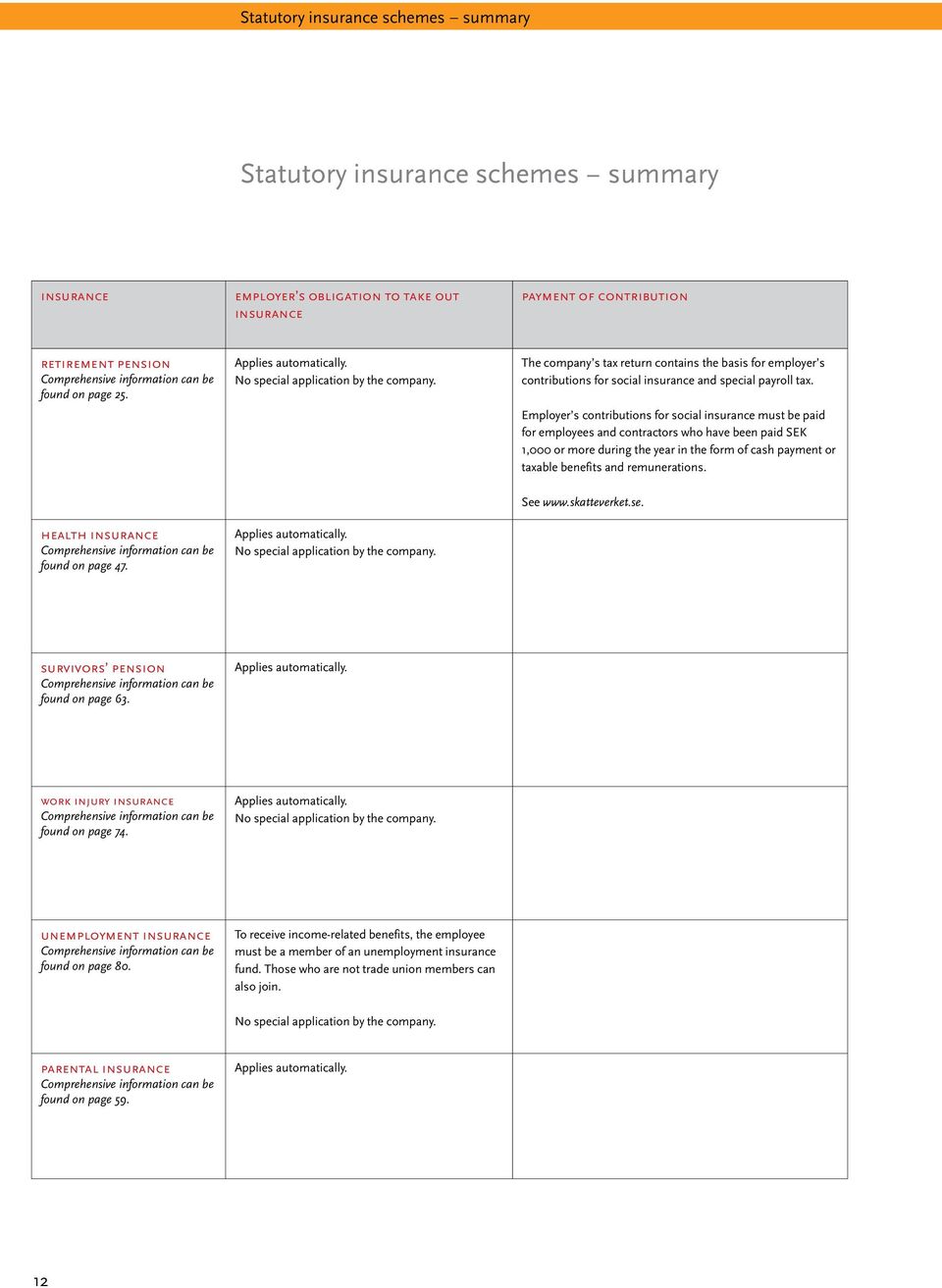
14 Statutory insurance schemes summary EMPLOYER S CONTRIBUTIONS 2016 % OF GROSS PAY EMPLOYEE BENEFITS EMPLOYER S PARTICIPATION IN INSURANCE CLAIMS EMPLOYEE S PARTICIPATION IN INSURANCE CLAIMS State pension with a flexible pension age may be drawn no earlier than age 61. An employee has the right to work until the age of 67. None. Notification under the Security of Employment Act no later than one month before reaching retirement age. The application is made to the Pension Authority Sickness benefit, activity/sickness compensation and rehabilitation compensation. As a rule, the employer pays sick pay for the first 14 days of a sick period. The employer is responsible for notifying the Social Insurance Office. The employee reports sick to the employer. Sickness benefit and activity/ sickness compensation are applied for at the Social Insurance Office Survivors pension None. The Pension Authority investigates. In most cases, relatives do not need to apply Work injury life annuity and funeral grant. The employer is obligated to report any injury at once to the Social Insurance Office. The Swedish Work Environment Authority and the Social Insurance Office have a joint website for notifying work injuries, Immediate notice to the employer is mandatory. Self-employed individuals and contractors report the injury directly to the Social Insurance Office. An application for benefit is made to the Social Insurance Office. Compensation in the event of death is investigated by the Pension Authority (Labour market contribution) Daily allowance subject to certain conditions, including work conditions and membership conditions. The most recent employer is required by law to issue a certificate of employment on request The application is made to the unemployment insurance fund Parental allowance upon the birth of a child. None. The application is made to the Social Insurance Office. 13

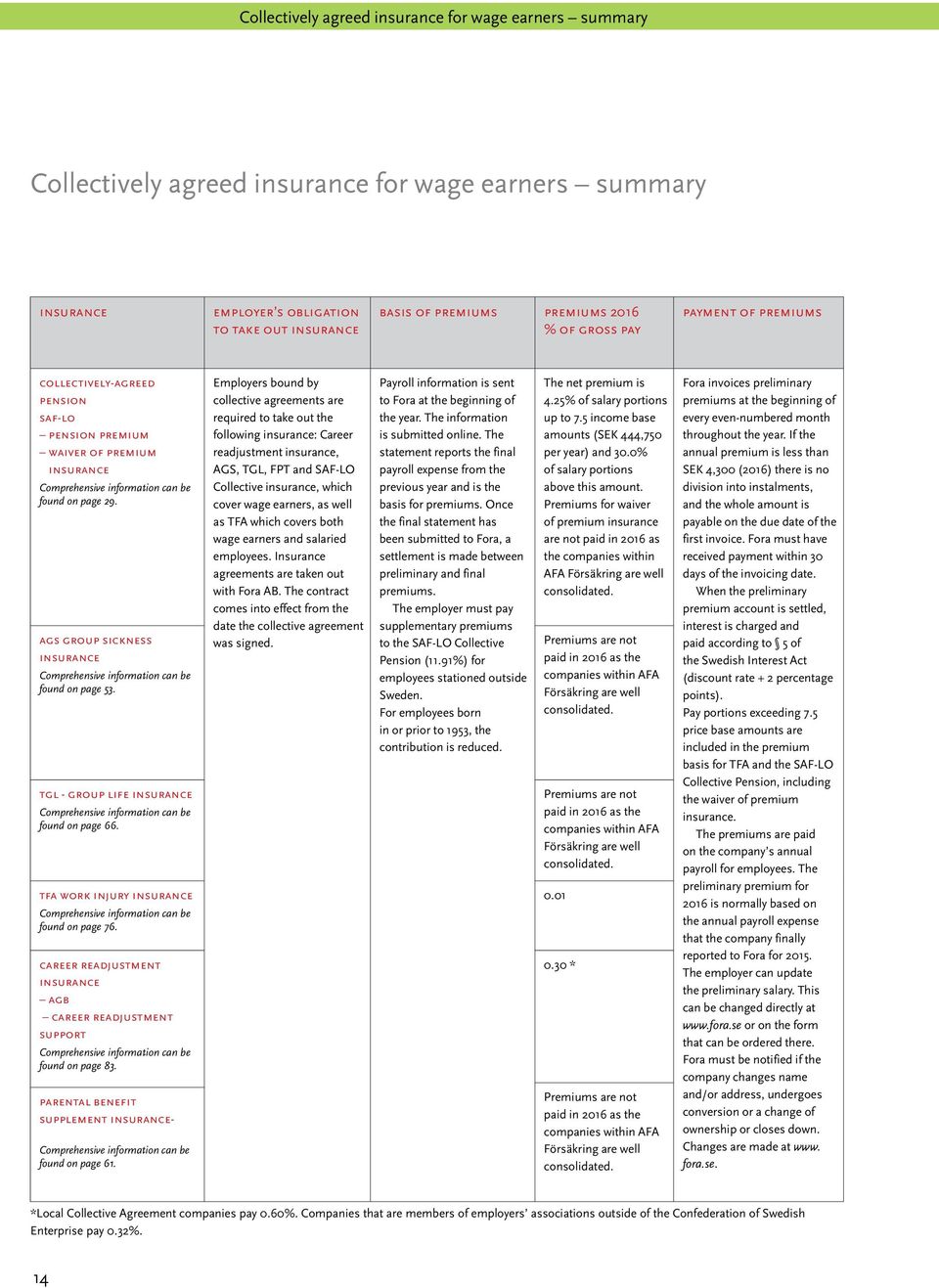
15 Collectively agreed insurance for wage earners summary Collectively agreed insurance for wage earners summary INSURANCE EMPLOYER S OBLIGATION TO TAKE OUT INSURANCE BASIS OF PREMIUMS PREMIUMS 2016 % OF GROSS PAY PAYMENT OF PREMIUMS COLLECTIVELY-AGREED PENSION SAF-LO PENSION PREMIUM waiver OF PREMIUM INSURANCE Comprehensive information can be found on page 29. AGS GROUP SICKNESS INSURANCE Comprehensive information can be found on page 53. TGL - GROUP LIFE INSURANCE Comprehensive information can be found on page 66. TFA WORK INJURY INSURANCE Comprehensive information can be found on page 76. CAREER READJUSTMENT INSURANCE AGB CAREER READJUSTMENT SUPPORT Comprehensive information can be found on page 83. PARENTAL BENEFIT SUPPLEMENT INSURANCE Comprehensive information can be found on page 61. Employers bound by collective agreements are required to take out the following insurance: Career readjustment insurance, AGS, TGL, FPT and SAF-LO Collective insurance, which cover wage earners, as well as TFA which covers both wage earners and salaried employees. Insurance agreements are taken out with Fora AB. The contract comes into effect from the date the collective agreement was signed. Payroll information is sent to Fora at the beginning of the year. The information is submitted online. The statement reports the final payroll expense from the previous year and is the basis for premiums. Once the final statement has been submitted to Fora, a settlement is made between preliminary and final premiums. The employer must pay supplementary premiums to the SAF-LO Collective Pension (11.91%) for employees stationed outside Sweden. For employees born in or prior to 1953, the contribution is reduced. The net premium is 4.25% of salary portions up to 7.5 income base amounts (SEK 444,750 per year) and 30.0% of salary portions above this amount. Premiums for waiver of premium insurance are not paid in 2016 as the companies within AFA Försäkring are well consolidated. Premiums are not paid in 2016 as the companies within AFA Försäkring are well consolidated. Premiums are not paid in 2016 as the companies within AFA Försäkring are well consolidated * Premiums are not paid in 2016 as the companies within AFA Försäkring are well consolidated. Fora invoices preliminary premiums at the beginning of every even-numbered month throughout the year. If the annual premium is less than SEK 4,300 (2016) there is no division into instalments, and the whole amount is payable on the due date of the first invoice. Fora must have received payment within 30 days of the invoicing date. When the preliminary premium account is settled, interest is charged and paid according to 5 of the Swedish Interest Act (discount rate + 2 percentage points). Pay portions exceeding 7.5 price base amounts are included in the premium basis for TFA and the SAF-LO Collective Pension, including the waiver of premium insurance. The premiums are paid on the company s annual payroll for employees. The preliminary premium for 2016 is normally based on the annual payroll expense that the company finally reported to Fora for The employer can update the preliminary salary. This can be changed directly at or on the form that can be ordered there. Fora must be notified if the company changes name and/or address, undergoes conversion or a change of ownership or closes down. Changes are made at www. fora.se. *Local Collective Agreement companies pay 0.60%. Companies that are members of employers associations outside of the Confederation of Swedish Enterprise pay 0.32%. 14
16 Collectively agreed insurance for wage earners summary INSURANCE FOR WAGE EARNERS INSURANCE CLAIMS ARE HANDLED BY EMPLOYER S PARTICIPATION IN INSURANCE CLAIMS WAGE EARNER S PARTICIPATION IN INSURANCE CLAIMS State pension with or without repayment cover. Family cover is an option. Waiver of premium insurance in the event of sickness, parental leave and periods of pregnancy benefit. The insurance company chosen by the employee. Fora, tel. +46 (0) The employer assists by providing information on salary/wages and can apply for waiver of premium. When stationed outside Sweden, Fora is to be notified when state retirement pension contributions are no longer being paid. The wage earner makes pension choices through Fora. Before the age of 65, the wage earner will receive a pension notice and will choose the type of payment. The wage earner also has personal contact with his/ her insurance company. AGS Daily payments to those receiving sickness benefit or monthly payments to those on activity or sickness compensation. AFA Sjukförsäkring* tel The employer must attest to the employment conditions etc. and can submit notification, When employees are stationed outside Sweden, Fora is to be notified when employees lose their right to Swedish sickness benefit. The employee makes the application to AFA Försäkring s customer web or on a form entitled Application for group sickness insurance (AGS) and waiver of premium insurance. TGL - Lump sum in the form of a basic sum, child supplement and funeral grant for survivors in the event of the death of the wage earner. In certain cases also in the event of the death of the spouse/registered partner/cohabitant. AFA Livförsäkring* tel The employer must submit an employment certificate with the application. The application is made by survivors of the deceased. TFA Compensation is awarded under the regulations for work injury claims, i.e. accidents occurring on the job, travel accidents subject to certain conditions and occupational disease. This denotes compensation for any expenses incurred, pain and suffering, and also, in the case of disability, for incapacity and harm and other inconvenience. Compensation for loss of income may be provided in the event of an accident at work. AFA Trygghetsförsäkring* tel (claims payments, claims adjustment). The employer must attest to the employment conditions, etc. The employer simply attests to the employment situation and does not assess whether a work injury in fact has occurred, Application on AFA Försäkring s customer web or on form TFA Claim application form, which is to be signed by the employer and the wage earner. AGB - Compensation to wage earners made redundant due to lack of work. Career readjustment support Action programme to assist wage earners in finding a new job as soon as possible. AFA Livförsäkring* tel Trygghetsfonden TSL tel AGB - The employer must attest to the employment conditions etc. and sign the application together with the wage earner. TSL - The application is submitted to The employer enters into an agreement with the selected supplier. AGB - The wage earner submits the notification. TSL - Wage earners sign a personal appendix after having met the selected supplier. Compensation in the event of parental leave. AFA Sjukförsäkring* Customer centre tel The employer must attest to the employment conditions etc., The employer can submit notification. The wage earner submits notification on AFA Försäkring s customer web. It is also possible to call the customer centre, tel * These insurance providers are jointly known as AFA and jointly own Fora AB. 15

17 Collectively agreed insurance for salaried employees summary Collectively agreed insurance for salaried employees summary INSURANCE EMPLOYER S OBLIGATION TO TAKE OUT INSURANCE BASIS OF PREMIUMS PREMIUMS 2016 % OF GROSS PAY PAYMENT OF PREMIUMS ITP PLAN PARTS 1 AND 2 Comprehensive information can be found on page 33. Employers bound by collective agreements are required to take out insurance with Collectum. As an alternative to insurance, a company can make in-house commitments for state pension benefits. Special regulations regarding safeguarding etc. exist. The employer must also, on a continuous basis, report admission into the insurance scheme, changes in pay and termination of employment for reasons other than reaching retirement age. Notifications are made via the Internet or on a form. The employer reports salaries to Collectum. For ITP 1, the gross salary paid in cash each month must be reported. For ITP 2, reporting refers to the current year s relevant annual salary. The information is submitted via the Internet or on a form. For ITP 1, the expenses incurred by the employer are known. The premium is 4.668% on salary portions up to 7.5 income base amounts (SEK 37,063 per month) and % on salary portions above this amount. For ITP 2, the expenses are difficult to predict due to the premium being calculated on the employee s age, salary and estimated period of service. Companies that apply FPG/PRI pay credit insurance premiums and administration charges to PRI Pensionsgaranti. Collectum sends out an invoice each month. Waiver of premium for ITP 1 applies in the event of illness lasting more than 14 days, parental leave lasting 13 months and temporary parental allowance (leave for child care). For ITP 2, waiver of premium normally applies from the end of the month after the 90th sick day. Premiums must be paid up to and including the month before the month of retirement. Collectum handles the salaried employees own selection and invoices on behalf of the insurance companies involved. TGL - GROUP LIFE INSURANCE Comprehensive information can be found on page 71. The employer takes out insurance with either Alecta, Bliwa, Folksam, Länsförsäkringar, Movestic, SEB Pension och Försäkring, SEB Trygg Liv or Skandia Liv for all salaried employees aged 18 or over. The employer submits a report to the insurance company where TGL has been taken out. The insurance companies use various routines for premium payments. Approx Free premium setting is applied and the premium is within the interval SEK 30-51/month. Each TGL company sends its own invoices. Premiums are not paid during voluntary basic military training and when studying. Premiums are only paid up until the month before an employee s 70th birthday. TFA WORK INJURY INSURANCE Comprehensive information can be found on page 76. The employer must take out insurance with Fora, www. fora.se. The same procedure as for the AFA insurance schemes Fora sends out an invoice at the beginning of each evennumbered month. Fora must have received payment within 30 days of the invoicing date. CAREER READJUSTMENT AGREEMENT AND TRR (CAREER READJUSTMENT SUPPORT AND AGE) Comprehensive information can be found on page 85. The company is automatically affiliated with the TRR when its membership of an employers association within the Confederation of Swedish Enterprise has been approved. Local collective agreement companies must apply for affiliation. The same procedure as for the AFA insurance schemes. 0.30* Fora sends out an invoice at the beginning of each evennumbered month. Fora must have received payment within 30 days of the invoicing date. LFU MEDICAL EXPENSES INSURANCE FOR EMPLOYEES STATIONED OUTSIDE SWEDEN Comprehensive information can be found on page 91. The employer must take out insurance with one of the insurance companies that supply LFU and guarantee insurance. In accordance with each insurance company s regulations. In accordance with each insurance company s regulations. In accordance with each insurance company s regulations. * Local Collective Agreement companies pay 0.70%. 16

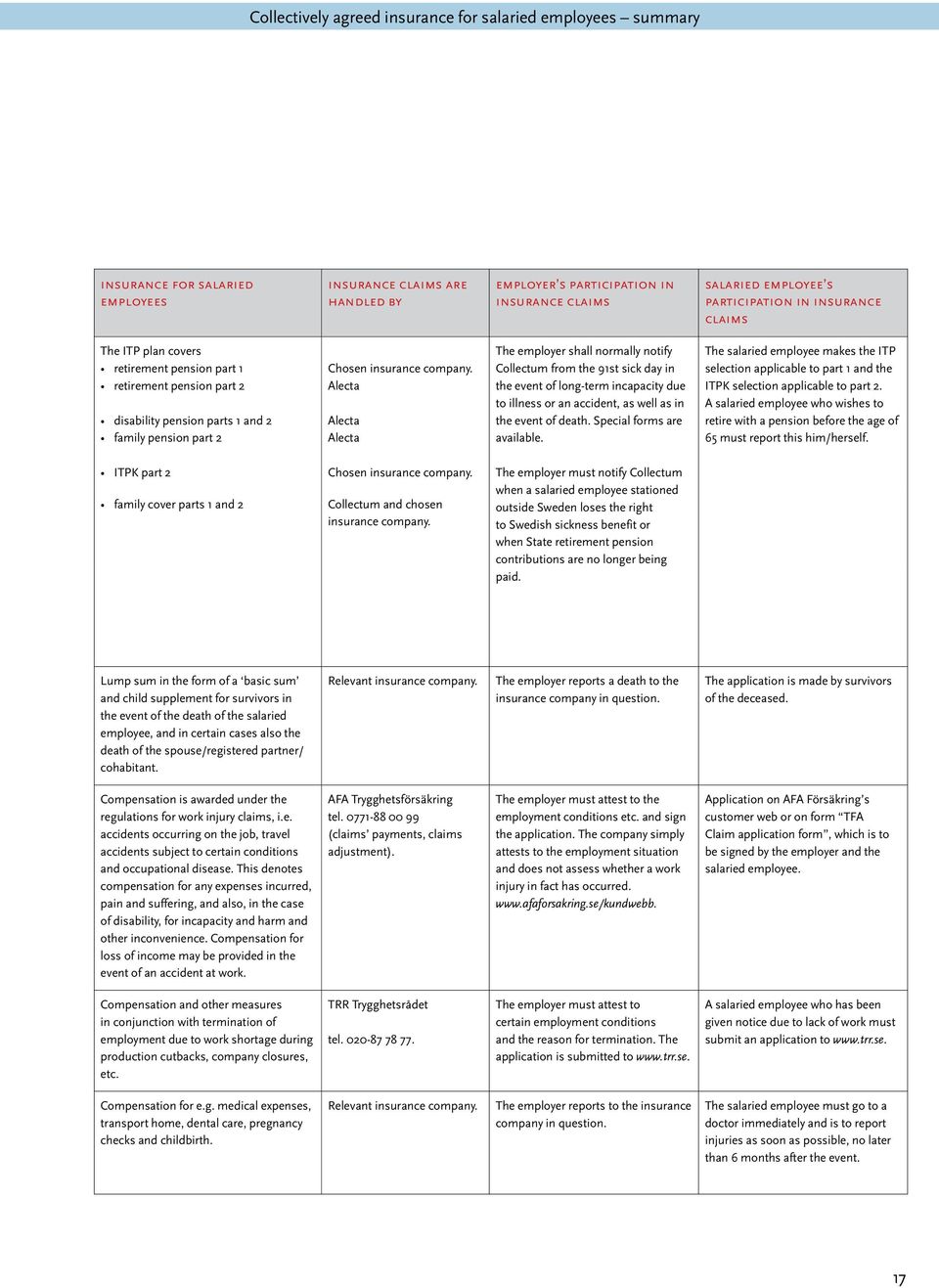
18 Collectively agreed insurance for salaried employees summary INSURANCE FOR SALARIED EMPLOYEES INSURANCE CLAIMS ARE HANDLED BY EMPLOYER S PARTICIPATION IN INSURANCE CLAIMS SALARIED EMPLOYEE S PARTICIPATION IN INSURANCE CLAIMS The ITP plan covers retirement pension part 1 retirement pension part 2 disability pension parts 1 and 2 family pension part 2 Chosen insurance company. Alecta Alecta Alecta The employer shall normally notify Collectum from the 91st sick day in the event of long-term incapacity due to illness or an accident, as well as in the event of death. Special forms are available. The salaried employee makes the ITP selection applicable to part 1 and the ITPK selection applicable to part 2. A salaried employee who wishes to retire with a pension before the age of 65 must report this him/herself. ITPK part 2 family cover parts 1 and 2 Chosen insurance company. Collectum and chosen insurance company. The employer must notify Collectum when a salaried employee stationed outside Sweden loses the right to Swedish sickness benefit or when State retirement pension contributions are no longer being paid. Lump sum in the form of a basic sum and child supplement for survivors in the event of the death of the salaried employee, and in certain cases also the death of the spouse/registered partner/ cohabitant. Relevant insurance company. The employer reports a death to the insurance company in question. The application is made by survivors of the deceased. Compensation is awarded under the regulations for work injury claims, i.e. accidents occurring on the job, travel accidents subject to certain conditions and occupational disease. This denotes compensation for any expenses incurred, pain and suffering, and also, in the case of disability, for incapacity and harm and other inconvenience. Compensation for loss of income may be provided in the event of an accident at work. AFA Trygghetsförsäkring tel (claims payments, claims adjustment). The employer must attest to the employment conditions etc. and sign the application. The company simply attests to the employment situation and does not assess whether a work injury in fact has occurred. Application on AFA Försäkring s customer web or on form TFA Claim application form, which is to be signed by the employer and the salaried employee. Compensation and other measures in conjunction with termination of employment due to work shortage during production cutbacks, company closures, etc. TRR Trygghetsrådet tel The employer must attest to certain employment conditions and the reason for termination. The application is submitted to A salaried employee who has been given notice due to lack of work must submit an application to Compensation for e.g. medical expenses, transport home, dental care, pregnancy checks and childbirth. Relevant insurance company. The employer reports to the insurance company in question. The salaried employee must go to a doctor immediately and is to report injuries as soon as possible, no later than 6 months after the event. 17
19 Contributions, premiums, etc. Contributions, premiums, etc. INTRODUCTION EMPLOYER S CONTRIBUTION SPECIAL PAYROLL TAX GENERAL PENSION CONTRIBUTION WAGE EARNERS SALARIED EMPLOYEES The employer is required by law to pay employer s contributions for state pension, health insurance, etc. Employers who have collective insurance schemes also pay premiums for these. The employer s contributions are calculated on cash salary and taxable remunerations and benefits. Remuneration amounting to less than SEK 1,000 to a single person during a calendar year will not be included. The size of the employer s contribution is presented on page 20. Companies must report VAT, employer s contributions and deducted tax in a joint tax return. The date by which the declaration and payment must have been submitted to the Tax Authority can be seen from the information from the Tax Authority. The employer s contributions are a deductible expense. The employer pays special payroll tax on pension expenses for its employees. The company can receive basic information regarding this from Fora and Collectum/Alecta. Payroll tax on pension premiums is paid in accordance with usual routines for the company s corporation tax. The payroll tax is a deductible expense. In conjunction with deductions for preliminary tax, the company also deducts employee contributions that the employee is required by law to pay. The employee contribution comprises a general pension contribution of 7% and is paid on salary portions up to 8.07 income base amounts. The company can report the employee contribution on the pay specification. PREMIUMS TO COLLECTIVE INSURANCE SCHEMES The size of the premiums is determined annually. The AFA Insurance schemes, Career readjustment insurance and SAF-LO Collective Pension are invoiced by Fora in each even-numbered month and Fora must have received the premiums within 30 days of the invoicing date. Supplementary invoices are issued in between in the event of any changes. The premiums are normally deductible for the company. The size of the premiums is determined annually. The premiums for ITP 1 and 2 as well as ITPK are invoiced every month and must have been received by Collectum at the latest on the 15th of the following month. If TGL has been taken out with Alecta, the premium is included in Collectum s invoice. Fora sends out invoices at the start of each even-numbered month regarding premiums for salaried employees TFA and TRR Trygghetsrådet. Supplementary invoices are issued in between in the event of any changes. Fora must have received the premiums within 30 days of the invoicing date. The premiums are normally deductible for the company. 18

20 Deduction rules and taxes for pensions Deduction rules and taxes for pensions Premiums for employees pensions are a deductible expense for employers. There is, however, a ceiling for how large the deduction may be, calculated either using the main or the supplementary rule. The main rule is that the premium may not constitute more than 35% of salary. The costs can comprise insurance premiums, balance-sheet liability entries or transfers to pension funds. The deduction entitlement is limited to 10 times the price base amount (SEK 443,000) per year and employee. The supplementary rule, which may only be used for one-off premiums, means that the costs are generally deductible regardless of amount. The pension rate may not exceed the limits set out below. For pensions paid out between the ages of 62 and 65, different regulations apply. When paying oneoff premiums, it is advisable to check the effects of this on the employer and the employees. DEDUCTION RULES FOR OCCUPATIONAL PENSION SALARY PORTIONS IN PRICE BASE AMOUNTS COMPARISON LEVEL AS A % OF SALARY, at retirement age Owners who work in their own limited companies are regarded as employees under the Income Tax Act. Only the main rule applies to self-employed persons in trading or sole trader companies. From 2016, private individuals have no right to make a deduction in their income tax returns for pension premiums. Persons lacking occupational pensions in their employment may be granted deductions according to special regulations. The minimum age in all categories for drawing pensions is now 55 years. The shortest period for drawing pension is normally 5 years. For employers who have taken out collective pensions, there is normally scope for supplementary premiums. The employer can offer employees the opportunity to take a portion their salary in the form of additional occupational pension, known as salary exchange or salary abstention. However, in such a scheme it is important to check the effects on both the statutory and collective insurance schemes. Pension premiums are subject to a special payroll tax of 24.26%. paid by the employer. The insurance company or equivalent is taxed on pension capital. All types of pension plans are treated the same. The tax base is estimated using a standard method. The tax rate is 15%. Endowment policies are taxed in the same way at 30%. SALARY EXCHANGE SPECIAL PAYROLL TAX DIVIDEND TAX 19

21 Statutory employer s contributions Statutory employer s contributions wage earners, salaried employees and selfemployed persons EMPLOYERS CONTRIBUTIONS FOR WAGE EARNERS AND SALARIED EMPLOYEES (% OF GROSS PAY) Retirement pension Health insurance 4.85 Parental insurance 2.60 Survivors pension 1.17 Work injury insurance 0.30 Labour market contribution 2.64 General employment tax 9.65 Total CONTRIBUTIONS FOR SELF-EMPLOYED PERSONS NOT LIMITED COMPANIES (% OF GROSS PAY) Retirement pension Health insurance *5.32 (1 day), 4.85 (14 days), 4.53 (30 days), 4.19 (60 days), 3.93 (90 days) Parental insurance 2.60 Survivors pension 1.17 Work injury insurance 0.30 Labour market contribution 0.10 General employment tax 9.65 Total For those born in 1991 or later, the employer s contribution amounts to 25.46%. The reduction ends from June Full employer contributions of 31.42% are paid from 1 June For those born in , the employer s contribution amounts to 16.36%. For employees born in or prior to 1937, 6.15% is paid. For self-employed persons born in 1991 or later, the contribution amounts to 23.69% if no qualifying period has been selected. The reduction ends from June Employee contributions of 28.97% are paid from 1 June If passive business activities are conducted, a special payroll tax of 24.26% is paid instead of employee contributions, irrespective of age. Further information about employer s and employee contributions can be found at Information about various forms of employment support can be found at * The general qualifying period is 7 days. Self-employed persons can choose a qualifying period of 1, 14, 30, 60 or 90 days. The employee contribution is then (1 day), (14 days), 28.56% (30 days), 28.22% (60 days) and 27.96% (90 days) on salary portions up to 7.5 price base amounts % is paid on salary portions in excess of this, irrespective of the qualifying period. REDUCTION IN CONTRIBUTIONS There are reductions in certain regions. Further information can be obtained from the County Administrative Board. Selfemployed businessmen and owners in trading companies can receive a special deduction from their own contributions, SUPPORT FOR NEW START JOBS AND SPECIAL NEW START JOBS The rules for New Start Jobs and Special New Start Jobs mean that the employer, when employing people who have been on sick leave or unemployed during a reference period, receives financial support. More information can be found at www. arbetsformedlingen.se. The employer applies for the subsidy from the Employment Service. The subsidy is issued through a credit entry in the employer s tax account
22 Premiums for collective insurance wage earners Premiums for collective insurance wage earners PREMIUMS WAGE EARNERS (% OF GROSS PAY) Salary < SEK 444,750/year Salary > SEK 444,750/year Career readjustment insurance* AGS (Health insurance)** TFA (Statutory work injury insurance) TGL (Life insurance)** FPT (Parental benefit supplement)** SAF-LO Collective Pension pension premium*** waiver of premium insurance** Total premium Funded by surplus funds**** Total premium invoiced * Local Collective Agreement companies pay 0.60%. Companies that are members of employers associations outside of the Confederation of Swedish Enterprise pay 0.32%. The premium is paid on salary portions up to 7.5 price base amounts (SEK 332,250). ** Premiums are not paid in 2016 as the companies within AFA Försäkring are well consolidated. *** The premium is paid from the month in which the wage earner turns 25 until the month before he turns 65. **** In connection with the phasing out of the pension plan (STP) applicable for wage earners up to 1995, the Confederation of Swedish Enterprise and LO reached an agreement whereby any surplus funds, after essential capital to pay the defined benefit STP has been separated within the AMF pension, shall be repaid to the employers. The surplus funds now available are to be used in 2016 to pay 0.25 percentage points of the premium for SAF-LO Collective Pension on salary portions up to 7.5 income base amounts. This entails a saving for the companies of approximately SEK 1 billion. PREMIUMS ACCORDING TO INDUSTRIAL AGREEMENTS In a number of sectors, the parties have agreed that the employer is to pay a premium for part-time pension and/ or working hours pension. These premiums are additional and are not presented in the above compilation. Fora administers the allocation, For further information please refer to the collective agreement of the concerned employers association. SPECIAL PAYROLL TAX Employers must pay a special payroll tax of 24.26% of the pension costs for their employees. This special payroll tax is payable in accordance with the usual routines for the company s F-tax (corporation tax). Payroll tax is deductible for the employer for income tax purposes. 21
23 Premiums for collective insurance salaried employees Premiums for collective insurance salaried employees ITP 1 PREMIUMS SALARIED EMPLOYEES ITP 1 (% OF GROSS PAY) Salary < SEK 37,063/month Salary > SEK 37,063/month ITP 1 - retirement pension* waiver of premium insurance* health insurance** TGL (life insurance)*** approx TFA (statutory work injury insurance) TRR (career readjustment agreement)**** Total * The premium is paid from the month in which the salaried employee turns 25 until the month before he turns 65. ** The premium of 0.068% is paid on salary portions up to SEK 27,688/month (7.5 price base amounts). The premium of 0.373% is paid on salary portions between SEK 27,688/month and SEK 148,250/month (30 income base amounts). *** Free premium setting is applied and the premium is within the interval SEK 30-51/month, which is equivalent to approx. 0.15% in the event of salaries of SEK 27,688/month (7.5 price base amounts). **** Local Collective Agreement companies pay 0.70%. PREMIUM REDUCTION During 2016, the premiums for waiver of premium and health insurance are reduced by 75%. The premiums are presented after the premium reduction. PREMIUMS ACCORDING TO INDUSTRIAL AGREEMENTS In a number of sectors, the parties have agreed that the employer is to pay a premium for part-time pension and/or working hours pension. These premiums are additional and are not presented in the above compilation. Collectum administers the allocation, For further information please refer to the collective agreement of the concerned employers association. ITP 1 Salaried employees born in 1979 or later with companies who had signed ITP agreements prior to 26 April 2006 are covered by ITP part 1. Companies that are currently bound by collective agreements can take out ITP 1 for all salaried employees irrespective of age (provided this is approved by Collectum). Unpaid gross salary is reported by the employer each month and is the basis for the premium as above. Between the ages of 18 and 25, a premium is only paid for ITP health insurance. SPECIAL PAYROLL TAX Employers must pay a special payroll tax of 24.26% of the pension costs for their employees. This special payroll tax is payable in accordance with the usual routines for the company s F-tax (corporation tax). Payroll tax is deductible for the employer for income tax purposes. 22
24 Premiums for collective insurance salaried employees Premiums for collective insurance salaried employees ITP 2 PREMIUMS SALARIED EMPLOYEES ITP 2 (% OF GROSS PAY) ITP 2 (retirement pension, ITPK, health insurance, etc.)* approx TGL (life insurance)** approx TFA (statutory work injury insurance) 0.03 TRR (career readjustment agreement)*** 0.3 Total approx * Projection for There are wide variations. The premium normally varies between 5 and 20%. No wage trends for 2016 have been taken into account when making the calculations. The effect of a wage increase can be estimated by assuming that a wage increase of 1% produces an increased premium of approx percentage points. The premium is paid on salary portions up to 30 income base amounts (SEK 1,779,000 per year). The premium is paid until the month before the salaried employee turns 65. ** Free premium setting is applied and the premium is within the interval SEK 30-51/month, which is equivalent to approx. 0.15% in the event of salaries of 7.5 price base amounts (SEK 332,250 per year). *** Local Collective Agreement companies pay 0.7%. PREMIUM REDUCTION During 2016, the premiums for waiver of premium and health insurance are reduced by 75%. The premiums are presented after the premium reduction. PREMIUMS ACCORDING TO INDUSTRIAL AGREEMENTS In a number of sectors, the parties have agreed that the employer is to pay a premium for part-time pension and/ or working hours pension. These premiums are additional and are not presented in the above compilation. Collectum administers the allocation, For further information please refer to the collective agreement of the concerned employers association. ITP 2 Salaried employees born in 1978 or earlier with companies who had signed ITP agreements prior to 26 April 2006 are covered by ITP part 2. Companies that are currently bound by collective agreements can take out ITP 1 for all salaried employees irrespective of age (provided this is approved by Collectum). SPECIAL PAYROLL TAX Employers must pay a special payroll tax of 24.26% of the pension costs for their employees. This special payroll tax is payable in accordance with the usual routines for the company s F-tax (corporation tax). Payroll tax is deductible for the employer for income tax purposes. 23
25 Base amounts and indices Base amounts and indices The statutory insurance and pension plans are regulated by legislation including the Social Insurance Code, the Sick Pay Act (sjll) and the Unemployment Insurance Act (ALF). The collective insurance schemes are regulated through collective agreements between the Confederation of Swedish Enterprise and the LO on the one hand and the Confederation and the PTK on the other. Benefits and pensions are calculated and index-linked to the change in prices and incomes and to the financial stability of the pension system. INDEX There are various indices for the calculations. Income index, which is based on the most recent years changes income as well as the change in prices over the past year. The income index is the system s interest. Every year, a balance sheet is prepared for the pension system. If the liabilities exceed the assets, the pensions cannot completely follow the wage trend. In this case, a balance index is established to guarantee that there is sufficient money in the system. BASE AMOUNTS There are three base amounts: the price base amount, the income base amount and the raised price base amount. The various base amounts are used in different contexts, as described below: Price base amount (SEK 443,00 for 2016) income ceiling for sickness benefit and activity or sickness compensation, guarantee pension and work injury life annuity. Income base amount (SEK 59,300 for 2016) the ceiling for the pensionable income (PGI), the general pension contribution and extra pension rights for childcare years. Raised price base amount (SEK 45,200 for 2016) used in the calculation of pension points for supplementary pension. 24
26 State pension State pension The year in which a person was born determines which rules apply to the calculation of their state pension. Basic state pension and ATP are now called supplementary pension and will soon be replaced by income-based pension, premium pension and guarantee pension. Those born in 1954 and later receive their state pension entirely according to the new system. Those born between 1938 and 1953 receive their pension according to both the old system and the new one, in proportions depending on when the person was born. Earned pension arising from pensionable income from the calendar year in which the person reaches the age of 65 will be calculated entirely according to the new system. The pensions of those born in 1937 and earlier will be entirely according to the old system. THE TABLE SHOWS EARNED PENSION IN 2016 YEAR OF BIRTH PROPORTION NEW SYSTEM PROPORTION ATP ALLOCATION TO PREMIUM PENSION % / / / / / / / / / / / / / / /20 2/ /20 1/ / Every year, the Pension Authority sends out an orange envelope containing decisions regarding earned pension rights, the change in the value of the unit trusts as well as a forecast for the future pension. PENSIONABLE INCOME (PGI) CONFERS THE RIGHT TO PENSION In the national pension, lifetime income is important. All earned income and compensation from social and unemployment insurance gives pension rights. Pension rights are earned when the income exceeds 42.3% of the price base amount (SEK 44,300) and the pension rights are then calculated from the first krona earned. PENSION RIGHTS 25
27 State pension There are no lower or upper age limits. Every year, the Tax Authority determines the pensionable income (PGI) from the tax returns. When the PGI has been determined, a deduction is made for the general pension contribution, which is 7% of income. The PGI cannot be higher than 7.5 income base amounts (SEK 444,750 for 2016). To obtain maximum PGI, a person s income before deduction for the general pension contribution must amount to SEK 478,551 (8.07 income base amounts). PENSIONABLE AMOUNT PENSIONABLE AMOUNTS GIVE PENSION RIGHTS Every year, the Pension Authority automatically sets figures known as pensionable amounts. These amounts are not money paid out today, but merely hypothetical calculations that confer higher future pensions. These amounts replace or supplement the PGI for the year concerned. Pensionable amounts can be earned for post-upper secondary school studies, activity and sickness compensation, and years spent looking after children (child years). Pension rights are earned on studies from 1995, child years from 1960, early retirement pension from , activity compensation/sickness compensation from 2003 and military service from Post-upper secondary school studies confer pension rights on the basis of a hypothetical income calculated as 138% of the grant portion of the student grant system. For child years, pension entitlement is given for the child s first four years. Only one of the parents is credited with child years for a given year, and only for one child at a time. Certain requirements relating to residence and custody must be fulfilled in order for child years to be calculated. Pension entitlement is calculated in three different ways: Child years are used to top up the income the parent had in the year before the child was born. Child years are used to top up to a hypothetical salary corresponding to 75% of the average income in Sweden. A fixed increment corresponding to one income base amount (SEK 59,300). The Pension Authority automatically chooses the alternative that is most advantageous for the parent. The child year is credited to the parent with the lowest income for the year. If the parents wish otherwise, they can tell the Pension Authority. For pension to be calculated including child years, military service and studies, the person must have some connection with a workplace. The person s PGI must be at least twice the income base amount for at least five years before reaching the age of 70 (known as the income condition). If the PGI exceeds 7.5 times the income base amount, no pensionable amount is approved. FEES One of the basic ideas of the pension system is that pensions should be financed by employers and employees jointly. The total contribution is to be 18.5%, of which 16% to the income pension and 2.5% to the premium pension. The employer pays 10.21% of the total salary via the employer s contribution. The employee pays 7% as a pension contribution on salary portions up to 8.07 income base amounts. Via a state retirement pension contribution, the government pays 10.21% for social security and unemployment benefits and 18.5% for pensionable amounts. 26
28 State pension An amount equivalent to 16% of the annual income is set aside to the income-related pension ( % and %). These pension rights are added up each year and make up the pension capital, known as a pension account. Each year, inheritance gains are added from deceased persons of the same age group. The account is recalculated annually in line with general wage trends in the country (income index/balance index), and administrative costs are deducted. The pension that is paid out depends on the lifetime accumulated pension capital (divided by the life expectancy denominator). The life expectancy denominator is based on the estimated remaining average life expectancy and projected income growth of 1.6%. The life expectancy denominator is the same for both men and women. The longer someone waits to draw their income pension, the higher the pension. The income pension is adaptability indexed, i.e. it follows income growth in Sweden. On those occasions when the pension system s liabilities are greater than the assets, a balance index is established instead to guarantee that there is sufficient money in the system. An amount corresponding to 2.5% of the annual income is set aside to the premium pension. Every year new pension rights are earned. The amounts placed in unit trusts during December 2015 were earned in the 2014 income year. A lower proportion of income goes to the premium pension for persons only partially covered by the new pension system, as described in the table on page 25. Each person can choose up to five different unit trusts. The money is invested according to the most recent choice made by the person. There is no limit to the switches a person can make between unit trusts and no costs are currently incurred. If no choice of trust has been made, the money is placed in the Seventh National Pension Insurance Fund. Spouses can transfer their premium pension rights to each other. Notification is given to the Pension Authority, and entails a reduction in pension rights of 8% at present. The size of a person s future premium pension depends on how much his or her unit trusts are worth at the time of payment. This unit trust value is divided by a life expectancy denominator based on remaining estimated average life expectancy. The life expectancy denominator is the same for men and women. While people are drawing their pensions, they can buy life annuities at guaranteed amounts, or retain their unit trusts. It is possible to buy survivors cover when applying for premium pension. This will result in a lower pension while the person is alive, but it will be paid out as long as one of the spouses is alive. An application to draw the income and/or premium pension can be submitted to the Pension Authority from age 61 at the earliest. The longer someone works, the higher the pension. The pension is lifelong and can be drawn as 1/1, 3/4, 1/2 or 1/4 parts. The income and premium pension need not be drawn in identical proportions. The fact that state pension can be drawn part-time does not obligate the employer to provide part-time employment. The employee has a statutory right to work up to age 67. No connection is made between working hours and the drawing of a state pension. It is therefore possible to work full-time and draw a full state pension. The guarantee pension is basic protection for those who have had no income or a low income. The full guarantee pension is 2.13 price base amounts for an unmarried person (SEK 7,863 per month) and 1.90 price base amounts for married persons (SEK 7,014 per month). Full guarantee pension is paid to those who have no income-related pension at all. If the income-related pension is lower than approximately three price base amounts, the person can receive a guarantee pension to top it up. The top-up amount depends on the size of the person s income-related pension. INCOME PENSION INDEXATION PREMIUM PENSION RETIREMENT AGE GUARANTEE PENSION 27
29 State pension Supplementary pension for persons born in In principle, all income-earners born before 1954 are entitled to supplementary pension. The supplementary pension is payable in twentieths depending on when the person was born (see table on page 25). Pension points are credited for each year for which pensionable income is confirmed. These points are calculated by means of the raised price base amount and are used to index-link the pensionable salary. Pension points are equal to the relationship between pensionable income for one year and the monetary value applicable for that income year. They are calculated as follows: PENSION POINTS = Pensionable income raised price base amount Raised price base amount PENSION POINTS PENSION CALCULATION INDEXATION GUARANTEE RULE To receive a supplementary pension, the person must have at least three years pension points, with thirty years required for the maximum supplement. Pension points are awarded until the year in which a person turns 64. After that, all points earned (20/20) by those born in are added to the income and premium pension. Pension is calculated on the basis of the insured person s average points, which is the average number of pension points in the 15 years of highest income. For those with fewer than 15 years of pension points, the average points are the same as the average of all points earned. The pension is 60% of the average points multiplied by the price base amount at the time of payment. The pension is reduced if the number of point-earning years is less than 30. The term basic state pension has disappeared. Those born between 1938 and 1953 receive an amount equivalent to the old basic state pension in their supplementary pension. In order to be entitled to this, the person must have at least three pension point years, while a full amount requires thirty years. The amount that replaces the basic state pension is 96% of the price base amount for unmarried persons. Married individuals living together receive 78.5% of the price base amount. The supplementary pension is adaptability indexed, i.e. it follows income growth in Sweden. On those occasions when the pension system s liabilities are greater than the assets, a balance index is established instead to guarantee that there is sufficient money in the system. A guarantee rule is in force for persons born between 1938 and This means a guaranteed minimum pension equivalent to that which the person would have earned in the old ATP system up to the year If this pension is higher than what was earned under the new rules, a guarantee supplement is paid. The supplement is payable from age 65 at the earliest. The pension may be drawn starting from the month when the recipient turns 61. The supplementary pension is reduced by 0.5% for each month in which it is drawn before the month in which the person turns 65. This reduction continues throughout the person s life. Drawing the state pension can also be deferred, and the pension then rises by 0.7% for each month in which the person postpones drawing the pension. The drawn pension must include both income and supplementary pensions. The premium pension need not be drawn at the same time as the income and supplementary pensions. The pension application is submitted to the Pension Authority. 28
30 Collective retirement pension wage earners Collective retirement pension wage earners SAF-LO Collective Pension The SAF-LO collective pension comprises state pension, waiver of premium and the option of selecting survivors cover. The waiver of premium insurance applies in the event of sickness, parental leave and periods of pregnancy benefit. SAF-LO COLLECTIVE PENSION SAF-LO Collective Pension Statutory pension In Defined premium pension Waiver of premium Early drawing RETIREMENT PENSION The pension premium is 4.5% of salary portions up to 7.5 income base amounts (SEK 444,750 per year) and 30.0% of salary portions above this amount. There is no ceiling for salaries. Pensionable salary during the year is gross salary paid in cash. The pension premium is paid from the month in which the wage earner turns 25. Everyone is covered, regardless of the type or scope of employment. SAF-LO Collective Pension is earned until the month before the employee turns 65. If the employee remains in work after his 65th birthday, pension may be earned if this is agreed between the company and the employee. In this case, the company will continue to pay premiums, following notification to Fora. EMPLOYMENT AFTER 65 Up until 2008, the premium was 3.5% of the entire salary, and was paid from the age of 21. According to the agreement between the Confederation of Swedish Enterprise and the LO, the pension premium has been increased as shown below, and is now up to the same level as ITP 1 for salaried employees. When negotiating salaries and employment conditions for the period , the unions in each contractual area must have taken the increase in costs into account. PREMIUM FOR SAF-LO COLLECTIVE PENSION YEAR < 7.5 IBA > 7.5 IBA % 6.0% % 12.0% % 18.0% % 24.0% % 30.0% 29
31 Collective retirement pension wage earners The employer pays the premium for the state pension and waiver of premium insurance to Fora AB. Fora informs the wage earner of the pension choice. The pension premium is transferred to the selected fund manager in the year following the earning year, after the final premiums have been paid by the employer. SAFEGUARDS BY THE EMPLOYER OTHER PENSION PLAN SUPPLEMENTARY PREMIUMS The employer can, after gaining approval from the Pension Board at Fora, offer in-house management of the pension premium, secured by entering the pension liability onto the books or by allocating the money to a pension fund. Such safeguarding shall be covered by credit insurance. The employer must also sign an administrative agreement with Fora. The employer may reach an agreement with the local trade union or with the wage earner regarding a pension plan other than the SAF-LO Collective Pension including waiver of premium insurance. Local agreements must be approved centrally and then notified to Fora. An agreement with the wage earner must be approved by the Pension Board at Fora. The Pension Board comprises members from the Confederation of Swedish Enterprise and LO. The employer can agree to pay supplementary premiums. The agreement can be made with a local trade union or with the wage earner. OPTIONS The wage earner can choose the type of saving and insurance company, as well as whether to take out repayment cover and family cover. The choice can be changed during the insurance period. TRADITIONAL PENSION INSURANCE UNIT-LINKED INSURANCE ELIGIBLE INSURANCE COMPANIES In traditional pension insurance, it is the insurance company that is responsible for investing the pension capital. The wage earner is guaranteed a certain basic pension. The guarantee varies between the insurance companies. If the company manages the money in such a way that a surplus arises, the pension becomes higher. By choosing unit-linked insurance, the wage earner exercises his right to decide how his pension premiums are to be managed. The employee chooses from among eligible funds. The pension may be higher or lower than that guaranteed in traditional insurance, since unit-linked insurance provides no guaranteed basic pension. An affiliation process has been conducted which means that all companies that satisfy given terms within the SAF-LO Collective pension are eligible for the premiums that are paid from
32 Collective retirement pension wage earners ELIGIBLE INSURANCE COMPANIES TRADITIONAL INSURANCE Alecta AMF Folksam Liv UNIT-LINKED INSURANCE AMF Danica Pension Folksam-LO Pension Handelsbanken Liv Länsförsäkringar Fondliv Movestic Liv & Pension Nordea Liv & Pension SEB Trygg Liv SPP Pension & Försäkring Swedbank Försäkring Earned capital as from 1996 can be moved within an eligible company or to one of the other eligible companies. Fora administers the move. Information about the charges etc. for moving capital can be found at Employees can take out repayment cover on their state pension, which means that the earned pension is paid to beneficiaries in the event of the death of the insured. Repayment cover normally includes the whole pension capital paid into the SAF-LO collective pension from 1996 onwards, regardless of fund manager. Repayment cover persists even after payment of the state pension has begun, unless the recipient opts out. Once the pension has begun to be paid, it is no longer possible to choose repayment cover. The state pension can be supplemented with family cover that is disbursed at the rate of 1, 2, 3 or 4 price base amounts per year for 5, 10, 15 or 20 years in the event of death. Family cover is only payable up until the day the deceased would have turned 70. The premium for family cover is age dependent and reduces the premium for the retirement pension, see page 65. The family cover is taken out with AFA Försäkring. The family cover is paid to the surviving spouse, registered partner, cohabitant or child(ren). RIGHT TO MOVE CAPITAL REPAYMENT COVER FAMILY COVER EXAMPLE WAGE EARNER AGED 45 ANNUAL SALARY SEK 300,000 Premium 4.5% SEK 13,500 Family cover 1 price base amount/year over 5 years - SEK 251 (see table on page 65) For pension SEK 13,249 The premiums of those who do not specify a choice are invested in a traditional pension insurance with AMF with no repayment cover or family cover. NON-CHOOSERS 31
33 Collective retirement pension wage earners DRAWING OF PENSION The state pension may be drawn as full or partial pensions from the age of 55. The pension can be drawn for a limited period or on a lifelong basis. It is possible to defer drawing until a point after the person s 65th birthday. PENSION STATEMENT AND ANNUAL STATEMENT Fora issues annual pension statements to the employees detailing the value of their pension capital. The statement includes information pertaining to which fund manager(s) the employee has chosen, and whether repayment cover and family cover have been taken out. The annual statement includes the name of the employer and the premiums paid. WAIVER OF PREMIUM INSURANCE With waiver of premium insurance (PBF), the premium for the state pension of the wage earner and, where applicable, family cover are still paid during sickness and parental leave with parental benefit. From 1 January 2012, PBF also applies during periods of pregnancy benefit. PBF comes into effect in the event of absence due to illness or accidents for periods exceeding that of the sick pay period. The waiver of premium is proportional to the degree of work incapacity. The PBF also applies to insurance events where the insured person has a life annuity under the Work Injury Insurance Act without simultaneously drawing sickness compensation. For parental leave with parental benefit, the premium is paid for a maximum of 13 months. When applying to AFA Försäkring for parental benefit supplement, see page 61, PBF applies automatically. POST-EMPLOYMENT COVER An application is required for any insurance event that may confer entitlement to waiver of premium. After employment is terminated, there is 90 day post-employment PBF cover for those who were employed for at least 90 days. So, anyone who falls ill within 90 days of termination of employment continues to earn a pension during the illness period, at most up until the age of 65. This is paid for by the collective waiver of premium insurance. PENSIONS BENEFITS PREVIOUSLY EARNED IN THE STP PLAN There are transitional rules applying to those who earned pension benefits under the STP plan prior to 1996; these rules determine how the pension is finally set no later than when the employee reaches the age of 60. This pension is paid lifelong and can be drawn from the age of 60 at the earliest. It is possible to defer drawing until a point after the person s 65th birthday. INDUSTRIAL AGREEMENTS PART-TIME PENSION In certain sectors, the parties have agreed that the employer is to pay a premium for part-time pension. Fora administers the allocation. For further information please refer to the collective agreement of the concerned employers association. LIFETIME WORKING HOURS PENSION/WORKING HOURS PENSION Besides the SAF-LO collective pension, the parties in certain industries have agreed to give employees the option of choosing for themselves between further allocation for state pension, leave or cash payment. For further information please refer to the collective agreement of the concerned employers association. 32
34 Collective retirement pension salaried employees Collective retirement pension salaried employees The parts of the ITP plan The ITP plan is a complement to the statutory insurance cover. Companies with collective agreements take out ITP via the insurance company, Collectum AB, which also invoices the premiums. This applies to companies that are members of an employers association within the Confederation of Swedish Enterprise or that have entered into local collective agreements with trade unions for salaried employees. The ITP plan has two parts, ITP 1 and 2. For an explanation of which persons are covered by the respective parts, see below. Companies currently bound by collective agreements involving an obligation to take out ITP can normally apply ITP 1 to all salaried employees, irrespective of age. Central approval by the relevant professional associations is required for ITP 1 to be applied to all salaried employees. Collectum grants approval on behalf of the parties. Approval is not given when the company, within 18 months of signing a new collective agreement, has been included in a previously signed collective agreement involving an obligation to take out ITP 2. See also the section Abstention on the next page. NEW MEMBER COMPANIES For other companies the following is applicable: salaried employees born in 1979 or later are covered by ITP 1, and salaried employees born in 1978 and earlier are covered by ITP 2. The regulations for ITP 1 and 2 are explained in the relevant section for the type of insurance. The company s ITP plan governs which plan the salaried employee is insured in. For example, a 55 year-old salaried employee who is insured in ITP 2 and changes employer, will be insured in ITP 1 if the new employer applies ITP 1 for all salaried employees. The ITP disability pension applies from the age of 18 and is explained under disability pension on page 57. Salaried employees, insured in ITP 2, with a pensionable salary exceeding 10 income base amounts (SEK 593,000 for 2016) can, upon reaching agreement with the employer, choose to be covered by ITP 1. This is applicable irrespective of whether the salaried employee has traditional ITP, or an alternative ITP, known as a tiotaggarlösning (ten-fold earner solution). SALARIED EMPLOYEES WITH YEARLY SALARIES OVER 10 INCOME BASE AMOUNTS 33
35 Collective retirement pension salaried employees SELF-EMPLOYED PERSONS All salaried employees except managing directors in limited companies and self-employed persons or a spouse of a self-employed person who works in the company are covered by the plan. The following are considered self-employed persons EXEMPTIONS ABSTENTION AND ADMISSION WITH NEW EMPLOYER The owner of a sole trading firm. All owners in trading companies General partners in limited partnerships In limited liability companies a shareholder who personally, or jointly with another shareholder who is his spouse, parent or child, owns at least one third of the shares in the company. Co-owners with a smaller stake can apply for exemption from affiliation to the collective insurance schemes. Spouses of self-employed persons are always counted as selfemployed persons regardless of corporate form. A cohabitant who has a child with the selfemployed person may also apply for an exemption from the collective insurance schemes. Exemptions are applied for from the ITB Board, Collectum. Only companies with collective agreements which involve an obligation to take out ITP can be newly affiliated through an agreement with Collectum. Self-employed persons and managing directors may voluntarily affiliate to the company s ITP plan. If a particular reason exists, the ITP Board may permit another owner to be regarded as self-employed and accordingly be exempted from the ITP plan. The Board can grant exemptions in some other cases too. ABSTENTION FROM ITP In companies that previously took out another pension plan for salaried employees when the collective agreement came into force, salaried employees who were employed by the company at that time may agree with the employer to retain this pension solution and abstain from ITP. Collectum should be informed of any abstention within six months of the collective agreement. A special form is available for this purpose. If the salaried employee changes employer and is to be covered by ITP 1, admission may be granted if the salaried employee is able to work to at least 25% (the salaried employee is insured for the portion that he/she is able to work). If the salaried employee changes employer and is to be covered by ITP 2, admission may be granted if the salaried employee is able to work to at least 25% (the salaried employee is insured for the portion that he/she is able to work) and has more than 15 years remaining until normal retirement age, usually 65 years. If there are fewer than 15 years remaining until normal retirement age, a check is performed as to whether the insurance will be subject to premium maximisation (in the defined-benefit ITP 2 there is a ceiling for how high the premium for retirement pension may be, a maximum premium). If the premium does not exceed the ceiling, re-admission is normally granted. Re-admission that exceeds the ceiling is assessed by the ITP Board, and re-admission may be granted with a natural premium, i.e. premium without premium maximisation. If the employer does not approve natural premium, the employer may apply for an exemption. Salaried employees with a yearly salary exceeding 10 income base amounts may also be granted readmission if alternative ITP is taken out, see page
36 Collective retirement pension salaried employees ABSTENTION IN COMPANIES THAT APPLY ITP 1 TO ALL SALARIED EMPLOYEES, IRRESPECTIVE OF AGE Collectum signs a pension agreement and informs the professional associations that the company has entered into an agreement for ITP 1. Salaried employees have the potential, within 14 days of Collectum informing the professional associations, to tell their employer that they wish to abstain from ITP 1 in order to retain their previously agreed occupational pension. If the employer does not approve abstention within a further 14 days, the salaried employee may request that the ITP Board at Collectum (the ITP Board comprises members from the Confederation of Swedish Enterprise and PTK) approve abstention. A written request must reach the ITP Board within a further three days. Abstention will be approved if the previous pension solution is likely to offer a significantly better pension compared with ITP 1. The ITP Board s decision must be unanimous. The Confederation of Swedish Enterprise recommends that previously agreed pensions are terminated at the time of the collective agreement. ITP can normally be taken out to the extent the salaried employee is able to work. In the event there are salaried employees who are e.g. on sick leave or receiving sickness or activity compensation, these will remain in the previously agreed insurance for the ill part in order to be transferred to ITP on recovery. If a salaried employee asks to retain the previously agreed occupational pension, and the company intends to reject this request, the company must contact the old insurance company to revive the terminated pension solution. The company is granted a temporary exemption from taking out ITP up until the decision of the ITP Board. The revived pension solution is paid until a decision has been taken by the ITPBoard (and naturally from then on if the ITP Board judges that it will probably provide a significantly better pension compared to ITP 1). The Confederation of Swedish Enterprise Insurance Information will assist with information and advice. 35
37 Collective retirement pension salaried employees Collective retirement pension salaried employees Comparison between the parts of the ITP plan ITP 1 ITP 2 Pension system Entry age/ Scope The size of the pension Final payment Expenses Pensionable salary Salary portions covered Compensation to survivors Waiver of premium insurance Defined premiums. Retirement pension years old. Disability pension 18 years old. The premium is set and the size of the pension depends on the premiums paid in, which are calculated on the employee s salary, the fund management and any charges applied by the company. There is no final payment. The expenses incurred by the employer are known. The premium is 4.5% of salary portions up to 7.5 income base amounts (SEK 37,063 per month) and 30% of salary portions above this amount. The premium is based on gross salaries paid in cash/month. An additional expense for health and waiver of premium insurance is added. Gross salary paid in cash including overtime, bonus, commission, etc., per month. Expense allowance is not included. No upper salary limits. Within the framework of the general pension premium, the salaried employee can choose repayment cover and family cover. Waiver of premium for the employer in the event of - illness/accidents (takes effect after more than 14 days of illness) - parental leave with parental benefit (13 months) - temporary parental allowance - leave for child care. The waiver of premium is proportional to the degree of work incapacity. Benefits/Defined premiums. Retirement pension and disability pension cover all insured persons who have not reached their 65th birthday, i.e. salaried employees born in 1978 or earlier. The premium is dependent on the benefits to be paid. ITP retirement pension is dependent on the salary at the time of retirement. ITPK retirement pension depends on the premiums paid in, as well as the salary earned by the employee, the fund management and any charges applied by the company. There is a final payment, see page 45. The employer s expenses are difficult to predict due to the premium being calculated on the employee s age, salary and estimated period of service (concerning state and family pension). Generally speaking, the higher the salary and age, the more expensive the insurance. ITPK premium corresponds to 2% of salary. Current permanent monthly salary x 12.2 plus any variable salary portions etc. Overtime and expense allowances are not included. Salary limit 30 iba (SEK 1,779,000/year). Family pension is paid out for the life duration of the survivor, if the salaried employee has/had salary in excess of 7.5 income base amounts. Not applicable to cohabitant of the insured or children over the age of 20. The premium for family pension can be transferred to ITPK. In ITPK employees can choose repayment cover and family cover. Waiver of premium for the employer in the event of - illness or accidents (takes effect after 90 days consecutive illness or after 105 days during the last twelve month period) and with a minimum of 25% sick leave. The employer need not pay any premiums at present in the event of at least 25% sick leave. 36
38 Collective retirement pension salaried employees Collective retirement pension salaried employees - ITP 1 The Confederation of Swedish Enterprise and PTK reached a new agreement regarding occupational pension (ITP 1) for salaried employees, which entered into force in That which is described below relates to companies that have signed ITP 1 and ITP 2 agreements (salaried employees born in 1978 and earlier are covered by ITP 2). In conclusion, there is an explanation of what applies to companies that are now bound by collective agreements and that can take out ITP 1 for all salaried employees. ITP 1 ITP 1 Health insurance Statutory pension Years Defined premium pension Waiver of premium Early drawing ITP 1 Salaried employees born in 1979 or later are covered by ITP 1. The pension premium is paid from the month in which the salaried employee turns 25. The plan is a complete defined-premium scheme. The premium is 4.5% on salary portions up to 7.5 income base amounts (SEK 37,063 per month) and 30% on salary portions above this amount. There is no ceiling for salaries. Over and above the defined premium scheme, premiums will be added for the ITP disability pension and waiver of premium insurance. Pension is earned until the month before the employee turns 65. Pension points can be earned after the age of 65 if the company and salaried employee so agree. In this case, the company will continue to pay premiums, following notification to Collectum. EMPLOYMENT AFTER 65 PENSIONABLE SALARY Pensionable salary is gross salary paid in cash excluding reimbursement of expenses for each calendar month. The premium is paid from the first krona of salary. Start from the gross salary each month before deductions for tax after gross salary deductions for e.g. home PCs, courtesy cars, etc. 37
39 Collective retirement pension salaried employees SALARY EXCHANGE SALARY TERMS Salary exchange and salary abstention reduce the monthly salary that is to be reported by a corresponding amount. Add holiday compensation and holiday pay compensation for additional hours, overtime compensation compensation for on-call time and stand-by time supplements for shift work or unsocial hours supplements paid to salaried employees who are receiving pregnancy benefit statutory sick pay (paid by the employer on days 2-14 of the illness) bonus, commission, performance bonus travel time remuneration salary increments. Do not include the value of free board and lodging per diem allowance, regardless of whether this is taxable or tax-free remunerations (e.g. rent compensation, compensation for use of own car, congestion tax, compensation for journeys home, compensation to cover an employee s work-related expenditure) non-statutory sick pay (e.g. according to collective agreement that the employer pays on sick days 15-90) parental pay allocation of shares or bonds that trigger taxation taxable benefits that are not cash salary remunerations that are not linked to the employment car remuneration (as standard for the use of own car at work and costs for wear, fuel, etc.) inventor remuneration severance pay. If the company has a type of pay that does not match any of the items above, the matter is raised with the company s local trade union on the employer s and the employee s side. For a detailed summary regarding the term salary, visit ITP SELECTION Salaried employees can choose the fund manager and type of saving (traditional pension insurance or unit-linked insurance). However, at least half the premium is invested in traditional pension insurance. The terms traditional insurance and unit-linked insurance are described on pages 44 and 45. The salaried employee can also choose repayment cover (paid to beneficiaries in the event of the death of the insured) and family cover at 1, 2, 3 or 4 times the price base amount that is paid annually for 5, 10, 15 or 20 years in the event of death. 38
40 Collective retirement pension salaried employees Family cover is only payable up until the day the deceased would have turned 70. The premium for family cover is age dependent and reduces the premium for the retirement pension, see page 69. ITP is taken out with Collectum and family cover is taken out with Alecta. EXAMPLE: SALARIED EMPLOYEE AGED 45 ANNUAL SALARY SEK 300,000 ITP premium 4.5% SEK 13,500 Family cover 1 price base amount/year over 5 years - SEK 35 (see table on page 69) For pension SEK 13,465 Collectum, on the basis of directives from the ITP Board, has carried out a procurement procedure to select the insurance companies that employees may choose. The premiums of those who do not specify a choice are invested in a traditional pension insurance with Alecta with no repayment cover or family cover. The most recent procurement procedure applies from July CHOICE OF INSURANCE COMPANY ELIGIBLE INSURANCE COMPANIES TRADITIONAL INSURANCE Alecta AMF Folksam Liv Skandia Liv UNIT-LINKED INSURANCE AMF Danica Pension SEB Trygg Liv SPP Pension & Försäkring Swedbank Försäkring Earned capital can be moved within an eligible company or to one of the other eligible companies. Collectum carries out the administration of the move. Information about the charges etc. for moving capital can be found at The state pension may be drawn as full or partial pensions from the age of 55. The pension can be drawn for a limited period or on a lifelong basis. It is possible to defer drawing until a point after the person s 65th birthday. The employer can agree to pay supplementary premiums. Agreement can be reached with a local trade union or with an individual salaried employee. With waiver of premium insurance, the premium for the state pension of the salaried employee and, where applicable, family cover are paid by the insurance. Waiver of premium insurance pays the premiums in proportion to the degree of work incapacity due to sickness or accident for periods exceeding the statutory sick pay period, for parental leave with parental benefit to at least 25% due to the child s birth or adoption for a maximum of 13 months per birth/adoption and for temporary parental allowance (leave for child care) to at least 25%. RIGHT TO MOVE CAPITAL DRAWING OF PENSION SUPPLEMENTARY PREMIUMS WAIVER OF PREMIUM INSURANCE 39
41 Collective retirement pension salaried employees SAFEGUARDS BY THE EMPLOYER INDUSTRIAL AGREEMENTS The employer can, after gaining approval from the ITP Board, offer in-house management of their salaried employees pension premiums, secured by entering the pension liability onto the books or by allocating the money to a pension fund. Such safeguarding shall be covered by credit insurance. The employer must also sign an administrative agreement with Collectum. PART-TIME PENSION In certain sectors, the parties have agreed that the employer is to pay a premium for part-time pension. Collectum carries out the allocation. For further information please refer to the collective agreement of the concerned employers association. LIFETIME WORKING HOURS PENSION/WORKING HOURS PENSION Besides the ITP, the parties in certain industries have agreed to give employees the option of choosing for themselves between further allocation to state pension, leave or cash payment. For further information please refer to the collective agreement of the concerned employers association. NEW MEMBER COMPANIES Companies currently bound by collective agreements involving an obligation to take out ITP can normally apply ITP 1 to all salaried employees, irrespective of age. Central approval by the relevant professional associations is required for ITP 1 to be applied to all salaried employees. Collectum grants approval on behalf of the parties. Approval is not given when the company, within 18 months of signing a new collective agreement, has been included in a previously signed collective agreement involving an obligation to take out ITP 2. See also the section Abstention on page 35. All other collective agreement insurance (TGL, TFA and TRR) is taken out in the usual way. 40
42 Collective retirement pension salaried employees Collective retirement pension salaried employees - ITP 2 Companies bound by collective agreements (member companies in the Confederation of Swedish Enterprise or companies with local collective agreements) always take out ITP 2 via the Alecta insurance company. Affiliation is carried out through an agreement with Collectum. ITP 2 Health insurance 30 iba 7.5 iba ITPK ITP 65%, 32.5% ITPK ITP 10% Statutory pension In ITP - retirement pension ITPK ITP - family pension Early drawing Final payment The ITP plan includes the following benefits: BENEFITS retirement pension ITPK supplementary retirement pension final payment (more information on page 45) disability pension (more information on page 57) family pension (more information on page 70). The ITP plan applies to salaried employees who are permanently or temporarily employed starting from the first month of employment. Salaried employees working on a stand-in, trainee or other temporary basis are covered by ITP after three full consecutive calendar months. Employers pay from the first month of employment. For a salaried employee working part-time, the plan applies if his or her average working hours amount to at least 8 hours a week with the same employer. Salaried employees who have less than three years left to normal retirement age and who have not previously earned ITP or any other equivalent pension are not covered by the ITP plan. Collectum should, however, always be notified. Pension is earned until the month before the employee turns 65. No pensionable income can be received in ITP 2 after the employee s 65th birthday. Pension points can be earned after the age of 65 in ITP 1 if the company and salaried employee so agree. In such a case, the company registers the salaried employee with ITP 1 and pays premiums. INSURANCE COVER WITH DIFFERENT TYPES OF EMPLOYMENT EMPLOYMENT AFTER 65 41
43 Collective retirement pension salaried employees PENSIONABLE SALARY The benefits of the ITP scheme are calculated on the basis of the salary reported to Collectum. The reported salary should include: 12.2 x permanent monthly salary. Commission, bonus, etc. (average for the variable salary portions paid out over the last three years); see below. The Confederation of Swedish Enterprise recommends that estimated variable salary portions that will be paid out during the first year are reported directly. After one year, variable salary portions that have been paid out during the first year are reported, and after two years the average of the variable salary portions paid out over the two years is reported. The reported salary must not be below any guaranteed income. The compensation paid out over the preceding year for regular shift work, unsocial hours, on-call and stand-by time The compensation paid out over the preceding year for travel time remuneration (not travel cost compensation). Holiday pay on variable salary portions as above. Fringe benefits in the form of entirely free board or lodging. BONUS Any bonus that is comparable with a commission is to be included in the pensionable salary. This means that the bonus is a variable sum that is paid when targets have been achieved. The rules are to be clear in advance. Performance bonuses determined by the employer alone do not count as pensionable salary. No other fringe benefits, overtime pay, per diem allowances, travel costs or severance pay are to be included in the reported salary. For a detailed summary regarding the term salary, visit SALARY EXCHANGE AND PARTIAL PENSION In the event of salary exchange and partial retirement under the auspices of the company and similar, the employer can report the unreduced salary. This means that the ITP retirement and family pension as well as the ITPK insurance are based on the unreduced salary. The ITP disability pension is based on the reduced salary, however. Salary exchange means that the salaried employee abstains from salary in favour of other benefits, and if those benefits cease, the salary is increased again. The employee chooses which salary terms are to be applied. However, it is important for it to be clear from the agreement with the salaried employee which salary terms are to be applied. 42
44 Collective retirement pension salaried employees When less than 60 months remain before the normal retirement age, there are restrictions regarding how much the pensionable salary may be raised. This rule means that the pensionable proportion of the salary rise is limited by the percentage change in the income base amount from the previous year, adjusted upwards by a factor according to the table below. The table presents the maximum salary rise that may be credited in various time intervals. SALARY CAP NUMBER OF MONTHS REMAINING UNTIL MAXIMUM PENSIONABLE SALARY RISE RETIREMENT x increase in the income base amount x increase in the income base amount x increase in the income base amount x increase in the income base amount x increase in the income base amount Example: The increase in the income base amount is 2.1%. A salaried employee who is 62 years of age may credit himself with a pensionable salary rise corresponding to a maximum of 2.1% x 1.10 = 2.3%. This example is based on the salaried employee having a retirement age of 65. PENSIONABLE EMPLOYMENT PERIOD Salaried employees covered by the ITP plan are credited with pensionable employment starting from the month after the employee s 28th birthday. In order to receive a full pension, the insured must have an expected period of at least 360 months left until retirement. Otherwise the pension is paid in proportion to the employment period completed. CO-ORDINATION WITH PREVIOUSLY EARNED PENSION RIGHTS When salaried employees switch to the ITP 2 plan from some other pension schemes, they are credited with periods of pensionable employment earned prior to 1 January The previously earned occupational pension is taken into account when calculating the size of the ITP benefits and when calculating the employer s premium. For salaried employees employed as from 1 January 2009, there is no co-ordination with previously earned pension rights outside of the ITP 2 plan with Alecta. Coordination will continue to take place with earned pension rights within the ITP 2 plan with Alecta. The co-ordination that has taken place with other occupational pensions prior to 1 January 2009 will also remain. For salaried employees born in 1951 or earlier, the old co-ordination rules will continue to apply. WAIVER OF PREMIUM INSURANCE Waiver of premium insurance for ITP 2 pays the premium from the month after the insured has suffered work incapacity due to sickness or accident lasting for more than 90 consecutive calendar days, or for more than a total of 105 days during the past twelve month period. 43
45 Collective retirement pension salaried employees BASE AMOUNTS The income base amount is used to calculate salary limits in the ITP plan. When calculating 7.5 base amounts for ITP disability pension, the price base amount is used. RETIREMENT PENSION Retirement age under the ITP plan is 65, unless the employer and salaried employee have agreed on a lower retirement age. FULL RETIREMENT PENSION IS PAID LIFELONG AT THE FOLLOWING PERCENTAGES OF SALARY: SALARY PORTIONS WITHIN THE INTERVAL RETIREMENT PENSION income base amounts % % % DRAWING OF PENSION SALARIED EMPLOYEES WITH YEARLY SALARIES OVER 10 INCOME BASE AMOUNTS CHANGE OF ITP PLAN Earned pension may be drawn as full or partial pensions from the age of 55. The employee decides the payment period, with 5 years being the minimum and lifelong payment being the maximum. It is possible to defer drawing until a point after the person s 65th birthday. An employer can enter into an agreement with a salaried employee who receives a pensionable salary exceeding ten times the income base amount (SEK 593,000 in 2016) to apply a different pension solution regarding portions of salary between 7.5 and 30 times the income base amount, known as alternative ITP, which means that the traditional ITP plan is partially replaced. Such an agreement is valid for pension purposes only and covers both retirement and survivors pensions. It is valid thereafter for the duration of employment. The employer decides on whether the company will offer an alternative ITP. The premium can be paid as an ongoing supplementary premium to ITPK, see Salaried employees with pensionable salaries over 10 income base amounts can, upon reaching agreement with the employer, choose to be covered by ITP 1. This is applicable irrespective of whether the salaried employee has traditional ITP or an alternative ITP, known as a tiotaggarlösning (ten-fold earner solution). ITPK The supplementary retirement pension (ITPK) is based on the amount of premium paid in. The premium, which goes to the salaried employee s insurance, is 2% of the salary for all employees. The premiums are paid through Collectum. The salaried employee can choose the savings form and fund manager, as well as whether to take out repayment cover and/or family cover. These choices can be changed during the insurance period. TRADITIONAL PENSION INSURANCE In traditional pension insurance, it is the insurance company that is responsible for investing the pension capital. The salaried employee is guaranteed a certain basic pension. The guarantee varies between the insurance companies. If the company manages the money in such a way that a surplus arises, the pension becomes higher. 44
46 Collective retirement pension salaried employees By choosing unit-linked insurance, a salaried employee exercise his right to decide how his pension premiums are to be managed. The salaried employee chooses from among eligible funds. The pension may be higher or lower than that guaranteed in traditional insurance, since unit-linked insurance provides no guaranteed basic pension. Collectum, on the basis of directives from the ITP Board, has carried out a procurement procedure to select the insurance companies that employees may choose. The eligible companies are the same companies that can be chosen in ITP 1. Repayment cover means that the earned pension is paid to beneficiaries in the event of the death of the salaried employee. The state pension can be supplemented with family cover that is disbursed at the rate of 1, 2, 3 or 4 price base amounts per year for 5, 10, 15 or 20 years in the event of death. Family cover is only payable up until the day the deceased would have turned 70. The premium for family cover is agedependent and reduces the premium for the retirement pension The family cover is taken out with Alecta and is the same as for ITP 1, see page 69. The family cover is paid to the surviving spouse, registered partner, cohabitant or child(ren). If the family cover has been selected before 1 April 2008, the old variant applies with 1 or 2 times the raised price base amount being paid out to survivors for 5 years. The premium, which is not age-dependent, amounts to SEK 7 per base amount and month during The premiums of those who do not specify a choice are invested in traditional pension insurance with Alecta with no repayment cover or family cover (the same as for non-choosers within ITP 1). Earned capital in ITPK can be moved within an eligible company or to one of the other eligible companies. This also applies to the original ITPK. Collectum carries out the administration of the move. Information about the charges etc. for moving capital can be found at The employer can agree to pay supplementary premiums to ITPK. The agreement can be made with a local trade union or with the individual employee. UNIT-LINKED INSURANCE CHOICE OF INSURANCE COMPANY REPAYMENT COVER FAMILY COVER NON-CHOOSERS RIGHT TO MOVE CAPITAL SUPPLEMENTARY PREMIUMS FINAL PAYMENT Salaried employees who wish to leave their jobs in order to retire no earlier than the month after their 62nd birthday, are entitled to receive pension as if they had earned retirement pension, ITPK and family pension until their 65th birthday. If the salaried employee chooses to draw lifelong pension before the age of 65, the pension is only reduced because the calculated disbursement period is longer. PAID-UP POLICY Salaried employees who terminate their employment after the age of 28 are entitled to convert their earned pension entitlement into a paid-up policy. This right to a paid-up policy applies to the state pension, ITPK and family pension. 45
47 Collective retirement pension salaried employees ENTERING PENSION AS A LIABILITY AND PENSION FUND The ITP retirement pension can be safeguarded either by insurance through the Alecta insurance company, by entering the pension as a liability in the company s books or by allocating sums to a pension fund. Entering the pension as a liability means that the pension savings are kept in the company s business. A pension fund is a separate legal entity. If the employer draws up pension commitments for all or some of the employees, the company is entitled to allocate funds to the pension fund for future pension purposes. When making pension payments, the employer is entitled to a refund of pension expenses from the fund. On entering the pension into the books as a liability and maintaining a pension fund, the employer must take out credit insurance and register the pension commitments with PRI Pensionsgaranti (the insurance company PRI Pensionsgaranti, mutual). The advantage of the FPG/PRI model is that the company obtains long-term credit since the pension payments are deferred to the future. When employees then retire, PRI Pensionsgaranti disburses the pensions and charges the company for such payments. The preliminary average ITP premiums reported on page 23 relate to the average cost for the whole ITP collective. However, the costs reported are usually higher for a company using the FPG/ PRI model. This is because technical accounting rules require that the company reports part of the pension liability as a financial expense. The financial expense is determined by PRI Pensionsgaranti. It is calculated on the basis of an interest rate on the average pension liability for the year. This interest rate is based on the discount rates used in calculating the pension liability and the upward adjustment for inflation made during the year. When comparing with the insurance alternative, the financial expense must be deducted. PENSION SUPPLEMENTS The ITP pension is index-linked in the event of payment with pension supplements. This pension supplement must not correspond to more than the rise in the consumer price index. PRI companies and Alecta provide pension supplements of the same size. WHAT DOES IT COST? The ITP premium for a salaried employee consists of a state pension premium, ITPK premium, risk premium and compensating premium, and for salaried employees with salaries above 7.5 income base amounts, a family pension premium. The ITP state and family pensions are defined-benefit pensions, and so the premiums are calculated on an individual basis. The premiums are affected by the employee s salary, age and previously earned pension. INDUSTRIAL AGREEMENTS PART-TIME PENSION In certain sectors, the parties have agreed that the employer is to pay a premium for part-time pension. Collectum carries out the allocation. For further information please refer to the collective agreement of the concerned employers association. LIFETIME WORKING HOURS PENSION/WORKING HOURS PENSION Besides the ITP, the parties have agreed to give employees the option of choosing for themselves between further allocation to state pension, leave or cash payment. For further information please refer to the collective agreement of the concerned employers association. 46
48 Statutory sickness benefits Statutory sickness benefits In the event of sickness, an employee receives compensation in the form of sick pay for the first 14 days, sickness benefit from day 15 and, for long-term illness, benefit in the form of activity or sickness compensation. There are also supplementary benefits in the form of sick pay and health insurance under collective agreements, i.e. AGS and ITP disability pension. THE SICK PAY ACT The Sick Pay Act is directly applicable to employees who have permanent employment or who are temporarily employed for at least one month. For other employees, the Act applies after 14 days of employment. Several periods of employment with the same employer may be combined if the intervals between them do not exceed 14 calendar days. During the sick pay period, the employer is responsible for payments to the employee. In some cases, the employer can refund additional costs relating to travel to and from work instead of paying sick pay. Employers pay sick pay for the first 14 calendar days when an employee is absent due to reduced work capacity in the event of sickness (sick-pay period). It is only paid for working days. The basis for calculating the size of sick pay is regulated in the Sick Pay Act and in collective agreements. In the event of absence due to sickness, the following applies. Day 1 Days 2-14 Qualifying day (no compensation) 80% of pay A qualifying day means that no compensation is paid for the first working day in a sick pay period. The number of qualifying days is restricted to ten during a 12-month period. The qualifying period also applies if the sickness is due to a work injury. If an employee recovers and then falls ill again within 5 calendar days, the new period of sickness is counted as a continuation of the previous one. Compensation must then be calculated as if the period of sickness was unbroken. In practice this means that no new qualifying day is required. It also has a bearing on the length of the sick pay period. The employee must submit a doctor s certificate to the employer if the illness lasts for longer than 7 calendar days. If particular reasons exists, the employer may request the submission of a doctor s certificate earlier, for example from the first day of the sickness period. Individuals who in future are assumed to have extensive sickness absence (more than 10 short sick periods during a 12-month period), as well as those who are going to donate organs or tissue, can apply to the Social Insurance Office to be covered by special high-risk cover. This means that sick pay is payable from the first day in the sick pay period. Those who suffer an illness that entails one or more lengthy periods of sickness (at least 28 days) during a 12-month period or who have been paid activity compensation are also covered (a qualifying day applies in this case). The employer is refunded for sick pay expenses (including employer s contributions) by the Social Insurance Office on application. QUALIFYING DAY REPEATED SICKNESS RULE DOCTOR S CERTIFICATE SPECIAL HIGH-RISK COVER 47
49 Statutory sickness benefits EMPLOYER S REPORTING RESPONSIBILITY Employers with 100 employees or more are to submit information about paid sick pay once a month to Statistics Sweden. COMPENSATION FOR HIGH SICK PAY COSTS Protection against high sick pay costs is available to all employers in Sweden. This protection means that employers can receive compensation for annual sick pay costs that exceed a certain level. SIZE OF THE COMPENSATION The compensation is calculated on the basis of different levels. The employer s level is dependent on how high its annual pay costs are. The employer can receive compensation for that part of the sick pay costs that exceeds 0.5% of the total pay cost if the annual pay cost does not exceed SEK 3 million 0.9% of the total pay cost if the annual pay cost is between SEK 3 million and SEK 6 million 1.2% of the total pay cost if the annual pay cost is between SEK 6 million and SEK 12 million 1.3% of the total pay cost if the annual pay cost is between SEK 12 million and SEK 20 million 1.5% of the total pay cost if the annual pay cost exceeds SEK 20 million. MAXIMUM COMPENSATION DECISION ON COMPENSATION SICKNESS-BENEFIT QUALIFYING INCOME (SGI) TRAVEL REIMBURSEMENT The maximum compensation that can be received is SEK 250,000 annually. The Social Insurance Office calculates any entitlement to compensation based on the information in the monthly employer s declarations submitted to the Tax Authority. If the Social Insurance Office decides that the employer is entitled to compensation, the employer s tax account is credited once a year. The employer can apply for preliminary compensation in advance. SICKNESS BENEFIT All those working in Sweden who have an annual qualifying income for sickness benefit (SGI) of at least SEK 10,700 are insured with the Social Insurance Office. The income qualifying for sickness benefit (SGI) is the estimated cash payment per month multiplied by 12. SGI is multiplied by a factor of This calculation shall be in force pending a proposal for SGI to be based on past income instead of anticipated income, as is the case today. Sickness benefit is paid out on SGI up to 7.5 price base amounts (SEK 332,200 for 2016) multiplied by 0.97, i.e. SEK 322,234. Neither taxable benefits nor holiday compensation are included in the SGI. In order to be entitled to sickness benefit, the person must have an illness that reduces his or her work capacity by at least 1/4. In order to be entitled to full sickness benefit, the person must be fully incapacitated. Additional sickness benefit levels are 3/4 and 1/2. In certain cases the Social Insurance Office will refund extra costs in conjunction with travel to and from work instead of paying sickness benefit. 48
50 Statutory sickness benefits Sick leave of more than 14 days must be reported by the employer to the Social Insurance Office within 7 calendar days of the end of the sick-pay period. The Social Insurance Office pays sickness benefit from day 15 at 80% of SGI for 364 days during a reference period comprising the last 450 days. These 364 days include days with sickness benefit, rehabilitation compensation, etc. 13 days in the sick pay period are also included, provided the sickness benefit has been paid directly in connection with this. Days with partial compensation are also counted as one (1) day. People with a serious illness can apply to have more days with sickness benefit at normal level. Individuals whose work capacity is still reduced at the end of the 364 days may apply for sickness benefit at continuation level; the compensation will then be approx. 75% of SGI. SICKNESS BENEFIT AT NORMAL LEVEL MORE DAYS WITH SICKNESS BENEFIT AT NORMAL LEVEL SICKNESS BENEFIT AT COMPENSATION LEVEL Sickness benefit at normal and continuation level is calculated as 80% / 75% x SGI x 0.97/365. The maximum sickness benefit in 2016 at a benefit level of 80% is SEK 706 per day. The highest sickness benefit for unemployed people is SEK 543 per day. The Social Insurance Office will reduce the sickness benefit at normal level (80%) if compensation in the form of sick pay or compensation from free group sickness insurance determined in a collective agreement exceeds 10% of the salary up to 7.5 price base amounts and 90% of salary portions that exceed 7.5 price base amounts. In the event of sickness benefit at continuation level (75%), the reduction rule applies if compensation exceeds 10% and 85% respectively. In cases where the insured person is undergoing medical treatment or medical rehabilitation aimed at preventing illness or shortening the period of illness, the Social Insurance Office can pay preventive sickness benefit instead of the employer s sick pay. This is paid from the first day. THE REDUCTION RULE SICKNESS BENEFIT FOR PREVENTIVE PURPOSES ACTIVITY AND SICKNESS COMPENSATION A person who is younger than 30 and whose work capacity is reduced due to sickness that is expected to last for at least one year receives activity compensation. For a person between the ages of 30 and 64 and whose work capacity is permanently reduced, sickness compensation is granted until further notice. For both payments, the work capacity is to be reduced by at least a quarter. It is also payable as 1/2, 3/4 and full compensation. The payments are made by the Social Insurance Office in the form of an income-related compensation and/or a guarantee compensation. The income-related sickness and activity compensation is calculated on the basis of an assumed income. The assumed income, which can never be higher than 7.5 times the price base amount, is calculated using the rule of the average of the 3 highest yearly salaries during a reference period. The length of the reference period varies from the previous 5 to 8 years, depending on the age of the insured person. An insured person who is 46 or younger has a reference period of 8 years, while older people have shorter periods. The full income-related activity and sickness compensation is calculated as 64% of the assumed income. INCOME-RELATED COMPENSATION 49
51 Statutory sickness benefits GUARANTEE COMPENSATION ACTIVITY COMPENSATION EMPLOYMENT The guarantee compensation is age-related until the age of 30. It rises from 2.1 price base amounts annually for a 20-year-old to 2.35 price base amounts for a 29-year-old. For persons aged 30-64, the guarantee level is 2.40 price base amounts. The guarantee level is the same for married and unmarried persons. The guarantee compensation is co-ordinated in direct proportion to the incomerelated compensation. The Social Insurance Office is obliged to offer some sort of activity to people with activity compensation. The insured need not accept. Decisions regarding activity compensation are always timelimited, and for a maximum of three years. An employee receiving activity compensation keeps his or her employment. In the event of full sickness compensation payable until further notice (no time limit), the employment is terminated when the employer gives the employee notice of this. WORKING WITH SICKNESS COMPENSATION Individuals who have been granted sickness compensation prior to July 2008 can apply to the Social Insurance Office to retain their sickness compensation and at the same time enter into gainful employment or study. Individuals who are receiving full sickness compensation can earn up to one price base amount, SEK 44,200, and still retain their sickness compensation. In the event of higher incomes, the sickness compensation is reduced. These individuals are not entitled to either sick pay or sickness benefit. Individuals who have been granted sickness compensation from July 2008 can apply to the Social Insurance Office to put their sickness compensation on hold for a maximum of two years in order to try working or studying. For a person who is working, 25% of the dormant compensation can be paid for a maximum of 12 months. People below the age of 30 with activity compensation who want to work or study can also apply for the activity compensation to be dormant. People who work according to these rules are covered by the normal employment protection, and the employer s rehabilitation and adaptation responsibility applies. REHABILITATION Employers have the primary responsibility for their employees rehabilitation. Employers must undertake measures at their own workplaces aimed at enabling the employee to return to work. The Social Insurance Office is responsible for co-ordinating the various measures required. WORKPLACE-RELATED SUPPORT The employer can receive a grant from the Social Insurance Office for the purchase of workplacerelated support intended to prevent illness and to make it easier for employees to return to work. This effort must be carried out by the occupational health service or an equivalent player. This can involve help in charting the need for adaptation of work duties and working hours, or for consultation regarding work aids. 50
52 Statutory sickness benefits The grant goes directly to the employer and covers half the cost of the measures that are carried out, up to a maximum of SEK 7,000 per measure. The support is provided as far as access to allocated resources permits, which is why the employer is recommended to apply for the support continually. AFA Försäkring can finance up to half the cost of work-oriented rehabilitation or preventive measures for an employee covered by AGS insurance. More information can be found on page 56. REHABILITATION COMPENSATION A person undergoing work-oriented rehabilitation can receive rehabilitation benefit and a special grant from the Social Insurance Office. The rehabilitation compensation is paid at the same amount that applies for sickness benefit. During rehabilitation, a special grant can be paid for expenses. In order for an employee to be able to continue working or to return to work after illness, work aids or adaptation of the workplace may be necessary. The Social Insurance Office can provide grants to the employer or the employee. Applications from the employer can relate to aids or devices that entail interventions in property, such as the conversion of premises or a machine. The employee himself applies if the work aid is personal. The employer and the employee can normally receive grants of up to SEK 50,000 each. For employers, there is a qualifying deduction of SEK 10,000, after which compensation can be paid at half the remaining cost. FINANCIAL SUPPORT FOR WORK-ORIENTED REHABILITATION WORK AIDS REHABILITATION CHAIN The rehabilitation chain entails set times for the Social Insurance Office s assessment of the right to sickness benefit. DAYS 1-90 During the first 90 days of a sickness absence period, the Social Insurance Office will assess the person s work capacity in relation to regular work or other suitable work that the employer can offer. DAYS The Social Insurance Office assesses the work capacity against other work at the employee s employer. If it is possible for the employee, after rehabilitation, relocation, etc., to carry out some other work that is available at the employer, sickness benefit will not be paid. The presence of work duties at the employer does not in itself entail sickness benefit being brought into question. If the employee cannot return to work at the employer within 180 days of sickness absence, a plan for his return to work will be drawn up by the Social Insurance Office and support will be offered via the Employment Service. In order for the Social Insurance Office to have a comprehensive basis on which to assess whether the employee can carry out work other than his regular duties with the employer, the Social Insurance Office is able to request a statement from the employer, via the employee. This statement must indicate the opportunities that exist to utilise the employee s work capacity within the employer s operations after relocation or rehabilitation. It is the employee s obligation to submit this statement to the Social Insurance Office. NEED FOR NEW WORK STATEMENT FROM THE EMPLOYER 51
53 Statutory sickness benefits DAY In its assessment of the entitlement to sickness benefit, the Social Insurance Office must take into consideration whether the person is able to provide for himself through gainful employment that occurs normally on the labour market. This assessment may be deferred, although at most until day 365, if it is probable that the person can return to work with the employer in the near future or if there are particular reasons, as well as if this assessment can be deemed unreasonable. DAY 366 AND AFTER If it is not deemed unreasonable, the Social Insurance Office assesses whether the person has the work capacity to provide for himself through gainful employment on the regular labour market. LEAVE ACT An employee who is on sick leave is entitled to leave from his employment to try out other work. The employment agreement with another employer must have been entered into during the period from day 91 to day 180 in the rehabilitation chain, and the new employment can be a permanent or a temporary position. The employee is entitled to a maximum of nine months leave. CUSTOMER CENTRE FOR EMPLOYERS The customer centre for employers at the Social Insurance Office is responsible for questions regarding the implications of sick leave and sickness absence for employers. For addresses and telephone numbers, see page
54 Collectively agreed sickness benefits wage earners Collectively agreed sickness benefits wage earners Group sickness insurance (AGS) In the event of work incapacity due to sickness, the group sickness insurance scheme (AGS) supplements the statutory sickness benefit and activity or sickness compensation. WHEN DOES AGS APPLY? Only persons with income regarded by the Social Insurance Office as qualifying for sickness benefit are covered by AGS. The insurance applies in cases of work incapacity due to sickness or accident. WHEN IS COMPENSATION PAID? AGS compensation is paid up to and including day 360 in the event of sick leave at a rate equivalent to at least 1/4 of the sickness benefit, as well as during periods with activity or sickness compensation. AGS compensation applies until the wage earner turns 65. CONDITIONS FOR ENTITLEMENT TO COMPENSATION Compensation is paid from the AGS for periods of sickness benefit as well as activity or sickness compensation after the wage earner has been employed for 90 days. Previous periods of employment with another employer who has AGS insurance cover are also counted in the qualifying period, provided that the job(s) concerned were not held more than two years before the last job. If the employer has taken out ITP insurance, the employee may also count a period as a salaried employee. When the wage earner has completed the above qualifying period, the insurance applies for the duration of his/her employment. This is known as the insurance-carrying employment period. If the employee is absent for longer than six consecutive months, the insurance-carrying employment period ends, provided that the absence is not due to sickness or care of children. SIZE OF THE COMPENSATION The following compensation rules apply to the daily compensation rate: No AGS compensation is paid for the first 14 days during which sick pay is normally paid. Daily compensation is paid from day 15 until day 360. During the period when sickness benefit is paid at 80% of salary, daily compensation is paid corresponding to 12.5% of the sickness benefit, and during the period when sickness benefit is paid at 75% of salary, daily compensation is paid corresponding to 13.3% of the sickness benefit. Sickness benefit is paid out on incomes up to 7.5 price base amounts, see page 48. The AGS does not pay daily compensation after day 360 in a sickness period. If 3/4, 1/2 or 1/4 sickness benefit is being paid, the AGS pays the corresponding rate of daily compensation. When activity or sickness compensation is being paid, the AGS compensation is calculated on the basis of the size of the sickness-benefit qualifying income (SGI) the person was earning when he/she fell ill. Depending on the degree of work incapacity, the monthly compensation can be paid at 1/1, 3/4, 1/2 or 1/4 of the full amount. The extent of the monthly compensation, which is approx. 15% on salary portions up to SEK 321,000 per year, is shown in the table on page 115. Individuals who have an income exceeding 7.5 price base amounts can also receive monthly compensation for the loss of income during the activity/sickness compensation period. The compensation is 65% of salary portions between 7.5 and 20 price base amounts, and 32.5% between 20 and 30 price base amounts. QUALIFYING PERIOD INSURANCE-CARRYING EMPLOYMENT PERIOD COMPENSATION DURING SICKNESS BENEFIT PERIOD COMPENSATION DURING PERIOD OF ACTIVITY OR SICKNESS COMPENSATION COMPENSATION FOR INCOME EXCEEDING 7.5 PRICE BASE AMOUNTS 53
55 Collectively agreed sickness benefits wage earners COMPENSATION DURING SICKNESS AGS ILLNESS 30 PBA 20 PBA QUALIFYING DAY SEK 0 80% SICK PAY 32.5% AGS 65% AGS 7.5 PBA APPROX. 10% AGS DAYS APPROX. 15% AGS SALARY QUALIFYING DAY SEK 0 80% SICK PAY 80% SICKNESS BENEFIT 75% SICKNESS BENEFIT 64% ACTIVITY AND SICKNESS COMPENSATION DAY YEARS *Paid out on salary portions up to SEK 321,000 per year. TAXATION All AGS compensation is regarded as taxable earned income. An exception is made for those who fell ill before INDEX-LINKING When AGS compensation has been paid for 24 consecutive months, special rules allow the compensation amount to be raised if the price base amount has been raised. However, this increase must not exceed 4% annually unless AFA Försäkring adopts a higher upward adjustment. 54
56 Collectively agreed sickness benefits wage earners POST-EMPLOYMENT COVER AGS can provide cover after the period of insurance-carrying employment has ended. Postemployment cover applies for 720 calendar days. One condition of post-employment cover is that the insured person has income that is considered to qualify for sickness benefit under the National Insurance Act. If the wage earner falls ill during the period of post-employment cover, the postemployment cover days are not used up. Post-employment cover ends if the wage earner, after three consecutive months unemployment, is not at the disposal of the labour market, or has been employed for a total of 180 days with an employer who has not signed an insurance agreement for AGS, or becomes otherwise entitled to benefits that are similar in principle. A wage earner who leaves his/her employment without observing the collectively agreed period of notice is not covered by post-employment cover. CUSTOMER WEB AT AFA FÖRSÄKRING Employers who sign up to the customer web at AFA Försäkring can confirm employment, view current trends and receive a history of registered cases. The wage earner registers for compensation in the event of parental leave, sick leave or a work injury directly on the customer web. Information can be found at INFORMATION TO EMPLOYEES IN DIFFERENT LANGUAGES AFA Försäkring issues the brochure Försäkrad via jobbet ( Insured through work ) in Arabian, English, Finnish, Persian, Polish, Serbian, Spanish, Swedish and Turkish. The insurance schemes described are AGS, FPT, TFA, AGB and TGL. 55
57 Financial support to employers for work-oriented rehabilitation Financial support to employers for work-oriented rehabilitation Since 2000, the Confederation of Swedish Enterprise and LO have set aside a total of SEK 175 million from the joint AGS fund to cover costs in association with individual rehabilitation measures. CONDITIONS FOR GRANTING REHABILITATION SUPPORT In order for AFA Försäkring to co-finance rehabilitation, it is necessary for: the employee for whom the rehabilitation funds are being sought to be covered by AGS insurance the need for rehabilitation must be confirmed and be evident from the plan for a return to work. The plan must be drawn up by the employer, the Social Insurance Office or the Employment Service. Grants are provided for work-oriented rehabilitation as well as for preventive purposes. In each individual case, AFA Försäkring assesses whether the cost of the relevant rehabilitation measure can be paid. In the event of a measure for preventive purposes, compensation can be paid during the period when the Social Insurance Office is paying preventive sickness benefit for treatment sessions with a psychologist or licensed psychotherapist in the event of treatment for abuse or dependency. SCOPE APPLICATION AFA Försäkring can finance up to half the rehabilitation cost for employees. The employer, the Social Insurance Office or the Employment Service applies for a rehabilitation grant from AFA Försäkring, SUPPORT FOR WORKING ENVIRONMENT An agreement has been reached between the Confederation of Swedish Enterprise, the LO and PTK regarding support for working environment training. The agreement means that SEK 25 million is set aside each year from AFA Försäkring in order to finance the support. AFA Försäkring will also administer the support. More information can be found on page
58 Collectively agreed sickness benefits salaried employees Collectively agreed sickness benefits salaried employees ITP 1 and 2 The employer pays the collectively-agreed sick pay to salaried employees for sickness periods that last for longer than 14 days and up to day 90. For salary portions up to 7.5 price base amounts, the sick pay is 10% of the pay, and for salary portions above this it is 90%. DISABILITY PENSION IN THE ITP PLAN The ITP disability pension applies from the age of 18 and is taken out with Alecta through an agreement between the employer and Collectum. Salaried employees are entitled to a disability pension from the ITP plan in the event of work incapacity of at least 25% due to sickness or accident, and when this incapacity has lasted for more than 90 consecutive days. If the work incapacity has not lasted for more than 90 consecutive days, but the salaried employee has been ill on several occasions during the past 12-month period, the employee becomes entitled to a disability pension after a total of 105 calendar days. Full disability pension is paid in the event of complete work incapacity. If the work incapacity is partial, the pension is paid in proportion to the degree of incapacity, which must be at least 25%. SICK PAY QUALIFYING PERIOD SALARY-BASED DISABILITY PENSION The salary that is the base of the disability pension applicable for ITP 1 is the average pensionable salary for the 12 months prior to the illness. The term salary is defined on page 37. For ITP 2 the term salary applies in accordance with the explanation on page 42. SALARY PORTIONS WITHIN THE INTERVAL SICKNESS BENEFIT PERIOD up to and incl. day days day * price base amounts (pba) 0% 10% 0% 7.5 pba - 20 income base amounts 0% 65% 65% income base amounts 0% 32.5% 32.5% * Days 15-90, collectively agreed sick pay is paid by the employer. When the qualifying rule of 105 days has been met, the employer no longer pays collectively agreed sick pay. Instead, compensation is paid from the ITP at 10%, 65% and 32.5% of pay. SALARY PORTIONS WITHIN THE INTERVAL ACTIVITY OR SICKNESS COMPENSATION PERIOD price base amounts (pba) 15% 7.5 pba - 20 income base amounts 65% income base amounts 32.5% 57
59 Collectively agreed sickness benefits salaried employees COMPENSATION DURING SICKNESS ITP ILLNESS 30 IBA 20 IBA QUALIFYING DAY SEK 0 80% SICK PAY 90% COLLECTIVELY AGREED SICK PAY 32.5% ITP 65% ITP 7.5 PBA 10% COLLECTIVELY AGREED SICK PAY 10% ITP DAY % ITP SALARY QUALIFYING DAY SEK 0 80% SICK PAY 80% SICKNESS BENEFIT 75% SICKNESS BENEFIT 64% ACTIVITY/SICKNESS COMPENSATION DAY YEARS WAIVER OF PREMIUM INSURANCE - ITP 1 WAIVER OF PREMIUM INSURANCE - ITP 2 POST-EMPLOYMENT COVER Waiver of premium insurance for ITP 1 pays the premiums in proportion to the degree of work incapacity due to sickness or accident for periods exceeding the statutory sick pay period, for parental leave with parental benefit to at least 25% due to a child s birth or adoption for a maximum of 13 months per birth/adoption and for temporary parental allowance (leave for child care) to at least 25%. Waiver of premium insurance for ITP 2 pays the premium from the month after the insured has suffered work incapacity due to sickness or accident lasting for more than 90 consecutive calendar days, or for more than a total of 105 days during the past twelve month period. After the end of the period of employment, the insurance applies for a further three months. 58
60 Statutory parental insurance Statutory parental insurance Parental insurance makes it financially possible for parents to take leave at the birth of a child and thereafter to care for the child. PARENTAL BENEFIT AT THE BIRTH/ADOPTION OF A CHILD Parental benefit is paid for max. 480 days in total to the parents. When the parents provide joint care, they are entitled to 240 days each. Of these, 90 days according to the sickness benefit level are reserved for each of the parents and cannot be transferred. For children born before 2016, 60 days applies. In the case of multiple births, parental benefit is paid for a further 180 days per additional child. CHILDREN BORN IN 2014 AND LATER Parental benefit can be paid in conjunction with the birth of a child until the child reaches the age of 12. The majority must be drawn before the child reaches the age of 4. After the child has reached the age of 4, parental benefit can be paid for a maximum of 96 days. In the case of multiple births, there are an additional 36 days per additional child. CHILDREN BORN BEFORE 2014 Parental benefit is paid at most until the child has finished the first year of compulsory school. If the child reaches the age of 8 after the end of the school year, parental benefit can be drawn until the child s 8th birthday. LEVELS Parental benefit can be paid at full, three-quarters, half, one-quarter or one-eighth payment. ENTITLEMENT TO LEAVE The Parental Leave Act grants entitlement to various types of parental leave. The employers associations help employers who have questions regarding the entitlement to leave. SIZE OF PARENTAL BENEFIT Parental benefit is calculated per day, including for days when the person is not normally working. There are three different compensation levels. The first level is called the sickness benefit level and the compensation is equivalent to approximately 80% of sickness-benefit qualifying income (SGI). This is calculated in the same way as sickness benefit, see page 48. Parental benefit is paid on SGI up to 10 price base amounts (SEK 443,000 for 2016). The second level is called the basic level. The basic level applies to parents with low or no income. The basic level is SEK 250 per day. The third level is called the lowest level and applies for 90 days. The lowest level is SEK 180 per day. In order to receive compensation calculated on SGI for the first 180 days, the parent must be entitled to sickness benefit exceeding SEK 180 per day for at least 240 consecutive days before the predicted or actual birth. If this requirement is not satisfied, the basic level of SEK 250 per day is paid. The same requirement does not apply for the remaining 210 days. For the additional days in the event of twins being born, the compensation is calculated for 90 days according to the sickness benefit level or basic level and the remaining 90 days according to the lowest level. 59
61 Statutory parental insurance PARENTAL BENEFIT ON LEAVE DAYS Parental benefit can be paid for all days of the week, including Saturdays and Sundays. For payment of parental benefit at sickness benefit level for a maximum of four days, which are normally nonworking days, the payment must be drawn the day before or the day after the non-working days. Parental benefit cannot be drawn during holidays. PREGNANCY BENEFIT If a woman who is pregnant is incapacitated by at least a quarter, and she cannot be offered less physically demanding work, then she is entitled to pregnancy benefit, although at most until the 11th day before the estimated birth date. A pregnant woman is able to start drawing parental benefit 60 days before the estimated birth date. TEMPORARY PARENTAL BENEFIT AT THE BIRTH OF A CHILD The father or the other parent is entitled to temporary parental benefit for ten days in conjunction with the birth of a child if the parent abstains from work or UIF. These days will provide the potential to be present at the birth and to both get to know the new child and take care of other children in the family. TEMPORARY PARENTAL BENEFIT IN THE CASE OF A SICK CHILD When caring for a sick child below the age of 12, temporary parental benefit can be paid. In special cases, temporary parental benefit can also be paid for children who have reached the age of
62 Collectively agreed benefits in the event of parental leave wage earners Parental benefit supplement insurance (FPT) is an insurance for wage earners according to an agreement with the Confederation of Swedish Enterprise and the Swedish Trade Union Confederation (LO). The insurance applies from 1 January There is no corresponding insurance for salaried employees. COLLECTIVELY AGREED BENEFITS IN THE EVENT OF PARENTAL LEAVE WAGE EARNERS The insurance is administered by Fora and taken out with AFA Försäkring. No premium for the parental benefit supplement will be drawn for 2016 as the companies within AFA Försäkring are well consolidated. QUALIFICATION REQUIREMENTS In order to be entitled to compensation, the wage earner at the time of the child s birth or adoption must have been employed for at least 12 months during a reference period of 4 years with one or more employers who have the insurance. Time before the employer had the insurance is also counted. Absence from employment of more than 6 consecutive months is not counted as the qualifying period unless the absence is due to illness, full leave with pay or full leave according to the Parental Leave Act. ENTITLEMENT TO COMPENSATION An employee is entitled to compensation during a continuous period of parental leave, according to the Parental Leave Act, with parental benefit at sickness benefit level. The parental benefit supplement does not apply to time later than 18 months after the birth or adoption of the child. PAYMENT PERIOD The parental benefit supplement can be paid for a maximum of 180 calendar days with parental benefit at sickness benefit level per birth or adoption. Each payment day, regardless of whether the statutory parental benefit is drawn partially or in full, constitutes one (1) full day. The compensation is proportional in relation to the drawing of statutory parental benefit. In the case of employment for at least 12 months, according to the qualification requirements above, compensation is paid for a maximum of 60 days. In the event of at least 24 months employment, compensation is paid for a maximum of 180 days. SIZE OF THE COMPENSATION The compensation is based on the sickness benefit-qualifying income for the employment, which forms the basis for statutory parental benefit, known as the parental benefit basis. The compensation is 10% on salary portions up to 10 price base amounts and 90% on salary portions above this amount. The compensation is proportional in relation to the drawing of statutory parental benefit. 61
63 Collectively agreed benefits in the event of parental leave wage earners APPLICATION The employee must apply to AFA Försäkring. The employer can also apply, but is under no obligation to do so. The application must be made within five and a half years of the child s birth or adoption. If the application is made later than this, no compensation will be paid out. WAIVER OF PREMIUM INSURANCE SAF-LO COLLECTIVE PENSION In the event of an application to AFA Försäkring regarding parental benefit supplement, the waiver of premium insurance will apply automatically. CUSTOMER WEB AT AFA FÖRSÄKRING Employers who sign up to the customer web at AFA Försäkring can confirm employment, view current trends and receive a history of registered cases. The employer registers for compensation in the event of parental leave, sick leave or a work injury directly on the customer web. Information can be found at for practical management and administration & application 62
64 Statutory insurance benefits in the event of death Statutory insurance benefits in the event of death Under current rules, the adjustment pension applies to both women and men. The widow s pension still applies for women who were married as of 31 December 1989 through special transitional rules. Children who have lost a parent receive a child pension. TO SURVIVING ADULTS Career readjustment pension Extended adjustment pension Guarantee pension for adjustment pension Widow s pension The surviving spouse, registered partner or cohabitant who lived with the deceased on a permanent basis has the right to claim adjustment pension for 12 months. The survivor shall ADJUSTMENT PENSION not have attained the age of 65 and live permanently with children under the age of 18, which either of the spouses had custody of or lived together with the spouse for the last five years. In order for a cohabitant to have the same rights as a spouse, one of the following requirements must be met: he/she must have/have had or be expecting a child with the deceased he/she must have been previously married to the deceased. Extended adjustment pension is granted for a further 12 months if there are children under the age of 18 always until the youngest child is 12, however. EXTENDED ADJUSTMENT PENSION The right to extended adjustment pension ceases if the survivor gets married, registers a partnership or becomes a cohabitant with somebody with whom the survivor has children or to whom the survivor has previously been married. The adjustment pension is calculated as 55% of the estimated state pension of the deceased. The calculation is done as though the deceased had worked up to age 65. This applies to both adult and child survivor pensions. The guarantee pension for the adjustment pension gives 2.13 price base amounts per year, which amounts to SEK 7,863 per month. The guarantee pension is reduced by the adjustment pension in direct proportion to the payment. The same payments apply to the extended adjustment pension. COMPENSATION IN THE EVENT OF ADJUSTMENT PENSION TRANSITIONAL RULES FOR WIDOW S PENSION Widows who were married as of 31 December 1989 are still entitled to a widow s pension. Those born in 1945 or later will primarily receive an adjustment pension, and a widow s pension as a supplement if that produces a higher amount. 63
65 Statutory insurance benefits in the event of death TO SURVIVING CHILDREN Child pension Survivor support to children Children whose parent has died are entitled to child pension and survivor support. The pension is paid until the child s 18th birthday, but is extended while the child attends upper secondary school up to and including the month of June in the year the child turns 20. COMPENSATION IN THE EVENT OF CHILD PENSION SURVIVOR S SUPPORT FINANCING APPLICATION When there is a child under 12, the child pension is 35% of the calculated state pension of the parent. Two children can share 60% of the same basis. For each further child, 25% is added, to be divided between the children. When the child is 12 years old or older, the compensation is 30% of the basis. Two children from the age of 12 share 50% of the basis. For each further child, they share a further 20%. If both parents have died, the children s pension from each parent is 35%, 60%, etc., regardless of whether the children are under or over the age of 12. The compensation paid never exceeds 100% of the deceased parent s calculated state pension. Where there is an adult survivor, the compensation level cannot exceed 80% of the calculated state pension. There is a guaranteed survivor support level for cases where the deceased parent has a low estimated state pension. Survivor s support is a basic protection where a child is guaranteed that the compensation from each deceased parent amounts to 40% of the price base amount, SEK 1,477/month. The adjustment pension and child pension are financed via employer s contributions. The guarantee pension and survivor support to children are publicly financed. Pension to survivors is administered by the Pension Authority. An application is required if the survivor or the deceased did not live in Sweden. For others, survivors pension is granted with no application. 64
66 Collectively agreed benefits in the event of death wage earners Collectively agreed benefits in the event of death wage earners SAF-LO Collective Pension The SAF-LO Collective Pension offers the options of repayment cover and family cover. Employees can take out repayment cover on their state pension, which means that earned pension is paid to beneficiaries in the event of the death of the wage earner. Repayment cover normally includes the whole pension capital paid that has been earned in the SAF-LO collective pension from 1996 onwards, regardless of fund manager. Repayment cover persists even after payment of the state pension has begun, unless the recipient opts out. Once the pension has begun to be paid, it is no longer possible to choose repayment cover. The state pension can be supplemented with family cover that is disbursed at the rate of 1, 2, 3 or 4 price base amounts per year for 5, 10, 15 or 20 years in the event of death before the age of 65. Family cover is only payable up until the day the deceased would have turned 70. When taking out family cover, there are rules regarding when a health declaration is required. The premium for the family cover, which is determined for one year at a time, reduces the premium for the state pension and is age-dependent (see example on page 31). The family cover is taken out with AFA Försäkring. REPAYMENT COVER FAMILY COVER EXAMPLE OF PREMIUM/YEAR FOR FAMILY COVER PREMIUM/YEAR FOR 1 PRICE BASE AMOUNT AGE Payment 5 years Payment 20 years 25 years SEK 157 SEK years SEK 183 SEK years SEK 251 SEK years SEK 469 SEK 1,162* 64 years SEK 1,177 SEK 1,177* * Payment ceases on the day the deceased would have turned 70. The premium for 2, 3 and 4 price base amounts is calculated by multiplying the premium for one price base amount by the number of price base amounts. Family cover and repayment cover are paid to the surviving spouse, registered partner, cohabitant or child(ren). The order of priority between these may be changed through a written instruction on beneficiaries. Other beneficiaries may be selected, but these are limited to previous spouse or cohabitant, his or her child(ren), and stepchild(ren) and foster child(ren). No other beneficiaries may be selected. The pension statement from Fora will show any choice of repayment cover and family cover. BENEFICIARY 65
67 Collectively agreed benefits in the event of death wage earners Collectively agreed benefits in the event of death wage earners TGL Group life insurance Group life insurance (TGL) is a form of life insurance paid in a lump sum on the death of the wage earner. In certain cases, TGL also applies if the spouse, registered partner or cohabitant of the wage earner dies. TGL is insured with AFA Försäkring. TGL includes the following benefits: funeral grant basic benefit child supplement. INSURANCE-CARRYING EMPLOYMENT PERIOD WHEN DOES TGL APPLY? TGL cover becomes effective on the day on which the wage earner is fit to work and begins to do so. The cover lasts as long as the person is employed to carry out at least eight hours of work per week. When the work is for less than eight hours weekly, TGL cover applies only during days on which work is carried out. There are special regulations for wage earners aged 65 and over who remain employed. Absence from work lasting up to 180 consecutive days also counts as an insurance-carrying employment period. For illness and leave for child care, TGL cover applies even after 180 days absence. TGL BENEFITS Compensation from TGL is paid in the form of a lump sum paid on death, irrespective of whether the death takes place during working hours or not. The only exception is if the working hours are fewer than eight hours weekly. BASIC BENEFIT The basic benefit is paid on the death of a wage earner who leaves as the next of kin a spouse, registered partner, unmarried cohabitant or child(ren). If there are no such relatives, no basic benefit is paid. The benefit paid is based on the age of the deceased. The full basic benefit is paid in cases where the deceased was employed to carry out at least 16 hours work weekly. Half this benefit is paid when the employment has been for at least eight, but less than 16 hours per week. Half the basic amount is paid on the death of a wage earner who only leaves children who have reached the age of 21. THE BASIC BENEFIT IS PAID ON THE BASIS OF THE AGE OF THE DECEASED THE WAGE EARNER AT THE TIME OF DEATH IS FULL BASIC BENEFIT IN SEK HALF BASIC BENEFIT IN SEK Below 55 years of age 265, , but not turned , , but not turned , , but not turned ,350 99, but not turned ,200 88, but not turned ,050 77, but not turned ,900 66, but not turned ,750 55, but not turned 63 88,600 44, but not turned 64 66,450 33, or above 44,300 22,150 66
68 Collectively agreed benefits in the event of death wage earners If the wage earner has children under the age of 17, the basic benefit is not reduced even if the age of the wage earner is between 55 and 65. The child benefit is paid to each child under the age of 21 at a rate between one half and double the price base amount, as shown below: CHILD BENEFIT AT THE TIME OF THE DEATH OF THE WAGE EARNER, THE CHILD IS FULL CHILD SUPPLEMENT IN SEK HALF CHILD SUPPLEMENT IN SEK Below 17 years of age 88,600 44, or 18 years old 66,450 33, or 20 years old 44,300 22,150 A funeral grant is paid to the estate of the deceased in the amount of SEK 22,150, even when the basic benefit/child benefit is paid to the beneficiaries. If the wage earner s spouse, registered partner or cohabitant dies, a funeral grant in the amount of SEK 22,150 is paid to the estate, provided that the spouse, registered partner or cohabitant was not covered by TGL. The deceased must not have reached the age of 65 and the wage earner must not have reached the age of 70 and must have been employed to carry out at least 16 hours work weekly. If there are children under 17, a child benefit of SEK 44,300 is also paid for each such child living at home. BENEFICIARY CLAUSE Under the beneficiary clause of the insurance provisions, the basic benefit is paid to the spouse, registered partner, unmarried cohabitant and/or child in that order. The basic benefit is paid to a cohabitant who has, has had or is expecting a child with the wage earner, or to a cohabitant to whom the wage earner was previously married or a registered partner. The cohabitation must have been on a permanent basis. The basic benefit can also be paid to a cohabitant other than the above. If the wage earner has children with someone else, half the basic benefit is paid to them and half to the current cohabitant. If the wage earner leaves no children of his or her own, the current cohabitant is the beneficiary of the whole basic amount. The period of cohabitation must have lasted for at least six months. Both the wage earner and his/her cohabitant are to be aged at least 18. In order to be regarded as cohabitants, the parties must have lived together in quasi-marital or quasi-partnership conditions. In order for the basic amount to be paid out, there must be a survivor within the group of people specified in the general clause above. If the wage earner wishes to select one or more other beneficiaries, AFA Försäkring must be notified in writing. The insured will receive a confirmation notice as proof that this other instruction has been registered by AFA Försäkring. FUNERAL GRANT SPOUSE INSURANCE BENEFICIARY CLAUSE AMENDED BENEFICIARY CLAUSE TAXATION TGL payments are exempt from income tax. Inheritance tax has been abolished. 67
69 Collectively agreed benefits in the event of death wage earners POST-EMPLOYMENT COVER TGL cover continues to apply in certain cases even when the insurance-carrying employment period has ended. In the event of work incapacity due to sickness or accident, the insurance cover applies until the insured reaches the age of 65. If the wage earner has completed at least 180 days of insurance-carrying employment, postemployment cover applies for 180 days (general period of post-employment cover). In calculating the length of the insurance-carrying period, the wage earner can be credited with a previous period of employment with another employer covered by the TGL insurance. If, during the general period of post-employment cover, the wage earner is at the disposal of the labour market or in receipt of full parental allowance, his or her post-employment cover is retained for this period, although no longer than for two years. If the wage earner has not been employed for a period of 180 days or more, the post-employment cover applies for the same number of days as the employee was employed. If a wage earner leaves his/her job, e.g. due to production cutbacks, and has received a severance pension up to the age of 65, the employer has the option of taking out TGL in the event of occupational pension with AFA Försäkring via Fora. CONTINUATION INSURANCE A wage earner who is covered by general post-employment protection in TGL is able to take out continuation insurance via Fora. INFORMATION TO EMPLOYEES IN DIFFERENT LANGUAGES AFA Försäkring issues the brochure Försäkrad via jobbet ( Insured through work ) in Arabian, English, Finnish, Persian, Polish, Serbian, Spanish, Swedish and Turkish. The insurance schemes described are AGS, FPT, TFA, AGB and TGL. for practical management and administration & application 68
70 Collectively agreed benefits in the event of death salaried employees Collectively agreed benefits in the event of death salaried employees ITP 1 In the ITP 1 scheme, the salaried employee can choose repayment cover and family cover payable to the beneficiaries on the death of the insured. The salaried employee must make an active choice if money is to be paid. Employees can take out repayment cover on their state pension, which means that earned pension is paid to beneficiaries in the event of the death of the salaried employee. Repayment cover persists even after payment of the state pension has begun, unless the recipient opts out. Once the pension has begun to be paid, it is no longer possible to choose repayment cover. The state pension can be supplemented with family cover that is disbursed at the rate of 1, 2, 3 or 4 price base amounts per year for 5, 10, 15 or 20 years in the event of death before the age of 65. Family cover is only payable up until the day the deceased would have turned 70. When taking out family cover, there are rules regarding when a health declaration is required. The premium for the family cover, which is determined for one year at a time, reduces the premium for the state pension and is age-dependent (see example on page 39). The family cover is taken out with Alecta. REPAYMENT COVER FAMILY COVER EXAMPLE OF PREMIUM/YEAR FOR FAMILY COVER PREMIUM/YEAR FOR 1 PRICE BASE AMOUNT AGE Payment 5 years Payment 20 years 25 years SEK 6 SEK years SEK 13 SEK years SEK 35 SEK years SEK 111 SEK 308* 64 years SEK 319 SEK 380* * Payment ceases on the day the deceased would have turned 70. The premium for 2, 3 and 4 price base amounts is calculated by multiplying the premium for one price base amount by the number of price base amounts. Family cover and repayment cover are paid to the surviving spouse, registered partner, cohabitant or child(ren). The order of priority between these may be changed through a written instruction on beneficiaries. Other beneficiaries may be selected, but these are limited to previous spouse or cohabitant, his or her child(ren), and stepchild(ren) and foster child(ren). No other beneficiaries may be selected. BENEFICIARY 69
71 Collectively agreed benefits in the event of death salaried employees Collectively agreed benefits in the event of death salaried employees ITP 2 ITPK In the ITPK scheme, the salaried employee can choose repayment cover and family cover payable to the beneficiaries on the death of the insured. The salaried employee must make an active choice if money is to be paid. REPAYMENT COVER FAMILY COVER BENEFICIARY Repayment cover means that the earned pension is paid to beneficiaries in the event of the death of the salaried employee. The state pension can be supplemented with family cover that is disbursed at the rate of 1, 2, 3 or 4 price base amounts per year for 5, 10, 15 or 20 years in the event of death. Family cover is only payable up until the day the deceased would have turned 70. The premium for family cover is age-dependent and reduces the premium for the retirement pension The family cover is taken out with Alecta and is the same as for ITP 1 (see previous page). Family cover and repayment cover are paid to the surviving spouse, registered partner, cohabitant or child(ren). The order of priority between these may be changed through a written instruction on beneficiaries. Other beneficiaries may be selected, but these are limited to previous spouse or cohabitant, his or her child(ren), and stepchild(ren) and foster child(ren). No other beneficiaries may be selected. If the family cover has been selected before 1 April 2008, the old variant applies with 1 or 2 times the raised price base amount being paid out to survivors for 5 years. The premium, which is not age-dependent, amounts to SEK 7 per base amount and month during FAMILY PENSION The ITP family pension is paid to the spouse of a deceased salaried employee. If the couple had no children together, the marriage must have lasted at least five years if it was entered into after the 60th birthday of the deceased. Entitlement to family pension remains even after the salaried employee has attained retirement age. SIZE OF FAMILY PENSION Full family pension is paid at an amount determined by a basic benefit and the number of beneficiaries. SALARY PORTIONS WITHIN THE INTERVAL income base amounts BASIC BENEFIT % % % ABSTENTION FROM FAMILY PENSION Family pension paid to a spouse without children entitled to pension (i.e. under age 20) is paid at 100% of the basic benefit. To a spouse with one child, 130%, spouse with two children 150% and for each further child, 10%. A spouse receives 75% of the basic amount and the remaining amount is divided equally between the children. If only children survive, then 75% is paid for one child, 110% for two children, 135% for three children, 150% for four children and for each further child 10%. Salaried employees can choose to abstain from future payments to family pension and instead have the premium transferred to ITPK. This abstention is permanent, even in the event of a change of employer. The salaried employee receives a paid-up policy for the previously earned family pension. 70
72 Collectively agreed benefits in the event of death salaried employees Collectively agreed benefits in the event of death - salaried employees TGL Group life insurance Group Life Insurance (TGL) for salaried employees is a form of life insurance that is paid out in a lump sum if the salaried employee dies. TGL may also be paid if the spouse, registered partner or cohabitant of the salaried employee dies. TGL includes: basic benefit child supplement. TGL can be taken out with any of the following insurance companies: Alecta, Bliwa, Folksam, Länsförsäkringar, Movestic, SEB Pension och Försäkring, SEB Trygg Liv or Skandia Liv. WHEN DOES TGL APPLY? TGL applies to salaried employees who work a minimum of 8 hours/week and at the earliest from the month after the salaried employee turns 18. TGL ceases when the employment ceases or when the salaried employee retires. The rules relating to post-employment cover are described at the end of the section. In the case of work after the age of 65, the insurance applies at most until the month before the 70th birthday. TGL BENEFITS TGL compensation is paid on death as a lump sum, regardless of whether the death takes place during working hours. The full TGL sum is paid if the salaried employee works at least 16 hours weekly. Half the TGL sum is paid if the salaried employee works at least 8 but fewer than 16 hours weekly. BASIC BENEFIT THE BASIC BENEFIT IS PAID ON THE BASIS OF THE AGE OF THE DECEASED THE SALARIED EMPLOYEE AT THE TIME OF DEATH IS FULL BASIC BENEFIT IN SEK HALF BASIC BENEFIT IN SEK Below 55 years of age 265, , but not turned , , but not turned , , but not turned ,350 99, but not turned ,200 88, but not turned ,050 77, but not turned ,900 66, but not turned ,750 55, but not turned 63 88,600 44, but not turned 64 66,450 33, but not turned 70 44,300 22,150 If the salaried employee has children under the age of 17, the basic benefit is not reduced even if the salaried employee is between the ages of 55 and
73 Collectively agreed benefits in the event of death salaried employees CHILD SUPPLEMENT The child supplement is paid at a rate between one half and double the price base amount to children under 20. AT THE TIME OF THE DEATH OF THE SALARIED EMPLOYEE, THE CHILD IS FULL CHILD SUPPLEMENT IN SEK HALF CHILD SUPPLEMENT IN SEK Below 17 years of age 88,600 44, or 18 years old 66,450 33, but not turned 20 44,300 22,150 FUNERAL GRANT SPOUSE INSURANCE BENEFICIARY CLAUSE If there are no beneficiaries of the basic benefit when the salaried employee dies, SEK 22,150 is paid to the estate as a funeral grant. If the spouse, registered partner or cohabitant of the salaried employee dies, and they have children under the age of 17, a lump sum is paid to the survivor from the spouse insurance. The registered partner or cohabitant is covered if the couple have children together. The registered partner or cohabitant who has been included by the insured individual as a beneficiary of the basic amount is also covered, even if the couple do not have children together. The condition is that the deceased was not covered by TGL. The amounts for 2016 are: SEK 22,150 to the salaried employee SEK 44,300 to each child under 17. BENEFICIARY CLAUSE Under the beneficiary clause, the beneficiaries of the basic benefit are, in order of priority: spouse/registered partner child(ren), grandchild(ren) parents AMENDED BENEFICIARY CLAUSE If the insured wishes to select one or more beneficiaries other than those included in the beneficiary clause above, he or she must send written instructions to Collectum amending the beneficiary clause. Collectum will return a copy as proof that the names have been registered. A salaried employee who cohabits with a person without being married to him/her and who wishes the cohabitant to be a beneficiary must always submit written notification of this. This applies even if the couple have children together. The beneficiary clause should be updated if changes occur in family circumstances. Collectum maintains a register of beneficiaries that is shared by the insurance companies who are insuring TGL for salaried employees. 72
74 Collectively agreed benefits in the event of death salaried employees TAXATION TGL amounts are exempt from income tax. Inheritance tax has been abolished. POST-EMPLOYMENT COVER The TGL insurance continues to be valid for three months after the employment ceases. This is known as post-employment cover. If the salaried employee becomes unemployed and applies for or obtains a new job without TGL insurance, the post-employment cover is extended. Postemployment cover applies for as long as the employment has lasted, but no longer than 24 months. The same applies if the salaried employee is on leave for studies and is entitled to a study grant or a study allowance. In the event of sickness during the period of post-employment cover, the cover is extended for the same length of time. In other words, compensation during sickness applies up to the age of 65. for practical management and administration & application 73
75 Statutory work injury insurance Statutory work injury insurance WHO IS COVERED? Work injury insurance covers all gainfully employed persons with either permanent or temporary jobs. Managing directors, self-employed persons and those working on commission or on a freelance basis are also covered. Students whose courses entail a particular risk of work injury are covered as well. WHAT IS A WORK INJURY? an injury caused by an accident at work an injury in the course of travel to and from work (travel accident) an occupational illness, i.e. injurious effect of the work environment that has with a high degree of probability caused the illness an illness caused by infection, such as hepatitis. COMPENSATION ACCORDING TO WORK INJURY INSURANCE The Social Insurance Office shall assess the injury. The insurance can cover expenses for: medical care outside Sweden dental care special technical aids, such as crutches and prostheses. Persons wishing to apply for compensation must make a written application. If the work injury has caused a lasting reduction in work capacity, any loss of income is made up for through a life annuity. A funeral grant is paid in the event of death due to work injury. Life annuities to survivors can also be paid. WORK INJURY LIFE ANNUITY COMPENSATION IN EVENT OF DEATH In the event of lasting reduction in work capacity, the injured person is entitled to receive compensation in the form of a life annuity if the injury causes permanent loss of income or loss of income that lasts at least one year. This life annuity compensates for the future loss of income caused by the work injury at a rate of up to 100%, although for losses up to a maximum of 7.5 price base amounts. The occupational injury life annuity counts as pensionable income towards the statutory retirement pension. An ongoing life annuity may be reduced or terminated should the post-injury income rise or a significant improvement occur in work capacity. If the injured person s capacity to earn income through work is impaired by at least 1/15 and if the annual loss of income amounts to at least 1/4 of the price base amount, life annuity can be paid. Those granted the work injury life annuity also receive special work injury compensation. The compensation is to make up the loss of income for 2 qualifying days. Life annuities are index-linked through both the price base amount and real pay rises. In the event of death owing to work injury, a funeral grant is paid at 30% of the price base amount at the time of death. 74
76 Statutory work injury insurance ANNUITY TO SURVIVORS This benefit consists of an adjustment annuity and an extended adjustment annuity. The adjustment annuity is paid to a spouse who has not reached the age of 65. Equated with spouse is a cohabitant who was previously married to the deceased, has or has had a child with him/ her, or was expecting a child by the deceased. In addition, the cohabitation must have been on a permanent basis at the time of death for a period of at least five years or they must have been living permanently with children under the age of 18, which one of the spouses had custody of. The period of payment is 12 months. If the survivor has custody of a child(ren) and lives with child(ren) aged between 12 and 18, an extended adjustment annuity is paid for a 12-month period. This extended adjustment annuity is paid until the youngest child has reached the age of 12. The size of the life annuity is 45% of the deceased person s annuity basis if there are no children entitled to an annuity. If there are children, the life annuity is reduced to 20%. If there is one child, the child is entitled to 40% of the deceased parent s annuity basis. If there are two or more children, the basis is increased by 20% for each child and then divided equally between them, up to a maximum of 100% of the deceased s annuity basis. CHILD ANNUITY NOTIFICATION OF WORK INJURY An employer who has learned of a work injury is required to notify the Social Insurance Office of the injury. The Swedish Work Environment Authority and the Social Insurance Office have a joint website for notifying work injuries, The company simply attests the employment situation to the Social Insurance Office, and does not assess whether a work injury in fact has occurred or not. The employer s account of the incident can, however, be of great value to the Social Insurance Office. Applications for compensation are made to the Social Insurance Office. Compensation in the event of death is investigated by the Pension Authority. In most cases, relatives do not need to apply. The insurance is financed by the work injury contribution that is included in the employer s contribution. APPLICATION FINANCING POST-EMPLOYMENT PROTECTION LIMITATION In order for compensation to be able to be paid out, the person must apply within six years. 75
77 Collectively agreed benefits in the event of work injury all employees Collectively agreed benefits in the event of work injury all employees Work Injury Insurance (TFA) WHAT IS TFA? Work Injury Insurance (TFA) is a collective insurance that covers both wage earners and salaried employees. TFA is a type of no-fault liability insurance. This means that an employee can receive compensation from the TFA regardless of whether the employer or anyone else was at fault. A salaried employee who has suffered a work injury may not sue an employer for damages who has taken out TFA, or another employee covered by TFA. The TFA provides compensation for costs arising from the work injury. The TFA provides compensation for non-pecuniary loss, largely under the rules of tort liability. This involves compensation for pain and suffering and in the event of disability, for incapacity and harm. For more severe injuries, compensation is paid in some cases for special inconvenience. In the case of accidents at work that result in absence, income compensation can be paid right from the first day. In the event of death, compensation is paid for funeral costs, loss of support and compensation for the bodily injury of a close relative. Compensation for the bodily injury of a close relative means that those who were closely related to the deceased primarily the spouse, registered partner, cohabitant, child(ren) and parent(s) can receive compensation for bodily injury, e.g. shock, if the problems arose from the death. WHEN DOES TFA APPLY? All employees are covered immediately, without a qualifying period and regardless of the number of working hours. For TFA to apply, the injuries must have been caused by: accidents at work travel accidents where the Traffic Damage Act is not applicable occupational illnesses lasting at least 180 days, provided that - the Social Insurance Office has classed the illness as an occupational injury, and - the illness is listed in the ILO Convention (on employment injury benefits, see page 116) injury caused by infection under certain conditions. The insurance also applies when a sick-listed person visits the workplace during rehabilitation. The insurance also applies when stationed outside Sweden. When stationed outside Sweden, injuries caused by environmental factors not normally occurring in Sweden are compensated in some cases. INCOME COMPENSATION DURING THE SICKNESS BENEFIT PERIOD In the case of work accidents that entail absence, income compensation is paid from the first day. In most cases, the compensation will cover the loss of income. As a rule, no income compensation is paid from the TFA for occupational disease or travel accidents. However, if the employer is deemed the cause of the occupational illness, compensation for income shortfall will be paid. The employee must demonstrate that the employer has been negligent. COSTS COMPENSATION DURING PERIOD OF ACUTE ILLNESS For accidents causing personal injury and necessitating a visit to the doctor, compensation can be paid for doctor s and healthcare costs, damaged spectacles, prostheses and the like. This applies even where the accident does not result in absence from work. 76
78 Collectively agreed benefits in the event of work injury all employees In the event of accidents that entail work incapacity, compensation can also be paid according to the rules of tort liability for other additional costs that the injury has entailed, e.g. clothing. If the period of sick leave after an accident lasts for 31 days or more, TFA compensation is paid from the first day for pain and suffering (temporary physical and mental suffering). No compensation for pain and suffering is normally provided for occupational disease which manifested itself on 1 May 2003 or later. The size of the compensation depends on the type, treatment, healing time, etc., of the injury. The compensation is tax-exempt and is paid as a lump sum. Compensation for pain and suffering is not paid in the event of sick leave pending retraining/relocation, a decision on sickness compensation or similar factors. If the injured person cannot return to his or her previous job, but must be retrained for another comparable occupation, TFA compensation is provided for such costs arising in conjunction with retraining, provided such costs are not refunded from another source. COMPENSATION FOR LASTING WORK INCAPACITY Compensation from TFA can be provided for future loss of income not compensated by the Social Insurance Office or another source. The compensation is paid either as a lump sum or an annuity. The lump sum is 40% tax-free and 60% taxable. The annuity is taxable. COMPENSATION FOR INVALIDITY Compensation is provided for disability or other lasting injury (physical and mental suffering of a permanent nature). A disability in this context is a bodily defect that may be regarded as disfiguring and can be observed directly by others. This includes scars, lameness and loss of an arm, foot and the like. Other lasting injury in this context comprises a great deal more and is used to summarise problems connected with one s way of life. Such injuries include loss or impairment of vision, hearing, the senses of smell and taste, non-disfiguring bodily defects, e.g. mobility problems or pain associated with certain movements. This compensation is calculated under the rules of tort liability. The starting point is both the medical degree of invalidity that can be predicted to be permanent, the age at the time of injury and whether the injured person has returned to work or not. The examples shown in the table below relate to injuries from 1 January 2002 where the injured person has not returned to work. If the injured person has returned to work, another table is used where the figures include compensation for work stress. The amounts are higher if the injured person returns to work. The compensation is tax-exempt. PAIN AND SUFFERING REHABILITATION COMPENSATION FUTURE LOSS OF INCOME INCAPACITY AND HARM 77
79 Collectively agreed benefits in the event of work injury all employees EXAMPLES OF THE SIZE OF THE AMOUNTS MEDICAL DISABILITY 25-year-old lump sum, SEK 50-year-old lump sum, SEK 65-year-old lump sum, SEK 99% 1,610,900 1,239, ,400 50% 498, , ,800 5% 43,400 33,600 23,500 In injury cases where there is particular stress in daily life, compensation in excess of that shown in the table can be paid for special inconvenience. If the injury entails unavoidable extra future expenses, compensation is paid from TFA as either an annuity or a lump sum. Compensation is provided for costs not covered by the Social Insurance Office or another source and is tax-exempt. COMPENSATION IN EVENT OF DEATH In the event of death, a funeral grant is provided from TFA, subject to co-ordination with funeral grants from TGL and statutory work injury insurance. Compensation is also provided for loss of support to survivors, i.e. the survivor is in principle to retain the same standard of living. For injuries from 2002 and onwards, there are no guaranteed amounts. Survivors can also receive compensation for psychological problems caused by the death. INDEX-LINKING The life annuities paid from TFA are indexed under the Act on the Adjustment of Annuities Awarded in Tort (1973:213). Life annuities are recalculated at the end of each year. POST-EMPLOYMENT PROTECTION LIMITATION In some cases, a person incurring an occupational disease has the right to compensation from TFA even if the disease does not manifest itself until the employment has ceased. The TFA conditions contain a 10-year limitation on non-pecuniary compensation. A 6-year limitation applies to the payment of other compensation. CUSTOMER WEB AT AFA FÖRSÄKRING Employers who sign up to the customer web at AFA Försäkring can confirm employment, view current trends and receive a history of registered cases. The employer registers for compensation in the event of parental leave, sick leave or a work injury directly on the customer web. Information can be found at for practical management and administration & application 78
80 Support for working environment training Support for working environment training An agreement has been reached between the Confederation of Swedish Enterprise, the LO and PTK regarding time-limited support for working environment training. The agreement applies during the period and means that SEK 25 million is set aside each year from AFA Försäkring in order to finance the support. AFA Försäkring will also administer the support. The working environment training courses will focus on the needs of the entire workplace in order to develop and stimulate preventive working environment activities at the workplace. Employers that have taken out work injury insurance (TFA) for their employees can apply for compensation. TFA is taken out through an agreement with Fora. Scope The support is aimed at wage earners, salaried employees and managers, on the basis of the needs of the entire workplace for working environment training. Support can be provided for the following working environment training. Basic and further training for managers. Further training for safety and working environment representatives for both wage earners and salaried employees. The company can receive compensation for a wide range of working environment courses. This can include training regarding physical and psychosocial working environments, chemical health risks, threats and violence, crisis management and other risk factors in working life. In order for the compensation to be paid, it is necessary for the training to have been conducted by a training provider that has entered into an affiliation agreement with AFA Försäkring. Companies that themselves choose to arrange working environment training, either within their own Group or in another related company, can enter into an affiliation agreement with AFA Försäkring as the training organiser. In this case, special conditions can be applied when assessing applications for support for working environment training. Compensation Compensation can be paid for course fees for working environment training. If the training cannot be carried out locally, compensation may also be paid for travel, food and accommodation in particular cases. SIZE OF THE COMPENSATION As a guide regarding the size of the compensation, the parties have stated that compensation will be provided for course fees up to a maximum of SEK 10,000 per person for a three-day course, SEK 8,000 for a two-day course and SEK 5,000 for a one-day course. The compensation ceiling per company is SEK 350,000 per calendar year. Support for a single employee can be provided for a maximum of 6 days per calendar year. Application The application and information can be found at AFA Försäkring, Evaluation In order for the measures to be able to be evaluated continually, a questionnaire is conducted for the participants in the training courses. With the support of these evaluations, it is possible to ensure that the measures are distributed between employee and employer representatives as well as between different sectors. INTERNAL COMPANY TRAINING 79
81 Statutory unemployment insurance Statutory unemployment insurance Unemployment insurance covers both employees and self-employed persons. There are certain special provision for self-employed persons. A person may be a member of a sector-specific unemployment insurance fund (UIF) or belong to the supplementary unemployment insurance fund, Alfa. CONDITIONS FOR ENTITLEMENT TO COMPENSATION Compensation is divided into basic compensation and income-related compensation. Membership of a UIF or Alfa is necessary to receive income-related compensation. INCOME-RELATED COMPENSATION AND MEMBERSHIP CONDITIONS The right to income-related compensation is enjoyed by a person who: has been a member of the fund for at least 12 consecutive calendar months (the same conditions apply to employees and self-employed people) and satisfied a work condition within the membership period. In order to become a member of a UIF, work within the sector covered by the unemployment fund is required. There is no requirement as regard the extent of the work. Individuals who are not working at the time of the application are entitled to admission if their most recent job was within the sector covered by the unemployment fund. It is not necessary to be a member of a trade union or company organisation. BASIC BENEFIT WORK CONDITIONS Benefit from the basic insurance is paid out as a basic amount to the individual who satisfies a work condition, although not a membership condition. The basic benefit calculated on full-time is SEK 365 per day and is paid by the UIF of which the person is a member. If the person is not a member of a UIF, the basic benefit is paid by Alfa. Payment is made at the earliest from the day on which the unemployed person turns 20. To be entitled to compensation, it is necessary to satisfy a work condition. In order to fulfil the work condition the following must apply: have worked at least 6 calendar months during the last twelve month period (reference period) with a minimum of 80 hours worked in each month, or have worked at least 480 hours during a continuous 6 month period, with a minimum of 50 hours for each and every month. Gainful employment includes regular work employment with salary subsidies or employment support, (not special employment support, however) sheltered employment with public employers work within Samhall development employment and security employment New Start jobs and Special New Start jobs 80
82 Statutory unemployment insurance Gainful employment also includes Holiday or other leave with fully or partially retained salary, although not leave due to illness, military service or the birth of a child. Time with severance pay or financial damages. Time with parental benefit (although max. 2 months together with work for 4 months). Completed military service (although max. 2 months together with work for 4 months). Time that can be disregarded, e.g. in the event of illness or child care, entails an extension of the reference period. This means that work performed more than 12 months previously can be included in the work condition. The main rule is that the time that can be disregarded amounts to a maximum of 5 years. BASIC TERMS To be entitled to compensation, it is also necessary to satisfy the following basic conditions. TIME THAT CAN BE DISREGARDED SUITABLE WORK is fit for work and not impeded from undertaking suitable work. is registered as a jobseeker with the Employment Service. is otherwise at the disposal of the labour market. the person must be able to and want to undertake work lasting at least 3 hours each working day and an average of at least 17 hours per week. Employment offered is considered suitable if: Reasonable consideration has been given, with a view to available jobs, to the person s suitability for the work and other personal circumstances. The employment benefits are in accordance with a collective agreement or, if there is no collective agreement, are reasonable in relation to the benefits that employees with equivalent work duties and qualifications receive at comparable companies. The work does not relate to a workplace where a legal industrial dispute is under way. The conditions at the workplace comply with the regulations aimed at preventing illhealth and accidents. The person must repeatedly submit an activity report to the employment service. If the person does not submit an activity report, misses a meeting that has been booked with the employment service, or otherwise mismanages his jobseeking activities, there is a series of measures comprising warning, exclusion and withdrawal of compensation. ACTIVITY REPORT COMPENSATION PERIOD AND QUALIFYING PERIOD The compensation period is 300 days. Parents of children below the age of 18 can receive a further 150 compensation days. The first 7 days without work are a qualifying period. The qualifying days are not deducted from the 300 compensation days. Long-term registered jobseekers must be invited to participate in the work and development guarantee, where activity support is paid. The purpose of the guarantee is, with the aid of individually tailored measures, to help the participants to progress to the regular labour market as quickly as possible. JOB AND DEVELOPMENT GUARANTEE 81
83 Statutory unemployment insurance PART-TIME RESTRICTION EMPLOYEE RESIGNATION SEVERANCE PAY STATE PAY GUARANTEE APPLICATION FOR COMPENSATION EXCLUSION AND MEASURES The compensation is paid for a maximum of 5 days a week and is based on the income during the 12 months immediately preceding the unemployment. Months out of work can also be included in the calculation. After a temporary or partial absence from work, some compensation from the Social Insurance Office can be included. COMPENSATION LEVELS The compensation level is determined by the number of compensation days that have been paid out. Days receiving both unemployment benefit and activity support count as compensation days. The highest daily payment is SEK 910 for the first 100 days, and SEK 760 thereafter. Day 1-200, the compensation level is 80%. Day , the compensation level is 70%. After day 300, jobseekers are invited to participate in the work and development guarantee, where activity support is paid at 65%. Parents with children under 18 years of age on the 300th compensation day may receive an extended period of 150 compensation days. The compensation during these 150 days is 70%. After this, the work and development guarantee applies with a compensation level of 65%. A person who works part-time can receive unemployment benefit in combination with work below a maximum of 75 compensation days. An applicant who is affected by the part-time restriction rule, and who is single and has children below the age of 18, may participate in the work and development guarantee. Persons who voluntarily leave their jobs without a valid reason or have to resign owing to improper conduct are excluded from compensation. The exclusion can vary, but is normally 45 days. HEALTH REASONS Health factors can be a valid reason for leaving employment. Health reasons normally need to be verified by a doctor s certificate that has been issued before the employment ceased. The doctor s certificate should show that the person cannot return either to his previous job or to another job with the employer. Compensation can also be paid to a person who has been granted unpaid leave of absence and who, for health reasons, cannot return to either his previous job or to another job with the employer. The Social Insurance Office must have assessed that work capacity exists in relation to the labour market in general. Compensation can be paid even if the employer has an outstanding rehabilitation obligation, if the employer has implemented the rehabilitation measures that have been possible up until the time of the application. Severance pay, which is paid in conjunction with the termination of employment, is recalculated in terms of time and viewed as work. In the event of bankruptcy, and provided certain conditions are satisfied, the State may pay the salary to the employee in the event the employer is unable to pay. A written application for compensation during unemployment is made to the UIF of which the person is a member. A certificate of employment regarding the person s employment situation must be issued, If the person mismanages his jobseeking activities, there are a series of measures comprising warning and exclusion, etc. 82
84 Collectively agreed benefits in the event of unemployment wage earners Collectively agreed benefits in the event of unemployment wage earners Career readjustment insurance The object of the career readjustment insurance is to deal with redundancy problems for wage earners and companies when a work shortage arises. The agreement is made up of two components: career readjustment support and severance pay (AGB). Career readjustment insurance means that companies allocate funds continuously for use in the event of redundancy. If production cutbacks become necessary, the local parties must try to reach agreement on an order of selection that promotes the company s future competitiveness, thus paving the way for continued employment. The rules for order of selection and periods of notice are set out in the relevant union agreements. We recommend that Confederation of Swedish Enterprise member companies contact their employer organisations as early as possible for consultation prior to local negotiations. CAREER READJUSTMENT SUPPORT Career readjustment support means that the worker is involved in measures that are to make it easier to find a new job. The career readjustment support is administered by TSL. Career readjustment support can only cover companies that are parties to the collective agreement. All wage earners in such companies are covered. Companies that, without a collective agreement, have entered into an agreement with Fora, are only covered by AGB. The managing director, business owner and business owner s spouse are never covered by the career readjustment insurance. The premium for agreements relating to career readjustment insurance is 0.30% for companies that are members of an employers association within the Confederation of Swedish Enterprise. Companies with local collective agreements will pay 0.60%. Companies that are members of employers associations outside of the Confederation of Swedish Enterprise pay 0.32%. The premium is calculated on the company s payroll expense for wage earners. The parties can agree locally not to take out career readjustment support. The TSL Board makes a decision on a reduction in the premium corresponding to the part of the contribution that finances TSL s activities. The AFA Försäkring board makes a decision every year about the level of AGB and the TSL Board makes a decision about the level of the contribution to career readjustment support. The premium for the career readjustment insurance remains the same. Wage earners who are made redundant from a permanent post due to work shortage can receive career readjustment support. Wage earners who leave their jobs on the employer s initiative (due to a work shortage) without it being clearly evident that a termination with notice has taken place may also be given support. Their average working hours must have been over 16 hours a week and they must have been employed for at least a year. Periods of employment in several companies who have been affiliated to TSL may be added together. In the event of disputes regarding the giving of notice, the wage earner is not entitled to career readjustment support. The possibility of declaring the redundancy invalid or suing for damages is void one week after the application for support is received by TSL. Career readjustment support applies until the 65th birthday at the latest. The application for career readjustment support on TSL s website can be filled in by the company, the trade union or the career readjustment company that has been selected. The application is then printed onto paper and signed by the company and local trade union. The formal application is made by sending the signed application along with the list of participants to TSL. SCOPE PREMIUM CONDITIONS FOR CAREER READJUSTMENT SUPPORT 83
85 Collectively agreed benefits in the event of unemployment wage earners The company enters into an agreement with any career readjustment company. A career readjustment company that is selected for the first time enters into a framework contract with TSL. A list of career readjustment companies that have agreements with TSL can be found at It is also possible to choose another company. The support is currently SEK 22,000 per redundant wage earner and commenced programme. The programmes vary in length depending on the career readjustment company, and include CONDITIONS FOR AGB AGB - AMOUNT mapping review of opportunities on the labour market guidance plan of action training in personal marketing and applying for a job. The company pays the career readjustment company and receives a grant from the TSL (max. SEK 22,000 per wage earner) when the invoice has been paid. The company can also choose to only pay VAT on the supplier invoice, and then to commission TSL to pay the actual career readjustment support directly to the supplier. AGB Severance pay (AGB) is a lump sum that is paid on termination of employment. This sum is paid irrespective of whether the person is unemployed or not. Wage earners who are made redundant from a permanent post due to work shortage can receive severance pay (AGB). Employees who leave their jobs due to a work shortage without notice being given, where it is clearly evident that termination is at the employer s initiative, may also receive AGB, e.g. where the company and employee have agreed that employment should cease due to the work shortage. This is common in the event of severance pension. The wage earner must be at least 40 when made redundant, and AGB entitlement ends in the month when the wage earner turns 65. The employee must have been employed for at least 50 months over a five-year period with one or more companies that have the AGB insurance. This period is the five-year period immediately preceding the time when the permanent employment ceased. The wage earner need not be completely redundant. Those who have their working hours reduced receive benefits proportional to their loss of hours. There is no entitlement to AGB when the redundant person: before the cessation of the employment is granted an entitlement to full sickness compensation, or within three months has been reemployed or offered reemployment within the company or the Group, or has declined an offer of employment with a new employer in the event of a business transfer. If particular reasons exists, the AGB Board may decide on exemptions from the provision that AGB should not be disbursed if the wage earner has gained new employment within the same Group within three months, or if the wage earner has declined to go along with the business transfer. AGB is a lump sum paid by AFA Försäkring. The sum is SEK 33,850 for Those who have turned 50 receive a further SEK 1,400, those who have turned 51 a further SEK 2,800 and so on up to the age of 60. The maximum amount that is paid out totals SEK 49,250 (wage earners between the ages of 60 and 65). The application must have been received by AFA Försäkring no later than two years after the end of employment. The sum is taxable but not pensionable income. Compensation from the UIF is not reduced because AGB is paid. 84
86 Collectively agreed benefits in the event of unemployment salaried employees Collectively agreed benefits in the event of unemployment salaried employees Career readjustment agreement and TRR The career readjustment agreement means that companies allocate funds continuously for use in the event of redundancy. If production cutbacks become necessary, the local parties must try to reach agreement on an order of selection that promotes the company s future competitiveness, thus paving the way for continued employment. The rules for order of selection and periods of notice are set out in the relevant union agreements. We recommend that Confederation of Swedish Enterprise member companies contact their employer organisations as early as possible for consultation prior to local negotiations. KOLLEKTIVAVTALSSTIFTELSEN TRR TRYGGHETSRÅDET The function of TRR is to make it easier for companies and employees when dismissals are necessitated by work shortage. TRR s work is based on the career readjustment agreement. It is financed by a premium (0.30% annually) calculated on the basis of the company s payroll expense for the employees covered by the career readjustment agreement. In most companies only the salaried employees are covered. However, the agreement makes it possible for all company employees to become affiliated. The managing director, business owner and business owner s spouse are never covered by the career readjustment agreement. Companies that are not members of an employer s association within the Confederation of Swedish Enterprise can affiliate separately to the TRR provided that the company has signed a collective agreement (local collective agreement) with, normally, a PTK-affiliated association. Local collective agreement companies pay 0.70%, compared to member companies in employers associations within the Confederation of Swedish Enterprise which pay 0.30%. WHAT SUPPORT CAN TRR PROVIDE? Prior to a dismissal, TRR can provide companies with advice, communicate experiences from similar situations and tell them how the organisation works. As soon as it is clear who is/are to be dismissed owing to work shortage, an application should be sent to TRR. For approval to be granted, the application must have been received within two years of the severance date. The career readjustment agreement provides for two different types of support from TRR: career readjustment support and severance compensation (AGE). Career readjustment support involves personal consultation and measures to help the dismissed person find a new job or start a business. AGE is a form of financial support during the period of unemployment. The benefits apply until the employee reaches the age of 65. The objective of AGE is to provide an income level corresponding to 70% of previous salary (including compensation from a UIF). After 130 days of compensation (approx. 6 months), the compensation level falls to 50%. The salaried employee must have had a monthly salary of at least approx. SEK 27,100, as in the event of a salary below that level, he would have received compensation via the UIF corresponding to 70% or more of the previous salary. When the compensation level is reduced to 50%, a monthly salary of around SEK 33,000 is required in order for AGE to be paid. The highest monthly salary that can form the basis for AGE is 1.4 income base amounts (SEK 81,340/month). ADVICE TO THE COMPANY SEVERANCE COMPENSATION 85
87 Collectively agreed benefits in the event of unemployment salaried employees SALARY TERMS The term salary includes cash salary x 12, the average of the previous three years commissions and bonuses, entirely free board or lodging, as well as compensation for shift work, on-call or stand-by time. The salary is the same as that which applies to the pensionable salary under ITP 2, not including holiday supplement. There is no alternative salary term in the event of salary exchange and partial pension that can be applied within the ITP 2 plan. AGE is calculated on actual salary. PAYMENT OF AGE DAY OF SEVERANCE PAID OUT IN NUMBER OF COMPENSATION DAYS COMPENSATION LEVEL % INCLUDING UIF years 130 days years 130 days days years 130 days days The payment period varies with the age of the salaried employee at the end of the period of notice. The compensation is calculated according to a formula where each month on average has working days, compensation days. 130 compensation days is equivalent to approx. 6 months. Amounts payable and time limits are not determined in negotiations between the parties, but by the TRR Board. This means that the rules may change over the course of an agreement period. The AGE is paid while the salaried employee is looking for work, is participating in a labour market programme, and for 130 compensation days as a self-employed person. WHO IS ENTITLED TO AGE? CAREER READJUSTMENT SUPPORT WHO IS ENTITLED TO CAREER READJUSTMENT SUPPORT? To be entitled to AGE, the person under notice must have reached the age of 40 not later than on the day of severance and have had at least five years continuous employment in the company giving notice. Working hours must have been at least five hours a week. The redundancy must have been on the grounds of lack of work. Salaried employees who leave their jobs on the employer s initiative (due to a work shortage) without it being clearly evident that a termination with notice has taken place may also be given AGE. This possibility presupposes an agreement between the company and the salaried employee. The company and the local trade union must be in agreement that redundancy exists, and this must be confirmed in writing, for example with minutes of the negotiations. With career readjustment support, dismissed salaried employees receive a personal contact for consultation and guidance throughout the process leading up to a new job or business start-up. In addition to personal discussions, TRR offers methods and group activities to meet the job applicant s various needs. TRR can also finance practical, skills-enhancing, initial or further training wholly or in part, as well as providing financial support for company start-ups. To be covered by career readjustment support, a salaried employee must have worked at least an average of 16 hours a week for a year. The redundancy must have been on the grounds of lack of work. Salaried employees who leave their jobs without termination with notice, although on the employer s initiative and due to a work shortage, for example by agreement, may also be granted career readjustment support following a TRR assessment. 86
88 Collectively agreed benefits in the event of unemployment salaried employees Instead of career readjustment support provided by TRR, the company and the company-level salaried employees union can agree on a different arrangement. If a company is considering this alternative, we recommend contacting the employer s organisation concerned. One option is for the company to decide to request a discount on the TRR premium and, instead of utilising the career readjustment support, paying for the necessary measures in the event of future staff cutbacks. This discount is decided upon by TRR s board and must be at least 0.12%. The local agreement must be registered with TRR. Another option is for the company to pay a full charge, but to agree with the company-level trade union on other outplacement arrangements should it be necessary to reduce staff. For these arrangements, the company can utilise a sum (currently SEK 26,500 per full-time employee) for each redundancy, instead of making use of TRR s career readjustment support. If the local parties do not reach an agreement, the salaried employee can, after a decision by TRR, utilise the same amount plus VAT himself if he wants career readjustment support from another supplier. Employers wishing to appoint new staff can obtain help from TRR. Both employer and salaried employee need to apply, ALTERNATIVES TO CAREER READJUSTMENT REPORT LOCAL AGREEMENT SALARIED EMPLOYEE S CHOICE OF ANOTHER SUPPLIER RECRUITMENT SERVICE APPLICATION 87
89 Stationed outside Sweden social security in the EU Stationed outside Sweden social security in the EU There are no joint regulations on social insurance schemes in the European Union. Each country decides on its own insurance systems, compensation rates and contributions. On the other hand, there is some co-ordination to ensure that persons who work in different countries do not lose their earned benefits. The main rule is that people are insured in the country where they work. Unemployed family members are insured in the country where the employed family member works. Self-employed persons are also insured in the country where they work. THE CO-ORDINATED SYSTEM COVERS THE FOLLOWING BENEFITS benefits in the event of illness and maternity, such as sickness benefit and parental allowance benefits in the event of invalidity, such as sickness compensation and rehabilitation measures benefits in old age, such as state pension benefits related to work accidents and occupational disease, e.g. work injury compensation benefits in the event of unemployment, such as compensation from unemployment insurance funds benefits in the event of death, such as funeral grants family-related benefits, such as child allowance. IN ORDER TO ENABLE FREE MOVEMENT OF LABOUR, THE FOLLOWING PRINCIPLES APPLY THE LEGISLATION PRINCIPLE This main principle means that you can only belong to one country s social insurance system at any one time, and that you only pay social insurance charges to that country. The main rule is that a person working in a Member State must belong to that country s social insurance system, even if he/she is living in another member state. THE PRINCIPLE OF EQUAL TREATMENT An EU/EEA citizen working in another EU/EEA country must be treated the same as that country s own citizens. This means, for example, that child allowance and study allowance are available to EU/ EEA citizens as soon as they come to Sweden. THE AGGREGATION PRINCIPLE When the qualifying period for certain social benefits is calculated, all insurance periods in different EU/EEA countries are aggregated so that the individual is entitled to the benefits earned even if they have not spent sufficient time in each particular country. THE PRINCIPLE OF EXPORTABILITY Benefits such as pensions must be paid from the country in which they were earned even if the person concerned lives in another EU/EEA country. THE PRINCIPLE OF EARNING A person who has earned a pension in several countries is entitled to have their pension paid from each country. The size of the pension depends on the period of earning in the various countries. 88
90 Stationed outside Sweden social security in the EU EU REGULATION 883/2004 The co-ordination of social insurance schemes within the EU has been governed since May 2010 by EU Regulation 883/2004. As from 1 July 2012, Switzerland and the EEA countries Norway, Liechtenstein and Iceland are also applying EU Regulation 883/2004. The principal content in Regulation 883/2004 is In the event of brief periods stationed outside Sweden, it is obligatory to remain in the home country s social insurance for up to 24 months. The possibility of an exemption also exists in the event of extended periods stationed outside Sweden. In the event of work in several Member States, the work in the country of residence must constitute a significant proportion, at least 25%, in order for the employee to remain in the country of residence s social insurance scheme. Individuals who are employed in one Member State and are self-employed in another may only have social insurance in the country in which they receive their main income. The certificate regarding applicable legislation (A1) applies when being stationed within the EU. The application is made jointly by the employer and employee at the Social Insurance Office on form If the job is intended to be of more than 24 months duration, the posted employee is covered from the first day by the social insurance system of the country of posting. If the intention is for the work to continue for 24 months or less, the employee is covered by the social insurance scheme of the Member State of origin. After 24 months, and if the posting period has been completed, a new posting period may not be granted until at least 2 months have elapsed from the final day of the completed posting period. However, the posted employee may remain covered by the social insurance system in the member state of origin for a longer period of posting. In Sweden, an application for such an exemption is made to the Social Insurance Office. This should be done at the time of posting. There has been a growth in the practice of normally permitting exemptions for five years. 24 MONTHS EXEMPTION COLLECTIVE INSURANCE SCHEMES Benefits from collective insurance schemes are not affected by the co-ordination regulations. There are special regulations for employees sent abroad to work in another EU/EEA country for limited periods. This also applies to family members. convention countries If the employee is sent to a country outside the EU/EEA, with which Sweden has a social insurance convention, the employee remains within Sweden s social insurance system for the period specified by the convention. OUTSIDE THE EU/EEA OTHER COUNTRIES If the employee is sent to a country outside the EU/EEA, with which Sweden does not have a social insurance convention, the employee remains within Sweden s social insurance system if the posting period does not exceed 12 months. If the posting period exceeds 12 months, the employee leaves the Swedish social insurance system. 89
91 Insurance cover when stationed outside Sweden wage earners Insurance cover when stationed outside Sweden wage earners When stationed outside Sweden, the collective insurance schemes will continue to apply under the collective agreement and the insurance agreement with Fora. These also provide compensation for loss of Swedish sickness benefit and general state pension. Payments are made via Fora. In the event of the loss of Swedish sickness benefit, the employer pays a supplementary premium to the AGS in order for this insurance to compensate the loss. In the event of the loss of general state pension in Sweden, the employer must pay the supplementary premiums for general state pension contribution and survivors pension contribution on the employee s salary up to 7.5 income base amounts. The supplementary premiums go to SAF- LO Collective Pension and are covered by the same regulations as apply to the regular SAF-LO Collective Pension. Compensation for loss of general state pension does not apply to an employee who is working in an EU/EEA country or in another country with which Sweden has a Social Insurance convention. MEDICAL EXPENSES INSURANCE The Confederation of Swedish Enterprise recommends that employers concerned also take out special insurance to cover the medical expenses of employees stationed outside Sweden. WHEN DOES THE INSURANCE COVER APPLY? In order for the collective insurance schemes to apply, the wage earner must have been covered by Swedish work injury insurance or unemployment insurance immediately before commencing his or her service abroad. The employee may also have completed another period of service abroad covered by the agreement on social security. In addition, the following requirements must be met Service abroad relates to both business trips and more prolonged assignments abroad The position must be with a Swedish employer The service abroad must take place on behalf of a Swedish employer. EXEMPTIONS In certain cases it may be less appropriate to retain the Swedish collective insurance schemes during service abroad. The employer and the wage earner may therefore agree that the employee should be exempted from one or more collective insurance schemes in the following three situations: the wage earner was not domiciled in Sweden at the time of being sent abroad the service abroad is intended to last, or has lasted, for more than six years the wage earner is doubly employed, i.e. is employed by both a Swedish and a foreign company, and there is an agreement on social benefits with the foreign company. for practical management and administration & application 90
92 Insurance cover when stationed outside Sweden salaried employees Insurance cover when stationed outside Sweden salaried employees The agreement on social security during service abroad means that the Swedish collective insurance schemes ITP, TGL and TFA, plus the Career readjustment agreement, continue to apply during service abroad. The ITP plan is supplemented by provisions on compensation for loss of Swedish sickness benefit and general retirement pension. In some cases of sickness, the employer is responsible for topping up the employee s salary to a level corresponding to the Swedish sickness benefit. In addition, the employer must take out insurance to cover medical expenses (LFU) or a guarantee insurance. WHEN DOES THE INSURANCE COVER APPLY? In order for the collective insurance schemes to apply, the salaried employee must have been covered by Swedish work injury insurance or unemployment insurance immediately before commencing his or her service abroad. The employee may also have completed another period of service abroad covered by the agreement on social security. In addition, the following requirements must be met Service abroad relates to both business trips and more prolonged assignments abroad The position must be with a Swedish employer The service abroad must take place on behalf of a Swedish employer. EXEMPTIONS In certain cases it may be less appropriate to retain the Swedish collective insurance schemes during service abroad. The employer and the salaried employee may therefore agree that the salaried employee should be exempted from one or more collective insurance schemes in the following three situations: the salaried employee was not domiciled in Sweden at the time of being sent abroad the service abroad is intended to last, or has lasted, for more than six years the salaried employee is doubly employed, i.e. is employed by both a Swedish and a foreign company, and there is an agreement on social benefits with the foreign company. MEDICAL EXPENSES INSURANCE The employer must ensure that the salaried employee is covered by special terms for medical expenses. The employer can choose between taking out medical expense insurance (LFU) or assume responsibility for equivalent benefits by taking out a guarantee insurance policy. As an insurance provider for LFU, the employer can currently choose between AIG, Europeiska ERV, Gouda, If and Bupa Global. Guarantee insurance can be taken out with Willis Faber & Dumas Ltd (Lloyds Brokers). Medical expenses insurance cover provides compensation in the following cases Reasonable costs connected with medical and hospital care, travel costs, transport home and the return journey Emergency dental care Maternity care and childbirth. The accompanying spouse or cohabitant and child(ren) are covered by medical expenses insurance if the company and the salaried employee concerned have agreed that they should accompany him or her. There are special business travel insurance policies for shorter trips that are adapted to the agreement between the Confederation of Swedish Enterprise and PTK. Business travel insurance is often included in the company insurance. The insurance companies can provide information about medical expenses insurance. 91
93 Insurance cover when stationed outside Sweden salaried employees SICKNESS BENEFIT GUARANTEE If, in the event of illness, a salaried employee does not receive sickness benefit or its equivalent in the country of posting, or if she/he receives sickness benefit below Swedish levels, the employer must pay the difference, topping up the employee s income to a level corresponding to Swedish sickness benefit. However, this does not apply if the salaried employee is receiving compensation from ITP or TFA. In practice, this provision is rather meaningless since the company normally pays sick pay. However, there is no collective obligation to pay sick pay abroad. for practical management and administration & application 92
94 Foreign companies with temporary business in Sweden Foreign companies with temporary business in Sweden The agreement between the Confederation of Swedish Enterprise and the LO on the one hand and the Confederation and the PTK on the other concerns companies domiciled in the EU/EEA who have temporary business in Sweden and where the company in the collective agreement is legally bound to affiliate to the insurance. Temporary business means the period the company intends to run the business in Sweden is not expected to exceed 12 months. The insurance agreements with Fora and Collectum must be taken out at the time of the collective agreement. The starting point is that all the insurances must be taken out, although with certain exceptions. TGL and TFA must always be taken out. Career readjustment insurance for wage earners and career readjustment agreements for salaried employees are not taken out. AGS group sickness insurance for wage earners and ITP disability pension for salaried employees are not taken out if the employer can show that the employee is covered by the social insurance scheme in another EU/EEA member state. If the contributions for the supplementary state pension in the country of origin are still being paid, wage earners may be exempt from the SAF-LO Collective Pension and salaried employees may be exempt from the ITP retirement and family pensions as well as the ITPK. The exemptions in accordance with the above must be applied for via Fora for wage earners and via Collectum for salaried employees. Companies domiciled outside the EU/EEA that have temporary business in Sweden and where the company in the collective agreement is legally bound to affiliate to the insurance schemes may, after special assessment by the Insurance board at Fora and the ITP board at Collectum, also be exempt in accordance with the above. Foreign companies that are active in Sweden for longer than 12 months may also, after special assessment, be granted exemption from the insurance policies. 93
95 Absence during employment wage earners Absence during employment wage earners INTRODUCTION PARENTAL LEAVE In addition to sickness and work injury, there are other types of absence during employment that may occur and may to some extent influence the insurance cover. The AFA insurance schemes generally apply during absences. In the event of longer absences, the insurance cover may be reduced or may cease entirely. AGS The insurance cover is retained in the event of full leave according to the Parental Leave Act. TGL The insurance cover is retained in the event of full leave according to the Parental Leave Act. FPT Absence from employment of more than six consecutive months is not counted as the qualifying period unless the absence is due to illness, full leave with pay or full leave according to the Parental Leave Act. Parental benefit supplement insurance can be paid out if the conditions for FPT are satisfied. TFA The cover only applies when working. CAREER READJUSTMENT INSURANCE The insurance is valid if the employee still holds a position in the company. SAF-LO COLLECTIVE PENSION Waiver of premium insurance (PBF) comes into effect in the event of parental leave with parental benefit, which means that the premiums are paid by the insurance for a maximum of 13 months per birth. From 1 January 2012, PBF also applies during periods of pregnancy benefit. SERVICE WITHIN THE SWEDISH ARMED FORCES AGS The insurance cover is not valid if the employee is not entitled to sickness benefit. TGL The insurance does not apply to service within the Swedish Armed Forces. However, the State maintains a group life insurance. FPT Absence from employment of more than six consecutive months is not counted as the qualifying period unless the absence is due to illness, full leave with pay or full leave according to the Parental Leave Act. Parental benefit supplement insurance can be paid out if the conditions for FPT are satisfied. 94
96 Absence during employment wage earners TFA The cover only applies when working. During service within the Swedish Armed Forces, the State s personal injury protection comes into effect. CAREER READJUSTMENT INSURANCE The insurance is valid if the employee still holds a position in the company. SAF-LO COLLECTIVE PENSION Employees who are not receiving pay do not earn a pension. AGS If the 90 day qualifying period has been completed, the insurance continues to apply for 6 months. After this, post-employment cover applies for 720 days. Sick days with sick pay or sickness benefit do not use up the post-employment cover. Work during the period of post-employment normally provides new cover for 720 days. TGL The cover normally applies for 6 months plus post-employment cover for a further 180 days. Returning to work during this period provides new protection for up to approximately 1 year. FPT Absence from employment of more than six consecutive months is not counted as the qualifying period unless the absence is due to illness, full leave with pay or full leave according to the Parental Leave Act. Parental benefit supplement insurance can be paid out if the conditions for FPT are satisfied. TFA The cover only applies when working. CAREER READJUSTMENT INSURANCE The insurance is valid if the employee still holds a position in the company. SAF-LO COLLECTIVE PENSION Employees who are not receiving pay do not earn a pension. 95
97 Absence during employment wage earners OTHER LEAVE AGS If the qualifying period of 90 days has been completed, the insurance cover continues to apply for 6 months. After this, post-employment cover applies for 720 days. One condition of post-employment cover is that the insured person has income that is considered to qualify for sickness benefit. Work during the period of post-employment normally provides new cover for 720 days. TGL The cover normally applies for 6 months plus a period of post-employment cover lasting a further 180 days. Work during the post-employment period provides new protection for up to approximately 1 year. FPT Absence from employment of more than six consecutive months is not counted as the qualifying period unless the absence is due to illness, full leave with pay or full leave according to the Parental Leave Act. Parental benefit supplement insurance can be paid out if the conditions for FPT are satisfied. TFA The cover only applies when working. CAREER READJUSTMENT INSURANCE The insurance is valid if the employee still holds a position in the company. SAF-LO COLLECTIVE PENSION Employees who are not receiving pay do not earn a pension. 96
98 Absence during employment salaried employees Absence during employment salaried employees In addition to sickness and work injury, there are other types of absence during employment that may occur and may to some extent influence the insurance cover. In some cases there are no general rules for how the company should proceed, which is explained in this section. ITP 1 Waiver of premium insurance means that the premiums are met by the insurance. Waiver of premium insurance pays the premiums for parental leave with parental benefit to at least 25% due to the child s birth or adoption for a maximum of 13 months per birth/adoption and for temporary parental allowance (leave for child care) to at least 25%. INTRODUCTION PARENTAL LEAVE ITP 2 The period of parental benefit is pensionable for 11 months. According to the insurance provisions, there is no obligation for the company to continue to pay ITP. The Confederation of Swedish Enterprise recommends that ITP be maintained for 11 months. It is important for the company to determine which policy it is going to apply to salaried employees on parental leave, i.e. how long the ITP plan is to be maintained. TGL The group life insurance applies for the duration of employment, and must also be maintained during parental leave. TFA The cover only applies when working. CAREER READJUSTMENT AGREEMENT AND TRR Leave of absence is equated with period of employment when it comes to qualifying periods in the career readjustment agreement. ITP 1 AND 2 The company is not obliged to maintain the ITP insurance. SERVICE WITHIN THE SWEDISH ARMED FORCES TGL During service within the Swedish Armed Forces, the salaried employee is not covered by TGL. However, the State maintains a group life insurance. TFA The cover only applies when working. During service within the Swedish Armed Forces, the State s personal injury protection applies. CAREER READJUSTMENT AGREEMENT AND TRR Leave of absence is equated with period of employment when it comes to qualifying periods in the career readjustment agreement. 97
99 Absence during employment salaried employees STUDIES ITP 1 AND 2 The ITP plan includes no obligation to maintain the insurance during extended periods of study (one calendar month or more). TGL A salaried employee who has statutory leave for studies is not covered by TGL and the company issues a cancellation notice. If the salaried employee is entitled to receive a study grant or a study allowance during his study leave, TGL applies with an extended post-employment cover for the same number of months that the salaried employee has been employed, although not more than 24 months. There is also the standard post-employment cover of 3 months. TFA The cover only applies when working. CAREER READJUSTMENT AGREEMENT AND TRR Leave of absence is equated with period of employment when it comes to qualifying periods in the career readjustment agreement. OTHER LEAVE ITP 1 AND 2 In the event of other extended leave, the company deregisters the salaried employee. TGL The insurance cover for TGL applies for the duration of the employment. TFA The cover only applies when working. CAREER READJUSTMENT AGREEMENT AND TRR Leave of absence is equated with period of employment when it comes to qualifying periods in the career readjustment agreement. POST-EMPLOYMENT COVER When the company deregisters a salaried employee, the insurance cover may continue for a certain time. 98
100 Employment after 65 Employment after 65 STATUTORY According to the Security of Employment Act (LAS), employees are obliged to retire at 67. At this age, employment is terminated via a simplified procedure. People remaining in their jobs after 67 are subject to a one-month period of notice from their employer. After the age of 67, the right to priority in new employment is lost. Employers also have the potential to employ a person aged 67 or over for limited periods without special justification. RETIREMENT PENSION Pension rights to the state pension continue to be earned for as long as a person has pensionable income, irrespective of their age. This applies to people born in 1938 and later. Those born in and before 1937 do not continue to earn state pension. WORK INJURY INSURANCE Statutory work injury insurance applies during employment. A life annuity is paid until the employee is 67. ILLNESS The Sick Pay Act applies to all employees without age limit. Sickness benefit is paid within certain limitations; the Social Insurance Office can assess the right to continued sickness benefit of persons who have reached the age of 65 and have been receiving sickness benefit for 180 days. If the person has turned 70, the sick pay is received for a maximum of 180 days. Sickness compensation is not paid after 65. Nor is it possible to receive unemployment benefit from a UIF after the age of 65. Full employer contributions are paid for the year in which a person turns 65. For remuneration to people who have reached 65 years of age by the start of the year and were born between , 16.36% is paid. For employees born in or prior to 1937, 6.15% is paid. TFA Work injury insurance applies irrespective of age. No premium payment from the month in which the wage earner turns 65. EMPLOYER S CONTRIBUTIONS ACCORDING TO AGREEMENT - WAGE EARNERS AGS AGS applies until the employee reaches the age of 65. No premium payment from the month in which the wage earner turns 65. FPT The parental benefit supplement insurance can be paid provided the wage earner receives statutory parental benefit at sickness benefit level and otherwise satisfies the conditions for FPT. No premium payment from the month in which the wage earner turns 65. TGL TGL applies for as long as the employee remains in work, on the condition that, after his 65th birthday, he is not absent for more than 90 consecutive days. No premium payment from the month in which the wage earner turns
101 Employment after 65 SAF-LO COLLECTIVE PENSION The pension is earned until the month before the employee turns 65. If the employee remains in work after his 65th birthday, pension may be earned if this is agreed between the company and the employee. In this case, the company will continue to pay premiums, following notification to Fora. The waiver of premium insurance applies at most until the month before the employee turns 65. CAREER READJUSTMENT INSURANCE Career readjustment insurance applies until the employee reaches the age of 65. No premium payment from the month in which the wage earner turns 65. ACCORDING TO AGREEMENT - SALARIED EMPLOYEES TFA Work injury insurance applies irrespective of age. No premiums are paid from the start of the calendar year in which the salaried employee turns 66. TGL The insurance cover and the payment of premiums continue at most until the month before the employee turns 70. ITP 1 Pension is earned until the month before the employee turns 65. Pension points can be earned after the age of 65 if the company and salaried employee so agree. In this case, the company will continue to pay premiums, following notification to Collectum. The waiver of premium insurance applies until the month before the salaried employee turns 65. The ITP disability pension applies during the sickness benefit period up to and including the 180th sick day. ITP 2 Pension is earned until the month before the employee turns 65. No pensionable income can be received in ITP 2 after the employee s 65th birthday. Waiver of premium insurance and ITP disability pension apply until the age of 65. Pension points can be earned after the age of 65 in ITP 1 if the company and salaried employee so agree. In such a case, the company registers the salaried employee with ITP 1 and pays premiums. CAREER READJUSTMENT AGREEMENT AND TRR The career readjustment agreement and TRR apply until the age of 65. No premiums are paid from the start of the calendar year in which the salaried employee turns 66. COLLECTIVELY AGREED SICK PAY Collectively agreed sickness benefits after 65 vary between different areas of agreement. 100
102 Insurance cover for the self-employed Insurance cover for the self-employed collectively agreed insurance The collective insurance schemes do not cover managing directors of limited liability companies and selfemployed persons. The exception is the work injury insurance (TFA) that covers all employees, managing directors and self-employed persons working in companies that have signed insurance agreements with Fora. Managing directors and self-employed persons must personally ensure that they obtain appropriate insurance cover. SELF-EMPLOYED PERSONS INCLUDE THE FOLLOWING The owner of a sole trading firm All owners in trading companies General partners in limited partnerships Any shareholder of a limited liability company who personally, or jointly with child, spouse and/or parent, owns at least one-third of the shares. Co-owners with a smaller stake can apply for exemption from affiliation to the collective insurance schemes. Spouses of self-employed persons are always counted as self-employed persons regardless of corporate form. A cohabitant who has a child with the self-employed person may also apply for an exemption from the collective insurance schemes. Exemptions are applied for from the ITB Board at Collectum or the Insurance Board at Fora. The insurance cover can be arranged through individual insurance with any insurance company, via insurance with Fora or the ITP plan via Collectum. In order for a self-employed person to be able to take out insurance via Fora, the company must either have signed an insurance contract with Fora for employees or have a basic agreement. Under a basic agreement, the self-employed person is covered by TFA and when the company hires new employees they are covered by all the AFA schemes and the SAF-LO Collective Pension. The premium for a basic agreement is SEK 450 annually. To take out ITP via Collectum, a collective agreement is required. It is possible to combine one or more of the products in the collective insurance schemes with individual insurance. Self-employed persons may also be able to take out discounted group insurance policies. The situation of the individual self-employed person determines the need for insurance cover. INSURANCE SCOPE INFORMATION FROM TFA Work injury insurance. Self-employed persons are automatically included at no cost if the company has taken out insurance policies for its employees with Fora. Fora AGS Group sickness insurance. Fora TGL SAF-LO COLLECTIVE PENSION ITP For group life insurance, terms differ between AFA Försäkring (taken out through Fora) and other companies that offer the product. Pension insurance. Self-employed persons in limited companies may affiliate to ITP. Only companies with a collective obligation to take out ITP are newly affiliated. Fora, Alecta, Bliwa, Folksam, Länsförsäkringar, Movestic, SEB Pension och Försäkring, SEB Trygg Liv, Skandia Liv. Fora Collectum Self-employed persons cannot take out Career readjustment insurance/agb and are not covered by the TRR s activities. 101
103 Insurance cover for the self-employed Self-employed person s choice OPPORTUNITIES COLLECTIVE INSURANCE INDIVIDUAL INSURANCE SCHEMES FORA TFA AGS TGL SAF-LO Collective Pension COLLECTUM ITP TGL COMPANY Alecta Bliwa Folksam Länsförsäkringar Movestic SEB Pension SEB Trygg Liv Skandia Liv Health Accident Pension Survivors UIF Key person health Medical care Partner Possible to combine the systems Self-employed persons who want to allow the company to purchase supplementary protection can choose between several alternatives. The self-employed person s own insurance via Fora. This includes three products and the self-employed person can take out one or more of these. These are AGS health insurance, TGL and SAF-LO Collective Pension. The ITP plan via Collectum (Note: To take out ITP, a collective agreement is required). TGL with a number of companies. Individual insurance solutions from any insurance company. The various forms of insurance cover can be combined. Many different factors can influence this choice, such as salary, previous employment, family situation, health, corporate form, collective agreement, etc. Self-employed persons cannot take out Career readjustment insurance/agb and are not covered by the TRR s activities. 102
104 Insurance cover for the self-employed Individual insurance schemes On the market there are insurance companies that supply health insurance accident insurance pension insurance life insurance and special products such as medical care, key person health insurance and partner insurance, etc. The Social Insurance Office s compensation during the sickness benefit period is approx. 80% and during the sickness compensation period approx. 64% of income. Individual health insurance can raise the compensation level up to 90% of income during the sickness benefit/sickness compensation period. An individual accident insurance scheme normally applies 24 hours a day. The compensation is paid in the form of both a tax-free lump sum (non-pecuniary compensation), as well as compensation for various costs as well as for rehabilitation. It is important for the cover to cover both working hours and leisure time if the individual does not have TFA insurance. If there is both TFA and full-time accident insurance, compensation is paid from both if the individual suffers an accident during working hours. For most people, the general retirement pension pays approximately 50% of the salary in pension from the age of 65. By saving towards a pension, it is possible for an individual to raise his/her pension from the age of 65 or to retire early, although not before the age of 55. In the event of death, the spouse, cohabitant and children can also be protected. Life insurance is a good complement to the basic legal protection. This can provide a tax-free lump sum, making it possible to e.g. redeem loans, pay costs arising in conjunction with the death or save a little capital as a reserve for future needs. If the owner or a key employee should suffer an accident or long-term illness, this can result in a reduction in the company s income, while the fixed costs (salaries, rent, interest, telecommunications, etc.) remain. With key person health insurance, cover can be arranged for the business that helps to cover these costs. The insurance covers the fixed costs that are incurred by the business and/or the additional costs that may arise if e.g. a replacement has to be employed (salary, employer s contributions, etc.). Medical care insurance provides access to qualified care and reduces the company s risk of financial damage due to absence. The insurance covers the costs for any required medical care/operations, and ensures rapid care. The insurance provides access to specialist care. The insurance can be taken out for everyone or for key individuals in the company. Depending on how the insurance is taken out, only approx. 2 15% of the premium may be deducted in the business. Preferential taxation for the individual takes place to the same extent. An individual who runs a limited liability company or a trading company can have one or more partners. If this is the case, the self-employed person should consider entering into a partner agreement and taking out partner insurance. The agreement regulates rights and obligations between the part-owners. Insurance payments from a partner insurance scheme may be used to buy out the deceased partner s family from the company. The insurance can also be paid out if a partner has to withdraw, e.g. due to illness. ILLNESS ACCIDENT PENSION LIFE KEY PERSON HEALTH MEDICAL CARE PARTNER 103
105 Insurance cover for the self-employed Statutory protection sickness QUALIFYING PERIOD HIGH-RISK COVER SICK PAY SICKNESS BENEFIT INDIVIDUAL SOLE TRADER COMPANY - UNDER DEVELOPMENT contact the Social Insurance Office Self-employed persons or contractors are not covered by the rules relating to sick pay. They are only entitled to sickness benefit and sickness compensation. The illness must be notified on the first day to the Social Insurance Office, which also pays the sickness benefit. Self-employed persons in limited liability companies, who receive pay from the company, are viewed as employees and are thereby covered by the Sick Pay Act for the first 14 calendar days. As a self-employed person, i.e. somebody who conducts business activities in the form of a sole trader company, trading company or limited partnership, there is a basic qualifying period of 7 days. It is possible to choose 1, 14, 30, 60 or 90 qualifying days, which affects the employee contribution. Note that if a self-employed person has selected a long qualifying period and wishes to change to a shorter period, the person must be healthy and below 55 years of age. However, a new self-employed person over the age of 55 may select a longer qualifying period. A general high-risk cover comes into effect in the event of subsequent instances of illness for a selfemployed person who has had more than 21 qualifying days over a total of at least five sick periods during a consecutive 12-month period. No new qualifying day will then be required. The general high-risk cover applies to self-employed persons who have a qualifying period of 1 or 7 days. The special high-risk protection that has been introduced to protect people who have an illness or a disability will continue to apply. Self-employed persons with a qualifying period of 1 or 7 days may be covered by the special high-risk protection, which means that sickness benefit is paid from the first day of each period of illness. The Sick Pay Act is applicable to employees and self-employed persons in limited liability companies who are permanently employed or who are temporarily employed for at least one month. For other employees, the Act applies after 14 days of employment. A self-employed person can be covered by the health insurance. The compensation is based on sickness-benefit qualifying income (SGI) and is calculated differently depending on the corporate form. As an employee in his/her own limited liability company or financial association, SGI is calculated on the basis of the pay the self-employed person receives. If the self-employed person does not receive any pay, no compensation is paid in the event of illness either, and only the lowest compensation in the event of parental leave. Note that dividends from a limited liability company and repayments from a financial association are not sickness-benefit qualifying income. An individual who runs an individual sole trader company, trading company or limited partnership has his sickness-benefit qualifying income calculated on the basis of the proportion this constitutes of the calculated net income. Special rules apply for the calculation of SGI for self-employed persons during the business s development phase. These rules entail that a self-employed person is entitled, for 24 months, to receive an SGI that corresponds to that which an employee would receive for similar work. If the company is established and has been in existence for longer than 24 months, SGI is calculated from the estimated income from business activities. If particular reasons exist, SGI may also be calculated at a higher amount. The Social Insurance Office has a special group of agents for self-employed persons, tel , mention self-employed person on the automated voice system. 104
106 Insurance cover for the self-employed Individual insurance schemes sickness The individual health insurance will compensate for loss of income in the event of long-term work incapacity due to illness or an accident. It is normally included in an occupational pension plan for self-employed persons. In an individual health insurance scheme, the qualifying period may be 3 months, 12 months and/or a flexible qualifying period. The flexible qualifying period means that compensation starts to be paid out when the insured person receive sickness benefit, normally at a minimum of 25% work incapacity. Conditions can vary between different companies. Compensation from health insurance is given as a rule in the event of 25% work incapacity due to illness or an accident, and is paid out at an amount in the month that has been agreed in advance up until pension age. Compensation in the event of illness may not normally exceed 90% of the income, including sickness benefit. This is in accordance with the recommendation of the Swedish Financial Supervisory Authority. If several health insurance schemes are taken out and the total compensation exceeds 90% of the work income, the insurance company can retain a portion of the compensation. For self-employed persons, special maximum rules may apply. As self-employed persons are assumed to take a relatively lower pay from the company in order to consolidate the company, they may take out more than 90% of the sickness-benefit qualifying income (up to 120% of SGI in some companies). When taking out health insurance, an individual has to submit a health declaration and in certain cases undergo a medical examination. Option rights are generally included, which means that an individual is entitled, within a certain framework, to increase the compensation amount without a health examination. The premium is based on qualifying period, age and pay the shorter the qualifying period, the higher the age and the higher the insurance amount, the higher the premium. The premium is recalculated every year. It is possible to choose between individual or group health insurance. Individual health insurance can be taken out either as P-insurance (taxable amount) or K-insurance (tax-free amount). The group health insurance is a K-insurance. The premium for the health insurance in AGS and ITP is normally deductible. In an individual health insurance scheme, the premium is normally deductible if the insurance is P-classified. QUALIFYING PERIOD MAXIMUM COMPENSATION LEVEL HEALTH CHECK PREMIUM RIGHT TO MAKE DEDUCTIONS 105
107 Insurance cover for the self-employed Individual insurance schemes accident EXAMPLE ACCIDENT FULL-TIME Disability compensation 20 pba medical or financial Pain and suffering Pharmaceutical costs Dental care costs, required amounts Travel, required amounts Additional costs, max. 3.5 pba Rehabilitation costs (Death 1 pba) INDIVIDUAL ACCIDENT INSURANCE Accident insurance only covers accidents, not the risk of suffering a long-term illness. Individual accident insurance normally applies 24 hours a day, whereas group accident insurance normally only applies to accidents that occur during leisure time. MULTIPLE ACCIDENT INSURANCE SCHEMES MEDICAL AND FINANCIAL DISABILITY PREMIUM EXCESS Compensation for costs and pain and suffering can be paid out from an insurance scheme. Remaining portions, such as the non-pecuniary compensations, are paid out from each insurance scheme. Certain accident insurance schemes, such as TFA, are only linked to work, whereas others only apply to leisure time, such as group accident insurance. This includes largely the same types of compensation as TFA. DISABILITY COMPENSATION In an individual accident insurance scheme, the emphasis is placed on disability compensation, which is paid out in the form of a lump sum when the degree of disability has been definitively determined. This insurance includes both medical and financial disability. Medical disability is based on a permanent reduction in body function. The disability is graded according to various disabilities in disability degrees that have been developed in consultation with doctors within various medical specialist areas. Financial disability is assessed according to the extent to which the ability to work has been impaired as a result of the accident. In practice, a comparison is made with the rules for sickness compensation, and the assessment is based on whether the injury has entailed at least half sickness benefit from statutory insurance. It is also possible to receive compensation for costs in conjunction with medical and dental care, as well as for travel, to the extent these costs are not covered by the statutory insurance. If the accident results in a fatality, death compensation is paid instead. The premium is normally not age-dependent, but is based on the disability compensation that has been taken out. Certain risky professions entail a higher premium. A certain excess may be included in this type of accident insurance. 106
108 Insurance cover for the self-employed General information about occupational pensions The insurance is viewed as a K-insurance and is consequently not deductible. Payments made are tax-free, however. RIGHT TO MAKE DEDUCTIONS Is it necessary to supplement the statutory pension, then? This depends on how individuals view their future as pensioners, if they want to retain their financial standard, provide security for survivors in the event of their death, etc. Occupational pension is a pension that is linked to an employment situation and that is paid by the employer. The primary purpose of the occupational pension is to supplement the national pension. The pension is based on commitments regarding the pension to the insured person and his/her survivors. The commitment normally includes rules about disability pension in the event of periods of sickness benefit and sickness compensation retirement pension from a certain age, which can either be defined-benefit or defined-premium survivors pension how the premium is to be safeguarded, see below. SAFEGUARDING THE OCCUPATIONAL PENSION How is it possible to be really sure that these commitments will be observed, that the pension will be paid out on the day you leave the company? The following financing systems are available Insurance The company takes out insurance in return for payment of a certain premium, and the responsibility for the pension being paid rests with the insurance company. Pension fund The company pays premiums into a pension fund owned by the company. Entering the pension as a liability in the company The company itself is responsible for the pension commitment. If the company goes into liquidation or if the self-employed person leaves the company before retirement age, it is possible that the pension may not be paid out if it is a non-protected pension, i.e. the commitment is not guaranteed. If the company chooses instead to safeguard the commitment through credit insurance, a bank guarantee or capital insurance, the pension is protected and will be paid out. OCCUPATIONAL PENSION FINANCING SYSTEMS RETIREMENT PENSION PENSION COMMITMENT DEFINED BENEFITS Guarantees a certain pension The cost is difficult to predict DEFINED PREMIUMS No guarantee of the size of the pension Determined by fees and return Check of the pension cost DEFINED-BENEFIT OR DEFINED-PREMIUM PENSION? A defined-benefit pension entails that a certain percentage of the salary will be paid out in pension, while in a defined-premium pension the size of the pension is determined by the premiums that are paid in. ITP 2 is a defined-benefit pension. ITP 1 and SAF-LO collective pension are definedpremium pensions. The individual occupational pensions are usually defined-premium pensions. PENSION COMMITMENT 107
109 Insurance cover for the self-employed SOME SELF-EMPLOYED PERSONS CANNOT TAKE OUT OCCUPATIONAL PENSION INSURANCE The potential to take out occupational pension insurance is dependent on the corporate form. LIMITED LIABILITY COMPANY TRADING COMPANY/ LIMITED PARTNERSHIP SOLE TRADING FIRM DEDUCTIBLE PREMIUM DIVIDEND TAX A self-employed person who runs a limited liability company and declares income from employment may receive occupational pension. The company must deduct the premiums in the business according to certain rules. In trading companies and limited partnerships, the self-employed person, as owner, declares income from the operation, while his/her spouse and children over the age of 16 declare income from employment. As an owner, it is not possible to receive occupational pension, although it is still possible to arrange your retirement via a private pension insurance or SAF-LO collective pension. The pension contribution may not be deducted as a business cost, although individuals may make a deduction in their own tax return. For sole trading firms, both spouses may declare income from the business, and may consequently take out private insurance. Children over the age of 16 declare income from employment, and should take out an occupational pension. Premiums for the children s occupational pension may be deducted within the business, and the premiums for the spouses private insurance are deducted in their own tax returns. PENSION SAVING Pension saving is characterised by the paid amounts being subject to income tax, and by the premium being deductible within certain limits. The pension may be drawn at the earliest from the age of 55, and is normally paid out for at least 5 years. In both traditional and unit-linked insurance, a spouse, cohabitant and children can be beneficiaries, and with both alternatives the saving can be combined with survivors pension. There are three alternatives for deductible pension saving traditional insurance unit-linked insurance individual pension saving, IPS, via a bank. (Does not apply to self-employed persons in limited liability companies.) The insurance company or equivalent is taxed on pension capital. All types of pension plans are treated the same. The tax base is estimated using a standard method. The tax rate is 15%. Endowment policies are taxed in the same way at 30%. 108
110 Insurance cover for the self-employed Individual insurance schemes death SURVIVORS PENSION A survivors pension can be structured in several different ways, but always entails a monthly amount that is to be paid out in the event of a death. The group of beneficiaries is limited in the case of pension insurance according to the Income Tax Act. If you want to protect your family by supplementing your occupational pension with a survivors pension, you can choose to allow a certain amount to be paid out to your family in the event of your death and/or for the paid premiums to be repaid. The pension is paid out for at least five years, although it can be drawn for a longer, set period or lifelong. A person who is receiving sickness compensation is normally exempted from paying premiums corresponding to the degree of sick leave. In order to take out the insurance, however, it is usually necessary to undergo a health check. The premium is normally deductible for the company. One alternative to survivors pension that is becoming increasingly common is to purchase a separate life insurance as financial security for the survivors. PAYMENT PERIOD WAIVER OF PREMIUM LIFE INSURANCE The are two types of individual life insurance: pure life insurance or life insurance with saving. Pure life insurance is taken out for a certain period, e.g. until the age of 70. If the insured person dies before this age, the insurance amount is paid out to beneficiaries. If the insured person lives beyond the age limit, the insurance ceases and no money is paid out. Life insurance with saving means that if the insured person dies before the age limit in the insurance policy, the insurance amount is paid out. Otherwise, an insurance amount is paid when the insured person reaches the age limit specified in the insurance policy. Unlike group insurance policies, the insured person has greater freedom to determine the insurance amount and to select beneficiaries when taking out an individual live insurance. An individual life insurance premium is based on age and the insurance amount. The higher the age and the insurance amount, the higher the premium. Waiver of premium normally comes into effect at a minimum of 25% sickness compensation. LIFE INSURANCE - PURE LIFE INSURANCE - WITH SAVING PREMIUM WAIVER OF PREMIUM - LIFE 109
111 Insurance cover for the self-employed Deduction rules DEDUCTION RULES PENSION MAIN RULE Defined premiums Max. 35% of pay SUPPLEMENTARY RULE Defined benefits Percentage of final salary Note! Only applies to self-employed persons in limited liability companies. MAIN RULE The deduction rules for the employer s pension costs include both a main rule that applies to selfemployed persons in all companies, as well as a supplementary rule that only applies to self-employed persons in limited liability companies. The supplementary rule may only be used for one-off premiums. Deductions for pension costs may be made at a maximum of 35% of the employee s pay, irrespective of whether the costs relate to payment of the pension insurance, balance-sheet liability entries or transfers to pension funds. The deduction for each person may not exceed 10 price base amounts for the year before the tax year. Pay refers to the pensionable remuneration according to the pension agreement. It is possible to choose whether this will be the pay for the current tax year or the previous year s pay. DEDUCTION RULES THE SUPPLEMENTARY RULE BEFORE THE AGE OF 65 AFTER pba 80% pba 70% pba 40% 7.5 pba 20% pba 70% pba 40% SUPPLEMENTARY RULE The supplementary rule only applies to employees in limited liability companies. Managing directors and self-employed persons are also viewed as employees in the limited liability company. The supplementary rule can be used for example if you want to make changes in a pension agreement or take out a new pension agreement due to early retirement or the pension commitments being insufficiently secured. The supplementary rule grants the right to make a deduction for the actual cost of the retirement pension, however large it may be, as long as it does not exceed costs corresponding to the pension levels specified in the Act, as above. For pensions paid out between the ages of 62 and 65, different regulations apply. When paying one-off premiums, it is advisable to check the effects of this. 110
112 Insurance cover for the self-employed The pension levels are only provided to make it possible to calculate the deduction scope, and it does not matter if this relates to a defined-benefit or a defined-premium insurance. The rule can also be used if you have taken out a unit-linked insurance. In this case, the scope is calculated as if the insurance had been a normal pension insurance with a certain guaranteed return. Costs for survivors pension and disability pension must be included in this scope according to the main rule. If the supplementary rule is used, only the retirement pension costs are of interest. This means that costs for disability and survivors pension are normally deductible when using the supplementary rule. DISABILITY AND SURVIVORS PENSION DEDUCTION RULES ACTIVE BUSINESS ACTIVITIES INCOME BASIS Deductions in business activities 35% (max. 10 price base amounts) Deductions for premiums for private pension insurance schemes are only calculated based on income from active business activities. Capital income etc., which must be reported as income from employment according to the special rules for private companies, may not be included in the calculation basis. The calculation is based on the current tax year or on income from the preceding tax year. If you are running an individual sole trader company, the basis for the deduction comprises income from business activities before the premium, before deductions for payroll tax on the premium and before deductions for employee contributions. Income from business activities must be calculated after interest adjustment and allocations to an accruals fund and expansion funds. If the deduction results in a deficit in the business activities, it can be transferred to the following year. ACTIVE BUSINESS ACTIVITIES 111
113 Insurance cover for the self-employed Unemployment BASIS FOR COMPENSATION WHEN IS A SELF-EMPLOYED PERSON UNEMPLOYED? Remuneration for self-employed persons is calculated on the income from the business that can be seen from the most recent taxation. If it is more beneficial for the self-employed person, the remuneration will be based on the average income from the business over the two years preceding the income year in the most recent taxation. A self-employed person who ceases business activities within 24 months of the business being started can have his/her remuneration based on income from previous employment. When the remuneration is based on previous employment, the assessment of whether the work condition has been satisfied will relate to time in the previous employment. The reference period will then refer to the twelve months preceding the month in which the applicant started up his/her business. A self-employed person is counted as unemployed if the company has ceased trading or the self-employed person has left the company. A self-employed person who ceases conducting business activities is deemed to be unemployed as soon as no actions are being implemented in the business. If business activities are resumed by the self-employed person or a close relative, the potential for unemployment benefit exists in the event of renewed unemployment if at least five years have elapsed from the time when the business activities were resumed. If a shorter period of time has elapsed, the business activities must have ceased definitively in order for the person to be entitled to compensation. SECONDARY OCCUPATION UNEMPLOYMENT INSURANCE FUNDS FOR SELF-EMPLOYED PERSONS Secondary occupations refer to employment or business activities that are conducted in parallel with full-time employment or a full-time business. There is no income limit in order to have a business activity approved as a secondary occupation. Self-employed persons are thereby given the opportunity to continue to run their company as a secondary occupation at the same time as receiving unemployment benefit (deductions from the daily payment may be made in certain cases). There are also unemployment insurance funds for self-employed persons. In addition to these, there is a completely independent unemployment insurance fund that is available to everyone Alfa. UIFs that cover all self-employed persons within all sectors are: SHA, the UIF for all self-employed persons, for which the Confederation of Swedish Enterprise is one of the principals Alfa Unemployment Insurance Fund (Arbetslöshetskassan Alfa) Unemployment Insurance Fund for Small Entrepreneurs. 112
114 Insurance cover for the self-employed Liability insurance for managing director and board of directors According to the Swedish Companies Act (ABL), the managing director and board of directors of a limited liability company have personal responsibility for the administration of the company s affairs. If the managing director or the board of directors should harm the company, either intentionally or through negligence, they are liable to compensate for the harm. The same applies if the harm is caused by shareholders or another party by means of an infringement of the articles of association or the Swedish Companies Act. In certain cases, the managing director and the board of directors also have personal responsibility for the company s liabilities, as well as criminal responsibility in accordance with applicable legal stipulations. Personal liability for damages can be targeted at the managing director or members of the board, for example if they have exceeded their authority, disadvantaged shareholders through an infringement of the Swedish Companies Act or the articles of association, breached the accounting regulations, granted loans on incorrect grounds, etc. The managing director and board of directors can protect themselves against financial consequences of negligence through a liability insurance, which provides compensation for costs relating to damages, investigations, negotiations and legal action. Under certain conditions, the liability insurance can also provide compensation for the company s liabilities for which the managing director or the board of directors are personally liable according to applicable law. Furthermore, the insurance can provide compensation for necessary and reasonable costs for defending an insured person, in the event he/she has acted in a way that is criminally negligent. It can also provide compensation for costs for representation in conjunction with the company s activities being examined. Note that it is important to study terms and content carefully before selecting liability insurance, as the various companies products and premiums can vary. 113
115 Base amounts Base amounts YEAR PRICE BASE AMOUNT SEK YEAR PRICE BASE AMOUNT SEK YEAR PRICE BASE AMOUNT SEK , , , , , , , , , , , , , , , , , , , , , , , , , , , , , , , , , , , , , , , , , , , , , , , , , , , , , ,300 YEAR RAISED PRICE BASE AMOUNT SEK INCOME BASE AMOUNT SEK , , , , ,700 37, ,700 38, ,400 40, ,100 42, ,300 43, ,500 44, ,100 45, ,800 48, ,600 50, ,300 51, ,700 52, ,900 54, ,400 56, ,300 56, ,400 58, ,200 59,
116 AGS monthly compensation AGS monthly compensation MONTHLY PAYMENTS BELOW 7.5 PRICE BASE AMOUNTS FROM AGS IN THE EVENT OF ACTIVITY OR SICKNESS COMPENSATION Applies to those who have fallen ill from 1 January (For a complete table, see the AGS conditions.) SICKNESS-BENEFIT QUALIFYING INCOME ON FALLING ILL AMOUNTS TO MONTHLY PAYMENTS FROM AGS SEK but not SEK SEK 0 132, , , , ,000 1, , ,000 2, , ,000 2, , ,000 2, , ,000 2, , ,000 2, , ,000 2, , ,000 2, , ,000 2, , ,000 3, , ,000 3, , ,000 3, , ,000 3, , ,000 3, , ,000 3, , ,000 3, , ,000 3, , ,000 3, ,000 4,
117 Financing systems pensions Financing systems pensions There are various methods for financing future pension payments. A description follows of various financing systems. PAY-AS-YOU-GO SYSTEMS The pay-as-you-go system that applies e.g. to the income-related pension in the state pension system means that there is no investment. The fees paid each month to the government by companies via the employer s contributions are immediately paid out as pensions. Buffer funds may be created, e.g. the AP funds. NO FUND Premiums /contributions X x = retirement age Pension FUNDED SYSTEM The collectively agreed pension plans SAF-LO Collective Pension, ITP retirement pension and ITPK are funded systems. Premiums are paid or investments made during the active period until retirement age. On retirement age, the pension begins to be paid, and the fund is reduced by the amounts paid out. If the premium payments are stopped, a paid-up policy is created based on the premiums paid. At retirement age, the paid-up policy is paid in the form of an ongoing pension. The premiums are calculated with regard to estimated life expectancy, the time remaining until retirement age, and interest. For ITP 1, ITPK and the SAF-LO Collective Pension the premiums are set in agreements. In the state pension system, the premium pension is a funded system. FUND Fund X Premiums x = retirement age Pension 116
118 ILO convention on employment injury benefits ILO convention on employment injury benefits Table 1. List of occupational diseases (revised in 1980). OCCUPATIONAL DISEASES 1. Pneumoconioses caused by sclerogenic mineral dust (silicosis, anthraco-silicosis, asbestosis) and silicotuberculosis, provided that silicosis is an essential factor in causing the resultant incapacity or death. WORK THAT INVOLVES EXPOSURE TO RISK All work where the employee is exposed to this risk. 2. Bronchiopulmonary disease caused by hard-metal dust. 3. Bronchiopulmonary disease caused by cotton dust (byssinosis), or flax, hemp or sisal dust. 4. Occupational asthma caused by sensitising agents or irritants both recognised in this regard and inherent in the work process. 5. Extrinsic allergic alveolitis and its sequelae caused by the inhalation of organic dusts, as prescribed by national legislation. 6. Diseases caused by beryllium or its toxic compounds. 7. Diseases caused by cadmium or its toxic compounds. 8. Diseases caused by phosphorous or its toxic compounds. 9. Diseases caused by chromium or its toxic compounds. 10. Diseases caused by manganese or its toxic compounds. 11. Diseases caused by arsenic or its toxic compounds. 12. Diseases caused by mercury or its toxic compounds Diseases caused by lead or its toxic compounds. 14. Diseases caused by fluorine or its toxic compounds. 15. Diseases caused by carbon disulphide. 16. Diseases caused by the toxic halogen derivatives of aliphatic or aromatic hydrocarbons. 17. Diseases caused by benzene or its toxic homologues. 18. Diseases caused by toxic nitro and amino derivatives of benzene or its homologues. 19. Diseases caused by nitroglycerine or other nitric acid esters. 20. Disease caused by alcohols, glycols or ketones. 21. Diseases caused by asphyxiants: carbon monoxide, hydrogen cyanide or its toxic compounds, hydrogen sulphide. 22. Hearing impairment caused by noise. 23. Diseases caused by vibration (disorders of muscles, tendons, bones, joints, peripheral blood vessels or peripheral nerves). 24. Diseases caused by work in compressed air. 25. Diseases caused by ionising radiations. All work involving exposure to the action of ionising radiations. 26. Dermatological diseases caused by physical, chemical or biological factors not included under other items. 27. Primary skin cancer caused by tar, pitch, bitumen, mineral oil, anthracene, or the compounds, products or residues of these substances. All work that involves exposure to the risk concerned. 28. Lung cancer or mesotheliomas caused by asbestos. 29. Infectious or parasitic diseases contracted in an occupation where there is a particular (a) Health or laboratory work. risk of contamination. (b) Veterinary work. (c) Work handling animals, animal carcasses, parts of such carcasses, or merchandise which may have been contaminated by animals, animal carcasses or parts of such carcasses. (d) Other work carrying a particular risk of contamination. * In the application of this Schedule, the degree and type of exposure should be taken into account when appropriate. 117
119 Search terms Search terms Activity compensation...50 Alternative ITP Base amounts... 24, 114 Beneficiary clause... 67, 72 Bonus...38, 42 Career readjustment agreement...85 Career readjustment insurance...83 Career readjustment pension...63 Career readjustment support...83, 86 Child pension... 64, 70 Collective agreement... 8 Compensation for high sick pay costs...48 Continuation insurance Co-ordination...43 Disability pension...57 Dividend tax...19 Employer s contribution Employment after Family cover... 65, 69, 70 Family pension Foreign companies in Sweden Funeral grant... 67, 72 General insurance...25 Group life insurance...66, 71 Group sickness insurance...53 Guarantee pension...27 High-risk cover, special...47 Incapacity and harm...77 Income pension...27 Industrial agreements...32, 39, 46 Key person health insurance Life income...25 Lifetime working hours pension... 32, 40, 46 Medical care insurance Medical expenses insurance... 90, 91 Paid-up policy...45 Pain and suffering...77 Parental benefit supplement...61 Parental insurance...59, 61 Part-time pension...32, 39, 46 Pensionable income...25 Pension contribution, general...18, 26 Pension points Pension rights...25 Post-employment cover... 55, 58, 68, 75, 78 Pregnancy benefit...60 Premium pension...27 Qualifying day... 47, 81 Reduction rule Rehabilitation chain Rehabilitation compensation Rehabilitation costs (contributions)...56 Repayment cover... 65, 69, 70 Repeated sickness rule...47 Retirement pension... 25, 29, 33 SAF-LO Collective Pension Salary cap...43 Salary exchange...19, 37, 42 Salary terms ITP Salary terms ITP Salary terms SAF-LO Collective Pension Self-employed person Severance compensation...85 Severance pay... 82, 84 Sickness benefit Sickness-benefit qualifying income Sickness benefits... 47, 53, 57 Sickness compensation Special payroll tax...19 Spouse insurance... 67, 72 Stationed outside Sweden... 88, 90, 91 Supplementary pension Support for working environment training Survivors pension...63, 65, 69 Survivor support to children Ten-fold earners Travel reimbursement Travel time remuneration...38, 42 Unemployment insurance Waiver of premium... 32, 39, 58 Widow s pension...63 Work injury insurance...74,
120 Addresses and telephone numbers Addresses and telephone numbers wage earners General information about the AFA insurance schemes, insurance agreements, invoices, amendments to insurance, forms, conditions, etc. WAGE EARNERS Fora Stockholm AGB (work shortage) AGS (sickness) Waiver of premium matters Parental benefit supplement insurance (FPT) SAF-LO Collective Pension Career readjustment support (work shortage) Pension choice, SAF-LO Collective Pension Questions concerning sickness absence TFA (work injury) TGL (death) Stationed outside Sweden AFA Försäkring Stockholm AFA Försäkring Stockholm AFA Insurance Stockholm Fora Stockholm Trygghetsfonden TSL Box Stockholm Fora Stockholm Social Insurance Office AFA Försäkring Stockholm AFA Försäkring Stockholm Fora Stockholm
121 Addresses and telephone numbers Addresses and telephone numbers salaried employees Architects ITP ITP 2 cases premium calculations individual benefits severance pension continuation insurance payment Employers Employees ITP cases ITP 1 general information about ITP 2 the invoice the ITPK choice beneficiary register Employers Employees PRI Pensionsgaranti Questions concerning sickness absence TGL (death) TFA* (work injury) TRR* (work shortage) Foreign insurance, ITP SALARIED EMPLOYEES AI Pension Nybrogatan Stockholm Alecta Stockholm Collectum Stockholm PRI Pensionsgaranti Box Stockholm Social Insurance Office Alecta Bliwa Folksam Länsförsäkringar Movestic SEB Pension och Försäkring Skandia Liv AFA Försäkring Stockholm TRR Box Stockholm Collectum Stockholm * Insurance agreements and premiums etc. are administered by Fora, tel
122 Confederation of Swedish Enterprise Insurance Information Confederation of Swedish Enterprise Insurance Information Employer s service UMEÅ SUNDSVALL FALUN STOCKHOLM INSURANCE CONSULTANTS Christina Rydberg [email protected] Mona Söderström [email protected] Monika Backarp [email protected] Olov Hansson [email protected] Dorota Östlund, Marketing Manager [email protected] Carl-Erik Tärnström [email protected] Tarek Amri [email protected] Anna Lyck [email protected] ÖREBRO GÖTEBORG Thomas Lagefjäll thomas.lagefjä[email protected] Martin Rydhem [email protected] Anders Levin [email protected] LINKÖPING Annika Mörn [email protected] Linus Andersson [email protected] JÖNKÖPING VÄXJÖ MALMÖ Hans-Olof Siwe [email protected] Julia Utbult [email protected] Åsa Blomberg [email protected] Fredrik Norling [email protected]
123 Customer service: Confederation of Swedish Enterprise Insurance Information for employers offers companies that have signed or intend to sign a collective insurance agreement service pertaining to this insurance. Collective insurance is based on collective agreements between the Confederation of Swedish Enterprise and the Swedish Trade Union Confederation (LO), and between the Confederation of Swedish Enterprise and the Council for Negotiation and Co-operation (PTK). This book can also be downloaded from
Statutory and collective insurance schemes for the Swedish labour market 2014
 Statutory and collective insurance schemes for the Swedish labour market 2014 Statutory and collective insurance schemes for the Swedish labour market 2014 Svenskt Näringsliv Försäkringsinformation AB
Work-related insurance
 Work-related insurance All persons living and working in Sweden are insured. Sweden has a statutory social insurance scheme. 90 percent of all employees in Sweden are also covered by collectively agreed
Sample Insurance For Fora AB, SE-101 56 Stockholm Application
 Fora AB, SE-101 56 Stockholm Application for insurance for employees Enclosed please find the application documents for collective insurances. In the enclosed material you can read about insurance and
Your occupational pension plan with Alecta
 defined benefit occupational pension, itp 2 Your occupational pension plan with Alecta The information in this brochure is intended for people who have a defined benefit occupational pension with Alecta.
Occupational group life insurance (TGL)
 FACTS ABOUT YOUR INSURANCE COVER 2014 Occupational group life insurance (TGL) DEATH Occupational group life insurance (TGL) is life insurance which the employer pays for. It applies to nearly all salaried
DEFINED CONTRIBUTION OCCUPATIONAL PENSION, ITP 1 Your occupational pension with Alecta
 DEFINED CONTRIBUTION OCCUPATIONAL PENSION, ITP 1 Your occupational pension with Alecta The information in this brochure is intended for people who have a defined contribution occupational pension plan
The system is funded by contributions from employers, employees and the self-employed.
 Prepared by Danica Pension. I SUMMARY Social Security Eligibility Normal Retirement Age Contributions Essentially all residents. 65M/F The system is funded by contributions from employers, employees and
Working as a government employee in Sweden benefits and terms
 Working as a government employee in Sweden benefits and terms ÄÄÅÅ of employment In the service of citizens Pay Working hours Holiday Work leave Pay and other benefits during sick leave Work environment
Summary of Social Security and Private Employee Benefits HUNGARY
 Private Employee Benefits HUNGARY 2014 Your Local Link to IGP in Hungary: AEGON Hungary Composite Insurance Company AEGON Hungary Composite Insurance Company was Hungary s sole insurance company until
First and current law: 1965 (social security fund), with amendments.
 Page 1 of 6 Social Security Programs Throughout the World: Africa, 2009 You are here: Social Security Online > Research, Statistics, & Policy Analysis > Program Descriptions > Social Security Programs
Colombia. Old Age, Disability, and Survivors. Regulatory Framework. Qualifying Conditions. Coverage. Source of Funds. Colombia
 Colombia Exchange rate: US$1.00 equals 2,338.14 pesos. Old Age, Disability, and Survivors First law: 1946, implemented in 1965. Current law: 1993 (social insurance), implemented in 1994, with 2003 amendments.
Warning of job loss, redundancy, termination of employment
 Warning of job loss, redundancy, termination of employment organisational changes in the private sector The Swedish Union of University Graduates of Law, Business Administration and Economics, Computer
Employees. Table of Contents
 Table of Contents 1. Introduction 2 2. Recruitment 2 3. Pay and Leave Administration 5 3.1 Pay Administration 5 3.2 Leave Administration 7 4. Benefits 10 5. Employee Assistance Program 12 6. Conflict Resolution
1. PERSONAL SCOPE OF THE NATIONAL INSURANCE SCHEME 3 2. BENEFITS 4 3. FINANCING 5 4. OLD AGE PENSION 6 4.1 Old-age pension old provisions 7 4.1.
 CONTENTS Page 1. PERSONAL SCOPE OF THE NATIONAL INSURANCE SCHEME 3 2. BENEFITS 4 3. FINANCING 5 4. OLD AGE PENSION 6 4.1 Old-age pension old provisions 7 4.1.1 Basic Pension and Supplements for Spouse
Social assistance: 2% of covered payroll. Government. Social insurance: None; contributes as an employer. Social assistance: Any deficit.
 Barbados Exchange rate: US$1.00 = 2.02 Barbadian dollars (B$). Old Age, Disability, and Survivors First law: 1937 (social assistance). Current law: 1966 (social insurance). Type of program: Social insurance
SIX Group Staff Pension Fund
 SIX Group Staff Pension Fund Pension Fund Regulations Valid from 1 January 2014 These Regulations describe the benefits and the financing of the SIX Group Staff Pension Fund. The Regulations have been
1 General facts on postings abroad and social security 2 Posting to EU or EEA countries or other agreement countries
 Posting abroad 2010 Introduction This booklet is intended as a guide for employers and employees when planning a posting abroad. The booklet answers the following questions: Which country are the social
Employment Injuries and Occupational Diseases: Benefits (Permanent Incapacity) a), 2005
 Austria Belgium 20% (50% for pupils and students). Accident insurance fund. Review at any time possible in the first two years; thereafter at intervals of at least 1 year. No minimum level. Employment
Key Features of the BFS Protect Policy. A fresh look at Income Protection
 Key Features of the BFS Protect Policy A fresh look at Income Protection A fresh look at Income Protection 2 This is an important document which you should read along with your Personal Illustration. The
Social Security Programs Throughout the World: The Americas, 2007
 Social Security Programs Throughout the World: The Americas, 2007 Social Security Administration Office of Retirement and Disability Policy Office of Research, Evaluation, and Statistics 500 E Street,
Industrial Injury Allowance Policy
 Industrial Injury Allowance Policy 1. Aim The aim of this policy is to provide information to managers on the reporting of industrial injury related absence, and the mechanisms available to support employees
Collective Agreement for Salaried Employees between Teknikarbetsgivarna and Unionen, Sveriges Ingenjörer and Ledarna 1 april 2013-31 mars 2016
 Collective Agreement for Salaried Employees between Teknikarbetsgivarna and Unionen, Sveriges Ingenjörer and Ledarna 1 april 2013-31 mars 2016 Collective Agreement for Salaried Employees between Teknikarbetsgivarna
Sweden. Qualifying conditions. Benefit calculation. Earnings-related. Key indicators. Sweden: Pension system in 2012
 Sweden Sweden: Pension system in 212 The earnings-related part is based on notional accounts and there is a small mandatory contribution to individual, defined-contribution funded pensions. There is also
United Kingdom. Old Age, Disability, and Survivors. United Kingdom. Exchange rate: US$1.00 = 0.64 pounds ( ). Qualifying Conditions
 United Kingdom Exchange rate: US$1.00 = 0.64 pounds ( ). Old Age, Disability, and Survivors First laws: 1908 (old-age pension), 1911 (disability insurance), and 1925 (old-age and survivors insurance).
Comparative Review of Workers Compensation Systems in Select Jurisdictions
 of Workers Compensation Systems in Select Jurisdictions JURISDICTION: SWEDEN ENVIRONMENT Population Size 8,845 million (December 1996) Labour Force 3,845 million (January 1997) Demographic and Economic
Work Injury: Benefits, 2010
 Austria Belgium Temporary disability The insured receives the cash sickness benefit until a decision on permanent disability is made. The employer pays 100% of earnings for up to 12 weeks (plus additional
Protect. Policy Summary. Long Term and Short Term. ...the feeling s mutual
 Protect Long Term and Short Term Policy Summary If you want to know you re getting good value, fair and reliable Income Protection that does what it says on the tin...the feeling s mutual This document
URA Insurance. Terms and Conditions of Insurance, 1 July 2011. [Title 3]
![URA Insurance. Terms and Conditions of Insurance, 1 July 2011. [Title 3]](/thumbs/27/12356408.jpg "URA Insurance. Terms and Conditions of Insurance, 1 July 2011. [Title 3]") URA Insurance Terms and Conditions of Insurance, 1 July 2011 [Title 3] Page 2 (16) Contents 1. Take out insurance, scope, definitions and deductibles... 3 1.1 Execution... 3 1.2 Scope... 4 1.3 Definitions...
URA Insurance Terms and Conditions of Insurance, 1 July 2011 [Title 3] Page 2 (16) Contents 1. Take out insurance, scope, definitions and deductibles... 3 1.1 Execution... 3 1.2 Scope... 4 1.3 Definitions...
Australia. Old Age, Disability, and Survivors. Australia. Exchange rate: US$1.00 equals 1.32 Australian dollars (A$). Qualifying Conditions
 Australia Exchange rate: US$1.00 equals 1.32 Australian dollars (A$). Old Age, Disability, and Survivors First laws: 1908 (old-age and disability) and 1942 (widows). Current laws: 1991 (social security),
University of Limerick Income Continuance Plan
 University of Limerick Income Continuance Plan Introduction This explanatory booklet was produced by Willis Risk Services (Ireland) Limited and provides a brief outline only of the main benefits of the
You & Your Workplace An overview of the terms of employment at Stockholm University
 Human Resources Office You & Your Workplace An overview of the terms of employment at Stockholm University Changes until July 2013 1 1 GENERAL RULES... 3 1.1 EMPLOYMENT... 3 1.2 TEMPORARY EMPLOYMENT...
Memorandum. General Overview Employment Law/Sweden
 Memorandum General Overview Employment Law/Sweden 1. General 1. Brief Introduction The Swedish labour law model is based on civil rules that govern most aspects of the employeremployee relationship. Traditionally,
Korea, South. Old Age, Disability, and Survivors. Korea, South. Exchange rate: US$1.00 equals 945.30 won. Qualifying Conditions. Regulatory Framework
 Korea, South Exchange rate: US$1.00 equals 945.30 won. Old Age, Disability, and Survivors First law: 1973 (national welfare pension). Current law: 1986 (national pension), with 1989, 1993, 1995, 1997,
SCHEME GUIDE NHS Pension Scheme. Pensions
 SCHEME GUIDE NHS Pension Scheme Pensions Introduction Welcome to the member guide to the NHS Pension Scheme (the Scheme), the pension scheme for NHS workers. The term NHS worker includes people directly
Summary of Social Security and Private Employee Benefits URUGUAY
 Private Employee Benefits URUGUAY 2012 Your Local Link to IGP in URUGUAY: Network Partner Mapfre Uruguay Compañía de Seguros S.A. was established in 1995 and is the fourth largest insurance company in
IBN Glossary - Benefit Definitions. Accidental Death and Dismemberment
 IBN Glossary - Benefit Definitions Accidental Death and Dismemberment Actuary - (Pension) Added Years Additional Voluntary Contributions (AVC) AVCs in house AVCs - FSAVCs AD&D provides coverage for death
All persons gainfully employed under age 60. Self-employed are covered also.
 Prepared by First Life Financial Company. I SUMMARY Social Security Eligibility Retirement Contributions All persons gainfully employed under age 60. Self-employed are covered also. 60M/F To Social Security:
Employment in Poland 2012
 BRIEFING NOTE Employment in Poland 2012 1. Employment Cost 2. Legal System 3. Employer s obligations 4. Types of employment contract 5. Working time 6. Holiday 7. Sick pay 8. Parenthood rights 9. Mass
UCC Supplementary Life Assurance Scheme Member s Booklet
 UCC Supplementary Life Assurance Scheme Member s Booklet Sub-Title taking care of you... Introduction University College Cork (UCC) has established the UCC Supplementary Life Assurance Scheme (the Scheme)
Compensation for personal injury in road traffic accidents in Sweden. (Compensation based on the Swedish Law of Damages)
 Compensation for personal injury in road traffic accidents in Sweden (Compensation based on the Swedish Law of Damages) In this brochure, we aim to outline some of the main aspects of compensation for
LIFE, DISABILITY AND INCOME PROTECTION
 This document forms part of the NGS Super Member Guide (Product Disclosure Statement) dated 14 August 2015 LIFE, DISABILITY AND INCOME PROTECTION * FACT SHEET 6 14 AUGUST 2015 It s vital that you re prepared
PENSIONS AT A GLANCE 2011: RETIREMENT-INCOME SYSTEMS IN OECD COUNTRIES SWEDEN
 PENSIONS AT A GLANCE 2011: RETIREMENT-INCOME SYSTEMS IN OECD COUNTRIES Online Country Profiles, including personal income tax and social security contributions SWEDEN Sweden: pension system in 2008 The
Employee: 9.75 % of gross monthly salary Employer: 12.25% of gross monthly salary depending on type of industry No salary ceiling.
 Prepared by Mapfre Panama. I SUMMARY Social Security Eligibility Retirement Age Contributions Retirement Disability All private and public employees. 62M/57F Employee: 9.75 % of gross monthly salary Employer:
Denmark. Qualifying conditions. Benefit calculation. Basic. Targeted. Key indicators. Denmark: Pension system in 2012
 Denmark Denmark: Pension system in 212 There is a public basic scheme. A means-tested supplementary pension benefit is paid to the financially most disadvantaged pensioners. There is also a scheme based
University College Dublin UCD Income Continuance Plan. Member s Booklet
 University College Dublin UCD Income Continuance Plan Member s Booklet September 2014 2 UCD Income Continuance Plan INTRODUCTION This explanatory booklet was produced by Friends First and provides a brief
Group Income Protection Technical Guide
 For commercial customers and their advisers only Group Income Protection Technical Guide Reference BGR/4019/OCT12 Contents Page Its aims Employers your commitment Risk factors How does the policy work?
Doing business in Sweden. www.pwc.se/doingbusinessinsweden
 Doing business in Sweden www.pwc.se/doingbusinessinsweden 1. What type of presence do we require? 2. What other registrations do we need to be aware of? 3. What tax issues may arise now that we are operating
60M/55F subject to a minimum participation of 1 year.
 Prepared by TransGlobe Life. I SUMMARY Social Security Eligibility Retirement Age Contributions Retirement Labour Insurance Programme (LI) applies to companies with 5 or more staff above age 15 and under
THE ITC BUY OUT BOND BROCHURE. www.independent-trustee.com
 THE ITC BUY OUT BOND BROCHURE www.independent-trustee.com If you were the member of an occupational pension scheme, leaving or have left employment, or your pension scheme is being wound up, it is time
How should a Managing Director employment contract be formulated?
 26 May 2011 How should a Managing Director employment contract be formulated? As the Managing Director of a limited company, you are in a special position of trust in relation to your employer. The fact
Disability Income Protection
 Disability Income Protection Table of contents Introduction... 1 Highlights...2 Sick Leave plan... 4 Joining the plan...4 Cost...4...4 Exclusions... 5 In the event... 5 How to submit claims... 5 Group
Long-Term Disability Insurance
 Long-Term Disability Insurance Developed for the Employees of Lake County Board of County Commissioners 817763 a 06/12 Protecting Your Family Securing Your Future As long as you've got your health. If
Section one: Interest on and repayment of educational loans and loss of rights
 Section one: Interest on and repayment of educational loans and loss of rights Chapter 1 Interest accrual on the educational loan and repayment plan 1-1 Interest on the educational loan The educational
Issued ₁ July ₂₀₁₅. Insurance Guide. SignatureSuper AIA fact sheet. AMP Corporate Super Registered trademark of AMP Life Limited ABN 84 079 300 379.
 Issued ₁ July ₂₀₁₅ Insurance Guide SignatureSuper AIA fact sheet AMP Corporate Super Registered trademark of AMP Life Limited ABN 84 079 300 379. The information in this document forms part of the product
Working for business. A guide to ACC for agents and advisors
 Working for business A guide to ACC for agents and advisors Who to contact with a question The best person to talk to is your ACC Business Relationship Manager. We have dedicated teams who work with small
Your social security rights in Denmark
 Your social security rights in Denmark 1 The information provided in this guide has been drafted and updated in close collaboration with the national correspondents of the Mutual Information System on
Canada Life Group Income Protection
 A policyholder s guide to making a claim frequently asked questions We aim to make the claims process as straightforward as possible. This leaflet guides you through the process and answers some of the
NEW JERSEY COMPENSATION RATING & INSPECTION BUREAU EXPLORING THE COST OF A WORKERS COMPENSATION INSURANCE POLICY
 NEW JERSEY COMPENSATION RATING & INSPECTION BUREAU EXPLORING THE COST OF A WORKERS COMPENSATION INSURANCE POLICY 2007 INTRODUCTION This booklet provides a basic explanation of how the cost of a New Jersey
About Your Benefits 1
 About Your Benefits 1 BENEFIT HIGHLIGHTS Your Benefits. Provide Immediate Eligibility for You and Your Family As a Full-time or Part-time Employee, you are eligible for coverage under most benefits on
Benefits Handbook Date January 1, 2016. Basic Long Term Disability Marsh & McLennan Companies
 Date January 1, 2016 Marsh & McLennan Companies This Plan provides you with income in case you can t work for an extended period of time because of an injury or illness. Benefits under Marsh & McLennan
LIFE INSURANCE SUMMARY
 LIFE INSURANCE SUMMARY Your family can count on your paycheck to meet day-to-day expenses while you are actively at work, but it is important to plan for their financial security in the event of your death.
Employer s Rights and Liabilities Information for Foreign Employers
 Employer s Rights and Liabilities Information for Foreign Employers Employer s Rights and Liabilities Print: Pensionsstyrelsen 2. edition, 1. printing Copenhagen, november 2011 Pensionsstyrelsen Njalsgade
Q+A Life-course savings scheme
 Q+A Life-course savings scheme What is the life-course savings scheme? The life-course savings scheme enables employees to save part of their gross salary. These savings can be used to pay for a period
GROUP INCOME PROTECTION
 GROUP INCOME PROTECTION PROACTIVE PROTECTION PROVIDED BY METLIFE POLICY technical guide This document is a guide to the features, benefits, risks and limitations of the policy, including how the policy
China. Old Age, Disability, and Survivors. China. Exchange rate: US$1.00 = 6.78 yuan. Regulatory Framework. Coverage. Qualifying Conditions
 China Exchange rate: US$1.00 = 6.78 yuan. Old Age, Disability, and Survivors First law: 1951. Current laws: 1953 (regulations); 1978, 1995, 1997, 1999, and 2005 (directives); and 2009 (guideline on rural
SUMMARY OF THE MONTANA LIFE AND HEALTH INSURANCE GUARANTY ASSOCIATION ACT AND NOTICE CONCERNING COVERAGE LIMITATIONS AND EXCLUSIONS
 SUMMARY OF THE MONTANA LIFE AND HEALTH INSURANCE GUARANTY ASSOCIATION ACT AND NOTICE CONCERNING COVERAGE LIMITATIONS AND EXCLUSIONS Residents of Montana who purchase life insurance, annuities or health
Electrical. Pension. Trustees. Pension Plan No. 2
 Electrical Pension Trustees Pension Plan No. 2 ABOUT THIS BOOKLET To understand your benefits from the Electrical Contractors Association and Local Union 134, I.B.E.W. Joint Pension Trust of Chicago Pension
Nova Scotia College of Art & Design
 Nova Scotia College of Art & Design Plan Document Number: G0080847 Group Policy Number: G0050232 Plan - All Employees Employee Name: Certificate Number: Welcome to Your Group Benefit Program Plan Document
A Guide to Staff Benefits Locally recruited Staff
 A Guide to Staff Benefits Locally recruited Staff Policy and Compensation Section (HRM/POL) Bureau of Human Resources Management Printed March 2013 2 Page Introduction The United Nations and its Specialized
EU Employment Law Euro Info Centre December 2006
 EU Employment Law Euro Info Centre December 2006 CONTENTS EU Employment Law 2 1. Anti-discrimination 2 2 2 2. Equal treatment of men and women in the workplace 3 3 3 3. Fixed and part time work including
(J8131) SICKNESS PAY SCHEME
 (J8131) SICKNESS PAY SCHEME June 2008 www.abertawe.ac.uk www.swansea.ac.uk 1 (J8131) SICKNESS PAY SCHEME 1. This is a Scheme to supplement the State Insurance Benefit and Statutory Sick Pay by the payment
Act on the old-age pension scheme. The National Council of the Slovak Republic has adopted the Act as follows: SECTION I PART ONE GENERAL PROVISIONS
 Act on the old-age pension scheme The full text of Act No 43/2004 Coll. of 20 January 2004 on the old-age pension scheme, as amended by Act No 186/2004 Coll., Act No 439/2004 Coll., Act No 721/2004 Coll.,
ANNEX VI { 1 } SOCIAL SECURITY
 12.12.2015 - EEA AGREEMENT - ANNEX VI p. 1 ANNEX VI { 1 } SOCIAL SECURITY INTRODUCTION When the acts referred to in this Annex contain notions or refer to procedures which are specific to the Community