
Chapter 9. Plant Assets. Determining the Cost of Plant Assets
|
|
|
- Dulcie Gordon
- 9 years ago
- Views:
Transcription
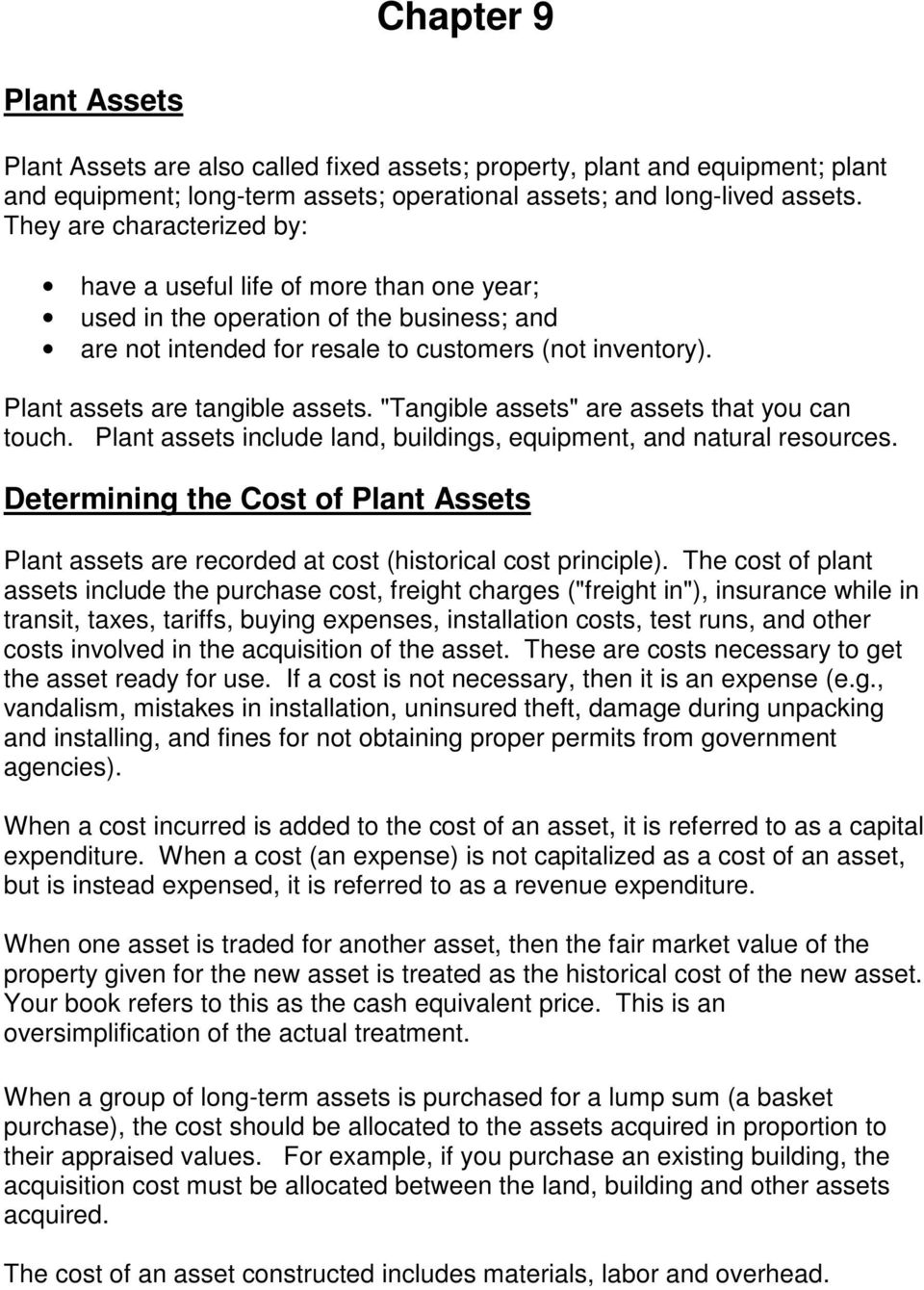
1 Chapter 9 Plant Assets Plant Assets are also called fixed assets; property, plant and equipment; plant and equipment; long-term assets; operational assets; and long-lived assets. They are characterized by: have a useful life of more than one year; used in the operation of the business; and are not intended for resale to customers (not inventory). Plant assets are tangible assets. "Tangible assets" are assets that you can touch. Plant assets include land, buildings, equipment, and natural resources. Determining the Cost of Plant Assets Plant assets are recorded at cost (historical cost principle). The cost of plant assets include the purchase cost, freight charges ("freight in"), insurance while in transit, taxes, tariffs, buying expenses, installation costs, test runs, and other costs involved in the acquisition of the asset. These are costs necessary to get the asset ready for use. If a cost is not necessary, then it is an expense (e.g., vandalism, mistakes in installation, uninsured theft, damage during unpacking and installing, and fines for not obtaining proper permits from government agencies). When a cost incurred is added to the cost of an asset, it is referred to as a capital expenditure. When a cost (an expense) is not capitalized as a cost of an asset, but is instead expensed, it is referred to as a revenue expenditure. When one asset is traded for another asset, then the fair market value of the property given for the new asset is treated as the historical cost of the new asset. Your book refers to this as the cash equivalent price. This is an oversimplification of the actual treatment. When a group of long-term assets is purchased for a lump sum (a basket purchase), the cost should be allocated to the assets acquired in proportion to their appraised values. For example, if you purchase an existing building, the acquisition cost must be allocated between the land, building and other assets acquired. The cost of an asset constructed includes materials, labor and overhead.
2 Examples of the Treatment of Acquisition Costs of Assets. Land When land is purchased, the "Land" account is debited for: the price paid for the land; real estate commissions; lawyers' fees; back taxes assumed (these are taxes accrued while the property was owned by the seller, but the taxes are paid by the buyer); draining, clearing, landscaping, and grading costs; assessments for local improvements; and the cost (less salvage value) of razing structures situated on the property. Land Improvements Land improvements, such as driveways, parking lots, fences and signs, are subject to depreciation and require a separate Land Improvements account. Buildings The cost of buildings purchased includes the applicable items described above and the cost of any repairs made in order to make the building usable. If a building is construction, the construction costs are added to the cost of the building. Interest incurred during the construction of a building or other plant asset is included in the cost of the asset (capitalized interest). This is true even if the loan was not directly used to construct the asset. Interest incurred for the purchase of a plant asset is expensed when incurred. Equipment The cost of equipment includes the price paid, sales taxes, freight charges, and insurance during transit paid by the purchaser. It also includes expenditures required in assembling, installing, and testing the unit. Journal Entries For Acquiring Fixed Assets (Not in Book) The acquisition of plant assets is often financed by issuing stock, notes, or bonds or through operations.

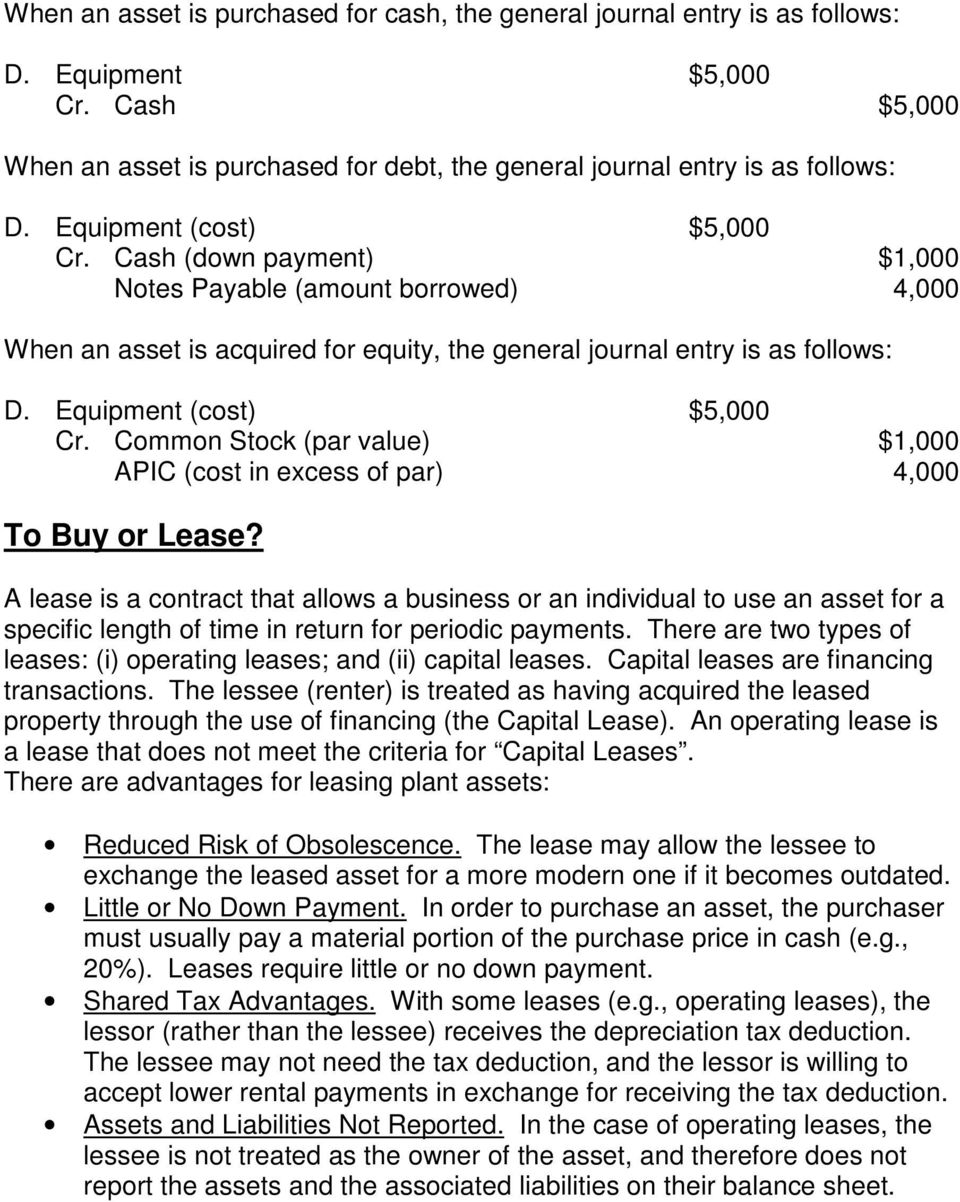
3 When an asset is purchased for cash, the general journal entry is as follows: D. Equipment $5,000 Cr. Cash $5,000 When an asset is purchased for debt, the general journal entry is as follows: D. Equipment (cost) $5,000 Cr. Cash (down payment) $1,000 Notes Payable (amount borrowed) 4,000 When an asset is acquired for equity, the general journal entry is as follows: D. Equipment (cost) $5,000 Cr. Common Stock (par value) $1,000 APIC (cost in excess of par) 4,000 To Buy or Lease? A lease is a contract that allows a business or an individual to use an asset for a specific length of time in return for periodic payments. There are two types of leases: (i) operating leases; and (ii) capital leases. Capital leases are financing transactions. The lessee (renter) is treated as having acquired the leased property through the use of financing (the Capital Lease). An operating lease is a lease that does not meet the criteria for Capital Leases. There are advantages for leasing plant assets: Reduced Risk of Obsolescence. The lease may allow the lessee to exchange the leased asset for a more modern one if it becomes outdated. Little or No Down Payment. In order to purchase an asset, the purchaser must usually pay a material portion of the purchase price in cash (e.g., 20%). Leases require little or no down payment. Shared Tax Advantages. With some leases (e.g., operating leases), the lessor (rather than the lessee) receives the depreciation tax deduction. The lessee may not need the tax deduction, and the lessor is willing to accept lower rental payments in exchange for receiving the tax deduction. Assets and Liabilities Not Reported. In the case of operating leases, the lessee is not treated as the owner of the asset, and therefore does not report the assets and the associated liabilities on their balance sheet.
4 Journal Entries Relating To Leases (Not In Book) Rental payments under an operating lease are treated as a rent expense for each period the asset is leased: D. Rent Expense $5,000 Cr. Cash $5,000 Capital leases are not really leases. They are financing transactions. You are really buying an asset; not leasing it. Many car leases are, in fact, financing transactions. A capital lease (as determined by certain criteria) is in substance a sale and should be recorded as an asset (to be depreciated) and a related liability by the lessee. When the capital lease is signed, the lessee makes journal entries that record the acquisition of an asset and liability. The purchase price and the amount of the liability is the present value of all of the payments under the lease: D. Equipment Under Capital Lease (present value of lease payments) Cr. Obligations Under Capital Lease (present value of lease payments) At the end of each year, the lessee depreciates the leased asset: $5,000 $5,000 D. Depreciation Expense $1,000 Cr. Accumulated Depreciation, Equipment Under Capital Lease $1,000 Each payment under the lease is treated as a payment on the debt. A portion is treated as interest and a portion is treated as principal: D. Interest Expense (amount paid over present value) $200 Obligations Under Capital Lease (amount related to present 800 value) Cr. Cash $1,000 Depreciation In dealing with long-term assets, the major accounting problem is to determine how much of the asset has benefited the current period (e.g., expenses) and how much should be carried forward as an asset to benefit future periods (e.g., assets).

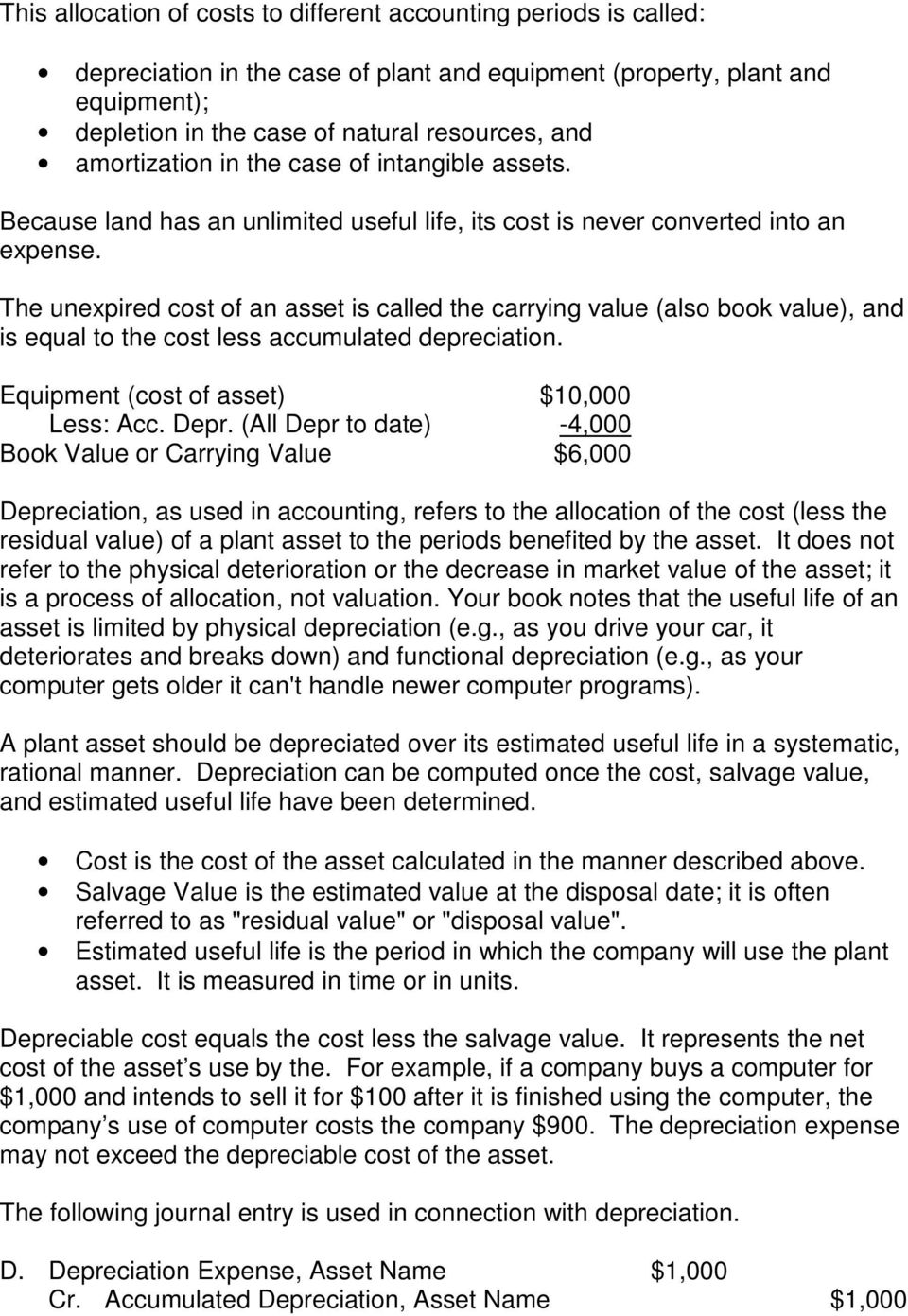
5 This allocation of costs to different accounting periods is called: depreciation in the case of plant and equipment (property, plant and equipment); depletion in the case of natural resources, and amortization in the case of intangible assets. Because land has an unlimited useful life, its cost is never converted into an expense. The unexpired cost of an asset is called the carrying value (also book value), and is equal to the cost less accumulated depreciation. Equipment (cost of asset) $10,000 Less: Acc. Depr. (All Depr to date) -4,000 Book Value or Carrying Value $6,000 Depreciation, as used in accounting, refers to the allocation of the cost (less the residual value) of a plant asset to the periods benefited by the asset. It does not refer to the physical deterioration or the decrease in market value of the asset; it is a process of allocation, not valuation. Your book notes that the useful life of an asset is limited by physical depreciation (e.g., as you drive your car, it deteriorates and breaks down) and functional depreciation (e.g., as your computer gets older it can't handle newer computer programs). A plant asset should be depreciated over its estimated useful life in a systematic, rational manner. Depreciation can be computed once the cost, salvage value, and estimated useful life have been determined. Cost is the cost of the asset calculated in the manner described above. Salvage Value is the estimated value at the disposal date; it is often referred to as "residual value" or "disposal value". Estimated useful life is the period in which the company will use the plant asset. It is measured in time or in units. Depreciable cost equals the cost less the salvage value. It represents the net cost of the asset s use by the. For example, if a company buys a computer for $1,000 and intends to sell it for $100 after it is finished using the computer, the company s use of computer costs the company $900. The depreciation expense may not exceed the depreciable cost of the asset. The following journal entry is used in connection with depreciation. D. Depreciation Expense, Asset Name $1,000 Cr. Accumulated Depreciation, Asset Name $1,000
6 The most common methods of depreciation are: The straight-line method (based on the passage of time) The declining-balance method (an accelerated method), and The units-of-activity method (based on units produced, miles driven, and the like) Straight-Line Method Under the straight-line method, the depreciable cost is spread uniformly over the estimated useful life of the asset. Depreciation for each year is computed as follows: Cost - Salvage Value Estimated useful life in years For example, if you had an asset with a cost of $10,000, a salvage value of $1,000, and a useful life of 10 years, each year you would take $900 of depreciation ($10,000 - $1,000)/10. Declining-Balance Method Accelerated methods of depreciation result in larger depreciation in the early years of an asset's life. Under the declining-balance method, depreciation is computed by multiplying the existing carrying value of the asset by a fixed percentage. The double-declining-balance method is a form of the decliningbalance method; it uses a fixed percentage that is twice the straight-line percentage. Under the double-declining-balance method, the fixed percentage is double the percentage used in the straight line calculation. For example, if the useful life is 10 years, then the straight-line depreciation would be 1/10 (10%) of the depreciable cost. With the double declining balance method, you would use twice the straight-line rate (20%). This percentage is then multiplied against the existing book value of the asset for the year in question. Note that the declining-balance method does not use residual value in figuring the rate. Despite this, you are not allowed to depreciate the asset below the residual vale. In other words, depreciation is limited to the amount necessary to bring the carrying value down to the estimated residual value.

7 Units-of-Activity Method This is often referred to as the units-of-production method or the production method. This method is similar to the straight-line method. Under the straightline method, the cost of the asset is spread out evenly over the period in which the asset is used. Under the units-of-production method, the cost is spread evenly over the units produced by the asset. Depreciation for each year is computed as follows: Cost - Salvage Value Estimated units of useful life Units of production method is a good application of the matching principle but can only be used if output over useful life can be estimated with reasonable accuracy. Depreciation and Income Taxes The Internal Revenue Code uses the Modified Accelerated Cost Recovery System (MACRS), which computes depreciation in a manner that is different than the depreciation methods used in financial accounting. For example, under MACRS, set recovery periods are used instead of the actual useful lives of given assets. A company is not required to use the same depreciation methods for tax purposes and financial statement purposes. Because a company may wish to maximize its profits, it will choose to minimize its depreciation expense by using the straight-line method. On the other hand, the same company may wish to minimize its income taxes, and therefore will minimize its income by using an accelerated depreciation method. Depreciation Disclosure in the Notes A company must disclose the depreciation methods that it employs. This disclosure is made in the notes to the financial statements. Revising Periodic Depreciation When a company changes an estimate which was used in calculated depreciation expense (e.g., extending the useful life of an asset or changing the residual value of the asset), then the company, using the remaining book value of the asset, recalculates the depreciation expense of the asset, leaving previous depreciation unchanged.

8 Other Comments on Depreciation (Not In Book) Besides calculating depreciation on an asset by asset basis, assets may be depreciated by grouping them together with other assets with similar traits. Depreciation is calculated on the group as a whole. When an asset is purchased after the beginning of the year or is discarded before the end of the year, depreciation is recorded for only part of the year. This is done by computing the year's depreciation and multiplying this figure by the fraction of the year that the asset was in use. Expenditures During Useful Life Expenditures relating to plant assets (payments or obligations to make future payments) are of two types: Capital expenditures, such as the purchase or expansion of a building, benefit several periods and are recorded as the acquisition of assets ("capitalized"). Revenue expenditures, such as operation and maintenance costs, benefit only the current period and are recorded as expenses ("expensed"). Ordinary repairs are expenditures necessary to maintain an asset in good operating condition; they are charged as an expense in the period incurred. Your book refers to capital expenditures as additions and improvements. They are described as costs that increase the operating efficiency, productive capacity or expected useful life of existing plant assets. Capital Expenditures (Not In Book) Capital expenditures on an asset that you already own are usually described as Additions; Betterments; or Extraordinary Repairs An addition adds a new feature to an existing building. An example of an addition would be adding a new room to a building. The cost is capitalized and then depreciated (expensed) over the useful life of the room or the building, whichever is shorter. A new asset is created by the expenditure A betterment improves a fixed asset's operating efficiency or capacity for its remaining useful life. It is added to the cost of the original asset. An example would be exchanging the hard drive of a computer for a newer one with more capacity. The cost of the new drive is added to the computer s cost, and the cost

9 and any accumulated depreciation related to the old hard drive should be removed from the computer s cost. Extraordinary repairs are expenditures that either increase an asset's residual value or lengthen its useful life (e.g., a major overhaul of a car engine). Extraordinary repairs are recorded by debiting Accumulated Depreciation and crediting Cash. This has the effect of increasing the book value of the asset, but makes it appear less depreciated. The thought is that by making the extraordinary repair, you have undone the previous depreciation. D. Accumulated Depreciation, Asset Name $2,000 Cr. Depreciation Expense, Asset Name $2,000 If a capital expenditure is recorded mistakenly as a revenue expenditure, current period expense is overstated and net income is understated. In future periods, net income will be overstated since it was all expensed in the first period. The opposite effects would be true for a revenue expenditure recorded mistakenly as a capital expenditure. Impairments As noted above, the historical cost of a plant asset is used in a company s balance sheet. The balance sheet is also governed by the principle of conservatism. When the market value of an asset falls below the book value of the asset, the asset is impaired. A company is required to write down the book value of the impaired asset to its fair market value in the year that the decline in value occurs. The journal entry to reflect the impairment loss is reflected below: D. Impairment Loss $10,000 Cr. Asset Name $10,000 Plant Asset Disposals Disposal occurs when the asset is discarded, sold, or traded in. When a business disposes of an asset, depreciation is recorded for the period preceding disposal. This brings the asset's Accumulated Depreciation account up to the date of disposal. When a machine is discarded, Accumulated Depreciation, Machinery is debited and Machinery is credited for their present balances.

10 If the machine is fully depreciated: D. Accumulated Depreciation, Machinery $10,000 Cr. Machinery $10,000 If the machine has not been fully depreciated, then Loss on Disposal of Machinery must be debited for the carrying value to balance the entry. D. Accumulated Depreciation, Machinery $7,000 Loss on Disposal of Machinery 3,000 Cr. Machinery $10,000 When a machine is sold for cash, Accumulated Depreciation, Machinery is debited, Cash is debited, and Machinery is credited. If a machine is sold for its book value: D. Cash $3,000 Accumulated Depreciation, Machinery 7,000 Cr. Machinery $10,000 If the cash received is less than the carrying value of the machine, then Loss on Sale of Machinery would also be debited. On the other hand, if the cash received is greater than the carrying value, then Gain on Sale of Machinery would be credited to balance the entry. D. Cash $2,000 Accumulated Depreciation, Machinery 7,000 Loss on Sale Machinery 1,000 Cr. Machinery $10,000 (Sale of machine at less than carrying value; loss recorded) D. Cash $4,000 Accumulated Depreciation, Machinery 7,000 Cr. Machinery $10,000 Gain on Sale of Machinery 1,000 (Sale of machine at more than carrying value)

11 Trade Ins (Not In Book) When an asset is traded in (exchanged) for a similar one, the gain or loss should first be computed, as follows: Trade-in allowance - Carrying value of asset traded in Gain (loss) on trade-in For financial reporting purposes, both gains and losses should be recognized (recorded) on the exchange of dissimilar assets. Gains should not be recognized on the exchange of similar assets. Losses are recognized. For income tax purposes, neither gains nor losses should be recognized on the exchange of similar assets, but both should be recognized on the exchange of dissimilar assets. When a gain or loss is to be recognized, the asset acquired should be debited for its list price (cash paid plus trade-in allowance); a realistic trade-in value is assumed. The old asset is removed from the books, as explained above. When a gain or loss is not to be recognized, the asset acquired should be debited for the carrying value of the asset traded in plus cash paid (this will result in non-recognition of the gain or loss). If you received a new machine worth $15,000 in exchange for cash of $9,000 and an old machine with a book value of $3,000, you would record the new machine at $12,000 ($3,000 book value + cash of $9,000): D. Machinery (New) $12,000 Accumulated Depreciation, Machinery (Old) 7,000 Cr. Machinery (Old) $10,000 Cash 9,000 If a gain was recognized on the above transaction, then the new machine would be recorded at its fair market value and a gain of $3,000 would be recognized on the receipt of a credit of $6,000 for the old machine with the book value of $3,000. D. Machinery (New) $15,000 Accumulated Depreciation, Machinery (Old) 7,000 Cr. Machinery (Old) $10,000 Cash 9,000 Gain on Exchange of Machine 3,000

12 Natural Resources (Not in Book) Natural resources are tangible non-monetary assets containing valuable substances that may be extracted and sold. They are sometimes referred to as "wasting assets", and include standing timber, oil and gas fields, and mineral deposits. Depletion refers to the allocation of a natural resource's cost to accounting periods based on the amount extracted each period. Depletion for each year is computed as follows: Cost - residual value x actual units extracted during period Estimated units to be extracted Units extracted but not sold during the year are recorded as inventory, to be charged as an expense in the year sold. Tangible assets used with natural resources should be depreciated over the shorter of the life of the tangible asset or the life of the natural resource. There are two acceptable methods of accounting for exploration and development of oil and gas reserves. Under successful efforts accounting, the cost of producing wells is capitalized and depleted, while the cost of dry wells is expensed immediately. Under the full-costing method, the cost of all wells is capitalized and depleted. The following journal entry relates to depletion: D. Depletion Expense, Coal Deposits $1,000 Cr. Accumulated Depletion, Coal Deposits $1,000 Analyzing Plant Assets Financial Analysts often use two ratios to evaluate a company s use of its plant assets: Return on Assets Ratio, and Asset Turnover Ratio

13 Return on Assets Ratio Financial Analysts often look at the profit earned on the company s assets. The Return on Assets Ratio is calculated as follows: Asset Turnover Ratio Net Income Average Total Assets The Asset Turnover Ratio looks at the productivity of a company s assets (rather than their profitability). This ratio is calculated as follows: Profit Margin Ratio Revisited Net Sales Average Total Assets The Profit Margin and the Asset Turnover Ratio are components of the Return on Assets: Profit Margin X Asset Turnover Ratio = Return On Assets Net Income Net Sales X Net Sales Average Total Assets = Net Income Average Total Assets Net Sales in the Profit Margin and the Asset Turnover Ratio cancel out and leave you with the Return on Assets. This relationship demonstrates the fact that if a company wishes to increase its profitability, it can either: increase its profit margin (earn more income on its given revenue), or increase its asset turnover ratio (make its assets more productive). Intangible Assets Intangible assets are long-term assets that have no physical substance; they represent certain legal rights and advantages extended to their owner. Examples of intangible assets are patents, copyrights, trademarks, goodwill, leaseholds, leasehold improvements, franchises, licenses, brand names, formulas, and processes. An intangible asset should be written off over its useful life through a process called amortization in accordance with the matching principle. Assets with an

14 indefinite useful life should not be amortized. These assets however still must be written down as impaired assets if their fair market value declines below their book value. Rather than using a contra account to reduce the asset being amortized (as was the case with Accumulated Depreciation and Accumulated Depletion), the intangible asset is reduced by its Amortization expense. There is no contra account. The journal entry for amortization is as follows: D. Amortization Expense, Patent $1,000 Cr. Patent $1,000 Patents A patent is an exclusive legal right to use an invention for 20 years. The cost of a patent should be amortized over the shorter of its useful life or its legal life. If a company incurs legal costs in successfully defending its patent, these costs are added to the cost of the patent and amortized over its remaining life. Research and Development Costs Research and development encompass the development of new products, the testing of existing and proposed products, and pure research. According to GAAP, research and development costs normally should be expensed in the period incurred. The cost of developing computer software should be treated as research and development up to the point where a product is deemed technologically feasible. From that point on, software production costs should be capitalized and amortized over their useful lives using the straight-line method. Copyrights A copyright is an exclusive legal right to publish literary, musical, and other artistic materials and software. For individuals, the copyright period is the creator s life plus 50 years. The cost of a copyright should be amortized over the shorter of its useful life or its legal life. If a company incurs legal costs in successfully defending its copyright, these costs are added to the cost of the copyright and amortized over its remaining life. Trademarks and Trade Names Trademarks and trade names are the exclusive rights to use registered symbols and names to identify a product or service. Trademarks and trade names are

15 registered with the U.S. Patent Office. Such registration provides 20 years protection and may be renewed indefinitely as long as the trademark or trade name is in use. Because trademarks and trade names have an indefinite life, they are not amortized. Franchises and Licenses A franchise grants the franchisee the exclusive right to operate a business in a given territory (e.g., a Wendy s). A license grants the licensee the right to use property or a process (e.g., formula, technique, process, or design) of another person, company or government. Annual payments on a franchise or license are an operating expense. The cost of acquiring a franchise or license should be amortized over its useful life. If the useful life is indefinite, then there should be no amortization. Goodwill Goodwill, as the term is used in accounting, refers to a company's ability to earn more than is normal for its particular industry or for the amount of its capitalization (net assets). Goodwill is recorded only when a company is purchased and equals the excess of the purchase cost over the fair market value of the net assets. Goodwill is considered to have an indefinite useful life, and therefore is not amortized. However, a company is required to examine whether its Goodwill is impaired on an annual basis. Leasehold (Not In Book) A leasehold is the purchased right to rent property for a long period of time. Leasehold improvements are improvements made to leased property that revert to the lessor at the end of the lease. They are amortized over the shorter of: (i) the useful life of the improvements or (ii) the remaining term of the lease.

College Accounting Chapter 10 Plant Assets, Natural Resources, and Intangibles
 College Accounting Chapter 10 Plant Assets, Natural Resources, and Intangibles 1. HOW DOES A BUSINESS MEASURE THE COST OF A PLANT ASSET? Plant assets are long-lived, tangible assets used in the operation
Long-Lived Assets. 1. How the matching principle underlies the methods used to account for long-lived assets.
 CHAPTER 9 Long-Lived Assets SYNOPSIS In this chapter, the author discusses (1) accounting for the acquisition, use, and disposal of long-lived assets, and (2) management's incentives for selecting accounting
Financial Accounting and Reporting Exam Review. Fixed Assets. Chapter Five. Black CPA Review www.blackcpareview.com Chapter 5
 Fixed Assets Chapter Five Black CPA Review www.blackcpareview.com Chapter 5 Objectives: Objective 1: Know which costs associated with the purchase of fixed assets are capitalized Objective 2: Understand
Accounting Notes. Types (classifications) of Assets:
 Types (classifications) of s: 1) Current s - short lived assets used in the operations of a business 2) Plant s - long lived tangible assets used in the operations of a business 3) Long Term Investment
REVIEW FOR EXAM NO. 3, ACCT-2301 (SAC) (Chapters 7-9)
 REVIEW FOR EXAM NO. 3, ACCT-2301 (SAC) (Chapters 7-9) A. Chapter 7. 1. Internal Control Objectives. a. Safeguards to protect assets. b. Procedures to insure reliable financial reports. c. Methods to insure
ASSIGNMENT CHARACTERISTICS TABLE
 CHAPTER 9 Long-Lived Assets ASSIGNMENT CLASSIFICATION TABLE Study Objectives Questions Brief Exercises Exercises Problems Set A Problems Set B 1. Apply the cost principle to property, plant, and equipment.
RAPID REVIEW Chapter Content
 RAPID REVIEW BASIC ACCOUNTING EQUATION (Chapter 2) INVENTORY (Chapters 5 and 6) Basic Equation Assets Owner s Equity Expanded Owner s Owner s Assets Equation = Liabilities Capital Drawing Revenues Debit
Accounting Building Business Skills. Learning Objectives. Learning Objectives. Paul D. Kimmel
 Accounting Building Business Skills Paul D. Kimmel Chapter Eight: Reporting and Analysing Non-current assets PowerPoint presentation by Christine Langridge Swinburne University of Technology, Lilydale
value, also called residual value or scrap value, is an estimate of the asset's value at the end of its benefit period.
 value, also called residual value or scrap value, is an estimate of the asset's value at the end of its benefit period. ~ Your answer is correct! Read about this Leftover Useful Obsolescence The correct
Depreciation and Depletion
 CHAPTER Depreciation and Depletion CHAPTER OBJECTIVES After careful study of this chapter, you will be able to: 1. Identify the factors involved in depreciation. 2. Explain the alternative methods of cost
CHAPTER 10. Acquisition and Disposition of Property, Plant, and Equipment 1, 2, 3, 5, 6, 11, 12, 21 11, 15, 16 8, 9, 10, 11, 12
 CHAPTER 10 Acquisition and Disposition of Property, Plant, and Equipment ASSIGNMENT CLASSIFICATION TABLE (BY TOPIC) Topics Questions Brief Exercises Exercises Problems Concepts for Analysis 1. Valuation
6. Depreciation is a process of a. asset devaluation. b. cost accumulation. c. cost allocation. d. asset valuation.
 1. A company purchased land for $72,000 cash. Real estate brokers' commission was $5,000 and $7,000 was spent for demolishing an old building on the land before construction of a new building could start.
Quiz Questions for Chapter 9
 Quiz Questions for Chapter 9 1. A truck was purchased for $25,000. It has a six-year life and a $4,000 salvage value. Using straight-line depreciation, what is the asset s carrying value (book value) after
CHAPTER 16. Non-current assets: Revaluation, disposal and other aspects CONTENTS
 CHAPTER 16 Non-current assets: Revaluation, disposal and other aspects CONTENTS 16.1 Non-current asset disposals 16.2 Revaluation and disposal 16.3 Intangibles and natural resources 16.4 Goodwill and discount
Chapter Overview Chapter 10 Acquisition and Disposition of Property, Plant, and Equipment Learning Objectives Learning Objectives Chapter Overview
 Chapter 10 Chapter Overview Acquisition and Disposition of Property, Plant, And Equipment Chapter 10 Valuation at date of acquisition Disposition of assets Annual reports: Dr. Pepper, Winnebago, Intel,
ACCT 265 Chapter 10 Review
 ACCT 265 Chapter 10 Review This chapter deals with the accounting for Property Plant & Equipment (PPE) or Capital Assets. When recording cost of PPE, the price of the asset is not the only cost recorded
International Accounting Standard 17 Leases
 International Accounting Standard 17 Leases Objective 1 The objective of this Standard is to prescribe, for lessees and lessors, the appropriate accounting policies and disclosure to apply in relation
CASH FLOW STATEMENT & BALANCE SHEET GUIDE
 CASH FLOW STATEMENT & BALANCE SHEET GUIDE The Agriculture Development Council requires the submission of a cash flow statement and balance sheet that provide annual financial projections for the business
Statement of Financial Accounting Standards No. 13
 Statement of Financial Accounting Standards No. 13 FAS13 Status Page FAS13 Summary Accounting for Leases November 1976 Financial Accounting Standards Board of the Financial Accounting Foundation 401 MERRITT
CHAPTER 12. Intangible Assets 1, 2, 3, 4, 5, 6, 7, 8, 9, 10, 11, 12, 13, 14 9, 10, 13, 14, 25. 3. Goodwill. 12, 13, 14, 18 6, 8 6, 12, 13, 15
 CHAPTER 12 Intangible Assets ASSIGNMENT CLASSIFICATION TABLE (BY TOPIC) Topics Questions Brief Exercises Exercises Problems Concepts for Analysis 1. Intangible assets; concepts, definitions; items comprising
Intermediate Accounting
 Intermediate Accounting Thomas H. Beechy Schulich School of Business, York University Joan E. D. Conrod Faculty of Management, Dalhousie University PowerPoint slides by: Bruce W. MacLean, Faculty of Management,
CHAPTER 12. Intangible Assets 1, 2, 3, 4, 5, 6, 7, 8, 9, 10, 11, 12, 13, 14, 25. 3. Goodwill. 12, 13, 14, 18 5, 8, 9 12, 13, 15 5, 6
 CHAPTER 12 Intangible Assets ASSIGNMENT CLASSIFICATION TABLE (BY TOPIC) Topics Questions Brief Exercises Exercises Problems Concepts for Analysis 1. Intangible assets; concepts, definitions; items comprising
Answer on Question #41857, Management, Other
 Answer on Question #41857, Management, Other Distinguish between Revenue Expenditure and capital expenditure. How are they treated while preparing the final accounts? If by mistake the accountant of a
Module 9: Property, plant and equipment (PPE) and intangible assets
 Module 9: Property, plant and equipment (PPE) and intangible assets Overview In this module, you learn about the valuation of property, plant and equipment (PPE) and intangible assets, and the cost components
Chapter 3 Unit 1. IET 35000 Engineering Economics. Learning Objectives Chapter 3. Learning Objectives Unit 1
 Chapter 3 Unit 1 The Accounting Equation Depreciation, Inventory and Ratios IET 35000 Engineering Economics Learning Objectives Chapter 3 Upon completion of this chapter you should understand: Accounting
SOLUTIONS TO EXERCISES
 EXERCISE 10-1 (15 20 minutes) SOLUTIONS TO EXERCISES Item Land Land Improvements Building Other Accounts (a) ($275,000) Notes Payable (b) $275,000 (c) $ 8,000 (d) 7,000 (e) 6,000 (f) (1,000) (g) 22,000
CLASSIFICATION OF LEASES
 284 Accounting Standard (AS) 19 Leases Contents OBJECTIVE SCOPE Paragraphs 1-2 DEFINITIONS 3-4 CLASSIFICATION OF LEASES 5-10 LEASES IN THE FINANCIAL STATEMENTS OF LESSEES 11-25 Finance Leases 11-22 Operating
ACCOUNTING FOR LEASES - COMPARISON OF INDIAN ACCOUNTING STANDARD AND US GAAP
 D.S.RAWAT FCA ACCOUNTING FOR LEASES - COMPARISON OF INDIAN ACCOUNTING STANDARD AND US GAAP The comparison of lease accounting as per the Indian GAAP (AS-19) US GAAP SFAS-13 is based on (1) The similarities
a. $ 65,000. b. $ 80,000. c. $130,000. d. $145,000.
 注 意 1. 本 試 題 卷 共 50 題, 總 分 100 分 第 01-15 題, 每 題 1.75 分, 合 計 26.25 分 ; 第 16-35 題, 每 題 2 分, 合 計 40 分 ; 第 36-50 題, 每 題 2.25 分, 合 計 33.75 答 錯 不 倒 扣 2. 請 將 答 案 按 試 題 題 號, 依 序 填 入 答 案 卡 1.FastForward had cash
University of Waterloo Final Examination. Term: Fall Year: 2005. Core Concepts of Accounting Information
 University of Waterloo Final Examination Term: Fall Year: 2005 Student Name Solution UW Student ID Number Course Abbreviation and Number AFM 101 Course Title Core Concepts of Accounting Information Section(s)
Residual carrying amounts and expected useful lives are reviewed at each reporting date and adjusted if necessary.
 87 Accounting Policies Intangible assets a) Goodwill Goodwill represents the excess of the cost of an acquisition over the fair value of identifiable net assets and liabilities of the acquired company
How To Balance Sheet
 Page 1 of 6 Balance Sheet Accounts The Chart of Accounts is normally arranged or grouped by the Major Types of Accounts. The Balance Sheet Accounts (Assets, Liabilities, & Equity) are presented first,
CHAPTER 10. Acquisition and Disposition of Property, Plant, and Equipment 1, 2, 3, 4, 6, 7, 12, 13, 18 16, 18, 19, 22
 CHAPTER 10 Acquisition and Disposition of Property, Plant, and Equipment ASSIGNMENT CLASSIFICATION TABLE (BY TOPIC) Topics Questions Brief Exercises Exercises Problems Concepts for Analysis 1. Valuation
IAS 38 Intangible Assets
 2012 Technical Summary IAS 38 Intangible Assets as issued at 1 January 2012. Includes IFRSs with an effective date after 1 January 2012 but not the IFRSs they will replace. This extract has been prepared
Accounting for Long-term Assets,
 1 Accounting for Long-term Assets, Long-term Debt and Leases TABLE OF CONTENTS Introduction 2 Long-term Assets 2 Acquiring or creating 2 Tangible assets 2 Intangible assets 3 Depreciating, amortizing and
Accounting 1010 Sample Exam 3 Chapters 7, 8, and 9
 Accounting 1010 Sample Exam 3 Chapters 7, 8, and 9 Name Multiple Choice: Circle the letter corresponding to the best answer for each question. Only circle one answer per question. Problems: Show ALL work
CHAPTER 3: PREPARING FINANCIAL STATEMENTS
 CHAPTER 3: PREPARING FINANCIAL STATEMENTS I. TIMING AND REPORTING A. The Accounting Period Time period assumption an organization s activities can be divided into specific time periods. Examples: a month,
Consolidated Financial Statements Notes to the Consolidated Financial Statements for Fiscal Year 2014
 171 The most important exchange rates applied in the consolidated financial statements developed as follows in relation to the euro: Currency Average rate Closing rate Country 1 EUR = 2014 2013 2014 2013
Jones Sample Accounts Limited. Company Registration Number: 04544332 (England and Wales) Report of the Directors and Unaudited Financial Statements
 Company Registration Number: 04544332 (England and Wales) Report of the Directors and Unaudited Financial Statements Period of accounts Start date: 1st June 2009 End date: 31st May 2010 Contents of the
Operating Working Capital Drills
 Operating Working Capital Drills Operating Working Capital Drills 1. Use IBM s balance sheet below to calculate 2010 and 2011 working capital and operating working capital. Your VP has told you to consider
Uniform Accounting Network Inventory Manual. Table of Contents. Warranty Maintenance Debt Management Depreciation Disposal
 Inventory Manual Uniform Accounting Network Inventory Manual Table of Contents Introduction Parts of the Manual Part 1 Assets Chapter 1 Acquisition Warranty Maintenance Debt Management Depreciation Disposal
Technical Factsheet 189 Intangible Fixed Assets
 Technical Factsheet 189 Intangible Fixed Assets CONTENTS Page 1 Introduction 1 2 Legislative requirement 1 3 Accounting standards 2 4 Example 9 5 Checklist 10 6 Sources of information 12 This technical
IPSAS 13 LEASES Acknowledgment
 IPSAS 13 LEASES Acknowledgment This International Public Sector Accounting Standard is drawn primarily from International Accounting Standard (IAS) 17 (revised 2003), Leases published by the International
ACCOUNTING FOR LEASES AND HIRE PURCHASE CONTRACTS
 Issued 07/85 Revised 06/90 New Zealand Society of Accountants STATEMENT OF STANDARD ACCOUNTING PRACTICE NO. 18 Revised 1990 ACCOUNTING FOR LEASES AND HIRE PURCHASE CONTRACTS Issued by the Council, New
Chapter 3 the balance sheet and the statement of changes in stockholder. equity
 Full Picture for Intermediate Accounting (I) Chapter 3 the balance sheet ASSET LIABILITY Current Chapter 6 cash and receivables Chapter 7/8 inventories Chapter 12 current liabilities and contingencies
Week 13, Chap 9 Accounting 1A, Financial Accounting
 Week 13, Chap 9 Accounting 1A, Financial Accounting Reporting and Interpreting Liabilities Instructor: Michael Booth Understanding the Business Debt is considered riskier than equity. Interest is a legal
INDONESIAN INSTITUTE OF ACCOUNTANTS FIXED ASSETS AND OTHER ASSETS
 STATEMENT OF SFAS No. FINANCIAL ACCOUNTING STANDARD 16 INDONESIAN INSTITUTE OF ACCOUNTANTS FIXED ASSETS AND OTHER ASSETS Statement of Financial Accounting Standard (SFAS) No.16, Fixed Assets and Other
ACCOUNTING COMPETENCY EXAM SAMPLE EXAM. 2. The financial statement or statements that pertain to a stated period of time is (are) the:
 ACCOUNTING COMPETENCY EXAM SAMPLE EXAM 1. The accounting process does not include: a. interpreting d. observing b. reporting e. classifying c. purchasing 2. The financial statement or statements that pertain
How To Account For Property, Plant And Equipment
 International Accounting Standard 16 Property, Plant and Equipment Objective 1 The objective of this Standard is to prescribe the accounting treatment for property, plant and equipment so that users of
Accounting 500 4A Balance Sheet Page 1
 Accounting 500 4A Balance Sheet Page 1 I. PURPOSE A. The Balance Sheet shows the financial position of the company at a specific point in time (a date) 1. This differs from the Income Statement which measures
This policy sets forth system-wide standards for financial accounting and reporting of leases.
 Accounting for Leases Section: Accounting and Financial Reporting Title: Accounting for Leases Number: 05.281 Index POLICY.100 POLICY STATEMENT.110 POLICY RATIONALE.120 AUTHORITY.130 APPROVAL AND EFFECTIVE
IPSAS 13 LEASES Acknowledgment
 IPSAS 13 LEASES Acknowledgment This International Public Sector Accounting Standard (IPSAS) is drawn primarily from International Accounting Standard (IAS) 17 (Revised 2003), Leases, published by the International
Long Island University C.W. Post GBA 521. Final Exam - review
 Long Island University C.W. Post GBA 521 Name: _ (Last name) (First name) Date: _ Final Exam - review Multiple Choice Following are 14 multiple choice questions, worth 3 points each. Clearly identify the
DEPARTMENT OF ADMINISTRATION POLICY MANUAL Revision Date 06/20/2013 Filing Number 13,001 Date Issued 07/72 Page 1 of 12 Revisions throughout
 Date Issued 07/72 Page 1 of 12 SUBJECT Capital Asset Records PURPOSE To provide capital asset policies and procedures for both Comprehensive Annual Financial Report (CAFR) and non-cafr reporting AUTHORITATIVE
Sri Lanka Accounting Standard LKAS 17. Leases
 Sri Lanka Accounting Standard LKAS 17 Leases CONTENTS SRI LANKA ACCOUNTING STANDARD LKAS 17 LEASES paragraphs OBJECTIVE 1 SCOPE 2 3 DEFINITIONS 4 6 CLASSIFICATION OF LEASES 7 19 LEASES IN THE FINANCIAL
Accounting for Leases
 CHAPTER 21 O BJECTIVES After reading this chapter, you will be able to: 1 Explain the advantages of leasing. 2 Understand key terms related to leasing. 3 Explain how to classify leases of personal property.
POLICY MANUAL. Financial Management Significant Accounting Policies (July 2015)
 POLICY 1. Objective To adopt Full Accrual Accounting and all other applicable Accounting Standards. 2. Local Government Reference Local Government Act 1995 Local Government (Financial Management) Regulations
Understanding Financial Statements. For Your Business
 Understanding Financial Statements For Your Business Disclaimer The information provided is for informational purposes only, does not constitute legal advice or create an attorney-client relationship,
Module 2: Preparing for Capital Venture Financing Financial Forecasting Methods TABLE OF CONTENTS
 Module 2: Preparing for Capital Venture Financing Financial Forecasting Methods Module 2: Preparing for Capital Venture Financing Financial Forecasting Methods 1.0 FINANCIAL FORECASTING METHODS 1.01 Introduction
Principles of Financial Accounting ACC-101-TE. TECEP Test Description
 Principles of Financial Accounting ACC-101-TE TECEP Test Description This TECEP is an introduction to the field of financial accounting. It covers the accounting cycle, merchandising concerns, and financial
IAS - 17. Leases. By: http://www.worldgaapinfo.com
 IAS - 17 Leases International Accounting Standard No 17 (IAS 17) Leases This revised standard replaces IAS 17 (revised 1997) Leases, and will apply for annual periods beginning on or after January 1, 2005.
Learning Objectives: Quick answer key: Question # Multiple Choice True/False. 14.1 Describe the important of accounting and financial information.
 0 Learning Objectives: 14.1 Describe the important of accounting and financial information. 14.2 Differentiate between managerial and financial accounting. 14.3 Identify the six steps of the accounting
AP 531 - TANGIBLE CAPITAL ASSETS
 AP 531 - TANGIBLE CAPITAL ASSETS The following topics are discussed in this administrative procedure: 1.0 Policy 2.0 Purpose 3.0 Scope 4.0 Glossary 5.0 Categorization of Assets 6.0 Accounting and Reporting
Consolidated Balance Sheet
 Consolidated Balance Sheet (As of March 31, 2010) Item Amount Item Amount [Assets] million yen [Liabilities] million yen Current assets 12,277Current liabilities 7,388 Notes payable and accounts 2,449
Jones Sample Accounts Limited. Company Registration Number: 04544332 (England and Wales) Report of the Directors and Unaudited Financial Statements
 Company Registration Number: 04544332 (England and Wales) Report of the Directors and Unaudited Financial Statements Period of accounts Start date: 1st June 2008 End date: 31st May 2009 Contents of the
The Town of Fort Frances POLICY SECTION ACCOUNTING FOR TANGIBLE CAPITAL ASSETS. ADMINISTRATION AND FINANCE NEW: May 2009 1. PURPOSE: 2.
 The Town of Fort Frances ACCOUNTING FOR TANGIBLE CAPITAL ASSETS SECTION ADMINISTRATION AND FINANCE NEW: May 2009 REVISED: POLICY Resolution Number: 05/09 Consent 156 Policy Number: 1.18 PAGE 1 of 11 Supercedes
Chapter 21 The Statement of Cash Flows Revisited
 Chapter 21 The Statement of Cash Flows Revisited AACSB assurance of learning standards in accounting and business education require documentation of outcomes assessment. Although schools, departments,
Property, Plant and Equipment
 STATUTORY BOARD FINANCIAL REPORTING STANDARD SB-FRS 16 Property, Plant and Equipment SB-FRS 16 Property, Plant and Equipment applies to Statutory Boards for annual periods beginning on or after 1 January
Dr. M.D. Chase Accounting Principles Examination 2J Page 1
 Accounting Principles Examination 2J Page 1 Code 1 1. The term "net sales" refers to gross sales revenue reduced by sales discounts and transportation-in. 2. The cost of goods available for sale in a given
International Accounting Standard 38 Intangible Assets. Objective. Scope IAS 38
 International Accounting Standard 38 Intangible Assets Objective 1 The objective of this Standard is to prescribe the accounting treatment for intangible assets that are not dealt with specifically in
INTANGIBLE ASSETS IAS 38
 INTANGIBLE ASSETS IAS 38 Road Map on IAS 38 1. Definition of intangible asset 2. Recognition and measurement 3. Recognition of expense 4. Measurement after recognition 5. Useful life 6. Intangible assets
Financial Statements
 Financial Statements The financial information forms the basis of financial planning, analysis & decision making for an organization or an individual. Financial information is needed to predict, compare
INTERNATIONAL ACCOUNTING STANDARDS. CIE Guidance for teachers of. 7110 Principles of Accounts and. 0452 Accounting
 www.xtremepapers.com INTERNATIONAL ACCOUNTING STANDARDS CIE Guidance for teachers of 7110 Principles of Accounts and 0452 Accounting 1 CONTENTS Introduction...3 Use of this document... 3 Users of financial
Fixed Assets. Name: SudhirJain M. No.: 213157
 Fixed Assets Name: SudhirJain M. No.: 213157 Agenda AS- 10 Accounting for Fixed Assets Introduction & Scope Definitions and other relevant provisions Relevant provisions of other Accounting Standards applicable
ACCOUNTING 105 CONCEPTS REVIEW
 ACCOUNTING 105 CONCEPTS REVIEW A note from the tutors: This handout is designed to help you review important information as you study for your cumulative final exam. While it does cover many important
UNIVERSITY OF WATERLOO School of Accounting and Finance
 UNIVERSITY OF WATERLOO School of Accounting and Finance AFM 101 Professor Duane Kennedy Mid-Term Examination Fall 2008 Date and Time: October 16, 2008, 7:15 8:45pm Pages: 16, including cover Name: Student
$20,000 invoice price 1,500 sales tax 500 freight 200 set-up (contractor) $22,200 total cost
 Section 2 DEPRECIATION UNDER GAAP (FOR BOOK PURPOSES) Introduction Most plant and equipment assets wear out or become obsolete over the years. Similarly, although land is not depreciated (because it does
國 立 體 育 大 學 100 學 年 度 學 士 班 轉 學 考 試 試 題 休 閒 產 業 經 營 學 系 二 年 級 會 計 學 ( 本 試 題 共 8 頁 )
 國 立 體 育 大 學 100 學 年 度 學 士 班 轉 學 考 試 試 題 休 閒 產 業 經 營 學 系 二 年 級 會 計 學 ( 本 試 題 共 8 頁 ) 注 意 : 1. 答 案 一 律 寫 在 答 案 卷 上, 否 則 不 予 計 分 2. 請 核 對 試 卷 准 考 證 號 碼 與 座 位 號 碼 三 者 是 否 相 符 3. 試 卷 彌 封 處 不 得 汚 損 破 壞 4. 行
Regulations of the University of North Texas System Chapter 08. Fiscal Management. 08.9000 Asset Capitalization
 Regulations of the University of North Texas System Chapter 08 08.9000 Asset Capitalization Fiscal Management 08.9001 Regulation Statement. The University of North Texas System shall identify, measure,
TREASURER S DIRECTIONS ACCOUNTING LIABILITIES Section A3.6 : Leases
 TREASURER S DIRECTIONS ACCOUNTING LIABILITIES Section A3.6 : Leases STATEMENT OF INTENT Assets required by Agencies to deliver outputs can be obtained by purchase or by lease. This Section provides the
SETTING UP YOUR BUSINESS ACCOUNTING SYSTEM
 100 Arbor Drive, Suite 108 Christiansburg, VA 24073 Voice: 540-381-9333 FAX: 540-381-8319 www.becpas.com Providing Professional Business Advisory & Consulting Services Douglas L. Johnston, II [email protected]
Raw materials 1. Direct materials 2. Indirect materials Direct labor, Manufacturing overhead
 Chapter9 Inventory and Cost Inventory/Merchandise Inventory = Goods that are hold in stock (Classification as Current Assets) For merchandiser or inventory firm, inventory is the goods which purchased
International Accounting Standard 38 (IAS 38), Intangible Assets
 International Accounting Standard 38 (IAS 38), Intangible Assets By BRIAN FRIEDRICH, MEd, CGA, FCCA(UK), CertIFR and LAURA FRIEDRICH, MSc, CGA, FCCA(UK), CertIFR Updated By STEPHEN SPECTOR, MA, FCGA This
Chapter 8 Accounting for Receivable
 Chapter 8 Accounting for Receivable Type of receivable: Receivable refers to amounts due from individuals and companies. o Account receivable: Amount customer owe on account, result from sales of goods
Summary of Certain Differences between SFRS and US GAAP
 Summary of Certain Differences between and SUMMARY OF CERTAIN DIFFERENCES BETWEEN AND The combined financial statements and the pro forma consolidated financial information of our Group included in this
Practice Bulletin No. 2
 Practice Bulletin No. 2 INTERNATIONAL GLOSSARY OF BUSINESS VALUATION TERMS To enhance and sustain the quality of business valuations for the benefit of the profession and its clientele, the below identified
Accounting and reporting by charities EXPOSURE DRAFT
 10. Balance sheet Introduction 10.1. All charities preparing accruals accounts must prepare a balance sheet at the end of each reporting period which gives a true and fair view of their financial position.
RECOGNITION AND INITIAL MEASUREMENT OF AN INTANGIBLE ASSET
 430 AS 26 430 Accounting Standard (AS) 26 Intangible Assets Contents OBJECTIVE SCOPE Paragraphs 1-5 DEFINITIONS 6-18 Intangible Assets 7-18 Identifiability 11-13 Control 14-17 Future Economic Benefits
Chapter 4: Business Valuation (Adjusted Book Value or Cost Approach)
 Chapter 4: Business Valuation (Adjusted Book Value or Cost Approach) In adjusting the balance sheet, the most difficult task is to mark to market (substitute market values for book values) the assets and
Glossary of Accounting Terms
 Glossary of Accounting Terms Account: A record that holds the results of financial transactions. Accountant's Equation: The equation that is the basis of the Balance Sheet: Assets = Liabilities + Owners'
Investments and advances... 313,669
 Consolidated Financial Statements of the Company The consolidated balance sheet, statement of income, and statement of equity of the Company are as follows. Please note the Company s consolidated financial
Assuming office supplies are charged to the Office Supplies inventory account when purchased:
 Adjusting Entries Prepaid Expenses Second Bullet Example - Assuming office supplies are charged to the Office Supplies inventory account when purchased: Office supplies expense 7,800 Office supplies 7,800
The Application of International Accounting Standards in the Financial Statements of Tearfund Partners
 The Application of International Accounting Standards in the Financial Statements of Tearfund Partners Context: International Accounting Standards (IAS) have been developed primarily to bring consistency