
Mechanics of Balance
|
|
|
- Melinda Mills
- 9 years ago
- Views:
Transcription
1 Maureen McHugh Number 1 Notes on Applied Anatomy Feldenkrais Practitioner Mechanics of Balance July 2009 Balance on one foot How does the ballet dancer balance on one foot? In looking at the photo at right, your answer might be: "Simply. Easily. Naturally." Like all experts, she makes the difficult look easy. But as you will know if you try it, it is not easy. A lot of training has gone into being able to hold that pose. Some of a dancer's skill develops through persistent repetition from an early age. This is needed. But there is also a body of knowledge that can accelerate the learning process -- at any age. It has to do with the coordination of body parts around axes of rotation. When that clarifies, mentally, then, physically, also, action clarifies. One-word vs. two-word descriptors Describe, if you will please, how the woman at right has moved her shoulder. Probably you will say, "She has moved it forward." This is a true description, and economical. But it is incomplete. It would be more accurate to say, "She has moved her shoulder forward and leftward." Or "forward and inward." And what about her other shoulder? Usually people say, "She has moved the left shoulder backward." But it is more complete to say that she has moved it backward and rightward. Or backward and inward. The one-word descriptions are conveniently short. But they are inaccurate because they describe movement along one dimension, which means on a line. The two-word description is more complete because it describes movement along two dimensions, which means a plane. It talks about an arc, which is part of a circle. You could make the description even richer by observing that she also moves the right shoulder down. This takes the discussion into three dimensions. It is a very interesting expansion of the topic! But for now we will stick with two. All rights reserved Maureen A. McHugh 2009 Landmark Tower 101 S. Whiting Street #207 Alexandria, VA 22304

2 "Not a line! An arc!" The differentiation between a linear or circular understanding of movement became important to me in one instant, years ago, when I was working with a client, Madeline, who had shoulder pain. She was lying on her left side on my table, and I was sitting on a stool at her head just as in the photo at right. I had placed my hands on her right shoulder, and I was asking through my hands, "What will it be like for this shoulder to go 'some up' or 'some down'?" In response to my question, the shoulder didn't move up. It didn't move down. It didn't do anything at all. I found this unsettling. Why not? How can a shoulder not move? Then -- with a flash of insight -- a new thought came to me: "When a shoulder moves from this starting position, it moves 'some up and in' and then 'some down and in'." When I tried next to move her shoulder with this idea of an arc, it just floated. There was no problem at all. It was as though it had been greased. Madeline and I were both so happy. After that, every day I saw another application where, following the association given by one-word descriptors, I had an inner representation of linear movement. This was incorrect, and the more correct understanding was that the movement was circular. An arc, a whole circle, a center, and an axis In subsequent days I understood more details. Every time you have an arc you also have three other elements: 1) a whole circle to which the arc belongs 2) a center of that circle and 3) an axis around which the circle revolves. The drawing at right gives an example of a circle around the vertical axis. Since we live in a three-dimensional world, there are three basic As we live in a three-dimensional world, there are three axes of rotation. 2

3 The vertical axis The most common axis in human movement is the vertical. Partial movements around this axis are usually called 'turning', and we do them all the time. Twists are also movements around the vertical axis -- the upper body turns one way and the lower the other. The woman a few paragraphs ago who was standing "with her right shoulder forward" was using this axis to rotate her shoulders and torso. This is the same axis that is used in dance to do a pirouette, and in figure skating, a spin. The horizontal axis The second most common axis of rotation is the horizontal. All the bending movements use this one. In the photo at right the woman is bending in the hip joint. Note that in relation to the usual upright standing position, her head has come down and forward. The sagittal axis The least common is the front-to-back axis. It is so rarely discussed that there isn't even an everyday word for it. The anatomist's word is sagittal, or anterior-posterior. The easiest example is the gymnast's cartwheel. These three axes of rotation are the building blocks of all movements. You can do simple movements using predominantly one axis. More complex movements use combinations of them. 3

4 The language of math Say you want to describe how a person moves in terms of the fundamental axis of rotation. Let's imagine Susan who is standing. She turns to the left. To describe her movement you say, "She is turning around the vertical axis." This is a true and simple statement. But what happens when Susan lies down on her back, bends her knees and places her feet on the floor, crosses her arms over her chest, hugging herself, and rolls in a happy manner from side to side. What axis is that? You could say, as I sometimes do when teaching, "Susan is rolling around the axis that is 'vertical-when-standing'." This works! But it lacks elegance. A more elegant choice is to use the language of math. In math the vertical axis is called Y. "Y" is just a name. So now you can use fewer words and say, "Susan is taking a Y axis movement, at one moment while standing and at another while lying down." If you'll make the effort to get used to this vocabulary, you will find that it simplifies things later on. Movements around the Y axis One example of the usefulness of this vocabulary is in describing a swimmer's action. Good technique requires that the swimmer rotate his body as he lies in the water. This helps him to turn his head to get a breath and raise his arm out of the water, among other things. It is a Y rotation, not while standing. Movements around the X axis The movements that are called "bending" are X axis rotations. Other commons words include: "arching, rounding, flexion, extension and folding." The man at right is bending in his ankles, knees and hip joints preparatory to leaping onto the box. His back and head are also arched. His elbows are lightly flexed. These are all X axis rotations in the relevant joints. 4

5 Movements around the Z axis When you tilt your head to the side to hold the phone to your ear, that is a Z axis movement of the head. If you don't use a hand to hold the phone, but instead hold it by pressing the shoulder to the head, then you have two counterbalancing Z axis movements: 1) the head rotating clockwise and 2) the shoulder and related ribs rotating counterclockwise. Balancing on one foot So now we have enough background to discuss the question: "How does a dancer balance on one foot?" Let's begin in a simple, balanced pose on two feet. You have the intention next to stand only on your right foot. Raising one leg as an isolation Do you keep everything constant and just raise the left leg to the side? When you look at the drawing at right, you can see how stiff the move looks. Ignore, please, the fakey smile. It is not at all natural or balanced. You would have to have very powerful muscles to hold everything in place and just raise one leg straight to the side. 5

6 Using the torso What really happens is that you use the torso to help raise the left leg. You bend in the spine. The bend makes several things happen at once: 1) the left hip comes higher (becomes lighter) 2) the right hip presses down (becomes heavier) 3) the left shoulder comes lower 4) the right shoulder goes higher 5) the left ribs compress 6) the right ribs bow out Two Z axis circles rotate toward each other These details can be summarized as the consequences of two circles, Z axis circles, rotating toward each other. The upper circle rotates clockwise and the lower counter clockwise. The consequence of the dual rotation is that you get 1) longer on the weighted leg and 2) shorter on the unweighted leg. When you work with yourself to clarify your ability to move like this, you will find that you are more secure in your balance. More to see Once you get used to this way of seeing, and take the initiative to observe other people's movement, you will see more and more examples of this pattern. For example, look at this field goal kicker. Weighted side. His weight is on his left leg. The left ribs are bowed out. The left shoulder and arm are high. Unweighted side. The right leg is in the air, unweighted. The right ribs are compressed. They draw the right hip up and the right shoulder down. 6

7 More effort than one sees One thing that is interesting to me in the study of balance is the deeper awareness of how much effort it takes to stay on one foot. The word "balance" doesn't immediately give that impression. I can easily get an association from it of "no effort." But in this study of two rotating circles in counterbalancing movement, one can clearly perceive that it takes energy to be balanced on one foot. It may LOOK effortless, but it is not. Art is illusion! Another step more complicated The focus so far has been on rotations in a single plane. But, of course, a dance gesture can easily be more complicated. For example, in this photo of Baryshnikov, one can easily see the Z axis contribution: the left side is compressed, bringing the left hand and left leg close to each other, while the right side is elongated with the right arm and right leg maximally distant. In addition, Mikhail has strongly arched his back and let his head fall backwards. These are X axis movements. One can think again of two counterbalancing circles. Both are behind his back, one behind his upper body, and one behind his lower. They rotate, around the horizontal axis, inward -- toward each other. And he arches! All three And then, of course, a beautiful dance move can use all three axes. Here is Patrick Chan, Canada's figure skating champion. His weight is on one foot, the right; that takes good Z axis work. He is deeply bent in the right knee and ankle and in both hip joints; that is X axis folding. And he is rotated so he looks left; Y axis. Natural talent! Years of practice! And good body part mechanics! 7

Cardiac Rehab Program: Stretching Exercises
 Cardiac Rehab Program: Stretching Exercises Walk around the room, step side to side, ride a bike or walk on a treadmill for at least 5 minutes to warm up before doing these stretches. Stretch warm muscles
General Guidelines. Neck Stretch: Side. Neck Stretch: Forward. Shoulder Rolls. Side Stretch
 Stretching Exercises General Guidelines Perform stretching exercises at least 2 3 days per week and preferably more Hold each stretch for 15 20 seconds Relax and breathe normally Stretching is most effective
Fact sheet Exercises for older adults undergoing rehabilitation
 Fact sheet Exercises for older adults undergoing rehabilitation Flexibility refers to the amount of movement possible around a joint and is necessary for normal activities of daily living such as stretching,
How To Stretch Your Body
 Exercise Module A New Leaf Choices for Healthy Living University of North Carolina at Chapel Hill 2007 Center for Health Promotion and Disease Prevention Physical Activity Exercises for Keeping Active
Exercise 1: Knee to Chest. Exercise 2: Pelvic Tilt. Exercise 3: Hip Rolling. Starting Position: Lie on your back on a table or firm surface.
 Exercise 1: Knee to Chest Starting Position: Lie on your back on a table or firm surface. Action: Clasp your hands behind the thigh and pull it towards your chest. Keep the opposite leg flat on the surface
HELPFUL HINTS FOR A HEALTHY BACK
 HELPFUL HINTS FOR A HEALTHY BACK 1. Standing and Walking For correct posture, balance your head above your shoulders, eyes straight ahead, everything else falls into place. Try to point toes straight ahead
Range of Motion. A guide for you after spinal cord injury. Spinal Cord Injury Rehabilitation Program
 Range of Motion A guide for you after spinal cord injury Spinal Cord Injury Rehabilitation Program This booklet has been written by the health care providers who provide care to people who have a spinal
The 11+ A complete warm-up program
 The 11+ A complete warm-up program Part 1 & 3 A A }6m Part 2 B A: Running B: Jog back B! FIELD SET-UP A: Running exercise B: Jog back The course is made up of 6 pairs of parallel cones, approx. 5-6m apart.
EGOSCUE CLINIC PAIN/POSTURE STRETCHES 1. Standing Arm Circles: Helps Restore Upper Body Strength
 EGOSCUE CLINIC PAIN/POSTURE STRETCHES 1. Standing Arm Circles: Helps Restore Upper Body Strength Two sets of 40 repetitions each. Stand with your feet pointed straight and hip-width apart. Place your fingertips
X-Plain Neck Exercises Reference Summary
 X-Plain Neck Exercises Reference Summary Introduction Exercising your neck can make it stronger, more flexible and reduce neck pain that is caused by stress and fatigue. This reference summary describes
CHAPTER 3: BACK & ABDOMINAL STRETCHES. Standing Quad Stretch Athletic Edge - www.athleticedge.biz - (650) 815-6552
 CHAPTER : BACK & ABDOMINAL STRETCHES Standing Quad Stretch ) Stand and grasp right ankle with same hand, use a wall or chair to Lower maintain Back balance with left hand. Maintain an upright Stretches
Spine Conditioning Program Purpose of Program
 Prepared for: Prepared by: OrthoInfo Purpose of Program After an injury or surgery, an exercise conditioning program will help you return to daily activities and enjoy a more active, healthy lifestyle.
Basic Stretch Programme 3. Exercise Circuit 4
 Basic Stretch Programme 3 Exercise Circuit 4 2 1 Calves Stand approximately 1 metre away from wall with legs straight and heels on floor. Step and lean forward and slowly push hips towards wall. Should
Shoulders (free weights)
 Dumbbell Shoulder Raise Dumbbell Shoulder Raise 1) Lie back onto an incline bench (45 or less) with a DB in each hand. (You may rest each DB on the corresponding thigh.) 2) Start position: Bring the DB
INTRODUCTION TO POSITIONING. MODULE 3: Positioning and Carrying
 MODULE 3: Positioning and Carrying Blankets, pillows and towels, sandbags, carpet on the floor, a doll with floppy limbs that can be positioned i.e. not a hard plastic doll, display materials. Icebreaker
A Stretch-Break Program for Your Workplace! www.healthyworkplaceweek.ca
 www.healthyworkplaceweek.ca A Stretch-Break Program for Your Workplace! Why is stretching at work important? Sitting at a desk or computer; or standing at your work station for extended periods of time
Lower Body Strength/Balance Exercises
 Compliments of (Medical Group Name & Phone # to be inserted here) Lower Body Strength/Balance Exercises Hip Flexion Strengthens thigh and hip muscles. Use ankle weights, if you are ready to. Stand to the
D: Date Sunday Monday Tuesday Wednesday Thursday Friday Saturday Week 1 D: D: D: D: D: D: D:
 Physical Therapy and Home Exercise Program for Patients in the Exercise Group (Treatment Sessions 1-8) and the Manipulation + Exercise Group (Treatment Sessions 3-8) This exercise handout contains descriptions
Low Back Pain: Exercises
 Low Back Pain: Exercises Your Kaiser Permanente Care Instructions Here are some examples of typical rehabilitation exercises for your condition. Start each exercise slowly. Ease off the exercise if you
How To Improve Drainage
 Rehabilitation Home Program Edema Exercises To Improve Drainage You will improve your lymph flow by doing a few exercises each day. These exercises are an important part of your home program. They may
Exercises for older people
 Exercise for older people Exercises for older people Sitting Getting started If you ve not done much physical activity for a while, you may want to get the all-clear from a GP before starting. For the
are you reaching your full potential...
 T h e r e s n o s u c h t h i n g a s b a d e x e r c i s e - j u s t e x e r c i s e d o n e b a d l y FIT for sport are you reaching your full potential... These tests are a series of exercises designed
Rotator Cuff and Shoulder Conditioning Program. Purpose of Program
 Prepared for: Prepared by: OrthoInfo Purpose of Program After an injury or surgery, an exercise conditioning program will help you return to daily activities and enjoy a more active, healthy lifestyle.
he American Physical Therapy Association would like to share a secret with you. It can help you do more with less effort breathe easier feel great.
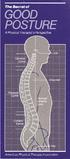 The Secret... T he American Physical Therapy Association would like to share a secret with you. It can help you do more with less effort breathe easier feel great. The secret is about good posture, which
SHOULDER PULL DOWNS. To learn efficient use of the shoulder blades and arms while maintaining a neutral spine position.
 SHOULDER INTRODUCT ION Welcome to your shoulder exercise program The exercises in the program are designed to improve your shoulder mobility, posture and the control of the muscles in your neck and shoulder
Trunk Strengthening and Muscle and Coordination Exercises for Lower Limb Amputees
 Trunk Strengthening and Muscle and Coordination Exercises for Lower Limb Amputees Part One: Trunk Strengthening Trunk Extension Needed: Sturdy chair or stool, Theraband, and a Theraball if necessary. Sit
by Ellen Saltonstall and Dr. Loren Fishman
 10 Yoga Poses for Low Back Pain Prevention by Ellen Saltonstall and Dr. Loren Fishman Introduction This series of poses is designed to prevent future back pain and also to relieve back pain that you may
5852/1. Massage & stretching cards to help you provide best care for your pet
 5852/1 Massage & stretching cards to help you provide best care for your pet Massage & stretching cards to help you provide best care for your pet We at Vetoquinol care about your pet's well-being and
Low Back Pain Exercises Interactive Video Series Transcript July 2013
 Introduction Low Back Pain Exercises Interactive Video Series Transcript July 2013 ** Note: If an exercise causes an increase in your pain, stop the exercise.** [Music introduction; Dr. John Sheehan onscreen]
9 exercises to rehab a torn ACL without surgery
 MENU Search foxnews.com Health Home Men's Health Women's Health Children's Health Alternative Medicine Diabetes Heart Health Allergies HEALTH 9 exercises to rehab a torn ACL without surgery By Julie Wilcox
Sheet 1A. Treating short/tight muscles using MET. Pectorals. Upper trapezius. Levator scapula
 Sheet 1A Treating short/tight muscles using MET Pectorals Once daily lie at edge of bed holding a half-kilo can, arm out sideways. Raise arm and hold for 10 seconds, then allow arm to hang down, stretching
Otago Exercise Program Activity Booklet
 Head Movements Stand up tall and look ahead. Slowly turn your head as far as you can to the right. Slowly turn your head as far as you can to the left. Repeat five times to each side. 44 Neck Movements
Info. from the nurses of the Medical Service. LOWER BACK PAIN Exercise guide
 Info. from the nurses of the Medical Service LOWER BACK PAIN Exercise guide GS/ME 03/2009 EXERCISE GUIDE One of the core messages for people suffering with lower back pain is to REMAIN ACTIVE. This leaflet
Spinal Exercise Program/Core Stabilization Program Adapted from The Spine in Sports: Robert G. Watkins
 Spinal Exercise Program/Core Stabilization Program Adapted from The Spine in Sports: Robert G. Watkins Below is a description of a Core Stability Program, designed to improve the strength and coordination
LEVEL I SKATING TECHNICAL. September 2007 Page 1
 SKATING September 2007 Page 1 SKATING SKILLS The game of Ice Hockey is a fast-paced, complex, team sport, which demands quick thinking, fast reactions and special athletic skills. Skating is the most important
A proper warm-up is important before any athletic performance with the goal of preparing the athlete both mentally and physically for exercise and
 A proper warm-up is important before any athletic performance with the goal of preparing the athlete both mentally and physically for exercise and competition. A warm-up is designed to prepare an athlete
MINDING OUR BODIES. Healthy Eating and Physical Activity for Mental Health
 MINDING OUR BODIES Healthy Eating and Physical Activity for Mental Health Facilitators Guide: Background Information (note: tell participants to consult with their doctor before starting to exercise) What
Easy Yogic Breathing for a Restful Sleep
 YOGA POSES Enliven your days with the benefits of yoga. Discover physical and breathing poses to complement your mood, calm your mind and achieve balance in your body. Easy Yogic Breathing for a Restful
Most Effective Abdominal Exercises
 The following abdominal exercises, when done correctly, will give you an incredible workout. They are suitable for both men and women. Most Effective Abdominal Exercises You have full rights to distribute
Cervicothoracic Mobility Exercises
 Cervicothoracic Mobility Exercises Upper Cervical Mobility Exercises... 2 Lower Cervical Mobility Exercises... 3 Cervicothoracic Junction Mobility Exercises... 4 1 st Rib Mobility Exercises... 5 Cervical
Exercises for the Hip
 Exercises for the Hip Gluteal Sets: Lie on your back, tighten buttocks and hold for 3-5 seconds. Repeat 20 times. Supine Hip ER/IR: Lie on your back with legs straight. Gently rotate knees out and in limited
try Elise s toning exercise plan
 try Elise s toning exercise plan Whether you want to start things off slow and gradually build up your fi tness, or begin with a challenge, Elise s toning exercise programme is designed for all levels.
Aquatic Exercises: Upper Body Strengthening
 Aquatic Exercises: Upper Body Strengthening These exercises will strengthen your muscles in your arms, shoulders, chest and neck. Exercising in water allows you to have less stress on your joints. When
Care at its Best! Foam Roller Exercise Program
 Foam Roller Exercise Program Foam rollers are a popular new addition the gym, physical therapy clinics or homes. Foam rollers are made of lightweight polyethyline foam. Cylindrical in shape, foam rollers
Range of Motion Exercises
 Range of Motion Exercises Range of motion (ROM) exercises are done to preserve flexibility and mobility of the joints on which they are performed. These exercises reduce stiffness and will prevent or at
Stretching in the Office
 Stretching in the Office Legs: Quads, Hamstrings, IT band, Hip flexors, Gluts, Calves Quads: Standing @ desk maintaining upright posture, grab one leg @ a time by foot or ankle and bring it towards backside
Conditioning From Gym To Home To Gym
 Page 1 of 6 Conditioning From Gym To Home To Gym by Vladimir Artemov, Olympic and World Champion and USA Gymnastics Women's National Clinician In the beginning, and throughout the training process, conditioning
Otago Exercise Program
 Otago Exercise Program Edited Version Exercise Booklet Created by: Genesee County Coalition Supported by a grant from the Health Foundation for Western and Central New York Otago Exercise Program to Prevent
Mike s Top Ten Tips for Reducing Back Pain
 Mike s Top Ten Tips for Reducing Back Pain The following article explains ways of preventing, reducing or eliminating back pain. I have found them to be very useful to myself, my clients and my patients.
Chest (medicine ball)
 Kneel to Pushup Kneel to Pushup Start Position: Your body will be in an upright position sitting on your knees. Hold medicine ball at chest level. Keeping your torso erect fall forward and chest press
Self-mobilization methods
 Self-mobilization methods 5 Muscle energy techniques, as outlined in previous chapters, provide us with an excellent series of methods for relaxation and stretching of specific tight, shortened, contracted
1. Cut & plant 6. Hitch Hiker 5-7 cuts on each side 3 x 20-30s. 2. Single-leg jumping 7. Y-position 5-10 reps 2 x 10 reps each arm
 Beach Volleyball program - Level 1 1. Cut & plant 6. Hitch Hiker 5-7 cuts on each side Keep knee over toe 5-7 cuts on each side Squeeze shoulder blades together Lift arms Thumb pointing upwards 2. Single-leg
EXERCISE DESCRIPTIONS PHASE I Routine #1
 EXERCISE DESCRIPTIONS PHASE I Routine #1 Hip Mobility Exercise: Forward Out-In Movement: Raise leg out to the side, and rotate around to the front. Keep shin/thigh angle at 90 degrees. Exercise: Backward
Passive Range of Motion Exercises
 Exercise and ALS The physical or occupational therapist will make recommendations for exercise based upon each patient s specific needs and abilities. Strengthening exercises are not generally recommended
Chronos - Circuit Training Bodyweight
 Outline Chronos - Circuit Training Bodyweight 1. Mountain climbers doubles x 10 2. Mountain climbers singles x 10 each leg 3. Mountain climbers singles out x 10 each leg 4. Mountain Climbers Doubles out
Rehabilitation after lumbar discectomy, microdiscectomy and decompressive laminectomy. Information for patients
 Rehabilitation after lumbar discectomy, microdiscectomy and decompressive laminectomy Information for patients You have just had surgery on your lumbar spine. Below are some common questions with answers,
Wellness Workbook. Journaling your way to a healthier life! By Tamiko Arbuckle http://myfoggybrain.com
 Wellness Workbook Journaling your way to a healthier life! By Tamiko Arbuckle http://myfoggybrain.com Please send any questions/ feedback to [email protected] Here s to your Wellness! Welcome and
Do s and Don ts with Low Back Pain
 Do s and Don ts with Low Back Pain Sitting Sit as little as possible and then only for short periods. Place a supportive towel roll at the belt line of the back especially when sitting in a car. When getting
Stretching for Young Athletes. Shawn P. Anderson, SPT Duke University Doctor of Physical Therapy
 Stretching for Young Athletes Shawn P. Anderson, SPT Duke University Doctor of Physical Therapy Sports and exercise are usually integral parts of many adolescents life. Whether they play at school or in
Welcome to your LOW BACK PAIN treatment guide
 Welcome to your LOW BACK PAIN treatment guide You are receiving this guide because you have recently experienced low back pain. Back pain is one of the most common musculoskeletal problems treated in medicine
Qigong. Ba Duan Jin. The Eight Pieces of Brocade
 Qigong Ba Duan Jin The Eight Pieces of Brocade by Col and g Hamilton Yiheyuan Martial Arts Contents Page Introduction 2 Preparation 2 1. Hold up the Sky 3 2. The Archer 4 3. Join Heaven and Earth 5 4a.
No Equipment Agility/Core/Strength Program for Full Body No Equip Trainer: Rick Coe
 No Equipment Agility/Core/Strength Program for Full Body No Equip Trainer: Rick Coe Introduction Program designed to be performed in a circuit. Perform exercises in sequence without rest 2-3 times. Increase
Living Room Bodyweight Workout Week 1 March or jog in place for 1 min to increase heart rate and lubricate joints.
 Warm Up- Living Room Bodyweight Workout Week 1 March or jog in place for 1 min to increase heart rate and lubricate joints. Protocol- All exercises will be done for 2 sets of 10 repetitions. After the
During the breathing exercises, it is important not to use your neck or shoulder muscles. Generally, ten breath cycles per session is adequate.
 Cool-Down Breathing Exercises Overview Breathing exercises help make use of the entire lung and keep the chest muscles active. They allow for more oxygen with each breath and to breathe with less effort.
ISOMETRIC EXERCISE HELPS REVERSE JOINT STIFFNESS, BUILDS MUSCLE, AND BOOSTS OVERALL FITNESS.
 ISOMETRIC EXERCISE HELPS REVERSE JOINT STIFFNESS, BUILDS MUSCLE, AND BOOSTS OVERALL FITNESS. By Askari A. Kazmi KazmisBioscienceLabs exercise helps reverse joint stiffness, builds muscle, and boosts overall
KNEE EXERCISE PROGRAM
 KNEE PROGRAM INTRODUCT ION Welcome to your knee exercise program. The exercises in the program are designed to improve your knee stability and strength of the muscles around your knee and hip. The strength
Lower Back Pain www.spireperform.com 01283 576333
 Lower Back Pain www.spireperform.com 01283 576333 Low back pain can be caused through deficiencies in movement, posture and your lower limbs or pelvis. The advice in this booklet aims to help with relieving
back care TIPS FOR DAILY ACTIVITIES
 back care TIPS FOR DAILY ACTIVITIES TIPS FOR DAILY ACTIVITIES INTRODUCTION When your back hurts, the way you hold and move your body is important. Your muscles can become more tense and painful depending
Sutton & Cheam Swimming Club. Land Training for Swimming and Water Polo
 Sutton & Cheam Swimming Club Land Training for Swimming and Water Polo Why do we need to perform land work? Many of the basics for swimming and water polo can be gained by experiencing activities out
Do you sit at a desk all day? Does your 9 to 5 leave no time for structured exercise..?
 Do you sit at a desk all day? Does your 9 to 5 leave no time for structured exercise..? Staying healthy at work is easier than you might think: Try building the following desk based exercises into your
Functional rehab after breast reconstruction surgery
 Functional rehab after breast reconstruction surgery UHN A guide for women who had DIEP, latissimus dorsi with a tissue expander or implant, or two-stage implant based breast reconstruction surgery Read
The Santa Monica Orthopaedic and Sports Medicine Research Foundation. The PEP Program: Prevent injury and Enhance Performance
 The Santa Monica Orthopaedic and Sports Medicine Research Foundation The PEP Program: Prevent injury and Enhance Performance This prevention program consists of a warm-up, stretching, strengthening, plyometrics,
EXERCISE INSTRUCTIONS 1
 EXERCISE INSTRUCTIONS 1 Contents ANKLE TOUCHES... 4 BACK EXTENSIONS... 4 BACK REVERSE FLYES... 4 BALL ROLL... 4 BASKETBALL SQUATS... 4 BEAR CRAWL... 4 BICEP CURL (Resistance Band)... 4 BOXING JABS... 5
Kelly Corso MS, ATC, CES, FMSC, CSST
 ACL Injury Prevention Program Kelly Corso MS, ATC, CES, FMSC, CSST What is the ACL??? The ACL or anterior cruciate ligament, attaches the front top portion of the shin bone (tibia) to the back bottom portion
Chair Exercises For Older Adults
 Chair Exercises For Older Adults Many of these exercises were adapted from these sources: National Institute on Aging, Exercise: A Guide from the National Institute on Aging, 2001, http://www.nia.nih.gov/healthinformation/publications/exerciseguide/.
Standing with legs slightly apart, inhale and expand chest and shoulders; exhale and draw in chest and shoulders.
 ILLUSTRATED EXERCISE #4 PAGE 1 2012 Bringing the Body to the Stage and Screen and Beyond by Annette Lust 1 Standing with legs slightly apart, inhale and expand chest and shoulders; exhale and draw in chest
Exercises for Low Back Injury Prevention
 DIVISION OF AGRICULTURE RESEARCH & EXTENSION University of Arkansas System Family and Consumer Sciences Increasing Physical Activity as We Age Exercises for Low Back Injury Prevention FSFCS38 Lisa Washburn,
Basic Training Exercise Book
 Basic Training Exercise Book Basic Training Exercise Book Instructions The exercises are designed to challenge the major muscles groups every day, approximately every 2 to 3 hours., for a total of 6 times
stretches and exercises
 stretches and exercises The enclosed sheets contain stretches and exercises which can be used to delay and minimise the development of contractures and deformities occurring in children with Duchenne muscular
Yoga Teacher Training Home Study Course. Part 3b. Teaching and Practicing Sun Salutations
 Yoga Teacher Training Home Study Course Part 3b Teaching and Practicing Sun Salutations Sun Salutations (Surya Namaskar) A sun salutation is a graceful sequence of positions performed as one continuous
Psoas Syndrome. The pain is worse from continued standing and from twisting at the waist without moving the feet.
 Psoas Syndrome The iliopsoas muscle is a major body mover but seldom considered as a source of pain. Chronic lower back pain involving the hips, legs, or thoracic regions can often be traced to an iliopsoas
Take a few minutes for yourself and incorporate some Office Yoga into your daily routine.
 OFFICE YOGA Working in an office or at a computer for prolonged periods of time can put strain on the neck, shoulder and back muscles which in turn can lead to tension and stiffness. This tension can cause
Physical & Occupational Therapy
 In this section you will find our recommendations for exercises and everyday activities around your home. We hope that by following our guidelines your healing process will go faster and there will be
MELT Mini Map For Motorcyclists
 MELT Mini Map For Motorcyclists The MELT Self-Treatment Tools needed for this monthʼs Mini Map can be found online at store.meltmethod.com. Depending on which tools you have on hand, you can start with
Reduce Stress with This 15-Minute Restorative Yoga Sequence
 Reduce Stress with This 15-Minute Restorative Yoga Sequence Try this short, stress-busting restorative yoga sequence to ease tension around the holidays, at work, and more Stress it s something everyone
Lower Body Exercise One: Glute Bridge
 Lower Body Exercise One: Glute Bridge Lying on your back hands by your side, head on the floor. Position your feet shoulder width apart close to your glutes, feet facing forwards. Place a theraband/mini
The Lose-the-Last-1o-Pounds Workout
 Printable Workout: www.myfitstation.com The Lose-the-Last-1o-Pounds Workout From The Women s Health Big Book of Exercises Phase 1) Week 1-4 It s time to finish off that fat for good! This 8-week plan from
Clasp hands behind hips and stretch arms down towards floor. Roll shoulder back to open chest. Do not let back arch. Power Skips
 Warm Up Exercises Jump Rope Ankle Bounces Jumping Jacks Using a fast twirl, rapidly jump up and down using spring in the feet and ankles, not in knees. V-Jumps Rapidly jump up and down using spring in
SAMPLE WORKOUT Full Body
 SAMPLE WORKOUT Full Body Perform each exercise: 30 secs each x 2 rounds or 2-3 sets of 8-12 reps Monday & Wednesday or Tuesday & Thursday Standing Squat Muscles: glutes (butt), quadriceps (thigh) Stand
Self-Myofascial Release Foam Roller Massage
 How it works. Self-Myofascial Release Foam Roller Massage Traditional stretching techniques simply cause increases in muscle length and can actually increase your chances of injury. Self-myofascial release
ANKLE STRENGTHENING INTRODUCTION EXERCISES SAFETY
 ANKLE STRENGTHENING INTRODUCTION Welcome to your Ankle Strengthening exercise program. The exercises in the program are designed to improve your ankle strength, fitness, balance and dynamic control. The
Back Safety and Lifting
 Back Safety and Lifting Structure of the Back: Spine The spine is the part of the back that supports the trunk and head. It protects the spinal cord as well as giving flexibility to the body. Vertebrae
COMMON OVERUSE INJURIES ATTRIBUTED TO CYCLING, AND WAYS TO MINIMIZE THESE INJURIES
 COMMON OVERUSE INJURIES ATTRIBUTED TO CYCLING, AND WAYS TO MINIMIZE THESE INJURIES Listed are a few of the most common overuse injuries associated with cycling long distances. 1. Cervical and upper back
Preventing Overuse Injuries at Work
 Preventing Overuse Injuries at Work The Optimal Office Work Station Use an adjustable chair with good lumbar support. Keep your feet flat on a supportive surface (floor or foot rest). Your knees should
DSM Spine+Sport - Mobility
 To set yourself up for success, practice keeping a neutral spine throughout all of these movements. This will ensure the tissue mobilization is being applied to the correct area, and make the techniques
Why Back Safety is Important
 Back Safety Why Back Safety is Important Back injuries are considered by OSHA (the Occupational Safety and Health Administration) as the nation's #1 workplace safety problem. Back Injuries are often: Very
Don t. Hamstrings. Calf Muscles. both legs 2-3 times. stretch is felt in the back of the calf. Repeat with both legs 2-3 times.
 Remember to: Warm-up your muscles first before stretching (e.g. stretch after walking). Stretch until you feel mild discomfort, not pain. Never bounce or force a stretch. Hold the stretch for 10-30 seconds
Workout Routine - Dumbbells - Full Body Printed on Apr 28 2011
 Workout Routine - Dumbbells - Full Body Printed on Apr 28 2011 Workout Routine Snapshot 2 Workout Days 0 Cardio Exercises 14 Strength Training 0 Stretching Exercises 2 Abs 2 Back 2 Chest 2 Shoulders 2
BEACH VOLLEYBALL TRAINING PROGRAM
 2008 ELITE PERFORMANCE ATHLETE CONDITIONING BEACH VOLLEYBALL TRAINING PROGRAM Team BC 2008 Steve Van Schubert, CAT(C), CSCS Training Schedule General Outline Phase 1 2 Weeks Phase 2 3 Weeks Phase 3 3 Weeks
Knee Conditioning Program. Purpose of Program
 Prepared for: Prepared by: OrthoInfo Purpose of Program After an injury or surgery, an exercise conditioning program will help you return to daily activities and enjoy a more active, healthy lifestyle.