
3-Official Football Mechanics Manual
|
|
|
- Gordon Perry
- 9 years ago
- Views:
Transcription
1 3-Official Football Mechanics Manual The NFHS is no longer publishing the 3-Official portion of the Football Mechanics Manual. Accordingly, the NFHS authorizes interested persons to download and print this manual without first obtaining written permission of the NFHS. The NFHS disclaims any responsibility to conduct any further review, correction or updating of this material. Three Officials KICKOFF A. Before kick: 1. Position is near R s 10-yard line in center of field. 2. Count R players. 3. Check positions of other officials. 4. Hold arm above head to request ready sign from officials and kicker. 5. After ready signs have been received, drop arm and sound whistle to signal that kick be made. 6. If short, free kick is anticipated: a. Take regular position. b. Be alert to assist other officials. B. After kick: 1. Kick down the middle: a. Signal clock to start when kick is touched, other than first touching by K. b. Pick up runner and follow until releasing to linesman or umpire. 2. Deep kick: a. Retreat to goal line to rule on touchback. b. If kick is caught inside 5-yard line and player is downed in end zone, or ball goes out of bounds there, mark spot of catch with bean bag and rule on whether player s momentum took him into end zone. 3. Kick outside opposite inbounds lines: a. Move cautiously with play. b. Observe action of other players in vicinity of runner. c. Serve as clean-up behind, to side of, and around runner. 4. Kick out of bounds, determine if R had touched or last touched ball inbounds. 1

2 A. Before kick: 1. Position is R s free-kick line outside sideline opposite linesman. 2. Monitor bench area, identify the free-kick line for the receiving team, then move quickly to sideline opposite linesman. 3. Be certain coaches, players, substitutes and other individuals are in proper location. 4. Count R players. 5. Hold arm above head to indicate you are ready. 6. Watch for any infraction involving R s free-kick line. B. After kick: 1. Kick to your side: a. Signal clock to start when kick is touched, other than first touching by K. b. Pick up runner and follow. c. When ball becomes dead, sound whistle and give time-out signal. 2. Kick to opposite side of field: a. Move cautiously toward play. b. Observe action of other players in vicinity of runner. 3. Be alert for first touching by K and mark with bean bag. 4. Mark spot where kick goes out-of-bounds on your side of field: a. Bean bag spot if last touched inbounds by R. b. Drop penalty marker if untouched inbounds by R or not last touched inbounds by R. 5. After ball has gone downfield, move down the sideline while watching for fouls away from ball. 6. Maintain a position enabling coverage of your sideline at all times. 7. If ball becomes dead on your side prior to crossing R s free-kick line, sound whistle promptly and take charge. A. Before kick: 1. Take charge of ball. 2. Position is K s free-kick line in side zone to monitor bench area and assist kicking team in getting into position. 3. Move on field to kicker and after checking legality of kicking tee, hand kicker ball, point out referee and instruct kicker to wait for referee s signal before kicking. 4. Count K players. 5. Obtain captain s ready sign. 6. Move to position just outside the sideline on K s free-kick line on the line-to-gain equipment side. 7. Be certain coaches, players, substitutes and other individuals are in proper locations. 8. Hold arm above head to indicate you are ready. 9. Watch for any infraction involving K s free-kick line. 10. If there is a dead-ball foul, administer penalty and place ball ready. B. After kick: 1. Be alert for first touching by K mark spot with bean bag. 2. Be alert for kick which does not cross R s free-kick line. 3. Watch initial blocks by players near R s free-kick line and action against kicker and holder. 4. If there is a penalty for a foul before kick ends requiring re-kick, administer penalty and place ball ready. 5. Mark spot where kick goes out of bounds on your side of field. a. Bean bag spot if last touched inbounds by R. b. Drop penalty marker if untouched inbounds by R or not last touched inbounds by R. 6. Kick to opposite side of field: a. Move cautiously toward play. b. Observe actions of other players in vicinity of runner. 7. After ball has gone downfield, move down the sideline while watching for fouls away from ball. 8. Maintain position enabling coverage of sideline at all times. 9. Be in position to take over coverage of runner in your area on long return. A. Signal clock to start when kick is touched, other than first touching by K. B. Kick out-of-bounds between goal lines: 1. Sound whistle. 2. Give time-out signal and mark spot. 3. Determine if R had touched or last touched ball inbounds. 4. Toss flag if R did not touch the ball. C. Sound whistle when ball becomes dead in your area and give time-out signal. D. Carry bean bag in hand. E. Free kick following safety: 1. Each official assumes same relative position and has same duties as on kickoff. 2. Ball put in play by drop kick, place kick or punt. FIELD-GOAL ATTEMPT BY FREE KICK 2

3 AFTER A FAIR CATCH OR AWARDED FAIR CATCH A. Position: Behind and directly between uprights. B. Determine whether kick is successful. II. All other officials mechanics same as kickoff. RUNNING PLAY 1. Declare ball ready-for-play by using established procedure. 2. Position: One which allows continuous view of ball, behind Team A on side opposite linesman (distance back or to side varies according to A s formation, usually 3 to 4 yards deeper than deepest back). 3. Check the following: a. 25-second count. b. One-second count after huddle or shift. c. Number of A players and eligible backs. d. Be alert for snap irregularities, illegal shifts and false starts. 4. Be alert with linesman for player in motion away from you and maintain responsibility for him if he reverses direction. 1. Key opposite guard for run/pass, move cautiously to avoid interfering with a reverse or other delayed play. 2. Areas of responsibility: a. Ball, runner and action around him to neutral zone. b. If action is toward linesman: (1) Do not follow runner too closely. (2) Move parallel to scrimmage line behind runner. c. If action is away from linesman, move parallel to scrimmage line following runner. d. Do not get boxed in. Do not turn back on ball. e. Cover sideline opposite linesman, end line to end line. f. Be ready for kick or pass which may start out as running play. g. If there is a score and no foul which might nullify score, give touchdown signal and record score. 3. Check following: a. Illegal use of hands by players of A. b. Action behind ball and away from runner near neutral zone. c. Action on quarterback after handoff. d. Signal from linesman indicating foremost point of ball on quick line plays. e. Blocks on your side of ball outside free-blocking zone toward ball. f. Backward or forward pass when ball is thrown. g. Fouls behind runner after he crosses neutral zone. 4. Continue to observe action behind neutral zone before leaving area. 5. Responsible for runner until he crosses neutral zone or turns up field. Focus on side opposite linesman. 6. When ball is dead: a. Move quickly to its location. b. Be positive of ball location before sounding whistle. c. Relay ball to umpire at inbounds spot. 7. Oversee spotting of the ball, declare ball ready-for-play by using established procedure and sound whistle. 8. If first down has been made or change of team possession has occurred, give time-out signal to stop clock, unless already stopped by rule. 1. Position: a. Usually 3 to 8 yards behind B s line, near the guard/center gap opposite the linesman keeping snap in view. b. Do not interfere with vision or movement of B players. c. Vary position so players cannot use you as interference. 2. Check following: a. Appropriate number of players numbered 50 through 79 on offensive line. b. Count B players. c. Number of eligible pass receivers on your side on all plays. d. Interference with snap, snap infraction, false start or encroachment. e. Disconcerting signals by B. f. Note position of ball between inbounds lines. g. Note B s players on the line of scrimmage in the free-blocking zone. 3

4 1. Areas of responsibility: a. Key ineligible linemen for run/pass, read point of attack. b. Watch line play, paying particular attention to free-blocking zone restrictions. Do not cover ball closely. c. Look for illegal use of hands or arms, illegal blocks and other fouls near neutral zone. d. On plays into your side zone area and on wide offensive plays, cover from inside the hash marks, take runner and ball to goal line. Referee covers behind you. e. When hole opens directly in front of you: (1) React and adjust according to play, possibly move laterally (quick step) from hole and be alert for tight end cutting across. (2) Cover action at point of attack and then behind runner. 2. Be alert for: a. Quick kick or pass. b. Ineligible receivers and point forward pass first strikes anything. c. Fouls in secondary area. d. If fumble occurs beyond neutral zone, assist in determining who secures possession. 3. If ball becomes dead in your area, sound whistle immediately; otherwise, 4. Do not sound whistle unless covering official is not in position. 5. If ball becomes dead in side zone, spot ball at inbounds line. 6. If ball becomes dead out of bounds, be ready to assist with relay to inbounds spot. 1. Position: Straddle the line of scrimmage on the sideline. 2. Check down-marker number; signal number of down. 3. Use extended arm signal and hold until snap to indicate closest A player is off line of scrimmage. 4. Check following: a. Number of eligible pass receivers on your side. b. Wingbacks, flankers, split ends and slot backs are in legal position. c. Player in motion away from you and maintain responsibility for him if he reverses direction. d. Minimum of seven offensive players on line of scrimmage. e. Encroachment, false start. 1. Areas of responsibility: a. On quick plays into line, assist referee in marking forward progress with downfield foot. b. Observe initial charge of linemen. Key near tackle for run/pass. c. Observe action by blockers on end and linebackers on your side. d. Pinch in when necessary especially on short yardage for first down and, if possible, on every play within 10-yard line and goal line. e. Be ready to move quickly downfield on quick kick and pass. 2. On plays into your side zone and on wide offensive plays, take runner and ball to goal line. 3. While moving downfield with runner, watch for illegal forward pass or fumble. 4. If play continues following an illegal forward pass, drop penalty marker at spot of pass to indicate where run ended and at spot of any subsequent foul. C. Working with line-to-gain equipment and crew: 1. Echo referee s signal verbally and with proper hand signal. 2. Repeat referee s time-out signal. 3. Do not turn back on field of play when having equipment moved. 4. Authorize down marker to be moved only after referee s signal. 5. When necessary to move line-to-gain equipment: a. Spot foremost point of ball with downfield foot. b. Have down-marker operator mark the spot, informing referee that line-to-gain equipment is ready. c. Have line-to-gain crew set the remaining line-to-gain equipment. 6. When line-to-gain is goal line: a. Remove line-to-gain equipment from sideline. b. Provide down-marker operator with bean bag for goal-to-go situations when the line-to-gain equipment has been removed. A. Keep play properly boxed in. B. Before sounding whistle: 1. Be certain ball is dead. 2. Be certain of ball location. 3. Keep eyes on runner when you are covering. 4. Be alert for surprise plays or fumbles. C. If there is a fumble, covering official should: 1. Mark spot of fumble with bean bag. 2. Rule on possession immediately. 3. If defense recovers, covering official should immediately signal time-out and then first down. 4

5 4. If fumbling team recovers, covering official should indicate number of next down with finger(s) or fist if fourth down. 5. If ball becomes dead before fumble, covering official sound whistle immediately to indicate down has ended. D. When ball becomes dead in your area, sound whistle promptly and be alert for dead-ball fouls: E. If ball goes out of bounds: 1. Covering official: a. Give time-out signal immediately. b. Mark and hold spot. c. Continue to observe action. 2. Nearest free official retrieve ball, unless covering official is in best position to do so. 3. Other officials: a. Echo time-out signal. b. Move quickly into position to assist getting ball ready-for-play. F. Be alert for substitution infractions. FORWARD PASS 1. Declare ball ready-for-play by using established procedure. 2. Position: On side of quarterback opposite linesman. 3. Count A players. 4. Identify eligible backs. 1. Key opposite tackle for run/pass. 2. Observe all blocks behind the neutral zone. 3. As passer retreats, remain wider and deeper than passer. 4. Give special attention to contact with passer. a. After ball is released, continue to observe passer, not flight of ball. b. Verbally alert defenders when passer has released ball. 5. Determine whether pass is forward or backward. 6. Be alert to observe illegal passes. a. Move to spot of pass to determine whether passer s feet were in or behind neutral zone when ball was released. b. If illegal, drop penalty marker; continue to officiate. c. If close, mark spot of pass with bean bag and continue to officiate. 7. Solely responsible for intentional grounding. 8. Continue to observe player action behind neutral zone before leaving area. 9. Responsible for runner until he crosses neutral zone and to side of field opposite linesman. 1. Position: 3-8 yards behind B s line and near the guard/center gap on side opposite linesman. 2. Observe ineligibles and numbering requirements. 3. Identify eligible receivers on your side of line. 4. Note position of ball between inbounds lines. 1. Watch initial charge and whether ineligible linemen are illegally downfield. 2. Key ineligible linemen for run/pass. 3. Determine whether pass crosses neutral zone. 4. Assist referee to determine whether passer s feet were in or behind neutral zone when ball was released. 5. Cover short passes down middle responsible for passes in flat on your side. 6. Watch for interference. 7. Cover a fumble or an illegal pass after forward pass is caught: a. Mark spot of fumble with bean bag. b. Drop penalty marker at spot from which illegal pass is thrown. 8. If pass is incomplete, relay ball to referee. 9. Determine if ineligible is illegally downfield. 10. If pass is intercepted inside defensive team s 5-yard line: a. Be prepared to rule on momentum carrying player into end zone. b. Mark spot of interception with bean bag. 1. Position, same as for running play. 2. Check down-marker number. 3. Identify eligible receivers on your side of line. 4. Be alert for shifts which may change eligibility of players. 5. With the referee, check player in motion away from you and maintain responsibility for him if he reverses direction. 5

6 1. Key near guard for run/pass. 2. Be alert for defensive holding of eligible receiver. 3. Move downfield to cover passes on your side and assist with all deep passes. 4. Watch for and be ready to rule on: a. Interference by either team. b. Illegal pass after completion. 5. Be ready to adjust coverage if passer decides to run. 6. After catch and ball is dead, mark spot and look for first down. 7. After interception: a. Observe action until ball is dead. b. Mark spot. c. Signal time-out. d. Signal direction ball will be put in play. 8. After incompletion in your area: a. Sound whistle and give incomplete signal. b. Relay ball to umpire. c. If umpire retrieves ball, help him relay ball to referee by going half the distance to take toss from umpire. IV. COVERING OFFICIALS A. Be alert for an illegal pass. B. Observe touching or catching by ineligible player. C. Watch for holding of eligible receivers and all contact beyond neutral zone both before and after pass is thrown. D. If ruling on pass reception involving sideline, only signal governing action should be used. E. If pass intercepted inside defensive team s 5-yard line and player making interception is downed in end zone or ball goes out of bounds there: 1. Be prepared to rule whether his momentum took him into end zone. 2. Mark spot of interception with bean bag. SCRIMMAGE KICK 1. Check down and distance with linesman. 2. Declare ball ready-for-play by using established procedure. 3. Position: 3-4 yards in advance and 5-7 yards outside player in kicker s position, and on kicking leg side. 4. Be able to see ball and observe all backs. 5. Count K players. 1. Watch for roughing the snapper. 2. Watch for fouls behind neutral zone especially near kicker. 3. Be alert for blocked kick and be ready to rule on recovery. 4. After ball crosses the neutral zone, observe line play. 5. Move downfield slowly following kick. 6. Watch for fouls and be ready to pick up runner if there is long return. 7. Determine from covering official if ball was touched beyond neutral zone and by whom. 8. Kick out of bounds in flight: a. Long kick line up covering official with spot where ball crossed sideline by using an outstretched arm. b. Short kick go directly to out-of-bounds spot. 9. If no foul, signal linesman to move line-to-gain equipment. 10. Obtain ready sign from linesman before giving ready-for-play signal. 1. Position: Wide and 10 yards in front of receiver. 2. Check numbering exception. 3. Count R players. 1. Carry bean bag in hand during down. 2. Kick caught inside 5-yard line and player downed in his end zone: a. Mark spot of catch with bean bag. b. Be prepared to rule if momentum took him into end zone. 3. Kick down middle or to your side: a. Move quickly downfield. b. Cover action around ball. c. Pick up runner if kick is returned. 4. Kick rolls out of bounds along your sideline: a. Sound whistle. 6

7 b. Give time-out signal. c. Mark spot. d. Continue to observe play until all action stops. e. If necessary drop bean bag. f. Retrieve ball and toss to nearer official at inbounds spot. 5. Kick is to linesman side: a. Move slowly downfield watching action around ball. b. If out of bounds on linesman side, help retrieve ball and go to inbounds spot. c. Spot the ball. 6. K touches kick beyond line: a. Mark spot of first touching with bean bag. b. Sound whistle if K is first to touch kick at rest beyond neutral zone. 7. Following fair catch: a. Sound whistle as soon as kick is caught. b. Give time-out signal. c. Mark spot. 8. If there is a foul, official not involved should cover ball while official who had foul reports information to referee. 1. Position: Same as for run or pass. 2. Check down number. 3. Responsible for knowing if ball crossed neutral zone. 1. Hold position until ball crosses the neutral zone. 2. Cover all kicks to your side. 3. Ball out of bounds in flight: a. Sound whistle and give time-out signal. b. Move farther downfield than where it went out. c. Walk up field until referee spots you on sideline. 4. Ball rolls out of bounds: a. Sound whistle and give time-out signal. b. Hold spot and continue to observe action. c. Drop bean bag at spot if ball must be retrieved. 5. Assist referee in covering ball on short or blocked kick: a. Note if kick is touched beyond neutral zone. b. Note if recovered in or behind neutral zone. 6. Routine kick: a. Unless kick comes close to your side, delay your move down sideline, cover clipping and other fouls in secondary. b. Move with runner if he comes to your side. c. Follow to goal line if run is broken. d. When ball becomes dead: (1) Sound whistle, give time-out signal, and mark spot. (2) Make sure of possession on fair catch. 7. If there is a foul, free official cover ball while official who had foul reports information to referee. 8. Watch referee for signal to move line-to-gain equipment. FIELD-GOAL OR TRY ATTEMPT A. Position: Behind kicker to cover acts in vicinity. Be able to see holder receive ball. B. Count K players. C. Determine if ball passes above crossbar on try attempt. D. Judge whether kick goes between uprights. E. Try blocked, sound whistle field goal blocked, ball remains live. A. Position: Near goal line. B. Count R players. C. Determine if ball passes above crossbar on field goal attempt. D. Sound whistle when kick breaks goal-line plane. A. Position: Same as for pass or run. B. Watch for roughing the kicker or holder. A. Position and duties are similar to any scrimmage kick. GOAL-LINE PLAY A. Position and cover same as scrimmage play. 7

8 B. Do not give touchdown signal behind runner unless obvious. C. Be alert for farthest point of advance of ball. D. Give touchdown signal if touchdown has been signaled by another official and no foul occurred. A. Position: Near goal line and opposite linesman. B. Cover same as scrimmage play. C. Be alert for quick jump pass over line of scrimmage. D. When runner has made quick thrust into line, be sure ball is not moved forward after it has been declared dead. A. Position and cover as any scrimmage play. B. When line-to-gain is goal line: 1. Remove line-to-gain equipment from sideline. 2. Provide down-marker operator with bean bag for goal-to-go situations when the line-to-gain equipment has been removed. D. During play: 1. Observe action on line. 2. Be ready to move quickly in end zone if forward pass is thrown. 3. Mark farthest point to which the ball is advanced with extended foot or by actually placing ball. 4. If you see ball in possession cross or touch goal-line plane, INSTANTLY give touchdown signal. AFTER A TOUCHBACK, SAFETY, TRY OR FIELD GOAL A. Declare ball ready-for-play by using established procedure. B. Count proper team players. A. Be alert for substitutions and any irregularities as to number of players. B. Move to proper position. A. Take proper position: 1. Down-marker operator should retrieve ball and pass it to linesman. 2. Take ball to center of field on proper yard line and place it with foremost point on center of line. 3. Count proper team players and be alert for substitutions. B. Hand ball to kicker if it is put in play by free kick: 1. Instruct kicker to wait for referee s signal. 2. Move to sideline where line-to-gain equipment is located and await referee s ready-for-play signal. A. Do not permit any team attendants on field following a touchback. B. Reminder, on free kick following safety: 1. Each official assumes same relative position and has same duties as on kickoff. 2. Ball may be put in play by drop kick, place kick or punt. C. Strive to put ball in play without delay. ADMINISTERING PENALTIES A. When ball is dead following a foul: 1. Give time-out signal. 2. Get full information from official who called foul. 3. Give preliminary signal to press-box side of field only. 4. Give options to captain of offended team. 5. When captains most advantageous choice is obvious, quickly inform him. 6. When captain does not respond, his silence shall be considered acceptance of obvious choice. Once made, it cannot be revoked. 7. Make note of enforcement spot for penalty. 8. After ball has been spotted, give final signal for foul to press-box side of field only. B. When penalty is declined: 1. Go to spot of ball. 2. Give foul signal followed by penalty-declined signal to press box. C. When there is a double foul: 1. Signal each foul, facing press box. 2. Follow this with penalty-declined signal. D. When two penalties are enforced, give proper signals following each enforcement. E. When penalty is to be enforced on kickoff: 1. Indicate scoring signal. 2. Follow with proper foul signal. 3. Point to offending team. 4. Point toward succeeding spot. 8

9 F. Accepted penalty for foul by either team during the last timed down of a period, play continues with an untimed down. A. Secure ball. B. Make note of enforcement spot for penalty. C. Proceed with measurement. D. On properly marked field, avoid stepping off distance between yard lines, except to the first and for the final yard line. E. Walk briskly, use an arm signal to point to each yard line you cross. Ill. LINESMAN A. Be ready to have line-to-gain equipment moved after penalty administration. B. Check enforcement. C. Be certain of down number. D. Do not permit trainers, attendants or coaches to come onto field. E. Relay penalty information to appropriate coach. A. Observe live-ball foul: 1. Withhold whistle. 2. Drop penalty marker at proper yard line and continue to observe play, noting location of ball at time of foul. 3. When ball becomes dead: a. Give time-out signal. b. Sound whistle. c. Verbally report information to referee. d. Give no visible signal. e. Make mental note as to whether clock should be started on ready or on snap. B. Observe dead-ball foul. 1. Sound whistle, toss penalty marker into air and give time-out signal immediately. 2. Follow procedures outlined under A. C. See that umpire assesses penalty properly in all respects. D. Calling official (umpire, linesman): 1. After calling foul and ball has been declared dead: a. Sound whistle and stop clock. b. Get referee s attention by giving short blasts of whistle. c. Make sure another official is covering spot of foul. d. Verbally report information fully to referee: (1) Identify foul. (2) Identify offending team including jersey color and offense/ defense or kicking/receiving team. (3) Identify offending player s number or position. (4) Indicate spot of foul, end of run or end of kick. (5) Indicate status of ball when foul occurred. E. Assist with locating captains. F. Recover penalty markers and ball. G. Enforcement: 1. Stay clear of spot of foul. 2. If spot is different, go to enforcement spot. 3. When umpire begins enforcement, check for correctness and distance. 4. Avoid visiting while penalty is assessed. H. When a disqualifying foul is called: 1. Official who called foul shall inform offending player and report his number and type of infraction to referee, coach and other members of officiating crew. 2. Emphasize disqualification is for remainder of game. 3. If there are double disqualifying fouls, referee may designate another official to assist in reporting foul to coaches. 4. The official shall not place a hand on offending player, nor accompany or escort him to sideline. 5. All officials: a. Record player s number and name, if known. b. Observe all other players. 6. Following contest, notify state association office, if applicable. I. Record unsportsmanlike penalties. MEASURING FOR FIRST DOWN USING LINE-TO-GAIN EQUIPMENT A. Give time-out signal. B. Signal linesman to bring line-to-gain equipment onto field. C. Motion players away from ball. D. Place one hand on ground in vertical position at foremost point of ball. E. Rotate ball so long axis is parallel to sideline. 9

10 F. Place one end against your hand marking foremost point. G. In side zone, measure before ball is taken inbounds. H. If line-to-gain not reached in side zone, use chain to accurately place ball at the inbounds spot. I. If ball has gone out of bounds, measure to point where ball crossed sideline. J. Inside edge of forward rod marks line-to-gain. K. When measurement is completed: 1. Signal number of next down. 2. Spot ball at proper place. 3. Wait for line-to-gain crew to return to position. L. If new series awarded to opponent of team which was in possession when ball became dead: 1. Place ball so that foremost point, when it became dead, becomes rear point when the direction is changed. 2. New rear rod set with inside edge at new point of ball so that line-to-gain is 10 yards in advance of this point. M. After measurement: 1. Get ready signs from captains. 2. Declare ball ready-for-play by using established procedure. 3. If not out of bounds, signal clock to start with ready-for-play. 4. If first down for Team B, start clock on snap. A. Take forward rod from chainman at place of measurement. B. When linesman says ready, tighten chain and hold forward rod near ball until referee reaches decision. A. When a measurement is signaled by referee: 1. Grasp chain and clip at back edge of back-yard line (don t just grasp clip since clip could detach). 2. Instruct down-marker operator to mark front rod spot and keep same down number. 3. Bring chain behind ball and place clipped part of chain at back edge of back-yard line. 4. Hold firmly and call ready to umpire to stretch chain tight. 5. Wait for referee s decision and signal. 6. If not first down: a. While holding chain, accompany crew to sideline, reset chain in original position. b. Instruct down-box operator to move indicator to next down. 7. If new series, set inside edge of rear rod at foremost point of ball after spotted by referee. First down on marker. B. Mark foremost point of ball for down-box operator on all first downs. TIME-OUT PROCEDURE A. Sound whistle: 1. Signal time-out. 2. If time-out is charged to a team, indicate by moving both arms three times in a horizontal motion toward that team. B. If officials time-out, indicate by tapping chest with both hands. C. Duties: 1. Check number of time-outs remaining for each team. 2. Check time remaining with umpire. 3. Check down with linesman. 4. Notify coach and captain after third time-out has been charged. 5. Take position away from other officials. Observe Team A. 6. Time 60-second interval. At 45 seconds, signal umpire and linesman by pointing directly at them to give their teams 15-second warning. 7. Inform each team huddle of down and time remaining in period. 8. Declare ball ready-for-play by using established procedure. A. Position: Maintain position over ball. B. Be alert for signal from referee (pointing directly toward you) to give your team 15-second warning; go to team huddle and say: Coach, ball will be marked for ready-for-play in 15 seconds. C. Be alert for substitution or attempt to use substitutes for purpose of deception, and maintain proper number of players/attendants in huddle. D. Inform coach and captain of time-outs remaining. A. Position: Halfway between ball and your sideline. B. Be alert for signal from referee (pointing directly toward you) to give your team 15-second warning; go to team huddle and say: Coach, ball will be marked ready-for-play in 15 seconds. C. Be alert for illegal substitution and attempts to use substitution for purposes of deception. D. Inform captain and coach of time-outs remaining. 10

11 E. Make sure only three team attendants are on field. A. Repeat time-out signal. B. Record time-out, number of player who called it, time on clock and period. C. Stand alertly erect. D. Do not visit with players. E. Restrict discussion to captain. F. Do not huddle in a group. INJURY TIME-OUT PROCEDURE (Additional responsibilities beyond regular time-out.) A. Summon appropriate health-care professional(s) and/or coach(es) on field. B. Duties: 1. Any player who exhibits signs, symptoms or behaviors consistent with a concussion (such as loss of consciousness, headache, dizziness, confusion or balance problems) shall be immediately removed from the game and shall not return to play until cleared by an appropriate health-care professional. (See NFHS Suggested Guidelines for Management of Concussion, in Appendix B in the NFHS Football Rules Book) 2. Be ready to assist appropriate health-care professional(s) and/or coach(es) in securing additional medical help, if needed. 3. Attempt to keep players a significant distance away from the seriously injured player(s). Direct players and coaches toward respective team bench area. 4. Once the appropriate health-care professional(s) begins to work on an injured player, all members of the officiating crew should control the total playing field environment and team personnel and allow the appropriate health-care professional(s) to perform services without interruption of interference. Always ensure adequate lines of vision between the appropriate health-care professional(s) and all available emergency personnel. 5. Players and coaches should be appropriately controlled to avoid dictating medical services to the appropriate health-care professional(s) on the time taken to perform such services. A. Make sure summoned appropriate health-care professional(s) and/or coach(es) are not on the field for coaching purposes. ENDING-OF-PERIOD PROCEDURE A. If field clock is not used, keeps official time: 1. Takes officials time-out with approximately four minutes remaining in second and fourth periods. 2. Inform both captains of time remaining and have both coaches notified. 3. When time expires and ball becomes dead, sound whistle and repeat time-out signal. B. If field clock is used: 1. When facing clock, be responsible for knowing when time expires. 2. If time expires prior to snap: a. Sound whistle to prevent snap, if possible. b. If ball is snapped immediately after time has expired, sound whistle loud and long and give time-out signal. C. Following delay to ensure no foul, no obvious timing error, no request for coach-referee conference, and no other irregularity has occurred, hold ball in one hand over head to signal official end of period. A. If field clock is used: 1. When facing clock, be responsible for knowing when time expires. 2. If time expires prior to snap: a. Sound whistle to prevent snap, if possible. b. If ball is snapped immediately after time has expired, sound whistle loud and long, and give time-out signal. BETWEEN-PERIODS PROCEDURE A. Time one-minute interval same as in time-out procedure, including signaling umpire and linesman to give their teams 15-second warning. B. Note and record down, distance and yard line nearest foremost point of ball. C. Announce this information to other officials and confirm with them. D. Measure distance from nearest yard line to foremost point of ball and estimate distance from inbounds line. E. Quickly take ball to corresponding point in other half of field and reverse directions. F. Spot ball and check with linesman and umpire. G. At end of 60 seconds while near ball, announce down and distance. H. Declare ball ready-for-play by using established procedure. 11

12 A. Record down, distance and yard line. B. Observe both teams as you move to corresponding spot on other end of field. C. Assume responsibilities outlined for time-out including giving your team 15-second warning when directed by referee. Ill. LINESMAN A. Record down, distance and yard line nearest foremost point of ball. B. Confirm information with referee. C. Clip chain at back edge of back-yard line. D. Call down and distance to assistants. E. Reverse ends of yardage chain. F. Set yardage chain after referee has spotted ball. G. Check number of down and distance to gain. H. Assume responsibilities outlined for time-out including giving your team 15-second warning when directed by referee. I. Indicate to referee you are ready by signaling number of down with your finger(s) or fist for fourth down. A. Limit of three team attendants are permitted on field. B. One of two types of coach-player conferences may be held. BETWEEN-HALVES PROCEDURE A. Keep time during intermission. B. Signal time to start clock to time intermission. Do not visit with anyone. C. Discuss situations in dressing room or other private place. D. Responsible for seeing that three minutes is placed on the clock for the mandatory warm-up period prior to start of second half after the intermission time has elapsed. E. Determine which team has choice for second half. F. Escort captain to center of field. G. Relay choices to team bench and press box with appropriate signals. A. Escort captain to center of field. Ill. LINESMAN A. Secure game ball. B. During intermission, discuss with line-to-gain crew any aspects of its duties which could be improved to aid in game administration. C. Observe and record option of captains. A. Leave field together. B. Assemble in dressing room or other private place. C. Discuss overtime procedure if applicable. D. Return to field at least five minutes before second half is to begin. E. Start second half on time. Revised - January 2010 Final Review January

Answers are either TRUE or False = A or B (on the answer sheet) Example: [ A ] [==] [ C ] [ D ]
![Answers are either TRUE or False = A or B (on the answer sheet) Example: [ A ] [==] [ C ] [ D ]](/thumbs/40/21170446.jpg "Answers are either TRUE or False = A or B (on the answer sheet) Example: [ A ] [==] [ C ] [ D ]") 2012 SCFOA Football Rules & Mechanics Examination Use a #2 pencil to COMPLETELY fill in the correct answer. To change your answer ERASE COMPETELY & CLEANLY and mark again. Make no extra marks on the answer
2012 SCFOA Football Rules & Mechanics Examination Use a #2 pencil to COMPLETELY fill in the correct answer. To change your answer ERASE COMPETELY & CLEANLY and mark again. Make no extra marks on the answer
NFHS 2013-14 FOOTBALL EXAM PART 2 (Answers)
 NFHS 2013-14 FOOTBALL EXAM PART 2 (Answers) 1) Football gloves must meet the NOCSAE test standard at the time of manufacture, unless made of unaltered plain cloth. [Rule 1-5-2b] 2) The field of play is
2013 SCFOA Football Rules & Mechanics Examination
 2013 SCFOA Football Rules & Mechanics Examination Use a #2 pencil to COMPLETELY fill in the correct answer. To change your answer ERASE COMPETELY & CLEANLY and mark again. Make no extra marks on the answer
Updated: Jan. 24, 2016
 Section 4 Officiating Philosophies The following rules-based philosophies have been adopted for NCAA games. They also appear in the appropriate sections of this manual. Ball-Spotting 1. The ball can be
6-Man Mechanics Manual as adopted by PIAA
 6-Man Mechanics Manual as adopted by PIAA The basic philosophy for adding a sixth man to officiating crews is to provide additional coverage downfield. Because of the expanded passing attacks and increasingly
RULE 7 Ball in Play, Dead Ball, Scrimmage
 RULE 7 Ball in Play, Dead Ball, Scrimmage Section 1 Ball in Play Article 1: Live Ball. After the ball has been declared ready for play, it becomes a live ball when it is legally snapped or legally kicked
July 2016 Study Guide
 July 2016 Study Guide This is the next to last study guide. We had originally planned a large pool of questions but the GHSA office has so many tests to accomplish at the start of the year- Volleyball,
Forward Pass, Backward Pass, Fumble
 Rule 8 Section 1 Forward Pass, Backward Pass, Fumble Forward Pass DEFINITION Article 1 Definition It is a forward pass if: (a) the ball initially moves forward (to a point nearer the opponent s goal line)
Men s 7 on 7 Flag Football Rules
 Men s 7 on 7 Flag Football Rules THE CLOCK: Game Length: Games consist of two (2) twenty five (25)-minute halves with a running clock and two-minute warning at the end of the second half. Two-Minute Warning:
OFFICIAL PLAYING RULES AND CASEBOOK OF THE NATIONAL FOOTBALL LEAGUE
 2011 OFFICIAL PLAYING RULES AND CASEBOOK OF THE NATIONAL FOOTBALL LEAGUE Roger Goodell, Commissioner 2011 Rules Changes Rules-Section-Article Page 1-1 Surface of entire Field of Play must be a League-approved
2011 FOOTBALL STATISTICIANS MANUAL
 The Official National Collegiate Athletic Association 2011 FOOTBALL STATISTICIANS MANUAL Including Special Interpretations and Approved Rulings Covering Unusual Situations Basic Interpretations (Indicated
NAIRABET AMERICAN FOOTBALL
 NAIRABET AMERICAN FOOTBALL American football which is also called the NHL is played on a 100-yard long field, with goal lines on each end. The field is marked in increments of one yard. The main objective
1.1 A team shall consist of seven players. A team can play with a minimum of 6 players.
 Flag Football Rules Divisions Men s and Women s Leagues are offered Sub divisions may be created upon need of skill level 1. Team Requirements 1.1 A team shall consist of seven players. A team can play
Delaware Sports League Flag Football Rules
 1 Field Delaware Sports League Flag Football Rules A. The field will be 80 yards long from goal line to goal line with the end zones being 10 yards each. B. The field will be divided into four (4) zones
Official Basketball Rules 2010
 Official Basketball Rules 2010 Referees Manual Three-Person Officiating As approved by FIBA Central Board San Juan, Puerto Rico, 17 th April 2010 Valid as of 1 st October 2010 April 2010 Page 2 of 30 THREE-PERSON
The offensive team takes possession of the ball at its 5 yard line and has four
 RULES Scoring Touchdown: 6 Points PAT: 1 point from 3 yard line; 2 points from 10 yard line Team scoring a TD must declare 1 or 2 point decision immediately. The first declaration to the official will
JR. NFL YOUTH FLAG FOOTBALL LEAGUE OFFICIAL RULE BOOK
 JR. NFL YOUTH FLAG FOOTBALL LEAGUE OFFICIAL RULE BOOK Boys & Girls Clubs of Conejo & Las Virgenes 5137 Clareton Dr. #210 Agoura Hills, CA 91301 www.bgcconejo.org For further information or comments please
GHSA FOOTBALL OFFICIALS MANUAL 2013
 GHSA FOOTBALL OFFICIALS MANUAL 2013 For comments about or suggested changes to this manual or the mechanics described herein, send e-mail to: [email protected]. 1 Table of Contents I. General
Content. Word from the editor. Flag Football Rules 2013
 Content Flag Football Rules... 3 National Changes... 3 Diagram of Field... 4 Rule 1 - Game, Field, Ball and Equipment... 5 Rule 2 - Definitions... 6 Rule 3 - Periods and Time... 10 Rule 4 - Live Ball,
Youth Football Drills
 Angle Tackle Drill Combines tackling skills with proper pursuit and leverage and position. Align two cones five yards apart. Divide defenders into two single file lines five yards apart facing one another
Arizona Interscholastic Association. 2015 Football Officiating Mechanics Manual
 Arizona Interscholastic Association 2015 Football Officiating Mechanics Manual AIA Football Officials Advisory Committee Written & Edited by: Tyler Cerimeli Contributing Editors: John McDonnell, Reed Brotherton,
GHSA FOOTBALL OFFICIALS MANUAL 2015
 GHSA FOOTBALL OFFICIALS MANUAL 2015 Revision C For comments about or suggested changes to this manual or the mechanics described herein, send e-mail to: [email protected]. 1 Table of Contents
INDOOR TOUCH FOOTBALL RULE BOOK 2011
 INDOOR TOUCH FOOTBALL RULE BOOK 2011 Foreword, This rulebook has been created to establish consistency amongst Indoor Touch Football Officials. For many years, officials of the indoor game have adopted
MEMORANDUM. Stefanie Sparks Smith Secretary-Rules Editor, NCAA Women s Lacrosse Rules Committee.
 MEMORANDUM September 25, 2015 VIA EMAIL TO: Head Women s Lacrosse Coaches and Officials. FROM: Julie Myers Chair, NCAA Women s Lacrosse Rules Committee. Stefanie Sparks Smith Secretary-Rules Editor, NCAA
USAV New Rules and Interpretations
 USA Volleyball 2013-14 USAV New Rules and Interpretations 1 2013-2015 FIVB Rule NOT in Effect Rule 9.2.4 - It is a fault, during the reception of service, to make a double contact or catch using overhand
OFFICIAL BASKETBALL RULES SUMMARY OF CHANGES 2014
 OFFICIAL BASKETBALL RULES SUMMARY OF CHANGES 2014 1 No Charge Semi-circle Rule The no-charge semi-circle rule shall be applied when the defensive player has one foot or both feet in contact with the no-charge
FIBA vs North American Rules Comparison
 FIBA vs North American Rules Comparison by Anthony Reimer During his officiating career of over 20 years, Anthony Reimer became known in the province of Alberta, Canada, for his expertise in basketball
YMCA- Flag Football Rules Edt.7/5/11 Ages: 5-14. (K-9 th grade) Note: (5-6yo modified rules, see large-bold)
 YMCA- Flag Football Rules Edt.7/5/11 Ages: 5-14. (K-9 th grade) Note: (5-6yo modified rules, see large-bold) The game is played having a maximum of: (6) offensive and (6) defensive players. All players
C) UNDER 10s NEW RULES OF PLAY (Transitional Contact)
 C) UNDER 0s Players and match officials must ensure that RFU Regulation 5 www.englandrugby. com/governance/regulations and the World Rugby Laws of the Game, modified by the Rules of Play, are observed
17 Laws of Soccer. LAW 5 The Referee The referee enforces the 17 laws.
 17 Laws of Soccer The 17 laws explained below are the basic laws of soccer accepted throughout the world. These laws are usually altered slightly so the game is more fun and beneficial for young players.
National Federation of State High School Associations. Basketball. Take Part. Get Set For Life.
 National Federation of State High School Associations Basketball Three Officials Mechanics Take Part. Get Set For Life. Presentation ti Topics Terminology Pregame Jump Ball Primary Coverage Areas Rotations
FUTSAL RULES Below are additions and/or highlights to FIFA Futsal Rules For details on FIFA Rules, see Rules PDF.
 FUTSAL RULES Below are additions and/or highlights to FIFA Futsal Rules For details on FIFA Rules, see Rules PDF. Equipment & Uniforms Game balls are to be provided. Personal Futsal balls are allowed,
5-MAN MECHANICS MANUAL [South Carolina Football Officials Association]
![5-MAN MECHANICS MANUAL [South Carolina Football Officials Association]](/thumbs/40/21123382.jpg "5-MAN MECHANICS MANUAL [South Carolina Football Officials Association]") 5-MAN MECHANICS MANUAL [South Carolina Football Officials Association] [Revised May 7, 2010] NOTE: 2010 changes are indicated by bold RED type. 1 SCFOA MECHANICS MANUAL Five Man Mechanics INTRODUCTION...
5-MAN MECHANICS MANUAL [South Carolina Football Officials Association] [Revised May 7, 2010] NOTE: 2010 changes are indicated by bold RED type. 1 SCFOA MECHANICS MANUAL Five Man Mechanics INTRODUCTION...
17 Basic Rules of Soccer
 17 Basic Rules of Soccer Soccer has 17 laws or rules by which the game is played. Most of these laws are easy to understand. The laws are designed to make soccer fun, safe, and fair for all participants.
RULES OF THE GAME FOR INTRAMURAL VOLLEYBALL Revised July 10, 2013
 RULES OF THE GAME FOR INTRAMURAL VOLLEYBALL Revised July 10, 2013 OFFICE OF INTRAMURAL SPORTS DEPARTMENT OF UNIVERSITY RECREATION DIVISION OF STUDENT AFFAIRS MISSISSIPPI STATE UNIVERSITY General Information
U13-U18 Girls Variations to the World Laws of the Game. Law Variations applicable to all age grades between U13 and U18
 APPENDIX 3 U3-U8 Girls Variations to the World Laws of the Game Players and Match Officials must ensure that the World Rugby Laws of Game (including the World Rugby Under 9 Law Variations) and any such
FIFA Laws of the Game U10-18
 FIFA Laws of the Game U10-18 Law 1: Field of Play Law 2: The Ball Field size for U6-U12 players is reduced for small- sided play. U14 U19 play on regulation size fields. U6 & U8 play with size 3 soccer
Penalties: If a play results in a Flag, roll the dice and read the Penalty chart for the appropriate play.
 Dice Football The game of football played with a pair of dice. Requirements: 2 standard six sided dice (different colors) and the play and team sheets provided. Note: The dice should be read together to
II. Coach and Spectator Conduct/Responsibilities
 I. Format 1. Age divisions are as follows: a. 9-10 Coed (teams may be coed, all girls or all boys) b. 11-12 Coed c. 13-14 Boys d. 13-14 Girls Aug. 1 of the current calendar year is the date used to determine
Each player must present a Rowan ID card before each contest to be eligible to participate.
 5 on 5 Basketball Rules Each player must present a Rowan ID card before each contest to be eligible to participate. All intramural participants are responsible for their own medical expenses. Any student
Official Basketball Rules 2010
 Official Basketball Rules 2010 Referees Manual Two-Person Officiating As approved by FIBA Central Board San Juan, Puerto Rico, 17 th April 2010 Valid as of 1 st October 2010 April 2010 Page 2 of 78 Table
SPECTATORS GUIDE TO RUGBY (Borrowed from a USA RUGBY brochure)
 SPECTATORS GUIDE TO RUGBY (Borrowed from a USA RUGBY brochure) The sport of Rugby is often referred to as the father of American football. Football evolved with many of the same principles, strategies
Socci Sport Alternative Games
 - 1 - Socci Sport Alternative Games Table of Contents 1 Roller Socci 2 2 Pass and Shoot Socci 2 3 Punt & Catch Socci 2 4 Long Pass Socci 3 5 Pass, Dribble, and Shoot Socci 3 6 Scooter Socci Basketball
Player Information eligible to play on only one intramural soccer team per season. Illegal or Ineligible Penalty: Penalty: poor weather conditions
 Soccer Rules The following rules will govern play in Intramural Soccer. Rules not covered below are governed by FIFA (Federation International of Football Association) Rules. I. Player Information A. Player
SECTION A OFFICIAL EVENTS
 1 The Official Special Olympics Sports Rules for Football (Soccer) shall govern all Special Olympics competitions. As an international sports program, Special Olympics has created these rules based upon
III. TEAM COMPOSITION
 Volleyball Rules I. GAME CHARACTERISTICS 1. Volleyball is a sport played by two teams on a playing court divided by a net. There are different, versions available for specific circumstances in order to
Chapter Three Laws of the Game Of the Greater Longview Soccer Association
 Chapter Three Laws of the Game Of the Greater Longview Soccer Association 3.1 General FIFA Laws of the Game as Modified (recommended 2016/2017, mandatory 2017/2018). The Rules of play for Adult and Youth
Most Misunderstood Basketball Rules
 Most Misunderstood Basketball Rules This is a list of basketball rules that are often misunderstood by coaches, players, and parents. This has been developed over the past twenty-five years, officiating
Team Handball Study Guide
 Team Handball Study Guide Grotthuss History Team Handball originated in northern Europe (Denmark, Germany, Norway and Sweden) in the end of the 19 th century. The Dane Holger Nielsen drew up the rules
2015 FFA Laws Of The Game Certificate Help File
 2015 FFA Laws Of The Game Certificate Help File Field Of Play 1. Move sections of the pitch to correct positions 2. 2.44m x 7.32m (8 feet x 8 yards) 3. 1.5m (5 feet) 4. Correct Field Markings Corner Flags
The referee acts on the advice of assistant referees regarding incidents that he has not seen
 Law 5 The Referee Topics 2 Powers and Duties Advantage Injuries Cooperation with Assistant Referees Cooperation with Fourth Official Team officials Trifling (minor) offences More than one offence occurring
LINE JUDGE MECHANICS 2013
 LINE JUDGE MECHANICS 2013 OHSAA LINE JUDGE MECHANICS: The R has Primary Responsibility for his Crew using OHSAA Approved Standards for FB Officiating Mechanics (Gold Book). Mechanics indicated below are
RFU REGULATION 15 AGE GRADE RUGBY Appendix 1B U9s. B) UNDER 9s RULES OF PLAY (Transitional Contact)
 B) UNDER 9s RULES OF PLAY (Transitional Contact) Players and match officials must ensure that the following Rules of Play and RFU Regulation 5 www.englandrugby.com/governance/regulations are observed when
Play is governed by NFHS Soccer rules with the following modifications:
 Play is governed by NFHS Soccer rules with the following modifications: 1. AREA OF PLAY All Soccer matches will be played at the Intramural Fields with the below modifications to a regulation pitch. The
Youth Football Rules Book 2014. Official Rules Approved Rulings
 Youth Football Rules Book 2014 Official Rules Approved Rulings USA FOOTBALL YOUTH FOOTBALL RULES BOOK Copyright 2010, 2011, 2012 by USA Football, Inc. Copying in whole or in part is prohibited without
MARBLE FALLS LEAGUES. Volleyball Rules
 MARBLE FALLS LEAGUES Volleyball Rules MATCH - Matches may either consist of 15 points or 30 minutes (whichever is first) TO WIN A GAME - One game match: 15 points, win by 2, no cap (until 30 minute mark)
USA FOOTBALL COACHING SCHOOL BY JAKE GILBERT WESTFIELD HS LINEBACKERS
 USA FOOTBALL COACHING SCHOOL BY JAKE GILBERT WESTFIELD HS LINEBACKERS Playing linebacker is the most challenging job anyone on this team will encounter. It is an honor to play LB here. You are involved
Photo copy and create Play sheets
 The 4-4 Defense Photo copy and create Play sheets Introduction to Defense When young kids decide to play football it is likely that the glory of scoring offensive touchdowns is what draws them to the game.
Rule 12 Player Conduct Blocking, Use of Hands, Arms, and Body LEGAL AND ILLEGAL BLOCK
 Rule 12 Player Conduct Section 1 Blocking, Use of Hands, Arms, and Body LEGAL AND ILLEGAL BLOCK Article 1 A player of either team may block (obstruct or impede) an opponent at any time, provided that the
YMCA Flag Football Rules Grid. 5-6yo (10115)
 YMCA Flag Football Rules Grid 5-6yo (10115) The Game Ball Size: 5-6yo Field Dimensions Field of play line markings: Time Of Play Number of Players on Field/ Minimum to play (4) Number of downs to reach
Football Learning Guide for Parents and Educators. Overview
 Overview Did you know that when Victor Cruz catches a game winning touchdown, the prolate spheroid he s holding helped the quarterback to throw a perfect spiral? Wait, what? Well, the shape of a football
7 v 7 Outdoor Soccer - Rules
 G e o r g e M a s o n U n i v e r s i t y 7 v 7 Outdoor Soccer - Rules Each player must present a valid Mason G Card before each contest to be eligible to participate. No ID No Play No Exceptions! *Note:
PHOTO COPY AND CREATE PLAY SHEETS
 PHOTO COPY AND CREATE PLAY SHEETS Introduction to Defense When young kids decide to play football it is likely that the glory of scoring offensive touchdowns is what draws them to the game. Team defense
2013-2014 USA Volleyball REFEREE EXAM Form C
 2013-2014 USA Volleyball REFEREE EXAM Form C Although USA Volleyball (USAV) and PAVO collaborate in developing the referee examinations, for clarity and simplification, the Form A and Form B examinations
SCHOOL NETBALL LEAGUE RULES FORMAT AND LOGISTICS
 SCHOOL NETBALL LEAGUE RULES FORMAT AND LOGISTICS Sporting-world.net schools Netball league handbook Aims Hasten the progress of youngsters to the standard game. Offer a game to suit the curriculum, extra-curricular
Rules for the IEEE Very Small Competition Version 1.0
 7th LATIN AMERICAN IEEE STUDENT ROBOTICS COMPETITION Joint with JRI 2008 (Brazilian Intelligent Robotic Journey) and SBIA 2008 (19 th Brazilian Symposium on Artificial Intelligence) Rules for the IEEE
Detroit is proposing to be able to challenge all fouls, from offensive holding, any foul that takes place, they re proposing should be reviewable.
 Competition Committee Conference Call with NFL Executive Vice President of Football Operations Troy Vincent, Atlanta Falcons President & CEO and Competition Committee Chairman Rich McKay and St. Louis
BROWARD COUNTY BASKETBALL OFFICIALS ASSOCIATION 3-MAN EVALUATION FORM
 BROWARD COUNTY BASKETBALL OFFICIALS ASSOCIATION 3-MAN EVALUATION FORM Official s Name: Evaluator: Competition Level: Date: GUIDELINES FOR EVALUATING OFFICIALS 5-Excellent 4-Above Average 3-Average 2-Follow
NHSOA 2013 SOCCER EXAM
 NHSOA 2013 SOCCER EXAM 1. During their inspection of the field, the referees note that the portable goals are not secured, anchored or counterweighted. The home team s head coach says that this is the
Official Basketball Rules 2014
 Official Basketball Rules 2014 As approved by FIBA Central Board Barcelona, Spain, 2 nd February 2014 Valid as of 1 st October 2014 Page 2 of 86 OFFICIAL BASKETBALL RULES 2014 May 2014 TABLE OF CONTENTS
c. should request the tournament director mark the court so that servers will have 6 feet of space to serve 8 The substitution zone is the area: a.
 1 What should be done if a group of people in the stands are shaking bottles full of rocks while the opposing team is serving and during play? a. The administrator should be made aware of the situation
FLOOR HOCKEY RULES. Rule 1: Eligibility
 INTRAMURAL SPORTS Mission Statement The mission of the Department of Campus Recreation is to develop and provide high quality innovative fitness, recreation, and leadership programming to promote retention
EAA In-House Basketball Rules. Grades 4-6
 Welcome to EAA Inhouse Basketball Parent, coach, and player conduct Player Code of Conduct Rules for all schools Referee Coordinator Referees Referee Timesheet Missing referee Misconduct Sportsmanship
R e f e r e e s G u i d e l i n e s Issued by Director of Refereeing
 Page 1 of 6 R e f e r e e s G u i d e l i n e s Issued by Director of Refereeing No one goes to a Sports Event to see the Referees. We are the people without fans But we have a commitment with the sport;
Differences Between Box Lacrosse and Hockey
 Differences Between Box Lacrosse and Hockey Referees on the Floor Both referees on the floor have the same level of authority. o The more senior of the 2 officials will face off the ball at the beginning
2012 RULE COMPARISON TABLE Side-by-side comparison of the Rules of Hockey and NCAA & NFHS modifications
 2012 RULE COMPARISON TABLE Side-by-side comparison of the Rules of Hockey and NCAA & NFHS modifications This comparison chart is meant to serve as a helpful reference for umpires officiating competitions
Topic: Passing and Receiving for Possession
 U12 Lesson Plans Topic: Passing and Receiving for Possession Objective: To improve the players ability to pass, receive, and possess the soccer ball when in the attack Dutch Square: Half of the players
Official Rules of Netball
 Official Rules of Netball Revised 2012 Netball Australia L.2, 140 King St, Melbourne VIC 3000 PO Box 13285, Law Courts VIC 8010 Tel +61 3 8621 8600 Fax +61 3 9614 4308 [email protected] www.netball.asn.au
WFTDA OFFICIATING STANDARD PRACTICES
 WFTDA OFFICIATING STANDARD PRACTICES Updated January 2015 The processes and practices outlined in this document represent current standards for WFTDA regulation and sanctioned play including all WFTDA
MINI-BASKETBALL RULES
 MINI-BASKETBALL RULES 2005 FEDERATION INTERNATIONALE DE BASKETBALL INTERNATIONAL BASKETBALL FEDERATION FIBA Founded in 1932 Address: Chemin de Blandonnet 8 P.O. Box 715 CH-1214 Vernier Geneva Switzerland
Copyright AC Ramskill (AcademyCoach83) October 2007
 Copyright AC Ramskill (AcademyCoach83) October 2007 All Rights reserved no part of this publication maybe reproduced, transmitted or utilized in any form or by any means, electronic, mechanical photocopying
Official Basketball Rules 2012
 Official Basketball Rules 2012 As approved by FIBA Central Board Rio de Janeiro, Brazil, 29 th April 2012 Valid as of 1 st October 2012 April 2012 Page 2 of 80 Table of contents / Table of diagrams RULE
Rules 2012/13. www.englandhockey.co.uk/in2hockey. The Rules of In2Hockey. are published by the EHB
 Rules 2012/13 The Rules of In2Hockey www.englandhockey.co.uk/in2hockey are published by the EHB in2hockey 7-A-Side Rules 2012/13 RULE 1 TEAMS a. The game is played between two teams. They shall each have
Emerald Isle Parks & Recreation Adult Soccer Rules
 RULE I GENERAL RULES a. No profanity, regardless if you are playing in a game or not. Profanity will not be tolerated. You will get ONE WARNING then a YELLOW card and then a RED card. b. No fighting. Fighting
4 on 4 Intramural Volleyball Rules
 4 on 4 Intramural Volleyball Rules COURT 1. NET HEIGHT: Men: 7'11", Women/Co-Rec: 7'4" 2. OUT AREA: The players have the right to play the ball in the out court. Where competition is being conducted on
2012-13 Volleyball Exam Part I
 2012-13 Volleyball Exam Part I Note: This exam is for study purposes only. Do not mail to the League Office-exams submitted on this form will not be accepted. Exams must be submitted online through Officials
Summary of FUTSAL Laws of the Gamel. A summary of FIFA's Futsal Laws of the Game
 Summary of FUTSAL Laws of the Gamel A summary of FIFA's Futsal Laws of the Game This is a summary of FIFA's "Laws of the Game for Futsal (Indoor Football)" Click the hypertext in the above sentence for
Rugby 101 - The Basics
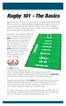 Rugby 101 - The Basics Rugby Union was, if the legend is to be believed first played when William Webb Ellis was involved in a game of football at Rugby School in England in 1823. The story goes that Master
One-On-One Basketball Moves
 One-On-One Basketball Moves Outside Live-Ball Moves Many times you will receive a pass on the court and find that, although you are guarded, you are the closest one to the basket. It's now up to you to
INTER-CROSSE RULEBOOK
 INTER-CROSSE RULEBOOK VERSION 4.0 (2007.07) TABLE OF CONTENTS SECTION 1 THE GAME...4 SECTION 2 PLAYING AREA... 5 SECTION 3 EQUIPMENT... 7 3.1GOALS...7 3.2STICK...7 3.3BALL...8 3.4JERSEY...8 3.5FIELD PLAYER...
Intramural Sports 4- on- 4 Volleyball Rules
 Intramural Sports 4- on- 4 Volleyball Rules Men s, Women s and Co- Rec Participation Warning There are inherent risks of mental and physical injury in Intramural Sports Volleyball; therefore, you may be
2011 Part II Soccer Exam. Question #1. Question #2. Question #3. Question #4. Question #5. Question #6
 2011 Part II Soccer Exam Question #1 The Team A goalkeeper is dribbling the ball with his feet in his own penalty area when opponent B1 fairly charges and steals the ball. The referee penalizes B1 and
Official Basketball Rules 2008
 Official Basketball Rules 2008 As approved by FIBA Central Board Beijing, People s Republic of China, 26 th April 2008 Valid as of 1 st October 2008 April 2008 Page 2 of 80 April 2008 Page 3 of 80 TABLE
Law 12 Fouls and Misconduct (Part 1 - Fouls)
 Law 12 Fouls and Misconduct (Part 1 - Fouls) Topics 2 Fouls Basis requirements for a foul Direct Free Kick Indirect Free kick Careless, reckless, using excessive force Charging an opponent Holding an opponent
2013 RULE COMPARISON TABLE Side-by-side comparison of the Rules of Hockey and NCAA & NFHS modifications
 2013 RULE COMPARISON TABLE Side-by-side comparison of the Rules of Hockey and NCAA & NFHS modifications This comparison chart is meant to serve as a helpful reference for umpires officiating competitions
Revised 12/05. Mac Chauvin Director of Officials. Louisiana High School Athletic Association
 Revised 12/05 1 Mac Chauvin Director of Officials Louisiana High School Athletic Association PREPARATION FOR OFFICIATING The first step for an official who desires to work high school games is to become
Photo copy and create Play sheets
 The Spread Offense Photo copy and create Play sheets Introduction to Offensive Schemes It is said that great offense puts people in the stands, but great defense wins championships. To be successful on
A Quick 20 Step Guide to the Youth Rules (up to 16 years of age)
 A Quick 20 Step Guide to the Youth Rules (up to 16 years of age) Compiled by Nick Leonard Updated April 2014 1 The Playing Area for Youth Tag Rugby For recreational games of Tag Rugby it is by no means
THE BAR VOLLEYBALL RULES (Derived from USAV, AVA and AVP official outdoor volleyball rules)
 THE BAR VOLLEYBALL RULES (Derived from USAV, AVA and AVP official outdoor volleyball rules) Playing Area and Equipment: 1. Balls will be supplied by The Bar. 2. Nets without antennas. Poles will act as
10 FREE BASKETBALL DRILLS
 BASKETBALL DRILLS AND PRACTICE PLANS 1 10 FREE BASKETBALL DRILLS by Coach Patrick Anderson BASKETBALL DRILLS AND PRACTICE PLANS 2 CONTENTS 1.1 Rapid Swing Pass... 3 1.2 Box Out React Drill... 3 1.3 Bump...