
Ohio School Counselor Evaluation Model MAY 2016
|
|
|
- Lawrence Powers
- 9 years ago
- Views:
Transcription
1 Ohio School Counselor Evaluation Model MAY 2016

2 Table of Contents Preface... 5 The Ohio Standards for School Counselors... 5 Ohio School Counselor Evaluation Framework... 6 School Counselor Evaluation Rubric... 7 Evaluation Rubric: Standards... 9 Evaluation Rubric: Metric(s) of Student Outcomes Area... 9 School Counselor Final Summative Rating The Ohio School Counselor Evaluation System Model Roles and Responsibilities Expectations for School Counselors Expectations for the Evaluator Goal-Setting: Professional Growth or Improvement Plan Development Goal Setting: Professional Growth Plan Goal Setting: Improvement Plan Observations: Gathering Evidence of School Counselor Performance Formal Observations Informal Observations Observation Conferences Evidence Collection Tips Defining the Evaluation Ratings Using Evidence to Inform Ratings Step One: Gather Evidence Step Two: Issue a Rating for Each Rubric Area Determining the Final Summative Rating of School Counselor Effectiveness... 19

3 Step Three: Issue an End-of-Year Holistic Final Summative Rating Choosing Reinforcement and Refinement Areas Summative Evaluation Conference Appendix A: Evaluation Framework for School Counselors Appendix B: School Counselor Evaluation Rubric Appendix C: Ohio School Counselor Evaluation System Model Components Appendix D: Glossary of Terms Appendix E: Self-Assessment on Standards Appendix F: School Counselor Professional Growth Plan Appendix G: Improvement Plan Appendix H: Informal Observation: Open-Ended Form Appendix I: Pre and Post Observation Questions Appendix J: Post Conference Planning Appendix K: Final Summative Rating of School Counselor Effectiveness Appendix L: Operational Definitions for Determining Positive Student Outcomes Using Student Metrics Appendix M: Sample Measurement Tools for Metric(s) of Student Outcomes Appendix N: Optional Form to Demonstrate a Positive Student Outcome Using Student Metrics Step One: Identify Domain Focus Area(s): Step Two: Identify Desired Student Outcome(s) Step Three: Determine the Metric(s) of Student Outcomes Step Four: Relevant school counselor activities/interventions Step Five: Monitoring Step Six: Analyze Results and Report Results... 49

4 Preface Ohio is serious about its commitment to quality schools. Over the past decade, Ohio has made important education policy advances, with a focus on standards and accountability, which together has moved Ohio s pre-kindergarten through 12 th grade system forward in several important ways. In response to changes in state law, Ohio has developed both standards and an evaluation system for Ohio s school counselors that will provide them with useful feedback and support as they grow and learn professionally. School counselors (previously referred to as guidance counselors) support all students in pre-kindergarten through grade 12 with academic achievement, social and emotional development and career planning. Ohio School Counselors are licensed according to Ohio Revised Code , having completed an approved master s program and an extensive internship. They develop and implement comprehensive school counseling programs that promote and enhance student success by collaborating with families, teachers and administrators. Ohio recognizes that school counselors are uniquely qualified professionals who support pre-kindergarten through grade twelve students in meeting the ever-changing academic and college/career preparation demands while contributing to students overall well-being. School counselors roles and responsibilities in the 21 st -century focus on promoting achievement for all students by providing direct and indirect services that address students academic, college/career and social-emotional needs. School counselors play an instrumental role in school districts throughout Ohio by helping guide students toward success in education and their future careers. The standards and evaluation system reflects the 21 st -century roles and responsibilities of Ohio s school counselors. As such, administration should work to ensure the assigned duties of school counselors afford the time and opportunity to demonstrate their ability in all areas identified by the standards in accordance with. The Ohio Standards for School Counselors House Bill 64 of the 131st Ohio General Assembly (Ohio Revised Code ) directed the State Board of Education to develop standards for school counselors. The Ohio Department of Education and the Educator Standards Board worked with stakeholder groups and the chancellor of higher education to identify school counselors, administrators and other representatives to serve on the writing team that drafted the standards during spring As its starting point, the writing team for the Ohio Standards for School Counselors began with the standards-based evaluation system and guide created by the Ohio School Counselor Association writing team, the Ohio School Counselor Evaluation System (2013). In addition to the work of the association, the writing team considered the national model created by the American School Counselor Association, the National Board School Counseling Standards, the standards of the Council for Accreditation of Counseling and Related Educational Programs, the School Counselor Assessment Framework from the Ohio Assessments for Educators and the work of exemplary states nationwide. In October 2015, the State Board of Education adopted the Ohio Standards for School Counselors, which define the skills and knowledge that school counselors must demonstrate at all stages of their careers. These standards promote effective professional practices and provide support to school counselors as they reflect upon and improve their performance over time. Six standards were adopted: 1. School counselors collaboratively envision a plan for a comprehensive school counseling program that is developmental, preventative and responsive, and in alignment with the school s goals and mission. OHIO SCHOOL COUNSELOR EVALUATION MODEL MAY 2016 PAGE 5

5 2. School counselors develop a curriculum, offer individual student planning and deliver responsive services in order to assist students in developing and applying knowledge, skills and mindsets for academic, career and social/emotional development. 3. School counselors collaborate and consult with school personnel, parents/guardians, community partners and agencies/organizations to coordinate support for all students. 4. School counselors collaboratively engage in a cycle of continuous improvement using data to identify needs, plan and implement programs, evaluate impact and adjust accordingly. 5. School counselors lead school efforts and advocate for policies and practices that support an equitable, safe, inclusive and positive learning environment for all students. 6. School counselors adhere to the ethical standards of the profession, engage in ongoing professional learning and refine their work through reflection. With the adoption of the Ohio Standards for School Counselors, Ohio has clearly defined the knowledge, skills, and competencies of effective school counselors. These standards promote the most effective school counseling practices and offer a core set of expectations for Ohio school counselors. Professional school counselors offer students access to the kinds of high-quality direct and indirect services, which will support students academic, career and social/emotional development. Ohio School Counselor Evaluation Framework The passage of House Bill 64 in July 2015 directed the State Board of Education to develop and adopt a standards-based state framework for evaluation of school counselors. In April 2016, the State Board adopted the Ohio School Counselor Evaluation Framework, which is aligned to the Ohio Standards for School Counselors. The framework appears in Appendix A. The bill further directed each school district board of education to adopt a school counselor evaluation policy by Sept. 30, 2016 that conforms to the State Board framework. OHIO SCHOOL COUNSELOR EVALUATION MODEL MAY 2016 PAGE 6

6 The Ohio School Counselor Evaluation System, created in response to the legal mandates, explains how school districts can implement school counselor evaluations in accordance with the State Board framework and state law. It was designed to be transparent, fair and adaptable to the specific contexts of Ohio s districts. The Ohio School Counselor Evaluation System is a standards based integrated model that is designed to foster the professional growth of school counselors in knowledge, skills and practice. In this evaluation system, each school counselor is evaluated based upon multiple factors including performance on all areas identified by the standards and the ability to produce positive student outcomes using metrics in order to determine the holistic final summative rating of effectiveness according to ODE requirements. The choice of metrics for student outcomes will be determined locally. Not later than September 30, 2016, each school district board of education shall adopt a standards-based school counselor evaluation policy that conforms to this framework for the evaluation of school counselors. The local policy shall include implementation of the framework for the evaluation of school counselors beginning in the school year. School Counselor Evaluation Rubric Beginning in October 2015, the Ohio Department of Education convened a group of educational stakeholders from across the state to design the school counselor evaluation rubric aligned to Ohio s Standards for School Counselors. The writing team considered the Ohio OHIO SCHOOL COUNSELOR EVALUATION MODEL MAY 2016 PAGE 7

7 School Counselor Evaluation System (2013) from the Ohio School Counselor Association, and the work of exemplary states nationwide including: West Virginia, Florida, North Carolina, New Jersey and Missouri. Ohio also consulted with American Institutes for Research to provide review and feedback on the evaluation rubric. The Ohio School Counselor Evaluation Rubric was piloted in volunteer districts to inform both the development of the evaluation rubric and model. The pilot engaged school counselors and their evaluators in OSCES training. After training, evaluators engaged with school counselors in the evaluation process. The Ohio Department of Education and an external evaluator gathered feedback over the course of four months, and participating pilot districts and buildings offered feedback on the school counselor evaluation rubric and model. School counselor performance is determined by using the Ohio School Counselor Evaluation Rubric, which is located in Appendix B of this document. The evaluation rubric consists of six standard areas and a seventh area focused on metric(s) of student outcomes: Standard 1: Comprehensive School Counseling Program Plan School counselors collaboratively envision a plan for a comprehensive school counseling program that is developmental, preventative and responsive, and in alignment with the school s goals and mission. Standard 2: Direct Services for Academic Career and Social/Emotional Development School counselors develop a curriculum, offer individual student planning and deliver responsive services in order to assist students in developing and applying knowledge, skills and mindsets for academic, career and social/emotional development. Standard 3: Indirect Services: Partnerships and Referrals School counselors collaborate and consult with school personnel, parents/guardians, community partners and agencies/organizations to coordinate support for all students. Standard 4: Evaluation and Data School counselors collaboratively engage in a cycle of continuous improvement using data to identify needs, plan and implement programs, evaluate impact and adjust accordingly. Standard 5: Leadership and Advocacy School counselors lead school efforts and advocate for policies and practices that support an equitable, safe, inclusive and positive learning environment for all students. Standard 6: Professional Responsibility, Knowledge and Growth School counselors adhere to the ethical standards of the profession, engage in ongoing professional learning and refine their work through reflection. OHIO SCHOOL COUNSELOR EVALUATION MODEL MAY 2016 PAGE 8

8 Evaluation Rubric: Standards The Ohio School Counselor Evaluation Rubric consists of indicators based on the six Ohio Standards for School Counselors. The rubric describes four levels of school counselor performance for each standard area. The indicators under each standard area describe the knowledge, skills and competencies of school counselors at each performance level (Ineffective, Developing, Skilled and Accomplished). School counselors must demonstrate their ability in all six standard areas. Evaluation Rubric: Metric(s) of Student Outcomes Area The Ohio School Counselor Evaluation Rubric includes a seventh area, the Metric(s) of Student Outcomes. The rubric describes four levels of school counselor performance for the Metric(s) of Student Outcomes area. In this portion of the evaluation rubric, the school counselor provides data demonstrating that students skills, knowledge or behaviors have positively changed as a result of the school counselor s actions. must clearly demonstrate the ability to positively impact student outcomes. and evaluator should collaboratively pre-determine metrics they will use for this portion of the evaluation rubric at the beginning of the evaluation cycle. It is recommended that the school counselor and evaluator select metrics that most clearly reflect the work of the school counselor being evaluated and clearly illustrate a link between the work and the student outcomes. To assist in this process, a sample table of Metric(s) of Student Outcomes appears below to illustrate potential metrics and student outcomes, as well as tools for measurement (see Appendix M for more sample tools for measurement). Pre-Determined Metric(s) Desired Student Outcome to Measure Source of Data Core course passage rates Reduction in core course failures Individual student report card data Career awareness rates Increased student career awareness Ohio Means Jobs Backpack data, survey data Behavior referral rates Reduction in behavior incidents Discipline referrals Optional Process for Demonstrating a Positive Student Outcome Collect or examine existing data to determine student need in one or more domain areas (academic achievement, college/career, social/emotional). Identify desired student outcome. Determine student metric(s) needed to demonstrate positive student outcome. Describe program activity, lesson or intervention the school counselor will carry out to bring about desired results or outcomes. Implement the school counselor program activity, lesson or intervention and collect data using pre-determined student metric(s). Analyze and interpret the data to determine student outcome(s). Compare student metric(s) data to demonstrate a change in students knowledge, skills and/or behavior. Report data on student outcome(s). See Appendix L for operational definitions for use in demonstrating a positive student outcome and Appendix N for an optional form for documenting the process. OHIO SCHOOL COUNSELOR EVALUATION MODEL MAY 2016 PAGE 9

9 Toward the close of the evaluation cycle, school counselors and evaluators will revisit the pre-determined metrics. They will analyze the metrics and the evaluator will determine the performance of the school counselor using the indicators under the Metric(s) of Student Outcomes area of the evaluation rubric. Once evaluators determine the performance in the Metric(s) of Student Outcomes area, they will then holistically incorporate this area, along with the six standard areas, to determine the end-of-year final summative rating of the school counselor. School Counselor Final Summative Rating final summative rating is determined by using the Ohio School Counselor Evaluation Rubric, which includes six standard areas and the Metric(s) of Student Outcomes area. Using the evaluation rubric, the evaluator will determine the holistic final summative rating for the school counselor: Ineffective, Developing, Skilled or Accomplished. The Ohio School Counselor Evaluation System does not include a weighting factor for the seven areas found on the evaluation rubric because all seven areas are critical to determine school counselor performance. The key point is that evaluators should not consider one area in isolation, but should analyze each in relation to all other areas of performance. The Ohio School Counselor Evaluation System Model This evaluation model is designed to provide support for the implementation of the State Board of Education approved School Counselor Evaluation framework. This model is a professional growth model and is intended to be used continually to assist in improving school counselor performance. The evaluation of school counselors must be conducted by evaluators who are approved by their local boards of education and have successfully completed the school counselor evaluation state training. Information contained in this model addresses the successful implementation of these components: o Roles and responsibilities; o Professional growth or improvement plan development (goal-setting); o Observations; o Using evidence to inform ratings; and o Determining the final summative rating of school counselor effectiveness For a glossary of terms included in this model, see Appendix D. Roles and Responsibilities s duties and responsibilities should encompass the seven areas of the evaluation rubric. There may be duties required of school counselors that fall outside the outlined areas of the evaluation rubric. Nevertheless, administrators should work to ensure the assigned duties afford the school counselor the time and opportunity to demonstrate competency in all seven areas in accordance with Ohio Revised Code. The evaluation process is to be collaborative and in support of the school counselor. A strong school counselor evaluation calls for ongoing collaboration and authentic conversation between the school counselor and evaluator. The foundation of such a system is the transparent, two-way gathering and sharing of evidence that informs the school counselor final summative rating at the end of the year. Because of the collaborative nature of the Ohio School Counselor Evaluation System, there are expectations for both the school counselor as well as the evaluator. Expectations, as listed below, help to support an evaluation system that is transparent, fair and includes shared responsibilities. OHIO SCHOOL COUNSELOR EVALUATION MODEL MAY 2016 PAGE 10

10 Expectations for School Counselors o A planning conference with the evaluator to mutually establish goals and objectives. o Collection and sharing of data related to the accomplishment of goals and objectives. o A final conference with the evaluator to review and reflect on progress, achievements and continued development, desires or needs based on outcomes of the performance period. Expectations for the Evaluator o A conference with the school counselor to mutually establish goals and objectives, action plans and evidence indicators for the evaluation period. o Provision of appropriate and timely feedback, resources and guidance to assist the school counselor in achieving goals and objectives. o Formal and informal observations of the school counselor as he/she performs non-confidential activities during the evaluation year. o Ideas for observations include guidance activities in a classroom, instructional small group activities, parent education functions, staff development sessions, child study team meetings and data meetings. o Post-observation conferences followed with a written report to the school counselor describing areas of reinforcement and opportunities for refinement. o A final summative rating at the end of each year providing the school counselor with written report of the results. and evaluator engage in the evaluation process over the course of a school year and on an annual basis. The evaluation has three required components that must occur during the school year. Those components are outlined below in the order in which they should occur: 1. Goal setting through professional growth or improvement plan development 2. Observations of school counselor (formal and informal) 3. Final summative rating of school counselor and written report Goal-Setting: Professional Growth or Improvement Plan Development The primary goal of evaluation is to foster the growth and development of the school counselor over time. Evaluation should promote excellent professional practices that enhance student academic progress. This dimension of the evaluation system requires the school counselor and evaluator to establish specific goals for the evaluation cycle through a professional growth or improvement plan. A professional growth plan or improvement plan is required and is based on the school counselor s final summative rating. If a school counselor has received a final summative rating of Ineffective in the previous school year, the school counselor will begin the following school year on an improvement plan. A school counselor new to the field or district would begin the school year on a professional growth plan. The first step is to determine which plan is appropriate for the school counselor and with what level of autonomy plan development will occur as illustrated on the next page. OHIO SCHOOL COUNSELOR EVALUATION MODEL MAY 2016 PAGE 11

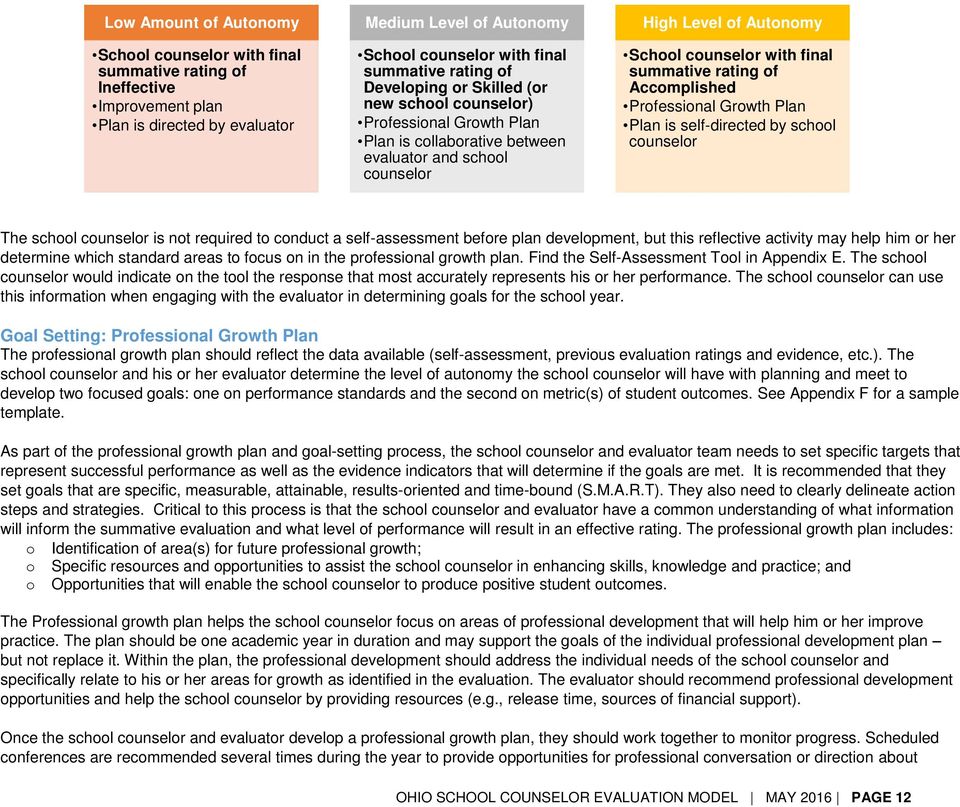
11 Low Amount of Autonomy School counselor with final summative rating of Ineffective Improvement plan Plan is directed by evaluator Medium Level of Autonomy School counselor with final summative rating of Developing or Skilled (or new school counselor) Professional Growth Plan Plan is collaborative between evaluator and school counselor High Level of Autonomy School counselor with final summative rating of Accomplished Professional Growth Plan Plan is self-directed by school counselor is not required to conduct a self-assessment before plan development, but this reflective activity may help him or her determine which standard areas to focus on in the professional growth plan. Find the Self-Assessment Tool in Appendix E. The school counselor would indicate on the tool the response that most accurately represents his or her performance. can use this information when engaging with the evaluator in determining goals for the school year. Goal Setting: Professional Growth Plan The professional growth plan should reflect the data available (self-assessment, previous evaluation ratings and evidence, etc.). The school counselor and his or her evaluator determine the level of autonomy the school counselor will have with planning and meet to develop two focused goals: one on performance standards and the second on metric(s) of student outcomes. See Appendix F for a sample template. As part of the professional growth plan and goal-setting process, the school counselor and evaluator team needs to set specific targets that represent successful performance as well as the evidence indicators that will determine if the goals are met. It is recommended that they set goals that are specific, measurable, attainable, results-oriented and time-bound (S.M.A.R.T). They also need to clearly delineate action steps and strategies. Critical to this process is that the school counselor and evaluator have a common understanding of what information will inform the summative evaluation and what level of performance will result in an effective rating. The professional growth plan includes: o Identification of area(s) for future professional growth; o Specific resources and opportunities to assist the school counselor in enhancing skills, knowledge and practice; and o Opportunities that will enable the school counselor to produce positive student outcomes. The Professional growth plan helps the school counselor focus on areas of professional development that will help him or her improve practice. The plan should be one academic year in duration and may support the goals of the individual professional development plan but not replace it. Within the plan, the professional development should address the individual needs of the school counselor and specifically relate to his or her areas for growth as identified in the evaluation. The evaluator should recommend professional development opportunities and help the school counselor by providing resources (e.g., release time, sources of financial support). Once the school counselor and evaluator develop a professional growth plan, they should work together to monitor progress. Scheduled conferences are recommended several times during the year to provide opportunities for professional conversation or direction about OHIO SCHOOL COUNSELOR EVALUATION MODEL MAY 2016 PAGE 12
12 performance, goals, progress, as well as supports needed. During the year, the evaluator and school counselor should discuss opportunities for professional development that evolve as a result of the evaluation process. Goal Setting: Improvement Plan The purpose of the improvement plan is to help the school counselor focus on area(s) in which they need intensive support to improve practice. A school counselor must develop an improvement plan when his or her final summative rating is Ineffective. Additionally, an evaluator may initiate an improvement plan at any time during the evaluation cycle based on deficiencies in performance by the school counselor. The evaluator directs the development of the improvement plan. Preparing the plan may take more than one meeting; evaluators and counselors should spend enough time to ensure that the plan is comprehensive and well detailed. The evaluator will review the improvement plan with the school counselor and identify specific areas for improvement. For a sample improvement plan template, see Appendix G. When an evaluator initiates an improvement plan, it is his or her responsibility to: o Identify, in writing, the specific area(s) for improvement to be addressed in relationship to the Ohio Standards for School Counselors; o Specify in writing, the desired level of performance that is expected for improvement and afford a reasonable period of time to correct deficiencies; o Develop and implement a written plan for improvement for the school counselor to begin immediately, and also include resources and assistance when available; o Determine additional education or professional development opportunities needed for the school counselor to improve in identified area(s); and o Gather evidence of progress or lack of progress toward improvement by the school counselor. Once the school counselor and evaluator develop an improvement plan, they should work together to monitor progress of the plan. Scheduled conferences are recommended several times during the year to provide opportunities for professional conversation or direction about performance, goals, progress, as well as supports needed. An evaluator should complete a reassessment of the school counselor s performance in accordance with the written plan. Upon this reassessment, if the school counselor has documented improvement at an acceptable level of performance, the professional growth plan may resume. If the school counselor s performance continues to remain at the Ineffective level, the supervising administrator may reinstate the improvement plan with additional recommendations or take the necessary steps to recommend dismissal. Observations: Gathering Evidence of School Counselor Performance Observations of the school counselor provide the evaluator with important evidence when assessing a school counselor s performance and effectiveness. As an evaluator observes a school counselor engaging with students, parents or other stakeholders, he or she may collect valuable evidence. Evaluators engage in both formal and informal observations (see below for descriptions of the formal and informal observation). A school counselor must follow the ethics of maintaining confidentiality in counseling relationships and this must be taken into consideration when engaging in observations of the school counselor. This does not mean observations of the school counselor should not occur, it means the evaluator and school counselor should work together to identify observation times where non- OHIO SCHOOL COUNSELOR EVALUATION MODEL MAY 2016 PAGE 13

13 confidential activities are scheduled so no breach in confidentiality occurs. Non-confidential activities (school counseling activities that do not compromise confidentiality by the presence of an outside observer) may include, but are not limited to, guidance activities in a classroom, instructional small group activities, parent education functions, staff development, child study team meetings and data meetings. Formal Observations Formal observations must occur two times during the evaluation cycle and last for a minimum of 30 minutes each. and evaluator should set times for the formal observations to take place and adjust this scheduled time and date as necessary if the observations are not conducted as planned. During the observations, the evaluator documents specific information related to school counseling activities. The evaluator then completes a narrative (see Evidence Collection Tips below) to document each formal observation. Formal observations will not include videotaping or sound recordings without written permission of the school counselor. The evaluator will analyze each formal observation using the School Counselor Evaluation Rubric. Informal Observations Informal observations of school counselors are walkthroughs of non-confidential activities that may be unannounced by the evaluator. Evaluators will conduct informal observations that are snapshots of the school counselor s regular activities (see Appendix H for an Informal Observation: Open-Ended Form). Summary data collected through a series of informal observations, along with evidence documented through formal observations will come together to inform the school counselor s final summative evaluation rating. Informal observations are a: o Tool to inform evaluation that provides the opportunity to gather evidence of school counselor practice over a series of short visits; o Process for giving targeted, evidence-based feedback to school counselors; and o Means for school leadership to visit school counselors more frequently and more purposefully. An informal observation is not a(n): o Formal observation; o Gotcha opportunity for supervisors or evaluators; o Isolated event; or o Shortcut to the observation protocol required as part of the school counselor evaluation process. Guidelines for informal observations of school counselors are illustrated below. OHIO SCHOOL COUNSELOR EVALUATION MODEL MAY 2016 PAGE 14

14 Informally Observe all School Counselors Focus on One or Two Areas Make Time to Follow Up School Counselor Driven Observations Types of Data All school counselors benefit from informal observations of non-confidential activities. Informal observations should last from 15 to 20 minutes (but less than 30 minutes); therefore, evaluators should conduct observations that they can follow up on either the same or next day. School counselors need and deserve some type of immediate feedback. Although there may be no predetermined focus established (because of no pre-conference), find a focus based on the activity, events or discussions that are occuring. A focus may also occur based upon past conferences and the need for follow-up observations. Follow-up communication to informal observations is a critical component. Follow-up will often be in writing but the evaluator should extend to the school counselor an invitation to discuss any comments provided face-to-face. The evaluator may also offer resources to help school counselors refine their practice. While it is recognized that evaluators have many demands on their time, encouraging school counselors to identify non-confidential activities for the observation can be a means for the collection of evidence related to specific areas of focus that may be worked upon. Data collected as evidence of school counselor practice may be quantitative, qualitative or a combination of both. Quantitative data includes frequencies, distributions and other counts or tallies. Qualitative data can include scripted notes detailing patterns of activities, vocabulary used and events observed. In both cases, accuracy is essential to ensure the credibility of the process and the evaluator. Observation Conferences The formal observation process consists of a pre-observation conference and a post-observation conference (illustrated below). The formal observation process includes ongoing communication and collaboration between evaluator and school counselor which helps foster a productive professional relationship that is supportive and leads to school counselor growth and development. This type of communication and collaboration can occur during pre- and post-observation conferences. Information sharing that can be valuable to both evaluator and school counselor happens during these formal observation conferences. Observation conferences can also occur with informal observations if needed. Pre-Observation Conference Observation Post- Observation Conference OHIO SCHOOL COUNSELOR EVALUATION MODEL MAY 2016 PAGE 15

15 Pre-Observation Conference At the pre-observation conference, the evaluator and school counselor discuss what the evaluator will encounter in the observation. They share important information about the characteristics of the school counseling environment and the school counseling activity. The conference also will give the school counselor an opportunity to identify areas in which he or she would like focused feedback from the evaluator during the observation. and the evaluator should keep a record of the date the conference takes place and the communication that takes place. The purpose of the pre-observation conference is to provide the evaluator with an opportunity to discuss the following: o Objectives of school counseling activity; o Experiences of the individuals in the session; o Characteristics of the environment; o Strategies that the school counselor will employ to meet the objectives; o Differentiation based on needs; and o Assessment data collected to demonstrate learning. Post-Observation Conference The purpose of the post-observation conference is to provide feedback to the school counselor for reflection on the observed school counseling activity. The conference also will assist the counselor in identifying ways to increase effectiveness of the activity. Following the activity, the school counselor reflects on whether or not the objectives for the activity were met. In addition to the feedback from the observed activity, professional conversations between the evaluator and the school counselor may help identify additional strategies and resources needed. The evaluator will make recommendations and commendations that may become part of the school counselor s professional development plan or improvement plan. In general, the discussion between the evaluator and the school counselor needs to focus on relative area(s) of strength (reinforcement), and relative area(s) for further support (refinement) in relation to the evaluation rubric. School counselors may bring additional evidence that supports the activity observed to share with the evaluator at the conference. The evaluator may consider these as evidence to support the school counselor s performance. Step One: Introducing Conference and Establishing Length a. Review conference process b. General impression question How do you think the activity went? Suggestions for Conducting the Post-Conference Step Two: Reinforcing the School Counselor (Area of Relative Strength) Support) a. Identify an area of reinforcement (only one area) b. Ask self-analysis questions c. Provide evidence from notes Step Three: Refining the School Counselor s Skill (Area of Further a. Identify area of refinement (only one) b. Ask self-analysis questions c. Provide evidence from notes d. Give a recommendation for future practice Step Four: Presenting Evidence and Ratings Connected to the Rubric a. Discuss ratings of standard areas observed b. Share evidence from observation directly related to standard areas addressed For a list of possible pre-observation and post-observation questions see Appendix I. OHIO SCHOOL COUNSELOR EVALUATION MODEL MAY 2016 PAGE 16

16 Evidence Collection Tips During observations, it is important to collect evidence that is accurate and can help inform the evaluation of the school counselor. Scripting during an observation is an important step for evidence collection. The following strategies will help the evaluator script during the observation of the activities and process the script after the observation. During the Observation o Time Capture the length of the different segments of the activity. o Abbreviate It s challenging to get down everything the school counselor says and does, so when possible, abbreviate. After the observation, review your notes and write out what you abbreviated. o Verbatim Capture as much verbatim dialogue as possible. Nothing is better than direct quotes of what the school counselor says. Use SC for school counselor, S for student and P for parent verbatim. o Paraphrase Use parentheses to indicate paraphrasing, so when you go back through your notes you know what is paraphrased and what is verbatim. o Circulate Circulate as necessary to collect evidence about the student activity from the school counselor or the student. After the Observation o Upfront Summary After you finish, go through your script and write a brief summary of the school counseling activities. o Label Begin to categorize your scripting notes by labeling evidence for various indicators on the rubric. o Activity Analysis Identify the primary objectives of the activity and its sub-objectives. o Q&F After you finish, go through your script and label all questions and feedback. OHIO SCHOOL COUNSELOR EVALUATION MODEL MAY 2016 PAGE 17

17 Defining the Evaluation Ratings In accordance with Ohio Revised Code , the Ohio School Counselor Evaluation Rubric outlines specific standards and criteria that distinguish four levels of school counselor performance for each of the seven areas outlined on the rubric. Each rating can also be described in more general terms (as illustrated below), and the evaluator should consider these in determining the holistic rating of school counselor performance. Accomplished: A rating of Accomplished indicates Ineffective: A rating of Ineffective indicates that the school counselor consistently fails to demonstrate minimum competency in one or more standards. There is little or no improvement over time. The school counselor requires immediate assistance and needs to be placed on an improvement plan. Developing: A rating of Developing indicates that the school counselor demonstrates minimum competency in many of the standards, but may struggle with others. is making progress but requires ongoing professional support for necessary growth to occur. Skilled: A rating of Skilled indicates that the school counselor consistently meets expectations for performance and fully demonstrates most or all competencies. This rating is the rigorous, expected performance level for most experienced school counselors. that the school counselor is a leader and model in the school and district, exceeding expectations for performance. The school counselor consistently strives to improve his or her professional practice and contributes to the school or district through the development and mentoring of colleagues. Using Evidence to Inform Ratings The following is a suggested step-by-step guidance for the scoring process as it occurs throughout the evaluation cycle. This guidance can help evaluators review and analyze evidence to inform school counselor ratings throughout the evaluation cycle. It is important to understand that evidence for each standard may not be observable during formal and informal observation. Continuous collaboration with both the evaluator and school counselor is important for collecting evidence and determining a rating in all the standard areas. Since the School Counselor Evaluation Rubric is intended to be scored holistically, evaluators will need to assess which performance level provides the best overall description of the school counselor. The evaluator should consider the school counselor to student ratio when determining the performance rating of the school counselor. Step One: Gather Evidence o Align evidence to each area on the evaluation rubric. Group the evidence collected from the formal and informal observations, conferences and everyday interactions with the school counselor into the appropriate areas on the evaluation rubric. When completing the evaluation rubric, please note that evaluators are not expected to gather evidence on all indicators for each observation. By the end of the evaluation cycle, however, they are required to have evidence of all standard areas in the evaluation rubric. o Be consistent in gathering, recording and sharing detailed, factual evidence. Capture enough detail to accurately but succinctly describe the activity, interaction or behavior factually (without implied judgment or opinion in the recording). OHIO SCHOOL COUNSELOR EVALUATION MODEL MAY 2016 PAGE 18

18 o Review and analyze evidence by rubric area to determine where more information is needed. As the year progresses, holes in evidence coverage across standard areas may emerge. If the evaluator organizes the evidence collected by rubric area after each interaction, missing evidence will be apparent. Keep these rubric areas in mind during future interactions with the school counselor, since school counselor evaluation requires evidence in all rubric areas. Step Two: Issue a Rating for Each Rubric Area o Read all of the evidence collected up to that point within the rubric area, looking for patterns. A school counselor may develop priorities in several standard areas and may follow with a goal to address a standard area. also may develop a goal based on student outcomes for his or her building. The evaluator may observe an activity the school counselor may engage in to demonstrate work and progress toward the goals. The evaluator can collect evidence and provide meaningful feedback to the school counselor and look for patterns. Note these patterns and take them into consideration when issuing a rating. o o Compare the evidence and patterns to the performance indicators. After becoming familiar with the rubric, start by re-reading all of the Skilled performance indicators in a standard area. Does the evidence exemplify this level of performance? Whether yes or no, look at the Accomplished or Developing performance level indicators as well, to decide if either of the performance levels better aligns with the available evidence. If the Developing indicators seem to be an appropriate match to the evidence, also read the Ineffective indicators carefully to consider whether any evidence is at this level. Repeat the process above for each rubric area and then consider patterns of performance across the evaluation rubric. Once you determine a rating for each of the rubric areas, based on the available evidence from multiple interactions, look at the larger picture of performance across all areas of the rubric. Although all areas are important for effective school counseling practice, you may find it appropriate to more strongly weight patterns of behavior in one area over another. The key point is that the evaluator should consider no one area in isolation, but should analyze each in relation to all other areas of performance. Determine which of the four performance levels is most appropriate for the school counselor based on this holistic process. It is recommended that the evaluator completes steps one and two after each formal observation of the school counselor. Once the evaluator completes that scoring process, he or she should use that information to issue the end-of-year holistic final summative rating. It is important to note that the evaluator may not have the Metric(s) of Student Outcomes after each formal observation because evidence may not be available; they will need to consider this rubric area only during step three. Determining the Final Summative Rating of School Counselor Effectiveness At the end of the evaluation cycle, a school counselor must receive a final summative rating that reflects his or her performance throughout the evaluation cycle. The evaluator completes the final summative rating of school counselor performance after he or she has gathered and analyzed multiple sources of evidence from across the evaluation cycle. Step three outlines how the evaluator issues this rating. Step Three: Issue an End-of-Year Holistic Final Summative Rating o Meet with School Counselor to Review Metric(s) of Student Outcomes. To issue a rating for the Metric(s) of Student Outcomes and incorporate this area into the end-of-year holistic final summative rating, the evaluator and school counselor should meet to review the previously determined student metrics. will provide the evaluator with data and analysis demonstrating that students skills, knowledge, or behaviors have positively changed as a result of the school counselor s activities. The evaluator should use the evaluation rubric to determine the level of performance in this rubric area. OHIO SCHOOL COUNSELOR EVALUATION MODEL MAY 2016 PAGE 19

19 o o o Consider all evidence from the year, paying attention to patterns and trends. To issue a school counselor s end-of-year final summative rating, return to the body of collected evidence for the evaluation cycle. Use the process outlined to reconsider the evidence in each standard area across the arc of the entire year, taking into account observations, all conferences and daily interactions. During this step, it is particularly important to consider trends in the school counselor s performance over time. Was the school counselor consistent in his or her leadership? Was he or she successful in meeting goals? Did positive student outcomes occur? If a pattern of evidence in a particular standard area displays a trend of behavior or practice, the evaluator may consider placing more emphasis on that area. Consider minimum thresholds of competency. Flag any instance of an Ineffective rating in preparation to issue the final rating. While the evaluator should examine the example of ineffective behavior within the entire context of the evidence collected, consider that there are minimum thresholds of competency for each of the seven areas described in the Ohio School Counselor Evaluation Rubric. It is possible that a serious deficiency in one area can and should carry more weight than positive ratings in other areas. The evaluator must rely on professional judgment, supported by the evidence gathered, to decide if this evidence of ineffective practice is grounds to issue a final Ineffective rating. The evaluator also should take into account how detrimental the displayed deficiency is to the school counselor s students and parents, staff and building as a whole. Issue the final performance rating, summarize the supporting evidence and offer areas of reinforcement and refinement. Complete the performance rating process by documenting the school counselor s final summative rating. Support your rating with evidence from formal and informal observations, artifacts provided by the school counselor and other appropriate evidence collected throughout the evaluation cycle. Provide succinct, targeted feedback on needed professional growth so the school counselor will clearly understand the path to continuous growth and improvement and has concrete examples to help him or her improve practice. See Appendix K for a sample form. OHIO SCHOOL COUNSELOR EVALUATION MODEL MAY 2016 PAGE 20

20 Choosing Reinforcement and Refinement Areas When choosing areas of reinforcement and refinement after considering all evidence from the observation cycle, an evaluator should consider several guiding questions to ensure that the professional growth plan will result in maximum benefits for the school counselor and his or her students. The following page illustrates hints and questions for choosing reinforcement and refinement objectives. Which area on the rubric received the highest ratings (reinforcement) and the lowest ratings (refinement)? Which of these areas would have the greatest impact with students? Which of these areas would have the greatest impact on other areas of the rubric? In which area will the school counselor have the most potential for growth? Make sure the reinforcement is not directly related to the refinement. Choose a refinement area for which there is sufficient and specific evidence from the observation to support why the school counselor needs work in this area. Summative Evaluation Conference After the evaluator completes the evaluation cycle, it is recommended that the evaluator meets with the school counselor to discuss the final summative rating and written report. Although the evaluation rubric helps in evaluating the school counselor s practice, its primary purpose is to provide the basis of support the school counselor receives for professional growth. This support should be provided by the evaluator. During the conference, evaluators will review areas of reinforcement, refinement and the final summative rating of the school counselor. A recommended framework for the summative evaluation conference could look like the following: 1. Introduction/Greeting/Establish Length of Conference 2. Reinforcing the School Counselor (Area of Relative Strength) 3. Refining the School Counselor s Practice (Area for Further Support) 4. Present Evidence and Final Summative Rating Connected to the Ohio School Counselor Evaluation Rubric According to Ohio Revised Code , school counselors must receive a written report of their evaluation results from the evaluator. OHIO SCHOOL COUNSELOR EVALUATION MODEL MAY 2016 PAGE 21

21 Appendices Appendix A: Evaluation Framework for School Counselors Evaluation Framework for School Counselors Ohio is serious about its commitment to quality schools. In 2015, the State Board of Education adopted standards for school counselors. With the adoption of the Ohio Standards for School Counselors, Ohio has clearly defined the knowledge, skills and competencies of effective school counselors. These standards promote the most effective school counseling practices and offer a core set of expectations for Ohio school counselors. Professional school counselors offer students access to high-quality services, which support students academic, career and social/emotional development. Each school counselor will be evaluated according to Ohio Revised Code and the Evaluation Framework which is aligned to the Ohio Standards for School Counselors. The Ohio School Counselor Evaluation System (OSCES) was designed to be transparent, fair and adaptable to the specific contexts of Ohio s districts. OSCES is a standards based integrated model that is designed to foster the professional growth of school counselors in knowledge, skills and practice. In OSCES, each school counselor is evaluated based upon multiple factors including performance on all areas identified by the standards and the ability to produce positive student outcomes using metrics in order to determine the holistic final summative rating of effectiveness according to ODE requirements. The choice of metrics for student outcomes will be determined locally. OHIO SCHOOL COUNSELOR EVALUATION MODEL MAY 2016 PAGE 22
22 Not later than September 30, 2016, each school district board of education shall adopt a standards-based school counselor evaluation policy that conforms to this framework for the evaluation of school counselors. The local policy shall include implementation of the framework for the evaluation of school counselors beginning in the school year. Additionally, at the local level, the board of education will include in its evaluation policy procedures for using the evaluation results for retention and promotion decisions and for removal of poorly performing school counselors. The local board of education will also provide for professional development to accelerate and continue school counselor growth and provide support to poorly performing school counselors. School counselor evaluations shall occur annually except as otherwise appropriate for high-performing school counselors. The annual evaluation process will consist of two formal observations of thirty minutes each and informal observations. The board may evaluate each school counselor who received a final summative rating of accomplished on the most recent evaluation once every three school years so long as the metric of student outcomes, for the most recent school year for which data is available, is skilled or higher on the evaluation rubric. The board may evaluate each school counselor who received a final summative rating of skilled on the most recent evaluation once every two school years so long as the metric of student outcomes, for the most recent school year for which data is available, is skilled or higher on the evaluation rubric. During the years in which high-performing school counselors are not fully evaluated, the board shall conduct at least one observation and one conference. School counselors with a final summative rating of accomplished will develop a professional growth plan*. School counselors with a final summative rating of skilled will develop a professional growth plan* collaboratively with their evaluator. School counselors with a final summative rating of developing will develop a professional growth plan* with their evaluator. The administration will approve the professional growth plan. School counselors with a final summative rating of ineffective will develop an improvement plan with their evaluator. The administration will approve the improvement plan. *Districts have discretion to place a school counselor on an improvement plan at any time based on deficiencies in any individual component of the evaluation system. OHIO SCHOOL COUNSELOR EVALUATION MODEL MAY 2016 PAGE 23
23 Appendix B: School Counselor Evaluation Rubric The School Counselor Evaluation Rubric is intended to be scored holistically. This means the evaluator will assess which level provides the best overall description of the school counselor. The evaluator is to consider evidence gathered during the pre-observation conference, the observation, the post-observation conference, and informal observations of school counselor activities (if applicable) when completing the rubric. Standard One: Comprehensive School Counseling Program Plan School counselors collaboratively envision a plan for a comprehensive school counseling program that is developmental, preventative, responsive and in alignment with the school s goals and mission. Ineffective Developing Skilled Accomplished articulates all components of a comprehensive school counseling program. cannot articulate components of a comprehensive school counseling program. articulates all components of a comprehensive school counseling program, reflects on future program needs and works to design a plan of implementation. implements all components of a comprehensive school counseling program and frequently reflects on future program development. does not collaborate with key stakeholders to set the goals, priorities and implementation strategies when a comprehensive school counseling program is being designed. collaborates with key stakeholders on a limited basis to set goals, priorities and implementation strategies that partially align to the school s goals and mission when a comprehensive school counseling program is being designed. collaborates with key stakeholders to set the goals, priorities and implementation strategies that align to the school s goals and mission when a comprehensive school counseling program is being designed. collaborates with key stakeholders to set the goals, priorities and implementation strategies that align to the school s goals and mission when a comprehensive school counseling program is being designed and suggests enhancements and adjustments for program based on needs and results. identifies no resources to implement the program. identifies resources needed to partially implement the program. identifies resources to fully implement the program. utilizes resources to fully implement the program from an innovative or diverse set of partners. Evidence OHIO SCHOOL COUNSELOR EVALUATION MODEL MAY 2016 PAGE 24
24 Standard Two: Direct Services for Academic, Career and Social/Emotional Development School counselors develop a curriculum, offer individual student planning and deliver responsive services to assist students in developing and applying knowledge, skills and mindsets for academic, career and social/emotional development. Ineffective Developing Skilled Accomplished lacks knowledge of academic program and/or does not deliver counseling, activities, and/or experiences that support students academic progress and goals. uses knowledge of the academic program to plan and deliver counseling, activities and/or experiences that support students academic progress and goals. plans and delivers effective comprehensive counseling, activities and/or experiences to support students academic progress and goals and makes adjustments as needed. plans and delivers effective comprehensive counseling, activities and/or experiences in collaboration with stakeholders to support students academic progress and goals and makes adjustments as needed. does not deliver developmentally appropriate counseling, activities, and/or experiences that build students awareness of Ohio-specific college, career and education options and resources. inconsistently or ineffectively provides developmentally appropriate counseling, activities and/or experiences that build students awareness of Ohio-specific college, career and education options and resources. plans and delivers effective comprehensive counseling, activities and/or experiences to support students awareness of Ohio-specific college, career and education options and resources and makes adjustments as needed. plans and delivers effective comprehensive counseling, activities and/or experiences to enhance students and parents/guardians awareness of Ohio-specific college, career and education options and resources and makes adjustments as needed. Evidence does not deliver counseling, activities and/or experiences that promote student well-being. attempts to deliver counseling, activities and/or experiences that promote student well-being with limited success. consistently delivers counseling, activities, and/or experiences that promote students social/emotional development and well-being. plans and delivers effective comprehensive counseling, activities and/or experiences in collaboration with stakeholders to promote students social-emotional development and well-being and makes adjustments as needed. OHIO SCHOOL COUNSELOR EVALUATION MODEL MAY 2016 PAGE 25
25 Standard Three: Indirect Services: Partnerships and Referrals School counselors collaborate and consult with school personnel, parents/guardians, community partners and agencies/organizations to coordinate support for all students. Ineffective Developing Skilled Accomplished provides no information to parents/guardians and school personnel for students academic, career and social-emotional development. provides relevant information upon request to parents/guardians and school personnel for students academic, career and social-emotional development. provides relevant information on a regular basis through collaboration with parents/guardians and school personnel for students academic, career and social-emotional development. provides relevant information on a regular basis and initiates collaboration with parents/guardians and school personnel for students academic, career and socialemotional development. does not coordinate school and community resources to support students and promote their success. attempts to coordinate school and community resources to support students and promote their success, but has limited success. coordinates school and community resources to support students and promote their success. coordinates school and community resources, and positively influences the types of services the partners provide to support students and promote their success. Evidence does not make referrals on behalf of students to parents/guardians or school personnel to appropriate mentors, professionals, agencies and services. makes referrals and connections on behalf of students to parents/guardians or school personnel to appropriate mentors, professionals, agencies and services only upon request. makes referrals and connections on behalf of students to parents/guardians or school personnel to appropriate mentors, professionals, agencies and services. makes referrals and connections on behalf of students to parents/guardians or school personnel to appropriate mentors, professionals, agencies and services and follows up within the guidelines of confidentiality when appropriate. OHIO SCHOOL COUNSELOR EVALUATION MODEL MAY 2016 PAGE 26
26 Standard Four: Evaluation and Data School counselors collaboratively engage in a cycle of continuous improvement using data to identify needs, plan and implement programs, evaluate impact and adjust accordingly. Ineffective Developing Skilled Accomplished The school counselor does not monitor student performance and progress. does limited monitoring of individual and group student performance and progress data to identify gaps and develops some appropriate interventions to enhance or improve student success. monitors individual and group student performance and progress data to identify gaps and develops appropriate interventions to enhance or improve student success. monitors individual and group student performance and progress data to identify gaps and develops appropriate interventions to enhance or improve student success, and fosters student selfmonitoring. The school counselor does not monitor effectiveness of the program. uses some data with minimal effectiveness to conduct program monitoring, assesses implementation and effectiveness, and makes adjustments for program improvement accordingly. effectively uses data to conduct program monitoring, assesses implementation and effectiveness, and makes adjustments for program improvement accordingly. uses comprehensive data to conduct regular program monitoring, assesses implementation and effectiveness, and collaborates with stakeholders to make adjustments for program improvement accordingly. Evidence OHIO SCHOOL COUNSELOR EVALUATION MODEL MAY 2016 PAGE 27
27 Standard Five: Leadership and Advocacy School Counselors lead school efforts and advocate for policies and practices that support an equitable, safe, inclusive and positive learning environment for all students. Ineffective Developing Skilled Accomplished attempts to establish establishes and maintains professional relationships professional relationships within the school through within and outside of the communication, teamwork school through and collaboration with communication, teamwork limited success. and collaboration. does not attempt to establish professional relationships within the school through communication, teamwork and collaboration. establishes and strengthens strategic professional relationships within and outside of the school through communication, teamwork and collaboration. does not advocate for nor responds to the needs of diverse populations. attempts to respond to the needs of diverse populations and has demonstrated progress in promoting an inclusive, responsive and safe school environment for its diverse members. effectively advocates for and responds to the needs of diverse populations, resulting in a positive impact on practices that promotes an inclusive, responsive and safe school environment for its diverse members. effectively advocates for practices within and outside of the school community and proactively addresses the changing needs of diverse populations resulting in a positive impact that promotes an inclusive, responsive and safe school environment for its diverse members. is unable to identify community, environmental and institutional factors that enhance or impede development and does not advocate for equity of opportunity for all students. identifies community, environmental and institutional factors that enhance or impede development but does not advocate for equity of opportunity for all students. identifies community, environmental and institutional factors that enhance or impede development and advocates for equity of opportunity for all students. identifies community, environmental and institutional factors that enhance or impede development and collaborates with stakeholders to advocate for programs, policies and practices that ensure equity of opportunity for all students. Evidence does not promote the program or the role of the school counselor in achieving the school s mission and student success. occasionally promotes the program and is beginning to articulate the role of the school counselor in achieving the school s mission and student success. effectively and consistently promotes the program and articulates the role of the school counselor in achieving the school s mission and student success. effectively and consistently promotes the program and articulates the role of the school counselor in achieving the school s mission and student success, and contributes to the advancement of the school counseling profession. OHIO SCHOOL COUNSELOR EVALUATION MODEL MAY 2016 PAGE 28
28 Standard Six: Professional Responsibility, Knowledge and Growth School Counselors adhere to the ethical standards of the profession, engage in ongoing professional learning and refine their work through reflective analysis. Ineffective Developing Skilled Accomplished does not adhere to the American School Counselor Association and other relevant ethical standards for school counselors nor the relevant federal, state and local codes and policies. has limited adherence to American School Counselor Association and other relevant ethical standards for school counselors and all relevant federal, state and local codes and policies. adheres to American School Counselor Association and other relevant ethical standards for school counselors and all relevant federal, state and local codes and policies. adheres to American School Counselor Association and other relevant ethical standards for school counselors and all relevant federal, state and local codes and policies. The counselor also helps colleagues access and interpret codes and policies and understand implications. does not engage in selfreflection of practice, review data to set goals for improvement or participate in professional learning. engages in limited selfreflection of practice, reviews minimal data ineffectively to set goals for improvement and participates in professional learning to meet some goals, enhance skills and stay current on professional issues. engages in thoughtful selfreflection of practice, reviews data to set goals for improvement and participates in professional learning to meet goals, enhance skills and stay current on professional issues. engages in thoughtful and ongoing selfreflection of practice; consistently reviews data to set and monitor goals for improvement; and participates in professional learning to meet goals, enhance skills and stay current on professional issues, educating others on learnings when appropriate. does not attend professional meetings nor belong to organizations at the local, state or national level. attends professional meetings and/or belongs to organizations at the local, state or national level. actively participates in both professional meetings and organizations at the local, state or national levels. coordinates, facilitates and/or provides leadership in professional meetings and organizations at the local, state or national level. Evidence OHIO SCHOOL COUNSELOR EVALUATION MODEL MAY 2016 PAGE 29
29 Metric(s) of Student Outcomes School counselors demonstrate an ability to produce positive student outcomes using pre-determined metrics. Ineffective Developing Skilled Accomplished Evidence does not collect data nor demonstrate a positive change in students knowledge, behavior or skills. collects data but cannot demonstrate a positive change in students knowledge, behavior or skills. clearly demonstrates a positive change in students knowledge, behavior or skills within at least one student domain. clearly demonstrates a positive change in students knowledge, behavior or skills within three student domains. OHIO SCHOOL COUNSELOR EVALUATION MODEL MAY 2016 PAGE 30
30 Appendix C: Ohio School Counselor Evaluation System Model Components Model Component Required Recommended Self-Assessment Professional Growth or Improvement Plan Two Formal Observations Informal Observations Pre-Conferences Post-Conferences Final Summative Rating using Evaluation Rubric including Metric(s) of Student Outcomes Summative Evaluation Conference Written Report of Evaluation Results OHIO SCHOOL COUNSELOR EVALUATION MODEL MAY 2016 PAGE 31
31 Appendix D: Glossary of Terms Advocacy: Advocacy includes those actions that a school counselor takes on behalf of students or the counseling profession to promote individual growth and support effective policies and standards. Career Development: Career development is the proactive planning and steps students take toward meeting their career goals. School counselors can help students (1) understand the connection between school and work; (2) envision, plan for and make successful transitions from pre-kindergarten through grade 12 education into postsecondary education or work; and (3) develop lifelong skills for future education, work transitions and decision making. To these ends, and across the continuum of student development, school counselors focus on awareness building, exploration and planning. As part of career development, school counselors help students with postsecondary planning that may include applications, selection and entry into college (two-year, four-year or technical programs) or workforce entry into business/industry. Comprehensive School Counseling Program: The comprehensive school counseling program includes four components: the school counseling core curriculum, individual student planning, responsive services and system support. An effective plan will clearly define roles and promote collaborative leadership; focus on results that are driven by data; be developmentally appropriate; and align with research, national models and effective practices. Direct Services: Direct services are in-person interactions between school counselors and students to support students academic, career and social/emotional development. Direct services include the development and implementation of the school counseling core curriculum, individual student planning and the delivery of responsive services. Formal Observation: A formal observation consists of the active acquisition of information from a primary source. Evaluators may observe school counselors while they are working in classrooms, small group settings, planning meetings or any other areas where they can obtain information for the evaluation. Schedule observations of school counselors at times when nonconfidential activities are occurring to maintain confidentiality of counseling relationships. Indirect Services: Indirect services include referrals, consultations and collaborations that school counselors make and engage in on students behalf. Individual Planning: When school counselors assist students individually in understanding, monitoring and managing their development, and coordinate activities designed to help students with their goals and plans, these activities are part of individual planning. Informal Observations: Informal observations, which may be unannounced, consist of walkthrough observations of nonconfidential school counseling activities by evaluators. Non-confidential activities: Non-confidential school counseling activities are those that do not compromise confidentiality by the presence of an outside observer. OHIO SCHOOL COUNSELOR EVALUATION MODEL MAY 2016 PAGE 32
32 Preventative Services: Preventative services are those proactive activities within the comprehensive school counseling program that promote students positive growth and development, while avoiding harm or negative consequences. Responsive Services: School counselors provide responsive services or interventions to meet students immediate needs and concerns or to respond to specific problems that affect social/emotional or academic development. Responsive services include crisis response. The School Counseling Core Curriculum: The school counseling core curriculum is a plan of structured lessons or activities designed to build students knowledge and skills as appropriate on the developmental continuum. An effective school counseling core curriculum does not need to include detailed daily lessons; rather, the key is that the counselor creates a systematic plan purposefully sequences its activities. The school counseling core curriculum is delivered as part of the school's overall plan for what students should learn. presents the plan in collaboration with other educators in prekindergarten through grade 12 classrooms and group activities. Stakeholders: Stakeholders include those people, groups or organizations that have an interest or concern in the comprehensive school counseling program and its impact on students. Internal stakeholders may include educators and administrators at the building or district level. External stakeholders may include representatives of community organizations, business/industry, or other groups. Student Standards: Student standards are written to describe the expected knowledge, skills and competencies students should possess at each grade level or grade-level band. The American School Counselor Association (ASCA) Mindsets and Behaviors for Student Success: K-12 College- and Career-Readiness Standards for Every Student (2014) describe the knowledge, skills and attitudes students need to achieve academic success, college and career readiness, and social/emotional development. s program also should reflect relevant state student standards, such as Ohio s Learning Standards (2010). Other student standards may inform the school counseling program as appropriate. System Support: System support includes those management activities needed to assure the implementation and ongoing evaluation of a high-quality, developmental and comprehensive school counseling program. OHIO SCHOOL COUNSELOR EVALUATION MODEL MAY 2016 PAGE 33
33 Appendix E: Self-Assessment on Standards The Ohio Standards for School Counselors define expectations for Ohio s school counselors based on what is known about the skills and practices of effective school counselors. The standards can be used as a guide for school counselors as they self-assess their professional effectiveness to identify their strengths and areas for additional professional growth. One way for school counselors to self-assess is to respond to focused, guiding questions related to effective practices. This selfassessment tool offers both essential questions and statements for response. should consider each of the statements below and choose the response that most accurately represents performance. Standard One Essential Question(s): Have I engaged in collaborative planning within my school for a comprehensive school counseling program plan? I possess the knowledge and skills to design a comprehensive and proactive school counseling program. 0 N/A 1 Not at all 2 Partially 3 Somewhat 4 Almost Fully 5 Completely I collaborate to design the school counseling program. 0 N/A 1 Never 2 Rarely 3 4 Sometimes Frequently 5 Always I take leadership in identifying resources for the school counseling program. 0 N/A 1 Never 2 Rarely 3 4 Sometimes Frequently 5 Always The school counseling program aligns with the school s goals and mission. 0 N/A 1 Not at all 2 Partially 3 Somewhat 4 Almost Fully 5 Completely OHIO SCHOOL COUNSELOR EVALUATION MODEL MAY 2016 PAGE 34
34 Standard Two Essential Question(s): Do I effectively provide direct services to meet the academic, college/career and social/emotional development needs of my students? Curriculum Development: I possess the knowledge and skills to develop an effective school counseling core curriculum. 0 N/A 1 Not at all 2 Partially 3 Somewhat 4 Almost Fully 5 Completely Individual Student Planning: I work directly with students to support their academic progress and goals. 0 N/A 1 Never 2 Rarely 3 Sometimes 4 Frequently 5 Always Individual Student Planning: I work directly with students to develop their college and career-related knowledge, skills and pathways. 0 N/A 1 Never 2 Rarely 3 Sometimes 4 Frequently 5 Always Individual Student Planning: I work directly with students to support their social/emotional development, skills and mindsets. 0 N/A 1 Never 2 Rarely 3 Sometimes 4 Frequently 5 Always Responsive Services: I develop appropriate interventions for students as needed. 0 N/A 1 Never 2 Rarely 3 Sometimes 4 Frequently 5 Always Standard Three Essential Question(s): Do I effectively make connections, build partnerships, consult and seek solutions, and provide referrals to meet my students academic, career/college and social/emotional development needs? I partner with school personnel and parents/guardians to achieve common goals for student success. 0 N/A 1 Never 2 Rarely 3 Sometimes 4 Frequently 5 Always I coordinate school and community resources and provide referrals as needed to support students and promote their success. 0 N/A 1 Never 2 Rarely 3 Sometimes 4 Frequently 5 Always OHIO SCHOOL COUNSELOR EVALUATION MODEL MAY 2016 PAGE 35
35 Standard Four Essential Question(s): Do I use data to plan, implement and continually improve my practice? I monitor student performance and progress. 0 N/A 1 Not at all 2 Partially 3 Somewhat 4 Almost Fully 5 Completely I monitor the effectiveness of the school counseling program. 0 N/A 1 Never 2 Rarely 3 Sometimes 4 Frequently 5 Always I use data to recommend changes and adjustments to the comprehensive school counseling program, specific practices and/or school policies and procedures to foster student success. 0 N/A 1 Never 2 Rarely 3 Sometimes 4 Frequently 5 Always Standard Five Essential Question(s): Do I effectively advocate on behalf of students and the role of the school counseling program in creating a positive environment and meeting the needs of the whole child? I serve as a leader. 0 N/A 1 Never 2 Rarely 3 Sometimes 4 Frequently 5 Always I foster a school environment that is inclusive of, responsive to, and safe for its diverse members. 0 N/A 1 Not at all 2 Partially 3 Somewhat 4 Almost Fully 5 Completely I advocate on behalf of students. 0 N/A 1 Never 2 Rarely 3 Sometimes 4 Frequently 5 Always I advocate for my profession and the role that school counselors play in fostering student success and well-being. 0 N/A 1 Never 2 Rarely 3 Sometimes 4 Frequently 5 Always OHIO SCHOOL COUNSELOR EVALUATION MODEL MAY 2016 PAGE 36
36 Standard Six Essential Question(s): Do I demonstrate professionalism, model ethics and seek continuous professional learning? I seek ongoing, relevant and high-quality professional learning and growth. 0 N/A 1 Never 2 Rarely 3 Sometimes 4 Frequently 5 Always I adhere to ethical standards and legal and professional codes. 0 N/A 1 Never 2 Rarely 3 Sometimes 4 Frequently 5 Always I demonstrate professionalism in my field 0 N/A 1 Not at all 2 Partially 3 Somewhat 4 Almost Fully 5 Completely OHIO SCHOOL COUNSELOR EVALUATION MODEL MAY 2016 PAGE 37
37 Appendix F: School Counselor Professional Growth Plan On an annual basis, a school counselor will develop two goals for professional growth and development; one in relation to the six standard areas, and the second in relation to the Metric of Student Outcomes area. Professional development should be individualized to meet the needs of the school counselor and specifically relate to the identified areas of refinement as identified in the school counselor s evaluation. The development of the plan can be informed by self-assessment, previous evaluation results, or other relevant data that will assist the school counselor in setting appropriate goals for professional growth. The evaluator should recommend professional development opportunities and support the school counselor by providing resources (e.g., time, financial). School Counselor Name: Evaluator Name: Self-Directed Collaborative Goal One Choose the Standard(s) aligned to the goal. These are addressed by the evaluator as appropriate for this school counselor. Comprehensive School Counseling Program Plan Evaluation and Data Direct Services for Academic, Career, and Social/Emotional Development Leadership and Advocacy Indirect Services Goal Statement Demonstrating Performance on Standards Action Steps & Resources to Achieve Goal Professional Responsibility, Knowledge & Growth Evidence Indicators Dates Discussed Goal Two Choose the domain(s) aligned to the Metric of Student Outcomes goal. Academic College/Career Social/Emotional Goal Statement Demonstrating Ability to Produce Positive Student Outcomes Action Steps & Resources to Achieve Goal Evidence Indicators Dates Discussed Comments: School Counselor: Evaluator: Date: OHIO SCHOOL COUNSELOR EVALUATION MODEL MAY 2016 PAGE 38
38 Appendix G: Improvement Plan Written improvement plans are to be developed when a school counselor receives an overall Ineffective rating. In addition, districts have discretion to place a school counselor on an improvement plan at any time based on deficiencies in any individual component of the evaluation system. The purpose of the improvement plan is to identify specific deficiencies in performance and foster growth through professional development and targeted support. If corrective actions are not made within the time as specified in the improvement plan, a recommendation may be made for dismissal or to continue on the plan. School Counselor Name: School Year: Date of Improvement Plan Conference: Building: Section 1: Improvement Statement - List specific areas for improvement as related to the Ohio Standards for School Counselors. Attach documentation. Performance Standard(s) Addressed in this Plan Date(s) Improvement Area or Concern Observed Specific Statement of the Concern: Areas of Improvement Section 2: Desired Level of Performance List specific measurable goals to improve performance. Indicate what each goal will measure. Goal(s) Level of Performance Specifically Describe Successful Improvement Target(s) Starting Date Ending Date OHIO SCHOOL COUNSELOR EVALUATION MODEL MAY 2016 PAGE 39
39 Improvement Plan (continued) Section 3: Specific Plan of Action Describe in detail specific plans of action that the school counselor must take to improve his or her performance. Indicate the sources of evidence that the evaluator will use to document completion of the improvement plan. Actions to be Taken Sources of Evidence that Will Be Examined Section 4: Assistance and Professional Development Describe in detail specific supports that will be provided as well as opportunities for professional development. Date for this Improvement Plan to Be Evaluated: School Counselor s Signature: Evaluator s Signature: Date: Date:. OHIO SCHOOL COUNSELOR EVALUATION MODEL MAY 2016 PAGE 40
40 Improvement Plan: Evaluation of Plan School Counselor Name: School Year: Date of Evaluation: Building: The improvement plan will be evaluated at the end of the time specified in the plan and will result in one of the following actions: Improvement demonstrated and professional standards met a satisfactory level of performance. Continue with the improvement plan for a specified amount of time. Date: Recommend dismissal. Comments: Provide justification for recommendation indicated above and attach evidence to support recommended course of action. I have reviewed this evaluation and discussed it with my evaluator. My signature indicates that I have been advised of my performance status; it does not necessarily imply that I agree with this evaluation. School Counselor s Signature: Evaluator s Signature: Date: Date: * The level of performance varies depending on school counselor s years of experience. OHIO SCHOOL COUNSELOR EVALUATION MODEL MAY 2016 PAGE 41
41 Appendix H: Informal Observation: Open-Ended Form School Counselor Name: Activity Observed: Date: Evaluator Name: Time Informal Observation Begins: Time Informal Observation Ends: Directions: This form serves as a record of an informal walkthrough by the school counselor s evaluator. The evaluator will likely not observe all areas of the performance rubric in one informal observation. This record, along with additional informal and formal observations, will be used to inform the summative evaluation of the school counselor. TIMES OBSERVATIONS Evaluator Summary Comments: Evaluator Signature Photocopy to School Counselor OHIO SCHOOL COUNSELOR EVALUATION MODEL MAY 2016 PAGE 42
42 Appendix I: Pre and Post Observation Questions Pre-Observation Planning and Post-Observation Resource Questions The following sample questions are intended to guide thinking and conversation during pre-observation and post-observation conferences. The purpose of these conferences is to promote communication, understanding and reflection on professional practices. All questions will not apply to all observations. Pre-Observation Post-Observation What are your goals for the school counseling program? What do you want to accomplish for the observation? How will you know if you accomplish your goals for the observation? How will your actions support the overall plan for the school counseling program? What could I observe you doing on a typical day? What is the rationale and context for what I will observe? What made you choose this particular activity? How will you prepare for the activity? What prior knowledge does the participant need to have for this activity? How can you get immediate feedback to make sure the participants understand the most important parts of your presentation? Discuss ways you meet the needs of students through individual planning. How will you help students develop skills for personal or social success? What collaboration might you have with colleagues in preparation for the observation? What might be some strategies for collaboration with colleagues inside and outside of your department? What outcome are you focused on? How do you plan to help students develop skills for academic success, career development, personal or social success? What data do you plan to collect that monitor s student progress? How will you know that students demonstrate positive outcomes as a result of your work with them? What do you feel was the strongest point of the observation? Why? To what extent do you think you accomplished your goals for the observation? How do you analyze and reflect on your work? In reflecting on this observation, what feedback would you give yourself? What would you do differently for the next observation in an attempt to accomplish your goals? How has monitoring data help improve student outcomes? After the observation, what will be your next steps? What would you most like to improve? What are some thoughts about providing responsive services to meet student needs? Discuss ways you could meet the needs of students through systems support. Discuss ways in which you can advocate for different groups of students? How can I (as your evaluator) help support your goals for the program OHIO SCHOOL COUNSELOR EVALUATION MODEL MAY 2016 PAGE 43
43 Appendix J: Post Conference Planning The goal for the conference leader is to cognitively coach the school counselor through the use of reflective questions. Record three reflective questions you would ask the school counselor that align with the area of reinforcement Record three reflective questions you would ask the school counselor that align with the area of refinement Four Key Elements of the Post-Conference 1. Introduction/Greeting/Establish Length: Review conference process General impression question: How do you think the activity went? 2. Reinforcing the School Counselor: Identify an area of reinforcement (ONLY one area) Ask self-analysis question Provide evidence from notes 3. Refining the School Counselor s Skill: Identify an area of refinement (ONLY one area) Ask self-analysis question Provide evidence from notes Give a recommendation for future practice 4. Present evidence and rating connected to the rubric OHIO SCHOOL COUNSELOR EVALUATION MODEL MAY 2016 PAGE 44
44 Appendix K: Final Summative Rating of School Counselor Effectiveness Once you determine a rating for each of the rubric areas, based on the available evidence from multiple interactions, look at the larger picture of performance across all areas of the rubric. Although all areas are important for effective school counseling practice, you may find it appropriate to more strongly weight patterns of behavior in one area over another. The key point is that the evaluator should consider no one area in isolation, but should analyze each in relation to all other areas of performance. Determine which of the four performance levels is most appropriate for the school counselor based on this holistic process. Rubric Areas I N E F F E C T I V E D E V E L O P I N G S K I L L E D AC C O M P L I S H E D Standard 1: Comprehensive School Counseling Program Plan Standard 2: Direct Services for Academic, Career and Social/Emotional Development Standard 3: Indirect Services: Partnerships and Referrals Standard 4: Evaluation and Data Standard 5: Leadership and Advocacy Standard 6: Professional Responsibility, Knowledge and Growth Metrics of Student Outcomes Area of reinforcement: Area of refinement: Final Summative (Overall) Rating I N E F F E C T I V E D E V E L O P I N G S K I L L E D AC C O M P L I S H E D Check here if improvement plan has been recommended. School Counselor Signature Date Evaluator Signature Date OHIO SCHOOL COUNSELOR EVALUATION MODEL MAY 2016 PAGE 45
45 Appendix L: Operational Definitions for Determining Positive Student Outcomes Using Student Metrics Positive student outcome A measureable, positive change in students knowledge, skills or behavior. will use student data to demonstrate a positive student outcome for the selected student group of participants. Student metric Measures taken over time used for comparison or to track and assess performance or outcomes. Student metrics provide a framework to measure progress in achieving the comprehensive program goals. Student metrics refer to a variety of student measures a school counselor could utilize to measure the rate of change produced by a particular program, activity, lesson or intervention. Some student metrics are easily accessible, such as attendance rates, behavior referral data and rates of suspensions. Other student metrics may require disaggregation from existing data or the creation of a tool to measure the specific metric needed. Select student metrics that align with the student outcome being measured. Student(s) A cohort, subgroup or grade level of students selected for the evaluation of a positive student outcome. Domain A field or scope of knowledge, action, thought or influence. A comprehensive school counseling program is organized in three major domains: academic, college/career and social/emotional development. The academic domain encompasses student attitudes, knowledge and skills contributing to effective learning in school and across the lifespan. The career domain encompasses the acquisition of skills and strategies to successfully achieve future career goals and the knowledge to make informed career and college choices. The social/emotional domain encompasses the knowledge, attitudes and interpersonal skills to be safe, respected and successful in society. OHIO SCHOOL COUNSELOR EVALUATION MODEL MAY 2016 PAGE 46
46 Appendix M: Sample Measurement Tools for Metric(s) of Student Outcomes The following table will assist school counselors and evaluators as they work in collaboration to determine metric(s) of student outcomes that most clearly reflect the work of the school counselor. This table provides potential focus areas and tools for measurement. Some of the tools listed may be used in more than one focus area. This list is not comprehensive and it is possible that other tools may be used as appropriate. Domain Academic progress and goals College/Career options and resources Social/Emotional development and well-being Source of Data State assessments, state report card, student grade reports, vendor assessments, matriculation rates, grade-point averages, awards, data from response to interventions, test scores, academic growth, percent completed work, attendance data (days present, tardy, truancy reports), completed credit recovery, partnerships and referrals, advanced placement enrollments. Needs assessments, college acceptance rates, college application processing, completed credit recovery, partnerships and referrals, advising with student success plans, career assessments, career center enrollment, advanced placement enrollments, SAT/ACT scores/data, scholarship awards, acceptance letters, college attendance rates. Structured observations, Positive Behavior Intervention Supports data, office referrals, suspensions, discipline data, observations, school climate survey, social skills instruments, extracurricular attendance, partnerships and referrals, attendance data (days present, tardy, truancy reports). OHIO SCHOOL COUNSELOR EVALUATION MODEL MAY 2016 PAGE 47
47 Appendix N: Optional Form to Demonstrate a Positive Student Outcome Using Student Metrics This section of the model outlines the possible process a school counselor and evaluator might follow to determine the metric(s) of student outcomes and demonstrate a positive student outcome for the Ohio School Counselor Evaluation System. Step One: Identify Domain Focus Area(s): Identify the student domain area(s) in the district, building, cohort, or grade level(s) based on needs. Example: School counselor data from showed that the incoming seventh grade cohort had on average the highest number of interpersonal student conflicts. Domain: Social/Emotional Step Two: Identify Desired Student Outcome(s) Based on identified focus areas of need (step one), develop student outcome goal(s). Example: In , Smart Middle School data will show a reduction in the average number of interpersonal student conflicts among the seventh grade cohort by April Step Three: Determine the Metric(s) of Student Outcomes Determine the measurement data to be used to demonstrate a change in student knowledge, skills or behavior. Example: Office Referrals (disaggregated to show the number of incidents of interpersonal conflict among seventh grade students). Peer Mediation Log Data (disaggregated to show the number of interpersonal conflicts mediated among seventh grade students). Survey data to show the number of students using mediation techniques to solve conflicts. Step Four: Relevant school counselor activities/interventions Describe activities, lessons or interventions the school counselor will implement and monitor to achieve the desired student outcome(s). Example: will train peer mediators and hold weekly sessions to support positive peer relations among seventh grade students. will design and distribute an online survey to seventh grade students to assess their knowledge and use of conflict resolution techniques at the beginning of the school year and again in the spring. OHIO SCHOOL COUNSELOR EVALUATION MODEL MAY 2016 PAGE 48
48 Step Five: Monitoring Over the course of the school year, monitor progress made on each metric of student outcomes. Example: reviews data in November 2016 and February 2017 to note changes. Additionally, school counselor collects informal data from the peer mediation weekly sessions in November 2016 and February 2017, and he or she reviews the peer mediation logs for trends and patterns. Step Six: Analyze Results and Report Results At the end of the evaluation process, determine the impact for each student outcome. Example: school counselor data revealed that on average the incoming seventh grade cohort had 12 interpersonal student conflicts per month; in April 2017 data revealed that the seventh grade cohort had seven interpersonal student conflicts per month. Informal data from the peer mediation weekly sessions revealed that students reported using peer mediation to solve interpersonal student conflicts more frequently. Survey data showed that seventh grade students increased both their knowledge and use of conflict resolution strategies during the year. OHIO SCHOOL COUNSELOR EVALUATION MODEL MAY 2016 PAGE 49
Ohio Standards for School Counselors
 Adopted by state board of education of ohio October, Ohio Standards for School Counselors Ohio Standards for School Counselors ii Contents Section I: Overview of the Ohio Standards for School Counselors...
Rubric for Evaluating North Carolina s School counselors
 Rubric for Evaluating North Carolina s School counselors Rubric for Evaluating North Carolina s School Counselors Standard 1: school counselors demonstrate leadership, advocacy, and collaboration. Professional
DRAFT For use in 2012-13 validation process only Rubric for Evaluating North Carolina s School counselors
 Rubric for Evaluating North Carolina s School counselors Rubric for Evaluating North Carolina s School Counselors Standard 1: school counselors demonstrate leadership, advocacy, and collaboration. Professional
St. Charles School District. Counselor Growth Guide and. Evaluation Documents
 St. Charles School District Growth Guide and Evaluation Documents 2014-2015 City of St. Charles School District MISSION The City of St. Charles School District will REACH, TEACH, and EMPOWER all students
Professional School Counselor Effectiveness Rubric 2011
 Professional School Counselor Effectiveness Rubric 2011 I. Overview II. Effectiveness Rubric a. Domain 1: Academic Achievement b. Domain 2: Student Assistance Services c. Domain 3: Career Development d.
Rubric for Evaluating NC s School Counselors +
 + NORTH CAROLINA PROFESSIONAL SCHOOL COUNSELING STANDARDS Every public school student will graduate from high school globally competitive for work and postsecondary education and prepared for life in the
Mississippi Counselor Appraisal Rubric M-CAR
 Mississippi Counselor Appraisal Rubric M-CAR 2014-15 Process Manual Last Modified 8/25/14 The Mississippi State Board of Education, the Mississippi Department of Education, the Mississippi School of the
New Jersey School Counselor Association Evaluation Model. The Road to Highly Effective School Counselors
 New Jersey School Counselor Association Evaluation Model The Road to Highly Effective School Counselors Purpose The purpose of the New Jersey School Counselor Association Evaluation Model (NJSCEM) is to
James Rumsey Technical Institute Employee Performance and Effectiveness Evaluation Procedure
 James Rumsey Technical Institute Employee Performance and Effectiveness Evaluation Procedure James Rumsey Technical Institute, a West Virginia state institution, is bound by Policy 5310, Performance Evaluation
Professional School Counselor Effectiveness Rubric 2012
 Professional School Counselor Effectiveness Rubric 2012 I. Overview II. Effectiveness Rubric a. Domain 1: Academic Achievement b. Domain 2: Student Assistance Services c. Domain 3: Career Development d.
Norfolk Public Schools Teacher Performance Evaluation System
 Norfolk Public Schools Teacher Performance Evaluation System The Norfolk Public Schools does not discriminate on the basis of race, sex, color, national origin, religion, age, political affiliation, veteran
THE SCHOOL BOARD OF ST. LUCIE COUNTY, FLORIDA TEACHER PERFORMANCE APPRAISAL SYSTEM, 2014-2015 TABLE OF CONTENTS
 , 2014-2015 TABLE OF CONTENTS Purpose and Key Components... 1 1. Core of Effective Practices... 1 2. Student Growth... 2 3. Evaluation Rating Criteria... 13 4. Teacher and Principal Involvement... 14 5.
Greenville City Schools. Teacher Evaluation Tool
 Greenville City Schools Teacher Evaluation Tool Table of Contents Introduction to Teacher Evaluation 2 Glossary 3 Record of Teacher Evaluation Activities 5 Teacher Evaluation Rubric 6 Self-Assessment 11
Wisconsin Educator Effectiveness System. Principal Evaluation Process Manual
 Wisconsin Educator Effectiveness System Principal Evaluation Process Manual Updated February 2016 This manual is an interim update to remove inaccurate information. A more comprehensive update for 2016-17
Ohio Standards for the School Counseling Profession
 Ohio Standards for the School Counseling Profession School counselor performance standards align with the American School Counseling Association (ASCA) National Model and contain the basic standards of
Counselor Summative Assessment: Evaluation Process
 3 Counselor Summative Assessment: Evaluation Process With higher standards for student learning, counselors are also expected to demonstrate higher standards of professional practice. While the NNPS assessment
Committee On Public Secondary Schools. Standards for Accreditation
 Committee On Public Secondary Schools Standards for Accreditation Effective 2011 New England Association of Schools & Colleges 3 Burlington Woods Drive, Suite 100 Burlington, MA 01803 Tel. 781-425-7700
School Counselor Performance Standards
 West Virginia School Counseling Programs Creating Pathways to Student Success West Virginia School Counselor Performance Standards West Virginia School Counseling Programs Creating Pathways to Student
TOOL KIT for RESIDENT EDUCATOR and MENT OR MOVES
 Get to Know My RE Observe Collect Evidence Mentor Moments Reflect Review Respond Tailor Support Provide Provide specific feedback specific Feedback What does my RE need? Practice Habits Of Mind Share Data
Oak Park School District. Administrator Evaluation Program
 Oak Park School District Administrator Evaluation Program Table of Contents Evaluation Purpose...1 Evaluation Timeline...2 Rubric for Instructional Administrator Standard 1...3 Standard 2...5 Standard
Crosswalk of the New Colorado Principal Standards (proposed by State Council on Educator Effectiveness) with the
 Crosswalk of the New Colorado Principal Standards (proposed by State Council on Educator Effectiveness) with the Equivalent in the Performance Based Principal Licensure Standards (current principal standards)
Setting Professional Goals*
 Setting Professional Goals* Beginning teachers are often overwhelmed by the scope of their work and the day-to-day demands of classroom instruction. Stepping back from and reflecting upon their teaching
Delaware Performance Appraisal System
 Delaware Performance Appraisal System Building greater skills and knowledge for educators DPAS-II Guide for Administrators (Principals) Principal Practice Rubric Updated July 2015 1 INEFFECTIVE A. DEVELOPS
Section Three: Ohio Standards for Principals
 Section Three: Ohio Standards for Principals 1 Principals help create a shared vision and clear goals for their schools and ensure continuous progress toward achieving the goals. Principals lead the process
Section Two: Ohio Standards for the Teaching Profession
 12 Section Two: Ohio Standards for the Teaching Profession 1 Teachers understand student learning and development and respect the diversity of the students they teach. Teachers display knowledge of how
Oregon Framework for Teacher and Administrator Evaluation and Support Systems
 Oregon Framework for Teacher and Administrator Evaluation and Support Systems Revised for 2014 2015 State Guidelines for ESEA Waiver & SB 290 OREGON DEPARTMENT OF EDUCATION 255 Capitol St, NE, Salem, OR
SCHOOL CITY OF MISHAWAKA TEACHER EVALUATION RUBRIC (SCHOOL SOCIAL WORKERS)
 APPENDIX E DOMAIN A: PURPOSEFUL PLANNING 1. Utilizing Student, School, and Community Data to Plan. The school social worker does not monitor academic achievement. The social worker rarely or never uses
Rubric for Evaluating North Carolina s Instructional Technology Facilitators
 Rubric for Evaluating North Carolina s Instructional Technology Facilitators Standard 1: Instructional Technology Facilitators demonstrate leadership. Not Demonstrated Developing Proficient Accomplished
The residency school counselor program does not prepare candidates to design, deliver, and
 STANDARD V: KNOWLEDGE AND SKILLS SCHOOL COUNSELORS -Building on the mission to prepare educators who demonstrate a positive impact on student learning based on the Improvement of Student Achievement act
Masters Comprehensive Exam and Rubric (Rev. July 17, 2014)
 1 Educational Leadership & Policy Studies Masters Comprehensive Exam and Rubric (Rev. July 17, 2014) The comprehensive exam is intended as a final assessment of a student s ability to integrate important
CITY OF ST. CHARLES SCHOOL DISTRICT PERFORMANCE-BASED GUIDANCE COUNSELOR EVALUATION
 CITY OF ST. CHARLES SCHOOL DISTRICT GUIDE TO PERFORMANCE-BASED GUIDANCE COUNSELOR EVALUATION Board Review April 2009 Table of Contents Topic Page Statutory Authority for Performance-Based... 1 Philosophy...
Charles A. Szuberla, Jr.
 THE STATE EDUCATION DEPARTMENT / THE UNIVERSITY OF THE STATE OF NEW YORK / ALBANY, NY 12234 TO: FROM: Higher Education Committee P-12 Education Committee John L. D Agati Charles A. Szuberla, Jr. SUBJECT:
The MSPA Rubric for Evaluation of School Psychologists
 The MSPA Rubric for Evaluation of School Psychologists The Massachusetts School Psychologists Association (MSPA) has developed this rubric for the evaluation of school psychologists for adoption, in part
Standard 1: Planning and Evaluation of a Data- Driven Counseling Program
 Professional School Counselors TEM Framework and Rubric.0 Revised December 0, 0 Standard : Planning and Evaluation of a Data- Driven Counseling Program / Significantly For Level 5, all evidence at Level
Texas Teacher Evaluation and Support System FAQ
 A. Overview 1. *What is T-TESS? Texas Teacher Evaluation and Support System FAQ T-TESS is the Texas Teacher Evaluation and Support System. It is a new teacher evaluation system for the state of Texas designed
Principal has shared the school vision and goals with the staff. A process for developing a school vision and goals is not evident.
 Ohio Principal Evaluation System Ohio Principal Performance Rating Rubric Principal Performance Rubric The Principal Performance Rating Rubric is intended to be scored holistically. This means that evaluators
TEACHER DEVELOPMENT & EVALUATION HANDBOOK
 TEACHER DEVELOPMENT & EVALUATION HANDBOOK College, Career Career & Citizen-Ready! Table of Contents Part 1: Introduction Purpose Part 2: Standards of Effective Teaching Performance Standards Sample Performance
Rise Indiana School Counselor Rubric
 Rise Indiana School Counselor Rubric 1 Domain 1: Academic Achievement 1.1 The School Counselor Utilizes Data To Monitor Student Achievement And Works Collaboratively With Stakeholders To Enhance Student
Internship Manual Educational Specialist (EdS) Florida Gulf Coast University
 Internship Manual Educational Specialist (EdS) Florida Gulf Coast University 2 Table of Contents The College of Education Vision... 3 The College of Education Mission... 3 Purpose of the Internship...
Principal Appraisal Overview
 Improving teaching, leading and learning T e x a s P r i n c i p a l E va l u a t i o n S y s t e m Principal Appraisal Overview Design and Development a collaborative effort McREL International Texas
Rubric for Evaluating North Carolina s School Social Workers (Required)
 Rubric for Evaluating North Carolina s School Social Workers (Required) STANDARD 1: School Social Workers Demonstrate Leadership. School Social Workers demonstrate leadership by promoting and enhancing
Teacher Performance Evaluation System TPES
 Teacher Performance Evaluation System TPES The Code of Virginia 22.1253.13.5 states, in part, the following: B. Consistent with the finding that leadership is essential for the advancement of public education
NORTH CAROLINA PROFESSIONAL SCHOOL SOCIAL WORK STANDARDS
 NORTH CAROLINA PROFESSIONAL SCHOOL SOCIAL WORK STANDARDS Every public school student will graduate from high school globally competitive for work and postsecondary education and prepared for life in the
School Counseling Department 2014 2015 Success Plan
 School Counseling Department 2014 2015 Success Plan Somers Central School District K-12 School Counseling Services Mission Statement: We, the Somers School District Counseling Department, will nurture
Essential Principles of Effective Evaluation
 Essential Principles of Effective Evaluation The growth and learning of children is the primary responsibility of those who teach in our classrooms and lead our schools. Student growth and learning can
CONNECTICUT SEED Student and Educator Support Specialists Guidance Document
 CONNECTICUT SEED Student and Educator Support Specialists Guidance Document 1 This document provides guidance to administrators and Student and Educator Support Specialists (SESS) on the application of
Mississippi Statewide Teacher Appraisal Rubric M-STAR
 Mississippi Statewide Teacher Appraisal Rubric M-STAR Introduction and Process Guide May 2012 2192_05/12 Contents Introduction... 1 Purpose of Teacher Performance Evaluation... 1 Teacher Evaluation Process...
St. Joseph s College Education Department Handbook for Student Teachers Cooperating Teachers College Supervisors
 St. Joseph s College Education Department Handbook for Student Teachers Cooperating Teachers College Supervisors Brooklyn Campus Long Island Campus 245 Clinton Avenue 155 West Roe Boulevard Brooklyn, NY
Illinois Center for School Improvement Framework: Core Functions, Indicators, and Key Questions
 Framework: Core Functions, Indicators, and Key Questions The Core Functions and Indicators, which form the structure for the delivery and execution of (Illinois CSI) services, describe the big ideas or
NORTH CAROLINA PROFESSIONAL SCHOOL SOCIAL WORK STANDARDS
 NORTH CAROLINA PROFESSIONAL SCHOOL SOCIAL WORK STANDARDS Every public school student will graduate from high school globally competitive for work and postsecondary education and prepared for life in the
TEACHER PERFORMANCE APPRAISAL
 201 TEACHER PERFORMANCE APPRAISAL SYSTEM Observation and Evaluation Forms and Procedures for Instructional Practice Effective July 1, 201 A Comprehensive System for Professional Development and Annual
Educator Performance Evaluation and Professional Growth System
 Educator Performance Evaluation and Professional Growth System September 2015 Table of Contents Introduction... 2 Stakeholders Group... 2 Beliefs... 3 Development Process... 4 Steering Committee Membership...
Wisconsin Educator Effectiveness System. Teacher Evaluation Process Manual
 Wisconsin Educator Effectiveness System Teacher Evaluation Process Manual Updated February 2016 This manual is an interim update to remove inaccurate information. A more comprehensive update for 2016-17
2014 School Counselor Performance Appraisal Rubric SAU 21
 Program Planning & Implementation Standard 1: Rating 4 Highly Effective Rating 3 Effective Rating 2 Improvement Comprehensive School Counseling Program School counselors collaboratively plan, implement,
CALIFORNIA PRELIMINARY ADMINISTRATIVE CREDENTIAL EXAMINATION (CPACE)
 Education Code section 44270.5 allows an examination alternative to the Administrative Services preparation program as long as the examination is aligned with the current Administrative Services Program
EVALUATION RUBRICS FOR COUNSELORS
 EVALUATION RUBRICS FOR COUNSELORS Standards & Elements The evaluation system for school counselors is based on 5 Standards and 13 Elements. These Elements describe important competencies of effective school
Albemarle County Schools Teacher Performance Appraisal (TPA) Rubrics
 Albemarle County Schools Teacher Performance Appraisal (TPA) Rubrics The Teacher Performance Appraisal includes performance rubrics designed to guide self-assessment and reflection based on professional
2015-16 Rubric for Evaluating Colorado s Specialized Service Professionals: Speech-Language Pathologists
 2015-16 Rubric for Evaluating Colorado s Specialized Service Professionals: Speech-Language Pathologists Definition of an Effective Speech-Language Pathologist Effective speech-language pathologists are
NC TEACHER EVALUATION PROCESS SAMPLE EVIDENCES AND ARTIFACTS
 STANDARD I: ELEMENT A: Teachers demonstrate leadership Teachers lead in their classroom Developing Has assessment data available and refers to it to understand the skills and abilities of students Accesses
North Carolina School Nurse Evaluation Process
 North Carolina School Nurse Evaluation Process Users Guide May 2013 Acknowledgements The North Carolina Department of Public Instruction gratefully acknowledges the School Nursing Evaluation Development
Charles A. Szuberla, Jr.
 THE STATE EDUCATION DEPARTMENT / THE UNIVERSITY OF THE STATE OF NEW YORK / ALBANY, NY 12234 TO: FROM: Higher Education Committee P-12 Education Committee John L. D Agati Charles A. Szuberla, Jr. SUBJECT:
2015-16 Rubric for Evaluating Colorado s Specialized Service Professionals: Audiologists
 2015-16 Rubric for Evaluating Colorado s Specialized Service Professionals: Audiologists Definition of an Effective Audiologist Effective audiologists are vital members of the education team. They are
learning and leading empowering effective educators through teacher evaluation and focused instruction
 Vol. 1 Iss. 1 learning and leading empowering effective educators through teacher evaluation and focused instruction A message from MPS and MFT After the conclusion of another school year, we wanted to
Educator Evaluation Gradual Implementation Guidebook
 Learning to Succeed Educator Evaluation Gradual Implementation Guidebook Version 1.0 1 Portland Public Schools * 196 Allen Avenue * Portland, Maine 04103 * Phone: (207) 874-8100 Table of Contents Introduction...
Texas Principal Evaluation and Support System FAQ
 A. Overview 1. What is T-PESS? Texas Principal Evaluation and Support System FAQ T-PESS is the Texas Principal Evaluation and Support System. It is a new principal evaluation system for the state of Texas
Maine DOE Teacher Performance Evaluation and Professional Growth Model
 Maine DOE Teacher Performance Evaluation and Professional Growth Model A Handbook and Implementation Guide for School Administrative Units (2014-2015) 23 State House Station Augusta, ME 04333 Systemic
The Ohio Resident Educator Program Standards Planning Tool. 1 9-1-11 Final
 The Ohio Resident Educator Program Standards Planning Tool 1 The Resident Educator Program Standards Planning Tool The Resident Educator Program Standards Planning Tool is intended to assist district/schools
LEVEL 1 LICENSURE PORTFOLIO
 LEVEL 1 LICENSURE PORTFOLIO Part I Purpose Principles to Be Addressed Required Documentation Directions Entry 1: Analyzing the School Counseling Environment Candidates analyze the school counseling environment
Model for Practitioner Evaluation Manual SCHOOL COUNSELOR. Approved by Board of Education August 28, 2002
 Model for Practitioner Evaluation Manual SCHOOL COUNSELOR Approved by Board of Education August 28, 2002 Revised August 2008 Model for Practitioner Evaluation Guidelines and Process for Traditional Evaluation
Name: School: School Year: Evaluator: District: Date Completed: Evaluator s Title:
 School Social Worker Summary Rating Form (Required) This form is to be jointly reviewed by the schools social worker and evaluator or designee during the Summary Evaluation Conference conducted at the
Eugene School District 4J Professional School Counselor Rubric
 Eugene School District 4J Professional School Counselor Rubric Using leadership, collaboration and advocacy, the Professional School Counselor plans, delivers, manages and promotes a comprehensive guidance
Revisioning Graduate Teacher Education in North Carolina Master of Arts in Elementary Education Appalachian State University
 Revisioning Graduate Teacher Education in North Carolina Master of Arts in Elementary Education Appalachian State University A. A description of how the proposed program has been revisioned to reflect
Standards for Professional Development
 Standards for Professional Development APRIL 2015 Ohio Standards for Professional Development April 2015 Page 1 Introduction All of Ohio s educators and parents share the same goal that Ohio s students
GEORGIA STANDARDS FOR THE APPROVAL OF PROFESSIONAL EDUCATION UNITS AND EDUCATOR PREPARATION PROGRAMS
 GEORGIA STANDARDS FOR THE APPROVAL OF PROFESSIONAL EDUCATION UNITS AND EDUCATOR PREPARATION PROGRAMS (Effective 9/01/08) Kelly Henson Executive Secretary Table of Contents Standard 1: Candidate Knowledge,
Celebrate Success. NC is a Leader in Educator Evaluation. Personnel
 Celebrate Success NC is a Leader in Educator Evaluation Statewide nline Evaluation Tool for Teachers Aligned Teacher and Principal Process Direct Connection to Professional Development Goals Direct Link
Principal Practice Observation Tool
 Principal Performance Review Office of School Quality Division of Teaching and Learning Principal Practice Observation Tool 2014-15 The was created as an evidence gathering tool to be used by evaluators
National Standards. Council for Standards in Human Service Education. http://www.cshse.org 2013 (2010, 1980, 2005, 2009)
 Council for Standards in Human Service Education National Standards ASSOCIATE DEGREE IN HUMAN SERVICES http://www.cshse.org 2013 (2010, 1980, 2005, 2009) I. GENERAL PROGRAM CHARACTERISTICS A. Institutional
Teacher Evaluation. Missouri s Educator Evaluation System
 Teacher Evaluation Missouri s Educator Evaluation System Teacher Evaluation Protocol Introduction Missouri s Educator Evaluation System was created and refined by hundreds of educators across the state.
Massachusetts Department of Elementary and Secondary Education. Professional Development Self- Assessment Guidebook
 Massachusetts Department of Elementary and Secondary Education Professional Development Self- Assessment Guidebook For Teacher Professional Development Offerings Modified for use by the District and School
Rubric to Evaluate North Carolina s School-Based Physical Therapists
 Rubric to Evaluate North Carolina s School-Based Physical Therapists Standard 1: School-based physical therapists demonstrate leadership. Element a. School-based physical therapists demonstrate leadership
Teacher Assistant Performance Evaluation Plan. Maine Township High School District 207. Our mission is to improve student learning.
 2012 2015 Teacher Assistant Performance Evaluation Plan Maine Township High School District 207 Our mission is to improve student learning. 0 P age Teacher Assistant Performance Evaluation Program Table
School Counseling Programs and Services
 REGULATION Related Entries: IJA Responsible Office: Special Education and Student Services MONTGOMERY COUNTY PUBLIC SCHOOLS IJA-RA School Counseling Programs and Services I. PURPOSE A. To ensure that a
MATTOON COMMUNITY UNIT SCHOOL DISTRICT #2 SCHOOL SOCIAL WORKER EVALUATION PROCEDURES AND FORMS
 MATTOON COMMUNITY UNIT SCHOOL DISTRICT #2 SCHOOL SOCIAL WORKER EVALUATION PROCEDURES AND FORMS Revised 07/03/12 By David R. Skocy, Ph.D. Purpose: NON-TENURED SCHOOL SOCIAL WORKER EVALUATION PROCEDURES
MILLIKIN TEACHING STANDARDS
 MILLIKIN TEACHING STANDARDS Millikin Teaching Standards are correlated to and modifications of Illinois Professional Teaching Standards. Modifications reflect Millikin s mission and the education unit
Standards for School Counseling
 Standards for School Counseling Page 1 Standards for School Counseling WAC Standards... 1 CACREP Standards... 7 Conceptual Framework Standards... 12 WAC Standards The items below indicate the candidate
Rubric for Evaluating Colorado s Specialized Service Professionals: School Psychologists Definition of an Effective School Psychologist
 Rubric for Evaluating Colorado s Specialized Service Professionals: School Psychologists Definition of an Effective School Psychologist Effective school psychologists are vital members of the education
2015-16 Rubric for Evaluating Colorado s Specialized Service Professionals: School Counselors
 2015-16 Rubric for Evaluating Colorado s Specialized Service Professionals: School Counselors Definition of an Effective School Counselor Effective school counselors are vital members of the education
ROCORI Schools Professional Development Program (PDP)
 ROCORI SCHOOLS ISD 750 ROCORI Schools Professional Development Program (PDP) To be central Minnesota s public education standard of excellence A joint agreement between Education Minnesota-ROCORI and ISD
ILLINOIS CERTIFICATION TESTING SYSTEM
 ILLINOIS CERTIFICATION TESTING SYSTEM FIELD 188: ASSESSMENT OF PROFESSIONAL TEACHING (PK 12) June 2011 ILLINOIS CERTIFICATION TESTING SYSTEM FIELD 188: ASSESSMENT OF PROFESSIONAL TEACHING (PK 12) June
Framework and Guidelines for Principal Preparation Programs
 THE FRAMEWORK FOR PRINCIPAL PREPARATION PROGRAM GUIDELINES PENNSYLVANIA DEPARTMENT OF EDUCATION 1 Purpose Of all the educational research conducted over the last 30 years in the search to improve student
Guidelines for Uniform Performance Standards and Evaluation Criteria for Principals
 Virginia Department of Education P. O. Box 2120 Richmond, Virginia 23218-2120 Guidelines for Uniform Performance Standards and Evaluation Criteria for Principals Approved by the Virginia Board of Education
Tennessee Educator Acceleration Model (TEAM) TEAM Evaluation Supplemental Materials 2014
 Tennessee Educator Acceleration Model (TEAM) TEAM Evaluation Supplemental Materials 2014 The contents of this manual were developed under a grant from the U.S. Department of Education. However, those contents
FRAMEWORK FOR EFFECTIVE TEACHING. Newark Public Schools Teacher Performance Evaluation
 FRAMEWORK FOR EFFECTIVE TEACHING Newark Public Schools Teacher Performance Evaluation A GUIDEBOOK FOR TEACHERS & ADMINISTRATORS 2014-2015 TABLE OF CONTENTS Letter from the Superintendent... iii Introduction...
Georgia Department of Education School Keys: Unlocking Excellence through the Georgia School Standards
 April 17, 2013 Page 2 of 77 Table of Contents Introduction... 5 School Keys History...5 School Keys Structure...6 School Keys Uses...7 GaDOE Contacts...8 Curriculum Planning Strand... 9 Assessment Strand...
NEW YORK STATE TEACHER CERTIFICATION EXAMINATIONS
 NEW YORK STATE TEACHER CERTIFICATION EXAMINATIONS ASSESSMENT DESIGN AND FRAMEWORK March 2014 Authorized for Distribution by the New York State Education Department NYSTCE, New York State Teacher Certification