
Framework for Junior Cycle 2015
|
|
|
- Derick Todd
- 9 years ago
- Views:
Transcription
1 Framework for Junior Cycle 2015 DEPARTMENT OF EDUCATION AND SKILLS
2 Framework for Junior Cycle 2015
3 2015 Department of Education and Skills Published by Department of Education and Skills Marlborough Street Dublin 1 This publication may be accessed at 1
4 Foreword from the Minister I am pleased to publish this document, the Framework for Junior Cycle (2015). It sets out a clear vision of how teaching, learning and assessment practices will evolve in the first three years of post-primary education to ensure a learning experience for our young people that is appropriate to the needs of the 21 st century. This vision builds on the thinking underpinning the Framework for Junior Cycle (2012) and has been informed by engagement with the educational partners and by national and international research. It also builds on effective practices in curriculum and assessment that are implemented by teachers in schools throughout the country. I believe that the Framework for Junior Cycle (2015) provides a valuable blueprint for guiding developments in Junior Cycle provision in the coming years. It places the student at the centre of the learning process and envisages a modernised curriculum across all subjects. It allows for new ways of learning and a broader range of skills to be properly assessed. The dual approach to assessment provides a valuable opportunity to embed classroom based assessment and formative assessment for learning while recognising the role of external assessment. The new reporting arrangements outlined in the Framework for Junior Cycle (2015) will also help to ensure that both parents and students get a broader picture of a student s learning progress and achievement throughout the whole of junior cycle. Most importantly, the focus on teacher student feedback and professional collaboration envisaged between teachers has huge potential to enrich both the quality of students learning and teachers own professional engagement. The implementation of the Framework for Junior Cycle (2015) will require the commitment of all those involved in education, particularly school leaders and teachers. I, too, am committed to ensuring that the Junior Cycle is well supported and resourced and that the continuing professional development for school leaders and teachers will be of a very high quality. Steps are already being taken to ensure that the necessary professional time and resources are available to implement the new Junior Cycle successfully, particularly the elements relating to school based assessment. I look forward to progressing the implementation of the Framework for Junior Cycle (2015) in collaboration with teachers and school management and of course with parents and students. Jan O Sullivan, TD, Minister for Education and Skills 2

5 3

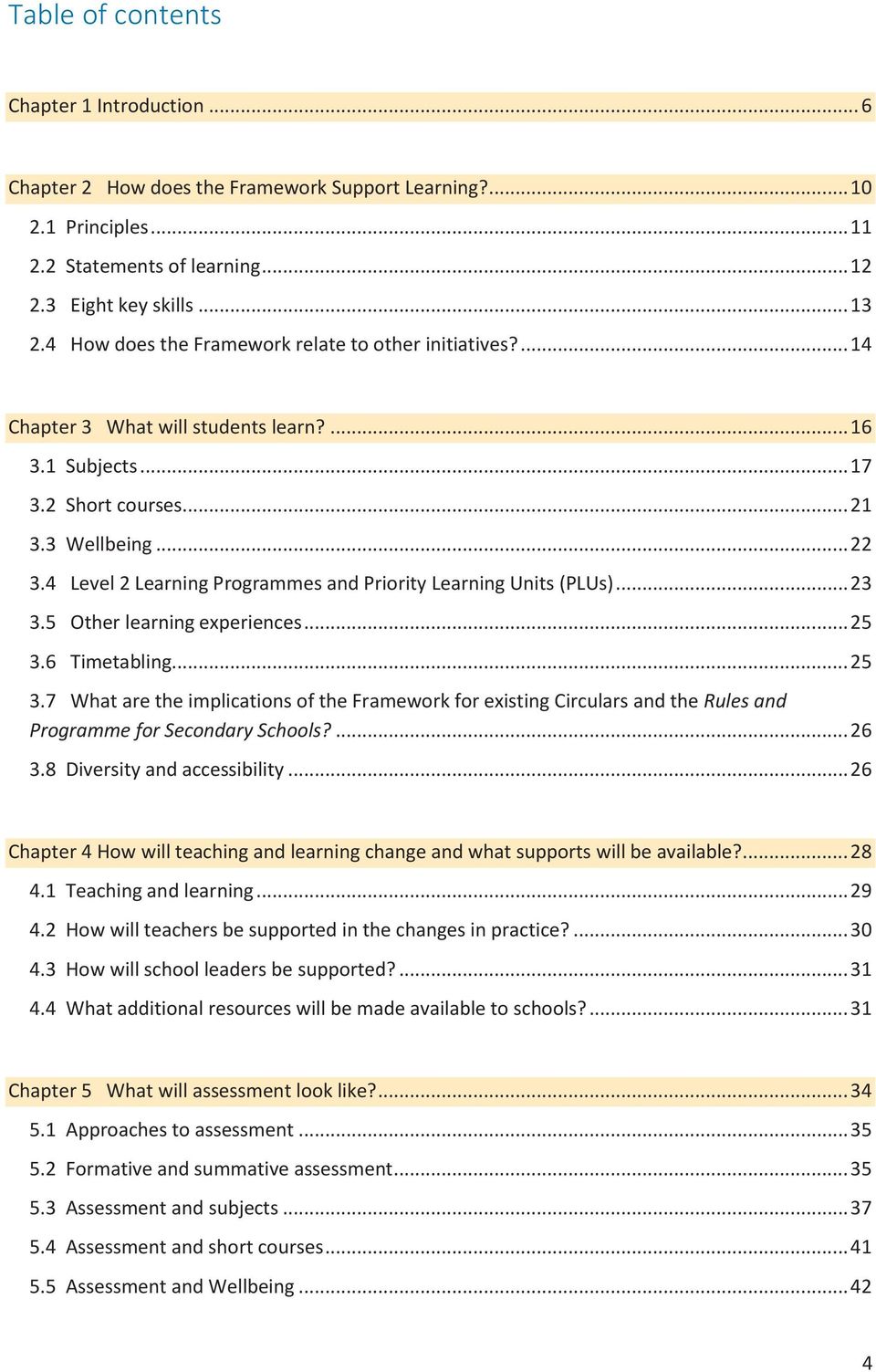
6 Table of contents Chapter 1 Introduction... 6 Chapter 2 How does the Framework Support Learning? Principles Statements of learning Eight key skills How does the Framework relate to other initiatives? Chapter 3 What will students learn? Subjects Short courses Wellbeing Level 2 Learning Programmes and Priority Learning Units (PLUs) Other learning experiences Timetabling What are the implications of the Framework for existing Circulars and the Rules and Programme for Secondary Schools? Diversity and accessibility Chapter 4 How will teaching and learning change and what supports will be available? Teaching and learning How will teachers be supported in the changes in practice? How will school leaders be supported? What additional resources will be made available to schools? Chapter 5 What will assessment look like? Approaches to assessment Formative and summative assessment Assessment and subjects Assessment and short courses Assessment and Wellbeing
7 5.6 Assessing and reporting on students learning in Priority Learning Units (PLUs) Chapter 6 What will reporting look like? Reporting to parents/guardians on students progress over the course of junior cycle The Junior Cycle Profile of Achievement (JCPA) How will the quality of student achievement be assured? Chapter 7 Summary Appendix Statements of Learning- Explanation of Learning Experiences Tables Table 1 Twenty-four statements of learning Table 2 Phased Implementation of Junior Cycle Table 3 Subjects available for study Table 4 Specification for subjects Table of Figures Figure 1 Eight Framework for Junior Cycle principles.11 Figure 2 Key skills and their elements Figure 3 Planning for learning, teaching and assessment Figure 4 The interlinked nature of learning and assessment Figure 5 Learning opportunities and elements for reporting
8 Chapter 1 Introduction This document, the Framework for Junior Cycle (2015), outlines the key educational changes that the Department of Education and Skills (DES) is putting in place for young people in the first three years of their post-primary education. It builds on and advances the vision for junior cycle reform that was outlined in the Framework for Junior Cycle (2012). The Framework for Junior Cycle (2015) incorporates a shared understanding of how teaching, learning and assessment practices should evolve to support the delivery of a quality, inclusive and relevant education that will meet the needs of junior cycle students, both now and in the future. This shared understanding is informed by engagement with stakeholders and by national and international research. This introductory section provides an overview of the key aspects of change relating to the delivery of junior cycle provision as envisaged in the Framework for Junior Cycle (2015). 6
9 A flexible programme for students learning The Framework for Junior Cycle (2015) gives schools greater flexibility to design programmes that are suited to the needs of their junior cycle students and to the particular context of the school. Each school s programme: will be guided by the twenty-four statements of learning, eight principles and eight key skills that are at the core of the new Junior Cycle will encompass learning in subjects or a combination of subjects and short courses will include an area of learning entitled Wellbeing will provide a range of other learning experiences may include priority learning units (PLUs) that will help to provide a junior cycle programme that is appropriate to the needs of particular students with significant special educational needs. Schools will have the flexibility and discretion to decide what combination of subjects, short courses or other learning experiences will be provided in their three-year junior cycle programme. Balance between knowledge and skills The Framework for Junior Cycle (2015) outlines the curriculum and assessment arrangements that will provide students with learning opportunities that achieve a balance between learning subject knowledge and developing a wide range of skills and thinking abilities. These curriculum and assessment arrangements will promote a focus on active and collaborative learning. In particular, learners will be enabled to use and analyse information in new and creative ways, to investigate issues, to explore, to think for themselves, to be creative in solving problems and to apply their learning to new challenges and situations. Given the changing nature of knowledge, the ease with which students have access to information, and the pace of change in the workplace and the world generally, these competences and skills are critical to the preparation of young people for learning and living. Subject specifications, heretofore known as syllabuses, and assessment arrangements will be revised on a phased basis to reflect this new balance between subject knowledge and skills. These new subject specifications are being designed to build on current best practices in the system and to support the further development of effective teaching, learning and assessment practice. The inclusion of short courses and other learning experiences in junior cycle programmes also provides a valuable opportunity to broaden students learning and skill set. Dual approach to assessment The Framework for Junior Cycle (2015) presents a dual approach to assessment that supports student learning over the three years of junior cycle and also measures achievement at the end of those three years. This dual approach reduces the focus on one externally assessed examination as a means of assessing students and increases the prominence given to classroom-based assessment and formative assessment. This change of emphasis arises from an acknowledgement that students learn best when teachers provide feedback that helps students to understand how their learning can be improved. 7
10 In the case of each subject, two structured Classroom-Based Assessments will be introduced which will contribute to and build on the use of formative assessment in the classroom. One of these Classroom-Based Assessments will take place in second year, and the other during third year. Each assessment will be drawn from a variety of types of assessment, which might include project tasks, oral language tasks, investigations, practical or designing and making tasks, field studies and artistic performance. After the second of the Classroom-Based Assessments, students will complete a written Assessment Task on what they have learned and the skills and competences that they have developed in that assessment. The Assessment Task, along with the final examination at the end of third year, will be marked by the State Examinations Commission (SEC). The dual approach to assessment will recognise and value the different types of learning that take place in schools, and will allow for a more rounded assessment of the education of each young person. Reporting a broader picture of learning The Framework for Junior Cycle (2015) emphasises the importance of valuing, acknowledging and affirming all the students learning opportunities and experiences during the three years of junior cycle. It also envisages that parents/guardians and students will get a broader picture of students learning. The approach to reporting will value the different aspects of students learning and the range of assessment approaches, both formative and summative, that generate evidence of this learning by students. The approach to reporting will facilitate provision of assessment information based on the following elements: Ongoing formative assessments, including routine teacher-designed tasks and tests Structured Classroom-Based Assessments conducted in second and third year Assessment of learning arising from short courses or priority learning units The written Assessment Task following the second Classroom-Based Assessment The results of the summative state examination. Schools will be supported to report on these elements by the provision of standard reporting templates, appropriate to the post-primary context, for use in first, second and third year. Before the end of the first term following the completion of the junior cycle, each student will receive a composite Junior Cycle Profile of Achievement (JCPA) from his/her school. The JCPA will capture all of the different assessment elements undertaken over the three years of junior cycle, including the grades which will have been previously and separately issued by the SEC. Greater professional collaboration between teachers The Framework for Junior Cycle (2015) recognises the importance of professional development and collaboration between teachers for informing their understanding of teaching, learning and assessment and their practice in the classroom. All teachers of each subject involved in teaching and assessing the classroom-based components in the school will engage in Subject Learning and Assessment Review meetings where they will share and discuss samples of their assessments of students work and build a common understanding about the quality of students learning. This 8
11 structured support for Classroom-Based Assessments (CBAs) will help to ensure consistency and fairness within and across schools in the appraisal of student learning. Teachers judgements about the work of students will be supported by the publication of standards by the National Council for Curriculum and Assessment (NCCA) that describe performance on each type of assessment task at a number of different levels, as well as providing teachers with exemplars of student work at the different levels. To further support teachers, the Junior Cycle for Teachers (JCT) support service will assist teachers to use the NCCA standards collaboratively with other teachers in the school. Phased introduction of Junior Cycle The new curriculum and assessment arrangements for junior cycle will be phased in to accommodate the development of new specifications for subjects, the provision of professional development for teachers and school planning. An overview of the phased introduction of the new Junior Cycle is outlined in Chapter 3. Schools will also have the opportunity to include short courses and other learning experiences in their new junior cycle programmes from the commencement of implementation. It should be noted that short courses are not intended to displace existing subjects. Supporting continuity and learning The changes to learning and assessment envisaged in the new Junior Cycle will support continuity and progression in students learning experiences as they move from primary to post-primary school. In doing so, they will complement existing transition initiatives such as the Education Passport 1. The flexibility that schools have to design their junior cycle programmes, particularly in the first year of the programme, will support students in experiencing a successful transition. Summary The Framework for Junior Cycle (2015) reflects our shared understanding of, and trust in, the many positive features of educational practice currently in our post-primary schools. It also provides a blueprint for guiding the enhancement and development of junior cycle provision in the next number of years. Details on different aspects of the curriculum and assessment changes relating to junior cycle provision are provided in the remainder of this document. 1 The Education Passport materials support the transfer of pupil information from primary to post-primary school and have been introduced for use by all primary schools from 2014/2015. For further detail, see and Primary Circular 0027/2015 at 9
12 Chapter 2 How does the Framework Support Learning? Learning in the junior cycle will be informed by Eight principles that underpin the entire Framework for Junior Cycle Twenty-four statements of learning that are central to planning for, the students experience of, and the evaluation of the school s junior cycle programme Eight key skills that are required for successful learning by all students The principles, statements of learning and key skills provide a structure for schools to design their junior cycle programme. They are an important guide for students and parents/guardians as to what they should expect from the new Junior Cycle. They will also facilitate and direct discussion regarding the kind of programme a school can provide. These principles, statements and skills will also inform the development of, and be given expression through, the learning outcomes 2 in subject and short course specifications which will be created as the Framework for Junior Cycle is being phased in. Schools will have the flexibility and discretion to decide what combination of subjects, short courses or other learning experiences will be provided in their three-year programme 3. Schools will also be able to include priority learning units (PLUs) in the provision of a junior cycle programme that is appropriate to the needs of a small group of students with significant special educational needs 4. 2 Learning outcomes are statements in curriculum specifications to describe the knowledge, understanding, skills and values students should be able to demonstrate after a period of learning 3 More details about the different choices available to schools can be found in Chapter 3. 4 This relates to students with general learning disabilities in the higher functioning moderate and low functioning mild categories, where such needs prevent students from accessing some or all of the subjects and short courses on offer that are broadly aligned with Level 3 of the National Framework of Qualifications. 10
13 2.1 Principles Eight principles underpin the Framework for Junior Cycle (Figure 1). These principles will inform the planning for as well as the development and the implementation of junior cycle programmes in all schools. Figure 1: Eight Framework for Junior Cycle Principles The student experience contributes directly to their physical, mental, emotional and social wellbeing and resilience. Learning takes place in a climate focused on collective wellbeing of school, community and society High quality curriculum, assessment, teaching and learning support students in developing greater independence in learning and in meeting the challenges of life beyond school, of further education, and of working life. The school s junior cycle programme is broad enough to offer a wide range of learning experiences to all, and flexible enough to offer choice to meet the needs of students. The educational experience is inclusive of all students and contributes to equality of opportunity, participation and outcomes for all. All students experience a high quality education, characterised by high expectations of learners and the pursuit of excellence. Curriculum, assessment, teaching and learning enables students to build on their learning to date, recognises their progress in learning and supports their future learning The experience of curriculum, assessment, teaching and learning encourages participation, generates engagement and enthusiasm, and connects with life outside the school. Curriculum, assessment, teaching and learning provide opportunities for students to be creative and innovative. 11

14 2.2 Statements of learning The learning at the core of Junior Cycle is described in the twenty-four statements of learning which are set out in Table 1. The appendix to this document provides an explanation of the learning experiences associated with each of the statements of learning. The twenty-four statements, underpinned by the eight principles, are central to planning for, the students experience of, and the evaluation of the school s junior cycle programme. Schools will ensure that all statements of learning and the eight key skills feature in the programmes offered to their junior cycle students. The detailed learning outcomes will be clearly set out in subject and short course specifications. Table 1: Twenty-four Statements of Learning The student: 1. communicates effectively using a variety of means in a range of contexts in L listens, speaks, reads and writes in L2 and one other language at a level of proficiency that is appropriate to her or his ability 3. creates, appreciates and critically interprets a wide range of texts 4. creates and presents artistic works and appreciates the process and skills involved 5. has an awareness of personal values and an understanding of the process of moral decision making 6. appreciates and respects how diverse values, beliefs and traditions have contributed to the communities and culture in which she/he lives 7. values what it means to be an active citizen, with rights and responsibilities in local and wider contexts 8. values local, national and international heritage, understands the importance of the relationship between past and current events and the forces that drive change 9. understands the origins and impacts of social, economic, and environmental aspects of the world around her/him 10. has the awareness, knowledge, skills, values and motivation to live sustainably 11. takes action to safeguard and promote her/his wellbeing and that of others 12. is a confident and competent participant in physical activity and is motivated to be physically active 13. understands the importance of food and diet in making healthy lifestyle choices 14. makes informed financial decisions and develops good consumer skills 15. recognises the potential uses of mathematical knowledge, skills and understanding in all areas of learning 16. describes, illustrates, interprets, predicts and explains patterns and relationships 17. devises and evaluates strategies for investigating and solving problems using mathematical knowledge, reasoning and skills 18. observes and evaluates empirical events and processes and draws valid deductions and conclusions 19. values the role and contribution of science and technology to society, and their personal, social and global importance 20. uses appropriate technologies in meeting a design challenge 21. applies practical skills as she/he develop models and products using a variety of materials and technologies 22. takes initiative, is innovative and develops entrepreneurial skills 23. brings an idea from conception to realisation 24. uses technology and digital media tools to learn, communicate, work and think collaboratively and creatively in a responsible and ethical manner 5 L1 is the language medium of the school (English in English-medium schools; Irish in Irish-medium schools). L2 is the second language (Irish in English-medium schools; English in Irish-medium schools). 12

15 2.3 Eight key skills There are eight key skills required for successful learning by students across the curriculum and for learning beyond school. These key skills and their elements are outlined in Figure 2. Figure 2: Key skills and their elements Throughout the Junior Cycle, students will acquire and enhance their proficiency in these eight key skills. They will be brought to life through the learning experiences encountered by students and will 13
16 be evident in the assessment approaches used in the classroom and in examinations. These skills are key to learning in every area of junior cycle and beyond. They are closely linked to the skills required at senior cycle and those already developed for early childhood and primary education. In Figure 2 above, the key skills are named and explained in language that students can access and understand. This will help them to take greater responsibility for their learning. The key skills will be embedded in the learning outcomes of every junior cycle subject and short course. Thus, teachers will have a clear understanding of how they fit into a subject, short course or priority learning unit and how to build the skills into class planning. 2.4 How does the Framework relate to other initiatives? The Framework for Junior Cycle is linked closely with: The Literacy and Numeracy Strategy (2011): The reform of the junior cycle curriculum was signalled as a key action in the Strategy document. The new subject specifications being developed place a greater emphasis on the teaching and consolidation of literacy and numeracy as key skills across all aspects of the junior cycle curriculum. The School Self-Evaluation (SSE) process Schools are encouraged to adopt a school self-evaluation (SSE) approach to planning for junior cycle which will enable them to review their current junior cycle provision and teaching, learning and assessment practices in an evidence-based way. For example, a school could think about how the principles of the Framework for Junior Cycle underpin learning in the school and review how the key skills are being developed across the subjects currently on offer in the school. They could also consider how classroom practice facilitates the development and assessment of the eight key skills and reflect on the changes in teaching, learning and assessment practices that will need to be put in place at subject or whole-school level to meet the requirements of the Framework. 14
17 15

18 Chapter 3 What will students learn? During junior cycle, a student will learn through A number of subjects or a combination of subjects and short courses that are broadly aligned with Level 3 of the National Framework of Qualifications (NFQ) An area of learning called Wellbeing Priority Learning Units (PLUs) that are broadly aligned with Level 2 of the NFQ. These will be included in learning programmes that provide for a small number of students with significant special educational needs Other learning experiences 16
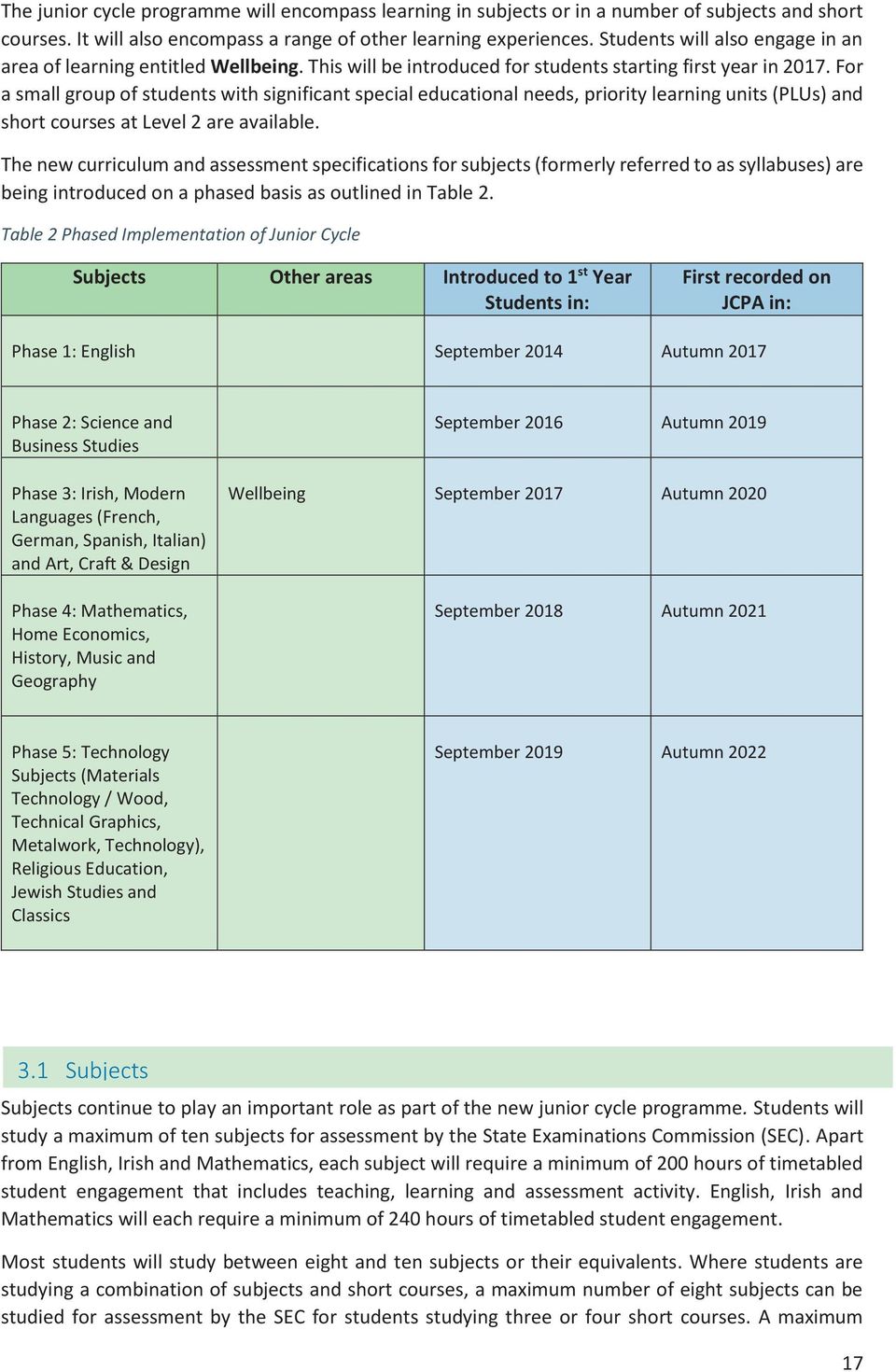
19 The junior cycle programme will encompass learning in subjects or in a number of subjects and short courses. It will also encompass a range of other learning experiences. Students will also engage in an area of learning entitled Wellbeing. This will be introduced for students starting first year in For a small group of students with significant special educational needs, priority learning units (PLUs) and short courses at Level 2 are available. The new curriculum and assessment specifications for subjects (formerly referred to as syllabuses) are being introduced on a phased basis as outlined in Table 2. Table 2 Phased Implementation of Junior Cycle Subjects Other areas Introduced to 1 st Year Students in: First recorded on JCPA in: Phase 1: English September 2014 Autumn 2017 Phase 2: Science and Business Studies Phase 3: Irish, Modern Languages (French, German, Spanish, Italian) and Art, Craft & Design Phase 4: Mathematics, Home Economics, History, Music and Geography September 2016 Autumn 2019 Wellbeing September 2017 Autumn 2020 September 2018 Autumn 2021 Phase 5: Technology Subjects (Materials Technology / Wood, Technical Graphics, Metalwork, Technology), Religious Education, Jewish Studies and Classics September 2019 Autumn Subjects Subjects continue to play an important role as part of the new junior cycle programme. Students will study a maximum of ten subjects for assessment by the State Examinations Commission (SEC). Apart from English, Irish and Mathematics, each subject will require a minimum of 200 hours of timetabled student engagement that includes teaching, learning and assessment activity. English, Irish and Mathematics will each require a minimum of 240 hours of timetabled student engagement. Most students will study between eight and ten subjects or their equivalents. Where students are studying a combination of subjects and short courses, a maximum number of eight subjects can be studied for assessment by the SEC for students studying three or four short courses. A maximum 17
20 number of nine subjects can be studied for assessment by the SEC for students studying one or two short courses. The current Junior Certificate examination in Civic, Social and Political Education (CSPE) is being extended until Students beginning first year in and may sit the CSPE examination in addition to the maximum of ten subjects. When all the new specifications are in place, there will be twenty-one subjects available for study (see Table 3). This does not preclude a further review of subjects at a future date. Table 3 Subjects available for study 6 English; Irish; Mathematics; Science; Business Studies; Modern Languages (French, German, Spanish, Italian); History; Geography; Religious Education; Art, Craft & Design; Home Economics; Music; Technology Subjects (Materials Technology (Wood); Technical Graphics; Metalwork; Technology) Jewish Studies and Classics The content of all twenty-one subjects, will be set out in new online specifications The specifications for subjects will be published early in the year prior to their introduction and will be available at Subject specifications are being introduced in a phased manner (Table 2) The specifications for the twenty-one subjects will be broadly aligned with Level 3 of the National Framework of Qualifications (NFQ) The key skills are embedded in the learning outcomes of each specification. Students will study English, Irish and Mathematics, along with a number of other subjects in their junior cycle programme. The range of subjects to be offered in the junior cycle programme in individual schools will vary in accordance with the teaching resources in the school and the needs and interests of the students. In the transitional period, the current Junior Certificate syllabuses for subjects will remain in place until they are replaced by the new specifications in accordance with the phasing in schedule outlined in Table 2. Each specification will include learning outcomes that are linked to examples of student work at different levels of achievement. 6 The following should be noted: Environmental and Social Studies (ESS), which is currently available as a subject option for a limited number of schools only, is not included on the list of subjects in the new junior cycle programme. After the new specifications for History and Geography are introduced in 2018, ESS will no longer be on offer as a subject. The last ESS examination will take place in Schools may also provide a separate religious education programme in accordance with their ethos in addition to Religious Education. The junior cycle subjects Latin, Greek, and Classical Studies were reviewed in A decision was taken to merge them into a single subject called Classics. This new subject will be included in the new Junior Cycle and is due to become available in September Type-writing is no longer a recognised subject in the new Junior Cycle. It will be examined for the last time in the Junior Certificate examination in June For further detail, see Circular 0061/2014 at 18
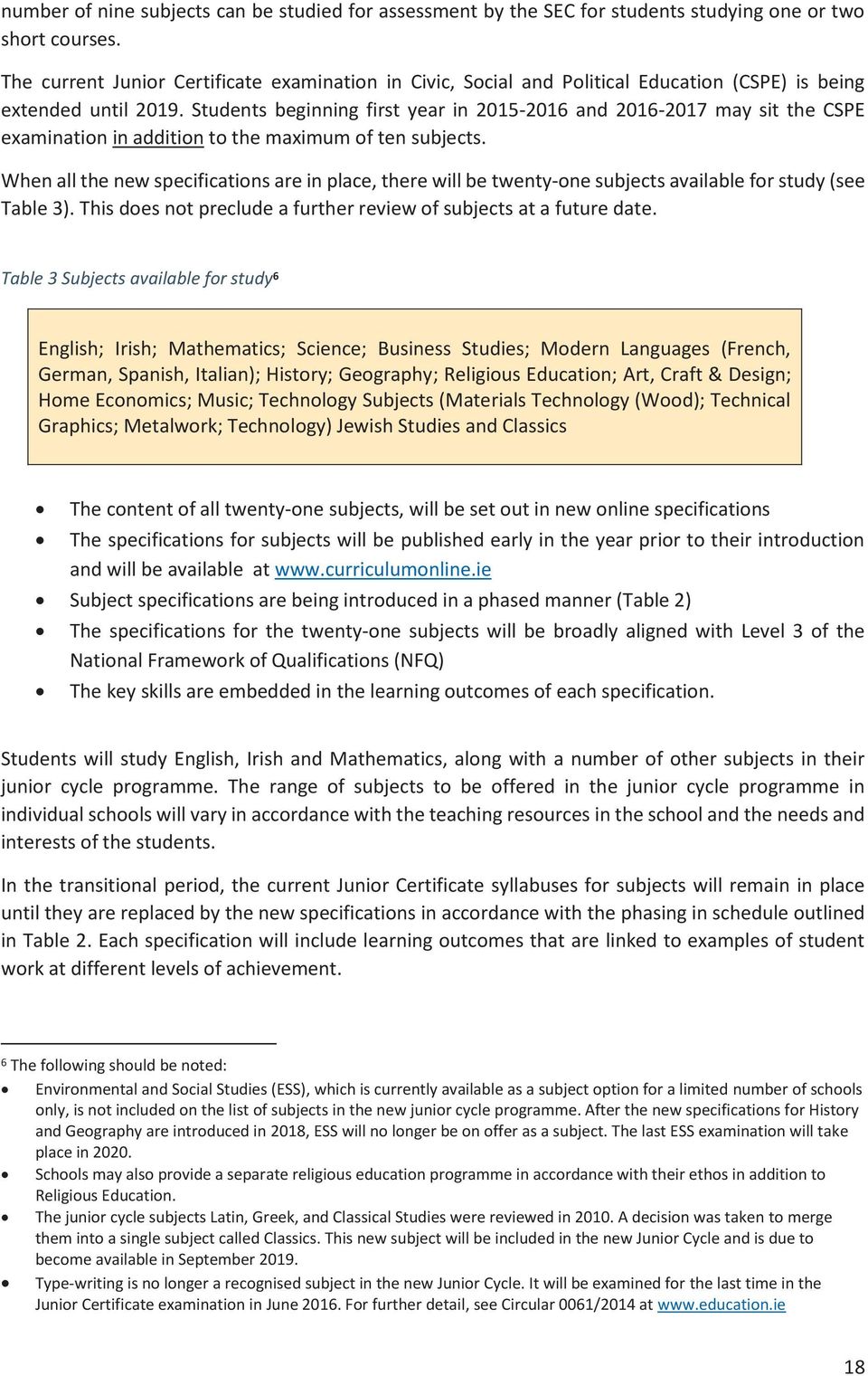
21 Table 4 Specification for subjects Section Content 1 Introduction to Junior Cycle This will be common to all specifications and will summarise the main features of the Framework for Junior Cycle. 2 Aim 3 Rationale A concise aim for the subject will be presented. This will describe the nature and purpose of the subject as well as the general demands and capacities that it will place on and require of students. It will, as appropriate, aim to draw attention to challenges and any access issues associated with study of the subject for students with specific needs or disabilities. 4 5 Links with Statements of learning Key skills Overview Strands Learning outcomes How the subject is linked to central features of learning and teaching at junior cycle will be highlighted and explained. An overview of the subject will illustrate how it is organised and will set out the learning involved in strands and learning outcomes. 6 Expectations for students These will be linked with groups of learning outcomes and will relate to examples of student work. The examples will be annotated, explaining whether the work is in line with, ahead of, or behind expectations for students. 7 Assessment and reporting This section refers to both formative and summative assessment. It outlines the assessment component/s through which students will present evidence of learning on an ongoing basis, and for the purposes of recording achievement for the Junior Cycle Profile of Achievement (JCPA). 7 This description of assessment is supplemented by separate assessment specifications and guidelines for use in second and third years. An online interface will give teachers access to a wide range of additional materials, including annotated exemplars of students work. The availability of online specifications means that teachers, parents/guardians, students and others can access them easily. English, Irish and Mathematics English, Irish and Mathematics will be a central part of the junior cycle programme for all students. These subjects will be offered at two levels, higher and ordinary, and the externally assessed state- 7 The reporting process at junior cycle will culminate in the award of the JCPA to students. The JCPA, received by each student in the term following third year, will report achievement across a range of areas of learning (See Chapter 6). 19
22 certified examination will reflect this. The Classroom-Based Assessments 8 in second year and in third year will be set at a common level. The specifications for English, Irish and Mathematics will be designed for a minimum of 240 hours of student engagement each over the three years. Schools may choose to timetable additional time for English, Mathematics and Irish in recognition of the key role played by English and Mathematics in supporting literacy and numeracy in English-medium schools, the key role played by English Irish, and Mathematics in promoting literacy and numeracy in Irish-medium schools and the particular status of Irish in all post-primary schools. The specifications for all subjects will include an emphasis on literacy and numeracy which will support students progress and achievement in these areas as they transfer from primary school. The key skills, Being Literate and Being Numerate, will be embedded into the learning outcomes for each subject. Schools will have flexibility and autonomy in determining the manner in which they enhance the emphasis on literacy and numeracy. Arrangements for doing so may include timetabling of additional classes for English and Mathematics in all schools and also for Irish in the case of Irish-medium schools, as well as the provision of meaningful opportunities for the development of students literacy and numeracy skills across subjects. These arrangements may also include provision of opportunities to students for reading and for engagement in co-curricular activities related to literacy and numeracy. Some students may have had exemptions from studying Irish in their primary schools and may not therefore be required to study it for the purposes of assessment by the SEC. With the specification s emphasis on the oral and cultural aspects of Irish, however, it is important that junior cycle students are encouraged to study the language, which they can do along with their peers, and to see it as an opportunity to achieve a level of personal proficiency that is appropriate to their ability. Other subjects The specifications for the other eighteen subjects will be designed for a minimum of 200 hours of timetabled student engagement. The Classroom-Based Assessments will be set at a common level and there will be a common level externally assessed state-certified examination. Junior Certificate School Programme The current provision of the Junior Certificate School Programme (JCSP) will continue for the present. JCSP will be subject to a review at a future date when a substantial proportion of the new Framework for Junior Cycle is in place. 8 More information about Classroom-Based Assessments can be found in Chapter 5. 20
23 3.2. Short courses Schools may also offer students the opportunity to take a small number of short courses. These short courses will be assessed through Classroom-Based Assessment, and will be reported upon to parents/guardians and students by the school. Each short course will require 100 hours of student engagement over the three years of junior cycle. The main purpose of short courses is to allow schools greater flexibility in the delivery of their junior cycle programme. The inclusion of short courses in a junior cycle programme will also allow schools to broaden the learning experiences for students, address their interests and encompass areas of learning not covered by the combination of curricular subjects available in the school. It is not intended that short courses would replace existing subjects. Schools may include up to a maximum of four short courses in their junior cycle programme but are strongly advised to limit the number of short courses that they offer, especially in the early years of the implementation of the Framework for Junior Cycle. Seven short courses that are broadly aligned with Level 3 of the NFQ, have been developed by the NCCA as outlined below: Coding Digital Media Literacy Artistic Performance Chinese Language and Culture Social, Personal and Health Education (SPHE) Physical Education (PE) Civic, Social and Political Education (CSPE) These short courses are available online at From 2017, the short courses in SPHE, CSPE and PE will be incorporated into the specification for Wellbeing (see 3.3. below). From 2017, a school may continue to offer up to four short courses in its junior cycle programme in addition to the area of learning entitled Wellbeing. An additional short course in Philosophy will also be made available by the NCCA. Schools may opt to include short courses developed by the NCCA, or alternatively, short courses that have been developed either by the school or another organisation in accordance with a template and guidelines set out by the NCCA. Short course provision will vary from school to school, in accordance with a number of factors, namely: the design and content of the school s junior cycle programme the resources available students needs and interests teacher availability, expertise and qualifications the views of parents/guardians how they can be integrated into the school timetable Where schools opt to offer short courses, they are advised to offer a small number of short courses in the initial years and to introduce such courses gradually. 21
24 3.3 Wellbeing The junior cycle years are a critical time in young peoples lives. Students are exposed to a range of influences and require support to make positive responsible decisions relating to their health and wellbeing and the wellbeing of others. Wellbeing in junior cycle is about young people feeling confident, happy, healthy and connected. Wellbeing is one of the principles that underpins junior cycle education. It is also reflected in a number of the statements of learning, including the following: The student: has an awareness of personal values and an understanding of the process of moral decision making takes action to safeguard and promote his/her wellbeing and that of others is a confident and competent participant in physical activity and is motivated to be physically active understands the importance of food and diet in making healthy lifestyle choices has the awareness, knowledge, skills, values and motivation to live sustainably values what it means to be an active citizen, with rights and responsibilities in local and wider contexts Wellbeing is also incorporated within a number of the key skills, in particular Staying Well, Communicating, Working with Others and Managing Myself. Students will undertake learning in a new area entitled Wellbeing throughout the three years of junior cycle. This area of learning will build on the very good work that has taken place in post-primary schools to date to support students wellbeing. It will also build on the learning experiences relating to wellbeing that students had in primary school. Wellbeing will provide learning opportunities to enhance the physical, mental, emotional and social wellbeing and resilience of students, and to enable students to build life-skills and to develop a strong sense of connectedness to the school and to their community. It will also emphasise the role that students play in their family, community and society in general. Furthermore, it will complement the contribution that the family, the community and relevant agencies make to supporting student wellbeing. This area of learning will incorporate learning traditionally included in PE, SPHE 9 and CSPE. A school may also choose to include other areas in their provision for Wellbeing. For example, in recognition of the unique contribution that guidance can make to the promotion of students wellbeing, guidance provision may also be included in the hours available for Wellbeing. Wellbeing may also incorporate other aspects of learning related to individual subjects or short courses that, in the opinion of the school, will support student learning in this area. Up to 400 hours will be available for learning in the area of Wellbeing commencing with a minimum of 300 hours of timetabled engagement from 2017 and moving to the full complement of time as the new junior cycle is fully implemented in schools. 9 SPHE also incorporates Relationship and Sexuality Education (RSE). 22
25 Students will also engage with learning related to Wellbeing through the school culture and students experience of the implementation of related whole-school policies. Such policies will include Relationships and Sexuality Education (RSE), and the school s Behaviour, Anti-Bullying, Health Promotion, Substance Use and Child Protection policies. Students engagement with learning in the area of Wellbeing will also be supported through activities related to pastoral care and through student support systems. The NCCA will provide a specification for the area of Wellbeing. It will also advise on the format of the appropriate assessment approaches for the area. Given the sometimes sensitive nature of this area of learning, schools will be given significant flexibility when assessing and reporting on learning in Wellbeing. In this context, and to allow schools to prepare for this new area of learning and for the necessary continuing professional development (CPD) to be provided in the year prior to implementation, Wellbeing will be introduced as part of the junior cycle programme for all schools from September Students starting first year in September 2017 will be the first set of students to undertake the new area of learning relating to Wellbeing. By summer 2020, it will be fully integrated across all junior cycle year groups. It is accepted that a certain degree of flexibility in relation to the hours for Wellbeing may be necessary in the initial years of the new Junior Cycle. To facilitate the above developments, the existing arrangements for SPHE, CSPE and PE, as outlined in Circular 0020/2014, 10 will continue for first year students commencing in September 2015 and Schools may choose to include the existing syllabuses for these areas in their junior cycle programme or alternatively, to offer the new short courses in these areas that have been available from September The current Junior Certificate examination in CSPE will therefore be retained for two additional academic years until Level 2 Learning Programmes and Priority Learning Units (PLUs) As part of the new Junior Cycle, schools can now include programmes called Level 2 Learning Programmes (L2LPs) designed for a small number of students with particular special educational needs. L2LPs are suited to students with general learning disabilities in the higher functioning moderate and low functioning mild categories. The special needs of these students is such as to prevent them from accessing some or all of the subjects and short courses on offer at junior cycle that are broadly aligned with Level 3 NFQ. Such students may be attending either a mainstream school 11 or a special school. It should be noted that most students with general learning disabilities should be able to access most, if not all, subjects and short courses through differentiated teaching, learning and assessment. Varied use of resource allocation such as team-teaching, small group and individual withdrawal, may also facilitate ease of access to subjects and short courses. L2LPs build on prior learning but are essentially designed around priority learning units (PLUs) that focus on the social, personal and pre-vocational skills that prepare students for further study, for work 10 Circular 0020/2014 is available at 11 Typically, one or two students would avail of L2LPs in a mainstream school. 23
26 and for life. Five PLUs, that are broadly aligned with Level 2 of the NFQ, have been developed by the NCCA in: Communication and Literacy Numeracy Personal Care Living in a Community Preparing for Work. Each PLU is designed for up to 250 hours of student engagement and is set out in terms of elements and learning outcomes. The elements clarify the important learning that a student will encounter in the PLU. Each element in turn has a set of associated learning outcomes that sets out a range of knowledge, skills and competences to be developed in the case of each element. In designing learning programmes for the student in question, schools and teachers will select the elements and outcomes from the PLU that are relevant to the learning needs of the individual student. Such decisions will depend on the educational needs and capabilities of the student, and should be made in consultation with parents/guardians and the student. All decisions should be informed by the principles of inclusive learning, as outlined in the DES publication Inclusion of Students with Special Educational Needs, Post- Primary Guidelines (2007). Further information for schools in relation to the planning of educational programmes for students with significant educational needs can be found in Circular 0070/ Much of the content of the PLUs is in alignment with the core aspects of Wellbeing. Where students undertaking PLUs have difficulty accessing some or all of the curricular provision for Wellbeing available to the general school population, the school may choose to adjust the learning programme offered to individual students in this area to meet the needs of the student while still ensuring that the student has access to appropriate provision and support. Two short courses that are broadly aligned with Level 2 NFQ have also been developed: A Personal Project - Caring for Animals Exploring Forensic Science The toolkit for L2LPs and PLUs available at provides further details on PLUs and short courses at Level 2 NFQ. The Toolkit is designed to assist post-primary and special schools in developing learning programmes to meet the specific needs of students within the range of general learning disabilities in question. The NCCA is also investigating whether Level 1 Learning Programmes, which are broadly aligned with Level 1 of the NFQ, will need to be introduced in due course. These programmes would address the learning needs of the very small number of students in the low moderate, and severe and profound range of general learning disabilities Circular 0070/2014 Guidance for post-primary schools on the provision of resource teaching and learning support is available at 13 These students will, in almost all cases, be enrolled in special schools rather than mainstream schools, due to the complexity of their needs. 24
27 3.5 Other learning experiences Students will have the opportunity to engage with a range of other learning experiences in their junior cycle programme. These will play a critical role in ensuring that students are provided with a broad and balanced educational experience, as envisaged through the Framework for Junior Cycle. Learning experiences could include student engagement with: activities relating to guidance, pastoral care and student support, and a school s own religious education programme co-curricular activities that complement the taught curriculum, and that augment and consolidate learning in a deliberate way, for example, students engaging in a science fair; students participating in a musical performance; students participating in a debating competition; students participating in a dance performance other specific learning opportunities that do not form part of subjects or short courses, for example, leadership training, school attendance initiatives, participation in a homework club, etc. In particular, schools will continue to make provision for guidance to students. This will relate to the provision of a range of learning experiences in a developmental sequence that will assist students to acquire self-management skills so as to make effective choices and decisions about their lives. Provision for guidance will also continue to encompass the three separate but interlinked areas of personal and social development, educational guidance and career guidance. Framework principles such as Continuity and Learning to Learn, key skills such as Managing Myself and a number of statements of learning, especially those linked to making decisions, will be useful in informing guidance provision. In accordance with current policy, schools will continue to have flexibility in deciding how they will make provision for guidance. In addition, students may also engage in extracurricular activities, such as: membership of their school s student council participation in their school s sporting activities membership of school clubs or societies social, entrepreneurial and philanthropic endeavours student-led initiatives, such as producing a school newsletter All of the above activities enrich students overall experience during schooling. Some of these may be documented under Other Learning Experiences in the Junior Cycle Profile of Achievement (JCPA) (see Chapter 6) that will be issued by schools to students before the end of the first term following the completion of the junior cycle programme. 3.6 Timetabling The teaching and learning activities that will take place in the revised junior cycle programmes will encompass a wider range of activities and a new balance between the development of skills and competences and the development of students knowledge. To facilitate this learning and the 25
28 implementation of good formative assessment practices, a minimum class period of 40 minutes will be required. As at present, certain subjects will require double class periods (2 x 40 minutes) during the school week. As soon as it is practicable to do so, schools should move to ensure that class periods of less than 40 minutes are not timetabled. Further guidance on this will be provided by means of a DES circular. Some schools will find the use of longer class periods of up to 60 minutes (rather than 40 minutes) more suited to the learning needs of their students and the subjects they study. 3.7 What are the implications of the Framework for existing Circulars and the Rules and Programme for Secondary Schools? As the implementation of the Framework for Junior Cycle 2015 is being phased into schools, the Rules and Programme for Secondary Schools, and the many circulars which have issued in the past, will be reviewed and/or replaced to reflect the Framework. In the interim, the curriculum will mean the programme that a school provides so as to comply with the principles, statements of learning and key skills, as set out in this document. Rule 20 of the Rules and Programme for Secondary Schools, which specifies the current curriculum of a voluntary secondary school, will be replaced over time, by the programme requirements of the Framework, as new specifications become available. These requirements will apply to all post-primary schools with no distinction between voluntary secondary schools and other types of post-primary schools. However, until such time as the new specification for an individual subject is introduced, the Rules and Programme for Secondary Schools, as amended by circulars, will continue to apply for existing subjects in voluntary secondary schools. Likewise, the current status of CSPE, SPHE and PE as defined in relevant circulars and/or the Rules and Programme for Secondary Schools will continue to exist until summer The new approach to Wellbeing will replace current practice from September All schools will continue to be required to have a number of agreed school policies, including policies on Guidance, Substance Use, Child Protection, and Anti-Bullying and to implement and to regularly review these policies. The full range of policies required of schools can be accessed in the School Self- Evaluation Guidelines for Post-Primary schools available at Diversity and accessibility Students in junior cycle come from a wide range of backgrounds and have a wide range of individual interests and needs. Subject specifications and short courses developed by the NCCA will be designed to be as universal as is feasible, providing meaningful and valuable learning opportunities for students from all cultural and social backgrounds and from a wide variety of individual circumstances. This includes ensuring that the learning opportunities are as accessible as possible to students with special educational needs and that statements about the skills to be developed are articulated in a way that reflects this. Schools or other agencies preparing further short courses should also follow this principle of universal design. 26
29 The greater degree of flexibility afforded by the Framework will allow schools to take account of the school s local context and the backgrounds, interests, and abilities of their students when planning their junior cycle programme. This flexibility will also allow them to ensure that, within the school s programme, there is sufficient flexibility to cater for the individual learning needs of all students, including those with special educational needs. Notwithstanding the above, there will inevitably remain learning outcomes within subjects and short course specifications that cannot be achieved by some students by virtue of a particular disability. Schools should be conscious of this when planning their junior cycle programmes so as to ensure that as far as possible, the particular range of subjects and courses is appropriate to the needs and abilities of each student. The individual student and his/her parents/guardians should also be aware of the feasibility of the curricular options available in light of the student s ability. The existing SEC provision for reasonable accommodation in the Junior Certificate examination will continue to be provided for candidates sitting the state-certified examination in the junior cycle subjects. 27
30 Chapter 4 How will teaching and learning change and what supports will be available? 28
31 4.1 Teaching and learning At the heart of junior cycle reform lies the need to build on our understanding of education, to provide students with quality learning opportunities that strike a balance between learning knowledge and developing a wide range of skills and thinking abilities. The changes to subject specifications and to assessment arrangements are designed to build on current best practices in the system and to support the further development of effective teaching, learning and assessment practice. For example, students will have opportunities and be encouraged to: apply their learning in a number of different contexts engage in research, investigation and experimentation gather and synthesise information think analytically and solve problems be creative, entrepreneurial and innovative work independently and/or as part of a team make decisions, implement ideas and take action communicate and critically respond to text and dialogue present and perform in a variety of modes collaborate with others in the completion of tasks think critically and reflect on their learning engage in dialogue with their teachers and peers evaluate their own learning, either as individuals or in collaboration with their peers. Students will be able to engage with subjects and short course specifications at a common level in most instances. This has the advantage of ensuring that students are not directed into a particular level of learning at too early a stage in their academic and personal development. This approach will enable students to have the experience and aspiration to achieve to their highest possible level so that they have greater options available to them at senior cycle, including studying at higher level in the Leaving Certificate examination. The Junior Cycle will be underpinned by the further integration of formative assessment as a normal part of teaching and learning in classrooms. Formative assessment involves teachers and students reflecting on how learning is progressing and deciding next steps to ensure successful outcomes. A vital part of formative assessment is the feedback that teachers provide to their students. Through a range of assessment activities the teacher helps the student to identify what has been achieved and where there is room for further learning and development. It involves a shift from focusing mainly on summative judgements to engaging in ongoing activities that can be used to support the next stages of learning. The emphasis on formative assessment in the Junior Cycle reflects the effective practice that is already evident in many classrooms. To facilitate the type of learning envisaged above, the role of the teacher and the dynamics of the teacher-student relationship will evolve. The teacher s role as a leader and facilitator of learning in the classroom will grow as key skills are developed during the mediation of the content of subjects, short courses and other learning experiences. Teachers will place a greater emphasis on integrating assessment into their teaching so they can better monitor students progress in learning and identify how they can support students to reflect on and critically analyse their own learning. 29
32 Building on the good practice already taking place in many classrooms, it is envisaged that lesson content and format in the new Junior Cycle will facilitate deeper learning. For example: Feedback between teachers and students will inform teaching and learning to a greater extent. Lessons will include further opportunities to enable students to acquire and apply their knowledge and learning and to use information in creative ways. There will be less focus on examination preparation and more focus on collaborative planning of teaching and learning. There will be greater use of other resources, including ICT and practical materials. Written activities will be designed to extend and enrich, as well as consolidate, the students knowledge and skills, and to afford students opportunities for independent thought and reflection. The implementation of the new Junior Cycle will also bring a renewed focus on differentiated learning whereby students of all abilities are engaged and making progress in accordance with their potential. 4.2 How will teachers be supported in the changes in practice? Specifications for subjects and short courses will be available at as they are developed. Online specifications for subjects and short courses will include clear learning outcomes, and will set out what is expected of students through classroom examples of student work that show a range of standards of achievement. The introduction of a new subject specification will be supported with continuing professional development (CPD) opportunities and ongoing guidance in relation to implementing the curriculum specifications. The Junior Cycle for Teachers (JCT) school support service will continue to assist schools in implementing their junior cycle programme through the provision of high quality CPD and relevant learning and teaching resources. CPD training opportunities will continue to be provided to subject teachers, both off-site and on a whole-school basis, as well as to school leaders. In addition to CPD, exemplar materials and complementary online support will continue to be provided to assist with the scheduled introduction of the curriculum. These are available at Teacher feedback and requests for clarification will be captured and collated on an ongoing basis at meetings and through the JCT website and social media mechanisms. In light of these, updated materials, resources and exemplars will be made available to support teachers and schools. This approach to CPD will promote professional dialogue and the sharing of experiences among school leaders and teachers. It will include subject specific CPD and whole-school CPD. Subject specific CPD will be delivered in advance of and during the introduction of each subject in schools across a number of years. CPD on implementing short courses and Level 2 Learning Programmes will also be provided. JCT will continue to provide schools with information about the various CPD opportunities as they become available. The CPD will complement the work already undertaken by schools themselves and the wide variety of materials produced by the National Council for Curriculum and Assessment (NCCA). 30
33 The NCCA will support teaching and learning through specifying a range of assessment modalities for each subject, particularly in second and third year (See Chapter 6). In addition, the Assessment Toolkit prepared by the NCCA and available at is designed to support and assist teachers in their work on junior cycle assessment. 4.3 How will school leaders be supported? It is recognised that the implementation of the significant curriculum and assessment changes in the new Junior Cycle will require the commitment of leadership and management in schools. In recognition of this, the JCT is providing dedicated CPD to school leaders and will make provision for whole-school professional development. The JCT will continue to provide such comprehensive dedicated CPD programmes for school leaders to enable them to plan for the introduction of the new Junior Cycle in their schools. Among the key implementation issues that will be addressed by this CPD for school leaders will be timetabling, subject and whole-school planning, issues relating to curricular provision and engagement in teacher collaboration. The Centre for School Leadership will also provide a range of leadership development opportunities and will complement the work of JCT in supporting the delivery of the Framework for Junior Cycle. It is also recognised that additional resources are required to support leaders in the implementation of the new Junior Cycle. For example, the whole-school administration of the Assessment Tasks will be resourced through an allocation of additional hours and necessary resources to the school s management to enable the effective and secure management of the SEC Assessment Tasks. The DES in collaboration with NCCA will engage with online providers to ensure that schools have access to online reporting to facilitate the new reporting arrangements for junior cycle. School management will also be in a position to allocate an additional two hours to a teacher for the co-ordination of each Subject Learning and Assessment Review meeting for an individual subject. This would be in addition to the 22 hours of professional time allocated within the timetable for each full-time teacher each year. 4.4 What additional resources will be available to schools? The DES will provide systematic professional support and additional dedicated resources, including time, curriculum and assessment materials, and dedicated CPD, to ensure the successful implementation of the new Junior Cycle. The provision of resources will be regularly reviewed and updated. There will be timetabling implications for schools arising from the commitment to support professional collaboration among teachers. Implementing Junior Cycle changes will, of course, draw on the existing professional time that all teachers employ in preparing for and supporting their work. Existing collaborative planning time facilitated by schools for groups of teachers or subject department teams will be important in supporting implementation. However, additional professional time will be available on a pro-rata basis to all teachers of junior cycle to support the new curriculum and 31
34 assessment arrangements for junior cycle. Each full-time teacher s class contact time will be reduced from 33 teaching periods in the timetable to 32 teaching periods to provide one Junior Cycle professional period of 40 minutes for each of the 33 weeks of the year (based on a school timetable of 40 minute periods). This time allocation equates to 22 hours of professional time within the timetable for each full-time teacher each year. 14 This time will facilitate teachers to engage, as necessary, with a range of professional and collaborative activities, namely: Whole-school professional activities to support the junior cycle Individual teacher and subject department professional activities, including activities related to formative assessment, feedback, reporting and inputs compiled for the JCPA Subject Learning and Assessment Review meetings 15 Preparation for Subject Learning and Assessment Review meetings Administration of SEC Assessment Tasks. The 40-minute professional time period provided within the timetable is available to teachers on the understanding that they will use the allocated time flexibly. Such flexible use of the allocated time will include bundling time periods and carrying forward time to facilitate professional collaboration, particularly Subject Learning and Assessment Review meetings. Teachers may also use the time periods for individual planning, feedback or reporting activities relating to junior cycle. Since professional collaboration meetings can only be held when the relevant subject teachers can be present, a limited number of meetings may need to draw on teachers bundled time to run beyond normal school tuition hours for some of the duration of the meeting. All teachers of junior cycle will be provided with the additional time allocation from the commencement of the 2017/2018 school year. This frontloading of the introduction of professional time will be highly beneficial in advancing whole-school implementation of junior cycle reform including engaging from an early stage with the embedding of formative assessment from first to third year. In the interim, additional time will be allocated in a phased manner with priority given to teachers of English in the school year 2015/16 and teachers of English, Science and Business Studies in the school year 2016/2017. It will be allocated through the provision of additional paid substitution hours to the school. The board of management of each school, along with the in-school management team, will be accountable for the overall implementation of the Framework for Junior Cycle in the school, as it is for other aspects of the school s work. In this context, all time periods provided to support implementation of the Junior Cycle must be used for this purpose under the overall direction of the school s management. 14 Further information on the details of the additional professional time to be provided to teachers is available in Junior Cycle Reform Appendix to Joint Statement on Principles and Implementation, Professional Time to Support Implementation 8 July 2015 at 15 Further information about assessment arrangements including the Subject Learning and Assessment Review meetings and Assessment Tasks can be found in Chapter 5. 32
35 33
36 Chapter 5 What will assessment look like? There will be a range of assessment approaches to complement learning 16 : Ongoing assessments, including routine teacher-designed tasks and tests One or two Classroom-Based Assessment tasks in short courses Ongoing assessment for students undertaking priority learning units at Level 2 Structured Classroom-Based Assessments for subjects conducted in second and third year A written Assessment Task for subjects that will be based on the second Classroom-Based Assessment and will be submitted to the SEC for marking along with the state-certified examination An externally assessed, state-certified examination for subjects at the end of third year Specific arrangements for practical subjects 16 The National Literacy and Numeracy Strategy (2011) also envisages the introduction of full-cohort standardised achievement testing of English, Mathematics and Science in English-medium schools in second year and of Irish, English, Mathematics and Science in Irish-medium schools. Given the impact that this will have on assessment for second year students, and the need to embed the other changes in assessment at junior cycle, the DES will review time for, and the phasing of, the introduction of such full-cohort testing in schools in the context of the interim review of the National Literacy and Numeracy Strategy. 34
37 5.1 Approaches to assessment The most significant change in the new Junior Cycle is in the area of assessment. There is a substantial body of research evidence to show that educational outcomes for students can be improved by broadening the approach to assessment. There is also a recognition that no single assessment event can provide evidence of the full range of student achievement. All assessment in junior cycle, formative or summative, moment-in-time or ongoing, SEC, NCCA or teacher-designed, should have as its primary purpose, the support of student learning. Research shows that the greatest benefits for students learning occur when teachers provide effective feedback to students that helps them to understand how their learning can be improved. That is why a consideration of approaches to quality learning cannot be separated from a consideration of assessment. Ongoing classroom assessment practices are of crucial importance in supporting student learning and promoting student achievement. Ongoing assessment involves practice that is both formative and summative. Formative assessment, complemented by summative assessment, will be a key feature of the new Junior Cycle. A dual approach to assessment, involving classroom-based assessment across the three years and a final externally-assessed, state-certified examination can enable the appropriate balance between preparing students for examinations and also facilitating creative thinking, engaged learning and better outcomes for students. This approach will recognise and value the different types of learning that take place in schools and will allow for a more rounded assessment of the educational achievements of each young person. The assessment practices will build on existing good practice in teaching, learning and assessment. Successful implementation will depend to a very significant degree on the professional skills and abilities of teachers and their collaborative engagement with their subject department colleagues. It will also require effective school leadership to create a supportive professional context for teachers. Formative assessment, complemented by summative assessment, will be a key feature of the new Junior Cycle. 5.2 Formative and summative assessment Teachers and students will engage in ongoing assessment activities as part of classroom practice that can be either formative or summative in nature. Schools will use a range of assessment methods for formative or summative purposes which will emphasise the interlinked and complementary nature of the assessment process at junior cycle. An overall picture of students achievement is not possible without the opportunity for ongoing assessment. Schools will therefore need to use a variety of assessment approaches that will allow students to demonstrate their understanding of concepts and skills and their ability to apply them in ways that would not be possible in a written examination. Taken together, the assessment elements 35
38 undertaken will provide a broad picture of the student s learning journey through the three years of junior cycle. Most of the assessment activities over the three years of junior cycle will be formative in nature. Teachers will use the learning outcomes provided by subject or short course specifications as a starting point for planning a unit of learning and to develop learning intentions and success criteria to be shared and discussed with their students. These learning outcomes will clearly set out what the students should know, understand, and be able to do as a result of the learning and teaching activities which they have undertaken during the course of junior cycle. As part of their daily practice, teachers will continue to assess students learning by observing and listening as students carry out tasks and by considering how they respond to questions. Teachers will use the learning intentions and success criteria as the basis for providing feedback to help students plan their next steps in learning. Students will also be encouraged to reflect on how they are progressing in their own learning and provide feedback to their teachers. In developing the capacity for self-management and self-awareness, students will approach their learning more confidently and will be better prepared to meet the challenges of life beyond school. Figure 3 illustrates how formative and summative assessment are linked. It provides a guide for teachers on how they might plan for learning, teaching and assessment at junior cycle. Figure 3 Planning for learning, teaching and assessment Oral reporting to parents and students Written reporting to parents and students Planning for Learning JCPA Reporting on student progress and achievement Formative and Summative Assessment Teaching and Learning Review of learning and assessment Gathering Evidence of learning Ongoing assessment Classroom- Based Assessment State-certified examination and Assessment Task 36
39 Students written tests, homework assignments, project work, tasks and classroom questioning will each have significant formative potential as the teacher gives regular feedback to students on their work. They will also provide opportunities for teachers to take stock and make judgements about how well a student is progressing. Ensuring that opportunities are provided to review and comment on student performance will be an important feature of teacher planning. These planned opportunities for making summative judgements will support schools in reporting progress to parents/guardians. 5.3 Assessment and subjects Formative assessment practices in each subject, alongside the two Classroom-Based Assessments, will be complemented by a written Assessment Task and state-certified examination which will both be marked by the SEC. The new specification produced by the NCCA for each subject will incorporate clear details of its assessment arrangements, including details of the knowledge, skills and competences that can be expected of students at different levels of performance. Assessment will be aligned with the learning outcomes of each subject. The NCCA will produce specifications including a set of tasks for each subject which will support schools in planning for Classroom-Based Assessments. Classroom-Based Assessment for subjects The introduction of Classroom-Based Assessments will emphasise the importance of formative assessment in supporting teaching and learning. In each subject, students will undertake two Classroom-Based Assessments facilitated by their teacher. One Classroom-Based Assessment will take place in second year and a second Classroom-Based Assessment in third year. Classroom-Based Assessments will provide students with opportunities to demonstrate their understanding and skills in a way which would not be possible in a formal examination. A particular purpose of the Classroom- Based Assessments will be to facilitate developmental feedback to students during their engagement with the assessment task and at the end of the process. The Classroom-Based Assessments will be at a common level. The tasks involved in the Classroom- Based Assessments will be specified by the NCCA in consultation with the SEC on an annual basis. A number of assessment tasks will be designed by the NCCA for a particular Classroom-Based Assessment. This will enable the selection of Classroom-Based Assessments that best align with the school s particular curriculum programme and the learning needs of its students. Decisions relating to the selection of Classroom-Based Assessments will form part of the normal curriculum and subject planning processes engaged in by the school. It is advisable that each subject department should choose the same Classroom-Based Assessment for all students taking the subject, other than where there are educational grounds for choosing a second one in order to accommodate an individual student or small group of students with special/particular educational needs. The tasks will cover a broad range of activities including oral presentations, written work of different types, practical or designing and making activities, artistic performances, scientific experiments, projects or other suitable tasks. Work related to the Classroom-Based Assessments is best seen as an integral part of ongoing assessment and routine classroom practice. 37
40 Classroom-Based Assessments will be undertaken by students in a defined time period within class contact time to a national timetable. The NCCA will provide a specific timeline for each Classroom- Based Assessment. For each Classroom-Based Assessment, the NCCA will articulate standards or reference points that describe performance on the Classroom-Based Assessment at a number of levels. These quality descriptors will be accompanied by exemplars of students work at the different levels. The provision of standards and exemplars of work will provide teachers with a clear framework within which to evaluate the work of their own students for assessment purposes. The Classroom-Based Assessment undertaken by students in third year will have two elements. It will involve formative assessment facilitated by teachers similar to the first Classroom-Based Assessment. Students achievements in the formative assessment part of the Classroom-Based assessments will be reported to students and parents/guardians by the school shortly after they happen. They will also be recorded in the JCPA. Classroom-Based Assessments will describe the achievement of students using a nationally determined common set of descriptors. In addition, the second Classroom-Based Assessment for each subject will be followed by a formal written Assessment Task based on the topic or task undertaken in the second Classroom-Based Assessment. This Assessment Task will be submitted to the SEC to be marked along with the statecertified examination in the subject. Assessment Task The written Assessment Task, marked by the SEC, will be specified by the NCCA and will relate to the learning outcomes of the second Classroom-Based Assessment. The written Assessment Task may require the student to demonstrate an understanding of the knowledge and skills developed during the second Classroom-Based Assessment. It may facilitate the student in highlighting key learning points gained as the student undertook the Classroom-Based Assessment in question. The written Assessment Task may also provide an opportunity for students to refer to skills and competences that were developed and describe ways in which their learning might be applied to new situations. The Assessment Task will be completed in class under the supervision of the teacher and will be sent to the SEC for marking along with the script for that subject in the state-certified examination. Marks for the Assessment Task in each subject will be incorporated into the presentation of the grade for that subject. Further details and the specifications for the Classroom-Based Assessments are available on the Assessment Toolkit at Specific arrangements for practical subjects In the case of a small number of subjects (Art, Music, Home Economics and Technology Subjects), the second structured Classroom-Based Assessment will involve practical work, or the creation of an artefact or a performance. The formative assessment related to the production of these artefacts and performances will be reported upon to the student and parent/guardian by the school as for all other second structured Classroom-Based Assessments. However, as the finished artefact and performances are currently marked by the SEC, the artefact or performance (for example, the piece of art or project work created by the student) will continue to be marked by SEC, together with the related written evidence as appropriate. 38
41 Subject learning and Assessment Review meetings All teachers of each subject involved in teaching and assessing the Classroom-Based Assessments in the school will engage in Subject Learning and Assessment Review meetings where they will share and discuss samples of their assessments of student work and build common understanding about the quality of student learning. Each Subject Learning and Assessment Review meeting will be subject-specific and will focus on the Classroom-Based Assessment undertaken by the particular year group. Each meeting will take approximately two hours. This means that when fully implemented, teachers will be facilitated 17 to participate in a review meeting for each subject they teach in respect of the second-year Classroom- Based Assessment and also for the third year Classroom-Based Assessment. 18 A teacher of two subjects to second year and third year will attend four review meetings amounting to eight hours of professional time. One teacher of each subject in the school will be allocated two additional hours by school management to facilitate the preparation for and coordination of each Subject Learning and Assessment Review meeting. To foster capacity building in each subject department, this activity will normally be rotated among the relevant teachers. In Subject Learning and Assessment Review meetings, teachers will share and discuss samples of their assessments of student work and build a common understanding about the quality of student learning. Where there is a single teacher of a subject in a school, the teacher can be facilitated to participate in a Subject Learning and Assessment Review meeting with another school. In the case of an Irishmedium school, the teacher can be facilitated to participate in a Subject Learning and Assessment Review meeting with another Irish-medium school. The potential of ICT to support such meetings will be explored. The Subject Learning and Assessment Review meetings will play a key role in developing a collegial professional culture and build confidence about the judgements that teachers make about student performance. The structured support in Subject Learning and Assessment Review meetings for Classroom-Based Assessments will also help to ensure consistency and fairness within and across schools in the assessment of student learning. Support for teachers in coming to a common understanding of standards and expectations will be provided by the NCCA through the annotated exemplification of student work and a range of 17 Since Subject Learning and Assessment Review meetings can only be held when the relevant subject teachers can be present, meetings may need to draw on teachers bundled allocated professional time to run beyond normal school tuition time for some of the duration of the meeting. 18 For the school year 2015/2016, schools and teachers of English will have the option of having their students complete the first Classroom-Based Assessment in the Spring of 2016 (in second year) or early in autumn 2016 (in the beginning of third year) 39
42 associated support material and specifications. Understanding of standards will arise through professional discussion in Subject Learning and Assessment Review meetings when teachers bring their own examples of student work and compare their judgements with other colleagues and with the annotated examples of student work provided by the NCCA. In addition, opportunities for regular professional dialogue among teachers will be required to support them in facilitating classroom-based assessment. In that context, the JCT will enable teachers to use the NCCA standards collaboratively with colleagues in their subject teams. CPD support will also be provided to assist teachers with developing their expertise in providing developmental feedback to students and facilitating and reporting to parents/guardians on students learning and progress. Engagement in Subject Learning and Assessment Review meetings will help teachers to develop their own knowledge and skills by developing a shared understanding of national standards and expectations. The meetings will also enable teachers to reflect on the assessment process within their subject overall and support teachers in providing useful feedback to their students to improve their learning. Advice on how Subject Learning and Assessment Review meetings might be organised and structured is provided in the Assessment Toolkit available at Reporting Reporting will benefit students by charting the progress they are making and actively involve them and their parents/guardians in reflection on and discussion of learning progress. As is currently the case, formal reporting in the new Junior Cycle will take place annually from first through to third year. It will be based on a national approach. The NCCA will develop standard reporting templates, appropriate to the second-level curriculum, for use in first and second year. The design of the templates will draw upon existing best practice in school reporting and will enable the school to put flexible and practical reporting arrangements in place. These reporting arrangements will complement other oral and written reporting opportunities that a school may wish to put in place including parent-teacher meetings, teacher-student dialogue and other home-school written communications. Before the end of the first term following the completion of the Junior Cycle, each student will receive a composite Junior Cycle Profile of Achievement (JCPA). This will document the full range of the student s learning achievements. Further information on reporting in general, and the JCPA in particular, is provided in the next chapter. State-certified externally assessed examinations It will be important to see the state-certified examination as one element of a balanced, broader approach to assessment. All aspects of assessment will contribute to providing a comprehensive picture of student achievement which will be captured in the JCPA. The interlinked and complementary nature of student learning, ongoing assessment, Classroom-Based Assessment, the Assessment Task and the state-certified examination is represented in Figure 4. The Classroom-Based Assessments will be complemented by the state-certified examination so that when taken together, the assessments cover a broad range of knowledge, skills and competencies that align with the curriculum specifications. 40
43 For most subjects, there will be a written examination completed at the end of third year. Examinations will be set, administered, marked and resulted by the SEC. The written examinations will be of no longer than two hours duration in a maximum of ten subjects. 19 The examinations will be held in the month of June in third year for most subjects. 20 The final examination will be available at a common level apart from English, Mathematics and Irish where there will be two levels (higher and ordinary) available. Student achievement on the externally assessed state-certified examinations, which will incorporate the results of the Assessment Task also assessed by the SEC, will be recorded using a set of grades. These grades will first issue in provisional form in September following the end of third year and will subsequently be confirmed and included in the Junior Cycle Profile of Achievement (JCPA). Figure 4 The interlinked nature of learning and assessment 5.4 Assessment and Short Courses The junior cycle programme may also include learning in a small number of short courses. It is expected that most of the assessment activities during the teaching of short courses will be formative 19 As outlined in 3.1, students commencing first year in and will be allowed to sit the CSPE examination at the end of junior cycle in addition to the final state examinations taken in a maximum of ten subjects. 20 Subjects that have traditionally had a practical examination before June will continue to do so. 41
44 in nature. The evidence of learning will be generated according to the short course specification and will relate directly to the aims and learning outcomes of the short course. There will be no more than two Classroom-Based Assessments involved and the achievement of students will be described using a nationally determined common set of descriptors. Short courses will be assessed by the students teachers and reported on to students and parents/guardians during junior cycle and in the JCPA (See Chapter 6). 5.5 Assessment and Wellbeing It is expected that most of the assessment activities in the area of Wellbeing will be classroom-based and formative in nature. Learning in Wellbeing will be assessed by the students teachers and reported on to students and parents/guardians during junior cycle and in the JCPA. Before Wellbeing is formally introduced from September 2017, the NCCA will provide advice on how progress and achievement in the area of Wellbeing can be assessed. 5.6 Assessing and reporting on students learning in Priority Learning Units (PLUs) The assessment generated through Priority Learning Units undertaken by a small number of students with significant special educational needs will be classroom-based. Over the three years in junior cycle, students will assemble evidence of their learning in a portfolio. Students will submit this portfolio to their teachers and the students work will be assessed and reported on. The JCPA will document the achievement of the student in PLUs, as reported by the school. A toolkit to support the schools in the assessment of PLUs and short courses is available on the NCCA website 42
45 43
46 Chapter 6 What will reporting look like? In line with good practice, the learning opportunities and experiences during junior cycle should be valued, acknowledged and affirmed. These elements are outlined below. Figure 5 Learning opportunities and elements for reporting Outcomes of Teacher-designed tasks and tests Outcomes of Short Courses and/or Priority Learning Units Results from statecertified examination incorporating Assessment Task Other learning achievements Outcomes of Classroom-Based Assessments 1 and 2 Achievements in the area of Wellbeing 44
47 During the three years of junior cycle, oral and written feedback to parents/guardians and students will be essential in supporting the student to build on strengths and address areas where learning can improve. Existing parent-teacher meetings provide an important opportunity to communicate the outcomes of classroom-based assessments and affirm other learning experiences. Parents/guardians should be given a comprehensive picture of students learning. Linking classroom assessment and other assessment with a new system of reporting that culminates in the awarding of the Junior Cycle Profile of Achievement (JCPA) will offer parents/guardians a clear and broad picture of their child s learning journey over the three years of junior cycle. 6.1 Reporting to parents/guardians on students progress over the course of junior cycle Formal reporting on the progress and achievements of students will be through annual reports in first year and second year, and through the composite Junior Cycle Profile of Achievement in the autumn following third year. This will complement existing reporting systems employed in schools including reporting of progress to parents/guardians and students during events such as teacher-student feedback sessions and parent-teacher meetings. From autumn 2017, reporting will be based on a national approach and agreed templates designed by the NCCA. Degrees of flexibility and the potential for customisation will be built into the template designs to facilitate some school preferences in the area of reporting. The design of the templates will draw upon existing good practice in school reporting. Templates will be designed for hard-copy and on-line completion. They will be user-friendly and easily interpreted by students and parents/guardians. The national templates will link closely to the standards expected of students at this stage of their education. An understanding and appreciation of those standards will derive and emerge from teacher engagement with: clear, outcomes-based, national curriculum and assessment specifications the extensive use of annotated examples of student work ongoing assessment discussion of student work through Subject Learning and Assessment Review meetings assessment of the state examinations and the Assessment Tasks (where relevant) professional development related to reporting and the other areas above The approach to reporting will benefit students by charting the progress they are making and actively involve them and their parents/guardians in reflection on and discussion of learning progress. It will value teacher judgement and link back clearly to learning, teaching and formative feedback in classrooms. The reporting process itself will be efficient, manageable and appropriate to the post-primary curriculum context. Reports will include information on learning in subjects, short courses and Wellbeing, and information on other learning experiences and wider achievements relevant to the student s progress in learning at school. 45
48 Reporting at the end of second year will document the achievement of students in Classroom-Based Assessments completed in that year, and reports on the Classroom-Based Assessments in both second and third year will be included in the Junior Cycle Profile of Achievement issued to each student in the autumn following third year. In short, reporting at junior cycle aims to contribute to the personal and educational development of students, to support and underpin ongoing learning and assessment, and to be manageable, accessible and effective for the school, teacher, student and parent/guardian. Guidelines on reporting in junior cycle and the templates schools can use in this context will be developed by the NCCA and will provide further detail on the various aspects of reporting outlined above. 6.2 The Junior Cycle Profile of Achievement (JCPA) The reporting process at junior cycle will culminate in the award of the JCPA to students. The JCPA will be awarded for the first time in autumn During the years when students are studying subjects for which new specifications have been provided alongside existing Junior Certificate subjects, the results of the latter will be included in the JCPA. The format of the JCPA will evolve as the various phases of junior cycle reform are rolled out. The JCPA will reward achievement across all areas of learning as applicable: Subjects Short courses Wellbeing Priority learning units Other areas of learning The JCPA will draw upon and report on achievement across all elements of assessment including ongoing, formative assessment; Classroom-Based Assessments; and SEC grades which include results from the state-certified examinations and the Assessment Tasks. The JCPA will have a nationally determined format. It will be compiled by the school and received by students in the autumn following third year, when all assessment results from the SEC and the school are available and confirmed. Students will be aware of their results before receiving the JCPA. In the case of both the SEC grades and the Classroom-Based Assessment tasks, students will already have received the results of assessments prior to the awarding of the JCPA. In line with current practice, students will receive a provisional statement of results from the SEC in the September following completion of third year. In the case of Classroom-Based Assessments related to subjects, short courses and priority learning units, students will receive the results shortly after their completion in second and third year. The JCPA will include learning achievements that are broadly aligned to the National Framework of Qualifications (NFQ). In the vast majority of cases, the achievements reported will relate to subjects and short courses that are broadly aligned with Level 3 of the NFQ. In the small number of cases where 46
49 students have followed Level 2 Learning Programmes, the priority learning units and short courses involved are aligned with Level 2 of the NFQ. The JCPA will record: The student s achievements in the state-certified examinations inclusive of the Assessment Tasks This section will set out the student s achievement in subjects taken in the state-certified examination. The result for each subject will incorporate the result of the written Assessment Task. In 2017, 2018 and 2019, the students results in the CSPE examination, where taken, will be included in this. The student s achievements in the Classroom-Based Assessments This section will record the student s achievements in the Classroom-Based Assessments in both subjects and short courses, depending on the combination of subjects and short courses taken by students. A maximum of four short courses can be included where students have taken eight subjects in the externally assessed state-certified examination and a maximum of two short courses can be included where nine subjects have been taken. The student s achievements in Level 2 Learning Programmes (L2LPs) Where students have completed an L2LP as part of their junior cycle programme, this section will set out their achievements in the priority learning units and short courses that they have taken. The student s achievements in the area of Wellbeing This section will report on student achievement in the area of Wellbeing from Guidelines prepared by the NCCA on introducing, managing and assessing the area of Wellbeing in schools will include advice on how schools may report on students progress and achievement. The student s achievement in other areas of learning This section provides an opportunity for schools to report on student achievement in other areas of learning including short courses that may have been included in the school s junior cycle programme. It may also report on other learning experiences and events that the student has participated in. Schools may also wish to include broader aspects of reporting in this section, or areas such as attendance, personal and social development and learning dispositions. Appeals and Queries Student appeals regarding the state-certified examination grade inclusive of the Assessment Task will be processed as per the current appeal arrangements. Queries in relation to all other aspects of the JCPA, where they arise, will be dealt with by the school. 47
50 6.3 How will the quality of student achievement be assured? The new junior cycle programme that combines formative assessment practices, alongside two structured Classroom-Based Assessments, and a state-certified examination and Assessment Task, both externally marked by the SEC, will involve a significant period of transition and require both quality assurance and support. A number of elements have been put in place to provide supports for teachers and to assure quality in assessment arrangements at junior cycle, namely the use of: national curriculum specifications national assessment specifications, including guidance on descriptors used in assessing Classroom-Based Assessments and marking guides used in respect of state-certified examinations and Assessment Tasks annotated examples of student work on assessments showing the standards expected multiple judgements of student work through Subject Learning and Assessment Review meetings an Assessment Toolkit of nationally agreed assessment tools and methods comprehensive professional development for teachers in educational assessment, including the provision of feedback to students professional development in curriculum leadership, educational assessment and change management for principals and deputy principals external assessments through the SEC information for parents/guardians and students The school s own self-evaluation process will continue to be supported and supplemented by the external evaluations carried out by the DES through the ongoing work of its Inspectorate in assessing the quality of teaching and learning in schools. Systematic support will be available from the DES and the necessary additional dedicated resources, including time and curriculum materials, will be provided. 48
51 49
52 Chapter 7 Summary The junior cycle programme followed by students in their schools must be consistent with the Framework for Junior Cycle (2015). Beyond this requirement, schools will be free to decide what should be included in their junior cycle programme and how it should be organised. To comply with the Framework, a school s programme must: subscribe to and fully reflect the principles of junior cycle education meet the requirements of the twenty-four statements of learning emphasise the development of the eight key skills be mediated through subjects, short courses, Wellbeing, other learning experiences and, where relevant, priority learning units (PLUs) facilitate the process by which evidence of learning is generated, gathered, assessed and reported throughout the cycle to students and shared regularly with their parents/guardians have Classroom-Based Assessments, Assessment Tasks and state-certified examinations for subjects, so that assessment can support and document student learning in a balanced range of knowledge, skills and competences support continuity with primary education and progression to senior cycle education provide students at the end of the three years with a JCPA which will: o report their achievement in subjects in the examinations and Assessment Tasks marked by the SEC in each subject o report on their progress and achievement in the Classroom-Based Assessments of subjects, in short courses, or PLUs where relevant o report on students achievement in other areas of learning, including Wellbeing be evaluated by the school through its ongoing process of self-evaluation and improvement which will be complemented by monitoring by the DES and its Inspectorate Through a commitment to the implementation of all aspects of the Framework, the educational system will be able to deliver junior cycle provision that places the needs of students at the core of teaching and learning. The comprehensive implementation of the Framework will improve the quality of the learning experiences and outcomes of all students. This will require leadership and support not only from the DES, the NCCA, JCT and the SEC but, in particular, from school management. It will also require the commitment of teachers, the support of parents/guardians and high expectations for all students. 50
53 Appendix Statements of Learning Explanation of Learning Experiences The student Subjects, short courses and other learning experiences that could contribute 1. communicates effectively using a variety of means in a range of contexts in L1 21 I understand the language used in my school and can describe what I think to others by speaking and writing in that language. I can take part in discussion of everyday issues and of topics covered in class. In working with others on class activities, I can make helpful contributions to the activity by sharing my ideas and feelings as well as commenting on the ideas and opinions of others. I read a variety of texts for pleasure and for study to inform myself and to build my ideas and language skills. English Irish 2. listens, speaks, reads and writes in L2 and one other language at a level of proficiency that is appropriate to his/her ability I can express what I m thinking by speaking and writing in languages other than the language used in my school; I understand the views and experiences of other people when they speak those languages. I read different types of texts in the languages to obtain information and knowledge. The ways of living and cultures in places where the languages are used are interesting to me and I like comparing them with life and culture in Ireland. I know that the skills that help me to learn one language are useful in learning another. Chinese language and culture English Irish Italian French German Spanish 21 L1 is the language medium of the school (English in English-medium schools; Irish in Irish-medium schools). L2 is the second language (Irish in English-medium schools; English in Irish-medium schools). 51
54 The student Subjects, short courses and other learning experiences that could contribute 3. creates, appreciates and critically interprets a wide range of texts I enjoy reading and engaging with different kinds of texts. I can understand and form opinions on the content. When I create a text, I take into account its purpose as well as the needs and interests of people who will be accessing it. In written texts, I understand the importance of grammar, select the correct words to create an effect and use accurate spelling and punctuation. Not all texts are written, so I am also able to work with visual and sound material. When I create a text, I am able to share it in whatever form is most appropriate and I know when permissions to do this are needed. Art Craft Design Classics English French German History Irish Italian Music Spanish Technical Graphics Digital Media Literacy 4. creates and presents artistic works and appreciates the process and skills involved I can create a piece of art, either on my own or with others. This art can be an object, a written piece or a performance, created by myself or as part of a group. The art I create is another way of saying and exploring what I think or feel and hearing what others think or feel. The artistic pieces I look at or listen to can be those of my classmates, present-day artists or can be the work of artists of another place and time. Art Craft Design Artistic Performance Classics English Home Economics Irish Music Physical Education Technology subjects 5. has an awareness of personal values and an understanding of the process of moral decision making I can see where my own values come from and the different influences that have shaped them. I respect the values of others while holding my own as special to me. I have an understanding of how moral decision making works in my own life and in the lives of others based on their particular values. I can discuss different day-to-day ethical and moral decisions and comment on them. Religious Education SPHE Wellbeing 52
55 The student Subjects, short courses and other learning experiences that could contribute 6. appreciates and respects how diverse values, beliefs and traditions have contributed to the communities and culture in which she/he lives I am aware of the importance of religious traditions and the non-religious interpretations of life. I appreciate how different belief systems have influenced and shaped who we are in Ireland, and also in Europe and the wider world. I can discuss different beliefs and practices in an informed way, and respect those holding beliefs different from my own. Chinese language and culture CSPE Geography History Irish Jewish Studies Modern Languages Religious Education 7. values what it means to be an active citizen, with rights and responsibilities in local and wider contexts I understand how government and politics works in Ireland and elsewhere. I understand that as citizens we all have rights and responsibilities. I respect the rights of minority groups in society. I feel inspired when I learn about ways that active citizens can contribute to building a better world within their local communities and in the wider world. I am willing and able to think carefully about and take action for change on issues that concern me or my community. Business Studies CSPE Geography History Wellbeing 8. values local, national and international heritage, understands the importance of the relationship between past and current events and the forces that drive change Using different types of evidence and materials, I look at the lives of both famous people and ordinary people in the past. I can see how local, national and international communities change over time, how people act to bring about change, and how these changes may be connected with each other and with current events and developments. I am aware that I inherit the values, beliefs and traditions that go to make up my culture and of the importance of respecting the cultures of others. Chinese language and culture Classics CSPE Geography History Jewish Studies Religious Education Science 53
56 The student Subjects, short courses and other learning experiences that could contribute 9. understands the origins and impacts of social, economic, and environmental aspects of the world around her/him I can describe natural processes which lead to change in the natural landscape. I appreciate that people living and making a living often change the landscape and that this happens in my locality as well as around the world. I understand the relationship between changing landscapes and human life. I am also aware that these changes, as well as political and cultural activities, link people, places and regions and that these links provide great opportunities but also present challenges. Business Studies CSPE Geography History Home Economics Mathematics 10. has the awareness, knowledge, skills, values and motivation to live sustainably I understand that the natural world is beautiful and of great significance and importance to the lives of everybody on the planet. I take responsibility for the choices I make about how I live and these choices have consequences for the environment and quality of life in my locality and beyond in the wider world. I try to think globally and act locally. I can help my community play its part in improving our environment but can see that other communities have different concerns and I try to take those into account. Business Studies CSPE Geography Home Economics Science SPHE Wellbeing 11. takes action to safeguard and promote her/his wellbeing and that of others I know how to make decisions that are good for my physical, mental, emotional and spiritual health and my relationships with others. I can assess and manage risk and understand the impact of risk-taking behaviour. I feel confident and I can cope with different challenges and setbacks. I can ask for help when I need it. I accept that people are different and that it is everyone s responsibility to challenge discrimination and bullying, and the school can support me to do this. Guidance Pastoral Care Physical Education Religious Education SPHE Wellbeing 54
57 The student Subjects, short courses and other learning experiences that could contribute 12. is a confident and competent participant in physical activity and is motivated to be physically active I participate in energetic physical activities and sport on a regular basis and I know that this allows me to develop and apply a range of social and motor skills, to learn in a different way, develop my fitness and manage my body. It helps me to relax and feel better, especially in the activities, and contributes to my health and wellbeing. Being able to take part in various physical activities also helps me to meet and be with others. I look forward to having more opportunities to be involved inside school and in my community. Physical Education SPHE Wellbeing 13. understands the importance of food and diet in making healthy lifestyle choices I choose to eat a variety and balance of foods and drinks. I can make healthy food choices and try to eat well on my own and with others. I appreciate the important role of food for different social and cultural groups. I understand that the dietary needs of individuals and groups vary through life stages. I am aware of the many factors that influence food choices and attitudes to food and eating. Wellbeing Home Economics Physical Education Science SPHE 14. makes informed financial decisions and develops good consumer skills I am able to plan my finances on the basis of the resources available to me and those available in my home. I assess information or advertisements that try to influence my behaviour and act only after making well thought out decisions. My knowledge and awareness of consumer information, rights and responsibilities, and sustainable development also inform these decisions. Business Studies CSPE Home Economics 55
58 The student Subjects, short courses and other learning experiences that could contribute 15. recognises the potential uses of mathematical knowledge, skills and understanding in all areas of learning I understand that my mathematical knowledge and skills form a language made up of numbers, symbols and various other signs. I can use these inside school and outside school in a variety of activities and contexts. Using and doing maths improves my logical thinking and problem solving and allows me to communicate and discuss my ideas clearly and accurately in a way that others can understand. Business Studies Mathematics Science Technology subjects 16. describes, illustrates, interprets, predicts and explains patterns and relationships I enjoy looking for and finding patterns and describing the relationships I see in both words and symbols. In many cases, when I uncover the relationship I use it to complete missing terms in the pattern or to predict what other elements of the same pattern will look like. By using this knowledge, I can investigate how patterns influence and are influenced by everyday life. All languages Business Studies Geography History Mathematics Music Science 17. devises and evaluates strategies for investigating and solving problems using mathematical knowledge, reasoning and skills I can use a variety of mathematical approaches to come up with a reasonable solution to a problem that is new to me or complete a task that I have not been shown how to do. I can judge which strategy is likely to be most effective for the situation. I can break a problem down into smaller, logical steps so that I can contribute to building an overall solution. Business Studies Digital Media Literacy Geography Mathematics Coding Science Technology subjects 56
59 The student Subjects, short courses and other learning experiences that could contribute 18. observes and evaluates empirical events and processes and draws valid deductions and conclusions I can observe, measure and record data accurately, drawing on a variety of sources, and I make use of logical thinking and reasoning to form opinions and make judgments based on evidence and experiment. I can identify and summarise different points of view, and analyse different arguments, when I encounter public statements or claims. Business Studies Geography Mathematics Science Technology subjects 19. values the role and contribution of science and technology to society, and their personal, social and global importance I appreciate the role of science and technology in the everyday world, investigating how elements of everyday life have changed over time to gain an awareness of the link with and between scientific and technological developments. I use my knowledge of science and technology to help me to make informed decisions and choices. Digital Media Literacy Coding Science Technology subjects 20. uses appropriate technologies in meeting a design challenge By examining and discussing the features of design, I am gaining an awareness of the factors that influence the design process. I use problem solving strategies and show creativity (on my own or with others) in a design challenge to plan, develop, make and evaluate an item that meets a real need or reflects an idea. I can select the possible approaches and suggest what technologies might be useful in all stages of that process. Art Craft Design Digital Media Literacy Music Coding Technology Subjects 21. applies practical skills as she/he develop models and products using a variety of materials and technologies I can work with others to generate, discuss and develop imaginative ideas to create artefacts. I select from a range of materials, tools and software and while working with these, I become confident in my practical skills. My practical experience helps me to design or improve my ideas or products and to understand how materials react when they are shaped by various technologies. I am conscious of the Art Craft Design Coding Technology Subjects 57
60 The student Subjects, short courses and other learning experiences that could contribute issue of sustainability in my choice and use of materials and in the design of products. I can use all equipment and software safely. 22. takes initiative, is innovative and develops entrepreneurial skills I like to turn my ideas and those of others into action by thinking up new solutions, planning the approaches and making sure that things happen at the right time and in the best way. This happens with others in a group or with a partner and sometimes I like to work on my own. At times, when things don t go according to plan, I look at what went wrong and decide on a new course of action. I am able to see when something needs to be done and I am willing to take a chance on my ideas and get on with it. Art Craft Design Business Studies Home Economics Technology subjects Artistic Performance 23. brings an idea from conception to realisation I am able to take an idea for something and make it happen. This sometimes involves working with others but even in a group, I can contribute to the vision or the view of what the final outcome should look like, and to moving the process along. I realise that reflecting on and evaluating how the work has progressed is a vital part of activity like this. Art Craft Design Business Studies Home economics Music Physical Education Technology Subjects Project work 24. uses technology and digital media tools to learn, work and think collaboratively and creatively in a responsible and ethical manner I am able to source information and share content online and I recognise and respect my rights and the rights of others in using technology and digital media. I can evaluate online information and content. I can use technology and digital media to read, to help me think, to express myself and to work with others. In working with others, I use technology creatively to interact and develop ideas. I understand that the increasing use of technology and digital media has an impact on people and their communities. All subjects, short courses and other learning experiences 58
Information on The Framework for Junior Cycle
 A Framework for Junior Cycle Information on The Framework for Junior Cycle Spring 2013 department of education and skills The Department of Education and Skills wishes to thank the schools below for permission
The Department of Education and Skills wishes to thank the schools below for permission to use photographs:
 A Framework for Junior Cycle October 2012 DEPARTMENT OF EDUCATION AND SKILLS The Department of Education and Skills wishes to thank the schools below for permission to use photographs: Bandon Grammar School,
Towards A Framework for Junior Cycle
 Towards A Framework for Junior Cycle Contents 1. Innovation and Identity the Big Ideas About Change................... 3 2. Vision, Values and Principles.................................... 9 3. Learning
Short Course. Physical Education. Specification for Junior Cycle
 Short Course Physical Education for June 2014 Contents Page 3 Introduction to junior cycle Page 4 Rationale Page 5 Aim Page 6 Links Page 8 Course overview Page 9 Expectations for students 10 Strand 1:
School Development Planning Curriculum Review at Junior Cycle
 School Development Planning Curriculum Review at Junior Cycle SDPI Contents Introduction...2 Section 1...5 Section 2...11 Section 3...14 Section 4...17 Section 5...20 Appendix 1...22 Appendix 2...27 Appendix
A Personal Project: Caring for Animals
 A Personal Project: Caring for Animals Level 2 Specification for Junior Cycle Short Course Enter Title Here 1 June 2016 Enter Date Here Contents Short courses and Level 2 Learning Programmes 3 Rationale
Junior Cycle Business Studies Draft Specification. For consultation
 Junior Cycle Business Studies Draft Specification For consultation 1 2 Contents Introduction to junior cycle 5 Rationale 6 Aim 7 Overview: Links 8 Overview: Course 11 Progression 14 Expectations for students
WYVERN TECHNOLOGY COLLEGE POLICY NUMBER 7 CURRICULUM POLICY
 PAGE 1 OF 8 WYVERN TECHNOLOGY COLLEGE POLICY NUMBER 7 CURRICULUM POLICY PURPOSE The purpose of this policy is to provide the framework within which Wyvern Technology College will carry out its responsibility
Inspectorate Guidelines for Schools P R O M O T I N G T H E Q U A L I T Y O F L E A R N I N G
 School Self-Evaluation Guidelines for Primary Schools Inspectorate Guidelines for Schools I N S P E C TO R AT E P R O M O T I N G T H E Q U A L I T Y O F L E A R N I N G 2 School Self-Evaluation Guidelines
The Standards for Registration: mandatory requirements for Registration with the General Teaching Council for Scotland December 2012
 DRIVING FORWARD PROFESSIONAL STANDARDS FOR TEACHERS The Standards for Registration: mandatory requirements for Registration with the General Teaching Council for Scotland December 2012 Contents Page The
Inspectorate Guidelines for Schools P R O M O T I N G T H E Q U A L I T Y O F L E A R N I N G
 School Self-Evaluation Guidelines for Post-Primary Schools Inspectorate Guidelines for Schools I N S P E C TO R AT E P R O M O T I N G T H E Q U A L I T Y O F L E A R N I N G 2 School Self-Evaluation Guidelines
Health and wellbeing Principles and practice
 Health and wellbeing Principles and practice Curriculum for Excellence has an important role to play in promoting the health and wellbeing of children and young people and of all of those in the educational
Whole-School Evaluation Management, Leadership and Learning REPORT. St Columba s College Whitechurch, Dublin 16 Roll number: 60320H
 An Roinn Oideachais agus Scileanna Department of Education and Skills Whole-School Evaluation Management, Leadership and Learning REPORT St Columba s College Whitechurch, Dublin 16 Roll number: 60320H
QUALITY ASSURANCE IN INITIAL TEACHER EDUCATION
 QUALITY ASSURANCE IN INITIAL TEACHER EDUCATION BENCHMARK INFORMATION ON THE STANDARD for INITIAL TEACHER EDUCATION IN SCOTLAND CONSULTATION DOCUMENT April 2000 This document has been produced under the
GENERAL AND SPECIAL REQUIREMENTS FOR TEACHERS OF RECOGNISED SUBJECTS IN MAINSTREAM POST- PRIMARY EDUCATION
 GENERAL AND SPECIAL REQUIREMENTS FOR TEACHERS OF RECOGNISED SUBJECTS IN MAINSTREAM POST- PRIMARY EDUCATION REQUIREMENTS FOR RECOGNITION AS A SUBJECT TEACHER The following Requirements must be satisfied
CSI: Exploring Forensic Science Level 2
 Short Course for June 2014 Contents Page 3 Short courses and Learning Programmes Page 4 Introduction to junior cycle Page 5 Rationale Page 6 Aim Page 7 Links Page 10 Expectations for students 11 Strand
Short Course. Coding. Specification for Junior Cycle
 for Contents Page 3 Introduction to junior cycle Page 4 Rationale Page 5 Aim Page 6 Links Page 8 Course overview Page 9 Expectations for students 10 Strand 1: Computer science introduction 11 Strand 2:
Citizenship education in Northern Ireland, Wales, Scotland and England
 Citizenship education in Northern Ireland, Wales, Scotland and England Northern Ireland The Northern Ireland curriculum is described as six Areas of Learning at key stages 1 and 2: Language and Literacy
Schools for Health in Ireland
 Schools for Health in Ireland Framework for Developing a Health Promoting School Post-Primary Contents Section 1: Introduction 4 Section 2: The Health Promoting School 6 Background to Health Promoting
REPORT INFORMATION ON THE INSPECTION ON THE QUALITY OF LEARNING AND TEACHING IN BUSINESS SUBJECTS
 An Roinn Oideachais agus Scileanna Department of Education and Skills Subject Inspection of Business Subjects REPORT Loreto Secondary School Wexford Town, County Wexford Roll number: 63660A Date of inspection:
Midleton College POLICY FOR INCLUSION OF STUDENTS WITH SPECIAL EDUCATIONAL NEEDS
 Midleton College POLICY FOR INCLUSION OF STUDENTS WITH SPECIAL EDUCATIONAL NEEDS This Policy is drawn up in compliance with the Post-Primary Guidelines for Inclusion of Students with Special Educational
Programming and Coding. Draft Specification for Junior Cycle Short Course
 Programming and Coding Draft Specification for Junior Cycle Short Course October 2013 Contents Introduction to junior cycle... 3 Rationale... 3 Aim... 4 Links... 4 Course Overview... 7 Expectations for
Vernon Park Primary School. Teaching and Learning Policy
 Vernon Park Primary School Teaching and Learning Policy The school s approach to teaching and learning is based upon the school vision: At Vernon Park Primary School we aim to provide all children, parents,
KEY SKILLS OF JUNIOR CYCLE
 KEY SKILLS OF JUNIOR CYCLE Key skills of junior cycle Learners need a wide range of skills to help them face the many challenges presented to them in today s world. They develop specific skills in their
Resources for Promoting Well-Being in Primary Schools
 Resources for Promoting Well-Being in Primary Schools 1 Contents: 1. Social Personal and Health Education Curriculum 3 2. DES Programmes which support implementation of the SPHE curriculum 4 Stay Safe
Longridge Primary SCHOOL IMPROVEMENT PLAN DATA LABEL-PUBLIC 1
 Longridge Primary SCHOOL IMPROVEMENT PLAN DATA LABEL-PUBLIC 1 Nurtured Safe Active 2015-2016 Healthy Successful Learner Achieving Confident Individual Included Respected Responsibl e Responsibl e Citizen
a curriculum for excellence
 a curriculum for excellence building the curriculum 1 the contribution of curriculum areas RESPONSIBLE CITIZENS EFFECTIVE CONTRIBUTORS a curriculum for excellence building the curriculum 3 18 (1) the contribution
Bachelor of Bachelor of Education (Honours)
 Bachelor of Bachelor of Education (Honours) Detailed Course Requirements The 2016 Monash University Handbook will be available from October 2015. This document contains interim 2016 course requirements
curriculum for excellence
 curriculum for excellence building the curriculum 3 a framework for learning and teaching RESPONSIBLE CITIZENS EFFECTIVE CONTRIBUTIONS SUCCESSFUL LEARNERS CONFIDENT INDIVIDUALS curriculum for excellence
Professional Standards for Teachers
 Professional Standards for Teachers Guidelines for Professional Practice July 2005 Queensland the Smart State The State of Queensland (Department of Education) 2005 Copyright protects this publication.
REPORT INFORMATION ON THE INSPECTION ON THE QUALITY OF LEARNING AND TEACHING IN BUSINESS STUDIES AND BUSINESS
 An Roinn Oideachais agus Scileanna Department of Education and Skills Subject Inspection of Business Studies and Business REPORT Ennis Community College Ennis, County Clare Roll number: 70830N Date of
Literacy Action Plan. An Action Plan to Improve Literacy in Scotland
 Literacy Action Plan An Action Plan to Improve Literacy in Scotland Literacy Action Plan An Action Plan to Improve Literacy in Scotland The Scottish Government, Edinburgh, 2010 Crown copyright 2010 ISBN:
National Standards for Headteachers
 Guidance Organisation & Management National Standards for Headteachers Staff Management Status: Information Date of issue: 10/2004 Ref: DfES/0083/2004 Contents Introduction 2 Shaping the Future 6 Leading
SPECIAL EDUCATIONAL NEEDS POLICY COACHFORD COLLEGE
 SPECIAL EDUCATIONAL NEEDS POLICY COACHFORD COLLEGE I Mission Statement of School Our school Mission Statement promotes the ethos of inclusion which informs our policy and provision for students with S.E.N.
Guidelines for Probationary Teachers in Primary Schools
 Guidelines for Probationary Teachers in Primary Schools Department of Education and Science, 2005 ISBN: 0-7557 - 7336-5 Designed by Q Design/Print Printed by Brunswick Press Ltd. Published by the Stationery
AUSTRALIAN PROFESSIONAL STANDARDS FOR TEACHERS I L C O U N C
 AUSTRALIAN PROFESSIONAL STANDARDS FOR TEACHERS QUALITY TEACHING I L C O U N C Contents Introduction 2 Organisation of the Australian Professional Standards for Teachers 4 Professional Knowledge 8 Professional
Blackburn College Teaching, Learning and Assessment Strategy. 25 August 2015
 Blackburn College Teaching, Learning and Assessment Strategy 25 August 2015 1 Introduction This document provides a Teaching, Learning and Assessment Strategy covering all of the College s Further Education
AN ROINN OIDEACHAIS AGUS EOLAÍOCHTA JUNIOR CYCLE SOCIAL, PERSONAL & HEALTH EDUCATION
 AN ROINN OIDEACHAIS AGUS EOLAÍOCHTA JUNIOR CYCLE SOCIAL, PERSONAL & HEALTH EDUCATION THE JUNIOR CERTIFICATE Aims and Principles 1. The general aim of education is to contribute towards the development
Principal Job Description
 Anfield School Anfield International Kindergarten Anfield International Kindergarten & Nursery Principal Job Description RESPONSIBLE TO: The School Board INTRODUCTION: This job description is based on
Professional Standards for Teachers in England from September 2007 1
 Professional Standards for Teachers in England from September 2007 1 Introduction Bringing coherence to the professional and occupational standards for the whole school workforce 1. The framework of professional
CONTINUING PROFESSIONAL DEVELOPMENT FOR EDUCATIONAL LEADERS
 CONTINUING PROFESSIONAL DEVELOPMENT FOR EDUCATIONAL LEADERS 1 When the best leader s work is done, the people say, We did it ourselves. Lao-tsu 2 Context A Teaching Profession for the 21 st Century, the
Our Young Learners: giving them the best possible start
 NSW DEPARTMENT OF EDUCATION & TRAINING Our Young Learners: giving them the best possible start An Education Strategy for the Early Years from Kindergarten to Year 4, 2006-2009 Introduction We are committed
Developing a strategic plan. Cloud 10. work in progress...
 Developing a strategic plan Cloud 10 work in progress... What is our current position? Our school is a place where our children and young people feel included, valued, respected and safe. Our children,
Cleveland College of Art & Design BA (Hons) Fashion Enterprise Programme Handbook 2013-2014 1
 Cleveland College of Art & Design BA (Hons) Fashion Enterprise Programme Handbook 2013-2014 1 BA (Hons) Fashion Enterprise Programme Handbook 2013-2014 Your Programme Handbook provides you with a range
New Hampshire Department of Education Special Education Program Approval and Improvement Process
 New Hampshire Department of Education Special Education Program Approval and Improvement Process The mission of NHDOE Special Education Program Approval is to improve education results for all learners.
Whole-School Evaluation Management, Leadership and Learning REPORT. Enniscorthy Vocational College Enniscorthy, County Wexford Roll number: 71630K
 An Roinn Oideachais agus Scileanna Department of Education and Skills Whole-School Evaluation Management, Leadership and Learning REPORT Enniscorthy Vocational College Enniscorthy, County Wexford Roll
Special Educational Needs Policy. Loreto College, St. Stephen s Green
 Loreto College St. Stephen s Green Introduction This policy is drawn up in the context of The Education Act (1998) and takes cognisance of The Equal Status Act (2000), The Equality Act (2004), The Education
Thames Christian College
 Thames Christian College Independent school inspection report DCSF registration number 212/6403 Unique Reference Number (URN) 132237 Inspection number 353819 Inspection dates 28 April 2010 Reporting inspector
The Shape of the Australian Curriculum
 November 2010 The Shape of the Australian Curriculum Version 2.0 December 2010 www.acara.edu.au Australian Curriculum, Assessment and Reporting Authority 2010 ii This work is copyright. You may download,
student councils: a voice for students
 student councils: a voice for students ISBN 0-7557-1330-3 Charge @5.00 First published in 2002 by Department of Education and Science Copyright Department of Education and Science Photographs by Bryan
STATEMENT OF STRATEGY 2015-2017 AN ROINN OIDEACHAIS AGUS SCILEANNA DEPARTMENT OF EDUCATION AND SKILLS DEPARTMENT OF EDUCATION AND SKILLS 2015-2017
 STATEMENT OF STRATEGY 2015-2017 AN ROINN OIDEACHAIS AGUS SCILEANNA DEPARTMENT OF EDUCATION AND SKILLS Foreword by the Minister I welcome the publication of the Statement of Strategy which sets out the
Social, Personal and Health Education (SPHE) in the Primary School. Inspectorate Evaluation Studies PROMOTING THE QUALITY OF LEARNING INSPECTORATE
 Social, Personal and Health Education (SPHE) in the Primary School Inspectorate Evaluation Studies PROMOTING THE QUALITY OF LEARNING INSPECTORATE Social, Personal and Health Education (SPHE) in the Primary
Every chance to learn
 Every chance to learn Curriculum framework for ACT schools Preschool to year 10 Contents Message from the Minister...4 Message from the Chair, Curriculum Renewal Taskforce...5 Introduction...6 Definition
PGCert/PGDip/MA Education PGDip/Masters in Teaching and Learning (MTL) Programme Specifications
 PGCert/PGDip/MA Education PGDip/Masters in Teaching and Learning (MTL) Programme Specifications Faculty of Education, Law and Social Sciences School of Education December 2011 Programme Specification PG
Damers First School Teaching & Learning Policy
 Damers First School Teaching & Learning Policy DAMERS FIRST SCHOOL HAPPY CHILDREN & HIGH QUALITY OHANA! In our family NO ONE GETS LEFT BEHIND Because we believe CHILDREN ARE OUR FUTURE. TEACH THEM WELL
The Standards for Leadership and Management: supporting leadership and management development December 2012
 DRIVING FORWARD PROFESSIONAL STANDARDS FOR TEACHERS The Standards for Leadership and Management: supporting leadership and management development December 2012 Contents Page The Standards for Leadership
Health and wellbeing across learning 7 Literacy across learning 19 Numeracy across learning 38
 Table of Contents To make it easier to use this file, there are links in the table below. Hover your mouse over the text and then select control and click to follow the link. Introduction 3 Responsibility
Nefertari International Schools IBDP Candidate School Whole School Language Policy
 Nefertari International Schools IBDP Candidate School Whole School Language Policy Release Date: September 2014 To be Reviewed: September 2019 Introduction Before framing the language policy for the International
Professional Graduate Certificate in Education (Post-compulsory Education)
 PROGRAMME SPECIFICATION Professional Graduate Certificate in Education (Post-compulsory Education) Postgraduate Certificate in Education (Post-compulsory Education) Incorporating Lifelong Learning UK (LLUK)
Mode of Study The MPH course will be delivered full-time and part-time on campus at the Kedleston Road site
 PROGRAMME SPECIFICATION DOCUMENT SECTION ONE: GENERAL INFORMATION Programme Title/ Subject Title: Master of Public Health Award title and Interim awards: Postgraduate Certificate in Public Health Postgraduate
Evidence Guide for the Proficient Teacher Standards
 Guide for the Proficient Teacher Standards Guide for the Proficient Teacher Standards Table of Contents Section One: Teaching Standards... 3 Section Two: for Accreditation... 8 Section Three: Examples
Special Educational Needs: Curriculum Issues Discussion Paper
 National Council for Curriculum and Assessment An Chomhairle Náisiúnta Curaclaim agus Measúnachta Special Educational Needs: Curriculum Issues Discussion Paper National Council for Curriculum and Assessment
Improving School Sport and Physical Education in your School
 Improving School Sport and Physical Education in your School Published by the Student Learning Division Office of Government School Education Department of Education and Early Childhood Development Melbourne
AN ROINN OIDEACHAIS AGUS EOLAÍOCHTA THE JUNIOR CERTIFICATE CIVIC, SOCIAL AND POLITICAL EDUCATION SYLLABUS
 AN ROINN OIDEACHAIS AGUS EOLAÍOCHTA THE JUNIOR CERTIFICATE CIVIC, SOCIAL AND POLITICAL EDUCATION SYLLABUS 1 INTRODUCTION 1.1 The Importance of Civic, Social and Political Education 1.1.1 Civic, Social
Managing National Assessment Report. Hamilton Christian School
 Managing National Assessment Report 2014 Hamilton Christian School Managing National Assessment Report Hamilton Christian School Introduction The purpose of the Managing National Assessment (MNA) external
Calday Grange Grammar School PERSON SPECIFICATION: TEACHER
 Qualifications 1. Qualified teacher status. a) Commitment to continuing professional development activities Professional Attributes 1. Have high expectations of young people including a commitment to ensuring
Guide to the National Quality Standard
 3 Guide to the National Quality Standard September 2013 Amendments to the Education and Care Services National Regulations affecting the National Quality Framework Resource Kit Amendments to the Education
COLÁISTE POBAIL BHEANNTRAÍ SPECIAL EDUCATIONAL NEEDS POLICY
 COLÁISTE POBAIL BHEANNTRAÍ SPECIAL EDUCATIONAL NEEDS POLICY Ní neart go cur le chéile In partnership, through a comprehensive curriculum, we aim to provide quality teaching and learning in the pursuit
Whole-School Evaluation Management, Leadership and Learning REPORT. Christian Brothers Secondary School, Synge Street, Dublin 8 Roll number: 60470D
 An Roinn Oideachais agus Scileanna Department of Education and Skills Whole-School Evaluation Management, Leadership and Learning REPORT Christian Brothers Secondary School, Synge Street, Dublin 8 Roll
How To Take A Minor
 Make a Major difference to your degree. Flexible Learning at Southampton 2 Studying a Minor subject allows you to broaden your educational experience Make a Major difference to your degree by choosing
Babington Community College. Special Educational Needs and Disability Information Report. 1. Ethos and Values
 Babington Community College Special Educational Needs and Disability Information Report 1. Ethos and Values Babington Community College is an Outstanding School (OFSTED 2013). Our vision is for all of
Guide to the National Quality Standard
 3 Guide to the National Quality Standard October 2011 Copyright The details of the relevant licence conditions are available on the Creative Commons website (accessible using the links provided) as is
LONDON SCHOOL OF COMMERCE. Programme Specifications for the. Cardiff Metropolitan University. MSc in International Hospitality Management
 LONDON SCHOOL OF COMMERCE Programme Specifications for the Cardiff Metropolitan University MSc in International Hospitality Management 1 Contents Programme Aims and Objectives 3 Programme Learning Outcomes
REPORT INFORMATION ON THE INSPECTION ON THE QUALITY OF LEARNING AND TEACHING IN MUSIC
 An Roinn Oideachais agus Scileanna Department of Education and Skills Subject Inspection of Music REPORT Ratoath College Ratoath, Co Meath Roll number: 76088T Date of inspection: 12 December 2013 REPORT
Assessment for Curriculum for Excellence. Strategic Vision Key Principles
 Assessment for Curriculum for Excellence Strategic Vision Key Principles Assessment for Curriculum for Excellence Strategic Vision and Key Principles Cabinet Secretary s Foreword Curriculum for Excellence
Scottish Government Consultations
 Scottish Government Consultations Appendix A A Consultation on the Next Generation of National Qualifications in Scotland Shetland Islands Council The document which follows uses the consultation feedback
Australian Professional Standard for Principals
 AITSL is funded by the Australian Government Australian Professional Standard for Principals July 2011 Formerly the National Professional Standard for Principals 2011 Education Services Australia as the
Foreword. Harold Hislop, Chief Inspector DES Stanley Goudie, Chief Inspector ETI
 A Joint Report by the Education and Training Inspectorate and the Department of Education and Skills Inspectorate on How Best to Promote and Improve Literacy and Numeracy in our Schools November 2010 December
Business Plan 2013-2016. Striving, Enjoying, Enquiring. Striving, Enjoying Enquiring. Founded 1906
 Striving, Enjoying Enquiring Founded 1906 Business Plan 2013-2016 Striving, Enjoying, Enquiring Our school has developed a reputation within the community as being an excellent school that caters for the
National School Improvement Tool
 National School Improvement Tool ISBN 978-1-74286-198-2 [hardcopy] 978-1-74286-199-9 [PDF] The National School Improvement Tool (tool) was developed by the Australian Council for Educational Research for
Planning and Programming Guidelines for Teachers. Transition Year 9
 Planning and Programming Guidelines for Teachers Transition Year 9 2010 Planning and Programming Guidelines for Teachers Transition Year 9 NT Department of Employment and Training Requirements for curriculum,
Health and wellbeing 1 Experiences and outcomes
 Health and wellbeing 1 Experiences and outcomes Learning in health and wellbeing ensures that children and young people develop the knowledge and understanding, skills, capabilities and attributes which
Continuing Professional Development For Educational Leaders
 Continuing Professional Development For Educational Leaders Documents produced in this series:- 1. Continuing Professional Development 2. Standard for Chartered Teacher 3. Chartered Teacher Status: Frequently
A report on. Saundersfoot Community Primary School Frances Lane Saundersfoot Pembrokeshire SA69 9HB. Date of inspection: 12-14 April 2011
 A report on Saundersfoot Community Primary School Frances Lane Saundersfoot Pembrokeshire SA69 9HB Date of inspection: 12-14 by Dr David Gareth Evans Reporting Inspector, under contract to Estyn for Estyn,
LONDON BOROUGH OF TOWER HAMLETS St Paul s Way Trust School JOB DESCRIPTION. Inner London Pay Spine Range: L18-L22
 LONDON BOROUGH OF TOWER HAMLETS St Paul s Way Trust School JOB DESCRIPTION Post Title: Director of the Teaching School and School of Education (SoE Director) Grade: Inner London Pay Spine Range: L18-L22
MA EDUCATION MA Education: Childhood and Youth Studies MA Education: Higher Education MA Education: Leadership and Management MA Education: TESOL
 Programme Specification MA EDUCATION MA Education: Childhood and Youth Studies MA Education: Higher Education MA Education: Leadership and Management MA Education: TESOL PGCert Artist Teacher PGCert Challenging
The Kingswood School Inspection report
 The Kingswood School Inspection report Unique Reference Number Local Authority Inspection number Inspection dates Reporting inspector 1115 Northamptonshire 1419 67 September 007 Alan Clamp HMI This inspection
Appendix 1: Detailed evidence examples
 Appendix 1: Detailed examples These examples are not an exhaustive list and serve only as an illustration. They should not be viewed as a checklist. Please note: one quality item can provide for a range
REGULATIONS FOR THE DEGREE OF MASTER OF EDUCATION (MEd)
 215 REGULATIONS FOR THE DEGREE OF MASTER OF EDUCATION (MEd) (See also General Regulations) Any publication based on work approved for a higher degree should contain a reference to the effect that the work
REPORT INFORMATION ON THE INSPECTION ON THE QUALITY OF LEARNING AND TEACHING IN RELIGIOUS EDUCATION
 An Roinn Oideachais agus Scileanna Department of Education and Skills Subject Inspection of Religious Education REPORT Coláiste Pobail Setanta Phibblestown, Clonee, Dublin 15 Roll number: 76098W Date of
LEAVING CERTIFICATE SHORT COURSE PSYCHOLOGY DRAFT SHORT COURSE FOR CONSULTATION
 LEAVING CERTIFICATE SHORT COURSE PSYCHOLOGY DRAFT SHORT COURSE FOR CONSULTATION Senior cycle 6 Introduction 7 The experience of senior cycle 7 Psychology 11 Introduction and rationale 12 Aim 12 Objectives
National Framework for Values Education in Australian Schools
 National Framework for Values Education in Australian Schools National Framework for Values Education in Australian Schools Commonwealth of Australia 2005 ISBN: 0 642 77496 X ISBN: 0 642 77497 8 (online
Job Description and Person Specification Learning Support Assistant (Primary)
 Job Description and Person Specification Learning Support Assistant (Primary) The Lilac Sky Schools Academy Trust Job Description Post: Reports to: Liaising with: Main Purpose: Key Functions: Specific