
Canada Revenue Agency > Report on Plans and Priorities >
|
|
|
- Cecily Washington
- 9 years ago
- Views:
Transcription
1 Canada Revenue Agency > Report on Plans and Priorities >

2 For copyright information, please visit the CRA website at i ISSN Rv1-12/2015E-PDF

3 Table of Contents Minister s Message A Message from the Commissioner Section 1: Organizational expenditure overview Organizational profile Organizational context Planned expenditures Alignment of spending with the Whole of Government framework CRA spending trend Estimates by Vote Section 2: Analysis of programs by strategic outcome Program: Taxpayer and business assistance Subprogram: Taxpayer services enquiries and information products Subprogram: Charities Subprogram: Policy, rulings, and interpretations Subprogram: Registered plans Program: Assessment of returns and payment processing Subprogram: Individual returns and payment processing Subprogram: Business returns and payment processing Program: Reporting compliance Subprogram: Small and medium enterprises Subprogram: International and large business Subprogram: Criminal Investigations Program Subprogram: Scientific research and experimental development Subprogram: Voluntary Disclosures Program Program: Collections and returns compliance Subprogram: Trust accounts compliance Subprogram: Non-filer compliance Subprogram: Collections tax and government programs Program: Appeals Subprogram: Income and commodity tax objections, determinations, and appeals to the courts Subprogram: Canada Pension Plan/employment insurance appeals to the minister and appeals to the courts Subprogram: Service complaints Subprogram: Taxpayer relief Program: Benefit programs Subprogram: Benefit enquiries Subprogram: Benefit programs administration Internal services Section 3: Supplementary information Future-oriented statements of operations List of supplementary information tables Tax expenditures and evaluations Section 4: Organizational contact information Appendix: definitions Endnotes Canada Revenue Agency > Report on Plans and Priorities >

4 4 Canada Revenue Agency > Report on Plans and Priorities >

5 Minister s Message Our government is protecting the revenue base by ensuring all Canadians meet their tax obligations. Kerry-Lynne D. Findlay The Canada Revenue Agency (CRA) plays an essential role in our government s jobs and growth agenda. Iam committed to making it easier for taxpayers to meet and understand their obligations, find information, and apply for benefits. Our government is also enhancing CRA services to meet the needs of businesses. The CRA s ever increasing range of secure and innovative online services are simplifying interactions with taxpayers, businesses, and benefit recipients while reducing the overall cost of tax administration. While delivering these service improvements, the CRA continues to place the highest priority on protecting the personal information entrusted to it by taxpayers, and is implementing enhanced protocols to make sure that taxpayer information is safeguarded. Our government is reducing red tape for businesses and individuals. Since 2006, we have introduced many measures to give entrepreneurs the support they need to manage their tax affairs easily and quickly. I announced the Liaison Officer Initiative in January 2014 through which CRA experts give hands on help to entrepreneurs. After a successful pilot, the Liaison Officer Initiative has now been rolled out across the country. The CRA s innovative e services include the Business Tax Reminders mobile app launched last year, and a new app to be implemented this year to allow taxpayers to view basic personal tax information from their mobile devices. To continue our work to reduce red tape, the CRA consulted with owners of small and medium sized businesses and their accountants in more than 20 cities across Canada last Fall. Their feedback will help the CRA to establish priorities for 2015 and beyond. We also recognize the importance of plain language communications. The CRA is implementing an action plan to make our correspondence easier for businesses, individuals and benefit recipients to understand. Canada Revenue Agency > Report on Plans and Priorities >

6 Our government is protecting the revenue base with new measures to ensure all Canadians meet their tax obligations. In November 2014, I tabled in Parliament an enhanced three year strategy Reducing Participation in the Underground Economy and joined forces with industry through the creation of my Ministerial Underground Economy Advisory Committee. Our government has also strengthened the CRA s ability to combat international tax evasion and aggressive tax avoidance. Last year, I launched the Offshore Tax Informant Program and announced the creation of a new Offshore Compliance Division, supported by $30 million in new and reallocated funds. In January 2015, the Electronic Funds Transfer (EFT) initiative came into effect, requiring international EFTs of $10,000 or more to be reported to the CRA to help identify higher risk taxpayers and files. These new tools will combat offshore tax non compliance and improve the integrity of the tax system. Taxpayers are taking notice. The CRA has seen an increase in the use of the Voluntary Disclosures Program which provides a safe way for them to come forward and correct their tax affairs. As the Minister of National Revenue, I am proud to present the Report on Plans and Priorities for the Canada Revenue Agency. The Honourable Kerry Lynne D. Findlay, P.C., Q.C., M.P. Minister of National Revenue 6 Canada Revenue Agency > Report on Plans and Priorities >

7 Canada Revenue Agency > Report on Plans and Priorities >

8 8 Canada Revenue Agency > Report on Plans and Priorities >
9 A Message from the Commissioner On behalf of the employees of the Canada Revenue Agency (CRA), I am pleased to present the Report on Plans and Priorities. This document sets out the CRA s plans and priorities for the next three years and outlines the steps we will take to achieve them. We strive to make it easy for taxpayers who want to pay their taxes, and difficult for those who don t. Andrew Treusch At the heart all of the CRA s plans and priorities are two underlying goals to make it easier for the vast majority of taxpayers who want to pay their taxes, and more difficult for the small minority who do not. How are we making it easier for taxpayers to comply? First, by continuously expanding and improving our suite of innovative online services to provide fast, easy, convenient, and secure options for individual taxpayers and businesses. Over 80 percent of Canadians are choosing to e file, and we anticipate rapidly growing interest in our new online mail service. Individuals who choose to receive notifications from the CRA will be prompted to sign into My Account to read new correspondence. In 2015, individuals will be able to receive electronic notices of assessment and, by 2017, 80% of CRA routine correspondence will be available electronically. Second, we make sure Canadians have ready access to the information they need about taxes or benefits. In addition to providing current and comprehensive information on our website and through our call centres, we are actively working to develop and launch mobile applications for taxpayers. In 2015 we will release a mobile application to enable taxpayers to view basic personal tax information from their mobile devices. Third, we are modernizing our compliance strategies, beginning with expanded education and outreach activities specifically designed to prevent non compliance. Our recently launched Liaison Officer Initiative is designed to provide information and in person support to small businesses at key points as their businesses grow, helping them navigate the tax system and avoid making errors. The CRA is also working to increase engagement with key stakeholders to improve compliance, promote greater co operation, and reduce errors or misunderstandings. In 2014, we signed an historic agreement with Chartered Professional Accountants of Canada (CPA Canada). The CRA CPA Canada Framework Agreement formalizes an important partnership focused on improving our tax system and better serving Canadian taxpayers. Canada Revenue Agency > Report on Plans and Priorities >

10 How are we making it more difficult for those who choose not to comply? The CRA has fully implemented measures from Economic Action Plan 2013 to combat international tax evasion and aggressive tax avoidance, including our Electronic Funds Transfer (EFT) initiative that enables the CRA to monitor every international EFT of $10,000 or more. The CRA s Underground Economy (UE) strategy, which was tabled in Parliament by the Minister of National Revenue in November 2014, will build greater awareness of the widespread consequences of participating in the UE. We set high standards, and we make sure those standards are met. Canadians trust the CRA to protect their information, and the CRA s Integrity Framework sets out a wide range of measures that make sure the Agency maintains the highest level of integrity and security. We are continuously updating and improving the framework to make sure integrity remains at the forefront of our tax and benefits administration. Employee engagement continues to be the driving force behind our success. Through initiatives such as BluePrint 2020, we are building a culture of engagement that taps into employee knowledge and experience to bring innovative, citizen centric approaches to our everyday work. In 2014 and 2015, the CRA was identified as a top employer in the National Capital Region, and also received recognition as a top youth employer in We are proud of this recognition, the commitment of all of our employees, and our exciting plans for the future. Andrew Treusch Commissioner of the Canada Revenue Agency 10 Canada Revenue Agency > Report on Plans and Priorities >

11 Canada Revenue Agency > Report on Plans and Priorities >

12 12 Canada Revenue Agency > Report on Plans and Priorities >

13 Section 1: Organizational expenditure overview Organizational profile Appropriate Minister: The Honourable Kerry Lynne D. Findlay, P.C., Q.C., M.P. Institutional head: Andrew Treusch Ministerial portfolio: National Revenue Enabling instrument: Canada Revenue Agency Act lois.justice.gc.ca/eng/acts/c 10.11/ ii Year of commencement: 1999 Organizational context Raison d être The Canada Revenue Agency (CRA) administers tax, benefits, and related programs, and ensures compliance on behalf of governments across Canada. The CRA activities provide these governments the revenue needed to deliver essential services to Canadians that lay the foundation for continued economic prosperity and future growth. The CRA processes hundreds of billions of dollars in taxes annually, and issues billions of dollars in benefit and credit payments. The CRA s mandate is to ensure that Canadians: > pay their required share of taxes; > receive their rightful share of benefits; and > are provided with an impartial review of decisions they choose to contest. Responsibilities The Agency has a broad range of responsibilities. In addition to the Income Tax Act and the Excise Tax Act, the CRA administers legislation relating to the Canada Pension Plan and the employment insurance program. It is also responsible for enforcing legislation governing charities, collecting tobacco taxes and duties, administering registered plans, and collecting non tax debts for the federal government. Serving taxpayers: The CRA provides taxpayers with the accurate and timely information they need to comply with Canada s tax laws through its website, call centres, technical publications, and through technical interpretations and rulings services. The Agency regulates charities and monitors and administers deferred income and savings plans to ensure they meet legislative requirements. It assesses and processes tax returns and payments for individuals and businesses as quickly and accurately as possible, providing taxpayers with early certainty to help them manage their tax affairs with confidence. Canada Revenue Agency > Report on Plans and Priorities >

14 Promoting and enforcing tax compliance: The CRA identifies, addresses, and deters non compliance with Canada s tax laws by promoting and enforcing compliance. The Agency promotes compliance through outreach activities, targeted taxpayer assistance, and by educating taxpayers about their reporting responsibilities. It undertakes domestic and international examinations, audits, and criminal investigations. It helps to ensure tax debt is resolved on a timely basis and enforce compliance with tax laws for registration, filing, withholding, and payment of debt obligations. Facilitating redress: The CRA provides a fair and impartial redress process to resolve disputes and requests for relief arising from decisions made by the CRA. If taxpayers are not satisfied with the outcome of this process, they can appeal to the courts. Administering benefits: The CRA administers a range of ongoing benefits and one time payment programs for the provinces and territories and the federal government, such as the Canada child tax benefit, the good and services tax/harmonized sales tax credit and the universal child care benefit. The Agency ensures that the right benefit payment is made to the right individual at the right time and gives recipients accessible information and timely responses to their enquiries. Strategic outcomes and program alignment architecture Strategic outcome: Taxpayers meet their obligations and Canada s revenue base is protected > Program: Taxpayer and business assistance Sub program: Taxpayer services enquiries and information products Sub program: Charities Sub program: Policy, rulings, and interpretations Sub program: Registered plans > Program: Assessment of returns and payment processing Sub program: Individual returns and payment processing Sub program: Business returns and payment processing > Program: Reporting compliance Sub program: International and large business Sub program: Small and medium enterprises Sub program: Criminal Investigations Program Sub program: Scientific research and experimental development Sub program: Voluntary Disclosures Program > Program: Collections and returns compliance Sub program: Trust accounts compliance Sub program: Non filer compliance Sub program: Collections tax and government programs > Program: Appeals Sub program: Income and commodity tax objections, determinations, and appeals to the courts Sub program: Canada Pension Plan/employment insurance appeals to the minister and appeals to the courts Sub program: Service complaints Sub program: Taxpayer relief 14 Canada Revenue Agency > Report on Plans and Priorities >

15 Strategic outcome: Eligible families and individuals receive timely and accurate benefit payments > Program: Benefit programs Sub program: Benefit enquiries Sub program: Benefit programs administration Sub program: Statutory children s special allowance payments Internal services Organizational priorities Priority Type 1 Description Strategic outcome Service Ongoing Why this is a priority: Our vision: We provide service which is fast, easy, convenient, and secure. Plans for meeting this priority: A new online mail service to let the CRA send notifications to individuals who opt in for the service, prompting them to sign into My Account to read new correspondence. In 2015, individuals will be able to receive electronic notices of assessment. By 2017, 80% of CRA routine correspondence will be available electronically. Electronic correspondence will be designed to maximize clarity. A new mobile application planned for release in 2015, which will allow taxpayers to view basic personal tax information from their mobile device. Automatic population of tax preparation software with taxpayer information from the CRA Tax Data Delivery at the request of a taxpayer or an authorized representative, and with the highest degree of information security. This option will be available to tax preparers in 2015 and will be extended to individuals in New e services, such as developing a new rulings e service which will enable clients to send requests for rulings and interpretations and receive responses electronically by Upgrade of CRA call centre infrastructure to provide better caller experience and service. Recognizing the importance of clarity, the CRA is implementing a plain language action plan to make correspondence easier for businesses, individuals and benefit recipients to understand. Taxpayers meet their obligations and Canada s revenue base is protected Eligible families and individuals receive timely and accurate benefit payments Canada Revenue Agency > Report on Plans and Priorities >

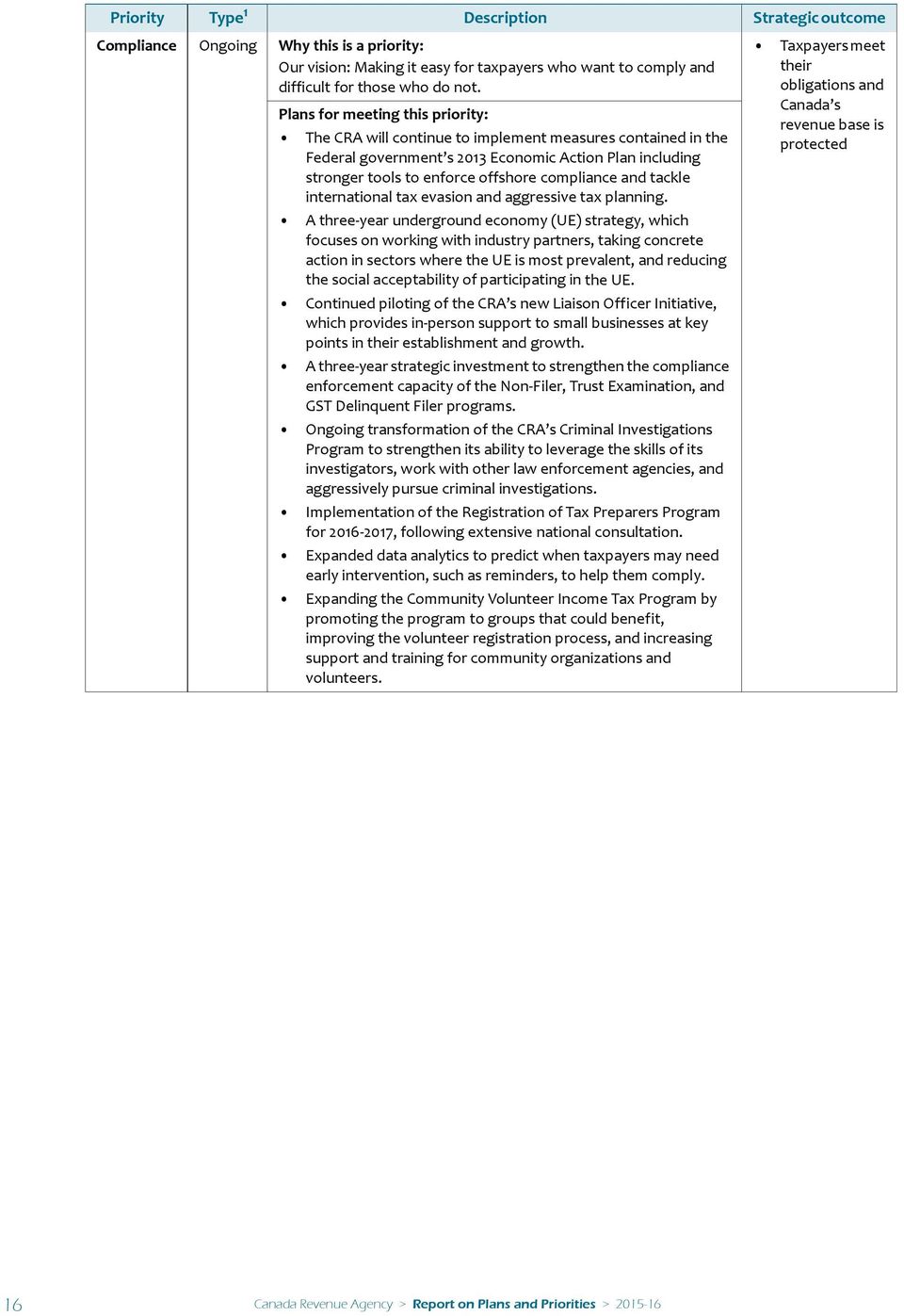
16 Priority Type 1 Description Strategic outcome Compliance Ongoing Why this is a priority: Our vision: Making it easy for taxpayers who want to comply and difficult for those who do not. Plans for meeting this priority: The CRA will continue to implement measures contained in the Federal government s 2013 Economic Action Plan including stronger tools to enforce offshore compliance and tackle international tax evasion and aggressive tax planning. A three year underground economy (UE) strategy, which focuses on working with industry partners, taking concrete action in sectors where the UE is most prevalent, and reducing the social acceptability of participating in the UE. Continued piloting of the CRA s new Liaison Officer Initiative, which provides in person support to small businesses at key points in their establishment and growth. A three year strategic investment to strengthen the compliance enforcement capacity of the Non Filer, Trust Examination, and GST Delinquent Filer programs. Ongoing transformation of the CRA s Criminal Investigations Program to strengthen its ability to leverage the skills of its investigators, work with other law enforcement agencies, and aggressively pursue criminal investigations. Implementation of the Registration of Tax Preparers Program for , following extensive national consultation. Expanded data analytics to predict when taxpayers may need early intervention, such as reminders, to help them comply. Expanding the Community Volunteer Income Tax Program by promoting the program to groups that could benefit, improving the volunteer registration process, and increasing support and training for community organizations and volunteers. Taxpayers meet their obligations and Canada s revenue base is protected 16 Canada Revenue Agency > Report on Plans and Priorities >
17 Priority Type 1 Description Strategic outcome Integrity and security Ongoing Why this is a priority: Our vision: We set the highest standards and make sure we meet those standards. Plans for meeting this priority: An anonymous employee reporting line to enable employees to report suspected internal fraud and misuse. The Agency wide Privacy Impact Assessment Plan to enhance the CRA s ability to identify and address privacy impacts each and every time the CRA launches a new program or activity. Initiatives to improve system identity and access management, including the new capacity to proactively detect unauthorized employee access to taxpayer information through audit trails. An updated agency security plan and information technology security strategy to address emerging threats and ensure the security of information holdings. Immediate, concrete actions to enhance the protection of personal information and privacy at the Agency. The CRA is enhancing the protection of personal information held by the Agency through the continued implementation and monitoring of its Privacy Action Plan developed in fiscal year An independent third party assessment of the CRA s Access to Information and Privacy control framework. Revised Access to Information Program operational processes to strengthen the protection of taxpayer information, including increased quality assurance activities, heightened protection for data transfers, enhanced protocols for identification of private information, and the provision of additional privacy and security training for its staff. Taxpayers meet their obligations and Canada s revenue base is protected Eligible families and individuals receive timely and accurate benefit payments Canada Revenue Agency > Report on Plans and Priorities >

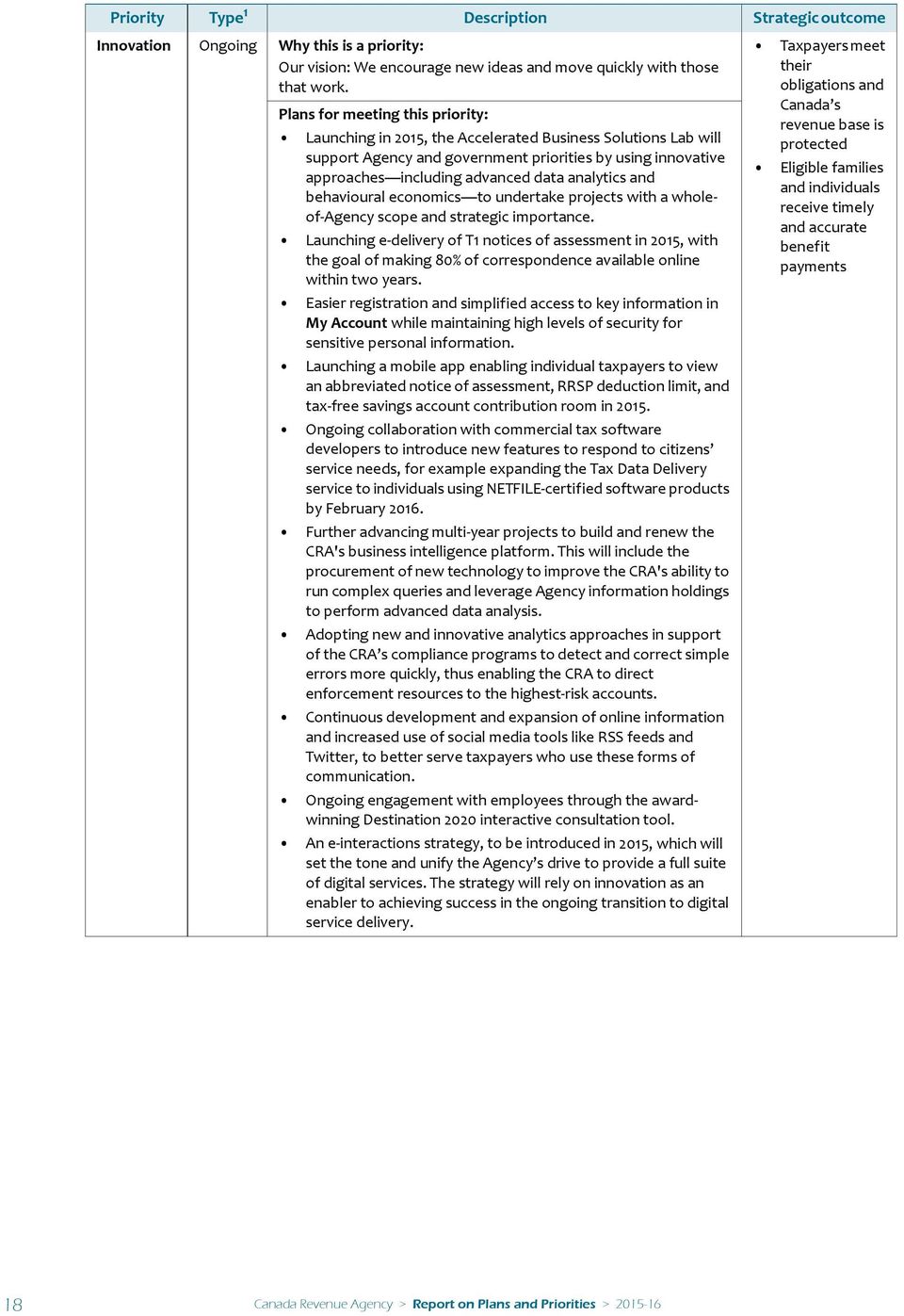
18 Priority Type 1 Description Strategic outcome Innovation Ongoing Why this is a priority: Our vision: We encourage new ideas and move quickly with those that work. Plans for meeting this priority: Launching in 2015, the Accelerated Business Solutions Lab will support Agency and government priorities by using innovative approaches including advanced data analytics and behavioural economics to undertake projects with a wholeof Agency scope and strategic importance. Launching e delivery of T1 notices of assessment in 2015, with the goal of making 80% of correspondence available online within two years. Easier registration and simplified access to key information in My Account while maintaining high levels of security for sensitive personal information. Launching a mobile app enabling individual taxpayers to view an abbreviated notice of assessment, RRSP deduction limit, and tax free savings account contribution room in Ongoing collaboration with commercial tax software developers to introduce new features to respond to citizens service needs, for example expanding the Tax Data Delivery service to individuals using NETFILE certified software products by February Further advancing multi year projects to build and renew the CRA's business intelligence platform. This will include the procurement of new technology to improve the CRA's ability to run complex queries and leverage Agency information holdings to perform advanced data analysis. Adopting new and innovative analytics approaches in support of the CRA s compliance programs to detect and correct simple errors more quickly, thus enabling the CRA to direct enforcement resources to the highest risk accounts. Continuous development and expansion of online information and increased use of social media tools like RSS feeds and Twitter, to better serve taxpayers who use these forms of communication. Ongoing engagement with employees through the awardwinning Destination 2020 interactive consultation tool. An e interactions strategy, to be introduced in 2015, which will set the tone and unify the Agency s drive to provide a full suite of digital services. The strategy will rely on innovation as an enabler to achieving success in the ongoing transition to digital service delivery. Taxpayers meet their obligations and Canada s revenue base is protected Eligible families and individuals receive timely and accurate benefit payments 18 Canada Revenue Agency > Report on Plans and Priorities >
19 Priority Type 1 Description Strategic outcome People Ongoing Why this is a priority: Our vision: We are a high performing, diverse workforce embracing new ways of working. Plans for meeting this priority: Expanding the use of social media tools in the workplace to enhance collaboration, and improve engagement and line ofsight with CRA priorities, and showcase the work and achievements of Agency employees across the country. Updating competencies, performance management, and staffing processes in line with feedback from employees. Modernization of human resource service delivery to facilitate effective and efficient people management decisions. A comprehensive strategy to recruit technical tax experts at all career stages. Taxpayers meet their obligations and Canada s revenue base is protected Eligible families and individuals receive timely and accurate benefit payments 1 Type is defined as follows: previously committed to: committed to in the first or second fiscal year prior to the subject year of the report; ongoing: committed to at least three fiscal years prior to the subject year of the report; and new: newly committed to in the reporting year of the RPP or DPR. Risk analysis To support enterprise risk management, the CRA develops an annual corporate risk profile. This profile presents the current landscape of the CRA s enterprise risks, the accountabilities for the management of those risks, and information on how the risks are being addressed. Managing risks to compliance Managing risks related to tax compliance remains a key priority for the CRA. Efforts continue to target two main areas, the underground economy and aggressive tax planning, while further exploring the impacts of digital commerce and new forms of economic activity. The underground economy involves income that is not reported or that is under reported to avoid paying taxes. Aggressive tax planning is a major threat for tax administrations globally, and Canada is not exempt. Both the underground economy and aggressive tax planning are direct threats to the integrity and fairness of the tax system. To address these risks to Canada s revenue base, the CRA dedicates specific audit resources and engages in compliance research, education, and outreach. The CRA also works with domestic and international partners to co ordinate initiatives and efforts. Managing risks to integrity The CRA remains diligent in protecting taxpayer and benefit recipient information and ensuring controls remain strong in preventing and responding to security incidents. The CRA has many robust controls in place to address this risk. With the increasing prevalence of cyber attacks, the CRA continues to implement a number of cyber and IT security measures to ensure information remains protected from those on the outside who would want to do it harm, while continuing to strengthen internal privacy protections. Canada Revenue Agency > Report on Plans and Priorities >

20 Managing risks to service Maintaining an agile and responsive IT infrastructure is important for the CRA s continued automation of programs and services. The move towards expanding electronic services remains a key part of the CRA s approach to make it easier for taxpayers to comply and interact with the organization. To that end, with partners at Shared Services Canada, the CRA continues to pursue IT enhancements and to improve its secure online portals. Addressing this risk allows the CRA to meet the evolving service expectations of Canadians, while fully supporting the federal government s whole of government approach to the delivery of reliable, secure, and lower cost government IT infrastructure services. Key risks Risk Risk response strategy Link to program alignment architecture Compliance The risk related to compliance is one of the CRA s top risks because of the impact it could have on the Agency s ability to protect Canada s revenue base. As such, this risk has the potential to threaten the achievement of the CRA s compliance priority for the three year planning period beginning with fiscal year To address this area of risk over the next three years, the CRA's approach will include continuing compliance research, taxpayer education, and targeted communications. The Agency will also continue to dedicate specific audit resources to help address this risk. To address the threat of the underground economy (UE), in November 2014, the Minister of National Revenue tabled in Parliament an enhanced strategy Reducing Participation in the Underground Economy and met with the newly created Minister s Underground Economy Advisory Committee. These actions will complement the Agency initiatives to encourage compliance and reduce participation in the UE such as using UE specialist teams focusing on specific files and sectors which have an elevated risk of UE activity; addressing electronic suppression of sales through the use of specialized teams, audit techniques, and the application of new penalty provisions; and identifying and auditing taxpayers who are at an increased risk of repeated UE related non compliance. The CRA s ability to monitor the electronic transfer of funds, and collect data from domestic sources to effectively counter international tax avoidance and evasion threats were also enhanced by measures introduced in Economic Action Plan 2013 to address the UE and aggressive tax planning (ATP). The CRA will also vigilantly protect the integrity of the revenue base by examining forwardlooking risks to tax compliance associated with advances in technology and changing digital environments. More details, including indicators to help measure the effectiveness of strategies, are included in the Reporting compliance section of this report. Reporting compliance 20 Canada Revenue Agency > Report on Plans and Priorities >

21 Risk Protection of information Information technology (IT) sustainability Risk response strategy This is one of the CRA s top risks because it may cause taxpayers to question how well the Agency is maintaining the security and integrity of taxpayer information. This risk is directly related to the achievement of the priorities of integrity, security, and compliance for the three year planning period beginning with fiscal year An action plan is in place and is focused on strengthening privacy protections through strengthened use of technology, both in relation to internal applications and through the secure services the CRA provides to taxpayers. This includes continuing projects to advance Identify and Access Management through the National Audit Trail System, as well as the Data Security Initiative. More details, including indicators to help measure the effectiveness of strategies, are included in the Internal services section of this report. This is one of the CRA s top risks because of the role that IT plays as a key enabler of the move to e services, a major aspect of making it easier for taxpayers to comply. This risk has the potential to affect the achievement of the priorities of service, integrity, and security for the three year planning period beginning with fiscal year To ensure the continued sustainability of CRA systems, a number of infrastructure enhancements are planned or underway. These include the T1 Systems Redesign Project, the reengineering of the benefits system platform, and the Charities Modernization Project. Over the planning cycle, the CRA will continue to improve its secure online portals called My Account, My Business Account, and Represent a Client to make them easier for taxpayers and their representatives to use, while also preparing for future program growth and advances in technology. More details, including indicators to help measure the effectiveness of strategies, are included throughout this document, with a concentration in the Internal services section of this report. Link to program alignment architecture Internal services Internal services Canada Revenue Agency > Report on Plans and Priorities >
22 Planned expenditures Budgetary financial information (dollars) Main Estimates planned spending planned spending 1 planned spending 1 Canada Revenue Agency 3,801,645,731 3,801,645,731 3,759,477,615 3,721,217,890 Taxpayers Ombudsman 3,198,657 3,198,657 3,191,343 3,192,181 Total 3,804,844,388 3,804,844,388 3,762,668,958 3,724,410,071 1 Planned spending refers to those amounts for which a Treasury Board submission approval has been received by no later than February 1, This cut off date differs from the Main Estimates process. While in any given year planned spending may include amounts incremental to planned expenditure levels presented in the Main Estimates, this year it does not. Human resources (full time equivalents) Canada Revenue Agency 38,385 37,876 37,315 Taxpayers Ombudsman Total 38,416 37,907 37, Canada Revenue Agency > Report on Plans and Priorities >
23 Budgetary planning summary for strategic outcomes and programs (dollars) Strategic outcomes, programs, and internal services expenditures forecast spending Main estimates planned spending Strategic outcome: Taxpayers meet their obligations and Canada s revenue base is protected Taxpayer and business assistance 453,280, ,801, ,691, ,181, ,181, ,567, ,088,894 Assessment of returns and payment processing 643,799, ,108, ,008, ,590, ,590, ,246, ,586,054 Reporting compliance 1,170,473,553 1,084,562,230 1,134,056,062 1,045,193,249 1,045,193,249 1,031,278,872 1,032,337,340 Collections and returns compliance 512,217, ,787, ,312, ,453, ,453, ,262, ,295,719 Appeals 192,046, ,219, ,377, ,658, ,658, ,823, ,576,460 Sub total 2,971,817,526 2,771,479,142 2,857,445,908 2,589,077,097 2,589,077,097 2,565,179,231 2,524,884,467 Strategic outcome: Eligible families and individuals receive timely and accurate benefit payments Benefit programs 383,719, ,414, ,447, ,217, ,217, ,704, ,000,658 Sub total 383,719, ,414, ,447, ,217, ,217, ,704, ,000,658 Strategic outcome: Taxpayers and benefit recipients receive an independent and impartial review of their service related complaints Taxpayers Ombudsman 1 2,622,557 2,524,101 3,338,963 3,198,657 3,198,657 3,191,343 3,192,181 Sub total 2,622,557 2,524,101 3,338,963 3,198,657 3,198,657 3,191,343 3,192,181 Internal services 960,308, ,441,789 1,091,774, ,350, ,350, ,594, ,332,765 Total 4,318,468,143 4,062,859,356 4,348,007,787 3,804,844,388 3,804,844,388 3,762,668,958 3,724,410,071 1 Since the Taxpayers Ombudsman operates at arm s length from the CRA, this Report on Plans and Priorities does not reflect the activities of that office. The reduction in forecast/planned spending over the planning period (from $4.348 billion in to $3.724 billion in ) is primarily attributable to: > certain technical adjustments that are reflected only in including: a carry forward from , funding for the one time transition payment resulting from the Government s move to pay in arrears, and funding for maternity and severance benefits; > the conclusion of funding received for special projects and the softwood lumber administration costs as well as adjustments for accommodation and real property services, the Canada School of Public Service, and funding for the Government advertising program; and > the implementation of initiatives to improve efficiency. Canada Revenue Agency > Report on Plans and Priorities >
24 Alignment of spending with the Whole of Government framework iii Strategic outcomes Programs Spending areas Government of Canada outcomes Taxpayers meet their obligations and Canada s revenue base is protected Eligible families and individuals receive timely and accurate benefit payments Taxpayers and benefit recipients receive an independent and impartial review of their service related complaints Taxpayer and business assistance Assessment of returns and payment processing Reporting compliance Collections and returns compliance Government affairs Government affairs Government affairs Government affairs A transparent, accountable, and responsive federal government Well managed and efficient government operations Well managed and efficient government operations Well managed and efficient government operations Appeals Government affairs A transparent, accountable, and responsive federal government Benefit programs Economic affairs Income security and employment for Canadians Taxpayers Ombudsman Government affairs A transparent, accountable, and responsive federal government Planned spending (dollars) 280,181, ,590,330 1,045,193, ,453, ,658, ,217,640 3,198,657 Total spending by spending area (dollars) Spending area Total planned spending Economic affairs 375,217,640 Social affairs International affairs Government affairs 2,592,275, Canada Revenue Agency > Report on Plans and Priorities >
25 CRA spending trend 4,500,000,000 4,000,000,000 3,500,000,000 3,000,000,000 2,500,000,000 2,000,000,000 1,500,000,000 1,000,000, ,000,000 0 CRA spending trend (dollars) actuals forecast spending Planned spending refers to amounts in Main Estimates, as well as any other additional funding for inclusion in the Agency s reference levels, approved by Treasury Board no later than February 1, In fiscal year planned spending is identical to expenditure levels presented in the Main Estimates. The planned spending trend figure shows all parliamentary appropriations (Main Estimates and Supplementary Estimates) and revenue sources provided to the Canada Revenue Agency for: policy and operational initiatives arising from various federal budgets and economic statements; transfers from the Department of Public Works and Government Services Canada for accommodations and real property services; disbursements under the Softwood Lumber Agreement; responsibilities related to the harmonization of sales tax in Ontario and British Columbia; the children s special allowance payments, as well as the implementation of initiatives to improve efficiency. Total spending for fiscal years to , also includes certain technical adjustments such as the CRA s carry forward adjustments from the previous year and funding for maternity and severance benefits. The fiscal year further includes funding for the one time transition payment resulting from the Government s move to pay in arrears. Over the period to , the CRA s appropriations show a decline, primarily as a result of the funding received for the upgrade of the individual income tax processing system and various wage settlements being more than offset by decreases due the following: > the implementation of initiatives to improve efficiency; planned spending Statutory authorities 1,007,281, ,057, ,440, ,419, ,363, ,780,951 Voted 3,311,186,938 3,160,801,992 3,516,567,064 2,979,424,773 2,942,305,691 2,912,629,120 Total 4,318,468,143 4,062,859,356 4,348,007,787 3,804,844,388 3,762,668,958 3,724,410,071 > the fluctuation in the CRA s Statutory Authorities for the disbursements to the provinces under the Softwood Lumber Products Export Charge Act, 2006 and the rates of the contributions to employee benefit plans; Canada Revenue Agency > Report on Plans and Priorities >
26 > the planned decrease in funding for: the implementation of the Harmonized Sales Tax for Ontario and British Columbia, and the Affordable Living Tax Credit for Nova Scotia; and the administration of the Softwood Lumber Agreement; > other miscellaneous reductions such as: the transfer to Public Works and Government Services Canada for accommodation and real property services; adjustment to funding previously transferred to Shared Services Canada; the transfer to Canada School of Public Service. Estimates by Vote For information on the CRA s organizational appropriations, consult the Main Estimates iv on the Treasury Board of Canada Secretariat website. 26 Canada Revenue Agency > Report on Plans and Priorities >
27 Canada Revenue Agency > Report on Plans and Priorities >
28 28 Canada Revenue Agency > Report on Plans and Priorities >
29 Section 2: Analysis of programs by strategic outcome Program: Taxpayer and business assistance The taxpayer and business assistance program is committed to providing taxpayers with the accurate and timely information they need to comply with Canada s tax laws. Our website is organized according to taxpayer needs, providing detailed information about CRA programs and services for individuals and families, businesses, charities and giving, and representatives. Taxpayers with more complex information needs can contact our call centres, refer to our technical interpretations, or consult our advance rulings services. To further support taxpayers we monitor charities and administer registered plans to ensure they meet legislative requirements. Budgetary financial information (dollars) Main Estimates planned spending planned spending 1 planned spending 1 280,181, ,181, ,567, ,088,894 1 Planned spending refers to those amounts for which a Treasury Board submission approval has been received by no later than February 1, This cut off date differs from the Main Estimates process. While in any given year planned spending may include amounts incremental to planned expenditure levels presented in the Main Estimates, this year it does not. Canada Revenue Agency > Report on Plans and Priorities >
30 Human resources (full time equivalents) ,780 3,697 3,692 Performance measurements Expected results Indicators Targets Date to be achieved Taxpayers and businesses have access to the information and services they need to voluntarily comply with tax laws Organizations and businesses administering or producing registered plans, charities, and excise dutiable products comply with applicable legislation Percentage of service standard targets that are met for individual and business enquiries Percentage of charity, registered plan, and commodity audits completed compared to planned 100% March % March 2016 Planning highlights The CRA s website strives to provide timely, accurate, and relevant information to Canadians who prefer to look online first to find the answers to their questions. The Agency invests significantly in keeping the website up to date and user friendly, and continuously improves online information and services. The CRA recognizes the importance of responding to the diverse needs of taxpayers with a broad range of information services. The Agency call centre services answer both simple and more complex enquiries and provide taxpayer specific information, subject to identity authentication. In addition, the CRA has moved into new communications products and channels, like social media, to respond to taxpayer expectations and to take advantage of the timeliness and flexibility of modern ways to provide information. For example, videos about taxes and benefits on the CRA s branded YouTube channel currently generate almost 40,000 views, and the Agency maintains an active Twitter presence with about 49,500 followers. The CRA takes a proactive approach to education and outreach. This includes identifying and working with taxpayers most likely to benefit from more targeted interaction, ranging from individuals, to small and medium sized businesses, to Aboriginal peoples, seniors, newcomers to Canada, and youth. Agency outreach extends to working with other government departments and agencies, as well as various other groups to educate, promote, and raise awareness of programs, services, and benefits. Recently an additional $1 million was allocated to the CRA s Community Volunteer Income Tax Program to expand and strengthen the program. The funding will allow for increased promotion to other organizations, and will enable the CRA to provide enhanced training and support for first time community organizations. >The CRA takes a proactive approach to education and outreach. 30 Canada Revenue Agency > Report on Plans and Priorities >
31 Subprogram: Taxpayer services enquiries and information products The taxpayer services enquiries and information products subprogram provides taxpayers with the accurate and timely information they need to comply with Canada s tax laws on our website, in response to enquiries, and in print products. Budgetary financial information (dollars) planned spending Human resources (full time equivalents) planned spending planned spending 150,091, ,701, ,534, ,112 2,103 2,102 Performance measurements Expected results Indicators Targets Date to be achieved Individual taxpayers have access to timely and accurate responses to their tax enquiries Businesses have access to timely and accurate responses to their tax enquiries Percentage of individual callers who succeed in reaching the CRA telephone service (peak season 1 ) Percentage of individual callers who succeed in reaching the CRA telephone service (non peak season 2 ) Percentage of accurately updated internal reference materials for taxpayer services agents (individual) Percentage of business callers who succeed in reaching the CRA telephone service Percentage of accurately updated internal reference materials for taxpayer services agents (business) 85% March % March % March % March % March Peak season begins on Monday of the third full week in February and ends on Friday of the week 2 including the April 30 th tax filing deadline. Non peak season begins on the Monday after the April 30 th tax filing deadline and ends on Friday of the second full week in February. Canada Revenue Agency > Report on Plans and Priorities >
32 Planning highlights Canadians make more than 100 million visits to arc.gc.ca v each year to take advantage of 24 hour access to reliable, up to date tax information. Through the website, the Agency maintains and provides hundreds of different forms and publications, and more than 20 million copies are downloaded annually. To complement the information on the website and portals, the CRA is expanding the use of social media tools like RSS feeds and Twitter so it can better serve taxpayers who use these forms of communication. The CRA is leading the development of the Taxes theme on the new federal government wide website. By 2016, more than 100 federal department and agency websites will be amalgamated into one site, Canada.ca vi. Canadians will benefit from a more user friendly site featuring easy access to federal government information and, at the same time, they can rest assured security remains a top priority in the development of Canada.ca vi. The CRA s call centres handle millions of tax enquiries every year and will continue to be a key service channel. As part of its commitment to continually improve service response time and overall service to taxpayers, the CRA is implementing the Contact Centre Transformation initiative to upgrade telephony technologies and standardize infrastructure across all CRA call centres. > More than 100 federal department and agency websites are being amalgamated into one site, Canada.ca. Deliverables > The federal government s Contact Centre Transformation initiative will see the CRA s call centres move to a common technology infrastructure, with the potential for new features to be introduced beginning in , such as call back options, skills based routing, and related queuing. The initiative will also provide access to enhanced tools for reporting, monitoring, client service quality, and workforce management. Subprogram: Charities The charities subprogram registers charities, Canadian amateur athletic associations, and national arts service organizations. We provide information and technical guidance to help them comply with tax laws and we conduct examinations and audits to enforce compliance. Budgetary financial information (dollars) planned spending planned spending planned spending 29,830,283 31,261,406 29,885, Canada Revenue Agency > Report on Plans and Priorities >
33 Human resources (full time equivalents) Performance measurements Expected results Indicators Targets Date to be achieved Registered charities and applicants for charitable status receive timely service Charities non compliance with legislation and regulations is detected and addressed Percentage of charities calls in agent queue responded to within two minutes Percentage of charitable registration applications that are reviewed and responded to within established timeframes (two months for simple applications and six months for regular applications) Percentage of charities that file their annual information return on time Percentage of charities that are known to be participating in gifting tax shelters that are audited 80% March % March % March % March 2016 Canada Revenue Agency > Report on Plans and Priorities >
34 Planning highlights Each year, Canadians donate billions of dollars to support registered charities. In 2012, registered charities issued $14 billion in official donation receipts. The CRA registers charities, Canadian amateur athletic associations, and national arts service organizations, and monitors their compliance with requirements for charitable status. Each year the Agency processes over 83,000 registered charity information returns and audits hundreds of charities. The CRA takes an education first approach with charities, providing them with all the information and the tools they need to voluntarily comply. When an organization isn t meeting the legislative requirements to maintain charitable status, the CRA will provide the organization with further information and opportunities to amend the situation. Fewer than one percent of charities have their registered charity status revoked in any given year. Deliverables > The CRA will develop new electronic services, specifically the online filing of Form T3010, Registered Charity Information Return, and Form T2050, Application to Register a Charity under the Income Tax Act. These services will make it easier for charities to comply and will reduce red tape. 34 Canada Revenue Agency > Report on Plans and Priorities >
35 IN FOCUS Working with charities There are more than 86,000 registered charities in Canada, each playing an important role in our society, providing valuable services to Canadians including to the most vulnerable. In recognition of the important work done by charities, the Government of Canada provides assistance through the tax system. Registration as a charity under the Act provides organizations with unique tax privileges an exemption from income tax, the ability to issue official donation receipts for gifts and to receive gifts from other registered charities. Registration also comes with the obligation to follow longstanding rules for charities contained in the Income Tax Act. As the federal regulator for charities, the CRA has a mandate to protect the integrity of the tax system, and the charitable sector as a whole, by ensuring that registered charities understand and follow these rules. The CRA promotes voluntary compliance by charities through a balanced program of education, client service, and responsible enforcement. The CRA takes an education-first approach to compliance, providing charities with all the information and the tools they need to voluntarily comply with the Act. We do this through the provision of quality information, such as through our client services program and public outreach, and through the development of educational resources, such as webinars and videos, as well as policies and guidance on our website. Audits are also an important element of our efforts. Through audits, the CRA is able to ensure that registered charities understand the requirements for registration and are using their resources, in particular donations from Canadians, in accordance with the Act. The CRA audits approximately one percent, or 800 to 900, of registered charities across Canada each year. The overwhelming majority of audited charities meet the requirements of the Act and only a very small proportion of the audits result in serious consequences like sanctions or revocation. Working closely with the CRA, the vast majority of charities selected for audit are able to correct any identified non-compliance concerns and continue delivering their charitable programs for the benefit of all Canadians. Canada Revenue Agency > Report on Plans and Priorities >
36 Subprogram: Policy, rulings, and interpretations The policy, rulings, and interpretations subprogram provides taxpayers, registrants, and tax intermediaries with binding rulings and non binding interpretations of the Acts administered by the CRA (including the Canada Pension Plan and Employment Insurance Act). By doing so, we give taxpayers early certainty by explaining how legislation applies to specific situations. We work closely with the Department of Finance in developing legislative policy and providing legislative policy and administrative services to other Canadian government organizations. Budgetary financial information (dollars) planned spending Human resources (full time equivalents) planned spending planned spending 79,316,031 79,640,665 77,343, ,115 1,045 1,045 Performance measurements Expected results Indicators Targets Date to be achieved Taxpayers and businesses receive timely rulings and interpretations under the Income Tax Act, the Excise Tax Act, and various other federal legislation Non compliance with the Excise Act and the Excise Act, 2001 with respect to dutiable products is detected and addressed Advance income tax rulings issued within 90 business days Technical interpretations issued within 90 business days GST/HST rulings and interpretations respond to written requests within 45 business days of receipt by CRA (this excludes highly technical and precedent or policy setting rulings and interpretations) Percentage of excise regulatory reviews and excise compliance activities completed compared to planned 85% March % March % March % March Canada Revenue Agency > Report on Plans and Priorities >
37 Planning highlights Taxpayers and tax professionals with more complex information needs have access to CRA expertise through a number of channels, including technical publications on the website and by requesting rulings or interpretations. The CRA continuously develops new publications to provide taxpayers with the most current and relevant technical information. Equally importantly, we make sure our publications are up to date and reflect the latest developments in legislation and jurisprudence. Stakeholders such as the Chartered Professional Accountants of Canada have offered to partner with the CRA, bringing their tax expertise to bear on our efforts to make sure everyone has access to high quality, current information. Each year the Agency responds to over 100,000 verbal and written enquiries for rulings or interpretations concerning an act administered by the CRA. By explaining how legislation applies to specific situations, the Agency offers taxpayers early certainty. In addition, the CRA is responsible for making sure Canada Pension Plan (CPP) contributions and employment insurance (EI) premiums are deducted, remitted, and reported as required by legislation, and responds to about 40,000 requests for CPP/EI rulings annually. Deliverables > By 2017, the CRA will develop a rulings e service to allow clients to send requests for rulings and interpretations and receive responses electronically. Subprogram: Registered plans The registered plans subprogram registers, audits, and approves contributions to deferred income and savings plans to ensure they meet the provisions of the Income Tax Act. We provide information on registered plans on our website and in response to enquiries. Budgetary financial information (dollars) planned spending Human resources (full time equivalents) planned spending planned spending 16,311,026 17,078,731 16,583, Canada Revenue Agency > Report on Plans and Priorities >
38 Performance measurements Expected results Indicators Targets Date to be achieved Registered plan administrators and their agents receive timely service in response to applications Percentage of registered plan applications reviewed within the established timeframes (180 days) 85% March 2016 Non compliance by registered plan administrators and their agents with legislation and regulations pertaining to registered plans is detected and addressed Planning highlights Percentage of registered plan audits completed compared to planned 100% March 2016 Registered plans are tax effective savings and retirement tools available to help Canadians in planning and securing income for the future. The CRA oversees deferred income and savings plans with about $2 trillion in combined assets. The Agency registers and monitors the plans, approves the deductibility of employer contributions to defined benefit pension plans, and provides information on registered plans on the CRA website and in response to enquiries. >The CRA oversees deferredincome and savings plans with approximately $2 trillion in assets. Deliverables > The CRA will update the information technology systems supporting registered plans by This initiative is consistent with the CRA s overarching IT sustainability and modernization program to make sure all key applications function effectively. 38 Canada Revenue Agency > Report on Plans and Priorities >
39 Canada Revenue Agency > Report on Plans and Priorities >
40 40 Canada Revenue Agency > Report on Plans and Priorities >
41 Program: Assessment of returns and payment processing The assessment of returns and payment processing program assesses and processes tax returns and payments for individuals and businesses as quickly and accurately as possible, providing taxpayers with early certainty to help them manage their tax affairs with confidence. We aim to reduce red tape by providing streamlined and timely services to individuals and businesses while securing Canada s revenue base. Budgetary financial information (dollars) Main Estimates planned spending 1, planned spending 1,2 planned spending 1,2 614,590, ,590, ,246, ,586,054 1 Planned spending refers to those amounts for which a Treasury Board submission approval has been received by no later than February 1, This cut off date differs from the Main Estimates process. While in any given year planned spending may include amounts incremental to planned expenditure levels presented in the Main Estimates, this year it does not. 2 The decrease in planned spending from to in the assessment of returns and payments processing program results primarily from adjustments in funding associated with the upgrade of the individual income tax processing system and other major investment projects, and the conclusion of funding received for special projects. Human resources (full time equivalents) ,415 6,192 6,148 Canada Revenue Agency > Report on Plans and Priorities >
42 Performance measurements Expected results Indicators Targets Date to be achieved Individuals, businesses, and registrants get timely and accurate tax assessment notices and tax payment processing Percentage of service standards targets met relating to timeliness of processing for individual, business, and GST/HST returns 100% March 2016 Planning highlights The CRA s wide range of e services has become the preferred service channel for many taxpayers: over 80% of individuals file their tax return online. The CRA s secure portals My Account for individuals, My Business Account for businesses, and Represent a Client for tax intermediaries allow taxpayers and their representatives to check information and carry out a wide range of transactions at their convenience. E services help the CRA to issue refunds faster, and reduce the overall cost of tax administration through lower processing and mailing costs. The CRA is making information and e services accessible from mobile devices. The Agency s first mobile application for businesses, released in 2014, lets users create reminders for instalment payments, returns, and remittances to better manage their tax affairs. In 2015, the CRA will release a mobile application allowing individuals to access basic tax information such as notices of assessment. Mobile apps are the next step in the Agency s drive to find better ways to deliver convenient and cost effective tax and benefit services to Canadians. The CRA does not compromise the security of taxpayer information in the delivery of e services. Innovative approaches help the Agency meet both security and convenience expectations. For example, the CRA is simplifying registration for My Account by introducing a two tier authentication process. The first tier will allow users secure, limited access to services and information in My Account, including refund status, tax free savings account and RRSP limits, and an abbreviated version of the electronic T1 notice of assessment. The second tier will grant secure access to all of the My Account services and electronic delivery of the detailed T1 notice of assessment, but will require users to go through the full My Account registration process. > Over 80% of individuals filed their tax return online. The CRA is introducing a new online mail service in 2015 to reduce the volume of correspondence delivered by conventional mail. Taxpayers who opt in for the new Manage Online Mail service will be notified by that they have new correspondence to view in My Account. This convenient e delivery service will ensure taxpayer information is secure and protected. The CRA will continue to work with commercial tax software developers to improve tax filing software. In 2015, the Agency will launch a tax data delivery service through which authorized tax representatives using CRA certified software products (EFILE) with the tax data delivery option will be able to populate parts of an income tax and benefit return with information from the CRA. The service will provide such information as T4 and universal child care benefit statements. Over time, this option will be expanded to include individuals using NETFILE certified software products. The automated population of tax forms using data available from the CRA will make it easier for taxpayers to file and will increase accuracy by reducing errors made during manual data entry. 42 Canada Revenue Agency > Report on Plans and Priorities >
43 Subprogram: Individual returns and payment processing The individual returns and payment processing subprogram helps individuals to voluntarily comply with Canada s tax laws by processing their information and payments as quickly and accurately as possible. We assess and validate the information they provide and inform them of the results of their assessment or reassessment. Budgetary financial information (dollars) Human resources (full time equivalents) planned spending 1 planned spending 1 planned spending 1 320,303, ,787, ,773,907 1 The decrease in planned spending from to in the individual returns and payments processing program results primarily from adjustments in funding associated with the upgrade of the individual income tax processing system and the conclusion of funding received for special projects ,344 4,265 4,226 Performance measurements Expected results Indicators Targets Date to be achieved Individual taxfilers receive timely and accurate assessment notices Individuals file electronically Percentage of service standards targets met relating to T1 individual and T3 trust returns activities Percentage of individual (T1) returns processed accurately Percentage of individual (T1) returns received on time processed by mid June Individual (T1) electronic filing rates (tax filing season) 100% March % March % March % March 2016 Canada Revenue Agency > Report on Plans and Priorities >
44 Expected results Indicators Targets Date to be achieved Validation activities detect and address non compliance by individuals with the reporting requirements of the acts Ratio of average dollar value assessed for targeted versus random reviews Percentage of planned validation reviews of individual returns (T1) completed Minimum ratio of 2:1 March % March 2016 Planning highlights The CRA assesses more than 28 million individual returns annually. Assessment includes determining the status of an individual s tax obligations, finding and fixing errors, informing taxpayers of taxes owing, and paying refunds. Electronic filing accelerates the processing of returns and payments and is also less costly than traditional paper options. The CRA s error checking typically finds more than $1 billion in non compliance, and the Agency identifies more than $100 million in beneficial adjustments annually. Deliverables The CRA will: > Launch a mobile app enabling individual taxpayers to view an abbreviated notice of assessment, RRSP deduction limit, and tax free savings account contribution room in > Launch e delivery of T1 notices of assessment in 2015, with the goal of making 80% of correspondence available online within two years. >The CRA assesses more than 28 million individual returns annually. > Accept additional prior year returns through EFILE and NETFILE by February > Expand the Tax Data Delivery service to individuals using NETFILE certified software products by February > Continue to move forward on the T1 Systems Redesign project to modernize the CRA personal income tax assessing and accounting systems for completion in This initiative will make sure there is a strong, flexible, and resilient foundation for the T1 Program. Modernized systems will also assist with the introduction of future service improvements. > Encourage use of direct deposit to ensure timely receipt of refunds and benefits. 44 Canada Revenue Agency > Report on Plans and Priorities >
45 IN FOCUS Red tape reduction for small and medium enterprises The CRA is committed to reducing red tape and making it easier for individuals and smalland medium-sized enterprises (SMEs) to access CRA services and fulfil their tax obligations. Canada-wide Red Tape Reduction consultations conducted in the fall of 2014 will be instrumental in shaping the CRA s Red Tape Reduction action plans for the next three years. The Agency will continue to develop strategies for reducing the time businesses spend on taxes so they can get on with the task of creating jobs and growing the economy. Planning highlights The CRA will: Continue to expand the Submit Document service to new workloads for GST/HST Registrants by April Improve the online Business Registration service to streamline the process and make it easier for businesses to register by April Include a payment option within GST NETFILE for business taxpayers by October Introduce e-filing for Form T1135, Foreign Income Verification Statement, for corporations by Report the results of the Canada-wide Red Tape Reduction consultations in the spring of The CRA will develop and implement red tape action plans based on the consultation report. Make all payments by direct deposit for taxpayers who have signed up for one or more CRA payments by this method, to ensure secure, fast, convenient and cost-effective service. Canada Revenue Agency > Report on Plans and Priorities >
46 Subprogram: Business returns and payment processing The business returns and payment processing subprogram helps businesses to voluntarily comply with Canada s tax laws by processing their information and payments as quickly and accurately as possible. We assess and validate the information they provide and inform them of the results of their assessment or reassessment. We register businesses for a business number and administer T2, GST/HST, excise and other levies programs. Budgetary financial information (dollars) planned spending Human resources (full time equivalents) planned spending planned spending 294,286, ,459, ,812, ,071 1,927 1,922 Performance measurements Expected results Indicators Targets Date to be achieved Business taxfilers receive timely and accurate assessment notices and payment processing Corporations file electronically Payments to the Receiver General that are processed on time Percentage of service standards targets met relating to business taxfilers (T2, GST/HST, excise and other levies) activities Percentage of T2 returns processed accurately Corporation (T2) electronic filing rates (fiscal year) Percentage of payments to the Receiver General deposited within 24 hours of receipt 100% March % March % March % March Canada Revenue Agency > Report on Plans and Priorities >
47 Planning highlights > More than 1.9 million businesses are enrolled in My Business Account. Businesses and their tax representatives are extensive users of the CRA s e services: the vast majority of corporation income tax returns and GST/HST returns are filed electronically. Also, more than 1.9 million businesses are enrolled in My Business Account, the Agency's online portal for business. E services provide an opportunity to interact electronically with the CRA on various business accounts and are convenient, easy to use, fast, and secure. The CRA also maintains Canada s Business Number System. A business number is a unique client identifier given to a business to help simplify its dealings with federal, provincial/territorial, aboriginal, and municipal governments. The system is based on the idea of one business, one number, and it is a key enabler of red tape reduction. Deliverables The CRA will: > Improve the online Business Registration service to streamline the process and make it easier for businesses to register by April > Improve the systems supporting the Business Number Program to enhance integrity by > Include a payment option within GST NETFILE for business taxpayers by October > Expand the Submit Documents service to the GST/HST Returns and Rebates program, the Canada Pension Plan and Employment Insurance Rulings program and the T2 Audit programs, by October > In collaboration with Industry Canada, develop a business number strategic adoption plan to promote using the Business Number System to strengthen federal programs and provincial and territorial partnerships. Canada Revenue Agency > Report on Plans and Priorities >
48 48 Canada Revenue Agency > Report on Plans and Priorities >
49 Program: Reporting compliance The reporting compliance program seeks to protect the integrity of Canada s voluntary compliance system by identifying and addressing the small segment of the population that does not report the correct amounts. Our compliance interventions follow an escalating approach that moves from influencing compliance to enforcing it. We seek to influence compliance attitudes by increasing taxpayers understanding of their tax obligations through targeted outreach activities, client service, and education. We also undertake examinations, audits, and investigations at the domestic and international level to ensure compliance with Canada s tax laws. Budgetary financial information (dollars) Main Estimates planned spending planned spending 1 planned spending 1 1,045,193,249 1,045,193,249 1,031,278,872 1,032,337,340 1 Planned spending refers to those amounts for which a Treasury Board submission approval has been received by no later than February 1, This cut off date differs from the Main Estimates process. While in any given year planned spending may include amounts incremental to planned expenditure levels presented in the Main Estimates, this year it does not. Human resources (full time equivalents) ,807 9,656 9,651 Canada Revenue Agency > Report on Plans and Priorities >
50 Performance measurements Expected results Indicators Targets Date to be achieved Reporting non compliance is detected and corrected by targeting compliance actions through effective risk assessment Change rate (percentage of risk assessed audit activities that result in detection of non compliance by individuals and corporations) 75% March 2016 Planning highlights Taxpayers are required by law to report correct information to the CRA, and the Agency uses this information to determine taxpayers obligations. To enforce reporting requirements, the CRA conducts audits and investigations. The CRA complements enforcement activities with early interventions to encourage self correction and prevent non compliance. Advanced data analysis supports these complementary approaches by helping to determine where and when early intervention is most needed. For example, the Agency is proactively helping small and medium sized businesses at critical points in their business cycle with interventions such as educational products and reminder letters to address specific types of non compliance. The Agency also provides an avenue for taxpayers to voluntarily come forward and correct their tax affairs through the CRA s increasingly successful Voluntary Disclosures Program. Each year, thousands of taxpayers take advantage of this program and work cooperatively with the CRA to correct their tax filings. Approximately 70% of individuals and business taxpayers use the services of a tax intermediary. The Agency s complementary approaches include working closely with tax intermediaries to promote compliance and reduce common errors. In , the CRA undertook extensive consultations on a proposed tax preparer registration program to help the Agency engage directly with tax preparers to improve service and compliance. During the planning period, the CRA will move ahead with a registration program that takes into account feedback received from a wide range of stakeholders including the Canadian Federation of Independent Business, the Canadian Tax Foundation, the Certified General Accountants Association of Canada, the Chartered Professional Accountants of Canada, the EFILE Association of Canada, and the Association de la planification fiscale et financière. >The Agency is proactively helping small and medium sized businesses to comply at critical points in their business cycle. The CRA is continuously strengthening the integrity of its programs. Business intelligence teams have been established in each region to combine advanced data analysis with established risk assessment processes and local knowledge, so the taxpayers with the highest risk of noncompliance are identified and addressed. This also reinforces the integrity of the workload selection process by separating the decision of who will be audited from the audit itself. At the same time as improving workload selection, the CRA has introduced more rigorous quality assurance standards and set up separate regional teams to independently review auditors work prior to a file being closed. The Business Intelligence and Quality Assurance teams report to the regional Assistant Commissioners. These measures are important demonstrations of the CRA's commitment to quality, consistency, and integrity in program activities. 50 Canada Revenue Agency > Report on Plans and Priorities >
51 Addressing offshore compliance and aggressive tax planning is a top priority for the CRA. The increasing volume of global business and financial transactions has created new challenges for tax administrations internationally. The CRA s ability to effectively tackle offshore compliance and aggressive tax planning was strengthened by a range of measures introduced in the Government of Canada s Economic Action Plan (EAP) The measures introduced in EAP 2013 have enhanced the CRA s ability to monitor the electronic transfer of funds, and collect data from domestic sources to effectively counter international tax avoidance and evasion threats. The Government s renewal and expansion of tax treaties with other countries also contribute to the CRA s efforts to combat international tax evasion and aggressive tax planning. The Agency continues to expand its relationships with domestic and international government partners to share information and best practices, and is actively contributing to Organisation for Economic Co operation and Development (OECD) work on international tax avoidance, such as the Common Reporting Standard for the automatic exchange of tax information between governments. The CRA is engaging with key stakeholders such as the Chartered Professional Accountants of Canada (CPA Canada) to improve compliance, promote greater co operation, and reduce errors or misunderstandings. An historic new agreement between the CRA and CPA Canada formalizes this important partnership which will contribute to improving the tax system. > The Minister of National revenue tabled in Parliament an enhanced UE strategy. The CRA works closely with the Department of Finance Canada and the Department of Justice Canada to identify legislative weaknesses, close tax loopholes, and develop new legislative tools to deal with emerging threats. Through referrals of criminal investigations to the Public Prosecution Service of Canada for criminal prosecution, the CRA is ensuring the most serious cases of noncompliance are met with significant consequences. The CRA recognizes that the underground economy (UE) poses a threat to Canada s revenue base, and makes it difficult for Canadian small businesses to compete on a level playing field. In response, in November 2014, the Minister of National Revenue tabled in Parliament an enhanced UE strategy. The updated UE strategy focuses on refining the Agency s understanding of the UE, reducing the social acceptability of participating in the UE, and deploying a range of initiatives to encourage compliance and reduce participation in the UE. The CRA s ongoing efforts to address the UE will also be guided by the newly created Ministerial Underground Economy Advisory Committee. Canada Revenue Agency > Report on Plans and Priorities >
52 Subprogram: Small and medium enterprises The small and medium enterprises subprogram enforces compliance of Canada s tax legislation by the small and medium businesses and non resident taxpayers. It supports compliance through taxpayer consultations, education, and partnerships with stakeholders. The program uses risk management principles to apply a balanced approach to audit enforcement activities including associated client assistance, service and quality audits. Budgetary financial information (dollars) Human resources (full time equivalents) planned spending 1 planned spending 1 planned spending 1 590,150, ,374, ,687,956 1 The decrease in planned spending from to under the small and medium enterprises subprogram results from the Agency s implementation of initiatives to improve efficiency ,068 5,931 5,930 Performance measurements Expected results Indicators Targets Date to be achieved Reporting non compliance is detected and corrected by targeting compliance actions through effective risk assessment on the individuals, small and medium businesses and non residents Change rate for SME audits income tax (percentage of risk assessed audit activities that result in detecting non compliance) 75% March Canada Revenue Agency > Report on Plans and Priorities >
53 IN FOCUS The underground economy Individuals or businesses that deliberately under-report or fail to report sales or income to avoid paying taxes are participating in the underground economy (UE). The underground economy creates an unfair advantage for those who engage in it by undermining the competitiveness of honest businesses, especially small businesses, who abide by the law. The UE includes any economic activity not reported or under reported for tax purposes. Examples of UE behaviour can be as simple as a contractor choosing not to file a tax return, or as complex as a restaurant using sophisticated computer software to alter its accounting records in order to evade taxes on a portion of its business revenue. If left unchallenged, the UE can corrode the integrity of Canada's tax system. In November 2014, the Minister of National Revenue tabled in Parliament an enhanced three-year strategy to combat the underground economy in Canada, and met with the newly created Ministerial Underground Economy Advisory Committee. The Committee will advise on current UE trends, help identify emerging risks, deepen the government s understanding of aggressive compliance behaviour, and contribute to the development of innovative new compliance tools. The UE strategy is a renewed effort to reduce the social acceptability of, and participation in the underground economy. The strategy contains existing measures which have proven effective in combatting the underground economy and proposes new measures to encourage increased levels of tax compliance, particularly in sectors of the economy where cash transactions are common and participation in the underground economy has been shown to be more prevalent. Planning highlights: The CRA will continue to play a leading role in international forums dedicated to promoting best practices, sharing information, conducting research, and co-ordinating international efforts to address the UE. Regional issues and trends will be incorporated into the CRA s national UE strategy. The CRA will enhance Agency-wide approaches for the identification and management of taxpayers at risk of participating in the UE. The CRA will continue working with provincial and territorial partners through forums such as the UE Provincial and Territorial Roundtables, to develop new approaches for addressing the UE. The CRA will listen to and address issues raised through stakeholder engagement in the Ministerial Underground Economy Advisory Committee. Canada Revenue Agency > Report on Plans and Priorities >
54 Planning highlights Canada s population of small and medium enterprises (SMEs) is large and includes approximately three million individual filers and two million corporate filers. The CRA enforces the compliance of SMEs through a program of reviews, examinations and audits. In , the CRA performed almost 40,000 reviews and audits on the returns filed by SMEs. These activities generated over $1 billion in fiscal impact annually. SME compliance is supported through education, outreach, extensive stakeholder engagement, and in person support designed to help taxpayers comply with their tax obligations. Because many SMEs work in sectors of the economy characterized by cash transactions, they are at a higher risk of participation in the Underground Economy (UE). For this reason, the CRA focuses a large portion of its UE audit resources on SMEs. Audits are the primary tool used by the Agency to detect and address UE activity. As a complement to these audit activities, UE related outreach activities are underway in collaboration with a number of industry associations. In addressing underground activity in the SME population, the CRA will: > Implement the three year strategy Reducing Participation in the Underground Economy announced by the Minister of National Revenue in November > Continue utilizing UE specialist teams, focusing on specific files and sectors which have an elevated risk of UE activity. These teams employ audit techniques which are specifically designed to detect unreported income. > Continue to address electronic suppression of sales through the use of specialized teams, audit techniques, and the application of new penalty provisions. > Employ compliance projects which test the rate of non compliance within specified industries and with regard to specific issues or business practises. Where required, these projects will be expanded in scope. > Use the confidential informant leads program, coordinated through the National Leads Centre, to identify taxpayers that are not fully compliant in their reporting of income, deductions, and expenditures. > Work to identify and audit taxpayers who are at an increased risk of repeated UE related noncompliance. Where warranted, repeat offenders will be referred for potential criminal prosecution. In January of 2014, the CRA announced a new three point plan to help small and medium enterprises more easily meet their tax obligations and reduce red tape. The three elements of the plan are: > The Liaison Officer Initiative to provide in person support to small businesses at key points in their establishment and growth. > The Registration of Tax Preparers Program to enable the CRA to work directly with tax preparers to address common and recurring errors before tax returns are filed. > An enhanced focus on high risk files through advanced business intelligence, specialized audit teams, and the use of approaches like letter writing campaigns to address specific noncompliance risks, to complement the CRA's traditional audit approaches. 54 Canada Revenue Agency > Report on Plans and Priorities >
55 Deliverables > Following a successful pilot project, the Liaison Officer Initiative (LOI) was expanded to all regions of the country in Over the next three years the CRA will evaluate the impact of the LOI on voluntary compliance. > The CRA will move forward with the Registration of Tax Preparers Program by This program will allow the Agency to more easily identify and address recurring errors before tax returns are filed. > In collaboration with industry associations, the CRA will expand the use of targeted communications, including letter writing campaigns and the use of social media to promote compliance throughout > Effectiveness measures will be developed by to assess the impact of traditional audit activities and non audit compliance activities such as targeted communications, education and assistance. Canada Revenue Agency > Report on Plans and Priorities >
56 GST/HST The CRA s GST/HST compliance programs are designed to ensure GST/HST registrants comply with reporting requirements, and to identify and address non compliance. The CRA s GST/HST compliance activities protect Canada s revenue base by aggressively pursuing those taxpayers who participate in the UE and in aggressive GST/HST planning schemes. Annually, almost 80,000 GST/HST audits are completed, generating more than $1.5 billion in fiscal impact 1. The Agency s risk based and balanced approach includes audits of high risk filings, examinations, education, and outreach activities. Deliverables > The CRA will work to improve audit quality assurance by expanding the audit quality review program to include other GST/HST programs by > The aggressive GST/HST planning program will improve its capacity to identify false claims and detect suspicious patterns of behaviour by by improving the risk profiles and models it uses to identify files for audit and review. > The CRA will increase engagement with key stakeholders through to to identify ways to discuss GST/HST matters of common concern to improve compliance, promote greater co operation, and reduce unnecessary errors and misunderstandings. > Working through the Framework Agreement between the CRA and Chartered Professional Accountants of Canada (CPA), the CRA will promote regular dialogue between the two organizations on tax related matters of common interest. >Annually, almost 80,000 GST/HST audits are completed, generating more than $1.5 billion in fiscal impact 1. > The CRA will improve the industry sector profiles used by its field auditors and examiners by These profiles include information on known GST/HST risks within specific industry sectors and the audit techniques used to address them. > The GST/HST research audit program for small and medium business registrants will continue through to Results of this research will be used to develop new risk assessment criteria and to provide an accurate baseline for monitoring future compliance trends. 1. Fiscal impact consists of tax assessed, tax refunds reduced, interest and penalties, and present value of future federal tax assessable arising from compliance actions. It excludes the impact of appeals reversals and uncollectable amounts. 56 Canada Revenue Agency > Report on Plans and Priorities >
57 IN FOCUS Ensuring GST/HST refund integrity The CRA s GST/HST Refund Integrity Program is responsible for managing the risks associated with GST/HST credit returns, rebate claims, and some debit returns to help ensure unwarranted GST/HST refunds are not issued. In 2012, the CRA implemented the Pre-assessment National Inventory (PANI) in the GST/HST Refund Integrity Program. This automated risk assessment and workload management system weighs and scores returns using automated algorithms and other available risk assessment data. It also allows workload to be shared nationally, with higher risk returns being assigned anywhere in the country. This approach ensures GST/HST audit resources are efficiently deployed. Since the inception of PANI, the program has consistently delivered excellent results. For example, between and the average recovery per file increased by approximately 28%. These results clearly show the effectiveness of using the new PANI risk identification processes. The continued success of the program demonstrates how the smart use of technology, coupled with the intelligent application of advanced data analysis, can be used to effectively identify files at risk, efficiently distribute workload, and increase productivity to deliver dramatic results. Canada Revenue Agency > Report on Plans and Priorities >
58 Subprogram: International and large business The international and large business subprogram helps to ensure that Canada receives its share of taxes from international and large corporations with complex financial transactions. It enforces compliance with Canada s tax legislation by encouraging, assisting, and verifying compliance by large corporate tax filers. This is done through taxpayer consultations, education, legislative reviews, and enforcement measures. Budgetary financial information (dollars) planned spending Human resources (full time equivalents) planned spending planned spending 287,499, ,875, ,606, ,333 2,326 2,322 Performance measurements Expected results Indicators Targets Date to be achieved Reporting non compliance is detected and corrected by targeting compliance actions through effective risk assessment of the largest and most complex taxfilers Change rate for international and large business audits (percentage of risk assessed audit activities that result in detection of non compliance) 75% March Canada Revenue Agency > Report on Plans and Priorities >
59 IN FOCUS Offshore compliance In Economic Action Plan 2013 the Government of Canada announced a range of measures to strengthen the CRA s capacity to combat international tax evasion and aggressive tax avoidance. These measures included: The requirement to report to the CRA international electronic funds transfers of $10,000 or more. The creation of an Offshore Tax Informant Program (OTIP). The extension of the normal reassessment period for taxpayers who fail to report income from a specified foreign property and properly file the Foreign Income Verification Statement (T1135). Revisions to the Foreign Income Verification Statement (T1135) form to improve the quality and scope of the information required regarding specified foreign property. The current form reflects feedback from stakeholders. The Government of Canada is investing $30 million over five years to implement the Economic Action Plan measures. The Agency created an offshore compliance division during to deliver the measures and related program activity, including creating dedicated offshore compliance specialized teams in regions across Canada. Launched in January 2014, the OTIP allows the CRA to offer financial rewards to individuals who provide specific and credible information about major international tax non-compliance leading to the assessment and collection of additional federal taxes. The reward is between 5% and 15% if more than $100,000 of federal tax was assessed and collected as a result of the information, excluding interest and penalties. Offering financial rewards for information about major cases of international tax non-compliance helps encourage those with information to come forward, and dissuades others from arranging their affairs in an attempt to contravene Canadian tax laws. Planning highlights: As of January 2015, banks and other financial intermediaries are required to report to the CRA international electronic funds transfers (EFTs) of $10,000 or more. EFT data will be used to more effectively identify taxpayers who participate in aggressive tax avoidance and those who attempt to conceal income and assets offshore. The CRA will implement a framework to measure the performance and impact of the Offshore Compliance Division program activities during E-filing for the Foreign Income Verification Statement for Corporations form will be introduced by As a result of the new offshore compliance measures, the CRA anticipates a growing number of taxpayers will choose to self-correct their tax affairs through the Voluntary Disclosures Program. The CRA will allocate resources as needed to continue effectively administering increases in volume. Canada Revenue Agency > Report on Plans and Priorities >
60 Planning highlights The CRA verifies and enforces international and large business compliance through a risk based program of audit measures and legislative reviews. The CRA works collaboratively with businesses and their representatives to find new ways to reduce the compliance burden and support compliance. The quality of CRA s audits is critical to the CRA s reputation for integrity. The Agency assures the quality of audits through on going quality assurance monitoring, professional training, and the strategic recruitment of the auditors and specialists required to meet future needs. The CRA employs over 2,000 audit resources who are dedicated to reviewing and auditing the tax affairs of Canada s largest corporate entities. These auditors and specialists also work to ensure offshore and aggressive tax planning issues and risks are identified and addressed. The international and large business program generates a fiscal impact 2 of over $6 billion annually. Deliverables > The CRA will create enhanced integrated large business audit teams in These teams will include Domestic Large, International and Aggressive Tax Planning auditors, and will increase technical capacity and help streamline large case audits. > To better identify and prioritize large business files for audit, the CRA will be implementing a new Integrated Risk Assessment System in This new risk assessment system is an enhancement of the existing National Risk Assessment Model introduced in > The CRA will improve the way it provides technical expertise to audit staff in the field through the creation of centres of expertise and specialty teams in , and through utilization of industry specialty services and industry coordinating offices. >The international and large business program generates a fiscal impact 2 of over $6 billion annually. > The CRA will support efforts to deal with international tax issues through to by participating in international forums and initiatives such as the Organisation for Economic Co operation and Development (OECD) Forum on Tax Administration and the Base Erosion and Profit Shifting Project. In addition, the CRA will move to implement the Common Reporting Standard, an approach endorsed by the OECD and the G20 to support the automatic exchange of information between tax authorities. 2. Fiscal impact consists of tax assessed, tax refunds reduced, interest and penalties, and present value of future federal tax assessable arising from compliance actions. It excludes the impact of appeals reversals and uncollectable amounts. 60 Canada Revenue Agency > Report on Plans and Priorities >
61 Subprogram: Criminal Investigations Program The Criminal Investigations Program enforces the Acts administered by the CRA by detecting and addressing tax evasion and fraud. We conduct investigations into suspected significant cases of fraudulent non compliance and will recommend such cases for prosecution. To enhance public awareness and encourage voluntary compliance, we also publicize the results of court convictions. Budgetary financial information (dollars) planned spending Human resources (full time equivalents) planned spending planned spending 77,130,430 76,912,695 76,909, Performance measurements Expected results Indicators Targets Date to be achieved Suspected cases of evasion or fraud are detected and addressed through referrals to Public Prosecution Service of Canada (PPSC) Percentage of files accepted by PPSC that result in a conviction 80% March 2016 Canada Revenue Agency > Report on Plans and Priorities >
62 Planning highlights The Criminal Investigations Program investigates serious cases of tax evasion and fraud, and makes referrals to the Public Prosecution Service of Canada (PPSC) for criminal prosecution. The high visibility of these prosecutions help to increase public awareness of the work the CRA does to safeguard Canada s tax system, and deter others who might be contemplating tax evasion or fraud. In recent years, the program has undergone a transformational change in order to better leverage resources and investigative expertise, and to strengthen key relationships with other law enforcement agencies and the PPSC. CRA criminal investigators work closely with other federal law enforcement agencies to make sure the most serious cases of tax evasion and fraud are thoroughly investigated and referred for prosecution. Each year, more than 95% of the CRA cases criminally prosecuted by the PPSC result in convictions. Deliverables > The CRA will improve its ability to select and prioritize high risk files for criminal investigations during > The CRA will work with internal and external partners during to increase awareness of the CRA s Criminal Investigations Program and encourage the referrals of potential tax evasion cases. > During , the CRA will implement an enhanced quality assurance program, with a renewed focus on real time reviews of active investigations. > Each year, more than 95% of the CRA cases criminally prosecuted by the Public Prosecution Service of Canada result in convictions. > The CRA will develop dedicated training, learning, mentoring and coaching products during to help its investigators meet the challenge of increasingly complex criminal investigations. > In , forensic and informatics capabilities will be enhanced through the acquisition of the tools and technological expertise needed for complex investigations and through the provision of on going technical training. > The CRA will use all communication channels to publicize successful prosecutions and investigative actions during In addition, the CRA will continue to warn Canadians about the dangers of fraudulent tax schemes through tax alerts, news releases, and media advisories. 62 Canada Revenue Agency > Report on Plans and Priorities >
63 IN FOCUS Aggressive tax planning Aggressive tax planning (ATP) arrangements involve a transaction or a series of transactions designed primarily to avoid paying taxes. Such tax arrangements often go against the object and spirit of tax legislation and represent a significant threat to the revenue base of countries around the globe. The CRA s approach to ATP has both domestic and international components. The Agency is enhancing its dedicated ATP audit program, and will continue to work closely with the Department of Finance Canada to close tax loopholes and develop new legislative tools to deal with emerging threats to Canada s revenue base. The CRA also works closely with the Department of Justice Canada to defend legal challenges to Agency audit decisions, to protect the integrity of the Acts administered by the Agency. Internationally, the CRA shares information and best practices with tax administrations in other countries by working bilaterally and in multilateral forums. Aggressive international tax planning is a global threat to all industrialized countries and can only be effectively addressed by working co-operatively with other tax administrations. Planning highlights: The CRA will leverage the expertise of its National Centre of Expertise and new specialized workload development centres to identify and address high-risk cases. The CRA will focus on the development of locally-sourced referrals and leads to identify ATP files to pursue. The CRA will immediately begin implementing the recommendations contained in the Office of the Auditor General of Canada s Spring 2014 report to strengthen the ATP program. Canada Revenue Agency > Report on Plans and Priorities >
64 Subprogram: Scientific research and experimental development The scientific research and experimental development subprogram provides tax assistance and investment tax credits to Canadian businesses as an incentive to conduct qualifying industrial research and development activities in Canada. It ensures that all claims are in accordance with the legislative requirements, tax laws, policies and procedures. It also ensures that the applicants are provided with information and timely services they need to access investment tax credits, and that the tax credits or cash refunds are delivered in a timely, consistent and predictable manner. Budgetary financial information (dollars) planned spending Human resources (full time equivalents) planned spending planned spending 85,356,423 85,075,612 85,092, Performance measurements Expected results Indicators Targets Date to be achieved Eligible claimants receive timely scientific research and experimental development tax incentives Reporting non compliance is detected and corrected by better targeting compliance actions through effective risk assessment of SR&ED claims Percentage of service standards targets that are met relating to SR&ED Change rate for SR&ED audits (percentage of risk assessed audit activities that result in detecting non compliance) 100% March % March Canada Revenue Agency > Report on Plans and Priorities >
65 Planning highlights > Each year, the Agency processes almost 25,000 SR&ED claims. Through the Scientific Research and Experimental Development (SR&ED) Program, the federal government provides tax assistance and investment tax credits to Canadian businesses as an incentive to conduct industrial research and development activities in Canada. The CRA is responsible for verifying the correctness of tax credit claims, and for making sure businesses are well informed about the requirements they must meet to receive credits in a timely and predictable manner. The CRA employs hundreds of scientists and auditors to review the research conducted by Canadian businesses applying for SR&ED tax incentives. The work of these employees protects the integrity of the programs. Each year, the Agency processes almost 25,000 SR&ED claims and delivers more than $3 billion in tax credits for Canadian industrial research and development. Deliverables > The CRA will review the results of a recent pilot project which provided claimants with aformal pre approval of their SR&ED claims. During , the CRA will evaluate the feasibility of implementing a full national rollout of this service. > The CRA will work to increase business awareness of the SR&ED program through industry and sector specific engagement during Subprogram: Voluntary Disclosures Program The Voluntary Disclosures Program encourages and processes voluntary disclosures by taxpayers and/or their representatives wishing to correct inaccurate or incomplete information. Budgetary financial information (dollars) planned spending Human resources (full time equivalents) planned spending planned spending 5,055,701 5,040,818 5,041, Canada Revenue Agency > Report on Plans and Priorities >
66 Performance measurements Expected results Indicators Targets Date to be achieved Timely and effective processing of voluntary disclosure submissions Percentage of files completed compared to intake 80% March 2016 Planning highlights The CRA s Voluntary Disclosures Program (VDP) supports our voluntary self reporting tax system by encouraging taxpayers to voluntarily self correct their tax affairs. For taxpayers who realize their previous tax filings are inaccurate, or those who have not previously filed or reported, the program provides a safe way for them to come forward and relieve themselves of worrying about a future audit or investigation which might result in significant fines or imprisonment. The VDP also allows the CRA to identify millions of dollars in unreported income each year which otherwise might be lost, or identified at much greater expense through compliance enforcement action. Over the past two years, close to 30,000 voluntary disclosures were processed, representing unreported income in excess of $2 billion. The Agency s efforts to improve program awareness have helped to encourage taxpayers to come forward to take advantage of the VDP and correct their tax affairs. Every year the CRA is contacted by thousands of taxpayers wishing to make a voluntary disclosure. Each application for voluntary disclosure is carefully reviewed before it is accepted to make sure it meets the conditions for the Program and has not been triggered by a taxpayer who is aware of CRA compliance action started against them. Once compliance action has begun, taxpayers are no longer eligible for the VDP. The information gathered through the VDP provides the CRA with an important source of intelligence on emerging tax issues and trends and helps inform the Agency s Offshore Compliance and Underground Economy strategies. > Every year the CRA is contacted by thousands of taxpayers wishing to make a voluntary disclosure. Deliverables > The CRA will emphasize the importance of self disclosure in promoting awareness of the VDP through the CRA s website, and through the use of online videos and social media tools through to March Once compliance action has begun, taxpayers are no longer eligible for the VDP. 66 Canada Revenue Agency > Report on Plans and Priorities >
67 Canada Revenue Agency > Report on Plans and Priorities >
68 68 Canada Revenue Agency > Report on Plans and Priorities >
69 Program: Collections and returns compliance The collections and returns compliance program identifies, addresses, and prevents non-compliance to help ensure tax debt is resolved on a timely basis. The CRA takes a progressive approach to compliance and debt collection, beginning with education and outreach activities to remind taxpayers of their compliance obligations. We work with individuals and businesses who have outstanding tax returns or remittances, or who owe money to assist them in meeting their tax obligations and paying their outstanding debt. When needed, we take action to address non-compliance by using a range of activities to enforce compliance with Canada s tax laws for registration, filing, withholding, and payment of debt obligations. Budgetary financial information (dollars) Main Estimates planned spending 1, planned spending 1, planned spending 1,2 469,453, ,453, ,262, ,295,719 1 Planned spending refers to those amounts for which a Treasury Board submission approval has been received by no later than February 1, This cut off date differs from the Main Estimates process. While in any given year planned spending may include amounts incremental to planned expenditure levels presented in the Main Estimates, this year it does not. 2 The decrease in planned spending for the trust accounts and non filer subprograms results primarily from the conclusion of funding received for special projects. Human resources (full time equivalents) ,638 7,735 7,358 Canada Revenue Agency > Report on Plans and Priorities >
70 Performance measurements Expected results Indicators Targets Date to be achieved Tax debt and government programs debt is resolved on a timely basis and is within targeted levels Ensure compliance with registering, filing, and remitting requirements Percentage of tax debt resolved compared to planned Percentage of government programs debt resolved compared to planned Percentage of cases resolved, returns obtained, and accounts registered compared to forecast 100% March % March % March 2016 Planning highlights Over 92% of all individuals filed and paid their taxes last year without CRA intervention. This high rate of voluntary compliance allows the Agency to concentrate on addressing non compliance. Recent advances in information technology and data analysis are changing the CRA s approach to collections and returns compliance. Using these tools, the Agency can more accurately assess and predict taxpayer behaviour, which in turn helps to identify lower risk taxpayers. A well directed phone call or a nudge letter is often enough to remind these taxpayers of their obligations, to increase awareness of the consequences of failing to file a tax return or pay a debt, and to offer assistance as needed. Using quick, low cost methods to help lower risk taxpayers enables the CRA to focus more resources on taxpayers who are at a much higher risk of non compliance. During the planning period, the CRA will advance its three year Non Audit Compliance Initiative to boost efforts to identify higher risk taxpayers in three key areas: trust accounts, non filers, and GST delinquent filers. This initiative will further protect Canada s revenue base by: increasing examination coverage of employer payroll and GST registrant books and records, to ensure source deductions are properly withheld and remitted as required; identifying additional non filers who have tax amounts owing; and expanding coverage of sectors at higher risk for underground economy activity. > Recent advances in information technology and data analysis are enhancing the CRA s compliance strategies. Subprogram: Trust accounts compliance The trust accounts compliance subprogram enforces registration, withholding, remitting, reporting, and filing obligations for payroll deductions, GST/HST, other levies, and non resident taxes. In order to protect the revenues that governments need for programs and services, we encourage individuals, businesses and trusts to register as required and file on time. We also provide education on legal tax obligations and assistance with filing and paying amounts due. 70 Canada Revenue Agency > Report on Plans and Priorities >
71 Budgetary financial information (dollars) Human resources (full time equivalents) planned spending 1 planned spending 1 planned spending 1 83,756,946 84,304,112 70,814,864 1 The decrease in planned spending for the trust accounts subprogram results primarily from the conclusion of funding received for special projects ,922 1,873 1,679 Performance measurements Expected results Indicators Targets Date to be achieved Ensure compliance with filing, remitting, and GST/HST registration requirements Percentage of GST/HST, payroll deductions, and non resident withholding dollars assessed compared to forecast Percentage of GST/HST, payroll deductions, and non resident withholding cases resolved and accounts registered compared to forecast Percentage of GST/HST, payroll deductions, and non resident withholding supporting activities completed to forecast 100% March % March % March 2016 Planning highlights Employers form a critical role in Canada s self assessment tax system by collecting income tax at source. Each year, the CRA collects more than $200 billion through source deductions remitted by approximately 1.6 million employers. Canada Revenue Agency > Report on Plans and Priorities >
72 The CRA works with employers to make sure they fulfil their obligations in a timely manner, such as withholding, remitting, reporting, and filing for payroll deductions, GST/HST, other levies, and non resident taxes. To assess whether employers meet these requirements, the Agency reviews more than 480,000 payroll accounts annually, and resolves more than 240,000 GST/HST files through its GST/HST delinquent filer program. Each year, the CRA conducts employer compliance audits and identifies over $1.8 billion in non compliance, including source deductions. Data analysis is helping the CRA to prevent employer non compliance. For example, the Agency can more readily identify key points in the life cycle of employers, such as when businesses hire new employees or register for the GST/HST. Based on this knowledge, the CRA uses cost effective, educational, and proactive approaches such as webinars, automated phone calls, and letters to remind employers of their obligations associated with payroll deductions, GST/HST, and other levies. Deliverables > In , the CRA will expand its work to educate employers regarding taxable benefits, ensuring employers have a better understanding of their obligations to withhold, report, and remit taxes on employee benefits. > Each year, the CRA conducts employer compliance audits and identifies over $1.8 billion in noncompliance. > By the end of , the CRA will improve the predictive capability of its data mining tools and automate certain processes to assess GST/HST amounts owed by select registrants who have not complied with their obligation to file. > The CRA is investing in technology to allow for improved risk based management of the GST/HST non registrant workload. Effective in early 2015, the new technology will allow the Agency to better leverage available business intelligence and eliminate manual processes. Subprogram: Non-filer compliance The non filer compliance subprogram identifies filing non compliance through reviews. We encourage individuals, businesses, and trusts to file on time, educate them on their tax obligations, and assist them with their filing obligations. Budgetary financial information (dollars) planned spending 1 planned spending 1 planned spending 1 66,666,041 65,053,750 56,262,959 1 The decrease in planned spending for the non filer subprogram results primarily from the conclusion of funding received for special projects. 72 Canada Revenue Agency > Report on Plans and Priorities >
73 Human resources (full time equivalents) Performance measurements Expected results Indicators Targets Date to be achieved Ensure compliance of individuals, corporations, and trusts with reporting and filing requirements Percentage of non filer dollars assessed for individuals, trusts, and corporations compared to forecast Percentage of non filer returns assessed for individuals, trusts, and corporations compared to forecast Percentage of supporting non filer compliance activities for individuals, trusts, and corporations compared to forecast 100% March % March % March 2016 Planning highlights The CRA encourages individuals, businesses, and trusts to file tax returns on time. In most instances, this means ensuring taxpayers understand their tax obligations or offering assistance with filing requirements. However, the CRA is also responsible for identifying filing noncompliance and pursuing individuals, corporations, or trusts who do not file tax returns despite a legal obligation to do so. Each year, the Agency s efforts to identify and pursue non filers bring in over 600,000 additional income tax and information returns, and help identify over $2.7 billion in non compliance. As part of the Non Audit Compliance Initiative, the CRA will expand efforts to identify non filers in other areas, for example those participating in the underground economy. The Agency will use such proven methods as automated system checks to match information slips and corporate business numbers against submitted tax returns, the matching of employer reports on taxable benefits, and income earned to individual income tax and benefit returns, as well as the review of informant leads and information from various other reporting sources. Canada Revenue Agency > Report on Plans and Priorities >
74 Deliverables > The CRA will expand its efforts to identify non filers participating in the underground economy (UE). This will include projects such as a cheque cashing project running until March > The CRA will enhance the effectiveness of its non filer data mining model to improve the risk scoring of account selection and to improve related workload strategies. A product is anticipated to be ready for testing and validation by October > The CRA will increase the use of the Debt Management Call Centre in , by redirecting greater numbers of non filer accounts to the call centre and assessing the impacts of this lower cost intervention. Subprogram: Collections tax and government programs The collections tax and government programs collect tax debts on behalf of the federal, provincial and territorial governments, and other government departments and agencies. We also collect non tax debts including social program overpayments and defaulted Canada Student Loan debt on behalf of such government programs which have transferred collection responsibilities to the CRA. Budgetary financial information (dollars) planned spending Human resources (full time equivalents) planned spending planned spending 319,030, ,905, ,217, ,784 4,937 4, Canada Revenue Agency > Report on Plans and Priorities >
75 Performance measurements Expected results Indicators Targets Date to be achieved > Each year, the Agency resolves billions of dollars in outstanding debt through the tax services offices and the call centre. The tax debt portfolio is managed for the federal, provincial, and territorial governments Debts are collected and resolved for the federal, provincial, and territorial governments on a timely basis and within targeted levels Percentage of tax services office tax collections inventory aged five or more years old Percentage of unpaid assessments eight or more years old by tax year, for personal, corporate, and GST/HST accounts Percentage of unpaid assessments five or more years old by tax year, for payroll tax accounts Percentage of the dollar value of debt resolved compared to intake Percentage of collections inventory under one year compared to annual gross revenues 1 The CRA aims to resolve most debt within the first year, and to make sure no more than 18% of tax debts are beyond five years old. These targets compare favourably with other tax administrations. The targets recognize some debts will take longer to resolve. For example, the appeals process may extend the time needed to resolve some debts. 18% 1 March % 1 March % 1 March % March % 1 March 2016 Planning highlights To be fully compliant, individual and business taxpayers must pay all taxes on time. The CRA collects tax debts on behalf of federal, provincial, and territorial governments. It also collects debts for such government programs as defaulted Canada Student Loan amounts, employment insurance overpayments, and Canada Pension Plan overpayments. Managing tax debt is critical to protecting Canada s revenue base and providing the Government of Canada with the revenue it needs to support programs and priorities. Each year, the Agency resolves billions of dollars in outstanding debt through tax services offices and the call centre. Using improved information technology and data analysis, the CRA is taking a more targeted and risk based approach to collecting tax debt. For example, data analysis helps to distinguish various taxpayer segments including those who can and want to pay, those who owe but cannot pay immediately, and those who are unwilling to pay. Based on these insights, the CRA can better identify the lower risk accounts most likely to self resolve and, in those cases, use lower cost strategies such as automated letters and telephone calls. This approach will allow the Agency to redirect more compliance resources towards accounts representing the highest risk of loss. Canada Revenue Agency > Report on Plans and Priorities >
76 Deliverables > A 10 year collection limit on most tax debts took effect in March The CRA is developing an automated system so the Agency can track and resolve debts within the time limit. This is a multi year project with system changes scheduled for February 2015, October 2015, and > By , the CRA will develop specialized strategies to manage the unique risks associated with tax debt on complex workloads, such as international accounts and tax avoidance schemes. > By , the CRA will identify ways to more efficiently and effectively manage debts associated with Government programs, including defaulted Canada Student Loan amounts, Employment Insurance overpayments, and Canada Pension Plan overpayments. > To ensure clarity in its communications with taxpayers regarding tax debt collection, the CRA will make sure all correspondence uses easy to understand plain language. 76 Canada Revenue Agency > Report on Plans and Priorities >
77 Canada Revenue Agency > Report on Plans and Priorities >
78 78 Canada Revenue Agency > Report on Plans and Priorities >
79 Program: Appeals The appeals program provides a fair and impartial redress process to resolve disputes arising from decisions made by the CRA, and to respond to service complaints and requests for relief from penalties and interest. The Appeals program also assists the Department of Justice in handling cases that are sent before the courts. Budgetary financial information (dollars) Main Estimates planned spending planned spending 1 planned spending 1 179,658, ,658, ,823, ,576,460 1 Planned spending refers to those amounts for which a Treasury Board submission approval has been received by no later than February 1, This cut off date differs from the Main Estimates process. While in any given year planned spending may include amounts incremental to planned expenditure levels presented in the Main Estimates, this year it does not. Human resources (full time equivalents) ,696 1,669 1,649 Performance measurements Expected results Indicators Targets Date to be achieved Taxpayers receive a timely review of contested decisions made under legislation administered by the CRA and of service complaints Taxpayers receive an objective review of contested decisions made under legislation administered by the CRA Percentage of targeted levels of timeliness and consistency for income tax and commodity tax objections, CPP/EI appeals to the minister, and service complaints that are met Percentage of targeted levels of transparency and objectivity for income tax and commodity tax objections, CPP/EI appeals to the minister that are met 98% March % March 2016 Canada Revenue Agency > Report on Plans and Priorities >
80 Subprogram: Income and commodity tax objections, determinations, and appeals to the courts The Income Tax Objections, Determinations, and Appeals to the Courts subprogram provides a timely, impartial, and consistent dispute resolution process for taxpayers who disagree with the CRA decisions relating to assessments or determinations made under the Income Tax Act, the Excise Act, and Excise Tax Act. This program also assists the Department of Justice in handling appeals to the courts. Budgetary financial information (dollars) planned spending Human resources (full time equivalents) planned spending planned spending 149,186, ,459, ,042, ,214 1,211 1,202 Performance measurements Expected results Indicators Targets Date to be achieved Taxpayers receive an objective and timely review of contested decisions made under the Income Tax Act, the Excise Act, and the Excise Tax Act Percentage of decisions on objections filed under the Income Tax Act, the Excise Act, and the Excise Tax Act completed within established timeframes Percentage of decisions on objections filed under the Income Tax Act, the Excise Act and the Excise Tax Act determined to meet or exceed consistency standards Percentage of decisions on objections filed under the Income Tax Act, the Excise Act, and the Excise Tax Act determined to be objective that meets or exceeds targets 85% March % March % March Canada Revenue Agency > Report on Plans and Priorities >
81 Planning highlights Every taxpayer who disagrees with a CRA decision about an assessment has access to the CRA s dispute resolution process. The Agency receives approximately 80,000 objections each year. To make sure they are handled in a timely, impartial, and consistent manner, the CRA segments objections into various categories including low complexity, medium complexity, highcomplexity, and group objections. Low complexity files usually involve the application of basic provisions of the law, with little research required. Examples include objections to decisions about individual tax credits, personal deductions, the Canada child tax benefit, the disability tax credit, and other deductions on regular individual (T1) returns. The CRA has established a new target of resolving low complexity files within 180 days, 90% of the time. Medium complexity objections frequently involve more complex provisions of the law and complex transactions such as decisions about business deductions, scientific research and experimental development claims, and more complex T1 issues. High complexity objections typically require more extensive research because they involve large files, multi national corporations, complex business transactions, international transactions, as well as antiavoidance provisions. Both medium and high complexity objections require a higher level of technical expertise and are assigned accordingly. Group objections relate to tax schemes that involve a significant number of taxpayers such as gifting tax shelters, RRSP strips, and other aggressive tax planning schemes. These have become increasingly common in recent years, resulting in a large backlog of inventory. In the last year, 85,000 gifting tax shelter objections have been processed, of which 47,000 have been resolved. As for the remaining objections, an amendment to the Income Tax Act now allows the CRA to apply to the court to have the remaining taxpayers bound to lead litigation cases. Deliverables > In , the CRA will meet its newly established target by resolving new intake of lowcomplexity objections within 180 days, 90% of the time. > During the planning period, the CRA will resolve the current inventory of aged lowcomplexity files (already more than 180 days old). > To handle medium complexity objections, the CRA will develop a national shelf or a central repository to allow for more efficient and systematic distribution of incoming objections, and the Agency will implement an inventory management strategy. > The CRA will continue to reduce the group objections inventory. With over 85,000 processed so far, the Agency will continue to systematically process these group objections and further reduce its inventory during the planning period. > To protect taxpayers and help prevent them from making potentially costly errors, the CRA will continue working to build taxpayer awareness of tax shelter schemes and unscrupulous promoters. Canada Revenue Agency > Report on Plans and Priorities >
82 Subprogram: Canada Pension Plan/ employment insurance appeals to the minister and appeals to the courts The Canada Pension Plan/Employment Insurance Appeals to the Minister, and Appeals to the Courts subprogram provides a timely, impartial, and consistent dispute resolution process for taxpayers who disagree with the CRA decisions relating to assessments or rulings made under the Canada Pension Plan and the Employment Insurance Act. This program also assists the Department of Justice in handling appeals to the courts. Budgetary financial information (dollars) Human resources (full time equivalents) planned spending 1 planned spending 1 planned spending 1 3,883,570 4,447,891 4,456,384 1 The increase in planned spending from to in the CPP/EI appeals to the minister and appeals to the courts subprogram results primarily from the recoverable expenditures on behalf of the Canada Pension Plan and the Employment Insurance Act The decrease in planned full time equivalents under the CPP/EI Appeals to the minister and Appeals to the courts subprogram from to results from a change in the recoverable expenditures on behalf of the Canada Pension Plan and the Employment Insurance Act. Performance measurements Expected results Indicators Targets Date to be achieved Taxpayers receive a timely review of contested decisions made under the Canada Pension Plan or the Employment Insurance Act Percentage of reviews of appeals to the minister filed under the Canada Pension Plan or the Employment Insurance Act completed within established time frames 85% March Canada Revenue Agency > Report on Plans and Priorities >
83 Expected results Indicators Targets Date to be achieved Taxpayers receive an accurate review of contested decisions made under the Canada Pension Plan or the Employment Insurance Act Taxpayers receive an objective review of contested decisions made under the Canada Pension Plan or the Employment Insurance Act Percentage of decisions regarding CPP/EI appeals to the minister determined to meet or exceed accuracy standards Percentage of decisions of CPP/EI appeals to the minister determined to be objective 90% March % March 2016 Planning highlights Thousands of Canadians rely on payments through the Canada Pension Plan (CPP) or employment insurance (EI), and prolonged disputes can potentially cause financial hardship. Canadians are entitled to dispute decisions related to CPP/EI payments. Each year the CRA receives and resolves about 3,000 CPP/EI disputes. It also helps the Department of Justice Canada in handling cases where taxpayers want to pursue further recourse, typically filing approximately 300 CPP/EI appeals before the Tax Court of Canada. Deliverables > The CRA will implement a new centralized approach to workload management to increase efficiency in handling CPP/EI appeals and to ensure consistency and timeliness in the level of service as well as the application of legislation. Subprogram: Service complaints The service complaints subprogram provides taxpayers with a complaint resolution process to address dissatisfaction with the service, quality, or timeliness of the CRA s work, and complaints related to the Taxpayer Bill of Rights. Budgetary financial information (dollars) planned spending Human resources (full time equivalents) planned spending planned spending 7,957,575 8,022,375 8,028, Canada Revenue Agency > Report on Plans and Priorities >
84 Performance measurements Expected results Indicators Targets Date to be achieved Taxpayers are issued timely acknowledgements to their service complaints Taxpayers receive timely resolutions to their service complaints Percentage of service complaints acknowledged within two business days Percentage of service complaints resolved within 30 business days 80% March % March 2016 Planning highlights The CRA s complaint resolution process enables taxpayers to express dissatisfaction with the service, quality, or timeliness of the Agency s work, as described in the Taxpayer Bill of Rights. In , the Agency was able to resolve more than 2,700 service complaints within 30 business days more than 95% of the time. The CRA recognizes taxpayer feedback can provide valuable insight, which in turn helps to identify and implement service improvements. The Agency collects feedback through the service complaints program, the call centre, and other formal and informal channels. The key challenge is to consistently and effectively capture this input so the Agency can make continuous improvements. >The CRA recognizes taxpayer feedback can provide valuable insight. Deliverables > The CRA will develop a model to collect taxpayer feedback received from all of the Agency s programs. This Agency feedback model will enable the CRA to quickly identify and respond to systemic issues or problems. Planning and development of the feedback model will occur in , and implementation is expected in Subprogram: Taxpayer relief The taxpayer relief subprogram administers the process under which the Minister of National Revenue may, per legislative provisions, grant relief from penalties and interest to taxpayers who are unable meet their tax obligations due to personal misfortune or circumstances beyond their control. Budgetary financial information (dollars) planned spending planned spending planned spending 18,631,011 18,894,209 18,048, Canada Revenue Agency > Report on Plans and Priorities >
85 Human resources (full time equivalents) Performance measurements Expected results Indicators Targets Date to be achieved Taxpayers receive a consistent response to requests for interest or penalty relief or both Percentage of decisions on taxpayer relief requests determined to meet or exceed consistency standards 85% March 2016 Planning highlights The CRA administers the process under which the Minister of National Revenue may cancel or waive penalties and interest under taxpayer relief provisions. Each year, the Agency resolves more than 300,000 requests for taxpayer relief from taxpayers who cannot meet their tax obligations due to personal misfortune or circumstances beyond their control. Deliverables > By 2017, the CRA will implement a new service standard to measure turnaround times for acknowledgement letters to taxpayers requests for relief. > To provide better service to Canadians and to allow for more efficient distribution of incoming taxpayer relief requests, the Agency will implement a national inventory management system in Canada Revenue Agency > Report on Plans and Priorities >
86 86 Canada Revenue Agency > Report on Plans and Priorities >
87 Program: Benefit programs The benefit programs help many Canadians who depend on benefit payments for a significant part of their household income. The CRA administers a range of ongoing benefits and one-time payment programs on behalf of the provinces and territories and the federal government, such as the Canada child tax benefit, the GST/HST credit and the universal child care benefit. We ensure that the right benefit payment is made to the right individual at the right time and give recipients accessible information and timely responses to their enquiries. Budgetary financial information (dollars) Main Estimates planned spending 1, planned spending 1,2 planned spending 1,2 375,217, ,217, ,704, ,000,658 1 Includes budgetary financial resources for the Statutory Children s Special Allowance Payments subprogram (237,000,000 in , 237,000,000 in , and 237,000,000 in ). 2 Planned spending refers to those amounts for which a Treasury Board submission approval has been received by no later than February 1, This cut off date differs from the Main Estimates process. While in any given year planned spending may include amounts incremental to planned expenditure levels presented in the Main Estimates, this year it does not. Human resources (full time equivalents) ,508 1,529 1,513 Canada Revenue Agency > Report on Plans and Priorities >
88 Performance measurements Expected results Indicators Targets Date to be achieved Benefit recipients are provided timely and accurate eligibility determinations and payments, and have access to timely and accurate information Planning highlights Percentage of service standards targets that are met relating to benefits administration and enquiries Payment accuracy after application processing and account maintenance transaction 100% March % March 2016 The federal government and many provincial and territorial governments turn to the CRA to deliver benefit and credit programs because of the Agency's expertise and systems infrastructure. By working with the CRA, government clients can lower their program administration costs and reduce duplication, as well as take advantage of the CRA's track record of integrity, fairness, and effective management of benefit programs. The CRA s role is to ensure the correct payments are made to the right individuals as efficiently as possible. Most programs use similar income based eligibility criteria, contributing to a high degree of accuracy in benefit payments. The Agency s information technology infrastructure enables quick and efficient data matching from tax returns and information sharing with federal, provincial, and territorial government counterparts. The CRA also possesses the payment processing capabilities needed to ensure the right benefit payment is made to the right individual at the right time. The CRA is in year four of a nine year project to reengineer the benefits system platform to strengthen capacity to issue timely and accurate benefit payments to millions of Canadians. The result will be improved service to taxpayers and increased capacity to manage future growth in the benefit programs and services delivered for the provinces and territories, and the federal government. Technology is also at the centre of the CRA s strategy to make it as easy as possible to securely apply for benefits, receive information, and communicate with the Agency. The CRA s e services provide self service options which enable benefit applicants and recipients to securely manage their account details, such as updating marital status and the number of children in their care, using the benefits page within My Account, the online portal for taxpayers. The CRA will be making it easier for taxpayers to access essential information about their benefits. >The CRA s role is to ensure the correct payments are made to the right individuals as efficiently as possible. The automated benefits application greatly simplifies the benefit application process for taxpayers. When registering their child s birth, parents simply need to consent to their data being shared with the CRA. The CRA then automatically determines if the applicant is eligible for the Canada child tax benefit (CCTB), the universal child care benefit (UCCB), and any related provincial and territorial programs participating in the automated benefit application process. First introduced in 2009, the automated benefit application is now available in nine provinces with Saskatchewan scheduled to join in late Discussions continue with the three territories. 88 Canada Revenue Agency > Report on Plans and Priorities >
89 Subprogram: Benefit enquiries The benefit enquiries subprogram offers benefit recipients timely and accessible information on their entitlements and obligations through our call centres. Budgetary financial information (dollars) planned spending Human resources (full time equivalents) planned spending planned spending 33,700,125 33,651,603 33,740, Performance measurements Expected results Indicators Targets Date to be achieved Benefit recipients have access to timely and accurate responses to their telephone enquiries Planning highlights Percentage of Canada child tax benefit credit callers who succeed in reaching the CRA telephone service Percentage of GST/HST credit callers who succeed in reaching the CRA telephone service Percentage of accurately updated internal reference materials for benefit services agents 80% March % March % March 2016 Families and children, low and moderate income households, persons with disabilities, caregivers, and other Canadians receiving benefit payments depend on the CRA to provide efficient determinations of their eligibility and they count on the Agency to respond promptly to more than five million enquiries annually. The Agency s benefit administration service for the federal government and provincial and territorial governments includes providing benefit applicants and recipients with information about benefit programs and giving timely and accurate responses to their enquiries. Canada Revenue Agency > Report on Plans and Priorities >
90 Deliverables > The CRA is pilot testing the amalgamation of two telephone networks to improve services by resolving more issues the first time benefit recipients call the Agency. The results of the pilot will be reviewed in Subprogram: Benefit programs administration The benefit programs administration subprogram delivers a range of ongoing benefits and one time payment programs that support the economic and social well being of Canadians. Through processing and validation activities it ensures the right benefit payment is made to the right individual at the right time. Budgetary financial information (dollars) planned spending Human resources (full time equivalents) planned spending planned spending 104,517, ,052, ,260, ,025 1,044 1, Canada Revenue Agency > Report on Plans and Priorities >
91 Performance measurements Expected results Indicators Targets Date to be achieved >The CRA is ensuring these important government programs meet the needs of Canadians. Benefit and credit eligibility determination and payment processing are timely and accurate Benefit and credit payments are received through direct deposit Percentage of service standards targets that are met relating to benefit and credit application/ maintenance Percentage of Canada child tax benefit accounts targeted under validation programs that were adjusted (validation and control) Percentage of respondents satisfied with benefit application processing time Percentage of benefit and credit payments that are issued by direct deposit 100% March % 1 March % 2 March % 3 March The CRA has strong controls in place for selecting files for validation, ensuring it selects those at greatest risk of non compliance. 2 The Agency aims to meet benefit recipients expectations for quick processing of their applications. 3 The CRA promotes direct deposit, so more individuals receive benefit and credit payments electronically. Planning highlights The CRA administers these important government programs in a secure and cost effective manner while also simplifying the benefit process for eligible recipients. Deliverables > Beginning in July 2015, the CRA will automatically determine the eligibility of every individual who files a return and issue the GST/HST credit to all entitled individuals. > On October 30, 2014, the Government of Canada announced tax relief measures and benefit increases for families with children. The announcement included the following enhancements to the universal child care benefit (UCCB): $60 increase, from $100 to $160, for each eligible child under the age of 6 years, effective January $60 for each eligible child aged 6 to 17, effective January Pending the receipt of royal assent, the first enhanced UCCB payments will be issued in July 2015, and will include any increased benefit applicable from January to June of > The CRA will implement e delivery for benefit recipients who opt in for this service in 2016, enabling the CRA to advise benefit recipients, via electronic notification, when they have correspondence or an action request from the CRA to view in a secure portal. > The CRA will continue to expand the use of the Automated Benefit Application service to the remaining province in late Discussions continue with the three territories. Canada Revenue Agency > Report on Plans and Priorities >
92 92 Canada Revenue Agency > Report on Plans and Priorities >
93 Internal services Internal services are groups of related activities and resources that are administered to support the needs of programs and other corporate obligations of an organization. Internal services include only those activities and resources that apply across an organization, and not those provided to a specific program. The groups of activities are management and oversight services; communications services; legal services; human resources management services; financial management services; information management services; information technology services; real property services; materiel services; and acquisition services. Budgetary financial information (dollars) Main Estimates planned spending 1, planned spending 1, planned spending 1,2 837,350, ,350, ,594, ,332, Planned spending refers to those amounts for which a Treasury Board submission approval has been received by no later than February 1, This cut off date differs from the Main Estimates process. While in any given year planned spending may include amounts incremental to planned expenditure levels presented in the Main Estimates, this year it does not. The decrease in planned spending from to under internal services results primarily from a reduction in funding associated with government advertising programs, the implementation of initiatives to improve efficiency, and the conclusion of funding received for the administration of the Softwood Lumber Agreement and for special projects. Human resources (full time equivalents) ,541 7,398 7,304 Canada Revenue Agency > Report on Plans and Priorities >
94 Planning highlights Human resources The CRA s experienced and highly qualified experts in a wide variety of fields administer Canada s tax and benefit programs effectively, and with integrity, while serving Canadians from the Agency s offices in communities from coast to coast. The Agency is implementing strategies to maintain its high performing workforce in order to meet both current and future needs, while transferring its values to new employees. The Agency s workforce strategies will address the reality of an increasing number of employees who are becoming eligible to retire. The CRA s Agency Workforce Plan and action plans on official languages and employment equity and diversity contribute to maintaining a knowledgeable, competent workforce representing the Canadian population, while serving taxpayers in the official language of their choice. The Agency was recognized by the Canada s Top 100 Employers project as a top employer in the National Capital Region and a top employer for young people for To maintain an open dialogue, the CRA makes sure all employees have documented performance expectations, as well as mid year and year end discussions with their immediate supervisors to review performance. Deliverables > The CRA will implement a new external recruitment strategy in This strategy will include working in partnerships with other government agencies and departments, and external stakeholders such as the professional accounting associations, to conduct targeted national recruitment campaigns. > The CRA is adopting the Federal Student Work Experience Program for student hiring and is partnering with the Public Service Commission of Canada to advertise the new Auditor Development Program. > The Agency is working with Chartered Professional Accountants Canada to recognize the CRA as an official training office to obtain the CPA designation. > The CRA is enhancing its visibility on post secondary campuses and CRA representatives continue to attend various post secondary school and community organization career fairs. > The CRA will continue succession planning initiatives to develop and maintain its leadership capacity. > The CRA will implement initiatives fostering employee health and wellness. The Agency will analyze results of the 2014 Public Service Employee Survey and develop action plans at the national, branch, and regional levels in > The CRA will maintain a strong and vibrant workforce representative of the Canadian population it serves including representation for the four employment equity groups (Aboriginal peoples, persons with disability, members of visible minority, and women). > The CRA will work with official language minority communities 3 throughout when developing or changing programs. The Agency is building these communities into regular consultation and outreach plans. >The CRA s employees, working in communities from coast to coast, are committed to serving taxpayers with integrity and efficiency. 3. The term official language minority communities refers to English speaking communities in Quebec and French speaking communities in a territory or in a province other than Quebec. 94 Canada Revenue Agency > Report on Plans and Priorities >
95 Reducing internal red tape Reducing internal red tape is about constantly looking for ways to identify and eliminate unnecessary rules, procedures and processes to increase efficiency and support innovation. Internal red tape reduction was identified by employees during the Agency s recent Blueprint 2020 engagement process as a key priority. As a result, internal red tape reduction forms part of the Agency s Blueprint 2020 action plan. Through Blueprint 2020 and other Agency modernization initiatives CRA employees are encouraged to continuously seek opportunities to streamline processes and reduce duplication. In every branch and region, engaged staff are developing plans to reduce red tape and make red tape reduction a part of everyday business. For example, the Agency has converted 70% of its internal taxation operations manuals to electronic format to facility ease of use and the quicker updating of information and procedures. The CRA will be converting the remainder of its taxation operations manuals over the planning period. Canada Revenue Agency > Report on Plans and Priorities >
96 Blueprint 2020 IN FOCUS The CRA advocates and actively participates in Blueprint 2020, a government-wide exercise to shape the future Public Service of Canada. Blueprint 2020 represents a unique opportunity, inspiring the CRA to reinvent the workplace and reaffirm its commitment to service excellence. Through BluePrint 2020, the Agency is building a culture of engagement that taps into employee knowledge and experience to bring innovative, citizen-centric approaches to employees everyday work. While many Blueprint 2020 initiatives focus on how the CRA workplace will evolve, the following goals and actions link directly to service excellence: CRA Blueprint 2020 Goals Improve service to Canadians through the use of modern technology by using e tools to communicate with taxpayers. For more information on this topic, see chapters on Taxpayer and business assistance and Assessment of returns and payment processing. Strengthen the performance management process. Improve the staffing process. Actions The Agency implements improvements to its e communications service each year. The CRA will: Develop the MyCRA mobile app so individuals can access refund and benefit information from mobile devices (2015) Streamline the authentication process for the MyAccount secure online service (2015) Enable individuals to register for the Manage Online Mail service to view correspondence such as notices of assessment in MyAccount (2015) Accept additional prior year returns through EFILE and NETFILE (2016) Improve usability of Business Registration Online Improve the CRA s Tax Data Delivery service, enabling representatives to request secure electronic transmission of some tax information from clients accounts Our employees are the foundation of service excellence. By equipping managers and employees to engage in meaningful discussion we can achieve optimal performance results. The CRA will: Establish standardized expectations for CRA jobs with a high number of employees Expand the CRA s upward feedback pilot project to include sites in additional regions and branches Identify approaches to enhance teamwork in order to achieve Agency goals Effective staffing is about putting the right people in the right place at the right time, better enabling the CRA to deliver service excellence. The CRA will: Improve how the Agency manages staffing processes, and help build the CRA brand for external recruitment Reduce staffing time by streamlining administration, and implementing national and regional selection processes 96 Canada Revenue Agency > Report on Plans and Priorities >
97 Information technology The CRA s sophisticated information technology (IT) environment enables it to provide a responsive and secure Canadian tax and benefits delivery system. The Agency is able to handle large volumes of tax and benefit transactions and offer a broad range of e service functions accurately, on time, efficiently, and cost effectively with a suite of modern tools, systems, and IT enabled solutions. More than 60% of all transactions for individual returns, benefit payments, and payment processing are automated. This reliance on IT will increase as the CRA releases more electronic self service options and as taxpayers adopt these tools. IT innovation is at the core of the CRA s risk based compliance strategies, enabling the Agency to quickly detect and correct errors, validate data, and direct enforcement resources to the highest risk accounts. The CRA is upgrading its compliance systems to support these compliance activities. >More than 60% of all transactions for individual returns, benefit payments, and payment processing are automatic. The CRA has an IT sustainability program to make sure its major applications will continue to function effectively and can support continuous improvement in service delivery and compliance actions. Ongoing sustainability programs include the T1 Systems Redesign Project and reengineering the benefits system platform to strengthen the CRA s capacity to issue timely and accurate benefit payments to millions of Canadians annually. The Charities Modernization Project will support new electronic filing solutions, automate manual processes, and integrate charities into the suite of e services. All of the CRA s IT enhancements are supported by the IT Security Strategy, which guides the protection of taxpayer data and the actions to shield the IT infrastructure and data holdings from increasingly complex cyber threats. The CRA works closely with Shared Services Canada to make sure IT infrastructure services meet the Agency s needs and support the federal government's approach to delivering reliable, secure, and lower cost IT infrastructure services. The CRA will continue several joint initiatives with Shared Services Canada, including Data Centre Consolidation, Transformation, Contact Centre Transformation, and cyber and IT security measures. Deliverables > The CRA will implement new e services during , such as more flexible payment options, enabling taxpayers and businesses to securely send electronic documents to the CRA, and a new mobile application for taxpayers. > The Agency will improve its secure online portals My Account, My Business Account, and Represent a Client to make them easier for taxpayers and their representatives to use, while also preparing for future program growth and advances in technology. > Throughout , the CRA will continue multi year projects to build and renew its business intelligence platform in support of the CRA s activities in research and data analysis. > The CRA will continue working with Shared Services Canada to provide employees with technologies supporting greater organizational flexibility and efficiency by , including those supporting mobile and remote work requirements. Canada Revenue Agency > Report on Plans and Priorities >
98 Integrity and security Integrity and security are at the core of everything the CRA does. These values are incorporated into every aspect of the Agency s business strategy and decision making. They guide how the CRA works, protects systems, safeguards taxpayer information, effectively manages programs, and supports employees in doing the right thing. The CRA recognizes the importance of maintaining Canadians trust and is committed to protecting all data it receives. The CRA has a significant internet presence and is managing a growing amount of confidential taxpayer data, therefore its security program must continue to meet or exceed the information technology security recommendations set out by the Government of Canada. Every CRA employee is responsible for protecting the integrity of Agency programs, data, and systems. The Agency requires all employees to review and acknowledge annually their obligations under the Code of Ethics and Conduct and the Conflict of Interest Policy as a condition of employment. The CRA will continue to extensively screen employees who work in positions requiring ahigh level of public trust. Deliverables > The CRA will establish an anonymous reporting line to allow employees to report suspected cases of internal fraud and misuse. This new reporting service will augment the options available to employees wishing to report employee misconduct. > The Agency will enhance the protection of personal information it holds through the continued implementation of its privacy action plan. This includes the implementation of the highest levels of security protocols for data transfers and an Agency wide plan to ensure privacy impacts are identified and addressed each time the CRA launches a new program or activity. > Integrity and security are at the core of everything the CRA does. > The CRA will continue to strengthen privacy protections for internal applications and secure services to taxpayers. In the face of evolving threats, the CRA s vigilant protection of Canadians tax information and electronic services will be assured through ongoing projects to advance identity and access management and through the National Audit Trail System (to be fully implemented by March 2017). > The CRA has developed a three year agency security plan outlining its strategic and integrated approach to planning for security priorities. The implementation of this plan will ensure the Agency successfully manages security risks and strengthens its security position. 98 Canada Revenue Agency > Report on Plans and Priorities >
99 IN FOCUS Access to information and privacy The CRA is enhancing the protection of personal information held by the Agency through the timely implementation of its privacy action plan developed in fiscal This plan outlines actions the Agency will take to strengthen privacy oversight and practices at the CRA. Some of the key activities in the action plan include the implementation of an Agency-wide privacy impact assessment action plan, which will ensure privacy risks are adequately addressed in the development of new programs and services, and the use of the Audit Trail Record Analysis Tool (ATRAT), which enhances the CRA s ability to monitor access to taxpayer information by its employees. The CRA is taking immediate action to enhance the protection of personal information and privacy within its ATIP operations. Near-term actions will focus on three broad areas: operational processes, communications/training, and accountabilities. Actions will include: Implementing encryption for electronic transmission of documents. Enhancing existing requirements for securing all Agency documents containing personal information through the use of identifying marks clearly communicating to employees which documents contain protected information and must be managed accordingly. Establishing quality assurance officers in all ATIP offices who are dedicated to verifying the accuracy and transmission information for all document packages. This will add additional, independent oversight of contents and use of security procedures. Raising the accountabilities and authorities granted under the Access to Information Act to ensure senior managers are directly engaged in decisions on the treatment and disclosure of personal information. The CRA is committed to continually enhancing its ability to protect taxpayer information, taking immediate action where there is inappropriate disclosure or access, and meeting its legislative requirements under the Privacy Act. The Agency will do so while managing a steadily increasing volume of requests which, in recent years, consistently rank it in the top three of all government departments and agencies. In , the CRA received 2,751 requests and processed 1,636,782 pages. This is almost 400,000 more pages than the organisation ranked second. Canada Revenue Agency > Report on Plans and Priorities >
100 Finance and administration The CRA s activities take place in an environment of sound comptrollership, where senior management s decisions are based on timely financial and administrative information. The CRA uses a robust system of financial controls and financial service delivery to maintain cost effective internal services and to support the efficient administration of the tax system. Effective resource management is key to the CRA s success in managing one of the Government of Canada s largest budgets. This is accomplished through the CRA s ongoing commitment to a sound base of accountabilities and financial controls over planning and budgeting, which ensure financial resources, including investments, are applied optimally and are aligned to the strategic direction and priorities of the organization. The Agency maintains transparent and responsible oversight of travel and hospitality expenses. In addition, the CRA regularly reviews its finance and administration organizational and service delivery models to maximize efficiencies, simplify processes and procedures, and identify improvement and savings opportunities. Deliverables > Accommodations are one of the CRA s largest expenditures and space optimization is a priority. While space optimization remains a long standing goal, the implementation of a Workspace 2.0 environment in April 2011 has led to the reduction of 81,000 square metres (8.7% of inventory) and will create a further reduction of 72,000 square metres (7.7% of inventory) by March The CRA will ensure its investments in work spaces reflect industry best practices and meet employee needs through the continued implementation of the Workplace 2.0 initiative. The Agency will also implement strategies to optimize investments in office print equipment by December 2016 and in office furniture by March >Effective resource management is key to the CRA s success in managing one of the Government of Canada s largest budgets. > The CRA will renew its approach to providing financial advice, analysis, and decision support to senior executives and modernize the financial services delivery model to better align with Government wide best practices. > The CRA is consolidating its financial services operations from six financial services units to two. The main objective of this initiative is to maximize the efficiencies by standardizing and streamlining processes. 100 Canada Revenue Agency > Report on Plans and Priorities >
101 IN FOCUS Sustainable development The CRA s sustainable development strategies focus on improving operational efficiencies and conserving resources, helping it reduce its environmental impact. The Agency s Sustainable Development Strategy vii sets a three-year agenda for continued greening of CRA programs and operations in support of Canada s federal sustainable development strategy. Planning highlights The CRA will: Reduce greenhouse gas emissions from operations through sustainable fleet management and by promoting sustainable travel options to employees Embed environmental considerations in Crown procurement through training on green procurement and by including green procurement in performance evaluations Improve sustainability in workplace operations by managing waste through reuse and recycling and by increasing population density in CRA buildings Provide greener services by improving and increasing e-services for taxpayers and benefit recipients Canada Revenue Agency > Report on Plans and Priorities >
102 Section 3: Supplementary information Future-oriented statements of operations The future oriented condensed statement of operations provides a general overview of the CRA s operations. The forecast of financial information on expenses and revenues is prepared on an accrual accounting basis to strengthen accountability and to improve transparency and financial management. Because the future oriented condensed statement of operations is prepared on an accrual accounting basis, and the forecast and planned spending amounts presented in other sections of the Report on Plans and Priorities are prepared on an expenditure basis, amounts differ. A more detailed future oriented statement of operations viii and associated notes, including a reconciliation of the net cost of operations to the requested authorities, can be found on the CRA s website v. Future oriented condensed statement of operations For the year ended March 31 (in thousands of dollars) Financial information estimated results planned results Difference Total expenses 4,570,984 4,472,524 (98,460) Total non tax revenues 486, ,957 2,742 Net cost of operations 4,084,769 3,983,567 (101,202) 102 Canada Revenue Agency > Report on Plans and Priorities >
103 Service standards External service standards set out the level of service that citizens can expect under normal circumstances. They help reinforce the Agency s commitment to transparency, management accountability, and citizen focused service. Managing our service standards The CRA will continue to examine opportunities for introducing new service standards to keep pace with changes, client preferences or expectations, technology and business processes, and evolving service offerings. The Agency recognizes the importance of client input and is taking steps to consider the perspectives of taxpayers and benefit recipients in the development and updating of service standards. Retirement of service standards The CRA remains committed to developing service standards that are relevant to clients and that respond to changes in the operating environment. As part of the ongoing review process, the Agency will retire two service standards related to deferred profit sharing plans amendments and terminations, and amendments to registered pension plans. As part of a recent business transformation, the CRA is testing a new process that subjects all registered plans to a comprehensive, risk based review on a cyclical basis. This will ensure compliance with the Income Tax Act. This change in process means that the two service standards are no longer relevant. The CRA consulted with stakeholders, who gave positive feedback on the new process. Program Service Standard to be retired Target Taxpayer and business assistance Deferred profit sharing plans Amendments and terminations The goal is to review requests to amend and to terminate plans within 270 calendar days 80% Amendments to registered pension plans The goal is to review pension plan amendments for compliance with the Income Tax Act within nine months 80% Canada Revenue Agency > Report on Plans and Priorities >
104 Converting service standards The CRA will convert two external service standards related to the Problem Resolution Program to internal performance standards. The Problem Resolution Program specializes in resolving sensitive cases requiring immediate attention. It is designed to address tax or benefit related issues where normal administrative and operational channels were unable to do so. As taxpayers and benefit recipients do not have direct access to the Program, it is not relevant to include the Program with our external service standards. Canadians with routine questions or concerns can continue to contact the CRA using the regular service channels: phone, mail, and Internet. Program Service Standard to be converted Target Appeals Problem Resolution Program acknowledge receipt The goal is to acknowledge receipt of a problem within two business days 95% Problem Resolution Program resolution The goal is to resolve the problem within 15 business days. If we cannot (for example, if a case is complex), we will make contact within that time to indicate an anticipated date of resolution 95% List of supplementary information tables The supplementary information tables ix listed in the Report on Plans and Priorities can be found on the CRA s website. > CRA Sustainable Development Strategy; > Details on transfer payment programs > Upcoming internal audits and evaluations over the next three fiscal years > Services received without charges > Source of respendable revenues non tax revenue and non respendable non tax revenue > Summary of capital spending by program > CRA planned spending and full time equivalents Tax expenditures and evaluations The tax system can be used to achieve public policy objectives through the application of special measures such as low tax rates, exemptions, deductions, deferrals and credits. The Department of Finance Canada publishes cost estimates and projections for these measures annually in the Tax Expenditures and Evaluations x publication. The tax measures presented in the Tax Expenditures and Evaluations publication are the responsibility of the Minister of Finance. 104 Canada Revenue Agency > Report on Plans and Priorities >
105 Section 4: Organizational contact information Organizational structure The Honourable Kerry-Lynne D. Findlay Minister of National Revenue The minister is responsible for the Canada Revenue Agency. Richard (Rick) Thorpe Chair, Board of Management The Board is responsible for overseeing the organization and administration of the CRA and the management of its resources, services, property, personnel, and contracts. Andrew Treusch Commissioner of the Canada Revenue Agency The commissioner is the chief executive officer of the CRA and is responsible for its day-to-day management and direction. Anne-Marie Lévesque Assistant Commissioner Appeals Frank Vermaeten Assistant Commissioner Assessment, Benefit and Service Peter Estey Assistant Commissioner Atlantic Vince Pranjivan Assistant Commissioner Ontario Brian Philbin Assistant Commissioner and Chief Audit Executive Audit, Evaluation, and Risk Roch Huppé Assistant Commissioner and Chief Financial Officer Finance and Administration Richard Montroy Assistant Commissioner Compliance Programs Maureen Phelan Assistant Commissioner Pacific Diane Lorenzato Assistant Commissioner Human Resources Rick Stewart Assistant Commissioner Legislative Policy and Regulatory Affairs Cheryl Bartell Assistant Commissioner Prairie John Messina Assistant Commissioner and Chief Information Officer Information Technology Michael Snaauw Assistant Commissioner Collections and Verification Gabriel Caponi Assistant Commissioner Quebec Micheline Van-Erum Assistant Deputy Attorney General Legal Services Susan Gardner-Barclay Assistant Commissioner and Chief Privacy Officer Public Affairs Catherine Bennett Assistant Commissioner Strategy and Integration Canada Revenue Agency > Report on Plans and Priorities >
106 IN FOCUS Fairness and the promotion of taxpayer rights are key goals at the CRA. In order to maintain public confidence and encourage voluntary compliance, the CRA is committed to treating taxpayers fairly and to ensuring their rights are upheld. The Taxpayer bill of rights serves to outline this commitment. Taxpayer bill of rights 1. You have the right to receive entitlements and to pay no more and no less than what is required by law. 2. You have the right to service in both official languages. 3. You have the right to privacy and confidentiality. 4. You have the right to a formal review and a subsequent appeal. 5. You have the right to be treated professionally, courteously, and fairly. 6. You have the right to complete, accurate, clear, and timely information. 7. You have the right, unless otherwise provided by law, not to pay income tax amounts in dispute before you have had an impartial review. 8. You have the right to have the law applied consistently. 9. You have the right to lodge a service complaint and to be provided with an explanation of our findings. 10. You have the right to have the costs of compliance taken into account when administering tax legislation. 11. You have the right to expect us to be accountable. 12. You have the right to relief from penalties and interest under tax legislation because of extraordinary circumstances. 13. You have the right to expect us to publish our service standards and report annually. 14. You have the right to expect us to warn you about questionable tax schemes in a timely manner. 15. You have the right to be represented by a person of your choice. 16. You have the right to lodge a service complaint and request a formal review without fear of reprisal. Commitment to small business 1. The Canada Revenue Agency (CRA) is committed to administering the tax system in a way that minimizes the costs of compliance for small businesses. 2. The CRA is committed to working with all governments to streamline service, minimize cost, and reduce the compliance burden. 3. The CRA is committed to providing service offerings that meet the needs of small businesses. 4. The CRA is committed to conducting outreach activities that help small businesses comply with the legislation we administer. 5. The CRA is committed to explaining how we conduct our business with small businesses. > For more information, visit the CRA Web site at cra.gc.ca/rights xi >The Taxpayer Bill of Rights describes and defines 16 rights to ensure fair and respectful treatment. 106 Canada Revenue Agency > Report on Plans and Priorities >
107 Head office Connaught building 555 MacKenzie Avenue, 7 th floor Ottawa ON K1A 0L5 Telephone: Fax: Website: arc.gc.ca v Canada Revenue Agency > Report on Plans and Priorities >
108 Appendix: definitions Appropriation: Any authority of Parliament to pay money out of the Consolidated Revenue Fund. Budgetary expenditures: Include operating and capital expenditures; transfer payments to other levels of government, organizations, or individuals; and payments to Crown corporations. Departmental performance report: A report on an appropriated organization s accomplishments against the plans, priorities, and expected results set out in the corresponding report on plans and priorities. The report is tabled in Parliament in the fall. Full time equivalent: Is a measure of the extent to which an employee represents a full person year charge against a departmental budget. Full time equivalents are calculated as a ratio of assigned hours of work to scheduled hours of work. Scheduled hours of work are set out in collective agreements. Government of Canada outcomes: A set of 16 high level objectives defined for the Government as a whole, grouped in four spending areas: economic affairs, social affairs, international affairs, and government affairs. Management, resources, and results structure: A comprehensive framework that consists of an organization s inventory of programs, resources, results, performance indicators, and governance information. Programs and results are depicted in their hierarchical relationship to each other and to the strategic outcomes to which they contribute. A management, resources and results structure is developed from the program alignment architecture. Non budgetary expenditures: Include net outlays and receipts related to loans, investments, and advances, which change the composition of the financial assets of the Government of Canada. Performance: What an organization did with its resources to achieve its results, how well those results compare to what the organization intended to achieve, and how well lessons learned have been identified. Performance indicator: A qualitative or quantitative means of measuring an output or outcome, with the intention of gauging the performance of an organization, program, policy, or initiative respecting expected results. Performance reporting: The process of communicating evidence based performance information. Performance reporting supports decision making, accountability, and transparency. Planned spending: For reports on plans and priorities and departmental performance reports, planned spending refers to those amounts that receive Treasury Board of Canada Secretariat approval by February 1. Therefore, planned spending may include amounts incremental to planned expenditures presented in the Main Estimates. A department is expected to be aware of the authorities that it has sought and received. The determination of planned spending is a departmental responsibility, and departments must be able to defend the expenditure and accrual numbers presented in their reports on plans and priorities and departmental performance reports. 108 Canada Revenue Agency > Report on Plans and Priorities >
109 Plans: The articulation of strategic choices, which provides information on how an organization intends to achieve its priorities and associated results. Generally a plan will explain the logic behind the strategies chosen and tend to focus on actions that lead up to the expected result. Priorities: Plans or projects that an organization has chosen to focus and report on during the planning period. Priorities represent the things that are most important or what must be done first to support the achievement of the desired strategic outcomes. Program: A group of related resource inputs and activities that are managed to meet specific needs and to achieve intended results and that are treated as a budgetary unit. Program alignment architecture: A structured inventory of an organization s programs depicting the hierarchical relationship between programs and the strategic outcomes to which they contribute. Report on plans and priorities: Provides information on the plans and expected performance of an appropriated organization over a three year period. This report is tabled in Parliament each spring. Results: An external consequence attributed, in part, to an organization, policy, program or initiative. Results are not within the control of one organization, policy, program, or initiative. Instead, they are within the area of the organization s influence. Strategic outcome: A long term and enduring benefit to Canadians that is linked to the organization s mandate, vision, and core functions. Sunset program: A time limited program that does not have an ongoing funding and policy authority. When the program is set to expire, a decision must be made whether to continue the program. In the case of a renewal, the decision specifies the scope, funding level, and duration. Target: A measurable performance or success level that an organization, program, or initiative plans to achieve within a specified time. Targets can be either quantitative or qualitative. Whole of government framework: Maps the financial contributions of federal organizations receiving appropriations by aligning their programs to a set of 16 government wide, high level outcome areas, grouped under four spending areas. Canada Revenue Agency > Report on Plans and Priorities >
110 Endnotes i. Copyright information, arc.gc.ca/cpyrght eng.html ii. Canada Revenue Agency Act, lois.justice.gc.ca/eng/acts/c 10.11/ iii. Whole of government framework, sct.gc.ca/ppg cpr/frame cadre eng.aspx iv Main Estimates, sct.gc.ca/ems sgd/esp pbc/me bpd eng.asp v. Canada Revenue Agency, arc.gc.ca vi. Government of Canada, Canada.ca vii. CRA Sustainable Development Strategy , arc.gc.ca/gncy/sstnbl/strtgs/ /rc eng.html viii. Future oriented statement of operation, arc.gc.ca/gncy/rprts/menu eng.html ix. Supplementary information tables, arc.gc.ca/gncy/rprts/menu eng.html x. Tax Expenditures and Evaluation publication, eng.asp xi. Taxpayer Bill of Rights, cra.gc.ca/rights 110 Canada Revenue Agency > Report on Plans and Priorities >
Canada Revenue Agency. Report on Plans and Priorities
 Canada Revenue Agency 2013 14 Report on Plans and Priorities Mission To administer tax, benefits, and related programs, and ensure compliance on behalf of governments across Canada, thereby contributing
Canada Revenue Agency
 Canada Revenue Agency Performance Report For the period ending March 31, 2008 The Honourable Jean-Pierre Blackburn, P.C., M.P. Minister of National Revenue The content of this performance report is taken
Canada School of Public Service 2012-13. Departmental Performance Report
 Canada School of Public Service Departmental Performance Report Original version signed by: The Honourable Tony Clement President of the Treasury Board and Minister for the Federal Economic Development
Canada Revenue Agency
 Canada Revenue Agency 2010-2011 Estimates Report on Plans and Priorities The Honourable Keith Ashfield, P.C., M.P. Minister of National Revenue and Minister of the Atlantic Canada Opportunities Agency
Department of Finance Canada
 Department of Finance Canada 2015 16 Report on Plans and Priorities The Honourable Joe Oliver, P.C., M.P. Minister of Finance Her Majesty the Queen in Right of Canada (2015) All rights reserved All requests
Service Alberta BUSINESS PLAN 2009-12 ACCOUNTABILITY STATEMENT THE MINISTRY
 Service Alberta BUSINESS PLAN 2009-12 ACCOUNTABILITY STATEMENT The business plan for the three years commencing April 1, 2009 was prepared under my direction in accordance with the Government Accountability
Canada Information Office. 1999-2000 Estimates A Report on Plans and Priorities
 1999-2000 Estimates A Report on Plans and Priorities Table of Contents Section I: Messages A. Minister s Message 2 B. Management Representation Statement 3 Section II:Departmental Overview A. Mandate,
PART FIVE Charter Report and Performance Measures
 PART FIVE Charter Report and Performance Measures PART FIVE Charter Report and Performance Measures 79 NEW ZEALAND INLAND REVENUE Annual Report 2004 80 PART FIVE Charter Report and Performance Measures
Revenue Administration: Performance Measurement in Tax Administration
 T e c h n i c a l N o t e s a n d M a n u a l s Revenue Administration: Performance Measurement in Tax Administration William Crandall Fiscal Affairs Department I n t e r n a t i o n a l M o n e t a r
Report on Compliance Programs, Activities, Trends and Targets Prepared in Accordance with Act 50, Sec. E. 111 (b) of 2013
 Report on Compliance Programs, Activities, Trends and Targets Prepared in Accordance with Act 50, Sec. E. 111 (b) of 2013 January 15, 2014 Vermont Department of Taxes: Report on Compliance Programs, Activities,
ACTION PLAN FOR SMALL BUSINESS
 ACTION PLAN FOR SMALL BUSINESS 1 ACTION PLAN FOR SMALL BUSINESS 2010-2013 ACTION PLAN FOR SMALL BUSINESS 3 Message from the Minister As Minister of Small Business, Technology and Economic Development,
Service Excellence Strategy
 Service Excellence Consolidated report and recommendations SERVE Our standards and commitment to being service-focused and responsive. Contents 3 Executive summary 4 A picture of the future Customer service
RESPONSIBLE MINISTER FOR INLAND REVENUE DEPARTMENT: Minister of Revenue
 Vote Revenue APPROPRIATION MINISTER(S): Minister of Revenue (M57) APPROPRIATION ADMINISTRATOR: Inland Revenue Department RESPONSIBLE MINISTER FOR INLAND REVENUE DEPARTMENT: Minister of Revenue THE ESTIMATES
HC 677 SesSIon 2010 2011 17 December 2010. HM Revenue & Customs. Managing civil tax investigations
 Report by the Comptroller and Auditor General HC 677 SesSIon 2010 2011 17 December 2010 HM Revenue & Customs Managing civil tax investigations 4 Summary Managing civil tax investigations Summary 1 In 2009-10,
Five-Year Strategic Plan
 U.S. Department of Education Office of Inspector General Five-Year Strategic Plan Fiscal Years 2014 2018 Promoting the efficiency, effectiveness, and integrity of the Department s programs and operations
How To Ensure Health Information Is Protected
 pic pic CIHI Submission: 2011 Prescribed Entity Review October 2011 Who We Are Established in 1994, CIHI is an independent, not-for-profit corporation that provides essential information on Canada s health
2014/15 Annual Plan for British Columbia. Labour Market Development Agreement (LMDA)
 2014/15 Annual Plan for British Columbia Labour Market Development Agreement (LMDA) Labour Market Development Agreement It is my pleasure to present the 2014/15 Annual Plan for the Labour Market Development
Service Alberta BUSINESS PLAN 2010 13
 Service Alberta BUSINESS PLAN 2010 13 Service Alberta BUSINESS PLAN 2010-13 ACCOUNTABILITY STATEMENT The business plan for the three years commencing April 1, 2010 was prepared under my direction in accordance
Ministry of Finance. Plan for 2015-16. saskatchewan.ca
 Ministry of Finance Plan for 2015-16 saskatchewan.ca Statement from the Minister I am pleased to present the Ministry of Finance Plan for 2015-16. Government s Direction and Budget for 2015-16 is focused
BUSINESS PLAN 2012 2015
 BUSINESS PLAN 2012 2015 Electrical Safety Authority BUSINESS PLAN 2012 2015 1 ABOUT ESA Vision: An Ontario free of electrical fatalities and serious damage, injury, or loss. Mission: To improve electrical
Building a Strong Organization CORPORATE GOVERNANCE AND ORGANIZATIONAL STRUCTURE
 chapter III Building a Strong Organization To remain a strong organization that is able to fulfil its mandate, CMHC draws on sound corporate governance, financial and risk management practices, progressive
Canadians and Their Money Building a brighter financial future
 Report of Recommendations on Financial Literacy EXECUTIVE SUMMARY AND RECOMMENDATIONS Canadians and Their Money Building a brighter financial future December 2010 Executive Summary Financial literacy is
Canadian Intergovernmental Conference Secretariat
 Canadian Intergovernmental Conference Secretariat 2011 12 Departmental Performance Report The Honourable Peter Penashue Minister of Intergovernmental Affairs President of the Queen s Privy Council for
Business Plan 2014-2015
 Business Plan 2014-2015 Table of Contents RHRA Corporate Overview Profile 1 Vision, Mission, Mandate and Values 1 Strategic Priorities and Business Planning Overview 2 Fiscal Year 2014-15 Activities and
Real Estate Council of Alberta. An introduction 1
 Real Estate Council of Alberta An introduction 1 2 Real Estate Council of Alberta - An introduction Welcome At the heart of Alberta s real estate industry is an organization where people work cooperatively
Public Safety Canada 2015-16. Report on Plans and Priorities
 Public Safety Canada 2015-16 Report on Plans and Priorities The Honourable Steven Blaney, P.C., M.P. Minister of Public Safety and Emergency Preparedness Her Majesty the Queen in Right of Canada, 2015
Connect Renfrewshire
 How the council will use its information and technology assets to achieve successful change Contents Strategy Context 2 Digital Delivery and Citizen Engagement 4 Operational Excellence and Transformation
Red Tape Reduction Action Plan
 Red Tape Reduction Action Plan Her Majesty the Queen in Right of Canada, represented by the President of the Treasury Board, 2012 Catalogue No. BT22-132/2012E-PDF ISBN 978-1-100-21308-8 This document is
Great skills. Real opportunities.
 Department of Education, Training and Employment 130107 Photography: Tony Phillips Great skills. Real opportunities. The Queensland Government reform action plan for further education and training Foreword
STRATEGIC PLAN 2013-16
 STRATEGIC PLAN 2013-16 CONTACT INFORMATION If you require further information or have any queries in relation to this Strategic Plan, please contact: National Health Funding Body PO Box 3139, Manuka ACT
The Government of Canada Action Plan to Reform the Administration of Grant and Contribution Programs
 The Government of Canada Action Plan to Reform the Administration of Grant and Contribution Programs Her Majesty the Queen in Right of Canada, represented by the President of the Treasury Board, 2008
Entrepreneurs Programme - Business Growth Grants
 Entrepreneurs Programme - Business Growth Grants Version: 15 July 2015 Contents 1 Purpose of this guide... 4 2 Programme overview... 4 2.1 Business Management overview... 4 3 Business Growth Grant... 5
Government Services ACCOUNTABILITY STATEMENT
 BUSINESS PLAN 2000-03 Government Services ACCOUNTABILITY STATEMENT This Business Plan for the three years commencing April 1, 2000 was prepared under my direction in accordance with the Government Accountability
Department of Finance. Strategic Plan 2015-2019. California s Fiscal Policy Experts
 Department of Finance Strategic Plan 2015-2019 California s Fiscal Policy Experts California s Fiscal Policy Experts MESSAGE FROM THE DIRECTOR Since fiscal year 2011-12, the state has recovered from budget
Sustainable Development Strategy 2011-2014 Responsibility. Innovation. Commitment.
 Canada Revenue Agency Sustainable Development Strategy 2011-2014 Responsibility. Innovation. Commitment. RC4087(E) Rev. 11 xxxx Message from the Commissioner The Government of Canada tabled its first Federal
You made record profits in 2012. How are you giving back to communities? 9,000+ donated to. United Way
 COMMUNITY In this section Priorities, 2012 Performance highlights and 2013 Plans 95 Our approach: Donations and sponsorships 97 Donations at glance 98 Employee contributions 99 Impact 100 How we give 101
Australian Research Council. Client Service Charter
 Australian Research Council Client Service Charter June 2014 Message from the Chief Executive Officer Page 2 The Australian Research Council (ARC) is committed to the Australian Public Service (APS) Values
Canada School of Public Service
 Canada School of Public Service 2010-2011 Departmental Performance Report Original signed by The Honourable Tony Clement President of the Treasury Board and Minister for the Federal Economic Development
Human Resources and Skills Development Canada. Departmental Performance Report
 Human Resources and Skills Development Canada 2012 13 Departmental Performance Report You can download this publication by going online: http://www12.hrsdc.gc.ca This document is available on demand in
MCFD CONTRACTING FINANCIAL REPORTING AND MANAGEMENT REQUIREMENTS FOR MINISTRY STAFF AND CONTRACTORS
 MCFD CONTRACTING FINANCIAL REPORTING AND MANAGEMENT REQUIREMENTS FOR MINISTRY STAFF AND CONTRACTORS Province of British Columbia 5/28/2013 2 P a g e Review and Endorsement Name Procurement and Contract
STUDENT LOAN CORPORATION OF NEWFOUNDLAND AND LABRADOR ANNUAL REPORT 2006-07
 STUDENT LOAN CORPORATION OF NEWFOUNDLAND AND LABRADOR ANNUAL REPORT 2006-07 TABLE OF CONTENTS CHAIRPERSON S MESSAGE... i 1.0 OVERVIEW... 1 1.1 MANDATE... 1 1.2 VISION... 1 1.3 MISSION... 2 1.4 LINES OF
Branch Human Resources
 Introduction The Human Resources Branch provides strategies, programs, services and consultation to attract and retain a diverse, engaged, innovative and skilled workforce to build a great city. Recruitment
Payroll Operations and Information Management and Payroll Services Alliance Management Office Annual Report. November 2007
 Payroll Operations and Information Management and Payroll Services Alliance Management Office Annual Report November 2007 1. Initiative Overview 2. Status Update 3. Appendix A: Contract Objectives 4. Appendix
2015 FEDERAL BUDGET. Tax highlights from the 2015 federal budget. By Jerry S. Rubin, B.E.S., B.Comm.(Hons), CMA, TEP, CFP
 2015 FEDERAL BUDGET By Jerry S. Rubin, B.E.S., B.Comm.(Hons), CMA, TEP, CFP Tax highlights from the 2015 federal budget Finance Minister Joe Oliver tabled the 2015 federal budget on April 21, 2015. The
HUMAN RESOURCES 2015 16 Business Plan
 HUMAN RESOURCES 2015 16 Business Plan 1. DEPARTMENTAL OVERVIEW MISSION Supporting excellence in the GNWT public service through the shared service delivery of innovative, quality human resource services.
Consultation on Canada's International Education Strategy
 Consultation on Canada's International Education Strategy In Budget 2011, the Government of Canada announced funding for the development and implementation of an international education strategy that will
How To Help The Republic Of The Maldives
 Technical Assistance Report Project Number: 47150 Capacity Development Technical Assistance (CDTA) December 2013 Republic of the Maldives: Enhancing Tax Administration Capacity (Financed by the Japan Fund
Women and Hispanic Claims Program Talking Points September 6, 2012
 Hispanic and Women Farmers and Ranchers Claims Process Women and Hispanic Claims Program Talking Points September 6, 2012 General message on USDA and civil rights We remain committed to resolving cases
Victorian Training Guarantee Compliance Framework
 Victorian Training Guarantee Compliance Framework Published by the Communications Division for Higher Education and Skills Group Department of Education and Early Childhood Development Melbourne October
Queensland. Health Practitioner Regulation (Administrative Arrangements) National Law Act 2008
 Queensland Health Practitioner Regulation (Administrative Arrangements) National Law Act 2008 Act No. 62 of 2008 Queensland Health Practitioner Regulation (Administrative Arrangements) National Law Act
Public Service Commission Statement of Mandate
 Public Service Commission Statement of Mandate 2014 2015 Inspired, client-focused professionals delivering innovative HR programs to advance employee engagement and the work of the Nova Scotia public service.
Office of the Small Business Commissioner
 Office of the Small Business Commissioner 2 Office of the Small Business Commissioner Overview NSW has a relative advantage as the most populous Australian state and home to the largest concentration of
Privacy Statement. What Personal Information We Collect. Australia
 Privacy Statement Kelly Services, Inc. and its subsidiaries ("Kelly Services" or Kelly ) respect your privacy and we acknowledge that you have certain rights related to any personal information we collect
Department of Finance & Management Strategic Plan V.3.3
 Department of Finance & Management Strategic Plan V.3.3 Planning Period: 2012 2015 Table of Contents Message from the Commissioner... 3 Department Overview... 4 Department Strategic Planning Process...
City of Toronto STRATEGIC ACTIONS 2013-2018
 City of Toronto STRATEGIC ACTIONS 2013-2018 Contents Message from the City Manager 2 Council s Strategic Plan 3 Developing Strategic Actions 6 Strategic Actions 2013-2018 7 City Building 8 Economic Vitality
JOB ANNOUNCEMENT. Chief Security Officer, Cheniere Energy, Inc.
 JOB ANNOUNCEMENT Chief Security Officer, Cheniere Energy, Inc. Position Overview The Vice President and Chief Security Risk Officer (CSRO) reports to the Chairman, Chief Executive Officer and President
ICMA Private Wealth Management Charter of Quality
 ICMA Private Wealth Management Charter of Quality Preamble 1. The Private Wealth Management Charter of Quality ( the Charter of Quality ) is a voluntary standard of recommended minimum good market practice.
CITY OF VAUGHAN EXTRACT FROM COUNCIL MEETING MINUTES OF FEBRUARY 17, 2015
 EXTRACT FROM COUNCIL MEETING MINUTES OF FEBRUARY 17, 2015 Item 3, Report No. 5, of the Finance, Administration and Audit Committee, which was adopted without amendment by the Council of the City of Vaughan
Human Resources Department 203.6 FTE s
 27 Human Resources Human Resources Department 203.6 FTE s General Manager Human Resources 4 FTE's Director Labour Relations 2 FTE's Director Organizational Effectiveness 2 FTE's Director Compensation,
General Guidelines for the Development of Government Payment Programs
 General Guidelines for the Development of Government Payment Programs Social Safety Nets Course Washington D.C., 15 December 2014 Massimo Cirasino, Head, Payment Systems Development Group The World Bank
U.S. Office of Personnel Management. Actions to Strengthen Cybersecurity and Protect Critical IT Systems
 U.S. Office of Personnel Management Actions to Strengthen Cybersecurity and Protect Critical IT Systems June 2015 1 I. Introduction The recent intrusions into U.S. Office of Personnel Management (OPM)
The Future of Census Bureau Operations
 The Future of Census Bureau Operations Version 1.0 April 25, 2013 The Future of Census Bureau Operations Page ii [This page intentionally left blank] The Future of Census Bureau Operations Page iii Document
American institute of certified public accountants
 American institute of certified public accountants Strategic Plan 2009 2011 American institute of certified public accountants STRATEGIC PLAN 2009 2011 Making sense of a changing and complex world CPAs
TAX LAW SERVICES PORTFOLIO EVALUATION Final Report. March 2013. Evaluation Division Office of Strategic Planning and Performance Management
 TAX LAW SERVICES PORTFOLIO EVALUATION Final Report March 2013 Division Office of Strategic Planning and Performance Management TABLE OF CONTENTS EXECUTIVE SUMMARY... i 1. INTRODUCTION... 1 1.1. Purpose
SECTOR ASSESSMENT (SUMMARY): PUBLIC RESOURCE MANAGEMENT. 1. Public Resource Management Sector Issues and Opportunities
 Country Partnership Strategy: SRI, 2012 2016 SECTOR ASSESSMENT (SUMMARY): PUBLIC RESOURCE MANAGEMENT 1. Public Resource Management Sector Issues and Opportunities 1. The problems in Sri Lanka are multifaceted
Iowa State University Proposal for HR-01 ISU HR Operating Model
 Iowa State University Proposal for HR-01 ISU HR Operating Model Overview: Iowa State University proposes undertaking the HR-01 ISU HR Operating Model business case to transform the quality, manner and
EXAMINING PUBLIC SPENDING. Estimates Review: A Guide for Parliamentarians
 EXAMINING PUBLIC SPENDING Estimates Review: A Guide for Parliamentarians Some information for this booklet was taken from the Treasury Board of Canada Secretariat s website. A description of the Expenditure
Australian Charities and Not-for-profits Commission: Regulatory Approach Statement
 Australian Charities and Not-for-profits Commission: Regulatory Approach Statement This statement sets out the regulatory approach of the Australian Charities and Not-for-profits Commission (ACNC). It
Table of Contents 2016-17 Biennial Budget Revenue, Department of
 Table of Contents 2016-17 Biennial Budget Revenue, Department of Agency Profile Revenue, Department of... 1 Tax System Management... 3 Debt Collection... 6 Minnesota Department of Revenue www.revenue.state.mn.us
Annual Report FY 2014. Courtney M. Kay-Decker Director
 Annual Report FY 2014 Courtney M. Kay-Decker Director TABLE of CONTENTS Department of Revenue Organizational Chart... 2 Department Mission, Vision, and Guiding Principles... 3 Department Core Functions...
Financial Services FINANCIAL SERVICES UTILITIES 57 FINANCIAL SERVICES AND UTILITIES 2016-2018 BUSINESS PLAN. CR_2215 Attachment 1
 CR_2215 Attachment 1 Financial Services FINANCIAL SERVICES & UTILITIES 57 FINANCIAL SERVICES AND UTILITIES 2016-2018 BUSINESS PLAN Acting Branch Manager: Stacey Padbury Table of Contents INTRODUCTION Our
State Board of Equalization 2015 SLAA REPORT
 2015 SLAA REPORT December 28, 2015 Michael Cohen, Director California Department of Finance 915 L Street Sacramento, CA 95814 Dear Mr. Cohen, In accordance with the State Leadership Accountability Act
005ASubmission to the Serious Data Breach Notification Consultation
 005ASubmission to the Serious Data Breach Notification Consultation (Consultation closes 4 March 2016 please send electronic submissions to [email protected]) Your details Name/organisation
Canada Student Loans Program Review: Seneca College Recommendations
 Canada Student Loans Program Review: Seneca College Recommendations Seneca College s submission to the Canada Student Loan Program (CSLP) Review has been developed based upon a number of distinctive characteristics
National Standards for Safer Better Healthcare
 National Standards for Safer Better Healthcare June 2012 About the Health Information and Quality Authority The (HIQA) is the independent Authority established to drive continuous improvement in Ireland