
Insulin Pens and Their Mechanisms
|
|
|
- Luke Jenkins
- 9 years ago
- Views:
Transcription
1 Insulin Pens and Their Mechanisms Douglas A. Kerr Issue 5 November 30, 2015 ABSTRACT AND INTRODUCTION Several types of insulin intended for injection by the diabetes patient are available in a convenient disposable administration device called an insulin pen. In three popular types, the Novo Nordisk FlexPen and FlexTouch pen and the Eli Lilly KwikPen, the device is dispensed pre-filled with 3 ml of insulin solution, corresponding to 300 international units (IU) of insulin, which may be used for numerous shots. For each shot, the user attaches a disposable needle and sets the desired dose with a knob carrying a scale marked in IU. Then, after insertion of the needle at the injection site, the user presses an operating plunger or actuating button, accurately delivering the preset dose. This article describes these three popular types of insulin pen and discusses in detail, with illustrations, the operation of their ingenious and intricate mechanisms. 1. THE INSULIN PENS 1.1 General The three insulin pens described by this article are: FlexPen, a product of Novo Nordisk, headquartered in Denmark (in particular, the one loaded with Levemir, a long-acting insulin) (now superseded by the Flextouch pen). KwikPen, a product of Eli Lilly and Company, headquartered in Indianapolis, Indiana, USA (in particular, the one loaded with Humalog, a quick-acting insulin). (I m not sure of its current market status.) Flextouch pen, also a product of Novo Nordisk (recently introduced). Here we will again see a unit loaded with Levemir. These are listed in this order as the third is of the newest design and has a method of operation, as seen by the user, quite different from that of the first two. All three types are available with several types of insulin, and are also used (perhaps with some change in details) for other injectable medication as well. Copyright Douglas A. Kerr. May be reproduced and/or distributed but only intact, including this notice. Brief excerpts may be reproduced with credit.

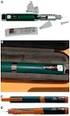
2 Insulin Pens and Their Mechanisms Page 2 The author, a Type 2 diabetic, insulin-dependent, has had extensive personal experience with all three of these pen types. The pens are used with replaceable needles, including the types having a common ISO standard screw thread attachment and those that can be pushed on the ISO thread fitting on the pen. For the FlexTouch pen, a proprietary needle with a bayonet attachment may also be used (the tip of the pen having mating slots as well as the ISO thread). Needles are available in several gauges and penetration lengths. It is recommended that a needle be used only for one shot. All three pens are typically dispensed prefilled with 3 ml of deliverable insulin solution, corresponding to 300 international units (IU 1 ) 2. (There is a very small amount of additional solution that cannot be delivered.) After the entire deliverable contents has been delivered, the pen is discarded. It cannot be refilled in the field. Essentially, the pens consist of a fairly-conventional hypodermic syringe arrangement with a rubber piston, integrated with an ingenious precision controllable-dose syringe operating mechanism. Although the overall appearance and mode of user operation of the first two pens are almost identical, their mechanisms are dramatically different in principle. For the third pen (FlexTouch), the mode of user operation is somewhat different, and correspondingly the mechanism is quite different from that of the other two pens. Figure 1. Novo Nordisk Levemir FlexPen Figure 1 shows a Novo Nordisk FlexPen, filled with Levemir long-acting insulin solution, with the pen cap removed and a needle in place. The outer and inner needle sheaths (on the needle as it is 1 I note that in writing prescriptions, this quantity is to be abbreviated U rather than IU in order to avoid any chance that the I (handwritten) would be seen as one, thus causing a misunderstanding in the dosage or whatever. But as this auricle is not a prescription (which I am in any case not authorized to write), and is in any case not issued as handwritten, I will use here the normal scientific symbol, IU. 2 This concentration is referred to as U-100, since one ml of solution carries 100 IU of insulin.

3 Insulin Pens and Their Mechanisms Page 3 supplied) are also shown. (There is also a foil seal tab, not shown, closing the open end of the outer sheath.) Figure 2 shows an Eli Lilly KwikPen, filled with Humalog quick-acting insulin solution, with the pen cap removed and a needle in place. Figure 2. Eli Lilly Humalog KwikPen The pen in this figure has had about 3/4 of its contents delivered. Figure 3 shows a Novo Nordisk Levemir-filled FlexTouch pen, with the pen cap removed and a needle in place, in this case the Novo Nordisk proprietary needle with bayonet attachment. Figure 3. Novo Nordisk Levemir FlexTouch pen We see the pen cap (dark blue), the needle outer cap (light blue), and the needle inner cap (milky white), as well as the foil seal from the needle as it is provided. The white part seen at the tip of the pen is the body of the needle, with internal features mating with the bayonet slots on the pen tip. 1.2 Mode of operation FlexPen and KwikPen These two pens have modes of operation that are almost identical to the user, and so they will be described together. To take a shot, the user first removes the cap from the pen. A new fully-sheathed needle is screwed (or for some types, pressed) on, using the outer sheath as a thimble. The back end of the needle

4 Insulin Pens and Their Mechanisms Page 4 passes through a thin rubber stopper 3 on the tip of the syringe section, entering the chamber holding the insulin solution. The outer needle sheath is then removed, followed by the inner sheath (the latter normally being discarded). The user then sets (and arms ) the pen for the desired dose by turning the setting knob clockwise. This turns the operating plunger, which is supported in the pen housing by a helical thread of substantial pitch. As the plunger turns, it advances longitudinally, screwing itself out of the housing. On the operating plunger there is a set of index marks, deployed along a helical path on the plunger. As the cylinder moves helically, these pass successively under the window in the housing. There is a fiducial mark on the edge of the window against which the marks are read. The marks correspond to setting increments of one international unit (IU) of the insulin solution. The even numbered marks (and the mark for 1 ) are labeled. The maximum rotation of the plunger is three turns, which corresponds to 60 units (which will mean the delivery of 0.6 ml of solution). Thus when it reaches the end of its travel, the mark 60 will be in the window, aligned with the fiducial. At this point, the plunger has emerged approximately 1.25 from the housing compared to its closed position (the exact stroke varies between the two units). In figure 4, we see the FlexPen armed to a dose of 20 IU. Figure 4. FlexPen armed to a dose of 20 IU The user then inserts the needle at the injection site. Holding the pen body with the fingers of one hand, the thumb of that hand (typically) is used to press on the setting knob itself (KwikPen) or an inset button on the setting knob (FlexPen) in order to drive the operating plunger back into the pen body. 3 This term, which does not really seem apt, comes from the corresponding member of modern injectable medication vials, the term there being brought forward from earlier injectable medication vials having an actual rubber stopper.

5 Insulin Pens and Their Mechanisms Page 5 The initial pressure on the knob or button shifts the mechanism from the arming mode to the delivery mode. As the operating plunger spirals back into the pen housing, the mechanism moves the syringe piston (by a much shorter, accurately scaled distance). This delivers the dose through the needle. When the operating plunger returns to its home position (showing 0 on the scale), the dose delivery is complete. The user withdraws the needle from the injection site, replaces the outer sheath on the needle, and using it as a thimble, unscrews the needle from the pen and discards it. The cap is replaced on the pen. With the cap off, the syringe piston is visible through the transparent syringe barrel, which is provided with a scale showing approximately the amount of insulin solution still available for delivery. The mechanism keeps precise track of the amount of insulin solution remaining available for delivery, and does not allow the user to set a dose greater than that. If there is no insulin solution available for delivery, the setting knob cannot be turned at all FlexTouch pen This pen has a mode of user operation somewhat different from that of the other two pens. To take a shot, the user first removes the cap from the pen. A new fully-sheathed needle is screwed on, pressed on, or attached with a bayonet connection (depending on the type of needle in use), using the outer sheath as a thimble. The back end of the needle passes through a rubber stopper on the tip of the syringe section, entering the chamber holding the insulin solution. The outer needle sheath is then removed, followed by the inner sheath (the latter being discarded). The user then arms the pen for the desired dose by turning the setting knob clockwise. It turns against a torsion spring, and a ratchet prevents it from automatically turning back under the reactive torque of the spring when the user lets go of the knob. (The user can, however, turn the knob back, a release cam mechanism releasing the ratchet in that case to allow the backward movement, as if for example the user initially overshoots the intended setting.) There is a set of index marks, in terms of IU, running from zero to 80, deployed along a helical path on an internal indicating cylinder, which moves helically as the setting knob is turned. As it does, these marks pass successively under a window in the housing. There is a fiducial mark on the edge of the window against which the marks are read.

6 Insulin Pens and Their Mechanisms Page 6 The marks correspond to setting increments of one international unit (IU) of the insulin solution. The even numbered marks are labeled. In figure 5, we see a FlexTouch pen armed to a dose of 30 IU. This is a new pen, still fully-loaded, so we cannot yet see the syringe piston, which is in its initial position, hidden in the pen body.) Figure 5. FlexTouch armed to a dose of 30 IU Unlike in the other two pens (see for example figure 4), no plunger extends from the pen as the setting knob is turned. The maximum rotation of the knob is 3-1/3 turns, which corresponds to 80 units of insulin (and thus the delivery of 0.8 ml of insulin solution). Thus when the knob reaches the limit of its travel, the mark 80 will be in the window, aligned with the fiducial. After arming, the user inserts the needle at the injection site. Holding the pen body with the fingers of one hand, the thumb of that hand (typically) is used to press a button inset into the end of the setting knob. This releases the spring mechanism, and the spring drives the syringe piston the distance that will deliver the set dose of insulin through the needle. The rate of delivery is primarily governed by the resistance to flow of the insulin solution through the small-diameter bore of the needle, considering the pressure of the solution resulting from the force applied to the syringe piston by the spring. When the operating plunger returns to its home position (showing 0 on the scale), the user hears a sharp click and the dose delivery is complete. The user withdraws the needle from the injection site, replaces the outer sheath on the needle, and using it as a thimble, unscrews the needle from the pen and discards it. The cap is replaced on the pen. With the pen cap removed, the syringe piston is visible through the transparent syringe barrel, which is provided with a scale showing approximately the amount of insulin solution still available for delivery.

7 Insulin Pens and Their Mechanisms Page 7 The mechanism keeps precise track of the amount of insulin solution remaining available for delivery (based on the cumulative stroke of the syringe piston), and does not allow the user to set a dose greater than that. If there is no insulin solution available for delivery, the setting knob cannot be turned at all. 2. THE MECHANISMS IN DETAIL 2.1 Introduction Although the first two types of insulin pens described here have similar appearance and almost identical operation from the standpoint of the user, they use quite different mechanisms. And the third, which has a different scheme as seen by the user, not surprisingly has yet another mechanism. In this section we will describe the operation of these three mechanisms in considerable detail with the use of detailed illustrations. The illustrations are broadly to scale, and the components are shown so as to give a useful impression of their actual configuration and juxtaposition. Many liberties have been taken with their details in the interest of clarifying the presentation and minimizing the illustration labor. Special schematic notation is used for functional features such as clutches, detents, and ratchets. When two parts can move with respect to each other, an exaggerated clearance gap is shown between them. Where no clearance is shown, either the two parts are fastened together, there is no prospect of movement between them, or (in the particular figure) one has already been pressed against the other preparatory to pushing it longitudinally. When two parts are keyed so that they must rotate together although moving longitudinally with respect to one another (such as in the case of a telescoping joint), fine dashed lines on either side of the clearance gap indicate this. Where one part engages another with a helical thread, a coarse crosshatch pattern across the joint between them indicates this. In the case of the threaded rod (jackscrew) that appears in both mechanisms, the familiar overall crosshatch is used to show the thread; in the nut plate through which it is threaded, a crosshatch pattern near the edge reminds us of its threads. In either case, crosshatch lines going up to the right indicate a left-hand thread, just as we would see the actual threads on the near side of the male part.

8 Insulin Pens and Their Mechanisms Page The Novo Nordisk FlexPen General The Novo Nordisk FlexPen uses a straightforward mechanism, nicely executed, with a number of very clever details. Figure 6 is a schematic cross-section diagram of this mechanism. Note the special schematic symbols, discussed above, used to call attention to the way certain parts interact. 9 * ) +, - /. 0 2 = M 4 E C JA A JD 6 D HA 6 D HA A? JE C E = I EF E J 4 J= HO H= J? D A J! F =? A I 6 HE= C K = HJ JD B=? A? K J? D Figure 6. Novo Nordisk FlexPen mechanism (schematic cross section) The components illustrated are (the terms are all my own): A Body of the pen B Rubber stopper pierced by the back end of the needle. C Insulin solution D Rubber syringe piston E Piston push plate F Threaded jackscrew G Jackscrew nut plate H Jackscrew driving spindle J Intermediate cylinder K Operating plunger K1 Setting knob (integral part of K) L Ratchet rotor M Button N Content monitor traveler W Setting window Z Threaded nipple onto which the needle attaches. Further details of these components will be covered as we learn of their roles in the overall operation. The figure suggests that the piston runs in the interior of the pen body, A. In reality, it runs in the interior of a glass tube (like that of a traditional hypodermic syringe), which has on its left end a small

9 Insulin Pens and Their Mechanisms Page 9 nipple carrying the rubber stopper, B. I have not shown this actual construction in the figure as it is of no consequence in following the operation of the mechanism (and doing so would have cluttered the figure, not to mention taking me quite a bit of additional illustration labor) Setting ( arming ) phase In order to set the pen for a certain dose and arm it, the user turns the setting knob, K1, clockwise. The operating plunger, K, of which the knob is an integral part, is supported in the pen housing, A, by a helical thread of substantial pitch. Thus, as the plunger turns, it advances longitudinally (to the right in the figure), screwing itself out of the housing. On the operating plunger there is a set of index marks, deployed along a helical path on the plunger. As the plunger moves helically, these pass successively by the window, W, in the housing. There is a fiducial mark on the edge of the window against which the marks are read. The marks correspond to setting increments of one international unit (IU) of the insulin solution. The even numbered marks (and the mark for 1 ) are labeled. The maximum rotation of the plunger is three turns, which corresponds to 60 units. Thus when the plunger reaches the end of its travel, the mark 60 will be in the window, aligned with the fiducial. At this point, the plunger has emerged approximately 1.31 from the housing compared to its closed position. The intermediate cylinder, J, follows the operating plunger longitudinally, but does not rotate. It is, in fact, prevented from rotating by a pawl on its left end operating on a ring ratchet on the fixed nut plate, G, which would only allow J to rotate counter-clockwise. There is a ratchet mechanism between the setting cylinder and ratchet wheel, L. Its actual purpose is as a one way detent, assuring that K comes to rest at an integral setting position. It clicks for each unit of advance of the knob. L cannot turn to avoid that action, because of a second ratchet mechanism between it and J, which cannot rotate clockwise since it is connected through a sliding coupling to H, and the ratchet between H and fixed nut plate G prevents H from rotating clockwise. Should the user overshoot the intended setting, and turn the setting knob, K1, and operating plunger K, counterclockwise to reduce the setting value, ratchet wheel L is forced to rotate as well, since this is not the permissive direction for the K/L ratchet. However, L is able to turn because this is the permissive direction of motion of a second

10 Insulin Pens and Their Mechanisms Page 10 ratchet between L and J. Thus this second ratchet now serves as the one-way detent, assuring that now the plunger will again stop at an integral setting position. There is some drag as this second ratchet (L/J) slips, which will attempt to turn J, which will in turn attempt to turn H (they are connected by a telescoping slip joint), and in this operation this is in the direction that is permissive for the ratchet between H and the fixed nut plate G, However, the minimum torque required to move the H/G ratchet is greater than the torque for the L/J ratchet, and thus there is not enough torque on J so that it and H will turn. In figure 7, we see the pen after rotation of the setting cylinder to its maximum dose setting (60 IU). 9 * ) +, -. / 0 6 D HA 6 D HA A? JE C E = I EF E J Delivery phase Figure 7. Armed to the maximum settable dose Now the user, having inserted the needle into the injection site, presses on button M to drive the operating plunger back into the pen. The first result of this is shown on figure 8. 9 * ) +, -. / 0 Figure 8. Button depressed at start of delivery stroke Button M moves against ratchet wheel L, which moves against the face of auxiliary cylinder J, which is pressed slightly to the left, until the left side of its flange presses against the step in cylinder K. The step in K has a saw-toothed face pattern, and several teeth on J press into that. Thus J becomes locked to K. Further pressure on button M thus causes J and K together to spiral back into the pen (because of the helical thread on which K is supported).

11 Insulin Pens and Their Mechanisms Page 11 The rotation of J causes a corresponding rotation of H (they are coupled by a telescoping slip joint). The ratchet between H and G allows this, which is in the permissible direction (now there is substantial torque). H then turns jackscrew F (they are coupled by a telescoping slip joint). F screws through nut plate G, advancing to the left and, pressing on plate E, moves syringe piston D, delivering the insulin solution through the needle. When the cylinder returns to its home position (beyond which it will not move further into the housing), the correct value of insulin solution will have been delivered. Figure 9 shows the pen at the completion of this phase of operation. 2 HE HF I EJE 9 * ) +, -. / 0 Figure 9. Delivery completed The dotted line above syringe piston D shows the initial position of its left end before this cycle. Thus we can see the amount that it has moved. The delivery phase is accompanied by the sound of the ratchet between H and G Reducing the dose setting Suppose that the user accidentally turns the setting knob too far, beyond the desired dose. The user can just turn the operating plunger back (counterclockwise), with knob K1, toward the needed setting. Since there is now no pressure on button M, the face clutch between K and J is not engaged, and so this rotation of K does not turn J. Thus there is no further motion of H and F, and no solution is expelled Aborting the shot Suppose that for some reason the user cannot discharge the full dose (perhaps the needle is clogged), and decides to abandon the shot for the time being.

12 Insulin Pens and Their Mechanisms Page 12 The user can just stop pressing the operating plunger, stopping the delivery, and then (as described just above) turn the plunger back (counterclockwise), with knob K1, until the setting is 0. The pen is now ready for a new attempt from scratch Monitoring of remaining usable content To simplify the discussion, we have so far ignored the function of component N, the content monitor traveler. Its purpose is to prevent the user from arming the system for a dose greater than the useable content remaining in the syringe. Essentially, the position of N along J corresponds to the amount of insulin solution so far discharged by the earlier cycles of the pen plus any amount committed by a current setting 4. How does this happen? The traveler is like a nut, with coarse internal threads, which ride on external threads on the outside of J. It also has a slot on its exterior that rides on a rib on the inside of K, thus keying N in rotation to K. When the user turns the setting knob, K is rotated, and the keying rib on K rotates N, which screws itself along the thread on J (which does not rotate during arming) by an amount corresponding to the setting amount. We in fact see this after the first arming cycle in figure 7. During discharge, both K and J rotate, and thus there is no movement of N along J. Accordingly, the net advance of N along J during this cycle remains proportional to the setting, and thus to the amount of insulin solution discharged as the cycle is completed. This movement of N along J accumulates in this way for each cycle. We see this after completion of the discharge for the first cycle in figure 9. 9 * ), -. + / 0 Figure 10. Small usable content remaining Suppose that the usable remaining content (a small amount will by intent remain unused) corresponds to 25 IU. Then N will be very near 4 This is like accrual accounting.

13 Insulin Pens and Their Mechanisms Page 13 the right-hand end of its travel along J. We see this with the operating plunger at home in figure 10. Suppose the user would like to arm the pen for a dose of 35 IU. As discussed above, as K is rotated, the rib on K rotates N, which as before screws itself along the thread on J (which does not rotate during arming). When the setting cylinder reaches 25, N has come to the end of its travel along J. A pair of lugs on the right face of N then comes up against a pair of lugs on the left face of the flange of J, preventing any more relative rotation between N and J. N is keyed to K. Thus, K, J, and N are locked together. Figure 11 shows this situation. The small circle calls attention to the lower lug on N interacting with a lug on J. 9 * ) +, -. / 0 Figure 11. Armed for maximum available dose Thus K can turn no more unless J turns too, but J is linked to H, and H is prevented from turning clockwise by the ratchet between it and fixed part G. Thus further motion of K is arrested with it reading exactly 25. Thus, the user realizes that there is only 25 IU of insulin left. Noting that, he may decide shoot that 25 IU dose, move the needle to a new pen, and shoot a further 10 IU from it. Alternatively, he may decide he will only take 25 IU right now, discard the exhausted pen, and go on about his business. Or he may take the needle off the pen, discard the pen (wasting 20 IU of insulin solution), put the needle on a new pen, and shoot the full 35 IU dose from it. If the user aborts the discharge before completion, and returns the setting cylinder to home by turning the knob, the relative rotation between K and J (which does not move during this maneuver) partially resets N, thus crediting the discharge reckoning with part of the amount already charged during arming but not actually discharged. 9 * +, -. ) / 0 Figure 12. After discharge of all available content

14 Insulin Pens and Their Mechanisms Page 14 Figure 12 shows the situation after discharge of all available content. We note that, with the pen in its home position, N is already at the far right of its travel along J, and we see (in the circle) its lug already engaging the lug on the left face of the flange of J. Now, K cannot be turned at all to attempt to arm the pen for a new cycle A peek at the real parts Now that we understand what the parts of the FlexPen do, let s look at how some of the more interesting ones are actually made. In figure 13, we see operating plunger K, with its knob K1 at the right. Figure 13. FlexPen operating plunger (K) Figure 14 shows some of the other parts. Figure 14. FlexPen parts We see jackscrew F; jackscrew driving spindle K emerging from intermediate cylinder J; on J, content monitor traveler N, riding on the external threads on J; ratchet rotor L; and button M. Jackscrew F has flats, and it passes into a flat-sided bore on K, making a telescoping rotary drive joint. On L, the pawl fingers nearest us engage J; those on the far side engage K (actually at the interior of knob K1). We see the lug on N and the lug on J it engages when all content is delivered or committed (contrast emphasized in the circles).

15 Insulin Pens and Their Mechanisms Page The Eli Lilly KwikPen General Although the overall appearance and functionality of the Eli Lilly KwikPen is almost indistinguishable from that of the FlexPen, the mechanisms are entirely different. The KwikPen uses a convoluted scheme of movements of three screw mechanisms, with differing rates and algebraic signs. During arming, all three movements are summed, but their total cancels out, so the syringe piston is not moved. During discharge, one of those movements is disabled, and the algebraic sum of the remaining two moves the piston at the proper ratio. Figure 15 shows a schematic cross-section diagram of the mechanism. Note again the special schematic symbols used to call attention to the way certain parts interact. * ) +, -. / D HA 6 D HA A? JE C E = I EF E J 6 HE= C K = HJ JD B=? A? K J? D 5 F HE C Figure 15. Eli Lilly KwikPen mechanism (schematic cross section) The components illustrated are: A Body of the pen B Rubber stopper pierced by the back end of the needle. C Insulin solution D Rubber syringe piston E Piston push plate F Threaded jackscrew G Jackscrew guide plate (prevents rotation of jackscrew) H Jackscrew driving cylinder 5 K Operating plunger J Control cylinder L Clutch cylinder 5 In reality, H and L are not concentric cylinders, as suggested by the drawing, but partial cylinders of the same diameter. Each has a pair of prongs that nestle into the spaces between the prongs of the other one. This is difficult to illustrate on the schematic drawing, so I took the liberty seen.

16 Insulin Pens and Their Mechanisms Page 16 M W U Z Knob Setting window Clutch engaging spring Threaded nipple onto which the needle attaches. Further details of these components will be covered as we learn of their roles in the overall operation Setting ( arming ) phase In order to set the pen for a certain dose and arm it, the user turns knob M clockwise. It is rigidly attached to the clutch cylinder, L. Spring U holds L against the left edge of the flange on the operating plunger K. There is a sawtooth clutch at that point, which is held engaged by the spring force. Thus L and K are (for now) coupled together for rotation. Turning the knob turns L and K. The operating plunger, K, is supported in the pen housing, A, by a helical thread of substantial pitch. Thus, as the cylinder turns, it advances longitudinally, screwing itself out of the housing. On the operating plunger there is a set of index marks, deployed along a helical path on the plunger. As the plunger moves helically, these pass successively by the window, W, in the housing. There is a fiducial mark on the edge of the window against which the marks are read. The marks correspond to setting increments of one international unit (IU) of the insulin solution. The even numbered marks (and the mark for 1 ) are labeled. The maximum rotation of the operating plunger is three turns, which corresponds to 60 units. Thus when it reaches the end of its travel, the mark 60 will be in the window, aligned with the fiducial. At this point, the plunger has emerged approximately from the housing compared to its closed position. Control cylinder J is suspended inside setting cylinder K on a set of helical threads with pitch slightly less than the pitch of the threads by which K is supported in the housing. Fins in the housing A engage slots on the left end of J (not seen in the drawing) to prevent J from turning. Thus, as the operating plunger K screws itself out of the housing to the right, it expels control cylinder J out its tail to the left. But this 6 As in the earlier figure, the figure suggests that the piston runs in the interior of the pen body, A, but in this case that is true (actually, a transparent plastic segment of the pen body).

17 Insulin Pens and Their Mechanisms Page 17 motion is not at the same rate as the longitudinal advance of K (since the pitch of the threads by which J is suspended in K is less than the pitch of the threads by which K is suspended in the housing A). Thus J has a net movement to the right, just slower then the motion of K. Cylinders H and L are connected by a telescoping finger joint. Thus during the arming process, H rotates as well. A detent between H and J (J is not rotating) assures that when the user lets go of the knob, the rotating members (H and K) are at an integral dose setting. As H moves slowly to the right, we would think it would pull jackscrew F along. But the jackscrew is connected to H by being screwed into a threaded hole in the left wall of H. The direction of the thread on F is such that the rotation of H expels F from the tail of H as H moves to the right. The pitch of the thread on F is such that there is no net movement of F during this process. (See The algebra of the movement, below.) In figure 16, we see the system after the completion of an arming operation for nearly the maximum settable dose. * ) +, -. / Figure 16. Armed for near maximum dose The dotted lines show the initial positions of syringe piston D and the left end of cylinder H. We can see that cylinder H has moved to the right, but not as far as operating plunger K. And we see that syringe piston D hasn t moved at all Delivery phase Now the user insets the needle into the injection site, grasps the pen with his fingers, and presses on the knob M (typically with his thumb). The initial effect is seen on figure 17. * ) +, -. / Figure 17. Knob depressed at start of delivery stroke

18 Insulin Pens and Their Mechanisms Page 18 The pressure on knob M moves the knob and inner cylinder L to the left. This disengages the sawtooth face clutch between L and K (see in the circles). Further movement of M pushes L and (once spring U fully compresses) K to the left. K will screw itself back into the housing. But the rotation of K does not force L to rotate, since the clutch has been disengaged. The differential thread arrangement from the housing through K to J, which we saw at work during the arming phase, now works the other way, with J moving to the left (but more slowly than the leftward movement of K). J then pushes H (slowly) to the left. We heard earlier that there is no torque to turn L, so there is no torque from L to turn H. And in fact the detent between H and J (J cannot rotate, being keyed to the housing) keeps H from turning from miscellaneous torque. (See Disadvantages, below.) With H not turning, it will not suck jackscrew F back into its tail. Thus the leftward movement of H will move F the same amount. This in turn pushes syringe piston D (via plate E), discharging insulin solution through the needle. Figure 18 shows the situation after completion of the delivery stoke. * ) +, -. / Figure 18. Delivery stroke completed Again, the dotted line shows us the previous position of the syringe piston D. The delivery operation is ordinarily silent, no ratchets or detents being exercised during the process (but see later under Disadvantages ) Reducing the dose setting Suppose that the user accidentally turns the setting knob too far, beyond the desired dose. The user can just turn the setting cylinder counterclockwise, with knob M, until it reaches the desired position. Since there is now no longitudinal pressure on knob M, pressure on the button, the face

19 Insulin Pens and Their Mechanisms Page 19 clutch between K and L is engaged. Thus K, L, and H rotate together, just as during the arming operation, but in the opposite direction. The interaction of the three screw motions means that there is no motion of jackscrew F (just as during arming) Aborting the shot Suppose that for some reason the user cannot discharge the full dose (perhaps the needle is clogged), and decides to abandon the shot for the time being. The user can just stop pressing the operating plunger, stopping the delivery. Then he can just turn the setting cylinder counterclockwise, with knob M, (just as described above) until it reaches the 0 position. The pen is then ready for a new attempt from scratch Monitoring of remaining usable content We also have here a way of preventing attempts to arm the system to deliver a dose greater than the available content left in the syringe. It is very simple (about time). We can follow its operation on figure 19. *, -. + ) / Figure 19. Only small usable content remaining Here, previous cycles have almost delivered the entire usable content. Note that the right end of jackscrew F is almost up to the threaded plate on the left of H. The thread grooves on F have a closed end (F is a two-start thread, with two distinct land/groove pairs). If the end attempts to actually enter the thread plate, the end of each land in the threaded hole will contact the closed end of the corresponding groove on F, and prevent any further rotation between F and H. (The black dot reminds us of the closed-end thread.) In the situation shown, when the user next attempts to arm the pen, as H moves to the right, rotating, it will unscrew itself along F, preventing F from moving (as is normal during arming). But shortly, H will come to the end of the thread on F. Thus no further rotation of H, L and K can occur and arming motion must halt. The pen will be armed to only deliver the available insulin solution, and the scale will indicate that dose.

20 Insulin Pens and Their Mechanisms Page 20 Figure 20. KwikPen control cylinder J and jackscrew driving cylinder H A peek at the real parts Now that we understand what the parts of the KwikPen do, let s look at how two of the more interesting ones are actually made. In figure 20, we see control cylinder J and jackscrew driving cylinder H. On J we see the threads by which it is supported inside operating plunger K. In figure 21, we see these two parts mated as they are in the completed pen. Figure 21. Jackscrew driving cylinder H in control cylinder J Prongs on the fingers near the left end of J act on sets of teeth just right of the flange at the left end of H to provide the H/J detent The algebra of the movement It is interesting to examine the curious operation of the setting and delivery mechanism operations algebraically. I will use the following notation:

21 Insulin Pens and Their Mechanisms Page 21 Pka The pitch of the thread by which operating plunger K is suspended in housing A. Pjk The pitch of the thread by which cylinder J is suspended in operating plunger K. Pfh The pitch of the thread on jackscrew F (operating into H). Ak The angular movement (in turns) of operating plunger K. xk The longitudinal movement of K with respect to the entire pen (positive to the right) xjk The longitudinal movement of J with respect to K (positive to the right) xfh The longitudinal movement of F with respect to H (positive to the right) xf The longitudinal movement of F with respect to the entire pen (positive to the right) S The amount of the setting (in turns of the operating plunger, K), positive clockwise Now, in the setting phase, as we turn operating plunger K through an angle Ak=S: x k SP k (1) x x (2) jk SP jk (3) fh SP fh the minus signs in the last two being the result of the hand of the respective threads and which member rotates with respect to what. These three motions are summed to give the absolute motion of F as follows: x f SP SP SP (4) k jl fh or x f S P P P ) (5) ( k jl fh Now, the design of the system is evidently such that: P fh P P (6) k jl which we can restate as: P P P 0 (7) k jl fh
22 Insulin Pens and Their Mechanisms Page 22 Thus, substituting equation 7 into equation 5, we get: x 0 (8) f showing that there is no motion of jackscrew F during setting. Now, during the delivery phase, H does not rotate, and there is thus no relative motion between F and H (i.e., xfh=0). Note that here the change in angle of K is S (since we are returning K to its home position, with counter-clockwise rotation). Now, the absolute motion of F is given by: x f S P P ) (9) ( k jl The design is such that Pk>Pjl. Thus the term in parentheses is positive, and xf will be negative motion of F to the left, moving syringe piston D in the direction to deliver insulin solution Numerical example In the specimen unit, the approximate pitches are (I have forced them to add up as required by the design concept): Pka Pjk Pfh Assume that the user arms the unit to deliver 20 IU, with one turn of the operating plunger K. For that one turn (clockwise) of K, it moves to the right by Jackscrew driving cylinder H moves to the left with respect to K by 0.260, and thus the net movement of H is to the right by But H, which is rotating, unscrews itself along jackscrew F, also by 0.115, so F does not move at all. During delivery, for the full stroke, the operating plunger K makes one turn counterclockwise. It moves to the left by Jackscrew driving cylinder H moves to the right with respect to K by 0.260, and thus the net movement of H is to the left by (K and H now being back to their normal home positions). But since H does not turn during the delivery phase, it does not screw itself to the left along F, but rather just pushes F to the left by 0.115, delivering 0.2 ml (20 IU) of insulin Why all this? Especially having seen the direct approach of the FlexPen to operation in the setting mode, it is hard to imagine where the roundabout
23 Insulin Pens and Their Mechanisms Page 23 scheme of the KwikPen came from. The most likely notion is that it was contrived to avoid patents (such as those covering the FlexPen design) Disadvantages The author notes two potential disadvantages of the KwikPen mechanism design. 1. During the delivery phase, pressure on the operating plunger knob M disengages the sawtooth face clutch between L and K. This allows L and K to move longitudinally, without rotation, as K spirals back into the housing. The lack of rotation of H is a predicate for the proper motion of the jackscrew F (see equation 9). But if K overly-enthusiastically starts its spiral movement back into the housing (propelled, in a sense, by the spring, U), the gap in the clutch may close, and K as it rotates will attempt to turn L. The detent between H and J resists the turning of L (which is keyed to H). As the user s thumb pressure on M continues, M and L move more to the left, disengaging the clutch. Then perhaps K will again jump ahead in its spiral movement, again reengaging the clutch, and so on. The result of this repeated partial engagement and then disengagement of the clutch is an unexpected buzzing sound (the delivery operation is normally silent). This can be very disconcerting to the user. 7 It seems that ordinarily the friction attending the movement of K means that K will not jump ahead under the influence of spring U (waiting instead until spring U is fully compressed, and then moving longitudinally in pace with M and L), and this phenomenon will not usually occur. 2. [For completeness, I will repeat the first passage from the case above, which is also applicable to this issue.] During the delivery phase, pressure on the operating plunger knob M disengages the sawtooth face clutch between L and K. This allows L and K to move longitudinally, without rotation, as K spirals back into the housing. The lack of rotation of H is a predicate for the proper motion of the jackscrew F (see equation 9). Although there is no torque from the rotation of K onto H (the clutch being disengaged), what would prevent H from rotating under the influence of some hypothetical extraneous torque? Only the 7 It was in fact my encountering of this phenomenon in a KwikPen newly put into service that prompted this entire investigation of the pen mechanisms.
24 Insulin Pens and Their Mechanisms Page 24 resistance of the detent between H and J (J never rotates, as it is keyed to the housing). Where could such an extraneous torque come from? Note that knob M is rigidly attached to L. Suppose the user, instead of pressing on M with his thumb, grasped M with the other hand to push it in. If the user inadvertently placed any torque on M while doing this, that torque would go directly to L and through the sliding joint to H. It could easily overcome the resistance of the H/J detent. The result might be some unwanted rotation of H, causing the advance of F to not be as desired, delivering an improper dose. The same could occur with thumb actuation if there was significant friction between the thumb and knob M, especially if the thumb motion has a rotary aspect (perhaps the thumb of the opposite hand is used). In any case, as we see from equation 9, the rotation of H would add an unwanted component to the intended motion of jackscrew F, resulting in an inaccurate delivery of the insulin dose. The likelihood of such misbehavior is of course slight. Still, it is disappointing that the design admits it. 2.4 The Novo Nordisk FlexTouch pen General The Novo Nordisk FlexTouch pen exhibits to the user a different behavior from that of the other two pens. Its mechanism is straightforward in concept but complex in implementation. Figure 22 shows a schematic cross section of the mechanism of a Novo Nordisk FlexPen insulin pen. As usual, I have taken substantial liberties with the exact arrangement of the parts in the interest of allowing their function to be most clearly seen.
25 Insulin Pens and Their Mechanisms Page 25 * ) +, -. / 0 5 G K = HA J JD? D HA 2 = M 4 E C JA A JD 6 D HA A? JE C E = I EF E J 4 J= HO H= J? D A J Figure 22. Novo Nordisk FlexTouch pen (schematic cross-section) The components illustrated are: A Body of the pen B Rubber stopper (pierced by the back end of the needle) C Insulin solution D Rubber syringe piston E Piston push plate F Threaded jackscrew G Jackscrew nut plate H Jackscrew drive plate I Auxiliary jackscrew drive plate J Winding cylinder K Setting knob L Indicating cylinder M Actuating button N Content monitor traveler P Zero plate R Button spring (compression) S Main spring (torsion) T Setting tube W Setting window Z Threaded nipple (with bayonet slots) onto which the needle attaches Further details of these components will be covered as we learn of their roles in the overall operation The business end This time I will start with a description of the business end of the pen so that the reader will have it in mind during the overall description of the mechanism.
26 Insulin Pens and Their Mechanisms Page 26 The needle is mounted to the nipple Z, either by way of the ISO threads on the nipple or on the proprietary bayonet slots in the nipple. The insulin solution, C, is propelled through the needle by the syringe piston, D. 8 The piston is propelled by the jackscrew, F, whose force is distributed across the rear face of the piston by the piston push plate, E. The piston has a left-hand thread. 9 It is screwed through a hole with a matching internal thread in the jackscrew nut plate, G, which is fixed to the syringe housing. The jackscrew has two keyways along its length. It passes though a hole in the jackscrew drive plate, H, which has matching keys. When the time comes to make the shot, the jackscrew drive plate is rotated counterclockwise (as seen from the right-hand side of the figure), rotating the jackscrew, causing it to advance through the nut plate and advance the syringe piston. The jackscrew drive plate has two pawls that engage ratchet teeth on the interior of the pen housing so that it can only ever rotate counterclockwise (even though there might be at certain times some incidental forces seeking to turn it clockwise). Lugs on the jackscrew auxiliary drive plate engage tabs on the jackscrew drive plate, G, so that the auxiliary jackscrew drive plate can move longitudinally while remaining engaged rotationally with the jackscrew drive plate. With the pen idle, the auxiliary jackscrew drive plate is prevented from turning in either direction in that its right face has a number of teeth that, with the plate in its idle position, engage square teeth on the interior of the pen housing. We will learn of how the jackscrew drive plate is (by way of the auxiliary jackscrew drive plate) rotated during the shot in the main part of the description, coming up now. 8 As in the earlier figures, the figure suggests that the piston runs in the interior of the pen body, A, whereas in reality, it runs in the interior of a glass tube. 9 Although it is of no consequence to the description, we note that this is a two-start thread, meaning that it has two helical land-groove features, interleaved along its length. This makes the thread, which has a substantial lead compared to its diameter, stronger and behave better in light of the fact that the keyways on the jackscrew interrupt the threads.
27 Insulin Pens and Their Mechanisms Page The setting ( arming ) phase Here we describe how the user sets the pens for a certain dose, arming it to deliver that dose. An important ingredient in pen operation is the indicating cylinder, L. Figure 23 shows the actual part. Please excuse the scar seen just to the right of the marking 50. This is an artifact of the dissection of the pen, which involved some surgical sawing. Figure 23. FlexTouch pen indicating cylinder (L) The indicating cylinder carries, along a helical path, index marks at 1 IU intervals, labeled for the even numbers, from 0 through 80. These index numbers can be seen though a small window in the pen housing, W. There is a fiducial mark on the housing adjacent to the window, against which the numbers are read. The indicating cylinder has a shallow helical groove on its outer surface, lying between the turns of the helical sets of markings. This engages a shallow helical thread on the interior of the pen housing. Thus the indicating cylinder can only move in a helical path, keeping its path of markings visible in the window. With the pen idle, the indicating cylinder is at its far rightmost position (in terms of the drawing) in which the marking 0 appears in the window against the fiducial mark. This home position is precisely established by way of two notches in the right-hand end of the indicator cylinder bearing on tabs that extends from the zero plate, Z, which is fixed in the housing. The interior of the indicating cylinder carries several sets of longitudinal ribs that engage mating ribs on the exterior of the winding cylinder, J. Thus, if the winding cylinder were to turn clockwise, it
28 Insulin Pens and Their Mechanisms Page 28 would rotate the indicating cylinder, causing it to screw along its path (to our left), showing increasing numbers through the window. The setting knob, K, has internal splines that engage matching splines at the right end of the setting tube, T. The left ends of the winding cylinder and the setting tube engage the jackscrew drive plate in a complicated way not easily shown in schematic form. The dark gray ellipses in the figure are just a proxy for all that. We will follow the action there in narrative form. To set the pen for a shot of a certain number of IU, the user turns the setting knob clockwise (again as seen from the right of the drawing). This turns the setting tube. When the setting tube, T, is turned clockwise, a tab at its left end presses on a feature of the winding cylinder, J, and turns it (again, this is all swallowed up in the dark gray ellipse). The winding cylinder, J, engages the auxiliary jackscrew drive plate, I, through a pawl and ratchet wheel arrangement (sort of a mechanical diode). This allows the winding cylinder to turn clockwise without moving the auxiliary jackscrew drive plate. And in fact, as mentioned previously, the jackscrew drive plate is prevented from turning clockwise by two pawls on it that engage ratchet teeth on the interior of the pen housing, which would prevent the auxiliary jackscrew drive plate from turning clockwise. And in any case, at this phase of operation, the auxiliary jackscrew drive plate is prevented from rotating in either direction by the engagement of the square teeth previously mentioned. So during this operation, all that rotates is the setting tube, and from it the winding cylinder, and from it, the indicating cylinder, L, (the latter showing the dosage that is being set). The reason for the winding part of the name for the winding cylinder is that the it is connected to the left end of a long torsion spring. The right end of this spring is anchored to the (fixed) zero plate P. Thus, as the winding cylinder is turned clockwise by the action of the setting knob, this spring is wound up. It will be this spring that provides the energy to (during the delivery phase) advance the jackscrew. 10 We will assume at this point that the user correctly turns the setting knob to the desired dosage in IU. 10 The mainspring has a preload ; that is, with the winding cylinder at its home position, the spring has still been wound some amount (my guess is about 3-5 turns). This makes the torque of the spring more nearly constant as the rotating parts return to their home position. Otherwise, as the system neared the home position, the torque of the spring would approach zero.
29 Insulin Pens and Their Mechanisms Page 29 When the user lets go of the knob, the spring wants to turn the winding tube back counterclockwise. But it cannot, as the pawl and ratchet arrangement connecting the winding tube to the auxiliary jackscrew drive plate would turn that counterclockwise, but it cannot move at all owing to the engagement of the square teeth on the auxiliary jackscrew drive plate with the square teeth on the pen housing. Thus the winding tube cannot turn back counterclockwise, nor the indicating cylinder, nor the setting tube, nor the setting knob. So the pen sits there, ready to be fired. Assuming that there is this much solution remaining (see later), the maximum rotation of the setting knob is 2-1/3 turns, resulting in a setting of 80 IU of insulin (meaning a delivery of 0.8 ml of solution Delivery phase Next the user inserts the needle at the injection site and presses the delivery button, M. 11 That button has been held clear by a compression spring, R. The button presses the winding tube to our left (allowed as it is connected to the knob by a spline arrangement). In fact, the first part of the longitudinal motion of the tube disengages the splines from the knob so the knob is no longer connected rotationally to the winding tube. This prevents any drag on the knob (perhaps from the user s fingers) from interfering with the rotation of the setting tube, which will soon occur The further longitudinal movement (leftward, for us) of the winding tube carries with it the winding cylinder and the auxiliary jackscrew drive plate. That disengages the square teeth on the auxiliary jackscrew drive plate from the square teeth on the pen housing. Now, the winding cylinder is free to rotate counterclockwise under the torque of the spring (and with it the auxiliary jackscrew drive plate and winding tube). The auxiliary jackscrew drive plate, though its lug and tab connection with the jackscrew drive plate, rotates the latter counterclockwise, advancing the jackscrew and with it the syringe piston, delivering insulin solution through the needle. As this happens, the counterclockwise rotation of the winding cylinder rotates the indicating cylinder, which moves in its normal helical path (to our right), showing lower and lower numbers as the delivery progresses. The desired dosage will have been delivered precisely when the indicator cylinder reaches 0 (at the far rightmost end of its helical travel). Its further motion is blocked at exactly this point by the 11 The button is retained to the end of the setting tube by two small prongs.
30 Insulin Pens and Their Mechanisms Page 30 engagement of two notches with the tabs on the zero plate. Just as the cylinder reaches this position, a lever on the zero plate drops into one of the notches to make a sharp click to advise the user that the shot is finished Reducing the dose setting Suppose that the user accidentally turns the setting knob too far, beyond the desired dose. If the user then turns the knob back (counterclockwise), a small initial counterclockwise rotation of the setting tube with respect to the winding cylinder (which at first is not interested in turning in that direction) will, by means of little cams at the left end of the setting tube, retract the pawls on the winding cylinder that had been engaged in a ratchet wheel on the auxiliary jackscrew driving plate (which we recall is itself locked against any rotation by the square teeth arrangement). Thus the winding tube, now freed from the locked auxiliary jackscrew driving plate, can rotate counterclockwise under the influence of the setting tube, reducing the dosage setting. The indicating cylinder rotates with the setting cylinder, and moves helically, showing decrease in dosage setting in the indication window Aborting the shot Suppose that for some reason the user does not discharge the full dose (perhaps the needle is clogged), and decides to abandon the shot for the time being. The user can just release the pressure on the button. The setting tube moves to the right, and its square teeth engage the square teeth on the pen housing, blocking further rotation of the setting tube and stopping any further driving of the syringe piston and thus stopping delivery. The user can than reset the pen to 0 by turning the knob clockwise, as described just above Monitoring of remaining usable content To simplify the discussion, we have so far ignored the function of component N, the content monitor traveler. Its purpose is to prevent the user from arming the system for a dose greater than the useable content remaining in the syringe. Essentially, the position of traveler N along jackscrew J corresponds to the amount of insulin solution so far discharged by the earlier cycles of the pen plus any amount committed by a current setting. How does this happen? The traveler is like a nut, with internal threads which ride on the external threads on J. It also has a slot on its
31 Insulin Pens and Their Mechanisms Page 31 exterior that rides on a rib on the inside of setting tube K, thus keying N in rotation to K. When the user turns the setting knob, K is rotated, and the keying rib on K rotates N, which screws itself along the thread on J (which does not rotate during arming) by an amount corresponding to the setting amount. We in fact see this after the first arming cycle in figure 7. During discharge, both K and J rotate, and thus there is no movement of N along J. Accordingly, the net advance of N along J during this cycle remains proportional to the setting, and thus to the amount of insulin solution discharged as the cycle is completed. This movement of N along J accumulates in this way for each cycle. Traveler N has on its right-hand end two teeth, which, if N comes to the right end of jackscrew J, would engage two little tabs extending radically from J at its end. Thus, if the user attempts to set a dose greater than the amount of solution remaining in the pen, during setting, traveler N will come to the end of J and its teeth will engage the two tabs on J, stopping the further rotation of N 12 and thus of setting tube T (to which N is rotationally keyed) and thus stopping further advance of the setting knob. I note that given the long trail of the blocking process and in particular that jackscrew J is not infinitely stiff, rotationally, this brick wall is a little rubbery. If for the last shot from a pen the user sets exactly the entire available dose, after setting (and after the shot) traveler N ends up at the right end of jackscrew J, with its teeth engaging the tabs at the end of the jackscrew. If the user then later attempts to set the dosage for another shot, the setting knob cannot be moved at all (it will already be up against the rubbery wall ) A peek at the real parts Now that we understand what the parts of the FlexTouch pen do, let s look at how some of the more interesting ones are actually made. We already saw, in figure 23, the indicating cylinder, L. In figure 24, we see it again, in its zero position, along with the zero plate (milky white), P, against which it nestles when in the zero position. 12 Jackscrew J cannot rotate clockwise as it is keyed to jackscrew setting plate H, which is prevented from rotating clockwise by its pawls that engage ratchet teeth in the pen housing, A.
32 Insulin Pens and Their Mechanisms Page 32 Again, we see the scar from dissection. Figure 24. FlexTouch pen indicating cylinder, L and zero plate, P On the left, we see some of the internal ribs that engage complementary ribs on the setting cylinder. There are four sets, with different spacings, engaging ribs of different widths on the setting cylinder (one set is actually a singleton, which engages a pair of ribs on the setting cylinder), so that the indicating cylinder cannot be assembled in the wrong orientation. On the right we see the flank of the notch on the end of the indicating cylinder against the stop lug on the zero plate, accurately locating the cylinder when in its zero position. We also see the curved click arm having dropped into the notch on its other side. In figure 25, we see the main spring, a torsion spring. Figure 25. FlexTouch pen main spring, S The right end of the spring hooks into a slot on the (fixed) zero plate. The left end hooks into a notch on the left end of the winding cylinder. Note that as mentioned earlier, the spring is preloaded ; with the mechanism in its zero position, the spring has been wound by several turns. In figure 26, we see jackscrew F, jackscrew nut plate G (fixed in the body), jackscrew drive plate H (which rotates the jackscrew to screw
33 Insulin Pens and Their Mechanisms Page 33 it through the nut plate), and content monitor traveler N (which is keyed by way of two thin ribs to the inside of the setting tube, which has slots to receive the fins). Figure 26. FlexTouch pen jackscrew and associated components We can see on the jackscrew drive plate (just below the tab nearest us) the tip of the pawl (there are actually two of them) that engages ratchet teeth on the interior of the pen body. The purpose of this is to prevent the jackscrew drive play from ever turning clockwise (retrograde) even in the fact of modest forces on it in that direction that occur during winding (namely, the drag of the pawl-ratchet arrangement between the winding tube and the auxiliary jackscrew drive plate). In figure 27, we have added the subassembly comprising auxiliary jackscrew drive plate I (engaged with jackscrew drive plate H), winding cylinder J, and the setting tube T. Figure 27. FlexTouch pen jackscrew fully accessorized The lugs with the three ribs on the auxiliary jackscrew drive plate (I) fit between tabs on the jackscrew drive plate (H) so it can turn the latter during the delivery phase. In addition, with the winding cylinder in its longitudinal rest position (shown), the right hand ends of those ribbed tabs also engage the square teeth in the pen body, preventing (after
34 Insulin Pens and Their Mechanisms Page 34 setting) the spring torque on the setting cylinder from turning the auxiliary jackscrew drive plate. When the actuating button is pressed, setting tube T is pressed to our left, carrying with it winding cylinder J and auxiliary jackscrew drive plate I. The auxiliary jackscrew drive plate remains keyed to jackscrew drive plate H, but its lugs move clear of the square teeth in the pen body, and thus the whole collection of parts turns counterclockwise under the torque of the main spring (which is actually applied to the winding tube). The result is that jackscrew drive plate H turns jackscrew F, which screws through the fixed jackscrew nut plate, G, moving to our left and pressing syringe piston D to the left, delivering insulin solution through the needle. 3. Acknowledgement Thanks to Carla C. Kerr for her insightful copy editing of this difficult manuscript in the almost-final draft of issue 4. But for changes since then I am on my own. #
Disposable Insulin Delivery Device User Manual
 PV 3734 AMP Disposable Insulin Delivery Device User Manual Instructions for Use Read and follow all of these instructions carefully. If you do not follow these instructions completely, you may get too
PA 9117 FSAMP. Lilly. Prefilled Insulin Delivery Device User Manual
 1 Lilly PA 9117 FSAMP Prefilled Insulin Delivery Device User Manual Instructions for Use Read and follow all of these instructions carefully. If you do not follow these instructions completely, you may
Rebuild Instructions for 70001 and 70010 Transmission
 Rebuild Instructions for 70001 and 70010 Transmission Brinn, Incorporated 1615 Tech Drive Bay City, MI 48706 Telephone 989.686.8920 Fax 989.686.6520 www.brinninc.com Notice Read all instructions before
SIMPLEX UNICAN LOCKS CHANGING THE CODE / COMBINATION 900 Series 1000 Series L1000 Series LP1000 Series EE1000 Series 2000 Series 2015 Series
 SIMPLEX UNICAN LOCKS CHANGING THE CODE / COMBINATION 900 Series 1000 Series L1000 Series LP1000 Series EE1000 Series 2000 Series 2015 Series 2400/2500 Series 3000 Series 3100 Series Simplex 5000 Series
Instructions for Use HUMALOG KwikPen insulin lispro injection (rdna origin)
 1 Instructions for Use HUMALOG KwikPen insulin lispro injection (rdna origin) Read the Instructions for Use before you start taking HUMALOG and each time you get a refill. There may be new information.
KwikPen Insulin delivery device
 USER MANUAL KwikPen Insulin delivery device PLEASE READ THESE INSTRUCTIONS BEFORE USE Lilly Introduction The KwikPen is designed for ease of use. It is a disposable pen containing 3 ml (300 units) of U-
Instructions for Use
 1 Instructions for Use HUMULIN R U-500 KwikPen insulin human injection U-500 (500 units/ml, 3 ml pen) Important: Know your dose of HUMULIN R U-500 insulin. The Pen delivers your dose in insulin units.
ClikSTAR - Important facts about your new insulin delivery device.
 ClikSTAR - Important facts about your new insulin delivery device. Instruction for Use ClikSTAR Insulin delivery device Before you start: Read these instructions and follow them completely each time you
NIH Clinical Center Patient Education Materials Giving a subcutaneous injection
 NIH Clinical Center Patient Education Materials What is a subcutaenous injection? A subcutaneous injection is given in the fatty layer of tissue just under the skin. A subcutaneous injection into the fatty
Fuel Injection Pump, Rotary (005-014)
 Fuel Injection Pump, Rotary View Related Topic Page 1 of 30 Fuel Injection Pump, Rotary (005-014) Table of Contents Summary General Information Preparatory Steps Remove Front Gear Train Rear Gear Train
INSULIN INJECTION KNOW-HOW
 0-0- INSULIN INJECTION KNOW-HOW Learning how to Congratulations for making the move to insulin therapy. It won t be long before you start enjoying better blood sugar control, more energy, and a host of
UNIT II Robots Drive Systems and End Effectors Part-A Questions
 UNIT II Robots Drive Systems and End Effectors Part-A Questions 1. Define End effector. End effector is a device that is attached to the end of the wrist arm to perform specific task. 2. Give some examples
Stitch Formation in Rotary Hook Sewing Machines ABSTRACT
 Stitch Formation in Rotary Hook Sewing Machines Douglas A. Kerr Issue 3 October 28, 2008 ABSTRACT Most modern general-purpose sewing machines form a lockstitch by way of the rotary hook technique. The
HUMULIN 70/30 KwikPen
 1 Instructions for Use HUMULIN 70/30 KwikPen (70% human insulin isophane suspension 30% human insulin injection [rdna origin]) Read the Instructions for Use before you start taking HUMULIN 70/30 and each
Instructions for Use. TRULICITY (Trū-li-si-tee) (dulaglutide) injection, for subcutaneous use. 0.75 mg/0.5 ml Single-Dose Pen.
 Instructions for Use 1 TRULICITY (Trū-li-si-tee) (dulaglutide) injection, for subcutaneous use 0.75 mg/0.5 ml Single-Dose Pen once weekly BREAK SEAL BREAK SEAL Unfold and lay flat Read both sides for full
Volkswagen Jetta, Golf, GTI 1999, 2000 Brake System 46 Brakes - Mechanical Components (Page GR-46)
 46 Brakes - Mechanical Components (Page GR-46) Front brakes Brake pads, removing and installing Brake pads, removing and installing FN 3 brake caliper, servicing FS III brake caliper, servicing Rear wheel
BETTIS CONVERSION INSTRUCTIONS TO CONVERT HD SERIES ACTUATORS TO HD-M3, HD-SR-M3 HD-M3HW OR HD-SR-M3HW SERIES PNEUMATIC ACTUATORS
 BETTIS CONVERSION INSTRUCTIONS TO CONVERT HD SERIES ACTUATORS TO HD-M3, HD-SR-M3 HD-M3HW OR HD-SR-M3HW SERIES PNEUMATIC ACTUATORS PART NUMBER: 132581 REVISION: A RELEASE DATE: 24 March 2000 Page 1 of 10
Exakta 6x6 No. 602246
 Page 1/7 Repair of Exakta 6x6, 2 1/4, Single Lens Reflex Exakta 6x6 No. 602246 Access to Film ounter & Winding Mechanism For convenience remove the lens. The lens release is on the left side of the camera
Installation Instructions 4508 4508S
 SYMPHONY Spread Lavatory Faucet with Speed Connect Drain Congratulations on purchasing your American Standard faucet with Speed Connect drain, a feature found only on American Standard faucets. Speed Connect
Installation Instructions 6028.801
 DAZZLE Installation Instructions 08.80 Spread Lavatory Faucet with Speed Connect Drain* Congratulations on purchasing your American Standard faucet with Speed Connect drain, a feature found only on American
Instructions for Use. Components of the GENOTROPIN PEN 12
 Instructions for Use Important Note Please read these instructions completely before using the GENOTROPIN PEN 12. If there is anything you do not understand or cannot do, call the toll-free number listed
A simple guide to using the HumaPen Luxura HD. If you need help with your Pen, call the. HumaPen Luxura HD Help Line: 0800 783 6764
 A simple guide to using the HumaPen Luxura HD If you need help with your Pen, call the Introducing your new Half Unit Dose Insulin Delivery Device Pen Cap Rubber Seal Cartridge Holder Pen needle (available
SP AF 300mm F/2.8 LD [IF] for Canon (Model 360EE)
![SP AF 300mm F/2.8 LD [IF] for Canon (Model 360EE)](/thumbs/40/21493790.jpg "SP AF 300mm F/2.8 LD [IF] for Canon (Model 360EE)") SP AF 300mm F/2.8 LD [IF] for Canon (Model 360EE) We greatly appreciate your purchase of this Tamron lens. The Tamron SP AF 300mm F/2.8 LD [IF] is a fast telephoto lens developed for Canon AF single-reflex
SP AF 300mm F/2.8 LD [IF] for Canon (Model 360EE) We greatly appreciate your purchase of this Tamron lens. The Tamron SP AF 300mm F/2.8 LD [IF] is a fast telephoto lens developed for Canon AF single-reflex
Objectives At the completion of this module, unlicensed assistive personnel (UAP) should be able to:
 Objectives At the completion of this module, unlicensed assistive personnel (UAP) should be able to: 1. administer medications by subcutaneous injections. 2. document medication administration in the client
SERVICE PARTS LIST PAGE 1 OF 6 BASE ASSEMBLY SPECIFY CATALOG NO. AND SERIAL NO. WHEN ORDERING PARTS 12" DUAL BEVEL COMPOUND MITER SAW B27A
 PAGE 1 OF 6 BASE ASSEMBLY 00 0 EXAMPLE: Component Parts (Small #) Are Included When Ordering The Assembly (Large #). SPECIFY CATALOG NO. AND NO. WHEN ORDERING PARTS 1 02-80-0050 Thrust Bearing (1) 2 05-80-0510
SECTION G2: CABLE PROCESSOR MODULE MAINTENANCE
 SECTION G2: CABLE PROCESSOR MODULE MAINTENANCE Cable Processor Module overview WARNING! When tipping the Cable Processor Module back, (after removing the toggle arm pin), use extreme caution not to drop
Trouble Shooting Tech Tips Operation
 Steering Components TroubleShooting Tech Tips Table of Contents Basic Steering System Operation 2 Sector Shaft Adjustments 4 Drag Link Adjustment 5 Relief Valve/Unloading Valve Adjustment 6 Ross TAS Automatic
ALBINS SEQUENTIAL SHIFTER
 ALBINS SEQUENTIAL SHIFTER Updated 12/11/11 8-AGB5-INST GENERAL NOTES The Albins Sequential Shifter is specifically designed for AGB transaxles. It features an integral reverse lockout lever and has a position
SHIFT INTERLOCK SYSTEM SHIFT INTERLOCK SYSTEM
 SHIFT INTERLOCK SYSTEM The shift lock system is designed to ensure the proper operation of the automatic transmission. The driver must depress the brake pedal in order to move the gear selector from Park
Unit 24: Applications of Pneumatics and Hydraulics
 Unit 24: Applications of Pneumatics and Hydraulics Unit code: J/601/1496 QCF level: 4 Credit value: 15 OUTCOME 2 TUTORIAL 3 HYDRAULIC AND PNEUMATIC MOTORS The material needed for outcome 2 is very extensive
SET-UP AND INSTALLATION FOR LEAD SCREW CARTRIDGE ASSEMBLY
 SET-UP AND INSTALLATION FOR LEAD SCREW CARTRIDGE ASSEMBLY 82-13-1 O-Ring (Rear) The Lead Screw Assembly is shipped separately. Note: Install Electrical and Pneumatic Circuitry. Be Sure electrical and pneumatic
No. 57 Receiver Sight No. 57 SML Receiver Sight No. 66 Receiver Sight
 No. 57 Receiver Sight No. 57 SML Receiver Sight No. 66 Receiver Sight MOUNTING AND ADJUSTING MOUNTING LYMAN NO 57 RECEIVER SIGHT The No. 57 Sight is designed primarily for rifles with round receivers.
How To Prepare and Give a Prefilled Syringe Injection
 Diablo Valley Onc&Hem Med Grp, Inc Phone Number: (925)6775041 How To Prepare and Give a Prefilled Syringe Injection Patient Education Quick Reference Guide The following are instructions for use of prefilled
User Manual Important: First read the Medication Guide that comes inside your FORTEO carton.
 1 RA082FSAM02 User Manual Important: First read the Medication Guide that comes inside your FORTEO carton. Before you use your new FORTEO delivery device, please read the entire front and back of this
Gear Trains. Introduction:
 Gear Trains Introduction: Sometimes, two or more gears are made to mesh with each other to transmit power from one shaft to another. Such a combination is called gear train or train of toothed wheels.
Learning to Self Inject Methotrexate at Home Developed by Andy Thompson MD FRCPC and Marie J Craig-Chambers B.Sc.Phm
 Learning to Self Inject Methotrexate at Home Developed by Andy Thompson MD FRCPC and Marie J Craig-Chambers B.Sc.Phm Why might my Doctor ask me to inject Methotrexate? Methotrexate comes in two forms:
POWER TRIM 5 F AUTO TRIM AND AUTO TRIM
 POWER TRIM 5 F 22217 AUTO TRIM AND AUTO TRIM Table of Contents Page Auto Trim System........................ 5F-1 Description........................... 5F-1 Auto Trim Operation...................... 5F-2
2006 HEADSHOK Service Video #1
 LEFTY SPEED DLR DAMPING CARTRIDGE This document explains how to properly remove, disassemble, inspect, reassemble and reinstall the Lefty Speed DLR2 damping cartridge. It is a document to be used in conjunction
CHROME FRONT BRAKE MASTER CYLINDER KIT
 -J075 REV. 009-0-0 CHROME FRONT BRAKE MASTER CYLINDER KIT GENERAL Kit Number 5-99D, 5-99D Models These Chrome Master Cylinder Kits are designed to replace the original equipment front brake master cylinder
Onset Peak Duration Comments
 Rapid- Acting 5-15 minutes 0.5-3 hours 3-5 hours Meal should be available before administering, ideally taking within 10 minutes of eating). Good in refrigerator (36-46 F) until expiration date. Protect
SUSP-06, Torsion Bars - Removing, Replacing, and Indexing
 Introduction SUSP-06, Torsion Bars - Removing, Replacing, and Indexing Replacing the torsion bar on a 944 is not all that difficult. However, reindexing the torsion after completion is a pain and can be
Joplin Rebuild Instructions
 Joplin Rebuild Instructions This is a step by step list of instruction on how to rebuild the Crankbrothers Joplin post. It may not always be required to completely tear-down the post to do the work needed
TERMINATION EQUIPMENT INSTRUCTION MANUAL TELE-PIERCE P/N 356-246
 TERMINATION EQUIPMENT INSTRUCTION MANUAL TELE-PIERCE P/N 356-246 OPERATION AND SERVICE INSTRUCTIONS AMPHENOL 157 SERIES TELE-PIERCE MULTI-WIRE TERMINATION TOOL 356-246 AMPHENOL TERMINATION SYSTEMS 1830
M113 VEHICLE FAMILY RUBBER TRACK INSTALLATION INSTRUCTIONS SOUCY TRACK SYSTEM 04-M113-1ENS (SPLIT IDLER) Litho d in Canada 1 04-M113-1ENS
 M113 VEHICLE FAMILY RUBBER TRACK INSTALLATION INSTRUCTIONS (SPLIT IDLER) 1 # TABLE OF CONTENTS List of parts and tools................................................3 Installation of complete kit...................................................5
APPLIED PNEUMATICS AND HYDRAULICS H TUTORIAL HYDRAULIC AND PNEUMATIC CYLINDERS. This work covers part of outcome 2 of the standard Edexcel module.
 APPLIED PNEUMATICS AND HYDRAULICS H TUTORIAL HYDRAULIC AND PNEUMATIC CYLINDERS This work covers part of outcome 2 of the standard Edexcel module. The material needed for outcome 2 is very extensive so
Unit 24: Applications of Pneumatics and Hydraulics
 Unit 24: Applications of Pneumatics and Hydraulics Unit code: J/601/1496 QCF level: 4 Credit value: 15 OUTCOME 2 TUTORIAL 4 DIRECTIONAL CONTROL VALVES The material needed for outcome 2 is very extensive
CHAPTER 65 TAIL ROTOR DRIVE SYSTEM. Section Title Page
 CHAPTER 65 TAIL ROTOR DRIVE SYSTEM Section Title Page 65-00 Description........................................ 65.1 65-10 Tail Rotor Drive Fan Shaft.............................. 65.1 65-20 Tail Rotor
UW MEDICINE PATIENT EDUCATION. Using Insulin. Basic facts about insulin and self-injection. What is insulin? How does diabetes affect the body?
 UW MEDICINE PATIENT EDUCATION Using Insulin Basic facts about insulin and self-injection This handout explains what insulin is, the different types of insulin, how to store it, how to give an injection
OD 1401 9 PRECISION MEASURING INSTRUMENTS
 SUBCOURSE EDITION OD 1401 9 PRECISION MEASURING INSTRUMENTS PRECISION MEASURING INSTRUMENTS SUBCOURSE OD1401 EDITION 9 Unites States Army Combined Arms Support Command Fort Lee, VA 23801-1809 5 CREDIT
Unit 24: Applications of Pneumatics and Hydraulics
 Unit 24: Applications of Pneumatics and Hydraulics Unit code: J/601/1496 QCF level: 4 Credit value: 15 OUTCOME 2 TUTORIAL 2 HYDRAULIC AND PNEUMATIC CYLINDERS The material needed for outcome 2 is very extensive
TRANS-05, Torque Tube Removal, Rebuilding, and Installation
 TRANS-05, Torque Tube Removal, Rebuilding, and Installation Tools Metric Wrench Set Metric Socket Set Jack Stands (6 minimum) Floor Jack 8mm Cheesehead socket (also referred to as 12 point internal socket
For exploded diagram and part number information, refer to the Spare Parts Catalog available on our website at www.rockshox.com.
 For exploded diagram and part number information, refer to the Spare Parts Catalog available on our website at www.rockshox.com. 2 0 0 5 D U K E A I R X C / S L / R A C E S E R V I C E G U I D E Information
Volkswagen B3 Passat Manual Transmission 02A 34 Manual Transmission - Controls, Assembly (Page GR-34) 02A 5-speed. Gearshift cable/lever installing
 34 Manual Transmission - Controls, Assembly (Page GR-34) 02A 5-speed Gearshift cable/lever installing Gearshift housing repairing Gearshift lever repairing lever/relay lever, installing Gearshift mechanism
Slide the new steering column shaft through the steering column from the driver compartment.
 Slide the new steering column shaft through the steering column from the driver compartment. Push the column shaft through the steering column until the machined end is out past the column lower bushing.
M A N U A L 13-10-05
 Documentation The following information sheets illustrate the description below: 12-WW01-4G-E Sectional view of the lance with main dimensions 12-W101-6G-E Sectional view of the head of the lance with
HED\ED:NS-BL 037-3rd
 HED\ED:NS-BL 037-3rd Insulin Insulin is produced by the beta cells in the islets of Langerhans in the pancreas. When glucose enters our blood, the pancreas should automatically excrete the right amount
#62192 Moroso Degree Wheel with Intake Center Line Calculator Instructions:
 #62192 Moroso Degree Wheel with Intake Center Line Calculator Instructions: Items in Kit: 1-18 Inner Degree Wheel 2-20 Outer Degree Wheel 3- (4) Nylon thumb screws 4- (4) 10-32 Allen Head screws 5- (4)
not appearance. ADHESIVE SYSTEMS CORIAN As an integral part of its sheet and shape products, DuPont has developed a special adhesive.
 CORIAN JOINT ADHESIVE SYSTEM 8.1 CORIAN JOINT ADHESIVE SYSTEM As an integral part of its sheet and shape products, DuPont has developed a special adhesive. The DuPont Corian covers seam performance, not
Lab 7: Rotational Motion
 Lab 7: Rotational Motion Equipment: DataStudio, rotary motion sensor mounted on 80 cm rod and heavy duty bench clamp (PASCO ME-9472), string with loop at one end and small white bead at the other end (125
Waters Corporation. Waters 2690/5 USER & TROUBLESHOOTING GUIDE
 Waters Corporation Waters 2690/5 USER & TROUBLESHOOTING GUIDE Contents 2690/5 Theory Setup procedures. Troubleshooting the 2690/5 User maintenance of the 2690/5 Spare Parts 2 2690/5 Theory 2690/5 Solvent
Model 5600 & 5600 Econominder
 Service Manual IMPORTANT: Fill in pertinent information on page 3 for future reference. Table of Contents Job Specification Sheet...................................................................................
Wheeled Vehicle Design For Science Olympiad By Carey I. Fisher
 Wheeled Vehicle Design For Science Olympiad By Carey I. Fisher The Wheeled Vehicle competition requires that the vehicle travel a specific distance set by the judge at the time of the contest. So the problem
Owners & Installation Manual for the Sheridan, Mountainair, Pine Valley and Old Forge Ceiling Fan Family
 Owners & Installation Manual for the Sheridan, Mountainair, Pine Valley and Old Forge Ceiling Fan Family Part of the Kiva Lighting Family Custom Lighting and Fans Since 1992 1312 12th St NW Albuquerque,
Drive shaft, servicing
 Volkswagen Passat B6 - Drive shaft, servicing Стр. 1 из 41 40-7 Drive shaft, servicing Drive shafts, overview I - Assembly overview: Drive axle with CV joint VL100 40-7, Drive axle with CV joint VL100,
Kiosk Group, Inc. ASSEMBLY INSTRUCTIONS FOR THE STANDALONE. EXQUISITE ipad KIOSK. For ipad 2-3-4-5 Version Tablets.
 Kiosk Group, Inc. ASSEMBLY INSTRUCTIONS FOR THE STANDALONE EXQUISITE ipad KIOSK For ipad 2-3-4-5 Version Tablets ipad 2-3-4-5 Version Tablet Items Required: ipad data/power cable that came with your ipad.
Insulin Pens. Basic facts. What is insulin? What are the different types of insulin?
 UW MEDICINE PATIENT EDUCATION Insulin Pens Basic facts This handout explains what insulin is, the different types of insulin, how to store it, how to give an injection with an insulin pen, and other important
Original Assembly Guide
 TCT Multipurpose Single Bevel Sliding Compound Mitre Saw Original Assembly Guide Read instructions before assembling this tool. Table of Contents GB Assembly Guide Read instructions before assembling this
Guideline for the Administration of Insulin by Nursing Staff
 Guideline for the Administration of Insulin by Nursing Staff Aims and objectives In Lanarkshire the number of people with Diabetes on insulin treatment is growing, as both the population ages and people
DYNA RIDER FOOTBOARD KIT
 -J0 REV. 0-0-0 DYNA RIDER FOOTBOARD KIT GENERAL Kit Number 000 Models For model fitment information, see the P&A Retail Catalog or the Parts and Accessories section of www.harley-davidson.com (English
S&G Model 2937 Group 1 Combination Lock
 Installation and Combination Changing Instructions S&G Model 2937 Group 1 Combination Lock NOTE: READ COMPLETE INSTRUCTIONS BEFORE INSTALLATION These instructions should be followed when installing the
PVM Piston Pumps Service Manual
 PVM Piston Pumps Service Manual PVM018/020 PVM045/050 PVM057/063 PVM074/081 PVM098/106 PVM131/141 Table of Contents Service Parts Pump Description... 3 Basic pump Pump Operation Controls Types Part Identification...
For exploded diagram and part number information, refer to the Spare Parts Catalog available on our website at www.rockshox.com.
 For exploded diagram and part number information, refer to the Spare Parts Catalog available on our website at www.rockshox.com. Information contained in this publication is subject to change at anytime
Automatic Transmission Basics
 Automatic Transmission Basics Lesson Objectives 1. Describe the function of the torque converter. 2. Identify the three major components of the torque converter that contribute to the multiplication of
Georgia Performance Standards Framework for Physical Science 8 th GRADE. Unit: Fast and Furious Forces General Task Life is Easy with Simple Machines
 Subject Area: Physical Science Grade: 8 Unit: Fast and Furious Forces General Task Life is Easy with Simple Machines S8P3. Students will investigate relationship between force, mass, and the motion of
Fleck 4650. Service Manual INSTALLATION AND START-UP PROCEDURE TABLE OF CONTENTS JOB SPECIFICATION SHEET
 Fleck 4650 Service Manual TABLE OF CONTENTS JOB SPECIFICATION SHEET...1 INSTALLATION AND START-UP PROCEDURE...1 CONTROL VALVE DRIVE ASSEMBLY...2 CONTROL DRIVE ASSEMBLY FOR CLOCK...3 BYPASS VALVE ASSEMBLY...4
Universal Gauge Measuring System USERS MANUAL
 Universal Gauge Measuring System 2002 Chief Automotive Technologies, Inc. Chief s Limited One-Year Warranty & Liability CHIEF'S LIMITED ONE-YEAR WARRANTY & LIABILITY Chief Automotive Technologies, Inc.
INJECTION TECHNIQUE. IVF NURSING OFFICE: (301) 400-2151 Darshana (301) 400-2146 Nicole
 IVF NURSING OFFICE: (301) 400-2151 Darshana (301) 400-2146 Nicole PLEASE NOTE: If you do not have medications for the next day s dose, you MUST go to the clinic that morning at 6:30 AM for more medications.
Eðlisfræði 2, vor 2007
 [ Assignment View ] [ Pri Eðlisfræði 2, vor 2007 28. Sources of Magnetic Field Assignment is due at 2:00am on Wednesday, March 7, 2007 Credit for problems submitted late will decrease to 0% after the deadline
INDEX INTRODUCTION. Reference No. 10-21L-01 R E V I S E D : 2 0 0 5 0 2
 10-21L-01 SRM-2305, SRM-2305SI 1 1 INTRODUCTION We are constantly working on technical improvement of our products. For this reason, technical data, equipment and design are subject to change without notice.
INSTRUCTIONS. FLHR/C/S (Road King) FRONT END LOWERING KIT 1WARNING -J03242 REV. 10-19-04. General. Removal (Left and Right Forks) Kit Number 54614-05
 INSTRUCTIONS -J04 REV. 0-9-04 General FLHR/C/S (Road King) FRONT END LOWERING KIT This kit is designed for installation on 00 and later FLHR/C/S Model Motorcycles. Road King models use the conventional
CNC HARDWARE & TOOLING BASICS
 Computer Aided Manufacturing (CAM) CNC HARDWARE & TOOLING BASICS Assoc. Prof. Dr. Tamer S. Mahmoud 1. Parts of CNC Machine Tools Any CNC machine tool essentially consists of the following parts: Part Program,
Using Insulin Pens and Pen Needles
 My Doctor Says I Should Begin Using an Insulin Pen... How Do I Use Them? BD Getting Started Using Insulin Pens and Pen Needles Insulin Pens and Dosers easy to carry, dose and use An insulin pen is a convenient
Overview PARTS LIST. B. Lever mounting base C. Flush handle assembly D. Grey/Blue float stop E. Grey float (Full Flush) F. Flush valve washer
 Overview READ ENTIRE INSTRUCTIONS BEFORE STARTING INSTALLATION PARTS LIST A. Flush valve B. Lever mounting base C. Flush handle assembly D. Grey/Blue float stop E. Grey float (Full Flush) F. Flush valve
EQUIPMENT SET UP RECURVE BOW
 EQUIPMENT SET UP RECURVE BOW Archery Australia Inc Coaching and Standards Committee Proudly Sponsored By EQUIPMENT SET UP RECURVE BOW It is important that equipment to be used must be set up correctly
Tiguan Haldex All-Wheel Drive
 Service Training Self Study Program 861803 Tiguan Haldex All-Wheel Drive Volkswagen of America, Inc. Volkswagen Academy Printed in U.S.A. Printed 3/2008 Course Number 861803 2008 Volkswagen of America,
Manual piston sampler...m 11
 SAMPLING Manual piston sampler...m 11 Screw sampler...prec 22...PREC 100 Slide sampler...pr 55 Rotative screw sampler...prv Piston sampler...p 11 Sampler on belt conveyor...pba Rotating cup sampler...pgr
Alarms of American Mantel Clocks By David J. LaBounty, CMC FBHI
 Alarms of American Mantel Clocks By David J. LaBounty, CMC FBHI Introduction I can remember one of my greatest fears as an apprentice clockmaker. It would happen while I was working the front counter,
Fig 1 Power Transmission system of Tractor
 POWER TRANSMISSION SYSTEM Transmission is a speed reducing mechanism, equipped with several gears (Fig. 1). It may be called a sequence of gears and shafts, through which the engine power is transmitted
The Mechanics of Arrow Flight 101 By Daniel Grundman Flex-Fletch
 The Mechanics of Arrow Flight 101 By Daniel Grundman Flex-Fletch Thunk! The arrow you just released from your bow has hit its target. Or has it? Due to a number of factors, your arrow may or may not have
YOUR GUIDE TO THE LANTUS SOLOSTAR INSULIN PEN
 Important Safety Information for Lantus You must test your blood sugar levels while using insulin, such as Lantus. Do not make any changes to your dose or type of insulin without talking to your healthcare
Operation of the overrun braking system.
 Operation of the overrun braking system. Fig 1 The overrun device can be described as the control device of the overrun brake system. A draw-bar force is produced at the coupling point by reducing the
Structural Integrity Analysis
 Structural Integrity Analysis 1. STRESS CONCENTRATION Igor Kokcharov 1.1 STRESSES AND CONCENTRATORS 1.1.1 Stress An applied external force F causes inner forces in the carrying structure. Inner forces
Mechanical Reasoning Test
 Mechanical Reasoning Test Question 1 In the electrical circuit above, which light bulbs should be lit if Switch 1 is on and Switch 2 is off? ll should be off. b) All should be on. c) A, C & D should be
All-Season Sunroom Sliding Glass Door Installation Instructions
 ASRESGD-08 All-Season Sunroom Sliding Glass Door Installation Instructions Panel Frame Door Frame Left Side Foam Insulator IE241 H Bar Assembly Door Frame Top Track Panel Frame Door Frame Right Side Stationary
Master Code 2. Troubleshooting: Installation 7. Troubleshooting: Door Jamming and Door Handing 8. Troubleshooting: Keypad 12
 Programming and Troubleshooting Guide 1 2 3 4 5 6 Master Code 2 Troubleshooting: Installation 7 Troubleshooting: Door Jamming and Door Handing 8 Troubleshooting: Keypad 12 Troubleshooting: Battery 13 Battery
FOR ANY QUESTIONS, PLEASE CALL US @ 727.347.9915 M-F 8:00a.m.-8:00p.m. EST. REAR BRAKES 1 AEROSPACE COMPONENTS 727.347.9915
 REAR BRAKES 1 AEROSPACE COMPONENTS 727.347.9915 REAR BRAKES Before getting started, remove all stock braking components. Pre-assembly of parts: Clean the bolts and the threads in the hat with acetone.
FRONT BUMPER INSTALLATION INSTRUCTIONS 2007-2011 DODGE / MERCEDES SPRINTER
 Aluminess Products Inc 9402 Wheatlands Ct. #A Santee, CA 92071 619-449-9930 FRONT BUMPER INSTALLATION INSTRUCTIONS 2007-2011 DODGE / MERCEDES SPRINTER Please read before beginning Stainless steel hardware
INSTRUCTION. Industrial Sewing Machines. No. 010012. First published : June 1997 Second edition : March 2001
 INSTRUCTION Industrial Sewing Machines First published : June 1997 Second edition : March 2001 No. 010012 INTRODUCTION Thank you for your purchasing Kansai Special's DLR Series. Read and study this instruction
Things you need to assemble the tube actuator. Left to right. are small piece of masking tape, super glue,pen knife and small
 Things you need to assemble the tube actuator. Left to right are small piece of masking tape, super glue,pen knife and small crosspoint screwdriver. You will also need a few drops of light oil. Begin by