
Phoenix Gas-Fired Water Heater
|
|
|
- Marcus McLaughlin
- 10 years ago
- Views:
Transcription
1 Phoenix Gas-Fired Water Heater INSTALLATION START-UP MAINTENANCE PARTS Phoenix Water Heater Models* PH / / / PH / / / PH / / / Phoenix Sanitizer Booster Models* SA / SA *A suffix of LP denotes propane gas *A suffix of S denotes solar model This manual must be used by a qualified installer/service technician. Read all instructions in this manual before installing. Perform steps in the given order. Failure to comply could result in substantial property damage, severe personal injury, or death. NOTICE: HTP reserves the right to make product changes or updates without notice and will not be held liable for typographical errors in literature. 120 Braley Rd. P.O. Box 429 East Freetown, MA

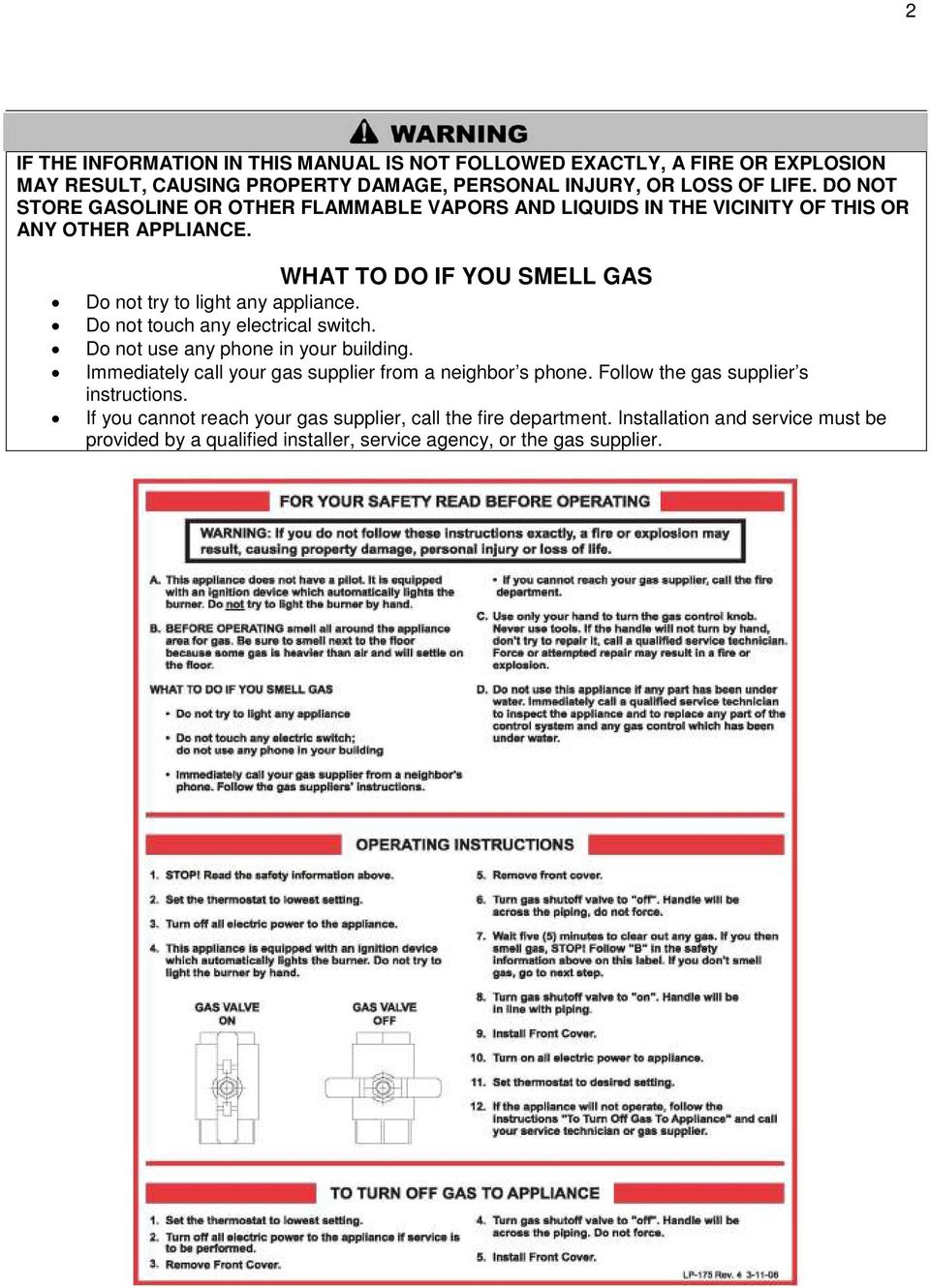
2 2 IF THE INFORMATION IN THIS MANUAL IS NOT FOLLOWED EXACTLY, A FIRE OR EXPLOSION MAY RESULT, CAUSING PROPERTY DAMAGE, PERSONAL INJURY, OR LOSS OF LIFE. DO NOT STORE GASOLINE OR OTHER FLAMMABLE VAPORS AND LIQUIDS IN THE VICINITY OF THIS OR ANY OTHER APPLIANCE. WHAT TO DO IF YOU SMELL GAS Do not try to light any appliance. Do not touch any electrical switch. Do not use any phone in your building. Immediately call your gas supplier from a neighbor s phone. Follow the gas supplier s instructions. If you cannot reach your gas supplier, call the fire department. Installation and service must be provided by a qualified installer, service agency, or the gas supplier.
3 3 The following defined terms are used throughout this manual to bring attention to the presence of hazards of various risk levels, or to important product information. DANGER indicates an imminently hazardous situation which, if not avoided, will result in death or serious injury. WARNING indicates a potentially hazardous situation which, if not avoided, could result in death or serious injury. CAUTION indicates a potentially hazardous situation which, if not avoided, may result in minor or moderate injury. CAUTION used without the safety alert symbol indicates a potentially hazardous situation which, if not avoided, may result in property damage. FOREWORD This manual is intended to be used in conjunction with other literature provided with the Phoenix Gas- Fired Water Heater. This includes all related control information. It is important that this manual, all other documents included with this system, and additional publications including the National Fuel Gas Code, ANSI Z , be reviewed in their entirety before beginning any work. Installation should be made in accordance with the regulations of the local code authorities and utility companies which pertain to this type of water heating equipment. NOTE TO CONSUMER: PLEASE KEEP ALL INSTRUCTIONS FOR FUTURE REFERENCE.

4 4 FOR THE INSTALLER This manual must only be used by a qualified heating installer/service technician. Read all instructions in this manual before installing. Perform steps in the order given. Failure to comply could result in severe personal injury, death or substantial property damage. This appliance must be installed by qualified and licensed personnel. The installer should be guided by the instructions furnished with the boiler, and with local codes and utility company requirements. In the absence of local codes, preference should be given to the National Fuel Gas Code, ANSI Z INSTALLATIONS MUST COMPLY WITH: Local, state, provincial, and national codes, laws, regulations and ordinances. The latest version of the National Fuel Gas Code, ANSI Z223.1, from American Gas Association Laboratories, 8501 East Pleasant Valley Road, Cleveland, OH In Canada CGA No. B149 (latest version), from Canadian Gas Association Laboratories, 55 Scarsdale Road, Don Mills, Ontario, Canada M3B 2R3. Also, Canadian Electrical Code C 22.1, from Canadian Standards Association, 5060 Spectrum Way, Suite 100, Mississauga, Ontario, Canada L4W 5N6. Code for the installation of Heat Producing Appliances (latest version), from American Insurance Association, 85 John Street, New York, NY The latest version of the National Electrical Code, NFPA No. 70. NOTE: The gas manifold and controls met safe lighting and other performance criteria when undergoing tests specified in ANSI Z latest edition.
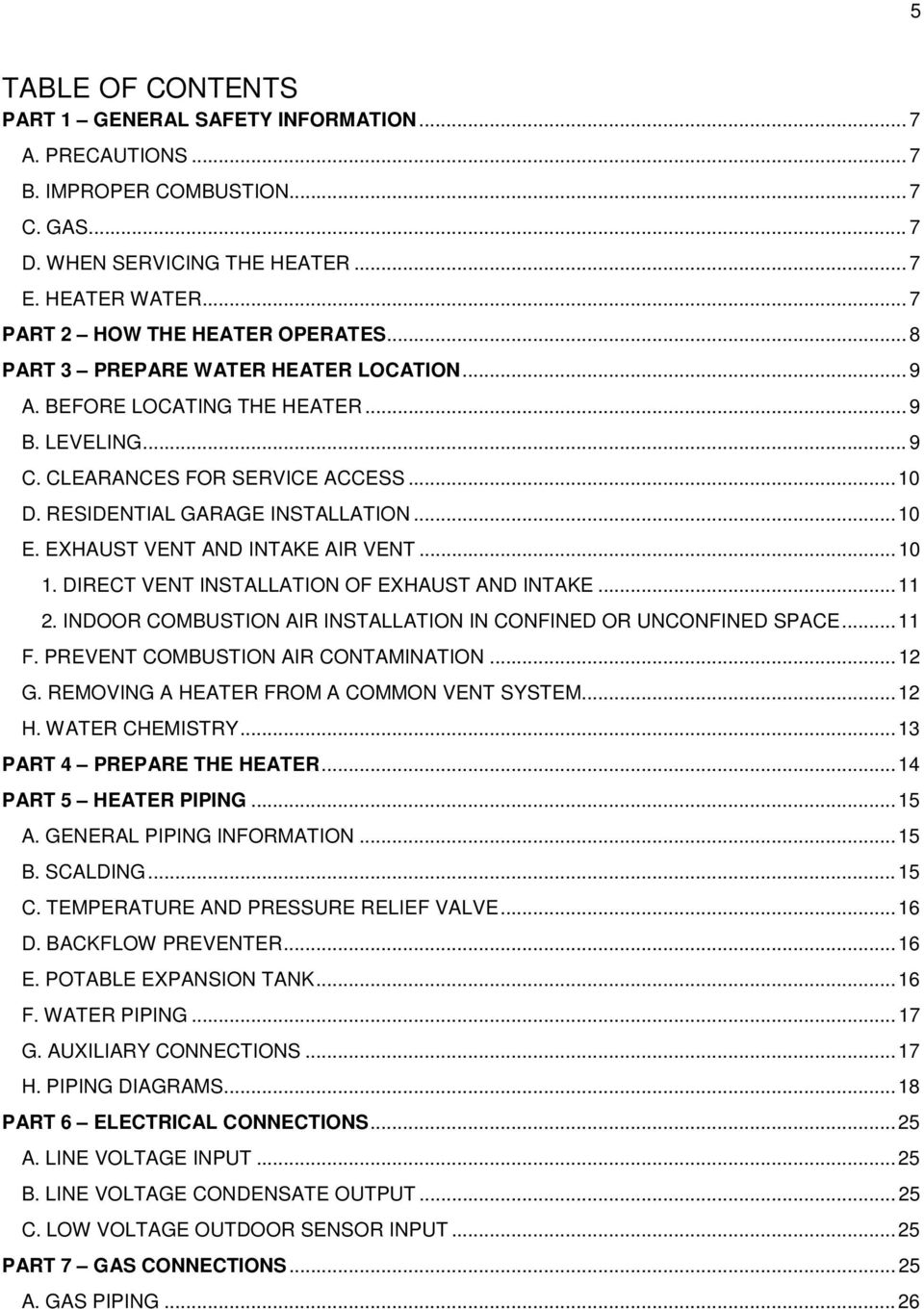
5 5 TABLE OF CONTENTS PART 1 GENERAL SAFETY INFORMATION... 7 A. PRECAUTIONS... 7 B. IMPROPER COMBUSTION... 7 C. GAS... 7 D. WHEN SERVICING THE HEATER... 7 E. HEATER WATER... 7 PART 2 HOW THE HEATER OPERATES... 8 PART 3 PREPARE WATER HEATER LOCATION... 9 A. BEFORE LOCATING THE HEATER... 9 B. LEVELING... 9 C. CLEARANCES FOR SERVICE ACCESS D. RESIDENTIAL GARAGE INSTALLATION E. EXHAUST VENT AND INTAKE AIR VENT DIRECT VENT INSTALLATION OF EXHAUST AND INTAKE INDOOR COMBUSTION AIR INSTALLATION IN CONFINED OR UNCONFINED SPACE F. PREVENT COMBUSTION AIR CONTAMINATION G. REMOVING A HEATER FROM A COMMON VENT SYSTEM H. WATER CHEMISTRY PART 4 PREPARE THE HEATER PART 5 HEATER PIPING A. GENERAL PIPING INFORMATION B. SCALDING C. TEMPERATURE AND PRESSURE RELIEF VALVE D. BACKFLOW PREVENTER E. POTABLE EXPANSION TANK F. WATER PIPING G. AUXILIARY CONNECTIONS H. PIPING DIAGRAMS PART 6 ELECTRICAL CONNECTIONS A. LINE VOLTAGE INPUT B. LINE VOLTAGE CONDENSATE OUTPUT C. LOW VOLTAGE OUTDOOR SENSOR INPUT PART 7 GAS CONNECTIONS A. GAS PIPING... 26
6 6 B. GAS TABLE C. GAS VALVE PART 8 VENTING, COMBUSTION AIR AND CONDENSATE REMOVAL A. GENERAL B. APPROVED MATERIALS FOR EXHAUST AND INTAKE AIR VENTS C. EXHAUST AND INTAKE AIR VENT PIPE LOCATION DETERMINE EXHAUST VENT LOCATION DETERMINE AIR INTAKE VENT LOCATION D. EXHAUST AND INTAKE AIR VENT SIZING E. LONGER VENT RUNS F. EXHAUST VENT AND INTAKE AIR PIPE INSTALLATION G. VENTING DRAWINGS DIRECT VENT INSTALLATION OF EXHAUST AND INTAKE INDOOR COMBUSTION AIR INSTALLATION IN CONFINED OR UNCONFINED SPACE H. CONDENSATE REMOVAL SYSTEM PART 9 START-UP PROCEDURE A. OPERATING INSTRUCTIONS B. OVERALL APPLIANCE AND CONTROL OPERATION C. STATUS MENU D. OUTDOOR RESET E. TEST MODE F. MAINTENANCE G. INTERNAL WIRING PART 10 SHUTDOWN A. SHUTDOWN PROCEDURE B. VACATION PROCEDURE C. FAILURE TO OPERATE PART 11 TROUBLESHOOTING A. ERROR CODE B. HEATER ERROR C. LOCKOUT PART 12: MAINTENANCE MAINTENANCE NOTES HTP CUSTOMER INSTALLATION RECORD FORM... 58

7 7 PART 1 GENERAL SAFETY INFORMATION A. PRECAUTIONS This appliance is for indoor installations only. Clearance to combustible materials: 0 top, bottom, sides and back. Unit must have room for service: 24 front and 12 sides are minimum recommended service clearances. (A combustible door or removable panel is acceptable front clearance.) This appliance has been approved for closet installation, and installation on combustible flooring. Do not install this appliance directly on carpeting. Use only Category IV vent systems. INSTALLER Read all instructions in this manual before installing. Perform steps in the order given. USER This manual is for use only by a qualified heating installer/service technician. Refer to user s information manual for your reference. Have this heater serviced/inspected by a qualified service technician annually. FAILURE TO ADHERE TO THE GUIDELINES ON THIS PAGE CAN RESULT IN SUBSTANTIAL PROPERTY DAMAGE, SEVERE PERSONAL INJURY, OR DEATH. NOTE: If the heater is exposed to the following, do not operate until all corrective steps have been made by a qualified serviceman: 1. FIRE 2. DAMAGE 3. WATER Any claims for damage or shortage in shipment must be filed immediately against the transportation company by the consignee. DO NOT USE THIS APPLIANCE IF ANY PART HAS BEEN UNDERWATER. Immediately call a qualified service technician. Replace any part of the control unit that has been under water. B. IMPROPER COMBUSTION NOTE: Do not obstruct the flow of combustion and ventilating air. Adequate air must be provided for safe operation. C. GAS Should overheating or gas supply fail to shut off, turn off the manual gas control valve to the appliance. D. WHEN SERVICING THE HEATER To avoid electric shock, disconnect electrical supply before performing maintenance. To avoid severe burns, allow heater to cool. E. HEATER WATER Do not use petroleum-based cleaning or sealing compounds in a heater system. Gaskets and seals in the system may be damaged. This can result in substantial property damage. Do not use homemade cures or heater patent medicines. Substantial property damage, damage to heater, and/or serious personal injury may result.

8 8 PART 2 HOW THE HEATER OPERATES Modulation Condensing Technology is an intelligent system that delivers highly efficient water heating, while maximizing efficiency by measuring the data parameters of your water heating system. Some of its features are: Stainless Steel Water Storage Tank The stainless steel water storage tank has a combustion chamber submerged into the tank water. When the water heater is fired, combustion gases heat the combustion chamber walls, transferring heat directly into the surrounding water. These hot gases are blown into secondary heat exchanger coils, where more heat is transferred into the water, removing even more heat from the gases. Modulating Combustion System Modulation during water heating operation is based on tank temperature. The control monitors the system to regulate burner output during operation to match system demand. This increase in efficiency allows for substantial fuel savings. Gas Valve The gas valve senses suction from the blower, allowing gas to flow only if the gas valve is energized and combustion air is flowing. Upper Supply Tank Sensor This sensor monitors the upper portion water temperature (system supply) of the water heater. The control module adjusts the burner firing rate so the outlet water temperature meets the set point. Lower Return Tank Sensor This sensor monitors the lower portion of the water heater inlet water temperature (system return). The control module reduces or increases input, depending on how close the water temperature is to the outlet water temperature set point. Control The integrated control system monitors upper and lower water temperature and regulates fan speed to regulate the unit s energy output. This allows the unit to deliver the required amount of heated energy and nothing more. Burner Constructed of high grade stainless steel, the burner uses pre-mixed air and gas and provides a wide range of firing rates. Condensate Drain Connection This is a condensing high efficiency appliance, and therefore has a condensate removal system. Condensate is nothing more than water vapor, derived from combustion products and similar to an automobile when it is initially started. It is very important that the condensate line slopes away from the water heater and down to a suitable inside drain. If the condensate outlet on the heater is lower than the drain, you must use a condensate removal pump (kit p/n available from HTP.) In addition, local authorities may require a condensate neutralizer to neutralize the condensate. Condensate neutralizers are made up of lime crystals, marble or phosphate chips. Neutralizers can be installed in the field by the installer and purchased from HTP (p/n 7450P-212). It is also very important not to expose the condensate line to freezing temperatures or any type of blockage. Plastic tubing must be the only material used for the condensate line. Steel, brass, copper or other materials will be subject to corrosion or deterioration. A second vent may be necessary to prevent condensate line vacuum lock on a long horizontal run. Also, an increase in pipe size may be necessary to

9 9 allow condensate to drain properly. Support of the condensation line may be necessary to avoid blockage of the condensate flow. Spark Ignition The burner flame is ignited by applying high voltage to the system spark electrode. This causes a spark from electrode to ground. Water temperature over 125 o F can instantly cause severe burns, or death, from scalds. Children, disabled, and elderly are at the highest risk of being scalded. See instruction manual before setting temperature at water heater. Feel water before bathing or showering! Temperature limiting valves are available. PART 3 PREPARE WATER HEATER LOCATION Before considering location, many factors need to be addressed. Piping, Venting, and Condensation Removal are just a few of the issues that need attention prior to the installation of the heater. Please read the entire manual, as it could save time and money. A. BEFORE LOCATING THE HEATER Check for nearby connections to: System water piping Venting connections Gas supply piping Electrical power Condensate drain Check area around heater. Remove any combustible materials, gasoline, and other flammable liquids. Failure to keep heater area clear and free of combustible materials, liquids, and vapors can result in substantial property damage, severe personal injury, or death. The heater gas control system components must be protected from dripping water during operation and service. If replacing an existing heater, check for and correct any existing system problems, such as: System leaks Heater is located in a condition that could cause the system to freeze and leak. Incorrectly-sized expansion tank Clean and flush existing system when reinstalling a heater. B. LEVELING In order for the condensate to properly flow out of the collection system, the area where you locate the heater must be level. Location must also fully support the weight of the filled water heater.

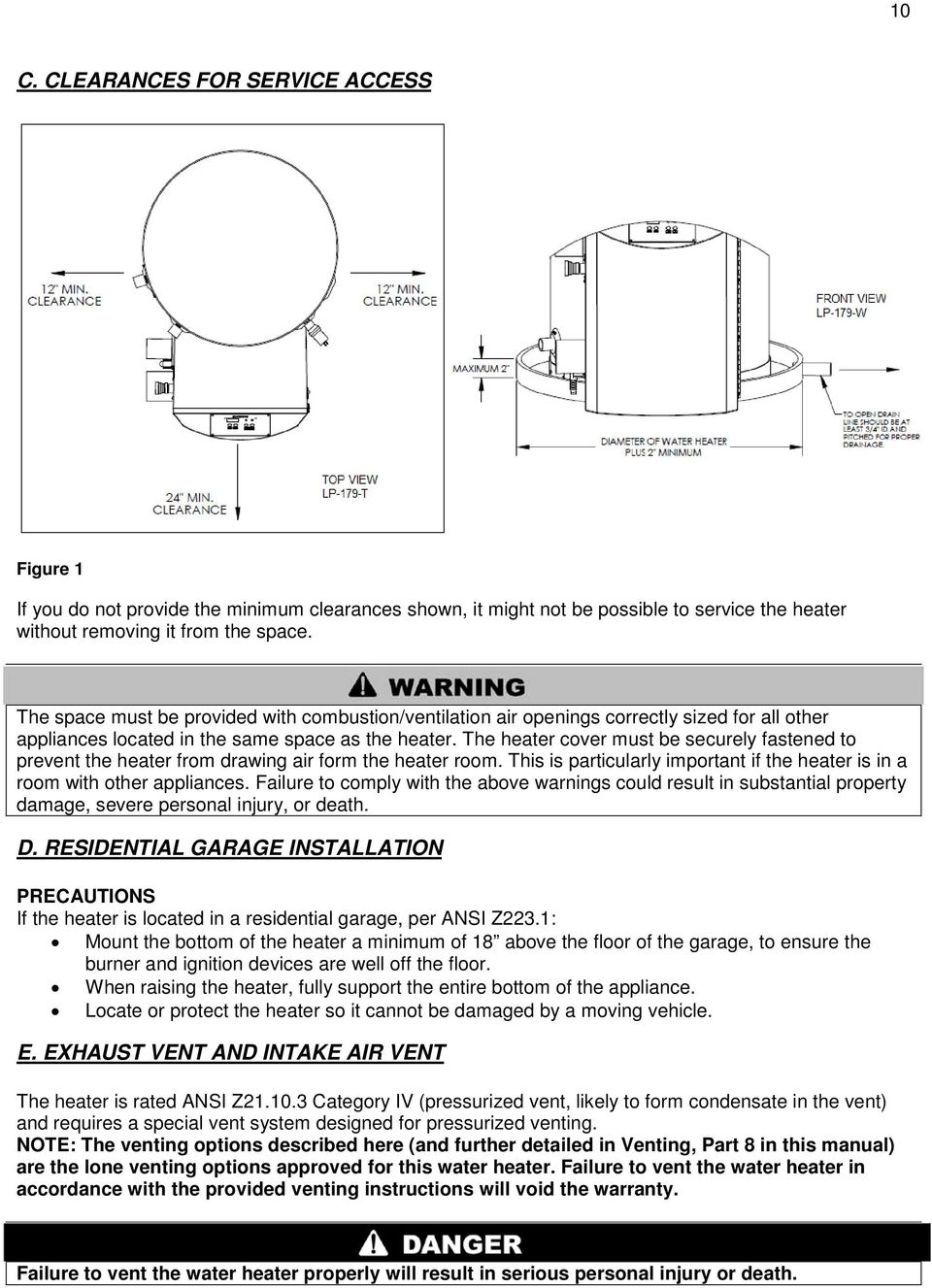
10 10 C. CLEARANCES FOR SERVICE ACCESS Figure 1 If you do not provide the minimum clearances shown, it might not be possible to service the heater without removing it from the space. The space must be provided with combustion/ventilation air openings correctly sized for all other appliances located in the same space as the heater. The heater cover must be securely fastened to prevent the heater from drawing air form the heater room. This is particularly important if the heater is in a room with other appliances. Failure to comply with the above warnings could result in substantial property damage, severe personal injury, or death. D. RESIDENTIAL GARAGE INSTALLATION PRECAUTIONS If the heater is located in a residential garage, per ANSI Z223.1: Mount the bottom of the heater a minimum of 18 above the floor of the garage, to ensure the burner and ignition devices are well off the floor. When raising the heater, fully support the entire bottom of the appliance. Locate or protect the heater so it cannot be damaged by a moving vehicle. E. EXHAUST VENT AND INTAKE AIR VENT The heater is rated ANSI Z Category IV (pressurized vent, likely to form condensate in the vent) and requires a special vent system designed for pressurized venting. NOTE: The venting options described here (and further detailed in Venting, Part 8 in this manual) are the lone venting options approved for this water heater. Failure to vent the water heater in accordance with the provided venting instructions will void the warranty. Failure to vent the water heater properly will result in serious personal injury or death.
11 11 Vents must be properly supported. Heater intake and exhaust connections are not designed to carry heavy weight. Vent support brackets must be within 1 of the heater and the balance at 4 intervals. Heater must be readily accessible for visual inspection for the first 3 from the heater. 1. DIRECT VENT INSTALLATION OF EXHAUST AND INTAKE If installing a direct vent option, combustion air must be drawn from the outdoors directly into the appliance intake, and exhaust must terminate outside. There are three basic direct vent options detailed in this manual: 1. Side Wall Venting, 2. Roof Venting, and 3. Unbalanced Venting. Be sure to locate the heater such that the air intake and exhaust vent piping can be routed through the building and properly terminated. Different vent terminals can be used to simplify and eliminate multiple penetrations in the building structure (see Optional Equipment in Venting Section). The air intake and exhaust vent piping lengths, routing and termination methods must all comply with the methods and limits given in the Venting section, Part 8 of this manual. When installing a combustion air intake from outdoors, care must be taken to utilize uncontaminated combustion air. NOTE: To prevent combustion air contamination, see Table INDOOR COMBUSTION AIR INSTALLATION IN CONFINED OR UNCONFINED SPACE This heater requires fresh, uncontaminated air for safe operation and must be installed in a mechanical room where there is adequate combustion and ventilating air. NOTE: To prevent combustion air contamination, see Table 1. Combustion air from the indoor space can be used if the space has adequate area or when air is provided through a duct or louver to supply sufficient combustion air based on the appliance input. Never obstruct the supply of combustion air to the appliance. If the appliance is installed in areas where indoor air is contaminated (see Table 1) it is imperative that the appliance be installed as direct vent so that all combustion air is taken directly from the outdoors into the appliance intake connection. Unconfined space is space with volume greater than 50 cubic feet per 1,000 Btu/hour (4.8 cubic meters per kw) of the total input rating of all fuel-burning appliances installed in that space. Rooms connected directly to this space, through openings not furnished with doors, are considered part of the space. See Figure 22, p. 40 for details. Confined space is space with volume less than 50 cubic feet per 1,000 Btu/hour (4.8 cubic meters per kw) of the total input rating of all fuel-burning appliances installed in that space. Rooms connected directly to this space, through openings not furnished with doors, are considered part of the space. When drawing combustion air from inside a conventionally constructed building to a confined space, such space should be provided with two permanent openings: one located 6 (15 cm) below the space ceiling, the other 6 (15cm) above the space floor. Each opening should have a free area of one square inch per 1,000 Btu/hr (22cm 2 /kw) of the total input of all appliances in the space, but not less than 100 square inches (645cm 2 ). If the confined space is within a building of tight construction, air for combustion must be obtained from the outdoors as outlined in the Venting section, Part 8 of this manual. When drawing combustion air from the outside into the mechanical room, care must be taken to provide adequate freeze protection.

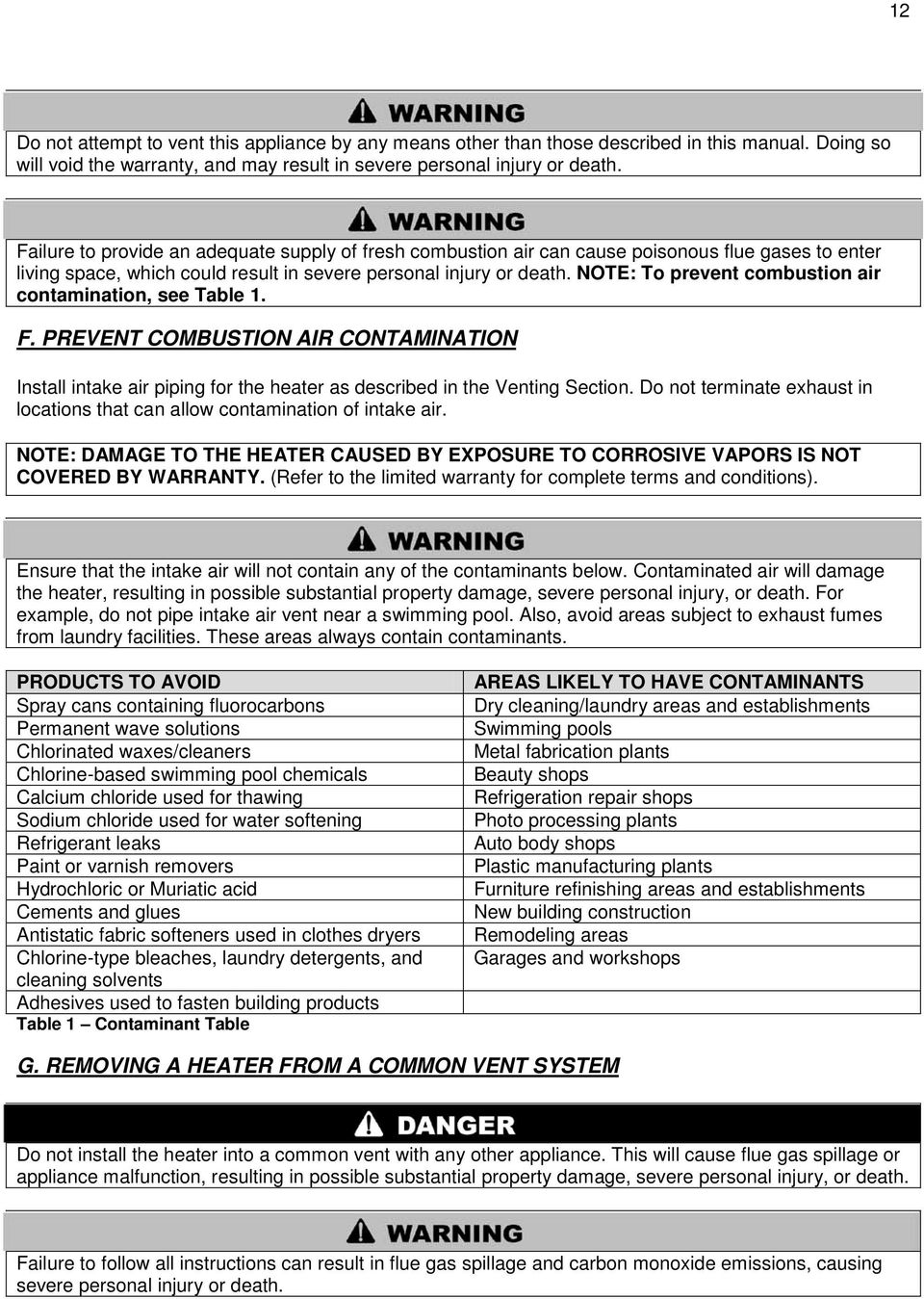
12 12 Do not attempt to vent this appliance by any means other than those described in this manual. Doing so will void the warranty, and may result in severe personal injury or death. Failure to provide an adequate supply of fresh combustion air can cause poisonous flue gases to enter living space, which could result in severe personal injury or death. NOTE: To prevent combustion air contamination, see Table 1. F. PREVENT COMBUSTION AIR CONTAMINATION Install intake air piping for the heater as described in the Venting Section. Do not terminate exhaust in locations that can allow contamination of intake air. NOTE: DAMAGE TO THE HEATER CAUSED BY EXPOSURE TO CORROSIVE VAPORS IS NOT COVERED BY WARRANTY. (Refer to the limited warranty for complete terms and conditions). Ensure that the intake air will not contain any of the contaminants below. Contaminated air will damage the heater, resulting in possible substantial property damage, severe personal injury, or death. For example, do not pipe intake air vent near a swimming pool. Also, avoid areas subject to exhaust fumes from laundry facilities. These areas always contain contaminants. PRODUCTS TO AVOID Spray cans containing fluorocarbons Permanent wave solutions Chlorinated waxes/cleaners Chlorine-based swimming pool chemicals Calcium chloride used for thawing Sodium chloride used for water softening Refrigerant leaks Paint or varnish removers Hydrochloric or Muriatic acid Cements and glues Antistatic fabric softeners used in clothes dryers Chlorine-type bleaches, laundry detergents, and cleaning solvents Adhesives used to fasten building products Table 1 Contaminant Table AREAS LIKELY TO HAVE CONTAMINANTS Dry cleaning/laundry areas and establishments Swimming pools Metal fabrication plants Beauty shops Refrigeration repair shops Photo processing plants Auto body shops Plastic manufacturing plants Furniture refinishing areas and establishments New building construction Remodeling areas Garages and workshops G. REMOVING A HEATER FROM A COMMON VENT SYSTEM Do not install the heater into a common vent with any other appliance. This will cause flue gas spillage or appliance malfunction, resulting in possible substantial property damage, severe personal injury, or death. Failure to follow all instructions can result in flue gas spillage and carbon monoxide emissions, causing severe personal injury or death.
13 13 When removing an existing heater, follow the steps below. 1. Seal any unused openings in the common venting system. 2. Visually inspect the venting system for proper size and horizontal pitch to determine if there is blockage, leakage, corrosion or other deficiencies that could cause an unsafe condition. Figure 3 - CO Warning Label Figure 2 3. If practical, close all building doors, windows and doors between the space in which the appliance remains connected to the common venting system and other spaces in the building. Turn on clothes dryers and any appliances not connected to the common venting system. Turn on any exhaust fans, such as range hoods and bathroom exhausts, at maximum speed. Do not operate a summer exhaust fan. Close all fireplace dampers. 4. Place in operation the appliance being inspected. Follow the lighting instructions. Adjust the thermostat so the appliance will operate continuously. 5. Test for spillage at the draft hood relief opening after 5 minutes of main burner operation. Use the flame of a match or candle or smoke from a cigarette. 6. After it has been determined that each appliance remaining connected to common venting system properly vents when tested as outlined, return doors, windows, exhaust fans, fireplace dampers and any other gas burning appliance to their previous condition of use. 7. Any improper operation of the common venting system should be corrected to conform to the National Fuel Gas Code, ANSI Z When resizing any portion of the common venting system, the system should approach the minimum size as determined using the appropriate tables in Appendix G in the National Fuel Gas Code, ANSI Z H. WATER CHEMISTRY Chemical imbalance of your water can cause severe damage to your water heater and associated equipment, and may also affect efficiency. You may have to have your water quality professionally analyzed to determine whether you need to install a water softener. Failure of a heat exchanger due to lime scale build-up on the heating surface, low ph or other imbalance IS NOT covered by the warranty. Water Hardness Water hardness is mainly due to the presence of calcium and magnesium salts dissolved in the water. The concentration of these salts is expressed in mg/l, ppm or grains per gallon, as a measure of relative hardness of water. Grains per gallon is the common reference measurement used in the U.S. water heater industry. Hardness expressed as mg/l or ppm may be divided by 17.1 to convert to grains per gallon. Water may be classified as very soft, slightly hard, moderately hard, or hard based on its hardness

14 14 number. The minerals in the water precipitate out when the water is heated and cause accelerated lime and scale accumulation on a heat transfer surface. If the hardness of the water exceeds the maximum level of 25 grains per gallon, water should be softened to a hardness level no lower than 5 grains per gallon. Water softened as low as 0 to 1 grain per gallon may be under-saturated with respect to calcium carbonate, resulting in water that is aggressive and corrosive. ph of Water ph is a measure of relative acidity, neutrality or alkalinity. Dissolved minerals and gases affect water ph. The ph scale ranges from 0 to 14. Water with a ph of 7.0 is considered neutral. Water with a ph lower than 7 is considered acidic. Water ph higher than 7 is considered alkaline. A neutral ph (around 7) is desirable for most potable water applications. Corrosion damage and heater failures resulting from water ph levels of lower than 6 or higher than 8 ARE NOT covered by the warranty. The ideal ph range for water used in a storage tank or a water heater system is 7.2 to 7.8. Total Dissolved Solids Total Dissolved Solids (TDS) is a measurement of all minerals and solids dissolved in a water sample. The concentration of total dissolved solids is usually expressed in parts per million (ppm). Water with a high TDS concentration will greatly accelerate lime and scale formation in the hot water system. Most high TDS concentrations precipitate out of the water when heated. This can generate a scale accumulation on the heat transfer surface that will greatly reduce the service life of a water heater. This scale accumulation can also impede the ability of the heat exchanger to transfer heat into the water. A heat exchanger damaged or blocked by lime/scale accumulation must be replaced. The manufacturer of the water heater has no control of water quality, especially TDS levels in your system. Total dissolved solids in excess of 2,000 ppm will accelerate lime and scale formation in the heat exchanger. Heat exchanger failure due to total dissolved solids in excess of 2,000 ppm is a nonwarrantable condition. Failure of a water heater due to lime scale build up on the heating surface IS NOT covered by the warranty. PART 4 PREPARE THE HEATER UNCRATING HEATER Any claims for damage or shortage in shipment must be filed immediately against the transportation company by the consignee. COLD WEATHER HANDLING If the heater has been stored in a very cold location (BELOW 0 o F) before installation, handle with care until the plastic components come to room temperature. Remove all sides of the shipping crate to allow the heater to be lifted into its installation location.
15 15 PART 5 HEATER PIPING Never use dielectric unions or galvanized steel fittings when connecting to a stainless steel storage tank or heater. Use only copper or brass fittings. Teflon thread sealant must be used on all connections. A. GENERAL PIPING INFORMATION Use two wrenches when tightening water piping at heater. Use one wrench to prevent the heater return or supply line from turning. Failure to prevent piping connections from turning could cause damage to heater components. The heater control module uses temperature sensors to provide both high limit protection and modulating temperature control. The control module also provides low water protection by sensing the water level in the tank. Some codes/jurisdictions may require additional external controls. B. SCALDING This heater can deliver scalding water. Be careful whenever using hot water to avoid scalding injury. Certain appliances, such as dishwashers and automatic clothes washers may require increased water temperature. By setting the thermostat on this heater to obtain the increased water temperature required by these appliances, you may create the potential for scald injury. To protect against injury, you should install a mixing valve in the water system. This valve will reduce point of discharge temperature by mixing cold and hot water in branch supply lines. Such valves are available from your local plumbing supplier. Table 2 details the relationship of water temperature and time with regard to scald injury and may be used as a guide in determining the safest water temperature for your applications. APPROXIMATE TIME / TEMPERATURE RELATIONSHIPS IN SCALDS 120 o F More than 5 minutes 125 o F 1 ½ to 2 minutes 130 o F About 30 seconds 135 o F About 10 seconds 140 o F Less than 5 seconds 145 o F Less than 3 seconds 150 o F About 1 ½ seconds 155 o F About 1 second Table 2

16 16 C. TEMPERATURE AND PRESSURE RELIEF VALVE To avoid water damage or scalding due to relief valve operation: Discharge line must be connected to relief valve outlet and run to a safe place of disposal. Terminate the discharge line in a manner that will prevent possibility of severe burns or property damage should the relief valve discharge. Discharge line must be as short as possible and the same size as the valve discharge connection throughout its entire length. Discharge line must pitch downward from the valve and terminate at least 6 above the floor drain, making discharge clearly visible. The discharge line shall terminate plain, not threaded, with a material serviceable for temperatures of 375 o F or greater. Do not pipe discharge to any location where freezing could occur. No shutoff valve may be installed between the relief valve and heater or in the discharge line. Do not plug or place any obstruction in the discharge line. Test the operation of the relief valve after filling and pressurizing the system by lifting the lever. Make sure the valve discharges freely. If the valve fails to operate correctly, immediately replace with a new properly rated relief valve. Test T&P valve at least once annually to ensure the waterway is clear. If valve does not operate, turn the heater off and call a plumber immediately. Take care whenever operating relief valve to avoid scalding injury or property damage. FAILURE TO COMPLY WITH THE ABOVE GUIDELINES COULD RESULT IN FAILURE OF RELIEF VALVE OPERATION, RESULTING IN POSSIBILITY OF SUBSTANTIAL PROPERTY DAMAGE, SEVERE PERSONAL INJURY, OR DEATH. Do not thread a cap or plug into the relief valve under any circumstances! Explosion and property damage, serious injury, or death may result. D. BACKFLOW PREVENTER Use a backflow preventer specifically designed for water heater installations. This valve should be installed on the cold water fill supply line per local codes. E. POTABLE EXPANSION TANK A potable hot water expansion tank is required to offset heated water expansion. In most city plumbing systems, the water meter has a no return or back flow device built into the system to prevent back flowing of water into city mains. Some local codes require back flow preventers on all incoming water supplies. The hot water expansion tank must be listed for potable water use. The expansion tank should be located on the cold inlet piping close to the water heater. EXPANSION TANK AND MAKE-UP WATER 1. Ensure that the expansion tank is sized to correctly handle heater and system water volume and temperature.

17 17 Undersized expansion tanks cause system water to be lost from the relief valve, causing make-up water to be added. Eventual heater failure can result due to excessive make-up water addition. SUCH FAILURE IS NOT COVERED BY WARRANTY. 2. The expansion tank must be located as shown in the Heater Piping Details, or following recognized design methods. See expansion tank manufacturer s instructions for details. The expansion tank must be suitable for hot potable water. F. WATER PIPING Never use dielectric unions or galvanized steel fittings on any domestic water or auxiliary connections. Use only copper or brass fittings. Thread sealant must be used on all connections. The domestic water connections must be installed in accordance to all local and national plumbing codes, or any applicable standard which prevails. The inlet and outlet ports are 1" on 55 gallon models, and 1 ½ on 80 and 119 gallon models. On the cold inlet, install a 1" brass tee on 55 gallon models, or a 1 ½" tee on 80 and 119 gallon models. On the run of the 1" brass tee, install a 1" brass drain cock or equivalent with pipe sealant compound. In the branch of the 1" or a 1 ½" brass tee, install a copper male adapter to match your copper plumbing system. For convenience, you may install a sweat shut off valve and a union in the cold inlet piping to ease future servicing. If there is a back flow preventer or any type of a no return valve in the system, you must install an additional tee here, suitable for a potable hot water expansion tank. In the hot outlet, install a suitable adapter to match the copper tubing of the plumbing system. A thermal trap or heat trap loop may be installed here to provide additional energy savings and prevent the thermal siphoning of domestic hot water. G. AUXILIARY CONNECTIONS The auxiliary connections are additional connections for air handlers, plate exchangers, or other devices that supply hot water. These connections must be installed in accordance with all local and national codes or any applicable standard that prevails. Auxiliary connections are 1" on all models. Never use dielectric unions or galvanized steel fittings. Use only copper or brass fittings. Sealant must be used on all connections. The top port is the supply outlet and the bottom port is the return inlet. Never connect auxiliary connections to any system that uses glycol or other solutions formulated for hydronic systems. These auxiliary connections are to be used only in a potable water system. Failure to follow this warning could result in serious injury or death.

18 18 H. PIPING DIAGRAMS Figure 4 LP-179-L - NOTE: This drawing is meant to demonstrate system piping only. The installer is responsible for all equipment and detailing required by local codes. In Massachusetts, you must install a vacuum relief valve per 248 CMR. With air handlers, outdoor reset is available with an outdoor sensor. See Part 9, Section D. An ASSE 1017 thermostatic mixing valve MUST be installed when using outdoor reset. Failure to do so could result in substantial property damage, serious injury, or death.
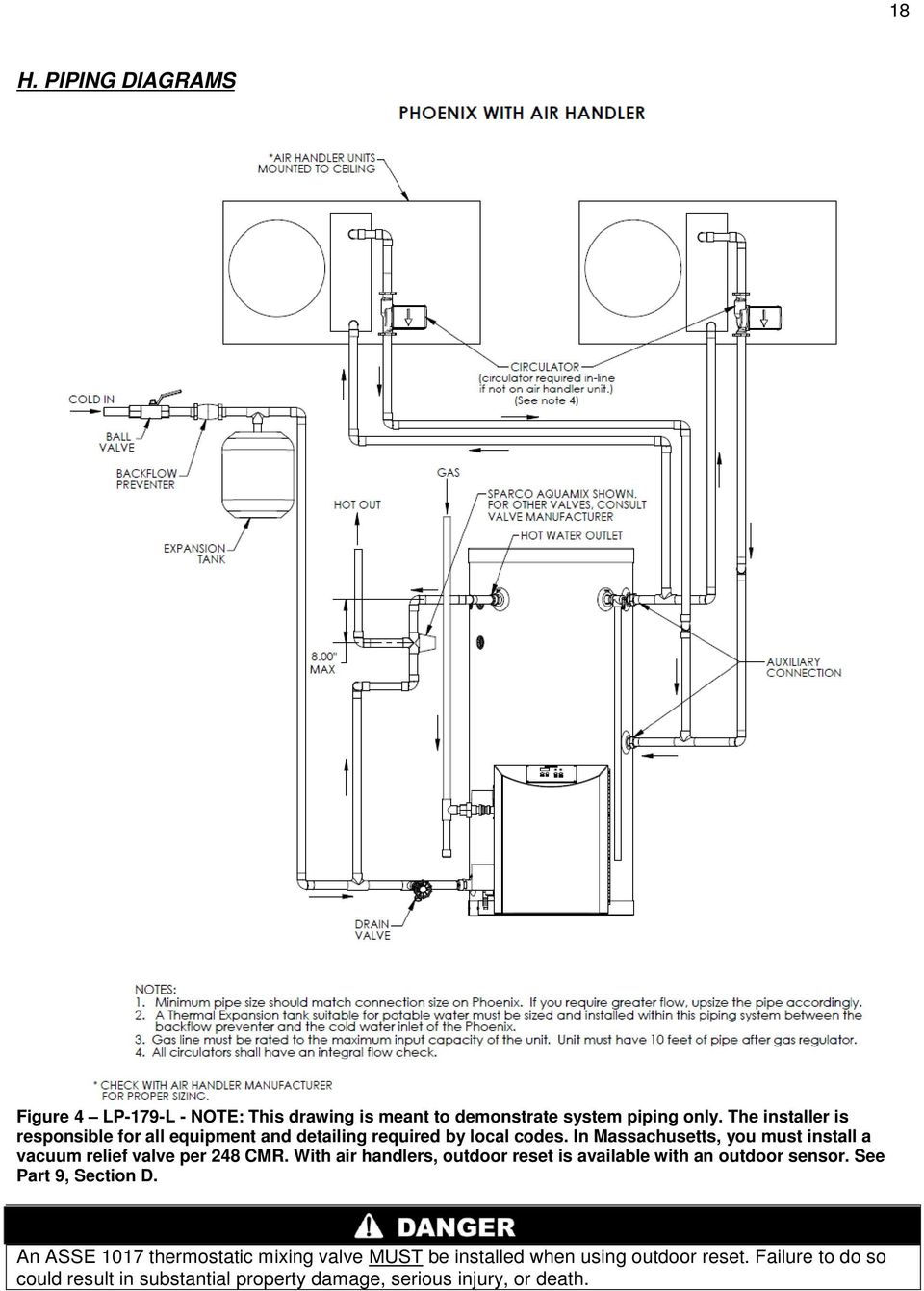
19 19 PHOENIX WITH AIR HANDLER ON SIDE Figure 5 LP-179-M - NOTE: This drawing is meant to demonstrate system piping only. The installer is responsible for all equipment and detailing required by local codes. In Massachusetts, you must install a vacuum relief valve per 248 CMR. With air handlers, outdoor reset is available with an outdoor sensor. See Part 9, Section D. An ASSE 1017 thermostatic mixing valve MUST be installed when using outdoor reset. Failure to do so could result in substantial property damage, serious injury, or death.

20 Figure 6 LP-179-N - NOTE: This drawing is meant to demonstrate system piping only. The installer is responsible for all equipment and detailing required by local codes. In Massachusetts, you must install a vacuum relief valve per 248 CMR. 20

21 Figure 7 LP-179-U - NOTE: This drawing is meant to demonstrate system piping only. The installer is responsible for all equipment and detailing required by local codes. In Massachusetts, you must install a vacuum relief valve per 248 CMR. 21
22 Figure 8 LP-179-O - NOTE: This drawing is meant to demonstrate system piping only. The installer is responsible for all equipment and detailing required by local codes. In Massachusetts, you must install a vacuum relief valve per 248 CMR. 22
23 23 Figure 9 LP-179-Z - NOTE: This drawing is meant to demonstrate system piping only. The installer is responsible for all equipment and detailing required by local codes. In Massachusetts, you must install a vacuum relief valve per 248 CMR. NOTE: For proper operation, it is important to pipe recirculation lines with thermostatic mixing valve as shown above. An ASSE 1017 thermostatic mixing valve MUST be installed when using outdoor reset. Failure to do so could result in substantial property damage, serious injury, or death.
24 24 The standard Phoenix Water Heater does not meet the required temperature settings for sanitizer booster applications. Use only the Phoenix Sanitizer Booster that delivers temperatures of 184 o F. Inlet water to the booster must be supplied at 140 o F. PHOENIX SANITIZER BOOSTER INSTALLATION p/n PH130-55SA / PH199-55SA Figure 10 LP-179-SA - NOTE: In Massachusetts, you must install a vacuum relief valve per 248 CMR. For further energy savings, install the Phoenix Sanitizer Booster on the same electrical circuit as the dishwasher.
25 25 PART 6 ELECTRICAL CONNECTIONS A. LINE VOLTAGE INPUT The heater must be wired to a 120 volt circuit by a qualified electrician. It is recommended that the heater be wired on its own circuit to minimize the possibility of circuit failure due to outside causes. The heater requires a maximum of 8 amps at 120 volts in use. B. LINE VOLTAGE CONDENSATE OUTPUT The heater has the capability of supplying power to a condensate pump. The connection is 120 VAC +/- 10% at a max of 2 amps. Power is supplied to the pump only when the heater is connected to power, and the power switch is in the on position. C. LOW VOLTAGE OUTDOOR SENSOR INPUT The heater has the capability of an outdoor reset. Connecting an outdoor sensor allows the heater to operate at optimum efficiency. HTP offers an outdoor sensor, p/n 7250P-319 The outdoor sensor must be a 12K NTC sensor. Use a minimum 22 AWG wire for runs of 100 feet or less and minimum 18 AWG wire for runs up to 150 feet. Instructions are included with the outdoor sensor to correctly mount the sensor on the exterior surface of the building. It is preferable to mount the sensor on the north side in an area that will not be affected by direct sunlight but will be exposed to varying weather conditions. Connect the outdoor sensor to terminals marked Outdoor. Figure 11 LP-179-Y It is of extreme importance that this unit be properly grounded. It is very important that the building system ground is inspected by a qualified electrician prior to making this connection. Electrical power must only be turned on when the heater is completely filled with cold water. PART 7 GAS CONNECTIONS Failure to follow all precautions could result in fire, explosion, severe injury or death!
26 26 The gas supply shall have a maximum inlet pressure of less than 14" water column (350 mm), ½ pound pressure (3.5 kpa), and a minimum of 3.5" water column. The entire piping system, gas meter and regulator must be sized properly to prevent pressure drop greater than 0.5" WC as stated in the National Fuel Gas Code. This information is listed on the rating plate. It is very important that you are connected to the type of gas as noted on the rating plate: "LP" for liquefied petroleum, propane gas, or "Nat" for natural or city gas. All gas connections must be approved by the local gas supplier or utility, in addition to the governing authority, prior to turning the gas supply on. Do not remove the adaptor in Figure 12! It is mandatory that this fitting is used for connection to a field fabricated drip leg per the National Fuel Gas Code. You must ensure that the entire gas line to the connection at the water heater is no smaller than ¾". Once all inspections have been performed, the piping must be leak tested. If the leak test requirement is a higher test pressure than the maximum gas inlet pressure, you must isolate the heater from the gas line to continue leak testing. To do this, you must turn off the factory and field-installed gas cocks. This will minimize the possibility of damaging the gas Figure 12 LP-179-Q valve. Failure to do so may damage the gas valve. In the event the gas valve is exposed to a pressure greater than ½ PSI, 14" water column, the gas valve must be replaced. Never use an open flame (match, lighter, etc.) to check gas connections. A. GAS PIPING Run the gas supply line in accordance with all applicable codes. Locate and install manual shutoff valves in accordance with local and state requirements. B. GAS TABLE Refer to the table below to size the supply piping to minimize pressure drop between meter or regulator and unit. Maximum capacity of pipe in cubic feet of gas per hour for gas pressures of.5 psi or less and a pressure drop of.3 inch water column. Nominal Iron Pipe Size (Inches) Internal Diameter (Inches) Length of Pipe (Feet) ¾ ¼ , ½ ,600 1, Table 3 Source ANSI Z223.1 BTU s Per Hour x 1,000
27 27 It is recommended that a soapy solution be used to detect leaks. Bubbles will appear on the pipe to indicate a leak is present. The gas piping must be sized for proper flow and length of pipe to avoid excessive pressure drop. Both the gas meter and the gas regulator must be properly sized for the total gas load. If you experience a pressure drop greater than 1" WC, the meter, regulator or gas line is undersized or in need of service. You can attach a manometer to the incoming gas drip leg by removing the cap. The gas pressure must remain between 3.5" WC and 14" WC during stand-by (static) mode and while in operating (dynamic) mode at full output. If an in-line regulator is used, it must be a minimum of 10 feet from the heater. It is very important that the gas line is properly purged by the gas supplier or utility. Failure to properly purge the lines or improper line sizing will result in ignition failure. This problem is especially noticeable in NEW LP installations and also in empty tank situations. This can also occur when a utility company shuts off service to an area to provide maintenance to their lines. The gas valve must not be replaced with a conventional gas valve under any circumstances. As an additional safety feature, the gas valve in this appliance has a flanged connection to the swirl plate and blower. C. GAS VALVE Do not do a gas conversion on this water heater without an officially approved conversion kit and instructions supplied by HTP. Figure 13 Gas Valve LP-179-P
28 28 PART 8 VENTING, COMBUSTION AIR AND CONDENSATE REMOVAL The heater must be vented as detailed in this Venting Section. Ensure exhaust and intake piping complies with these instructions regarding vent system. Inspect finished combustion air intake and exhaust piping thoroughly to ensure all joints are well secured, airtight, and comply with all applicable code requirements, as well as with the instructions provided in this manual. Failure to provide a properly installed vent system will cause severe personal injury or death. A. GENERAL This vent system will operate with a positive pressure in the pipe. Do not connect vent connectors serving appliances vented by natural draft into any portion of mechanical draft systems operating under positive pressure. Follow the venting instructions below carefully. Failure to do so may result in substantial property damage, severe personal injury, or death. 1. Install the water heater venting system in accordance with these instructions and with the National Fuel Gas Code, ANSI Z223.1/NFPA 54, CAN/CGA B149, and/or applicable provisions of local building codes. 2. This water heater is a direct vent appliance and is listed as a Category IV appliance with Underwriters Laboratories, Inc. VENT AND INTAKE AIR VENT. B. APPROVED MATERIALS FOR EXHAUST AND INTAKE AIR VENTS Item Vent or air pipe and fittings Pipe cement/primer Table 4 APPROVED VENTING MATERIAL Material Standards for Installation in: United States Canada PVC schedule 40/80 ANSI/ASTM D1785 CPVC and PVC venting PVC-DWV ANSI/ASTM D2665 must be ULC-S636 Certified. IPEX is an approved manufacturer in CPVC schedule 40/80 ANSI/ASTM F441 Canada, supplying vent material listed to ULC- S636. PVC ANSI/ASTM D2564 IPEX System 636 CPVC ANSI/ASTM F493 Cements & Primers Do not use Foam Core Pipe in any portion of the exhaust piping from this water heater. Use of Foam Core Pipe may result in substantial property damage, severe personal injury, or death.
29 29 C. EXHAUST AND INTAKE AIR VENT PIPE LOCATION 1. DETERMINE EXHAUST VENT LOCATION a. The vent piping for this water heater is approved for zero clearance to combustible construction. b. See illustration within this section of clearances for location of exit terminals of direct-vent venting systems. c. This water heater vent system shall terminate at least 3 feet (0.9 m) above any forced air intake located within 10 ft (3 m). Note: this does not apply to the combustion air intake of a direct-vent appliance. d. Provide a minimum of 1 foot distance from any door, operable window, or gravity intake into any building. e. Provide a minimum of 1 foot clearance from the bottom of the exhaust above the expected snow accumulation level. Snow removal may be necessary to maintain clearance. f. Provide 4 feet horizontal clearance from electrical meters, gas meters, gas regulators, relief equipment, exhaust fans and inlets. In no case shall the exit terminal be above or below the aforementioned equipment unless the 4 foot horizontal distance is maintained. g. When adjacent to a public walkway, locate exit terminal at least 7 feet above grade. h. Do not locate the exhaust directly under roof overhangs to prevent icicles from forming. i. Provide 4 feet clearance from the inside corner of vertical walls, chimneys, etc., as well as horizontal corners created by roof overhangs. 2. DETERMINE AIR INTAKE VENT LOCATION a. Provide 1 foot clearance from the bottom of the intake air vent and the level of maximum snow accumulation. Snow removal may be necessary to maintain clearances. b. Do not locate intake air vent in a parking area where machinery may damage the pipe. c. When venting with a two pipe system, maximum distance between intake air vent and exhaust vent is 6 feet (1.8 m). Minimum distance between exhaust vent and intake air vent on single water heater is 10 (0.255 m) center-to-center. Minimum distance between exhaust vents and intake air vents on multiple water heaters is 10 (0.255 m) center-to-center.
30 30 Figure 14 Venting D. EXHAUST AND INTAKE AIR VENT SIZING 1. The exhaust and intake vent size is 2" for the PH100 and PH130 and 3" for the PH160 and PH The total combined equivalent length of exhaust vent and intake air pipe should not exceed 85 feet.
31 31 a. The equivalent length of elbows, tees, and other fittings are listed in the Friction Loss Table below: FRICTION LOSS EQUIVALENT IN PIPING AND FITTINGS FITTINGS OR PIPING EQUIVALENT FEET DEGREE ELBOW* DEGREE ELBOW COUPLING AIR INLET TEE STRAIGHT PIPE CONCENTRIC VENT KIT 3 3 N/A V500 2 VENT KIT 1 N/A N/A V VENT KIT N/A 1 1 V VENT KIT N/A 1 1 Table 5 - *Friction loss for long radius elbow is 1 foot less. b. For example: If the exhaust vent has two 90 elbows and 10 feet of PVC pipe we will calculate: Exhaust Vent Pipe Equivalent Length = (2x5) + 10 = 20 feet. Further, if the intake air vent pipe has two 90 elbows, one 45 elbow and 10 feet of PVC pipe, the following calculation applies: Intake Air Vent Pipe Equivalent Length = (2x5) = 23 feet. Finally, if a concentric vent kit is used we find: Total Combined Equivalent Length = = 46 feet. Therefore, the total combined equivalent length is 46 feet which is well below the maximum of 85 feet. c. The intake air vent pipe and the exhaust vent are intended to penetrate the same wall or roof of the building. d. Effort should be made to keep a minimum difference in equivalent length between the intake air vent pipe and the exhaust vent. 3. The minimum combined equivalent length is 16 equivalent feet. E. LONGER VENT RUNS 1. The maximum combined equivalent length can be extended by increasing the diameter of both exhaust vent and intake air vent pipe equally. However, the transitions should begin a minimum of 15 equivalent feet from the water heater. a. The maximum equivalent length for increased diameter vent pipes is 125 feet. b. Transitions should always be made in vertical sections of pipe to prevent the condensate from pooling in the vent pipe. VENT CONNECTION REDUCING COUPLING VENT TRANSITION 2 3 X X 3 4 Table 6 Vent Run Transition c. If the transition occurs at a distance greater than 15 equivalent feet from the water heater, the maximum equivalent length will be reduced.
32 32 TRANSITION POINT (FT. FROM WATER HEATER) TEL OF OVERSIZED VENT PIPE (FT.)* MAXIMUM TEL OF ALL VENT PIPE (FT.) / / / / /2 88-1/2 NONE 0 85 Table 7 TEL = Total Equivalent Length *Oversized vent pipe diameter is 1 or greater than factory supplied connection. F. EXHAUST VENT AND INTAKE AIR PIPE INSTALLATION All joints of positive pressure vent systems must be sealed completely to prevent leakage of flue products into living space. 1. Use only solid PVC or CPVC pipe. FOAM CORE PIPING IS NOT APPROVED. 2. Remove all burrs and debris from joints and fittings. 3. All joints must be properly cleaned, primed, and cemented. Use only cement and primer approved for use with the pipe material. Cement must conform to ASTM D2564 for PVC and ASTM F493 for CPVC pipe. 4. Horizontal lengths of exhaust vent must slope back towards the water heater not less than ¼" per foot to allow condensate to drain from the vent pipe. 5. All piping must be fully supported. Use pipe hangers at a minimum of 4 foot intervals to prevent sagging of the pipe where condensate may form. 6. Do not use the heater to support any piping. 7. A screened straight coupling is provided with the heater for use as an outside exhaust termination. 8. A screened inlet air tee is provided with the heater to be used as an outside intake termination. 9. The following information on Table 5-8 lists optional intake air/exhaust vent terminations available from HTP. DESCRIPTION STOCK CODE 2 PVC CONCENTRIC VENT TERMINATION KIT KGAVT0501CVT 3 PVC CONCENTRIC VENT TERMINATION KIT KGAVT0601CVT 2 STAINLESS STEEL VENT TERMINATION KIT V500 3 STAINLESS STEEL VENT TERMINATION KIT V STAINLESS STEEL VENT TERMINATION KIT V2000 Table 8
33 33 G. VENTING DRAWINGS 1. DIRECT VENT INSTALLATION OF EXHAUST AND INTAKE If installing a direct vent option, combustion air must be drawn from the outdoors directly into the appliance intake, and exhaust must terminate outside. There are three basic direct vent options detailed in this manual: 1. Side Wall Venting, 2. Roof Venting, and 3. Unbalanced Venting. Be sure to locate the heater such that the air intake and exhaust vent piping can be routed through the building and properly terminated. Different vent terminals can be used to simplify and eliminate multiple penetrations in the building structure (see Optional Equipment in Venting Section). The air intake and exhaust vent piping lengths, routing and termination methods must all comply with the methods and limits given in the Venting section, Part 8 of this manual. When installing a combustion air intake from outdoors, care must be taken to utilize uncontaminated combustion air. NOTE: To prevent combustion air contamination, see Table 1. Figure 15 LP-179-C - NOTE: This drawing is meant to demonstrate system venting only. The installer is responsible for all equipment and detailing required by local codes.
34 34 Figure 16 LP-179-D NOTE: This drawing is meant to demonstrate system venting only. The installer is responsible for all equipment and detailing required by local codes.
35 35 Figure 17 LP-179-E NOTE: This drawing is meant to demonstrate system venting only. The installer is responsible for all equipment and detailing required by local codes.
36 36 Figure 18 LP-179-F NOTE: This drawing is meant to demonstrate system venting only. The installer is responsible for all equipment and detailing required by local codes.
37 37 Figure 19 LP-179-G NOTE: This drawing is meant to demonstrate system venting only. The installer is responsible for all equipment and detailing required by local codes.
38 38 Figure 20 LP-179-AA NOTE: This drawing is meant to demonstrate system venting only. The installer is responsible for all equipment and detailing required by local codes. 2. INDOOR COMBUSTION AIR INSTALLATION IN CONFINED OR UNCONFINED SPACE This heater requires fresh, uncontaminated air for safe operation and must be installed in a mechanical room where there is adequate combustion and ventilating air. NOTE: To prevent combustion air contamination, see Table 1 on page 12.
39 39 Combustion air from the indoor space can be used if the space has adequate area or when air is provided through a duct or louver to supply sufficient combustion air based on the appliance input. Never obstruct the supply of combustion air to the appliance. If the appliance is installed in areas where indoor air is contaminated (see Figure 21) it is imperative that the appliance be installed as direct vent so that all combustion air is taken directly from the outdoors into the appliance intake connection. Unconfined space is space with volume greater than 50 cubic feet per 1,000 Btu/hour (4.8 cubic meters per kw) of the total input rating of all fuelburning appliances installed in that space. Rooms connected directly to this space, through openings not furnished with doors, are considered part of the space. Confined space is space with volume less than 50 cubic feet per 1,000 Btu/hour (4.8 cubic meters per kw) of the total input rating of all fuel-burning appliances installed in that space. Rooms connected directly to this space, through openings not furnished with doors, are considered part of the space. Figure 21 LP-325-X When drawing combustion air from inside a conventionally constructed building to a confined space, such space should be provided with two permanent openings: one located 6 (15 cm) below the space ceiling, the other 6 (15cm) above the space floor. Each opening should have a free area of one square inch per 1,000 Btu/hr (22cm 2 /kw) of the total input of all appliances in the space, but not less than 100 square inches (645cm 2 ). If the confined space is within a building of tight construction, air for combustion must be obtained from the outdoors as outlined in the Venting section of this manual. See Figure 22
40 Figure 22 40
41 41 H. CONDENSATE REMOVAL SYSTEM This condensing high efficiency appliance has a condensate removal system. Condensate is water vapor derived from combustion products, similar to an automobile when it is initially started. It is very important that the condensate line is sloped down away from the heater and to a suitable drain. If the heater condensate outlet is lower than the drain, you must use a condensate removal pump (kit p/n available from HTP). If required by local authorities, a condensate filter of lime crystals, marble, or phosphate chips will neutralize slightly acidic condensate. This can be installed in the field and purchased from HTP (p/n 7450P-212). The condensate line must remain unobstructed. If allowed to freeze in the line or obstructed in any other manner, condensate can exit from the water heater tee, resulting in potential water damage to property. When installing a condensate pump, select one approved for use with condensing heaters and furnaces. The condensate pump should have an overflow switch to prevent property damage from spillage. Condensate from the heater will be slightly acidic (ph from 3.2 to 4.5). Install a neutralizing filter if required by local codes. Figure 23
42 42 Plastic pipe must be the only material used for the condensate line. Steel, brass, copper or other materials will be subject to corrosion or deterioration. A second vent may be necessary to prevent a condensate line vacuum lock if a long horizontal run is used. An increase in condensate line diameter may be necessary to allow condensate to drain properly. Support of the condensate line may be necessary to avoid blockage of the condensate flow. PART 9 START-UP PROCEDURE FOR YOUR OWN SAFETY READ BEFORE OPERATING 1. This appliance does not have a pilot light. It is equipped with an ignition device which automatically lights the burner. Do not try to light the burner by hand. 2. BEFORE OPERATING smell all around the appliance area for gas. Be sure to smell next to the floor because some gas is heavier than air and will settle on the floor. WHAT TO DO IF YOU SMELL GAS Do not try to light any appliance. Do not touch any electric switch; do not use any phone in your building. Immediately call your gas supplier from a neighbor's phone. Follow the gas suppliers' instructions. If you cannot reach your gas supplier, call the fire department. 3. Turn on gas shutoff valve (located inside of the down near burner) so that the handle is aligned with the gas pipe. If the handle will not turn by hand, don't try to repair it, call a qualified service technician. Force or attempted repair may result in a fire or explosion. 4. Do not use this appliance if any part has been under water. Immediately call a qualified service technician to inspect the appliance and to replace any part of the control system and any gas control which has been under water. 5. The heater shall be installed so the gas ignition system components are protected from water (dripping, spraying, rain, etc.) during appliance operation and service (circulator replacement, condensate trap, control replacement, etc.) A. OPERATING INSTRUCTIONS If you smell gas, STOP. Follow listed safety instructions above. If you do not smell gas, follow the next steps. 1. Turn on all electric power to appliance. Make sure tank is full with cold water and purge all piping. To assure adequate purging, open all hot water faucets. 2. Adjust the temperature set point of the heater to the desired level. The factory default setting is 119 o F. If changes are necessary, follow Overall Appliance and Control Operation in this section. 3. If the appliance fails to start, refer to the Troubleshooting section in the back of this manual. B. OVERALL APPLIANCE AND CONTROL OPERATION To adjust the temperature of stored water, press and hold {S3} for 2 seconds. The first item is: DU: Water Temperature Set Point factory set at 119 F. Adjust down by pressing {S1} to a temperature as low as 95 F. Adjust up as high as 160 F by pressing the {S2}. Press {S3} again to display DH, the differential which is factory set at 7 F and adjustable down to 1 F by pressing {S1} and up to 18 F by pressing {S2}.
43 43 Note: Due to the highly advanced control on this appliance, which compensates for varying inlet water temperature, the actual differential temperature may vary slightly from your setting. Press {S3} again to display the factory default temperature measurement in Fahrenheit. Change the default to Celsius by pressing {S1}. When finished, press {S3} one final time to place unit back into operation. The control automatically re-starts if no key is pressed for 2 minutes. C. STATUS MENU Installers are also able to check the current status of the heater parameters by pressing {S4} for 3 seconds. Once activated, the display will show d1 alternating value of the actual upper supply tank temperature. Actual values are displayed for each function. To view the next value, simply press {S/4} to go to the next displayed value. Listed below are the values which can be displayed. These values cannot be changed. To exit this menu, press {S3} to resume normal operation. Function Value d1 Actual temperature from upper tank sensor d2 Actual temperature from lower sensor d3 0 (Not used) d4 308 (Not used) d5 Outdoor sensor d6 Actual fan speed multiplied by 10 (Example: If fan speed displayed is 410 RPM x 10 = 4100 actual fan speed) d7 Actual ionization current read from flame rectification probe d8 0 (Not used) d9 1 (Not used) d10 Actual status of bus communication co = connected, nc = not connected d11 32 (Not used) d12 Power on hours in thousands (display will not read until 100 hrs.) d13 Total water heating hours in thousands (display will not read until 100 hrs.) d14 0 (Not used) d15 Passed ignition attempts in thousands D. OUTDOOR RESET This unit is supplied with outdoor reset wire connection terminals. When an outdoor sensor (p/n 7250P- 319) is connected, operation of the unit immediately changes. Refer to the following steps to properly set up the unit with an outdoor sensor.
44 44 An ASSE 1017 thermostatic mixing valve MUST be installed when using outdoor reset. Failure to do so could result in substantial property damage, serious injury, or death. 1. Connect the outdoor sensor to the terminals marked outdoor. 2. Press and hold {S3}. You will see a flashing du and a temperature value. Set du to the maximum desired tank temperature (default 119 o F). After you set the temperature; press {S3} until you exit the menu. 3. Setting the outdoor reset curve (change only the functions in the descriptions below): a. Press and hold {S3} and {S4} together for 5 seconds b. Use {S1} and {S2} to adjust flashing 000 to code 975. Press {S3} until you enter the menu. c. Use {S3} to scroll to Function 8 to adjust minimum outdoor temperature. Use {S1} and {S2} to adjust temperature to desired setting (Range: -49 o F 32 o F / Default 5 o F). d. Use {S3} to scroll to Function 9 to adjust maximum supply temperature. Use {S1} and {S2} to adjust temperature to desired setting (Range: 77 o F 160 o F / Default 119 o F). It is recommended that the du setting matches Function 9. e. Use {S3} to scroll to Function 10 to adjust maximum outdoor temperature. Use {S1} and {S2} to adjust temperature to desired setting (Range: 32 o F 95 o F / Default 68 o F). f. Use {S3} to scroll to Function 11 to adjust minimum supply temperature. From the appliance, use {S1} and {S2} to adjust temperature to desired setting. It is recommended that this temperature is set to the minimum desired DHW temperature (Range: 32 o F 160 o F / Default 120 o F). g. Use {S3} to scroll to Function 12 to adjust desired DHW temperature (minimum tank temperature). Use {S1} and {S2} to adjust temperature to desired setting. It is recommended that this is the same temperature set in Function 11 (Range: 32 o F 160 o F / Default 120 o F). h. Press and hold {S4} to exit the menu. Outdoor Reset Curve Tank Temperature Function 11 du setting / Function 9 Function Function Outdoor Temperature Function 10 Figure 24 - NOTE: The maximum tank temperature is 160 o F, independent of all settings described above.
45 45 E. TEST MODE This function is intended to simplify the gas valve adjustment if needed. Listed below are the recommended limits on each heater and the combustion settings. Automatic modulation does not take place when the controller is in Test mode, only temperature limitation based on the heater set point. The user will be allowed to increase or decrease the fan speed by pressing in either the {S1} or {S2} keys. To activate the Test Mode simply press the {S2} and {S3} key together for 1 second. Once activated, you will see in the display {Ser} and the actual fan speed. The measurement of the combustion levels should always be taken at the highest and lowest fan speed. When in Test Mode, the heater s limit will shut down the burner if temperature limit is exceeded. It is recommended to draw water out of the tank to lower temperature so tests can be performed. After 10 minutes, Test Mode stops automatically. To exit Test Mode manually, press {S1} and {S2} key together for 1 second. COMBUSTION SETTINGS HIGH FIRING RATES and LOW FIRING RATES ON ALL MODELS NATURAL GAS PROPANE LP Low High Low high Carbon Monoxide (CO%) 0 10 ppm 0 20 ppm 0 10 ppm 0 20 ppm Carbon Dioxide (CO 2 %) % % % % Table 9 FAN SPEEDS BTU IGNITION MIN MAX 100, , , , Table 10 F. MAINTENANCE The control system requires no periodic maintenance under normal conditions. However, in unusually dirty or dusty conditions, periodic vacuuming of the cover to maintain visibility of the display and indicators is recommended. In dirty environments, such as construction sites, care must be taken to keep the appliance burner cover in place and drywall or saw dust away from appliance. In unusually dirty or dusty conditions, care must be taken to keep appliance burner door in place. Failure to do so VOIDS WARRANTY!
46 46 G. INTERNAL WIRING Figure 25
47 47 PART 10 SHUTDOWN A. SHUTDOWN PROCEDURE If the burner is not operating, disconnect the electrical supply. If the burner is operating, lower the set point value to 70 o F and wait for the burner to shut off. Continue to wait for the combustion blower to stop, so all latent combustion gases are purged from the system. This should take a maximum of 40 to 90 seconds. B. VACATION PROCEDURE If there is danger of freezing, change the set point to 70 o F. DO NOT turn off electrical power. If there is no danger of freezing, follow Shutdown Procedure. C. FAILURE TO OPERATE Should the burner fail to light, the control will perform two more ignition trials prior to entering a lockout state. Note that each subsequent ignition trial will not occur immediately. After a failed ignition trial, the blower must run for approximately 10 seconds to purge the system. Therefore, a time period of approximately 40 to 90 seconds will expire between each ignition trial. If the burner lights during any one of these three ignition trails, normal operation will resume. If the burner lights, but goes off in about 4 seconds, check the polarity of the wiring. See electrical connection section. If the burner does not light after the third ignition trial, the control will enter a lockout state. This lockout state indicates that a problem exists with the appliance, the controls, or the gas supply. Under such circumstances, a qualified service technician should be contacted immediately to properly service the appliance and correct the problem. If a technician is not available, depressing the {S4} button once will remove the lockout state so additional trials for ignition can be performed. The unit will try to re-light once every 6 minutes. PART 11 TROUBLESHOOTING A. ERROR CODE An error code may occur during installation of the heater. This condition may lead to a lock out condition of the controller, which will need to be manually reset by pressing the {S4} button. These following will help the installer correct the problem before going into a lock out condition, which will require a manual reset. B. HEATER ERROR 1. When an error condition occurs the controller will display an error code on the display module. 2. These error codes and several suggested corrective actions are included in Table In the case of E00, E13, and E14 this error, if uncorrected, will go into a fault condition as described in Paragraph C.
48 48 C. LOCKOUT 1. When a fault condition occurs the controller will illuminate the red fault indication light and display a fault code in the format (Example: F00 ) on the display module. 2. Note the fault code and refer to Table 12 for an explanation of the fault code along with several suggestions for corrective actions. 3. Press the reset key to clear the fault and resume operation. Be sure to observe the operation of the unit to prevent a recurrence of the fault. When servicing or replacing any components of this water heater be certain that: The gas is off. All electrical power is disconnected. When servicing or replacing components that are in direct contact with heater water, be certain that: There is no pressure in the heater. Pull the release on the relief valve to relieve pressure in the heater. Heater water is not hot. The electrical power is off. Do not use this appliance if any part has been under water. Improper or dangerous operation may result. Contact a qualified service technician immediately to inspect the heater and repair or replace any part that has been under water. The appliance has wire function labels on all internal wiring. Observe the position of each wire before removing it. Wiring errors may cause improper and dangerous operation. Verify proper operation after servicing.
49 49 RESISTANCE TABLE FOR SUPPLY TEMPERATURE SENSOR HIGH/LOW TEMP. SENSOR TEMP. ( o F) RESISTANCE (ohms) Table CONTROL BOARD ERROR CODES CODE DESCRIPTION DURATION CORRECTIVE ACTION Combustion Fan Speed E131 Low. The 1. Check the combustion air fan wiring. heater 60 Sec. 2. Replace the combustion air fan. combustion 3. Replace the control board. air fan speed less than 70% of expected. E14 LEO FLU LOU Table 12 Combustion Fan Speed High. The heater combustion air fan speed is more than 130% of expected. Water Level in Tank is Low Blocked Vent Pressure Switch open, Condensate cup Full, Condensate Cup not present 24 Volt Low 60 Sec. Until Corrected Until Corrected Until Corrected 1. Check the combustion air fan wiring. 2. Replace the combustion air fan. 3. Replace the control board. 1. Be sure all air is bled from system. 2. Inspect low level switch and wiring for damage and repair if necessary. 1. Check the flue vent to be sure it is not blocked or damaged. 2. Check the blocked vent pressure switch operation by applying a jumper. (If the switch is not functioning properly, replace it. 1. Check line voltage. Must be between volts. 2. If available, connect a PC and, using HTP service software, check the 24v supply display in the lower left corner of the screen. The number displayed here must be greater than 128 and should be greater than 250. Use this as a troubleshooting guide as you follow the steps below. 3. Remove 10 pin Molex connector from customer connection board. If LOU clears, then the problem is with external sensor wiring. Examine external sensor wiring for shorts to ground, repairing as necessary. If LOU code is still present and the boiler is so equipped, disconnect high gas pressure switch, then low gas pressure switch, then UL 353 low water cutoff in this order, one at a time, to see if LOU code clears. Replace faulty part. Check low voltage wire harness in heater for shorts to ground. 4. If LOU only occurs when burner tries to light, check gas valve for excessive current draw. 5. If LOU is present with the low voltage harness disconnected from the 926 control board, replace the 926 control board.
50 Control Board FAULT Code Description Remedy F00 F01 F02 F03 F05 F06 F09 F10 F11F F13 High temperature switch limit exceeded 194 o F. Vent temperature limit exceeded. Interrupted or shorted upper temperature sensor. Interrupted or shorted lower temperature sensor. Upper temperature sensor exceeds 194 o F. Lower temperature sensor exceeds 194 o F. No flame detected Heater will make three attempts at ignition before the control goes into this lockout condition. Will reset in 1 hour. Loss of flame signal The heater will relight 4 times before the control goes into this lockout condition. Will reset in 1 hour. False flame signal The heater will lock out if it senses a flame signal when there should be none present. Combustion fan speed incorrect The heater will lock out if it senses that the fan speed is less than 70% of expected rate for more than 60 seconds. 1. Try reset. If F00 repeats, create a demand for hot water. (DANGER: Use caution to prevent burn injury.) If water is above 194 o F, test upper and lower temperature sensor with an ohmmeter. (Refer to resistance chart, this section.) Replace bad sensor. If water is below 194 o F, test high temperature switch and wiring with ohmmeter. Switch should be closed at this point. If not, replace switch. 2. If unit did reset successfully, let the heater run and go into the status menu to check the upper and lower temperature sensor. If either reading displayed does not make sense, check appropriate sensor with ohmmeter. (Refer to resistance chart, this section.) Replace bad sensor. Do an OHMs reading on both sensors to check continuity. 1. Inspect all flue piping. If the flue is damaged or shows signs of overheating, repair or replace the flue parts as necessary before proceeding. 2. If the flue piping system is intact, not damaged and there is no sign of the flue overheating (such as discoloration or melting), push the red reset button on the flue switch 3. Be sure the heater is connected to a water supply and full of water. 4. Push the RESET button on the heater control panel. The appliance should light. If the appliance lights, proceed to step 5. If the appliance does not light and the display again begins to flash F01, inspect the wiring to the flue switch, repairing or replacing as necessary. If the wiring is intact, replace the flue switch, using care to mount the new flue switch in the same position and mounting holes as the old one. If the display flashes a code other than F01, follow the troubleshooting guide for that code. 5. Observe operation for 5 minutes. Place the probe of an exhaust analyzer into the flue system within 6 feet of the heater. The exhaust temperature should not rise above 190 o F after several minutes of operation. 6. If the flue temperature is below 190 o F and the heater again goes into lockout displaying F01, replace the flue switch, using care to mount the new flue switch in the same position and mounting holes as the old one. If the display flashes a code other than F01, follow the troubleshooting guide for that code. 7. If the flue temperature increases to over 190 o F, consult HTP for further assistance. 1. Check the electrical connection to the appropriate temperature sensor. 2. If connection is okay, replace bad sensor. 1. If water in tank is not greater than 194 o F, check wiring. Repair if faulty. 2. If wiring is okay, check appropriate sensor with ohmmeter and compare to reading in resistance chart above. If reading does not agree with water temperature, replace bad sensor. 1. Watch the igniter through the observation window provided. 2. If there is no spark, check the spark electrode for the proper ¼ gap. 3. Remove any corrosion from the spark electrode and flame rectifier probe. 4. If there is a spark but no flame, check the gas supply to the heater. 5. If there is a flame, check the flame sensor. 6. Check any flue blockage or condensate blocks. 1. Monitor the gas pressure to the unit while in operation. 2. Assure that the flame is stable when lit. 3. Check to see if the green light on the display module is out while the heater is running. 4. If the green light doesn t come on or goes off during operation check the flame signal on the status menu. 5. If the signal reads less than 1 microampere, clean the flame rectifier probe. 6. If the flame rectifier probe continues to read low, replace it. 1. Turn the gas off to the unit at the service valve. 2. If the flame signal is still present replace the igniter. 3. If the flame signal is not present after turning off the gas supply, check the gas valve electrical connection. 4. If there is no power to the gas valve, remove the valve and check for obstruction in the valve seat or replace the gas valve. 5. Turn the gas on at the service valve after corrective action is taken. 1. Check the combustion air fan wiring. 2. Replace the combustion air fan. 3. Replace the control board. Table 13 NOTE: If you replace a part to remedy a fault, it is recommended that you cycle the unit at least three or four times to assure the fault has been resolved.
51 Figure 26 51
52 Figure 27 LP-179-J 52
53 Figure 28 LP-179-H 53
54 54 PART 12: MAINTENANCE Periodic maintenance should be performed once a year by a qualified service technician to assure that all the equipment is operating safely and efficiently. The owner should make necessary arrangements with a qualified heating contractor for periodic maintenance of the heater. Installer must also inform the owner that the lack of proper care and maintenance of the heater may result in a hazardous condition. INSPECTION ACTIVITIES DATE LAST COMPLETED PIPING 1 st YEAR 2 nd YEAR 3 rd YEAR 4 th YEAR* Near heater piping Check heater and system piping for any sign of leakage; make sure they are properly supported. Vent Check condition of all vent pipes and joints. Gas Check Gas piping, test for leaks and signs of aging. Make sure all pipes are properly supported. SYSTEM Visual Do a full visual inspection of all system components. Functional Test all functions of the system (Heat, Safeties) Temperatures Verify safe settings on heater or Anti-Scald Valve Temperatures Verify programmed temperature settings ELECTRICAL Connections Check wire connections. Make sure they are tight. Smoke and CO detector Verify devices are installed and working properly. Change batteries if necessary. Circuit Breakers Check to see that the circuit breaker is clearly labeled. Exercise circuit breaker. CHAMBER/BURNER Combustion Chamber Spark Electrode Flame Probe Check burner tube and combustion chamber coils. Clean according to maintenance section of manual. Vacuum combustion chamber. Clean. Set gap at ¼. Clean. Check ionization in ua (d7 on status menu in Start-up Procedures). Record high fire and low fire. CONDENSATE Neutralizer Check condensate neutralizer. Replace if necessary. Condensate hose Disconnect condensate hose. Clean out dirt. Fill with water to level of outlet and re-install. (NOTE: Verify the flow of condensate, making sure that the hose is properly connected during final inspection.) GAS Pressure Measure incoming gas pressure (3.5 to 14 W.C.) Pressure Drop Measure drop in pressure on light off (no more than 1 W.C.) Check gas pipe for Check piping for leaks. Verify that all are properly leaks supported. COMBUSTION CO/CO2 Levels SAFETIES ECO (Energy Cut Out) Upper/Lower Sensors FINAL INSPECTION Check list Check CO and CO2 levels in Exhaust (See Start-up Procedures for ranges). Record at high and low fire. Check continuity on Flue and Water ECO. Replace if corroded. Check wiring. Verify through ohms reading. Verify that you have completed entire check list. WARNING: FAILURE TO DO SO COULD RESULT IN SERIOUS INJURY OR DEATH. Review what you have done with the homeowner. Homeowner Table 14 - *Continue annual maintenance beyond the 4 th year as required.
55 55
56 56
57 MAINTENANCE NOTES 57
58 58 HTP CUSTOMER INSTALLATION RECORD FORM The following form should be completed by the installer for you to keep as a record of the installation in case of a warranty claim. After reading the important notes at the bottom of the page, please also sign this document. Customer s Name: Installation Address: Date of Installation: Installer s Code/Name: Product Serial Number(s): Comments: Installer s Phone Number: 1 Signed by Installer: Signed by Customer: 2 IMPORTANT: Customer: Please only sign after the installer has reviewed the installation, safety, proper operation and maintenance of the system. In the case that the system has any problems, please call the installer. If you are unable to make contact, please contact your HTP Sales Representative. Distributor/Dealer: Please insert contact details. LP 179 REV
PART 6: VENTING, COMBUSTION AIR & CONDENSATE REMOVAL
 PART 6: VENTING, COMBUSTION AIR & CONDENSATE REMOVAL Boiler Manual A. INSTALLING EXHAUST VENT AND INTAKE AIR VENT B. GENERAL n DANGER The Elite Heating Boiler must be vented as detailed in this section.
NOTICE: HTP reserves the right to make product changes or updates without notice and will not be held liable for typographical errors in literature.
 Phoenix Light Commercial INSTALLATION START-UP MAINTENANCE PARTS Models* PH76-50 / PH76-60 / PH76-80 *A suffix of LP denotes propane gas This manual must only be used by a qualified heating installer/service
NOTE TO CONSUMER: PLEASE KEEP ALL INSTRUCTIONS FOR FUTURE REFERENCE.
 INSTALLATION START-UP MAINTENANCE PARTS Water Heater Models* UGC55S-100 / UGC55S-130 / UGC55S-160 / UGC55S-199 UGC80S-100 / UGC80S-130 / UGC80S-160 / UGC80S-199 UGC120S-100 / UGC120S-130 / UGC120S-160
Tankless Water Heater
 Tankless Water Heater USER S INFORMATION MANUAL Models WGRTNG199 / WGRTLP199 WGRTCNG199 / WGRTCLP199 NOTICE: Westinghouse reserves the right to make product changes or updates without notice and will not
Phoenix Plus. Water Heater. Installation. Start-Up. Maintenance. Parts. Warranty. PHP Models*
 Phoenix Plus Water Heater Installation Start-Up Maintenance Parts Warranty PHP Models* * LP Denotes Propane Gas Operation This manual must only be used by a qualified installer / service technician. Read
Installation Operation Maintenance
 Installation Operation Maintenance 2008 Heat Transfer Products, Inc. Phoenix Water Heater Models* PH100-55 / 130-55 / 199-55 PH100-80 / 130-80 / 199-80 PH100-119 / 130-119 / 199-119 Phoenix Sanitizer Booster
Installation Operation Maintenance
 Installation Operation Maintenance 2009 Heat Transfer Products, Inc. Phoenix Evolution Water Heater Models* PHE130-55 / PHE199-55 PHE130-80 / PHE199-80 PHE130-119 / PHE199-119 *A suffix of LP denotes propane
n NOTICE n WARNING Read and review this entire manual with special emphasis on the Venting and Operation Sections prior to any installation work.
 High Efficiency Commercial Gas Water Heater USE & CARE MANUAL WITH INSTALLATION INSTRUCTIONS FOR THE CONTRACTOR This Use & Care Manual covers the following model numbers: HE55-100N HE119-130N HE55-199LP
2010 Residential Water Heater Replacement Check List
 2010 Residential Water Heater Replacement Check List The intent of this check list is to provide installers a general reference for the enforcement of code requirements in the Greater San Diego Area. This
CARING FOR YOUR WATER HEATER
 http://waterheatertimer.org/troubleshoot-rheem-tankless-water-heater.html Water Heater Inspections CARING FOR YOUR WATER HEATER Venting System (Direct Vent Only) The venting system should be inspected
CROWN BOILER COMPANY BWF SERIES BOILER CATEGORY I VENT KIT INSTALLATION AND OPERATING INSTRUCTIONS
 CROWN BOILER COMPANY BWF SERIES BOILER CATEGORY I VENT KIT INSTALLATION AND OPERATING INSTRUCTIONS WARNING Improper installation, adjustment, alteration, service, or maintenance of this product can cause
SL280UHV SERIES GAS FURNACE WARNING
 2010 Lennox Industries Inc. Dallas, Texas, USA 506677 01 11/2010 Supersedes 506409 01 SL280UHV SERIES GAS FURNACE Litho U.S.A. FIRE OR EXPLOSION HAZARD. Failure to follow safety warnings exactly could
Your safety and the safety of others are very important.
 NATURAL GAS TO PROPANE CONVERSION KIT 090 INSTALLATION INSTRUCTIONS FOR ALTITUDES 0 -,00 FT. ONLY PROPANE CONVERSION KIT SAFETY... INSTALLATION REQUIREMENTS... Tools and Parts... LP Gas Requirements...
Residential Tankless Water Heater
 Residential Tankless Water Heater INSTALLATION START-UP MAINTENANCE PARTS Models* WGRTNG199 WGRTLP199 NOTICE: Westinghouse reserves the right to make product changes or updates without notice and will
Indirect Water Heaters
 Indirect Water Heaters Installation Start-Up Maintenance Parts Warranty For Residential and Commercial Use WI Models The surfaces of these products contacted by potable (consumable) water contain less
ELECTRIC WATER HEATER INSTALLATION & OPERATING INSTRUCTION MANUAL
 ELECTRIC WATER HEATER A Spanish language version of these instructions is available by contacting the manufacturer listed on the rating plate. La version espanola de estas instruccions se puede obtener
Commercial Gas Water Heaters
 UP TO 96% THERMAL EFFICIENCY, DIRECT-VENT FEATURES TM BTH-120 through BTH-500 The A. O. Smith Cyclone Xi family of products represents the industry s most technologically advanced commercial water heaters.
LAKE COUNTY ANIMAL SERVICES EXPANSION SECTION 15459
 SECTION 15459 PART 1 - GENERAL 1.1 RELATED DOCUMENTS: A. Drawings and general provisions of Contract, including General and Supplementary Conditions and Division-1 Specification sections, apply to work
OWNER S MANUAL FORCE 10 MARINE COMPANY 23080 HAMILTON ROAD RICHMOND, BC CANADA V6V 1C9 TEL: (604) 522-0233 FAX: (604) 522-9608
 Electric Water Heater OWNER S MANUAL FORCE 10 MARINE COMPANY 23080 HAMILTON ROAD RICHMOND, BC CANADA V6V 1C9 TEL: (604) 522-0233 FAX: (604) 522-9608 If your water Heater is Damaged or you have questions
ASX7-4-IOM-7 J30-08579
 INSTALLATION INSTRUCTIONS 4" COMBUSTION AIR INLET KIT TUBULAR GAS FIRED DIRECT SPARK PROPELLER UNIT HEATERS UNIT CONVERSION & CATEGORY III VENTING FOR SEPARATED COMBUSTION For 30,000 to 75,000 BTU/HR SUPPLEMENT
Everlast Electric Water Heater
 Everlast Electric Water Heater INSTALLATION START-UP MAINTENANCE PARTS Everlast Water Heater Models EV-6 / EV-12 / EV-20 / EV-30 EV-30LB / EV-45LB / EV-50 / EV-80 California Proposition 65 Warning: This
Indirect-Fired Storage Water Heater Models WH-30 through WH-80 INSTALLATION AND OPERATING INSTRUCTIONS
 Indirect-Fired Storage Water Heater Models WH-30 through WH-80 INSTALLATION AND OPERATING INSTRUCTIONS Contents Page Ratings and Specifications..................... 2 Installation Requirements......................
36G22, 36G23, 36G24 & 36G52 36J22, 36J23, 36J24 & 36J52 DSI and HSI Single Stage Combination Gas Valve
 Operator: Save these instructions for future use! FAILURE TO READ AND FOLLOW ALL INSTRUCTIONS CAREFULLY BEFORE INSTALLING OR OPERATING THIS CONTROL COULD CAUSE PERSONAL INJURY AND/OR PROPERTY DAMAGE. DESCRIPTION
Electric Water Heater
 Electric Water Heater Operation and Installation Manual (LIMITED WARRANTY AND TANK REPLACEMENT POLICY) The following information should be noted at time of installation and retained for future reference.
LIGHT DUTY COMMERCIAL ELECTRIC WATER HEATER INSTALLATION & OPERATING INSTRUCTION MANUAL
 LIGHT DUTY COMMERCIAL ELECTRIC WATER HEATER A Spanish language version of these instructions is available by contacting the company listed on the rating plate. La versión espãnola de estas instrucciones
INDIRECT WATER HEATER. Installation and Operating Instruction Manual
 INDIRECT WATER HEATER Installation and Operating Instruction Manual Maximum supply temperature to heat exchanger must not exceed 180 F (82 C). Safety Warning: Indirect water heaters are heat-producing
Boiler Manual. Installation Startup Maintenance Parts WARNING
 Boiler Manual Installation Startup Maintenance Parts WARNING This manual must only be used by a qualified heating installer/service technician. Read all instructions in this manual before installing. Perform
NAVIEN AMERICA INC. 17855 FITCH AVENUE
 Navien America Inc. Specification Details for the Navien models: CC-240 CC-240A For Potable Water Heating and Space Heating NAVIEN AMERICA INC. 17855 FITCH AVENUE IRVINE, CALIFORNIA, USA 92614 Toll Free:
Installation & Service Manual
 SWH-I-S Rev K TM Installation & Service Manual Models: SNR150-100, SNR200-100, SNA285-125, SNA400-125, AND SNA500-125 WARNING: If the information in these instructions is not followed exactly, a fire or
Instruction Manual. Series 300, 301. For Your Safety AN ODORANT IS ADDED TO THE GAS USED BY THIS WATER HEATER.
 500 Tennessee Waltz Parkway Ashland City, TN 37015 Instruction Manual COMMERCIAL GAS WATER HEATERS MODELS BT-80, BT-100 Series 300, 301 INSTALLATION - OPERATION - SERVICE - MAINTENANCE - LIMITED WARRANTY
Installing, Operating & Maintaining MUNCHKIN HIGH EFFICIENCY 399M COMMERCIAL BOILER
 Installing, Operating & Maintaining MUNCHKIN HIGH EFFICIENCY 399M COMMERCIAL BOILER WARNING If the information in this manual is not followed exactly, a fire or explosion may result causing property damage,
Subpart 1. Installation. All plumbing systems must be. installed and tested according to this chapter and chapter 4715,
 4658.4500 PLUMBING SYSTEMS; NEW CONSTRUCTION. Subpart 1. Installation. All plumbing systems must be installed and tested according to this chapter and chapter 4715, the Minnesota Plumbing Code. Subp. 2.
INSTALLATION, OPERATION, AND SERVICE MANUAL RESIDENTIAL STORAGE TYPE GAS WATER HEATER
 INSTALLATION, OPERATION, AND SERVICE MANUAL RESIDENTIAL STORAGE TYPE GAS WATER HEATER THESE INSTRUCTIONS ARE INTENDED AS AN AID TO QUALIFIED SERVICE PERSONNEL FOR PROPER INSTALLATION, ADJUSTMENT AND OPERATION
Use & Care Manual. Electric Tankless Water Heaters. With Installation Instructions for the Installer AP15447 (10/10)
 Use & Care Manual With Installation Instructions for the Installer Electric Tankless Water Heaters The purpose of this manual is twofold: one, to provide the installer with the basic directions and recommendations
Residential 30, 38, 40, 50 and 60 Gallon
 ! WARNING: This water heater is not suitable for use in manufactured (mobile) homes! Use & Care Manual With Installation Instructions for the Installer Residential Gas - FVIR Certified Water Heaters Residential
SECTION 23 81 03 - PACKAGED ROOFTOP AIR CONDITIONING UNITS NON-CUSTOM
 SECTION 23 81 03 - PACKAGED ROOFTOP AIR CONDITIONING UNITS NON-CUSTOM PART 1 - GENERAL 1.1 SUMMARY A. Section Includes: 1. Packaged rooftop air conditioning unit (5 tons and smaller). 2. Roof curb. 1.2
COMMERCIAL GAS WATER HEATERS
 Instruction Manual COMMERCIAL GAS WATER HEATERS POWER VENTED GAS MODELS W/HOT SURFACE IGNITION MODEL BTX-80 SERIES 100 500 Tennessee Waltz Parkway Ashland City, TN 37015 Low Lead Content For Your Safety
High Efficiency Commercial Gas Water Heater USE & CARE MANUAL WITH INSTALLATION INSTRUCTIONS FOR THE CONTRACTOR
 OFF ON High Efficiency Commercial Gas Water Heater USE & CARE MANUAL WITH INSTALLATION INSTRUCTIONS FOR THE CONTRACTOR Recognize this symbol as an Indication of Important Safety Information This Use &
COMMERCIAL ELECTRIC WATER HEATER INSTALLATION & OPERATING INSTRUCTION MANUAL
 COMMERCIAL ELECTRIC WATER HEATER La A version Spanish espanola language de version estas of instrucciones these instructions se puede is available obtener al by escribirle contacting a la the fábrica company
Instruction Manual for Residential Manufactured Home Gas Water Heaters
 Instruction Manual for Residential Manufactured Home Gas Water Heaters FOR USE ONLY IN MANUFACTURED HOMES GAMA certification applies to all residential gas water heaters with capacities of 20 to 100 gallons
INSTALLATION, OPERATION, AND SERVICE MANUAL POWER VENT STORAGE TYPE GAS WATER HEATER MODELS PVG/PVCG
 INSTALLATION, OPERATION, AND SERVICE MANUAL POWER VENT STORAGE TYPE GAS WATER HEATER MODELS PVG/PVCG THESE INSTRUCTIONS ARE INTENDED AS AN AID TO QUALIFIED SERVICE PERSONNEL FOR PROPER INSTALLATION, ADJUSTMENT
INSTALLATION AND OPERATIONS GUIDE FOR GRAND CANYON GAS LOG SYSTEMS
 INSTALLATION AND OPERATIONS GUIDE FOR GRAND CANYON GAS LOG SYSTEMS Installation and service must be provided by a qualified installer, service agency or gas supplier Grand Canyon Gas Logs, logs are made
Instruction Manual for Residential Gas Water Heaters
 Instruction Manual for Residential Gas Water Heaters NOT FOR USE IN MANUFACTURED (MOBILE) HOMES GAMA certification applies to all residential gas water heaters with capacities of 20 to 100 gallons with
prestige Water Boiler * I N S T A L L A T I O N A N D M A I N T E N A N C E * M A N U A L
 prestige Solo 60 Solo 175 Solo 250 Solo 399 Water Boiler L I S T E D * I N S T A L L A T I O N A N D M A I N T E N A N C E * M A N U A L NOTICE Warranty Registration Card must be filled out by the customer
PURCHASED. IF YOU ARE UNSUCCESSFUL, CALL THE TECHNICAL SUPPORT PHONE NUMBER SHOWN ON THE WATER HEATER LABELING.
 Instruction Manual COMMERCIAL GAS WATER HEATERS POWER VENT/POWER DIRECT VENT GAS MODELS WITH HOT SURFACE IGNITION Ashland City, TN 37015 www.hotwater.com For Your Safety AN ODORANT IS ADDED TO THE GAS
G26 Corp. 9721-L11 Revised 07-2001 LENNOXOEMPARTS.COM. Service Literature G26 SERIES UNITS
 Service Literature G26 SERIES UNITS G26 series units are high-efficiency upflow gas furnaces manufactured with DuralokPlust aluminized steel clamshell-type heat exchangers. G26 units are available in heating
Residential Gas Water Heaters. Residential 30, 38, 40 and 50 Gallon
 ! Warning: This water heater is not suitable for use in manufactured (mobile) homes! Use & Care Manual With Installation Instructions for the Installer Residential Gas Water Heaters The purpose of this
Installing, Operating & Maintaining MUNCHKIN HIGH EFFICIENCY HEATER with the 925 Controller
 Installing, Operating & Maintaining MUNCHKIN HIGH EFFICIENCY HEATER with the 925 Controller WARNING If the information in this manual is not followed exactly, a fire or explosion may result causing property
Installation Instructions and Use & Care Guide
 WARNING: If the information in these instructions is not followed exactly, a fire or explosion may result causing property damage, personal injury or death. Do not store or use gasoline or other flammable
Do not store or use gasoline or other flammable vapors and liquids in the vicinity of this or any other appliance.
 Condensing Water Heater Operation Manual Model NPE-180A/ 210A/ 240A NPE-180S/ 210S/ 240S * Lead Free Keep this manual near this water heater for future reference whenever maintenance or service is required.
INSTALLATION INSTRUCTIONS & HOME OWNERS MANUAL ECO 18 ECO 24 ECO 27 IMPORTANT SAFETY INFORMATION
 INSTALLATION INSTRUCTIONS & HOME OWNERS MANUAL ECO 18 ECO 24 ECO 27 IMPORTANT SAFETY INFORMATION As when installing or using any high voltage electrical appliance, basic safety precautions should always
CHAPTER 5 WATER HEATERS
 PlumbingCode06_ch05 5/29/06 8:12 AM Page 1 CHAPTER 5 WATER HEATERS Water heaters are only a small portion of a plumbing system, but they are important, and they can be dangerous. Many plumbers take water
SWIMMING POOL HEAT PUMP
 SWIMMING POOL HEAT PUMP Installation & User Manual Model HP40B HP50B HP65B Hayward Pool Products Canada, Inc. T: 1-888-238-7665 www.haywardpool.ca CONTENT I. Application 4 II. Features 4 III. Technical
INSTALLATION, OPERATING, AND SERVICE INSTRUCTIONS
 INSTALLATION, OPERATING, AND SERVICE INSTRUCTIONS HEAT-FLO HOT WATER STORAGE/ BOOSTER TANKS MODELS 30-ST, 40-ST, 40L-ST, 60-ST, 60L-ST 80-ST, 115-ST, 80-ST-C, 115-ST-C Conforms to UL STD 174 and NSF/ANSI
Plumbing Installations. A homeowner guide to the City of Winnipeg plumbing requirements for a single-family dwelling
 Plumbing Installations A homeowner guide to the City of Winnipeg plumbing requirements for a single-family dwelling February 2001 contents General Information 3 Inspection 4 New Drain and Vent Installations
USER S, MAINTENANCE and SERVICE INFORMATION MANUAL
 CONTENTS SAFETY INFORMATION................ 2 FOR YOUR SAFETY....................... 2 SYSTEM OPERATION.................. 2 THERMOSTATS........................... 2 INTERMITTENT IGNITION DEVICE...........
PURCHASED. IF YOU ARE UNSUCCESSFUL, PLEASE WRITE TO THE COMPANY LISTED ON THE RATING PLATE ON THE WATER HEATER.
 Instruction Manual COMMERCIAL GAS WATER HEATERS MODELS CG(N,L)075075, CG(N,L)075100 Series 300, 301 300 Maddox Simpson Parkway Lebanon, TN 37090 Phone: 615-889-8900 Fax: 615-547-1000 Technical Service
Water Heaters. Residential 30, 40 and 50 Gallon
 ! WARNING: This water heater is not suitable for use in manufactured (mobile) homes! Use & Care Manual With Installation Instructions for the Installer Gas Residential Water Heaters Model: HG Series, GG
Installing, Operating & Maintaining EVO 79-599 HIGH EFFICIENCY WATER HEATERS AND HEATING BOILERS
 Installing, Operating & Maintaining EVO 79-599 HIGH EFFICIENCY WATER HEATERS AND HEATING BOILERS INNOVA TIVE CONDENSING TECHNOLOGY By Hamilton Engineering, Inc. ICRO BTU/hr BTU/hr BTU/hr BTU/hr EVO DUO
TANKLESS WATER HEATER USE AND CARE MANUAL
 WARNING: If the information in these instructions is not followed exactly, a fire or explosion may result, causing death, personal injury, or property damage. For Your Safety! Do not store or use gasoline
Product and Safety Information... 2,3 Service and Maintenance Munchkin Operation Primary Water
 User Manual TABLE OF CONTENTS Product and Safety Information............................................. 2,3 Service and Maintenance Munchkin Operation Primary Water Section I Combustion Air Prevention
Residential/Commercial Gas Condensing High Efficiency Tankless Water Heaters
 Residential/Commercial Gas Condensing High Efficiency Tankless Water Heaters FEATURES ULTRA-LOW NOx CONDENSING TECHNOLOGY PROVIDES UNPRECEDENTED 0.95 ENERGY FACTOR DURABLE HEAT EXCHANGER Primary Heat Exchanger
Commercial Gas Water Heaters
 CYCLONE Mxi MODULATING MODULATING BURNER ADVANCES THE CYCLONE TO HIGHER LEVELS OF EFFICIENCY The full line of A. O. Smith Cyclone Mxi condensing water heaters has been designed to provide years of dependable
Water Heater Safety Tips
 Instruction Manual for Light Duty Commercial Power Direct Vent Gas Water Heaters ALL TECHNICAL AND WARRANTY QUESTIONS: SHOULD BE DIRECTED TO THE LOCAL DEALER FROM WHOM THE HEATER WAS PURCHASED. IF YOU
Twin Pipe PVC / CPVC Venting options for Rinnai Ultra Series Condensing Tankless Water Heaters.
 Twin Pipe PVC / CPVC Venting options for Rinnai Ultra Series Condensing Tankless Water Heaters. Purpose: The purpose of this presentation is to provide information concerning new venting options available
PURCHASED. IF YOU ARE UNSUCCESSFUL, PLEASE WRITE TO THE COMPANY LISTED ON THE RATING PLATE ON THE WATER HEATER.
 Instruction Manual RESIDENTIAL GAS WATER HEATERS FOR USE ONLY IN MANUFACTURED HOMES GAMA certification applies to all residential gas water heaters with capacities of 20 to 100 gallons with input rating
prestige Solo 110 Water Boiler * I N S T A L L A T I O N A N D M A I N T E N A N C E * M A N U A L
 prestige Solo 110 Water Boiler * I N S T A L L A T I O N A N D M A I N T E N A N C E * M A N U A L Warranty Registration Card must be filled out by the customer and mailed within thirty (30) days of installation
INSTALLATION, OPERATING AND SERVICE INSTRUCTIONS
 INSTALLATION, OPERATING AND SERVICE INSTRUCTIONS HEAT-FLO HOT WATER STORAGE / BOOSTER TANKS MODELS 30-ST, 40-ST, 40L-ST, 60-ST, 60L-ST, 80-ST, 115-ST, 80-ST-C, 115-ST-C FOR SINGLE TANK INSTALLATIONS For
RECON WATER HEATER INSTALLATION FORM
 RECON WATER HEATER INSTALLATION FORM Please complete ONE (1) form for each SITE and return to AERCO for warranty validation within 30 days of start-up. After completion, e-mail this form to: [email protected].
I N S T ALLATION INSTRUCTIONS & HOME OWNERS MANUAL IMPORTANT SAFETY INFORMATION
 I N S T ALLATION INSTRUCTIONS & HOME OWNERS MANUAL MODELS: HA018240 HA024240 HA027240 HA036240 IMPORTANT SAFETY INFORMATION As when installing or using any high voltage electrical appliance, basic safety
TANKLESS WATER HEATER INSTALLATION DIAGRAMS
 TANKLESS WATER HEATER INSTALLATION DIAGRAMS Installation Diagrams Tankless Installation / Optional Return Small 10-15 Gallon Point-of-Use Water Single and Optional Return : One single, small capacity water
INSTALLATION AND SERVICE MANUAL EPJ SERIES INDIRECT WATER HEATERS
 INSTALLATION AND SERVICE MANUAL EPJ SERIES INDIRECT WATER HEATERS FOR MODELS EPJ-40 AND EPJ-56 SEE REAR COVER FOR INDEX Read this instruction manual before installation, operation, or service. Failure
Water Heaters. Residential 30, 40 and 50 Gallon
 Residential 30, 40 and 50 Gallon Use & Care Manual With Installation Instructions for the Contractor Gas Residential Water Heaters Model: HG Series, GG Series, GP Series, PG Series, SG Series, SG Series
Plumbing Installations A homeowner guide to the City of Winnipeg plumbing requirements for a single-family dwelling
 PLANNING, PROPERTY AND DEVELOPMENT DEPARTMENT Plumbing Installations A homeowner guide to the City of Winnipeg plumbing requirements for a single-family dwelling October 2014 contents General Information
CEILING CASSETTE FAN COIL UNIT
 CEILING CASSETTE FAN COIL UNIT Operation and Installation Manual MHCFC4W-04, 08, 12, 16 Four way ceiling cassette fan coil unit Please read this manual before using the fan coil unit. Installation and
CHAPTER 10 BOILERS, WATER HEATERS AND PRESSURE VESSELS
 CHAPTER 10 BOILERS, WATER HEATERS AND PRESSURE VESSELS SECTION 1001 GENERAL 1001.1 Scope. This chapter shall govern the installation, alteration and repair of boilers, water heaters and pressure vessels.
Sun Bandit Hybrid Water Heater Installation, Operation and Solar Hybrid Energy Systems Patent(s) Pending
 Solar Hybrid Energy Systems Patent(s) Pending Sun Bandit Hybrid Water Heater Installation, Operation and Solar Hybrid Energy Systems Patent(s) Pending Maintenance Manual Solar Hybrid Energy Systems Patent(s)
Installation Manual DIAPHRAGM WELL TANK
 Installation Manual DIAPHRAGM WELL TANK IN-LINE SERIES: 2-5 & 7 GALLON VERTICAL SERIES: 14-20-25-32-36-52-65-86-96-119 GALLON HORIZONTAL SERIES: 7-14 & 20 GALLON NO LEAD NO LEAD: The weighted average of
commercial gas water heaters
 Instruction Manual commercial gas water heaters www.americanwaterheater.com American Water Heater Johnson City, TN 37605 MODELS BCG3 & ABCG3 SERIES 118/119 INSTALLATION - OPERATION - SERVICE - MAINTENANCE
Instantaneous gas water heater
 Instantaneous gas water heater Models W 125...T1 installation operation maintenance The Bosch instantaneous water heater is a high efficiency, space saving answer to your water heating needs. All Bosch
INSTALLATION & MAINTENANCE MANUAL TURBOPOWER GAS, OIL & GAS/OIL WATER HEATER
 INSTALLATION & MAINTENANCE MANUAL TURBOPOWER GAS, OIL & GAS/OIL WATER HEATER Installation and service must be performed by a qualified service installer, service agency or the gas supplier. Oil Gas/Oil
OTF Oil Fired Pool Heater
 OTF Oil Fired Pool Heater Installation Operation Maintenance Manual Service Policy 722010 Congratulations on the purchase of your new pool heater. In order to maintain peak performance of your pool heater
DRYER VENTING SPECIFICATIONS DRYER SAFETY
 DRYER VENTING SPECIFICATIONS Table of Contents DRYER SAFETY...1 INSTALLATION REQUIREMENTS...4 Venting Requirements...5 DRYER INSPECTION AND CLEANING...7 Frequency of Exhaust System Cleaning...7 Inspecting
DESIGNER S GUIDE EFFICIENCY+ BOILER
 DESIGNER S GUIDE EFFICIENCY+ BOILER 150,000 300,000 BTU/HR Dear Specifier/Project Manager, At Lochinvar, we have long recognized the importance of innovation to any product or service. Those who enter
HEAVY DUTY STORAGE GAS
 Multi-Fin flue technology Flue damper saves energy Electronic controls HEAVY DUTY STORAGE GAS Dependability The Rheem heavy duty gas range is the work horse of the industry having proved itself over many
Installation Instructions and Use & Care Guide
 This manual covers model numbers: United States Canada PG10* 34-100-2NV or 2PV PG10* 34-130-2NV or 2PV PG10* 50-130-2NV or 2PV PG10* 34-150-2NV or 2PV PG10* 50-175-3NV or 3PV PG10* 50-199-3NV or 3PV PG10*
GAS-FIRED WATER HEATER
 GAS-FIRED WATER HEATER A Spanish language version of these instructions is available by contacting the company listed on the rating plate. La version espanola de estas instrucciones se puede obtener al
Techtanium Solar Indirect Water Heater Instruction Manual
 To the Installer: Please attach these instructions next to the water heater. To the Consumer: Please read these and all component instructions and keep for future reference. Techtanium Solar Indirect Water
Arapahoe County Residential Water Heater Installation and Inspection Guide
 Arapahoe County Residential Water Heater Installation and Inspection Guide The attached handout is designed to be a general permit submittal and inspection guide covering most installation instances, however
RESIDENTIAL GAS WATER HEATERS
 Instruction Manual RESIDENTIAL GAS WATER HEATERS NOT FOR USE IN MANUFACTURED (MOBILE) HOMES GAMA certification applies to all residential gas water heaters with capacities of 20 to 100 gallons with input
Ceiling Mount Air Handler Manual
 www.surna.com 303.993.5271 Ceiling Mount Air Handler Manual Models: CMAH12, CMAH18, CMAH24, CMAH30, CMAH36, CMAH48, CMAH60 Revised: September 2014 Table of Contents Warranty Information 4 Limited Warranty
Operating Instructions & User s Information Manual VITODENS 100-W WARNING WARNING IMPORTANT. Read and save these instructions for future reference.
 Operating Instructions & User s Information Manual Vitodens 100-W WB1B Series Wall-Mounted, gas-fired condensing boiler with optional on demand hot water CombiPLUS Kit Heating input: 37 to 118 MBH 10.8