
Data Collection Strategies 1. Bonus Table 1 Strengths and Weaknesses of Tests
|
|
|
- Marian King
- 9 years ago
- Views:
Transcription
1 Data Collection Strategies 1 Bonus Table 1 Strengths and Weaknesses of Tests Strengths of tests (especially standardized tests) Can provide measures of many characteristics of people. Often standardized (i.e., the same stimulus is provided to all participants). Allows comparability of common measures across research populations. Strong psychometric properties (high measurement validity). Availability of reference group data. Many tests can be administered to groups which saves time. Can provide hard, quantitative data. Tests are usually already developed. A wide range of tests is available (most content can be tapped). Response rate is high for group administered tests. Ease of data analysis because of quantitative nature of data. Weaknesses of tests (especially standardized tests) Can be expensive if test must be purchased for each research participant. Reactive effects such as social desirability can occur. Test may not be appropriate for a local or unique population. Open-ended questions and probing not available. Tests are sometimes biased against certain groups of people. Nonresponse to selected items on the test. Some tests lack psychometric data.

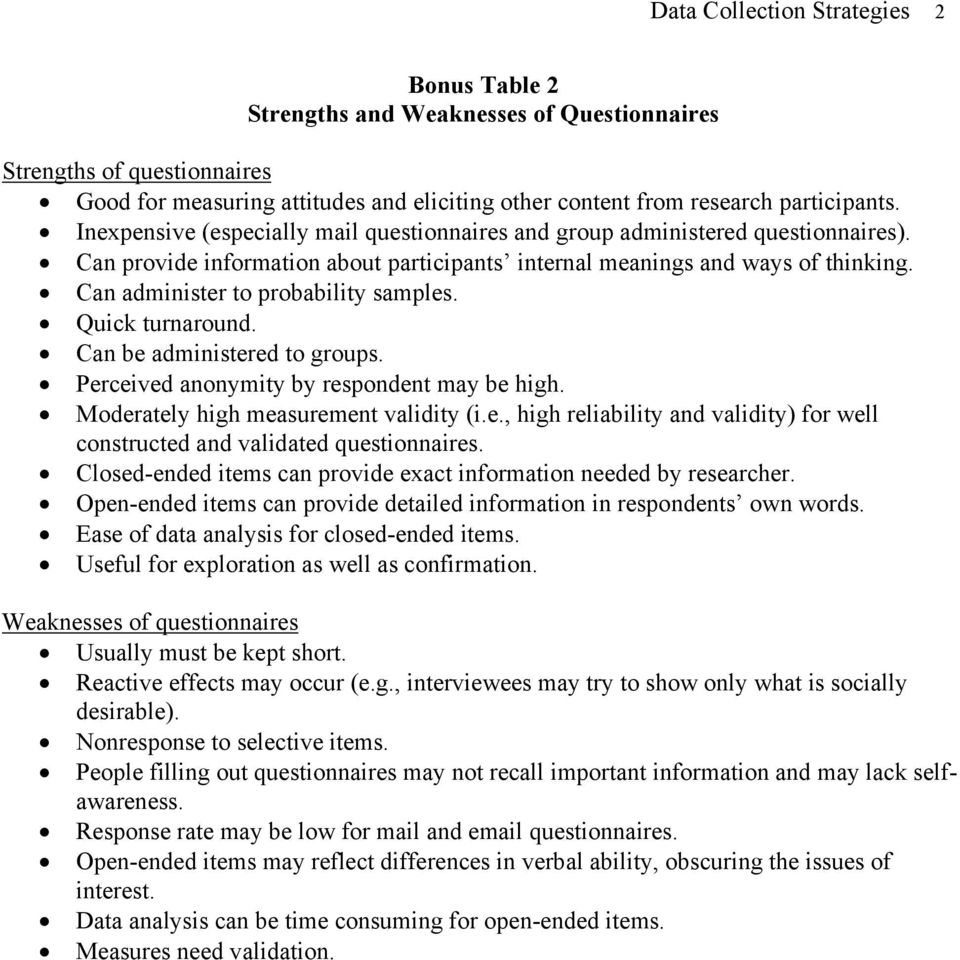
2 Data Collection Strategies 2 Bonus Table 2 Strengths and Weaknesses of Questionnaires Strengths of questionnaires Good for measuring attitudes and eliciting other content from research participants. Inexpensive (especially mail questionnaires and group administered questionnaires). Can provide information about participants internal meanings and ways of thinking. Can administer to probability samples. Quick turnaround. Can be administered to groups. Perceived anonymity by respondent may be high. Moderately high measurement validity (i.e., high reliability and validity) for well constructed and validated questionnaires. Closed-ended items can provide exact information needed by researcher. Open-ended items can provide detailed information in respondents own words. Ease of data analysis for closed-ended items. Useful for exploration as well as confirmation. Weaknesses of questionnaires Usually must be kept short. Reactive effects may occur (e.g., interviewees may try to show only what is socially desirable). Nonresponse to selective items. People filling out questionnaires may not recall important information and may lack selfawareness. Response rate may be low for mail and questionnaires. Open-ended items may reflect differences in verbal ability, obscuring the issues of interest. Data analysis can be time consuming for open-ended items. Measures need validation.
3 Data Collection Strategies 3 Bonus Table 3 Strengths and Weaknesses of Interviews Strengths of interviews Good for measuring attitudes and most other content of interest. Allows probing and posing of follow-up questions by the interviewer. Can provide in-depth information. Can provide information about participants internal meanings and ways of thinking. Closed-ended interviews provide exact information needed by researcher. Telephone and interviews provide very quick turnaround. Moderately high measurement validity (i.e., high reliability and validity) for well constructed and tested interview protocols. Can use with probability samples. Relatively high response rates are often attainable. Useful for exploration as well as confirmation. Weaknesses of interviews In-person interviews usually are expensive and time consuming. Reactive effects (e.g., interviewees may try to show only what is socially desirable). Investigator effects may occur (e.g., untrained interviewers may distort data because of personal biases and poor interviewing skills). Interviewees may not recall important information and may lack self-awareness. Perceived anonymity by respondents may be low. Data analysis can be time consuming for open-ended items. Measures need validation.

4 Data Collection Strategies 4 Bonus Table 4 Strengths and Weaknesses of Focus Groups Strengths of focus groups Useful for exploring ideas and concepts. Provides window into participants internal thinking. Can obtain in-depth information. Can examine how participants react to each other. Allows probing. Most content can be tapped. Allows quick turnaround. Weaknesses of focus groups Sometimes expensive. May be difficult to find a focus group moderator with good facilitative and rapport building skills. Reactive and investigator effects may occur if participants feel they are being watched or studied. May be dominated by one or two participants. Difficult to generalize results if small, unrepresentative samples of participants are used. May include large amount of extra or unnecessary information. Measurement validity may be low. Usually should not be the only data collection methods used in a study. Data analysis can be time consuming because of the open-ended nature of the data.

5 Data Collection Strategies 5 Bonus Table 5 Strengths and Weaknesses of Observational Data Strengths of observational data Allows one to directly see what people do without having to rely on what they say they do. Provides firsthand experience, especially if the observer participates in activities. Can provide relatively objective measurement of behavior (especially for standardized observations). Observer can determine what does not occur. Observer may see things that escape the awareness of people in the setting. Excellent way to discover what is occurring in a setting. Helps in understanding importance of contextual factors. Can be used with participants with weak verbal skills. May provide information on things people would otherwise be unwilling to talk about. Observer may move beyond selective perceptions of people in the setting. Good for description. Provides moderate degree of realism (when done outside of the laboratory). Weaknesses of observational data Reasons for observed behavior may be unclear. Reactive effects may occur when respondents know they are being observed (e.g., people being observed may behave in atypical ways). Investigator effects (e.g., personal biases and selective perception of observers) Observer may go native (i.e., over-identifying with the group being studied). Sampling of observed people and settings may be limited. Cannot observe large or dispersed populations. Some settings and content of interest cannot be observed. Collection of unimportant material may be moderately high. More expensive to conduct than questionnaires and tests. Data analysis can be time consuming.

6 Data Collection Strategies 6 Bonus Table 6 Strengths and Weaknesses of Secondary/Already Existing Data Strengths of documents and physical data: Can provide insight into what people think and what they do. Unobtrusive, making reactive and investigator effects very unlikely. Can be collected for time periods occurring in the past (e.g., historical data). Provides useful background and historical data on people, groups, and organizations. Useful for corroboration. Grounded in local setting. Useful for exploration. Strengths of archived research data: Archived research data are available on a wide variety of topics. Inexpensive. Often are reliable and valid (high measurement validity). Can study trends. Ease of data analysis. Often based on high quality or large probability samples. Weaknesses of documents and physical data: May be incomplete. May be representative only of one perspective. Access to some types of content is limited. May not provide insight into participants personal thinking for physical data. May not apply to general populations. Weaknesses of archived research data: May not be available for the population of interest to you. May not be available for the research questions of interest to you. Data may be dated. Open-ended or qualitative data usually not available. Many of the most important findings have already been mined from the data.

EVALUATION METHODS TIP SHEET
 EVALUATION METHODS TIP SHEET QUANTITATIVE METHODS: Quantitative data collection methods consist of counts or frequencies, rates or percentages, or other statistics that document the actual existence or
9. Data-Collection Tools
 9. Data-Collection Tools Depending on the nature of the information to be gathered, different instruments are used to conduct the assessment: forms for gathering data from official sources such as police
Software Engineering. Requirements elicitation - Facts finding. Software Engineering Requirements Elicitation Slide 1
 Software Engineering Requirements elicitation - Facts finding Software Engineering Requirements Elicitation Slide 1 Chapter Objectives To introduce software the Requirements Engineering Process To describe
LECTURE 3 REQUIREMENTS GATHERING
 LECTURE 3 REQUIREMENTS GATHERING Key Definitions The As-Is system is the current system and may or may not be computerized The To-Be system is the new system that is based on updated requirements The System
2. Choose the location and format for focus groups or interviews
 Steps for Conducting Focus Groups or Individual In-depth Interviews 1. Plan the study Plan your study with the input of your strategy team, stakeholders, and research experts so that collaboratively you
Chapter 6 Multiple Choice Questions (The answers are provided after the last question.)
 Chapter 6 Multiple Choice Questions (The answers are provided after the last question.) 1. According to your text, how many points should a rating scale have? a. Five b. Four c. Ten d. Somewhere from 4
Survey Research. Classifying surveys on the basis of their scope and their focus gives four categories:
 Survey Research Types of Surveys Surveys are classified according to their focus and scope (census and sample surveys) or according to the time frame for data collection (longitudinal and cross-sectional
Semi-structured interviews
 Semi-structured interviews 3 rd December 2014 Prof. Edwin van Teijlingen BU Graduate School Aim of this session: introduce various ways of conducting interviews with qualitative methods; outline strength
 Research and Research Methods What we will cover: Formal vs. Informal Qualitative vs. Quantitative Primary vs. Secondary Focus Groups In-Depth Interviews Intercept Interviews 1 Research and Research Methods
How do I: Conduct Market Research?
 How do I: Conduct Market Research? Think the business needs some market research and not sure how to go about it? This guide will help you quickly answer these, understand the task ahead, its key elements
Usability Evaluation with Users CMPT 281
 Usability Evaluation with Users CMPT 281 Outline Usability review Observational methods Interview methods Questionnaire methods Usability ISO 9241-11: The extent to which a product can be used by specified
DATA COLLECTION TECHNIQUES
 DATA COLLECTION TECHNIQUES Kongmany Chaleunvong GFMER - WHO - UNFPA - LAO PDR Training Course in Reproductive Health Research Vientiane, 25 September 2009 1 OBJECTIVES At the end of this session you should
STRATEGIES FOR GROWTH SM
 STRATEGIES FOR GROWTH SM "CONSULTANTS TO THE SERVICES INDUSTRY" Comparative Advantages/ Disadvantages of Phone, Mail & E-Mail/Web-Based Surveys Prepared by: William K. Pollock President Strategies For
Customer Market Research Primer
 Customer Market Research Primer This factsheet acts as a primer to the basic concepts of Market Research and how a business or individual could do their own research. Market research is an effective way
How to Conduct Ethnographic Research
 The Qualitative Report Volume 16 Number 2 March 2011 567-573 http://www.nova.edu/ssss/qr/qr16-2/sangasubanat.pdf How to Conduct Ethnographic Research Nisaratana Sangasubana Nova Southeastern University,
MARKETING RESEARCH AND MARKET INTELLIGENCE (MRM711S) FEEDBACK TUTORIAL LETTER SEMESTER `1 OF 2016. Dear Student
 MARKETING RESEARCH AND MARKET INTELLIGENCE (MRM711S) FEEDBACK TUTORIAL LETTER SEMESTER `1 OF 2016 Dear Student Assignment 1 has been marked and this serves as feedback on the assignment. I have included
How do we know what we know?
 Research Methods Family in the News Can you identify some main debates (controversies) for your topic? Do you think the authors positions in these debates (i.e., their values) affect their presentation
CHAPTER 3 RESEARCH METHODOLOGY
 CHAPTER 3 RESEARCH METHODOLOGY 3.1 Introduction This study is survey research in order to study marketing strategies for sustainable cultural tourism in Nakhon Si Thammarat. In case of primary data were
AN OVERVIEW OF QUANTITATIVE AND QUALITATIVE DATA COLLECTION METHODS 5. DATA COLLECTION METHODS: SOME TIPS AND COMPARISONS
 Section III AN OVERVIEW OF QUANTITATIVE AND QUALITATIVE DATA COLLECTION METHODS 5. DATA COLLECTION METHODS: SOME TIPS AND COMPARISONS In the previous chapter, we identified two broad types of evaluation
Manual on Training Needs Assessment
 Project on Improvement of Local Administration in Cambodia What is Training Needs Assessment? Five Steps of Training Needs Assessment Step 1: Identify Problem and Needs Step 2: Determine Design of Needs
Self-administered Questionnaire Survey
 Primary methods of survey data collection Self-administered questionnaire (SAQ) Mail Face-to-face interview Telephone interview Self-administered Questionnaire Survey 1 Steps are: a. Mail distribution
Avoiding Bias in the Research Interview
 Avoiding Bias in the Research Interview Sonja I. Ziniel, MA Ph.D. Clinical Research Program, Children s Hospital Boston Department of Medicine, Harvard Medical School [email protected]
MODULE - I Foundations of Psychology
 Methods of 2 METHODS OF PSYCHOLOGY In the last lesson we noted that the interpretation of a psychological phenomenon by a psychologist may differ from that of a novice. A psychologist follows a systematic
Research on consumer attitude and effectiveness of advertising in computer and video games
 Research on consumer attitude and effectiveness of advertising in computer and video games (Summary) Zhana Belcheva Master program Advertising Management, New Bulgarian University, Bulgaria In a world
Autonomy etalk White Paper. Optimizing Customer Feedback: Executing a Valuable Post-Call Survey
 Autonomy etalk White Paper Optimizing Customer Feedback: Executing a Valuable Post-Call Survey Proprietary and Confidential to Autonomy etalk. Optimizing Customer Feedback: Executing a Valuable Post-Call
Good Practices in Survey Design Step-by-Step
 From: Measuring Regulatory Performance A Practitioner's Guide to Perception Surveys Access the complete publication at: http://dx.doi.org/10.1787/9789264167179-en Good Practices in Survey Design Step-by-Step
Using qualitative research to explore women s responses
 Using qualitative research to explore women s responses Towards meaningful assistance - how evidence from qualitative studies can help to meet survivors needs Possible questions Why do survivors of SV
Client Satisfaction Quality Improvement Tool and Sample Surveys
 Client Satisfaction Quality Improvement Tool and Sample Surveys August 2011 Prepared For California Department of Public Health, Office of Family Planning Family PACT Technical Assistance and Training
14. Qualitative Field Research
 196 Qualitative Field Research 14. Qualitative Field Research Qualitative research is the method of choice when the research question requires an understanding of processes, events and relationships in
COVENANT UNIVERSITY NIGERIA TUTORIAL KIT OMEGA SEMESTER PROGRAMME: MASS COMMUNICATION
 COVENANT UNIVERSITY NIGERIA TUTORIAL KIT OMEGA SEMESTER PROGRAMME: MASS COMMUNICATION COURSE: PRE 325 DISCLAIMER The contents of this document are intended for practice and leaning purposes at the undergraduate
PERFORMANCE MONITORING & EVALUATION TIPS CONDUCTING FOCUS GROUP INTERVIEWS
 NUMBER 10 2011 Printing PERFORMANCE MONITORING & EVALUATION TIPS CONDUCTING FOCUS GROUP INTERVIEWS ABOUT TIPS These TIPS provide practical advice and suggestions to USAID managers on issues related to
www.doncaster.gov.uk
 Market Research It is essential that market research is undertaken to establish there is a need for childcare within a specified area and have knowledge of the local community that a business wishes to
Plan for Executing Senior Manager Focus Groups Regarding the Independent Review of the Defense Civilian Intelligence Personnel System
 Plan for Executing Senior Manager Focus Groups Regarding the Independent Review of the Defense Civilian Intelligence Personnel System February 18, 2010 Background The National Academy of Public Administration
TIPSHEET IMPROVING RESPONSE SCALES
 TIPSHEET IMPROVING RESPONSE SCALES As important as it is to have good question wording in a survey, it is equally important to have well constructed and reliable question response options. Researchers
Improving Government Websites and Surveys With Usability Testing and User Experience Research
 Introduction Improving Government Websites and Surveys With Usability Testing and User Experience Research Jennifer Romano Bergstrom, Jonathan Strohl Fors Marsh Group 1010 N Glebe Rd., Suite 510, Arlington,
Determining Students Language Needs in a Tertiary Setting
 Determining Students Language Needs in a Tertiary Setting By Victoria Chan (Hong Kong) This article reports on part of the findings of a large-scale investigation into the English language needs of students
Interview studies. 1 Introduction... 1. 2 Applications of interview study designs... 2. 3 Outline of the design... 3
 Interview studies Contents 1 Introduction... 1 2 Applications of interview study designs... 2 3 Outline of the design... 3 4 Strengths and weaknesses of interview study designs... 6 5 References... 7 1
Chapter 2: Research Methodology
 Chapter 2: Research Methodology 1. Type of Research 2. Sources of Data 3. Instruments for Data Collection 4. Research Methods 5. Sampling 6. Limitations of the Study 6 Chapter 2: Research Methodology Research
Question Specifications for the Cognitive Test Protocol
 Question Specifications for the Cognitive Test Protocol Core Questions These are the 6 disability questions to be tested in the interview. All of the other questions in the cognitive test protocol are
Qualitative Research Methods for Evaluating Computer Information Systems
 2 Qualitative Research Methods for Evaluating Computer Information Systems Bonnie Kaplan and Joseph A. Maxwell Introduction Qualitative research methods are being used increasingly in evaluation studies,
Running surveys and consultations
 Running surveys and consultations Susannah Wintersgill, Public Affairs Annette Cunningham & Rob Markham, Estates Tuesday 9 June 2015 Contents Five key stages of planning a survey Questionnaire design:
Calder LaTour Inc. Marketing Research Services
 Calder LaTour Inc. Marketing Research Services 2525 GROSS POINT ROAD EVANSTON, ILLINOIS 60201-4928 USA PHONE: 847.864.3400 TOLL FREE: 800.475.1155 FAX: 847.864.9512 email: [email protected] An Introduction
CHAPTER III METHODOLOGY. The purpose of this study was to describe which aspects of course design
 CHAPTER III METHODOLOGY The purpose of this study was to describe which aspects of course design and/or instruction are more effective and successful in the online environment than in the face-to-face
Chapter 7 Conducting Interviews and Investigations
 Chapter 7 Conducting Interviews and Investigations Chapter Outline 1. Introduction 2. Planning the Interview 3. Interviewing Skills 4. Interviewing Clients 5. Interviewing Witnesses 6. Planning and Conducting
Trier 4. Marketing Research MANAGING MARKETING INFORMATION TO GAIN CUSTOMER INSIGHTS
 Trier 4 Marketing Research MANAGING MARKETING INFORMATION TO GAIN CUSTOMER INSIGHTS Marketing Information and Customer Insights Fresh and deep insights into customers needs and wants Difficult to obtain
Chapter 8: Survey Research
 Chapter Outlines for: Frey, L., Botan, C., & Kreps, G. (1999). Investigating communication: An introduction to research methods. (2nd ed.) Boston: Allyn & Bacon. Chapter 8: Survey Research I. Introduction
EVALUATION REPORT Management & Leadership Development Program Pilot 10/00
 This report presents results from an evaluation MLDP is a useful program that should be of the Food Safety and Inspection Service s continued with the condition that certain (FSIS) Management and Leadership
Criteria for Recruitment as Assistant Professor of Accounting in Colleges and Universities
 Criteria for Recruitment as Assistant Professor of Accounting in Colleges and Universities By: Venkat M. Iyer, and Dixie Clark Iyer, V.M. and D. Clark. 1998. Criteria for Recruitment as Assistant Professors
Marketing Research Core Body Knowledge (MRCBOK ) Learning Objectives
 Fulfilling the core market research educational needs of individuals and companies worldwide Presented through a unique partnership between How to Contact Us: Phone: +1-706-542-3537 or 1-800-811-6640 (USA
One-On-One Interviews: A Qualitative Assessment Approach
 One-On-One Interviews: A Qualitative Assessment Approach by Cristin Bates (Wellesley College 08) Claire Droste (Wellesley College 10) Lee Cuba (Wellesley College) Joseph Swingle (Wellesley College) TABLE
Marketing Research for Entrepreneurs and Small
 MT 9013 Human Resource Development Marketing Research for Entrepreneurs and Small Business Managers by David J. Snepenger, Montana State University College of Business In a previous MontGuide, "Basics
Comparison of Various Requirements Elicitation Techniques
 Comparison of Various Requirements Elicitation Techniques Masooma Yousuf Department of Computer Science, Baba Ghulam Shah Badshah University, Rajouri, J&K, India M. Asger School of Mathematical Sciences
Capstone Suggestions for Survey Development for Research Purposes
 Capstone Suggestions for Survey Development for Research Purposes 1. Begin by listing the questions you would like to answer with the survey. These questions will be relatively broad and should be based
Qualitative methods for effectiveness evaluation: When numbers are not enough
 Chapter 7 Qualitative methods for effectiveness evaluation: When numbers are not enough 7.1 Introduction 7.2 Methods of collecting qualitative information 7.2.1 Interviews and focus groups 7.2.2 Questionnaires
Section 4: Key Informant Interviews
 UCLA CENTER FOR HEALTH POLICY RESEARCH Section 4: Key Informant Interviews Purpose Key informant interviews are qualitative in-depth interviews with people who know what is going on in the community. The
Qualifications, Roles and Responsibilities of the Implementation Team. The Implementation Team should include the following members:
 Qualifications, Roles and Responsibilities of the Implementation Team Skilled personnel who are well trained and motivated can strongly influence the success of your field operation. The implementation
Social Survey Methods and Data Collection
 Social Survey Social Survey Methods and Data Collection Zarina Ali June 2007 Concept of Survey & Social Survey A "survey" can be anything from a short paper- and-pencil feedback form to an intensive one-on
Collecting primary data
 CHAPTER 8 CHAPTER OBJECTIVES After studying this chapter you should: be able to define primary data and their role in research apply a variety of techniques for collecting primary data understand and apply
ISPA School Psych Skills Model
 ISPA School Psych Skills Model ISPA s (training) goals and standards in the format of the CanMeds model 7 roles / competency areas 1. Expert Cognition and Learning Social and Emotional Development Individual
Class 2: Qualitative Research Methods Urban and Regional Planning 298A San Jose State University
 Class 2: Qualitative Research Methods Urban and Regional Planning 298A San Jose State University Why qualitative methods? Not everything that can be counted counts, and not everything that counts can be
Strategic Communications Audits
 Strategic Communications Audits Prepared for the Communications Consortium Media Center Julia Coffman October 2004 Nonprofit organizations are now continuously being challenged to be more strategic in
METHODOLOGIES FOR STUDIES OF PROGRAM VISUALIZATION
 Full paper ABSTRACT METHODOLOGIES FOR STUDIES OF PROGRAM VISUALIZATION Niko Myller & Roman Bednarik Department of Computer Science University of Joensuu PO Box 111, FI-80101 [email protected]
How to gather and evaluate information
 09 May 2016 How to gather and evaluate information Chartered Institute of Internal Auditors Information is central to the role of an internal auditor. Gathering and evaluating information is the basic
Introduction... 3. Qualitative Data Collection Methods... 7 In depth interviews... 7 Observation methods... 8 Document review... 8 Focus groups...
 1 Table of Contents Introduction... 3 Quantitative Data Collection Methods... 4 Interviews... 4 Telephone interviews... 5 Face to face interviews... 5 Computer Assisted Personal Interviewing (CAPI)...
THINKING IT THROUGH: TEACHING AND LEARNING IN THE KINDERGARTEN CLASSROOM
 THINKING IT THROUGH: TEACHING AND LEARNING IN THE KINDERGARTEN CLASSROOM This position statement provides educators of young children with important assessment guidelines. It also highlights some of the
Qualitative Interview Design: A Practical Guide for Novice Investigators
 The Qualitative Report Volume 15 Number 3 May 2010 754-760 http://www.nova.edu/ssss/qr/qr15-3/qid.pdf Qualitative Interview Design: A Practical Guide for Novice Investigators Daniel W. Turner, III Nova
Identifying Risk Factors for Suicide and Barriers to Behavioral Health Care in Military Populations Using Focus Groups
 Identifying Risk Factors for Suicide and Barriers to Behavioral Health Care in Military Populations Using Focus Groups Christine Lagana-Riordan, PhD, LCSW-C Shelley Schmissrauter, MPH Alexis Bender, PhD
FOCUS GROUPS A GUIDE TO LEARNING THE NEEDS OF THOSE WE SERVE
 FOCUS GROUPS A GUIDE TO LEARNING THE NEEDS OF THOSE WE SERVE OFFICE OF QUALITY IMPROVEMENT Focus Groups A Guide to Learning the Needs of Those We Serve The purpose of this document is to provide an overview
Keywords personal interview; interviewer bias; interviewer effects; data quality; response bias
 Author: James K. Doyle Associate Professor of Psychology Department of Social Science and Policy Studies Worcester Polytechnic Institute 100 Institute Rd. Worcester, MA 01609 [email protected] Keywords personal
Tips & Tools #17: Analyzing Qualitative Data
 Tips & Tools #17: Analyzing Qualitative Data Introduction Qualitative evaluation methods yield narrative data often describing experiences, perceptions, or opinions from key informant interviews, open
Data Collection and Sampling OPRE 6301
 Data Collection and Sampling OPRE 6301 Recall... Statistics is a tool for converting data into information: Statistics Data Information But where then does data come from? How is it gathered? How do we
Qualitative data acquisition methods (e.g. Interviews and observations) -.
 Qualitative data acquisition methods (e.g. Interviews and observations) -. Qualitative data acquisition methods (e.g. Interviews and observations) ( version 0.9, 1/4/05 ) Code: data-quali Daniel K. Schneider,
Evaluating Training. Debra Wilcox Johnson Johnson & Johnson Consulting
 Debra Wilcox & Consulting Learning new behavior new or enhanced skills is the most powerful outcome of training. Behavioral change is the most difficult outcome to achieve, but may be the most important.
Partnership Satisfaction & Impact Survey
 Partnership Satisfaction & Impact Survey Page 1 of TABLE OF CONTENTS Contents I INTRODUCTION... 3 II SATISFACTION SURVEY... 4 II.1 What?... 4 II.1.1 Definition... 4 II.1.2 Satisfaction survey in Practice...
Lean UX. Best practices for integrating user insights into the app development process. Best Practices Copyright 2015 UXprobe bvba
 Lean UX Best practices for integrating user insights into the app development process Best Practices Copyright 2015 UXprobe bvba Table of contents Introduction.... 3 1. Ideation phase... 4 1.1. Task Analysis...
Employee Surveys as a Management Tool. Dr. Mark Ellickson Opinion Research Specialists, LLC
 Employee Surveys as a Management Tool Dr. Mark Ellickson Opinion Research Specialists, LLC Employee Surveys are Used to Improve Organizational Effectiveness Key Indicators Job Satisfaction & Commitment