
ASIO Report to Parliament
|
|
|
- Roland Dickerson
- 10 years ago
- Views:
Transcription
1

2 VISION The intelligence edge for a secure Australia MISSION To identify and investigate threats to security and provide advice to protect Australia, its people and its interests VALUES Excellence Producing high-quality, relevant, timely advice Displaying strong leadership and professionalism Improving through innovation and learning Integrity Being ethical and working without bias Maintaining the confidentiality and security of our work Respecting others and valuing diversity Respect We show respect in our dealings with others Accountability Being responsible for what we do and for our outcomes Being accountable to the Australian community through the government and the parliament Cooperation Building a common sense of purpose and mutual support Using appropriate communication in all our relationships Fostering and maintaining productive partnerships

3
4 ISSN Commonwealth of Australia (Australian Security Intelligence Organisation) 2014 All material presented in this publication is provided under a Creative Commons (CC) BY Attribution 3.0 Australia Licence ( by/3.0/au/deed.en). The details of the relevant licence conditions are available on the Creative Commons website ( as is the full legal code for the CC BY Attribution 3.0 Australia Licence ( licenses/by/3.0/legalcode). Commonwealth Coat of Arms The Commonwealth Coat of Arms is used in accordance with Commonwealth Coat of Arms: information and guidelines, November 2012, provided by the Department of the Prime Minister and Cabinet ( guidelines/docs/ccoa_guidelines.pdf, viewed 9 May 2013) ii
5 iii
6 iv

7 Table of Contents Director-General s review The year at a glance Guide to the report ASIO s role and functions Organisational structure vii xiii xiv xv xv Par t 1 The security environment and outlook...1 Terrorism 2 Espionage and clandestine foreign interference 5 Communal violence and violent protest 8 Border integrity 10 Par t 2 Program performance...11 Outcome 1 12 Security intelligence analysis and advice 13 Protective security advice 25 Security intelligence investigations and capabilities 28 Foreign intelligence collection in Australia 34 Part 3 Outcomes and highlights...35 Par t 4 ASIO and accountability...39 Attorney-General 40 Parliamentary oversight 41 Independent oversight 44 Legal assurance and capability protection 50 Internal audits and fraud control 56 Security in ASIO 57 v
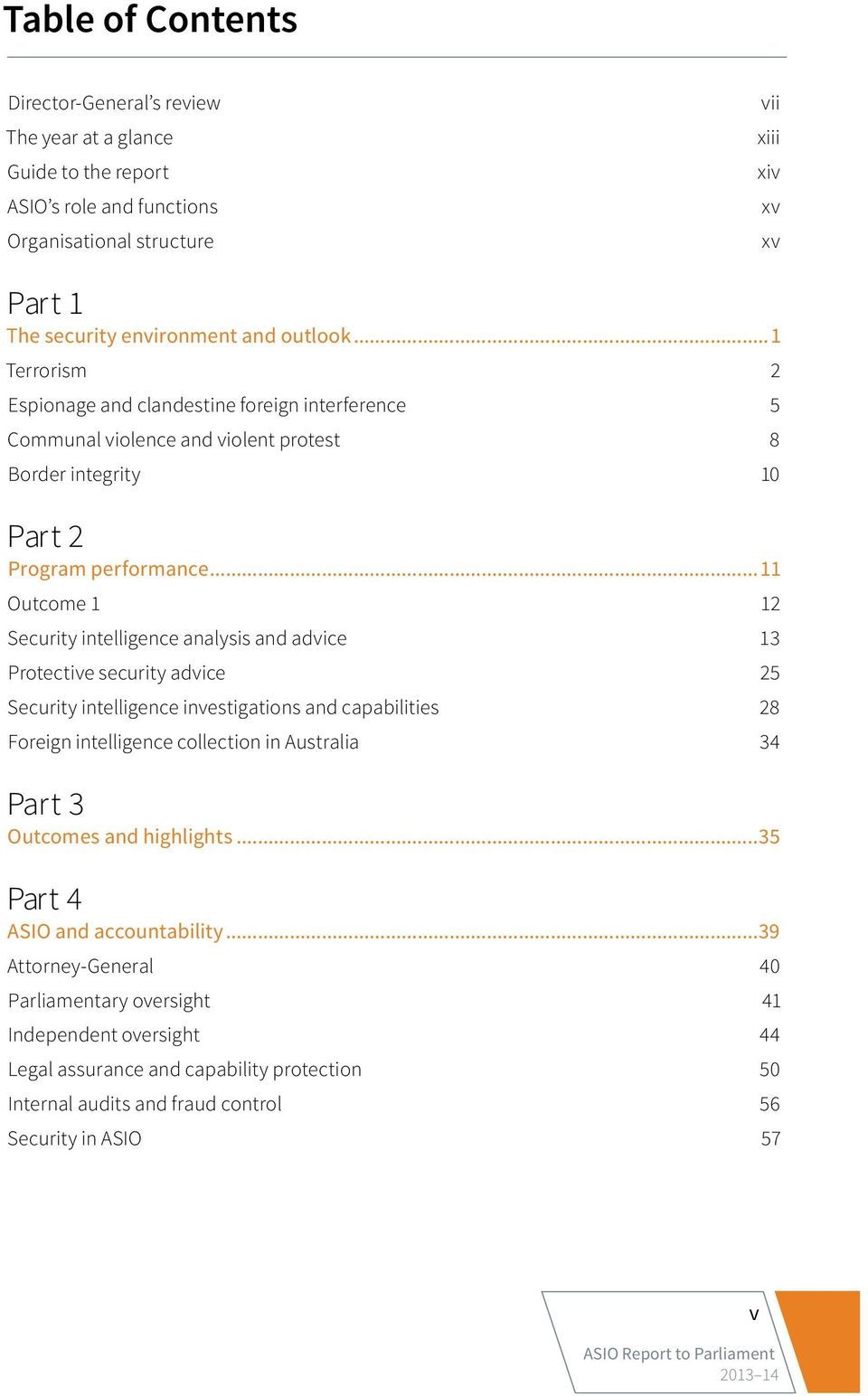
8 Par t 5 Corporate management...59 Corporate strategy and governance 60 Outreach 67 People 69 Property 78 Financial services 79 Information and technology services 80 Part 6 Financial statements...81 Par t 7 Appendices and indices Appendix A 134 Appendix B 135 Appendix C 136 Appendix D 137 Appendix E 139 Appendix F 141 Appendix G 142 Compliance index 144 Additional ASIO reporting requirements (under the ASIO Act) 148 Glossary 149 Index 151 vi
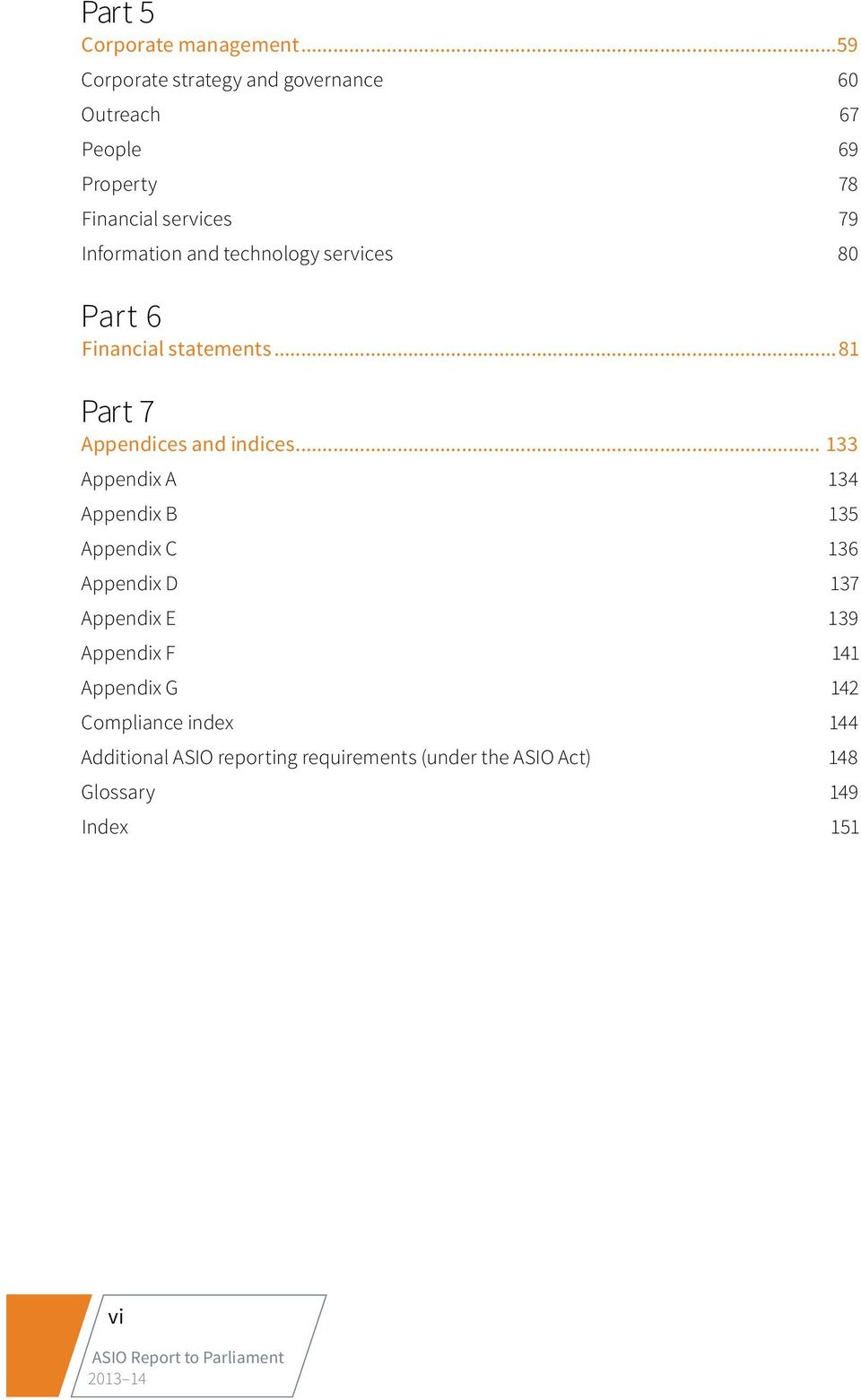
9 Director-General s review ASIO s mission is to identify and investigate threats to security and provide advice to protect Australia, its people and its interests in Australia and overseas. The security environment Australia currently faces a concerning, challenging and volatile security environment. This is ASIO s assessment based on intelligence ASIO collects, intelligence ASIO receives from others, and all other available information. It takes into account a spread of international tensions, an increase in the range and intensity of threats, and the difficulties Australia faces in responding to them. Australia is subject to significant and increasing threats simultaneously from both terrorism and clandestine or deceptive activity by foreign powers, occurring against a backdrop of significant geopolitical uncertainty. Terrorism The increased terrorist threat has a range of drivers, but chief among these is the Syrian conflict, which has now spread to Iraq. It has attracted would-be fighters and terrorists from around the world and provided an environment in which extremism, in its most abhorrent form, has both spread and flourished. A substantial number of Australians are in Syria and Iraq training and fighting with anti-government groups. Most of these individuals have gravitated to the most extreme groups, Jabhat al-nusra and Islamic State of Iraq and the Levant. At the end of the reporting period, ASIO was aware of 14 Australians who had died in Syria and Iraq during this conflict. This included the first known Australian suicide bomber in Syria, in September (In July 2014, shortly after the reporting period, another Australian conducted a suicide bombing near a Shia mosque in Iraq.) These events demonstrate one of ASIO s primary concerns with Australians travelling overseas to train and fight with extremist groups that these individuals will undertake activities overseas causing death and injury. vii
10 ASIO is also concerned that individuals in Australia will be inspired by the conflict in Syria to commit terrorism here. Returnees from the conflict are likely to be radicalised and to have the knowledge, experience and networks to conduct a mass casualty attack in Australia or other Western countries. They are also likely to have increased influence over vulnerable youth. We have already seen returnees from Syria and Iraq undertake attacks in Europe. A significant proportion of those returning to Australia from fighting or training in Afghanistan in the early 2000s became involved in terrorist planning here, and recruited and encouraged others who had not travelled to join them in their plots. We are concerned that history will repeat itself in Australia. It could also affect us overseas. The flood of foreign fighters into Syria comes from many parts of the world, including many from our region. The impact of this on the threat to Australian interests overseas is to increase the potential for terrorist violence from those returning to their home countries or those inspired by events in the Middle-East. Any such violence could be indiscriminate or, in some places, could be specifically directed at Australians or Australian interests. Events in Syria and Iraq have also contributed to increased tensions between communities in Australia with links to those countries. This has led to occasional instances of communal violence. ASIO has worked in cooperation with communities and with other Australian Government agencies to try to mitigate these tensions. It is important to recognise that Syria is only one part of the picture. Terrorist threats emanating from elsewhere persist, from the Middle-East to Africa to South and South-East Asia. Australia must remain alert to moves by organisations such as al-qa ida and its many franchises to undertake attacks in the West or against Western interests, including Australian interests, in other parts of the world. Other jihadist organisations not affiliated with al-qa ida but sharing its willingness to use violence to achieve their objectives are also active and have links into Australia. And politically motivated violence from sources other than jihadists also persists, from time to time involving Australians or touching on Australia s interests. To protect Australia from these threats, ASIO has worked closely with law enforcement, intelligence and other partners to identify and disrupt extremist activity in Australia and to discourage and prevent Australians from travelling overseas to train and fight with extremist groups. The reporting period saw a substantial increase in the number of adverse security assessments ASIO issued in relation to Australian passports; this increase is almost entirely attributable to the Syrian conflict. ASIO works closely with the community in addressing the issue of home-grown terrorism. ASIO also contributed to the government s countering violent extremism strategy by identifying and diverting people at risk of violent extremism. viii
11 Espionage and clandestine foreign interference ASIO s understanding of the threat from clandestine activity by foreign powers directed against Australia has increased over the past year, and the situation here is worse than previously thought. Harmful acts of clandestine or deceptive foreign activity against Australian interests continued throughout the reporting period. These utilised both traditional methods of spying and foreign interference, and cyber means. The scale and complexity of the challenge posed by this activity demand sustained attention from both government and industry. The compromise of sensitive Australian Government and business information has adverse consequences for Australia s national security. ASIO worked closely with business, government and key intelligence partners to counter the threat posed by these insidious attacks. Appropriate and effective disclosure laws are important to ensure that improper conduct within government including within intelligence agencies is investigated and dealt with. ASIO welcomes the enactment of the Public Interest Disclosure Act 2013, which came into effect in January 2014 and provides appropriate protection against the unauthorised disclosure of intelligence information. But continued unauthorised disclosures of sensitive information during the reporting period have highlighted the threat posed by self-motivated malicious insiders. Governments are entitled to hold secrets and individuals with privileged access to those secrets have obligations to protect them. In addition to its investigative response to unauthorised disclosures, ASIO works with partners to identify and address personnel security policy issues arising from such events. ix

12 Outlook The challenges Australia faces from terrorism and clandestine foreign activity will persist. The impact of the conflicts in Syria and Iraq will be felt in Australia for many years to come, including through instances of communal violence and in the potential for Australians including lone actors inspired by the conflicts to engage in terrorism here or against Australia s interests overseas. Foreign clandestine targeting of Australian government and business information will also persist, as will the threat from the actions of malicious insiders. Australia s defence will be multidimensional and will include raising awareness of the consequences for individuals who betray the trust associated with access to highly sensitive government information. A security service in a democracy The role of a security intelligence organisation is to identify and assess possible threats to national security or to the lives and safety of Australians in sufficient time and with sufficient accuracy to prevent such threats eventuating. Our work is predictive and advisory an exercise in informing risk management and enabling government to take preventative actions. We also provide assessments, drawing on our understanding of the security environment, that help inform decision making, policy setting and the taking of action by others to ensure they are based on the best possible foundation of knowledge. ASIO necessarily conducts most of its work in the background, away from public attention. However, as a result of developments in the security environment during the reporting period, ASIO s work has been subject to particularly sustained public commentary and speculation. ASIO has increased its public engagement to match the current level of public interest in its activities. ASIO s public commentary aims to explain the Organisation s role and to clarify misconceptions about the Organisation s activities and its legislated powers. That said, it is not appropriate for ASIO to comment on each and every item of public speculation or sometimes fanciful conspiracy theory relating to its work. ASIO adheres to the rule of law and operates under not just a strict legislative regime, but also comprehensive oversight and accountability regimes. It engages transparently with those oversight and accountability mechanisms established to provide public reassurance of the legality and propriety of ASIO s actions. ASIO fulfils an essential role in our system of government, helping protect Australians and Australian interests from attempts to do us harm or cause us disadvantage. In doing so, it contributes to a safe and secure environment in which the nation, individuals and our democratic institutions can operate freely and prosper. Such a security service, operating under not just a strict legislative regime but also comprehensive oversight and accountability frameworks, helps us maintain a society in which, as Justice Hope said, public safety and individual liberty sustain each other. x
13 Funding and financial performance Over the last several years, ASIO has absorbed a number of additional functions and activities, while funding has remained steady. To accommodate this, ASIO has undertaken a range of efficiency measures including cessation or reduction of a number of security functions, an organisational restructure, a reduction in ASIO s overseas presence and a reduction in the number of Senior Executive Level and Executive Level staff in an effort to maximise the use of its appropriation. But the increased complexity and severity of security threats facing Australia, as well as their persistence into the medium and long-term, mean ASIO has now sought additional resourcing to provide a level of assurance to government that it can continue to respond adequately to these threats. In early August 2014 the Prime Minister, the Hon. Tony Abbott MP, announced additional funding for ASIO and other counter-terrorism agencies as part of the government s response to the increased terrorism threat facing Australia. The additional resources will increase intelligence officer, analyst and technical specialist numbers, strengthening the Organisation s human intelligence collection, technical collection, surveillance, investigation and assessment capabilities, as well as liaison with Australia s national security community and ASIO s counterpart security agencies overseas. While no amount of resourcing can provide the government with absolute certainty that all future terrorist attacks will be identified and prevented, the proposed additional resourcing will allow ASIO to build and sustain the capabilities required to give government a considerably greater level of assurance in relation to the long-term terrorism threat facing Australia. However, resourcing pressures will remain in relation to the Organisation s non-counter-terrorism focused areas. xi

14 Challenges to capability The complexity and diversity of threats faced led to a heightened operational tempo over the reporting period and increased demands on ASIO s capabilities. The demands were further compounded by the challenges of the increasingly complex technical environment in which ASIO operates, and of legislation that has not kept pace with significant technological change. The legislative framework under which ASIO operates was largely enacted more than 30 years ago; it is in the process of being modernised to maintain pace with the exponential increase in technological change since that time. Amendments such as streamlining ASIO s warrant-based intelligence collection powers, introducing a special intelligence operations scheme and requiring the retention of data by telecommunications providers are critical for ASIO to maintain its ability to provide an appropriate level of security assurance for Australia. The National Security Legislation Amendment Bill (No. 1) 2014, introduced into parliament outside the reporting period, proposes to put in place some of these mechanisms; it has been referred to the Parliamentary Joint Committee on Intelligence and Security for inquiry and report. With the support of the Parliament of Australia in giving ASIO the capabilities it needs, I believe ASIO will be well placed to protect Australia from current and future threats. I trust this report will provide some insight into the work of the nameless people of ASIO, who are to be commended for their conscientious professionalism in the support of national security and the safety and lives of their fellow Australians. This is my final annual report as Director-General of Security. I should like to express my gratitude and appreciation to the staff of ASIO, and to all others who have helped and supported me in my time with the Organisation. David Irvine Director-General of Security xii

15 The year at a glance Outcomes and achievements During the reporting period, ASIO: initiated and continued security investigations into terrorism, espionage, foreign interference, communal violence and border integrity threats issued adverse security assessments in relation to 45 passports (compared to 18 in ) completed the following security assessments: visa security assessments counter-terrorism security assessments personnel security assessments provided assistance and advice in relation to over 50 litigation matters increased the security awareness of the private sector through briefings, publicly accessible reports and bilateral meetings implemented an internal framework for current and former public officials to make a public interest disclosure regarding ASIO, consistent with the Public Interest Disclosure Act 2013 reviewed proposed draft legislation and subordinate rules and regulations to ensure a smooth transition from the previous accountability regime (under the Financial Management and Accountability Act 1997) to the new regime under the Public Governance, Performance and Accountability legislation completed 532 requests for ASIO records, requiring pages to be examined reviewed and redeveloped ASIO s employment relations framework implemented the ASIO Professional Conduct and Behaviour Strategy and reviewed the Organisation s Values and Code of Conduct to ensure ASIO maintains a professional, ethical and high-performing workforce. xiii

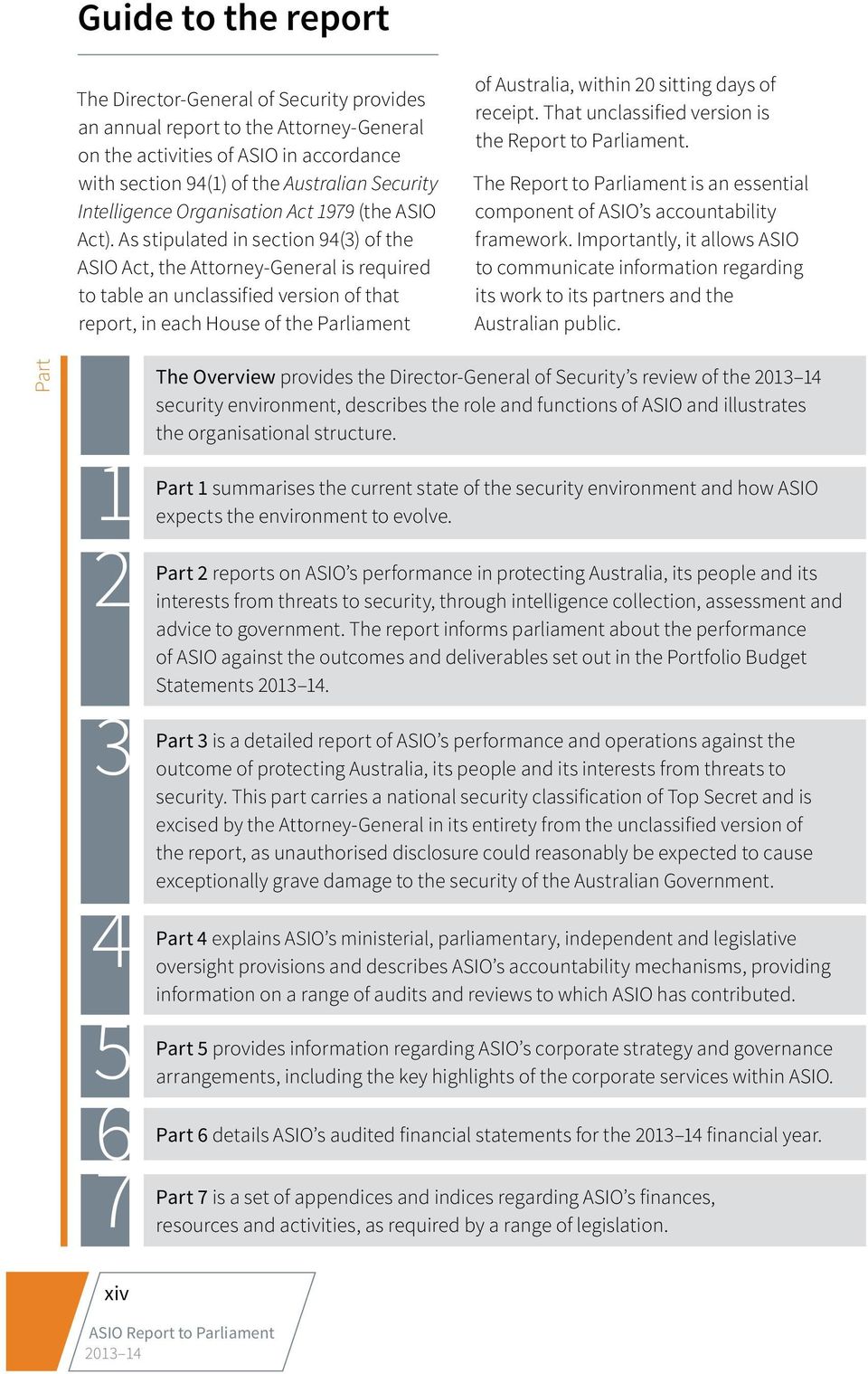
16 Guide to the report The Director-General of Security provides an annual report to the Attorney-General on the activities of ASIO in accordance with section 94(1) of the Australian Security Intelligence Organisation Act 1979 (the ASIO Act). As stipulated in section 94(3) of the ASIO Act, the Attorney-General is required to table an unclassified version of that report, in each House of the Parliament of Australia, within 20 sitting days of receipt. That unclassified version is the Report to Parliament. The Report to Parliament is an essential component of ASIO s accountability framework. Importantly, it allows ASIO to communicate information regarding its work to its partners and the Australian public. Part The Overview provides the Director-General of Security s review of the security environment, describes the role and functions of ASIO and illustrates the organisational structure Part 1 summarises the current state of the security environment and how ASIO expects the environment to evolve. Part 2 reports on ASIO s performance in protecting Australia, its people and its interests from threats to security, through intelligence collection, assessment and advice to government. The report informs parliament about the performance of ASIO against the outcomes and deliverables set out in the Portfolio Budget Statements. Part 3 is a detailed report of ASIO s performance and operations against the outcome of protecting Australia, its people and its interests from threats to security. This part carries a national security classification of Top Secret and is excised by the Attorney-General in its entirety from the unclassified version of the report, as unauthorised disclosure could reasonably be expected to cause exceptionally grave damage to the security of the Australian Government. Part 4 explains ASIO s ministerial, parliamentary, independent and legislative oversight provisions and describes ASIO s accountability mechanisms, providing information on a range of audits and reviews to which ASIO has contributed. Part 5 provides information regarding ASIO s corporate strategy and governance arrangements, including the key highlights of the corporate services within ASIO. Part 6 details ASIO s audited financial statements for the financial year. Part 7 is a set of appendices and indices regarding ASIO s finances, resources and activities, as required by a range of legislation. xiv
17 ASIO s role and functions ASIO is responsible for protecting Australia, its people and its interests from threats to security, through intelligence collection and assessment and by providing advice to ministers, Commonwealth and state authorities and other approved entities. The ASIO Act defines security as the protection of Australia and its citizens from: espionage sabotage politically motivated violence the promotion of communal violence attacks on Australia s defence systems acts of foreign interference serious threats to Australia s territorial and border integrity. The ASIO Act also defines security as including the carrying out of Australia s responsibilities to any foreign country in relation to the above matters. As authorised by the ASIO Act, ASIO is responsible for providing security assessments regarding: people seeking entry to Australia people seeking access to classified material and designated security-controlled areas. Section 17E of the ASIO Act also authorises ASIO to obtain foreign intelligence within Australia, under warrant, on matters related to national security, at the request of the Minister for Defence or the Minister for Foreign Affairs. In investigating and responding to threats to security, ASIO works closely with a range of stakeholders, including members of the Australian Intelligence Community, law enforcement agencies, government departments, industry and members of the public. This engagement includes providing protective security advice to industry and communicating and cooperating with relevant authorities of foreign countries, as approved by the Attorney-General. Organisational structure ASIO has maintained a structure of eight divisions, following a close to a quarter reduction in the Senior Executive Service during the previous reporting period. ASIO further refined its organisational structure in this reporting period by combining its operational and support functions into two groups under each Deputy Director-General. xv
18 ASIO s organisational structure as at 30 June 2014 David Irvine Director-General of Security Deputy Director-General internal audit office of the senior executive First Assistant Director-General Counter- Espionage and Interference information Technical Capabilities Corporate and security Assistant Director-General Counter- Espionage and Interference A Counter- Espionage and Interference B IT INFRASTRUCTURE SERVICES Business Information Services TELE- COMMUNICATIONS INTERCEPTION CAPABILITIES telecommunications and Information Operations internal security Resource Management Counter- Espionage and Interference C Information services technical OPERATIONS Human Resources CYBER Espionage Telecommunication sector security Property Data Exploitation Capabilities xvi

19 Deputy Director-General state and territory managers Operational Capabilities Office of Legal CounSel Security Advice and Assessments COUNTER- TERRORISM surveillance Security Assessments, Employment and Commercial Law strategic advice and engagement National Counter- Terrorism Operations counter- Terrorism CONTrol centre OPERATIONS SERVICES Legislation, Warrants and technical capabilities National Threat Assessment Centre New South Wales MIDDLE EAST and AFRICA LITIGATION VISA SECURITY ASSESSMENTS and Travel intelligence VICTORIA ASIA Operations Counsel and capability protection central xvii

20 xviii
21 1 Part 1 The security environment and outlook The role of a security intelligence organisation is to identify and assess possible threats to national security or to the lives and safety of Australians in sufficient time and with sufficient accuracy to prevent such threats eventuating. David Irvine, Director-General of Security 2013 Sir Zelman Cowen Oration, Australian Institute of Public Affairs, 1 October
22 The Security Environment and Outlook Terrorism The principal terrorist threat to Australia, Australians and Australian interests comes from those who adhere to a violent jihadist ideology and who view Australia and Australian interests as legitimate targets for attack. The jihadist movement is a worldwide phenomenon involving a range of groups and doctrines that are sometimes in conflict but are united in having an ultimate objective of driving apostates and non-muslims from Muslim lands and establishing an Islamic state ruled by extremists in accordance with their deviant interpretation of Islam. They are also in agreement on the need to use terrorist and other violence to achieve that objective. The threat comes from al-qa ida, its affiliates and like-minded groups and from organisations, such as the Islamic State of Iraq and the Levant (ISIL), that are separate to and sometimes in conflict with the al-qa ida axis. All share the view that Western countries, including Australia, are enemies of Islam and that terrorist attacks in Australia are not only legitimate and necessary but also obligatory. So the threat is multidimensional and complex. Overseas influences and events continue to shape the Australian security environment. Australians have travelled overseas to fight in a number of jihadist theatres or to receive terrorist training, while others who remained in Australia have provided support and encouragement to overseas extremists and recruited new supporters to the jihadist cause. Of these jihad theatres, by far the most significant over the past year has been Syria. Some Australians who have responded to the conflict share familial or personal links with Lebanon and Syria. Others without such personal links nevertheless see this conflict as a critical and defining moment in the jihadist struggle, particularly given the identification of al-sham (Greater Syria) in Islamic prophecy as the location of apocalyptical struggles preceding the establishment of the final caliphate. During June 2014 the conflict expanded dramatically with an offensive by ISIL forces in northern and western Iraq. On 29 June 2014 ISIL declared the establishment of a caliphate and changed its name to the Islamic State. The number of Australians training and fighting with, or otherwise assisting, groups involved in the conflicts in Syria and Iraq increased across the reporting period and is at an unprecedented level. At the end of the reporting period, ASIO was aware of approximately 60 Australians who were training or fighting in Syria or Iraq most of these individuals had gravitated towards the most violent and extreme jihadist groups, including Jabhat al-nusra and ISIL. Recruiters for these jihadist groups view fighters with English language skills and Western backgrounds such as Australians as valuable, particularly in the context of aspirations to undertake attacks in the West. 1 2
23 The extent of direct involvement of Australians in violence has also increased across the reporting period. The first known suicide bombing conducted by an Australian occurred in Syria in September A second suicide bombing conducted by an Australian was carried out in Iraq in July 2014, just outside the reporting period. Australians are also likely to have been directly involved in the murder of civilians and prisoners in Iraq. ASIO works with local and overseas partners to disrupt the travel of individuals likely to engage in activities prejudicial to national security. Australia has an international obligation not to export terrorism or other forms of political violence it is an offence for Australians to take part in foreign incursions. The disruption of travel through means such as passport cancellation is one way Australia can meet those obligatons. The travel of Australians to take part in jihad in Syria and Iraq has attracted much public attention, but it should be seen as part of a broader problem that also involves those who do not travel but are radicalised and support jihadist objectives and methods. Australians who have participated in the Syrian conflict as members of one or other of the extremist groups, and jihadist sympathisers in Australia who have not travelled, will present a threat to Australia s security both domestically and internationally well into the future. The numbers involved both in travel and local support are greater than in previous conflicts, and it is likely the future consequences for Australia will be commensurably greater. By way of comparison, ASIO identified 30 Australians who travelled to Afghanistan or Pakistan to fight or train with Islamic extremist groups during the 1990s and early 2000s. Of the 25 of these who returned to Australia, 19 continued to engage in activities of security concern and nine of those were involved in terrorist attack planning in Australia within five years of their return to Australia. The threat to security from such individuals comes from the skills they have acquired that would enable them to mount attacks domestically, the cachet they have in the extremist community and the capacity they possess to attract others to their cause and to motivate them to act. The nine Afghanistan returnees who engaged in attack planning in Australia did so in concert with an even greater number of extremists who had not travelled to fight. And it is not only Australians engaged in or engaged by the conflicts who pose a threat other Westerners active in conflict areas could also readily pose a threat to Australians here or overseas. Syria is not the only source of threat. Australian citizens continue to materially support or directly participate in terrorism in other theatres overseas, demonstrating the persistent and enduring appeal of the extremist message that persuades some Australians to join the cause of violent jihadists worldwide. Affected regions include large parts of Somalia, Yemen, Afghanistan and Pakistan. These locations continue to provide havens for al-qa ida and its affiliates and environments conducive to radicalisation, training and, potentially, plotting to target Western countries. The Security Environment and Outlook 3 1
24 Individuals outside established groups may pose a lone actor threat. A lone actor is an individual who plans or conducts violent acts for political or religious motives or to advance some personal cause. The lone actor may have some contact with other extremists but operates independently; may have no contact with other extremists but is inspired by an ideology promulgated by others; or may be completely self-contained. Regardless, their autonomy makes them difficult to detect. The Security Environment and Outlook Inspire, the English-language magazine of al-qa ida in the Arabian Peninsula. The threat of terrorism in Australia s region endures. Authorities in South-East Asia have had numerous counter-terrorism successes over a number of years, but extremist networks are resilient and will continue to be a threat to Western including Australian interests, as well as to local interests. A number of factors point to an increasing threat. The release of terrorist prisoners whose incarceration either has recently concluded or will do so in the year ahead is likely to strengthen these extremist networks. And in South-East Asia, as in other parts of the world, the Syrian conflict has served to energise extremists. Numbers of extremists from South-East Asia are travelling to Syria and training and fighting with the most extreme groups. Given the history of attacks on Australian interests in the South-East Asian region and continued identification of Australia as a specific target by regional extremists, these developments are of significant concern. The potential for lone actors to perpetrate terrorist acts has not gone unnoticed by jihadist organisations, and a number of jihadist online publications specifically target young men who might follow this path. The al-qa ida in the Arabian Peninsula publication Inspire includes a section specifically providing instructions on how to undertake lone actor attacks. An issue published during the reporting period included an interview with now deceased figure Anwar al-aulaqi which stated, Weaken the enemy from within as much as you can. If we have brothers bringing the battle to the US, France, Britain, Germany, Denmark and Australia, that would have much more effect in weakening the enemy than having brothers join us from those countries. The internet, particularly video-sharing and social-networking sites, remains pivotal to extremists as a means of communication and networking and as a propaganda vehicle. More material than ever before is promoting and glorifying the ideology and actions of violent jihad. Adroit use of social media and modern communications technologies by Syrian jihadists has been central to the Syrian conflict and the ability of groups to attract Western fighters. 1 4
25 Extremist propaganda on the internet can strengthen and exacerbate extremist views among those who already hold them, and exposure to such material can accelerate a person s radicalisation process. On top of this, the internet s increasingly interactive nature enables radicalised users to engage with ideologues who incite violence and extremists who facilitate travel to jihadist theatres. Extremism is relevant not only to jihadists. Far-right activity in Australia encompasses a broad range of right-wing groups and activists that operate at the fringes of the Australian political scene. Established far right-wing groups in Australia typically do not advocate violence to advance their nationalist or white supremacist cause, with acts of violence being rare. However, nationalist and ethnic tensions, violence overseas and activists involved in right-wing groups could have a bearing on Australia s security environment in the future. ASIO takes a leadership role in guiding Australian Government responses to terrorism, including through threat assessments, security intelligence advice, contributions to policy development and legislative reform, active public engagement, and collaboration with Australian and international partners. Espionage and clandestine foreign interference Nations use a range of clandestine or deceptive activities, including undertaking espionage and other forms of foreign interference, in order to advantage themselves, to protect or project their national interests or to harm adversaries. Espionage and clandestine foreign interference activity against Australian interests is extensive. Foreign powers use a wide range of techniques and capabilities, including human intelligence, technical collection and exploitation of the internet and information technology, to obtain intelligence or disrupt use (cyber attack). Competing national interests drive intelligence collection and foreign interference priorities, and nations will refine or expand information requirements and interference priorities in response to changing fortunes and international circumstances. The consequences of espionage and foreign interference are not fixed but will change as circumstances change as international tensions increase, the stakes tend to become higher. Insofar as Australia can never predict where circumstances might take its relationships, all clandestine foreign activity against Australia must be taken seriously. The Security Environment and Outlook 5 1
26 The Security Environment and Outlook Information of interest to foreign intelligence services is not limited to classified or other protected material. Any non-public information that may confer advantage to another country or protect its interests is of potential value to a foreign intelligence service. Espionage is potentially detrimental to Australia s defence, intelligence, scientific and technical capabilities; its trade and economy; and its international relations. The capabilities of foreign intelligence services vary widely, as does the potential for hostile intelligence activity to cause serious harm to Australian interests. In responding to this threat, ASIO pursues a three-part approach: to discover the most harmful clandestine activity; degrade its adverse impact on Australia; and defend against future harmful clandestine activity, including by contributing to resilient security policies and practices. In, the range, scale and sophistication of state actors engaged in hostile cyber espionage activity against Australian Government and private sector systems continued to increase. The potential access to large aggregations of valuable information, the plausible deniability it offers to state actors and the often difficult-to-detect nature of the activity ensure cyber espionage remains and will continue to be a widely used and increasingly sophisticated espionage vector. Critical to countering this persistent and highly damaging threat are holistic, well-established and widely adopted security practices and policies. Working collaboratively with its national security partners, and leveraging the growing body of knowledge and expertise in this sphere, ASIO, together with the Australian Signals Directorate and the Computer Emergency Response Team, is actively promoting awareness of defensive responses to the threat from cyber espionage. A broad awareness of the persistence, currency and scope of state-sponsored espionage is critical to ensuring Australia s defence against it. Consequently, ASIO continues to allocate substantial resources to defensive outreach and advice to heighten awareness of the threat environment and to drive and shape appropriate security policy responses. A range of foreign governments interfere in Australia s affairs in clandestine and deceptive ways designed to support or advance their interests. These acts of foreign interference may be carried out by intelligence services or others and may include the monitoring, coercion, or intimidation of diaspora communities; attempts to influence, or shape, commercial and government thinking to favour foreign interests; or other actions that are detrimental to Australia s interests. Foreign interference in Australia is pervasive and ongoing; it spans community groups, business and social associations, academic institutions and many other areas of civil society and is directed against all levels of government. ASIO is focused on discovering and defending against the most harmful foreign interference activities, which have the potential to adversely affect the fundamental principles of Australia s democratic freedoms. 1 6
27 Self-motivated individuals who exploit their privileged access to government information to make unauthorised disclosures of classified or other privileged information have always been a potential source of harm to Australia s national interests. The harm they can cause has been greatly increased by modern information technology, which allows large amounts of information to be aggregated and copied. The internet has amplified the harm by enabling the information to be distributed easily, as well as providing an audience to consume it. Investigation of actions by individuals who abuse their privileged access to information, often motivated by personal grievances or agendas, is complex, resource intensive and highly sensitive. ASIO s methodology for investigating this threat is designed to ensure an appropriate and proportionate response, having close regard to both individual privacy considerations and the potential gravity of the harm being inflicted. It is a fundamental duty of government and its public servants to preserve and defend the nation s interests, and this includes holding secrets. Individuals who have or have had privileged access to confidential information have obligations to protect it, in many instances for life. For this reason, parliament has provided mechanisms to ensure accountability while preserving the confidentiality of information. ASIO has no interest in preventing individuals reporting what they believe to be wrongdoing and maladministration through established mechanisms, including mechanisms established under the Public Interest Disclosure Act ASIO s concern is unauthorised disclosure. Edward Snowden is a compelling example of the wide-scale and indiscriminate harm that can be caused by malicious insiders. The damage caused by Snowden will be felt for many years. Of great concern is the very real potential the Snowden case will inspire and influence people who wrongly regard him as a whistleblower. The Attorney-General, Senator the Hon. George Brandis QC, said in his speech to the Centre for Strategic and International Studies in Washington DC in April 2014: I know some people naively claim that Snowden is a whistleblower. That claim is profoundly wrong. As The Economist s senior editor, Edward Lucas, points out in his recent book, The Snowden operation, Snowden meets none of the criteria of a whistleblower. According to a widely accepted series of tests developed by the Princeton scholar Professor Rahul Sagur in his book Secrets and lies, there are three principal criteria which define a whistleblower. First, a whistleblower must have clear and convincing evidence of abuse. Second, releasing the information must not pose a disproportionate threat to public safety. Third, the information leaked must be as limited in scope and scale as possible. Lucas concluded: Snowden has failed all three of these criteria. The Security Environment and Outlook 7 1
28 Communal violence and violent protest The Security Environment and Outlook Most Australian protests are peaceful, and there is little public support for the use of violent or destructive protest tactics. During some issues attracted large protests in Australia. The most notable protest platforms were the environment, animal rights and government policies. Events overseas including in Syria, Egypt, Russia and Ukraine have also attracted non-violent protest actions. Since the 2013 election, some protesters against Australian high-office holders have shown an increased willingness to employ confrontational and disruptive tactics. Large protests occasionally result in violent clashes with police or law enforcement and in subsequent arrests. Planned acts of violence are usually organised by small numbers of protesters with an anarchist or revolutionary agenda who insert themselves into larger legitimate protest groups and then, in the course of protests, incite others to confront police or law enforcement. The Group of Twenty (G20) Leaders Summit will be held in Brisbane on November 2014, with 4000 delegates expected to attend. To support the summit, ASIO is providing G20-related security advice, including intelligence collection support, an extensive body of published assessments, protective security advice for the event organiser (Prime Minister and Cabinet s G20 Taskforce) and security checking of people requiring access accreditation. Past G20 meetings have attracted violent and destructive protests resulting in mass property damage, injuries and arrests. Protests at the Brisbane summit are expected on a range of enduring platforms such as anti-capitalism, anti-globalisation, anti-war and environmental platforms and also on domestic issues, including Indigenous rights, marriage equality and refugee advocacy. Protest issues are fluid and driven by contemporary issues. While ASIO expects that most organised protests will be peaceful, the possibility of violence-prone protesters co-opting large-scale protests remains the key security concern. 1 8
29 Lawful protest Section 17A of the Australian Security Intelligence Organisation Act 1979 states: This Act shall not limit the right of persons to engage in lawful advocacy, protest or dissent and the exercise of that right shall not, by itself, be regarded as prejudicial to security, and the functions of the Organisation shall be construed accordingly. ASIO investigates protest activity only where it includes, or has the potential to include, premeditated violence; where it has the potential to impinge on the security of designated people and places; or where ASIO suspects there is a link between the protest and conduct that may come within the definition of security. ASIO s threat assessment function is an integral part of national arrangements for the protection of high-office holders, internationally protected persons, sites of national significance and critical infrastructure. ASIO may prepare threat assessments in relation to any demonstration or protest activity on the basis of information that ASIO already has or information that has been passed to ASIO by other agencies. The Security Environment and Outlook 9 1
30 Australia has a low incidence of inter- or intra-communal violence. Past incidents of communal violence have tended to be in relation to specific local or international events that resonate locally and add to or reignite the residual influence of communal grievances elsewhere. The most prominent present example of this is the Syrian conflict. Since early 2011, tensions between Australia-based Shia and Sunni communities have continued in response to the ongoing violence in Syria. While these tensions have, for the most part, been managed peacefully within and between communities, they have occasionally escalated into sporadic acts of violence perpetrated by a small number of individuals. This violence is not representative of general Shia and Sunni community feeling, which continues to be demonstrated through peaceful protests, vigils and fundraising activities. However, the thresholds at which communal violence occurs can be difficult to predict, and tensions will remain as events unfold in Syria and Iraq. Border integrity Since July 2013, the number of illegal maritime arrivals has declined significantly. Awareness among potential illegal immigrants of Australian Government policies, and execution of these policies, has contributed to this decline. However, Australia s border integrity continues to be challenged, and maritime people smuggling continues to pose a threat to Australia s border integrity and security. People smugglers are resilient and adaptable, and some continue to target Australia. The Security Environment and Outlook Several groups have been established primarily online that espouse an anti-islam agenda. Since May 2013, the scale and intensity of online anti-islam rhetoric have increased in Australia. Anti-Islam groups and members of the Australian Muslim community have increasingly engaged in hostile, abusive and threatening online exchanges, some of which advocate violence. The potential exists for these tensions to develop into opportunistic acts of inter-communal violence. 1 10
31 2 Part 2 Program performance The public should have confidence that Australia is striking the proper balance between community human rights and individual human and civil rights. It should also have confidence that the nameless, hardworking people of ASIO understand that balance, that tension, and work within it. It is part of our DNA, as it should be in a security intelligence agency dedicated to protecting our democratic values and way of life. David Irvine, Director-General of Security 2013 Sir Zelman Cowen Oration, Australian Institute of Public Affairs, 1 October
32 Outcome 1 ASIO s appropriation, identified in the Portfolio Budget Statement, is directed to a single outcome: Outcome 1 To protect Australia, its people and its interests from threats to security through intelligence collection, assessment and advice to government. ASIO has two key performance indicators: the contribution of ASIO s action and advice to the management and the reduction of risk to: people and property government business and national infrastructure special events of national and international significance the security of ASIO s activities. ASIO s outcome supports the Australian Government s policy aim of A secure Australia in a secure region. In this outcome was separated into four program deliverables: Deliverables 1 2 Security intelligence analysis and advice including strategic, investigative and complex analysis, threat assessments, border security, critical infrastructure protection, policy contribution and support to prosecutions. Protective security advice including counter-terrorism checking, personnel security, physical security and contributing to policy development. Program Performance 3 4 Security intelligence investigations and capabilities including the maintenance and enhancement of all-source security intelligence collection, complex tactical and technical analysis, technical research and development, counter-terrorism response, national and international liaison, and contributing to policy development. Foreign intelligence collection in Australia at the request of the Minister for Foreign Affairs or the Minister for Defence, as well as incidentally through security intelligence capabilities and liaison with overseas partners. 2 12
33 Deliverable 1 Security intelligence analysis and advice ASIO provides assessment and advice on threats to Australians and Australian interests from politically motivated violence, violent protest, communal violence, espionage and foreign interference. Security intelligence analysis and the resulting advice inform stakeholders about the security environment and ASIO s work in countering threats to national security. This deliverable includes: strategic assessment and advice threat assessment and advice counter-espionage threat assessment and advice industry engagement and advice proscription-related advice security assessment and advice border integrity investigations and analysis support to security intelligence related prosecutions and litigation. Strategic assessment and advice ASIO s strategic intelligence assessments aim to provide insight into complex issues and foresight of future challenges to help policymakers, decision-makers and responders undertake their functions. They explore and explain the security environment looking at aspects of security issues including people, issues, events and ideologies, and identify or anticipate emerging national security threats. ASIO assessments directly support operational planning, policy development and resource management to help effective management of current and future threats. Performance In terrorism-related assessments dominated ASIO s strategic analysis, with reports on the conflict in Syria and the involvement of Australians in that conflict accounting for almost half of the assessments issued. ASIO also produced assessments on issues such as border security, counter-intelligence, counter-espionage and developments in the regional security environment. The Organisation continued to draw on its work on understanding extremism and radicalisation in Australia to provide advice to the Countering Violent Extremism Taskforce, coordinated by the Attorney-General s Department, and provided strategic analytical support to Operation Sovereign Borders. Program Performance 13 2
34 Program Performance Threat assessment and advice The National Threat Assessment Centre (NTAC) within ASIO, provides assessments and advice on security threats to Australian interests at home and abroad, threats to Australian and overseas dignitaries, violent protest threats, threats to diplomatic premises in Australia, threats to critical infrastructure sectors, and threats to major events. Threat advice helps stakeholders, including government and industry, understand their environment so that they can plan and implement protective security arrangements and risk management strategies. It also assists the Department of Foreign Affairs and Trade (DFAT) to formulate overseas travel advice for its smarttraveller.gov.au website. NTAC is Australia s national authority for threat assessments. By bringing together officers from a number of agencies, NTAC facilitates a fusion of sector knowledge that is vital to its effectiveness. NTAC has seconded officers from the following agencies: the Australian Federal Police the Australian Secret Intelligence Service the Australian Signals Directorate the Defence Intelligence Organisation the Department of Foreign Affairs and Trade the Department of Infrastructure and Transport the Office of National Assessments the New South Wales Police Force. Performance In NTAC regularly updated its advice on terrorist and other threats to Australian interests overseas through a variety of analytical products. Most effort went to assessment and advice on areas where Australians and Australian interests were at greatest threat, but regular reviews of the global threat situation were undertaken. Threat advice was especially critical in respect of countries in the Middle East, Africa and South Asia regions where al-qa ida-affiliated organisations and other terrorist groups control territory and conduct numerous attacks and in South-East Asia, where terrorist networks persist and continue to pose a threat. These assessments informed a number of Australian Government processes, in particular the development of DFAT travel advice. NTAC also disseminated advice to the state and territory law enforcement agencies responsible for providing security responses and ensuring public order during protests. Notification of protests specifically targeting Australian high-office holders helped other agencies to allocate security resources appropriately for protests. Overseas issues such as the Syria and Iraq conflicts resonated in Australia among Sunni and Shia communities, and NTAC worked closely with internal and external stakeholders to monitor community tensions for signs that grievances would manifest themselves in violent or destructive protests. Likewise, NTAC provided reporting on the threat of violence between anti-islam groups and members of the Muslim community. 2 14
35 Image: Iurii Osadchi / Shutterstock.com In NTAC prepared threat assessment advice to inform the protective security measures for a range of special events, including the Sochi 2014 Winter Olympics and Paralympics in Russia, and the 2014 FIFA Soccer World Cup in Brazil. NTAC also produced assessments to inform security-planning decisions related to Group of Twenty (G20) events in NTAC continued to leverage relationships with key international partners who also produce threat assessment products. An important aspect of ASIO s role is to build security awareness and resilience through a proactive, prioritised and targeted outreach program across government and industry. During the reporting period this included presentations on the foreign intelligence threat to Australian interests, continuation of the Contact Reporting Scheme, tailored presentations for major events such as the G20 Summit, and staffing of a dedicated position to manage relationships and engagement with agency security advisers. Counter-espionage threat assessment and advice During the reporting period, ASIO provided threat assessments and advice to government partners on the threat posed by foreign espionage and interference activities against Australian interests domestically and overseas, including domestic critical infrastructure, travelling dignitaries and ministers and special events including Australia s hosting of the G20 Summit. Industry engagement and advice Business Liaison Unit ASIO works in partnership with the private sector to protect Australian interests, including national critical infrastructure. The Business Liaison Unit (BLU) is ASIO s key platform for engaging with the private sector. Program Performance 15 2
36 Welcome to the latest edition of the BLU Bulletin. The function of the BLU is to share information and build awareness of security concern within the Australian business sector. It is one of our most important external engagement activities. Looking at the current threat environment terrorism remains the most immediate threat to the security of Australians and Australian interests. However, we cannot lose sight of other significant security concerns. The threat of home-grown terrorism is real terrorist attacks such as the Boston Marathon bombings in the United States and the Woolwich attack in the United Kingdom demonstrate this. In September we witnessed the horrific and wanton slaughter of innocent people in a shopping mall in Nairobi at the hands of the Somali terrorist group, al-shabaab, an ally of al-qa ida with which Australians have trained, served and been killed in the past. Instances of espionage and foreign interference have continued. The ability to prevent foreign countries conducting espionage or sabotage by cyber means is an important element in our national well-being. This is why ASIO is participating in the whole-of-government Australian Cyber Security Centre which will be housed in ASIO s new headquarters. Espionage activity extends to the threat of a trusted insider. International high-profile cases this year serve as a reminder of the risk that someone with legitimate access to classified systems may deliberately disclose or sell protected information. Though not of the same scope or scale, there have been a number of trusted insider cases in Australia. This type of unauthorised disclosure can have significant financial implications for governments and business. Internal security measures are paramount in preventing and combating such disclosures. As always, ASIO will continue to share information with the private sector. We remain committed to active and effective liaison with business and industry. I thank you for your engagement and encourage you to contact the BLU to enhance your security coordination efforts. David Irvine Director-General of Security ASIO Director-General s foreword 1 Mass gatherings 2 BLU role and function Business Liaison Unit Client Survey 3 The Register of Australian Interests Overseas 3 BLU Security Briefing days Recent Reporting on the BLU Website 4 The BLU is a resource for security managers, enabling them to: recognise and respond to national security threats develop appropriate risk mitigation strategies for such threats provide informed briefings to executives and staff. The BLU provides declassified material drawn from intelligence holdings on a broad range of security topics, including the domestic and international threat environments, terrorist tactics, malicious activity indicators, cyber security, protective security, and espionage. The BLU publishes reports prepared by other Australian Government agencies and international partners on its independant website. ASIO Director-General s foreword BLU Bulletin INFORMING THE PRIVATE SECTOR SINCE 2006 ISSUE 18 Australians continue to travel overseas to participate in terrorist training or engage in foreign disputes. In this issue BLU BULLETIN 1 Performance In the BLU continued to meet its objective of providing security awareness to the private sector through bilateral meetings and group briefing days and by publishing reports on its website. Program Performance The BLU is not corporately funded or sponsored. Interested business and other entities can apply for access to BLU material by submitting an access request form, located on the website. In addition, the BLU administers the Register of Australian Interests Overseas. This system invites business owners to register the details of their operations throughout the world, enabling ASIO to provide time-critical advice to subscribed companies in the event of an imminent and credible threat. For further information, visit the BLU website The BLU conducted 233 separate meetings with corporate security and risk managers across Australia, published 157 reports on its subscriber-based website (including 77 reports from foreign liaison counterparts and 14 reports from other Australian Government agencies) and hosted four dedicated security briefing days for corporate security managers from the defence industry security program, the energy and resources sector, the banking and finance sector, and a multi-sector security program. The BLU has seen a steady increase in the number of subscribers to its website over the last five years. Last year the number of subscribers increased by 38 per cent, from 1555 to
37 Figure 1: Total number of BLU subscribers over the last five financial years Subscribers Cyber The threat posed by malicious activity conducted by cyber means has continued to increase. During the reporting period, ASIO provided industry partners with security advice and defensive briefings on the threat posed by cyber espionage to sensitive information and intellectual property. ASIO also developed an intelligence-led outreach program aimed at identifying new and building upon existing productive relationships with private businesses to assist them mitigate these cyber threats. The establishment of the Australian Cyber Security Centre in late 2014 is expected to deliver substantial dividends and momentum on cyber security issues, not least in enhancing coordinated and targeted industry outreach. Proscription-related advice The proscription of an organisation identifies it as a terrorist organisation, establishing a number of terrorist offences in relation to the group. Under Division 102 of the Criminal Code Act 1995, the government can proscribe an organisation if the Attorney-General is satisfied on reasonable grounds that the organisation: is directly or indirectly engaged in, preparing, planning, assisting in or fostering the doing of a terrorist act (whether or not a terrorist act has occurred or will occur); or advocates the doing of a terrorist act (whether or not a terrorist act has occurred or will occur). To inform the Attorney-General s decision-making, ASIO provides the Attorney-General s Department with advice about organisations where ASIO assesses a case has been made for proscription. This advice is provided in an unclassified Statement of Reasons, which is prepared in consultation with other government agencies and, upon an organisation s proscription, is made publicly available via the Australian Government s National Security website. Program Performance 17 2
38 Program Performance As at 30 June 2014, the Australian Government had proscribed 19 organisations. Performance During, the Attorney-General renewed the proscription of seven terrorist organisations the Abu Sayyaf Group, al-qa ida, al-qa ida in the Arabian Peninsula, al-qa ida in the Lands of the Islamic Maghreb, the Islamic State of Iraq and the Levant, Jamiat ul-ansar and Jemaah Islamiyah and proscribed Boko Haram for the first time. In each case, ASIO provided advice to help inform the Attorney-General s decision. ASIO also briefed the Parliamentary Joint Committee on Intelligence and Security (PJCIS) on the groups re-proscribed during. Security assessment and advice Part IV of the ASIO Act authorises ASIO to provide other government agencies with security assessment advice on individuals. ASIO may issue security assessments to the Department of Immigration and Border Protection (DIBP) in relation to the granting or holding of a visa, or citizenship to DFAT in relation to the issuing of a passport, or to another government organisation in relation to a person s access to national security-classified information. ASIO may also issue security assessments in relation to access to certain security-controlled areas (such as airports or ports) or certain security-controlled substances. The purpose of this function is to identify people who pose a threat to security for example, on the grounds of terrorism or espionage and to ensure that government agencies take this security consideration into account in their decision-making. Government agencies may request a security assessment, or ASIO may provide one of its own volition. A security assessment may entail extensive investigation or may be limited to checking intelligence holdings. Once a security assessment is complete, ASIO will issue one of three forms of advice: a non-prejudicial assessment ASIO does not have security concerns about the proposed action a qualified security assessment ASIO has information, an opinion or advice that is or could be prejudicial to the interests of the person an adverse security assessment ASIO recommends that a particular action be taken or not taken, which would be prejudicial to the interests of the person, such as the refusal of a visa or cancellation of a passport. 2 18
39 Appeal mechanisms for security assessments For most categories of security assessments, where ASIO provides a government agency with an adverse or qualified security assessment on an individual, the agency concerned is generally required to notify the subject within 14 days. Merits review of certain assessments (excluding most relating to migration) is available in the Security Appeals Division of the Administrative Appeals Tribunal (AAT). The AAT stands in the shoes of the decision-maker, reviews the material that was before the decision-maker and may inform itself on any matter in such manner as it considers appropriate. Judicial review of ASIO s administrative decision-making processes as with all decisions of the executive arm of government is possible for all security assessments, through the Federal Court and the High Court of Australia. Passports ASIO, in cooperation with local and overseas partners, uses a variety of measures to disrupt the travel of individuals likely to engage in activities prejudicial to national security, or where such travel has already occurred, takes measures to mitigate the threat. Pursuant to the Australian Passports Act 2005 and the Australian Passports Determination Act 2005, ASIO can recommend to the Minister for Foreign Affairs that an individual s passport be cancelled or refused if the individual is likely to engage in activities prejudicial to security and the cancellation or refusal might prevent the activities. Such security assessments consider only factors related to security, as defined in the ASIO Act. The cancellation of a passport does not affect an Australian citizen s right of return to Australia. DFAT can issue temporary documents to facilitate the return of a person whose passport has been cancelled overseas. Figure 2: Number of passports subject to adverse security assessments by financial year Number of passports subject to adverse security assessments Program Performance 19 2
40 Performance During the reporting period, ASIO issued adverse security assessments in respect of 45 passports, in respect to individuals located both in Australia and offshore. The overwhelming majority of these assessments related to the Syrian conflict. Citizenship ASIO may issue security assessments in relation to Australian citizenship under the Australian Citizenship Act In, ASIO did not issue any adverse assessments in relation to citizenship applications. Visa security assessments ASIO adopts an intelligence-led, risk-managed approach to identifying persons travelling to Australia who may pose a threat to national security. ASIO may furnish a visa security assessment to DIBP of its own volition or following a referral by DIBP of a visa application. Where ASIO assesses that an individual is directly or indirectly a threat to security as defined in the ASIO Act, ASIO may issue an adverse visa security assessment, which may result in the refusal of a visa application or cancellation of an existing visa. ASIO works closely with other border agencies, particularly DIBP, on visa security assessment issues. ASIO s cooperation with DIBP includes a flexible approach to meeting DIBP s prioritisation of visa caseloads, and contributions to relevant training. Performance The reduction in the number of visa security assessments for illegal maritime arrivals reflects a reduction in the number of such cases referred by DIBP. Table 1: Total numbers of immigration-related assessments conducted by ASIO over the last two years Program Performance Type of entry Number of assessments completed Number of assessments completed 1 Temporary visas Permanent residence and citizenship Onshore protection (air) Offshore refugee / humanitarian Illegal maritime arrivals TOTAL Excludes assessments undertaken to resolve potential matches to national security border alerts 2 20
41 In, ASIO undertook a large-scale data remediation project with DIBP which enhanced the quality of data used for national security alerts. ASIO conducted tailored training for ASIO and DIBP staff, and engaged more closely with foreign partners on visa security assessment issues to improve the efficiency of visa security assessment processes. ASIO worked with the Australian Customs and Border Protection Service in preparation for ASIO s participation in the multi-agency National Border Targeting Centre (NBTC), which commences operation from 1 July ASIO s involvement in the NBTC is part of a broader national security contribution to intelligence-led border security, which will include enhancing the identification of high-risk border movements. Counter-terrorism security assessments ASIO provides counter-terrorism security assessments for applicants seeking access to sensitive air or maritime port areas, or security-sensitive chemical, biological and nuclear sites, and for special events. Individuals requiring access to sensitive air and maritime port areas must undergo appropriate background checking including security checking before being granted Aviation Security Identification Cards (ASICs) and Maritime Security Identification Cards (MSICs), which permit such access. ASIO s role in the ASIC and MSIC process is to consider whether the applicant poses a threat to national security should they have access to sensitive areas. AusCheck, located within the Attorney-General s Department, coordinates the larger suite of background checks, including criminal history checks, and assesses an applicant s overall suitability to hold an ASIC or MSIC. ASIO provides, via the Australian Federal Police (AFP), counter-terrorism security assessment advice as part of the licensing process by Australian states and territories for access to security-sensitive ammonium nitrates (SSANs), which are used as an explosive, particularly by the mining industry and as a fertiliser in agriculture. Each state and territory has its own licensing regime, consistent with a set of principles agreed in 2005 by the Council of Australian Governments. Similar ASIO checks are provided to the Department of Health for individuals requiring access to security-sensitive biological agents (SSBA) as part of the SSBA Regulatory Scheme flowing from the National Health Security Act ASIO may recommend against a licence for access to SSANs or SSBAs. ASIO also provides, via the AFP, security assessment advice regarding the access of individuals to the Australian Nuclear Science and Technology Organisation nuclear facility at Lucas Heights, New South Wales. ASIO security assessment advice is also provided to Commonwealth and state government agencies for some special-event accreditation, such as the G20 meetings in Australia in Program Performance 21 2
42 Table 2: Number and type of national security clearance assessments completed by financial year Type of access Positive Vetting Negative Vetting Level Negative Vetting Level Other 4 5 Total Program Performance Performance In ASIO completed counter-terrorism security assessments. No adverse or qualified assessments were issued during the year. Personnel security assessments ASIO is the issuing authority for personnel security clearances of its own staff, and for clearances sponsored by ASIO. In all other cases, a department or agency must request security assessment advice from ASIO as part of its overall consideration of whether or not to grant a national security clearance. Ensuring that access to national security-classified, sensitive and privileged information is provided to individuals suitable to hold a security clearance is a critical element in protecting the integrity of government business. Border integrity investigations and analysis ASIO has continued to support whole-of-government strategies to disrupt and deter people smugglers. ASIO also contributes to Australia s border security through border-related threat assessments and intelligence reporting, and visa security assessments. Foreign nationals arriving in Australia, whether through regular or irregular channels, are subject to national security checking. Performance During the reporting period, ASIO identified and investigated serious threats to Australia s territorial and border integrity and provided advice to government on these threats. ASIO also provided advice in the form of security assessments to DIBP on significant emerging threat issues, including terrorism- and espionage-related threats. 2 22
43 ASIO participated in inter-departmental committees and working groups on border integrity and provided additional staffing support for Operation Sovereign Borders. It also provided reporting on reactions to changes in Australia s people-smuggling policies and supported legal measures, such as passport cancellation, to disrupt the activities of Australians involved in people-smuggling activities. In addition, ASIO provided information and briefings to support the work of the Australian Government Independent Reviewer of Adverse Security Assessments, former Federal Court judge the Hon. Margaret Stone. Support to security intelligence related prosecutions and litigation The Office of Legal Counsel manages ASIO involvement in legal proceedings in courts, tribunals and other forums, including in terrorism and other prosecutions, civil lawsuits, and administrative matters such as merits review of security assessments. In doing so, the Office of Legal Counsel works closely with operational areas, external stakeholders and legal representatives to balance the protection of ASIO investigations, capabilities, methodologies, officer and source identities, and foreign liaison relationships with court requirements and the principles of open justice. In, ASIO was involved in over 50 litigation matters, including terrorism and other criminal prosecutions, civil matters in which ASIO material was sought as evidence, and judicial and administrative review of ASIO security assessments. The increase since 2005 in the relative and absolute volume of security assessment litigation particularly relating to illegal maritime arrivals and complex matters involving multiple Commonwealth agencies in the Federal and High Courts of Australia, as well as the AAT, required significant legal resources. ASIO was also involved in Australia s response to a complaint brought by Timor-Leste in the International Court of Justice. ASIO s focus remained the protection of sensitive national security information while facilitating its contribution and disclosure as required in prosecutions and administrative and judicial review of ASIO and other agencies decisions. Performance Various criminal prosecutions, administrative reviews and other litigation matters in which ASIO was involved remain before courts or tribunals as at the end of. In the review period a number of appeals against or concerning ASIO s security assessments were resolved by the AAT or the Federal Court. Program Performance 23 2
44 Passport cancellation case Program Performance In 2010, ASIO had reasonable grounds to suspect that a person was likely to engage in conduct which might prejudice the security of a foreign country, and judged that his passport should be cancelled to prevent him from doing so. The subject challenged ASIO s adverse security assessment and the decision by the then Minister for Foreign Affairs to cancel his passport. On 19 November 2013, the Administrative Appeals Tribunal (AAT) affirmed these decisions. The tribunal acknowledged that ASIO s task of anticipating and helping prevent future dangers necessarily involves speculation, understood in a neutral, not pejorative sense. Certainty will rarely, if ever, be attainable. All that is required is that any prediction of future events contained in an adverse assessment must be well informed; the reasoning supporting the prediction must be rational and inferences must be based on sound foundations. The tribunal also described the ASIO witness as credible, thorough and fair and noted he not only advanced, persuasively, ASIO s case but also properly and frankly drew the attention of the tribunal to certain materials and considerations that he accepted should be balanced against the assessment ASIO had made. 2 24
45 Deliverable 2 Protective security advice ASIO provides protective security advice for government and industry to enhance physical, technical, procedural, personnel and information security. This deliverable includes: protective security risk reviews and vulnerability assessments physical security certifications technical surveillance countermeasures security services and equipment evaluation protective security training. Overview ASIO s protective security advice unit, T4, provides advice to the Australian Government, state and territory governments and Australian businesses. The main focus of T4 protective security advice relates to protection against threats to national security as set out in section 4 of the ASIO Act. However, ASIO s protective security advice function in section 17(1)(d) of the ASIO Act is not limited to that narrow definition of security and can include advice relating to protective security as more broadly understood. Owners and operators of national critical infrastructure, both government and privately owned, are key clients of T4. State and territory governments are also important clients but, under the ASIO Act, T4 must obtain approval from the Attorney-General before providing advice to them. Protective security risk reviews and vulnerability assessments Key elements of T4 s work are the provision of vulnerability assessments and protective security risk reviews (PSRRs) and the delivery of security design evaluations. Vulnerability assessments identify weaknesses in protective security arrangements and provide practical recommendations for clients to address the identified vulnerabilities. Program Performance 25 2
46 Program Performance PSRRs assess physical, information, administrative and personnel security risks. A PSRR typically involves extensive consultation with clients, needs analysis, critical asset identification, identification of threats, vulnerability assessment, risk analysis, risk treatment recommendations and security equipment considerations. PSRRs are issued as formal reports providing practical recommendations for risk management and mitigation. Security design evaluations aim to assist clients at any point in the design phase of a project; they provide a third-party assurance that the project will satisfy the client s requirements. Physical security certifications The Australian Government Protective Security Policy Framework (PSPF) requires all Zone 5 facilities (facilities that hold information classified as Top Secret) within Australia to be certified by T4. On behalf of Defence Intelligence Security, T4 also certifies the physical security of sensitive compartmented information facilities (SCIFs). The policy framework requires all Zone 5 facilities and SCIFs to be recertified every five years. Technical surveillance countermeasures T4 delivers technical surveillance countermeasures (TSCM) services to Australian Government organisations. This work provides a level of assurance that highly classified or sensitive discussions and information are not subject to compromise through technical attack for example, by monitoring to detect unauthorised covert listening devices during conferences, or unauthorised access to, or compromise of, information through technical means. Inspections include electronic surveys, the monitoring of premises for possible covert electronic activity, and physical security inspections. While ASIO does not comment publicly on the details of this sensitive work program, the demand for specialised TSCM services remained high in. Security services and equipment evaluation T4 conducts a security equipment evaluation program on behalf of the Australian Government s Security Construction and Equipment Committee (SCEC). It also evaluates and endorses security services such as couriers (for the transportation of classified material), locksmiths (for the maintenance and repair of government locks and security containers), data destruction facilities, and security consultants (who are endorsed to provide physical security advice across government more broadly). The security equipment program evaluates security products such as locks, alarms and security containers to determine whether they are fit for purpose and appropriate for use by government. Products assessed as being fit for purpose are listed in the Security Equipment Evaluated Product List. A new version of this list will be published by T4 in late
47 Protective security training T4 conducts a number of practical training courses for Australian Government agencies and their staff. It also regularly delivers training, through the Attorney-General s Protective Security Training College, to enable commercial security consultants and locksmiths to meet the requirements of SCEC programs. Through the quarterly Security Practitioners Course, T4 also provides training for agency security advisers, defence security officers and security managers throughout the Australian Government in the practical application of protective security measures. For further information on T4 visit For further information on SCEC visit Performance In T4 met its objective of providing protective security advice to its clients by delivering the following outputs: Advice Performance Protective security risk reviews and vulnerability assessments Physical security certifications Technical surveillance countermeasures Security services and equipment evaluation Protective security training 6 protective security risk reviews 6 design evaluations 6 vulnerability assessments 25 Zone 5 site certifications 6 Zone 5 provisional certifications 73 physical security inspections 11 destruction companies approvals includes 14 reports during the reporting period While ASIO does not comment publicly on the details of this sensitive work program, the demand for specialised TSCM services remained high in. 15 security equipment evaluations Site certification for 2 shared internet gateway facilities used by Australian Government agencies 1 SCEC-endorsed courier report 1 locksmith bulletin 5 protective security circulars 3 security equipment guides 8 protective security training courses Program Performance 27 2
48 Deliverable 3 Security intelligence investigations and capabilities Security intelligence investigations and capabilities support national intelligence priorities through complex tactical operations, all-source security intelligence collection, analysis, and engagement with national and international partners. This deliverable includes: counter-terrorism investigations and analysis; counter-espionage and foreign interference investigations and analysis; engagement with national partners; international advice; and contribution to policy development. Counter-terrorism investigations and analysis ASIO s security intelligence functions are anticipatory in nature. ASIO s role is to identify and assess possible threats to national security or to the lives and safety of Australians in sufficient time and accuracy to prevent such threats eventuating. ASIO s work is predictive and advisory, informing risk management and enabling government to take preventative actions. ASIO s Counter-Terrorism Division undertakes security intelligence investigations and operations to identify, monitor and understand threats of terrorism and other politically motivated violence to Australia and Australians, whether that threat originates here or overseas. These activities enable ASIO to assess individuals, groups and entities engaging in acts relevant to politically motivated violence and to advise government on potential mitigating action. ASIO s investigative horizon is necessarily long term; however, changes to the security environment during, both in Australia and globally, were reflected in the focus and tempo of counter-terrorism investigations, a situation likely to persist. Program Performance 2 28
49 Performance Counter-terrorism investigations grew in volume and complexity during as extremist activities overseas such as those in Syria and Iraq increasingly converged with activities in Australia. ASIO remained adaptive. It appropriately prioritised investigative resources and partnered with Australian and international law enforcement and intelligence agencies to detect terrorist planning, assess associated threats and provide advice to government. Further detail on ASIO s performance relating to counter-terrorism operations and capabilities is provided in the classified Part 3 section of the annual report. Part 1 provides an overview of our current assessment of the threat from terrorism. Counter-espionage and foreign interference investigations and analysis ASIO has significantly bolstered its understanding of the scale, nature and threat posed to Australia s interests by espionage and foreign interference in recent years. This has led to an increased output of security intelligence advice to government and the private sector, and an enhanced role in associated policy development and implementation. A challenge is the scale, diversity and complexity of the sources, methods, targets and objectives involved in the espionage and foreign interference threat that Australia faces. ASIO s objectives are to discover sources of threat and to build resilient defences spanning the spectrum of personnel, technical and information and communications technology security policies rather than be limited to providing an investigative response after harmful activity has occurred. ASIO s work relies on strong and collaborative partnerships. Part 1 provides an overview of our current assessment of the threat from espionage and foreign interference. Contact Reporting Scheme The Contact Reporting Scheme is a whole-of-government counter-espionage strategy managed by ASIO. Information obtained through the scheme can: provide vital indicators of clandestine or deceptive activity, including attempts to cultivate or recruit Australian Government employees assist ASIO to identify espionage and hostile foreign intelligence activity directed against Australia inform ASIO s mitigation advice to the Australian Government. All government employees are obliged to report contact with foreign nationals that appears to be suspicious, ongoing, unusual or persistent in any respect. This contact could be official or social and could occur either in or outside Australia. Program Performance 29 2
50 Engagement with national partners The Australian Government s counter-terrorism strategy is characterised by strong intelligence-led collaboration between Australian Government, state and territory agencies, and international counterparts. Australian Government agencies also have productive relationships with partners in the private sector and broader community. ASIO contributes to Australia s security through a number of multi-agency initiatives, including leadership of the Counter Terrorism Control Centre (CTCC), participation in the Australian and New Zealand Counter-Terrorism Committee and participation in the National Counter-Terrorism Exercise Program. Counter Terrorism Control Centre Counter Terrorism Control Centre The CTCC, hosted by ASIO, is the multi-agency body responsible for coordinating Australia s counter-terrorism intelligence mission. The CTCC sets and communicates Australia s strategic counter-terrorism intelligence priorities and evaluates the performance of Australia s counter-terrorism community against those priorities. The CTCC also fosters inter-agency collaboration and the dissemination of relevant information, chairing regular roundtables and working groups. These programs ensure the Australian Government s counter-terrorism intelligence efforts are coordinated and effective. During, the CTCC improved its evaluation methodology, better reflecting the various roles and capabilities across the counter-terrorism community. This process with its emphasis on thorough, qualitative feedback provided the CTCC with greater detail on which to base its judgements and enabled it to provide government with a clearer appreciation of the counter-terrorism issues impacting on Australia. Program Performance Although its priority-setting and evaluation functions are managed independently, the CTCC has adopted processes consistent with those developed by the Australian Government s National Intelligence Collection Management Committee (NICMC). The CTCC reports to the government annually via NICMC, and tabled its classified Counter terrorism intelligence planning document and Annual evaluation report in April
51 Australian and New Zealand Counter-Terrorism Committee ASIO is a committed member of the Australian and New Zealand Counter-Terrorism Committee (ANZCTC), contributing to the development of nationwide counter-terrorism capability. ASIO provides security intelligence advice to the committee, through membership of a number of subcommittees, individual capability forums and the National Counter-Terrorism Exercise Program. This ensures there is a common understanding of the threat environment and helps ANZCTC initiatives remain targeted and efficient. National counter-terrorism exercises During ASIO continued its participation in the National Counter-Terrorism Exercise Program. The program successfully conducted a range of exercises to ensure that Australia is well placed to protect the community from acts of terrorism and to respond in an efficient and coordinated manner to terrorist threats. The continuous testing, validation and improvement of Australia s counter-terrorism capability is fundamental to effective prevention, mitigation and incident response. ASIO is a lead member of the Exercise Writing Committee, which develops exercises focused on Australia s coordinated response to counter-terrorism-related incidents, multi-jurisdiction investigation arrangements and intelligence support to operational decision-making. The exercise program enables multi-agency, cross-sector engagement to: test current plans and arrangements to identify capability gaps validate and confirm levels of capability achievement validate training and inform training requirements develop and maintain interoperability across agencies and sectors inform the review and development of security legislation, policy, plans, arrangements and processes maintain consistency in the application of Australia s counter-terrorism arrangements. Performance The CTCC published updated editions of its Counter-terrorism intelligence planning document and Annual evaluation report. These documents provide guidance to help agencies address Australia s counter-terrorism priorities more effectively, and inform government of the performance of agencies in fulfilling Australia s counter-terrorism mission. ASIO co-wrote, directed and participated in a number of national counter-terrorism exercises. The G20 series of exercises conducted during the reporting period identified and explored gaps in current planning and training in the lead-up to the G20 Leaders Summit, enabling improvement in communication and incident response practices. Program Performance 31 2
52 International engagement Responding effectively to the transnational nature of security and intelligence threats demands international cooperation between security and intelligence agencies. To maximise its effectiveness, ASIO engages with, and receives support from, a number of international partners. Effective liaison relationships with international partners have proved to be vital in protecting Australia from the threat posed by foreign fighters returning from current conflicts in the Middle East. International liaison relationships enable ASIO to draw on the expertise and capability of overseas partners, enhancing ASIO s ability to pursue intelligence investigations. Contribution to policy development ASIO makes a sustained contribution to policy development through the Australian Government and domestic partners. The Organisation worked closely with policy agencies to develop specific measures to improve the ability of Australian Government agencies to prevent or disrupt Australians seeking to provide support to terrorist groups engaged in the Syria and Iraq conflicts and to manage the threat posed by individuals returning to Australia after participating in the conflicts. ASIO supported policy agencies in the development of the National Security Legislation Amendment Bill (No. 1) 2014, which was introduced on 16 July 2014 and implements the government s response to recommendations made by the PJCIS in Chapter 4 of its Report of the inquiry into potential reforms of Australia s national security legislation (tabled in June 2013). The Bill seeks to modernise and improve the Australian Intelligence Community legislative framework, primarily through amendments to the ASIO Act and the Intelligence Services Act Program Performance In, ASIO worked with the Attorney-General s Department and other stakeholders in the development of a broad suite of policy, resourcing and legislative measures to respond to the increasing threat posed to Australians by Islamist terrorism, both domestically and internationally. ASIO assessments informed policy makers of the implications of the conflicts in Syria and Iraq for Australia s security, including the consequences arising from the involvement of Australian citizens in those conflicts and their impact on radicalisation within Australia. 2 32
53 ASIO Submission to the Senate inquiry into a comprehensive revision of the Telecommunications (Interception and Access) Act UNCLASSIFIED UNCLASSIFIED February 2014 ASIO also contributed to the Senate inquiry into the comprehensive revision of the Telecommunications (Interception and Access) Act 1979 (the TIA Act). ASIO made an unclassified submission to the inquiry, highlighting the importance of telecommunications interception and data to ASIO s activities and the growing challenges of maintaining lawful access. The Director-General of Security attended a public hearing on 21 July 2014 to supplement this submission. ASIO also provided a private briefing with the Senate inquiry committee. ASIO has significantly increased engagement with the broader Australian Government at both executive levels and with agency security advisors to raise awareness of the malicious insider threat. Malicious insiders are trusted employees and contractors who deliberately and wilfully breach their duty to maintain the security of privileged information, techniques, technology, assets or premises. Of note, ASIO has used its investigative and personnel security assessment experience, and that of its allied partners, to inform the development and implementation of robust policy and procedures to strengthen the Australian Government s defence against the malicious insider threat. The Organisation has worked closely with key agencies, including the Attorney-General s Department, the Department of the Prime Minister and Cabinet and the Department of Defence, on personnel security policy reforms and other associated policy initiatives. ASIO s focus has been to simultaneously address: access the suitability of ASIO s clearance holders and the need for comprehensive and robust vetting, revalidation and clearance maintenance processes accessibility ensuring ASIO s systems and processes appropriately restrict access to information to a need to know while not inhibiting secure and effective government business processes. This work will be the focus of continued effort over the next reporting period, but it has already resulted in significant improvements in personnel security outcomes and an increased awareness of the potential threat to the security and integrity of government business. Program Performance 33 2
54 Deliverable 4 Foreign intelligence collection in Australia ASIO has the statutory authority under section 17(1)(e) of the ASIO Act to collect foreign intelligence in Australia on matters relating to Australia s national security, Australia s foreign relations or Australia s national economic wellbeing. ASIO exercises its foreign collection powers under warrant at the request of the Minister for Defence or the Minister for Foreign Affairs. Overview At the request of the Minister for Foreign Affairs or the Minister for Defence, ASIO has used its special collection powers to undertake foreign intelligence collection within Australia. ASIO exercises its foreign intelligence collection powers where authorised by the Attorney-General, in relation to matters that are in the interests of Australia s national security, Australia s foreign relations or Australia s national economic wellbeing. ASIO undertakes this activity in close cooperation with its foreign intelligence collection partners: the Australian Secret Intelligence Service and Australian Signals Directorate. Performance ASIO s performance in relation to this intelligence collection activity is measured by stakeholders in terms of ASIO meeting the intelligence requirements of the sponsoring agency, and also the National Intelligence Priorities set by the National Security Committee of Cabinet. For reasons of national security, ASIO s outcomes in relation to its foreign intelligence collection operations are reported in the classified Part 3 of the annual report. Program Performance 2 34
55 3 Part 3 Outcomes and highlights There is a persistent threat of terrorist violence in Australia, associated with a range of extremist and distorted political, religious and racist ideologies. We also continue to face quite sophisticated attempts to gain access to our most precious government and business secrets via espionage, including by cyber means. David Irvine, Director-General of Security The Crescent Institute, 11 February
56 outcomes and highlights 3 36
57 Part 3 Exclusion The Attorney-General has approved the exclusion of Part 3, under Section 94(4) of the ASIO Act, in its entirety from the unclassified after obtaining advice from the Director-General of Security that this is necessary in order to avoid prejudice to security. outcomes and highlights 37 3
58 outcomes and highlights 3 38
59 4 Part 4 ASIO and accountability Today s intelligence community, its conceptual philosophy, its scope, its essential structure, its balance of human rights and state power, its operating procedures and its accountability and oversight mechanisms derive in large part from the extraordinarily insightful work of Justice Hope and his team. David Irvine, Director-General of Security 2013 Sir Zelman Cowen Oration, Australian Institute of Public Affairs, 1 October
60 Attorney-General ASIO s ministerial accountability is to the Attorney-General. Senator the Hon. George Brandis QC is Australia s Attorney-General, sworn into office following the federal election on 7 September Prior to the election, the Hon. Mark Dreyfus QC MP held the office of Attorney-General. Functional responsibility ASIO s security intelligence activity is conducted in accordance with the Attorney-General s Guidelines last updated by the Attorney-General on 10 December 2007 under sections 8A(1) and 8A(2) of the ASIO Act. The guidelines stipulate that ASIO s activities must be conducted in a lawful, timely and efficient manner, applying the principal of proportionality to ensure the least intrusion necessary into an individual s privacy. The Attorney-General issues all ASIO warrants, other than questioning warrants and questioning and detention warrants that are issued and approved as specified under Part III, Division 3 of the ASIO Act. If ASIO judges that a warrant is required, the Director-General of Security will present a warrant request to the Attorney-General. The Attorney-General will consider the request and, if in agreement, will authorise the warrant. For every warrant authorised, ASIO must report to the Attorney-General on the extent to which it assisted the Organisation in carrying out its functions. asio and accountability The Attorney-General, Senator the Hon. George Brandis QC and Deputy Director-General Kerri Hartland 4 40
61 ASIO also keeps the Attorney-General informed of significant national security developments, as well as other important issues affecting ASIO. During the reporting period, ASIO provided advice to the Attorney-General on a range of investigative, operational and administrative issues, primarily communicated through Attorney-General ministerial submissions. In ASIO submitted over 300 ministerial submissions. Parliamentary oversight ASIO has been subject to parliamentary joint committee oversight since In that oversight was performed by the PJCIS, Senate Estimates hearings and several parliamentary inquiries relating to national security. Parliamentary Joint Committee on Intelligence and Security The PJCIS is a bipartisan statutory committee established under section 28 of the Intelligence Services Act More information on the role of the committee and its previous inquiries is available on the Parliament of Australia website at Parliamentary_Business/Committees/ Joint/Intelligence_and_Security. The primary ongoing responsibility of the PJCIS is to review annually the administration and expenditure of Australia s intelligence agencies, including their annual financial statements. These reviews provide assurance to the parliament and the public that the administration and expenditure of Australian intelligence agencies are conducted appropriately. The committee has access to national security-classified material provided by the agencies to inform its public report. Additional functions of the PJCIS include: reviewing any matter in relation to Australia s intelligence agencies referred to it by the responsible minister or a resolution of either House of the Parliament of Australia reviewing a regulation which lists an entity as a terrorist organisation reporting comments and recommendations to each House of the Parliament of Australia and to the responsible minister. Due to changes to the PJCIS membership during the reporting period, ASIO hosted a classified briefing session with members of the committee in March 2014 to inform their understanding of ASIO s role in protecting Australia, including the current terrorism and espionage challenges in the security environment and ASIO s technical capabilities. asio and accountability 41 4
62 asio and accountability Review of administration and expenditure During the reporting period, the PJCIS initiated its review of the administration and expenditure of Australian intelligence agencies for the period ASIO provided the committee with a classified submission and an unclassified submission; the latter is available from the committee s website. The submissions provide information on the security environment, as well as ASIO s expenditure, organisational structure, corporate direction and strategic planning, human resource management, accommodation, legislation, approach to security, relationships and accountability. On 27 March 2014, ASIO attended a private hearing before the committee to inform its inquiry. This hearing covered both the and the reporting periods and will assist the committee to provide reports to parliament for both periods. Review of national security legislation On 24 June 2013 the committee tabled its findings from its review of national security legislation. During the reporting period, ASIO worked with the Attorney-General s Department to inform the Australian Government s response to the committee s report. Outside the reporting period, on 16 July 2014, the Attorney-General introduced the National Security Legislation Amendment Bill (No.1) 2014 in the Senate to respond to the Committee s recommendations in Chapter 4 of the report. Senate Standing Committee on Legal and Constitutional affairs Senate Estimates Senate Estimates hearings provide an opportunity for senators to publicly scrutinise the operation and expenditure of Australian Government departments and agencies. ASIO first appeared at Senate Estimates in August 1993, and the Organisation continues to welcome the opportunity to engage in public with the Parliament of Australia on all aspects of ASIO s work, consistent with the requirements of national security. As part of the Attorney-General s portfolio, ASIO appears before the Legal and Constitutional Affairs Committee. In, the Director-General of Security and the Deputy Director-General, Kerri Hartland, appeared before the committee on three occasions: Supplementary Budget Estimates, on 18 November 2013; Additional Estimates, on 24 February 2014; and Budget Estimates, on 29 May During these appearances, ASIO responded to questions on topics such as ASIO s budget, security assessments, the Ben Chifley Building, the execution of ASIO search warrants, and proposed changes to the Telecommunications (Interception and Access) Act Transcripts of ASIO s evidence at these hearings are available on the committee s website, /Parliamentary_Business/Committees/ Senate/Legal_and_Constitutional_Affairs. 4 42
63 Migration Amendment Bill 2013 inquiry On 12 December 2013, the Senate referred the Migration Amendment Bill 2013 to the Legal and Constitutional Affairs Legislation Committee for inquiry and report. On 4 February 2014, the Director-General of Security provided evidence at a confidential hearing of the inquiry. The Director-General of Security addressed questions from committee members relating to ASIO s security assessments for protection visa applicants, caseload numbers, internal reviews of security assessments, and the Independent Reviewer of Adverse Security Assessments, former Federal Court judge the Hon. Margaret Stone. Further detail can be found in the transcript of the hearing, available online from the committee s website. The committee tabled its report on 12 February 2014, recommending the Bill be passed and the government consider putting in place a regulatory framework to underpin the powers, authority and role of the Independent Reviewer of Adverse Security Assessments. The Bill was passed by parliament, and the Migration Amendment Act 2014 came into effect on 2 June This Act: amends the Migration Act 1958 so that a protection visa can be issued only where the applicant is not the subject of an adverse security assessment confirms that an individual who has had their visa application refused due to an adverse security assessment is unable to appeal to the Refugee Review Tribunal, the Migration Review Tribunal or the Administrative Appeals Tribunal (AAT) does not affect a visa applicant s right to seek judicial review of an adverse security assessment under the original jurisdiction of the High Court of Australia does not remove the discretionary power of the Minister for Immigration and Border Protection to issue a visa to any person in immigration detention, regardless of whether ASIO has issued an adverse security assessment. Senate inquiry into the Telecommunications (Interception and Access) Act 1979 In December 2013, the Senate referred a comprehensive revision of the Telecommunications (Interception and Access) Act 1979 (the TIA Act) to the Legal and Constitutional Affairs References Committee. The inquiry is focusing on previous recommendations relating to the TIA Act made by the Australian Law Reform Commission in its 2008 review of Australian privacy law and practice; and those made by the PJCIS in its Report of the inquiry into potential reforms of Australia s national security legislation. During the reporting period, ASIO made an unclassified submission to the inquiry, highlighting the importance of telecommunications interception and data to ASIO s activities and the growing challenges ASIO faces in maintaining access to this information. ASIO s submission is available online from the committee s website. asio and accountability 43 4
64 asio and accountability Subsequent to the reporting period, the Director-General of Security attended a public hearing on 21 July 2014 to supplement this submission. ASIO also hosted committee members for a private briefing. The inquiry was ongoing at the end of the reporting period. Independent oversight Inspector-General of Intelligence and Security The Office of the Inspector-General of Intelligence and Security (IGIS) was established under the Inspector-General of Intelligence and Security Act 1986 and sits within the Prime Minister s portfolio. The current IGIS, Dr Vivienne Thom, was appointed in The IGIS is an independent statutory office holder responsible for reviewing the activities of the Australian Intelligence Community to provide assurance that agencies operate with propriety, according to law, consistent with ministerial guidelines and directives and with due regard for human rights. The powers of the IGIS are wide-ranging and similar to those of a royal commission; they include access to ASIO records and premises at any time. The IGIS conducts regular inspections and monitors ASIO s activities on an ongoing basis. ASIO does not wait for an inspection of a case to bring issues or errors to the attention of the IGIS but proactively provides that advice. ASIO also ensures that the staff of the Office of the IGIS have the access they need, and it provides the office with briefings about particular aspects of ASIO s work and systems. Outcomes of IGIS inquiries During the reporting period, two full IGIS inquiries examined ASIO s role and functions, one stemming from a complaint to the IGIS about ASIO, and the other from a ministerial referral relating to an illegal maritime arrival. Inquiry into attendance of lawyers at ASIO interviews In May 2013 the IGIS initiated an inquiry into the attendance of legal representatives at ASIO interviews. The inquiry originated in a complaint, lodged by the Refugee Advisory and Casework Service, alleging inconsistent and arbitrary practices by ASIO in relation to the attendance of legal representatives at security assessment interviews. The IGIS completed her inquiry during the reporting period, and the public version of the report can be found on the IGIS website In her report, the IGIS stated that ASIO s internal policies were sound and appropriate and that ASIO officers conducted themselves in a professional manner during the interviews. However, the IGIS made five recommendations that would serve to refresh and reinforce ASIO s policies and procedures. Of the five recommendations in the report (see Table 3), ASIO agreed in full to Recommendations 1 to 4 and agreed in part to Recommendation 5. ASIO has fully implemented all recommendations to which it agreed. 4 44
65 Table 3: IGIS recommendations resulting from the inquiry into the attendance of lawyers at ASIO interviews Recommendation ASIO should work with the Department of Immigration and Border Protection (DIBP) to ensure that: when making interview arrangements in Australia, visa applicants are specifically asked whether they want to have a legal representative attend the lawyer s personal details are obtained by Immigration and passed to ASIO a decision is made about whether the lawyer may attend and is conveyed prior to the day of interview. ASIO should: review its training to reinforce that the attendance of a lawyer at a security assessment interview is not to be considered problematic, unless sound reasons exist for deciding otherwise ensure that decisions about whether a lawyer may attend an interview are considered and recorded on a case-by-case basis ensure that, in the absence of a specific cause for concern, interviews should commence without efforts by interviewing officers to discourage the attendance of a legal representative. ASIO should: ASIO should: clarify the status of any person who wants to attend an interview to ascertain whether they are the interviewee s legal representative further consider whether migration agents should be accorded the same status as lawyers, with their attendance at interviews being addressed on a case-by-case basis. provide guidance for interviewing officers on when a written or verbal confidentiality undertaking should be requested from a person provide the template undertaking document to attendees before the interview commences provide a copy of a written undertaking to the signatory. The details of this recommendation are afforded a national security classification and cannot be included in this abridged report. asio and accountability 45 4
66 Table 4: IGIS recommendations relevant to ASIO resulting from the inquiry into Egyptian maritime arrival Mr E. Recommendation Immigration and ASIO should continue to build on recent improvements in implementing a coordinated approach to resolving potential matches to national security alerts and document agreed procedures. This approach includes mechanisms to: escalate the priority of requests for information ensure that requests are followed up access all relevant existing information. Immigration should review its procedures for conducting risk assessments in cases involving national security to ensure that those undertaking the assessment: asio and accountability have access to relevant information and expertise including from ASIO and the Australian Federal Police (AFP) have appropriate training and a standard process to follow; reference source information ensure that risk assessments become part of corporate records and are linked to the particular client s case. Immigration and ASIO should ensure that in the small number of cases where there are potentially national security issues all relevant information is taken into account by Immigration when making immigration detention management decisions. Where such a case also involves issues of serious criminality Immigration should also work with the AFP to ensure relevant AFP information is also obtained and taken into account. This recommendation is not intended to suggest that responsibility for the decision in relation to the level of security for a person in immigration detention should rest with ASIO or the AFP; that decision is ultimately one for Immigration to make based on the best available information and advice. 4 46
67 Inquiry into Egyptian maritime arrival Mr E. On 5 June 2013 the then Prime Minister, the Hon. Julia Gillard MP, requested that the IGIS conduct an inquiry into the management by Australian Government agencies of people seeking asylum who present complex security issues, with particular reference to an Egyptian illegal maritime arrival who was subject to an Interpol red notice. The IGIS completed her inquiry during the reporting period, and the public version of the report can be found on the IGIS website. The report noted that, prior to the case becoming a matter of public interest, ASIO had already initiated significant changes addressing a number of the issues raised during the inquiry. Of the six recommendations made by the IGIS, three were relevant to ASIO: Recommendation 1, Recommendation 4 and Recommendation 6 (see Table 4). ASIO accepted the three recommendations in full. During the reporting period, ASIO worked with DIBP to implement the recommendations, with consequent changes to ASIO processes, training and guidance to staff. Independent Reviewer of Adverse Security Assessments The role of the Independent Reviewer of Adverse Security Assessments, currently former Federal Court judge the Hon. Margaret Stone, was established in December The Independent Reviewer conducts independent advisory reviews of ASIO adverse security assessments provided to the DIBP in relation to eligible persons. An eligible person is an individual who remains in immigration detention, having been found by DIBP: to be owed protection obligations under international law to be ineligible for a permanent protection visa, or who has had their permanent protection visa cancelled, because they are the subject of an adverse security assessment. In performing her role, the Independent Reviewer has access to all materials relied on by ASIO to make its assessment, as well as any additional information obtained by ASIO since the assessment was made. The Independent Reviewer s full terms of reference are available online at asio and accountability 47 4
68 At the start of the reporting period, the Independant Reviewer had a caseload of Reviews ceased for three individuals during the reporting period as ASIO independently issued new non-prejudical or qualified assessments, reducing the caseload to 51. During the reporting period, the Independent Reviewer finalised 17 reviews. Of these: The Independent Reviewer found 15 adverse security assessments were appropriate, and these are now subject to periodic review. This includes one case where ASIO issued a new adverse security assessment taking into account new information referred by the Independent Reviewer. The Independent Reviewer found the new adverse security assessment to be an appropriate outcome. In one case, the Independent Reviewer found to be appropriate a new, qualified security assessment issued by ASIO as a result of new information referred by the Independent Reviewer in the last reporting period. In one case, the Independent Reviewer found ASIO s adverse security assessment was not appropriate and recommended ASIO issue a qualified assessment. After re-examining the case, ASIO issued a qualified security assessment. Table 5: Summary of the Independent Reviewer's caseload since December Total asio and accountability New non-prejudicial or qualified security assessments issued by ASIO in relation to eligible persons separate to independent review process Finalised preliminary reviews Number of assessments where the Independent Reviewer formed the view that the assessment was an appropriate outcome Number of assessments where the Independent Reviewer formed the view that the assessment was not an appropriate outcome Number of cases where ASIO issued a new non-prejudicial or qualified assessment after considering new information referred by the Independent Reviewer 2 (resulted in nonprejudicial assessments) (resulted in a qualified assessment) 0 1 (resulted in a qualified assessment) Oral submissions heard Periodic reviews initiated N/A 2 2 Periodic reviews completed N/A of the 54 primary reviews were completed in , see ASIO Report to Parliament for details
69 In addition to the finalised cases, during the reporting period, the Independent Reviewer referred new information concerning three cases to ASIO, together with incomplete but advanced drafts of her reports. The drafts summarised all the information before her but did not include any recommendations. ASIO was still considering the new information in these three cases at the end of the reporting period. Under the terms of reference, the review process remains on hold until ASIO concludes its consideration of the new information. In a further two cases, the Independent Reviewer submitted draft reports concluding that the original assessments were not an appropriate outcome. ASIO was still considering these cases at the end of the reporting period. In addition to the primary reviews that were either finalised or referred to ASIO, the Independent Reviewer had prepared advanced drafts of a further 11 reports. A number of these reviews were finalised just after the end of the reporting period. The Independent Reviewer s terms of reference require her to conduct a periodic review of adverse security assessments for eligible persons every 12 months. In June 2014, the Independent Reviewer commenced periodic reviews of two cases. These reviews were ongoing at the end of the reporting period. Independent National Security Legislation Monitor The Office of the Independent National Security Legislation Monitor (INSLM) was established by the Independent National Security Legislation Monitor Act The role of the INSLM is to assist ministers in ensuring Australia s counter-terrorism and national security legislation: is effective in deterring, preventing and responding to terrorism is consistent with Australia s international obligations contains appropriate safeguards to protect the rights of individuals. Mr Bret Walker SC was appointed as the INSLM on 21 April 2011, and his term ended on 20 April At the time of writing, the government had yet to appoint a new INSLM. During the reporting period the INSLM s third and fourth annual reports were tabled in parliament, on 12 December 2013 and 18 June 2014 respectively. The reports are available online from the website of the Department of the Prime Minister and Cabinet, The reports detail the outcomes of the INSLM s examinations of the National Security Information (Criminal and Civil Proceedings) Act 2004, which is designed to: counter-terrorism financing and prevent Australians participating in offshore conflicts address issues in the existing legislation that may adversely affect the investigation and prosecution of terrorism offences or the identification and investigation of security threats. asio and accountability 49 4
70 asio and accountability During the reporting period ASIO provided submissions and evidence in private hearings to the INSLM on these matters, and the INSLM s reports made several recommendations relating to ASIO s activities: amending ASIO s questioning powers to include offences against the Charter of the United Nations Act 1945 introducing the ability for an interim passport suspension to be approved by the Director-General of Security, including suspending the capacity to use a foreign passport introducing a legislative special intelligence operation scheme where ASIO officers and human sources are protected from criminal and civil liability for certain conduct in the course of intelligence operations amending the Intelligence Services Act 2001 to streamline intelligence cooperation between ASIO and the Australian Secret Intelligence Service (ASIS) that is, not requiring a ministerial authorisation for requests to ASIS, Australian Signals Directorate and Australian Geospacial-Intelligence Organisation where it is at the request of the Director-General of Security and is for the purpose of assisting ASIO in the performance of its functions; introducing a power for the Minister for Immigration and Border Protection to revoke the citizenship of Australians on security grounds, where to do so would not render the individual stateless amending the name or alias of a proscribed terrorist organisation without having to conduct the proscription process from the beginning. The PJCIS has separately considered several of these issues, and shortly after the reporting period the Australian Government introduced the National Security Legislation Amendment Bill (No. 1) 2014 into parliament to amend Australia s national security legislation. Legal assurance and capability protection ASIO s Office of Legal Counsel assists ASIO to manage its legal compliance and risk in carrying out its operational activities. In particular, the office provides advice on capability risks and on the scope of ASIO s powers and functions. In relation to ASIO s involvement in legal proceedings, the office works closely with operational areas, external stakeholders and legal representatives to balance the protection of ASIO investigations, capabilities, methodologies, officer and source identities, and foreign liaison relationships with court requirements and the principles of open justice. 4 50
71 The office assists ASIO in the proper use of its special powers warrants by providing advice on whether the information available satisfies the legislative requirements; assessing and processing warrant documentation; overseeing the ongoing management and timeliness of warrants; and helping in the provision of warrant revocation and reporting documentation to the Attorney-General. During, the office assisted ASIO across a range of operations, investigations and legal and administrative proceedings. This assistance included: providing legal advice and assistance to operational planning around the growing threat of radicalised individuals training in or returning from Syria providing legal and capability protection support to a number of significant counter-espionage investigations providing legal support to operational staff for planning and deployment ahead of the G20 meetings providing legal support to operational areas in the provision of security advice to inform Australian Government agency decision-making this included the provision of legal advice to support security assessment interview preparation, legal evaluation of the intelligence case and preparation of decision records providing training to operational staff in relation to various matters, including security assessments, procedural fairness and use of legal powers under the ASIO Act reviewing and processing warrants and associated documentation managing ASIO s involvement in over 50 cases as a party or where ASIO s information was used in evidence providing advice on the effect on operations of prospective legislative change at both the Commonwealth and state level. The office continued to provide a range of capability protection advice to support both the merits review process in the AAT and judicial review in the Federal and High Courts of Australia. The office also continued its work in ensuring that legislation affecting ASIO adequately equips and assists it to fulfil its functions. This work included advocating for legislative amendment within a whole-of-government agenda and actively contributing to reviews such as those conducted by the INSLM. The INSLM s fourth annual report contained a number of recommendations, including the implementation of a special intelligence operations scheme, a recommendation taken up in the National Security Legislation Amendment Bill (No. 1) 2014 (see National Security Legislation Amendment Bill (No. 1) 2014, on page 53). asio and accountability 51 4
72 asio and accountability Legislative change Public Governance, Performance and Accountability legislation The Public Governance, Performance and Accountability Amendment Act 2014, which amends the Public Governance, Performance and Accountability Act 2013, received royal assent on 26 June 2014 and became effective on 1 July Its consequential counterpart, the Public Governance, Performance and Accountability (Consequential and Transitional Provisions) Act 2014, received royal assent on 30 June. During the reporting period, ASIO reviewed the proposed draft legislation and subordinate rules and regulations and worked cooperatively with other intelligence and security agencies, the Department of Finance and the Attorney-General s Department to ensure a smooth transition from the previous accountability regime (under the Financial Management and Accountability Act 1997) to the new regime under the Public Governance, Performance and Accountability legislation. This included work with the Department of Finance to ensure that ASIO would still be subject to the same accountability mechanisms as before and that these mechanisms would not jeopardise the ongoing security of intelligence personnel or investigations. This was achieved in part by ASIO advising on the practical application of parts of the proposed regime to ASIO s day-to-day work in collecting intelligence relevant to security. See Part 5 for further information about the Public Governance, Performance and Accountability legislation. Information Privacy Act 2014 (ACT) The Information Privacy Act 2014 (ACT) was passed by the Legislative Assembly of the Australian Capital Territory (ACT) on 3 June It was introduced to regulate the handling of personal information (other than personal health information) by public sector agencies in the ACT. During the reporting period, ASIO provided advice to the ACT Government that the Bill, as it had been introduced, might prevent the timely disclosure to ASIO of personal information relevant to security that would assist in the collection of security intelligence. ASIO undertook a large amount of work to review proposed amendments to the Bill and provide briefings to relevant ministers and departments on the practical application of parts of the proposed regime to the performance by ASIO of its function of collecting intelligence relevant to security. In ASIO s view, the resulting exemptions in the Information Privacy Act 2014 achieve a balance between the right to privacy of individuals, and the public interest in ensuring intelligence and law enforcement agencies can perform their role effectively in the interests of national security and safety. Legislation on assumed identities With the support of the Attorney-General s Department, ASIO has been pursuing amendments to state and territory legislation on assumed identities (AIs). During the reporting period, this work resulted in amendments to New South Wales, ACT and Victorian legislation on AIs. 4 52
73 New South Wales The Law Enforcement and National Security (Assumed Identities) Act 2010 (NSW) was amended on 23 August 2013 to allow the Director-General of Security to apply for an order from an eligible NSW Supreme Court judge for entry of an AI in the NSW Births, Deaths and Marriages (BDM) register in acquiring evidence of the assumed identity under a Commonwealth AI authority. The legislative amendments also ensure that sensitive information is protected in applications for orders for entry, or cancellation of an entry, of an AI in the NSW BDM register by requiring that applications be heard in chambers and not in open court. Australian Capital Territory The Crimes (Assumed Identities) Act 2009 (ACT) was amended on 10 December 2013 to allow the Director-General of Security to apply for an order from the ACT Supreme Court for entry of an AI in the ACT BDM register in acquiring evidence of the AI under a Commonwealth AI authority. Victoria The Crimes (Assumed Identities) Regulations 2006 (Vic) was amended on 15 July 2013, declaring Part IAC of the Crimes Act 1914 (Cwlth) a corresponding law for the purposes of the Crimes (Assumed Identities) Act 2004 (Vic). This means ASIO can rely on the Victorian AI legislation to apply for orders from the Victorian Supreme Court for entry, or cancellation of entry, of an AI acquired under a Commonwealth AI authority in the Victorian BDM register, and to support the acquisition/cancellation of other evidence of an AI authorised by a Commonwealth AI authority. These amendments represent a significant outcome for ASIO in the protection of the identity of its officers and people. National Security Legislation Amendment Bill (No. 1) 2014 Senator The Hon. George Brandis QC introduced the National Security Legislation Amendment Bill (No. 1) 2014 into parliament on 16 July While outside of the reporting period, the introduction of the Bill was built on a significant body of work during the reporting period. The Bill gives effect to important recommendations in Chapter 4 of the PJCIS s Report of the inquiry into potential reforms of Australia s national security legislation. ASIO believes this legislative reform is critical to ensuring ASIO is equipped to carry out its mandate in the face of rapidly changing security environments. The Bill is intended to modernise and address gaps in the legislative framework that governs the activities of the Australian Intelligence Community, primarily through changes to the ASIO Act and the Intelligence Services Act 2001 (the ISA). The Bill also contains some additional measures to update and strengthen secrecy offences in the ASIO Act and the ISA to protect intelligence personnel and information. The proposed amendments fall into four broad themes; effectiveness, modernisation, cooperation and the protection of information and capabilities. asio and accountability 53 4
74 BROAD THEMES of the bill asio and accountability Effectiveness The National Security Legislation Amendment Bill (No. 1) 2014 includes amendments to address problems being experienced with the scope and effectiveness of ASIO warrants, including: amendments to ASIO s computer access legislation (section 25A of the Australian Security Intelligence Organisation Act 1979) introduction of an identified person warrant a proposed special intelligence operations scheme to protect ASIO employees and other persons from liability for certain lawfully authorised activities that would otherwise be unlawful. Modernisation Also included are amendments to update ASIO s surveillance device provisions, including by making clarifications to legislation in respect of the use of surveillance devices and alignment with the Surveillance Devices Act The Bill also incorporates amendments to modernise ASIO s employment provisions. Cooperation The Bill includes changes to enhance further cooperation between ASIO and ASIS, by enabling ASIS to undertake an activity, or series of activities, to support ASIO in the performance of its functions and for the specific purpose of producing intelligence on an Australian person (or class of Australian persons) without a ministerial authorisation. The Bill also contains changes to confirm the existing power for ASIO to cooperate with the private sector for example, through the Business Liaison Unit. Protection of information and capabilities The Bill includes amendments to the communication-of-information provisions in the Intelligence Services Act 2001 and the ASIO Act to increase the penalty for existing offences of unauthorised communication of national security information and to introduce offences for unauthorised copying and/or removal of information relating to an agency in the Australian Intelligence Community. Another change reflected in the Bill is to ensure that breaches of section 92 of the ASIO Act (publishing the identity of an ASIO officer) can be referred to law enforcement for investigation when it is not otherwise relevant to security. Amendments in the Bill also include the introduction of a prima facie evidentiary certificate regime to apply to some ASIO Act warrants and authorisations, similar to the regimes in the Telecommunications (Interception and Access) Act This amendment provides an additional legislative basis to help ASIO protect the identity of employees, sources and sensitive capabilities used in connection with certain warrants or authorisations issued under the ASIO Act. 54 4
75 Public Interest Disclosure Act 2013 By the time the Public Interest Disclosure Act 2013 (the PID Act) came into effect on 15 January 2014, ASIO had implemented policies and procedures to support the PID Act. The new policy framework provides public officials with a clear and legitimate pathway for reporting concerns about wrongdoing or maladministration, either within the Organisation or in the wider Australian Public Service (APS). The framework complements ASIO s existing security protocols and provides the Organisation with an additional mechanism to develop a strong and supportive security culture. ASIO strongly supports the need for all APS agencies to have the ability to facilitate disclosure and investigate wrongdoing and maladministration in the APS, including within ASIO. For intelligence agencies, the PID Act works in conjunction with other legislation such as the ASIO Act, the IGIS Act, the ISA and the Crimes Act 1914 to protect intelligence information and provides specific avenues for individuals to make a public interest disclosure involving intelligence information. Since implementing the policies and procedures in January 2014, ASIO has embarked on an education program for all staff, including delivering training for supervisors, authorised officers and investigating officers. In addition, all staff are required to undertake mandatory e-learning training outlining their rights and responsibilities under the PID Act. In the first six months of the new framework, two disclosures were received and allocated to an investigating authority. One of the allocated disclosures was withdrawn by the discloser prior to investigation, and the second resulted in an investigation reviewing internal processes. The completed public interest disclosure investigation produced recommendations aimed at improving organisational effectiveness and increasing overall accountability. Public interest disclosures regarding ASIO can be made via telephone to or sent to: Public Interest Disclosures PO Box 7241 Canberra BC ACT 2610 Throughout the reporting period, ASIO worked in close consultation with the Office of the IGIS and with the Department of the Prime Minister and Cabinet in implementing policies and procedures to deal with any disclosures made under the PID Act. asio and accountability 55 4
76 asio and accountability Council of Australian Governments review of counter-terrorism legislation The Council of Australian Governments (COAG) review committee completed its review of counter-terrorism legislation and tabled its report on 14 May COAG made recommendations regarding counter-terrorism offences, such as creating a terrorism hoax offence and expanding the definition of terrorist act in relevant legislation to clearly include threats of action. It also made changes to control orders and preventative detention orders under the Criminal Code Act Some of the COAG recommendations are being considered for introduction in the proposed National Security Legislation Amendment Bill (No. 2) 2014 as part of the Australian Government s response to that review. Internal audits and fraud control Fraud control ASIO is committed to enhancing its fraud control and management arrangements so that they reflect best practice. In preparation for the introduction of the Public Governance, Performance and Accountability Act 2013 and associated rules on 1 July 2014, ASIO reviewed its fraud policies and guidance documents and conducted a fraud risk assessment to inform its current Fraud Control Plan. In the reporting period, ASIO also developed its Fraud Management Guidelines. These provide staff with specific guidance on the Commonwealth fraud control policy framework, ASIO s fraud control and management arrangements and fraud allegation reporting procedures. ASIO received one allegation of fraud, which was dealt with through the PID Act investigative process. No external allegations of fraud were reported. Fraud awareness training for all new employees and contractors has been a feature of ASIO induction training for several years. The Organisation also provides a mandatory e-learning training module on fraud awareness, which ASIO personnel must complete every three years. Audit The Internal Audit directorate undertakes performance audits of business areas and processes to improve ASIO performance and ensure the Organisation is meeting legislative, regulation and policy requirements. In , the directorate audited ASIO s compliance with the requirements of the Work Health and Safety Act 2011 and recommended a follow-up audit be conducted to assess the outcomes of a number of projects underway at the time. The directorate conducted the follow-up audit in the reporting period and found ASIO had made improvements in the area of work health and safety policy development and guidance material, had expanded the Health and Safety Representative role and had implemented a health and safety inspection program. 4 56
77 In, ASIO continued to conduct compliance audits to ensure the Organisation s conformance with privacy requirements and agreements made with external partners. ASIO also continued to formalise existing informal arrangements in order to promote a better compliance framework and provide accountability for, and assurance of, internal controls. The Internal Audit Work Plan included an additional annual compliance audit. This audit focused on ASIO s Rehabilitation Management System and arose from new requirements in the Safety Rehabilitation and Compensation Act The audit sought to establish whether ASIO was using the framework of the legislation and the Guidelines for Rehabilitation Authorities 2012 to manage the return to work of its injured employees. The audit found ASIO was meeting the requirements of the framework and the guidelines. Audit of assumed identities Assumed identities are used to protect ASIO officers identities and prevent the potential compromise of ASIO operational activities. The authority for this is drawn from Part IAC of the Crimes Act 1914, under which stringent audit requirements are applied six-monthly. Additionally, a small number of authorities are maintained under the New South Wales Law Enforcement and National Security (Assumed Identities) Act The Internal Audit directorate undertook all mandated audits and provided certificates of compliance to the Office of the IGIS and privacy commissioners where specifically required. No compliance issues requiring rectification were identified. Security in ASIO ASIO is committed to ensuring ASIO officers, premises, information and assets are protected from compromise. To achieve this, ASIO adheres to a best practice security model which meets Australian Government requirements and also has additional ASIO-specific protective security measures. These measures include security awareness programs and initiatives designed to reflect contemporary issues as well as emerging threats to ASIO s internal security. Such programs, coupled with robust security policies and procedures, assist in promoting an active security culture amongst ASIO officers. asio and accountability 57 4
78 Security policy and coordination ASIO complies with the Australian Government s Protective Security Policy Framework s requirements for the management and oversight of the Organisation s protective security, and it develops policies aligned with this framework. ASIO also has internal security policies and procedures specific to the Organisation s unique security environment. These are continually reviewed to ensure they remain current and relevant. New or significantly altered policies are communicated to staff via security education and awareness campaigns. Personnel security All ASIO officers hold high-level security clearances. The suitability to hold a clearance is assessed as part of entry to ASIO and as per Australian Government security clearance requirements. ASIO officers must be honest, trustworthy, mature, tolerant and loyal and not susceptible to influence or coercion. Throughout their employment with ASIO, officers suitability to hold this clearance is continually evaluated by a variety of government-mandated and ASIO-specific reviews. Physical and information security All ASIO premises are designed to meet the Australian Government Protective Security Policy Framework s requirements for the protection of officers, premises, information and assets. ASIO also implements information security programs designed to protect ASIO s information and communication systems. These programs focus on ensuring that usage of ASIO information systems is appropriate, authorised and secure and that classified and/or sensitive information is effectively protected. Protection strategies are continually reviewed in recognition that the security environment is always changing, with new threats and challenges constantly emerging. Information technology security ASIO employs a range of activities and capabilities to ensure that ASIO s information technology systems are secure and that usage is appropriate and authorised. These programs include ongoing security awareness campaigns designed to develop a strong security culture, reviews of system security compliance, and ongoing audit and monitoring activities. asio and accountability 4 58
79 5 Part 5 Corporate management National security is as relevant today as it has ever been. The threats exist, and they endure. We are in the business of dealing with the unknown, often in a fast and fluid environment in fact, very little in our business is certain. David Irvine, Director-General of Security Security in Government Conference 2013, 13 August 2013 Image: Neale Cousland / Shutterstock.com 59 5
80 Corporate strategy and governance ASIO Corporate ASIO Strategic Plan Committee Framework To operate effectively, ASIO must not only meet the security needs of Australia today but prepare for the challenges of tomorrow. ASIO s Strategic Plan reflects that requirement and contains elements specific to ensuring that Australia s national security capability is maintained. Figure 3: ASIO's governance committees Finance Committee New Building Committee Intelligence Coordination Committee Director- General of Security ASIO Executive Board Audit and Risk Committee ASIO Security Committee Counter Intelligence and Security Review Committee Work Health and Safety Committee Workforce Capability Committee Corporate management In the Strategic Plan served as the keystone of ASIO s strategic and operational planning, including: setting the overall direction of the Organisation through business plans, corporate committee priorities and executive focus ensuring ASIO s capability development investments contributed to meeting the goals outlined in the Strategic Plan measuring and reporting on performance as it pertained to the Strategic Plan. Importantly, the Strategic Plan was also used to prepare ASIO for the introduction of the Public Governance, Performance and Accountability Act 2013, particularly through the development of ASIO s Risk Management Policy. ASIO s Strategic Plan is an unclassified, publicly available document. It is available on ASIO s website ASIO s governance committees The Director-General of Security is responsible for ensuring that ASIO achieves its mission: to identify and investigate threats to security and provide advice to protect Australia, its people and its interests. ASIO s corporate governance framework provides the information and advice required to support the Director-General of Security in his responsibilities. Unless otherwise noted, all sitting members of ASIO committees are serving ASIO officers. ASIO Executive Board The Executive Board is the peak advisory committee to the Director-General of Security. ASIO s Executive Board comprises the Director-General of Security, the Deputy Directors-General and an external member, Ms Jenet Connell, a highly experienced and distinguished public servant currently serving as the Chief Operating Officer of the Department of Finance. 5 60
81 ASIO Strategic Plan VISION The intelligence edge for a secure Australia MISSION To identify and investigate threats to security and provide advice to protect Australia, its people and its interests GOALS Deliver high-quality security intelligence collection, analysis, assessment and advice in support of our mission We excel in our use of security intelligence in support of our mission. We work with partners to ensure capabilities are managed to optimise security outcomes. We provide timely and accurate security intelligence advice to support decision-makers. We manage risk in a constantly evolving security environment. Continue to enhance our strategic impact and reputation We work effectively and collaboratively with national and international partners and are seen as a responsive and collegial partner. We are influential in shaping Australia s response to the national and international security environment. We promote security awareness and understanding across government and private industry. We provide leadership and expertise on security intelligence in support of our mission. Evaluate, evolve and strengthen our capabilities and business practices We are professional, with the flexibility, initiative and determination to anticipate and drive change. We harness opportunities and address challenges presented by technology. We build accountability and evaluation into everything we do. We evaluate activities to strengthen future planning and decision-making. Attract, develop and retain a professional and highly competent workforce We exemplify excellence in security practices, cooperation, accountability and integrity. We develop and support people to succeed. We have a motivated, high-performing workforce who exemplify professionalism in all they do. We have a strong, unified leadership team who encourage and motivate others to achieve. Corporate management 61 5
82 Corporate management The Executive Board meets monthly. Its functions are to set ASIO s strategic direction, consider significant resource and budget issues, consider security strategy, and provide guidance and oversight to significant policy developments. The minutes of the Executive Board are visible to Australian National Audit Office (ANAO) as part of its governance audit. Over the reporting period, the Executive Board received regular reporting from ASIO s corporate committees on outcomes, key security issues (including the conflict in Syria, developments in the domestic security environment and espionage threats), the Organisation s budget and investment program, and risks. In the lead-up to the Public Governance, Performance and Accountability Act 2013 (the PGPA Act) coming into effect, the Executive Board received submissions from ASIO s Audit and Risk Committee and a briefing with representatives from the Department of Finance, enabling ASIO to put in place policies and procedures to meet the requirements of the PGPA Act. Internal performance reporting ASIO conducts quarterly internal performance reporting, which the corporate committees provide to the Executive Board. Over the reporting period, the process and system for reporting performance to the Executive Board were refined and parameters were set against ASIO s Strategic Plan This was done to facilitate the Executive Board s consideration of matters of strategic importance to ASIO and to highlight when an emerging or ongoing strategic risk requires action. Intelligence Coordination Committee The Intelligence Coordination Committee (ICC) directs ASIO s investigative and assessment priorities, including the coordination and allocation of resources. The ICC also performs the functions of a program board and provides governance for intelligence and related investment projects in ASIO. The committee is chaired by a Deputy Director-General. The focus of the ICC ranges across different intelligence thematic areas, including counter-terrorism, counter-espionage and the protection of Australia s territorial and border integrity from serious threats. Workforce Capability Committee ASIO s ability to both respond to and prepare for challenges in the security environment depends largely on its highly skilled workforce. The Workforce Capability Committee (WCC) considers matters relevant to the size, skill set and accommodation of ASIO s workforce. It also provides reporting to ASIO s Executive Board on the performance of ASIO s recruitment, internal transfer and training programs. The committee is chaired by a Deputy Director-General. A subcommittee of the WCC is the Work Health and Safety Committee, which is responsible for ensuring better health and safety policies and practices across ASIO. 5 62
83 Over the reporting period, the WCC oversaw the compliance rates for ASIO mandatory e-learning modules. Similarly, the WCC reported to the Executive Board on ASIO s Enhancing Performance framework, including statistics on compliance rates across the Organisation. These reports, provided to the Executive Board, informed management of compliance levels across their teams in both training and performance management. This heightened awareness resulted in an increased uptake of the training and performance programs. Counter Intelligence and Security Review Committee The security of information, systems and people is fundamental to the effective operation of ASIO as a security intelligence organisation. The Counter Intelligence and Security Review Committee (CISRC) is the coordinating body for approving security policy and procedures in ASIO. In fulfilling that role, the CISRC provides assurance to the Executive Board and, through it, the Director-General of Security of sound and secure practices in ASIO. A subcommittee of the CISRC is the ASIO Security Committee, which has primary responsibility for the application and integration of security practices and processes in ASIO. Finance Committee The Finance Committee (FC) monitors ASIO s financial performance and provides advice to the Executive Board on the financial management of the Organisation. A subcommittee of the FC is ASIO s New Building Committee (NBC), which is responsible for ensuring that the Ben Chifley Building will meet ASIO requirements. As the building project nears completion, reporting lines will change and the NBC will begin reporting to the WCC. This is in acknowledgment that the project will have shifted from one of project management to one requiring oversight of the move of ASIO s workforce to the Ben Chifley Building. Each year, ASIO undertakes a program of investment aimed at delivering the capabilities required to meet identified priorities and address strategic risks. In the FC oversaw and reported on the financial aspects of this program to the Executive Board, providing additional assurance to the board as each project advanced. Audit and Risk Committee The Audit and Risk Committee (ARC) provides advice on ASIO s risk management, a range of internal controls and legislative and policy compliance. The ARC is a senior corporate committee, comprising three internal and two external members. Corporate management 63 5
84 Corporate management Two years ago, the Director-General of Security appointed an independent chair to the ARC, underlining the committee s role in providing independent assurance and advice to the ASIO executive on a range of governance and compliance matters. The current independent chair is Ms Lynelle Briggs AO, a distinguished former public servant whose experience includes serving as the Australian Public Service Commissioner and the Chief Executive of Medicare Australia. The committee also includes a second external agency member, Mr Roman Quaedvlieg, Deputy Chief Executive Officer of Australian Customs and Border Protection Service and an observer from the ANAO, reinforcing the committee s role in providing independent assurance and advice. In the reporting period, consistent with the ANAO s Better Practice guide on audit committees, ASIO conducted a biennial performance review of the ARC. The review found the overall performance of the committee was sound. Recommendations centred on enhancing committee administration and member induction and training, as well as incorporating changes relating to the introduction of the Public Governance, Performance and Accountability rules. The ARC endorsed the review findings and ASIO implemented all recommendations. The ARC has particularly focused on the development of a risk management policy that seamlessly covers the corporate and operational functions of ASIO. This work is essentially complete. The ARC expects the policy to be integrated into the existing risk management framework, augmenting existing risk management guidance documentation. For further information on the policy, see Risk management, page 64. The ARC has considered all audits undertaken by ASIO s Internal Audit during the period and monitored and reviewed ASIO s response and action in relation to recommendations or significant issues raised in external audit and review reports and Better Practice guides. For further information on the audits and reviews considered by the committee, see Internal Audit in Part 4. Communication and leadership meetings Distinct from ASIO s corporate committees are ASIO s communication and leadership meetings. They do not represent decision-making points but instead focus on communicating current and emerging issues and ensuring they are understood across the Organisation. The Senior Executive Meeting is a meeting of all ASIO division heads at Senior Executive Service level 2 and above and occurs weekly. The Senior Executive Service Meeting is a meeting of all officers at Senior Executive Service level 1 and above and occurs monthly. 5 64
85 ASIO Consultative Council The ASIO Consultative Council provides a conduit between the staff and executive of ASIO on matters of employment conditions and provisions. Two representatives from ASIO s Staff Association and two representatives from ASIO s management group constitute a quorum for the meeting. Over the reporting period, the ASIO Consultative Council received updates regarding: the Australian Government Employment Bargaining Framework; ASIO s first Consolidated Determination of Terms and Conditions of Employment; and the ASIO Staff Survey. Risk management In May 2013 ASIO commenced a review of its Strategic Risk Management Framework. The purpose of the review was twofold: to establish whether the framework still served ASIO s requirements and to ensure ASIO was well placed to implement changes required by the Public Governance, Performance and Accountability Act 2013 (PGPA Act). The review found that the framework ensured ASIO met the compliance requirements of risk management standard (AS/NZS ISO 31000:2009) but that it did not focus on treating risk as an opportunity. The review also identified changes required for ASIO to be suitably prepared for commencement of the PGPA Act. In response to the review, ASIO developed a new draft risk management policy. This draft policy was endorsed by ASIO s Executive Board in December 2013 and has since been reviewed to ensure compliance with the PGPA Act. To support the new policy, ASIO has developed an overarching statement on its tolerance of risk, and it is developing risk threshold statements for each of its corporate committees. These statements will enable the committees to communicate to staff the risks ASIO is prepared to take to achieve its objectives. Such communication is aimed at assisting ASIO officers at all levels to assess the level of risk they are taking to achieve outcomes in their work. At the conclusion of the reporting period, ASIO s risk management policy met the requirements of the PGPA Act. Work is ongoing to further build on progress made in ASIO s approach to risk. Corporate management 65 5
86 Public Governance, Performance and Accountability Act Corporate management The Public Governance, Performance and Accountability Act 2013 (the PGPA Act) establishes a principles-based financial management framework covering governance, accountability and performance. Regulatory details have been provided in rules made under the PGPA Act. The PGPA Act replaces the Financial Management and Accountability Act 1997 and the Commonwealth Authorities and Companies Act The substantive provisions of the PGPA Act came into effect on 1 July 2014, while some requirements will come into effect from 1 July The PGPA Act imposes a number of duties both on accountable authorities, including the Director-General of Security, and on officials. ASIO has undertaken a range of activities to prepare for the commencement of the PGPA Act. The Executive Board and the Audit and Risk Committee (ARC) received briefings from the Department of Finance on the PGPA Act and its implications. ASIO reviewed the ARC s charter and composition to ensure the committee fulfils the responsibilities set out in the PGPA Act. ASIO has updated its financial instructions and delegations to reflect the requirements of the PGPA Act. A principles-based Commonwealth Risk Management Policy has been developed by the Department of Finance to support the discharge of responsibilities under the PGPA Act. ASIO has refreshed its enterprise risk framework to comply with the PGPA requirements. The PGPA Act brings together responsibilities in relation to planning, measuring, assessing and reporting financial and non-financial performance. The Act establishes seven elements to provide a means for recording and reporting on performance; of these elements, six are new features. The PGPA rules on fraud establish minimum standards for managing the risk and incidents of fraud. They are consistent with the current Commonwealth Fraud Control Guidelines and ASIO already complies with them. Further PGPA legislation the Public Governance, Performance and Accountability Amendment Act 2014 and the Public Governance, Performance and Accountability (Consequential and Transitional Provisions) Act 2014 was enacted in See Part 4 for further information. 5 66
87 Outreach ASIO is committed to engaging across the public, community, government and business sectors. Building effective relationships and meaningful dialogues is integral to ASIO s work in maintaining the security of Australia, its people and its interests. As Australia s security intelligence organisation, ASIO may pique interest, curiosity and reserve. Through direct public contact, such as the Director-General of Security s speeches at community events, ASIO seeks to dispel inaccuracies, foster a broad understanding of the Organisation and its challenges, and continue to build trust among the Australian community. The public can also contact ASIO directly, through the ASIO public line ( ). Through a constant exchange of information and ideas, ASIO builds indispensable relationships with agencies in both government and business. ASIO s protective security program, targeted briefing days and unclassified reports on issues of national security are all elements in ASIO s comprehensive program of outreach and engagement. ASIO Partnership Forum ASIO s Partnership Forums involve participants from the national security community and broader government partners. The forums aim to develop the participants understanding of ASIO s role, structure and capabilities in the context of the wider national security community, as well as to foster a common understanding of priorities and shared challenges. During the reporting period, ASIO held six Partnership Forums: three forums for senior officers and three for Senior Executive Service officers. These forums attracted attendance from 120 people across 42 state, territory and Commonwealth government agencies. Feedback from the forums was overwhelmingly positive, with attendees remarking on the high level of detail and contemporary nature of the information provided. Stakeholder Satisfaction Survey The annual Stakeholder Satisfaction Survey is a vital mechanism in understanding ASIO s relationship with partner agencies. The survey provides ASIO with feedback on ASIO s engagement with partners, with a focus on strategic and administrative issues. At a strategic level, topics covered in the survey include collaboration, stakeholder focus, and capabilities and people. At an administrative level, feedback is sought on the quality, timeliness and accessibility of ASIO s information and advice. ASIO has engaged an external consultant to prepare and conduct the survey to ensure feedback is forthright. Preparations for the next survey have commenced, with interviews scheduled to be conducted in July August It is expected that the findings will be presented to ASIO senior management in late Corporate management 67 5
88 Corporate management Public statements and the media ASIO endeavours to provide timely and considered public comment on contemporary security-related matters, such as terrorism and espionage. While ASIO does not comment on specific operations, investigations or individuals, public statements are made by the Director-General of Security and by ASIO Media when responding to media inquiries. The Director-General of Security is the face of ASIO and provides first-hand comment though occasional public speeches, media interviews and statements. Transcripts of public speeches by the Director-General of Security are available on the ASIO website ASIO makes a concerted effort to provide meaningful information to assist the media when reporting on national security. For ASIO, it is an opportunity to clarify the Organisation s position and inform the public about the current security environment. ASIO appreciates the value of accurate media reporting on national security. The Official History of ASIO The Australian National University (ANU), under the direction of Professor David Horner AM, has completed writing Volume 1 of The Official History of ASIO. Volume 1 covers the period 1949 to 1963 and explores the reasons ASIO was established and its role during the Cold War. Following a competitive process, ASIO selected Allen & Unwin to publish the Official History, and Volume 1 will be available in retail outlets from October Over 5500 unredacted ASIO files were viewed by the ANU researchers writing the Official History of ASIO. ASIO subjected the manuscript to an exhaustive clearance process to ensure it contained no information prejudicial to national security, while maintaining the academic integrity and factual accuracy of the history itself. Because of the significance and amount of material uncovered during the research, the Director-General of Security agreed to the ANU s proposal to reconfigure the original two volumes into three volumes. Three volumes will allow the history to be told in a more thorough and constructive manner. Volume 2 (1963 to 1975) covers the period of the Vietnam War and the Whitlam government. Volume 3 (1975 to 1989) covers the advent of the Hope Royal Commissions and their profound impact on ASIO, and the Fraser and Hawke governments. The History of ASIO Advisory Committee has monitored the progress of the project since its inception. The committee meets every six months and comprises two external members Mr Geoff Gallop AC and Mr Jim Carlton AO as well as the Director-General of Security and a Deputy Director-General. 5 68
89 People Overview The rapidly evolving security environment is shaping ASIO s work program. To meet the challenges of its environment, ASIO delivers high-quality, agile human resources programs and services that support the Organisation in achieving security intelligence outcomes that protect Australia, its people and interests. ASIO s work in the human resources area has contributed towards all four of the goals described in ASIO s Strategic Plan, particularly Attracting, developing and retaining a professional and highly competent workforce. ASIO continues to develop and refine programs and services that enable the Organisation to meet increasingly diverse and complex security challenges. Outcomes and achievements During the reporting period, ASIO: Made significant progress in the review and redevelopment of its employment relations framework in particular, establishing ASIO s Consolidated Determination of Terms and Conditions of Employment and conducting a comprehensive review of human resources delegations. Implemented a Professional Conduct and Behaviour Strategy that saw the development of a range of new policies, as well as a review of ASIO s Values and Code of Conduct. These initiatives seek to clarify the behavioural expectations of all staff, at work and in connection with work, to ensure ASIO maintains a professional, ethical and high-performance culture. Developed and delivered, in close collaboration with partner agencies, a shared-services approach to management and leadership training that will build a pipeline of future leaders in the Australian Intelligence Community. Introduced a framework for strategically managing local and international postings, affording greater flexibility in balancing the requirements of the Organisation and individuals. Significantly strengthened relationships with international partner agencies on corporate and human resources matters, sharing corporate strategies and resources to build capability. Reviewed and implemented a revised intelligence training model and enhanced ASIO s suite of advanced operational training programs. Corporate management 69 5
90 Corporate management Workforce management and reporting In, ASIO continued with downsizing activities, a result of recommendations from the internal Review of the Staffing and Resource Allocation ( ). Such activities included a capability-reshaping program, with targeted voluntary redundancies, suspended recruitment for non-critical job families and heightened efforts to recruit for intelligence officers, technical officers and security assessors. These initiatives reduced our middle management structure and enabled ASIO to prioritise growth and effort in key operational areas to ensure the Organisation has the workforce capacity and capability to respond to current and future priorities. As at 30 June 2014, ASIO employed full-time equivalent staff. The Organisational Capability Program provides ASIO with a variety of mechanisms to deploy staff around the Organisation, including internationally, developing the capability and capacity required by ASIO to deliver on its mission. In the program was expanded to include all roles, meeting ASIO s requirement to develop depth and breadth of experience in its staff while delivering flexibility for staff to manage their careers and balance personal and family responsibilities. Recruitment and staff movements In, recruitment remained one of ASIO s key challenges. The focus for the period was on the difficult-to-fill roles of intelligence officer, technical officer and security assessor. ASIO places a range of security-related requirements on staff over and above those required by other employers, and this increases the challenge in attracting suitable candidates. The skill-sets and backgrounds required can be either very broad or very specific. To engage with prospective employees and promote employment opportunities, ASIO placed recruitment advertising across a range of online media, including social-networking sites and the ASIO website. While it receives a large volume of applications, ASIO is often aiming to attract passive job seekers with specialist skills, people who are not actively seeking specific opportunities but who are open to changing employment if an interesting role catches their eye. To ensure that these passive job seekers were reached, ASIO also advertised employment opportunities in a range of targeted newspapers and specialist professional publications. ASIO s expenditure on recruitment advertising for difficult-to-fill roles increased from $ in to $ in. Since the implementation of this new advertising strategy, one recruitment campaign for intelligence officers has been finalised. The campaign attracted 1049 applications, compared with 638 applications for the previous campaign an increase of approximately 40 per cent. 5 70
91 Employment relations Through the introduction of a new technical officer graduate program, ASIO strengthened its grow your own strategies to attract and develop entry-level staff in specialist areas. Aimed at university graduates, the one-year structured program includes placements in a range of technical areas, supported by a senior mentor. The program provides graduates with the skills and knowledge required to undertake a range of roles in ASIO s technical areas. At its conclusion, graduates specialise in a technical area and continue to develop and expand their skills. In, ASIO focused on improving human resource governance arrangements by strengthening its employment instruments and using them to enhance the positive culture of the Organisation. A critical component of this was the introduction in September 2013 of the ASIO Consolidated Determination of Terms and Conditions of Employment and supporting human resource delegations, which underpin all employment-related decisions in ASIO. The development of these instruments reflects ASIO s contemporary approach to people management and provides staff and managers alike with a transparent and accountable employment framework. These instruments are now embedded in ASIO s employment framework and continue to be refined to ensure they meet the progressing needs of the Organisation. Culturally, ASIO continues to focus on the expected standards of behaviour and professional conduct of staff. ASIO s new Professional Conduct and Behaviour Strategy outlines the Organisation s approach in clarifying behavioural expectations, managing hazards and risks and addressing infractions. A review of the ASIO Values and Code of Conduct formed part of the strategy and has brought about greater alignment with the Australian Public Service. Initial consultation on the 10th ASIO Workplace Agreement commenced in June The Workplace Agreement is the mechanism through which ASIO negotiates changes to terms and conditions of employment, consistent with the Australian Government Public Sector Workplace Bargaining Policy. Corporate management 71 5
92 ASIO s Professional Conduct and Behaviour Strategy Corporate management The Professional Conduct and Behaviour Strategy takes a multifaceted approach to addressing all forms of inappropriate behaviour. The strategy focuses on the importance of professional conduct and behaviour in the workplace but also raises awareness of a staff member s obligations and responsibilities when their conduct is in connection with work but they are not physically at work. Examples are attendance at a training course or a work-related social function, or use of social media about work or more generally. In addition to clearly articulating and reinforcing ASIO s expectations, the strategy also educates staff on their rights and sets out the culture ASIO wants for its people. Consistent with Safe Work Australia s Code of Practice, considerable work has been undertaken to identify risks or hazards. This work includes: the ASIO staff survey focus groups analysis of data from existing human resources reporting mechanisms extensive consultation with staff. Some examples of strategies being implemented to manage identified risks or hazards include: strengthening the foundations that support professional conduct and behaviour consolidating human resources policies in the Consolidated Determination of Terms and Conditions of Employment updating the ASIO Values and Code of Conduct developing and reviewing related human resources policies such as those on bullying, harassment and discrimination, and professional conduct and behaviour reviewing induction information, on-boarding materials and e-learning content contributing to the redevelopment of ASIO s Leadership Strategy continually strengthening and enhancing ASIO s Harassment and Discrimination Advisor network. Elements of the Professional Conduct and Behaviour Strategy will continue to be embedded over a 12-month schedule, followed by ongoing review and evaluation. 5 72
93 Ombudsman The ASIO Ombudsman is an external service provider who acts to resolve staff issues or concerns impartially and informally, through advice, consultation and mediation. In the ASIO Ombudsman provided advice in relation to 42 general queries and responded to 36 staff in relation to formal matters. Four reviews of complaints were conducted during this period at the direction of management. During this period, the ASIO Ombudsman provided valuable input into reviewing and amending the ASIO Values and Code of Conduct, and into the design and development of content for ASIO s bespoke management training programs, while also delivering, in the ASIO new starter program, regular presentations on the role of the Ombudsman. ASIO staff also have the opportunity to formally raise concerns through the Public Interest Disclosure Act 2013 and the Office of the Inspector-General of Intelligence and Security. Work Health and Safety ASIO maintains a strong focus on early intervention and active rehabilitation case management, and initiatives such as the HealthINT program continue to raise ASIO officers awareness and understanding of their own lifestyle choices. This approach seeks to minimise the financial cost and personal impact associated with long-term people management issues, while supporting line management to resolve complex staffing situations. During the reporting period, no notifications were made to Comcare and no investigations were conducted, nor were any notices issued to ASIO under the Work Health and Safety Act 2011 (WHS Act). In much of the focus in work health and safety was on developing and embedding policies and guidelines to help ASIO manage risks to the health and safety of its workers. Following an internal audit conducted in 2013 to determine ASIO s compliance with the WHS Act, the Organisation implemented a number of projects, including: an incident reporting campaign to encourage ASIO workers to report work health and safety incidents and near-misses the development of key performance indicators to help identify trends and more effectively manage risk monitoring of the staff completion rate of mandatory work health and safety e-learning to ensure current knowledge among staff. In 2012, ASIO invited Comcare to conduct an audit of the Organisation s rehabilitation management system to provide a benchmark of how effectively it is meeting its obligations under the Safety, Rehabilitation and Compensation Act Following the Comcare audit, ASIO established an annual internal audit program, in accordance with the requirements of the 2012 Guidelines for Rehabilitation Authorities, issued by Comcare. The first internal audit of ASIO s rehabilitation management system commenced in May Corporate management 73 5
94 Corporate management Health and safety representatives (HSRs) actively engage with their work groups on the benefits of maintaining a safe work environment. They also conduct quarterly workplace safety inspections to identify specific hazards and risks; these are supported by the Work Health and Safety directorate and senior management. In the reporting period, HSRs conducted workplace safety inspections on general work areas and electrical safety, and a review of procedures and general safety is scheduled for the second half of Corrective actions identified in the quarterly workplace safety inspections were assigned priority using a risk management approach, and 100 per cent of high-priority corrective actions for have been completed. The First Aid Officer program, which underwent a restructure in 2012, has been reviewed in preparation for ASIO s occupation of the Ben Chifley Building. The Staff and Family Liaison Service continues to support ASIO staff, including by providing support to those who are relocating interstate or overseas. Family information evenings typically attract attendees and provide an opportunity for the families of serving ASIO officers to gain a greater understanding of ASIO s work. In, absences due to work-related injury increased by 18 per cent compared to but remain low compared to pre-2011 figures. ASIO s Comcare premium rate has risen from 1.05 per cent of payroll in to 1.18 per cent of payroll in , which has been attributed to an increase in cost-of-injury claims in ASIO and across the Australian Public Service (APS). Despite this, ASIO s premium rate for is 55 per cent of the average premium rate for APS agencies. Training and development Intelligence training The Intelligence Development Program (IDP) is ASIO s program for training and developing new intelligence officers in analytical and operational tradecraft. It is an intensive, practical program conducted over six months, followed by a further six months of coaching and assessment on the job. Two IDPs were completed in the reporting period, with a number of intelligence officers graduating and commencing their first posting. ASIO s post-idp training team continued to deliver advanced and specialised courses, enhancing the skills of practising intelligence professionals in areas such as analytical and operational leadership, situational awareness, agent running and complex tradecraft. Additional courses reflected strategic shifts in the Australian security environment, with courses addressing new risks and new targeting requirements. Strong partnerships have been developed internally and externally to address Organisation-wide intelligence training requirements, as well as more localised and immediate skills development. 5 74
95 Core capabilities ASIO s capability requirements continue to evolve in response to changes in the operating environment, and training continues to be an important investment in building and sustaining capability. ASIO provides training and development opportunities through internal and external training programs delivered in-house and by external agencies. During the reporting period, ASIO approved 1400 instances of face-to-face training, attended by 383 officers across 48 training courses at a cost of $ This included training in management and leadership development; corporate programs such as project management and financial management; and Organisational information technology. In, ASIO began implementing the Management and Leadership in Security Intelligence Strategy ( ). The strategy focuses on the management and leadership behaviours and skills required of current and future ASIO leaders, providing a framework for talent management and succession planning. The strategy also guides investment and decision-making for targeted development across a suite of management and leadership programs available internally, within the Australian Intelligence Community and in the public and private sectors. Senior Executive Service development ASIO has implemented a targeted approach to the development of our Senior Executive Service (SES) that will continue to see ASIO s leadership group capable of setting the right culture and preparing the Organisation for future challenges. This approach will provide ASIO with effective SES succession management, a diverse pool of leadership talent, bench strength for critical roles, and targeted development investment. In ASIO delivered leadership training and provided development opportunities for its SES officers, including: a 360-degree survey and coaching program for SES Band 1 officers leadership programs in the broader public sector for Bands 1, 2 and 3 officers career and succession planning. e-learning In addition to existing modules in work health and safety, workplace behaviour, and ethics and accountability, ASIO has added two new modules to its online training catalogue. These mandatory modules help to ensure the Organisation adheres to requirements related to environmental management and public interest disclosure legislation. All staff are expected to be up to date with mandatory training requirements, and refresher training must be completed regularly. Compliance records are reported to division heads on a monthly basis, and any outstanding requirements are followed up with individuals. Corporate management 75 5
96 Building leadership capability in the Australian Intelligence Community Corporate management During the reporting period ASIO led a shared-services approach to development, designed to build management and leadership capability across the Australian Intelligence Community through the joint design, development and delivery of two training programs: The Introduction to Management Program is a management development program aimed at first-time managers and high performers preparing for management roles. The Mastering Management Program is for high-performing officers in the Executive Level (EL) cohort. The program is designed for officers who demonstrate experience in managing and leading teams and who are showing potential, ability, motivation and commitment for continued progression into future management and leadership roles. In, 30 officers attended the Introduction to Management Program and 10 EL officers attended the Mastering Management Program. These programs will continue throughout , with four of each program scheduled per annum. Feedback for both programs has been very positive, with participants noting that the use of program champions and EL2 sponsors demonstrated the importance the Organisation places on leadership development. Participants also commended the involvement in the program of the Senior Executive Service and other agencies, as well as the high calibre of the participants and instructors. ASIO is also developing a program to build foundational skills, including managing performance and managing resources in the context of security intelligence. 5 76
97 Study support and language development programs Across ASIO, six per cent of staff receive support to undertake study or language development. ASIO s Study Support Program is intended to provide assistance in the form of financial and/or leave provisions to staff committed to their ongoing professional development. In, a review of the program resulted in a simplified framework and a cost-effective funding model, ensuring ASIO can continue to afford to provide these opportunities. During the reporting period, 166 officers participated in the Study Support Program across more than 100 courses and disciplines including business management and strategic studies, security and policy, engineering, commerce, project management and information technology at a total cost of $ Rewards and recognition ASIO holds awards ceremonies each year as part of its Rewards and Recognition Framework. This framework recognises the excellent work and dedication of ASIO officers at work and in the broader community. Director-General s medallions are awarded to teams and individuals in the categories of Innovation, Exceptional Leadership, Significant Contribution and Modelling ASIO Values. At the Foundation Day awards ceremony, staff are also recognised for service over 10, 20, 30 or 40 years. In addition to these awards, the Director-General s bursaries recognise and reward staff who dedicate themselves to personal development and pursuits or community-based work without compromising their work performance. In addition to training, officers can apply for study assistance and support to undertake language skills development. ASIO s Language Skills Development Program is aimed at building language capability across the Organisation. Officers provide a business case outlining their language development proposal, which may include tuition, immersion opportunities or university study in their chosen language. During the reporting period, ASIO allocated $ to fund 38 language development business cases to 34 officers across 11 different languages. Corporate management 77 5
98 Property Ben Chifley Building ASIO s new central office was opened on 23 July 2013 and named the Ben Chifley Building, after Australia s 16th Prime Minister and the founder of ASIO, Joseph Benedict Ben Chifley. The Ben Chifley Building has been designed and built from the ground up to provide a purpose-built high-security facility. The building will be owned by the Department of Finance and leased to ASIO. It will also house the Australian Cyber Security Centre (ACSC). Corporate management Construction of the building is substantially complete. As at the end of, the building was undergoing final testing and commissioning. ASIO had begun installing corporate information and communications technology equipment, and the fit-out of the ACSC was nearing completion. Preparations for transitioning staff and systems to the building are well advanced. Based on the current program, ASIO will commence relocating to the building in the second half of 2014, and staff moves will be completed by mid Project delays, the collapse of key subcontractors and costs relating to the rectification of problems identified during commissioning have continued to put pressure on the project s budget, with cost overruns increasing to $61 million by the end of. This equates to 10.3 per cent of the project budget approved in 2008, up from 7.5 per cent as at the end of Environmental performance ASIO has continued its commitment to reduce its carbon footprint. Initiatives undertaken in have resulted in: a reduction of approximately kilowatt hours (2.1 per cent) in our total energy consumption compared to the previous year a total of 65 per cent of waste committed to recycling, including paper products, printer toner cartridges, scrap metal and fluorescent light tubes ongoing refinements to operating times for building lighting and air conditioning to meet staffing and seasonal requirements. In addition, ASIO again participated in the seventh consecutive Earth Hour event, on 29 March
99 Financial services Purchasing Throughout ASIO adhered to the Commonwealth Procurement Rules and associated policy and guidelines. This involved exercising contemporary procurement advice and methodology in order to ensure ASIO s procurement activities are effectively managed and deliver value for money. Details of ASIO s agreements, contracts and standing offers are available to members of the Parliamentary Joint Committee on Intelligence and Security (PJCIS), who have oversight of ASIO s administration and expenditure. ASIO does not manage any expenditure types that require reporting under the Australian Government Spatial Reporting Framework. Subject to authorised exemption for the protection of national security, a list of consultancy contracts let to the value of $ or more, inclusive of GST, and the total value of each of those contracts over the life of each contract may be made available to members of parliament as a confidential briefing or to the PJCIS on request. Competitive tendering and contracting ASIO participated in 54 open tenders during. Other approaches to market were not advertised publicly for reasons of national security, in accordance with clause 2.6 of the Commonwealth Procurement Rules. Consultants ASIO entered into 50 new consultancy contracts during, resulting in total actual expenditure of $ In addition, 11 ongoing consultancy contracts were active during the reporting period, involving total actual expenditure of $ Total consultancy expenditure has decreased by $ from Corporate management 79 5
100 Corporate management Information and technology services Release of ASIO records ASIO is an exempt agency under the Freedom of Information Act 1982 but is subject to release of records under the Archives Act 1983, which allows public access to Australian Government records in the open period. In accordance with changes to the Archives Act in 2010, the open period is transitioning from 30 to 20 years. The open period currently covers all records created in or before All public requests for ASIO records are made to the National Archives of Australia (NAA). The application is forwarded to ASIO, although the identity of the applicant is not provided by the NAA. Due to the increasing number of requests for access to records and despite permanently allocating a significant number of officers to service public requests, ASIO faces challenges in meeting the 90-day legislated turnaround time. The Organisation prioritises requests in accordance with a 1992 direction from the then Parliamentary Joint Committee on ASIO; the direction was endorsed in 2008 by the Inspector-General of Intelligence and Security. In accordance with this direction, ASIO categorises requests into fast track and bulk access. Fast-track requests for information include those that are family related and/or not resource intensive. Bulk-access requests are those of a more complicated nature, including research-related requests for access to Table 6: Public requests for access to ASIO records over Applications for record access Requests completed Number of pages examined a broad range of material. A number of researchers make substantial requests for access to ASIO records, and all need to be treated equitably. In there was a 75 per cent increase in the number of applications made for access to records. A total of 532 requests were completed in the reporting period. Applicants dissatisfied with exemptions claimed by ASIO can request a reconsideration of the decision by the NAA. In there were two reconsiderations. In both cases, the NAA upheld the ASIO exemptions. An applicant may appeal to the Administrative Appeals Tribunal (AAT) if the NAA upholds an exemption or if a request for access is not completed within 90 days. One new appeal against exemptions claimed by ASIO was lodged with the AAT in The applicant later withdrew his application, and the AAT issued formal dismissal advice. An outstanding application from was also processed by the AAT during the reporting period. These requests were not completed within 90 days and are considered a deemed refusal under section 40(8)(c) of the Archives Act The various hearings on these matters led to some reprioritisation of other requests. 5 80
101 6 Part 6 FINANCIAL STATEMENTS What is certain is my trust in the high-quality work done by the people within the national intelligence community. Their respect for the rule of law, regard for fairness and proportionality, and ability to conduct themselves in a non-partisan way are central to our business and its future success. David Irvine, Director-General of Security Security in Government Conference 2013, 13 August 2013 Image: istock.com / Kokkai Ng 81 6
102 Financial statements 6 82
103 STATEMENT BY THE DIRECTOR-GENERAL OF SECURITY In my opinion, the attached financial statements for the year ended 30 June 2014 are based on properly maintained financial records and give a true and fair view of the matters required by the Finance Minister s Orders made under the Financial Management and Accountability Act 1997, as amended. David Irvine Director-General of Security 26 August 2014 Financial statements 83 6
104 Financial statements 6 84
105 FINANCIAL STATEMENTS 85 6
106 FINANCIAL STATEMENTS 6 86
107 STATEMENT OF COMPREHENSIVE INCOME for the period ended 30 June Notes $ 000 $ 000 EXPENSES Employee benefits 3A 218, ,075 Suppliers 3B 137, ,843 Depreciation and amortisation 3C 49,107 56,421 Finance costs 3D Write-down and impairment of assets 3E ,058 Losses from asset sales 3F Foreign exchange losses 3 ( 1) Total expenses 406, ,736 Less: OWN-SOURCE INCOME Own-source revenue Sale of goods and rendering of services 4A 13,513 27,565 Total own-source revenue 13,513 27,565 Gains Rental income 4B 660 1,007 Other gains 4C Total gains 805 1,497 Total own-source income 14,318 29,062 Net cost of services 392, ,674 Revenue from Government 4D 346, ,743 Deficit attributable to the Australian Government ( 46,324) ( 54,931) OTHER COMPREHENSIVE INCOME Changes in asset revaluation surplus - 9,828 Total comprehensive loss attributable to the Australian Government ( 46,324) ( 45,103) The above statement should be read in conjunction with the accompanying notes. Financial statements 87 6
108 STATEMENT OF FINANCIAL POSITION as at 30 June Notes $ 000 $ 000 ASSETS Financial assets Cash and cash equivalents 17,101 14,217 Trade and other receivables 6A 200, ,048 Other financial assets 6B 5,453 6,178 Total financial assets 223, ,443 Non-financial assets Land and buildings 7A,D 269, ,258 Property, plant and equipment 7B,D 84,264 78,744 Intangibles 7C,E 26,110 19,359 Other non-financial assets 7F 22,641 14,640 Total non-financial assets 402, ,001 Total assets 625, ,444 LIABILITIES Payables Suppliers 8A 15,647 14,026 Lease incentives 8B 1,674 2,201 Other payables 8C 24,813 20,314 Total payables 42,134 36,541 Provisions Employee provisions 9A 56,537 58,086 Restoration obligations 9B 6,088 10,024 Other provisions 8,000 - Total provisions 70,625 68,110 Total liabilities 112, ,651 Net assets 512, ,794 Financial statements EQUITY Parent equity interest Contributed equity 614, ,907 Reserves 17,930 17,930 Retained surplus (deficit) ( 119,367) ( 73,043) Total equity 512, ,794 The above statement should be read in conjunction with the accompanying notes. 6 88
109 STATEMENT OF CHANGES IN EQUITY for the period ended 30 June 2014 Retained earnings Asset revaluation surplus Contributed equity/capital Total equity $ 000 $ 000 $ 000 $ 000 $ 000 $ 000 $ 000 $ 000 Opening balance ( 73,043) ( 18,112) 17,930 8, , , , ,069 Comprehensive income Other comprehensive income , ,828 Deficit for the period ( 46,324) ( 54,931) ( 46,324) ( 54,931) Total comprehensive income ( 46,324) ( 54,931) - 9, ( 46,324) ( 45,103) Transactions with owners Contributions by owners Equity injection appropriation , ,062 Departmental capital budget ,974 60,766 59,974 60,766 Total transactions with owners ,139 65,828 60,139 65,828 Closing balance attributable to the Australian Government ( 119,367) ( 73,043) 17,930 17, , , , ,794 The above statement should be read in conjunction with the accompanying notes. Financial statements 89 6
110 CASH FLOW STATEMENT for the period ended 30 June Notes $ 000 $ 000 OPERATING ACTIVITIES Cash received Appropriations 411, ,815 Sales of goods and rendering of services 14,061 24,092 Net GST received 15,240 14,263 Other 15,549 3,893 Total cash received 456, ,063 Cash used Employees 219, ,455 Suppliers 165, ,587 Section 31 receipts transferred to OPA 31,030 29,297 Total cash used 415, ,339 Net cash from operating activities 10 40,818 40,724 INVESTING ACTIVITIES Cash received Proceeds from sales of property, plant and equipment Total cash received Cash used Purchase of property, plant and equipment 44,593 44,753 Purchase of intangibles 14,346 10,618 Total cash used 58,939 55,371 Net cash used by investing activities ( 58,099) ( 54,642) Financial statements FINANCING ACTIVITIES Cash received Contributed equity 20,165 15,360 Total cash received 20,165 15,360 Net cash from financing activities 20,165 15,360 Net increase (decrease) in cash held 2,884 1,442 Cash and cash equivalents at the beginning 14,217 12,775 of the reporting period Cash and cash equivalents at the end of the reporting period 17,101 14,217 The above statement should be read in conjunction with the accompanying notes. 6 90
111 SCHEDULE OF COMMITMENTS as at 30 June Notes $ 000 $ 000 BY TYPE Commitments receivable Sublease rental income Net GST recoverable on commitments 60,085 62,550 Total commitments receivable 60,717 63,535 Commitments payable Capital commitments Land and buildings A 5,411 - Property, plant and equipment A 587 3,574 Intangibles Total capital commitments 6,394 4,416 Other commitments Operating leases B 640, ,555 Other 18,690 23,649 Total other commitments 659, ,204 Net commitments by type 604, ,085 Commitments are GST inclusive where relevant. No contingent rentals exist. There are no renewal or purchase options available to ASIO. A. Buildings, plant and equipment commitments are primarily contracts for purchases of fit-out, furniture and fittings for a new building. B. Operating leases included are effectively non-cancellable and comprise: - Agreements for the provision of motor vehicles to senior executive and other officers - Leases for office accommodation Various arrangements apply to the review of lease payments: - annual review based on upwards movement in the consumer price index (CPI); - biennial review based on the CPI; and - biennial review based on market appraisal. Financial statements 91 6
112 SCHEDULE OF COMMITMENTS continued Notes $ 000 $ 000 BY MATURITY Commitments receivable Operating lease One year or less From one to five years - - Total operating lease income Other commitments receivable One year or less 6,283 6,134 From one to five years 20,095 21,259 Over five years 33,707 35,157 Total other commitments receivable 60,086 62,550 Total commitments receivable 60,717 63,535 Commitments payable Capital commitments One year or less 6,394 4,416 From one to five years - - Total capital commitments 6,394 4,416 Operating lease commitments One year or less 49,437 48,608 From one to five years 220, ,223 Over five years 370, ,724 Total operating lease commitments 640, ,555 Other commitments One year or less 15,949 17,254 From one to five years 2,740 6,395 Total other commitments 18,689 23,649 Total commitments payable 665, ,620 Financial statements Net commitments by maturity 604, ,085 The above schedule should be read in conjunction with the accompanying notes. 6 92
113 SCHEDULE OF CONTINGENCIES as at 30 June $ 000 $ 000 Contingent liabilities Claims for damages or costs 1, Total contingent liabilities 1, Net contingent liabilities 1, Details of each class of contingent liabilities and assets, including those not included above because they cannot be quantified or are considered remote, are disclosed in Note 11: Contingent Liabilities and Assets. The above schedule should be read in conjunction with the accompanying notes. Financial statements 93 6
114 NOTES TO AND FORMING PART OF THE FINANCIAL STATEMENTS for the year ended 30 June 2014 Note 1: Summary of Significant Accounting Policies Note 2: Events after the Reporting Period Note 3: Expenses Note 4: Income Note 5: Fair Value Measurements Note 6: Financial Assets Note 7: Non-Financial Assets Note 8: Payables Note 9: Provisions Note 10: Cash Flow Reconciliation Note 11: Contingent Liabilities and Assets Note 12: Remuneration of Auditors Note 13: Senior Executive Remuneration Note 14: Financial Instruments Note 15: Appropriations Note 16: Compensation and Debt Relief Note 17: Reporting of Outcomes Note 18: Net Cash Appropriation Arrangements Financial statements 6 94
115 Note 1: Summary of significant accounting policies 1.1 Objective of ASIO ASIO is an Australian Government-controlled entity. It is a not-for-profit entity. The objective of ASIO is to provide advice, in accordance with the Australian Security Intelligence Organisation Act 1979, to ministers and appropriate agencies and authorities, to protect Australia and its people from threats to national security. ASIO is structured to meet the outcome To protect Australia, its people and its interests from threats to security through intelligence collection, assessment and advice to Government. Australian accounting standards and interpretations issued by the Australian Accounting Standards Board (AASB) that apply for the reporting period. The financial statements have been prepared on an accrual basis and are in accordance with the historical cost convention, except for certain assets and liabilities at fair value. Except where stated, no allowance is made for the effect of changing prices on the results or the financial position. The financial statements are presented in Australian dollars, and values are rounded to the nearest thousand dollars unless otherwise specified. ASIO activities contributing towards the outcome are classified as departmental. Departmental activities involve the use of assets, liabilities, revenues and expenses controlled or incurred by ASIO in its own right. The continuing existence of ASIO in its present form and with its present programs is dependent on government policy and on continuing appropriations by the Parliament of Australia. 1.2 basis of preparation of the financial statements The financial statements are general purpose and are required by section 49 of the Financial Management and Accountability Act The financial statements have been prepared in accordance with: Finance Minister s Orders (FMOs) for reporting periods ending on or after 1 July 2011 Unless an alternative treatment is specifically required by an accounting standard or the FMOs, assets and liabilities are recognised in the Statement of Financial Position when, and only when, it is probable that future economic benefits will flow to ASIO or a future sacrifice of economic benefits will be required and the amounts of the assets or liabilities can be reliably measured. However, assets and liabilities arising under agreements equally proportionately unperformed are not recognised unless required by an accounting standard. Liabilities and assets that are unrecognised are reported in the Schedule of Commitments or the Schedule of Contingencies. Financial statements 95 6
116 Financial statements Unless alternative treatment is specifically required by an accounting standard, income and expenses are recognised in the Statement of Comprehensive Income when, and only when, the flow or consumption or loss of economic benefits has occurred and can be reliably measured. 1.3 Significant accounting judgements and estimates In the process of applying the accounting policies listed in this note, ASIO has made the following judgements, which have the most significant impact on the amounts recorded in the financial statements: The fair value of land and buildings has been taken to be the market value of similar properties as determined by an independent valuer. In some instances, ASIO buildings are purpose built and may in fact realise more or less in the market. Employee provisions include an estimation component in respect of long-term employee benefits measured at the present value of estimated future cash outflows. No accounting assumptions or estimates have been identified that have a significant risk of causing a material adjustment to carrying amounts of assets and liabilities within the next reporting period. 1.4 new Australian accounting standards Adoption of new Australian accounting standard requirements No accounting standard has been adopted earlier than the application date as stated in the standard. New standards and amendments to standards that were issued prior to the signing of the statement by the Director-General of Security and are applicable to the current reporting period did not have a financial impact, and are not expected to have a future financial impact on the entity. Future Australian accounting standard requirements New standards, amendments to standards or interpretations that have been issued by the AASB but are effective for future reporting periods are not expected to have a future financial impact on the entity. 1.5 Revenue Revenue from the sale of goods is recognised when: the risks and rewards of ownership have been transferred to the buyer the seller retains no managerial involvement or effective control over the goods the revenue and transaction costs incurred can be reliably measured it is probable that the economic benefits associated with the transaction will flow to the entity. 6 96
117 Revenue from the rendering of services is recognised by reference to the stage of completion of contracts at the reporting date. The revenue is recognised when: the amount of revenue, stage of completion and transaction costs incurred can be reliably measured the probable economic benefits associated with the transaction will flow to the entity. The stage of completion of contracts at the reporting date is determined by reference to the proportion that costs incurred to date bear to the estimated total costs of the transaction. Receivables for goods and services, which have 30-day terms, are recognised at nominal amounts due less any impairment allowance amount. Collectability of debts is reviewed at the end of the reporting period. Allowances are made when collectability of the debt is no longer probable. Revenue from government Amounts appropriated for departmental appropriations for the year (adjusted for any formal additions and reductions) are recognised as Revenue from Government when ASIO gains control of the appropriation, except for certain amounts that relate to activities that are reciprocal in nature, in which case revenue is recognised only when it has been earned. 1.6 Gains Resources received free of charge Resources received free of charge are recognised as gains when, and only when, a fair value can be reliably determined and the services would have been purchased if they had not been donated. Use of those resources is recognised as an expense. Resources received free of charge are recorded as either revenue or gains depending on their nature. Sale of assets Gains from the disposal of an asset are recognised when control of the asset has passed to the buyer. 1.7 Transactions with the government as owner Equity injections Amounts appropriated which are designated as equity injections for a year (less any formal reductions) and departmental capital budgets are recognised directly in contributed equity in that year. Distributions to owners The FMOs require that distributions to owners be debited to contributed equity unless it is in the nature of a dividend. Appropriations receivable are recognised at their nominal amounts. Financial statements 97 6
118 Financial statements 1.8 Employee benefits Liabilities for short-term employee benefits (as defined in AASB 119 Employee Benefits) and termination benefits expected within 12 months of the end of the reporting period are measured at nominal amounts. The nominal amount is calculated with regard to the rates expected to be paid on settlement of the liability. Other employee benefit liabilities are measured as the net total of the present value of the defined benefit obligation at the end of the reporting period minus the fair value at the end of the reporting period of plan assets (if any) out of which the obligations are to be settled directly. Leave The liability for employee entitlements includes provision for annual leave and long service leave. No provision has been made for sick leave, as all sick leave is non-vesting and the average sick leave taken in future years by employees of ASIO is estimated to be less than the annual entitlement for sick leave. The leave liabilities are calculated on the basis of employees remuneration at the estimated salary rates that apply at the time the leave is taken, including ASIO s employer superannuation contribution rates, to the extent that the leave is likely to be taken during service rather than paid out on termination. The liability for leave has been determined by reference to the work of an actuary as at May The estimate of present value of the liability takes into account attrition rates and pay increases through promotion and inflation. Separation and redundancy Provision is made for separation and redundancy benefit payments. ASIO recognises a provision for terminations when it has developed a detailed formal plan for the terminations and has informed those employees affected that it will carry out the terminations. Superannuation Staff of ASIO are members of the Commonwealth Superannuation Scheme (CSS), the Public Sector Superannuation Scheme (PSS), the PSS accumulation plan (PSSap) or other complying superannuation funds. The CSS and PSS are defined benefit schemes for the Australian Government. The PSSap and other complying funds are defined contribution schemes. The liability for defined benefits is recognised in the financial statements of the Australian Government and is settled by the Australian Government in due course. This liability is reported in the Department of Finance s administered schedules and notes. ASIO makes employer contributions to the employees superannuation scheme at rates determined by an actuary to be sufficient to meet the current cost to the Australian Government. ASIO accounts for the contributions as if they were contributions to defined contribution plans. Superannuation payable as at 30 June represents outstanding contributions for the final fortnight of the year. 6 98
119 1.9 Leases A distinction is made between finance leases and operating leases. Finance leases effectively transfer from the lessor to the lessee substantially all the risks and rewards incidental to ownership of leased assets. An operating lease is a lease that is not a finance lease. In operating leases, the lessor effectively retains substantially all such risks and benefits. Where an asset is acquired by means of a finance lease, the asset is capitalised at either the fair value of the lease property or, if lower, the present value of minimum lease payments at the inception of the contract and a liability recognised at the same time and for the same amount. The discount rate used is the interest rate implicit in the lease. Leased assets are amortised over the period of the lease. Lease payments are allocated between the principal component and the interest expense. Operating lease payments are expensed on a straight line basis which is representative of the pattern of benefits derived from the leased assets Fair value measurement ASIO deems transfers between levels of the fair value hierachy to have occurred at the end of the reporting period Cash Cash is recognised at its nominal amount. Cash and cash equivalents includes: cash on hand demand deposits in bank accounts with an original maturity of three months or less that are readily convertible to known amounts of cash and subject to insignificant risk of changes in value cash held by outsiders Financial assets ASIO classifies its financial assets as loans and receivables. Financial assets are recognised and derecognised upon trade date. Effective interest method The effective interest method is a method of calculating the amortised cost of a financial asset and of allocating interest income over the relevant period. The effective interest rate is the rate that exactly discounts estimated future cash receipts through the expected life of the financial asset or, where appropriate, a shorter period. Receivables Trade receivables and other receivables that have fixed or determinable payments that are not quoted in an active market are classified as loans and receivables. Receivables are measured at amortised cost using the effective interest method less impairment. Interest is recognised by applying the effective interest rate. Financial statements 99 6
120 Financial statements Impairment of financial assets Financial assets are assessed for impairment at the end of each reporting period. Financial assets held at cost If there is objective evidence that an impairment loss has been incurred, the amount of the impairment loss is valued at cost Financial liabilities ASIO classifies its financial liabilities as other financial liabilities. Financial liabilities are recognised and derecognised upon trade date. Other financial liabilities Other financial liabilities are initially measured at fair value, net of transaction costs. These liabilities are subsequently measured at amortised cost using the effective interest method, with interest expense recognised on an effective yield basis. The effective interest method is a method of calculating the amortised cost of a financial liability and of allocating interest expense over the relevant period. The effective interest rate is the rate that exactly discounts estimated future cash payments through the expected life of the financial liability or, where appropriate, a shorter period. Supplier and other payables are recognised at amortised cost. Liabilities are recognised to the extent that the goods or services have been received (and irrespective of having been invoiced) Contingent liabilities and contingent assets Contingent liabilities and contingent assets are not recognised in the Statement of Financial Position but are reported in the relevant schedules and notes. They may arise from uncertainty as to the existence of a liability or asset or represent an existing liability or asset in respect of which the amount cannot be reliably measured. Contingent assets are reported when settlement is probable, but not virtually certain, and contingent liabilities are recognised when settlement is greater than remote Acquisition of assets Assets are recorded at cost on acquisition except as stated below. The cost of acquisition includes the fair value of assets transferred in exchange and liabilities undertaken. Financial assets are initially measured at their fair value plus transaction costs where appropriate. Assets acquired at no cost, or for nominal consideration, are initially recognised as assets and income at their fair value at the date of acquisition, unless acquired as a consequence of restructuring of administrative arrangements. In the latter case, assets are initially recognised as contributions by owners at the amounts at which they were recognised in the transferor s accounts immediately prior to the restructuring
121 1.16 Property, plant and equipment Asset recognition threshold Purchases of property, plant and equipment are recognised initially at cost in the Statement of Financial Position, except for purchases costing less than $4000, which are expensed in the year of acquisition (other than where they form part of a group of similar items which are significant in total). The initial cost of an asset includes an estimate of the cost of dismantling and removing the item and restoring the site on which it is located. This is particularly relevant to restoration obligation provisions in property leases taken up by ASIO where there exists an obligation to restore the property to its original condition. These costs are included in the value of ASIO s leasehold improvements with a corresponding provision for the restoration obligation recognised. Revaluations Following initial recognition at cost, property, plant and equipment are carried at fair value less accumulated depreciation and accumulated impairment losses. Valuations are conducted with sufficient frequency to ensure that the carrying amounts of assets do not materially differ from the assets fair values as at the reporting date. The regularity of independent valuations depends upon the volatility of movements in market values for the relevant assets. Revaluation adjustments are made on a class basis. Any revaluation increment is credited to equity under the heading of asset revaluation surplus except to the extent that it reverses a previous revaluation decrement of the same asset class that was previously recognised in the surplus/deficit. Revaluation decrements for a class of assets are recognised directly in the surplus/deficit except to the extent that they reverse a previous revaluation increment for that class. Any accumulated depreciation as at the revaluation date is eliminated against the gross carrying amount of the asset and the asset restated to the revalued amount. Depreciation Depreciable property, plant and equipment assets are written-off to their estimated residual values over their estimated useful lives to ASIO using, in all cases, the straight-line method of depreciation. Leasehold improvements are depreciated on a straight-line basis over the lesser of the estimated useful life of the improvements or the unexpired period of the lease. Depreciation rates (useful lives), residual values and methods are reviewed at each reporting date, and necessary adjustments are recognised in the current, or current and future reporting periods, as appropriate. Financial statements 101 6
122 Depreciation rates applying to each class of depreciable asset are based on the following useful lives: Buildings on freehold land 8 60 years 8 60 years Leasehold improvements lease term lease term Plant and equipment 2 25 years 2 21 years Impairment All assets were assessed for impairment at 30 June Where indications of impairment exist, the asset s recoverable amount is estimated and an impairment adjustment made if the asset s recoverable amount is less than its carrying amount. The recoverable amount of an asset is the higher of its fair value less costs of disposal and its value in use. Value in use is the present value of the future cash flows expected to be derived from the asset. Where the future economic benefit of an asset is not primarily dependent on the asset s ability to generate future cash flows, and the asset would be replaced if ASIO were deprived of the asset, its value in use is taken to be its depreciated replacement cost Intangibles ASIO s intangibles comprise internally developed and purchased software for internal use. These assets are carried at cost less accumulated amortisation and accumulated impairment losses. Software is amortised on a straight-line basis over its anticipated useful life. The useful life of ASIO s software is 1 10 years ( : 1 10 years). All software assets were assessed for indications of impairment as at 30 June Taxation ASIO is exempt from all forms of taxation except fringe benefits tax and the goods and services tax (GST). Revenues, expenses and assets are recognised net of GST except: where the amount of GST incurred is not recoverable from the Australian Taxation Office for receivables and payables. Financial statements Derecognition An asset is derecognised upon disposal or when no further future economic benefits are expected from its use or disposal
123 Note 2: Events after the reporting period There were no events occuring after reporting date which had an effect on the 2014 financial statements. On 13 August 2013 the Instrument to Reduce Appropriations (No. 1 of ) signed by the Minister for Finance and Deregulation took effect. The instrument gave legal standing to the reduction of ASIO s Appropriation Act (No. 1) by $ The result of this reduction is reflected in the Statement of Comprehensive Income and Statement of Financial Position. As required by the FMOs, the reduction is not included in Notes 15A Annual Appropriations and 15C Unspent departmental annual appropriations. The instrument would have the effect of reducing: In Note 6A: Appropriations receivable for existing programs and the corresponding Trade and Other Receivables in the Statement of Financial Position by $ In Note 8C: Payable to Government (appropriation) and the corresponding Other Paybles in the Statement of Financial Position by $ In Note 15A: Departmental ordinary annual services by $ In Note 15C: Appropriation Act (No. 1) by $ if it had been executed in the financial year. Note 3: Expenses $ 000 $ 000 Note 3A: Employee benefits Wages and salaries 166, ,117 Superannuation: Defined contribution plans 13,070 13,355 Defined benefit plans 17,998 18,219 Leave and other entitlements 14,436 13,737 Separation and redundancies 7,099 3,647 Total employee benefits 218, ,075 Financial statements 103 6
124 Note 3B: Suppliers $ 000 $ 000 Provision of goods related entities Provision of goods external entities 11,457 6,647 Rendering of services related entities 21,218 22,072 Rendering of services external entities 82,402 80,280 Operating lease rentals related entities: minimum lease payments 3,879 3,943 Operating lease rentals external entities: minimum lease payments 17,027 17,631 Workers compensation premiums 1,614 1,985 Total supplier expenses 137, ,843 Note 3C: Depreciation and amortisation Depreciation: Property, plant and equipment 24,356 28,465 Buildings 17,156 21,295 Total depreciation 41,512 49,760 Amortisation intangibles computer software 7,595 6,661 Total depreciation and amortisation 49,107 56,421 Note 3D: Finance costs Unwinding of discount restoration obligations Note 3E: Write-down and impairment of assets Asset write-downs and impairments from: Impairment of receivables 2 6,858 Revaluation decrement of property, plant and equipment - 1,622 Write-down of property, plant and equipment 629 2,540 Write-down of intangible assets - 38 Total write-down and impairment of assets ,058 Financial statements Note 3F: Losses from asset sales Property, plant and equipment Proceeds from sale (840) (729) Carrying value of assets sold 1, Total losses from asset sales
125 Note 4: Income $ 000 $ 000 OWN SOURCE REVENUE Note 4A: Sale of goods and rendering of services Provision of goods related entities 6 8 Provision of goods external entities 1 4 Rendering of services related entities 13,256 25,341 Rendering of services external entities 250 2,212 Total sale of goods and rendering of services 13,513 27,565 GAINS Note 4B: Rental income Rental income - operating lease 660 1,007 Note 4C: Other Resources received free of charge Other Total other gains REVENUE FROM GOVERNMENT Note 4D: Revenue from Government Appropriation Departmental appropriations 346, ,743 Financial statements 105 6
126 Note 5: Fair value measurements The following tables provide an analysis of assets and liabilities that are measured at fair value. The different levels of the fair value hierarchy are defined below. Level 1: Quoted prices (unadjusted) in active markets for identical assets or liabilities that the entity can access at measurement date. Level 2: Inputs other than quoted prices included within Level 1 that are observable for the asset or liability, either directly or indirectly. Level 3: Unobservable inputs for the asset or liability. Note 5A: Fair value measurements Fair value measurements at the end of the reporting period by hierarchy for non-financial assets Fair value Fair value measurements at the end of the reporting period using Level 1 inputs Level 2 inputs Level 3 inputs $ 000 $ 000 $ 000 $ 000 Non-financial assets Land 1, ,565 Buildings on freehold land 5, ,092 Leasehold improvements 29, ,611 Other property, plant and equipment 82,644-43,946 38,698 Total non-financial assets 118,912-43,946 74,966 Total fair value measurements of assets in the statement of financial position 118,912-43,946 74,966 Assets not measured at fair value in the statement of financial position Financial statements Non-financial assets 1 Leasehold improvements work in progress 232, Other property, plant and equipment work in progress 1, Intangibles 26, Total assets not measured at fair value in the statement of financial position 260, ASIO did not measure any non-financial assets at fair value on a non-recurring basis as at 30 June Fair value measurements ASIO s assets are held for operational purposes and not held for the purposes of deriving a profit. The current use of the assets is considered the highest and best use
127 Note 5B: Level 1 and level 2 transfers for recurring fair value measurements There have been no transfers between levels of the hierarchy during the year. The entity s policy for determining when transfers between levels are deemed to have occurred can be found in Note 1. Note 5C: Valuation technique and inputs for level 2 and level 3 fair value measurements Level 2 and 3 fair value measurements valuation technique and the inputs used for assets in 2014 Category (Level 2 or Level 3) Fair value $ 000 Valuation technique(s) 1 Inputs used Range (weighted average) 2 Non-financial assets Land 3 1,565 Buildings on freehold land 3 1,361 Market Approach Market Approach Price per square metre (10.00%) % Price per square metre (10.00%) % Buildings (specialised) 3 3,731 Depreciated Replacement Cost Replacement Cost New N/A Consumed economic benefit/ Obsolescence of asset 2.93% % (3.29%) per annum Leasehold 3 29,611 Depreciated Replacement Cost Replacement Cost New N/A Consumed economic benefit/ Obsolescence of asset 6.67% % (10.44%) per annum Plant and equipment 2 43,946 Market Approach Adjusted market transactions N/A Plant and equipment (specialised) 3 38,698 Depreciated Replacement Cost Replacement Cost New N/A Consumed economic benefit/ Obsolescence of asset 1 There has been no change to valuation techniques. 2 Significant unobservable inputs only. Not applicable for assets or liabilities in the Level 2 category % % (16.97%) per annum There were no significant inter-relationships between unobservable inputs that materially affect fair value. Financial statements 107 6
128 Recurring and non-recurring Level 3 fair value measurements valuation processes ASIO procured the services of an appropriately qualified valuer to undertake a materiality review of all non-financial assets as at 30 June ASIO tests the procedures of the valuation model at least once every 12 months (as obtained at least once every three years). The valuer provided written assurance to ASIO that the models developed are in compliance with AASB 13. There is no change in the valuation technique since the prior year. Significant Level 3 inputs used by ASIO are derived and evaluated as follows: Land and buildings price per square metre The market approach utilises market transactions of similar assets to determine fair value. Due to the sensitive nature of the assets within this class, precise locations have not been disclosed. Fair value measurements have been developed based on analysed prices in the asset s general locality. The prices per square metre rates are based on sales evidence and applied using professional judgement. Buildings (specialised), leasehold, plant and equipment consumed economic benefit / obsolescence of asset Assets that do not transact with enough frequency or transparency to develop objective opinions of value from observable market evidence have been measured utilising the depreciated replacement cost approach. Under the depreciated replacement cost approach the estimated cost to replace the asset is calculated and then adjusted to take into account the consumed economic benefit/obsolescence. The consumed economic benefit/obsolescence has been determined based on professional judgement regarding physical, economic and external obsolescence factors relevant to the asset under consideration. Recurring level 3 fair value measurements sensitivity of inputs Land and buildings price per square metre The significant unobservable inputs used in the fair value measurement of ASIO s land and buildings asset classes relate to the adopted price per square metre. A significant increase (decrease) in this input would result in a significantly higher (lower) fair value measurement. Buildings (specialised), leasehold, plant and equipment consumed economic benefit / obsolescence of asset The significant unobservable inputs used in the fair value measurement of ASIO s Buildings (specialised), Leasehold and Plant and equipment assets classes relate to consumed economic belefit/obsolescence. A significant increase (decrease) in this input would result in a significantly lower (higher) fair value measurement. Financial statements 6 108
129 Note 5D: Reconciliation for recurring level 3 fair value measurements Recurring level 3 fair value measurements reconciliation for assets Non-financial assets Land Buildings Leasehold Plant and equipment (specialised) Total $'000 $ 000 $ 000 $ 000 $ 000 Opening balance 1 1,565 5,526 46,028 39,760 92,879 Total gains/(losses) in accumulated depreciation - (434) (16,722) (14,013) (31,169) Purchases ,132 13,438 Sales (181) (181) Issues Settlements Transfers into Level Transfers out of Level Closing balance 1,565 5,092 29,611 38,698 74,966 Changes in unrealised gains/(losses) recognised Open balance as determined in accordance with AASB There have been no transfers between levels of the hierarchy during the year. ASIO s policy for determining when transfers between levels are deemed to have occurred can be found in Note 1. Financial statements 109 6
130 Note 6: Financial assets $ 000 $ 000 Note 6A: Trade and other receivables Goods and services receivables in connection with: Related entities 2,175 1,406 External entities Total receivables for goods and services 2,559 2,069 Appropriations receivable for existing programs 195, ,676 GST receivable from the Australian Taxation Office 2,386 2,303 Total trade and other receivables (net) 200, ,048 All receivables are expected to be recovered in no more than 12 months. Receivables are aged as follows: Not overdue 199, ,957 Overdue by: less than 30 days to 60 days to 90 days more than 90 days Total receivables (gross) 200, ,048 Credit terms for goods and services were within 30 days (2013: 30 days). Note 6B: Other financial assets Accrued revenue 5,453 6,178 All accrued revenue is expected to be recovered in no more than 12 months. Financial statements 6 110
131 Note 7: Non-financial sssets $ 000 $ 000 Note 7A: Land and buildings Land at fair value 1,565 1,565 Buildings on freehold land fair value 5,635 5,635 accumulated depreciation (543) (109) Total buildings on freehold land 5,092 5,526 Leasehold improvements work in progress 232, ,140 fair value 50,315 50,010 accumulated depreciation (20,703) (3,983) Total leasehold improvements 262, ,167 Total land and buildings 269, ,258 No indicators of impairment were found for land and buildings. No land and buildings are expected to be sold or disposed of within the next 12 months. Note 7B: Property, plant and equipment Property, plant and equipment work in progress 1,620 1,615 fair value 111,507 83,706 accumulated depreciation (28,863) (6,577) Total property, plant and equipment 84,264 78,744 No indicators of impairment were found for infrastructure, plant and equipment. Property, plant and equipment of an immaterial value only is expected to be sold or disposed of within the next 12 months. Financial statements 111 6
132 $ 000 $ 000 Revaluations of non-financial assets All revaluations were conducted in accordance with the revaluation policy stated in Note 1. On 31 March 2013, an independent valuer conducted the revaluations. Revaluation amounts were: Land and buildings increment transferred to asset revaluation surplus - 10,441 Property, plant and equipment decrement transferred to asset revaluation surplus - (449) Property, plant and equipment decrement expensed - (1,622) Total revaluations of non-financial assets - 8,370 Note 7C: Intangibles Computer software purchased 26,743 21,486 internally developed in progress 8,481 1,831 internally developed in use 26,396 24,606 accumulated amortisation (35,428) (28,482) accumulated impairment (82) (82) Total computer software 26,110 19,359 Total intangibles 26,110 19,359 No indicators of impairment were found for intangible assets. No intangibles are expected to be sold or disposed of within the next 12 months. Financial statements 6 112
133 Note 7D: Reconciliation of the opening and closing balances of property, plant and equipment Land Buildings Buildings - leasehold improvement Property, plant & equipment Total $ 000 $ 000 $ 000 $ 000 $ As at 1 July 2013 Gross book value 1,565 5, ,150 85, ,671 Accumulated depreciation and impairment - (109) (3,983) (6,577) (10,670) Net book value 1 July ,565 5, ,167 78, ,002 Additions by purchase ,945 31,637 52,582 Depreciation expense - (434) (16,722) (24,356) (41,512) Disposals other (1,761) (1,761) Net book value 30 June ,565 5, ,392 84, ,313 Net book value 30 June 2014 represented by: Gross book value 1,565 5, , , ,422 Accumulated depreciation and impairment - (543) (20,703) (28,863) (50,110) 1,565 5, ,392 84, ,313 Financial statements 113 6
134 2013 As at 1 July 2012 Land Buildings Buildings - leasehold improvement Property, plant & equipment Total $ 000 $ 000 $ 000 $ 000 $ 000 Gross book value 1,515 7, , , ,326 Accumulated depreciation and impairment - (1,192) (23,587) (48,073) (72,852) Net book value 1 July ,515 6, ,626 78, ,474 Additions by purchase ,421 33,932 97,353 Revaluations and impairments recognised in other comprehensive income ,181 (450) 9,991 Revaluations recognised in the operating result (1,622) (1,622) Depreciation expense - (1,239) (20,056) (28,465) (49,760) Disposals other - - (4) (3,683) (3,687) Depreciation Adjustment Net book value 30 June ,565 5, ,168 78, ,002 Net book value 30 June 2013 represented by: Gross book value 1,565 5, ,150 85, ,671 Accumulated depreciation and impairment - (109) (3,983) (6,577) (10,669) 1,565 5, ,168 78, ,002 Financial statements 6 114
135 Note 7E: Reconciliation of the opening and closing balances of intangibles Internally developed Computer software Purchased Total $ 000 $ 000 $ As at 1 July 2013 Gross book value 26,437 21,486 47,923 Accumulated amortisation and impairment (15,503) (13,061) (28,564) Net book value 1 July ,934 8,425 19,359 Additions by purchase or internally developed 8,738 5,609 14,347 Amortisation expense (4,159) (3,436) (7,595) Net book value 30 June ,513 10,598 26,110 Net book value 30 June 2014 represented by: Gross book value 34,878 26,743 61,621 Accumulated amortisation and impairment (19,365) (16,145) (35,510) 15,513 10,598 26, As at 1 July 2012 Gross book value 25,205 16,827 42,032 Accumulated amortisation and impairment (14,669) (11,923) (26,592) Net book value 1 July ,536 4,904 15,440 Additions by purchase or internally developed 4,618 6,001 10,619 Amortisation expense (4,220) (2,441) (6,661) Disposals other - (38) (38) Net book value 30 June ,934 8,426 19,359 Net book value 30 June 2013 represented by: Gross book value 26,437 21,486 47,923 Accumulated amortisation and impairment (15,503) (13,061) (28,564) 10,934 8,426 19,359 Financial statements 115 6
136 Note 7F: Other non-financial assets $ 000 $ 000 Prepayments 22,641 14,640 Total other non-financial assets 22,641 14,640 Total other non-financial assets are expected to be recovered in: No more than 12 months 14,578 9,290 More than 12 months 8,063 5,350 22,641 14,640 No indicators of impairment were found for other non-financial assets. Note 8: Payables Note 8A: Suppliers Trade creditors and accruals 15,647 14,026 Supplier payables expected to be settled within 12 months: Related entities 1, External entities 14,217 13,513 15,647 14,026 Settlement is usually made within 30 days. Note 8B: Lease incentives Lease incentives 1,674 2,201 Lease incentives are expected to be settled in: No more than 12 months More than 12 months 1,172 1,600 1,674 2,201 Financial statements Note 8C: Other payables Salaries and wages 5,710 4,559 Superannuation Unearned income 13, Fringe benefits tax Rent payable 4,013 4,484 Payable to Government (appropriation) - 10,226 Total other payables 24,813 20,
137 $ 000 $ 000 Rent payable is expected to be settled in: No more than 12 months More than 12 months 3,510 4,006 4,013 4,484 Unearned income is expected to be settled in: No more than 12 months 2, More than 12 months 10,890-13, All other payables are expected to be settled in no more than 12 months. Note 9: Provisions Note 9A: Employee provisions Leave 56,206 57,643 Superannuation Total employee provisions 56,537 58,085 Employee provisions are expected to be settled in: No more than 12 months 41,112 39,921 More than 12 months 15,425 18,164 56,537 58,085 Financial statements 117 6
138 $ 000 $ 000 Note 9B: Restoration obligations Restoration obligations 6,088 10,024 Restoration obligations are expected to be settled in: No more than 12 months 2,322 4,127 More than 12 months 3,766 5,897 6,088 10,024 Carrying amount 1 July ,024 9,979 Additional provisions 5 38 Lease expiry - (336) Extinguish obligation for restoration (4,094) - Revaluations Unwinding of discount or change in discount rate Closing balance 6,088 10,024 ASIO currently has agreements for the leasing of premises which have provisions requiring ASIO to restore the premises to their original condition at the conclusion of the lease. ASIO has made a provision to reflect the present value of this obligation. Financial statements 6 118
139 Note 10: Cash flow reconciliation $ 000 $ 000 Reconciliation of cash and cash equivalents as per Statement of Financial Position to cash flow statement Cash and cash equivalents as per: Cash Flow Statement 17,101 14,217 Statement of Financial Position 17,101 14,217 Reconciliation of net cost of services to net cash from operating activities: Net cost of services (392,505) (384,674) Revenue from Government 346, ,743 Adjustments for non-cash items Depreciation/amortisation 49,107 56,421 Net write-down of non-financial assets 629 2,578 Loss on disposal of assets Revaluation of property, plant and equipment - 1,622 Revaluation of restoration obligation liabilities - (164) Changes in assets/liabilities (Increase)/decrease in receivables 44,109 29,134 (Increase)/decrease in accrued revenue 725 (1,800) (Increase)/decrease in prepayments (8,001) 863 Increase/(decrease) in employee provisions (1,549) (781) Increase/(decrease) in other provisions 8,000 - Increase/(decrease) in restoration obligations (3,936) 45 Increase/(decrease) in lease incentives (527) (555) Increase/(decrease) in supplier payables (6,208) (2,886) Increase/(decrease) in other payables 4,499 11,017 Net cash from/(used by) operating activities 40,818 40,724 Financial statements 119 6
140 Note 11: Contingent liabilities and assets $ 000 $ 000 Quantifiable contingencies The schedule of contingencies reports $1.125m contingent liabilities in respect of claims for damages or costs (2013: $210,000). The amount represents an estimate of ASIO s liability based on precedent in such cases. ASIO is defending the claims. Contingent liabilities Balance from previous period New contingent liabilities recognised 1, Liabilities realised (125) - Obligations expired (85) - Total contingent liaibilites 1, Unquantifiable contingencies At 30 June 2014, ASIO had a number of legal claims against it. ASIO has denied liability and is defending the claims. It is not possible to estimate amounts of any eventual payments that may be required in relation to these claims (2013: Nil). Significant remote contingencies ASIO does not have any significant remote contingencies. Financial statements 6 120
141 Note 12: Remuneration of auditors $ $ Financial statement audit services are provided free of charge to ASIO by the Australian National Audit Office. No other services were provided by the Auditor-General. Fair value 120, ,000 Note 13: Senior executive remuneration Note 13A: Senior executive expense for the reporting period Short-term employee benefits: Salary 9,853,527 10,848,113 Motor vehicle and other allowances 876, ,903 Total short-term employee benefits 10,730,426 11,762,015 Post-employment benefits: Superannuation 2,170,662 2,183,135 Other long-term benefits: Annual leave accrued 788, ,589 Long-service leave accrued 255, ,391 Termination benefits: Voluntary redundancy payments 631,148 4,083,979 Total 14,576,163 19,206,110 Note 13A excludes acting arrangements and part-year service where total remuneration expensed as a senior executive was less than $195,000. Financial statements 121 6
142 Note 13B: Average annual reportable remuneration paid to substantive senior executives during the reporting period Average annual reportable remuneration 1 Senior executives Reportable salary 2 Contributed superannuation 3 Total 4 No. $ $ $ 2014 Total remuneration: $0 to $194, ,049 18,845 89,894 $195,000 to $224, ,736 40, ,784 $225,000 to $254, ,487 44, ,927 $255,000 to $284, ,437 40, ,253 $285,000 to $314, ,875 57, ,263 $345,000 to $374, ,234 51, ,504 $375,000 to $404, ,559 48, ,460 $405,000 to $434, ,829 52, ,014 $435,000 to $464, ,906 62, ,482 $585,000 to $614, , , ,855 Total Total remuneration: $0 to $194, ,664 39, ,685 $195,000 to $224, ,908 33, ,438 $225,000 to $254, ,277 48, ,021 $255,000 to $284, ,910 48, ,818 $285,000 to $314, ,820 54, ,640 $315,000 to $344, ,620 56, ,693 $345,000 to $374, ,733 50, ,986 $375,000 to $404, ,307 64, ,962 $405,000 to $434, ,239 32, ,674 $555,000 to $584, , , ,762 Total 59 1 This table reports substantive senior executives who received remuneration during the reporting period. Financial statements Each row is an averaged figure based on head count for individuals in that band. 2 Reportable salary includes: - gross payments as per individuals payment summary (as required by the FMOs; excluding salary sacrificed benefits other than superannuation); - reportable fringe benefits (as required by the FMOs; not the amount reported on individuals payment summary, but at the taxable value prior to grossing up ); - reportable employer superannuation contributions as per individuals payment summary (these amounts are salary sacrificed superannuation contributions); and - exempt foreign employment income (if any)
143 3 The contributed superannuation amount is the average cost to ASIO for the provision of superannuation benefits to substantive senior executives in that reportable remuneration band during the reporting period. 4 There were no reportable allowances or bonuses paid. Note 13C: Average annual reportable remuneration paid to other highly paid staff during the reporting period Average annual reportable remuneration 1 Staff Reportable salary 2 Contributed superannuation 3 Total 4 No. $ $ $ 2014 Total remuneration: ,236 31, , ,558 33, , ,433 15, , ,823 17, ,837 Total Total remuneration: Total ,066 40, , ,282 43, ,512 1 This table reports staff: - who were employed by ASIO during the reporting period; - whose reportable remuneration was $195,000 or more for the reporting period; and - were not required to be disclosed in Table B. Each row is an averaged figure based on headcount for individuals in that band. 2 Reportable salary includes: - gross payments as per individuals payment summary (as required by the FMOs; excluding salary sacrificed benefits other than superannuation); - reportable fringe benefits (as required by the FMOs; not the amount reported on individuals payment summary, but at the taxable value prior to grossing up ); - reportable employer superannuation contributions as per individuals payment summary (these amounts are salary sacrificed superannuation contributions); and - exempt foreign employment income (if any). 3 The contributed superannuation amount is the average cost to ASIO for the provision of superannuation benefits to other highly paid staff in that reportable remuneration band during the reporting period. 4 There were no reportable allowances or bonuses paid. Financial statements 123 6
144 Note 14: Financial instruments $ 000 $ 000 Note 14A: Categories of financial instruments Financial assets Loans and receivables Cash 17,101 14,217 Trade receivables 2,559 2,069 Accrued revenue 5,453 6,178 Carrying amount of financial assets 25,113 22,464 Financial liabilities At amortised cost Trade creditors and accruals 15,647 14,026 Carrying amount of financial liabilities 15,647 14,026 Note 14B: Net gains and losses from financial assets There is no net gain from financial assets through the profit and loss for the period ending 30 June 2014 (2013: Nil). Note 14C: Net gains and losses from financial liabilities There is no net gain or loss from financial liabilities through profit or loss for the period ending 30 June 2014 (2013: Nil). Financial statements 6 124
145 Note 14D: Fair value of financial instruments 2014 $' $' $' $'000 Carrying amount Fair value Carrying amount Fair value Financial assets Loans and receivables Cash 17,101 17,101 14,217 14,217 Trade receivables 2,559 2,559 2,069 2,069 Accrued revenue 5,453 5,453 6,178 6,178 Total 25,113 25,113 22,464 22,464 Financial liabilities At amortised cost Trade creditors and accruals 15,647 15,647 14,026 14,026 Note 14E: Credit risk ASIO s maximum exposures to credit risk at the reporting date in relation to each class of recognised financial assets is the carrying amount of those assets as indicated in the Statement of Financial Position. ASIO is exposed to minimal credit risk in relation to potential debtor default. ASIO provides for this risk through the recognition of an allowance for impairment where necessary. ASIO manages its debtors by undertaking recovery processes for those receivables which are considered to be overdue. The risk of overdue debts arising is negated through the implementation of credit assessments on potential customers. ASIO s credit risk profile has not changed from the prior financial year. The following table illustrates ASIO s gross exposure to credit risk, excluding any collateral or credit enhancements. Financial statements 125 6
146 $ 000 $ 000 Financial assets Loans and receivables Cash 17,101 14,217 Trade receivables 2,559 2,069 Accrued revenue 5,453 6,178 Total financial assets 25,113 22,464 Financial liabilities At amortised cost Trade creditors and accruals 15,647 14,026 The credit quality of financial instruments not past due or individually determined as impaired: $'000 $'000 $'000 $'000 Not past due nor impaired Past due or impaired Loans and receivables Cash 1 17,101 14, Trade receivables 2 1, ,263 1,091 Accrued revenue 3 5,453 6, Total loans and receivables 23,849 21,372 1,263 1,091 1 Cash is subject to minimal credit risk, as cash holdings are held with the Reserve Bank of Australia. 2 Trade and other receivables are subject to minimal credit risk, the majority of which will be recovered on a timely basis. 3 Accrued revenue is subject to minimal credit risk as full recovery is expected. Financial statements 6 126
147 Ageing of financial assets that are past due but not impaired: 0 to 30 days 31 to 60 days 61 to 90 days 90+ days Total $'000 $'000 $'000 $'000 $' Loans and receivables Trade and other receivables , Loans and receivables Trade and other receivables ,091 Note 14F: Liquidity risk ASIO has no significant exposures to any concentrations of liquidity risk. ASIO analyses measures of liquidity, such as the relationship between current assets and current liabilities. Such processes, together with the application of full cost recovery, ensure that at any point in time ASIO has appropriate resources available to meet its financial obligations as and when they fall due. ASIO manages liquidity risk by ensuring all financial liabilities are paid in accordance with terms and conditions on demand. ASIO s liquidity risk profile has not changed from The following table illustrates the maturities for financial liabilities. On demand within 1 year 1 to 5 years > 5 years $'000 $'000 $'000 $'000 $' At amortised cost Trade creditors and accruals - 15, , At amortised cost Trade creditors and accruals - 14, ,026 Total Note 14G: Market risk ASIO holds basic financial instruments that do not expose it to certain market risks. ASIO s market risk profile has not changed from ASIO is not exposed to Currency risk, Other price risk or Interest rate risk. Financial statements 127 6
148 Note 15: Appropriations Note 15A: Annual appropriations Appropriation Act Annual Appropriations appropriation reduced Section 30 FMA Act Section 31 Total (GST excl.) appropriation Appropriation applied (current and prior years) Variance $ 000 $ 000 $ 000 $ 000 $ 000 $ 000 $ Departmental Ordinary annual services 417,024 (10,869) 2,764 31, ,949 (437,478) 2,471 Other services Equity (165) - Total Departmental 417,189 (10,869) 2,764 31, ,114 (437,643) 2, Departmental Ordinary annual services 400,735-3,518 29, ,550 (460,716) (27,166) Other services Equity 5, ,062-5,062 Total Departmental 405,797-3,518 29, ,612 (460,716) (22,104) Financial statements 6 128
149 Note 15B: Departmental capital budgets (recoverable GST exclusive) Appropriation Act Annual Capital Budget Appropriations applied Payments for non-financial assets Variance $ 000 $ 000 $ Departmental Ordinary annual services Departmental Capital Budget 59,974-59,974 Total Departmental 59,974-59, Departmental Ordinary annual services Departmental Capital Budget 60,766 (8,360) 52,406 Total Departmental 60,766 (8,360) 52,406 Departmental Capital Budgets are appropriated through Appropriation Acts (No. 1, 3, 5). They form part of ordinary annual services, and are not separately identified in the Appropriation Acts. Payments made for non-financial assets include purchases of assets and expenditure on assets which have been capitalised. Note 15C: Unspent departmental annual appropriations $ 000 $ 000 Appropriation Act (No.1) 160,095 - Appropriation Act (No.1) , ,952 Appropriation Act (No.2) ,062 5,062 Appropriation Act (No.1) ,879 Total 212, ,893 Financial statements 129 6
150 Note 15D: Disclosure by agent in relation to annual appropriations (recoverable GST exclusive) DoFD DFAT DoFD DFAT $ '000 $ '000 $ '000 $ '000 Total payments 17,639 8,093 59,309 11,545 Agent payments to the Department of Finance relate to the construction of a new building. Agent payments to the Department of Foreign Affairs and Trade relate to services overseas. Note 16: Compensation and debt relief $ 000 $ 000 Compensation and debt relief Departmental Act of Grace payments - - Waivers of amounts owing to the Australian Government pursuant to subsection 34(1) of the Financial Management and Accountability Act Payments made under the Compensation for Detriment caused by Defective Administration (CDDA) Scheme - - Ex-gratia payments - - Note 17: Reporting of outcomes Expenses Departmental 406, ,736 Income from non-government sector Departmental Activities subject to cost recovery ( 251) ( 2,216) Other ( 25) ( 375) ( 276) ( 2,591) Financial statements Other own-source income Departmental ( 14,042) ( 26,471) Net cost of outcome delivery 392, ,674 Net costs shown include intra-government costs that are eliminated in calculating the actual Budget Outcome
151 Note 18: Net cash appropriation arrangements $ 000 $ 000 Total comprehensive income/(loss) plus depreciation and amortisation expenses previously funded through revenue appropriations 2,783 11,318 Less depreciation and amortisation expenses previously funded through revenue appropriation ( 49,107) ( 56,421) Total comprehensive loss as per statement of comprehensive income ( 46,324) ( 45,103) From , the Government introduced net cash appropriation arrangements, where revenue appropriations for depreciation and amortisation expenses ceased. Entities now receive a separate capital budget provided through equity appropriations. Capital budgets are to be appropriated in the period when cash payment for capital expenditure is required. Financial statements 131 6
152 Financial statements 6 132
153 7 Part 7 Appendices and indices Let me finish by noting my appreciation and respect for the people across the national intelligence community. The men and women of our national security community work tirelessly to protect our nation and they are significantly effective at it. They are responsive and flexible. Their abilities to collect and assess information, effectively investigating significant security threats against Australia and Australians, deserve greater acknowledgement. David Irvine, Director-General of Security Security in Government Conference 2013, 13 August 2013 Image: ZRyzner / Shutterstock.com 133 7
154 Appendix A Agency Resource Statement Actual available appropriation Payments made Balance remaining for $ 000 $ 000 $ 000 Ordinary Annual Services Departmental appropriation 2 Prior year departmental appropriation 195,614 * 137,639 47,749 Prior year departmental appropriation reduction (10,226) Departmental appropriation 1 417,024 * 263, ,863 Departmental appropriation reduction (10,869) (10,869) s31 relevant agency receipts 4 31,030 * 31,030 - s30 FMA Act 2,764 2,764 - Cash on hand - 17,101 Total ordinary annual services 625, , ,844 Other Services Departmental non-operating 3 Equity injections 5,227-5,227 Total other services 5,227-5,227 Total net resourcing and payments for ASIO 630, ,594 1 Appropriation Bill (No.1) & Appropriation Bill (No. 3) 2 Includes an amount of $47.374m in for the Departmental Capital Budget For accounting purposes this amount has been designated as contributions by owners 3 Appropriation Bill (No.2) 4 $17.237m per Portfolio Budget Statement plus $13.793m underestimate at time of PBS Appendices and indices * as per Portfolio Budget Statements 7 134
155 Appendix B Expenses by Outcomes Budget* Actual Expenses Variation $ 000 $ 000 $ 000 Outcome 1: To protect Australia, its people and its interests from threats to security through intelligence collection, assessment and advice to Government Program 1.1: Security Intelligence Departmental expenses Departmental appropriation 386, ,823 ( 19,936) Expenses not requiring appropriation in the Budget year 56,891 49,227 7,664 Total for Program , ,050 ( 12,272) Total expenses for Outcome 1 443, ,050 ( 12,272) * as per Portfolio Budget Statements Appendices and indices 135 7
156 Appendix C Mandatory reporting requirements for Questioning Warrants and Questioning and Detention Warrants under section 94 of the Australian Security Intelligence Organisation Act 1979 Section Description Number 94(1a)(a) The total number of requests made under Division 3 of Part III to issuing authorities during the year for the issue of warrants under that division 0 94(1A)(b) The total number of warrants issued during the year under that division 0 94(1A)(c) The total number of warrants issued during the year under section 34E 0 94(1A)(d) The number of hours each person appeared before a prescribed authority for questioning under a warrant issued during the year under section 34E and the total of all those hours for all those persons 0 94(1A)(e) The total number of warrants issued during the year under section 34G 0 94(A)(f)(i) The number of hours each person appeared before a prescribed authority for questioning under a warrant issued during the year under section 34G 0 94(A)(f)(ii) The number of hours each person spent in detention under such a warrant 0 94(A)(f)(iii) The total of all those hours for all those persons 0 94(1A)(g) The number of times each prescribed authority had persons appear for questioning before him or her under warrants issued during the year 0 Appendices and indices 7 136
157 Appendix D Workforce statistics Table 7: Composition of workforce to Ongoing full-time (excl. Director-General) 1,452 1,460 1,511 1,546 1,589 1,490 Non-ongoing full-time Ongoing part-time Non-ongoing part-time Non-ongoing casual Total 1,690 1,691 1,767 1,812 1,904 1,795 1 Includes secondees and locally engaged staff held against positions in the structure Table 8: Senior Executive Service equivalent classification and gender to (does not include the Director-General) Band 1 Female Male Band 2 Female Male Band 3 Female Male Total These figures do not include a seconded Band 3. Appendices and indices 137 7
158 Table 9: Percentage representation of designated groups within ASIO as at 30 June 2014 Group Total staff 1 Women Non English speaking background Aboriginal and Torres Strait Islander People with a Disability Available EEO data 2 SES (excl. DG) Senior officers AO AO Information Technology Officers grades 1 and Engineers grades 1 and Total 1, ,781 1 Based on staff salary classifications recorded in ASIO s human resource information system 2 Provision of EEO data is voluntary 3 Translates to the APS Executive Level 1 and 2 classifications and includes equivalent staff in the Engineer and Information Technology classifications 4 ASIO Officer grade 5 group translates to APS Level 6. 5 Translates to span the APS 1 to 5 classification levels. Table 10: Percentage of representation of designated groups in ASIO to Appendices and indices Group Women Non English speaking background Aboriginal and Torres Strait Islander People with a disability Percentages for women are based on total staff. Percentages for other groups are based on staff for whom EEO data was available
159 Appendix E ASIO salary classification structure as at 30 June 2014 ASIO MANAGERS SES Band 3 $232,491 minimum point SES Band 2 $208,888 minimum point SES Band 1 $170,683 minimum point AEO3 $126,614 AEO2 $114,863 to $126,614 AEO1 $101,283 to $114,863 INTELLIGENCE OFFICERS IO $77,337 to $88,214 ASIO OFFICERS ASIO Officer 5 $77,337 to $88,214 ASIO Officer 4 $63,784 to $71,694 ASIO Officer 3 $55,623 to $61,445 ASIO Officer 2 $48,982 to $54,183 ASIO Officer 1 $43,416 to $47,859 ASIO ITOs SITOA $126,614 SITOB $114,863 to $126,614 SITOC $101,283 to $109,327 ITO2 $77,337 to $88,214 ITO1 $59,934 to $69,626 ASIO ENGINEERS SIO(E)5 $128,625 SIO(E)4 $114,863 to $126,614 SIO(E)3 $101,283 to $109,327 SIO(E)2 $77,337 to $88,214 SIO(E)1 $59,934 to $69,626 Appendices and indices 139 7
160 ASIO staff numbers Staff Number FTE Financial Year Appendices and indices 7 140
161 Appendix F Correction of material errors in previous annual report The following statements in the Report to Parliament are identified as incorrect: ASIO salary classification structure On page 121, in Appendix E: ASIO salary classification structure at 30 June 2013, the figures reported for the SES Bands 1 to 3 were effective as at 1 July The table below provides the correct information as at 30 June 2013: ASIO MANAGERS SES Band 3 $227,932 minimum point SES Band 2 $204,792 minimum point SES Band 1 $167,336 minimum point Appendices and indices 141 7
162 Appendix G Relevance of the images used in the Report to Parliament The Report to Parliament is one of ASIO s key accountability measures. It is the most significant external publication issued by ASIO each year. As part of the development of this year s report ASIO held a photography competition and invited all interested staff to submit an image that best represented the theme, protecting our way of life. The winning image was included in this year s report. Part 1: City ASIO is responsible for protecting Australia s interests from threats to security. This includes the coordination, management and support for the implementation of ASIO s response to national and international events, both in Australia and overseas. ASIO has dedicated significant focus in this reporting period in support of the government s preparation for the G20 leader s summit in November. Part 2: Australian industry ASIO has a proactive, prioritised and targeted outreach program across government and industry designed to build security awareness and resilience. These relationships are integral to ASIO s work in maintaining the security of Australia, its people and its interests. Appendices and indices Part 3: Australian summer at the beach Australians are friendly democratic decent people and ASIO is committed to protecting the things we value, and our way of life
163 Part 4: Travel ASIO provides security assessments to the Department of Immigration and Border Protection (DIBP) regarding the granting or holding of a visa, and to DFAT in relation to the issuing of a passport. ASIO is also responsible for security assessments on individuals seeking access to designated security-controlled areas (such as airports or ports) or to certain security-controlled substances. Part 5: Australian passion for sport, culture and events ASIO provides assessments and advice on security threats to Australian interests at home and abroad, threats to Australian and overseas dignitaries, violent protest threats, threats to diplomatic premises in Australia, threats to critical infrastructure sectors, and threats to major events. The Melbourne Cricket Ground was previously a target under consideration for attack by a terrorist group, a plot jointly disrupted by ASIO and law enforcement agencies. Part 6: Australia s economic prosperity Harmful acts of clandestine or deceptive foreign activity against Australian interests continue. ASIO works closely with business, government and key intelligence partners to counter the adverse consequences for Australia s national security posed by espionage. Part 7: Country Together with private citizens, business and other government agencies, ASIO works to ensure a secure Australia. Appendices and indices 143 7
164 Compliance Index Appendices and indices Description Requirement Page Letter of transmittal Mandatory iii Table of contents Mandatory v, vi Index Mandatory 131 Glossary Mandatory Contact officer(s) Mandatory Back cover Internet home page address and internet address for report Review by secretary [or equivalent] Mandatory Review by departmental secretary [or equivalent] Mandatory vii ix Summary of significant issues and developments Suggested vii ix Overview of department s performance and financial results Suggested Back cover Outlook for following year Suggested Part 1 Significant issues and developments portfolio Departmental overview Portfolio departments suggested Role and functions Mandatory xii ix Not applicable Organisational structure Mandatory xiii xiv Outcome and program structure Mandatory x, 10 Where outcome and program structures differ from PB Statements/ PAES or other portfolio statements accompanying any other additional appropriation bills (other portfolio statements), details of variation and reasons for change Portfolio structure Report on performance Review of performance during the year in relation to programs and contributions to outcomes Actual performance in relation to deliverables and Key Performance Indicators set out in Portfolio Budget Statements/Portfolio Additional Estimates Statements or other portfolio statements Where performance targets differ from the PBS/PAES, details of both former and new targets, and reasons for the change Mandatory Portfolio departments Mandatory Not applicable Not applicable Mandatory Part 2 Mandatory Part 2 Mandatory Not applicable Narrative discussion and analysis of performance Mandatory Part
165 Description Requirement Page Report on performance continued Trend information Mandatory Throughout Significant changes in nature of principal functions/services Performance of purchaser/provider arrangements Factors, events or trends influencing departmental performance Contribution of risk management in achieving objectives Social inclusion outcomes Performance against service charter customer service standards, complaints data, and the department s response to complaints Discussion and analysis of the department s financial performance Discussion of any significant changes from the prior year, from budget or anticipated to have a significant impact on future operations Agency resource statement and summary resource tables by outcomes Management and accountability Corporate governance Agency heads are required to certify that their agency complies with the Commonwealth Fraud Control Guidelines Statement of the main corporate governance practices in place Suggested If applicable, suggested Not applicable Not applicable Suggested Part 1 Suggested 52 If applicable, mandatory If applicable, mandatory Not applicable Mandatory Part 6 Mandatory 38, 47, ix Mandatory 116 Mandatory iii Mandatory Names of the senior executive and their responsibilities Suggested Senior management committees and their roles Suggested Corporate and operational planning and associated performance reporting and review Approach adopted to identifying areas of significant financial or operational risk Policy and practices on the establishment and maintenance of appropriate ethical standards How nature and amount of remuneration for SES officers is determined Suggested 52 Suggested 52 Suggested Suggested 103 Appendices and indices 145 7
166 Appendices and indices Description Requirement Page External scrutiny Significant developments in external scrutiny Mandatory Judicial decisions and decisions of administrative tribunals Reports by the Auditor-General, a parliamentary committee or the Commonwealth Ombudsman Management of human resources Assessment of effectiveness in managing and developing human resources to achieve departmental objectives Mandatory Mandatory Not applicable Mandatory Workforce planning, staff turnover and retention Suggested Impact and features of enterprise or collective agreements, individual flexibility arrangements (IFAs), determinations, common-law contracts and AWAs Suggested 59 Training and development undertaken and its impact Suggested 56, 58 Work health and safety performance Suggested Productivity gains Suggested Statistics on staffing Mandatory Enterprise or collective agreements, IFAs, determinations, common-law contracts and AWAs Mandatory 59 Performance pay Mandatory Not applicable Assessment of effectiveness of assets management Assessment of purchasing against core policies and principles The annual report must include a summary statement detailing the number of new consultancy services contracts let during the year; the total actual expenditure on all new consultancy contracts let during the year (inclusive of GST); the number of ongoing consultancy contracts that were active in the reporting year; and the total actual expenditure in the reporting year on the ongoing consultancy contracts (inclusive of GST). The annual report must include a statement noting that information on contracts and consultancies is available through the AusTender website. Absence of provisions in contracts allowing access by the Auditor-General If applicable, mandatory 64 Mandatory 64 Mandatory 64 Mandatory Contracts exempt from the AusTender Mandatory 64 Not applicable Financial statements Mandatory Part
167 Description Requirement Page Other mandatory information Work health and safety (Schedule 2, Part 4 of the Work Health and Safety Act 2011) Advertising and market research (section 311A of the Commonwealth Electoral Act 1918) and statement on advertising campaigns Ecologically sustainable development and environmental performance (section 516A of the Environment Protection and Biodiversity Conservation Act 1999) Compliance with the agency s obligations under the Carer Recognition Act 2010 Mandatory Mandatory 56 Mandatory If applicable, mandatory Not applicable Grant programs Mandatory Not applicable Disability reporting explicit and transparent reference to agency-level information available through other reporting mechanisms Mandatory 120 Information Publication Scheme statement Mandatory Not applicable Spatial reporting expenditure by program between regional and non-regional Australia Correction of material errors in previous annual report Agency resource statements and resources for outcomes If applicable, mandatory If applicable, mandatory 64 Mandatory 116 Not applicable List of requirements Mandatory Appendix Appendices and indices 147 7
168 Additional ASIO reporting requirements (under the ASIO Act) Description Requirement Page The total number of requests made under Division 3 of Part III to issuing authorities during the year for the issue of warrants under that Division Mandatory 136 The total warrants issued during the year under that Division Mandatory 136 The total number of warrants issued during the year under section 34E and the total of all those hours for all those persons The following numbers: The number of hours each person appeared before a prescribed authority for questions under warrant issued during the year under section 34G The number of hours each person spent in detention under such a warrant The total of all those hours for all those persons The number of times each prescribed authority had persons appear for questioning before him or her under warrants issued during the year Mandatory 136 Mandatory 136 Mandatory 136 Appendices and indices 7 148
169 Glossary AAT Administrative Appeals Tribunal AFP Australian Federal Police ANAO Australian National Audit Office ANU Australian National University ANZCTC Australia and New Zealand Counter-Terrorism Committee APS Australian Public Service AQAP al-qa ida in the Arabian Peninsula ASD Australian Signals Directorate ASIC Aviation Security Identification Card ASIO Australian Security Intelligence Organisation ASIS Australian Secret Intelligence Service BLU Business Liaison Unit COAG Council of Australian Governments CTCC Counter Terrorism Control Centre DFAT Department of Foreign Affairs and Trade DIBP Department of Immigration and Border Protection DIS Defence Intelligence Security EMS Environmental Management System FOI Act Freedom of Information Act 1982 G20 Group of Twenty GST goods and services tax IDP Intelligence Development Program IGIS Inspector-General of Intelligence and Security INSLM Independent National Security Legislation Monitor ISA Intelligence Services Act 2001 JCTT Joint Counter Terrorism Team MSIC Maritime Security Identification Card NAA National Archives of Australia Appendices and indices 149 7
170 NiTAC National Interception Technical Assistance Centre NSW CCA New South Wales Criminal Court of Appeal NTAC National Threat Assessment Centre PGPA Act Performance and Accountability Act 2013 PID Act Public Interest Disclosure Act 2013 PJCIS Parliamentary Joint Committee on Intelligence and Security PMC Department of the Prime Minister and Cabinet PSPF Protective Security Policy Framework PSRR Protective Security Risk Review SCEC Security Construction and Equipment Committee SEEPL Security Equipment Evaluated Product List SSAN security-sensitive ammonium nitrates SSBA security-sensitive biological agents WHS Act Work Health and Safety Act 2011 Appendices and indices 7 150
171 Index A Abbott, the Hon. Tony xi accountability v, x, xiii, xiv, 7, 39, 40, 42, 52, 55, 57, 61, 62, 64,66, 75, 142, 145 Administrative Appeals Tribunal (AAT) 19, 23, 24, 43, 51, 80, 149 security assessments 18 adverse security assessments See security assessments Afghanistan viii, 3 Africa viii, 14 al-qa ida viii, 2, 3, 4, 14, 18, 149 al-qa ida in the Arabian Peninsula (AQAP) 4, 149 al-sham (Greater Syria) 2 Archives Act ASIO Security Committee 60, 63 assets 33, 57, 58, 87, 88, 93, 95, 96, 97, 98, 99, 100, 101, 102, 104, 106, 107, 108, 109, 110, 112, 116, 119, 120, 124, 125, 126, 127, 129, 146 assumed identities 52, 53, 57 Attorney-General v, xiv, xv, 7, 13, 17, 18, 21, 25, 27, 32, 33, 34, 37, 40, 41, 42, 51, 52 Attorney-General s Department 13, 17, 21, 32, 33, 42, 52 Attorney-General s Guidelines 40 audit 56, 57, 58, 62, 63, 64, 73 Audit and Risk Committee 62, 63, 66 AusCheck 21 Australia vii, viii, ix, x, xi, xii, xiv, xv, 2, 3, 4, 5, 6, 7, 8, 10, 11,12, 13, 14, 15, 16, 17, 19, 20, 21, 22, 23, 26, 28, 29, 30, 31, 32, 34, 40, 41, 43, 45, 49, 50, 51, 53, 60, 61, 62, 64, 67, 69, 72, 78, 80, 95, 126, 135, 142, 143, 147, 149, 150 Australia and New Zealand Counter-Terrorism Committee (ANZCTC) 31, 149 Australian Citizenship Act Australian Customs and Border Protection Service 21, 64 Australian Cyber Security Centre 17, 78 Australian Federal Police (AFP) 14, 21, 46, 149 Australian Geospatial-Intelligence Organisation (AGO). 50 See also Defence Imagery and Geospatial Organisation (DIGO) Australian Government viii, ix, x, 6, 10, 12, 14, 16, 18, 25, 26, 27, 29, 30, 32, 33, 42, 47, 50, 51, 56, 57, 58, 95, 98 Australian National Audit Office (ANAO) 62, 64, 121, 149 Australian National University, The (ANU) 68, 149 Australian Nuclear Science and Technology Organisation 21 Australian Passports Act Australian Public Service (APS) 55, 149 Australian Secret Intelligence Service (ASIS) 14, 34, 50, 54, 149 Australian Security Intelligence Organisation Act 1979 (ASIO Act) xiv, xv, 9, 18, 19, 20, 25, 32, 34, 37, 40, 51, 53, 54, 55, 136, 148 Australian Signals Directorate (ASD) 6, 14, 34, 50, 149. See also Defence Signals Directorate (DSD) Aviation Security Identification Card (ASIC) 21, 149 B Ben Chifley Building 42, 63, 74, 78 border integrity xiii, xv, 10, 13, 22, 23, 62 border security 12, 13, 21, 22. See also people smuggling Brandis QC, Senator the Hon. George 7, 40, 53 Briggs AO, Ms Lynelle 64 Business Liaison Unit (BLU) 15, 16, 17, 54, 149 C Career and Talent Management Framework 75 Centre for Strategic and International Studies 7 Chief Operating Officer 60 Code of Conduct xiii, 69, 71, 73 Comcare 73, 74 Commonwealth Procurement Rules 79 communal violence viii, x, xiii, xv, 8, 10, 13 complaints 73, 145 Computer Emergency Response Team 6 Connell, Ms Jenet 60 Consolidated Determination 65, 69, 71, 72 Consultants 26, 27, 79 Contact Reporting Scheme 15, 29 Corporate Committee 60, 62, 63, 64, 65 corporate governance 60, 145 Corporate strategy xiv, 60 Council of Australian Governments (COAG) 21, 56, 149 counter-espionage 13, 28, 29, 51, 62. See also espionage Countering Violent Extremism Taskforce 13 Counter Intelligence and Security Review Committee 60, 63 counter-terrorism 4, 12, 21, 28, 29, 31, 56, 62. See also terrorism Counter Terrorism Control Centre (CTCC) 30, 31, 149 Crimes Act , 55, 57 Criminal Code Act 1995 (Criminal Code) 17, 56 critical infrastructure 9, 12, 14, 15, 25, 143 Appendices and indices 151 7
172 cyber espionage 6, 17. See also cyber security; See also espionage cyber security 16, 17. See also cyber espionage; See also espionage G G20 8, 15, 21, 31, 51, 142, 149 Gillard, the Hon. Julia 47 Appendices and indices D Defence Imagery and Geospatial Organisation (DIGO). 50 See also Australian Geospatial- Intelligence Organisation (AGO) Defence Intelligence Organisation 14 Defence Intelligence Security (DIS) 26, 149 Defence Signals Directorate (DSD). See Australian Signals Directorate (ASD) Department of Defence 33 Department of Finance 52, 60, 62, 66, 78, 98, 130 Department of Foreign Affairs and Trade (DFAT) 14, 18, 19, 130, 143, 149 Department of Health 21 Department of Immigration and Border Protection (DIBP) 18, 20, 21, 22, 45, 47, 143, 149 Department of Infrastructure and Transport 14 Department of the Prime Minister and Cabinet (PMC) 33, 49, 55, 150 Director-General of Security vii, xii, xiv, xvi, 1, 11, 33, 35, 37, 39, 40, 42, 43, 44, 50, 53, 59, 60, 63, 64, 66, 68, 77, 81, 83, 96, 133 Dreyfus QC MP, the Hon. Mark 40 E Egypt 8, 46, 47 e-learning 55, 56, 63, 72, 73, 75 engagement x, xv, 5, 13, 15, 28, 30, 31, 32, 33, 67 Environmental performance 7, 14, 78 espionage ix, xiii, xv, 5, 6, 13, 15, 16, 17, 18, 22, 28, 29, 35, 41, 51, 62, 68, 143. See also cyber espionage; See also cyber security Europe viii Executive Board 60, 62, 63, 65, 66 extremism vii, viii, 5, 13 F Federal Court of Australia 19, 23, 43, 47 Finance Committee 60, 63 Financial Management and Accountability Act 1997 (FMA Act) xiii, 52, 66, 83, 95, 128, 130, 134 financial statements 41, 81, 83, 95, 96, 98, 103, 146 foreign fighters viii, 32 foreign intelligence xv, 6, 15, 29, 34 foreign interference ix, xiii, xv, 5, 6, 13, 28, 29 fraud 56, 66 Freedom of Information Act 1982 (FOI Act) 80, 149 H High Court of Australia 19, 23, 43, 51 Hope, Justice x, 39, 68 Horner AM, Professor David 68 I illegal maritime arrivals 10, 20, 23, 44, 47 Independent National Security Legislation Monitor (INSLM) 49, 50, 51, 149 Independent Reviewer of Adverse Security Assessments 23, 43, 47 information and communications technology 29, 78 Information Privacy Act 2014 (ACT) 52 Information technology 58, 75, 77 Inspector-General of Intelligence and Security (IGIS) 44, 45, 46, 47, 55, 57, 73, 80, 149 Inspire magazine 4 Intelligence Coordination Committee 60, 62 Intelligence Development Program 74, 149 Intelligence Services Act 2001 (the ISA) 32, 41, 50, 53, 54, 149 International Court of Justice 23 international partners 5, 15, 16, 28, 32, 61 Interpol 47 Iraq vii, viii, x, 2, 3, 10, 14, 18, 29, 32 Islamic State in Iraq and the Levant (ISIL) vii, 2, 18 J Jabhat al-nusra vii, 2 jihadists viii, 3, 4, 5 K Key Performance Indicators 12, 73, 144 L Lebanon 2 Legal and Constitutional Affairs Committee 42 litigation xiii, 13, 23 lone actors x, 4 M Management and Leadership 69, 75, 76 Maritime Security Identification Card (MSIC) 21, 150 Middle East viii, 14, 32 Migration Amendment Act Minister for Defence xv, 12, 34 Minister for Foreign Affairs xv, 12, 19, 24, 34 Minister for Immigration and Border Protection 43,
173 N National Archives of Australia (NAA) 80, 150 National Border Targeting Centre (NBTC) 21 National Counter-Terrorism Exercise Program 30, 31 National Intelligence Priorities 28, 34 national security ix, x, xii, xiv, xv, 1, 3, 6, 13, 16, 17, 19, 20, 21, 22, 23, 25, 28, 34, 41, 42, 45, 46, 52, 54, 59, 60, 67, 68, 79, 95, 143 National Security Committee of Cabinet 34 national security community xi, 67, 133 National Security Information (Criminal and Civil Proceedings) Act National Security Legislation Amendment Bill (No.1) 2014 xii, 32, 42, 50, 51, 53, 54, National Security Legislation Amendment Bill (No.2) National Threat Assessment Centre (NTAC) 14, 15, 150 new ASIO building. See Ben Chifley Building New Building Committee 60, 63 new central office. 78 See also Ben Chifley Building New South Wales Police Force 14 O Office of National Assessments 14 Official History of ASIO 68 Ombudsman 73, 146 Operation Sovereign Borders 13, 23 Organisational Capability Program 70 Organisational structure xiv, xv, xvi, 42, 144 outreach 6, 15, 17, 67, 142 P Pakistan 3 Parliamentary Joint Committee on Intelligence and Security (PJCIS) xii, 18, 32, 41, 42, 43, 50, 53, 79, 150 Partnership Forums 67 passports viii, xiii, 19, 20 people smuggling 10, 23. See also border security politically motivated violence viii, xv, 13, 28 proscription 13, 17, 18, 50 protective security xv, 8, 12, 14, 15, 16, 25, 27, 57, 58, 67 Protective Security Policy Framework (PSPF) 26, 58, 150 protective security risk reviews (PSRR) 25, 27, 150 Protective Security Training College 27 protest activity 9 Public Governance, Performance and Accountability Act , 56, 60, 62, 65, 66 Public Interest Disclosure Act 2013 ix, xiii, 7, 55, 56, 73, 150 Q questioning and detention warrants 40, 136 questioning warrants 40, 136 R radicalisation 3, 5, 13, 32 records xiii, 44, 46, 51, 75, 80, 83 recruitment 62, 70 reviews xiv, 14, 19, 23, 41, 43, 47, 48, 49, 51, 58, 64, 73 Rewards and recognition 77 risk 12, 16, 26, 46, 50, 56, 60, 61, 62, 63, 65, 66, 71, 72, 73, 74, 96, 99, 125, 126, 127, 145, 150 risk management 14, 20, 26, 28, 60, 63, 64, 65, 66, 74, 145 Russia 8, 15 S security assessments viii, xiii, xv, 13, 19, 20, 21, 22, 23, 42, 43, 44, 45, 51, 143 adverse viii, xiii, 18, 19, 20, 24, 43, 47, 48, 49 advice 13, 18, 21, 22 appeal mechanisms 19 counter-terrorism xiii, 21, 22 personnel xiii, 22, 33 qualified 18, 19, 22, 48 visa xiii, 20, 21, 22 Security Construction and Equipment Committee (SCEC) 26, 150 security environment vii, x, xiv, 1, 2, 5, 13, 28, 41, 42, 53, 58, 61, 62, 68, 69, 74 Security Equipment Evaluated Product List (SEEPL) 26, 150 security-sensitive ammonium nitrates (SSAN) 21, 150 security-sensitive biological agents (SSBA) 21, 150 Senate Estimates 41, 42 Senior Executive Service xv, 64, 67, 75, 76, 137 Snowden, Edward 7 social media 4, 72 Somalia 3 South Asia 14 South-East Asia viii, 4, 14 Stakeholder Satisfaction Survey 67 Stone, the Hon. Margaret 23, 43, 47 Strategic Risk Management Framework 65 Study Support Program 77 suicide bombing vii, 3 Surveillance Devices Act Syria vii, viii, x, 2, 3, 4, 8, 10, 13, 14, 20, 29, 32, 51, 62 Appendices and indices 153 7
174 T T4 25, 26, 27 technical capabilities xvi, 6, 41 technical surveillance countermeasures 25, 26, 27 Telecommunications (Interception and Access) Act , 42, 43, 54 terrorism vii, viii, x, xi, xiii, 2, 3, 4, 5, 14, 16, 17, 18, 22, 23, 28, 29, 31, 32, 35, 41, 49, 56, 68. See also counter-terrorism terrorist groups/organisations 14, 17, 18, 32, 41, Thom, Dr Vivienne 44 threat assessments 5, 9, 12, 14, 15, 22 Timor-Leste 23 U Ukraine 8 V vetting 33, 122 violent extremism viii, 13 violent protest 8, 13, 14, 143 visa security assessments 20. See also security assessments W Walker SC, Bret 49 warrants 40, 42, 51, 54, 136, 148 whistleblower 7 whole-of-government 22, 29, 51 Workforce Capability Committee (WCC) 60, 62, 63 workforce planning 146 Work Health and Safety Act 2012 (WHS Act) 56, 60, 73, 147, 150 Work Health and Safety Committee 62 work health and safety (WHS) 56, 60, 62, 73, 74, 75, 146, 147 workplace agreement 71 Y Yemen 3 Appendices and indices 7 154
175 Contact and internet details Written enquiries The Director-General of Security ASIO Central Office GPO Box 2176 CANBERRA ACT 2601 General enquiries Central Office switchboard Tel: (02) (toll free) Fax: (02) Media enquiries Tel: (02) Fax: (02) Website Report a threat National Security Hotline Tel: [email protected] State and territory offices Australian Capital Territory New South Wales Northern Territory Queensland South Australia Tasmania Victoria Western Australia (02) (02) (08) (07) (08) (03) (08) Supplementary information The ASIO Strategic Plan provides further information on the activities and management of ASIO, and is available on the ASIO website.
176
AUSTRALIAN SECURITY INTELLIGENCE ORGANISATION
 AUSTRALIAN SECURITY INTELLIGENCE ORGANISATION Section 1: Agency overview and resources 1.1 STRATEGIC DIRECTION STATEMENT The mission of the Australian Security Intelligence Organisation (ASIO) is to identify
Records Authority. Australian Security Intelligence Organisation
 Records Authority Australian Security Intelligence Organisation This is an accurate reproduction of the authorised records authority content, created for accessibility purposes CONTENTS INTRODUCTION 3
Assessment of the Terror Threat to Denmark
 19 March 2015 Assessment of the Terror Threat to Denmark Summary The terrorist attacks in Copenhagen on 14 and 15 February 2015 confirm that the terror threat to Denmark is significant. There are individuals
AT A HEARING ENTITLED THREATS TO THE HOMELAND
 STATEMENT OF JAMES B. COMEY DIRECTOR FEDERAL BUREAU OF INVESTIGATION BEFORE THE COMMITTEE ON HOMELAND SECURITY AND GOVERNMENTAL AFFAIRS UNITED STATES SENATE AT A HEARING ENTITLED THREATS TO THE HOMELAND
Assessment of the terror threat to Denmark
 28 April 2016 Assessment of the terror threat to Denmark Summary The terror threat to Denmark remains significant. This means that there are individuals with intent and capacity to commit terrorist attacks
Commonwealth Organised Crime Strategic Framework: Overview
 Commonwealth Organised Crime Strategic Framework: Overview Commonwealth Organised Crime Strategic Framework: Overview ISBN: 978-1-921241-94-9 Commonwealth of Australia 2009 This work is copyright. Apart
E-SECURITY REVIEW 2008 DISCUSSION PAPER FOR PUBLIC CONSULTATION
 1. Introduction E-SECURITY REVIEW 2008 DISCUSSION PAPER FOR PUBLIC CONSULTATION Australia s national security and economic and social well-being rely upon the use and availability of a range of Information
Australia s counter-terrorism laws
 Australia s counter-terrorism laws & Questions and answers OFFENCES This pamphlet is a reference to help explain Australia s counter-terrorism laws. There are five main sections to this pamphlet: Terrorist
NATIONAL CYBERSECURITY STRATEGIES: AUSTRALIA AND CANADA
 NATIONAL CYBERSECURITY STRATEGIES: AUSTRALIA AND CANADA JOÃO MANUEL ASSIS BARBAS Coronel de Artilharia. Assessor de Estudos do IDN INTRODUCTION Globalization and information and communication technologies
Principles of Oversight and Accountability For Security Services in a Constitutional Democracy. Introductory Note
 Principles of Oversight and Accountability For Security Services in a Constitutional Democracy Introductory Note By Kate Martin and Andrzej Rzeplinski The 1990 s saw remarkable transformations throughout
National Security Agency
 National Security Agency 9 August 2013 The National Security Agency: Missions, Authorities, Oversight and Partnerships That s why, in the years to come, we will have to keep working hard to strike the
Guidelines on SPECIAL BRANCH WORK in the United Kingdom
 Guidelines on SPECIAL BRANCH WORK in the United Kingdom Foreword Within the police service, Special Branches play a key role in protecting the public and maintaining order. They acquire and develop intelligence
The UK cyber security strategy: Landscape review. Cross-government
 REPORT BY THE COMPTROLLER AND AUDITOR GENERAL HC 890 SESSION 2012-13 12 FEBRUARY 2013 Cross-government The UK cyber security strategy: Landscape review 4 Key facts The UK cyber security strategy: Landscape
Manifesto for Education Empowering Educators and Schools
 Manifesto for Education Empowering Educators and Schools As the world faces new challenges with the growing threat of violent extremism, schools and educators are confronted with expressions and sentiments
2 Gabi Siboni, 1 Senior Research Fellow and Director,
 Cyber Security Build-up of India s National Force 2 Gabi Siboni, 1 Senior Research Fellow and Director, Military and Strategic Affairs and Cyber Security Programs, Institute for National Security Studies,
National Surface Transport Security Strategy. September 2013. Transport and Infrastructure Senior Officials Committee. Transport Security Committee
 National Surface Transport Security Strategy September 2013 Transport and Infrastructure Senior Officials Committee Transport Security Committee 1 National Surface Transport Security Strategy (NSTSS) Foreword
Examples of International terrorist attacks since 9/11
 PAPER ONE INTERNATIONAL TERRORISM: THE THREAT Any discussion of the Government s strategy to reduce the threat from international terrorism to the UK and its citizens must begin with the nature of the
Regulation of Investigatory Powers Act 2000
 Regulation of Investigatory Powers Act 2000 Consultation: Equipment Interference and Interception of Communications Codes of Practice 6 February 2015 Ministerial Foreword The abilities to read or listen
Contact Reporting Guidelines The Australian Government Contact Reporting Scheme
 Contact Reporting Guidelines The Australian Government Contact Reporting Scheme Version 1.0 Approved September 2010 Contents Introduction... 1 The role of ASIO... 1 Australian Government Contact Reporting
HMG Security Policy Framework
 HMG Security Policy Framework Security Policy Framework 3 Foreword Sir Jeremy Heywood, Cabinet Secretary Chair of the Official Committee on Security (SO) As Cabinet Secretary, I have a good overview of
SUMMARY OF KEY SECTIONS OF THE USA PATRIOT ACT OF 2001 By Richard Horowitz, Esq.
 . SUMMARY OF KEY SECTIONS OF THE USA PATRIOT ACT OF 2001 By Richard Horowitz, Esq. The Patriot Act was signed into law by President George W. Bush on October 26, 2001. It passed in the Senate by a vote
Security Awareness and Training
 T h e A u d i t o r - G e n e r a l Audit Report No.25 2009 10 Performance Audit A u s t r a l i a n N a t i o n a l A u d i t O f f i c e Commonwealth of Australia 2010 ISSN 1036 7632 ISBN 0 642 81115
Hearing before the House Permanent Select Committee on Intelligence. Homeland Security and Intelligence: Next Steps in Evolving the Mission
 Hearing before the House Permanent Select Committee on Intelligence Homeland Security and Intelligence: Next Steps in Evolving the Mission 18 January 2012 American expectations of how their government
2015docs\INSLM02. 1 See Intelligence Services Act 1994, s 5(1): No entry on or interference with property or with wireless telegraphy
 Professor Clive Walker School of Law, University of Leeds Inquiry into section 35P of the Australian Security Intelligence Organisation Act 1979 Submission to the Independent Security Law Monitor 3 April
TENNESSEE DEPARTMENT OF SAFETY AND HOMELAND SECURITY TENNESSEE OFFICE OF HOMELAND SECURITY
 Page0 Page1 Available as of January 1, 2014 Law Enforcement / Public Safety Courses Introduction to Terrorism Terrorism can range from complex plots to small scale attacks and can take many forms. Often,
Protective security governance guidelines
 Protective security governance guidelines Business impact levels Approved November 2014 Amended April 2015 Version 2.1 Commonwealth of Australia 2013 All material presented in this publication is provided
Cyber Security Operations Centre Reveal Their Secrets - Protect Our Own Defence Signals Directorate
 Cyber Security Operations Centre Reveal Their Secrets - Protect Our Own Defence Signals Directorate Contents Message from the Director 3 Cyber Security Operations Centre 5 Cyber Security Strategy 7 Conversation
Middle Class Economics: Cybersecurity Updated August 7, 2015
 Middle Class Economics: Cybersecurity Updated August 7, 2015 The President's 2016 Budget is designed to bring middle class economics into the 21st Century. This Budget shows what we can do if we invest
CROATIAN PARLIAMENT Pursuant to Article 88 of the Constitution of the Republic of Croatia, I hereby pass the
 CROATIAN PARLIAMENT Pursuant to Article 88 of the Constitution of the Republic of Croatia, I hereby pass the DECISION PROMULGATING THE ACT ON THE SECURITY INTELLIGENCE SYSTEM OF THE REPUBLIC OF CROATIA
THE STRATEGIC POLICING REQUIREMENT. July 2012
 THE STRATEGIC POLICING REQUIREMENT July 2012 Contents Foreward by the Home Secretary...3 1. Introduction...5 2. National Threats...8 3. Capacity and contribution...9 4. Capability...11 5. Consistency...12
Germany: Report on Developments in the Field of Information and Telecommunications in the Context of International Security (RES 69/28),
 Germany: Report on Developments in the Field of Information and Telecommunications in the Context of International Security (RES 69/28), General appreciation of the issues of information security Information
Protective security governance guidelines
 Protective security governance guidelines Reporting incidents and conducting security investigations Approved 13 September 2011 Version 1.0 Commonwealth of Australia 2011 All material presented in this
BLUEPRINT FOR INTEGRATION
 BLUEPRINT FOR INTEGRATION Commonwealth of Australia 2014 With the exception of the Commonwealth Coat of Arms, all material presented in this publication is provided under a Creative Commons Attribution
(U) Appendix E: Case for Developing an International Cybersecurity Policy Framework
 (U) Appendix E: Case for Developing an International Cybersecurity Policy Framework (U//FOUO) The United States lacks a comprehensive strategic international policy framework and coordinated engagement
Physical security management guidelines
 Physical security management guidelines Event security Approved 13 December 2011 Version 1.0 i Commonwealth of Australia 2011 All material presented in this publication is provided under a Creative Commons
EU COOPERATION. The Madrid bombings have provided additional impetus for action. In an 18-page declaration on counter terrorism on
 TESTIMONY BY AMBASSADOR J. COFER BLACK COORDINATOR FOR COUNTERTERRORISM DEPARTMENT OF STATE BEFORE THE SENATE FOREIGN RELATIONS SUBCOMMITTEE ON EUROPE MARCH 31, 2004 Thank you Mr. Chairman and members
Australian Charities and Not-for-profits Commission: Regulatory Approach Statement
 Australian Charities and Not-for-profits Commission: Regulatory Approach Statement This statement sets out the regulatory approach of the Australian Charities and Not-for-profits Commission (ACNC). It
Strategic Priorities for the Cooperation against Cybercrime in the Eastern Partnership Region
 CyberCrime@EAP EU/COE Eastern Partnership Council of Europe Facility: Cooperation against Cybercrime Strategic Priorities for the Cooperation against Cybercrime in the Eastern Partnership Region Adopted
RESPONSE TO THE GOVERNMENT REVIEW OF THE MUSLIM BROTHERHOOD 22 DECEMBER 2015
 RESPONSE TO THE GOVERNMENT REVIEW OF THE MUSLIM BROTHERHOOD 22 DECEMBER 2015 PHOTO: ALLEGED MUSLIM BROTHERHOOD HEADQUARTERS IN LONDON CAMPAIGN AGAINST ANTISEMITISM PO Box 2647, London W1A 3RB Registered
POLICY FRAMEWORK AND STANDARDS INFORMATION SHARING BETWEEN GOVERNMENT AGENCIES
 POLICY FRAMEWORK AND STANDARDS INFORMATION SHARING BETWEEN GOVERNMENT AGENCIES January 2003 CONTENTS Page 1. POLICY FRAMEWORK 1.1 Introduction 1 1.2 Policy Statement 1 1.3 Aims of the Policy 1 1.4 Principles
Home Security: Russia s Challenges
 Home Security: Russia s Challenges A Russian Perspective Andrei Fedorov * Home security: Russia s challenges Home security and the struggle against terrorism is one of the most crucial issues for the Russian
The Comprehensive National Cybersecurity Initiative
 The Comprehensive National Cybersecurity Initiative President Obama has identified cybersecurity as one of the most serious economic and national security challenges we face as a nation, but one that we
NATIONAL STRATEGY FOR GLOBAL SUPPLY CHAIN SECURITY
 NATIONAL STRATEGY FOR GLOBAL SUPPLY CHAIN SECURITY JANUARY 2012 Table of Contents Executive Summary 1 Introduction 2 Our Strategic Goals 2 Our Strategic Approach 3 The Path Forward 5 Conclusion 6 Executive
Australian Government Cyber Security Review
 Australian Government Cyber Security Review The Cisco Response Today, governments are almost universally pursuing a development and modernisation agenda to nurture their society into the digital age, and
National Security Overview - Australia
 Submission to the National Commission of Audit from the Australian Strategic Policy Institute (ASPI) regarding National Security Overview This submission addresses the National Commission of Audit s terms
COUNCIL OF EUROPE COMMITTEE OF MINISTERS
 COUNCIL OF EUROPE COMMITTEE OF MINISTERS Recommendation Rec(2006)8 of the Committee of Ministers to member states on assistance to crime victims (Adopted by the Committee of Ministers on 14 June 2006 at
Counter-Terrorism Strategy
 1 of 13 Charity Commission s Counter-Terrorism Strategy Contents A. Introduction 2 B. Key factors relevant to our strategy for safeguarding the sector from terrorist abuse 4 C. The scale and nature of
Honourable members of the National Parliaments of the EU member states and candidate countries,
 Speech by Mr Rudolf Peter ROY, Head of division for Security Policy and Sanctions of the European External Action Service, at the L COSAC Meeting 29 October 2013, Vilnius Honourable members of the National
Finnish Security Intelligence Service
 Finnish Security Intelligence Service CONTENTS 4 Preventive task 7 National Counterterrorism Strategy 10 Operating environment 14 Counterterrorism 20 Countering of illegal intelligence 26 Security work
Patrick Fair Partner, ITC and Data Security Specialist Baker & McKenzie. Developments in Security Regulation
 Patrick Fair Partner, ITC and Data Security Specialist Baker & McKenzie Developments in Security Regulation Agenda Introduction PM & C Cybersecurity Review Mandatory Data Retention Legislation Overview
Testimony of Matthew Rhoades Director Cyberspace & Security Program Truman National Security Project & Center for National Policy
 Testimony of Matthew Rhoades Director Cyberspace & Security Program Truman National Security Project & Center for National Policy House Committee on Homeland Security Subcommittee on Cybersecurity, Infrastructure
How To Run The Tanzania Intelligence And Security Service
 THE TANZANIA INTELLIGENCE AND SECURITY SERVICE ACT, 1996 ARRANGEMENT OF SECTIONS PART I PRELIMINARY Section Title 1. Short title and commencement. 2. Application. 3. Interpretation. PART II THE TANZANIA
Training Courses Catalog 2015
 Training Courses Catalog 2015 Office of Homeland Security Tennessee Department of Safety & Homeland Security Homeland Security Training January 2015 Law Enforcement and Public Safety Courses Introduction
Federal Bureau of Investigation s Integrity and Compliance Program
 Evaluation and Inspection Division Federal Bureau of Investigation s Integrity and Compliance Program November 2011 I-2012-001 EXECUTIVE DIGEST In June 2007, the Federal Bureau of Investigation (FBI) established
Minister Shatter presents Presidency priorities in the JHA area to European Parliament
 Minister Shatter presents Presidency priorities in the JHA area to European Parliament 22 nd January 2013 The Minister for Justice, Equality and Defence, Alan Shatter TD, today presented the Irish Presidency
Policy Instruments & (Side)-Effects
 Policy Instruments & (Side)-Effects EU Parl. LIBE Hearing on the fight against terrorism and the challenges for EU internal security Quirine Eijkman, Centre for Terrorism and Counter-Terrorism Faculty
TENNESSEE DEPARTMENT OF SAFETY AND HOMELAND SECURITY TENNESSEE OFFICE OF HOMELAND SECURITY
 Page0 Wm. R. Snodgrass TN Tower, 25 th Floor Nashville, TN 37243 (615) 532-7825 [email protected] Page 1 TENNESSEE DEPARTMENT OF SAFETY AND HOMELAND SECURITY Current as of June 1, 2013 LAW ENFORCEMENT
Safeguarding your organisation against terrorism financing. A guidance for non-profit organisations
 Safeguarding your organisation against terrorism financing A guidance for non-profit organisations Safeguarding your organisation against terrorism financing A guidance for non-profit organisations ISBN:
BRUNEI DARUSSALAM'S SECURITY CONCEPTS AND PERCEPTIONS
 ARF WORKSHOP 21-22 JUNE 2005 ULAANBAATAR, MONGOLIA BRUNEI DARUSSALAM'S SECURITY CONCEPTS AND PERCEPTIONS Overall, Brunei Darussalam security assessment remains peaceful and stable. However, the range of
Fighting Terrorism at its Source
 The Auditor-General Audit Report No.30 2011 12 Performance Audit Australian Federal Police Australian National Audit Office Commonwealth of Australia 2012 ISSN 1036 7632 ISBN 0 642 81237 3 COPYRIGHT INFORMATION
ESTABLISHING A NATIONAL CYBERSECURITY SYSTEM IN THE CONTEXT OF NATIONAL SECURITY AND DEFENCE SECTOR REFORM
 Information & Security: An International Journal Valentyn Petrov, vol.31, 2014, 73-77 http://dx.doi.org/10.11610/isij.3104 ESTABLISHING A NATIONAL CYBERSECURITY SYSTEM IN THE CONTEXT OF NATIONAL SECURITY
Statement National Strategy for Trusted Identities in Cybersecurity Creating Options for Enhanced Online Security and Privacy
 Statement National Strategy for Trusted Identities in Cybersecurity Creating Options for Enhanced Online Security and Privacy We thank the administration for this valuable opportunity to engage in a national
London 2012 Olympic Safety and Security Strategic Risk. Mitigation Process summary Version 2 (January 2011) Updated to reflect recent developments
 London 2012 Olympic Safety and Security Strategic Risk Assessment (OSSSRA) and Risk Mitigation Process summary Version 2 (January 2011) Updated to reflect recent developments Introduction London 2012
CONTEST: The United Kingdom s Strategy for Countering Terrorism
 CONTEST: The United Kingdom s Strategy for Countering Terrorism July 2011 Introduction 3 1.01. This is the third published version of the United Kingdom s counter-terrorism strategy, CONTEST. This new
LAW ON MILITARY SECURITY AGENCY AND MILITARY INTELLIGENCE AGENCY I GENERAL PROVISIONS. Article 1
 LAW ON MILITARY SECURITY AGENCY AND MILITARY INTELLIGENCE AGENCY I GENERAL PROVISIONS Article 1 This Law shall regulate competences, activities, tasks, authority, oversight and control of the Military
Offensive capabilities
 Chapter 5 5 Beyond signals intelligence: Offensive capabilities 5.1 Introduction Documents released by German magazine Der Spiegel provide a much richer picture of the offensive activities of the NSA and
Active Engagement, Modern Defence
 Strategic Concept For the Defence and Security of The Members of the North Atlantic Treaty Organisation Adopted by Heads of State and Government in Lisbon Active Engagement, Modern Defence Preface We,
CONSULTATIVE COUNCIL OF EUROPEAN PROSECUTORS (CCPE) FRAMEWORK OVERALL ACTION PLAN FOR THE WORK OF THE CCPE
 Strasbourg, 29 November 2006 CCPE (2006) 05 Rev final CONSULTATIVE COUNCIL OF EUROPEAN PROSECUTORS (CCPE) FRAMEWORK OVERALL ACTION PLAN FOR THE WORK OF THE CCPE as approved by the Committee of Ministers
Terrorist or freedom fighter or..?
 Learning outcomes Students will practice arguing and understanding views which are not necessarily their own Students will gain an understanding of how history can judge events in a different way from
Changes in modus operandi of Islamic State terrorist attacks
 Europol Public Information Changes in modus operandi of Islamic State terrorist attacks Review held by experts from Member States and Europol on 29 November and 1 December 2015 The Hague, 18 January 2016
CYBER SECURITY AND RISK MANAGEMENT. An Executive level responsibility
 CYBER SECURITY AND RISK MANAGEMENT An Executive level responsibility Cyberspace poses risks as well as opportunities Cyber security risks are a constantly evolving threat to an organisation s ability to
Law Enforcement Assessment of the Violent Extremism Threat. Charles Kurzman and David Schanzer June 25, 2015
 Law Enforcement Assessment of the Violent Extremism Threat Charles Kurzman and David Schanzer June 25, 2015 About the Authors Charles Kurzman is a professor of sociology at the University of North Carolina
Corporate Governance Statement
 Corporate Governance Statement The Board of Directors of APN Outdoor Group Limited (APO) is responsible for the overall corporate governance of APO, including establishing the corporate governance framework
The Need to Share: The U.S. Intelligence Community and Law Enforcement
 The Need to Share: The U.S. Intelligence Community and Law Enforcement A White Paper prepared by the AFCEA Intelligence Committee April 2007 Serving Intelligence Professionals and their Community The Need
CEAS ANALYSIS. of the Law on Amendments of the Law on the Security Intelligence Agency
 CEAS ANALYSIS of the Law on Amendments of the Law on the Security Intelligence Agency Belgrade, July 2014. CEAS is supported by the Rockefeller Brother s Fund The views and analysis in this report do not
The Management of Physical Security
 The Auditor-General Audit Report No.49 2013 14 Performance Audit Australian Crime Commission Geoscience Australia Royal Australian Mint Australian National Audit Office Commonwealth of Australia 2014 ISSN
CYBER SECURITY STRATEGY AN OVERVIEW
 CYBER SECURITY STRATEGY AN OVERVIEW Commonwealth of Australia 2009 This work is copyright. Apart from any use as permitted under the Copyright Act 1968, no part may be reproduced by any process without
LORD CHANCELLOR S CODE OF PRACTICE ON THE MANAGEMENT OF RECORDS UNDER
 LORD CHANCELLOR S CODE OF PRACTICE ON THE MANAGEMENT OF RECORDS UNDER SECTION 46 OF THE FREEDOM OF INFORMATION ACT 2000 NOVEMBER 2002 Presented to Parliament by the Lord Chancellor Pursuant to section
Corporate Plan 2015-19
 Corporate Plan 2015-19 i ii Serving the Australian Parliament The DPS Corporate Plan 2015-2019 This corporate plan lays out the strategic direction for the Department of Parliamentary Services for the
THE HON JULIA GILLARD MP DEPUTY PRIME MINISTER Minister for Education Minister for Employment and Workplace Relations Minister for Social Inclusion
 THE HON JULIA GILLARD MP DEPUTY PRIME MINISTER Minister for Education Minister for Employment and Workplace Relations Minister for Social Inclusion SPEECH ***CHECK AGAINST DELIVERY*** Address to Sydney
Cyber Attacks: Securing Agencies ICT Systems
 The Auditor-General Audit Report No.50 2013 14 Performance Audit Cyber Attacks: Securing Agencies ICT Systems Across Agencies Australian National Audit Office Commonwealth of Australia 2014 ISSN 1036 7632
A guide to the Defence Trade Controls Amendment Bill 2015
 A guide to the Defence Trade Controls Amendment Bill 2015 Introduction This guide has been produced to support public consultation on the Defence Trade Controls Amendment Bill 2015 (the Amendment Bill).
JOINT STATEMENT BY HER MAJESTY S ATTORNEY GENERAL AND THE LORD ADVOCATE
 JOINT STATEMENT BY HER MAJESTY S ATTORNEY GENERAL AND THE LORD ADVOCATE HANDLING OF TERRORIST CASES WHERE THE JURISDICTION TO PROSECUTE IS SHARED BY PROSECUTING AUTHORITIES WITHIN THE UK STATEMENT OF SHARED
Financial Crimes Enforcement Network
 Fiscal Years 2008 2012 Financial Crimes Enforcement Network Table of Contents Message from the Director 1 Introduction 3 The Bank Secrecy Act 4 The Nation s Financial Intelligence Unit 5 Mission Statement
005ASubmission to the Serious Data Breach Notification Consultation
 005ASubmission to the Serious Data Breach Notification Consultation (Consultation closes 4 March 2016 please send electronic submissions to [email protected]) Your details Name/organisation
JOINT EXPLANATORY STATEMENT TO ACCOMPANY THE CYBERSECURITY ACT OF 2015
 JOINT EXPLANATORY STATEMENT TO ACCOMPANY THE CYBERSECURITY ACT OF 2015 The following consists of the joint explanatory statement to accompany the Cybersecurity Act of 2015. This joint explanatory statement
Business Plan 2012/13
 Business Plan 2012/13 Contents Introduction 3 About the NFA..4 Priorities for 2012/13 4 Resources.6 Reporting Arrangements.6 Objective 1 7 To raise the profile and awareness of fraud among individuals,
Cyberterrorism: Addressing the Challenges for Establishing an International Legal Framework
 Edith Cowan University Research Online Australian Counter Terrorism Conference Security Research Institute Conferences 2012 Cyberterrorism: Addressing the Challenges for Establishing an International Legal