
SCHOLARSHIPS AT POSTGRADUATE LEVEL - A TRACER STUDY AMONGST BENEFICIARIES
|
|
|
- Veronica Wilcox
- 9 years ago
- Views:
Transcription
1 MASTER it! EFS SCHOLARSHIPS AT POSTGRADUATE LEVEL - A TRACER STUDY AMONGST BENEFICIARIES The National Commission for Further and Higher Education in collaboration with the Scholarships Unit - Programme Implementation Directorate within the Ministry for Education and Employment December Malta 1 Tracer StudyBooket R.indd 1 07/12/ :10

2 MASTER it! Scholarships Scheme Mission: MASTER it! supports an increase in the number of students following post-graduate courses at Masters level, and prepares students for employment in the priority sectors of the knowledge-based economy of Malta Aims and Objectives of the Scheme Postgraduate education forms an increasingly important part of any country s economic and social agenda. It supplies a key part of many people s continuing professional development. The key objectives of the Master it! scheme are to: assist people to pursue further levels of academic research; improve the quality and relevance of the education system; reduce skills mismatches particularly within the priority economic sectors; support further research in science and technology; and increase the capacity and level of research, innovation and development activity in Malta. Published by the Scholarships Unit Programme Implementation Directorate All rights reserved. No part of this document may be reproduced, stored in a retrieved system or transmitted in any form or by any means without the prior permission of the author, and of the publisher, which must be obtained beforehand. December Tracer StudyBooket R.indd 2 07/12/ :10
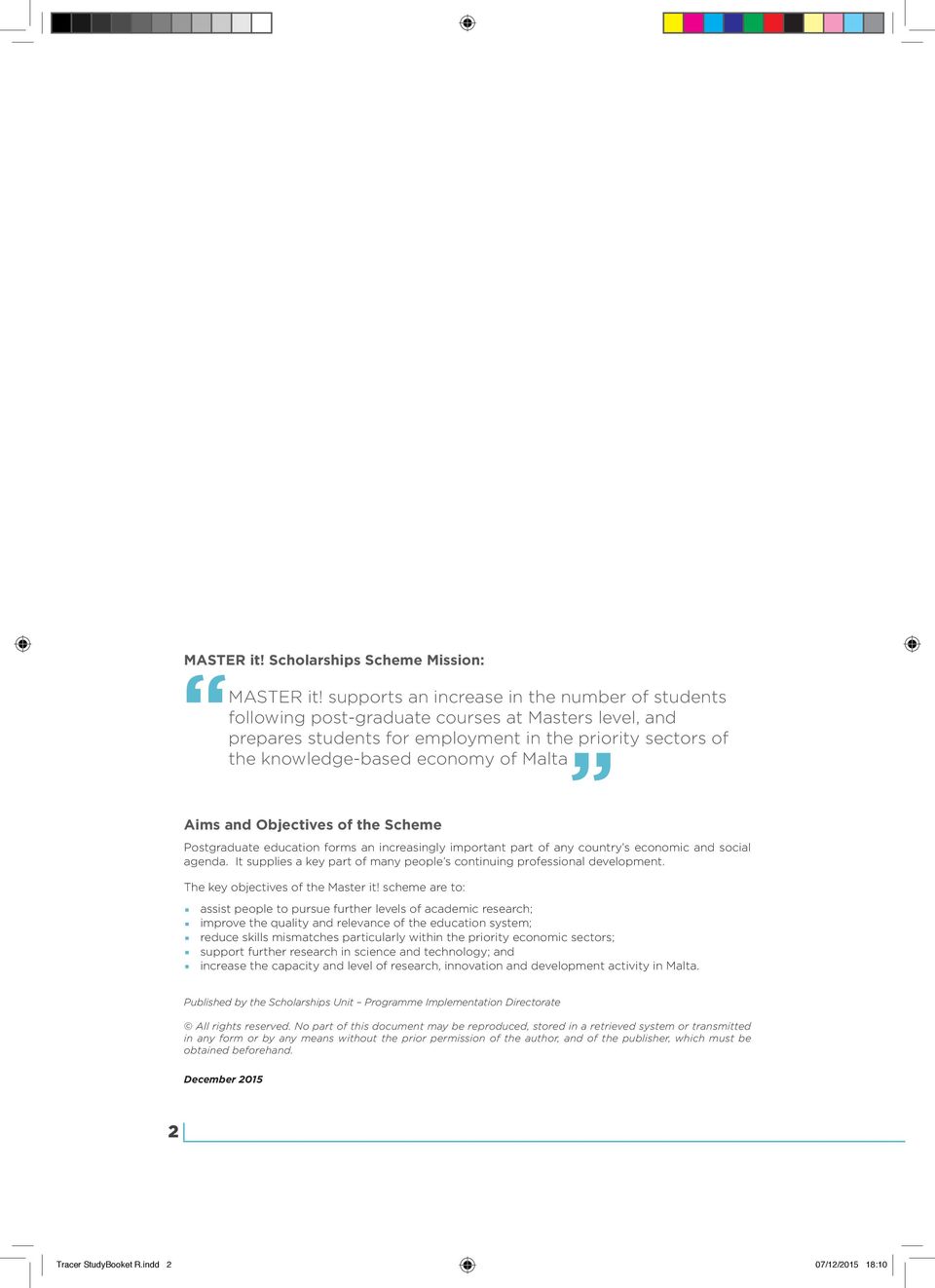
3 TABLE OF CONTENTS List of Tables and Figures Message from Hon. Evarist Bartolo, Minister for Education and Employment Foreword Note from the Project Leader Introduction and Methodology Target population Methodology Structure of the report Executive summary 1. The organisational history and profile of the scholarships schemes 2. Demographic information on scholarship holders Key findings / 2.1. Gender / 2.2. Age / 2.3. Nationality / 2.4. Dependents / 2.5. Locality of residence 3. Study programme followed Key findings / 3.1. Level of study programme / 3.2. Subject area 3.3. Link of current study programme to previous studies / 3.4. Mode of study / 3.5. Country of study Conditions of the scholarship Key findings / 4.1. Financial aspects of the scholarship / 4.2. Duration of studies / 4.3. Work alongside studies 5. Continuation of studies Key findings 6. Transition into employment Key findings 7. Plans to return to Malta Key findings 8. Assessment of the scholarships schemes Key findings / 8.1. Effectiveness of the scholarships scheme to encourage further studies 8.2. Effectiveness of the scholarships schemes in meeting awardees expectations 8.3. Suggestions for improving the scholarships schemes Recommendations 9.1. Enhanced guidance and support / 9.2 More tailored financial support / 9.3. Support after completion 99 3 Tracer StudyBooket R.indd 3 07/12/ :10
4 4 Tracer StudyBooket R.indd 4 07/12/ :10

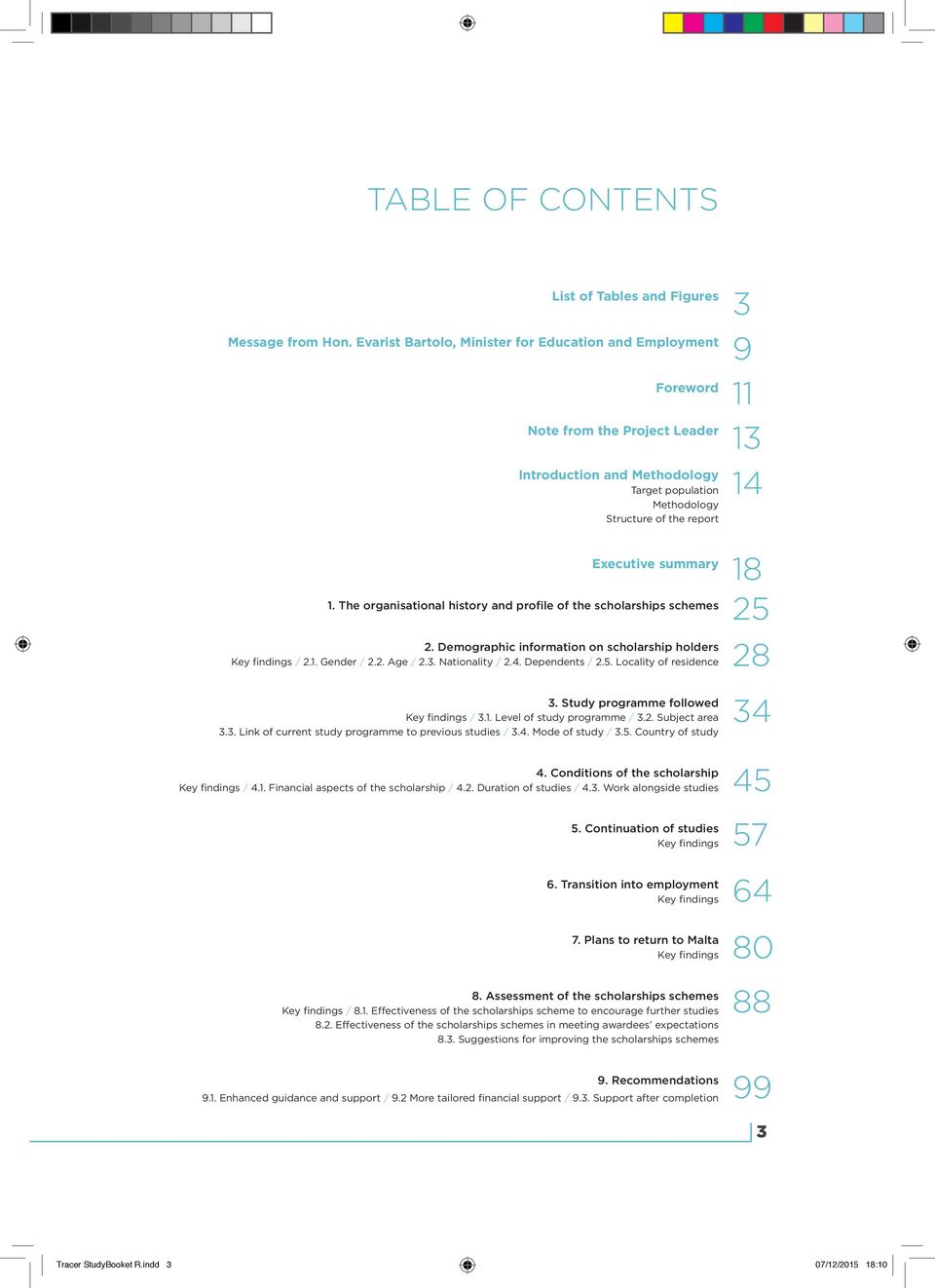
5 List of Tables and Figures Table 1: Table 2: Table 2.1: Figure 2.2: Table 2.3: Figure 2.4: Table 2.5: Table 2.6: Figure 2.7: Table 2.8: Figure 2.9: Table 2.10: Scholarships awarded in the years Scholarships awarded between by scholarships scheme and level of education supported Gender of awardees by completion of studies; scholarship awarded and level of the study programme followed Gender of awardees by completion of studies; scholarship awarded and level of the study programme followed Age profile of scholarship awardees by gender, scholarship awarded and level of study programme (arithmetic mean and Std. Deviation) Age profile of scholarship awardees by gender, scholarship awarded and level of study programme (arithmetic mean and Std. Deviation) Country of nationality of scholarship awardees Scholarship awardees with dependents by gender; scholarship awarded and level of study programme Scholarship awardees with dependents by gender; scholarship awarded and level of study programme Scholarship awardees with dependents by age in brackets Scholarship awardees with dependents by age in brackets Scholarship awardees locality of residence by gender; scholarships scheme awarded and level of study programme Table 3.1: Figure 3.2: 35 Table 3.3: 37 Table 3.4: 38 Table 3.5: 39 Figure 3.6: 40 Table 3.7: 41 Table 3.8: 42 Table 3.9: 42 Table 3.10: 43 Table 3.11: 44 Table 4.1: 46 Table 4.2: 47 Level of study programme attained before the scholarship by study programme followed Level of study programme attained before the scholarship by study programme followed Subject area by scheme Subject area of study programme by gender of scholarship awardees Link of current study programme to previous studies by subject area of study programme supported through the scholarship Subject area followed by scholarship awardees reporting that their previous study programme was closely related to the study programme supported through the scholarship Mode of study by formal student status and degree level Reason for choice of mode of study by mode of study and location (in%) Reason for choice of mode of study by formal status and level of studies (in%) Country of study Subject area by country of study. Means of financing by scheme and location of study in percentages Means of financing by age, level and mode of study in percentages 5 Tracer StudyBooket R.indd 5 07/12/ :10

6 Table 4.3: Assessment towards financial support provided by the scholarship Table 5.3: Table 4.4: 50 Figure 4.5: 50 Table 4.6: 51 Table 4.7: 52 Table 4.8: 53 Table 4.9: 53 Table 4.10: 54 Table 4.11: 54 Table 4.12: 55 Average duration of studies (in years) by study programme and formal student status Average duration of studies (in years) by study programme and formal student status Perceived need by scholarship awardees for an extension of studies Scholarship awardees working alongside their studies by scholarships scheme, level of studies and location of studies Scholarship awardees working alongside their studies by age and formal student status Extent of work alongside studies for working scholarship awardees by scholarships scheme, age and formal student status Employment opportunities offered to scholarship awardees during their studies by scholarships schemes and level of studies Employment opportunities offered to scholarship awardees during their studies by age and formal student status Country in which employment was offered to scholarship awardees during their studies by location of studies and scholarships scheme Figure 5.4: 59 Table 5.5: 60 Figure 5.6: 60 Table 5.7: 61 Figure 5.8: 61 Table 5.9: 62 Figure 5.10: 62 Awardees plans for future studies after completion of current study programme by age and formal student status (current students) Awardees plans for future studies after completion of current study programme by age and formal student status (current students) Planned level of studies for awardees planning to continue their studies after completion of study programme (current students) Planned level of studies for awardees planning to continue their studies after completion of study programme (current students) Current studies of awardees, who have completed the studies for which they were awarded the scholarship (graduates) Current studies of awardees, who have completed the studies for which they were awarded the scholarship (graduates) Plans for undertaking studies in the same field for awardees planning to continue their studies after completion of their study programme (current students) Plans for undertaking studies in the same field for awardees planning to continue their studies after completion of their study programme (current students) Table 4.13: 55 Country in which employment was offered to scholarship awardees during their studies by level of studies and formal student status Table 5.11: 63 Link of current studies to previous study programme of awardees, who have completed the studies for which they were awarded the scholarship (graduates) Table 5.1: 58 Awardees plans for future studies after completion of current study programme by scholarship programme and level of studies (current students) Figure 5.12: 63 Link of current studies to previous study programme of awardees, who have completed the studies for which they were awarded the scholarship (graduates) Figure 5.2: 58 Awardees plans for future studies after completion of current study programme by scholarship programme and level of studies (current students) Table 6.1: 66 Current employment status of awardees, who have completed their studies, by scholarships scheme awarded and level of programme followed 6 Tracer StudyBooket R.indd 6 07/12/ :10
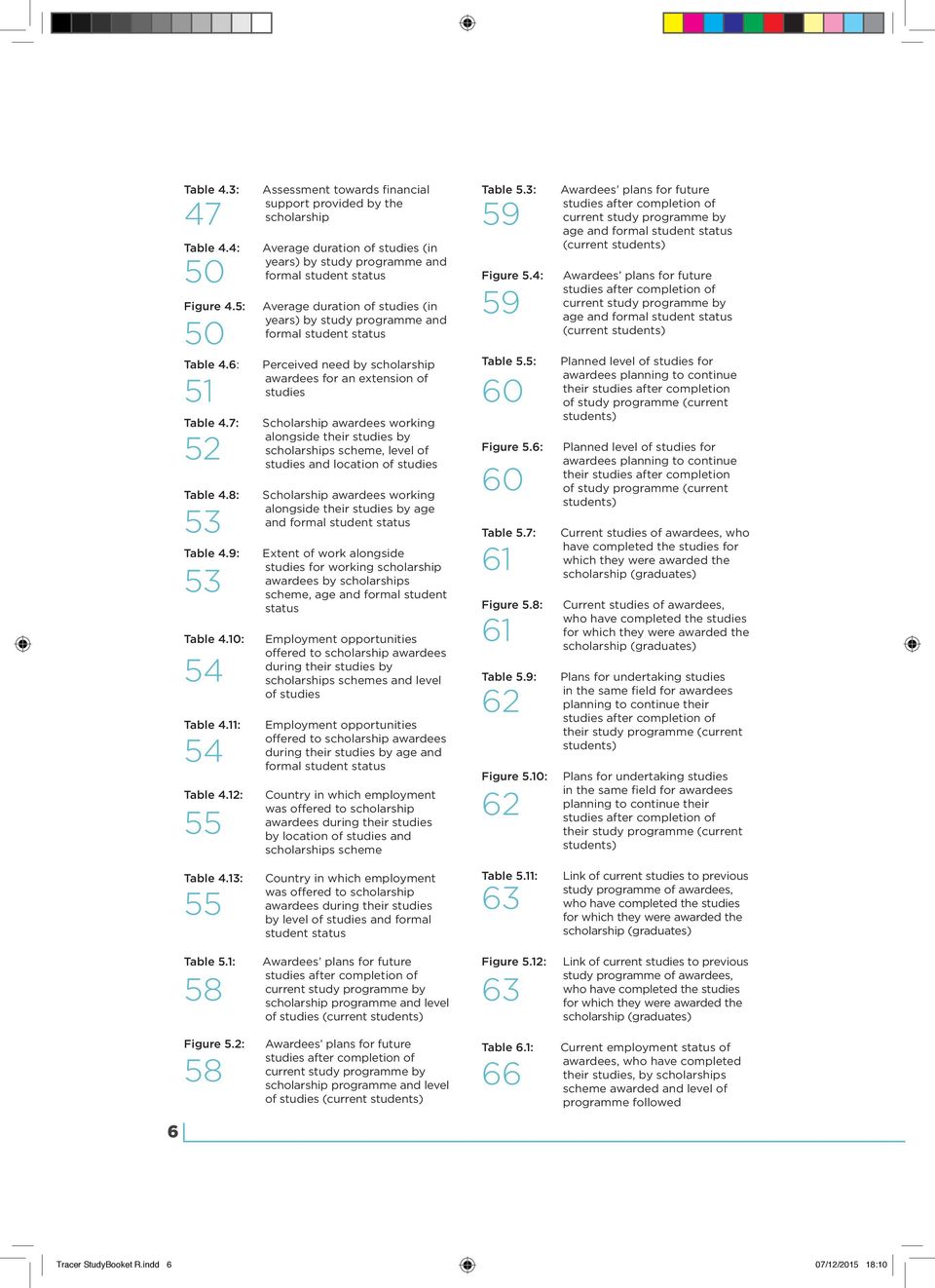
7 Figure 6.2: Table 6.3: Table 6.4: Table 6.5: Figure 6.6: Table 6.7: Figure 6.8: Table 6.9: Current employment status of all scholarship awardees, who have completed their studies Current employment status of scholarship awardees, who have completed their studies, by age of scholarship awardees Current employment status of scholarship awardees, who have completed their studies, by formal student status and place of study Current sector of employment of scholarship awardees, who have completed their studies, by age and formal student status Current sector of employment of all scholarship awardees, who have completed their studies Current occupation of scholarship awardees, who have completed the studies for which they were awarded the scholarship by scholarships scheme awarded, age and formal student status Current occupation of scholarship awardees, who have completed the studies for which they were awarded the scholarship by scholarships scheme awarded, age and formal student status Current occupation of scholarship awardees, who have completed the studies for which they were awarded the scholarship by age and formal student status Table 6.13: Figure 6.14: 75 Table 6.15: 75 Figure 6.16: 76 Table 6.17: 77 Figure 6.18: 77 Transition into employment of scholarship awardees, who have completed the studies for which they were awarded the scholarship by scholarships scheme and location of studies Transition into employment of scholarship awardees, who have completed the studies for which they were awarded the scholarship by scholarships scheme and location of studies Transition into employment of scholarship awardees, who have completed the studies for which they were awarded the scholarship by age and formal student status Transition into employment of scholarship awardees, who have completed the studies for which they were awarded the scholarship by age and formal student status Gross annual income of scholarship awardees, who have completed the studies for which they were awarded the scholarship, are residing in Malta and are in employment by scholarships scheme Gross annual income of scholarship awardees, who have completed the studies for which they were awarded the scholarship, are residing in Malta and are in employment by scholarships scheme Figure 6.10: 73 Current occupation of scholarship awardees, who have completed the studies for which they were awarded the scholarship by age and formal student status Table 6.19: 78 Gross annual income of scholarship awardees, who have completed the studies for which they were awarded the scholarship, are residing in Malta and are in employment by age Table 6.11: 73 Figure 6.12: 74 Link between current employment and previous study programme of scholarship awardees, who have completed the studies for which they were awarded the scholarship by location of studies Link between current employment and previous study programme of scholarship awardees, who have completed the studies for which they were awarded the scholarship by location of studies Figure 6.20: Gross annual income of scholarship awardees, who have completed the studies for 78 which they were awarded the scholarship, are residing in Malta and are in employment by age Table 7.1: 81 Location of employment of scholarship awardees, who have completed the studies for which they were awarded the scholarship by age, formal student status and location of studies 7 Tracer StudyBooket R.indd 7 07/12/ :10
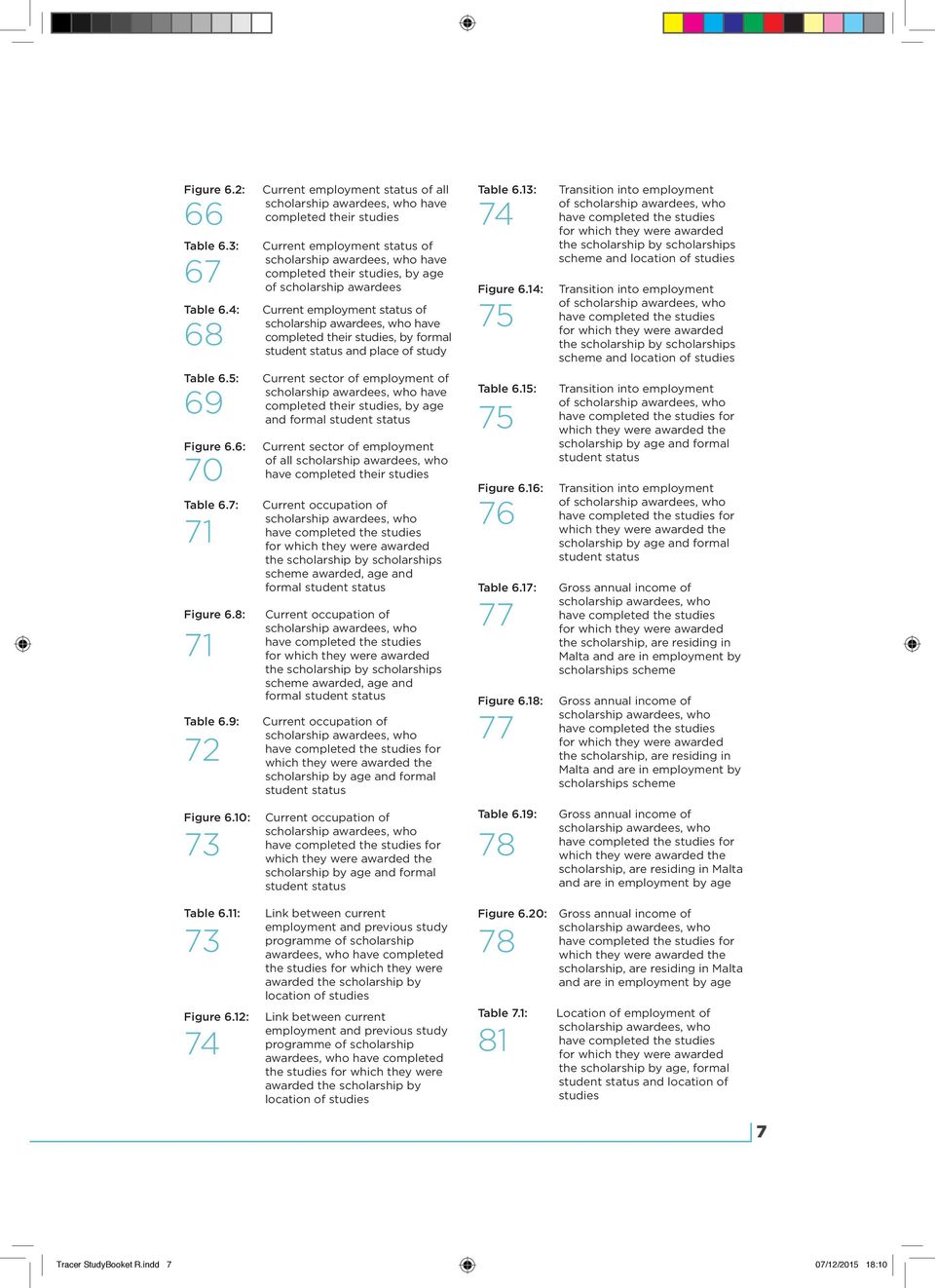
8 8 Figure 7.2: 81 Table 7.3: 82 Figure 7.4: 83 Table 7.5: 84 Figure 7.6: 85 Table 7.7: 86 Figure 7.8: 87 Table 8.1: 89 Table 8.2: 89 Table 8.3: 90 Table 8.4: 90 Table 8.5: 92 Table 8.6: 98 Location of employment of scholarship awardees, who have completed the studies for which they were awarded the scholarship by age, formal student status and location of studies Plans to return to Malta after completion of studies abroad of scholarship awardees, who are still undertaking their studies by level of studies and formal student status Plans to return to Malta after completion of studies abroad of scholarship awardees, who are still undertaking their studies by level of studies and formal student status Country of residence of scholarship awardees, who (plan to) live abroad after completion of the study programme by age, formal student status and location of studies4 Country of residence of scholarship awardees, who (plan to) live abroad after completion of the study programme they were awarded the scholarship for Reasons for scholarship awardees remaining / planning to remain abroad after completing their study programme for which they were awarded the scholarship Reasons for scholarship awardees remaining / planning to remain abroad after completing their study programme for which they were awarded the scholarship Importance of the scholarship for awardees to encourage further studies Likelihood of having continued studying without a scholarship by importance of the scholarship for awardees Likelihood of having continued studies without a scholarship for students considering the scholarships scheme important Assessment of awardees of scholarship meeting expectations by scholarships scheme Reasons for the scholarships scheme not meeting awardees expectations Suggestions for improvement of the scholarships schemes Tracer StudyBooket R.indd 8 07/12/ :10
9 Message from Hon. Evarist Bartolo, Minister for Education and Employment In terms of employment, Malta is creating jobs and is in a better situation than a lot of other countries in the European Union jobs have been created since March However, half of these jobs have been taken up by non-maltese. Like many European countries, the biggest challenge that Malta is facing is the skills gap. Employers are finding it frustratingly hard to find people with the right skills and the right work ethic to fill those jobs and be able to contribute to economic development and prosperity. Across the European Union, education and training have a prominent place in the Europe 2020 strategy, especially in countries that have a high youth and graduate unemployment. Research shows that participation in higher education is translated into better job prospects with higher monetary gains and job mobility. Therefore, having higher education courses which are relevant to today s needs is mandatory, where courses are aimed to develop talents and equip our students with the skills and values that are needed for active citizenship and employability. It is imperative that educators and social partners work together to make education relevant within and beyond formal educational institutions, thus creating opportunities for sustainable and viable economic growth now and in the future. In the Maltese context, our human capital remains our most important resource. As a government, our primary goal is to ensure that more young people progress successfully in their education and gain the right skills to be able to differentiate themselves among other candidates for the same job. We are committed to invest in our people and provide more opportunities for them to develop their talents, as well as develop socially and economically. These scholarships are the vehicle to achieve further specialisation at higher levels of education so that graduates are able to meet future challenges. It is a pleasure to note that over these two years, nearly 800 scholarships have been awarded through the MGSS and the Master It! Scholarship schemes. This augurs well towards improving participation rates in higher education towards achieving the ET2020 target of 40%. Investing in education is the way forward to achieve our country s economic development. It is one of the most important investments a country can make in its people and its future, and is critical to reducing poverty and inequality. Hon. Evarist Bartolo Minister for Education and Employment 9 Tracer StudyBooket R.indd 9 07/12/ :10

10 10 Tracer StudyBooket R.indd 10 07/12/ :10

11 Foreword The provision of high quality further and higher education in Malta has been the aim of the National Commission for Further and Higher Education (NCFHE) since its inception. It regularly embarks on research projects aimed to study the further and higher education sphere to identify potential areas of improvement for the best interest of the students. The ESF project aimed to measure the effectiveness of scholarship schemes available in Malta until 2014 among their beneficiaries, mainly the STEPS, MASTER it! and MGSS-Postgraduate Scholarship. In collaboration with the Ministry for Education and & Employment who is the provider of such schemes, the NCFHE could assess the impact such opportunities had not only on the students themselves, but also on the social and economic development of the country. Scholarship schemes are increasingly becoming a trend worldwide and go beyond the issue of financing. These overseas experiences help students to improve their academic ability, as well as their language and intercultural skills. In the long run, such improvements shall lead to the formation of new scholars, researchers and leaders for the benefit of the whole nation, improving capacity and potential for innovation. The Bologna Process further emphasises on the need to widen access to higher education and improving the economic and social conditions of students, in order to ensure that they do not face any obstacles in entering, progressing or completing higher education. This is both a matter of social justice, but also important in view of Malta s aspiration to continuously increase participation in higher education with the aim of 33% of year olds having attained higher education by As can be seen, investing in training, education and other forms of learning is essential for the Maltese economy in order to achieve smart, sustainable and inclusive growth. This study will help in improving future scholarship schemes and creating awareness on the specific needs and difficulties students have. This would help to ensure that Maltese students have a competitive advantage when looking for employment both locally and internationally. I would like to thank the Directorate for Programme Implementation of the Ministry for Education and Employment who gave their support throughout the data collection process for this report. My appreciation also goes to the NCFHE Research Department for its constant dedication in such projects. Ms Edel Cassar Chief Executive Officer of the National Commission for Further and Higher Education 11 Tracer StudyBooket R.indd 11 07/12/ :10
12 12 Tracer StudyBooket R.indd 12 07/12/ :10

13 Note from the Project Leader for STEPS & MASTER it! Scholarships Schemes The need for a tracer study amongst our various scholarship schemes beneficiaries has been felt by the Scholarships Unit - Programme Implementation Directorate for these past years. Moving rapidly to the closure stage of both the Strategic Educational Pathways Scholarships Scheme STEPS [ESF 1.25] and the MASTER it! Scholarship Scheme [ESF 1.225], a tracer study amongst our beneficiaries has become a must. The acquisition of further European and local funds under the MASTER it! Scholarship Scheme project made it possible to embark on a professional tracer study which had been in the Directorate s plans. Although the Malta Government Scholarships Scheme Postgraduate was locally funded and no European Union funds were allocated to this scheme, it was felt that this first scholarship scheme which was launched in 2006 paved the way for the STEPS Scheme and therefore, including it in the study, would provide more interesting results. More than 1,977 applicants over a span of six years have benefitted from a scholarship since 2006, out of which 1,514 scholarships were awarded through ESF funded schemes. 863 scholars benefitted from grants under the STEPS Scholarship Scheme while another 651 awardees were awarded scholarships under the MASTER it! Scholarship Scheme. The purpose of this tracer study was to take an inventory of our past and present beneficiaries by tracking their current standing prior to the award of the scholarship and following such award. The Directorate wanted to establish if the scholarships awarded were really of benefit to these scholars in real life scenarios in the same way that they are perceived to be. Furthermore, the Directorate endeavoured to become cognizant of whether awardees were satisfied with the procedures and practices applied together with the service provided by the Scholarships Unit which is entrusted with the administration of these scholarships schemes. expectations of the scholarship beneficiaries and also critique on the service offered. The findings of this study shall provide a great deal of information and insight to the Directorate and the Scholarships Unit in particular when planning and launching new schemes. As expected the respondents highlighted a number of both positive and negative aspects which shall be noted and taken into account by the Directorate in the future. In fact the Directorate through its Scholarships Unit has already commenced working on procedures which will lead to the mitigation of issues raised by the respondents while acknowledging the fact that the Directorate will face any challenges which will result in the improvement of the service provided by the Directorate. Indeed, the Directorate has already taken initial steps in tackling the problem of lean time whereby the Directorate is addressing this issue through the simplification of processes. Furthermore, the Scholarships Unit -PID is also already operating as a one stop shop and has implemented an on-line application system. This tracer study will leave positive effects on the scholarships system and the services provided by the Directorate at large. The NCFHE, who have been entrusted to carry out this tracer study, were the ideal entity to be entrusted with this task. With their knowledge and expertise in the sector the Directorate was confident that NCFHE would carry out this tracer study in the most professional and diligent of manners. The Scholarships Unit Programme Implementation Directorate would like to take this opportunity to thank all the respondents of this tracer study who were ready to give some minutes in return out of what they received from the Scholarship to help us improve on what already has been attained in past years. Through this tool the Directorate is in a better position to measure the importance of scholarships and the level of support require in order for our schemes to be more successful. This study provides feedback on the Josephine Sultana Project Leader STEPS & MASTER it! Scholarships Schemes 13 Tracer StudyBooket R.indd 13 07/12/ :10
![years. Moving rapidly to the closure stage of both the Strategic Educational Pathways Scholarships Scheme STEPS [ESF 1.25] and the MASTER it! Scholarship Scheme [ESF 1.](/docs-images/44/17267943/images/page_13.jpg "225], a tracer study amongst our beneficiaries has become a must. The acquisition of further European and local funds under the MASTER it!")
14 Introduction and methodology As part of the ESF project 1.225, this research surveyed previous beneficiaries of the MASTER it! Scholarships Scheme, the Strategic Education Pathways Scholarships scheme (STEPS) and the Malta Government Scholarships Scheme Postgraduate. The aim of this research was to collect information on the conditions of the scholarship awardees during their studies and their pathways after completion both in terms of their professional and academic development. This information was sought in order to evaluate the effectiveness of the scholarships schemes, their impact on the social and economic development of the country as a whole and gain insights into potential future improvements of the scholarships schemes. 14 Tracer StudyBooket R.indd 14 07/12/ :10
15 Target population The research addressed all awardees of the STEPS, MASTER it! and MGSS Postgraduate Scholarships Schemes. It addressed both those awardees who had already graduated from their programme in order to assess their progression into the labour market or continuation in Higher Education, as well as those who are still undertaking their studies in order to identify their future plans after graduation. Between 2006 up to 2014, the MGSS Postgraduate Scholarships Scheme supported 235 individuals to read for a PhD, while 228 scholarships were awarded to individuals who undertook a Master Degree. A total of 463 applicants were thus awarded a scholarship through the MGSS Postgraduate Scholarships scheme. Between 2009 and 2012, STEPS supported 82 individuals to read for a PhD, while 781 scholarships were awarded to individuals undertaking a Master Degree. The considerably lower number of individuals supported by STEPS to undertake a PhD when compared to MGSS Postgraduate was due to this particular scholarships scheme supporting only full-time Doctoral studies. This restriction was due to STEPS being a European Social Fund project with a specific time schedule for the disbursement of funds. Overall, a total of 863 applicants were awarded a STEPS Scholarship. Between 2013 and January 2015, the MASTER it! Scholarships Scheme supported 651 individuals to read for a Master Degree. Thus, between 2006 and January 2015 all three schemes have supported 317 individuals to pursue a PhD and 1,660 individuals to undertake a Master degree. Methodology The research was conducted through an online survey amongst all the beneficiaries outlined above. Beneficiaries were invited to participate in the survey drawing on contact information held by the Scholarships Unit - Directorate for Programme Implementation of the Ministry for Education and Employment for the administration of the programme. This ensured comprehensive and updated contact information on the target population. The data was collected between 14 th April 2015 and 10 th May Within that period 1,022 beneficiaries responded to the survey. This corresponds to a response rate of 52%. Out of these respondents 900 beneficiaries completed the survey fully, which corresponds to a drop-out rate of 12%, which is satisfactory. Overall the feedback collected through the 900 complete responses out of a total target population of 1,977 awardees guarantees a maximum margin of error of 2.4%, assuming a 95% degree of confidence, which is very satisfactory. Besides that, wherever possible, the feedback collected from the remaining Tracer StudyBooket R.indd 15 07/12/ :10

16 incomplete responses was taken into consideration for those topics on which these awardees had provided data. The data collected was corroborated with regard to the year of award and the scholarships scheme awarded as well as the level of the study programme pursued by beneficiaries based on administrative data provided by the Scholarships Unit - Ministry for Education and Employment. Structure of the report 16 The report is structured in 9 chapters: Chapter 1 provides an overview of the organisational history and profile of the scholarships schemes under review. Chapter 2 provides demographic information on the scholarship awardees. This includes information on the distribution of age, gender and nationality, the share of awardees with children and the locality of residence at the time of application for the scholarships scheme. Chapter 3 contains details on the study programme followed by scholarship awardees. This covers topics, such as the level of the programme undertaken, the subject area followed and its link to previous studies, the mode of study and the country in which students are following their programme. Chapter 4 provides information on the funding sources scholarship awardees use in order to cover their study and living costs along with their assessment of their financial situation and the contribution of the respective scholarships scheme in this regard. It also looks into awardees employment alongside studies and the duration of their studies. Chapter 5 looks into plans scholarship awardees have after completion of their studies in terms of their further academic development. Chapter 6 provides insights into scholarship awardees transition into the labour market for those scholarship awardees, which already graduated and are currently residing in Malta. Chapter 7 focuses on scholarship awardees, which are undertaking or have undertaken their studies abroad. The chapter discusses their plans to remain abroad after their studies and their eventual return to Malta. Chapter 8 discusses the feedback received from scholarship awardees about the overall effectiveness of the programme to encourage further studies, the implementation of the schemes and suggestions for their improvement. The report concludes in Chapter 9 with recommendations for improvement of the scholarships schemes based on the analysis of the data gathered and the feedback received by scholarship awardees. Tracer StudyBooket R.indd 16 07/12/ :10

17 The National Commission for Further and Higher Education expresses its sincere thanks to the Scholarships Unit PID within the Ministry for Education and Employment for being entrusted with this important research project and the fruitful cooperation in its implementation. As an advisory body to the Ministry on the future development of Further and Higher Education in Malta, such research projects fall squarely within the remit of the NCFHE and provide further impetus and capacity for overarching tracer studies among graduates of Further and Higher Education. In this regard, it is hoped that the present report provides fruitful insights into the implementation and impact of the different scholarships schemes implemented by the Ministry for Education and Employment and contributes to their future development in order to further strengthen the capacity in Higher Education, Research and Development in Malta. 17 Tracer StudyBooket R.indd 17 07/12/ :10
18 Executive summary This research aimed to collect data on the conditions and current situation amongst beneficiaries of MASTER it! STEPS and MGSS Postgraduate, who completed the programme for which they were awarded the scholarship and also amongst those who at the time of the survey were still undertaking their studies. This executive summary provides an overview of the key findings for each of the chapters within this report. 18 Tracer StudyBooket R.indd 18 07/12/ :10
19 Chapter 1 gives a detailed overview of the organisational history and profile of the different scholarships schemes under review in this research: MGSS Postgraduate, STEPS and MASTER it! not only promote Higher Education attainment, but also students undertaking their studies abroad. Both of these aspects are important since 73% of Bachelor and 51% of Master students in Malta intend to continue their studies either within a year after graduating from their current study programme or at a later stage in their life. Besides that, 21% of Bachelor students in Malta, who plan to pursue further studies, intend to do so abroad. The increase in total beneficiaries of these scholarships schemes from 33 in 2006 to 544 in 2013 confirms the priority afforded to supporting individuals interested in undertaking studies at postgraduate level in Malta or abroad. This is particularly true from 2009 onwards and can clearly be attributed to the impact of the STEPS and MASTER it! Scholarships Schemes. Moreover, it is particularly true for scholarships provided at Master s level. Chapter 2 provides an overview of the demographics of the scholarship holders, including characteristics such as their age, gender, region amongst others. Female respondents seem to slightly outnumber males among scholarship holders. Awardees are on average 31 years old. MGSS Postgraduate awardees are on average older, which may be due to the fact that it also offers scholarships for Doctoral studies. With few exceptions, awardees are Maltese (99.2%). Awardees following a Doctoral Degree and MGSS Postgraduate awardees have more often children compared to the other schemes and study levels. This may be linked to Doctoral Degree and MGSS Postgraduate awardees being older. It also seems that scholarship awardees are more often from the Northern Harbour region compared to the number of awardees from Gozo and from the Southern Harbour region. In fact, the data shows that only 4.2% of all beneficiaries are from Gozo and only 9.1% of all beneficiaries are from the Southern Harbour whereas 31.9% of all beneficiaries are from the Northern Harbour region. 19 Tracer StudyBooket R.indd 19 07/12/ :10
20 Chapter 3 contains information about the level of studies attained by both Doctoral and Master students prior to being awarded the scholarship. The majority of the awardees undertaking a Master were in possession of a qualification equivalent to MQF level 6 (74.5%) upon application for the scholarship. The majority of students are enrolled in life sciences (25.4%), educational services (15.4%), followed by financial services (11.0%) and ICT (10.9%). Additionally, most awardees study on campus while only 2.4% study through distance learning. It seems that blended and distance learning courses are more likely to be followed by part-time students, whereas full-time students are more likely to study on campus (93.9%). Doctoral students are more likely to study through distance and blended learning. The choice of the mode of study seems to be based mainly on the compatibility with work and family commitments. However, Doctoral students seem to give more importance to family and work commitments when deciding on the mode of study whereas Master students are more likely to give consideration to the course duration. 20 Chapter 4 provides an overview of the conditions of the scholarship. The main sources of financial support of awardees are scholarship funds granted towards tuition fees (70.6%) apart from own savings (45.9%) and family and parental support (29.7%). 68% agreed that the scholarships scheme fully covers their tuition expenses. Scholarship awardees, who were based in Malta, seem to be more positive about their financial situation compared to those who followed their studied abroad. This may be linked to higher cost of living in foreign countries when compared to Malta. 17% of the graduates stated that they felt that they would have needed more time to complete their studies. This is true, in particular, for those who completed their studies in Malta. 54.5% of the awardees juggled their professional commitments whilst furthering their studies with 66.7% working full-time. MGSS Postgraduate awardees seem more likely to be working full-time (73.7%) compared to the other schemes. One can conclude that because these awardees are older, they would need to work to support their family. Doctoral students are more often employed in the public sector whereas students at a Master level are more likely to be employed within the private sector. Data indicates that the majority of those undertaking their studies in Malta were offered a job based in Malta while only half of those who enrolled in a foreign Higher Education institution were offered a job in the same country of their studies. Tracer StudyBooket R.indd 20 07/12/ :10

21 Chapter 5 looks into the awardees plans for future studies after graduating from the programme for which the scholarship was awarded. A considerable share of respondents, who are still following the programme for which they were awarded the scholarship, plan to continue their studies, namely 40.8%. However, only 18% of awardees, who already graduated, eventually followed another study programme. Master students plan more often to pursue another course after completing the current one when compared to Doctoral students. The majority of the awardees plan to do a Doctorate. In fact 85.1% of the Master students plan to do a Doctorate. The older the scholarship awardees are, the less likely they are to continue their studies after they have completed the programme for which they were awarded the scholarship. 80.2%, who continued their studies after graduating from the programme for which they received the scholarship, did so in a related subject area. Chapter 6 provides information on scholarship awardees transition into employment. This data indicates the following: Most awardees, who already graduated, work in the public (39.0%) or private sector (38.0%). Only 3.3% are still looking for a job or to start their own business at the time of the survey. Thus, awardees generally do not seem to face particular difficulties in finding employment. Doctorate graduates work mostly in the public sector (66.0%), while those with a Master work more often in the private sector (40.0%) and 9.3% are also still studying full-time and not working. Most scholarship awardees, who already graduated, work in education (24.2%), professional, scientific and technical activities (21.5%), human health and social work activities (13.9%), and information and communication technology (11.9%), which is generally consistent with the main subject areas scholarship awardees are enrolled in. Former awardees mainly hold positions of professionals (79.3%) or managers (14.2%). Younger graduates work more often as technicians (13.0% of up to 25 year olds compared to 4.3% among all students), while older ones are more often managers (19.1% among those 35 years and over compared to 14.2% among all students). Most awardees hold jobs that are very closely or closely related to their studies (73.1%), suggesting that they had no difficulty finding jobs related to their studies or chose their programme in line with their career path. This appears to be particularly the case for students who studied abroad (77.0%). 21 Tracer StudyBooket R.indd 21 07/12/ :10
22 50.6% of graduates took up jobs or started their own business within 6 months after graduation, while 35.3% retained the position they held during their studies, which is consistent with the high share of beneficiaries studying alongside employment. Overall, younger students, full timers and those who studied abroad took up new positions within 6 months of their graduation, while older students, part-time or distance learners and those who studied in Malta retained the position they held alongside their studies. Most scholarship graduates earn an annual gross salary of between 20,001 and 25,000 Euro (34.5%) followed by 15,001 and 20,000 Euro (23.0%). MGSS Postgraduate and STEPS awardees appear to earn higher salaries than beneficiaries of MASTER it!, since they more often hold professional or managerial posts. Younger age groups earn significantly lower salaries (20.9% of those up to 25 years have an annual gross salary of 25,001 Euro or more) compared to the older age groups (39.0% of those 35 years and over have an annual gross salary of 25,001 Euro or more). Chapter 7 looks into scholarship awardees plans to return to Malta after studying abroad. The majority of scholarship awardees, who already graduated and are working, hold jobs in Malta (72.4%). Older awardees, part-time or distance learners and those who studied in Malta work more often in Malta, while younger students, full-timers and those who studied abroad are more likely to remain abroad. The majority of current awardees, who are still studying, plan to return to Malta within a year after graduating or at a later stage (93.8%). Current Master students are less likely to return to Malta immediately after graduating, while Doctorate students either plan to return to Malta within a year or not at all. Most awardees, who choose to live abroad after their studies, want to remain or move to the UK Kingdom (76.2%) or Belgium (5.4%). The latter might be linked to employment opportunities at different entities related to the European Union. The most common reasons for choosing to live abroad after graduation are more opportunities in the labour market (63.9%) the quality of labour market opportunities (46.1%) and higher salary levels abroad (42.7%). Besides that, furthering their studies is also cited as a reason for choosing to remain living abroad. Thus, work experience or study-related reasons outweigh personal regard for the country as factors influencing awardees decision to remain living abroad after completing their studies. 22 Tracer StudyBooket R.indd 22 07/12/ :10
23 Chapter 8 provides an overview of the assessment of the scholarships schemes by the awardees themselves. It also includes the awardees recommendations on how to improve the schemes. For 69.1% of awardees, the scholarship had a vital role in their decision to continue their studies. A considerable share of respondents, who stated that the scholarship was important to them, would not have continued their studies without it, namely 46.8%. In contrast, 98.1% of those respondents, for whom the scholarship was not an important factor in deciding to continue their studies, would have also continued without it. 88.7% of the scholarship awardees confirmed that the scholarship met their expectations. The main reason/s why scholarship awardees were dissatisfied with the scholarships schemes were due to insufficient funds (51.9%), the bureaucratic process (22.6%) and delay in payments for scholarship funds (20.8%). The scholarship awardees provided some recommendations in order to improve the scholarships schemes. The main recommendations were improvement in the administration procedures (38.5%), followed by calls for additional funds and more tailored funding schemes (27.1%) and better guidance in the application phase (16.1%). Chapter 9 issues recommendations on the basis of the findings in this report. These are related to three areas, namely enhanced guidance and support in the application phase as well as throughout the studies, a more tailored support provided through the scholarships scheme and enhanced support after completion of studies. Enhanced guidance and support It is recommended that the promotion of the scholarships schemes is amplified along with support in the application process, for example, through a one-stop-shop approach. The application process could be simplified, for example through an online platform, which would be accessible for beneficiaries throughout their studies to supply any documentation needed by the awarding body and to facilitate communication. 23 Tracer StudyBooket R.indd 23 07/12/ :10
24 More tailored financial support It is recommended to review the present timeframes for the application and selection process of the different scholarships schemes to allow for beneficiaries to be informed further in advance of the actual commencement of their studies. The support granted could be reviewed to be more comprehensive in covering all study-related costs and consider supplementary support to groups of students in need of additional assistance. The possibility of increasing the flexibility of scholarships schemes could be reviewed to allow awardees to extend or temporarily suspend their studies without losing the scholarship or undertake employment alongside their studies to supplement the support received through the scholarship. These guidelines and the payment schedules should be made more transparent for beneficiaries. Support after completion Many current awardees plan to continue their studies, but few awardees appear to actually do so and this may be linked in part to financial constraints. Thus, providing more flexibility in the scholarships schemes may encourage more awardees to apply for financial support to pursue advanced research qualifications. The support for post-doctoral research recently established may also encourage more Doctorate holders to further their research. The high share of awardees, who retained the position they held alongside employment, suggests that increasing the flexibility with regard to employment alongside studies could also promote further studies. In order to increase the return of benefit of the scholarships scheme for Malta for scholarship awardees choosing to remain abroad after graduation, the development of a structured network of scholarship beneficiaries and alumni might contribute to the development of a strong network of Maltese researchers worldwide, which would also benefit Higher Education, research and development in Malta. Such a network might also increase support and guidance at all stages of the scholarship journey. 24 Tracer StudyBooket R.indd 24 07/12/ :10
25 1. The organisational history and profile of the scholarships schemes The Government of Malta heavily invests in the provision of scholarships to promote Higher Education attainment and encourage student mobility. In this regard, three scholarships schemes are of particular importance in promoting studies at postgraduate and Doctoral level, namely: the Malta Government Scholarships Scheme Postgraduate (MGSS-PG); the Strategic Educational Pathways Scholarship Scheme (STEPS) and MASTER it! Scholarship Scheme The Malta Government Scholarship Scheme Postgraduate (MGSS-PG) was launched in 2006, and assists students to follow postgraduate programmes at Master (MQF level 7) or Doctoral level (MQF level 8) at recognised Higher Education Institutions in Malta or abroad. MGSS-PG provides support to students following their programme either on a full-time or part-time basis or through distance learning. The aims of this scholarships scheme are to assist exceptional applicants to pursue further levels of academic research; to encourage and promote further participation at postgraduate level both locally and internationally; contribute towards research in identified areas of national priority; increase the capacity and level of research, innovation and development activity in Malta and assist applicants to find better jobs. 1 The Strategic Education Pathways Scholarship Scheme (STEPS) was launched in 2009, co-funded by the European Social Fund, for the implementation of the Cohesion Policy in Malta for the period It aimed at supporting postgraduate students in pursuing a Master or a Doctoral degree in Malta or abroad. While beneficiaries could undertake a Master either on a full-time or part-time basis or through distance learning, Doctoral studies were supported only if undertaken on a full-time basis. The scheme supported in particular studies in the areas of science and technology and information and communications technology by making available higher grants to beneficiaries following programmes in these fields. Like STEPS, the MASTER it! scholarships scheme is supported with funding from the European Social Fund and aims at promoting attainment at Master level. This scheme covers both full-time and part-time studies as well as distance learning. It aims at assisting people to pursue further levels of academic research; improve the quality and relevance of the education system; reduce skills mismatches 1 Ministry for Education and Employment: Malta Government Scholarship Scheme (Postgraduate) Tracer StudyBooket R.indd 25 07/12/ :10
26 particularly within priority economic sectors; support further research in science and technology; and increase the capacity and level of research, innovation and development activity in Malta. 2 Overall, apart from increasing participation in Further and Higher Education in general, these scholarships schemes also provide financial assistance to students interested in undertaking their studies abroad. Both of these aspects are of importance since data collected through the Eurostudent V survey carried out in Malta in 2013 suggests that 73% of Bachelor and 51% of Master students in Malta intend to continue their studies either within a year after graduating from their current study programme or at a later stage in their life. 3 Besides that, 21% of Bachelor students in Malta, who plan to continue their studies, intend to do so abroad. 4 Therefore, in an effort to increase the research and innovation capacity in Malta, these scholarships schemes could provide support to these students interested in furthering their studies at postgraduate level in Malta or abroad. Table 1 below provides an overview of the number of scholarships awarded by the Government of Malta through MGSS Postgraduate, STEPS and MASTER it! between 2006 and In this regard it is important to point out that the 8 th and final call for the STEPS scholarships scheme closed in 2012 and the MASTER it! scholarship was awarded for the first time in Therefore, the scholarships not open for applications in a given year are marked as not available in the table below Ministry for Education and Employment: MASTER it! NCFHE 2014b: NCFHE 2014b: The Strategic Education Pathways Scholarship Scheme (STEPS) was launched in 2009, co-funded by the European Social Fund for the period It supported postgraduate studies for Master s or a Doctoral Degrees in Malta or abroad at a full-time or part-time basis or through distance learning, with a particular emphasis on studies in the area of science and technology and information and communications technology. Tracer StudyBooket R.indd 26 07/12/ :10
27 Table 1: Scholarships awarded in the years Scholarship Scheme MGSS-PG MASTER it! n.a. n.a. n.a. n.a. n.a. n.a. n.a STEPS n.a. n.a. n.a n.a. n.a. Total (Source: Ministry for Education and Employment: Programme Implementation Directorate - Scholarships Unit; * NCHE 2009; ** NCHE 2010a) Although the number of scholarships awarded is subject to fluctuations and has also been strongly influenced by funding made available through the European Social Fund, it is evident from Table 1 that the Government of Malta has given priority to supporting individuals interested in furthering their studies at postgraduate level in Malta or abroad. In fact, the total number of beneficiaries increased from 33 in 2006 to 544 in It is also interesting to note the distribution of scholarships by the level of education supported as shown in Table 2. Overall, it is evident that the number of postgraduate students supported through scholarships schemes made available by the Government of Malta has continuously increased. This is particularly true from 2009 onwards and can be clearly attributed to the impact of the STEPS and MASTER it! Scholarships Schemes. Moreover, it is particularly true for scholarships provided at Master level. Given that the STEPS scholarships scheme, which provided scholarships both for Master and Doctoral level concluded its support to Doctoral students in 2011, this gap could be filled only partially by MGSS Postgraduate. Nevertheless, in comparison to the year 2012 (29 Doctoral scholarships), the Government of Malta has increased its support for Doctoral students to 45 scholarships being awarded in 2013 and 42 being awarded in This clearly confirms its commitment to increase the research and innovation capacity of Malta. Table 2: Scholarships awarded between by scholarships scheme and level of education supported Total MGSS-PG Master STEPS n.a. n.a. n.a n.a. n.a. 781 MASTER it! n.a. n.a. n.a. n.a. n.a. n.a. n.a Total Master ,660 MGSS-PG Doctorate STEPS n.a. n.a. n.a n.a. n.a. n.a. 82 Total Doctorate (Source: Ministry for Education and Employment: Programme Implementation Directorate - Scholarships Unit) 27 Tracer StudyBooket R.indd 27 07/12/ :10
28 2. Demographic information on scholarship holders Key findings The data shows that female scholarship awardees tend to slightly outnumber their male counterparts. The average age of scholarship awardees is 31. Master students are on average 30 years old and Doctoral students are on average 37. Further differences in ages appear across the three scholarships schemes where awardees of MGSS Postgraduate tend to be older than those from STEPS and MASTER it! This is due to the fact that MGSS Postgraduate tends to support Doctoral studies more often. With few exceptions scholarship awardees are Maltese (99.2%). Awardees, who are parents, make up 23.6% of the total respondents with no particular difference between males and females. The two groups that have a considerably higher rate of those with children are MGSS Postgraduate grant holders and those pursuing a Doctorate degree (with 45.5% and 42% respectively), which appears to be linked to the higher average age among both groups. Scholarship awardees are more often from the Northern Harbour region compared to the number of awardees from Gozo and from the Southern Harbour region. In fact, the data shows that only 4.2% of all beneficiaries are from Gozo and only 9.1% of all beneficiaries are from the Southern Harbour whereas 31.9% of all beneficiaries are from the Northern Harbour region. 28 Tracer StudyBooket R.indd 28 07/12/ :10
29 1.1. Gender The table and figure below show that female awardees tend to slightly outnumber their male counterparts among graduates and current students. In the latter, the difference becomes even larger in favour of females as they form 56.6% of the respondents. Similarly, females outweigh males across the different scholarships with the exception of STEPS where they are equally represented. This tendency also appears in Master and Doctorate programmes. Table 2.1: Gender of awardees by completion of studies; scholarship awarded and level of the study programme followed all students graduate current student MASTER it! STEPS MGSS-PG Master Doctorate / PhD Male Count % 46.5% 48.9% 43.4% 42.1% 50.0% 47.6% 46.6% 46.0% Female Count % 53.5% 51.1% 56.6% 57.9% 50.0% 52.4% 53.4% 54.0% Total Count % 100.0% 100.0% 100.0% 100.0% 100.0% 100.0% 100.0% 100.0% Figure 2.2: Gender of awardees by completion of studies; scholarship awarded and level of the study programme followed 29 Tracer StudyBooket R.indd 29 07/12/ :10
30 1.2. Age The average respondents age is 31. There are no significant age differences between males and females. However, since a Doctoral degree is pursued upon completing a Master and frequently after accumulating years of work experience, Doctoral students are typically older than the Master students. This is reflected in the age difference between Master and Doctorate awardees in the figure and table below where the Master students are on average 30 year old whereas the Doctoral students are 37 years old on average. Further differences in ages appear across the three scholarships schemes where awardees of MGSS Postgraduate tend to be older than those from STEPS and MASTER it!. This is expected as MGSS Postgraduate supports more Doctoral degrees, namely a total of 235 between 2006 and 2014, compared to STEPS, which supported 82 individuals undertaking a Doctorate between 2009 and Table 2.3: Age profile of scholarship awardees by gender, scholarship awarded and level of study programme (arithmetic mean and Std. Deviation) Mean N Std. Deviation Total Male Female MASTER it! STEPS MGSS-PG Master Doctorate / PhD Figure 2.4: Age profile of scholarship awardees by gender, scholarship awarded and level of study programme (arithmetic mean and Std. Deviation) 30 Tracer StudyBooket R.indd 30 07/12/ :10
31 1.3. Nationality Table 2.5: Country of nationality of scholarship awardees Frequency % Malta Albania 1.1 British Indian Ocean Territory 1.1 Hungary 1.1 Italy 1.1 Mali 1.1 Portugal 1.1 Spain 1.1 Total Regarding country of origin, applicants who are eligible to any of the scholarships are Maltese citizens, EU/EEA nationals and third country nationals provided that they meet certain residence conditions. However, as per table 1.5, the vast majority (99.2%) of awardees were Maltese Dependents Table 2.6: Scholarship awardees with dependents by gender; scholarship awarded and level of study programme all students Male Female MASTER it! STEPS MGSS-PG Master Doctorate / PhD No children Children Total Count % 76.4% 75.1% 77.5% 88.1% 80.2% 54.5% 80.1% 58.0% Count % 23.6% 24.9% 22.5% 11.9% 19.8% 45.5% 19.9% 42.0% Count % 100.0% 100.0% 100.0% 100.0% 100.0% 100.0% 100.0% 100.0% 31 Tracer StudyBooket R.indd 31 07/12/ :10
32 Figure 2.7: Scholarship awardees with dependents by gender; scholarship awarded and level of study programme The three scholarships schemes grant additional children allowance for every child residing with the awardees when undertaking studies abroad in an effort to encourage parents to pursue postgraduate degrees. Awardees who have children make up 23.6% of the total respondents with no particular differences between male and female participants. The two groups that have a considerably higher rate of those with children are MGSS Postgraduate grant holders and those pursuing a Doctoral degree (with 45.5% and 42% respectively). Since the share of students with children increases considerably among older students as shown in Table 2.8 and Figure 2.9, this difference can be explained by the higher average age among MGSS Postgraduate grant holders and Doctoral students. Table 2.8: Scholarship awardees with dependents by age in brackets up to up to up to and over No children Children Total Count % 99.4% 96.6% 96.0% 30.7% Count %.6% 3.4% 4.0% 69.3% Count % 100.0% 100.0% 100.0% 100.0% 32 Tracer StudyBooket R.indd 32 07/12/ :10
33 Figure 2.9: Scholarship awardees with dependents by age in brackets 2.5. Locality of residence Table 2.10: Scholarship awardees locality of residence by gender; scholarships scheme awarded and level of study programme all students Male Female MASTER it! STEPS MGSS PG Master Doctorate / PhD Southern Harbour Northern Harbour South Eastern Western Northern Gozo and Comino Total Count % 9.1% 9.3% 8.9% 9.1% 9.5% 8.6% 9.3% 8.0% Count % 31.9% 34.2% 29.9% 30.2% 31.7% 34.8% 31.4% 34.7% Count % 14.0% 14.8% 13.3% 14.0% 17.2% 9.4% 14.8% 10.0% Count % 22.0% 22.2% 21.8% 22.0% 23.1% 20.6% 21.6% 24.0% Count % 18.7% 16.0% 21.0% 18.3% 16.9% 21.9% 18.2% 21.3% Count % 4.2% 3.3% 5.0% 6.4% 1.8% 4.7% 4.7% 2.0% Count % 100.0% 100.0% 100.0% 100.0% 100.0% 100.0% 100.0% 100.0% Table 2.10 above shows the awardees locality of residence by gender, scholarships scheme awarded and level of study programme. The rates do not differ significantly. However, it suggests that scholarship awardees are more often from the Northern Harbour region compared to the number of awardees from Gozo and from the Southern Harbour region. In fact, the data shows that only 4.2% of all beneficiaries are from Gozo and only 9.1% of all beneficiaries are from the Southern Harbour whereas 31.9% of all beneficiaries are from the Northern Harbour region. 33 Tracer StudyBooket R.indd 33 07/12/ :10
34 3. Study programme followed Key findings The vast majority (74.5%) of scholarship awardees studying for their Master degree were in possession of an MQF level 6 qualification upon application, while 22.3% had another MQF level 7 qualification and a very small percentage an MQF level 5 qualification. Those awarded scholarships supporting their Doctoral studies were either in possession of an MQF level 7 qualification (91.1% of them) or an MQF level 6 qualification (8.9% of them). The highest rates of students are enrolled in the fields of life sciences (25.4%), educational services (15.4%), followed by financial services (11.0%) and ICT (10.9%). MASTER it! seems to have the highest rates of awardees in life sciences, financial services, and creative industries. STEPS awardees are most frequently enrolled in ICT and life sciences, while MGSS Postgraduate grant holders tend to choose life sciences or educational services. Respondents are generally enrolled in study programmes related to the subject areas of their previous degrees (82.4%). Students in ICT pursue more often a programme related to their previous studies (89.8%), while students in financial services are less likely to do so (76.1%). Most scholarship awardees study on campus (86.8%), while fewer follow their programme through blended (7.2%) or distance learning (2.4%). Full-time students follow their programme significantly more often on campus (94.9%), while part-time students do so more often through blended (21.1%) or distance learning (6.8%). Likewise, Master students follow their programme more often on campus (93.9%), while Doctoral studies are more often carried out through blended (23.6%) or distance learning (8.6%). In general, respondents tend to base their choice of mode of study mainly on their work and family commitments. The reasons ranked highest among respondents for their choice of mode of study were duration of studies (62.1%), compatibility with work (35.0%) and family commitments (20.4%) and the possibility to follow a program abroad without the need to relocate (12.4%). Master students chose their mode of study mainly based on the course duration (67.6%) but Doctoral students, who are on average older, gave more consideration in their decision to their work (52.9%) and family commitments (40.7%). There are 39.4% of all beneficiaries enrolled in Malta and 53.6% enrolled in the UK. The remaining 7% are distributed across several countries, the majority of which are within the EU. Students in ICT (48.1%) and financial services (41.8%) appear to study significantly more often in Malta compared to students in life sciences (32.5%) or educational services (39.6%). Students in educational services studying outside of Malta do so nearly exclusively in the UK (58.4%) while 57.6% of students in life sciences and studying abroad chose the UK and 9.9% are studying elsewhere. 34 Tracer StudyBooket R.indd 34 07/12/ :10
35 3.1. Level of study programme Table 3.1: Level of study programme attained before the scholarship by study programme followed all students Master Doctorate / PhD MQF level 5 MQF level 6 MQF level 7 Total Count % 2.7% 3.2% 0.0% Count % 63.5% 74.5% 8.9% Count % 33.8% 22.3% 91.1% Count 1, % 100.0% 100.0% 100.0% Figure 3.2: Level of study programme attained before the scholarship by study programme followed This section deals with the level of studies attained by both Doctoral and Master awardees prior to being awarded the scholarship. Figure 3.2 shows that the vast majority (74.5%) of those studying for their Master degree (MQF level 7) were in possession of an MQF level 6 degree when they applied for the scholarship, while 22.3% of awardees had another MQF level 7 degree and a very small percentage had an MQF level 5 degree. Those awarded scholarships supporting their Doctoral studies were either in possession of an MQF level 7 degree (91.1% of them) or an MQF level 6 degree (8.9% of them). All three scholarships schemes fund students applying for their Master degrees. However, eligibility criteria differ among the MASTER it! and MGSS Postgraduate scholarships schemes. Both conditionally accept applicants who are already in possession of an MQF level 7 degree. However, those who already have an MQF level 7 degree were not eligible for the STEPS scholarship. This may explain 35 Tracer StudyBooket R.indd 35 07/12/ :10
36 why the highest rates of Master students were in possession of an MQF level 6 degree upon application for the scholarship. At the same time, this data shows that a considerable share of scholarship awardees also choose to pursue another Master qualification to specialise either in the same field or a different subject area. This option has been available under the MGSS Postgraduate and MASTER it! schemes since Similar to scholarships for studies at Master level, applicants for a Doctoral scholarship are not allowed to be already in possession of an MQF level 8 degree prior to applying. The eligibility criteria explicitly state that awardees must be in possession of a MQF level 7 and/or level 6 degree Subject area The choice of subject area is imperative in the selection process as bursaries are granted based on certain priority areas. Since this research was supported through ESF 1.225, MASTER it!, study programmes were grouped into subject areas in line with the priority areas of this scholarships scheme, namely: Area Examples of specialisation High-End Manufacturing Renewable Technologies, Product/Equipment Design, Plastics/Advanced Materials Manufacturing Life Sciences Dietetics, Health Psychology, Leadership and organisational development in the health sector, Clinical Sciences, Cancer research; Medical and Surgical Specialities, Pharma manufacturing, Veterinary Educational Services Hearing/Visual Impairment, Severe, Profound and Multiple Disabilities, SEBD, Autism, Learning Disabilities, Multi-Sensory Impairments, Inclusion Coordination, Career Guidance, Educational Psychology, Clinical Psychology, Counselling, School Curriculum Development, Family Therapy, Literacy, Education Planning, Vocational Education, Humanitarian Action Financial Services Funds Management, Back office support Management, Financial Mathematics, Marketing, Innovation, Strategy, Economics, Business Analytics, E Commerce, Business Administration, Marketing and International Affairs Transportation & Advanced Logistics Ship Management, Ship Registration, Yachting/Super Yachting, Aircraft Maintenance/Repair, Aviation, Road Management Higher Quality Tourism Eco-Tourism, Health Tourism, Sports Tourism, International Relations Creative Industries Digital Media, Online Gaming, Radio/Television/Film Production, Scriptwriting, Visual Effects Environment Alternative Energy, Waste Management, Climate Change, Green Technology, Crop production, Marine Management, Oil and Resources Management ICT Software development in specific areas such as Security, Telecommunications, e-health, Microelectronics, Telecommunications and Satellite, ICT for students with Special Educational Needs, Forensic Computing, Cyber Technology 36 Tracer StudyBooket R.indd 36 07/12/ :10
37 From the table below, it appears that the highest rates of students are enrolled in the fields of life sciences and educational services, followed by financial services and ICT. Fields of studies related to high-end manufacturing, transport and logistics, humanities and arts, and sciences are those with the lowest rates of student enrolments. By comparing the three schemes, there appear to be significant differences in rates of enrolments by fields of study (Pearson Chi Square p-value of 0.000), which may be linked to specific priority areas and support allocated to them in the different scholarships schemes. For all three schemes students appear to be most often enrolled in programmes in the life sciences with 29.8% of MGSS Postgraduate beneficiaries, 26.6% of STEPS beneficiaries and 20.9% of MASTER it! beneficiaries. However, beneficiaries of MGSS Postgraduate are following more often programmes in educational services (26.0%), while STEPS beneficiaries are more often enrolled in ICT (17.4%) and MASTER it! beneficiaries in financial services (17.6%). Table 3.3: Subject area by scheme all students MASTER it! STEPS MGSS PG High-End Manufacturing Life Sciences Educational Services Financial Services Transport & Advanced Logistics Higher Quality Tourism Creative Industries Environment ICT Other: Humanities and Arts Other: Social Sciences, Business and Law Other: Science Other: Engineering, Manufacturing and Construction Count % 4.0% 5.8% 3.4% 2.3% Count % 25.4% 20.9% 26.6% 29.8% Count % 15.4% 8.8% 14.2% 26.0% Count % 11.0% 17.6% 8.4% 5.7% Count % 1.6% 2.2% 1.6%.8% Count % 3.3% 6.0% 1.6% 1.9% Count % 7.5% 12.4% 4.2% 5.7% Count % 9.7% 11.0% 9.2% 8.7% Count % 10.9% 8.8% 17.4% 4.5% Count % 1.9% 1.9% 1.3% 2.6% Count % 4.6% 3.0% 4.7% 6.4% Count % 1.7%.8% 2.1% 2.3% Count % 3.2%.8% 5.3% 3.4% Total Tracer StudyBooket R.indd 37 07/12/ :10
38 The figures in Table 3.4 also show that the most frequented subject areas identified above are quite gendered. Females are significantly more often enrolled in life sciences (64.3%) and educational services (73.2%), while males are more often enrolled in ICT (83.0%) (Pearson Chi-square p-value 0.000). Table 3.4: Subject area of study programme by gender of scholarship awardees all students MASTER it! STEPS MGSS PG High-End Manufacturing Life Sciences Educational Services Financial Services Transport & Advanced Logistics Higher Quality Tourism Creative Industries Environment ICT Other: Humanities and Arts Other: Social Sciences, Business and Law Other: Science Other: Engineering, Manufacturing and Construction Count % 4.0% 5.8% 3.4% 2.3% Count % 25.4% 20.9% 26.6% 29.8% Count % 15.4% 8.8% 14.2% 26.0% Count % 11.0% 17.6% 8.4% 5.7% Count % 1.6% 2.2% 1.6%.8% Count % 3.3% 6.0% 1.6% 1.9% Count % 7.5% 12.4% 4.2% 5.7% Count % 9.7% 11.0% 9.2% 8.7% Count % 10.9% 8.8% 17.4% 4.5% Count % 1.9% 1.9% 1.3% 2.6% Count % 4.6% 3.0% 4.7% 6.4% Count % 1.7%.8% 2.1% 2.3% Count % 3.2%.8% 5.3% 3.4% Total Link of current study programme to previous studies 38 Respondents are in general currently enrolled in study programmes which are in the same subject areas as their previous degrees. On average 82% of students stated that the subject areas are linked. However, there appear to be significant differences in the link between the previous and current study programme, depending on the subject area pursued by awardees (Pearson Chi-square p-value 0.021). Tracer StudyBooket R.indd 38 07/12/ :10
39 Overall students currently enrolled in engineering are following more often a programme linked to their previous studies (96.9%), compared to students currently following programmes in the humanities or arts (63.2%). For the most frequented subject areas identified in Table 3.3 students enrolled in ICT state significantly more often that their previous studies were related to their current study programme (89.8%), while students enrolled in financial services are significantly less likely to have followed a programme linked to their current studies (76.1%). Table 3.5: Link of current study programme to previous studies by subject area of study programme supported through the scholarship all students Yes, my previous programme was in the same subject area No, my previous programme was in a different subject area High-End Manufacturing Life Sciences Educational Services Financial Services Transport & Advanced & Logistics Higher Quality Tourism Creative Industries Environment ICT Other: Humanities and Arts Other: Social Sciences, Business and Law Other: Science Other: Engineering, Manufacturing and Construction Total Count % 100.0% 87.5% 12.5% Count % 100.0% 83.9% 16.1% Count % 100.0% 83.8% 16.2% Count % 100.0% 76.1% 23.9% Count % 100.0% 93.3% 6.7% Count % 100.0% 75.8% 24.2% Count % 100.0% 76.0% 24.0% Count % 100.0% 81.4% 18.6% Count % 100.0% 89.8% 10.2% Count % 100.0% 63.2% 36.8% Count % 100.0% 76.1% 23.9% Count % 100.0% 76.5% 23.5% Count % 100.0% 96.9% 3.1% Count % 100.0% 82.4% 17.6% 39 Tracer StudyBooket R.indd 39 07/12/ :10
40 Figure 3.6: Subject area followed by scholarship awardees reporting that their previous study programme was closely related to the study programme supported through the scholarship 40 Tracer StudyBooket R.indd 40 07/12/ :10
41 3.4. Mode of study Table 3.7 presents data on the mode of study of scholarship awardees. Most scholarship awardees are following their programme on campus (86.8%), while considerably fewer follow it through blended learning (7.2%) or distance learning (2.4%). There appear to be significant differences in the mode of study of scholarship awardees depending on their formal student status. Full-time students follow their programme significantly more often on campus (94.9%), while parttime students do so more often through blended (21.1%) or distance learning (6.8%). This may be linked to students following distance or blended learning programmes more often with Higher Education institutions abroad while residing in Malta, which may be less often possible on a full-time basis. The mode of study also differs significantly between Master and Doctoral students. While Master students follow their programme more often on campus (93.9%), Doctoral students study more often through blended (23.6%) or distance learning (8.6%). A probable reason might be that Doctoral programs are in general research- oriented and require the presence of students on campus only for specific study related activities. It may also be linked to Doctoral students undertaking their degree in foreign Higher Education institutions while working and living in Malta and, thus, less often on campus. In fact, students, who follow their programme abroad, do so significantly more often through blended (9.4%) or distance learning (3.0%), while students studying in Malta do so more often on campus (93.9%). Table 3.7: Mode of study by formal student status and degree level all students Full-time student Part-time student Master Doctorate / PhD Malta abroad on campus through distance learning through blended learning Other Count % 86.8% 94.9% 61.6% 93.9% 54.3% 93.9% 85.0% Count % 2.4% 1.0% 6.8% 1.1% 8.6% 1.6% 3.0% Count % 7.2% 2.7% 21.1% 3.6% 23.6% 3.8% 9.4% Count % 3.6% 1.4% 10.5% 1.4% 13.6% 5.1% 2.6% Total Tracer StudyBooket R.indd 41 07/12/ :10
42 Table 3.8: Reason for choice of mode of study by mode of study and location (in%) all students on campus through distance learning through blended learning other Malta abroad Duration of studies 62.1% 68.7% 5.3% 21.4% 21.4% 57.6% 65.1% Compatibility with work commitments Compatibility with family commitments Possibility to follow a programme abroad without the need to relocate Possibility to follow a programme abroad Only option available for the desired programme 35.0% 29.2% 78.9% 76.8% 60.7% 45.9% 27.6% 20.4% 16.1% 63.2% 51.8% 32.1% 30.9% 13.3% 12.4% 7.1% 47.4% 55.4% 32.1% 8.0% 15.4% 5.0% 5.6% 0.0% 1.8% 0.0% 0.3% 8.1% 5.4% 5.8% 0.0% 1.8% 7.1% 2.9% 7.1% Possibility to focus on studies 6.0% 6.3% 5.3% 0.0% 10.7% 3.5% 7.7% Programme not offered in Malta 1.0% 0.9% 5.3% 1.8% 0.0% 0.3% 1.5% Programme offered in Malta 0.5% 0.4% 0.0% 1.8% 0.0% 1.0% 0.2% Reputation / Quality of desired programme / education institution 2.2% 2.4% 0.0% 0.0% 3.6% 0.3% 3.4% Other 4.0% 4.3% 10.5% 0.0% 0.0% 4.8% 3.4% Table 3.9: Reason for choice of mode of study by formal status and level of studies (in%) all students Full-time student Part-time student Master Doctorate / PhD Duration of studies 62.1% 75.0% 22.1% 67.6% 37.1% Compatibility with work commitments Compatibility with family commitments Possibility to follow a programme abroad without the need to relocate Possibility to follow a programme abroad Only option available for the desired programme 35.0% 18.8% 85.3% 31.0% 52.9% 20.4% 12.7% 44.2% 15.9% 40.7% 12.4% 7.6% 27.4% 8.9% 28.6% 5.0% 6.6% 0.0% 5.9% 0.7% 5.4% 6.6% 1.6% 5.6% 4.3% Possibility to focus on studies 6.0% 7.4% 1.6% 5.9% 6.4% Programme not offered in Malta 1.0% 0.8% 1.6% 0.9% 1.4% Programme offered in Malta 0.5% 0.7% 0.0% 0.3% 1.4% Reputation / Quality of desired programme / education institution 2.2% 2.9% 0.0% 1.7% 4.3% Other 4.0% 4.2% 3.2% 4.5% 1.4% 42 Tables 3.8 and 3.9 above show the responses of the awardees regarding their choice of mode of study. In general, respondents tend to base their choices on their work and family commitments rather than on criteria related to the study program. The reasons ranked highest among respondents for their choice of mode of study were duration of studies (62.1%), compatibility with work (35.0%) and family commitments (20.4%) and the possibility to follow a program abroad without the need to relocate (12.4%). Tracer StudyBooket R.indd 42 07/12/ :10
43 However, it appears that while the duration of studies was the most important factor for students following their programme on campus (68.7%), students undertaking their programme through distance or blended learning highlight more often the compatibility with work commitments (78.9% and 76.8% respectively), family commitments (63.2% and 51.8% respectively) and the possibility to study abroad without the need to relocate (47.4% and 55.4% respectively). A similar picture is evident when comparing the responses of fulltime and part-time students. While full-time students have chosen their mode of study due to the duration of studies (75.0%), part-time students have done so due to their compatibility with work commitments (85.3%), family commitments (44.2%) and the possibility to follow a programme abroad without the need to relocate (27.4%). This confirms the different circumstances and needs of fulltime students studying on campus and part-time or distance learning students. By comparing responses from Master and Doctorate awardees, it appears that Master students chose their mode of study based on the course duration but Doctorate students, who are on average older, gave more weight in their decision to their work and family commitments. This supports the endorsement above whereby Doctoral students may undertake their degree with foreign Higher Education institutions while working and living in Malta and, therefore, chose more often to study through blended or distance learning Country of study There are 39.4% of all scholarship awardees enrolled in Malta and 53.6% enrolled in the United Kingdom (UK). The remaining 7% are distributed across several countries, the majority of which are within the European Union (EU). Table 3.10: Country of study all students (Count) All students (%) United Kingdom % Malta % Netherlands % Ireland % Sweden 6.6% Germany 5.5% United States 5.5% Denmark 3.3% France 3.3% Italy 3.3% Spain 3.3% Switzerland 3.3% Belgium 2.2% Portugal 1.1% Russian Federation 1.1% Taiwan, Province of China 1.1% Total % 43 Tracer StudyBooket R.indd 43 07/12/ :10
44 There appear to be significant differences in the country of study of scholarship awardees depending on the subject they are following. With regard to the most popular subject areas as indicated in Table 3.3, namely life sciences (25.4%), educational services (15.4%), financial services (11.0%) and ICT (10.9%), differences in the choice of studying in Malta or abroad are evident. Students following programmes in ICT (48.1%) and financial services (41.8%) appear to follow their programme significantly more often in Malta compared to students enrolled in life sciences (32.5%) or educational services (39.6%). However, while students enrolled in educational services and studying outside of Malta do so nearly exclusively in the UK (58.4%) with only 2.0% choosing other destinations, 57.6% of students enrolled in life sciences outside of Malta are enrolled in the UK while 9.9% are studying elsewhere. This might be linked to the strong and continued influence of the UK s education system on Malta. Table 3.11: Subject area by country of study Malta Abroad High-End Manufacturing 60.0% 40.0% Life Sciences 32.5% 67.50% Educational Services 39.6% 60.40% Financial Services 41.8% 58.2% Transport & Advanced Logistics 18.8% 81.20% Higher Quality Tourism 60.6% 39.40% Creative Industries 33.3% 66.70% Environment 45.9% 54.10% ICT 48.1% 51.90% Other: Humanities and Arts 47.4% 52.6% Other: Social Sciences, Business and Law 23.9% 76.10% Other Science 52.9% 47.10% Other Engineering, Manufacturing and Construction 21.9% 78.10% Total 39.4% 60.6% 44 Tracer StudyBooket R.indd 44 07/12/ :10
45 4. Conditions of the scholarship Key findings The scholarships schemes support students mainly towards covering their tuition expenses (70.6%), while 28.8% received maintenance grants. Study abroad allowances were granted to 21.1% of awardees, while 1.6% benefitted from an allowance for Gozo residents. The main sources of funding of scholarship awardees are the scholarship towards tuition fees (70.6%), followed by personal savings (45.9%) and family and parental support (29.7%). Most awardees agree or fully agree (68%) that the scholarship covered their tuition expenses fully. However, only 42% agree or fully agree that the scholarship provided enough funds to sustain them for their studies. This is in line with the intentions of the scholarship, which mainly aims to support students tuition expenses and provides maintenance support only to a limited extent and to specific target audiences. Scholarship awardees studying in Malta assessed the scholarship significantly more positively than awardees who studied abroad. This appears to be linked to the additional expenses incurred when studying abroad, namely for relocating, the costs associated with maintaining a household and the higher cost of living compared to Malta, specifically the UK being the dominant country of study for all scholarship awardees. Master graduates, who studied on a full time basis, completed their programme on an average in 1.22 years, while those on a part time basis took 2.32 years and distance learning graduates taking 2.28 years. Doctoral graduates, who studied full-time, took an average 3.78 years, while part- timers took 5.25 years and distance learners 3.50 years. 17% of graduates felt they needed more time than originally planned to complete their studies. Graduates, who studied in Malta state significantly more often that they would have needed more time (26.6%) compared to students, who studied abroad (11.6%). The majority of scholarship awardees (54.5%) have been working alongside their studies, with 66.7% of them working full time. MGSS Postgraduate awardees work more often full-time (73.7%) when compared to beneficiaries of MASTER it! (66.9%) or STEPS (58.3%). This may be linked to MGSS Postgraduate awardees being on average older and thus more likely to have professional and personal commitments. 41.5% of scholarship awardees were offered employment during the course of their studies. Doctoral students were more frequently offered employment by the university attended (26.5%), while 24% of Master students were offered jobs in the private sector. This may be due to Doctoral students being offered research posts. With regards to the country where the awardees were offered employment, the vast majority of those enrolled in Malta were offered jobs in Malta whereas only half of those enrolled abroad were offered jobs in that same country. 45 Tracer StudyBooket R.indd 45 07/12/ :10
46 4.1. Financial aspects of the scholarship Scholarship awardees were asked about what forms of financial support they received for their studies funded by the scholarships. They were asked to select all the sources of financial support they had received. Table 4.1: Means of financing by scheme and location of study in percentages all students MASTER it! STEPS MGSS PG Malta abroad Financial support towards tuition fees 70.6% 71.7% 72.8% 65.9% 71.9% 69.7% Maintenance grant 28.8% 36.5% 31.0% 14.7% 32.5% 26.4% Study abroad allowance 21.1% 30.9% 23.1% 4.4% 2.1% 33.5% Additional allowances as part of scholarship 4.3% 3.7% 3.8% 6.0% 4.7% 4.1% Family/parental support 29.7% 32.9% 35.3% 17.1% 17.7% 37.6% Own savings 45.9% 47.9% 51.1% 35.7% 33.0% 54.4% Paid job 19.3% 13.6% 18.8% 28.2% 22.6% 17.2% Bank loan 11.6% 14.7% 13.3% 4.8% 2.9% 17.3% Other 0.9% 0.8% 0.8% 1.2% 1.3% 0.7% Gozo allowance 1.6% 3.4% 0.5% 0.8% 3.9% 0.2% Private loan 0.3% 0.3% 0.3% 0.4% 0.0% 0.5% According to the scholarships rules and regulations, maintenance grants are given only for full time students in contrast to the tuition fees which are supported by the schemes irrespective of the study mode or formal status. Almost 30% of all students got maintenance grants and 70% of them stated that they got financial help from the scholarships schemes towards tuition fees. Study abroad allowances, which are granted to 21% of all students, are provided for full timers studying and residing abroad. Additional allowances include children s allowances awarded to students residing abroad, who have dependents residing with them. Almost 30% of respondents benefitted from such support. Gozo allowances are granted for 1.6% of the total students who are Gozo residents and full timers at the University of Malta supported by the scholarships. As for family and parental support, these include all kinds of financial support provided by the family or parents of the awardees. In general, the sources most frequently mentioned as supporting awardees during their studies are the financial support towards tuition fees granted through the scholarship, followed by family and parental support, and own savings. In view of the scholarships regulations, part-time students benefit the least from additional grants besides tuition fees, but rely instead on paid employment alongside their studies. (28% of part-timers work compared to 13.5% of fulltimers). Furthermore, it is noticed that older students tend to rely less on parental support and more on paid jobs. 46 Tracer StudyBooket R.indd 46 07/12/ :10
47 Table 4.2: Means of financing by age, level and mode of study in percentages Master Doctorate / PhD up to up to up to and over Full-time student Part-time student Distance learning student Financial support towards tuition fees Maintenance grant Study abroad allowance Additional allowances as part of scholarship Family / parental support 70.6% 70.8% 67.1% 70.5% 72.0% 76.0% 71.4% 71.4% 67.6% 29.2% 26.7% 49.1% 37.0% 18.0% 14.4% 45.2% 5.9% 2.5% 22.4% 14.3% 26.7% 31.8% 26.0% 6.6% 34.4% 0.5% 1.5% 3.6% 8.1% 5.6% 2.7% 8.0% 4.4% 5.7% 4.3% 0.5% 31.7% 19.9% 41.0% 37.0% 32.0% 12.2% 44.5% 4.9% 9.8% Own savings 48.5% 32.9% 42.2% 51.0% 50.0% 33.6% 55.5% 29.2% 33.8% Paid job 18.2% 24.8% 15.5% 18.5% 20.0% 21.4% 13.5% 28.1% 27.9% Bank loan 12.9% 5.0% 13.7% 14.4% 16.0% 2.6% 17.1% 1.1% 5.4% Other 0.9% 1.2% 1.2% 0.7% 0.0% 1.7% 1.0% 1.1% 0.5% Gozo allowance 1.8% 0.6% 6.2% 1.0% 0.0% 0.0% 2.4% 1.1% 0.0% Private loan 0.4% 0.0% 0.0% 0.7% 0.0% 0.0% 0.5% 0.0% 0.0% Respondents were asked whether the scholarship was enough to cover tuition fees, whether it provided enough funding to sustain them for their studies and whether it prevented them from facing financial hardships during their studies. Answers helped form an idea regarding the perceived extent of the support provided by the scholarship funds for different student groups. Table 4.3: Assessment towards financial support provided by the scholarship The scholarship covered my tuition expenses fully The scholarship provided enough funding to sustain me for my studies Due to the scholarship I did not face financial hardship Fully agree Agree Neither agree nor disagree Disagree Fully disagree Count % 50.5% 13.3% 17.3% Count % 17.5% 28.8% 32.6% Count % 6.4% 17.0% 27.1% Count % 15.8% 26.6% 18.3% Count Valid cases % 9.5% 14.3% 4.8% From the above table, it can be calculated that while around 68% agree or fully agree that the scholarship fully covered their tuition expenses, only 42% agree or fully agree that the scholarship provided enough funds to sustain them 47 Tracer StudyBooket R.indd 47 07/12/ :10
48 throughout their studies. This is concurrent with the intentions of the scholarship as outlined above, which mainly aims to support students tuition expenses and provide support towards maintenance expenses to a limited extent and to specific target audiences, namely those studying abroad, with dependents or awardees residing in Gozo. Bearing this in mind, it is good to note that about 50% of the respondents agree or fully agree that due to the scholarship they did not face any financial hardships during their studies. Indeed one beneficiary felt that: Overall I have to say that without the scholarship I would never have been able to proceed and continue my studies. But the same beneficiary also conceded that Maybe some more help for doctorate programs would have helped, especially when these requested frequent travel to the UK and which were not covered by the scholarship While most beneficiaries voice this concern, one scholarship beneficiary also suggested that Maybe, the government can consider partial financing of the course so that more people can benefit from such scholarship. Opinions, therefore, seem to be divided whether scholarships schemes should aim to support a greater number of individuals or provide more substantial support to those selected. However, with regard to the latter, it is important to note that 23% of beneficiaries stated that they disagree or fully disagree that due to the scholarship they were not facing financial hardship. The main concern appears to be support towards living costs, particularly for those studying abroad: 48 Tracer StudyBooket R.indd 48 07/12/ :10
49 Increas[e] the study allowance abroad. Living abroad is extremely expensive. If I had not had my own savings, and A LOT of help from family, I would be in great debt. Student accommodation itself results in thousands for one year. The high incidence of scholarship awardees relying on own savings and family and parental support as well as the fact that 11.6% of all students stated that they had taken on a bank loan to fund their studies does attest to an element of financial constraints faced by awardees due to their studies. The possibility to work alongside their studies, therefore, appears to be an important source of income, in particular for part-time students as pointed out by another beneficiary: Living costs need to be considered more carefully when deciding upon the maintenance allowance, particularly as students are not allowed to work enough hours to sustain themselves. The most significant differences in the assessment of scholarship awardees are, therefore, notable when taking into consideration the location of studies where those who were enrolled in Malta had considerably more positive assessments regarding the questions mentioned above than their contemporaries who studied abroad (Pearson Chi-Square p-value for each of the three questions 0.000). This is clearly linked to the additional expenses associated with studying abroad, namely for relocating, the costs associated with maintaining a household and the higher cost of living compared to Malta, specifically in the UK as the dominant country of study for all scholarship awardees. It is also worth noting the extent to which scholarships schemes sustained students during their studies with working students being significantly more satisfied than those not engaged in paid employment (Pearson Chi-Square p-value 0.002). Apparently, the additional resources they got from their employment might have covered shortages from the scholarship funds and, thus, improved their general satisfaction with the funding provided to them by the scheme. 49 Tracer StudyBooket R.indd 49 07/12/ :10
50 4.2. Duration of studies Table 4.4: Average duration of studies (in years) by study programme and formal student status Mean N Std. Deviation Full-time all Master Part-time all Distance learning all Full-time all Doctorate / PhD Part-time all Distance learning all Table 4.4 and Figure 4.5 show the average duration needed by the respondents to complete their studies. This section included only responses from graduates who had already completed their studies at the time of the survey. Master graduates who were enrolled on a full time basis had taken an average of 1.22 years, those on part- time programmes had taken 2.32 years and distance learning graduates had taken 2.28 years. As for the Doctoral students, full- timers took an average of 3.78 years to complete their degree, part timers took 5.25 years and distance learners took 3.50 years. Figure 4.5: Average duration of studies (in years) by study programme and formal student status 50 Tracer StudyBooket R.indd 50 07/12/ :10
51 Graduates were asked whether they felt they needed more time than originally planned to complete their studies with around 17% confirming that they would have needed additional time. In this regard, the actual duration taken by those who felt they needed more time than the originally planned timeframe does not necessarily reflect the duration that students felt they needed to finish their degree and thus have not been included in this analysis. Students had to both respect the timeframes set for completion of studies by the awarding institution as well as by the scholarships scheme. The regulations of each of the three scholarships set strict timeframes which are a minimum of 12 months for full- time Master studies with a maximum of two years from a set commencement date to a set date of result submission irrespective of the actual start date of the selected programme. Parttime and distance learning Master programmes are to be completed within 24 months at most. Exceptions to these timeframes are the programmes funded by the MGSS Postgraduate scheme which are given up to 5 years for Master degrees and 7 years for Doctoral degrees. Nevertheless, it is interesting to note the differences in responses by different groups of scholarship awardees. Namely, (15.4%) of Master students felt that they would have needed an extension of their studies when compared to Doctoral students (30.2%) (Pearson Chi-Square p-value 0.006). Doctoral studies are research- based degrees and may require several reassessments of the work as well as the publishing of papers and taking part in conferences. This might explain the need for additional time. There are also statistically significant differences notably among scholarship awardees depending on where they undertook their studies (Pearson Chi- Square p-value 0.000). Students who undertook their programme abroad report significantly less often that they would have required an extension of their studies (11.6%) when compared to students who undertook their studies in Malta (26.6%). This might be linked to the findings in Table 4.9 below with regard to the reasons for choosing a particular mode of study, whereby students following their programme in Malta cited more often work (45.9%) and family commitments (30.9%) compared to students studying abroad (27.6% and 13.3% respectively). Thus, these work and family commitments may pose particular constraints on students and might have influenced this perceived need for an extension of studies. Table 4.6: Perceived need by scholarship awardees for an extension of studies all students Master Doctorate / PhD Malta Abroad Yes No Count % 16.8% 15.4% 30.2% 26.6% 11.6% Count % 83.2% 84.6% 69.8% 73.4% 88.4% Total Tracer StudyBooket R.indd 51 07/12/ :10
52 4.3. Work alongside studies Graduates and current students were asked about their work experience alongside their studies. 54.5% of the total stated they had been working during their studies (see Table 4.7) and of those working students, 66.7% were working full time (see Table 4.9). In other words, of the total awardees around 36% of them had a full -time job during their studies. As Table 4.7 indicates, some groups of scholarship awardees appear to be working significantly more often than others. For example, MGSS Postgraduate awardees appear to work significantly more often (80%) compared to awardees of STEPS (47.5%) or MASTER it! (43.5%). Likewise, Doctoral students work significantly more often (76%) than Master students (50.3%) and students following their programme in Malta work more often (70.5%) than students following their programme abroad (44.6%). This is probably caused by the older age groups among MGSS Postgraduate scholarship holders, and Doctoral students who are more likely to have a family and a need to support it financially through their work. Table 4.7: Scholarship awardees working alongside their studies by scholarships scheme, level of studies and location of studies all students MASTER it! STEPS MGSS-PG Master Doctorate / PhD Malta abroad Working Not working Count % 54.5% 43.5% 47.5% 79.9% 50.3% 75.7% 70.5% 44.6% Count % 45.5% 56.5% 52.5% 20.1% 49.7% 24.3% 29.5% 55.4% Total Furthermore, the older age groups are probably already well established in their careers. It is, therefore, plausible, that Table 4.8 shows that older students work significantly more than younger students and students following their programme on a part-time or distance-learning basis than full-time students. The latter may be influenced in part by the regulations of the scholarships scheme, which restrict the possibility of undertaking employment alongside fulltime studies. Full time awardees are allowed to work up to 19/20 hours per week. However, part-time students are also more likely to have specifically chosen their mode of study due to their work commitments with 86% of them indicating that they are working full-time (see Table 4.9). 52 Tracer StudyBooket R.indd 52 07/12/ :10
53 Table 4.8: Scholarship awardees working alongside their studies by age and formal student status all students up to up to up to and over Full-time student Parttime student Distance learning student Working Not working Count % 54.5% 31.7% 43.0% 50.0% 80.5% 30.2% 90.3% 92.1% Count % 45.5% 68.3% 57.0% 50.0% 19.5% 69.8% 9.7% 7.9% Total Table 4.9: Extent of work alongside studies for working scholarship awardees by scholarships scheme, age and formal student status all students MASTER it! STEPS MGSS-PG up to up to up to and -over Full-time student Part-time student Distance learning student Fulltime Parttime Count % 66.7% 66.9% 58.3% 73.7% 41.2% 57.9% 88.0% 77.8% 25.9% 86.0% 88.0% Count % 33.3% 33.1% 41.7% 26.3% 58.8% 42.1% 12.0% 22.2% 74.1% 14.0% 12.0% Total The proportion of those working full time is larger than those working part time. However, MGSS Postgraduate awardees are more likely to be engaged in full-time employment (73.7%) when compared to beneficiaries of MASTER it! (66.9%) or STEPS (58.3%). Given that older students tend to have familial and professional commitments, they also tend to work full-time while studying when compared to younger scholarship awardees. Moreover, in line with what has been pointed out above in terms of part-time students having chosen this mode of study due to work commitments, part-time and distance learning students tend to be more likely to working full-time when compared to full-time students. When asked about whether they were offered employment opportunities during their studies, 41.5% of scholarship awardees were offered employment either by the Higher Education Institution they attended, by the private sector or by the public sector. A significant number of Doctoral students replied that they were offered employment by the university attended (26.5%), compared to only 9% of the Master students. However, 24% of the latter were offered employment by the private sector compared to 8% of the Doctoral students. This may be due to Doctoral students being offered research posts. This also influences differences in employment opportunities reported by awardees of the different scholarships schemes, since MASTER it! supports exclusively Master studies while beneficiaries of MGSS Postgraduate tend to undertake Doctoral degrees. Thus, a significant number of awardees of MGSS Postgraduate are more often offered jobs by the university they attended, while MASTER it! scholarship holders are more likely to be offered jobs in the private sector. 53 Tracer StudyBooket R.indd 53 07/12/ :10
54 Table 4.10: Employment opportunities offered to scholarship awardees during their studies by scholarships schemes and level of studies all students MASTER it! STEPS MGSS-PG Master Doctorate / PhD Yes, by the University I attended/attend Yes, by the private sector Yes, by the public sector I was not offered employment Count % 12.0% 8.8% 13.2% 14.7% 9.1% 26.5% Count % 21.4% 25.1% 22.5% 14.7% 24.1% 7.9% Count % 8.1% 4.8% 8.2% 12.6% 6.4% 16.6% Count % 58.5% 61.3% 56.1% 58.0% 60.4% 49.0% Total Table 4.11: Employment opportunities offered to scholarship awardees during their studies by age and formal student status all students up to up to up to and over Full-time student Parttime student Distance learning student Yes, by the University I attended/attend Yes, by the private sector Yes, by the public sector I was not offered employment Count % 12.0% 11.3% 14.0% 2.0% 13.0% 15.2% 9.1% 5.3% Count % 21.4% 34.4% 20.9% 26.0% 11.7% 25.4% 13.1% 17.5% Count % 8.1% 5.6% 7.2% 8.0% 9.1% 5.7% 14.9% 9.0% Count % 58.5% 48.8% 57.9% 64.0% 66.1% 53.7% 62.9% 68.3% Total The data also indicates a significant difference in the likelihood of being offered employment opportunities and the age and formal student status of scholarship awardees. Younger scholarship holders report a larger likelihood of being offered job opportunities mainly in the private sector when compared with older awardees. A similar trend is noticeable for full-time students when compared to part-time or distance learning students. 54 Tracer StudyBooket R.indd 54 07/12/ :10
55 Table 4.12: Country in which employment was offered to scholarship awardees during their studies by location of studies and scholarships scheme all students Malta abroad MASTER it! STEPS MGSS-PG In the same country I studied / study In a different country from where I studied / study Count % 68.0% 92.7% 50.9% 75.8% 68.6% 55.4% Count % 32.0% 7.3% 49.1% 24.2% 31.4% 44.6% Total Table 4.13: Country in which employment was offered to scholarship awardees during their studies by level of studies and formal student status all students Master Doctorate / PhD Full-time student Part-time student Distance learning student In the same country I studied / study In a different country from where I studied / study Count % 68.0% 70.7% 51.4% 74.7% 59.2% 54.0% Count % 32.0% 29.3% 48.6% 25.3% 40.8% 46.0% Total With regards to the country where the awardees were offered employment, the vast majority of those enrolled in Malta were offered jobs in Malta whereas only half of those enrolled abroad were offered jobs in that same country. This suggests that the local job market has the potential to absorb the awardees and retain them in Malta. However, with reference to awardees graduating from foreign education institutions, graduates may have the opportunity to exploit the international connections they make to facilitate their entrance into the employment sector abroad when compared to their counterparts who studied in Malta. At the same time, the data suggests that a considerable number of scholarship awardees, who have studied abroad, may be seeking and finding employment opportunities in a country different from the one they studied in. These awardees might have used their connections in Malta to find positions in their home country. At the same time Table 4.7 showed that students enrolled abroad study significantly more often through distance and blended learning (12.4% compared to 5.4% for those studying in Malta). Thus, these students may have followed their programme while residing in Malta, and looked for employment locally while pursuing their studies. This may be further supported by the fact that distance learning students report significantly more often to have been offered employment opportunities in a country different from the one they studied in (46.0% compared to 32.0% for all students). 55 Tracer StudyBooket R.indd 55 07/12/ :10
56 Since Doctoral and part-time students study significantly more often through distance and blended learning (32.2% and 27.9% respectively) compared to Master and full-time students (4.7% and 3.7% respectively), this may explain the higher share among them those reporting that they were offered employment opportunities in a country different from the one they studied in. It may also explain the differences observed between the different scholarships schemes, since MASTER it! supports only studies at Master level, while MGSS Postgraduate tends to support students pursuing degrees at a Doctoral level. 56 Tracer StudyBooket R.indd 56 07/12/ :10
57 5. Continuation of studies Key findings 40.8% of students still following the programme for which they were awarded the scholarship plan to continue their studies either within a year after completing their current programme or at a later stage. A significant number of Master students are more likely to pursue further studies within a year (16.0%) or at a later stage (30.8%) when compared to current Doctorate students. The same pattern can be observed for younger students when compared their older counterparts. The vast majority of awardees plan to undertake a qualification at Doctoral level (75.7%). This is true in particular for Master students (85.1%), while current Doctoral students have shown increasing interest in undertaking Post-Doctoral Research or another study programme. The majority of the current scholarship awardees (89.1%) who are planning to further their studies after completing their current programme intend to continue their studies in the same area. When comparing the feedback of current scholarship awardees to those who have already completed their studies, data shows that only 18% are following another study programme at the time they participated in the online survey. This is particularly the case for older awardees, who are less likely to further their studies after completion of the programme for which they were awarded the scholarship. This could indicate that awardees still undertaking their studies would like to further their studies, which may be influenced by the high share of Master degrees being supported through MASTER it! wishing to attain a Doctorate. It may also suggest that a considerable share of awardees rescind their plans for further studies. The majority of awardees (80.2%), who already completed the programme for which they were awarded the scholarship and are currently following another study programme, reported that their current programme is in a related area to their previous qualification attained via a scholarships scheme. This confirms that scholarship awardees generally follow programmes in the same subject area throughout their educational career. 57 Tracer StudyBooket R.indd 57 07/12/ :10
58 In order to have an idea of the continuation of studies upon completion of their qualification via a scholarships scheme, this section is divided among graduates and current students. In the survey, graduates who had completed their studies were asked about their current studies and current students were asked about their plans for continuing their studies once they completed their current qualification. Table 5.1: Awardees plans for future studies after completion of current study programme by scholarship programme and level of studies (current students) all students MASTER it! MGSS-PG Master Doctorate / PhD Yes, within a year after finishing my current study programme Yes, but not within a year after finishing my current study programme No, I do not plan to continue studying at all I don't know yet Count % 14.5% 15.5% 12.9% 16.0% 9.9% Count % 26.3% 30.6% 19.3% 30.8% 13.5% Count % 11.9% 12.7% 10.5% 11.3% 13.5% Count % 47.3% 41.3% 57.3% 41.8% 63.1% Total Figure 5.2: Awardees plans for future studies after completion of current study programme by scholarship programme and level of studies (current students) 58 Out of those beneficiaries still enrolled in a programme of studies enabled by a scholarships scheme, 40.8% (175 students) plan to continue their studies either within a year or at a later stage after finishing their current study programme. At the same time, 47.3% were still unsure about whether or not to continue their studies. There appear to be significant differences between current beneficiaries Tracer StudyBooket R.indd 58 07/12/ :10
59 plans to continue their studies depending on their current level of studies (Pearson Chi-Square two-tailed.000). Those awardees, who are currently undertaking a Master qualification, demonstrate more frequent plans to continue their studies either within a year (16.0%) or at a later stage (30.8%) compared to those who are currently undertaking a Doctorate. Given that MASTER it! supports only studies at Master level whilst MGSS Postgraduate supports Doctoral studies as well, the feedback collected from awardees by type of scholarship awarded reflects these differences. MASTER it! awardees have more often concrete plans to continue their studies after completing their current qualifications when compared to MGSS Postgraduate awardees. Table 5.3: Awardees plans for future studies after completion of current study programme by age and formal student status (current students) all students up to up to up to and over Full-time student Part-time student Distance learning student Yes, within a year after finishing my current study programme Yes, but not within a year after finishing my current study programme No, I do not plan to continue studying at all I don't know yet Count % 14.5% 12.0% 15.0% 18.2% 14.5% 13.4% 14.6% 16.1% Count % 26.3% 40.2% 27.0% 13.6% 18.3% 33.2% 18.5% 24.1% Count % 11.9% 14.1% 10.0% 18.2% 13.0% 13.9% 10.0% 10.7% Count % 47.3% 33.7% 48.0% 50.0% 54.2% 39.6% 56.9% 49.1% Total Figure 5.4: Awardees plans for future studies after completion of current study programme by age and formal student status (current students) 59 Tracer StudyBooket R.indd 59 07/12/ :10
60 The data also indicates a significant difference in the scholarship awardees plans to continue their studies depending on their age (Pearson Chi-Square 2-tailed 0.034). This suggests that younger scholarship awardees tend to show a preference to continue their studies when compared to older beneficiaries. In addition, there seems to be a significant difference between scholarship students plans for future studies after completion of their current study programme and their formal student status (Pearson Chi-Square 2-tailed 0.042). In fact, 46.6% of the full time students plan to continue their studies either within a year after completing their current programme or at a later stage, while only 33.1% of part-time students state the same. This may be linked to the fact that Master students are on average younger (29.8%) than Doctoral students (36.9%) and study considerably more often fulltime (63.5% of Master students compared to 43.7% of Doctorates). Thus, older scholarship awardees and part-time students may have already achieved the level of qualification they aspired to, which may explain why they do not have concrete plans to continue their studies. Table 5.5: Planned level of studies for awardees planning to continue their studies after completion of study programme (current students) all students Master Doctorate/PhD I plan to undertake a Master Count % 4.6% 4.7% 4.0% I plan to undertake Doctoral Studies / a PhD Count % 75.7% 85.1% 20.0% I plan to undertake Post-Doctoral Research Count % 6.4% 0.0% 44.0% I plan to follow another study programme Count % 13.3% 10.1% 32.0% Total Figure 5.6: Planned level of studies for awardees planning to continue their studies after completion of study programme (current students) 60 Tracer StudyBooket R.indd 60 07/12/ :10
61 The vast majority of those scholarship awardees who are planning to further their studies after completing the programme, for which the scholarship was awarded, are planning to undertake a qualification at Doctoral level (75.7%). Master students (85.1%) are significantly more likely to undertake a qualification at Doctoral level while current Doctoral students are more likely to undertake Post-Doctoral Research or follow another study programme (Pearson Chi- Square p-value 0.000). The reason for this difference appears to be the aspiration to advance to the next higher level of attainment, which would be a Doctorate for graduates of a Master qualification and post-doctoral research for Doctorate holders rather than a preference for specialization within the same field at the same level. Table 5.7: Current studies of awardees, who have completed the studies for which they were awarded the scholarship (graduates) all students up to up to up to and over Yes, I am doing a Master Yes, I am undertaking Doctoral Studies / a PhD Yes, I am following another study programme No, I am not currently studying Count % 1.6% 1.4% 2.1% 3.6% 1.0% Count % 12.9% 8.7% 22.9% 3.6% 3.0% Count % 4.3% 4.3% 2.6% 3.6% 3.0% Count % 85.5% 72.4% 89.3% 93.0% Total Figure 5.8: Current studies of awardees, who have completed the studies for which they were awarded the scholarship (graduates) 61 Tracer StudyBooket R.indd 61 07/12/ :10
62 When comparing the feedback of current scholarship awardees to graduates who previously benefitted from scholarships schemes, data shows that only 18% are following another study programme at the time of the online survey. This compares roughly with the share of current students planning to continue their studies within a year after completing their current qualification (14.5%) as shown in Table 5.1. At the same time, it appears current students plans to continue their studies after graduating (40.8%) exceed the share of graduates who do actually take up further studies (18%), bearing in mind that some of the graduates had completed their studies already several years ago. This could indicate two things: either awardees currently undertaking their studies do indeed plan more often to continue their studies at a later date, which may be influenced by the high share of Master students being supported through MASTER it!, who might wish to attain qualifications at Doctoral level, or a considerable share of awardees who plan to continue do not eventually realise their plans. This appears to be particularly the case for older students, who are considerably less likely to undertake further studies (Pearson Chi-Square 2-tailed 0.001), which also concurs with the findings above with reference to current students plans for further studies after graduating. Table 5.9: Plans for undertaking studies in the same field for awardees planning to continue their studies after completion of their study programme (current students) all students Master Doctorate / PhD Yes, I plan to continue my studies in the same subject area as my current study programme No, I plan to continue my studies in a different subject area than my current study programme Count % 89.1% 89.9% 84.6% Count % 10.9% 10.1% 15.4% Total Figure 5.10: Plans for undertaking studies in the same field for awardees planning to continue their studies after completion of their study programme (current students) 62 Tracer StudyBooket R.indd 62 07/12/ :10
63 The majority of the current scholarship awardees (89.1%) planning to further their studies after completing their current programme intend to continue their studies in the same area and there appears to be no statistically significant difference between awardees currently undertaking a Master or Doctorate qualification (Pearson Chi-Square p-value 0.429). Taking into consideration the information in Table 3.5, which showed that awardees generally pursue programmes in the same subject areas as their previous qualification, it can be deduced that awardees generally plan to stay in their fields of study throughout their education and rarely intend to change their subject areas as they proceed to higher levels of qualification. Table 5.11: Link of current studies to previous study programme of awardees, who have completed the studies for which they were awarded the scholarship (graduates) all students Master Doctorate / PhD Yes, my current programme is in the same subject area as the programme for which I received the scholarship No, my current programme is in a different subject area than the programme for which I received the scholarship Count % 80.2% 81.1% 66.7% Count % 19.8% 18.9% 33.3% Total Figure 5.12: Link of current studies to previous study programme of awardees, who have completed the studies for which they were awarded the scholarship (graduates) Indeed when comparing these findings to data on the current studies undertaken by scholarship awardees who have already completed their studies, it transpires that 80.2% are currently following a programme that is related to their previous studies. Again, no statistically significant differences appear to exist in this regard between awardees who have benefited from a scholarship for their Master or Doctorate qualification (Pearson Chi-Square p-value 0.390). This confirms that scholarship awardees generally follow programmes in the same subject area throughout their educational career. 63 Tracer StudyBooket R.indd 63 07/12/ :10
64 6. Transition into employment Key findings Most scholarship awardees who already graduated work in the public (39.0%) or private sector (38.0%). Only 3.3% of former awardees are still looking for employment or to start their own business. Thus, awardees are generally well absorbed in the labour market, both in the public and private sector. A higher incidence of Doctorate graduates work in the public sector (66.0%), while those with a Master degree are more likely to work in the private sector (40.0%). 9.3% of Master graduates are still undertaking studies on a full-time basis and are not in employment when compared to 2.0% of Doctorate holders. More than 70% of scholarship awardees who already graduated work in education (24.2%), professional, scientific and technical activities (21.5%), human health and social work activities (13.9%), and information and communication technology (11.9%). Overall this is consistent with the main subject areas scholarship awardees are enrolled in. Most former scholarship awardees are employed as professionals (79.3%) or managers (14.2%). Beneficiaries of MGSS Postgraduate work more often as professionals (89.9%) and STEPS beneficiaries as managers (16.4%), while graduates of MASTER it! scholarships work more often as technicians (10.0% among MASTER it! awardees compared to 4.3% among all students). Significant differences were also found depending on the age and formal student status of former scholarship awardees with younger beneficiaries working more often as technicians (13.0% of up to 25 year olds compared to 4.3% among all students), while older students are more often employed as managers (19.1% among those 35 years and over compared to 14.2% among all students). 73.1% of former scholarship awardees work is very closely related or closely related to their previous study programme, suggesting that beneficiaries have no difficulty finding employment related to their studies or chose their programme in line with their career path. This appears to be particularly the case among students who were enrolled abroad (77.0%) when compared to those enrolled in Malta (65.6%). Most scholarship graduates take up jobs or start their own business within 6 months after graduation (50.6%) while 14% took more time. Indeed, 35.3% of all scholarship graduates retained the position they held during their studies, which is consistent with the high share of beneficiaries studying whilst being in paid employment. Overall, students following their programme abroad, younger students and full timers are far more likely to search for permanent positions after 64 Tracer StudyBooket R.indd 64 07/12/ :10
65 graduation and generally took these up within 6 months; older students, studying part-time or through distance learning, and particularly those, studying in Malta, show a greater preference to retain the position they held alongside their studies. The majority of scholarship graduates earn an annual gross salary that ranges between 20,001 and 25,000 Euro (34.5%) followed by 15,001 and 20,000 Euro (23.0%). MGSS Postgraduate and STEPS awardees appear to earn significantly higher salaries than beneficiaries of MASTER it! This is commensurate with awardees of MGSS Postgraduate and STEPS holding more often professional or managerial posts compared to beneficiaries of MASTER it! Younger age groups earn significantly lower salaries (20.9% of those up to 25 years of age have an annual gross salary of 25,001 Euro or more) when compared to the older age groups (39.0% of those 35 years and over have an annual gross salary of 25,001 Euro or more). As this section deals with the transition to employment upon completion of studies, responses were taken only from graduates who had completed their studies funded through the scholarship at the time of the survey. Table 6.1 and Figure 6.2 indicate that the majority of these awardees are employed either in the public sector (39.0%) or in the private sector (38.0%). It is also worth noting that only 3.3% of former awardees are still looking for employment or to start their own business. This suggests that awardees are generally well absorbed in the labour market, both in the public and private sector. However, there appear to be significant differences in the sector of employment among awardees of different scholarships schemes (Pearson Chi-Square p-value 0.004) depending on the level of studies undertaken (Pearson Chi- Square p-value 0.000). It appears that beneficiaries of MGSS Postgraduate are significantly more likely to be employed in the public sector (50.6%), while MASTER it! awardees habitually appear to be employed in the private sector (43.8%). Besides that, a considerable share of MASTER it! awardees appear to be still enrolled on a full-time basis and not in employment (9.4%) compared to MGSS Postgraduate awardees (5.1%). These awardees may be undertaking their Doctorate qualifications after having attained their Master degree. This may also explain the significant differences in the employment status of those beneficiaries supported for their Master or Doctorate degrees. Awardees, having pursued a Doctorate, are more often employed in the public sector (66.0%), while awardees, who have attained a Master degree, are more often employed in the private sector (40.0%). Likewise, graduates, who received a scholarship for their Master studies show a greater likelihood to undertake studies on a full-time basis and not to be in employment (9.3%) when compared to Doctorate holders (2.0%). These differences may be influenced by the different levels of studies supported through the three scholarships schemes, since MASTER it! supports only studies at Master level, while MGSS Postgraduate also supports studies at Doctorate level. 65 Tracer StudyBooket R.indd 65 07/12/ :10
66 Table 6.1: Current employment status of awardees, who have completed their studies, by scholarships scheme awarded and level of programme followed all students MASTER it! STEPS MGSS-PG Master Doctorate / PhD I am employed in the public sector I am employed in the private sector I am self-employed / have my own business I am employed - other I am still looking for employment / to start my own business I am doing an internship / voluntary work I am studying full-time and am not working I have family responsibilities No, I am doing something else Count % 39.0% 22.9% 40.8% 50.6% 36.1% 66.0% Count % 38.0% 43.8% 39.1% 26.6% 40.0% 20.0% Count % 6.2% 3.1% 5.6% 12.7% 6.5% 4.0% Count % 2.5% 3.1% 2.1% 3.8% 2.2% 6.0% Count % 3.3% 11.5% 1.8% 0.0% 3.5% 2.0% Count % 1.4% 5.2%.6% 0.0% 1.5% 0.0% Count % 8.6% 9.4% 9.2% 5.1% 9.3% 2.0% Count %.8% 0.0%.9% 1.3%.9% 0.0% Count %.2% 1.0% 0.0% 0.0%.2% 0.0% Total Figure 6.2: Current employment status of all scholarship awardees, who have completed their studies 66 Tracer StudyBooket R.indd 66 07/12/ :10
67 Table 6.3: Current employment status of scholarship awardees, who have completed their studies, by age of scholarship awardees all students up to up to up to and over I am employed in the public sector I am employed in the private sector I am self-employed / have my own business I am employed - other I am still looking for employment / to start my own business I am doing an internship / voluntary work I am studying full-time and am not working I have family responsibilities No, I am doing something else Count % 39.0% 21.7% 29.5% 39.3% 66.0% Count % 38.0% 52.2% 42.0% 35.7% 20.0% Count % 6.2% 4.3% 4.1% 10.7% 6.0% Count % 2.5% 1.4% 3.1% 3.6% 1.0% Count % 3.3% 8.7% 4.1% 3.6% 2.0% Count % 1.4% 0.0% 2.6% 3.6% 1.0% Count % 8.6% 11.6% 13.5% 3.6% 1.0% Count %.8% 0.0%.5% 0.0% 3.0% Count %.2% 0.0%.5% 0.0% 0.0% Total Besides these differences by scholarships scheme and level od studies pursued, the data in Table 6.3 also suggests significant differences in the sector of employment of scholarship awardees depending on their age (Pearson Chi- Square p-value 0.000). While younger students are more often employed in the private sector (52.2% of up to 25 year olds), older beneficiaries are more likely to work in the public sector (66.0% of those 35 or older). Moreover, former beneficiaries, who are younger, report more often to be undertaking fulltime studies and not being in employment (11.6% of up to 25 year olds) when compared to their older counterparts (1.0% of those 35 or older). Similar trends appear evident for former scholarship beneficiaries who have pursued their studies on a full-time basis. These are significantly more likely to be employed in the private sector (39.9%) than former part-time or distance learning students (Pearson Chi-Square p-value 0.000). They are also more likely to have continued their studies full-time rather than seeking employment (10.9%). When comparing the responses of former scholarship awardees depending on the location of where they undertook their programme, it is evident that those awardees who undertook their studies abroad report a significant higher incidence of being self-employed (7.1%) when compared to those who undertook their studies in Malta (4.6%). They also report a significant likelihood to continue their studies full-time and, thus not working (10.3% compared to 5.2% for former beneficiaries, who studied in Malta). 67 Tracer StudyBooket R.indd 67 07/12/ :10
68 Table 6.4: Current employment status of scholarship awardees, who have completed their studies, by formal student status and place of study all students Fulltime student Parttime student Distance learning student Malta abroad I am employed in the public sector I am employed in the private sector I am self-employed / have my own business I am employed - other I am still looking for employment / to start my own business I am doing an internship / voluntary work I am studying full-time and am not working I have family responsibilities No, I am doing something else Count % 39.0% 32.2% 64.7% 53.5% 42.2% 37.4% Count % 38.0% 39.9% 27.5% 36.0% 41.6% 36.2% Count % 6.2% 7.2% 3.9% 3.5% 4.6% 7.1% Count % 2.5% 3.2% 0.0% 1.2% 1.2% 3.2% Count % 3.3% 4.3% 0.0% 1.2% 2.3% 3.8% Count % 1.4% 1.9% 0.0% 0.0% 0.0% 2.1% Count % 8.6% 10.9% 2.0% 2.3% 5.2% 10.3% Count %.8%.3% 2.0% 2.3% 2.3% 0.0% Count %.2%.3% 0.0% 0.0%.6% 0.0% Total Tracer StudyBooket R.indd 68 07/12/ :10
69 Table 6.5: Current sector of employment of scholarship awardees, who have completed their studies, by age and formal student status all students up to up to up to and over Full-time student Parttime student Distance learning student Agriculture, forestry and fishing Manufacturing Electricity, gas, steam and air conditioning supply Water supply; sewerage, waste management and remediation activities Construction Wholesale and retail trade; repair of motor vehicles and motorcycles Transportation and storage Accommodation and food service activities Information and communication Real estate activities Professional, scientific and technical activities Administrative and support service activities Education Arts, entertainment and recreation Other service activities Activities of households as employers; undifferentiated goods- and servicesproducing activities of households for own use Activities of extraterritorial organisations and bodies Financial and insurance activities Public administration and defence; compulsory social security Human health and social work activities Count %.9% 1.8%.6% 4.2% 1.1%.9% 2.0% 0.0% Count % 2.5% 5.5% 3.6% 4.2% 0.0% 2.5% 2.0% 2.5% Count % 1.1% 0.0% 1.2% 0.0% 1.1% 1.3% 2.0% 0.0% Count %.4% 1.8%.6% 0.0% 0.0%.6% 0.0% 0.0% Count % 3.6% 0.0% 4.2% 0.0% 3.4% 3.8% 4.1% 2.5% Count %.7% 3.6%.6% 0.0% 0.0%.6% 2.0% 0.0% Count %.9% 1.8%.6% 0.0% 1.1%.6% 0.0% 2.5% Count %.4% 0.0% 0.0% 0.0% 1.1%.3% 0.0% 1.3% Count % 11.9% 20.0% 12.1% 16.7% 4.5% 12.3% 6.1% 13.8% Count %.2% 0.0% 0.0% 0.0% 1.1% 0.0% 2.0% 0.0% Count % 21.5% 34.5% 26.1% 33.3% 9.0% 26.1% 14.3% 7.5% Count % 1.6% 5.5% 1.8% 0.0% 0.0% 2.2% 0.0% 0.0% Count % 24.2% 7.3% 19.4% 8.3% 47.2% 19.5% 28.6% 40.0% Count % 2.2% 1.8% 1.8% 0.0% 2.2% 2.8% 0.0% 1.3% Count % 6.7% 5.5% 8.5% 4.2% 4.5% 6.6% 8.2% 6.3% Count %.2% 0.0% 0.0% 4.2% 0.0%.3% 0.0% 0.0% Count %.9% 1.8% 1.2% 0.0% 1.1%.9% 2.0% 0.0% Count % 5.1% 1.8% 4.2% 8.3% 4.5% 6.0% 2.0% 3.8% Count % 1.1% 0.0% 1.8% 4.2% 1.1% 1.3% 0.0% 1.3% Count % 13.9% 7.3% 11.5% 12.5% 16.9% 11.3% 24.5% 17.5% Total Tracer StudyBooket R.indd 69 07/12/ :10
70 Figure 6.6: Current sector of employment of all scholarship awardees, who have completed their studies 70 Table 6.5 and Figure 6.6 show that more than 70% of scholarship awardees, who already graduated from the programme, are employed in four main sectors, namely education (24.2%), professional, scientific and technical activities (21.5%), human health and social work activities (13.9%), and the information and communication sector (11.9%). In the other sectors, significantly lower shares of former scholarship awardees are employed. Overall this is consistent with the main subject areas scholarship awardees are enrolled in (see Table 3.3), namely life sciences (25.4%), educational services (15.4%), financial services (11.0%) and ICT (10.9%). It is worth noting that there are 47% of those aged 35 and over who are employed in the education sector. Furthermore, this age group consists of graduates who are frequently employed in the public sector. Given that the education sector has been identified as a priority area for funding, it appears, therefore, that the scholarships schemes have successfully attracted individuals to further their studies in the field of education either by attracting employees already engaged the public sector or eventually attracting graduates to the public sector upon completion. This is a particularly positive sign for the further modernisation of education in Malta. Table 6.7 and Figure 6.8 show the current occupation of those beneficiaries who have graduated from the programme for which they were awarded their scholarship and indicate that most of them are professionals (79.3%) or managers (14.2%). Beneficiaries of MGSS Postgraduate appear to work more often as professionals (89.9%) and STEPS beneficiaries as managers (16.4%), while graduates of MASTER it! scholarships report a significant likelihood to work as technicians (10.0% among MASTER it! awardees compared to 4.3% among all students). Tracer StudyBooket R.indd 70 07/12/ :10
71 Table 6.7: Current occupation of scholarship awardees, who have completed the studies for which they were awarded the scholarship by scholarships scheme awarded, age and formal student status all students MASTER it! STEPS MGSS-PG Managers (Senior officials in government or nongovernment organizations; Managers of companies and small enterprises) Professionals (Doctors; nurses; architects; teachers; lawyers; accountants; journalists; public service administrations) Technicians and associate professionals (Medical assistants; building and health inspectors; learning support assistants; estate agents; police inspectors; arts and sports professionals; air traffic controllers) Clerical support workers (secretaries / office clerks; cashiers; customer service providers; online gaming; croupiers; travel agents; receptionists) Craft and related trades workers (builders; painters; electricians; plumbers; mechanics; bakers; butchers; tailors; goldsmiths) Count % 14.2% 11.4% 16.4% 7.2% Count % 79.3% 74.3% 78.0% 89.9% Count % 4.3% 10.0% 3.6% 1.4% Count % 1.8% 4.3% 1.6% 0.0% Count %.5% 0.0%.3% 1.4% Total Figure 6.8: Current occupation of scholarship awardees, who have completed the studies for which they were awarded the scholarship by scholarships scheme awarded, age and formal student status 71 Tracer StudyBooket R.indd 71 07/12/ :10
72 Apart from significant differences in the occupation held by beneficiaries of the different scholarships schemes, there also appear to be significant differences depending on the age or formal student status of former beneficiaries. It appears that younger beneficiaries work significantly more often as technicians (13.0% of up to 25 year olds compared to 4.3% among all students), while older students are more often employed as managers (19.1% among those 35 years and over compared to 14.2% among all students). Likewise, scholarship awardees who undertook their programme on a full-time basis are employed more often in professional occupations (81.3% compared to 79.3% among all students), while graduates of part-time and distance learning programmes are working more often as managers (20.4% and 22.5% respectively compared to 14.2% among all students). This might be due to parttime or distance-learners having retained their jobs during their studies allowing them to accumulate work experience, which, apart from continuing their studies, may have facilitated their promotion into managerial positions. Table 6.9: Current occupation of scholarship awardees, who have completed the studies for which they were awarded the scholarship by age and formal student status all students up to up to up to and over Fulltime student Parttime student Distance learning student Managers (Senior officials in government or nongovernment organizations; Managers of companies and small enterprises) Professionals (Doctors; nurses; architects; teachers; lawyers; accountants; journalists; public service administrations) Count % 14.2% 7.4% 9.8% 24.0% 19.1% 11.1% 20.4% 22.5% Count % 79.3% 75.9% 82.9% 72.0% 80.9% 81.3% 77.6% 72.5% Technicians and associate professionals (Medical assistants; building and health inspectors; learning support assistants; estate agents; police inspectors; arts and sports professionals; air traffic controllers) Count % 4.3% 13.0% 4.9% 4.0% 0.0% 5.4% 0.0% 2.5% Clerical support workers (secretaries / office clerks; cashiers; customer service providers; online gaming; croupiers; travel agents; receptionists) Count % 1.8% 3.7% 1.8% 0.0% 0.0% 1.9% 0.0% 2.5% Craft and related trades workers (builders; painters; electricians; plumbers; mechanics; bakers; butchers; tailors; goldsmiths) Count %.5% 0.0%.6% 0.0% 0.0%.3% 2.0% 0.0% Total Tracer StudyBooket R.indd 72 07/12/ :10
73 Figure 6.10: Current occupation of scholarship awardees, who have completed the studies for which they were awarded the scholarship by age and formal student status Table 6.11: Link between current employment and previous study programme of scholarship awardees, who have completed the studies for which they were awarded the scholarship by location of studies all students Malta abroad very closely related closely related somewhat related little related not at all related Count % 47.1% 34.4% 53.7% Count % 26.0% 31.2% 23.3% Count % 16.0% 17.5% 15.2% Count % 5.6% 7.1% 4.7% Count % 5.3% 9.7% 3.0% Total Tracer StudyBooket R.indd 73 07/12/ :10
74 Figure 6.12: Link between current employment and previous study programme of scholarship awardees, who have completed the studies for which they were awarded the scholarship by location of studies Concerning the link between current employment and previous study programme of scholarship graduates, 73.1% of all the students report that their work is closely related to their previous study programme. This seems to suggest that scholarship beneficiaries do not find difficulty in finding employment related to their studies or have chosen to follow a programme in line with the career path they have already embarked on. This appears to be particularly the case among students who were enrolled in a study programme abroad (77.0%) when compared to those enrolled in a study programme locally (65.6%). Table 6.13: Transition into employment of scholarship awardees, who have completed the studies for which they were awarded the scholarship by scholarships scheme and location of studies all students MASTER it! STEPS MGSS-PG Malta abroad I retained the position I held during the studies for which I received the scholarship I took up a new position / started my business in less than 6 months after graduation I took up a new position / started my business between 6 months and 1 year after graduation I took up a new position / started my business more than 1 year after graduation Count % 35.3% 24.3% 35.7% 44.4% 46.5% 29.5% Count % 50.6% 67.1% 48.6% 43.1% 39.4% 56.4% Count % 7.5% 7.1% 8.0% 5.6% 7.1% 7.7% Count % 1.4% 7.7% 6.9% 7.1% 6.4% Total Tracer StudyBooket R.indd 74 07/12/ :10
75 Figure 6.14: Transition into employment of scholarship awardees, who have completed the studies for which they were awarded the scholarship by scholarships scheme and location of studies Scholarship graduates appear to take up employment or start their own business shortly after they graduate as there are 50.6% of awardees who report they had found a job in less than 6 months after graduation compared to 14% who took longer to find employment. It is also interesting to note that 35.3% of all scholarship graduates retained the position they held during their studies, which is consistent with the high share of beneficiaries undertaking their studies alongside employment (see Tables 4.7 and 4.9). The share of students having retained the position they held during their studies appears to be significantly higher among beneficiaries who undertook their studies in Malta (46.5%) compared to those who studied abroad (29.5%). This may be linked to students who undertook their studies in Malta finding it easier to work and study at the same time and thus retain the position they previously held beyond graduation. Students choosing to study abroad might have had to give up their position in order to pursue the study programme for which they received a scholarship, providing that their degree was not pursued via distance learning. It is also interesting to note that MGSS Postgraduate beneficiaries have retained significantly more often the position they held alongside their studies (44.4%) compared to beneficiaries of MASTER it! (24.3%) or STEPS (35.7%). Table 6.15: Transition into employment of scholarship awardees, who have completed the studies for which they were awarded the scholarship by age and formal student status I retained the position I held during the studies for which I received the scholarship I took up a new position / started my business in less than 6 months after graduation I took up a new position / started my business between 6 months and 1 year after graduation I took up a new position / started my business more than 1 year after graduation all students up to up to up to and over Full-time student Part-time student Distance learning student Count % 35.3% 21.4% 23.8% 32.0% 60.7% 21.9% 61.2% 73.8% Count % 50.6% 75.0% 60.1% 64.0% 22.5% 65.4% 18.4% 10.0% Count % 7.5% 3.6% 8.9% 4.0% 6.7% 6.5% 10.2% 10.0% Count % 6.6% 0.0% 7.1% 0.0% 10.1% 6.2% 10.2% 6.3% Total Tracer StudyBooket R.indd 75 07/12/ :10
76 Figure 6.16: Transition into employment of scholarship awardees, who have completed the studies for which they were awarded the scholarship by age and formal student status There also appears to be a strong link between age and retaining one s job with the rate of students aged over 35 years of age maintaining the position they held during their studies being 60.7% which is a much higher proportion when compared to the graduates below 25 years of age (21.4%). One may also observe significant differences across formal student statuses. There are 73.8% of all distance learners and 61.2% of part timers who retained their job during their studies. This suggests that conditions of part-time and distance learning allowed awardees considerable opportunities to undertake employment alongside their studies when compared to the full timers and thus allowed them more often to retain the job they previously held. On the other hand, these students might have already established themselves in their position prior to commencing their studies and hence chose their student status based on their will to retain their employment. Overall, this suggests that students following their programme abroad, younger students and full timers appear to search more frequently for permanent positions after graduation and generally take these up within 6 months; whereas older students, studying part-time or through distance learning, and particularly those studying in Malta, retained the position they previously held alongside their studies. 76 Tracer StudyBooket R.indd 76 07/12/ :10
77 Table 6.17: Gross annual income of scholarship awardees, who have completed the studies for which they were awarded the scholarship, are residing in Malta and are in employment by scholarships scheme all students MASTER it! STEPS MGSS-PG up to 10,000 Euro 10,001-15,000 Euro 15,001-20,000 Euro 20,001-25,000 Euro 25,001-30,000 Euro 30,001-35,000 Euro 35,001 and above Count % 3.4% 0.0% 4.1% 3.8% Count % 4.3% 14.0% 2.7% 1.9% Count % 23.0% 42.0% 20.5% 15.1% Count % 34.5% 26.0% 35.6% 37.7% Count % 17.4% 12.0% 19.2% 15.1% Count % 6.8% 0.0% 8.2% 7.5% Count % 10.6% 6.0% 9.6% 18.9% Total Figure 6.18: Gross annual income of scholarship awardees, who have completed the studies for which they were awarded the scholarship, are residing in Malta and are in employment by scholarships scheme 77 Tracer StudyBooket R.indd 77 07/12/ :10
78 Table 6.17 and Figure 6.18 suggest that the majority of scholarship graduates earn an annual gross salary of between 20,001 and 25,000 Euro (34.5%) followed by 15,001 and 20,000 Euro (23.0%). MGSS Postgraduate and STEPS awardees appear to earn significantly higher salaries than beneficiaries of MASTER it! This is commensurate with awardees of MGSS Postgraduate and STEPS holding significantly more often professional or managerial posts when compared to beneficiaries of MASTER it! (see Table 6.7). Table 6.19: Gross annual income of scholarship awardees, who have completed the studies for which they were awarded the scholarship, are residing in Malta and are in employment by age all students up to up to up to and over up to 10,000 Euro 10,001-15,000 Euro 15,001-20,000 Euro 20,001-25,000 Euro 25,001-30,000 Euro 30,001-35,000 Euro 35,001 and above Count % 3.4% 0.0% 7.0% 0.0% 1.2% Count % 4.3% 11.6% 4.0% 0.0% 2.4% Count % 23.0% 34.9% 33.0% 12.5% 14.6% Count % 34.5% 32.6% 35.0% 31.3% 42.7% Count % 17.4% 18.6% 13.0% 18.8% 17.1% Count % 6.8% 0.0% 5.0% 18.8% 7.3% Count % 10.6% 2.3% 3.0% 18.8% 14.6% Total Figure 6.20: Gross annual income of scholarship awardees, who have completed the studies for which they were awarded the scholarship, are residing in Malta and are in employment by age 78 Tracer StudyBooket R.indd 78 07/12/ :10
79 Younger age groups appear to earn significantly lower salaries (20.9% of those up to 25 years have an annual gross salary of 25,001 Euro or more) compared to the older age groups (39.0% of those 35 years and over have an annual gross salary of 25,001 Euro or more). The similar pattern observed among older students and MGSS Postgraduate awardees might be explained by the fact that MGSS Postgraduate beneficiaries have considerably higher average ages (36.7) than awardees of STEPS (30.2) and MASTER it! (27.8) (see Table 2.3). This may be linked to MGSS Postgraduate more frequently supporting studies at Doctoral level (see Table 2). 79 Tracer StudyBooket R.indd 79 07/12/ :10
80 7. Plans to return to Malta Key findings The majority of awardees who finish the course they were awarded the scholarship for and who are in the labour market, are working in Malta (72.4%). Older awardees, those having studied part-time or through distance learning and those who followed their programme in Malta are more likely to work in Malta, while younger, full-time students and those who undertook their programme abroad are more likely to remain living abroad. The majority of awardees, who are still undertaking the programme for which they received the scholarship, have an intention to return to Malta after finishing their studies (93.8%) either within a year or more after graduating. Awardees undertaking a Master degree are less likely to return to Malta immediately after completing their course while those currently undertaking a Doctorate either want to return to Malta within a year after graduating or do not plan to return at all after completion of their degree. 96% of the full time students want to return to Malta, but 32.7% of them do not plan to do so within a year after graduating. In contrast, 84.8% of the part-time students and 80.6% of the distance learners want to return to Malta within a year after graduation. The majority of awardees, who choose to live abroad after completion of the programme for which they received the scholarship, want to remain or move to the United Kingdom (76.2%), followed by Belgium (5.4%). Younger students, those following their studies on a full-time basis and abroad are more often planning to or have remained living in the United Kingdom, while older students, particularly those who have studied on a part-time basis or through distance learning and those who studied in Malta tend to favour moving to Belgium. The latter might be linked to employment opportunities at different entities related to the European Union. The most common reasons for choosing to live abroad after graduation are more opportunities in the labour market (63.9%) the quality of labour market opportunities (46.1%) and higher salary levels abroad (42.7%). Besides that, the furthering of studies is also cited as a reason for choosing to remain living abroad. Thus, work experience or study-related reasons outweigh personal regard for the country as factors influencing awardees decision to remain living abroad after completing their studies. 80 Tracer StudyBooket R.indd 80 07/12/ :10
81 This section looks into the current location of employment of those scholarship awardees that already completed the programme for which they were awarded a scholarship. In addition it looks into the plans of current scholarship holders, who are studying abroad, to return to Malta upon completion of their studies. Table 7.1: Location of employment of scholarship awardees, who have completed the studies for which they were awarded the scholarship by age, formal student status and location of studies all students up to up to up to and over Full-time student Part-time student Distance learning student Malta abroad Malta In another country Count % 72.4% 80.0% 60.1% 64.0% 92.1% 65.1% 87.8% 92.5% 91.6% 62.5% Count % 27.6% 20.0% 39.9% 36.0% 7.9% 34.9% 12.2% 7.5% 8.4% 37.5% Total Figure 7.2: Location of employment of scholarship awardees, who have completed the studies for which they were awarded the scholarship by age, formal student status and location of studies 81 Tracer StudyBooket R.indd 81 07/12/ :10
82 Based on Table 7.1 and Figure 7.2 it seems that the majority of those who finished the programme they were awarded the scholarship for and who are in the labour market, are working in Malta (72.4%). This is particularly true for older students (92.1% of those aged 35 years or older are working in Malta), while a considerably higher share of younger students report to be working abroad. There also seems to be a significant difference in the location of current employment depending on the formal status of the scholarship awardees, who already graduated from the programme for which they were awarded the scholarship (Pearson Chi-Square two-tailed 0.000). This suggests that students who studied on a full-time basis are more likely to be working in another country (34.9%), while those having who studied part time or through distance learning are more likely to work in Malta (87.8% and 92.5% respectively). Even, the location where the former scholarship awardees completed their studies has a significant effect on whether they are working in Malta or abroad (Pearson Chi-Square two-tailed 0.000). In fact, those who have studied abroad are more likely to be working in another country, namely 37.5%, while 91.6% of those who completed their studies in Malta choose to work locally. Table 7.3: Plans to return to Malta after completion of studies abroad of scholarship awardees, who are still undertaking their studies by level of studies and formal student status all students Master Doctorate / PhD Full-time student Part-time student Distance learning student Yes, I plan to return within a year after finishing my current study programme Yes, I plan to return, but not within a year after finishing my current study programme No, I plan to remain in the country where I am currently following my study programme No, I plan to move to another country Count % 71.0% 68.3% 78.6% 63.3% 84.8% 80.6% Count % 22.8% 27.5% 9.5% 32.7% 9.1% 6.5% Count % 4.3% 2.5% 9.5% 3.1% 6.1% 6.5% Count % 1.9% 1.7% 2.4% 1.0% 0.0% 6.5% Total Tracer StudyBooket R.indd 82 07/12/ :10
83 Figure 7.4: Plans to return to Malta after completion of studies abroad of scholarship awardees, who are still undertaking their studies by level of studies and formal student status Scholarship awardees who are still undertaking their studies in a country other than Malta were asked about their intention of returning to Malta after completing their current study programme. The majority of the respondents (93.8%) intend to return to Malta after finishing their studies, irrespective of whether they do so within a year or more after they finish their current study programme. Moreover, there seems to be a significant relation between current scholarship awardees plans to return to Malta and their level of study (Pearson Chi-Square two-tailed 0.037) as well as their formal student status (Pearson Chi-Square two-tailed 0.006). In fact, those at Master level are less likely to return to Malta immediately after completing their course while those currently undertaking a Doctorate either want to return to Malta within a year after graduating or do not plan to return at all afterwards. It also seems that 96% of full- time students want to return to Malta, however, 32.7% do not plan to do so within a year after finishing their current study programme. In contrast, 84.8% of the part-time students and 80.6% of the distance learning students want to return to Malta within a year after finishing their current study programme for which they were awarded the scholarship. 83 Tracer StudyBooket R.indd 83 07/12/ :10
84 Table 7.5: Country of residence of scholarship awardees, who (plan to) live abroad after completion of the study programme by age, formal student status and location of studies all students up to up to up to and over Full-time student Part-time student Distance learning student Malta abroad United Kingdom Belgium Netherlands United States France Germany Ireland Luxembourg Sweden Switzerland Brazil Congo, the Democratic Republic of Denmark Italy New Zealand Count % 76.2% 83.3% 76.8% 55.6% 50.0% 78.9% 50.0% 62.5% 53.8% 78.6% Count % 5.4% 8.3% 2.9% 0.0% 30.0% 2.6% 25.0% 25.0% 23.1% 3.4% Count % 3.1% 0.0% 2.9% 11.1% 0.0% 3.5% 0.0% 0.0% 0.0% 3.4% Count % 2.3% 0.0% 1.4% 0.0% 20.0% 1.8% 12.5% 0.0% 0.0% 2.6% Count % 1.5% 0.0% 2.9% 0.0% 0.0% 1.8% 0.0% 0.0% 0.0% 1.7% Count % 1.5% 0.0% 1.4% 0.0% 0.0%.9% 0.0% 12.5% 7.7%.9% Count % 1.5% 8.3% 0.0% 0.0% 0.0% 1.8% 0.0% 0.0% 7.7%.9% Count % 1.5% 0.0% 2.9% 0.0% 0.0% 1.8% 0.0% 0.0% 0.0% 1.7% Count % 1.5% 0.0% 2.9% 0.0% 0.0% 1.8% 0.0% 0.0% 0.0% 1.7% Count % 1.5% 0.0% 1.4% 11.1% 0.0% 1.8% 0.0% 0.0% 0.0% 1.7% Count %.8% 0.0% 0.0% 11.1% 0.0%.9% 0.0% 0.0% 0.0%.9% Count %.8% 0.0% 1.4% 0.0% 0.0%.9% 0.0% 0.0% 0.0%.9% Count %.8% 0.0% 0.0% 11.1% 0.0%.9% 0.0% 0.0% 0.0%.9% Count %.8% 0.0% 1.4% 0.0% 0.0% 0.0% 12.5% 0.0% 7.7% 0.0% Count %.8% 0.0% 1.4% 0.0% 0.0%.9% 0.0% 0.0% 0.0%.9% Total Tracer StudyBooket R.indd 84 07/12/ :10
85 Figure 7.6: Country of residence of scholarship awardees, who (plan to) live abroad after completion of the study programme they were awarded the scholarship for Table 7.5 and Figure 7.6 show the country where both current scholarship awardees and those who already completed their studies plan to remain living, currently live or the country they wish to move to after completing their studies. There seems to be a significant correlation between the current or planned country of residence of scholarship awardees with other variables such as age (Pearson Chi-Square two-tailed 0.021), former student status (Pearson Chi- Square two-tailed 0.039) and the place where they studied (0.016). It is evident that the majority of current students and those who completed the programme they were awarded the scholarship for want to remain or move to the United Kingdom (76.2%), followed by Belgium (5.4%). The large majority of younger students, full-time students and awardees studying abroad plan to or opt to remain living in the United Kingdom. Older students, part-time and distance-learning students and awardees studying locally are inclined to move to Belgium. The latter might be linked to employment opportunities at different entities related to the European Union. 85 Tracer StudyBooket R.indd 85 07/12/ :10
86 Table 7.7: Reasons for scholarship awardees remaining / planning to remain abroad after completing their study programme for which they were awarded the scholarship Utmost importance Very important Important Less important Not important at all Total More opportunities / jobs in the labour market compared to Malta Quality of labour market opportunities abroad is better compared to Malta Higher salary levels compared to Malta Esteem for the political system of the chosen country Esteem for the values held in the chosen country Esteem for the culture / lifestyle of the chosen country I like living in a large country I have personal relations / family ties with the chosen country I am continuing my studies abroad Other reasons Count % 63.9% 26.1% 6.7% 2.5%.8% 100.0% Count % 46.1% 30.4% 18.3% 3.5% 1.7% 100.0% Count % 42.7% 32.5% 14.5% 6.8% 3.4% 100.0% Count % 6.1% 8.7% 23.5% 33.9% 27.8% 100.0% Count % 11.0% 15.3% 26.3% 27.1% 20.3% 100.0% Count % 13.8% 19.8% 26.7% 26.7% 12.9% 100.0% Count % 11.2% 16.4% 22.4% 25.0% 25.0% 100.0% Count % 9.6% 10.4% 9.6% 18.3% 52.2% 100.0% Count % 100.0% 0.0% 0.0% 0.0% 0.0% 100.0% Count % 60.0% 20.0% 0.0% 0.0% 20.0% 100.0% 86 Tracer StudyBooket R.indd 86 07/12/ :10
87 Figure 7.8: Reasons for scholarship awardees remaining / planning to remain abroad after completing their study programme for which they were awarded the scholarship Respondents who plan to move abroad after the completion of their studies or who have opted to remain in the country they studied, were also asked for the reason behind their choice. The most common reasons are more opportunities in the labour market (63.9% state it is of utmost importance), the quality of labour market opportunities (46.1% state it is of utmost importance) and higher salary levels abroad (42.7% state it is of utmost importance). Also, 6 respondents reported that the main reason why they chose to remain in the country they have studied is that they are continuing their studies abroad. It appears, therefore, that work experience or study-related reasons outweigh personal regard for their country as factors influencing awardees decision to remain living abroad after completing their studies. 87 Tracer StudyBooket R.indd 87 07/12/ :10
88 8. Assessment of the scholarships schemes Key findings For most beneficiaries the scholarship awarded played a vital role in their decision to further their studies (69.1%). Scholarship awardees considering the opportunity of attaining a scholarship as a deciding factor in their decision to pursue their studies would have been considerably less likely to have continued their studies without it (46.8%), while 98.1% of respondents, who did not consider it an important factor in their choice to further their education, would have continued their studies regardless. This clearly shows the importance of the scholarships schemes to encourage further studies among those requiring additional financial support to do so. The importance of scholarships schemes to encourage further studies is voiced in particularly among beneficiaries of MGSS Postgraduate and STEPS as well as among older scholarship holders. The older age group is the one with the highest rates of parents which suggests increased financial and familial responsibility, in addition to a higher probability of more demanding work positions that require more sacrifices on the student s part if undertaken without any additional financial assistance. The vast majority of awardees (88.7%) confirmed that the scholarships schemes had met their expectations. Among those who were dissatisfied with their bursary cited insufficient funds (51.9%) as the main reason, followed by the perceived bureaucracy of the process (22.6%) and delays in the payment of scholarship funds (20.8%). It is interesting to note that bureaucratic processes are lamented only by beneficiaries of STEPS and MASTER it!, which might be linked to the requirements of documentation required in connection with the implementation of these ESF projects. In terms of recommendations for improvement of the scholarships schemes, awardees particularly suggested improvements to administration procedures (38.5%), followed by calls for additional funds and more tailored funding schemes (27.1%) and better guidance in the application phase (16.1%). In line with the concerns of awardees in terms of administration procedures, students who benefitted from the MGSS Postgraduate scheme appear again more satisfied with its administration as opposed STEPS and MASTER it! beneficiaries who lamented about bureaucratic regulations. 88 Tracer StudyBooket R.indd 88 07/12/ :10
89 8.1. Effectiveness of the scholarships scheme to encourage further studies Table 8.1: Importance of the scholarship for awardees to encourage further studies Frequency Percent Important role % Not important role % Total % Most awardees confirm that the scholarship awarded played a vital role in their decision to read for their programme (69.1%). However, as Table 8.2 shows, there appears to be a significant relationship between awardees assessment of the importance of the scholarship and their willingness to continue their studies without it (Pearson Chi-Square p-value 0.000). While, 98.1% of those students, who did not consider the scholarship to play a vital role in their decision to continue their studies, would have continued their studies regardless, 46.8% of those who considered it as important, would not have taken up their studies without it. This clearly shows the importance of the scholarships scheme to encourage further studies among those requiring additional financial support. Table 8.2: Likelihood of having continued studying without a scholarship by importance of the scholarship for awardees Would have continued studying Would not have continued studying Total Important role Not important role Total Count % 53.2% 46.8% 100.0% Count % 98.3% 1.7% 100.0% Count % 67.1% 32.9% 100.0% 89 Tracer StudyBooket R.indd 89 07/12/ :10
90 Table 8.3: Likelihood of having continued studies without a scholarship for students considering the scholarships scheme important all students MASTER it! STEPS MGSS PG up to up to up to and over yes no Count % 53.2% 65.2% 45.7% 49.7% 61.5% 64.1% 46.9% 39.5% Count % 46.8% 34.8% 54.3% 50.3% 38.5% 35.9% 53.1% 60.5% Total The importance of scholarships schemes to encourage further studies appears to be felt particularly among beneficiaries of MGSS Postgraduate and STEPS as well as among older scholarship holders. In contrast, MASTER it! awardees and younger students indicate a greater willingness to continue their studies without a scholarship. As has been shown in Table 2.8, the older age group is the one with the highest rates of students with children which suggests increased financial and familial responsibility, in addition to a higher probability of having demanding professional commitments. These factors might form considerable obstacles in pursuing one s education without additional financial assistance. The same reason might also explain, when compared to MASTER it! awardees, the higher rates among MGSS Postgraduate awardees that would not have furthered their studies without the benefits of a scholarship. Given that MGSS Postgraduate and STEPS also support Doctoral studies, with students at that level tending to be older on average, might also suggest a particular importance of the scholarships scheme to encourage studies at Doctoral level. However, no statistically significant difference could be established to support this (Pearson Chi-Square p-value 0.208) Effectiveness of the scholarships schemes in meeting awardees expectations Table 8.4: Assessment of awardees of scholarship meeting expectations by scholarships scheme all students MASTER it! STEPS MGSS-PG Meeting expectations Not meeting expectations Total Count % 88.7% 88.0% 87.1% 91.8% Count % 11.3% 12.0% 12.9% 8.2% Count % 100.0% 100.0% 100.0% 100.0% 90 Tracer StudyBooket R.indd 90 07/12/ :10
91 When asked about whether the scholarship met their expectations, 88.7% of awardees confirmed their satisfaction. Moreover, there is no statistical significant difference in assessments across the three different schemes suggesting that awardees of all three schemes are overwhelmingly satisfied by them. The awardees, who suggested that the schemes had not met their expectations, were also asked to provide explanations on why they felt that the scheme did not live up to their expectations. The answers to this question, provided by both graduates and students, were divided into five broad categories. The first category encompasses respondents concerns about the financial aspects of these scholarships. This entails insufficient funds to cover either the basic tuition fees or the additional costs such as study related equipment and resources, bench fees, currency exchange rates, participation in conferences, and transportation. Students who were enrolled abroad as well as those enrolled in distance learning courses particularly complained about shortages in funds for accommodation as well as other travel expenses. One respondent lamented that: Back then there was no difference between a Part Time Master by correspondence or Part Time Master where the student needed to visit the other country. So my scholarship covered my tuition fees but not all my tuition expenses as I need to travel and stay in the UK for 3 days every fortnight or month. Respondents also highlighted the delays in payments where the reimbursements to the awardees were affected at a much later date than the deadline where the students had to pay their university tuition fees. This put the students under significant financial constraints as they had to borrow from family members or take a bank loan to be able to settle the fees. A third category mentioned complaints related to the administrative aspects of the scholarships schemes as some described it as too bureaucratic at the application stage as well as at the maintenance and payments stages. Demands were thought to be impractical, unnecessary, confusing, and distracting which caused, according to some, delays in enrolment dates or distractions from studying. This category also included complaints about the handling of documents related to the awarding of the scholarships. Students who were enrolled abroad found this issue to be particularly distressing as some had to fly back to Malta to submit the required documents in person. An additional category covered comments of some awardees who perceived the selection process to be inconsistent and inequitable and favoured specific areas of study, choice of institution, and mode of study. A last group included complaints reported about the schemes inflexibility regarding time frames and working alongside studies. Awardees, especially those on research degrees, felt considerable pressure to conclude their studies within the agreed timeframes with no possibility of extension. This was equally felt by some awardees whose programmes were shorter than the reported timeframe; 91 Tracer StudyBooket R.indd 91 07/12/ :10
92 I was surprised and disappointed by the fact that the lump sum contribution which was intended to cover tuition fees was pro-rata for those people whose programme was shorter than one year. While this is perfectly understandable in respect of maintenance grants, I found this to be unfair in relation to tuition fees. A number of awardees also mentioned the inflexibility restricting them or limiting the hours of working alongside their studies. Table 8.5 highlights the frequency of awardees, split in different categories, who showed dissatisfaction with the different scholarships schemes. It is evident that insufficient funds (51.9%) are perceived as the primary concern, followed by the perceived bureaucracy of the process (22.6%) and delays in the payment of scholarship funds (20.8%). It is interesting to note that bureaucratic processes are lamented only by beneficiaries of STEPS and MASTER it!, which might be linked to the requirements of documentation needed in connection with the implementation of these ESF projects. Table 8.5: Reasons for the scholarships scheme not meeting awardees expectations all students MASTER it! STEPS MGSS-PG Insufficient funds Delays in payments of scholarship funds Process too bureaucratic, problems in communications Inconsistence/Inequity perceived in the selection and maintenance processes Inflexibility regarding time frames and working alongside studies Other Count % 51.9% 41.0% 58.7% 57.1% Count % 20.8% 17.9% 23.9% 19.0% Count % 22.6% 28.2% 28.3% 0.0% Count % 6.6% 2.6% 6.5% 14.3% Count % 14.2% 17.9% 10.9% 14.3% Count % 3.8% 5.1% 2.2% 4.8% Total Suggestions for improving the scholarships schemes In the following section, answers provided by the awardees have been sorted into categories and suggestions related to each category have been presented in detail. Furthermore, many responses from these two questions were duplicated in both and were hence compiled into the same categories as explained below. Tracer StudyBooket R.indd 92 07/12/ :10
93 Financial aspects Respondents mentioned the need to include additional study abroad allowances, currency exchange rates, conference costs, study visits travel expenses, and costs for buying study related resources. Students from Gozo asked for funds addressing their additional expenses. Another group of awardees issued suggestions to adapt the funds to each student s needs. This means that instead of assigning a fixed amount to be granted to each student, it was suggested that the scholarships schemes should take into consideration the tuition fees of the particular programme and any changes in fees that might occur during the study years, the living expenses of the location where the degree is pursued, and compulsory study activities (travelling, conferences, publications,...) related to the programme in question. For example, a student suggested the following; Possibly, looking at the actual tuition fees for the particular course and adjust funding according to the tuition fees not according to the time period. Responses also called for the development of individualized funding schemes based on the actual expenses rather than having the funding based on pre-set categories such as full time/part time courses or studying at home/abroad/ distance learning. A number of awardees suggested setting up a subsidized loan scheme to assist students to cover their additional expenses; The scholarships should provide for the full course fees and a significant part of the costs for travelling and accommodations - these could be divided into percentages with 50% as a grant and 50% as payback over a period of years to allow a student/family to recover from the financial burden and loans which one would have to incur. Administrative aspects An improved administration procedure is the second category of suggestions that calls for developing application and awarding procedures. Students and graduates have asked for longer application timeframes and application deadlines which do not coincide with other important events of applicants, such as university examinations. Additional requests called for a decrease in bureaucracy and paperwork in the application process. Clear checklists setting out the required documentation as opposed to ongoing request for papers to be submitted should be established prior to the students having left Malta. 93 Tracer StudyBooket R.indd 93 07/12/ :10
94 94 Less paper work and bureaucracy. At times I even considered renouncing the scholarship as the paper work involved was too much. Every now and then I got contacted and discovered I had to fill in some other paper which was a major hassle since I was in the UK. This means that most times, I had to ask my parents to fill in forms for me and take them to the offices. Furthermore, suggestions called for a shift to an online system where students can submit all the required documents instead of having to hand them in personally. An electronic system, according to the respondents, would facilitate the document submission process, especially for those studying abroad. It can as well keep track of documents that the student still needs to submit along with the deadlines. Online applications! The process is old school, inefficient, unprofessional and unnecessarily time-consuming As for students and graduates who were enrolled in universities abroad, they called for a more flexible system which takes into consideration the fact that universities abroad might have different procedures in place and might not comply with the demands of the awarding body; Further schemes should make it easier for students studying abroad to access information. It needs to be acknowledged that these students cannot attend meetings in Malta. Schemes should also be more flexible with the paperwork they require - not all Universities are willing/able to provide the same documentation. In this respect, several responses encouraged direct communication and liaising between the awarding body and the universities so as to ensure easier document transmissions and facilitate administrative procedures; Reaching out to the accredited universities and informing them about the Scholarships scheme would be a plus so that they can be prepared when students choose their university. Tracer StudyBooket R.indd 94 07/12/ :10
95 Several responses mentioned the late notification of those awarded the scholarship where in many instances, students were informed of the acceptance after the courses start date; Ideally, students should be informed of the financial assistance they are receiving at least 3 months before they are due to begin their studies. My scholarship (for which I am grateful!) was awarded at the end of September, when I had already enrolled, travelled to my university and paid the tuition fee for the 1st year. Students may have difficulties accepting placements and pursuing studies without a scholarship and may therefore have to turn down opportunities or seek alternative financial assistance. Timeframes In view of the strict deadlines to complete the study programmes imposed by the scholarship, respondents have suggested having a possibility of extension without financial penalties, especially for research degrees and for students with additional jobs and family responsibilities. The permission for temporary withdrawals was deemed important in exceptional unforeseen circumstances. It was also considered necessary to set submission and completion deadlines after checking the university s policy and timeline as each institution might have procedures which diverge from that of the awarding institution. Some comments even asked for flexibility in cases when students submit before the stipulated completion time. Payment procedures Complaints were issued about delays in paying the funds to students beyond the start of the scholastic year when tuition fees had to be paid. Awardees suggested that the awarding scheme replaces its current refund system by several other more convenient schemes; ensuring students receive funds prior to the dates when tuition fees are due to be paid to the university, have an earlier reimbursement to students upon presentation of the invoices, or settle the fees through direct payments to the academic institutions. 95 Tracer StudyBooket R.indd 95 07/12/ :10
96 In my case I would have found it immensely helpful if the money for the scholarship would have been given to me before the beginning of the scholastic year and not much later. I had to pay the tuition fee, accommodation expenses, and transportation costs with my own money and since I was still a student my savings were not considerable at the time and I found myself in great difficulty in getting a hold of the sum required. There isn t an agreed date on which the student is given the funds. More structure in this would be preferred, especially when there are commitments with the bank. Being that currently you have to pay upfront and then be reimbursed, it would be ideal to offer also an option where the student can choose for the scheme to pay directly to the University. Student guidance and support Suggestions in this category called for more elaborate and individualized support and guidance through all stages of the scholarship including, amongst others: Wider advertisement of the scholarships schemes to increase accessibility via public awareness Transparent selection criteria and requirements Clear application guidelines, explanations of terms and conditions, regulations and timeframes More informed personnel; setting a person acting as a point of contact for queries from those students who are granted the scholarship Online support services and efficient response times Detailed one-to-one information sessions for those who received the scholarship Setting up networks of students in each academic institution Better assistance for students studying abroad in the early stages of in the programme Ongoing communication via regular meetings with students to monitor progress 96 Tracer StudyBooket R.indd 96 07/12/ :10
97 Below are extracts of students quotes related to the above mentioned suggestions: The administration operations at present do not address any form of support to the students at all but only review and check that the student is actually continuing with the studies - there is no real communication with the students apart from the interview and award of scholarship, this gives the student a sense of being alone with limited resources and help which local university students have available. More organization. It felt as if everyone asked for different things (with regards to paperwork). It made it very difficult for me to follow on their requests from abroad. Support after completion of the study programmes A number of comments mentioned the need for better support upon the completion of the study programme. This included facilitating access to employment in Malta, providing funds for studying for a second further degree, organizing alumni activities and networking, coordinating with local newspapers to publish final reports and forming a scholarship portal to publish research papers done by students.... I would make sure that the scholarships awarded will in the long term give back the country value and make sure that the people... are contributing their expertise. The composition of the student intake The selection criteria were perceived as inequitable and non- transparent by some respondents and several suggestions targeted this issue. Awardees also suggested tailoring the scholarships schemes to the needs of the individual student and the demands of their particular programmes of study and academic institution, setting up different scholarships for different age groups, cover more diverse fields of study (most frequently mentioned were the fields of humanities, arts, pure sciences, environmental, agricultural and cultural studies), ensure the evaluating board and interview panel composition reflect the field of expertise of the applying students, and allow more flexibility for switching between part- time and full- time studies to cater for responsibilities a student has in addition to the studies. 97 Tracer StudyBooket R.indd 97 07/12/ :10
98 Other suggestions This category gathered all suggestions that did not fit any of the above mentioned categories, notably the demands to reduce restrictions on hours of employment alongside studies. Table 8.6: Suggestions for improvement of the scholarships schemes all students MASTER it! STEPS MGSS-PG Additional funds and funding schemes tailored to each study program, type, country, and mode Improved administration procedures Increased flexibility in duration of studies Less delays in payments to students Better guidance in the application phase, transparency in selection criteria, and student support during studies Enhanced end-of-study student support Count % 27.1% 22.3% 26.2% 35.0% Count % 38.5% 50.3% 41.7% 17.5% Count % 7.2% 7.7% 8.2% 5.0% Count % 12.6% 10.4% 13.1% 15.0% Count % 16.1% 16.4% 14.6% 17.9% Count % 5.5% 1.5% 7.9% 7.9% Total Table 8.6 provides an overview of the main suggestions for improvement in line with the classifications outlined above. Overall awardees recommendations were related most frequently to improving administration procedures (38.5%), followed by calls for additional funds and more tailored funding schemes (27.1%) and better guidance in the application phase (16.1%). In line with the concerns of awardees in terms of administration procedures, MGSS Postgraduate beneficiaries appear again more satisfied with the administration of the scheme and raise this issue considerably less often than awardees of STEPS and MASTER it! 98 Tracer StudyBooket R.indd 98 07/12/ :10
99 9. Recommendations 9.1. Enhanced guidance and support In an effort to further promote participation at advanced levels of Higher Education in Malta and abroad in an equitable and inclusive manner scholarships schemes should be more widely promoted and guidance in the application process augmented, for example, through a one-stop-shop approach. Moreover, the application process should be simplified, while still allowing for the necessary documentation needed for the implementation of the ESF projects to be collected. In this regard, awardees have recommended the transition to an online platform during the application process, which could also be used for the monitoring and submission of any further documentation by awardees throughout their studies and regular communication between awardees and the awarding body More tailored financial support Dissatisfaction with the scholarships schemes is voiced particularly with regard to the level, flexibility and time constraints of the scholarship award. In this regard, the timeframes for the call, application deadline, interview, selection and award of scholarships may need to be reviewed to allow for more timely communication of the award and disbursement of funds. Awardees also requested a more comprehensive support towards expenses related to tuition fees, currency exchange rates, travel costs, living costs, compulsory study related activities and more clear guidelines and transparent payment schedules. It may also be worthwhile to review the categories and levels of supplementary maintenance grants to cater more adequately for the needs of different groups of students, such as mature students or students with children. Moreover, awardees stressed the need for more flexibility in the implementation of scholarships schemes, including the possibility for extending or temporarily suspending their studies without losing the scholarship. Indeed, 17% of graduates felt they would have needed more time to complete their studies. Given that students, not working alongside their studies, assess their financial situation during the studies for which they received the scholarship considerably more negatively than those working alongside their studies, it may also be worthwhile to reconsider more flexibility in the possibility of working while studying for their qualification Support after completion Regarding plans for further studies after completion of the qualification for which a scholarship was awarded, only 12% of current students affirmed that they will not pursue further qualifications. When graduates were asked about whether they had followed other programmes of study, 81% answered that 99 Tracer StudyBooket R.indd 99 07/12/ :10
100 they had not actually pursued any further qualifications after completing the scholarship. The large gap between students wishing to further their studies and those who actually manage to achieve their goal has several possible explanations. One might deduce that there could be insufficient financial means to support such aspirations. Providing more flexibility in the scholarships scheme as outlined above may encourage students to apply for financial support and pursue further studies. Besides that, the support for post-doctoral research recently established may also encourage more Doctorate holders to further their research. With regards to finding employment after completing their studies, graduates do not seem to face major problems when searching for jobs. However, data indicated that 35% of scholarship awardees had retained the positions which they held during their studies. This suggests that it is important to continue to work whilst studying and thus a more flexible approach to increase the take-up of the scholarships schemes and promote further studies after the scholarships scheme should be established. Among graduates who completed their studies, 91.6% of those who studied in Malta are employed in Malta compared to 62.5% of those who studied abroad. This suggests that students who are enrolled abroad have a high probability of staying abroad upon completion of their studies. Since the scholarships schemes aim primarily to enhance and improve the prospects of local students, it is important to ensure a return of benefit of the scholarships scheme for Malta for example, by attracting more graduates who studied abroad to return by offering them more post-doctoral and research opportunities in Malta. Likewise, a structured network of scholarship beneficiaries and alumni might ensure support and guidance at all stages of the scholarship journey and develop a strong network of Maltese researchers worldwide, which would also benefit Higher Education, research and development in Malta. 100 Tracer StudyBooket R.indd /12/ :10
Guide to. Financial Support Schemes. for Maltese Students. in Further & Higher. Education
 Guide to Financial Support Schemes for Maltese Students in Further & Disclaimer The information contained in this publication is for general information purposes only. The information is provided by the
REVISED POLICY: POSTGRADUATE SCHOLARSHIPS FOR NATIONALS WITH FIRST CLASS HONOURS DEGREES (2012)
 REVISED POLICY: POSTGRADUATE SCHOLARSHIPS FOR NATIONALS WITH FIRST CLASS HONOURS DEGREES (2012) 1 INTRODUCTION The Government of Trinidad and Tobago has embarked on a programme which focuses on people-centred
POLICY: POST GRADUATE SCHOLARSHIPS FOR CITIZENS WITH A FIRST CLASS HONOURS DEGREE (2012)
 POLICY: POST GRADUATE SCHOLARSHIPS FOR CITIZENS WITH A FIRST CLASS HONOURS DEGREE (2012) 1 INTRODUCTION The Government of Trinidad and Tobago has embarked on a programme which focuses on people-centred
Australian Graduate School of Leadership. Torrens University Australia. Doctor of Business Leadership. Course Information
 Australian Graduate School of Leadership at Torrens University Australia Doctor of Business Leadership Course Information Contents An Important Business Career Landmark... 3 Course Outcomes... 3 Course
SCHOLARSHIPS REGULATION FOR HELLENES
 SCHOLARSHIPS REGULATION FOR HELLENES 2015 1 GENERAL TERMS & CONDITIONS The Onassis Foundation grants scholarships for postgraduate studies in Greece and abroad to individuals with Greek nationality or
Make up of a Modern Day Coach. Skills, Experience & Motivations
 Make up of a Modern Day Coach Skills, Experience & Motivations Introducing the research... As the world s largest training organisation for coaches, the coaching academy has developed a reputation for
Common Best Practice code FoR HiGH-Quality internships
 Common Best Practice code FoR HiGH-Quality internships Gateways to the Professions collaborative Forum about us The Gateways to the Professions Collaborative Forum is an ad hoc advisory body. Its membership
Call for Applicants (Non-Greek Nationals) PROGRAMME 2014-2015 DOCTORAL/POSTDOCTORAL RESEARCH IN GREECE
 HELLENIC REPUBLIC MINISTRY OF EDUCATION & RELIGIOUS AFFAIRS ------ STATE SCHOLARSHIPS FOUNDATION (Ι.Κ.Υ.) DIRECTORATE FOR SPECIAL PROGRAMMES, INTERNATIONAL SCHOLARSHIPS UNIT FOR FOREIGNERS AND CULTURAL
Programme Specification
 College of Business BSc (Hons) Logistics Management (Top-Up) Programme Specification Commencing September 2014 JACS code N100 Programme Code UN1AW Valid for delivery at University of Derby Kedleston Road
Symposium report. The recruitment and retention of nurses in adult social care
 Symposium report The recruitment and retention of nurses in adult social care Overview 1. Social care employers providing nursing care services have been raising concerns about nursing recruitment and
Masters with a purpose Taught postgraduate employability and employer engagement. Summary report
 Masters with a purpose Taught postgraduate employability and employer engagement Summary report Postgraduate employers 1 1 Contents INTRODUCTION 2 MAIN FINDINGS 3 1. POSTGRADUATE EMPLOYERS 4 What do employers
MINISTRY FOR EDUCATION AND EMPLOYMENT
 MINISTRY FOR EDUCATION AND EMPLOYMENT POSITION OF PROJECT MANAGER (YOUTH GUARANTEE) IN THE MINISTRY FOR EDUCATION AND EMPLOYMENT (Capacity building approval dated 13/11/2015) In accordance with clause
Strategy of the Federal and Länder Ministers of Science. for the Internationalisation of the Higher Education Institutions.
 Strategy of the Federal and Länder Ministers of Science for the Internationalisation of the Higher Education Institutions in Germany (Resolution of the 18th Meeting of the Joint Science Conference in Berlin
National Report Sweden - Report on the Swedish follow-up of the Bologna Declaration and the Prague Communiqué
 Memorandum 30 April 2003 Ministry of Education and Science Sweden Division for Higher Education National Report Sweden - Report on the Swedish follow-up of the Bologna Declaration and the Prague Communiqué
ACCREDITATION. APM Corporate CASE STUDY
 Introduction Established in 1969, The Open University (OU) was the world s first successful distance teaching university, founded on the belief that communications technology could bring high quality,
Master of Information Management 2015
 Master of Information Management 2015 Victoria Business School Orauariki - 2 - Build your future career Your career future depends on how you build it. If you want to tailor-make your management studies,
POSITION OF CENTRE ADMINISTRATOR (SCHOOL OF ART MALTA) IN THE DIRECTORATE FOR LIFELONG LEARNING IN THE MINISTRY FOR EDUCATION AND EMPLOYMENT
 HR MEDE Circular No. 77/2015 Ministry for Education and Employment Education Building Great Siege Road Floriana VLT 2000 Date: 14 December 2015 To: Permanent Secretaries Directors-General Directors Heads
introducing The Bologna Qualifications Framework
 introducing The Bologna Qualifications Framework introduction The Bologna Process was initiated in 1999. It now involves 45 countries. In 2003, Ministers with responsibility for higher education gathered
Dublin City Childcare Committee. Feedback to Consultation Document on developing the workforce in the early childhood care and education sector
 Dublin City Childcare Committee Feedback to Consultation Document on developing the workforce in the early childhood care and education sector Changing practice environments Current and future policy commitments
International Education Export Sector: Cover Paper
 OFFICE OF THE MINSTER FOR TERTIARY EDUCATION, SKILLS AND EMPLOYMENT OFFICE OF THE MINSTER OF IMMIGRATION The Chair Cabinet Economic Growth and Infrastructure Committee International Education Export Sector:
BA Hons Sports Business, Sponsorship and Advertising. Design, Media & ManagementDesign, Media & Management
 PROGRAMME SPECIFICATION This Programme Specification is correct as of the date indicated; however, minor amendments may be made throughout the year and will be incorporated in the annual updating process.
The European Qualifications Framework for Lifelong Learning (EQF)
 European Qualifications Framework The European Qualifications Framework for Lifelong Learning (EQF) Europe Direct is a service to help you find answers to your questions about the European Union Freephone
Future Research Leaders call 2015/16 Guidance notes for non-academic reviewers
 Future Research Leaders call 2015/16 Guidance notes for non-academic reviewers Introduction... 1 Aims and objectives... 1 Procedure... 3 Peer Review form on Je-S... 3 The decision-making process... 3 Assessment
MSc in Banking Practice and Management and Chartered Fellowship
 MSc in Banking Practice and Management and Chartered Fellowship Part-time Executive and Online programmes +44 (0)1227 829499 [email protected] www.ifslearning.ac.uk The ifs School of Finance
Education and Training Monitor 2015. Malta. Education and Training
 Education and Training Monitor 2015 Malta Education and Training This publication is based on document SWD(2015)199. The Education and Training Monitor 2015 was prepared by the Directorate-General of Education
City and County of Swansea. Human Resources & Workforce Strategy 2013-2017. Ambition is Critical 1
 City and County of Swansea Human Resources & Workforce Strategy 2013-2017 Ambition is Critical 1 Delivering quality services for a safer, greener, smarter, fairer, healthier, richer Swansea Executive Summary
 UPC International Relations Plan 2003-2006 Servei de Comunicació Institucional de la UPC, 2003 (7077) Contents Introduction Teaching Subsection 1: The European Higher Education Area Subsection 2: The internationalisation
European Higher Education Fair - 2014
 EU Public Diplomacy and Outreach in India and in the SAARC European Higher Education Fair - 2014 New Delhi - 30 November to 01 December Bengaluru - 03 December Kolkata - 05 December Students FAQs Answered
Realising the European Higher Education Area
 Realising the European Higher Education Area Communiqué of the Conference of Ministers responsible for Higher Education in Berlin on 19 September 2003 Preamble On 19 June 1999, one year after the Sorbonne
The New Diversity. Executive Summary 2013
 Executive Summary 2013 The New Diversity Tomorrow s MBA Prospective MBA students set out their views on what they think of the MBA qualification, what they expect from the business school experience and
Programme Specification for MSc Applied Sports Performance Analysis
 PROGRAMME SPECIFICATION Postgraduate Courses Programme Specification for MSc Applied 1. Awarding institution/body University of Worcester 2. Teaching institution University of Worcester 3. Programme accredited
MA in International Development
 MA in International Development Overview International development is an exciting field of study at the forefront of international affairs exploring questions of poverty, inequality, social orders and
Scotland s Class of 99: the early career paths of graduates who studied in Scottish higher education institutions. Summary report
 Scotland s Class of 99: the early career paths of graduates who studied in Scottish higher education institutions Summary report Scotland s Class of 99: the early career paths of graduates who studied
REGISTRATION AND PROGRESSION REGULATIONS FOR THE AWARD OF. DOCTOR OF PROFESSIONAL STUDIES (DProf) MASTER OF PROFESSIONAL STUDIES (MProf)
 RDC-C REGISTRATION AND PROGRESSION REGULATIONS FOR THE AWARD OF DOCTOR OF PROFESSIONAL STUDIES (DProf) MASTER OF PROFESSIONAL STUDIES (MProf) 2015-16 ACADEMIC YEAR TO BE USED IN CONJUNCTION WITH: RDC-A
How To Improve The Quality Of Higher Education In Europe
 The Bologna Process 2020 - The European Higher Education Area in the new decade Communiqué of the Conference of European Ministers Responsible for Higher Education, Leuven and Louvain-la-Neuve, 28-29 April
UNIVERSITY OF WOLVERHAMPTON CONFIRMED
 UNIVERSITY OF WOLVERHAMPTON CONFIRMED UNIVERSITY QUALITY COMMITTEE AAR Ref 988 Report of the meeting held on 15 May 1997 in Room MN104, School of Legal Studies, Campus to approve the new Award of MA Legal
2015/16. BA (Hons) Sport Development with Coaching 體 育 發 展 與 訓 練 ( 榮 譽 ) 文 學 士 Course Code: CE68-502-00/51
 2015/16 Full-time Undergraduate Programmes 全 日 制 大 學 學 位 課 程 University of Northumbria at Newcastle 紐 卡 素 諾 森 比 亞 大 學 BA (Hons) Sport Development with Coaching 體 育 發 展 與 訓 練 ( 榮 譽 ) 文 學 士 Course Code:
Application for Master of Visual Arts or Master of Music AND Application for a Postgraduate Research Scholarship
 OFFICE USE: ID # APPL # Application for Master of Visual Arts or Master of Music AND Application for a Postgraduate Research Scholarship Instructions There are TWO parts to this application: Part A To
BA (Hons) American Sports Business Management. Design, Media & ManagementDesign, Media & Management. Applied Management & LawApplied Management & Law
 PROGRAMME SPECIFICATION This Programme Specification is correct as of the date indicated; however, minor amendments may be made throughout the year and will be incorporated in the annual updating process.
REGISTRATION AND PROGRESSION REGULATIONS FOR THE AWARD OF. DOCTOR OF PHILOSOPHY (PhD) MASTER OF PHILOSOPHY (MPhil)
 RDC-B REGISTRATION AND PROGRESSION REGULATIONS FOR THE AWARD OF DOCTOR OF PHILOSOPHY (PhD) MASTER OF PHILOSOPHY (MPhil) 2015-16 ACADEMIC YEAR TO BE USED IN CONJUNCTION WITH: RDC-A GENERAL FRAMEWORK AND
Standards and Guidelines for Quality Assurance in the European Higher Education Area (ESG)
 Standards and Guidelines for Quality Assurance in the European Higher Education Area (ESG) Approved by the Ministerial Conference in May 2015 by European Association for Quality Assurance in Higher Education
By Clare Lyonette, Gaby Atfield, Heike Behle and Lynn Gambin Institute for Employment Research University of Warwick Coventry CV4 7AL
 Tracking student mothers higher education participation and early career outcomes over time: initial choices and aspirations, HE experiences and career destinations By Clare Lyonette, Gaby Atfield, Heike
The Bordeaux Communiqué
 The Bordeaux Communiqué on enhanced European cooperation in vocational education and training Communiqué of the European Ministers for vocational education and training, the European social partners and
Policy Paper on Non-Formal Education: A framework for indicating and assuring quality
 Policy Paper on Non-Formal Education: A framework for indicating and assuring quality Adopted by the Council of Members/ Extraordinary General Assembly 2-3 May 2008 (Castelldefels, Catalonia - Spain) 0.
AQF COUNCIL. Review of Graduate and Vocational Graduate Certificates and Diplomas in the Australian Qualifications Framework
 AQF COUNCIL Review of Graduate and Vocational Graduate Certificates and Diplomas in the Australian Qualifications Framework November 2011 1. INTRODUCTION The AQF Council is undertaking a review of the
Psychology, Early Childhood Studies, Counselling Date specification last up-dated May 2014
 Child Psychology Final award Intermediate awards available UCAS code Details of professional body accreditation BSc (Hons) Cert. HE, DipHE, BSc C823 British Psychological Society Relevant QAA Benchmark
AFR 2015 Programme Description and Application Guidelines. Table of Contents
 AFR 2015 Programme Description and Application Guidelines Table of Contents 1. Glossary... 2 2. Objectives of the AFR programme... 3 2.1. Introduction... 3 2.2. FNR's vision, mission and strategic priorities...
PROGRAMME SPECIFICATION University Certificate Psychology. Valid from September 2012. Faculty of Education, Health and Sciences -1 -
 Faculty of Education, Health and Sciences PROGRAMME SPECIFICATION University Certificate Valid from September 2012-1 - www.derby.ac.uk/ehs CONTENTS SECTION ONE: GENERAL INFORMATION... 1 SECTION TWO: OVERVIEW
UNIVERSITY OF ULSTER PROGRAMME SPECIFICATION. Honours Subject Business Studies Major and Honours Subject Business Minor
 SECTION B1 Programme Specifications UNIVERSITY OF ULSTER PROGRAMME SPECIFICATION HONOURS SUBJECT TITLE: BSc Hons Business Studies with Specialisms Honours Subject Business Studies Major and Honours Subject
MBA for the changing world
 MBA for the changing world MBA Overview/Description The MBA is designed for professionals aspiring to general or divisional management or chief executive positions. It is for those wanting to transform
UNIVERSITY OF ULSTER PROGRAMME SPECIFICATION
 UNIVERSITY OF ULSTER PROGRAMME SPECIFICATION HONOURS SUBJECT TITLE: Human Resource Management MAIN, MINOR PLEASE NOTE: This specification provides a concise summary of the main features of the subject
MA in Finance and Investment online. Study an online MA in Finance and Investment in partnership with the Quality Label awarded Uninettuno University
 London School of Business Finance ONLINE online Study an online in partnership with the Quality Label awarded Uninettuno University Shaping success in business & finance Class profile The connects you
Design, Media & ManagementDesign, Media & Management. Applied Management & LawApplied Management & Law
 PROGRAMME SPECIFICATION This Programme Specification is correct as of the date indicated; however, minor amendments may be made throughout the year and will be incorporated in the annual updating process.
CONTENTS 1. INTRODUCTION 1 2. THE EVIDENCE BASE FOR INSPECTION 1 3. BACKGROUND TO THE COURSE 1 4. THE QUALITY OF PASTORAL CARE 2
 CONTENTS Section Page 1. INTRODUCTION 1 2. THE EVIDENCE BASE FOR INSPECTION 1 3. BACKGROUND TO THE COURSE 1 4. THE QUALITY OF PASTORAL CARE 2 5. THE QUALITY OF LEADERSHIP AND MANAGEMENT 2 6. THE QUALITY
YEREVAN COMMUNIQUÉ. A renewed vision: our priorities
 YEREVAN COMMUNIQUÉ We, the Ministers, meeting in Yerevan on 14-15 May 2015, are proud to recognize that the vision which inspired our predecessors in Bologna has given rise to the European Higher Education
REVIEW OF AUSTRALIA S RESEARCH TRAINING SYSTEM
 REVIEW OF AUSTRALIA S RESEARCH TRAINING SYSTEM Response to the Consultation Questions August 2015 Research Australia Page 1 About Research Australia Research Australia is an alliance of 160 members and
Standards and Guidelines for Quality Assurance in the European Higher Education Area (ESG)
 Standards and Guidelines for Quality Assurance in the European Higher Education Area (ESG) Endorsed by the Bologna Follow-Up Group in September 2014 Subject to approval by the Ministerial Conference in
EUROPEAN AREA OF SKILLS AND QUALIFICATIONS
 EUROPEAN AREA OF SKILLS AND QUALIFICATIONS REPORT Fieldwork: April - May 2014 Publication: June 2014 This survey has been requested by the European Commission, Directorate-General for Education and Culture
Information for applicants from Latin America and the Caribbean for study commencing in 2014
 Information for applicants from Latin America and the Caribbean for study commencing in 2014 Development Scholarships The Development Scholarships (NZDS) scheme offers the opportunity to people from targeted
Making the Most of Our Potential: Consolidating the European Higher Education Area Bucharest Communiqué FINAL VERSION
 Making the Most of Our Potential: Consolidating the European Higher Education Area Bucharest Communiqué FINAL VERSION We, the Ministers responsible for higher education in the 47 countries of the European
Employability of Graduates in Sport
 Employability of Graduates in Sport Needs Analysis (Work Package 2) Executive Summary University of Gloucestershire June, 2014 Copyright, University of Gloucestershire (2014). Acknowledgements We are extremely
Paper E-180314-? Appendix 1 Annex A
 Comparison between the GCC s Degree Recognition Criteria (May 2010) and the Councils on Chiropractic Education International - International Chiropractic Accreditation Standards (2009) Introduction The
REQUIREMENTS. for OMAN S SYSTEM OF QUALITY ASSURANCE IN HIGHER EDUCATION
 APPROVED VERSION Page 1 REQUIREMENTS for OMAN S SYSTEM OF QUALITY ASSURANCE IN HIGHER EDUCATION APPROVED VERSION Page 2 TABLE OF CONTENTS INTRODUCTION Part One: Standards I. Standards for Quality Assurance
Appendix 5 Outcome 5: A skilled and capable workforce to support an inclusive growth path
 Appendix 5 Outcome 5: A skilled and capable workforce to support an inclusive growth path 1. National Development Plan (NDP) 2030 Vision and Trajectory As committed by government in the National Development
How To Teach An Mba
 Criteria for the Accreditation of MBA Programmes 1 2 1 INTRODUCTION Framework & Eligibility 1.1 This document sets out the criteria for MBA programme accreditation. While setting the standards that accredited
Aarhus Graduate School of Business and Social Sciences
 Aarhus Graduate School of Business and Social Sciences School of Business and Social Sciences, Aarhus University Rules and regulations for the PhD degree programme (April 2014) The following is an English
The Role of TVET Providers in Training for Employees: New Zealand paper
 APEC Forum on Human Resources Development, Chiba November 2008 The Role of TVET Providers in Training for Employees: New Zealand paper Executive Summary New Zealand needs to raise labour productivity if
Henley MBA by Flexible Learning For students entering in 2012/3. Relevant QAA subject Benchmarking group(s): Programme length:
 Henley MBA by Flexible Learning For students entering in 2012/3 Awarding Institution: Teaching Institution: Relevant QAA subject Benchmarking group(s): Faculty: Programme length: Date of specification:
Vienna School of International Studies École des Hautes Études Internationales de Vienne
 Vienna School of International Studies École des Hautes Études Internationales de Vienne MASTER OF ADVANCED INTERNATIONAL STUDIES (MAIS) POSTGRADUATE PROGRAMME FULL TIME Master of Advanced International
Award in HR and People Management
 Award in HR and People Management For Business Professionals who already work in HR or aspire to make a career move within HR. 4 modules spread over 8 sessions, starting 3rd December 2015 Get Qualified
Master of Arts Public Policy Leadership
 Master of Arts Public Policy Leadership UNIVERSITY OF MALTA Department of Public Policy Master of Arts Public Policy Leadership Programme overview This programme meets the needs of those who aspire to
AQF COUNCIL. Review of Graduate and Vocational Graduate Certificates and Diplomas in the Australian Qualifications Framework.
 AQF COUNCI Review of and Vocational s and s in the Australian ns Framework November 2011 1. INTRODUCTION The AQF Council is undertaking a review of the AQF and Vocational s and s qualificatio. In its advice
Generation Y Changing with the times
 Generation Y Changing with the times Generation Y refers to any individual born between 1980 and 2000 and, like most other generations, they have been shaped by the leaders, developments, trends and events
Your first EURES job. Progress Summary 2014Q4. March 2015
 Progress Summary 04Q4 March 05 This summary presents an overview of the implementation of Your first Eures job since the start date of activities in June 0 until the end of 04. It highlights in particular
SUBMISSION BY COMMUNITY LEARNING SCOTLAND (CLS) Summary
 SUBMISSION BY COMMUNITY LEARNING SCOTLAND (CLS) Summary Lifelong learning needs to support a social justice agenda by promoting access by the most marginalised groups in society, through appropriate support
Mobility for Better Learning
 Mobility for Better Learning Mobility strategy 2020 for the European Higher Education Area (EHEA) I. Mobility aims and targets Promoting high quality mobility of students, early stage researchers, teachers
MSc in Operations and Supply Chain Management Online Programme
 MSc in Operations and Supply Chain Management Online Programme 2 Foreword Professor Murray Dalziel Director, University of Liverpool Management School As a management professional and prospective student
The Danish Ministry of Education. GGuidance in Education. a new guidance system in Denmark
 12067 UM -nyt omslag3 21/12/04 11:54 Side 21 The Danish Ministry of Education 15 GGuidance u i d a ninceducation e in Education a new guidance system in Denmark FACTS & FIGURES Population: 5.4 million;
This document covers the AHRC s expectations in respect of support and development for Early Career Researchers (ECR).
 0BAHRC RESEARCH TRAINING FRAMEWORK EARLY CAREER RESEARCHERS 1BIntroduction This document covers the AHRC s expectations in respect of support and development for Early Career Researchers (ECR). AHRC s
INTERNATIONAL ADVANCED STUDIES PROGRAMME ON SPORT SAFETY & SECURITY MANAGEMENT
 Become a Certified Sport Safety and Security Professional! INTERNATIONAL ADVANCED STUDIES PROGRAMME ON SPORT SAFETY & SECURITY MANAGEMENT Certified Sport Safety and Security Professional www.asp.theicss.org
Commonwealth Split-site (PhD) Scholarships. 2016 prospectus
 Commonwealth Split-site (PhD) Scholarships 2016 prospectus INTRODUCTION The Commonwealth Scholarship and Fellowship Plan (CSFP) is one of the largest and most prestigious scholarship schemes for international