
When You Are More Than Down in the Dumps Depression in Older Adults
|
|
|
- Cornelius Andrews
- 9 years ago
- Views:
Transcription
1 When You Are More Than Down in the Dumps Depression in Older Adults Revised by M. Smith (2006) from K.C. Buckwalter & M. Smith (1993), When You Are More Than Down in the Dumps : Depression in the Elderly, The Geriatric Mental Health Training Series, for the Hartford Center of Geriatric Nursing Excellence, College of Nursing, University of Iowa.
2 Facts About Depression The most common psychiatric illness for people of all ages Under- and misdiagnosed in older adults Mistaken for problems of aging

3 Facts About Depression 7 of 35 million older adults have depression!!! Risk factors include Female gender Chronic & disabling illness Lack of social support Recently bereaved Prior history of depression

4 Diagnosis is Difficult Coexistence of many other problems medical physical social economic normal aging May mask depression

5 TRUE FALSE

6 Suicide in Older Adults Represent 13% of the population Account for 1/5 (20%) of all reported suicides Lowest rate of ATTEMPTS Highest rate of COMPLETED SUICIDE
7 Indirect Suicide Starvation, refusing to eat Refusing needed medications Mixing medications Alcohol abuse Loss of will to live

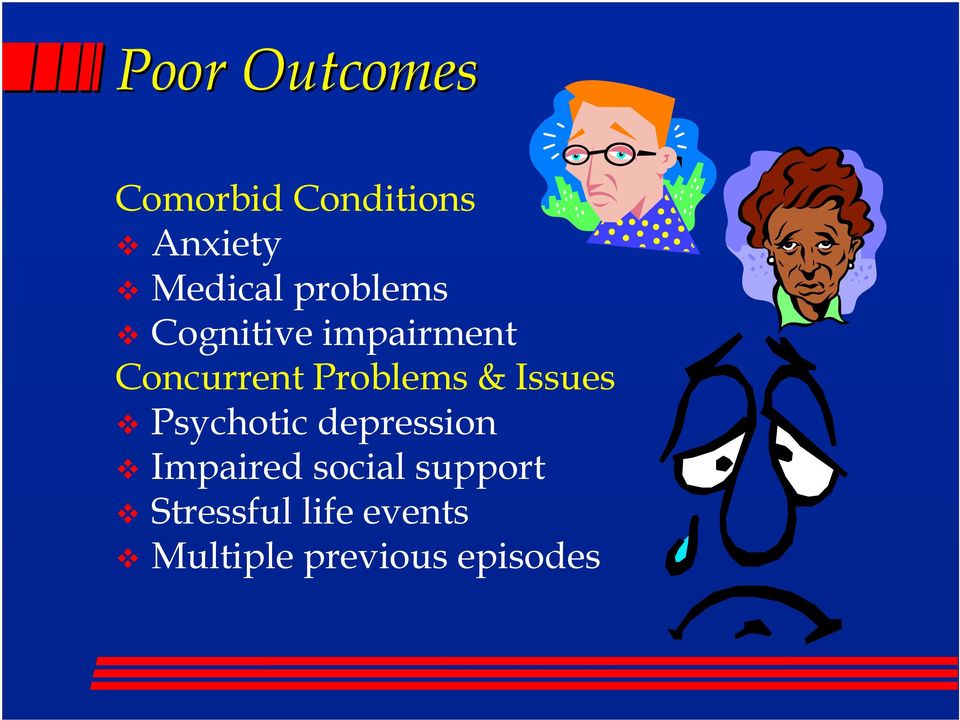
8 Poor Outcomes Comorbid Conditions Anxiety Medical problems Cognitive impairment Concurrent Problems & Issues Psychotic depression Impaired social support Stressful life events Multiple previous episodes
9 Changes in MOOD Sadness Discouragement Crying Feeling down Having the blues Despair Irritability Being on edge Anxiety Brooding Panic attacks

10 Changes in PERCEPTION Withdrawal Hopelessness Self reproach for minor failings Inability to express pleasure Delusions Hallucinations Worthlessness Unreasonable fears Critical of self, others
11 Changes in BEHAVIOR Appetite change Weight loss/gain Sleep disturbance Fatigue, loss of energy Slowed speech Health concerns Can t think, concentrate Thoughts of death Tachycardia Constipation Pacing, wringing hands
12 Depression or??? Stop! Think about CHAIN OF EVENTS! Tempting to think person is putting us on or manipulating Behaviors are part of depression Adjust expectations & approaches: Person cannot just cheer up or look at bright side!
13 Major Depression Depressed mood most of the day, everyday OR Loss of interest or pleasure nearly every day and at least 4 additional symptoms...
14 Major Depression, cont. FOUR ADDITIONAL SYMPTOMS Significant weight loss or gain Insomnia or hypersomnia Psychomotor agitation or retardation Fatigue or loss of energy Feelings of worthlessness, inappropriate guilt Loss of ability to think, concentrate, make decisions Recurrent thoughts of death, suicidal ideation
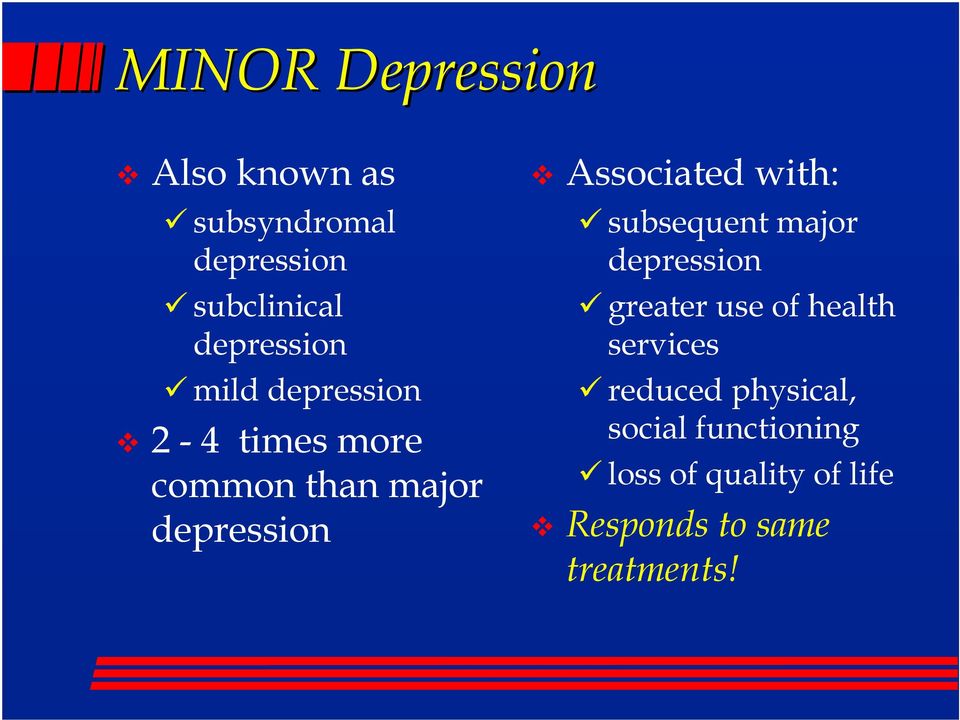
15 MINOR Depression Also known as subsyndromal depression subclinical depression mild depression 2-4 times more common than major depression Associated with: subsequent major depression greater use of health services reduced physical, social functioning loss of quality of life Responds to same treatments!
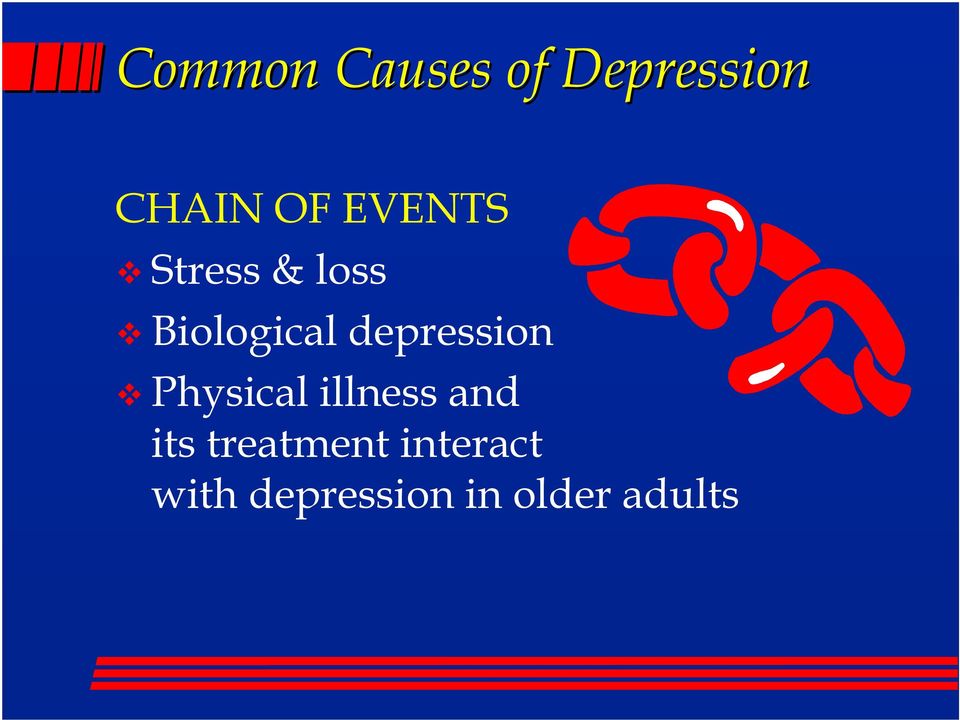
16 Common Causes of Depression CHAIN OF EVENTS Stress & loss Biological depression Physical illness and its treatment interact with depression in older adults
17 Stress and Loss in Late Life Decreased sensory capacity vision hearing Changes in social status, responsibility to others Loss of family, friends Relocation due to changing abilities Declining social contacts due to health limitations Reduced functional status Dwindling financial resources
18 Stress and Loss in Late Life Loss of meaningful roles productivity purpose in living Loss of self-esteem helplessness powerlessness Decreased coping options

19 Biological Depression Genetic cause vs. reaction to stress seems to come out of nowhere family, personal history more common increased risk of severity, reoccurrence Effects of environment and physical illness are still important to address!!

20 Physical Illness & Depression Physical illness directly cause symptoms of depression metabolic endocrine neurologic pulmonary cardiovascular musculoskeletal others: cancer, anemia

21 Physical Illness & Depression Physical illness can cause a reaction of depression by causing chronic pain, fear of pain disability, loss of function loss of self esteem increased dependence fear of death
22 Physical Illness & Depression Depressed elderly may present with somatic (physical) complaints aches, pains appetite, weight fatigue, loss of energy constipation tachycardia insomnia
23 Physical Illness & Depression Medications can cause symptoms of depression antihypertensives psychotropics analgesics cardiovacscular antimicrobials steroids others
24 Physical Illness & Depression Environment in which physical illnesses are treated may contribute to depression... Isolation Sensory deprivation Enforced dependency
25 Assessment Depression symptoms Suicidal thoughts Psychiatric history personal family Physical health/illness Medications Recent loss/stress Resources/abilities
26 Geriatric Depression Scale Score 0 or 1 Add up points (0-30) Further assessment if > 10 Remember! Screening tool; assess symptoms further!!
27 Suicide Assessment Always ASK!!! Have you thought that life isn t worth living? If YES, then... Have you thought about harming yourself? If YES, then... Do you have a plan? If YES, examine lethality... Is the plan viable? Can they execute it? Are means deadly, available?
28 Psychiatric History Look carefully!! Previous episodes of depression Check chart/record Undiagnosed Bad nerves; nervous breakdown; went to bed sick After childbirth, (postpartum), children leave (empty nest), death of loved one, retirement
29 Physical Health/Illness Consider factors that increase isolation, loneliness, fear, or worthlessness!! Loss of mobility Level of disability Worry about declining abilities Pain resulting from health conditions Look for factors that directly increase depression symptoms Medications New? Change in dose? New onset of physical illness Influenza? Change in status of chronic diseases
30 Recent Loss recent relocation? change in relationships? change in health? change in functional abilities? change in sensory status? change in financial status? death of loved one? (even a pet) loss of control over daily routines? loss of significant role?
31 Resources & Abilities family support? community support? social network? physical abilities? functional abilities? cognitive abilities? financial resources? personality traits? personal history? experiences, beliefs, convictions?
32 Person-Centered Appreciate the older person s perspective and experience: control, power loss unwanted dependency meaning of functional losses, relationship to activity, meaning and purpose in living Facility, Staff
33 Interventions Depression is highly treatable Depression is sometimes called A reason for hope Many treatments Talking therapy Medications Daily contacts
34 Interventions Every interaction has Therapeutic Potential Social environment or milieu is powerful Support, encouragement Safety, security Interaction, involvement Validate worth by the way we treat them!
35 Interventions First-Line Interventions Communicate caring Help see they are unusually sad or blue Provide accurate information about depression Create a healthy physical and social environment.
36 Interventions Communicate caring Remind: WE VALUE THEM even if they don't seem to care about themselves right now Ask: how they feel or what they think Encourage: to talk about issues, fears Understand: their point of view Accept: sadness, other feelings
37 Interventions Help to realize they are UNUSUALLY sad, blue Suggest: more than "down in the dumps" Help: identify the things that are troubling Recall: past positive events things haven't always been this bad Note: Positive attributes, characteristics they do still have worth!!
38 Interventions Provide information about DEPRESSION An ILLNESS, like physical illness Symptoms are part of depression Common in people of all ages Has a treatment AND treatment works Medications Talking therapies Increased involvement in activities
39 Promote Mental Health Reduce depressing effects of the environment Adjust factors in the social environment Promote health & well-being Alter approaches to care Offer different activities/experiences Promote positive health outcomes!!
40 Monitor Physical Health Nutrition Elimination Sleep/rest patterns Physical comfort Pain management relaxation methods medication alternative therapies
41 Encourage Physical Activity Exercise program Referrals physical therapy occupational therapy recreational therapy Develop daily activity schedule Involve in meaningful activity
42 Promote Autonomy Create mastery experiences break tasks into steps assure success promote self worth, build confidence Encourage personal control, power independent activity decision-making involvement in care
43 Focus on Positive Current abilities knowledge, wisdom experiences attitudes, beliefs attributes Reminiscence promotes self worth strengthens tie to identify, former self stimulates interests, conversation
44 Employ Alternative Therapies Pet therapy unconditional positive regard sensory stimulation sense of responsibility, meaningful role Horticultural therapy lifespan simulation aroma therapy maintain mobility
45 Encourage Group Activities Psychosocial therapies Reminiscence Remotivation Health, stress management Sensory stimulation Many benefits Social interaction Mastery experiences Realization I am not alone in this!
46 Promote Creativity Lots of alternatives: Singing, playing music Story-telling Drawing, painting Poetry, writing Making crafts, jewelry Associated with positive health outcomes Decreased depression, loneliness Increased health, morale, satisfaction, activity
47 Enhance Social Support Identify a point person to help identify, mobilize resources family member friend, neighbor church members clergy volunteer visitor peer counselor
48 Professional Interventions Individual therapy Group therapy Medication therapy Antidepressants most common Others may be needed for anxiety or psychotic symptoms
49 Depression A REASON FOR HOPE
Mental health issues in the elderly. January 28th 2008 Presented by Éric R. Thériault [email protected]
 Mental health issues in the elderly January 28th 2008 Presented by Éric R. Thériault [email protected] Cognitive Disorders Outline Dementia (294.xx) Dementia of the Alzheimer's Type (early and late
Depression Assessment & Treatment
 Depressive Symptoms? Administer depression screening tool: PSC Depression Assessment & Treatment Yes Positive screen Safety Screen (see Appendix): Administer every visit Neglect/Abuse? Thoughts of hurting
A Depression Education Toolkit
 A Depression Education Toolkit Facts about Depression in Older Adults What is Depression? Depression is a medical illness. When sadness persists or interferes with everyday life, it may be depression.
Presently, there are no means of preventing bipolar disorder. However, there are ways of preventing future episodes: 1
 What is bipolar disorder? There are two main types of bipolar illness: bipolar I and bipolar II. In bipolar I, the symptoms include at least one lifetime episode of mania a period of unusually elevated
Registered Charity No. 5365
 THE MULTIPLE SCLEROSIS SOCIETY OF IRELAND Dartmouth House, Grand Parade, Dublin 6. Telephone: (01) 269 4599. Fax: (01) 269 3746 MS Helpline: 1850 233 233 E-mail: [email protected] www.ms-society.ie
Understanding. Depression. The Road to Feeling Better Helping Yourself. Your Treatment Options A Note for Family Members
 TM Understanding Depression The Road to Feeling Better Helping Yourself Your Treatment Options A Note for Family Members Understanding Depression Depression is a biological illness. It affects more than
Depression Flow Chart
 Depression Flow Chart SCREEN FOR DEPRESSION ANNUALLY Assess for depression annually with the PHQ-9. Maintain a high index of suspicion in high risk older adults. Consider suicide risk and contributing
`çããçå=jéåí~ä= aáëçêçéêëw=^åñáéíó=~åç= aééêéëëáçå. aêk=`=f=lâçåü~ jéçáå~ä=aáêéåíçê lñäé~ë=kep=cçìåç~íáçå=qêìëí=
 `çããçå=jéåí~ä= aáëçêçéêëw=^åñáéíó=~åç= aééêéëëáçå aêk=`=f=lâçåü~ jéçáå~ä=aáêéåíçê lñäé~ë=kep=cçìåç~íáçå=qêìëí= Overview: Common Mental What are they? Disorders Why are they important? How do they affect
MOLINA HEALTHCARE OF CALIFORNIA
 MOLINA HEALTHCARE OF CALIFORNIA MAJOR DEPRESSION IN ADULTS IN PRIMARY CARE HEALTH CARE GUIDELINE (ICSI) Health Care Guideline Twelfth Edition May 2009. The guideline was reviewed and adopted by the Molina
DEPRESSION Depression Assessment PHQ-9 Screening tool Depression treatment Treatment flow chart Medications Patient Resource
 E-Resource March, 2015 DEPRESSION Depression Assessment PHQ-9 Screening tool Depression treatment Treatment flow chart Medications Patient Resource Depression affects approximately 20% of the general population
Depression is a medical illness that causes a persistent feeling of sadness and loss of interest. Depression can cause physical symptoms, too.
 The Family Library DEPRESSION What is depression? Depression is a medical illness that causes a persistent feeling of sadness and loss of interest. Depression can cause physical symptoms, too. Also called
Depression Definition
 Depression Definition Depression may be described as feeling sad, blue, unhappy, miserable, or down in the dumps. Most of us feel this way at one time or another for short periods. Clinical depression
Depression: Facility Assessment Checklists
 Depression: Facility Assessment Checklists A facility system assessment is a starting point for a quality improvement project. The checklists included in this booklet will be most useful if you take a
CHAPTER 5 MENTAL, BEHAVIOR AND NEURODEVELOPMENT DISORDERS (F01-F99) March 2014. 2014 MVP Health Care, Inc.
 CHAPTER 5 MENTAL, BEHAVIOR AND NEURODEVELOPMENT DISORDERS (F01-F99) March 2014 2014 MVP Health Care, Inc. CHAPTER 5 CHAPTER SPECIFIC CATEGORY CODE BLOCKS F01-F09 Mental disorders due to known physiological
Depression Signs & Symptoms
 Depression Signs & Symptoms Contents What Is Depression? What Are The Signs And Symptoms Of Depression? How Do The Signs And Symptoms Of Depression Differ In Different Groups? What Are The Different Types
Seniors and. Depression. What You Need to Know. Behavioral Healthcare Options, Inc.
 Seniors and Depression What You Need to Know Behavioral Healthcare Options, Inc. Depression More Than Just The Blues ou may not know exactly what is wrong with you, but you do know that you just don t
Elizabeth A. Crocco, MD Assistant Clinical Professor Chief, Division of Geriatric Psychiatry Department of Psychiatry and Behavioral Sciences Miller
 Elizabeth A. Crocco, MD Assistant Clinical Professor Chief, Division of Geriatric Psychiatry Department of Psychiatry and Behavioral Sciences Miller School of Medicine/University of Miami Question 1 You
Welcome New Employees. Clinical Aspects of Mental Health, Developmental Disabilities, Addictive Diseases & Co-Occurring Disorders
 Welcome New Employees Clinical Aspects of Mental Health, Developmental Disabilities, Addictive Diseases & Co-Occurring Disorders After this presentation, you will be able to: Understand the term Serious
Feeling Moody? Major Depressive. Disorder. Is it just a bad mood or is it a disorder? Mood Disorders. www.seclairer.com S Eclairer 724-468-3999
 Feeling Moody? Is it just a bad mood or is it a disorder? Major Depressive Disorder Prevalence: 7%; 18-29 years old; Female>Male DDx: Manic episodes with irritable mood or mixed episodes, mood disorder
DEPRESSION CARE PROCESS STEP EXPECTATIONS RATIONALE
 1 DEPRESSION CARE PROCESS STEP EXPECTATIONS RATIONALE ASSESSMENT/PROBLEM RECOGNITION 1. Did the staff and physician seek and document risk factors for depression and any history of depression? 2. Did staff
Depression & Multiple Sclerosis
 Depression & Multiple Sclerosis Managing specific issues Aaron, diagnosed in 1995. The words depressed and depression are used so casually in everyday conversation that their meaning has become murky.
Depression Overview. Symptoms
 1 of 6 6/3/2014 10:15 AM Return to Web version Depression Overview What is depression? When doctors talk about depression, they mean the medical illness called major depression. Someone who has major depression
HEALTH 4 DEPRESSION, OTHER EMOTIONS, AND HEALTH
 HEALTH 4 DEPRESSION, OTHER EMOTIONS, AND HEALTH GOALS FOR LEADERS To talk about the connection between certain emotions (anger, anxiety, fear, and sadness and health) To talk about ways to manage feelings
More than just feelings of unhappiness, clinical or major depression is a mood disorder a medical illness that involves both the body and mind.
 What is depression? More than just feelings of unhappiness, clinical or major depression is a mood disorder a medical illness that involves both the body and mind. 1,2 The difference between clinical depression
Symptoms of mania can include: 3
 Bipolar Disorder This factsheet gives information on bipolar disorder. It explains the symptoms of bipolar disorder, treatments and ways to manage symptoms. It also covers what treatment the National Institute
Mental Health Ombudsman Training Manual. Advocacy and the Adult Home Resident. Module V: Substance Abuse and Common Mental Health Disorders
 Mental Health Ombudsman Training Manual Advocacy and the Adult Home Resident Module V: Substance Abuse and Common Mental Health Disorders S WEHRY 2004 Goals Increase personal comfort and confidence Increase
Depression & Multiple Sclerosis. Managing Specific Issues
 Depression & Multiple Sclerosis Managing Specific Issues Feeling blue The words depressed and depression are used so casually in everyday conversation that their meaning has become murky. True depression
Caring for depression
 Caring for depression Aetna Health Connections SM Disease Management Program Get information. Get help. Get better. 21.05.300.1 B (6/08) Get back to being you How this guide can help you Having an ongoing
Martha T Hinson, M.Ed. Licensed Professional Counselor National Board Certified Counselor
 Martha T Hinson, M.Ed. Licensed Professional Counselor National Board Certified Counselor General uneasiness to panic attacks and phobias Excessive fears and worries, feelings of restlessness Continual
Are you feeling... Tired, Sad, Angry, Irritable, Hopeless?
 Are you feeling... Tired, Sad, Angry, Irritable, Hopeless? I feel tired and achy all the time. I can t concentrate and my body just doesn t feel right. Ray B. I don t want to get out of bed in the morning
Depression. What Causes Depression?
 National Institute on Aging AgePage Depression Everyone feels blue now and then. It s part of life. But, if you no longer enjoy activities that you usually like, you may have a more serious problem. Feeling
Depre r s e sio i n o i n i a dults Yousuf Al Farsi
 Depression in adults Yousuf Al Farsi Objectives 1. Aetiology 2. Classification 3. Major depression 4. Screening 5. Differential diagnosis 6. Treatment approach 7. When to refer 8. Complication 9. Prognosis
Asthma, anxiety & depression
 Anxiety and are common in people with asthma. The good news is that there are effective treatments both for asthma and for anxiety and. With careful management, the symptoms of anxiety and can be treated
Guide for family and friends of people affected by bipolar disorders. www.douglas.qc.ca
 Guide for family and friends of people affected by bipolar disorders www.douglas.qc.ca This guide is intended for families, friends and other people who are interested in understanding the different aspects
Standardised care process (SCP): depression
 Standardised care process (SCP): depression Topic Identifying and responding to symptoms of depression Objective To promote evidence-based practice in how staff identify and respond to symptoms of depression
Depression in Older Persons
 Depression in Older Persons How common is depression in later life? Depression affects more than 6.5 million of the 35 million Americans aged 65 or older. Most people in this stage of life with depression
Release: 1. HLTEN515B Implement and monitor nursing care for older clients
 Release: 1 HLTEN515B Implement and monitor nursing care for older clients HLTEN515B Implement and monitor nursing care for older clients Modification History Not Applicable Unit Descriptor Descriptor This
For Mental Health and Human Services Workers in Major Disasters
 Page 1 of 5 Home Programs Mental Health Topics Newsroom Publications Resources This Site Search For Mental Health and Human Services Workers in Major Disasters POTENTIAL RISK GROUPS Online Publications
Major Depressive Disorder (MDD) Guideline Diagnostic Nomenclature for Clinical Depressive Conditions
 Major Depressive Disorder Major Depressive Disorder (MDD) Guideline Diagnostic omenclature for Clinical Depressive Conditions Conditions Diagnostic Criteria Duration Major Depression 5 of the following
Dr. Anna M. Acee, EdD, ANP-BC, PMHNP-BC Long Island University, Heilbrunn School of Nursing
 Dr. Anna M. Acee, EdD, ANP-BC, PMHNP-BC Long Island University, Heilbrunn School of Nursing Overview Depression is significantly higher among elderly adults receiving home healthcare, particularly among
Personality Difficulties
 Personality Difficulties The essential features of a personality disorder are impairments in personality (self and interpersonal) functioning and the presence of pathological personality traits. There
FACT SHEET 4. Bipolar Disorder. What Is Bipolar Disorder?
 FACT SHEET 4 What Is? Bipolar disorder, also known as manic depression, affects about 1 percent of the general population. Bipolar disorder is a psychiatric disorder that causes extreme mood swings that
Depression in the Elderly: Recognition, Diagnosis, and Treatment
 Depression in the Elderly: Recognition, Diagnosis, and Treatment LOUIS A. CANCELLARO, PhD, MD, EFAC Psych Professor Emeritus and Interim Chair ETSU Department of Psychiatry & Behavioral Sciences Diagnosis
Bipolar Disorder. When people with bipolar disorder feel very happy and "up," they are also much more active than usual. This is called mania.
 Bipolar Disorder Introduction Bipolar disorder is a serious mental disorder. People who have bipolar disorder feel very happy and energized some days, and very sad and depressed on other days. Abnormal
What Are the Symptoms of Depression?
 Lately, Lindsay hasn t felt like herself. Her friends have noticed it, too. Kia was surprised when Lindsay turned down her invitation to go shopping last Saturday (she always loves to shop). There was
Depression and its Treatment in Older Adults. Gregory A. Hinrichsen, Ph.D. Geropsychologist New York City
 Depression and its Treatment in Older Adults Gregory A. Hinrichsen, Ph.D. Geropsychologist New York City What is Depression? Everyday use of the word Clinically significant depressive symptoms : more severe,
Schizoaffective Disorder
 FACT SHEET 10 What Is? Schizoaffective disorder is a psychiatric disorder that affects about 0.5 percent of the population (one person in every two hundred). Similar to schizophrenia, this disorder is
INPATIENT SERVICES. Inpatient Mental Health Services (Adult/Child/Adolescent)
 INPATIENT SERVICES Inpatient Mental Health Services (Adult/Child/Adolescent) Acute Inpatient Mental Health Services represent the most intensive level of psychiatric care and is delivered in a licensed
Helping people to live life their way
 Occupational therapy and Depression Occupational therapy can help people Occupational therapy Dealing Depression is a common illness that affects people of all ages. Depression may occur for no apparent
Coping With Stress and Anxiety
 Coping With Stress and Anxiety Stress and anxiety are the fight-and-flight instincts that are your body s way of responding to emergencies. An intruder crawling through your bedroom window in the dark
Provider Attestation (Expedited Requests Only) Clinical justification for expedited review:
 Inpatient Treatment Request Fax completed form to: 866 949 4846 Fill out completely to avoid delays Date: / / Request Type (Check one): Standard Expedited (additional information required below) Provider
Dr Steve Moss BSc MSc Phd, Consultant Research Psychologist attached to the Estia Centre, Guys Hospital, London.
 INFORMATION SHEET Mental health problems in people with learning disabilities Dr Steve Moss BSc MSc Phd, Consultant Research Psychologist attached to the Estia Centre, Guys Hospital, London. In the whole
Depression ENGELSK. Depresjon
 Depression ENGELSK Depresjon Depression What is depression? Everyone will feel sadness, loneliness, or grief at one time or another, for example at the death of a loved one. This is a natural part of life,
Depression Screening in Primary Care
 Depression Screening in Primary Care Toni Johnson, MD Kristen Palcisco, BA, MSN, APRN MetroHealth System Our Vision Make Greater Cleveland a healthier place to live and a better place to do business. 2
Self Assessment: Substance Abuse
 Self Assessment: Substance Abuse Please respond TRUE (T) or FALSE (F) to the following items as they apply to you. Part 1 I use or have used alcohol or drugs for recreational purposes. I use alcohol despite
Revised 7/05. Copyright 2005 St. Jude Children's Research Hospital www.stjude.org Page 1 of 6
 Antidepressants are drugs used, most often, to treat depression. Depression is a complex illness that involves sad and hopeless feelings that do not go away. Doctors sometimes order these drugs for other
Depression is a common biological brain disorder and occurs in 7-12% of all individuals over
 Depression is a common biological brain disorder and occurs in 7-12% of all individuals over the age of 65. Specific groups have a much higher rate of depression including the seriously medically ill (20-40%),
North Bay Regional Health Centre
 Addictions and Mental Health Division Programs Central Intake Referral Form The Central Intake Referral Form is used in the District of Nipissing by the North Bay Regional Health Centre s Addictions and
Alcohol Disorders in Older Adults: Common but Unrecognised. Amanda Quealy Chief Executive Officer The Hobart Clinic Association
 Alcohol Disorders in Older Adults: Common but Unrecognised Amanda Quealy Chief Executive Officer The Hobart Clinic Association The Hobart Clinic Association Not-for-profit private Mental Health Service
Keynote Session 1 Navigating Teenage Depression Prof. Gordon Parker
 Keynote Session 1 Navigating Teenage Depression Prof. Gordon Parker Professor Gordon Parker is a leading international expert on depression and mood disorders. He is Scientia Professor of Psychiatry at
A Carer s Guide to Depression in People with a Learning Disability
 A Carer s Guide to Depression in People with a Learning Disability Fife Clinical Psychology Department Lynebank Hospital Halbeath Road Dunfermline Fife KY11 4UW Tel: 01383 565 210 December 2009 This booklet
SUICIDAL BEHAVIOR IN CHILDREN AND ADOLESCENTS NADINE J KASLOW, PHD, ABPP [email protected] 2014 APA PRESIDENT
 SUICIDAL BEHAVIOR IN CHILDREN AND ADOLESCENTS NADINE J KASLOW, PHD, ABPP [email protected] 2014 APA PRESIDENT Setting the Stage What are the common myths about suicide in children and adolescents? If I
About Postpartum Depression and other Perinatal Mood Disorders
 About Postpartum Depression and other Perinatal Mood Disorders The entire period of pregnancy up to one year after delivery is described as the perinatal period. Many physical and emotional changes occur
Postpartum Depression and Post-Traumatic Stress Disorder
 Postpartum Depression and Post-Traumatic Stress Disorder Emotional Recovery: Postpartum Depression and Post-Traumatic Stress Disorder By: Lisa Houchins Published: July 23, 2013 Emotions vary widely after
TECHNICAL/CLINICAL TOOLS BEST PRACTICE 7: Depression Screening and Management
 TECHNICAL/CLINICAL TOOLS BEST PRACTICE 7: Depression Screening and Management WHY IS THIS IMPORTANT? Depression causes fluctuations in mood, low self esteem and loss of interest or pleasure in normally
Recognition and Treatment of Depression in Parkinson s Disease
 Recognition and Treatment of Depression in Parkinson s Disease Web Ross VA Pacific Islands Health Care System What is depression? Depression is a serious medical condition that affects a person s feelings,
Memory, Behaviour, Emotional and Personality Changes after a Brain Injury
 Memory, Behaviour, Emotional and Personality Changes after a Brain Injury The consequences of a brain injury on any individual, family or relationship are far reaching. A brain injury not only impacts
Psychiatrists should be aware of the signs of Asperger s Syndrome as they appear in adolescents and adults if diagnostic errors are to be avoided.
 INFORMATION SHEET Age Group: Sheet Title: Adults Depression or Mental Health Problems People with Asperger s Syndrome are particularly vulnerable to mental health problems such as anxiety and depression,
Drugs PSYCHOSIS. Depression. Stress Medical Illness. Mania. Schizophrenia
 Drugs Stress Medical Illness PSYCHOSIS Depression Schizophrenia Mania Disorders In preschool children imaginary friends and belief in monsters under the bed is normal (it may be normal in older developmentally
ENTITLEMENT ELIGIBILITY GUIDELINE
 ENTITLEMENT ELIGIBILITY GUIDELINE BIPOLAR DISORDERS MPC 00608 ICD-9 296.0, 296.1, 296.4, 296.5, 296.6, 296.7, 296.8, 301.13 ICD-10 F30, F31, F34.0 DEFINITION BIPOLAR DISORDERS Bipolar Disorders include:
A Sierra Tucson Publication. An Introduction to Mood Disorders & Treatment Options
 A Sierra Tucson Publication An Introduction to Mood Disorders & Treatment Options 0 Introduction The term mood disorder refers to a category that includes the following mental health issues: Anxiety Disorders
MANAGING DEPRESSIVE SYMPTOMS IN SUBSTANCE ABUSE CLIENTS DURING EARLY RECOVERY
 MANAGING DEPRESSIVE SYMPTOMS IN SUBSTANCE ABUSE CLIENTS DURING EARLY RECOVERY Presented by: William L. Mock, Ph.D., LISW,LICDC, SAP Professional Training Associates Inc North Ridgeville, Ohio 1 (216) 299-9506
The sooner a person with depression seeks support, the sooner they can recover.
 Depression Summary Depression is a constant feeling of dejection and loss, which stops you doing your normal activities. Different types of depression exist, with symptoms ranging from relatively minor
Recommended Geropsychiatric Competency Enhancements for Nurse Practitioners Who Provide Care to Older Adults but are not Geriatric Specialists
 Recommended Geropsychiatric Competency Enhancements for Nurse Practitioners Who Provide Care to Older Adults but are not Geriatric Specialists These recommended competency enhancement statements are not
Are You Considering Medication for Depression?
 Are You Considering Medication for Depression? Perhaps your counselor or psychiatrist has mentioned this option to you, or you've wondered whether an antidepressant medication might be helpful based on
BIPOLAR DISORDER IN PRIMARY CARE
 E-Resource January, 2014 BIPOLAR DISORDER IN PRIMARY CARE Mood Disorder Questionnaire Common Comorbidities Evaluation of Patients with BPD Management of BPD in Primary Care Patient resource Patients with
Depression: What You Need to Know
 Depression: What You Need to Know What is a Depressive Illness? A depressive illness is a whole-body illness, involving your body, mood, thoughts, and behavior. It affects the way you eat and sleep, the
Understanding Suicidal Thinking
 Understanding Suicidal Thinking Suicidal thoughts are temporary. Suicide is permanent. Don t give in to suicidal thoughts you can overcome them. If depression or bipolar disorder (also known as manic depression)
Delirium. The signs of delirium are managed by treating the underlying cause of the medical condition causing the delirium.
 Delirium Introduction Delirium is a complex symptom where a person becomes confused and shows significant changes in behavior and mental state. Signs of delirium include problems with attention and awareness,
Recognizing and Treating Depression in Children and Adolescents.
 Recognizing and Treating Depression in Children and Adolescents. KAREN KANDO, MD Division of Child and Adolescent Psychiatry Center for Neuroscience and Behavioral Medicine Phoenix Children s Hospital
How To Overcome Depression With Diabetes
 BREAKING FREE FROM DEPRESSION AND DIABETES 10 THINGS YOU NEED TO KNOW AND DO DepressionPageFINAL.indd 1 Depression is like a black hole. It can take the joy out of life, drain your energy and motivation,
BIPOLAR DISORDER A GUIDE FOR INDIVIDUALS AND FAMILIES FOR THE TREATMENT OF BIPOLAR DISORDER IN ADULTS
 BIPOLAR DISORDER A GUIDE FOR INDIVIDUALS AND FAMILIES FOR THE TREATMENT OF BIPOLAR DISORDER IN ADULTS A publication of the Massachusetts Department of Mental Health and the Massachusetts Division of Medical
Major Depression. What is major depression?
 Major Depression What is major depression? Major depression is a serious medical illness affecting 9.9 million American adults, or approximately 5 percent of the adult population in a given year. Unlike
Co-Occurring Disorders: A Basic Overview
 Co-Occurring Disorders: A Basic Overview What is meant by Co-Occurring Disorders (COD)? Co-Occurring Disorders (COD) refers to two diagnosable problems that are inter-related and occur simultaneously in
BEST PRACTICES FOR NURSING CARE OF THE OLDER ADULT
 NETWORK OF EXCELLENCE FOR GERIATRIC SERVICES BEST PRACTICES FOR NURSING CARE OF THE OLDER ADULT TITLE: DEPRESSION DATE: October 2005 CONTENT: RELEVANT TOOLS: 10 pages For use in the cognitively intact:
Postpartum Depression (PPD) Beth Buxton, LCSW Massachusetts Department of Public Health [email protected]
 Postpartum Depression (PPD) Beth Buxton, LCSW Massachusetts Department of Public Health [email protected] Mental Health Disorders An estimated 57.7 million adults (26.2% of adult population) suffer
Understanding Bipolar Disorder
 Barnet, Enfield and Haringey Mental Health NHS Trust Understanding Bipolar Disorder Information for patients and carers Page What is bipolar disorder? Bipolar disorder is a serious mental illness involving
Associates for Life Enhancement, Inc. 505 New Road ~ PO Box 83 ~ Northfield, NJ 08225 Phone (609) 569-1144 ~ Fax (609) 569-1510 ~ 1-800-356-2909
 Parents Names (If Client is a Minor) Client Information Sheet Client s Last Name First M.I.. Social Security No. Date of Birth: Age Sex M / F Home Phone No.( ) Education Level: Marital Status: Home Address:
Specific Phobias. Anxiety Disorders Association of America
 Specific Phobias Everyone thinks that once I ve driven on the highway, I ve conquered it. They just don t understand... I don t understand. It s a day-in and day-out struggle. What is a phobia? We all
Psychosis Psychosis-substance use Bipolar Affective Disorder Programmes EASY JCEP EPISO Prodrome
 Dr. May Lam Assistant Professor, Department of Psychiatry, The University of Hong Kong Psychosis Psychosis-substance use Bipolar Affective Disorder Programmes EASY JCEP EPISO Prodrome a mental state in
Intake Form. Marital Status: Date of Birth: Street Address: City: State: Zip: Home Phone: Cell Phone: Work Phone: Social Security #:
 Intake Form PATIENT INFORMATION Patient Last Name: First Name: Marital Status: Date of Birth: Street Address: City: State: Zip: Home Phone: Cell Phone: Work Phone: Social Security #: Gender: Employer:
Depression and Older Adults: Key Issues. The Treatment of Depression in Older Adults
 Depression and Older Adults: Key Issues The Treatment of Depression in Older Adults Depression and Older Adults: Key Issues The Treatment of Depression in Older Adults U.S. Department of Health and Human
Delusions are false beliefs that are not part of their real-life. The person keeps on believing his delusions even when other people prove that the be
 Schizophrenia Schizophrenia is a chronic, severe, and disabling brain disorder which affects the whole person s day-to-day actions, for example, thinking, feeling and behavior. It usually starts between
See also www.thiswayup.org.au/clinic for an online treatment course.
 Depression What is depression? Depression is one of the common human emotional states. It is common to experience feelings of sadness and tiredness in response to life events, such as losses or disappointments.
NURSING B29 Gerontology Community Nursing. UNIT 2 Care of the Cognitively Impaired Elder in the Community
 NURSING B29 Gerontology Community Nursing UNIT 2 Care of the Cognitively Impaired Elder in the Community INTRODUCTION The goal of this unit is for the learner to be able to differentiate between delirium,
Adolescent Depression. Danielle Bradshaw, DO Diplomate of the American Board of Psychiatry and Neurology Adult and Child/Adolescent Psychiatry
 Adolescent Depression Danielle Bradshaw, DO Diplomate of the American Board of Psychiatry and Neurology Adult and Child/Adolescent Psychiatry Adolescence When does it start? When does it end? Characteristics:
ADHD AND ANXIETY AND DEPRESSION AN OVERVIEW
 ADHD AND ANXIETY AND DEPRESSION AN OVERVIEW A/Professor Alasdair Vance Head, Academic Child Psychiatry Department of Paediatrics University of Melbourne Telephone: 9345 4666 Facsimile: 9345 6002 Email:
What Do These Students Have in Common? They are college students who got depressed...got treatment...and got better.
 What Do These Students Have in Common? When I took a part-time job and started living off-campus, my course work fell apart. I couldn t concentrate or sleep, and I was always IRRITABLE and angry. - Leah,
BRIEF NOTES ON THE MENTAL HEALTH OF CHILDREN AND ADOLESCENTS
 BRIEF NOTES ON THE MENTAL HEALTH OF CHILDREN AND ADOLESCENTS The future of our country depends on the mental health and strength of our young people. However, many children have mental health problems