
TRUST COMPANY BUSINESS CODES OF PRACTICE
|
|
|
- Sabina Henry
- 9 years ago
- Views:
Transcription
1 CONSULTATION PAPER NO TRUST COMPANY BUSINESS CODES OF PRACTICE A consultation paper on the proposed revision of the Codes of Practice for Trust Company Business ISSUED August 2006

2 CONSULTATION PAPER The Jersey Financial Services Commission (the Commission ) invites comments on this consultation paper. David Wild at Jersey Finance Limited ( Jersey Finance ) is co-ordinating an industry response that will incorporate any matters raised by local businesses. Comments should reach Jersey Finance by 15 November Responses should be sent to: David Wild Jersey Finance Limited 27 Hill Street St Helier Jersey JE2 4UA Telephone: +44 (0) Facsimile: +44 (0) [email protected] Alternatively, responses may be sent directly to Darren Boschat at the Commission by 15 November If you require any assistance, clarification or wish to discuss any aspect of the proposal prior to formulating a response, it is of course appropriate to contact the Commission. The Commission contact is: Darren Boschat Senior Manager Trust Company Business Jersey Financial Services Commission PO Box 267 Nelson House David Place St Helier Jersey JE4 8TP Telephone: +44 (0) Facsimile: +44 (0) [email protected] It is the policy of the Commission to make the content of all responses available for public inspection unless specifically requested otherwise. Trust Company Businesses Codes of Practice 1

3 CONSULTATION PAPER CONTENTS Pages 1 Executive summary 3 2 Consultation 5 3 The Commission 6 4 Codes of Practice 7 5 Cost benefit analysis 12 6 Summary of questions 13 APPENDICES A List of representative bodies who have been sent this consultation paper 14 B Summary of drafting changes 15 C Draft Codes of Practice 25 Trust Company Business Codes of Practice 2

4 1 - EECUTIVE SUMMARY OVERVIEW 1.1 This paper invites comments on proposed amendments to the Trust Company Business Codes of Practice (the Codes ). The existing Codes were introduced by the Commission in November 2000 and were subsequently amended in October The Commission is granted the power to revise Codes of Practice under Article 19 of the Financial Services (Jersey) Law 1998 (the Law ) and considers it prudent to do so where compelling reasons for such a change exist. In this case, the Commission has decided to review the Codes principally as a result of: Recommendations by the International Monetary Fund 1 ( IMF ) Findings from onsite and offsite supervision Industry feedback The intended repeal of Article 56 of the Trusts (Jersey) Law (the Trusts Law ) 1.2 The update also takes account of the revised structure adopted in more recent Codes issued by the Commission, for example, under the Insurance Business Codes of Practice and the proposed Codes of Practice for Deposit Taking. 1.3 All significant changes are detailed and commented upon in appendix B. WHO WOULD BE AFFECTED? 1.4 Jersey registered trust company businesses ( TCBs ) will be affected by the revision of the Codes. 1 The International Monetary Fund ( IMF ) assessed Jersey s regulatory regime in 2002 and certain recommendations for improvement were made. The proposed amendments to the existing Codes are considered necessary to address and satisfy a number of those recommendations. 2 The Minister for Economic Development has indicated his intention to progress the repeal of Article 56 of the Trusts Law which attaches personal liability to the directors of corporate trustees in the event of a breach of trust. The draft revision of the Codes has been undertaken with this development in mind. Trust Company Business Codes of Practice 3

5 BACKGROUND Jersey s Trust Company Business industry 1.5 Jersey is a leading international financial centre. The Island s financial services industry has well established banking, fund management, investment and trust company sectors, which have in more recent years been joined by a growing insurance sector. 1.6 The Law provides for the regulation of trust company business. There are currently in the region of 190 licensed TCB affiliation 3 leaders operating within the Island. 1.7 Confidence in, and demand for, trust company business services is maintained by the quality, reputation and expertise of individual institutions and the overall business and regulatory climate promoted by the Island s authorities. The Commission aims to maintain Jersey amongst the world s better regulated financial centres and is committed to supporting and implementing international regulatory standards. Jersey s financial services legislation 1.8 Jersey s financial sector is governed by four distinct regulatory laws. 4 The Law, as amended, governs persons carrying on trust company business in and from within Jersey, and Jersey incorporated companies carrying on trust company business anywhere in the world. 1.9 In addition, TCBs are required to comply with such legislation as is relevant to the particular customer structures that they administer: for example, the Trusts Law and Companies (Jersey) Law The Commission is granted the power to issue Codes of Practice for financial service business under Article 19 of the Law The Commission will look for registered TCBs to fully meet all requirements of the revised Codes within six months of their issue in final form. Until that time, the Codes issued by the Commission in October 2001 will remain in force. 3 Affiliation leader has the meaning given to that term by the Financial Services (Trust Company Business (Registration & Fees))(Jersey) Order The Collective Investment Funds (Jersey) Law 1988, the Banking Business (Jersey) Law 1991, the Insurance Business (Jersey) Law 1996, and the Financial Services (Jersey) Law Trust Company Business Codes of Practice 4

6 2 - CONSULTATION 2.1 The Commission has issued this consultation paper in accordance with Article 8(2) of the Financial Services Commission (Jersey) Law 1998, as amended, under which the Commission may, in connection with the carrying out of its functions.consult and seek the advice of such persons or bodies whether inside or outside the Island as it considers appropriate. 2.2 The Commission invites comments in writing from interested parties on the proposals set out in this consultation paper. These are particularly sought in respect of: the specific questions posed (which are summarised in section 6); and the latest draft of the proposed Codes (appendix C). 2.3 Where comments are made by an industry body or association, that body or association should also provide a summary of the type of individuals and/or institutions that it represents. 2.4 To assist in analysing responses to the consultation paper, respondents are asked to: prioritise comments and to indicate their relative importance; and respond as specifically as possible and, where such responses relate to costs, to quantify those costs. 2.5 This paper will be submitted to Jersey Finance, who have agreed to distribute it to all relevant industry bodies and interested parties, to provide a discussion forum for stakeholders and to respond to the Commission on these proposals. 2.6 This paper will also be published on the Commission s web-site at for public access. This will be brought to the attention of the public through an appropriate media announcement. 2.7 Following this period of consultation, the Commission will review responses received and consider any consequent further amendments that might be appropriate. The extent of further consultation will be dependent on the materiality of such amendments. However, it is anticipated that this second consultative process will result in the Codes being finalised and issued. 2.8 A version of the Codes showing tracked changes is available from the Commission upon request. Trust Company Business Codes of Practice 5

7 3 - THE COMMISSION 3.1 The Commission is a statutory body corporate established under the Financial Services Commission (Jersey) Law 1998, as amended. It is responsible for the supervision of financial services provided in or from within Jersey. 3.2 The Commission s guiding principles require it to have regard to: the reduction of risk to the public of financial loss due to dishonesty, incompetence or malpractice by, or the financial unsoundness of, persons carrying on the business of financial services in or from within the Island; the protection and enhancement of the reputation and integrity of Jersey in commercial and financial matters; the best economic interests of the Island; and, in pursuit of the above, contributing to the fight against financial crime. Trust Company Business Codes of Practice 6

8 4 CODES OF PRACTICE 4.1 Format and content A current draft of the Codes, duly amended as a result of the factors outlined under 1.1, is attached at appendix C The draft Codes retain six fundamental principles for trust company business: A registered person must conduct its business with integrity; A registered person must have due regard for the interests of its customers; A registered person must organise and control its affairs effectively for the proper performance of its business activities and be able to demonstrate the existence of adequate risk management systems; A registered person must be transparent in its business arrangements; A registered person must maintain, and be able to demonstrate the existence of, adequate capital resources; and A registered person is expected to deal with the Commission and other authorities in the Bailiwick in an open and co-operative manner In addition, the following seventh principle has been added, under which will be structured codes relating to the advertising of products and services 5 : A registered person must not make statements that are misleading, false or deceptive So far as is possible, the Commission has sought to align the format and content of the Codes that it has issued in respect of other industry sectors What are your views in relation to the proposed new high level principle seven and the accompanying Codes in relation to advertising? 5 This change anticipates the adoption of a subordinate Order to the Law pertaining to advertising and serves to align the Codes with the Codes issued in respect of insurance business and the draft Codes issued in respect deposit-taking business. Trust Company Business Codes of Practice 7

9 4.2 Financial Resource Requirements An important requirement of the Codes, and the regulatory regime in general, is that registered persons have appropriate financial standing The financial failure of a registered person has the potential to severely prejudice customers and damage the Island s reputation. Therefore it is important that the regulatory regime require that registered persons maintain adequate financial resources and insurance Whilst the Commission is of the view that the financial resource requirements remain broadly appropriate, issues arising during the course of regulatory supervision indicate that some amendments are necessary. In addition, the anticipated repeal of Article 56 of the Trusts Law has been considered in this context, as well as in connection with record keeping and the exercise of discretion Full details of the changes are set out in appendices B and C, however brief particulars are discussed below: Adjusted Net Liquid Assets ( ANLA ) calculations The provisions within the Second Schedule relating to the ANLA calculation have been made more prescriptive. This is intended to facilitate a more consistent interpretation of the solvency requirements by TCBs. It is proposed that registered persons be required to notify the Commission in the event that their ANLA calculation produces a ratio of less that 130%. The minimum permissible ratio will remain at 110% therefore a ratio of between 130% and 110%, whilst being notifiable, will not constitute a breach of the Codes Liens and Guarantees The previous option of satisfying the resource requirements by way of a deposit under lien or an irrevocable bank guarantee has been removed. This provision was very rarely utilised and would likely have presented practical difficulties in the event of the insolvency of a TCB Long Term Loans The Codes propose that, henceforth, all loans payable should be treated as liabilities for the purpose of the ANLA calculation unless they are: approved long term subordinated loans; or long-term bank loans. This provision is designed to ensure that liabilities excluded from the ANLA calculation are truly long term, appropriately documented, and, in the case of subordinated loans, subject to certain notification requirements. Trust Company Business Codes of Practice 8

10 Professional Indemnity Insurance ( PII ) The Commission has sought to remove ambiguous terms and has introduced a requirement that firms obtain appropriate run off PII 6 where a TCB is ceasing to conduct business. The maximum permissible PII excess has been moved from 20,000 plus 0.25% of cover over 5 Million to 3% of relevant fees and commissions. It is felt that this more appropriately reflects the levels of excess available in the insurance market and puts the Codes on a more equal footing with the requirements in the other Crown Dependencies Do you consider any of the changes proposed in terms of financial resources to be inappropriate and, if so, how? Are these changes likely to alter your ability to satisfy the ANLA requirements and, if so, how? Do you have loans that you will need to convert to a subordinated basis? Does your business rely upon a deposit under lien or guarantee to meet the financial resource requirements? 4.3 Record Keeping A new paragraph has been inserted at 2.8 of the Codes requiring that registered persons maintain, or ensure that another person is maintaining, adequate financial records in relation to structures under administration. The Codes were previously unclear as to the requirements in this area and the Commission s supervisory work has revealed a need for further prescription The minimum record keeping requirements set out under section 3.7 have also been amended to provide greater clarity Are the record keeping requirements clear and, if not, how could they be improved? 4.4 The Exercise of Discretion Section 2.3 of the Codes has been amended to require that, where a registered person is responsible for the exercise of discretion, such decisions must be appropriate and properly documented. Additional amendments have been made to sections and whereby registered persons acting as, or arranging for their officers or staff to act as, directors or trustees must ensure that the requirements of relevant laws are complied with. 6 Run off PII is insurance coverage for past acts or omissions once a business has ceased trading. Trust Company Business Codes of Practice 9

11 4.4.2 These changes will serve to better align the Codes with other Codes issued by the Commission. 4.5 Compliance Officers and Money Laundering Reporting Officers ( MLROs ) Changes have been made requiring that Compliance Officers are sufficiently independent and are afforded adequate access to the information and resources necessary for them to properly perform their role This change, together with an additional section relating to MLROs is designed to address deficiencies that have been identified during on-site examinations of TCBs. Again, these changes will also serve to better align the Codes with other Codes of Practice issued by the Commission. 4.6 The First Schedule Tables 4 and Tables 4 & 5 set out those qualifications that the Commission considers as being appropriate to satisfy the staff competency requirements when held in conjunction with relevant experience The name and structure of a number of qualifications has changed since the Codes were last updated and this has been reflected in the update to tables 4 and 5. Having taken relevant independent advice, the Commission also considers it appropriate to recognise a number of new qualifications for inclusion in tables 4 and Do you think that the qualifications included in tables 4 and 5 are appropriate? Do you believe that the Codes are appropriate in dealing with staff competency? 4.7 The Fourth Schedule Notification requirements and matters requiring the Commission s consent are currently found throughout the Codes. A new fourth schedule has been created so as to collate these items in a consolidated table. 4.8 Other changes Key changes made to the revised Codes are shown in the table at appendix B. Minor changes, or those involving largely only improvement in terminology, are not commented upon. However, a version of the draft Codes showing all track changes is available from the Commission upon request In light of the proposed changes noted, please consider the following questions: Do you consider any of the proposed changes made to the draft revised Codes to be inappropriate? If so, please provide an explanation How might the same result be achieved differently? Trust Company Business Codes of Practice 10

12 4.8.5 Can you identify any ways in which the revised Codes could be improved? Can you identify any issues that you feel should be addressed within the Codes that have not been addressed in the proposed draft? Trust Company Business Codes of Practice 11

13 5 COST BENEFIT ANALYSIS 5.1 The main benefits achievable from amending the Codes include: The removal of outdated provisions, in particular, the transitional provisions section, which is no longer applicable; Clearer, less ambiguous provisions; Greater consistency with other Codes issued by the Commission; Greater consumer protection through provisions dealing with advertising, record keeping, and the proper exercise of discretion; Clearer, less ambiguous, financial resource and PII requirements; The satisfaction of a number of recommendations made by the IMF in respect of Jersey s regulatory regime; and In doing so, contributing to the maintenance of confidence in the Island s trust company business industry and corresponding regulatory regime. 5.2 The minimum operating standards established by the Codes are considered to be widely in place and already applied by TCBs. The Commission recognises, though, that the size of individual operations and breadth of activities in Jersey vary significantly, with a proportionately greater financial impact falling on smaller entities. 5.3 The cost to industry, as a consequence of these changes to the Codes, is considered unlikely to be significant on the basis that the Codes are not seeking to introduce requirements which would not already be observed by the majority of TCBs as a matter of best practice. 5.4 The Commission already actively supervises TCBs and the amendment to the Codes is not expected to materially add to its operating costs. Trust Company Business Codes of Practice 12
14 6 - SUMMARY OF QUESTIONS Reference Question What are your views in relation to the proposed new high level principle seven and the accompanying Codes in relation to advertising? Do you consider any of the changes proposed in terms of financial resources to be inappropriate and, if so, how? Are these changes likely to alter your ability to satisfy the ANLA requirements and, if so, how? Do you have loans that you will need to convert to a subordinated basis? Does your business rely on a deposit under lien or guarantee to meet the financial resource requirements? Are the record keeping requirements clear and, if not, how could they be improved? Do you think that the qualifications included in tables 4 and 5 are appropriate? Do you believe that the Codes are appropriate in dealing with staff competency? Do you consider any of the proposed changes made to the draft revised Codes to be inappropriate? If so, please provide an explanation How might the same result be achieved differently? Can you identify any ways in which the revised Codes could be improved? Can you identify any issues that you feel should be addressed within the Codes that have not been addressed in the proposed draft? Trust Company Business Codes of Practice 13

15 APPENDI A LIST OF REPRESENTATIVE BODIES WHO HAVE BEEN SENT THIS CONSULTATION PAPER. Jersey Finance Jersey Association of Trust Companies Jersey Bankers Association Jersey Society of Chartered and Certified Accountants The Society of Trust & Estate Practitioners Jersey Branch The Law Society of Jersey Trust Company Business Codes of Practice 14

16 Appendix B SUMMARY OF DRAFTING CHANGES MADE TO THE TRUST COMPANY BUSINESS CODES OF PRACTICE Section Amendment details Comment Throughout Replacement of ambiguous terms eg. should. Explanatory sections re-captioned as Notes. Contents Various consequential amendments. Advisory Note on application Intro New insertion. Various consequential amendments. Amended paragraph dealing with consequences of failing to adhere to Codes. Replaces former section 8. Brings more into line with other Codes and addresses an IMF recommendation. 1. Reflects the recent renumbering of Articles in the Law. 2. Reflects replacement section 7 (as it was) and removal of section 8 of the Codes. 3. Reflects a change in wording of high level principle 6. Gives better clarification as to the status of the Codes. This change is consistent with IMF recommendations and with the approach being taken in the new Anti-Money Laundering Guidance Notes. 1.2 Replace may with must. Removes ambiguity and brings into line with other Codes. 2.1, , 2.6 Various minor amendments. Removes ambiguity and brings into line with other Codes. Trust Company Business Codes of Practice 15

17 2.3 Requirement to document exercise of discretion and that exercise of discretion must be appropriate. Considered a necessary amendment in light of supervisory findings and the repeal of Article 56 of the Trusts (Jersey) Law Replace should with must. Removes ambiguity and brings into line with other Codes. 2.8 Insertion of paragraph dealing with record keeping in relation to customer entities. 1. Extends Codes to include a formal requirement to maintain accurate financial records. 2. Complaints and on-site examinations have exposed this as an area requiring formal regulatory prescription. 3. Addresses an IMF recommendation Note 3 Insertion of Section dealing with Corporate Governance. Deals in more detail with risk management requirements. Requires a registered person to have due regard to the Commission s policy on outsourcing. 1. Brings into line with other Codes. 2. Examinations have exposed this an area requiring explicit coverage in the Codes. 3. Addresses an IMF recommendation. Brings into line with other Codes. Brings into line with other Codes. Trust Company Business Codes of Practice 16

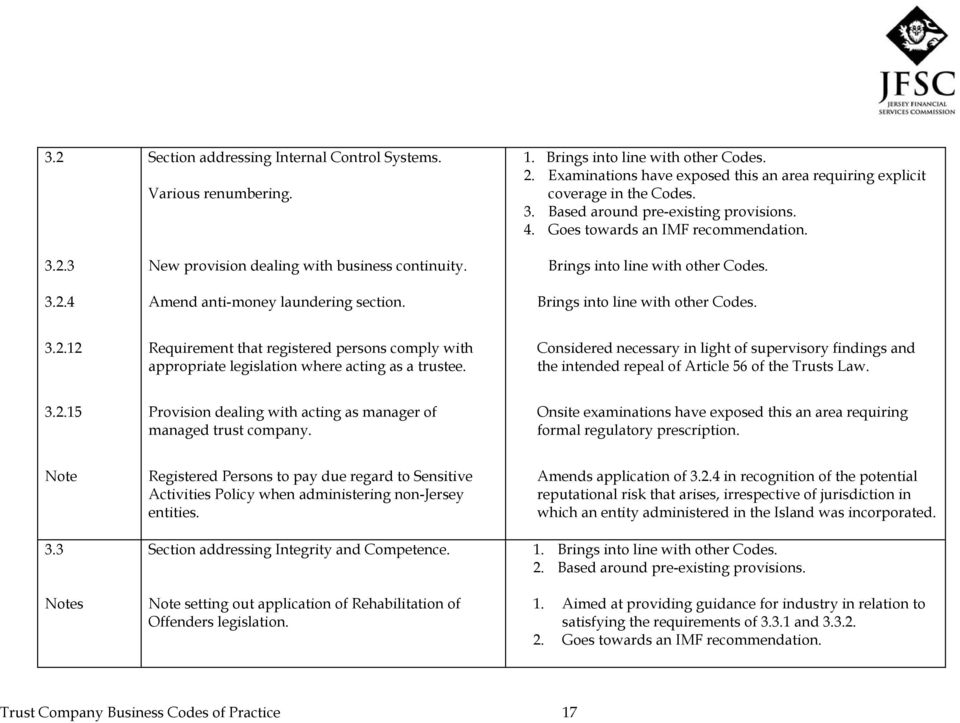
18 Section addressing Internal Control Systems. Various renumbering. New provision dealing with business continuity. Amend anti-money laundering section. 1. Brings into line with other Codes. 2. Examinations have exposed this an area requiring explicit coverage in the Codes. 3. Based around pre-existing provisions. 4. Goes towards an IMF recommendation. Brings into line with other Codes. Brings into line with other Codes Requirement that registered persons comply with appropriate legislation where acting as a trustee. Considered necessary in light of supervisory findings and the intended repeal of Article 56 of the Trusts Law Provision dealing with acting as manager of managed trust company. Onsite examinations have exposed this an area requiring formal regulatory prescription. Note 3.3 Notes Registered Persons to pay due regard to Sensitive Activities Policy when administering non-jersey entities. Section addressing Integrity and Competence. Note setting out application of Rehabilitation of Offenders legislation. Amends application of in recognition of the potential reputational risk that arises, irrespective of jurisdiction in which an entity administered in the Island was incorporated. 1. Brings into line with other Codes. 2. Based around pre-existing provisions. 1. Aimed at providing guidance for industry in relation to satisfying the requirements of and Goes towards an IMF recommendation. Trust Company Business Codes of Practice 17
19 , , Provisions relating to access to information, independence and resourcing of the compliance function. Notification requirements in relation to Compliance Officers. 1. Brings into line with other Codes. 2. Onsite examinations have exposed this an area requiring coverage in the Codes. Brings into line with other Codes New provision requiring appointment of a designate in event that Compliance Officer is temporarily unable to fulfil his/her duties. Section relating to MLROs. Brings into line with other Codes. 4.1 Delete Subject to paragraph 7.3. Refers to, now defunct, transitional provisions. 4.3 New fee provision requiring that registered persons maintain accurate records in relate to time cost charges and disbursements and make such available to customers on request. Considered necessary as a result of customer complaints. 5.1, , and Previous option of satisfying the financial resource requirements by way of a deposit under lien or an irrevocable bank guarantee has been removed. Addition of the specific requirement for a registered person to maintain a net asset position. This option had only been taken up by a very few registered persons and it would be preferable to adopt a more consistent and straightforward approach. This has previously been an explicit requirement just for non-incorporated entities but now puts all registered persons on an equal footing. The majority of registered persons must maintain a net asset position in order to meet the ANLA Trust Company Business Codes of Practice 18

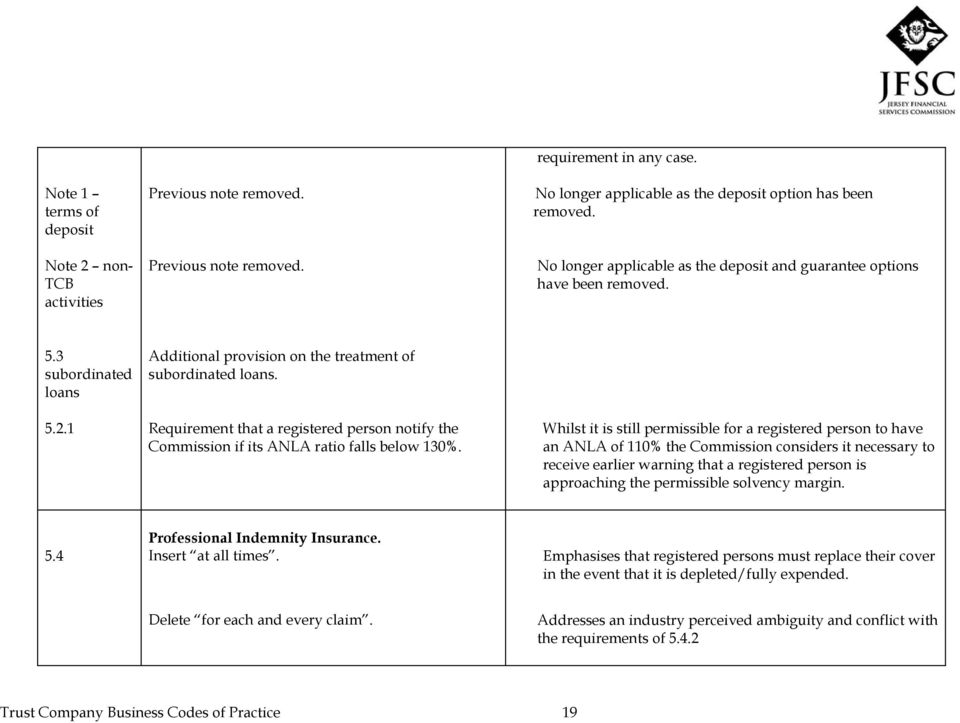
20 Note 1 terms of deposit Note 2 non- TCB activities Previous note removed. Previous note removed. requirement in any case. No longer applicable as the deposit option has been removed. No longer applicable as the deposit and guarantee options have been removed. 5.3 subordinated loans Additional provision on the treatment of subordinated loans. Requirement that a registered person notify the Commission if its ANLA ratio falls below 130%. Whilst it is still permissible for a registered person to have an ANLA of 110% the Commission considers it necessary to receive earlier warning that a registered person is approaching the permissible solvency margin. 5.4 Professional Indemnity Insurance. Insert at all times. Emphasises that registered persons must replace their cover in the event that it is depleted/fully expended. Delete for each and every claim. Addresses an industry perceived ambiguity and conflict with the requirements of Trust Company Business Codes of Practice 19
21 Maximum PII excess requirements -Replace 20,000 plus 0.25% of cover in excess of 5m with 3% of relevant fees and commissions. Requirement that full quantum of excess be treated as an additional liability when performing ANLA. 1. Response to industry comment that current PII excess requirement often unachievable in the market. 2. Brings requirements more into line with other Crown Dependencies. 3. Basis of calculation better reflects firm s ability to fund the excess. 4. Bringing full amount of excess into ANLA requires firm to balance its level of excess against its solvency margin Delete second sentence. Insert provision requiring run off PII in the event of cessation of business. Insert provision dealing with requirement to obtain a re-instatement if cover is depleted. Consequential amendment resulting from change to Recent licence revocations have exposed this an area requiring coverage in the Codes. Emphasises that registered persons must replace their cover in the event that it is depleted/fully expended per High level principle 6. Replace is expected to with must. Insertion of a requirement dealing with Commission inspections of agents and subcontractors. Insertion of requirement for prior notification of the summary winding up or voluntary dissolution of a registered person. Part of a general process of avoiding ambiguity. Brings into line with other Codes. Recent revocations have highlighted this an area requiring coverage in the Codes. Trust Company Business Codes of Practice 20
22 Require notification of a change in a registered person s address. Offsite supervision has revealed this as an area requiring an express provision. Note Insert note setting out Commission s requirements where a registered person is seeking to have its registration revoked. Aims to provide guidance for registered persons. Revocations have shown this as an area that needed to be addressed by the Codes. Trust Company Business Codes of Practice 21
23 7 Replace section on transitional applicants with a new section dealing with advertising standards. 1. Transitional provisions have now expired. 2. Brings into line with other Codes. First Schedule Tables 1,2, and 3 Tables 4 & 5 Staff Categories & Qualifications. Remove references to transitional arrangements. Greater clarification on circumstances in which a principal person can be exempted from competence requirements. Various changes and additions to acceptable qualifications. All transitional provisions have now expired. Onsite supervision has revealed this as an area requiring an express provision. Changes made in consultation with examining bodies and an independent consultant. Second Schedule - Resource requirement table Introduction Format Add statement that for affiliations, the calculation should incorporate all of the participating members as well as the affiliation leader. More detailed pro-forma calculation Addresses a common question raised by registered persons. Should result in more consistent interpretation and application of the requirements. Trust Company Business Codes of Practice 22
24 Illiquid assets adjustment Liabilities Related party liabilities Expanded to include work in progress, debtors and prepayments > 90 days, charges over assets and guarantee margins. Expanded to include deferred income. Now treated as a discrete category. Builds on guidance notes issued and moves charges over assets to a more prominent position. Builds on guidance notes issued. Builds on guidance notes issued and should hopefully encourage more accurate treatment of these balances. PII excess Nonrefundable deferred income Bad debt expense, discretionary bonuses and exceptional costs Ratio Liability added for basic PII excess. Addition of this adjustment on the face of the calculation. Additional detail added to the face of the calculation. Addition of reminder that registered persons are required to notify the Commission if the ratio falls below 130%. Corresponds with change in Builds on guidance notes issued. Builds on guidance notes issued. Another prompt for the registered person. Trust Company Business Codes of Practice 23
25 Definitions used in the Second Schedule Format Definitions Subordinated loans Third Schedule Note Fourth Schedule Again, greater detail has been added and balances split out. The definitions have also been referenced to the appropriate sections of the calculation. Changes in the definitions are in line with the changes in the calculation as noted above. Expanded to incorporate changes to the Commission s policy on subordinated loans. Exceptions from the Codes. Clarification note as to when exceptions are available. New section providing a summary of all notification requirements within the Codes. Purpose is to clarify and make the calculation more userfriendly. As above. Considered a useful reference for practitioners. Trust Company Business Codes of Practice 24
26 CODES OF PRACTICE TRUST COMPANY BUSINESS
27 Contents Advisory note regarding the application of the Codes of Practice Introduction Principles: - 1. A registered person must conduct its business with integrity. 2. A registered person must have the highest regard for the interests of its customers. 3. A registered person must organise and control its affairs effectively for the proper performance of its business activities and be able to demonstrate the existence of adequate risk management systems. Corporate Governance (3.1). Internal Systems and Controls (3.2). Integrity and Competence (3.3). Continuing Professional Development (CPD) (3.4). Compliance Officer and Money Laundering Reporting Officer (3.5) Complaints (3.6). Record - Keeping (3.7). 4. A registered person must be transparent in its business arrangements. 5. A registered person must maintain, and be able to demonstrate the existence of, both adequate financial resources and adequate insurance. Financial Resources ( ). Insurance arrangements (5.4). 6. A registered person must deal with the Commission and other authorities in the Bailiwick in an open and co-operative manner. 7. A registered person must not make statements that are misleading, false or deceptive. Page
28 Contents continued Page Schedules: - First - Employee Category Tables and Qualification Tables Second - Resource requirement table Third - Exceptions for individual classes of business Fourth Table of notification requirements and matters requiring the Commission s consent
29 Advisory note regarding the application of the Codes of Practice (the Codes ) These Codes apply to all persons registered by the Jersey Financial Services Commission (the Commission ) under Article 9 of the Financial Services (Jersey) Law 1998 (the Law ) to carry on trust company business as defined under Article 2(3) and (4) of the Law. Persons registered to conduct Class F or Class O as a single class of trust company business and persons registered to conduct Classes J and K, whether jointly or as single classes of trust company business may, on application, be permitted to enjoy amended requirements in respect of certain sections of the Codes as set out in the Third Schedule. 3
30 Introduction The Codes are issued by the Commission under powers granted to it by Article 19 of the Law. The Codes have been prepared and issued for the purpose of establishing sound principles for the conduct of trust company business as defined in Article 2(3) and (4) of the Law. It is the responsibility of the registered person, however, not only to comply with these principles but also to implement such additional practices, as it considers necessary. In exceptional circumstances, where strict adherence to the Codes would produce an anomalous result, registered persons may apply to the Commission for variance from the Codes. The Codes are arranged under seven fundamental principles, which are further described, explained and delimited, as the case may be. Those fundamental principles are: - A registered person must conduct its business with integrity; A registered person must have the highest regard for the interests of its customers ; In this context, customer means any person(s) who has: - (a) entered into an agreement for the provision of services by the registered person when carrying on trust company business; or (b) received or may receive the benefit of services provided or arranged by the registered person when carrying on trust company business; A registered person must organise and control its affairs effectively for the proper performance of its business activities and be able to demonstrate the existence of adequate risk management systems; A registered person must be transparent in its business arrangements; A registered person must maintain, and be able to demonstrate the existence of, both adequate financial resources and adequate insurance; A registered person must deal with the Commission and other authorities in the Bailiwick in an open and co-operative manner; and A registered person must not make statements that are misleading, false or deceptive. 4
31 Each section of the Codes is designed to be understood by reference to its full text including any notes. Failure by a registered person to follow these Codes represents grounds for the Commission to take enforcement action. Where the Commission has reason to believe that at any time there has been a failure on the part of a registered person or an applicant to follow these Codes, it may consider making use of its regulatory powers which, in serious cases, could include the revocation of a trust company business registration. In addition, failure to comply with a Code may support a decision by the Commission that, for example, continued non-compliance or other failure to remedy the circumstances giving rise to the breach may be addressed by the issue of a direction under Article 23 of the Law. Such a direction might impose requirements on the registered person to do or not to do things, remove persons, or cease operations. In appropriate circumstances that direction can be made public. Whilst failure to follow these Codes shall not of itself render any person liable to proceedings of any kind or invalidate any transaction, the Codes shall be admissible in evidence if it appears to the court, conducting the proceedings, to be relevant to any question arising in the proceedings and shall be taken into account in determining any such question. Where it appears to the Commission that a person has failed to comply with these Codes, it may issue a public statement under Article 25 of the Law. Registered persons are reminded that the conduct of trust company business involves the carrying on of business that involves the provision of company administration services or trustee or fiduciary services and, in the course of providing those services, provides any of the services listed in Article 2(4) of the Law, by way of business in or from within the Bailiwick or, if by a company incorporated in the Bailiwick, in any part of the world. The Codes can be revised after consultation with such persons or bodies as appear to be representative of the interests concerned. Director General [Insert Month]
32 The Principles 1. A registered person must conduct its business with integrity. 1.1 Failure to comply with the above principle will be considered amongst the most serious of breaches of the Codes. 1.2 Without limiting the width of the above principle, a registered person must not: act or refrain from acting, or contract or have any other arrangement, so as to avoid, or seek to avoid, any regulatory responsibilities it may have under the Codes and the full consequences at law of not following them unless the Codes expressly permit any such avoidance. 6
33 2. A registered person must have the highest regard for the interests of its customers. 2.1 A registered person must act with due skill, care and diligence to fulfil the responsibilities that it has undertaken. 2.2 Where a registered person is responsible for exercising discretion for or in relation to its customers, it must take all reasonable steps to obtain sufficient information in order to exercise its discretion or other powers in a proper manner. 2.3 A registered person must only exercise its power or discretion for a proper purpose and must be able to evidence, in writing, that its exercise of that power or discretion was appropriate. 2.4 A registered person must either avoid any conflict of interest arising or, where conflicts arise, must address such conflicts by: disclosure; applying internal rules of confidentiality; declining to act; or, otherwise as appropriate. 2.5 A registered person must transact its business (including the establishing, transfer or closing of business relationships with its customers) in an expeditious manner. 2.6 Any delegation of duties or powers, whether by Power of Attorney or otherwise, must only be entered into for a proper purpose, and be limited and monitored as appropriate. 2.7 A registered person must ensure that adequate procedures are implemented to ensure that regular reviews at appropriate intervals are conducted in respect of the trust company services, which it provides to its customers. 2.8 A registered person must keep, or satisfy itself that another person is keeping, accounting records that are sufficient to show and explain transactions and disclose, with reasonable accuracy, the financial position of structures under administration. NOTE: structures under administration means trusts, companies, partnerships, foundations or other vehicles not beneficially owned by the registered person, that the registered person is responsible for in accordance with the responsibilities that the registered person has accepted in the course of carrying on trust company business. 7
34 3. A registered person must organise and control its affairs effectively for the proper performance of its business activities and be able to demonstrate the existence of adequate risk management systems. 3.1 Corporate Governance Introductory note Corporate governance is the system by which an organisation is directed and controlled. A corporate governance framework specifies the distribution of rights and responsibilities among different participants in the organisation and sets out the rules and procedures for making decisions. Risk management is an integral part of the corporate governance framework Registered persons must operate an effective corporate governance system that must include the following key elements: Registered persons must satisfy the Commission they have an adequate span of control appropriate to the nature of their business Where a registered person is entitled to control trust company business assets, its span of control must comprise at least three appropriately skilled and experienced individuals The relationship of the individuals must be such as to ensure they can all exercise independent judgement without duress or undue influence from one another in the best interests of customers and so as to secure compliance with the Law, any Orders made under it and these Codes Responsibilities must be apportioned among the registered person s senior managers, directors and partners in such a way that their individual responsibilities are clear; and the business and affairs of the registered person are adequately monitored and controlled at senior management and board level Clearly defined procedures must be in place so that there is appropriate oversight by the board of directors and senior management in order to address the principles of risk management: An assessment of the risks present in the registered person s business must be made, and those risks must be documented, as must the ways in which they are monitored and controlled The registered person must maintain accurate and reliable information systems and timely and appropriate management reporting. 8
35 3.1.3 Where the size of a registered person s business warrants it, a separate risk management committee must be established. Note 1 : The requirements set out under paragraph deal with prudential issues referring as they do, to the direction of the business of the registered person itself. As such, this is not a provision that directly governs, for instance, appropriate signatory arrangements for the execution of a specific transaction or exercise of a particular discretion. Note 2 :The Commission has produced guidance notes in relation to span of control and in relation to businesses that do not have the normal span of control in place, which may be of assistance. These are located on the Commission s website. Note 3 : Registered persons should have due regard to the Commission s Policy Statement and Guidance Notes on Outsourcing when considering any delegation of regulated functions. 9
36 3.2 Internal systems and controls A registered person must: operate robust arrangements for meeting the standards and requirements of the regulatory system, including the appointment of a Compliance Officer, establishing effective complaints handling systems, adequate supervision of direct and indirect employees, procedures governing sole, dual or multiple authorisations for handling trust company business assets and for guarding against involvement in financial crime (including the detection and prevention of money laundering) and ensuring that all transactions or decisions are appropriately authorised by persons with the requisite knowledge and experience to effect such transactions or make such decisions; keep adequate and orderly records of their business transactions, their financial position, their internal organisation and their risk management systems; ensure that adequate business resumption, disaster recovery and other contingency arrangements are in place and tested at appropriate intervals; comply with all relevant legislation and guidance to counter money laundering and the financing of terrorism; and have due regard to the principles of the sensitive activities policy document issued by the Jersey Companies Registry from time to time, irrespective of the jurisdiction in which the entity that it is providing services to was incorporated; if providing services defined in Article 2(4)(a) of the Law (namely acting as a company or partnership formation agent under a registration for Class F of trust company business), comply with relevant statutory obligations arising as a result of forming companies or partnerships in Jersey and other jurisdictions; if providing services defined in Article 2(4)(b) of the Law (namely acting or fulfilling the function of or arranging for another person to act as or fulfil the function of director or alternate director of a company under a registration for Class G of trust company business): - Or if providing services defined in Article 2(4)(c) of the Law (namely acting or fulfilling the function of or arranging for another person to act as or fulfil the function of a partner of a partnership under a registration for Class H of trust company business): where arranging for another to act, the registered person must take reasonable steps to ensure that those acting understand their obligations under the relevant law; or, where the registered person, its officers or employees are acting, the registered person must ensure 10
37 they are suitable, competent and understand their duties under, and comply with the requirements of, the relevant laws; be able to demonstrate that reasonable care has been taken to have knowledge of the activities of the companies or partnerships for which they act as or arrange for another to act as director or partner, and any material changes thereto; and have adequate procedures to ensure that, where appropriate, relevant documentation is subject to legal review if providing services defined Article 2(4)(d) of the Law (namely acting or arranging for another person to act as secretary, alternate, assistant or deputy secretary of a company under a registration for Class I of trust company business): where arranging for another to act, the registered person must take reasonable steps to ensure that those acting understand their obligations under the relevant law; or, where the registered person, its officers or employees are acting themselves, the registered person must ensure they are suitable, competent and understand their duties under, and comply with the requirements of, the relevant laws; and where acting as secretary, take reasonable steps to maintain adequate contact with the directors if providing services defined in Article 2(4)(e) of the Law (namely providing a registered office or business address for a company or partnership under a registration for Class J of trust company business) be suitable, competent and understand their duties under, and comply with the requirements of, the laws of the countries in which the companies or partnerships for which they are acting are established; where holding correspondence (whether postal packets, electronic data or otherwise) for collection or forwarding the registered person shall: - establish the reason for the service and agree written procedures and open and retain copies of relevant correspondence received and details of any forwarding addressor, if collected, the date collected, and the name and address of the person collecting the correspondence. 11
38 if providing services defined in Article 2(4)(f) of the Law (namely providing an accommodation, correspondence or administrative address for a company, a partnership or for any other person under a registration for Class K of trust company business): where holding correspondence (whether postal packets, electronic data or otherwise) for collection or forwarding the registered person shall: establish the reason for the service and agree written procedures; and open and retain copies of relevant correspondence received and details of: - (a) any forwarding address; or (b) if collected, the date collected, and the name and address of the person collecting the correspondence if providing services defined in Article 2(4)(g) of the Law (namely acting as or fulfilling or arranging for another person to act as or fulfil the function of trustee of an express trust under a registration for Class L of trust company business), where arranging for another to act, the registered person must take reasonable steps to ensure that those acting understand their obligations under the relevant law; or, where the registered person, its officers or employees are acting themselves, the registered person must ensure they are suitable, competent and understand their duties under, and comply with the requirements of, all relevant laws if providing services defined in Article 2(4)(h) of the Law (namely acting as or fulfilling or arranging for another person to act as shareholder or unitholder as a nominee for another person under a registration for Class M of trust company business ), where arranging for another to act, the registered person must take reasonable steps to ensure that those acting understand their obligations under the relevant law; or, where the registered person, its officers or employees are acting themselves, the registered person must ensure they are suitable, competent and understand their duties under, and comply with the requirements of, all relevant laws if acting as the manager of a managed trust company under a registration for Class N of trust company business, the manager must pay due regard to the risks that might arise from performing this role as part of its own corporate governance. 12
39 3.3 Integrity and competence Explanatory note regarding employee categories and the First Schedule Tables 1-3 of the First Schedule identify three categories of employee; the category into which any individual falls being determined by the most senior role that employee performs. (For example, if an employee has substantially the role of a Category B employee but, rather than being a decision taker the employee is the significant decision-taker for customer affairs, then the employee may be regarded as a Category A employee.) The Tables show the proportions of staff that need to meet the required competence levels. Thus, 75% of Category A and B employees, cumulatively, (notwithstanding that at all times, 75% of the Category A employees must be suitably qualified) and 50% of Category C employees must meet the competence measure. The competence measure allows exemption by experience to count towards the percentage requirements. Tables 4 and 5 of the First Schedule list approved qualifications dependent on whether one is a Category A or B employee or a Category C employee. Tables 4 and 5 are not intended to be a comprehensive list of qualifications relevant to the role of the employee. On submission of a request by the registered person, the Commission will consider, on a case-by-case basis, the acceptability or otherwise of any other qualifications held by a trust company business employee. Such a request must include a written explanation as to why the registered person considers the alternative qualification to be appropriate for that employee and the Commission may request a copy of the syllabus studied or equivalent. The Commission will accept as relevant, qualifications considered by the Commission to be equal to, or higher than, those listed on the respective Tables. A registered person must : ensure their directors, partners, senior managers and all other employees are fit and proper for their roles; vet and monitor the competence and probity of their directors, partners, senior managers and other employees; and obtain and retain copies of documentary evidence of qualifications held by trust company business employees, which are to be used by the registered person to assess the competence of those employees. 13
40 3.3.4 Where complex transactions are undertaken or complex structures are administered (either by the nature of the entity or the jurisdiction of the proper law or forum of that entity), more specialised qualifications, experience and other competencies may be required to ensure the registered person can demonstrate that employees are competent and adequately supervised The Commission may, on application by the registered person, grant exemptions from the requirements to hold the qualifications set out in the First Schedule, where the employees concerned meet one or more of the following requirements: For Category A employees; with at least 20 years relevant experience prior to 27 November 2000, a significant proportion of which must be at a senior level within a relevant sector (the proportion, seniority and relevance of the sector to be determined by the registered person), and certification of competence by the chief executive/managing partner; or who have attained full membership of STEP having applied on or before 31 December For Category B employees; with at least 15 years relevant experience prior to 27 November 2000, a significant proportion of which must be at a senior level within a relevant sector (the proportion, seniority and relevance of the sector to be determined by the registered person), and certification of competence by chief executive/ managing partner; or who have attained full membership of STEP having applied on or before 31 December For Category C employees; with at least 3 years relevant experience prior to 27 November 2000 and certification of competence by chief executive/managing partner; or who have attained full membership of STEP having applied on or before 31 December The Commission will, on application, also consider granting an exemption where exceptional circumstances can be demonstrated. Note 1: For the purposes of the Codes, trust company business employee means a principal or any other person employed by the registered person, whether employed under a service contract or a contract for services, who is providing, in the capacity of a category A or B employee, any of the services in paragraph (4) of Article 2 of the Law; or any person who is assisting in the provision of such services, in the capacity of a category C employee. Note 2: It is the responsibility of the registered person to determine and to document what constitutes relevant experience. Note 3: Paragraphs and above are subject to the restrictions imposed by the Rehabilitation of Offenders (Jersey) Law The exceptions in the Rehabilitation of Offenders (Exceptions) (Jersey) Regulations 2002 ( the Exceptions Regulations ) are 14
41 available to registered persons, applicants and those intending to apply for registration under the Financial Services (Jersey) Law Exceptions cover principal persons and defined categories of employees of regulated financial services businesses. Note 4: As a consequence of Regulation 21 of the Exceptions Regulations, the Rehabilitation of Offenders (Jersey) Law 2001 does not prohibit employers from asking principal persons and defined categories of employees about convictions for relevant offences, even though such convictions may have been obtained some time ago and would otherwise be regarded as spent convictions as defined by the Rehabilitation of Offenders (Jersey) Law To be consistent with the Codes, it is necessary for employers to make use of such exceptions when screening employees who are subject to these exceptions. Note 5 : Employees as identified in this section includes not only direct employees, but also indirect employees, such as temporary and contracted employees and other contracted service providers and, in the case of sole traders, the proprietor of the business. 15
42 3.4 Continuing Professional Development ( CPD ) This section sets out the importance the Commission places on registered persons keeping up to date with industry developments CPD is a compulsory requirement for all trust company business employees and the Compliance Officer. Registered persons are required to maintain CPD records for all such employees (although it is permissible for registered persons to require their employees to keep their own records and account to the registered person on a regular basis) A minimum of 25 hours per year of relevant CPD must be undertaken, a maximum of 5 of which may be relevant reading (pro-rated for part-time employees) It is expected that employees will achieve their CPD targets by adhering to the requirements of their own relevant professional body. However, where the relevant professional body does not prescribe how CPD should be achieved, there are a number of acceptable ways to attain the minimum CPD requirement, including, but not restricted to; (a) studying for further qualifications; (b) in-house training, seminars, conferences and product presentations; (c) computer-based training; (d) one-to-one tuition; (e) reading relevant professional and trade magazines; (f) personal structured study; and (g) attending external training courses The registered person is responsible for ensuring that CPD is appropriate for relevant employees and this consideration must take into account the employee s job description and current duties and may include future development needs The onus is on each registered person to demonstrate the adequacy of its CPD regime. 16
43 3.5 Compliance Officer and Money Laundering Reporting Officer This section sets out the responsibilities of the Compliance Officer and the Money Laundering Reporting Officer and the importance the Commission attaches to these roles. In order to comply with paragraph 3.2.1, there is a requirement for a registered person to designate an appropriately skilled and experienced person (as determined by the registered person), as its Compliance Officer The Compliance Officer must: have appropriate independence and direct access to the registered person s Jersey board of directors or equivalent; hold either an appropriate (as determined by the registered person) compliance or other professional qualification or be studying towards such a qualification; have unfettered access to all business lines and support departments; have appropriate status within the registered person to ensure that directors and senior management react to and determine whether to act upon his or her recommendations; be able to devote sufficient time, and have sufficient resources, to properly discharge the responsibilities of the position; and be based in Jersey The Compliance Officer is responsible for: ensuring the registered person has robust arrangements for compliance with the Law, Orders and Codes; ensuring appropriate monitoring of operational performances and promptly instigating action to remedy any deficiencies in the robust arrangements; and providing the principal point of contact on regulatory matters A registered person must notify the Commission in advance of the appointment, resignation or change of its designated Compliance Officer and must arrange for a completed Personal Questionnaire to be sent to the Commission prior to the appointment of a Compliance Officer. 17
44 3.5.4 In the event that a Compliance Officer is temporarily unable to fulfil his/her responsibilities the board must notify the Commission and designate an appropriately skilled and experienced alternate A registered person must appoint a Money Laundering Reporting Officer The Money Laundering Reporting Officer must: have appropriate independence; have unfettered access to all business lines and support departments; be appropriately skilled and experienced; and have appropriate status within the registered person to ensure that directors and senior management react to and determine whether to act upon his or her recommendations The registered person must submit to the Commission a completed Personal Questionnaire in respect of the appointed person In the event that a Money Laundering Reporting Officer is temporarily unable to fulfil his/her responsibilities the board must notify the Commission and designate an appropriately skilled and experienced alternate. Note 1: Upon receipt of a Personal Questionnaire the Commission will make a number of enquiries. Registered persons may wish to await the Commission s confirmation that it has no objection before confirming the appointment of a Compliance Officer or Money Laundering Reporting Officer. Note 2: Where the registered person has an inexperienced compliance resource, the Commission would expect the registered person to support this area of operation where necessary by importing specialist skills, either internally or possibly through the use of consultancy services. Note 3: There is no specific requirement for a registered person to be subject to an internal audit review. However, the Commission will recognise and take comfort from those registered persons that have effective internal audit controls, or where such functions are provided from elsewhere within a group. The Commission requires access to internal audit reports and requires that such reports will be available to external auditors. 18
45 Note 4: Where the structure of the registered person s business is such that procedures do not compel the Compliance Officer to report directly to the management board, but do compel the Compliance Officer to report to another party, then the Commission will consider, on application by the registered person, exemption from the requirement to comply with above. 19
46 3.6 Complaints This section sets out minimum complaints handling standards. Compliance with requires that a registered person must establish effective complaints handling systems and procedures and, in particular must maintain adequate records of complaints against the registered person, including a central register; and notify the Commission: if a complaint is not satisfactorily resolved within 3 months; or if the registered person considers it to be in the interests of the public/complainant; or of a complaint or series of complaints that suggest the registered person is failing to meet any of the requirements of the Codes. 20
47 3.7 Record Keeping This section explains the minimum standards of record keeping that are required in respect of a registered person s own business and the trust company business services that it is providing Compliance with paragraphs 2.3, 2.8, and requires a registered person to maintain adequate internal controls and to keep not only adequate and orderly accounting records, business records and records of transactions but also adequate and orderly records of its internal organisation and its risk management systems. The registered person must therefore: document the relationship between the companies forming part of the group subject to registration under the Law; document systems and procedures intended to safeguard both the registered person s and trust company business assets and to ensure that only authorised and proper transactions are undertaken; and ensure that the records prepared under paragraphs and are updated as required. When updates are made, the effective date of such updates must be recorded and the superseded records maintained Every registered person is expected to maintain such books and records at an appropriate location in the Bailiwick, and if kept otherwise than in legible form, so as to be readable at a terminal in the Bailiwick and produced in legible form without any delay Records must be kept for at least 10 years. Note: In special circumstances or where compliance is otherwise clearly impractical, the Commission reserves the right to waive the requirement for registered persons to maintain books and records at an appropriate location in the Bailiwick. 21
48 4. A registered person must be transparent in its business arrangements. 4.1 A registered person must disclose on its stationery and advertising material that it is regulated by the Commission in the carrying on of trust company business. 4.2 A registered person must be open and transparent about its charges, including the basis for determining all associated (including other group) fees and charges including commissions (both initial and recurring) and any payments to or from third parties (such as introductory fees or commission sharing arrangements), and must inform customers if the fees will be deducted directly from their assets without their approval - effectively a no surprises policy. This includes implications in relation to the termination of services, (particularly whether fees paid in advance are refundable in the event of termination) and the ability to make changes to the basis for determining fees. Publication of scales of charges, which are available on request, could assist in this regard. 4.3 A registered person must accurately record the basis of any charges in respect of time spent and disbursements and make the relevant records available to customers upon request. Note: If, in the case of any one customer or customers, it is impractical or inappropriate to provide such information directly, it would be sufficient in such instances for the registered person to ensure that the general basis for their charges, and a scale of charges were available on request. 22
49 5. A registered person must maintain, and be able to demonstrate, the existence of, both adequate financial resources and adequate insurance. This section sets out the minimum financial resources required. 5.1 For a registered person, adequate financial resources means (subject to paragraph 5.2): a minimum of 25,000 paid up share capital (or evidenced net assets for non-incorporated entities) and a surplus of Adjusted Net Liquid Assets ( ANLA ) over the Expenditure Requirement in the ratio of 110% in accordance with the calculation set out in the Second Schedule, and a net asset position evidenced in the registered person s accounts In respect of a registered person that is part of an affiliation, then: each affiliation member must comply with the minimum share capital requirement and with the minimum ANLA requirement; or only the affiliation leader need comply with the minimum share capital requirement provided that the affiliation leader is able to provide accounts that enable it to perform, at least once every 3 months, the financial resource requirement calculation in respect of the affiliation in accordance with paragraph Registered persons are required to immediately notify the Commission (in addition to any notification obligation under the Law or these Codes): if their ANLA falls below 130% of their Expenditure Requirements; any transaction or situation that appears not to be catered for in, or where the application of, the Second Schedule or where its application might give a misleading impression of the adequacy of the financial resources. 5.3 The Commission may, upon written application, consider granting consent to exclude a long term subordinated loan as a liability within the ANLA calculation. Such consent is only likely to be granted where the loan is in a prescribed format as provided by the Commission, and where the loan is made by an lender that is acceptable to the Commission. 23
50 Note Where an affiliation has issued share capital of less than 25,000 but a combined share capital and share premium exceeding 25,000, together with a surplus of Adjusted Net Liquid Assets ( ANLA ) over Expenditure Requirements, the Commission may deem the affiliation to have satisfied of the Codes. In such circumstances the affiliation must give prior written notification to the Commission of any proposed reduction in share premium. 24
51 5.4 Insurance arrangements This section sets out the minimum insurance arrangements required A Registered Person is required to maintain adequate insurance cover at all times, commensurate with its business activities. Such cover must include professional indemnity insurance ( PII ) extended to include fidelity guarantee and director s and officer s insurance). PII cover and extensions must therefore include negligence and errors and omissions by the registered person and employee dishonesty and must, where possible, extend to all territories from which the registered person conducts business Specifically, cover should be arranged on the basis of any one claim and in the aggregate including costs and expenses and, so far as lawful, extensions must include retroactive cover in respect of claims arising from work carried out in the past by the registered person; loss or theft of documents (liability and costs of replacement, reinstatement of data and increased costs of working); self-employed or contract hire persons engaged in the registered person s business; and indemnity to employees, former partners, employees and/ or consultants. A registered person must inform the Commission of any limitations in cover that may apply to any territory in which business may be conducted The minimum cover must (subject to paragraph 5.4.4) be the greater of: three times relevant fees and commissions; thirty times relevant fees and commissions from the registered person s single largest customer (including all related customers); or ,000,000 (five million pounds sterling only) but registered persons shall not be required by the above tests to have cover exceeding 10,000,000 (ten million pounds sterling only) The Commission may, on application, consider an exception to the minimum insurance cover requirements stipulated under above in exceptional circumstances Subject to paragraph 5.4.6, any excess per claim on the policy should not exceed 3% of a registered person s annual relevant fees and commissions. The full amount of any excess per claim must at all times be treated as an additional liability when performing the ANLA calculation as set out in the Second Schedule The Commission may, on application, consider an exception to the maximum excess per claim stipulated under
52 5.4.7 With the consent of the Commission, registered persons may self-insure provided they are, or are owned by, an institution of stature In the case of an affiliation, it is the responsibility of the affiliation leader to demonstrate to the Commission that the insurance cover maintained meets the requirements of paragraphs and This may be achieved by: the participating members of the affiliation complying with the PII requirements as though each member was a stand alone applicant; or each participating member of the affiliation entering into Affiliation PII arrangements whereby each member is named on a single policy, the extent of cover being determined in accordance with paragraph but based on the aggregated affiliation revenues; or a combination of the alternatives set out in paragraphs and Registered persons that are ceasing to conduct trust company business are required to arrange for appropriate run off PII coverage in respect of claims arrising from past acts or omissions. Such cover must be on terms reasonably considered to be appropriate by the Commission in all cases In the event that a registered person s aggregate level of PII cover is depleted as a result of a claim on its policy, the registered person must obtain reinstated cover that meets the requirements set out under 5.4 of the Codes. 26
53 6 A registered person must deal with the Commission and other authorities in the Bailiwick in an open and co-operative manner. 6.1 There is a need for candour and co-operation in a registered person s relationship with the Commission. This principle extends to the provision of information and notification of events concerning non-regulated activities and other members of the corporate group, where appropriate, for example, in relation to money laundering issues and market abuse In addition to the requirements of the relevant law, a registered person must allow, and shall procure that any agent or subcontractor of the registered person also allows, inspections by or on behalf of the Commission of any part of its activities. The registered person must provide all reasonable assistance in connection with any such inspection and shall procure that any such agents or subcontractors also provide all reasonable assistance. 6.2 When a registered person has failed to comply with other parts of the Codes, its observance or non-observance of this principle will be relevant to the question of mitigation or aggravation. 6.3 Notifications This section sets out matters which must be brought to the attention of the Commission within the timescales specified. In addition to obligations under the Law, and notwithstanding the generality of paragraph 6.1 above, certain notifications will always be expected from a registered person: A registered person must notify the Commission in writing not less than 28 days before the change is implemented, of a change in: the name of the registered person; any business name under which the registered person carries on trust company business; the address of the principal office of the registered person; the address of the registered office of the registered person; any address which is treated as the proper address of the registered person by paragraph (6) of Article 40 of the Law; and at least 28 days prior to the summary winding up or voluntary dissolution of a registered person. 27
54 6.3.2 A registered person must notify the Commission immediately in writing of any of the following: the presentation of any application to the court for désastre, or the winding up of the registered person or of a company which is a subsidiary or holding company of the registered person, or the summoning of any meeting to consider a resolution to wind-up a registered person, or a company which is a subsidiary, or holding company of the registered person; the application by any person for the commencement of any insolvency proceedings, appointment of any receiver, administrator or provisional liquidator under the law of any country in respect of the registered person; the making or any proposals for the making of a composition or arrangement with creditors of the registered person; where the registered person is a partnership, a limited partnership, or a limited liability partnership (collectively known as partnership ), an application to wind up or dissolve the partnership; the imposition of disciplinary measures or disciplinary sanctions on the registered person in relation to its regulated business by any relevant supervisory authority; the conviction of the registered person or any of its employees for any offence, under legislation of any country, involving fraud or dishonesty; the re-registration of a registered person incorporated with unlimited liability as a limited liability company; a general partner in a registered person becoming a limited partner; the granting or refusal of any application for, or revocation of, authorisation to carry on any regulated business in Jersey, or any country or territory outside the Bailiwick; the withdrawal of an application for, or revocation of, membership of any professional body by a principal person, in any jurisdiction; the appointment of inspectors (howsoever named) by a statutory or other regulatory authority to investigate the affairs of the registered person; 28
55 any other matter which the registered person considers would be material to the requirements placed on the registered person, any of its principal persons, or any of its regulated business employees by the Law or these Codes any matter that might reasonably be expected to affect their registration or be in the interests of customers to disclose A registered person must give written notice within seven days to the Commission upon becoming aware of any of the following matters: in relation to any principal person who is an individual, any change relating to his name or address, and any information which might impact upon his good reputation or character; where a registered person is a body corporate, the formation, acquisition, disposal or dissolution of a subsidiary specifying the subsidiary s name and its principal business; where a registered person is not a body corporate, when it acquires or disposes, for its own benefit, of a holding of more than half in nominal value of the equity share capital of a company, specifying the name of the company and its principal business. Note 1: The duty in and arises immediately the registered person knows, or has reasonable grounds for believing, that any of the above matters may have been or may be about to be committed. Note 2: Where a registered person has global operations, they should apply to the Commission to discuss the extent to which compliance with 6.3 is required. Note 3. Where a registered person wishes the Commission to revoke its registration in accordance with Article 9(4)(a) of the Law, it must submit a request to the Commission in writing accompanied by a Cessation of Business Plan ( COBP ). An outline of the matters that should be addressed by a COBP is available from the Commission upon request. 29
56 7. A registered person must not make statements that are misleading, false or deceptive. Note: Under Article 30 of the Law, it is an offence for any person to knowingly or recklessly make a misleading, false or deceptive statement, promise of forecast for the purpose of inducing another person to enter into, or to refrain from entering into, an agreement for the provision of financial services business. 7.1 A registered person must ensure that its advertising and promotional literature is adequate, fair and not misleading. Words used in advertisements must be chosen carefully and certain words, such as guarantee, assured, confidential and secret, must be treated with great caution. 7.2 An advertisement must not contain a statement, promise or forecast which is untrue or misleading; a statement of fact which the registered person does not at the time the advertisement is issued have reasonable grounds, supported by documentary evidence, for believing to be true; a statement of opinion held by any person which the registered person does not at the time the advertisement is issued have reasonable grounds, supported by documentary evidence, for believing to be the honestly held opinion of that person at that time; a statement of fact which the registered person does not, at the time the advertisement is issued, have reasonable grounds for believing will continue to be true for so long as the advertisement continues to be issued in current publications; a misleading statement about the scale of activities of, or any of the activities of, or the resources of or available to, the registered person or that person s group or affiliates; a statement relating to taxation benefits unless it is properly qualified to show what it means in practice and to whom such benefits apply; a statement relating to client confidentiality unless it is properly qualified to show the limits of any confidentiality assurance made; a comparison with other entities carrying out trust company business unless the basis of comparison is clearly stated and the comparison is fair: or 30
57 7.2.9 a statement implying that the service is only available for a limited period or in limited form, if such is not the case. 7.3 The content and format of any advertisement for trust company business must not: be so designed as to be likely to be misunderstood; be so designed as to disguise the significance of any warning statement or information, which is required to be included under this Code; be presented in such a way that it is not clearly identifiable as an advertisement; signify in any way that the advertisement is approved or has been approved by the Commission (this rule applies even if the Commission has been consulted in regard to the specific advertisement). 7.4 An advertisement may include a quotation from a statement made by any person commending any service provided that: where the person is an employee or associate of the registered person, that fact is disclosed in the advertisement; the quotation is included with that person s consent; the statement is relevant to the service which is the subject of the advertisement; where the whole of the statement is not quoted, what is quoted represents fairly the message contained in the whole of the statement; and the statement has not become inaccurate or misleading through the passage of time since it was made. 7.5 An advertisement must only specify some but not all of the terms and conditions, which attach to a service and exclude others, providing: those which are specified give a fair indication of the nature of the service and the risks involved; and the advertisement contains 31
58 information as to how a written statement of all the terms and conditions can be obtained; or where no mention of terms and conditions is made, the financial services advertisement must contain information as to how all the terms and conditions may be obtained. 7.6 Any advertisement must disclose any special areas of risk relating to the services advertised. 7.7 The Commission will generally decline to vet or approve financial services advertisements before issue. 32
59 THE FIRST SCHEDULE Table 1 Category A Employee Role Indicators Principal person Overall responsibility for the activities and decisions of all employees Makes all significant decisions in respect of Trust Company Business customer affairs Authority to enter singly into any significant commitment on behalf of Trust Company Business customers Minimum Relevant Experience ( MRE ) / Qualifications / CPD Standard Exceptions 5 years MRE } 75% Table 4 qualifications } 25 hours CPD per annum (pro-rated for parttime employees) Note 1: As is currently the practice, it is the responsibility of the registered person to determine and to document what constitutes Relevant Experience. Note 2: CPD should be appropriate i.e. having regard to the employee s job description and duties but may include future development needs. It may include up to a maximum of 5 hours reading (prorated for part-time employees). Note 3: There are a number of acceptable ways to attain the minimum CPD requirement, including, but not restricted to: - (a) studying for further qualifications; (b) in-house training, seminars, conferences and product presentations; (c) computerbased training; (d) one-to-one tuition; (e) reading relevant professional and trade magazines; (f) personal structured study; and (g) attending external training courses. if a non executive director (or partner) i.e. not an executive director (or partner), is not involved in the day to day running of the registered person s business and has no signing authority in respect of trust company business assets (as defined in Article 1 of the Financial Services (Jersey) Law 1998), and is not providing any of the other services referred to in Article 2(4) of the Law - then compliance with MRE, Qualifications and CPD is waived. if a principal person, is not involved in providing any of the services listed in paragraph (4) of Article 2 of the Law (i.e. his responsibilities are confined to managing or supporting the registered person s business only), and he/she does not have the ability to control customer assets, whether singly or on a joint basis, then compliance with minimum relevant experience, qualification and continuing professional development requirements is waived. Exemptions The Commission may, on application, grant an exemption from the requirement to hold qualifications where an individual can demonstrate at least 20 years relevant experience prior to 27 November The Commission may, on application from the registered person, grant an exemption from the requirement to hold qualifications for named trust company business employees where those employees have attained full membership of STEP having applied on or before 31 December Where an individual is a Category A employee but has not completed the prescribed MRE, the Commission may, on application, grant exemption from compliance with this requirement where such compliance would, in its opinion, produce an anomalous result. 33
60 Table 2 Category B Employee Role Indicators Responsible to a principal person (other than as a Category C Employee) Responsible for the activities of Category C Employees reporting to him / her Makes other than significant decisions (Refer Category A) in respect of Trust Company Business customer affairs Minimum Relevant Experience ( MRE ) / Qualifications / CPD Standard EITHER 3 years MRE } 75% Table 4 qualification } 25 hours CPD per annum (pro-rated for part-time employees) OR 5 years MRE } 75% Table 5 qualification } 25 hours CPD per annum (pro-rated for part-time employees) Note 1: As is currently the practice, it is the responsibility of the registered person to determine and to document what constitutes Relevant Experience. Note 2: CPD should be appropriate i.e. having regard to the employee s job description and duties, but may include future development needs.it may include up to a maximum of 5 hours reading (pro-rated for part-time employees). Note 3: There are a number of acceptable ways to attain the minimum CPD requirement, including, but not restricted to: - (a) studying for further qualifications; (b) in-house training, seminars, conferences and product presentations; (c) computer-based training; (d) one-to-one tuition; (e) reading relevant professional and trade magazines; (f) personal structured study; and (g) attending external training courses. Exemptions The Commission may, on application from the registered person, grant an exemption from the requirement to hold qualifications for named trust company business employees where those employees can demonstrate at least 15 years relevant experience prior to 27 November The Commission may, on application from the registered person, grant an exemption from the requirement to hold qualifications where an individual has attained full membership of STEP having applied on or before 31 December Where an individual is a Category B employee, but has not completed the prescribed MRE, the Commission may, on application, grant exemption from compliance with this requirement where such compliance would, in its opinion, produce an anomalous result. 34
61 Table 3 Category C Employee Role Indicators Work is supervised and reviewed directly by a Category A or B employee May be client facing but not a material decision taker Performing a professional administrative (as distinct from clerical) role, but dependent on superiors for decisions on technical matters or Trust Company Business decisions. Minimum Relevant Experience ( MRE ) / Qualifications / CPD Standard Table 5 qualification }50% 25 hours CPD per annum (pro-rated for part-time employees) Note 1: As is currently the practice, it is the responsibility of the registered person to determine and to document what constitutes Relevant Experience. Note 2: CPD should be appropriate i.e. having regard to the employee s job description and duties but may include future development needs. It may include up to a maximum of 5 hours reading (prorated for part-time employees). Note 3: There are a number of acceptable ways to attain the minimum CPD requirement, including, but not restricted to: - (a) studying for further qualifications; (b) in-house training, seminars, conferences and product presentations; (c) computer-based training; (d) one-to-one tuition; (e) reading relevant professional and trade magazines; (f) personal structured study; and (g) attending external training courses. Exemptions The Commission may, on application from a registered person, grant an exemption from the requirement to hold qualifications for named trust company business employees where those employees can demonstrate at least 3 years relevant experience prior to 27 November The Commission may, on application from the registered person, grant an exemption from the requirement to hold qualifications where an individual has attained full membership of STEP having applied on or before 31 December
62 Table 4 - all qualifications must normally be held by examination only. Where qualifications are obtained by any other method the Commission must be notified. Institute of Financial Services Fellow, being formerly an Associate, or Associate of the Chartered Institute of Bankers Associate of the Chartered Institute of Bankers Trustee Diploma B.Sc. Financial Services Diploma in Trust and Estate Practice Institute of Chartered Secretaries & Administrators MSc Corporate Governance Fellow, being formerly an Associate, or Associate of the Chartered Institute of Secretaries & Administrators Diploma in Offshore Finance and Administration Diploma in Business Practice Society of Trust and Estate Practitioners Diploma in Offshore Trust Management Institute of Chartered Accountants of England and Wales or Scotland or Ireland Fellow, being formerly an Associate, or Associate of the Institute of Chartered Accountants Accountancy Degree Full Degree accredited by a UK or Commonwealth University Association of Chartered Certified Accountants Fellow, being formerly an Associate, or Associate of the Association of Chartered Certified Accountants Chartered Institute of Taxation Fellow, being formerly an Associate, or Associate of the Chartered Institute of Taxation Legal Qualifications A Law Degree recognised by the Law Society of England and Wales or the Inns of Court, or its equivalent body elsewhere in the UK or Republic of Ireland Jersey Solicitors Jersey Advocates English Solicitors English Barristers Fellow of the Institute of Legal Executives A Diploma in Law from a recognised professional body as determined by the Commission 36
63 Table 4 Continiued Association of Accounting Technicians Fellow Member (FMAAT) or Full Member status (MAAT) of the Association of Accounting Technicians Institute of Certified Public Accountants in Ireland Professional level of the Institute of Certified Public Accountants in Ireland Chartered Institute of Management Accountants Member of the Chartered Institute of Management Accountants Institute of Financial Accountants Fellowship level of the Institute of Financial Accountants Certified Financial Planner Board of Standards Certified Financial Planner Refer also to the Notes at the foot of Table 5 of this First Schedule. 37
64 Table 5 - all qualifications must normally be held by examination only. Where qualifications are obtained by any other method the Commission must be notified. Any of the qualifications in Table 4, or; Institute of Chartered Secretaries & Administrators Certificate in Offshore Finance & Administration Certificate in Business Practice Accountancy Degree Associate or Foundation Degree accredited by a UK or Commonwealth University Certificate in Offshore Administration Certificate held to include the Introduction to Trusts and Companies module Institute of Financial Services Diploma in Financial Services Management Society of Trust and Estate Practitioners Foundation Certificate in Offshore Trust Management Association of Accounting Technicians Intermediate Level Advanced Certificate Level Association of Chartered Certified Accountants Foundation Level of the Association of Chartered Certified Accountants Certificate Level of the Association of Chartered Certified Accountants CAT Diploma in Financial Management Institute of Certified Public Accountants in Ireland Formation level of the Institute of Certified Public Accountants in Ireland Institute of Financial Accountants Associate level of the Institute of Financial Accountants Financial Accountant Technician Chartered Institute of Management Accountants Certificate in Business Accounting Advanced Diploma in Management Accounting 38
65 Table 5 Cont Association of Taxation Technicians Affiliate of the Association of Taxation Technicians Member of the Association of Taxation Technicians NOTE 1: The Commission may, on application by a registered person, grant exemption from the requirement to hold any of the qualifications listed in Table 5 where the employee is studying towards one of the qualifications listed in Table 4 and has successfully completed certain modules. NOTE 2: The Commission may also, on application by a registered person, grant exemption from the requirement to hold any of the qualifications listed in Table 5 where the registered person is satisfied that the employee can prove that he has supplemented existing qualifications with a top-up in a relevant discipline. Such requests must attach a copy of the relevant syllabus and a written explanation as to why the registered person considers the alternative qualification to be appropriate. NOTE 3: On submission of a request by the registered person, the Commission will consider, on a case- by-case basis, the acceptability or otherwise of any other qualifications held by a trust company business employee. Such a request must include a written explanation as to why the registered person considers the alternative qualification to be appropriate for that employee and the Commission may request a copy of the syllabus studied or equivalent. NOTE 4: The competence measure allows exemption by experience to count towards the percentage requirements. NOTE 5: 75% of Category A and B employees cumulatively (notwithstanding that at all times, 75% of the Category A employees must be suitably qualified) and 50% of Category C employees must meet the competence measure. NOTE 6: The Commission may, on application from a registered person, consider granting an exemption from the requirement to hold any of the qualifications listed in Table 5 where the employee is principally engaged in the administration of employee share plans and has obtained the Institute of Chartered Secretaries and Administrators Certificate in Employee Share Plans. 39
66 THE SECOND SCHEDULE (Paragraphs 5.1, 5.2, and 5.3) The following table (the Resource Requirement Table) sets out the methodology for calculating the Adjusted Net Liquid Assets and Expenditure Requirements. The next pages set out the applicable definitions and calculations. Frequency of calculations - A firm must calculate the requirement as appropriate to the business, but at least once every three months. For affiliations, the calculation should incorporate all of the participating members, as well as the affiliation leader. Resource Requirement Table Note Assets: Total Fixed Assets Current assets: Work in progress Debtors and prepayments Amounts due from related parties Cash at bank and in hand Investments Other Total Current Assets Total Assets A Illiquid Asset Adjustments: B Fixed assets Work in progress C Debtors and prepayments > 90 days D Amounts due from related parties E Other Total Illiquid Assets Adjustment () Adjusted Total Assets 40
67 Liabilities: Note Current Liabilities: Bank Overdraft Bank loans < 1 year Lease obligations < 1 year Taxation obligations < 1 year Deferred income Amounts due to related parties <1 year E Subordinated loan < 1 year to run Other Total Current Liabilities Long Term Liabilities: Bank loans > 1 year Lease obligations > 1 year Taxation obligations > 1 year Amounts due to related parties > 1 year E Subordinated loan > 1 year Other Total Long Term Liabilities Total Liabilities F Adjustments to Total Liabilities: PII Excess G Additional Excess on PII H Guarantees and/or charges over assets I Non refundable deferred income () J Allowable subordinated loan > 1 year () K Allowable undrawn credit facility () L Lease obligations > 1 year () Taxation obligations > 1 year () Bank loans > 1 year () Total Adjustment to liabilities Adjusted Total Liabilities Adjusted Net Liquid Assets (ANLA) 41
68 Calculation of Expenditure Requirement (ER): Administrative expenses Distribution costs Finance costs Tax expense Other expenses Total expenditure M Compare to: Budget for the current year Take the higher Adjustments to ER: Discretionary bonuses/profit share N Bad debt expense Exceptional costs O Other Total adjustments to ER Relevant Annual Expenditure (RAE) Expenditure Requirement of RAE P Ratio of ANLA/ER (Notify the Commission if < 130%) % The ANLA should be maintained at, at least, 110% of the expenditure requirement (either by increasing share capital or introducing subordinated loans). Registered persons are required to notify the Commission if the ANLA falls below the level of 130%. 42
69 Definitions used in the Second Schedule Ref. Definitions Notes A Total assets As disclosed in the current balance sheet. B Illiquid Assets For example, land and buildings, intangibles (goodwill, intellectual property, etc.) amounts receivable from shareholders and/or directors and/or related parties, debtors which are more than 90 days overdue. C Work in progress (WIP) WIP not billable and collectable within 90 days should be treated as illiquid. (see also the Commission s guidance note entitled Interpretation and application of principle 5 and of the second schedule of the Financial Services (Jersey) Law 1998 Trust Company Business Codes of Practice. which is available on the Commission s website.) D Prepayments Any prepayment relating to a period after 90 days should be treated as illiquid. ( see also the guidance note, details of which are set out above.) E Related Party Balances All amounts due from related parties (including shareholders, directors and connected companies) are considered to be illiquid unless they are in the normal course of business and the outstanding balances are settled every 60 days. All amounts due to related parties should be included within the total liabilities, unless in the ordinary course of business and balances are settled every 60 days. No deduction to total liabilities should be made for these amounts unless they have been appropriately subordinated. (See I below) F Total liabilities As disclosed in the current balance sheet, excluding shareholders funds or equivalent. G Professional indemnity insurance (PII) excess The amount of the excess on a registered person s PII policy should be treated as a liability within the calculation. H Additional PII liability In cases where the Commission has granted prior written consent to a PII excess higher than the level specified in the Codes, a registered person may be required to treat a multiple of the additional excess as a liability within this calculation. (see also the guidance note, details of which 43
70 I J Charges over assets and guarantees Non-refundable deferred income are set out above) Where a charge has been given over any asset or the registered person has entered into a guarantee arrangement related to any asset within Adjusted total assets, an appropriate adjustment should be made to reduce the adjusted net liquid assets. Where the registered person s standard terms and conditions state that fees billed in advance are nonrefundable, this amount of deferred income need not be included as a liability in the calculation. (see also guidance notes) K Subordinated loans In cases where the Commission has granted prior written consent to the use of an eligible subordinated loan, the balance of the loan may be removed from liabilities. Such consent is conditional upon the loan being from an acceptable lender, the use of the proforma subordinated loan agreement issued by the Commission and full compliance with the notification requirements within the subordinated loan agreement. Failure to comply with any of these conditions renders the Commission s consent void. (See 5.3) L Allowable undrawn credit facilities Where the Commission has granted prior written consent to the use of a credit facility, the registered person may deduct the undrawn element of the facility from liabilities. (see also the guidance note, details of which are set out above.) M Total expenditure This figure should be the higher of the latest audited annual results and the budget for the current year. During the year, the figure may also be based upon budgeted expenses for the year flexed for actual expenditure. N Discretionary bonuses /profit share Where these items are payable under an employment contract or similar, they may not be treated as deductible. If the items are wholly discretionary, they may be deducted. (see also the guidance note, details of which are set out above.) O Exceptional costs With the Commission s prior written consent, certain exceptional items may be deducted. (see guidance notes for additional detail) P Expenditure requirement Calculated as one quarter of relevant annual expenditure 44
71 THE THIRD SCHEDULE Class (F) acting as a company or partnership formation agent; Exceptions re Codes If providing only Class F services - then: span of control (Paragraph 3.1.1) - minimum of 4 eyes. Employee qualifications & relevant experience (Paragraph 3.3) - trust company business employees who might otherwise be required to hold the qualifications contained in Table 4 of The First Schedule may, instead, hold, as a minimum, the qualifications contained in Table 5 of The First Schedule. Capital - a minimum of 5,000 paid up share capital PII - same calculation basis as paragraph but with the minimum requirement scaled down to 1,000,000 (one million) (J) providing a registered office or business address for a company or partnership; (K) providing an accommodation, correspondence or administrative address for a company, a partnership or for any other person; If providing Class J and /or Class K services only then: span of control (Paragraph 3.1.1) - minimum of 4 eyes. Employee qualifications & relevant experience (Paragraph 3.3) - trust company business employees are exempted from the requirement to hold the qualifications contained in Tables 4 or 5 of The First Schedule. Emphasis will, however, be placed on relevant experience. Capital - a minimum of 5,000 paid up share capital PII - same calculation basis as paragraph but with the minimum requirement scaled down to 1,000,000 (one million pounds sterling) (O) Providing a service specified in Article 2(4)(a),(d),(e) or (h) of the Law ( the specified service ) to a person (whether or not a natural person) where - (a) that person is resident for tax purposes in the Island; and If providing only Class O services then: span of control (Paragraph 3.1.1) - minimum of 2 eyes, providing proper provision for succession exists. Employee qualifications & relevant experience (Paragraph 3.3) - trust company business employees who might otherwise be required to hold the 45
72 (b) the provision of the specified service to that person by the provider does not require the provider to handle or control trust company business assets of the person other than those the provider handles or controls as a necessary result of providing the specified service qualifications contained in Table 4 of The First Schedule may, instead, hold, as a minimum, the qualifications contained in Table 5 of The First Schedule. Capital - a minimum of 5,000 paid up share capital PII - same calculation basis as paragraph but with the minimum requirement scaled down to 2,000,000 (two million pounds sterling) Audit Requirement - waived Note: Other than these exceptions, the remainder of the provisions of the Codes apply. Note: These exceptions are only available upon application to the Commission by the registered person. The Commission would not ordinarily anticipate recognising such exceptions where the applicant is a participating member of an affiliation, unless all members of the affiliation were eligible for similar exceptions. 46
73 THE FOURTH SCHEDULE TABLE OF NOTIFICATIONS AND CONSENTS The following table summarises those trigger events and circumstances which a registered person must bring to the attention of the Commission as well as those exceptions which require the Commission s prior written consent. CONTROL AND RISK MANAGEMENT Note on Application Consent Exemption from compliance with certain sections of the Codes as set out in the Third Schedule may be granted on application 3.3 Consent On submission of a request by a registered person, the Commission will consider on a case-by-case basis, the acceptability or otherwise of any qualifications, other than those set out in Tables 4 and 5, held by a trust company business employee. Such a request must include a written explanation as to why the registered person considers the alternative qualification to be appropriate for that employee and the Commission may request a copy of the syllabus studied or equivalent Consent The Commission may, on application by the registered person, grant exemptions from the requirements to hold the qualifications set out in the First Schedule, where the employees concerned meet one or more of the requirements defined in Notification A registered person must notify the Commission if a complaint is not satisfactorily resolved within three months, or if the registered person considers it to be in the interests of the public/complainant, or if there is a complaint or series of complaints that suggest the registered person is failing to meet the requirements of the Codes 3.7 Note Consent In special circumstances or where compliance is otherwise clearly impractical, the Commission may waive the requirement for registered persons to maintain books and records at an appropriate location in the Bailiwick FINANCIAL RESOURCES 5.2 Note Notification Where an affiliation has issued share capital of less than 25,000 but a combined share capital and share premium exceeding 25,000 and complies with the adjusted net liquid assets ( ANLA ) over expenditure requirement, the Commission may deem the affiliation to have satisfied of the Codes. In such circumstances the affiliation must seek written consent from the Commission prior to any reduction in share premium Notification A registered person is required to immediately notify the Commission if their adjusted net liquid assets ( ANLA ) fall below 130% of their expenditure requirements Notification Notification should be made of any transaction or situation that appears not to be catered for in, or where the application of, the 47
74 Second Schedule might give a misleading impression of the adequacy of the financial resources 5.3 Consent The Commission may, upon written application, consider granting consent to exclude an eligible subordinated loan from the liabilities within the ANLA calculation. Second Schedule Second Schedule Second Schedule Consent On written application, the Commission may consider granting consent to the inclusion of a guaranteed overdraft or a loan facility in the ANLA calculation Consent Eligible subordinated loans may be excluded from liabilities in the ANLA calculation subject to the Commission s consent. See the note in 5.3 Consent Certain exceptional items may be excluded, with the Commission s consent, from the expenditure requirement in the ANLA calculation. INSURANCE ARRANGEMENTS Notification A registered person must inform the Commission of any limitations in professional indemnity insurance ( PII ) cover that may apply to any territory in which business may be conducted Consent In exceptional circumstances, the Commission may consider an exemption to the minimum PII cover requirements stipulated under Consent The Commission may consider an exemption to the maximum excess per claim on PII stipulated under Where this has been granted, the amount of a multiple of at least three times the additional excess must be treated as an additional liability within the ANLA calculation Consent Registered persons may self-insure, with the consent of the Commission, provided they are, or are owned by, an institution of stature CHANGES IN DETAILS Notification Notify in writing not less than 28 days before any change in: Name of the registered person; Any business name under which the registered person carries on trust company business; Address of the principal office of the registered person; Address of the registered office of the registered person; Any address which is treated as the proper address of the registered person by paragraph (6) of Article 40 of the Law; and at least 28 days prior to the summary winding up or voluntary dissolution of a registered person. LIQUIDATIONS AND WINDING UPS Notification Notify immediately in writing of: Application for or the summoning of a meeting to consider a resolution for désastre or winding up of the registered person or of a subsidiary or holding company of the registered person; Application by any person for the commencement of insolvency proceedings, appointment of a receiver, administrator or provisional liquidator in respect of the 48
75 registered person; Making or any proposals for the making of a composition or arrangement with creditors of the registered person; Where the registered person is a partnership, limited partnership or a limited liability partnership, the application to wind up or dissolve the partnership. Note Consent Where a registered person wishes the Commission revoke its registration in accordance with Article 9(4)(a) of the Law, it should submit a request to the Commission in writing accompanied by a Cessation of Business Plan GENERAL NOTIFICATIONS Notification Notify immediately in writing of: Imposition of disciplinary measures or disciplinary sanctions on the regulated person in relation to its regulated business by any relevant supervisory authority; Conviction of the registered person or any of its employees for any offence, under legislation of any country, involving fraud or dishonesty; Re-registration of a registered person incorporated with unlimited liability as a limited liability company; General partner in a registered person becoming a limited partner; Granting or refusal of any application for, or revocation of, authorisation to carry on any regulated business in Jersey or any country or territory outside the Bailiwick; Withdrawal of an application for, or revocation of, membership of any professional body by a principal person, in any jurisdication; Appointment of inspectors (howsoever named) by a statutory or other regulatory authority to investigate the affairs of the registered person; Any other matter which the registered person considers would be material to the requirements placed on the registered person, any of its principal persons, or any of its regulated business employees by the Law or these Codes; Any matter that might reasonably be expected to affect their registration or be in the interests of customers to disclose Notification Notify the Commission in writing within 7 days of: Changes in the information originally provided to the Commission on the form of application for registration relating to the name, address, good reputation or character of any principal person who is an individual; The formation, acquisition, disposal or dissolution or a subsidiary where the registered person is a body corporate, to specify the subsidiary s name and principal business; 49
76 Where the registered person is not a body corporate, when it acquires or disposes, for its own benefit, of a holding of more than half in nominal value of the equity share capital of a company, to specify the name of the company and its principal business. EMPLOYEE QUALIFICATIONS First Schedule Consent The Commission may, on application, grant an exemption from the requirement to hold qualifications where an individual can demonstrate at least 20 years relevant experience prior to the 27 November The Commission may, on application from the registered person, grant an exemption from the requirement to hold qualifications for named trust company business employees where those employees have attained full membership of STEP having applied on or before 31 December Where an individual is a Category A employee but has not completed the prescribed MRE, the Commission may, on application, grant exemption from compliance with this requirement where such compliance would, in its opinion, produce an anomalous result Table 5 Consent The Commission may, on application, grant the following exemptions: Exemption from the requirement to hold any of the qualifications listed in Table 5 where the employee is studying towards one of the qualifications in Table 4 and has successfully completed certain modules; Exemption from the requirement to hold any of the qualifications listed in Table 5 where the registered person is satisfied that the employee can prove that he has supplemented existing qualifications with a top-up in a relevant discipline; Exemption from the requirement to hold any of the qualifications listed in Table 5 where the employee is principally engaged in the administration of employee share plans and has obtained the Institute of Chartered Secretaries and Administrators Certificate in Employee Share Plans 50
Financial Services (Jersey) Law 1998. Codes of Practice. Trust Company Business
 Financial Services (Jersey) Law 1998 Codes of Practice for Trust Company Business Effective from: 1 January 2008 Contents Page Introduction 4 Glossary 7 1. The Principles A registered person must conduct
Financial Services (Jersey) Law 1998. Codes of Practice for Fund Services Business. Effective from: 14 November 2007
 Financial Services (Jersey) Law 1998 Codes of Practice for Fund Services Business Effective from: 14 November 2007 Revised: 1 July 2014 Contents Page Glossary 5 Introduction 9 Principles: 1. A registered
Policy Statement: Licensing Policy in respect of those activities that require a permit under the Insurance Business (Jersey) Law 1996
 Policy Statement: Licensing Policy in respect of those activities that require a permit under the Insurance Business (Jersey) Law 1996 Issued: 11 February 2011 Glossary of terms: The following table provides
MONEY SERVICES BUSINESS
 CONSULTATION PAPER NO. 1 2003 Consultation Paper 2003-01 MONEY SERVICES BUSINESS Oversight of bureaux de change, money transmitters, and cheque cashers Issued March 2003 CONSULTATION PAPER The Jersey Financial
CONSULTATION PAPER NO 2. 2004
 CONSULTATION PAPER NO 2. 2004 REGULATION OF GENERAL INSURANCE MEDIATION BUSINESS This consultation paper explains the need for the Island to regulate general insurance mediation business and examines the
Financial services regulation in Jersey
 www.bedellgroup.com Jersey Guernsey London Dublin Mauritius BVI Singapore Financial services regulation in Jersey Bedell Cristin Jersey briefing briefing Jersey's reputation as a leading international
Authorisation Requirements and Standards for Debt Management Firms
 2013 Authorisation Requirements and Standards for Debt Management Firms 2 Contents Authorisation Requirements and Standards for Debt Management Firms Contents Chapter Part A: Authorisation Requirements
GUERNSEY FINANCIAL SERVICES COMMISSION
 GUERNSEY FINANCIAL SERVICES COMMISSION LICENCE APPLICATIONS FOR ENTITIES ACTING IN RESPECT OF QUALIFYING INVESTOR FUNDS OR REGISTERED CLOSED-ENDED INVESTMENT FUNDS GUIDANCE In recent years, the Commission
GUIDANCE NOTE NATURAL PERSONS CARRYING ON A SINGLE CLASS OF TRUST COMPANY BUSINESS (APPLICATION PROCESS AND ON-GOING REGULATORY REQUIREMENTS)
 GUIDANCE NOTE NATURAL PERSONS CARRYING ON A SINGLE CLASS OF TRUST COMPANY BUSINESS (APPLICATION PROCESS AND ON-GOING REGULATORY REQUIREMENTS) Issued: February 2009 Last revised: August 2013 Contents 1
Authorised Persons Regulations
 Authorised Persons Regulations Contents Part 1: General Provisions Article 1: Preliminary... Article 2: Definitions... Article 3: Compliance with the Regulations and Rules... Article 4: Waivers... Part
INSURANCE ACT 2008 CORPORATE GOVERNANCE CODE OF PRACTICE FOR REGULATED INSURANCE ENTITIES
 SD 0880/10 INSURANCE ACT 2008 CORPORATE GOVERNANCE CODE OF PRACTICE FOR REGULATED INSURANCE ENTITIES Laid before Tynwald 16 November 2010 Coming into operation 1 October 2010 The Supervisor, after consulting
New Zealand Institute of Chartered Accountants
 New Zealand Institute of Chartered Accountants FAES Issued 11/09 Amended 07/13 ENGAGEMENT STANDARD FINANCIAL ADVISORY ENGAGEMENTS Issued by the Board of the New Zealand Institute of Chartered Accountants
Thompson Jenner LLP Last revised April 2013 Standard Terms of Business
 The following standard terms of business apply to all engagements accepted by Thompson Jenner LLP. All work carried out is subject to these terms except where changes are expressly agreed in writing. 1
NOBLE TRUST COMPANY LTD. GENERAL TERMS OF BUSINESS. The following definitions and rules of interpretation shall apply:
 NOBLE TRUST COMPANY LTD. GENERAL TERMS OF BUSINESS 1. Definitions and interpretation The following definitions and rules of interpretation shall apply: 1.1 Agent means any person appointed by a Client
STATEMENT OF INSOLVENCY PRACTICE 9 (SCOTLAND) REMUNERATION OF INSOLVENCY OFFICE HOLDERS
 STATEMENT OF INSOLVENCY PRACTICE 9 (SCOTLAND) REMUNERATION OF INSOLVENCY OFFICE HOLDERS 1 INTRODUCTION 1.1 This Statement of Insolvency Practice (SIP) is one of a series issued to licensed insolvency practitioners
COLLECTIVE INVESTMENT LAW DIFC LAW No. 2 of 2010
 ---------------------------------------------------------------------------------------------- COLLECTIVE INVESTMENT LAW DIFC LAW No. 2 of 2010 ----------------------------------------------------------------------------------------------
A CREDITORS' GUIDE TO LIQUIDATORS' FEES ENGLAND AND WALES
 A CREDITORS' GUIDE TO LIQUIDATORS' FEES ENGLAND AND WALES 1 Introduction 1.1 When a company goes into liquidation the costs of the proceedings are paid out of its assets. The creditors, who hope to recover
National Occupational Standards. Compliance
 National Occupational Standards Compliance NOTES ABOUT NATIONAL OCCUPATIONAL STANDARDS What are National Occupational Standards, and why should you use them? National Occupational Standards (NOS) are statements
A SHAREHOLDERS GUIDE TO LIQUIDATORS FEES - ENGLAND AND WALES
 A SHAREHOLDERS GUIDE TO LIQUIDATORS FEES - ENGLAND AND WALES 1 Introduction 1.1 When a company goes into liquidation the costs of the proceedings are paid out of its assets. The members (shareholders),
GENERAL LICENSING POLICY FOR THOSE SEEKING A BANKING, INVESTMENT BUSINESS OR FIDUCIARY SERVICES LICENCE
 GENERAL LICENSING POLICY FOR THOSE SEEKING A BANKING, INVESTMENT BUSINESS OR FIDUCIARY SERVICES LICENCE This licensing policy sets out the general criteria the Commission will normally apply in assessing
FRAMEWORK FOR THE PREPARATION OF ACCOUNTS. Best Practice Guidance
 FRAMEWORK FOR THE PREPARATION OF ACCOUNTS Best Practice Guidance Revised Edition April 2010 PUBLISHED IN APRIL 2010 THE INSTITUTE OF CHARTERED ACCOUNTANTS OF SCOTLAND This document is published by the
COLLECTIVE INVESTMENT SCHEMES ACT 2008 COLLECTIVE INVESTMENT SCHEMES (REGULATED FUND) REGULATIONS 2010
 Statutory Document No. 161/10 COLLECTIVE INVESTMENT SCHEMES ACT 2008 COLLECTIVE INVESTMENT SCHEMES (REGULATED FUND) REGULATIONS 2010 1 Title 2 Commencement 3 Interpretation INDEX THE GOVERNING BODY 4 Composition
A Guide to the Financial Services Regulations
 A Guide to the Financial Services Regulations Contents Chapter 1 2 Introduction to the Financial Services Regulations Legislative Background Chapter 2 3 Overview of FSR Regulated Activities Authorisation
Solvency Assessment and Management: Pillar II Sub Committee Governance Task Group Discussion Document 81 (v 3)
 Solvency Assessment and Management: Pillar II Sub Committee Governance Task Group Discussion Document 81 (v 3) Governance, Risk Management, and Internal Controls INTERIM REQUIREMENTS CONTENTS 1. INTRODUCTION
Financial Services Guidance Note Outsourcing
 Financial Services Guidance Note Issued: April 2005 Revised: August 2007 Table of Contents 1. Introduction... 3 1.1 Background... 3 1.2 Definitions... 3 2. Guiding Principles... 5 3. Key Risks of... 14
GUIDANCE FOR MANAGING THIRD-PARTY RISK
 GUIDANCE FOR MANAGING THIRD-PARTY RISK Introduction An institution s board of directors and senior management are ultimately responsible for managing activities conducted through third-party relationships,
LONDON STOCK EXCHANGE HIGH GROWTH SEGMENT RULEBOOK 27 March 2013
 LONDON STOCK EXCHANGE HIGH GROWTH SEGMENT RULEBOOK 27 March 2013 Contents INTRODUCTION... 2 SECTION A ADMISSION... 3 A1: Eligibility for admission... 3 A2: Procedure for admission... 4 SECTION B CONTINUING
INSOLVENCY GUIDANCE NOTE STATEMENT OF INSOLVENCY PRACTICE 9 (NI): REMUNERATION OF INSOLVENCY OFFICE HOLDERS NORTHERN IRELAND
 INSOLVENCY GUIDANCE NOTE STATEMENT OF INSOLVENCY PRACTICE 9 (NI): REMUNERATION OF INSOLVENCY OFFICE HOLDERS NORTHERN IRELAND Contents Paragraph s Introduction 1-8 The Statutory provisions 9 Administration
A MEMBERS GUIDE TO LIQUIDATORS FEES ENGLAND AND WALES
 A MEMBERS GUIDE TO LIQUIDATORS FEES ENGLAND AND WALES 1 Introduction 1.1 When a Company goes into members voluntary liquidation, the costs of the proceedings are paid out of its assets. A declaration of
Corporate Governance Code for Collective Investment Schemes and Management Companies
 Corporate Governance Code for Collective Investment Schemes and Management Companies Corporate Governance Code Page 1 Transitional Arrangements Whilst this Code is voluntary in nature, its adoption is
GUIDANCE NOTE DECISION-MAKING PROCESS
 GUIDANCE NOTE DECISION-MAKING PROCESS This document is intended as a general guide to the way in which the Jersey Financial Services Commission (the Commission ), normally approaches the exercise of its
MANAGED CORPORATE SERVICE PROVIDERS
 PRACTICE NOTES ON MANAGED CORPORATE SERVICE PROVIDERS (PN-010105) (Issued under section 7(1)(a) of the Financial Services Development Act 2001) Issued on 06 January 2005 CONTENTS Pages 1 Introduction 1-2
A CREDITORS GUIDE TO FEES CHARGED BY TRUSTEES IN BANKRUPTCY ENGLAND AND WALES
 A CREDITORS GUIDE TO FEES CHARGED BY TRUSTEES IN BANKRUPTCY 1 Introduction ENGLAND AND WALES 1.1 When an individual becomes bankrupt the costs of the bankruptcy proceedings are paid out of his or her assets.
SCOPE OF APPLICATION AND DEFINITIONS
 Unofficial translation No. 398/1995 Act on Foreign Insurance Companies Issued in Helsinki on 17 March 1995 PART I SCOPE OF APPLICATION AND DEFINITIONS Chapter 1. General Provisions Section 1. Scope of
Guidance note on Outsourcing/Delegation of Functions and inward outsourcing
 Financial Services Rule Book Rules 8.13, 8.9 and 8.9A Guidance note on Outsourcing/Delegation of Functions and inward outsourcing Supervision Division Financial Supervision Commission September 2012 Guidance
Standard terms of business
 31a Charnham Street, Hungerford, Berkshire, RG17 0EJ Tel: 01488 682546 Fax: 01488 684473 Email: [email protected] Web: www.bradingcryer.co.uk Standard terms of business The following standard
APPENDIX B A CREDITORS GUIDE TO ADMINISTRATORS REMUNERATION SCOTLAND
 APPENDIX B A CREDITORS GUIDE TO ADMINISTRATORS REMUNERATION SCOTLAND This guide applies to all appointments on or after 6 April 2006. Any creditor requiring guidance on a case where the Insolvency Practitioner
Clause 1. Definitions and Interpretation
 [Standard data protection [agreement/clauses] for the transfer of Personal Data from the University of Edinburgh (as Data Controller) to a Data Processor within the European Economic Area ] In this Agreement:-
Supplement No. 5 published with Gazette No. 15 of 20th July, 2009. MUTUAL FUNDS LAW. (2009 Revision)
 Supplement No. 5 published with Gazette No. 15 of 20th July, 2009. Mutual Funds Law (2009 Revision) MUTUAL FUNDS LAW (2009 Revision) Law 13 of 1993 consolidated with Laws 18 of 1993, 16 of 1996 (part),
General Protocol relating to the collaboration of the insurance supervisory authorities of the Member States of the European Union March 2008
 CEIOPS-DOC-07/08 General Protocol relating to the collaboration of the insurance supervisory authorities of the Member States of the European Union March 2008 CEIOPS e.v. - Westhafenplatz 1 60327 Frankfurt
CAYMAN ISLANDS. Supplement No. 1 published with Gazette No. 22 of 22nd October, 2012. MUTUAL FUNDS LAW (2012 REVISION)
 CAYMAN ISLANDS Supplement No. 1 published with Gazette No. 22 of 22nd October, 2012. MUTUAL FUNDS LAW (2012 REVISION) Law 13 of 1993 consolidated with Laws 18 of 1993, 16 of 1996 (part), 9 of 1998, 4 of
NATIONAL PAYMENT SYSTEM ACT
 LAWS OF KENYA NATIONAL PAYMENT SYSTEM ACT No. 39 of 2011 Revised Edition 2012 [2011] Published by the National Council for Law Reporting with the Authority of the Attorney-General www.kenyalaw.org [Rev.
GUIDELINE ON THE APPLICATION OF THE OUTSOURCING REQUIREMENTS UNDER THE FSA RULES IMPLEMENTING MIFID AND THE CRD IN THE UK
 GUIDELINE ON THE APPLICATION OF THE OUTSOURCING REQUIREMENTS UNDER THE FSA RULES IMPLEMENTING MIFID AND THE CRD IN THE UK This Guideline does not purport to be a definitive guide, but is instead a non-exhaustive
GUIDELINES ON COMPLIANCE FUNCTION FOR FUND MANAGEMENT COMPANIES
 GUIDELINES ON COMPLIANCE FUNCTION FOR FUND MANAGEMENT COMPANIES Issued: 15 March 2005 Revised: 25 April 2014 1 P a g e List of Revision Revision Effective Date 1 st Revision 23 May 2011 2 nd Revision 16
Effective from 1 January 2009. Code of Ethics for insolvency practitioners.
 INSOLVENCY PRACTITIONERS (PART D) Effective from 1 January 2009. Code of Ethics for insolvency practitioners. On 1 January 2014 a minor change was made to paragraph 400.3 of the code. The change clarifies
Code for International Corporate Service Providers
 Code for International Corporate Service Providers FINANCIAL SERVICES AUTHORITY Bois De Rose Avenue P.O. Box 991 Victoria Mahé Seychelles Tel: +248 4380800 Fax: +248 4380888 Website:www.fsaseychelles.sc
Financial Advisers (Amendment) Bill
 Financial Advisers (Amendment) Bill Bill No. 15/2015. Read the first time on 11 May 2015. A BILL intituled An Act to amend the Financial Advisers Act (Chapter 110 of the 2007 Revised Edition). Be it enacted
Internal Control Systems and Maintenance of Accounting and Other Records for Interactive Gaming & Interactive Wagering Corporations (IGIWC)
 Internal Control Systems and Maintenance of Accounting and Other Records for Interactive Gaming & Interactive Wagering Corporations (IGIWC) 1 Introduction 1.1 Section 316 (4) of the International Business
POLICY STATEMENT AND GUIDANCE NOTES ON: (1) OUTSOURCING; AND
 POLICY STATEMENT AND GUIDANCE NOTES ON: (1) OUTSOURCING; AND (2) DELEGATION BY JERSEY CERTIFIED FUNDS AND FUND SERVICES BUSINESSES Issued: May 2011 Contents CONTENTS Contents...3 Background...4 1 Scope...
as a percentage of the value of the assets which are realised or distributed or both, or
 LIQUIDATION - A CREDITORS GUIDE TO FEES AND STATEMENT OF CREDITORS RIGHTS 1 Introduction 1.1 When a company goes into liquidation the costs of the proceedings are paid out of its assets. The creditors,
Business and Agri Loan Terms and Conditions
 October 2012 Thank you for choosing an ANZ loan. When you take out a loan, various terms and conditions apply to it. These are covered in this Terms and Conditions document and in your loan agreement.
GUIDANCE NOTE OUTSOURCING OF FUNCTIONS BY ENTITIES LICENSED UNDER THE PROTECTION OF INVESTORS (BAILIWICK OF GUERNSEY) LAW, 1987
 GUIDANCE NOTE OUTSOURCING OF FUNCTIONS BY ENTITIES LICENSED UNDER THE PROTECTION OF INVESTORS (BAILIWICK OF GUERNSEY) LAW, 1987 CONTENTS Page 1. Introduction 3-4 2. The Commission s Policy 5 3. Outsourcing
July 2014. Handbook of Prudential Requirements for Investment Intermediaries. Page 0 of 12 Page 0 of 12
 July 2014 Handbook of Prudential Requirements for Investment Intermediaries Page 0 of 12 Page 0 of 12 Handbook of Prudential Requirements for Investment Intermediaries Contents Table of Contents Introduction
GOVERNANCE AND MARKET CONDUCT FRAMEWORK FOR LABUAN TRUST COMPANIES
 Appendix GOVERNANCE AND MARKET CONDUCT FRAMEWORK FOR LABUAN TRUST COMPANIES 1.0 Introduction 1.1 The Governance and Market Conduct Framework for Labuan Trust Companies (the Guidelines) is designed to provide
Insolvency Practitioners Bill
 Insolvency Practitioners Bill Government Bill Explanatory note General policy statement The Insolvency Practitioners Bill introduces a negative licensing system that gives the Registrar of Companies the
Guidelines. ADI Authorisation Guidelines. www.apra.gov.au Australian Prudential Regulation Authority. April 2008
 Guidelines ADI Authorisation Guidelines April 2008 www.apra.gov.au Australian Prudential Regulation Authority Disclaimer and copyright These guidelines are not legal advice and users are encouraged to
Insolvency INSOLVENCY PRACTITIONER REGULATIONS 2014
 Insolvency Legislation made under s. 486. 2011-26 (LN. ) Commencement 1.11.2014 Amending enactments Relevant current provisions Commencement date LN. 2015/133 rr. 9, 22 20.8.2015 Regulation 1. Title and
INSOLVENCY CODE OF ETHICS
 LIST OF CONTENTS INSOLVENCY CODE OF ETHICS Paragraphs Page No. Definitions 2 PART 1 GENERAL APPLICATION OF THE CODE 1-3 Introduction 3 4 Fundamental Principles 3 5-6 Framework Approach 3 7-16 Identification
MAURITIUS FINANCIAL SERVICES ACT, 2007. (as amended, 2010) ARRANGEMENT OF SECTIONS PART I PRELIMINARY PART II THE FINANCIAL SERVICES COMMISSION
 MAURITIUS FINANCIAL SERVICES ACT, 2007 (as amended, 2010) ARRANGEMENT OF SECTIONS PART I PRELIMINARY 1. Short title 2. Interpretation 3. Establishment of Commission 4. The Board 5. Objects of Commission
DEVELOPING ANGUILLA S INVESTMENT BUSINESS
 CONSULTATION PAPER DEVELOPING ANGUILLA S INVESTMENT BUSINESS MEASURES TO INTRODUCE THE REGULATION OF INVESTMENT BUSINESS AND TO ENHANCE THE REGULATION OF MUTUAL FUNDS 1. INTRODUCTION 1.1 Currently, non-domestic
INTERNATIONAL COLLECTIVE INVESTMENT SCHEMES LAW
 REPUBLIC OF CYPRUS INTERNATIONAL COLLECTIVE INVESTMENT SCHEMES LAW (No 47(I) of 1999) English translation prepared by The Central Bank of Cyprus ARRANGEMENT OF SECTIONS PART I PRELIMINARY AND GENERAL Section
KINGDOM OF SAUDI ARABIA. Capital Market Authority CREDIT RATING AGENCIES REGULATIONS
 KINGDOM OF SAUDI ARABIA Capital Market Authority CREDIT RATING AGENCIES REGULATIONS English Translation of the Official Arabic Text Issued by the Board of the Capital Market Authority Pursuant to its Resolution
AS TABLED IN THE HOUSE OF ASSEMBLY
 AS TABLED IN THE HOUSE OF ASSEMBLY A BILL entitled INSURANCE AMENDMENT ACT 2014 TABLE OF CONTENTS 1 2 3 4 5 6 7 8 9 10 11 12 13 Citation Inserts section 15A Amends section 17A Amends section 30JA Amends
Lawyers and Conveyancers Act (Trust Account) Regulations 2008
 Lawyers and Conveyancers Act (Trust Account) Regulations 2008 Rt Hon Dame Sian Elias, Administrator of the Government Order in Council At Wellington this 30th day of June 2008 Present: Her Excellency the
2.4 Where a court liquidation follows immediately on an administration the court may appoint the former administrator to act as liquidator.
 1. Introduction 2. The Liquidation Procedure 3. The Liquidation Committee 4. Fixing the Liquidator's Fees 5. What Information Should be Provided by the Liquidator? 6. What if a Creditor is Dissatisfied?
APRA S FIT AND PROPER REQUIREMENTS
 APRA S FIT AND PROPER REQUIREMENTS Consultation Paper Australian Prudential Regulation Authority PREAMBLE APRA was created out of the Government s financial sector reforms that were implemented as a result
GUIDANCE FOR MEMBERS CREDITORS COMMITTEES IN BANKRUPTCY
 GUIDANCE FOR MEMBERS OF CREDITORS COMMITTEES IN BANKRUPTCY CONTENTS INTRODUCTION...1 GENERAL...1.1 THE TRUSTEE IN BANKRUPTCY...1.2 THE CREDITORS COMMITTEE...1.3 THE FUNCTIONS OF THE COMMITTEE...2 CONTROL
GUIDANCE NOTE ON OUTSOURCING
 GN 14 GUIDANCE NOTE ON OUTSOURCING Office of the Commissioner of Insurance Contents Page I. Introduction.. 1 II. Application...... 1 III. Interpretation.... 2 IV. Legal and Regulatory Obligations... 3
KINGDOM OF SAUDI ARABIA. Capital Market Authority CREDIT RATING AGENCIES REGULATIONS
 KINGDOM OF SAUDI ARABIA Capital Market Authority CREDIT RATING AGENCIES REGULATIONS English Translation of the Official Arabic Text Issued by the Board of the Capital Market Authority Pursuant to its Resolution
Litigation schemes and proof of debt schemes: Managing conflicts of interest
 REGULATORY GUIDE 248 Litigation schemes and proof of debt schemes: Managing conflicts of interest April 2013 About this guide This guide sets out our approach on how a person who provides a financial service
Governance working group
 Governance working group Issues paper on trustee and director duties March 2011 PROPOSED REFORM The Government s response to recommendation 2.1 of the Super System Review included in principle support
INTRODUCTION... 3 OVERSEA COMPANIES... 9
 Mdina Malta INTRODUCTION... 3 FORMATION AND REGISTRATION OF COMPANIES... 4 PRIVATE OR PUBLIC COMPANY... 4 MEMORANDUM AND ARTICLES OF ASSOCIATION... 4 WHO MAY INCORPORATE... 5 TIME REQUIRED FOR INCORPORATION...
UIBL TOBA. United Insurance Brokers Ltd. Terms of Business Agreement
 TOBA United Insurance Brokers Ltd Terms of Business Agreement 1. Introduction and business service United Insurance Brokers Ltd () is an independent international insurance and reinsurance (1) Lloyd s
CONTENT OF THE AUDIT LAW
 CONTENT OF THE AUDIT LAW I. GENERAL PROVISIONS Article 1 This Law shall regulate the conditions for conducting an audit of legal entities which perform activities, seated in the Republic of Macedonia.
2010 CORPORATE INSOLVENCY REFORMS
 2010 CORPORATE INSOLVENCY REFORMS Reversal of the effect of Sons of Gwalia v Margaretic and related issues Section 563A of the Corporations Act subordinates any claims made by a person in their capacity
STANDARD TERMS AND CONDITIONS FOR PROVISION OF MEDICAL REPORTING SERVICES BY MEDICAL PRACTITIONERS
 STANDARD TERMS AND CONDITIONS FOR PROVISION OF MEDICAL REPORTING SERVICES BY MEDICAL PRACTITIONERS 1. DEFINITIONS AND INTERPRETATION 1.1 In these Conditions the following words and expressions shall have
RISK MANAGEMENT AND COMPLIANCE
 RISK MANAGEMENT AND COMPLIANCE Contents 1. Risk management system... 2 1.1 Legislation... 2 1.2 Guidance... 3 1.3 Risk management policy... 4 1.4 Risk management process... 4 1.5 Risk register... 8 1.6
As previously stated, we pride ourselves on the quality of work undertaken. would invite creditors to consider the following points:
 DUFF & PHELPS LTD. PROFESSIONAL FEES - SIP 9 Our mission statement is to provide clients with an outstanding service based on technical excellence, effective problem solving and the highest level of client
POV on Draft Guidelines on Managing Risks and Code of Conduct in Outsourcing of Financial Services by NBFCs
 POV on Draft Guidelines on Managing Risks and Code of Conduct in Outsourcing of Financial Services by NBFCs April 2015 For private circulation only Draft Guidelines on Managing Risks and Code of Conduct
BANKING UNIT BANKING RULES OUTSOURCING BY CREDIT INSTITUTIONS AUTHORISED UNDER THE BANKING ACT 1994
 BANKING UNIT BANKING RULES OUTSOURCING BY CREDIT INSTITUTIONS AUTHORISED UNDER THE BANKING ACT 1994 Ref: BR/14/2009 OUTSOURCING BY CREDIT INSTITUTIONS AUTHORISED UNDER THE BANKING ACT 1994 INTRODUCTION
DORMANT BANK ACCOUNTS (JERSEY) LAW 201-
 DORMANT BANK ACCOUNTS (JERSEY) LAW 201- REPORT Explanatory Note Draft 12A 7 July 2015 Page - 1 File No.711 Dormant Bank Accounts (Jersey) Law 201- Arrangement DORMANT BANK ACCOUNTS (JERSEY) LAW 201- Arrangement
SIP9 Guide to Liquidators Fees (E & W) A CREDITORS GUIDE TO LIQUIDATORS FEES ENGLAND AND WALES
 SIP9 Guide to Liquidators Fees (E & W) A CREDITORS GUIDE TO LIQUIDATORS FEES ENGLAND AND WALES 1 Introduction 1.1 When a company goes into liquidation the costs of the proceedings are paid out of its assets.
TERMS & CONDITIONS OF BUSINESS
 TERMS & CONDITIONS OF BUSINESS 1. Introduction These terms and conditions explain the basis upon which we carry out work for you and charge for our services subject to any variations set out in our engagement
NOTICE ON OUTSOURCING
 CONSULTATION PAPER P018-2014 SEPTEMBER 2014 NOTICE ON OUTSOURCING PREFACE 1 MAS first issued the Guidelines on Outsourcing in 2004 1 ( Guidelines ) to promote sound risk management practices for the outsourcing
Guidance Note on Outsourcing/Delegation of Functions
 Guidance Note on Outsourcing/Delegation of Functions Supervision Division Financial Supervision Commission 7 May 2002 1 Introduction Guidance Note on Outsourcing/Delegation of Functions This Guidance applies
JRI S STANDARD TERMS OF PURCHASE. Business Day: a day (other than a Saturday, Sunday or public holiday) when banks in London are open for business.
 JRI S STANDARD TERMS OF PURCHASE 1. INTERPRETATION 1.1 Definitions. In these Conditions, the following definitions apply: Business Day: a day (other than a Saturday, Sunday or public holiday) when banks
STANDARD CONDITIONS FOR INDIVIDUAL VOLUNTARY ARRANGEMENTS. Produced by the IVA FORUM
 Protocol Annex 4 STANDARD CONDITIONS FOR INDIVIDUAL VOLUNTARY ARRANGEMENTS Produced by the IVA FORUM Revised November 2013 For use in proposals issued on or after 1 January 2014 TABLE OF CONTENTS FOR STANDARD