
Litigation schemes and proof of debt schemes: Managing conflicts of interest
|
|
|
- Sydney Nash
- 10 years ago
- Views:
Transcription
1 REGULATORY GUIDE 248 Litigation schemes and proof of debt schemes: Managing conflicts of interest April 2013 About this guide This guide sets out our approach on how a person who provides a financial service can satisfy the obligation to maintain adequate practices and follow certain procedures for managing potential and actual conflicts of interest in relation to a litigation scheme or a proof of debt scheme.
2 About ASIC regulatory documents In administering legislation ASIC issues the following types of regulatory documents. Consultation papers: seek feedback from stakeholders on matters ASIC is considering, such as proposed relief or proposed regulatory guidance. Regulatory guides: give guidance to regulated entities by: explaining when and how ASIC will exercise specific powers under legislation (primarily the Corporations Act) explaining how ASIC interprets the law describing the principles underlying ASIC s approach giving practical guidance (e.g. describing the steps of a process such as applying for a licence or giving practical examples of how regulated entities may decide to meet their obligations). Information sheets: provide concise guidance on a specific process or compliance issue or an overview of detailed guidance. Reports: describe ASIC compliance or relief activity or the results of a research project. Document history This guide was issued in April 2013 and is based on legislation and regulations as at the date of issue. Disclaimer This guide does not constitute legal advice. We encourage you to seek your own professional advice to find out how the Corporations Act and other applicable laws apply to you, as it is your responsibility to determine your obligations. Examples in this guide are purely for illustration; they are not exhaustive and are not intended to impose or imply particular rules or requirements. Australian Securities and Investments Commission April 2013 Page 2
3 Contents A Overview... 4 What is the obligation to maintain adequate practices and follow certain procedures for managing conflicts of interest?... 4 When does the obligation apply?... 6 Conflicts of interest... 7 What is the purpose of the obligation?... 9 When do you need to comply with the obligation?... 9 Our expectations for compliance...10 B Procedures for adequately managing conflicts of interest...12 Procedures for managing situations in which interests may conflict...12 Procedures for protecting the interests of members...16 C Disclosure of conflicts of interest...17 Disclosure to prospective members...17 Disclosure to existing members...18 Timely, prominent, specific and meaningful disclosure...18 Method of delivering disclosure...19 D Managing situations in which interests may conflict...20 Recruitment of prospective members...20 The terms of any funding agreement...21 Lawyers obligations to both the funder and members...23 Independence of the funder, lawyers and members...23 E Oversight of settlement agreements and offers...25 Independent review...25 Criteria for approval...26 Australian Securities and Investments Commission April 2013 Page 3
4 A Overview Key points A person providing financial services for litigation schemes and proof of debt schemes is exempt from the requirements that would otherwise apply under Ch 7 of the Corporations Act 2001 (Corporations Act), but the person must maintain, for the duration of the scheme, adequate practices for managing any conflicts of interest that may arise in relation to the scheme. Our guidance on managing conflicts of interest applies to you to the extent that you are involved in a litigation scheme or proof of debt scheme and you rely on the exemptions under the Corporations Regulations 2001 (Corporations Regulations) for litigation schemes or proof of debt schemes, or conduct your activities under an Australian financial services (AFS) licence. This guide sets out our expectations for compliance with the obligation to maintain adequate practices to manage conflicts of interest. We expect that you will be: responsible for determining your own arrangements to manage interests that may conflict; and able to demonstrate that you have adequate practices to manage conflicts of interest, including documenting, implementing and reviewing your arrangements. What is the obligation to maintain adequate practices and follow certain procedures for managing conflicts of interest? RG A person who is providing, or has provided, a financial service to a litigation scheme or a proof of debt scheme must maintain and follow, for the duration of the scheme, adequate practices for managing any conflict of interest that may arise in relation to activities undertaken by a person in relation to the scheme or arrangement: see reg AB(2) of the Corporations Amendment Regulations. Failure to maintain adequate practices and follow certain procedures for managing these conflicts is an offence. Note: In this document, references to specific regulations (e.g. reg AB ) are to the Corporations Amendment Regulation 2012 (No. 6), as amended by the Corporations Amendment Regulation 2012 (No. 6) Amendment Regulation 2012 (No. 1) (Corporations Amendment Regulations), unless otherwise specified. What is a litigation scheme? RG Regulation 5C.11.01(1) of the Corporations Amendment Regulations defines a litigation scheme as a scheme that has all of the following features: Australian Securities and Investments Commission April 2013 Page 4
5 (d) (e) (f) the dominant purpose of the scheme is for each of its general members to seek remedies to which they may be legally entitled; the possible entitlement of each of the general members of the scheme to remedies arises out of: (i) (ii) the same, similar or related transactions or circumstances that give rise to a common issue of law or fact; or different transactions or circumstances, but the claims of the general members can be appropriately dealt with together; the possible entitlement of each of the general members of the scheme to remedies relates to transactions or circumstances that occurred before or after the first funding agreement (dealing with any issue of interests in the scheme) is finalised; the steps taken to seek remedies for each of the general members of the scheme include a lawyer providing services in relation to: (i) (ii) making a demand for payment in relation to a claim; lodging a proof of debt; (iii) commencing or undertaking legal proceedings; (iv) investigating a potential or actual claim; (v) negotiating a settlement of a claim; or (vi) administering a deed of settlement or scheme of settlement relating to a claim; a person (the funder) provides funds or indemnities, or both, under a funding agreement (including an agreement under which no fee is payable to the funder or lawyer if the scheme is not successful in seeking remedies) to enable the general members of the scheme to seek remedies; and the funder is not a lawyer or legal practice that provides a service for which some or all of the fees or disbursements, or both, are payable only on success. RG RG The Corporations Amendment Regulations also make a litigation funding arrangement that involves a single claimant subject to the obligation to maintain adequate practices and follow certain procedures for managing conflicts of interest that may arise in relation to the arrangement. Our guidance also applies to a litigation funding arrangement as defined in reg 5C.11.01(1)(d). A common form of litigation scheme is a representative proceeding or group proceeding issued in the Federal Court or a state or territory Supreme Court. While the terms representative proceeding and group proceeding are used in these courts, these proceedings are commonly referred to as class Australian Securities and Investments Commission April 2013 Page 5

6 actions. A litigation scheme can be structured as fully funded by an external funder, partly funded by lawyers or unfunded (i.e. funded by the members). What is a proof of debt scheme? RG RG A proof of debt scheme often has a similar structure to a litigation scheme, but the key difference is that the company against which remedies are sought has become insolvent. As a result, legal proceedings cannot be issued or continued against it without the permission of the liquidator. Regulation 5C.11.01(1) of the Corporations Amendment Regulations defines a proof of debt scheme as a scheme that has all of the following features: the scheme relates to an externally administered body corporate; the creditors or members of the body corporate provide funds (including through a trust) or indemnities, or both, to the body corporate or external administrator; the funds or indemnities, or both, enable the external administrator or the body corporate to: (i) (ii) conduct investigations; seek or enforce a remedy against a third party; or (iii) defend proceedings brought against the body corporate in relation to the external administration of the body corporate (other than in relation to allegations, made by creditors or members of the body corporate, of negligence or non-performance of duties by the external administrator). When does the obligation apply? RG Our guidance on maintaining adequate practices and following certain procedures for managing conflicts of interest only applies to a person involved in a litigation scheme or a proof of debt scheme to the extent they: rely on the exemptions under the Corporations Amendment Regulations for litigation schemes and proof of debt schemes; or do not rely on the exemptions under the Corporations Amendment Regulations but conduct their activities under an AFS licence. Note: When we refer to a person, we mean a person relying on the exemptions in the Corporations Amendment Regulations or those who conduct their activities under an AFS licence. RG Funders and lawyers are most likely to rely on the exemptions in the Corporations Amendment Regulations or hold an AFS licence in relation to Australian Securities and Investments Commission April 2013 Page 6
7 a litigation scheme or proof of debt scheme. However, any person involved in a litigation scheme or proof of debt scheme can seek to rely on the exemptions. RG Many of the activities undertaken by lawyers for litigation schemes or proof of debt schemes will not be financial services or are likely to be exempt from compliance with the relevant requirements of Ch 7 of the Corporations Act without the need to rely on the exemptions in the Corporations Amendment Regulations for litigation schemes and proof of debt schemes. Note: For example, under s766b(5) of the Corporations Act, advice given by a lawyer in a professional capacity about matters of law, legal interpretation or the application of law, or any other advice given by a lawyer reasonably necessary to be given in the ordinary course of activities as a lawyer, is not financial product advice. Further, under reg (1)(e) of the Corporations Regulations, we consider that merely referring a claimholder to a litigation funder would not constitute providing a financial service. RG More generally, lawyers are already subject to obligations to their clients relating to conflicts of interest. For example, lawyers are subject to fiduciary duties to their client, ethical duties to the court, statutory duties under state or territory legal profession Acts, and professional codes of conduct and practice rules. Conflicts of interest RG RG The nature of the arrangements between the parties involved in a litigation scheme or a proof of debt scheme has the potential to lead to a divergence between the interests of the members and the interests of the funder and lawyers because: the funder has an interest in minimising the legal and administrative costs associated with the scheme and maximising their return; lawyers have an interest in receiving fees and costs associated with the provision of legal services; and the members have an interest in minimising the legal and administrative costs associated with the scheme, minimising the remuneration paid to the funder and maximising the amounts recovered from the defendant or insolvent company. The divergence of interests may result in conflicts between the interests of the funder, lawyers and members. These conflicts of interest can be actual or potential, and present or future. Potential conflicts in a litigation scheme RG Conflicts of interest between the funder, lawyers and members may arise in a litigation scheme where: Australian Securities and Investments Commission April 2013 Page 7

8 the lawyers act for both the funder and the members; Note: In such a case there may be a perception of a conflict for the lawyers. For example, the funder retains the lawyers, and retainers offered by the funder can provide significant fees for the lawyers. Members do not, usually, engage their own lawyers. there is a pre-existing legal or commercial relationship between the funder, lawyers and/or members; and Note: For example, the lawyers may also own, or be officers of, the funder. the funder has control of, or has the ability to control, the conduct of proceedings. Note 1: For example, the funder may determine whether or not the lawyers are provided with the funds to initiate interlocutory proceedings or an appeal on particular points of law or procedure. Note 2: For example, a proceeding against a multinational corporation may be proposed that will be funded by a funder, and there are several possible causes of action, all of which are viable. Some causes of action are stronger than others. In an effort only to reduce legal costs, the funder may recommend to the lawyer that certain causes of action should not be pleaded. RG The divergence of interests between the funder, lawyers and members in a litigation scheme could affect: the recruitment of prospective members; Note: For example, advertisements placed calling for prospective members to participate in the litigation scheme may give undue prominence to the scheme s prospects of success to maximise the number of members recruited. the terms of any funding agreement; Note 1: For example, the funding agreement may include terms that the funder is to be paid 30% of the amount recovered if proceedings are issued within one year or, if proceedings are not issued within one year, the funder is to be paid 45% plus a management fee of 5%. Note 2: For example, the funding agreement may provide that the funder can make or participate in decisions affecting the litigation scheme, such as the decision to enter into alternative dispute resolution, settle or appeal. a scheme where there are difficulties with the case of the representative party, but not with the cases of the other members of the class; and Note: For example, the defendant may make an offer to a representative party with a weak case not to claim costs if the proceedings of the class are discontinued. (d) any decision to settle or discontinue the action. Note: For example, a settlement offer may be received from the defendant before proceedings are issued. The settlement offer may be attractive to the funder due to the size of the global resolution sum. However, the lawyers may regard the damages payable to the majority of the class as insufficient. RG This list is not exhaustive. You should review your individual circumstances to identify divergent interests and assess those interests and potential conflicts. Australian Securities and Investments Commission April 2013 Page 8

9 Potential conflicts in a proof of debt scheme RG RG A proof of debt scheme does not generally involve legal proceedings being issued, so the areas where conflicts of interest may arise in a litigation scheme will not necessarily apply in a proof of debt scheme. In those instances where legal proceedings are issued to dispute the decision by a liquidator to admit or refuse a claim, those areas where interests may diverge in a litigation scheme will also apply. Conflicts of interest may arise in a proof of debt scheme in the following areas: (d) the recruitment of prospective members; the terms of any funding agreement; schemes where the lawyers act for both the funder and the members; and schemes where there is a pre-existing relationship between the funder, lawyers and/or members. What is the purpose of the obligation? RG RG RG The purpose of the obligation to maintain adequate practices and follow certain procedures for managing conflicts of interest is to ensure that you only conduct a litigation scheme or a proof of debt scheme if you have robust arrangements for addressing potential, actual or perceived conflicts of interest and you follow those arrangements. Our guidance is designed to enhance the protection of members by setting out our expectations of what is required to satisfy the obligation to maintain adequate practices and follow certain procedures for managing conflicts of interest that may arise in relation to a litigation scheme or a proof of debt scheme. We are concerned with ensuring that you have practices and procedures in place to protect the interests of members and that you follow these practices and procedures. When do you need to comply with the obligation? RG You must be able to show that you can comply with the obligation to maintain adequate practices and follow certain procedures for managing conflicts of interest from the time you commence recruitment of prospective members to the litigation scheme or proof of debt scheme until all members cease to have an interest in the scheme. Australian Securities and Investments Commission April 2013 Page 9

10 Our expectations for compliance RG This guide sets out our expectations for compliance with the obligation to maintain adequate practices and follow certain procedures for managing conflicts of interest. While you must take responsibility for determining your own approach to managing interests that may conflict, in our view, if your arrangements are not consistent with the guidance and expectations in this guide, you are less likely to be complying with the obligation and will be exposed to a greater risk of regulatory action. Note: In this guide, we use the phrase we expect to describe what we look for when we assess compliance with the obligation to maintain adequate practices and follow certain procedures for managing conflicts of interest that may arise in a litigation scheme or a proof of debt scheme. RG RG RG RG We do not provide exhaustive guidance on what you need to do to comply with the obligation. You must determine, on an ongoing basis, what arrangements you need to have in place to manage interests that may conflict. You must also be able to demonstrate that you maintain adequate practices and follow certain procedures for managing conflicts of interest. The nature of the arrangements between the funder, lawyers and members means that it will be difficult for you to avoid conflicting interests. Instead, we expect that you will be: responsible for determining your own arrangements to manage interests that may conflict; and able to demonstrate that you have adequate practices to manage conflicts of interest, including documenting, implementing, monitoring and reviewing your arrangements (see Section B). You are best placed to know your own interests and where conflicts may arise based on the arrangements that you have with the members of the litigation scheme or proof of debt scheme. What you need to do to comply with the obligation may vary according to the nature, scale and complexity of the scheme: see RG RG Our guidance sets out some practices for managing any conflict of interest that may arise in relation to a litigation scheme or proof of debt scheme. These practices are not intended to be exhaustive. Table 1 summarises the key practices to adequately manage conflicts of interest. Australian Securities and Investments Commission April 2013 Page 10
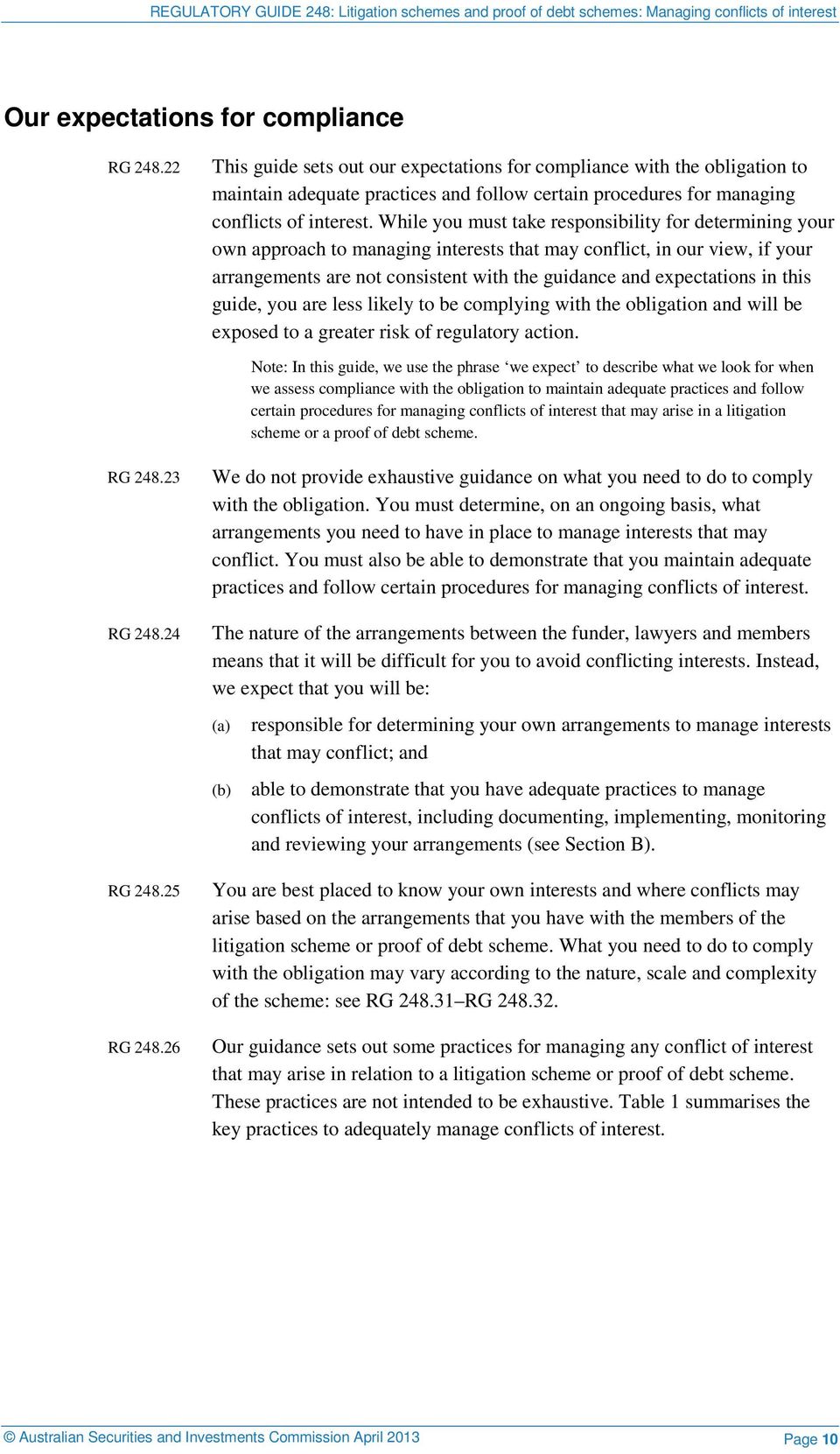
11 Table 1: Summary of the key practices to satisfy the obligation Practice Description Location of guidance Procedures for managing situations in which interests may conflict You must be able to show through documentation that: you have conducted a review of your business operations that relate to the litigation scheme or proof of debt scheme to identify and assess potential conflicting interests; you have written procedures for identifying and managing conflicts of interest; you have effectively implemented the procedures; the written procedures are regularly reviewed, at intervals of not less than 12 months; and the written procedures are implemented, monitored and managed by your senior management or partners (reg AB(4)). Section B Procedures for protecting the interests of members Disclosure of conflicts of interest Recruitment of prospective members Review the terms of the funding agreement Lawyers obligations to both the funder and members Independence of the funder, lawyers and members Oversight of settlement agreements and offers Your written procedures must include procedures about protecting the interests of members and prospective members of the litigation scheme or proof of debt scheme: reg AB(4)(d)(iv). You must have written procedures dealing with how to effectively disclose conflicts of interest to members and prospective members of the litigation scheme or proof of debt scheme: reg AB(4)(d)(ii). Your written procedures must include procedures about recruiting prospective members: reg AB(4)(d)(viii). Your written procedures must include procedures about reviewing the terms of the funding agreement to ensure the terms are consistent with Div 2 of Pt 2 of the Australian Securities and Investments Commission 2001 (ASIC Act): reg AB(4)(d)(vii). Your written procedures must include procedures about dealing with situations in which the lawyer acts for both the funder and members: reg AB(4)(d)(v). Your written procedures must include procedures about how to deal with situations in which there is a pre-existing relationship between any of the funder, lawyer and members: reg AB(4)(d)(vi). If your litigation scheme settles without a proceeding being issued, the terms of any settlement agreement should be approved by counsel (or senior counsel if involved): part of reg 7.601AB(4)(d)(iii). Section B Section C Section D Section D Section D Section D Section E Australian Securities and Investments Commission April 2013 Page 11
12 B Procedures for adequately managing conflicts of interest Key points To meet your obligation to maintain adequate practices and follow certain procedures to manage conflicts of interest, you must be able to show through documentation that: you have conducted a review of your business operations that relate to the litigation scheme or proof of debt scheme to identify and assess potential conflicting interests; you have written procedures for identifying and managing conflicts of interest; you have effectively implemented the procedures; you regularly review the written procedures at intervals of not less than 12 months; and your senior management or partners oversee the implementation, monitoring and management of your procedures (reg AB(4)). The obligation is scalable that is, what you need to do to meet the obligation will vary depending on the nature, scale and complexity of the litigation scheme or proof of debt scheme. Procedures for managing situations in which interests may conflict RG RG RG RG We use the expression procedures in this guide to refer to your measures, processes and procedures for ensuring that you comply with your obligation to maintain adequate practices and follow certain procedures for managing conflicts of interest. You must be able to demonstrate that you have procedures to: identify divergent interests and where conflicts may arise; assess those interests and potential conflicts; and decide upon and implement an appropriate response to those divergent interests and potential conflicts. We expect you to continue to monitor, assess and evaluate those divergent interests for the duration of the litigation scheme or proof of debt scheme, as well as to monitor, assess and evaluate whether the procedures remain adequate to address and minimise the impact of those divergent interests. The procedures you adopt should be: designed or tailored according to the nature, scale and complexity of the litigation scheme or proof of debt scheme; Australian Securities and Investments Commission April 2013 Page 12
13 (d) (e) documented; effectively implemented; regularly monitored and reviewed, and updated as needed; and overseen by a designated senior person (or persons) who takes responsibility for their implementation, reviewing and updating. Tailoring of your procedures to the nature, scale and complexity of your scheme RG RG The procedures you adopt should be designed with your own particular circumstances in mind. We encourage you to ensure that your conflicts management arrangements are designed or tailored according to the nature, scale and complexity of your litigation scheme or proof of debt scheme. Nature, scale and complexity includes factors such as: (d) (e) the number of members of the litigation scheme or proof of debt scheme; the potential for conflicts of interest to arise; the identity of the group members (e.g. whether the class of group members is open or closed, consumers and/or institutions) because this can have an impact on the cost of organising and conducting proceedings, whether strong and weak claims are combined and the distribution of any settlement; legal representation of group members in the proceeding, including fee and retainer agreements with group members; and the structure of the litigation scheme (e.g. choice of defendants, such as whether to commence proceedings against some or all of a corporate group, its directors or its advisers) because this can have an impact on prospects of success, costs exposure, length of litigation and the likely recovery. Note: For example, for small and simple schemes, arrangements could include procedures such as meetings with affected members and periodic reviews of files and records. On the other hand, for a large, complex scheme you are more likely to need procedures that include, for example, the use of detailed policy manuals, dedicated staff, internal structures and reporting lines that support management of conflicts of interest, and comprehensive disclosure of potential and actual conflicts of interest. Documenting your measures RG You must document your practices for managing conflicts of interest: reg AB(4)(i). You will need to be able to show us how you are complying with the obligation to maintain adequate practices and follow certain procedures for managing conflicts of interest. Documentation helps you demonstrate this. This generally involves having a written conflicts Australian Securities and Investments Commission April 2013 Page 13

14 management policy and documenting how you implement measures to address and minimise the impact of conflicts. RG RG RG When you document your procedures, we expect this will include details of who is responsible for compliance and associated record keeping and reporting. We expect you will keep records showing what you have done to monitor compliance with your conflicts management practices and procedures. Conflicts management arrangements are unlikely to be adequate if they do not ensure that compliance monitoring records are kept. We expect you will keep, for at least seven years, records of: conflicts indentified and action taken; any reports given to your owners or senior management about conflicts of interest matters; and copies of written conflicts of interest disclosures given to prospective members or the public as a whole. Note: You should consider what records of oral disclosure should be kept to help you in monitoring your compliance with your obligation to maintain adequate practices and follow certain procedures for managing conflicts of interest. You should consider how they will demonstrate your compliance with the obligation in the event of review. For example, you may wish to keep copies of oral disclosure scripts used by your representatives. RG You should consider how best to keep these documents and records (e.g. it may be appropriate to keep records in the form of a register). Documents and records may be kept electronically. Implementing and reviewing your procedures RG RG It is not enough just to document your procedures for managing any conflicts of interest. To be adequate, your procedures must be implemented and maintained and accompanied by effective compliance monitoring designed to ensure that conflicts management arrangements are actually followed and appropriate action is taken when non-compliance is identified: reg AB(2). To successfully manage situations where interests may conflict, we expect you to be able to: (d) identify the divergent interests relating to the litigation scheme or proof of debt scheme; assess those interests and where any conflicts may arise; implement appropriate measures to address and minimise the impact of the conflicts; and regularly review your procedures. Australian Securities and Investments Commission April 2013 Page 14

15 RG RG RG RG RG This means you need to put them into practice and integrate them into the day-to-day conduct of the litigation scheme or proof of debt scheme. For measures to work effectively in practice, you should have people at all levels of your business who understand them and are committed to their success. Integrating your measures into the culture of your business helps ensure they are effective on an ongoing basis. Primary responsibility for the implementation and monitoring of the interests and potential conflicts should rest with your senior management or partners. The senior person designated to be directly responsible should satisfy themselves that the procedures are adequate and approve a response to any conflicts that are indentified: see RG RG Under reg AB(4), you must review your written procedures at intervals of no greater than 12 months. We expect you will regularly review your procedures to ensure that they are adequate to identify, assess and evaluate, and successfully manage, conflicts of interest. Where there are changes to your operational practices or to the legislative landscape affecting the litigation scheme or proof of debt scheme, you should consider whether changes should be made to your written procedures. You should consider whether it is appropriate for your regular review to be an internal review or conducted by a third party such as an auditor. As part of your review, where necessary, your procedures should be updated. Approval and oversight by senior management RG Regulation AB(4)(f) requires that you allocate to a person in senior management responsibility for implementing, monitoring and managing your procedures. We expect that the person or persons you designate as being responsible for implementing, monitoring and managing your procedures will be responsible for reporting to the board or partnership (including having ready access to the board or partnership). Note: Senior management is defined in the Key terms. RG We expect the person or persons you designate as being responsible for overseeing your procedures and deciding upon and implementing an appropriate response to a conflict of interest should be free of any business or other relationship that could materially interfere with or could reasonably be perceived to interfere with the independent exercise of their judgement. Australian Securities and Investments Commission April 2013 Page 15

16 The role of the person or persons approving and overseeing procedures RG The role of the person or persons you designate as being responsible for approving your procedures and overseeing the implementation of your procedures might extend to: (d) (e) communicating the procedures to those responsible for implementing them and other stakeholders; ensuring that you have adequate staff and resources to undertake the required compliance functions; ensuring staff awareness of the procedures; implementing clear reporting lines for the staff responsible for the procedures; and receiving regular reports on the measures and reporting to the governing body. Procedures for protecting the interests of members RG RG RG We expect that you will have in place appropriate policies and procedures so that when you are faced with a conflict between your interests and the interests of members, the members interests are adequately protected. You should be able to demonstrate that you have practices to ensure that, regardless of the presence of divergent interests, your services are provided in a way that meets your obligation to maintain adequate practices and follow certain procedures for managing conflicts of interest. Your commercial interests need to be pursued in a manner that ensures adequate protection of members interests. You should not conduct a litigation scheme or a proof of debt scheme without taking into account the risks that a divergence of interests may pose to the members interests. Australian Securities and Investments Commission April 2013 Page 16
17 C Disclosure of conflicts of interest Key points You must have written procedures dealing with how to effectively disclose conflicts of interest to members and prospective members of the litigation scheme or proof of debt scheme: reg AB(4)(d)(ii). We expect that the procedures you adopt will include procedures about providing prospective members with information about the different significant interests of the funder, lawyers and members, and how they may conflict, as well as details of any dispute resolution options that are available to members. Your written procedures should include procedures about disclosure to members of any significant conflicts of interest that arise during the conduct of the litigation scheme or proof of debt scheme. Your disclosure should be timely, prominent and specific, and contain enough detail for members to understand the potential impact of the divergent interests on the litigation scheme or proof of debt scheme. RG We expect that you will make full and appropriate disclosure to members and prospective members as part of your procedures to manage interests that may conflict. While disclosure alone will sometimes not be enough, it is a key mechanism that you should use to manage potential and actual conflicts of interest. Disclosure to prospective members RG RG You must have written procedures dealing with how to effectively disclose conflicts of interest to prospective members. These should include procedures about providing prospective members with: information that will assist them to understand the different interests of the funder, lawyers and members, the specific situations where conflicts may arise in the scheme or arrangement and how the interests may conflict; and details of any dispute resolution options that are available to a member who has a dispute with the funder. Disclosure reduces the risk of you breaching your obligation to maintain adequate practices and follow certain procedures for managing conflicts of interest by promoting accountability. In addition, disclosure may be necessary to avoid prospective members being misled in deciding whether Australian Securities and Investments Commission April 2013 Page 17
18 they participate in the litigation scheme or proof of debt scheme. For our expectations on arrangements for avoiding misleading and deceptive conduct, see RG RG RG Adequate disclosure that highlights potential conflicts of interest at the outset of the funding arrangement enhances prospective members ability to make more informed decisions about entering into any funding agreement and reduces the risk of them being misled. Note: For example, if certain members of the scheme are likely to receive a greater proportion of any settlement because they help fund the claim, this should be clearly disclosed. RG Dispute resolution is potentially an important mechanism to resolve conflicts of interest because it is one means by which your interests and members interests can be fairly balanced. Therefore, details about the availability of any dispute resolution mechanism are important for a member in assessing the likely impact of potential conflicts. Disclosure to existing members RG RG We expect that disclosure of conflicts of interest will be ongoing throughout the course of the litigation scheme or proof of debt scheme. Your written procedures should include procedures about notifying members of any significant conflicts of interest that arise during the conduct of the scheme at the first reasonable opportunity, using the most efficient and effective method of communication. The most efficient and effective method of communication will depend on the facts and circumstances: see RG RG Disclosure may be given in writing or verbally. If given verbally, appropriate records of the disclosure should be retained. Note: We expect you will keep, for at least seven years, records of conflicts of interest disclosure given to members, prospective members or the public as a whole: see RG RG We recognise that in some situations disclosure may not be appropriate (e.g. the source of the conflict of interest may be confidential). In these situations you will need to assess whether the conflict can be adequately managed through other mechanisms or whether it is appropriate to continue to provide the service to the affected member. Timely, prominent, specific and meaningful disclosure RG Disclosure about conflicts of interest should: be timely, prominent and specific; and Australian Securities and Investments Commission April 2013 Page 18

19 contain enough detail for members to understand the potential impact of the divergent interests on the litigation scheme or proof of debt scheme. RG RG We expect that you will provide disclosure on a timely basis and provide enough detail in a clear, concise and effective manner to allow the member to make an informed decision about how the conflict of interest may affect the service being provided to them. We consider that boilerplate disclosure is unlikely to be appropriate. To be specific, and so be meaningful for members, disclosure should refer to the particular facts and circumstances and should be specific enough for members to understand the potential impact of the divergent interests. Method of delivering disclosure RG RG We expect that you will determine the method of delivering disclosure that best suits the members and will not expose those members to undue risk of scams or fraud. In some cases, the members might be better suited to receiving paper disclosures (e.g. members without ready access to the internet or who, while they have access to the internet, do not use it regularly or feel uncomfortable with online communication). In other cases, disclosure can be delivered by sending members or prospective members: text in an or an attachment to an ; or an with a hyperlink to the disclosure; or a written (paper or electronic) notification that the disclosure is available from a website. We consider that, generally, you should obtain a member s consent before delivering disclosures online (e.g. paper disclosure should be the default method of delivering disclosure) and the member should be told that, if consent is given: paper documents may no longer be given; and consent to the giving of documents by electronic communication may be withdrawn at any time. Note 1: Some disclosures can be delivered online without first obtaining member consent. For example, in an open class representative proceeding in which a prospective member s identity is unknown, the only practicable method of delivering disclosure is by making the information available on a website. Note 2: We encourage you to take into consideration our good practice guidance when delivering disclosures online: see Section C of Regulatory Guide 221 Facilitating online financial services disclosures (RG 221). Australian Securities and Investments Commission April 2013 Page 19

20 D Managing situations in which interests may conflict Key points As part of the obligation under reg AB(4)(d)(iii) to manage situations in which interests may conflict, we expect that your written procedures will include procedures about: recruitment of prospective members to ensure that conflicts do not result in misleading or deceptive conduct; the terms of any funding agreement; ensuring that if there is no direct contractual relationship between the lawyers and members, any funder will engage the lawyers on terms that make clear that if there is a divergence of interests between the funder and members, the lawyers will ensure that the members interests are adequately protected; and disclosure to members if there is a pre-existing relationship between any of the funder, lawyer and members. Note: We encourage you to consider the specific issues listed in this section in managing conflicts of interest. However, the issues listed in this section and the matters dealt with in the Corporations Amendment Regulations are not intended to be exhaustive. You should determine which issues are relevant to your litigation scheme or proof of debt scheme, and have processes and procedures dealing with how to effectively manage any conflicts that may arise. Recruitment of prospective members RG RG RG Your written procedures for identifying and managing conflicts of interest must include procedures about recruiting prospective members: reg AB(4)(d)(viii). When recruiting prospective members for a litigation scheme or a proof of debt scheme, we expect that you will have arrangements to ensure that conflicts do not result in misleading or deceptive conduct, including having a person who is in senior management with designated responsibility to oversee the recruitment process. Recruiting a sufficient number of prospective members with good claims to participate in a litigation scheme or proof of debt scheme is of commercial importance to the person operating the scheme or arrangement. We consider that this could be an area where divergent interests between a funder, lawyers and members could arise. Note: For example, in Jarra Creek Central Packing Shed Pty Ltd v Amcor Limited [2008] FCA 575, after a notice to opt out of a class action proceeding was given to Australian Securities and Investments Commission April 2013 Page 20
21 group members, the solicitor for the plaintiffs made representations concerning the anticipated amount of damages the court might award. The court held that the statements were misleading because the solicitor incorrectly attributed them to the Australian Competition and Consumer Commission and that the statements could have a significant impact on a group member s opt-out decision because the inaccurate statements artificially inflated the member s expectations of potential compensation. RG We expect that you will not engage in recruitment strategies that are misleading or deceptive, or likely to mislead or deceive. In view of the conflict that may arise, you should have in place arrangements to ensure that advertising or recruitment practices do not mislead prospective members about significant features, risks or returns. Note: For example, you should have arrangements for checking marketing communications to ensure they do not suggest that prospective members will receive a certain amount without disclosing the amounts that will be subtracted from this sum for the fees and costs of the funder. Communications should not suggest prospective members can only recover their losses through the claim if in fact there are other avenues to recover their losses. RG In recruiting prospective members, you should be mindful of all our expectations on managing situations where conflicts may arise. For example, the person or persons in senior management you have designated as being responsible for overseeing the processes and procedures to manage conflicts of interest should review all advertising and recruitment scripts to ensure that prospective members are not misled. The terms of any funding agreement RG RG RG Members do not always have legal knowledge, and may not be well placed to negotiate a funding agreement or have the ability to assess the terms they agree to. This can create an asymmetry of bargaining power between the funder and members. We consider that including terms in a funding agreement to manage conflicts of interest is an important tool that a funder and/or lawyer should use to meet its obligation. In considering the types of terms that may assist in managing conflicts of interest, the funder and/or lawyer will need to consider the interests of each person or group of people in the scheme and where interests may actually or potentially diverge in the scheme. However, we expect the funder and/or lawyer will consider including the following terms in the funding agreement. an obligation to comply with and implement procedures to meet the requirements of the Corporations Amendment Regulations; a cooling-off period which provides an opportunity for members to seek legal advice; Australian Securities and Investments Commission April 2013 Page 21
22 (d) (e) an obligation for the lawyer to give priority to the instructions given by the member over those of the funder; the procedure that will be applied in reviewing and deciding whether to accept any settlement offer, including the factors that will and will not be taken into account in deciding to settle; an obligation to provide clear and full disclosure of any terms of settlement to all members and to the court (where applicable); Note: We expect that disclosure of the terms of settlement will allow members to understand the settlement in the context of the total amount of the claim. For example, a funder should provide disclosure to members that sets out the total settlement amount as a percentage of the total amount of the claim and a worked example of how the proposed settlement might affect claimants. (f) (g) (h) how disputes in relation to the scheme will be resolved; an obligation to provide clear and full disclosure to members of the terms of the agreement between the funder and the lawyers; and an obligation to provide timely and clear disclosure to members of any breach of the Corporations Amendment Regulations and a right to terminate the agreement if the funder does not comply with the regulations. RG RG RG RG Under the Corporations Amendment Regulations you must also review the terms of any funding agreement to ensure the terms are consistent with Div 2 of Pt 2 of the ASIC Act: reg AB(4)(e). As part of the obligation to manage situations where conflicts may arise, you should review the terms of agreements to which you are a party in light of the existing body of law on unfair contracts and unconscionability, where relevant. We consider that there are some protections for members from being bound by unfair terms of funding agreements, including: the law on unfair contracts, such as the unfair contract provisions in Subdiv BA of Div 2 of Pt 2 of the ASIC Act and the law on unconscionable conduct and consumer protection (Div 2 of Pt 2 of the ASIC Act); the consequent loss of any return on investment for the funder if the agreement, or part of it, is found to be invalid by the courts; and the increasing participation of more sophisticated members who are well informed and familiar with contractual terms and legal proceedings, and who are unlikely to agree to the terms of an unfair contract. You should be mindful of the statutory prohibitions on unconscionable conduct and unfair contract terms in drafting the funding agreement and ensure that it is checked with due regard to the law. We expect that the Australian Securities and Investments Commission April 2013 Page 22
23 funding agreement will be approved by the designated person with responsibility for the implementation and monitoring of arrangements to manage conflicts of interest. Lawyers obligations to both the funder and members RG RG RG RG Under the Corporations Amendment Regulations your written procedures for identifying and managing conflicts of interest should include procedures about dealing with situations in which the lawyer acts for both the funder and members: reg AB(4)(d)(v). We expect that if there is no direct contractual relationship between the lawyers and each of the members, the funder should ensure that they engage the lawyers on terms that make clear that if there is a divergence of interests between the funder and the members, the lawyers must ensure that the members interests are adequately protected. In a lawyer client relationship, the lawyer has fiduciary obligations to the client. Lawyers also have fiduciary obligations to people who are not in a direct contractual relationship with them. However, we consider that the potential for any adverse impact on members as a result of a divergence of interests is reduced when the members are the clients. We recognise that it is necessary for there to be communication between the lawyers and the funder during the course of the litigation scheme or proof of debt scheme. It is appropriate for the funder to give instructions to the lawyers and for the lawyers to consider these instructions in light of their obligation to the members. However, we do not think that having the lawyers act solely for the members will impede this occurring. Independence of the funder, lawyers and members RG RG Your procedures for managing conflicts of interest should include procedures about how to deal with situations in which there is a pre-existing relationship between any of the funder, lawyer and members: reg AB(4)(d)(vi). We expect that there will be either: independence between the funder, lawyers and members; or if there is no such independence, the relationship will be disclosed to members. Note: When reading this section, you should bear in mind the key concepts in Section C. Australian Securities and Investments Commission April 2013 Page 23
24 RG RG We consider that the independence of lawyers from the funder means that their interests are less likely to conflict than when there is a relationship between the lawyers and the funder. Disclosure assists members to understand where their interests may diverge with those of the funder and lawyers. We consider that you should prominently disclose to members: if the funder and lawyers are associates, or if their spouses, children, directors, partners or senior employees are associates; Note: Associated person is defined in the Key terms. (d) any relationships between other directors, partners or senior employees; any relationships (outside the provision of the services for the litigation scheme or proof of debt scheme) with any other parties to the scheme (including any involvement with any other litigation scheme or proof of debt scheme); and any direct or indirect fee or benefit to be paid or given by one party to the scheme to another for providing services to, or participating in, that scheme. Note: For example, if a member is receiving a fee that other members are not receiving for participating in the scheme, it should be disclosed. If a lawyer is a partner of a law firm that is acting for members in a litigation scheme and a director of the funder providing the funding for the same litigation scheme, it should be disclosed. RG RG Disclosure should relate to relationships or interests that are current, proposed or existed in the previous two years. This two-year period is a minimum period for disclosure. Earlier relationships may be so significant that they warrant disclosure as well. Disclosure should be timely, prominent and meaningful for members and potential members. Boilerplate disclosures (e.g. we receive fees for professional services ) should be avoided in favour of more specific disclosure. You should clearly disclose enough detail to allow members to make informed decisions about how the relationship may affect the service being provided to them. Australian Securities and Investments Commission April 2013 Page 24
25 E Oversight of settlement agreements and offers Key points Some litigation schemes settle without a proceeding being issued and the courts will only look at the settlement agreement if it is challenged on some other grounds. We expect that if your litigation scheme settles without a proceeding being issued, the terms of any settlement agreement will be approved by counsel (or senior counsel if involved). When you evaluate a settlement offer or formulate a settlement proposal, we expect that you will be mindful of our expectations set out in Section B that you have in place appropriate policies and procedures to protect members interests. Independent review RG There is a considerable body of Australian case law in which issues of potential conflicts of interest have emerged in the context of the settlement of a litigation scheme. Note: For example, see Darwalla Milling Co. Pty Ltd v F Hoffman-La Roche Ltd (No. 2) (2006) 236 ALR 322, Wotton v State of Queensland (2009) 109 ALD 534 and Crawford v Bank of Western Australia Ltd [2005] FCA 949. RG The potential for conflicts of interest in the settlement of a litigation scheme means that as part of the obligation to manage situations in which interests may conflict (see reg AB(4)(d)(iii)), you must have adequate practices to manage conflicts of interest in the settlement of proceedings. In this regard, you should consider appropriate terms in any funding agreement. Note: For more information, see RG RG RG RG We expect that if your litigation scheme settles without a proceeding being issued, the terms of any settlement agreement should also be approved by counsel (or senior counsel if involved). We recognise that the funder and lawyers involved in a litigation scheme have a good understanding of the legal and commercial factors behind the claim and so have important insight into whether settling is in the best interests of the members. We believe that this knowledge is an important resource that should be used to assist members in settlement negotiations. However, we are concerned about the potential for the funder and lawyers to prefer their own commercial interests over those of the members, or for the settlement to be in the interests of the lead plaintiff and defendant and not necessarily the other group members. Australian Securities and Investments Commission April 2013 Page 25
26 RG RG RG RG If you have issued representative or group proceedings, any settlement or discontinuance cannot occur without the approval of the court. We consider that this independent oversight of the court provides protection for group members as a whole against the potentially conflicting commercial interests of the funder and/or lawyers and for group members against each other. Some litigation schemes settle without a proceeding being issued and the courts will only look at the settlement agreement if it is challenged on some other grounds. Our expectation about reviewing settlement agreements applies to these schemes because the members are not afforded the same protection as when proceedings are issued. We expect that the terms of the settlement agreement will be reviewed by counsel (or senior counsel if involved). Parties engage in pre-litigation settlement to minimise cost and delay. We consider that counsel will have accrued significant knowledge of the strengths and weaknesses of the claims and would be in the best position to judge whether the settlement is fair and reasonable without incurring the additional cost and delay of briefing an independent party. We expect that you will also be mindful of our expectations that you have in place appropriate policies and procedures to protect members interests when evaluating a settlement offer or formulating settlement proposals: see RG RG Criteria for approval RG RG We consider that in reviewing a settlement agreement, counsel (or senior counsel if involved) must be satisfied that the settlement agreement is fair and reasonable, taking into account the claims made on behalf of the members who will be bound by the settlement and potential conflicts between the funder, lawyers and the members, as well as between members. In satisfying themselves that the proposed settlement is fair and reasonable, counsel should take into account, among other things, the following factors: (d) (e) the amount offered to each member; the prospects of success in the proceeding (i.e. the weaknesses, substantial or procedural, in the case advanced by the members); the likelihood of members obtaining judgment for an amount significantly in excess of the settlement sum; whether the settlement sum falls within a realistic range of likely outcomes; the terms of any advice received from an independent expert on the issues that arise in the case; Australian Securities and Investments Commission April 2013 Page 26
27 (f) (g) (h) (i) (j) the attitude of the group members to the settlement; the likely duration and cost to members of proceedings if continued to judgment; the terms of any funding agreement about the procedure that will be applied in reviewing and deciding whether to accept any settlement offer, including the factors that will and will not be taken into account in deciding to settle; whether the funder might refuse to fund further proceedings if the settlement is not approved; and whether the settlement involved any unfairness to any member or categories of members for the benefit of others. RG A considerable body of case law has developed on the appropriate factors for a court to consider in determining whether to approve a settlement of a representative proceeding. Our approach adopts the tests applied by the Federal Court in approving the settlement of a representative proceeding under the Federal Court of Australia Act Note: For example, see Adamson v Professional Investment Services Pty Ltd [2009] FCA 1235 and Darwalla Milling Co. Pty Ltd v F Hoffman-La Roche Ltd (No. 2) (2006) 236 ALR 322 (Darwalla). RG RG We consider that counsel should also take into account the potential for conflicts of interest between members and we have adopted the test applied by Jessup J in Darwalla at paragraph 41. The test applied by His Honour in Darwalla was to determine whether the settlement involved any actual or potential unfairness to any member or categories of members having regard to all relevant matters, including whether the overall settlement sum involved unfair compromises by some members or categories of members for the benefit of others, and whether the distribution scheme fairly reflected the apparent or assumed relative losses suffered by particular members or categories of members. Australian Securities and Investments Commission April 2013 Page 27
28 Key terms Term AFS licence AFS licensee ASIC ASIC Act associated person Ch 7 (for example) Corporations Act Corporations Amendment Regulations Corporations Regulations funder funding agreement litigation scheme member proof of debt scheme reg 5C (for example) Meaning in this document An Australian financial services licence under s913b of the Corporations Act that authorises a person who carries on a financial services business to provide financial services. Note: This is a definition contained in s761a of the Corporations Act. A person who holds an AFS licence under s913b of the Corporations Act. Note: This is a definition contained in s761a of the Corporations Act. Australian Securities and Investments Commission Australian Securities and Investments Commission Act 2001 An associate (within the meaning of Pt 1.2 of Div 2 of the Corporations Act) of the relevant person A chapter of the Corporations Act (in this example numbered 7) Corporations Act 2001, including regulations made for the purposes of that Act Corporations Amendment Regulation 2012 (No. 6), as amended by the Corporations Amendment Regulation 2012 (No. 6) Amendment Regulation 2012 (No. 1) Corporations Regulations 2001 A funder mentioned in reg 5C.11.01(v) of the Corporations Amendment Regulations An agreement between a funder and member that sets out the terms and conditions on which the funder agrees to partially or fully fund the member s participation in the litigation scheme or proof of debt scheme A scheme mentioned in reg 5C.11.01(1) or an arrangement mentioned in reg 5C.11.01(1)(d) of the Corporations Amendment Regulations A member of a litigation scheme or proof of debt scheme A scheme mentioned in reg 5C.11.01(1)(d) of the Corporations Amendment Regulations A regulation of the Corporations Amendment Regulations (in this example numbered 5C.11.01), unless otherwise specified Australian Securities and Investments Commission April 2013 Page 28
29 Term senior management unfunded scheme Meaning in this document An officer of a corporation, or an officer of an entity that is neither an individual nor a corporation within the meaning of s9 of the Corporations Act A litigation scheme or proof of debt scheme that is not funded by a funder where the members either agree to meet the costs and disbursements of the proceeding or have special funding agreements with the lawyers Australian Securities and Investments Commission April 2013 Page 29
30 Related information Headnotes conflict of interest, conflicts management, disclosure, litigation schemes, proof of debt schemes, settlement agreements Class order [CO 10/333] Funded representative proceedings and funded proof of debt arrangements Regulatory guide RG 221 Facilitating online financial services disclosures Legislation ASIC Act, Subdiv BA of Div 2 of Pt 2 Corporations Act, Ch 7 Corporations Amendment Regulations, regs 5C and AB Corporations Regulations, reg (1)(e) Federal Court of Australia Act 1976 Cases Adamson v Professional Investment Services Pty Ltd [2009] FCA 1235; Crawford v Bank of Western Australia Ltd [2005] FCA 949; Darwalla Milling Co. Pty Ltd v F Hoffman-La Roche Ltd (No. 2) (2006) 236 ALR 322; Jarra Creek Central Packing Shed Pty Ltd v Amcor Limited [2008] FCA 575; Wotton v State of Queensland (2009) 109 ALD 534 Consultation paper CP 185 Litigation schemes and proof of debt schemes: Managing conflicts of interest Media and other releases 10-92AD ASIC grants interim class order relief from regulation for all funded representative actions and funded proof of debt arrangements (7 May 2010) Australian Securities and Investments Commission April 2013 Page 30
31 12-200MR ASIC consults on requirement to manage conflicts of interest in litigation schemes and proof of debt schemes (17 August 2012) MR ASIC extends relief from regulation for all funded representative actions and funded proof of debt arrangements (11 January 2013) Australian Securities and Investments Commission April 2013 Page 31
Compensation and insurance arrangements for AFS licensees
 REGULATORY GUIDE 126 Compensation and insurance arrangements for AFS licensees March 2008 About this guide This guide is for Australian financial services (AFS) licensees and representatives, their advisers
Resignation, removal and replacement of auditors
 REGULATORY GUIDE 26 Resignation, removal and replacement of auditors June 2015 About this guide This is a guide for public companies, responsible entities of registered managed investment schemes, Australian
Licensing: Financial product advisers Conduct and disclosure
 REGULATORY GUIDE 175 Licensing: Financial product advisers Conduct and disclosure May 2009 About this guide This is a guide for persons who provide financial product advice and their professional advisers
Compensation and insurance arrangements for AFS licensees
 REGULATORY GUIDE 126 Compensation and insurance arrangements for AFS licensees October 2009 About this guide This guide is for Australian financial services (AFS) licensees and representatives, their advisers
Guidelines Legal Services Advertising, Marketing and Promotion The purpose of these Guidelines is to provide practitioners with a starting point for
 Guidelines Legal Services Advertising, Marketing and Promotion The purpose of these Guidelines is to provide practitioners with a starting point for seeking general information about their professional
Doing financial services business in Australia
 REGULATORY GUIDE 121 Doing financial services business in Australia July 2013 About this guide This is a guide for people or companies from overseas who propose to conduct a financial services business
Foreign collective investment schemes
 REGULATORY GUIDE 178 Foreign collective investment schemes June 2012 About this guide This guide is for operators of foreign collective investment schemes (FCIS) that are authorised in other jurisdictions
Over-the-counter contracts for difference: Improving disclosure for retail investors
 REGULATORY GUIDE 227 Over-the-counter contracts for difference: Improving disclosure for retail investors August 2011 About this guide This guide is for those involved with the issue, sale or advertising
Thompson Jenner LLP Last revised April 2013 Standard Terms of Business
 The following standard terms of business apply to all engagements accepted by Thompson Jenner LLP. All work carried out is subject to these terms except where changes are expressly agreed in writing. 1
COMMENTARY. GPT Class Action Settlement Raises Concerns about Legal and Funding Fees Charged in Australian Class Actions. Summary.
 November 2013 JONES DAY COMMENTARY GPT Class Action Settlement Raises Concerns about Legal and Funding Fees Charged in Australian Class Actions Key Points The 7 November 2013 and 21 June 2013 judgments
COLLECTIVE INVESTMENT LAW DIFC LAW No. 2 of 2010
 ---------------------------------------------------------------------------------------------- COLLECTIVE INVESTMENT LAW DIFC LAW No. 2 of 2010 ----------------------------------------------------------------------------------------------
TEMPLE LITIGATION ADVANTAGE INSURANCE FOR DISBURSEMENTS AND OPPONENT S COSTS Certificate of Insurance
 TEMPLE LITIGATION ADVANTAGE INSURANCE FOR DISBURSEMENTS AND OPPONENT S COSTS Certificate of Insurance In return for the payment of the Premium specified in the Schedule and based on any Information that
Disclosure: Product Disclosure Statements (and other disclosure obligations)
 REGULATORY GUIDE 168 Disclosure: Product Disclosure Statements (and other disclosure obligations) October 2011 About this guide This is a guide for persons responsible for Product Disclosure Statements
Credit licensing: Competence and training
 REGULATORY GUIDE 206 Credit licensing: Competence and training December 2009 About this guide This guide is for credit licensees and licence applicants. It provides guidance on how credit licensees can
LEGAL SCHEME REGULATIONS
 LEGAL SCHEME REGULATIONS These Regulations came into force on 1 July 2014. 1 Introduction 1.1 These Regulations govern the Union s legal Scheme. The Rules of the Union set out your other rights and entitlements.
Standard terms of business
 31a Charnham Street, Hungerford, Berkshire, RG17 0EJ Tel: 01488 682546 Fax: 01488 684473 Email: [email protected] Web: www.bradingcryer.co.uk Standard terms of business The following standard
Facilitating debt raising
 REGULATORY GUIDE 213 Facilitating debt raising May 2012 About this guide This guide is for listed entities, their advisers and investors involved in offers of quoted corporate bonds or convertible notes.
Claims Management Services Regulation. Conduct of Authorised Persons Rules 2013 (2)
 Claims Management Services Regulation Conduct of Authorised Persons Rules 2013 (2) Effective from 8 July 2013 Contents Introduction 1 Definitions 1 General Rules Principles 2 Conduct of Business 2 Professional
Your. Product Disclosure Statement and Insurance Policy
 Your Product Disclosure Statement and Insurance Policy In arranging this insurance Defence Bank Limited ABN 57 087 651 385 AFSL /Australian Credit Licence 234582 is acting pursuant to an agreement with
SAMPLE. Professional Indemnity Insurance (PII) Policy 2015/16. lawcover.com.au Page 1
 Professional Indemnity Insurance (PII) Policy 2015/16 Lawcover Insurance Pty Limited ABN 15 095 082 509 Level 13, 383 Kent Street Sydney NSW 2000 DX 13013 Sydney Market Street Telephone: 1800 650 748 (02)
ISSUES PAPER LEGAL REPRESENTATION AND JURISDICTIONAL LIMIT IN SMALL CLAIMS
 DEPARTMENT OF THE ATTORNEY-GENERAL AND JUSTICE ISSUES PAPER LEGAL REPRESENTATION AND JURISDICTIONAL LIMIT IN SMALL CLAIMS June 2013 Legal Policy Division Department of the Attorney-General and Justice
Guidance Note AGN 520.1
 Guidance Note AGN 520.1 Fit and Proper Requirements Definition of a responsible person 1. The definitions of responsible persons cover those persons whose conduct is most likely to have significant implications
2010 CORPORATE INSOLVENCY REFORMS
 2010 CORPORATE INSOLVENCY REFORMS Reversal of the effect of Sons of Gwalia v Margaretic and related issues Section 563A of the Corporations Act subordinates any claims made by a person in their capacity
Civil Law (Wrongs) (Proportionate Liability and Professional Standards) Amendment Act 2004
 Australian Capital Territory Civil Law (Wrongs) (Proportionate Liability and Professional Standards) Amendment Act 2004 Contents Page 1 Name of Act 2 2 Commencement 2 3 Legislation amended 2 4 New chapter
MOTOR VEHICLE ACCIDENT CLAIMS ACT
 Province of Alberta MOTOR VEHICLE ACCIDENT CLAIMS ACT Revised Statutes of Alberta 2000 Chapter M-22 Current as of April 1, 2015 Office Consolidation Published by Alberta Queen s Printer Alberta Queen s
Deregistration and Winding up of Australian Companies
 Introduction Deregistration and Winding up of Australian Companies There can be a number of legal and commercial reasons to end the life of an Australian company. While the most obvious and common reason
Motor Accidents Compensation Amendment (Claims and Dispute Resolution) Act 2007 No 95
 New South Wales Motor Accidents Compensation Amendment (Claims and Dispute Contents Page 1 Name of Act 2 2 Commencement 2 3 Amendment of Motor Accidents Compensation Act 1999 No 41 2 4 Amendment of other
CONSULTATION PAPER 61. ACCC / ASIC debt collection guideline: For collectors, creditors and debtors (First draft)
 CONSULTATION PAPER 61 ACCC / ASIC debt collection guideline: For collectors, creditors and debtors (First draft) February 2005 Australian Competition and Consumer Commission Australian Securities and Investments
CREDIT REPAIR AUSTRALIA Pty Ltd ( CRA ) A.C.N 103 959 502 CODE OF CONDUCT IN RELATION TO CREDIT RESTORATION SERVICES
 CREDIT REPAIR AUSTRALIA Pty Ltd ( CRA ) A.C.N 103 959 502 CODE OF CONDUCT IN RELATION TO CREDIT RESTORATION SERVICES 1. SHORT TITLE 1. Short title. 2. Background & Purposes. 3. Definitions. 4. Prohibited
Legal Costs, Cost Agreements, Disclosure & Billing under the The Legal Profession Uniform Law. NSW Law Society Seminar
 Legal Costs, Cost Agreements, Disclosure & Billing under the The Legal Profession Uniform Law NSW Law Society Seminar John Fleming Solicitor (Legal Costs Unit) Law Society of NSW Tel: (02) 9926 0373 Email:
Example Statement of Advice: Scaled advice for a new client
 REGULATORY GUIDE 90 Example Statement of Advice: Scaled advice for a new client August 2013 About this guide This guide is for Australian financial services (AFS) licensees, authorised representatives,
Claims Management Services Regulation. Conduct of Authorised Persons Rules 2014
 Claims Management Services Regulation Conduct of Authorised Persons Rules 2014 Effective from 1 October 2014 Contents Introduction 1 Definitions 1 General Rules Principles 2 Conduct of Business 2 Professional
Code of Conduct for registered migration agents
 Code of Conduct for registered migration agents Current from 1 JULY 2012 SCHEDULE 2: CODE OF CONDUCT (regulation 8) Migration Act 1958, subsection 314(1) THIS CODE OF CONDUCT SHOULD BE DISPLAYED PROMINENTLY
Guidance for the instruction of experts in civil claims
 Guidance for the instruction of experts in civil claims Introduction 1. The purpose of this guidance is to assist litigants, those instructing experts and experts to understand best practice in complying
Queensland PERSONAL INJURIES PROCEEDINGS ACT 2002
 Queensland PERSONAL INJURIES PROCEEDINGS ACT 2002 Act No. 24 of 2002 Queensland PERSONAL INJURIES PROCEEDINGS ACT 2002 TABLE OF PROVISIONS Section Page CHAPTER 1 PRELIMINARY PART 1 INTRODUCTION 1 Short
IMF (Australia) Ltd. Combined Financial Services Guide and Product Disclosure Statement
 IMF (Australia) Ltd Combined Financial Services Guide and Product Disclosure Statement Dated the 18th day of January 2010 FINANCIAL SERVICES GUIDE & PRODUCT DISCLOSURE STATEMENT PAGE 2 1. Introduction
Licensing: Financial product advice and dealing
 REGULATORY GUIDE 36 Licensing: Financial product advice and dealing August 2013 About this guide This guide is for persons who may provide financial product advice or deal in a financial product as defined
Professional Direct Insurance Ockford Mill Ockford Road Godalming GU7 1RH. Terms and Conditions of Business Agreement. Our Service
 Professional Direct Insurance Ockford Mill Ockford Road Godalming GU7 1RH Terms and Conditions of Business Agreement This document is important and sets out the basis upon which we will carry on our business
Audit and Risk Committee Charter. Knosys Limited ACN 604 777 862 (Company)
 Audit and Risk Committee Charter Knosys Limited ACN 604 777 862 (Company) Audit and Risk Committee Charter 1. Introduction 1.1 The Audit and Risk Committee is a committee established by the board of directors
Insolvency INSOLVENCY PRACTITIONER REGULATIONS 2014
 Insolvency Legislation made under s. 486. 2011-26 (LN. ) Commencement 1.11.2014 Amending enactments Relevant current provisions Commencement date LN. 2015/133 rr. 9, 22 20.8.2015 Regulation 1. Title and
RESPONSE TO LRC PERSONAL DEBT MANAGEMENT AND DEBT ENFORCEMENT REPORT. Chapter 1: Personal Insolvency Law: Debt Settlement Arrangements
 Chapter 1: Personal Insolvency Law: Debt Settlement Arrangements Reform of the Bankruptcy Act The Report recommends that a thorough review of the Bankruptcy Act 1988 should be undertaken. Comment: It is
Education Services for Overseas Students Act 2000
 Education Services for Overseas Students Act 2000 Act No. 164 of 2000 as amended This compilation was prepared on 17 December 2008 taking into account amendments up to Act No. 144 of 2008 The text of any
UIBL TOBA. United Insurance Brokers Ltd. Terms of Business Agreement
 TOBA United Insurance Brokers Ltd Terms of Business Agreement 1. Introduction and business service United Insurance Brokers Ltd () is an independent international insurance and reinsurance (1) Lloyd s
Setting Up Fee Charging Services
 Setting Up Fee Charging Services Client Care Letter: Template for work to be paid by fixed fee or hourly rate Dear [name of Client] RE:[subject] Thank you for instructing [name of Law Centre]. Purpose
Companies Regulations (COR)
 Appendix 9 In this appendix underlining indicates new text and striking through indicates deleted text. N.B. As mentioned in paragraph 7 of this consultation paper, these regulations are made under the
Customer Responsiveness Strategy
 Customer Responsiveness Strategy Dated 23 June 2006. Telstra Corporation Limited (ABN 33 051 775 556) ( Telstra ) Disclaimer This Customer Responsiveness Strategy is being published in furtherance of Telstra
A CREDITORS GUIDE TO FEES CHARGED BY TRUSTEES IN BANKRUPTCY ENGLAND AND WALES
 A CREDITORS GUIDE TO FEES CHARGED BY TRUSTEES IN BANKRUPTCY 1 Introduction ENGLAND AND WALES 1.1 When an individual becomes bankrupt the costs of the bankruptcy proceedings are paid out of his or her assets.
- - - - - - - - - - - - - - - - - - - - - - - - - - - - - - - - - - - - - - - - - - - - - - - - - - - - - - - - - - - - - - -
 . Board Charter - - - - - - - - - - - - - - - - - - - - - - - - - - - - - - - - - - - - - - - - - - - - - - - - - - - - - - - - - - - - - - - 1. Interpretation 1.1 In this Charter: Act means the Companies
COLLECTIVE INVESTMENT SCHEMES ACT 2008 COLLECTIVE INVESTMENT SCHEMES (REGULATED FUND) REGULATIONS 2010
 Statutory Document No. 161/10 COLLECTIVE INVESTMENT SCHEMES ACT 2008 COLLECTIVE INVESTMENT SCHEMES (REGULATED FUND) REGULATIONS 2010 1 Title 2 Commencement 3 Interpretation INDEX THE GOVERNING BODY 4 Composition
BRACKNELL FOREST COUNCIL ADULT SOCIAL CARE & HEALTH DEBT RECOVERY POLICY & PROCEDURES
 BRACKNELL FOREST COUNCIL ADULT SOCIAL CARE & HEALTH DEBT RECOVERY POLICY & PROCEDURES POLICY DOCUMENT Table of Contents 1. Definitions and Abbreviations... 3 2. Legal Status... 4 3. Principles for Debt
Appendix 14 CORPORATE GOVERNANCE CODE AND CORPORATE GOVERNANCE REPORT
 Appendix 14 CORPORATE GOVERNANCE CODE AND CORPORATE GOVERNANCE REPORT The Code This Code sets out the principles of good corporate governance, and two levels of recommendations: code provisions; and recommended
Short Guide to OFT Debt Collection Guidance
 Short Guide to OFT Debt Collection Guidance By Ray Watson (20 November 2012) An easy reference guide to the OFT's debt collection guidance prepared by former OFT official, Ray Watson. Please do not rely
ASSOCIATION OF PERSONAL INJURY LAWYERS SCOTLAND Standard of competence for Litigators
 ASSOCIATION OF PERSONAL INJURY LAWYERS SCOTLAND Standard of competence for Litigators INTRODUCTION Standards of occupational competence Standards of occupational competence are widely used in many fields
1. Introduction. The laws of any jurisdiction other than England & Wales Taxes or duties Financial investment.
 1. Introduction 1.1 This document, together with our Engagement Letter, explains the basis upon which we work for you. These two documents constitute the contract between you and The Law House. In the
Real Estate Agents Act (Professional Conduct and Client Care) Rules 2012
 Real Estate Agents Act (Professional Conduct and Client Care) Rules 2012 Contents Page 1 Title 1 2 Commencement 1 3 Scope and objectives 1 4 Interpretation 1 5 Standards of professional competence 2 6
Life Insurance - A Beginners Guide to Understanding
 Life Product Disclosure Statement and Insurance Policy CGU Life Product Disclosure Statement and Policy Life Preparation date: 01/02/2013 Contents About This Insurance 1 Overview 1 Who is the product
Credit licensing: Competence and training
 REGULATORY GUIDE 206 Credit licensing: Competence and training July 2014 About this guide This guide is for credit licensees, licence applicants and unlicensed carried over instrument lenders (unlicensed
3.6. Please also note, unless your policy confirms otherwise, the rights under your policy may only be pursued in an English court.
 Terms of business agreement - commercial customers M & N Insurance Service Limited Authorised and regulated by the Financial Conduct Authority No: 305837. Registered Office: 248 Hendon Way London NW4 3NL
Motor Vehicle Insurance. and. Repair Industry. Code of Conduct
 . Motor Vehicle Insurance and Repair Industry Code of Conduct Revised March 2011 MOTOR VEHICLE INSURANCE AND REPAIR INDUSTRY CODE OF CONDUCT 1 TABLE OF CONTENTS PREAMBLE... 3 1. PRINCIPLES OF THE CODE...
Financial Services Guidance Note Outsourcing
 Financial Services Guidance Note Issued: April 2005 Revised: August 2007 Table of Contents 1. Introduction... 3 1.1 Background... 3 1.2 Definitions... 3 2. Guiding Principles... 5 3. Key Risks of... 14
NSW COURT OF APPEAL DECISION SUPPORTS LITIGATION FUNDING MARKET
 NSW COURT OF APPEAL DECISION SUPPORTS LITIGATION FUNDING MARKET Introduction 1. The New South Wales Court of Appeal, in a unanimous Judgment on Thursday 31 March 2005, sent some clear messages to legal
Credit licensing: Responsible lending conduct
 REGULATORY GUIDE 209 Credit licensing: Responsible lending conduct November 2014 About this guide This is a guide for credit licensees, credit applicants and unlicensed carried over instrument lenders
It is hereby notified that the President has assented to the following Act which is hereby published for general information:-
 PRESIDENT'S OFFICE No. 967. 14 June 1996 NO. 29 OF 1996: MINE HEALTH AND SAFETY ACT, 1996. It is hereby notified that the President has assented to the following Act which is hereby published for general
Conditional Fee Arrangements, After the Event Insurance and beyond!
 Conditional Fee Arrangements, After the Event Insurance and beyond! CFAs, ATEs, DBAs Let s de-mystify the acronyms! 1. Conditional Fee Arrangements 1.1. What is a Conditional Fee Arrangement A conditional
JRI S STANDARD TERMS OF PURCHASE. Business Day: a day (other than a Saturday, Sunday or public holiday) when banks in London are open for business.
 JRI S STANDARD TERMS OF PURCHASE 1. INTERPRETATION 1.1 Definitions. In these Conditions, the following definitions apply: Business Day: a day (other than a Saturday, Sunday or public holiday) when banks
Professional Indemnity Insurance Glossary of Terms
 Professional Indemnity Insurance Glossary of Terms Index Aggregation of claims Automatic reinstatement Average provision Cancellation Civil liability Claim Claims made Consumer protection legislation Continuous
Employment Law Guide
 Employment Law Guide Settlement Agreements (Formally known as Compromise Agreements) See the separate guide. Unfair Dismissal Length of employment Employees can only bring a claim for ordinary unfair dismissal
Costs Payable in Personal Injury Claims under the Various Legislative Regimes by Paul Garrett
 Costs Payable in Personal Injury Claims under the Various Legislative Regimes by Paul Garrett I was asked to deliver a paper in relation to costs which are payable under the various regimes where claimants
Financial Services (Collective Investment Schemes) FINANCIAL SERVICES (EXPERIENCED INVESTOR FUNDS) REGULATIONS 2012
 Financial Services (Collective Investment Schemes) 2005-48 Legislation made under s. 52. FINANCIAL SERVICES (EXPERIENCED INVESTOR FUNDS) (LN. ) Commencement 12.4.2012 Amending enactments Relevant current
LEGAL PRACTITIONERS' LIABILITY COMMITTEE CONTRACT OF PROFESSIONAL INDEMNITY INSURANCE FOR SOLICITORS: 2012/2013 TABLE OF CONTENTS
 LEGAL PRACTITIONERS' LIABILITY COMMITTEE ABN 45 838 419 536 Level 31, 570 Bourke Street Melbourne Victoria 3000 DX 431 Melbourne Ph: (03) 9672 3800 Fax: (03) 9670 5538 www.lplc.com.au Contract for Professional
ACCC/ASIC 'Debt collection guideline for collectors and creditors' publication review
 1 November 2012 Mr Richard Weksler Assistant Director Compliance Strategies Branch Australian Competition & Consumer Commission Level 35 360 Elizabeth Street MELBOURNE VIC 3000 By email: [email protected]
Accounting and Controls in law practices
 Accounting and Controls in law practices TRUST MONEY & TRUST RECORDS Accounting and Support Staff Trust Accounts Department Law Society of New South Wales 170 Phillip Street, Sydney NSW 2000 1 July 2015
Board Charter. HCF Life Insurance Company Pty Ltd (ACN 001 831 250) (the Company )
 Board Charter HCF Life Insurance Company Pty Ltd (ACN 001 831 250) (the Company ) Board approval date: 27 October 2015 Contents 1. Introduction and Purpose of this Charter...1 2. Role of the Board...1
LawCover. Professional Indemnity Insurance Policy 2009/2010 116693148 \ 0421663 \ AZO01
 LawCover Professional Indemnity Insurance Policy 2009/2010 116693148 \ 0421663 \ AZO01 This Policy sets out the conditions on which we agree to insure you. When reading this Policy, please note the use
Submission by AFA Pty Ltd on the development of new Terms of Reference for the Financial Ombudsman Service
 Submission by AFA Pty Ltd on the development of new Terms of Reference for the Financial Ombudsman Service Preamble AFA Pty Ltd does not operate as an insurer in its own right, but offers its products
AUSTRALIAN PRUDENTIAL REGULATION AUTHORITY SUPERANNUATION CIRCULAR NO III.A.6 WINDING-UP A SUPERANNUATION FUND
 AUSTRALIAN PRUDENTIAL REGULATION AUTHORITY SUPERANNUATION CIRCULAR NO III.A.6 WINDING-UP A SUPERANNUATION FUND April 2002 2 DISCLAIMER AND COPYRIGHT NOTICE 1. The purpose of this Circular is to provide
COLLECTION AND DEBT REPAYMENT PRACTICES REGULATION
 Province of Alberta FAIR TRADING ACT COLLECTION AND DEBT REPAYMENT PRACTICES REGULATION Alberta Regulation 194/1999 With amendments up to and including Alberta Regulation 57/2014 Office Consolidation Published
Exposure Draft of Proposed Standard: APES 330 Insolvency Services
 Exposure Draft of Proposed Standard: APES 330 Insolvency Services ED XX/08 P:\Standards & Guidance Notes\APES330 Insolvency Services\Exposure Draft APES330 Insolvency Services.doc Commenting on this Exposure
Insurance. Life. Insurance. Product Disclosure Statement and Policy
 Insurance Life Insurance Product Disclosure Statement and Policy Effective 11 October 2013 The information provided in this PDS is general information only and does not take into account your individual
GUIDANCE NOTE FOR ADVISING ON SMSFS
 GUIDANCE NOTE FOR ADVISING ON SMSFS GUIDANCE FOR CPA AUSTRALIA PUBLIC PRACTITIONERS FINANCIAL ADVISORY SERVICES Continuing growth in the number of self-managed superannuation funds (SMSFs) illustrate the
How To Get A Limited Accountants Exemption Licence
 Information guide: Accountants exemption reform This information guide has been developed for members of CPA Australia and Chartered Accountants Australia and New Zealand (Chartered Accountants ANZ). 1.
New Zealand Institute of Chartered Accountants
 New Zealand Institute of Chartered Accountants FAES Issued 11/09 Amended 07/13 ENGAGEMENT STANDARD FINANCIAL ADVISORY ENGAGEMENTS Issued by the Board of the New Zealand Institute of Chartered Accountants
A CREDITORS' GUIDE TO LIQUIDATORS' FEES ENGLAND AND WALES
 A CREDITORS' GUIDE TO LIQUIDATORS' FEES ENGLAND AND WALES 1 Introduction 1.1 When a company goes into liquidation the costs of the proceedings are paid out of its assets. The creditors, who hope to recover
Workers Compensation Amendment (Miscellaneous Provisions) Regulation 2006
 No 656 New South Wales Workers Compensation Amendment (Miscellaneous Provisions) Regulation under the Workers Compensation Act 1987 and Workplace Injury Management and Workers Compensation Act 1998 Her
TERMS & CONDITIONS OF BUSINESS
 TERMS & CONDITIONS OF BUSINESS 1. Introduction These terms and conditions explain the basis upon which we carry out work for you and charge for our services subject to any variations set out in our engagement
Reseller Agreement. Domain Central Australia Pty Ltd (ACN 152 360 088) Level 27, 101 Collins Street, Melbourne VIC 3000 AUSTRALIA
 Reseller Agreement Domain Central Australia Pty Ltd (ACN 152 360 088) Level 27, 101 Collins Street, Melbourne VIC 3000 AUSTRALIA Telephone: 1300 139 643 Web: www.domaincentral.com.au Email: [email protected]
CHAPTER 43 ACTIONS OF DAMAGES FOR, OR ARISING FROM, PERSONAL INJURIES
 CHAPTER 43 ACTIONS OF DAMAGES FOR, OR ARISING FROM, PERSONAL INJURIES Application and interpretation of this Chapter 43.1.-(1) Subject to paragraph (4) and rule 43.1A (actions based on clinical negligence).
Electronic trading REGULATORY GUIDE 241. About this guide. August 2013
 REGULATORY GUIDE 241 Electronic trading August 2013 About this guide This guide is for market participants of the markets operated by ASX Limited (ASX), Chi-X Australia Pty Ltd (Chi-X) and Asia Pacific
Small Business Grants (Employment Incentive) Act 2015 No 14
 New South Wales Small Business Grants (Employment Incentive) Act 2015 No 14 Contents Page Part 1 Part 2 Preliminary 1 Name of Act 2 2 Commencement 2 3 Object of Act 2 4 Definitions 2 Grant scheme 5 Grant
PRIVATE HEALTH INSURANCE INTERMEDIARIES PRACTICE CODES JUNE 2015 VERSION 2
 PRIVATE HEALTH INSURANCE INTERMEDIARIES PRACTICE CODES JUNE 2015 VERSION 2 CONTENTS PART A - Pages 3-4 INTRODUCTION 1. ACCEPTANCE OF CODES 2. CODE COMPLIANCE 2.1 CODE COMPLIANCE COMMITTEE 3. REVIEW AND
INSURANCE ACT 2008 CORPORATE GOVERNANCE CODE OF PRACTICE FOR REGULATED INSURANCE ENTITIES
 SD 0880/10 INSURANCE ACT 2008 CORPORATE GOVERNANCE CODE OF PRACTICE FOR REGULATED INSURANCE ENTITIES Laid before Tynwald 16 November 2010 Coming into operation 1 October 2010 The Supervisor, after consulting
Align Technology. Data Protection Binding Corporate Rules Processor Policy. 2014 Align Technology, Inc. All rights reserved.
 Align Technology Data Protection Binding Corporate Rules Processor Policy Confidential Contents INTRODUCTION TO THIS POLICY 3 PART I: BACKGROUND AND ACTIONS 4 PART II: PROCESSOR OBLIGATIONS 6 PART III:
Risk management systems of responsible entities: Further proposals
 CONSULTATION PAPER 263 Risk management systems of responsible entities: Further proposals July 2016 About this paper This paper sets out our proposals to provide guidance to responsible entities on our